EP4538407A1 - Ultra high strength steel sheet having excellent elongation and hole expansion ratio and method for manufacturing same - Google Patents
Ultra high strength steel sheet having excellent elongation and hole expansion ratio and method for manufacturing same Download PDFInfo
- Publication number
- EP4538407A1 EP4538407A1 EP23820133.9A EP23820133A EP4538407A1 EP 4538407 A1 EP4538407 A1 EP 4538407A1 EP 23820133 A EP23820133 A EP 23820133A EP 4538407 A1 EP4538407 A1 EP 4538407A1
- Authority
- EP
- European Patent Office
- Prior art keywords
- steel sheet
- less
- value
- temperature
- present disclosure
- Prior art date
- Legal status (The legal status is an assumption and is not a legal conclusion. Google has not performed a legal analysis and makes no representation as to the accuracy of the status listed.)
- Pending
Links
Images

Classifications
-
- C—CHEMISTRY; METALLURGY
- C21—METALLURGY OF IRON
- C21D—MODIFYING THE PHYSICAL STRUCTURE OF FERROUS METALS; GENERAL DEVICES FOR HEAT TREATMENT OF FERROUS OR NON-FERROUS METALS OR ALLOYS; MAKING METAL MALLEABLE, e.g. BY DECARBURISATION OR TEMPERING
- C21D9/00—Heat treatment, e.g. annealing, hardening, quenching or tempering, adapted for particular articles; Furnaces therefor
- C21D9/46—Heat treatment, e.g. annealing, hardening, quenching or tempering, adapted for particular articles; Furnaces therefor for sheet metals
-
- C—CHEMISTRY; METALLURGY
- C21—METALLURGY OF IRON
- C21D—MODIFYING THE PHYSICAL STRUCTURE OF FERROUS METALS; GENERAL DEVICES FOR HEAT TREATMENT OF FERROUS OR NON-FERROUS METALS OR ALLOYS; MAKING METAL MALLEABLE, e.g. BY DECARBURISATION OR TEMPERING
- C21D8/00—Modifying the physical properties of ferrous metals or ferrous alloys by deformation combined with, or followed by, heat treatment
- C21D8/02—Modifying the physical properties of ferrous metals or ferrous alloys by deformation combined with, or followed by, heat treatment during manufacturing of plates or strips
-
- C—CHEMISTRY; METALLURGY
- C21—METALLURGY OF IRON
- C21D—MODIFYING THE PHYSICAL STRUCTURE OF FERROUS METALS; GENERAL DEVICES FOR HEAT TREATMENT OF FERROUS OR NON-FERROUS METALS OR ALLOYS; MAKING METAL MALLEABLE, e.g. BY DECARBURISATION OR TEMPERING
- C21D8/00—Modifying the physical properties of ferrous metals or ferrous alloys by deformation combined with, or followed by, heat treatment
- C21D8/02—Modifying the physical properties of ferrous metals or ferrous alloys by deformation combined with, or followed by, heat treatment during manufacturing of plates or strips
- C21D8/0221—Modifying the physical properties of ferrous metals or ferrous alloys by deformation combined with, or followed by, heat treatment during manufacturing of plates or strips characterised by the working steps
- C21D8/0226—Hot rolling
-
- C—CHEMISTRY; METALLURGY
- C21—METALLURGY OF IRON
- C21D—MODIFYING THE PHYSICAL STRUCTURE OF FERROUS METALS; GENERAL DEVICES FOR HEAT TREATMENT OF FERROUS OR NON-FERROUS METALS OR ALLOYS; MAKING METAL MALLEABLE, e.g. BY DECARBURISATION OR TEMPERING
- C21D8/00—Modifying the physical properties of ferrous metals or ferrous alloys by deformation combined with, or followed by, heat treatment
- C21D8/02—Modifying the physical properties of ferrous metals or ferrous alloys by deformation combined with, or followed by, heat treatment during manufacturing of plates or strips
- C21D8/0221—Modifying the physical properties of ferrous metals or ferrous alloys by deformation combined with, or followed by, heat treatment during manufacturing of plates or strips characterised by the working steps
- C21D8/0236—Cold rolling
-
- C—CHEMISTRY; METALLURGY
- C21—METALLURGY OF IRON
- C21D—MODIFYING THE PHYSICAL STRUCTURE OF FERROUS METALS; GENERAL DEVICES FOR HEAT TREATMENT OF FERROUS OR NON-FERROUS METALS OR ALLOYS; MAKING METAL MALLEABLE, e.g. BY DECARBURISATION OR TEMPERING
- C21D8/00—Modifying the physical properties of ferrous metals or ferrous alloys by deformation combined with, or followed by, heat treatment
- C21D8/02—Modifying the physical properties of ferrous metals or ferrous alloys by deformation combined with, or followed by, heat treatment during manufacturing of plates or strips
- C21D8/0247—Modifying the physical properties of ferrous metals or ferrous alloys by deformation combined with, or followed by, heat treatment during manufacturing of plates or strips characterised by the heat treatment
- C21D8/0273—Final recrystallisation annealing
-
- C—CHEMISTRY; METALLURGY
- C22—METALLURGY; FERROUS OR NON-FERROUS ALLOYS; TREATMENT OF ALLOYS OR NON-FERROUS METALS
- C22C—ALLOYS
- C22C38/00—Ferrous alloys, e.g. steel alloys
- C22C38/02—Ferrous alloys, e.g. steel alloys containing silicon
-
- C—CHEMISTRY; METALLURGY
- C22—METALLURGY; FERROUS OR NON-FERROUS ALLOYS; TREATMENT OF ALLOYS OR NON-FERROUS METALS
- C22C—ALLOYS
- C22C38/00—Ferrous alloys, e.g. steel alloys
- C22C38/04—Ferrous alloys, e.g. steel alloys containing manganese
-
- C—CHEMISTRY; METALLURGY
- C22—METALLURGY; FERROUS OR NON-FERROUS ALLOYS; TREATMENT OF ALLOYS OR NON-FERROUS METALS
- C22C—ALLOYS
- C22C38/00—Ferrous alloys, e.g. steel alloys
- C22C38/06—Ferrous alloys, e.g. steel alloys containing aluminium
-
- C—CHEMISTRY; METALLURGY
- C22—METALLURGY; FERROUS OR NON-FERROUS ALLOYS; TREATMENT OF ALLOYS OR NON-FERROUS METALS
- C22C—ALLOYS
- C22C38/00—Ferrous alloys, e.g. steel alloys
- C22C38/18—Ferrous alloys, e.g. steel alloys containing chromium
- C22C38/22—Ferrous alloys, e.g. steel alloys containing chromium with molybdenum or tungsten
-
- C—CHEMISTRY; METALLURGY
- C22—METALLURGY; FERROUS OR NON-FERROUS ALLOYS; TREATMENT OF ALLOYS OR NON-FERROUS METALS
- C22C—ALLOYS
- C22C38/00—Ferrous alloys, e.g. steel alloys
- C22C38/18—Ferrous alloys, e.g. steel alloys containing chromium
- C22C38/34—Ferrous alloys, e.g. steel alloys containing chromium with more than 1.5% by weight of silicon
-
- C—CHEMISTRY; METALLURGY
- C22—METALLURGY; FERROUS OR NON-FERROUS ALLOYS; TREATMENT OF ALLOYS OR NON-FERROUS METALS
- C22C—ALLOYS
- C22C38/00—Ferrous alloys, e.g. steel alloys
- C22C38/18—Ferrous alloys, e.g. steel alloys containing chromium
- C22C38/38—Ferrous alloys, e.g. steel alloys containing chromium with more than 1.5% by weight of manganese
-
- C—CHEMISTRY; METALLURGY
- C22—METALLURGY; FERROUS OR NON-FERROUS ALLOYS; TREATMENT OF ALLOYS OR NON-FERROUS METALS
- C22C—ALLOYS
- C22C38/00—Ferrous alloys, e.g. steel alloys
- C22C38/60—Ferrous alloys, e.g. steel alloys containing lead, selenium, tellurium, or antimony, or more than 0.04% by weight of sulfur
-
- C—CHEMISTRY; METALLURGY
- C21—METALLURGY OF IRON
- C21D—MODIFYING THE PHYSICAL STRUCTURE OF FERROUS METALS; GENERAL DEVICES FOR HEAT TREATMENT OF FERROUS OR NON-FERROUS METALS OR ALLOYS; MAKING METAL MALLEABLE, e.g. BY DECARBURISATION OR TEMPERING
- C21D2211/00—Microstructure comprising significant phases
- C21D2211/001—Austenite
-
- C—CHEMISTRY; METALLURGY
- C21—METALLURGY OF IRON
- C21D—MODIFYING THE PHYSICAL STRUCTURE OF FERROUS METALS; GENERAL DEVICES FOR HEAT TREATMENT OF FERROUS OR NON-FERROUS METALS OR ALLOYS; MAKING METAL MALLEABLE, e.g. BY DECARBURISATION OR TEMPERING
- C21D2211/00—Microstructure comprising significant phases
- C21D2211/002—Bainite
-
- C—CHEMISTRY; METALLURGY
- C21—METALLURGY OF IRON
- C21D—MODIFYING THE PHYSICAL STRUCTURE OF FERROUS METALS; GENERAL DEVICES FOR HEAT TREATMENT OF FERROUS OR NON-FERROUS METALS OR ALLOYS; MAKING METAL MALLEABLE, e.g. BY DECARBURISATION OR TEMPERING
- C21D2211/00—Microstructure comprising significant phases
- C21D2211/005—Ferrite
-
- C—CHEMISTRY; METALLURGY
- C21—METALLURGY OF IRON
- C21D—MODIFYING THE PHYSICAL STRUCTURE OF FERROUS METALS; GENERAL DEVICES FOR HEAT TREATMENT OF FERROUS OR NON-FERROUS METALS OR ALLOYS; MAKING METAL MALLEABLE, e.g. BY DECARBURISATION OR TEMPERING
- C21D2211/00—Microstructure comprising significant phases
- C21D2211/008—Martensite
Definitions
- the present disclosure relates to an ultra-high strength steel sheet and a method for manufacturing the same, and more particularly, to an ultra-high strength steel sheet having both excellent elongation and an excellent hole expansion ratio and a method for manufacturing the same.
- Patent Document 1 is a technology relating to manufacturing of a steel material having a martensite volume ratio of 80 to 97% and a remainder of ferrite, by continuously annealing a steel material having 0.18 to 0.3% or carbon, cooling the steel material with water, and then overaging the steel material at a temperature of 120 to 300°C for 1 to 15 minutes.
- An aspect of the present disclosure is to provide an ultra-high strength steel sheet having both excellent elongation and hole expansion ratio and a method for manufacturing the same.
- a steel sheet comprises, by weight%: 0.15 to 0.25% of carbon (C), 1.5 to 2.5% of manganese (Mn), 1.0 to 2.0% of silicon (Si), 0.1% or less of phosphorus (P), 0.03% or less of sulfur (S), and 0.01 to 0.1% of aluminum (Al) with a remainder of iron (Fe) and other unavoidable impurities, wherein the steel sheet comprises 5 to 50% by area of ferrite, 35 to 80% by area of a sum of tempered martensite and bainite, 7 to 15% by area of residual austenite, and 10% by area or less of fresh martensite, as a microstructure.
- the steel sheet may further comprise 0.03% or less of antimony (Sb).
- the steel sheet may have a sum of chromium (Cr) and molybdenum (Mo) contents of 0.01% or less.
- [U] is a phase fraction value having an IQ value of 40,000 or less
- [X] is a phase fraction value having an IQ value of 40,000 to 70,000
- [Y] is a maximum phase fraction value having an IQ value of 40,000 or less
- [Z] is a maximum phase fraction value having an IQ value of 40,000 to 70,000
- the preparing of a cold rolled steel sheet may include:
- the average cooling rate may be 2 to 5°C/s, and in the second cooling, the average cooling rate may be 30 to 60°C/s.
- a steel sheet having excellent elongation and hole expansion ratio and also having excellent strength and a method for manufacturing the same may be provided.
- FIG. 1 shows (a) EBSD IQ chart and (b) EBSD IQ + Phase map of Inventive Example 2.
- Carbon (C) is an interstitial solid solution element, the most effective and important element for improving steel strength, and an element which should be necessarily added for securing martensite steel strength.
- the content is more than 0.25%, martensite is excessively formed during cooling due to increased hardenability, so that strength may be rapidly increased to deteriorate elongation.
- the upper limit is limited to 0.25%. The upper limit may be more preferably 0.24%.
- Manganese (Mn) is an element added for securing strength.
- the lower limit of the manganese (Mn) content may be more preferably 1.8%, and still more preferably 2.0%.
- a Ms temperature is lowered during cooling after annealing, so that it may be difficult to secure an initial martensite structure well.
- Q&P quenching % partitioning
- the upper limit of the silicon (Si) content may be more preferably 1.8%.
- the steel according to an aspect of the present disclosure may have the sum of the contents of chromium (Cr) and molybdenum (Mo) of 0.01% or less.
- ferrite may be comprised for improving elongation, and in order to secure both strength of a yield strength of 600 MPa or more and a hole expansion ratio of 20% or more, 35% or more of a sum of tempered martensite and bainite may be comprised.
- the ferrite fraction may be more preferably 10% or more.
- the sum of tempered martensite and bainite fractions may be more preferably 75% or less, and still more preferably 70% or less.
- 10% or less of fresh martensite may be comprised for a steel material having strength, elongation, and hole expansion ratio which are all excellent.
- the following Relation 1 is suggested based on the EBSD Image Quality (IQ) value.
- IQ EBSD Image Quality
- the phase fraction ratio depending on the IQ value, it may be more favorable to secure the microstructure and the physical properties to be desired in the present disclosure.
- a ratio between a phase fraction value of 40,000 or less and 40,000 to 70,000 and a maximum phase fraction value of 40,000 or less and 40,000 to 70,000 may show a relative ratio of the microstructure fraction.
- [U] is a phase fraction value having an IQ value of 40,000 or less
- [X] is a phase fraction value having an IQ value of 40,000 to 70,000
- [Y] is a maximum phase fraction value having an IQ value of 40,000 or less
- [Z] is a maximum phase fraction value having an IQ value of 40,000 to 70,000
- the steel according to an aspect of the present disclosure may be manufactured by heat treatment, first cooling, second cooling, reheating, and overaging of a cold rolled steel sheet satisfying the alloy composition described above, and the cold rolled steel sheet may be manufactured by reheating, hot rolling, winding, and cold rolling of a steel slab.
- a slab satisfying the alloy composition of the present disclosure may be reheated in a temperature range of 1100 to 1300°C.
- the reheating process may be performed for performing a subsequent hot rolling process well and sufficiently obtaining the target physical properties of the steel sheet.
- a reheating temperature is lower than 1100°C, a problem of rapidly increased hot rolling load may occur.
- the temperature is higher than 1300°C, a surface scale amount is excessively increased to deteriorate the yield of a material.
- the reheated slab may be hot rolled to a finish hot rolling temperature of Ar3 or higher to obtain a hot rolled steel.
- finish hot rolling temperature is lower than Ar3 (temperature at which austenite begins to transform into ferrite during cooling)
- rolling in a two-phase region of ferrite+austenite or ferrite region may be performed to form a mixed grain structure, and malfunction due to variation in a hot rolling load may be concerned.
- an oxide film on the surface of a steel sheet may be excessively produced to cause defects.
- strength of a hot rolled steel sheet is increased and a rolling load of cold rolling which is a subsequent process may be increased, but which is not a factor making actual production impossible, and the lower limit of the winding temperature is not limited in the present disclosure.
- an oxide layer formed on the surface of a steel sheet may be removed by pickling.
- the wound steel sheet may be cold rolled to a cold reduction rate of 30 to 80%.
- the cold rolled steel sheet may be subjected to an annealing heat treatment of heating to a two-phase region temperature range of 780°C to Ac3 and maintaining for 30 seconds or more.
- the heat treated steel sheet may be first cooled to a temperature range of 630 to 750°C at an average cooling rate of 1 to 10°C/s.
- a tempered martensite fraction is excessively increased and the residual austenite fraction may be finally decreased to deteriorate elongation. Meanwhile, when the temperature is higher than Ms, it is difficult to form a tempered martensite structure and it may be difficult to secure strength and a hole expansion ratio to be desired.
- a bainite structure may be partially formed during the second cooling from a first cooling section, but when the average cooling rate is more than 80°C/s, a shape on the surface of the steel sheet may be deteriorated due to a rapid martensite transformation rate at the time of second cooling, and a problem in material deviation in the width direction may occur.
- the upper limit may be more preferably 60°C/s.
- Relation 2 shows relationship among yield strength, total elongation, and hole expansion ratio, and when the R value defined by Relation 2 is 30,000 to 60,000 MPa ⁇ %, both the elongation and the hole expansion ratio may be secured in the ultra-high strength steel having a tensile strength of 980 MPa or more to be desired in the present disclosure.
- the steel grade to be desired in the present disclosure is different or any one of the elongation and the hole expansion ratio is poor, so that it may be difficult to use the steel as a member for absorbing collision energy to be desired in the present disclosure.
- the microstructure and the physical properties of the manufactured steel sheets are shown.
- the 1/4 point of the thickness of the steel sheet was measured using X-ray diffraction (XRD) and electron backscattered diffraction (EBSD) to show a phase fraction.
- XRD X-ray diffraction
- EBSD electron backscattered diffraction
- the sum of ferrite (F), bainite (B), and tempered martensite (TM) and the phase fraction of fresh martensite (FM) and austenite ( ⁇ ) were calculated using the IQ chart through EBSD.
- yield strength (YS), tensile strength (TS), total elongation (total-EL), and uniform elongation (uEL) were measured by working a steel sheet into a JIS standard (gauge length width ⁇ length: 25 ⁇ 50 mm, total specimen length: 200 to 260 mm) and then performing a tensile test under the conditions of a test speed of 28 mm/min.
- the hole expansion ratio (HER) was measured according to the ISO 16330 standard, and the hole was shear worked with a clearance of 12% using a punch having a diameter of 10 mm.
- a and B values of Relation 1 were calculated from the measured physical properties. [Table 2] Speci men No.
- FIG. 1 shows (a) EBSD IQ chart and (b) EBSD IQ + Phase map of Inventive Example 2 of the present disclosure.
- (a) shows the fraction value according to the IQ value as a chart, and the boundary value of each phase for defining Relation 1 may be confirmed.
- (b) shows the residual austenite fraction, and the residual austenite fraction level of the inventive steel may be confirmed.
- Comparative Examples 4 and 5 did not satisfy the second cooling conditions of the present disclosure, and in Comparative Example 4, the cooling end temperature was excessively high so that the average cooling rate was insufficient, and thus, only bainite transformation proceeded without tempered martensite and final fresh martensite was increased, and as a result, the desired physical properties were not secured. In addition, in Comparative Example 5, the cooling end temperature was excessively low, so that a tempered martensite fraction was excessive, and final residual austenite was hardly secured to have very poor elongation.
Landscapes
- Chemical & Material Sciences (AREA)
- Engineering & Computer Science (AREA)
- Mechanical Engineering (AREA)
- Materials Engineering (AREA)
- Metallurgy (AREA)
- Organic Chemistry (AREA)
- Physics & Mathematics (AREA)
- Thermal Sciences (AREA)
- Crystallography & Structural Chemistry (AREA)
- Heat Treatment Of Sheet Steel (AREA)
Abstract
Description
- The present disclosure relates to an ultra-high strength steel sheet and a method for manufacturing the same, and more particularly, to an ultra-high strength steel sheet having both excellent elongation and an excellent hole expansion ratio and a method for manufacturing the same.
- Recently, in the automotive field, research to reduce a vehicle body weight has actively been in progress due to fuel efficiency regulations and performance improvements in advanced countries, led by Europe, and in the case of steel automobile parts, efforts such as increasing strength and further decreasing a steel sheet thickness are being made at the same level as competitive materials (such as Mg, Al, and CFRP) in order to correspond to the demand for weight reductions of the automobile companies. Along with weight reductions, there is a trend requiring stability and higher strength of a vehicle body material, due to strengthening safety regulations for car passenger and pedestrians due to strengthening CO2 emission regulations and rapid change to the electric vehicle era. In particular, demand for high-strength steel material of a 980 to 1180 MPa or higher grade is increased, but since a steel material of a 980 MPa grade should have high elongation for being molded into a complicated shape in order to be used as a member for absorbing collision energy and should not cause rupture against axial deformation, it also needs to have an excellent hole expansion ratio. The structural member is required to have high yield strength and a high hole expansion ratio in order to favor impact energy absorption.
- As a representative manufacturing method for increasing yield strength, water cooling may be used during continuous annealing. As a representative conventional technology thereof, Patent Document 1 is a technology relating to manufacturing of a steel material having a martensite volume ratio of 80 to 97% and a remainder of ferrite, by continuously annealing a steel material having 0.18 to 0.3% or carbon, cooling the steel material with water, and then overaging the steel material at a temperature of 120 to 300°C for 1 to 15 minutes. A cold rolled steel sheet may be formed into an ultra-high strength steel by a tempering method after two-phase or single-phase region annealing and then quenching to room temperature, and when it is manufactured it this way, it may have excellent yield strength and hole expansion ratio, but has deteriorated coil shape quality by temperature deviation in the width and length directions, and may cause problems such as poor material and poor workability depending on the area during roll forming part processing.
- In addition, generally, as the strength of a steel sheet is increased, the elongation thereof is decreased to deteriorate molding workability, and thus, has limited application as a material for cold stamping. In order to mold a steel material having a complicated shape, its elongation should be basically high, and as a representative method for increasing the elongation, when ferrite is introduced a lot for further securing elongation in addition to residual austenite, as in Patent Document 2, yield strength and hole expansion ratio may be poor.
- Therefore, in order to solve the problems described above, development of an ultra-high strength cold rolled steel sheet having both excellent elongation and hole expansion ratio and also an excellent tensile strength of 980 MPa or more is demanded.
-
- (Patent Document 1)
Japanese Patent Laid-open Publication No. 1992-289120 (published on October 14, 1992 - (Patent Document 2)
Japanese Patent Laid-open Publication No. 2004-211157 (published on July 29, 2004 - An aspect of the present disclosure is to provide an ultra-high strength steel sheet having both excellent elongation and hole expansion ratio and a method for manufacturing the same.
- An object of the present disclosure is not limited to the above description. A person skilled in the art will have no difficulty in understanding of further objects of the present disclosure from the overall descriptions of the present specification.
- According to an aspect of the present disclosure, a steel sheet comprises, by weight%: 0.15 to 0.25% of carbon (C), 1.5 to 2.5% of manganese (Mn), 1.0 to 2.0% of silicon (Si), 0.1% or less of phosphorus (P), 0.03% or less of sulfur (S), and 0.01 to 0.1% of aluminum (Al) with a remainder of iron (Fe) and other unavoidable impurities,
wherein the steel sheet comprises 5 to 50% by area of ferrite, 35 to 80% by area of a sum of tempered martensite and bainite, 7 to 15% by area of residual austenite, and 10% by area or less of fresh martensite, as a microstructure. - The steel sheet may further comprise 0.03% or less of antimony (Sb).
- The steel sheet may have a sum of chromium (Cr) and molybdenum (Mo) contents of 0.01% or less.
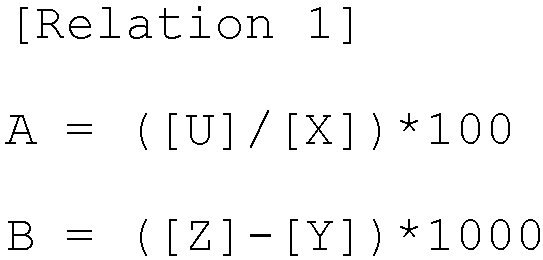
- The steel sheet may have an A value of 40 or less and a B value of 12 or more, A and B being defined by the following Relation 1:

- wherein [U] is a phase fraction value having an IQ value of 40,000 or less, [X] is a phase fraction value having an IQ value of 40,000 to 70,000, [Y] is a maximum phase fraction value having an IQ value of 40,000 or less, [Z] is a maximum phase fraction value having an IQ value of 40,000 to 70,000, and these are based on an Image Quality (IQ) Chart (35 bar graphs) obtained from EBSD measurement.
- The steel sheet may have a tensile strength of 980 MPa or more and a R value defined by the following Relation 2 of 30,000 to 60,000 MPa·%:

wherein [YS] is yield strength (MPa), [Total-El] is total elongation (%), and [HER] is a hole expansion ratio (%). - The steel sheet may have a yield strength of 600 MPa or more, an elongation of 21% or more, and a hole expansion ratio (HER) of 20% or more.
- According to another aspect of the present disclosure, a method for manufacturing a steel sheet comprises: preparing a cold rolled steel sheet comprising, by weight%: 0.15 to 0.25% of carbon (C), 1.5 to 2.5% of manganese (Mn), 1.0 to 2.0% of silicon (Si), 0.1% or less of phosphorus (P), 0.03% or less of sulfur (S), and 0.01 to 0.1% of aluminum (Al) with a remainder of iron (Fe) and other unavoidable impurities;
- performing an annealing heat treatment by heating the cold rolled steel sheet to a temperature range of 780°C to Ac3 and maintaining the temperature for 30 seconds or more;
- first cooling the annealing heat-treated steel sheet to a temperature range of 630 to 750°C at an average cooling rate of 1 to 10°C/s;
- second cooling the first cooled steel sheet to a temperature range of 180°C to Ms at an average cooling rate of 30 to 80°C/s; and
- performing reheating and overaging by heating the second cooled steel sheet to a temperature range of Ms-50 to 450°C and maintaining the temperature for 1 to 30 minutes:
Ac3 = 910-203√([C])- 15.2[Ni]+44.7[Si]+104[V]+31.5[Mo]+13.1[W] - wherein [C], [Ni], [Si], [V], [Mo], and [W] are wt% of each element,
- Ms = 539-423[C]-30.4[Mn]-7.5[Si]+30[Al]-12.1[Cr]-17.7[Ni]-7.5[Mo]
- wherein [C], [Mn], [Si], [Al], [Cr], [Ni], and [Mo] are wt% of each element.
- The cold rolled steel sheet may further comprise 0.03% or less of antimony (Sb).
- The cold rolled steel sheet may have a sum of chromium (Cr) and molybdenum (Mo) contents of 0.01% or less.
- The preparing of a cold rolled steel sheet may include:
- reheating a steel slab in a temperature range of 1100 to 1300°C;
- hot rolling the reheated slab to a finish hot rolling temperature of Ar3 or higher to obtain a hot rolled steel sheet;
- cooling the hot rolled steel sheet to a temperature of 700°C or lower and winding the steel sheet; and
- cold rolling the wound hot rolled steel sheet at a cold reduction rate of 30 to 80%.
- In the first cooling, the average cooling rate may be 2 to 5°C/s, and
in the second cooling, the average cooling rate may be 30 to 60°C/s. - As set forth above, according to an exemplary embodiment in the present disclosure, a steel sheet having excellent elongation and hole expansion ratio and also having excellent strength and a method for manufacturing the same may be provided.
-
FIG. 1 shows (a) EBSD IQ chart and (b) EBSD IQ + Phase map of Inventive Example 2. - Hereinafter, preferred exemplary embodiments of the present disclosure will be described. The exemplary embodiments of the present disclosure may be modified in various forms, and the scope of the disclosure should not be interpreted to be limited to the exemplary embodiments set forth below. These exemplary embodiments are provided in order to describe the present disclosure in more detail to those with ordinary skill in the art to which the present disclosure pertains.
- In the present disclosure, it was confirmed that all of elongation, hole expansion ratio, and strength may be secured simultaneously by controlling the content ranges of the component elements such as C, Mn, Si, P, and S as an alloy composition, and controlling particularly the conditions of heat treatment, first cooling, second cooling, reheating, and overaging among the manufacturing process conditions. As a result, the present disclosure has been completed.
- Hereinafter, the present disclosure will be described in detail.
- Hereinafter, the steel composition of the present disclosure will be described in detail.
- Unless otherwise particularly mentioned in the present disclosure, % indicating the content of each element is based on the weight.
- A steel according to an aspect of the present disclosure may comprise, by weight%: 0.15 to 0.25% of carbon (C), 1.5 to 2.5% of manganese (Mn), 1.0 to 2.0% of silicon (Si), 0.1% or less of phosphorus (P), 0.03% or less of sulfur (S), and 0.01 to 0.1% of aluminum (Al) with a remainder of iron (Fe) and other unavoidable impurities.
- Carbon (C) is an interstitial solid solution element, the most effective and important element for improving steel strength, and an element which should be necessarily added for securing martensite steel strength. In order to obtain an ultra-high strength steel satisfying the yield strength and the tensile strength targeted in the present disclosure, it is preferable add 0.15% or more, more preferably 0.18% or more, and still more preferably 0.2% or more of carbon (C). However, when the content is more than 0.25%, martensite is excessively formed during cooling due to increased hardenability, so that strength may be rapidly increased to deteriorate elongation. In addition, since an increase in carbon (C) content impairs weldability, it is preferred that the upper limit is limited to 0.25%. The upper limit may be more preferably 0.24%.
- Manganese (Mn) is an element added for securing strength. When the content of manganese (Mn) is less than 1.5%, it may be difficult to secure the level of strength required in the present disclosure. The lower limit of the manganese (Mn) content may be more preferably 1.8%, and still more preferably 2.0%. However, when the content is more than 2.5%, a Ms temperature is lowered during cooling after annealing, so that it may be difficult to secure an initial martensite structure well. Thus, it may be difficult to secure all of strength, elongation, and hole expansion ratio targeted in the present disclosure simultaneously, due to a decrease in a tempered martensite fraction in a quenching % partitioning (Q&P) process. In addition, since manganese is segregated in the thickness direction and a manganese (Mn) band is easily formed in a slab, there may be a problem of increasing occurrence of defects during a rolling process along with soft cast cracks. More preferably, the upper limit of the Manganese (Mn) content may be 2.4%.
- Silicon (Si) is a key element of a transformation induced plasticity (TRIP) steel which acts to increase a residual austenite fraction and elongation, by inhibiting precipitation of cementite. When the content of silicon (Si) is less than 1.0%, precipitation of cementite in reheating and overaging is not controlled well, and thus, a finally formed residual austenite fraction may be small or stability may be low, so that final elongation may be poor. The lower limit of the silicon (Si) content may be more preferably 1.2%. However, when the content of silicon (Si) is more than 2.0%, the physical properties of a welding area is deteriorated due to formation of liquid metal embrittlement (LME) cracks, and the surface characteristics and platability are deteriorated. The upper limit of the silicon (Si) content may be more preferably 1.8%.
- Phosphorus (P) is an impurity element included in steel and 0% is excluded considering the case of unavoidably including the element during a manufacturing process. Meanwhile, when the content of phosphorus (P) is more than 0.1%, weldability is deteriorated and brittleness of steel may occur, and thus, the upper limit may be limited to 0.1%. The upper limit may be more preferably 0.03%.
- Sulfur (S) is an impurity which is unavoidably included in steel, like P, and since it is an element to deteriorate ductility and weldability of a steel sheet, it is preferable manage the content as low as possible. Therefore, in the present disclosure, the content of sulfur (S) may be limited to 0.03% or less. More preferably, it may be limited to 0.005% or less. Meanwhile, 0% is excluded considering the case of unavoidably including the element during a manufacturing process.
- Aluminum (Al) may be added for removing oxygen in molten steel, and is an element which is effective for stabilizing residual austenite by suppressing precipitation of cementite in the reheating and overaging to stabilize, like Si. When the content of aluminum (Al) is less than 0.01%, a steel material is not sufficiently deoxidized and cleanliness of a steel material may be damaged. However, when the content of aluminum (Al) is more than 0.1%, castability of a slab is deteriorated and also a temperature required for heating a single phase region during annealing is raised, which may cause production and facility problems. More preferably, it may be limited to 0.05% or less.
- The steel of the present disclosure may include a remainder of iron (Fe) and unavoidable impurities, in addition to the composition described above. Since the unavoidable impurities may be incorporated unintentionally in a common manufacturing process, they may not be excluded. Since these impurities are known to any person skilled in the common steel manufacturing field, the entire contents are not particularly mentioned in the present specification.
- The steel according to an aspect of the present disclosure may further comprise 0.03% or less of antimony (Sb).
- Antimony (Sb) is distributed in a crystal grain boundary and delays the diffusion of oxidative elements such as Mn, Si, and Al through the crystal grain boundary, thereby suppressing oxide concentration on the surface. In addition, it has an excellent effect in suppressing coarsening of a surface concentrate due to a temperature rise and changes in a hot rolling process. However, when the content of antimony (Sb) is more than 0.03%, the effects described above are saturated, manufacturing costs are increased, and workability is deteriorated. Therefore, the antimony (Sb) may be added at 0.03% or less, and in some cases, may not be added. Since the antimony (Sb) may be grain boundary segregated and adversely affect the strength of the welding area, when it needs to be applied to a member in which welding characteristics are important as compared with other materials, the antimony (Sb) may not be added.
- The steel according to an aspect of the present disclosure may have the sum of the contents of chromium (Cr) and molybdenum (Mo) of 0.01% or less.
- Chromium (Cr) and molybdenum (Mo) are representative elements which may improve hardenability, but in the present disclosure, since a balance among strength, elongation, hole expansion ratio is important and the steel has a tensile strength grade of 980 MPa, the elements do not need to be added for the purpose of facilitating martensite formation by improving hardenability. When these elements are added, ferroalloy costs are increased, and thus, it is preferred in the present disclosure that chromium (Cr) and molybdenum (Mo) are not added for a special purpose. Therefore, in the present disclosure, the sum of the contents may be limited to 0.01% or less. Meanwhile, the lower limit may be 0.003%, considering the case of unavoidably including the elements during a manufacturing process.
- Hereinafter, the steel microstructure of the present disclosure will be described in detail.
- Unless otherwise particularly mentioned in the present disclosure, % indicating the fraction of the microstructure is based on the area.
- The steel according to an aspect of the present disclosure may comprise: 5 to 50% by area of ferrite, 35 to 80% by area of a sum of tempered martensite and bainite, 7 to 15% by area of residual austenite, and 10% by area or less of fresh martensite, as a microstructure.
- In the present disclosure 5% or more of ferrite may be comprised for improving elongation, and in order to secure both strength of a yield strength of 600 MPa or more and a hole expansion ratio of 20% or more, 35% or more of a sum of tempered martensite and bainite may be comprised. However, when more than 50% of ferrite is comprised, it may be difficult to secure the strength and hole expansion ratio to be desired in the present disclosure, and when the sum of the tempered martensite and bainite fractions is more than 80%, elongation may be insufficient. In the present disclosure, the ferrite fraction may be more preferably 10% or more. The sum of tempered martensite and bainite fractions may be more preferably 75% or less, and still more preferably 70% or less.
- By securing the tempered martensite and bainite fractions, 7 to 15% of residual austenite which is stable at room temperature may be finally included. Herein, when the residual austenite fraction is less than 7%, it may be difficult to secure the elongation level to be desired in the present disclosure. However, when the fraction is more than 15%, the safety of the residual austenite is insufficient, and it may be also difficult to secure the elongation to be desired.
- In addition, in the present disclosure, 10% or less of fresh martensite may be comprised for a steel material having strength, elongation, and hole expansion ratio which are all excellent.
- The steel according to an aspect of the present disclosure may have an A value of 40 or less and a B value of 12 or more, A and B being defined by the following Relation 1.
- In the present disclosure, in addition to define each microstructure fraction, in order to further control relationship according to the fraction of the microstructure more strictly, the following Relation 1 is suggested based on the EBSD Image Quality (IQ) value. By defining the phase fraction ratio depending on the IQ value, it may be more favorable to secure the microstructure and the physical properties to be desired in the present disclosure. In the present disclosure, as shown in the following Relation 1, in the IQ chart using 35 bar graphs, a ratio between a phase fraction value of 40,000 or less and 40,000 to 70,000 and a maximum phase fraction value of 40,000 or less and 40,000 to 70,000 may show a relative ratio of the microstructure fraction.
- When the A value defined by the following Relation 1 is more than 40, it means that a final fresh martensite fraction is higher than the bainite and tempered martensite fractions which are the key structure, which may cause problems such as a decrease in final yield strength, an increase in tensile strength, and inferior hole expansion ratio. It may be more preferably 38 or less, and still more preferably 35 or less. In addition, the lower limit may be more preferably 1. In addition, when the B value is less than 12, a final fresh martensite structure is strongly formed though the A value is good, which may also cause the problems mentioned above. It may be more preferably 13 or more, and still more preferably 15 or more. In addition, the upper limit may be more preferably 50.

- wherein [U] is a phase fraction value having an IQ value of 40,000 or less, [X] is a phase fraction value having an IQ value of 40,000 to 70,000, [Y] is a maximum phase fraction value having an IQ value of 40,000 or less, [Z] is a maximum phase fraction value having an IQ value of 40,000 to 70,000, and these are based on an Image Quality (IQ) Chart (35 bar graphs) obtained from EBSD measurement.
- Hereinafter, the method for manufacturing steel of the present disclosure will be described in detail.
- The steel according to an aspect of the present disclosure may be manufactured by heat treatment, first cooling, second cooling, reheating, and overaging of a cold rolled steel sheet satisfying the alloy composition described above, and the cold rolled steel sheet may be manufactured by reheating, hot rolling, winding, and cold rolling of a steel slab.
- A slab satisfying the alloy composition of the present disclosure may be reheated in a temperature range of 1100 to 1300°C.
- The reheating process may be performed for performing a subsequent hot rolling process well and sufficiently obtaining the target physical properties of the steel sheet. When a reheating temperature is lower than 1100°C, a problem of rapidly increased hot rolling load may occur. However, when the temperature is higher than 1300°C, a surface scale amount is excessively increased to deteriorate the yield of a material.
- The reheated slab may be hot rolled to a finish hot rolling temperature of Ar3 or higher to obtain a hot rolled steel.
- When the finish hot rolling temperature is lower than Ar3 (temperature at which austenite begins to transform into ferrite during cooling), rolling in a two-phase region of ferrite+austenite or ferrite region may be performed to form a mixed grain structure, and malfunction due to variation in a hot rolling load may be concerned.
- The hot rolled steel sheet may be cooled and wound to a temperature of 700°C or lower.
- When a winding temperature is higher than 700°C, an oxide film on the surface of a steel sheet may be excessively produced to cause defects. As the winding temperature is lower, strength of a hot rolled steel sheet is increased and a rolling load of cold rolling which is a subsequent process may be increased, but which is not a factor making actual production impossible, and the lower limit of the winding temperature is not limited in the present disclosure. In the present disclosure, an oxide layer formed on the surface of a steel sheet may be removed by pickling.
- The wound steel sheet may be cold rolled to a cold reduction rate of 30 to 80%.
- When the cold reduction rate is less than 30%, it is difficult to secure a target steel sheet thickness, and austenite production and final physical properties may be affected during an annealing heat treatment due to remaining hot rolled crystal grains. Meanwhile, when the reduction rate is more than 80%, material deviation of a final steel sheet may occur due to non-uniformity of a reduction amount rolled in the length and width directions from work hardening occurring during cold rolling, and it may be difficult to secure a target thickness due to a rolling load.
- The cold rolled steel sheet may be subjected to an annealing heat treatment of heating to a two-phase region temperature range of 780°C to Ac3 and maintaining for 30 seconds or more.
- During the heat treatment, when the steel sheet is heated to a temperature range of 780°C or higher and Ac3 or less, the elongation targeted in the present disclosure may be secured, and annealed ferrite may be partially formed in addition to residual austenite. The temperature range may be more preferably 800°C or higher, and still more preferably 880°C or lower.
Ac3 = 910-203√([C])- 15.2[Ni]+44.7[Si]+104[V]+31.5[Mo]+13.1[W]
wherein [C], [Ni], [Si], [V], [Mo], and [W] are wt% of each element. - The heat treated steel sheet may be first cooled to a temperature range of 630 to 750°C at an average cooling rate of 1 to 10°C/s.
- During the first cooling, when the average cooling rate is less than 1°C/s, it may be difficult to secure targeted strength due to production of ferrite. However, when the cooling rate is more than 10°C/s, the average cooling rate is lowered during second cooling, and it may be difficult to secure a sufficient martensite fraction. This soon leads to a decrease in a tempered martensite fraction, and it may be difficult to secure both the strength and the hole expansion ratio to be desired in the present disclosure. The lower limit of the average cooling rate may be more preferably 2°C/s, and the upper limit of the average cooling rate may be more preferably 5°C/s.
- During the first cooling, when the cooling temperature is lower than 630°C, phases such as ferrite and bainite are formed so that strength may be lowered. However, when the temperature is higher than 750°C, there may be a problem in an actual production line.
- The first cooled steel sheet may be second cooled to a temperature range of 180°C to Ms at an average cooling rate of 30 to 80°C/s.
- In order to secure the physical properties to be desired in the present disclosure, a tempered martensite structure should be secured. In order to secure the tempered martensite structure to a desired level, the steel sheet needs to be cooled to a temperature range between a martensite transformation starting temperature (Ms) and a martensite transformation finish temperature (Mf) during the second cooling, after the first cooling. In the present disclosure, it is preferable cool to a temperature of 180°C to Ms.
- When a second cooling temperature is lower than 180°C, a tempered martensite fraction is excessively increased and the residual austenite fraction may be finally decreased to deteriorate elongation. Meanwhile, when the temperature is higher than Ms, it is difficult to form a tempered martensite structure and it may be difficult to secure strength and a hole expansion ratio to be desired.
- When the average cooling rate is less than 30°C/s during the second cooling, a bainite structure may be partially formed during the second cooling from a first cooling section, but when the average cooling rate is more than 80°C/s, a shape on the surface of the steel sheet may be deteriorated due to a rapid martensite transformation rate at the time of second cooling, and a problem in material deviation in the width direction may occur. The upper limit may be more preferably 60°C/s.
Ms = 539-423[C]-30.4[Mn]-7.5[Si]+30[Al]-12.1[Cr]- 17.7[Ni]-7.5[Mo]
wherein [C], [Mn], [Si], [Al], [Cr], [Ni], and [Mo] are wt% of each element. - Reheating and overaging of heating the second cooled steel sheet to a temperature range of Ms-50 to 450°C and maintaining the temperature for 1 to 30 minutes may be performed.
- In the present disclosure, martensite formed during the second cooling which has high dislocation density and is hard is changed to tempered martensite through the reheating and the overaging, thereby improving toughness. In addition, concentration of C into residual austenite remaining from annealing occurs through securing a sufficient amount of tempered martensite and bainite transformation (partitioning). In this process, a transformation starting temperature (Ms) of C-concentrated austenite to martensite is lowered to room temperature or lower, and a large amount of residual austenite is finally formed, thereby securing the physical properties to be desired in the present disclosure. In the present disclosure, in order to sufficiently secure the partitioning effect, the reheating temperature may be limited to Ms-50 to 450°C. When the temperature range is not satisfied, it is difficult to secure the tempered martensite, bainite, and residual austenite fractions to be desired, and it may be difficult to secure the physical properties to be desired.
- When the heating maintenance time is less than 1 minute, sufficient transformation does not proceed and it is difficult to obtain the partitioning effect to be desired, and when the time is more than 30 minutes, a reheating and overaging temperature section should be very long and it takes a lot of time, so that it may be difficult to apply it to an actual production line.
- The steel of the present disclosure manufactured as such has a tensile strength of 980 MPa or more and a R value defined by the following Relation 2 of 30000 to 60000 MPa·%.
- The following Relation 2 shows relationship among yield strength, total elongation, and hole expansion ratio, and when the R value defined by Relation 2 is 30,000 to 60,000 MPa·%, both the elongation and the hole expansion ratio may be secured in the ultra-high strength steel having a tensile strength of 980 MPa or more to be desired in the present disclosure. When the R value is out of the desired range, the steel grade to be desired in the present disclosure is different or any one of the elongation and the hole expansion ratio is poor, so that it may be difficult to use the steel as a member for absorbing collision energy to be desired in the present disclosure. More preferably, the steel sheet may have the strength of 600 MPa or more, the elongation of 21% or more, and the hole expansion ratio (HER) of 20% or more.

wherein [YS] is yield strength (MPa), [Total-El] is total elongation (%), and [HER] is a hole expansion ratio (%). - Hereinafter, the present disclosure will be specifically described through the following examples. However, it should be noted that the following examples are only for describing the present disclosure in detail by illustration, and not intended to limit the right scope of the present disclosure.
- Specimens of specimen Nos. 1 to 13 in the following Table 1 were manufactured using steel slabs having the compositions of 0.2 to 0.24[C] - 1.2 to 1.8[Si] - 2.0 to 2.4[Mn] - 0.01 to 0.05[Al] (each element is its wt% and a remainder of Fe and other unavoidable impurities are included). Meanwhile, Specimen 14 had the composition of 0.2 to 0.24[C] - 1.2 to 1.8[Si] - 2.0 to 2.4[Mn] - 0.01 to 0.05[Al] - 0.1[Mo] in which the Mo content was out of the range of the present disclosure, and Specimen 15 had the composition of 0.2 to 0.24 [C] - 1.2 to 1.8 [Si] - 1.0 to 1.4 [Mn] - 0.01 to 0.05 [Al] in which the Mo content was out of the range of the present disclosure, and thus, the specimens were manufactured using the steel slabs having the compositions out of the range suggested in the present disclosure.
- Steel sheets were manufactured by reheating, hot rolling, winding, cold rolling, heat treatment, first cooling, second cooling, reheating, and overaging under the conditions of the following Table 1 as the manufacturing method. At this time, the reheating was performed at 1100 to 1300°C and the finish hot rolling was performed in the temperature range of 850 to 950°C. In addition, the winding was performed in the temperature range of 200 to 700°C, and the cold rolling was performed at a cold reduction rate of 45 to 65%. During annealing, a heat treatment was performed for 100 to 300 seconds, and an overaging time of 1 to 30 minutes was applied. In the following Table 1, the Ac3 temperature of Specimens 1 to 13 was 882°C and the Ms temperature thereof was 367°C, the Ac3 temperature of Specimen 14 was 885°C and the Ms temperature thereof was 366°C, and the Ac3 temperature of Specimen 15 was 882°C and the Ms temperature thereof was 399°C.
[Table 1] Speci men No. Annealing heat treatment First cooling Second cooling Reheating and overaging Temperature (°C) Temperature (°C) Average cooling rate (°C/s) Temperature (°C) Average cooling rate (°C/s) Temperature (°C) 1 770 650 2.2 200 41.9 400 2 840 600 4.0 250 32.6 400 3 810 600 3.5 400 18.6 400 4 810 650 2.7 400 23.3 400 5 810 650 2.7 150 46.5 400 6 810 600 3.5 200 37.2 400 7 840 680 2.7 280 37.2 470 8 810 650 2.7 200 41.9 460 9 810 760 0.8 200 52.1 400 10 840 650 3.2 350 27.9 400 11 810 650 2.7 200 41.9 400 12 840 680 2.7 280 37.2 400 13 840 680 2.7 250 37.2 400 14 840 680 2.7 250 37.2 400 15 840 650 3.2 250 37.2 400 - In the following Table 2, the microstructure and the physical properties of the manufactured steel sheets are shown. In the microstructure, the 1/4 point of the thickness of the steel sheet was measured using X-ray diffraction (XRD) and electron backscattered diffraction (EBSD) to show a phase fraction. The sum of ferrite (F), bainite (B), and tempered martensite (TM) and the phase fraction of fresh martensite (FM) and austenite (γ) were calculated using the IQ chart through EBSD. In addition, yield strength (YS), tensile strength (TS), total elongation (total-EL), and uniform elongation (uEL) were measured by working a steel sheet into a JIS standard (gauge length width×length: 25×50 mm, total specimen length: 200 to 260 mm) and then performing a tensile test under the conditions of a test speed of 28 mm/min. The hole expansion ratio (HER) was measured according to the ISO 16330 standard, and the hole was shear worked with a clearance of 12% using a punch having a diameter of 10 mm. In addition, the A and B values of Relation 1 were calculated from the measured physical properties.
[Table 2] Speci men No. Microstructure (by area%) F B+TM FM γ EBSD IQ value Relation 1 U X Y z A value B value 1 60 24 9 7 0.158 0.263 0.028 0.038 60 10 2 38 43 11 8 0.090 0.235 0.025 0.036 38 11 3 50 34 10 6 0.127 0.267 0.030 0.044 48 14 4 40 40 11 9 0.166 0.356 0.036 0.069 47 33 5 40 57 1 2 0.298 0.383 0.070 0.055 78 -15 6 50 30 13 7 0.100 0.254 0.033 0.036 39 3 7 19 64 11 6 0.129 0.352 0.035 0.045 37 10 8 40 44 12 4 0.104 0.269 0.027 0.037 39 10 9 36 54 5 5 0.243 0.365 0.065 0.051 67 -14 10 27 54 11 8 0.192 0.271 0.039 0.032 71 -7 11 40 46 5 9 0.078 0.276 0.020 0.042 28 22 12 19 65 4 12 0.081 0.406 0.029 0.057 20 28 13 19 68 2 11 0.086 0.341 0.033 0.051 25 18 14 4 80 9 7 0.075 0.452 0.035 0.062 17 27 15 58 30 4 8 0.072 0.259 0.032 0.054 28 22


wherein [U] is a phase fraction having an IQ value of 40,000 or less, [X] is a phase fraction having an IQ value of 40,000 to 70,000, [Y] is a maximum phase fraction value having an IQ value of 40,000 or less, [Z] is a maximum phase fraction value having an IQ value of 40,000 to 70,000, and these are based on an Image Quality (IQ) Chart (35 bar graphs) obtained from EBSD measurement.[Table 3] Specimen No. Physical properties Classification YS (MPa) TS (MPa) Total-EL (%) uEL (%) HER (%) Relation 2 (MPa. %) 1 537 1031 22 17 8 20406 Comparative Example 1 2 599 1062 21 15 9 23361 Comparative Example 2 3 589 1050 20 14 12 25916 Comparative Example 3 4 580 1058 21 15 14 28420 Comparative Example 4 5 894 1186 11 6 36 74202 Comparative Example 5 6 580 1064 20 15 9 22040 Comparative Example 6 7 644 1122 17 12 5 17388 Comparative Example 7 8 582 1125 18 12 8 19788 Comparative Example 8 9 798 1096 20 13 31 65436 Comparative Example 9 10 617 1085 19 14 11 25297 Comparative Example 10 11 673 1053 23 16 23 46437 Inventive Example 1 12 709 1057 21 15 23 47503 Inventive Example 2 13 756 1073 24 15 25 55944 Inventive Example 3 14 921 1149 15 10 38 83811 Comparative Example 11 15 432 930 25 19 22 29808 Comparative Example 12 
wherein [YS] is yield strength (MPa), [Total-El] is total elongation (%), and [HER] is a hole expansion ratio (%). - As shown in Table 2, in Inventive Examples 1 to 3 satisfying the alloy composition and manufacturing conditions of the present disclosure, the microstructure characteristics suggested in the present disclosure were satisfied, and the physical properties to be desired in the present disclosure were secured.
-
FIG. 1 shows (a) EBSD IQ chart and (b) EBSD IQ + Phase map of Inventive Example 2 of the present disclosure. (a) shows the fraction value according to the IQ value as a chart, and the boundary value of each phase for defining Relation 1 may be confirmed. (b) shows the residual austenite fraction, and the residual austenite fraction level of the inventive steel may be confirmed. - However, Comparative Example 1 which did not satisfy the annealing conditions of the present disclosure did not satisfy the microstructure fraction and Relations 2 and 3. In particular, the ferrite fraction was excessive and the strength was poor.
- In Comparative Examples 2 and 6 which did not satisfy the first cooling temperature suggested in the present disclosure, a soft phase was formed during the first cooling, so that tempered martensite and bainite transformation did not proceed well during the second cooling and overaging processes, and the final fresh martensite fraction was increased to deteriorate yield strength and hole expansion ratio.
- In Comparative Example 3 which did not satisfy the second cooling conditions as well as the first cooling conditions, only bainite transformation was promoted without tempered martensite transformation, and a final fresh martensite fraction was increased and a residual austenite fraction was decreased due to an overall decrease in transformation fraction. As a result, the desired level of physical properties was not secured.
- Comparative Examples 4 and 5 did not satisfy the second cooling conditions of the present disclosure, and in Comparative Example 4, the cooling end temperature was excessively high so that the average cooling rate was insufficient, and thus, only bainite transformation proceeded without tempered martensite and final fresh martensite was increased, and as a result, the desired physical properties were not secured. In addition, in Comparative Example 5, the cooling end temperature was excessively low, so that a tempered martensite fraction was excessive, and final residual austenite was hardly secured to have very poor elongation.
- In Comparative Examples 7 and 8 which did not satisfy the overheating and overaging conditions, bainite transformation did not proceed well during the overaging, so that the fresh martensite fraction was increased. As a result, the residual austenite fraction was decreased, so that the finally desired physical properties were not secured.
- In Comparative Example 9 which did not satisfy the cooling conditions of the present disclosure, there may be equipment problems such as equipment lifespan. In addition, there was almost no ferrite and bainite transformation during cooling, and a final residual austenite fraction was insufficient due to the tempered martensite and subsequent bainite transformation during reheating and overaging, so that the desired physical properties were not secured.
- In Comparative Example 10 which had insufficient second average cooling rate, sufficient martensite and bainite transformation did not proceed, so that the fresh martensite fraction of the final microstructure was increased. As a result, the desired level of physical properties was not secured.
- In Comparative Example 11 in which the sum of Cr and Mo contents was more than the content suggested in the present disclosure, and due to the addition of the hardenability element described above, a soft phase (such as ferrite and bainite) was slowly transformed during annealing, so that the tempered martensite was formed as a main structured phase. As a result, the overall strength was excellent, but elongation was insufficient due to the lack of the soft phase.
- In Comparative Example 12 in which the Mn content was insufficient, the strength was poor, so that the desired level of physical properties were not secured.
- Hereinabove, the present disclosure has been described in detail by the exemplary embodiments, but other exemplary embodiments having different forms are possible. Therefore, the technical spirit and scope of the claims set forth below are not limited by the exemplary embodiments.
Claims (11)
- A steel sheet comprising, by weight%: 0.15 to 0.25% of carbon (C), 1.5 to 2.5% of manganese (Mn), 1.0 to 2.0% of silicon (Si), 0.1% or less of phosphorus (P), 0.03% or less of sulfur (S), and 0.01 to 0.1% of aluminum (Al) with a remainder of iron (Fe) and other unavoidable impurities,
wherein the steel sheet comprises 5 to 50% by area of ferrite, 35 to 80% by area of a sum of tempered martensite and bainite, 7 to 15% by area of residual austenite, and 10% by area or less of fresh martensite, as a microstructure. - The steel sheet of claim 1, wherein the steel sheet further comprise 0.03% or less of antimony (Sb).
- The steel sheet of claim 1, wherein the steel sheet has a sum of chromium (Cr) and molybdenum (Mo) contents of 0.01% or less.
- The steel sheet of claim 1, wherein the steel sheet has an A value of 40 or less and a B value of 12 or more, A and B being defined by the following Relation 1:
- The steel sheet of claim 1, wherein the steel sheet has a tensile strength of 980 MPa or more and a R value defined by the following Relation 2 of 30,000 to 60,000 MPa·%:

- The steel sheet of claim 5, wherein the steel sheet has a yield strength of 600 MPa or more, an elongation of 21% or more, and a hole expansion ratio (HER) of 20% or more.
- A method for manufacturing a steel sheet, the method comprising:preparing a cold rolled steel sheet comprising, by weight%: 0.15 to 0.25% of carbon (C), 1.5 to 2.5% of manganese (Mn), 1.0 to 2.0% of silicon (Si), 0.1% or less of phosphorus (P), 0.03% or less of sulfur (S), and 0.01 to 0.1% of aluminum (Al) with a remainder of iron (Fe) and other unavoidable impurities,performing an annealing heat treatment by heating the cold rolled steel sheet to a temperature range of 780°C to Ac3 and maintaining the temperature for 30 seconds or more;first cooling the annealing heat-treated steel sheet to a temperature range of 630 to 750°C at an average cooling rate of 1 to 10°C/s;second cooling the first cooled steel sheet to a temperature range of 180°C to Ms at an average cooling rate of 30 to 80°C/s; andperforming reheating and overaging by heating the second cooled steel sheet to a temperature range of Ms-50 to 450°C and maintaining the temperature for 1 to 30 minutes:
Ac3 = 910-203√([C])- 15.2[Ni]+44.7[Si]+104[V]+31.5[Mo]+13.1[W] wherein [C], [Ni], [Si], [V], [Mo], and [W] are wt% of each element,Ms = 539-423[C]-30.4[Mn]-7.5[Si]+30[Al]-12.1[Cr]-17.7[Ni]-7.5[Mo]wherein [C], [Mn], [Si], [Al], [Cr], [Ni], and [Mo] are wt% of each element. - The method for manufacturing a steel sheet of claim 7, wherein the cold rolled steel sheet further comprises 0.03% or less of antimony (Sb).
- The method for manufacturing a steel sheet of claim 7, wherein the cold rolled steel sheet has a sum of chromium (Cr) and molybdenum (Mo) contents of 0.01% or less.
- The method for manufacturing a steel sheet of claim 7, wherein the preparing of a cold rolled steel sheet comprises:reheating a steel slab in a temperature range of 1100 to 1300°C;hot rolling the reheated slab to a finish hot rolling temperature of Ar3 or higher to obtain a hot rolled steel sheet;cooling the hot rolled steel sheet to a temperature of 700°C or lower and winding the steel sheet; andcold rolling the wound hot rolled steel sheet at a cold reduction rate of 30 to 80%.
- The method for manufacturing a steel sheet of claim 7,wherein in the first cooling, the average cooling rate is 2 to 5°C/s, andin the second cooling, the average cooling rate is 30 to 60°C/s.
Applications Claiming Priority (2)
| Application Number | Priority Date | Filing Date | Title |
|---|---|---|---|
| KR1020220070001A KR20230170171A (en) | 2022-06-09 | 2022-06-09 | Ultra high strength steel sheet having excellent elongation and hole expansion ratio and method for manufacturing the same |
| PCT/KR2023/007938 WO2023239198A1 (en) | 2022-06-09 | 2023-06-09 | Ultra high strength steel sheet having excellent elongation and hole expansion ratio and method for manufacturing same |
Publications (2)
| Publication Number | Publication Date |
|---|---|
| EP4538407A1 true EP4538407A1 (en) | 2025-04-16 |
| EP4538407A4 EP4538407A4 (en) | 2025-10-15 |
Family
ID=89118713
Family Applications (1)
| Application Number | Title | Priority Date | Filing Date |
|---|---|---|---|
| EP23820133.9A Pending EP4538407A4 (en) | 2022-06-09 | 2023-06-09 | ULTRA HIGH STRENGTH STEEL SHEET HAVING EXCELLENT ELONGATION AND HOLE EXPANSION RATIO AND MANUFACTURING METHOD THEREOF |
Country Status (6)
| Country | Link |
|---|---|
| EP (1) | EP4538407A4 (en) |
| JP (1) | JP2025517811A (en) |
| KR (1) | KR20230170171A (en) |
| CN (1) | CN119256108A (en) |
| MX (1) | MX2024014919A (en) |
| WO (1) | WO2023239198A1 (en) |
Family Cites Families (14)
| Publication number | Priority date | Publication date | Assignee | Title |
|---|---|---|---|---|
| JP2528387B2 (en) | 1990-12-29 | 1996-08-28 | 日本鋼管株式会社 | Manufacturing method of ultra high strength cold rolled steel sheet with good formability and strip shape |
| JP2003073773A (en) * | 2001-08-31 | 2003-03-12 | Kobe Steel Ltd | High-strength steel sheet superior in workability and fatigue characteristic, and manufacturing method therefor |
| JP4188609B2 (en) * | 2001-02-28 | 2008-11-26 | 株式会社神戸製鋼所 | High-strength steel sheet with excellent workability and method for producing the same |
| JP3887308B2 (en) | 2002-12-27 | 2007-02-28 | 新日本製鐵株式会社 | High strength and high ductility hot dip galvanized steel sheet and its manufacturing method |
| JP4445365B2 (en) * | 2004-10-06 | 2010-04-07 | 新日本製鐵株式会社 | Manufacturing method of high-strength thin steel sheet with excellent elongation and hole expandability |
| JP6291289B2 (en) * | 2013-03-06 | 2018-03-14 | 株式会社神戸製鋼所 | High-strength cold-rolled steel sheet excellent in steel sheet shape and shape freezing property and method for producing the same |
| WO2017109540A1 (en) * | 2015-12-21 | 2017-06-29 | Arcelormittal | Method for producing a high strength steel sheet having improved ductility and formability, and obtained steel sheet |
| KR102276741B1 (en) * | 2018-09-28 | 2021-07-13 | 주식회사 포스코 | High strength cold-rolled steel sheet and galvanized steel sheet having high hole expansion ratio and manufacturing method thereof |
| CN113166839B (en) * | 2019-02-06 | 2023-02-10 | 日本制铁株式会社 | Hot-dip galvanized steel sheet and method for producing same |
| US12467108B2 (en) * | 2019-07-29 | 2025-11-11 | Posco Co., Ltd | High-strength steel sheet and manufacturing method thereof |
| WO2021019947A1 (en) * | 2019-07-30 | 2021-02-04 | Jfeスチール株式会社 | High-strength steel sheet and method for manufacturing same |
| KR102927086B1 (en) * | 2019-12-20 | 2026-02-11 | 타타 스틸 이즈무이덴 베.뷔. | Hot rolled high strength steel strip with high hole expansion ratio |
| US20230243007A1 (en) * | 2020-06-12 | 2023-08-03 | Arcelormittal | Cold rolled and heat-treated steel sheet and method of manufacturing thereof |
| KR20240098513A (en) * | 2022-12-21 | 2024-06-28 | 주식회사 포스코 | Ultra high strength steel sheet having excellent elongation and hole expansion ratio and method for manufacturing the same |
-
2022
- 2022-06-09 KR KR1020220070001A patent/KR20230170171A/en active Pending
-
2023
- 2023-06-09 WO PCT/KR2023/007938 patent/WO2023239198A1/en not_active Ceased
- 2023-06-09 EP EP23820133.9A patent/EP4538407A4/en active Pending
- 2023-06-09 CN CN202380045976.8A patent/CN119256108A/en active Pending
- 2023-06-09 JP JP2024569814A patent/JP2025517811A/en active Pending
-
2024
- 2024-11-29 MX MX2024014919A patent/MX2024014919A/en unknown
Also Published As
| Publication number | Publication date |
|---|---|
| WO2023239198A1 (en) | 2023-12-14 |
| CN119256108A (en) | 2025-01-03 |
| EP4538407A4 (en) | 2025-10-15 |
| MX2024014919A (en) | 2025-01-09 |
| KR20230170171A (en) | 2023-12-19 |
| JP2025517811A (en) | 2025-06-10 |
Similar Documents
| Publication | Publication Date | Title |
|---|---|---|
| EP2937433B1 (en) | High-strength cold-rolled steel sheet with low yield ratio and method for manufacturing the same | |
| EP4450670A1 (en) | Ultra-high strength steel sheet having excellent bendability, and manufacturing method therefor | |
| KR102109265B1 (en) | Ultra high strength and high ductility steel sheet having excellent yield ratio and manufacturing method for the same | |
| EP1870483B1 (en) | Hot-rolled steel sheet, method for production thereof and workedd article formed therefrom | |
| EP2604715A1 (en) | High-strength cold-rolled steel sheet having excellent workability and impact resistance, and method for manufacturing same | |
| EP2617850A1 (en) | High-strength hot rolled steel sheet having excellent toughness and method for producing same | |
| KR102469278B1 (en) | Steel material for hot press forming, hot pressed member and manufacturing method theerof | |
| CN110832100B (en) | Steel material for tailor-welded blanks and method for producing hot stamped parts using the same | |
| CN115461482B (en) | Steel sheet, component, and method for manufacturing same | |
| EP4265781A1 (en) | Ultra-high-strength cold-rolled steel sheet having excellent yield strength and bending properties and method for manufacturing same | |
| EP4265764A1 (en) | High strength steel sheet having excellent workability, and method for manufacturing same | |
| EP3964600A1 (en) | Ultra-high strength steel sheet having excellent shear workability and method for manufacturing same | |
| US20230120827A1 (en) | High strength steel sheet and method of producing same | |
| KR20210080664A (en) | Steel sheet having excellent ductility and workablity, and method for manufacturing thereof | |
| KR20240098513A (en) | Ultra high strength steel sheet having excellent elongation and hole expansion ratio and method for manufacturing the same | |
| JP5860345B2 (en) | High-strength cold-rolled steel sheet with small variation in mechanical properties and method for producing the same | |
| KR20230056822A (en) | Ultra-high strength steel sheet having excellent ductility and mathod of manufacturing the same | |
| EP4265763A1 (en) | High strength steel sheet having excellent workability and method for manufacturing same | |
| EP4442851A1 (en) | Ultra-high strength cold-rolled steel sheet having excellent elongation and manufacturing method thereof | |
| KR102747790B1 (en) | Cold-rolled steel sheet and method of manufacturing the same | |
| EP4431630A1 (en) | Ultrahigh-strength steel sheet with excellent bendability and stretch flangeability, and manufacturing method therefor | |
| JPWO2018168618A1 (en) | High strength cold rolled steel sheet and method of manufacturing the same | |
| EP4079913A1 (en) | Steel for hot forming, hot-formed member, and manufacturing methods therefor | |
| JP7853633B1 (en) | Steel sheet, automotive parts containing the same, and method for manufacturing steel sheet | |
| EP4357476A1 (en) | Ultra high strength steel sheet having high yield ratio and excellent bendability and method of manufacturing same |
Legal Events
| Date | Code | Title | Description |
|---|---|---|---|
| STAA | Information on the status of an ep patent application or granted ep patent |
Free format text: STATUS: THE INTERNATIONAL PUBLICATION HAS BEEN MADE |
|
| PUAI | Public reference made under article 153(3) epc to a published international application that has entered the european phase |
Free format text: ORIGINAL CODE: 0009012 |
|
| STAA | Information on the status of an ep patent application or granted ep patent |
Free format text: STATUS: REQUEST FOR EXAMINATION WAS MADE |
|
| 17P | Request for examination filed |
Effective date: 20241210 |
|
| AK | Designated contracting states |
Kind code of ref document: A1 Designated state(s): AL AT BE BG CH CY CZ DE DK EE ES FI FR GB GR HR HU IE IS IT LI LT LU LV MC ME MK MT NL NO PL PT RO RS SE SI SK SM TR |
|
| REG | Reference to a national code |
Ref country code: DE Ref legal event code: R079 Free format text: PREVIOUS MAIN CLASS: C22C0038040000 Ipc: C22C0038020000 |
|
| DAV | Request for validation of the european patent (deleted) | ||
| DAX | Request for extension of the european patent (deleted) | ||
| A4 | Supplementary search report drawn up and despatched |
Effective date: 20250911 |
|
| RIC1 | Information provided on ipc code assigned before grant |
Ipc: C22C 38/02 20060101AFI20250905BHEP Ipc: C22C 38/04 20060101ALI20250905BHEP Ipc: C22C 38/06 20060101ALI20250905BHEP Ipc: C22C 38/22 20060101ALI20250905BHEP Ipc: C22C 38/34 20060101ALI20250905BHEP Ipc: C22C 38/38 20060101ALI20250905BHEP Ipc: C22C 38/60 20060101ALI20250905BHEP Ipc: C21D 8/02 20060101ALI20250905BHEP Ipc: C21D 9/46 20060101ALI20250905BHEP |