EP4538350A1 - Method and apparatus for treating a fluidization gas of a pyrolysis, gasification or torrefaction reactor - Google Patents
Method and apparatus for treating a fluidization gas of a pyrolysis, gasification or torrefaction reactor Download PDFInfo
- Publication number
- EP4538350A1 EP4538350A1 EP24205254.6A EP24205254A EP4538350A1 EP 4538350 A1 EP4538350 A1 EP 4538350A1 EP 24205254 A EP24205254 A EP 24205254A EP 4538350 A1 EP4538350 A1 EP 4538350A1
- Authority
- EP
- European Patent Office
- Prior art keywords
- reactor
- gas
- recirculated
- product
- recirculated gas
- Prior art date
- Legal status (The legal status is an assumption and is not a legal conclusion. Google has not performed a legal analysis and makes no representation as to the accuracy of the status listed.)
- Pending
Links
Images

Classifications
-
- C—CHEMISTRY; METALLURGY
- C10—PETROLEUM, GAS OR COKE INDUSTRIES; TECHNICAL GASES CONTAINING CARBON MONOXIDE; FUELS; LUBRICANTS; PEAT
- C10B—DESTRUCTIVE DISTILLATION OF CARBONACEOUS MATERIALS FOR PRODUCTION OF GAS, COKE, TAR, OR SIMILAR MATERIALS
- C10B49/00—Destructive distillation of solid carbonaceous materials by direct heating with heat-carrying agents including the partial combustion of the solid material to be treated
- C10B49/16—Destructive distillation of solid carbonaceous materials by direct heating with heat-carrying agents including the partial combustion of the solid material to be treated with moving solid heat-carriers in divided form
- C10B49/20—Destructive distillation of solid carbonaceous materials by direct heating with heat-carrying agents including the partial combustion of the solid material to be treated with moving solid heat-carriers in divided form in dispersed form
- C10B49/22—Destructive distillation of solid carbonaceous materials by direct heating with heat-carrying agents including the partial combustion of the solid material to be treated with moving solid heat-carriers in divided form in dispersed form according to the "fluidised bed" technique
-
- C—CHEMISTRY; METALLURGY
- C10—PETROLEUM, GAS OR COKE INDUSTRIES; TECHNICAL GASES CONTAINING CARBON MONOXIDE; FUELS; LUBRICANTS; PEAT
- C10B—DESTRUCTIVE DISTILLATION OF CARBONACEOUS MATERIALS FOR PRODUCTION OF GAS, COKE, TAR, OR SIMILAR MATERIALS
- C10B47/00—Destructive distillation of solid carbonaceous materials with indirect heating, e.g. by external combustion
- C10B47/18—Destructive distillation of solid carbonaceous materials with indirect heating, e.g. by external combustion with moving charge
- C10B47/22—Destructive distillation of solid carbonaceous materials with indirect heating, e.g. by external combustion with moving charge in dispersed form
- C10B47/24—Destructive distillation of solid carbonaceous materials with indirect heating, e.g. by external combustion with moving charge in dispersed form according to the "fluidised bed" technique
-
- C—CHEMISTRY; METALLURGY
- C10—PETROLEUM, GAS OR COKE INDUSTRIES; TECHNICAL GASES CONTAINING CARBON MONOXIDE; FUELS; LUBRICANTS; PEAT
- C10B—DESTRUCTIVE DISTILLATION OF CARBONACEOUS MATERIALS FOR PRODUCTION OF GAS, COKE, TAR, OR SIMILAR MATERIALS
- C10B49/00—Destructive distillation of solid carbonaceous materials by direct heating with heat-carrying agents including the partial combustion of the solid material to be treated
- C10B49/02—Destructive distillation of solid carbonaceous materials by direct heating with heat-carrying agents including the partial combustion of the solid material to be treated with hot gases or vapours, e.g. hot gases obtained by partial combustion of the charge
- C10B49/04—Destructive distillation of solid carbonaceous materials by direct heating with heat-carrying agents including the partial combustion of the solid material to be treated with hot gases or vapours, e.g. hot gases obtained by partial combustion of the charge while moving the solid material to be treated
- C10B49/08—Destructive distillation of solid carbonaceous materials by direct heating with heat-carrying agents including the partial combustion of the solid material to be treated with hot gases or vapours, e.g. hot gases obtained by partial combustion of the charge while moving the solid material to be treated in dispersed form
- C10B49/10—Destructive distillation of solid carbonaceous materials by direct heating with heat-carrying agents including the partial combustion of the solid material to be treated with hot gases or vapours, e.g. hot gases obtained by partial combustion of the charge while moving the solid material to be treated in dispersed form according to the "fluidised bed" technique
-
- C—CHEMISTRY; METALLURGY
- C10—PETROLEUM, GAS OR COKE INDUSTRIES; TECHNICAL GASES CONTAINING CARBON MONOXIDE; FUELS; LUBRICANTS; PEAT
- C10B—DESTRUCTIVE DISTILLATION OF CARBONACEOUS MATERIALS FOR PRODUCTION OF GAS, COKE, TAR, OR SIMILAR MATERIALS
- C10B53/00—Destructive distillation, specially adapted for particular solid raw materials or solid raw materials in special form
- C10B53/02—Destructive distillation, specially adapted for particular solid raw materials or solid raw materials in special form of cellulose-containing material
-
- C—CHEMISTRY; METALLURGY
- C10—PETROLEUM, GAS OR COKE INDUSTRIES; TECHNICAL GASES CONTAINING CARBON MONOXIDE; FUELS; LUBRICANTS; PEAT
- C10B—DESTRUCTIVE DISTILLATION OF CARBONACEOUS MATERIALS FOR PRODUCTION OF GAS, COKE, TAR, OR SIMILAR MATERIALS
- C10B53/00—Destructive distillation, specially adapted for particular solid raw materials or solid raw materials in special form
- C10B53/07—Destructive distillation, specially adapted for particular solid raw materials or solid raw materials in special form of solid raw materials consisting of synthetic polymeric materials, e.g. tyres
-
- C—CHEMISTRY; METALLURGY
- C10—PETROLEUM, GAS OR COKE INDUSTRIES; TECHNICAL GASES CONTAINING CARBON MONOXIDE; FUELS; LUBRICANTS; PEAT
- C10B—DESTRUCTIVE DISTILLATION OF CARBONACEOUS MATERIALS FOR PRODUCTION OF GAS, COKE, TAR, OR SIMILAR MATERIALS
- C10B57/00—Other carbonising or coking processes; Features of destructive distillation processes in general
- C10B57/14—Features of low-temperature carbonising processes
-
- C—CHEMISTRY; METALLURGY
- C10—PETROLEUM, GAS OR COKE INDUSTRIES; TECHNICAL GASES CONTAINING CARBON MONOXIDE; FUELS; LUBRICANTS; PEAT
- C10J—PRODUCTION OF PRODUCER GAS, WATER-GAS, SYNTHESIS GAS FROM SOLID CARBONACEOUS MATERIAL, OR MIXTURES CONTAINING THESE GASES; CARBURETTING AIR OR OTHER GASES
- C10J3/00—Production of combustible gases containing carbon monoxide from solid carbonaceous fuels
-
- C—CHEMISTRY; METALLURGY
- C10—PETROLEUM, GAS OR COKE INDUSTRIES; TECHNICAL GASES CONTAINING CARBON MONOXIDE; FUELS; LUBRICANTS; PEAT
- C10K—PURIFYING OR MODIFYING THE CHEMICAL COMPOSITION OF COMBUSTIBLE GASES CONTAINING CARBON MONOXIDE
- C10K1/00—Purifying combustible gases containing carbon monoxide
- C10K1/02—Dust removal
- C10K1/026—Dust removal by centrifugal forces
-
- C—CHEMISTRY; METALLURGY
- C10—PETROLEUM, GAS OR COKE INDUSTRIES; TECHNICAL GASES CONTAINING CARBON MONOXIDE; FUELS; LUBRICANTS; PEAT
- C10K—PURIFYING OR MODIFYING THE CHEMICAL COMPOSITION OF COMBUSTIBLE GASES CONTAINING CARBON MONOXIDE
- C10K1/00—Purifying combustible gases containing carbon monoxide
- C10K1/04—Purifying combustible gases containing carbon monoxide by cooling to condense non-gaseous materials
Definitions
- the application relates to a method defined in claim 1 and an apparatus defined in claim 9 for treating a fluidization gas in a thermal conversion process.
- Different products can be produced from different raw materials in pyrolysis, torrefaction and gasification processes in which a fluidization agent is used. Further, fluidized bed reactors can be used for producing pyrolysis and gasification products.
- steam, nitrogen or other suitable gas can be used as fluidization agents.
- some by-product gas flows may be used as the fluidization agent.
- the by-product gas flows may include impurities or oxygen, which may cause process safety or operational issues, or loss of yield of products to a process.
- the objective is to solve the above problems. Further, the objective is to disclose a new-type method and apparatus for treating a recirculated fluidization gas in a process, e.g. in a pyrolysis, torrefaction or gasification process. Further, the objective is to upgrade the recirculated fluidization gas before a reactor. Further, the objective is to decrease oxygen in the recirculated fluidization gas.
- the method for treating a fluidization gas in a thermal conversion process comprises recirculating a recirculated gas in the thermal conversion process comprising a reactor in which a feed is treated for forming a product, feeding the recirculated gas formed from the product and/or a non-condensible gas of the product as the fluidization gas to the reactor, and treating the recirculated gas by a catalytic conversion using a catalyst before the reactor or in the reactor for decreasing oxygen content in the recirculated gas.
- the apparatus for treating a fluidization gas in a thermal conversion process comprises at least one fluidized reactor in which a feed is treated for forming a product, at least one recirculation means for recirculating a recirculated gas, formed from the product and/or a non-condensible gas of the product, in the thermal conversion process and for feeding the recirculated gas as the fluidization gas to the reactor, and at least one catalyst for treating the recirculated gas by a catalytic conversion before the reactor or in the reactor for decreasing oxygen content in the recirculated gas.
- a recirculated gas is recirculated in the thermal conversion process which comprises at least a fluidized reactor.
- a feed is treated for forming a product.
- the recirculated gas is recirculated such that the recirculated gas is formed from the product and/or a non-condensible gas of the product and the recirculated gas is fed as the fluidization gas to the reactor.
- the recirculated gas is heated, and the recirculated gas is treated by a catalytic conversion using a catalyst before the reactor or in the reactor for decreasing oxygen content in the recirculated gas before the treatment of the feed in the reactor.
- An apparatus for treating a fluidization gas in a thermal conversion process comprises at least one fluidized reactor in which a feed is treated for forming a product. Further, the apparatus comprises at least one recirculation means for recirculating a recirculated gas, which is formed from the product and/or a non-condensible gas of the product, in the thermal conversion process and for feeding the recirculated gas as the fluidization gas to the reactor. Further, the apparatus comprises at least one heating device for heating the recirculated gas and at least one catalyst for treating the recirculated gas by a catalytic conversion before the reactor or in the reactor for decreasing oxygen content in the recirculated gas before the treatment of the feed in the reactor.
- FIG. 1 and Fig. 2 Some embodiments of the method and the apparatus are shown in Fig. 1 and Fig. 2 .
- the feed means any feed or feed material which is treated in a reactor of the process, e.g. in a pyrolysis, torrefaction or gasification reactor.
- the feed is formed from raw material, which may comprise wood-based material, biomass, woody biomass, agrobiomass, waste material, plastic-based material, plastic waste, residual material, side stream material, other suitable material or their combinations. Further, the feed can comprise also other materials.
- the feed may comprise one or more components.
- the feed component may be recycled material, residue material, waste material or virgin material or their combinations. In one embodiment, the feed is formed from recycled material, waste material, residue material and their combinations.
- the thermal conversion process is a pyrolysis, gasification or torrefaction. In one embodiment, the thermal conversion process is a pyrolysis or torrefaction. In one embodiment, the reactor is a pyrolysis reactor, gasification reactor or torrefaction reactor. In one embodiment, the reactor is a pyrolysis reactor or torrefaction reactor. In one embodiment, the reactor is a pyrolysis reactor, e.g. a fast pyrolysis reactor or a slow pyrolysis reactor. In one embodiment, the reactor is a torrefaction reactor, e.g. a low temperature pyrolysis reactor. Any suitable fluidized reactor can be used in the process. In one embodiment, the reactor is a fluidized bed reactor.
- the reactor is a fluidized bed reactor in which any suitable bed material may be used.
- the bed material is selected from the group comprising inert fluidizable material, inert granular material, e.g. sand, or fluidizable material with catalytic properties, e.g. engineered catalyst material or naturally occurring material with catalytic properties, or their combinations.
- the reactor is a fluidized bed reactor in which sand is used as a bed material.
- the feed can be fed using the feeder to the reactor.
- Any suitable feeder can be used in feeding.
- the feeder is a screw feeder, extruder, gravimetric feeder, pneumatic feeder or their combinations.
- the product means any product which is formed by the thermal conversion process.
- the product is in a gaseous form.
- the product is a pyrolysis product, torrefaction product or gasification product.
- the product is a pyrolysis product.
- the product is a torrefaction product.
- the product is a gasification product.
- the feed is treated in the reactor.
- the treatment in the reactor is carried out at low temperature of below 600 °C, in one embodiment temperature of below 500 °C, in one embodiment temperature of below 450 °C, and in one embodiment temperature of below 400 °C.
- the treatment is carried out at temperature of 200 - 600 °C, in one embodiment temperature of 250 - 450 °C, and in one embodiment temperature of 300 - 400 °C.
- the feed may be treated by a pyrolysis.
- the pyrolysis is carried out at low temperature of 300 - 600 °C, in one embodiment temperature of 400 - 500 °C.
- the feed may be treated by a torrefaction.
- the torrefaction is carried out at low temperature of 200 - 450 °C, in one embodiment temperature of 250 - 400 °C, and in one embodiment temperature of 300 - 350 °C.
- the recirculated gas means any recirculated gas which can be recirculated in the thermal conversion process and which can be used as a fluidization gas in the reactor of the thermal conversion process.
- the recirculated gas may comprise oxygen.
- the recirculated gas comprises at least a non-condensible gas of the product, e.g. from a non-condensible gas fraction of the product.
- the recirculated gas is a non-condensable gas.
- the non-condensable gas comprises at least CO and hydrocarbons, and optionally NO x , CO 2 and/or N 2 .
- the recirculated gas is a non-condensable gas from a condenser in which the product is condensed after the reactor. In one embodiment, the recirculated gas is formed from the product, e.g. separating a gas fraction or non-condensable gas fraction. In one embodiment, the recirculated gas is formed from the product in the condenser. In one embodiment, the recirculated gas is formed from a non-condensible gas of the product in the condenser. In one embodiment, the recirculated gas comprises oxygen. In one embodiment, an oxygen content in the recirculated gas is ⁇ 0.5 % by weight, in one embodiment ⁇ 1.0 by weight.
- the oxygen content of the recirculated gas comprising oxygen increases in circulation flows and the oxygen can accumulate in the process.
- the oxygen content may reduce yields of desired components in the product. Further, the oxygen may cause problems in the thermal conversion treatment of the reactor, and also in the process. Therefore, the oxygen content of the recirculated gas must be decreased before the treatment in the reactor.
- the recirculation means may comprise pipes, lines, compressors and other suitable devices and equipments for recirculating the recirculated gas.
- the product is condensed after the reactor, preferably to form a liquid product.
- the product is supplied to at least one condenser in which the product is cooled and condensed.
- a non-condensable gas is formed in the condenser and separated from the liquid product.
- the product is supplied from the reactor to a condenser to form a liquid product, and a non-condensable gas is separated from the liquid product, and at least a part of the non-condensable gas is recirculated as the recirculated gas to the reactor.
- the apparatus comprises at least one condenser for condensing the product.
- the apparatus comprises at least one condenser to which the product is supplied from the reactor to form a liquid product and in which non-condensable gas is separated from the liquid product, and the recirculation means is arranged to recirculate at least a part of the non-condensable gas as the recirculated gas to the reactor.
- a non-condensable gas is separated from the product, such as from the liquid product.
- the apparatus comprises at least one separating device for separating a non-condensable gas from the product. Any suitable separating device can be used for separating the non-condensable gas from the product.
- the apparatus comprises at least one combustor in which residuals and/or solid material can be combusted and/or a material, such as a bed material, of the reactor can be treated.
- the apparatus comprises the combustor in which sand of the reactor can be treated.
- the apparatus comprises the combustor, which is a boiler, e.g. a fluidized bed boiler. Any suitable combustor, e.g. fluidized bed combustor, can be used in the process.
- a non-condensable gas is separated from the product and is supplied to a combustor in which residuals are combusted and a material, e.g. a bed material, of the reactor is treated, and at least a part of the non-condensable gas is recirculated as the recirculated gas to the reactor before feeding to the combustor.
- the apparatus comprises at least one separating device for separating non-condensable gas from the product, and a combustor to which a part of the non-condensable gas is supplied and in which residuals are combusted and a material, e.g. a bed material, of the reactor is treated, and the recirculation means is arranged to recirculate at least a part of the non-condensable gas as the recirculated gas to the reactor before feeding to the combustor.
- the recirculated gas is treated by the catalytic conversion such that oxygen of the recirculated gas reacts at least with hydrocarbons to form carbon dioxide and water. In one embodiment, the recirculated gas is treated by the catalytic conversion such that oxygen of the recirculated gas reacts with hydrocarbons and carbon monoxide to form carbon dioxide and water. Then oxygen content of the recirculated gas can be decreased.
- the catalytic conversion is performed at temperature of below 400 °C, in one embodiment at temperature of below 350 °C, and in one embodiment at temperature of below 300 °C. In one embodiment, the catalytic conversion is performed at temperature of 200 - 400 °C, in one embodiment at temperature of 230 - 350 °C, and in one embodiment at temperature of 250 - 300 °C.
- the catalytic conversion is performed using a suitable catalyst, e.g. a catalyst comprising platinum, palladium and/or rhodium or other suitable catalyst component.
- a suitable catalyst e.g. a catalyst comprising platinum, palladium and/or rhodium or other suitable catalyst component.
- the catalytic conversion is performed using a solid catalyst.
- the catalyst can be arranged to a catalytic element, e.g. inside the element or on a surface of the element.
- the catalytic conversion is performed in a catalytic conversion device comprising the catalyst.
- the apparatus comprises a catalytic conversion device comprising the catalyst. Any suitable catalytic conversion device can be used for the catalytic conversion.
- the catalytic conversion device is a catalytic converter comprising a solid catalyst.
- oxidation and reduction reactions is carried out in the catalytic conversion device.
- NO x and CO can be converted into N 2 and CO 2
- hydrocarbons and CO together with oxygen can be converted into CO 2 and H 2 O.
- the catalytic conversion is performed before the reactor. In one embodiment, the catalytic conversion is performed before the reactor in a catalytic conversion device comprising the catalyst. In one embodiment, the apparatus comprises a catalytic conversion device comprising the catalyst for performing the catalytic conversion, and the catalytic conversion device is arranged before the reactor.
- the apparatus comprises at least one line, e.g. line, channel or the like, for recirculating the recirculated gas, preferably for recirculating to the reactor.
- the catalytic conversion is performed in connection with the line.
- the apparatus comprises at least one line for recirculating the recirculated gas, and the catalytic conversion device is placed in the line.
- the apparatus comprises at least one line for recirculating the non-condensable gas from the condenser or separating device to the reactor.
- the catalytic conversion is performed in the reactor such that the catalyst is mixed with a bed material of the reactor.
- the catalyst is arranged in the reactor as a mixture with a bed material of the reactor.
- the recirculated gas is heated before the catalytic conversion.
- the recirculated gas may be heated using the heating device.
- the heating device can be a heat exchanger, burner, duct burner, indirect heating device, direct heat exchange device, e.g. electrical heater or heating with a solid heat carrier, or their combinations.
- the heating is carried out by using heated sand, e.g. by an indirect heating.
- the heating is carried out before the catalytic conversion.
- the heating device is a separate heating device which is arranged before the catalytic conversion, preferably before the catalytic conversion device.
- the heating is carried out in connection with catalytic conversion, e.g. in the catalytic conversion device.
- the heating device is a part of the catalytic conversion device, and preferably the heating is carried out before the catalytic conversion. In one embodiment, the heating is carried out by utilizing a catalytic element of the catalytic conversion device, e.g. via the catalytic element such that the catalyst is arranged on the surface of the catalytic element and a heating medium for heating the recirculated gas is supplied from an inside of the catalytic element to the gas.
- the recirculated gas is heated to a temperature which is suitable to cause, e.g. to start or initiate, a catalytic reaction.
- the recirculated gas is heated to a minimum temperature of the catalyst in which the catalyst can work.
- the recirculated gas is heated after the condensation, such as after the condenser, to increase a temperature of the recirculated gas before the catalytic conversion. In the condensation the recirculated gas may be typically condensed to temperature of 50 °C or below 50 °C.
- temperature is adjusted during the catalytic conversion, preferably to prevent an increase of temperature, e.g. too high, during the catalytic conversion.
- the apparatus comprises an adjusting device or a control device for adjusting temperature during the catalytic conversion.
- the apparatus comprises a control device comprising the heating device.
- the apparatus comprises a control device comprising the heating device and adjusting device for heating and adjusting the temperature.
- the heat of the recirculated gas can be utilized in the reactor. In one embodiment, the heat of the recirculated gas from the heating is supplied into the reactor. In one embodiment, the heat of the recirculated gas from the catalytic conversion is supplied into the reactor.
- the apparatus comprises at least one cyclone for separating at least solid material from the product after the reactor.
- the solid material e.g. solids, char, bed material and/or sand
- the solid material is supplied to a combustor in which the solid material is treated and/or combusted and the material of the reactor can be heated. Further, an excess energy can be produced in the combustor.
- the heated material e.g. sand or bed material, can be recirculated from the combustor to the reactor.
- a part of the non-condensable gas from the condenser or separating device are recirculated to the combustor.
- the method and apparatus are based on a continuous process.
- the oxygen content of the recirculated gas can be decreased during the process to reduce risk of safety hazards and to improve the overall efficiency of the process by decreased detrimental effect on product yields.
- the oxygen content of the recirculated gas is low, the yield of desired product components can be improved, and undesired reactions, e.g. oxidation or burning, can be avoided during the process. This increases efficiency in the process, and problems can be avoided in the process.
- the oxygen or cumulated oxygen content may cause safety problems or process problems.
- the recirculated gas can be used also in low temperature processes and reactors when the oxygen content is decreased before the reactor. Further, also other impurities can be decreased at the same time.
- the method and apparatus offer a possibility to treat the recirculated gas easily, and energy- and cost-effectively in the thermal conversion process.
- the present invention provides an industrially applicable, simple and affordable way to produce fluidization gases from different by-product flows and/or non-condensable flows.
- the method and apparatus are easy and simple to realize in connection with production processes.
- Fig. 1 and Fig. 2 present some embodiments of the process for producing a product and for treating a fluidization gas.
- the apparatus of Figs. 1 and 2 comprises a fluidized reactor (2) for treating, e.g. by pyrolyzing, a feed (1) to form a product (3), e.g. a pyrolysis product, and a feeder for feeding the feed (1) to the reactor.
- a fluidization gas (15) is supplied to the reactor from a bottom of the reactor.
- the apparatus of Figs. 1 and 2 comprises a recirculation means, such as lines, for recirculating a recirculated gas (10), which is formed from a non-condensible gas of the product, and for feeding the recirculated gas as the fluidization gas (15) to the reactor.
- the apparatus comprises a condenser (8) for condensing the product (3) and for forming a liquid product (9) and the non-condensable gas.
- the non-condensable gas is used as the recirculated gas (10).
- the apparatus may comprise a separating device for separating the non-condensable gas after the condenser.
- the apparatus of Figs. 1 and 2 comprises a catalytic conversion device (12) comprising a catalyst for treating the recirculated gas (10) by a catalytic conversion before the reactor for decreasing oxygen content in the recirculated gas before the reactor, and apparatus may comprise a heating device (11), e.g. heat exchanger or duct burner, for heating the recirculated gas before the catalytic conversion.
- a heating device e.g. heat exchanger or duct burner
- the apparatus of Fig. 2 comprises a cyclone (4) for separating solid material (5), e.g. solids, sand, char or other residuals, from the product (3) after the reactor (2).
- the apparatus comprises a combustor (6) where the solid material (5) is treated and combusted together with non-condensable gas (10a), and simultaneously the material of the reactor may be heated.
- the combustor may be a fluidized bed boiler or other suitable combustor.
- the heated material (7) can be recirculated from the combustor to the reactor (2).
- air (13) can be supplied to the combustor (6), and steam (14) can be discharged from the combustor.
- the product (3) is supplied from the cyclone (4) to the condenser (8).
- a liquid product (9) is recovered from the condenser, and the non-condensable gas (10) is separated.
- a part of the non-condensable gas is supplied as a gas flow (10a) to the combustor (6) and a part of the non-condensable gas is recirculated as a recirculated gas (10b) to the catalytic conversion, and after that the recirculated gas is supplied as the fluidization gas (15) to the reactor (2).
- the recirculated gas (10b) is heated before the catalytic conversion.
- a product is formed in a fluidized reactor and a fluidization gas is treated in the process according to Fig. 2 .
- a feed (1) which includes woody biomass, is fed to a fluidized pyrolysis reactor (2), and a fluidization gas (15) is supplied to the reactor from a bottom of the reactor.
- the feed is pyrolyzed at temperature of temperature of 300 - 450 °C to form a pyrolysis product (3) .
- At least sand and/or char (5) are separated from the pyrolysis product (3) in a cyclone (4) after the pyrolysis reactor.
- the residuals, sand and/or char are treated and combusted together with non-condensable gas (10a) in a combustor (6) which is a fluidized bed boiler such that the residuals, char and non-condensable gas burn and thus heat the sand.
- the hot sand (7) is recirculated to the pyrolysis reactor, i.e. the material of the pyrolysis reactor is continuously circulated.
- Air (13) can be supplied to the combustor (6), and steam (14), e.g. high pressure steam, can be discharged from the combustor.
- the pyrolysis product vapor (3) is supplied to a condenser (8) in which the pyrolysis product vapor is cooled and condensed.
- a pyrolysis liquid product (9) is recovered from the condenser.
- Non-condensable gas (10) is separated and supplied as a gas flow (10a) to the combustor (6) and a part of the non-condensable gas (10) is recirculated as a recirculated gas (10b).
- the recirculated gas (10b) is treated by a catalytic conversion in a converter (12), and after that the recirculated gas is supplied as the fluidization gas (15) to the reactor (2).
- the recirculated gas (10b) is heated, e.g. in a heating device (11) such as a heat exchanger, before the catalytic conversion.
- a heating device (11) such as a heat exchanger
- reactors, combustors, condensers, separating devices, converters and heating devices, and other devices and equipments of the process used in Figs. 1 and 2 are known per se in the art, and therefore they are not described in any more detail in this context.
- the method and apparatus are suitable in different embodiments for treating different recirculated gases and for producing desired products from different raw materials.
Landscapes
- Chemical & Material Sciences (AREA)
- Engineering & Computer Science (AREA)
- Oil, Petroleum & Natural Gas (AREA)
- Organic Chemistry (AREA)
- Combustion & Propulsion (AREA)
- Materials Engineering (AREA)
- Dispersion Chemistry (AREA)
- Chemical Kinetics & Catalysis (AREA)
- General Chemical & Material Sciences (AREA)
- Devices And Processes Conducted In The Presence Of Fluids And Solid Particles (AREA)
Abstract
The invention relates to a method and an apparatus for treating a fluidization gas in a thermal conversion process. A recirculated gas (10) is recirculated in the thermal conversion process which comprises at least a fluidized reactor (2), in which a feed (1) is treated for forming a product, such that the recirculated gas is formed from the product (3) and/or a non-condensible gas of the product and the recirculated gas (10) is fed as the fluidization gas (15) to the reactor. The recirculated gas is heated, and the recirculated gas is treated by a catalytic conversion using a catalyst before the reactor or in the reactor for decreasing oxygen content in the recirculated gas.
Description
- The application relates to a method defined in
claim 1 and an apparatus defined inclaim 9 for treating a fluidization gas in a thermal conversion process. - Different products can be produced from different raw materials in pyrolysis, torrefaction and gasification processes in which a fluidization agent is used. Further, fluidized bed reactors can be used for producing pyrolysis and gasification products.
- Typically, steam, nitrogen or other suitable gas can be used as fluidization agents. Further, some by-product gas flows may be used as the fluidization agent. However, the by-product gas flows may include impurities or oxygen, which may cause process safety or operational issues, or loss of yield of products to a process.
- The objective is to solve the above problems. Further, the objective is to disclose a new-type method and apparatus for treating a recirculated fluidization gas in a process, e.g. in a pyrolysis, torrefaction or gasification process. Further, the objective is to upgrade the recirculated fluidization gas before a reactor. Further, the objective is to decrease oxygen in the recirculated fluidization gas.
- The method and apparatus are characterized by what are presented in the claims.
- The method for treating a fluidization gas in a thermal conversion process comprises recirculating a recirculated gas in the thermal conversion process comprising a reactor in which a feed is treated for forming a product, feeding the recirculated gas formed from the product and/or a non-condensible gas of the product as the fluidization gas to the reactor, and treating the recirculated gas by a catalytic conversion using a catalyst before the reactor or in the reactor for decreasing oxygen content in the recirculated gas.
- The apparatus for treating a fluidization gas in a thermal conversion process comprises at least one fluidized reactor in which a feed is treated for forming a product, at least one recirculation means for recirculating a recirculated gas, formed from the product and/or a non-condensible gas of the product, in the thermal conversion process and for feeding the recirculated gas as the fluidization gas to the reactor, and at least one catalyst for treating the recirculated gas by a catalytic conversion before the reactor or in the reactor for decreasing oxygen content in the recirculated gas.
- The accompanying drawings, which are included to provide a further understanding of the invention and constitute a part of this specification, illustrate some embodiments of the invention and together with the description help to explain the principles of the invention. In the drawings:
-
Fig. 1 is a flow chart illustration of a process according to one embodiment, and -
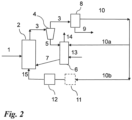
Fig. 2 is a flow chart illustration of a process according to another embodiment. - In a method for treating a fluidization gas in a thermal conversion process, a recirculated gas is recirculated in the thermal conversion process which comprises at least a fluidized reactor. In the reactor a feed is treated for forming a product. The recirculated gas is recirculated such that the recirculated gas is formed from the product and/or a non-condensible gas of the product and the recirculated gas is fed as the fluidization gas to the reactor. The recirculated gas is heated, and the recirculated gas is treated by a catalytic conversion using a catalyst before the reactor or in the reactor for decreasing oxygen content in the recirculated gas before the treatment of the feed in the reactor.
- An apparatus for treating a fluidization gas in a thermal conversion process comprises at least one fluidized reactor in which a feed is treated for forming a product. Further, the apparatus comprises at least one recirculation means for recirculating a recirculated gas, which is formed from the product and/or a non-condensible gas of the product, in the thermal conversion process and for feeding the recirculated gas as the fluidization gas to the reactor. Further, the apparatus comprises at least one heating device for heating the recirculated gas and at least one catalyst for treating the recirculated gas by a catalytic conversion before the reactor or in the reactor for decreasing oxygen content in the recirculated gas before the treatment of the feed in the reactor.
- Some embodiments of the method and the apparatus are shown in
Fig. 1 andFig. 2 . - In this context, the feed means any feed or feed material which is treated in a reactor of the process, e.g. in a pyrolysis, torrefaction or gasification reactor. The feed is formed from raw material, which may comprise wood-based material, biomass, woody biomass, agrobiomass, waste material, plastic-based material, plastic waste, residual material, side stream material, other suitable material or their combinations. Further, the feed can comprise also other materials. The feed may comprise one or more components. The feed component may be recycled material, residue material, waste material or virgin material or their combinations. In one embodiment, the feed is formed from recycled material, waste material, residue material and their combinations.
- In one embodiment, the thermal conversion process is a pyrolysis, gasification or torrefaction. In one embodiment, the thermal conversion process is a pyrolysis or torrefaction. In one embodiment, the reactor is a pyrolysis reactor, gasification reactor or torrefaction reactor. In one embodiment, the reactor is a pyrolysis reactor or torrefaction reactor. In one embodiment, the reactor is a pyrolysis reactor, e.g. a fast pyrolysis reactor or a slow pyrolysis reactor. In one embodiment, the reactor is a torrefaction reactor, e.g. a low temperature pyrolysis reactor. Any suitable fluidized reactor can be used in the process. In one embodiment, the reactor is a fluidized bed reactor. In one embodiment, the reactor is a fluidized bed reactor in which any suitable bed material may be used. In one embodiment, the bed material is selected from the group comprising inert fluidizable material, inert granular material, e.g. sand, or fluidizable material with catalytic properties, e.g. engineered catalyst material or naturally occurring material with catalytic properties, or their combinations. In one embodiment, the reactor is a fluidized bed reactor in which sand is used as a bed material.
- In one embodiment, the feed can be fed using the feeder to the reactor. Any suitable feeder can be used in feeding. In one embodiment, the feeder is a screw feeder, extruder, gravimetric feeder, pneumatic feeder or their combinations.
- In this context, the product means any product which is formed by the thermal conversion process. In one embodiment, the product is in a gaseous form. In one embodiment, the product is a pyrolysis product, torrefaction product or gasification product. In one embodiment, the product is a pyrolysis product. In one embodiment, the product is a torrefaction product. In one embodiment, the product is a gasification product.
- The feed is treated in the reactor. In one embodiment, the treatment in the reactor is carried out at low temperature of below 600 °C, in one embodiment temperature of below 500 °C, in one embodiment temperature of below 450 °C, and in one embodiment temperature of below 400 °C. In one embodiment, the treatment is carried out at temperature of 200 - 600 °C, in one embodiment temperature of 250 - 450 °C, and in one embodiment temperature of 300 - 400 °C. In one embodiment, the feed may be treated by a pyrolysis. In one embodiment, the pyrolysis is carried out at low temperature of 300 - 600 °C, in one embodiment temperature of 400 - 500 °C. In one embodiment, the feed may be treated by a torrefaction. In one embodiment, the torrefaction is carried out at low temperature of 200 - 450 °C, in one embodiment temperature of 250 - 400 °C, and in one embodiment temperature of 300 - 350 °C.
- In this context, the recirculated gas means any recirculated gas which can be recirculated in the thermal conversion process and which can be used as a fluidization gas in the reactor of the thermal conversion process. Preferably, the recirculated gas may comprise oxygen. In one embodiment, the recirculated gas comprises at least a non-condensible gas of the product, e.g. from a non-condensible gas fraction of the product. In one embodiment, the recirculated gas is a non-condensable gas. In one embodiment, the non-condensable gas comprises at least CO and hydrocarbons, and optionally NOx, CO2 and/or N2. In one embodiment, the recirculated gas is a non-condensable gas from a condenser in which the product is condensed after the reactor. In one embodiment, the recirculated gas is formed from the product, e.g. separating a gas fraction or non-condensable gas fraction. In one embodiment, the recirculated gas is formed from the product in the condenser. In one embodiment, the recirculated gas is formed from a non-condensible gas of the product in the condenser. In one embodiment, the recirculated gas comprises oxygen. In one embodiment, an oxygen content in the recirculated gas is ≥ 0.5 % by weight, in one embodiment ≥ 1.0 by weight. If the recirculated gas comprising oxygen is used as a fluidization gas, e.g. in a reactor with low temperature treatment, the oxygen content increases in circulation flows and the oxygen can accumulate in the process. The oxygen content may reduce yields of desired components in the product. Further, the oxygen may cause problems in the thermal conversion treatment of the reactor, and also in the process. Therefore, the oxygen content of the recirculated gas must be decreased before the treatment in the reactor.
- Any suitable recirculation means can be used in the process. In one embodiment, the recirculation means may comprise pipes, lines, compressors and other suitable devices and equipments for recirculating the recirculated gas.
- In one embodiment, the product is condensed after the reactor, preferably to form a liquid product. In one embodiment, the product is supplied to at least one condenser in which the product is cooled and condensed. In one embodiment a non-condensable gas is formed in the condenser and separated from the liquid product. In one embodiment, the product is supplied from the reactor to a condenser to form a liquid product, and a non-condensable gas is separated from the liquid product, and at least a part of the non-condensable gas is recirculated as the recirculated gas to the reactor. In one embodiment, the apparatus comprises at least one condenser for condensing the product. In one embodiment, the apparatus comprises at least one condenser to which the product is supplied from the reactor to form a liquid product and in which non-condensable gas is separated from the liquid product, and the recirculation means is arranged to recirculate at least a part of the non-condensable gas as the recirculated gas to the reactor.
- In one embodiment, a non-condensable gas is separated from the product, such as from the liquid product. In one embodiment, the apparatus comprises at least one separating device for separating a non-condensable gas from the product. Any suitable separating device can be used for separating the non-condensable gas from the product.
- In one embodiment, the apparatus comprises at least one combustor in which residuals and/or solid material can be combusted and/or a material, such as a bed material, of the reactor can be treated. In one embodiment, the apparatus comprises the combustor in which sand of the reactor can be treated. In one embodiment, the apparatus comprises the combustor, which is a boiler, e.g. a fluidized bed boiler. Any suitable combustor, e.g. fluidized bed combustor, can be used in the process.
- In one embodiment, a non-condensable gas is separated from the product and is supplied to a combustor in which residuals are combusted and a material, e.g. a bed material, of the reactor is treated, and at least a part of the non-condensable gas is recirculated as the recirculated gas to the reactor before feeding to the combustor. In one embodiment, the apparatus comprises at least one separating device for separating non-condensable gas from the product, and a combustor to which a part of the non-condensable gas is supplied and in which residuals are combusted and a material, e.g. a bed material, of the reactor is treated, and the recirculation means is arranged to recirculate at least a part of the non-condensable gas as the recirculated gas to the reactor before feeding to the combustor.
- In one embodiment, the recirculated gas is treated by the catalytic conversion such that oxygen of the recirculated gas reacts at least with hydrocarbons to form carbon dioxide and water. In one embodiment, the recirculated gas is treated by the catalytic conversion such that oxygen of the recirculated gas reacts with hydrocarbons and carbon monoxide to form carbon dioxide and water. Then oxygen content of the recirculated gas can be decreased.
- In one embodiment, the catalytic conversion is performed at temperature of below 400 °C, in one embodiment at temperature of below 350 °C, and in one embodiment at temperature of below 300 °C. In one embodiment, the catalytic conversion is performed at temperature of 200 - 400 °C, in one embodiment at temperature of 230 - 350 °C, and in one embodiment at temperature of 250 - 300 °C.
- In one embodiment, the catalytic conversion is performed using a suitable catalyst, e.g. a catalyst comprising platinum, palladium and/or rhodium or other suitable catalyst component. In one embodiment, the catalytic conversion is performed using a solid catalyst. In one embodiment, the catalyst can be arranged to a catalytic element, e.g. inside the element or on a surface of the element.
- In one embodiment, the catalytic conversion is performed in a catalytic conversion device comprising the catalyst. In one embodiment, the apparatus comprises a catalytic conversion device comprising the catalyst. Any suitable catalytic conversion device can be used for the catalytic conversion. In one embodiment, the catalytic conversion device is a catalytic converter comprising a solid catalyst. In one embodiment, oxidation and reduction reactions is carried out in the catalytic conversion device. In one embodiment, NOx and CO can be converted into N2 and CO2, and hydrocarbons and CO together with oxygen can be converted into CO2 and H2O.
- In one embodiment, the catalytic conversion is performed before the reactor. In one embodiment, the catalytic conversion is performed before the reactor in a catalytic conversion device comprising the catalyst. In one embodiment, the apparatus comprises a catalytic conversion device comprising the catalyst for performing the catalytic conversion, and the catalytic conversion device is arranged before the reactor.
- In one embodiment, the apparatus comprises at least one line, e.g. line, channel or the like, for recirculating the recirculated gas, preferably for recirculating to the reactor. In one embodiment, the catalytic conversion is performed in connection with the line. In one embodiment, the apparatus comprises at least one line for recirculating the recirculated gas, and the catalytic conversion device is placed in the line. In one embodiment, the apparatus comprises at least one line for recirculating the non-condensable gas from the condenser or separating device to the reactor.
- In one embodiment, the catalytic conversion is performed in the reactor such that the catalyst is mixed with a bed material of the reactor. In one embodiment, the catalyst is arranged in the reactor as a mixture with a bed material of the reactor.
- In one embodiment, the recirculated gas is heated before the catalytic conversion. The recirculated gas may be heated using the heating device. In one embodiment, the heating device can be a heat exchanger, burner, duct burner, indirect heating device, direct heat exchange device, e.g. electrical heater or heating with a solid heat carrier, or their combinations. In one embodiment, the heating is carried out by using heated sand, e.g. by an indirect heating. In one embodiment, the heating is carried out before the catalytic conversion. In one embodiment, the heating device is a separate heating device which is arranged before the catalytic conversion, preferably before the catalytic conversion device. In one embodiment, the heating is carried out in connection with catalytic conversion, e.g. in the catalytic conversion device. In one embodiment, the heating device is a part of the catalytic conversion device, and preferably the heating is carried out before the catalytic conversion. In one embodiment, the heating is carried out by utilizing a catalytic element of the catalytic conversion device, e.g. via the catalytic element such that the catalyst is arranged on the surface of the catalytic element and a heating medium for heating the recirculated gas is supplied from an inside of the catalytic element to the gas.
- In one embodiment, the recirculated gas is heated to a temperature which is suitable to cause, e.g. to start or initiate, a catalytic reaction. In one embodiment, the recirculated gas is heated to a minimum temperature of the catalyst in which the catalyst can work. In one embodiment, the recirculated gas is heated after the condensation, such as after the condenser, to increase a temperature of the recirculated gas before the catalytic conversion. In the condensation the recirculated gas may be typically condensed to temperature of 50 °C or below 50 °C.
- In one embodiment, temperature is adjusted during the catalytic conversion, preferably to prevent an increase of temperature, e.g. too high, during the catalytic conversion. In one embodiment, the apparatus comprises an adjusting device or a control device for adjusting temperature during the catalytic conversion. In one embodiment, the apparatus comprises a control device comprising the heating device. In one embodiment, the apparatus comprises a control device comprising the heating device and adjusting device for heating and adjusting the temperature.
- In one embodiment, the heat of the recirculated gas can be utilized in the reactor. In one embodiment, the heat of the recirculated gas from the heating is supplied into the reactor. In one embodiment, the heat of the recirculated gas from the catalytic conversion is supplied into the reactor.
- In one embodiment, at least solid material, e.g. residual material, material of the reactor and/or bed material, is separated from the product after the reactor. In one embodiment, the apparatus comprises at least one cyclone for separating at least solid material from the product after the reactor. In one embodiment, the solid material, e.g. solids, char, bed material and/or sand, is separated by the cyclone from the product. In one embodiment, the solid material, e.g. solids, bed material, sand and/or char, is supplied to a combustor in which the solid material is treated and/or combusted and the material of the reactor can be heated. Further, an excess energy can be produced in the combustor. The heated material, e.g. sand or bed material, can be recirculated from the combustor to the reactor. In one embodiment, a part of the non-condensable gas from the condenser or separating device are recirculated to the combustor.
- In one embodiment, the method and apparatus are based on a continuous process.
- Thanks to the invention, the oxygen content of the recirculated gas can be decreased during the process to reduce risk of safety hazards and to improve the overall efficiency of the process by decreased detrimental effect on product yields. When the oxygen content of the recirculated gas is low, the yield of desired product components can be improved, and undesired reactions, e.g. oxidation or burning, can be avoided during the process. This increases efficiency in the process, and problems can be avoided in the process. The oxygen or cumulated oxygen content may cause safety problems or process problems. Further, the recirculated gas can be used also in low temperature processes and reactors when the oxygen content is decreased before the reactor. Further, also other impurities can be decreased at the same time.
- The method and apparatus offer a possibility to treat the recirculated gas easily, and energy- and cost-effectively in the thermal conversion process. The present invention provides an industrially applicable, simple and affordable way to produce fluidization gases from different by-product flows and/or non-condensable flows. The method and apparatus are easy and simple to realize in connection with production processes.
-
Fig. 1 andFig. 2 present some embodiments of the process for producing a product and for treating a fluidization gas. - The apparatus of
Figs. 1 and2 comprises a fluidized reactor (2) for treating, e.g. by pyrolyzing, a feed (1) to form a product (3), e.g. a pyrolysis product, and a feeder for feeding the feed (1) to the reactor. A fluidization gas (15) is supplied to the reactor from a bottom of the reactor. - The apparatus of
Figs. 1 and2 comprises a recirculation means, such as lines, for recirculating a recirculated gas (10), which is formed from a non-condensible gas of the product, and for feeding the recirculated gas as the fluidization gas (15) to the reactor. The apparatus comprises a condenser (8) for condensing the product (3) and for forming a liquid product (9) and the non-condensable gas. The non-condensable gas is used as the recirculated gas (10). Further, the apparatus may comprise a separating device for separating the non-condensable gas after the condenser. - Further, the apparatus of
Figs. 1 and2 comprises a catalytic conversion device (12) comprising a catalyst for treating the recirculated gas (10) by a catalytic conversion before the reactor for decreasing oxygen content in the recirculated gas before the reactor, and apparatus may comprise a heating device (11), e.g. heat exchanger or duct burner, for heating the recirculated gas before the catalytic conversion. - Further, the apparatus of
Fig. 2 comprises a cyclone (4) for separating solid material (5), e.g. solids, sand, char or other residuals, from the product (3) after the reactor (2). Also, the apparatus comprises a combustor (6) where the solid material (5) is treated and combusted together with non-condensable gas (10a), and simultaneously the material of the reactor may be heated. The combustor may be a fluidized bed boiler or other suitable combustor. The heated material (7) can be recirculated from the combustor to the reactor (2). Further, air (13) can be supplied to the combustor (6), and steam (14) can be discharged from the combustor. - In the apparatus of
Fig. 2 , the product (3) is supplied from the cyclone (4) to the condenser (8). A liquid product (9) is recovered from the condenser, and the non-condensable gas (10) is separated. A part of the non-condensable gas is supplied as a gas flow (10a) to the combustor (6) and a part of the non-condensable gas is recirculated as a recirculated gas (10b) to the catalytic conversion, and after that the recirculated gas is supplied as the fluidization gas (15) to the reactor (2). The recirculated gas (10b) is heated before the catalytic conversion. - In this example, a product is formed in a fluidized reactor and a fluidization gas is treated in the process according to
Fig. 2 . - A feed (1), which includes woody biomass, is fed to a fluidized pyrolysis reactor (2), and a fluidization gas (15) is supplied to the reactor from a bottom of the reactor. The feed is pyrolyzed at temperature of temperature of 300 - 450 °C to form a pyrolysis product (3) .
- At least sand and/or char (5) are separated from the pyrolysis product (3) in a cyclone (4) after the pyrolysis reactor. The residuals, sand and/or char are treated and combusted together with non-condensable gas (10a) in a combustor (6) which is a fluidized bed boiler such that the residuals, char and non-condensable gas burn and thus heat the sand. The hot sand (7) is recirculated to the pyrolysis reactor, i.e. the material of the pyrolysis reactor is continuously circulated. Air (13) can be supplied to the combustor (6), and steam (14), e.g. high pressure steam, can be discharged from the combustor.
- From the cyclone (4) the pyrolysis product vapor (3) is supplied to a condenser (8) in which the pyrolysis product vapor is cooled and condensed. A pyrolysis liquid product (9) is recovered from the condenser. Non-condensable gas (10) is separated and supplied as a gas flow (10a) to the combustor (6) and a part of the non-condensable gas (10) is recirculated as a recirculated gas (10b). The recirculated gas (10b) is treated by a catalytic conversion in a converter (12), and after that the recirculated gas is supplied as the fluidization gas (15) to the reactor (2). The recirculated gas (10b) is heated, e.g. in a heating device (11) such as a heat exchanger, before the catalytic conversion. During the catalytic conversion hydrocarbons and carbon monoxide react with oxygen to form carbon dioxide and water at temperature of 250 - 300 °C in the converter.
- The reactors, combustors, condensers, separating devices, converters and heating devices, and other devices and equipments of the process used in
Figs. 1 and2 are known per se in the art, and therefore they are not described in any more detail in this context. - The method and apparatus are suitable in different embodiments for treating different recirculated gases and for producing desired products from different raw materials.
- The invention is not limited merely to the examples referred to above; instead many variations are possible within the scope of the inventive idea defined by the claims.
Claims (15)
- A method for treating a fluidization gas in a thermal conversion process, characterized in that the method comprises- recirculating a recirculated gas in the thermal conversion process which comprises at least a fluidized reactor, in which a feed is treated for forming a product, such that the recirculated gas is formed from the product and/or a non-condensible gas of the product and the recirculated gas is fed as the fluidization gas to the reactor, and- heating the recirculated gas, and treating the recirculated gas by a catalytic conversion using a catalyst before the reactor or in the reactor for decreasing oxygen content in the recirculated gas.
- The method according to claim 1, char- acterized in that the recirculated gas is treated by the catalytic conversion such that oxygen of the recirculated gas reacts with hydrocarbons and carbon monoxide to form carbon dioxide and water.
- The method according to claim 1 or 2, characterized in that the catalytic conversion is performed at temperature of 250 - 300 °C.
- The method according to any one of claims 1 to 3, characterized in that the thermal conversion process is a pyrolysis, gasification or torrefaction.
- The method according to any one of claims 1 to 4, characterized in that the recirculated gas is non-condensable gas.
- The method according to any one of claims 1 to 5, characterized in that the product is supplied from the reactor to a condenser to form a liquid product, and non-condensable gas is separated from the liquid product, and at least a part of the non-condensable gas is recirculated as the recirculated gas to the reactor.
- The method according any one of claims 1 to 6, characterized in that non-condensable gas is separated from the product and is supplied to a combustor in which residuals are combusted and a material of the reactor is treated, and at least a part of the non-condensable gas is recirculated as the recirculated gas to the reactor.
- The method according to any one of claims 1 to 7, characterized in that the catalytic conversion is performed before the reactor in a catalytic conversion device comprising the catalyst.
- An apparatus for treating a fluidization gas in a thermal conversion process, characterized in that the apparatus comprises- at least one fluidized reactor (2) in which a feed (1) is treated for forming a product (3), and at least one recirculation means for recirculating a recirculated gas (10), which is formed from the product (3) and/or a non-condensible gas of the product, in the thermal conversion process and for feeding the recirculated gas as the fluidization gas (15) to the reactor, and- at least one heating device for heating the recirculated gas, and at least one catalyst for treating the recirculated gas by a catalytic conversion before the reactor or in the reactor for decreasing oxygen content in the recirculated gas.
- The apparatus according to claim 9, characterized in that the apparatus comprises a catalytic conversion device (12) comprising the catalyst for performing the catalytic conversion, and the catalytic conversion device is arranged before the reactor (2).
- The apparatus according to claim 9 or 10, characterized in that the reactor (2) is a pyrolysis reactor, gasification reactor or torrefaction reactor.
- The apparatus according to any one of claims 9 to 11, characterized in that the apparatus comprises at least one condenser (8) to which the product (3) is supplied from the reactor (2) to form a liquid product (9) and in which non-condensable gas is separated from the liquid product, and the recirculation means is arranged to recirculate at least a part of the non-condensable gas as the recirculated gas (10) to the reactor.
- The apparatus according to any one of claims 9 to 12, characterized in that the apparatus comprises at least one separating device for separating non-condensable gas from the product (3), and a combustor (6) to which the non-condensable gas is supplied and in which residuals are combusted and a material of the reactor is treated, and the recirculation means is arranged to recirculate at least a part of the non-condensable gas as the recirculated gas (10b) to the reactor (2) before feeding to the combustor.
- The apparatus according to any one of claims 9 to 13, characterized in that the apparatus comprises a combustor (6) which is a fluidized bed boiler.
- The apparatus according to any one of claims 9 to 14, characterized in that the apparatus comprises at least one line for recirculating the recirculated gas (10, 10b), and a catalytic conversion device (12) is placed in the line.
Applications Claiming Priority (1)
| Application Number | Priority Date | Filing Date | Title |
|---|---|---|---|
| FI20236126A FI131886B1 (en) | 2023-10-11 | 2023-10-11 | Method and apparatus for treating a fluidization gas |
Publications (1)
| Publication Number | Publication Date |
|---|---|
| EP4538350A1 true EP4538350A1 (en) | 2025-04-16 |
Family
ID=93037312
Family Applications (1)
| Application Number | Title | Priority Date | Filing Date |
|---|---|---|---|
| EP24205254.6A Pending EP4538350A1 (en) | 2023-10-11 | 2024-10-08 | Method and apparatus for treating a fluidization gas of a pyrolysis, gasification or torrefaction reactor |
Country Status (2)
| Country | Link |
|---|---|
| EP (1) | EP4538350A1 (en) |
| FI (1) | FI131886B1 (en) |
Citations (4)
| Publication number | Priority date | Publication date | Assignee | Title |
|---|---|---|---|---|
| US5605551A (en) * | 1992-11-26 | 1997-02-25 | University Of Waterloo | Process for the thermal conversion of biomass to liquids |
| US20140001026A1 (en) * | 2012-06-28 | 2014-01-02 | Uop Llc | Methods and apparatuses for thermally converting biomass |
| WO2014006273A1 (en) * | 2012-07-06 | 2014-01-09 | Teknologian Tutkimuskeskus Vtt | Method and apparatus for producing a pyrolysis product |
| US20230038042A1 (en) * | 2020-01-31 | 2023-02-09 | Danmarks Tekniske Universitet | Pyrolysis system, a method for producing purified pyrolysis gas and pyrolysis liquids and use of a pyrolysis system |
Family Cites Families (5)
| Publication number | Priority date | Publication date | Assignee | Title |
|---|---|---|---|---|
| US9434885B2 (en) * | 2013-02-26 | 2016-09-06 | The United States Of America, As Represented By The Secretary Of Agriculture | Methods for producing bio-oil |
| CN105885891A (en) * | 2014-12-29 | 2016-08-24 | 北京林业大学 | Self-heating type biomass fluidization bed rapid pyrolysis process |
| FI127201B (en) * | 2015-04-17 | 2018-01-31 | Valmet Technologies Oy | Catalytic refining of pyrolysis vapors |
| FI129560B (en) * | 2020-06-15 | 2022-04-29 | Valmet Technologies Oy | System and process for producing catalytically treated pyrolysis vapor |
| US20230357641A1 (en) * | 2020-09-14 | 2023-11-09 | University Of Pretoria | Fluidised bed pyrolysis apparatus and method |
-
2023
- 2023-10-11 FI FI20236126A patent/FI131886B1/en active
-
2024
- 2024-10-08 EP EP24205254.6A patent/EP4538350A1/en active Pending
Patent Citations (4)
| Publication number | Priority date | Publication date | Assignee | Title |
|---|---|---|---|---|
| US5605551A (en) * | 1992-11-26 | 1997-02-25 | University Of Waterloo | Process for the thermal conversion of biomass to liquids |
| US20140001026A1 (en) * | 2012-06-28 | 2014-01-02 | Uop Llc | Methods and apparatuses for thermally converting biomass |
| WO2014006273A1 (en) * | 2012-07-06 | 2014-01-09 | Teknologian Tutkimuskeskus Vtt | Method and apparatus for producing a pyrolysis product |
| US20230038042A1 (en) * | 2020-01-31 | 2023-02-09 | Danmarks Tekniske Universitet | Pyrolysis system, a method for producing purified pyrolysis gas and pyrolysis liquids and use of a pyrolysis system |
Also Published As
| Publication number | Publication date |
|---|---|
| FI131886B1 (en) | 2026-01-27 |
| FI20236126A1 (en) | 2025-04-12 |
Similar Documents
| Publication | Publication Date | Title |
|---|---|---|
| US12492345B2 (en) | Method and system for pyrolysis | |
| CA2391146C (en) | Flash-pyrolysis in a cyclone | |
| US8790428B2 (en) | Method and device for producing synthesis gas from biomass | |
| US9580657B2 (en) | Fluidised bed pyrolysis apparatus and method | |
| US9096809B2 (en) | Process for generating energy from organic materials and/or biomass | |
| CN103045307B (en) | Pyrolysis and gasification method and device for preparing tar-free hydrogen-rich gas | |
| JP2003504454A5 (en) | ||
| SK18542001A3 (en) | Method and device for pyrolyzing and gasifying organic substances or substance mixtures | |
| US10059883B2 (en) | Method for producing a pyrolysis product | |
| KR102878972B1 (en) | Method and device for treating carbon-containing materials | |
| WO2014094308A1 (en) | Pyrolysis gasification method and device for preparing tar-free hydrogen-rich gas | |
| EP4538350A1 (en) | Method and apparatus for treating a fluidization gas of a pyrolysis, gasification or torrefaction reactor | |
| EP4372068B1 (en) | Plant and process for treating organic material by pyrolysis | |
| US20110056127A1 (en) | Method for coal conversion and apparatus for implementation thereof | |
| EP4359488A1 (en) | Process of treating carbonaceous material and apparatus therefor | |
| Reynders et al. | Fast pyrolysis of woody biomass in a dual fluidised bed–pilot scale commissioning | |
| FI131149B1 (en) | Method and apparatus for heating fluidizing agent and use | |
| KR20250079009A (en) | Method for providing pyrolysis oil from biomass containing holocellulose and lignin | |
| CN120584166A (en) | Method and apparatus for producing hydrocarbons from liquid oil | |
| WO2024231603A1 (en) | Method and apparatus for converting wax to oil | |
| HK40109953A (en) | Process of treating carbonaceous material and apparatus therefor | |
| HK1020349B (en) | Efficient energy liquefaction of biomaterials by thermolysis and apparatus used therefor |
Legal Events
| Date | Code | Title | Description |
|---|---|---|---|
| PUAI | Public reference made under article 153(3) epc to a published international application that has entered the european phase |
Free format text: ORIGINAL CODE: 0009012 |
|
| STAA | Information on the status of an ep patent application or granted ep patent |
Free format text: STATUS: THE APPLICATION HAS BEEN PUBLISHED |
|
| AK | Designated contracting states |
Kind code of ref document: A1 Designated state(s): AL AT BE BG CH CY CZ DE DK EE ES FI FR GB GR HR HU IE IS IT LI LT LU LV MC ME MK MT NL NO PL PT RO RS SE SI SK SM TR |
|
| STAA | Information on the status of an ep patent application or granted ep patent |
Free format text: STATUS: REQUEST FOR EXAMINATION WAS MADE |
|
| 17P | Request for examination filed |
Effective date: 20251015 |