EP4537916A1 - Simulating audio signals - Google Patents

Simulating audio signals Download PDF

Info

Publication number
EP4537916A1
EP4537916A1 EP24204534.2A EP24204534A EP4537916A1 EP 4537916 A1 EP4537916 A1 EP 4537916A1 EP 24204534 A EP24204534 A EP 24204534A EP 4537916 A1 EP4537916 A1 EP 4537916A1
Authority
EP
European Patent Office
Prior art keywords
room
audio signal
audio
signal
environment
Prior art date
Legal status (The legal status is an assumption and is not a legal conclusion. Google has not performed a legal analysis and makes no representation as to the accuracy of the status listed.)
Pending
Application number
EP24204534.2A
Other languages
German (de)
French (fr)
Inventor
Michael Lee Jones
Christopher George Buchanan
Calum Armstrong
Alexei Ashton Derek SMITH
Maria PILATAKI MANIKA
Current Assignee (The listed assignees may be inaccurate. Google has not performed a legal analysis and makes no representation or warranty as to the accuracy of the list.)
Sony Interactive Entertainment Europe Ltd
Original Assignee
Sony Interactive Entertainment Europe Ltd
Priority date (The priority date is an assumption and is not a legal conclusion. Google has not performed a legal analysis and makes no representation as to the accuracy of the date listed.)
Filing date
Publication date
Application filed by Sony Interactive Entertainment Europe Ltd filed Critical Sony Interactive Entertainment Europe Ltd
Publication of EP4537916A1 publication Critical patent/EP4537916A1/en
Pending legal-status Critical Current

Links

Images

Classifications

    • AHUMAN NECESSITIES
    • A63SPORTS; GAMES; AMUSEMENTS
    • A63FCARD, BOARD, OR ROULETTE GAMES; INDOOR GAMES USING SMALL MOVING PLAYING BODIES; VIDEO GAMES; GAMES NOT OTHERWISE PROVIDED FOR
    • A63F13/00Video games, i.e. games using an electronically generated display having two or more dimensions
    • A63F13/50Controlling the output signals based on the game progress
    • A63F13/54Controlling the output signals based on the game progress involving acoustic signals, e.g. for simulating revolutions per minute [RPM] dependent engine sounds in a driving game or reverberation against a virtual wall
    • HELECTRICITY
    • H04ELECTRIC COMMUNICATION TECHNIQUE
    • H04SSTEREOPHONIC SYSTEMS 
    • H04S7/00Indicating arrangements; Control arrangements, e.g. balance control
    • H04S7/30Control circuits for electronic adaptation of the sound field
    • H04S7/305Electronic adaptation of stereophonic audio signals to reverberation of the listening space
    • H04S7/306For headphones
    • GPHYSICS
    • G06COMPUTING OR CALCULATING; COUNTING
    • G06FELECTRIC DIGITAL DATA PROCESSING
    • G06F3/00Input arrangements for transferring data to be processed into a form capable of being handled by the computer; Output arrangements for transferring data from processing unit to output unit, e.g. interface arrangements
    • G06F3/16Sound input; Sound output
    • G06F3/165Management of the audio stream, e.g. setting of volume, audio stream path
    • GPHYSICS
    • G10MUSICAL INSTRUMENTS; ACOUSTICS
    • G10KSOUND-PRODUCING DEVICES; METHODS OR DEVICES FOR PROTECTING AGAINST, OR FOR DAMPING, NOISE OR OTHER ACOUSTIC WAVES IN GENERAL; ACOUSTICS NOT OTHERWISE PROVIDED FOR
    • G10K15/00Acoustics not otherwise provided for
    • G10K15/08Arrangements for producing a reverberation or echo sound
    • GPHYSICS
    • G10MUSICAL INSTRUMENTS; ACOUSTICS
    • G10KSOUND-PRODUCING DEVICES; METHODS OR DEVICES FOR PROTECTING AGAINST, OR FOR DAMPING, NOISE OR OTHER ACOUSTIC WAVES IN GENERAL; ACOUSTICS NOT OTHERWISE PROVIDED FOR
    • G10K15/00Acoustics not otherwise provided for
    • G10K15/08Arrangements for producing a reverberation or echo sound
    • G10K15/12Arrangements for producing a reverberation or echo sound using electronic time-delay networks
    • HELECTRICITY
    • H04ELECTRIC COMMUNICATION TECHNIQUE
    • H04SSTEREOPHONIC SYSTEMS 
    • H04S7/00Indicating arrangements; Control arrangements, e.g. balance control
    • H04S7/30Control circuits for electronic adaptation of the sound field
    • H04S7/302Electronic adaptation of stereophonic sound system to listener position or orientation
    • GPHYSICS
    • G10MUSICAL INSTRUMENTS; ACOUSTICS
    • G10KSOUND-PRODUCING DEVICES; METHODS OR DEVICES FOR PROTECTING AGAINST, OR FOR DAMPING, NOISE OR OTHER ACOUSTIC WAVES IN GENERAL; ACOUSTICS NOT OTHERWISE PROVIDED FOR
    • G10K15/00Acoustics not otherwise provided for
    • G10K15/02Synthesis of acoustic waves
    • HELECTRICITY
    • H04ELECTRIC COMMUNICATION TECHNIQUE
    • H04SSTEREOPHONIC SYSTEMS 
    • H04S2400/00Details of stereophonic systems covered by H04S but not provided for in its groups
    • H04S2400/11Positioning of individual sound objects, e.g. moving airplane, within a sound field
    • HELECTRICITY
    • H04ELECTRIC COMMUNICATION TECHNIQUE
    • H04SSTEREOPHONIC SYSTEMS 
    • H04S2400/00Details of stereophonic systems covered by H04S but not provided for in its groups
    • H04S2400/13Aspects of volume control, not necessarily automatic, in stereophonic sound systems
    • HELECTRICITY
    • H04ELECTRIC COMMUNICATION TECHNIQUE
    • H04SSTEREOPHONIC SYSTEMS 
    • H04S2420/00Techniques used stereophonic systems covered by H04S but not provided for in its groups
    • H04S2420/11Application of ambisonics in stereophonic audio systems
    • HELECTRICITY
    • H04ELECTRIC COMMUNICATION TECHNIQUE
    • H04SSTEREOPHONIC SYSTEMS 
    • H04S7/00Indicating arrangements; Control arrangements, e.g. balance control
    • H04S7/30Control circuits for electronic adaptation of the sound field
    • H04S7/305Electronic adaptation of stereophonic audio signals to reverberation of the listening space

Definitions

  • the present invention relates to methods of simulating and generating audio signals in a virtual environment.
  • the room may slightly change acoustically over time, for example if the sun moves over a window then the temperature of the room changes which changes the acoustic response of the room slightly.
  • these small changes will typically not make any noticeable, perceptual difference and so in such cases it is sufficient to approximate the room as being acoustically stationary.
  • the predetermined function does not need to be calculated in real-time, because it does not change with time, a more accurate determination of the acoustic response of the third room can be calculated, because all reflections and reverbs within the third room can be taken into account as computational time and resources are not limited. A more accurate determination of the predetermined function leads to a more accurately generated output audio signal and improve audio quality overall.
  • a computer program comprising instructions which, when the program is executed by a computer, cause the computer to carry out the method as described above.
  • the extent by which the original audio signal is modified by the virtual environment is determined by an impulse response.
  • the impulse response comprises the audio characteristics of the virtual environment that are imparted on the original audio signal as the audio signal propagates through the virtual environment.
  • the impulse response includes the effect any surfaces and objects within the virtual environment that the audio signal will encounter within the virtual environment.
  • a receiver placed in the same environment as the audio source will receive a signal comprised of the originally generated source audio signal modified by the acoustic response of the environment.
  • Any audio signal subsequently passing through the acoustically stationary environment can then simply be modified by the already-calculated acoustic response of the acoustically stationary environment, rather than doing calculations in real-time. This is computationally less intensive.
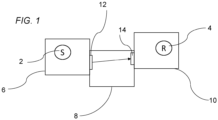
  • an audio source 2 is located in a first room 6 and an audio receiver 4 is located in a third room 10.
  • a second room 8 is located between the first room 6 and the third room 10, with two doors 12, 14 joining the rooms together.
  • An audio signal generated at the audio source 2 travels through the first room 6, through the first door 12, through the second room 8, through the second door 14, and through the third room 10 to the audio receiver 4.
  • At least one of the audio source 2 and the audio receiver 4 are movable.
  • the second room 8 is empty which means that there are no moving components in the room and no other audio sources that would affect the sound waves travelling through this room.
  • the second room 8 is acoustically stationary.

Landscapes

  • Engineering & Computer Science (AREA)
  • Physics & Mathematics (AREA)
  • Multimedia (AREA)
  • Acoustics & Sound (AREA)
  • Signal Processing (AREA)
  • Theoretical Computer Science (AREA)
  • Human Computer Interaction (AREA)
  • General Engineering & Computer Science (AREA)
  • General Physics & Mathematics (AREA)
  • General Health & Medical Sciences (AREA)
  • Audiology, Speech & Language Pathology (AREA)
  • Health & Medical Sciences (AREA)
  • Stereophonic System (AREA)

Abstract

A computer implemented method of simulating audio signals in a virtual environment, wherein the virtual environment comprises a first room comprising an audio source, a second room comprising an audio receiver, and a third room in-between the first and second rooms, the method comprising: simulating the propagation of an audio signal in the first room and outputting the simulated audio signal to the third room; modifying the simulated audio signal by a predetermined function; generating a modified audio signal and outputting the modified audio signal to the second room.

Description

    FIELD OF THE INVENTION
  • The present invention relates to methods of simulating and generating audio signals in a virtual environment.
  • BACKGROUND
  • Modern virtual environments, such as video game environments, are programmed such that physical phenomena that occur in reality are closely replicated in simulations. For example, video game environments are programmed to mirror the acoustic behaviours of real environments, such that sounds propagate in a manner akin to that in reality.
  • Depending on the complexity of the virtual environment, reproducing virtual sounds and acoustic behaviours can be very computationally expensive in terms of both time and resources used. This can make it difficult to accurately replicate physical phenomena in virtual environments effectively in real-time.
  • It is an object of the invention to make progress in overcoming these issues.
  • SUMMARY OF INVENTION
  • According to a first aspect there is provided a computer implemented method of simulating audio signals in a virtual environment, wherein the virtual environment comprises a first room comprising an audio source, a second room comprising an audio receiver, and a third room in-between the first and second rooms, the method comprising: simulating the propagation of an audio signal in the first room and outputting the simulated audio signal to the third room; modifying the simulated audio signal by a predetermined function; and generating a modified audio signal and outputting the modified audio signal to the second room.
  • This method involves modifying the simulated audio signal by a predetermined function. By using a predetermined function, this computation does not need to be does in real-time but instead can be done ahead of when the modification is required. In addition, the predetermined function can be used to modify any simulated audio signal and the function does not need to be recalculated each time. The output audio signal which is generated based on the modified audio signal can therefore be generated more efficiently, by using a predetermined signal instead of real-time calculations, and so the overall process is more computational efficient in terms of time and resources used.
  • The predetermined function may correspond to the acoustic response of the third room. Preferably, the third room is a substantially acoustically stationary room. This means that the third room does not have a perceptively changing effect on the audio signals that propagate through the third room. Once the effect of the third room on audio signals has been determined, this effect is effectively static with time and so it does not need to be recalculated. Given that the impact of the third room on audio signals remains substantially constant over time, the predetermined function only needs to be calculated once and can then be applied to any audio signal as necessary. By "substantially acoustically stationary" and "effectively static", and similar terms, we mean that the room is approximated to be acoustically static. In reality, the room may slightly change acoustically over time, for example if the sun moves over a window then the temperature of the room changes which changes the acoustic response of the room slightly. However, these small changes will typically not make any noticeable, perceptual difference and so in such cases it is sufficient to approximate the room as being acoustically stationary.
  • Since the predetermined function does not need to be calculated in real-time, because it does not change with time, a more accurate determination of the acoustic response of the third room can be calculated, because all reflections and reverbs within the third room can be taken into account as computational time and resources are not limited. A more accurate determination of the predetermined function leads to a more accurately generated output audio signal and improve audio quality overall.
  • Modifying the input audio signal may comprise convolving the input audio signal with a response signal, wherein the response signal corresponds to an acoustic response of the third room.
  • In some examples, each of the first room, the second room, and third rooms are discrete rooms that are distinct from each other. In other words, each room can be clearly defined and separated from another room. The rooms are not general areas within a space that merge into each other with undefined boundaries.
  • The first room, the second room, and the third room may be linearly arranged. Preferably, the first room is adjacent the third room and the second room is adjacent the third room.
  • There may be a portal between the first room and third room such that audio signals can propagate from the first room to the third room through the portal. There may be a portal between the third room and the second room such that audio signals can propagate from the third room to the second room through the portal. A portal may be considered as any passage or gap which allows audio signals to travel from one room to another room. A door may be an example of a portal.
  • According to another aspect there may be provided a data processing system comprising a processor configure to perform the method as described above.
  • According to another aspect there is provided a computer program comprising instructions which, when the program is executed by a computer, cause the computer to carry out the method as described above.
  • BRIEF DESCRIPTION OF DRAWINGS
  • The present invention will now be described by way of example of with reference to the accompanying drawings in which:
    • Figure 1 is a schematic diagram of a virtual environment; and
    • Figure 2 is a flow diagram of a method.
    DETAILED DESCRIPTION
  • When simulating audio in a virtual space, the original audio signal bounces off objects and surfaces within the virtual environment before reaching the user and so the audio signal that is heard by a user is effectively a modified version of the original audio signal.
  • The extent by which the original audio signal is modified by the virtual environment is determined by an impulse response. The impulse response comprises the audio characteristics of the virtual environment that are imparted on the original audio signal as the audio signal propagates through the virtual environment. The impulse response includes the effect any surfaces and objects within the virtual environment that the audio signal will encounter within the virtual environment.
  • The implies response can be generated by playing an audio signal from an audio source in an environment (e.g. a room), the resulting sound being referred to as an impulse. This impulse provides a snapshot of the environment's ambience based on the acoustics of the environment. The resulting sound can be recorded (e.g. using a microphone) and the effect of the environment of the original audio signal can be determined.
  • By editing out or removing the initial impulse from the captured sound recording, the acoustic response of the environment can be determined. The acoustic response is effectively just the signal of the environment, indicating how the environment modifies audio signals played within it. The acoustic response does not include other audio signals that may exists within the environment.
  • By knowing the acoustic response of a particular environment (for example a room within a video game) it is possible to modify an audio signal generated by an audio source so that the resulting audio sound accurately replicates what a user would hear within a real-world equivalent of the simulated environment.
  • A receiver placed in the same environment as the audio source will receive a signal comprised of the originally generated source audio signal modified by the acoustic response of the environment.
  • If either the source or the receiver moves, the acoustic response of the environment needs to be recalculated for the new source and / or receiver position. This means that during video gameplay as a user moves an avatar around the room, the user effectively representing a moving receiver, a large number of calculations need to be performed in real-time in order to accurately simulate what the avatar would "hear" at any given moment in the virtual environment. If the audio source is also moving, for example the audio source may be a moving vehicle, then the number of calculations needed to accurately simulate the audio signals received by the avatar in the environment get increasingly more numerous and more complex.
  • When the source and receiver are not in the same environment, for example the source is in a first room and the receiver is in a second room, before the signal is received by the receiver, the audio signal propagates through the both the first room and the second room. Thus, in this case, the original source signal is modified by both the acoustic response of the first room and the acoustic response of the second room.
  • The passageway (e.g. door) between the two rooms, also referred to as a portal, effectively provides a simplified acoustic 'view' from one room into another separate room. As an example, a virtual environment comprising three linearly adjacent rooms has a first door between the first and second rooms and a second door between the second and third rooms. Each of the first and second doors can be considered as first and second portals. From the perspective of any receiver in one of the rooms, for example the first room, the exact details of what is going on acoustically in each other room beyond the first room is largely irrelevant. The receiver in the first room simply hears a single complex audio source emanating from the portal in question (i.e. the portal between the first room and all subsequent rooms which can be considered collectively). In reality, the single complex audio source comprises one or more audio signals from one or more audio sources present in the second and / or third rooms, each signal from an audio source modified by the acoustic response of the rooms. Modelling the acoustic responses of all the rooms beyond the first room and computing the various audio signals and their propagation through these rooms until they reach the portal into the first room is therefore computationally expensive.
  • Environments in which there are no moving sources or objects that would affect the propagation of sound waves through the environment can be considered as acoustically stationary. Audio signals propagating through an acoustically stationary environment do not change and so the paths of the sound waves in the acoustically stationary environment do not need to be simulated and recalculated. The acoustic response of the acoustically stationary environment is therefore constant over time and so only needs to be calculated once. The calculation does not need to be repeated as there is nothing in the environment that would cause the acoustic response to change.
  • Any audio signal subsequently passing through the acoustically stationary environment can then simply be modified by the already-calculated acoustic response of the acoustically stationary environment, rather than doing calculations in real-time. This is computationally less intensive.
  • Within a propagation engine, audio sources can propagate through multiple rooms, spaces and portals. Typically, the engine may try to calculate some reflections / reverbs within each space. This may be required to be calculated at runtime as the position of the source and receiver is variable within the originating space and the receiving space. However, there are special cases where the propagating source passes through at least one middle-space. In this case, the acoustic response of the middle room is often stable and as such can be calculated offline with higher quality than can be achieved doing the calculation in real-time.
  • Considering the example above of three linearly adjacent rooms, with reference to Figure 1, an audio source 2 is located in a first room 6 and an audio receiver 4 is located in a third room 10. A second room 8 is located between the first room 6 and the third room 10, with two doors 12, 14 joining the rooms together. An audio signal generated at the audio source 2 travels through the first room 6, through the first door 12, through the second room 8, through the second door 14, and through the third room 10 to the audio receiver 4.
  • At least one of the audio source 2 and the audio receiver 4 are movable. As illustrated in Figure 1, the second room 8 is empty which means that there are no moving components in the room and no other audio sources that would affect the sound waves travelling through this room. In this example, the second room 8 is acoustically stationary.
  • In this example, the acoustic response of the first room 6 needs to be calculated in order to determine how the sound waves from the audio source travel through the first room 6 and through the first door 12 into the second room 8. However, since there is nothing in the second room 8 that changes with time, and so nothing that will have a time-changing effect on how the sounds waves will travel through the second room 8, the audio signal entering the second room 8 through the first door 12 can simply be modified by the acoustic response of the second room 8, which is constant with time, in order to determine the audio signal that will enter the third room 10 via the second door 14.
  • Effectively, the audio signal entering the second room 8 is multiplied by a function that represents the effect on the sound waves of the second room 8. Since the acoustic response of the second room 8 does not change with time, it does not need to be recalculated in real-time but can instead be calculated once initially. This means that the acoustic response of the second room 8 does not need to be calculated during gameplay but can instead be computed offline and applied during gameplay.
  • Computing the acoustic response offline provides a better, more accurate acoustic response to be calculated for a given environment because it is possible to take all reflections and interferences of the audio signal with itself and other objects in the environment into account. Doing this calculation offline rather than during gameplay also reduces the amount of processing carried out at run time.
  • The acoustic response of the first and third rooms 6, 10 needs to be done in real-time during gameplay as a result of the variable propagation of the source 2 and / or receiver 4 as a result of movement during the game. This places a limit on the complexity and the number of reflections that can be taken into account during these calculations, in order to avoid significantly affecting game performance.
  • The above method involves convolving a source audio signal with a predetermined acoustic response of an acoustically stationary environment to generate an audio signal that would be received by a receiver beyond the acoustically stationary environment.
  • The convolution may comprise multiplying the frequency spectra of the source signal and the acoustic response so that frequencies that are shared between the two will be accentuated, while frequencies that are not shared will be attenuated. It is this convolution that causes the source signal to take on the acoustic qualities of the environment to which the acoustic response belongs, because characteristic frequencies from the acoustic response common in the source signal are boosted. Convolution is therefore the process of imparting the acoustic characteristics of a physical space or object on those of another.
  • The above describe method can be summarised with reference to Figure 2. Firstly, an input signal is received 201. The input signal can be received at a point in the second room 8. The input signal corresponds to an audio signal coming from the first room 6 and that has travelled through the first door 12 into the second room 8. The input signal is modified by a predetermined function 202. The predetermined function is the acoustic response of the second room 8. An output signal is then generated based on the modified input signal 203. The output signal is sent from the second room 8 to the third room 10 through the second door 14.
  • The method described herein, whilst specific to acoustically stationary rooms, can significantly improve the audio quality of a source. As an example, consider a receiver (e.g. an avatar in a game) is stood just outside of a church, and an audio source (e.g. an organ) is output from a side-room within the church. In this case the main space within the church can be considered acoustically stationary. The audio propagation engine would compute the portal-input to the main church from the side-room, then that source would be convolved with a high-quality response of the reverberant space (i.e. the amin space in the church) and output through the portal-exit next to the receiver. This computational method saves computation time and resources, and improves the final audio quality.
Claims (11)

  1. A computer implemented method of simulating audio signals in a virtual environment, wherein the virtual environment comprises a first room comprising an audio source, a second room comprising an audio receiver, and a third room in-between the first and second rooms, the method comprising:
    simulating the propagation of an audio signal in the first room and outputting the simulated audio signal to the third room;
    modifying the simulated audio signal by a predetermined function;
    generating a modified audio signal and outputting the modified audio signal to the second room.
  2. The method of claim 1 wherein the predetermined function corresponds to the acoustic response of the third room.
  3. The method of claim 1 or 2 wherein the third room is a substantially acoustically stationary room.
  4. The method of any preceding claim wherein modifying the simulated audio signal comprises convolving the simulated audio signal with a response signal, wherein the response signal corresponds to an acoustic response of the third room.
  5. The method of any preceding claim wherein each of the first room, the second room, and third rooms are distinct from each other.
  6. The method of any preceding claim wherein the first room, the second room, and the third room are linearly arranged.
  7. The method of any preceding claim wherein the first room is adjacent the third room and the second room is adjacent the third room.
  8. The method of any preceding claim wherein there is a portal between the first room and third room such that audio signals can propagate from the first room to the third room through the portal.
  9. The method of any preceding claim wherein there is a portal between the third room and the second room such that audio signals can propagate from the third room to the second room through the portal.
  10. A data processing system comprising a processor configure to perform the method of any of claims 1 to 9.
  11. A computer program comprising instructions which, when the program is executed by a computer, cause the computer to carry out the method of any of claims 1 to 9.
EP24204534.2A 2023-10-04 2024-10-03 Simulating audio signals Pending EP4537916A1 (en)

Applications Claiming Priority (1)

Application Number Priority Date Filing Date Title
GB2315204.4A GB2634268A (en) 2023-10-04 2023-10-04 Simulating audio signals

Publications (1)

Publication Number Publication Date
EP4537916A1 true EP4537916A1 (en) 2025-04-16

Family

ID=88696297

Family Applications (1)

Application Number Title Priority Date Filing Date
EP24204534.2A Pending EP4537916A1 (en) 2023-10-04 2024-10-03 Simulating audio signals

Country Status (3)

Country Link
US (1) US20250119699A1 (en)
EP (1) EP4537916A1 (en)
GB (1) GB2634268A (en)

Citations (5)

* Cited by examiner, † Cited by third party
Publication number Priority date Publication date Assignee Title
US7099482B1 (en) * 2001-03-09 2006-08-29 Creative Technology Ltd Method and apparatus for the simulation of complex audio environments
WO2021034397A1 (en) * 2019-08-22 2021-02-25 Microsoft Technology Licensing, Llc Bidirectional propagation of sound
US20220377485A1 (en) * 2021-05-04 2022-11-24 Microsoft Technology Licensing, Llc Modeling Acoustic Effects of Scenes With Dynamic Portals
EP4132012A1 (en) * 2021-08-05 2023-02-08 Koninklijke Philips N.V. Determining virtual audio source positions
EP4210353A1 (en) * 2022-01-11 2023-07-12 Koninklijke Philips N.V. An audio apparatus and method of operation therefor

Family Cites Families (1)

* Cited by examiner, † Cited by third party
Publication number Priority date Publication date Assignee Title
WO2019246159A1 (en) * 2018-06-18 2019-12-26 Magic Leap, Inc. Spatial audio for interactive audio environments

Patent Citations (5)

* Cited by examiner, † Cited by third party
Publication number Priority date Publication date Assignee Title
US7099482B1 (en) * 2001-03-09 2006-08-29 Creative Technology Ltd Method and apparatus for the simulation of complex audio environments
WO2021034397A1 (en) * 2019-08-22 2021-02-25 Microsoft Technology Licensing, Llc Bidirectional propagation of sound
US20220377485A1 (en) * 2021-05-04 2022-11-24 Microsoft Technology Licensing, Llc Modeling Acoustic Effects of Scenes With Dynamic Portals
EP4132012A1 (en) * 2021-08-05 2023-02-08 Koninklijke Philips N.V. Determining virtual audio source positions
EP4210353A1 (en) * 2022-01-11 2023-07-12 Koninklijke Philips N.V. An audio apparatus and method of operation therefor

Also Published As

Publication number Publication date
US20250119699A1 (en) 2025-04-10
GB2634268A (en) 2025-04-09
GB202315204D0 (en) 2023-11-15

Similar Documents

Publication Publication Date Title
Taylor et al. Resound: interactive sound rendering for dynamic virtual environments
US10911885B1 (en) Augmented reality virtual audio source enhancement
US7563168B2 (en) Audio effect rendering based on graphic polygons
US11170139B1 (en) Real-time acoustical ray tracing
US11317233B2 (en) Acoustic program, acoustic device, and acoustic system
US11062714B2 (en) Ambisonic encoder for a sound source having a plurality of reflections
EP4320877B1 (en) Audio apparatus and method therefor
EP4335119A1 (en) Modeling acoustic effects of scenes with dynamic portals
CN115273795B (en) Method, device and computer equipment for generating simulated impulse response
Beig et al. An introduction to spatial sound rendering in virtual environments and games
Aspöck et al. A real-time auralization plugin for architectural design and education
Shen et al. Data-driven feedback delay network construction for real-time virtual room acoustics
CN117880702A (en) Method for optimizing audio output device parameters, electronic device and storage medium
EP2552130B1 (en) Method for sound signal processing, and computer program for implementing the method
US20250119699A1 (en) Simulating Audio Signals
CN117581297B (en) Audio signal rendering method, device and electronic device
CN121264063A (en) Hybrid system for predicting audio impulse response
Chandak et al. Efficient auralization for moving sources and receiver
US20250114704A1 (en) Method And System For Simulating The Propagation Of An Audio Signal In A Virtual Environment
EP4539039A1 (en) A method for decorrelating a set of simulated audio signals in a virtual environment
CN114530158B (en) A sound effect processing system and method
US20250227431A1 (en) Reverberation processing method and apparatus, and non-transitory computer readable storage medium
Siddiq Real-time impulse response estimation based on mirrored virtual sound sources
Tikhonov Application of Methods for Obtaining Impulse Responses in Compact Recording Studios
HK40076038B (en) Method and apparatus for generating simulated impulse response, and computer device

Legal Events

Date Code Title Description
PUAI Public reference made under article 153(3) epc to a published international application that has entered the european phase

Free format text: ORIGINAL CODE: 0009012

STAA Information on the status of an ep patent application or granted ep patent

Free format text: STATUS: REQUEST FOR EXAMINATION WAS MADE

17P Request for examination filed

Effective date: 20241003

AK Designated contracting states

Kind code of ref document: A1

Designated state(s): AL AT BE BG CH CY CZ DE DK EE ES FI FR GB GR HR HU IE IS IT LI LT LU LV MC ME MK MT NL NO PL PT RO RS SE SI SK SM TR