EP4537704A1 - Method for stacking books on a book shelf and a shelf for stacking books - Google Patents
Method for stacking books on a book shelf and a shelf for stacking books Download PDFInfo
- Publication number
- EP4537704A1 EP4537704A1 EP24460008.6A EP24460008A EP4537704A1 EP 4537704 A1 EP4537704 A1 EP 4537704A1 EP 24460008 A EP24460008 A EP 24460008A EP 4537704 A1 EP4537704 A1 EP 4537704A1
- Authority
- EP
- European Patent Office
- Prior art keywords
- shelf
- book
- tendon
- plate
- books
- Prior art date
- Legal status (The legal status is an assumption and is not a legal conclusion. Google has not performed a legal analysis and makes no representation as to the accuracy of the status listed.)
- Pending
Links
Images

Classifications
-
- A—HUMAN NECESSITIES
- A47—FURNITURE; DOMESTIC ARTICLES OR APPLIANCES; COFFEE MILLS; SPICE MILLS; SUCTION CLEANERS IN GENERAL
- A47B—TABLES; DESKS; OFFICE FURNITURE; CABINETS; DRAWERS; GENERAL DETAILS OF FURNITURE
- A47B63/00—Cabinets, racks or shelf units, specially adapted for storing books, documents, forms, or the like
-
- A—HUMAN NECESSITIES
- A47—FURNITURE; DOMESTIC ARTICLES OR APPLIANCES; COFFEE MILLS; SPICE MILLS; SUCTION CLEANERS IN GENERAL
- A47B—TABLES; DESKS; OFFICE FURNITURE; CABINETS; DRAWERS; GENERAL DETAILS OF FURNITURE
- A47B96/00—Details of cabinets, racks or shelf units not covered by a single one of groups A47B43/00 - A47B95/00; General details of furniture
-
- B—PERFORMING OPERATIONS; TRANSPORTING
- B42—BOOKBINDING; ALBUMS; FILES; SPECIAL PRINTED MATTER
- B42D—BOOKS; BOOK COVERS; LOOSE LEAVES; PRINTED MATTER CHARACTERISED BY IDENTIFICATION OR SECURITY FEATURES; PRINTED MATTER OF SPECIAL FORMAT OR STYLE NOT OTHERWISE PROVIDED FOR; DEVICES FOR USE THEREWITH AND NOT OTHERWISE PROVIDED FOR; MOVABLE-STRIP WRITING OR READING APPARATUS
- B42D17/00—Hanging or securing devices for books, newspapers or the like
Definitions
- the object of the invention is a method for stacking books on a book shelf and a shelf for stacking books, designed to be fixed on a vertical wall.
- Book shelves are known, the essential part of which is a plate, perpendicular to the wall, usually horizontal, on which, on its upper surface, books, albums, brochures and similar items are placed vertically.
- the shelves have vertical walls at their sides against which books are supported to keep them upright, and shelves without such walls are fitted with lateral supports that slide along the horizontal panel.
- the shelf is in the shape of a long rectangle and one of its longer edges is fixed to the wall. From the description of the Chinese utility model No. CN207744878U , a shelf is known, named there as an over-and-under shelving unit, where there are several shelves one above the other, all of them horizontal, all of them fastened at the sides by vertical walls.
- the shelves have adjustable spacing to accommodate books of different sizes.
- a pocket is made by gluing a few sheets of paper to the sides of the cover and, using the pocket created in this way, the base is slid onto a horizontal support which disappears inside the base book and is therefore invisible to the observer.
- books are usually placed horizontally, but they can also be placed vertically, depending on the owner's preference.
- Other hanging book shelves are known, developed by various designers for decorative and practical purposes, in which, for example, the plate for placing books on it is not horizontal, but has the form of a wave, an oval or is diagonal. In all of them, even the most fanciful designs, books are always placed on the top surfaces of the plates and supported at the sides.
- each tendon has an adjustable length.
- Each upper end of each tendon is wound onto a winch shaft, individual for each tendon.
- the winches are attached to the bottom plate or top plate of the shelf, advantageously in the interior of the shelf between its top plate and bottom plate.
- the tendon tensioning mechanism of each winch is its respective tension spring.
- the winches are fixed in a row in the interior of the shelf and under each winch there are holes in the lower plate of the shelf through which the tendons with stops at the lower end are threaded.
- a torsion spring is used as the tension spring, which is located inside the winch shaft.
- fig. 1 shows a shelf fixed to the wall and books attached to it
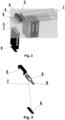
- fig. 2 shows an illustrative drawing of a shelf with adjustable length tendons, where the tendons are wound on winch shafts
- fig. 3 shows a single winch tension mechanism for positioning books.
- the book shelf is a thick, rectangular plate 1, with an upper plate 2 on which various objects are placed, here flowers, ornaments, it can also be books, and with a lower plate 3 to which the books are fixed.
- the books are fixed by the method according to the invention from underneath, they hang below the lower plate 3 remaining in contact with it by their upper sides. The positioning of the books is very aesthetically pleasing, all of them being in contact with the shelf.
- the plate 1 is hollow in the middle, between the upper plate 2 and the lower plate 3 there is a mechanism to fix the books to the underside of the lower plate 3. In detail, this mechanism is shown in fig.
Landscapes
- Assembled Shelves (AREA)
- Warehouses Or Storage Devices (AREA)
Abstract
The object of the invention is a method for stacking books on a book shelf, and a shelf for stacking books, designed to be fixed on a vertical wall.
A method for stacking books on a book shelf, wherein the books are suspended from the bottom of the shelf in such a way that the upper sides of the books are under the lower surface of the bottom panel of the shelf, consists in the fact that each book is fixed by inserting a thin tendon between the pages of the book, which is terminated at the bottom by a stop on which the book seated on the tendon rests with its lower side. The length of the tendon is selected so that the distance between the stop and the lower surface of the lower shelf plate is equal to the height of the book to be fixed and the book with its upper side is in contact with the lower surface of the lower shelf plate.
The book stacking shelf according to the invention has at the bottom along the entire length of the lower shelf plate 3 of the shelf 1 a number of tendons 7 of fixed or adjustable length, each tendon 7 at the bottom having an attached stop 8 determining its length. Preferably, each tendon 7 most often has an adjustable length, in which case each upper end of each tendon 7 is wound onto a shaft 4 of a winch, individual for each tendon 7. The winches are attached to the lower plate 3 or upper plate 2 of the shelf 1, advantageously in the interior of the shelf 1 between its upper plate 2 and lower plate 3. The mechanism for tensioning the tendon 7 in each winch is its respective tension spring 9. The winches are fixed in a row in the interior of the shelf 1 and under each of them in the lower plate 3 of the shelf 1 there are holes 6 through which the tendons 7 are threaded with stops 8 at the lower end.
Description
- The object of the invention is a method for stacking books on a book shelf and a shelf for stacking books, designed to be fixed on a vertical wall.
- Book shelves are known, the essential part of which is a plate, perpendicular to the wall, usually horizontal, on which, on its upper surface, books, albums, brochures and similar items are placed vertically. The shelves have vertical walls at their sides against which books are supported to keep them upright, and shelves without such walls are fitted with lateral supports that slide along the horizontal panel. The shelf is in the shape of a long rectangle and one of its longer edges is fixed to the wall. From the description of the Chinese utility model No.
CN207744878U , a shelf is known, named there as an over-and-under shelving unit, where there are several shelves one above the other, all of them horizontal, all of them fastened at the sides by vertical walls. The shelves have adjustable spacing to accommodate books of different sizes. Books are positioned on the top surfaces of each shelf. Shelves are known to have a smaller shelf underneath, for office supplies and similar small items - here again, these items are placed on the top surface of the lower shelf and books are placed on the top surface of the upper shelf. There are known invisible book shelves, shown no. at https://www.youtube.com/watch?v=NT3VZRcfyMo - here the main part is a sturdy horizontal support - a horizontal plate - attached to the wall. One of the books, not intended for reading, redundant in the book collection but e.g. decorative, is used as a horizontal base for others which are stacked on it. In the base book, a pocket is made by gluing a few sheets of paper to the sides of the cover and, using the pocket created in this way, the base is slid onto a horizontal support which disappears inside the base book and is therefore invisible to the observer. On this horizontal base, books are usually placed horizontally, but they can also be placed vertically, depending on the owner's preference. Other hanging book shelves are known, developed by various designers for decorative and practical purposes, in which, for example, the plate for placing books on it is not horizontal, but has the form of a wave, an oval or is diagonal. In all of them, even the most fanciful designs, books are always placed on the top surfaces of the plates and supported at the sides. The website https://www.youtube.com/watch?v=u6y_5uFdAvk&ab_channel=Homedit%C2%AE shows a method of stacking books from the bottom of the shelf, where books are suspended from the bottom of the shelf so that they hang below the shelf rather than standing on it. To achieve this, loops are made from rubber - bands - with which the books are strapped, the bands being fixed to the underside of the shelf. Once the rubber band is tightened, each book is slipped into its designated loop and the book hangs in the loop under the bottom surface of the lower shelf plate. However, the end result is spoilt by the fact that the books hang in disarray, as the distances of the upper sides from the lower shelf plate vary according to the weight of the book. - According to the invention, a method of arranging books on a book shelf, where the books are suspended from the bottom of the shelf in such a way that the upper sides of the books are under the lower surface of the lower shelf plate, consists in the fact that each book is fixed by inserting a thin string between the pages of the book, which is terminated at the bottom by a stop on which the book, which is seated on the string, rests with its lower side. The length of the string is chosen so that the distance between the stop and the lower surface of the lower shelf plate is equal to the height of the book to be fixed, and the book, with its upper side, is in contact with the lower surface of the lower shelf plate.
- The book stacking shelf according to the invention has at the bottom along the entire length of the lower shelf plate a number of tendons of fixed or adjustable length, and each tendon at the bottom has a stop attached to it which determines its length.
- The stop is most often a narrow flat bar, in the middle of which is the point of attachment of the tendon.
- In another version, the stop is a decorative figure.
- It is advantageous if each tendon has an adjustable length. Each upper end of each tendon is wound onto a winch shaft, individual for each tendon. The winches are attached to the bottom plate or top plate of the shelf, advantageously in the interior of the shelf between its top plate and bottom plate. The tendon tensioning mechanism of each winch is its respective tension spring.
- The winches are fixed in a row in the interior of the shelf and under each winch there are holes in the lower plate of the shelf through which the tendons with stops at the lower end are threaded.
- Ideally, the holes are slots parallel to the axis of the shafts.
- A torsion spring is used as the tension spring, which is located inside the winch shaft.
- The method of placing books on the shelf and the bookshelf fixed to the shelf by the method according to the invention allows for an original visual effect that seems to contradict the laws of physics, which will be described in more detail in the following section.
- The shelf according to the invention is shown in an example of execution in the drawing, in which
fig. 1 shows a shelf fixed to the wall and books attached to it,fig. 2 shows an illustrative drawing of a shelf with adjustable length tendons, where the tendons are wound on winch shafts, andfig. 3 shows a single winch tension mechanism for positioning books. - As shown in
fig. 1 , the book shelf is a thick,rectangular plate 1, with an upper plate 2 on which various objects are placed, here flowers, ornaments, it can also be books, and with alower plate 3 to which the books are fixed. As can be seen, the books are fixed by the method according to the invention from underneath, they hang below thelower plate 3 remaining in contact with it by their upper sides. The positioning of the books is very aesthetically pleasing, all of them being in contact with the shelf. As shown infig. 2 , theplate 1 is hollow in the middle, between the upper plate 2 and thelower plate 3 there is a mechanism to fix the books to the underside of thelower plate 3. In detail, this mechanism is shown infig. 3 and is a winch, theshaft 4 of which is placed in aframe 5 and thisframe 5 is fixed to thelower plate 3 in the interior of theplate 1. On theshaft 4 is wound atendon 7, which is terminated at the bottom by astop 8, which determines the length of thetendon 7. In this example of execution, thestop 8 is a narrow flat bar, fixed in the middle to thetendon 7. Thetendons 7 are threaded throughholes 6 in thelower plate 3, in this example these are transverse slots, parallel to the axis of theshaft 4. Atension spring 9 is placed inside theshaft 4. This mechanism enables the length of thetendons 7 to be adjusted - depending on the vertical dimension of the book to be hung, thetendons 7 are unwound from thedrums 4 and pulled downwards through theholes 6 in thelower plate 3. Then theties 7 are inserted between the pages of the books, thestops 8 rest on the lower sides of the books and by the force of the tension springs 9 the books are pressed against thelower board 3 from below with their upper side. Thestops 8 fit between the covers of the books, so they remain invisible to the observer and the books look as if they are glued to thelower board 3. As you can see, the books do not stand on the shelf, but are attached to it from below, with invisible fasteners, which gives an amazing visual effect. This effect can be enhanced by using a decorative figure, such as Atlas bearing the celestial vault, as a stop. For each book there is its own fixing mechanism - the hoists are placed side by side insideshelf 1.
Claims (8)
- Method for stacking books on a book shelf, wherein the books are suspended from the underside of the shelf in such a way that the upper sides of the books are under the lower surface of the lower panel of the shelf, characterized in that each book is fixed by inserting a tendon (7) between the pages of the book, which is terminated at the bottom by a stop (8) on which the book, which is seated on the tendon (7), rests with its lower side, wherein the length of the tendon (7) is chosen so that the distance between the stop (8) and the lower surface (3) of the lower shelf (1) plate is equal to the height of the book to be fixed, so that the book, with its upper side, is in contact with the lower surface (3) of the lower shelf (1) plate.
- Shelf for stacking books, in the form of a plate fixed horizontally to a wall by one edge of a rectangle, characterised by having at the bottom along the entire length of the lower plate (3) of the shelf plate (1) a number of tendons (7) of fixed or adjustable length, each tendon (7) at the bottom having a stop (8) attached.
- Shelf according to claim. 2, characterised in that the stop (8) is a narrow flat bar, in the middle of which there is an attachment point for the
- Shelf according to claim. 2, characterised in that the stop (8) is a decorative figure.
- Shelf according to claim. 2, characterised in that each tendon (7) has an adjustable length, whereby each upper end of each tendon (7) is wound onto a shaft (4) of a winch, individual for each tendon (7), the winches being attached to the lower plate (3) or upper plate (2) of the shelf (1), advantageously in the interior of the shelf (1) between its upper plate (2) and its lower plate (3), the tendon tension mechanism (7) in each winch being its respective tension spring (9).
- Shelf according to claim. 5, characterised in that the winches are fixed in a row inside the shelf (1) and under each winch in the lower plate (3) of the shelf (1) there are holes (6) through which the tendons (7) with stops (8) at the lower end are threaded.
- Shelf according to claim. 6, characterised in that the holes (6) are slots parallel to the axis of the shafts (4).
- Shelf according to claim. 5, characterised in that the tension spring (9) is a torsion spring and is placed inside the shaft (4) of the winch.
Applications Claiming Priority (1)
| Application Number | Priority Date | Filing Date | Title |
|---|---|---|---|
| PL446361A PL446361A1 (en) | 2023-10-12 | 2023-10-12 | Way to arrange books on a bookshelf and a shelf for arranging books |
Publications (1)
| Publication Number | Publication Date |
|---|---|
| EP4537704A1 true EP4537704A1 (en) | 2025-04-16 |
Family
ID=90482468
Family Applications (1)
| Application Number | Title | Priority Date | Filing Date |
|---|---|---|---|
| EP24460008.6A Pending EP4537704A1 (en) | 2023-10-12 | 2024-02-20 | Method for stacking books on a book shelf and a shelf for stacking books |
Country Status (2)
| Country | Link |
|---|---|
| EP (1) | EP4537704A1 (en) |
| PL (1) | PL446361A1 (en) |
Citations (3)
| Publication number | Priority date | Publication date | Assignee | Title |
|---|---|---|---|---|
| CN202077857U (en) * | 2010-12-30 | 2011-12-21 | 浙江工业大学 | Multi-functional hanging type book shelf |
| CN202567058U (en) * | 2011-12-26 | 2012-12-05 | 曾艳秋 | Wall-mounted adjustable bookshelf |
| CN207744878U (en) | 2017-06-04 | 2018-08-21 | 孙怡滢 | A kind of lift bookshelf |
Family Cites Families (3)
| Publication number | Priority date | Publication date | Assignee | Title |
|---|---|---|---|---|
| GB2333952A (en) * | 1998-02-06 | 1999-08-11 | Priestman Goode | Book hanger |
| CN201023357Y (en) * | 2007-04-04 | 2008-02-20 | 蒙亮 | Book and periodicals hanging rope |
| CN107713398A (en) * | 2016-08-13 | 2018-02-23 | 颜茹玉 | Multi-functional hanging type book shelf |
-
2023
- 2023-10-12 PL PL446361A patent/PL446361A1/en unknown
-
2024
- 2024-02-20 EP EP24460008.6A patent/EP4537704A1/en active Pending
Patent Citations (3)
| Publication number | Priority date | Publication date | Assignee | Title |
|---|---|---|---|---|
| CN202077857U (en) * | 2010-12-30 | 2011-12-21 | 浙江工业大学 | Multi-functional hanging type book shelf |
| CN202567058U (en) * | 2011-12-26 | 2012-12-05 | 曾艳秋 | Wall-mounted adjustable bookshelf |
| CN207744878U (en) | 2017-06-04 | 2018-08-21 | 孙怡滢 | A kind of lift bookshelf |
Also Published As
| Publication number | Publication date |
|---|---|
| PL446361A1 (en) | 2025-04-14 |
Similar Documents
| Publication | Publication Date | Title |
|---|---|---|
| US6820853B1 (en) | Adjustable wall display | |
| US2807908A (en) | Copy holding device for reading stand | |
| US4378102A (en) | Book or magazine reading support | |
| US1991102A (en) | Metal display rack | |
| EP4537704A1 (en) | Method for stacking books on a book shelf and a shelf for stacking books | |
| KR101186301B1 (en) | A whole reading desk using a book cover | |
| US5165631A (en) | Music stand | |
| US7395937B2 (en) | Adjustable bulletin board | |
| US5168986A (en) | Earring frame | |
| US3126844A (en) | Display unit | |
| US6860458B1 (en) | Book holder | |
| US4127253A (en) | Holder for books, music sheets, or other sheet-containing articles | |
| US1374269A (en) | Bookcase and magazine-holder | |
| US1020875A (en) | Reading-desk. | |
| US4213259A (en) | Wall-mounted displays | |
| US7588268B2 (en) | Multi-page viewing binder | |
| US1883965A (en) | Louis c | |
| US1805761A (en) | Pad | |
| WO1995015857A1 (en) | Telephone directory storage device and method | |
| KR100583831B1 (en) | Bookshelf clip | |
| US1270575A (en) | Knockdown basket-stand. | |
| JP2010125600A (en) | Book opening sustainer | |
| KR20130006217U (en) | Standing calender | |
| CN214522930U (en) | a printed album | |
| US1678275A (en) | Sectional magazine rack |
Legal Events
| Date | Code | Title | Description |
|---|---|---|---|
| PUAI | Public reference made under article 153(3) epc to a published international application that has entered the european phase |
Free format text: ORIGINAL CODE: 0009012 |
|
| STAA | Information on the status of an ep patent application or granted ep patent |
Free format text: STATUS: THE APPLICATION HAS BEEN PUBLISHED |
|
| AK | Designated contracting states |
Kind code of ref document: A1 Designated state(s): AL AT BE BG CH CY CZ DE DK EE ES FI FR GB GR HR HU IE IS IT LI LT LU LV MC ME MK MT NL NO PL PT RO RS SE SI SK SM TR |
|
| STAA | Information on the status of an ep patent application or granted ep patent |
Free format text: STATUS: REQUEST FOR EXAMINATION WAS MADE |
|
| 17P | Request for examination filed |
Effective date: 20250611 |