EP4535550A1 - Electrochemical apparatus and electric device - Google Patents
Electrochemical apparatus and electric device Download PDFInfo
- Publication number
- EP4535550A1 EP4535550A1 EP23810729.6A EP23810729A EP4535550A1 EP 4535550 A1 EP4535550 A1 EP 4535550A1 EP 23810729 A EP23810729 A EP 23810729A EP 4535550 A1 EP4535550 A1 EP 4535550A1
- Authority
- EP
- European Patent Office
- Prior art keywords
- tab
- electrode assembly
- sub
- electrochemical device
- projection
- Prior art date
- Legal status (The legal status is an assumption and is not a legal conclusion. Google has not performed a legal analysis and makes no representation as to the accuracy of the status listed.)
- Pending
Links
Images







Classifications
-
- H—ELECTRICITY
- H01—ELECTRIC ELEMENTS
- H01M—PROCESSES OR MEANS, e.g. BATTERIES, FOR THE DIRECT CONVERSION OF CHEMICAL ENERGY INTO ELECTRICAL ENERGY
- H01M10/00—Secondary cells; Manufacture thereof
- H01M10/04—Construction or manufacture in general
-
- H—ELECTRICITY
- H01—ELECTRIC ELEMENTS
- H01M—PROCESSES OR MEANS, e.g. BATTERIES, FOR THE DIRECT CONVERSION OF CHEMICAL ENERGY INTO ELECTRICAL ENERGY
- H01M10/00—Secondary cells; Manufacture thereof
- H01M10/42—Methods or arrangements for servicing or maintenance of secondary cells or secondary half-cells
- H01M10/425—Structural combination with electronic components, e.g. electronic circuits integrated to the outside of the casing
-
- H—ELECTRICITY
- H01—ELECTRIC ELEMENTS
- H01M—PROCESSES OR MEANS, e.g. BATTERIES, FOR THE DIRECT CONVERSION OF CHEMICAL ENERGY INTO ELECTRICAL ENERGY
- H01M10/00—Secondary cells; Manufacture thereof
- H01M10/42—Methods or arrangements for servicing or maintenance of secondary cells or secondary half-cells
- H01M10/48—Accumulators combined with arrangements for measuring, testing or indicating the condition of cells, e.g. the level or density of the electrolyte
-
- H—ELECTRICITY
- H01—ELECTRIC ELEMENTS
- H01M—PROCESSES OR MEANS, e.g. BATTERIES, FOR THE DIRECT CONVERSION OF CHEMICAL ENERGY INTO ELECTRICAL ENERGY
- H01M50/00—Constructional details or processes of manufacture of the non-active parts of electrochemical cells other than fuel cells, e.g. hybrid cells
- H01M50/10—Primary casings; Jackets or wrappings
- H01M50/102—Primary casings; Jackets or wrappings characterised by their shape or physical structure
- H01M50/105—Pouches or flexible bags
-
- H—ELECTRICITY
- H01—ELECTRIC ELEMENTS
- H01M—PROCESSES OR MEANS, e.g. BATTERIES, FOR THE DIRECT CONVERSION OF CHEMICAL ENERGY INTO ELECTRICAL ENERGY
- H01M50/00—Constructional details or processes of manufacture of the non-active parts of electrochemical cells other than fuel cells, e.g. hybrid cells
- H01M50/10—Primary casings; Jackets or wrappings
- H01M50/102—Primary casings; Jackets or wrappings characterised by their shape or physical structure
- H01M50/112—Monobloc comprising multiple compartments
-
- H—ELECTRICITY
- H01—ELECTRIC ELEMENTS
- H01M—PROCESSES OR MEANS, e.g. BATTERIES, FOR THE DIRECT CONVERSION OF CHEMICAL ENERGY INTO ELECTRICAL ENERGY
- H01M50/00—Constructional details or processes of manufacture of the non-active parts of electrochemical cells other than fuel cells, e.g. hybrid cells
- H01M50/50—Current conducting connections for cells or batteries
- H01M50/502—Interconnectors for connecting terminals of adjacent batteries; Interconnectors for connecting cells outside a battery casing
- H01M50/503—Interconnectors for connecting terminals of adjacent batteries; Interconnectors for connecting cells outside a battery casing characterised by the shape of the interconnectors
-
- H—ELECTRICITY
- H01—ELECTRIC ELEMENTS
- H01M—PROCESSES OR MEANS, e.g. BATTERIES, FOR THE DIRECT CONVERSION OF CHEMICAL ENERGY INTO ELECTRICAL ENERGY
- H01M50/00—Constructional details or processes of manufacture of the non-active parts of electrochemical cells other than fuel cells, e.g. hybrid cells
- H01M50/50—Current conducting connections for cells or batteries
- H01M50/502—Interconnectors for connecting terminals of adjacent batteries; Interconnectors for connecting cells outside a battery casing
- H01M50/509—Interconnectors for connecting terminals of adjacent batteries; Interconnectors for connecting cells outside a battery casing characterised by the type of connection, e.g. mixed connections
- H01M50/51—Connection only in series
-
- H—ELECTRICITY
- H01—ELECTRIC ELEMENTS
- H01M—PROCESSES OR MEANS, e.g. BATTERIES, FOR THE DIRECT CONVERSION OF CHEMICAL ENERGY INTO ELECTRICAL ENERGY
- H01M50/00—Constructional details or processes of manufacture of the non-active parts of electrochemical cells other than fuel cells, e.g. hybrid cells
- H01M50/50—Current conducting connections for cells or batteries
- H01M50/502—Interconnectors for connecting terminals of adjacent batteries; Interconnectors for connecting cells outside a battery casing
- H01M50/519—Interconnectors for connecting terminals of adjacent batteries; Interconnectors for connecting cells outside a battery casing comprising printed circuit boards [PCB]
-
- H—ELECTRICITY
- H01—ELECTRIC ELEMENTS
- H01M—PROCESSES OR MEANS, e.g. BATTERIES, FOR THE DIRECT CONVERSION OF CHEMICAL ENERGY INTO ELECTRICAL ENERGY
- H01M50/00—Constructional details or processes of manufacture of the non-active parts of electrochemical cells other than fuel cells, e.g. hybrid cells
- H01M50/50—Current conducting connections for cells or batteries
- H01M50/531—Electrode connections inside a battery casing
-
- H—ELECTRICITY
- H01—ELECTRIC ELEMENTS
- H01M—PROCESSES OR MEANS, e.g. BATTERIES, FOR THE DIRECT CONVERSION OF CHEMICAL ENERGY INTO ELECTRICAL ENERGY
- H01M50/00—Constructional details or processes of manufacture of the non-active parts of electrochemical cells other than fuel cells, e.g. hybrid cells
- H01M50/50—Current conducting connections for cells or batteries
- H01M50/531—Electrode connections inside a battery casing
- H01M50/533—Electrode connections inside a battery casing characterised by the shape of the leads or tabs
-
- H—ELECTRICITY
- H01—ELECTRIC ELEMENTS
- H01M—PROCESSES OR MEANS, e.g. BATTERIES, FOR THE DIRECT CONVERSION OF CHEMICAL ENERGY INTO ELECTRICAL ENERGY
- H01M50/00—Constructional details or processes of manufacture of the non-active parts of electrochemical cells other than fuel cells, e.g. hybrid cells
- H01M50/50—Current conducting connections for cells or batteries
- H01M50/531—Electrode connections inside a battery casing
- H01M50/534—Electrode connections inside a battery casing characterised by the material of the leads or tabs
-
- H—ELECTRICITY
- H01—ELECTRIC ELEMENTS
- H01M—PROCESSES OR MEANS, e.g. BATTERIES, FOR THE DIRECT CONVERSION OF CHEMICAL ENERGY INTO ELECTRICAL ENERGY
- H01M50/00—Constructional details or processes of manufacture of the non-active parts of electrochemical cells other than fuel cells, e.g. hybrid cells
- H01M50/50—Current conducting connections for cells or batteries
- H01M50/531—Electrode connections inside a battery casing
- H01M50/538—Connection of several leads or tabs of wound or folded electrode stacks
-
- H—ELECTRICITY
- H01—ELECTRIC ELEMENTS
- H01M—PROCESSES OR MEANS, e.g. BATTERIES, FOR THE DIRECT CONVERSION OF CHEMICAL ENERGY INTO ELECTRICAL ENERGY
- H01M50/00—Constructional details or processes of manufacture of the non-active parts of electrochemical cells other than fuel cells, e.g. hybrid cells
- H01M50/50—Current conducting connections for cells or batteries
- H01M50/569—Constructional details of current conducting connections for detecting conditions inside cells or batteries, e.g. details of voltage sensing terminals
-
- H—ELECTRICITY
- H01—ELECTRIC ELEMENTS
- H01M—PROCESSES OR MEANS, e.g. BATTERIES, FOR THE DIRECT CONVERSION OF CHEMICAL ENERGY INTO ELECTRICAL ENERGY
- H01M50/00—Constructional details or processes of manufacture of the non-active parts of electrochemical cells other than fuel cells, e.g. hybrid cells
- H01M50/50—Current conducting connections for cells or batteries
- H01M50/572—Means for preventing undesired use or discharge
- H01M50/574—Devices or arrangements for the interruption of current
- H01M50/581—Devices or arrangements for the interruption of current in response to temperature
-
- Y—GENERAL TAGGING OF NEW TECHNOLOGICAL DEVELOPMENTS; GENERAL TAGGING OF CROSS-SECTIONAL TECHNOLOGIES SPANNING OVER SEVERAL SECTIONS OF THE IPC; TECHNICAL SUBJECTS COVERED BY FORMER USPC CROSS-REFERENCE ART COLLECTIONS [XRACs] AND DIGESTS
- Y02—TECHNOLOGIES OR APPLICATIONS FOR MITIGATION OR ADAPTATION AGAINST CLIMATE CHANGE
- Y02E—REDUCTION OF GREENHOUSE GAS [GHG] EMISSIONS, RELATED TO ENERGY GENERATION, TRANSMISSION OR DISTRIBUTION
- Y02E60/00—Enabling technologies; Technologies with a potential or indirect contribution to GHG emissions mitigation
- Y02E60/10—Energy storage using batteries
Definitions
- This application relates to the technical field of energy storage, and in particular, to an electrochemical device and an electrical device.
- the electrochemical device includes a housing, an electrode assembly, and a circuit board.
- the electrode assembly includes a first sub-electrode assembly and a second sub-electrode assembly.
- the first sub-electrode assembly and the second sub-electrode assembly are mounted in the housing along a first direction.
- a first tab and a second tab of opposite polarities are disposed on the first sub-electrode assembly.
- a third tab and a fourth tab of opposite polarities are disposed on the second sub-electrode assembly.
- the first tab and the fourth tab are of opposite polarities.
- a plurality of conductive pieces are disposed on the circuit board.
- the first tab and the fourth tab each are connected to one separate conductive piece.
- the second tab is connected to the third tab.
- the second tab is further connected to one of the conductive pieces. Viewed along the first direction, a projection of the second tab at least partially overlaps a projection of the third tab.
- the first sub-electrode assembly and second sub-electrode assembly are connected in series by the second tab and the third tab.
- the charging or discharging current does not flow back to the circuit board after passing through each of the first sub-electrode assembly or the second sub-electrode assembly separately, but flows back to the circuit board after passing through both the first sub-electrode assembly and the second sub-electrode assembly, thereby reducing the internal resistance of the electrochemical device and increasing the charging power and discharging power.
- the projection of the second tab at least partially overlaps the projection of the third tab in the first direction, thereby reducing the space occupied by the second tab and the third tab, and improving the energy density of the electrochemical device.
- the conductive pieces and the second tab are made of a first material.
- the third tab is made of a second material.
- a melting point of the first material is higher than a melting point of the second material.
- the conductive pieces, the second tab, and the third tab are stacked in sequence.
- a first connecting region exists between the second tab and the conductive pieces.
- a second connecting region exists between the second tab and the third tab. Viewed along the first direction, a projection of the first connecting region does not overlap a projection of the second connecting region.
- the above arrangement staggers the first connecting region from the second connecting region, thereby reducing the difficulty of multi-layer welding and improving the welding efficiency.
- a projection of the first tab, a projection of the fourth tab, and the projection of the second tab do not overlap.
- the above arrangement makes it convenient to connect the first tab, the second tab, and the fourth tab to the conductive pieces of the circuit board, optimizes the welding operation space, facilitates the welding operation, and improves the welding efficiency.
- the projection of the second tab is located between the projection of the first tab and the projection of the fourth tab.
- the welding region between the second tab and the circuit board is relatively small, and the welding region between the first tab and the circuit board as well as the welding region between the fourth tab and the circuit board are relatively large.
- the relatively large welding regions are arranged on the two sides, thereby optimizing the welding space, facilitating the welding process, and facilitating routing on the circuit board.
- the second tab includes a first portion and a second portion.
- the first portion is connected to the first sub-electrode assembly.
- the second portion is configured to be connected to the conductive pieces. Viewed along the first direction, a width of the second portion is less than a width of the first portion.
- the charging current and the discharging current flow through the first portion, and a detection current flows through the second portion.
- the detection current is less than the charging current and the discharging current, thereby reducing the width of the second portion.
- the reduced width of the second portion can downsize the corresponding conductive piece and improve the utilization rate of the circuit board.
- a plurality of accommodation cavities isolated from each other are disposed in the housing.
- the plurality of accommodation cavities are arranged along the first direction.
- the first sub-electrode assembly and the second sub-electrode assembly are mounted in different accommodation cavities. This can eliminate the need for a fixing housing for fixing the first sub-electrode assembly and the second sub-electrode assembly and a separate packaging housing, thereby downsizing the battery and increasing the energy density of the battery.
- the housing includes a body portion, two first seal edges, and two second seal edges.
- a second direction, a third direction, and the first direction are perpendicular to each other.
- the two first seal edges are located on two opposite sides of the body portion respectively.
- the two second seal edges are located on the two opposite sides of the body portion respectively.
- a length of each of the first seal edges along the third direction is W
- a length of each of the second seal edges along the second direction is L
- W is less than L.
- the circuit board is disposed on the first seal edge.
- the length of the circuit board in the third direction corresponds to the length of the first seal edge in the third direction, thereby shortening the size of the circuit board accordingly and increasing the energy density of the electrochemical device.
- one of the first seal edges includes a first section and a second section. Viewed along the first direction, a projection of the first section is spaced apart from a projection of the second section.
- the circuit board is disposed in the first section, thereby further downsizing the circuit board.
- the two second seal edges extend along the first direction.
- the electrochemical device further includes a first adhesive.
- the first adhesive is disposed on each second seal edge.
- the first adhesive overlays an end face of the second seal edge in an extension direction, thereby serving to insulate the cut end face of the first adhesive.
- the second seal edges extend along the first direction.
- the electrochemical device further includes a second adhesive. The second seal edges are bonded to the body portion by the second adhesive.
- the second seal edges are folded to extend along the first direction, thereby reducing the space occupied by the housing.
- the second adhesive may be an ultraviolet adhesive or hot-melt adhesive serving to fix the seal edge.
- one of the second seal edges includes a third section, a fourth section, and a fifth section that are connected together. Viewed along the first direction, the third section is perpendicular to the fourth section, and the third section is parallel to the fifth section.
- the circuit board is disposed in any one of the third section, the fourth section, or the fifth section.
- the length of the third section and the length of the fifth section in the second seal edge in the third direction are both less than the length of the second seal edge in the second direction.
- the length of the fourth section in the second direction is less than the length of the second seal edge in the second direction.
- the circuit board is mounted on the first seal edges. Viewed along the first direction, a projection of the circuit board at least partially overlaps a projection of the first seal edges, thereby shortening the overall length of the electrochemical device in the second direction.
- the electrochemical device further includes a temperature-controlled switch.
- the temperature-controlled switch is mounted on the circuit board, and is connected to a plurality of electrode assembles in series.
- the temperature-controlled switch includes a temperature sensing wall. The temperature sensing wall is oriented toward one of the first seal edges. Upon detecting that the heat of an electrode assembly exceeds a preset threshold, the temperature-controlled switch controls the current between the circuit board and the electrode assembly to get cut off to reduce the risk of damage to the electrochemical device caused by overcharge.
- a thermal conductor is further disposed between the temperature sensing wall and the first seal edges.
- the thermal conductor can play a role in heat transfer, and can reduce the loss of heat and improve the accuracy of temperature detection.
- An embodiment of this application further provides an electrical device.
- the electrical device includes the electrochemical device according to any one of the foregoing embodiments.
- the first tab, the second tab, and the fourth tab in this application are connected to the circuit board by the conductive piece.
- the first sub-electrode assembly and second sub-electrode assembly are connected in series through the connection between the second tab and the third tab.
- the current passes through the circuit board, the first tab, the first sub-electrode assembly, the second sub-electrode assembly, and the fourth tab in sequence. Therefore, the charging current and the discharging current are prevented from flowing back to the circuit board after passing through each of the sub-electrode assemblies separately, thereby reducing the internal resistance of the electrochemical device and increasing the charging power and discharging power.
- the projection of the second tab in the first direction at least partially overlaps the projection of the third tab in the first direction, thereby reducing the space occupied by the second tab and the third tab, and improving the energy density of the electrochemical device.
- perpendicular is a description of an ideal state between two components. In the actual production or use state, one component may be approximately perpendicular to another component.
- perpendicular may represent an angle of 90° ⁇ 10° between two straight lines, or a dihedral angle of 90° ⁇ 10° between two planes, or an angle of 90° ⁇ 10° between a straight line and a plane.
- Two components described as "perpendicular" to each other may be not absolute straight lines or planes, but may be roughly straight lines or planes.
- An object is considered to be a "straight line” or "plane” if the overall extension direction of the object is a straight line or plane as viewed from a macro perspective.
- parallel is a description of an ideal state between two components. In an actual production or use state, one component may be approximately parallel to another component.
- the term “parallel” may represent an angle of 180° ⁇ 10° between two straight lines, or a dihedral angle of 180° ⁇ 10° between two planes, or an angle of 180° ⁇ 10° between a straight line and a plane.
- the two components described as “parallel” may be not absolute straight lines or planes, but may be roughly straight lines or planes.
- An object is considered to be a "straight line” or "plane” if the overall extension direction of the object is a straight line or plane as viewed from a macro perspective.
- the electrochemical device includes a housing, an electrode assembly, and a circuit board.
- the electrode assembly includes a first sub-electrode assembly and a second sub-electrode assembly.
- the first sub-electrode assembly and the second sub-electrode assembly are mounted in the housing along a first direction.
- a first tab and a second tab of opposite polarities are disposed on the first sub-electrode assembly.
- a third tab and a fourth tab of opposite polarities are disposed on the second sub-electrode assembly.
- the first tab and the fourth tab are of opposite polarities.
- a plurality of conductive pieces are disposed on the circuit board.
- the first tab and the fourth tab each are connected to one separate conductive piece.
- the second tab is connected to the third tab.
- the second tab is further connected to one of the conductive pieces. Viewed along the first direction, a projection of the second tab at least partially overlaps a projection of the third tab.
- the first tab, the second tab, and the fourth tab of the electrode assembly are connected to the circuit board by the conductive piece.
- the first sub-electrode assembly and second sub-electrode assembly are connected in series through the connection between the second tab and the third tab.
- the current passes through the circuit board, the first tab, the first sub-electrode assembly, the second tab, the third tab, the second sub-electrode assembly, and the fourth tab in sequence, so that the charging current and the discharging current do not flow back to the circuit board after passing through each of the sub-electrode assemblies separately, but flow back to the circuit board after passing through all the sub-electrode assemblies, thereby reducing the internal resistance of the electrochemical device and increasing the charging power and discharging power.
- the projection of the second tab in the first direction at least partially overlaps the projection of the third tab in the first direction, thereby reducing the space occupied by the second tab and the third tab, and improving the energy density of the electrochemical device
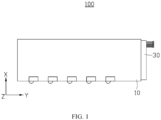
- an embodiment of this application provides an electrochemical device 100.
- the electrochemical device 100 includes a housing 10, an electrode assembly 20, and a circuit board 30.
- the electrode assembly 20 includes a first sub-electrode assembly 201 and a second sub-electrode assembly 202.
- the first sub-electrode assembly 201 and the second sub-electrode assembly 202 are mounted in the housing 10 along a first direction Z.
- a first tab 21 and a second tab 22 of opposite polarities are disposed on the first sub-electrode assembly 201.
- the second sub-electrode assembly 202 includes a third tab 23 and a fourth tab 24 of opposite polarities.
- a plurality of conductive pieces 31 are disposed on the circuit board 30.
- the first tab 21 and the fourth tab 24 each are connected to one separate conductive piece 31.
- the second tab 22 is connected to the third tab 23.
- the second tab 22 is further connected to one of the conductive pieces 31.
- a plurality of accommodation cavities 101 isolated from each other are disposed in the housing 10.
- the first sub-electrode assembly 201 and the second sub-electrode assembly 202 are mounted in different accommodation cavities 101.
- the housing 10 includes a first housing part 11, a second housing part 12, and a plurality of partition pieces 13.
- the first housing part 11 is connected to the second housing part 12.
- the plurality of partition pieces 13 are disposed between the first housing part 11 and the second housing part 12.
- the first housing part 11, the second housing part 12, and the plurality of partition pieces 13 close in together to form a plurality of accommodation cavities 101.
- the plurality of accommodation cavities 101 are isolated from each other.
- Each of the accommodation cavities 101 is filled with an electrolyte solution.
- the electrolyte solution does not circulate between the plurality of accommodation cavities 101.
- the plurality of accommodation cavities 101 are arranged along a first direction Z.
- the first direction Z is parallel to a thickness direction of the housing 10.
- the first housing part 11 and the second housing part 12 are disposed opposite to each other along the first direction Z.
- the partition pieces 13 are disposed in a space formed by enclosure by the first housing part 11 and the second housing part 12 so that the partition pieces 13 are not visible from the outside.
- a seal edge is formed at a junction between the first housing part 11 and the second housing part 12 so that the housing 10 includes a body portion 14, two first seal edges 15, and two second seal edges 16.
- the two first seal edges 15 are located on the two opposite sides of the body portion 14, and the second direction Y is perpendicular to the first direction Z.
- the two second seal edges 16 are located on the two opposite sides of the body portion 14, and the third direction X is perpendicular to the first direction Z.
- the third direction X is further perpendicular to the second direction Y.
- the first tab 21, the second tab 22, and the third tab 23 of the electrode assembly 20 may extend from the first seal edge 15 or the second seal edge 16 out of the accommodation cavity 101.
- the first seal edge 15 or the second seal edge 16 may serve to seal the accommodation cavity 101.
- a length of the first seal edge 15 along the third direction X is W
- a length of the second seal edge 16 along the second direction Y is L
- W is less than L.
- the second direction Y is parallel to the length direction of the housing 10.
- the third direction X is parallel to the width direction of the housing 10.
- the electrochemical device 100 further includes a first adhesive 50.
- the first seal edge 15 and the second seal edge 16 extend from the body portion 14, and both include a cut end face in the extension direction.
- a first adhesive 50 is disposed on the first seal edge 15 or the second seal edge 16.
- the first adhesive 50 overlays the end face of the first seal edge 15 or the second seal edge 16 in the extension direction, and serves to insulate the cut end face of the first seal edge 15 or the second seal edge 16.
- the first adhesive 50 is a piece of U-shaped adhesive tape, for example, single-sided tape or double-sided tape.
- the adhesive tape occupies less space, and helps to downsize the electrochemical device 100.
- the electrochemical device 100 further includes a second adhesive 60.
- the first seal edge 15 or the second seal edge 16, on which no tab is disposed, is folded and extends along the first direction Z. After being folded, the first seal edge 15 or the second seal edge 16 can reduce the space occupied by the entire electrochemical device 100, thereby improving the space utilization rate of the electrochemical device 100, and increasing the energy density of the electrochemical device 100.
- the folded first seal edge 15 or second seal edge 16 is bonded to the body portion 14 by the second adhesive 60.
- the second adhesive 60 may be an ultraviolet adhesive or hot-melt adhesive serving to fix the seal edge.
- the folded first seal edge 15 or second seal edge 16 is coated with the first adhesive 50.
- the first adhesive 50 is bonded to the body portion 14 by the second adhesive 60.
- the first adhesive 50 may serve as a bonding medium between the seal edge and the second adhesive 60 to protect the seal edge.
- the first sub-electrode assembly 201 includes a negative electrode plate, a positive electrode plate, a separator, a first tab 21, and a second tab 22.
- the separator is located between the negative electrode plate and the positive electrode plate.
- the positive electrode plate and the negative electrode plate may be stacked or wound.
- the polarity of the first tab 21 is opposite to the polarity of the second tab 22.
- the first tab 21 is a positive tab, and is connected to the positive electrode plate; and the second tab 22 is a negative tab, and is connected to the negative electrode plate.
- the second sub-electrode assembly 202 includes a negative electrode plate, a positive electrode plate, a separator, and a third tab 23 and a fourth tab 24 of opposite polarities.
- a negative electrode plate for detailed settings, reference may be made to the first sub-electrode assembly 201, and the details are omitted herein.
- the first tab 21 is connected to one conductive piece 31.
- the fourth tab 24 is connected to one conductive piece 31.
- the fourth tab 24 is of an opposite polarity to the first tab 21.
- the second tab 22 is connected to the third tab 23 to implement series connection between the first sub-electrode assembly 201 and the second sub-electrode assembly 202.
- a series connection path 204 is formed after the series connection is implemented.
- the series connection path 204 is a path along which the charging current and the discharging current flow.
- the second tab 22 is further connected to one of the conductive pieces 31. In this way, a current for detection is caused to flow between the second tab 22 and the circuit board 30. The detection current is less than the charging current and the discharging current.
- the first sub-electrode assembly 201 and the second sub-electrode assembly 202 are mounted in different accommodation cavities 101, so that the first sub-electrode assembly 201 and the second sub-electrode assembly 202 are arranged along the first direction Z.
- the electrode assembly 20 further includes a third sub-electrode assembly 203.
- the third sub-electrode assembly 203 includes a negative electrode plate, a positive electrode plate, a separator, and a fifth tab 25 and a sixth tab 26 of opposite polarities.
- the third sub-electrode assembly 203 is disposed on one side of the second sub-electrode assembly 202, the side being oriented away from the first sub-electrode assembly 201.
- the sixth tab 26 is of an opposite polarity to the third tab 23.
- the fifth tab 25 is connected to the fourth tab 24.
- the sixth tab 26 is connected to a conductive piece 31. Viewed along the first direction Z, a projection of the fifth tab 25 at least partially overlaps a projection of the fourth tab 24.
- the electrode assembly 20 may further include more sub-electrode assemblies, for example, a fourth sub-electrode assembly (not identified), and the like, the details of which are omitted herein.
- the number of sub-electrode assemblies is N.
- the number of tabs extending from the electrode assembly 20 is S. Two tabs connected together are deemed to be one tab. For example, one second tab 22 and one third tab 23 connected together are counted as one tab. A first tab 21 that is not connected to any other tabs is counted as one tab.
- the numbers satisfy: N + 1 ⁇ S ⁇ 2N.
- the number N of sub-electrode assemblies may be 2, 3, 4, 5, 6, 7, or the like.
- the projection of the second tab 22 at least partially overlaps the projection of the third tab 23.
- the space occupied by the second tab 22 and the third tab 23 is reduced, thereby increasing the energy density of the electrochemical device 100.
- the first tab 21, the second tab 22, the third tab 23, and the fourth tab 24 all protrude from the first seal edge 15, and extend along the second direction Y. Viewed along the first direction Z, the projection of the first tab 21, the projection of the fourth tab 24, and the projection of the second tab 22 do not overlap.
- the above arrangement makes it convenient to connect the first tab 21, the second tab 22, and the fourth tab 24 to the conductive pieces 31 of the circuit board 30.
- the first tab 21, the second tab 22, and the fourth tab 24 are arranged in the way above to optimize the welding operation space, facilitate the welding operation, and improve the welding efficiency.
- the first tab 21, the second tab 22, and the fourth tab 24 at least partially overlap to reduce the space occupied by the first tab 21, the second tab 22, and the third tab 23 in the first direction Z, thereby increasing the energy density of the electrochemical device 100.
- a plurality of conductive pieces 31 on the circuit board 30 are arranged sequentially in such order that they correspond to the first tab 21, the second tab 22, and the fourth tab 24, respectively.
- the first tab 21 is connected to one conductive piece 31, so as to be electrically connected to the circuit board 30.
- the second tab 22 is connected to one conductive piece 31, so as to be electrically connected to the circuit board 30.
- the fourth tab 24 is connected to one conductive piece 31, so as to be electrically connected to the circuit board 30.
- the first sub-electrode assembly 201 and the second sub-electrode assembly 202 are connected in series through the connection between the second tab 22 and the third tab 23. In this way, when the circuit board 30 is engaged in charging and discharging, the charging or discharging current passes through the circuit board 30, the first tab 21, the first sub-electrode assembly 201, the second tab 22, the third tab 23, the second sub-electrode assembly 202, and the fourth tab 24 in sequence.
- the charging or discharging current does not flow back to the circuit board 30 after passing through the first sub-electrode assembly 201 alone, but flows back to the circuit board 30 after passing through both the first sub-electrode assembly 201 and the second sub-electrode assembly 202, thereby reducing the internal resistance of the electrochemical device 100 and increasing the charging power and discharging power.
- Electronic components configured to collect information about the first sub-electrode assembly 201 and the second sub-electrode assembly 202 are disposed on the circuit board 30.
- a current for detecting information such as voltage and current flows between the first sub-electrode assembly 201 and the circuit board, and between the second sub-electrode assembly 202 and the circuit board 30. The detection current is less than the charging current and the discharging current.
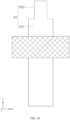
- the second tab 22 includes a first portion 221 and a second portion 222.
- the first portion 221 is connected to the first sub-electrode assembly 201.
- the second portion 222 is configured to be connected to the conductive pieces 31.
- a width of the second portion 222 in the third direction X is less than a width of the first portion 221 in the third direction X.
- the third tab 23 may be connected to the relatively wide first portion 221, so that the charging current and the discharging current flow through the first portion 221, and the detection current flows through the second portion 222.
- the detection current is less than the charging current and the discharging current, thereby reducing the width of the second portion 222.
- the reduced width of the second portion 222 can downsize the corresponding conductive piece 31 and improve the utilization rate of the circuit board 30.
- the conductive piece 31 is welded to the circuit board 30.
- the second portion 222 of the second tab 22 is welded to the conductive piece 31.
- the reduced width of the second portion 222 makes the size of the conductive piece 31 reducible. In this way, the area of the welding region, welded to the conductive piece 31, on the circuit board 30 is reducible, thereby increasing the utilization rate of the area of the circuit board 30.
- the second tab 22 is an L-shaped tab or an inverted hollow T-shaped tab. In this way, viewed along the first direction Z, the width of the second portion 222 in the third direction X is less than the width of the first portion 221 in the third direction X.
- the width of the second portion 222 of the second tab 22 in the third direction X is less than the width of the first portion 221 in the third direction X.
- a first connecting pad 32 is disposed on the circuit board 30.
- the conductive piece 31 welded to the second tab 22 is welded to the first connecting pad 32.
- at least two second connecting pads 33 are disposed on the circuit board 30.
- the conductive piece 31 welded to the first tab 21 is welded to one of the second connecting pads 33, and the conductive piece 31 welded to the fourth tab 24 is welded to one of the second connecting pads 33.
- the area of the first connecting pad 32 is smaller than the area of the second connecting pad 33.
- the projection of the second tab 22 is located between the projection of the first tab 21 and the projection of the fourth tab 24.
- the relatively large second connecting pads 33 on the circuit board 30 can be made to be located at both ends, and the relatively small first connecting pad 32 is located between at least two second connecting pads 33.
- the first connecting pad 32 located between the at least two second connecting pads 33 is relatively small in area, thereby facilitating the welding operation and improving the welding efficiency.
- both the first connecting pad 32 and the second connecting pad 33 are bonding pads.
- the second tab 22 is a negative tab.
- the conductive piece 31 and the second tab 22 are made of a first material.
- the first material may be nickel.
- the third tab 23 is a positive tab.
- the third tab 23 is made of a second material different from the first material.
- the second material may be aluminum.
- the melting point of the first material is higher than the melting point of the second material.
- the conductive piece 31, the second tab 22, and the third tab 23 are stacked in sequence.
- the second tab 22 is welded to the conductive piece 31 and is disposed on one side of the conductive piece 31 in the first direction Z.
- the third tab 23 is welded to the second tab 22 and located on one side of the second tab 22, the side being oriented away from the conductive piece 31.
- the melting point of nickel is higher than the melting point of aluminum. The above arrangement can protect the aluminum tab and reduce the risk of burning through the aluminum tab.
- the conductive piece 31, the second tab 22, and the third tab 23 are stacked sequentially along the first direction Z.
- the thickness of the conductive piece 31 made of the first material may be 0.08 mm to 0.3 mm, and specifically may be 0.08 mm, 0.1 mm, 0.25 mm, or 0.3 mm.
- the thickness of the second tab 22 made of the first material may be 0.08 mm to 0.3 mm, and specifically may be 0.08 mm, 0.1 mm, 0.25 mm, or 0.3 mm.
- the thickness of the third tab 23 made of the second material may be 0.1 mm to 0.3 mm, and specifically may be 0.1 mm, 0.25 mm, or 0.3 mm.
- both the thickness of the conductive piece 31 and the thickness of the second tab 22 are greater than a thickness difference between the conductive piece 31 and the second tab 22.
- both the thickness of the second tab 22 and the thickness of the third tab 23 are greater than a thickness difference between the second tab 22 and the third tab 23.
- a first connecting region 401 exists between the conductive piece 31 and the second tab 22.
- a second connecting region 402 exists between the third tab 23 and the second tab 22. Viewed along the first direction Z, a projection of the first connecting region 401 does not overlap a projection of the second connecting region 402.
- the above arrangement staggers the first connecting region 401 from the second connecting region 402, thereby reducing the difficulty of multi-layer welding and improving the welding efficiency.
- an extension length of the second tab 22 is greater than an extension length of the third tab 23. In the extension direction of the second tab 22, the second tab 22 is made to exceed the third tab 23. The excess part of the second tab 22 beyond the third tab 23 is welded to the conductive piece 31. The non-excess part of the second tab 22 not beyond the third tab 23 overlaps and is welded to the third tab 23.
- the first tab 21, the second tab 22, the third tab 23, and the fourth tab 24 protrude from the first seal edge 15.
- the circuit board 30 is disposed on the first seal edge 15.
- the first seal edge 15 is a short edge.
- the length of the circuit board 30 in the third direction X corresponds to the length of the first seal edge 15 in the third direction X, thereby shortening the size of the circuit board 30 accordingly and increasing the energy density of the electrochemical device 100.
- one first seal edge 15 among the two first seal edges 15 includes a first section 151 and a second section 152. Viewed along the first direction Z, a projection of the first section 151 is spaced apart from a projection of the second section 152. The first tab 21, the second tab 22, and the third tab 23 all protrude from the first section 151.
- the circuit board 30 is disposed in the first section 151.
- the first seal edge 15 is divided into the first section 151 and the second section 152.
- the length of the first section 151 and the length of the second section 152 in the third direction X are both less than the length of the first seal edge 15 in the third direction X.
- the housing 10 is roughly L-shaped so that the first seal edge 15 includes the first section 151 and the second section 152.
- the circuit board 30 is disposed in the first section 151, thereby further downsizing the circuit board 30.
- one second seal edge 16 among the two second seal edges 16 includes a third section 161, a fourth section 162, and a fifth section 163 that are connected together.
- the third section 161 is perpendicular to the fourth section 162.
- the third section 161 is parallel to the fifth section 163.
- the first tab 21, the second tab 22, the third tab 23, and the fourth tab 24 all protrude from the third section 161, or all protrude from the fourth section 162, or all protrude from the fifth section 163.
- the housing 10 is roughly hollow U-shaped.
- the circuit board 30 is disposed in a section from which the tab protrudes among the third section 161, the fourth section 162, or the fifth section 163.
- the length of the third section 161 and the length of the fifth section 163 in the second seal edge 16 in the third direction X are both less than the length of the second seal edge 16 in the second direction Y.
- the length of the fourth section 162 in the second direction Y is less than the length of the second seal edge 16 in the second direction Y.
- Positioning the circuit board 30 in any one of the third section 161, the fourth section 162, or the fifth section 163 can sufficiently utilize the space of the battery.
- the first tab 21, the second tab 22, the third tab 23, and the fourth tab 24 protrude from the first seal edge 15, and extend along the second direction Y.
- the circuit board 30 is mounted on the first seal edge 15, and is connected to the first tab 21, the second tab 22, and the fourth tab 24 by a plurality of conductive pieces 31 separately. Viewed along the first direction Z, the projection of the circuit board 30 at least partially overlaps the projection of the first seal edge 15, thereby shortening the overall length of the electrochemical device 100 in the second direction Y.
- the conductive piece 31 is an L-shaped sheet. Of the L-shaped conductive piece 31, one section is welded to the circuit board 30, and the other section is welded to the tab. By bending the nickel sheet and the tab in sequence, the circuit board 30 is driven to turn over correspondingly. In this way, when viewed along the first direction, the projection of the circuit board 30 at least partially overlaps the projection of the first seal edge 15.
- the conductive piece 31 is flat straight sheet-shaped.
- the circuit board 30 is driven to turn over correspondingly by bending the tab. In this way, when viewed along the first direction Z, the projection of the circuit board 30 at least partially overlaps the projection of the first seal edge 15.
- the electrochemical device 100 further includes a temperature-controlled switch 70.
- the temperature-controlled switch 70 is mounted on the circuit board 30, and is connected to a first sub-electrode assembly 201 and a second sub-electrode assembly 202 in series.
- a clearance opening 34 is created and runs through the circuit board 30 along the first direction Z, and is available for mounting the temperature-controlled switch 70.
- the temperature-controlled switch 70 is electrically connected to the circuit board 30 through the clearance opening 34 by Surface Mounted Technology (SMT).
- SMT Surface Mounted Technology
- the clearance opening 34 is a notch recessed at one lateral edge of the circuit board 30.
- the clearance opening 34 is a through-hole that runs through the circuit board 30 along the first direction Z.
- a temperature sensor may be built in the temperature-controlled switch 70, and the temperature-controlled switch may include a temperature sensing wall 71 connected to the temperature sensor.
- the temperature sensing wall 71 serves as a transfer medium oriented toward the first seal edge 15 to detect the heat emitted by the electrode assembly 20.
- the temperature-controlled switch 70 controls the current between the circuit board 30 and the electrode assembly 20 to get cut off to reduce the risk of damage to the electrochemical device 100 caused by overcharge.
- a thermal conductor 72 is further disposed between the temperature sensing wall 71 and the first seal edge 15.
- the thermal conductor 72 may be in contact with the temperature sensing wall 71, and additionally, the thermal conductor 72 may be in contact with the first seal edge 15.
- the thermal conductor 72 may be a thermal adhesive or a thermal foam gasket, and serves to transfer heat and fix the position of the thermal conductor 72, thereby improving the accuracy of temperature sensing.
- an embodiment of this application further provides an electrical device 1.
- the electrical device 1 includes the electrochemical device 100 disclosed in any one of the above embodiments.
- the electrical device 1 contains the electrochemical device 100 based on the technical solution in any one of the above embodiments, and therefore, achieves at least the beneficial effects brought by the electrochemical device 100 based on the technical solution in any one of the embodiments, the details of which are omitted here.
- the electrical device 1 may be a mobile phone, a computer, a camera, a calculator, a headset, an e-book, a player, a phone watch, a light, a toy, a game console, a video recorder, a portable CD player, an electronic notepad, a portable sound recorder, a radio set, or the like.
Landscapes
- Chemical & Material Sciences (AREA)
- Chemical Kinetics & Catalysis (AREA)
- Electrochemistry (AREA)
- General Chemical & Material Sciences (AREA)
- Engineering & Computer Science (AREA)
- Manufacturing & Machinery (AREA)
- Microelectronics & Electronic Packaging (AREA)
- Connection Of Batteries Or Terminals (AREA)
Abstract
Description
- This application relates to the technical field of energy storage, and in particular, to an electrochemical device and an electrical device.
- With the development of electronic technology, electrical devices are imposing higher requirements on the charging power and discharging power of a battery and higher requirements on the cruising range of the battery, and require a higher energy density of the battery of the same size. Currently, many electrical devices are powered by a battery pack. By connecting a plurality of batteries in series or parallel in the battery pack, the electrical devices can achieve the desired high voltage and high capacity.
- However, after a plurality of batteries are connected in series or parallel, a bracket for fixing each battery needs to be disposed, and a shell for packaging a plurality of batteries also needs to be disposed. Such components involved in the battery packaging take up a large amount of space, and lead to a decrease in the energy density of the batteries.
- In view of the above situation, it is necessary to provide an electrochemical device and an electrical device that can improve the charging power, discharging power, and energy density.
- Some embodiments of this application provide an electrochemical device. The electrochemical device includes a housing, an electrode assembly, and a circuit board. The electrode assembly includes a first sub-electrode assembly and a second sub-electrode assembly. The first sub-electrode assembly and the second sub-electrode assembly are mounted in the housing along a first direction. A first tab and a second tab of opposite polarities are disposed on the first sub-electrode assembly. A third tab and a fourth tab of opposite polarities are disposed on the second sub-electrode assembly. The first tab and the fourth tab are of opposite polarities. A plurality of conductive pieces are disposed on the circuit board. The first tab and the fourth tab each are connected to one separate conductive piece. The second tab is connected to the third tab. The second tab is further connected to one of the conductive pieces. Viewed along the first direction, a projection of the second tab at least partially overlaps a projection of the third tab.
- The first sub-electrode assembly and second sub-electrode assembly are connected in series by the second tab and the third tab. In this way, when the circuit board is engaged in charging or discharging, the charging or discharging current does not flow back to the circuit board after passing through each of the first sub-electrode assembly or the second sub-electrode assembly separately, but flows back to the circuit board after passing through both the first sub-electrode assembly and the second sub-electrode assembly, thereby reducing the internal resistance of the electrochemical device and increasing the charging power and discharging power. The projection of the second tab at least partially overlaps the projection of the third tab in the first direction, thereby reducing the space occupied by the second tab and the third tab, and improving the energy density of the electrochemical device.
- In some embodiments, the conductive pieces and the second tab are made of a first material. The third tab is made of a second material. A melting point of the first material is higher than a melting point of the second material. Along the first direction, the conductive pieces, the second tab, and the third tab are stacked in sequence. By virtue of such an arrangement, in welding the second tab, the third tab, and the conductive pieces, the risk of burning through the third tab is reduced, and the third tab is protected effectively.
- In some embodiments, a first connecting region exists between the second tab and the conductive pieces. A second connecting region exists between the second tab and the third tab. Viewed along the first direction, a projection of the first connecting region does not overlap a projection of the second connecting region.
- The above arrangement staggers the first connecting region from the second connecting region, thereby reducing the difficulty of multi-layer welding and improving the welding efficiency.
- In some embodiments, viewed along the first direction, a projection of the first tab, a projection of the fourth tab, and the projection of the second tab do not overlap.
- The above arrangement makes it convenient to connect the first tab, the second tab, and the fourth tab to the conductive pieces of the circuit board, optimizes the welding operation space, facilitates the welding operation, and improves the welding efficiency.
- In some embodiments, viewed along the first direction, the projection of the second tab is located between the projection of the first tab and the projection of the fourth tab.
- In an actual welding process, the welding region between the second tab and the circuit board is relatively small, and the welding region between the first tab and the circuit board as well as the welding region between the fourth tab and the circuit board are relatively large. The relatively large welding regions are arranged on the two sides, thereby optimizing the welding space, facilitating the welding process, and facilitating routing on the circuit board.
- In some embodiments, the second tab includes a first portion and a second portion. The first portion is connected to the first sub-electrode assembly. The second portion is configured to be connected to the conductive pieces. Viewed along the first direction, a width of the second portion is less than a width of the first portion.
- The charging current and the discharging current flow through the first portion, and a detection current flows through the second portion. The detection current is less than the charging current and the discharging current, thereby reducing the width of the second portion. The reduced width of the second portion can downsize the corresponding conductive piece and improve the utilization rate of the circuit board.
- In some embodiments, a plurality of accommodation cavities isolated from each other are disposed in the housing. The plurality of accommodation cavities are arranged along the first direction. The first sub-electrode assembly and the second sub-electrode assembly are mounted in different accommodation cavities. This can eliminate the need for a fixing housing for fixing the first sub-electrode assembly and the second sub-electrode assembly and a separate packaging housing, thereby downsizing the battery and increasing the energy density of the battery.
- In some embodiments, the housing includes a body portion, two first seal edges, and two second seal edges. A second direction, a third direction, and the first direction are perpendicular to each other. Along the second direction, the two first seal edges are located on two opposite sides of the body portion respectively. Along the third direction, the two second seal edges are located on the two opposite sides of the body portion respectively.
- In some embodiments, a length of each of the first seal edges along the third direction is W, a length of each of the second seal edges along the second direction is L, and W is less than L. The circuit board is disposed on the first seal edge.
- The length of the circuit board in the third direction corresponds to the length of the first seal edge in the third direction, thereby shortening the size of the circuit board accordingly and increasing the energy density of the electrochemical device.
- In some embodiments, one of the first seal edges includes a first section and a second section. Viewed along the first direction, a projection of the first section is spaced apart from a projection of the second section. The circuit board is disposed in the first section, thereby further downsizing the circuit board.
- In some embodiments, the two second seal edges extend along the first direction. The electrochemical device further includes a first adhesive. The first adhesive is disposed on each second seal edge. The first adhesive overlays an end face of the second seal edge in an extension direction, thereby serving to insulate the cut end face of the first adhesive.
- In some embodiments, the second seal edges extend along the first direction. The electrochemical device further includes a second adhesive. The second seal edges are bonded to the body portion by the second adhesive.
- The second seal edges are folded to extend along the first direction, thereby reducing the space occupied by the housing. The second adhesive may be an ultraviolet adhesive or hot-melt adhesive serving to fix the seal edge.
- In some embodiments, one of the second seal edges includes a third section, a fourth section, and a fifth section that are connected together. Viewed along the first direction, the third section is perpendicular to the fourth section, and the third section is parallel to the fifth section. The circuit board is disposed in any one of the third section, the fourth section, or the fifth section.
- The length of the third section and the length of the fifth section in the second seal edge in the third direction are both less than the length of the second seal edge in the second direction. The length of the fourth section in the second direction is less than the length of the second seal edge in the second direction. Positioning the circuit board in any one of the third section, the fourth section, or the fifth section can downsize the circuit board.
- In some embodiments, the circuit board is mounted on the first seal edges. Viewed along the first direction, a projection of the circuit board at least partially overlaps a projection of the first seal edges, thereby shortening the overall length of the electrochemical device in the second direction.
- In some embodiments, the electrochemical device further includes a temperature-controlled switch. The temperature-controlled switch is mounted on the circuit board, and is connected to a plurality of electrode assembles in series. The temperature-controlled switch includes a temperature sensing wall. The temperature sensing wall is oriented toward one of the first seal edges. Upon detecting that the heat of an electrode assembly exceeds a preset threshold, the temperature-controlled switch controls the current between the circuit board and the electrode assembly to get cut off to reduce the risk of damage to the electrochemical device caused by overcharge.
- In some embodiments, a thermal conductor is further disposed between the temperature sensing wall and the first seal edges.
- The thermal conductor can play a role in heat transfer, and can reduce the loss of heat and improve the accuracy of temperature detection.
- An embodiment of this application further provides an electrical device. The electrical device includes the electrochemical device according to any one of the foregoing embodiments.
- The first tab, the second tab, and the fourth tab in this application are connected to the circuit board by the conductive piece. The first sub-electrode assembly and second sub-electrode assembly are connected in series through the connection between the second tab and the third tab. In this way, during charging and discharging of the electrochemical device, the current passes through the circuit board, the first tab, the first sub-electrode assembly, the second sub-electrode assembly, and the fourth tab in sequence. Therefore, the charging current and the discharging current are prevented from flowing back to the circuit board after passing through each of the sub-electrode assemblies separately, thereby reducing the internal resistance of the electrochemical device and increasing the charging power and discharging power. The projection of the second tab in the first direction at least partially overlaps the projection of the third tab in the first direction, thereby reducing the space occupied by the second tab and the third tab, and improving the energy density of the electrochemical device.
-
-
FIG. 1 is a schematic structural diagram of an electrochemical device according to an embodiment of this application; -
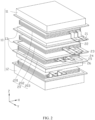
FIG. 2 is a schematic exploded view of an electrochemical device according to an embodiment of this application; -
FIG. 3 is a cross-sectional view of the electrochemical device shown inFIG. 2 ; -
FIG. 4 is a schematic structural diagram of an electrochemical device according to an embodiment of this application; -
FIG. 5 is a partial cross-sectional view of an electrochemical device according to an embodiment of this application; -
FIG. 6 is a side view of an electrochemical device according to an embodiment of this application; -
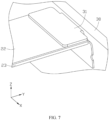
FIG. 7 is a schematic diagram of connection between a circuit board and a third tab according to an embodiment of this application; -
FIG. 8 is a schematic diagram of connection between an electrode assembly and a circuit board according to an embodiment of this application; -
FIG. 9 is a schematic structural diagram of a tab according to an embodiment of this application; -
FIG. 10 is a schematic structural diagram of a tab according to another embodiment of this application; -
FIG. 11 is a side view of connection between a third tab and a conductive piece according to an embodiment of this application; -
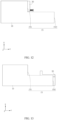
FIG. 12 is a top view of an electrochemical device according to an embodiment of this application; -
FIG. 13 is a top view of an electrochemical device according to another embodiment of this application; -
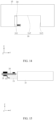
FIG. 14 is a top view of an electrochemical device according to still another embodiment of this application; -
FIG. 15 is a side view of an electrochemical device according to an embodiment of this application; -
FIG. 16 is a schematic diagram of a folded circuit board of an electrochemical device according to an embodiment of this application; -
FIG. 17 is a schematic diagram of a folded circuit board of an electrochemical device according to another embodiment of this application; -
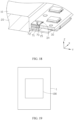
FIG. 18 is a partial cross-sectional view of an electrochemical device according to an embodiment of this application; and -
FIG. 19 is a schematic diagram of an electrical device according to an embodiment of this application. -
-
electrochemical device 100 -
housing 10 -
first housing part 11 -
second housing part 12 -
partition piece 13 -
body portion 14 -
first seal edge 15 -
first section 151 -
second section 152 -
second seal edge 16 -
third section 161 -
fourth section 162 -
fifth section 163 -
accommodation cavity 101 -
electrode assembly 20 -
first tab 21 -
second tab 22 -
first portion 221 -
second portion 222 -
third tab 23 -
fourth tab 24 -
fifth tab 25 -
sixth tab 26 - first
sub-electrode assembly 201 - second
sub-electrode assembly 202 - third
sub-electrode assembly 203 -
series connection path 204 -
circuit board 30 -
conductive piece 31 - first connecting
pad 32 - second connecting
pad 33 -
clearance opening 34 - first connecting
region 401 - second connecting
region 402 -
first adhesive 50 -
second adhesive 60 - temperature-controlled
switch 70 -
temperature sensing wall 71 -
thermal conductor 72 -
electrical device 1 - first direction Z
- second direction Y
- third direction X
- The following describes the technical solutions in some embodiments of this application with reference to the drawings hereof. Evidently, the described embodiments are merely a part of but not all of the embodiments of this application.
- The term "perpendicular" is a description of an ideal state between two components. In the actual production or use state, one component may be approximately perpendicular to another component. For example, numerically, the term "perpendicular" may represent an angle of 90°±10° between two straight lines, or a dihedral angle of 90°±10° between two planes, or an angle of 90°±10° between a straight line and a plane. Two components described as "perpendicular" to each other may be not absolute straight lines or planes, but may be roughly straight lines or planes. An object is considered to be a "straight line" or "plane" if the overall extension direction of the object is a straight line or plane as viewed from a macro perspective.
- The term "parallel" is a description of an ideal state between two components. In an actual production or use state, one component may be approximately parallel to another component. For example, numerically, the term "parallel" may represent an angle of 180°±10° between two straight lines, or a dihedral angle of 180°±10° between two planes, or an angle of 180°±10° between a straight line and a plane. The two components described as "parallel" may be not absolute straight lines or planes, but may be roughly straight lines or planes. An object is considered to be a "straight line" or "plane" if the overall extension direction of the object is a straight line or plane as viewed from a macro perspective.
- Unless otherwise defined, when used for describing the number of components, the term "plurality" herein specifically means that there are two or more components.
- Unless otherwise defined, all technical and scientific terms used herein bear the same meanings as what is normally understood by a person skilled in the technical field of this application. The terms used in the specification of this application are merely intended to describe specific embodiments but not to limit this application.
- This application discloses an electrochemical device. The electrochemical device includes a housing, an electrode assembly, and a circuit board. The electrode assembly includes a first sub-electrode assembly and a second sub-electrode assembly. The first sub-electrode assembly and the second sub-electrode assembly are mounted in the housing along a first direction. A first tab and a second tab of opposite polarities are disposed on the first sub-electrode assembly. A third tab and a fourth tab of opposite polarities are disposed on the second sub-electrode assembly. The first tab and the fourth tab are of opposite polarities. A plurality of conductive pieces are disposed on the circuit board. The first tab and the fourth tab each are connected to one separate conductive piece. The second tab is connected to the third tab. The second tab is further connected to one of the conductive pieces. Viewed along the first direction, a projection of the second tab at least partially overlaps a projection of the third tab.
- The first tab, the second tab, and the fourth tab of the electrode assembly are connected to the circuit board by the conductive piece. The first sub-electrode assembly and second sub-electrode assembly are connected in series through the connection between the second tab and the third tab. In this way, during charging and discharging of the electrochemical device, the current passes through the circuit board, the first tab, the first sub-electrode assembly, the second tab, the third tab, the second sub-electrode assembly, and the fourth tab in sequence, so that the charging current and the discharging current do not flow back to the circuit board after passing through each of the sub-electrode assemblies separately, but flow back to the circuit board after passing through all the sub-electrode assemblies, thereby reducing the internal resistance of the electrochemical device and increasing the charging power and discharging power. The projection of the second tab in the first direction at least partially overlaps the projection of the third tab in the first direction, thereby reducing the space occupied by the second tab and the third tab, and improving the energy density of the electrochemical device.
- The following describes some embodiments of this application with reference to drawings. To the extent that no conflict occurs, the following embodiments and the features in the embodiments may be combined with each other.
- Referring to
FIG. 1 andFIG. 2 , an embodiment of this application provides anelectrochemical device 100. Theelectrochemical device 100 includes ahousing 10, anelectrode assembly 20, and acircuit board 30. Referring toFIG. 2 to FIG. 4 , theelectrode assembly 20 includes a firstsub-electrode assembly 201 and a secondsub-electrode assembly 202. The firstsub-electrode assembly 201 and the secondsub-electrode assembly 202 are mounted in thehousing 10 along a first direction Z. Afirst tab 21 and asecond tab 22 of opposite polarities are disposed on the firstsub-electrode assembly 201. The secondsub-electrode assembly 202 includes athird tab 23 and afourth tab 24 of opposite polarities. A plurality ofconductive pieces 31 are disposed on thecircuit board 30. Thefirst tab 21 and thefourth tab 24 each are connected to one separateconductive piece 31. Thesecond tab 22 is connected to thethird tab 23. Thesecond tab 22 is further connected to one of theconductive pieces 31. - In some embodiments, referring to
FIG. 2 andFIG. 3 , a plurality ofaccommodation cavities 101 isolated from each other are disposed in thehousing 10. The firstsub-electrode assembly 201 and the secondsub-electrode assembly 202 are mounted indifferent accommodation cavities 101. In some embodiments, thehousing 10 includes afirst housing part 11, asecond housing part 12, and a plurality ofpartition pieces 13. Thefirst housing part 11 is connected to thesecond housing part 12. The plurality ofpartition pieces 13 are disposed between thefirst housing part 11 and thesecond housing part 12. Thefirst housing part 11, thesecond housing part 12, and the plurality ofpartition pieces 13 close in together to form a plurality ofaccommodation cavities 101. The plurality ofaccommodation cavities 101 are isolated from each other. Each of theaccommodation cavities 101 is filled with an electrolyte solution. The electrolyte solution does not circulate between the plurality ofaccommodation cavities 101. The plurality ofaccommodation cavities 101 are arranged along a first direction Z. The first direction Z is parallel to a thickness direction of thehousing 10. In an embodiment, thefirst housing part 11 and thesecond housing part 12 are disposed opposite to each other along the first direction Z. - In some embodiments, referring to
FIG. 3 and FIG. 4 , thepartition pieces 13 are disposed in a space formed by enclosure by thefirst housing part 11 and thesecond housing part 12 so that thepartition pieces 13 are not visible from the outside. A seal edge is formed at a junction between thefirst housing part 11 and thesecond housing part 12 so that thehousing 10 includes abody portion 14, two first seal edges 15, and two second seal edges 16. Along the second direction Y, the two first seal edges 15 are located on the two opposite sides of thebody portion 14, and the second direction Y is perpendicular to the first direction Z. Along the third direction X, the two second seal edges 16 are located on the two opposite sides of thebody portion 14, and the third direction X is perpendicular to the first direction Z. The third direction X is further perpendicular to the second direction Y. Thefirst tab 21, thesecond tab 22, and thethird tab 23 of theelectrode assembly 20 may extend from thefirst seal edge 15 or thesecond seal edge 16 out of theaccommodation cavity 101. Thefirst seal edge 15 or thesecond seal edge 16 may serve to seal theaccommodation cavity 101. - In some embodiments, referring to
FIG. 4 , a length of thefirst seal edge 15 along the third direction X is W, a length of thesecond seal edge 16 along the second direction Y is L, and W is less than L. The second direction Y is parallel to the length direction of thehousing 10. The third direction X is parallel to the width direction of thehousing 10. - In some embodiments, referring to
FIG. 4 andFIG. 5 , theelectrochemical device 100 further includes afirst adhesive 50. Thefirst seal edge 15 and thesecond seal edge 16 extend from thebody portion 14, and both include a cut end face in the extension direction. Afirst adhesive 50 is disposed on thefirst seal edge 15 or thesecond seal edge 16. The first adhesive 50 overlays the end face of thefirst seal edge 15 or thesecond seal edge 16 in the extension direction, and serves to insulate the cut end face of thefirst seal edge 15 or thesecond seal edge 16. - In some embodiments, referring to
FIG. 4 andFIG. 5 , thefirst adhesive 50 is a piece of U-shaped adhesive tape, for example, single-sided tape or double-sided tape. The adhesive tape occupies less space, and helps to downsize theelectrochemical device 100. - In some embodiments, referring to
FIG. 4 andFIG. 5 , theelectrochemical device 100 further includes asecond adhesive 60. Thefirst seal edge 15 or thesecond seal edge 16, on which no tab is disposed, is folded and extends along the first direction Z. After being folded, thefirst seal edge 15 or thesecond seal edge 16 can reduce the space occupied by the entireelectrochemical device 100, thereby improving the space utilization rate of theelectrochemical device 100, and increasing the energy density of theelectrochemical device 100. The foldedfirst seal edge 15 orsecond seal edge 16 is bonded to thebody portion 14 by thesecond adhesive 60. The second adhesive 60 may be an ultraviolet adhesive or hot-melt adhesive serving to fix the seal edge. - In some embodiments, the folded
first seal edge 15 orsecond seal edge 16 is coated with thefirst adhesive 50. Thefirst adhesive 50 is bonded to thebody portion 14 by thesecond adhesive 60. In some embodiments, the first adhesive 50 may serve as a bonding medium between the seal edge and the second adhesive 60 to protect the seal edge. - Referring to
FIG. 2 to FIG. 4 , the firstsub-electrode assembly 201 includes a negative electrode plate, a positive electrode plate, a separator, afirst tab 21, and asecond tab 22. The separator is located between the negative electrode plate and the positive electrode plate. The positive electrode plate and the negative electrode plate may be stacked or wound. The polarity of thefirst tab 21 is opposite to the polarity of thesecond tab 22. For example, thefirst tab 21 is a positive tab, and is connected to the positive electrode plate; and thesecond tab 22 is a negative tab, and is connected to the negative electrode plate. The secondsub-electrode assembly 202 includes a negative electrode plate, a positive electrode plate, a separator, and athird tab 23 and afourth tab 24 of opposite polarities. For detailed settings, reference may be made to the firstsub-electrode assembly 201, and the details are omitted herein. - The
first tab 21 is connected to oneconductive piece 31. Thefourth tab 24 is connected to oneconductive piece 31. Thefourth tab 24 is of an opposite polarity to thefirst tab 21. Thesecond tab 22 is connected to thethird tab 23 to implement series connection between the firstsub-electrode assembly 201 and the secondsub-electrode assembly 202. Referring toFIG. 8 , aseries connection path 204 is formed after the series connection is implemented. Theseries connection path 204 is a path along which the charging current and the discharging current flow. Thesecond tab 22 is further connected to one of theconductive pieces 31. In this way, a current for detection is caused to flow between thesecond tab 22 and thecircuit board 30. The detection current is less than the charging current and the discharging current. - Referring to
FIG. 2 to FIG. 4 , the firstsub-electrode assembly 201 and the secondsub-electrode assembly 202 are mounted indifferent accommodation cavities 101, so that the firstsub-electrode assembly 201 and the secondsub-electrode assembly 202 are arranged along the first direction Z. - In some embodiments, the
electrode assembly 20 further includes a thirdsub-electrode assembly 203. The thirdsub-electrode assembly 203 includes a negative electrode plate, a positive electrode plate, a separator, and afifth tab 25 and asixth tab 26 of opposite polarities. For detailed settings, reference may be made to the firstsub-electrode assembly 201, and the details are omitted herein. - The third
sub-electrode assembly 203 is disposed on one side of the secondsub-electrode assembly 202, the side being oriented away from the firstsub-electrode assembly 201. Thesixth tab 26 is of an opposite polarity to thethird tab 23. Thefifth tab 25 is connected to thefourth tab 24. Thesixth tab 26 is connected to aconductive piece 31. Viewed along the first direction Z, a projection of thefifth tab 25 at least partially overlaps a projection of thefourth tab 24. - In some embodiments, the
electrode assembly 20 may further include more sub-electrode assemblies, for example, a fourth sub-electrode assembly (not identified), and the like, the details of which are omitted herein. - In some embodiments, the number of sub-electrode assemblies is N. The number of tabs extending from the
electrode assembly 20 is S. Two tabs connected together are deemed to be one tab. For example, onesecond tab 22 and onethird tab 23 connected together are counted as one tab. Afirst tab 21 that is not connected to any other tabs is counted as one tab. The numbers satisfy: N + 1 ≤ S < 2N. Optionally, the number N of sub-electrode assemblies may be 2, 3, 4, 5, 6, 7, or the like. - As an example, the
electrode assembly 20 does not include a thirdsub-electrode assembly 203, and the number of sub-electrode assemblies is N = 2. The number of thefirst tabs 21, the number of thesecond tabs 22, the number of thethird tabs 23, and the number of thefourth tabs 24 are one separately. Therefore, the number of tabs extending from theelectrode assembly 20 is S = 3. - As an example, the
electrode assembly 20 includes a thirdsub-electrode assembly 203, and the number of sub-electrode assemblies is N = 3. The number of thefirst tabs 21, the number of thesecond tabs 22, the number of thethird tabs 23, the number of thefourth tabs 24, the number of thefifth tabs 25, and the number of thesixth tabs 26 are one separately. Therefore, the number of tabs extending from theelectrode assembly 20 is S = 4. - Referring to
FIG. 6 , viewed along the first direction Z, the projection of thesecond tab 22 at least partially overlaps the projection of thethird tab 23. In this way, viewed along the first direction Z, the space occupied by thesecond tab 22 and thethird tab 23 is reduced, thereby increasing the energy density of theelectrochemical device 100. - In some embodiments, referring to
FIG. 4 andFIG. 6 , thefirst tab 21, thesecond tab 22, thethird tab 23, and thefourth tab 24 all protrude from thefirst seal edge 15, and extend along the second direction Y. Viewed along the first direction Z, the projection of thefirst tab 21, the projection of thefourth tab 24, and the projection of thesecond tab 22 do not overlap. The above arrangement makes it convenient to connect thefirst tab 21, thesecond tab 22, and thefourth tab 24 to theconductive pieces 31 of thecircuit board 30. For example, when thefirst tab 21, thesecond tab 22, and thefourth tab 24 are connected to theconductive pieces 31 by welding, thefirst tab 21, thesecond tab 22, and thefourth tab 24 are arranged in the way above to optimize the welding operation space, facilitate the welding operation, and improve the welding efficiency. - In some embodiments, referring to
FIG. 4 andFIG. 6 , viewed along the third direction X, thefirst tab 21, thesecond tab 22, and thefourth tab 24 at least partially overlap to reduce the space occupied by thefirst tab 21, thesecond tab 22, and thethird tab 23 in the first direction Z, thereby increasing the energy density of theelectrochemical device 100. - Referring to
FIG. 7 andFIG. 8 , a plurality ofconductive pieces 31 on thecircuit board 30 are arranged sequentially in such order that they correspond to thefirst tab 21, thesecond tab 22, and thefourth tab 24, respectively. Thefirst tab 21 is connected to oneconductive piece 31, so as to be electrically connected to thecircuit board 30. Thesecond tab 22 is connected to oneconductive piece 31, so as to be electrically connected to thecircuit board 30. Thefourth tab 24 is connected to oneconductive piece 31, so as to be electrically connected to thecircuit board 30. - The first
sub-electrode assembly 201 and the secondsub-electrode assembly 202 are connected in series through the connection between thesecond tab 22 and thethird tab 23. In this way, when thecircuit board 30 is engaged in charging and discharging, the charging or discharging current passes through thecircuit board 30, thefirst tab 21, the firstsub-electrode assembly 201, thesecond tab 22, thethird tab 23, the secondsub-electrode assembly 202, and thefourth tab 24 in sequence. Therefore, the charging or discharging current does not flow back to thecircuit board 30 after passing through the firstsub-electrode assembly 201 alone, but flows back to thecircuit board 30 after passing through both the firstsub-electrode assembly 201 and the secondsub-electrode assembly 202, thereby reducing the internal resistance of theelectrochemical device 100 and increasing the charging power and discharging power. Electronic components configured to collect information about the firstsub-electrode assembly 201 and the secondsub-electrode assembly 202 are disposed on thecircuit board 30. Through thesecond tab 22, a current for detecting information such as voltage and current flows between the firstsub-electrode assembly 201 and the circuit board, and between the secondsub-electrode assembly 202 and thecircuit board 30. The detection current is less than the charging current and the discharging current. - In some embodiments, referring to
FIG. 8 to FIG. 10 , thesecond tab 22 includes afirst portion 221 and asecond portion 222. Thefirst portion 221 is connected to the firstsub-electrode assembly 201. Thesecond portion 222 is configured to be connected to theconductive pieces 31. Viewed along the first direction Z, a width of thesecond portion 222 in the third direction X is less than a width of thefirst portion 221 in the third direction X. Thethird tab 23 may be connected to the relatively widefirst portion 221, so that the charging current and the discharging current flow through thefirst portion 221, and the detection current flows through thesecond portion 222. The detection current is less than the charging current and the discharging current, thereby reducing the width of thesecond portion 222. The reduced width of thesecond portion 222 can downsize the correspondingconductive piece 31 and improve the utilization rate of thecircuit board 30. As an example, theconductive piece 31 is welded to thecircuit board 30. Thesecond portion 222 of thesecond tab 22 is welded to theconductive piece 31. The reduced width of thesecond portion 222 makes the size of theconductive piece 31 reducible. In this way, the area of the welding region, welded to theconductive piece 31, on thecircuit board 30 is reducible, thereby increasing the utilization rate of the area of thecircuit board 30. - Optionally, the
second tab 22 is an L-shaped tab or an inverted hollow T-shaped tab. In this way, viewed along the first direction Z, the width of thesecond portion 222 in the third direction X is less than the width of thefirst portion 221 in the third direction X. - In some embodiments, referring to
FIG. 8 , viewed along the first direction Z, the width of thesecond portion 222 of thesecond tab 22 in the third direction X is less than the width of thefirst portion 221 in the third direction X. A first connectingpad 32 is disposed on thecircuit board 30. Theconductive piece 31 welded to thesecond tab 22 is welded to the first connectingpad 32. Further, at least two second connectingpads 33 are disposed on thecircuit board 30. Theconductive piece 31 welded to thefirst tab 21 is welded to one of the second connectingpads 33, and theconductive piece 31 welded to thefourth tab 24 is welded to one of the second connectingpads 33. The area of the first connectingpad 32 is smaller than the area of the second connectingpad 33. Viewed along the first direction Z, the projection of thesecond tab 22 is located between the projection of thefirst tab 21 and the projection of thefourth tab 24. In this way, the relatively large second connectingpads 33 on thecircuit board 30 can be made to be located at both ends, and the relatively small first connectingpad 32 is located between at least two second connectingpads 33. During welding, the first connectingpad 32 located between the at least two second connectingpads 33 is relatively small in area, thereby facilitating the welding operation and improving the welding efficiency. Optionally, both the first connectingpad 32 and the second connectingpad 33 are bonding pads. - In some embodiments, referring to
FIG. 7 , thesecond tab 22 is a negative tab. Theconductive piece 31 and thesecond tab 22 are made of a first material. For example, the first material may be nickel. Thethird tab 23 is a positive tab. Thethird tab 23 is made of a second material different from the first material. For example, the second material may be aluminum. The melting point of the first material is higher than the melting point of the second material. - Along the first direction Z, the
conductive piece 31, thesecond tab 22, and thethird tab 23 are stacked in sequence. In other words, thesecond tab 22 is welded to theconductive piece 31 and is disposed on one side of theconductive piece 31 in the first direction Z. Thethird tab 23 is welded to thesecond tab 22 and located on one side of thesecond tab 22, the side being oriented away from theconductive piece 31. The melting point of nickel is higher than the melting point of aluminum. The above arrangement can protect the aluminum tab and reduce the risk of burning through the aluminum tab. - In some embodiments, the
conductive piece 31, thesecond tab 22, and thethird tab 23 are stacked sequentially along the first direction Z. Along the first direction Z, the thickness of theconductive piece 31 made of the first material may be 0.08 mm to 0.3 mm, and specifically may be 0.08 mm, 0.1 mm, 0.25 mm, or 0.3 mm. The thickness of thesecond tab 22 made of the first material may be 0.08 mm to 0.3 mm, and specifically may be 0.08 mm, 0.1 mm, 0.25 mm, or 0.3 mm. The thickness of thethird tab 23 made of the second material may be 0.1 mm to 0.3 mm, and specifically may be 0.1 mm, 0.25 mm, or 0.3 mm. - In some embodiments, along the first direction Z, both the thickness of the
conductive piece 31 and the thickness of thesecond tab 22 are greater than a thickness difference between theconductive piece 31 and thesecond tab 22. Along the first direction Z, both the thickness of thesecond tab 22 and the thickness of thethird tab 23 are greater than a thickness difference between thesecond tab 22 and thethird tab 23. This setting facilitates the welding operation and improves the welding effect. - In some embodiments, referring to
FIG. 11 , a first connectingregion 401 exists between theconductive piece 31 and thesecond tab 22. A second connectingregion 402 exists between thethird tab 23 and thesecond tab 22. Viewed along the first direction Z, a projection of the first connectingregion 401 does not overlap a projection of the second connectingregion 402. The above arrangement staggers the first connectingregion 401 from the second connectingregion 402, thereby reducing the difficulty of multi-layer welding and improving the welding efficiency. As an example, an extension length of thesecond tab 22 is greater than an extension length of thethird tab 23. In the extension direction of thesecond tab 22, thesecond tab 22 is made to exceed thethird tab 23. The excess part of thesecond tab 22 beyond thethird tab 23 is welded to theconductive piece 31. The non-excess part of thesecond tab 22 not beyond thethird tab 23 overlaps and is welded to thethird tab 23. - In some embodiments, referring to
FIG. 1 andFIG. 4 , thefirst tab 21, thesecond tab 22, thethird tab 23, and thefourth tab 24 protrude from thefirst seal edge 15. Thecircuit board 30 is disposed on thefirst seal edge 15. Thefirst seal edge 15 is a short edge. The length of thecircuit board 30 in the third direction X corresponds to the length of thefirst seal edge 15 in the third direction X, thereby shortening the size of thecircuit board 30 accordingly and increasing the energy density of theelectrochemical device 100. - In some embodiments, referring to
FIG. 12 and FIG. 13 , onefirst seal edge 15 among the two first seal edges 15 includes afirst section 151 and asecond section 152. Viewed along the first direction Z, a projection of thefirst section 151 is spaced apart from a projection of thesecond section 152. Thefirst tab 21, thesecond tab 22, and thethird tab 23 all protrude from thefirst section 151. Thecircuit board 30 is disposed in thefirst section 151. Thefirst seal edge 15 is divided into thefirst section 151 and thesecond section 152. The length of thefirst section 151 and the length of thesecond section 152 in the third direction X are both less than the length of thefirst seal edge 15 in the third direction X. As an example, thehousing 10 is roughly L-shaped so that thefirst seal edge 15 includes thefirst section 151 and thesecond section 152. Thecircuit board 30 is disposed in thefirst section 151, thereby further downsizing thecircuit board 30. - In some embodiments, still referring to
FIG. 14 , onesecond seal edge 16 among the two second seal edges 16 includes athird section 161, afourth section 162, and afifth section 163 that are connected together. Viewed along the first direction, thethird section 161 is perpendicular to thefourth section 162. Thethird section 161 is parallel to thefifth section 163. Thefirst tab 21, thesecond tab 22, thethird tab 23, and thefourth tab 24 all protrude from thethird section 161, or all protrude from thefourth section 162, or all protrude from thefifth section 163. As an example, thehousing 10 is roughly hollow U-shaped. - The
circuit board 30 is disposed in a section from which the tab protrudes among thethird section 161, thefourth section 162, or thefifth section 163. The length of thethird section 161 and the length of thefifth section 163 in thesecond seal edge 16 in the third direction X are both less than the length of thesecond seal edge 16 in the second direction Y. The length of thefourth section 162 in the second direction Y is less than the length of thesecond seal edge 16 in the second direction Y. Positioning thecircuit board 30 in any one of thethird section 161, thefourth section 162, or thefifth section 163 can sufficiently utilize the space of the battery. - In some embodiments, referring to
FIG. 15 to FIG. 17 , thefirst tab 21, thesecond tab 22, thethird tab 23, and thefourth tab 24 protrude from thefirst seal edge 15, and extend along the second direction Y. Thecircuit board 30 is mounted on thefirst seal edge 15, and is connected to thefirst tab 21, thesecond tab 22, and thefourth tab 24 by a plurality ofconductive pieces 31 separately. Viewed along the first direction Z, the projection of thecircuit board 30 at least partially overlaps the projection of thefirst seal edge 15, thereby shortening the overall length of theelectrochemical device 100 in the second direction Y. - Optionally, the
conductive piece 31 is an L-shaped sheet. Of the L-shapedconductive piece 31, one section is welded to thecircuit board 30, and the other section is welded to the tab. By bending the nickel sheet and the tab in sequence, thecircuit board 30 is driven to turn over correspondingly. In this way, when viewed along the first direction, the projection of thecircuit board 30 at least partially overlaps the projection of thefirst seal edge 15. - Optionally, the
conductive piece 31 is flat straight sheet-shaped. Thecircuit board 30 is driven to turn over correspondingly by bending the tab. In this way, when viewed along the first direction Z, the projection of thecircuit board 30 at least partially overlaps the projection of thefirst seal edge 15. - In some embodiments, referring to
FIG. 18 , theelectrochemical device 100 further includes a temperature-controlledswitch 70. The temperature-controlledswitch 70 is mounted on thecircuit board 30, and is connected to a firstsub-electrode assembly 201 and a secondsub-electrode assembly 202 in series. - In some embodiments, referring to
FIG. 18 , aclearance opening 34 is created and runs through thecircuit board 30 along the first direction Z, and is available for mounting the temperature-controlledswitch 70. The temperature-controlledswitch 70 is electrically connected to thecircuit board 30 through theclearance opening 34 by Surface Mounted Technology (SMT). - As an example, the
clearance opening 34 is a notch recessed at one lateral edge of thecircuit board 30. As an example, theclearance opening 34 is a through-hole that runs through thecircuit board 30 along the first direction Z. - A temperature sensor may be built in the temperature-controlled
switch 70, and the temperature-controlled switch may include atemperature sensing wall 71 connected to the temperature sensor. Thetemperature sensing wall 71 serves as a transfer medium oriented toward thefirst seal edge 15 to detect the heat emitted by theelectrode assembly 20. When the temperature sensor detects that the heat of theelectrode assembly 20 exceeds a preset threshold, the temperature-controlledswitch 70 controls the current between thecircuit board 30 and theelectrode assembly 20 to get cut off to reduce the risk of damage to theelectrochemical device 100 caused by overcharge. - In some embodiments, referring to
FIG. 18 , athermal conductor 72 is further disposed between thetemperature sensing wall 71 and thefirst seal edge 15. Thethermal conductor 72 may be in contact with thetemperature sensing wall 71, and additionally, thethermal conductor 72 may be in contact with thefirst seal edge 15. Thethermal conductor 72 may be a thermal adhesive or a thermal foam gasket, and serves to transfer heat and fix the position of thethermal conductor 72, thereby improving the accuracy of temperature sensing. - Referring to
FIG. 19 , an embodiment of this application further provides anelectrical device 1. Theelectrical device 1 includes theelectrochemical device 100 disclosed in any one of the above embodiments. Theelectrical device 1 contains theelectrochemical device 100 based on the technical solution in any one of the above embodiments, and therefore, achieves at least the beneficial effects brought by theelectrochemical device 100 based on the technical solution in any one of the embodiments, the details of which are omitted here. - The
electrical device 1 may be a mobile phone, a computer, a camera, a calculator, a headset, an e-book, a player, a phone watch, a light, a toy, a game console, a video recorder, a portable CD player, an electronic notepad, a portable sound recorder, a radio set, or the like. - In addition, a person of ordinary skill in the art understands that the foregoing embodiments are merely intended to illustrate this application, but not intended to limit this application. Any and all appropriate modifications and changes made to the embodiments without departing from the spirit and conception of this application still fall within the protection scope of this application.
Claims (18)
- An electrochemical device, characterized in that the electrochemical device comprises:a housing;an electrode assembly, comprising a first sub-electrode assembly and a second sub-electrode assembly, wherein the first sub-electrode assembly and the second sub-electrode assembly are mounted in the housing along a first direction, a first tab and a second tab of opposite polarities are disposed on the first sub-electrode assembly, a third tab and a fourth tab of opposite polarities are disposed on the second sub-electrode assembly, and the first tab and the fourth tab are of opposite polarities;a circuit board, on which a plurality of conductive pieces are disposed, the first tab and the fourth tab each are connected to one separate conductive piece, the second tab is connected to the third tab, and the second tab is further connected to one of the conductive pieces; andviewed along the first direction, a projection of the second tab at least partially overlaps a projection of the third tab.
- The electrochemical device according to claim 1, characterized in that the electrode assembly comprises a third sub-electrode assembly; the third sub-electrode assembly is disposed on one side of the second sub-electrode assembly, the one side of the second sub-electrode assembly being oriented away from the first sub-electrode assembly; a fifth tab and a sixth tab of opposite polarities are disposed on the third sub-electrode assembly; the fifth tab is connected to the fourth tab; the sixth tab and the third tab are of opposite polarities; and the sixth tab is connected to one of the conductive pieces; and
viewed along the first direction, a projection of the fifth tab at least partially overlaps a projection of the fourth tab. - The electrochemical device according to claim 1, characterized in that the plurality of conductive pieces and the second tab are made of a first material, the third tab is made of a second material, a melting point of the first material is higher than a melting point of the second material,;and
along the first direction, one of the conductive pieces, the second tab, and the third tab are stacked in sequence. - The electrochemical device according to claim 1, characterized in that a first connecting region is provided between the second tab and one of the conductive pieces, a second connecting region is provided between the second tab and the third tab; and,
viewed along the first direction, a projection of the first connecting region does not overlap a projection of the second connecting region. - The electrochemical device according to claim 1, characterized in that, viewed along the first direction, a projection of the first tab, a projection of the fourth tab, and the projection of the second tab do not overlap.
- The electrochemical device according to claim 5, characterized in that, viewed along the first direction, the projection of the second tab is located between the projection of the first tab and the projection of the fourth tab.
- The electrochemical device according to claim 1, characterized in that the second tab comprises a first portion and a second portion, the first portion is connected to the first sub-electrode assembly, the second portion is configured to be connected to one of the conductive pieces,;and
viewed along the first direction, a width of the second portion is less than a width of the first portion. - The electrochemical device according to claim 1, characterized in that a plurality of accommodation cavities isolated from each other are disposed in the housing, the plurality of accommodation cavities are arranged along the first direction, and the first sub-electrode assembly and the second sub-electrode assembly are mounted in different accommodation cavities.
- The electrochemical device according to claim 8, characterized in that the housing comprises a body portion, two first seal edges, and two second seal edges; a second direction, a third direction, and the first direction are perpendicular to each other; along the second direction, the two first seal edges are located on two opposite sides of the body portion respectively; and, along the third direction, the two second seal edges are located on other two opposite sides of the body portion respectively.
- The electrochemical device according to claim 9, characterized in that a length of each of the first seal edges along the third direction is W, a length of each of the second seal edges along the second direction is L, W is less than L, and the circuit board is disposed on the first seal edge.
- The electrochemical device according to claim 10, characterized in that one of the first seal edges comprises a first section and a second section; viewed along the first direction, a projection of the first section is spaced apart from a projection of the second section; and the circuit board is disposed in the first section.
- The electrochemical device according to claim 10, characterized in that the two second seal edges extend along the first direction, the electrochemical device comprises a first adhesive, the first adhesive is disposed on each second seal edge, and the first adhesive overlays an end face of the second seal edge in an extension direction.
- The electrochemical device according to claim 10, characterized in that the electrochemical device comprises a second adhesive, and the second seal edges are bonded to the body portion by the second adhesive.
- The electrochemical device according to claim 9, characterized in that one of the second seal edges comprises a third section, a fourth section, and a fifth section that are connected together; viewed along the first direction, the third section is perpendicular to the fourth section, and the third section is parallel to the fifth section; and the circuit board is disposed in any one of the third section, the fourth section, or the fifth section.
- The electrochemical device according to claim 9, characterized in that the circuit board is mounted on the first seal edges; and, viewed along the first direction, a projection of the circuit board at least partially overlaps a projection of the first seal edges.
- The electrochemical device according to claim 15, characterized in that the electrochemical device comprises a temperature-controlled switch, the temperature-controlled switch is mounted on the circuit board, the temperature-controlled switch is connected to the electrode assembly in series, the temperature-controlled switch comprises a temperature sensing wall, and the temperature sensing wall is oriented toward one of the first seal edges.
- The electrochemical device according to claim 16, characterized in that a thermal conductor is disposed between the temperature sensing wall and one of the first seal edges.
- An electrical device, characterized in that the electrical device comprises the electrochemical device according to any one of claims 1 to 17.
Applications Claiming Priority (2)
| Application Number | Priority Date | Filing Date | Title |
|---|---|---|---|
| CN202210580553.3A CN114824593B (en) | 2022-05-25 | 2022-05-25 | Electrochemical device and electric equipment |
| PCT/CN2023/089991 WO2023226656A1 (en) | 2022-05-25 | 2023-04-23 | Electrochemical apparatus and electric device |
Publications (2)
| Publication Number | Publication Date |
|---|---|
| EP4535550A1 true EP4535550A1 (en) | 2025-04-09 |
| EP4535550A4 EP4535550A4 (en) | 2026-01-07 |
Family
ID=82517892
Family Applications (1)
| Application Number | Title | Priority Date | Filing Date |
|---|---|---|---|
| EP23810729.6A Pending EP4535550A4 (en) | 2022-05-25 | 2023-04-23 | ELECTROCHEMICAL DEVICE AND ELECTRICAL DEVICE |
Country Status (4)
| Country | Link |
|---|---|
| US (1) | US20250087790A1 (en) |
| EP (1) | EP4535550A4 (en) |
| CN (1) | CN114824593B (en) |
| WO (1) | WO2023226656A1 (en) |
Families Citing this family (1)
| Publication number | Priority date | Publication date | Assignee | Title |
|---|---|---|---|---|
| CN114824593B (en) * | 2022-05-25 | 2024-05-17 | 东莞新能德科技有限公司 | Electrochemical device and electric equipment |
Family Cites Families (24)
| Publication number | Priority date | Publication date | Assignee | Title |
|---|---|---|---|---|
| DE60307750T2 (en) * | 2002-05-08 | 2006-12-14 | Nissan Motor Co., Ltd., Yokohama | Secondary cell module and method for its production |
| JP4449485B2 (en) * | 2004-02-17 | 2010-04-14 | 日産自動車株式会社 | Bipolar battery, battery pack and vehicle equipped with these batteries |
| JP4928099B2 (en) * | 2005-08-17 | 2012-05-09 | 日立マクセルエナジー株式会社 | Battery pack, mobile device and battery pack charging method |
| JP4725578B2 (en) * | 2007-12-28 | 2011-07-13 | Tdk株式会社 | Electrochemical device and method for producing electrochemical device |
| KR100989841B1 (en) * | 2008-01-04 | 2010-10-29 | 삼성에스디아이 주식회사 | Compression pin and secondary battery having same |
| JP5601203B2 (en) * | 2009-02-02 | 2014-10-08 | 株式会社Gsユアサ | Terminal-to-terminal connection conductor, assembled battery, and method of manufacturing the assembled battery |
| JP6065610B2 (en) * | 2013-01-28 | 2017-01-25 | 株式会社豊田自動織機 | Method for manufacturing power storage device |
| JP6247055B2 (en) * | 2013-09-03 | 2017-12-13 | 株式会社富士通テレコムネットワークス福島 | Charge / discharge test equipment |
| JP6322555B2 (en) * | 2014-11-26 | 2018-05-09 | 株式会社ジャパンディスプレイ | Detection device and display device with detection function |
| WO2016181608A1 (en) * | 2015-05-08 | 2016-11-17 | パナソニックIpマネジメント株式会社 | Assembled battery |
| CN106558672B (en) * | 2015-09-25 | 2023-08-29 | 东莞新能安科技有限公司 | Battery pack |
| KR101950464B1 (en) * | 2015-11-30 | 2019-02-20 | 주식회사 엘지화학 | Battery Cell of Irregular Structure with Improved Sealing Reliability of Cell Case |
| US10497966B2 (en) * | 2016-12-22 | 2019-12-03 | Murata Manufacturing Co., Ltd. | Secondary battery, battery pack, electric vehicle, electric power storage system, electric power tool, and electronic apparatus |
| CN111477823A (en) * | 2020-04-27 | 2020-07-31 | 深圳市汇鑫利电子科技有限公司 | Battery tab, tab PACK processing method, battery finished product and electronic product |
| CN212062536U (en) * | 2020-06-18 | 2020-12-01 | 东莞新能安科技有限公司 | Battery pack |
| CN212136551U (en) * | 2020-06-29 | 2020-12-11 | 珠海冠宇动力电池有限公司 | Battery module |
| CN212486875U (en) * | 2020-07-17 | 2021-02-05 | 蜂巢能源科技有限公司 | An aluminum-based flexible circuit board and a power battery pack |
| JP7596677B2 (en) * | 2020-08-31 | 2024-12-10 | 株式会社Gsユアサ | Circuit breaker and storage element |
| JP7372981B2 (en) * | 2020-08-31 | 2023-11-01 | 寧徳新能源科技有限公司 | Electrochemical devices and electronic devices including electrochemical devices |
| CN112002868B (en) * | 2020-09-08 | 2021-07-20 | 宁德新能源科技有限公司 | An electrochemical device and electronic device |
| CN114008842A (en) * | 2021-03-22 | 2022-02-01 | 宁德新能源科技有限公司 | Battery pack and electric device with same |
| CN113437443B (en) * | 2021-06-21 | 2023-06-20 | 东莞新能安科技有限公司 | Electrochemical devices and electronic devices |
| CN215732033U (en) * | 2021-08-23 | 2022-02-01 | 东莞新能德科技有限公司 | Battery and power consumption device |
| CN114824593B (en) * | 2022-05-25 | 2024-05-17 | 东莞新能德科技有限公司 | Electrochemical device and electric equipment |
-
2022
- 2022-05-25 CN CN202210580553.3A patent/CN114824593B/en active Active
-
2023
- 2023-04-23 WO PCT/CN2023/089991 patent/WO2023226656A1/en not_active Ceased
- 2023-04-23 EP EP23810729.6A patent/EP4535550A4/en active Pending
-
2024
- 2024-11-25 US US18/958,644 patent/US20250087790A1/en active Pending
Also Published As
| Publication number | Publication date |
|---|---|
| WO2023226656A1 (en) | 2023-11-30 |
| EP4535550A4 (en) | 2026-01-07 |
| CN114824593A (en) | 2022-07-29 |
| CN114824593B (en) | 2024-05-17 |
| US20250087790A1 (en) | 2025-03-13 |
Similar Documents
| Publication | Publication Date | Title |
|---|---|---|
| CN110299479B (en) | Electronic device | |
| CN112133876B (en) | Battery and terminal equipment | |
| KR100870349B1 (en) | Connection terminal of protective circuit board and secondary battery using same | |
| CN104737322B (en) | Three-dimensional non-rectangular batteries cellular construction | |
| US10601081B2 (en) | Battery pack | |
| WO2022227729A1 (en) | Cell and power utilization apparatus | |
| KR102479721B1 (en) | Battery pack | |
| CN110168769A (en) | Battery pack | |
| EP4064505A1 (en) | Terminal device | |
| KR20140142649A (en) | Battery pack | |
| CN114744374B (en) | Battery and battery pack | |
| CN115810879A (en) | Batteries and electrical equipment | |
| WO2021129492A1 (en) | Battery assembly for use in terminal device, and terminal device having same | |
| CN115380411A (en) | Electrochemical device and electronic device including the same | |
| US20250046966A1 (en) | Battery and electronic device | |
| CN105322133A (en) | Secondary battery | |
| US20250087790A1 (en) | Electrochemical device and electrical device | |
| CN211455731U (en) | Battery modules and electronic equipment | |
| WO2021179216A1 (en) | Battery cell structure and battery | |
| US11600882B1 (en) | Thin battery pack architecture | |
| EP4095990A1 (en) | Battery cell, battery pack, and electronic device | |
| CN217281003U (en) | Battery components and terminal equipment | |
| CN217823177U (en) | Battery and electronic device | |
| CN117996369A (en) | Secondary battery and electronic device | |
| JP7536388B2 (en) | Battery module and battery pack including said battery module |
Legal Events
| Date | Code | Title | Description |
|---|---|---|---|
| STAA | Information on the status of an ep patent application or granted ep patent |
Free format text: STATUS: THE INTERNATIONAL PUBLICATION HAS BEEN MADE |
|
| PUAI | Public reference made under article 153(3) epc to a published international application that has entered the european phase |
Free format text: ORIGINAL CODE: 0009012 |
|
| STAA | Information on the status of an ep patent application or granted ep patent |
Free format text: STATUS: REQUEST FOR EXAMINATION WAS MADE |
|
| 17P | Request for examination filed |
Effective date: 20241223 |
|
| AK | Designated contracting states |
Kind code of ref document: A1 Designated state(s): AL AT BE BG CH CY CZ DE DK EE ES FI FR GB GR HR HU IE IS IT LI LT LU LV MC ME MK MT NL NO PL PT RO RS SE SI SK SM TR |
|
| DAV | Request for validation of the european patent (deleted) | ||
| DAX | Request for extension of the european patent (deleted) | ||
| A4 | Supplementary search report drawn up and despatched |
Effective date: 20251205 |
|
| RIC1 | Information provided on ipc code assigned before grant |
Ipc: H01M 50/55 20210101AFI20251201BHEP Ipc: H01M 50/507 20210101ALI20251201BHEP Ipc: H01M 10/04 20060101ALI20251201BHEP Ipc: H01M 10/42 20060101ALI20251201BHEP Ipc: H01M 10/48 20060101ALI20251201BHEP Ipc: H01M 50/105 20210101ALI20251201BHEP Ipc: H01M 50/112 20210101ALI20251201BHEP Ipc: H01M 50/51 20210101ALI20251201BHEP Ipc: H01M 50/519 20210101ALI20251201BHEP Ipc: H01M 50/533 20210101ALI20251201BHEP Ipc: H01M 50/534 20210101ALI20251201BHEP Ipc: H01M 50/569 20210101ALI20251201BHEP |