EP4535500A1 - Battery cell suitable for wireless communication of data signals, a battery comprising at least one cell - Google Patents
Battery cell suitable for wireless communication of data signals, a battery comprising at least one cell Download PDFInfo
- Publication number
- EP4535500A1 EP4535500A1 EP23202113.9A EP23202113A EP4535500A1 EP 4535500 A1 EP4535500 A1 EP 4535500A1 EP 23202113 A EP23202113 A EP 23202113A EP 4535500 A1 EP4535500 A1 EP 4535500A1
- Authority
- EP
- European Patent Office
- Prior art keywords
- cell
- battery
- communication unit
- data
- plate
- Prior art date
- Legal status (The legal status is an assumption and is not a legal conclusion. Google has not performed a legal analysis and makes no representation as to the accuracy of the status listed.)
- Withdrawn
Links
Images

Classifications
-
- H—ELECTRICITY
- H01—ELECTRIC ELEMENTS
- H01M—PROCESSES OR MEANS, e.g. BATTERIES, FOR THE DIRECT CONVERSION OF CHEMICAL ENERGY INTO ELECTRICAL ENERGY
- H01M10/00—Secondary cells; Manufacture thereof
- H01M10/42—Methods or arrangements for servicing or maintenance of secondary cells or secondary half-cells
- H01M10/425—Structural combination with electronic components, e.g. electronic circuits integrated to the outside of the casing
- H01M10/4257—Smart batteries, e.g. electronic circuits inside the housing of the cells or batteries
-
- H—ELECTRICITY
- H01—ELECTRIC ELEMENTS
- H01M—PROCESSES OR MEANS, e.g. BATTERIES, FOR THE DIRECT CONVERSION OF CHEMICAL ENERGY INTO ELECTRICAL ENERGY
- H01M10/00—Secondary cells; Manufacture thereof
- H01M10/42—Methods or arrangements for servicing or maintenance of secondary cells or secondary half-cells
- H01M10/425—Structural combination with electronic components, e.g. electronic circuits integrated to the outside of the casing
-
- H—ELECTRICITY
- H01—ELECTRIC ELEMENTS
- H01M—PROCESSES OR MEANS, e.g. BATTERIES, FOR THE DIRECT CONVERSION OF CHEMICAL ENERGY INTO ELECTRICAL ENERGY
- H01M10/00—Secondary cells; Manufacture thereof
- H01M10/42—Methods or arrangements for servicing or maintenance of secondary cells or secondary half-cells
- H01M10/48—Accumulators combined with arrangements for measuring, testing or indicating the condition of cells, e.g. the level or density of the electrolyte
-
- H—ELECTRICITY
- H01—ELECTRIC ELEMENTS
- H01M—PROCESSES OR MEANS, e.g. BATTERIES, FOR THE DIRECT CONVERSION OF CHEMICAL ENERGY INTO ELECTRICAL ENERGY
- H01M10/00—Secondary cells; Manufacture thereof
- H01M10/42—Methods or arrangements for servicing or maintenance of secondary cells or secondary half-cells
- H01M10/48—Accumulators combined with arrangements for measuring, testing or indicating the condition of cells, e.g. the level or density of the electrolyte
- H01M10/482—Accumulators combined with arrangements for measuring, testing or indicating the condition of cells, e.g. the level or density of the electrolyte for several batteries or cells simultaneously or sequentially
-
- H—ELECTRICITY
- H01—ELECTRIC ELEMENTS
- H01M—PROCESSES OR MEANS, e.g. BATTERIES, FOR THE DIRECT CONVERSION OF CHEMICAL ENERGY INTO ELECTRICAL ENERGY
- H01M50/00—Constructional details or processes of manufacture of the non-active parts of electrochemical cells other than fuel cells, e.g. hybrid cells
- H01M50/10—Primary casings; Jackets or wrappings
- H01M50/116—Primary casings; Jackets or wrappings characterised by the material
- H01M50/121—Organic material
-
- H—ELECTRICITY
- H01—ELECTRIC ELEMENTS
- H01M—PROCESSES OR MEANS, e.g. BATTERIES, FOR THE DIRECT CONVERSION OF CHEMICAL ENERGY INTO ELECTRICAL ENERGY
- H01M50/00—Constructional details or processes of manufacture of the non-active parts of electrochemical cells other than fuel cells, e.g. hybrid cells
- H01M50/10—Primary casings; Jackets or wrappings
- H01M50/116—Primary casings; Jackets or wrappings characterised by the material
- H01M50/124—Primary casings; Jackets or wrappings characterised by the material having a layered structure
-
- H—ELECTRICITY
- H01—ELECTRIC ELEMENTS
- H01M—PROCESSES OR MEANS, e.g. BATTERIES, FOR THE DIRECT CONVERSION OF CHEMICAL ENERGY INTO ELECTRICAL ENERGY
- H01M50/00—Constructional details or processes of manufacture of the non-active parts of electrochemical cells other than fuel cells, e.g. hybrid cells
- H01M50/10—Primary casings; Jackets or wrappings
- H01M50/14—Primary casings; Jackets or wrappings for protecting against damage caused by external factors
- H01M50/141—Primary casings; Jackets or wrappings for protecting against damage caused by external factors for protecting against humidity
-
- H—ELECTRICITY
- H02—GENERATION; CONVERSION OR DISTRIBUTION OF ELECTRIC POWER
- H02J—ELECTRIC POWER NETWORKS; CIRCUIT ARRANGEMENTS OR SYSTEMS FOR SUPPLYING OR DISTRIBUTING ELECTRIC POWER; SYSTEMS FOR STORING ELECTRIC ENERGY
- H02J7/00—Circuit arrangements for charging or discharging batteries or for supplying loads from batteries
- H02J7/40—Circuit arrangements for charging or discharging batteries or for supplying loads from batteries characterised by the exchange of charge or discharge related data
-
- H—ELECTRICITY
- H04—ELECTRIC COMMUNICATION TECHNIQUE
- H04B—TRANSMISSION
- H04B13/00—Transmission systems characterised by the medium used for transmission, not provided for in groups H04B3/00 - H04B11/00
-
- H—ELECTRICITY
- H04—ELECTRIC COMMUNICATION TECHNIQUE
- H04W—WIRELESS COMMUNICATION NETWORKS
- H04W24/00—Supervisory, monitoring or testing arrangements
- H04W24/04—Arrangements for maintaining operational condition
-
- H—ELECTRICITY
- H01—ELECTRIC ELEMENTS
- H01M—PROCESSES OR MEANS, e.g. BATTERIES, FOR THE DIRECT CONVERSION OF CHEMICAL ENERGY INTO ELECTRICAL ENERGY
- H01M10/00—Secondary cells; Manufacture thereof
- H01M10/42—Methods or arrangements for servicing or maintenance of secondary cells or secondary half-cells
- H01M10/425—Structural combination with electronic components, e.g. electronic circuits integrated to the outside of the casing
- H01M2010/4271—Battery management systems including electronic circuits, e.g. control of current or voltage to keep battery in healthy state, cell balancing
-
- H—ELECTRICITY
- H01—ELECTRIC ELEMENTS
- H01M—PROCESSES OR MEANS, e.g. BATTERIES, FOR THE DIRECT CONVERSION OF CHEMICAL ENERGY INTO ELECTRICAL ENERGY
- H01M10/00—Secondary cells; Manufacture thereof
- H01M10/42—Methods or arrangements for servicing or maintenance of secondary cells or secondary half-cells
- H01M10/425—Structural combination with electronic components, e.g. electronic circuits integrated to the outside of the casing
- H01M2010/4278—Systems for data transfer from batteries, e.g. transfer of battery parameters to a controller, data transferred between battery controller and main controller
-
- H—ELECTRICITY
- H01—ELECTRIC ELEMENTS
- H01M—PROCESSES OR MEANS, e.g. BATTERIES, FOR THE DIRECT CONVERSION OF CHEMICAL ENERGY INTO ELECTRICAL ENERGY
- H01M2220/00—Batteries for particular applications
- H01M2220/20—Batteries in motive systems, e.g. vehicle, ship, plane
-
- Y—GENERAL TAGGING OF NEW TECHNOLOGICAL DEVELOPMENTS; GENERAL TAGGING OF CROSS-SECTIONAL TECHNOLOGIES SPANNING OVER SEVERAL SECTIONS OF THE IPC; TECHNICAL SUBJECTS COVERED BY FORMER USPC CROSS-REFERENCE ART COLLECTIONS [XRACs] AND DIGESTS
- Y02—TECHNOLOGIES OR APPLICATIONS FOR MITIGATION OR ADAPTATION AGAINST CLIMATE CHANGE
- Y02E—REDUCTION OF GREENHOUSE GAS [GHG] EMISSIONS, RELATED TO ENERGY GENERATION, TRANSMISSION OR DISTRIBUTION
- Y02E60/00—Enabling technologies; Technologies with a potential or indirect contribution to GHG emissions mitigation
- Y02E60/10—Energy storage using batteries
Definitions
- Patent EP 3 605 778 B1 may be cited in this connection, which describes a balancing unit on board a battery cell.
- the balancing unit comprises means for measuring cell state parameters, wireless communication means for sending and receiving state parameters, and wireless energy transfer means.
- the wireless communication means are generally located within each cell and wireless communication of data to a cell balancing and data management system may encounter obstacles to wireless communication through cell walls, which may affect the successful communication of wireless data signals to be processed by the electronic system.
- Patent application EP 3 517 350 A1 describes a wireless battery management system and a battery pack equipped therewith.
- the wireless battery management system includes a master BMS configured to transmit a first radio frequency (RF) signal including a state detection command over a first wireless channel, and a plurality of slave BMSs coupled to one or more battery modules in one-to-one correspondence.
- Each of the slave BMSs is configured to detect status information of the battery module to which the corresponding slave BMS is coupled in response to the first RF signal, and transmit a second RF signal indicative of the battery module status information via the first wireless channel.
- RF radio frequency
- Each battery cell comprises, in a housing structure, an electrolyte, which may be solid, liquid or in gel (or semi-solid) form.
- Each cell comprises electronic components as explained below with reference to Figures 1a and 1b , including a cell or battery management unit, and a communication unit, which comprises at least one antenna in Figure 1a or an RF coupler for radio frequency signals, for example in the near field.
- the cell communication unit also enables data or parameter or measurement signals, such as the state of charge of the battery, to be transmitted via the same receiving antenna or another transmitting antenna. In this case, it is preferred to use the same antenna for receiving and transmitting wireless data or parameter signals.
- a cable may be provided connecting on the one hand a master management control unit in the battery for controlling all the battery cells, and on the other hand the cable being disposed in the vicinity of each receiving and transmitting antenna of the battery cells in a near-field configuration so as to communicate wirelessly with each battery cell so as to constitute near-field communication.
- Figure 1a represents a particular case of a battery 1 which normally comprises at least a first battery cell 10 with a set 11 of different electronic components, which may be connected together or at least be connected to electrical connection terminals 2 and 3 generally opening out from an upper wall of a casing structure of the cell 10 for electrical connection with other cells or parts of the battery 1.
- the battery 1 also comprises a first battery management unit or system 20, which is responsible for communicating with the first cell 10.
- the first master battery management unit may also communicate wirelessly with a second cell 10' of the battery 1 in order to monitor, for example, the state of charge 15 of each cell, various parameters, the temperature, an identifier of each cell or other elements of the cells.
- Communication between the master defined battery management unit 20 and the slave defined cells 10, 10' provided in the battery 1 is by wireless communication using RF radio frequency signals.
- the battery 1 may comprise an electrical cable 4, which is disposed in the battery in the vicinity of each wireless communication unit 14 of the cells 10, 10'. As shown in Figure 1a , communication is effected by the transmission of bi-directional wireless messages by data or parameter signals 5 for example via a cable 4 connected at one end to a communication unit 24 of the first master battery management unit 20 and to the communication unit 14 of each cell.
- Figure 3b represents a further embodiment of means for improving or promoting good reception of radio frequency signals generally from a communication unit of a master battery management system as explained with reference to Figure 2 above.
- provision may be made for a direct combination of the first and second plates shown in Figure 3a , or for designing a plate with apertures made therethrough of square or substantially rectangular shape and generating or making spacings between each aperture at a determined depth of the plate 30 for example by a machining laser beam or other machining technique.
Landscapes
- Engineering & Computer Science (AREA)
- Chemical Kinetics & Catalysis (AREA)
- General Chemical & Material Sciences (AREA)
- Electrochemistry (AREA)
- Chemical & Material Sciences (AREA)
- Manufacturing & Machinery (AREA)
- Microelectronics & Electronic Packaging (AREA)
- Signal Processing (AREA)
- Computer Networks & Wireless Communication (AREA)
- Power Engineering (AREA)
- Arrangements For Transmission Of Measured Signals (AREA)
- Secondary Cells (AREA)
- Battery Mounting, Suspending (AREA)
Abstract
Description
- The present invention relates to a battery cell, which is adapted for wireless communication of data signals with a master management unit of a battery.
- The present invention also relates to a battery comprising at least one cell adapted for wireless communication of data signals with a master management unit of the battery.
- A battery is made up of a plurality of cells connected in series or in parallel. These cells typically have different characteristics in terms of production, temperature distribution or life curve. In addition, they often have different states of charge, which degrades the battery and reduces its operational efficiency. To optimise the battery's capacity and lifespan, a BMS (Battery Management System) is traditionally used, which is an electronic system for controlling the states of charge of the battery cells. This system balances the charge of the cells by short-circuiting certain cells or redistributing the energy between the cells.
-
Patent EP 3 605 778 B1 may be cited in this connection, which describes a balancing unit on board a battery cell. The balancing unit comprises means for measuring cell state parameters, wireless communication means for sending and receiving state parameters, and wireless energy transfer means. However, the wireless communication means are generally located within each cell and wireless communication of data to a cell balancing and data management system may encounter obstacles to wireless communication through cell walls, which may affect the successful communication of wireless data signals to be processed by the electronic system. -
Patent application EP 3 517 350 A1 describes a wireless battery management system and a battery pack equipped therewith. The wireless battery management system includes a master BMS configured to transmit a first radio frequency (RF) signal including a state detection command over a first wireless channel, and a plurality of slave BMSs coupled to one or more battery modules in one-to-one correspondence. Each of the slave BMSs is configured to detect status information of the battery module to which the corresponding slave BMS is coupled in response to the first RF signal, and transmit a second RF signal indicative of the battery module status information via the first wireless channel. As the transmission of bi-directional messages by wireless data or parameter RF signals takes place through housing walls of each battery pack or battery cell, the transmission of bi-directional messages by RF signals through at least one wall of each cell housing may be reduced or disturbed or interfered with by the material or materials of the walls constituting the housing of each cell. - The invention thus relates to a battery cell, which is adapted for wireless communication of bi-directional messages by data or parameter signals with a master battery management unit. The cell comprises means combined in a portion of a wall of the cell housing or forming part of an externally configured plate to enable proper transmission of wireless bi-directional messages by RF data or parameter signals, according to the features of
independent claim 1. - Particular forms of the means combined with a wall portion of each battery cell or forming part of an externally configured plate for good wireless bidirectional transmission of RF data or parameter signals are defined in
dependent claims 2 to 8. - A further aspect of the invention relates to a battery comprising at least one cell adapted for wireless communication of bi-directional messages by RF data or parameter signals with a battery master management unit or external to the battery, according to the features of independent claim 9.
- Particular forms of the battery, which may comprise one or more battery cells connected substantially in series with one another and each comprising means combined with a wall portion of each battery cell or forming part of an externally configured plate for the proper wireless transmission of bi-directional messages by RF data or parameter signals, are defined in
dependent claims 10 to 17. - The purposes, advantages and characteristics of the battery cell, and of the battery with at least one cell comprising means for improving or enabling good reception or transmission of RF wireless data or parameter signals, will become clearer in the following non-limiting description with reference to the drawings, in which :
-
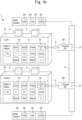
Figure 1a represents various electrical or electronic components constituting a power supply battery, in particular for a vehicle, which comprises several battery cells adapted for wireless communication of bidirectional messages by RF signals of data or parameters with one or two master battery management units for controlling each cell according to the invention, -
Figure 1b represents a variant ofFigure 1a of various electrical or electronic components constituting a power supply battery, in particular for a vehicle, which comprises several battery cells adapted for wireless communication of bidirectional messages by RF couplers of data or parameters with one or two master control battery management units of each cell according to the invention, -
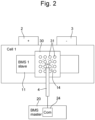
Figure 2 represents a first embodiment of a battery cell, which comprises means integrated into a wall of the cell casing, or means forming part of a plate disposed externally or internally on the cell as represented according to the present invention to improve the reception or transmission of data or parameter signals, -
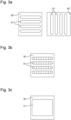
Figures 3a to 3c show three embodiments of means mounted on each cell of a battery to improve the reception and transmission of RF data or parameter signals in accordance with the invention. - In the following description, reference is made to a battery, generally to a battery for powering a vehicle, which is primarily a car. However, it may also refer to a boat, a submarine, an aircraft, a train, a construction machine or any other vehicle likely to be powered by a battery for its operation or movement.
- According to the present invention, the means for improving the transmission of bidirectional messages by RF signals makes it possible to maintain the functionality of the battery, which retains its qualities concerning its impermeability to liquids and to a certain extent to oxygen.
- It should be noted that different types of cell can be produced. It can be a "pouch" cell. This pouch cell is made with all its electronic or electrical components under vacuum in its casing. A second type of cell is the "prismatic" cell, which is a plastic or metallic case containing all the electronic or electrical components. Finally, a third form of the cell is a cell with a cylindrical outer shape, which includes all the electronic components used subsequently also for wireless communication with a master or central battery management unit.
- The battery comprises in a housing not shown at least one battery cell for providing an electrical supply when charged by two positive and negative output terminals for operation or movement of a vehicle. In the battery housing, the battery comprises at least one battery cell. However, such a battery may comprise a plurality of battery cells, which are preferably connected in series with each other so that all the cells provide the supply voltage to two positive and negative output terminals of the battery. The cells of the battery may also be connected to each other in parallel, or by a combination of cells connected in parallel and cells connected in series one after the other.
- Each battery cell comprises, in a housing structure, an electrolyte, which may be solid, liquid or in gel (or semi-solid) form. Each cell comprises electronic components as explained below with reference to
Figures 1a and1b , including a cell or battery management unit, and a communication unit, which comprises at least one antenna inFigure 1a or an RF coupler for radio frequency signals, for example in the near field. The cell communication unit also enables data or parameter or measurement signals, such as the state of charge of the battery, to be transmitted via the same receiving antenna or another transmitting antenna. In this case, it is preferred to use the same antenna for receiving and transmitting wireless data or parameter signals. - In order to effect wireless reception of radio frequency signals for all the battery cells, a cable may be provided connecting on the one hand a master management control unit in the battery for controlling all the battery cells, and on the other hand the cable being disposed in the vicinity of each receiving and transmitting antenna of the battery cells in a near-field configuration so as to communicate wirelessly with each battery cell so as to constitute near-field communication.
- According to the present invention described below, each battery cell comprises means for improving and facilitating the reception of data or parameter signals wirelessly, in particular by proximity radio frequency signals transmitted by the cable disposed in proximity to each battery cell. Several alternative designs are described below with reference to the figures shown to describe the various means used to improve and facilitate the reception of wireless data or parameter signals, as well as the transmission of RF data or parameter signals from each cell to the master management control unit in the battery. However, it may be envisaged not to use the cable in the battery for wireless reception and transmission of data or parameter or measurement signals in particular from each cell in question and the master management control unit.
- Generally, if the battery comprises several battery cells, these cells are generally connected by their external electrical connection terminals in series one after the other. The voltage of each cell is generally controlled so as to be able to redistribute the electrical charge equally in each cell one after the other so as not to damage the battery.
-
Figure 1a represents a particular case of abattery 1 which normally comprises at least afirst battery cell 10 with aset 11 of different electronic components, which may be connected together or at least be connected toelectrical connection terminals cell 10 for electrical connection with other cells or parts of thebattery 1. - The
battery 1 also comprises a first battery management unit orsystem 20, which is responsible for communicating with thefirst cell 10. In the case where thebattery 1 comprises several cells, for example twocells 10 and 10', the first master battery management unit may also communicate wirelessly with a second cell 10' of thebattery 1 in order to monitor, for example, the state ofcharge 15 of each cell, various parameters, the temperature, an identifier of each cell or other elements of the cells. Communication between the master definedbattery management unit 20 and the slave definedcells 10, 10' provided in thebattery 1 is by wireless communication using RF radio frequency signals. Typically, thebattery 1 may comprise anelectrical cable 4, which is disposed in the battery in the vicinity of eachwireless communication unit 14 of thecells 10, 10'. As shown inFigure 1a , communication is effected by the transmission of bi-directional wireless messages by data orparameter signals 5 for example via acable 4 connected at one end to acommunication unit 24 of the first masterbattery management unit 20 and to thecommunication unit 14 of each cell. - Each
cell 10, 10' first wirelessly receives an RF signal transmitted by the first active masterbattery management unit 20, and according to the request of the active masterbattery management unit 20, thefirst cell 10 shown transmits RF signals in response to the active masterbattery management unit 20 via the connectingcable 4. - In this
figure 1a ,battery cells 10, 10' are shown for simplicity only two cells are shown, but several other cells may also be provided. In addition, a second master battery management unit 20' may also be provided, which is placed in a passive state when the first masterbattery management unit 20 is active. But the twobattery management units 20, 20' can wirelessly transmit bidirectional messages by RF signals of data or parameters or measurements wirelessly transmitted by eachcell 10, 10' of thebattery 1 each by acommunication unit 24. In each masterbattery management unit 20, and redundant master 20', there is provided anelectronic component 25 for monitoring the total voltage andtotal current 26 of the battery. -
Figure 1b shows a variant of the battery shown inFigure 1a .RF couplers 28 are arranged along thecable 4 close to eachcell 10, 10' of thebattery 1, each being connected to themetal wire 27 by an open annular portion of thecable 4. In eachcircuit 10, 10', anRF coupler 14 is provided in connection with a communication unit for the transmission of bidirectional messages transmitted by data or parameter ormeasurement RF signals 5. -
Figure 2 represents just a first form of execution ofmeans first cell 10 following signals previously transmitted by the first masterbattery management unit 20. The signals transmitted by the first masterbattery management unit 20 were transmitted to the first cell either directly wirelessly or via acable 4 withcouplers 28 arranged opposite each antenna of the communication unit of thefirst cell 10 or of a second cell 10' shown in particular inFigure 1b . - The means for improving and promoting good wireless reception and transmission of data or parameter or measurement signals can be achieved by means of a
plate 30 pierced withvarious holes 31, which are impervious to liquids and to some extent to the penetration of double oxygen (O2) or moisture or water, and give access to the not shown communication antenna of thefirst cell 10, which is generally located in the housing structure of thefirst cell 10. The antenna of thecommunication unit 14 of thefirst cell 10 may be adapted to receive transmitted signals first. Holes of various shapes or the like may be of the same or varying size. - The means for improving and promoting good wireless reception and transmission of data or parameter or measurement signals can be also achieved by means of a cell housing directly pierced with
various holes 31, which are impervious to liquids and to some extent to the penetration of double oxygen (O2) and moisture. - For each embodiment shown in
Figures 2 ,3a, 3b, 3c , a hole is permeable to the electromagnetic signals necessary for bidirectional communication and through which the RF coupler will be able to exchange its communication signals. On the other hand, the hole is impervious to exchanges of liquid and, to a certain extent, oxygen, and moisture between the outside world and the inside of the battery. - This
first cell 10 comprises acommunication unit 14, which is generally integrated into the cell housing structure. The communication unit may be linked directly to an RF coupler in the communication unit, which typically comprises an antenna not shown, which may be used for both the reception and wireless transmission of RF radio frequency signals towards the first masterbattery management unit 20. - As shown in this
Figure 2 , the RF signals transmitted by the first masterbattery management unit 20 pass through acable 4 so as to approach the communication unit of thefirst cell 10 or other cells. Thecable 4 is arranged to wirelessly transmit bidirectional messages by RF signals of data or parameters or measurements at the plate pierced with holes arranged between the transmission of the wireless signals from the first masterbattery management unit 20 and the communication unit of thefirst cell 10. - Much more generically, the means for improving and promoting good reception of wireless radiofrequency signals with the
wireless communication unit 14 of thefirst cell 10 consists in providing for the making of holes at the location of the antenna, which may be an antenna made on a printed circuit, of thecommunication unit 14 of thefirst cell 10. In this first embodiment, the holes are mainly made through theplate 30 made of an insulating material and fixed to an insulating wall portion facing thecommunication unit 14. Thecommunication unit 14 of thefirst cell 10 also comprises a layer insulating the housing structure, enabling signals to be received correctly. - In a second embodiment, the holes can be made through the metallic and/or insulating material of the wall portion facing the
communication unit 14. Thecommunication unit 14 of thefirst cell 10 also comprises a layer insulating the housing structure, enabling signals to be received correctly. - Other embodiments of means for improving and promoting good reception and transmission of data or parameter or measurement signals are shown in
Figures 3a to 3c . Plates to be fixed to a wall portion of the housing structure facing eachcommunication unit 14 of eachcell 10, 10' of the battery are shown. It may also be possible to use the cable to properly route the RF signals. -
Figure 3a represents one of the means for improving or promoting good reception of radio frequency signals generally originating from a communication unit of a master battery management system as explained with reference toFigure 2 above. These combined means are provided by means of a first plate 30' comprising longitudinal apertures 31' arranged parallel to one another and preferably evenly spaced from one another in this case vertically. Asecond plate 30" is provided for these combined means withlongitudinal apertures 31" arranged parallel one above the other and preferably evenly spaced from one another horizontally. The first plate 30' can be mounted on thesecond plate 30" or vice versa to form a plate assembly. Thus the combination of the vertical longitudinal openings 31' of the first plate 30' and the horizontallongitudinal openings 31" of thesecond plate 30" generates openings giving access to each communication unit of each cell which has these means to improve and promote the reception of radio frequency signals. Of course, it may be possible to have direct access to an antenna of thecommunication unit 14 of each battery cell. Under these conditions, a great improvement in communication reception is obtained by these combined means. In this case it is quite plausible to add a layer of insulation through the opening in the housing structure of the first cell. -
Figure 3b represents a further embodiment of means for improving or promoting good reception of radio frequency signals generally from a communication unit of a master battery management system as explained with reference toFigure 2 above. In this embodiment, provision may be made for a direct combination of the first and second plates shown inFigure 3a , or for designing a plate with apertures made therethrough of square or substantially rectangular shape and generating or making spacings between each aperture at a determined depth of theplate 30 for example by a machining laser beam or other machining technique. - In a third embodiment shown in
figure 3c , only oneplate 30 with asingle opening 31 completely passing through the plate is recommended so that at least one antenna of acommunication unit 14 of eachcell 10 or 10' can be placed above it without any protection. However, with asingle opening 31, it may also be advisable to fit a protective plate above thecommunication unit 14 of eachcell 10, 10'. This protective plate should be made of a material that does not interfere with radio frequency signals. - Of course, for these three alternative embodiments of the combined means for improving or promoting the transmission of radio frequency signals, provision is also made for establishing near field communication via a
cable 4 connected to at least onecommunication unit 24 of a masterbattery management unit 20 as explained with reference toFigures 1a or1b above. - In the foregoing description, different embodiments may be provided for the combined means for enhancing or promoting the reception of radio frequency signals generally from a master battery management unit within the scope of the independent claims described.
Claims (17)
- A battery cell (10, 10'), which comprises in a housing structure at least one slave cell management unit (slave BMS), and at least one communication unit (14) for wirelessly communicating bidirectional messages by data or parameter or measurement signals with a communication unit (24) of a master battery management system (20), characterized in that the cell comprises combined means in a portion of a wall of the cell housing structure or forming part of an externally or internally configured plate disposed on a wall facing the cell communication unit (14) for enhancing or promoting good bi-directional transmission of radio frequency signals..
- The battery cell (10, 10'), according to claim 1, arranged to communicate with the battery via an electric cable (4), which is arranged in the battery in the vicinity of each wireless communication unit (14) of the cell or cells (10, 10'), characterized in that communication can be effected by wireless transmission of data or parameter or measurement signals (5), via a cable (4) connected on one side to a communication unit (24) of the master (20) and redundant master (20') battery management system and to the communication unit (14) of each cell (10, 10').
- The battery cell (10, 10'), according to claim 1, characterized in that the means for improving and promoting good wireless reception and transmission of data or parameter or measurement signals are achieved by using various holes (31) on the housing structure, which are impervious to water or moisture or double oxygen, but allow electromagnetic waves to pass through, and arranged to give access to a communication antenna of the communication unit (14) of each cell (10, 10').
- The battery cell (10, 10'), according to claim 1, characterized in that the means for improving and promoting good wireless reception and transmission of data or parameter or measurement signals are achieved by means of a plate (30) pierced with various holes (31) which are impervious to water or moisture or double oxygen, but allow electromagnetic waves to pass through, and arranged to give access to a communication antenna of the communication unit (14) of each cell (10, 10').
- The battery cell (10, 10') according to claim 3 or 4, characterized in that the various holes (31), which are impervious to water or moisture or double oxygen but allow electromagnetic waves to pass through, are of identical or variable size in order to give access to a communication antenna of the communication unit (14) of each cell (10, 10').
- The battery cell (10, 10') according to claim 1, characterized in that the means for improving and promoting good wireless reception and transmission of data or parameter or measurement signals are realized by means of a first plate (30') comprising longitudinal apertures (31') arranged parallel to one another and preferably regularly spaced from one another vertically and a second plate (30')' provided for these combined means with longitudinal apertures (31") arranged parallel above one another and preferably regularly spaced from one another horizontally.
- The battery cell (10, 10') according to claim 6, characterized in that the second plate is fixedly mounted to the first plate.
- The battery cell (10, 10'), according to claim 1, characterized in that the means for improving and promoting good wireless reception and transmission of data or parameter or measurement signals are achieved by means of one plate (30) with a single opening (31) giving direct access to a communication antenna of the communication unit (14) of each cell.
- A battery comprising at least one battery cell (10, 10'), the cell comprising in a housing structure at least one slave cell management unit (BMS), and at least one communication unit (14) for wireless communication of data or parameter or measurement signals with a communication unit (24) of a master battery management system (20), characterized in that the cell comprises combined means in a portion of a wall of the cell housing structure or forming part of an externally configured plate disposed on a wall facing the cell communication unit (14) for enhancing or promoting good reception of radio frequency signals with the master battery management system (20).
- The battery, according to claim 9, characterized in that the means for improving and promoting good wireless reception and transmission of data or parameter or measurement signals are realized by using various holes (31) on the cell housing structure, which are impervious to water or moisture or double oxygen or by means of a plate (30) pierced with various holes (31) and arranged to give access to a communication antenna of the communication unit (14) of each of the cells (10, 10').
- The battery according to claim 10, characterized in that the various holes (31) are of identical or variable size to give access to a communication antenna of the communication unit (14) of each cell (10, 10').
- The battery, according to claim 9, characterized in that it comprises at least one cable (4) connected on one side to a communication unit (24) of a master battery management system (20) and to the communication unit (14) of each cell (10, 10') to establish communication by wireless transmission of data or parameter or measurement signals (5) with the communication unit (14) of each cell (10, 10').
- The battery, according to claim 12, characterized in that it includes RF couplers (28) arranged along the cable (4) close to each cell (10, 10') of the battery, each being connected to a metal wire (27) by an open annular portion of the cable (4).
- The battery, according to claim 9, characterized in that the means for improving and promoting good wireless reception and transmission of data signals or parameters or measurements are realized by means of a first plate (30') comprising longitudinal apertures (31') arranged parallel to one another and preferably regularly spaced from one another vertically and a second plate (30") provided for these combined means with longitudinal apertures (31") arranged parallel above one another and preferably regularly spaced from one another horizontally.
- The battery according to claim 14 characterized in that the second plate is fixedly mounted to the first plate.
- The battery, according to claim 9, characterized in that the means for improving and promoting good wireless reception and transmission of data signals or parameters or measurements are realized by means of one plate (30) with a single opening (31) giving direct access to a communication antenna of the communication unit (14) of each cell (10, 10').
- The battery, according to claim 9, characterized in that a second master battery management system (20') is connected by the cable (4) in a passive state, when the first master battery management unit (20) is active, and in that both master battery management systems (20, 20') are adapted to receive data or parameter or measurement signals transmitted wirelessly from each cell (10, 10') of the battery each by a communication unit (24).
Priority Applications (6)
| Application Number | Priority Date | Filing Date | Title |
|---|---|---|---|
| EP23202113.9A EP4535500A1 (en) | 2023-10-06 | 2023-10-06 | Battery cell suitable for wireless communication of data signals, a battery comprising at least one cell |
| EP24201187.2A EP4535502A1 (en) | 2023-10-06 | 2024-09-18 | Battery cell suitable for wireless communication of data signals, the battery comprising at least one cell |
| US18/893,324 US20250118816A1 (en) | 2023-10-06 | 2024-09-23 | Battery cell suitable for wireless communication of data signals, the battery comprising at least one cell |
| JP2024171992A JP2025065044A (en) | 2023-10-06 | 2024-10-01 | Battery cell suitable for wireless communication of data signals, and battery including at least one battery cell |
| KR1020240135130A KR20250050758A (en) | 2023-10-06 | 2024-10-04 | Battery cell suitable for wireless communication of data signals, the battery comprising at least one cell |
| CN202411393093.9A CN119786765A (en) | 2023-10-06 | 2024-10-08 | Battery unit suitable for wireless communication of data signals, battery comprising at least one unit |
Applications Claiming Priority (1)
| Application Number | Priority Date | Filing Date | Title |
|---|---|---|---|
| EP23202113.9A EP4535500A1 (en) | 2023-10-06 | 2023-10-06 | Battery cell suitable for wireless communication of data signals, a battery comprising at least one cell |
Publications (1)
| Publication Number | Publication Date |
|---|---|
| EP4535500A1 true EP4535500A1 (en) | 2025-04-09 |
Family
ID=88295622
Family Applications (2)
| Application Number | Title | Priority Date | Filing Date |
|---|---|---|---|
| EP23202113.9A Withdrawn EP4535500A1 (en) | 2023-10-06 | 2023-10-06 | Battery cell suitable for wireless communication of data signals, a battery comprising at least one cell |
| EP24201187.2A Pending EP4535502A1 (en) | 2023-10-06 | 2024-09-18 | Battery cell suitable for wireless communication of data signals, the battery comprising at least one cell |
Family Applications After (1)
| Application Number | Title | Priority Date | Filing Date |
|---|---|---|---|
| EP24201187.2A Pending EP4535502A1 (en) | 2023-10-06 | 2024-09-18 | Battery cell suitable for wireless communication of data signals, the battery comprising at least one cell |
Country Status (5)
| Country | Link |
|---|---|
| US (1) | US20250118816A1 (en) |
| EP (2) | EP4535500A1 (en) |
| JP (1) | JP2025065044A (en) |
| KR (1) | KR20250050758A (en) |
| CN (1) | CN119786765A (en) |
Citations (4)
| Publication number | Priority date | Publication date | Assignee | Title |
|---|---|---|---|---|
| US20190221894A1 (en) * | 2016-07-01 | 2019-07-18 | Dukosi Limited | Electric batteries |
| EP3517350A1 (en) | 2017-07-20 | 2019-07-31 | LG Chem, Ltd. | Wireless battery management system and battery pack including same |
| EP3605778B1 (en) | 2018-07-30 | 2021-06-16 | Belenos Clean Power Holding AG | Wireless balancing unit and system for a battery cell |
| US20230282914A1 (en) * | 2022-03-01 | 2023-09-07 | Huawei Digital Power Technologies Co., Ltd. | Battery cover plate, battery, and power system |
Family Cites Families (2)
| Publication number | Priority date | Publication date | Assignee | Title |
|---|---|---|---|---|
| JP4732403B2 (en) * | 2007-06-25 | 2011-07-27 | 日本電信電話株式会社 | Storage battery system control method and control circuit |
| JP2014127386A (en) * | 2012-12-27 | 2014-07-07 | Sumitomo Electric Ind Ltd | Battery device, battery pack system, and electric propulsion vehicle |
-
2023
- 2023-10-06 EP EP23202113.9A patent/EP4535500A1/en not_active Withdrawn
-
2024
- 2024-09-18 EP EP24201187.2A patent/EP4535502A1/en active Pending
- 2024-09-23 US US18/893,324 patent/US20250118816A1/en active Pending
- 2024-10-01 JP JP2024171992A patent/JP2025065044A/en active Pending
- 2024-10-04 KR KR1020240135130A patent/KR20250050758A/en active Pending
- 2024-10-08 CN CN202411393093.9A patent/CN119786765A/en active Pending
Patent Citations (4)
| Publication number | Priority date | Publication date | Assignee | Title |
|---|---|---|---|---|
| US20190221894A1 (en) * | 2016-07-01 | 2019-07-18 | Dukosi Limited | Electric batteries |
| EP3517350A1 (en) | 2017-07-20 | 2019-07-31 | LG Chem, Ltd. | Wireless battery management system and battery pack including same |
| EP3605778B1 (en) | 2018-07-30 | 2021-06-16 | Belenos Clean Power Holding AG | Wireless balancing unit and system for a battery cell |
| US20230282914A1 (en) * | 2022-03-01 | 2023-09-07 | Huawei Digital Power Technologies Co., Ltd. | Battery cover plate, battery, and power system |
Non-Patent Citations (1)
| Title |
|---|
| RANA ANWAR ET AL: "Frequency Selective Surfaces: A Review", APPLIED SCIENCES, vol. 8, no. 9, 18 September 2018 (2018-09-18), pages 1689, XP055719588, ISSN: 2076-3417, DOI: 10.3390/app8091689 * |
Also Published As
| Publication number | Publication date |
|---|---|
| CN119786765A (en) | 2025-04-08 |
| JP2025065044A (en) | 2025-04-17 |
| KR20250050758A (en) | 2025-04-15 |
| EP4535502A1 (en) | 2025-04-09 |
| US20250118816A1 (en) | 2025-04-10 |
Similar Documents
| Publication | Publication Date | Title |
|---|---|---|
| EP2614382B1 (en) | Vehicle battery monitoring system | |
| KR102550319B1 (en) | Battery system and slave battery management system | |
| CN109818091B (en) | Lithium ion battery | |
| EP4239756B1 (en) | Battery cover plate, battery, and power system | |
| US10340557B2 (en) | Battery for a motor vehicle and motor vehicle | |
| KR102325135B1 (en) | Battery cell for a battery of a motor vehicle, battery, and motor vehicle | |
| CN107305972A (en) | Battery module with integrated RF communications and unit senses plate | |
| CN110166070A (en) | Multipoint communication system for battery management system, and associated systems and methods | |
| JP2016157681A (en) | Battery monitoring device | |
| US12136739B2 (en) | Battery module with series connected cells, internal relays and internal battery management system | |
| KR102449819B1 (en) | Battery apparatus having galvanic isolation communication architecture | |
| EP3611789B1 (en) | Battery monitoring device | |
| US11575270B2 (en) | Battery module with series connected cells, internal relays and internal battery management system | |
| JP2019126227A (en) | Battery monitoring system | |
| CN107534187A (en) | For apparatus and method and battery cell, battery module, battery pack, battery pack system and the means of transport to be communicated with battery cell | |
| US11495994B2 (en) | Unit and system for wireless balancing for battery cell | |
| EP4535500A1 (en) | Battery cell suitable for wireless communication of data signals, a battery comprising at least one cell | |
| CN107543590A (en) | Measuring system | |
| CN117878459A (en) | Battery packs, battery management systems and energy storage systems | |
| JP7106766B2 (en) | Storage battery device | |
| US20250112284A1 (en) | Battery control device, battery monitoring system including battery control device and battery monitoring devices, and method of identifying abnormal battery using battery monitoring system | |
| US12405309B2 (en) | Low cost battery cell monitoring circuit | |
| JP2024037373A (en) | Battery monitoring system, control device, monitoring device and program | |
| US20250266509A1 (en) | Hybrid wireless communication for battery monitoring and management systems | |
| EP4439912B1 (en) | Communication method for energy storage system, and energy storage system |
Legal Events
| Date | Code | Title | Description |
|---|---|---|---|
| PUAI | Public reference made under article 153(3) epc to a published international application that has entered the european phase |
Free format text: ORIGINAL CODE: 0009012 |
|
| STAA | Information on the status of an ep patent application or granted ep patent |
Free format text: STATUS: THE APPLICATION HAS BEEN PUBLISHED |
|
| AK | Designated contracting states |
Kind code of ref document: A1 Designated state(s): AL AT BE BG CH CY CZ DE DK EE ES FI FR GB GR HR HU IE IS IT LI LT LU LV MC ME MK MT NL NO PL PT RO RS SE SI SK SM TR |
|
| P01 | Opt-out of the competence of the unified patent court (upc) registered |
Free format text: CASE NUMBER: APP_31976/2025 Effective date: 20250702 |
|
| STAA | Information on the status of an ep patent application or granted ep patent |
Free format text: STATUS: THE APPLICATION IS DEEMED TO BE WITHDRAWN |
|
| 18D | Application deemed to be withdrawn |
Effective date: 20251010 |