EP4535351A1 - Sound coding method, sound decoding method, and related apparatuses and system - Google Patents
Sound coding method, sound decoding method, and related apparatuses and system Download PDFInfo
- Publication number
- EP4535351A1 EP4535351A1 EP23844962.3A EP23844962A EP4535351A1 EP 4535351 A1 EP4535351 A1 EP 4535351A1 EP 23844962 A EP23844962 A EP 23844962A EP 4535351 A1 EP4535351 A1 EP 4535351A1
- Authority
- EP
- European Patent Office
- Prior art keywords
- gain
- codebook
- algebraic codebook
- linear
- algebraic
- Prior art date
- Legal status (The legal status is an assumption and is not a legal conclusion. Google has not performed a legal analysis and makes no representation as to the accuracy of the status listed.)
- Pending
Links
Images


Classifications
-
- G—PHYSICS
- G10—MUSICAL INSTRUMENTS; ACOUSTICS
- G10L—SPEECH ANALYSIS TECHNIQUES OR SPEECH SYNTHESIS; SPEECH RECOGNITION; SPEECH OR VOICE PROCESSING TECHNIQUES; SPEECH OR AUDIO CODING OR DECODING
- G10L19/00—Speech or audio signals analysis-synthesis techniques for redundancy reduction, e.g. in vocoders; Coding or decoding of speech or audio signals, using source filter models or psychoacoustic analysis
- G10L19/02—Speech or audio signals analysis-synthesis techniques for redundancy reduction, e.g. in vocoders; Coding or decoding of speech or audio signals, using source filter models or psychoacoustic analysis using spectral analysis, e.g. transform vocoders or subband vocoders
- G10L19/032—Quantisation or dequantisation of spectral components
- G10L19/038—Vector quantisation, e.g. TwinVQ audio
-
- G—PHYSICS
- G10—MUSICAL INSTRUMENTS; ACOUSTICS
- G10L—SPEECH ANALYSIS TECHNIQUES OR SPEECH SYNTHESIS; SPEECH RECOGNITION; SPEECH OR VOICE PROCESSING TECHNIQUES; SPEECH OR AUDIO CODING OR DECODING
- G10L19/00—Speech or audio signals analysis-synthesis techniques for redundancy reduction, e.g. in vocoders; Coding or decoding of speech or audio signals, using source filter models or psychoacoustic analysis
- G10L19/04—Speech or audio signals analysis-synthesis techniques for redundancy reduction, e.g. in vocoders; Coding or decoding of speech or audio signals, using source filter models or psychoacoustic analysis using predictive techniques
- G10L19/08—Determination or coding of the excitation function; Determination or coding of the long-term prediction parameters
- G10L19/12—Determination or coding of the excitation function; Determination or coding of the long-term prediction parameters the excitation function being a code excitation, e.g. in code excited linear prediction [CELP] vocoders
-
- G—PHYSICS
- G10—MUSICAL INSTRUMENTS; ACOUSTICS
- G10L—SPEECH ANALYSIS TECHNIQUES OR SPEECH SYNTHESIS; SPEECH RECOGNITION; SPEECH OR VOICE PROCESSING TECHNIQUES; SPEECH OR AUDIO CODING OR DECODING
- G10L19/00—Speech or audio signals analysis-synthesis techniques for redundancy reduction, e.g. in vocoders; Coding or decoding of speech or audio signals, using source filter models or psychoacoustic analysis
- G10L2019/0001—Codebooks
- G10L2019/0002—Codebook adaptations
-
- G—PHYSICS
- G10—MUSICAL INSTRUMENTS; ACOUSTICS
- G10L—SPEECH ANALYSIS TECHNIQUES OR SPEECH SYNTHESIS; SPEECH RECOGNITION; SPEECH OR VOICE PROCESSING TECHNIQUES; SPEECH OR AUDIO CODING OR DECODING
- G10L19/00—Speech or audio signals analysis-synthesis techniques for redundancy reduction, e.g. in vocoders; Coding or decoding of speech or audio signals, using source filter models or psychoacoustic analysis
- G10L2019/0001—Codebooks
- G10L2019/0016—Codebook for LPC parameters
Definitions
- the methods provided in the first aspect and the second aspect have at least the following beneficial effects: when the estimated gain of the algebraic codebook in the first subframe is calculated during encoding and decoding, operations with high complexity such as a logarithm log operation and an exponential operation with 10 as a base can be completely avoided, thereby significantly reducing algorithm complexity.
- a codec may directly obtain a value of 10 a 0 +a 1 CT corresponding to a parameter CT of the current frame through table lookup, to avoid a case that calculation is performed when the codec runs, thereby reducing the algorithm complexity.
- a method for decoding a sound signal is provided, similarly applied to a first subframe in a current frame.
- the method may include: receiving an encoding parameter, where the encoding parameter includes: a frame classification parameter index of the current frame and an index of a winning codebook vector; searching a first mapping table for a linear estimated value of an algebraic codebook gain in a linear domain according to the frame classification parameter index of the current frame, where each entry in the first mapping table includes two values: a frame classification parameter index and a linear estimated value of an algebraic codebook gain in the linear domain; calculating energy Ec of an algebraic codebook vector from an algebraic codebook, performing a logarithm operation with 10 as a base on a square root of the energy, calculating an additive inverse of a value obtained through the logarithm operation, and then performing an exponential operation with 10 as a base, to obtain 10 ⁇ log 10 E c ; multiplying the linear estimated value
- a converter such as an exponential calculator 702 shown in FIG. 7 , configured to convert the linear estimated value of the algebraic codebook gain in the logarithm domain into a linear domain through an exponential operation, to obtain a linear estimated value of the algebraic codebook gain in the linear domain;
- a first calculator including a square summator 704 and a square root calculator 705 shown in FIG. 7 and configured to calculate energy of an algebraic codebook vector from an algebraic codebook; a first multiplier such as a multiplier 703 shown in FIG. 7 , configured to multiply the linear estimated value of the algebraic codebook gain in the linear domain by a reciprocal of a square root of the energy of the algebraic codebook vector, to obtain an estimated gain of the algebraic codebook; and a second multiplier such as a multiplier 707 shown in FIG.
- a first calculator including a square summator 804 and a square root calculator 805 shown in FIG. 8 and configured to calculate energy of an algebraic codebook vector from an algebraic codebook; a first multiplier such as a multiplier 803 shown in FIG. 8 , configured to multiply the linear estimated value of the algebraic codebook gain in the linear domain by a reciprocal of a square root of the energy of the algebraic codebook vector, to obtain an estimated gain of the algebraic codebook; and a second multiplier such as a multiplier 806 shown in FIG. 8 , configured to multiply the estimated gain of the algebraic codebook by a correction factor included in a winning codebook vector, to obtain a quantized gain of the algebraic codebook, where the winning codebook vector is selected from a gain codebook.
- the apparatus provided in the thirteenth aspect may further include: a communication component, configured to transmit an encoding parameter, where the encoding parameter includes: the frame type of the current frame, the linear estimation constant, and an index of the winning codebook vector in the gain codebook.
- a communication component configured to transmit an encoding parameter, where the encoding parameter includes: the frame type of the current frame, the linear estimation constant, and an index of the winning codebook vector in the gain codebook.
- an apparatus having a voice decoding function may be configured to implement the method provided in the sixth aspect.
- the apparatus may include: a communication component, configured to receive an encoding parameter, where the encoding parameter includes: a frame type of a current frame, a linear estimation constant in a first subframe, and an index of a winning codebook vector; a linear prediction component such as a linear estimation module 801 shown in FIG. 8 , configured to perform linear estimation by using the linear estimation constant in the first subframe and the frame type of the current frame, to obtain a linear estimated value of an algebraic codebook gain in a logarithm domain; a converter such as an exponential calculator 802 shown in FIG.
- a related art of CELP encoding and decoding is improved, which can implement memory-less joint gain coding and also reduce complexity of calculating a codebook gain.
- Encoding parameters such as a quantized gain of a codebook, an index of the optimal adaptive codebook vector in the adaptive codebook, an index of the optimal algebraic codebook vector in the algebraic codebook, and a linear predictive coding parameter form a bit stream, and the bit stream is transmitted to a decoding side.
- Constants c 0 , c 1 , c 2 , c 3 , c 4 , and c 5 and an estimated gain g c0 are calculated before the gain codebook is searched.
- the error energy E is calculated for each codebook entry.
- a codebook vector [g p ; ⁇ ] causing minimum error energy is selected as a winning codebook vector, and an entry of the codebook vector corresponds to the quantized gain g p of the adaptive codebook and ⁇ .
- linear estimation is first performed on the algebraic codebook gain according to the classification parameter CT in a logarithm domain, to obtain a linear estimated value of the algebraic codebook gain: a 0 +a 1 CT.
- an energy parameter log 10 E c of the algebraic codebook vector from the algebraic codebook is subtracted from the linear estimated value, to obtain an estimated gain of the algebraic codebook in the logarithm domain: a 0 + a 1 CT ⁇ log 10 E c where Ec is obtained by using the foregoing formula (5).
- the estimated gain of the algebraic codebook in the logarithm domain is converted into a linear domain, to obtain an estimated gain g c 0 0 of the algebraic codebook in the linear domain, which refers to the foregoing formula (4).
- the estimated gain g c 0 0 of the algebraic codebook is multiplied by the correction factor ⁇ selected from the gain codebook, to obtain the quantized algebraic codebook gain g c 0 .
- the codec may directly obtain a value of 10 a0+a1CT corresponding to a parameter CT of a current frame through table lookup, to avoid a case that calculation is performed when the codec runs, thereby reducing algorithm complexity.
- b CT index 10 a 0 + a 1 CT
- the index CT index of the classification parameter CT of the current frame is first input to a table lookup module 701. Then, the table lookup module 701 obtains a linear estimated value (which is represented as b [ CT index ] below) of an algebraic codebook gain in a logarithm domain through table lookup according to the index CT index , and outputs b[CT index ] to an exponential calculator 702 with 10 as a base, to obtain a linear estimated value 10 b[CT index ] of the algebraic codebook gain in a linear domain. Next, the linear estimated value 10 b[CT index ] of the algebraic codebook gain in the linear domain is output to a multiplier 703.
- a multiplier 703 the linear estimated value 10 b[CT index ] of the algebraic codebook gain in the linear domain is output to a multiplier 703.
- a process of calculating an estimated gain of an algebraic codebook in the first subframe represented by the formula (7) may be described as follows. First, a linear estimated value a 0 +a 1 CT of an algebraic codebook gain in a logarithm domain is obtained through calculation according to a classification parameter CT of a current frame. Then, the linear estimated value a 0 +a 1 CT of the algebraic codebook gain in the logarithm domain is converted into a linear domain through an exponential operation with 10 as a base, to obtain 10 a 0 +a 1 CT .
- a linear estimated value 10 a 0 +a 1 CT of the algebraic codebook gain in the linear domain is divided by a square root (which is represented as E c ) of energy E c of an algebraic codebook vector from the algebraic codebook in the linear domain, to obtain the estimated gain g c 0 0 of the algebraic codebook in the first subframe.
- a value of a square root E c of energy of an algebraic codebook vector from an algebraic codebook is sequentially calculated through a square summator 804 and a square root calculator 805.
- the square summator 804 calculates Ec by using the formula (5), and then outputs a reciprocal value of E c to the multiplier 803, and 10 a0+a1CT is divided by the reciprocal value of E c to obtain an estimated gain g c 0 0 of the algebraic codebook.
- the square summator 903 calculates Ec by using the formula (5), and then outputs E c to a calculator 905, and an additive inverse of a value obtained by performing a logarithm log operation on E c is calculated to obtain ⁇ log 10 E c . Then, ⁇ log 10 E c is output to a calculator 906, and an exponential operation with 10 as a base is performed on ⁇ log 10 E c , to obtain 10 ⁇ log 10 E c . 10 ⁇ log 10 E c is output to the multiplier 902, 10 ⁇ log 10 E c is multiplied by b [ CT index ], to obtain an estimated gain g c 0 0 of an algebraic codebook.
- the estimated gain g c 0 0 of the algebraic codebook is output to a multiplier 907, and the estimated gain g c 0 0 of the algebraic codebook is multiplied by a correction factor ⁇ from a gain codebook, to obtain a quantized gain g c 0 of the algebraic codebook.
- the quantized gain g c 0 of the algebraic codebook may be further output to a multiplier 908, and the quantized gain g c 0 of the algebraic codebook is multiplied by an algebraic codebook vector (filtered algebraic excitation) of the algebraic codebook, to obtain an excited algebraic codebook contribution.
- the excited algebraic codebook contribution is output to an adder 909, and the excited algebraic codebook contribution and an excited adaptive codebook contribution are added up to obtain total filtered excitation.
- the excited adaptive codebook contribution is obtained by multiplying an adaptive codebook vector (filtered adaptive excitation) that is from an adaptive codebook and that is output to a multiplier 910 by a quantized gain g p 0 of the adaptive codebook from the gain codebook.
- the quantized gain g p 0 of the adaptive codebook is directly selected from the gain codebook.
- the gain codebook is searched based on a principle of minimum mean square error MMSE, which refers to the foregoing formula (2).
- classification a parameter CT of a frame.
- basic classification is performed according to only voiced or unvoiced.
- more types such as voiced or strong unvoiced may be enhanced.
- the signal classification may be performed in the following three steps.
- a speech active detector speech active detector (speech active detector, SAD) distinguishes between a valid speech frame and an invalid speech frame. If the invalid speech frame such as ground noise (ground noise) is detected, classification is ended, and an encoding frame is generated by using a comfort noise generator (comfort noise generator, CNG). If the valid speech frame is detected, the frame is further classified, to distinguish an unvoiced frame. If the frame is further classified into an unvoiced signal, classification is ended, and the frame is encoded by using an encoding method most suitable for the unvoiced signal. Otherwise, it is further determined whether the frame is stable voiced.
- SAD speech active detector
- the unvoiced signal may be classified based on the following parameters: voicing measure r x , an average spectral tilt e t , a maximum short-time energy increment dE0 and a maximum short time energy deviation dE that are at a low level.
- An algorithm for distinguishing the unvoiced signal is not limited in this application, for example, an algorithm mentioned in the following document Jelinek,M.,etal., "Advances in source-controlledvariable bitrate wideband speech coding", Special Workshop in MAUI(SWIM); Lectures by masters in speech processing, Maui, January12-24,2004 may be used, which is incorporated herein by reference in its entirety.
- the stable voiced frame may be classified based on the following parameters: a normalization correlation r x of each subframe (with 1/4 subsample resolution), an average spectral tilt e t , and open-loop pitch estimation in all subframes (with 1/4 subsample resolution).
- An algorithm for distinguishing the sable voiced frame is not limited in this application.
- An estimation coefficient is found by minimizing a mean square error between an estimated gain of an algebraic codebook and an optimal gain in a logarithm domain on all the frames in the training data of the big sample.
- the calculated estimation constants may be used for designing a gain codebook for each subframe, and gain quantization of each subframe can be further determined according to the estimation constants and the gain codebook.
- estimation of the algebraic codebook gain is slightly different in each subframe, and an estimation coefficient is obtained through a minimum mean square error MSE.
- the gain codebook may be designed with reference to a KMEANS algorithm in the following document: MacQueen,J.B.(1967), "Some Methods for classification and Analysis of Multivariate Observations", Proceedings of 5th Berkeley Symposium on Mathematical Statistics and Probability, University of CaliforniaPress.pp.281-297 , which is incorporated herein by reference in its entirety.
- a channel decoder 116 performs a channel decoding operation on the bit stream 124 received through the communication component, for example, detects and corrects, by using redundancy information in the bit stream 124, a channel error occurring during transmission.
- a voice decoding apparatus 117 converts the bit stream 125 received from the channel decoder back to the encoding parameters for creating a synthesized voice signal 126.
- a digital to analog (D/A) converter 108 converts the synthesized voice signal 126 reconstructed in the voice decoding apparatus 117 back to the analog voice signal 127. Finally, the analog voice signal 127 is played through a sound playback apparatus such as a speaker unit 119.
Landscapes
- Engineering & Computer Science (AREA)
- Physics & Mathematics (AREA)
- Spectroscopy & Molecular Physics (AREA)
- Computational Linguistics (AREA)
- Signal Processing (AREA)
- Health & Medical Sciences (AREA)
- Audiology, Speech & Language Pathology (AREA)
- Human Computer Interaction (AREA)
- Acoustics & Sound (AREA)
- Multimedia (AREA)
- Compression, Expansion, Code Conversion, And Decoders (AREA)
Abstract


Description
- This application claims priority to
Chinese Patent Application No. 202210908196.9, filed with the China National Intellectual Property Administration on July 29, 2022 - This application relates to the field of audio encoding and decoding, and in particular, to audio encoding and decoding technologies based on code-excited linear prediction (code-excited linear prediction, CELP).
- A code-excited linear prediction (CELP) technology can implement compromise between good quality and a good bit rate, which is first proposed by Manfred R. Schroeder and Bishnu S. Atal in 1985. In a CELP encoder, input voice or an audio signal (a sound signal) is processed by using a frame as a unit. The frame is further divided into a smaller block, and the smaller block is referred to as a subframe. In a codec, an excitation signal is determined in each subframe and includes two components: One is from past excitation (which is also referred to as an adaptive codebook), and the other is from an algebraic codebook (which is also referred to as a fixed codebook or a creative codebook). An encoding side transmits encoding parameters such as an algebraic codebook gain and an adaptive codebook gain instead of original sound to a decoding side, and the encoding parameters are calculated when an error between a reconstructed voice signal sound and an original voice signal is a minimum value. How to reduce calculation complexity is a hotspot of research in the field.
- Embodiments of this application provide a sound encoding method and a sound decoding method, which can reduce complexity of calculating a codebook gain.
- According to a first aspect, a method for encoding a sound signal is provided, applied to a first subframe in a current frame. The method may include: receiving a frame classification parameter index of the current frame, searching a first mapping table for a linear estimated value of an algebraic codebook gain in a linear domain according to the frame classification parameter index of the current frame, where each entry in the first mapping table includes two values: a frame classification parameter index and a linear estimated value of an algebraic codebook gain in the linear domain, calculating energy of an algebraic codebook vector from an algebraic codebook, dividing the linear estimated value of the algebraic codebook gain in the linear domain by a square root of the energy of the algebraic codebook vector, to obtain an estimated gain of the algebraic codebook, and then multiplying the estimated gain of the algebraic codebook by a correction factor, to obtain a quantized gain of the algebraic codebook. The correction factor is from a winning codebook vector, and the winning codebook vector is selected from a gain codebook.
- The method provided in the first aspect may further include: transmitting an encoding parameter. The encoding parameter may include: the frame classification parameter index of the current frame and an index of the winning codebook vector in the gain codebook.
- According to a second aspect, compared with the method for encoding a sound signal in the first aspect, a method for decoding a sound signal is provided, similarly applied to a first subframe in a current frame. The method may include: receiving an encoding parameter, where the encoding parameter may include: a frame classification parameter index of the current frame and an index of a winning codebook vector, searching a first mapping table for a linear estimated value of an algebraic codebook gain in a linear domain based on the frame classification parameter index of the current frame, where each entry in the first mapping table includes two values: a frame classification parameter index and a linear estimated value of an algebraic codebook gain in the linear domain, calculating energy of an algebraic codebook vector from an algebraic codebook, dividing the linear estimated value of the algebraic codebook gain in the linear domain by a square root of the energy of the algebraic codebook vector, to obtain an estimated gain of the algebraic codebook, and finally multiplying the estimated gain of the algebraic codebook by a correction factor, to obtain a quantized gain of the algebraic codebook, where the correction factor is from the winning codebook vector, and the winning codebook vector is selected from a gain codebook based on the index of the winning codebook vector.
- The methods provided in the first aspect and the second aspect have at least the following beneficial effects: when the estimated gain of the algebraic codebook in the first subframe is calculated during encoding and decoding, operations with high complexity such as a logarithm log operation and an exponential operation with 10 as a base can be completely avoided, thereby significantly reducing algorithm complexity. In addition, a codec may directly obtain a value of 10a
0 +a1 CT corresponding to a parameter CT of the current frame through table lookup, to avoid a case that calculation is performed when the codec runs, thereby reducing the algorithm complexity. - According to a third aspect, a method for encoding a sound signal is provided, applied to a first subframe in a current frame. The method may include: receiving a frame classification parameter index of the current frame, searching a first mapping table for a linear estimated value of an algebraic codebook gain in a logarithm domain according to the frame classification parameter index of the current frame, where each entry in the first mapping table includes two values: a frame classification parameter index and a linear estimated value of an algebraic codebook gain in the logarithm domain, converting the linear estimated value of the algebraic codebook gain in the logarithm domain into a linear domain through an exponential operation, to obtain a linear estimated value of the algebraic codebook gain in the linear domain, calculating energy of an algebraic codebook vector from an algebraic codebook, dividing the linear estimated value of the algebraic codebook gain in the linear domain by a square root of the energy of the algebraic codebook vector, to obtain an estimated gain of the algebraic codebook, and finally multiplying the estimated gain of the algebraic codebook by a correction factor, to obtain a quantized gain of the algebraic codebook, where the correction factor is from a winning codebook vector, and the winning codebook vector is selected from a gain codebook.
- The method provided in the third aspect may further include: transmitting an encoding parameter, where the encoding parameter includes: the frame classification parameter index of the current frame and an index of the winning codebook vector in the gain codebook.
- According to a fourth aspect, compared with the method for encoding a sound signal in the third aspect, a method for decoding a sound signal is provided, similarly applied to a first subframe in a current frame. The method may include: receiving an encoding parameter, where the encoding parameter includes: a frame type of the current frame, a linear estimation constant in the first subframe, and an index of a winning codebook vector; performing linear estimation by using the linear estimation constant in the first subframe and the frame type of the current frame, to obtain a linear estimated value of an algebraic codebook gain in a logarithm domain; converting the linear estimated value of the algebraic codebook gain in the logarithm domain into a linear domain through an exponential operation, to obtain a linear estimated value of the algebraic codebook gain in the linear domain; calculating energy of an algebraic codebook vector from an algebraic codebook; dividing the linear estimated value of the algebraic codebook gain in the linear domain by a square root of the energy of the algebraic codebook vector, to obtain an estimated gain of the algebraic codebook; and multiplying the estimated gain of the algebraic codebook by a correction factor, to obtain a quantized gain of the algebraic codebook, where the correction factor is from the winning codebook vector, and the winning codebook vector is selected from a gain codebook based on the index of the winning codebook vector.
- The methods provided in the third aspect and the fourth aspect have at least the following beneficial effects: when the estimated gain of the algebraic codebook in the first subframe is calculated during encoding and decoding, a logarithm operation and an exponential operation involved in the energy Ec of the algebraic codebook vector can be avoided, thereby reducing algorithm complexity. In addition, a codec may directly obtain a value of a0+a1CT corresponding to a parameter CT of the current frame through table lookup, to avoid a case that the value is calculated when the codec runs, thereby reducing a calculation amount.
- According to a fifth aspect, a method for encoding a sound signal is provided, applied to a first subframe in a current frame. The method may include: performing linear estimation by using a linear estimation constant in the first subframe and a frame type of the current frame, to obtain a linear estimated value of an algebraic codebook gain in a logarithm domain; converting the linear estimated value of the algebraic codebook gain in the logarithm domain into a linear domain through an exponential operation, to obtain a linear estimated value of the algebraic codebook gain in the linear domain; calculating energy of an algebraic codebook vector from an algebraic codebook; dividing the linear estimated value of the algebraic codebook gain in the linear domain by a square root of the energy of the algebraic codebook vector, to obtain an estimated gain of the algebraic codebook; and multiplying the estimated gain of the algebraic codebook by a correction factor, to obtain a quantized gain of the algebraic codebook, where the correction factor is from a winning codebook vector, and the winning codebook vector is selected from a gain codebook.
- The method provided in the fifth aspect may further include: transmitting an encoding parameter, where the encoding parameter includes: the frame type of the current frame, the linear estimation constant, and an index of the winning codebook vector in the gain codebook.
- According to a sixth aspect, compared with the method for encoding a sound signal in the fifth aspect, a method for decoding a sound signal is provided, similarly applied to a first subframe in a current frame. The method may include: receiving an encoding parameter, where the encoding parameter includes: a frame type of the current frame, a linear estimation constant in the first subframe, and an index of a winning codebook vector; performing linear estimation by using the linear estimation constant in the first subframe and the frame type of the current frame, to obtain a linear estimated value of an algebraic codebook gain in a logarithm domain; converting the linear estimated value of the algebraic codebook gain in the logarithm domain into a linear domain through an exponential operation, to obtain a linear estimated value of the algebraic codebook gain in the linear domain; calculating energy of an algebraic codebook vector from an algebraic codebook; dividing the linear estimated value of the algebraic codebook gain in the linear domain by a square root of the energy of the algebraic codebook vector, to obtain an estimated gain of the algebraic codebook; and multiplying the estimated gain of the algebraic codebook by a correction factor, to obtain a quantized gain of the algebraic codebook, where the correction factor is from the winning codebook vector, and the winning codebook vector is selected from a gain codebook based on the index of the winning codebook vector.
- The methods provided in the fifth aspect and the sixth aspect have at least the following beneficial effects: when the estimated gain of the algebraic codebook of the first subframe is calculated during encoding and decoding, a logarithm operation and an exponential operation involved in the energy Ec of the algebraic codebook vector can be avoided, thereby reducing algorithm complexity.
- According to a seventh aspect, a method for encoding a sound signal is provided, applied to a first subframe in a current frame. The method may include: receiving a frame classification parameter index of the current frame; searching a first mapping table for a linear estimated value of an algebraic codebook gain in a linear domain according to the frame classification parameter index of the current frame, where each entry in the first mapping table includes two values: a frame classification parameter index and a linear estimated value of an algebraic codebook gain in the linear domain; calculating energy Ec of an algebraic codebook vector from an algebraic codebook, performing a logarithm operation with 10 as a base on a square root of the energy, calculating an additive inverse of a value obtained through the logarithm operation, and then performing an exponential operation with 10 as a base, to obtain


gain 
- The method provided in the seventh aspect may further include: transmitting an encoding parameter, where the encoding parameter includes: the frame classification parameter index of the current frame and an index of the winning codebook vector in the gain codebook.
- According to an eighth aspect, compared with the method for encoding a sound signal in the seventh aspect, a method for decoding a sound signal is provided, similarly applied to a first subframe in a current frame. The method may include: receiving an encoding parameter, where the encoding parameter includes: a frame classification parameter index of the current frame and an index of a winning codebook vector; searching a first mapping table for a linear estimated value of an algebraic codebook gain in a linear domain according to the frame classification parameter index of the current frame, where each entry in the first mapping table includes two values: a frame classification parameter index and a linear estimated value of an algebraic codebook gain in the linear domain; calculating energy Ec of an algebraic codebook vector from an algebraic codebook, performing a logarithm operation with 10 as a base on a square root of the energy, calculating an additive inverse of a value obtained through the logarithm operation, and then performing an exponential operation with 10 as a base, to obtain


- The methods provided in the seventh aspect and the eighth aspect have at least the following beneficial effects: a codec may directly obtain a value of 10a
0 +a1 CT corresponding to a parameter CT of the current frame through table lookup, to avoid an exponential operation with 10 as a base involved in the linear estimated value of the algebraic codebook gain, thereby reducing algorithm complexity. - The methods for encoding and decoding a sound signal provided in the first aspect to the eighth aspect may further include: multiplying the quantized gain of the algebraic codebook gain by the algebraic codebook vector from the algebraic codebook, to obtain an excitation contribution of the algebraic codebook; multiplying a quantized gain of an adaptive codebook included in the winning codebook vector selected from the gain codebook by an adaptive codebook vector from the adaptive codebook, to obtain an excitation contribution of the adaptive codebook; and finally, adding up the excitation contribution of the algebraic codebook and the excitation contribution of the adaptive codebook, to obtain total excitation. The total excitation may reconstruct a voice signal through a synthesis filter.
- According to a ninth aspect, an apparatus having a voice encoding function is provided and may be configured to implement the method provided in the first aspect. The apparatus may include: a searching component such as a
table lookup module 601 shown inFIG. 6 , configured to search a first mapping table for a linear estimated value of an algebraic codebook gain in a linear domain according to a frame classification parameter index of a current frame, where each entry in the first mapping table includes two values: a frame classification parameter index and a linear estimated value of an algebraic codebook gain in the linear domain; a first calculator, including asquare summator 603 and asquare root calculator 604 shown inFIG. 6 and configured to calculate energy of an algebraic codebook vector from an algebraic codebook; a first multiplier such as amultiplier 602 shown inFIG. 6 , configured to multiply the linear estimated value of the algebraic codebook gain in the linear domain by a reciprocal of a square root of the energy of the algebraic codebook vector, to obtain an estimated gain of the algebraic codebook; and a second multiplier such as amultiplier 605 shown inFIG. 6 , configured to multiply the estimated gain of the algebraic codebook by a correction factor included in a winning codebook vector, to obtain a quantized gain of the algebraic codebook, where the winning codebook vector is selected from a gain codebook. - The apparatus provided in the ninth aspect may further include: a communication component, configured to transmit an encoding parameter, where the encoding parameter includes: the frame classification parameter index of the current frame and an index of the winning codebook vector in the gain codebook.
- According to a tenth aspect, an apparatus having a voice decoding function is provided and may be configured to implement the method provided in the second aspect. The apparatus may include: a communication component, configured to receive an encoding parameter, where the encoding parameter includes: a frame classification parameter index of a current frame and an index of a winning codebook vector; a first searching component such as a table lookup module 601 shown in
FIG. 6 , configured to search a first mapping table for a linear estimated value of an algebraic codebook gain in a linear domain based on the frame classification parameter index of the current frame, where each entry in the first mapping table includes two values: a frame classification parameter index and a linear estimated value of an algebraic codebook gain in the linear domain; a first calculator, including a square summator 603 and a square root calculator 604 shown inFIG. 6 and configured to calculate energy of an algebraic codebook vector from an algebraic codebook; a first multiplier such as a multiplier 602 shown inFIG. 6 , configured to multiply the linear estimated value of the algebraic codebook gain in the linear domain by a reciprocal of a square root of the energy of the algebraic codebook vector, to obtain an estimated gain of the algebraic codebook; a second multiplier such as a multiplier 605 shown inFIG. 6 , configured to multiply the estimated gain of the algebraic codebook by a correction factor, to obtain a quantized gain of the algebraic codebook, where the correction factor is from the winning codebook vector; and a second searching component, configured to search a gain codebook for the winning codebook vector based on the index of the winning codebook vector. - According to an eleventh aspect, an apparatus having a voice encoding function is provided and may be configured to implement the method provided in the third aspect. The apparatus may include: a searching component such as a table lookup module 701 shown in
FIG. 7 , configured to search a first mapping table for a linear estimated value of an algebraic codebook gain in a logarithm domain according to a frame classification parameter index of a current frame, where each entry in the first mapping table includes two values: a frame classification parameter index and a linear estimated value of an algebraic codebook gain in the logarithm domain; a converter such as an exponential calculator 702 shown inFIG. 7 , configured to convert the linear estimated value of the algebraic codebook gain in the logarithm domain into a linear domain through an exponential operation, to obtain a linear estimated value of the algebraic codebook gain in the linear domain; a first calculator, including a square summator 704 and a square root calculator 705 shown inFIG. 7 and configured to calculate energy of an algebraic codebook vector from an algebraic codebook; a first multiplier such as a multiplier 703 shown inFIG. 7 , configured to multiply the linear estimated value of the algebraic codebook gain in the linear domain by a reciprocal of a square root of the energy of the algebraic codebook vector, to obtain an estimated gain of the algebraic codebook; and a second multiplier such as a multiplier 707 shown inFIG. 7 , configured to multiply the estimated gain of the algebraic codebook by a correction factor included in a winning codebook vector, to obtain a quantized gain of the algebraic codebook, where the winning codebook vector is selected from a gain codebook. - The apparatus provided in the eleventh aspect may further include: a communication component, configured to transmit an encoding parameter, where the encoding parameter includes: the frame classification parameter index of the current frame and an index of the winning codebook vector in the gain codebook.
- According to a twelfth aspect, an apparatus having a voice decoding function is provided and may be configured to implement the method provided in the fourth aspect. The apparatus may include: a communication component, configured to receive an encoding parameter, where the encoding parameter includes: a frame classification parameter index of a current frame and an index of a winning codebook vector; a first searching component such as a
table lookup module 701 shown inFIG. 7 , configured to search a first mapping table for a linear estimated value of an algebraic codebook gain in a logarithm domain based on the frame classification parameter index of the current frame, where each entry in the first mapping table includes two values: a frame classification parameter index and a linear estimated value of an algebraic codebook gain in the logarithm domain; a converter such as anexponential calculator 702 shown inFIG. 7 , configured to convert the linear estimated value of the algebraic codebook gain in the logarithm domain into a linear domain through an exponential operation, to obtain a linear estimated value of the algebraic codebook gain in the linear domain; - a first calculator, including a
square summator 704 and asquare root calculator 705 shown inFIG. 7 and configured to calculate energy of an algebraic codebook vector from an algebraic codebook; a first multiplier such as amultiplier 703 shown inFIG. 7 , configured to multiply the linear estimated value of the algebraic codebook gain in the linear domain by a reciprocal of a square root of the energy of the algebraic codebook vector, to obtain an estimated gain of the algebraic codebook; and a second multiplier such as amultiplier 707 shown inFIG. 7 , configured to multiply the estimated gain of the algebraic codebook by a correction factor, to obtain a quantized gain of the algebraic codebook, where the correction factor is from the winning codebook vector; and a second searching component, configured to search a gain codebook for the winning codebook vector based on the index of the winning codebook vector. - According to a thirteenth aspect, an apparatus having a voice encoding function is provided and may be configured to implement the method provided in the fifth aspect. The apparatus may include: a linear prediction component such as a linear estimation module 801 shown in
FIG. 8 , configured to perform linear estimation by using a linear estimation constant in a first subframe and a frame type of a current frame, to obtain a linear estimated value of an algebraic codebook gain in a logarithm domain; a converter such as an exponential calculator 802 shown inFIG. 8 , configured to convert the linear estimated value of the algebraic codebook gain in the logarithm domain into a linear domain through an exponential operation, to obtain a linear estimated value of the algebraic codebook gain in the linear domain; a first calculator, including a square summator 804 and a square root calculator 805 shown inFIG. 8 and configured to calculate energy of an algebraic codebook vector from an algebraic codebook; a first multiplier such as a multiplier 803 shown inFIG. 8 , configured to multiply the linear estimated value of the algebraic codebook gain in the linear domain by a reciprocal of a square root of the energy of the algebraic codebook vector, to obtain an estimated gain of the algebraic codebook; and a second multiplier such as a multiplier 806 shown inFIG. 8 , configured to multiply the estimated gain of the algebraic codebook by a correction factor included in a winning codebook vector, to obtain a quantized gain of the algebraic codebook, where the winning codebook vector is selected from a gain codebook. - The apparatus provided in the thirteenth aspect may further include: a communication component, configured to transmit an encoding parameter, where the encoding parameter includes: the frame type of the current frame, the linear estimation constant, and an index of the winning codebook vector in the gain codebook.
- According to a fourteenth aspect, an apparatus having a voice decoding function is provided and may be configured to implement the method provided in the sixth aspect. The apparatus may include: a communication component, configured to receive an encoding parameter, where the encoding parameter includes: a frame type of a current frame, a linear estimation constant in a first subframe, and an index of a winning codebook vector; a linear prediction component such as a linear estimation module 801 shown in
FIG. 8 , configured to perform linear estimation by using the linear estimation constant in the first subframe and the frame type of the current frame, to obtain a linear estimated value of an algebraic codebook gain in a logarithm domain; a converter such as an exponential calculator 802 shown inFIG. 8 , configured to convert the linear estimated value of the algebraic codebook gain in the logarithm domain into a linear domain through an exponential operation, to obtain a linear estimated of the algebraic codebook gain in the linear domain; a first calculator, including a square summator 804 and a square root calculator 805 shown inFIG. 8 and configured to calculate energy of an algebraic codebook vector from an algebraic codebook; a first multiplier such as a multiplier 803 shown inFIG. 8 , configured to multiply the linear estimated value of the algebraic codebook gain in the linear domain by a reciprocal of a square root of the energy of the algebraic codebook vector, to obtain an estimated gain of the algebraic codebook; and a second multiplier such as a multiplier 806 shown inFIG. 8 , configured to multiply the estimated gain of the algebraic codebook by a correction factor, to obtain a quantized gain of the algebraic codebook, where the correction factor is from the winning codebook vector; and a searching component, configured to search a gain codebook for the winning codebook vector based on the index of the winning codebook vector. - According to a fifteenth aspect, an apparatus having a voice encoding function is provided and may be configured to implement the method provided in the seventh aspect. The apparatus may include: a first searching component such as a table lookup module 901 shown in
FIG. 9 , configured to search a first mapping table for a linear estimated value of an algebraic codebook gain in a linear domain according to a frame classification parameter index of a current frame, where each entry in the first mapping table includes two values: a frame classification parameter index and a linear estimated value of an algebraic codebook gain in the linear domain; a first calculator, including a square summator 903 and a square root calculator 904 shown inFIG. 9 and configured to calculate energy Ec of an algebraic codebook vector from an algebraic codebook; a logarithm operator such as a calculator 905 shown inFIG. 9 , configured to perform a logarithm operation with 10 as a base on a square root of the energy; an exponential operator such as a calculator 906 shown inFIG. 9 , configured to calculate an additive inverse of a value obtained through the logarithm operation, and then perform an exponential operation with 10 as a base, to obtain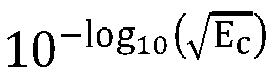
FIG. 9 , configured to multiply the linear estimated value of the algebraic codebook gain in the linear domain by
FIG. 9 , configured to multiply the estimated gain
- The apparatus provided in the fifteenth aspect may further include: a communication component, configured to transmit an encoding parameter, where the encoding parameter includes: the frame classification parameter index of the current frame and an index of the winning codebook vector in the gain codebook.
- According to a sixteenth aspect, an apparatus having a voice decoding function is provided and may be configured to implement the method provided in the eighth aspect. The apparatus may include: a communication component, configured to receive an encoding parameter, where the encoding parameter may include: a frame classification parameter index of a current frame and an index of a winning codebook vector in a gain codebook; a first searching component such as a table lookup module 901 shown in
FIG. 9 , configured to search a first mapping table for a linear estimated value of an algebraic codebook gain in a linear domain according to the frame classification parameter index of the current frame, where each entry in the first mapping table includes two values: a frame classification parameter index and a linear estimated value of an algebraic codebook gain in the linear domain; a first calculator, including a square summator 903 and a square root calculator 904 shown inFIG. 9 and configured to calculate energy Ec of an algebraic codebook vector from an algebraic codebook; a logarithm operator such as a calculator 905 shown inFIG. 9 , configured to perform a logarithm operation with 10 as a base on a square root of the energy; an exponential operator such as a calculator 906 shown inFIG. 9 , configured to calculate an additive inverse of a value obtained through the logarithm operation, and then perform an exponential operation with 10 as a base, to obtain
FIG. 9 , configured to multiply the linear estimated value of the algebraic codebook gain in the linear domain by
FIG. 9 , configured to multiply the estimated gain
- The apparatuses having a voice encoding function and a voice decoding function provided in the ninth aspect to the sixteenth aspect may further include:
- a third multiplier, configured to multiply the quantized gain of the algebraic codebook gain by the algebraic codebook vector from the algebraic codebook, to obtain an excitation contribution of the algebraic codebook;
- a fourth multiplier, configured to multiply a quantized gain of an adaptive codebook included in the winning codebook vector selected from the gain codebook by an adaptive codebook vector from the adaptive codebook, to obtain an excitation contribution of the adaptive codebook; and
- an adder, configured to add up the excitation contribution of the algebraic codebook and the excitation contribution of the adaptive codebook, to obtain total excitation.
- According to a seventeenth aspect, a voice communication system is provided and may include: a first apparatus and a second apparatus, where the first apparatus may be configured to perform the methods for encoding a sound signal provided in the first aspect, the third aspect, the fifth aspect, and the seventh aspect, and the second apparatus may be configured to perform the methods for encoding a sound signal provided in the second aspect, the fourth aspect, the sixth aspect, and the eighth aspect. The first apparatus may be the apparatus having a voice encoding function provided in the ninth aspect, the eleventh aspect, the thirteenth aspect, and the fifteenth aspect, and the second apparatus may be the apparatus having a voice decoding function provided in the tenth aspect, the twelfth aspect, the fourteenth aspect, and the sixteenth aspect.
- To describe the technical solutions in embodiments of this application more clearly, the following describes the accompanying drawings required in embodiments of this application.
-
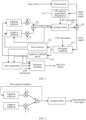
FIG. 1 is a block diagram of an existing CELP encoding algorithm; -
FIG. 2 is a block diagram of an existing CELP decoding algorithm; -
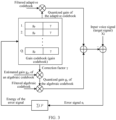
FIG. 3 is a gain quantization process in an encoder of memory-less joint gain coding; -
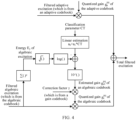
FIG. 4 is a process of calculating an algebraic codebook gain in a first subframe; -
FIG. 5 is a process of calculating an algebraic codebook gain in a second subframe and a subsequent subframe; -
FIG. 6 is a process of calculating an algebraic codebook gain in a first subframe according toEmbodiment 1 of this application; -
FIG. 7 is a process of calculating an algebraic codebook gain in a first subframe according toEmbodiment 2 of this application; -
FIG. 8 is a process of calculating an algebraic codebook gain in a first subframe according to Embodiment 3 of this application; -
FIG. 9 is a process of calculating an algebraic codebook gain in a first subframe according to Embodiment 4 of this application; -
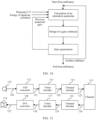
FIG. 10 is a process of designing a gain codebook by using a calculated estimation constant; and -
FIG. 11 shows a voice communication system including a voice encoding apparatus and a voice decoding apparatus according to an embodiment of this application. - In embodiments of this application, a related art of CELP encoding and decoding is improved, which can implement memory-less joint gain coding and also reduce complexity of calculating a codebook gain.
-
FIG. 1 is a block diagram of an existing CELP encoding algorithm. - An input voice signal is first preprocessed. During preprocessing, sampling, pre-emphasis, and the like may be performed on the input voice signal. A preprocessed signal is further output to an LPC analysis
quantization interpolation module 101 and anadder 102. The LPC analysisquantization interpolation module 101 performs linear predictive analysis on the input voice signal, performs quantization and interpolation on an analysis result, and calculates a linear predictive coding (linear predictive coding, LPC) parameter. The LPC parameter is used for constructing a synthesis filter (synthesis filter) 103. Both a result obtained by multiplying an algebraic codebook vector from an algebraic codebook by an algebraic codebook gain gc and a result obtained by multiplying an adaptive codebook vector from an adaptive codebook by an adaptive codebook gain gp are output to anadder 104 for adding up, and an adding result is output to thesynthesis filter 103, to construct a reconstructed voice signal generated after an excitation signal is processed through thesynthesis filter 103. The reconstructed voice signal is also output to theadder 102 and is subtracted from the input voice signal to obtain an error signal. - The error signal is processed by a perceptual weighting (perceptual weighting)
filter 105 to change a spectrum according to hearing experience, and is fed back to a pitch analysis (pitch analysis)module 106 and an algebraic codebook search (algebra codebook search)module 107. Theperceptual weighting filter 105 is also constructed based on the LPC parameter. - An excitation signal and a codebook gain are determined according to a principle of minimizing a mean square error of the perceptual weighted error signal. The
pitch analysis module 106 derives a pitch period through autocorrelation analysis, searches an adaptive codebook based on the pitch period to determine an optimal adaptive codebook vector, and obtains an excitation signal with a quasi-periodic feature in voice. The algebraiccodebook search module 107 searches an algebraic codebook, determines an optimal algebraic codebook vector according to a principle of minimizing a weighted mean square error, and obtains a random excitation signal of a voice model. Then, a gain of the optimal adaptive codebook vector and a gain of the optimal algebraic codebook vector are determined. Encoding parameters such as a quantized gain of a codebook, an index of the optimal adaptive codebook vector in the adaptive codebook, an index of the optimal algebraic codebook vector in the algebraic codebook, and a linear predictive coding parameter form a bit stream, and the bit stream is transmitted to a decoding side. -
FIG. 2 is a block diagram of an existing CELP decoding algorithm. - First, the decoding side obtains each encoding parameter from a compressed bit stream. Then, the decoding side generates an excitation signal by using the encoding parameters. The following processing is performed on each subframe: multiplying the adaptive codebook vector and the algebraic codebook vector by respective quantized gains to obtain excitation signals; and obtaining a reconstructed voice signal after the excitation signals are processed through a linear prediction synthesis filter 201. On the decoding side, the linear prediction synthesis filter 201 is also constructed based on the LPC parameter.
- Further, memory-less joint gain coding may be performed on an adaptive codebook gain and an algebraic codebook gain in each subframe, especially at a low bit rate (for example, 7.2 kbps or 8 kbps). After the oint gain coding is performed, an index of a quantized gain gp of an adaptive codebook in a gain codebook (gain codebook) is transmitted together with a bit stream.
- Before a gain quantization process, it is assumed that an adaptive codebook and an algebraic codebook that are filtered are already known. Gain quantization in an encoder is implemented by searching a designed gain codebook based on a principle of a minimum mean square error MMSE. Each entry in the gain codebook includes two values: a quantized gain gp of an adaptive codebook and a correction factor γ used for an algebraic codebook gain. Estimation of the algebraic codebook gain is completed in advance, and a result gc0 is multiplied by a correction factor γ selected from the gain codebook. In each subframe, the gain codebook is completely searched, for example, an index q=0, ..., Q-1. If a quantized gain of an adaptive part of excitation is forced to be less than a specific threshold, it is possible to limit a search range. To allow the search range to be reduced, codebook entries in the gain codebook may be arranged in ascending order according to values of gp. The gain quantization process may be shown in
FIG. 3 . - The gain quantization is implemented by minimizing energy of an error signal e(i). Error energy is represented by using the following formula:

- gc is replaced by γ*gc0, and the formula may be expanded into:

- Constants c0, c1, c2, c3, c4, and c5 and an estimated gain gc0 are calculated before the gain codebook is searched. The error energy E is calculated for each codebook entry. A codebook vector [gp; γ] causing minimum error energy is selected as a winning codebook vector, and an entry of the codebook vector corresponds to the quantized gain gp of the adaptive codebook and γ.
- Then, a quantized gain gc of a fixed codebook may be calculated as follows:

- In a decoder, a received index is used for obtaining a quantized gain gp of adaptive excitation and a quantization correction factor γ of an estimated gain of algebraic excitation. In the encoder, an estimated gain of an algebraic part of excitation is completed in a same manner.
- In a first subframe of a current frame, an estimated (predicted) gain of an algebraic codebook is given by using the following formula (4):

- CT is an encoding classification (encoding mode) parameter and is a type selected for the current frame in a preprocessing part of the encoder. Ec is energy of a filtered algebraic codebook vector with a unit of dB and is calculated by using the following formula (5). Estimation constants a0 and a1 are determined by minimizing an MSE on a big signal database. The encoding mode parameter CT in the formula is constant for all subframes of the current frame. A superscript [0] represents the first subframe of the current frame.

- c(n) is a filtered algebraic code vector.
-
FIG. 4 is a gain estimation process of a first subframe. - An algebraic codebook gain estimation process is described as follows. An algebraic codebook gain is estimated according to a classification parameter CT of a current frame, and energy of an algebraic code vector from an algebraic codebook has been excluded from the estimated algebraic codebook gain. Finally, an estimated gain of the algebraic codebook is multiplied by a correction factor γ selected from the gain codebook, to obtain a quantized algebraic codebook gain gc.
- Specifically, as shown in
FIG. 4 , linear estimation is first performed on the algebraic codebook gain according to the classification parameter CT in a logarithm domain, to obtain a linear estimated value of the algebraic codebook gain: a0+a1CT. - Then, an energy parameter


gain 
gain 
gain 
- A quantized
gain 
- All subframes after the first subframe of the current frame use slightly different estimation solutions. A differences lies in that in the subframes, both quantized gains of an adaptive codebook and an algebraic codebook from a previous subframe are used as auxiliary estimation parameters to improve efficiency. In a kth subframe, where k>0, an estimated gain of an algebraic codebook is given by using the following formula (6):

- k=1, 2, 3. A first sum term Σ and a second sum term Σ in an exponential respectively represent a quantized gain of an algebraic codebook and a quantized gain of an adaptive codebook of a previous subframe. Estimation constants b0, ..., and b2k+1 are also determined by minimizing the MSE on the big signal database.
-
FIG. 5 is a gain estimation process of a second subframe and a subsequent subframe. Different from the first frame, in addition to the classification parameter CT of the current frame, an algebraic codebook gain of a latter subframe is further estimated according to quantized gains of an adaptive codebook and an algebraic codebook of a former subframe. - Specifically, as shown in
FIG. 5 , an estimated gain of an algebraic codebook is first calculated in a logarithm domain:


- In a second subframe and a subsequent subframe, a quantized gain

- A difference between an estimation process of the second subframe and the subsequent subframe and the estimation process of the first subframe also lies in that energy of an algebraic codebook vector from an algebraic codebook is not subtracted from the estimated gain of the algebraic codebook in the logarithm domain. This is because gain estimation of a latter subframe is based on an algebraic codebook gain of a former subframe, the energy is already subtracted from the algebraic codebook gain of the previous first subframe, and the gain estimation of the latter subframe does not need to consider an impact of removing the energy.
- For memory-loss joint gain coding, reference may be further made to the following document: 3GPP TS26.445, "Codec for Enhanced Voice Services (EVS); Detailed algorithmic description", which is incorporated herein by reference in its entirety.
- In the decoder, a winning codebook vector [gp; γ] causing minimum error energy is found from the gain codebook according to an index, where gp is the quantized gain of the adaptive codebook, and a quantized gain gc of the algebraic codebook is obtained by multiplying an estimated gain gc0 of the algebraic codebook by the correction factor γ. A calculation manner of gc0 is the same as a manner used in the encoder. An adaptive codebook vector and an algebraic codebook vector are obtained through decoding from a bit stream, and the adaptive codebook vector and the algebraic codebook vector are respectively multiplied by the quantized gains of the adaptive codebook and the algebraic codebook, to obtain an adaptive excitation contribution and an algebraic excitation contribution. Finally, the two excitation contributions are added up to form total excitation, and the linear prediction synthesis filter filters the total excitation to reconstruct a voice signal.
- The related art of CELP encoding and decoding has a problem of relatively high calculation complexity. For example, in the formula (4), estimating the algebraic codebook gain in the first subframe requires both a logarithm log operation and an exponential operation with 10 as a base with a relatively large calculation amount.
- Therefore, in various embodiments of this application, a process of calculating the algebraic codebook gain in the first subframe is improved, which can reduce high complexity of the logarithmic log operation and the exponential operation with 10 as a base, and reduce calculation complexity of a codebook gain.
- In a process of calculating an algebraic codebook gain in a first subframe provided in
Embodiment 1, a calculation formula of an estimatedgain 

- Because a linear estimated
value 10a0 +a1 CT of an algebraic codebook gain in a linear domain is related to only a classification parameter CT and estimation constants a0 and a1 in a logarithm domain, a value of 10a0 +a1 CT may be enumerated in a table in advance. 10a0+a1CT represents the linear estimated value of the algebraic codebook gain in the linear domain. A codec may maintain a mapping table b. Each entry in the table b includes two values: an index CTindex of a classification parameter CT and a linear estimatedvalue 10a0 +a1 CT of an algebraic codebook gain in the linear domain. In this way, the codec may directly obtain a value of 10a0+a1CT corresponding to a parameter CT of a current frame through table lookup, to avoid a case that calculation is performed when the codec runs, thereby reducing algorithm complexity.
- A calculation process of the formula (7) may be further simplified as:

- A process of calculating an estimated gain of an algebraic codebook in the first subframe represented by the formula (9) may be described as follows. First, a linear estimated value of an algebraic codebook gain in a linear domain is obtained through table lookup according to an index CTindex of a classification parameter CT of a current frame. Then, the linear estimated value of the algebraic codebook gain in the linear domain is divided by a square root (which is represented as

gain 
- An encoding side may transmit the following encoding parameters to a decoding side: the index CTindex of the classification parameter CT of the current frame and an index of a winning codebook vector [gp; γ] in a gain codebook.
-
FIG. 6 is a process of calculating an algebraic codebook gain in a first subframe according toEmbodiment 1. - As shown in
FIG. 6 , the index CTindex of the classification parameter CT of the current frame is first input to atable lookup module 601. Then, thetable lookup module 601 obtains a linear estimated value (which is represented as
multiplier 602. In addition, a value of a square root
square summator 603 and asquare root calculator 604. Thesquare summator 603 calculates Ec by using the formula (5), and then outputs a reciprocal value of
multiplier 602, and b[CTindex ] is divided by the reciprocal value of
gain 
gain 
multiplier 605, and the estimatedgain 
gain 
gain 
multiplier 606, and the quantizedgain 
adder 607, and the excited algebraic codebook contribution and an excited adaptive codebook contribution are added up to obtain total filtered excitation. - The excited adaptive codebook contribution is obtained by multiplying an adaptive codebook vector (filtered adaptive excitation) that is from an adaptive codebook and that is output to a
multiplier 608 by a quantizedgain 
gain 
- In a process of calculating an algebraic codebook gain in a first subframe provided in
Embodiment 2, a calculation formula of an estimatedgain 

- A slight difference from
Embodiment 1 lies in that only a value of a0+a1CT in the formula (7) is enumerated in a table in advance. a0+a1CT represents a linear estimated value of an algebraic codebook gain in a logarithm domain. In this case, each entry in a mapping table b maintained by a codec may include two values: an index CTindex of a classification parameter CT and a linear estimated value a0+a1CT of an algebraic codebook gain in the logarithm domain. In this way, the codec may directly obtain a value of a0+a1CT corresponding to a parameter CT of a current frame through table lookup, to avoid a case that the value is calculated when the codec runs, thereby reducing a calculation amount.
- A calculation process of the formula (7) may be further simplified as:

- A process of calculating an estimated gain of an algebraic codebook in the first subframe represented by the formula (11) may be described as follows. First, a linear estimated value of an algebraic codebook gain in a logarithm domain is obtained through table lookup according to an index CTindex of a classification parameter CT of a current frame. Then, a linear estimated value of the algebraic codebook gain in a linear domain is divided by a square root (which is represented as

gain 
- An encoding side may transmit the following encoding parameters to a decoding side: the index CTindex of the classification parameter CT of the current frame and an index of a winning codebook vector [gp; γ] in a gain codebook.
-
FIG. 7 is a process of calculating an algebraic codebook gain in a first subframe according toEmbodiment 2. - As shown in
FIG. 7 , the index CTindex of the classification parameter CT of the current frame is first input to atable lookup module 701. Then, thetable lookup module 701 obtains a linear estimated value (which is represented as b[CTindex ] below) of an algebraic codebook gain in a logarithm domain through table lookup according to the index CTindex, and outputs b[CTindex ] to anexponential calculator 702 with 10 as a base, to obtain a linear estimatedvalue 10b[CTindex ] of the algebraic codebook gain in a linear domain. Next, the linear estimatedvalue 10b[CTindex ] of the algebraic codebook gain in the linear domain is output to amultiplier 703. In addition, a value of a square root
square summator 704 and asquare root calculator 705. Thesquare summator 704 calculates Ec by using the formula (5), and then outputs a reciprocal value of
multiplier 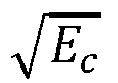
gain 
gain 
multiplier 706, and the estimatedgain 
gain 
gain 
multiplier 707, and the quantizedgain 
adder 708, and the excited algebraic codebook contribution and an excited adaptive codebook contribution are added up to obtain total filtered excitation. - The excited adaptive codebook contribution is obtained by multiplying an adaptive codebook vector (filtered adaptive excitation) that is from an adaptive codebook and that is output to a
multiplier 709 by a quantizedgain 
gain 
- In a process of calculating an algebraic codebook gain in a first subframe provided in Embodiment 3, a calculation formula of an estimated
gain 

- A difference from the foregoing embodiments lies in that a linear estimated
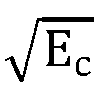
value 10a0 +a1 CT of an algebraic codebook gain in a linear domain or a value of a linear estimated value a0+a1CT of an algebraic codebook gain in a logarithm domain is not enumerated in a table in advance, but 10a0 +a1 CT is obtained through an exponential operation with 10 as a base. - A process of calculating an estimated gain of an algebraic codebook in the first subframe represented by the formula (7) may be described as follows. First, a linear estimated value a0+a1CT of an algebraic codebook gain in a logarithm domain is obtained through calculation according to a classification parameter CT of a current frame. Then, the linear estimated value a0+a1CT of the algebraic codebook gain in the logarithm domain is converted into a linear domain through an exponential operation with 10 as a base, to obtain 10a
0 +a1 CT. A linear estimatedvalue 10a0 +a1 CT of the algebraic codebook gain in the linear domain is divided by a square root (which is represented as
gain 
- An encoding side may transmit the following encoding parameters to a decoding side: a frame type CT of the current frame, linear estimation constants a0 and a1, and an index of a winning codebook vector [gp; γ] in a gain codebook.
-
FIG. 8 is a process of calculating an algebraic codebook gain in a first subframe according to Embodiment 3. - As shown in
FIG. 8 , a classification parameter CT of a current frame is first input to alinear estimation module 801. Then, thelinear estimation module 801 calculates a linear estimated value a0+a1CT of an algebraic codebook gain in a logarithm domain according to the parameter CT, and outputs a0+a1CT to anexponential calculator 802 with 10 as a base to obtain a linear estimatedvalue 10a0 +a1 CT of the algebraic codebook gain in a linear domain. Next, the linear estimatedvalue 10a0 +a1 CT of the algebraic codebook gain in the linear domain is output to amultiplier 803. In addition, a value of a square root
square summator 804 and asquare root calculator 805. Thesquare summator 804 calculates Ec by using the formula (5), and then outputs a reciprocal value of
multiplier 
gain 
gain 
multiplier 806, and the estimatedgain 
gain 
gain 
multiplier 807, and the quantizedgain 
adder 808, and the excited algebraic codebook contribution and an excited adaptive codebook contribution are added up to obtain total filtered excitation. - The excited adaptive codebook contribution is obtained by multiplying an adaptive codebook vector (filtered adaptive excitation) that is from an adaptive codebook and that is output to a
multiplier 809 by a quantizedgain 
gain 
- In a process of calculating an algebraic codebook gain in a first subframe provided in Embodiment 4, a calculation formula of an estimated
gain 

- Same as
Embodiment 1, because a linear estimatedvalue 10a0+a1CT of an algebraic codebook gain in a linear domain is related to only a classification parameter CT and estimation constants a0 and a1 in a logarithm domain, a value of 10a0 +a1 CT may be enumerated in a table in advance. 10a0 +a1 CT represents the linear estimated value of the algebraic codebook gain in the linear domain. A codec may maintain a mapping table b. Each entry in the table b includes two values: an index CTindex of a classification parameter CT and a linear estimatedvalue 10a0+a1CT of an algebraic codebook gain in the linear domain. In this way, the codec may directly obtain a value of 10a0 +a1 CT corresponding to a parameter CT of a current frame through table lookup, to avoid a case that calculation is performed when the codec runs, thereby reducing algorithm complexity.
- A calculation process of the formula (12) may be further simplified as:

- A process of calculating an estimated gain of an algebraic codebook in the first subframe represented by the formula (13) may be described as follows. First, a linear estimated
value 10a0 +a1 CT of an algebraic codebook gain in a linear domain is obtained through table lookup according to an index CTindex of a classification parameter CT of a current frame. In addition, an additive inverse of an energy parameter

value 10a0+a1CT of the algebraic codebook gain in the linear domain is multiplied by
gain 
- An encoding side may transmit the following encoding parameters to a decoding side: the index CTindex of the classification parameter CT of the current frame and an index of a winning codebook vector [gp; γ] in a gain codebook.
-
FIG. 9 is a process of calculating an algebraic codebook gain in a first subframe according to Embodiment 4. - As shown in
FIG. 9 , the index CTindex of the classification parameter CT of the current frame is first input to atable lookup module 901. Then, thetable lookup module 901 obtains a linear estimated value (which is represented as b[CTindex ] below) of an algebraic codebook gain in a linear domain through table lookup according to the index CTindex, and outputs b[CTindex ] to amultiplier 902. In addition, a value of a square root
square summator 903 and asquare root calculator 904. Thesquare summator 903 calculates Ec by using the formula (5), and then outputs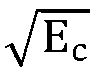
calculator 905, and an additive inverse of a value obtained by performing a logarithm log operation on


calculator 906, and an exponential operation with 10 as a base is performed on


multiplier 
gain 
gain 
multiplier 907, and the estimatedgain 
gain 
gain 
multiplier 908, and the quantizedgain 
adder 909, and the excited algebraic codebook contribution and an excited adaptive codebook contribution are added up to obtain total filtered excitation. - The excited adaptive codebook contribution is obtained by multiplying an adaptive codebook vector (filtered adaptive excitation) that is from an adaptive codebook and that is output to a multiplier 910 by a quantized
gain 
gain 
- In Embodiment 4, b[CTindex]=a0 + a1CT, that is, only a value of a0+a1CT is enumerated in a table in advance by using the table b. In this case, a calculation process of the formula (12) may be further simplified as:

- A process of calculating an estimated gain of an algebraic codebook in the first subframe represented by the formula (14) may be described as follows. First, a linear estimated value of an algebraic codebook gain in a logarithm domain is obtained through table lookup according to an index CTindex of a classification parameter CT of a current frame. In addition, energy


- In the foregoing embodiments, a value of the classification parameter CT of the current frame may be selected based on a signal type. For example, for a narrowband signal, for an unvoiced frame, a voiced frame, a generic frame, or a transition frame, values of the parameter CT are respectively set to 1, 3, 5, and 7, and for a broadband signal, the values of the parameter CT are respectively set to 0, 2, 4, and 6. Signal classification is described below, and is not expanded herein,
- There may be different methods for determining classification (a parameter CT) of a frame. For example, basic classification is performed according to only voiced or unvoiced. In another example, more types such as voiced or strong unvoiced may be enhanced.
- The signal classification may be performed in the following three steps. First, a speech active detector (speech active detector, SAD) distinguishes between a valid speech frame and an invalid speech frame. If the invalid speech frame such as ground noise (ground noise) is detected, classification is ended, and an encoding frame is generated by using a comfort noise generator (comfort noise generator, CNG). If the valid speech frame is detected, the frame is further classified, to distinguish an unvoiced frame. If the frame is further classified into an unvoiced signal, classification is ended, and the frame is encoded by using an encoding method most suitable for the unvoiced signal. Otherwise, it is further determined whether the frame is stable voiced. If the frame is classified into a stable voiced frame, the frame is encoded by using an encoding method most suitable for a stable voiced signal. Otherwise, the frame may include a non-stable signal segment such as a voiced onset or rapidly evolving voiced signal.
- The unvoiced signal may be classified based on the following parameters: voicing measure
rx , an average spectral tiltet , a maximum short-time energy increment dE0 and a maximum short time energy deviation dE that are at a low level. An algorithm for distinguishing the unvoiced signal is not limited in this application, for example, an algorithm mentioned in the following document Jelinek,M.,etal., "Advances in source-controlledvariable bitrate wideband speech coding", Special Workshop in MAUI(SWIM); Lectures by masters in speech processing, Maui, January12-24,2004 may be used, which is incorporated herein by reference in its entirety. - If a frame is not classified into a valid frame or an unvoiced frame, it is tested whether the frame is a stable voiced frame. The stable voiced frame may be classified based on the following parameters: a normalization correlation
rx of each subframe (with 1/4 subsample resolution), an average spectral tiltet , and open-loop pitch estimation in all subframes (with 1/4 subsample resolution). An algorithm for distinguishing the sable voiced frame is not limited in this application. - In the foregoing embodiments, in addition to the classification parameter CT, the linear estimated gain of the algebraic codebook in the first subframe of the current frame is further related to an estimation constant ai. The estimation constant ai may be determined through training by using data of a big sample.
- Training data of a big sample may include a large quantity of various speech signals in different languages, different genders, different ages, different environments, and the like. In addition, it is assumed that the training data of the big sample includes (N+1) frames.
- An estimation coefficient is found by minimizing a mean square error between an estimated gain of an algebraic codebook and an optimal gain in a logarithm domain on all the frames in the training data of the big sample.
- For a first subframe in an nth frame, energy of the mean square error is given by using the following formula:

- In the first subframe of the nth frame, an estimated gain of an algebraic codebook in a logarithm domain is given by using the following formula:

where i=0, ..., L-1. L represents L samples of input voice signals. Ei(n) represents energy of an algebraic codebook vector from an algebraic codebook in the nth frame, which may refer to calculation in the foregoing formula (5). - After the formula (16) is substituted, the formula (15) is changed into:

- In the formula (17),


- Constants or correlation coefficients c0, c1, c2, c3, c4, and c5 are obtained through calculation by using the following formula:

- A process of calculating a minimum mean square error MSE is simplified by defining a normalized gain


where
- A solution (that is, optimal values of the estimation constants a0 and a1) of the defined minimum mean square error MSE is obtained by using the following pair of partial derivatives:

- So far, the optimal values of the estimation constants a0 and a1 can be determined. Expressions of the optimal values of the estimation constants a0 and a1 are not provided herein, that is, solution of the formula (21) is not shown, and the expressions are relatively complex. During actual application, the optimal value can be calculated in advance by using calculation software such as MATLAB.
- For a second subframe and a subsequent subframe in the nth frame, energy of a mean square error is given by using the following formula:

where k≥2,


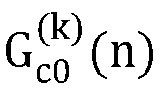

- To solve optimal values of estimation constants b0, b1, ..., and bk that implement the minimum mean square error MSE, similar to the solution method in the first subframe, a partial derivative of the formula (22) may be obtained.
- So far, the optimal values of the estimation constants b0, b1, ..., and bk can be determined. Expressions of the optimal values of the estimation constants b0, b1, ..., and bk are not provided herein, and the expressions are relatively complex. During actual application, the optimal value can be calculated in advance by using calculation software such as MATLAB.
- As shown in
FIG. 10 , the calculated estimation constants may be used for designing a gain codebook for each subframe, and gain quantization of each subframe can be further determined according to the estimation constants and the gain codebook. Based on the foregoing, estimation of the algebraic codebook gain is slightly different in each subframe, and an estimation coefficient is obtained through a minimum mean square error MSE. The gain codebook may be designed with reference to a KMEANS algorithm in the following document: MacQueen,J.B.(1967), "Some Methods for classification and Analysis of Multivariate Observations", Proceedings of 5th Berkeley Symposium on Mathematical Statistics and Probability, University of CaliforniaPress.pp.281-297, which is incorporated herein by reference in its entirety. -
FIG. 11 shows avoice communication system 110 including avoice encoding apparatus 113 and avoice decoding apparatus 117 according to an embodiment of this application. Thevoice communication system 110 supports transmission of a voice signal through acommunication channel 115. Thecommunication channel 115 may be a wireless communication link or may be a wired link formed by a conducting wire and the like. Thecommunication channel 115 may support a plurality of voice communication that is performed simultaneously and needs to share bandwidth resources Without being limited to communication between apparatuses, thecommunication channel 115 may also be extended to a memory unit within a single apparatus for implementing shared communication, for example, a memory unit of a single apparatus for recording and storing encoded voice signals for later playback. - At a transmitter end, a voice acquisition apparatus 111 such as a microphone converts voice into an
analog voice signal 120 provided to an analog to digital (A/D)converter 112. A function of the A/D converter 112 is to convert theanalog voice signal 120 into adigital voice signal 121. Avoice encoding apparatus 113 encodes thedigital voice signal 121 to generate a group of encodingparameters 122 in a binary form and transmits the encoding parameters to achannel encoder 114 through a communication component. Thechannel encoder 114 performs a channel encoding operation such as adding redundancy on theencoding parameters 122 to form abit stream 123, and transmits the bit stream through thecommunication channel 115. - At a receiver end, a
channel decoder 116 performs a channel decoding operation on thebit stream 124 received through the communication component, for example, detects and corrects, by using redundancy information in thebit stream 124, a channel error occurring during transmission. Avoice decoding apparatus 117 converts thebit stream 125 received from the channel decoder back to the encoding parameters for creating a synthesizedvoice signal 126. A digital to analog (D/A) converter 108 converts the synthesizedvoice signal 126 reconstructed in thevoice decoding apparatus 117 back to theanalog voice signal 127. Finally, theanalog voice signal 127 is played through a sound playback apparatus such as aspeaker unit 119. - That the
voice encoding apparatus 113 encodes a voice signal to obtain an encoding parameter, and thevoice decoding apparatus 117 reconstructs the voice signal by using the encoding parameter carried in a bit stream may refer to the above content. Details are not described again. - Each device at the transmitter end may be integrated into one electronic device, and each device at the receiver end may be integrated into another electronic device. In this case, the two electronic devices communicate via a communication channel formed by a wired or wireless link, for example, transmitting an encoding parameter, for example, transmitting an encoding parameter. Each device at the transmitter end and each device at the receiver end may alternatively be integrated into a same electronic device. In this case, data exchange, that is, communication, for example, transmission of an encoding parameter, is implemented between the transmitter end and the receiver end inside the electronic device through a shared memory unit.
- The foregoing descriptions are merely specific implementations of this application, but are not intended to limit the protection scope of this application. Any variation or replacement readily figured out by a person skilled in the art within the technical scope disclosed in this application shall fall within the protection scope of this application. Therefore, the protection scope of this application shall be subject to the protection scope of the claims.
Claims (27)
- A method for encoding a sound signal, applied to a first subframe in a current frame, wherein the method comprises:receiving a frame classification parameter index of the current frame;searching a first mapping table for a linear estimated value of an algebraic codebook gain in the linear domain according to the frame classification parameter index of the current frame, wherein each entry in the first mapping table comprises two values: a frame classification parameter index and a linear estimated value of an algebraic codebook gain in the linear domain;calculating energy of an algebraic codebook vector from an algebraic codebook;dividing the linear estimated value of the algebraic codebook gain in the linear domain by a square root of the energy of the algebraic codebook vector, to obtain an estimated gain of the algebraic codebook; andmultiplying the estimated gain of the algebraic codebook by a correction factor, to obtain a quantized gain of the algebraic codebook, wherein the correction factor is from a winning codebook vector, and the winning codebook vector is selected from a gain codebook.
- The method according to claim 1, wherein the method further comprises:
transmitting an encoding parameter, wherein the encoding parameter comprises: the frame classification parameter index of the current frame and an index of the winning codebook vector in the gain codebook. - A method for encoding a sound signal, applied to a first subframe in a current frame, wherein the method comprises:receiving a frame classification parameter index of the current frame;searching a first mapping table for a linear estimated value of an algebraic codebook gain in a logarithm domain according to the frame classification parameter index of the current frame, wherein each entry in the first mapping table comprises two values: a frame classification parameter index and a linear estimated value of an algebraic codebook gain in the logarithm domain;converting the linear estimated value of the algebraic codebook gain in the logarithm domain into a linear domain through an exponential operation, to obtain a linear estimated value of the algebraic codebook gain in the linear domain;calculating energy of an algebraic codebook vector from an algebraic codebook;dividing the linear estimated value of the algebraic codebook gain in the linear domain by a square root of the energy of the algebraic codebook vector, to obtain an estimated gain of the algebraic codebook; andmultiplying the estimated gain of the algebraic codebook by a correction factor, to obtain a quantized gain of the algebraic codebook, wherein the correction factor is from a winning codebook vector, and the winning codebook vector is selected from a gain codebook.
- The method according to claim 3, wherein the method further comprises:
transmitting an encoding parameter, wherein the encoding parameter comprises: the frame classification parameter index of the current frame and an index of the winning codebook vector in the gain codebook. - A method for encoding a sound signal, applied to a first subframe in a current frame, wherein the method comprises:performing linear estimation by using a linear estimation constant in the first subframe and a frame type of the current frame, to obtain a linear estimated value of an algebraic codebook gain in a logarithm domain;converting the linear estimated value of the algebraic codebook gain in the logarithm domain into a linear domain through an exponential operation, to obtain a linear estimated value of the algebraic codebook gain in the linear domain;calculating energy of an algebraic codebook vector from an algebraic codebook;dividing the linear estimated value of the algebraic codebook gain in the linear domain by a square root of the energy of the algebraic codebook vector, to obtain an estimated gain of the algebraic codebook; andmultiplying the estimated gain of the algebraic codebook by a correction factor, to obtain a quantized gain of the algebraic codebook, wherein the correction factor is from a winning codebook vector, and the winning codebook vector is selected from a gain codebook.
- The method according to claim 5, wherein the method further comprises:
transmitting an encoding parameter, wherein the encoding parameter comprises: the frame type of the current frame, the linear estimation constant, and an index of the winning codebook vector in the gain codebook. - A method for decoding a sound signal, applied to a first subframe in a current frame, wherein the method comprises:receiving an encoding parameter, wherein the encoding parameter comprises: a frame classification parameter index of the current frame and an index of a winning codebook vector;searching a first mapping table for a linear estimated value of an algebraic codebook gain in the linear domain based on the frame classification parameter index of the current frame, wherein each entry in the first mapping table comprises two values: a frame classification parameter index and a linear estimated value of an algebraic codebook gain in the linear domain;calculating energy of an algebraic codebook vector from an algebraic codebook;dividing the linear estimated value of the algebraic codebook gain in the linear domain by a square root of the energy of the algebraic codebook vector, to obtain an estimated gain of the algebraic codebook; andmultiplying the estimated gain of the algebraic codebook by a correction factor, to obtain a quantized gain of the algebraic codebook, wherein the correction factor is from the winning codebook vector, and the winning codebook vector is selected from a gain codebook based on the index of the winning codebook vector.
- A method for decoding a sound signal, applied to a first subframe in a current frame, wherein the method comprises:receiving an encoding parameter, wherein the encoding parameter comprises: a frame classification parameter index of the current frame and an index of a winning codebook vector;searching a first mapping table for a linear estimated value of an algebraic codebook gain in a logarithm domain based on the frame classification parameter index of the current frame, wherein each entry in the first mapping table comprises two values: a frame classification parameter index and a linear estimated value of an algebraic codebook gain in the logarithm domain;converting the linear estimated value of the algebraic codebook gain in the logarithm domain into a linear domain through an exponential operation, to obtain a linear estimated value of the algebraic codebook gain in the linear domain;calculating energy of an algebraic codebook vector from an algebraic codebook;dividing the linear estimated value of the algebraic codebook gain in the linear domain by a square root of the energy of the algebraic codebook vector, to obtain an estimated gain of the algebraic codebook; andmultiplying the estimated gain of the algebraic codebook by a correction factor, to obtain a quantized gain of the algebraic codebook, wherein the correction factor is from the winning codebook vector, and the winning codebook vector is selected from a gain codebook based on the index of the winning codebook vector.
- A method for decoding a sound signal, applied to a first subframe in a current frame, wherein the method comprises:receiving an encoding parameter, wherein the encoding parameter comprises: a frame type of the current frame, a linear estimation constant in the first subframe, and an index of a winning codebook vector;performing linear estimation by using the linear estimation constant in the first subframe and the frame type of the current frame, to obtain a linear estimated value of an algebraic codebook gain in a logarithm domain;converting the linear estimated value of the algebraic codebook gain in the logarithm domain into a linear domain through an exponential operation, to obtain a linear estimated value of the algebraic codebook gain in the linear domain;calculating energy of an algebraic codebook vector from an algebraic codebook;dividing the linear estimated value of the algebraic codebook gain in the linear domain by a square root of the energy of the algebraic codebook vector, to obtain an estimated gain of the algebraic codebook; andmultiplying the estimated gain of the algebraic codebook by a correction factor, to obtain a quantized gain of the algebraic codebook, wherein the correction factor is from the winning codebook vector, and the winning codebook vector is selected from a gain codebook based on the index of the winning codebook vector.
- A method for encoding a sound signal, applied to a first subframe in a current frame, wherein the method comprises:receiving a frame classification parameter index of the current frame;searching a first mapping table for a linear estimated value of an algebraic codebook gain in the linear domain according to the frame classification parameter index of the current frame, wherein each entry in the first mapping table comprises two values: a frame classification parameter index and a linear estimated value of an algebraic codebook gain in the linear domain;calculating energy Ec of an algebraic codebook vector from an algebraic codebook, performing a logarithm operation with 10 as a base on a square root of the energy, calculating an additive inverse of a value obtained through the logarithm operation, and then performing an exponential operation with 10 as a base, to obtain
 multiplying the linear estimated value of the algebraic codebook gain in the linear domain by
 multiplying the estimated gain
- The method according to claim 10, wherein the method further comprises:
transmitting an encoding parameter, wherein the encoding parameter comprises: the frame classification parameter index of the current frame and an index of the winning codebook vector in the gain codebook. - A method for decoding a sound signal, applied to a first subframe in a current frame, wherein the method comprises:receiving an encoding parameter, wherein the encoding parameter comprises: a frame classification parameter index of the current frame and an index of the winning codebook vector;searching a first mapping table for a linear estimated value of an algebraic codebook gain in the linear domain according to the frame classification parameter index of the current frame, wherein each entry in the first mapping table comprises two values: a frame classification parameter index and a linear estimated value of an algebraic codebook gain in the linear domain;calculating energy Ec of an algebraic codebook vector from an algebraic codebook, performing a logarithm operation with 10 as a base on a square root of the energy, calculating an additive inverse of a value obtained through the logarithm operation, and then performing an exponential operation with 10 as a base, to obtain
 multiplying the linear estimated value of the algebraic codebook gain in the linear domain by
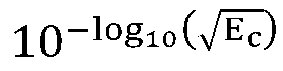 multiplying the estimated gain
- The method according to any one of claims 1 to 12, wherein the method further comprises:multiplying the quantized gain of the algebraic codebook gain by the algebraic codebook vector from the algebraic codebook, to obtain an excitation contribution of the algebraic codebook;multiplying a quantized gain of an adaptive codebook comprised in the winning codebook vector selected from the gain codebook by an adaptive codebook vector from the adaptive codebook, to obtain an excitation contribution of the adaptive codebook; andadding up the excitation contribution of the algebraic codebook and the excitation contribution of the adaptive codebook, to obtain total excitation.
- A voice communication system, comprising: a first apparatus and a second apparatus, wherein the first apparatus is configured to perform the methods according to any one of claims 1 to 6, claims 10 and 11, and claim 13, and the second apparatus is configured to perform the methods according to any one of claims 7 to 9 and claims 12 and 13.
- An apparatus having a voice encoding function, comprising:a searching component, configured to search a first mapping table for a linear estimated value of an algebraic codebook gain in the linear domain according to a frame classification parameter index of a current frame, wherein each entry in the first mapping table comprises two values: a frame classification parameter index and a linear estimated value of an algebraic codebook gain in the linear domain;a first calculator, configured to calculate energy of an algebraic codebook vector from an algebraic codebook;a first multiplier, configured to multiply the linear estimated value of the algebraic codebook gain in the linear domain by a reciprocal of a square root of the energy of the algebraic codebook vector, to obtain an estimated gain of the algebraic codebook; anda second multiplier, configured to multiply the estimated gain of the algebraic codebook by a correction factor comprised in a winning codebook vector, to obtain a quantized gain of the algebraic codebook, wherein the winning codebook vector is selected from a gain codebook.
- The apparatus according to claim 15, further comprising: a communication component, configured to transmit an encoding parameter, wherein the encoding parameter comprises: the frame classification parameter index of the current frame and an index of the winning codebook vector in the gain codebook.
- An apparatus having a voice encoding function, comprising:a searching component, configured to search a first mapping table for a linear estimated value of an algebraic codebook gain in a logarithm domain according to a frame classification parameter index of the current frame, wherein each entry in the first mapping table comprises two values: a frame classification parameter index and a linear estimated value of an algebraic codebook gain in the logarithm domain;a converter, configured to convert the linear estimated value of the algebraic codebook gain in the logarithm domain into a linear domain through an exponential operation, to obtain a linear estimated value of the algebraic codebook gain in the linear domain;a first calculator, configured to calculate energy of an algebraic codebook vector from an algebraic codebook;a first multiplier, configured to multiply the linear estimated value of the algebraic codebook gain in the linear domain by a reciprocal of a square root of the energy of the algebraic codebook vector, to obtain an estimated gain of the algebraic codebook; anda second multiplier, configured to multiply the estimated gain of the algebraic codebook by a correction factor comprised in a winning codebook vector, to obtain a quantized gain of the algebraic codebook, wherein the winning codebook vector is selected from a gain codebook.
- The apparatus according to claim 15, further comprising: a communication component, configured to transmit an encoding parameter, wherein the encoding parameter comprises: the frame classification parameter index of the current frame and an index of the winning codebook vector in the gain codebook.
- An apparatus having a voice encoding function, comprising:a linear prediction component, configured to perform linear estimation by using a linear estimation constant in the first subframe and a frame type of the current frame, to obtain a linear estimated value of an algebraic codebook gain in a logarithm domain;a converter, configured to convert the linear estimated value of the algebraic codebook gain in the logarithm domain into a linear domain through an exponential operation, to obtain a linear estimated value of the algebraic codebook gain in the linear domain;a first calculator, configured to calculate energy of an algebraic codebook vector from an algebraic codebook;a first multiplier, configured to multiply the linear estimated value of the algebraic codebook gain in the linear domain by a reciprocal of a square root of the energy of the algebraic codebook vector, to obtain an estimated gain of the algebraic codebook; anda second multiplier, configured to multiply the estimated gain of the algebraic codebook by a correction factor comprised in a winning codebook vector, to obtain a quantized gain of the algebraic codebook, wherein the winning codebook vector is selected from a gain codebook.
- The apparatus according to claim 19, further comprising: a communication component, configured to transmit an encoding parameter, wherein the encoding parameter comprises: the frame type of the current frame, the linear estimation constant, and an index of the winning codebook vector in the gain codebook.
- An apparatus having a voice decoding function, comprising:a communication component, configured to receive an encoding parameter, wherein the encoding parameter comprises: a frame classification parameter index of the current frame and an index of a winning codebook vector;a first searching component, configured to search a first mapping table for a linear estimated value of an algebraic codebook gain in the linear domain based on the frame classification parameter index of the current frame, wherein each entry in the first mapping table comprises two values: a frame classification parameter index and a linear estimated value of an algebraic codebook gain in a linear domain;a first calculator, configured to calculate energy of an algebraic codebook vector from an algebraic codebook;a first multiplier, configured to multiply the linear estimated value of the algebraic codebook gain in the linear domain by a reciprocal of a square root of the energy of the algebraic codebook vector, to obtain an estimated gain of the algebraic codebook;a second multiplier, configured to multiply the estimated gain of the algebraic codebook by a correction factor, to obtain a quantized gain of the algebraic codebook, wherein the correction factor is from the winning codebook vector; anda second searching component, configured to search a gain codebook for the winning codebook vector based on the index of the winning codebook vector.
- An apparatus having a voice decoding function, comprising:a communication component, configured to receive an encoding parameter, wherein the encoding parameter comprises: a frame classification parameter index of the current frame and an index of a winning codebook vector;a first searching component, configured to search a first mapping table for a linear estimated value of an algebraic codebook gain in a logarithm domain based on the frame classification parameter index of the current frame, wherein each entry in the first mapping table comprises two values: a frame classification parameter index and a linear estimated value of an algebraic codebook gain in the logarithm domain;a converter, configured to convert the linear estimated value of the algebraic codebook gain in the logarithm domain into a linear domain through an exponential operation, to obtain a linear estimated value of the algebraic codebook gain in the linear domain;a first calculator, configured to calculate energy of an algebraic codebook vector from an algebraic codebook;a first multiplier, configured to multiply the linear estimated value of the algebraic codebook gain in the linear domain by a reciprocal of a square root of the energy of the algebraic codebook vector, to obtain an estimated gain of the algebraic codebook;a second multiplier, configured to multiply the estimated gain of the algebraic codebook by a correction factor, to obtain a quantized gain of the algebraic codebook, wherein the correction factor is from the winning codebook vector; anda second searching component, configured to search a gain codebook for the winning codebook vector based on the index of the winning codebook vector.
- An apparatus having a voice decoding function, comprising:a communication component, configured to receive an encoding parameter, wherein the encoding parameter comprises: a frame type of the current frame, a linear estimation constant in the first subframe, and an index of a winning codebook vector;a linear prediction component, configured to perform linear estimation by using the linear estimation constant in the first subframe and the frame type of the current frame, to obtain a linear estimated value of an algebraic codebook gain in a logarithm domain;a converter, configured to convert the linear estimated value of the algebraic codebook gain in the logarithm domain into a linear domain through an exponential operation, to obtain a linear estimated value of the algebraic codebook gain in the linear domain;a first calculator, configured to calculate energy of an algebraic codebook vector from an algebraic codebook;a first multiplier, configured to multiply the linear estimated value of the algebraic codebook gain in the linear domain by a reciprocal of a square root of the energy of the algebraic codebook vector, to obtain an estimated gain of the algebraic codebook;a second multiplier, configured to multiply the estimated gain of the algebraic codebook by a correction factor, to obtain a quantized gain of the algebraic codebook, wherein the correction factor is from the winning codebook vector; anda searching component, configured to search a gain codebook for the winning codebook vector based on the index of the winning codebook vector.
- An apparatus having a voice encoding function, comprising:a first searching component, configured to search a first mapping table for a linear estimated value of an algebraic codebook gain in the linear domain according to a frame classification parameter index of the current frame, wherein each entry in the first mapping table comprises two values: a frame classification parameter index and a linear estimated value of an algebraic codebook gain in the linear domain;a first calculator, configured to calculate energy Ec of an algebraic codebook vector from an algebraic codebook;a logarithm operator, configured to perform a logarithm operation with 10 as a base on a square root of the energy;an exponential operator, configured to calculate an additive inverse of a value obtained through the logarithm operation, and then perform an exponential operation with 10 as a base, to obtain
 a first multiplier, configured to multiply the linear estimated value of the algebraic codebook gain in the linear domain by
 a second multiplier, configured to multiply the estimated gain
- The apparatus according to claim 24, further comprising: a communication component, configured to transmit an encoding parameter, wherein the encoding parameter comprises: the frame classification parameter index of the current frame and an index of the winning codebook vector in the gain codebook.
- An apparatus having a voice decoding function, comprising:a communication component, configured to receive an encoding parameter, wherein the encoding parameter comprises: a frame classification parameter index of the current frame and an index of the winning codebook vector in the gain codebook.a first searching component, configured to search a first mapping table for a linear estimated value of an algebraic codebook gain in the linear domain according to the frame classification parameter index of the current frame, wherein each entry in the first mapping table comprises two values: a frame classification parameter index and a linear estimated value of an algebraic codebook gain in the linear domain;a first calculator, configured to calculate energy Ec of an algebraic codebook vector from an algebraic codebook;a logarithm operator, configured to perform a logarithm operation with 10 as a base on a square root of the energy;an exponential operator, configured to calculate an additive inverse of a value obtained through the logarithm operation, and then perform an exponential operation with 10 as a base, to obtain
 a first multiplier, configured to multiply the linear estimated value of the algebraic codebook gain in the linear domain by
 a second multiplier, configured to multiply the estimated gain
 a second searching component, configured to search a gain codebook for the winning codebook vector based on the index of the winning codebook vector.
 - The apparatus according to any one of claims 15 to 26, further comprising:a third multiplier, configured to multiply the quantized gain of the algebraic codebook gain by the algebraic codebook vector from the algebraic codebook, to obtain an excitation contribution of the algebraic codebook;a fourth multiplier, configured to multiply a quantized gain of an adaptive codebook comprised in the winning codebook vector selected from the gain codebook by an adaptive codebook vector from the adaptive codebook, to obtain an excitation contribution of the adaptive codebook; andan adder, configured to add up the excitation contribution of the algebraic codebook and the excitation contribution of the adaptive codebook, to obtain total excitation.
Applications Claiming Priority (2)
| Application Number | Priority Date | Filing Date | Title |
|---|---|---|---|
| CN202210908196.9A CN116052700B (en) | 2022-07-29 | 2022-07-29 | Sound coding and decoding methods and related devices and systems |
| PCT/CN2023/092547 WO2024021747A1 (en) | 2022-07-29 | 2023-05-06 | Sound coding method, sound decoding method, and related apparatuses and system |
Publications (2)
| Publication Number | Publication Date |
|---|---|
| EP4535351A1 true EP4535351A1 (en) | 2025-04-09 |
| EP4535351A4 EP4535351A4 (en) | 2025-10-22 |
Family
ID=86127993
Family Applications (1)
| Application Number | Title | Priority Date | Filing Date |
|---|---|---|---|
| EP23844962.3A Pending EP4535351A4 (en) | 2022-07-29 | 2023-05-06 | SOUND CODING METHOD, SOUND DECODING METHOD AND ASSOCIATED DEVICES AND SYSTEM |
Country Status (4)
| Country | Link |
|---|---|
| US (1) | US20240404538A1 (en) |
| EP (1) | EP4535351A4 (en) |
| CN (3) | CN117476022A (en) |
| WO (1) | WO2024021747A1 (en) |
Families Citing this family (2)
| Publication number | Priority date | Publication date | Assignee | Title |
|---|---|---|---|---|
| CN117476022A (en) * | 2022-07-29 | 2024-01-30 | 荣耀终端有限公司 | Sound coding and decoding methods and related devices and systems |
| CN121367478B (en) * | 2025-12-22 | 2026-03-17 | 苏州大学 | Quantization-sensing wide linear minimum error modulus adaptive filter |
Family Cites Families (22)
| Publication number | Priority date | Publication date | Assignee | Title |
|---|---|---|---|---|
| US7072832B1 (en) * | 1998-08-24 | 2006-07-04 | Mindspeed Technologies, Inc. | System for speech encoding having an adaptive encoding arrangement |
| US6782360B1 (en) * | 1999-09-22 | 2004-08-24 | Mindspeed Technologies, Inc. | Gain quantization for a CELP speech coder |
| KR100316304B1 (en) * | 2000-01-14 | 2001-12-12 | 대표이사 서승모 | High speed search method for LSP codebook of voice coder |
| US6947888B1 (en) * | 2000-10-17 | 2005-09-20 | Qualcomm Incorporated | Method and apparatus for high performance low bit-rate coding of unvoiced speech |
| WO2003058407A2 (en) * | 2002-01-08 | 2003-07-17 | Dilithium Networks Pty Limited | A transcoding scheme between celp-based speech codes |
| RU2316059C2 (en) * | 2003-05-01 | 2008-01-27 | Нокиа Корпорейшн | Method and device for quantizing amplification in broadband speech encoding with alternating bitrate |
| US20050256702A1 (en) * | 2004-05-13 | 2005-11-17 | Ittiam Systems (P) Ltd. | Algebraic codebook search implementation on processors with multiple data paths |
| TWI324336B (en) * | 2005-04-22 | 2010-05-01 | Qualcomm Inc | Method of signal processing and apparatus for gain factor smoothing |
| JP3981399B1 (en) * | 2006-03-10 | 2007-09-26 | 松下電器産業株式会社 | Fixed codebook search apparatus and fixed codebook search method |
| CN101118748A (en) * | 2006-08-04 | 2008-02-06 | 北京工业大学 | Algebraic codebook search method, device and speech encoder |
| MY152845A (en) * | 2006-10-24 | 2014-11-28 | Voiceage Corp | Method and device for coding transition frames in speech signals |
| CN101266795B (en) * | 2007-03-12 | 2011-08-10 | 华为技术有限公司 | An implementation method and device for grid vector quantification coding |
| CN101572092B (en) * | 2008-04-30 | 2012-11-21 | 华为技术有限公司 | Method and device for searching constant codebook excitations at encoding and decoding ends |
| PL2515299T3 (en) * | 2009-12-14 | 2018-11-30 | Fraunhofer-Gesellschaft zur Förderung der angewandten Forschung e.V. | Vector quantization device, voice coding device, vector quantization method, and voice coding method |
| CN102844810B (en) * | 2010-04-14 | 2017-05-03 | 沃伊斯亚吉公司 | Flexible and scalable combined innovation codebook for use in celp coder and decoder |
| US8600737B2 (en) * | 2010-06-01 | 2013-12-03 | Qualcomm Incorporated | Systems, methods, apparatus, and computer program products for wideband speech coding |
| KR101999563B1 (en) * | 2011-02-15 | 2019-07-15 | 보이세지 코포레이션 | Device and method for quantizing the gains of the adaptive and fixed contributions of the excitation in a celp codec |
| US9275644B2 (en) * | 2012-01-20 | 2016-03-01 | Qualcomm Incorporated | Devices for redundant frame coding and decoding |
| PL3444818T3 (en) * | 2012-10-05 | 2023-08-21 | Fraunhofer-Gesellschaft zur Förderung der angewandten Forschung e.V. | An apparatus for encoding a speech signal employing acelp in the autocorrelation domain |
| JP6385936B2 (en) * | 2013-08-22 | 2018-09-05 | パナソニック インテレクチュアル プロパティ コーポレーション オブ アメリカPanasonic Intellectual Property Corporation of America | Speech coding apparatus and method |
| CN104517612B (en) * | 2013-09-30 | 2018-10-12 | 上海爱聊信息科技有限公司 | Variable bitrate coding device and decoder and its coding and decoding methods based on AMR-NB voice signals |
| CN117476022A (en) * | 2022-07-29 | 2024-01-30 | 荣耀终端有限公司 | Sound coding and decoding methods and related devices and systems |
-
2022
- 2022-07-29 CN CN202311218550.6A patent/CN117476022A/en active Pending
- 2022-07-29 CN CN202210908196.9A patent/CN116052700B/en active Active
-
2023
- 2023-05-06 WO PCT/CN2023/092547 patent/WO2024021747A1/en not_active Ceased
- 2023-05-06 CN CN202380055614.7A patent/CN119604933A/en active Pending
- 2023-05-06 US US18/694,276 patent/US20240404538A1/en active Pending
- 2023-05-06 EP EP23844962.3A patent/EP4535351A4/en active Pending
Also Published As
| Publication number | Publication date |
|---|---|
| WO2024021747A1 (en) | 2024-02-01 |
| CN117476022A (en) | 2024-01-30 |
| CN116052700A (en) | 2023-05-02 |
| EP4535351A4 (en) | 2025-10-22 |
| CN116052700B (en) | 2023-09-29 |
| CN119604933A (en) | 2025-03-11 |
| US20240404538A1 (en) | 2024-12-05 |
Similar Documents
| Publication | Publication Date | Title |
|---|---|---|
| JP6316398B2 (en) | Apparatus and method for quantizing adaptive and fixed contribution gains of excitation signals in a CELP codec | |
| EP0501421B1 (en) | Speech coding system | |
| US20240404538A1 (en) | Sound encoding method and sound decoding method, related apparatus, and system | |
| EP3242442A2 (en) | Frame loss compensation processing method and apparatus | |
| JP3248215B2 (en) | Audio coding device | |
| US7603271B2 (en) | Speech coding apparatus with perceptual weighting and method therefor | |
| US10115408B2 (en) | Device and method for quantizing the gains of the adaptive and fixed contributions of the excitation in a CELP codec | |
| JPH09269799A (en) | Speech coding circuit with noise suppression processing function | |
| HK40028306B (en) | Device and method for quantizing the gains of the adaptive and fixed contributions of the excitation in a celp codec | |
| JPH08160996A (en) | Speech coding device | |
| HK40028306A (en) | Device and method for quantizing the gains of the adaptive and fixed contributions of the excitation in a celp codec | |
| Liang et al. | A new 1.2 kb/s speech coding algorithm and its real-time implementation on TMS320LC548 | |
| Chui et al. | A hybrid input/output spectrum adaptation scheme for LD-CELP coding of speech | |
| JPH0675597A (en) | Voice coding device |
Legal Events
| Date | Code | Title | Description |
|---|---|---|---|
| STAA | Information on the status of an ep patent application or granted ep patent |
Free format text: STATUS: THE INTERNATIONAL PUBLICATION HAS BEEN MADE |
|
| PUAI | Public reference made under article 153(3) epc to a published international application that has entered the european phase |
Free format text: ORIGINAL CODE: 0009012 |
|
| STAA | Information on the status of an ep patent application or granted ep patent |
Free format text: STATUS: REQUEST FOR EXAMINATION WAS MADE |
|
| 17P | Request for examination filed |
Effective date: 20240228 |
|
| AK | Designated contracting states |
Kind code of ref document: A1 Designated state(s): AL AT BE BG CH CY CZ DE DK EE ES FI FR GB GR HR HU IE IS IT LI LT LU LV MC ME MK MT NL NO PL PT RO RS SE SI SK SM TR |
|
| A4 | Supplementary search report drawn up and despatched |
Effective date: 20250923 |
|
| RIC1 | Information provided on ipc code assigned before grant |
Ipc: G10L 19/12 20130101AFI20250917BHEP Ipc: G10L 19/00 20130101ALI20250917BHEP |
|
| DAV | Request for validation of the european patent (deleted) | ||
| DAX | Request for extension of the european patent (deleted) |