EP4535336A1 - Secret computing device, secret computing method, and program - Google Patents
Secret computing device, secret computing method, and program Download PDFInfo
- Publication number
- EP4535336A1 EP4535336A1 EP22944903.8A EP22944903A EP4535336A1 EP 4535336 A1 EP4535336 A1 EP 4535336A1 EP 22944903 A EP22944903 A EP 22944903A EP 4535336 A1 EP4535336 A1 EP 4535336A1
- Authority
- EP
- European Patent Office
- Prior art keywords
- value
- sequence
- values
- flag
- missing
- Prior art date
- Legal status (The legal status is an assumption and is not a legal conclusion. Google has not performed a legal analysis and makes no representation as to the accuracy of the status listed.)
- Pending
Links
Images






Classifications
-
- G—PHYSICS
- G09—EDUCATION; CRYPTOGRAPHY; DISPLAY; ADVERTISING; SEALS
- G09C—CIPHERING OR DECIPHERING APPARATUS FOR CRYPTOGRAPHIC OR OTHER PURPOSES INVOLVING THE NEED FOR SECRECY
- G09C1/00—Apparatus or methods whereby a given sequence of signs, e.g. an intelligible text, is transformed into an unintelligible sequence of signs by transposing the signs or groups of signs or by replacing them by others according to a predetermined system
-
- H—ELECTRICITY
- H04—ELECTRIC COMMUNICATION TECHNIQUE
- H04L—TRANSMISSION OF DIGITAL INFORMATION, e.g. TELEGRAPHIC COMMUNICATION
- H04L9/00—Cryptographic mechanisms or cryptographic arrangements for secret or secure communications; Network security protocols
- H04L9/30—Public key, i.e. encryption algorithm being computationally infeasible to invert or user's encryption keys not requiring secrecy
- H04L9/3006—Public key, i.e. encryption algorithm being computationally infeasible to invert or user's encryption keys not requiring secrecy underlying computational problems or public-key parameters
-
- G—PHYSICS
- G06—COMPUTING OR CALCULATING; COUNTING
- G06F—ELECTRIC DIGITAL DATA PROCESSING
- G06F21/00—Security arrangements for protecting computers, components thereof, programs or data against unauthorised activity
- G06F21/60—Protecting data
-
- H—ELECTRICITY
- H04—ELECTRIC COMMUNICATION TECHNIQUE
- H04L—TRANSMISSION OF DIGITAL INFORMATION, e.g. TELEGRAPHIC COMMUNICATION
- H04L9/00—Cryptographic mechanisms or cryptographic arrangements for secret or secure communications; Network security protocols
- H04L9/008—Cryptographic mechanisms or cryptographic arrangements for secret or secure communications; Network security protocols involving homomorphic encryption
-
- H—ELECTRICITY
- H04—ELECTRIC COMMUNICATION TECHNIQUE
- H04L—TRANSMISSION OF DIGITAL INFORMATION, e.g. TELEGRAPHIC COMMUNICATION
- H04L9/00—Cryptographic mechanisms or cryptographic arrangements for secret or secure communications; Network security protocols
- H04L9/08—Key distribution or management, e.g. generation, sharing or updating, of cryptographic keys or passwords
- H04L9/0816—Key establishment, i.e. cryptographic processes or cryptographic protocols whereby a shared secret becomes available to two or more parties, for subsequent use
- H04L9/085—Secret sharing or secret splitting, e.g. threshold schemes
-
- H—ELECTRICITY
- H04—ELECTRIC COMMUNICATION TECHNIQUE
- H04L—TRANSMISSION OF DIGITAL INFORMATION, e.g. TELEGRAPHIC COMMUNICATION
- H04L2209/00—Additional information or applications relating to cryptographic mechanisms or cryptographic arrangements for secret or secure communication H04L9/00
- H04L2209/46—Secure multiparty computation, e.g. millionaire problem
Definitions
- the present invention relates to a secure computation device, a secure computation method, and a program for computing a representative value of data excluding missing values while keeping input data including the missing values secret.
- Non Patent Literature 1 As a method for obtaining a specific computation result without restoring an encrypted numerical value, there is a method called secure computation (for example, refer to Non Patent Literature 1 and Non Patent Literature 2).
- secure computation for example, refer to Non Patent Literature 1 and Non Patent Literature 2.
- encryption of distributing fragments of numerical values to three secure computation devices is performed, and the three secure computation devices perform cooperative calculation, and thus the results of addition/subtraction, constant addition, multiplication, constant multiplication, logical operation (NOT, logical product, logical sum, exclusive logical sum), and data format conversion (integer and binary number) can be obtained in a state of being distributed to the three secure computation devices, that is, while being encrypted, without restoring the numerical values.
- NOT logical product, logical sum, exclusive logical sum
- data format conversion integer and binary number
- Data is often missing.
- a missing value may be referred to as a lost value, null, or NA (not available), in addition to a missing value.
- data includes a missing value
- many machine learning models cannot treat the data as learning data.
- a process of replacing a missing value with a representative value representing the data is generally often performed (Non Patent Literature 3).
- the representative value a mean, a median, or a mode of data excluding the missing values is generally used.
- an object of the present invention is to provide a secure computation device that realizes data transformation for calculating a representative value of data including a missing value while keeping the number and locations of missing values secret.
- a secure computation device of the present invention is a secure computation device that performs calculation while keeping input data secret and includes a flag sequence generating unit and a true data count computing unit, the input data including an encrypted value sequence including a missing value.
- the flag sequence generating unit generates a flag sequence that is a sequence of flags indicating a value obtained by encrypting 0, when a corresponding value is a missing value, and a value obtained by encrypting 1, when the corresponding value is not a missing value.
- the true data count computing unit computes the number of true data items excluding missing values by summing values of flags in the flag sequence.
- data transformation for calculating a representative value of data including a missing value is realized while keeping the number and locations of missing values secret.
- the secure computation devices 1-1, ... 1-p, ... 1-P of the present example are connected to the network 9 to be able to communicate with each other.
- the P secure computation devices 1-1, ... 1-p, ... 1-P all have the same function and will be collectively referred to as the secure computation device 1.
- the data treated by the secure computation device 1 is encrypted through a secure distribution according to a configuration illustrated in the drawing and is computed while being kept encrypted.
- the data treated by the secure computation device of the present invention needs to be encrypted by some method and computed while being kept encrypted, but does not need to be encrypted through a secure distribution.
- the secure computation device 1 includes a flag sequence generating unit 11, a true data count computing unit 12, a mean calculating unit 13, a median calculating unit 14, and a mode calculating unit 15.
- a flag sequence generating unit 11 a true data count computing unit 12
- a mean calculating unit 13 a median calculating unit 14
- a mode calculating unit 15 a mode calculating unit 16.
- Reference Patent Literature 1 can be used for inspecting for missing values.
- the mean calculating unit 13 calculates a mean of the value sequence based on the value sequence, the flag sequence, and the number m of true data (S13). Details thereof will be described below.
- the median calculating unit 14 calculates a median of the value sequence based on the value sequence, the flag sequence, and the number m of true data (S14). Details thereof will be described below.
- the mode calculating unit 15 calculates a mode of the value sequence by using aggregate sum calculation based on the value sequence, the flag sequence, and the number m of true data (S15). Details thereof will be described below.
- an aggregate function is a calculation for obtaining statistical values divided into groups on the basis of a value of a key attribute when there are a key attribute and a value attribute in a table.
- An aggregate sum is one of the aggregate functions and is a calculation for aggregating a sum of desired value attributes for each group when the table is divided into groups on the basis of the value of the key attribute.
- the method proposed in Reference Patent Literature 2 can be used for the aggregate sum calculation.
- the mean calculating unit 13 of the present example includes a correction value sequence generating unit 131 and a mean computing unit 132.
- operations of each configuration requirement will be described with reference to Fig. 5 .
- An operation example of the correction value sequence generating unit 131 is illustrated in Fig. 6 . Referring to a table on the left of the drawing before processing and a table on the right of the drawing after the processing, it can be found that NA has been converted to 0.
- the mean computing unit 132 divides the total sum of the correction values by the number of true data, that is, computes the following mean expression to obtain a mean of the input data (S132).
- the median calculating unit 14 of the present example includes a missing value overwriting unit 141, a value ascending sort unit 142, an index flag sequence generating unit 143, a median index computing unit 144, an odd flag sequence generating unit 145, an even flag sequence generating unit 146, and a median computing unit 147.
- a missing value overwriting unit 141 includes a missing value overwriting unit 141, a value ascending sort unit 142, an index flag sequence generating unit 143, a median index computing unit 144, an odd flag sequence generating unit 145, an even flag sequence generating unit 146, and a median computing unit 147.
- v and f after a sort are denoted as v' and f', respectively. Consequently, the missing value moves backward.
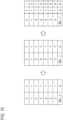
- a left table of Fig. 9 illustrates a state before a sorting process performed by the missing value overwriting unit 141, and a center table of the drawing illustrates a state after the sorting process performed by the missing value overwriting unit 141. Note that this sorting process is not essential and can be omitted as appropriate.
- the missing value overwriting unit 141 overwrites the missing value with a value larger than the maximum value of the values in the true data (S141).
- a right table of Fig. 9 illustrates a state after an overwriting process performed by the missing value overwriting unit 141.
- step S141 is a process to be performed to correctly perform an ascending sort which is a subsequent process, it is necessary to replace the missing value with a value larger than the maximum value of values in the true data, but it is not always necessary to replace NA with a value (0b1 ... 1) in which all bits are 1.
- the simplest method is to overwrite the NA with the value (0b1 ... 1) in which all bits are 1.
- the value ascending sort unit 142 sorts data including the value sequence v' and the flag sequence in ascending order based on the value v' (S142).
- a sorting result is represented as v''.
- a left table of Fig. 10 illustrates a state before an ascending sort process performed by the value ascending sort unit 142, and a center table of the drawing illustrates a state after the ascending sort process performed by the value ascending sort unit 142.
- a right table of Fig. 10 illustrates a state after a flag sequence generating process performed by the index flag sequence generating unit 143.
- a table of Fig. 11 illustrates a state after generation of the odd flag sequence and the even flag sequence.
- the median computing unit 147 computes, as a median, a sum of products of the values v" and the odd flag f odd , if the number m of true data is an odd number, and computes, as a median, a value obtained by dividing a sum of products of the values v" and the even flag f even by 2 if the number m of true data is an even number, that is, the following expression, (S147).
- ⁇ i 1 n v i " ⁇ f even 2 if m is an even number
- the mode calculating unit 15 of the present example includes a missing value overwriting unit 151, a value ascending sort unit 152, a boundary flag sequence generating unit 153, a group count computing unit 154, a value vector generating unit 155, a frequency vector computing unit 156, and a mode output unit 157.
- the missing value overwriting unit 151 overwrites the missing value with a value larger than the maximum value of the values in the true data (S151).
- a left table of Fig. 14 illustrates a state after a missing value overwriting process performed by the missing value overwriting unit 151.
- the value ascending sort unit 152 sorts data (v i , f i ) including the value sequence and the flag sequence in ascending order based on the value v (S152). Sorted results are represented by v' and f', respectively.
- a center table of Fig. 14 illustrates a state after an ascending sort process performed by the value ascending sort unit 152.
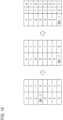
- a right table of Fig. 14 illustrates a state after a flag sequence generating process performed by the boundary flag sequence generating unit 153. This process enables a boundary flag e in which an index of the last element of values included in a key attribute v' is 1 to be derived.
- the value vector k is a vector in which a value of a key attribute becomes an element without duplication.
- An example of the value vector generated by the value vector generating unit 155 is illustrated in a second table from the left in Fig. 15 .
- An example of the frequency vector generated by the frequency vector computing unit 156 is illustrated in a third table from the left in Fig. 15 .
- the rightmost table in Fig. 15 illustrates a state after a descending sort process performed by the mode output unit 157.
- the secure computation device 1 of Example 1 it is possible to calculate, by the secure computation, the representative value of the values other than the missing value for the data including the missing value while keeping the number of missing values and the index having the missing value secret.
- the device includes, for example, an input unit that can be connected to a keyboard or the like as a single hardware entity, an output unit that can be connected to a liquid crystal display or the like, a communication unit that can be connected to a communication device (e.g., a communication cable) capable of communicating with the outside of the hardware entity, a central processing unit (CPU which may include a cache memory or a register), a RAM or a ROM which is a memory, an external storage device as a hard disk, and a bus that connects the input unit, the output unit, the communication unit, the CPU, the RAM, the ROM, and the external storage device so that data can be exchanged therebetween.
- a device (drive) or the like that can write and read data in and from a recording medium such as a CD-ROM may be provided in the hardware entity, as necessary. Examples of a physical entity including such a hardware resource include a general-purpose computer.
- the external storage device of the hardware entity stores programs required for implementing the above-described functions, data required for processing of the programs, and the like (the programs may be stored, for example, in a ROM as a read-only storage device instead of the external storage device). Data or the like obtained by the processing of these programs is appropriately stored in a RAM, an external storage device, or the like.
- each program stored in the external storage device (or ROM or the like) and data required for processing of each program are read into a memory as necessary and are appropriately interpreted and processed by the CPU.
- the CPU implements a predetermined function (each component represented as ... unit, ... means, or the like).
- the present invention is not limited to the above-described embodiments and can be appropriately modified without departing from the gist of the present invention.
- the pieces of processing described in the foregoing embodiments may be executed not only chronologically in accordance with the described order, but also in parallel or individually in accordance with the processing capability of a device that executes the processing or as necessary.
- processing function of the hardware entity (the device according to the present invention) described in the foregoing embodiments is implemented by a computer
- processing details of the function of the hardware entity are described by a program.
- the computer then executes the program, and thus, the processing function of the hardware entity is implemented in the computer.
- the various kinds of processing described above can be performed by causing a recording unit 10020 of a computer 10000 illustrated in Fig. 16 to read a program for executing each step of the method described above and causing a control unit 10010, an input unit 10030, an output unit 10040, and the like to operate.
- the program in which the processing content is written may be recorded on a computer-readable recording medium.
- the computer-readable recording medium may be, for example, any recording medium such as a magnetic recording device, an optical disc, a magneto-optical recording medium, or a semiconductor memory.
- a hard disk device a flexible disk, a magnetic tape, or the like can be used as the magnetic recording device
- a digital versatile disc (DVD), a DVD random access memory (DVD-RAM), a compact disc read only memory (CD-ROM), a CD recordable/rewritable (CD-R/RW), or the like can be used as the optical disc
- a magneto-optical disc (MO) or the like can be used as the magneto-optical recording medium
- an electrically erasable and programmable-read only memory (EEP-ROM) or the like can be used as the semiconductor memory.
- the program is distributed by, for example, selling, transferring, or renting a portable recording medium such as a DVD or a CD-ROM on which the program is recorded.
- the program may be stored in a storage device of a server computer, and the program may be distributed by transferring the program from the server computer to another computer via a network.
- a computer for executing such a program first temporarily stores a program recorded on a portable recording medium or a program transferred from a server computer in a storage device of the computer. Then, when executing processing, the computer reads the program stored in the recording medium of the computer and executes the processing according to the read program. Moreover, as another mode of the program, the computer may read the program directly from a portable recording medium and execute processing according to the program, or alternatively, the computer may sequentially execute processing according to a received program every time the program is transferred from a server computer to the computer.
- the above-described processing may be executed by a so-called application service provider (ASP) type service that implements a processing function only by an execution instruction and result acquisition without transferring the program from a server computer to the computer.
- ASP application service provider
- the program in the present embodiment includes information that is used for processing by an electronic computer and is equivalent to the program (data or the like that is not a direct command to the computer but has property that defines processing performed by the computer).
- the hardware entity is formed by executing a predetermined program in a computer in this mode, at least some of the processing details may be implemented by hardware.
Landscapes
- Engineering & Computer Science (AREA)
- Theoretical Computer Science (AREA)
- Computer Security & Cryptography (AREA)
- Signal Processing (AREA)
- Computer Networks & Wireless Communication (AREA)
- Computing Systems (AREA)
- General Physics & Mathematics (AREA)
- Physics & Mathematics (AREA)
- Computer Hardware Design (AREA)
- General Engineering & Computer Science (AREA)
- Software Systems (AREA)
- Health & Medical Sciences (AREA)
- General Health & Medical Sciences (AREA)
- Bioethics (AREA)
- Storage Device Security (AREA)
- Complex Calculations (AREA)
Abstract
Description
- The present invention relates to a secure computation device, a secure computation method, and a program for computing a representative value of data excluding missing values while keeping input data including the missing values secret.
- As a method for obtaining a specific computation result without restoring an encrypted numerical value, there is a method called secure computation (for example, refer to
Non Patent Literature 1 and Non Patent Literature 2). In the method described inNon Patent Literature 1, encryption of distributing fragments of numerical values to three secure computation devices is performed, and the three secure computation devices perform cooperative calculation, and thus the results of addition/subtraction, constant addition, multiplication, constant multiplication, logical operation (NOT, logical product, logical sum, exclusive logical sum), and data format conversion (integer and binary number) can be obtained in a state of being distributed to the three secure computation devices, that is, while being encrypted, without restoring the numerical values. In addition, inNon Patent Literature 2, a function that can be executed in secure computation is specifically described. In recent years, there has also been proposed machine learning on secure computation. -
- Non Patent Literature 1: Koji Chida, Koki Hamada, Dai Ikarashi, Katsumi Takahashi, "Keiryo kensho kano 3 party hitoku kansu keisan no saiko (in Japanese) (A Three-Party Secure Function Evaluation with Lightweight Verifiability Revisited)" In CSS,2010.
- Non Patent Literature 2: Naoto Kiribuchi, Dai Ikarashi, Koki Hamada, Ryo Kikuchi, "MEVAL3: A Library for Programmable Secure Computation", In SCIS,2018
- Non Patent Literature 3: the pandas development team, "pandas.DataFrame.fillna", [online], [retrieved on May 27, 2022], Internet <URL: https://pandas.pydata.org/docs/reference/api/pandas.DataFra me.fillna.html>
- Data is often missing. For example, in a questionnaire survey, in a case where a responder does not answer or a sensor cannot acquire data for some reason when the data is acquired by the sensor, the corresponding data will be missing. Such missing data is called a missing value. The missing value may be referred to as a lost value, null, or NA (not available), in addition to a missing value. In a case where data includes a missing value, many machine learning models cannot treat the data as learning data. In this case, a process of replacing a missing value with a representative value representing the data is generally often performed (Non Patent Literature 3). As the representative value, a mean, a median, or a mode of data excluding the missing values is generally used.
- However, since a method of calculating a representative value of data including a missing value in secure computation is not definite, the missing value cannot be complemented by applying the conventional technology to machine learning in secure computation.
- Therefore, an object of the present invention is to provide a secure computation device that realizes data transformation for calculating a representative value of data including a missing value while keeping the number and locations of missing values secret.
- A secure computation device of the present invention is a secure computation device that performs calculation while keeping input data secret and includes a flag sequence generating unit and a true data count computing unit, the input data including an encrypted value sequence including a missing value.
- The flag sequence generating unit generates a flag sequence that is a sequence of flags indicating a value obtained by encrypting 0, when a corresponding value is a missing value, and a value obtained by encrypting 1, when the corresponding value is not a missing value. The true data count computing unit computes the number of true data items excluding missing values by summing values of flags in the flag sequence.
- According to a secure computation device of the present invention, data transformation for calculating a representative value of data including a missing value is realized while keeping the number and locations of missing values secret.
-
-
Fig. 1 is a block diagram illustrating secure distribution processing by a plurality of secure computation devices connected to a network. -
Fig. 2 is a block diagram illustrating a functional configuration of a secure computation device of Example 1. -
Fig. 3 is a flowchart illustrating an operation of the secure computation device of Example 1. -
Fig. 4 is a block diagram illustrating a functional configuration of a mean calculating unit of Example 1. -
Fig. 5 is a flowchart illustrating an operation of the mean calculating unit of Example 1. -
Fig. 6 is a diagram illustrating an example of data processed by a correction value sequence generating unit of the mean calculating unit of Example 1. -
Fig. 7 is a block diagram illustrating a functional configuration of a median calculating unit of Example 1. -
Fig. 8 is a flowchart illustrating an operation of the median calculating unit of Example 1. -
Fig. 9 is a diagram illustrating an example of data processed by a missing value overwriting unit of the median calculating unit of Example 1. -
Fig. 10 is a diagram illustrating an example of data processed by a value ascending sort unit and an index flag sequence generating unit of the median calculating unit according to Example 1. -
Fig. 11 is a diagram illustrating an example of data processed by an odd flag sequence generating unit and an even flag sequence generating unit of the median calculating unit of Example 1. -
Fig. 12 is a block diagram illustrating a functional configuration of a mode calculating unit of Example 1. -
Fig. 13 is a flowchart illustrating an operation of the mode calculating unit according to Example 1. -
Fig. 14 is a diagram illustrating an example of data processed by a missing value overwriting unit, a value ascending sort unit, and a boundary flag sequence generating unit of the mode calculating unit of Example 1. -
Fig. 15 is a diagram illustrating an example of data processed by a value vector generating unit, a frequency vector generating unit, and a mode output unit of the mode calculating unit of Example 1. -
Fig. 16 is a diagram illustrating a functional configuration example of a computer. - Hereinafter, embodiments of the present invention will be described in detail. Note that components having the same functions will be denoted by the same reference numerals, and redundant description will be omitted.
- With reference to
Fig. 1 , secure distribution processing performed by a plurality of secure computation devices 1-1, ... 1-p, ... 1-P (P is an integer of 2 or more, p = 1, ..., P) of Example 1 connected to anetwork 9 will be described. As illustrated in the drawing, the secure computation devices 1-1, ... 1-p, ... 1-P of the present example are connected to thenetwork 9 to be able to communicate with each other. The P secure computation devices 1-1, ... 1-p, ... 1-P all have the same function and will be collectively referred to as thesecure computation device 1. The data treated by thesecure computation device 1 is encrypted through a secure distribution according to a configuration illustrated in the drawing and is computed while being kept encrypted. - Note that the data treated by the secure computation device of the present invention needs to be encrypted by some method and computed while being kept encrypted, but does not need to be encrypted through a secure distribution.
- With reference to
Fig. 2 , a functional configuration of thesecure computation device 1 that is a device performing calculation while keeping input data secret will be described, the input data including an encrypted value sequence including a missing value. As illustrated in the drawing, thesecure computation device 1 of the present example includes a flagsequence generating unit 11, a true datacount computing unit 12, a mean calculatingunit 13, a median calculatingunit 14, and amode calculating unit 15. Hereinafter, operations of each configuration requirement will be described with reference toFig. 3 . - An encrypted value sequence including a missing value is represented as v = v1, ..., and vn including n ≥ 2 values, and any value is represented as vi using an index i. Regarding v, a result of inspecting for missing values is represented by flag sequences f = f1, ..., fn, and the missing value is represented by NA.
- The flag
sequence generating unit 11 generates a flag sequence that is the following expression and a sequence of flags indicating a value obtained by encrypting 0, when a corresponding value is a missing value (NA), and a value obtained by encrypting 1, when the corresponding value is not a missing value (NA) (S11).
- Here, the method proposed in
Reference Patent Literature 1 can be used for inspecting for missing values. - The true data
count computing unit 12 computes the number m of true data items excluding missing values by summing values of flags in a flag sequence (Σn i = 1fi) (S12). Hence, the true datacount computing unit 12 computes the number m of true data items from m = Σn i = 1fi. - The mean calculating
unit 13 calculates a mean of the value sequence based on the value sequence, the flag sequence, and the number m of true data (S13). Details thereof will be described below. - The median calculating
unit 14 calculates a median of the value sequence based on the value sequence, the flag sequence, and the number m of true data (S14). Details thereof will be described below. - The
mode calculating unit 15 calculates a mode of the value sequence by using aggregate sum calculation based on the value sequence, the flag sequence, and the number m of true data (S15). Details thereof will be described below. - Note that an aggregate function is a calculation for obtaining statistical values divided into groups on the basis of a value of a key attribute when there are a key attribute and a value attribute in a table. An aggregate sum is one of the aggregate functions and is a calculation for aggregating a sum of desired value attributes for each group when the table is divided into groups on the basis of the value of the key attribute. For example, the method proposed in
Reference Patent Literature 2 can be used for the aggregate sum calculation. - The secure aggregate sum system of
Reference Patent Literature 2 inputs: - a vector of a value attribute when sorting is performed based on a value of a key attribute;
- a flag in which the last element of each group is true and the other elements are false when groups are divided on the basis of the value of the key attribute;
- the number of groups; and
- a vector in which the value of the key attribute becomes an element without duplication, and outputs:
- a vector indicating a sum of value attributes for each group.
- Hereinafter, a detailed functional configuration of the mean calculating
unit 13 will be described with reference toFig. 4 . As illustrated in the drawing, the mean calculatingunit 13 of the present example includes a correction valuesequence generating unit 131 and amean computing unit 132. Hereinafter, operations of each configuration requirement will be described with reference toFig. 5 . - The correction value
sequence generating unit 131 sets a product of a value and a corresponding flag, that is, v' = v × f, as a correction value and generates a correction value sequence v' (S131). Note that a multiplication result of the missing value (NA) and 0 is assumed to be 0. Therefore, values other than the missing value in the correction value sequence v' are the same as values in a value sequence v, and the missing value is converted into 0. An operation example of the correction valuesequence generating unit 131 is illustrated inFig. 6 . Referring to a table on the left of the drawing before processing and a table on the right of the drawing after the processing, it can be found that NA has been converted to 0. - The
mean computing unit 132 divides the total sum of the correction values by the number of true data, that is, computes the following mean expression to obtain a mean of the input data (S132).
- Hereinafter, a detailed functional configuration of the median calculating
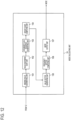
unit 14 will be described with reference toFig. 7 . As illustrated in the drawing, themedian calculating unit 14 of the present example includes a missingvalue overwriting unit 141, a value ascendingsort unit 142, an index flagsequence generating unit 143, a medianindex computing unit 144, an odd flagsequence generating unit 145, an even flagsequence generating unit 146, and amedian computing unit 147. Hereinafter, operations of each configuration requirement will be described with reference toFig. 8 . - The missing
value overwriting unit 141 performs a descending sort on data that is a set (vi, fi) of values of v and f associated by an index, on the basis of f. Regarding a sorting process (including a stable sort), for example, a sort described in ReferenceNon Patent Literature 1 can be used. - (Reference Non Patent Literature 1: Dai Ikarashi, Koki Hamada, Ryo Kikuchi, Koji Chida, "A Design and an Implementation of Super-high-speed Multi-party Sorting: The Day When Multi-party Computation Reaches Scripting Languages",) CSS2017)
- Here, v and f after a sort are denoted as v' and f', respectively. Consequently, the missing value moves backward. A left table of
Fig. 9 illustrates a state before a sorting process performed by the missingvalue overwriting unit 141, and a center table of the drawing illustrates a state after the sorting process performed by the missingvalue overwriting unit 141. Note that this sorting process is not essential and can be omitted as appropriate. - Next, the missing
value overwriting unit 141 overwrites the missing value with a value larger than the maximum value of the values in the true data (S141). A right table ofFig. 9 illustrates a state after an overwriting process performed by the missingvalue overwriting unit 141. - For example, the missing
value overwriting unit 141 may overwrite the missing value with the maximum value that can be expressed by a processing system thereof. If the value is stored as an integer type without a sign, the maximum value is a value (0b1 ... 1) in which all bits are 1. This is a process of overwriting vi' with the maximum value when fi' = 0 in which 1 ≤ i ≤ n. - Note that, since step S141 is a process to be performed to correctly perform an ascending sort which is a subsequent process, it is necessary to replace the missing value with a value larger than the maximum value of values in the true data, but it is not always necessary to replace NA with a value (0b1 ... 1) in which all bits are 1. However, since all the values in the value sequence are encrypted as described above, in order to reliably convert the NA to a large value without knowing the values in the value sequence, it is considered that the simplest method is to overwrite the NA with the value (0b1 ... 1) in which all bits are 1.
- The value ascending
sort unit 142 sorts data including the value sequence v' and the flag sequence in ascending order based on the value v' (S142). A sorting result is represented as v''. A left table ofFig. 10 illustrates a state before an ascending sort process performed by the value ascendingsort unit 142, and a center table of the drawing illustrates a state after the ascending sort process performed by the value ascendingsort unit 142. - The index flag
sequence generating unit 143 generates an index flag sequence j which is a sequence of index flags in which a value corresponding to a first row of the data is a value obtained by encrypting 0 (j1 = 0), and values corresponding to other rows are values obtained by encrypting values (j2 = 1, j3 = 2, jn = n - 1) obtained by adding 1 to values corresponding to previous rows (S143). A right table ofFig. 10 illustrates a state after a flag sequence generating process performed by the index flagsequence generating unit 143. - The median
index computing unit 144 computes, as a median index Imed, that is, the following expression, a value obtained by rounding down a decimal point of (m - 1)/2, where m represents the number of true data (S144).
- Note that the parentheses shown in the above expression mean a calculation of rounding down a fractional part.
- The odd flag
sequence generating unit 145 generates an odd flag sequence fodd, that is, the following expression, which is a sequence of odd flags indicating a value obtained by encrypting a value of 0, when values of the index flag are not equal to values of the median index (Imed ≠ ji, 1 ≤ i ≤ n), and a value obtained by encrypting a value of 1, when the values of the index flag are equal to the values of the median index (Imed = ji, 1 ≤ i ≤ n) (S145).
- The even flag
sequence generating unit 146 generates an even flag sequence feven, that is, the following expression, that is a sequence of even flags in which a values corresponding to a case where values of the odd flag are 1 is 1 and which indicate a value obtained by encrypting a value of 0, when the values of the index flag are not equal to a value obtained by adding 1 to the median index (Imed + 1 ≠ ji, 1 ≤ i ≤ n), a value obtained by encrypting a value of 1, when the values of the index flag are equal to a value obtained by adding 1 to the median index (Imed + 1 = ji, 1 ≤ i ≤ n) (S146).
- Note that or represents a process of performing a general logical sum. A table of
Fig. 11 illustrates a state after generation of the odd flag sequence and the even flag sequence. - The
median computing unit 147 computes, as a median, a sum of products of the values v" and the odd flag fodd, if the number m of true data is an odd number, and computes, as a median, a value obtained by dividing a sum of products of the values v" and the even flag feven by 2 if the number m of true data is an even number, that is, the following expression, (S147).
- Hereinafter, a detailed functional configuration of the
mode calculating unit 15 will be described with reference toFig. 12 . As illustrated in the drawing, themode calculating unit 15 of the present example includes a missingvalue overwriting unit 151, a value ascendingsort unit 152, a boundary flagsequence generating unit 153, a groupcount computing unit 154, a valuevector generating unit 155, a frequencyvector computing unit 156, and amode output unit 157. - Hereinafter, operations of each configuration requirement will be described with reference to
Fig. 13 . - The missing
value overwriting unit 151 overwrites the missing value with a value larger than the maximum value of the values in the true data (S151). A left table ofFig. 14 illustrates a state after a missing value overwriting process performed by the missingvalue overwriting unit 151. - The value ascending
sort unit 152 sorts data (vi, fi) including the value sequence and the flag sequence in ascending order based on the value v (S152). Sorted results are represented by v' and f', respectively. - A center table of
Fig. 14 illustrates a state after an ascending sort process performed by the value ascendingsort unit 152. - The boundary flag
sequence generating unit 153 generates a boundary flag sequence, that is, the following expression, which is a sequence of boundary flags in which a value corresponding to a predetermined value vi' is a value obtained by encrypting 0, when a value of the predetermined value is equal to a value of a next value thereafter (vi'= vi + 1', 1 ≤ i ≤ n - 1), a value corresponding to the predetermined value vi' is a value obtained by encrypting 1 when the value of the predetermined value is not equal to the value of the next value thereafter (vi' ≠ vi + 1', 1 ≤ i ≤ n - 1), and a value corresponding to a value vn' located in a lowermost row of the value sequence is a value obtained by encrypting 1 (S153).
- A right table of
Fig. 14 illustrates a state after a flag sequence generating process performed by the boundary flagsequence generating unit 153. This process enables a boundary flag e in which an index of the last element of values included in a key attribute v' is 1 to be derived. - The group
count computing unit 154 computes the number of groups g = Σn i = 1ei with a sum of the boundary flag sequences as the number g of groups (S154). - The value
vector generating unit 155 generates a value vector k having a value corresponding to the value of 1 of the boundary flag as an element, that is, a value vector k as kj = vi' when ei = 1 from the beginning for 1 ≤ i ≤ n and 1 ≤ j ≤ g (S155). The value vector k is a vector in which a value of a key attribute becomes an element without duplication. An example of the value vector generated by the valuevector generating unit 155 is illustrated in a second table from the left inFig. 15 . - The frequency
vector computing unit 156 computes a frequency vector s = s1, ..., sg that is a sum of values (value attributes) of the flags in each group delimited based on the value of 1 of the boundary flag (S156). An example of the frequency vector generated by the frequencyvector computing unit 156 is illustrated in a third table from the left inFig. 15 . - The
mode output unit 157 sorts data (ki, si) including a set of individual elements of the value vector k and the frequency vector s in descending order by using the frequency vector s as a key and outputs an element of a first value vector as a mode (mode = k1') (S157). The rightmost table inFig. 15 illustrates a state after a descending sort process performed by themode output unit 157. - According to the
secure computation device 1 of Example 1, it is possible to calculate, by the secure computation, the representative value of the values other than the missing value for the data including the missing value while keeping the number of missing values and the index having the missing value secret. - The device according to the present invention includes, for example, an input unit that can be connected to a keyboard or the like as a single hardware entity, an output unit that can be connected to a liquid crystal display or the like, a communication unit that can be connected to a communication device (e.g., a communication cable) capable of communicating with the outside of the hardware entity, a central processing unit (CPU which may include a cache memory or a register), a RAM or a ROM which is a memory, an external storage device as a hard disk, and a bus that connects the input unit, the output unit, the communication unit, the CPU, the RAM, the ROM, and the external storage device so that data can be exchanged therebetween. A device (drive) or the like that can write and read data in and from a recording medium such as a CD-ROM may be provided in the hardware entity, as necessary. Examples of a physical entity including such a hardware resource include a general-purpose computer.
- The external storage device of the hardware entity stores programs required for implementing the above-described functions, data required for processing of the programs, and the like (the programs may be stored, for example, in a ROM as a read-only storage device instead of the external storage device). Data or the like obtained by the processing of these programs is appropriately stored in a RAM, an external storage device, or the like.
- In the hardware entity, each program stored in the external storage device (or ROM or the like) and data required for processing of each program are read into a memory as necessary and are appropriately interpreted and processed by the CPU. As a result, the CPU implements a predetermined function (each component represented as ... unit, ... means, or the like).
- The present invention is not limited to the above-described embodiments and can be appropriately modified without departing from the gist of the present invention. The pieces of processing described in the foregoing embodiments may be executed not only chronologically in accordance with the described order, but also in parallel or individually in accordance with the processing capability of a device that executes the processing or as necessary.
- As described above, in a case where the processing function of the hardware entity (the device according to the present invention) described in the foregoing embodiments is implemented by a computer, processing details of the function of the hardware entity are described by a program. The computer then executes the program, and thus, the processing function of the hardware entity is implemented in the computer.
- The various kinds of processing described above can be performed by causing a
recording unit 10020 of acomputer 10000 illustrated inFig. 16 to read a program for executing each step of the method described above and causing acontrol unit 10010, aninput unit 10030, anoutput unit 10040, and the like to operate. - The program in which the processing content is written may be recorded on a computer-readable recording medium. The computer-readable recording medium may be, for example, any recording medium such as a magnetic recording device, an optical disc, a magneto-optical recording medium, or a semiconductor memory. Specifically, for example, a hard disk device, a flexible disk, a magnetic tape, or the like can be used as the magnetic recording device, a digital versatile disc (DVD), a DVD random access memory (DVD-RAM), a compact disc read only memory (CD-ROM), a CD recordable/rewritable (CD-R/RW), or the like can be used as the optical disc, a magneto-optical disc (MO) or the like can be used as the magneto-optical recording medium, and an electrically erasable and programmable-read only memory (EEP-ROM) or the like can be used as the semiconductor memory.
- Moreover, the program is distributed by, for example, selling, transferring, or renting a portable recording medium such as a DVD or a CD-ROM on which the program is recorded. Furthermore, the program may be stored in a storage device of a server computer, and the program may be distributed by transferring the program from the server computer to another computer via a network.
- For example, a computer for executing such a program first temporarily stores a program recorded on a portable recording medium or a program transferred from a server computer in a storage device of the computer. Then, when executing processing, the computer reads the program stored in the recording medium of the computer and executes the processing according to the read program. Moreover, as another mode of the program, the computer may read the program directly from a portable recording medium and execute processing according to the program, or alternatively, the computer may sequentially execute processing according to a received program every time the program is transferred from a server computer to the computer. Moreover, the above-described processing may be executed by a so-called application service provider (ASP) type service that implements a processing function only by an execution instruction and result acquisition without transferring the program from a server computer to the computer. Note that the program in the present embodiment includes information that is used for processing by an electronic computer and is equivalent to the program (data or the like that is not a direct command to the computer but has property that defines processing performed by the computer).
- Moreover, although the hardware entity is formed by executing a predetermined program in a computer in this mode, at least some of the processing details may be implemented by hardware.
Claims (6)
- A secure computation device that performs computation while keeping input data secret, the input data including an encrypted value sequence including a missing value, the secure computation device comprising:a flag sequence generating unit that generates a flag sequence that is a sequence of flags indicating a value obtained by encrypting 0, when a corresponding value is a missing value, and a value obtained by encrypting 1, when the corresponding value is not a missing value; anda true data count computing unit that computes the number of true data items excluding a missing value by summing values of flags in the flag sequence.
- The secure computation device according to claim 1, comprising:a correction value sequence generating unit that sets products of the values and corresponding flags as correction values and generates a correction value sequence; anda mean computing unit that computes a mean of the input data by dividing a sum of the correction values by the number of true data.
- The secure computation device according to claim 1, comprising:a missing value overwriting unit that overwrites the missing value with a value larger than a maximum value of values in the true data;a value ascending sort unit that sorts data including the value sequence and the flag sequence in ascending order based on the values;an index flag sequence generating unit that generates an index flag sequence which is a sequence of index flags in which a value corresponding to a first row of the data is a value obtained by encrypting 0, and a value corresponding to another row is a value obtained by encrypting a value obtained by adding 1 to a value corresponding to a previous row;a median index computing unit that computes, as a median index, a value obtained by rounding down after a decimal point of (m - 1)/2, where m represents the number of true data;an odd flag sequence generating unit that generates an odd flag sequence which is a sequence of odd flags indicating a value obtained by encrypting a value of 0, when values of the index flag are not equal to values of the median index, and a value obtained by encrypting a value of 1, when the values of the index flag are equal to the values of the median index;an even flag sequence generating unit that generates an even flag sequence that is a sequence of even flags in which a value corresponding to a case where values of the odd flag are 1 is 1 and which indicate a value obtained by encrypting a value of 0, when the values of the index flag are not equal to a value obtained by adding 1 to the median index, and a value obtained by encrypting a value of 1, when the values of the index flag are equal to a value obtained by adding 1 to the median index; anda median computing unit that computes, as a median, a sum of products of the values and the odd flag, when the number of true data is an odd number, and computes, as a median, a value obtained by dividing a sum of products of the values and the even flag by 2 when the number of true data is an even number.
- The secure computation device according to claim 1, comprising:a missing value overwriting unit that overwrites the missing value with a value larger than a maximum value of values in the true data;a value ascending sort unit that sorts data including the value sequence and the flag sequence in ascending order based on the values;a boundary flag sequence generating unit that generates a boundary flag sequence which is a sequence of boundary flags in which a value corresponding to a predetermined value is a value obtained by encrypting 0, when a value of the predetermined value is equal to a value of a next value after the predetermined value, a value corresponding to the predetermined value is a value obtained by encrypting 1 when the value of the predetermined value is not equal to the value of the next value after the predetermined value, and a value corresponding to a value located in a lowermost row of the value sequence is a value obtained by encrypting 1;a value vector generating unit that generates value vectors having values corresponding to a value of 1 of the boundary flag as respective elements;a frequency vector computing unit that computes a frequency vector that is a sum of values of the flags in each group delimited based on the value of 1 of the boundary flag; anda mode output unit that sorts data including a set of individual elements of the value vector and the frequency vector in descending order by using the frequency vector as a key and outputs an element of a first value vector as a mode.
- A secure computation method executed by a secure computation device that performs computation while keeping input data secret, the input data including an encrypted value sequence including a missing value, the secure computation method comprising:a flag sequence generating step of generating a flag sequence that is a sequence of flags indicating a value obtained by encrypting 0, when a corresponding value is a missing value, and a value obtained by encrypting 1, when the corresponding value is not a missing value; anda true data count computing step of computing the number of true data items excluding a missing value by summing values of flags in the flag sequence.
- A program for causing a computer to function as the secure computation device according to any one of claims 1 to 4.
Applications Claiming Priority (1)
| Application Number | Priority Date | Filing Date | Title |
|---|---|---|---|
| PCT/JP2022/022486 WO2023233622A1 (en) | 2022-06-02 | 2022-06-02 | Secret computing device, secret computing method, and program |
Publications (2)
| Publication Number | Publication Date |
|---|---|
| EP4535336A1 true EP4535336A1 (en) | 2025-04-09 |
| EP4535336A4 EP4535336A4 (en) | 2026-03-18 |
Family
ID=89026182
Family Applications (1)
| Application Number | Title | Priority Date | Filing Date |
|---|---|---|---|
| EP22944903.8A Pending EP4535336A4 (en) | 2022-06-02 | 2022-06-02 | SECRET DATA PROCESSING DEVICE, SECRET DATA PROCESSING METHOD AND PROGRAM |
Country Status (5)
| Country | Link |
|---|---|
| US (1) | US20250350457A1 (en) |
| EP (1) | EP4535336A4 (en) |
| JP (1) | JP7740543B2 (en) |
| CN (1) | CN119301661A (en) |
| WO (1) | WO2023233622A1 (en) |
Family Cites Families (7)
| Publication number | Priority date | Publication date | Assignee | Title |
|---|---|---|---|---|
| JP5367112B2 (en) | 2012-03-22 | 2013-12-11 | 株式会社東芝 | Data analysis support device and data analysis support processing program |
| JP5957126B1 (en) * | 2015-06-24 | 2016-07-27 | 日本電信電話株式会社 | Secret calculation device, secret calculation method, and program |
| WO2019039383A1 (en) | 2017-08-22 | 2019-02-28 | 日本電信電話株式会社 | Share generation device, restoration device, secret calculation system, share generation method, restoration method, program, and recording medium |
| US11593362B2 (en) * | 2018-05-25 | 2023-02-28 | Nippon Telegraph And Telephone Corporation | Secure aggregate function computation system, secure computation apparatus, secure aggregate function computation method, and program |
| US11568305B2 (en) * | 2019-04-09 | 2023-01-31 | Genesys Telecommunications Laboratories, Inc. | System and method for customer journey event representation learning and outcome prediction using neural sequence models |
| FR3105845B1 (en) * | 2019-12-31 | 2021-12-31 | Bull Sas | DATA PROCESSING METHOD AND SYSTEM FOR PREPARING A DATA SET |
| US11941541B2 (en) * | 2020-08-10 | 2024-03-26 | International Business Machines Corporation | Automated machine learning using nearest neighbor recommender systems |
-
2022
- 2022-06-02 US US18/868,759 patent/US20250350457A1/en active Pending
- 2022-06-02 WO PCT/JP2022/022486 patent/WO2023233622A1/en not_active Ceased
- 2022-06-02 EP EP22944903.8A patent/EP4535336A4/en active Pending
- 2022-06-02 CN CN202280096705.0A patent/CN119301661A/en active Pending
- 2022-06-02 JP JP2024524106A patent/JP7740543B2/en active Active
Also Published As
| Publication number | Publication date |
|---|---|
| JPWO2023233622A1 (en) | 2023-12-07 |
| JP7740543B2 (en) | 2025-09-17 |
| EP4535336A4 (en) | 2026-03-18 |
| CN119301661A (en) | 2025-01-10 |
| WO2023233622A1 (en) | 2023-12-07 |
| US20250350457A1 (en) | 2025-11-13 |
Similar Documents
| Publication | Publication Date | Title |
|---|---|---|
| US11121868B2 (en) | Secure computation system, secure computation device, secure computation method, and program | |
| JP7067632B2 (en) | Secret sigmoid function calculation system, secret logistic regression calculation system, secret sigmoid function calculation device, secret logistic regression calculation device, secret sigmoid function calculation method, secret logistic regression calculation method, program | |
| JPWO2018135563A1 (en) | Secret calculation system, secret calculation device, secret calculation method, program | |
| CN109416894B (en) | Secret calculation system, secret calculation device, secret calculation method, and recording medium | |
| EP4231276A1 (en) | Hidden decision tree test device, hidden decision tree test system, hidden decision tree test method, and program | |
| EP3806071A1 (en) | Secret collective approximation system, secret calculation device, secret collective approximation method, and program | |
| EP3483865B1 (en) | Secure computation system, secure computation device, secure computation method, and program | |
| US20250350457A1 (en) | Secure computation device, secure computation method, and program | |
| EP3982282A1 (en) | Secret division system, secret calculation device, secret division method, and program | |
| US20250322032A1 (en) | Secure attribute selection system, secure attribute selection apparatus, secure attribute selection method, and program | |
| US20250349228A1 (en) | Secure computation device, secure computation method, and program | |
| EP4231274A1 (en) | Secret decision tree testing device, secret decision tree testing system, secret decision tree testing method, and program | |
| EP4231273A1 (en) | Secret decision tree learning device, secret decision tree learning system, secret decision tree learning method, and program | |
| JP7205623B2 (en) | Secret conjugate gradient method calculation system, secret calculation device, conjugate gradient method calculation device, secret conjugate gradient method calculation method, conjugate gradient method calculation method, and program | |
| US12299047B2 (en) | Secret grouping apparatus, secret grouping system, secret grouping method, and program | |
| US12632370B2 (en) | Secret decision tree test apparatus, secret decision tree test system, secret decision tree test method, and program | |
| JP6682105B2 (en) | Fisher Exact Test Calculation Device, Method and Program | |
| EP4465279A1 (en) | Secret random number calculation system, secret random number calculation device, secret random number calculation method, secret cluster calculation system, secret cluster calculation device, secret cluster calculation method, and program | |
| EP4044050B1 (en) | Approximate function calculation device, method, and program | |
| JP7243846B2 (en) | Secret Survival Time Data Processing System, Secret Survival Time Data Processing Device, Secret Survival Time Data Processing Method, and Program | |
| JP6758632B2 (en) | Exact test calculator, exact test calculation method, and program | |
| EP3839923B1 (en) | Secret strong mapping calculation system, method therefor, secret calculation device, and program | |
| JP2019164723A (en) | Management support device, management support method and management support program |
Legal Events
| Date | Code | Title | Description |
|---|---|---|---|
| STAA | Information on the status of an ep patent application or granted ep patent |
Free format text: STATUS: THE INTERNATIONAL PUBLICATION HAS BEEN MADE |
|
| PUAI | Public reference made under article 153(3) epc to a published international application that has entered the european phase |
Free format text: ORIGINAL CODE: 0009012 |
|
| STAA | Information on the status of an ep patent application or granted ep patent |
Free format text: STATUS: REQUEST FOR EXAMINATION WAS MADE |
|
| 17P | Request for examination filed |
Effective date: 20250102 |
|
| AK | Designated contracting states |
Kind code of ref document: A1 Designated state(s): AL AT BE BG CH CY CZ DE DK EE ES FI FR GB GR HR HU IE IS IT LI LT LU LV MC MK MT NL NO PL PT RO RS SE SI SK SM TR |
|
| DAV | Request for validation of the european patent (deleted) | ||
| DAX | Request for extension of the european patent (deleted) | ||
| RAP3 | Party data changed (applicant data changed or rights of an application transferred) |
Owner name: NTT, INC. |
|
| A4 | Supplementary search report drawn up and despatched |
Effective date: 20260212 |
|
| RIC1 | Information provided on ipc code assigned before grant |
Ipc: G09C 1/00 20060101AFI20260206BHEP Ipc: G06F 21/60 20130101ALI20260206BHEP Ipc: H04L 9/00 20220101ALI20260206BHEP Ipc: H04L 9/08 20060101ALI20260206BHEP |