EP4535298A1 - Data processing method, electronic device and non-transitory computer readable storage medium - Google Patents
Data processing method, electronic device and non-transitory computer readable storage medium Download PDFInfo
- Publication number
- EP4535298A1 EP4535298A1 EP24173022.5A EP24173022A EP4535298A1 EP 4535298 A1 EP4535298 A1 EP 4535298A1 EP 24173022 A EP24173022 A EP 24173022A EP 4535298 A1 EP4535298 A1 EP 4535298A1
- Authority
- EP
- European Patent Office
- Prior art keywords
- key frame
- image
- data processing
- processing method
- electronic device
- Prior art date
- Legal status (The legal status is an assumption and is not a legal conclusion. Google has not performed a legal analysis and makes no representation as to the accuracy of the status listed.)
- Pending
Links
Images



Classifications
-
- G—PHYSICS
- G06—COMPUTING OR CALCULATING; COUNTING
- G06V—IMAGE OR VIDEO RECOGNITION OR UNDERSTANDING
- G06V40/00—Recognition of biometric, human-related or animal-related patterns in image or video data
- G06V40/10—Human or animal bodies, e.g. vehicle occupants or pedestrians; Body parts, e.g. hands
- G06V40/16—Human faces, e.g. facial parts, sketches or expressions
-
- G—PHYSICS
- G06—COMPUTING OR CALCULATING; COUNTING
- G06F—ELECTRIC DIGITAL DATA PROCESSING
- G06F21/00—Security arrangements for protecting computers, components thereof, programs or data against unauthorised activity
- G06F21/60—Protecting data
- G06F21/62—Protecting access to data via a platform, e.g. using keys or access control rules
- G06F21/6218—Protecting access to data via a platform, e.g. using keys or access control rules to a system of files or objects, e.g. local or distributed file system or database
- G06F21/6245—Protecting personal data, e.g. for financial or medical purposes
- G06F21/6254—Protecting personal data, e.g. for financial or medical purposes by anonymising data, e.g. decorrelating personal data from the owner's identification
-
- G—PHYSICS
- G06—COMPUTING OR CALCULATING; COUNTING
- G06T—IMAGE DATA PROCESSING OR GENERATION, IN GENERAL
- G06T5/00—Image enhancement or restoration
- G06T5/70—Denoising; Smoothing
-
- G—PHYSICS
- G06—COMPUTING OR CALCULATING; COUNTING
- G06V—IMAGE OR VIDEO RECOGNITION OR UNDERSTANDING
- G06V10/00—Arrangements for image or video recognition or understanding
- G06V10/40—Extraction of image or video features
- G06V10/44—Local feature extraction by analysis of parts of the pattern, e.g. by detecting edges, contours, loops, corners, strokes or intersections; Connectivity analysis, e.g. of connected components
-
- G—PHYSICS
- G06—COMPUTING OR CALCULATING; COUNTING
- G06V—IMAGE OR VIDEO RECOGNITION OR UNDERSTANDING
- G06V10/00—Arrangements for image or video recognition or understanding
- G06V10/70—Arrangements for image or video recognition or understanding using pattern recognition or machine learning
- G06V10/74—Image or video pattern matching; Proximity measures in feature spaces
- G06V10/75—Organisation of the matching processes, e.g. simultaneous or sequential comparisons of image or video features; Coarse-fine approaches, e.g. multi-scale approaches; using context analysis; Selection of dictionaries
- G06V10/751—Comparing pixel values or logical combinations thereof, or feature values having positional relevance, e.g. template matching
-
- G—PHYSICS
- G06—COMPUTING OR CALCULATING; COUNTING
- G06V—IMAGE OR VIDEO RECOGNITION OR UNDERSTANDING
- G06V20/00—Scenes; Scene-specific elements
- G06V20/10—Terrestrial scenes
Definitions
- This disclosure relates to a method and a device, in particular to a data processing method and an electronic device.
- SLAM Simultaneous Localization and Mapping
- An aspect of present disclosure relates to a data processing method applicable to an electronic device in an environment.
- the data processing method includes: obtaining a key frame; in a condition that the key frame comprises at least one privacy content, processing the key frame to generate a modified key frame, wherein the modified key frame comprises at least one image processing area corresponding to the at least one privacy content; and using the modified key frame to update a map of the environment.
- the data processing method includes: obtaining a key frame; in a condition that the key frame comprises at least one privacy content, processing the key frame to generate a modified key frame, wherein the modified key frame comprises at least one image processing area corresponding to the at least one privacy content; and using the modified key frame to update a map of the environment.
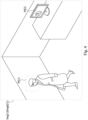
- Fig. 1 is a schematic diagram of an environment E1 where an electronic device 100 is in accordance with some embodiments of the present disclosure.
- the electronic device 100 is a head-mounted device (HMD).
- HMD head-mounted device
- the electronic device 100 can be mounted on head of a user U1 in the environment E1 such as a public place, a gaming place, a workplace, etc.
- the electronic device 100 can provide an immersive content (not shown) for the user U1.
- the electronic device 100 might occlude the direct visibility of the user U1 to the environment E1, and the immersive content can correspondingly be a virtual reality (VR) environment, or a mixed reality (MR) environment.
- the MR environment simulates the environment E1 and enables an interaction of virtual reality objects (which cannot be directly seen in the environment E1 by the user U1) with a simulated environment.
- the present disclosure is not limited herein.
- the electronic device 100 might not occlude the direct visibility of the user U1 to the environment E1, and the immersive content can correspondingly be an augmented reality (AR) environment.
- the AR environment augments the environment E1 directly seen by the user U1 with the virtual reality objects.
- the electronic device 100 is not limited to be the HMD.
- the electronic device 100 can be an autonomous mobile robot such as a clean robot, a sweeping robot, a food delivery robot, etc. All in all, the electronic device 100 can be a device capable of localizing itself in the environment E1.
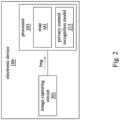
- Fig. 2 is a block diagram of the electronic device 100 in accordance with some embodiments of the present disclosure.
- the electronic device 100 includes an image capturing circuit 201 and a processor 203.
- the processor 203 is electrically coupled to the image capturing circuit 201.
- the image capturing circuit 201 is configured to capture image frames Img.
- the image capturing circuit 201 can be implemented by at least one camera device, or other structure including multiple components such as lens, image sensor, image processor, etc.
- the processor 203 is configured to localize the electronic device 100 in the environment E1 by some visual-based localization technologies (e.g., Simultaneous Localization and Mapping (SLAM), etc.).
- SLAM Simultaneous Localization and Mapping
- the processor 203 uses the image frames Img received from the image capturing circuit 201 to generate and/or update a map M1 of the environment E1 and to calculate location and/or pose of the electronic device 100 in the map M1.
- the processor 203 can be implemented by central processing unit (CPU), graphic processing unit (GPU), application-specific integrated circuit (ASIC), microprocessor, system on a Chip (SoC) or other suitable processing circuits.
- CPU central processing unit
- GPU graphic processing unit
- ASIC application-specific integrated circuit
- SoC system on a Chip
- the electronic device 100 might accidentally obtain some privacy information from the environment E1.
- the privacy information can be, for example the portrait of a person U2 in the environment E1, the visual content displayed by a display O1 in the environment E1, etc.
- This privacy information might be carried by some of the image frames Img. If the processor 203 uses those image frames Img carrying the privacy information to generate and/or update the map M1 and to calculate the location and/or the pose of the electronic device 100, the computational complexity and burden of the processor 203 might be increased.
- the person U2 in the environment E1 might be conspicuous in the environment E1 and/or might have an unpredictable movement, which affects the image feature extraction.
- the electronic device 100 when the electronic device 100 is going to share information with other devices, the electronic device 100 has to further perform the encryption to prevent this privacy information from breach if those image frames Img carrying the privacy information would be shared.
- the privacy information can be referred as confidential information or sensitive information.
- the processor 203 can perform further operations (e.g., generating and/or updating the map M1, calculating the location and/or the pose of the electronic device 100, etc.) without using the privacy information.
- the electronic device 100 can avoid the above issues.
- the operations of the processor 203 would be described in detail below with reference to Fig. 3 .
- a training data set might be first used to adjust parameters of the privacy content recognition model 213.
- the training data set is composed of multiple training images, in which each training image includes at least one label indicating the privacy content in the training image.
- a validation data set might then be used to adjust hyperparameters of the privacy content recognition model 213.
- a test data set might be used to evaluate the performance of the privacy content recognition model 213. In such way, the privacy content recognition model 213 can learn to recognize the privacy contents from the images.
- the training of the privacy content recognition model 213 may be completed before the official use of the privacy content recognition model 213.
- the electronic device 100 can further include a storage circuit (not shown), in which the storage circuit can be implemented by volatile memory, non-volatile memory, or the both.
- the map M1, the privacy content recognition model 213 and the image frames Img captured by the image capturing circuit 201 can be stored in the storage circuit, and can be accessed by the processor 203.
- Fig. 4 is a schematic diagram of one image frame lmg[1] of the image frames Img captured by the image capturing circuit 201 in accordance with some embodiments of the present disclosure.
- the image frame Img[1] captured by the image capturing circuit 201 can be corresponding to a field of view V1 as shown in Fig. 1 .
- the image frame Img[1] is separated from a last/newest key frame (not shown) by a predetermined frame number or more, and an amount of common feature points of the image frame lmg[1] with the last key frame is equal to or less than a predetermined threshold.
- the processor 203 determines the image frame lmg[1] to be new key frame Imgk[1].
- step S302 is executed.
- the processor 203 performs the image recognition on the key frame Imgk[1].
- the processor 203 recognizes the key frame Imgk[1] by the privacy content recognition model 213 of Fig. 2 .
- a privacy content PI[1] and a privacy content PI[2] are recognized from the key frame Imgk[1].
- the privacy content PI[1] is corresponding to the portrait of the person U2 in Fig. 1
- the privacy content PI[2] is corresponding to the visual content displayed by the display O1 in Fig. 1 .
- the modified key frame lmgk[1]' includes the image processing area PA[1] and the image processing area PA[2].
- the image processing area PA[1] is corresponding to the privacy content PI[1]
- the image processing area PA[2] is corresponding to the privacy content PI[2].
- the number of the privacy contents PI or the number of the image processing areas PA should not be limited thereto.
- at least one privacy content PI is recognized from the key frame, and at least one image processing area PA is generated by processing the at least one privacy content PI.
- the processor 203 is unable to extract any feature points from the image processing areas PA[1] and PA[2] which are generated by performing the image smoothing.
- the first feature points F1[1] ⁇ F1[11] are not extracted from the image processing areas PA[1] and PA[2].
- the image smoothing can be replaced by any suitable image processing technologies capable of eliminating features of the privacy content.
- step S302 would be executed again after new key frame lmgk[2] is set.
- the result of the image recognition on the key frame lmgk[2] shows that the key frame Imgk[2] does not include any privacy content.
- the processor 203 does not have to process and analyze the key frame Imgk[2], and step S307 is executed accordingly.
- step S307 the processor 203 uses the key frame Imgk[2] to update the map M1 of the environment E1.
- the update of the map M1 is well known by person having ordinary skill in art of the present disclosure, and therefore the descriptions thereof are omitted herein.
- the step of using the modified key frame lmgk[1]' to update the map M1 of the environment E1 is performed in the condition that the amount of the first feature points F1[1]-F1[11] of the modified key frame lmgk[1]' is greater than the first threshold.
- the processor 203 recognizes the portrait of the person U2 in Fig. 1 as the privacy content PI[1].
- the present disclosure is not limited herein.
- the processor 203 might recognize the entire image of the person U2 (i.e., from head to feet) as the privacy content PI.
- the processor 203 might perform the image smoothing on the entire image of the person U2 to generate the image processing area PA correspondingly.
- the disclosed methods may take the form of a program code (i.e., executable instructions) embodied in tangible media, such as floppy diskettes, CD-ROMS, hard drives, or any other transitory or non-transitory machine-readable storage medium, wherein, when the program code is loaded into and executed by a machine, such as a computer, the machine thereby becomes an apparatus for practicing the methods.
- the methods may also be embodied in the form of a program code transmitted over some transmission medium, such as electrical wiring or cabling, through fiber optics, or via any other form of transmission, wherein, when the program code is received and loaded into and executed by a machine, such as a computer, the machine becomes an apparatus for practicing the disclosed methods.
- the program code When implemented on a general-purpose processor, the program code combines with the processor to provide a unique apparatus that operates analogously to application specific logic circuits.
Landscapes
- Engineering & Computer Science (AREA)
- Theoretical Computer Science (AREA)
- General Physics & Mathematics (AREA)
- Physics & Mathematics (AREA)
- General Health & Medical Sciences (AREA)
- Health & Medical Sciences (AREA)
- Multimedia (AREA)
- Computer Vision & Pattern Recognition (AREA)
- Medical Informatics (AREA)
- Software Systems (AREA)
- Databases & Information Systems (AREA)
- Bioethics (AREA)
- General Engineering & Computer Science (AREA)
- Artificial Intelligence (AREA)
- Computing Systems (AREA)
- Computer Hardware Design (AREA)
- Computer Security & Cryptography (AREA)
- Evolutionary Computation (AREA)
- Oral & Maxillofacial Surgery (AREA)
- Human Computer Interaction (AREA)
- Image Analysis (AREA)
- Image Processing (AREA)
- Information Retrieval, Db Structures And Fs Structures Therefor (AREA)
- Processing Or Creating Images (AREA)
- Two-Way Televisions, Distribution Of Moving Picture Or The Like (AREA)
Abstract
The present disclosure provides data processing method and electronic device. The data processing method is applicable to the electronic device in an environment. The data processing method includes: obtaining a key frame; in a condition that the key frame comprises at least one privacy content, processing the key frame to generate a modified key frame, wherein the modified key frame comprises at least one image processing area corresponding to the at least one privacy content; and using the modified key frame to update a map of the environment.
Description
- This disclosure relates to a method and a device, in particular to a data processing method and an electronic device.
- In the fields of spatial localization and tracking, those devices applying the visual-based Simultaneous Localization and Mapping (SLAM) technology are inevitable to obtain any type of private information such as, people, documents, etc. This private information is not only unable to help in performing spatial localization and tracking, but also affects the computational performance of the devices. Therefore, it is necessary to provide an approach to address the above issues caused by the private information.
- An aspect of present disclosure relates to a data processing method applicable to an electronic device in an environment. The data processing method includes: obtaining a key frame; in a condition that the key frame comprises at least one privacy content, processing the key frame to generate a modified key frame, wherein the modified key frame comprises at least one image processing area corresponding to the at least one privacy content; and using the modified key frame to update a map of the environment.
- Another aspect of present disclosure relates to an electronic device. The electronic device includes an image processing circuit and a processor. The image capturing circuit is configured to capture a plurality of image frames. The processor is coupled to the image capturing circuit, and is configured to: set one of the plurality of image frames as a key frame; in a condition that the key frame comprises at least one privacy content, process the key frame to generate a modified key frame, wherein the modified key frame comprises at least one image processing area corresponding to the at least one privacy content; and use the modified key frame to update a map of an environment where the electronic device is.
- Another aspect of present disclosure relates to a non-transitory computer readable storage medium with a computer program to execute a data processing method applicable to an electronic device in an environment. The data processing method includes: obtaining a key frame; in a condition that the key frame comprises at least one privacy content, processing the key frame to generate a modified key frame, wherein the modified key frame comprises at least one image processing area corresponding to the at least one privacy content; and using the modified key frame to update a map of the environment.
- It is to be understood that both the foregoing general description and the following detailed description are by examples, and are intended to provide further explanation of the invention as claimed.
- The present disclosure can be more fully understood by reading the following detailed description of the embodiment, with reference made to the accompanying drawings as follows:
-
Fig. 1 is a schematic diagram of an environment where an electronic device is in accordance with some embodiments of the present disclosure; -
Fig. 2 is a block diagram of the electronic device in accordance with some embodiments of the present disclosure; -
Fig. 3 is a flow diagram of a data processing method in accordance with some embodiments of the present disclosure; -
Fig. 4 is a schematic diagram of an image frame captured by the electronic device in accordance with some embodiments of the present disclosure; -
Fig. 5 is a schematic diagram of a modified key frame generated by the electronic device in accordance with some embodiments of the present disclosure; and -
Fig. 6 is a schematic diagram of another image frame captured by the electronic device in accordance with some embodiments of the present disclosure. - The embodiments are described in detail below with reference to the appended drawings to better understand the aspects of the present application. However, the provided embodiments are not intended to limit the scope of the disclosure, and the description of the structural operation is not intended to limit the order in which they are performed. Any device that has been recombined by components and produces an equivalent function is within the scope covered by the disclosure.
- As used herein, "coupled" and "connected" may be used to indicate that two or more elements physical or electrical contact with each other directly or indirectly, and may also be used to indicate that two or more elements cooperate or interact with each other.
- Referring to
Fig. 1, Fig. 1 is a schematic diagram of an environment E1 where anelectronic device 100 is in accordance with some embodiments of the present disclosure. In some embodiments, theelectronic device 100 is a head-mounted device (HMD). Thus, as shown inFig. 1 , theelectronic device 100 can be mounted on head of a user U1 in the environment E1 such as a public place, a gaming place, a workplace, etc. - In some embodiments, the
electronic device 100 can provide an immersive content (not shown) for the user U1. Theelectronic device 100 might occlude the direct visibility of the user U1 to the environment E1, and the immersive content can correspondingly be a virtual reality (VR) environment, or a mixed reality (MR) environment. In particular, the MR environment simulates the environment E1 and enables an interaction of virtual reality objects (which cannot be directly seen in the environment E1 by the user U1) with a simulated environment. However, the present disclosure is not limited herein. For example, theelectronic device 100 might not occlude the direct visibility of the user U1 to the environment E1, and the immersive content can correspondingly be an augmented reality (AR) environment. In particular, the AR environment augments the environment E1 directly seen by the user U1 with the virtual reality objects. - In accordance with the above embodiments, the user U1 might control the virtual reality objects in the immersive content by operating at least one controller (not shown) or by making hand or eye movements. In particular, the at least one controller is wirelessly connected to the
electronic device 100, and the hand or eye movements would be sensed and recognized by theelectronic device 100. - As can be understood, the
electronic device 100 is not limited to be the HMD. For example, in some embodiments, theelectronic device 100 can be an autonomous mobile robot such as a clean robot, a sweeping robot, a food delivery robot, etc. All in all, theelectronic device 100 can be a device capable of localizing itself in the environment E1. - Referring to
Fig. 2, Fig. 2 is a block diagram of theelectronic device 100 in accordance with some embodiments of the present disclosure. In some embodiments, as shown inFig. 2 , theelectronic device 100 includes an image capturingcircuit 201 and aprocessor 203. Theprocessor 203 is electrically coupled to theimage capturing circuit 201. - In some embodiments, the
image capturing circuit 201 is configured to capture image frames Img. In particular, theimage capturing circuit 201 can be implemented by at least one camera device, or other structure including multiple components such as lens, image sensor, image processor, etc. - In some embodiments, the
processor 203 is configured to localize theelectronic device 100 in the environment E1 by some visual-based localization technologies (e.g., Simultaneous Localization and Mapping (SLAM), etc.). By those visual-based localization technologies, theprocessor 203 uses the image frames Img received from theimage capturing circuit 201 to generate and/or update a map M1 of the environment E1 and to calculate location and/or pose of theelectronic device 100 in the map M1. In particular, theprocessor 203 can be implemented by central processing unit (CPU), graphic processing unit (GPU), application-specific integrated circuit (ASIC), microprocessor, system on a Chip (SoC) or other suitable processing circuits. - Due to those visual-based localization technologies, the
electronic device 100 might accidentally obtain some privacy information from the environment E1. In the embodiments ofFig. 1 , the privacy information can be, for example the portrait of a person U2 in the environment E1, the visual content displayed by a display O1 in the environment E1, etc. This privacy information might be carried by some of the image frames Img. If theprocessor 203 uses those image frames Img carrying the privacy information to generate and/or update the map M1 and to calculate the location and/or the pose of theelectronic device 100, the computational complexity and burden of theprocessor 203 might be increased. For example, the person U2 in the environment E1 might be conspicuous in the environment E1 and/or might have an unpredictable movement, which affects the image feature extraction. Also, when theelectronic device 100 is going to share information with other devices, theelectronic device 100 has to further perform the encryption to prevent this privacy information from breach if those image frames Img carrying the privacy information would be shared. As can be understood, the privacy information can be referred as confidential information or sensitive information. - In view of above issues caused by the privacy information, as shown in
Fig. 2 , theprocessor 203 is configured to use a privacycontent recognition model 213 to perform an image recognition on some of the image frames Img. In some embodiments, the privacycontent recognition model 213 is a neural network model (e.g., convolutional neural network (CNN) model, multi-layer perceptron (MLP) model, etc.) that has been well-trained to recognize privacy contents from images. Based on the result of the image recognition, theprocessor 203 can selectively process and analyze those image frames Img being recognized. By such operations, theprocessor 203 can perform further operations (e.g., generating and/or updating the map M1, calculating the location and/or the pose of theelectronic device 100, etc.) without using the privacy information. Thus, theelectronic device 100 can avoid the above issues. The operations of theprocessor 203 would be described in detail below with reference toFig. 3 . - In some embodiments, a training data set might be first used to adjust parameters of the privacy
content recognition model 213. The training data set is composed of multiple training images, in which each training image includes at least one label indicating the privacy content in the training image. A validation data set might then be used to adjust hyperparameters of the privacycontent recognition model 213. After the privacycontent recognition model 213 is well-adjusted by the training data set and the validation data set, a test data set might be used to evaluate the performance of the privacycontent recognition model 213. In such way, the privacycontent recognition model 213 can learn to recognize the privacy contents from the images. In addition, the training of the privacycontent recognition model 213 may be completed before the official use of the privacycontent recognition model 213. - In some embodiments, the
electronic device 100 can further include a storage circuit (not shown), in which the storage circuit can be implemented by volatile memory, non-volatile memory, or the both. The map M1, the privacycontent recognition model 213 and the image frames Img captured by theimage capturing circuit 201 can be stored in the storage circuit, and can be accessed by theprocessor 203. - Referring to
Fig. 3, Fig. 3 is a flow diagram of adata processing method 300 in accordance with some embodiments of the present disclosure. Thedata processing method 300 can be performed by theprocessor 203 of theelectronic device 100. In some embodiments, as shown inFig. 3 , thedata processing method 300 includes steps S301-S307. However, the present disclosure should not be limited herein. - In step S301, the
processor 203 obtains a key frame, which would be described in detail below with reference toFigs. 1 and4. Fig. 4 is a schematic diagram of one image frame lmg[1] of the image frames Img captured by theimage capturing circuit 201 in accordance with some embodiments of the present disclosure. The image frame Img[1] captured by theimage capturing circuit 201 can be corresponding to a field of view V1 as shown inFig. 1 . In some embodiments, the image frame Img[1] is separated from a last/newest key frame (not shown) by a predetermined frame number or more, and an amount of common feature points of the image frame lmg[1] with the last key frame is equal to or less than a predetermined threshold. In the described condition, as shown inFig. 4 , theprocessor 203 determines the image frame lmg[1] to be new key frame Imgk[1]. - After the key frame Imgk[1] is obtained, step S302 is executed. In step S302, the
processor 203 performs the image recognition on the key frame Imgk[1]. In some embodiments, theprocessor 203 recognizes the key frame Imgk[1] by the privacycontent recognition model 213 ofFig. 2 . As a result, as shown inFig. 4 , a privacy content PI[1] and a privacy content PI[2] are recognized from the key frame Imgk[1]. In particular, the privacy content PI[1] is corresponding to the portrait of the person U2 inFig. 1 , and the privacy content PI[2] is corresponding to the visual content displayed by the display O1 inFig. 1 . - Based on the result that the key frame Imgk[1] includes the privacy content PI[1] and the privacy content Pl[2], the
processor 203 have to further process and analyze the key frame Imgk[1]. Thus, step S303 is executed. In step S303, theprocessor 203 processes the key frame Imgk[1] to generate a modified key frame Imgk[1]', which would be described in detail below with reference toFigs. 4 and5. Fig. 5 is a schematic diagram of the modified key frame Imgk[1]' in accordance with some embodiments of the present disclosure. In some embodiments, theprocessor 203 performs an image smoothing (or image blurring) on the privacy content PI[1] and the privacy content PI[2] inFig. 4 , to generate an image processing area PA[1] and an image processing area PA[2] inFig. 5 . In other words, the modified key frame lmgk[1]' includes the image processing area PA[1] and the image processing area PA[2]. As shown inFigs. 4 and5 , the image processing area PA[1] is corresponding to the privacy content PI[1], and the image processing area PA[2] is corresponding to the privacy content PI[2]. - As can be understood, the number of the privacy contents PI or the number of the image processing areas PA should not be limited thereto. For example, in some embodiments, at least one privacy content PI is recognized from the key frame, and at least one image processing area PA is generated by processing the at least one privacy content PI.
- After the modified key frame Imgk[1]' is generated, step S304 is executed. In step S304, the
processor 203 analyzes the modified key frame Imgk[1]'. In some embodiments, as shown inFig. 5 , theprocessor 203 extracts multiple first feature points F1[1]~F1[11] from the modified key frame Imgk[1]', calculates an amount of the first feature points F1[1]~F1[11], and compares the amount of the first feature points F1[1]~F1[11] with another predetermined threshold. As can be seen from the above descriptions, theprocessor 203 analyzes the modified key frame, to determine whether the amount of the first feature points of the modified key frame is greater than a first threshold (i.e., said another predetermined threshold). - Notably, in some embodiments, because features of the privacy contents PI[1] and PI[2] are eliminated by the image smoothing, the
processor 203 is unable to extract any feature points from the image processing areas PA[1] and PA[2] which are generated by performing the image smoothing. Thus, as shown inFig. 5 , the first feature points F1[1]~F1[11] are not extracted from the image processing areas PA[1] and PA[2]. As can be understood, the image smoothing can be replaced by any suitable image processing technologies capable of eliminating features of the privacy content. - In some embodiments, the
processor 203 determines that the amount of the first feature points of the modified key frame is greater than the first threshold, so that step S305 is executed. In step S305, theprocessor 203 uses the modified key frame Imgk[1]' to update the map M1 of the environment E1. As can be understood, the update of the map M1 is well known by person having ordinary skill in art of the present disclosure, and therefore the descriptions thereof are omitted herein. Moreover, in some embodiments, as shown inFig. 3 , step S301 would be executed again after step S305 is executed. - In some embodiments, the
processor 203 determines that the amount of the first feature points of the modified key frame is not greater than the first threshold, and then abandons the modified key frame. The modified key frame without enough feature points will be abandoned because it does not provide enough information for updating the map M1 (and/or calculating the location and/or the pose of theelectronic device 100 in the map M1). In some further embodiments, the key frame (e.g., the key frame lmgk[1] as shown inFig. 4 ) which includes the at least one privacy content PI would also be abandoned due to the at least one privacy content PI. In particular, abandoning the modified key frame (or the key frame) means that theprocessor 203 might not store the modified key frame (or the key frame) in the storage circuit of theelectronic device 100. Accordingly, step S306 is executed. - In step S306, the
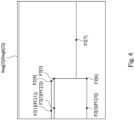
processor 203 obtains another key frame, which would be described in detail below with reference toFigs. 1 and6 . Referring toFig. 6, Fig. 6 is a schematic diagram of another one image frame lmg[2] of the image frames Img captured by theimage capturing circuit 201 in accordance with some embodiments of the present disclosure. The image frame lmg[2] captured by theimage capturing circuit 201 can be corresponding to another field of view V2 as shown inFig. 1 . In some embodiments, the image frame lmg[2] is also separated from the last key frame by the predetermined frame number or more. Then, as shown inFig. 6 , theprocessor 203 extracts multiple second feature points F2[1]-F2[7] from the image frame lmg[2] and matches the second feature points F2[1]-F2[7] to multiple map points (not shown) of the map M1 corresponding to the last key frame. In some embodiments, three second feature points F2[1]-F2[3] are found to be matched, and, as a result, can be referred as common feature points FC[1]-FC[3]. In other words, theprocessor 203 obtains the common feature points FC[1]-FC[3] of the image frame lmg[2] with the last key frame. Theprocessor 203 determines whether an amount of the common feature points FC[1]-FC[3] is equal to or less than said predetermined threshold afterwards. In the embodiments ofFig. 6 , the amount of the common feature points FC[1]-FC[3] is equal to or less than said predetermined threshold, so that the image frame lmg[2] is set as new key frame lmgk[2]. As can be seen from the above descriptions, in the condition that the amount of the common feature points is not greater than a second threshold (i.e., said predetermined threshold), theprocessor 203 determines the image frame Img[2] to be the key frame Imgk[2]. - In some embodiments, as shown in
Fig. 3 , step S302 would be executed again after new key frame lmgk[2] is set. In some further embodiments, the result of the image recognition on the key frame lmgk[2] shows that the key frame Imgk[2] does not include any privacy content. Thus, theprocessor 203 does not have to process and analyze the key frame Imgk[2], and step S307 is executed accordingly. In step S307, theprocessor 203 uses the key frame Imgk[2] to update the map M1 of the environment E1. The update of the map M1 is well known by person having ordinary skill in art of the present disclosure, and therefore the descriptions thereof are omitted herein. - As can be seen from the above descriptions of the
data processing method 300, in some embodiments, the data processing method of the present disclosure includes step of obtaining the key frame Imgk[1], step of processing the key frame Imgk[1] to generate the modified key frame Imgk[1]' in the condition that the key frame Imgk[1] includes at least one privacy content (e.g., the privacy content PI[1], the privacy content PI[2], etc.), and step of using the modified key frame Imgk[1]' to update the map M1 of the environment E1. In some further embodiments, the step of using the modified key frame lmgk[1]' to update the map M1 of the environment E1 is performed in the condition that the amount of the first feature points F1[1]-F1[11] of the modified key frame lmgk[1]' is greater than the first threshold. - In the above embodiments, for those image frames Img which are not set as the key frame, the
processor 203 only uses the relative relationship between those image frames Img and the last key frame to simply estimate the location and/or the pose of theelectronic device 100. Afterwards, those image frames Img might not be preserved, that is, those image frames Img might not be stored in the storage circuit of theelectronic device 100. Thus, in some embodiments, theprocessor 203 does not perform the image smoothing on those image frames Img, even if those image frames Img carry the privacy information. - In the above embodiments, as shown in
Figs. 1 ,4 and5 , theprocessor 203 recognizes the portrait of the person U2 inFig. 1 as the privacy content PI[1]. However, the present disclosure is not limited herein. For example, in some embodiments, theprocessor 203 might recognize the entire image of the person U2 (i.e., from head to feet) as the privacy content PI. In such arrangements, theprocessor 203 might perform the image smoothing on the entire image of the person U2 to generate the image processing area PA correspondingly. - As can be seen from the above embodiments of the present disclosure, by eliminating the features of the privacy contents in the key frame, the operations (e.g., generating and/or updating the map M1, calculating the location and/or the pose of the
electronic device 100, etc.) of theprocessor 203 would not be affected by the privacy information accidentally obtained from the environment E1, which leads to the decrease in the computational complexity and burden of theprocessor 203. Furthermore, in the condition that theelectronic device 100 has to share information (e.g., the modified key frame) related to the environment E1 with other devices so that those devices can also localize themselves in the environment E1, theprocessor 203 does not need to perform the encryption. In sum, theelectronic device 100 and the data processing method 200 of the present disclosure has advantage of improved performance, etc. - The disclosed methods, may take the form of a program code (i.e., executable instructions) embodied in tangible media, such as floppy diskettes, CD-ROMS, hard drives, or any other transitory or non-transitory machine-readable storage medium, wherein, when the program code is loaded into and executed by a machine, such as a computer, the machine thereby becomes an apparatus for practicing the methods. The methods may also be embodied in the form of a program code transmitted over some transmission medium, such as electrical wiring or cabling, through fiber optics, or via any other form of transmission, wherein, when the program code is received and loaded into and executed by a machine, such as a computer, the machine becomes an apparatus for practicing the disclosed methods. When implemented on a general-purpose processor, the program code combines with the processor to provide a unique apparatus that operates analogously to application specific logic circuits.
- Although the present disclosure has been described in considerable detail with reference to certain embodiments thereof, other embodiments are possible. Therefore, the spirit and scope of the appended claims should not be limited to the description of the embodiments contained herein. It will be apparent to those skilled in the art that various modifications and variations can be made to the structure of the present disclosure without departing from the scope or spirit of the invention. In view of the foregoing, it is intended that the present invention cover modifications and variations of this invention provided they fall within the scope of the following claims.
Claims (15)
- A data processing method, applicable to an electronic device in an environment, and comprising:obtaining a key frame;in a condition that the key frame comprises at least one privacy content, processing the key frame to generate a modified key frame, wherein the modified key frame comprises at least one image processing area corresponding to the at least one privacy content; andusing the modified key frame to update a map of the environment.
- The data processing method of claim 1, further comprising:
performing an image recognition on the key frame by a privacy content recognition model, to determine if the key frame comprises the at least one privacy content. - The data processing method of claim 1, further comprising:analyzing the modified key frame, to determine if an amount of a plurality of first feature points of the modified key frame is greater than a first threshold;wherein in a condition that the amount of the plurality of first feature points of the modified key frame is greater than the first threshold, using the modified key frame to update the map of the environment is performed.
- The data processing method of claim 3, wherein analyzing the modified key frame comprises:extracting the plurality of first feature points from the modified key frame;calculating the amount of the plurality of first feature points; andcomparing the amount of the plurality of first feature points with the first threshold.
- The data processing method of claim 3, further comprising:
in a condition that the amount of the plurality of first feature points of the modified key frame is not greater than the first threshold, obtaining another key frame. - The data processing method of claim 5, wherein obtaining the another key frame comprises:extracting a plurality of second feature points from an image frame;matching the plurality of second feature points to a plurality of map points of the map, to obtain a plurality of common feature points; andin a condition that the amount of the plurality of common feature points is not greater than a second threshold, determining the image frame to be the another key frame.
- The data processing method of claim 5, wherein after obtaining the another key frame, the data processing method further comprises:
performing an image recognition on the another key frame by a privacy content recognition model. - The data processing method of claim 3, wherein the plurality of first feature points are not extracted from the at least one image processing area.
- The data processing method of claim 1, further comprising:
in a condition that the key frame does not comprise the at least one privacy content, using the key frame to update the map of the environment. - The data processing method of claim 1, wherein processing the key frame to generate the modified key frame comprises:
performing an image smoothing or image blurring on the at least one privacy content, to generate the at least one image processing area. - An electronic device, comprising:an image capturing circuit, configured to capture a plurality of image frames; anda processor, coupled to the image capturing circuit, and configured to:set one of the plurality of image frames as a key frame;in a condition that the key frame comprises at least one privacy content, process the key frame to generate a modified key frame, wherein the modified key frame comprises at least one image processing area corresponding to the at least one privacy content; anduse the modified key frame to update a map of an environment where the electronic device is.
- The electronic device of claim 11, wherein the processor is further configured to perform an image recognition on the key frame by a privacy content recognition model, to determine if the key frame comprises the at least one privacy content.
- The electronic device of claim 11, wherein the processor is further configured to:analyze the modified key frame, to determine if an amount of a plurality of first feature points of the modified key frame is greater than a first threshold,wherein the processor uses the modified key frame to update the map of the environment in a condition that the amount of the plurality of first feature points of the modified key frame is greater than the first threshold.
- The electronic device of claim 11, wherein the processor is further configured to perform an image smoothing or image blurring on the at least one privacy content, to generate the at least one image processing area.
- A non-transitory computer readable storage medium with a computer program to execute a data processing method applicable to an electronic device in an environment, wherein the data processing method comprises:obtaining a key frame;in a condition that the key frame comprises at least one privacy content, processing the key frame to generate a modified key frame, wherein the modified key frame comprises at least one image processing area corresponding to the at least one privacy content; andusing the modified key frame to update a map of the environment.
Applications Claiming Priority (1)
| Application Number | Priority Date | Filing Date | Title |
|---|---|---|---|
| US18/479,840 US12423474B2 (en) | 2023-10-03 | 2023-10-03 | Data processing method, electronic device and non-transitory computer readable storage medium |
Publications (1)
| Publication Number | Publication Date |
|---|---|
| EP4535298A1 true EP4535298A1 (en) | 2025-04-09 |
Family
ID=90923991
Family Applications (1)
| Application Number | Title | Priority Date | Filing Date |
|---|---|---|---|
| EP24173022.5A Pending EP4535298A1 (en) | 2023-10-03 | 2024-04-29 | Data processing method, electronic device and non-transitory computer readable storage medium |
Country Status (4)
| Country | Link |
|---|---|
| US (1) | US12423474B2 (en) |
| EP (1) | EP4535298A1 (en) |
| CN (1) | CN119766983A (en) |
| TW (1) | TWI896023B (en) |
Family Cites Families (28)
| Publication number | Priority date | Publication date | Assignee | Title |
|---|---|---|---|---|
| CN109120994A (en) | 2017-06-22 | 2019-01-01 | 中兴通讯股份有限公司 | A kind of automatic editing method, apparatus of video file and computer-readable medium |
| US10440229B2 (en) * | 2017-11-15 | 2019-10-08 | Dean Drako | Aerial imaging privacy enhancement system |
| DE112018006630T5 (en) * | 2017-12-28 | 2020-09-24 | Intel Corporation | VISUAL FOG |
| EP3877831B1 (en) | 2018-11-09 | 2025-06-18 | Beckman Coulter, Inc. | Service glasses with selective data provision |
| WO2020243059A1 (en) * | 2019-05-29 | 2020-12-03 | Apple Inc. | Obfuscating location specific data associated with a physical environment |
| EP4046139B1 (en) * | 2019-10-15 | 2026-05-20 | Magic Leap, Inc. | REALITY-OVER-THE-WORLD SYSTEM WITH LOCALIZATION SERVICE |
| CN114616534B (en) * | 2019-10-15 | 2025-08-26 | 奇跃公司 | Cross-reality system with wireless fingerprint |
| US11562525B2 (en) * | 2020-02-13 | 2023-01-24 | Magic Leap, Inc. | Cross reality system with map processing using multi-resolution frame descriptors |
| JP7586918B2 (en) * | 2020-02-26 | 2024-11-19 | マジック リープ, インコーポレイテッド | Cross-reality system with buffer for localization accuracy |
| CN111767554B (en) * | 2020-06-01 | 2024-02-20 | Oppo(重庆)智能科技有限公司 | Screen sharing method and device, storage medium and electronic equipment |
| US11886625B1 (en) * | 2020-12-21 | 2024-01-30 | Apple Inc. | Method and device for spatially designating private content |
| KR20220090158A (en) * | 2020-12-22 | 2022-06-29 | 삼성전자주식회사 | Electronic device for editing video using objects of interest and operating method thereof |
| EP4348403A1 (en) * | 2021-07-05 | 2024-04-10 | Apple Inc. | Method and device for dynamically selecting an operation modality for an object |
| CN117882033A (en) * | 2021-08-30 | 2024-04-12 | 苹果公司 | Method and apparatus for invoking write to a surface |
| US12236631B2 (en) * | 2021-09-24 | 2025-02-25 | Qualcomm Incorporated | Keypoint detection and feature descriptor computation |
| CN113989450B (en) * | 2021-10-27 | 2023-09-26 | 北京百度网讯科技有限公司 | Image processing methods, devices, electronic equipment and media |
| WO2023137003A1 (en) * | 2022-01-14 | 2023-07-20 | Op Solutions, Llc | Systems and methods for privacy protection in video communication systems |
| CN116939130A (en) * | 2022-03-31 | 2023-10-24 | 北京字跳网络技术有限公司 | Video generation method and device, electronic equipment and storage medium |
| US11924330B1 (en) * | 2022-04-14 | 2024-03-05 | Meta Platforms Technologies, Llc | Cryptographic key exchange |
| CN114925390B (en) * | 2022-04-29 | 2024-10-18 | 中国科学院信息工程研究所 | Method, device, electronic device and storage medium for desensitizing sensitive information |
| KR102715352B1 (en) * | 2022-11-14 | 2024-10-11 | 주식회사 엑스페릭스 | Method for processing data for personal information proctecting and apparatus using the same |
| US12217127B2 (en) * | 2023-02-10 | 2025-02-04 | Qualcomm Incorporated | Protecting against malicious attacks in images |
| US20240354962A1 (en) * | 2023-04-14 | 2024-10-24 | Qualcomm Incorporated | Pose optimization for object tracking |
| EP4456008B1 (en) * | 2023-04-25 | 2025-09-17 | Axis AB | Methods, systems and non-transitory computer-readable storage mediums for detecting an object of a first object type in a video sequence |
| US20240371043A1 (en) * | 2023-05-01 | 2024-11-07 | Qualcomm Incorporated | Processing image data in an extended-reality system |
| CN119068381A (en) * | 2023-06-02 | 2024-12-03 | 戴尔产品有限公司 | Method, electronic device and computer program product for identifying object regions of an image |
| US20240403484A1 (en) * | 2023-06-04 | 2024-12-05 | Apple Inc. | Privacy-protecting mixed reality recording |
| US12393264B2 (en) * | 2023-08-31 | 2025-08-19 | Qualcomm Incorporated | Private data sharing for extended reality systems |
-
2023
- 2023-10-03 US US18/479,840 patent/US12423474B2/en active Active
-
2024
- 2024-03-05 CN CN202410246146.8A patent/CN119766983A/en active Pending
- 2024-03-05 TW TW113107987A patent/TWI896023B/en active
- 2024-04-29 EP EP24173022.5A patent/EP4535298A1/en active Pending
Non-Patent Citations (2)
| Title |
|---|
| DEEKSHA DANGWAL ET AL: "Analysis and Mitigations of Reverse Engineering Attacks on Local Feature Descriptors", ARXIV.ORG, CORNELL UNIVERSITY LIBRARY, 201 OLIN LIBRARY CORNELL UNIVERSITY ITHACA, NY 14853, 9 May 2021 (2021-05-09), XP081960392 * |
| LEE HARIM ET AL: "Development of a Privacy-Preserving UAV System With Deep Learning-Based Face Anonymization", IEEE ACCESS, IEEE, USA, vol. 9, 24 September 2021 (2021-09-24), pages 132652 - 132662, XP011880921, DOI: 10.1109/ACCESS.2021.3113186 * |
Also Published As
| Publication number | Publication date |
|---|---|
| TW202516458A (en) | 2025-04-16 |
| CN119766983A (en) | 2025-04-04 |
| TWI896023B (en) | 2025-09-01 |
| US12423474B2 (en) | 2025-09-23 |
| US20250111087A1 (en) | 2025-04-03 |
Similar Documents
| Publication | Publication Date | Title |
|---|---|---|
| US11074461B2 (en) | People flow estimation device, display control device, people flow estimation method, and recording medium | |
| CN106462242B (en) | User Interface Control Using Gaze Tracking | |
| CN110222573A (en) | Face identification method, device, computer equipment and storage medium | |
| CN111273772B (en) | Augmented reality interaction method and device based on slam mapping method | |
| GB2560340A (en) | Verification method and system | |
| US20210338109A1 (en) | Fatigue determination device and fatigue determination method | |
| CN105426827A (en) | Living body verification method, device and system | |
| US10496874B2 (en) | Facial detection device, facial detection system provided with same, and facial detection method | |
| CN114333046A (en) | Dance action scoring method, device, equipment and storage medium | |
| US20170365084A1 (en) | Image generating apparatus and image generating method | |
| US20230386049A1 (en) | Tracking apparatus, tracking system, tracking method, and recording medium | |
| CN113792595A (en) | Target behavior detection method, device, computer equipment and storage medium | |
| WO2023185241A1 (en) | Data processing method and apparatus, device and medium | |
| CN117677973A (en) | Bystander and attached object removal | |
| JP2024138079A (en) | Program, image processing method and system | |
| JP2020027390A (en) | Attention target estimation device and attention target estimation method | |
| US20230057733A1 (en) | Computer-readable recording medium storing identification program, identification method, and information processing apparatus | |
| CN113963355B (en) | OCR character recognition method, device, electronic equipment and storage medium | |
| JP7560015B2 (en) | OBJECT RECOGNITION DEVICE, OBJECT RECOGNITION METHOD, AND PROGRAM | |
| US12423474B2 (en) | Data processing method, electronic device and non-transitory computer readable storage medium | |
| US20200211275A1 (en) | Information processing device, information processing method, and recording medium | |
| CN111223549A (en) | Mobile end system and method for disease prevention based on posture correction | |
| Kondori et al. | Direct hand pose estimation for immersive gestural interaction | |
| CN117724609A (en) | Interaction method and system based on facial information tracking | |
| US20250029363A1 (en) | Image processing system, image processing method, and non-transitory computer-readable medium |
Legal Events
| Date | Code | Title | Description |
|---|---|---|---|
| STAA | Information on the status of an ep patent application or granted ep patent |
Free format text: STATUS: EXAMINATION IS IN PROGRESS |
|
| PUAI | Public reference made under article 153(3) epc to a published international application that has entered the european phase |
Free format text: ORIGINAL CODE: 0009012 |
|
| 17P | Request for examination filed |
Effective date: 20240429 |
|
| AK | Designated contracting states |
Kind code of ref document: A1 Designated state(s): AL AT BE BG CH CY CZ DE DK EE ES FI FR GB GR HR HU IE IS IT LI LT LU LV MC ME MK MT NL NO PL PT RO RS SE SI SK SM TR |
|
| GRAP | Despatch of communication of intention to grant a patent |
Free format text: ORIGINAL CODE: EPIDOSNIGR1 |
|
| STAA | Information on the status of an ep patent application or granted ep patent |
Free format text: STATUS: GRANT OF PATENT IS INTENDED |