EP4535245A1 - Machine learning method, and machine learning device - Google Patents
Machine learning method, and machine learning device Download PDFInfo
- Publication number
- EP4535245A1 EP4535245A1 EP23811642.0A EP23811642A EP4535245A1 EP 4535245 A1 EP4535245 A1 EP 4535245A1 EP 23811642 A EP23811642 A EP 23811642A EP 4535245 A1 EP4535245 A1 EP 4535245A1
- Authority
- EP
- European Patent Office
- Prior art keywords
- learning
- period
- periods
- divided
- model
- Prior art date
- Legal status (The legal status is an assumption and is not a legal conclusion. Google has not performed a legal analysis and makes no representation as to the accuracy of the status listed.)
- Pending
Links
Images






Classifications
-
- G—PHYSICS
- G06—COMPUTING OR CALCULATING; COUNTING
- G06F—ELECTRIC DIGITAL DATA PROCESSING
- G06F18/00—Pattern recognition
- G06F18/20—Analysing
- G06F18/21—Design or setup of recognition systems or techniques; Extraction of features in feature space; Blind source separation
- G06F18/217—Validation; Performance evaluation; Active pattern learning techniques
-
- G—PHYSICS
- G06—COMPUTING OR CALCULATING; COUNTING
- G06N—COMPUTING ARRANGEMENTS BASED ON SPECIFIC COMPUTATIONAL MODELS
- G06N20/00—Machine learning
-
- G—PHYSICS
- G06—COMPUTING OR CALCULATING; COUNTING
- G06F—ELECTRIC DIGITAL DATA PROCESSING
- G06F16/00—Information retrieval; Database structures therefor; File system structures therefor
-
- G—PHYSICS
- G06—COMPUTING OR CALCULATING; COUNTING
- G06F—ELECTRIC DIGITAL DATA PROCESSING
- G06F16/00—Information retrieval; Database structures therefor; File system structures therefor
- G06F16/90—Details of database functions independent of the retrieved data types
- G06F16/903—Querying
- G06F16/90335—Query processing
-
- G—PHYSICS
- G06—COMPUTING OR CALCULATING; COUNTING
- G06F—ELECTRIC DIGITAL DATA PROCESSING
- G06F18/00—Pattern recognition
- G06F18/20—Analysing
- G06F18/21—Design or setup of recognition systems or techniques; Extraction of features in feature space; Blind source separation
- G06F18/214—Generating training patterns; Bootstrap methods, e.g. bagging or boosting
-
- G—PHYSICS
- G06—COMPUTING OR CALCULATING; COUNTING
- G06F—ELECTRIC DIGITAL DATA PROCESSING
- G06F18/00—Pattern recognition
- G06F18/20—Analysing
- G06F18/24—Classification techniques
Definitions
- the present invention relates to a machine-learning method and a machine-learning apparatus.
- the cross-validation includes dividing a data set into learning data and validation data, performing machine learning of a learning model using the learning data, and evaluating a performance of the learning model on which the machine learning has been performed using the validation data (for example, see Patent Document 1 and Patent Document 2).
- the performance of the learning model may be degraded due to an influence of the idiosyncratic data.
- the present invention has been made in view of the above-described problem. It is therefore an object of the present invention to provide a machine-learning method and a machine-learning apparatus capable of improving a performance of a learning model on which the machine learning has been performed.
- a machine-learning method comprises:
- a machine-learning method comprises:
- the learning-candidate-period separating process and the learning-period evaluation process are repeatedly performed, so that the divided learning period having the high evaluation index for the learning-period evaluation model is selected as the learning target period, and the machine learning of the learning model is performed using the learning data corresponding to the learning target period. Therefore, a performance of the learning model on which the machine learning has been performed can be improved.
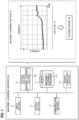
- FIG. 1 is a configuration diagram showing an example of a machine-learning apparatus 1 according to a first embodiment.
- the machine-learning apparatus 1 is configured to perform a machine-learning method S1 of performing machine learning of a learning model M using a data set D.
- the machine-learning apparatus 1 is configured by, for example, a general-purpose or dedicated computer (see FIG. 2 described later).
- the data set D includes time-series data obtained at respective points in time according to a change in predetermined phenomenon over time in a predetermined period P.
- the time-series data contains data points arranged in a time-series order.
- the predetermined phenomenon is, for example, a phenomenon in which one or more variable(s) representing a state of an observation target changes over time. Examples of the phenomenon include a mechanical phenomenon, an electromagnetic phenomenon, a thermal phenomenon, an acoustic phenomenon, a chemical phenomenon, a physiological phenomenon, etc.
- the phenomenon may be a natural phenomenon or an economic phenomenon.
- the variable(s) that represents the state of the observation target in each phenomenon is measured by, for example, a sensor at a predetermined time cycle.
- the measured variables are quantified (digitized) as data, and are collected and accumulated in time-series order, so that the data set D for use in the machine-learning method S1 is composed.
- the data set D may be collected in the past or in real time.
- Main components of the machine-learning apparatus 1 include a control section 10, a memory 11, an input section 12, an output section 13, a communication section 14, and a device connecting section 15.
- the control section 10 performs a machine-learning program 110 stored in the memory 11 to thereby function as a machine-learning section 100 configured to perform various processes in the machine-learning method S1.
- the memory 11 stores the machine-learning program 110 and various data used in the machine-learning program 110, and further stores, for example, an operating system (OS), other programs, data, etc.
- the input section 12 receives various input operations, and the output section 13 outputs various information via a display screen or voice, so that the input section 12 and the output section 13 function as user interfaces.
- the communication section 14 is coupled to a wired or wireless network and functions as a communication interface configured to transmit and receive various data to and from another device (not shown).
- the device connecting section 15 functions as a connecting interface with an external device, such as a scanner, a printer, etc., a measuring device, such as a sensor, etc., and a storage medium, such as a USB memory, a CD-ROM, a DVD, etc.
- an external device such as a scanner, a printer, etc.
- a measuring device such as a sensor, etc.
- a storage medium such as a USB memory, a CD-ROM, a DVD, etc.
- a learned model is provided to an arbitrary utilization system by performing the machine learning of the learning model M using the data set D.
- the data set D is based on, for example, variable(s) of a monitoring target or a controlling target in an apparatus or a facility (which may be one of components of the apparatus or the facility)
- the learned model is used to estimate a state (abnormality, failure, signs thereof, etc.) of the monitoring target or to control the controlling target by inputting unknown variables (which may be variables collected in the past or in real time) to the learned model.
- the learning model M is a model that implements arbitrary machine-learning algorithm or arbitrary machine-learning method.
- the learning model M may be used for a classification problem, such as a binary classification or a multi-value classification, or may handle a regression problem.
- Examples of the learning model M include tree type (e.g., decision tree, regression tree), ensemble learning (e.g., bagging, boosting), neural network type (including deep learning) (e.g., deep neural network, recurrent neural network, convolutional neural network, LSTM), clustering type (e.g., hierarchical clustering, non-hierarchical clustering, k-nearest neighbor algorithm, and k-mean clustering), multivariate analysis (e.g., principal component analysis, factor analysis, logistic regression), and support vector machine, while the learning model M is not limited to these examples.
- any one of supervised learning, unsupervised learning, and reinforcement learning as a machine-learning method may be applied to the learning model M.
- FIG. 2 is a hardware configuration diagram showing an example of a computer 200.
- the computer 200 is an example of a device constituting the machine-learning apparatus 1, and is configured as a general-purpose or dedicated computer.
- main components of the computer 200 include buses 210, a processor 212, a memory 214, an input device 216, an output device 217, a display device 218, a storage device 220, a communication I/F (interface) section 222, an external device I/F section 224, an I/O (input/output) device I/F section 226, and a media input/output section 228.
- the above components may be omitted as appropriate depending on an application in which the computer 200 is used.
- the processor 212 includes one or more arithmetic processing unit(s) (CPU (Central Processing Unit), MPU (Micro-processing unit), DSP (digital signal processor), GPU (Graphics Processing Unit), etc.) and operates as a control section 10 configured to control the entire computer 200.
- the memory 214 stores various data and programs 230, and includes, for example, a volatile memory (DRAM, SRAM, etc.) that functions as a main memory, a non-volatile memory (ROM), a flash memory, etc.
- the input device 216 includes, for example, a keyboard, a mouse, a numeric keypad, an electronic pen, etc., and functions as the input section 12.
- the output device 217 includes, for example, a sound (voice) output device, a vibration device, etc., and functions as the output section 13.
- the display device 218 includes, for example, a liquid crystal display, an organic EL display, electronic paper, a projector, etc., and functions as the output section 13.
- the input device 216 and the display device 218 may be configured integrally, such as a touch panel display.
- the storage device 220 includes, for example, HDD (Hard Disk Drive), SSD (Solid State Drive), etc., and functions as the memory 11.
- the storage device 220 stores various data necessary for executing the operating system and the programs 230.
- the communication I/F section 222 is coupled to a network 240, such as the Internet or an intranet, in a wired manner or a wireless manner, and functions as the communication section 14 that transmits and receives data to and from another computer according to a predetermined communication standard.
- the external device I/F section 224 is coupled to an external device 250, such as a camera, a printer, a scanner, a reader/writer, in a wired manner or a wireless manner, and functions as the device connecting section 15 that transmits and receives data to and from the external device 250 according to a predetermined communication standard.
- the I/O device I/F section 226 is coupled to I/O devices 260, such as various sensors or actuators, and functions as the device connecting section 15 that transmits and receives various signals, such as detection signals from the sensors or control signals to the actuators, and data to and from the I/O devices 260.
- the media input/output section 928 is constituted of, for example, a drive device, such as a DVD (Digital Versatile Disc) drive or a CD (Compact Disc) drive, a memory card slot, and a USB connector, and functions as the device connecting section 15 that writes and reads data into and from a medium (non-transitory storage medium) 970, such as a DVD, a CD, a memory card, or a USB flash drive.
- the processor 212 calls the program 230 stored in the storage device 220 into the memory 214 and executes the program, and controls each section of the computer 200 via the buses 210.
- the program 230 may be stored in the memory 214 instead of the storage device 220.
- the program 230 may be stored in the medium 270 in an installable file format or an executable file format, and may be provided to the computer 200 via the media input/output section 228.
- the program 230 may be provided to the computer 200 by being downloaded via the network 240 and the communication I/F section 222.
- the computer 200 may perform various functions realized by the processor 212 executing the programs 230.
- the computer 200 may include hardware, such as an FPGA (field-programmable gate array), an ASIC (application specific integrated circuit), etc. for executing the above-described various functions.
- the computer 200 is, for example, a stationary computer or a portable computer, and is an electronic device in arbitrary form.
- the computer 200 may be a client computer, a server computer, or a cloud computer.
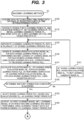
- FIGS. 3 and 4 are flowcharts showing an example of the machine-learning method S1 according to the first embodiment.
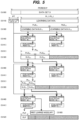
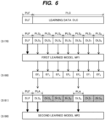
- FIGS. 5 and 6 are diagrams showing an example of operation of the machine-learning method S1 according to the first embodiment.
- FIG. 7 is a diagram showing an example of calculation of evaluation indexes in the machine-learning method S1 according to the first embodiment.
- step S100 data-set acquisition process
- the machine-learning apparatus 1 acquires a data set D including time-series data obtained at respective points in time in a predetermined period P.
- the time-series data contains data points arranged in a time-series order.
- the data set D may be read out from the memory 11, may be received from another device via the communication section 14, may refer to data stored in the storage medium via the device connecting section 15, or may be data measured by the measuring device via the device connecting section 15.
- step S110 data-set division process
- the period P is separated into a learning period PL and a validation period PT.
- the learning period PL is set to an initial learning candidate period PL 1
- the data set D is divided into learning data DL corresponding to the learning period PL and validation data DT corresponding to the validation period PT.
- the period P is separated into the learning period PL (e.g., 90%) and the validation period PT (e.g., 10%) with a predetermined data ratio, e.g., "9:1".
- the validation period PT may be set discretely in a time-series order of the period P. For example, if the period P is 35 days, it is preferable that the validation period PT is dispersed in the time-series order of the period P, such as one day in an early period (1st to 12th days), one day in a middle period (13th to 24th days), and one day in a late period (25th to 35th days).
- the validation period PT may be set to 6th day, 18th day, and 30th day. As a result, a bias in the data included in the validation data can be suppressed.
- step S130 learning-candidate-period separating process
- the "j" is a variable (index) indicating an identifier for identifying the plurality of divided learning periods PLD i , j .
- the learning candidate period PL i may be separated into the plurality of divided learning periods PLD i, j such that each of the divided learning periods PLD i, j includes discrete periods in a time-series order of the learning candidate period PL i .
- the learning candidate period PL 1 is 32 days out of 35 days, excluding 6th, 18th, and 30th days
- a divided learning period PLD 1 , 1 is 16 days including 1st to 5th and 19th to 29th days
- a divided learning period PLD 1 , 2 is 16 days including 7th to 17th and 31st to 35th days.
- a learning-period evaluation model ML i, j is generated for each of the divided learning periods PLD i, j by performing machine learning of the learning model M for each of the divided learning periods PLD i, j using divided learning data DLD i, j , which is the learning data DL corresponding to each of the divided learning periods PLD i , j .
- An evaluation index EL i , j of the learning-period evaluation model ML i , j is then calculated for each of the divided learning periods PLD i, j by performing verification of the learning-period evaluation model ML i, j for each of the divided learning periods PLD i, j using the validation data DT.
- the evaluation index EL i, j of the learning-period evaluation model ML i , j is, for example, an accuracy rate, a precision rate, a recall rate, a specificity rate, an F value, etc.
- a single evaluation index may be used, or a combination of evaluation indexes may be used.
- the precision rate is used as the evaluation index EL i, j will be described.
- steps S150 to S152 whether to terminate the repetitive process of repeating the learning-candidate-period separating process S130 and the learning-period evaluation process S140, S141 is determined according to a predetermined termination condition (step S150).
- step S151 When the termination condition is not satisfied (the step S151: No), in order to continue the repetitive process, divided learning period(s) PLD i , j having high evaluation index(es) EL i, j is set to a next learning candidate period PL i (the step S151).
- the process then returns to the step S130 to thereby repeatedly perform the above-described learning-candidate-period separating process S130 and the learning-period evaluation process S140, S141 until the termination condition is satisfied.
- the number of repetitions i is "1"
- the divided learning period PLD 1 , 1 having a high evaluation index EL 1, 1 is set to a next learning candidate period PL 2 .
- one of the divided learning periods PLD i, j having a higher evaluation index EL i, j is set to the next learning candidate period PL i
- one of the divided learning periods PLD i, j having the highest evaluation index EL i, j may be set to the next learning candidate period PL i
- divided learning periods PLD i, j arranged in descending order of the evaluation indexes EL i, j may be set to the next learning candidate period PL i .
- step S151 when the termination condition is satisfied (the step S151: Yes), the repetitive process is terminated, and divided learning period(s) PLD i, j having high evaluation index(es) EL i, j is selected as a learning target period PLF (step S152).
- one divided learning period PLD i, j having a higher evaluation index EL i, j is set to the learning target period PLF, while when the number of segments S is "3 or more", one divided learning period PLD i, j having the highest evaluation index EL i, j may be set to the learning target period PLF, or divided learning periods PLD i, j arranged in descending order of the evaluation indexes EL i, j may be set to the learning target period PLF.
- step S160 the learning model M on which machine learning has been performed using the learning data DL (hereinafter referred to as "learning target data DLF") corresponding to the learning target period PLF is then output as a first learned model MF1.
- the first learned model MF1 may be output to the memory 11 or other device.
- the first learned model MF1 includes, for example, learned coefficients or parameters for characterizing the learning model M.
- step S170 learning-data division process
- learning data DLC excluding the learning target data DLF corresponding to the learning target period PLF is divided into a plurality set of sub-learning data DLS k corresponding to the plurality of sub-learning periods PLS k .
- an evaluation index EF k of the first learned model MF1 is calculated for each of the plurality of sub-learning periods PLS k by performing verification of the first learned model MF1 using each of the plurality set of sub-learning data DLS k .
- Sub-learning period(s) PLS k in which the evaluation index(es) EF k of the first learned model MF1 satisfies a predetermined addition condition is then selected as additional target period(s) PLA.
- the addition condition for the determination may be such that whether the evaluation index EF k exceeds a threshold value.
- one sub-learning period PLS k may be selected as the additional target period PLA, or a plurality of sub-learning periods PLS k may be selected as the additional target periods PLA.
- a case in which two sub-learning periods PLS 2 and PLS 6 are selected as the additional target periods PLA is illustrated.
- step S190 the learning model M on which machine learning has been performed using the learning data DL corresponding to at least one of the learning target period PLF and the additional target period(s) PLA is then output as a second learned model MF2.
- machine learning of the learning model M is performed using at least one of the learning target data DLF corresponding to the learning target period PLF and sub-learning data DLS k (in the example of FIG. 6 and FIG. 7 , DLS 2 and DLS 6 ) corresponding to the additional target period(s) PLA.
- the learning model M is output as the second learned model MF2, and a series of processes is terminated.
- the second learned model MF2 may be output to the memory 11 or other device.
- the second learned model MF2 includes, for example, learned coefficients or parameters for characterizing the learning model M.
- the second learned model MF2 may additionally perform machine learning (relearning) of the first learned model MF1 using the sub-learning data DLS k corresponding to the additional target period(s) PLA, or may perform machine learning of an initialized learning model M using the learning target data DLF and the sub-learning data DLS k corresponding to the additional target period(s) PLA.
- a plurality of second learned models MF2 may be output as the second learned model MF2 by performing machine learning of the learning model M using any combination of the learning target data DLF and the sub-learning data DLS k .
- a learning model M on which machine learning has been performed using the learning target data DLF and the sub-learning data DLS 2 , DLS 6 , a learning model M on which machine learning has been performed using the learning target data DLF and the sub-learning data DLS 2 , and a learning model M on which machine learning has been performed using the learning target data DLF and the sub-learning data DLS 6 may be output.
- the learning-candidate-period separating process S130 and the learning-period evaluation process S140, S141 are repeatedly performed in the learning-period selection process S150 to S152, so that the divided learning period PLD i, j having the high evaluation index EL i, j of the learning-period evaluation model ML i, j is selected as the learning target period PLF, and machine learning of the learning model M is performed using the learning target data DLF corresponding to the learning target period PLF. Therefore, a performance of the learning model on which the machine learning has been performed can be improved.
- the sub-learning period(s) PLS k in which the evaluation index(es) EF k of the first learned model MF1 satisfies the predetermined addition condition is selected as the additional target period(s) PLA, and machine learning of the learning model M is performed using the sub-learning data DLS k corresponding to the additional target period(s) PLA. Therefore, the performance of the learning model can be improved while overlearning caused by performing machine learning using the learning target data DLF is suppressed by using the sub-learning data DLS k .
- Basic configurations of the machine-learning apparatus 1 according to this embodiment are the same as those of the first embodiment, while details of a machine-learning method S2 performed by the control section 10 (machine-learning section 100) of the machine-learning apparatus 1 differ from the machine-learning method S1 in the first embodiment.
- the learning-data division process S170 is performed after the first model output process S160
- a learning-data division process S220 is performed after a data-set division process S210.
- the details of the machine-learning method S2 performed by the control section 10 (machine-learning section 100) of the machine-learning apparatus 1 according to this embodiment will be described below with reference to FIGS. 8 to 12 .
- FIGS. 8 and 9 are flowcharts showing an example of the machine-learning method S2 according to the second embodiment.
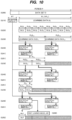
- FIGS. 10 and 11 are diagrams showing an example of operation of the machine-learning method S2 according to the second embodiment.
- FIG. 12 is a diagram showing an example of calculation of evaluation indexes in the machine-learning method S2 according to the second embodiment.
- step S200 data-set acquisition process
- the machine-learning apparatus 1 acquires a data set D including time-series data obtained at respective points in time in a predetermined period P, as well as the step S100.
- the time-series data contains data points arranged in a time-series order.
- step S210 data-set division process
- the period P is separated into a learning period PL and a validation period PT, as well as the step S110.
- the learning period PL is set to an initial learning candidate period PL 1
- the data set D is divided into learning data DL corresponding to the learning period PL and validation data DT corresponding to the validation period PT.
- step S220 learning-data division process
- step S230 learning-candidate-period separating process
- the "j" is a variable (index) indicating an identifier for identifying the plurality of divided learning periods PLD i, j .
- the initial learning candidate period PL 1 when the number of repetitions i is "1" is separated into two divided learning periods PLD 1 , 1 and PLD 1 , 2 corresponding to the number of segments S being "2".
- the initial learning candidate period PL 1 is separated into the divided learning period PLD 1 , 1 including four sub-learning periods PLS 1 to PLS 4 and the divided learning period PLD 1 , 2 including four sub-learning periods PLS 5 to PLS 8 .
- the plurality of sub-learning periods PLS k may be separated into the plurality of divided learning periods PLD i, j at random in a time-series order of the plurality of sub-learning periods PLS k such that each of the plurality of divided learning periods PLD i, j includes discrete periods in a time-series order of the learning candidate period PL i .
- the divided learning period PLD 1 , 1 may include four sub-learning periods PLS 1 , PLS 3 , PLS 3 , and PLS 7
- the divided learning period PLD 1 , 2 may include four sub-learning periods PLS 2 , PLS 4 , PLS 6 , and PLS 8 .
- a bias in the data included in each of the plurality of sub-learning periods PLS k can be suppressed.
- a learning-period evaluation model ML i, j is generated for each of the divided learning periods PLD i, j by performing machine learning of the learning model M for each of the divided learning periods PLD i, j using the sub-learning data DLS k corresponding to the sub-learning periods PLS k included in each of the divided learning periods PLD i, j .
- An evaluation index EL i, j of the learning-period evaluation model ML i , j is then calculated for each of the divided learning periods PLD i, j by performing verification of the learning-period evaluation model ML i, j for each of the divided learning periods PLD i, j using the validation data DT.
- steps S250 to S252 whether to terminate the repetitive process of repeating the learning-candidate-period separating process S230 and the learning-period evaluation process S240, S241 is determined according to a predetermined termination condition (step S250), as well as the steps S150 to S152.
- step S251 When the termination condition is not satisfied (the step S251: No), in order to continue the repetitive process, divided learning period(s) PLD i , j having a high evaluation index EL i, j is set to a next learning candidate period PL i (the step S251). The process then returns to the step S230 to thereby repeatedly perform the above-described learning-candidate-period separating process S230 and the learning-period evaluation process S240, S241 until the termination condition is satisfied.
- step S251 when the termination condition is satisfied (the step S251: Yes), the repetitive process is terminated, and a sub-learning period PLS k included in a divided learning period PLD i, j having a high evaluation index EL i, j is selected as a learning target period PLF (step S252).
- step S260 (first model output process), the learning model M on which machine learning has been performed using the sub-learning data DLS k (hereinafter referred to as "learning target data DLF") corresponding to the learning target period PLF is then output as a first learned model MF1, as well as the step S160.
- learning target data DLF sub-learning data DLF
- an evaluation index EF k of the first learned model MF1 is calculated for each of the plurality of sub-learning periods PLS k by performing verification of the first learned model MF1 using each of the plurality set of sub-learning data DLS k excluding the learning target data DLF corresponding to the learning target period PLF.
- Sub-learning period(s) PLS k in which the evaluation index(es) EF k of the first learned model MF1 satisfies a predetermined addition condition is then selected as additional target period(s) PLA.
- FIGS. 11 and 12 a case in which two sub-learning periods PLS 2 and PLS 6 are selected as the additional target periods PLA is illustrated.
- step S290 the learning model M on which machine learning has been performed using the sub-learning data DLS k corresponding to at least one of the learning target period PLF and the additional target period(s) PLA is then output as a second learned model MF2.
- machine learning is performed on the learning model M using at least one of the learning target data DLF corresponding to the learning target period PLF and sub-learning data DLS k (DLS 2 and DLS 6 in the example of FIG. 11 and FIG. 12 ) corresponding to the additional target period(s) PLA.
- the learning model M is output as the second learned model MF2, and a series of processes is terminated.
- the learning-candidate-period separating process S230 and the learning-period evaluation process S240, S241 are repeatedly performed in the learning-period selection process S250 to S252, so that the sub-learning data DLS k included in the divided learning period PLD i, j having the high evaluation index EL i, j of the learning-period evaluation model ML i , j is selected as the learning target period PLF.
- Machine learning is performed on the learning model M using the learning target data DLF corresponding to the learning target period PLF. Therefore, a performance of the learning model on which the machine learning has been performed can be improved.
- the sub-learning period(s) PLS k in which the evaluation index(es) EF k of the first learned model MF1 satisfies the predetermined additional condition is selected as the additional target period(s) PLA.
- Machine learning is performed on the learning model M using the sub-learning data DLS k corresponding to the additional target period(s) PLA. Therefore, the performance of the learning model can be improved while overlearning caused by performing machine learning using the learning target data DLF is suppressed by using the sub-learning data DLS k .
- the machine-learning methods S1 and S2 performed by the control section 10 (machine-learning section 100) of the machine-learning apparatus 1 are implemented by a single device, while processes included in the machine-learning methods S1 and S2 may be individually implemented by a plurality of devices.
- the operation order of each step may be appropriately changed or some steps may be omitted in the flowcharts showing the details of the machine-learning methods S1 and S2.
- the processes of the step S170 and the following steps may be omitted, or in the machine-learning method S2, the processes of the step S280 and the following steps may be omitted.
- the machine-learning methods S1 and S2 are performed according to various conditions and settings, such as the termination condition, the addition condition, the data ratio, the upper limit value of repetitions R, the number of segments S, and the number of divisions T.
- These conditions and settings may be changed as appropriate.
- the conditions and the settings may be changeable on a display screen by the input section 12 and the output section 13 that function as a user interface.
- the data-set division processes S110 and S210 in the machine-learning methods S1 and S2 include dividing the data set D into the learning data DL and the validation data DT which adopts a so-called hold-out validation technique.
- the machine-learning methods S1 and S2 may adopt a combination of cross-validation techniques, such as k-fold cross-validation, stratified k-fold cross-validation, shuffled-fold cross-validation, time-series-fold cross-validation, sliding-type cross-validation, etc., as appropriate.
- the present invention is applicable to a machine-learning method and a machine-learning apparatus.
Landscapes
- Engineering & Computer Science (AREA)
- Theoretical Computer Science (AREA)
- Data Mining & Analysis (AREA)
- General Physics & Mathematics (AREA)
- Physics & Mathematics (AREA)
- General Engineering & Computer Science (AREA)
- Artificial Intelligence (AREA)
- Computer Vision & Pattern Recognition (AREA)
- Evolutionary Computation (AREA)
- Software Systems (AREA)
- Bioinformatics & Computational Biology (AREA)
- Life Sciences & Earth Sciences (AREA)
- Bioinformatics & Cheminformatics (AREA)
- Evolutionary Biology (AREA)
- Mathematical Physics (AREA)
- Computing Systems (AREA)
- Medical Informatics (AREA)
- Databases & Information Systems (AREA)
- Computational Linguistics (AREA)
- Feedback Control In General (AREA)
- Debugging And Monitoring (AREA)
- Testing And Monitoring For Control Systems (AREA)
Abstract
Description
- The present invention relates to a machine-learning method and a machine-learning apparatus.
- Conventionally, when machine learning is performed on a data set, a method called cross-validation has been used. The cross-validation includes dividing a data set into learning data and validation data, performing machine learning of a learning model using the learning data, and evaluating a performance of the learning model on which the machine learning has been performed using the validation data (for example, see
Patent Document 1 and Patent Document 2). -
- Patent document 1:
Japanese laid-open patent publication No. 2019-003408 - Patent document 2:
Japanese laid-open patent publication No. 2019-061565 - If the learning data for the machine learning in the cross-validation contains, for example, idiosyncratic data whose characteristics are significantly different from other data, the performance of the learning model may be degraded due to an influence of the idiosyncratic data.
- The present invention has been made in view of the above-described problem. It is therefore an object of the present invention to provide a machine-learning method and a machine-learning apparatus capable of improving a performance of a learning model on which the machine learning has been performed.
- In order to achieve the above object, a machine-learning method according to one aspect of the present invention comprises:
- performing machine learning of a learning model by a computer using a data set containing time-series data obtained at respective points in time according to a change in a predetermined phenomenon over time in a predetermined period,
- wherein performing the machine learning of the learning model comprises:
- a data-set division process of separating the period into a learning period and a validation period, setting the learning period to an initial learning candidate period, and dividing the data set into learning data corresponding to the learning period and validation data corresponding to the validation period;
- a learning-candidate-period separating process of separating the learning candidate period into a plurality of divided learning periods;
- a learning-period evaluation process of generating a learning-period evaluation model for each of the plurality of divided learning periods by performing machine learning of the learning model for each of the plurality of divided learning periods using the learning data corresponding to each of the plurality of divided learning periods, and calculating an evaluation index of the learning-period evaluation model for each of the plurality of divided learning periods by performing verification of the learning-period evaluation model for each of the plurality of divided learning periods using the validation data;
- a learning-period selection process of repeating the learning-candidate-period separating process and the learning-period evaluation process while setting a divided learning period having a high evaluation index to a next learning candidate period until a predetermined termination condition is satisfied, and selecting the divided learning period having the high evaluation index as a learning target period when the termination condition is satisfied; and
- a model output process of outputting, as a learned model, the learning model on which machine learning has been performed using the learning data corresponding to the learning target period.
- Furthermore, a machine-learning method according to another aspect of the present invention comprises:
- performing machine learning of a learning model by a computer using a data set containing time-series data obtained at respective points in time according to a change in a predetermined phenomenon over time in a predetermined period,
- wherein performing the machine learning of the learning model comprises:
- a data-set division process of separating the period into a learning period and a validation period, setting the learning period to an initial learning candidate period, and dividing the data set into learning data corresponding to the learning period and validation data corresponding to the validation period;
- a learning-data division process of separating the learning period into a plurality of sub-learning periods, and dividing the learning data into a plurality set of sub-learning data corresponding to the plurality of sub-learning periods;
- a learning-candidate-period separating process of separating the plurality of sub-learning periods included in the learning candidate period into a plurality of divided learning periods;
- a learning-period evaluation process of generating a learning-period evaluation model for each of the plurality of divided learning periods by performing machine learning of the learning model for each of the plurality of divided learning periods using the plurality set of sub-learning data corresponding to the plurality of sub-divided learning periods included in each of the plurality of divided learning periods, and calculating an evaluation index of the learning-period evaluation model for each of the plurality of divided learning periods by performing verification of the learning-period evaluation model for each of the plurality of divided learning periods using the validation data;
- a learning-period selection process of repeating the learning-candidate-period separating process and the learning-period evaluation process while setting a divided learning period having a high evaluation index to a next learning candidate period until a predetermined termination condition is satisfied, and selecting a sub-learning period included in the divided learning period having the high evaluation index as a learning target period when the termination condition is satisfied; and
- a model output process of outputting, as a learned model, the learning model on which machine learning has been performed using sub-learning data corresponding to the learning target period.
- According to the machine-learning method of the embodiments of the present invention, in the learning-period selection process, the learning-candidate-period separating process and the learning-period evaluation process are repeatedly performed, so that the divided learning period having the high evaluation index for the learning-period evaluation model is selected as the learning target period, and the machine learning of the learning model is performed using the learning data corresponding to the learning target period. Therefore, a performance of the learning model on which the machine learning has been performed can be improved.
- Problems, configurations, and effects other than the previous descriptions will be clarified in the descriptions of embodiments, which will be described later.
-
- [
FIG. 1] FIG. 1 is a configuration diagram showing an example of a machine-learning apparatus 1; - [
FIG. 2] FIG. 2 is a hardware configuration diagram showing an example of acomputer 200; - [
FIG. 3] FIG. 3 is a flowchart showing an example of a machine-learning method S1 according to a first embodiment; - [
FIG. 4] FIG. 4 is a flowchart (continuation ofFIG. 3 ) showing the example of the machine-learning method S1 according to the first embodiment; - [
FIG. 5] FIG. 5 is a diagram showing an example of operation of the machine-learning method S1 according to the first embodiment; - [
FIG. 6] FIG. 6 is a diagram (continuation ofFIG. 5 ) showing the example of operation of the machine-learning method S1 according to the first embodiment; - [
FIG. 7] FIG. 7 is a diagram showing an example of calculation of evaluation indexes in the machine-learning method S1 according to the first embodiment; - [
FIG. 8] FIG. 8 is a flowchart showing an example of a machine-learning method S2 according to a second embodiment; - [
FIG. 9] FIG. 9 is a flowchart (continuation ofFIG. 8 ) showing the example of the machine-learning method S2 according to the second embodiment; - [
FIG. 10] FIG. 10 is a diagram showing an example of operation of the machine-learning method S2 according to the second embodiment; - [
FIG. 11] FIG. 11 is a diagram (continuation ofFIG. 10 ) showing the example of operation of the machine-learning method S2 according to the second embodiment; and - [
FIG. 12] FIG. 12 is a diagram showing an example of calculation of evaluation indexes in the machine-learning method S2 according to the second embodiment. - Embodiments of the present invention will now be described with reference to the drawings. In the following descriptions, scope necessary for the descriptions to achieve the object of the present invention will be schematically shown, scope necessary for the descriptions of relevant parts of the present invention will be mainly described, and parts omitted from the descriptions will be based on known technology.
-
FIG. 1 is a configuration diagram showing an example of a machine-learning apparatus 1 according to a first embodiment. The machine-learning apparatus 1 is configured to perform a machine-learning method S1 of performing machine learning of a learning model M using a data set D. The machine-learning apparatus 1 is configured by, for example, a general-purpose or dedicated computer (seeFIG. 2 described later). - The data set D includes time-series data obtained at respective points in time according to a change in predetermined phenomenon over time in a predetermined period P. The time-series data contains data points arranged in a time-series order. The predetermined phenomenon is, for example, a phenomenon in which one or more variable(s) representing a state of an observation target changes over time. Examples of the phenomenon include a mechanical phenomenon, an electromagnetic phenomenon, a thermal phenomenon, an acoustic phenomenon, a chemical phenomenon, a physiological phenomenon, etc. The phenomenon may be a natural phenomenon or an economic phenomenon. The variable(s) that represents the state of the observation target in each phenomenon is measured by, for example, a sensor at a predetermined time cycle. The measured variables are quantified (digitized) as data, and are collected and accumulated in time-series order, so that the data set D for use in the machine-learning method S1 is composed. The data set D may be collected in the past or in real time.
- Main components of the machine-
learning apparatus 1 include acontrol section 10, amemory 11, aninput section 12, anoutput section 13, acommunication section 14, and adevice connecting section 15. - The
control section 10 performs a machine-learning program 110 stored in thememory 11 to thereby function as a machine-learning section 100 configured to perform various processes in the machine-learning method S1. Thememory 11 stores the machine-learning program 110 and various data used in the machine-learning program 110, and further stores, for example, an operating system (OS), other programs, data, etc. Theinput section 12 receives various input operations, and theoutput section 13 outputs various information via a display screen or voice, so that theinput section 12 and theoutput section 13 function as user interfaces. Thecommunication section 14 is coupled to a wired or wireless network and functions as a communication interface configured to transmit and receive various data to and from another device (not shown). Thedevice connecting section 15 functions as a connecting interface with an external device, such as a scanner, a printer, etc., a measuring device, such as a sensor, etc., and a storage medium, such as a USB memory, a CD-ROM, a DVD, etc. - In the machine-learning method S1, a learned model is provided to an arbitrary utilization system by performing the machine learning of the learning model M using the data set D. When the data set D is based on, for example, variable(s) of a monitoring target or a controlling target in an apparatus or a facility (which may be one of components of the apparatus or the facility), the learned model is used to estimate a state (abnormality, failure, signs thereof, etc.) of the monitoring target or to control the controlling target by inputting unknown variables (which may be variables collected in the past or in real time) to the learned model.
- The learning model M is a model that implements arbitrary machine-learning algorithm or arbitrary machine-learning method. The learning model M may be used for a classification problem, such as a binary classification or a multi-value classification, or may handle a regression problem. Examples of the learning model M include tree type (e.g., decision tree, regression tree), ensemble learning (e.g., bagging, boosting), neural network type (including deep learning) (e.g., deep neural network, recurrent neural network, convolutional neural network, LSTM), clustering type (e.g., hierarchical clustering, non-hierarchical clustering, k-nearest neighbor algorithm, and k-mean clustering), multivariate analysis (e.g., principal component analysis, factor analysis, logistic regression), and support vector machine, while the learning model M is not limited to these examples. In addition, any one of supervised learning, unsupervised learning, and reinforcement learning as a machine-learning method may be applied to the learning model M.
-
FIG. 2 is a hardware configuration diagram showing an example of acomputer 200. Thecomputer 200 is an example of a device constituting the machine-learningapparatus 1, and is configured as a general-purpose or dedicated computer. - As shown in
FIG. 2 , main components of thecomputer 200 includebuses 210, aprocessor 212, amemory 214, aninput device 216, anoutput device 217, adisplay device 218, astorage device 220, a communication I/F (interface)section 222, an external device I/F section 224, an I/O (input/output) device I/F section 226, and a media input/output section 228. The above components may be omitted as appropriate depending on an application in which thecomputer 200 is used. - The
processor 212 includes one or more arithmetic processing unit(s) (CPU (Central Processing Unit), MPU (Micro-processing unit), DSP (digital signal processor), GPU (Graphics Processing Unit), etc.) and operates as acontrol section 10 configured to control theentire computer 200. Thememory 214 stores various data andprograms 230, and includes, for example, a volatile memory (DRAM, SRAM, etc.) that functions as a main memory, a non-volatile memory (ROM), a flash memory, etc. - The
input device 216 includes, for example, a keyboard, a mouse, a numeric keypad, an electronic pen, etc., and functions as theinput section 12. Theoutput device 217 includes, for example, a sound (voice) output device, a vibration device, etc., and functions as theoutput section 13. Thedisplay device 218 includes, for example, a liquid crystal display, an organic EL display, electronic paper, a projector, etc., and functions as theoutput section 13. Theinput device 216 and thedisplay device 218 may be configured integrally, such as a touch panel display. Thestorage device 220 includes, for example, HDD (Hard Disk Drive), SSD (Solid State Drive), etc., and functions as thememory 11. Thestorage device 220 stores various data necessary for executing the operating system and theprograms 230. - The communication I/
F section 222 is coupled to anetwork 240, such as the Internet or an intranet, in a wired manner or a wireless manner, and functions as thecommunication section 14 that transmits and receives data to and from another computer according to a predetermined communication standard. The external device I/F section 224 is coupled to anexternal device 250, such as a camera, a printer, a scanner, a reader/writer, in a wired manner or a wireless manner, and functions as thedevice connecting section 15 that transmits and receives data to and from theexternal device 250 according to a predetermined communication standard. The I/O device I/F section 226 is coupled to I/O devices 260, such as various sensors or actuators, and functions as thedevice connecting section 15 that transmits and receives various signals, such as detection signals from the sensors or control signals to the actuators, and data to and from the I/O devices 260. The media input/output section 928 is constituted of, for example, a drive device, such as a DVD (Digital Versatile Disc) drive or a CD (Compact Disc) drive, a memory card slot, and a USB connector, and functions as thedevice connecting section 15 that writes and reads data into and from a medium (non-transitory storage medium) 970, such as a DVD, a CD, a memory card, or a USB flash drive. - In the
computer 200 having the above configurations, theprocessor 212 calls theprogram 230 stored in thestorage device 220 into thememory 214 and executes the program, and controls each section of thecomputer 200 via thebuses 210. Theprogram 230 may be stored in thememory 214 instead of thestorage device 220. Theprogram 230 may be stored in the medium 270 in an installable file format or an executable file format, and may be provided to thecomputer 200 via the media input/output section 228. Theprogram 230 may be provided to thecomputer 200 by being downloaded via thenetwork 240 and the communication I/F section 222. In addition, thecomputer 200 may perform various functions realized by theprocessor 212 executing theprograms 230. Thecomputer 200 may include hardware, such as an FPGA (field-programmable gate array), an ASIC (application specific integrated circuit), etc. for executing the above-described various functions. - The
computer 200 is, for example, a stationary computer or a portable computer, and is an electronic device in arbitrary form. Thecomputer 200 may be a client computer, a server computer, or a cloud computer. - Next, details of the machine-learning method S1 performed by the control section 10 (machine-learning section 100) of the machine-learning
apparatus 1 having the above configurations will be described with reference toFIGS. 3 to 7 . -
FIGS. 3 and4 are flowcharts showing an example of the machine-learning method S1 according to the first embodiment.FIGS. 5 and6 are diagrams showing an example of operation of the machine-learning method S1 according to the first embodiment.FIG. 7 is a diagram showing an example of calculation of evaluation indexes in the machine-learning method S1 according to the first embodiment. - First, in step S100 (data-set acquisition process), the machine-learning
apparatus 1 acquires a data set D including time-series data obtained at respective points in time in a predetermined period P. The time-series data contains data points arranged in a time-series order. The data set D may be read out from thememory 11, may be received from another device via thecommunication section 14, may refer to data stored in the storage medium via thedevice connecting section 15, or may be data measured by the measuring device via thedevice connecting section 15. - Next, in step S110 (data-set division process), the period P is separated into a learning period PL and a validation period PT. The learning period PL is set to an initial learning candidate period PL1, and the data set D is divided into learning data DL corresponding to the learning period PL and validation data DT corresponding to the validation period PT.
- The period P is separated into the learning period PL (e.g., 90%) and the validation period PT (e.g., 10%) with a predetermined data ratio, e.g., "9:1". The validation period PT may be set discretely in a time-series order of the period P. For example, if the period P is 35 days, it is preferable that the validation period PT is dispersed in the time-series order of the period P, such as one day in an early period (1st to 12th days), one day in a middle period (13th to 24th days), and one day in a late period (25th to 35th days). The validation period PT may be set to 6th day, 18th day, and 30th day. As a result, a bias in the data included in the validation data can be suppressed.
- The initial learning candidate period PL1 indicates an initial value of a learning candidate period PLi (where i = 1, 2, ..., R (R is an integer equal to or larger than 2)) when a learning-candidate-period separating process S130 and a learning-period evaluation process S140 and S141 are repeatedly performed in a learning-period selection process S150 to S152 which will be described later. The "i" is a variable (index) indicating the number of repetitions, and is initialized as the number of repetitions i = 1 in the data-set division process S110. The "R" indicates an upper limit value of the number of repetitions. In this embodiment, a case where the upper limit value of repetitions R = 3 will be described.
- Next, in step S130 (learning-candidate-period separating process), the learning candidate period PLi is separated into a plurality of divided learning periods PLDi, j (where j = 1, 2, ..., S (S is an integer equal to or larger than 2)). The "j" is a variable (index) indicating an identifier for identifying the plurality of divided learning periods PLDi,j. The "S" indicates the number of segments when the learning candidate period PLi is separated into the plurality of divided learning periods PLDi, j. In this embodiment, a case where the number of segments S = 2 will be described. Therefore, in this embodiment, the initial learning candidate period PL1 when the number of repetitions i is "1" is separated into two divided learning periods PLD1, 1 and PLD1, 2 corresponding to the number of segments S being "2".
- The learning candidate period PLi may be separated into the plurality of divided learning periods PLDi, j such that each of the divided learning periods PLDi, j includes discrete periods in a time-series order of the learning candidate period PLi. For example, if the learning candidate period PL1 is 32 days out of 35 days, excluding 6th, 18th, and 30th days, a divided learning period PLD1, 1 is 16 days including 1st to 5th and 19th to 29th days, and a divided learning period PLD1, 2 is 16 days including 7th to 17th and 31st to 35th days. As a result, a bias in the data included in each of the divided learning periods PLDi,j can be suppressed.
- Next, in steps S140 and S141 (learning-period evaluation process), a learning-period evaluation model MLi, j is generated for each of the divided learning periods PLDi, j by performing machine learning of the learning model M for each of the divided learning periods PLDi, j using divided learning data DLDi, j, which is the learning data DL corresponding to each of the divided learning periods PLDi,j. An evaluation index ELi,j of the learning-period evaluation model MLi,j is then calculated for each of the divided learning periods PLDi, j by performing verification of the learning-period evaluation model MLi, j for each of the divided learning periods PLDi, j using the validation data DT.
- The evaluation index ELi, j of the learning-period evaluation model MLi,j is, for example, an accuracy rate, a precision rate, a recall rate, a specificity rate, an F value, etc. A single evaluation index may be used, or a combination of evaluation indexes may be used. In this embodiment, a case in which the precision rate is used as the evaluation index ELi, j will be described. When the number of repetitions i is "1", a precision rate (evaluation index EL1, 1 = 36.5%) of a learning-period evaluation model ML1, 1 on which machine learning has been performed using the divided learning period PLD1, 1 and a precision rate (evaluation index EL1, 2 = 23.6%) of a learning-period evaluation model ML1, 2 on which machine learning has been performed using the divided learning period PLD1, 2 are calculated.
- Next, in steps S150 to S152 (learning-period selection process), whether to terminate the repetitive process of repeating the learning-candidate-period separating process S130 and the learning-period evaluation process S140, S141 is determined according to a predetermined termination condition (step S150). The termination condition for the determination may be such that whether the number of repetitions i exceeds the upper limit value of repetitions R (in this embodiment, R = 3) when the number of repetitions i is incremented, or whether the evaluation index ELi, j falls outside a predetermined limit value (e.g., a lower limit value), etc.
- When the termination condition is not satisfied (the step S151: No), in order to continue the repetitive process, divided learning period(s) PLDi,j having high evaluation index(es) ELi, j is set to a next learning candidate period PLi (the step S151). The process then returns to the step S130 to thereby repeatedly perform the above-described learning-candidate-period separating process S130 and the learning-period evaluation process S140, S141 until the termination condition is satisfied. For example, in this embodiment, when the number of repetitions i is "1", the divided learning period PLD1, 1 having a high evaluation index EL1, 1 is set to a next learning candidate period PL2. When the number of segments S is "2", one of the divided learning periods PLDi, j having a higher evaluation index ELi, j is set to the next learning candidate period PLi, while when the number of segments S is "3 or more", one of the divided learning periods PLDi, j having the highest evaluation index ELi, j may be set to the next learning candidate period PLi, or divided learning periods PLDi, j arranged in descending order of the evaluation indexes ELi, j may be set to the next learning candidate period PLi.
- On the other hand, when the termination condition is satisfied (the step S151: Yes), the repetitive process is terminated, and divided learning period(s) PLDi, j having high evaluation index(es) ELi, j is selected as a learning target period PLF (step S152). When the number of segments S is "2", one divided learning period PLDi, j having a higher evaluation index ELi, j is set to the learning target period PLF, while when the number of segments S is "3 or more", one divided learning period PLDi, j having the highest evaluation index ELi, j may be set to the learning target period PLF, or divided learning periods PLDi, j arranged in descending order of the evaluation indexes ELi, j may be set to the learning target period PLF.
- In step S160 (first model output process), the learning model M on which machine learning has been performed using the learning data DL (hereinafter referred to as "learning target data DLF") corresponding to the learning target period PLF is then output as a first learned model MF1. The first learned model MF1 may be output to the
memory 11 or other device. The first learned model MF1 includes, for example, learned coefficients or parameters for characterizing the learning model M. When a second learned model MF1 is output in a second model output process S190 described later, outputting of the first learned model MF1 may be omitted. - Next, in step S170 (learning-data division process), a learning period PLC excluding the learning target period PLF is separated into a plurality of sub-learning periods PLSk (k = 2, 3, ..., T (T is an integer equal to or larger than 3)), and learning data DLC excluding the learning target data DLF corresponding to the learning target period PLF is divided into a plurality set of sub-learning data DLSk corresponding to the plurality of sub-learning periods PLSk. The "T" indicates the number of divisions when the learning data DLC is divided into the plurality set of sub-learning data DLSk. In this embodiment, a case where the number of divisions T = 7 (= 2R-1 = 23-1) and seven sub-learning data DLSk (k = 2, 3, ..., 8) will be described.
- Next, in steps S180 and S181 (additional-period selection process), an evaluation index EFk of the first learned model MF1 is calculated for each of the plurality of sub-learning periods PLSk by performing verification of the first learned model MF1 using each of the plurality set of sub-learning data DLSk. Sub-learning period(s) PLSk in which the evaluation index(es) EFk of the first learned model MF1 satisfies a predetermined addition condition is then selected as additional target period(s) PLA. The addition condition for the determination may be such that whether the evaluation index EFk exceeds a threshold value. As a result, one sub-learning period PLSk may be selected as the additional target period PLA, or a plurality of sub-learning periods PLSk may be selected as the additional target periods PLA. In the example of
FIGS. 6 and7 , a case in which two sub-learning periods PLS2 and PLS6 are selected as the additional target periods PLA is illustrated. - In step S190 (second model output process), the learning model M on which machine learning has been performed using the learning data DL corresponding to at least one of the learning target period PLF and the additional target period(s) PLA is then output as a second learned model MF2. In other words, machine learning of the learning model M is performed using at least one of the learning target data DLF corresponding to the learning target period PLF and sub-learning data DLSk (in the example of
FIG. 6 andFIG. 7 , DLS2 and DLS6) corresponding to the additional target period(s) PLA. The learning model M is output as the second learned model MF2, and a series of processes is terminated. As in the first learned model MF1, the second learned model MF2 may be output to thememory 11 or other device. As in the first learned model MF1, the second learned model MF2 includes, for example, learned coefficients or parameters for characterizing the learning model M. - The second learned model MF2 may additionally perform machine learning (relearning) of the first learned model MF1 using the sub-learning data DLSk corresponding to the additional target period(s) PLA, or may perform machine learning of an initialized learning model M using the learning target data DLF and the sub-learning data DLSk corresponding to the additional target period(s) PLA. A plurality of second learned models MF2 may be output as the second learned model MF2 by performing machine learning of the learning model M using any combination of the learning target data DLF and the sub-learning data DLSk. For example, a learning model M on which machine learning has been performed using the learning target data DLF and the sub-learning data DLS2, DLS6, a learning model M on which machine learning has been performed using the learning target data DLF and the sub-learning data DLS2, and a learning model M on which machine learning has been performed using the learning target data DLF and the sub-learning data DLS6 may be output.
- As described above, according to the machine-learning method S1 of this embodiment, the learning-candidate-period separating process S130 and the learning-period evaluation process S140, S141 are repeatedly performed in the learning-period selection process S150 to S152, so that the divided learning period PLDi, j having the high evaluation index ELi, j of the learning-period evaluation model MLi, j is selected as the learning target period PLF, and machine learning of the learning model M is performed using the learning target data DLF corresponding to the learning target period PLF. Therefore, a performance of the learning model on which the machine learning has been performed can be improved.
- Furthermore, in the additional-period selection process S180 and S181, the sub-learning period(s) PLSk in which the evaluation index(es) EFk of the first learned model MF1 satisfies the predetermined addition condition is selected as the additional target period(s) PLA, and machine learning of the learning model M is performed using the sub-learning data DLSk corresponding to the additional target period(s) PLA. Therefore, the performance of the learning model can be improved while overlearning caused by performing machine learning using the learning target data DLF is suppressed by using the sub-learning data DLSk.
- Basic configurations of the machine-learning
apparatus 1 according to this embodiment are the same as those of the first embodiment, while details of a machine-learning method S2 performed by the control section 10 (machine-learning section 100) of the machine-learningapparatus 1 differ from the machine-learning method S1 in the first embodiment. Specifically, in the first embodiment, the learning-data division process S170 is performed after the first model output process S160, whereas in the second embodiment, a learning-data division process S220 is performed after a data-set division process S210. The details of the machine-learning method S2 performed by the control section 10 (machine-learning section 100) of the machine-learningapparatus 1 according to this embodiment will be described below with reference toFIGS. 8 to 12 . -
FIGS. 8 and9 are flowcharts showing an example of the machine-learning method S2 according to the second embodiment.FIGS. 10 and11 are diagrams showing an example of operation of the machine-learning method S2 according to the second embodiment.FIG. 12 is a diagram showing an example of calculation of evaluation indexes in the machine-learning method S2 according to the second embodiment. - First, in step S200 (data-set acquisition process), the machine-learning
apparatus 1 acquires a data set D including time-series data obtained at respective points in time in a predetermined period P, as well as the step S100. The time-series data contains data points arranged in a time-series order. - Next, in step S210 (data-set division process), the period P is separated into a learning period PL and a validation period PT, as well as the step S110. The learning period PL is set to an initial learning candidate period PL1, and the data set D is divided into learning data DL corresponding to the learning period PL and validation data DT corresponding to the validation period PT.
- The initial learning candidate period PL1 indicates an initial value of a learning candidate period PLi (i = 1, 2, ..., R (R is an integer equal to or larger than 2)) when a learning-candidate-period separating process S230 and a learning-period evaluation process S240, S241 are repeatedly performed in a learning-period selection process S250 to S252 which will be described later. The "i" is a variable (index) indicating the number of repetitions, and is initialized as the number of repetitions i = 1 in the data-set division process S210. The "R" indicates an upper limit value of the number of repetitions. In this embodiment, a case where the upper limit value of repetitions R = 3 will be described.
- Next, in step S220 (learning-data division process), the learning period PL is separated into a plurality of sub-learning periods PLSk (k = 1, 2, ..., T (S is an integer equal to or larger than 2)), and the learning data DL is divided into a plurality set of sub-learning data DLSk corresponding to the plurality of sub-learning periods PLSk. The "T" indicates the number of divisions when the learning data DL is divided into the plurality set of sub-learning data DLSk. In this embodiment, a case where the number of divisions T = 8 (= 2R = 23) and eight sub-learning data DLSk (k = 1, 3, ..., 8) will be described.
- Next, in step S230 (learning-candidate-period separating process), the plurality of sub-learning periods PLSk included in the learning candidate period PLi are separated into a plurality of divided learning periods PLDi, j (where j = 1, 2, ..., S (S is an integer equal to or larger than 2)). The "j" is a variable (index) indicating an identifier for identifying the plurality of divided learning periods PLDi, j. The "S" indicates the number of segments when the plurality of sub-learning periods PLSk are separated into the plurality of divided learning periods PLDi,j. In this embodiment, a case where the number of segments S = 2 will be described. Therefore, in this embodiment, the initial learning candidate period PL1 when the number of repetitions i is "1" is separated into two divided learning periods PLD1, 1 and PLD1, 2 corresponding to the number of segments S being "2". In this case, the initial learning candidate period PL1 is separated into the divided learning period PLD1, 1 including four sub-learning periods PLS1 to PLS4 and the divided learning period PLD1, 2 including four sub-learning periods PLS5 to PLS8.
- The plurality of sub-learning periods PLSk may be separated into the plurality of divided learning periods PLDi, j at random in a time-series order of the plurality of sub-learning periods PLSk such that each of the plurality of divided learning periods PLDi, j includes discrete periods in a time-series order of the learning candidate period PLi. For example, the divided learning period PLD1, 1 may include four sub-learning periods PLS1, PLS3, PLS3, and PLS7, and the divided learning period PLD1, 2 may include four sub-learning periods PLS2, PLS4, PLS6, and PLS8. As a result, a bias in the data included in each of the plurality of sub-learning periods PLSk can be suppressed.
- Next, in steps S240 and S241 (learning-period evaluation process), a learning-period evaluation model MLi, j is generated for each of the divided learning periods PLDi, j by performing machine learning of the learning model M for each of the divided learning periods PLDi, j using the sub-learning data DLSk corresponding to the sub-learning periods PLSk included in each of the divided learning periods PLDi, j. An evaluation index ELi, j of the learning-period evaluation model MLi,j is then calculated for each of the divided learning periods PLDi, j by performing verification of the learning-period evaluation model MLi, j for each of the divided learning periods PLDi, j using the validation data DT.
- Next, in steps S250 to S252 (learning-period selection process), whether to terminate the repetitive process of repeating the learning-candidate-period separating process S230 and the learning-period evaluation process S240, S241 is determined according to a predetermined termination condition (step S250), as well as the steps S150 to S152. The termination condition for the determination may be such that whether the number of repetitions i exceeds the upper limit value of repetitions R (in this embodiment, R = 3) when the number of repetitions i is incremented, or whether the evaluation index ELi, j falls outside a predetermined limit value (e.g., a lower limit value), etc.
- When the termination condition is not satisfied (the step S251: No), in order to continue the repetitive process, divided learning period(s) PLDi,j having a high evaluation index ELi, j is set to a next learning candidate period PLi (the step S251). The process then returns to the step S230 to thereby repeatedly perform the above-described learning-candidate-period separating process S230 and the learning-period evaluation process S240, S241 until the termination condition is satisfied.
- On the other hand, when the termination condition is satisfied (the step S251: Yes), the repetitive process is terminated, and a sub-learning period PLSk included in a divided learning period PLDi, j having a high evaluation index ELi, j is selected as a learning target period PLF (step S252).
- In step S260 (first model output process), the learning model M on which machine learning has been performed using the sub-learning data DLSk (hereinafter referred to as "learning target data DLF") corresponding to the learning target period PLF is then output as a first learned model MF1, as well as the step S160.
- Next, in steps S280 and S281 (additional-period selection process), an evaluation index EFk of the first learned model MF1 is calculated for each of the plurality of sub-learning periods PLSk by performing verification of the first learned model MF1 using each of the plurality set of sub-learning data DLSk excluding the learning target data DLF corresponding to the learning target period PLF. Sub-learning period(s) PLSk in which the evaluation index(es) EFk of the first learned model MF1 satisfies a predetermined addition condition is then selected as additional target period(s) PLA. In the example of
FIGS. 11 and12 , a case in which two sub-learning periods PLS2 and PLS6 are selected as the additional target periods PLA is illustrated. - In step S290 (second model output process), the learning model M on which machine learning has been performed using the sub-learning data DLSk corresponding to at least one of the learning target period PLF and the additional target period(s) PLA is then output as a second learned model MF2. In other words, machine learning is performed on the learning model M using at least one of the learning target data DLF corresponding to the learning target period PLF and sub-learning data DLSk (DLS2 and DLS6 in the example of
FIG. 11 andFIG. 12 ) corresponding to the additional target period(s) PLA. The learning model M is output as the second learned model MF2, and a series of processes is terminated. - As described above, according to the machine-learning method S2 of this embodiment, the learning-candidate-period separating process S230 and the learning-period evaluation process S240, S241 are repeatedly performed in the learning-period selection process S250 to S252, so that the sub-learning data DLSk included in the divided learning period PLDi, j having the high evaluation index ELi, j of the learning-period evaluation model MLi,j is selected as the learning target period PLF. Machine learning is performed on the learning model M using the learning target data DLF corresponding to the learning target period PLF. Therefore, a performance of the learning model on which the machine learning has been performed can be improved.
- Furthermore, in the additional-period selection process S280 and S281, the sub-learning period(s) PLSk in which the evaluation index(es) EFk of the first learned model MF1 satisfies the predetermined additional condition is selected as the additional target period(s) PLA. Machine learning is performed on the learning model M using the sub-learning data DLSk corresponding to the additional target period(s) PLA. Therefore, the performance of the learning model can be improved while overlearning caused by performing machine learning using the learning target data DLF is suppressed by using the sub-learning data DLSk.
- The present invention is not limited to the above-described embodiments, and various modifications can be made and used without deviating from the scope of the present invention. All of them are included in the technical concept of the present invention.
- In embodiments described above, the machine-learning methods S1 and S2 performed by the control section 10 (machine-learning section 100) of the machine-learning
apparatus 1 are implemented by a single device, while processes included in the machine-learning methods S1 and S2 may be individually implemented by a plurality of devices. - In the above embodiments, the operation order of each step may be appropriately changed or some steps may be omitted in the flowcharts showing the details of the machine-learning methods S1 and S2. For example, in the machine-learning method S1, the processes of the step S170 and the following steps may be omitted, or in the machine-learning method S2, the processes of the step S280 and the following steps may be omitted.
- In the embodiments described above, the machine-learning methods S1 and S2 are performed according to various conditions and settings, such as the termination condition, the addition condition, the data ratio, the upper limit value of repetitions R, the number of segments S, and the number of divisions T. These conditions and settings may be changed as appropriate. For example, the conditions and the settings may be changeable on a display screen by the
input section 12 and theoutput section 13 that function as a user interface. - In the above embodiments, the data-set division processes S110 and S210 in the machine-learning methods S1 and S2 include dividing the data set D into the learning data DL and the validation data DT which adopts a so-called hold-out validation technique. The machine-learning methods S1 and S2 may adopt a combination of cross-validation techniques, such as k-fold cross-validation, stratified k-fold cross-validation, shuffled-fold cross-validation, time-series-fold cross-validation, sliding-type cross-validation, etc., as appropriate.
- The present invention is applicable to a machine-learning method and a machine-learning apparatus.
-
- 1...machine-learning apparatus, 10...control section, 11...memory,
- 12...input section, 13...output section,
- 14...communication section, 15...device connecting section,
- 100...machine-learning section, 110...machine-learning program, 200...computer
Claims (9)
- A machine-learning method comprising:performing machine learning of a learning model by a computer using a data set containing time-series data obtained at respective points in time according to a change in a predetermined phenomenon over time in a predetermined period,wherein performing the machine learning of the learning model comprises:a data-set division process of separating the period into a learning period and a validation period, setting the learning period to an initial learning candidate period, and dividing the data set into learning data corresponding to the learning period and validation data corresponding to the validation period;a learning-candidate-period separating process of separating the learning candidate period into a plurality of divided learning periods;a learning-period evaluation process of generating a learning-period evaluation model for each of the plurality of divided learning periods by performing machine learning of the learning model for each of the plurality of divided learning periods using the learning data corresponding to each of the plurality of divided learning periods, and calculating an evaluation index of the learning-period evaluation model for each of the plurality of divided learning periods by performing verification of the learning-period evaluation model for each of the plurality of divided learning periods using the validation data;a learning-period selection process of repeating the learning-candidate-period separating process and the learning-period evaluation process while setting a divided learning period having a high evaluation index to a next learning candidate period until a predetermined termination condition is satisfied, and selecting the divided learning period having the high evaluation index as a learning target period when the termination condition is satisfied; anda model output process of outputting, as a learned model, the learning model on which machine learning has been performed using the learning data corresponding to the learning target period.
- A machine-learning method comprising:performing machine learning of a learning model by a computer using a data set containing time-series data obtained at respective points in time according to a change in a predetermined phenomenon over time in a predetermined period,wherein performing the machine learning of the learning model comprises:a data-set division process of separating the period into a learning period and a validation period, setting the learning period to an initial learning candidate period, and dividing the data set into learning data corresponding to the learning period and validation data corresponding to the validation period;a learning-data division process of separating the learning period into a plurality of sub-learning periods, and dividing the learning data into a plurality set of sub-learning data corresponding to the plurality of sub-learning periods;a learning-candidate-period separating process of separating the plurality of sub-learning periods included in the learning candidate period into a plurality of divided learning periods;a learning-period evaluation process of generating a learning-period evaluation model for each of the plurality of divided learning periods by performing machine learning of the learning model for each of the plurality of divided learning periods using the plurality set of sub-learning data corresponding to the plurality of sub-divided learning periods included in each of the plurality of divided learning periods, and calculating an evaluation index of the learning-period evaluation model for each of the plurality of divided learning periods by performing verification of the learning-period evaluation model for each of the plurality of divided learning periods using the validation data;a learning-period selection process of repeating the learning-candidate-period separating process and the learning-period evaluation process while setting a divided learning period having a high evaluation index to a next learning candidate period until a predetermined termination condition is satisfied, and selecting a sub-learning period included in the divided learning period having the high evaluation index as a learning target period when the termination condition is satisfied; anda model output process of outputting, as a learned model, the learning model on which machine learning has been performed using sub-learning data corresponding to the learning target period.
- The machine-learning method according to claim 1, further comprising:a learning-data division process of separating the learning period excluding the learning target period into a plurality of sub-learning periods, and dividing the learning data excluding the learning data corresponding to the learning target period into a plurality set of sub-learning data corresponding to the plurality of sub-learning periods; andan additional-period selection process of calculating an evaluation index of the learned model for each of the plurality of sub-learning periods by performing verification of the learned model using each of the plurality set of sub-learning data, and selecting, as an additional target period, a sub-learning period in which the evaluation index of the learned model satisfies a predetermined addition condition;wherein the model output process comprises outputting, as a learned model, the learning model on which machine learning has been performed using the learning data corresponding to at least one of the learning target period and the additional target period.
- The machine-learning method according to claim 2, further comprising:an additional-period selection process of calculating an evaluation index of the learned model for each of the plurality of sub-learning periods by performing verification of the learned model using each of the plurality set of sub-learning data excluding the sub-learning data corresponding to the learning target period, and selecting, as an additional target period, a sub-learning period in which the evaluation index of the learned model satisfies a predetermined addition condition;wherein the model output process comprises outputting, as a learned model, the learning model on which machine learning has been performed using the sub-learning data corresponding to at least one of the learning target period and the additional target period.
- The machine-learning method according to claim 1, wherein the learning-candidate-period separating process comprises separating the learning candidate period into the plurality of divided learning periods such that each of the plurality of divided learning periods includes discrete periods in a time-series order of the learning candidate period.
- The machine-learning method according to claim 2, wherein the learning-candidate-period separating process comprises separating the plurality of sub-learning periods into the plurality of divided learning periods at random in a time-series order of the plurality of sub-learning periods such that each of the plurality of divided learning periods includes discrete periods in a time-series order of the learning candidate period.
- The machine-learning method according to any one of claims 1 to 6, wherein separating the period into the learning period and the validation period in the data-set division process comprises separating the period into the learning period and the validation period such that the validation period is set discretely in a time-series order of the period.
- A machine-learning apparatus comprising:a machine-learning section configured to perform machine learning of a learning model using a data set containing time-series data obtained at respective points in time according to a change in a predetermined phenomenon over time in a predetermined period,wherein the machine-learning section is configured to perform:a data-set division process of separating the period into a learning period and a validation period, setting the learning period to an initial learning candidate period, and dividing the data set into learning data corresponding to the learning period and validation data corresponding to the validation period;a learning-candidate-period separating process of separating the learning candidate period into a plurality of divided learning periods;a learning-period evaluation process of generating a learning-period evaluation model for each of the plurality of divided learning periods by performing machine learning of the learning model for each of the plurality of divided learning periods using the learning data corresponding to each of the plurality of divided learning periods, and calculating an evaluation index of the learning-period evaluation model for each of the plurality of divided learning periods by performing verification of the learning-period evaluation model for each of the plurality of divided learning periods using the validation data;a learning-period selection process of repeating the learning-candidate-period separating process and the learning-period evaluation process while setting a divided learning period having a high evaluation index to a next learning candidate period until a predetermined termination condition is satisfied, and selecting the divided learning period having the high evaluation index as a learning target period when the termination condition is satisfied; anda model output process of outputting, as a learned model, the learning model on which machine learning has been performed using the learning data corresponding to the learning target period.
- A machine-learning apparatus comprising:a machine-learning section configured to perform machine learning of a learning model using a data set containing time-series data obtained at respective points in time according to a change in a predetermined phenomenon over time in a predetermined period,wherein the machine-learning section is configured to perform:a data-set division process of separating the period into a learning period and a validation period, setting the learning period to an initial learning candidate period, and dividing the data set into learning data corresponding to the learning period and validation data corresponding to the validation period;a learning-data division process of separating the learning period into a plurality of sub-learning periods, and dividing the learning data into a plurality set of sub-learning data corresponding to the plurality of sub-learning periods;a learning-candidate-period separating process of separating the plurality of sub-learning periods included in the learning candidate period into a plurality of divided learning periods;a learning-period evaluation process of generating a learning-period evaluation model for each of the plurality of divided learning periods by performing machine learning of the learning model for each of the plurality of divided learning periods using the plurality set of sub-learning data corresponding to the plurality of sub-divided learning periods included in each of the plurality of divided learning periods, and calculating an evaluation index of the learning-period evaluation model for each of the plurality of divided learning periods by performing verification of the learning-period evaluation model for each of the plurality of divided learning periods using the validation data;a learning-period selection process of repeating the learning-candidate-period separating process and the learning-period evaluation process while setting a divided learning period having a high evaluation index to a next learning candidate period until a predetermined termination condition is satisfied, and selecting a sub-learning period included in the divided learning period having the high evaluation index as a learning target period when the termination condition is satisfied; anda model output process of outputting, as a learned model, the learning model on which machine learning has been performed using sub-learning data corresponding to the learning target period.
Applications Claiming Priority (2)
| Application Number | Priority Date | Filing Date | Title |
|---|---|---|---|
| JP2022087178A JP7668495B2 (en) | 2022-05-27 | 2022-05-27 | Machine learning method and machine learning device |
| PCT/JP2023/017757 WO2023228767A1 (en) | 2022-05-27 | 2023-05-11 | Machine learning method, and machine learning device |
Publications (2)
| Publication Number | Publication Date |
|---|---|
| EP4535245A1 true EP4535245A1 (en) | 2025-04-09 |
| EP4535245A4 EP4535245A4 (en) | 2026-05-06 |
Family
ID=88919082
Family Applications (1)
| Application Number | Title | Priority Date | Filing Date |
|---|---|---|---|
| EP23811642.0A Pending EP4535245A4 (en) | 2022-05-27 | 2023-05-11 | MACHINE LEARNING PROCEDURES AND MACHINE LEARNING DEVICE |
Country Status (7)
| Country | Link |
|---|---|
| US (1) | US20250322304A1 (en) |
| EP (1) | EP4535245A4 (en) |
| JP (1) | JP7668495B2 (en) |
| KR (1) | KR20250016135A (en) |
| CN (1) | CN119183571A (en) |
| TW (1) | TW202401307A (en) |
| WO (1) | WO2023228767A1 (en) |
Family Cites Families (5)
| Publication number | Priority date | Publication date | Assignee | Title |
|---|---|---|---|---|
| US10496927B2 (en) * | 2014-05-23 | 2019-12-03 | DataRobot, Inc. | Systems for time-series predictive data analytics, and related methods and apparatus |
| JP6840627B2 (en) | 2017-06-15 | 2021-03-10 | 株式会社日立製作所 | Hyperparameter evaluation method, computer and program |
| JP7010641B2 (en) | 2017-09-27 | 2022-01-26 | パナソニック インテレクチュアル プロパティ コーポレーション オブ アメリカ | Abnormality diagnosis method and abnormality diagnosis device |
| US20220083914A1 (en) * | 2020-09-11 | 2022-03-17 | Actapio, Inc. | Learning apparatus, learning method, and a non-transitory computer-readable storage medium |
| CN112529301B (en) * | 2020-12-14 | 2023-11-14 | 南京中兴力维软件有限公司 | Electricity consumption forecasting methods, equipment and storage media |
-
2022
- 2022-05-27 JP JP2022087178A patent/JP7668495B2/en active Active
-
2023
- 2023-05-11 US US18/867,909 patent/US20250322304A1/en active Pending
- 2023-05-11 EP EP23811642.0A patent/EP4535245A4/en active Pending
- 2023-05-11 KR KR1020247038880A patent/KR20250016135A/en active Pending
- 2023-05-11 WO PCT/JP2023/017757 patent/WO2023228767A1/en not_active Ceased
- 2023-05-11 CN CN202380039997.9A patent/CN119183571A/en active Pending
- 2023-05-24 TW TW112119229A patent/TW202401307A/en unknown
Also Published As
| Publication number | Publication date |
|---|---|
| EP4535245A4 (en) | 2026-05-06 |
| WO2023228767A1 (en) | 2023-11-30 |
| CN119183571A (en) | 2024-12-24 |
| KR20250016135A (en) | 2025-02-03 |
| TW202401307A (en) | 2024-01-01 |
| US20250322304A1 (en) | 2025-10-16 |
| JP2023174361A (en) | 2023-12-07 |
| JP7668495B2 (en) | 2025-04-25 |
Similar Documents
| Publication | Publication Date | Title |
|---|---|---|
| Hesami et al. | Machine learning: its challenges and opportunities in plant system biology | |
| Farid et al. | An adaptive rule-based classifier for mining big biological data | |
| Duarte et al. | Adaptive model rules from high-speed data streams | |
| JP2018195308A (en) | Method and system for data-based optimization of performance indicators in process and manufacturing industries | |
| JPWO2019216404A1 (en) | Neural network construction device, information processing device, neural network construction method and program | |
| Rudolph et al. | Hybrid modeling design patterns | |
| US20100049340A1 (en) | Inferential Sensors Developed Using Three-Dimensional Pareto-Front Genetic Programming | |
| JP6631540B2 (en) | Information processing system, change point detection method, and program | |
| JP7052914B1 (en) | Abnormality diagnosis system, abnormality diagnosis device, abnormality diagnosis method, and program | |
| Patel et al. | Knowledge base and neural network approach for protein secondary structure prediction | |
| KR20240144988A (en) | Systems, methods and programs to support material creation | |
| Deepika et al. | Predictive maintenance of aircraft engines: Machine learning approaches for remaining useful life estimation | |
| KR102329365B1 (en) | Development support device, development support system, and development support method | |
| US20250322304A1 (en) | Machine-learning method and machine-learning apparatus | |
| Taha et al. | Machine Learning Techniques for Predicting Heart Diseases | |
| Gray | Software defect prediction using static code metrics: Formulating a methodology | |
| CN121844386A (en) | Modeling of clinical variation | |
| CN119783098A (en) | Method and system for zero-day malware similarity detection | |
| Kokko et al. | PYLFIRE: Python implementation of likelihood-free inference by ratio estimation | |
| Airlangga | Comparative analysis of machine learning models for chronic disease indicator classification using US chronic disease indicators dataset | |
| Güler et al. | Anomaly detection and performance analysis with exponential smoothing model powered by genetic algorithms and meta optimization | |
| Nursikuwagus et al. | Support Vector Machine to Classify Sentiment Reviews on Google Play Store | |
| Tikabo et al. | Bridging the gap: Enhancing explainability in rocket | |
| US20250259111A1 (en) | Learning apparatus, physical property prediction apparatus, learning program, and physical property prediction program | |
| Yamazaki | Investigation of Transformers and Other Machine Learning Techniques for Health Data Classification |
Legal Events
| Date | Code | Title | Description |
|---|---|---|---|
| STAA | Information on the status of an ep patent application or granted ep patent |
Free format text: STATUS: THE INTERNATIONAL PUBLICATION HAS BEEN MADE |
|
| PUAI | Public reference made under article 153(3) epc to a published international application that has entered the european phase |
Free format text: ORIGINAL CODE: 0009012 |
|
| STAA | Information on the status of an ep patent application or granted ep patent |
Free format text: STATUS: REQUEST FOR EXAMINATION WAS MADE |
|
| 17P | Request for examination filed |
Effective date: 20241203 |
|
| AK | Designated contracting states |
Kind code of ref document: A1 Designated state(s): AL AT BE BG CH CY CZ DE DK EE ES FI FR GB GR HR HU IE IS IT LI LT LU LV MC ME MK MT NL NO PL PT RO RS SE SI SK SM TR |
|
| DAV | Request for validation of the european patent (deleted) | ||
| DAX | Request for extension of the european patent (deleted) | ||
| A4 | Supplementary search report drawn up and despatched |
Effective date: 20260407 |
|
| RIC1 | Information provided on ipc code assigned before grant |
Ipc: G06N 20/00 20190101AFI20260330BHEP Ipc: G06F 16/00 20190101ALI20260330BHEP Ipc: G06F 16/903 20190101ALI20260330BHEP Ipc: G06F 18/214 20230101ALI20260330BHEP Ipc: G06F 18/21 20230101ALI20260330BHEP Ipc: G06F 18/24 20230101ALI20260330BHEP |