EP4535224A1 - Information processing program, information processing method, and information processing device - Google Patents
Information processing program, information processing method, and information processing device Download PDFInfo
- Publication number
- EP4535224A1 EP4535224A1 EP22944914.5A EP22944914A EP4535224A1 EP 4535224 A1 EP4535224 A1 EP 4535224A1 EP 22944914 A EP22944914 A EP 22944914A EP 4535224 A1 EP4535224 A1 EP 4535224A1
- Authority
- EP
- European Patent Office
- Prior art keywords
- sentence
- vector
- machine learning
- learning model
- information processing
- Prior art date
- Legal status (The legal status is an assumption and is not a legal conclusion. Google has not performed a legal analysis and makes no representation as to the accuracy of the status listed.)
- Pending
Links
Images





Classifications
-
- G—PHYSICS
- G06—COMPUTING OR CALCULATING; COUNTING
- G06F—ELECTRIC DIGITAL DATA PROCESSING
- G06F40/00—Handling natural language data
- G06F40/20—Natural language analysis
- G06F40/268—Morphological analysis
-
- G—PHYSICS
- G06—COMPUTING OR CALCULATING; COUNTING
- G06F—ELECTRIC DIGITAL DATA PROCESSING
- G06F40/00—Handling natural language data
- G06F40/20—Natural language analysis
- G06F40/205—Parsing
- G06F40/216—Parsing using statistical methods
-
- G—PHYSICS
- G06—COMPUTING OR CALCULATING; COUNTING
- G06F—ELECTRIC DIGITAL DATA PROCESSING
- G06F40/00—Handling natural language data
- G06F40/20—Natural language analysis
- G06F40/232—Orthographic correction, e.g. spell checking or vowelisation
-
- G—PHYSICS
- G06—COMPUTING OR CALCULATING; COUNTING
- G06F—ELECTRIC DIGITAL DATA PROCESSING
- G06F40/00—Handling natural language data
- G06F40/20—Natural language analysis
- G06F40/253—Grammatical analysis; Style critique
-
- G—PHYSICS
- G06—COMPUTING OR CALCULATING; COUNTING
- G06F—ELECTRIC DIGITAL DATA PROCESSING
- G06F40/00—Handling natural language data
- G06F40/20—Natural language analysis
- G06F40/279—Recognition of textual entities
- G06F40/289—Phrasal analysis, e.g. finite state techniques or chunking
-
- G—PHYSICS
- G06—COMPUTING OR CALCULATING; COUNTING
- G06F—ELECTRIC DIGITAL DATA PROCESSING
- G06F40/00—Handling natural language data
- G06F40/30—Semantic analysis
-
- G—PHYSICS
- G06—COMPUTING OR CALCULATING; COUNTING
- G06F—ELECTRIC DIGITAL DATA PROCESSING
- G06F40/00—Handling natural language data
- G06F40/40—Processing or translation of natural language
- G06F40/42—Data-driven translation
- G06F40/44—Statistical methods, e.g. probability models
-
- G—PHYSICS
- G06—COMPUTING OR CALCULATING; COUNTING
- G06N—COMPUTING ARRANGEMENTS BASED ON SPECIFIC COMPUTATIONAL MODELS
- G06N20/00—Machine learning
-
- G—PHYSICS
- G06—COMPUTING OR CALCULATING; COUNTING
- G06N—COMPUTING ARRANGEMENTS BASED ON SPECIFIC COMPUTATIONAL MODELS
- G06N3/00—Computing arrangements based on biological models
- G06N3/02—Neural networks
- G06N3/04—Architecture, e.g. interconnection topology
- G06N3/044—Recurrent networks, e.g. Hopfield networks
-
- G—PHYSICS
- G06—COMPUTING OR CALCULATING; COUNTING
- G06F—ELECTRIC DIGITAL DATA PROCESSING
- G06F40/00—Handling natural language data
- G06F40/10—Text processing
- G06F40/166—Editing, e.g. inserting or deleting
Definitions
- the present invention relates to an information processing program, and the like.
- an appropriate sentence “the function is a feature” and an input error sentence “the yesterday is a feature” are sentences having significantly different meanings from each other, and vectors of the sentences are also significantly different from each other.
- an input error of a target sentence is revised by training a learning model by using a data set of pairs of an input error and a corresponding revised sentence from a revision history and inputting the target sentence to the trained learning model.
- an object of the present invention is to provide a an information processing program, an information processing method, and an information processing apparatus that are capable of estimating a sentence to be filled in a blank in a text constituted by a plurality of sentences and detecting a sentence having an input error.
- a computer is caused to execute the following processing.
- the computer calculates individual vectors of a plurality of continuous sentences that have a relationship with preceding and following sentences.
- the computer generates a machine learning model that predicts a sentence vector of a sentence input next to a certain sentence when a vector of the certain sentence is input to the machine learning model, by sequentially inputting the vectors of the plurality of sentences to the machine learning model and training the machine learning model.
- the computer calculates a vector of a first sentence and a vector of a second sentence next to the first sentence.
- the computer calculates a vector of a sentence predicted to be next to the first sentence by inputting the vector of the first sentence to the machine learning model, and determines whether or not the vector of the second sentence is appropriate.
- the sentence for filling the blank in the text constituted by the plurality of sentences may be estimated, and the sentence having the input error may be detected.
- FIG. 1 is a diagram for describing the processing in the learning phase of the information processing apparatus according to the present embodiment.
- the information processing apparatus executes learning of a machine learning model 50 (trains the machine learning model 50) by using a plurality of texts included in teaching data 141.
- the machine learning model 50 is a neural network (NN) such as pre-training of Deep Bidirectional Transformers for Language Understanding (BERT), Next Sentence Prediction, and Transformers.
- NN neural network
- the text included in the teaching data 141 include a plurality of sentences.
- the plurality of sentences has a predetermined relationship with preceding and following sentences.
- Each sentence is a sentence set in advance based on a syllogism of an inductive method or a deductive method, or the like.
- a sentence “Birds lay eggs.” a sentence “Penguins are birds.”, ⁇ , and a sentence “Therefore, penguins lay eggs.” in order from a first sentence.
- a sentence “Birds are born from eggs.” a sentence “Pigeons are members of birds.”, ⁇ , and a sentence "Therefore, pigeons are born from eggs.” in order from a first sentence.
- the information processing apparatus calculates sentence vectors of respective sentences included in the texts 10a and 10b and other texts. For example, the information processing apparatus calculates a sentence vector by executing morphological analysis on a sentence to divide the sentence into words and integrating the vectors of the respective words.
- a sentence vector of the sentence "Birds lay eggs.” of the text 10a is "SV1-1".
- a sentence vector of the sentence "Penguins are birds” is "SV1-2”.
- a sentence vector of the sentence "Therefore, penguins lay eggs.” is "SV1-3”.
- a sentence vector of the sentence "Birds are born from eggs.” of the text 10b is "SV2-1".
- a sentence vector of the sentence "Pigeons are members of birds.” is “SV2-2”.
- a sentence vector of the sentence "Therefore, pigeons lay eggs.” is "SV2-3”.
- the information processing apparatus repeatedly executes processing of inputting vectors to the machine learning model 50 in order from the vector of the first sentence included in the text. For example, the information processing apparatus inputs the sentence vectors to the machine learning model 50 in the order of the sentence vectors "SV1-1", “SV1-2", ⁇ , and "SV1-3". The information processing apparatus inputs the sentence vectors to the machine learning model 50 in the order of the sentence vectors "SV2-1", “SV2-2", ⁇ , and "SV2-3".
- the machine learning model 50 that predicts a sentence vector of a second sentence next to a certain first sentence in a case where a sentence vector of the first sentence is input is generated.
- FIG. 2 is a diagram for describing the processing in the analysis phase of the information processing apparatus according to the present embodiment.
- the information processing apparatus calculates a sentence vector included in a text to be processed by using the trained machine learning model 50, and detects an inappropriate sentence based on a cosine similarity or the like.
- a text to be processed including an input error or the like is referred to as a text 20.
- the text 20 includes a sentence "Birds lay eggs.”, a sentence “Penguins are photographed.”, ⁇ , and a sentence "Therefore, penguins lay eggs.” in order from a first sentence.
- the sentence "Penguins are photographed.” is a sentence including an input error of "photographed” which is a homonym of a word "birds” for a correct sentence "Penguins are birds.” included in the text 10a of the teaching data 141.
- the information processing apparatus predicts a sentence vector of a next sentence of the sentence "Birds lay eggs.” by calculating the sentence vector "SV1-1" of the sentence “Birds lay eggs.” and inputting the calculated sentence vector "SV1-1" to the machine learning model 50.
- "SV1-2" is predicted as the sentence vector of the next sentence of the sentence "Birds lay eggs.” by the machine learning model 50.
- the information processing apparatus calculates a sentence vector "SV3" of "Penguins are photographed", which is the sentence included in the text 20 and is next to the sentence "Birds lay eggs.”
- the information processing apparatus calculates a cosine similarity between the sentence vector "SV1-2" of the next sentence predicted by the machine learning model 50 and the sentence vector "SV3" of the sentence "Penguins are photographed", which is included in the text 20 and is next to the sentence "Birds lay eggs.”
- the information processing apparatus determines that the sentence "Penguins are birds.”, which is included in the text 10a and is next to the sentence "Birds lay eggs", is a correct (hereinafter, referred to as appropriate) sentence as a case where the cosine similarity is less than a threshold value.
- the information processing apparatus determines that the "Penguins are photographed.”, which is included in the text 20 and is next to the sentence "Birds lay eggs.”, is an inappropriate sentence including an input error or the like as a case where the cosine similarity is less than the threshold value.
- the vectors of the respective sentences of the text included in the teaching data 141 are sequentially input to the machine learning model 50, and thus, the information processing apparatus generates the machine learning model 50 that predicts the sentence vector of the second sentence next to the certain first sentence in a case where the sentence vector of the first sentence is input.
- the information processing apparatus inputs a sentence vector of a sentence of a text to be processed to the generated machine learning model, predicts a sentence vector of a next sentence, and detects a sentence including an input error from the text to be processed based on the predicted sentence vector. That is, a sentence including an input error or the like and having an inappropriate sentence vector may be detected from the sentences included in the text to be processed.
- the information processing apparatus may search for the sentence "Penguins are birds.” having an appropriate sentence vector from a database (DB) or the like based on the sentence vector SV1-2 predicted by the machine learning model 50, and may output (hereinafter, referred to as "correct"), as a correct revision candidate, the sentence having the appropriate sentence vector to a display device.
- DB database
- correct a correct revision candidate
- the information processing apparatus may calculate respective word vectors of a plurality of words "Penguins", "are”, and "photographed.” constituting the sentence "Penguins are photographed” from which the inappropriate sentence vector is detected, and may correct an input error or the like of the deviating word "photographed.”.
- FIG. 3 is a functional block diagram illustrating a configuration of the information processing apparatus according to the present embodiment.
- an information processing apparatus 100 includes a communication unit 110, an input unit 120, a display unit 130, a storage unit 140, and a control unit 150.
- the communication unit 110 is coupled to an external apparatus or the like in a wired or wireless manner, and transmits and receives information to and from the external apparatus or the like.
- the communication unit 110 is implemented by, for example, a network interface card (NIC) or the like.
- the communication unit 110 may be coupled to a network (not illustrated).
- the input unit 120 is an input device that inputs various types of information to the information processing apparatus 100.
- the input unit 120 corresponds to a keyboard, a mouse, a touch panel, or the like.
- a user may input data of a text or the like by operating the input unit 120.
- the display unit 130 is a display device that displays information output from the control unit 150.
- the display unit 130 corresponds to a liquid crystal display, an organic electroluminescence (EL) display, a touch panel, or the like. For example, a sentence having an input error is displayed on the display unit 130.
- EL organic electroluminescence
- the storage unit 140 includes the machine learning model 50, the teaching data 141, and a word vector dictionary 142.
- the storage unit 140 is implemented by a semiconductor memory device such as a random-access memory (RAM) or a flash memory, or a storage device such as a hard disk or an optical disk.
- RAM random-access memory
- flash memory or a storage device such as a hard disk or an optical disk.
- the machine learning model 50 is an NN or the like such as BERT, Next Sentence Prediction, or Transformers described in FIG. 1 .
- the teaching data 141 is the teaching data 141 described in FIG. 1 .
- the text included in the teaching data 141 include a plurality of sentences.
- the plurality of sentences have a predetermined relationship with preceding and following sentences.
- Each sentence is a sentence set in advance based on a syllogism of an inductive method or a deductive method, or the like.
- the word vector dictionary 142 is a table that defines codes and word vectors assigned to words.
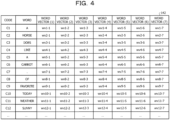
- FIG. 4 is a diagram illustrating an example of a data structure of the word vector dictionary.
- the word vector dictionary 142 includes a code, a word, and word vectors (1) to (7).
- the code is a code assigned to a word.
- the word is the word included in a character string.
- the word vectors (1) to (7) are vectors assigned to the word.
- a DB 143 has various texts.
- a text includes a plurality of sentences, and each sentence includes a plurality of words.
- the DB 143 may have the texts included in the teaching data 141.
- a sentence transposition index 144 associates a sentence vector with a position pointer.
- the position pointer indicates a position in the DB 143 where a sentence corresponding to the sentence vector is present.
- the control unit 150 includes a pre-processing unit 151, a learning unit 152, and an analysis unit 153.
- the control unit 150 is implemented by a central processing unit (CPU) or a micro processing unit (MPU).
- the control unit 150 may also be executed by, for example, an integrated circuit such as an application-specific integrated circuit (ASIC) or a field-programmable gate array (FPGA).
- ASIC application-specific integrated circuit
- FPGA field-programmable gate array
- the pre-processing unit 151 executes various types of pre-processing. For example, the pre-processing unit 151 acquires a sentence from the DB 143 in an unprocessed manner, and calculates a sentence vector of the sentence. The pre-processing unit 151 sets a relationship between the calculated sentence vector and the position pointer of the sentence corresponding to the sentence vector in the sentence transposition index 144.
- FIGs. 5A and 5B are diagrams for describing the processing of calculating the sentence vector.
- the pre-processing unit 151 decomposes the sentence "A horse does like a carrot.” into a plurality of words by executing morphological analysis. " ⁇ (space)” is given to each of the decomposed words. For example, Sentence 1 "A horse does like a carrot.” is divided into "A ⁇ ", “horse ⁇ ”, “does ⁇ ”, “like ⁇ ”, “a ⁇ ”, “carrot ⁇ ”, and ". ⁇ ".
- the pre-processing unit 151 specifies codes corresponding to the respective words and replaces the words with the respective codes, by comparing the individual divided words with the word vector dictionary 45. For example, the individual words “A ⁇ ”, “horse ⁇ ”, “does ⁇ ”, “like ⁇ ”, “a ⁇ ”, “carrot ⁇ ”, and . ⁇ ” are replaced with “C1”, “C2”, “C3”, “C4", “C5", “C6”, and “C7", respectively.
- the pre-processing unit 151 specifies the word vectors (1) to (7) assigned to the codes based on the word vector dictionary 45 and the individual codes.
- the word vectors (1) to (7) of the code "C1" are wv1-1 to wv1-7.
- the word vectors (1) to (7) of the code "C2" are wv2-1 to wv2-7.
- the word vectors (1) to (7) of the code "C3” are wv3-1 to wv3-7.
- the word vectors (1) to (7) of the code "C4" are wv4-1 to wv4-7.
- the word vectors (1) to (7) of the code "C5" are wv5-1 to wv5-7.
- the word vectors (1) to (7) of the code “C6” are wv6-1 to wv6-7.
- the word vectors (1) to (7) of the code "C7” are wv7-1 to wv7-7.
- the pre-processing unit 151 calculates the sentence vector SV1 of the sentence by integrating the word vectors for each element. For example, the pre-processing unit 151 calculates a first component "SV1-1" of the sentence vector SV1 by integrating wv1-1 to wv7-1 serving as the respective word vectors (1). The pre-processing unit 151 calculates a second component "SV1-2" of the sentence vector SV1 by integrating wv1-2 to wv7-2 serving as the respective word vectors (2). The pre-processing unit calculates a third component "SV1-3" of the sentence vector SV1 by integrating wv1-3 to wv7-3 serving as the respective word vectors (3).
- the pre-processing unit 151 calculates a fourth component "SV1-4" of the sentence vector SV1 by integrating wv1-4 to wv7-4 serving as the respective word vectors (4).
- the pre-processing unit 151 calculates a fifth component "SV1-5" of the sentence vector SV1 by integrating wv1-5 to wv7-5 serving as the respective word vectors (5).
- the pre-processing unit 151 calculates a sixth component "SV1-6" of the sentence vector SV1 by integrating wv1-6 to wv7-6 serving as the respective word vectors (6).
- the pre-processing unit 151 calculates a seventh component "SV1-7" of the sentence vector SV1 by integrating wv1-7 to wv7-7 serving as the respective word vectors (7).
- the above-described processing is repeatedly executed on individual sentences of the other texts included in the DB 143, and thus, the pre-processing unit 151 calculates sentence vectors of the respective sentences.
- the pre-processing unit 151 generates the sentence transposition index 144 by associating the calculated sentence vectors of the respective sentences with the position pointers of the DB 143. Note that the pre-processing unit 151 may generate the sentence transposition index 144 having a data structure illustrated in FIG. 6.
- FIG. 6 is a diagram for describing processing of generating the sentence transposition index. As illustrated in FIG. 6 , the pre-processing unit 151 may associate the sentence vectors, a plurality of record pointers, and a plurality of position pointers with each other, and may associate the individual record pointers and the position pointers with the respective sentences of the DB 143.
- the learning unit 152 By executing the processing in the learning phase described in FIG. 1 , the learning unit 152 generates the machine learning model 50 that predicts the sentence vector of the second sentence next to the certain first sentence in a case where the sentence vector of the first sentence is input.
- the learning unit 152 executes the learning of the machine learning model 50 by calculating the sentence vectors of the respective sentences included in the text of the teaching data 141 and sequentially inputting the calculated sentence vectors to the machine learning model 50.
- Other processing of the learning unit 152 is similar to the processing described in FIG. 1 .
- Processing of, by the learning unit 152, calculating the sentence vectors of the sentences is similar to the processing of, by the pre-processing unit 151, calculating the sentence vectors of the sentences.
- the analysis unit 153 By executing the processing in the analysis phase described in FIG. 2 , the analysis unit 153 detects a sentence having an inappropriate sentence vector from the sentences included in the text to be processed.
- the analysis unit 153 calculates the sentence vectors of the sentences included in the text 20.
- the analysis unit 153 specifies the sentences included in the text 20 based on periods ".” included in the text 20. Processing of, by the analysis unit 153, calculating the sentence vectors of the sentences is similar to the processing of, by the pre-processing unit 151, calculating the sentence vectors of the sentences.
- the analysis unit 153 predicts a sentence vector SVn+1' of an (n+1)-th sentence from the first sentence of the text 20 by inputting the sentence vector SVn to the trained machine learning model 50.
- the analysis unit 153 calculates a cosine similarity between the sentence vector SVn+1' predicted by using the machine learning model 50 and a vector SVn+1 of the sentence.
- the analysis unit 153 determines that the (n+1)-th sentence from the first sentence is an appropriate sentence.
- the analysis unit 153 determines that the (n+1)-th sentence from the first sentence is a sentence having an inappropriate sentence vector.
- the analysis unit 153 compares the sentence vector SVn+1' with the sentence transposition index 144, and specifies the position pointer of the sentence corresponding to the sentence vector SVn+1'.
- the analysis unit 153 searches for the sentence corresponding to the sentence vector SVn+1' from the DB 143 based on the position pointer.
- the analysis unit 153 displays, on the display unit 130, the sentence having the inappropriate sentence vector and the searched sentence in association with each other.
- the analysis unit 153 may compare the sentence having the inappropriate sentence vector with the searched sentence on a word-by-word basis, may detect a word with an input error from the sentence having the inappropriate sentence vector, and may display the detected word.
- FIG. 7 is a flowchart illustrating a processing procedure in the learning phase of the information processing apparatus according to the present embodiment.
- the learning unit 152 of the information processing apparatus 100 selects an unselected text from the teaching data 141 (step S101).
- the learning unit 152 calculates sentence vectors of respective sentences included in the selected text, and generates a sentence transposition index in which the sentence vectors, the records in the DB, and the positions of the sentences are associated with each other (step S102).
- the learning unit 152 executes learning by sequentially inputting the sentence vectors to the machine learning model 50 from the sentence vector of the first sentence included in the selected text (step S103).
- step S104 the learning unit 152 proceeds to step S101.
- step S104 the learning unit 152 ends the processing in the learning phase.
- FIG. 8 is a flowchart illustrating a processing procedure in the analysis phase of the information processing apparatus according to the present embodiment.
- the analysis unit 153 of the information processing apparatus 100 receives an input of a text to be processed (step S201).
- the analysis unit 153 calculates individual sentence vectors of respective sentences included in the input text (step S202).
- the analysis unit 153 sets n to an initial value (step S203).
- the analysis unit 153 predicts the sentence vector SVn+1' of the (n+1)-th sentence by inputting the sentence vector SVn of the n-th sentence among the plurality of sentences included in the text to the machine learning model 50 (step S204).
- the analysis unit 153 calculates the cosine similarity between the sentence vector SVn+1 of the (n+1)-th sentence and the predicted sentence vector SVn+1' of the sentence among the plurality of sentences included in the text (step S205).
- step S210 the analysis unit 153 proceeds to step S210.
- the analysis unit 153 detects the (n+1)-th sentence as the sentence having the inappropriate sentence vector (step S207).
- the analysis unit 153 detects the sentence corresponding to the sentence vector SVn+1' from the DB 143 based on the predicted sentence vector SVn+1' and the sentence transposition index 144 (step S208).
- the analysis unit 153 displays, on the display unit 130, the sentence having the inappropriate sentence vector and the sentence detected from the DB 143 (step S209).
- step S210 Processing in step S210 and subsequent steps will be described.
- the analysis unit 153 ends the processing.
- L is the number of sentences included in the text to be processed.
- the analysis unit 153 updates n by a value obtained by adding 1 to n (step S211), and proceeds to step S204.
- the information processing apparatus 100 generates the machine learning model 50 that predicts the sentence vector of the second sentence next to the certain first sentence in a case where the sentence vector of the first sentence is input by sequentially inputting the vectors of the respective sentences of the text included in the teaching data 141 to the machine learning model 50.
- the information processing apparatus 100 predicts the sentence vector of the next sentence by inputting the sentence vectors of the sentences of the text to be processed to the generated machine learning model 50, and detects the sentence having the inappropriate sentence vector from the text to be processed based on the predicted sentence vector.
- the word with the input error or the like may be corrected from the inappropriate sentence.
- the information processing apparatus 100 detects the sentence having the inappropriate sentence vector based on the cosine similarity between the sentence vector of the next sentence predicted by the machine learning model 50 and the sentence vector of the next sentence of the sentence included in the text to be processed, and corrects the input error or the like. Accordingly, calculation cost is suppressed, the sentence having the inappropriate sentence vector is detected, and thus, the input error or the like may be corrected.
- the information processing apparatus 100 sequentially inputs, to the machine learning model, the vectors of the plurality of sentences, the arrangement order of which is determined based on the inductive method or the deductive method, and trains the machine learning model. Accordingly, a next sentence of a target sentence may be predicted based on the inductive method or the deductive method.
- the information processing apparatus 100 searches for a corrected sentence based on the vector predicted by the machine learning model 50. Accordingly, the revised sentence may be notified.
- processing content of the information processing apparatus 100 described above is an example, and the information processing apparatus 100 may execute other processing.
- the other processing of the information processing apparatus 100 will be described below.
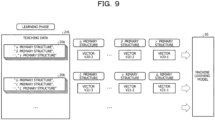
- FIGs. 9 and 10 are diagrams for describing the other processing of the information processing apparatus.
- the information processing apparatus 100 causes the machine learning model 50 to learn the order of sentence vectors based on the syllogism
- the information processing apparatus may cause the machine learning model to learn the order of vectors of a protein primary structure, which is a sequence of a protein and is constituted by a plurality of amino acid sequences corresponding to words, instead of the sentence vectors.
- a continuous amino acid sequence of a protein is referred to as a "basic structure”
- a protein primary structure is referred to as a "primary structure”.
- FIG. 9 is described.
- the information processing apparatus 100 executes learning of the machine learning model 50 by using sequences 20a and 20b of a plurality of proteins included in teaching data 241.
- sequence 20a includes primary structures “ ⁇ primary structure”, “ ⁇ primary structure”, ⁇ , and “ ⁇ primary structure”.
- sequence 20b includes primary structures “ ⁇ primary structure”, “ ⁇ primary structure”, ⁇ , and " ⁇ primary structure”.
- the information processing apparatus 100 specifies vectors of respective primary structures by using a vector dictionary of basic structures of proteins in which basic structures and vectors are associated with each other.
- a vector of the primary structure " ⁇ primary structure” constituted by a plurality of basic structures is "V20-1”
- a vector of the primary structure " ⁇ primary structure” is “V20-2”
- a vector of the primary structure " ⁇ primary structure” is "V20-3”.
- a vector of the primary structure " ⁇ primary structure” is "V21-1”
- a vector of the primary structure " ⁇ primary structure” is "V21-2”
- a vector of the primary structure " ⁇ primary structure” is "V21-3”.
- the vector of each primary structure is calculated based on the vectors of the respective basic structures of the plurality of basic structures constituting that primary structure.
- the information processing apparatus 100 repeatedly executes processing of inputting the vectors to the machine learning model 50 in order from a vector of a first primary structure included in the sequence of the protein. For example, the information processing apparatus inputs the vectors to the machine learning model 50 in the order of the vectors "V20-1", “V20-2", ⁇ , and “V20-3". The information processing apparatus inputs the vectors to the machine learning model 50 in the order of the vectors "V21-1", “V21-2", ⁇ , and "V21-3".
- the machine learning model 50 that predicts a vector of a primary structure next to a certain primary structure in a case where a vector of the primary structure is input is generated.
- FIG. 10 is described.
- a sequence of a protein to be processed is a sequence 25.
- Primary structures " ⁇ primary structure”, “ ⁇ primary structure”, ⁇ , and “ ⁇ primary structure” are included in the sequence 25 in order from a first primary structure.
- the information processing apparatus 100 predicts a vector of a primary structure next to the primary structure " ⁇ primary structure” by calculating the vector "V20-1" of the primary structure “ ⁇ primary structure” and inputting the calculated vector "V20-1” to the machine learning model 50.
- "V20-2" is predicted by the machine learning model 50, as the vector of the primary structure next to the primary structure " ⁇ primary structure”.
- the information processing apparatus 100 calculates a vector "V22" of the " ⁇ primary structure", which is a primary structure included in the sequence 25 and is next to the primary structure " ⁇ primary structure”.
- the information processing apparatus 100 calculates a cosine similarity between the vector "V20-2" of the next primary structure predicted by the machine learning model 50 and the vector "V22" of the " ⁇ primary structure” next to the basic structure " ⁇ primary structure", which is the primary structure included in the sequence 25.
- the information processing apparatus determines that the " ⁇ primary structure”, which is the primary structure included in the sequence 25 and is next to the primary structure " ⁇ primary structure”, is a correct primary structure.
- the information processing apparatus determines that the " ⁇ primary structure”, which is the primary structure included in the sequence 25 and is next to the primary structure " ⁇ primary structure”, is an inappropriate primary structure, and corrects a mutation or the like of the basic structure included in the primary structure " ⁇ primary structure”.
- a primary structure having an inappropriate primary structure vector may be detected from the plurality of primary structures included in the sequence of the protein, and a basic structure having a mutation or the like may be corrected. Accordingly, a protein primary structure having a mutation or the like (SNPs is a representative example) occurring in a receptor constituted by a plurality of protein primary structures may be detected. Further, by performing machine learning on a large number of protein primary structures constituting the receptor and a single or a plurality of protein primary structures bound to the receptor in order of binding, a vector of a protein primary structure of a ligand bound to the receptor may be predicted. Accordingly, improvement of a ligand having a vector of a new protein primary structure, which is similar to a ligand already commercialized as a biopharmaceutical, has an excellent medicinal effect, and in which side reactions are suppressed may be supported.
- SNPs is a representative example
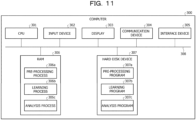
- FIG. 11 is a diagram illustrating an example of the hardware configuration of the computer that implements the functions similar to the functions of the information processing apparatus according to the embodiment.
- a computer 300 includes a CPU 301 that executes various types of arithmetic processing, an input device 302 that receives input of data from a user, and a display 303.
- the computer 300 also includes a communication device 304 that exchanges data with an external apparatus or the like via a wired or wireless network, and an interface device 305.
- the computer 300 also includes a RAM 306 that temporarily stores various types of information and a hard disk device 307. Each of the individual devices 301 to 307 is coupled to a bus 308.
- the hard disk device 307 includes a pre-processing program 307a, a learning program 307b, and an analysis program 307c.
- the CPU 301 reads the individual programs 307a to 307c and loads the programs into the RAM 306.
- the pre-processing program 307a functions as a pre-processing process 306a.
- the learning program 307b functions as a learning process 306b.
- the analysis program 307c functions as an analysis process 306c.
- Processing of the pre-processing process 306a corresponds to the processing of the pre-processing unit 151.
- Processing of the learning process 306b corresponds to the processing of the learning unit 152.
- Processing of the analysis process 306c corresponds to processing of the analysis unit 153.
- each of the programs 307a to 307c may not be stored in the hard disk device 307 from the beginning.
- each program may be stored in a "portable physical medium" such as a flexible disk (FD), a CD-ROM, a DVD, a magneto-optical disk, an IC card, or the like inserted in the computer 300.
- the computer 300 may read and execute each of the programs 307a to 307c.
Landscapes
- Engineering & Computer Science (AREA)
- Theoretical Computer Science (AREA)
- Physics & Mathematics (AREA)
- Artificial Intelligence (AREA)
- General Engineering & Computer Science (AREA)
- General Physics & Mathematics (AREA)
- Health & Medical Sciences (AREA)
- Computational Linguistics (AREA)
- General Health & Medical Sciences (AREA)
- Audiology, Speech & Language Pathology (AREA)
- Software Systems (AREA)
- Mathematical Physics (AREA)
- Data Mining & Analysis (AREA)
- Evolutionary Computation (AREA)
- Computing Systems (AREA)
- Computer Vision & Pattern Recognition (AREA)
- Medical Informatics (AREA)
- Probability & Statistics with Applications (AREA)
- Biophysics (AREA)
- Molecular Biology (AREA)
- Biomedical Technology (AREA)
- Life Sciences & Earth Sciences (AREA)
- Machine Translation (AREA)
- Information Retrieval, Db Structures And Fs Structures Therefor (AREA)
Abstract
Description
- The present invention relates to an information processing program, and the like.
- In recent years, services for calculating vectors of sentences and executing various types of processing such as translation into another language and database search by using the calculated vectors are provided. However, when there is an input error or the like in a sentence itself designated by a user, the vectors of the sentences may not be accurately calculated, and an error may occur in processing such as translation and search.
- For example, an appropriate sentence "the function is a feature" and an input error sentence "the yesterday is a feature" are sentences having significantly different meanings from each other, and vectors of the sentences are also significantly different from each other.
- As a related art for revising an input error of a sentence, there is a related art in which an input error of a target sentence is revised by training a learning model by using a data set of pairs of an input error and a corresponding revised sentence from a revision history and inputting the target sentence to the trained learning model.
- PTL 1:
Japanese Laid-open Patent Publication No. 2019-101993 -
- NPL 1: Kazuhiro Miki et al., "Answering English Fill-in-the-blank Questions Using BERT", Department of Information Technology Faculty of Engineering, Okayama University, DEIM2020 G2-4 (day1 p47)
- NPL 2: Tanaka Yu et al., "'Building Japanese Input Error Dataset Using Wikipedias Revision History", Department of Intelligence Science and Technology, Kyoto University Graduate School, The Association for Natural Language Processing, 26-th Annual Meeting, Journal, March 2020.
- In the related art described above, there is a technology of filling a blank in which a word or the like of a part of a text is masked, and this technology has high accuracy of a word for filling a blank in a sentence constituted by a plurality of words. However, there are few technologies of increasing the accuracy of a sentence for filling a blank in a text constituted by a plurality of sentences, and there is no technology of detecting a sentence having an input error. In addition, in the related art, an input error such as a typographical error or an omission may be revised, but an input error due to incorrect conversion may not be revised in many cases.
- In one aspect, an object of the present invention is to provide a an information processing program, an information processing method, and an information processing apparatus that are capable of estimating a sentence to be filled in a blank in a text constituted by a plurality of sentences and detecting a sentence having an input error.
- In a first aspect, a computer is caused to execute the following processing. The computer calculates individual vectors of a plurality of continuous sentences that have a relationship with preceding and following sentences. The computer generates a machine learning model that predicts a sentence vector of a sentence input next to a certain sentence when a vector of the certain sentence is input to the machine learning model, by sequentially inputting the vectors of the plurality of sentences to the machine learning model and training the machine learning model. The computer calculates a vector of a first sentence and a vector of a second sentence next to the first sentence. The computer calculates a vector of a sentence predicted to be next to the first sentence by inputting the vector of the first sentence to the machine learning model, and determines whether or not the vector of the second sentence is appropriate.
- The sentence for filling the blank in the text constituted by the plurality of sentences may be estimated, and the sentence having the input error may be detected.
-
- [
FIG. 1] FIG. 1 is a diagram for describing processing in a learning phase of an information processing apparatus according to the present embodiment. - [
FIG. 2] FIG. 2 is a diagram for describing processing in an analysis phase of the information processing apparatus according to the present embodiment. - [
FIG. 3] FIG. 3 is a functional block diagram illustrating a configuration of the information processing apparatus according to the present embodiment. - [
FIG. 4] FIG. 4 is a diagram illustrating an example of a data structure of a word vector dictionary. - [
FIG. 5A] FIG. 5A is a diagram (1) for describing processing of calculating a sentence vector. - [
FIG. 5B] FIG. 5B is a diagram (2) for describing the processing of calculating the sentence vector. - [
FIG. 6] FIG. 6 is a diagram for describing processing of generating a sentence transposition index. - [
FIG. 7] FIG. 7 is a flowchart illustrating a processing procedure in the learning phase of the information processing apparatus according to the present embodiment. - [
FIG. 8] FIG. 8 is a flowchart illustrating a processing procedure in the analysis phase of the information processing apparatus according to the present embodiment. - [
FIG. 9] FIG. 9 is a diagram (1) for describing other processing of the information processing apparatus. - [
FIG. 10] FIG. 10 is a diagram (2) for describing other processing of the information processing apparatus. - [
FIG. 11] FIG. 11 is a diagram illustrating an example of a hardware configuration of a computer that implements functions similar to functions of the information processing apparatus according to the embodiment. - Hereinafter, embodiments of an information processing program, an information processing method, and an information processing apparatus disclosed in the present application will be described in detail with reference to the drawings. Note that this invention is not limited by the embodiments.
- Processing of the information processing apparatus according to the present embodiment will be described. After processing in a learning phase is executed, the information processing apparatus executes processing in an analysis phase.
FIG. 1 is a diagram for describing the processing in the learning phase of the information processing apparatus according to the present embodiment. - In the learning phase, the information processing apparatus executes learning of a machine learning model 50 (trains the machine learning model 50) by using a plurality of texts included in
teaching data 141. Themachine learning model 50 is a neural network (NN) such as pre-training of Deep Bidirectional Transformers for Language Understanding (BERT), Next Sentence Prediction, and Transformers. - The text included in the
teaching data 141 include a plurality of sentences. The plurality of sentences has a predetermined relationship with preceding and following sentences. Each sentence is a sentence set in advance based on a syllogism of an inductive method or a deductive method, or the like. - For example, in a text 10a, a sentence "Birds lay eggs.", a sentence "Penguins are birds.", ···, and a sentence "Therefore, penguins lay eggs." in order from a first sentence. In a
text 10b, a sentence "Birds are born from eggs.", a sentence "Pigeons are members of birds.", ···, and a sentence "Therefore, pigeons are born from eggs." in order from a first sentence. - The information processing apparatus calculates sentence vectors of respective sentences included in the
texts 10a and 10b and other texts. For example, the information processing apparatus calculates a sentence vector by executing morphological analysis on a sentence to divide the sentence into words and integrating the vectors of the respective words. - A sentence vector of the sentence "Birds lay eggs." of the text 10a is "SV1-1". A sentence vector of the sentence "Penguins are birds" is "SV1-2". A sentence vector of the sentence "Therefore, penguins lay eggs." is "SV1-3".
- A sentence vector of the sentence "Birds are born from eggs." of the
text 10b is "SV2-1". A sentence vector of the sentence "Pigeons are members of birds." is "SV2-2". A sentence vector of the sentence "Therefore, pigeons lay eggs." is "SV2-3". - The information processing apparatus repeatedly executes processing of inputting vectors to the
machine learning model 50 in order from the vector of the first sentence included in the text. For example, the information processing apparatus inputs the sentence vectors to themachine learning model 50 in the order of the sentence vectors "SV1-1", "SV1-2", ···, and "SV1-3". The information processing apparatus inputs the sentence vectors to themachine learning model 50 in the order of the sentence vectors "SV2-1", "SV2-2", ···, and "SV2-3". - By the information processing apparatus executing the processing in the learning phase described above, the
machine learning model 50 that predicts a sentence vector of a second sentence next to a certain first sentence in a case where a sentence vector of the first sentence is input is generated. -
FIG. 2 is a diagram for describing the processing in the analysis phase of the information processing apparatus according to the present embodiment. In the analysis phase, the information processing apparatus calculates a sentence vector included in a text to be processed by using the trainedmachine learning model 50, and detects an inappropriate sentence based on a cosine similarity or the like. - In the description of
FIG. 2 , a text to be processed including an input error or the like is referred to as atext 20. Thetext 20 includes a sentence "Birds lay eggs.", a sentence "Penguins are photographed.", ···, and a sentence "Therefore, penguins lay eggs." in order from a first sentence. The sentence "Penguins are photographed." is a sentence including an input error of "photographed" which is a homonym of a word "birds" for a correct sentence "Penguins are birds." included in the text 10a of theteaching data 141. - The information processing apparatus predicts a sentence vector of a next sentence of the sentence "Birds lay eggs." by calculating the sentence vector "SV1-1" of the sentence "Birds lay eggs." and inputting the calculated sentence vector "SV1-1" to the
machine learning model 50. In the example illustrated inFIG. 2 , "SV1-2" is predicted as the sentence vector of the next sentence of the sentence "Birds lay eggs." by themachine learning model 50. - The information processing apparatus calculates a sentence vector "SV3" of "Penguins are photographed", which is the sentence included in the
text 20 and is next to the sentence "Birds lay eggs.". - The information processing apparatus calculates a cosine similarity between the sentence vector "SV1-2" of the next sentence predicted by the
machine learning model 50 and the sentence vector "SV3" of the sentence "Penguins are photographed", which is included in thetext 20 and is next to the sentence "Birds lay eggs.". - The information processing apparatus determines that the sentence "Penguins are birds.", which is included in the text 10a and is next to the sentence "Birds lay eggs", is a correct (hereinafter, referred to as appropriate) sentence as a case where the cosine similarity is less than a threshold value. On the other hand, the information processing apparatus determines that the "Penguins are photographed.", which is included in the
text 20 and is next to the sentence "Birds lay eggs.", is an inappropriate sentence including an input error or the like as a case where the cosine similarity is less than the threshold value. - As described above, the vectors of the respective sentences of the text included in the
teaching data 141 are sequentially input to themachine learning model 50, and thus, the information processing apparatus generates themachine learning model 50 that predicts the sentence vector of the second sentence next to the certain first sentence in a case where the sentence vector of the first sentence is input. The information processing apparatus inputs a sentence vector of a sentence of a text to be processed to the generated machine learning model, predicts a sentence vector of a next sentence, and detects a sentence including an input error from the text to be processed based on the predicted sentence vector. That is, a sentence including an input error or the like and having an inappropriate sentence vector may be detected from the sentences included in the text to be processed. - Note that in the processing of
FIG. 2 , in a case where it is determined that the sentence "Penguins are photographed" is a sentence having an inappropriate sentence vector, the information processing apparatus may search for the sentence "Penguins are birds." having an appropriate sentence vector from a database (DB) or the like based on the sentence vector SV1-2 predicted by themachine learning model 50, and may output (hereinafter, referred to as "correct"), as a correct revision candidate, the sentence having the appropriate sentence vector to a display device. - By using another machine learning model that has learned the order of vectors on a word-by-word basis, the information processing apparatus may calculate respective word vectors of a plurality of words "Penguins", "are", and "photographed." constituting the sentence "Penguins are photographed" from which the inappropriate sentence vector is detected, and may correct an input error or the like of the deviating word "photographed.".
- Next, a configuration example of the information processing apparatus that executes the processing described in
FIGs. 1 and2 will be described.FIG. 3 is a functional block diagram illustrating a configuration of the information processing apparatus according to the present embodiment. As illustrated inFIG. 3 , aninformation processing apparatus 100 includes acommunication unit 110, aninput unit 120, adisplay unit 130, astorage unit 140, and acontrol unit 150. - The
communication unit 110 is coupled to an external apparatus or the like in a wired or wireless manner, and transmits and receives information to and from the external apparatus or the like. Thecommunication unit 110 is implemented by, for example, a network interface card (NIC) or the like. Thecommunication unit 110 may be coupled to a network (not illustrated). - The
input unit 120 is an input device that inputs various types of information to theinformation processing apparatus 100. Theinput unit 120 corresponds to a keyboard, a mouse, a touch panel, or the like. For example, a user may input data of a text or the like by operating theinput unit 120. - The
display unit 130 is a display device that displays information output from thecontrol unit 150. Thedisplay unit 130 corresponds to a liquid crystal display, an organic electroluminescence (EL) display, a touch panel, or the like. For example, a sentence having an input error is displayed on thedisplay unit 130. - The
storage unit 140 includes themachine learning model 50, theteaching data 141, and aword vector dictionary 142. For example, thestorage unit 140 is implemented by a semiconductor memory device such as a random-access memory (RAM) or a flash memory, or a storage device such as a hard disk or an optical disk. - The
machine learning model 50 is an NN or the like such as BERT, Next Sentence Prediction, or Transformers described inFIG. 1 . - The
teaching data 141 is theteaching data 141 described inFIG. 1 . The text included in theteaching data 141 include a plurality of sentences. The plurality of sentences have a predetermined relationship with preceding and following sentences. Each sentence is a sentence set in advance based on a syllogism of an inductive method or a deductive method, or the like. - The
word vector dictionary 142 is a table that defines codes and word vectors assigned to words.FIG. 4 is a diagram illustrating an example of a data structure of the word vector dictionary. As illustrated inFIG. 4 , theword vector dictionary 142 includes a code, a word, and word vectors (1) to (7). The code is a code assigned to a word. The word is the word included in a character string. The word vectors (1) to (7) are vectors assigned to the word. An N-th component of the word vector is denoted as a word vector (n) (n = 1 to 7). - A
DB 143 has various texts. A text includes a plurality of sentences, and each sentence includes a plurality of words. TheDB 143 may have the texts included in theteaching data 141. - A sentence transposition index 144 associates a sentence vector with a position pointer. The position pointer indicates a position in the
DB 143 where a sentence corresponding to the sentence vector is present. - The description returns to
FIG. 3 . Thecontrol unit 150 includes apre-processing unit 151, alearning unit 152, and ananalysis unit 153. For example, thecontrol unit 150 is implemented by a central processing unit (CPU) or a micro processing unit (MPU). In addition, thecontrol unit 150 may also be executed by, for example, an integrated circuit such as an application-specific integrated circuit (ASIC) or a field-programmable gate array (FPGA). - The
pre-processing unit 151 executes various types of pre-processing. For example, thepre-processing unit 151 acquires a sentence from theDB 143 in an unprocessed manner, and calculates a sentence vector of the sentence. Thepre-processing unit 151 sets a relationship between the calculated sentence vector and the position pointer of the sentence corresponding to the sentence vector in the sentence transposition index 144. - An example of processing of, by the
pre-processing unit 151, calculating the sentence vector of the sentence will be described.FIGs. 5A and5B are diagrams for describing the processing of calculating the sentence vector. Herein, a case where a sentence vector of a sentence "A horse does like a carrot." is calculated will be described. Thepre-processing unit 151 decomposes the sentence "A horse does like a carrot." into a plurality of words by executing morphological analysis. "△ (space)" is given to each of the decomposed words. For example,Sentence 1 "A horse does like a carrot." is divided into "A△", "horse△", "does△", "like△", "a△", "carrot△", and ".△". - The
pre-processing unit 151 specifies codes corresponding to the respective words and replaces the words with the respective codes, by comparing the individual divided words with the word vector dictionary 45. For example, the individual words "A△", "horse△", "does△", "like△", "a△", "carrot△", and .△" are replaced with "C1", "C2", "C3", "C4", "C5", "C6", and "C7", respectively. - Description proceeds to
FIG. 5B . Thepre-processing unit 151 specifies the word vectors (1) to (7) assigned to the codes based on the word vector dictionary 45 and the individual codes. For example, the word vectors (1) to (7) of the code "C1" are wv1-1 to wv1-7. The word vectors (1) to (7) of the code "C2" are wv2-1 to wv2-7. The word vectors (1) to (7) of the code "C3" are wv3-1 to wv3-7. - The word vectors (1) to (7) of the code "C4" are wv4-1 to wv4-7. The word vectors (1) to (7) of the code "C5" are wv5-1 to wv5-7. The word vectors (1) to (7) of the code "C6" are wv6-1 to wv6-7. The word vectors (1) to (7) of the code "C7" are wv7-1 to wv7-7.
- The
pre-processing unit 151 calculates the sentence vector SV1 of the sentence by integrating the word vectors for each element. For example, thepre-processing unit 151 calculates a first component "SV1-1" of the sentence vector SV1 by integrating wv1-1 to wv7-1 serving as the respective word vectors (1). Thepre-processing unit 151 calculates a second component "SV1-2" of the sentence vector SV1 by integrating wv1-2 to wv7-2 serving as the respective word vectors (2). The pre-processing unit calculates a third component "SV1-3" of the sentence vector SV1 by integrating wv1-3 to wv7-3 serving as the respective word vectors (3). - The
pre-processing unit 151 calculates a fourth component "SV1-4" of the sentence vector SV1 by integrating wv1-4 to wv7-4 serving as the respective word vectors (4). Thepre-processing unit 151 calculates a fifth component "SV1-5" of the sentence vector SV1 by integrating wv1-5 to wv7-5 serving as the respective word vectors (5). Thepre-processing unit 151 calculates a sixth component "SV1-6" of the sentence vector SV1 by integrating wv1-6 to wv7-6 serving as the respective word vectors (6). Thepre-processing unit 151 calculates a seventh component "SV1-7" of the sentence vector SV1 by integrating wv1-7 to wv7-7 serving as the respective word vectors (7). - The above-described processing is repeatedly executed on individual sentences of the other texts included in the
DB 143, and thus, thepre-processing unit 151 calculates sentence vectors of the respective sentences. - The
pre-processing unit 151 generates the sentence transposition index 144 by associating the calculated sentence vectors of the respective sentences with the position pointers of theDB 143. Note that thepre-processing unit 151 may generate the sentence transposition index 144 having a data structure illustrated inFIG. 6. FIG. 6 is a diagram for describing processing of generating the sentence transposition index. As illustrated inFIG. 6 , thepre-processing unit 151 may associate the sentence vectors, a plurality of record pointers, and a plurality of position pointers with each other, and may associate the individual record pointers and the position pointers with the respective sentences of theDB 143. - The description returns to
FIG. 3 . By executing the processing in the learning phase described inFIG. 1 , thelearning unit 152 generates themachine learning model 50 that predicts the sentence vector of the second sentence next to the certain first sentence in a case where the sentence vector of the first sentence is input. - For example, the
learning unit 152 executes the learning of themachine learning model 50 by calculating the sentence vectors of the respective sentences included in the text of theteaching data 141 and sequentially inputting the calculated sentence vectors to themachine learning model 50. Other processing of thelearning unit 152 is similar to the processing described inFIG. 1 . Processing of, by thelearning unit 152, calculating the sentence vectors of the sentences is similar to the processing of, by thepre-processing unit 151, calculating the sentence vectors of the sentences. - By executing the processing in the analysis phase described in
FIG. 2 , theanalysis unit 153 detects a sentence having an inappropriate sentence vector from the sentences included in the text to be processed. - For example, in a case where the
text 20 to be processed is received, theanalysis unit 153 calculates the sentence vectors of the sentences included in thetext 20. Theanalysis unit 153 specifies the sentences included in thetext 20 based on periods "." included in thetext 20. Processing of, by theanalysis unit 153, calculating the sentence vectors of the sentences is similar to the processing of, by thepre-processing unit 151, calculating the sentence vectors of the sentences. A sentence vector of an n-th sentence from the first sentence of thetext 20 is denoted by "SVn" (n = 0 to M). - The
analysis unit 153 predicts a sentence vector SVn+1' of an (n+1)-th sentence from the first sentence of thetext 20 by inputting the sentence vector SVn to the trainedmachine learning model 50. Theanalysis unit 153 calculates a cosine similarity between the sentence vector SVn+1' predicted by using themachine learning model 50 and a vector SVn+1 of the sentence. - In a case where the cosine similarity between the sentence vector SVn+1' and the sentence vector SVn+1 is greater than or equal to a threshold value, the
analysis unit 153 determines that the (n+1)-th sentence from the first sentence is an appropriate sentence. On the other hand, in a case where the cosine similarity between the sentence vector SVn+1' and the sentence vector SVn+1 is greater than or equal to the threshold value, theanalysis unit 153 determines that the (n+1)-th sentence from the first sentence is a sentence having an inappropriate sentence vector. - In a case where it is determined that the sentence is the sentence having the inappropriate sentence vector, the
analysis unit 153 compares the sentence vector SVn+1' with the sentence transposition index 144, and specifies the position pointer of the sentence corresponding to the sentence vector SVn+1'. Theanalysis unit 153 searches for the sentence corresponding to the sentence vector SVn+1' from theDB 143 based on the position pointer. Theanalysis unit 153 displays, on thedisplay unit 130, the sentence having the inappropriate sentence vector and the searched sentence in association with each other. - The
analysis unit 153 may compare the sentence having the inappropriate sentence vector with the searched sentence on a word-by-word basis, may detect a word with an input error from the sentence having the inappropriate sentence vector, and may display the detected word. - Next, an example of a processing procedure of the
information processing apparatus 100 according to the present embodiment will be described.FIG. 7 is a flowchart illustrating a processing procedure in the learning phase of the information processing apparatus according to the present embodiment. As illustrated inFIG. 7 , thelearning unit 152 of theinformation processing apparatus 100 selects an unselected text from the teaching data 141 (step S101). - The
learning unit 152 calculates sentence vectors of respective sentences included in the selected text, and generates a sentence transposition index in which the sentence vectors, the records in the DB, and the positions of the sentences are associated with each other (step S102). Thelearning unit 152 executes learning by sequentially inputting the sentence vectors to themachine learning model 50 from the sentence vector of the first sentence included in the selected text (step S103). - In a case where learning is continued (Yes in step S104), the
learning unit 152 proceeds to step S101. In a case where learning is not continued (No in step S104), thelearning unit 152 ends the processing in the learning phase. -
FIG. 8 is a flowchart illustrating a processing procedure in the analysis phase of the information processing apparatus according to the present embodiment. As illustrated inFIG. 8 , theanalysis unit 153 of theinformation processing apparatus 100 receives an input of a text to be processed (step S201). - The
analysis unit 153 calculates individual sentence vectors of respective sentences included in the input text (step S202). Theanalysis unit 153 sets n to an initial value (step S203). - The
analysis unit 153 predicts the sentence vector SVn+1' of the (n+1)-th sentence by inputting the sentence vector SVn of the n-th sentence among the plurality of sentences included in the text to the machine learning model 50 (step S204). - The
analysis unit 153 calculates the cosine similarity between the sentence vector SVn+1 of the (n+1)-th sentence and the predicted sentence vector SVn+1' of the sentence among the plurality of sentences included in the text (step S205). - In a case where the cosine similarity is greater than or equal to the threshold value (Yes in step S206), the
analysis unit 153 proceeds to step S210. - On the other hand, in a case where the cosine similarity is not greater than or equal to the threshold value (No in step S206), the
analysis unit 153 detects the (n+1)-th sentence as the sentence having the inappropriate sentence vector (step S207). Theanalysis unit 153 detects the sentence corresponding to the sentence vector SVn+1' from theDB 143 based on the predicted sentence vector SVn+1' and the sentence transposition index 144 (step S208). - The
analysis unit 153 displays, on thedisplay unit 130, the sentence having the inappropriate sentence vector and the sentence detected from the DB 143 (step S209). - Processing in step S210 and subsequent steps will be described. In a case where n is greater than or equal to L (Yes in step S210), the
analysis unit 153 ends the processing. L is the number of sentences included in the text to be processed. In a case where n is not greater than or equal to L (No in step S210), theanalysis unit 153 updates n by a value obtained by adding 1 to n (step S211), and proceeds to step S204. - Next, effects of the
information processing apparatus 100 according to the present embodiment are described. Theinformation processing apparatus 100 generates themachine learning model 50 that predicts the sentence vector of the second sentence next to the certain first sentence in a case where the sentence vector of the first sentence is input by sequentially inputting the vectors of the respective sentences of the text included in theteaching data 141 to themachine learning model 50. Theinformation processing apparatus 100 predicts the sentence vector of the next sentence by inputting the sentence vectors of the sentences of the text to be processed to the generatedmachine learning model 50, and detects the sentence having the inappropriate sentence vector from the text to be processed based on the predicted sentence vector. In addition, the word with the input error or the like may be corrected from the inappropriate sentence. - The
information processing apparatus 100 detects the sentence having the inappropriate sentence vector based on the cosine similarity between the sentence vector of the next sentence predicted by themachine learning model 50 and the sentence vector of the next sentence of the sentence included in the text to be processed, and corrects the input error or the like. Accordingly, calculation cost is suppressed, the sentence having the inappropriate sentence vector is detected, and thus, the input error or the like may be corrected. - The
information processing apparatus 100 sequentially inputs, to the machine learning model, the vectors of the plurality of sentences, the arrangement order of which is determined based on the inductive method or the deductive method, and trains the machine learning model. Accordingly, a next sentence of a target sentence may be predicted based on the inductive method or the deductive method. - In a case where it is determined that the sentence is a sentence to be revised, the
information processing apparatus 100 searches for a corrected sentence based on the vector predicted by themachine learning model 50. Accordingly, the revised sentence may be notified. - Note that the processing content of the
information processing apparatus 100 described above is an example, and theinformation processing apparatus 100 may execute other processing. The other processing of theinformation processing apparatus 100 will be described below. -
FIGs. 9 and10 are diagrams for describing the other processing of the information processing apparatus. Although the above-describedinformation processing apparatus 100 causes themachine learning model 50 to learn the order of sentence vectors based on the syllogism, the information processing apparatus may cause the machine learning model to learn the order of vectors of a protein primary structure, which is a sequence of a protein and is constituted by a plurality of amino acid sequences corresponding to words, instead of the sentence vectors. In the following description, a continuous amino acid sequence of a protein is referred to as a "basic structure", and a protein primary structure is referred to as a "primary structure". -
FIG. 9 is described. In the learning phase, theinformation processing apparatus 100 executes learning of themachine learning model 50 by usingsequences 20a and 20b of a plurality of proteins included inteaching data 241. - For example, the
sequence 20a includes primary structures "α primary structure", "β primary structure", ···, and "γ primary structure". The sequence 20b includes primary structures "Δ primary structure", "ε primary structure", ···, and "ζ primary structure". - The
information processing apparatus 100 specifies vectors of respective primary structures by using a vector dictionary of basic structures of proteins in which basic structures and vectors are associated with each other. For example, a vector of the primary structure "α primary structure" constituted by a plurality of basic structures is "V20-1", a vector of the primary structure "β primary structure" is "V20-2", and a vector of the primary structure "γ primary structure" is "V20-3". A vector of the primary structure "Δ primary structure" is "V21-1", a vector of the primary structure "ε primary structure" is "V21-2", and a vector of the primary structure "ζ primary structure" is "V21-3". The vector of each primary structure is calculated based on the vectors of the respective basic structures of the plurality of basic structures constituting that primary structure. - The
information processing apparatus 100 repeatedly executes processing of inputting the vectors to themachine learning model 50 in order from a vector of a first primary structure included in the sequence of the protein. For example, the information processing apparatus inputs the vectors to themachine learning model 50 in the order of the vectors "V20-1", "V20-2", ···, and "V20-3". The information processing apparatus inputs the vectors to themachine learning model 50 in the order of the vectors "V21-1", "V21-2", ···, and "V21-3". - By the
information processing apparatus 100 executing the processing in the learning phase described above, themachine learning model 50 that predicts a vector of a primary structure next to a certain primary structure in a case where a vector of the primary structure is input is generated. -
FIG. 10 is described. In the analysis phase, a sequence of a protein to be processed is asequence 25. Primary structures "α primary structure", "η primary structure", ···, and "γ primary structure" are included in thesequence 25 in order from a first primary structure. - The
information processing apparatus 100 predicts a vector of a primary structure next to the primary structure "α primary structure" by calculating the vector "V20-1" of the primary structure "α primary structure" and inputting the calculated vector "V20-1" to themachine learning model 50. In the example illustrated inFIG. 10 , "V20-2" is predicted by themachine learning model 50, as the vector of the primary structure next to the primary structure "α primary structure". - The
information processing apparatus 100 calculates a vector "V22" of the "η primary structure", which is a primary structure included in thesequence 25 and is next to the primary structure "α primary structure". - The
information processing apparatus 100 calculates a cosine similarity between the vector "V20-2" of the next primary structure predicted by themachine learning model 50 and the vector "V22" of the "η primary structure" next to the basic structure "α primary structure", which is the primary structure included in thesequence 25. - In a case where the cosine similarity is greater than or equal to a threshold value, the information processing apparatus determines that the "η primary structure", which is the primary structure included in the
sequence 25 and is next to the primary structure "α primary structure", is a correct primary structure. On the other hand, in a case where the cosine similarity is less than the threshold value, the information processing apparatus determines that the "η primary structure", which is the primary structure included in thesequence 25 and is next to the primary structure "α primary structure", is an inappropriate primary structure, and corrects a mutation or the like of the basic structure included in the primary structure "η primary structure". - By the
information processing apparatus 100 executing the processing illustrated inFIGs. 9 and10 , a primary structure having an inappropriate primary structure vector may be detected from the plurality of primary structures included in the sequence of the protein, and a basic structure having a mutation or the like may be corrected. Accordingly, a protein primary structure having a mutation or the like (SNPs is a representative example) occurring in a receptor constituted by a plurality of protein primary structures may be detected. Further, by performing machine learning on a large number of protein primary structures constituting the receptor and a single or a plurality of protein primary structures bound to the receptor in order of binding, a vector of a protein primary structure of a ligand bound to the receptor may be predicted. Accordingly, improvement of a ligand having a vector of a new protein primary structure, which is similar to a ligand already commercialized as a biopharmaceutical, has an excellent medicinal effect, and in which side reactions are suppressed may be supported. - Next, an example of a hardware configuration of a computer that implements functions similar to the functions of the
information processing apparatus 100 illustrated in the above embodiment will be described.FIG. 11 is a diagram illustrating an example of the hardware configuration of the computer that implements the functions similar to the functions of the information processing apparatus according to the embodiment. - As illustrated in
FIG. 11 , acomputer 300 includes aCPU 301 that executes various types of arithmetic processing, aninput device 302 that receives input of data from a user, and adisplay 303. Thecomputer 300 also includes acommunication device 304 that exchanges data with an external apparatus or the like via a wired or wireless network, and aninterface device 305. Thecomputer 300 also includes aRAM 306 that temporarily stores various types of information and ahard disk device 307. Each of theindividual devices 301 to 307 is coupled to abus 308. - The
hard disk device 307 includes apre-processing program 307a, alearning program 307b, and ananalysis program 307c. In addition, theCPU 301 reads theindividual programs 307a to 307c and loads the programs into theRAM 306. - The
pre-processing program 307a functions as apre-processing process 306a. Thelearning program 307b functions as alearning process 306b. Theanalysis program 307c functions as ananalysis process 306c. - Processing of the
pre-processing process 306a corresponds to the processing of thepre-processing unit 151. Processing of thelearning process 306b corresponds to the processing of thelearning unit 152. Processing of theanalysis process 306c corresponds to processing of theanalysis unit 153. - Note that each of the
programs 307a to 307c may not be stored in thehard disk device 307 from the beginning. For example, each program may be stored in a "portable physical medium" such as a flexible disk (FD), a CD-ROM, a DVD, a magneto-optical disk, an IC card, or the like inserted in thecomputer 300. Thecomputer 300 may read and execute each of theprograms 307a to 307c. Reference Signs List
Claims (12)
- An information processing program causing a computer to execute a process comprising:calculating individual vectors of a plurality of continuous sentences that have a relationship with preceding and following sentences;generating a machine learning model that predicts a sentence vector of a sentence input next to a certain sentence when a vector of the certain sentence is input to the machine learning model, by sequentially inputting the vectors of the plurality of sentences to the machine learning model and training the machine learning model;calculating a vector of a first sentence and a vector of a second sentence next to the first sentence; andcalculating a vector of a sentence predicted to be next to the first sentence by inputting the vector of the first sentence to the machine learning model, and determining whether or not the vector of the second sentence is appropriate.
- The information processing program according to claim 1, wherein the determining is determining whether or not the vector of the second sentence is appropriate based on a cosine similarity between the vector predicted by inputting the vector of the first sentence to the machine learning model and the vector of the second sentence.
- The information processing program according to claim 2, wherein the plurality of continuous sentences are a plurality of sentences of which an arrangement order is determined based on an inductive method or a deductive method, and the generating of the machine learning model is sequentially inputting the vectors of the plurality of sentences of which the arrangement order is determined based on the inductive method or the deductive method to the machine learning model and training the machine learning model.
- The information processing program according to claim 1, wherein the computer is caused to further execute a process of calculating the vector of the sentence predicted to be next to the first sentence by inputting the vector of the first sentence to the machine learning model, and recommending an appropriate sentence based on the calculated vector of the sentence predicted to be next to the first sentence in order to search for a sentence similar to the calculated vector and present the searched sentence as a candidate for the appropriate sentence, in a case where it is determined that the vector of the second sentence is inappropriate.
- An information processing method implemented by a computer, the information processing method comprising:calculating individual vectors of a plurality of continuous sentences that have a relationship with preceding and following sentences;generating a machine learning model that predicts a sentence vector of a sentence input next to a certain sentence when a vector of the certain sentence is input to the machine learning model, by sequentially inputting the vectors of the plurality of sentences to the machine learning model and training the machine learning model;calculating a vector of a first sentence and a vector of a second sentence next to the first sentence; andcalculating a vector of a sentence predicted to be next to the first sentence by inputting the vector of the first sentence to the machine learning model, and determining whether or not the vector of the second sentence is appropriate.
- The information processing method according to claim 5, wherein the determining is determining whether or not the vector of the second sentence is appropriate based on a cosine similarity between the vector predicted by inputting the vector of the first sentence to the machine learning model and the vector of the second sentence.
- The information processing method according to claim 6, wherein the plurality of continuous sentences are a plurality of sentences of which an arrangement order is determined based on an inductive method or a deductive method, and the generating of the machine learning model is sequentially inputting the vectors of the plurality of sentences of which the arrangement order is determined based on the inductive method or the deductive method to the machine learning model and training the machine learning model.
- The information processing method according to claim 5, wherein the computer is caused to further execute a process of calculating the vector of the sentence predicted to be next to the first sentence by inputting the vector of the first sentence to the machine learning model, and recommending an appropriate sentence based on the calculated vector of the sentence predicted to be next to the first sentence in order to search for a sentence similar to the calculated vector and present the searched sentence as a candidate for the appropriate sentence, in a case where it is determined that the vector of the second sentence is inappropriate.
- An information processing apparatus comprising:
a control unit configured to execute a process including:calculating individual vectors of a plurality of continuous sentences that have a relationship with preceding and following sentences;generating a machine learning model that predicts a sentence vector of a sentence input next to a certain sentence when a vector of the certain sentence is input to the machine learning model, by sequentially inputting the vectors of the plurality of sentences to the machine learning model and training the machine learning model;calculating a vector of a first sentence and a vector of a second sentence next to the first sentence; andcalculating a vector of a sentence predicted to be next to the first sentence by inputting the vector of the first sentence to the machine learning model, and determining whether or not the vector of the second sentence is appropriate. - The information processing apparatus according to claim 9, wherein the determining is determining whether or not the vector of the second sentence is appropriate based on a cosine similarity between the vector predicted by inputting the vector of the first sentence to the machine learning model and the vector of the second sentence.
- The information processing apparatus according to claim 10, wherein the plurality of continuous sentences are a plurality of sentences of which an arrangement order is determined based on an inductive method or a deductive method, and the generating of the machine learning model is sequentially inputting the vectors of the plurality of sentences of which the arrangement order is determined based on the inductive method or the deductive method to the machine learning model and training the machine learning model.
- The information processing apparatus according to claim 9, wherein the computer is caused to further execute a process of calculating the vector of the sentence predicted to be next to the first sentence by inputting the vector of the first sentence to the machine learning model, and recommending an appropriate sentence based on the calculated vector of the sentence predicted to be next to the first sentence in order to search for a sentence similar to the calculated vector and present the searched sentence as a candidate for the appropriate sentence, in a case where it is determined that the vector of the second sentence is inappropriate.
Applications Claiming Priority (1)
| Application Number | Priority Date | Filing Date | Title |
|---|---|---|---|
| PCT/JP2022/022525 WO2023233633A1 (en) | 2022-06-02 | 2022-06-02 | Information processing program, information processing method, and information processing device |
Publications (2)
| Publication Number | Publication Date |
|---|---|
| EP4535224A1 true EP4535224A1 (en) | 2025-04-09 |
| EP4535224A4 EP4535224A4 (en) | 2025-07-23 |
Family
ID=89026185
Family Applications (1)
| Application Number | Title | Priority Date | Filing Date |
|---|---|---|---|
| EP22944914.5A Pending EP4535224A4 (en) | 2022-06-02 | 2022-06-02 | INFORMATION PROCESSING PROGRAM, INFORMATION PROCESSING METHOD AND INFORMATION PROCESSING DEVICE |
Country Status (6)
| Country | Link |
|---|---|
| US (1) | US20250086387A1 (en) |
| EP (1) | EP4535224A4 (en) |
| JP (1) | JP7806894B2 (en) |
| CN (1) | CN119301599A (en) |
| AU (1) | AU2022461080A1 (en) |
| WO (1) | WO2023233633A1 (en) |
Family Cites Families (8)
| Publication number | Priority date | Publication date | Assignee | Title |
|---|---|---|---|---|
| JP6979294B2 (en) | 2017-07-06 | 2021-12-08 | 株式会社朝日新聞社 | Calibration support device, calibration support method and calibration support program |
| JP7024364B2 (en) * | 2017-12-07 | 2022-02-24 | 富士通株式会社 | Specific program, specific method and information processing device |
| KR102329738B1 (en) * | 2019-10-30 | 2021-11-19 | 연세대학교 산학협력단 | Method and Apparatus for Reconstructing Sentence Order through Topic-Guided Coherence Modeling |
| JP7377524B2 (en) | 2019-12-06 | 2023-11-10 | アイビーリサーチ株式会社 | Input support device, input support system and program |
| WO2021124490A1 (en) | 2019-12-18 | 2021-06-24 | 富士通株式会社 | Information processing program, information processing method, and information processing device |
| CN111428470B (en) * | 2020-03-23 | 2022-04-22 | 北京世纪好未来教育科技有限公司 | Text continuity judgment method, text continuity judgment model training method, electronic device and readable medium |
| CN111539199B (en) | 2020-04-17 | 2023-08-18 | 中移(杭州)信息技术有限公司 | Text error correction method, device, terminal, and storage medium |
| CN112256840A (en) * | 2020-11-12 | 2021-01-22 | 北京亚鸿世纪科技发展有限公司 | A device for improving the transfer learning model for industrial Internet discovery and information extraction |
-
2022
- 2022-06-02 WO PCT/JP2022/022525 patent/WO2023233633A1/en not_active Ceased
- 2022-06-02 CN CN202280096573.1A patent/CN119301599A/en active Pending
- 2022-06-02 EP EP22944914.5A patent/EP4535224A4/en active Pending
- 2022-06-02 AU AU2022461080A patent/AU2022461080A1/en active Pending
- 2022-06-02 JP JP2024524117A patent/JP7806894B2/en active Active
-
2024
- 2024-11-22 US US18/957,134 patent/US20250086387A1/en active Pending
Also Published As
| Publication number | Publication date |
|---|---|
| US20250086387A1 (en) | 2025-03-13 |
| CN119301599A (en) | 2025-01-10 |
| JP7806894B2 (en) | 2026-01-27 |
| JPWO2023233633A1 (en) | 2023-12-07 |
| EP4535224A4 (en) | 2025-07-23 |
| AU2022461080A1 (en) | 2024-11-28 |
| WO2023233633A1 (en) | 2023-12-07 |
Similar Documents
| Publication | Publication Date | Title |
|---|---|---|
| US11157686B2 (en) | Text sequence segmentation method, apparatus and device, and storage medium thereof | |
| US10311146B2 (en) | Machine translation method for performing translation between languages | |
| US11693854B2 (en) | Question responding apparatus, question responding method and program | |
| EP4131076A1 (en) | Serialized data processing method and device, and text processing method and device | |
| CN111046659B (en) | Context information generation method, context information generation device, and computer readable recording medium | |
| US20150095017A1 (en) | System and method for learning word embeddings using neural language models | |
| CN117217207A (en) | Text error correction methods, devices, equipment and media | |
| US20220358361A1 (en) | Generation apparatus, learning apparatus, generation method and program | |
| US10963647B2 (en) | Predicting probability of occurrence of a string using sequence of vectors | |
| US20210406483A1 (en) | Device, method and program for natural language processing | |
| US12518139B2 (en) | Learning apparatus, information processing apparatus, learning method, information processing method and program | |
| TWI567569B (en) | Natural language processing systems, natural language processing methods, and natural language processing programs | |
| JP6312467B2 (en) | Information processing apparatus, information processing method, and program | |
| CN110489765B (en) | Machine translation method, apparatus and computer readable storage medium | |
| US20190179901A1 (en) | Non-transitory computer readable recording medium, specifying method, and information processing apparatus | |
| JP6605997B2 (en) | Learning device, learning method and program | |
| US20250086387A1 (en) | Recording medium storing information processing program, information processing method, and information processing apparatus | |
| US11934779B2 (en) | Information processing device, information processing method, and program | |
| JP7194759B2 (en) | Translation data generation system | |
| CN115936010B (en) | Text abbreviation data processing method and device | |
| US12573377B2 (en) | Stable output streaming speech translation system | |
| KR20220021836A (en) | Context sensitive spelling error correction system or method using Autoregressive language model | |
| JP6545633B2 (en) | Word score calculation device, word score calculation method and program | |
| CN117743515B (en) | Text annotation method, model training method, device and electronic device | |
| WO2026059432A1 (en) | Method and system for processing and generating machine-readable text in kazakh using articial intelligence |
Legal Events
| Date | Code | Title | Description |
|---|---|---|---|
| STAA | Information on the status of an ep patent application or granted ep patent |
Free format text: STATUS: THE INTERNATIONAL PUBLICATION HAS BEEN MADE |
|
| PUAI | Public reference made under article 153(3) epc to a published international application that has entered the european phase |
Free format text: ORIGINAL CODE: 0009012 |
|
| STAA | Information on the status of an ep patent application or granted ep patent |
Free format text: STATUS: REQUEST FOR EXAMINATION WAS MADE |
|
| 17P | Request for examination filed |
Effective date: 20241120 |
|
| AK | Designated contracting states |
Kind code of ref document: A1 Designated state(s): AL AT BE BG CH CY CZ DE DK EE ES FI FR GB GR HR HU IE IS IT LI LT LU LV MC MK MT NL NO PL PT RO RS SE SI SK SM TR |
|
| A4 | Supplementary search report drawn up and despatched |
Effective date: 20250624 |
|
| RIC1 | Information provided on ipc code assigned before grant |
Ipc: G06F 40/166 20200101AFI20250617BHEP Ipc: G06F 40/216 20200101ALI20250617BHEP Ipc: G06F 40/232 20200101ALI20250617BHEP Ipc: G06F 40/253 20200101ALI20250617BHEP Ipc: G06F 40/44 20200101ALI20250617BHEP Ipc: G06F 40/289 20200101ALI20250617BHEP |
|
| DAV | Request for validation of the european patent (deleted) | ||
| DAX | Request for extension of the european patent (deleted) |