EP4535065A1 - Display device and aerial image display device - Google Patents
Display device and aerial image display device Download PDFInfo
- Publication number
- EP4535065A1 EP4535065A1 EP23811791.5A EP23811791A EP4535065A1 EP 4535065 A1 EP4535065 A1 EP 4535065A1 EP 23811791 A EP23811791 A EP 23811791A EP 4535065 A1 EP4535065 A1 EP 4535065A1
- Authority
- EP
- European Patent Office
- Prior art keywords
- image
- display device
- temperature
- light
- concave mirror
- Prior art date
- Legal status (The legal status is an assumption and is not a legal conclusion. Google has not performed a legal analysis and makes no representation as to the accuracy of the status listed.)
- Withdrawn
Links
Images






Classifications
-
- G—PHYSICS
- G09—EDUCATION; CRYPTOGRAPHY; DISPLAY; ADVERTISING; SEALS
- G09F—DISPLAYING; ADVERTISING; SIGNS; LABELS OR NAME-PLATES; SEALS
- G09F19/00—Advertising or display means not otherwise provided for
- G09F19/12—Advertising or display means not otherwise provided for using special optical effects
- G09F19/125—Stereoscopic displays; 3D displays
-
- G—PHYSICS
- G09—EDUCATION; CRYPTOGRAPHY; DISPLAY; ADVERTISING; SEALS
- G09G—ARRANGEMENTS OR CIRCUITS FOR CONTROL OF INDICATING DEVICES USING STATIC MEANS TO PRESENT VARIABLE INFORMATION
- G09G3/00—Control arrangements or circuits, of interest only in connection with visual indicators other than cathode-ray tubes
- G09G3/001—Control arrangements or circuits, of interest only in connection with visual indicators other than cathode-ray tubes using specific devices not provided for in groups G09G3/02 - G09G3/36, e.g. using an intermediate record carrier such as a film slide; Projection systems; Display of non-alphanumerical information, solely or in combination with alphanumerical information, e.g. digital display on projected diapositive as background
- G09G3/002—Control arrangements or circuits, of interest only in connection with visual indicators other than cathode-ray tubes using specific devices not provided for in groups G09G3/02 - G09G3/36, e.g. using an intermediate record carrier such as a film slide; Projection systems; Display of non-alphanumerical information, solely or in combination with alphanumerical information, e.g. digital display on projected diapositive as background to project the image of a two-dimensional display, such as an array of light emitting or modulating elements or a CRT
-
- G—PHYSICS
- G01—MEASURING; TESTING
- G01J—MEASUREMENT OF INTENSITY, VELOCITY, SPECTRAL CONTENT, POLARISATION, PHASE OR PULSE CHARACTERISTICS OF INFRARED, VISIBLE OR ULTRAVIOLET LIGHT; COLORIMETRY; RADIATION PYROMETRY
- G01J5/00—Radiation pyrometry, e.g. infrared or optical thermometry
- G01J5/0022—Radiation pyrometry, e.g. infrared or optical thermometry for sensing the radiation of moving bodies
-
- G—PHYSICS
- G02—OPTICS
- G02B—OPTICAL ELEMENTS, SYSTEMS OR APPARATUS
- G02B27/00—Optical systems or apparatus not provided for by any of the groups G02B1/00 - G02B26/00, G02B30/00
- G02B27/01—Head-up displays
- G02B27/0101—Head-up displays characterised by optical features
-
- G—PHYSICS
- G02—OPTICS
- G02B—OPTICAL ELEMENTS, SYSTEMS OR APPARATUS
- G02B30/00—Optical systems or apparatus for producing three-dimensional [3D] effects, e.g. stereoscopic images
- G02B30/50—Optical systems or apparatus for producing three-dimensional [3D] effects, e.g. stereoscopic images the image being built up from image elements distributed over a three-dimensional [3D] volume, e.g. voxels
- G02B30/56—Optical systems or apparatus for producing three-dimensional [3D] effects, e.g. stereoscopic images the image being built up from image elements distributed over a three-dimensional [3D] volume, e.g. voxels by projecting aerial or floating images
-
- G—PHYSICS
- G06—COMPUTING OR CALCULATING; COUNTING
- G06F—ELECTRIC DIGITAL DATA PROCESSING
- G06F3/00—Input arrangements for transferring data to be processed into a form capable of being handled by the computer; Output arrangements for transferring data from processing unit to output unit, e.g. interface arrangements
- G06F3/01—Input arrangements or combined input and output arrangements for interaction between user and computer
- G06F3/011—Arrangements for interaction with the human body, e.g. for user immersion in virtual reality
-
- G—PHYSICS
- G06—COMPUTING OR CALCULATING; COUNTING
- G06F—ELECTRIC DIGITAL DATA PROCESSING
- G06F3/00—Input arrangements for transferring data to be processed into a form capable of being handled by the computer; Output arrangements for transferring data from processing unit to output unit, e.g. interface arrangements
- G06F3/01—Input arrangements or combined input and output arrangements for interaction between user and computer
- G06F3/016—Input arrangements with force or tactile feedback as computer generated output to the user
-
- G—PHYSICS
- G09—EDUCATION; CRYPTOGRAPHY; DISPLAY; ADVERTISING; SEALS
- G09F—DISPLAYING; ADVERTISING; SIGNS; LABELS OR NAME-PLATES; SEALS
- G09F19/00—Advertising or display means not otherwise provided for
- G09F19/12—Advertising or display means not otherwise provided for using special optical effects
- G09F19/16—Advertising or display means not otherwise provided for using special optical effects involving the use of mirrors
-
- G—PHYSICS
- G09—EDUCATION; CRYPTOGRAPHY; DISPLAY; ADVERTISING; SEALS
- G09F—DISPLAYING; ADVERTISING; SIGNS; LABELS OR NAME-PLATES; SEALS
- G09F19/00—Advertising or display means not otherwise provided for
- G09F19/12—Advertising or display means not otherwise provided for using special optical effects
- G09F19/18—Advertising or display means not otherwise provided for using special optical effects involving the use of optical projection means, e.g. projection of images on clouds
-
- G—PHYSICS
- G02—OPTICS
- G02B—OPTICAL ELEMENTS, SYSTEMS OR APPARATUS
- G02B17/00—Systems with reflecting surfaces, with or without refracting elements
- G02B17/02—Catoptric systems, e.g. image erecting and reversing system
- G02B17/06—Catoptric systems, e.g. image erecting and reversing system using mirrors only, i.e. having only one curved mirror
- G02B17/0626—Catoptric systems, e.g. image erecting and reversing system using mirrors only, i.e. having only one curved mirror using three curved mirrors
- G02B17/0642—Catoptric systems, e.g. image erecting and reversing system using mirrors only, i.e. having only one curved mirror using three curved mirrors off-axis or unobscured systems in which not all of the mirrors share a common axis of rotational symmetry, e.g. at least one of the mirrors is warped, tilted or decentered with respect to the other elements
-
- G—PHYSICS
- G02—OPTICS
- G02B—OPTICAL ELEMENTS, SYSTEMS OR APPARATUS
- G02B27/00—Optical systems or apparatus not provided for by any of the groups G02B1/00 - G02B26/00, G02B30/00
- G02B27/01—Head-up displays
- G02B27/0101—Head-up displays characterised by optical features
- G02B2027/011—Head-up displays characterised by optical features comprising device for correcting geometrical aberrations, distortion
-
- G—PHYSICS
- G09—EDUCATION; CRYPTOGRAPHY; DISPLAY; ADVERTISING; SEALS
- G09G—ARRANGEMENTS OR CIRCUITS FOR CONTROL OF INDICATING DEVICES USING STATIC MEANS TO PRESENT VARIABLE INFORMATION
- G09G2354/00—Aspects of interface with display user
Definitions
- Patent Literature 1 A known aerial image display device is described in, for example, Patent Literature 1.
- New visual experiences are to be provided to users.
- the known display device and the known aerial image display device described in Patent Literature 1 have not provided users with new visual experiences using infrared light.
- FIGs. 1A and 1B are diagrams of aerial image display devices according to two embodiments of the present disclosure.
- FIG. 2A is a cross-sectional view of an example display in the aerial image display device in FIG. 1A .
- FIG. 2B is a plan view of multiple visible light emitters and multiple infrared light emitters in the display in FIG. 2A in an example arrangement.
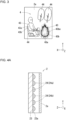
- FIG. 3 is a front view of an image displayed on the display.
- FIG. 4A is a cross-sectional view of another example display in the aerial image display device in FIG. 1A .
- FIG. 4B is a plan view of multiple visible light emitters and multiple infrared light emitters in the display in FIG. 4A in an example arrangement.
- FIG. 4C is a plan view of the multiple visible light emitters and the multiple infrared light emitters in the display in FIG. 4A in another example arrangement.
- FIG. 5 is a cross-sectional view of a first concave mirror in a reflective optical system in the aerial image display device in FIG. 1A , describing the definition of the curvature of the first concave mirror.
- FIG. 6 is a plan view of the multiple visible light emitters and the multiple infrared light emitters in the display in FIG. 2A in another example arrangement.
- FIG. 7 is a plan view of the multiple visible light emitters and the multiple infrared light emitters in the display in FIG. 4A in another example arrangement.
- An aerial image is hatched in FIGs. 1A and 1B .
- FIG. 1A and 1B An aerial image is hatched in FIGs. 1A and 1B .
- FIG. 2A illustrates a cross section taken along section line IIA-IIA in FIG. 2B .
- FIG. 4A illustrates a cross section taken along section line IVA-IVA in FIG. 4B .
- Infrared light emitters (infrared light emitting elements) are hatched in FIGs. 2B , 4B , 4C , 6 , and 7 .
- FIGs. 2B , 4B , 4C , 6 , and 7 illustrates the visible light emitters and the infrared light emitters arranged on a substrate alone.
- the high-temperature image portion 43 in the image 4 is displayed with light (visible light) including infrared light.
- a user also referred to as a viewer
- a thermal sensation e.g., a cutaneous sensation; hereafter also referred to as warmth. This can provide the user with a new visual experience with warmth.
- the light intensity of the infrared light emitters may be controlled to allow the user to perceive the warmth (about 40 to 50 °C) to be obtained when the user places a hand over the flame.
- the high-temperature image portion 43 is a heat generating object such as the sun
- the light intensity of the infrared light emitter may be controlled to allow the user to perceive the warmth (about 30 to 50 °C) corresponding to the heat from the sun.
- the processing of adding a start flag, a start tag, or another piece of data to the high-temperature image data or processing of adding an end flag, an end tag, or another piece of data may be performed manually.
- the processing of adding a start flag, a start tag, or another piece of data to the high-temperature image data or the processing of adding an end flag, an end tag, or another piece of data may be performed using an imaging device such as a camera to capture an image of the image 4 displayed on the display 2.
- An image captured with the camera (captured image) is analyzed with an analysis software program to identify the high-temperature image portion 43 in the captured image.
- the analysis software program may include an artificial intelligence (AI) software program for performing image recognition in which the captured image is analyzed to detect and extract a specific pattern.
- the AI software program may perform image recognition in which the image data is directly analyzed to detect and extract a specific pattern.
- the display device can be used in various electronic devices.
- electronic devices include automobile route guidance systems (car navigation systems), ship route guidance systems, aircraft route guidance systems, indicators for instruments in vehicles such as automobiles, instrument panels, smartphones, mobile phones, tablets, personal digital assistants (PDAs), video cameras, digital still cameras, electronic organizers, electronic books, electronic dictionaries, personal computers, copiers, terminals for game devices, television sets, product display tags, price display tags, programmable display devices for industrial use, car audio systems, digital audio players, facsimile machines, printers, automatic teller machines (ATMs), vending machines, medical display devices, digital display watches, smartwatches, guidance display devices installed in stations or airports, signage (digital signage) for advertisement, and head-mounted displays (HMDs).
- car navigation systems car navigation systems
- PDAs personal digital assistants
- video cameras digital still cameras
- electronic organizers electronic organizers
- electronic books electronic books
- electronic dictionaries personal computers
- copiers terminals for game devices
- television sets product display tags
- price display tags
- an aerial image display device 1 includes a display (hereafter also referred to as a display device) 2 and a reflective optical system 3.
- the display device 2 includes a display surface 2a and displays the image 4 that propagates as image light L toward the reflective optical system 3 (a first concave mirror 31) on the display surface 2a.
- the display device 2 can display the image 4 (illustrated in FIG. 3 as an example) including a visible light image including infrared light.
- the display device 2 emits the image light L through the display surface 2a.
- the image light L may include at least one of visible light L1 or infrared light L2.
- the image light L may thus include the visible light L1 alone in some cases and may include the infrared light L2 alone in other cases.
- the reflective optical system 3 reflects the image light L of the image 4 displayed on the display surface 2a and forms an aerial image R as a real image. A user 5 can thus perceive the aerial image R formed with the image light L.
- the image light L includes the visible light L1 alone, the user 5 can visually perceive a visible light aerial image R1 formed with the visible light L1.
- the image light L includes the visible light L1 and the infrared light L2
- the user 5 can visually perceive the visible light aerial image R1 formed with the visible light L1 and can perceive the temperature of an infrared aerial image R2 formed with the infrared light L2 with a sensation (e.g., a cutaneous sensation).
- the reflective optical system 3 includes a reflective optical element such as a concave mirror or a convex mirror.
- the display device 2 may be a transmissive display device 2 illustrated in FIG. 2A .
- the transmissive display device 2 may be a liquid crystal display including a backlight 21 and a liquid crystal panel 22.
- the visible light emitters 21a may emit white light.
- the visible light emitters 21a may include a red LED that emits red light, a green LED that emits green light, and a blue LED that emits blue light.
- Each of the visible light emitters 21a may include a white LED that emits white light.
- the white LED may include an ultraviolet LED that emits ultraviolet light and a phosphor that converts the ultraviolet light emitted from the ultraviolet LED to white light through wavelength conversion.
- the white LED may include a blue LED that emits blue light and a phosphor that converts the blue light emitted from the blue LED to white light through wavelength conversion.
- Each of the infrared light emitters 21b may be an infrared LED.
- the infrared LED may be a near infrared LED that emits near infrared light or infrared light having a wavelength of about 0.78 to 2.5 ⁇ m.
- a range of values referred to herein as one value to another value intends to mean the two values being inclusive.
- the subpixel for emitting red light converts white light emitted from the visible light emitter 21a to red light (red-colored light) using a red filter in the color filter substrate and controls the amount of red light transmission.
- the amount of red light transmission may be controlled by controlling the light amount from the white LED corresponding to the subpixel for emitting red light.
- the subpixel for emitting red light may use red light emitted from the red LED in the visible light emitter 21a corresponding to the subpixel. In this case, the amount of red light transmission may be controlled by controlling the light amount from the red LED.
- the structure of the subpixel described above may be applicable to the subpixel for emitting green light and the subpixel for emitting blue light.
- the subpixel for emitting red light, the subpixel for emitting green light, and the subpixel for emitting blue light may partly block the infrared light emitted from the infrared light emitters 21b.
- FIG. 2B illustrates an example including the same number of visible light emitters 21a and infrared light emitters 21b, but the infrared light emitters 21b may be fewer than the visible light emitters 21a. Infrared light emitted from the infrared light emitters 21b is more likely to transmit through the liquid crystal panel 22 than visible light (white light) emitted from the visible light emitters 21a. Thus, the infrared light emitters 21b fewer than the visible light emitters 21a can maintain the infrared light L2 with sufficient intense.
- the display device 2 is not limited to the transmissive display device 2 and may be a self-luminous display device 2 including multiple self-luminous elements.
- the self-luminous display device 2 includes multiple pixels 24 (illustrated in FIG. 4A ). Each of the multiple pixels 24 includes a visible light emitter 24a and an infrared light emitter 24b. As illustrated in FIGs. 4A and 4B , the self-luminous display device 2 includes a substrate 23. The multiple visible light emitters 24a and the multiple infrared light emitters 24b may be arranged alternately in a matrix on a first surface 23a of the substrate 23.
- each of the multiple visible light emitters 24a includes a red-light emitting element 24aR that emits red light, a green-light emitting element 24aG that emits green light, and a blue-light emitting element 24aB that emits blue light.
- Each of the multiple infrared light emitters 24b includes an infrared light emitting element 24bI that emits infrared light.
- Each of the red-light emitting element 24aR, the green-light emitting element 24aG, the blue-light emitting element 24aB, and the infrared light emitting element 24bI may be, for example, an LED or an OLED.
- Each of the red-light emitting element 24aR, the green-light emitting element 24aG, the blue-light emitting element 24aB, and the infrared light emitting element 24bI may be a micro-LED.
- the micro-LED located on the first surface 23a may be rectangular as viewed in plan with each side having a length of about 1 to 100 ⁇ m inclusive, or about 3 to 10 ⁇ m inclusive.
- the infrared light emitting element 24bI may be a near infrared LED, an infrared LED, a near infrared OLED, or an infrared OLED that emits near infrared light or infrared light having a wavelength of about 0.78 to 2.5 ⁇ m.
- the aerial image display device 1 includes a light emission controller 6 as illustrated in FIG. 1A .
- the light emission controller 6 controls the image 4 displayed on the display surface 2a based on the image signal input from outside.
- the image signal includes a visible light image signal SV and an infrared image signal SI.
- the light emission controller 6 causes the display surface 2a to display the visible light image based on the visible light image signal SV and mixes infrared light on the display surface 2a based on the infrared image signal SI. More specifically, the light emission controller 6 controls the display device 2 to mix infrared light to the visible light image.
- the light emission controller 6 may also have the functions of, for example, turning on and off the display device 2, transmitting the image signal to the display device 2, and adjusting the luminance, the chromaticity, the frame frequency, or other parameters of the images.
- the light emission controller 6 may have the function of adjusting the temperature of the heat dissipator or the cooling member.
- the aerial image display device 1 may distinguish between the normal temperature image portion 44 and the high-temperature image portion 43 in the image displayed on the display device 2 as described below.
- the light emission controller 6 may be configured to store image data for each frame.
- the light emission controller 6 may store the image data in a manner to distinguish image data of the high-temperature image portion 43 (also referred to as high-temperature image data). For example, a start flag, a start tag, or another piece of data that indicates the beginning of the high-temperature image data may be added to a head (beginning) of the high-temperature image data, and an end flag, an end tag, or another piece of data that indicates the end of the high-temperature image data may be added to a tail (end) of the high-temperature image data.
- the normal temperature may be, for example, 15 to 25 °C, or may be 20 °C.
- the aerial image display device 1 may also include a temperature sensor 60 (illustrated in FIG. 1B ) that detects an ambient temperature of its surroundings.
- the normal temperature may be the ambient temperature detected by the temperature sensor 60.
- the user 5 may set the normal temperature to any temperature or any temperature range to reflect a difference in recognizing the temperature and the temperature range as the normal temperature. The difference tends to result from, for example, the birthplace or the dwelling place of the user 5.
- the user 5 may set the normal temperature to any temperature or any temperature range within, but is not limited to, a range of, for example, about 0 to 35 °C.
- the aerial image display device 1 may display the high-temperature image portion 43 as a video.
- the user 5 can perceive the movement of the high-temperature image portion 43 (specifically, the high-temperature object) visually and cutaneously.
- the high-temperature object is a bonfire
- the aerial image display device 1 can thus provide the user 5 with a new visual experience using infrared light.
- the light emission controller 6 can control the emission and non-emission of the multiple visible light emitters 21a or 24a and the multiple infrared light emitters 21b or 24b.
- the high-temperature image portion 43 can be displayed as a video when the light emission controller 6 controls the emission and non-emission of the multiple visible light emitters 21a or 24a and the multiple infrared light emitters 21b or 24b.
- the temperature gradient portion of the infrared aerial image R2 is a portion in which the infrared light L2 has an intensity decreasing as the distance from the center (centroid) or the edge of the visible light aerial image R1 perceived by the user 5 in the same manner as or in a similar manner to the temperature gradient portion 43ba.
- the user 5 can thus perceive the heat of the high-temperature object and also the radiant heat emitted from the high-temperature object to the surroundings or the conductive heat transmitted through heat conduction. This can provide the user 5 with a more realistic visual experience.
- the temperature gradient portion 43ba may have a temperature gradient in, but is not limited to, a range of about 0.1 to 10 °C/mm or in a range of about 0.1 to 3 °C/mm.
- a time lag ⁇ t of the movement of the infrared image 43b relative to the movement of the visible light image 43a may be in, but not limited to, a range of, for example, about 0.1 to 1.0 seconds.
- the time lag ⁇ t may be determined based on, for example, the size (the number of pixels) of the visible light image 43a, the distance between the user 5 and the virtual imaging plane 8, the heat conductivity of the air, or the estimated temperature of the high-temperature object.
- the delay in the movement of the infrared image 43b relative to the movement of the visible light image 43a can provide the user 5 with a more realistic visual experience.
- the liquid crystal display device causes the infrared light emitters 21b corresponding to the high-temperature image portion 43 in the backlight to emit light.
- the self-luminous display device causes the infrared light emitters 24b corresponding to the high-temperature image portion 43 to emit light.
- the light intensity of the infrared light emitters 21b or 24b may be controlled based on the estimated temperature of the high-temperature image portion.
- the light intensity of the infrared light emitters 21b or 24b may be controlled by, for example, the light emission controller 6 connected to or included in the display device 2 that controls a current input into or a voltage applied to the infrared light emitters 21b or 24b.
- the high-temperature image portion 43 is, for example, a person, an animal, or a character
- the light intensity of the infrared light emitters 21b or 24b may be controlled to allow the user 5 to perceive the warmth corresponding to the body temperature (about 35 to 37 °C) of the person, the animal, or the character.
- the high-temperature image portion 43 is a heat generating object such as hot water (about 38 to 42 °C)
- the light intensity of the infrared light emitters 21b or 24b may be controlled to allow the user 5 to perceive the warmth corresponding to the hot water.
- the high-temperature image portion 43 is a heat generating object such as a flame
- the light intensity of the infrared light emitters 21b or 24b may be controlled to allow the user 5 to perceive the warmth (about 40 to 50 °C) to be obtained when the user 5 places a hand over the flame.
- the second concave mirror 33 is configured to reflect, in a direction different from a direction toward the convex mirror 32, the image light L reflected from the convex mirror 32 and form the aerial image R as a real image.
- the reflective optical system 3 including multiple reflective optical elements can form the aerial image R with less distortion.
- the center of the reflective surface 31a is defined by a lowest point (maximum protruding point) of the curved reflective surface 31a.
- the reflective surface 31a of the first concave mirror 31 is elliptic in a front view.
- the size of the first concave mirror 31 may correspond to the length of a major diameter selected from line segments including the center of the reflective surface 31a and connecting both the ends of the reflective surface 31a.
- the size of the first concave mirror 31 may correspond to the length of a maximum diameter (e.g., a diagonal diameter) selected from the line segments including the center of the reflective surface 31a and connecting both the ends of the reflective surface 31a.
- the size of the second concave mirror 33 and the size of the convex mirror 32 may be defined in the same or a similar manner.
- the size of the first concave mirror 31 may be defined by the area of the reflective surface 31a of the first concave mirror 31 or by the area of the reflective surface 31a of the first concave mirror 31 in a front view.
- the size of the second concave mirror 33 may be defined by the area of the reflective surface 33a of the second concave mirror 33 or by the area of the reflective surface 33a of the second concave mirror 33 in a front view.
- Each of the reflective surfaces 31a, 32a, and 33a as a freeform surface may be an XY polynomial surface (also referred to as an SPS XYP surface) defined by Formulas 1 and 2 below.
- the XY polynomial surface is expressed by polynomials until the tenth degree to be added to a conic reference surface. In Formulas 1 and 2, the sum of m and n is thus less than or equal to 10.
- the reflective surface 33a of the second concave mirror 33 may overlap the display surface 2a of the display device 2, the reflective surface 31a of the first concave mirror 31, and the reflective surface 32a of the convex mirror 32 as viewed from a rear surface of the second concave mirror 33 in a direction parallel to the virtual imaging plane 8 of the aerial image R (a Y-direction in FIGs. 1A and 1B ).
- This structure reduces the space occupied by the display device 2 and the reflective optical system 3, thus reducing the size of the aerial image display device 1.
- This reduces the optical path length of the image light L inside the aerial image display device 1, and thus reduces the loss of the image light L due to, for example, unintended scatter or interference.
- the aerial image display device 1 can thus have higher display quality.
- the backlight 21 in the transmissive display device 2 may include the multiple visible light emitters 21a arranged in a first area 23a1 on the first surface 23a and the multiple infrared light emitters 21b arranged in a second area 23a2 on the first surface 23a.
- the second area 23a2 does not overlap the first area 23a1 in a plan view.
- white light emitted from the visible light emitters 21a is less likely to transmit through the subpixels for emitting infrared light.
- the visible light image alone can be displayed when the multiple visible light emitters 21a alone emit light.
- the infrared image (warm portion) alone can be displayed.
- the aerial image display device 1 may be used as a heater in a cold season such as winter.
- the image 4 may include the visible light image in one part and the warm portion in another part.
- the visible light image may be a bright image having high brightness, such as the sun, to provide visual warmth to the user.
- the self-luminous display device 2 may include the multiple visible light emitters 24a in the first area 23a1 on the first surface 23a and the multiple infrared light emitters 24b in the second area 23a2 on the first surface 23a.
- the second area 23a2 does not overlap the first area 23a1 in a plan view.
- the multiple visible light emitters 24a and the multiple infrared light emitters 24b arranged in different areas, the multiple visible light emitters 24a can be arranged in an optimal manner, and the multiple infrared light emitters 24b can be arranged in an optimal manner. This can improve the image quality of the visible light image and the infrared image displayed on the display surface 2a.
- the reflective optical system 3 can be designed appropriately to form the visible light aerial image R1 and the infrared aerial image R2 at any position on the virtual imaging plane 8.
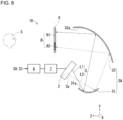
- FIG. 8 is a diagram of the aerial image display device according to the other embodiment of the present disclosure.
- an aerial image display device 1A includes the same components as or similar components to those of the aerial image display device 1 except for the structures of the reflective optical system.
- Like reference numerals denote the same components as or similar components to those of the aerial image display device 1. Such components will not be described.
- the size of the aerial image display device 1A is reduced to reduce the optical path length of the image light L between the display surface 2a of the display device 2 and the reflective surface 33a of the second concave mirror 33, thus reducing the loss of the image light L due to, for example, unintended scatter or interference.
- the aerial image display device 1A can thus have higher display quality.
- the aerial image display device 1A can provide the user 5 with a new visual experience using infrared light in the same manner as or in a similar manner to the aerial image display device 1.
- the aerial image display device 1A may display the infrared image alone without displaying the visible light image on the display surface 2a in the same manner as or in a similar manner to the aerial image display device 1.
- the aerial image display device 1A may be used as a heater in the same manner as or in a similar manner to the aerial image display device 1.
- FIG. 9 is a diagram of an aerial image display device 1B according to the other embodiment of the present disclosure.
- the aerial image display device 1B differs from the aerial image display device 1 in that the aerial image display device 1B includes a stimulation signal irradiator 66 that applies a stimulation signal 66a to the body of the user.
- the aerial image display device 1B includes no time lag controller 7.
- Other components of the aerial image display device 1B are the same as or similar to those of the aerial image display device 1.
- Like reference numerals denote the same components as or similar components to those of the aerial image display device 1. Such components will not be described.
- the aerial image display device 1B includes the stimulation signal irradiator 66 that applies, in response to one part of the body (e.g., one part of a finger 5f of a hand 5h) of the user 5 coming in contact with the high-temperature image portion 43 in the aerial image R, the stimulation signal 66a to another part of the finger 5f of the user 5 spaced from the part of the finger 5f of the user 5.
- the stimulation signal irradiator 66 that applies, in response to one part of the body (e.g., one part of a finger 5f of a hand 5h) of the user 5 coming in contact with the high-temperature image portion 43 in the aerial image R, the stimulation signal 66a to another part of the finger 5f of the user 5 spaced from the part of the finger 5f of the user 5.
- the part of the body of the user 5 receiving the stimulation signal 66a may be, for example, a part of the finger 5f of the hand 5h of the user, a part of the palm of the hand 5h of the user, a part of the back of the hand 5h of the user 5, or a part of an arm of the user 5.
- the stimulation signal 66a may be a tactile induction signal inducing a tactile sensation in the user 5.
- the tactile induction signal may be a sonic signal or an ultrasonic signal being air vibration or, for example, a wind (airflow) being air pressure.
- the ultrasonic signal among the signals above is not audible to the user 5.
- the ultrasonic signal is thus advantageously less likely to interfere with the aerial image R.
- the ultrasonic signal may have a frequency greater than or equal to about 20 kHz, or may be about 20 kHz to 20 MHz.
- the stimulation signal irradiator 66 may be an ultrasonic signal generator.
- the ultrasonic signal generator may be a mid-air tactile generator (mid-air haptics device) including, for example, an electric-ultrasonic converter array (also referred to as an ultrasonic transducer array) to generate haptic sensations in the mid-air by converging multiple ultrasonic signals emitted from the ultrasonic transducer array through phase control.
- mid-air haptics device including, for example, an electric-ultrasonic converter array (also referred to as an ultrasonic transducer array) to generate haptic sensations in the mid-air by converging multiple ultrasonic signals emitted from the ultrasonic transducer array through phase control.
- the stimulation signal 66a may be a warmth induction signal inducing warmth.
- the warmth induction signal may be, for example, a near-infrared light signal or an infrared light signal that is a heat ray or, for example, hot wind (hot air flow).
- the warmth induction signal that is a near-infrared light signal or an infrared light signal is advantageously applicable to a part of the body of the user 5 with positional precision in a focused manner.
- the warmth induction signal may provide warmth (temperature) higher than the warmth (temperature) of the high-temperature image portion 43 to the part of the body of the user 5. In this case, the part of the body of the user 5 can perceive the mutual thermal referral more clearly.
- the warmth induction signal may provide a part of the body of the user 5 with warmth (temperature) that is, but not limited to, more than one times and about two times or less the warmth (temperature) of the high-temperature image portion 43.
- the stimulation signal irradiator 66 applies the stimulation signal 66a to the part f2 of the finger 5f of the user 5 spaced from the part f1 of the finger 5f of the user 5.
- the space (distance) between the part f1 and the part f2 may be about 10 to 80 mm.
- the mutual thermal referral effect may occur in the distance of about 10 to 80 mm. With the distance less than 10 mm, the warmth is less likely to have depth. With the distance more than 80 mm, the mutual thermal referral is less likely to occur.
- the aerial image display device 1B may include a detector 65 that detects a part (e.g., the finger 5f or another part) of the body of the user 5 coming in contact with the high-temperature image portion 43 in the aerial image R.
- the detector 65 may be, for example, an imaging device such as a camera.
- the detector 65 may be a light (electromagnetic wave) detection device that detects reflection, transmission, or non-transmission of, for example, visible light, laser light, infrared light, or electromagnetic waves.
- the light (electromagnetic wave) detection device may include a light emitter for emitting, for example, visible light and a light receiver for receiving, for example, visible light, and may be configured to detect the finger 5f or another coming in contact with the high-temperature image portion 43 in the aerial image R in response to the light receiver receiving reflection light reflected from the finger 5f or another part (or in response to an output from the light receiver).
- a light emitter for emitting, for example, visible light
- a light receiver for receiving, for example, visible light
- the optical detection device may include the light emitter for emitting, for example, visible light and the light receiver for receiving, for example, visible light, and may be configured to detect the finger 5f or another part coming in contact with the high-temperature image portion 43 in the aerial image R in response to the finger 5f or another part blocking light being received by the light receiver (in response to the loss of the output from the light receiver).
- the detector 65 may be a sonic wave detection device that detects reflection, transmission, or non-transmission of sonic waves or ultrasonic waves.
- the sound wave detection device may operate on the same principle as or a similar principle to the optical detection device.
- FIG. 11 is a diagram of an aerial image display device 1C according to another embodiment of the present disclosure.
- the aerial image display device 1C differs from the aerial image display device 1Ain that the aerial image display device 1C includes the stimulation signal irradiator 66 that applies the stimulation signal 66a to the body of the user.
- the aerial image display device 1C includes no time lag controller 7.
- Other components of the aerial image display device 1C are the same as or similar to those of the aerial image display device 1A.
- Like reference numerals denote the same components as or similar components to those of the aerial image display device 1A. Such components will not be described.
- the aerial image display device 1C includes a reflective optical system 3A.
- the reflective optical system 3A includes the first concave mirror 31 and the second concave mirror 33 and includes no convex mirror 32. This structure reduces the size of the aerial image display device 1C and allows the thermal stimulation to be conveyed in the depth direction to provide depth to the warmth felt by the user 5. Combined with an image with depth, the illusion provides the user 5 with a more realistic, new visual experience.
- the aerial image display device 1, 1A, 1B, or 1C may be a head-up display to be installed in a vehicle.
- a part of a front windshield in the vehicle may be a reflector.
- the reflector may be used as the second concave mirror 33.
- the reflector may allow the user to view the aerial image R.
- the reflector may be a semi-transmissive reflector (a reflector for transmitting about half of light and reflecting about another half of the light).
- each of the aerial image display devices 1, 1A, 1B, and 1C may include the display device 2 (and the convex mirror 32) between the first concave mirror 31 and the second concave mirror 33 as viewed laterally.
- the first concave mirror 31 may be at the lowest position
- the second concave mirror 33 may be at the highest position.
- the aerial image display device 1, 1A, 1B, or 1C can be less tall and be smaller easily.
- the infrared light emitters 21b may have a smaller size (dimension) than the visible light emitters 21a. This is because infrared light has a higher transmittance through the liquid crystal panel 22 than visible light. Smaller infrared light emitters 21b with lower light intensity can consume less power.
- the display device and the aerial image display device can provide the user with a new visual experience using infrared light.
- the aerial image display device allows an operation of aerial images without touching, and may be used in, but not limited to, products in various fields described below.
- examples of such products include a communication device for communication or conversations using aerial images, a medical interview device that allows doctors to interview patients using aerial images, a navigation device and a driving control device for vehicles such as automobiles, an order reception and registration device used in, for example, shops, an operational panel used in, for example, buildings or elevators, a learning device for teaching or learning classes using aerial images, an office device for business communication or instructions using aerial images, a gaming device used for playing games using aerial images, a projector for projecting images on the ground or walls of buildings, for example, amusement parks or game arcades, a simulation device for simulation using aerial images in, for example, universities or medical organizations, a large display for displaying prices and other information in, for example, markets or stock exchanges, and an imaging viewing device used for viewing aerial images.
Landscapes
- Engineering & Computer Science (AREA)
- Physics & Mathematics (AREA)
- General Physics & Mathematics (AREA)
- Theoretical Computer Science (AREA)
- General Engineering & Computer Science (AREA)
- Optics & Photonics (AREA)
- Human Computer Interaction (AREA)
- Business, Economics & Management (AREA)
- Accounting & Taxation (AREA)
- Marketing (AREA)
- Spectroscopy & Molecular Physics (AREA)
- Computer Hardware Design (AREA)
- Devices For Indicating Variable Information By Combining Individual Elements (AREA)
Applications Claiming Priority (3)
| Application Number | Priority Date | Filing Date | Title |
|---|---|---|---|
| JP2022087244 | 2022-05-27 | ||
| JP2022124387 | 2022-08-03 | ||
| PCT/JP2023/019033 WO2023228919A1 (ja) | 2022-05-27 | 2023-05-22 | 表示装置および空中像表示装置 |
Publications (1)
| Publication Number | Publication Date |
|---|---|
| EP4535065A1 true EP4535065A1 (en) | 2025-04-09 |
Family
ID=88919259
Family Applications (1)
| Application Number | Title | Priority Date | Filing Date |
|---|---|---|---|
| EP23811791.5A Withdrawn EP4535065A1 (en) | 2022-05-27 | 2023-05-22 | Display device and aerial image display device |
Country Status (5)
| Country | Link |
|---|---|
| US (1) | US20250336320A1 (https=) |
| EP (1) | EP4535065A1 (https=) |
| JP (1) | JP7837405B2 (https=) |
| CN (1) | CN119072650A (https=) |
| WO (1) | WO2023228919A1 (https=) |
Family Cites Families (23)
| Publication number | Priority date | Publication date | Assignee | Title |
|---|---|---|---|---|
| JPH02232094A (ja) * | 1989-03-04 | 1990-09-14 | Nishi Denko:Kk | 温感画像装置 |
| JPH09303878A (ja) * | 1996-03-13 | 1997-11-28 | Nippon Dennetsu Co Ltd | 映像装置付き温風暖房機 |
| JPH1185725A (ja) * | 1997-09-04 | 1999-03-30 | Minolta Co Ltd | 仮想現実感装置 |
| JPH1176606A (ja) * | 1997-09-04 | 1999-03-23 | Namco Ltd | ゲーム装置 |
| JP2001259217A (ja) * | 2000-03-21 | 2001-09-25 | Sega Corp | 体感装置及びカードゲーム装置 |
| JP2006084169A (ja) * | 2004-08-17 | 2006-03-30 | Seiko Epson Corp | 暖房機 |
| JP4171771B2 (ja) * | 2006-07-19 | 2008-10-29 | 独立行政法人科学技術振興機構 | ディスプレイ装置 |
| JP5141044B2 (ja) * | 2007-02-27 | 2013-02-13 | セイコーエプソン株式会社 | プロジェクタ |
| JP5045250B2 (ja) * | 2007-06-01 | 2012-10-10 | セイコーエプソン株式会社 | プロジェクタ |
| US9036986B2 (en) * | 2012-03-21 | 2015-05-19 | Bruce Amberson | Heater |
| US9360672B2 (en) * | 2013-07-11 | 2016-06-07 | Seiko Epson Corporation | Head mounted display device and control method for head mounted display device |
| CN205716472U (zh) * | 2016-04-14 | 2016-11-23 | 宏齐光电子(深圳)有限公司 | 一种全彩led封装结构 |
| JP6934618B2 (ja) * | 2016-11-02 | 2021-09-15 | パナソニックIpマネジメント株式会社 | ジェスチャ入力システム及びジェスチャ入力方法 |
| EP3557375B1 (en) * | 2016-12-19 | 2023-10-25 | Sony Group Corporation | Information processing device, information processing method, and program |
| JPWO2019049767A1 (ja) * | 2017-09-05 | 2020-11-26 | 富士フイルム株式会社 | 投写ユニット |
| US10795145B2 (en) * | 2017-10-25 | 2020-10-06 | Ulsee Inc. | Infrared and night vision pixel by pixel optical fusion system |
| WO2020023669A1 (en) * | 2018-07-25 | 2020-01-30 | Light Field Lab, Inc. | Light field display system based amusement park attraction |
| JP2020067707A (ja) | 2018-10-22 | 2020-04-30 | 豊田合成株式会社 | 非接触操作検出装置 |
| JP2020140821A (ja) * | 2019-02-27 | 2020-09-03 | 石塚硝子株式会社 | 照明装置 |
| JP7504387B2 (ja) * | 2020-03-31 | 2024-06-24 | パナソニックオートモーティブシステムズ株式会社 | 撮像表示システム |
| CN214468891U (zh) * | 2020-12-14 | 2021-10-22 | 徐东志 | 空间立体加热取暖器 |
| JP7658790B2 (ja) * | 2021-04-22 | 2025-04-08 | 清水建設株式会社 | 疑似環境生成装置 |
| US12007549B1 (en) * | 2022-03-14 | 2024-06-11 | Fyotech Llc | Passive color night vision |
-
2023
- 2023-05-22 WO PCT/JP2023/019033 patent/WO2023228919A1/ja not_active Ceased
- 2023-05-22 EP EP23811791.5A patent/EP4535065A1/en not_active Withdrawn
- 2023-05-22 CN CN202380038632.4A patent/CN119072650A/zh active Pending
- 2023-05-22 US US18/867,406 patent/US20250336320A1/en active Pending
- 2023-05-22 JP JP2024523294A patent/JP7837405B2/ja active Active
Also Published As
| Publication number | Publication date |
|---|---|
| JPWO2023228919A1 (https=) | 2023-11-30 |
| CN119072650A (zh) | 2024-12-03 |
| WO2023228919A1 (ja) | 2023-11-30 |
| JP7837405B2 (ja) | 2026-03-30 |
| US20250336320A1 (en) | 2025-10-30 |
Similar Documents
| Publication | Publication Date | Title |
|---|---|---|
| EP4111254B1 (en) | VIEWER TRACKING SCREEN | |
| US9297996B2 (en) | Laser illumination scanning | |
| KR102906628B1 (ko) | 다중 사용자 디스플레이 및 그 방법 | |
| JP5552804B2 (ja) | 立体画像表示装置、その製造方法及び立体画像表示方法 | |
| JP2021523595A (ja) | ヘッドアップディスプレイ上での拡張現実エクスペリエンスの強化 | |
| US20110304614A1 (en) | Stereoscopic image display device and stereoscopic image display method | |
| US11910690B2 (en) | Electronic devices with illuminated display borders | |
| WO2010007787A1 (ja) | 裸眼立体映像表示システム、裸眼立体映像表示装置、遊技ゲーム機、パララックスバリアシート | |
| JP2014041370A (ja) | 表示装置 | |
| US20110069157A1 (en) | Three-dimensional image display device, method of manufacturing the same, and three-dimensional image display method | |
| US20240210684A1 (en) | Image display device | |
| JP7588214B2 (ja) | ディスプレイにおける境界平滑化 | |
| JP2023007106A (ja) | 空中浮遊映像表示装置 | |
| US20180356643A1 (en) | Spatial image display apparatus and spatial image display method | |
| CN113228153A (zh) | 具有视图终点指示器的多视图显示系统、多视图显示器和方法 | |
| RU2005129853A (ru) | Системы и способы для реализации дисплеев с интерферометрической модуляцией | |
| CN108388339A (zh) | 显示方法、装置及移动终端 | |
| EP4535065A1 (en) | Display device and aerial image display device | |
| CN109997072A (zh) | 用于平视显示器的图像生成装置和用于控制该装置的方法 | |
| US12572029B2 (en) | Air floating video display apparatus | |
| JP7576517B2 (ja) | 空間浮遊映像表示装置 | |
| JP2003513324A (ja) | 走査ビーム表示装置 | |
| CN114373786A (zh) | 显示装置及电子设备 | |
| CN209167942U (zh) | 设备 | |
| CN117178548A (zh) | 具有用于竖直视差校正的观看者跟踪的显示器 |
Legal Events
| Date | Code | Title | Description |
|---|---|---|---|
| STAA | Information on the status of an ep patent application or granted ep patent |
Free format text: STATUS: THE INTERNATIONAL PUBLICATION HAS BEEN MADE |
|
| PUAI | Public reference made under article 153(3) epc to a published international application that has entered the european phase |
Free format text: ORIGINAL CODE: 0009012 |
|
| STAA | Information on the status of an ep patent application or granted ep patent |
Free format text: STATUS: REQUEST FOR EXAMINATION WAS MADE |
|
| 17P | Request for examination filed |
Effective date: 20241202 |
|
| AK | Designated contracting states |
Kind code of ref document: A1 Designated state(s): AL AT BE BG CH CY CZ DE DK EE ES FI FR GB GR HR HU IE IS IT LI LT LU LV MC ME MK MT NL NO PL PT RO RS SE SI SK SM TR |
|
| STAA | Information on the status of an ep patent application or granted ep patent |
Free format text: STATUS: THE APPLICATION HAS BEEN WITHDRAWN |
|
| 18W | Application withdrawn |
Effective date: 20250702 |