EP4534957A1 - A cellular network for an efficient and reliable remote operation of a vehicle fleet - Google Patents
A cellular network for an efficient and reliable remote operation of a vehicle fleet Download PDFInfo
- Publication number
- EP4534957A1 EP4534957A1 EP23201113.0A EP23201113A EP4534957A1 EP 4534957 A1 EP4534957 A1 EP 4534957A1 EP 23201113 A EP23201113 A EP 23201113A EP 4534957 A1 EP4534957 A1 EP 4534957A1
- Authority
- EP
- European Patent Office
- Prior art keywords
- teleoperation
- route
- road
- network
- requested
- Prior art date
- Legal status (The legal status is an assumption and is not a legal conclusion. Google has not performed a legal analysis and makes no representation as to the accuracy of the status listed.)
- Pending
Links
Images

Classifications
-
- G—PHYSICS
- G01—MEASURING; TESTING
- G01C—MEASURING DISTANCES, LEVELS OR BEARINGS; SURVEYING; NAVIGATION; GYROSCOPIC INSTRUMENTS; PHOTOGRAMMETRY OR VIDEOGRAMMETRY
- G01C21/00—Navigation; Navigational instruments not provided for in groups G01C1/00 - G01C19/00
- G01C21/26—Navigation; Navigational instruments not provided for in groups G01C1/00 - G01C19/00 specially adapted for navigation in a road network
- G01C21/34—Route searching; Route guidance
- G01C21/3407—Route searching; Route guidance specially adapted for specific applications
-
- G—PHYSICS
- G08—SIGNALLING
- G08G—TRAFFIC CONTROL SYSTEMS
- G08G1/00—Traffic control systems for road vehicles
- G08G1/20—Monitoring the location of vehicles belonging to a group, e.g. fleet of vehicles, countable or determined number of vehicles
-
- G—PHYSICS
- G01—MEASURING; TESTING
- G01C—MEASURING DISTANCES, LEVELS OR BEARINGS; SURVEYING; NAVIGATION; GYROSCOPIC INSTRUMENTS; PHOTOGRAMMETRY OR VIDEOGRAMMETRY
- G01C21/00—Navigation; Navigational instruments not provided for in groups G01C1/00 - G01C19/00
- G01C21/26—Navigation; Navigational instruments not provided for in groups G01C1/00 - G01C19/00 specially adapted for navigation in a road network
- G01C21/34—Route searching; Route guidance
- G01C21/3453—Special cost functions, i.e. other than distance or default speed limit of road segments
- G01C21/3461—Preferred or disfavoured areas, e.g. dangerous zones, toll or emission zones, intersections, manoeuvre types or segments such as motorways, toll roads or ferries
-
- G—PHYSICS
- G01—MEASURING; TESTING
- G01C—MEASURING DISTANCES, LEVELS OR BEARINGS; SURVEYING; NAVIGATION; GYROSCOPIC INSTRUMENTS; PHOTOGRAMMETRY OR VIDEOGRAMMETRY
- G01C21/00—Navigation; Navigational instruments not provided for in groups G01C1/00 - G01C19/00
- G01C21/38—Electronic maps specially adapted for navigation; Updating thereof
- G01C21/3804—Creation or updating of map data
- G01C21/3807—Creation or updating of map data characterised by the type of data
- G01C21/3815—Road data
- G01C21/3819—Road shape data, e.g. outline of a route
-
- G—PHYSICS
- G01—MEASURING; TESTING
- G01C—MEASURING DISTANCES, LEVELS OR BEARINGS; SURVEYING; NAVIGATION; GYROSCOPIC INSTRUMENTS; PHOTOGRAMMETRY OR VIDEOGRAMMETRY
- G01C21/00—Navigation; Navigational instruments not provided for in groups G01C1/00 - G01C19/00
- G01C21/38—Electronic maps specially adapted for navigation; Updating thereof
- G01C21/3804—Creation or updating of map data
- G01C21/3807—Creation or updating of map data characterised by the type of data
- G01C21/3815—Road data
- G01C21/3822—Road feature data, e.g. slope data
-
- G—PHYSICS
- G05—CONTROLLING; REGULATING
- G05D—SYSTEMS FOR CONTROLLING OR REGULATING NON-ELECTRIC VARIABLES
- G05D1/00—Control of position, course, altitude or attitude of land, water, air or space vehicles, e.g. using automatic pilots
- G05D1/20—Control system inputs
- G05D1/22—Command input arrangements
- G05D1/221—Remote-control arrangements
- G05D1/222—Remote-control arrangements operated by humans
-
- G—PHYSICS
- G05—CONTROLLING; REGULATING
- G05D—SYSTEMS FOR CONTROLLING OR REGULATING NON-ELECTRIC VARIABLES
- G05D1/00—Control of position, course, altitude or attitude of land, water, air or space vehicles, e.g. using automatic pilots
- G05D1/20—Control system inputs
- G05D1/22—Command input arrangements
- G05D1/221—Remote-control arrangements
- G05D1/226—Communication links with the remote-control arrangements
-
- G—PHYSICS
- G05—CONTROLLING; REGULATING
- G05D—SYSTEMS FOR CONTROLLING OR REGULATING NON-ELECTRIC VARIABLES
- G05D1/00—Control of position, course, altitude or attitude of land, water, air or space vehicles, e.g. using automatic pilots
- G05D1/60—Intended control result
- G05D1/69—Coordinated control of the position or course of two or more vehicles
- G05D1/698—Control allocation
- G05D1/6987—Control allocation by centralised control off-board any of the vehicles
-
- G—PHYSICS
- G05—CONTROLLING; REGULATING
- G05D—SYSTEMS FOR CONTROLLING OR REGULATING NON-ELECTRIC VARIABLES
- G05D2105/00—Specific applications of the controlled vehicles
- G05D2105/20—Specific applications of the controlled vehicles for transportation
- G05D2105/22—Specific applications of the controlled vehicles for transportation of humans
-
- G—PHYSICS
- G05—CONTROLLING; REGULATING
- G05D—SYSTEMS FOR CONTROLLING OR REGULATING NON-ELECTRIC VARIABLES
- G05D2107/00—Specific environments of the controlled vehicles
- G05D2107/10—Outdoor regulated spaces
- G05D2107/13—Spaces reserved for vehicle traffic, e.g. roads, regulated airspace or regulated waters
-
- G—PHYSICS
- G05—CONTROLLING; REGULATING
- G05D—SYSTEMS FOR CONTROLLING OR REGULATING NON-ELECTRIC VARIABLES
- G05D2109/00—Types of controlled vehicles
- G05D2109/10—Land vehicles
Definitions
- the invention relates to a method for operating a cellular network, wherein a teleoperation server remotely operates a vehicle fleet on a road network via a wireless connection provided by a cellular network and a network node of the cellular network receives a route request from the teleoperation server, the received route request comprising a starting position of a vehicle of the vehicle fleet, a target location to be reached by the vehicle, a teleoperation route connecting the target location to the starting position and a travel time of the vehicle.
- the invention further relates to a network node for a cellular network and a computer program product.
- the vehicle fleet herein, shall be understood as a plurality of vehicles provided for being ordered and individually used by a plurality of customers on a predetermined road network, e.g., a road network of a town.
- the road network comprises a plurality of roads connected to each other at nodes of the road network.
- An aspect of the invention is a method for operating a cellular network, wherein a teleoperation server remotely operates a vehicle fleet on a road network via wireless connections provided by a cellular network and a network node of the cellular network receives a route request from the teleoperation server, the received route request comprising a starting position of a vehicle of the vehicle fleet, a target location to be reached by the vehicle, a teleoperation route connecting the target location to the starting position and a travel time of the vehicle.
- the road network may be a road network of a town and comprises a plurality of nodes and roads connecting the nodes.
- the vehicle fleet comprises a plurality of vehicles. Each vehicle is configured to be remotely operated and to travel along the roads of the road network.
- the teleoperation route comprises a sequence of roads of the road network to be traveled along by the vehicle sequentially.
- the network node may receive a route decision from the teleoperation server, the route decision comprising a suggested teleoperation route, store the suggested teleoperation route and cause the cellular network to reserve corresponding spectral resources of radio cells passed through by the suggested teleoperation route.
- Each stored teleoperation route may be understood to be a teleoperation route approved by the network node.
- the spectral resources shall be understood to be a plurality of resource blocks, RB, for respective time intervals.
- the spectral resources are reserved, i.e. blocked for respective travel times of the vehicle within the radio cells, i.e., the total travel duration is divided in subsequent partial travel durations each partial travel duration associated with a radio cell.
- blocked spectral resources not used for remotely operating the vehicle may readily be used otherwise.
- the network node stores the requested teleoperation route, causes the cellular network to reserve corresponding spectral resources of radio cells passed through by the requested teleoperation route and transmits a route confirmation to the teleoperation server when the cellular network allows for a safe remote operation of the vehicle along the requested teleoperation route during the requested travel time.
- the network node checks an availability of wireless connections along the requested teleoperation route during the requested travel time. In case the availability along the requested teleoperation route is sufficient for a safe remote operation of the vehicle the teleoperation server is not required to determine an optimal teleoperation route. Of course, the teleoperation server may still determine the optimal teleoperation route.
- the attributes specifying the road network may comprise a location of a node, a type of a node, a length of a road, a category of a road, a maximum velocity along a road section, a current traffic situation along a road section, an air quality along a road section, a number of lanes of a road section, a direction of a road.
- Said attributes specify a quality of the traffic along the road section. Categories of the road comprise a freeway, a federal highway, a highway, an urban road, a residential street and the like. Current traffic situations comprise a traffic jam, a traffic congestion, a lane closure and the like. Directions of the road comprise one-way and two-way.
- a third aspect of the invention is a computer program product, comprising a digital storage medium storing a program code.
- the digital storage medium may be configured as a CD (Compact Disc), a DVD (Digital Versatile Disk), a USB (Universal Serial Bus) stick, a hard drive, a RAM (Random Access Memory) chip, a cloud storage and the like.
- the program code causes a computing device to carry out a method according to an embodiment of the invention together with the teleoperation server as the network node when being executed by a processor of the computing device.
- the computer program product enables the computing device to participate in the inventive method as the network node and to allow for a teleoperation server an efficient and reliable remote operation of a vehicle fleet on a road network.
- the teleoperation server 2 is configured for remotely operating a vehicle fleet on a road network 3 via wireless connections 80 provided by the cellular network 8. Furthermore, the teleoperation server 2 is preferably configured as an edge server.
- the network node 1 is suitable for the cellular network 8 and may comprise an artificial neural network 10.
- the network node 1 is configured for carrying out a method according to an embodiment of the invention together with the teleoperation server 2 remotely operating the vehicle fleet on the road network 3 via wireless connections 80 provided by the cellular network 8.
- the network node 1 of the cellular network 8 receives a route request 4 from the teleoperation server 2.
- the received route request 4 comprises a starting position of a vehicle 9 of the vehicle fleet, a target location to be reached by the vehicle 9, a teleoperation route 30 connecting the target location to the starting position and a travel time of the vehicle 9.
- the requested teleoperation route 30 may be determined by the teleoperation server 2.
- the requested teleoperation route 30 may particularly be determined by minimizing a length of the route.
- the received route request 4 usually comprises respective starting positions, target locations, routes and travel times of a plurality of vehicles 9.
- a teleoperation application executed by the teleoperation server 2 and each vehicle 9 of the vehicle fleet may be caused to automatically adapt a data rate to a current bit rate of the wireless connection 80 by the cellular network 8.
- the network node 1 may determine a plurality of intermediate teleoperation routes 32 in between the requested teleoperation route 30 and the determined optimal teleoperation route 31 by applying random variations generated by a Monte Carlo algorithm to the requested teleoperation route 30 or the determined optimal teleoperation route 31.
- the transmitted route suggestion 7 comprises the determined intermediate teleoperation routes 32.
- the network node 1 preferably receives a route decision 5 from the teleoperation server 2.
- the route decision 5 comprises a suggested teleoperation route 31, 32, stores the suggested teleoperation route 31, 32 and causes the cellular network 8 to reserve corresponding spectral resources of radio cells passed through by the suggested teleoperation route 31, 32.
- the attributes specifying the cellular network 8 exemplarily comprise a radio coverage along a road 33 section, a minimum guaranteed bitrate along a road 33 section, a guaranteed maximum latency along a road 33 section and/or a maximum bit rate along a road 33 section.
- the attributes specifying the cellular network 8 may be predicted by an artificial neural network 10 and/or by means of a time series of historic data.
Landscapes
- Engineering & Computer Science (AREA)
- Radar, Positioning & Navigation (AREA)
- Remote Sensing (AREA)
- Physics & Mathematics (AREA)
- General Physics & Mathematics (AREA)
- Automation & Control Theory (AREA)
- Aviation & Aerospace Engineering (AREA)
- Traffic Control Systems (AREA)
Abstract
Description
- The invention relates to a method for operating a cellular network, wherein a teleoperation server remotely operates a vehicle fleet on a road network via a wireless connection provided by a cellular network and a network node of the cellular network receives a route request from the teleoperation server, the received route request comprising a starting position of a vehicle of the vehicle fleet, a target location to be reached by the vehicle, a teleoperation route connecting the target location to the starting position and a travel time of the vehicle. The invention further relates to a network node for a cellular network and a computer program product.
- The vehicle fleet, herein, shall be understood as a plurality of vehicles provided for being ordered and individually used by a plurality of customers on a predetermined road network, e.g., a road network of a town. The road network comprises a plurality of roads connected to each other at nodes of the road network.
- A customer usually orders a vehicle of the vehicle fleet indicating a starting position within the road network and, possibly, a pickup time, where and if applicable when the customer intends to start using the vehicle. Traditionally, a physical driver, i.e., a person, e.g., a taxi driver drives the ordered vehicle to arrive at the indicated starting position at the indicated pickup time, allows the customer to enter the vehicle, drives the vehicle to a target location within the road network indicated by the customer and allows the customer to exit the vehicle after having reached the target location.
- However, having each vehicle of the vehicle fleet driven by a physical driver is very expensive.
- The vehicle fleet may also be understood as a fleet of mobile robots, mobile cranes, mobile containers to be remotely operated on a path network of, e.g., a factory or a port.
- As cellular networks become more powerful, vehicles are going to be driven, i.e., operated remotely without a physical driver arranged in the vehicle. Instead, a remote driver receives real-time data from the vehicle and transmits commands to the vehicle via wireless connections provided by a cellular network, the received real-time data comprising video and audio data captured by sensors of the vehicle and the transmitted commands causing the vehicle to travel on a road network.
- Accordingly, a plurality of physical drivers may be replaced by few central operators, each central operator using a teleoperation server configured for remotely operating the vehicles of the vehicle fleet. The teleoperation server, on the one hand, allows for a more economic operation of the vehicle fleet. On the other hand, an efficiency of the vehicle fleet may be increased. A customer drives the ordered vehicle by himself/herself from the starting position to the target location while the central operator remotely operates the ordered vehicle for moving it in due time to the starting position indicated by the customer.
- However, an availability and/or a coverage of the cellular network usually is neither spatially homogeneous over the road network nor constant over time at a road or a node of the road network. As a result, parts of the road network may at least temporarily lack a sufficient provision of wireless connections which hinders or at least adversely affects remote operation of the vehicle fleet.
- It is, therefore, an object of the invention to suggest a method for operating a cellular network which allows for an efficient and reliable remote operation of a vehicle fleet on a road network. Further objects of the invention are to provide a network node for a cellular network and a computer program product.
- An aspect of the invention is a method for operating a cellular network, wherein a teleoperation server remotely operates a vehicle fleet on a road network via wireless connections provided by a cellular network and a network node of the cellular network receives a route request from the teleoperation server, the received route request comprising a starting position of a vehicle of the vehicle fleet, a target location to be reached by the vehicle, a teleoperation route connecting the target location to the starting position and a travel time of the vehicle. The road network may be a road network of a town and comprises a plurality of nodes and roads connecting the nodes. The vehicle fleet comprises a plurality of vehicles. Each vehicle is configured to be remotely operated and to travel along the roads of the road network. The teleoperation route comprises a sequence of roads of the road network to be traveled along by the vehicle sequentially.
- The teleoperation server is connected to the cellular network and may be used by an operator of the vehicle fleet, i.e., a tele drive operator or tele operator, for remotely operating the vehicle fleet. The network node forms part of the cellular network and is provided by an operator of the cellular network, i.e., a mobile network operator, MNO. The cellular network shall be understood as one cellular network out of a plurality of different cellular networks, each cellular network at least partially covering the road network. The different cellular networks may overlap at least partially.
- The route request is a data message indicating the starting position, the target location, the teleoperation route and the travel time. The travel time comprises a pickup time and a travel duration and specifies a future time interval.
- According to the invention, the network node determines an optimal teleoperation route allowing for a safe remote operation of the vehicle from the requested starting position to the requested target location and transmits a route suggestion to the teleoperation server when the cellular network does not allow for a safe remote operation of the vehicle along the requested teleoperation route during the requested travel time, the transmitted route suggestion comprising the optimal teleoperation route. The network node checks an availability of wireless connections along the requested teleoperation route during the requested travel time. In case the availability along the requested teleoperation route is insufficient for a safe remote operation of the vehicle the teleoperation server determines the optimal teleoperation route to be a route covered by the cellular network sufficiently for a safe remote operation of the vehicle.
- It is noted that the remotely operated vehicle traveling on the teleoperation node has to slow down or even stop when the wireless connection is insufficient for a remote operation. The vehicle may even be damaged from a collision caused by the insufficient wireless connection. The inventive method allows for an efficient and reliable operation of the vehicle fleet by avoiding or at least reducing said risks.
- Preferably, the network node determines a plurality of intermediate teleoperation routes in between the requested teleoperation route and the determined optimal teleoperation route by applying random variations generated by a Monte Carlo algorithm to the requested teleoperation route or the determined optimal teleoperation route, the transmitted route suggestion comprising the determined intermediate teleoperation routes. Each intermediate teleoperation route is determined in order to provide an availability of wireless connections sufficient for a safe remote operation of the vehicle. For instance, the intermediate teleoperation routes may be determined by means of a greedy algorithm. The intermediate teleoperation routes may have different lengths and/or different qualities of available wireless connections. The plurality of intermediate teleoperation nodes allows the teleoperation server, more specifically the operator using the teleoperation server, for a choice.
- The network node may receive a route decision from the teleoperation server, the route decision comprising a suggested teleoperation route, store the suggested teleoperation route and cause the cellular network to reserve corresponding spectral resources of radio cells passed through by the suggested teleoperation route. Each stored teleoperation route may be understood to be a teleoperation route approved by the network node. The spectral resources shall be understood to be a plurality of resource blocks, RB, for respective time intervals. The spectral resources are reserved, i.e. blocked for respective travel times of the vehicle within the radio cells, i.e., the total travel duration is divided in subsequent partial travel durations each partial travel duration associated with a radio cell. Of course, blocked spectral resources not used for remotely operating the vehicle may readily be used otherwise. The number of resource blocks to be reserved depends on a position of the vehicle in the radio cell, particularly relative to a position of a base transceiver station generating the radio cell. For instance, remotely operating the vehicle at a greater distance from the base transceiver station, gernerally requires more resource blocks than remotely operating the vehicle at a smaller distance therefrom.
- In an embodiment, the network node stores the requested teleoperation route, causes the cellular network to reserve corresponding spectral resources of radio cells passed through by the requested teleoperation route and transmits a route confirmation to the teleoperation server when the cellular network allows for a safe remote operation of the vehicle along the requested teleoperation route during the requested travel time. The network node checks an availability of wireless connections along the requested teleoperation route during the requested travel time. In case the availability along the requested teleoperation route is sufficient for a safe remote operation of the vehicle the teleoperation server is not required to determine an optimal teleoperation route. Of course, the teleoperation server may still determine the optimal teleoperation route.
- Determining the optimal teleoperation route may also comprise verifying the requested teleoperation route. The network node may additionally determine a teleoperation route without taking into account an availability of wireless connections along the teleoperation route. Verifying the requested teleoperation route comprises comparing the teleoperation route with the requested teleoperation route wherein the verification is successful when the teleoperation route and the requested teleoperation route at least substantially coincide, i.e., differ slightly at most.
- Determining the optimal teleoperation route preferably comprises assigning weights to sections of roads of the road network and applying a weighted shortest path algorithm to the road network, the weighted shortest path algorithm evaluating respective costs of routes connecting the requested target location to the requested starting position by summing up weights assigned to sections of roads of the route. The higher is the availability of wireless connections along a section of a road, the lower is the weight assigned to the section. In contrast, the lower is the availability of wireless connections along a section of the road, the higher is the weight assigned to the section. The cost of a route equals a sum of weights assigned to sections of the route. The optimal teleoperation route is determined to be both short and cheap.
- The weights may be assigned dependent on attributes of nodes and/or roads of the road network, the attributes specifying the road network and the cellular network. The nodes and roads of the road network correspond to nodes and edges of a mathematical graph. The nodes may be crossings, roundabouts, junctions, significant places alongside a road and the like.
- Exemplarily, the attributes specifying the cellular network may comprise a radio coverage along a road section, a maximum bit rate along a road section, a minimum guaranteed bitrate along a road section and/or a guaranteed maximum latency along a road section. Said attributes specify a quality of the cellular network along the road section which is readily accessible for the network node as part of the cellular network. In case there is a plurality of overlapping different cellular networks along the road section attributes of the respective best cellular network are relevant for the determination. In case the attributes of the cellular network vary along the road section the respective worst attribute value is relevant for the determination. The overlapping different cellular network may even cooperate in determining the optimal teleoperation route.
- In an embodiment, the attributes specifying the road network may comprise a location of a node, a type of a node, a length of a road, a category of a road, a maximum velocity along a road section, a current traffic situation along a road section, an air quality along a road section, a number of lanes of a road section, a direction of a road. Said attributes specify a quality of the traffic along the road section. Categories of the road comprise a freeway, a federal highway, a highway, an urban road, a residential street and the like. Current traffic situations comprise a traffic jam, a traffic congestion, a lane closure and the like. Directions of the road comprise one-way and two-way.
- It is noted that some attributes usually vary over time. Of course, values of these attributes during the requested travel time are relevant for determining teleoperation routes.
- In a favorable embodiment, the attributes specifying the cellular network are predicted by an artificial neural network and/or by means of a time series of historic data. For instance, a load of the cellular network may vary on a regular and, hence, predictable basis, e.g., showing a daily rhythm and/or a weekly rhythm. The artificial neural network is configured for recognizing time patterns of the attributes. Time patterns may be alternatively or additionally recognized from historic data by applying traditional pattern recognition algorithms to historic data, i.e., by time series analysis.
- The network node may determine a key figure for each determined teleoperation route and assigns the determined key figure to the determined teleoperation route, the transmitted route suggestion comprising the assigned key figure. The key figure facilitates choosing between different determined teleoperation routes, i.e., the optimal teleoperation route and each intermediate teleoperation route. Of course, a plurality of different key figures may be determined by the network node.
- Exemplarily, the network node may determine a difference of a travel time along the determined teleoperation route from the requested travel time, a difference of a route length of the determined teleoperation route from a route length of the requested teleoperation route and/or a probability of an undisturbed travel along the determined teleoperation route as the key figure. In other words, the key figure indicates an amount of how much longer it takes to travel along the determined teleoperation route, how much longer a travel distance along the determined teleoperation route is from the starting position to the target location and/or how high the risk of a disturbance is along the determined teleoperation route.
- The probability of a disturbance may be calculated assuming a Gaussian distribution for the number IsRB of resource blocks available along a road of the road network. In case the number MinRB of resource blocks required for an undisturbed travel is higher than IsRB, i.e., MinRB > IsRB, a disturbance probability is 100%. Otherwise, the disturbance probability is lower than 100%. MinRB depends on current states of the road network and the traveling vehicle, respectively, while IsRB depends on a current availability of the cellular network.
- For instance, (IsRB-MinRB)/MinRB = 1σ results in a disturbance probability of 68%, (IsRB-MinRB)MinRB = 2σ results in a disturbance probability of 5% and (IsRB-MinRB)/MinRB = 3σ results in a disturbance probability lower than 1% wherein σ is the so-called standard deviation of the Gaussian distribution.
- Preferably, a teleoperation application executed by the teleoperation server and each vehicle of the vehicle fleet is caused by the cellular network to automatically adapt a data rate to a current bit rate of the wireless connection and/or the teleoperation server is preferably configured as an edge server. The teleoperation application is a distributed real-time or near-real-time application. The teleoperation application receives control signals related to the current bit rate from the cellular network and adapts the data rate dependent on the received control signals. Thus, the teleoperation application automatically and immediately adapts to a current availability of the cellular network in order to minimize a latency and/or a jitter of the wireless connection. The jitter is a variation of the latency over time. A high latency and/or a high jitter is caused by permanently and/or temporarily overloaded network queues.
- The adaptability of the teleoperation application allows for ignoring any attribute related to the latency. For instance, the teleoperation application and the cellular network may implement a Low Latency Low Loss Scalable Throughput, L4S, protocol for interaction.
- The edge comprises a part of the cellular network within few hops from, i.e., a logical neighborhood of relevant base transceiver stations, BTS, of the cellular network. Arranging the teleoperation server close to a relevant base transceiver station significantly reduces a round-trip-time, RTT, of a communication between the teleoperation server and the vehicles of the vehicle fleet.
- In an embodiment, the requested teleoperation route is determined by the teleoperation server and/or by minimizing a length of the route. As the teleoperation server has no access to relevant data concerning the cellular network, a traditional shortest path algorithm may be applied by the teleoperation server for determining the teleoperation route to be requested.
- Of course, the received route request may comprise respective starting positions, target locations, routes and travel times of a plurality of vehicles. In other words, the teleoperation server is configured for simultaneously operate a plurality of vehicles and, particularly, the vehicle fleet as a whole.
- Another aspect of the invention is a network node for a cellular network. The network node is a computing device to be immediately connected to the cellular network. The network node may be an existing network node or an additional network node.
- According to the invention, the network node is configured for carrying out a method according to an embodiment of the invention together with the teleoperation server remotely operating a vehicle fleet on a road network via wireless connections provided by the cellular network. The network node allows for a teleoperation server of a teleoperation operator an efficient and reliable remote operation of a vehicle fleet on a road network.
- A third aspect of the invention is a computer program product, comprising a digital storage medium storing a program code. The digital storage medium may be configured as a CD (Compact Disc), a DVD (Digital Versatile Disk), a USB (Universal Serial Bus) stick, a hard drive, a RAM (Random Access Memory) chip, a cloud storage and the like.
- According to the invention, the program code causes a computing device to carry out a method according to an embodiment of the invention together with the teleoperation server as the network node when being executed by a processor of the computing device. In other words, the computer program product enables the computing device to participate in the inventive method as the network node and to allow for a teleoperation server an efficient and reliable remote operation of a vehicle fleet on a road network.
- It is an essential advantage of the inventive method that an efficient and reliable remote operation of a vehicle fleet is ensured. Apart from that, mobile network operators may open a new business field and help in developing an alternative traffic concept for towns and reducing an individual traffic in cities.
- It shall be understood that the features described previously and to be described subsequently may be used not only in the indicated combinations but also in different combinations or on their own without leaving the scope of the present invention.
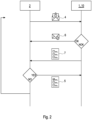
- The invention is described in detail by means of an exemplary embodiment and with reference to the drawings. Like components are indicated by like reference numerals throughout the drawings.
- Fig. 1
- schematically shows a cellular network with a network node according to an embodiment of the invention for a cellular network;
- Fig. 2
- schematically shows a flow chart of a method according to an embodiment of the invention for operating the cellular network shown in
fig. 1 . -
Fig. 1 schematically shows acellular network 8 with a network node 1 according to an embodiment of the invention. Thecellular network 8 is illustrated simply as an antenna of a base transceiver station, BTS, of thecellular network 8. Ateleoperation server 2 is connected to thecellular network 8. - The
teleoperation server 2 is configured for remotely operating a vehicle fleet on aroad network 3 viawireless connections 80 provided by thecellular network 8. Furthermore, theteleoperation server 2 is preferably configured as an edge server. - For sake of simplicity, a
single vehicle 9 of the vehicle fleet connected to thecellular network 8 via asingle wireless connection 80 is illustrated. Theroad network 3 comprises a plurality ofnodes 34 and a plurality ofroads 33 eachroad 33 connecting toadjacent nodes 34.Exemplary teleoperation routes vehicle 9 are also illustrated. - The network node 1 is suitable for the
cellular network 8 and may comprise an artificial neural network 10. The network node 1 is configured for carrying out a method according to an embodiment of the invention together with theteleoperation server 2 remotely operating the vehicle fleet on theroad network 3 viawireless connections 80 provided by thecellular network 8. - The network node 1 may be configured as a computing device implemented by means of a computer program product. The computer program product comprises a digital storage medium storing a program code. The program code causes the computing device to carry out the inventive method together with the
teleoperation server 2 as the network node 1 when being executed by a processor of the computing device. The inventive method is described in detail below. -
Fig. 2 schematically shows a flow chart of a method according to an embodiment of the invention for operating thecellular network 8 shown infig. 1 . - The
teleoperation server 2 remotely operates a vehicle fleet on theroad network 3 viawireless connections 80 provided by thecellular network 8. - The network node 1 of the
cellular network 8 receives aroute request 4 from theteleoperation server 2. The receivedroute request 4 comprises a starting position of avehicle 9 of the vehicle fleet, a target location to be reached by thevehicle 9, ateleoperation route 30 connecting the target location to the starting position and a travel time of thevehicle 9. - The requested
teleoperation route 30 may be determined by theteleoperation server 2. The requestedteleoperation route 30 may particularly be determined by minimizing a length of the route. The receivedroute request 4 usually comprises respective starting positions, target locations, routes and travel times of a plurality ofvehicles 9. - A teleoperation application executed by the
teleoperation server 2 and eachvehicle 9 of the vehicle fleet may be caused to automatically adapt a data rate to a current bit rate of thewireless connection 80 by thecellular network 8. - When the
cellular network 8 does not allow for a safe remote operation of thevehicle 9 along the requestedteleoperation route 30 during the requested travel time, the network node 1 determines anoptimal teleoperation route 31 allowing for a safe remote operation of thevehicle 9 from the requested starting position to the requested target location and transmits aroute suggestion 7 to theteleoperation server 2. The transmittedroute suggestion 7 comprises theoptimal teleoperation route 31. - The network node 1 may determine a plurality of
intermediate teleoperation routes 32 in between the requestedteleoperation route 30 and the determinedoptimal teleoperation route 31 by applying random variations generated by a Monte Carlo algorithm to the requestedteleoperation route 30 or the determinedoptimal teleoperation route 31. The transmittedroute suggestion 7 comprises the determinedintermediate teleoperation routes 32. - The network node 1 preferably receives a
route decision 5 from theteleoperation server 2. Theroute decision 5 comprises a suggestedteleoperation route teleoperation route cellular network 8 to reserve corresponding spectral resources of radio cells passed through by the suggestedteleoperation route - When the
cellular network 8 allows for a safe remote operation of thevehicle 9 along the requestedteleoperation route 30 during the requested travel time, the network node 1 may store the requestedteleoperation route 30, cause thecellular network 8 to reserve corresponding spectral resources of radio cells passed through by the requestedteleoperation route 30 and transmit a route confirmation 6 to theteleoperation server 2. - Determining the
optimal teleoperation route 31 preferably comprises assigning weights to sections ofroads 33 of theroad network 3 and applying a weighted shortest path algorithm to theroad network 3. The weighted shortest path algorithm evaluates respective costs of routes connecting the requested target location to the requested starting position by summing up weights assigned to sections ofroads 33 of the route. Determining theoptimal teleoperation route 31 may also comprise verifying the requestedteleoperation route 30. - The weights may be assigned dependent on attributes of the
nodes 34 and/orroads 33 of theroad network 3. The attributes specify both theroad network 3 and thecellular network 8. - The attributes specifying the
cellular network 8 exemplarily comprise a radio coverage along aroad 33 section, a minimum guaranteed bitrate along aroad 33 section, a guaranteed maximum latency along aroad 33 section and/or a maximum bit rate along aroad 33 section. The attributes specifying thecellular network 8 may be predicted by an artificial neural network 10 and/or by means of a time series of historic data. - The attributes specifying the
road network 3 exemplarily comprise a location of anode 34, a type of anode 34, a length of aroad 33, a category of aroad 33, a maximum velocity along aroad 33 section, a current traffic situation along aroad 33 section, an air quality along aroad 33 section, a number of lanes of aroad 33 section, a direction of aroad 33. - The network node 1 favorably determines a key figure for each
determined teleoperation route determined teleoperation route route suggestion 7 comprises each assigned key figure. - The network node 1 may determine a difference of a travel time along the
determined teleoperation route determined teleoperation route teleoperation route 30 and/or a probability of an undisturbed travel along thedetermined teleoperation route -
- 1
- network node
- 10
- artificial neural network
- 2
- teleoperation server
- 3
- road network
- 30
- requested teleoperation route
- 31
- optimal teleoperation route
- 32
- intermediate teleoperation route
- 33
- road
- 34
- node
- 4
- route request
- 5
- route decision
- 6
- route confirmation
- 7
- route suggestion
- 8
- cellular network
- 80
- wireless connection
- 9
- vehicle
Claims (15)
- A method for operating a cellular network (8), wherein- a teleoperation server (2) remotely operates a vehicle fleet on a road network (3) via wireless connections (80) provided by a cellular network (8);- a network node (1) of the cellular network (8) receives a route request (4) from the teleoperation server (2), the received route request (4) comprising a starting position of a vehicle (9) of the vehicle fleet, a target location to be reached by the vehicle (9), a teleoperation route (30) connecting the target location to the starting position and a travel time of the vehicle (9);- the network node (1) determines an optimal teleoperation route (31) allowing for a safe remote operation of the vehicle (9) from the requested starting position to the requested target location and transmits a route suggestion (7) to the teleoperation server (2) when the cellular network (8) does not allow for a safe remote operation of the vehicle (9) along the requested teleoperation route (30) during the requested travel time, the transmitted route suggestion (7) comprising the optimal teleoperation route (31).
- The method according to claim 1, wherein the network node (1) determines a plurality of intermediate teleoperation routes (32) in between the requested teleoperation route (30) and the determined optimal teleoperation route (31) by applying random variations generated by a Monte Carlo algorithm to the requested teleoperation route (30) or the determined optimal teleoperation route (31), the transmitted route suggestion (7) comprising the determined intermediate teleoperation routes (32).
- The method according to claim 1 or 2, wherein the network node (1) receives a route decision (5) from the teleoperation server (2), the route decision (5) comprising a suggested teleoperation route (31, 32), stores the suggested teleoperation route (31, 32) and causes the cellular network (8) to reserve corresponding spectral resources of radio cells passed through by the suggested teleoperation route (31, 32).
- The method according to one of claims 1 to 3, wherein the network node (1) stores the requested teleoperation route (30), causes the cellular network (8) to reserve corresponding spectral resources of radio cells passed through by the requested teleoperation route (30) and transmits a route confirmation (6) to the teleoperation server (2) when the cellular network (8) allows for a safe remote operation of the vehicle (9) along the requested teleoperation route during the requested travel time.
- The method according to one of claims 1 to 4, wherein determining the optimal teleoperation route (31) comprises assigning weights to sections of roads (33) of the road network (3) and applying a weighted shortest path algorithm to the road network (3), the weighted shortest path algorithm evaluating respective costs of routes connecting the requested target location to the requested starting position by summing up weights assigned to sections of roads (33) of the route, and/or verifying the requested teleoperation route (30).
- The method according to claim 5, wherein the weights are assigned dependent on attributes of nodes and/or edges of a mathematical graph representing the road network (3), the attributes specifying the road network (3) and the cellular network (8).
- The method according to claim 6, wherein the attributes specifying the cellular network (8) comprise a radio coverage along a road (33) section, a maximum bit rate along a road (33) section, a minimum guaranteed bitrate along a road (33) section and/or a guaranteed maximum latency along a road (33) section and/or wherein the attributes specifying the road network (3) comprise a location of a node (34), a type of a node (34), a length of a road (33), a category of a road (33), a maximum velocity along a road (33) section, a current traffic situation along a road (33) section, an air quality along a road (33) section, a number of lanes of a road (33) section, a direction of a road (33).
- The method according to one of claims 6 or 7, wherein the attributes specifying the cellular network (8) are predicted by an artificial neural network (10) and/or by means of a time series of historic data.
- The method according to one of claims 1 to 8, wherein the network node (1) determines a key figure for each determined teleoperation route (31, 32) and assigns the determined key figure to the determined teleoperation route (31, 32), the transmitted route suggestion (7) comprising the assigned key figure.
- The method according to claim 9, wherein the network node (1) determines a difference of a travel time along the determined teleoperation route (31, 32) from the requested travel time, a difference of a route length of the determined teleoperation route (31, 32) from a route length of the requested teleoperation route (30) and/or a probability of an undisturbed travel along the determined teleoperation route (31, 32) as the key figure.
- The method according to one of claims 1 to 9, wherein a teleoperation application executed by the teleoperation server (2) and each vehicle (9) of the vehicle fleet is caused by the cellular network (8) to automatically adapt a data rate to a current bit rate of the wireless connection (80) and/or the teleoperation server (2) is configured as an edge server.
- The method according to one of claims 1 to 11, wherein the requested teleoperation route (30) is determined by the teleoperation server (2) and/or by minimizing a length of the route.
- The method according to one of claims 1 to 12, wherein the received route request (4) comprises respective starting positions, target locations, routes and travel times of a plurality of vehicles (9).
- A network node (1) for a cellular network (8), configured for carrying out a method according to one of claims 1 to 13 together with the teleoperation server (2) remotely operating a vehicle fleet on a road network (3) via wireless connections (80) provided by the cellular network (8).
- A computer program product, comprising a digital storage medium storing a program code, the program code causing a computing device to carry out a method according to one of claims 1 to 13 together with the teleoperation server (2) as the network node (1) when being executed by a processor of the computing device.
Priority Applications (2)
| Application Number | Priority Date | Filing Date | Title |
|---|---|---|---|
| EP23201113.0A EP4534957A1 (en) | 2023-10-02 | 2023-10-02 | A cellular network for an efficient and reliable remote operation of a vehicle fleet |
| US18/888,196 US12688778B2 (en) | 2023-10-02 | 2024-09-18 | Cellular network for efficient and reliable remote operation of a vehicle fleet |
Applications Claiming Priority (1)
| Application Number | Priority Date | Filing Date | Title |
|---|---|---|---|
| EP23201113.0A EP4534957A1 (en) | 2023-10-02 | 2023-10-02 | A cellular network for an efficient and reliable remote operation of a vehicle fleet |
Publications (1)
| Publication Number | Publication Date |
|---|---|
| EP4534957A1 true EP4534957A1 (en) | 2025-04-09 |
Family
ID=88237904
Family Applications (1)
| Application Number | Title | Priority Date | Filing Date |
|---|---|---|---|
| EP23201113.0A Pending EP4534957A1 (en) | 2023-10-02 | 2023-10-02 | A cellular network for an efficient and reliable remote operation of a vehicle fleet |
Country Status (2)
| Country | Link |
|---|---|
| US (1) | US12688778B2 (en) |
| EP (1) | EP4534957A1 (en) |
Citations (2)
| Publication number | Priority date | Publication date | Assignee | Title |
|---|---|---|---|---|
| US20190383624A1 (en) * | 2018-06-15 | 2019-12-19 | Phantom Auto Inc. | Vehicle routing evaluation based on predicted network performance |
| US20220228874A1 (en) * | 2019-05-23 | 2022-07-21 | Telefonaktiebolaget Lm Ericsson (Publ) | Route Planning based on QoS Requirements |
-
2023
- 2023-10-02 EP EP23201113.0A patent/EP4534957A1/en active Pending
-
2024
- 2024-09-18 US US18/888,196 patent/US12688778B2/en active Active
Patent Citations (2)
| Publication number | Priority date | Publication date | Assignee | Title |
|---|---|---|---|---|
| US20190383624A1 (en) * | 2018-06-15 | 2019-12-19 | Phantom Auto Inc. | Vehicle routing evaluation based on predicted network performance |
| US20220228874A1 (en) * | 2019-05-23 | 2022-07-21 | Telefonaktiebolaget Lm Ericsson (Publ) | Route Planning based on QoS Requirements |
Also Published As
| Publication number | Publication date |
|---|---|
| US20250111781A1 (en) | 2025-04-03 |
| US12688778B2 (en) | 2026-07-21 |
Similar Documents
| Publication | Publication Date | Title |
|---|---|---|
| US9761136B2 (en) | Methods and software for managing vehicle priority in a self-organizing traffic control system | |
| US12432567B2 (en) | Systems and methods for matching an autonomous vehicle to a rider | |
| CN111882905B (en) | A method, system and electronic device for realizing road traffic reservation | |
| US11776393B2 (en) | Method and system for reversing the direction of a road segment | |
| He et al. | Multi-modal traffic signal control with priority, signal actuation and coordination | |
| EP2593932B1 (en) | Methods and systems for coordinating vehicular traffic using in-vehicle virtual traffic control signals enabled by vehicle-to-vehicle communications | |
| Noori et al. | A connected vehicle based traffic signal control strategy for emergency vehicle preemption | |
| CN108932862A (en) | A kind of automatic driving vehicle dispatching method and device | |
| CN112466115A (en) | Bus intersection priority passing control system and method based on edge calculation | |
| US20220114887A1 (en) | Collaborative distributed agent-based traffic light system and method of use | |
| Pereira et al. | Automated vehicles in smart urban environment: A review | |
| US20210074157A1 (en) | System for optimising transient kerbside access | |
| CN118747962A (en) | A road planning method and system for predicting traffic demand on smart construction sites | |
| US20230274645A1 (en) | Transportation Network for Multi-featured Autonomous Vehicles | |
| CN112665604A (en) | Vehicle Intelligent Guidance Platform | |
| US20250111781A1 (en) | Cellular network for efficient and reliable remote operation of a vehicle fleet | |
| JP2019196136A (en) | Management device, management system, and management method | |
| CN114566062B (en) | Vehicle parking scheduling management method, device, computer equipment and storage medium | |
| KR20240040782A (en) | Methods, computer program products, parking assistance systems and parking devices | |
| CN118736853A (en) | Real-time traffic flow prediction method and system based on deep learning | |
| CN120937066A (en) | System and method for CAV planning platform of internet access Frenet coordinate system | |
| KR20200074528A (en) | Operation system for self-driving vehicle using real time context information | |
| Aliedani et al. | Cooperative autonomous vehicles: An investigation of the drop-off problem | |
| US20250036136A1 (en) | Traffic control system and method | |
| Gazis | Congestion abatement in its through centralized route allocation |
Legal Events
| Date | Code | Title | Description |
|---|---|---|---|
| PUAI | Public reference made under article 153(3) epc to a published international application that has entered the european phase |
Free format text: ORIGINAL CODE: 0009012 |
|
| STAA | Information on the status of an ep patent application or granted ep patent |
Free format text: STATUS: THE APPLICATION HAS BEEN PUBLISHED |
|
| STAA | Information on the status of an ep patent application or granted ep patent |
Free format text: STATUS: REQUEST FOR EXAMINATION WAS MADE |
|
| AK | Designated contracting states |
Kind code of ref document: A1 Designated state(s): AL AT BE BG CH CY CZ DE DK EE ES FI FR GB GR HR HU IE IS IT LI LT LU LV MC ME MK MT NL NO PL PT RO RS SE SI SK SM TR |
|
| 17P | Request for examination filed |
Effective date: 20250326 |
|
| STAA | Information on the status of an ep patent application or granted ep patent |
Free format text: STATUS: EXAMINATION IS IN PROGRESS |
|
| 17Q | First examination report despatched |
Effective date: 20250912 |
|
| RIC1 | Information provided on ipc code assigned before grant |
Ipc: G01C 21/34 20060101AFI20260424BHEP Ipc: G05D 1/226 20240101ALI20260424BHEP Ipc: G05D 1/225 20240101ALI20260424BHEP Ipc: G05D 1/222 20240101ALI20260424BHEP Ipc: G05D 1/698 20240101ALI20260424BHEP |
|
| GRAP | Despatch of communication of intention to grant a patent |
Free format text: ORIGINAL CODE: EPIDOSNIGR1 |
|
| STAA | Information on the status of an ep patent application or granted ep patent |
Free format text: STATUS: GRANT OF PATENT IS INTENDED |
|
| INTG | Intention to grant announced |
Effective date: 20260623 |