EP4534630A2 - Synthetic lubricity additives for hydrocarbon fuels - Google Patents
Synthetic lubricity additives for hydrocarbon fuels Download PDFInfo
- Publication number
- EP4534630A2 EP4534630A2 EP25151302.4A EP25151302A EP4534630A2 EP 4534630 A2 EP4534630 A2 EP 4534630A2 EP 25151302 A EP25151302 A EP 25151302A EP 4534630 A2 EP4534630 A2 EP 4534630A2
- Authority
- EP
- European Patent Office
- Prior art keywords
- lubricity
- fuel
- alkenyl groups
- asa
- lubricity additive
- Prior art date
- Legal status (The legal status is an assumption and is not a legal conclusion. Google has not performed a legal analysis and makes no representation as to the accuracy of the status listed.)
- Pending
Links
Classifications
-
- C—CHEMISTRY; METALLURGY
- C10—PETROLEUM, GAS OR COKE INDUSTRIES; TECHNICAL GASES CONTAINING CARBON MONOXIDE; FUELS; LUBRICANTS; PEAT
- C10L—FUELS NOT OTHERWISE PROVIDED FOR; NATURAL GAS; SYNTHETIC NATURAL GAS OBTAINED BY PROCESSES NOT COVERED BY SUBCLASSES C10G OR C10K; LIQUIFIED PETROLEUM GAS; USE OF ADDITIVES TO FUELS OR FIRES; FIRE-LIGHTERS
- C10L1/00—Liquid carbonaceous fuels
- C10L1/10—Liquid carbonaceous fuels containing additives
- C10L1/14—Organic compounds
- C10L1/22—Organic compounds containing nitrogen
- C10L1/234—Macromolecular compounds
- C10L1/238—Macromolecular compounds obtained otherwise than by reactions involving only carbon-to-carbon unsaturated bonds
- C10L1/2383—Polyamines or polyimines, or derivatives thereof (poly)amines and imines; derivatives thereof (substituted by a macromolecular group containing 30C)
-
- C—CHEMISTRY; METALLURGY
- C10—PETROLEUM, GAS OR COKE INDUSTRIES; TECHNICAL GASES CONTAINING CARBON MONOXIDE; FUELS; LUBRICANTS; PEAT
- C10L—FUELS NOT OTHERWISE PROVIDED FOR; NATURAL GAS; SYNTHETIC NATURAL GAS OBTAINED BY PROCESSES NOT COVERED BY SUBCLASSES C10G OR C10K; LIQUIFIED PETROLEUM GAS; USE OF ADDITIVES TO FUELS OR FIRES; FIRE-LIGHTERS
- C10L1/00—Liquid carbonaceous fuels
- C10L1/10—Liquid carbonaceous fuels containing additives
- C10L1/14—Organic compounds
- C10L1/22—Organic compounds containing nitrogen
- C10L1/232—Organic compounds containing nitrogen containing nitrogen in a heterocyclic ring
-
- C—CHEMISTRY; METALLURGY
- C07—ORGANIC CHEMISTRY
- C07D—HETEROCYCLIC COMPOUNDS
- C07D207/00—Heterocyclic compounds containing five-membered rings not condensed with other rings, with one nitrogen atom as the only ring hetero atom
- C07D207/02—Heterocyclic compounds containing five-membered rings not condensed with other rings, with one nitrogen atom as the only ring hetero atom with only hydrogen or carbon atoms directly attached to the ring nitrogen atom
- C07D207/30—Heterocyclic compounds containing five-membered rings not condensed with other rings, with one nitrogen atom as the only ring hetero atom with only hydrogen or carbon atoms directly attached to the ring nitrogen atom having two double bonds between ring members or between ring members and non-ring members
- C07D207/34—Heterocyclic compounds containing five-membered rings not condensed with other rings, with one nitrogen atom as the only ring hetero atom with only hydrogen or carbon atoms directly attached to the ring nitrogen atom having two double bonds between ring members or between ring members and non-ring members with hetero atoms or with carbon atoms having three bonds to hetero atoms with at the most one bond to halogen, e.g. ester or nitrile radicals, directly attached to ring carbon atoms
- C07D207/36—Oxygen or sulfur atoms
- C07D207/40—2,5-Pyrrolidine-diones
- C07D207/404—2,5-Pyrrolidine-diones with only hydrogen atoms or radicals containing only hydrogen and carbon atoms directly attached to other ring carbon atoms, e.g. succinimide
-
- C—CHEMISTRY; METALLURGY
- C10—PETROLEUM, GAS OR COKE INDUSTRIES; TECHNICAL GASES CONTAINING CARBON MONOXIDE; FUELS; LUBRICANTS; PEAT
- C10L—FUELS NOT OTHERWISE PROVIDED FOR; NATURAL GAS; SYNTHETIC NATURAL GAS OBTAINED BY PROCESSES NOT COVERED BY SUBCLASSES C10G OR C10K; LIQUIFIED PETROLEUM GAS; USE OF ADDITIVES TO FUELS OR FIRES; FIRE-LIGHTERS
- C10L1/00—Liquid carbonaceous fuels
- C10L1/10—Liquid carbonaceous fuels containing additives
- C10L1/14—Organic compounds
- C10L1/18—Organic compounds containing oxygen
- C10L1/19—Esters ester radical containing compounds; ester ethers; carbonic acid esters
- C10L1/191—Esters ester radical containing compounds; ester ethers; carbonic acid esters of di- or polyhydroxyalcohols
-
- C—CHEMISTRY; METALLURGY
- C10—PETROLEUM, GAS OR COKE INDUSTRIES; TECHNICAL GASES CONTAINING CARBON MONOXIDE; FUELS; LUBRICANTS; PEAT
- C10L—FUELS NOT OTHERWISE PROVIDED FOR; NATURAL GAS; SYNTHETIC NATURAL GAS OBTAINED BY PROCESSES NOT COVERED BY SUBCLASSES C10G OR C10K; LIQUIFIED PETROLEUM GAS; USE OF ADDITIVES TO FUELS OR FIRES; FIRE-LIGHTERS
- C10L10/00—Use of additives to fuels or fires for particular purposes
- C10L10/04—Use of additives to fuels or fires for particular purposes for minimising corrosion or incrustation
-
- C—CHEMISTRY; METALLURGY
- C10—PETROLEUM, GAS OR COKE INDUSTRIES; TECHNICAL GASES CONTAINING CARBON MONOXIDE; FUELS; LUBRICANTS; PEAT
- C10L—FUELS NOT OTHERWISE PROVIDED FOR; NATURAL GAS; SYNTHETIC NATURAL GAS OBTAINED BY PROCESSES NOT COVERED BY SUBCLASSES C10G OR C10K; LIQUIFIED PETROLEUM GAS; USE OF ADDITIVES TO FUELS OR FIRES; FIRE-LIGHTERS
- C10L10/00—Use of additives to fuels or fires for particular purposes
- C10L10/08—Use of additives to fuels or fires for particular purposes for improving lubricity; for reducing wear
-
- C—CHEMISTRY; METALLURGY
- C10—PETROLEUM, GAS OR COKE INDUSTRIES; TECHNICAL GASES CONTAINING CARBON MONOXIDE; FUELS; LUBRICANTS; PEAT
- C10L—FUELS NOT OTHERWISE PROVIDED FOR; NATURAL GAS; SYNTHETIC NATURAL GAS OBTAINED BY PROCESSES NOT COVERED BY SUBCLASSES C10G OR C10K; LIQUIFIED PETROLEUM GAS; USE OF ADDITIVES TO FUELS OR FIRES; FIRE-LIGHTERS
- C10L2200/00—Components of fuel compositions
- C10L2200/04—Organic compounds
- C10L2200/0407—Specifically defined hydrocarbon fractions as obtained from, e.g. a distillation column
- C10L2200/0438—Middle or heavy distillates, heating oil, gasoil, marine fuels, residua
- C10L2200/0446—Diesel
-
- C—CHEMISTRY; METALLURGY
- C10—PETROLEUM, GAS OR COKE INDUSTRIES; TECHNICAL GASES CONTAINING CARBON MONOXIDE; FUELS; LUBRICANTS; PEAT
- C10L—FUELS NOT OTHERWISE PROVIDED FOR; NATURAL GAS; SYNTHETIC NATURAL GAS OBTAINED BY PROCESSES NOT COVERED BY SUBCLASSES C10G OR C10K; LIQUIFIED PETROLEUM GAS; USE OF ADDITIVES TO FUELS OR FIRES; FIRE-LIGHTERS
- C10L2200/00—Components of fuel compositions
- C10L2200/04—Organic compounds
- C10L2200/0461—Fractions defined by their origin
- C10L2200/0469—Renewables or materials of biological origin
Definitions
- This disclosure relates to lubricity additives for hydrocarbon fuels including adducts of alkenyl succinic anhydrides (ASA's) and certain bisamides or bisthioamides.
- ASA's alkenyl succinic anhydrides
- Refiners utilize intensive fuel processing in order to meet the stringent government mandates limiting permissible levels of sulfur in finished fuels.
- ULSD ultra-low sulfur diesel
- USLD is the on-road diesel fuel in the US.
- this intensive processing also eliminates trace oxygen and nitrogen compounds that contribute to the fuel's inherent lubricity.
- ULSD is known to be less lubricating if not treated with lubricity improving additives.
- Lubrication is vital in preventing wear in fuel delivery systems, particularly in pumps, high pressure pumps, and injectors.
- hydrocarbon fuels such as diesel fuel may be formulated with additives to modify other characteristics of the fuel and its performance in an engine.
- additives may include dispersants, antioxidants, viscosity index modifiers, corrosion inhibitors, and the like.
- US 7,361,629 concerns a composition for use as an additive for fuels and lubricants that includes an amination product of a hydrocarbyl substituted succinic acylating agent and polyamines. US 7,361,629 teaches the use of this additive as a dispersant to maintain impurities and deposits in a suspended state so that they can be removed from the system by filtration or other means rather than being deposited on internal engine components.
- US 5,551,957 concerns a fuel additive concentrate for use as a detergent/dispersant.
- the fuel additive concentrate includes a fuel-soluble product formed by reaction between (a) at least one polyamine and (b) at least one acyclic hydrocarbyl-substituted succinic acylating agent.
- the present disclosure provides fuel mixtures comprising a hydrocarbon fuel; and a lubricity additive according to the present disclosure.
- the hydrocarbon fuel may be a middle distillate fuel, derived from petroleum or biobased feedstock. Additional embodiments of the fuel mixtures of the present disclosure are described below.
- the present disclosure provides methods of making lubricity additives comprising reacting an alkenyl succinic anhydride according to formula II: with a species according to formula III: wherein R is a C8-C60 alkenyl group which is substituted or unsubstituted; n is 1 or 0; each Q is independently selected from oxygen and sulfur; and L is a linking group comprising 0-20 carbons which may be substituted or unsubstituted and may optionally comprise catenary heteroatoms.
- each Q is oxygen, in some each Q is sulfur, and in some at least one Q is oxygen and at least one Q is sulfur. Additional embodiments of the methods of the present disclosure are described below.
- Lubricity additives may be species according to formula I: wherein n is 1 or 0; wherein each Q is independently selected from oxygen and sulfur; wherein each R is independently selected from C8-C60 alkenyl groups which are substituted or unsubstituted; and wherein L is a linking group comprising 1-20 carbons which may be substituted or unsubstituted and may optionally comprise catenary heteroatoms.
- each Q is oxygen, whereas in others each Q is sulfur, whereas in others at least one Q is oxygen and at least one Q is sulfur.
- n is 0.
- each R may attach to one of the two succinyl groups of Formula I at a terminal carbon of the R group, or may attach to the succinyl group at a non-terminal carbon of the R group such that the R group branches at that carbon.
- each R group may be independently selected from C8-C60 alkenyl groups, C10-C60 alkenyl groups, C12-C60 alkenyl groups, C14-C60 alkenyl groups, C16-C60 alkenyl groups, C18-C60 alkenyl groups, C20-C60 alkenyl groups, C21-C60 alkenyl groups, C8-C50 alkenyl groups, C10-C50 alkenyl groups, C12-C50 alkenyl groups, C14-C50 alkenyl groups, C16-C50 alkenyl groups, C18-C50 alkenyl groups, C20-C50 alkenyl groups, C21-C50 alkenyl groups, C8-C40 alken
- the present lubricity additives may be made by any suitable method.
- an alkenyl succinic anhydride (ASA) according to formula II: is reacted with a species according to formula III: wherein R, n, Q, and L are as described above.
- the species according to formula III is urea.
- the species according to formula III is thiourea.
- the species according to formula III is a bisamide terminating at each end with a -C(O)NH 2 (amide) group.
- the species according to formula III is a bisthioamide terminating at each end with a -C(S)NH 2 (thioamide) group.
- the species according to formula III is ethane bisthioamide, H 2 NC(S)C(S)NH 2 .
- the alkenyl succinic anhydride (ASA) according to formula II may be made according to any suitable method.
- a selected olefin is reacted with maleic anhydride under inert atmosphere at elevated temperature, as described below in the Examples.
- the selected olefin may be present in a slight molar excess to minimize the formation of polymaleic anhydride.
- the olefin may be an alpha olefin or an internal olefin having a carbon-carbon double bond available for reaction.
- the selected olefin may be a single species of olefin or a mixture of species.
- the ASA may be reacted with the species according to formula III by any suitable method.
- the two reactants are reacted under inert atmosphere at elevated temperature, as described below in the Examples.
- ASA and the species according to formula III are present in the reaction mixture in 2:1 molar ratio.
- the reaction temperature is increased stepwise to provide amidation of ASA at lower temperatures, followed by ring closure to provide the corresponding imide groups at higher temperatures. Stepwise amidation and imidation was found to eliminate the formation of precipitates resulting from side-reactions.
- the present method employing a bisamide results in a carbonyl group that provides increased binding to metal surfaces, a trait that is desirable in a lubricity additive.
- a bisamide such as urea (IUPAC designation carbonyl diamide) results in a carbonyl group that provides increased binding to metal surfaces, a trait that is desirable in a lubricity additive.
- the present fuel additives may be provided neat or in solution.
- Certain fuel additives may be gels or solids at room temperature in the absence of solvent, leading to difficulty in handling and in blending with fuel.
- neat ASA- urea adducts are gels or solids at room temperature, depending on the length and the structure (e.g., branched or straight) of the alkenyl R groups.
- Formulations of these lubricity additives with as little as 10% solvent remain liquid and stable (i.e., no gelation, precipitation, phase separation, or dramatic increase in viscosity) during prolonged storage at 10°C.
- Any suitable common solvent may be used.
- the solvent is an aromatic solvent such as heavy aromatic naphtha.
- Formulations of these lubricity additives with 20% solvent or 30% solvent demonstrate low viscosity at sub-zero (centigrade) temperatures and excellent performance as lubricity additives.
- C12-C14 alpha-olefin Isomerized Alpha Olefin C12-C14 obtained from Chevron Phillips Chemical Company, USA, under the designation Isomerized Alpha Olefin C12-C14.
- Maleic anhydride was pulverized and then melted in a flask at 80°C under nitrogen sweep to purge the oxygen in the system.
- the selected olefin was charged into the flask in a slight molar excess to minimize the formation of polymaleic anhydride, which is a side reaction.
- Polymaleic anhydride may appear as dark brown precipitate which is discarded.
- the reaction mixture was heated to 200 °C - 205°C for at least 10 hours under nitrogen to generate the corresponding alkenyl succinic anhydride (ASA) as an amber to dark amber viscous liquid.
- ASA alkenyl succinic anhydride
- HFRR testing was performed in accordance with ASTM D6079 Standard Test Method for Evaluating Lubricity of Diesel Fuels by the High-Frequency Reciprocating Rig (HFRR).
- Table 2 reports HFRR results demonstrating lubricity improvement (smaller wear scar) with the use of ASA - Urea Adducts made with the C12-C14 alpha-olefin (Ex. 5 and 6) or the C16-C18 internal olefin (Ex. 7 and 8), maleic anhydride, and urea as described above.
- the "Comparative Wear Scar” column reports results obtained under the same conditions using the Benchmark Lubricity Additive. All additive formulations were 50% by weight additive in heavy aromatic naphtha, except examples 5 and 6 where the additive was added neat. In all cases, the Benchmark Lubricity Additive contains comparable % active as the formulated additives.
- the indicated additive was used to treat ULSD fuels at the indicated concentration and tested in accordance with the HFRR Test Method.
- the treat rates described in Table 2 were based on the total amount of the formulated additives (including solvent).
- Table 2 Example Active Material ULSD Treat Rate (ppm)
- Example Wear Scar ( ⁇ m) Comparative Wear Scar ( ⁇ m) 5 C12-C14 ASA-Urea Domestic Summer 0 580 580 100 491 507 150 435 441 6 C12-C14 - ASA Urea Domestic Winter 0 571 571 100 511 501 150 448 450 7 C16-C18 ASA-Urea Domestic Summer 0 580 580 200 526 510 300 459 494 8 C16-C18 ASA - Urea Export Winter 0 578 578 200 498 500 350 416 369
- Example Active Material ULSD Treat Rate (ppm) Example Wear Scar ( ⁇ m) Comparative Wear Scar ( ⁇ m) 9 C12 ASA-Urea Domestic Summer 0 580 580 200 532 510 300 452 494 10 C18 ASA-Urea Domestic Summer 0 580 580 200 497 510 300 432 494 11 C20-C24 ASA-Urea Domestic Summer 0 580 580 200 468 510 300 424 494 12 C12 ASA-Urea Export Winter 0 578 578 200 476 500 350 399 369 13 C18 ASA-Urea Export Winter 0 578 578 200 482 500 350 381 369 14 C20-C24 ASA - Urea Export Winter 0 578 578 200 449 500 350 381 369
- the product was obtained as a clear amber yellow liquid at 70% concentration in heavy aromatic naptha. This concentration is useful for ease of handling.
- the additive at the appropriate concentration can be added to the diesel fuel to obtain the desired lubricity performance.
- the lubricity performance of the product was measured in the high frequency reciprocating rig (HFRR) as described above and demonstrated wear scar values of 379 ⁇ m at 250 ppm concentration in diesel fuel.
- the product is obtained as a clear dark amber liquid at 70% concentration in heavy aromatic naptha. This concentration is useful for ease of handling.
- the additive at the appropriate concentration can be added to the diesel fuel to obtain the desired lubricity performance.
- the lubricity performance of the product was measured in the high frequency reciprocating rig (HFRR) as described above and demonstrated wear scar values in the range of 370 ⁇ m at a 250ppm concentration in the diesel fuel.
- the product is obtained as a clear amber yellow liquid at 70% concentration in heavy aromatic naptha. This concentration is useful for ease of handling.
- the additive at the appropriate concentration can be added to the diesel fuel to obtain the desired lubricity performance.
- the lubricity performance of the product was measured in the high frequency reciprocating rig (HFRR) as described above and demonstrated wear scar values of 378 ⁇ m at a 250ppm concentration in the diesel fuel.
- Alkenyl succinic glycerol bisester derivatives were synthesized from the reaction of several alkenyl succinic anhydrides and glycerol through the ring opening reaction of the anhydride with glycerol.
- Final target products were a mixture of isomers, were characterized by 1H NMR, Fourier transform-infrared spectroscopy (FT-IR), and were used as additives without further purification.
- Lubricity improvers for diesel fuel are known to exhibit ferrous corrosion inhibitor activity at dosages required to meet the lubricity specification.
- commercial ferrous corrosion inhibitors typically are used at lower rates, typically from 1 to 15 ppm in fuels. At these rates, typical lubricity improvers do not demonstrate good performance as corrosion inhibitors.
- NACE TM 0172 Standard Test Method for Determining Corrosive Properties of Cargoes in Petroleum Product Pipelines is a test method used for fuel pipeline companies and refineries to determine the corrosive properties of liquid petroleum products and other hydrocarbon products that are not water-soluble for transporting through a steel pipeline. Typically, an A or B++ rating per NACE TM 0172 is considered acceptable.
- the C-18 ASA/urea adduct described above was evaluated for ferrous corrosion inhibitor activity per NACE TM 0172 test in a corrosive summer diesel fuel and gasoline.
- the fuel samples were treated in the range of 1 to 10 ppm (based on 70% C-18 ASA/urea adduct in heavy aromatic naphtha).
- Tables 4 and 5 report the NACE TM 0172 performance of C-the 18 ASA/urea adduct as corrosion inhibitor.
Landscapes
- Chemical & Material Sciences (AREA)
- Organic Chemistry (AREA)
- Oil, Petroleum & Natural Gas (AREA)
- Engineering & Computer Science (AREA)
- Combustion & Propulsion (AREA)
- Chemical Kinetics & Catalysis (AREA)
- General Chemical & Material Sciences (AREA)
- Health & Medical Sciences (AREA)
- Emergency Medicine (AREA)
- Liquid Carbonaceous Fuels (AREA)
- Lubricants (AREA)
Abstract
Description
- This disclosure relates to lubricity additives for hydrocarbon fuels including adducts of alkenyl succinic anhydrides (ASA's) and certain bisamides or bisthioamides.
- Refiners utilize intensive fuel processing in order to meet the stringent government mandates limiting permissible levels of sulfur in finished fuels. At present in the United States, the maximum specification for ultra-low sulfur diesel (ULSD) is 15 ppm. USLD is the on-road diesel fuel in the US. Unfortunately, this intensive processing also eliminates trace oxygen and nitrogen compounds that contribute to the fuel's inherent lubricity. Hence ULSD is known to be less lubricating if not treated with lubricity improving additives. Lubrication is vital in preventing wear in fuel delivery systems, particularly in pumps, high pressure pumps, and injectors.
- The majority of commercial lubricity additives are based on fatty acids of natural origin such as vegetable oils or plant oils, such as tall oil fatty acids (TOFA). As such, these lubricity additives are subjected to supply and cost constraints due to the inherent price volatility of these raw materials. Moreover, variabilities in qualities and properties of vegetable and plant-based oils in various regions create product quality inconsistencies. Hence, the development of 100% synthetic-based lubricity additives holds the potential to ease supply chain challenges, avoid significant raw material cost fluctuations, and ensure consistent product quality.
- In addition to lubricity additives, hydrocarbon fuels such as diesel fuel may be formulated with additives to modify other characteristics of the fuel and its performance in an engine. Such additives may include dispersants, antioxidants, viscosity index modifiers, corrosion inhibitors, and the like.
-
US 7,361,629 concerns a composition for use as an additive for fuels and lubricants that includes an amination product of a hydrocarbyl substituted succinic acylating agent and polyamines.US 7,361,629 teaches the use of this additive as a dispersant to maintain impurities and deposits in a suspended state so that they can be removed from the system by filtration or other means rather than being deposited on internal engine components. -
US 5,551,957 concerns a fuel additive concentrate for use as a detergent/dispersant. The fuel additive concentrate includes a fuel-soluble product formed by reaction between (a) at least one polyamine and (b) at least one acyclic hydrocarbyl-substituted succinic acylating agent. - Briefly, the present disclosure provides lubricity additives according to formula I:
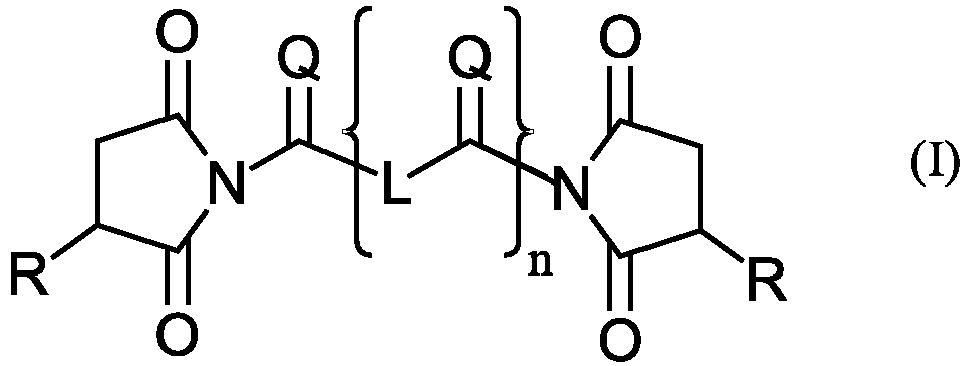
- In another aspect, the present disclosure provides fuel mixtures comprising a hydrocarbon fuel; and a lubricity additive according to the present disclosure. In various embodiments the hydrocarbon fuel may be a middle distillate fuel, derived from petroleum or biobased feedstock. Additional embodiments of the fuel mixtures of the present disclosure are described below.
- In another aspect, the present disclosure provides methods of making lubricity additives comprising reacting an alkenyl succinic anhydride according to formula II:


- The preceding summary of the present disclosure is not intended to describe each embodiment of the present invention. The details of one or more embodiments of the invention are also set forth in the description below. Other features, objects, and advantages of the invention will be apparent from the description and from the claims.
- In this application:
- "common solvents" refers to low molecular weight organic liquids commonly used as solvents by practitioners in the art, which may include aliphatic and alicyclic hydrocarbons (e.g., hexane, heptane, and cyclohexane), aromatic solvents (e.g., benzene, toluene, xylene, and mixtures of heavy aromatic naphtha), ethers (e.g., diethyl ether, glyme, diglyme, diisopropyl ether, and tetrahydrofuran), esters (e.g., ethyl acetate and butyl acetate), alcohols (e.g., ethanol and isopropyl alcohol), ketones (e.g., acetone, methyl ethyl ketone, and methyl isobutyl ketone), sulfoxides (e.g., dimethyl sulfoxide), amides (e.g., N,N-dimethylformamide, N,N-dimethylacetamide, and N-methyl-2-pyrrolidone), halogenated solvents (e.g., methylchloroform, 1,1,2-trichloro-1,2,2-trifluoroethane, trichloroethylene, and trifluorotoluene), and mixtures thereof; and
- "substituted" means, for a chemical species, group or moiety, substituted by conventional substituents which do not interfere with the desired product or process, e.g., substituents can be alkyl, alkoxy, aryl, phenyl, halo (F, Cl, Br, I), cyano, nitro, etc.
- All scientific and technical terms used herein have meanings commonly used in the art unless otherwise specified. All chemical formulas used herein are intended to include all enantiomers or stereoisomers unless otherwise specified.
- As used in this specification and the appended claims, the singular forms "a", "an", and "the" encompass embodiments having plural referents, unless the content clearly dictates otherwise.
- As used in this specification and the appended claims, the term "or" is generally employed in its sense including "and/or" unless the content clearly dictates otherwise.
- As used herein, "have", "having", "include", "including", "comprise", "comprising" or the like are used in their open ended sense, and generally mean "including, but not limited to." It will be understood that the terms "consisting of" and "consisting essentially of" are subsumed in the term "comprising," and the like.
- The present disclosure provides synthetic lubricity additives for hydrocarbon fuels such as diesel fuel. Lubricity additives may be species according to formula I:

- The present lubricity additives may be made by any suitable method. In one method, an alkenyl succinic anhydride (ASA) according to formula II:


- The alkenyl succinic anhydride (ASA) according to formula II may be made according to any suitable method. In one embodiment, a selected olefin is reacted with maleic anhydride under inert atmosphere at elevated temperature, as described below in the Examples. The selected olefin may be present in a slight molar excess to minimize the formation of polymaleic anhydride. The olefin may be an alpha olefin or an internal olefin having a carbon-carbon double bond available for reaction. The selected olefin may be a single species of olefin or a mixture of species.
- The ASA may be reacted with the species according to formula III by any suitable method. In one embodiment, the two reactants are reacted under inert atmosphere at elevated temperature, as described below in the Examples.
Typically ASA and the species according to formula III are present in the reaction mixture in 2:1 molar ratio. In one embodiment, the reaction temperature is increased stepwise to provide amidation of ASA at lower temperatures, followed by ring closure to provide the corresponding imide groups at higher temperatures. Stepwise amidation and imidation was found to eliminate the formation of precipitates resulting from side-reactions. - The present method employing a bisamide (such as urea (IUPAC designation carbonyl diamide) results in a carbonyl group that provides increased binding to metal surfaces, a trait that is desirable in a lubricity additive.
- The present fuel additives may be provided neat or in solution. Certain fuel additives may be gels or solids at room temperature in the absence of solvent, leading to difficulty in handling and in blending with fuel. For example, neat ASA- urea adducts are gels or solids at room temperature, depending on the length and the structure (e.g., branched or straight) of the alkenyl R groups. Formulations of these lubricity additives with as little as 10% solvent remain liquid and stable (i.e., no gelation, precipitation, phase separation, or dramatic increase in viscosity) during prolonged storage at 10°C. Any suitable common solvent may be used. In some embodiments, the solvent is an aromatic solvent such as heavy aromatic naphtha. Greater dilution may result in reduced viscosity and therefore improved pumpability at lower temperatures. Formulations of these lubricity additives with 20% solvent or 30% solvent demonstrate low viscosity at sub-zero (centigrade) temperatures and excellent performance as lubricity additives.
- The present disclosure additionally provides fuel mixtures comprising a hydrocarbon fuel and a lubricity additive according to the present disclosure. Any suitable fuel may be used. In various embodiments, the hydrocarbon fuel may be a middle distillate fuel, a bio-sourced fuel, or a diesel fuel. The fuel mixture may additionally comprise other additives such as one or more of dispersants, antioxidants, viscosity index modifiers, corrosion inhibitors, and the like.
- Additional embodiments are recited in the Selected Embodiments and Examples below.
- The following embodiments, designated by letter and number, are intended to further illustrate the present disclosure but should not be construed to unduly limit this disclosure.
- A1. A lubricity additive according to formula I:

- wherein n is 1 or 0;
- wherein each Q is independently selected from oxygen and sulfur;
- wherein each R is independently selected from C8-C60 alkenyl groups which are substituted or unsubstituted; and
- wherein L is a linking group comprising 0-20 carbons which may be substituted or unsubstituted and may optionally comprise catenary heteroatoms.
- A2. A lubricity additive according to embodiment A1 wherein each Q is oxygen.
- A3. A lubricity additive according to embodiment A1 wherein each Q is sulfur.
- A4. A lubricity additive according to any of embodiments A1-A3 wherein n is 0.
- A5. A lubricity additive according to any of embodiments A1-A4 wherein each R is independently selected from straight-chain or branched groups.
- A6. A lubricity additive according to any of embodiments A1-A4 wherein each R is independently selected from straight-chain groups.
- A7. A lubricity additive according to any of embodiments A1-A4 wherein each R is independently selected from branched groups.
- A8. A lubricity additive according to any of embodiments A1-A7 wherein each R is independently selected from C8-C32 alkenyl groups.
- A9. A lubricity additive according to any of embodiments A1-A7 wherein each R is independently selected from C12-C32 alkenyl groups.
- A10. A lubricity additive according to any of embodiments A1-A7 wherein each R is independently selected from C18-C32 alkenyl groups.
- A11. A lubricity additive according to any of embodiments A1-A7 wherein each R is independently selected from C12-C24 alkenyl groups.
- A12. A lubricity additive according to any of embodiments A1-A7 wherein each R is independently selected from C20-C24 alkenyl groups.
- F1. A fuel mixture comprising:
- a) a hydrocarbon fuel; and
- b) a lubricity additive according to any of embodiments A1-A12.
- F2. A fuel mixture according to embodiment F1 wherein the hydrocarbon fuel is a middle distillate fuel.
- F3. A fuel mixture according to embodiment F1 wherein the hydrocarbon fuel is a biobased fuel.
- F4. A fuel mixture according to embodiment F1 wherein the hydrocarbon fuel is a diesel fuel.
- M1. A method of making a lubricity additive comprising reacting an alkenyl succinic anhydride according to formula II:

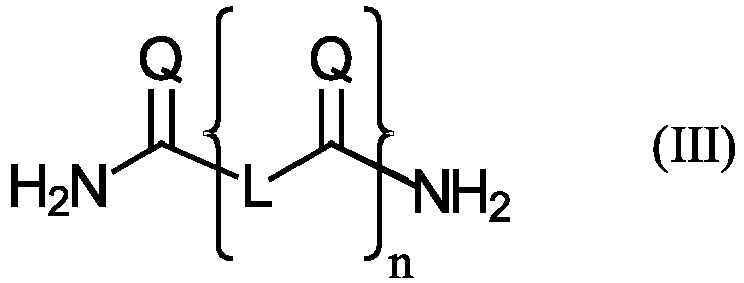
- wherein R is a C8-C60 alkenyl group which is substituted or unsubstituted;
- wherein n is 1 or 0;
- wherein each Q is independently selected from oxygen and sulfur; and
- wherein L is a linking group comprising 0-20 carbons which may be substituted or unsubstituted and may optionally comprise catenary heteroatoms.
- M2. A method according to embodiment M1 wherein each Q is oxygen.
- M3. A method according to embodiment M1 wherein each Q is sulfur.
- M4. A method according to any of embodiments M1-M3 wherein n is 0.
- M5. A method according to any of embodiments M1-M4 wherein the lubricity additive is a lubricity additive according to any of embodiments A1-A12.
- Objects and advantages of this disclosure are further illustrated by the following examples, but the particular materials and amounts thereof recited in these examples, as well as other conditions and details, should not be construed to unduly limit this disclosure.
- Unless otherwise noted, all reagents were obtained or are available from Aldrich Chemical Co., Milwaukee, WI, or may be synthesized by known methods.
- All parts, percentages, ratios, etc. in the examples and the rest of the specification are by weight, unless noted otherwise. The following abbreviations may be used: m = meters; cm = centimeters; mm = millimeters; um = micrometers; ft = feet; in = inch; RPM = revolutions per minute; kg = kilograms; oz = ounces; lb = pounds; Pa = Pascals; sec = seconds; min = minutes; hr = hours; and RH = relative humidity. The terms "weight %", "% by weight", and "wt%" are used interchangeably.
-
Designation Description maleic anhydride maleic anhydride obtained from Huntsman Corporation, USA, under the designation Low Acid Maleic Anhydride. urea Urea obtained from Univar Inc., USA, under the designation designation Urea Prill. heavy aromatic naphtha heavy aromatic naphtha obtained from ExxonMobil Chemical, USA, under the brand name SOLVESSO™ 150. C12 olefin Dodecene obtained from Shell Inc., USA, under the brand name NEODENE™ 12. C18 olefin Octadecene obtained from Shell Inc., USA, under the brand name NEODENE™ 18. C12-C14 alpha-olefin Isomerized Alpha Olefin C12-C14 obtained from Chevron Phillips Chemical Company, USA, under the designation Isomerized Alpha Olefin C12-C14. C16-C18 internal olefin Isomerized Alpha Olefin C16-C18 Mixture obtained from Chevron Phillips Chemical Company, USA, under the designation Isomerized Alpha Olefin C16-C18. C20-C24 olefin Isomerized Alpha Olefin C20-C24 Mixture obtained from Chevron Phillips Chemical Company, USA, under the designation Isomerized Alpha Olefin C20-C24. C-18 ASA C-18 alkenyl succinic anhydride obtained from Bercen Inc, USA, under the brand name BERSIZE™7938 C-20-24 ASA C-20-24 alkenyl succinic anhydride mixture obtained from Bercen Inc, USA, under the brand name BERSIZE™ 2024 C-12 ASA C-12 alkenyl succinic anhydride obtained from Milliken & Company, USA, under the designation DDSA. Domestic Summer ULSD Ultra-Low Sulfur Diesel fuel in a domestic use summer formulation Domestic Winter ULSD Ultra-Low Sulfur Diesel fuel in a domestic use winter formulation Export Summer ULSD Ultra-Low Sulfur Diesel fuel in an export summer formulation Export Winter ULSD Ultra-Low Sulfur Diesel fuel in an export winter formulation Benchmark Lubricity Additive Non-synthetic obtained from Nalco Company, Naperville, Illinois, under the designation EC5720A. Ethanolamine Ethanolamine obtained from Dow Chemical Corp, Freeport, TX. Biuret H2N-C(O)-NH-C(O)-NH2 obtained from VWR Inc. Radnor, PA. Oleylpropanediamine N-Oleyl-1,3-diaminopropane obtained from Nouryon Surface Chemistry LLC, Chicago, IL, under the designation DUOMEEN™ OL Glycerol glycerine obtained from Vantage Oleochemicals, Chicago, IL, under the designation VYCERIN™ GL93. - Maleic anhydride was pulverized and then melted in a flask at 80°C under nitrogen sweep to purge the oxygen in the system. The selected olefin was charged into the flask in a slight molar excess to minimize the formation of polymaleic anhydride, which is a side reaction. Polymaleic anhydride may appear as dark brown precipitate which is discarded. The reaction mixture was heated to 200 °C - 205°C for at least 10 hours under nitrogen to generate the corresponding alkenyl succinic anhydride (ASA) as an amber to dark amber viscous liquid.
- Following the ASA synthesis the flask was cooled to 100°C. Urea was added in a 2:1 ASA/urea molar ratio. The temperature was increased stepwise with a 2 hour duration at each of 100°C, 120°C, and 140°C - 150°C. The stepwise increase in temperature during imidation provided amidation of ASA with urea at lower temperatures, followed by ring closure to afford the corresponding ASA-urea adduct at higher temperatures (≥140°C). Stepwise amidation and imidation was found to eliminate the formation of black precipitate. After a total of 6 hours reaction time as described above, heavy aromatic naphtha was charge into the flask followed by filtration to afford a formulation at the desired concentration.
- HFRR testing was performed in accordance with ASTM D6079 Standard Test Method for Evaluating Lubricity of Diesel Fuels by the High-Frequency Reciprocating Rig (HFRR).
- Table I reports HFRR results demonstrating lubricity improvement (smaller wear scar) with the use of ASA - Urea Adducts made with the C12 olefin (Ex. 1 and 3) or the C18 olefin (Ex. 2 and 4). For comparative examples C1 and C2, the unreacted C12 olefin alone was used as the additive. The "Comparative Wear Scar" column reports results obtained under the same conditions using the Benchmark Lubricity Additive. All additive formulations were 50% by weight additive in heavy aromatic naphtha, which is comparable to the Benchmark Lubricity Additive. The indicated additive was used to treat ULSD fuels at the indicated concentration and tested in accordance with the HFRR Test Method. The treat rates described in Table 1 were based on the total amount of the formulated additives (including solvent).
- Both ULSD's responded very well to the ASA - Urea adducts. On the other hand, the ULSD samples did not show the same respond to the unmodified alkenyl succinic anhydride suggesting that the incorporation of the imide functionality in the molecule is essential to achieve performance as a lubricity improver for ULSD.
Table 1 Example Active Material ULSD Treat Rate (ppm) Example Wear Scar (µm) Comparative Wear Scar (µm) 1 C12 ASA - Urea Adduct Domestic Summer 0 580 580 200 511 510 300 484 494 2 C18 ASA - Urea Adduct Domestic Summer 0 580 580 200 462 510 300 415 494 C1 C12 ASA Domestic Summer 0 580 580 200 547 510 300 517 494 3 C12 ASA - Urea Adduct Export Winter 0 578 578 200 503 500 350 428 369 4 C18 ASA - Urea Adduct Export Winter 0 578 578 200 447 500 350 397 369 C2 C12 ASA Export Winter 0 578 578 200 506 500 350 503 369 - Table 2 reports HFRR results demonstrating lubricity improvement (smaller wear scar) with the use of ASA - Urea Adducts made with the C12-C14 alpha-olefin (Ex. 5 and 6) or the C16-C18 internal olefin (Ex. 7 and 8), maleic anhydride, and urea as described above. As above, the "Comparative Wear Scar" column reports results obtained under the same conditions using the Benchmark Lubricity Additive. All additive formulations were 50% by weight additive in heavy aromatic naphtha, except examples 5 and 6 where the additive was added neat. In all cases, the Benchmark Lubricity Additive contains comparable % active as the formulated additives. The indicated additive was used to treat ULSD fuels at the indicated concentration and tested in accordance with the HFRR Test Method. The treat rates described in Table 2 were based on the total amount of the formulated additives (including solvent).
Table 2 Example Active Material ULSD Treat Rate (ppm) Example Wear Scar (µm) Comparative Wear Scar (µm) 5 C12-C14 ASA-Urea Domestic Summer 0 580 580 100 491 507 150 435 441 6 C12-C14 - ASA Urea Domestic Winter 0 571 571 100 511 501 150 448 450 7 C16-C18 ASA-Urea Domestic Summer 0 580 580 200 526 510 300 459 494 8 C16-C18 ASA - Urea Export Winter 0 578 578 200 498 500 350 416 369 - To investigate the impact of ASA chain length on lubricity additive performance, ASA - Urea adducts derived from varying chain length olefins were tested as described above with regard to Examples 1-8 and the results are reported in Table 3. In general, it was found that better performance correlated with longer chain length.
Table 3 Example Active Material ULSD Treat Rate (ppm) Example Wear Scar (µm) Comparative Wear Scar (µm) 9 C12 ASA-Urea Domestic Summer 0 580 580 200 532 510 300 452 494 10 C18 ASA-Urea Domestic Summer 0 580 580 200 497 510 300 432 494 11 C20-C24 ASA-Urea Domestic Summer 0 580 580 200 468 510 300 424 494 12 C12 ASA-Urea Export Winter 0 578 578 200 476 500 350 399 369 13 C18 ASA-Urea Export Winter 0 578 578 200 482 500 350 381 369 14 C20-C24 ASA - Urea Export Winter 0 578 578 200 449 500 350 381 369 - A reaction was carried out according to the following procedure. C-18 ASA (58.36g, 0.17 mol) and urea (5g, 0.08 mol) were weighed into a 250 mL round-bottom reactor provided with an inert gas atmosphere to prevent oxidation. To the reaction mixture was added 25.87g of heavy aromatic naptha (HAN) and ethanolamine (1.27g, 0.0208mol) and stirred. The mixture was heated to 90 °C while stirring using a heated oil bath. After 4 hours the reaction temperature was raised to 150°C and held at 150°C for 4 hours. After the total reaction time of 8 hours, the principally Bisimide product (Bisimide, 58 g, 96%) was obtained. The product was obtained as a clear amber yellow liquid at 70% concentration in heavy aromatic naptha. This concentration is useful for ease of handling. The additive at the appropriate concentration can be added to the diesel fuel to obtain the desired lubricity performance. The lubricity performance of the product was measured in the high frequency reciprocating rig (HFRR) as described above and demonstrated wear scar values of 379 µm at 250 ppm concentration in diesel fuel.
- A reaction was carried out according to the following procedure. C-18 ASA (54.41g, 0.16 mol) and Biuret (8g, 0.08 mol) were weighed into a 250 mL round-bottom reactor provided with an inert gas atmosphere to prevent oxidation. To the reaction mixture was added 25.9g of heavy aromatic naptha (HAN) and ethanolamine (1.39g, 00217mol) and stirred. The mixture was heated to 90 °C while stirring using a heated oil bath. After 4 hours the reaction temperature is raised to 150°C and held at 150°C for 4 hours. After the total reaction time of 8 hours, the principally Bisimide product (Bisimide, 56 g, 94%) was obtained. The product is obtained as a clear dark amber liquid at 70% concentration in heavy aromatic naptha. This concentration is useful for ease of handling. The additive at the appropriate concentration can be added to the diesel fuel to obtain the desired lubricity performance. The lubricity performance of the product was measured in the high frequency reciprocating rig (HFRR) as described above and demonstrated wear scar values in the range of 370µm at a 250ppm concentration in the diesel fuel.
- A reaction was carried out according to the following procedure. C-18 ASA (58.36g, 0.17 mol) and urea (5g, 0.08 mol) were weighed into a 250 mL round-bottom reactor provided with an inert gas atmosphere to prevent oxidation. To the reaction mixture was added 25.87g of heavy aromatic naptha (HAN) and oleylpropandiamine (1.27g, 004mol) and stirred. The mixture was heated to 90 °C while stirring using a heated oil bath. After 4 hours the reaction temperature is raised to 150°C and held at 150°C for 4 hours. After the total reaction time of 8 hours, the Bisimide product (Bisimide, 58 g, 96%) was obtained. The product is obtained as a clear amber yellow liquid at 70% concentration in heavy aromatic naptha. This concentration is useful for ease of handling. The additive at the appropriate concentration can be added to the diesel fuel to obtain the desired lubricity performance. The lubricity performance of the product was measured in the high frequency reciprocating rig (HFRR) as described above and demonstrated wear scar values of 378µm at a 250ppm concentration in the diesel fuel.
- Alkenyl succinic glycerol bisester derivatives were synthesized from the reaction of several alkenyl succinic anhydrides and glycerol through the ring opening reaction of the anhydride with glycerol. Final target products were a mixture of isomers, were characterized by 1H NMR, Fourier transform-infrared spectroscopy (FT-IR), and were used as additives without further purification.
- A reaction was carried out according to the following procedure. C-18 ASA (55 g, 0.1569 mol) and glycerol (7.22 g, 0.0785 mol) were weighed into a 250 mL round-bottom reactor with an inert gas atmosphere to prevent oxidation. The mixture was heated to 70-80 °C while stirring using a heated oil bath. Products (Bisester, 61 g, 98%) were obtained after 8 hours. The product can be diluted with heavy aromatic naptha to generate a concentrated product solution for ease of handling. The additive at the appropriate concentration can be added to the diesel fuel to obtain the desired lubricity performance. The lubricity performance of the product was measured in the high frequency reciprocating rig (HFRR) as described above and demonstrated wear scar values in the range of 368-404 µm at a 200 ppm concentration in the diesel fuel.
- Most fuel system storage tanks, transfer lines, and underground pipelines are composed of 1018/1020 carbon steel. These system components are all susceptible to internal corrosion when exposed to fuel containing water. Corrosion in fuel storage and transportation system can be aggravated by acid carryover from fuel processing, microbial growth, seawater contamination, and water from salt drying operations.
- Lubricity improvers for diesel fuel are known to exhibit ferrous corrosion inhibitor activity at dosages required to meet the lubricity specification. However, commercial ferrous corrosion inhibitors typically are used at lower rates, typically from 1 to 15 ppm in fuels. At these rates, typical lubricity improvers do not demonstrate good performance as corrosion inhibitors.
- NACE TM 0172 Standard Test Method for Determining Corrosive Properties of Cargoes in Petroleum Product Pipelines is a test method used for fuel pipeline companies and refineries to determine the corrosive properties of liquid petroleum products and other hydrocarbon products that are not water-soluble for transporting through a steel pipeline. Typically, an A or B++ rating per NACE TM 0172 is considered acceptable.
- The C-18 ASA/urea adduct described above was evaluated for ferrous corrosion inhibitor activity per NACE TM 0172 test in a corrosive summer diesel fuel and gasoline. The fuel samples were treated in the range of 1 to 10 ppm (based on 70% C-18 ASA/urea adduct in heavy aromatic naphtha). Tables 4 and 5 report the NACE TM 0172 performance of C-the 18 ASA/urea adduct as corrosion inhibitor.
Table 4 C-18 ASA/urea adduct (70% active) ferrous corrosion inhibitor performance per NACE TM 0172 in a summer diesel fuel. Treat Rate, ppm NACE Rating per TM 0172 0 B+ 5 A 10 A 15 A Table 5 C-18 ASA/urea adduct (70% active) ferrous corrosion inhibitor performance per NACE TM 0172 in gasoline. Treat Rate, ppm NACE Rating per TM 0172 0 C 1 A 5 A 10 A - Various modifications and alterations of this disclosure will become apparent to those skilled in the art without departing from the scope and principles of this disclosure, and it should be understood that this disclosure is not to be unduly limited to the illustrative embodiments set forth hereinabove.
-
- 1. A lubricity additive according to formula I:
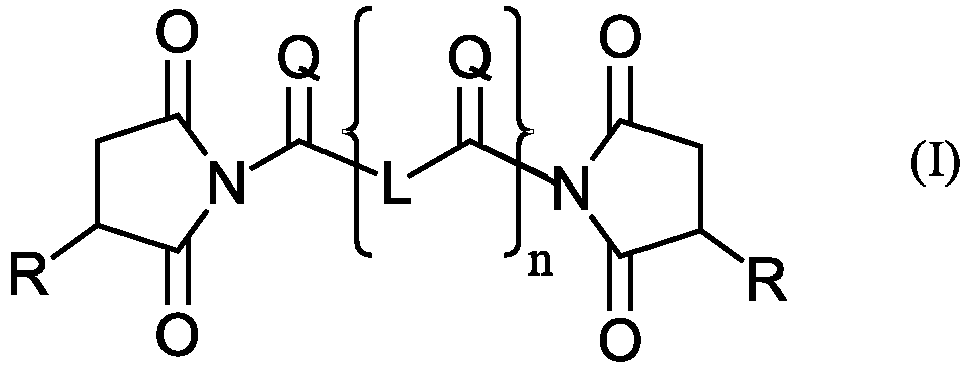
- wherein n is 1 or 0;
- wherein each Q is independently selected from oxygen and sulfur;
- wherein each R is independently selected from C8-C60 alkenyl groups which are substituted or unsubstituted; and
- wherein L is a linking group comprising 0-20 carbons which may be substituted or unsubstituted and may optionally comprise catenary heteroatoms.
- 2. A lubricity additive according to aspect 1 wherein each Q is oxygen.
- 3. A lubricity additive according to aspect 1 wherein each Q is sulfur.
- 4. A lubricity additive according to any of aspects 1-3 wherein n is 0.
- 5. A lubricity additive according to any of aspects 1-4 wherein each R is independently selected from C12-C32 alkenyl groups.
- 6. A lubricity additive according to any of aspects 1-4 wherein each R is independently selected from C12-C24 alkenyl groups.
- 7. A lubricity additive according to any of aspects 1-4 wherein each R is independently selected from C20-C24 alkenyl groups.
- 8. A fuel mixture comprising:
- a) a hydrocarbon fuel; and
- b) a lubricity additive according to any of aspects 1-7.
- 9. A fuel mixture according to aspect 8 wherein the hydrocarbon fuel is a middle distillate fuel.
- 10. A fuel mixture according to aspect 8 wherein the hydrocarbon fuel is a diesel fuel derived from petroleum or biobased feedstock.
- 11. A method of making a lubricity additive comprising reacting an alkenyl succinic anhydride according to formula II:


- wherein R is a C8-C60 alkenyl group which is substituted or unsubstituted;
- wherein n is 1 or 0;
- wherein each Q is independently selected from oxygen and sulfur; and
- wherein L is a linking group comprising 0-20 carbons which may be substituted or unsubstituted and may optionally comprise catenary heteroatoms.
- 12. A method according to aspect 11 wherein each Q is oxygen.
- 13. A method according to aspect 11 wherein each Q is sulfur.
- 14. A method according to any of aspects 11-13 wherein n is 0.
- 15. A method according to any of aspects 11-14 wherein the lubricity additive is a lubricity additive according to any of aspects 1-7.
Claims (15)
- A lubricity additive comprising a bisester which is the reaction product of glycerol and an alkenyl succinic anhydride according to formula II:

- The lubricity additive according to claim 1 wherein each R is independently selected from C8-C24 alkenyl groups.
- The lubricity additive according to claim 1 wherein each R is independently selected from C12-C24 alkenyl groups.
- The lubricity additive according to claim 1 wherein R is an octadecenyl group.
- A lubricity additive formulation consisting essentially of the lubricity additive according to any of claims 1 to 4 and solvent.
- The lubricity additive formulation according to claim 5 wherein the solvent is heavy aromatic naphtha.
- A fuel mixture comprising:a) a hydrocarbon fuel; andb) a lubricity additive according to any of claims 1 to 4.
- The fuel mixture according to claim 7 wherein the hydrocarbon fuel is a diesel fuel.
- A fuel mixture comprising:a) a hydrocarbon fuel; andb) a lubricity additive formulation according to any of claims 5 to 6.
- The fuel mixture according to claim 9 wherein the hydrocarbon fuel is a diesel fuel.
- A method of making a lubricity additive comprising reacting one molar equivalent of glycerol with two molar equivalents of an alkenyl succinic anhydride according to formula (II):

- The method according to claim 11 wherein each R is independently selected from C8-C24 alkenyl groups.
- The method according to claim 11 wherein each R is independently selected from C12-C24 alkenyl groups.
- The method according to claim 11 wherein R is an octadecenyl group.
- The method according to any of claims 11 to 14 wherein the lubricity additive is a bisester.
Applications Claiming Priority (3)
| Application Number | Priority Date | Filing Date | Title |
|---|---|---|---|
| US202063113444P | 2020-11-13 | 2020-11-13 | |
| EP21823423.5A EP4244316B1 (en) | 2020-11-13 | 2021-11-12 | Synthetic lubricity additives for hydrocarbon fuels |
| PCT/US2021/059087 WO2022104021A1 (en) | 2020-11-13 | 2021-11-12 | Synthetic lubricity additives for hydrocarbon fuels |
Related Parent Applications (2)
| Application Number | Title | Priority Date | Filing Date |
|---|---|---|---|
| EP21823423.5A Division EP4244316B1 (en) | 2020-11-13 | 2021-11-12 | Synthetic lubricity additives for hydrocarbon fuels |
| EP21823423.5A Division-Into EP4244316B1 (en) | 2020-11-13 | 2021-11-12 | Synthetic lubricity additives for hydrocarbon fuels |
Publications (2)
| Publication Number | Publication Date |
|---|---|
| EP4534630A2 true EP4534630A2 (en) | 2025-04-09 |
| EP4534630A3 EP4534630A3 (en) | 2025-06-18 |
Family
ID=78827899
Family Applications (2)
| Application Number | Title | Priority Date | Filing Date |
|---|---|---|---|
| EP21823423.5A Active EP4244316B1 (en) | 2020-11-13 | 2021-11-12 | Synthetic lubricity additives for hydrocarbon fuels |
| EP25151302.4A Pending EP4534630A3 (en) | 2020-11-13 | 2021-11-12 | Synthetic lubricity additives for hydrocarbon fuels |
Family Applications Before (1)
| Application Number | Title | Priority Date | Filing Date |
|---|---|---|---|
| EP21823423.5A Active EP4244316B1 (en) | 2020-11-13 | 2021-11-12 | Synthetic lubricity additives for hydrocarbon fuels |
Country Status (5)
| Country | Link |
|---|---|
| US (2) | US11629304B2 (en) |
| EP (2) | EP4244316B1 (en) |
| CA (1) | CA3197365A1 (en) |
| SA (1) | SA523440753B1 (en) |
| WO (1) | WO2022104021A1 (en) |
Citations (2)
| Publication number | Priority date | Publication date | Assignee | Title |
|---|---|---|---|---|
| US5551957A (en) | 1992-05-06 | 1996-09-03 | Ethyl Corporation | Compostions for control of induction system deposits |
| US7361629B2 (en) | 2004-03-10 | 2008-04-22 | Afton Chemical Corporation | Additives for lubricants and fuels |
Family Cites Families (34)
| Publication number | Priority date | Publication date | Assignee | Title |
|---|---|---|---|---|
| US3045042A (en) * | 1957-08-16 | 1962-07-17 | Monsanto Chemicals | Acid polyester succinates |
| NL124842C (en) | 1959-08-24 | |||
| CA1048507A (en) | 1974-03-27 | 1979-02-13 | Jack Ryer | Additive useful in oleaginous compositions |
| US4240970A (en) | 1976-07-28 | 1980-12-23 | Mobil Oil Corporation | Reaction products of hydroxy aromatic or alkylphenylether compounds and alkenylsuccinic acid, anhydride, or ester |
| US5162526A (en) | 1976-09-24 | 1992-11-10 | Exxon Chemical Patents Inc. | Macrocyclic polyamine and polycyclic polyamine multifunctional lubricating oil |
| US4171959A (en) | 1977-12-14 | 1979-10-23 | Texaco Inc. | Fuel composition containing quaternary ammonium salts of succinimides |
| US4292186A (en) | 1979-12-04 | 1981-09-29 | Mobil Oil Corporation | Metal complexes of alkylsuccinic compounds as lubricant and fuel additives |
| FR2510598A1 (en) | 1981-07-30 | 1983-02-04 | Inst Francais Du Petrole | USE OF NITROGEN ADDITIVES AS DISORDERS OF HYDROCARBON MEDIUM DISTILLATE DISORDER POINT AND HYDROCARBON MEDIUM DISTILLATE COMPOSITIONS COMPRISING SUCH ADDITIVES |
| US4675374A (en) | 1984-03-26 | 1987-06-23 | Gus Nichols | Solventless polymeric composition reaction product of (1) adduct of amine and acrylate with (2) polyacrylate |
| FR2586255B1 (en) | 1985-08-14 | 1988-04-08 | Inst Francais Du Petrole | IMPROVED COMPOSITIONS OF DISPERSING ADDITIVES FOR LUBRICATING OILS AND THEIR PREPARATION |
| US5032145A (en) | 1987-04-20 | 1991-07-16 | Mobil Oil Corporation | Low temperature fluidity improver and compositions thereof |
| US5047160A (en) | 1988-02-29 | 1991-09-10 | Exxon Chemical Patents Inc. | Polyanhydride modified adducts or reactants and oleaginous compositions containing same |
| US4897086A (en) | 1988-12-29 | 1990-01-30 | Mobil Oil Corporation | Lubricant and fuel compositions containing reaction products of polyalkenyl succinimides, aldehydes, and triazoles |
| US4997456A (en) | 1989-09-11 | 1991-03-05 | Ethyl Petroleum Additives, Inc. | Fuel compositions |
| US5241003A (en) | 1990-05-17 | 1993-08-31 | Ethyl Petroleum Additives, Inc. | Ashless dispersants formed from substituted acylating agents and their production and use |
| GB9321370D0 (en) | 1993-10-13 | 1993-12-08 | Exxon Chemical Patents Inc | Fuel additives |
| US6419714B2 (en) | 1999-07-07 | 2002-07-16 | The Lubrizol Corporation | Emulsifier for an acqueous hydrocarbon fuel |
| JP2001316361A (en) | 2000-05-01 | 2001-11-13 | Ethyl Corp | Succinimide-acid compounds and derivatives thereof |
| DE60109936T2 (en) | 2000-07-19 | 2006-02-02 | The Lubrizol Corp., Wickliffe | ADDITIVE COMPOSITION FOR MIDDESTILLATE FUELS AND MIDDLE DISTILLATE FUEL COMPOSITIONS CONTAINING THEREOF |
| US7182795B2 (en) | 2002-03-13 | 2007-02-27 | Atton Chemical Intangibles Llc | Fuel lubricity additives derived from hydrocarbyl succinic anhydrides and hydroxy amines, and middle distillate fuels containing same |
| US7208022B2 (en) | 2002-03-14 | 2007-04-24 | The Lubrizol Corporation | Ethanol-diesel fuel composition and methods thereof |
| WO2005012468A1 (en) | 2003-08-01 | 2005-02-10 | The Lubrizol Corporation | Mixed dispersants for lubricants |
| US20080086935A1 (en) | 2006-10-16 | 2008-04-17 | Lawrence J Cunningham | Method and compositions for reducing corrosion in engines combusting ethanol-containing fuels |
| US9011556B2 (en) | 2007-03-09 | 2015-04-21 | Afton Chemical Corporation | Fuel composition containing a hydrocarbyl-substituted succinimide |
| WO2010077538A1 (en) | 2008-12-09 | 2010-07-08 | The Lubrizol Corporation | Method of operating an engine using an ashless consumable lubricant |
| EP2514807B2 (en) | 2009-05-15 | 2020-11-18 | The Lubrizol Corporation | Quaternary ammonium amide salts |
| CA2816776A1 (en) | 2012-05-29 | 2013-11-29 | Tpc Group Llc | Adducts of low molecular weight pib with low polydispersity and high vinylidene content |
| RU2540671C2 (en) * | 2013-06-27 | 2015-02-10 | Федеральное Казенное Предприятие "Бийский Олеумный Завод" | Emulsifying composition for production of emulsion explosives (versions) |
| EP3149128A1 (en) | 2014-05-30 | 2017-04-05 | The Lubrizol Corporation | Branched amine containing quaternary ammonium salts |
| SG11201609883PA (en) * | 2014-05-30 | 2016-12-29 | Lubrizol Corp | Imidazole containing quaternary ammonium salts |
| WO2015184247A1 (en) | 2014-05-30 | 2015-12-03 | The Lubrizol Corporation | High molecular weight imide containing quaternary ammonium salts |
| US10260019B2 (en) | 2016-06-30 | 2019-04-16 | The Lubrizol Corporation | Hydroxyaromatic succinimide detergents for lubricating compositions |
| US10899985B2 (en) | 2016-08-25 | 2021-01-26 | Evonik Operations Gmbh | Amine alkenyl substituted succinimide reaction product fuel additives, compositions, and methods |
| CA3056545A1 (en) * | 2017-03-30 | 2018-10-04 | Innospec Limited | Method and use |
-
2021
- 2021-11-12 CA CA3197365A patent/CA3197365A1/en active Pending
- 2021-11-12 EP EP21823423.5A patent/EP4244316B1/en active Active
- 2021-11-12 US US17/525,105 patent/US11629304B2/en active Active
- 2021-11-12 WO PCT/US2021/059087 patent/WO2022104021A1/en not_active Ceased
- 2021-11-12 EP EP25151302.4A patent/EP4534630A3/en active Pending
-
2023
- 2023-03-14 US US18/121,301 patent/US12187970B2/en active Active
- 2023-05-11 SA SA523440753A patent/SA523440753B1/en unknown
Patent Citations (2)
| Publication number | Priority date | Publication date | Assignee | Title |
|---|---|---|---|---|
| US5551957A (en) | 1992-05-06 | 1996-09-03 | Ethyl Corporation | Compostions for control of induction system deposits |
| US7361629B2 (en) | 2004-03-10 | 2008-04-22 | Afton Chemical Corporation | Additives for lubricants and fuels |
Also Published As
| Publication number | Publication date |
|---|---|
| US20220154089A1 (en) | 2022-05-19 |
| SA523440753B1 (en) | 2025-05-29 |
| EP4534630A3 (en) | 2025-06-18 |
| US20230220290A1 (en) | 2023-07-13 |
| CA3197365A1 (en) | 2022-05-19 |
| US12187970B2 (en) | 2025-01-07 |
| EP4244316A1 (en) | 2023-09-20 |
| EP4244316C0 (en) | 2025-03-12 |
| EP4244316B1 (en) | 2025-03-12 |
| WO2022104021A1 (en) | 2022-05-19 |
| US11629304B2 (en) | 2023-04-18 |
Similar Documents
| Publication | Publication Date | Title |
|---|---|---|
| US6310174B1 (en) | Primary alkanolamides | |
| WO2007053787A1 (en) | Fuel additive concentrate composition and fuel composition and method thereof | |
| IL126985A (en) | Fuel additives | |
| US4391610A (en) | Liquid hydrocarbon fuel containing a corrosion inhibitor, dialkoxylated alkyl polyoxyalkyl primary amine | |
| US5454961A (en) | Substituted fullerenes as flow improvers | |
| MXPA05010777A (en) | Formulations useful as asphaltene dispersants in petroleum products. | |
| US20050223627A1 (en) | Additive for improving the thermal stability of hydrocarbon compositions | |
| US20120053101A1 (en) | Functionalized Maleated Fatty Acids as Non Acidic Fluid Additives | |
| EP3732274B1 (en) | Composition useful as friction modifier | |
| EP4244316B1 (en) | Synthetic lubricity additives for hydrocarbon fuels | |
| CA3028395C (en) | Fuel additive mixtures and fuels containing them | |
| US5853436A (en) | Diesel fuel composition containing the salt of an alkyl hydroxyaromatic compound and an aliphatic amine | |
| US5569407A (en) | Additives for fuels and lubricants | |
| US12018222B2 (en) | Synthetic lubricity additives for hydrocarbon fuels | |
| US20070074449A1 (en) | Additive concentrate | |
| EP0856574B1 (en) | Liquid polyfunctional additives for improved fuel lubricity | |
| CA3085540C (en) | Composition useful as friction modifier | |
| JP5068034B2 (en) | Fuel additives and compositions | |
| EP4584349A1 (en) | Synthetic lubricity additives for hydrocarbon fuels |
Legal Events
| Date | Code | Title | Description |
|---|---|---|---|
| PUAI | Public reference made under article 153(3) epc to a published international application that has entered the european phase |
Free format text: ORIGINAL CODE: 0009012 |
|
| STAA | Information on the status of an ep patent application or granted ep patent |
Free format text: STATUS: THE APPLICATION HAS BEEN PUBLISHED |
|
| AC | Divisional application: reference to earlier application |
Ref document number: 4244316 Country of ref document: EP Kind code of ref document: P |
|
| AK | Designated contracting states |
Kind code of ref document: A2 Designated state(s): AL AT BE BG CH CY CZ DE DK EE ES FI FR GB GR HR HU IE IS IT LI LT LU LV MC MK MT NL NO PL PT RO RS SE SI SK SM TR |
|
| REG | Reference to a national code |
Ref country code: DE Ref legal event code: R079 Free format text: PREVIOUS MAIN CLASS: C10L0010080000 Ipc: C10L0001238300 |
|
| PUAL | Search report despatched |
Free format text: ORIGINAL CODE: 0009013 |
|
| AK | Designated contracting states |
Kind code of ref document: A3 Designated state(s): AL AT BE BG CH CY CZ DE DK EE ES FI FR GB GR HR HU IE IS IT LI LT LU LV MC MK MT NL NO PL PT RO RS SE SI SK SM TR |
|
| RIC1 | Information provided on ipc code assigned before grant |
Ipc: C10L 1/19 20060101ALI20250515BHEP Ipc: C10L 10/08 20060101ALI20250515BHEP Ipc: C10L 1/2383 20060101AFI20250515BHEP |
|
| STAA | Information on the status of an ep patent application or granted ep patent |
Free format text: STATUS: REQUEST FOR EXAMINATION WAS MADE |
|
| 17P | Request for examination filed |
Effective date: 20251216 |