EP4534200A1 - Grading method for catalyst and production method for base oil - Google Patents
Grading method for catalyst and production method for base oil Download PDFInfo
- Publication number
- EP4534200A1 EP4534200A1 EP23909359.4A EP23909359A EP4534200A1 EP 4534200 A1 EP4534200 A1 EP 4534200A1 EP 23909359 A EP23909359 A EP 23909359A EP 4534200 A1 EP4534200 A1 EP 4534200A1
- Authority
- EP
- European Patent Office
- Prior art keywords
- catalyst
- content
- protective agent
- acid
- catalyst layer
- Prior art date
- Legal status (The legal status is an assumption and is not a legal conclusion. Google has not performed a legal analysis and makes no representation as to the accuracy of the status listed.)
- Pending
Links
Images

Classifications
-
- C—CHEMISTRY; METALLURGY
- C10—PETROLEUM, GAS OR COKE INDUSTRIES; TECHNICAL GASES CONTAINING CARBON MONOXIDE; FUELS; LUBRICANTS; PEAT
- C10G—CRACKING HYDROCARBON OILS; PRODUCTION OF LIQUID HYDROCARBON MIXTURES, e.g. BY DESTRUCTIVE HYDROGENATION, OLIGOMERISATION, POLYMERISATION; RECOVERY OF HYDROCARBON OILS FROM OIL-SHALE, OIL-SAND, OR GASES; REFINING MIXTURES MAINLY CONSISTING OF HYDROCARBONS; REFORMING OF NAPHTHA; MINERAL WAXES
- C10G45/00—Refining of hydrocarbon oils using hydrogen or hydrogen-generating compounds
- C10G45/58—Refining of hydrocarbon oils using hydrogen or hydrogen-generating compounds to change the structural skeleton of some of the hydrocarbon content without cracking the other hydrocarbons present, e.g. lowering pour point; Selective hydrocracking of normal paraffins
- C10G45/60—Refining of hydrocarbon oils using hydrogen or hydrogen-generating compounds to change the structural skeleton of some of the hydrocarbon content without cracking the other hydrocarbons present, e.g. lowering pour point; Selective hydrocracking of normal paraffins characterised by the catalyst used
- C10G45/64—Refining of hydrocarbon oils using hydrogen or hydrogen-generating compounds to change the structural skeleton of some of the hydrocarbon content without cracking the other hydrocarbons present, e.g. lowering pour point; Selective hydrocracking of normal paraffins characterised by the catalyst used containing crystalline alumino-silicates, e.g. molecular sieves
-
- B—PERFORMING OPERATIONS; TRANSPORTING
- B01—PHYSICAL OR CHEMICAL PROCESSES OR APPARATUS IN GENERAL
- B01J—CHEMICAL OR PHYSICAL PROCESSES, e.g. CATALYSIS OR COLLOID CHEMISTRY; THEIR RELEVANT APPARATUS
- B01J29/00—Catalysts comprising molecular sieves
- B01J29/04—Catalysts comprising molecular sieves having base-exchange properties, e.g. crystalline zeolites
- B01J29/06—Crystalline aluminosilicate zeolites; Isomorphous compounds thereof
- B01J29/80—Mixtures of different zeolites
-
- B—PERFORMING OPERATIONS; TRANSPORTING
- B01—PHYSICAL OR CHEMICAL PROCESSES OR APPARATUS IN GENERAL
- B01J—CHEMICAL OR PHYSICAL PROCESSES, e.g. CATALYSIS OR COLLOID CHEMISTRY; THEIR RELEVANT APPARATUS
- B01J29/00—Catalysts comprising molecular sieves
- B01J29/005—Mixtures of molecular sieves comprising at least one molecular sieve which is not an aluminosilicate zeolite, e.g. from groups B01J29/03 - B01J29/049 or B01J29/82 - B01J29/89
-
- B—PERFORMING OPERATIONS; TRANSPORTING
- B01—PHYSICAL OR CHEMICAL PROCESSES OR APPARATUS IN GENERAL
- B01J—CHEMICAL OR PHYSICAL PROCESSES, e.g. CATALYSIS OR COLLOID CHEMISTRY; THEIR RELEVANT APPARATUS
- B01J29/00—Catalysts comprising molecular sieves
- B01J29/82—Phosphates
- B01J29/84—Aluminophosphates containing other elements, e.g. metals, boron
- B01J29/85—Silicoaluminophosphates [SAPO compounds]
-
- B—PERFORMING OPERATIONS; TRANSPORTING
- B01—PHYSICAL OR CHEMICAL PROCESSES OR APPARATUS IN GENERAL
- B01J—CHEMICAL OR PHYSICAL PROCESSES, e.g. CATALYSIS OR COLLOID CHEMISTRY; THEIR RELEVANT APPARATUS
- B01J35/00—Catalysts, in general, characterised by their form or physical properties
- B01J35/19—Catalysts containing parts with different compositions
-
- B—PERFORMING OPERATIONS; TRANSPORTING
- B01—PHYSICAL OR CHEMICAL PROCESSES OR APPARATUS IN GENERAL
- B01J—CHEMICAL OR PHYSICAL PROCESSES, e.g. CATALYSIS OR COLLOID CHEMISTRY; THEIR RELEVANT APPARATUS
- B01J35/00—Catalysts, in general, characterised by their form or physical properties
- B01J35/30—Catalysts, in general, characterised by their form or physical properties characterised by their physical properties
-
- B—PERFORMING OPERATIONS; TRANSPORTING
- B01—PHYSICAL OR CHEMICAL PROCESSES OR APPARATUS IN GENERAL
- B01J—CHEMICAL OR PHYSICAL PROCESSES, e.g. CATALYSIS OR COLLOID CHEMISTRY; THEIR RELEVANT APPARATUS
- B01J8/00—Chemical or physical processes in general, conducted in the presence of fluids and solid particles; Apparatus for such processes
- B01J8/02—Chemical or physical processes in general, conducted in the presence of fluids and solid particles; Apparatus for such processes with stationary particles, e.g. in fixed beds
-
- B—PERFORMING OPERATIONS; TRANSPORTING
- B01—PHYSICAL OR CHEMICAL PROCESSES OR APPARATUS IN GENERAL
- B01J—CHEMICAL OR PHYSICAL PROCESSES, e.g. CATALYSIS OR COLLOID CHEMISTRY; THEIR RELEVANT APPARATUS
- B01J2229/00—Aspects of molecular sieve catalysts not covered by B01J29/00
- B01J2229/30—After treatment, characterised by the means used
- B01J2229/42—Addition of matrix or binder particles
-
- B—PERFORMING OPERATIONS; TRANSPORTING
- B01—PHYSICAL OR CHEMICAL PROCESSES OR APPARATUS IN GENERAL
- B01J—CHEMICAL OR PHYSICAL PROCESSES, e.g. CATALYSIS OR COLLOID CHEMISTRY; THEIR RELEVANT APPARATUS
- B01J29/00—Catalysts comprising molecular sieves
- B01J29/04—Catalysts comprising molecular sieves having base-exchange properties, e.g. crystalline zeolites
- B01J29/06—Crystalline aluminosilicate zeolites; Isomorphous compounds thereof
- B01J29/40—Crystalline aluminosilicate zeolites; Isomorphous compounds thereof of the pentasil type, e.g. types ZSM-5, ZSM-8 or ZSM-11, as exemplified by patent documents US3702886, GB1334243 and US3709979, respectively
-
- B—PERFORMING OPERATIONS; TRANSPORTING
- B01—PHYSICAL OR CHEMICAL PROCESSES OR APPARATUS IN GENERAL
- B01J—CHEMICAL OR PHYSICAL PROCESSES, e.g. CATALYSIS OR COLLOID CHEMISTRY; THEIR RELEVANT APPARATUS
- B01J29/00—Catalysts comprising molecular sieves
- B01J29/04—Catalysts comprising molecular sieves having base-exchange properties, e.g. crystalline zeolites
- B01J29/06—Crystalline aluminosilicate zeolites; Isomorphous compounds thereof
- B01J29/65—Crystalline aluminosilicate zeolites; Isomorphous compounds thereof of the ferrierite type, e.g. types ZSM-21, ZSM-35 or ZSM-38, as exemplified by patent documents US4046859, US4016245 and US4046859, respectively
-
- B—PERFORMING OPERATIONS; TRANSPORTING
- B01—PHYSICAL OR CHEMICAL PROCESSES OR APPARATUS IN GENERAL
- B01J—CHEMICAL OR PHYSICAL PROCESSES, e.g. CATALYSIS OR COLLOID CHEMISTRY; THEIR RELEVANT APPARATUS
- B01J29/00—Catalysts comprising molecular sieves
- B01J29/04—Catalysts comprising molecular sieves having base-exchange properties, e.g. crystalline zeolites
- B01J29/06—Crystalline aluminosilicate zeolites; Isomorphous compounds thereof
- B01J29/70—Crystalline aluminosilicate zeolites; Isomorphous compounds thereof of types characterised by their specific structure not provided for in groups B01J29/08 - B01J29/65
- B01J29/703—MRE-type, e.g. ZSM-48
-
- B—PERFORMING OPERATIONS; TRANSPORTING
- B01—PHYSICAL OR CHEMICAL PROCESSES OR APPARATUS IN GENERAL
- B01J—CHEMICAL OR PHYSICAL PROCESSES, e.g. CATALYSIS OR COLLOID CHEMISTRY; THEIR RELEVANT APPARATUS
- B01J29/00—Catalysts comprising molecular sieves
- B01J29/04—Catalysts comprising molecular sieves having base-exchange properties, e.g. crystalline zeolites
- B01J29/06—Crystalline aluminosilicate zeolites; Isomorphous compounds thereof
- B01J29/70—Crystalline aluminosilicate zeolites; Isomorphous compounds thereof of types characterised by their specific structure not provided for in groups B01J29/08 - B01J29/65
- B01J29/7042—TON-type, e.g. Theta-1, ISI-1, KZ-2, NU-10 or ZSM-22
-
- B—PERFORMING OPERATIONS; TRANSPORTING
- B01—PHYSICAL OR CHEMICAL PROCESSES OR APPARATUS IN GENERAL
- B01J—CHEMICAL OR PHYSICAL PROCESSES, e.g. CATALYSIS OR COLLOID CHEMISTRY; THEIR RELEVANT APPARATUS
- B01J29/00—Catalysts comprising molecular sieves
- B01J29/04—Catalysts comprising molecular sieves having base-exchange properties, e.g. crystalline zeolites
- B01J29/06—Crystalline aluminosilicate zeolites; Isomorphous compounds thereof
- B01J29/70—Crystalline aluminosilicate zeolites; Isomorphous compounds thereof of types characterised by their specific structure not provided for in groups B01J29/08 - B01J29/65
- B01J29/7046—MTT-type, e.g. ZSM-23, KZ-1, ISI-4 or EU-13
-
- C—CHEMISTRY; METALLURGY
- C10—PETROLEUM, GAS OR COKE INDUSTRIES; TECHNICAL GASES CONTAINING CARBON MONOXIDE; FUELS; LUBRICANTS; PEAT
- C10G—CRACKING HYDROCARBON OILS; PRODUCTION OF LIQUID HYDROCARBON MIXTURES, e.g. BY DESTRUCTIVE HYDROGENATION, OLIGOMERISATION, POLYMERISATION; RECOVERY OF HYDROCARBON OILS FROM OIL-SHALE, OIL-SAND, OR GASES; REFINING MIXTURES MAINLY CONSISTING OF HYDROCARBONS; REFORMING OF NAPHTHA; MINERAL WAXES
- C10G2400/00—Products obtained by processes covered by groups C10G9/00 - C10G69/14
- C10G2400/10—Lubricating oil
Definitions
- Embodiments of the present application relate to the technical field of catalysts, and, in particular, to a grading method of catalyst and a base oil production method.
- Lubricating oil can reduce the mechanical failure caused by friction and wear between mechanical parts. Therefore, with the rapid development of modern mechanical device and automobile industry, the market demand for lubricant base oil increases year by year. Converting paraffin oils into lubricant oils can realize the high added value of paraffin oil and bring great economic benefits.
- hydroisomerization technology is mainly used to isomerize long-chain alkane molecules in the paraffin oil into isomeric alkane molecules with branched structures, which can improve the low-temperature fluidity performance of the oil while retaining its viscosity index.
- CN1524929A discloses a method for reducing a cloud point of a lubricant base oil.
- the lubricating oil material is first pre-dewaxed by a solvent so that the pour point of the dewaxed oil is lowered to -5°C to 15°C, then the pre-dewaxed oil is hydrotreated to reduce its sulfur and nitrogen contents, and the hydrotreated pre-dewaxed oil is isomerized and dewaxed to obtain a lubricant base oil with a low cloud point.
- the dewaxing temperature is -10°C to 20°C, which requires low-temperature refrigeration device and high production cost.
- the feedstock oil contains impurity components such as sulfur and nitrogen, which needs to be removed by a hydrorefining process, thereby leading to a long process flow.
- CN1690175A discloses a method for reducing the cloud point of a hydrodewaxed lubricant base oil.
- the raw material for hydrodewaxed lubricant base oil is mixed with a solvent and a deflocculant, cooled to -5°C to -30°C and filtered to give a filtrate.
- the resulting filtrate is a hydrodewaxed lubricant base oil with a lowered cloud point, in which the addition amount of the deflocculant accounts for 0.002%wt to 5%wt of the raw material oil.
- This method improves the filtration speed through the addition of the deflocculant, thereby making it easy to filter out wax particles obtained from the crystallization.
- the filtration is carried out at a low temperature of 5°C to -30°C, which also has the problem of requiring low temperature refrigeration device and high production cost.
- CN99113304.8 proposes a method of tandem isomerization dewaxing, where a catalyst containing a molecular sieve with high silica content and low acidity and at least one Group VIII noble metal component is used in a first section, and a catalyst containing mesoporous SAPO-11 molecular sieve is used in a second section.
- a macroporous molecular sieve catalyst having low acidity in the first section the isomerization reaction of wax molecules is carried out at higher temperature while maintaining a lower cracking activity, reducing the loading of the SAPO-11 catalyst in the second section, achieving a lowered pour point of the base oil and maintaining a higher yield of lubricant base oil.
- CN1111073696A discloses a method of lowering a cloud point of a large viscosity lubricant base oil, where a first catalyst and a second catalyst are sequentially provided from top to bottom in a reaction device; said first catalyst and said second catalyst are two different noble metal isodewaxing catalysts; said lubricant base oil feedstock flows through the first catalyst and the second catalyst sequentially from top to bottom; the reaction temperature of the feedstock flowing through the second catalyst is smaller than the reaction temperature of the feedstock flowing through the first catalyst; and then after hydrofining, the product obtained from the bottom of the vacuum tower through atmospheric and vacuum fractionation is a lubricant base oil having low cloud and high viscosity.
- the present application provides a grading method of catalyst.
- grading the catalyst it is possible to improve the catalytic effect, and then increase the yield of a base oil, and improve the viscosity index, pour point, and cloud point of the base oil.
- the present application provides a grading method of catalyst, including a catalytic reaction unit, and a protective agent unit disposed before the catalytic reaction unit along a material flow direction.
- a total acid content of the catalyst first increases and then decreases, and a molar content proportion of Brönsted acid in the catalyst first increases and then decreases.
- an active metal content of a protective agent increases or remains constant; and a pore volume between protective agents decreases and a specific surface area of the protective agent increases.
- the catalytic reaction unit further includes a third catalyst layer disposed after the second catalyst layer along the material flow direction.
- the total acid content of the catalyst in the second catalyst layer is greater than that of the catalyst in the first catalyst layer and/or that of the catalyst in the third catalyst layer.
- the molar content proportion of Brönsted acid in the second catalyst layer is greater than that of Brönsted acid in the first catalyst layer and/or that of Brönsted acid in the third catalyst layer.
- the molar content proportion of Brönsted acid is 5% to 60% in at least one catalyst layer of the catalytic reaction unit.
- the molar content proportion of Brönsted acid is 10% to 50% in the at least one catalyst layer of the catalytic reaction unit.
- the total acid content of the catalyst is 50 ⁇ mol/g to 300 ⁇ mol/g in at least one catalyst layer of the catalytic reaction unit; preferably, the total acid content of the catalyst is 100 ⁇ mol/g to 300 ⁇ mol/g in the at least one catalyst layer of the catalytic reaction unit .
- the content of weak acid of the catalyst is 10 ⁇ mol/g to 150 ⁇ mol/g in at least one catalyst layer of the catalytic reaction unit; preferably, the content of weak acid of the catalyst is 20 ⁇ mol/g to 100 ⁇ mol/g in the at least one catalyst layer of the catalytic reaction unit; and/or the content of medium-strong acid of the catalyst is 5 ⁇ mol/g to 250 ⁇ mol/g in at least one catalyst layer of the catalytic reaction unit; preferably, the content of medium-strong acid of the catalyst is 10 ⁇ mol/g to 220 ⁇ mol/g in the at least one catalyst layer of the catalytic reaction unit.
- the protective agent unit includes a first protective agent layer and a second protective agent layer in sequence along the material flow direction.
- the active metal content of the protective agent in the first protective agent layer is less than or equal to that of the protective agent in the second protective agent layer.
- a volume percentage of the protective agent is 2% to 20%; and/or based on a total volume of the protective agent and the catalyst, a volume percentage of the catalyst is 80% to 98%.
- the present application provides a base oil production method, including performing catalytic treatment on a feedstock oil by using the grading method of catalyst as mentioned above to obtain the base oil.
- the feedstock oil is selected from at least one of hydrocracking tail oil, paraffin-based wax oil, naphthenic wax oil, intermediate-based wax oil, foots oil or petroleum jelly.
- the feedstock oil has a sulfur content of ⁇ 10 ⁇ g/g, a nitrogen content of ⁇ 5 ⁇ g/g, and a distillation range of 300°C to 600°C.
- the present application provides a grading method of catalyst, in which the catalyst is graded according to the acidity of the catalyst, effectively improving the catalytic effect, and increasing the yield of the base oil and the viscosity index of the base oil, reducing the low temperature performance of the base oil such as the pour point and the cloud point, and thus effectively improving the quality of the base oil.
- the total acid content of the catalyst first increases and then decreases along the material flow direction; and the molar content of Brönsted acid of the catalyst first increases and then decreases.
- the catalytic reaction unit includes a first catalyst layer and a second catalyst layer that are adjacent to each other in sequence.
- the content of weak acid is greater than the content of medium-strong acid; in the second catalyst layer, the content of weak acid is less than the content of medium-strong acid.
- the content of active metal in the protective agent increases or remains constant along the direction of material flow; the pore volume between the protective agents decreases and the specific surface area of the protective agent increases.
- the catalyst of the present application may be a catalyst commonly used in the art.
- the catalyst may contain a molecular sieve with a ten-member topological structure, and the molecular sieve may be one or more of ZSM-5, SAPO-11, ZSM-22, ZSM-35, ZSM-23, ZSM-48, and SAPO-41.
- the catalyst may further contain an amorphous inorganic porous material, which may be selected from at least one of alumina, zirconium oxide, and titanium oxide; or one or more of composite oxides thereof (alumina-silica, alumina-zirconium oxide, zirconium oxide-titanium oxide, alumina-titanium oxide).
- the mass percentage of the molecular sieve may be 40% to 80%; and further, based on the total mass of the catalyst, the mass percentage of the molecular sieve may be 55% to 75%. Based on the total mass of the catalyst, the mass percentage of the amorphous inorganic porous material may be 19% to 59.9%; and further, based on the total mass of the catalyst, the mass percentage of the amorphous porous material may be 25% to 50%.
- the active metal may be selected from one or more of Pt, Pd, Ru, and Ni; and further, the active metal may be selected from Pt and/or Pd. In some embodiments, based on the total mass of the catalyst, the mass percentage of the active metal is 0.1% to 1.0%; and further, based on the total mass of the catalyst, the mass percentage of the active metal is 0.2% to 0.5%.
- the catalytic reaction unit of the present application may be provided with catalysts that are prepared from one type of molecular sieve and have different acid amounts, such as catalysts that are prepared from ZSM-22 molecular sieve and have different acid amounts; or catalysts that are prepared from different types of molecular sieves and have different acid amounts.
- the material may be selected from one or more of hydrocracking tail oil, paraffin-based wax oil, cycloalkane-based wax oil, intermediate-based wax oil, foots oil or petroleum jelly.
- reaction pressure is from 6MPa to 15MPa
- reaction temperature is from 300°C to 400°C
- volume space velocity is from 0.5 to 3.0
- hydrogen-oil volume ratio is from 100 to 1000:1.
- the material can be converted into the base oil to a greater extent, improving the yield of the base oil. Furthermore, the impurity content in the base oil can be reduced and the quality of the base oil can be improved.
- the active metal in the protective agent can remove organic impurities (desulfurization and denitrification). The higher the content of the active metal in the protective agent, the stronger the ability of the protective agent to remove impurity (the stronger the ability of desulfurization and denitrification).
- the active metal may be at least one of nickel, cobalt, molybdenum, and tungsten.
- the acid species in the catalyst may be divided into Brönsted acid and Lewis acid according to whether it can give protons and whether it can accept electron pairs.
- Brönsted acid also called proton acid
- Lewis acid is an acid defined using the Lewis acid-base theory.
- Lewis acid-base theory a substance that has an empty orbital and is capable of accepting electron pairs is called as an acid, where the stronger its ability to accept electron pairs, the stronger its acidity.
- the acids in the catalyst are categorized into weak acid, medium-strong acid, and strong acid based on acid strength.
- the content of the weak acid refers to the molar content of the weak acid
- the content of the medium-strong acid refers to the molar content of the medium-strong acid
- the content of the strong acid refers to the molar content of the strong acid
- the total acid content refers to the sum of the molar contents of the weak, medium-strong, and strong acids.
- the molar contents of acids of various strengths in the catalyst as well as the total acid content can be determined using an ammonia temperature-programmed desorption (NH 3 -TPD) method.
- NH 3 -TPD ammonia temperature-programmed desorption
- the amount of ammonia desorbed between 100°C and 230°C corresponds to the content of weak acid
- the amount of ammonia desorbed between 230°C and 370°C corresponds to the content of medium-strong acid
- the amount of ammonia desorbed above 370°C corresponds to the amount of strong acid.
- the specific operation method may include: blowing a catalyst sample with helium at 500°C for 1 hour and then lowering the temperature to 60°C, introducing ammonia-saturated vapor, and performing pulse adsorption for five times to reach the equilibrium; increasing the temperature to 100°C and blowing for 2 hours, and then programmedly elevating the temperature for ammonia desorption at a heating rate of 10°C/minute, and elevating the temperature to 650°C; absorbing the desorbed ammonia by a hydrochloric acid solution, and then titrating the excess hydrochloric acid with a sodium hydroxide solution, where the amount of hydrochloric acid consumed to absorb the ammonia is used for defining the contents of weak, medium-strong, and strong acid, and the total acid content of the catalyst, respectively.
- the content of the weak acid that contacts the material first is greater than the content of the medium-strong acid in the catalyst, and the content of the weak acid contacting the material later is less than the content of the medium-strong acid in the catalyst, and at the same time, the total acid content of the catalyst first increases and then decreases; and the molar content proportion of Brönsted acid in the catalyst first increases and then decreases.
- FIG.1 shows a graph of the variation trend in the total acid content of the catalyst in the catalytic reaction unit along the material flow direction in some embodiments of the present application.
- the total acid content of the catalyst along the material flow direction may show a gradient change, first increasing and then decreasing.
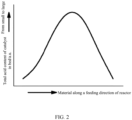
- FIG.2 shows a graph of the variation trend in the total acid content of the catalyst in the catalytic reaction unit along the material flow direction in some other embodiments of the present application. As shown in FIG.2 , in the present application, the total acid content of the catalyst along the material flow direction may gradually increase and then gradually decrease.
- the protective agent and catalyst are reasonably graded, where along the material flow direction of material flow, the active metal content in the protective agent increases or remains unchanged, the pore volume between the protective agents decreases, and the specific surface area of the protective agent increases.
- the protective agent in the upper bed of the protective agent layer mainly has the capacity of physical adsorption of impurities, accompanied by the capacity of chemical desorption of a small amount of impurities.
- the capacity of chemical desorption of impurities in the lower protective agent layer is strengthened to completely remove the impurities from the material, avoiding the poisoning of the catalyst acid center and the metal active center in the catalyst layer and the clogging of the pore structure of the catalyst by impurities.
- the catalyst is graded according to the total acid content and the acid strength of the catalyst, the upper part of the catalyst bed is loaded with a selective catalyst with a low total acid content and a high content proportion of weak acid, and the material undergoes an isomerization reaction at a low conversion rate, accompanied by a very small amount of cracking reaction, and a small part of the material undergoes isomerization reaction to produce isomeric alkanes.
- the middle part and lower middle part of the catalyst bed are loaded with a selective catalyst with a higher total acid content and a higher content proportion of medium-strong acid, and the increase of the acid content and the increase of the content of medium-strong acid in the catalyst may allow the material to perform an isomerization reaction at a high conversion rate, and at the same time, intensify the cracking reaction of the material to produce some light products. At this time, most of the material undergo isomerization reaction, converting into isomeric alkanes; and a small amount of the material undergoes the cracking reaction to generate light products.
- the rear of the catalyst bed is loaded with a catalyst having a total acid content lower than those of the middle part and lower-middle part of the catalyst bed, while having a reduced content of medium-strength acid; on the one hand, it can ensure that the remaining non-isomerized material is converted into iso-alkanes, and on the other hand, the reduction of the total acid content can reduce the generation of light oil products.
- Using the grading method of the present invention can effectively improve the catalytic effect of the material, thereby improving the yield of the base oil and the viscosity index of the base oil, lowering the low temperature performance such as the pour point and cloud point of the base oil, and effectively improving the quality of the base oil.
- the total acid content of the catalyst in the second catalyst layer is greater than the total acid content of the catalyst in the first catalyst layer and/or the total acid content of the catalyst in the third catalyst layer.
- the molar content proportion of Brönsted acid in the second catalyst layer is greater than that of Brönsted acid in the first catalyst layer and/or that of Brönsted acid in the third catalyst layer.
- the content of weak acid is less than the content of medium-strong acid.
- the catalytic reaction unit of the present application may successively include a first catalyst layer, a second catalyst layer, and a third catalyst layer along the material flow direction.
- the total acid content of the catalyst in the first catalyst layer and the total acid content of the catalyst in the third catalyst layer may be the same or different, as long as it is possible to make the total acid content of the catalyst along the material flow direction increase first and then decrease.
- the molar content proportion of Brönsted acid in the first catalyst layer and the molar content proportion of Brönsted acid in the third catalyst layer may be the same or different, as long as it is possible to make the molar content proportion of Brönsted acid in the catalyst first increase and then decrease along the material flow direction.
- the present application can further improve the catalytic effect of the catalyst, increase the yield of the base oil, and improve the viscosity index, the pour point and the cloud point of the base oil.
- the content of acid in the catalytic reaction unit can be further limited so as to further improve the catalytic efficiency of the catalyst, and improve the yield, viscosity index, pour point, and cloud point of the base oil.
- the total acid content of the catalyst in at least one catalyst layer of the catalytic reaction unit, is 50mmol/g to 300mmol/g. Further, in at least one catalyst layer of the catalytic reaction unit, the total acid content of the catalyst is 100 ⁇ mol/g to 300 ⁇ mol/g.
- the catalyst in at least one catalyst layer of in the catalytic reaction unit, has a weak acid content of 10 ⁇ mol/g to 150 ⁇ mol/g; and/or in at least one catalyst layer of the catalytic reaction unit, the catalyst has a medium-strong acid content of 5 ⁇ mol/g to 250 ⁇ mol/g.
- the catalyst has a weak acid content of 20 ⁇ mol/g to 100 ⁇ mol/g; and/or in at least one catalyst layer of the catalytic reaction unit, the catalyst has a medium-strong acid content of 10 ⁇ mol/g to 220 ⁇ mol/g.
- the protective agent is graded in accordance with its impurity removal capacity, which can improve the impurity removal effect of the protective agent, thereby improving the catalytic effect of the catalytic reaction, and enhancing the yield and the quality of the base oil.
- the active metal content of the protective agent in the first protective agent layer is less than or equal to the active metal content of the protective agent in the second protective agent layer.
- the content of the protective agent and the active metal content of the protective agent in the protective agent unit may be further selected, thereby better removing the impurities in the material, enhancing the catalytic efficiency, and improving the yield and the quality of the base oil.
- the volume percentage of the protective agent is 2% to 20%.
- the volume percentage of the catalyst is 80% to 98%.
- the volume percent of the protective agent is 5% to 15% and the volume percent of the catalyst is 85% to 95%.
- the mass percent of active metal in the protective agent is less than or equal to 5%.
- a second aspect of the present application provides a base oil production method, including: performing a catalytic treatment of a feedstock oil using the grading method of catalyst as described above to obtain the base oil.
- the feedstock oil can be catalytically treated under a hydrogen atmosphere through the catalyst bed of the above-described gradation to obtain a base oil with a low pour point, a low cloud point, and a high yield.
- the feedstock oil is selected from at least one of hydrocracking tail oil, paraffin-based wax oil, cycloalkane-based wax oil, intermediate-based wax oil, foots oil or petroleum jelly.
- the feedstock oil has a sulfur content of ⁇ 10 ⁇ g/g, a nitrogen content of ⁇ 5 ⁇ g/g, and a distillation range of 300°C-600°C.
- the feedstock oil shown in Table 3 is catalyzed to obtain a catalytic product; and the boiling point of the catalytic product is cut to obtain a base oil having a fraction greater than 300°C, which is subjected to property analyses, and the results are shown in Table 4.
- the grading method of catalyst in Example 1 to Example 3 of the present application can improve the yield of the base oil, and can effectively reduce the performance index the pour point and cloud point of the base oil, and the viscosity index of the base oil is higher, and the contents of sulphur and nitrogen in the product are lower, so that the quality of the base oil can be effectively improved.
- the base oil produced by the grading method of catalyst in Example 1 to Example 3 of the present application has a higher yield, and lower sulfur and nitrogen contents, and the low temperature performance (pour point and cloud point) indexes of the base oil can be effectively reduced, and the base oil has higher viscosity index, which can effectively improve the quality of the base oil.
Landscapes
- Chemical & Material Sciences (AREA)
- Organic Chemistry (AREA)
- Chemical Kinetics & Catalysis (AREA)
- Engineering & Computer Science (AREA)
- Materials Engineering (AREA)
- Crystallography & Structural Chemistry (AREA)
- Oil, Petroleum & Natural Gas (AREA)
- General Chemical & Material Sciences (AREA)
- Production Of Liquid Hydrocarbon Mixture For Refining Petroleum (AREA)
- Catalysts (AREA)
Abstract
Description
- This application claims the priority of
Chinese Patent Application No. 202211733085.5, entitled "GRADING METHOD OF CATALYST", and filed with the China National Intellectual Property Administration (CNIPA) on December 30, 2022 - Embodiments of the present application relate to the technical field of catalysts, and, in particular, to a grading method of catalyst and a base oil production method.
- Lubricating oil can reduce the mechanical failure caused by friction and wear between mechanical parts. Therefore, with the rapid development of modern mechanical device and automobile industry, the market demand for lubricant base oil increases year by year. Converting paraffin oils into lubricant oils can realize the high added value of paraffin oil and bring great economic benefits. Generally, in the industry, hydroisomerization technology is mainly used to isomerize long-chain alkane molecules in the paraffin oil into isomeric alkane molecules with branched structures, which can improve the low-temperature fluidity performance of the oil while retaining its viscosity index.
- For example,
CN1524929A discloses a method for reducing a cloud point of a lubricant base oil. In this method, the lubricating oil material is first pre-dewaxed by a solvent so that the pour point of the dewaxed oil is lowered to -5°C to 15°C, then the pre-dewaxed oil is hydrotreated to reduce its sulfur and nitrogen contents, and the hydrotreated pre-dewaxed oil is isomerized and dewaxed to obtain a lubricant base oil with a low cloud point. In the solvent pre-dewaxing stage, traditional mixed solvent of ketone-benzene is applied, which has certain toxicity and an unfriendly operation environment; the dewaxing temperature is -10°C to 20°C, which requires low-temperature refrigeration device and high production cost. The feedstock oil contains impurity components such as sulfur and nitrogen, which needs to be removed by a hydrorefining process, thereby leading to a long process flow. -
CN1690175A discloses a method for reducing the cloud point of a hydrodewaxed lubricant base oil. In the method, the raw material for hydrodewaxed lubricant base oil is mixed with a solvent and a deflocculant, cooled to -5°C to -30°C and filtered to give a filtrate. The resulting filtrate is a hydrodewaxed lubricant base oil with a lowered cloud point, in which the addition amount of the deflocculant accounts for 0.002%wt to 5%wt of the raw material oil. This method improves the filtration speed through the addition of the deflocculant, thereby making it easy to filter out wax particles obtained from the crystallization. However, the filtration is carried out at a low temperature of 5°C to -30°C, which also has the problem of requiring low temperature refrigeration device and high production cost. -
CN111073698A discloses a production method of food-grade white oil having a low pour point and a low cloud point, in which a first catalyst, a second catalyst and a third catalyst are sequentially arranged from top to bottom in a hydrogenation reactor for isodewaxing and cloud point reduction; the first catalyst and the second catalyst are two different noble metal isodewaxing catalysts, and the reaction temperatures for the first, second and third catalysts are the same or moderately decreasing; and finally, the light component is removed by flash evaporation to obtain said food-grade white oil having a low pour point and a low cloud point. -
CN99113304.8 proposes a method of tandem isomerization dewaxing, where a catalyst containing a molecular sieve with high silica content and low acidity and at least one Group VIII noble metal component is used in a first section, and a catalyst containing mesoporous SAPO-11 molecular sieve is used in a second section. By using a macroporous molecular sieve catalyst having low acidity in the first section, the isomerization reaction of wax molecules is carried out at higher temperature while maintaining a lower cracking activity, reducing the loading of the SAPO-11 catalyst in the second section, achieving a lowered pour point of the base oil and maintaining a higher yield of lubricant base oil. -
CN1111073696A - It can be seen that there is still room for further improvement in the existing methods for producing base oils. Therefore, it is necessary to further grade the existing catalysts to increase the yield of the base oil and to improve the viscosity index, pour point and cloud point of the base oil.
- The present application provides a grading method of catalyst. By grading the catalyst, it is possible to improve the catalytic effect, and then increase the yield of a base oil, and improve the viscosity index, pour point, and cloud point of the base oil.
- The present application provides a grading method of catalyst, including a catalytic reaction unit, and a protective agent unit disposed before the catalytic reaction unit along a material flow direction.
- In the catalytic reaction unit, along the material flow direction, a total acid content of the catalyst first increases and then decreases, and a molar content proportion of Brönsted acid in the catalyst first increases and then decreases.
- In the material flow direction, the catalytic reaction unit includes a first catalyst layer and a second catalyst layer that are adjacent to each other in sequence, where a content of weak acid is greater than a content of medium-strong acid in the first catalyst layer, and the content of weak acid is less than the content of medium-strong acid in the second catalyst layer.
- In the protective agent unit, along the material flow direction, an active metal content of a protective agent increases or remains constant; and a pore volume between protective agents decreases and a specific surface area of the protective agent increases.
- According to the grading method of catalyst, the catalytic reaction unit further includes a third catalyst layer disposed after the second catalyst layer along the material flow direction.
- The total acid content of the catalyst in the second catalyst layer is greater than that of the catalyst in the first catalyst layer and/or that of the catalyst in the third catalyst layer.
- The molar content proportion of Brönsted acid in the second catalyst layer is greater than that of Brönsted acid in the first catalyst layer and/or that of Brönsted acid in the third catalyst layer.
- The content of weak acid is less than the content of medium-strong acid in the third catalyst layer.
- According to the grading method of catalyst, where the molar content proportion of Brönsted acid is 5% to 60% in at least one catalyst layer of the catalytic reaction unit.
- According to the grading method of catalyst, where the molar content proportion of Brönsted acid is 10% to 50% in the at least one catalyst layer of the catalytic reaction unit.
- According to the grading method of catalyst, where the total acid content of the catalyst is 50µmol/g to 300µmol/g in at least one catalyst layer of the catalytic reaction unit; preferably, the total acid content of the catalyst is 100µmol/g to 300µmol/g in the at least one catalyst layer of the catalytic reaction unit .
- According to the grading method of catalyst, where the content of weak acid of the catalyst is 10µmol/g to 150µmol/g in at least one catalyst layer of the catalytic reaction unit; preferably, the content of weak acid of the catalyst is 20µmol/g to 100µmol/g in the at least one catalyst layer of the catalytic reaction unit; and/or
the content of medium-strong acid of the catalyst is 5µmol/g to 250µmol/g in at least one catalyst layer of the catalytic reaction unit; preferably, the content of medium-strong acid of the catalyst is 10µmol/g to 220µmol/g in the at least one catalyst layer of the catalytic reaction unit. - According to the grading method of catalyst, where, the protective agent unit includes a first protective agent layer and a second protective agent layer in sequence along the material flow direction.
- The active metal content of the protective agent in the first protective agent layer is less than or equal to that of the protective agent in the second protective agent layer.
- According to the grading method of catalyst, based on a total volume of the protective agent and the catalyst, a volume percentage of the protective agent is 2% to 20%; and/or
based on a total volume of the protective agent and the catalyst, a volume percentage of the catalyst is 80% to 98%. - According to the grading method of catalyst, based on the total volume of the protective agent and the catalyst, the volume percentage of the protective agent is 5% to 15%; and/or
based on the total volume of the protective agent and the catalyst, the volume percentage of the catalyst is 85% to 95%. - According to the grading method of catalyst, a mass percentage content of active metal in the protective agent is less than or equal to 5%.
- The present application provides a base oil production method, including performing catalytic treatment on a feedstock oil by using the grading method of catalyst as mentioned above to obtain the base oil.
- According to the base oil production method, the feedstock oil is selected from at least one of hydrocracking tail oil, paraffin-based wax oil, naphthenic wax oil, intermediate-based wax oil, foots oil or petroleum jelly.
- According to the base oil production method, the feedstock oil has a sulfur content of ≤10µg/g, a nitrogen content of ≤5µg/g, and a distillation range of 300°C to 600°C.
- The present application provides a grading method of catalyst, in which the catalyst is graded according to the acidity of the catalyst, effectively improving the catalytic effect, and increasing the yield of the base oil and the viscosity index of the base oil, reducing the low temperature performance of the base oil such as the pour point and the cloud point, and thus effectively improving the quality of the base oil.
- In order to more clearly illustrate the technical solutions in the embodiments of the present application or the prior art, the following will briefly introduce the accompanying drawings required for describing the embodiments or the prior art. Obviously, the accompanying drawings in the following description are some of the embodiments of the present application, and persons of ordinary skill in the art may still derive other drawings from these accompanying drawings without paying creative effort.
-
FIG.1 shows a graph of the variation trend in a total acid content of a catalyst in a catalytic reaction unit along a material flow direction in some embodiments of the present application. -
FIG.2 shows a graph of the variation trend in the total acid volume of the catalyst in the catalytic reaction unit along the material flow direction in other embodiments of the present application. - To make the objectives, technical solutions, and advantages of embodiments of the present application clearer, the following clearly and comprehensively describes the technical solutions in embodiments of the present application with reference to the accompanying drawings in embodiments of the present application. Apparently, the described embodiments are merely a part rather than all embodiments of the present application. All other embodiments obtained by persons of ordinary skill in the art based on embodiments of the present application without creative effort shall fall within the protection scope of the present application.
- In view of the above, the present application provides a grading method of catalyst, including a catalytic reaction unit, and a protective agent unit disposed before the catalytic reaction unit along the material flow direction.
- In the catalytic reaction unit, the total acid content of the catalyst first increases and then decreases along the material flow direction; and the molar content of Brönsted acid of the catalyst first increases and then decreases.
- In the material flow direction, the catalytic reaction unit includes a first catalyst layer and a second catalyst layer that are adjacent to each other in sequence. In the first catalyst layer, the content of weak acid is greater than the content of medium-strong acid; in the second catalyst layer, the content of weak acid is less than the content of medium-strong acid.
- In the protective agent unit, the content of active metal in the protective agent increases or remains constant along the direction of material flow; the pore volume between the protective agents decreases and the specific surface area of the protective agent increases.
- The catalyst of the present application may be a catalyst commonly used in the art. In some embodiments, the catalyst may contain a molecular sieve with a ten-member topological structure, and the molecular sieve may be one or more of ZSM-5, SAPO-11, ZSM-22, ZSM-35, ZSM-23, ZSM-48, and SAPO-41. In some embodiments, the catalyst may further contain an amorphous inorganic porous material, which may be selected from at least one of alumina, zirconium oxide, and titanium oxide; or one or more of composite oxides thereof (alumina-silica, alumina-zirconium oxide, zirconium oxide-titanium oxide, alumina-titanium oxide).
- In the present application, based on the total mass of the catalyst, the mass percentage of the molecular sieve may be 40% to 80%; and further, based on the total mass of the catalyst, the mass percentage of the molecular sieve may be 55% to 75%. Based on the total mass of the catalyst, the mass percentage of the amorphous inorganic porous material may be 19% to 59.9%; and further, based on the total mass of the catalyst, the mass percentage of the amorphous porous material may be 25% to 50%.
- In the catalysts of the present application, the active metal may be selected from one or more of Pt, Pd, Ru, and Ni; and further, the active metal may be selected from Pt and/or Pd. In some embodiments, based on the total mass of the catalyst, the mass percentage of the active metal is 0.1% to 1.0%; and further, based on the total mass of the catalyst, the mass percentage of the active metal is 0.2% to 0.5%.
- The catalytic reaction unit of the present application may be provided with catalysts that are prepared from one type of molecular sieve and have different acid amounts, such as catalysts that are prepared from ZSM-22 molecular sieve and have different acid amounts; or catalysts that are prepared from different types of molecular sieves and have different acid amounts.
- In the present application, the material may be selected from one or more of hydrocracking tail oil, paraffin-based wax oil, cycloalkane-based wax oil, intermediate-based wax oil, foots oil or petroleum jelly.
- In the grading method of catalyst of the present application, the material can be mixed with hydrogen and then flow through the protective agent unit for removing impurity, the impurity-removed material then enters the catalytic reaction unit to carry out a reaction, and the reaction product generated in the catalytic reaction unit can enter a supplementary refining reactor or directly enter a fractionation device for base oil cutting to produce lubricant base oils of different viscosities.
- Where, the reaction pressure is from 6MPa to 15MPa, the reaction temperature is from 300°C to 400°C, the volume space velocity is from 0.5 to 3.0, and the hydrogen-oil volume ratio is from 100 to 1000:1.
- In the present application, by first removing impurity from the material and then carrying out the catalytic reaction, the material can be converted into the base oil to a greater extent, improving the yield of the base oil. Furthermore, the impurity content in the base oil can be reduced and the quality of the base oil can be improved. Where, the active metal in the protective agent can remove organic impurities (desulfurization and denitrification). The higher the content of the active metal in the protective agent, the stronger the ability of the protective agent to remove impurity (the stronger the ability of desulfurization and denitrification). In the present application, the active metal may be at least one of nickel, cobalt, molybdenum, and tungsten.
- In the present application, two or more kinds of protective agents can be provided in the protective agent unit. The pore volume between the protective agents decreases gradually or decreases a stepwise manner along the material flow direction; and the specific surface area of the protective agent increases gradually or increases in a stepwise manner. The pore volume is capable of adsorbing inorganic impurities; and the larger the pore volume is, the stronger the adsorption capacity is.
- Moreover, in the present application, the acid species in the catalyst may be divided into Brönsted acid and Lewis acid according to whether it can give protons and whether it can accept electron pairs. Where, Brönsted acid, also called proton acid, is an acid defined using the Brönsted acid-base proton theory. According to the Brönsted acid-base theory, a substance that is capable of giving protons is called as an acid, where the stronger its ability to give protons, the stronger its acidity. Lewis acid is an acid defined using the Lewis acid-base theory. According to the Lewis acid-base theory, a substance that has an empty orbital and is capable of accepting electron pairs is called as an acid, where the stronger its ability to accept electron pairs, the stronger its acidity.
- In the present application, the molar contents of Brönsted acid and Lewis acid in the catalyst can be determined using pyridine infrared spectroscopy (Py-IR) characterization method, where, the pyridine is adsorbed at the Brönsted acid center to form pyridine ions, with an infrared characteristic absorption peak in a range of 1530cm-1 to 1560cm-1, and the corresponding molar amount is the molar amount of Brönsted acid; the pyridine is adsorbed at the Lewis acid center, with an infrared characteristic absorption peak in a range of 1440cm-1 to 1460cm-1, and the corresponding molar amount is the molar amount of Lewis acid. The molar content proportion of Brönsted acid refers to the molar percentage of Brönsted acid based on the total molar amounts of Brönsted acid and Lewis acid.
- In the present application, the acids in the catalyst are categorized into weak acid, medium-strong acid, and strong acid based on acid strength. Where, the content of the weak acid refers to the molar content of the weak acid, the content of the medium-strong acid refers to the molar content of the medium-strong acid, the content of the strong acid refers to the molar content of the strong acid, and the total acid content refers to the sum of the molar contents of the weak, medium-strong, and strong acids. In some embodiments, the molar contents of acids of various strengths in the catalyst as well as the total acid content can be determined using an ammonia temperature-programmed desorption (NH3-TPD) method. On the NH3-TPD desorption diagram, the amount of ammonia desorbed between 100°C and 230°C corresponds to the content of weak acid, the amount of ammonia desorbed between 230°C and 370°C corresponds to the content of medium-strong acid, and the amount of ammonia desorbed above 370°C corresponds to the amount of strong acid. The specific operation method may include: blowing a catalyst sample with helium at 500°C for 1 hour and then lowering the temperature to 60°C, introducing ammonia-saturated vapor, and performing pulse adsorption for five times to reach the equilibrium; increasing the temperature to 100°C and blowing for 2 hours, and then programmedly elevating the temperature for ammonia desorption at a heating rate of 10°C/minute, and elevating the temperature to 650°C; absorbing the desorbed ammonia by a hydrochloric acid solution, and then titrating the excess hydrochloric acid with a sodium hydroxide solution, where the amount of hydrochloric acid consumed to absorb the ammonia is used for defining the contents of weak, medium-strong, and strong acid, and the total acid content of the catalyst, respectively.
- It can be understood that in the present application, the content of the weak acid that contacts the material first is greater than the content of the medium-strong acid in the catalyst, and the content of the weak acid contacting the material later is less than the content of the medium-strong acid in the catalyst, and at the same time, the total acid content of the catalyst first increases and then decreases; and the molar content proportion of Brönsted acid in the catalyst first increases and then decreases.
-
FIG.1 shows a graph of the variation trend in the total acid content of the catalyst in the catalytic reaction unit along the material flow direction in some embodiments of the present application. As shown inFIG.1 , in the present application, the total acid content of the catalyst along the material flow direction may show a gradient change, first increasing and then decreasing.FIG.2 shows a graph of the variation trend in the total acid content of the catalyst in the catalytic reaction unit along the material flow direction in some other embodiments of the present application. As shown inFIG.2 , in the present application, the total acid content of the catalyst along the material flow direction may gradually increase and then gradually decrease. - In this application, by adjusting the number and strength of acid center (especially Brönsted acid) of the catalyst, the distribution of the product and the yield of the base oil can be effectively adjusted.
- In this application, the protective agent and catalyst are reasonably graded, where along the material flow direction of material flow, the active metal content in the protective agent increases or remains unchanged, the pore volume between the protective agents decreases, and the specific surface area of the protective agent increases. The protective agent in the upper bed of the protective agent layer mainly has the capacity of physical adsorption of impurities, accompanied by the capacity of chemical desorption of a small amount of impurities. The capacity of chemical desorption of impurities in the lower protective agent layer is strengthened to completely remove the impurities from the material, avoiding the poisoning of the catalyst acid center and the metal active center in the catalyst layer and the clogging of the pore structure of the catalyst by impurities.
- The catalyst is graded according to the total acid content and the acid strength of the catalyst, the upper part of the catalyst bed is loaded with a selective catalyst with a low total acid content and a high content proportion of weak acid, and the material undergoes an isomerization reaction at a low conversion rate, accompanied by a very small amount of cracking reaction, and a small part of the material undergoes isomerization reaction to produce isomeric alkanes. The middle part and lower middle part of the catalyst bed are loaded with a selective catalyst with a higher total acid content and a higher content proportion of medium-strong acid, and the increase of the acid content and the increase of the content of medium-strong acid in the catalyst may allow the material to perform an isomerization reaction at a high conversion rate, and at the same time, intensify the cracking reaction of the material to produce some light products. At this time, most of the material undergo isomerization reaction, converting into isomeric alkanes; and a small amount of the material undergoes the cracking reaction to generate light products. The rear of the catalyst bed is loaded with a catalyst having a total acid content lower than those of the middle part and lower-middle part of the catalyst bed, while having a reduced content of medium-strength acid; on the one hand, it can ensure that the remaining non-isomerized material is converted into iso-alkanes, and on the other hand, the reduction of the total acid content can reduce the generation of light oil products. Using the grading method of the present invention can effectively improve the catalytic effect of the material, thereby improving the yield of the base oil and the viscosity index of the base oil, lowering the low temperature performance such as the pour point and cloud point of the base oil, and effectively improving the quality of the base oil.
- In some embodiments of the present application, in the catalytic reaction unit, along the direction of material flow, there is further included a third catalyst layer provided after the second catalyst layer.
- The total acid content of the catalyst in the second catalyst layer is greater than the total acid content of the catalyst in the first catalyst layer and/or the total acid content of the catalyst in the third catalyst layer.
- The molar content proportion of Brönsted acid in the second catalyst layer is greater than that of Brönsted acid in the first catalyst layer and/or that of Brönsted acid in the third catalyst layer.
- In the third catalyst layer, the content of weak acid is less than the content of medium-strong acid.
- It is to be understood that the catalytic reaction unit of the present application may successively include a first catalyst layer, a second catalyst layer, and a third catalyst layer along the material flow direction.
- It is to be understood that, in the present application, the total acid content of the catalyst in the first catalyst layer and the total acid content of the catalyst in the third catalyst layer may be the same or different, as long as it is possible to make the total acid content of the catalyst along the material flow direction increase first and then decrease. The molar content proportion of Brönsted acid in the first catalyst layer and the molar content proportion of Brönsted acid in the third catalyst layer may be the same or different, as long as it is possible to make the molar content proportion of Brönsted acid in the catalyst first increase and then decrease along the material flow direction.
- By the above setting, the present application can further improve the catalytic effect of the catalyst, increase the yield of the base oil, and improve the viscosity index, the pour point and the cloud point of the base oil.
- In the present application, the content of acid in the catalytic reaction unit can be further limited so as to further improve the catalytic efficiency of the catalyst, and improve the yield, viscosity index, pour point, and cloud point of the base oil.
- In some embodiments of the present application, the molar content proportion of Brönsted acid in at least one catalyst layer of the catalytic reaction unit is 5% to 60%. Further, the molar content proportion of Brönsted acid in at least one catalyst layer of the catalytic reaction unit is 10% to 50%.
- In some embodiments of the present application, in at least one catalyst layer of the catalytic reaction unit, the total acid content of the catalyst is 50mmol/g to 300mmol/g. Further, in at least one catalyst layer of the catalytic reaction unit, the total acid content of the catalyst is 100µmol/g to 300µmol/g.
- In some embodiments of the present application, in at least one catalyst layer of in the catalytic reaction unit, the catalyst has a weak acid content of 10µmol/g to 150µmol/g; and/or
in at least one catalyst layer of the catalytic reaction unit, the catalyst has a medium-strong acid content of 5µmol/g to 250µmol/g. - Further, in at least one catalyst layer of the catalytic reaction unit, the catalyst has a weak acid content of 20µmol/g to 100µmol/g; and/or
in at least one catalyst layer of the catalytic reaction unit, the catalyst has a medium-strong acid content of 10µmol/g to 220µmol/g. - In the present application, the protective agent is graded in accordance with its impurity removal capacity, which can improve the impurity removal effect of the protective agent, thereby improving the catalytic effect of the catalytic reaction, and enhancing the yield and the quality of the base oil.
- Exemplarily, in the protective agent unit, a first protective agent layer and a second protective agent layer are included in sequence along the material flow direction.
- The active metal content of the protective agent in the first protective agent layer is less than or equal to the active metal content of the protective agent in the second protective agent layer.
- In the present application, the content of the protective agent and the active metal content of the protective agent in the protective agent unit may be further selected, thereby better removing the impurities in the material, enhancing the catalytic efficiency, and improving the yield and the quality of the base oil.
- In some embodiments of the present application, based on the total volume of the protective agent and the catalyst, the volume percentage of the protective agent is 2% to 20%.
- It can be understood that, based on the total volume of the protective agent and the catalyst, the volume percentage of the catalyst is 80% to 98%.
- Further, based on the total volume of the protective agent and the catalyst, the volume percent of the protective agent is 5% to 15% and the volume percent of the catalyst is 85% to 95%.
- In some embodiments of the present application, the mass percent of active metal in the protective agent is less than or equal to 5%.
- A second aspect of the present application provides a base oil production method, including: performing a catalytic treatment of a feedstock oil using the grading method of catalyst as described above to obtain the base oil.
- Specifically, the feedstock oil can be catalytically treated under a hydrogen atmosphere through the catalyst bed of the above-described gradation to obtain a base oil with a low pour point, a low cloud point, and a high yield.
- In some embodiments of the present application, the feedstock oil is selected from at least one of hydrocracking tail oil, paraffin-based wax oil, cycloalkane-based wax oil, intermediate-based wax oil, foots oil or petroleum jelly.
- Further, the feedstock oil has a sulfur content of≤ 10µg/g, a nitrogen content of ≤ 5µg/g, and a distillation range of 300°C-600°C.
- In the following, the technical solutions of the present application will be further described with reference to specific examples.
- The grading methods of the catalysts of Examples 1-3 and Comparative example 1-3 are shown in Table 1.
Table 1 Parameter Example 1 Example 2 Example 3 Comparative example 1 Comparative example 2 Comparative example 3 Protectiv e agent unit First protective agent Pore volume/ mL/g 0.75 0.72 0.76 0.72 0.72 0.76 Specific surface area /m2/g 95 112 87 112 112 87 Active metal and content/wt% None None None None None None Filling volume /vt% 6 15 3 3 15 15 Second protective agent Pore volume /ml/g 0.53 0.51 0.58 0.51 0.72 0.58 Specific surface area /m2/g 152 164 145 164 112 145 Active metal and content /wt% Ni, 4 Ni, 2, Mo,3 Mo, 3 Ni, 2; Mo, 3 None Mo, 3 Filling volume /vt% 4 5 2 2 5 5 Active metal Pt /wt% 0.4 0.2 0.1 0.4 0.2 0.2 Active metal Pd /wt% 0.1 0.1 0.3 0.1 0.1 0.1 First catalyst layer Molecular sieve and proportion /wt% SAPO-1 1, 53 SAPO-11, 40 SAPO-41, 64 ZSM-48, 65 SAPO-11, 40 ZSM-35, 80 Amorphous inorganic material and proportion /wt% ZrO2, 46.5 Al2O3, 59.7 TiO2, 35.6 Al2O3, 34.6 Al2O3, 59.7 Al2O3-SiO2, 19.7 Total acid /µmol/g 104 64 127 248 64 296 Weak acid /µmol/g 66 37 74 47 37 74 Catalytic reaction unit Medium-stron g acid /µmol/g 28 15 31 161 15 205 Brönsted acid /mol% 10 6 16 44 6 57 Filling volume/vt% 30 20 10 30 20 30 Second catalyst layer Molecular sieve and proportion /wt% ZSM-22, 70 ZSM-35, 80 ZSM-23,7 5 ZSM-48,65 ZSM-5,45 ZSM-5,45 Amorphous inorganic material type and proportion /wt% Al2O3-Ti O2, 29.5 Al2O3-Si O2, 19.7 ZrO2-TiO2 ,24.6 Al2O3, 34.6 Al2O3, 54.7 Al2O3, 54.7 Total acid /µmol/g 253 296 277 248 205 205 Weak acid /µmol/g 54 74 68 47 47 47 Medium-stron g acid /µmol/g 152 205 173 161 128 128 Brönsted acid /mol% 48 55 51 44 31 31 Filling volume /vt% 40 30 45 35 30 30 Third catalyst layer Molecular sieve and proportion /wt% ZSM-23, 60 ZSM-5,4 5 ZSM-48,6 5 ZSM-48,65 ZSM-35,80 SAPO-11,40 Amorphous inorganic material and proportion /wt% ZrO2,39. 5 Al2O3,54. 7 Al2O3,34.6 Al2O3,34.6 Al2O3-SiO2,19 .7 Al2O3,59.7 Total acid /µmol/g 223 205 248 248 296 64 Weak acid /µmol/g 53 47 47 47 74 37 Medium-stron g acid /µmol/g 142 128 161 161 205 15 Brönsted acid /mol% 40 31 44 44 57 6 Filling volume /vt% 20 30 40 30 30 20 - According to the grading method of the catalyst in Table 1, under the hydrogenation process conditions shown in Table 2, the feedstock oil shown in Table 3 is catalyzed to obtain a catalytic product; and the boiling point of the catalytic product is cut to obtain a base oil having a fraction greater than 300°C, which is subjected to property analyses, and the results are shown in Table 4.
Table 2 Isomerization dewaxing reactor temperature, °C 370 Reaction pressure, MPa 12 Liquid hourly space velocity, h-1 1.2 Hydrogen-oil volume ratio 500 Table 3 Density (20°C), g/ml 0.8743 Distillation range HK, °C 346 50%, °C 468 KK, °C 552 Sulfur, µg/g 9 Nitrogen, µg/g 4 Viscosity (100°C), mm2/s 8.9 Viscosity index 137 Aromatic content, wt% 6.3 Freezing point, °C 34 Table 4 Analysis items Example 1 Example 2 Example 3 Comparative example 1 Comparative example 2 Comparative example 3 Sulfur, µg/g 0.4 0.6 0.3 0.9 0.6 0.7 Nitrogen, µg/g 0.1 0.3 <0.1 1.3 1.2 1.4 Viscosity (100°C), mm2/s 7.6 7.4 7.8 7.0 6.9 7.1 Viscosity index 124 122 127 117 115 112 Pour point, °C -21 -18 -24 -10 -12 -9 Cloud point, °C -9 -7 -10 -3 -1 -2 Aromatic content, ω% 0.3 0.4 0.2 1.1 0.7 0.8 Total base oil yield, ω% 95.5 93.2 94.7 91.3 86.5 88.4 - As can be seen from Table 4, relative to Comparative example 1 to Comparative example 3, the grading method of catalyst in Example 1 to Example 3 of the present application can improve the yield of the base oil, and can effectively reduce the performance index the pour point and cloud point of the base oil, and the viscosity index of the base oil is higher, and the contents of sulphur and nitrogen in the product are lower, so that the quality of the base oil can be effectively improved.
- According to the grading method of catalyst in Table 1, under the hydrogenation conditions shown in Table 5, the feedstock oil shown in Table 6 is catalyzed to obtain a catalytic product, and the boiling point of the catalytic product is cut to obtain a base oil having a fraction greater than 300 °C, which is subjected to property analyses; and the results are shown in Table 7.
Table 5 Isomerization dewaxing reactor temperature, °C 350 Reaction pressure, MPa 8 Liquid hourly space velocity, h-1 1.5 Hydrogen-oil volume ratio 400 Table 6 Density (20°C), g/ml 0.8576 Distillation range HK, °C 336 50%, °C 389 KK, °C 514 Sulfur, µg/g 7 Nitrogen, µg/g 4 Viscosity (100°C), mm2/s 4.6 Viscosity index 145 Freezing point, °C 23 Table 7 Analysis items Example 1 Example 2 Example 3 Comparative example 1 Comparative example 2 Comparative example 3 Sulfur, µg/g 0.3 0.4 0.1 0.7 0.8 0.6 Nitrogen, µg/g <0.1 0.2 <0.1 0.6 0.7 0.5 Viscosity (100°C), mm2/s 3.8 3.5 3.9 3.7 3.4 3.6 Viscosity index 128 122 129 119 115 114 Pour point, °C -21 -19 -24 -11 -14 -12 Cloud point, °C -11 -8 -12 -4 -6 -4 Total base oil yield, ω% 94.2 92.1 95.3 91.1 87.6 89.1 - As can be seen from Table 7, relative to Comparative example 1 to Comparative example 3, the base oil produced by the grading method of catalyst in Example 1 to Example 3 of the present application has a higher yield, and lower sulfur and nitrogen contents, and the low temperature performance (pour point and cloud point) indexes of the base oil can be effectively reduced, and the base oil has higher viscosity index, which can effectively improve the quality of the base oil.
- Finally, it should be noted that the above embodiments are only used to illustrate the technical solutions of the present application, not to limit them; although the present application has been described in detail with reference to the foregoing embodiments, persons of ordinary skill in the art should understand that they can still make modifications to the technical solutions recorded in the foregoing embodiments, or make equivalent substitutions for some or all of the technical features thereof; and such modifications or substitutions do not make the essence of the corresponding technical solutions depart from the scope of the technical solutions of various embodiments of the present application.
Claims (15)
- A grading method of catalyst, comprising a catalytic reaction unit, and a protective agent unit disposed before the catalytic reaction unit along a material flow direction; whereinin the catalytic reaction unit, a total acid content of the catalyst first increases and then decreases along the material flow direction, and a molar content proportion of Brönsted acid of the catalyst first increases and then decreases;in the material flow direction, the catalytic reaction unit comprises a first catalyst layer and a second catalyst layer that are adjacent to each other in sequence, a content of weak acid is greater than a content of medium-strong acid in the first catalyst layer, and the content of weak acid is less than the content of medium-strong acid in the second catalyst layer;in the protective agent unit, along the material flow direction, an active metal content of a protective agent increases or remains constant, a pore volume between protective agents decreases and a specific surface area of the protective agent increases.
- The grading method of catalyst according to claim 1, wherein the catalytic reaction unit further comprises a third catalyst layer disposed after the second catalyst layer along the material flow direction;the total acid content of the catalyst in the second catalyst layer is greater than that of the catalyst in the first catalyst layer and/or that of the catalyst in the third catalyst layer;the molar content proportion of Brönsted acid in the second catalyst layer is greater than that of Brönsted acid in the first catalyst layer and/or that of Brönsted acid in the third catalyst layer;the content of weak acid is less than the content of medium-strong acid in the third catalyst layer.
- The grading method of catalyst according to claim 1 or 2, wherein the molar content proportion of Brönsted acid is 5% to 60% in at least one catalyst layer of the catalytic reaction unit.
- The grading method of catalyst according to claim 3, wherein the molar content proportion of Brönsted acid is 10% to 50% in the at least one catalyst layer of the catalytic reaction unit.
- The grading method of catalyst according to any one of claims 1-4, wherein the total acid content of the catalyst is 50µmol/g to 300µmol/g in at least one catalyst layer of the catalytic reaction unit.
- The grading method of catalyst according to claim 5, wherein the total acid content of the catalyst is 100µmol/g to 300µmol/g in the at least one catalyst layer of the catalytic reaction unit.
- The grading method of catalyst according to any one of claims 1-6, wherein the content of weak acid of the catalyst is 10µmol/g to 150µmol/g in at least one catalyst layer of the catalytic reaction unit; and/or
the content of medium-strong acid of the catalyst is 5µmol/g to 250µmol/g in at least one catalyst layer of the catalytic reaction unit. - The grading method of catalyst according to claim 7, wherein the content of weak acid of the catalyst is 20µmol/g to 100µmol/g in the at least one catalyst layer of the catalytic reaction unit; and/or
the content of medium-strong acid of the catalyst is 10µmol/g to 220µmol/g in the at least one catalyst layer of the catalytic reaction unit. - The grading method of catalyst according to any one of claims 1-8, wherein the protective agent unit comprises a first protective agent layer and a second protective agent layer in sequence along the material flow direction;
the active metal content of the protective agent in the first protective agent layer is less than or equal to that of the protective agent in the second protective agent layer. - The grading method of catalyst according to any one of claims 1-9, wherein based on a total volume of the protective agent and the catalyst, a volume percentage of the protective agent is 2% to 20%; and/or
based on a total volume of the protective agent and the catalyst, a volume percentage of the catalyst is 80% to 98%. - The grading method of catalyst according to claim 10, wherein based on the total volume of the protective agent and the catalyst, the volume percentage of the protective agent is 5% to 15%; and/or
based on the total volume of the protective agent and the catalyst, the volume percentage of the catalyst is 85% to 95%. - The grading method of catalyst according to any one of claims 1-11, wherein a mass percentage content of active metal in the protective agent is less than or equal to 5%.
- A base oil production method, comprising: performing catalytic treatment on a feedstock oil by using the grading method of catalyst according to any one of claims 1-12 to obtain the base oil.
- The base oil production method according to claim 13, wherein the feedstock oil is selected from at least one of hydrocracking tail oil, paraffin-based wax oil, cycloalkane-based wax oil, intermediate-based wax oil, foots oil or petroleum jelly.
- The base oil production method according to claim 13 or 14, wherein the feedstock oil has a sulfur content of ≤10µg/g, a nitrogen content of ≤5µg/g, and a distillation range of 300°C to 600°C.
Applications Claiming Priority (2)
| Application Number | Priority Date | Filing Date | Title |
|---|---|---|---|
| CN202211733085.5A CN118268027B (en) | 2022-12-30 | 2022-12-30 | A catalyst grading method |
| PCT/CN2023/118993 WO2024139424A1 (en) | 2022-12-30 | 2023-09-15 | Grading method for catalyst and production method for base oil |
Publications (2)
| Publication Number | Publication Date |
|---|---|
| EP4534200A1 true EP4534200A1 (en) | 2025-04-09 |
| EP4534200A4 EP4534200A4 (en) | 2026-02-18 |
Family
ID=91647217
Family Applications (1)
| Application Number | Title | Priority Date | Filing Date |
|---|---|---|---|
| EP23909359.4A Pending EP4534200A4 (en) | 2022-12-30 | 2023-09-15 | CLASSIFICATION METHOD FOR CATALYTIC CONVERTER AND MANUFACTURING METHOD FOR BASE OIL |
Country Status (3)
| Country | Link |
|---|---|
| EP (1) | EP4534200A4 (en) |
| CN (1) | CN118268027B (en) |
| WO (1) | WO2024139424A1 (en) |
Family Cites Families (16)
| Publication number | Priority date | Publication date | Assignee | Title |
|---|---|---|---|---|
| CN1176848C (en) * | 2002-05-30 | 2004-11-24 | 复旦大学 | SAPO-11 molecular sieve catalyst and its preparation method |
| CN1286954C (en) | 2003-02-28 | 2006-11-29 | 中国石油化工股份有限公司 | Method for reducing lubricating oil basic oil cloud point |
| CN1589967A (en) * | 2003-09-05 | 2005-03-09 | 中国科学院大连化学物理研究所 | Catalyst for production of ethyl benzene using ethylene and benzene and its preparation method and application |
| EP1514879A1 (en) * | 2003-09-12 | 2005-03-16 | Shell Internationale Researchmaatschappij B.V. | A polyalphaolefin having a low halide concentration and a method of manufacturing thereof |
| CN100469857C (en) | 2004-04-29 | 2009-03-18 | 中国石油化工股份有限公司 | A method for reducing the cloud point of hydrodewaxed lubricating oil base oil |
| US8475648B2 (en) * | 2010-06-29 | 2013-07-02 | Chevron U.S.A. Inc. | Catalytic processes and systems for base oil production from heavy feedstock |
| CN104667955B (en) * | 2013-11-26 | 2017-05-17 | 中国石油化工股份有限公司 | A catalyst for hydrogenation modification and a preparing method thereof |
| CN104673375B (en) * | 2013-11-26 | 2016-10-19 | 中国石油化工股份有限公司 | A kind of production lube base oil method |
| US20150158018A1 (en) * | 2013-12-09 | 2015-06-11 | Bi-Zeng Zhan | Hydrocracking catalyst and process for producing lube base stocks |
| CN106554820B (en) * | 2015-09-30 | 2018-07-31 | 中国石油化工股份有限公司 | A kind of method for preparing lubricating oil base oil |
| JP6034479B2 (en) * | 2015-12-11 | 2016-11-30 | シェブロン ユー.エス.エー. インコーポレイテッド | Novel process and catalyst system for improving dewaxing catalyst stability and lubricant yield |
| CN109988631B (en) * | 2017-12-29 | 2021-02-05 | 中国石油化工股份有限公司 | Method for producing gasoline and base oil by catalyst grading technology |
| CN110964191B (en) * | 2018-09-29 | 2021-02-02 | 杭州普力材料科技有限公司 | Mixed acid modified zinc-cobalt double metal cyanide catalyst and preparation method thereof |
| CN111073698B (en) | 2018-10-18 | 2021-12-17 | 中国海洋石油集团有限公司 | Production method of food-grade white oil with low pour point and cloud point and food-grade white oil |
| CN111073696B (en) | 2018-10-18 | 2022-03-01 | 中国海洋石油集团有限公司 | Method for reducing cloud point of base oil of high-viscosity lubricating oil and base oil of lubricating oil |
| CN114471681B (en) * | 2020-11-12 | 2024-08-27 | 中国石油天然气股份有限公司 | Method for producing low cloud point base oil, catalyst, and catalyst preparation method |
-
2022
- 2022-12-30 CN CN202211733085.5A patent/CN118268027B/en active Active
-
2023
- 2023-09-15 EP EP23909359.4A patent/EP4534200A4/en active Pending
- 2023-09-15 WO PCT/CN2023/118993 patent/WO2024139424A1/en not_active Ceased
Also Published As
| Publication number | Publication date |
|---|---|
| CN118268027B (en) | 2025-04-22 |
| EP4534200A4 (en) | 2026-02-18 |
| CN118268027A (en) | 2024-07-02 |
| WO2024139424A1 (en) | 2024-07-04 |
Similar Documents
| Publication | Publication Date | Title |
|---|---|---|
| JP4459057B2 (en) | Method for preparing a base oil having a high viscosity index | |
| US10669491B2 (en) | Base metal dewaxing catalyst | |
| CN103627433B (en) | Hydrogenation method for producing lubricant basic oil with low pour point and high viscosity index | |
| US10035962B2 (en) | Trim dewaxing of distillate fuel | |
| EP3342844A1 (en) | Method for manufacturing lubricant base oil | |
| US10668463B2 (en) | Methods for regenerating and rejuvenating catalysts | |
| CA2931187C (en) | Hydrocracking of gas oils with increased distillate yield | |
| AU2016379179A1 (en) | Trim dewaxing of distillate fuel | |
| EP3618958A1 (en) | Noble metal and base metal dewaxing catalyst | |
| US20160194566A1 (en) | Catalytic and solvent processing for base oil production | |
| JP2020523436A (en) | Production of diesel and base stock from crude oil | |
| US20190144774A1 (en) | Noble metal hydrogenation catalysts and aromatic saturation methods | |
| RU2852023C2 (en) | Method of catalyst placement and method for obtaining base oil | |
| WO2024139424A1 (en) | Grading method for catalyst and production method for base oil | |
| CN112812826B (en) | Method for preparing lubricating oil base oil from high waxy raw material | |
| CN1888024B (en) | A kind of hydrocarbon oil processing method | |
| US10632453B2 (en) | Trimetallic base metal dewaxing catalyst | |
| CN111484873A (en) | Method for preparing lubricating oil base oil | |
| CN1703494A (en) | Integrated process for catalytic dewaxing | |
| CN106590743A (en) | Method for producing lubricant base oil | |
| CN112237947A (en) | Carrier and method for producing the same, catalyst and method for producing the same, and dewaxing method | |
| CN112812837B (en) | Method for processing high wax content raw material to prepare lubricating oil base oil | |
| CN114717023B (en) | Hydroconversion method | |
| CA1281678C (en) | Process for catalytic dewaxing using zsm-11 catalyst with pt-group component | |
| JPH0867883A (en) | Method and catalyst for dewaxing hydrocarbon feedstock |
Legal Events
| Date | Code | Title | Description |
|---|---|---|---|
| STAA | Information on the status of an ep patent application or granted ep patent |
Free format text: STATUS: THE INTERNATIONAL PUBLICATION HAS BEEN MADE |
|
| PUAI | Public reference made under article 153(3) epc to a published international application that has entered the european phase |
Free format text: ORIGINAL CODE: 0009012 |
|
| STAA | Information on the status of an ep patent application or granted ep patent |
Free format text: STATUS: REQUEST FOR EXAMINATION WAS MADE |
|
| 17P | Request for examination filed |
Effective date: 20250102 |
|
| AK | Designated contracting states |
Kind code of ref document: A1 Designated state(s): AL AT BE BG CH CY CZ DE DK EE ES FI FR GB GR HR HU IE IS IT LI LT LU LV MC ME MK MT NL NO PL PT RO RS SE SI SK SM TR |
|
| A4 | Supplementary search report drawn up and despatched |
Effective date: 20260120 |
|
| RIC1 | Information provided on ipc code assigned before grant |
Ipc: B01J 29/80 20060101AFI20260114BHEP Ipc: C10G 45/64 20060101ALI20260114BHEP Ipc: B01J 35/30 20240101ALI20260114BHEP Ipc: B01J 35/00 20240101ALI20260114BHEP Ipc: B01J 29/85 20060101ALI20260114BHEP Ipc: B01J 29/00 20060101ALI20260114BHEP Ipc: B01J 8/02 20060101ALI20260114BHEP Ipc: B01J 29/70 20060101ALN20260114BHEP Ipc: B01J 29/65 20060101ALN20260114BHEP Ipc: B01J 29/40 20060101ALN20260114BHEP |
|
| DAV | Request for validation of the european patent (deleted) | ||
| DAX | Request for extension of the european patent (deleted) |