EP4534167A1 - Analysis device and analysis method - Google Patents
Analysis device and analysis method Download PDFInfo
- Publication number
- EP4534167A1 EP4534167A1 EP23811535.6A EP23811535A EP4534167A1 EP 4534167 A1 EP4534167 A1 EP 4534167A1 EP 23811535 A EP23811535 A EP 23811535A EP 4534167 A1 EP4534167 A1 EP 4534167A1
- Authority
- EP
- European Patent Office
- Prior art keywords
- precipitated
- crystal
- crystal form
- parameters
- precipitation
- Prior art date
- Legal status (The legal status is an assumption and is not a legal conclusion. Google has not performed a legal analysis and makes no representation as to the accuracy of the status listed.)
- Pending
Links
Images




Classifications
-
- G—PHYSICS
- G16—INFORMATION AND COMMUNICATION TECHNOLOGY [ICT] SPECIALLY ADAPTED FOR SPECIFIC APPLICATION FIELDS
- G16C—COMPUTATIONAL CHEMISTRY; CHEMOINFORMATICS; COMPUTATIONAL MATERIALS SCIENCE
- G16C20/00—Chemoinformatics, i.e. ICT specially adapted for the handling of physicochemical or structural data of chemical particles, elements, compounds or mixtures
- G16C20/70—Machine learning, data mining or chemometrics
-
- G—PHYSICS
- G01—MEASURING; TESTING
- G01N—INVESTIGATING OR ANALYSING MATERIALS BY DETERMINING THEIR CHEMICAL OR PHYSICAL PROPERTIES
- G01N21/00—Investigating or analysing materials by the use of optical means, i.e. using sub-millimetre waves, infrared, visible or ultraviolet light
- G01N21/17—Systems in which incident light is modified in accordance with the properties of the material investigated
- G01N21/25—Colour; Spectral properties, i.e. comparison of effect of material on the light at two or more different wavelengths or wavelength bands
- G01N21/31—Investigating relative effect of material at wavelengths characteristic of specific elements or molecules, e.g. atomic absorption spectrometry
- G01N21/35—Investigating relative effect of material at wavelengths characteristic of specific elements or molecules, e.g. atomic absorption spectrometry using infrared light
-
- G—PHYSICS
- G16—INFORMATION AND COMMUNICATION TECHNOLOGY [ICT] SPECIALLY ADAPTED FOR SPECIFIC APPLICATION FIELDS
- G16C—COMPUTATIONAL CHEMISTRY; CHEMOINFORMATICS; COMPUTATIONAL MATERIALS SCIENCE
- G16C20/00—Chemoinformatics, i.e. ICT specially adapted for the handling of physicochemical or structural data of chemical particles, elements, compounds or mixtures
- G16C20/30—Prediction of properties of chemical compounds, compositions or mixtures
-
- G—PHYSICS
- G01—MEASURING; TESTING
- G01N—INVESTIGATING OR ANALYSING MATERIALS BY DETERMINING THEIR CHEMICAL OR PHYSICAL PROPERTIES
- G01N21/00—Investigating or analysing materials by the use of optical means, i.e. using sub-millimetre waves, infrared, visible or ultraviolet light
- G01N21/17—Systems in which incident light is modified in accordance with the properties of the material investigated
- G01N21/25—Colour; Spectral properties, i.e. comparison of effect of material on the light at two or more different wavelengths or wavelength bands
- G01N21/31—Investigating relative effect of material at wavelengths characteristic of specific elements or molecules, e.g. atomic absorption spectrometry
- G01N21/35—Investigating relative effect of material at wavelengths characteristic of specific elements or molecules, e.g. atomic absorption spectrometry using infrared light
- G01N21/3577—Investigating relative effect of material at wavelengths characteristic of specific elements or molecules, e.g. atomic absorption spectrometry using infrared light for analysing liquids, e.g. polluted water
-
- G—PHYSICS
- G01—MEASURING; TESTING
- G01N—INVESTIGATING OR ANALYSING MATERIALS BY DETERMINING THEIR CHEMICAL OR PHYSICAL PROPERTIES
- G01N21/00—Investigating or analysing materials by the use of optical means, i.e. using sub-millimetre waves, infrared, visible or ultraviolet light
- G01N21/75—Systems in which material is subjected to a chemical reaction, the progress or the result of the reaction being investigated
- G01N21/77—Systems in which material is subjected to a chemical reaction, the progress or the result of the reaction being investigated by observing the effect on a chemical indicator
- G01N21/82—Systems in which material is subjected to a chemical reaction, the progress or the result of the reaction being investigated by observing the effect on a chemical indicator producing a precipitate or turbidity
Definitions
- the present disclosure relates to an analysis apparatus and an analysis method, and more particularly, to an analysis apparatus and analysis method that can predict the type of crystal form for a polymorphic analyte that can take multiple crystal forms.
- an analyte is a polymorphic substance that can have multiple crystal forms
- properties such as solubility vary with the crystal form, and thus it is desirable to be able to predict the crystal form to be precipitated.
- Conventional techniques include a method for estimating energy information corresponding to a crystal structure using machine learning.
- crystal structure candidates are selected from multiple crystal structure candidates, energy information about each of the selected crystal structure candidates is found by first-principle calculation, and of structure description information that represents crystal structure candidates, using structure description information corresponding to the selected crystal structure candidates as input information and using energy information about the selected crystal structure candidates as teacher information, machine learning is done to estimate energy information corresponding to the structure description information.
- An apparatus is disclosed that performs the process of estimating energy information corresponding to a crystal structure identified by the structure description information, based on results of the machine learning produced by the above-mentioned machine learning means.
- Patent Literature 1 Japanese Patent Laid-Open No. 2020-166706
- a crystal formation process is a complex and complicated physicochemical phenomenon.
- it is difficult to predict crystal forms by calculation according to various conditions in the crystal formation process, including drying conditions and temperature conditions for precipitation of crystals.
- the crystal forms are vulnerable, in particular, to time variation during precipitation.
- conducting calculations and the like by reflecting these conditions to predict crystal structures themselves not only involves tremendous amounts of time and money, but also involves extreme difficulty.
- An object of the present disclosure is to provide an analysis apparatus and analysis method that can predict the type of crystal form to be precipitated and precipitation conditions of each crystal form, with regard to an analyte that exhibits crystal polymorphism.
- an analysis apparatus comprising: an acceptance unit adapted to accept parameters that affect precipitation of a crystal of an analyte to be analyzed for crystal polymorphism; a prediction unit adapted to predict a type of crystal form to be precipitated, based on an accepted structural formula and the accepted parameters; an evaluation unit adapted to evaluate a relationship between the type of crystal form to be precipitated and the parameters, based on a degree of influence that represents an extent to which each of the parameters affects the precipitation of the crystal of the analyte; and a providing unit adapted to provide the type of crystal form to be precipitated and a precipitation condition to a user as information about a crystal form of a crystal to be precipitated.
- the present disclosure also provides an analysis method comprising: accepting parameters that affect precipitation of a crystal of an analyte; predicting a type of crystal form to be precipitated, based on the accepted parameters; evaluating a relationship between the type of crystal form to be precipitated and the parameters, based on a degree of influence that represents an extent to which each of the parameters affects the precipitation of the crystal of the analyte; and providing the type of crystal form to be precipitated and a precipitation condition to a user as information about a crystal form of a crystal to be precipitated.
- the present disclosure can provide an analysis apparatus and analysis method that can predict the type of crystal form to be precipitated and precipitation conditions of each crystal form, with regard to an analyte that exhibits crystal polymorphism.
- an analysis apparatus 10 accepts parameters that affect precipitation of crystals of an analyte. Then, based on the parameters, the analysis apparatus 10 predicts crystal forms produced when crystals are precipitated by drying a solution obtained by dissolving the analyte. Note that "crystal polymorphs" are compounds identical in chemical composition and different in crystal structure.
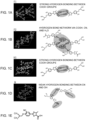
- Figures 1(a) to 1(e) are diagrams showing examples of crystal polymorphs.
- Febuxostat can take four crystal forms: F1 shown in Figure 1(a) , F2 shown in Figure 1(b) , H1 shown in Figure 1(c) , and Q shown in Figure 1(d) .
- the left side of the diagram shows a three-dimensional structure of the crystal form and the right side of the diagram shows a bonding state of molecules.
- Febuxostat has a structural formula shown in Figure 1(e) .
- crystal form indicated by F2 in Figure 1(b) forms a hydrogen bond network via COOH groups, CN groups (nitrile groups), and H 2 O.
- the crystal form indicated by H1 in Figure 1(c) is formed by COOH groups (carboxy groups) of two molecules bonded together via strong hydrogen bonding, with the two molecules being bonded into a single mass as with Figure 1(a) , but differs from Figure 1(a) in crystal form.
- the crystal form indicated by Q in Figure 1(d) is formed by a CN group and an OH group (hydroxyl group) bonded together via weak hydrogen bonding.
- crystal forms to be precipitated are predicted
- the expression "crystal forms to be precipitated are predicted” does not mean calculating concrete crystal structures shown in Figures 1(a) to 1(d) , based on a molecular theory. Although details will be described later, it is not that the analysis apparatus 10 predicts crystal forms, but the analysis apparatus 10 predicts what nature of crystal forms, among multiple crystal forms, will be precipitated under given conditions. This also includes predictions as to whether a substance can take multiple crystal forms.
- Figure 2 is a block diagram showing a functional configuration of the analysis apparatus 10 according to the present embodiment.
- the illustrated analysis apparatus 10 includes an acceptance unit 11, a solubility curve estimation unit 12, a prediction unit 13, an evaluation unit 14, and a providing unit 15.
- the acceptance unit 11 accepts parameters that affect precipitation of crystals to be analyzed for crystal polymorphism.
- the "parameters" are not specifically limited as long as they are indices that affect precipitation of crystals.
- the parameters include, for example, a structural formula of the analyte.
- the structural formula may be either a structural formula of an entire molecule or a structural formula known partially.
- the structural formula may be the type of a functional group of a molecule.
- the parameters are, for example, conditions for a solution in dissolving the analyte in the solution, and then drying and crystalizing the analyte. Examples of the conditions for a solution include the type of solvent and concentration of the dissolved analyte.
- the parameters include precipitation conditions for use during the precipitation. Examples of the precipitation conditions include precipitation temperature, drying speed of the solvent, humidity, atmosphere, wavelength and intensity of infrared radiation, and structure of the precipitation apparatus.
- the acceptance unit 11 also accepts tendency prediction, which is a prediction about a tendency of crystal forms expected to be precipitated.
- the tendency prediction is rough prediction about crystal forms likely to be precipitated, including, for example, the number and types of crystal forms that can be precipitated. If crystal forms that can be taken are known as shown in Figures 1(a) to 1(e) , the crystal forms can be used as they are for the tendency prediction.
- crystal forms that can be taken are unknown, the crystal forms can be found as follows.
- methods for tendency prediction include a method for predicting by comparison with similar substances. Available means for this include analyzing an analyte using DTA (Differential Thermal Analysis) or DSC (Differential Scanning Calorimeter) analysis.
- the solubility curve estimation unit 12 estimates a solubility curve of the analyte from tendency prediction.
- solubility curve estimation unit 12 is not essential. Although the solubility curve has been described as being a function of the analysis apparatus 10, a solubility curve found experimentally may be inputted to the analysis apparatus 10.
- the prediction unit 13 predicts the types of crystal form to be precipitated, based on accepted parameters.
- Examples of items (INPUT) inputted to the prediction unit 13 include heater temperature, target wavelength, cooling method, initial temperature, and initial solvent concentration.
- the items inputted to the prediction unit 13 also include properties of the solvent. Examples of physical properties of the solvent include the type of solvent, absorption spectrum, density and specific heat, and vapor pressure constant.
- the items inputted to the prediction unit 13 include properties of a solute. Examples of physical properties of the solute include the type of solute, absorption spectrum, density and specific heat, and heat of fusion and melting point. Note that all of the above items are not necessary, and necessary items are selected from the above items.
- the prediction unit 13 uses, for example, infrared radiation energy of the analyte, infrared absorption energy of the analyte, product humidity, drying speed of the solvent, solvent concentration, solute concentration, solubility, degree of supersaturation, and the like as analysis indices. Note that all of the above items are not necessary, and necessary analysis indices are selected from the above items.
- the analysis indices indicate what types of analysis are to be conducted based on input items.
- the infrared radiation energy of the analyte and the infrared absorption energy of the analyte can be analyzed based on the heater temperature, the wavelength, the cooling method, and the like.
- changes in the solution temperature and concentration at which the analyte will dissolve are predicted.
- a final ratio of crystal 1/crystal 2 is found as an output (OUTPUT).
- the prediction unit 13 also predicts the crystal forms to be precipitated, based on the estimated solubility curve. For example, based on the above-mentioned analysis indices, the prediction unit 13 predicts changes in the temperature and concentration of the solution containing the analyte. That is, the solubility curve varies with the crystal form. Then, by applying the analysis indices to the solubility curve for one of multiple crystal forms, the prediction unit 13 predicts whether the crystal form will be precipitated. By applying the analysis indices to the solubility curves for the other crystal forms, the prediction unit 13 also predicts whether the other crystal forms will be precipitated.
- the evaluation unit 14 Based on a degree of influence that represents an extent to which each of the parameters affects the precipitation of the crystal of the analyte, the evaluation unit 14 estimates relationships between types of crystal form to be precipitated and parameters. In so doing, the evaluation unit 14 uses an evaluation sheet S shown below.
- Figure 3 is a diagram showing an evaluation sheet S used in estimating relationships between types of crystal form to be precipitated and parameters.
- the evaluation unit 14 finds the degrees of influence of the respective parameters.
- the degrees of influence represent extents to which each parameter affects the precipitation of respective crystal forms.
- the degree of influence is found for each crystal form. That is, the evaluation unit 14 finds the degree of influence that affects crystal precipitation of each crystal form on a parameter by parameter basis.
- the degree of influence may be said to be the likelihood of each crystal form to occur, i.e., weighting.
- the degrees of influence are arranged in the column direction on a parameter by parameter basis.
- Concentration Factor corresponds, for example, to initial substance concentration.
- the temperature factor corresponds to precipitation temperature.
- the infrared factor corresponds to infrared wavelength.
- scores such as 0.00, 0.33, 0.67, and 1.00 that represent degrees of influence are assigned to crystal forms of F1 (most stable), F2 (hydrate), H1 (sub-stable), and Q (unstable).
- Contribution ratios (item contribution ratios) of these factors (parameters) in crystal precipitation are also set on the evaluation sheet S.
- the contribution ratio represents the degree to which each factor (parameter) contributes to the crystal form to be precipitated.
- the contribution ratio is set for each factor (parameter) such that the total contribution ratio of the four factors (parameters) will be 1.
- the contribution ratios are arranged in the row direction. Specifically, the contribution ratios are set to 0.90, 0.00, 0.00, and 0.10.
- the evaluation unit 14 multiplies the degrees of influence and the contribution ratio and adds up the resulting products for all the factors (parameters) to give a score. Then, using the scores as evaluation points, the evaluation unit 14 predicts that crystal forms with high evaluation points will be precipitated.
- the crystal form with the highest score or crystal forms with a score equal to or higher than a predetermined score may be predicted to be precipitated. It can be said that scores are assigned to crystal forms (evaluation points are calculated) according to the degrees of influence, that the crystal forms that can be precipitated are ranked, and that the crystal forms ranked high are predicted to be precipitated. Then, the evaluation unit 14 makes a similar prediction under each condition for precipitating crystals. In the illustrated example, predictions are made under Condition 1, Condition 2, .... Such conditions are set in precipitating crystals.
- the evaluation unit 14 compares the prediction results with the crystal forms precipitated under the respective conditions. Then, the evaluation unit 14 examines validity of the contribution ratio to be given by each factor (parameter) to the crystal form to be precipitated. It can be said that the evaluation unit 14 assigns scores based on the degrees of influence and the contribution ratios of the parameters, predicts the crystal forms to be precipitated, based on the results of scoring, and evaluates relationships between the types of crystal form to be precipitated and the parameters. It can also be said that the evaluation unit 14 compares the crystal forms predicted to be precipitated based on the results of scoring with the crystal forms actually precipitated under the same conditions and estimates the relationships between the types of crystal form to be precipitated and the parameters.
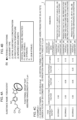
- Figures 4(a) to 4(c) are diagrams showing search results for contribution ratios.
- the evaluation unit 14 evaluates consistency between the crystal forms predicted based on the degrees of influence and the crystal forms actually precipitated.
- the degrees of influence are found using the solubility curve.
- the evaluation unit 14 does scoring based on the degrees of influence as well as on the contribution ratios of the respective precipitation conditions (parameters) and evaluates the consistency between the crystal forms predicted to be precipitated based on the results of scoring and the crystal forms actually precipitated.
- the evaluation unit 14 evaluates relationships between the types and precipitation conditions (parameters) of the crystal forms to be precipitated. Besides, based on the relationships, the evaluation unit 14 searches for contribution ratios.
- the evaluation unit 14 searches for contribution ratios based on the consistency between the crystal forms predicted to be precipitated based on the results of scoring and the crystal forms actually precipitated.
- the evaluation sheet S is used according to the present embodiment. Using the evaluation sheet S, crystal forms are predicted by changing the contribution ratios and compared with the crystal forms actually precipitated. This clarifies the contribution ratios of the respective parameters. This makes it possible to predict what crystal forms will be precipitated under certain conditions. Note that not only the contribution ratios, but also the degrees of influence may be changed.
- the providing unit 15 provides the types and precipitation conditions (confirmed parameters) of crystals to be precipitated to a user as information about the crystal forms of the crystals to be precipitated.
- the user is an operator of the analysis apparatus 10 or a provider of samples to be analyzed.
- Information about the crystal forms of the crystals to be precipitated concerns, for example, conditions that make it easy for intended crystal forms to be precipitated. Examples of such conditions include the initial concentration of a solution and drying conditions. Examples of such conditions also include crystal forms predicted to be precipitated when conditions are changed.
- the prediction unit 13 runs numerical simulations using solubility curves and thereby predicts the crystal forms to be precipitated.
- the types of crystal form to be precipitated can be predicted by taking the effects of infrared radiation into consideration. Also, the types of crystal form to be precipitated can be predicted in response to not only infrared radiation, but also input of various parameters.
- the present embodiment can reduce the time and calculation cost needed in predicting crystal forms. That is, relationships between parameters and crystal forms to be precipitated become clear. Then, according to the present embodiment, when a solute, a solvent, and precipitation conditions are specified, crystal forms to be precipitated can be predicted based on the relationships. Besides, based on the relationships, a solute, a solvent, and precipitation conditions can be predicted when at least one type of crystal form is precipitated.
- Figure 5 is a diagram showing a sequential flow of predicting crystal forms according to the present embodiment.
- a structural formula of the analyte and a sample for initial evaluation are received as user information (step S701).
- information about a functional group contained in the analyte may be used instead of the structural formula of the analyte. This makes clear the wavelength of infrared radiation absorbed during precipitation.
- a tendency prediction is made as an earliest-stage examination to predict a tendency of crystal forms expected to be precipitated and thereby predict crystal forms contained in the analyte (step S702). This can be done by making comparisons with similar substances through a prior-case study. The tendency prediction can also be made by conducting DTA or DSC analysis on samples received from the user.
- the acceptance unit 11 of the analysis apparatus 10 accepts the above information and the solubility curve estimation unit 12 makes an initial estimation of the solubility curve of the analyte (step S703).
- the solubility curve can be estimated through DSC analysis as described above.
- step S704 precipitation tendency of polymorphs is inferred by analogy using prediction software and tendencies of precipitating crystals under various conditions are roughly estimated.
- this corresponds to the process in which the prediction unit 13 runs simulations based on estimated solubility curves and predicts the types and percentage contents of the crystal forms to be precipitated.
- step S705 proper experimental conditions are extracted using the evaluation sheet S.
- this corresponds to the process in which the evaluation unit 14 determines contribution ratios using the evaluation sheet S.
- contribution ratios are determined, relationships between precipitation conditions (parameters) and crystal forms to be precipitated become clear.
- the produced samples are evaluated (step S707). This verifies whether intended crystal forms have been produced.
- the evaluation can be made using, for example, DSC analysis.
- step S708 the produced samples are provided to the user in order for the user to conduct testing or the like.
- the process can also return to step S702 to feed back the results for a tendency prediction.
- Figure 6 is a flowchart illustrating an operation of the analysis apparatus 10 in predicting crystal forms. This corresponds to step S704 in Figure 5 .
- the acceptance unit 11 accepts the parameters that will affect precipitation of the crystals of the analyte (step S801).
- the parameters are not specifically limited as long as they are indices that affect precipitation of the crystals as described above.
- the acceptance unit 11 also accepts tendency prediction such as described in Figure 5 (step S802).
- solubility curve estimation unit 12 estimates solubility curves based on the parameters and tendency prediction accepted by the acceptance unit 11 (step S803).
- the prediction unit 13 runs simulations based on the estimated solubility curves and predicts the types and percentage contents of the crystal forms to be precipitated (step S804).
- the process shown in Figure 6 is implemented on a computer apparatus by collaboration between software and hardware resources. That is, a processor such as a CPU provided on the analysis apparatus 10 loads a program that implements functions of the analysis apparatus 10 from memory, executes the program, and thereby implements the functions.
- a processor such as a CPU provided on the analysis apparatus 10 loads a program that implements functions of the analysis apparatus 10 from memory, executes the program, and thereby implements the functions.
- the process in which the analysis apparatus 10 predicts crystal forms described above can be seen as a program that makes a computer implement an acquisition function of acquiring input data including the type of solute (analyte), the type of solvent that dissolves the solute, and precipitation conditions (parameters) under which the solute is caused to be precipitated as a crystal; and a prediction function of predicting crystal forms of crystals to be precipitated given the solute, the solvent and the precipitation conditions.
- the process performed by the solubility curve estimation unit 12 can be seen as a function provided in the program, namely a solubility curve estimation function of estimating a solubility curve of the analyte. Based on the estimated solubility curve, the prediction function predicts the crystal forms to be precipitated.
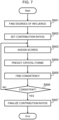
- Figure 7 is a flowchart illustrating an operation of the analysis apparatus 10 in evaluating crystal forms. This corresponds to step S705 in Figure 5 .
- the evaluation unit 14 finds the degrees of influence of the respective parameters (step S901).
- the evaluation unit 14 sets the contribution ratios that represent the extents to which respective parameters contribute to crystal precipitation (step S902).
- the evaluation unit 14 assigns scores based on the degrees of influence and the contribution ratios of the parameters (step S903).
- the evaluation unit 14 predicts the crystal forms to be precipitated (step S904).
- the evaluation unit 14 compares the predicted crystal forms with the crystal forms actually precipitated under the same conditions and thereby finds consistency (step S905).
- the evaluation unit 14 determines whether the consistency satisfies a predetermined standard, meaning that the predicted crystal forms and the actually precipitated crystal forms are consistent with each other (step S906).
- step S906 If the predetermined standard is satisfied as a result (Yes in step S906), the evaluation unit 14 finalizes the contribution ratios (step S907).
- step S906 the evaluation unit 14 returns to step S902 to set new contribution ratios and performs step S903 and subsequent steps.
- the process performed by the evaluation unit 14 of the analysis apparatus 10 according to the present embodiment is implemented on a computer apparatus by collaboration between software and hardware resources.
- the process performed by the evaluation unit 14 of the analysis apparatus 10 can be seen as a program that makes a computer implement an acquisition function of acquiring input data including the type of solute (analyte), the type of solvent that dissolves the solute, and precipitation conditions (parameters) under which the solute is caused to be precipitated as a crystal; and an evaluation function of evaluating consistency between the predicted crystal forms and the actually precipitated crystal forms regarding the crystal forms of crystals to be precipitated given the solute, the solvent and the precipitation conditions.
- the evaluation function of the program evaluates the relationships between the types and precipitation conditions of the crystal forms to be precipitated. Furthermore, when the solute, the solvent, and the precipitation conditions are specified, based on the relationships, the evaluation function can predict the crystal forms to be precipitated. Besides, based on the relationships, the evaluation function predicts a solute, a solvent, and precipitation conditions when at least one type of crystal form is precipitated.
- the evaluation unit 14 when the evaluation unit 14 finalizes scoring for a certain substance, it is highly likely that the scoring can be applied to other substances of a similar molecular structure. Therefore, when this cycle is repeated predetermined times, the evaluation unit 14 can serve as the prediction unit 13. That is, in predicting crystal forms of a substance different from an evaluated solute, contribution ratios finalized via searching can be used.
- this program can improve prediction accuracy.
- program that implements the present embodiment can be provided not only by means of communications, but also by being stored on a recording medium such as a CD-ROM.
- the prediction unit 13 further predicts new crystal forms. This can be done, for example, by procedures (1) to (5) below.
- the process performed by the analysis apparatus 10 can be seen as an analysis method that includes: accepting parameters that affect precipitation of a crystal of an analyte; predicting a type of crystal form to be precipitated, based on the accepted parameters; evaluating a relationship between the type of crystal form to be precipitated and the parameters, based on a degree of influence that represents an extent to which each of the parameters affects the precipitation of the crystal of the analyte; and providing the type of crystal form to be precipitated and a precipitation condition to a user as information about a crystal form of a crystal to be precipitated.
Landscapes
- Engineering & Computer Science (AREA)
- Life Sciences & Earth Sciences (AREA)
- Chemical & Material Sciences (AREA)
- Crystallography & Structural Chemistry (AREA)
- Bioinformatics & Cheminformatics (AREA)
- Bioinformatics & Computational Biology (AREA)
- Computing Systems (AREA)
- Theoretical Computer Science (AREA)
- Physics & Mathematics (AREA)
- General Health & Medical Sciences (AREA)
- Health & Medical Sciences (AREA)
- Spectroscopy & Molecular Physics (AREA)
- Computer Vision & Pattern Recognition (AREA)
- Medical Informatics (AREA)
- Software Systems (AREA)
- Evolutionary Computation (AREA)
- Databases & Information Systems (AREA)
- Artificial Intelligence (AREA)
- Data Mining & Analysis (AREA)
- Analytical Chemistry (AREA)
- Pathology (AREA)
- Immunology (AREA)
- Biochemistry (AREA)
- General Physics & Mathematics (AREA)
- Investigating Or Analysing Materials By Optical Means (AREA)
- Analysing Materials By The Use Of Radiation (AREA)
- Management, Administration, Business Operations System, And Electronic Commerce (AREA)
Abstract
Description
- The present disclosure relates to an analysis apparatus and an analysis method, and more particularly, to an analysis apparatus and analysis method that can predict the type of crystal form for a polymorphic analyte that can take multiple crystal forms.
- When an analyte is a polymorphic substance that can have multiple crystal forms, properties such as solubility vary with the crystal form, and thus it is desirable to be able to predict the crystal form to be precipitated. Conventional techniques include a method for estimating energy information corresponding to a crystal structure using machine learning.
- According to
Patent Literature 1, crystal structure candidates are selected from multiple crystal structure candidates, energy information about each of the selected crystal structure candidates is found by first-principle calculation, and of structure description information that represents crystal structure candidates, using structure description information corresponding to the selected crystal structure candidates as input information and using energy information about the selected crystal structure candidates as teacher information, machine learning is done to estimate energy information corresponding to the structure description information. An apparatus is disclosed that performs the process of estimating energy information corresponding to a crystal structure identified by the structure description information, based on results of the machine learning produced by the above-mentioned machine learning means. - [Patent Literature 1]
Japanese Patent Laid-Open No. 2020-166706 - However, a crystal formation process is a complex and complicated physicochemical phenomenon. Thus, it is difficult to predict crystal forms by calculation according to various conditions in the crystal formation process, including drying conditions and temperature conditions for precipitation of crystals. Besides, the crystal forms are vulnerable, in particular, to time variation during precipitation. Thus, conducting calculations and the like by reflecting these conditions to predict crystal structures themselves not only involves tremendous amounts of time and money, but also involves extreme difficulty.
- An object of the present disclosure is to provide an analysis apparatus and analysis method that can predict the type of crystal form to be precipitated and precipitation conditions of each crystal form, with regard to an analyte that exhibits crystal polymorphism.
- To solve the above problem, the present disclosure provides an analysis apparatus comprising: an acceptance unit adapted to accept parameters that affect precipitation of a crystal of an analyte to be analyzed for crystal polymorphism; a prediction unit adapted to predict a type of crystal form to be precipitated, based on an accepted structural formula and the accepted parameters; an evaluation unit adapted to evaluate a relationship between the type of crystal form to be precipitated and the parameters, based on a degree of influence that represents an extent to which each of the parameters affects the precipitation of the crystal of the analyte; and a providing unit adapted to provide the type of crystal form to be precipitated and a precipitation condition to a user as information about a crystal form of a crystal to be precipitated.
- The present disclosure also provides an analysis method comprising: accepting parameters that affect precipitation of a crystal of an analyte; predicting a type of crystal form to be precipitated, based on the accepted parameters; evaluating a relationship between the type of crystal form to be precipitated and the parameters, based on a degree of influence that represents an extent to which each of the parameters affects the precipitation of the crystal of the analyte; and providing the type of crystal form to be precipitated and a precipitation condition to a user as information about a crystal form of a crystal to be precipitated.
- The present disclosure can provide an analysis apparatus and analysis method that can predict the type of crystal form to be precipitated and precipitation conditions of each crystal form, with regard to an analyte that exhibits crystal polymorphism.
-
- [
Figure 1] Figures 1(a) to 1(e) are diagrams showing examples of crystal polymorphs. - [
Figure 2] Figure 2 is a block diagram showing a functional configuration of an analysis apparatus according to the present embodiment. - [
Figure 3 ] Figures 3(a) to 3(c) are diagrams showing an evaluation sheet used in estimating relationships between types of crystal form to be precipitated and parameters. - [
Figure 4] Figures 4(a) to 4(c) are diagrams showing search results for contribution ratios. - [
Figure 5] Figure 5 is a diagram showing a sequential flow of predicting crystal forms according to the present embodiment. - [
Figure 6] Figure 6 is a flowchart illustrating an operation of the analysis apparatus in predicting crystal forms. - [
Figure 7] Figure 7 is a flowchart illustrating an operation of the analysis apparatus in evaluating crystal forms. - An embodiment of the present disclosure will be described in detail below with reference to the accompanying drawings.
- According to the present embodiment, an
analysis apparatus 10 accepts parameters that affect precipitation of crystals of an analyte. Then, based on the parameters, theanalysis apparatus 10 predicts crystal forms produced when crystals are precipitated by drying a solution obtained by dissolving the analyte. Note that "crystal polymorphs" are compounds identical in chemical composition and different in crystal structure. -
Figures 1(a) to 1(e) are diagrams showing examples of crystal polymorphs. - In
Figure 1 , description will be given by citing febuxostat as an example of a substance that exhibits crystal polymorphism. - Febuxostat can take four crystal forms: F1 shown in
Figure 1(a) , F2 shown inFigure 1(b) , H1 shown inFigure 1(c) , and Q shown inFigure 1(d) . In each of the figures, the left side of the diagram shows a three-dimensional structure of the crystal form and the right side of the diagram shows a bonding state of molecules. Febuxostat has a structural formula shown inFigure 1(e) . - Of the crystal forms, the crystal form indicated by F1 in
Figure 1(a) , is formed by COOH groups (carboxy groups) of two molecules bonded together via strong hydrogen bonding, with the two molecules being bonded into a single mass. - Also, the crystal form indicated by F2 in
Figure 1(b) forms a hydrogen bond network via COOH groups, CN groups (nitrile groups), and H2O. - Furthermore, the crystal form indicated by H1 in
Figure 1(c) is formed by COOH groups (carboxy groups) of two molecules bonded together via strong hydrogen bonding, with the two molecules being bonded into a single mass as withFigure 1(a) , but differs fromFigure 1(a) in crystal form. - The crystal form indicated by Q in
Figure 1(d) is formed by a CN group and an OH group (hydroxyl group) bonded together via weak hydrogen bonding. - Note that by taking illustrated febuxostat as an example, description will be given below of cases in which crystal forms to be precipitated are predicted.
- Note that in the present embodiment, the expression "crystal forms to be precipitated are predicted" does not mean calculating concrete crystal structures shown in
Figures 1(a) to 1(d) , based on a molecular theory. Although details will be described later, it is not that theanalysis apparatus 10 predicts crystal forms, but theanalysis apparatus 10 predicts what nature of crystal forms, among multiple crystal forms, will be precipitated under given conditions. This also includes predictions as to whether a substance can take multiple crystal forms. - By taking illustrated febuxostat as an example, description will be given below of cases in which the types and precipitation conditions of crystal forms to be precipitated are predicted.
-
Figure 2 is a block diagram showing a functional configuration of theanalysis apparatus 10 according to the present embodiment. - The illustrated
analysis apparatus 10 includes anacceptance unit 11, a solubilitycurve estimation unit 12, aprediction unit 13, anevaluation unit 14, and a providingunit 15. - The
acceptance unit 11 accepts parameters that affect precipitation of crystals to be analyzed for crystal polymorphism. Here, the "parameters" are not specifically limited as long as they are indices that affect precipitation of crystals. The parameters include, for example, a structural formula of the analyte. The structural formula may be either a structural formula of an entire molecule or a structural formula known partially. For example, the structural formula may be the type of a functional group of a molecule. Besides, the parameters are, for example, conditions for a solution in dissolving the analyte in the solution, and then drying and crystalizing the analyte. Examples of the conditions for a solution include the type of solvent and concentration of the dissolved analyte. Furthermore, the parameters include precipitation conditions for use during the precipitation. Examples of the precipitation conditions include precipitation temperature, drying speed of the solvent, humidity, atmosphere, wavelength and intensity of infrared radiation, and structure of the precipitation apparatus. - The
acceptance unit 11 also accepts tendency prediction, which is a prediction about a tendency of crystal forms expected to be precipitated. The tendency prediction is rough prediction about crystal forms likely to be precipitated, including, for example, the number and types of crystal forms that can be precipitated. If crystal forms that can be taken are known as shown inFigures 1(a) to 1(e) , the crystal forms can be used as they are for the tendency prediction. - On the other hand, if crystal forms that can be taken are unknown, the crystal forms can be found as follows. Examples of methods for tendency prediction include a method for predicting by comparison with similar substances. Available means for this include analyzing an analyte using DTA (Differential Thermal Analysis) or DSC (Differential Scanning Calorimeter) analysis.
- The solubility
curve estimation unit 12 estimates a solubility curve of the analyte from tendency prediction. - To estimate the solubility curve of the analyte, for example, DSC analysis is conducted. Then, based on a melting point and heat of fusion found by the DSC analysis, the solubility curve can be formulated. This makes it possible to find the solubility curve with higher accuracy. Note that the solubility
curve estimation unit 12 is not essential. Although the solubility curve has been described as being a function of theanalysis apparatus 10, a solubility curve found experimentally may be inputted to theanalysis apparatus 10. - The
prediction unit 13 predicts the types of crystal form to be precipitated, based on accepted parameters. - Examples of items (INPUT) inputted to the
prediction unit 13 include heater temperature, target wavelength, cooling method, initial temperature, and initial solvent concentration. The items inputted to theprediction unit 13 also include properties of the solvent. Examples of physical properties of the solvent include the type of solvent, absorption spectrum, density and specific heat, and vapor pressure constant. Furthermore, the items inputted to theprediction unit 13 include properties of a solute. Examples of physical properties of the solute include the type of solute, absorption spectrum, density and specific heat, and heat of fusion and melting point. Note that all of the above items are not necessary, and necessary items are selected from the above items. - According to the present embodiment, the
prediction unit 13 uses, for example, infrared radiation energy of the analyte, infrared absorption energy of the analyte, product humidity, drying speed of the solvent, solvent concentration, solute concentration, solubility, degree of supersaturation, and the like as analysis indices. Note that all of the above items are not necessary, and necessary analysis indices are selected from the above items. - The analysis indices indicate what types of analysis are to be conducted based on input items. For example, the infrared radiation energy of the analyte and the infrared absorption energy of the analyte can be analyzed based on the heater temperature, the wavelength, the cooling method, and the like. By analyzing the infrared radiation energy of the analyte and the infrared absorption energy of the analyte, changes in the solution temperature and concentration at which the analyte will dissolve are predicted.
- According to the present embodiment, from analysis results based on analysis indices, a final ratio of
crystal 1/crystal 2 is found as an output (OUTPUT). - The
prediction unit 13 also predicts the crystal forms to be precipitated, based on the estimated solubility curve. For example, based on the above-mentioned analysis indices, theprediction unit 13 predicts changes in the temperature and concentration of the solution containing the analyte. That is, the solubility curve varies with the crystal form. Then, by applying the analysis indices to the solubility curve for one of multiple crystal forms, theprediction unit 13 predicts whether the crystal form will be precipitated. By applying the analysis indices to the solubility curves for the other crystal forms, theprediction unit 13 also predicts whether the other crystal forms will be precipitated. - Based on a degree of influence that represents an extent to which each of the parameters affects the precipitation of the crystal of the analyte, the
evaluation unit 14 estimates relationships between types of crystal form to be precipitated and parameters. In so doing, theevaluation unit 14 uses an evaluation sheet S shown below. -
Figure 3 is a diagram showing an evaluation sheet S used in estimating relationships between types of crystal form to be precipitated and parameters. - Regarding the crystal forms predicted by the
prediction unit 13 to be precipitated, theevaluation unit 14 finds the degrees of influence of the respective parameters. The degrees of influence represent extents to which each parameter affects the precipitation of respective crystal forms. The degree of influence is found for each crystal form. That is, theevaluation unit 14 finds the degree of influence that affects crystal precipitation of each crystal form on a parameter by parameter basis. The degree of influence may be said to be the likelihood of each crystal form to occur, i.e., weighting. On the illustrated evaluation sheet S, the degrees of influence are arranged in the column direction on a parameter by parameter basis. - On the illustrated evaluation sheet S, four parameters that affect crystal precipitation are listed: Concentration Factor, Temperature Factor, Infrared Factor, and Others. The concentration factor corresponds, for example, to initial substance concentration. The temperature factor corresponds to precipitation temperature. Furthermore, the infrared factor corresponds to infrared wavelength. Besides, scores such as 0.00, 0.33, 0.67, and 1.00 that represent degrees of influence are assigned to crystal forms of F1 (most stable), F2 (hydrate), H1 (sub-stable), and Q (unstable).
- Contribution ratios (item contribution ratios) of these factors (parameters) in crystal precipitation are also set on the evaluation sheet S. The contribution ratio represents the degree to which each factor (parameter) contributes to the crystal form to be precipitated. The contribution ratio is set for each factor (parameter) such that the total contribution ratio of the four factors (parameters) will be 1. On the illustrated evaluation sheet S, the contribution ratios are arranged in the row direction. Specifically, the contribution ratios are set to 0.90, 0.00, 0.00, and 0.10.
- Then, regarding each crystal form, the
evaluation unit 14 multiplies the degrees of influence and the contribution ratio and adds up the resulting products for all the factors (parameters) to give a score. Then, using the scores as evaluation points, theevaluation unit 14 predicts that crystal forms with high evaluation points will be precipitated. The crystal form with the highest score or crystal forms with a score equal to or higher than a predetermined score may be predicted to be precipitated. It can be said that scores are assigned to crystal forms (evaluation points are calculated) according to the degrees of influence, that the crystal forms that can be precipitated are ranked, and that the crystal forms ranked high are predicted to be precipitated. Then, theevaluation unit 14 makes a similar prediction under each condition for precipitating crystals. In the illustrated example, predictions are made underCondition 1,Condition 2, .... Such conditions are set in precipitating crystals. - Then, the
evaluation unit 14 compares the prediction results with the crystal forms precipitated under the respective conditions. Then, theevaluation unit 14 examines validity of the contribution ratio to be given by each factor (parameter) to the crystal form to be precipitated. It can be said that theevaluation unit 14 assigns scores based on the degrees of influence and the contribution ratios of the parameters, predicts the crystal forms to be precipitated, based on the results of scoring, and evaluates relationships between the types of crystal form to be precipitated and the parameters. It can also be said that theevaluation unit 14 compares the crystal forms predicted to be precipitated based on the results of scoring with the crystal forms actually precipitated under the same conditions and estimates the relationships between the types of crystal form to be precipitated and the parameters. Then, theevaluation unit 14 changes the contribution ratios based on the results of comparison and conducts searches to see how each factor (parameter) contributes to the crystal form to be precipitated. It can also be said that theevaluation unit 14 searches for contribution ratios based on the results of comparison. -
Figures 4(a) to 4(c) are diagrams showing search results for contribution ratios. - Here, febuxostat having the structural formula shown in
Figure 4(a) was produced.Figure 4(b) shows conditions set in precipitating crystals, including solution conditions and drying conditions. It is shown here that the solvent type in the solution can be changed. It is also shown that initial substance concentration can be changed. Furthermore, it is shown that precipitation temperature can be changed. Besides, infrared wavelength (wavelength of infrared radiation) can be changed. These are an example of above-mentioned parameters that affect crystal forms to be precipitated. -
Figure 4(c) shows results of searches conducted under six conditions selected from the alterable conditions shown inFigure 4(b) . Here, ethanol is selected as Solvent Type, and two concentrations-25[mL/mg] and 40[mL/mg] -- are selected as Initial Substance Concentration. Besides, 3.2 µm is selected as radiation wavelength. This wavelength is in the infrared wavelength region and corresponds to the absorption wavelength of a carboxy group surrounded by a solid line inFigure 4(a) . Furthermore, three temperatures-20[°C], 40[°C], and 70[°C] -- are selected as Precipitation Temperature. That is, six conditions are created by combinations of the initial substance concentration and the precipitation temperature. Then, under the six conditions, the crystal forms predicted on the evaluation sheet S and the actually precipitated crystal forms are compared on the table inFigure 4(c) . - In this case, four parameters -- Concentration Factor, Temperature Factor, Infrared Factor, and Others - - are considered as parameters that affect crystal precipitation. Concentration Factor corresponds to Initial Substance Concentration in
Figure 4(b) . Also, Temperature Factor corresponds to Precipitation Temperature. Furthermore, Infrared Factor corresponds to Infrared Wavelength. - Then, contribution ratios (item contribution ratios) of these factors (parameters) in crystal precipitation are set. The contribution ratios of the four factors (parameters) are configured such that their total will be 1.
- The contribution ratios and degrees of influence of the parameters are shown in Table T by being evaluated using
Scoring 1,Scoring 2, andScoring 3. - In
Scoring 1 of Table T, Concentration Factor is assigned 0.9 and Others is assigned 0.1. In so doing, it is assumed that theevaluation unit 14 predicts that the crystal form of F1 will be precipitated alone under all the conditions. Regarding the crystal forms actually precipitated, the crystal form of F1 is precipitated predominantly only under one condition. Under other three conditions, the crystal form of F1 is also precipitated, but not most predominantly. Note that under the other two conditions, the crystal form of F1 is not precipitated. Of the precipitated crystal forms, the crystal form precipitated the most is described as being "precipitated predominantly" crystal form. On the other hand, the crystal form which is precipitated, but not the most is described as being a "non-predominant" crystal form. On the evaluation sheet S, these states are described as being "Consistent: 1/6" and "Partially Consistent: 3/6," respectively. - In
Scoring 2, Concentration Factor is assigned 0.55, Temperature Factor is assigned 0.35, and Others is assigned 0.1. In so doing, it is assumed that theevaluation unit 14 predicts that the crystal form of F1 will be precipitated alone under two conditions and that the crystal form of F2 will be precipitated alone under four conditions. Note that under the other two conditions, the crystal form of F1 is not precipitated. Regarding the crystal forms actually precipitated, the crystal forms of F1 and F2 are precipitated predominantly under two conditions. Under two other conditions, the crystal forms of F1 and F2 are also precipitated, but not most predominantly. On the evaluation sheet S, these states are described as being "Consistent: 2/6" and "Partially Consistent: 2/6," respectively. - In
Scoring 3, Concentration Factor is assigned 0.30, Temperature Factor is assigned 0.35, Infrared Factor is assigned 0.25, and Others is assigned 0.1. In so doing, it is assumed that theevaluation unit 14 predicts that the crystal forms of F1, F2, and H1 will be precipitated in a mixture under all the conditions. Regarding the crystal forms actually precipitated, the crystal forms of F1, F2, and H1 are precipitated predominantly under four conditions. Under the other two conditions, the crystal forms of F1, F2, and H1 are also precipitated, but not most predominantly. On the evaluation sheet S, these states are described as being "Consistent: 4/6" and "Partially Consistent: 2/6," respectively. - In this way, according to the present embodiment, the
evaluation unit 14 evaluates consistency between the crystal forms predicted based on the degrees of influence and the crystal forms actually precipitated. The degrees of influence are found using the solubility curve. Then, theevaluation unit 14 does scoring based on the degrees of influence as well as on the contribution ratios of the respective precipitation conditions (parameters) and evaluates the consistency between the crystal forms predicted to be precipitated based on the results of scoring and the crystal forms actually precipitated. Furthermore, based on the consistency, theevaluation unit 14 evaluates relationships between the types and precipitation conditions (parameters) of the crystal forms to be precipitated. Besides, based on the relationships, theevaluation unit 14 searches for contribution ratios. It can also be said that theevaluation unit 14 searches for contribution ratios based on the consistency between the crystal forms predicted to be precipitated based on the results of scoring and the crystal forms actually precipitated. In so doing, the evaluation sheet S is used according to the present embodiment. Using the evaluation sheet S, crystal forms are predicted by changing the contribution ratios and compared with the crystal forms actually precipitated. This clarifies the contribution ratios of the respective parameters. This makes it possible to predict what crystal forms will be precipitated under certain conditions. Note that not only the contribution ratios, but also the degrees of influence may be changed. - The providing
unit 15 provides the types and precipitation conditions (confirmed parameters) of crystals to be precipitated to a user as information about the crystal forms of the crystals to be precipitated. In this case, the user is an operator of theanalysis apparatus 10 or a provider of samples to be analyzed. Information about the crystal forms of the crystals to be precipitated concerns, for example, conditions that make it easy for intended crystal forms to be precipitated. Examples of such conditions include the initial concentration of a solution and drying conditions. Examples of such conditions also include crystal forms predicted to be precipitated when conditions are changed. - The embodiment described above makes it possible to predict the types of crystal form to be precipitated, with regard to an analyte that exhibits crystal polymorphism. The embodiment also makes it possible to provide conditions for precipitating more useful crystal forms to the user. However, as described above, the present embodiment does not calculate concrete crystal structures based on a molecular theory. According to the present embodiment, there is no need to know crystal structures, and it is predicted that multiple crystal forms can be precipitated and predictions are made as to which of the multiple crystal forms will be precipitated.
- A crystal formation process is a complex and complicated physicochemical phenomenon. Therefore, conventionally huge numbers of experimental trials are needed to prepare crystal forms. However, because of the capability to predict the types of crystal form to be precipitated, with regard to any analyte that exhibits crystal polymorphism, the present embodiment does not require such huge numbers of experimental trials.
- According to the present embodiment, the
prediction unit 13 runs numerical simulations using solubility curves and thereby predicts the crystal forms to be precipitated. - Whereas conventionally, for example, effects of infrared radiation on precipitation is not taken into consideration in predicting crystal forms to be precipitated, according to the present embodiment, the types of crystal form to be precipitated can be predicted by taking the effects of infrared radiation into consideration. Also, the types of crystal form to be precipitated can be predicted in response to not only infrared radiation, but also input of various parameters.
- Furthermore, even if precipitation conditions or the like are changed, the types of crystal forms to be precipitated can be predicted quickly. In other words, the present embodiment can reduce the time and calculation cost needed in predicting crystal forms. That is, relationships between parameters and crystal forms to be precipitated become clear. Then, according to the present embodiment, when a solute, a solvent, and precipitation conditions are specified, crystal forms to be precipitated can be predicted based on the relationships. Besides, based on the relationships, a solute, a solvent, and precipitation conditions can be predicted when at least one type of crystal form is precipitated.
- Next, a concrete flow of predicting crystal forms to be precipitated from a solution of a polymorphic analyte will be described in more detail.
-
Figure 5 is a diagram showing a sequential flow of predicting crystal forms according to the present embodiment. - First, a structural formula of the analyte and a sample for initial evaluation are received as user information (step S701). Note that information about a functional group contained in the analyte may be used instead of the structural formula of the analyte. This makes clear the wavelength of infrared radiation absorbed during precipitation.
- Next, a tendency prediction is made as an earliest-stage examination to predict a tendency of crystal forms expected to be precipitated and thereby predict crystal forms contained in the analyte (step S702). This can be done by making comparisons with similar substances through a prior-case study. The tendency prediction can also be made by conducting DTA or DSC analysis on samples received from the user.
- Then, the
acceptance unit 11 of theanalysis apparatus 10 accepts the above information and the solubilitycurve estimation unit 12 makes an initial estimation of the solubility curve of the analyte (step S703). The solubility curve can be estimated through DSC analysis as described above. - Next, precipitation tendency of polymorphs is inferred by analogy using prediction software and tendencies of precipitating crystals under various conditions are roughly estimated (step S704). In the example described above, this corresponds to the process in which the
prediction unit 13 runs simulations based on estimated solubility curves and predicts the types and percentage contents of the crystal forms to be precipitated. - Next, proper experimental conditions are extracted using the evaluation sheet S (step S705). In the example described above, this corresponds to the process in which the
evaluation unit 14 determines contribution ratios using the evaluation sheet S. When the contribution ratios are determined, relationships between precipitation conditions (parameters) and crystal forms to be precipitated become clear. - Then, samples are produced actually (step S706). Consequently, a plurality of what appear to be heterogeneous crystals are created.
- Furthermore, the produced samples are evaluated (step S707). This verifies whether intended crystal forms have been produced. The evaluation can be made using, for example, DSC analysis.
- Then, the produced samples are provided to the user in order for the user to conduct testing or the like (step S708). The process can also return to step S702 to feed back the results for a tendency prediction.
- This will allow the user to identify useful crystal forms (step S709).
-
Figure 6 is a flowchart illustrating an operation of theanalysis apparatus 10 in predicting crystal forms. This corresponds to step S704 inFigure 5 . - First, the
acceptance unit 11 accepts the parameters that will affect precipitation of the crystals of the analyte (step S801). The parameters are not specifically limited as long as they are indices that affect precipitation of the crystals as described above. In the example shown in the evaluation sheet S ofFigure 3 , there are four parameters: Concentration Factor, Temperature Factor, Infrared Factor, and Others. - The
acceptance unit 11 also accepts tendency prediction such as described inFigure 5 (step S802). - Then, the solubility
curve estimation unit 12 estimates solubility curves based on the parameters and tendency prediction accepted by the acceptance unit 11 (step S803). - Next, the
prediction unit 13 runs simulations based on the estimated solubility curves and predicts the types and percentage contents of the crystal forms to be precipitated (step S804). - The process shown in
Figure 6 is implemented on a computer apparatus by collaboration between software and hardware resources. That is, a processor such as a CPU provided on theanalysis apparatus 10 loads a program that implements functions of theanalysis apparatus 10 from memory, executes the program, and thereby implements the functions. - Thus, the process in which the
analysis apparatus 10 predicts crystal forms described above can be seen as a program that makes a computer implement an acquisition function of acquiring input data including the type of solute (analyte), the type of solvent that dissolves the solute, and precipitation conditions (parameters) under which the solute is caused to be precipitated as a crystal; and a prediction function of predicting crystal forms of crystals to be precipitated given the solute, the solvent and the precipitation conditions. - The process performed by the solubility
curve estimation unit 12 can be seen as a function provided in the program, namely a solubility curve estimation function of estimating a solubility curve of the analyte. Based on the estimated solubility curve, the prediction function predicts the crystal forms to be precipitated. -
Figure 7 is a flowchart illustrating an operation of theanalysis apparatus 10 in evaluating crystal forms. This corresponds to step S705 inFigure 5 . - First, based on the crystal forms predicted by the
prediction unit 13 to be precipitated, theevaluation unit 14, finds the degrees of influence of the respective parameters (step S901). - Next, the
evaluation unit 14 sets the contribution ratios that represent the extents to which respective parameters contribute to crystal precipitation (step S902). - Then, using the evaluation sheet S, the
evaluation unit 14 assigns scores based on the degrees of influence and the contribution ratios of the parameters (step S903). - Furthermore, based on the results of scoring, the
evaluation unit 14 predicts the crystal forms to be precipitated (step S904). - Next, the
evaluation unit 14 compares the predicted crystal forms with the crystal forms actually precipitated under the same conditions and thereby finds consistency (step S905). - Then, the
evaluation unit 14 determines whether the consistency satisfies a predetermined standard, meaning that the predicted crystal forms and the actually precipitated crystal forms are consistent with each other (step S906). - If the predetermined standard is satisfied as a result (Yes in step S906), the
evaluation unit 14 finalizes the contribution ratios (step S907). - On the other hand, if the predetermined standard is not satisfied (No in step S906), the
evaluation unit 14 returns to step S902 to set new contribution ratios and performs step S903 and subsequent steps. - The process performed by the
evaluation unit 14 of theanalysis apparatus 10 according to the present embodiment is implemented on a computer apparatus by collaboration between software and hardware resources. - Thus, the process performed by the
evaluation unit 14 of theanalysis apparatus 10 according to the present embodiment can be seen as a program that makes a computer implement an acquisition function of acquiring input data including the type of solute (analyte), the type of solvent that dissolves the solute, and precipitation conditions (parameters) under which the solute is caused to be precipitated as a crystal; and an evaluation function of evaluating consistency between the predicted crystal forms and the actually precipitated crystal forms regarding the crystal forms of crystals to be precipitated given the solute, the solvent and the precipitation conditions. - Then, based on the consistency, the evaluation function of the program evaluates the relationships between the types and precipitation conditions of the crystal forms to be precipitated. Furthermore, when the solute, the solvent, and the precipitation conditions are specified, based on the relationships, the evaluation function can predict the crystal forms to be precipitated. Besides, based on the relationships, the evaluation function predicts a solute, a solvent, and precipitation conditions when at least one type of crystal form is precipitated. Here, when the
evaluation unit 14 finalizes scoring for a certain substance, it is highly likely that the scoring can be applied to other substances of a similar molecular structure. Therefore, when this cycle is repeated predetermined times, theevaluation unit 14 can serve as theprediction unit 13. That is, in predicting crystal forms of a substance different from an evaluated solute, contribution ratios finalized via searching can be used. - When predicting which of multiple crystal forms will be precipitated, this program can improve prediction accuracy.
- Note that the program that implements the present embodiment can be provided not only by means of communications, but also by being stored on a recording medium such as a CD-ROM.
- Next, a modification of the
analysis apparatus 10 will be described. According to the modification, theprediction unit 13 further predicts new crystal forms. This can be done, for example, by procedures (1) to (5) below. -
- (1) Regarding an analyte, a crystal form already known and regarded to be the most stable is set as the currently most stable crystal form. This crystal form is designated here, for example, as
crystal form 1. - (2) Assuming that there exists a more stable unknown crystal form having higher stability, the crystal form is set as an imaginary crystal form. This crystal form is designated here, for example, as
crystal form 2. - (3) Using a function of the
evaluation unit 14, the ease of precipitation is compared betweencrystal form 1 andcrystal form 2. Ifcrystal form 2 is precipitated, the conditions under whichcrystal form 2 is precipitated are derived. - (4) Experiments of actually precipitating
crystal form 2 are conducted under the derived conditions. - (5) If
crystal form 2 is precipitated as a result of the experiments, this means that a new most stable crystal form has been found out. On the other hand, ifcrystal form 2 is not precipitated, it is highly likely thatcrystal form 1 is the most stable crystal form. - Here, the process performed by the
analysis apparatus 10 can be seen as an analysis method that includes: accepting parameters that affect precipitation of a crystal of an analyte; predicting a type of crystal form to be precipitated, based on the accepted parameters; evaluating a relationship between the type of crystal form to be precipitated and the parameters, based on a degree of influence that represents an extent to which each of the parameters affects the precipitation of the crystal of the analyte; and providing the type of crystal form to be precipitated and a precipitation condition to a user as information about a crystal form of a crystal to be precipitated. - Whereas the present embodiment has been described above, the technical scope of the present disclosure is not limited to the scope of the embodiment described above. It will be apparent from the description of the claims that any form resulting from making various changes or improvements to the above embodiment is also included in the technical scope of the present disclosure.
-
- 10: analysis apparatus; 11: acceptance unit; 12: solubility curve estimation unit; 13: prediction unit;
- 14: evaluation unit; 15: providing unit; S: evaluation sheet
Claims (12)
- An analysis apparatus comprising:an acceptance unit adapted to accept parameters that affect precipitation of a crystal of an analyte;a prediction unit adapted to predict a type of crystal form to be precipitated, based on the accepted parameters;an evaluation unit adapted to evaluate a relationship between the type of crystal form to be precipitated and the parameters, based on a degree of influence that represents an extent to which each of the parameters affects the precipitation of the crystal of the analyte; anda providing unit adapted to provide the type of crystal form to be precipitated and a precipitation condition to a user as information about a crystal form of a crystal to be precipitated.
- The analysis apparatus according to claim 1, wherein the prediction unit predicts the crystal form to be precipitated, based on a solubility curve of the analyte having the crystal form.
- The analysis apparatus according to claim 2, wherein the prediction unit uses the solubility curve estimated based on a tendency prediction, which is a prediction about a tendency of the crystal form expected to be precipitated.
- The analysis apparatus according to claim 1, wherein the parameters include a wavelength of infrared radiation used in precipitating a crystal.
- The analysis apparatus according to claim 4, wherein a wavelength absorbed by the analyte having the crystal form expected to be precipitated is selected as the wavelength of the infrared radiation.
- The analysis apparatus according to claim 1, wherein the evaluation unit finds the degree of influence of each of the parameters based on the crystal form predicted by the prediction unit to be precipitated.
- The analysis apparatus according to claim 6, wherein the evaluation unit does scoring based on the degrees of influence and contribution ratios of the parameters, predicts a crystal form to be precipitated, based on results of the scoring, and evaluates the relationship between the type of crystal form to be precipitated and the parameters.
- The analysis apparatus according to claim 7, wherein the evaluation unit compares the crystal form predicted to be precipitated based on the results of the scoring with a crystal form actually precipitated and searches for the contribution ratios.
- The analysis apparatus according to claim 8, wherein the evaluation unit searches for the contribution ratios based on consistency between the crystal form predicted to be precipitated based on the results of the scoring and the crystal form actually precipitated.
- The analysis apparatus according to claim 1, wherein the prediction unit further predicts a new crystal form.
- An analysis method comprising:accepting parameters that affect precipitation of a crystal of an analyte;predicting a type of crystal form to be precipitated, based on the accepted parameters;evaluating a relationship between the type of crystal form to be precipitated and the parameters, based on a degree of influence that represents an extent to which each of the parameters affects the precipitation of the crystal of the analyte; andproviding the type of crystal form to be precipitated and a precipitation condition to a user as information about a crystal form of a crystal to be precipitated.
- An analysis method comprising:receiving parameters that affect precipitation of a crystal of an analyte, the parameters include a structural formula of the analyte;predicting a first type of crystal form to be precipitated, based on the accepted parameters and contribution ratios of each of the parameters;evaluating a relationship between the type of crystal form to be precipitated and the parameters, based on a degree of influence that represents an extent to which each of the parameters affects the precipitation of the crystal of the analyte;providing the type of crystal form to be precipitated and a precipitation condition to a user as information about a crystal form of a crystal to be precipitated;precipitating a crystal based on the parameters and the provided precipitation condition;comparing a form of the precipitated crystal form with the predicted first type of crystal form;changing the contribution ratios based on the comparison; andpredicting a second type of crystal form to be precipitated based on the changed contribution ratios.
Applications Claiming Priority (2)
| Application Number | Priority Date | Filing Date | Title |
|---|---|---|---|
| JP2022021472 | 2022-05-25 | ||
| PCT/JP2023/016024 WO2023228657A1 (en) | 2022-05-25 | 2023-04-21 | Analysis device and analysis method |
Publications (2)
| Publication Number | Publication Date |
|---|---|
| EP4534167A1 true EP4534167A1 (en) | 2025-04-09 |
| EP4534167A4 EP4534167A4 (en) | 2026-05-13 |
Family
ID=88876710
Family Applications (1)
| Application Number | Title | Priority Date | Filing Date |
|---|---|---|---|
| EP23811535.6A Pending EP4534167A4 (en) | 2022-05-25 | 2023-04-21 | ANALYSIS DEVICE AND ANALYSIS METHOD |
Country Status (5)
| Country | Link |
|---|---|
| US (1) | US20230386616A1 (en) |
| EP (1) | EP4534167A4 (en) |
| JP (1) | JP7828444B2 (en) |
| CN (1) | CN119095657A (en) |
| WO (1) | WO2023228657A1 (en) |
Families Citing this family (5)
| Publication number | Priority date | Publication date | Assignee | Title |
|---|---|---|---|---|
| US12587274B2 (en) | 2023-03-28 | 2026-03-24 | Quantum Generative Materials Llc | Satellite optimization management system based on natural language input and artificial intelligence |
| US12603701B2 (en) | 2023-12-27 | 2026-04-14 | Quantum Generative Materials Llc | Distributed satellite constellation management and control system |
| US12627372B2 (en) | 2023-12-27 | 2026-05-12 | Quantum Generative Materials Llc | Advanced mission control predictive systems for low earth orbit semi-autonomous satellites |
| US12368503B2 (en) | 2023-12-27 | 2025-07-22 | Quantum Generative Materials Llc | Intent-based satellite transmit management based on preexisting historical location and machine learning |
| CN118522386B (en) * | 2024-07-22 | 2024-11-01 | 中南大学 | Concrete micro-parameter design method and system under complex environmental conditions |
Family Cites Families (3)
| Publication number | Priority date | Publication date | Assignee | Title |
|---|---|---|---|---|
| JP2000166706A (en) * | 1998-12-04 | 2000-06-20 | Yoichiro Kuroiwa | Bedding |
| WO2002077772A2 (en) * | 2001-03-23 | 2002-10-03 | Transform Pharmaceuticals, Inc. | Method and system for high-throughput screening |
| JP2020166706A (en) * | 2019-03-29 | 2020-10-08 | 株式会社クロスアビリティ | Crystal shape predictor, crystal shape prediction method, neural network manufacturing method, and program |
-
2023
- 2023-04-21 JP JP2024522979A patent/JP7828444B2/en active Active
- 2023-04-21 CN CN202380039568.1A patent/CN119095657A/en active Pending
- 2023-04-21 EP EP23811535.6A patent/EP4534167A4/en active Pending
- 2023-04-21 WO PCT/JP2023/016024 patent/WO2023228657A1/en not_active Ceased
- 2023-05-15 US US18/317,265 patent/US20230386616A1/en active Pending
Also Published As
| Publication number | Publication date |
|---|---|
| WO2023228657A1 (en) | 2023-11-30 |
| EP4534167A4 (en) | 2026-05-13 |
| JPWO2023228657A1 (en) | 2023-11-30 |
| CN119095657A (en) | 2024-12-06 |
| JP7828444B2 (en) | 2026-03-11 |
| US20230386616A1 (en) | 2023-11-30 |
Similar Documents
| Publication | Publication Date | Title |
|---|---|---|
| US20230386616A1 (en) | Analysis apparatus and analysis method | |
| Haghbakhsh et al. | Group contribution and atomic contribution models for the prediction of various physical properties of deep eutectic solvents | |
| Errington | Direct calculation of liquid–vapor phase equilibria from transition matrix Monte Carlo simulation | |
| Polasky et al. | Recent advances in computational algorithms and software for large-scale glycoproteomics | |
| Paluch et al. | A method for computing the solubility limit of solids: Application to sodium chloride in water and alcohols | |
| Song et al. | PhysNet meets CHARMM: A framework for routine machine learning/molecular mechanics simulations | |
| Ciarella et al. | Finding defects in glasses through machine learning | |
| Mohan et al. | Predictive understanding of the surface tension and velocity of sound in ionic liquids using machine learning | |
| Tsai et al. | Reaction coordinates and rate constants for liquid droplet nucleation: Quantifying the interplay between driving force and memory | |
| Mohammadi et al. | Modeling the solubility of light hydrocarbon gases and their mixture in brine with machine learning and equations of state | |
| Wu et al. | Tutorial on how to build non-Markovian dynamic models from molecular dynamics simulations for studying protein conformational changes | |
| JPWO2020110268A1 (en) | Sample measurement device, program and measurement parameter setting support device | |
| Diky et al. | Validation of thermophysical data for scientific and engineering applications | |
| Valderrama et al. | Glass transition temperature of ionic liquids using molecular descriptors and artificial neural networks | |
| Sucerquia et al. | Ab initio metadynamics determination of temperature-dependent free-energy landscape in ultrasmall silver clusters | |
| Khan et al. | How fluxional reactants limit the accuracy/efficiency of infrequent metadynamics | |
| Jimenes-Vargas et al. | Prediction of compound-target interaction using several artificial intelligence algorithms and comparison with a consensus-based strategy | |
| Chen et al. | Deciphering melting behaviors of energetic compounds using interpretable Machine learning for melt-castable applications | |
| Urbina et al. | Rationalizing protein–ligand interactions via the effective fragment potential method and structural data from classical molecular dynamics | |
| Bhoutekar et al. | A new class of enhanced kinetic sampling methods for building Markov state models | |
| Clegg et al. | Isopiestic determination of the osmotic and activity coefficients of NaCl+ SrCl2+ H2O at 298.15 K and representation with an extended ion-interaction model | |
| Pilgrim | Empirical regularities in the behaviour of the critical constants of fluid alkali metals | |
| Marchan et al. | Toward harnessing AI for surfactant chemistry: Prediction of critical micelle concentration | |
| Hayer et al. | Prediction of activity coefficients by similarity-based imputation using quantum-chemical descriptors | |
| Malherbe et al. | IgBlend: unifying 3D structures and sequences in antibody language models |
Legal Events
| Date | Code | Title | Description |
|---|---|---|---|
| STAA | Information on the status of an ep patent application or granted ep patent |
Free format text: STATUS: THE INTERNATIONAL PUBLICATION HAS BEEN MADE |
|
| PUAI | Public reference made under article 153(3) epc to a published international application that has entered the european phase |
Free format text: ORIGINAL CODE: 0009012 |
|
| STAA | Information on the status of an ep patent application or granted ep patent |
Free format text: STATUS: REQUEST FOR EXAMINATION WAS MADE |
|
| 17P | Request for examination filed |
Effective date: 20241122 |
|
| AK | Designated contracting states |
Kind code of ref document: A1 Designated state(s): AL AT BE BG CH CY CZ DE DK EE ES FI FR GB GR HR HU IE IS IT LI LT LU LV MC ME MK MT NL NO PL PT RO RS SE SI SK SM TR |
|
| DAV | Request for validation of the european patent (deleted) | ||
| DAX | Request for extension of the european patent (deleted) | ||
| REG | Reference to a national code |
Ref country code: DE Ref legal event code: R079 Free format text: PREVIOUS MAIN CLASS: B01D0009020000 Ipc: G16C0020300000 |
|
| A4 | Supplementary search report drawn up and despatched |
Effective date: 20260415 |
|
| RIC1 | Information provided on ipc code assigned before grant |
Ipc: G16C 20/30 20190101AFI20260409BHEP Ipc: G16C 20/70 20190101ALI20260409BHEP Ipc: G01N 21/3577 20140101ALN20260409BHEP Ipc: G01N 21/82 20060101ALN20260409BHEP |