EP4534011A1 - Mood estimating program - Google Patents
Mood estimating program Download PDFInfo
- Publication number
- EP4534011A1 EP4534011A1 EP23815739.0A EP23815739A EP4534011A1 EP 4534011 A1 EP4534011 A1 EP 4534011A1 EP 23815739 A EP23815739 A EP 23815739A EP 4534011 A1 EP4534011 A1 EP 4534011A1
- Authority
- EP
- European Patent Office
- Prior art keywords
- electroencephalogram
- subject
- target person
- mood
- sentence
- Prior art date
- Legal status (The legal status is an assumption and is not a legal conclusion. Google has not performed a legal analysis and makes no representation as to the accuracy of the status listed.)
- Pending
Links
Images




Classifications
-
- A—HUMAN NECESSITIES
- A61—MEDICAL OR VETERINARY SCIENCE; HYGIENE
- A61B—DIAGNOSIS; SURGERY; IDENTIFICATION
- A61B5/00—Measuring for diagnostic purposes; Identification of persons
- A61B5/16—Devices for psychotechnics; Testing reaction times ; Devices for evaluating the psychological state
- A61B5/165—Evaluating the state of mind, e.g. depression, anxiety
-
- G—PHYSICS
- G16—INFORMATION AND COMMUNICATION TECHNOLOGY [ICT] SPECIALLY ADAPTED FOR SPECIFIC APPLICATION FIELDS
- G16H—HEALTHCARE INFORMATICS, i.e. INFORMATION AND COMMUNICATION TECHNOLOGY [ICT] SPECIALLY ADAPTED FOR THE HANDLING OR PROCESSING OF MEDICAL OR HEALTHCARE DATA
- G16H20/00—ICT specially adapted for therapies or health-improving plans, e.g. for handling prescriptions, for steering therapy or for monitoring patient compliance
- G16H20/70—ICT specially adapted for therapies or health-improving plans, e.g. for handling prescriptions, for steering therapy or for monitoring patient compliance relating to mental therapies, e.g. psychological therapy or autogenous training
-
- A—HUMAN NECESSITIES
- A61—MEDICAL OR VETERINARY SCIENCE; HYGIENE
- A61B—DIAGNOSIS; SURGERY; IDENTIFICATION
- A61B5/00—Measuring for diagnostic purposes; Identification of persons
- A61B5/24—Detecting, measuring or recording bioelectric or biomagnetic signals of the body or parts thereof
- A61B5/316—Modalities, i.e. specific diagnostic methods
- A61B5/369—Electroencephalography [EEG]
- A61B5/377—Electroencephalography [EEG] using evoked responses
- A61B5/38—Acoustic or auditory stimuli
-
- A—HUMAN NECESSITIES
- A61—MEDICAL OR VETERINARY SCIENCE; HYGIENE
- A61B—DIAGNOSIS; SURGERY; IDENTIFICATION
- A61B5/00—Measuring for diagnostic purposes; Identification of persons
- A61B5/72—Signal processing specially adapted for physiological signals or for diagnostic purposes
- A61B5/7235—Details of waveform analysis
- A61B5/7264—Classification of physiological signals or data, e.g. using neural networks, statistical classifiers, expert systems or fuzzy systems
- A61B5/7267—Classification of physiological signals or data, e.g. using neural networks, statistical classifiers, expert systems or fuzzy systems involving training the classification device
-
- G—PHYSICS
- G06—COMPUTING OR CALCULATING; COUNTING
- G06F—ELECTRIC DIGITAL DATA PROCESSING
- G06F3/00—Input arrangements for transferring data to be processed into a form capable of being handled by the computer; Output arrangements for transferring data from processing unit to output unit, e.g. interface arrangements
- G06F3/01—Input arrangements or combined input and output arrangements for interaction between user and computer
- G06F3/011—Arrangements for interaction with the human body, e.g. for user immersion in virtual reality
- G06F3/015—Input arrangements based on nervous system activity detection, e.g. brain waves [EEG] detection, electromyograms [EMG] detection, electrodermal response detection
-
- G—PHYSICS
- G06—COMPUTING OR CALCULATING; COUNTING
- G06N—COMPUTING ARRANGEMENTS BASED ON SPECIFIC COMPUTATIONAL MODELS
- G06N20/00—Machine learning
-
- G—PHYSICS
- G06—COMPUTING OR CALCULATING; COUNTING
- G06N—COMPUTING ARRANGEMENTS BASED ON SPECIFIC COMPUTATIONAL MODELS
- G06N3/00—Computing arrangements based on biological models
- G06N3/02—Neural networks
- G06N3/04—Architecture, e.g. interconnection topology
- G06N3/044—Recurrent networks, e.g. Hopfield networks
-
- G—PHYSICS
- G06—COMPUTING OR CALCULATING; COUNTING
- G06N—COMPUTING ARRANGEMENTS BASED ON SPECIFIC COMPUTATIONAL MODELS
- G06N3/00—Computing arrangements based on biological models
- G06N3/02—Neural networks
- G06N3/04—Architecture, e.g. interconnection topology
- G06N3/045—Combinations of networks
-
- G—PHYSICS
- G06—COMPUTING OR CALCULATING; COUNTING
- G06N—COMPUTING ARRANGEMENTS BASED ON SPECIFIC COMPUTATIONAL MODELS
- G06N3/00—Computing arrangements based on biological models
- G06N3/02—Neural networks
- G06N3/08—Learning methods
Definitions
- electroencephalograms are measured in a special state of performing a task for a simple sound stimulus (a sound stimulus delivered at a fixed stimulus interval of 2000 milliseconds in 85 [decibels]), and electroencephalograms for sound information that is daily heard are not used for estimating mood.
- the training data set is configured so that at least an electroencephalogram feature (the subject electroencephalogram feature) generated from an electroencephalogram of a person (the learning subject) when listening to a voice uttering a sentence is associated with a mood score (the subject mood score) indicating a level of depressed mood of the person.
- performing the machine learning includes a training step of training the estimation model so that the mood score estimated by the estimation model from the subject electroencephalogram feature matches the subject mood score for each of the plurality of training data sets.
- the computer can estimate the target person mood score with high accuracy by inputting, to the estimation model, the target person electroencephalogram feature generated from the electroencephalogram of the target person when listening to "a voice uttering a sentence" such as a news voice or a conversation voice.
- a mood estimation program may cause, in the mood estimation program according to the first aspect, the computer to perform in the electroencephalogram encoding step, generating an electroencephalogram feature corresponding to a category into which the sentence is classified, as the electroencephalogram feature, based on an electroencephalogram of a person when listening to a voice uttering a sentence classified into any of at least three categories of negative, neutral, and positive, and information indicating into which of the at least three categories the sentence is classified, the estimation model estimating the mood score when an electroencephalogram feature corresponding to a category into which the sentence is classified is input as the electroencephalogram feature, the subject electroencephalogram feature including a subject first electroencephalogram feature which is an electroencephalogram feature corresponding to the category of negative generated from an average of a plurality of electroencephalograms each of which is an electroencephalogram of the learning subject when listening to a voice uttering a sentence classified into the category of negative, a subject second electroencephalogram feature which is an electroencephalogram
- the electroencephalogram feature is at least one of a peak latency and an average amplitude before and after a peak of the predetermined component in an electroencephalogram response to a word included in a sentence.
- the predetermined component is, for example, at least one of components having peaks around 100 milliseconds, around 200 milliseconds, and around 400 milliseconds after word presentation.
- the training data set is configured by associating the subject mood score with at least one of a peak latency and an average amplitude before and after a peak of the predetermined component in an electroencephalogram response to a word of the learning subject.
- the estimation model is generated by performing the machine learning using the training data set. Therefore, the estimation model can estimate the mood score indicating the level of depressed mood of the person based on at least one of the peak latency and the average amplitude before and after the peak of the predetermined component in the electroencephalogram response to the word included in the sentence.
- the computer can estimate the target person mood score indicating the level of the depressed mood of the target person based on the electroencephalogram of the target person when listening to the voice uttering the sentence and the onset information indicating the start point of each word included in the sentence.
- a mood estimation program may cause, in the mood estimation program according to any one of the first to third aspects, the computer to perform in the electroencephalogram encoding step, generating, as the electroencephalogram feature, at least one of a peak latency and an average amplitude before and after a peak of a predetermined component in an electroencephalogram response following a voice envelope of a person based on an electroencephalogram of the person when listening to a voice uttering a sentence and the voice envelope of the voice that the person is listening to, the subject electroencephalogram feature being at least one of a peak latency and an average amplitude before and after a peak of the predetermined component in an electroencephalogram response following the voice envelope of the learning subject generated based on an electroencephalogram of the learning subject when listening to a voice uttering a sentence and a voice envelope of the voice that the learning subject was listening to, the program may cause the computer to further perform: an envelope information acquisition step of acquiring envelope information indicating a voice envelope of a voice
- the computer performs an envelope information acquisition step of acquiring the envelope information.
- the computer generates, as the target person electroencephalogram feature, at least one of a peak latency of the predetermined component and an average amplitude before and after a peak in an electroencephalogram response following the voice envelope of the target person from the target person electroencephalogram and the envelope information.
- the computer estimates the target person mood score by inputting at least one of a peak latency and an average amplitude before and after a peak of the predetermined component in the electroencephalogram response following the voice envelope of the target person to the estimation model.
- a mood estimation program may be characterized in that, in the mood estimation program according to any one of the first to fourth aspects, the estimation model further receives, as an input, a subjective score indicating subjective evaluation felt by a person for a sentence after listening to a voice uttering the sentence, in addition to the electroencephalogram feature, and estimates the mood score based on the electroencephalogram feature and the subjective score that are input, and each of the plurality of training data sets is formed by associating the subject mood score with the subject electroencephalogram feature and a subject subjective score which is the subjective score indicating subjective evaluation felt by the learning subject for the sentence after listening to a voice uttering the sentence, and performing the machine learning includes a training step of training the estimation model so that the mood score estimated by the estimation model when the subject electroencephalogram feature and the subject subjective score are input matches the subject mood score for each of the plurality of training data sets, the program may cause a computer to further perform a target person subjective score acquisition step of acquiring a target person subjective score which is the subjective
- the present inventors verified the estimation accuracy for the estimation model generated by performing the machine learning using the plurality of training data sets configured by associating the subject mood score with the subject electroencephalogram feature and the subject subjective score, respectively, and obtained the following verification results. That is, it was confirmed that the AUC of the estimation model was "0.83". In addition, the estimation model identified 78% of people with high level of depressive mood as having high level of depressive mood.
- the computer executes a target person subjective score acquisition step of acquiring the target person subjective score.
- the computer estimates the target person mood score by inputting the target person electroencephalogram and the target person subjective score to the estimation model.
- the computer can estimate the target person mood score indicating the level of the depressed mood of the target person with high accuracy based on the electroencephalograms of the target person when listening to the voice uttering the sentence and the target person subjective score indicating the subjective evaluation felt by the target person for the sentence.
- the information corresponding to the target person mood score may be information for relaxing the target person, for example, music, video, or the like for relaxing the target person.
- the computer can output information according to the level of depressed mood of the target person indicated by the target person mood score to the target person as "information corresponding to the target person mood score".
- one aspect of the present invention may be a computer or other device that executes the mood estimation program according to each of the above viewpoints, or may be a storage medium that stores the mood estimation program according to each of the above viewpoints and is readable by the computer, other device, machine, or the like.
- the computer-readable storage medium is a medium that accumulates information such as a program by electrical, magnetic, optical, mechanical, or chemical action.
- an estimation device or the like that estimates a mental state of an individual, particularly a level of depressed mood, based on a brain response to daily voice information.
- the "voice uttering a sentence” may be, for example, a voice uttering news (news voice) or a voice (conversation voice) in which another party of the conversation utters a conversation content (conversation sentence).
- the "voice uttering a sentence” may be a voice uttered by a person other than the "person whose electroencephalogram is to be measured", a machine, or the like, and is a voice (daily voice) that a person normally hears.
- a news voice is used as the "voice uttering a sentence”.
- the electroencephalogram feature Fw corresponding to each of the at least three categories is generated from the electroencephalogram of a person when the person is listening to the voice uttering the sentence.
- a first electroencephalogram feature Fw(1) corresponding to the category "Ng” is generated from the electroencephalogram of the person when listening to the voice uttering the sentence classified into the category "Ng”.
- a second electroencephalogram feature Fw(2) corresponding to the category "Nt" is generated from the electroencephalogram of the person when listening to the voice uttering the sentence classified into the category "Nt”.
- the electroencephalogram feature Fw is at least one of a peak latency and an average amplitude before and after a peak of a predetermined component Pc of an electroencephalogram (electroencephalogram response) of a person when listening to a voice uttering a sentence.
- a peak latency of the predetermined component Pc and the average amplitude before and after the peak may be referred to as "component feature Ifa”.
- the mood score Sm may be, for example, a BDI score calculated from answers to the Beck Depression Inventory (BDI) of a person.
- the mood score Sm may indicate whether or not the person depressed mood is high, and may indicate, for example, whether or not the BDI score is "14" or more.
- the mood score Sm is not limited to these examples, and may be any score as long as it can indicate the level of a person depressed mood.
- Performing machine learning in the present embodiment includes the following training step. That is, a training step of training the estimation model 3 so that a result (mood score Sm) of executing the estimation task of the estimation model 3 conforms to (matches) the subject mood score 123 when the subject electroencephalogram feature 121 and the subject subjective score 122 are given to the estimation model 3 for each training data set 120 is included.
- the model generation device 1 may train the estimation model 3 by, for example, machine learning by a support vector machine (linear support vector machine).
- the estimation model 3 generated by performing machine learning with the linear support vector machine can estimate whether a person depressed mood is high (for example, whether the BDI score is "14" or higher).
- the estimation device 2 is an example of a computer that executes a mood estimation program (mood estimation program 82) according to the present invention, and is a computer configured to perform an estimation task using a trained machine learning model (estimation model 3) generated by the model generation device 1.
- the estimation device 2 uses the trained estimation model 3 to execute an estimation task for a target person electroencephalogram feature 221 and a target person subjective score 9 (estimate a target person mood score 223 that is a mood score Sm indicating the level of depressed mood of the target person).
- the target person electroencephalogram feature 221 is an electroencephalogram feature Fw generated from the electroencephalogram of the target person when the target person is listening to the voice uttering the sentence.
- the target person subjective score 9 is a subjective score Ss indicating the subjective evaluation felt by the target person for the sentence after listening to the voice uttering the sentence.
- the estimation device 2 can estimate the target person mood score 223 by giving only the target person electroencephalogram feature 221 to the estimation model 3.
- the model generation device 1 and the estimation device 2 are connected to each other via a network.
- the type of the network may be appropriately selected from, for example, the Internet, a wireless communication network, a mobile communication network, a telephone network, a dedicated network, and the like.
- the method of exchanging data between the model generation device 1 and the estimation device 2 is not limited to such an example, and may be appropriately selected according to the embodiment.
- data may be exchanged between the model generation device 1 and the estimation device 2 using a storage medium.
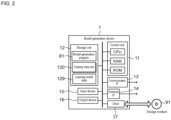
- the drive 17 is, for example, a CD drive, a DVD drive, or the like, and is a drive device for reading various kinds of information such as a program stored in the storage medium 91.
- the storage medium 91 is a medium that accumulates information such as a stored program by electrical, magnetic, optical, mechanical, or chemical action so that a computer, other devices, a machine, or the like can read the various information such as the program.
- At least one of the model generation program 81 and the plurality of training data sets 120 may be stored in the storage medium 91.
- the model generation device 1 may acquire at least one of the model generation program 81 and the plurality of training data sets 120 from the storage medium 91. Note that, in Fig.
- a disk-type storage medium such as a CD or a DVD is illustrated as an example of the storage medium 91.
- the type of the storage medium 91 is not limited to the disk type, and may be other than the disk type. Examples of the storage medium other than the disk type include a semiconductor memory such as a flash memory.
- the type of the drive 17 may be arbitrarily selected according to the type of the storage medium 91.
- the control unit 21 to the drive 27 and the storage medium 92 of the estimation device 2 may be configured similarly to the control unit 11 to the drive 17 and the storage medium 91 of the model generation device 1, respectively.
- the control unit 21 includes a CPU that is a hardware processor, a RAM, a ROM, and the like, and is configured to execute various types of information processing based on a program and data.
- the control unit 21 may use a GPU instead of the CPU or together with the CPU.
- the storage unit 22 includes, for example, a hard disk drive, a solid state drive, or the like.
- the storage unit 22 stores various types of information such as the mood estimation program 82 and the learning result data 129.
- the mood estimation program 82 is a program for causing the estimation device 2 to execute information processing ( fig. 7 ) to be described later that executes a predetermined estimation task for at least the target person electroencephalogram feature 221 using a trained machine learning model (in the present embodiment, the estimation model 3).
- the mood estimation program 82 includes a series of commands for the information processing. At least one of the mood estimation program 82 and the learning result data 129 may be stored in the storage medium 92. Further, the estimation device 2 may acquire at least one of the mood estimation program 82 and the learning result data 129 from the storage medium 92.
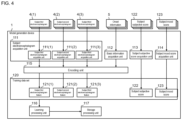
- the subject electroencephalogram acquisition unit 111 acquires a plurality of subject electroencephalograms 4 of each learning subject for each category of "Ng", “Nt", and "Ps". As illustrated in Fig. 4 , the subject electroencephalogram acquisition unit 111 may include a subject first electroencephalogram acquisition unit 111 (1), a subject second electroencephalogram acquisition unit 111 (2), and a subject third electroencephalogram acquisition unit 111 (3).
- the subject third electroencephalogram acquisition unit 111 (3) acquires, as a plurality of (for example, five) subject third electroencephalograms 4(3) of each learning subject, electroencephalograms when each learning subject is listening to a voice uttering each of a plurality of (for example, five) sentences classified into the category "Ps".
- Each of the plurality of subject third electroencephalograms 4(3) of each learning subject is an electroencephalogram of each learning subject listening to a voice uttering a sentence classified into the category "Ps".
- the basic information acquisition unit 112 acquires basic information used for generating the electroencephalogram feature Fw from the electroencephalogram of the person when listening to the voice uttering the sentence.
- the basic information acquired by the basic information acquisition unit 112 is at least one of onset information 5 and envelope information.
- the onset information 5 is information indicating a start point of each word included in the sentence that the learning subject was listening to as a voice.
- the envelope information is information indicating a voice envelope of a voice that a person is listening to.
- the basic information acquisition unit 112 acquires, as the basic information, the onset information 5 indicating the start point of each word included in the sentence that the learning subject was listening to as a voice.
- the basic information acquisition unit 112 notifies the encoding unit 115 of the acquired onset information 5.
- the encoding unit 115 generates, based on (A) the plurality of subject first electroencephalograms 4(1) of each learning subject, and (B) the onset information 5 indicating the start point of each word included in each of the plurality of sentences classified as "Ng" that each learning subject is listening, (C) the component feature Ifa (1) of the "electroencephalogram response to a word" of each learning subject for each of the plurality of sentences.
- the machine learning performed by the learning processing unit 116 in the present embodiment includes the first training step, second training step, and third training step described below.
- the estimation model 3 is trained so that the subjective score Ss estimated by the estimation model 3 when at least the first electroencephalogram feature Fw(1) (the subject first electroencephalogram feature 121(1)) of the learning subject is input matches the subject mood score 123.
- the estimation model 3 is trained so that the subjective score Ss estimated by the estimation model 3 when at least the second electroencephalogram feature Fw(2) of the learning subject (the subject second electroencephalogram feature 121(2)) is input matches the subject mood score 123.
- the estimation model 3 in the first training step, is trained so that the subjective score Ss estimated by the estimation model 3 when the subject first electroencephalogram feature 121(1) and the subject subjective score 122 are input matches the subject mood score 123.
- the estimation model 3 is trained so that the subjective score Ss estimated by the estimation model 3 when the subject second electroencephalogram feature 121(2) and the subject subjective score 122 are input matches the subject mood score 123.
- the estimation model 3 is trained so that the subjective score Ss estimated by the estimation model 3 when the subject third electroencephalogram feature 121(3) and the subject subjective score 122 are input matches the subject mood score 123.
- the basic information acquisition unit 213 is an example of a software module that executes at least one of the "onset information acquisition step" and the "envelope information acquisition step” of the present invention.
- the basic information acquisition unit 213 acquires the basic information, and specifically, acquires onset information 8 indicating a start point of each word included in the sentence that the subject was listening to as a voice.
- the basic information acquisition unit 213 notifies the encoding unit 215 of the obtained onset information 8.
- the basic information acquisition unit 213 may acquire envelope information indicating a voice envelope of a voice that the subject is listening to, instead of the onset information 8 or together with the onset information 8.
- the encoding unit 215 generates the target person electroencephalogram feature 221(3) as the third electroencephalogram feature Fw(3) of the target person.
- target person electroencephalogram features 221(1), 221(2), and 221(3) are not particularly distinguished, they may be referred to as "target person electroencephalogram features 221".
- the encoding unit 215 generates the component feature Ifa (x) in "electroencephalogram response to a word included in a sentence classified into category (x) indicated by the classification information 7" of the target person as the target person electroencephalogram feature 221(x) corresponding to the category (x) indicated by the classification information 7 based on the target person electroencephalogram 6, the classification information 7, and the onset information 8.
- the encoding unit 215 generates the component feature Ifa (1) in "electroencephalogram response to a word included in a sentence classified into 'Ng′′′ of the target person as the target person electroencephalogram feature 221(1) corresponding to "Ng".
- the estimation unit 216 is an example of a software module that executes the "estimation step" of the present invention.
- the estimation unit 216 uses the trained machine learning model (that is, the estimation model 3) generated by the model generation device 1 to execute the estimation task for at least the target person electroencephalogram feature 221, that is, to estimate the target person mood score 223.
- the estimation unit 216 includes the trained estimation model 3 generated by the model generation device 1 by holding the learning result data 129.
- the estimation unit 216 estimates the target person mood score 223 from at least the target person electroencephalogram feature 221 using the trained estimation model 3.
- the subject first electroencephalogram feature 121(1) is an average of the component features Ifa (1) in the "electroencephalogram response to a word included in a sentence classified as 'Ng′′′ of each learning subject.
- the subject second electroencephalogram feature 121(2) is an average of the component features Ifa (2) in the "electroencephalogram response to a word included in a sentence classified as 'Nt′′′ of each learning subject.
- the subject third electroencephalogram feature 121(3) is an average of the component features Ifa (3) in the "electroencephalogram response to a word included in a sentence classified as 'Ps′′′ of each learning subject.
- the estimation unit 216 estimates the target person mood score 223 based on the target person electroencephalogram feature 221 and the target person subjective score 9.
- the trained estimation model 3 is trained so that the subjective score Ss estimated by the estimation model 3 when the subject electroencephalogram feature 121 and the subject subjective score 122 are input matches the subject mood score 123. Therefore, the estimation unit 216 can estimate the target person mood score 223 by giving the target person electroencephalogram feature 221 and the target person subjective score 9 to the trained estimation model 3.
- the estimation unit 216 estimates the target person mood score 223 by giving the component features Ifa (3) (the target person electroencephalogram feature 221(3) corresponding to "Ps") and the target person subjective score 9 in the electroencephalogram response to a word included in a sentence classified as "Ps" of the target person to the trained estimation model 3.
- the output unit 217 is an example of a software module that executes the "output step" of the present invention.
- the output unit 217 outputs information corresponding to the target person mood score 223 estimated in the estimation step to the target person.
- the information corresponding to the target person mood score 223 may be information for relaxing the target person, for example, music, video, or the like for relaxing the target person.
- the estimation device 2 can output information according to the level of the depressed mood of the target person indicated by the target person mood score 223 to the target person as "information corresponding to target person mood score 223".
- control unit 11 calculates, for each training data set 120, an error between the output value obtained from the estimation model 3 and the "subject mood score 123" that is the correct data.
- the control unit 11 calculates the error of the value of each operation parameter (a weight of connection between neurons, a threshold value of each neuron, and the like) of the estimation model 3 using the calculated gradient of error by, for example, back propagation.
- the control unit 11 updates the value of each operation parameter of the estimation model 3 based on each calculated error.
- the degree of updating the value of each operation parameter may be adjusted by a learning rate.
- the learning rate may be given by designation of an operator or may be given as a setting value in a program.
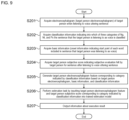
- Fig. 9 is a flowchart illustrating an example of a processing procedure of the estimation device 2 according to the present embodiment.
- the processing procedure described below is merely an example, and each step may be changed as much as possible.
- Step S203 Onset information acquisition step
- Step S205 Electroencephalogram encoding step
- step S206 the control unit 21 operates as the estimation unit 216, and estimates the target person mood score 223 by inputting at least the target person electroencephalogram feature 221 to the trained estimation model 3.
- the control unit 21 inputs the "target person electroencephalogram feature 221(x) corresponding to the category (x) indicated by the classification information 7" generated in step S205 and the target person subjective score 9 to the trained estimation model 3, and executes the estimation task. That is, the control unit 21 inputs the "target person electroencephalogram feature 221(x) corresponding to the category (x) indicated by the classification information 7" and the target person subjective score 9 to the trained estimation model 3 to estimate (output) the target person mood score 223.
- the training data set 120 is formed so that at least an electroencephalogram feature Fw (the subject electroencephalogram feature 121) generated from an electroencephalogram of a person (the learning subject) when listening to a voice uttering a sentence is associated with the mood score Sm (the subject mood score 123) indicating the level of depressed mood of the person.
- performing the machine learning includes a training step of training the estimation model 3 so that the mood score Sm estimated by the estimation model 3 from the subject electroencephalogram feature 121 matches the subject mood score 123 for each of the plurality of training data sets 120.
- the mood estimation program 82 further causes the estimation device 2 to execute an onset information acquisition step (S203) of acquiring the onset information 8 indicating the start point of each word included in the sentence that the target person is listening to as a voice. Then, the mood estimation program 82 causes the estimation device 2 to generate, as the target person electroencephalogram feature 221, the component feature Ifa in the "electroencephalogram response to a word" of the target person based on the target person electroencephalogram 6 and the "start point of each word included in the sentence that the target person is listening to as a voice" indicated by the onset information 8 in the electroencephalogram encoding step.
- the mood estimation program 82 causes the estimation device 2 to execute processing of estimating the target person mood score 223 by inputting, as the target person electroencephalogram feature 221, the component feature Ifa in the "electroencephalogram response to a word" of the target person to the estimation model 3 in the estimation step.
- the electroencephalogram feature Fw is the component feature Ifa in the "electroencephalogram response to a word included in a sentence".
- the training data set 120 is formed by associating the subject mood score 123 with the component feature Ifa in the "electroencephalogram response to a word" of the learning subject.
- the estimation model 3 is generated by performing machine learning using the training data set 120. Therefore, the estimation model 3 can estimate the mood score Sm indicating the level of person depressed mood from the component feature Ifa in the "electroencephalogram response to a word included in a sentence".
- the estimation device 2 executes a target person subjective score acquisition step of acquiring the target person subjective score 9.
- the estimation device 2 estimates the target person mood score 223 by inputting the target person electroencephalogram 6 and the target person subjective score 9 to the estimation model 3.
- the estimation device 2 (in particular, the encoding unit 215) may generate, as the electroencephalogram feature Fw, the component feature Ifa in the "electroencephalogram response following the voice" of the person from the electroencephalogram of the person while listening to the voice reading the sentence and the voice envelope of the voice.
- the subject electroencephalogram feature 121 is regarded as the component feature Ifa in the "electroencephalogram response following the voice envelope" of the learning subject generated from the electroencephalogram of the learning subject when listening to the voice uttering the sentence and the voice envelope of the voice.
- the mood estimation program 82 further causes the estimation device 2 to execute an envelope information acquisition step of acquiring envelope information indicating the voice envelope of the voice the target person is listening to.
- the envelope information acquisition step may be performed instead of the onset information acquisition step (S203) or together with the onset information acquisition step (S203).
Landscapes
- Engineering & Computer Science (AREA)
- Health & Medical Sciences (AREA)
- Physics & Mathematics (AREA)
- Life Sciences & Earth Sciences (AREA)
- Theoretical Computer Science (AREA)
- General Health & Medical Sciences (AREA)
- Biomedical Technology (AREA)
- Artificial Intelligence (AREA)
- General Engineering & Computer Science (AREA)
- Biophysics (AREA)
- Molecular Biology (AREA)
- Medical Informatics (AREA)
- General Physics & Mathematics (AREA)
- Psychiatry (AREA)
- Evolutionary Computation (AREA)
- Mathematical Physics (AREA)
- Software Systems (AREA)
- Public Health (AREA)
- Data Mining & Analysis (AREA)
- Computing Systems (AREA)
- Psychology (AREA)
- Computational Linguistics (AREA)
- Pathology (AREA)
- Veterinary Medicine (AREA)
- Animal Behavior & Ethology (AREA)
- Surgery (AREA)
- Heart & Thoracic Surgery (AREA)
- Developmental Disabilities (AREA)
- Social Psychology (AREA)
- Hospice & Palliative Care (AREA)
- Child & Adolescent Psychology (AREA)
- Computer Vision & Pattern Recognition (AREA)
- Primary Health Care (AREA)
- Neurosurgery (AREA)
- Human Computer Interaction (AREA)
- Dermatology (AREA)
- Neurology (AREA)
- Epidemiology (AREA)
- Fuzzy Systems (AREA)
- Physiology (AREA)
Abstract
Description
- The present invention relates to a mood estimation program.
- So far, there has been reported a study that discriminates between major depressive disorder and healthy person, and discriminates between a person with high mood of depression and a person with low mood of depression in a non-clinical group, by machine learning and deep learning using features of electroencephalograms. For example,
NPL 1 below discloses a method of measuring an electroencephalogram when a subject is performing a task for auditory stimulation, and identifying whether or not the subject is suffering from major depressive disorder, using, as features, latencies, amplitudes, and the like of event-related potential components (N1, P300). - NPL 1: Jang, K. et al. (2021). "Machine learning-based electroencephalographic phenotypes of Schizophrenia and Major Depressive Disorder". Frontiers in Psychiatry, 12:745458 (Published online version on October 13, 2021, doi: 10.3389/fpsyt.2021.745458).
- In recent years, with the development of media, especially the spread of the Internet, information received by people has explosively increased, but the capacity of the brain of modern people has not correspondingly increased. Stress, mental disorder, and deterioration in productivity due to excessive information have become social problems. In addition, not only the amount of information but also the content of information affects mental health. During the spread of the new coronavirus, the number of people suffering from mental illness has increased. Recent studies have reported that people exposed more to negative pandemic-related news suffer from mental illness.
- There is a large individual difference in how to perceive negative information. For example, it has been reported that there is attention bias that a person with depression is more likely to pay attention to negative information than a person without depression. In addition, it has been reported that cognitive processing is affected in a depressed person in order to allocate resources to processing of emotional information.
- However, in the above-described conventional technology, electroencephalograms are measured in a special state of performing a task for a simple sound stimulus (a sound stimulus delivered at a fixed stimulus interval of 2000 milliseconds in 85 [decibels]), and electroencephalograms for sound information that is daily heard are not used for estimating mood.
- The present invention has been made in view of such circumstances, and an object thereof is to provide an estimation device that estimates a mental state of an individual, particularly a level of depressed mood, based on a brain response to daily voice information, or the like.
- In order to solve the above-described problem, the present invention adopts the following configuration.
- A mood estimation program according to a first aspect causes a computer to perform: a target person electroencephalogram acquisition step of acquiring a target person electroencephalogram which is an electroencephalogram of a target person when listening to a voice uttering a sentence; an electroencephalogram encoding step of generating an electroencephalogram feature from an electroencephalogram of a person when listening to a voice uttering a sentence, the electroencephalogram encoding step generating a target person electroencephalogram feature as the electroencephalogram feature from the target person electroencephalogram; and an estimation step of estimating a target person mood score which is a mood score indicating a level of depressed mood of the target person by inputting the target person electroencephalogram feature to an estimation model, the estimation model receiving at least the electroencephalogram feature as an input and estimating a mood score indicating a level of depressed mood of the person, the estimation model being generated by performing machine learning using a plurality of training data sets, each of the plurality of training data sets being formed by associating a subject mood score which is the mood score indicating a level of depressed mood of a learning subject with at least a subject electroencephalogram feature which is the electroencephalogram feature generated from an electroencephalogram of the learning subject when listening to a voice uttering a sentence, performing the machine learning including a training step of training the estimation model so that the mood score estimated by the estimation model when the subject electroencephalogram feature is received as an input matches the subject mood score for each of the plurality of training data sets.
- In this configuration, the mood estimation program causes a computer to estimate the target person mood score indicating a level of depressed mood of the target person based on the target person electroencephalogram feature generated from an electroencephalogram of the target person when the target person is listening to "a voice uttering a sentence" such as a news voice or a conversation voice. The mood estimation program causes a computer to estimate the target person mood score by inputting the target person electroencephalogram feature to the estimation model generated by performing the machine learning using the plurality of training data sets.
- The training data set is configured so that at least an electroencephalogram feature (the subject electroencephalogram feature) generated from an electroencephalogram of a person (the learning subject) when listening to a voice uttering a sentence is associated with a mood score (the subject mood score) indicating a level of depressed mood of the person. In addition, performing the machine learning includes a training step of training the estimation model so that the mood score estimated by the estimation model from the subject electroencephalogram feature matches the subject mood score for each of the plurality of training data sets.
- The present inventors verified the estimation accuracy for the estimation model generated by performing the machine learning using the plurality of training data sets configured by associating the subject mood score with the subject electroencephalogram feature, and obtained the following verification results. That is, it was confirmed that the AUC (Area Under the Roc Curve) of the estimation model was "0.73". In addition, the estimation model identified 66% of people with high level of depressed mood (people whose BDI score calculated from answers to the Beck Depression Inventory (BDI) is 14 or more) as having high level of depressed mood.
- Therefore, the computer can estimate the target person mood score with high accuracy by inputting, to the estimation model, the target person electroencephalogram feature generated from the electroencephalogram of the target person when listening to "a voice uttering a sentence" such as a news voice or a conversation voice.
- In particular, the "voice uttering a sentence" such as a news voice or a conversation voice is not an unusual (special) sound described in NPL 1, but is a voice that the target person ordinarily hears, that is, daily voice information. Therefore, the computer can estimate the target person mood score indicating the level of the depressed mood of the target person from the electroencephalogram (the brain response) of the target person with respect to the daily voice information.
- A mood estimation program according to a second aspect may cause, in the mood estimation program according to the first aspect, the computer to perform in the electroencephalogram encoding step, generating an electroencephalogram feature corresponding to a category into which the sentence is classified, as the electroencephalogram feature, based on an electroencephalogram of a person when listening to a voice uttering a sentence classified into any of at least three categories of negative, neutral, and positive, and information indicating into which of the at least three categories the sentence is classified, the estimation model estimating the mood score when an electroencephalogram feature corresponding to a category into which the sentence is classified is input as the electroencephalogram feature, the subject electroencephalogram feature including a subject first electroencephalogram feature which is an electroencephalogram feature corresponding to the category of negative generated from an average of a plurality of electroencephalograms each of which is an electroencephalogram of the learning subject when listening to a voice uttering a sentence classified into the category of negative, a subject second electroencephalogram feature which is an electroencephalogram feature corresponding to the category of neutral generated from an average of a plurality of electroencephalograms each of which is an electroencephalogram of the learning subject when listening to a voice uttering a sentence classified into the category of neutral, and a subject third electroencephalogram feature which is an electroencephalogram feature corresponding to the category of positive generated from an average of a plurality of electroencephalograms each of which is an electroencephalogram of the learning subject when listening to a voice uttering a sentence classified into the category of positive, performing the machine learning including, for each of the plurality of training data sets, a first training step of training the estimation model so that the mood score estimated by the estimation model when the subject first electroencephalogram feature is input as the electroencephalogram feature corresponding to the category of negative matches the subject mood score, a second training step of training the estimation model so that the mood score estimated by the estimation model when the subject second electroencephalogram feature is input as the electroencephalogram feature corresponding to the category of neutral matches the subject mood score, and a third training step of training the estimation model so that the mood score estimated by the estimation model when the subject third electroencephalogram feature is input as the electroencephalogram feature corresponding to the category of positive matches the subject mood score, and the program may cause the computer to further perform a classification information acquisition step of acquiring classification information indicating into which of the at least three categories a sentence the target person is listening to as a voice is classified, and in the estimation step, estimating the target person mood score by inputting to the estimation model, as an electroencephalogram feature corresponding to a category indicated by the classification information, the target person electroencephalogram feature corresponding to a category indicated by the classification information generated, in the electroencephalogram encoding step, based on the target person electroencephalogram of the target person when listening to a voice uttering a sentence classified into a category indicated by the classification information and the classification information.
- In this configuration, the training data set is configured by associating the subject mood score with an electroencephalogram feature (the first electroencephalogram feature of the subject, the second electroencephalogram feature of the subject, and the third electroencephalogram feature of the subject) corresponding to each of at least three categories of negative, neutral, and positive. The estimation model is generated by performing the machine learning including the first training step, the second training step, and the third training step using the training data set. Therefore, the estimation model can estimate the mood score indicating the level of depressed mood of the person based on the electroencephalogram feature corresponding to each of the categories.
- The computer further executes a classification information acquisition step of acquiring the classification information. The classification information may be acquired from the outside of the computer. The computer may generate the classification information, and acquire the generated classification information in the classification information acquisition step. The classification information may be generated in an analog manner (for example, by a person classifying the sentence into any one of the at least three categories). In addition, the classification information may be generated by classifying the sentence into any of the at least three categories using a classification model or the like generated by performing machine learning using a plurality of training data sets each configured by a combination of a sentence and a classification result. The classification information may be generated on a rule basis or may be generated on a model basis. The computer generates the target person electroencephalogram feature corresponding to the category indicated by the classification information from the target person electroencephalogram of the target person when listening to a voice uttering a sentence classified into the category indicated by the classification information. Then, the computer estimates the target person mood score by inputting the target person electroencephalogram feature corresponding to the category indicated by the classification information to the estimation model.
- Therefore, the computer can estimate the target person mood score indicating the level of the depressed mood of the target person based on the electroencephalogram of the target person when listening to the voice uttering the sentence and the classification information indicating whether the sentence is classified into at least one of the three categories of negative, neutral, and positive.
- A mood estimation program according to a third aspect may cause, in the mood estimation program according to the first or second aspect, the computer to perform in the electroencephalogram encoding step, generating, as the electroencephalogram feature, at least one of a peak latency and an average amplitude before and after a peak of a predetermined component in an electroencephalogram response to a word of a person based on an electroencephalogram of the person when listening to a voice uttering a sentence and a start point of each word included in the sentence that the person is listening to as a voice, the subject electroencephalogram feature being at least one of a peak latency and an average amplitude before and after a peak of the predetermined component in an electroencephalogram response to the word of the learning subject generated based on an electroencephalogram of the learning subject when listening to a voice uttering a sentence and a start point of each word included in the sentence that the learning subject is listening to as a voice, the program may cause the computer to further perform an onset information acquisition step of acquiring onset information indicating a start point of each word included in a sentence that the target person is listening to as a voice, and in the estimation step, estimating the target person mood score by inputting to the estimation model, as the target person electroencephalogram feature, at least one of a peak latency and an average amplitude before and after a peak of the predetermined component in an electroencephalogram response to the word of the target person generated, in the electroencephalogram encoding step, based on the target person electroencephalogram and a start point of each word included in a sentence that the target person is listening to as a voice indicated by the onset information.
- In this configuration, the electroencephalogram feature is at least one of a peak latency and an average amplitude before and after a peak of the predetermined component in an electroencephalogram response to a word included in a sentence. The predetermined component is, for example, at least one of components having peaks around 100 milliseconds, around 200 milliseconds, and around 400 milliseconds after word presentation. The training data set is configured by associating the subject mood score with at least one of a peak latency and an average amplitude before and after a peak of the predetermined component in an electroencephalogram response to a word of the learning subject. Then, the estimation model is generated by performing the machine learning using the training data set. Therefore, the estimation model can estimate the mood score indicating the level of depressed mood of the person based on at least one of the peak latency and the average amplitude before and after the peak of the predetermined component in the electroencephalogram response to the word included in the sentence.
- The computer further executes an onset information acquisition step of obtaining the onset information. The computer generates, as the target person electroencephalogram feature, at least one of a peak latency and an average amplitude before and after a peak of the predetermined component in an electroencephalogram response to a word of the target person from the target person electroencephalogram and the onset information. Then, the computer estimates the target person mood score by inputting at least one of a peak latency and an average amplitude before and after a peak of the predetermined component in the electroencephalogram response to the word of the target person to the estimation model.
- Therefore, the computer can estimate the target person mood score indicating the level of the depressed mood of the target person based on the electroencephalogram of the target person when listening to the voice uttering the sentence and the onset information indicating the start point of each word included in the sentence.
- A mood estimation program according to a fourth aspect may cause, in the mood estimation program according to any one of the first to third aspects, the computer to perform in the electroencephalogram encoding step, generating, as the electroencephalogram feature, at least one of a peak latency and an average amplitude before and after a peak of a predetermined component in an electroencephalogram response following a voice envelope of a person based on an electroencephalogram of the person when listening to a voice uttering a sentence and the voice envelope of the voice that the person is listening to, the subject electroencephalogram feature being at least one of a peak latency and an average amplitude before and after a peak of the predetermined component in an electroencephalogram response following the voice envelope of the learning subject generated based on an electroencephalogram of the learning subject when listening to a voice uttering a sentence and a voice envelope of the voice that the learning subject was listening to, the program may cause the computer to further perform: an envelope information acquisition step of acquiring envelope information indicating a voice envelope of a voice the target person is listening to; and in the estimation step, estimating the target person mood score by inputting to the estimation model, as the target person electroencephalogram feature, at least one of a peak latency and an average amplitude before and after a peak of the predetermined component in an electroencephalogram response following the voice envelope of the target person generated, in the electroencephalogram encoding step, based on the target person electroencephalogram and a voice envelope of a voice the target person is listening to indicated by the envelope information.
- In this configuration, the electroencephalogram feature is at least one of a peak latency and an average amplitude before and after a peak of the predetermined component in an electroencephalogram response following a voice envelope of a listening voice. The predetermined component is, for example, at least one of components having peaks around 50 milliseconds, around 150 milliseconds, and around 250 milliseconds in an electroencephalogram response analyzed based on a voice envelope. The training data set is configured by associating the subject mood score with at least one of a peak latency and an average amplitude before and after a peak of the predetermined component in an electroencephalogram response following a voice envelope of the learning subject. Then, the estimation model is generated by performing the machine learning using the training data set. Therefore, the estimation model can estimate the mood score indicating the level of depressed mood of the person based on at least one of the peak latency and the average amplitude before and after the peak of the predetermined component in the electroencephalogram response following the voice envelope.
- Further, the computer performs an envelope information acquisition step of acquiring the envelope information. The computer generates, as the target person electroencephalogram feature, at least one of a peak latency of the predetermined component and an average amplitude before and after a peak in an electroencephalogram response following the voice envelope of the target person from the target person electroencephalogram and the envelope information. Then, the computer estimates the target person mood score by inputting at least one of a peak latency and an average amplitude before and after a peak of the predetermined component in the electroencephalogram response following the voice envelope of the target person to the estimation model.
- Therefore, the computer can estimate the target person mood score indicating the level of the depressed mood of the target person based on the electroencephalogram of the target person when listening to the voice uttering the sentence and the envelope information indicating the voice envelope of the voice.
- A mood estimation program according to a fifth aspect may be characterized in that, in the mood estimation program according to any one of the first to fourth aspects, the estimation model further receives, as an input, a subjective score indicating subjective evaluation felt by a person for a sentence after listening to a voice uttering the sentence, in addition to the electroencephalogram feature, and estimates the mood score based on the electroencephalogram feature and the subjective score that are input, and each of the plurality of training data sets is formed by associating the subject mood score with the subject electroencephalogram feature and a subject subjective score which is the subjective score indicating subjective evaluation felt by the learning subject for the sentence after listening to a voice uttering the sentence, and performing the machine learning includes a training step of training the estimation model so that the mood score estimated by the estimation model when the subject electroencephalogram feature and the subject subjective score are input matches the subject mood score for each of the plurality of training data sets, the program may cause a computer to further perform a target person subjective score acquisition step of acquiring a target person subjective score which is the subjective score indicating subjective evaluation that the target person felt for the sentence after listening to a voice uttering the sentence, and in the estimation step, estimating the target person mood score by inputting to the estimation model the target person electroencephalogram feature and the target person subjective score.
- In this configuration, the training data set is formed so that the subject mood score is associated with the subject electroencephalogram feature and the subjective score (the subject subjective score) indicating the subjective evaluation felt by the learning subject for the sentence listened as a voice. In addition, performing the machine learning includes a training step of training the estimation model so that the mood score estimated by the estimation model when the subject electroencephalogram feature and the subject subjective score are input matches the subject mood score for each of the plurality of training data sets. Therefore, the estimation model can estimate the mood score indicating the level of depressed mood of the person based on the electroencephalogram feature and the subjective score indicating the subjective evaluation felt by the person with respect to the sentence listened as a voice.
- The present inventors verified the estimation accuracy for the estimation model generated by performing the machine learning using the plurality of training data sets configured by associating the subject mood score with the subject electroencephalogram feature and the subject subjective score, respectively, and obtained the following verification results. That is, it was confirmed that the AUC of the estimation model was "0.83". In addition, the estimation model identified 78% of people with high level of depressive mood as having high level of depressive mood.
- Furthermore, the computer executes a target person subjective score acquisition step of acquiring the target person subjective score. The computer estimates the target person mood score by inputting the target person electroencephalogram and the target person subjective score to the estimation model.
- Therefore, the computer can estimate the target person mood score indicating the level of the depressed mood of the target person with high accuracy based on the electroencephalograms of the target person when listening to the voice uttering the sentence and the target person subjective score indicating the subjective evaluation felt by the target person for the sentence.
- A mood estimation program according to a sixth aspect may cause, in the mood estimation program according to any one of the first to fifth aspects, the computer to further perform, an output step of outputting, to the target person, information corresponding to the target person mood score estimated in the estimation step.
- In this configuration, the computer outputs (for example, notifies) information corresponding to the target person mood score to the target person. The information corresponding to the target person mood score may be the target person mood score itself. Furthermore, the information corresponding to the target person mood score may be information indicating the level of depressed mood of the target person indicated by the target person mood score. Furthermore, the information corresponding to the target person mood score may be information including advice to the target person corresponding to the target person mood score. For example, the computer can cause the target person to be aware of a state of mind such as depression of his/her own mood by outputting the target person mood score to the target person. For example, the computer can output, to the target person, information including advice to the target person, corresponding to the target person mood score, thereby urging the target person to take an action for maintaining mental health, such as blocking information that puts a heavy mental burden.
- In a case where the target person mood score indicates that the target person has a high level of depressed mood, the information corresponding to the target person mood score may be information for relaxing the target person, for example, music, video, or the like for relaxing the target person. The computer can output information according to the level of depressed mood of the target person indicated by the target person mood score to the target person as "information corresponding to the target person mood score".
- In particular, the computer estimates the target person mood score from an electroencephalogram of the target person when the target person is listening to "a voice uttering a sentence" such as a news voice or a conversation voice, which the target person hears on a daily basis, instead of the unusual (special) sound described in
NPL 1. Therefore, the computer estimates the target person mood score based on the electroencephalograms of the target person with respect to the daily speech information, and outputs the estimated target person mood score to the target person, thereby making the target person aware of his/her own state of mind, encouraging the target person to take action, and relaxing the target person. - Furthermore, as another aspect of the mood estimation program according to each of the above viewpoints, one aspect of the present invention may be a computer or other device that executes the mood estimation program according to each of the above viewpoints, or may be a storage medium that stores the mood estimation program according to each of the above viewpoints and is readable by the computer, other device, machine, or the like. Here, the computer-readable storage medium is a medium that accumulates information such as a program by electrical, magnetic, optical, mechanical, or chemical action.
- According to the present invention, it is possible to provide an estimation device or the like that estimates a mental state of an individual, particularly a level of depressed mood, based on a brain response to daily voice information.
-
- [
Fig. 1] Fig. 1 schematically shows an example of a scene to which the present invention is applied. - [
Fig. 2] Fig. 2 schematically shows an example of a hardware configuration of a model generation device according to the embodiment. - [
Fig. 3] Fig. 3 schematically shows an example of a hardware configuration of an estimation device according to the embodiment. - [
Fig. 4] Fig. 4 schematically shows an example of a software configuration of the model generation device according to the embodiment. - [
Fig. 5] Fig. 5 schematically shows an example of each process of feature generation processing and training processing executed by the model generation device according to the embodiment. - [
Fig. 6] Fig. 6 schematically shows an example of a software configuration of the estimation device according to the embodiment. - [
Fig. 7] Fig. 7 schematically shows an example of each process of the feature generation processing and the mood estimation processing executed by the estimation device according to the embodiment. - [
Fig. 8] Fig. 8 shows an example of a processing procedure of the model generation device according to the embodiment. - [
Fig. 9] Fig. 9 shows an example of a processing procedure of the estimation device according to the embodiment. - Hereinafter, an embodiment (hereinafter, also referred to as "present embodiment") according to one aspect of the present invention will be described with reference to the drawings. However, the present embodiment described below is merely an example of the present invention in all respects. It goes without saying that various improvements and modifications can be made without departing from the scope of the present invention. That is, in carrying out the present invention, a specific configuration according to the embodiment may be appropriately adopted. Note that data appearing in the present embodiment has been described in a natural language. More specifically, the data is specified in a pseudo language, a command, a parameter, a machine language, or the like that can be recognized by a computer.
-
Fig. 1 schematically shows an example of a scene to which the present invention is applied. Amood estimation system 100 according to the present embodiment includes amodel generation device 1 and anestimation device 2. - The
model generation device 1 according to the present embodiment is a computer configured to perform machine learning of anestimation model 3. Themodel generation device 1 performs machine learning of theestimation model 3 using the plurality of training data sets 120. - The
estimation model 3 is configured to execute an estimation task of estimating a mood score Sm indicating the level of depressed mood of a person (in other words, to output an output value corresponding to a result of executing the estimation task) when given at least an electroencephalogram feature Fw generated from an electroencephalogram of the person (learning subject and target person) when listening to a voice uttering a sentence. In the present embodiment, theestimation model 3 receives, in addition to the electroencephalogram feature Fw generated from the electroencephalogram of the person when listening to the voice uttering the sentence, a subjective score Ss indicating a subjective evaluation felt by the person for the sentence after listening, and estimates the mood score Sm from the electroencephalogram feature Fw and the subjective score Ss. - The "voice uttering a sentence" may be, for example, a voice uttering news (news voice) or a voice (conversation voice) in which another party of the conversation utters a conversation content (conversation sentence). The "voice uttering a sentence" may be a voice uttered by a person other than the "person whose electroencephalogram is to be measured", a machine, or the like, and is a voice (daily voice) that a person normally hears. In the present embodiment, a news voice is used as the "voice uttering a sentence".
- In the present embodiment, a sentence (for example, news) that a person is listening to as a voice is classified into at least one of three categories of negative, neutral, and positive. A sentence that a person is listening to as a voice can generate at least one of negative, neutral, and positive emotions. In the following description, "negative", "neutral", and "positive" may be abbreviated as "Ng", "Nt", and "Ps", respectively.
- The classification of sentences that a person listens to as a voice may be performed in an analog manner. For example, "categories in which a plurality of persons other than a person who listens to a voice uttering the sentences have classified the sentences" may be statistically processed to adopt as categories into which the sentences are classified. In addition, the sentence may be automatically or semiautomatically classified by a classification device or the like. For example, a sentence that a person listens to as a voice may be classified into one of the at least three categories described above using a classification model or the like generated by performing machine learning using a plurality of training data sets each including a combination of a sentence and a classification result (category). The sentence classification may be performed on a rule basis or a model basis.
- The electroencephalogram may be an electroencephalogram of a person when the person when listening to a voice uttering a sentence. In the present embodiment, the electroencephalogram is specified from the electroencephalogram measured at each of a plurality of (for example, three) electroencephalogram measurement points for a person when the person is listening to a voice uttering a sentence. However, it is not essential that the electroencephalogram is specified from the electroencephalogram measured at each of the plurality of electroencephalogram measurement points. The electroencephalogram may be an electroencephalogram measured at one electroencephalogram measurement point for a person when the person is listening to a voice uttering a sentence.
- Corresponding to the sentence that the person listens to as the voice being classified into at least three categories of "Ng", "Nt", and "Ps", the electroencephalogram feature Fw corresponding to each of the at least three categories is generated from the electroencephalogram of a person when the person is listening to the voice uttering the sentence. For example, a first electroencephalogram feature Fw(1) corresponding to the category "Ng" is generated from the electroencephalogram of the person when listening to the voice uttering the sentence classified into the category "Ng". Furthermore, a second electroencephalogram feature Fw(2) corresponding to the category "Nt" is generated from the electroencephalogram of the person when listening to the voice uttering the sentence classified into the category "Nt". Similarly, a third electroencephalogram feature Fw(3) corresponding to the category "Ps" is generated from the electroencephalogram of the person while listening to the voice uttering the sentence classified into the category "Ps". In a case where at least one of the first electroencephalogram feature Fw(1), the second electroencephalogram feature Fw(2), and the third electroencephalogram feature Fw(3) is given, the
estimation model 3 estimates (outputs) the mood score Sm. In the following description, in a case where the first electroencephalogram feature Fw(1), the second electroencephalogram feature Fw(2), and the third electroencephalogram feature Fw(3) are not particularly distinguished, they may be collectively referred to as "electroencephalogram feature Fw". - The electroencephalogram feature Fw is at least one of a peak latency and an average amplitude before and after a peak of a predetermined component Pc of an electroencephalogram (electroencephalogram response) of a person when listening to a voice uttering a sentence. In the following description, "at least one of the peak latency of the predetermined component Pc and the average amplitude before and after the peak" may be referred to as "component feature Ifa". In the present embodiment, the "electroencephalogram of a person when listening to a voice uttering a sentence" is at least one of an "electroencephalogram response to a word (each word) included in a sentence that the person is listening to as a voice" and an "electroencephalogram response following a voice envelope of the voice". The "predetermined component Pc" may be, for example, at least one of components having peaks around 100 milliseconds, around 200 milliseconds, and around 400 milliseconds after word presentation. Furthermore, the "predetermined component Pc" may be, for example, at least one of components having peaks around 50 milliseconds (or around 100 milliseconds), around 150 milliseconds (or around 200 milliseconds), and around 250 milliseconds (or around 400 milliseconds) in the electroencephalogram response analyzed based on the voice envelope. Hereinafter, an example will be described in which the component feature Ifa of the "electroencephalogram response to a word included in a sentence that a person is listening to as a voice", that is, the component feature Ifa of the "electroencephalogram response to a word" of a person is used as the electroencephalogram feature Fw.
- In the present embodiment, the subjective score Ss is information including five-grade evaluation for each of a difficulty level, an interest level, a valence, and a wakefulness level felt by a person for a sentence (voice) after listening to the voice uttering the sentence. The "difficulty level" indicates the difficulty level felt for the listened sentence (voice) by five-grade evaluation. The "interest level" indicates the interest level felt for the listened sentence (voice) by five-grade evaluation. The "valence" indicates whether the listened sentence (voice) is regarded as positive or negative by five-grade evaluation. The "wakefulness level" indicates the degree of emotional arousal (from "strongly aroused" to "weakly aroused") by five-grade evaluation. However, the subjective score Ss is not limited to the one indicating the five-grade evaluation for each of the difficulty level, the interest level, the valence, and the wakefulness level, and may be any one indicating the subjective evaluation felt by the person for the sentence after listening to the voice uttering the sentence.
- In the present embodiment, the mood score Sm may be, for example, a BDI score calculated from answers to the Beck Depression Inventory (BDI) of a person. In addition, the mood score Sm may indicate whether or not the person depressed mood is high, and may indicate, for example, whether or not the BDI score is "14" or more. However, the mood score Sm is not limited to these examples, and may be any score as long as it can indicate the level of a person depressed mood.
- Each
training data set 120 used for the machine learning of theestimation model 3 includes a combination of thesubject electroencephalogram feature 121, the subjectsubjective score 122, and thesubject mood score 123. Thesubject electroencephalogram feature 121 is an electroencephalogram feature Fw generated from an electroencephalogram of the learning subject when listening to a voice uttering a sentence. The subjectsubjective score 122 is a subjective score Ss indicating the subjective evaluation felt by the learning subject for the sentence after listening to the voice uttering the sentence. Thesubject mood score 123 is a mood score Sm indicating the level of the depressed mood of the learning subject, and indicates the correct answer of the estimation task for thesubject electroencephalogram feature 121 and the subjectsubjective score 122. - Performing machine learning in the present embodiment includes the following training step. That is, a training step of training the
estimation model 3 so that a result (mood score Sm) of executing the estimation task of theestimation model 3 conforms to (matches) thesubject mood score 123 when thesubject electroencephalogram feature 121 and the subjectsubjective score 122 are given to theestimation model 3 for eachtraining data set 120 is included. Themodel generation device 1 may train theestimation model 3 by, for example, machine learning by a support vector machine (linear support vector machine). Theestimation model 3 generated by performing machine learning with the linear support vector machine can estimate whether a person depressed mood is high (for example, whether the BDI score is "14" or higher). - The
estimation device 2 is an example of a computer that executes a mood estimation program (mood estimation program 82) according to the present invention, and is a computer configured to perform an estimation task using a trained machine learning model (estimation model 3) generated by themodel generation device 1. In the present embodiment, theestimation device 2 uses the trainedestimation model 3 to execute an estimation task for a targetperson electroencephalogram feature 221 and a target person subjective score 9 (estimate a target person mood score 223 that is a mood score Sm indicating the level of depressed mood of the target person). The targetperson electroencephalogram feature 221 is an electroencephalogram feature Fw generated from the electroencephalogram of the target person when the target person is listening to the voice uttering the sentence. The target person subjective score 9 is a subjective score Ss indicating the subjective evaluation felt by the target person for the sentence after listening to the voice uttering the sentence. - Note that, in the present invention, the subjective score Ss is not essential as an input to the
estimation model 3. Theestimation model 3 only needs to be able to receive at least an input of the electroencephalogram feature Fw and estimate the mood score Sm based on the input electroencephalogram feature Fw. Correspondingly, eachtraining data set 120 may be configured by associating thesubject mood score 123 with at least thesubject electroencephalogram feature 121. In this case, the training step is only required to train theestimation model 3 so that the mood score Sm estimated by theestimation model 3 matches thesubject mood score 123 when thesubject electroencephalogram feature 121 is given to theestimation model 3 for eachtraining data set 120. In a case where theestimation model 3 that estimates the mood score Sm only from the electroencephalogram feature Fw without requiring the subjective score Ss is used, theestimation device 2 can estimate the target person mood score 223 by giving only the targetperson electroencephalogram feature 221 to theestimation model 3. - In the example of
Fig. 1 , themodel generation device 1 and theestimation device 2 are connected to each other via a network. The type of the network may be appropriately selected from, for example, the Internet, a wireless communication network, a mobile communication network, a telephone network, a dedicated network, and the like. However, the method of exchanging data between themodel generation device 1 and theestimation device 2 is not limited to such an example, and may be appropriately selected according to the embodiment. For example, data may be exchanged between themodel generation device 1 and theestimation device 2 using a storage medium. - Furthermore, in the example of
Fig. 1 , themodel generation device 1 and theestimation device 2 are configured by separate computers. However, the configuration of themood estimation system 100 according to the present embodiment is not limited to such an example, and may be appropriately determined according to the embodiment. For example, themodel generation device 1 and theestimation device 2 may be an integrated computer. Furthermore, for example, at least one of themodel generation device 1 and theestimation device 2 may be configured by a plurality of computers. -
Fig. 2 schematically shows an example of a hardware configuration of themodel generation device 1 according to the present embodiment. As illustrated inFig. 2 , themodel generation device 1 according to the present embodiment is a computer to which acontrol unit 11, astorage unit 12, acommunication interface 13, anexternal interface 14, aninput device 15, anoutput device 16, and adrive 17 are electrically connected. InFig. 2 , the communication interface and the external interface are referred to as a "communication I/F" and an "external I/F", respectively. The same notation is used inFig. 3 described later. - The
control unit 11 includes a central processing unit (CPU) that is a hardware processor, a random access memory (RAM), a read only memory (ROM), and the like, and is configured to execute information processing based on a program and various data. The CPU is an example of a processor resource. As the processor resource, a graphics processing unit (GPU) may be used instead of the CPU or together with the CPU. Thestorage unit 12 is an example of a memory resource, and includes, for example, a hard disk drive, a solid state drive, or the like. In the present embodiment, thestorage unit 12 stores various types of information such as amodel generation program 81, a plurality oftraining data sets 120, and learningresult data 129. - The
model generation program 81 is a program for causing themodel generation device 1 to execute information processing (fig. 5 ) described later related to machine learning of theestimation model 3 and the like, and includes a series of commands of the information processing. The plurality oftraining data sets 120 are used for machine learning of theestimation model 3. The learningresult data 129 indicates information regarding a result of the machine learning (in the present embodiment, the trainedestimation model 3 generated by machine learning). In the present embodiment, the learningresult data 129 is generated as a result of executing themodel generation program 81. - The
communication interface 13 is, for example, a wired local area network (LAN) module, a wireless LAN module, or the like, and is an interface for performing wired or wireless communication via a network. Themodel generation device 1 may execute data communication with another information processing device via a network using thecommunication interface 13. Theexternal interface 14 is, for example, a universal serial bus (USB) port, a dedicated port, or the like, and is an interface for connecting to an external device. The type and the number ofexternal interfaces 14 may be appropriately selected according to the type and the number of external devices to be connected. In a case where data such as thesubject electroencephalogram 4 is acquired by a detection device such as an electroencephalograph, themodel generation device 1 may be connected to a target detection device via at least one of thecommunication interface 13 and theexternal interface 14. - The
input device 15 is, for example, a device for performing input such as a mouse and a keyboard. Furthermore, theoutput device 16 is, for example, a device for performing output, such as a display and a speaker. An operator such as a user can operate themodel generation device 1 by using theinput device 15 and theoutput device 16. - The
drive 17 is, for example, a CD drive, a DVD drive, or the like, and is a drive device for reading various kinds of information such as a program stored in thestorage medium 91. Thestorage medium 91 is a medium that accumulates information such as a stored program by electrical, magnetic, optical, mechanical, or chemical action so that a computer, other devices, a machine, or the like can read the various information such as the program. At least one of themodel generation program 81 and the plurality oftraining data sets 120 may be stored in thestorage medium 91. Themodel generation device 1 may acquire at least one of themodel generation program 81 and the plurality oftraining data sets 120 from thestorage medium 91. Note that, inFig. 2 , a disk-type storage medium such as a CD or a DVD is illustrated as an example of thestorage medium 91. However, the type of thestorage medium 91 is not limited to the disk type, and may be other than the disk type. Examples of the storage medium other than the disk type include a semiconductor memory such as a flash memory. The type of thedrive 17 may be arbitrarily selected according to the type of thestorage medium 91. - Note that, regarding a specific hardware configuration of the
model generation device 1, it is possible to appropriately omit, replace, and add structural elements according to the embodiment. For example, processor resources may include multiple hardware processors. The hardware processor may include a microprocessor, a field-programmable gate array (FPGA), a digital signal processor (DSP), or the like. Thestorage unit 12 may include a RAM and a ROM included in thecontrol unit 11. At least one of thecommunication interface 13, theexternal interface 14, theinput device 15, theoutput device 16, and thedrive 17 may be omitted. Themodel generation device 1 may include a plurality of computers. In this case, the hardware configurations of the computers may or may not be the same. In addition, themodel generation device 1 may be a general-purpose server device, a personal computer (PC), or the like, in addition to an information processing device designed exclusively for a service to be provided. -
Fig. 3 schematically shows an example of a hardware configuration of theestimation device 2 according to the present embodiment. As illustrated inFig. 3 , theestimation device 2 according to the present embodiment is a computer to which acontrol unit 21, astorage unit 22, acommunication interface 23, anexternal interface 24, aninput device 25, anoutput device 26, and adrive 27 are electrically connected. - The
control unit 21 to thedrive 27 and the storage medium 92 of theestimation device 2 may be configured similarly to thecontrol unit 11 to thedrive 17 and thestorage medium 91 of themodel generation device 1, respectively. Thecontrol unit 21 includes a CPU that is a hardware processor, a RAM, a ROM, and the like, and is configured to execute various types of information processing based on a program and data. Thecontrol unit 21 may use a GPU instead of the CPU or together with the CPU. Thestorage unit 22 includes, for example, a hard disk drive, a solid state drive, or the like. Thestorage unit 22 stores various types of information such as themood estimation program 82 and the learningresult data 129. - The
mood estimation program 82 is a program for causing theestimation device 2 to execute information processing (fig. 7 ) to be described later that executes a predetermined estimation task for at least the targetperson electroencephalogram feature 221 using a trained machine learning model (in the present embodiment, the estimation model 3). Themood estimation program 82 includes a series of commands for the information processing. At least one of themood estimation program 82 and the learningresult data 129 may be stored in the storage medium 92. Further, theestimation device 2 may acquire at least one of themood estimation program 82 and the learningresult data 129 from the storage medium 92. - Note that, regarding a specific hardware configuration of the
estimation device 2, structural elements can be omitted, replaced, and added as appropriate according to the embodiment. For example, the processor resource of theestimation device 2 may include a plurality of hardware processors. The hardware processor may be configured by a microprocessor, an FPGA, a DSP, or the like. Thestorage unit 22 may include a RAM and a ROM included in thecontrol unit 21. At least one of thecommunication interface 23, theexternal interface 24, theinput device 25, theoutput device 26, and thedrive 27 may be omitted. Theestimation device 2 may include a plurality of computers. In this case, the hardware configurations of the computers may or may not be the same. Furthermore, theestimation device 2 may be a general-purpose server device, a general-purpose PC, or the like, in addition to an information processing device designed exclusively for a service to be provided. -
Fig. 4 schematically shows an example of a software configuration of themodel generation device 1 according to the present embodiment. Thecontrol unit 11 of themodel generation device 1 deploys themodel generation program 81 stored in thestorage unit 12 in the RAM. Then, thecontrol unit 11 controls each structural element by interpreting and executing an instruction included in themodel generation program 81 deployed in the RAM by the CPU. As a result, themodel generation device 1 according to the present embodiment operates as a computer including a subjectelectroencephalogram acquisition unit 111, a basicinformation acquisition unit 112, a subject subjectivescore acquisition unit 113, a subject moodscore acquisition unit 114, anencoding unit 115, alearning processing unit 116, and astorage processing unit 117 illustrated inFig. 4 as software modules. That is, in the present embodiment, each software module of themodel generation device 1 is realized by the control unit 11 (CPU). - The subject
electroencephalogram acquisition unit 111 acquires asubject electroencephalogram 4, which is an electroencephalogram of the learning subject measured when listening to a voice uttering a sentence. The subjectelectroencephalogram acquisition unit 111 acquires thesubject electroencephalogram 4 of each of a plurality of learning subjects ("135 learning subjects" in the present embodiment). - In the present embodiment, the subject
electroencephalogram acquisition unit 111 acquires a plurality ofsubject electroencephalograms 4 of each learning subject for each category of "Ng", "Nt", and "Ps". As illustrated inFig. 4 , the subjectelectroencephalogram acquisition unit 111 may include a subject first electroencephalogram acquisition unit 111 (1), a subject second electroencephalogram acquisition unit 111 (2), and a subject third electroencephalogram acquisition unit 111 (3). The subject first electroencephalogram acquisition unit 111 (1) acquires, as a plurality of (for example, five) subject first electroencephalograms 4(1) of each learning subject, electroencephalograms when each learning subject is listening to a voice uttering each of a plurality of (for example, five) sentences classified into the category "Ng". Each of the plurality of subject first electroencephalograms 4(1) of each learning subject is an electroencephalogram of each learning subject listening to a voice uttering a sentence classified into the category "Ng". The subject second electroencephalogram acquisition unit 111 (2) acquires, as a plurality of (for example, five) subject second electroencephalograms 4(2) of each learning subject, electroencephalograms when each learning subject is listening to a voice uttering each of a plurality of (for example, five) sentences classified into the category "Nt". Each of the plurality of subject second electroencephalograms 4(2) of each learning subject is an electroencephalogram of each learning subject listening to a voice uttering a sentence classified into the category "Nt". The subject third electroencephalogram acquisition unit 111 (3) acquires, as a plurality of (for example, five) subject third electroencephalograms 4(3) of each learning subject, electroencephalograms when each learning subject is listening to a voice uttering each of a plurality of (for example, five) sentences classified into the category "Ps". Each of the plurality of subject third electroencephalograms 4(3) of each learning subject is an electroencephalogram of each learning subject listening to a voice uttering a sentence classified into the category "Ps". The subjectelectroencephalogram acquisition unit 111 notifies theencoding unit 115 of the acquired plurality of subject first electroencephalograms 4(1) of each learning subject, the acquired plurality of subject second electroencephalograms 4(2) of each learning subject, and the acquired plurality of subject third electroencephalograms 4(3) of each learning subject. - The basic
information acquisition unit 112 acquires basic information used for generating the electroencephalogram feature Fw from the electroencephalogram of the person when listening to the voice uttering the sentence. The basic information acquired by the basicinformation acquisition unit 112 is at least one ofonset information 5 and envelope information. Theonset information 5 is information indicating a start point of each word included in the sentence that the learning subject was listening to as a voice. The envelope information is information indicating a voice envelope of a voice that a person is listening to. In the present embodiment, the basicinformation acquisition unit 112 acquires, as the basic information, theonset information 5 indicating the start point of each word included in the sentence that the learning subject was listening to as a voice. The basicinformation acquisition unit 112 notifies theencoding unit 115 of the acquiredonset information 5. - The subject subjective
score acquisition unit 113 acquires, as the subjective score Ss of each learning subject, the subjectsubjective score 122 indicating the subjective evaluation felt by each learning subject for the sentence after listening to the voice uttering the sentence. The subject subjectivescore acquisition unit 113 stores the acquired subjectsubjective score 122 of each learning subject in thetraining data set 120 of thestorage unit 12. - The subject mood
score acquisition unit 114 acquires thesubject mood score 123 indicating the level of the depressed mood of each learning subject as the mood score Sm of each learning subject. The subject moodscore acquisition unit 114 stores the acquiredsubject mood score 123 of each learning subject in thetraining data set 120 of thestorage unit 12. - The
encoding unit 115 generates an electroencephalogram feature Fw from an electroencephalogram of a person when listening to a voice uttering a sentence. In the present embodiment, theencoding unit 115 generates thesubject electroencephalogram feature 121 from the electroencephalogram (that is, subject electroencephalogram 4) of the learning subject when listening to the voice uttering the sentence. - In the present embodiment, the
encoding unit 115 statistically processes (for example, averages) a plurality ofsubject electroencephalograms 4 of each learning subject when listening to voice uttering sentences respectively classified into the categories of "Ng", "Nt", and "Ps", and generates the subject electroencephalogram features 121 of each learning subject corresponding to the respective categories of "Ng", "Nt", and "Ps". Specifically, theencoding unit 115 generates the subject first electroencephalogram feature 121(1), the subject second electroencephalogram feature 121(2), and the subject third electroencephalogram feature 121(3) of each learning subject as the first electroencephalogram feature Fw(1), the second electroencephalogram feature Fw(2), and the third electroencephalogram feature Fw(3) of each learning subject. -
Fig. 5 schematically shows an example of each process of the feature generation processing and the learning processing executed by themodel generation device 1 in the present embodiment. As illustrated inFig. 5 , theencoding unit 115 statistically processes a plurality of subject first electroencephalograms 4(1) of each learning subject to generate the subject first electroencephalogram features 121(1) of each learning subject as the subject electroencephalogram features 121 corresponding to the category of "Ng" of each learning subject. Furthermore, theencoding unit 115 statistically processes the plurality of subject second electroencephalograms 4(2) of each learning subject to generate the subject second electroencephalogram features 121(2) of each learning subject as the subject electroencephalogram features 121 corresponding to the category of "Nt" of each learning subject. Furthermore, theencoding unit 115 statistically processes the plurality of subject third electroencephalograms 4(3) of each learning subject to generate the subject third electroencephalogram features 121(3) of each learning subject as the subject electroencephalogram features 121 corresponding to the category of "Ps" of each learning subject. - In particular, the
encoding unit 115 statistically processes (for example, averages) the plurality of "component features Ifa in the 'electroencephalogram response to a word' of each learning subject" for each category of "Ng", "Nt", and "Ps", and generates thesubject electroencephalogram feature 121 of each learning subject for each category of "Ng", "Nt", and "Ps". - For example, the
encoding unit 115 generates, based on (A) the plurality of subject first electroencephalograms 4(1) of each learning subject, and (B) theonset information 5 indicating the start point of each word included in each of the plurality of sentences classified as "Ng" that each learning subject is listening, (C) the component feature Ifa (1) of the "electroencephalogram response to a word" of each learning subject for each of the plurality of sentences. Then, theencoding unit 115 statistically processes the plurality of component features Ifa (1), which are the "component features Ifa of the 'electroencephalogram response to a word' of each learning subject" for the sentence each classified as "Ng", to generate the subject first electroencephalogram feature 121(1) of each learning subject. - Similarly, the
encoding unit 115 generates, based on (A) the plurality of subject second electroencephalograms 4(2) of each learning subject, and (B) theonset information 5 indicating the start point of each word included in each of the plurality of sentences classified as "Nt" that each learning subject is listening, (C) the component feature Ifa (2) of the "electroencephalogram response to a word" of each learning subject for each of the plurality of sentences. Then, theencoding unit 115 statistically processes the plurality of component features Ifa (2), which are the "component features Ifa of the 'electroencephalogram response to a word' of each learning subject" for the sentence each classified as "Nt", to generate the subject second electroencephalogram feature 121(2) of each learning subject. - In addition, the
encoding unit 115 generates, based on (A) the plurality of subject third electroencephalograms 4(3) of each learning subject, and (B) theonset information 5 indicating the start point of each word included in each of the plurality of sentences classified as "Ps" that each learning subject is listening, (C) the component feature Ifa (3) of the "electroencephalogram response to a word" of each learning subject for each of the plurality of sentences. Then, theencoding unit 115 statistically processes the plurality of component features Ifa (3), which are the "component features Ifa of the 'electroencephalogram response to a word' of each learning subject" for the sentence each classified as "Ps", to generate the subject third electroencephalogram feature 121(3) of each learning subject. - The
encoding unit 115 stores the generated subject first electroencephalogram feature 121(1), subject second electroencephalogram feature 121(2), and subject third electroencephalogram feature 121(3) of each learning subject in thetraining data set 120 of thestorage unit 12. - The
learning processing unit 116 performs machine learning of theestimation model 3 using the plurality oftraining data sets 120 stored in thestorage unit 12. As described above, theencoding unit 115 stores thesubject electroencephalogram feature 121 of each learning subject in eachtraining data set 120, and the subject moodscore acquisition unit 114 stores thesubject mood score 123 of each learning subject in eachtraining data set 120. Therefore, eachtraining data set 120 is formed by associating thesubject mood score 123 of each learning subject with at least thesubject electroencephalogram feature 121 of each learning subject. - The machine learning performed by the
learning processing unit 116 includes at least the training steps described below. That is, a training step of training theestimation model 3 so that the subjective score Ss estimated by theestimation model 3 when thesubject electroencephalogram feature 121 is received as an input matches thesubject mood score 123, for eachtraining data set 120 is included. - In the present embodiment, in each
training data set 120, the subjectsubjective score 122 of each learning subject is further stored by the subject subjectivescore acquisition unit 113. That is, in eachtraining data set 120, thesubject mood score 123 of each learning subject is associated with thesubject electroencephalogram feature 121 and the subjectsubjective score 122 of each learning subject. Therefore, the machine learning performed by thelearning processing unit 116 in the present embodiment includes the training steps described below. That is, a training step of training theestimation model 3 so that the subjective score Ss estimated by theestimation model 3 when thesubject electroencephalogram feature 121 and the subjectsubjective score 122 are input matches thesubject mood score 123, for eachtraining data set 120 is included. - In particular, in each
training data set 120 according to the present embodiment, the subject first electroencephalogram feature 121(1), the subject second electroencephalogram feature 121(2), and the subject third electroencephalogram feature 121(3) are stored as thesubject electroencephalogram feature 121 of each learning subject by theencoding unit 115. That is, in eachtraining data set 120, thesubject mood score 123 of each learning subject is associated with the subject first electroencephalogram feature 121(1), the subject second electroencephalogram feature 121(2), the subject third electroencephalogram feature 121(3), and the subjectsubjective score 122 of each learning subject. - Therefore, the machine learning performed by the
learning processing unit 116 in the present embodiment includes the first training step, second training step, and third training step described below. In the first training step, theestimation model 3 is trained so that the subjective score Ss estimated by theestimation model 3 when at least the first electroencephalogram feature Fw(1) (the subject first electroencephalogram feature 121(1)) of the learning subject is input matches thesubject mood score 123. In the second training step, theestimation model 3 is trained so that the subjective score Ss estimated by theestimation model 3 when at least the second electroencephalogram feature Fw(2) of the learning subject (the subject second electroencephalogram feature 121(2)) is input matches thesubject mood score 123. In the third training step, theestimation model 3 is trained so that the subjective score Ss estimated by theestimation model 3 when at least the third electroencephalogram feature Fw(3) (the subject third electroencephalogram feature 121(3)) of the learning subject is input matches thesubject mood score 123. - Specifically, as illustrated in
Fig. 5 , in the first training step, theestimation model 3 is trained so that the subjective score Ss estimated by theestimation model 3 when the subject first electroencephalogram feature 121(1) and the subjectsubjective score 122 are input matches thesubject mood score 123. In the second training step, theestimation model 3 is trained so that the subjective score Ss estimated by theestimation model 3 when the subject second electroencephalogram feature 121(2) and the subjectsubjective score 122 are input matches thesubject mood score 123. In the third training step, theestimation model 3 is trained so that the subjective score Ss estimated by theestimation model 3 when the subject third electroencephalogram feature 121(3) and the subjectsubjective score 122 are input matches thesubject mood score 123. By executing each training step described above, the trainedestimation model 3 is generated. A value of an operation parameter of theestimation model 3 is adjusted by each training step of the machine learning. - The
storage processing unit 117 generates information indicating the structure of the trainedestimation model 3 and the value of the operation parameter as the learningresult data 129. The structure may be specified by, for example, the number of layers from the input layer to the output layer, the type of each layer, the number of neurons included in each layer, a connection relationship between neurons in adjacent layers, and the like in the neural network. In a case where the structure of the model (the estimation model 3) is shared in themood estimation system 100, information on this structure may be omitted from the learningresult data 129. Furthermore, information that is not used in the usage scene may be omitted from the learningresult data 129. Thestorage processing unit 117 stores the generated learningresult data 129 in a predetermined storage area (thestorage unit 12 in the present embodiment). -
Fig. 6 schematically shows an example of a software configuration of theestimation device 2 according to the present embodiment. Thecontroller 21 of theestimation device 2 deploys themood estimation program 82 stored in thestorage unit 22 in the RAM. Thecontroller 21 causes the CPU to interpret and execute commands included inmood estimation program 82 deployed in the RAM to control the respective structural element. As a result, theestimation device 2 according to the present embodiment operates as a computer including a target personelectroencephalogram acquisition unit 211, a classificationinformation acquisition unit 212, a basicinformation acquisition unit 213, a target person subjectivescore acquisition unit 214, anencoding unit 215, anestimation unit 216, and anoutput unit 217 illustrated inFig. 6 as software modules. That is, in the present embodiment, each software module of theestimation device 2 is realized by the control unit 21(CPU) similarly to themodel generation device 1. - The target person
electroencephalogram acquisition unit 211 is an example of a software module that executes the "target person electroencephalogram acquisition step" of the present invention. The target personelectroencephalogram acquisition unit 211 acquires atarget person electroencephalogram 6 which is an electroencephalogram of the target person measured when listening to a voice uttering a sentence. The target personelectroencephalogram acquisition unit 211 notifies theencoding unit 215 of the acquiredtarget person electroencephalogram 6. - The classification
information acquisition unit 212 is an example of a software module that executes the "classification information acquisition step" of the present invention. The classificationinformation acquisition unit 212 acquiresclassification information 7 indicating into which of at least three categories of "Ng", "Nt", and "Ps" a sentence the subject is listening to as a voice is classified. The classificationinformation acquisition unit 212 notifies theencoding unit 215 of the acquiredclassification information 7. - The basic
information acquisition unit 213 is an example of a software module that executes at least one of the "onset information acquisition step" and the "envelope information acquisition step" of the present invention. In the present embodiment, similarly to the basicinformation acquisition unit 112, the basicinformation acquisition unit 213 acquires the basic information, and specifically, acquiresonset information 8 indicating a start point of each word included in the sentence that the subject was listening to as a voice. The basicinformation acquisition unit 213 notifies theencoding unit 215 of the obtainedonset information 8. Note that, similarly to the basicinformation acquisition unit 112, the basicinformation acquisition unit 213 may acquire envelope information indicating a voice envelope of a voice that the subject is listening to, instead of theonset information 8 or together with theonset information 8. - The target person subjective
score acquisition unit 214 is an example of a software module that executes the "target person subjective score acquisition step" of the present invention. The target person subjectivescore acquisition unit 214 acquires, as the subjective score Ss of the target person, the target person subjective score 9 indicating the subjective evaluation felt by the target person for the sentence after listening to the voice uttering the sentence. The target person subjectivescore acquisition unit 214 notifies theestimation unit 216 of the acquired target person subjective score 9. - The
encoding unit 215 is an example of a software module that executes the "electroencephalogram encoding step" of the present invention. Theencoding unit 215 generates the target person electroencephalogram feature 221 from thetarget person electroencephalogram 6. In the present embodiment, theencoding unit 215 generates the target person electroencephalogram feature 221(x) corresponding to the category (x) indicated by theclassification information 7 based on thetarget person electroencephalogram 6 and theclassification information 7. The "x" is an integer of "1" or more, and for example, category (1) corresponds to "Ng", category (2) corresponds to "Nt", and category (3) corresponds to "Ps". - Specifically, in a case where the
classification information 7 indicates that the sentence that the subject is listening to as a voice is classified as "Ng", theencoding unit 215 generates the target person electroencephalogram feature 221(1) as the first electroencephalogram feature Fw(1) of the target person. Furthermore, in a case where theclassification information 7 indicates that the sentence that the target person is listening to as a voice is classified as "Nt", theencoding unit 215 generates the target person electroencephalogram feature 221(2) as the second electroencephalogram feature Fw(2) of the target person. Furthermore, in a case where theclassification information 7 indicates that the sentence that the target person is listening to as a voice is classified as "Ps", theencoding unit 215 generates the target person electroencephalogram feature 221(3) as the third electroencephalogram feature Fw(3) of the target person. In the following description, when the target person electroencephalogram features 221(1), 221(2), and 221(3) are not particularly distinguished, they may be referred to as "target person electroencephalogram features 221". - The
encoding unit 215 generates the component feature Ifa in the "electroencephalogram response to a word" of the target person as the electroencephalogram feature Fw based on thetarget person electroencephalogram 6 and theonset information 8. In the present embodiment, theencoding unit 215 can generate the component feature Ifa in the "electroencephalogram response to a word" of the target person for each category of "Ng", "Nt", and "Ps", that is, generate the electroencephalogram feature Fw of the target person for each category of "Ng", "Nt", and "Ps". Specifically, theencoding unit 215 generates the component feature Ifa (x) in "electroencephalogram response to a word included in a sentence classified into category (x) indicated by theclassification information 7" of the target person as the target person electroencephalogram feature 221(x) corresponding to the category (x) indicated by theclassification information 7 based on thetarget person electroencephalogram 6, theclassification information 7, and theonset information 8. - For example, in a case where the
classification information 7 indicates that a sentence that the target person is listening to as a voice is classified into "Ng", theencoding unit 215 generates the component feature Ifa (1) in "electroencephalogram response to a word included in a sentence classified into 'Ng‴ of the target person as the target person electroencephalogram feature 221(1) corresponding to "Ng". Furthermore, in a case where theclassification information 7 indicates that the sentence that the target person is listening to as a voice is classified into "Nt", theencoding unit 215 generates the component feature Ifa (2) in the "electroencephalogram response to a word included in a sentence classified into 'Nt‴ of the target person as the target person electroencephalogram feature 221(2) corresponding to "Nt". Furthermore, in a case where theclassification information 7 indicates that the sentence that the target person is listening to as a voice is classified as "Ps", theencoding unit 215 generates the component feature Ifa (3) in the "electroencephalogram response to a word included in a sentence classified as 'Ps‴ of the target person as the target person electroencephalogram feature 221(3) corresponding to "Ps". - The
estimation unit 216 is an example of a software module that executes the "estimation step" of the present invention. Theestimation unit 216 uses the trained machine learning model (that is, the estimation model 3) generated by themodel generation device 1 to execute the estimation task for at least the targetperson electroencephalogram feature 221, that is, to estimate the targetperson mood score 223. Theestimation unit 216 includes the trainedestimation model 3 generated by themodel generation device 1 by holding the learningresult data 129. Theestimation unit 216 estimates the target person mood score 223 from at least the targetperson electroencephalogram feature 221 using the trainedestimation model 3. - In the present embodiment, the target
person electroencephalogram feature 221 is the target person electroencephalogram feature 221(x) corresponding to the category (x) indicated by theclassification information 7, and is particularly the component feature Ifa (x) in the "electroencephalogram response to a word included in a sentence classified into category (x) indicated byclassification information 7" of the target person. As described above, the trainedestimation model 3 is trained so that the subjective score Ss estimated by theestimation model 3 when the subject electroencephalogram feature 121(subject first electroencephalogram feature 121(1), subject second electroencephalogram feature 121(2), subject third electroencephalogram feature 121(3)) for each category of "Ng", "Nt", and "Ps" is input matches thesubject mood score 123. Then, the subject first electroencephalogram feature 121(1) is an average of the component features Ifa (1) in the "electroencephalogram response to a word included in a sentence classified as 'Ng‴ of each learning subject. In addition, the subject second electroencephalogram feature 121(2) is an average of the component features Ifa (2) in the "electroencephalogram response to a word included in a sentence classified as 'Nt‴ of each learning subject. Furthermore, the subject third electroencephalogram feature 121(3) is an average of the component features Ifa (3) in the "electroencephalogram response to a word included in a sentence classified as 'Ps‴ of each learning subject. Therefore, theestimation unit 216 can estimate the target person mood score 223 by giving the component feature Ifa (x) in "electroencephalogram response to a word included in a sentence classified into category (x) indicated byclassification information 7" of the target person to the trainedestimation model 3. - In particular, the
estimation unit 216 estimates the target person mood score 223 based on the targetperson electroencephalogram feature 221 and the target person subjective score 9. As described above, the trainedestimation model 3 is trained so that the subjective score Ss estimated by theestimation model 3 when thesubject electroencephalogram feature 121 and the subjectsubjective score 122 are input matches thesubject mood score 123. Therefore, theestimation unit 216 can estimate the target person mood score 223 by giving the targetperson electroencephalogram feature 221 and the target person subjective score 9 to the trainedestimation model 3. - For example, the
estimation unit 216 estimates the target person mood score 223 by giving the component feature Ifa (1) (the target person electroencephalogram feature 221(1) corresponding to "Ng") and the target person subjective score 9 in the electroencephalogram response to a word included in a sentence classified as "Ng" of the target person to the trainedestimation model 3. In addition, theestimation unit 216 estimates the target person mood score 223 by giving the component feature Ifa (2) (the target person electroencephalogram feature 221(2) corresponding to "Nt") and the target person subjective score 9 in the electroencephalogram response to a word included in a sentence classified as "Nt" of the target person to the trainedestimation model 3. Furthermore, theestimation unit 216 estimates the target person mood score 223 by giving the component features Ifa (3) (the target person electroencephalogram feature 221(3) corresponding to "Ps") and the target person subjective score 9 in the electroencephalogram response to a word included in a sentence classified as "Ps" of the target person to the trainedestimation model 3. -
Fig. 7 schematically shows an example of each process of the feature generation processing and the mood estimation processing executed by theestimation device 2. As illustrated inFig. 7 , theencoding unit 215 generates the component feature Ifa (x) in the "electroencephalogram response to a word included in a sentence classified into category (x) indicated by the classification information 7 (the target person electroencephalogram feature 221(x) corresponding to the category (x) indicated by the classification information 7)" of the target person based on thetarget person electroencephalogram 6, theclassification information 7, and theonset information 8. That is, theencoding unit 215 generates any one of the target person electroencephalogram feature 221(1) that is the first electroencephalogram feature Fw(1) of the target person, the target person electroencephalogram feature 221(2) that is the second electroencephalogram feature Fw(2) of the target person, and the target person electroencephalogram feature 221(3) that is the third electroencephalogram feature Fw(3) of the target person according to the category indicated by theclassification information 7. Then, the trainedestimation model 3 estimates (outputs) the target person mood score 223 based on the target person electroencephalogram feature 221(in particular, the target person electroencephalogram feature 221(x) corresponding to the category (x) indicated by the classification information 7) and the target person subjective score 9. - The
output unit 217 is an example of a software module that executes the "output step" of the present invention. Theoutput unit 217 outputs information corresponding to the target person mood score 223 estimated in the estimation step to the target person. - In this configuration, the
estimation device 2 outputs (for example, notifies) information corresponding to the target person mood score 223 to the target person. The information corresponding to the target person mood score 223 may be the target person mood score 223 itself. In addition, the information corresponding to the target person mood score 223 may be information indicating the level of the depressed mood of the target person indicated by the targetperson mood score 223. Furthermore, the information corresponding to the target person mood score 223 may be information including advice to the target person, corresponding to the targetperson mood score 223. For example, by outputting the target person mood score 223 to the target person, theestimation device 2 can allow the target person aware of a state of mind such as depression of his/her own mood. For example, theestimation device 2 outputs, to the target person, information including advice to the target person, corresponding to the target person mood score 223, thereby urging the target person to take an action for maintaining mental health soundness, such as blocking information that puts a heavy load on the mental. - In a case where the target person mood score 223 indicates that the target person has a high level of depressed mood, the information corresponding to the target person mood score 223 may be information for relaxing the target person, for example, music, video, or the like for relaxing the target person. The
estimation device 2 can output information according to the level of the depressed mood of the target person indicated by the target person mood score 223 to the target person as "information corresponding to target person mood score 223". - In particular, the
estimation device 2 estimates the target person mood score 223 from the electroencephalogram of the target person when the target person is listening to a voice uttering a sentence such as a news voice daily heard by the target person, instead of the unusual (special) sound as described inNPL 1. Therefore, theestimation device 2 estimates the target person mood score 223 from the electroencephalogram of the target person with respect to the daily speech information, and outputs information corresponding to the estimated target person mood score 223 to the target person, so that the target person can be made aware of his/her own state of mind, urged to take an action to keep mental health sound, and relaxed. - The software modules of the
model generation device 1 and theestimation device 2 will be described in detail in an operation example to be described later. In the present embodiment, an example in which each software module of themodel generation device 1 and theestimation device 2 is realized by a general-purpose CPU has been described. However, some or all of the software modules may be realized by one or a plurality of dedicated processors. For example, some or all of the software modules may be processed by a graphics processing unit. Furthermore, regarding the software configuration of each of themodel generation device 1 and theestimation device 2, omission, replacement, and addition of the software module may be appropriately performed according to the embodiment. -
Fig. 8 is a flowchart illustrating an example of a processing procedure of themodel generation device 1 according to the present embodiment. However, the processing procedure described below is merely an example, and each step may be changed as much as possible. Furthermore, with respect to the processing procedure described below, it is possible to appropriately omit, replace, and add steps according to the embodiment. - In step S101, the
control unit 11 operates as the subjectelectroencephalogram acquisition unit 111, and acquires a plurality ofsubject electroencephalograms 4 of each learning subject for each category of "Ng", "Nt", and "Ps". That is, thecontrol unit 11 acquires a plurality of subject first electroencephalograms 4(1), subject second electroencephalograms 4(2), and subject third electroencephalograms 4(3) of each learning subject. - In step S102, the
control unit 11 operates as the basicinformation acquisition unit 112, and acquires, in the present embodiment, theonset information 5 indicating the start point of time of each word included in the sentence that the learning subject was listening to as a voice. - In step S103, the
control unit 11 operates as the subject subjectivescore acquisition unit 113, and acquires the subjectsubjective score 122 indicating the subjective evaluation felt by each learning subject for the sentence after listening to the voice uttering the sentence. Thecontrol unit 11 stores the acquired subjectsubjective score 122 of each learning subject in thetraining data set 120 of thestorage unit 12. - In step S104, the
control unit 11 operates as the subject moodscore acquisition unit 114, and acquires thesubject mood score 123 indicating the level of the depressed mood of each learning subject. Thecontrol unit 11 stores the acquiredsubject mood score 123 of each learning subject in thetraining data set 120 of thestorage unit 12. - In step S105, the
control unit 11 operates as theencoding unit 115, and generates thesubject electroencephalogram feature 121 based on the plurality ofsubject electroencephalograms 4 and the basic information (the onset information 5) for each category of "Ng", "Nt", and "Ps". That is, thecontrol unit 11 generates the component feature Ifa (1) of the "electroencephalogram response to a word included in a sentence classified as 'Ng'" of each learning subject as the subject first electroencephalogram feature 121(1) of each learning subject based on the plurality of subject first electroencephalograms 4(1) of each learning subject and theonset information 5. In addition, thecontrol unit 11 generates the component feature Ifa (2) of the "electroencephalogram response to a word included in a sentence classified as 'Nt'" of each learning subject as the subject second electroencephalogram feature 121(2) of each learning subject based on the plurality of subject second electroencephalograms 4(2) of each learning subject and theonset information 5. Furthermore, thecontrol unit 11 generates the component feature Ifa (3) of the "electroencephalogram response to a word included in a sentence classified as 'Ps'" of each learning subject as the subject third electroencephalogram feature 121(3) of each learning subject based on the plurality of subject third electroencephalograms 4(3) of each learning subject and theonset information 5. - In step S106, the
control unit 11 operates as theencoding unit 115, and prepares a plurality oftraining data sets 120 each formed by associating thesubject mood score 123 with "thesubject electroencephalogram feature 121 and the subjectsubjective score 122 for each category of 'Ng', 'Nt', and 'Ps'". As described above, in S103, the subjectsubjective score 122 of each learning subject is stored in eachtraining data set 120. In addition, in S104, thesubject mood score 123 of each learning subject is stored in eachtraining data set 120. Then, in step S106, thecontrol unit 11 stores the subject first electroencephalogram feature 121(1), the subject second electroencephalogram feature 121(2), and the subject third electroencephalogram feature 121(3) of each learning subject generated in step S105 in eachtraining data set 120. As a result, a plurality oftraining data sets 120 in which thesubject mood score 123 of each learning subject is associated with the subject electroencephalogram features 121(the subject first electroencephalogram feature 121(1), the subject second electroencephalogram feature 121(2), and the subject third electroencephalogram feature 121(3)) and the subjectsubjective score 122 of each learning subject are prepared. - In step S107, the
control unit 11 operates as thelearning processing unit 116, and performs machine learning of the learning model (that is, the estimation model 3) using the plurality of training data sets 120. Performing the machine learning includes a training step of training theestimation model 3 so that, for each of the plurality oftraining data sets 120, the subjective score Ss estimated by theestimation model 3 when at least thesubject electroencephalogram feature 121 is received as an input matches thesubject mood score 123. Performing machine learning in the present embodiment includes a training step of training theestimation model 3 so that, for eachtraining data set 120, the subjective score Ss estimated by theestimation model 3 when the subject electroencephalogram features 121(the subject first electroencephalogram feature 121(1), the subject second electroencephalogram feature 121(2) the subject third electroencephalogram feature 121(3)) and the subjectsubjective score 122 are input matches thesubject mood score 123. - Specifically, performing the machine learning includes the first training step, second training step, and third training step as described below. In the first training step, the
estimation model 3 is trained so that the subjective score Ss estimated by theestimation model 3 when the subject first electroencephalogram feature 121(1) and the subjectsubjective score 122 are input matches thesubject mood score 123. In the second training step, theestimation model 3 is trained so that the subjective score Ss estimated by theestimation model 3 when the subject second electroencephalogram feature 121(2) and the subjectsubjective score 122 are input matches thesubject mood score 123. In the third training step, theestimation model 3 is trained so that the subjective score Ss estimated by theestimation model 3 when the subject third electroencephalogram feature 121(3) and the subjectsubjective score 122 are input matches thesubject mood score 123. - A neural network constituting the
estimation model 3 to be processed by the machine learning may be appropriately prepared. The structure (for example, the number of layers, the number of neurons included in each layer, a connection relationship between neurons in adjacent layers, and the like) of theestimation model 3, an initial value of the weight of the connection between each neuron, and an initial value of a threshold of each neuron may be given by a template or by an input of an operator. Furthermore, in a case of performing relearning, thecontrol unit 11 may prepare theestimation model 3 based on learning result data obtained by performing the past machine learning. For the training processing of the machine learning, for example, a batch gradient descent method, a stochastic gradient descent method, a minibatch gradient descent method, or the like may be used. - For example, the
control unit 11 calculates, for eachtraining data set 120, an error between the output value obtained from theestimation model 3 and the "subject mood score 123" that is the correct data. Thecontrol unit 11 calculates the error of the value of each operation parameter (a weight of connection between neurons, a threshold value of each neuron, and the like) of theestimation model 3 using the calculated gradient of error by, for example, back propagation. Thecontrol unit 11 updates the value of each operation parameter of theestimation model 3 based on each calculated error. The degree of updating the value of each operation parameter may be adjusted by a learning rate. The learning rate may be given by designation of an operator or may be given as a setting value in a program. - The
control unit 11 adjusts the values of the operation parameters of theestimation model 3 so that the sum of the calculated errors is reduced by the series of update processing described above. For example, thecontrol unit 11 may repeat the adjustment of the value of each operation parameter by the series of processing described above until a predetermined condition is satisfied so that the sum of the calculated errors, which is executed a specified number of times, is equal to or less than a threshold value. As a result, thecontrol unit 11 can train theestimation model 3 so that the execution result of the estimation task obtained from theestimation model 3 matches the correct data (the subject mood score 123) by giving thesubject electroencephalogram feature 121 and the subjectsubjective score 122 to theestimation model 3 for eachtraining data set 120. When the training processing in step S107 is completed, thecontrol unit 11 proceeds to the next step S108. - In step S108, the
control unit 11 operates as thestorage processing unit 117, and stores the result of the machine learning, that is, stores the learningresult data 129 indicating the structure of the trainedestimation model 3 and the value of the operation parameter in a predetermined storage area. -
Fig. 9 is a flowchart illustrating an example of a processing procedure of theestimation device 2 according to the present embodiment. However, the processing procedure described below is merely an example, and each step may be changed as much as possible. Furthermore, with respect to the processing procedure described below, it is possible to appropriately omit, replace, and add steps according to the embodiment. - In step S201, the
control unit 21 operates as the target personelectroencephalogram acquisition unit 211, and acquires the electroencephalogram of the target person (the target person electroencephalogram 6) when the target person is listening to the voice uttering a sentence. - In step S202, the
control unit 21 operates as the classificationinformation acquisition unit 212, and acquires theclassification information 7 indicating into which of at least three categories "Ng", "Nt", and "Ps" the sentence that the target person is listening to as a voice is classified. - In step S203, the
control unit 21 operates as the basicinformation acquisition unit 213, and acquires, as the basic information, theonset information 8 indicating the start point of each word included in the sentence that the subject was listening to as a voice. - In step S204, the
control unit 21 operates as the target person subjectivescore acquisition unit 214, and acquires the target person subjective score 9 indicating the subjective evaluation felt by the target person for the sentence after listening to the voice uttering the sentence. - In step S205, the
control unit 21 operates as theencoding unit 215, and generates the target person electroencephalogram feature 221 from thetarget person electroencephalogram 6. In the present embodiment, thecontrol unit 21 generates the target person electroencephalogram feature 221(x) corresponding to the category (x) indicated by theclassification information 7 based on thetarget person electroencephalogram 6, theonset information 8, and theclassification information 7. Specifically, thecontrol unit 21 generates the component feature Ifa (x) in "electroencephalogram response to a word included in a sentence classified into category (x) indicated byclassification information 7" of the target person as the target person electroencephalogram feature 221(x) corresponding to the category (x) indicated by theclassification information 7. - In step S206, the
control unit 21 operates as theestimation unit 216, and estimates the target person mood score 223 by inputting at least the targetperson electroencephalogram feature 221 to the trainedestimation model 3. In the present embodiment, thecontrol unit 21 inputs the "target person electroencephalogram feature 221(x) corresponding to the category (x) indicated by theclassification information 7" generated in step S205 and the target person subjective score 9 to the trainedestimation model 3, and executes the estimation task. That is, thecontrol unit 21 inputs the "target person electroencephalogram feature 221(x) corresponding to the category (x) indicated by theclassification information 7" and the target person subjective score 9 to the trainedestimation model 3 to estimate (output) the targetperson mood score 223. - In step S207, the
controller 21 operates as theoutput unit 217, and outputs the information regarding the execution result of the estimation task in step S206, that is, outputs the information corresponding to the target person mood score 223 estimated in the estimation step to the target person. - As described above, in the present embodiment, the
mood estimation program 82 causes the estimation device 2 (the computer) to execute the target person electroencephalogram acquisition step (S201), the electroencephalogram encoding step (S205), and the estimation step (S206). In the target person electroencephalogram acquisition step, theestimation device 2 acquires thetarget person electroencephalogram 6 that is an electroencephalogram of the target person when the target person is listening to a voice uttering a sentence. In the electroencephalogram encoding step, theestimation device 2 generates an electroencephalogram feature Fw from an electroencephalogram of a person when listening to a voice uttering a sentence. In particular, in the electroencephalogram encoding step, theestimation device 2 generates the targetperson electroencephalogram feature 221 as the "target person electroencephalogram feature Fw" from thetarget person electroencephalogram 6. In the estimation step, theestimation device 2 inputs the targetperson electroencephalogram feature 221 to the trainedestimation model 3 to estimate the target person mood score 223, which is the mood score Sm indicating the level of the depressed mood of the target person. - The
estimation model 3 may be formed as, for example, a linear support vector machine that receives at least the electroencephalogram feature Fw as an input and estimates the mood score Sm indicating the level of person depressed mood. Theestimation model 3 is generated by performing machine learning using a plurality of training data sets 120. Each of the plurality oftraining data sets 120 is formed by associating at least thesubject electroencephalogram feature 121 that is the electroencephalogram feature Fw generated from the electroencephalogram of the learning subject (the subject electroencephalogram 4) when listening to the voice uttering the sentence with thesubject mood score 123 that is the mood score Sm indicating the level of the depressed mood of the learning subject. Performing the machine learning includes a training step of training theestimation model 3 so that the mood score Sm estimated by theestimation model 3 when thesubject electroencephalogram feature 121 is received as an input matches thesubject mood score 123 for each of the plurality of training data sets 120. - In this configuration, the
mood estimation program 82 causes theestimation device 2 to estimate the target person mood score 223 indicating the level of the depressed mood of the target person based on the targetperson electroencephalogram feature 221 generated from the target person electroencephalogram 6 of the target person when listening to the voice uttering the sentence. Themood estimation program 82 causes theestimation device 2 to estimate the target person mood score 223 by inputting the targetperson electroencephalogram feature 221 to theestimation model 3 generated by performing machine learning using the plurality of training data sets 120. - The
training data set 120 is formed so that at least an electroencephalogram feature Fw (the subject electroencephalogram feature 121) generated from an electroencephalogram of a person (the learning subject) when listening to a voice uttering a sentence is associated with the mood score Sm (the subject mood score 123) indicating the level of depressed mood of the person. In addition, performing the machine learning includes a training step of training theestimation model 3 so that the mood score Sm estimated by theestimation model 3 from thesubject electroencephalogram feature 121 matches thesubject mood score 123 for each of the plurality of training data sets 120. - The present inventors verified the estimation accuracy for the
estimation model 3 generated by performing machine learning using the plurality oftraining data sets 120 formed by associating thesubject mood score 123 with thesubject electroencephalogram feature 121, and obtained the verification results as described below. That is, it was confirmed that the area under the Roc-curve (AUC) of theestimation model 3 was "0.73". In addition, theestimation model 3 identified 66% of people with high level of depressed mood (people with a BDI score of 14 or more) as having high level of depressed mood. Therefore, theestimation device 2 can estimate the target person mood score 223 with high accuracy by inputting, to theestimation model 3, the targetperson electroencephalogram feature 221 generated from the electroencephalogram of the target person when listening to the "voice uttering a sentence" such as a news voice or a conversation voice. - In particular, the "voice uttering a sentence" such as a news voice or a conversation voice is not an unusual (special) sound described in
NPL 1, but is a voice that the subject ordinarily hears, that is, daily voice information. Therefore, theestimation device 2 has an effect of being able to estimate the target person mood score 223 indicating the level of the depressed mood of the subject from the electroencephalogram (brain response) of the target person with respect to the daily speech information. - The
mood estimation program 82 causes theestimation device 2 to generate the electroencephalogram feature Fw for each of at least three categories of "Ng", "Nt", and "Ps" in the electroencephalogram encoding step. That is, in the electroencephalogram encoding step, theestimation device 2 generates the electroencephalogram feature Fw corresponding to the category into which the sentence is classified as the above-described electroencephalogram feature Fw based on the electroencephalogram of the person when listening to the voice uttering the sentence classified into any of the at least three categories and the information indicating the category into which the sentence is classified. - In a case where the electroencephalogram feature Fw corresponding to a category into which the sentence that the person is listening to as a voice is classified is input as the electroencephalogram feature Fw, the
estimation model 3 estimates the mood score Sm indicating the level of depressed mood of the person. For example, in a case where any one of the first electroencephalogram feature Fw(1) corresponding to the category of "Ng", the second electroencephalogram feature Fw(2) corresponding to the category of "Nt", and the third electroencephalogram feature Fw(3) corresponding to the category of "Ps" is input, theestimation model 3 estimates the mood score Sm. - The
subject electroencephalogram feature 121 includes the subject first electroencephalogram feature 121(1), the subject second electroencephalogram feature 121(2), and the subject third electroencephalogram feature 121(3). The subject first electroencephalogram feature 121(1) is the first electroencephalogram feature Fw(1) generated by statistically processing (for example, averaging) a plurality of subject first electroencephalograms 4(1), each of which is the electroencephalogram of the learning subject when listening to a voice uttering a sentence classified into the category "Ng". The subject second electroencephalogram feature 121(2) is the second electroencephalogram feature Fw(2) generated by statistically processing a plurality of subject second electroencephalograms 4(2), each of which is the electroencephalogram of the learning subject when listening to a voice uttering a sentence classified into the category "Nt". The subject third electroencephalogram feature 121(3) is the third electroencephalogram feature Fw(3) generated by statistically processing a plurality of subject third electroencephalograms 4(3), each of which is the electroencephalogram of the learning subject when listening to a voice uttering a sentence classified into the category "Ps". - Performing machine learning includes the first training step, the second training step, and the third training step. In the first training step, the
estimation model 3 is trained so that the mood score Sm estimated by theestimation model 3 when the subject first electroencephalogram feature 121(1) is input as the first electroencephalogram feature Fw(1) corresponding to the category of "Ng" matches thesubject mood score 123 for each of the plurality of training data sets 120. In the second training step, theestimation model 3 is trained so that the mood score Sm estimated by theestimation model 3 when the subject second electroencephalogram feature 121(2) is input as the second electroencephalogram feature Fw(2) corresponding to the category of "Nt" matches thesubject mood score 123 for each of the plurality of training data sets 120. In the third training step, theestimation model 3 is trained so that the mood score Sm estimated by theestimation model 3 when the subject third electroencephalogram feature 121(3) is input as the third electroencephalogram feature Fw(3) corresponding to the category of "Ps" matches thesubject mood score 123 for each of the plurality of training data sets 120. - The
mood estimation program 82 further causes theestimation device 2 to execute the classification information acquisition step (S202) of acquiring theclassification information 7 indicating into which of the at least three categories the sentence the target person is listening to as a voice is classified. Then, themood estimation program 82 causes theestimation device 2 to generate the target person electroencephalogram feature 221(x) corresponding to the category (x) indicated by theclassification information 7 based on the target person electroencephalogram 6 of the target person when listening to the voice uttering the sentence classified into the category (x) indicated by theclassification information 7 and theclassification information 7 in the electroencephalogram encoding step. Themood estimation program 82 causes theestimation device 2 to execute processing of estimating the target person mood score 223 by inputting the target person electroencephalogram feature 221(x) generated in the electroencephalogram encoding step to theestimation model 3 as the electroencephalogram feature Fw corresponding to the category (x) indicated by theclassification information 7 in the estimation step. - In this configuration, the
training data set 120 is formed by associating thesubject mood score 123 with the electroencephalogram feature Fw (the subject first electroencephalogram feature 121(1), the subject second electroencephalogram feature 121(2), the subject third electroencephalogram feature 121(3)) corresponding to each of at least three categories of "Ng", "Nt", and "Ps". Then, theestimation model 3 is generated by performing machine learning including the first training step, the second training step, and the third training step described above using thetraining data set 120. Therefore, theestimation model 3 can estimate the mood score Sm indicating the level of depressed mood of the person based on the electroencephalogram feature Fw (any one of the first electroencephalogram feature Fw(1), the second electroencephalogram feature Fw(2), and the third electroencephalogram feature Fw(3)) corresponding to each category of "Ng", "Nt", and "Ps". - Further, the
estimation device 2 executes the classification information acquisition step of acquiring theclassification information 7. Theclassification information 7 may be acquired from the outside of theestimation device 2. In addition, theestimation device 2 may generate theclassification information 7 and acquire the generatedclassification information 7 in the above-described classification information acquisition step. As described above, theclassification information 7 may be generated on a rule basis or may be generated on a model basis. - The
estimation device 2 generates the target person electroencephalogram feature 221(x) corresponding to the category (x) indicated by theclassification information 7 based on the target person electroencephalogram 6 of the target person when listening to the voice uttering the sentence classified into the category (x) indicated by theclassification information 7. Then, theestimation device 2 inputs the target person electroencephalogram feature 221(x) to theestimation model 3 to estimate the targetperson mood score 223. - Therefore, the
estimation device 2 can estimate the target person mood score 223 indicating the level of the depressed mood of the target person based on the electroencephalograms of the target person when listening to the voice uttering the sentence and theclassification information 7 indicating whether the sentence is classified into any one of at least three categories of "Ng", "Nt", and "Ps". - The
mood estimation program 82 may cause theestimation device 2 to generate, as the electroencephalogram feature Fw, the component feature Ifa in the "electroencephalogram response to a word included in a sentence" of the person from the electroencephalogram of the person when listening to the voice uttering the sentence in the electroencephalogram encoding step. For example, the estimation device 2 (in particular, encoding unit 215) generates the component feature Ifa in the "electroencephalogram response to a word" of the person as the electroencephalogram feature Fw based on the electroencephalogram of the person when listening to the voice reading the sentence and the start point of each word included in the sentence. - The
subject electroencephalogram feature 121 is a component feature Ifa in the "electroencephalogram response to a word" of the learning subject generated based on thesubject electroencephalogram 4 of the learning subject when listening to the voice uttering the sentence and the start point of each word included in the sentence. - The
mood estimation program 82 further causes theestimation device 2 to execute an onset information acquisition step (S203) of acquiring theonset information 8 indicating the start point of each word included in the sentence that the target person is listening to as a voice. Then, themood estimation program 82 causes theestimation device 2 to generate, as the targetperson electroencephalogram feature 221, the component feature Ifa in the "electroencephalogram response to a word" of the target person based on thetarget person electroencephalogram 6 and the "start point of each word included in the sentence that the target person is listening to as a voice" indicated by theonset information 8 in the electroencephalogram encoding step. Themood estimation program 82 causes theestimation device 2 to execute processing of estimating the target person mood score 223 by inputting, as the targetperson electroencephalogram feature 221, the component feature Ifa in the "electroencephalogram response to a word" of the target person to theestimation model 3 in the estimation step. - In this configuration, the electroencephalogram feature Fw is the component feature Ifa in the "electroencephalogram response to a word included in a sentence". The
training data set 120 is formed by associating thesubject mood score 123 with the component feature Ifa in the "electroencephalogram response to a word" of the learning subject. Then, theestimation model 3 is generated by performing machine learning using thetraining data set 120. Therefore, theestimation model 3 can estimate the mood score Sm indicating the level of person depressed mood from the component feature Ifa in the "electroencephalogram response to a word included in a sentence". - Further, the
estimation device 2 executes the onset information acquisition step of acquiring theonset information 8. Theestimation device 2 generates the component feature Ifa in the "electroencephalogram response to a word" of the target person as the targetperson electroencephalogram feature 221 based on thetarget person electroencephalogram 6 and theonset information 8. Then, theestimation device 2 estimates the target person mood score 223 by inputting the component feature Ifa in the "electroencephalogram response to a word" of the target person to theestimation model 3. - Therefore, the
estimation device 2 can estimate the target person mood score 223 indicating the level of the depressed mood of the target person based on the electroencephalogram (the target person electroencephalogram 6) of the target person when listening to the voice uttering the sentence and theonset information 8 indicating the start point of each word included in the sentence. - In the
mood estimation program 82, theestimation model 3 may further receive, as an input, the subjective score Ss indicating subjective evaluation felt by a person for a sentence after listening to a voice uttering the sentence, in addition to the electroencephalogram feature Fw, and estimate the mood score Sm based on the electroencephalogram feature Fw and the subjective score Ss that are input. - Each of the plurality of
training data sets 120 is formed by associating thesubject mood score 123 with thesubject electroencephalogram feature 121 and the subjectsubjective score 122 that is the subjective score Ss indicating the subjective evaluation felt by the learning subject for a sentence after listening to the voice uttering the sentence. Performing the machine learning includes a training step of training theestimation model 3 so that the mood score Sm estimated by theestimation model 3 when thesubject electroencephalogram feature 121 and the subjectsubjective score 122 are input matches thesubject mood score 123 for each of the plurality of training data sets 120. - The
mood estimation program 82 further causes theestimation device 2 to execute a target person subjective score acquisition step (S204) of acquiring the target person subjective score 9 that is the subjective score Ss indicating the subjective evaluation felt by the target person for a sentence after listening to the voice uttering the sentence. Then, themood estimation program 82 causes theestimation device 2 to execute processing of estimating the target person mood score 223 by inputting the targetperson electroencephalogram feature 221 and the target person subjective score 9 to theestimation model 3 in the estimation step. - In this configuration, the
training data set 120 is formed by associating thesubject mood score 123 with thesubject electroencephalogram feature 121 and the subjectsubjective score 122. In addition, performing the machine learning includes a training step of training theestimation model 3 so that the mood score Sm estimated by theestimation model 3 when thesubject electroencephalogram feature 121 and the subjectsubjective score 122 are input matches thesubject mood score 123 for each of the plurality of training data sets 120. Therefore, theestimation model 3 can estimate the mood score Sm indicating the level of person depressed mood based on the electroencephalogram feature Fw and the subjective score Ss indicating the subjective evaluation felt by a person for the sentence listened as a voice. The present inventors verified the estimation accuracy for theestimation model 3 generated by performing machine learning using the plurality oftraining data sets 120 formed by associating thesubject mood score 123 with thesubject electroencephalogram feature 121 and the subjectsubjective score 122, respectively, and obtained the following verification results. That is, it was confirmed that the AUC of theestimation model 3 was "0.83". In addition, theestimation model 3 identified 78% of people with high level of depressive mood as having high level of depressive mood. - Further, the
estimation device 2 executes a target person subjective score acquisition step of acquiring the target person subjective score 9. Theestimation device 2 estimates the target person mood score 223 by inputting thetarget person electroencephalogram 6 and the target person subjective score 9 to theestimation model 3. - Therefore, the
estimation device 2 can estimate the target person mood score 223 indicating the level of the depressed mood of the level of with high accuracy based on the electroencephalogram (the target person electroencephalogram 6) of the target person when listening to the voice uttering a sentence and the target person subjective score 9 indicating the subjective evaluation felt by the target person for the sentence. - Although the embodiments of the present invention have been described in detail above, the above description is merely an example of the present invention in all respects. It goes without saying that various modifications or variations can be made without departing from the scope of the present invention. For example, the following modifications are possible. In the following description, the same reference numerals are used for the same structural elements as those of the above embodiment, and the description of the same points as those of the above embodiment is appropriately omitted. The following modifications can be appropriately combined.
- <4.1>
In the above embodiment, an example has been described in which the component feature Ifa of a "electroencephalogram response to a word" of a person is used as the electroencephalogram feature Fw generated from the electroencephalogram (the electroencephalogram response) of the person when listening to the voice uttering a sentence. However, in the present invention, it is not essential that the electroencephalogram feature Fw be the component feature Ifa of the "electroencephalogram response to a word". In the present invention, the electroencephalogram feature Fw may be the component feature Ifa of at least one of "electroencephalogram response to a word" and "electroencephalogram response following a voice envelope". - That is, the
mood estimation program 82 may cause theestimation device 2 to generate, in the electroencephalogram encoding step (step S205), the component feature Ifa in the "electroencephalogram response to a word" instead of the component feature Ifa in the "electroencephalogram response to a word" or together with the component feature Ifa in the "electroencephalogram response to a word", the component feature Ifa in the "electroencephalogram response following a voice envelope". For example, the component feature Ifa in the "electroencephalogram response following the voice" of the person may be generated as the electroencephalogram feature Fw from the electroencephalogram of the person when listening to the voice uttering the sentence. Specifically, the estimation device 2 (in particular, the encoding unit 215) may generate, as the electroencephalogram feature Fw, the component feature Ifa in the "electroencephalogram response following the voice" of the person from the electroencephalogram of the person while listening to the voice reading the sentence and the voice envelope of the voice. - Correspondingly, the
subject electroencephalogram feature 121 is regarded as the component feature Ifa in the "electroencephalogram response following the voice envelope" of the learning subject generated from the electroencephalogram of the learning subject when listening to the voice uttering the sentence and the voice envelope of the voice. In this case, themood estimation program 82 further causes theestimation device 2 to execute an envelope information acquisition step of acquiring envelope information indicating the voice envelope of the voice the target person is listening to. The envelope information acquisition step may be performed instead of the onset information acquisition step (S203) or together with the onset information acquisition step (S203). - The
mood estimation program 82 causes theestimation device 2 to generate, as the targetperson electroencephalogram feature 221, the component feature Ifa in the "electroencephalogram response following the voice envelope" of the target person based on thetarget person electroencephalogram 6 and the "voice envelope of the voice the target person is listening to" indicated by the above-described envelope information in the electroencephalogram encoding step (step S205). Then, themood estimation program 82 causes theestimation device 2 to execute processing of estimating the target person mood score 223 by inputting, as the targetperson electroencephalogram feature 221, the component feature Ifa in the "electroencephalogram response following the voice envelope" of the target person to theestimation model 3 in the estimation step (step S206). - In this configuration, the electroencephalogram feature Fw is the component feature Ifa in the "electroencephalogram response following the voice envelope of the listening voice". The
training data set 120 is formed by associating thesubject mood score 123 with the component feature Ifa in the "electroencephalogram response following the voice envelope" of the learning subject. Then, theestimation model 3 is generated by performing machine learning using thetraining data set 120. Therefore, theestimation model 3 can estimate the mood score Sm indicating the level of depressed mood of a person from the component feature Ifa in the "electroencephalogram response following the voice envelope" of the person. - Further, the
estimation device 2 executes the envelope information acquisition step of acquiring envelope information. Theestimation device 2 generates the component feature Ifa in the "electroencephalogram response following the voice envelope" of the target person as the targetperson electroencephalogram feature 221 based on thetarget person electroencephalogram 6 and the envelope information. Then, theestimation device 2 estimates the target person mood score 223 by inputting the component feature Ifa in the "electroencephalogram response following the voice envelope" of the target person to theestimation model 3. - Therefore, the
estimation device 2 can estimate the target person mood score 223 indicating the level of the depressed mood of the target person based on the electroencephalogram of the target person (the target person electroencephalogram 6) when listening to the voice uttering the sentence and the envelope information indicating the voice envelope of the voice. - <4.2>
In the above embodiment, an example has been described in which a sentence (for example, news) that a person is listening to as a voice is classified into any of the three categories of "Ng", "Nt", and "Ps". However, in the present invention, it is not essential that a sentence that a person is listening to as a voice is classified into any of the three categories of "Ng", "Nt", and "Ps". In the present invention, a sentence that a person is listening to as a voice may be classified into any of at least three categories of "Ng", "Nt", and "Ps", and may be classified into any of four or more categories. Reference Signs List -
- 2 Estimation device (computer)
- 3 Estimation model
- 6 Target person electroencephalogram
- 7 Classification information
- 8 Onset information
- 9 Target person subjective score
- 82 Mood estimation program
- 121 Subject electroencephalogram feature
- 121(1) Subject first electroencephalogram feature
- 121(2) Subject second electroencephalogram feature
- 121(3) Subject third electroencephalogram feature
- 122 Subject subjective score
- 123 Subject mood score
- 221 Target person electroencephalogram feature
- 223 Target person mood score
- Fw electroencephalogram feature
- Sm Mood score
- Ss Subjective score
- S201 Target person electroencephalogram acquisition step
- S202 Classification information acquisition step
- S203 Onset information acquisition step
- S204 Target person subjective score acquisition step
- S205 Electroencephalogram encoding step
- S206 Estimation step
- S207 Output step
Claims (6)
- A mood estimation program causing a computer to perform:a target person electroencephalogram acquisition step of acquiring a target person electroencephalogram which is an electroencephalogram of a target person when listening to a voice uttering a sentence;an electroencephalogram encoding step of generating an electroencephalogram feature from an electroencephalogram of a person when listening to a voice uttering a sentence, the electroencephalogram encoding step generating a target person electroencephalogram feature as the electroencephalogram feature from the target person electroencephalogram; andan estimation step of estimating a target person mood score which is a mood score indicating a level of depressed mood of the target person by inputting the target person electroencephalogram feature to an estimation model,the estimation model receiving at least the electroencephalogram feature as an input and estimating a mood score indicating a level of depressed mood of the person,the estimation model being generated by performing machine learning using a plurality of training data sets,
each of the plurality of training data sets being formed byassociating a subject mood score which is the mood score indicating a level of depressed mood of a learning subject with at least a subject electroencephalogram feature which is the electroencephalogram feature generated from an electroencephalogram of the learning subject when listening to a voice uttering a sentence,performing the machine learning including a training step of training the estimation model so that the mood score estimated by the estimation model when the subject electroencephalogram feature is received as an input matches the subject mood score for each of the plurality of training data sets. - The mood estimation program according to claim 1, causing the computer to performin the electroencephalogram encoding step, generating an electroencephalogram feature corresponding to a category into which the sentence is classified, as the electroencephalogram feature, based onan electroencephalogram of a person when listening to a voice uttering a sentence classified into any of at least three categories of negative, neutral, and positive, andinformation indicating into which of the at least three categories the sentence is classified,the estimation model estimating the mood score when an electroencephalogram feature corresponding to a category into which the sentence is classified is input as the electroencephalogram feature,the subject electroencephalogram feature includinga subject first electroencephalogram feature which is an electroencephalogram feature corresponding to the category of negative generated from an average of a plurality of electroencephalograms each of which is an electroencephalogram of the learning subject when listening to a voice uttering a sentence classified into the category of negative,a subject second electroencephalogram feature which is an electroencephalogram feature corresponding to the category of neutral generated from an average of a plurality of electroencephalograms each of which is an electroencephalogram of the learning subject when listening to a voice uttering a sentence classified into the category of neutral, anda subject third electroencephalogram feature which is an electroencephalogram feature corresponding to the category of positive generated from an average of a plurality of electroencephalograms each of which is an electroencephalogram of the learning subject when listening to a voice uttering a sentence classified into the category of positive,performing the machine learning including, for each of the plurality of training data sets,a first training step of training the estimation model so that the mood score estimated by the estimation model when the subject first electroencephalogram feature is input as the electroencephalogram feature corresponding to the category of negative matches the subject mood score,a second training step of training the estimation model so that the mood score estimated by the estimation model when the subject second electroencephalogram feature is input as the electroencephalogram feature corresponding to the category of neutral matches the subject mood score, anda third training step of training the estimation model so that the mood score estimated by the estimation model when the subject third electroencephalogram feature is input as the electroencephalogram feature corresponding to the category of positive matches the subject mood score,the program causing the computer to further perform a classification information acquisition step of acquiring classification information indicating into which of the at least three categories a sentence the target person is listening to as a voice is classified, andin the estimation step, estimating the target person mood score by inputting to the estimation model, as an electroencephalogram feature corresponding to a category indicated by the classification information, the target person electroencephalogram feature corresponding to a category indicated by the classification information generated, in the electroencephalogram encoding step, based onthe target person electroencephalogram of the target person when listening to a voice uttering a sentence classified into a category indicated by the classification information andthe classification information.
- The mood estimation program according to claim 1 or 2, causing the computer to perform in the electroencephalogram encoding step, generating, as the electroencephalogram feature, at least one of a peak latency and an average amplitude before and after a peak of a predetermined component in an electroencephalogram response to a word of a person based onan electroencephalogram of the person when listening to a voice uttering a sentence anda start point of each word included in the sentence that the person is listening to as a voice,the subject electroencephalogram feature being at least one of a peak latency and an average amplitude before and after a peak of the predetermined component in an electroencephalogram response to the word of the learning subject generated based onan electroencephalogram of the learning subject when listening to a voice uttering a sentence anda start point of each word included in the sentence that the learning subject is listening to as a voice,the program causing the computer to further perform an onset information acquisition step of acquiring onset information indicating a start point of each word included in a sentence that the target person is listening to as a voice, andin the estimation step, estimating the target person mood score by inputting to the estimation model, as the target person electroencephalogram feature, at least one of a peak latency and an average amplitude before and after a peak of the predetermined component in an electroencephalogram response to the word of the target person generated, in the electroencephalogram encoding step, based onthe target person electroencephalogram anda start point of each word included in a sentence that the target person is listening to as a voice indicated by the onset information.
- The mood estimation program according to claim 1 or 2, causing the computer to perform in the electroencephalogram encoding step, generating, as the electroencephalogram feature, at least one of a peak latency and an average amplitude before and after a peak of a predetermined component in an electroencephalogram response following a voice envelope of a person based onan electroencephalogram of the person when listening to a voice uttering a sentence andthe voice envelope of the voice that the person is listening to,the subject electroencephalogram feature being at least one of a peak latency and an average amplitude before and after a peak of the predetermined component in an electroencephalogram response following the voice envelope of the learning subject generated based onan electroencephalogram of the learning subject when listening to a voice uttering a sentence anda voice envelope of the voice that the learning subject was listening to,the program causing the computer to further perform an envelope information acquisition step of acquiring envelope information indicating a voice envelope of a voice the target person is listening to, andin the estimation step, estimating the target person mood score by inputting to the estimation model, as the target person electroencephalogram feature, at least one of a peak latency and an average amplitude before and after a peak of the predetermined component in an electroencephalogram response following the voice envelope of the target person generated, in the electroencephalogram encoding step, based onthe target person electroencephalogram anda voice envelope of a voice the target person is listening to indicated by the envelope information.
- The mood estimation program according to claim 1 or 2, whereinthe estimation model further receives, as an input, a subjective score indicating subjective evaluation felt by a person for a sentence after listening to a voice uttering the sentence, in addition to the electroencephalogram feature, and estimates the mood score based on the electroencephalogram feature and the subjective score that are input,each of the plurality of training data sets is formed by associatingthe subject mood score with the subject electroencephalogram feature anda subject subjective score which is the subjective score indicating subjective evaluation felt by the learning subject for the sentence after listening to a voice uttering the sentence,performing the machine learning includes a training step of training the estimation model so that the mood score estimated by the estimation model when the subject electroencephalogram feature and the subject subjective score are input matches the subject mood score for each of the plurality of training data sets,the program causing a computer to further perform a target person subjective score acquisition step of acquiring a target person subjective score which is the subjective score indicating subjective evaluation that the target person felt for the sentence after listening to a voice uttering the sentence, andin the estimation step, estimating the target person mood score by inputting to the estimation model,the target person electroencephalogram feature andthe target person subjective score.
- The mood estimation program according to claim 1 or 2, causing the computer to further perform an output step of outputting, to the target person,
information corresponding to the target person mood score estimated in the estimation step.
Applications Claiming Priority (2)
| Application Number | Priority Date | Filing Date | Title |
|---|---|---|---|
| JP2022087801A JP7840535B2 (en) | 2022-05-30 | 2022-05-30 | Mood estimation program |
| PCT/JP2023/018025 WO2023233979A1 (en) | 2022-05-30 | 2023-05-15 | Mood estimating program |
Publications (2)
| Publication Number | Publication Date |
|---|---|
| EP4534011A1 true EP4534011A1 (en) | 2025-04-09 |
| EP4534011A4 EP4534011A4 (en) | 2025-10-22 |
Family
ID=89026335
Family Applications (1)
| Application Number | Title | Priority Date | Filing Date |
|---|---|---|---|
| EP23815739.0A Pending EP4534011A4 (en) | 2022-05-30 | 2023-05-15 | SENSITIVITY ASSESSMENT PROGRAM |
Country Status (4)
| Country | Link |
|---|---|
| US (1) | US20250316362A1 (en) |
| EP (1) | EP4534011A4 (en) |
| JP (1) | JP7840535B2 (en) |
| WO (1) | WO2023233979A1 (en) |
Families Citing this family (2)
| Publication number | Priority date | Publication date | Assignee | Title |
|---|---|---|---|---|
| US12431117B2 (en) * | 2023-06-27 | 2025-09-30 | International Business Machines Corporation | Electroencephalograph signal generation speech in a generative adversarial network |
| JP2025148675A (en) * | 2024-03-26 | 2025-10-08 | 国立研究開発法人情報通信研究機構 | A computer-generated estimation program that estimates the quality of conversations |
Family Cites Families (6)
| Publication number | Priority date | Publication date | Assignee | Title |
|---|---|---|---|---|
| US10321842B2 (en) * | 2014-04-22 | 2019-06-18 | Interaxon Inc. | System and method for associating music with brain-state data |
| JP6910632B2 (en) * | 2016-11-15 | 2021-07-28 | 都築 北村 | Biorisk acquisition device, biorisk acquisition method, biorisk acquisition program and recording medium |
| CN109157231B (en) * | 2018-10-24 | 2021-04-16 | 阿呆科技(北京)有限公司 | Portable multichannel depression tendency evaluation system based on emotional stimulation task |
| JP7250262B2 (en) * | 2018-12-04 | 2023-04-03 | 東日本旅客鉄道株式会社 | INDOOR SPACE DESIGN EVALUATION SYSTEM AND INDOOR SPACE DESIGN EVALUATION METHOD |
| EP4147636A4 (en) * | 2020-05-27 | 2024-05-15 | Tokyo Institute of Technology | Information processing device and information processing method |
| WO2022102721A1 (en) * | 2020-11-11 | 2022-05-19 | Assest株式会社 | Depression-state-determining program |
-
2022
- 2022-05-30 JP JP2022087801A patent/JP7840535B2/en active Active
-
2023
- 2023-05-15 US US18/865,622 patent/US20250316362A1/en active Pending
- 2023-05-15 EP EP23815739.0A patent/EP4534011A4/en active Pending
- 2023-05-15 WO PCT/JP2023/018025 patent/WO2023233979A1/en not_active Ceased
Also Published As
| Publication number | Publication date |
|---|---|
| JP2023175380A (en) | 2023-12-12 |
| JP7840535B2 (en) | 2026-04-06 |
| US20250316362A1 (en) | 2025-10-09 |
| WO2023233979A1 (en) | 2023-12-07 |
| EP4534011A4 (en) | 2025-10-22 |
Similar Documents
| Publication | Publication Date | Title |
|---|---|---|
| O’Sullivan et al. | Hierarchical encoding of attended auditory objects in multi-talker speech perception | |
| De Heer et al. | The hierarchical cortical organization of human speech processing | |
| Schall et al. | Voice identity recognition: functional division of the right STS and its behavioral relevance | |
| Oxenham | Pitch perception and auditory stream segregation: implications for hearing loss and cochlear implants | |
| US10390722B2 (en) | Method for quantifying the perceptive faculty of a person | |
| Viswanathan et al. | Electroencephalographic signatures of the neural representation of speech during selective attention | |
| US20250316362A1 (en) | Mood estimating program | |
| Bartoli et al. | Listener–speaker perceived distance predicts the degree of motor contribution to speech perception | |
| JP6251145B2 (en) | Audio processing apparatus, audio processing method and program | |
| EP4362016A2 (en) | Methods of decoding speech from the brain and systems for practicing the same | |
| Vuppalapati et al. | A system to detect mental stress using machine learning and mobile development | |
| Schüller et al. | Attentional modulation of the cortical contribution to the frequency-following response evoked by continuous speech | |
| KR20230044708A (en) | Method for providing information of major depressive disorders and device for providing information of major depressive disorders using the same | |
| Patel et al. | Interaction of bottom-up and top-down neural mechanisms in spatial multi-talker speech perception | |
| Varnet et al. | A psychophysical imaging method evidencing auditory cue extraction during speech perception: A group analysis of auditory classification images | |
| Reisinger et al. | Neural speech tracking contribution of lip movements predicts behavioral deterioration when the speaker's mouth is occluded | |
| Drakopoulos et al. | Emotion Recognition from Speech: A Survey. | |
| JP7623716B2 (en) | Information processing device and information processing method | |
| CN108601567A (en) | Estimation method, estimating program, estimating unit and hypothetical system | |
| JP2020086023A (en) | Action identification method, action identification device, action identification program, machine learning method, machine learning device, and machine learning program | |
| Duville et al. | Neuronal and behavioral affective perceptions of human and naturalness-reduced emotional prosodies | |
| JP7603114B1 (en) | Prediction system, prediction method, and prediction program | |
| Ip et al. | Exploring the impact of social relevance on the cortical tracking of speech: viability and temporal response characterisation | |
| Castellucci et al. | Neural activity flows through cortical subnetworks during speech production | |
| Llanos et al. | Principal component decomposition of acoustic and neural representations of time-varying pitch reveals adaptive efficient coding of speech covariation patterns |
Legal Events
| Date | Code | Title | Description |
|---|---|---|---|
| STAA | Information on the status of an ep patent application or granted ep patent |
Free format text: STATUS: THE INTERNATIONAL PUBLICATION HAS BEEN MADE |
|
| PUAI | Public reference made under article 153(3) epc to a published international application that has entered the european phase |
Free format text: ORIGINAL CODE: 0009012 |
|
| STAA | Information on the status of an ep patent application or granted ep patent |
Free format text: STATUS: REQUEST FOR EXAMINATION WAS MADE |
|
| 17P | Request for examination filed |
Effective date: 20241118 |
|
| AK | Designated contracting states |
Kind code of ref document: A1 Designated state(s): AL AT BE BG CH CY CZ DE DK EE ES FI FR GB GR HR HU IE IS IT LI LT LU LV MC ME MK MT NL NO PL PT RO RS SE SI SK SM TR |
|
| DAV | Request for validation of the european patent (deleted) | ||
| DAX | Request for extension of the european patent (deleted) | ||
| A4 | Supplementary search report drawn up and despatched |
Effective date: 20250924 |
|
| RIC1 | Information provided on ipc code assigned before grant |
Ipc: A61B 5/16 20060101AFI20250918BHEP Ipc: A61B 5/38 20210101ALI20250918BHEP Ipc: G06N 20/00 20190101ALI20250918BHEP |
|
| GRAP | Despatch of communication of intention to grant a patent |
Free format text: ORIGINAL CODE: EPIDOSNIGR1 |
|
| STAA | Information on the status of an ep patent application or granted ep patent |
Free format text: STATUS: GRANT OF PATENT IS INTENDED |