EP4531443A1 - Network device and client device - Google Patents
Network device and client device Download PDFInfo
- Publication number
- EP4531443A1 EP4531443A1 EP24198553.0A EP24198553A EP4531443A1 EP 4531443 A1 EP4531443 A1 EP 4531443A1 EP 24198553 A EP24198553 A EP 24198553A EP 4531443 A1 EP4531443 A1 EP 4531443A1
- Authority
- EP
- European Patent Office
- Prior art keywords
- client device
- multicast session
- data
- wait
- inactive state
- Prior art date
- Legal status (The legal status is an assumption and is not a legal conclusion. Google has not performed a legal analysis and makes no representation as to the accuracy of the status listed.)
- Pending
Links
Images




Classifications
-
- H—ELECTRICITY
- H04—ELECTRIC COMMUNICATION TECHNIQUE
- H04W—WIRELESS COMMUNICATION NETWORKS
- H04W4/00—Services specially adapted for wireless communication networks; Facilities therefor
- H04W4/06—Selective distribution of broadcast services, e.g. multimedia broadcast multicast service [MBMS]; Services to user groups; One-way selective calling services
-
- H—ELECTRICITY
- H04—ELECTRIC COMMUNICATION TECHNIQUE
- H04W—WIRELESS COMMUNICATION NETWORKS
- H04W52/00—Power management, e.g. Transmission Power Control [TPC] or power classes
- H04W52/02—Power saving arrangements
- H04W52/0209—Power saving arrangements in terminal devices
- H04W52/0212—Power saving arrangements in terminal devices managed by the network, e.g. network or access point is leader and terminal is follower
- H04W52/0216—Power saving arrangements in terminal devices managed by the network, e.g. network or access point is leader and terminal is follower using a pre-established activity schedule, e.g. traffic indication frame
-
- H—ELECTRICITY
- H04—ELECTRIC COMMUNICATION TECHNIQUE
- H04W—WIRELESS COMMUNICATION NETWORKS
- H04W52/00—Power management, e.g. Transmission Power Control [TPC] or power classes
- H04W52/02—Power saving arrangements
- H04W52/0209—Power saving arrangements in terminal devices
- H04W52/0212—Power saving arrangements in terminal devices managed by the network, e.g. network or access point is leader and terminal is follower
- H04W52/0219—Power saving arrangements in terminal devices managed by the network, e.g. network or access point is leader and terminal is follower where the power saving management affects multiple terminals
-
- H—ELECTRICITY
- H04—ELECTRIC COMMUNICATION TECHNIQUE
- H04W—WIRELESS COMMUNICATION NETWORKS
- H04W68/00—User notification, e.g. alerting and paging, for incoming communication, change of service or the like
- H04W68/02—Arrangements for increasing efficiency of notification or paging channel
-
- H—ELECTRICITY
- H04—ELECTRIC COMMUNICATION TECHNIQUE
- H04W—WIRELESS COMMUNICATION NETWORKS
- H04W76/00—Connection management
- H04W76/20—Manipulation of established connections
- H04W76/27—Transitions between radio resource control [RRC] states
-
- H—ELECTRICITY
- H04—ELECTRIC COMMUNICATION TECHNIQUE
- H04W—WIRELESS COMMUNICATION NETWORKS
- H04W76/00—Connection management
- H04W76/40—Connection management for selective distribution or broadcast
Definitions
- the present application generally relates to the field of wireless communications.
- the present application relates to a network device, a client device, and related methods and computer programs.
- An example embodiment of a network device comprises at least one processor and at least one memory storing instructions.
- the instructions when executed by the at least one processor, cause the network device to: generate an indicator based on at least one of an activation status of a multicast session or a data inactivity status; and transmit the indicator to a client device, wherein the indicator indicates to the client device whether the client device should wait for a paging message for the multicast session and stop monitoring data of the multicast session while the client device is in an inactive state.
- An example embodiment of a network device comprises means for performing: generate an indicator based on at least one of an activation status of a multicast session or a data inactivity status; transmit the indicator to a client device, wherein the indicator indicates to the client device whether the client device should wait for a paging message for the multicast session and stop monitoring data of the multicast session while the client device is in an inactive state.
- the data inactivity status is based on whether the network device has received data for the multicast session within a predetermined time duration.
- the network device is further caused to transmit the indicator in a radio resource control, RRC, release message or in a multicast and broadcast control channel, MCCH.
- RRC radio resource control
- MCCH multicast and broadcast control channel
- An example embodiment of a client device comprises at least one processor and at least one memory storing instructions.
- the instructions when executed by the at least one processor, cause the client device to: obtain an indication from a network device, wherein the indication indicates to the client device whether the client device should wait for a paging message for the multicast session and stop monitoring data of the multicast session while the client device is in an inactive state; and based on the obtained indication, monitor the data of the multicast session while the client device is in the inactive state if the indication indicates that the client device should not wait for the paging message.
- An example embodiment of a client device comprises means for performing: obtain an indication from a network device, wherein the indication indicates to the client device whether the client device should wait for a paging message for the multicast session and stop monitoring data of the multicast session while the client device is in an inactive state; and based on the obtained indication, monitor the data of the multicast session while the client device is in the inactive state if the indication indicates that the client device should not wait for the paging message.
- the client device is further caused to, based on the obtained indication, wait for the paging message for the multicast session and stop monitoring the data of the multicast session while the client device is in the inactive state, if the indication indicates that the client device should wait for the paging message for the multicast session and stop monitoring the data of the multicast session.
- the obtaining the indication comprises receiving an indicator, wherein the indicator explicitly indicates to the client device whether the client device should wait for a paging message for the multicast session and stop monitoring data of the multicast session while the client device is in the inactive state from network device or detecting an absence of the indicator from the network device.
- the multicast session comprises an active multicast session.
- the client device is further caused to obtain the indicator in a radio resource control, RRC, release message or in a multicast and broadcast control channel, MCCH.
- RRC radio resource control
- MCCH multicast and broadcast control channel
- the client device is further caused to, in response to the indication indicating that the client device should not wait for the paging message for the multicast session and monitor the data of the multicast session, keep radio bearers for the multicast session active and monitor the data of the multicast session while the client device is in the inactive state.
- monitoring the data of the multicast session comprises monitoring a group radio network temporary identifier, G-RNTI, of the multicast session.
- the client device is further caused to, in response to obtaining the indication from a network device controlling a first cell and selecting a second cell controlled by a second network device for camping in the inactive state, receive the paging message according to the indication while the client device is camping in the second cell.
- the client device is further caused to, in response to the indication indicating that the client device should not wait for the paging message for the multicast session and monitor the data of the multicast session, switch to a connected state from the inactive state in response to at least one criterion being met.
- the at least one criterion comprises at least: the client device being sent to the inactive state from the connected state in a first cell controlled by the network device, the client device switching to a second cell to camp in the inactive state; and the client device not finding a multicast and broadcast control channel, MCCH, in the second cell.
- An example embodiment of a method comprises: generating, by a network device, an indication based on at least one of an activation status of a multicast session or a data inactivity status; and transmitting, by the network device, the indication to a client device, wherein the indication indicates to the client device whether the client device should wait for a paging message for the multicast session and stop monitoring data of the multicast session while the client device is in an inactive state.
- An example embodiment of a method comprises: obtaining, by a client device, an indication from a network device, wherein the indication indicates to the client device whether the client device should wait for a paging message for the multicast session and stop monitoring data of the multicast session while the client device is in an inactive state; and based on the obtained indication, monitoring, by the client device, the data of the multicast session while the client device is in the inactive state if the indication indicates that the client device should not wait for the paging message.
- An example embodiment of a computer program product comprises program code configured to perform the method according to any of the above example embodiments when the computer program product is executed on a computer.
- Fig. 1 is a block diagram of a network device 100 configured in accordance with an example embodiment.
- the network device 100 may comprise one or more processors 101 and one or more memories 102 that comprise instructions.
- the network device 100 may also comprise at least one antenna port, as well as other elements, such as an input/output module, a transceiver, and/or a communication interface (not shown in Fig. 1 ).
- the instructions when executed by the at least one processor, cause the network device 100 to: generate an indicator based on at least one of an activation status of a multicast session or a data inactivity status; transmit the indicator to a client device, wherein the indicator indicates to the client device whether the client device should wait for a paging message for the multicast session and stop monitoring data of the multicast session while the client device is in an inactive state.
- the indicator may also be referred to as an indication, a paging indicator, a paging indication, or similar.
- the network device 100 may provide a "wait for paging" indicator in a radio resource control (RRC) release message to a user equipment (UE), wherein the indicator indicates to the UE whether the UE should wait for paging for a specific multicast session or for all multicast sessions, or not wait for paging for the specific multicast session or for all multicast sessions.
- RRC radio resource control
- the network device 100 may transmit the RRC release message due to, for example, there temporarily being no data in a multicast service for transmission to the UE.
- the network device 100 may transmit the indicator to the client device in other messages and/or situations such as those disclosed herein.
- a multicast service can be provided over a multicast session.
- a multicast session and multicast service can be used interchangeably.
- the data inactivity status is based on whether the network device has received data for the multicast session within a predetermined time duration. In other words, if the network device has not received any data for the multicast within a predetermined time duration, then the inactivity status of the data may be set to inactive. In such case the indicator may indicate to the UE to wait for paging. If there is data incoming, the indicator may indicate to the client device to keep monitoring for data and not wait for.
- the activity status of the multicast session may be e.g. inactive/deactivated or active.
- the indicator may indicate to the UE to wait for paging.
- the indicator may indicate to the client device to keep on monitoring data from the multicast session (and not wait for paging) despite the client device being sent to inactive mode. Even for active multicast session, there may temporarily be no data transmission for the client device.
- the network device 100 may be depicted to comprise only one processor 101, the network device 100 may comprise more processors.
- the memory 102 is capable of storing instructions, such as an operating system and/or various applications.
- the processor 101 may be capable of executing the stored instructions.
- the processor 101 may be embodied as a multi-core processor, a single core processor, or a combination of one or more multi-core processors and one or more single core processors.
- the processor 101 may be embodied as one or more of various processing devices, such as a coprocessor, a microprocessor, a controller, a digital signal processor (DSP), a processing circuitry with or without an accompanying DSP, or various other processing devices including integrated circuits such as, for example, an application specific integrated circuit (ASIC), a field programmable gate array (FPGA), a microcontroller unit (MCU), a hardware accelerator, a special-purpose computer chip, or the like.
- ASIC application specific integrated circuit
- FPGA field programmable gate array
- MCU microcontroller unit
- hardware accelerator a special-purpose computer chip, or the like.
- the processor 101 may be configured to execute hard-coded functionality.
- the processor 101 is embodied as an executor of software instructions, wherein the instructions may specifically configure the processor 101 to perform the algorithms and/or operations described herein when the instructions are executed.
- the memory 102 may be embodied as one or more volatile memory devices, one or more non-volatile memory devices, and/or a combination of one or more volatile memory devices and non-volatile memory devices.
- the memory 102 may be embodied as semiconductor memories (such as mask ROM, PROM (programmable ROM), EPROM (erasable PROM), flash ROM, RAM (random access memory), etc.).
- some component and/or components of the network device 100 may be configured to implement this functionality.
- this functionality may be implemented using program code comprised, for example, in the memory 102.
- the at least one memory 102 and the computer program code can be configured to, with the at least one processor 101, cause the network device 100 to perform that operation.
- the network device 100 may comprise, for example, a base station (BS), a next generation nodeB (gNB), or any such device providing an air interface for client devices to connect to the wireless network via wireless transmissions.
- BS base station
- gNB next generation nodeB
- Fig. 2 is a block diagram of a client device 200 configured in accordance with an example embodiment.
- the client device 200 may comprise one or more processors 201 and one or more memories 202 that comprise instructions.
- the client device 200 may also comprise at least one antenna port, as well as other elements, such as an input/output module, a transceiver, a display, and/or a communication interface (not shown in Fig. 2 ).
- the instructions when executed by the at least one processor, cause the client device 200 to: obtain an indication from a network device 100, wherein the indication indicates to the client device 200 whether the client device 200 should wait for a paging message for the multicast session and stop monitoring data of the multicast session while the client device 200 is in an inactive state; and based on the obtained indication, monitor the data of the multicast session while the client device 200 is in the inactive state if the indication indicates that the client device should not wait for the paging message
- the client device 200 may comprise, for example, a UE.
- paging may also be referred to as a paging message or similar.
- the client device 200 is further caused to, based on the obtained indication, wait for the paging message for the multicast session and stop monitoring the data of the multicast session while the client device 200 is in the inactive state, if the indication indicates that the client device should wait for the paging message for the multicast session and stop monitoring the data of the multicast session.
- the client device 200 may comprise a configuration related to a multicast session and the paging can indicate activation of the multicast session for the client device 200 or indicate that data arrives for the multicast session.
- the client device 200 can suspend the multicast radio bearer (MRB) associated with the multicast session.
- MRB multicast radio bearer
- the client device 200 may not suspend the MRB (i.e. keep the MRB active) and may receive group radio network temporary identifier (G-RNTI) for data of the multicast session.
- G-RNTI group radio network temporary identifier
- the client device 200 may ignore the previously obtained indication.
- the obtaining the indication comprises receiving an indicator from the network device.
- the indicator may explicitly indicate to the client device 200 whether the client device 200 should wait for the paging message for the multicast session and stop monitoring data of the multicast session, while the client device 200 is in the inactive state.
- the obtaining the indication comprises detecting an absence of the indicator from the network device.
- the client device may interpret this as a trigger to wait for the paging message for the multicast session and stop monitoring data of the multicast session, while the client device 200 is in the inactive state.
- the client device may interpret this as a trigger to not wait for the paging message for the multicast session and keep monitoring data of the multicast session, while the client device 200 is in the inactive state.
- the behavior of the client device in such situation i.e. whether to perform first or second embodiment may be preconfigured.
- obtaining the indication comprises receiving the indicator from the network device.
- the embodiments are also applicable for the case where obtaining the indication is performed by detecting the absence of the indicator (i.e. by not receiving the indicator).
- the UE when a UE receives a "wait for paging" indicator in a RRC release message, the UE may not expect to receive G-RNTI for that service and suspends the MRBs of the multicast session until the UE receives group paging for the corresponding service indicating activation of the multicast session or data arrival for the multicast session.
- the UE may perform this regardless of the value of session status it may receive in the RRC release message, for example even if the UE receives the session status is active.
- the UE when the UE receives the "do not wait for paging" indicator, the UE may assume that the session is active and may not suspend the MRBs of the multicast session and continues monitoring the G-RNTI for the multicast session.
- non-existence of the "wait for paging" indicator can function as an indicator that the UE should not wait for paging for the multicast session.
- the indicator is transmitted alternatively or additionally in a multicast and broadcast control channel (MCCH) to a UE.
- MCCH multicast and broadcast control channel
- a UE checks MCCH for a specific service and detects the "wait for paging" indicator although the session is active, the UE may not wait for the G-RNTI, suspends MRBs for service, and waits for paging for the multicast session.
- the client device 200 may be depicted to comprise only one processor 201, the client device 200 may comprise more processors.
- the memory 202 is capable of storing instructions, such as an operating system and/or various applications.
- the processor 201 may be capable of executing the stored instructions.
- the processor 201 may be embodied as a multi-core processor, a single core processor, or a combination of one or more multi-core processors and one or more single core processors.
- the processor 201 may be embodied as one or more of various processing devices, such as a coprocessor, a microprocessor, a controller, a digital signal processor (DSP), a processing circuitry with or without an accompanying DSP, or various other processing devices including integrated circuits such as, for example, an application specific integrated circuit (ASIC), a field programmable gate array (FPGA), a microcontroller unit (MCU), a hardware accelerator, a special-purpose computer chip, or the like.
- ASIC application specific integrated circuit
- FPGA field programmable gate array
- MCU microcontroller unit
- the processor 201 may be configured to execute hard-coded functionality.
- the processor 201 is embodied as an executor of software instructions, wherein the instructions may specifically configure the processor 201 to perform the algorithms and/or operations described herein when the instructions are executed.
- the memory 202 may be embodied as one or more volatile memory devices, one or more non-volatile memory devices, and/or a combination of one or more volatile memory devices and non-volatile memory devices.
- the memory 202 may be embodied as semiconductor memories (such as mask ROM, PROM (programmable ROM), EPROM (erasable PROM), flash ROM, RAM (random access memory), etc.).
- the client device 200 When the client device 200 is configured to implement some functionality, some component and/or components of the client device 200, such as the at least one processor 201 and/or the memory 202, may be configured to implement this functionality. Furthermore, when the at least one processor 201 is configured to implement some functionality, this functionality may be implemented using program code comprised, for example, in the memory 202. For example, if the client device 200 is configured to perform an operation, the at least one memory 202 and the computer program code can be configured to, with the at least one processor 201, cause the client device 200 to perform that operation.
- At least some example embodiments disclosed herein can, for example, enable the client device 200 to stop monitoring for G-RNTI, suspend MRBs, and save power during periods of time where no data is delivered for a multicast service when the 5G core keeps the session status for this multicast service active. At least some example embodiments can also enable the client device 200 to obtain information to enable necessary connections to the network.
- Fig. 3 illustrates a schematic representation of a signaling diagram according to an example.
- a gNB can send a UE 200 to RRC_INACTIVE state for, for example, power saving, if the following conditions are satisfied:
- a Rel-17 UE 200 is unaware of which of cases (1) and (2) above caused the UE to be sent into RRC_INACTIVE state, as "session activation status" is unknown to a Rel-17 UE 200.
- the UE 200 starts to wait for paging for the multicast session after being sent to RRC_INACTIVE state.
- the gNB pages once a session gets activated
- the gNB pages once some data arrives for the multicast session so that the UE 200 is brought back to the RRC_CONNECTED state for data reception.
- Rel-18 introduces multicast reception in RRC_INACTIVE state, on top of Rel-17 mechanism for reception in the RRC_CONNECTED state. Therefore, a Rel-18 UE 200 can be sent to the RRC_INACTIVE state and can be expected to receive multicast transmission, i.e., the UE 200 does not wait for paging.
- RRC release message can be used when sending UE 200 to the RRC_INACTIVE state, which can include the point-to-multipoint (PTM) configuration that the UE 200 needs for receiving multicast.
- PTM point-to-multipoint
- a periodic MCCH can indicate the PTM configuration that the UE 200 needs to use in the RRC_INACTIVE state multicast reception. If an RRC_INACTIVE UE 200 does not have the PTM configuration for an "active" multicast session, it reconnects and comes back to RRC_CONNECTED state for multicast reception (because perhaps the audience size is not that large and UEs are served in RRC_CONNECTED).
- a "session status” can be indicated both in RRC release and MCCH. That way, the UE 200 in the RRC_INACTIVE state can distinguish between an active and inactive multicast session, and the UE 200 can use this to determine whether to come back to the RRC_CONNECTED state or stay in the RRC_INACTIVE state.
- the UE 200 can be indicated whether to continue the MRBs that the UE was using in the RRC_CONNECTED state, also in the RRC_INACTIVE state, to have service continuity without interruptions when transitioning from the RRC_CONNECTED state to the RRC_INACTIVE state.
- the "session status" may be utilized for such a purpose, so that the UE 200 suspends the MRBs it was using in the RRC_CONNECTED state if they are for "inactive" multicast sessions and the UE 200 does not suspend the MRBs it was using in the RRC_CONNECTED state if they are for "active" multicast sessions.
- a UE 200 can be in the RRC_CONNECTED state receiving multicast service A 301. If the gNB decides 302 to release the UE 200 to the RRC_INACTIVE state for an "active" multicast session due to case (2) mentioned above and transmits an RRC release message 303 from cell 1 400_1 to the UE 200, the UE 200 would not suspend MRBs. The UE expects 304 to receive data in the RRC_INACTIVE state using MRBs used in the RRC_CONNECTED state and tries to decode 305 the multicast service although there is temporarily no data, and the UE 200 does not stop monitoring G-RNTI for that service. Such a situation could lead to unnecessary power consumption at the UE 200. Simply, the UE 200 cannot understand the reason why it was sent to the RRC_INACTIVE state.
- the UE 200 does not expect 306 group paging for the multicast service A.
- the UE 200 can miss 309 the group paging and stay in the RRC_INACTIVE state.
- Fig. 4 illustrates a schematic representation of a signaling diagram according to an example.
- the UE 200 may be sent to the RRC_INACTIVE state without having any "session status" provided by gNB1 in the RRC release message 402.
- cell 1 of gNB1 400_1 may be in a congested state 401 and gNB1 may want to keep the RRC release size minimal and desire the UE 200 to learn about session status via MCCH.
- the UE 200 can end up initially camping in a different cell that does not provide SIB20/MCCH.
- the UE 200 suspends 404 all MRBs and performs cell selection 405.
- the new cell may be Rel-17 gNB or Rel-18 gNB with a small audience size for multicast services 406, such as cell 2 of gNB2 500_2 in the example of Fig. 4 .
- the "session status" for the UE 200 may then be unknown. In such a case, the behavior of the UE 200 is not defined, and the UE 200 may not find SIB20 and may not reconnect as the session state is unknown 407.
- some solutions for the RRC_INACTIVE state multicast may create problems when the UE 200 is sent to the RRC_INACTIVE state for different purposes. Therefore, means are needed for an improved UE behavior after being sent to the RRC_INACTIVE state. For example, after being sent to the RRC_INACTIVE state, the UE 200 may be unable determine whether it should stay in the RRC_INACTIVE state and wait for paging for the multicast session, it should stay in the RRC_INACTIVE state and wait for data reception, and/or it should go to the RRC_CONNECTED state for data reception.
- the UE in operation 301, is in the RRC_CONNECTED state receiving a multicast service A.
- the network device is further caused to transmit the indicator in a radio resource control (RRC) release message or in a multicast and broadcast control channel (MCCH).
- RRC radio resource control
- MCCH multicast and broadcast control channel
- the network device 100 may, for example, transmit the indication in some other message or in a separate message.
- the client device 200 may, for example, receive the indicator in some other message or in a separate message.
- the multicast session comprises an active multicast session.
- gNB1 cell 1 400_1 transmits and the UE 200 receives the indicator in an RRC release message 501.
- the RRC release message 501 may further indicate that the multicast session is active.
- the indicator can, for example, indicate to the client device 200 whether the client device 200 should wait for paging for a specific multicast session. In another example, the indicator may indicate to the client device 200 whether the client device 200 should wait for paging for all the multicast sessions.
- the client device 200 is further caused to, in response to the indicator indicating that the client device 200 should wait for the paging message for the multicast session and stop monitoring the data of the multicast session while the client device 200 is in the inactive state, suspend radio bearers for the multicast session.
- the UE 200 in operation 502, the UE 200 expects to receive group paging in the RRC_INACTIVE state for multicast service A and suspends the MRBs that it was using in the RRC_CONNECTED state for the multicast service A, as the RRC release is due to temporary no data activity.
- the UE 200 does not monitor G-RNTI for the multicast service A.
- the UE 200 does not unnecessarily consume power, as shown in step 503.
- the UE 200 reselects cell 2 of gNB1 400_2 for camping. In operation 505, the UE 200 camps in cell 2 400_2.
- the UE 200 may wait for paging for the multicast service A, even if cell 2's 400_2 MCCH may indicate the multicast session as active and may not indicate "wait for paging".
- Cell 1 of gNB1 400_1 transmits the group paging 507 to cell 2 of gNB1 400_2 via the Xn interface.
- the group paging 507 indicates that the data arrives for the multicast service A.
- Cell 2 of gNB1 400_2 transmits the group paging 308 to the UE 200.
- Fig. 6 illustrates a schematic representation of a signaling diagram according to an example embodiment.
- the UE 200 in operation 301, is in the RRC_CONNECTED state receiving a multicast service A.
- the at least one memory 202 and the computer program code are further configured to, with the at least one processor 201, cause the client device 200 to, in response to the indicator indicating that the client device 200 should not wait for paging or not receiving the indicator from the network device 100, keep radio bearers for a multicast session active while the client device 200 is in the inactive state.
- cell 1 of gNB 1 400_1 can transmit an RRC release message 601 without a PTM configuration or session status to the UE 200.
- gNB1 can also provide an indicator for "do no wait for paging" to the UE 200, as the UE 200 is intended to receive the service in the RRC_INACTIVE state.
- non-existence of an explicit "wait for paging" can serve as the "do no wait for paging" indicator.
- the client device 200 is further caused to, in response to obtaining the indication from a network device controlling a first cell and selecting a second cell controlled by a second network device for camping in the inactive state, receive the paging message according to the indication while the client device is camping in the second cell.
- the UE 200 can still wait for paging and not try to decode any data, such as the G-RNTI, even in the case the UE 200 reselects a new cell for camping and the new cell does not indicate "wait for paging".
- the client device 200 may be further caused to, in response to obtaining the indication from a network device controlling a first cell and selecting a second cell controlled by a second network device for camping in the inactive state, not wait to receive the paging message according to the indication while the client device is camping in the second cell.
- the UE 200 can still wait for paging and not try to decode any data, such as the G-RNTI, in a camped cell whose MCCH indicates "wait for paging".
- the UE 200 in operations 602, does not suspend the MRBs. In operation 603, the UE 200 performs cell selection for initial camping and finds cell 2 of gNB2 500_2 as the best cell.
- gNB2 does not provide multicast service to UEs in the RRC_INACTIVE state. This may be due to, for example, gNB2 being a Rel-17 gNB or a Rel-18 gNB with no SIB20/MCCH.
- the UE 200 cannot find SIB20 in cell 2 of gNB2 500_2. Based on the explicit "do not wait for paging" indicator or based on non-existence of the "wait for paging" indicator, the UE 200 does not wait for paging and goes back to the RRC_CONNECTED state to receive multicast transmission 605 in the RRC_CONNECTED state by initiating the connection resumption or connection establishment procedure.
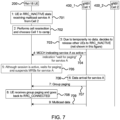
- Fig. 7 illustrates a schematic representation of a signaling diagram according to an example embodiment.
- the UE 200 in operation 701, is in the RRC_INACTIVE state receiving a multicast service A from cell 2 of gNB1 400_2.
- the UE 200 reselects cell 1 of gNB1 400_1 for camping.
- cell 1 of gNB1 400_1 releases some other UEs to the RRC_INACTIVE state due to there being temporarily no data.
- the at least one memory 102 and the computer program code are further configured to, with the at least one processor 101, cause the network device 100 to transmit the indicator in MCCH.
- the at least one memory 202 and the computer program code are further configured to, with the at least one processor 201, cause the client device 200 to receive the indicator in MCCH.
- MCCH 704 indicates for a multicast service A that service A is active, and that the UE 200 should wait for paging even though session A is active.
- the UE 200 waits for paging and suspends MRBs for the multicast service A.
- the UE 200 After receiving the paging, the UE 200 goes to the RRC_CONNECTED state for data reception 709. Alternatively, using the enhanced group paging, the UE 200 can also stay in the RRC_INACTIVE state and receive data.
- Fig. 8 illustrates a schematic representation of a signaling diagram according to an example embodiment.
- the network device 100 comprises a split gNB comprising a distributed unit (DU) 801, a centralized unit (CU) control plane (CP) 802, and a CP user plane (UP) 803.
- DU distributed unit
- CU centralized unit
- CP control plane
- UP CP user plane
- multicast session A is active but there is no data delivery for some time.
- the CU UP 803 can transmit an E1 application protocol (E1AP) inactivity notification 805 for service A to CU CP 802.
- E1AP E1 application protocol
- the CU CP 802 can transmit an RRC release message 806 comprising the "wait for paging" indicator to the UE 200. Any disclosure herein with respect to the indicator in the RRC release message may apply also to this example embodiment.
- the CU CP 802 can transmit an F1 application protocol (FLAP) multicast bearer context modification (CU to DU RRC information) comprising the "wait for paging" indicator in operation 807 to the DU 801.
- FLAP F1 application protocol
- the DU 801 can transmit MCCH broadcast comprising the "wait for paging" indicator to the UE 200 in operation 808. Any disclosure herein with respect to the indicator in the MCCH may apply also to this example embodiment.
- Fig. 9 illustrates a schematic representation of a signaling diagram according to an example embodiment.
- the UE 200 in operation 301, is in the RRC_CONNECTED state receiving multicast service A.
- gNB1 decides to release the UE 200 to the RRC_INACTIVE state.
- Cell 1 of gNB1 400_1 transmits an RRC release message 402 without PTM configuration or session status to the UE 200.
- the UE 200 suspends all MRBs.
- the UE 200 performs initial cell selection and finds the best cell is cell 2 of gNB2 500_2.
- cell 2 of gNB2 500_2 does not provide multicast service to UEs in the RRC_INACTIVE state. This may be due to, for example, gNB2 being a Rel-17 gNB or a Rel-18 gNB with no SIB20/MCCH.
- the client device 200 is further caused to, in response to the indication indicating that the client device should not wait for the paging message for the multicast session and monitor the data of the multicast session, switch to a connected state from the inactive state in response to at least one criterion being met.
- the UE 200 did not receive an explicit indicator in the RRC release message 402. This can function as the indication that that the UE 200 should not wait for the paging message for the multicast session.
- the at least one criterion comprises at least: the client device 200 being sent to the inactive state from the connected state in a first cell controlled by the network device, the client device 200 switching to a second cell to camp in the inactive state; and the client device 200 not finding a multicast and MCCH in the second cell.
- the first cell may comprise, for example, a cell from which the client device 200 received an RRC release message, such as cell 1 of gNB1 400_1 in the example embodiment of Fig. 9 .
- the at least one criterion may further comprise other criteria and/or comprise different criteria.
- the client device 200 may be configured to switch to the RRC_CONNECTED state in response to not receiving a session activation status and/or the indicator in the RRC release message, the client device 200 camping on a cell that is not the cell that sent the client device 200 to the RRC_INACTIVE state, and the camped cell not transmitting SIB20/MCCH.
- the UE 200 in operation 901, cannot find SIB20 after switching to cell 2 of gNB2 500_2. As the following conditions are satisfied, the UE 200 comes back to the RRC_CONNECTED state by initiating connection resumption or establishment procedure and a connection is resumed or established 902:
- Fig. 10 illustrates a flow chart representation of a method according to an example embodiment.
- a method 1000 comprises generating 1001, by a network device, an indicator based on at least one of an activation status of a multicast session or a data inactivity status and transmitting 1002, by the network device, the indicator to a client device, wherein the indicator indicates to the client device whether the client device should wait for a paging message for the multicast session and stop monitoring data of the multicast session while the client device is in an inactive state.
- the method 1000 may be performed by, for example, the network device 100.
- Fig. 11 illustrates a flow chart representation of a method according to an example embodiment.
- a method 1100 comprises, obtaining 1101, by a client device, an indication from a network device, wherein the indication indicates to the client device whether the client device should wait for a paging message for the multicast session and stop monitoring data of the multicast session while the client device is in an inactive state and based on the obtained indication, monitoring 1102, by the client device, the data of the multicast session while the client device is in the inactive state if the indication indicates that the client device should not wait for the paging message.
- the method 1100 may be performed by, for example, the client device 200.
- An apparatus may comprise means for performing any aspect of the method(s) described herein.
- the means comprise at least one processor, and memory comprising program code, the at least one processor, and program code configured to, when executed by the at least one processor, cause performance of any aspect of the method.
- the functionality described herein can be performed, at least in part, by one or more computer program product components such as software components.
- the network device 100 and/or the client device 200 comprises a processor configured by the program code when executed to execute the example embodiments of the operations and functionality described.
- the functionality described herein can be performed, at least in part, by one or more hardware logic components.
- illustrative types of hardware logic components include Field-programmable Gate Arrays (FPGAs), Application-specific Integrated Circuits (ASICs), Application-specific Standard Products (ASSPs), System-on-a-chip systems (SOCs), Complex Programmable Logic Devices (CPLDs), and Graphics Processing Units (GPUs).
Landscapes
- Engineering & Computer Science (AREA)
- Computer Networks & Wireless Communication (AREA)
- Signal Processing (AREA)
- Multimedia (AREA)
- Mobile Radio Communication Systems (AREA)
Abstract
According to an example embodiment, a network device is configured to: generate an indicator based on at least one of an activation status of a multicast session or a data inactivity status; and transmit the indicator to a client device, wherein the indicator indicates to the client device whether the client device should wait for a paging message for the multicast session and stop monitoring data of the multicast session while the client device is in an inactive state.
Description
- The present application generally relates to the field of wireless communications. In particular, the present application relates to a network device, a client device, and related methods and computer programs.
- In fifth generation (5G) cellular networks, a client device, such as a user equipment (UE) can transition into an inactive state when, for example, there is no traffic to the client device in order to save power. This can be referred to as a radio resource control (RRC) inactive (RRC_INACTIVE) state. However, various issue may arise due to the client device being in the inactive state.
- The scope of protection sought for various example embodiments is set out by the independent claims. The example embodiments and features, if any, described in this specification that do not fall under the scope of the independent claims are to be interpreted as examples useful for understanding various example embodiments.
- An example embodiment of a network device comprises at least one processor and at least one memory storing instructions. The instructions, when executed by the at least one processor, cause the network device to: generate an indicator based on at least one of an activation status of a multicast session or a data inactivity status; and transmit the indicator to a client device, wherein the indicator indicates to the client device whether the client device should wait for a paging message for the multicast session and stop monitoring data of the multicast session while the client device is in an inactive state.
- An example embodiment of a network device comprises means for performing: generate an indicator based on at least one of an activation status of a multicast session or a data inactivity status; transmit the indicator to a client device, wherein the indicator indicates to the client device whether the client device should wait for a paging message for the multicast session and stop monitoring data of the multicast session while the client device is in an inactive state.
- In an example embodiment, alternatively or in addition to the above-described example embodiments, the data inactivity status is based on whether the network device has received data for the multicast session within a predetermined time duration.
- In an example embodiment, alternatively or in addition to the above-described example embodiments, the network device is further caused to transmit the indicator in a radio resource control, RRC, release message or in a multicast and broadcast control channel, MCCH.
- An example embodiment of a client device comprises at least one processor and at least one memory storing instructions. The instructions, when executed by the at least one processor, cause the client device to: obtain an indication from a network device, wherein the indication indicates to the client device whether the client device should wait for a paging message for the multicast session and stop monitoring data of the multicast session while the client device is in an inactive state; and based on the obtained indication, monitor the data of the multicast session while the client device is in the inactive state if the indication indicates that the client device should not wait for the paging message.
- An example embodiment of a client device comprises means for performing: obtain an indication from a network device, wherein the indication indicates to the client device whether the client device should wait for a paging message for the multicast session and stop monitoring data of the multicast session while the client device is in an inactive state; and based on the obtained indication, monitor the data of the multicast session while the client device is in the inactive state if the indication indicates that the client device should not wait for the paging message.
- In an example embodiment, alternatively or in addition to the above-described example embodiments, the client device is further caused to, based on the obtained indication, wait for the paging message for the multicast session and stop monitoring the data of the multicast session while the client device is in the inactive state, if the indication indicates that the client device should wait for the paging message for the multicast session and stop monitoring the data of the multicast session.
- In an example embodiment, alternatively or in addition to the above-described example embodiments, the obtaining the indication comprises receiving an indicator, wherein the indicator explicitly indicates to the client device whether the client device should wait for a paging message for the multicast session and stop monitoring data of the multicast session while the client device is in the inactive state from network device or detecting an absence of the indicator from the network device.
- In an example embodiment, alternatively or in addition to the above-described example embodiments, the multicast session comprises an active multicast session.
- In an example embodiment, alternatively or in addition to the above-described example embodiments, the client device is further caused to obtain the indicator in a radio resource control, RRC, release message or in a multicast and broadcast control channel, MCCH.
- In an example embodiment, alternatively or in addition to the above-described example embodiments, the client device is further caused to, in response to the indication indicating that the client device should not wait for the paging message for the multicast session and monitor the data of the multicast session, keep radio bearers for the multicast session active and monitor the data of the multicast session while the client device is in the inactive state.
- In an example embodiment, alternatively or in addition to the above-described example embodiments, monitoring the data of the multicast session comprises monitoring a group radio network temporary identifier, G-RNTI, of the multicast session.
- In an example embodiment, alternatively or in addition to the above-described example embodiments, the client device is further caused to, in response to obtaining the indication from a network device controlling a first cell and selecting a second cell controlled by a second network device for camping in the inactive state, receive the paging message according to the indication while the client device is camping in the second cell.
- In an example embodiment, alternatively or in addition to the above-described example embodiments, the client device is further caused to, in response to the indication indicating that the client device should not wait for the paging message for the multicast session and monitor the data of the multicast session, switch to a connected state from the inactive state in response to at least one criterion being met.
- In an example embodiment, alternatively or in addition to the above-described example embodiments, the at least one criterion comprises at least: the client device being sent to the inactive state from the connected state in a first cell controlled by the network device, the client device switching to a second cell to camp in the inactive state; and the client device not finding a multicast and broadcast control channel, MCCH, in the second cell.
- An example embodiment of a method comprises: generating, by a network device, an indication based on at least one of an activation status of a multicast session or a data inactivity status; and transmitting, by the network device, the indication to a client device, wherein the indication indicates to the client device whether the client device should wait for a paging message for the multicast session and stop monitoring data of the multicast session while the client device is in an inactive state.
- An example embodiment of a method comprises:
obtaining, by a client device, an indication from a network device, wherein the indication indicates to the client device whether the client device should wait for a paging message for the multicast session and stop monitoring data of the multicast session while the client device is in an inactive state; and based on the obtained indication, monitoring, by the client device, the data of the multicast session while the client device is in the inactive state if the indication indicates that the client device should not wait for the paging message. - An example embodiment of a computer program product comprises program code configured to perform the method according to any of the above example embodiments when the computer program product is executed on a computer.
- The accompanying drawings, which are included to provide a further understanding of the example embodiments and constitute a part of this specification, illustrate example embodiments and together with the description help to explain the principles of the example embodiments. In the drawings:
-
Fig. 1 illustrates an example embodiment of the subject matter described herein illustrating a network device; -
Fig. 2 illustrates an example embodiment of the subject matter described herein illustrating a client device; -
Fig. 3 illustrates a schematic representation of a signaling diagram according to an example; -
Fig. 4 illustrates a schematic representation of a signaling diagram according to an example; -
Fig. 5 illustrates a schematic representation of a signaling diagram according to an example embodiment; -
Fig. 6 illustrates a schematic representation of a signaling diagram according to an example embodiment; -
Fig. 7 illustrates a schematic representation of a signaling diagram according to an example embodiment; -
Fig. 8 illustrates a schematic representation of a signaling diagram according to an example embodiment; -
Fig. 9 illustrates a schematic representation of a signaling diagram according to an example embodiment; -
Fig. 10 illustrates a flow chart representation of a method according to an example embodiment; and -
Fig. 11 illustrates a flow chart representation of a method according to an example embodiment. - Like reference numerals are used to designate like parts in the accompanying drawings.
- Reference will now be made in detail to example embodiments, examples of which are illustrated in the accompanying drawings. The detailed description provided below in connection with the appended drawings is intended as a description of the present examples and is not intended to represent the only forms in which the present disclosure may be constructed or utilized. The description sets forth the functions of the example and the sequence of steps for constructing and operating the example. However, the same or equivalent functions and sequences may be accomplished by different example embodiments.
-
Fig. 1 is a block diagram of anetwork device 100 configured in accordance with an example embodiment. - The
network device 100 may comprise one ormore processors 101 and one ormore memories 102 that comprise instructions. Thenetwork device 100 may also comprise at least one antenna port, as well as other elements, such as an input/output module, a transceiver, and/or a communication interface (not shown inFig. 1 ). - According to an example embodiment, the instructions, when executed by the at least one processor, cause the
network device 100 to: generate an indicator based on at least one of an activation status of a multicast session or a data inactivity status; transmit the indicator to a client device, wherein the indicator indicates to the client device whether the client device should wait for a paging message for the multicast session and stop monitoring data of the multicast session while the client device is in an inactive state. - The indicator may also be referred to as an indication, a paging indicator, a paging indication, or similar.
- For example, in some example embodiments, the
network device 100 may provide a "wait for paging" indicator in a radio resource control (RRC) release message to a user equipment (UE), wherein the indicator indicates to the UE whether the UE should wait for paging for a specific multicast session or for all multicast sessions, or not wait for paging for the specific multicast session or for all multicast sessions. Thenetwork device 100 may transmit the RRC release message due to, for example, there temporarily being no data in a multicast service for transmission to the UE. Alternatively or additionally, thenetwork device 100 may transmit the indicator to the client device in other messages and/or situations such as those disclosed herein. - A multicast service can be provided over a multicast session. Herein, a multicast session and multicast service can be used interchangeably.
- According to an example embodiment, the data inactivity status is based on whether the network device has received data for the multicast session within a predetermined time duration. In other words, if the network device has not received any data for the multicast within a predetermined time duration, then the inactivity status of the data may be set to inactive. In such case the indicator may indicate to the UE to wait for paging. If there is data incoming, the indicator may indicate to the client device to keep monitoring for data and not wait for.
- According to an example embodiment, the activity status of the multicast session may be e.g. inactive/deactivated or active. For inactive/deactivated status, the indicator may indicate to the UE to wait for paging. For active status, the indicator may indicate to the client device to keep on monitoring data from the multicast session (and not wait for paging) despite the client device being sent to inactive mode. Even for active multicast session, there may temporarily be no data transmission for the client device.
- Although the
network device 100 may be depicted to comprise only oneprocessor 101, thenetwork device 100 may comprise more processors. In an example embodiment, thememory 102 is capable of storing instructions, such as an operating system and/or various applications. - Furthermore, the
processor 101 may be capable of executing the stored instructions. In an example embodiment, theprocessor 101 may be embodied as a multi-core processor, a single core processor, or a combination of one or more multi-core processors and one or more single core processors. For example, theprocessor 101 may be embodied as one or more of various processing devices, such as a coprocessor, a microprocessor, a controller, a digital signal processor (DSP), a processing circuitry with or without an accompanying DSP, or various other processing devices including integrated circuits such as, for example, an application specific integrated circuit (ASIC), a field programmable gate array (FPGA), a microcontroller unit (MCU), a hardware accelerator, a special-purpose computer chip, or the like. In an example embodiment, theprocessor 101 may be configured to execute hard-coded functionality. In an example embodiment, theprocessor 101 is embodied as an executor of software instructions, wherein the instructions may specifically configure theprocessor 101 to perform the algorithms and/or operations described herein when the instructions are executed. - The
memory 102 may be embodied as one or more volatile memory devices, one or more non-volatile memory devices, and/or a combination of one or more volatile memory devices and non-volatile memory devices. For example, thememory 102 may be embodied as semiconductor memories (such as mask ROM, PROM (programmable ROM), EPROM (erasable PROM), flash ROM, RAM (random access memory), etc.). - When the
network device 100 is configured to implement some functionality, some component and/or components of thenetwork device 100, such as the at least oneprocessor 101 and/or thememory 102, may be configured to implement this functionality. Furthermore, when the at least oneprocessor 101 is configured to implement some functionality, this functionality may be implemented using program code comprised, for example, in thememory 102. For example, if thenetwork device 100 is configured to perform an operation, the at least onememory 102 and the computer program code can be configured to, with the at least oneprocessor 101, cause thenetwork device 100 to perform that operation. - The
network device 100 may comprise, for example, a base station (BS), a next generation nodeB (gNB), or any such device providing an air interface for client devices to connect to the wireless network via wireless transmissions. - Some terminology used herein may follow the naming scheme of 4G or 5G technology in its current form. However, this terminology should not be considered limiting, and the terminology may change over time. Thus, the following discussion regarding any example embodiment may also apply to other technologies.
-
Fig. 2 is a block diagram of aclient device 200 configured in accordance with an example embodiment. - The
client device 200 may comprise one ormore processors 201 and one ormore memories 202 that comprise instructions. Theclient device 200 may also comprise at least one antenna port, as well as other elements, such as an input/output module, a transceiver, a display, and/or a communication interface (not shown inFig. 2 ). - According to an example embodiment, the instructions, when executed by the at least one processor, cause the
client device 200 to: obtain an indication from anetwork device 100, wherein the indication indicates to theclient device 200 whether theclient device 200 should wait for a paging message for the multicast session and stop monitoring data of the multicast session while theclient device 200 is in an inactive state; and based on the obtained indication, monitor the data of the multicast session while theclient device 200 is in the inactive state if the indication indicates that the client device should not wait for the paging message - The
client device 200 may comprise, for example, a UE. - Herein, paging may also be referred to as a paging message or similar.
- According to an example embodiment, the
client device 200 is further caused to, based on the obtained indication, wait for the paging message for the multicast session and stop monitoring the data of the multicast session while theclient device 200 is in the inactive state, if the indication indicates that the client device should wait for the paging message for the multicast session and stop monitoring the data of the multicast session. - The
client device 200 may comprise a configuration related to a multicast session and the paging can indicate activation of the multicast session for theclient device 200 or indicate that data arrives for the multicast session. - For example, if the indication indicates that the
client device 200 needs to wait for paging for the multicast session, theclient device 200 can suspend the multicast radio bearer (MRB) associated with the multicast session. - If the indication indicates that the
client device 200 does not need to wait for paging, theclient device 200 may not suspend the MRB (i.e. keep the MRB active) and may receive group radio network temporary identifier (G-RNTI) for data of the multicast session. - If the
client device 200 obtains another indication indicating that theclient device 200 needs to wait for paging for the multicast session, theclient device 200 may ignore the previously obtained indication. - According to an example embodiment, the obtaining the indication comprises receiving an indicator from the network device. In this case the indicator may explicitly indicate to the
client device 200 whether theclient device 200 should wait for the paging message for the multicast session and stop monitoring data of the multicast session, while theclient device 200 is in the inactive state. - According to another example embodiment, the obtaining the indication comprises detecting an absence of the indicator from the network device. In a first embodiment in a case where the client device does not receive such indicator from the network device, the client device may interpret this as a trigger to wait for the paging message for the multicast session and stop monitoring data of the multicast session, while the
client device 200 is in the inactive state. In a second embodiment in a case where the client device does not receive such indicator from the network device, the client device may interpret this as a trigger to not wait for the paging message for the multicast session and keep monitoring data of the multicast session, while theclient device 200 is in the inactive state. The behavior of the client device in such situation (i.e. whether to perform first or second embodiment) may be preconfigured. - In the following most of the examples are written so that obtaining the indication comprises receiving the indicator from the network device. However, the embodiments are also applicable for the case where obtaining the indication is performed by detecting the absence of the indicator (i.e. by not receiving the indicator).
- For example, in some example embodiments, when a UE receives a "wait for paging" indicator in a RRC release message, the UE may not expect to receive G-RNTI for that service and suspends the MRBs of the multicast session until the UE receives group paging for the corresponding service indicating activation of the multicast session or data arrival for the multicast session. The UE may perform this regardless of the value of session status it may receive in the RRC release message, for example even if the UE receives the session status is active.
- For example, in some example embodiments, when the UE receives the "do not wait for paging" indicator, the UE may assume that the session is active and may not suspend the MRBs of the multicast session and continues monitoring the G-RNTI for the multicast session. As said above, in some embodiments, non-existence of the "wait for paging" indicator can function as an indicator that the UE should not wait for paging for the multicast session.
- In some example embodiments, the indicator is transmitted alternatively or additionally in a multicast and broadcast control channel (MCCH) to a UE. When a UE checks MCCH for a specific service and detects the "wait for paging" indicator although the session is active, the UE may not wait for the G-RNTI, suspends MRBs for service, and waits for paging for the multicast session.
- Although the
client device 200 may be depicted to comprise only oneprocessor 201, theclient device 200 may comprise more processors. In an example embodiment, thememory 202 is capable of storing instructions, such as an operating system and/or various applications. - Furthermore, the
processor 201 may be capable of executing the stored instructions. In an example embodiment, theprocessor 201 may be embodied as a multi-core processor, a single core processor, or a combination of one or more multi-core processors and one or more single core processors. For example, theprocessor 201 may be embodied as one or more of various processing devices, such as a coprocessor, a microprocessor, a controller, a digital signal processor (DSP), a processing circuitry with or without an accompanying DSP, or various other processing devices including integrated circuits such as, for example, an application specific integrated circuit (ASIC), a field programmable gate array (FPGA), a microcontroller unit (MCU), a hardware accelerator, a special-purpose computer chip, or the like. In an example embodiment, theprocessor 201 may be configured to execute hard-coded functionality. In an example embodiment, theprocessor 201 is embodied as an executor of software instructions, wherein the instructions may specifically configure theprocessor 201 to perform the algorithms and/or operations described herein when the instructions are executed. - The
memory 202 may be embodied as one or more volatile memory devices, one or more non-volatile memory devices, and/or a combination of one or more volatile memory devices and non-volatile memory devices. For example, thememory 202 may be embodied as semiconductor memories (such as mask ROM, PROM (programmable ROM), EPROM (erasable PROM), flash ROM, RAM (random access memory), etc.). - When the
client device 200 is configured to implement some functionality, some component and/or components of theclient device 200, such as the at least oneprocessor 201 and/or thememory 202, may be configured to implement this functionality. Furthermore, when the at least oneprocessor 201 is configured to implement some functionality, this functionality may be implemented using program code comprised, for example, in thememory 202. For example, if theclient device 200 is configured to perform an operation, the at least onememory 202 and the computer program code can be configured to, with the at least oneprocessor 201, cause theclient device 200 to perform that operation. - At least some example embodiments disclosed herein can, for example, enable the
client device 200 to stop monitoring for G-RNTI, suspend MRBs, and save power during periods of time where no data is delivered for a multicast service when the 5G core keeps the session status for this multicast service active. At least some example embodiments can also enable theclient device 200 to obtain information to enable necessary connections to the network. -
Fig. 3 illustrates a schematic representation of a signaling diagram according to an example. - In Rel-17, a gNB can send a
UE 200 to RRC_INACTIVE state for, for example, power saving, if the following conditions are satisfied: - 1) All the multicast sessions that the
UE 200 has joined have inactive/deactivated status; or - 2) The multicast sessions that the
UE 200 has joined have active status, but there is temporarily no activity (i.e. no incoming data) in the user plane. - A Rel-17
UE 200 is unaware of which of cases (1) and (2) above caused the UE to be sent into RRC_INACTIVE state, as "session activation status" is unknown to a Rel-17UE 200. For both cases, theUE 200 starts to wait for paging for the multicast session after being sent to RRC_INACTIVE state. For case (1), the gNB pages once a session gets activated, and for case (2), the gNB pages once some data arrives for the multicast session so that theUE 200 is brought back to the RRC_CONNECTED state for data reception. - However, Rel-18 introduces multicast reception in RRC_INACTIVE state, on top of Rel-17 mechanism for reception in the RRC_CONNECTED state. Therefore, a Rel-18
UE 200 can be sent to the RRC_INACTIVE state and can be expected to receive multicast transmission, i.e., theUE 200 does not wait for paging. - RRC release message can be used when sending
UE 200 to the RRC_INACTIVE state, which can include the point-to-multipoint (PTM) configuration that theUE 200 needs for receiving multicast. Furthermore, a periodic MCCH can indicate the PTM configuration that theUE 200 needs to use in the RRC_INACTIVE state multicast reception. If anRRC_INACTIVE UE 200 does not have the PTM configuration for an "active" multicast session, it reconnects and comes back to RRC_CONNECTED state for multicast reception (because perhaps the audience size is not that large and UEs are served in RRC_CONNECTED). - For a Rel-18
UE 200, to know such "session activation status", a "session status" can be indicated both in RRC release and MCCH. That way, theUE 200 in the RRC_INACTIVE state can distinguish between an active and inactive multicast session, and theUE 200 can use this to determine whether to come back to the RRC_CONNECTED state or stay in the RRC_INACTIVE state. - Furthermore, in RRC release message, the
UE 200 can be indicated whether to continue the MRBs that the UE was using in the RRC_CONNECTED state, also in the RRC_INACTIVE state, to have service continuity without interruptions when transitioning from the RRC_CONNECTED state to the RRC_INACTIVE state. The "session status" may be utilized for such a purpose, so that theUE 200 suspends the MRBs it was using in the RRC_CONNECTED state if they are for "inactive" multicast sessions and theUE 200 does not suspend the MRBs it was using in the RRC_CONNECTED state if they are for "active" multicast sessions. - However, there are problematic scenarios that can arise with such framework. For example, a
UE 200 can be in the RRC_CONNECTED state receivingmulticast service A 301. If the gNB decides 302 to release theUE 200 to the RRC_INACTIVE state for an "active" multicast session due to case (2) mentioned above and transmits anRRC release message 303 fromcell 1 400_1 to theUE 200, theUE 200 would not suspend MRBs. The UE expects 304 to receive data in the RRC_INACTIVE state using MRBs used in the RRC_CONNECTED state and tries to decode 305 the multicast service although there is temporarily no data, and theUE 200 does not stop monitoring G-RNTI for that service. Such a situation could lead to unnecessary power consumption at theUE 200. Simply, theUE 200 cannot understand the reason why it was sent to the RRC_INACTIVE state. - Further, the
UE 200 does not expect 306 group paging for the multicast service A. Thus, when data arrives 307 for service A and gNB1 performs group paging 308, theUE 200 can miss 309 the group paging and stay in the RRC_INACTIVE state. -
Fig. 4 illustrates a schematic representation of a signaling diagram according to an example. - The
UE 200 may be sent to the RRC_INACTIVE state without having any "session status" provided by gNB1 in theRRC release message 402. For example,cell 1 of gNB1 400_1 may be in acongested state 401 and gNB1 may want to keep the RRC release size minimal and desire theUE 200 to learn about session status via MCCH. In such a case, theUE 200 can end up initially camping in a different cell that does not provide SIB20/MCCH. For example, in the example ofFig. 4 , theUE 200 suspends 404 all MRBs and performscell selection 405. For example, the new cell may be Rel-17 gNB or Rel-18 gNB with a small audience size formulticast services 406, such ascell 2 of gNB2 500_2 in the example ofFig. 4 . The "session status" for theUE 200 may then be unknown. In such a case, the behavior of theUE 200 is not defined, and theUE 200 may not find SIB20 and may not reconnect as the session state is unknown 407. - As seen from the exemplary scenarios of
Figs. 3 and4 , some solutions for the RRC_INACTIVE state multicast may create problems when theUE 200 is sent to the RRC_INACTIVE state for different purposes. Therefore, means are needed for an improved UE behavior after being sent to the RRC_INACTIVE state. For example, after being sent to the RRC_INACTIVE state, theUE 200 may be unable determine whether it should stay in the RRC_INACTIVE state and wait for paging for the multicast session, it should stay in the RRC_INACTIVE state and wait for data reception, and/or it should go to the RRC_CONNECTED state for data reception. -
Fig. 5 illustrates a schematic representation of a signaling diagram according to an example embodiment. - In the example embodiment of
Fig. 5 , inoperation 301, the UE is in the RRC_CONNECTED state receiving a multicast service A. - In
operation 302, due to temporarily no data arrival for the service A and there being no other services the UE receives, gNB1 decides to release the UE to the RRC_INACTIVE state. gNB1 may correspond to thenetwork device 100. - According to an example embodiment, the network device is further caused to transmit the indicator in a radio resource control (RRC) release message or in a multicast and broadcast control channel (MCCH).
- In other example embodiments, the
network device 100 may, for example, transmit the indication in some other message or in a separate message. - According to an example embodiment, the
client device 200 is further caused to obtain the indication in a radio resource control (RRC) release message or in a multicast and broadcast control channel (MCCH). - According to an example embodiment, the obtaining the indication comprises receiving an indicator from the network device 100 (step 501 in
Figure 5 ), wherein the indicator explicitly indicates to theclient device 200 whether theclient device 200 should wait for a paging message for the multicast session and stop monitoring data of the multicast session while theclient device 200 is in the inactive state or detecting an absence of the indicator from the network device. - In other example embodiments, the
client device 200 may, for example, receive the indicator in some other message or in a separate message. - According to an example embodiment, the multicast session comprises an active multicast session.
- For example, in the example embodiment of
Fig. 5 ,gNB1 cell 1 400_1 transmits and theUE 200 receives the indicator in an RRC release message 501. The RRC release message 501 may further indicate that the multicast session is active. - According to an example embodiment, the indicator indicates to the
client device 200 whether theclient device 200 should wait for paging for a multicast session. - The indicator can, for example, indicate to the
client device 200 whether theclient device 200 should wait for paging for a specific multicast session. In another example, the indicator may indicate to theclient device 200 whether theclient device 200 should wait for paging for all the multicast sessions. - In the example embodiment of
Fig. 5 gNB1 transmits the RRC release message 501 comprising an indication that the service A is active and an indicator for "wait for paging", as theUE 200 will be paged upon data arrival for the multicast service A. - According to an example embodiment, the
client device 200 is further caused to, in response to the indicator indicating that theclient device 200 should wait for the paging message for the multicast session and stop monitoring the data of the multicast session while theclient device 200 is in the inactive state, suspend radio bearers for the multicast session. - For example, in the example embodiment of
Fig. 5 , inoperation 502, theUE 200 expects to receive group paging in the RRC_INACTIVE state for multicast service A and suspends the MRBs that it was using in the RRC_CONNECTED state for the multicast service A, as the RRC release is due to temporary no data activity. TheUE 200 does not monitor G-RNTI for the multicast service A. Thus, theUE 200 does not unnecessarily consume power, as shown instep 503. - In
operation 504, due to measurements, theUE 200 reselectscell 2 of gNB1 400_2 for camping. In operation 505, theUE 200 camps incell 2 400_2. - In
operation 506, theUE 200 may wait for paging for the multicast service A, even ifcell 2's 400_2 MCCH may indicate the multicast session as active and may not indicate "wait for paging". - In
operation 307, data arrives for multicast service A. -
Cell 1 of gNB1 400_1 transmits the group paging 507 tocell 2 of gNB1 400_2 via the Xn interface. Thegroup paging 507 indicates that the data arrives for the multicast service A. -
Cell 2 of gNB1 400_2 transmits the group paging 308 to theUE 200. - In
operation 508, theUE 200 receives the group paging 308 indicating data arrival for the multicast service A and goes back to the RRC_CONNECTED state incell 2 400_2 fordata reception 509. Alternatively, using the enhanced group paging, theUE 200 can also stay in the RRC_INACTIVE state and receive data of the multicast session. -
Fig. 6 illustrates a schematic representation of a signaling diagram according to an example embodiment. - In the example embodiment of
Fig. 6 , inoperation 301, theUE 200 is in the RRC_CONNECTED state receiving a multicast service A. - In
operation 401, due to congestion for example, gNB1 decides to release the UE to the RRC_INACTIVE state. - According to an embodiment, the at least one
memory 202 and the computer program code are further configured to, with the at least oneprocessor 201, cause theclient device 200 to, in response to the indicator indicating that theclient device 200 should not wait for paging or not receiving the indicator from thenetwork device 100, keep radio bearers for a multicast session active while theclient device 200 is in the inactive state. - According to an example embodiment, the
client device 200 is further caused to, in response to the indication indicating that theclient device 200 should not wait for the paging message for the multicast session and monitor the data of the multicast session, keep radio bearers for the multicast session active and monitor the data of the multicast session while theclient device 200 is in the inactive state. - According to an example embodiment, monitoring the data of the multicast session comprises monitoring a group radio network temporary identifier (G-RNTI) of the multicast session.
- For example, in the example embodiment of
Fig. 6 ,cell 1 ofgNB 1 400_1 can transmit anRRC release message 601 without a PTM configuration or session status to theUE 200. Optionally, gNB1 can also provide an indicator for "do no wait for paging" to theUE 200, as theUE 200 is intended to receive the service in the RRC_INACTIVE state. Alternatively, non-existence of an explicit "wait for paging" can serve as the "do no wait for paging" indicator. - According to an embodiment, the
client device 200 is further caused to, in response to obtaining the indication from a network device controlling a first cell and selecting a second cell controlled by a second network device for camping in the inactive state, receive the paging message according to the indication while the client device is camping in the second cell. - In some example embodiments, the network device and the second network device can be the same. In other example embodiments, they can be different devices.
- For example, in some example embodiments, if the
UE 200 is provided with a "wait for paging" indicator in the RRC release message, theUE 200 can still wait for paging and not try to decode any data, such as the G-RNTI, even in the case theUE 200 reselects a new cell for camping and the new cell does not indicate "wait for paging". - In some example embodiments, the
client device 200 may be further caused to, in response to obtaining the indication from a network device controlling a first cell and selecting a second cell controlled by a second network device for camping in the inactive state, not wait to receive the paging message according to the indication while the client device is camping in the second cell. - For example, in some example embodiments, if the
UE 200 is provided with the "do not wait for paging" indicator in the RRC release message, theUE 200 can still wait for paging and not try to decode any data, such as the G-RNTI, in a camped cell whose MCCH indicates "wait for paging". - For example, in the example embodiment of
Fig. 6 , inoperations 602, theUE 200 does not suspend the MRBs. Inoperation 603, theUE 200 performs cell selection for initial camping and findscell 2 of gNB2 500_2 as the best cell. - In
operation 406, gNB2 does not provide multicast service to UEs in the RRC_INACTIVE state. This may be due to, for example, gNB2 being a Rel-17 gNB or a Rel-18 gNB with no SIB20/MCCH. - In
operation 604, theUE 200 cannot find SIB20 incell 2 of gNB2 500_2. Based on the explicit "do not wait for paging" indicator or based on non-existence of the "wait for paging" indicator, theUE 200 does not wait for paging and goes back to the RRC_CONNECTED state to receivemulticast transmission 605 in the RRC_CONNECTED state by initiating the connection resumption or connection establishment procedure. -
Fig. 7 illustrates a schematic representation of a signaling diagram according to an example embodiment. - In the example embodiment of
Fig. 7 , in operation 701, theUE 200 is in the RRC_INACTIVE state receiving a multicast service A fromcell 2 of gNB1 400_2. - In
operation 702, due to measurements, theUE 200 reselectscell 1 of gNB1 400_1 for camping. - In
operation 703,cell 1 of gNB1 400_1 releases some other UEs to the RRC_INACTIVE state due to there being temporarily no data. - According to an example embodiment the at least one
memory 102 and the computer program code are further configured to, with the at least oneprocessor 101, cause thenetwork device 100 to transmit the indicator in MCCH. - According to an example embodiment, the at least one
memory 202 and the computer program code are further configured to, with the at least oneprocessor 201, cause theclient device 200 to receive the indicator in MCCH. - For example, in the example embodiment of
Fig. 7 ,MCCH 704 indicates for a multicast service A that service A is active, and that theUE 200 should wait for paging even though session A is active. - In
operation 705, although the session is active, theUE 200 waits for paging and suspends MRBs for the multicast service A. - In
operation 706, data arrival for multicast service A occurs andcell 1 of gNB1 400_1pages 707 the UEs supporting the multicast service A involving theUE 200. - In
operation 708, after receiving the paging, theUE 200 goes to the RRC_CONNECTED state fordata reception 709. Alternatively, using the enhanced group paging, theUE 200 can also stay in the RRC_INACTIVE state and receive data. -
Fig. 8 illustrates a schematic representation of a signaling diagram according to an example embodiment. - In the example embodiment of
Fig. 8 , thenetwork device 100 comprises a split gNB comprising a distributed unit (DU) 801, a centralized unit (CU) control plane (CP) 802, and a CP user plane (UP) 803. - In
operation 804, multicast session A is active but there is no data delivery for some time. TheCU UP 803 can transmit an E1 application protocol (E1AP)inactivity notification 805 for service A toCU CP 802. - In some example embodiments, the
CU CP 802 can transmit anRRC release message 806 comprising the "wait for paging" indicator to theUE 200. Any disclosure herein with respect to the indicator in the RRC release message may apply also to this example embodiment. - In some example embodiments, the
CU CP 802 can transmit an F1 application protocol (FLAP) multicast bearer context modification (CU to DU RRC information) comprising the "wait for paging" indicator inoperation 807 to theDU 801. TheDU 801 can transmit MCCH broadcast comprising the "wait for paging" indicator to theUE 200 inoperation 808. Any disclosure herein with respect to the indicator in the MCCH may apply also to this example embodiment. -
Fig. 9 illustrates a schematic representation of a signaling diagram according to an example embodiment. - In the example embodiment of
Fig. 9 , inoperation 301, theUE 200 is in the RRC_CONNECTED state receiving multicast service A. - In
operation 401, due to congestion for example, gNB1 decides to release theUE 200 to the RRC_INACTIVE state. -
Cell 1 of gNB1 400_1 transmits anRRC release message 402 without PTM configuration or session status to theUE 200. - In
operation 404, theUE 200 suspends all MRBs. - In
operation 405, theUE 200 performs initial cell selection and finds the best cell iscell 2 of gNB2 500_2. - In
operation 406,cell 2 of gNB2 500_2 does not provide multicast service to UEs in the RRC_INACTIVE state. This may be due to, for example, gNB2 being a Rel-17 gNB or a Rel-18 gNB with no SIB20/MCCH. - According to an example embodiment, the
client device 200 is further caused to, in response to the indication indicating that the client device should not wait for the paging message for the multicast session and monitor the data of the multicast session, switch to a connected state from the inactive state in response to at least one criterion being met. - For example, in the example embodiment of
Fig. 9 , theUE 200 did not receive an explicit indicator in theRRC release message 402. This can function as the indication that that theUE 200 should not wait for the paging message for the multicast session. - According to an example embodiment, the at least one criterion comprises at least: the
client device 200 being sent to the inactive state from the connected state in a first cell controlled by the network device, theclient device 200 switching to a second cell to camp in the inactive state; and theclient device 200 not finding a multicast and MCCH in the second cell. - The first cell may comprise, for example, a cell from which the
client device 200 received an RRC release message, such ascell 1 of gNB1 400_1 in the example embodiment ofFig. 9 . - In other embodiments, the at least one criterion may further comprise other criteria and/or comprise different criteria.
- In some example embodiments, the
client device 200 may be configured to switch to the RRC_CONNECTED state in response to not receiving a session activation status and/or the indicator in the RRC release message, theclient device 200 camping on a cell that is not the cell that sent theclient device 200 to the RRC_INACTIVE state, and the camped cell not transmitting SIB20/MCCH. - For example, in the example embodiment of
Fig. 9 , inoperation 901, theUE 200 cannot find SIB20 after switching tocell 2 of gNB2 500_2. As the following conditions are satisfied, theUE 200 comes back to the RRC_CONNECTED state by initiating connection resumption or establishment procedure and a connection is resumed or established 902: - 1. the
UE 200 did not receive session status for a multicast session that it joined in theRRC release message 402, - 2. the
UE 200 has selected another cell to initially camp compared to the cell that sent theUE 200 to the RRC_INACTIVE state, and - 3. the
UE 200 could not find SIB20 and/or MCCH in the initially camped cell. -
Fig. 10 illustrates a flow chart representation of a method according to an example embodiment. - According to an embodiment, a
method 1000 comprises generating 1001, by a network device, an indicator based on at least one of an activation status of a multicast session or a data inactivity status and transmitting 1002, by the network device, the indicator to a client device, wherein the indicator indicates to the client device whether the client device should wait for a paging message for the multicast session and stop monitoring data of the multicast session while the client device is in an inactive state. - The
method 1000 may be performed by, for example, thenetwork device 100. -
Fig. 11 illustrates a flow chart representation of a method according to an example embodiment. - According to an embodiment, a
method 1100 comprises, obtaining 1101, by a client device, an indication from a network device, wherein the indication indicates to the client device whether the client device should wait for a paging message for the multicast session and stop monitoring data of the multicast session while the client device is in an inactive state and based on the obtained indication, monitoring 1102, by the client device, the data of the multicast session while the client device is in the inactive state if the indication indicates that the client device should not wait for the paging message. - The
method 1100 may be performed by, for example, theclient device 200. - An apparatus may comprise means for performing any aspect of the method(s) described herein. According to an example embodiment, the means comprise at least one processor, and memory comprising program code, the at least one processor, and program code configured to, when executed by the at least one processor, cause performance of any aspect of the method.
- The functionality described herein can be performed, at least in part, by one or more computer program product components such as software components. According to an example embodiment, the
network device 100 and/or theclient device 200 comprises a processor configured by the program code when executed to execute the example embodiments of the operations and functionality described. Alternatively, or in addition, the functionality described herein can be performed, at least in part, by one or more hardware logic components. For example, and without limitation, illustrative types of hardware logic components that can be used include Field-programmable Gate Arrays (FPGAs), Application-specific Integrated Circuits (ASICs), Application-specific Standard Products (ASSPs), System-on-a-chip systems (SOCs), Complex Programmable Logic Devices (CPLDs), and Graphics Processing Units (GPUs). - Any range or device value given herein may be extended or altered without losing the effect sought. Also any example embodiment may be combined with another example embodiment unless explicitly disallowed.
- Although the subject matter has been described in language specific to structural features and/or acts, it is to be understood that the subject matter defined in the appended claims is not necessarily limited to the specific features or acts described above. Rather, the specific features and acts described above are disclosed as examples of implementing the claims and other equivalent features and acts are intended to be within the scope of the claims.
- It will be understood that the benefits and advantages described above may relate to one example embodiment or may relate to several example embodiments. The example embodiments are not limited to those that solve any or all of the stated problems or those that have any or all of the stated benefits and advantages. It will further be understood that reference to 'an' item may refer to one or more of those items.
- The steps of the methods described herein may be carried out in any suitable order, or simultaneously where appropriate. Additionally, individual blocks may be deleted from any of the methods without departing from the spirit and scope of the subject matter described herein. Aspects of any of the example embodiments described above may be combined with aspects of any of the other example embodiments described to form further example embodiments without losing the effect sought.
- The term 'comprising' is used herein to mean including the method, blocks or elements identified, but that such blocks or elements do not comprise an exclusive list and a method or apparatus may contain additional blocks or elements.
- It will be understood that the above description is given by way of example only and that various modifications may be made by those skilled in the art. The above specification, examples and data provide a complete description of the structure and use of exemplary embodiments. Although various example embodiments have been described above with a certain degree of particularity, or with reference to one or more individual example embodiments, those skilled in the art could make numerous alterations to the disclosed example embodiments without departing from the spirit or scope of this specification.
Claims (15)
- A network device (100), comprising:at least one processor (101); andat least one memory (102) storing instructions that, when executed by the at least one processor, cause the network device (100) to:generate an indicator based on at least one of an activation status of a multicast session or a data inactivity status; andtransmit the indicator to a client device (200), wherein the indicator indicates to the client device (200) whether the client device (200) should wait for a paging message for the multicast session and stop monitoring data of the multicast session while the client device (200) is in an inactive state.
- The network device according to claim 1 wherein the data inactivity status is based on whether the network device has received data for the multicast session within a predetermined time duration.
- The network device (100) according to claim 1 or claim 2, wherein the network device (100) is further caused to transmit the indicator in a radio resource control, RRC, release message (501, 601, 806) or in a multicast and broadcast control channel, MCCH, (704, 808).
- A client device (200), comprising:at least one processor (201); andat least one memory (202) storing instructions that, when executed by the at least one processor (201), cause the client device (200) of a multicast session to:obtain an indication from a network device (100), wherein the indication indicates to the client device (200) whether the client device (200) should wait for a paging message for the multicast session and stop monitoring data of the multicast session while the client device (200) is in an inactive state; andbased on the obtained indication, perform one of:monitor the data of the multicast session while the client device (200) is in the inactive state if the indication indicates that the client device should not wait for the paging message;wait for the paging message for the multicast session and stop monitoring the data of the multicast session while the client device (200) is in the inactive state, if the indication indicates that the client device should wait for the paging message for the multicast session and stop monitoring the data of the multicast session.
- The client device (200) according to claim 4, wherein the obtaining the indication comprises receiving an indicator, wherein the indicator explicitly indicates to the client device (200) whether the client device (200) should wait for a paging message for the multicast session and stop monitoring data of the multicast session while the client device (200) is in the inactive state from network device or detecting an absence of the indicator from the network device.
- The client device according to any of claims 4 - 5, wherein the multicast session comprises an active multicast session.
- The client device (200) according to any of claims 4 - 6, wherein the client device (200) is further caused to obtain the indication in a radio resource control, RRC, release message (501, 601, 806) or in a multicast and broadcast control channel, MCCH, (704, 808).
- The client device (200) according to any of claims 4 - 7, wherein the client device (200) is further caused to, in response to the indication indicating that the client device (200) should not wait for the paging message for the multicast session and monitor the data of the multicast session, keep radio bearers for the multicast session active and monitor the data of the multicast session while the client device (200) is in the inactive state.
- The client device (200) according to claim 8, wherein monitoring the data of the multicast session comprises monitoring a group radio network temporary identifier, G-RNTI, of the multicast session.
- The client device (200) according to any of claims 4 - 9, wherein the client device (200) is further caused to, in response to obtaining the indication from a network device controlling a first cell (400_1) and selecting a second cell controlled by a second network device (500_2) for camping in the inactive state, receive the paging message according to the indication while the client device (200) is camping in the second cell (500_2).
- The client device (200) according to any of claims 4 - 10, wherein the client device (200) is further caused to, in response to the indication indicating that the client device should not wait for the paging message for the multicast session and monitor the data of the multicast session, switch to a connected state from the inactive state in response to at least one criterion being met.
- The client device (200) according to claim 11, wherein the at least one criterion comprises at least:the client device (200) being sent to the inactive state from the connected state in a first cell controlled by the network device,the client device (200) switching to a second cell to camp in the inactive state (500_2); andthe client device (200) not finding a multicast and broadcast control channel, MCCH, in the second cell (500_2).
- The client device according to any of claims 4 to 12, wherein the client device is further caused to: select a second cell to camp on; switch to a connected state in the second cell in response to not receiving SIB20/MCCH in the second cell.
- The client device according to claim 13, wherein the client device is further caused to: receive an RRC release message from a first cell, the RRC release message not comprising the indication and/or a multicast session activation status.
- A method (1100) comprising:obtaining (1101), by a client device, an indication from a network device, wherein the indication indicates to the client device whether the client device should wait for a paging message for the multicast session and stop monitoring data of the multicast session while the client device is in an inactive state; andbased on the obtained indication, performing one of:monitoring (1102), by the client device, the data of the multicast session while the client device is in the inactive state if the indication indicates that the client device should not wait for the paging message,wait for the paging message for the multicast session and stop monitoring the data of the multicast session while the client device (200) is in the inactive state, if the indication indicates that the client device should wait for the paging message for the multicast session and stop monitoring the data of the multicast session.
Applications Claiming Priority (1)
| Application Number | Priority Date | Filing Date | Title |
|---|---|---|---|
| FI20236070 | 2023-09-27 |
Publications (1)
| Publication Number | Publication Date |
|---|---|
| EP4531443A1 true EP4531443A1 (en) | 2025-04-02 |
Family
ID=92633977
Family Applications (1)
| Application Number | Title | Priority Date | Filing Date |
|---|---|---|---|
| EP24198553.0A Pending EP4531443A1 (en) | 2023-09-27 | 2024-09-05 | Network device and client device |
Country Status (6)
| Country | Link |
|---|---|
| US (2) | US20250106763A1 (en) |
| EP (1) | EP4531443A1 (en) |
| CN (1) | CN119729368A (en) |
| AR (1) | AR133971A1 (en) |
| TW (1) | TW202516887A (en) |
| WO (1) | WO2025067808A1 (en) |
Citations (1)
| Publication number | Priority date | Publication date | Assignee | Title |
|---|---|---|---|---|
| CN116347362A (en) * | 2023-03-28 | 2023-06-27 | 上海数字电视国家工程研究中心有限公司 | MBS service activation method and receiving and transmitting device |
Family Cites Families (5)
| Publication number | Priority date | Publication date | Assignee | Title |
|---|---|---|---|---|
| US20130107727A1 (en) * | 2011-10-27 | 2013-05-02 | Nokia Corporation | Apparatus and Method for the Management of Reception Parameters in a Communication System |
| US11399406B2 (en) | 2019-10-24 | 2022-07-26 | Qualcomm Incorporated | Maintaining a multicast/broadcast radio bearer in an idle state or an inactive state |
| CN115843453A (en) | 2020-06-29 | 2023-03-24 | 瑞典爱立信有限公司 | Multicast and broadcast service for user equipment in idle and inactive states |
| WO2022084537A1 (en) | 2020-10-23 | 2022-04-28 | Telefonaktiebolaget Lm Ericsson (Publ) | Network node, device and methods in a telecommunication network |
| US20250168925A1 (en) | 2022-01-13 | 2025-05-22 | Samsung Electronics Co., Ltd. | A system and method of capability negotiation between a ue and network for multicast service delivery |
-
2024
- 2024-08-08 US US18/797,567 patent/US20250106763A1/en active Pending
- 2024-08-30 WO PCT/EP2024/074275 patent/WO2025067808A1/en active Pending
- 2024-09-03 TW TW113133256A patent/TW202516887A/en unknown
- 2024-09-05 EP EP24198553.0A patent/EP4531443A1/en active Pending
- 2024-09-26 CN CN202411353474.4A patent/CN119729368A/en active Pending
- 2024-09-27 AR ARP240102622A patent/AR133971A1/en unknown
- 2024-11-21 US US18/955,812 patent/US12457553B2/en active Active
Patent Citations (1)
| Publication number | Priority date | Publication date | Assignee | Title |
|---|---|---|---|---|
| CN116347362A (en) * | 2023-03-28 | 2023-06-27 | 上海数字电视国家工程研究中心有限公司 | MBS service activation method and receiving and transmitting device |
Non-Patent Citations (2)
| Title |
|---|
| JARKKO KOSKELA ET AL: "Control plane details for multicast reception in RRC_INACTIVE state", vol. RAN WG2, no. Xiamen, CN; 20231009 - 20231013, 29 September 2023 (2023-09-29), XP052529786, Retrieved from the Internet <URL:https://www.3gpp.org/ftp/TSG_RAN/WG2_RL2/TSGR2_123bis/Docs/R2-2310797.zip R2-2310797 Control plane details for multicast reception in RRC_INACTIVE state_final.docx> [retrieved on 20230929] * |
| RUI ZHOU ET AL: "Discussion on Notifications and RRC state transitions", vol. RAN WG2, no. Athens, GR; 20230227 - 20230303, 17 February 2023 (2023-02-17), XP052244830, Retrieved from the Internet <URL:https://www.3gpp.org/ftp/TSG_RAN/WG2_RL2/TSGR2_121/Docs/R2-2300179.zip R2-2300179.docx> [retrieved on 20230217] * |
Also Published As
| Publication number | Publication date |
|---|---|
| CN119729368A (en) | 2025-03-28 |
| AR133971A1 (en) | 2025-11-19 |
| WO2025067808A1 (en) | 2025-04-03 |
| US20250106764A1 (en) | 2025-03-27 |
| US20250106763A1 (en) | 2025-03-27 |
| US12457553B2 (en) | 2025-10-28 |
| TW202516887A (en) | 2025-04-16 |
Similar Documents
| Publication | Publication Date | Title |
|---|---|---|
| US20220095269A1 (en) | System information transmission method and apparatus | |
| CN115245041B (en) | Data transmission method and device | |
| CN107371206B (en) | Method and equipment for data transmission | |
| WO2023066316A1 (en) | Communication method and apparatus, and storage medium | |
| WO2023160604A1 (en) | Method for determining terminal in non-connected state, terminal and network device | |
| WO2016050075A1 (en) | Transmission initiation method and system, and method for processing state of terminal device and related device | |
| WO2022028539A1 (en) | Information transmission method and apparatus, terminal, and network side device | |
| WO2023001144A1 (en) | Multimedia broadcast service receiving method and sending method, apparatus, and device | |
| CN117676891A (en) | Communication method and communication device | |
| US12598622B2 (en) | BWP determining method, apparatus, and system | |
| WO2023125730A1 (en) | State switching method and apparatus, and device | |
| EP4531443A1 (en) | Network device and client device | |
| WO2023066167A1 (en) | Terminal positioning processing method and apparatus | |
| US20230232488A1 (en) | Method and system for efficiently activating or deactivating user equipment | |
| WO2023236014A1 (en) | Methods and apparatuses for multicast service reception during ue mobility and rrc state transition | |
| WO2024000384A1 (en) | Methods and apparatuses for mbs multicast service reception during ue mobility in rrc state | |
| WO2023151612A1 (en) | Communication method and communication apparatus | |
| WO2023208098A1 (en) | Communication method and apparatus, chip, and module device | |
| WO2021128925A1 (en) | Information processing method and apparatus, and device and computer readable storage medium | |
| WO2024092770A1 (en) | Method of determining applicable area of ptm configuration for ue receiving multicast in rrc inactive state and apparatuses | |
| US20250159751A1 (en) | Connection resume method and apparatus, terminal, and network-side device | |
| CN115243401B (en) | Business processing method, device, system, readable storage medium and electronic device | |
| US20250203713A1 (en) | Broadcast message transmission method and device, network function and storage medium | |
| CN113973268B (en) | Data receiving method, data sending method, resource updating method, device and equipment | |
| WO2023186138A1 (en) | Multicast session/service transmission method, apparatus, chip and module device |
Legal Events
| Date | Code | Title | Description |
|---|---|---|---|
| PUAI | Public reference made under article 153(3) epc to a published international application that has entered the european phase |
Free format text: ORIGINAL CODE: 0009012 |
|
| STAA | Information on the status of an ep patent application or granted ep patent |
Free format text: STATUS: EXAMINATION IS IN PROGRESS |
|
| 17P | Request for examination filed |
Effective date: 20240905 |
|
| AK | Designated contracting states |
Kind code of ref document: A1 Designated state(s): AL AT BE BG CH CY CZ DE DK EE ES FI FR GB GR HR HU IE IS IT LI LT LU LV MC ME MK MT NL NO PL PT RO RS SE SI SK SM TR |