EP4531394A1 - Coding unit division method, electronic device and computer readable storage medium - Google Patents
Coding unit division method, electronic device and computer readable storage medium Download PDFInfo
- Publication number
- EP4531394A1 EP4531394A1 EP23830065.1A EP23830065A EP4531394A1 EP 4531394 A1 EP4531394 A1 EP 4531394A1 EP 23830065 A EP23830065 A EP 23830065A EP 4531394 A1 EP4531394 A1 EP 4531394A1
- Authority
- EP
- European Patent Office
- Prior art keywords
- coding unit
- patch
- unit division
- coding
- depth
- Prior art date
- Legal status (The legal status is an assumption and is not a legal conclusion. Google has not performed a legal analysis and makes no representation as to the accuracy of the status listed.)
- Pending
Links
Images


Classifications
-
- H—ELECTRICITY
- H04—ELECTRIC COMMUNICATION TECHNIQUE
- H04N—PICTORIAL COMMUNICATION, e.g. TELEVISION
- H04N19/00—Methods or arrangements for coding, decoding, compressing or decompressing digital video signals
- H04N19/10—Methods or arrangements for coding, decoding, compressing or decompressing digital video signals using adaptive coding
- H04N19/169—Methods or arrangements for coding, decoding, compressing or decompressing digital video signals using adaptive coding characterised by the coding unit, i.e. the structural portion or semantic portion of the video signal being the object or the subject of the adaptive coding
- H04N19/17—Methods or arrangements for coding, decoding, compressing or decompressing digital video signals using adaptive coding characterised by the coding unit, i.e. the structural portion or semantic portion of the video signal being the object or the subject of the adaptive coding the unit being an image region, e.g. an object
- H04N19/176—Methods or arrangements for coding, decoding, compressing or decompressing digital video signals using adaptive coding characterised by the coding unit, i.e. the structural portion or semantic portion of the video signal being the object or the subject of the adaptive coding the unit being an image region, e.g. an object the region being a block, e.g. a macroblock
-
- G—PHYSICS
- G06—COMPUTING OR CALCULATING; COUNTING
- G06N—COMPUTING ARRANGEMENTS BASED ON SPECIFIC COMPUTATIONAL MODELS
- G06N3/00—Computing arrangements based on biological models
- G06N3/02—Neural networks
- G06N3/08—Learning methods
-
- G—PHYSICS
- G06—COMPUTING OR CALCULATING; COUNTING
- G06N—COMPUTING ARRANGEMENTS BASED ON SPECIFIC COMPUTATIONAL MODELS
- G06N3/00—Computing arrangements based on biological models
- G06N3/02—Neural networks
- G06N3/08—Learning methods
- G06N3/084—Backpropagation, e.g. using gradient descent
-
- H—ELECTRICITY
- H04—ELECTRIC COMMUNICATION TECHNIQUE
- H04N—PICTORIAL COMMUNICATION, e.g. TELEVISION
- H04N19/00—Methods or arrangements for coding, decoding, compressing or decompressing digital video signals
- H04N19/10—Methods or arrangements for coding, decoding, compressing or decompressing digital video signals using adaptive coding
- H04N19/102—Methods or arrangements for coding, decoding, compressing or decompressing digital video signals using adaptive coding characterised by the element, parameter or selection affected or controlled by the adaptive coding
- H04N19/119—Adaptive subdivision aspects, e.g. subdivision of a picture into rectangular or non-rectangular coding blocks
-
- H—ELECTRICITY
- H04—ELECTRIC COMMUNICATION TECHNIQUE
- H04N—PICTORIAL COMMUNICATION, e.g. TELEVISION
- H04N19/00—Methods or arrangements for coding, decoding, compressing or decompressing digital video signals
- H04N19/10—Methods or arrangements for coding, decoding, compressing or decompressing digital video signals using adaptive coding
- H04N19/169—Methods or arrangements for coding, decoding, compressing or decompressing digital video signals using adaptive coding characterised by the coding unit, i.e. the structural portion or semantic portion of the video signal being the object or the subject of the adaptive coding
- H04N19/182—Methods or arrangements for coding, decoding, compressing or decompressing digital video signals using adaptive coding characterised by the coding unit, i.e. the structural portion or semantic portion of the video signal being the object or the subject of the adaptive coding the unit being a pixel
-
- H—ELECTRICITY
- H04—ELECTRIC COMMUNICATION TECHNIQUE
- H04N—PICTORIAL COMMUNICATION, e.g. TELEVISION
- H04N19/00—Methods or arrangements for coding, decoding, compressing or decompressing digital video signals
- H04N19/90—Methods or arrangements for coding, decoding, compressing or decompressing digital video signals using coding techniques not provided for in groups H04N19/10-H04N19/85, e.g. fractals
- H04N19/96—Tree coding, e.g. quad-tree coding
Definitions
- the present disclosure relates to the field of communications, and in particular, to a coding unit division method, an electronic device, and a computer readable storage medium.
- H265/High Efficiency Video Coding greatly improves compression ratio by introducing a Coding Unit (CU) quadtree division structure and multi-angle intra prediction.
- the present disclosure provides a coding unit division method, an electronic device, and a computer readable storage medium.
- the present disclosure provides a coding unit division method, including: dividing an original image to obtain a plurality of coding tree units; with a patch taken as granularity, dividing each of the coding tree units into a patch one-dimensional array including a plurality of patches; performing vision attention mechanism calculation on each of the patches in the patch one-dimensional array to obtain a coding unit division depth corresponding to each of the patches in the patch one-dimensional array; and performing, for each of the coding tree units, coding unit division on the coding tree unit according to the coding unit division depth corresponding to each of the patches.
- the present disclosure provides an electronic device, including: one or more processors; and a storage device having stored thereon one or more programs which, when executed by the one or more processors, cause the one or more processors to implement the coding unit division method according to the present disclosure.
- the present disclosure provides a computer readable storage medium having stored thereon a computer program which, when executed by a processor, implements the coding unit division method according to the present disclosure.
- module means merely for facilitating the description of the present disclosure, and those terms have no particular meaning in themselves.
- module can be used together.
- module means merely for facilitating the explanation of the present disclosure, and have no peculiar meaning by themselves.
- module means merely for facilitating the explanation of the present disclosure, and have no peculiar meaning by themselves.
- module means merely for facilitating the explanation of the present disclosure, and have no peculiar meaning by themselves.
- module means merely for facilitating the explanation of the present disclosure, and have no peculiar meaning by themselves.
- module means merely for facilitating the explanation of the present disclosure, and have no peculiar meaning by themselves.
- “module”, “component” or “unit” may be used mixedly.
- a division process based on a CU quadtree includes traversing all possible CU division results of a current Coding Tree Unit (CTU) (64 ⁇ 64 pixels), respectively calculating a Rate Distortion Cost (RDC) based on each CU division mode, and finally selecting the CU division mode with the minimum RDC for coding.
- CTU Current Coding Tree Unit
- RDC Rate Distortion Cost
- ViT Vision Transform
- CNN Convolutional Neural Network
- the present disclosure provides a ViT-based CU division method for video coding and decoding.
- the present disclosure provides a CU division method. As shown in FIG. 1 , the method includes the following operations S100 to S400.
- each CTU into a patch one-dimensional array including a plurality of patches.
- the present disclosure provides the CU block division method for video coding and decoding based on the vision attention mechanism.
- the original image is first divided into a plurality of CTUs.
- a current CTU pixel block (e.g., a 64 ⁇ 64 pixel block) is divided into a plurality of patches according to the CU minimum division unit, that is, each patch has a size of the CU minimum division unit.
- the patches are coded respectively using the pixel values included in the patches.
- All the patches in one CTU are arranged into a one-dimensional array in unit of patch.
- a CTU of 64 ⁇ 64 pixels may be divided into 256 patches of 4 ⁇ 4 pixels, and the 256 patches originally arranged in a matrix is transformed into a linearly arranged patch one-dimensional array.
- “one-dimensional" is for the patches, rather than a dimension of the pixels.
- the dimension is 256*16, with 256 representing the number of the patches, and 16 representing the number of the pixels contained in each patch.
- the above coding information is subjected to linear transformation projection and addition of position coding information, and is then input to a Vision Transformer (ViT).
- ViT Vision Transformer
- the CU division depth corresponding to each patch is obtained after a series of calculations of a Vision Transformer attention mechanism are performed, and CU division is then performed on the current CTU according to the CU division depth corresponding to each patch. All the CTUs of the original image are subjected to CU division with the above method, thereby realizing CU division of the whole original image.
- FIG. 2 is a schematic diagram illustrating the overall flow of coding according to the H265/HEVC protocol.
- the part enclosed in the dashed box is where a ViT network of the present disclosure replaces a conventional algorithm.
- the present disclosure adopts the ViT network to replace the conventional calculation method in which cyclic traversal is performed to find the optimal CU division mode.
- the ViT-based CU division method for video coding and decoding provided in the present disclosure avoids, by reasonable training and learning, the coding complexity caused by the traversal of all the CU division modes in the conventional CU division method. Moreover, compared with the conventional CNN, the ViT-based CU division method for video coding and decoding provided in the present disclosure reduces computational complexity of the neural network and increases coding speed. By learning of the attention mechanism, the ViT-based CU division method for video coding and decoding provided in the present disclosure improves high real-time performance and reliability of the H265/HEVC protocol while ensuring video coding quality.
- the CTU is divided into a plurality of layers according to values of depths of the CTU, and performing CU division on the CTU according to the CU division depth corresponding to each patch (i.e., operation S400) includes: performing CU division on the CTU in order of depth and layer by layer according to the CU division depth corresponding to each patch.
- performing CU division on the CTU in order of depth and layer by layer according to the CU division depth corresponding to each patch includes: from a layer with a current depth i being 0, traversing and counting the number Ni of all the patches, the corresponding CU division depth of which is greater than i, in the CTU, with i denoting the current depth, and i and Ni being natural numbers; if Ni is greater than a CU division threshold ⁇ i set in advance for the current depth i, dividing current CUs in the CTU, and continuing to perform CU division for a next depth, with ⁇ i being greater than 0; and if Ni is less than or equal to the CU division threshold ⁇ i, CU division of the CTU is ended.
- the current CTU is subjected to traversal, counting, and CU division at each depth according to the CU division depth corresponding to each patch.
- the conventional method of cyclically traversing all the CU division modes is replaced, so that the computational complexity caused by traversing all the CU division modes is avoided, and the coding speed is increased.
- a CU division threshold is set in advance for each depth, and is taken as a determination condition for assessing whether CU division is needed at the current depth.
- the depths of the CTU range from 0 to 3, the CTU is accordingly divided into four layers from top to bottom, i.e., 64 ⁇ 64 ⁇ 32 ⁇ 32 ⁇ 16 ⁇ 16 ⁇ 8 ⁇ 8, and a CU division threshold ⁇ i is set in advance for each layer.
- a CU division threshold ⁇ i is set in advance for each layer.
- the number of the patches having the CU division depth exceeding the current depth is counted and taken as a patch depth predicted value number of the current depth. If the patch depth predicted value number of the current depth is greater than the CU division threshold set in advance for the current depth, it is determined that the current CU is dividable, so that the current CU is divided into four parts.
- a patch depth predicted value number of a next depth is counted and compared with the CU division threshold corresponding to the next depth, so as to determine whether to perform CU division, and so on.
- the CU division of the CTU is performed by recursively performing traversal and counting in order of depth and layer by layer from top to bottom until a patch depth predicted value number of a certain depth is less than or equal to the CU division threshold for the certain depth, and then the CU division of the CTU is ended.
- the preset CU division threshold is not limited to being compared with the patch depth predicted value number, and more comparison rules may be added or perform the comparison for other indexes, for example, a proportion of the patch depth predicted value number to a total number of the patches at the current layer, or a patch depth is compared with an actual depth of a currently traversed CU.
- performing vision attention mechanism calculation on each of the patches in the patch one-dimensional array to obtain the CU division depth corresponding to each of the patches in the patch one-dimensional array includes: performing dimension expansion on the patch one-dimensional array to obtain an input array after dimension expansion; performing vision attention mechanism calculation on the input array to obtain a first calculation result; performing fully-connected-layer calculation on the first calculation result to obtain a second calculation result; and performing Softmax-layer calculation on the second calculation result to obtain the CU division depth corresponding to each of the patches in the patch one-dimensional array.
- performing dimension expansion on the patch one-dimensional array includes: performing linear projection on the patch one-dimensional array, and adding position coding information, so as to obtain the input array after dimension expansion.
- FIG. 3 is a schematic diagram of a ViT-based CU division structure for video coding and decoding according to the present disclosure.
- on the left is a schematic diagram illustrating division of a CTU (64 ⁇ 64) divided into patches having sizes of 4 ⁇ 4; and on the right is a schematic diagram illustrating flattening the patches obtained by division to obtain a one-dimensional input, performing linear projection, adding position coding information, inputting into a Vision Transformer layer, an output corresponding to each patch which is obtained after performing vision attention mechanism calculation on each patch is taken as an input into a Fully Connected Layer and then into a Softmax Layer to obtain the CU division depth corresponding to each patch, and mapping to Patches Depth Label.
- performing vision attention mechanism calculation on each of the patches in the patch one-dimensional array to obtain the CU division depth corresponding to each of the patches in the patch one-dimensional array further includes: performing at least one round of vision attention mechanism training by back propagation to obtain a depth predicted value of each patch; and determining the depth predicted value of the patch which obtains the minimum loss by a loss function as the CU division depth corresponding to each patch in the patch one-dimensional array.
- the CU division depth corresponding to each patch in the patch one-dimensional array may be taken as a label corresponding to each patch.
- the Vision Transformer layer, the fully connected layer, and the Softmax layer may be further trained by back propagation to obtain the depth predicted value of each patch, the depth predicted value of each patch is compared with a real label, the depth predicted value of each patch is evaluated with a Softmax-layer loss function, and it is determined to be the optimal depth predicted value if the minimum loss is obtained.
- each patch may be a 4*4 pixel block divided according to the CU minimum division unit, and each CTU may be a 64*64 pixel block.
- FIG. 4 is a correspondence table of CU division sizes and CU division depths
- a CU division size may be any one of 64 ⁇ 64, 32 ⁇ 32, 16 ⁇ 16, 8 ⁇ 8, and 4 ⁇ 4, and the corresponding CU division depths are 0, 1, 2, 3, and 4, respectively.
- FIG. 5 is a schematic diagram of a CU division mode for a CTU (64 ⁇ 64), and CUs and corresponding division depths are marked.
- the CU depth predicted values of the patches may be counted, and the CTU may be subjected to counting and division again from top to bottom.
- the basic operations of deep learning which can be used in the embodiments of the present disclosure include, but are not limited to: ViT, Deconvolution, Rectified Linear Unit (ReLU), Sigmoid, Full-Connection, and Reshape.
- the network structures such as a Residual Network (ResNet), a CNN, and a Squeeze-and-Excitation Residual Network (SE-ResNet) may be used to replace the ViT network structure to achieve CU division.
- Residual Network Residual Network
- SE-ResNet Squeeze-and-Excitation Residual Network
- the CU division method provided in the embodiments of the present disclosure can be applied to all scenarios where video coding is needed, such as a Video Processing Unit (VPU), a built-in algorithm of a video codec chip, an intelligent cockpit, video compression, video transmission, and so on.
- VPU Video Processing Unit
- a built-in algorithm of a video codec chip an intelligent cockpit
- video compression video transmission
- video transmission and so on.
- FIG. 3 illustrates the overall flow of the present disclosure
- an input is a CTU (64 ⁇ 64) video CTU in the H265/HEVC
- an output is a division depth corresponding to each patch obtained after the CTU is divided in unit of patch (4 ⁇ 4).
- CU division may be finally completed according to a count of the depths corresponding to the patches in the CTU.
- the example mainly includes the operations of data set and label preparation, Vision Transformer training, Vision Transformer reasoning, and CU counting and division. Implementation details of each operation are described below.
- a video sequence image may be acquired from public data sets such as Vimeo90K, REDS4, and VID4 as original data.
- the original image is partitioned to obtain CTUs having sizes of 64 ⁇ 64, CU division modes of each CTU are subjected to exhaustive traversal and are sequentially subjected to RDC calculation, and the CU division mode with the minimum RDC is selected.
- the CTU is divided into patches having sizes of 4 ⁇ 4, and each patch is assigned with a depth (a depth label) of a CU to which the patch belongs.
- the input is then subjected to linear projection and addition of position coding information, at this time, the dimension of the input is 256*768.
- the fully connected layer, and the Softmax layer is completed, in a reasoning stage, as described in the operation of Vision Transformer training, the one-dimensional data, which is obtained by transformation of the patches of the current CTU, is taken as an input, and the input is input into the Vision Transformer, the fully connected layer, and the Softmax layer to obtain the depth corresponding to each patch.
- Operation 4 CU counting and division
- the division thresholds ⁇ 0, ⁇ 1, ⁇ 2, ⁇ 3 are set, and the CTU is recursively subjected to traversal, counting, and division from top to bottom (64 ⁇ 64 ⁇ 32 ⁇ 32 ⁇ 16 ⁇ 16 ⁇ 8 ⁇ 8).
- the patch depth predicted value number greater than the depth of 0 in a top layer (64 ⁇ 64) of the CTU (the depth is 0, and the size is 64 ⁇ 64) is counted; if a proportion of the patch depth predicted value number > ⁇ 0, the current CTU is divided into four parts; and if the proportion of the patch depth predicted value number is less than or equal to ⁇ 0, CU division is ended.
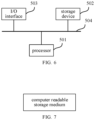
- the present disclosure further provides an electronic device, as shown in FIG. 6 , including: one or more processors 501; a storage device 502 having stored thereon one or more programs which, when executed by the one or more processors, cause the one or more processors to implement the CU division method according to the embodiments of the present disclosure.
- the electronic device may further include one or more input/output (I/O) interfaces 503 connected between the one or more processors and the storage device and configured to enable information interaction between the one or more processors and the storage device.
- I/O input/output
- the processor 501 is a device having data processing capability, and includes, but is not limited to, a Central Processing Unit (CPU); the storage device 502 is a device having data storage capability, and includes, but is not limited to, a Random Access Memory (RAM, more specifically, a Synchronous Dynamic RAM (SDRAM), a Double Data Rate SDRAM (DDR SDRAM), etc.), a Read-Only Memory (ROM), an Electrically Erasable Programmable Read-Only Memory (EEPROM), and a flash memory (FLASH); and the I/O interface (read/write) interface 503 is connected between the processor 501 and the storage device 502, is capable of enabling the information interaction between the processor 501 and the storage device 502, and includes, but is not limited to, a data bus (Bus).
- a data bus Bus
- the processor 501, the storage device 502, and the I/O interface 503 are connected to each other through a bus 504, and then are connected to other components of a computing device.
- the present disclosure further provides a computer readable storage medium.
- the computer readable storage medium has stored thereon a computer program which, when executed by a processor, implements the CU division method according to the embodiments of the present disclosure.
- the H265/ HEVC greatly improves the compression ratio, but the coding complexity is also increased by several times, and the calculation method in which all the CU division modes are traversed and the RDCs are calculated to select the optimal CU division mode takes up most of the time consumed by the H265/HEVC coding.
- the present disclosure provides the ViT-based CU division method for video coding and decoding, which can, by taking the minimum basic block for division of the CTU as the input, outputting each division depth corresponding to the minimum basic block, performing attention mechanism calculation on the patches, improve video coding efficiency and enable real-time high-quality video coding.
- the division between the functional modules/units stated above is not necessarily corresponding to the division of physical components; for example, one physical component may have a plurality of functions, or one function or operation may be performed through cooperation of several physical components.
- Some or all of the physical components may be implemented as software executed by a processor, such as a central processing unit, a digital signal processor or a microprocessor, or may be implemented as hardware, or may be implemented as an integrated circuit, such as an application specific integrated circuit.
- a processor such as a central processing unit, a digital signal processor or a microprocessor
- Such software may be distributed on a computer-readable medium, which may include a computer storage medium (or a non-transitory medium) and a communication medium (or a transitory medium).
- the term "computer storage medium” includes volatile/nonvolatile and removable/non-removable media used in any method or technology for storing information (such as computer-readable instructions, data structures, program modules and other data).
- the computer storage medium includes, but is not limited to, an RAM, a Read-Only Memory (ROM), an EEPROM, a flash memory or other memory techniques, a Compact Disc Read Only Memory (CD-ROM), a Digital Versatile Disc (DVD) or other optical discs, a magnetic cassette, a magnetic tape, a magnetic disk or other magnetic storage devices, or any other medium which can be configured to store desired information and can be accessed by a computer.
- the communication media generally include computer-readable instructions, data structures, program modules, or other data in modulated data signals such as carrier wave or other transmission mechanism, and may include any information delivery medium.
Landscapes
- Engineering & Computer Science (AREA)
- Signal Processing (AREA)
- Multimedia (AREA)
- Physics & Mathematics (AREA)
- Theoretical Computer Science (AREA)
- General Health & Medical Sciences (AREA)
- Computing Systems (AREA)
- Computational Linguistics (AREA)
- Data Mining & Analysis (AREA)
- Evolutionary Computation (AREA)
- Biomedical Technology (AREA)
- Molecular Biology (AREA)
- Biophysics (AREA)
- General Engineering & Computer Science (AREA)
- General Physics & Mathematics (AREA)
- Mathematical Physics (AREA)
- Software Systems (AREA)
- Artificial Intelligence (AREA)
- Life Sciences & Earth Sciences (AREA)
- Health & Medical Sciences (AREA)
- Compression Or Coding Systems Of Tv Signals (AREA)
Abstract
Description
- The present disclosure claims the priority to
Chinese Patent Application No. 202210770312.5 entitled "CODING UNIT DIVISION METHOD, ELECTRONIC DEVICE AND COMPUTER READABLE STORAGE MEDIUM" and filed on June 30, 2022 - The present disclosure relates to the field of communications, and in particular, to a coding unit division method, an electronic device, and a computer readable storage medium.
- With the improvement of material and spiritual standards of living of people, higher and higher requirements are proposed for high definition videos or even ultra-high definition videos. The core problem of how to reduce bandwidth consumption while ensuring video quality becomes the focus of research. Compared with the previous advanced video coding standard H264/Advanced Video Coding (AVC), H265/High Efficiency Video Coding (HEVC) greatly improves compression ratio by introducing a Coding Unit (CU) quadtree division structure and multi-angle intra prediction.
- The present disclosure provides a coding unit division method, an electronic device, and a computer readable storage medium.
- The present disclosure provides a coding unit division method, including: dividing an original image to obtain a plurality of coding tree units; with a patch taken as granularity, dividing each of the coding tree units into a patch one-dimensional array including a plurality of patches; performing vision attention mechanism calculation on each of the patches in the patch one-dimensional array to obtain a coding unit division depth corresponding to each of the patches in the patch one-dimensional array; and performing, for each of the coding tree units, coding unit division on the coding tree unit according to the coding unit division depth corresponding to each of the patches.
- The present disclosure provides an electronic device, including: one or more processors; and a storage device having stored thereon one or more programs which, when executed by the one or more processors, cause the one or more processors to implement the coding unit division method according to the present disclosure.
- The present disclosure provides a computer readable storage medium having stored thereon a computer program which, when executed by a processor, implements the coding unit division method according to the present disclosure.
-
-
FIG. 1 is a flowchart illustrating a coding unit division method according to the present disclosure. -
FIG. 2 is a flowchart illustrating a conventional coding method. -
FIG. 3 is a schematic diagram of a Vision Transform-based CU division structure for video coding and decoding according to the present disclosure. -
FIG. 4 is a correspondence table of CU division sizes and CU division depths. -
FIG. 5 is a schematic diagram of division depths of a coding tree unit (64×64). -
FIG. 6 is a schematic diagram of an electronic device according to the present disclosure. -
FIG. 7 is a schematic diagram of a computer readable storage medium according to the present disclosure. - It should be understood that the specific embodiments described herein are merely intended to explain the present disclosure, rather than limiting the present disclosure.
- In the following description, the terms such as "module", "component" and "unit" used to indicate elements are employed merely for facilitating the description of the present disclosure, and those terms have no particular meaning in themselves. Thus, "module ", "component" and "unit" can be used together.
- In the following description, suffixes such as "module", "component", or "unit" used to indicate elements are used merely for facilitating the explanation of the present disclosure, and have no peculiar meaning by themselves. Thus, "module", "component" or "unit" may be used mixedly.
- With the introduction of new coding techniques into the HEVC, coding time complexity is increased by several times compared with the H264/AVC. A division process based on a CU quadtree includes traversing all possible CU division results of a current Coding Tree Unit (CTU) (64×64 pixels), respectively calculating a Rate Distortion Cost (RDC) based on each CU division mode, and finally selecting the CU division mode with the minimum RDC for coding. Although the division process can reduce bit rate, the division process takes up 80% of coding time, and increases coding complexity by several times. Therefore, how to effectively find an optimal CU division mode in the HEVC is important for improving execution efficiency of H265/HEVC coding.
- Since the Vision Transform (ViT) mechanism is proposed, the patch-based attention mechanism, as compared with conventional Convolutional Neural Network (CNN), attracts wide attention in the field of image video application due to the advantages in terms of desired training data, computational complexity, and practical performance.
- In view of a conflict between code rate and coding complexity, based on the ViT attention mechanism, the present disclosure provides a ViT-based CU division method for video coding and decoding.
- The present disclosure provides a CU division method. As shown in
FIG. 1 , the method includes the following operations S100 to S400. - At operation S100, dividing an original image to obtain a plurality of CTUs.
- At operation S200, with a patch taken as granularity, dividing each CTU into a patch one-dimensional array including a plurality of patches.
- At operation S300, performing vision attention mechanism calculation on each of the patches in the patch one-dimensional array to obtain a CU division depth corresponding to each of the patches in the patch one-dimensional array.
- At operation S400, performing CU division on the CTU according to the CU division depth corresponding to each patch.
- The present disclosure provides the CU block division method for video coding and decoding based on the vision attention mechanism. The original image is first divided into a plurality of CTUs. A current CTU pixel block (e.g., a 64×64 pixel block) is divided into a plurality of patches according to the CU minimum division unit, that is, each patch has a size of the CU minimum division unit.
- With the patches used as basic blocks, the patches are coded respectively using the pixel values included in the patches. All the patches in one CTU are arranged into a one-dimensional array in unit of patch. For example, a CTU of 64×64 pixels may be divided into 256 patches of 4×4 pixels, and the 256 patches originally arranged in a matrix is transformed into a linearly arranged patch one-dimensional array. It should be noted that "one-dimensional" is for the patches, rather than a dimension of the pixels. For the pixels, the dimension is 256*16, with 256 representing the number of the patches, and 16 representing the number of the pixels contained in each patch.
- Then, the above coding information is subjected to linear transformation projection and addition of position coding information, and is then input to a Vision Transformer (ViT). The CU division depth corresponding to each patch is obtained after a series of calculations of a Vision Transformer attention mechanism are performed, and CU division is then performed on the current CTU according to the CU division depth corresponding to each patch. All the CTUs of the original image are subjected to CU division with the above method, thereby realizing CU division of the whole original image.
-
FIG. 2 is a schematic diagram illustrating the overall flow of coding according to the H265/HEVC protocol. InFIG. 2 , the part enclosed in the dashed box is where a ViT network of the present disclosure replaces a conventional algorithm. As can be seen fromFIG. 2 , the present disclosure adopts the ViT network to replace the conventional calculation method in which cyclic traversal is performed to find the optimal CU division mode. - Compared with the conventional H265/HEVC, the ViT-based CU division method for video coding and decoding provided in the present disclosure avoids, by reasonable training and learning, the coding complexity caused by the traversal of all the CU division modes in the conventional CU division method. Moreover, compared with the conventional CNN, the ViT-based CU division method for video coding and decoding provided in the present disclosure reduces computational complexity of the neural network and increases coding speed. By learning of the attention mechanism, the ViT-based CU division method for video coding and decoding provided in the present disclosure improves high real-time performance and reliability of the H265/HEVC protocol while ensuring video coding quality.
- In some embodiments, the CTU is divided into a plurality of layers according to values of depths of the CTU, and performing CU division on the CTU according to the CU division depth corresponding to each patch (i.e., operation S400) includes: performing CU division on the CTU in order of depth and layer by layer according to the CU division depth corresponding to each patch.
- Further, performing CU division on the CTU in order of depth and layer by layer according to the CU division depth corresponding to each patch includes: from a layer with a current depth i being 0, traversing and counting the number Ni of all the patches, the corresponding CU division depth of which is greater than i, in the CTU, with i denoting the current depth, and i and Ni being natural numbers; if Ni is greater than a CU division threshold αi set in advance for the current depth i, dividing current CUs in the CTU, and continuing to perform CU division for a next depth, with αi being greater than 0; and if Ni is less than or equal to the CU division threshold αi, CU division of the CTU is ended.
- According to the CU division method provided in the present disclosure, the current CTU is subjected to traversal, counting, and CU division at each depth according to the CU division depth corresponding to each patch. The conventional method of cyclically traversing all the CU division modes is replaced, so that the computational complexity caused by traversing all the CU division modes is avoided, and the coding speed is increased.
- In the embodiments of the present disclosure, a CU division threshold is set in advance for each depth, and is taken as a determination condition for assessing whether CU division is needed at the current depth.
- For example, the depths of the CTU range from 0 to 3, the CTU is accordingly divided into four layers from top to bottom, i.e., 64×64→32×32→16×16→8×8, and a CU division threshold αi is set in advance for each layer. According to the CU division depth corresponding to each patch obtained by the vision attention mechanism calculation as described above, at each layer, the number of the patches having the CU division depth exceeding the current depth is counted and taken as a patch depth predicted value number of the current depth. If the patch depth predicted value number of the current depth is greater than the CU division threshold set in advance for the current depth, it is determined that the current CU is dividable, so that the current CU is divided into four parts. After the division is completed at one layer, at a next layer, a patch depth predicted value number of a next depth is counted and compared with the CU division threshold corresponding to the next depth, so as to determine whether to perform CU division, and so on. In this way, the CU division of the CTU is performed by recursively performing traversal and counting in order of depth and layer by layer from top to bottom until a patch depth predicted value number of a certain depth is less than or equal to the CU division threshold for the certain depth, and then the CU division of the CTU is ended.
- It should be noted that the preset CU division threshold is not limited to being compared with the patch depth predicted value number, and more comparison rules may be added or perform the comparison for other indexes, for example, a proportion of the patch depth predicted value number to a total number of the patches at the current layer, or a patch depth is compared with an actual depth of a currently traversed CU.
- In some embodiments, performing vision attention mechanism calculation on each of the patches in the patch one-dimensional array to obtain the CU division depth corresponding to each of the patches in the patch one-dimensional array (i.e., operation S300) includes: performing dimension expansion on the patch one-dimensional array to obtain an input array after dimension expansion; performing vision attention mechanism calculation on the input array to obtain a first calculation result; performing fully-connected-layer calculation on the first calculation result to obtain a second calculation result; and performing Softmax-layer calculation on the second calculation result to obtain the CU division depth corresponding to each of the patches in the patch one-dimensional array.
- In some embodiments, performing dimension expansion on the patch one-dimensional array includes: performing linear projection on the patch one-dimensional array, and adding position coding information, so as to obtain the input array after dimension expansion.
-
FIG. 3 is a schematic diagram of a ViT-based CU division structure for video coding and decoding according to the present disclosure. InFIG. 3 , on the left is a schematic diagram illustrating division of a CTU (64×64) divided into patches having sizes of 4×4; and on the right is a schematic diagram illustrating flattening the patches obtained by division to obtain a one-dimensional input, performing linear projection, adding position coding information, inputting into a Vision Transformer layer, an output corresponding to each patch which is obtained after performing vision attention mechanism calculation on each patch is taken as an input into a Fully Connected Layer and then into a Softmax Layer to obtain the CU division depth corresponding to each patch, and mapping to Patches Depth Label. - In some embodiments, performing vision attention mechanism calculation on each of the patches in the patch one-dimensional array to obtain the CU division depth corresponding to each of the patches in the patch one-dimensional array (i.e., operation S300) further includes: performing at least one round of vision attention mechanism training by back propagation to obtain a depth predicted value of each patch; and determining the depth predicted value of the patch which obtains the minimum loss by a loss function as the CU division depth corresponding to each patch in the patch one-dimensional array.
- In the embodiments of the present disclosure, the CU division depth corresponding to each patch in the patch one-dimensional array may be taken as a label corresponding to each patch. After the CU division depth corresponding to each patch is obtained by vision attention mechanism calculation, the Vision Transformer layer, the fully connected layer, and the Softmax layer may be further trained by back propagation to obtain the depth predicted value of each patch, the depth predicted value of each patch is compared with a real label, the depth predicted value of each patch is evaluated with a Softmax-layer loss function, and it is determined to be the optimal depth predicted value if the minimum loss is obtained.
- In the embodiments of the present disclosure, each patch may be a 4*4 pixel block divided according to the CU minimum division unit, and each CTU may be a 64*64 pixel block.
-
FIG. 4 is a correspondence table of CU division sizes and CU division depths, a CU division size may be any one of 64×64, 32×32, 16×16, 8×8, and 4×4, and the corresponding CU division depths are 0, 1, 2, 3, and 4, respectively. -
FIG. 5 is a schematic diagram of a CU division mode for a CTU (64×64), and CUs and corresponding division depths are marked. - In the training and learning processes of the vision attention mechanism, after the CU division depth is predicted for each patch based on ViT, the CU depth predicted values of the patches may be counted, and the CTU may be subjected to counting and division again from top to bottom.
- The basic operations of deep learning which can be used in the embodiments of the present disclosure include, but are not limited to: ViT, Deconvolution, Rectified Linear Unit (ReLU), Sigmoid, Full-Connection, and Reshape.
- It should be noted that, in addition to using the ViT network structure, the network structures such as a Residual Network (ResNet), a CNN, and a Squeeze-and-Excitation Residual Network (SE-ResNet) may be used to replace the ViT network structure to achieve CU division.
- The CU division method provided in the embodiments of the present disclosure can be applied to all scenarios where video coding is needed, such as a Video Processing Unit (VPU), a built-in algorithm of a video codec chip, an intelligent cockpit, video compression, video transmission, and so on.
- The specific application of the CU division method provided in the present disclosure is illustrated below by an example.
-
FIG. 3 illustrates the overall flow of the present disclosure, an input is a CTU (64×64) video CTU in the H265/HEVC, and an output is a division depth corresponding to each patch obtained after the CTU is divided in unit of patch (4×4). CU division may be finally completed according to a count of the depths corresponding to the patches in the CTU. - The example mainly includes the operations of data set and label preparation, Vision Transformer training, Vision Transformer reasoning, and CU counting and division. Implementation details of each operation are described below.
- A video sequence image may be acquired from public data sets such as Vimeo90K, REDS4, and VID4 as original data. The original image is partitioned to obtain CTUs having sizes of 64×64, CU division modes of each CTU are subjected to exhaustive traversal and are sequentially subjected to RDC calculation, and the CU division mode with the minimum RDC is selected. Finally, the CTU is divided into patches having sizes of 4×4, and each patch is assigned with a depth (a depth label) of a CU to which the patch belongs.
- The obtained patch data of each CTU and the corresponding labels are respectively transformed into one-dimensional data, and the patch data of each CTU after being transformed may be expressed as input = [patch_0, patch_1, patch_2, ... patch_255], where patch_0, patch_1, patch_2, ... patch_255 are patch coding data, and a dimension of the input is 256*16; and the corresponding labels of the patches may be expressed as label= [label_0, label_1, label_2, ... label_255], where label_0, label_1, label_2, ... label_255 respectively represent the division depths of the CUs to which patch_0, patch_1, patch_2, ... patch_255 belong. The input is then subjected to linear projection and addition of position coding information, at this time, the dimension of the input is 256*768. Afterwards, the input is input into the Vision transform for attention mechanism calculation to obtain an intermediate result output of a ViT result output ViT_output = [ViT_0, ViT_1, ViT_2, ... ViT_255], the ViT_output is then taken as an input of the subsequent fully connected layer and Softmax layer to obtain the depth corresponding to each patch, i.e., depth = [dep_0, dep_1, dep_2, ... dep_255], the depth is compared with the real label, and the Vision Transform, the fully connected layer, and the Softmax layer are trained by back propagation. The loss function of the Softmax layer is a multi-class cross entropy loss:

- After the training of the Vision Transformer, the fully connected layer, and the Softmax layer is completed, in a reasoning stage, as described in the operation of Vision Transformer training, the one-dimensional data, which is obtained by transformation of the patches of the current CTU, is taken as an input, and the input is input into the Vision Transformer, the fully connected layer, and the Softmax layer to obtain the depth corresponding to each patch.
- The division thresholds α0, α1, α2, α3 are set, and the CTU is recursively subjected to traversal, counting, and division from top to bottom (64×64→32×32→16×16→8×8).
- 1) Firstly, the patch depth predicted value number greater than the depth of 0 in a top layer (64×64) of the CTU (the depth is 0, and the size is 64×64) is counted; if a proportion of the patch depth predicted value number > α0, the current CTU is divided into four parts; and if the proportion of the patch depth predicted value number is less than or equal to α0, CU division is ended.
- 2) The patch depth predicted value number greater than the depth of 1 in all 32×32 blocks (CTU) (the depth is 1, and the sizes are 32×32) is counted; if a proportion of the patch depth predicted value number>α1, the current CU is divided into four parts; and if the proportion of the patch depth predicted value number is less than or equal to α1, division of the current CU is ended.
- 3) The patch depth predicted value number greater than the depth of 2 in all 16×16 blocks (CTU) (the depth is 2, and the sizes are 16×16) is counted; if a proportion of the patch depth predicted value number>α2, the current CU is divided into four parts; and if the proportion of the patch depth predicted value number is less than or equal to α2, division of the current CU is ended.
- 4) The patch depth predicted value number greater than the depth of 3 in all 8×8 blocks (CTU) (the depth is 3, and the sizes are 8×8) is counted; if a proportion of the patch depth predicted value number>α3, the current CU is divided into four parts; and if the proportion of the patch depth predicted value number is less than or equal to α3, division of the current CU is ended.
- Finally, a final division mode of the CUs in the CTU is obtained and used in subsequent video coding and decoding processes.
- The present disclosure further provides an electronic device, as shown in
FIG. 6 , including: one ormore processors 501; astorage device 502 having stored thereon one or more programs which, when executed by the one or more processors, cause the one or more processors to implement the CU division method according to the embodiments of the present disclosure. - In addition, the electronic device may further include one or more input/output (I/O) interfaces 503 connected between the one or more processors and the storage device and configured to enable information interaction between the one or more processors and the storage device.
- The
processor 501 is a device having data processing capability, and includes, but is not limited to, a Central Processing Unit (CPU); thestorage device 502 is a device having data storage capability, and includes, but is not limited to, a Random Access Memory (RAM, more specifically, a Synchronous Dynamic RAM (SDRAM), a Double Data Rate SDRAM (DDR SDRAM), etc.), a Read-Only Memory (ROM), an Electrically Erasable Programmable Read-Only Memory (EEPROM), and a flash memory (FLASH); and the I/O interface (read/write)interface 503 is connected between theprocessor 501 and thestorage device 502, is capable of enabling the information interaction between theprocessor 501 and thestorage device 502, and includes, but is not limited to, a data bus (Bus). - In some embodiments, the
processor 501, thestorage device 502, and the I/O interface 503 are connected to each other through abus 504, and then are connected to other components of a computing device. - The present disclosure further provides a computer readable storage medium. As shown in
FIG. 7 , the computer readable storage medium has stored thereon a computer program which, when executed by a processor, implements the CU division method according to the embodiments of the present disclosure. - As stated above, compared with the previous advanced video coding standard H264/ AVC protocol, the H265/ HEVC greatly improves the compression ratio, but the coding complexity is also increased by several times, and the calculation method in which all the CU division modes are traversed and the RDCs are calculated to select the optimal CU division mode takes up most of the time consumed by the H265/HEVC coding. The present disclosure provides the ViT-based CU division method for video coding and decoding, which can, by taking the minimum basic block for division of the CTU as the input, outputting each division depth corresponding to the minimum basic block, performing attention mechanism calculation on the patches, improve video coding efficiency and enable real-time high-quality video coding.
- It should be understood by those of ordinary skill in the art that the functional modules/units in all or some of the operations, the systems, and the devices in the method disclosed above may be implemented as software, firmware, hardware, or suitable combinations thereof.
- If implemented as hardware, the division between the functional modules/units stated above is not necessarily corresponding to the division of physical components; for example, one physical component may have a plurality of functions, or one function or operation may be performed through cooperation of several physical components. Some or all of the physical components may be implemented as software executed by a processor, such as a central processing unit, a digital signal processor or a microprocessor, or may be implemented as hardware, or may be implemented as an integrated circuit, such as an application specific integrated circuit. Such software may be distributed on a computer-readable medium, which may include a computer storage medium (or a non-transitory medium) and a communication medium (or a transitory medium). As well known by those of ordinary skill in the art, the term "computer storage medium" includes volatile/nonvolatile and removable/non-removable media used in any method or technology for storing information (such as computer-readable instructions, data structures, program modules and other data). The computer storage medium includes, but is not limited to, an RAM, a Read-Only Memory (ROM), an EEPROM, a flash memory or other memory techniques, a Compact Disc Read Only Memory (CD-ROM), a Digital Versatile Disc (DVD) or other optical discs, a magnetic cassette, a magnetic tape, a magnetic disk or other magnetic storage devices, or any other medium which can be configured to store desired information and can be accessed by a computer. In addition, it is well known by those of ordinary skill in the art that the communication media generally include computer-readable instructions, data structures, program modules, or other data in modulated data signals such as carrier wave or other transmission mechanism, and may include any information delivery medium.
- The preferable embodiments of the present disclosure are described above with reference to the drawings, but the scope of the claims of the present disclosure is not limited thereto. Any modification, equivalent replacement and improvement made by those of ordinary skill without departing from the scope and essence of the present disclosure should be considered to fall within the scope of the claims of the present disclosure.
Claims (11)
- A coding unit division method, comprising:dividing an original image to obtain a plurality of coding tree units;with a patch taken as granularity, dividing each of the coding tree units into a patch one-dimensional array comprising a plurality of patches;performing vision attention mechanism calculation on each of the patches in the patch one-dimensional array to obtain a coding unit division depth corresponding to each of the patches in the patch one-dimensional array; andperforming, for each of the coding tree units, coding unit division on the coding tree unit according to the coding unit division depth corresponding to each of the patches.
- The coding unit division method of claim 1, wherein each of the coding tree units is divided into a plurality of layers according to values of depths of each of the coding tree units, and performing coding unit division on the coding tree unit according to the coding unit division depth corresponding to each of the patches comprises:
performing coding unit division on the coding tree unit in order of depth and layer by layer according to the coding unit division depth corresponding to each of the patches. - The coding unit division method of claim 2, wherein performing coding unit division on the coding tree unit in order of depth and layer by layer according to the coding unit division depth corresponding to each of the patches comprises:from a layer with a current depth i being 0, traversing and counting a number Ni of all the patches, the corresponding coding unit division depth of which is greater than i, in the coding tree unit, wherein i denotes the current depth, and i and Ni are natural numbers;if Ni is greater than a coding unit division threshold αi set in advance for the current depth i, dividing current coding units in the coding tree unit, and continuing to perform coding unit division for a next depth, wherein αi is greater than 0; andif Ni is less than or equal to the coding unit division threshold αi set in advance for the current depth i, coding unit division of the coding tree unit is ended.
- The coding unit division method of claim 1, wherein performing vision attention mechanism calculation on each of the patches in the patch one-dimensional array to obtain the coding unit division depth corresponding to each of the patches in the patch one-dimensional array comprises:performing dimension expansion on the patch one-dimensional array to obtain an input array after dimension expansion;performing vision attention mechanism calculation on the input array to obtain a first calculation result;performing fully-connected-layer calculation on the first calculation result to obtain a second calculation result; andperforming Softmax-layer calculation on the second calculation result to obtain the coding unit division depth corresponding to each of the patches in the patch one-dimensional array.
- The coding unit division method of claim 4, wherein performing dimension expansion on the patch one-dimensional array comprises:
performing linear projection on the patch one-dimensional array, and adding position coding information, so as to obtain the input array after dimension expansion. - The coding unit division method of claim 4, wherein performing vision attention mechanism calculation on each of the patches in the patch one-dimensional array to obtain the coding unit division depth corresponding to each of the patches in the patch one-dimensional array further comprises:performing at least one round of vision attention mechanism training by back propagation to obtain a depth predicted value of each of the patches; anddetermining the depth predicted value of a patch which obtains a minimum loss by a loss function as the coding unit division depth corresponding to each of the patches in the patch one-dimensional array.
- The coding unit division method of any one of claims 1 to 6, wherein the patches are 4*4 pixel blocks obtained by division according to a coding-unit minimum division unit.
- The coding unit division method of any one of claims 1 to 6, wherein the coding tree units are 64*64 pixel blocks.
- An electronic device, comprising:one or more processors; anda storage device having stored thereon one or more programs which, when executed by the one or more processors, cause the one or more processors to implement the coding unit division method of any one of claims 1 to 8.
- The electronic device of claim 9, further comprising:
one or more input/output, called I/O, interfaces, which are connected between the one or more processors and the storage device and configured to enable information interaction between the one or more processors and the storage device. - A computer readable storage medium having stored thereon a computer program which, when executed by a processor, implements the coding unit division method of any one of claims 1 to 8.
Applications Claiming Priority (2)
| Application Number | Priority Date | Filing Date | Title |
|---|---|---|---|
| CN202210770312.5A CN117376572B (en) | 2022-06-30 | 2022-06-30 | CU partitioning method, electronic device, and computer-readable storage medium |
| PCT/CN2023/101495 WO2024001886A1 (en) | 2022-06-30 | 2023-06-20 | Coding unit division method, electronic device and computer readable storage medium |
Publications (2)
| Publication Number | Publication Date |
|---|---|
| EP4531394A1 true EP4531394A1 (en) | 2025-04-02 |
| EP4531394A4 EP4531394A4 (en) | 2026-04-22 |
Family
ID=89383268
Family Applications (1)
| Application Number | Title | Priority Date | Filing Date |
|---|---|---|---|
| EP23830065.1A Pending EP4531394A4 (en) | 2022-06-30 | 2023-06-20 | Coding unit method, electronic device and computer-readable storage medium |
Country Status (3)
| Country | Link |
|---|---|
| EP (1) | EP4531394A4 (en) |
| CN (1) | CN117376572B (en) |
| WO (1) | WO2024001886A1 (en) |
Family Cites Families (6)
| Publication number | Priority date | Publication date | Assignee | Title |
|---|---|---|---|---|
| CN109618152B (en) * | 2018-12-14 | 2020-09-08 | 北京数码视讯软件技术发展有限公司 | Depth division coding method and device and electronic equipment |
| CN111510728B (en) * | 2020-04-12 | 2022-05-06 | 北京工业大学 | A fast coding method for HEVC intraframe based on deep feature representation and learning |
| CN113382245A (en) * | 2021-07-02 | 2021-09-10 | 中国科学技术大学 | Image dividing method and device |
| CN113709455B (en) * | 2021-09-27 | 2023-10-24 | 北京交通大学 | A multi-level image compression method using Transformer |
| CN114286093B (en) * | 2021-12-24 | 2025-05-23 | 杭州电子科技大学 | A fast video encoding method based on deep neural network |
| CN114550033A (en) * | 2022-01-29 | 2022-05-27 | 珠海横乐医学科技有限公司 | Video sequence guide wire segmentation method and device, electronic equipment and readable medium |
-
2022
- 2022-06-30 CN CN202210770312.5A patent/CN117376572B/en active Active
-
2023
- 2023-06-20 WO PCT/CN2023/101495 patent/WO2024001886A1/en not_active Ceased
- 2023-06-20 EP EP23830065.1A patent/EP4531394A4/en active Pending
Also Published As
| Publication number | Publication date |
|---|---|
| WO2024001886A1 (en) | 2024-01-04 |
| EP4531394A4 (en) | 2026-04-22 |
| CN117376572B (en) | 2026-01-13 |
| CN117376572A (en) | 2024-01-09 |
Similar Documents
| Publication | Publication Date | Title |
|---|---|---|
| CN119031147B (en) | Video coding and decoding acceleration method and system based on learning task perception mechanism | |
| US11778172B2 (en) | Colour component prediction method, encoder, decoder and storage medium | |
| US20170054988A1 (en) | Methods and Devices for Coding or Decoding Image | |
| CN102637302B (en) | Image coding method | |
| CN120475170A (en) | Data compression and transmission method and system for ferry inspection images | |
| CN118101951A (en) | A method and system for compressing regions of interest in complex scenes of remote sensing images | |
| CN115484464B (en) | Video coding method and device | |
| US20260032231A1 (en) | Encoding method, decoding method, and storage medium | |
| US20250317591A1 (en) | Image coding and decoding method and apparatus, and storage medium | |
| CN115941943A (en) | A kind of HEVC video encoding method | |
| US20250024085A1 (en) | Image encoding method, electronic device, and storage medium | |
| CN117376572B (en) | CU partitioning method, electronic device, and computer-readable storage medium | |
| EP4676047A1 (en) | Image decoding and encoding method and apparatus, device, and storage medium | |
| US20250047881A1 (en) | Picture decoding method and apparatus, and picture encoding method and apparatus | |
| CN118555396A (en) | Encoding processing method, device, equipment and storage medium | |
| CN119484846B (en) | Video coding CU block classification method and medium based on lightweight deep learning model | |
| CN121168534B (en) | Coding and decoding method based on logarithmic quantization and artificial intelligent chip | |
| WO2022183345A1 (en) | Encoding method, decoding method, encoder, decoder, and storage medium | |
| US20250260817A1 (en) | Video coding method, network device, and storage medium | |
| CN116055734B (en) | Video encoding methods, apparatus, equipment and storage media | |
| WO2026055922A1 (en) | Video decoding/encoding method for device deployed with neural network and video coding device incorporating the same | |
| WO2026081276A1 (en) | Video decoding method and encoding method applying dimension-decomposition for weights determination | |
| CN119854503B (en) | Machine video feature encoding and decoding method and device, electronic equipment and storage medium | |
| US20260122241A1 (en) | Image decoding method and apparatus, image coding method and apparatus, device and storage medium | |
| CN113473150B (en) | Image processing method and device and computer readable storage device |
Legal Events
| Date | Code | Title | Description |
|---|---|---|---|
| STAA | Information on the status of an ep patent application or granted ep patent |
Free format text: STATUS: THE INTERNATIONAL PUBLICATION HAS BEEN MADE |
|
| PUAI | Public reference made under article 153(3) epc to a published international application that has entered the european phase |
Free format text: ORIGINAL CODE: 0009012 |
|
| STAA | Information on the status of an ep patent application or granted ep patent |
Free format text: STATUS: REQUEST FOR EXAMINATION WAS MADE |
|
| 17P | Request for examination filed |
Effective date: 20241227 |
|
| AK | Designated contracting states |
Kind code of ref document: A1 Designated state(s): AL AT BE BG CH CY CZ DE DK EE ES FI FR GB GR HR HU IE IS IT LI LT LU LV MC ME MK MT NL NO PL PT RO RS SE SI SK SM TR |
|
| DAV | Request for validation of the european patent (deleted) | ||
| DAX | Request for extension of the european patent (deleted) | ||
| REG | Reference to a national code |
Ref country code: DE Ref legal event code: R079 Free format text: PREVIOUS MAIN CLASS: H04N0019149000 Ipc: H04N0019119000 |
|
| A4 | Supplementary search report drawn up and despatched |
Effective date: 20260325 |
|
| RIC1 | Information provided on ipc code assigned before grant |
Ipc: H04N 19/119 20140101AFI20260319BHEP Ipc: H04N 19/176 20140101ALI20260319BHEP Ipc: H04N 19/96 20140101ALI20260319BHEP Ipc: G06N 3/084 20230101ALI20260319BHEP |