EP4531134A1 - Electrochemical apparatus and electrical apparatus - Google Patents
Electrochemical apparatus and electrical apparatus Download PDFInfo
- Publication number
- EP4531134A1 EP4531134A1 EP22948511.5A EP22948511A EP4531134A1 EP 4531134 A1 EP4531134 A1 EP 4531134A1 EP 22948511 A EP22948511 A EP 22948511A EP 4531134 A1 EP4531134 A1 EP 4531134A1
- Authority
- EP
- European Patent Office
- Prior art keywords
- manganese oxide
- lithium manganese
- electrochemical apparatus
- positive electrode
- lithium
- Prior art date
- Legal status (The legal status is an assumption and is not a legal conclusion. Google has not performed a legal analysis and makes no representation as to the accuracy of the status listed.)
- Pending
Links
Images

Classifications
-
- H—ELECTRICITY
- H01—ELECTRIC ELEMENTS
- H01M—PROCESSES OR MEANS, e.g. BATTERIES, FOR THE DIRECT CONVERSION OF CHEMICAL ENERGY INTO ELECTRICAL ENERGY
- H01M4/00—Electrodes
- H01M4/02—Electrodes composed of, or comprising, active material
- H01M4/36—Selection of substances as active materials, active masses, active liquids
- H01M4/48—Selection of substances as active materials, active masses, active liquids of inorganic oxides or hydroxides
- H01M4/50—Selection of substances as active materials, active masses, active liquids of inorganic oxides or hydroxides of manganese
- H01M4/505—Selection of substances as active materials, active masses, active liquids of inorganic oxides or hydroxides of manganese of mixed oxides or hydroxides containing manganese for inserting or intercalating light metals, e.g. LiMn2O4 or LiMn2OxFy
-
- H—ELECTRICITY
- H01—ELECTRIC ELEMENTS
- H01M—PROCESSES OR MEANS, e.g. BATTERIES, FOR THE DIRECT CONVERSION OF CHEMICAL ENERGY INTO ELECTRICAL ENERGY
- H01M10/00—Secondary cells; Manufacture thereof
- H01M10/05—Accumulators with non-aqueous electrolyte
- H01M10/052—Li-accumulators
-
- H—ELECTRICITY
- H01—ELECTRIC ELEMENTS
- H01M—PROCESSES OR MEANS, e.g. BATTERIES, FOR THE DIRECT CONVERSION OF CHEMICAL ENERGY INTO ELECTRICAL ENERGY
- H01M10/00—Secondary cells; Manufacture thereof
- H01M10/05—Accumulators with non-aqueous electrolyte
- H01M10/052—Li-accumulators
- H01M10/0525—Rocking-chair batteries, i.e. batteries with lithium insertion or intercalation in both electrodes; Lithium-ion batteries
-
- H—ELECTRICITY
- H01—ELECTRIC ELEMENTS
- H01M—PROCESSES OR MEANS, e.g. BATTERIES, FOR THE DIRECT CONVERSION OF CHEMICAL ENERGY INTO ELECTRICAL ENERGY
- H01M4/00—Electrodes
- H01M4/02—Electrodes composed of, or comprising, active material
- H01M4/13—Electrodes for accumulators with non-aqueous electrolyte, e.g. for lithium-accumulators; Processes of manufacture thereof
- H01M4/131—Electrodes based on mixed oxides or hydroxides, or on mixtures of oxides or hydroxides, e.g. LiCoOx
-
- H—ELECTRICITY
- H01—ELECTRIC ELEMENTS
- H01M—PROCESSES OR MEANS, e.g. BATTERIES, FOR THE DIRECT CONVERSION OF CHEMICAL ENERGY INTO ELECTRICAL ENERGY
- H01M4/00—Electrodes
- H01M4/02—Electrodes composed of, or comprising, active material
- H01M4/36—Selection of substances as active materials, active masses, active liquids
- H01M4/362—Composites
- H01M4/364—Composites as mixtures
-
- H—ELECTRICITY
- H01—ELECTRIC ELEMENTS
- H01M—PROCESSES OR MEANS, e.g. BATTERIES, FOR THE DIRECT CONVERSION OF CHEMICAL ENERGY INTO ELECTRICAL ENERGY
- H01M4/00—Electrodes
- H01M4/02—Electrodes composed of, or comprising, active material
- H01M2004/026—Electrodes composed of, or comprising, active material characterised by the polarity
- H01M2004/028—Positive electrodes
-
- Y—GENERAL TAGGING OF NEW TECHNOLOGICAL DEVELOPMENTS; GENERAL TAGGING OF CROSS-SECTIONAL TECHNOLOGIES SPANNING OVER SEVERAL SECTIONS OF THE IPC; TECHNICAL SUBJECTS COVERED BY FORMER USPC CROSS-REFERENCE ART COLLECTIONS [XRACs] AND DIGESTS
- Y02—TECHNOLOGIES OR APPLICATIONS FOR MITIGATION OR ADAPTATION AGAINST CLIMATE CHANGE
- Y02E—REDUCTION OF GREENHOUSE GAS [GHG] EMISSIONS, RELATED TO ENERGY GENERATION, TRANSMISSION OR DISTRIBUTION
- Y02E60/00—Enabling technologies; Technologies with a potential or indirect contribution to GHG emissions mitigation
- Y02E60/10—Energy storage using batteries
Definitions
- This application relates to the field of batteries, and specifically, to an electrochemical apparatus and an electrical apparatus.
- Lithium-ion batteries due to their advantages such as light weight and high energy density, are gradually replacing lead-acid batteries in fields such as electric transportation tools, with a market penetration rate increasing year by year.
- Lithium manganese oxide due to its low cost, high safety, and good low-temperature performance, has been widely used as a positive electrode material for lithium-ion batteries in fields such as electric transportation tools.
- the disadvantages of the lithium manganese oxide such as low actual capacity and fast capacity decay seriously limit the use of lithium manganese oxide.
- this application provides an electrochemical apparatus and an electrical apparatus including such electrochemical apparatus.
- the electrochemical apparatus of this application has high initial coulombic efficiency and excellent cycling performance on the basis of high energy density.
- this application provides an electrochemical apparatus including a positive electrode plate, where the positive electrode plate includes a positive electrode active material layer, and the positive electrode active material layer includes a first lithium manganese oxide and a second lithium manganese oxide; and in a fully discharged state of the electrochemical apparatus, through Raman test, the first lithium manganese oxide has a characteristic peak A in a range of 507 cm -1 ⁇ 10 cm -1 and a characteristic peak B in a range of 660 cm -1 ⁇ 10 cm -1 , and the second lithium manganese oxide has a characteristic peak C in a range of 625 cm -1 ⁇ 10 cm -1 .
- the characteristic peak A is a characteristic peak of an orthorhombic phase in the first lithium manganese oxide
- the characteristic peak B is a characteristic peak of a monoclinic phase in the first lithium manganese oxide
- the characteristic peak C is a characteristic peak of a spinel structure in the second lithium manganese oxide.
- the positive electrode active material layer of the electrochemical apparatus of this application includes both the first lithium manganese oxide and the second lithium manganese oxide.
- the orthorhombic phase and monoclinic phase in the first lithium manganese oxide have a high lithium storage capacity, and a solid solution formed by the coexistence of the monoclinic phase and the orthorhombic phase has oxygen vacancies.
- the first lithium manganese oxide has a higher initial charge specific capacity and can provide lithium ions for forming a solid electrolyte interface (SEI) film during the first-cycle charge of the electrochemical apparatus.
- SEI solid electrolyte interface
- the residual lithium ions in the first lithium manganese oxide can provide lithium ions for the destruction and regeneration of the SEI film, reducing the consumption of lithium ions in the second lithium manganese oxide, thereby improving the cycling performance of the electrochemical apparatus.
- a peak intensity of the characteristic peak A is I A
- a peak intensity of the characteristic peak B is I B , satisfying: 0.4 ⁇ I A /I B ⁇ 0.75.
- a Raman spectrum of the first lithium manganese oxide has a characteristic peak in a range of 570 cm -1 ⁇ 10 cm -1 .
- the characteristic peak in the range of 570 cm -1 ⁇ 10 cm -1 corresponds to a stretching mode of manganese ions bonded to axial oxygen atoms in the first lithium manganese oxide after discharged.
- a Raman spectrum of the second lithium manganese oxide has a characteristic peak in a range of 480 cm -1 ⁇ 10 cm -1 .
- the characteristic peak in the range of 480 cm -1 ⁇ 10 cm -1 corresponds to a T 2g vibration mode of Li in a lattice of the second lithium manganese oxide after discharged.
- a 60 ⁇ m ⁇ 50 ⁇ m test region is selected from a cross section of the positive electrode plate; and through Raman test, in a Raman spectrum of the test region, a peak intensity of the characteristic peak B is I B , and a peak intensity of the characteristic peak C is I C , satisfying: 0.06 ⁇ I B /I C ⁇ 0.5.
- a peak intensity value is positively correlated with an amount to some extent.
- test is performed using an X-ray diffraction method, an X-ray diffraction pattern of the positive electrode plate has a diffraction peak 1 and a diffraction peak 2 at 2 ⁇ in a range of 18.5° to 19.5°, and a peak position difference ⁇ of the diffraction peak 2 and the diffraction peak 1 satisfies: 0.38° ⁇
- a molar ratio b1 of element Li to element Mn in the positive electrode active material layer satisfies: 0.55 ⁇ b1 ⁇ 0.6.
- the molar ratio Li/Mn falling within the above range can enhance the stability of the second lithium manganese oxide in the positive electrode active material layer, thereby improving the cycling performance of the electrochemical apparatus.
- the first lithium manganese oxide has a layered structure.
- the layered structure is conducive to the deintercalation of Li ions in the first lithium manganese oxide, thereby improving the energy density and cycling performance of the electrochemical apparatus.
- the first lithium manganese oxide further includes element T, where the element T includes at least one of Al, Nb, Ti, Cr, Mg, V, Cu, Zr, Mo, La, Zn, Ga, Ru, Ag, Sn, Au, Ce, Pr, Nd, Sm, Gd, Fe, Co, Ni, W, or Y.
- the presence of the element T in the first lithium manganese oxide can facilitate the formation of the monoclinic phase, enhancing the structural stability of the first lithium manganese oxide and suppressing the dissolution of Mn, thereby improving the cycling performance of the electrochemical apparatus.
- a molar ratio c1 of the element T to element Mn in the first lithium manganese oxide satisfies: 0.005 ⁇ c1 ⁇ 0.1.
- the first lithium manganese oxide includes Li x1 Mn y1 T z1 O 2 , where 0.1 ⁇ x1 ⁇ 1.1, 0.9 ⁇ y1 ⁇ 1, 0 ⁇ z1 ⁇ 0.1, and T includes at least one of Al, Nb, Ti, Cr, Mg, V, Cu, Zr, Mo, La, Zn, Ga, Ru, Ag, Sn, Au, Ce, Pr, Nd, Sm, Gd, Fe, Co, Ni, W, or Y.
- the second lithium manganese oxide has a spinel structure.
- the second lithium manganese oxide further includes element Q, where the element Q includes at least one of Al, Nb, Ti, Cr, Mg, V, Cu, Zr, Mo, La, Zn, Ga, Ru, Ag, Sn, Au, Ce, Pr, Nd, Sm, Gd, Fe, Co, Ni, W, or Y.
- a molar ratio d1 of the element Q to element Mn in the second lithium manganese oxide satisfies: 0 ⁇ d1 ⁇ 0.2.
- the second lithium manganese oxide includes Li x2 Mn y2 Q z2 O 4-t A t , where 0.6 ⁇ x2 ⁇ 1.2, 1.8 ⁇ y2 ⁇ 2, 0 ⁇ z2 ⁇ 0.2, 0 ⁇ t ⁇ 0.5, Q includes at least one of Al, Nb, Ti, Cr, Mg, V, Cu, Zr, Mo, La, Zn, Ga, Ru, Ag, Sn, Au, Ce, Pr, Nd, Sm, Gd, Fe, Co, Ni, W, or Y, and A includes at least one of S, N, F, Cl, or Br.
- this application provides an electrical apparatus including the electrochemical apparatus according to the first aspect.
- any lower limit may be combined with any upper limit to form a range not expressly recorded; any lower limit may be combined with any other lower limit to form a range not expressly recorded; and any upper limit may be combined with any other upper limit to form a range not expressly recorded.
- each individually disclosed point or individual single numerical value may itself be a lower limit or an upper limit which can be combined with any other point or individual numerical value or combined with another lower limit or upper limit to form a range not expressly recorded.
- a list of items connected by the terms “at least one of”, “at least one piece of”, “at least one kind of”, or the like may mean any combination of the listed items.
- the phrase “at least one of A or B” means only A; only B; or A and B.
- the phrase “at least one of A, B, or C” means only A; only B; only C; A and B (exclusive of C); A and C (exclusive of B); B and C (exclusive of A); or all of A, B, and C.
- the item A may contain a single constituent or a plurality of constituents.
- the item B may contain a single constituent or a plurality of constituents.
- the item C may contain a single constituent or a plurality of constituents.
- this application provides an electrochemical apparatus including a positive electrode plate, where the positive electrode plate includes a positive electrode active material layer, and the positive electrode active material layer includes a first lithium manganese oxide and a second lithium manganese oxide; and in a fully discharged state of the electrochemical apparatus, through Raman test, the first lithium manganese oxide has a characteristic peak A in a range of 507 cm -1 ⁇ 10 cm -1 and a characteristic peak B in a range of 660 cm -1 ⁇ 10 cm -1 , and the second lithium manganese oxide has a characteristic peak C in a range of 625 cm -1 ⁇ 10 cm -1 .
- the characteristic peak A is a characteristic peak of an orthorhombic phase in the first lithium manganese oxide
- the characteristic peak B is a characteristic peak of a monoclinic phase in the first lithium manganese oxide
- the characteristic peak C is a characteristic peak of a spinel structure in the second lithium manganese oxide.
- the positive electrode active material layer of the electrochemical apparatus of this application includes both the first lithium manganese oxide and the second lithium manganese oxide.
- the orthorhombic phase and monoclinic phase in the first lithium manganese oxide have a high lithium storage capacity, and a solid solution formed by the coexistence of the monoclinic phase and the orthorhombic phase has oxygen vacancies.
- the first lithium manganese oxide has a higher initial charge specific capacity and can provide lithium ions for forming a solid electrolyte interface (SEI) film during the first-cycle charge of the electrochemical apparatus.
- SEI solid electrolyte interface
- the residual lithium ions in the first lithium manganese oxide can provide lithium ions for the destruction and regeneration of the SEI film, reducing the consumption of lithium ions in the second lithium manganese oxide, thereby improving the cycling performance of the electrochemical apparatus.
- a peak intensity of the characteristic peak A is I A
- a peak intensity of the characteristic peak B is I B , satisfying: 0.4 ⁇ I A /I B ⁇ 0.75.
- I A /I B is 0.45, 0.5, 0.55, 0.6, 0.65, or 0.7, or a range defined by any two of these values.
- a Raman spectrum of the first lithium manganese oxide has a characteristic peak in a range of 570 cm -1 ⁇ 10 cm -1 .
- the characteristic peak in the range of 570 cm -1 ⁇ 10 cm -1 corresponds to a stretching mode of manganese ions bonded to axial oxygen atoms in the first lithium manganese oxide after discharged.
- a Raman spectrum of the second lithium manganese oxide has a characteristic peak in a range of 480 cm -1 ⁇ 10 cm -1 .
- the characteristic peak in the range of 480 cm -1 ⁇ 10 cm -1 corresponds to a T 2g vibration mode of Li in a lattice of the second lithium manganese oxide after discharged.
- a 60 ⁇ m ⁇ 50 ⁇ m test region is selected from a cross section of the positive electrode plate; and through Raman test, in a Raman spectrum of the test region, a peak intensity of the characteristic peak B is I B , and a peak intensity of the characteristic peak C is I C , satisfying: 0.06 ⁇ I B /I C ⁇ 0.5.
- a peak intensity value is positively correlated with an amount to some extent.
- I B /I C is 0.08, 0.15, 0.2, 0.25, 0.3, 0.35, 0.4, or 0.45, or a range defined by any two of these values. In some embodiments, 0.1 ⁇ I B /I C ⁇ 0.5.
- a mass percentage of the first lithium manganese oxide is 5% to 30%, for example, 7%, 9%, 13%, 17%, 19%, 23%, 17%, or 29%, or a range defined by any two of these values.
- test is performed using an X-ray diffraction method, an X-ray diffraction pattern of the positive electrode plate has a diffraction peak 1 and a diffraction peak 2 at 2 ⁇ in a range of 18.5° to 19.5°, and a peak position difference ⁇ of the diffraction peak 2 and the diffraction peak 1 satisfies: 0.38° ⁇
- is 0.39°, 0.40°, 0.41°, 0.42°, 0.43°, 0.44°, 0.45°, 0.46°, or 0.47°, or a range defined by any two of these values.
- a molar ratio b1 of element Li to element Mn in the positive electrode active material layer satisfies: 0.55 ⁇ b1 ⁇ 0.6.
- b1 is 0.555, 0.56, 0.565, 0.57, 0.575, 0.58, 0.585, 0.59, or 0.595, or a range defined by any two of these values.
- the molar ratio Li/Mn falling within the above range can enhance the stability of the second lithium manganese oxide in the positive electrode active material layer, thereby improving the cycling performance of the electrochemical apparatus.
- the first lithium manganese oxide has a layered structure.
- the layered structure is conducive to the deintercalation of Li ions in the first lithium manganese oxide, thereby improving the energy density and cycling performance of the electrochemical apparatus.
- the first lithium manganese oxide further includes element T, where the element T includes at least one of Al, Nb, Ti, Cr, Mg, V, Cu, Zr, Mo, La, Zn, Ga, Ru, Ag, Sn, Au, Ce, Pr, Nd, Sm, Gd, Fe, Co, Ni, W, or Y.
- the presence of the element T in the first lithium manganese oxide can facilitate the formation of the monoclinic phase, enhancing the structural stability of the first lithium manganese oxide and suppressing the dissolution of Mn, thereby improving the cycling performance of the electrochemical apparatus.
- a molar ratio c1 of the element T to element Mn in the first lithium manganese oxide satisfies: 0.005 ⁇ c1 ⁇ 0.1.
- c1 is 0.006, 0.007, 0.008, 0.009, 0.01, 0.011, 0.012, 0.013, 0.014, 0.015, 0.016, 0.017, 0.018, 0.019, 0.02, 0.03, 0.05, 0.08, 0.1, or a range defined by any two of these values.
- the first lithium manganese oxide includes Li x1 Mn y1 T z1 O 2 , where 0.1 ⁇ x1 ⁇ 1.1, 0.9 ⁇ y1 ⁇ 1, 0 ⁇ z1 ⁇ 0.1, and T includes at least one of Al, Nb, Ti, Cr, Mg, V, Cu, Zr, Mo, La, Zn, Ga, Ru, Ag, Sn, Au, Ce, Pr, Nd, Sm, Gd, Fe, Co, Ni, W, or Y.
- a preparation method of the first lithium manganese oxide includes: mixing a manganese-containing oxide, a lithium source, and a selectable element T source to obtain a mixture; and calcining the mixture under a first atmospheric condition and a first temperature condition to obtain the first lithium manganese oxide; where the manganese-containing oxide and the lithium source are mixed at a molar ratio Li/Mn in a range of 0.90-1.15, and the first atmospheric condition is an inert atmosphere.
- the inert atmosphere includes at least one of nitrogen, argon, or helium.
- the first temperature is 880°C to 1100°C, for example, 900°C, 950°C, 1000°C, or 1050°C.
- the calcining time is 5 hours to 20 hours, for example, 6 hours, 8 hours, 10 hours, 12 hours, 14 hours, 16 hours, or 18 hours.
- the manganese-containing oxide includes Mn 3 O 4 .
- the lithium source includes at least one of lithium hydroxide, lithium carbonate, lithium acetate, lithium nitrate, or lithium sulfate.
- the element T source includes at least one of oxides of element T, hydroxides of element T, or carbonates of element T.
- the element T includes at least one of Al, Nb, Ti, Cr, Mg, V, Cu, Zr, Mo, La, Zn, Ga, Ru, Ag, Sn, Au, Ce, Pr, Nd, Sm, Gd, Fe, Co, Ni, W, or Y.
- the element T source includes at least one of CrO 2 , Al 2 O 3 , MgO, TiO 2 , or Y 2 O 3 .
- the second lithium manganese oxide has a spinel structure.
- the second lithium manganese oxide further includes element Q, where the element Q includes at least one of Al, Nb, Ti, Cr, Mg, V, Cu, Zr, Mo, La, Zn, Ga, Ru, Ag, Sn, Au, Ce, Pr, Nd, Sm, Gd, Fe, Co, Ni, W, or Y.
- a molar ratio d1 of the element Q to element Mn in the second lithium manganese oxide satisfies: 0 ⁇ d1 ⁇ 0.2.
- the second lithium manganese oxide includes Li x2 Mn y2 Q z2 O 4-t A t , where 0.6 ⁇ x2 ⁇ 1.2, 1.8 ⁇ y2 ⁇ 2, 0 ⁇ z2 ⁇ 0.2, 0 ⁇ t ⁇ 0.5, Q includes at least one of Al, Nb, Ti, Cr, Mg, V, Cu, Zr, Mo, La, Zn, Ga, Ru, Ag, Sn, Au, Ce, Pr, Nd, Sm, Gd, Fe, Co, Ni, W, or Y, and A includes at least one of S, N, F, Cl, or Br.
- the electrochemical apparatus of this application further includes a negative electrode plate, where the negative electrode plate includes a negative electrode active material layer and a negative electrode current collector.
- the negative electrode active material layer includes a negative electrode active material, a conductive agent, and a binder.
- the negative electrode active material includes a material for reversible intercalation/deintercalation of lithium ions, lithium metal, lithium metal alloy, or transition metal oxide.
- the negative electrode active material includes at least one of a carbon material or a silicon material, where the carbon material includes at least one of graphite or hard carbon, and the silicon material includes at least one of silicon, silicon-oxygen compound, silicon-carbon compound, or silicon alloy.
- the binder may include various binder polymers.
- the negative electrode current collector may be copper foil, nickel foil, stainless steel foil, titanium foil, nickel foam, copper foam, a polymer substrate coated with a conductive metal, or a combination thereof.
- the electrochemical apparatus of this application further includes an electrolyte solution.
- the electrolyte solution includes a lithium salt and a non-aqueous solvent.
- the lithium salt is selected from one or more of LiPF 6 , LiBF 4 , LiAsF 6 , LiClO 4 , LiB(C 6 H 5 ) 4 , LiCH 3 SO 3 , LiCF 3 SO 3 , LiN(SO 2 CF 3 ) 2 , LiC(SO 2 CF 3 ) 3 , Li 2 SiF 6 , LiBOB, or lithium difluoroborate.
- LiPF 6 may be selected as the lithium salt.
- the non-aqueous solvent may be a carbonate compound, a carboxylate compound, an ether compound, another organic solvent, or a combination thereof.
- the carbonate compound may be a linear carbonate compound, a cyclic carbonate compound, a fluorocarbonate compound, or a combination thereof.
- linear carbonate compound is dimethyl carbonate (DMC), diethyl carbonate (DEC), dipropyl carbonate (DPC), methyl propyl carbonate (MPC), ethyl propyl carbonate (EPC), methyl ethyl carbonate (MEC), or a combination thereof.
- cyclic carbonate compound is ethylene carbonate (EC), propylene carbonate (PC), butylene carbonate (BC), vinyl ethylene carbonate (VEC), or a combination thereof.
- fluorocarbonate compound is fluoroethylene carbonate (FEC), 1,2-difluoroethylene carbonate, 1,1-difluoroethylene carbonate, 1,1,2-trifluoroethylene carbonate, 1,1,2,2-tetrafluoroethylene carbonate, 1-fluoro-2-methylethylene carbonate, 1-fluoro-1-methylethylene carbonate, 1,2-difluoro-1-methylethylene carbonate, 1,1,2-trifluoro-2-methylethylene carbonate, trifluoromethylethylene carbonate, or a combination thereof.
- FEC fluoroethylene carbonate
- carboxylate compound is methyl formate, methyl acetate, ethyl acetate, n-propyl acetate, tert-butyl acetate, methyl propionate, ethyl propionate, propyl propionate, ⁇ -butyrolactone, decanolide, valerolactone, mevalonolactone, caprolactone, or a combination thereof.
- ether compound is dibutyl ether, tetraglyme, diglyme, 1,2-dimethoxyethane, 1,2-diethoxyethane, ethoxymethoxy ethane, 2-methyltetrahydrofuran, tetrahydrofuran, or a combination thereof.
- An example of the another organic solvent is dimethyl sulfoxide, 1,2-dioxolane, sulfolane, methyl sulfolane, 1,3-dimethyl-2-imidazolidinone, N-methyl-2-pyrrolidone, formamide, dimethylformamide, acetonitrile, trimethyl phosphate, triethyl phosphate, trioctyl phosphate, phosphate ester, or a combination thereof.
- a separator is provided between a positive electrode and a negative electrode to prevent a short circuit.
- a material and shape of the separator used in some embodiments of this application is not specifically limited, and any technology disclosed in the prior art may be used for the separator.
- the separator includes a polymer or an inorganic substance formed by a material stable to the electrolyte of this application.
- the separator may include a substrate layer and a surface treatment layer.
- the substrate layer is a non-woven fabric, film, or composite film with a porous structure.
- the substrate layer is made of at least one of polyethylene, polypropylene, polyethylene terephthalate, or polyimide.
- a polypropylene porous film, a polyethylene porous film, polypropylene non-woven fabric, polyethylene non-woven fabric, or a polypropylene-polyethylene-polypropylene porous composite film may be selected.
- the surface treatment layer is provided on at least one surface of the substrate layer, and the surface treatment layer may be a polymer layer or an inorganic substance layer, or may be a layer formed by mixing a polymer and an inorganic substance.
- the inorganic substance layer includes inorganic particles and a binder.
- the inorganic particles include at least one of aluminum oxide, silicon oxide, magnesium oxide, titanium oxide, hafnium oxide, tin oxide, ceria oxide, nickel oxide, zinc oxide, calcium oxide, zirconium oxide, yttrium oxide, silicon carbide, boehmite, aluminum hydroxide, magnesium hydroxide, calcium hydroxide, or barium sulfate.
- the binder includes at least one of polyvinylidene fluoride, vinylidene fluoride-hexafluoropropylene copolymer, polyamide, polyacrylonitrile, polyacrylate ester, polyacrylic acid, polyacrylate salt, polyvinylpyrrolidone, polyvinyl ether, polymethyl methacrylate, polytetrafluoroethylene, or polyhexafluoropropylene.
- the polymer layer includes a polymer, and a material of the polymer includes at least one of polyamide, polyacrylonitrile, acrylate polymer, polyacrylic acid, polyacrylate salt, polyvinylpyrrolidone, polyvinyl ether, polyvinylidene fluoride, or poly(vinylidene fluoride-hexafluoropropylene).
- the electrochemical apparatus of this application includes but is not limited to all types of primary batteries or secondary batteries.
- the electrochemical apparatus is a lithium secondary battery.
- the lithium secondary battery includes but is not limited to a lithium metal secondary battery, a lithium-ion secondary battery, a lithium polymer secondary battery, or a lithium-ion polymer secondary battery.
- an electrical apparatus of this application may be any apparatus using the electrochemical apparatus according to the first aspect of this application.
- the electrical apparatus includes but is not limited to a notebook computer, a pen-input computer, a mobile computer, an e-book player, a portable phone, a portable fax machine, a portable copier, a portable printer, a head-mounted stereo headset, a video recorder, a liquid crystal display television, a portable cleaner, a portable CD player, a mini disc, a transceiver, an electronic notebook, a calculator, a storage card, a portable recorder, a radio, a backup power supply, a motor, an automobile, a motorcycle, a motor bicycle, a bicycle, a lighting apparatus, a toy, a game console, a clock, an electric tool, a flash lamp, a camera, a large household storage battery, or a lithium-ion capacitor.
- Step (1) Mn(OOH) was placed in a corundum crucible, heated to 500°C at a heating velocity of 5°C/min in an air atmosphere, and kept at a constant temperature for 1 h to obtain anhydrous Mn 3 O 4 .
- Step (2) Anhydrous Mn 3 O 4 and LiOH were weighed according to a molar ratio of Li:Mn being 1.05:1, and an additive containing element T was weighed according to a specified molar ratio of element T to element Mn (the type of the additive and the molar ratio of the element T to the element Mn were shown in Table 1). Then, the materials were mixed in a mixing device for 8 h to obtain a mixture precursor. The precursor was placed in the corundum crucible, with nitrogen gas filled at a speed of 2 m 3 /h, heated to 940°C at a heating velocity of 5°C/min and kept at a constant temperature for 10 h, and then naturally cooled to room temperature, to obtain the layered lithium manganese oxide.
- a positive electrode active material, conductive carbon black (Super P), carbon nanotubes (CNT), and polyvinylidene fluoride (PVDF) were mixed at a weight ratio of 95:1.8:1.2:2, and then N-methylpyrrolidone (NMP) was added as a solvent to prepare a slurry with a solid content of 0.75. The slurry was stirred well to obtain a slurry.
- the positive electrode active material was a mixture of spinel lithium manganese oxide (LiMn 2 O 4 ) and the layered lithium manganese oxide prepared in preparation example 1, and a mass percentage of the layered lithium manganese oxide was 30% based on the mass of the mixture.
- the slurry was uniformly applied on a positive electrode current collector aluminum foil, followed by processes such as drying at 90°C, cold pressing, and cutting, to obtain a positive electrode plate.
- a negative electrode active material graphite, conductive carbon black (Super P), and styrene-butadiene rubber (SBR) were mixed at a weight ratio of 97:1.0:2.0, and then deionized water was added as a solvent to prepare a slurry with a solid content of 0.8. The slurry was stirred well to obtain a slurry.
- the slurry was uniformly applied on a negative electrode current collector copper foil, followed by processes such as drying at 80°C, cold pressing, and cutting, to obtain a negative electrode plate.
- ethylene carbonate (EC), propylene carbonate (PC), diethyl carbonate (DEC), ethyl propionate (EP), and propyl propionate (PP) were mixed well at a mass ratio of 1:1:1:1:1. Then, a fully dried lithium salt LiPF 6 was dissolved in the foregoing non-aqueous solvent to obtain an electrolyte solution, where a mass percentage of LiPF 6 was 12.5wt%.
- a polyethylene (PE) porous polymer film was used as a separator.
- the positive electrode plate, the separator, and the negative electrode plate were stacked in sequence, so that the separator was located between the positive electrode plate and the negative electrode plate for separation.
- the resulting stack was wound to obtain an electrode assembly.
- the electrode assembly was placed in an outer packaging aluminum-plastic film, and an electrolyte solution was injected. Then, processes such as vacuum packaging, standing, formation, degassing, and trimming to obtain a lithium-ion soft pack battery.
- a positive electrode active material was a mixture of spinel lithium manganese oxide (LiMn 2 O 4 ) and the layered lithium manganese oxide prepared in preparation example 1, and a mass ratio of the spinel lithium manganese oxide (LiMn 2 O 4 ) to the layered lithium manganese oxide prepared in preparation example 1 was 70:30), polyvinylidene fluoride (PVDF), and conductive carbon black were mixed at a mass ratio of 90:5:5, and then the solvent N-methylpyrrolidone (NMP) was added. The resulting mixture was stirred in a vacuum mixer to obtain a uniform positive electrode slurry. The positive electrode slurry was applied on one surface of an aluminum foil with a thickness of 13 ⁇ m.
- the aluminum foil was dried in a vacuum drying oven at 90°C and then cold pressed and cut into small discs with a diameter of 1.4 cm.
- a lithium plate, a polypropylene separator, and an electrolyte solution (the composition was the same as the above lithium-ion soft pack battery) were assembled into a lithium-ion button battery.
- Examples 2 to 4 differed from example 1 only in that the mass percentages of the layered lithium manganese oxides in the positive electrode active materials were different and were 20%, 10%, and 5% respectively.
- Examples 5 to 9 differed from example 3 only in that the layered lithium manganese oxides in the positive electrode active materials were the layered lithium manganese oxides of preparation examples 2, 3, 4, 5, and 6.
- Comparative example 1 differed from example 1 only in that the positive electrode active material was only the spinel lithium manganese oxide (LiMn 2 O 4 ).
- Comparative example 2 differed from example 1 only in that the positive electrode active materials was only the layered lithium manganese oxide of preparation example 1.
- Comparative example 3 differed from example 1 only in that the positive electrode active material was a mixture of the spinel lithium manganese oxide (LiMn 2 O 4 ) and a conventional layered lithium manganese oxide.
- the positive electrode active material was a mixture of the spinel lithium manganese oxide (LiMn 2 O 4 ) and a conventional layered lithium manganese oxide.
- the lithium-ion soft pack battery in each of the above examples and comparative examples was disassembled to obtain the fully discharged positive electrode plate, and the fully discharged positive electrode plate was cut along a direction perpendicular to the surface of the current collector to obtain the cross section of the positive electrode plate; the first lithium manganese oxide, the second lithium manganese oxide, and the 60 ⁇ m ⁇ 50 ⁇ m test region were selected from the cross section of the positive electrode plate, then Raman characterization was performed to obtain the Raman spectrum of the fully discharged positive electrode plate, and I A /I B and I B /I C were calculated based on the Raman spectrum.
- the fully discharged condition was as follows: At 25°C, the lithium-ion soft pack battery was discharged to 2.8 V at a constant current of 1C.
- Instrument model was HR Evolution; and a laser was a solid-state laser (1 MHz) with power of 100 mW.
- the lithium-ion soft pack battery in each of the above examples and comparative examples was disassembled to obtain the fully discharged positive electrode plate, and XRD test was performed on the fully discharged positive electrode plate to obtain the XRD pattern of the fully discharged positive electrode plate.
- the fully discharged condition was as follows: At 25°C, the lithium-ion soft pack battery was discharged to 2.8 V at a constant current of 1C.
- XRD test instrument model was Bruker, D8, with a scanning velocity of 2°/min and a scanning angle range of 10° to 90°.
- Test was performed using SEM-EDS to obtain contents of elements such as element T and element Mn in the layered lithium manganese oxide of the positive electrode plate.
- the lithium-ion button battery in each of the examples and comparative examples was charged to 4.3 V at a constant current of 0.5C (that is, a current value obtained after a theoretical capacity was completely discharged in 2 h), and then charged to a cut-off current of 0.05C at a constant voltage of 4.3 V. An initial charge capacity of the lithium-ion button battery was recorded. Then, the lithium-ion button battery was discharged to 3 V at a constant current of 0.2C, and an initial discharge capacity was recorded.
- Initial charge specific capacity initial charge capacity/mass of positive electrode active material.
- the lithium-ion soft pack battery in each of the above examples and comparative examples was repeatedly charged and discharged through the following steps, and a discharge capacity retention rate of the battery was calculated.
- the battery was subjected to the first charge and discharge cycle.
- the battery was first charged to 4.2 V at a constant current of 0.5C, then charged to a cut-off current of 0.05C at a constant voltage of 4.2V, and then discharged to 2.8 V at a constant current of 1C.
- a discharge capacity of the first cycle was recorded.
- 1500 charge and discharge cycles was performed, and a discharge capacity at the 1500th cycle was recorded.
- Cycling capacity retention rate (discharge capacity at the 1500th cycle/discharge capacity at the first cycle) ⁇ 100%.
- V represents the presence of a corresponding characteristic peak
- / represents the absence of a corresponding characteristic peak or parameter
- I A /I B is the peak intensity ratio of the characteristic peak A to the characteristic peak B in the Raman spectrum
- I B /I C is the peak intensity ratio of the characteristic peak B to the characteristic peak C in the Raman spectrum
- ⁇ is the peak position difference of the diffraction peak 1 and the diffraction peak 2 at 2 ⁇ in the range of 18.5° to 19.5° in the X-ray diffraction pattern of the fully discharged electrode plate.
- the positive electrode active material in each of examples 1 to 9 contains both a lithium manganese oxide with a layered structure and a lithium manganese oxide with a spinel structure.
- the positive electrode active material in comparative example 1 does not contain the lithium manganese oxide with the layered structure, and the lithium manganese oxide with the layered structure is only used as the positive electrode active material in comparative example 2. It can be seen from the comparison of the data between examples 1 to 9 and comparative example 1 that the combined use of the lithium manganese oxide with the layered structure and the lithium manganese oxide with the spinel structure can significantly increase the charge specific capacity, thereby significantly increasing the energy density of the lithium-ion battery.
- the lithium manganese oxide with the layered structure can provided lithium ions for forming a solid electrolyte interface (SEI) film during the first-cycle charge of the lithium-ion battery.
- SEI solid electrolyte interface
- the residual lithium ions in the lithium manganese oxide with the layered structure can provide lithium ions for the destruction and regeneration of the SEI film, reducing the consumption of lithium ions in the lithium manganese oxide with the spinel structure, thereby significantly improving the cycling performance of the lithium-ion battery.
- a conventional layered lithium manganese oxide without orthorhombic phase is used and has no characteristic peak A in the range of 507 cm -1 ⁇ 10 cm -1 in its Raman spectrum. It can be seen from comparison between comparative example 3 and examples 1 to 9 that examples 1 to 9 with the coexistence of the orthorhombic phase and the monoclinic phase have significantly improved initial charge specific capacity and improved cycling performance. The possible reason is that the solid solution formed by the coexistence of the monoclinic phase and the orthorhombic phase has oxygen vacancies. This can facilitate the deintercalation of lithium ions, thereby providing a high charge specific capacity and significantly increasing the energy density of the lithium-ion battery.
- the difference between examples 1 to 4 lies in the mixing ratio of the lithium manganese oxide with the layered structure and the lithium manganese oxide with the spinel structure. Based on the total mass of the lithium manganese oxide with the layered structure and the lithium manganese oxide with the spinel structure, the mass percentages of the lithium manganese oxides with the layered structures in examples 1, 2, 3, and 4 are 30%, 20%, 10%, and 5%, respectively. It can be seen from the data of examples 1 to 4 that a higher amount of the lithium manganese oxide with the layered structure means that the lithium-ion battery has a higher initial charge specific capacity, and its cycling performance is also correspondingly improved.
Landscapes
- Chemical & Material Sciences (AREA)
- Chemical Kinetics & Catalysis (AREA)
- Electrochemistry (AREA)
- General Chemical & Material Sciences (AREA)
- Engineering & Computer Science (AREA)
- Composite Materials (AREA)
- Materials Engineering (AREA)
- Manufacturing & Machinery (AREA)
- Inorganic Chemistry (AREA)
- Battery Electrode And Active Subsutance (AREA)
- Secondary Cells (AREA)
Abstract
Description
- This application relates to the field of batteries, and specifically, to an electrochemical apparatus and an electrical apparatus.
- Lithium-ion batteries, due to their advantages such as light weight and high energy density, are gradually replacing lead-acid batteries in fields such as electric transportation tools, with a market penetration rate increasing year by year. Lithium manganese oxide, due to its low cost, high safety, and good low-temperature performance, has been widely used as a positive electrode material for lithium-ion batteries in fields such as electric transportation tools. However, the disadvantages of the lithium manganese oxide such as low actual capacity and fast capacity decay seriously limit the use of lithium manganese oxide.
- In view of the problems existing in the prior art, this application provides an electrochemical apparatus and an electrical apparatus including such electrochemical apparatus. The electrochemical apparatus of this application has high initial coulombic efficiency and excellent cycling performance on the basis of high energy density.
- According to a first aspect, this application provides an electrochemical apparatus including a positive electrode plate, where the positive electrode plate includes a positive electrode active material layer, and the positive electrode active material layer includes a first lithium manganese oxide and a second lithium manganese oxide; and in a fully discharged state of the electrochemical apparatus, through Raman test, the first lithium manganese oxide has a characteristic peak A in a range of 507 cm-1±10 cm-1 and a characteristic peak B in a range of 660 cm-1±10 cm-1, and the second lithium manganese oxide has a characteristic peak C in a range of 625 cm-1±10 cm-1. The characteristic peak A is a characteristic peak of an orthorhombic phase in the first lithium manganese oxide, the characteristic peak B is a characteristic peak of a monoclinic phase in the first lithium manganese oxide, and the characteristic peak C is a characteristic peak of a spinel structure in the second lithium manganese oxide. The positive electrode active material layer of the electrochemical apparatus of this application includes both the first lithium manganese oxide and the second lithium manganese oxide. On one hand, the orthorhombic phase and monoclinic phase in the first lithium manganese oxide have a high lithium storage capacity, and a solid solution formed by the coexistence of the monoclinic phase and the orthorhombic phase has oxygen vacancies. This can facilitate the deintercalation of lithium ions, thereby providing a high charge specific capacity and significantly increasing the energy density of the electrochemical apparatus. In addition, the coexistence of the monoclinic phase and the orthorhombic phase forms the solid solution, which can enhance the structural stability of the first lithium manganese oxide, thereby suppressing structural phase transitions during cycling and storage. On the other hand, the first lithium manganese oxide has a higher initial charge specific capacity and can provide lithium ions for forming a solid electrolyte interface (SEI) film during the first-cycle charge of the electrochemical apparatus. In addition, in a subsequent cycling process, the residual lithium ions in the first lithium manganese oxide can provide lithium ions for the destruction and regeneration of the SEI film, reducing the consumption of lithium ions in the second lithium manganese oxide, thereby improving the cycling performance of the electrochemical apparatus.
- In some embodiments, a peak intensity of the characteristic peak A is IA, and a peak intensity of the characteristic peak B is IB, satisfying: 0.4≤IA/IB≤0.75. When IA/IB falls within the above range, a significant difference is present between amounts of the orthorhombic phase and monoclinic phase in the first lithium manganese oxide, and the solid solution can be formed by a synergistic effect, facilitating the deintercalation of Li ions in the lithium manganese oxide, thereby increasing the energy density of the electrochemical apparatus.
- In some embodiments, in the fully discharged state of the electrochemical apparatus, a Raman spectrum of the first lithium manganese oxide has a characteristic peak in a range of 570 cm-1±10 cm-1. In this application, the characteristic peak in the range of 570 cm-1±10 cm-1 corresponds to a stretching mode of manganese ions bonded to axial oxygen atoms in the first lithium manganese oxide after discharged.
- In some embodiments, in the fully discharged state of the electrochemical apparatus, a Raman spectrum of the second lithium manganese oxide has a characteristic peak in a range of 480 cm-1±10 cm-1. In this application, the characteristic peak in the range of 480 cm-1±10 cm-1 corresponds to a T2g vibration mode of Li in a lattice of the second lithium manganese oxide after discharged.
- In some embodiments, in the fully discharged state of the electrochemical apparatus, a 60 µm×50 µm test region is selected from a cross section of the positive electrode plate; and through Raman test, in a Raman spectrum of the test region, a peak intensity of the characteristic peak B is IB, and a peak intensity of the characteristic peak C is IC, satisfying: 0.06≤IB/IC≤0.5. A peak intensity value is positively correlated with an amount to some extent. When IB/IC falls within the above range, an amount of the first lithium manganese oxide is moderate, and the electrochemical apparatus has high energy density, high initial coulombic efficiency, and excellent cycling performance. In some embodiments, 0.1≤IB/IC≤0.5.
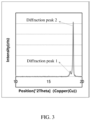
- In some embodiments, in the fully discharged state of the electrochemical apparatus, test is performed using an X-ray diffraction method, an X-ray diffraction pattern of the positive electrode plate has a
diffraction peak 1 and adiffraction peak 2 at 2θ in a range of 18.5° to 19.5°, and a peak position difference Δθ of thediffraction peak 2 and thediffraction peak 1 satisfies: 0.38°≤|Δθ|≤0.48°. - In some embodiments, in the fully discharged state of the electrochemical apparatus, a molar ratio b1 of element Li to element Mn in the positive electrode active material layer satisfies: 0.55≤b1≤0.6. The molar ratio Li/Mn falling within the above range can enhance the stability of the second lithium manganese oxide in the positive electrode active material layer, thereby improving the cycling performance of the electrochemical apparatus.
- In some embodiments, the first lithium manganese oxide has a layered structure. The layered structure is conducive to the deintercalation of Li ions in the first lithium manganese oxide, thereby improving the energy density and cycling performance of the electrochemical apparatus.
- In some embodiments, the first lithium manganese oxide further includes element T, where the element T includes at least one of Al, Nb, Ti, Cr, Mg, V, Cu, Zr, Mo, La, Zn, Ga, Ru, Ag, Sn, Au, Ce, Pr, Nd, Sm, Gd, Fe, Co, Ni, W, or Y. The presence of the element T in the first lithium manganese oxide can facilitate the formation of the monoclinic phase, enhancing the structural stability of the first lithium manganese oxide and suppressing the dissolution of Mn, thereby improving the cycling performance of the electrochemical apparatus.
- In some embodiments, a molar ratio c1 of the element T to element Mn in the first lithium manganese oxide satisfies: 0.005≤c1≤0.1.
- In some embodiments, the first lithium manganese oxide includes Lix1Mny1Tz1O2, where 0.1≤x1≤1.1, 0.9≤y1≤1, 0≤z1≤ 0.1, and T includes at least one of Al, Nb, Ti, Cr, Mg, V, Cu, Zr, Mo, La, Zn, Ga, Ru, Ag, Sn, Au, Ce, Pr, Nd, Sm, Gd, Fe, Co, Ni, W, or Y.
- In some embodiments, the second lithium manganese oxide has a spinel structure. In some embodiments, the second lithium manganese oxide further includes element Q, where the element Q includes at least one of Al, Nb, Ti, Cr, Mg, V, Cu, Zr, Mo, La, Zn, Ga, Ru, Ag, Sn, Au, Ce, Pr, Nd, Sm, Gd, Fe, Co, Ni, W, or Y.
- In some embodiments, a molar ratio d1 of the element Q to element Mn in the second lithium manganese oxide satisfies: 0≤d1≤0.2.
- In some embodiments, the second lithium manganese oxide includes Lix2Mny2Qz2O4-tAt, where 0.6≤x2≤1.2, 1.8≤y2≤2, 0≤z2≤0.2, 0≤t≤0.5, Q includes at least one of Al, Nb, Ti, Cr, Mg, V, Cu, Zr, Mo, La, Zn, Ga, Ru, Ag, Sn, Au, Ce, Pr, Nd, Sm, Gd, Fe, Co, Ni, W, or Y, and A includes at least one of S, N, F, Cl, or Br.
- According to a second aspect, this application provides an electrical apparatus including the electrochemical apparatus according to the first aspect.
-
-
FIG. 1 is an SEM image of a cross section of a fully discharged positive electrode plate of a lithium-ion battery in Example 1. -
FIG. 2 is a Raman image ofregion 2 andregion 3 inFIG. 1 . -
FIG. 3 is an XRD image of the fully discharged positive electrode plate of the lithium-ion battery in Example 1. - To make the objectives, technical solutions, and advantages of this application clearer, the following clearly and completely describes the technical solutions in this application with reference to some embodiments. Apparently, the described embodiments are some but not all embodiments of this application. Some relevant embodiments described herein are illustrative and used to provide a basic understanding of this application. Some embodiments of this application should not be construed as limitations on this application.
- For brevity, this specification specifically discloses only some numerical ranges. However, any lower limit may be combined with any upper limit to form a range not expressly recorded; any lower limit may be combined with any other lower limit to form a range not expressly recorded; and any upper limit may be combined with any other upper limit to form a range not expressly recorded. In addition, each individually disclosed point or individual single numerical value may itself be a lower limit or an upper limit which can be combined with any other point or individual numerical value or combined with another lower limit or upper limit to form a range not expressly recorded.
- In the description of this specification, unless otherwise stated, "more than" or "less than" is inclusive of the present number.
- Unless otherwise stated, the terms used in this application have common meanings generally understood by persons skilled in the art. Unless otherwise stated, numerical values of parameters mentioned in this application may be measured by using various measurement methods commonly used in the art (for example, they may be tested by using the methods provided in some embodiments of this application).
- A list of items connected by the terms "at least one of", "at least one piece of", "at least one kind of", or the like may mean any combination of the listed items. For example, if items A and B are listed, the phrase "at least one of A or B" means only A; only B; or A and B. In another example, if items A, B, and C are listed, the phrase "at least one of A, B, or C" means only A; only B; only C; A and B (exclusive of C); A and C (exclusive of B); B and C (exclusive of A); or all of A, B, and C. The item A may contain a single constituent or a plurality of constituents. The item B may contain a single constituent or a plurality of constituents. The item C may contain a single constituent or a plurality of constituents.
- According to a first aspect, this application provides an electrochemical apparatus including a positive electrode plate, where the positive electrode plate includes a positive electrode active material layer, and the positive electrode active material layer includes a first lithium manganese oxide and a second lithium manganese oxide; and in a fully discharged state of the electrochemical apparatus, through Raman test, the first lithium manganese oxide has a characteristic peak A in a range of 507 cm-1±10 cm-1 and a characteristic peak B in a range of 660 cm-1±10 cm-1, and the second lithium manganese oxide has a characteristic peak C in a range of 625 cm-1±10 cm-1. The characteristic peak A is a characteristic peak of an orthorhombic phase in the first lithium manganese oxide, the characteristic peak B is a characteristic peak of a monoclinic phase in the first lithium manganese oxide, and the characteristic peak C is a characteristic peak of a spinel structure in the second lithium manganese oxide. The positive electrode active material layer of the electrochemical apparatus of this application includes both the first lithium manganese oxide and the second lithium manganese oxide. On one hand, the orthorhombic phase and monoclinic phase in the first lithium manganese oxide have a high lithium storage capacity, and a solid solution formed by the coexistence of the monoclinic phase and the orthorhombic phase has oxygen vacancies. This can facilitate the deintercalation of lithium ions, thereby providing a high charge specific capacity and significantly increasing the energy density of the electrochemical apparatus. In addition, the coexistence of the monoclinic phase and the orthorhombic phase forms the solid solution, which can enhance the structural stability of the first lithium manganese oxide, thereby suppressing structural phase transitions during cycling and storage. On the other hand, the first lithium manganese oxide has a higher initial charge specific capacity and can provide lithium ions for forming a solid electrolyte interface (SEI) film during the first-cycle charge of the electrochemical apparatus. In addition, in a subsequent cycling process, the residual lithium ions in the first lithium manganese oxide can provide lithium ions for the destruction and regeneration of the SEI film, reducing the consumption of lithium ions in the second lithium manganese oxide, thereby improving the cycling performance of the electrochemical apparatus.
- In some embodiments, a peak intensity of the characteristic peak A is IA, and a peak intensity of the characteristic peak B is IB, satisfying: 0.4≤IA/IB≤0.75. In some embodiments, IA/IB is 0.45, 0.5, 0.55, 0.6, 0.65, or 0.7, or a range defined by any two of these values. When IA/IB falls within the above range, a significant difference is present between amounts of the orthorhombic phase and monoclinic phase in the first lithium manganese oxide, and the solid solution can be formed by a synergistic effect, facilitating the deintercalation of Li ions in the lithium manganese oxide, thereby increasing the energy density of the electrochemical apparatus.
- In some embodiments, in the fully discharged state of the electrochemical apparatus, a Raman spectrum of the first lithium manganese oxide has a characteristic peak in a range of 570 cm-1±10 cm-1. In this application, the characteristic peak in the range of 570 cm-1±10 cm-1 corresponds to a stretching mode of manganese ions bonded to axial oxygen atoms in the first lithium manganese oxide after discharged.
- In some embodiments, in the fully discharged state of the electrochemical apparatus, a Raman spectrum of the second lithium manganese oxide has a characteristic peak in a range of 480 cm-1±10 cm-1. In this application, the characteristic peak in the range of 480 cm-1±10 cm-1 corresponds to a T2g vibration mode of Li in a lattice of the second lithium manganese oxide after discharged.
- In some embodiments, in the fully discharged state of the electrochemical apparatus, a 60 µm×50 µm test region is selected from a cross section of the positive electrode plate; and through Raman test, in a Raman spectrum of the test region, a peak intensity of the characteristic peak B is IB, and a peak intensity of the characteristic peak C is IC, satisfying: 0.06≤IB/IC≤0.5. A peak intensity value is positively correlated with an amount to some extent. When IB/IC falls within the above range, an amount of the first lithium manganese oxide is moderate, and the electrochemical apparatus has high energy density, high initial coulombic efficiency, and excellent cycling performance. In some embodiments, IB/IC is 0.08, 0.15, 0.2, 0.25, 0.3, 0.35, 0.4, or 0.45, or a range defined by any two of these values. In some embodiments, 0.1≤IB/IC≤0.5.
- In some embodiments, in the positive electrode active material layer, based on a total mass of the first lithium manganese oxide and the second lithium manganese oxide, a mass percentage of the first lithium manganese oxide is 5% to 30%, for example, 7%, 9%, 13%, 17%, 19%, 23%, 17%, or 29%, or a range defined by any two of these values.
- In some embodiments, in the fully discharged state of the electrochemical apparatus, test is performed using an X-ray diffraction method, an X-ray diffraction pattern of the positive electrode plate has a
diffraction peak 1 and adiffraction peak 2 at 2θ in a range of 18.5° to 19.5°, and a peak position difference Δθ of thediffraction peak 2 and thediffraction peak 1 satisfies: 0.38°≤|Δθ|≤0.48°. In some embodiments, |Δθ| is 0.39°, 0.40°, 0.41°, 0.42°, 0.43°, 0.44°, 0.45°, 0.46°, or 0.47°, or a range defined by any two of these values. - In some embodiments, in the fully discharged state of the electrochemical apparatus, a molar ratio b1 of element Li to element Mn in the positive electrode active material layer satisfies: 0.55≤b1≤0.6. In some embodiments, b1 is 0.555, 0.56, 0.565, 0.57, 0.575, 0.58, 0.585, 0.59, or 0.595, or a range defined by any two of these values. The molar ratio Li/Mn falling within the above range can enhance the stability of the second lithium manganese oxide in the positive electrode active material layer, thereby improving the cycling performance of the electrochemical apparatus.
- In some embodiments, the first lithium manganese oxide has a layered structure. The layered structure is conducive to the deintercalation of Li ions in the first lithium manganese oxide, thereby improving the energy density and cycling performance of the electrochemical apparatus.
- In some embodiments, the first lithium manganese oxide further includes element T, where the element T includes at least one of Al, Nb, Ti, Cr, Mg, V, Cu, Zr, Mo, La, Zn, Ga, Ru, Ag, Sn, Au, Ce, Pr, Nd, Sm, Gd, Fe, Co, Ni, W, or Y. The presence of the element T in the first lithium manganese oxide can facilitate the formation of the monoclinic phase, enhancing the structural stability of the first lithium manganese oxide and suppressing the dissolution of Mn, thereby improving the cycling performance of the electrochemical apparatus.
- In some embodiments, a molar ratio c1 of the element T to element Mn in the first lithium manganese oxide satisfies: 0.005≤c1≤0.1. In some embodiments, c1 is 0.006, 0.007, 0.008, 0.009, 0.01, 0.011, 0.012, 0.013, 0.014, 0.015, 0.016, 0.017, 0.018, 0.019, 0.02, 0.03, 0.05, 0.08, 0.1, or a range defined by any two of these values.
- In some embodiments, the first lithium manganese oxide includes Lix1Mny1Tz1O2, where 0.1≤x1≤1.1, 0.9≤y1≤1, 0≤z1≤ 0.1, and T includes at least one of Al, Nb, Ti, Cr, Mg, V, Cu, Zr, Mo, La, Zn, Ga, Ru, Ag, Sn, Au, Ce, Pr, Nd, Sm, Gd, Fe, Co, Ni, W, or Y.
- In some embodiments, a preparation method of the first lithium manganese oxide includes: mixing a manganese-containing oxide, a lithium source, and a selectable element T source to obtain a mixture; and calcining the mixture under a first atmospheric condition and a first temperature condition to obtain the first lithium manganese oxide; where the manganese-containing oxide and the lithium source are mixed at a molar ratio Li/Mn in a range of 0.90-1.15, and the first atmospheric condition is an inert atmosphere.
- In some embodiments, the inert atmosphere includes at least one of nitrogen, argon, or helium.
- In some embodiments, the first temperature is 880°C to 1100°C, for example, 900°C, 950°C, 1000°C, or 1050°C. In some embodiments, the calcining time is 5 hours to 20 hours, for example, 6 hours, 8 hours, 10 hours, 12 hours, 14 hours, 16 hours, or 18 hours.
- In some embodiments, the manganese-containing oxide includes Mn3O4. In some embodiments, the lithium source includes at least one of lithium hydroxide, lithium carbonate, lithium acetate, lithium nitrate, or lithium sulfate.
- In some embodiments, the element T source includes at least one of oxides of element T, hydroxides of element T, or carbonates of element T. In some embodiments, the element T includes at least one of Al, Nb, Ti, Cr, Mg, V, Cu, Zr, Mo, La, Zn, Ga, Ru, Ag, Sn, Au, Ce, Pr, Nd, Sm, Gd, Fe, Co, Ni, W, or Y. In some embodiments, the element T source includes at least one of CrO2, Al2O3, MgO, TiO2, or Y2O3.
- In some embodiments, the second lithium manganese oxide has a spinel structure. In some embodiments, the second lithium manganese oxide further includes element Q, where the element Q includes at least one of Al, Nb, Ti, Cr, Mg, V, Cu, Zr, Mo, La, Zn, Ga, Ru, Ag, Sn, Au, Ce, Pr, Nd, Sm, Gd, Fe, Co, Ni, W, or Y.
- In some embodiments, a molar ratio d1 of the element Q to element Mn in the second lithium manganese oxide satisfies: 0≤d1≤0.2.
- In some embodiments, the second lithium manganese oxide includes Lix2Mny2Qz2O4-tAt, where 0.6≤x2≤1.2, 1.8≤y2≤2, 0≤z2≤0.2, 0≤t≤0.5, Q includes at least one of Al, Nb, Ti, Cr, Mg, V, Cu, Zr, Mo, La, Zn, Ga, Ru, Ag, Sn, Au, Ce, Pr, Nd, Sm, Gd, Fe, Co, Ni, W, or Y, and A includes at least one of S, N, F, Cl, or Br.
- In some embodiments, the positive electrode plate further includes a positive electrode current collector, where the positive electrode current collector may be a metal foil current collector or a composite current collector. For example, an aluminum foil may be used. The composite current collector may be formed by forming a metal material (copper, copper alloy, nickel, nickel alloy, titanium, titanium alloy, silver, silver alloy, or the like) on a polymer matrix.
- The electrochemical apparatus of this application further includes a negative electrode plate, where the negative electrode plate includes a negative electrode active material layer and a negative electrode current collector.
- In some embodiments, the negative electrode active material layer includes a negative electrode active material, a conductive agent, and a binder. In some embodiments, the negative electrode active material includes a material for reversible intercalation/deintercalation of lithium ions, lithium metal, lithium metal alloy, or transition metal oxide. In some embodiments, the negative electrode active material includes at least one of a carbon material or a silicon material, where the carbon material includes at least one of graphite or hard carbon, and the silicon material includes at least one of silicon, silicon-oxygen compound, silicon-carbon compound, or silicon alloy. In some embodiments, the binder may include various binder polymers. In some embodiments, the binder includes at least one of polyvinylidene fluoride, vinylidene fluoride-hexafluoropropylene copolymer, polyamide, polyacrylonitrile, polyacrylate ester, polyacrylic acid, polyacrylate salt, sodium carboxymethylcellulose, polyvinylpyrrolidone, polyvinyl ether, polytetrafluoroethylene, polyhexafluoropropylene, or styrene-butadiene rubber. In some embodiments, the conductive agent may use any conductive material, as long as it causes no chemical change. In some embodiments, the conductive agent includes at least one of conductive carbon black, acetylene black, carbon nanotubes, Ketjen black, carbon fibers, or graphene.
- In some embodiments, the negative electrode current collector may be copper foil, nickel foil, stainless steel foil, titanium foil, nickel foam, copper foam, a polymer substrate coated with a conductive metal, or a combination thereof.
- The electrochemical apparatus of this application further includes an electrolyte solution. The electrolyte solution includes a lithium salt and a non-aqueous solvent.
- In some embodiments of this application, the lithium salt is selected from one or more of LiPF6, LiBF4, LiAsF6, LiClO4, LiB(C6H5)4, LiCH3SO3, LiCF3SO3, LiN(SO2CF3)2, LiC(SO2CF3)3, Li2SiF6, LiBOB, or lithium difluoroborate. For example, LiPF6 may be selected as the lithium salt.
- The non-aqueous solvent may be a carbonate compound, a carboxylate compound, an ether compound, another organic solvent, or a combination thereof.
- The carbonate compound may be a linear carbonate compound, a cyclic carbonate compound, a fluorocarbonate compound, or a combination thereof.
- An example of the linear carbonate compound is dimethyl carbonate (DMC), diethyl carbonate (DEC), dipropyl carbonate (DPC), methyl propyl carbonate (MPC), ethyl propyl carbonate (EPC), methyl ethyl carbonate (MEC), or a combination thereof. An example of the cyclic carbonate compound is ethylene carbonate (EC), propylene carbonate (PC), butylene carbonate (BC), vinyl ethylene carbonate (VEC), or a combination thereof. An example of the fluorocarbonate compound is fluoroethylene carbonate (FEC), 1,2-difluoroethylene carbonate, 1,1-difluoroethylene carbonate, 1,1,2-trifluoroethylene carbonate, 1,1,2,2-tetrafluoroethylene carbonate, 1-fluoro-2-methylethylene carbonate, 1-fluoro-1-methylethylene carbonate, 1,2-difluoro-1-methylethylene carbonate, 1,1,2-trifluoro-2-methylethylene carbonate, trifluoromethylethylene carbonate, or a combination thereof.
- An example of the carboxylate compound is methyl formate, methyl acetate, ethyl acetate, n-propyl acetate, tert-butyl acetate, methyl propionate, ethyl propionate, propyl propionate, γ-butyrolactone, decanolide, valerolactone, mevalonolactone, caprolactone, or a combination thereof.
- An example of the ether compound is dibutyl ether, tetraglyme, diglyme, 1,2-dimethoxyethane, 1,2-diethoxyethane, ethoxymethoxy ethane, 2-methyltetrahydrofuran, tetrahydrofuran, or a combination thereof.
- An example of the another organic solvent is dimethyl sulfoxide, 1,2-dioxolane, sulfolane, methyl sulfolane, 1,3-dimethyl-2-imidazolidinone, N-methyl-2-pyrrolidone, formamide, dimethylformamide, acetonitrile, trimethyl phosphate, triethyl phosphate, trioctyl phosphate, phosphate ester, or a combination thereof.
- In some embodiments, in the electrochemical apparatus, a separator is provided between a positive electrode and a negative electrode to prevent a short circuit. A material and shape of the separator used in some embodiments of this application is not specifically limited, and any technology disclosed in the prior art may be used for the separator. In some embodiments, the separator includes a polymer or an inorganic substance formed by a material stable to the electrolyte of this application. For example, the separator may include a substrate layer and a surface treatment layer. The substrate layer is a non-woven fabric, film, or composite film with a porous structure. The substrate layer is made of at least one of polyethylene, polypropylene, polyethylene terephthalate, or polyimide. Specifically, a polypropylene porous film, a polyethylene porous film, polypropylene non-woven fabric, polyethylene non-woven fabric, or a polypropylene-polyethylene-polypropylene porous composite film may be selected. The surface treatment layer is provided on at least one surface of the substrate layer, and the surface treatment layer may be a polymer layer or an inorganic substance layer, or may be a layer formed by mixing a polymer and an inorganic substance. The inorganic substance layer includes inorganic particles and a binder. The inorganic particles include at least one of aluminum oxide, silicon oxide, magnesium oxide, titanium oxide, hafnium oxide, tin oxide, ceria oxide, nickel oxide, zinc oxide, calcium oxide, zirconium oxide, yttrium oxide, silicon carbide, boehmite, aluminum hydroxide, magnesium hydroxide, calcium hydroxide, or barium sulfate. The binder includes at least one of polyvinylidene fluoride, vinylidene fluoride-hexafluoropropylene copolymer, polyamide, polyacrylonitrile, polyacrylate ester, polyacrylic acid, polyacrylate salt, polyvinylpyrrolidone, polyvinyl ether, polymethyl methacrylate, polytetrafluoroethylene, or polyhexafluoropropylene. The polymer layer includes a polymer, and a material of the polymer includes at least one of polyamide, polyacrylonitrile, acrylate polymer, polyacrylic acid, polyacrylate salt, polyvinylpyrrolidone, polyvinyl ether, polyvinylidene fluoride, or poly(vinylidene fluoride-hexafluoropropylene).
- In some embodiments, the electrochemical apparatus of this application includes but is not limited to all types of primary batteries or secondary batteries. In some embodiments, the electrochemical apparatus is a lithium secondary battery. In some embodiments, the lithium secondary battery includes but is not limited to a lithium metal secondary battery, a lithium-ion secondary battery, a lithium polymer secondary battery, or a lithium-ion polymer secondary battery.
- According to a second aspect, an electrical apparatus of this application may be any apparatus using the electrochemical apparatus according to the first aspect of this application.
- In some embodiments, the electrical apparatus includes but is not limited to a notebook computer, a pen-input computer, a mobile computer, an e-book player, a portable phone, a portable fax machine, a portable copier, a portable printer, a head-mounted stereo headset, a video recorder, a liquid crystal display television, a portable cleaner, a portable CD player, a mini disc, a transceiver, an electronic notebook, a calculator, a storage card, a portable recorder, a radio, a backup power supply, a motor, an automobile, a motorcycle, a motor bicycle, a bicycle, a lighting apparatus, a toy, a game console, a clock, an electric tool, a flash lamp, a camera, a large household storage battery, or a lithium-ion capacitor.
- Step (1): Mn(OOH) was placed in a corundum crucible, heated to 500°C at a heating velocity of 5°C/min in an air atmosphere, and kept at a constant temperature for 1 h to obtain anhydrous Mn3O4.
- Step (2): Anhydrous Mn3O4 and LiOH were weighed according to a molar ratio of Li:Mn being 1.05:1, and an additive containing element T was weighed according to a specified molar ratio of element T to element Mn (the type of the additive and the molar ratio of the element T to the element Mn were shown in Table 1). Then, the materials were mixed in a mixing device for 8 h to obtain a mixture precursor. The precursor was placed in the corundum crucible, with nitrogen gas filled at a speed of 2 m3/h, heated to 940°C at a heating velocity of 5°C/min and kept at a constant temperature for 10 h, and then naturally cooled to room temperature, to obtain the layered lithium manganese oxide.
Table 1 Preparation example Composition Additive Type Molar ratio of element T to element Mn Preparation example 1 LiMnAl0.011O2 Al2O3 0.011 Preparation example 2 LiMnAl0.013O2 Al2O3 0.013 Preparation example 3 LiMnAl0.008O2 Al2O3 0.008 Preparation example 4 LiMnAl0.018O2 Al2O3 0.018 Preparation example 5 LiMnTi0.011O2 TiO2 0.011 Preparation example 6 LiMnNb0.011O2 NbCl5 0.011 - A positive electrode active material, conductive carbon black (Super P), carbon nanotubes (CNT), and polyvinylidene fluoride (PVDF) were mixed at a weight ratio of 95:1.8:1.2:2, and then N-methylpyrrolidone (NMP) was added as a solvent to prepare a slurry with a solid content of 0.75. The slurry was stirred well to obtain a slurry. The positive electrode active material was a mixture of spinel lithium manganese oxide (LiMn2O4) and the layered lithium manganese oxide prepared in preparation example 1, and a mass percentage of the layered lithium manganese oxide was 30% based on the mass of the mixture.
- The slurry was uniformly applied on a positive electrode current collector aluminum foil, followed by processes such as drying at 90°C, cold pressing, and cutting, to obtain a positive electrode plate.
- A negative electrode active material graphite, conductive carbon black (Super P), and styrene-butadiene rubber (SBR) were mixed at a weight ratio of 97:1.0:2.0, and then deionized water was added as a solvent to prepare a slurry with a solid content of 0.8. The slurry was stirred well to obtain a slurry.
- The slurry was uniformly applied on a negative electrode current collector copper foil, followed by processes such as drying at 80°C, cold pressing, and cutting, to obtain a negative electrode plate.
- In an argon atmosphere glove box with a moisture content less than 10 ppm, ethylene carbonate (EC), propylene carbonate (PC), diethyl carbonate (DEC), ethyl propionate (EP), and propyl propionate (PP) were mixed well at a mass ratio of 1:1:1:1:1. Then, a fully dried lithium salt LiPF6 was dissolved in the foregoing non-aqueous solvent to obtain an electrolyte solution, where a mass percentage of LiPF6 was 12.5wt%.
- A polyethylene (PE) porous polymer film was used as a separator.
- The positive electrode plate, the separator, and the negative electrode plate were stacked in sequence, so that the separator was located between the positive electrode plate and the negative electrode plate for separation. The resulting stack was wound to obtain an electrode assembly. The electrode assembly was placed in an outer packaging aluminum-plastic film, and an electrolyte solution was injected. Then, processes such as vacuum packaging, standing, formation, degassing, and trimming to obtain a lithium-ion soft pack battery.
- First, a positive electrode active material (the positive electrode active material was a mixture of spinel lithium manganese oxide (LiMn2O4) and the layered lithium manganese oxide prepared in preparation example 1, and a mass ratio of the spinel lithium manganese oxide (LiMn2O4) to the layered lithium manganese oxide prepared in preparation example 1 was 70:30), polyvinylidene fluoride (PVDF), and conductive carbon black were mixed at a mass ratio of 90:5:5, and then the solvent N-methylpyrrolidone (NMP) was added. The resulting mixture was stirred in a vacuum mixer to obtain a uniform positive electrode slurry. The positive electrode slurry was applied on one surface of an aluminum foil with a thickness of 13 µm. Then, the aluminum foil was dried in a vacuum drying oven at 90°C and then cold pressed and cut into small discs with a diameter of 1.4 cm. A lithium plate, a polypropylene separator, and an electrolyte solution (the composition was the same as the above lithium-ion soft pack battery) were assembled into a lithium-ion button battery.
- Examples 2 to 4 differed from example 1 only in that the mass percentages of the layered lithium manganese oxides in the positive electrode active materials were different and were 20%, 10%, and 5% respectively.
- Examples 5 to 9 differed from example 3 only in that the layered lithium manganese oxides in the positive electrode active materials were the layered lithium manganese oxides of preparation examples 2, 3, 4, 5, and 6.
- Comparative example 1 differed from example 1 only in that the positive electrode active material was only the spinel lithium manganese oxide (LiMn2O4).
- Comparative example 2 differed from example 1 only in that the positive electrode active materials was only the layered lithium manganese oxide of preparation example 1.
- Comparative example 3 differed from example 1 only in that the positive electrode active material was a mixture of the spinel lithium manganese oxide (LiMn2O4) and a conventional layered lithium manganese oxide.
- The conventional layered lithium manganese oxide was prepared as follows: Mn2O3 and Na2CO3 were mixed well at a ratio of Na:Mn=1.05:1, and then the resulting mixture was heated to 800°C at a heating velocity of 5°C/min in an N2 atmosphere and kept at a constant temperature for 24 h to obtain NaMnO2; an LiBr ethanol solution with a concentration of 5 mol/L was added at a molar ratio of LiBr:NaMnO2=10:1, exchange was performed at 180°C for 8 h in an air atmosphere, and the obtained product was washed with a large amount of ethanol after completion of exchange; and powder obtained after washing was dried for 5 h in an oven at 120°C to obtain the conventional layered lithium manganese oxide.
- After fully discharged, the lithium-ion soft pack battery in each of the above examples and comparative examples was disassembled to obtain the fully discharged positive electrode plate, and the fully discharged positive electrode plate was cut along a direction perpendicular to the surface of the current collector to obtain the cross section of the positive electrode plate; the first lithium manganese oxide, the second lithium manganese oxide, and the 60 µm×50 µm test region were selected from the cross section of the positive electrode plate, then Raman characterization was performed to obtain the Raman spectrum of the fully discharged positive electrode plate, and IA/IB and IB/IC were calculated based on the Raman spectrum. The fully discharged condition was as follows: At 25°C, the lithium-ion soft pack battery was discharged to 2.8 V at a constant current of 1C.
- Instrument model was HR Evolution; and a laser was a solid-state laser (1 MHz) with power of 100 mW.
- After fully discharged, the lithium-ion soft pack battery in each of the above examples and comparative examples was disassembled to obtain the fully discharged positive electrode plate, and XRD test was performed on the fully discharged positive electrode plate to obtain the XRD pattern of the fully discharged positive electrode plate. The fully discharged condition was as follows: At 25°C, the lithium-ion soft pack battery was discharged to 2.8 V at a constant current of 1C.
- XRD test instrument model was Bruker, D8, with a scanning velocity of 2°/min and a scanning angle range of 10° to 90°.
- Test was performed using SEM-EDS to obtain contents of elements such as element T and element Mn in the layered lithium manganese oxide of the positive electrode plate.
- At a constant temperature of 25°C, the lithium-ion button battery in each of the examples and comparative examples was charged to 4.3 V at a constant current of 0.5C (that is, a current value obtained after a theoretical capacity was completely discharged in 2 h), and then charged to a cut-off current of 0.05C at a constant voltage of 4.3 V. An initial charge capacity of the lithium-ion button battery was recorded. Then, the lithium-ion button battery was discharged to 3 V at a constant current of 0.2C, and an initial discharge capacity was recorded.
- Initial charge specific capacity=initial charge capacity/mass of positive electrode active material.
- Initial coulombic efficiency=(initial discharge capacity/initial charge capacity)×100%.
- The lithium-ion soft pack battery in each of the above examples and comparative examples was repeatedly charged and discharged through the following steps, and a discharge capacity retention rate of the battery was calculated.
- First, in an environment at 25°C, the battery was subjected to the first charge and discharge cycle. The battery was first charged to 4.2 V at a constant current of 0.5C, then charged to a cut-off current of 0.05C at a constant voltage of 4.2V, and then discharged to 2.8 V at a constant current of 1C. A discharge capacity of the first cycle was recorded. Then, 1500 charge and discharge cycles was performed, and a discharge capacity at the 1500th cycle was recorded.
- Cycling capacity retention rate=(discharge capacity at the 1500th cycle/discharge capacity at the first cycle)×100%.
-
Table 2 Example Raman peak position of fully discharged electrode plate (cm-1) IA/IB IB/IC Element T in layered lithium manganese oxide Δθ (°) Molar ratio b1 of Li/Mn Initial charge specific capacity (mAh/g) Initial coulombic efficiency (%) Cycling capacity retention rate (%) Characteristic peak A (507±10) Characteristic peak B (660±10) Characteristic peak C (625±10) Type Molar ratio of T/Mn Example 1 V V V 0.57 0.471 Al 0.011 0.41 0.587 131.4 82.5 85.6 Example 2 V V V 0.56 0.325 Al 0.011 0.39 0.579 129.4 85.4 88.0 Example 3 V V V 0.54 0.134 Al 0.011 0.42 0.565 124.3 90 82.9 Example 4 V V V 0.62 0.089 Al 0.011 0.42 0.561 121.7 91.0 80.2 Example 5 V V V 0.71 0.095 Al 0.013 0.46 0.562 120.9 90.5 80.9 Example 6 V V V 0.41 0.091 Al 0.008 0.43 0.563 121.3 89.3 80.4 Example 7 V V V 0.75 0.067 Al 0.018 0.39 0.561 121.7 90.0 80.3 Example 8 V V V 0.53 0.214 Ti 0.011 0.46 0.562 120.8 89.5 81.7 Example 9 V V V 0.55 0.239 Nb 0.011 0.42 0.559 120.5 88.7 81.3 Comparative example 1 / / V / / / / / 0.511 112 96.0 65.0 Comparative example 2 V V / 0.7 / Al 0.013 / 0.981 190.3 48.0 21.0 Comparative example 3 / V V / 0.097 / / 0.40 0.559 116.7 88.9 72.5 - In the table, V represents the presence of a corresponding characteristic peak, / represents the absence of a corresponding characteristic peak or parameter, IA/IB is the peak intensity ratio of the characteristic peak A to the characteristic peak B in the Raman spectrum, IB/IC is the peak intensity ratio of the characteristic peak B to the characteristic peak C in the Raman spectrum, and Δθ is the peak position difference of the
diffraction peak 1 and thediffraction peak 2 at 2θ in the range of 18.5° to 19.5° in the X-ray diffraction pattern of the fully discharged electrode plate. - The positive electrode active material in each of examples 1 to 9 contains both a lithium manganese oxide with a layered structure and a lithium manganese oxide with a spinel structure. The positive electrode active material in comparative example 1 does not contain the lithium manganese oxide with the layered structure, and the lithium manganese oxide with the layered structure is only used as the positive electrode active material in comparative example 2. It can be seen from the comparison of the data between examples 1 to 9 and comparative example 1 that the combined use of the lithium manganese oxide with the layered structure and the lithium manganese oxide with the spinel structure can significantly increase the charge specific capacity, thereby significantly increasing the energy density of the lithium-ion battery. In addition, with a higher initial charge specific capacity, the lithium manganese oxide with the layered structure can provided lithium ions for forming a solid electrolyte interface (SEI) film during the first-cycle charge of the lithium-ion battery. In addition, in a subsequent cycling process, the residual lithium ions in the lithium manganese oxide with the layered structure can provide lithium ions for the destruction and regeneration of the SEI film, reducing the consumption of lithium ions in the lithium manganese oxide with the spinel structure, thereby significantly improving the cycling performance of the lithium-ion battery.
- In comparative example 3, a conventional layered lithium manganese oxide without orthorhombic phase is used and has no characteristic peak A in the range of 507 cm-1±10 cm-1 in its Raman spectrum. It can be seen from comparison between comparative example 3 and examples 1 to 9 that examples 1 to 9 with the coexistence of the orthorhombic phase and the monoclinic phase have significantly improved initial charge specific capacity and improved cycling performance. The possible reason is that the solid solution formed by the coexistence of the monoclinic phase and the orthorhombic phase has oxygen vacancies. This can facilitate the deintercalation of lithium ions, thereby providing a high charge specific capacity and significantly increasing the energy density of the lithium-ion battery. In addition, the coexistence of the monoclinic phase and the orthorhombic phase forms the solid solution, which can enhance the structural stability of the lithium manganese oxide with the layered structure, thereby suppressing structural phase transitions during cycling and storage. Moreover, it can be seen from the data of examples 1 to 9 that when IB/IC is in the range of 0.06-0.5, the lithium-ion battery has a high first-cycle charge specific capacity, and its cycling performance is also significantly improved.
- The difference between examples 1 to 4 lies in the mixing ratio of the lithium manganese oxide with the layered structure and the lithium manganese oxide with the spinel structure. Based on the total mass of the lithium manganese oxide with the layered structure and the lithium manganese oxide with the spinel structure, the mass percentages of the lithium manganese oxides with the layered structures in examples 1, 2, 3, and 4 are 30%, 20%, 10%, and 5%, respectively. It can be seen from the data of examples 1 to 4 that a higher amount of the lithium manganese oxide with the layered structure means that the lithium-ion battery has a higher initial charge specific capacity, and its cycling performance is also correspondingly improved.
- Although some illustrative embodiments of this application have been illustrated and described, this application is not limited to the disclosed embodiments. On the contrary, persons of ordinary skill in the art will recognize that some modifications and changes can be made to the described embodiments without departing from the spirit and scope of this application described in the appended claims.
Claims (10)
- An electrochemical apparatus, comprising a positive electrode plate, wherein the positive electrode plate comprises a positive electrode active material layer, and the positive electrode active material layer comprises a first lithium manganese oxide and a second lithium manganese oxide; and in a fully discharged state of the electrochemical apparatus, through Raman test, the first lithium manganese oxide has a characteristic peak A in a range of 507 cm 1±10 cm-1 and a characteristic peak B in a range of 660 cm 1±10 cm-1, and the second lithium manganese oxide has a characteristic peak C in a range of 625 cm 1±10 cm-1.
- The electrochemical apparatus according to claim 1, wherein a peak intensity of the characteristic peak A is IA, and a peak intensity of the characteristic peak B is IB, satisfying: 0.4≤IA/IB≤0.75.
- The electrochemical apparatus according to claim 1, wherein in the fully discharged state of the electrochemical apparatus, a Raman spectrum of the first lithium manganese oxide has a characteristic peak in a range of 570 cm-1±10 cm-1; and/or
in the fully discharged state of the electrochemical apparatus, a Raman spectrum of the second lithium manganese oxide has a characteristic peak in a range of 480 cm 1±10 cm-1. - The electrochemical apparatus according to claim 1, wherein in the fully discharged state of the electrochemical apparatus, a 60 µm×50 µm test region is selected from a cross section of the positive electrode plate; and through Raman test, in a Raman spectrum of the test region, a peak intensity of the characteristic peak B is IB, and a peak intensity of the characteristic peak C is IC, satisfying: 0.06≤IB/IC≤0.5.
- The electrochemical apparatus according to claim 4, wherein 0.1≤IB/IC≤0.5.
- The electrochemical apparatus according to claim 1, wherein in the fully discharged state of the electrochemical apparatus, test is performed using an X-ray diffraction method, an X-ray diffraction pattern of the positive electrode plate has a diffraction peak 1 and a diffraction peak 2 at 2θ in a range of 18.5° to 19.5°, and a peak position difference Δθ of the diffraction peak 2 and the diffraction peak 1 satisfies: 0.38°≤|Δθ|≤0.48°.
- The electrochemical apparatus according to claim 1, wherein in the fully discharged state of the electrochemical apparatus, a molar ratio b1 of element Li to element Mn in the positive electrode active material layer satisfies: 0.55≤b1≤0.6.
- The electrochemical apparatus according to claim 1, wherein the electrochemical apparatus satisfies at least one of the following conditions:(1) the first lithium manganese oxide has a layered structure;(2) the first lithium manganese oxide comprises element T, wherein the element T comprises at least one of Al, Nb, Ti, Cr, Mg, V, Cu, Zr, Mo, La, Zn, Ga, Ru, Ag, Sn, Au, Ce, Pr, Nd, Sm, Gd, Fe, Co, Ni, W, or Y;(3) the first lithium manganese oxide comprises Lix1Mny1Tz1O2, wherein 0.1≤x1≤1.1, 0.9≤y1≤1, 0≤z1≤ 0.1, and T comprises at least one of Al, Nb, Ti, Cr, Mg, V, Cu, Zr, Mo, La, Zn, Ga, Ru, Ag, Sn, Au, Ce, Pr, Nd, Sm, Gd, Fe, Co, Ni, W, or Y;(4) the second lithium manganese oxide has a spinel structure;(5) the second lithium manganese oxide comprises element Q, wherein the element Q comprises at least one of Al, Nb, Ti, Cr, Mg, V, Cu, Zr, Mo, La, Zn, Ga, Ru, Ag, Sn, Au, Ce, Pr, Nd, Sm, Gd, Fe, Co, Ni, W, or Y; or(6) the second lithium manganese oxide comprises Lix2Mny2Qz2O4-tAt, wherein 0.6≤x2≤1.2, 1.8≤y2≤2, 0≤z2≤0.2, 0≤t≤0.5, Q comprises at least one of Al, Nb, Ti, Cr, Mg, V, Cu, Zr, Mo, La, Zn, Ga, Ru, Ag, Sn, Au, Ce, Pr, Nd, Sm, Gd, Fe, Co, Ni, W, or Y, and A comprises at least one of S, N, F, Cl, or Br.
- The electrochemical apparatus according to claim 8, wherein a molar ratio c1 of the element T to element Mn in the first lithium manganese oxide satisfies: 0.005≤c1≤0.1; and/or
a molar ratio d1 of the element Q to element Mn in the second lithium manganese oxide satisfies: 0≤d1≤0.2. - An electrical apparatus, comprising the electrochemical apparatus according to any one of claims 1 to 9.
Applications Claiming Priority (1)
| Application Number | Priority Date | Filing Date | Title |
|---|---|---|---|
| PCT/CN2022/102823 WO2024000406A1 (en) | 2022-06-30 | 2022-06-30 | Electrochemical apparatus and electrical apparatus |
Publications (2)
| Publication Number | Publication Date |
|---|---|
| EP4531134A1 true EP4531134A1 (en) | 2025-04-02 |
| EP4531134A4 EP4531134A4 (en) | 2026-03-04 |
Family
ID=88035025
Family Applications (1)
| Application Number | Title | Priority Date | Filing Date |
|---|---|---|---|
| EP22948511.5A Pending EP4531134A4 (en) | 2022-06-30 | 2022-06-30 | ELECTROCHEMICAL APPARATUS AND ELECTRICAL APPARATUS |
Country Status (4)
| Country | Link |
|---|---|
| US (1) | US20250140795A1 (en) |
| EP (1) | EP4531134A4 (en) |
| CN (1) | CN116802839A (en) |
| WO (1) | WO2024000406A1 (en) |
Family Cites Families (5)
| Publication number | Priority date | Publication date | Assignee | Title |
|---|---|---|---|---|
| JP2002145619A (en) * | 2000-09-04 | 2002-05-22 | Mitsubishi Chemicals Corp | Lithium manganese composite oxide, positive electrode material for lithium secondary battery, positive electrode for lithium secondary battery, lithium secondary battery, and method for producing lithium manganese composite oxide |
| JP2002068747A (en) * | 2000-09-04 | 2002-03-08 | Mitsubishi Chemicals Corp | Lithium manganese composite oxide, positive electrode material for lithium secondary battery, positive electrode, and lithium secondary battery |
| JP2002167220A (en) * | 2000-09-20 | 2002-06-11 | Mitsubishi Chemicals Corp | Lithium manganese composite oxide, positive electrode material for lithium secondary battery, positive electrode for lithium secondary battery, lithium secondary battery, and method for producing lithium manganese composite oxide |
| JP5205424B2 (en) * | 2010-08-06 | 2013-06-05 | 株式会社日立製作所 | Positive electrode material for lithium secondary battery, lithium secondary battery, and secondary battery module using the same |
| CN102255083B (en) * | 2010-11-04 | 2014-05-21 | 耿世达 | Layered manganese-based composite material for power-type lithium ion battery and preparation method thereof |
-
2022
- 2022-06-30 WO PCT/CN2022/102823 patent/WO2024000406A1/en not_active Ceased
- 2022-06-30 EP EP22948511.5A patent/EP4531134A4/en active Pending
- 2022-06-30 CN CN202280010315.7A patent/CN116802839A/en active Pending
-
2024
- 2024-12-30 US US19/005,031 patent/US20250140795A1/en active Pending
Also Published As
| Publication number | Publication date |
|---|---|
| US20250140795A1 (en) | 2025-05-01 |
| CN116802839A (en) | 2023-09-22 |
| EP4531134A4 (en) | 2026-03-04 |
| WO2024000406A1 (en) | 2024-01-04 |
Similar Documents
| Publication | Publication Date | Title |
|---|---|---|
| JP7713540B2 (en) | Electrochemical and Electronic Devices | |
| EP4089766B1 (en) | Positive electrode plate, electrochemical device comprising same, and electronic device | |
| CN114097113B (en) | Positive electrode lithium supplementing material, positive electrode plate containing same and electrochemical device | |
| EP4089762B1 (en) | Positive electrode plate, and electrochemical device and electronic device containing positive electrode plate | |
| US20240243280A1 (en) | Positive electrode material, electrochemical device, and electronic device | |
| WO2022121293A1 (en) | Positive electrode material, electrochemical apparatus, and electronic apparatus | |
| EP4439722A1 (en) | Positive electrode active material, electrochemical device comprising positive electrode active material, and electronic device | |
| US20250140814A1 (en) | Electrochemical device and electrical device | |
| US20240274787A1 (en) | Electrochemical apparatus and electronic apparatus including such electrochemical apparatus | |
| WO2022188037A1 (en) | Positive electrode, electrochemical device and electronic device | |
| EP4535439A1 (en) | Positive electrode active material, electrochemical device and electrical device | |
| US20250023042A1 (en) | Positive electrode material, electrochemical device, and electronic device | |
| US20250201807A1 (en) | Negative electrode plate, secondary battery, and electronic apparatus | |
| CN117293287A (en) | Cathode materials and electrochemical devices and electronic devices containing the materials | |
| US20240239690A1 (en) | Metal hydroxide, positive electrode material, electrochemical device, and electrical device | |
| EP4131498A1 (en) | Negative electrode active material, electrochemical device using same, and electronic device | |
| CN119725486A (en) | Positive electrode material, positive electrode sheet and secondary battery | |
| US20250140795A1 (en) | Electrochemical apparatus and electrical apparatus | |
| US20260121018A1 (en) | Positive electrode material, electrochemical apparatus and electrical apparatus | |
| CN114497512A (en) | Electrochemical device and electronic device | |
| CN117999674B (en) | A positive electrode material, an electrochemical device comprising the positive electrode material, and an electrical device thereof. | |
| US20240282974A1 (en) | Negative electrode active material, electrochemical apparatus, and electronic apparatus | |
| KR102957523B1 (en) | Electrochemical device and electronic device including the electrochemical device | |
| EP4546465A1 (en) | Electrochemical device and electronic device comprising same | |
| WO2025081481A1 (en) | Positive electrode material, electrochemical apparatus, and electronic apparatus |
Legal Events
| Date | Code | Title | Description |
|---|---|---|---|
| STAA | Information on the status of an ep patent application or granted ep patent |
Free format text: STATUS: THE INTERNATIONAL PUBLICATION HAS BEEN MADE |
|
| PUAI | Public reference made under article 153(3) epc to a published international application that has entered the european phase |
Free format text: ORIGINAL CODE: 0009012 |
|
| STAA | Information on the status of an ep patent application or granted ep patent |
Free format text: STATUS: REQUEST FOR EXAMINATION WAS MADE |
|
| 17P | Request for examination filed |
Effective date: 20241226 |
|
| AK | Designated contracting states |
Kind code of ref document: A1 Designated state(s): AL AT BE BG CH CY CZ DE DK EE ES FI FR GB GR HR HU IE IS IT LI LT LU LV MC MK MT NL NO PL PT RO RS SE SI SK SM TR |
|
| DAV | Request for validation of the european patent (deleted) | ||
| DAX | Request for extension of the european patent (deleted) | ||
| A4 | Supplementary search report drawn up and despatched |
Effective date: 20260203 |
|
| RIC1 | Information provided on ipc code assigned before grant |
Ipc: H01M 4/505 20100101AFI20260128BHEP |