EP4530859A1 - Computer-implemented method and system to determine the power consumption of a software application running on a system - Google Patents
Computer-implemented method and system to determine the power consumption of a software application running on a system Download PDFInfo
- Publication number
- EP4530859A1 EP4530859A1 EP23465541.3A EP23465541A EP4530859A1 EP 4530859 A1 EP4530859 A1 EP 4530859A1 EP 23465541 A EP23465541 A EP 23465541A EP 4530859 A1 EP4530859 A1 EP 4530859A1
- Authority
- EP
- European Patent Office
- Prior art keywords
- software application
- swa
- power consumption
- different operating
- software
- Prior art date
- Legal status (The legal status is an assumption and is not a legal conclusion. Google has not performed a legal analysis and makes no representation as to the accuracy of the status listed.)
- Withdrawn
Links
Images
Classifications
-
- G—PHYSICS
- G06—COMPUTING OR CALCULATING; COUNTING
- G06F—ELECTRIC DIGITAL DATA PROCESSING
- G06F11/00—Error detection; Error correction; Monitoring
- G06F11/30—Monitoring
- G06F11/3058—Monitoring arrangements for monitoring environmental properties or parameters of the computing system or of the computing system component, e.g. monitoring of power, currents, temperature, humidity, position, vibrations
- G06F11/3062—Monitoring arrangements for monitoring environmental properties or parameters of the computing system or of the computing system component, e.g. monitoring of power, currents, temperature, humidity, position, vibrations where the monitored property is the power consumption
-
- G—PHYSICS
- G06—COMPUTING OR CALCULATING; COUNTING
- G06F—ELECTRIC DIGITAL DATA PROCESSING
- G06F1/00—Details not covered by groups G06F3/00 - G06F13/00 and G06F21/00
- G06F1/26—Power supply means, e.g. regulation thereof
- G06F1/32—Means for saving power
- G06F1/3203—Power management, i.e. event-based initiation of a power-saving mode
-
- G—PHYSICS
- G06—COMPUTING OR CALCULATING; COUNTING
- G06F—ELECTRIC DIGITAL DATA PROCESSING
- G06F11/00—Error detection; Error correction; Monitoring
- G06F11/30—Monitoring
- G06F11/34—Recording or statistical evaluation of computer activity, e.g. of down time, of input/output operation ; Recording or statistical evaluation of user activity, e.g. usability assessment
- G06F11/3409—Recording or statistical evaluation of computer activity, e.g. of down time, of input/output operation ; Recording or statistical evaluation of user activity, e.g. usability assessment for performance assessment
-
- G—PHYSICS
- G06—COMPUTING OR CALCULATING; COUNTING
- G06F—ELECTRIC DIGITAL DATA PROCESSING
- G06F2201/00—Indexing scheme relating to error detection, to error correction, and to monitoring
- G06F2201/86—Event-based monitoring
Definitions
- the invention relates to a computer-implemented method and a system to determine the power consumption of a software application running on a system.
- the objective is solved by a computer-implemented method to determine the power consumption of a software application running on a system, the system comprising a data collector with probes for capturing run-time parameters of the system, including the steps of:
- the method provides a machine learning model to predict energy consumption of the software applications.
- the input features of the prediction model are the runtime values of different parameters of the monitored system, e.g., CPU load, network traffic, disk I/O, memory access, connected sensors, etc., wherein the parameters represent features and/or subsystems of the system, which are controlled by the software applications.
- parameters e.g., CPU load, network traffic, disk I/O, memory access, connected sensors, etc.
- the different operating configurations of the software application consider such different parameters, represented by the probes of the system, and captured by physical power consumption measurements.
- Probes can be physical sensors or software elements, which sense the usage of features or subsystems of the system.
- the operating configurations are a set of predefined parameters, selected out of the set of all parameter permutations.
- the output of the prediction model is the estimated instantaneous power generated by the running software application, measured in Watt.
- Training data is generated by a software application which runs on the monitored system in a training phase, logging the input parameters and the instantaneous power measured by the physical power meter.
- the invention provides granular measurements on sub-system level.
- the prediction model can be re-used for multiple use-cases at the execution of software applications.
- the invention allows to measure the energy consumption of software running on virtualized hardware.
- This prediction model enables the measurement of energy consumption without using a physical power meter, which is a much simpler alternative for measuring energy consumption of a software application.
- a simplified integration with DevOps feedback loop is provided and an increased usability by using software only components is obtained.
- the different operating configurations of the software application are determined by the number of features of the software application.
- the different operating configurations of the software application are determined by a CPU load and/or a network traffic and/or a storage disk operation of the system, respectively.
- a system to determine the power consumption of a software application running thereon comprising a data collector with probes, and a power meter is connected to the system, wherein the system is configured to execute the method according to the invention.
- a computer program product comprising instructions which, when the program is executed by a computer, cause it to carry out the method/steps of the method according to the invention.
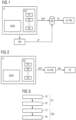
- Fig. 1 shows a block diagram of a system S as an embodiment of the invention at a training stage.
- the system S is configured to determine the power consumption of a software application SWA running thereon.
- the system S comprises a data collector DC with probes P1, P2, Pn for capturing run-time parameters RTP of the system S.
- a power meter PM is connected to the system to measure the instantaneous power IP consumed by the system S.
- the system S is configured to execute method steps according to the claims.
- the training stage comprises following two method steps for the setup and training ST of the prediction model AI-PM:
- the training data TD are stored in this embodiment in a data storage DS, e.g. a database.
- the different operating configurations of the software application SWA can consider different operating modes at the run-time execution of the software application SWA.
- a first, full power mode can be foreseen, providing a software functionality of the software application SWA with a predefined minimum number of features.
- a second, energy saving mode can be foreseen, providing a partial software functionality of the software application SWA with a predefined maximum number of features.
- the different operating configurations of the software application SWA can be determined by the number of features of the software application SWA.
- the different operating configurations of the software application SWA can be determined by a CPU load and/or a network traffic and/or a storage disk operation of the system, respectively.
- the different operating configurations are linked to the probes P1, P2, Pn of the data collector DC, which probes P1, P2, Pn are configured to capture run-time parameters RTP of the system S, i.e., the involved software application SWA, and respective sub-systems.
- Fig. 2 depicts a block diagram of a system of the system of the previous figure at an execution stage.
- the system S is configured to execute method steps according to the claims.
- the execution stage comprises following two method steps for the execution and measurement EM of power consumption of software application SWA:
- Fig. 3 shows an embodiment of a flow chart of the method of the invention with steps a) to d).
- the training stage includes setup and training ST of the prediction model AI-PM.
- the execution stage includes the execution and measurement EM of power consumption of software application SWA.
Landscapes
- Engineering & Computer Science (AREA)
- Theoretical Computer Science (AREA)
- General Engineering & Computer Science (AREA)
- Physics & Mathematics (AREA)
- General Physics & Mathematics (AREA)
- Quality & Reliability (AREA)
- Computing Systems (AREA)
- Computer Hardware Design (AREA)
- Debugging And Monitoring (AREA)
Abstract
Method to determine the power consumption of a software application running on a system, including the steps of:
a) Capturing the power consumption with a connected power meter, and capturing related system run-time parameters by the system, for different operating configurations of the software application, by the probes of the system and storing the power consumption and the related system run-time parameters as training data,
b) Setup and training of a prediction model with the training data,
c) Executing a software application on the system,
d) Estimating the power consumption of the software application running on the system based on the prediction model.
a) Capturing the power consumption with a connected power meter, and capturing related system run-time parameters by the system, for different operating configurations of the software application, by the probes of the system and storing the power consumption and the related system run-time parameters as training data,
b) Setup and training of a prediction model with the training data,
c) Executing a software application on the system,
d) Estimating the power consumption of the software application running on the system based on the prediction model.
Description
- Independent of the grammatical term usage, individuals with male, female or other gender identities are included within the term.
- The invention relates to a computer-implemented method and a system to determine the power consumption of a software application running on a system.
- The knowledge of power consumption of software applications is important for the overall system design. Moreover, to further develop the software to reduce the power consumption becomes more and more important.
- In prior art, there is limited support for the estimation of energy consumption of software applications.
- Some manufacturers provide tools, however, limited to their own hardware and not for the entire software system.
- Basically, when dedicated software tools are not available, physical power meter must be used.
- In virtual environments, like cloud, virtual machines, remote hardware, physical power meter cannot be used, and one must rely on the data offered by the infrastructure provider.
- It is the objective of the invention to provide a method and/or a system to assess the power consumption of software on a sub-system level.
- The objective is solved by a computer-implemented method to determine the power consumption of a software application running on a system, the system comprising a data collector with probes for capturing run-time parameters of the system, including the steps of:
- a) Capturing the power consumption with a connected power meter, and capturing related system run-time parameters by the system, for different operating configurations of the software application, by the probes of the system and storing the power consumption and the related system run-time parameters as training data,
- b) Setup and training of a prediction model with the training data,
- c) Executing a software application on the system,
- d) Estimating the power consumption of the software application running on the system based on the prediction model.
- The method provides a machine learning model to predict energy consumption of the software applications.
- The input features of the prediction model are the runtime values of different parameters of the monitored system, e.g., CPU load, network traffic, disk I/O, memory access, connected sensors, etc., wherein the parameters represent features and/or subsystems of the system, which are controlled by the software applications.
- The different operating configurations of the software application consider such different parameters, represented by the probes of the system, and captured by physical power consumption measurements.
- Probes can be physical sensors or software elements, which sense the usage of features or subsystems of the system.
- The operating configurations are a set of predefined parameters, selected out of the set of all parameter permutations.
- The output of the prediction model is the estimated instantaneous power generated by the running software application, measured in Watt.
- Training data is generated by a software application which runs on the monitored system in a training phase, logging the input parameters and the instantaneous power measured by the physical power meter.
- The invention provides granular measurements on sub-system level.
- Thereby, the prediction model can be re-used for multiple use-cases at the execution of software applications.
- Moreover, the invention allows to measure the energy consumption of software running on virtualized hardware.
- This prediction model enables the measurement of energy consumption without using a physical power meter, which is a much simpler alternative for measuring energy consumption of a software application.
- Thus, a precise model for estimating the power consumption of the system, including sub-systems, can be obtained, which allows to estimate the individual power consumption on feature- or subsystem-level of the system.
- A reduced complexity and reduced costs compared to the application of several measurement instruments is achieved.
- A simplified integration with DevOps feedback loop is provided and an increased usability by using software only components is obtained.
- In a further development of the invention, it is foreseen that the different operating configurations of the software application consider different operating modes at the run-time execution of the software application, including a first, full power mode, providing a software functionality of the software application with a predefined minimum number of features, and/or an second, energy saving mode, providing a partial software functionality of the software application with a predefined maximum number of features.
- Thus, a precise model for estimating the power consumption of the system, including sub-systems, can be obtained.
- In a further development of the invention, it is foreseen that the different operating configurations of the software application are determined by the number of features of the software application.
- Thus, a precise model for estimating the power consumption of the system, including sub-systems, can be obtained.
- In a further development of the invention, it is foreseen that the different operating configurations of the software application are determined by a CPU load and/or a network traffic and/or a storage disk operation of the system, respectively.
- Thus, a precise model for estimating the power consumption of the system, including sub-systems, can be obtained.
- Further, the objective of the invention is also solved by a system to determine the power consumption of a software application running thereon, comprising a data collector with probes, and a power meter is connected to the system, wherein the system is configured to execute the method according to the invention.
- Further, the objective of the invention is solved also by a computer program product, comprising instructions which, when the program is executed by a computer, cause it to carry out the method/steps of the method according to the invention.
- The invention is explained in more detail below with reference to an exemplary embodiment illustrated in the enclosed drawings. In the drawings shows:
- Fig. 1
- a block diagram of a system as an embodiment of the invention at a training stage,
- Fig. 2
- a block diagram of a system as an embodiment of the invention at an execution stage,
- Fig. 3
- a flow chart as an embodiment of the method of the invention.
-
Fig. 1 shows a block diagram of a system S as an embodiment of the invention at a training stage. - The system S is configured to determine the power consumption of a software application SWA running thereon.
- The system S comprises a data collector DC with probes P1, P2, Pn for capturing run-time parameters RTP of the system S.
- Further, a power meter PM is connected to the system to measure the instantaneous power IP consumed by the system S.
- The system S is configured to execute method steps according to the claims.
- The training stage comprises following two method steps for the setup and training ST of the prediction model AI-PM:
- a) Capturing the power consumption with a connected power meter PM, and capturing related system run-time parameters RTP by the system S, for different operating configurations of the software application SWA, by the probes P1, P2, Pn of the system S and storing the power consumption and the related system run-time parameters RTP as training data TD,
- b) Setup and training of a prediction model AI-PM with the training data TD,
- The training data TD are stored in this embodiment in a data storage DS, e.g. a database.
- Optionally, the different operating configurations of the software application SWA can consider different operating modes at the run-time execution of the software application SWA.
- A first, full power mode can be foreseen, providing a software functionality of the software application SWA with a predefined minimum number of features.
- Further, a second, energy saving mode can be foreseen, providing a partial software functionality of the software application SWA with a predefined maximum number of features.
- The different operating configurations of the software application SWA can be determined by the number of features of the software application SWA.
- Moreover, the different operating configurations of the software application SWA can be determined by a CPU load and/or a network traffic and/or a storage disk operation of the system, respectively.
- The different operating configurations are linked to the probes P1, P2, Pn of the data collector DC, which probes P1, P2, Pn are configured to capture run-time parameters RTP of the system S, i.e., the involved software application SWA, and respective sub-systems.
-
Fig. 2 depicts a block diagram of a system of the system of the previous figure at an execution stage. - The system S is configured to execute method steps according to the claims.
- The execution stage comprises following two method steps for the execution and measurement EM of power consumption of software application SWA:
- c) Executing a software application SWA on the system S,
- d) Estimating the power consumption IPE of the software application SWA running on the system S based on the prediction model AI-PM.
- Fig. 3 shows an embodiment of a flow chart of the method of the invention with steps a) to d).
- The training stage includes setup and training ST of the prediction model AI-PM.
- The execution stage includes the execution and measurement EM of power consumption of software application SWA.
-
- AI-PM
- AI prediction model
- DC
- data collector
- DS
- data storage, database
- EM
- execution and measurement of power consumption of software application
- IP
- instantaneous power
- IPE
- instantaneous power estimation
- P1, P2, Pn
- probe
- PC
- power consumption
- PM
- power meter
- RTP
- system run-time parameter
- S
- System, monitored hardware system
- ST
- setup and training of prediction model
- SWA
- software application
- TD
- training data
Claims (6)
- Computer-implemented method to determine the power consumption of a software application (SWA) running on a system (S), the system (S) comprising a data collector (DC) with probes (P1, P2, Pn) for capturing run-time parameters (RTP) of the system (S), including the steps of:a) Capturing the power consumption with a connected power meter (PM), and capturing related system run-time parameters (RTP) by the system (S), for different operating configurations of the software application (SWA), by the probes (P1, P2, Pn) of the system (S) and storing the power consumption and the related system run-time parameters (RTP) as training data (TD),b) Setup and training of a prediction model (AI-PM) with the training data (TD),c) Executing a software application (SWA) on the system (S),d) Estimating the power consumption (IPE) of the software application (SWA) running on the system (S) based on the prediction model (AI-PM).
- Method according to the preceding claim, wherein the different operating configurations of the software application (SWA) consider different operating modes at the run-time execution of the software application (SWA), including a first, full power mode, providing a software functionality of the software application (SWA) with a predefined minimum number of features, and/or an second, energy saving mode, providing a partial software functionality of the software application (SWA) with a predefined maximum number of features.
- Method according to one of the preceding claims, wherein the different operating configurations of the software application (SWA) are determined by the number of features of the software application (SWA).
- Method according to one of the preceding claims, wherein the different operating configurations of the software application (SWA) are determined by a CPU load and/or a network traffic and/or a storage disk operation of the system, respectively.
- System (S) to determine the power consumption of a software application (SWA) running thereon, comprising a data collector (DC) with probes (P1, P2, Pn), and a power meter (PM) is connected to the system, wherein the system (S) is configured to execute the method according to one of the preceding claims.
- Computer-program-product, comprising instructions which, when the program is executed by a computer, cause it to carry out the method/steps of the method according to one of the preceding claims.
Priority Applications (1)
| Application Number | Priority Date | Filing Date | Title |
|---|---|---|---|
| EP23465541.3A EP4530859A1 (en) | 2023-09-26 | 2023-09-26 | Computer-implemented method and system to determine the power consumption of a software application running on a system |
Applications Claiming Priority (1)
| Application Number | Priority Date | Filing Date | Title |
|---|---|---|---|
| EP23465541.3A EP4530859A1 (en) | 2023-09-26 | 2023-09-26 | Computer-implemented method and system to determine the power consumption of a software application running on a system |
Publications (1)
| Publication Number | Publication Date |
|---|---|
| EP4530859A1 true EP4530859A1 (en) | 2025-04-02 |
Family
ID=88647359
Family Applications (1)
| Application Number | Title | Priority Date | Filing Date |
|---|---|---|---|
| EP23465541.3A Withdrawn EP4530859A1 (en) | 2023-09-26 | 2023-09-26 | Computer-implemented method and system to determine the power consumption of a software application running on a system |
Country Status (1)
| Country | Link |
|---|---|
| EP (1) | EP4530859A1 (en) |
Citations (2)
| Publication number | Priority date | Publication date | Assignee | Title |
|---|---|---|---|---|
| US20110213997A1 (en) * | 2010-02-26 | 2011-09-01 | Microsoft Corporation | Virtual machine power consumption measurement and management |
| US20140244191A1 (en) * | 2013-02-28 | 2014-08-28 | Research In Motion Limited | Current usage estimation for electronic devices |
-
2023
- 2023-09-26 EP EP23465541.3A patent/EP4530859A1/en not_active Withdrawn
Patent Citations (2)
| Publication number | Priority date | Publication date | Assignee | Title |
|---|---|---|---|---|
| US20110213997A1 (en) * | 2010-02-26 | 2011-09-01 | Microsoft Corporation | Virtual machine power consumption measurement and management |
| US20140244191A1 (en) * | 2013-02-28 | 2014-08-28 | Research In Motion Limited | Current usage estimation for electronic devices |
Similar Documents
| Publication | Publication Date | Title |
|---|---|---|
| Jay et al. | An experimental comparison of software-based power meters: focus on CPU and GPU | |
| Huang et al. | Optimal testing resource allocation, and sensitivity analysis in software development | |
| Jarus et al. | Runtime power usage estimation of HPC servers for various classes of real-life applications | |
| JP7081070B2 (en) | Power consumption estimation device | |
| US6094527A (en) | Method and apparatus for estimating IC power consumption | |
| Salinas-Hilburg et al. | Unsupervised power modeling of co-allocated workloads for energy efficiency in data centers | |
| Pathania et al. | Calculating Software's Energy Use and Carbon Emissions: A Survey of the State of Art, Challenges, and the Way Ahead | |
| Amaral et al. | Process-based efficient power level exporter | |
| Al-Khatib et al. | Operand-value-based modeling of dynamic energy consumption of soft processors in FPGA | |
| CN111694712B (en) | Dynamic adaptive power consumption measurement method, system and medium for CPU and memory on multiple computing nodes | |
| Terboven et al. | Ee-hpc a framework for energy efficient hpc system management | |
| Da Costa et al. | Mastering system and power measures for servers in datacenter | |
| Diversi et al. | SCC thermal model identification via advanced bias-compensated least-squares | |
| Khan et al. | Analyzing the power consumption behavior of a large scale data center | |
| Diversi et al. | Thermal model identification of computing nodes in high-performance computing systems | |
| Wang et al. | Full-chip runtime error-tolerant thermal estimation and prediction for practical thermal management | |
| Niaz et al. | Concurrent and Orthogonal Software Power Meters for Accurate Runtime Energy Profiling of Parallel Hybrid Programs on Heterogeneous Hybrid Servers | |
| Jagannadharao et al. | A Beginner's Guide to Power and Energy Measurement and Estimation for Computing and Machine Learning | |
| Pittino et al. | A scalable framework for online power modelling of high-performance computing nodes in production | |
| US20250027976A1 (en) | Electric power consumption estimation apparatus, non-transitory computer-readable storage medium, and electric power consumption estimation method | |
| CN116430296B (en) | Method and device for checking accuracy of metering result of electric energy meter, medium and terminal | |
| Freina | End-to-End Power Model for the Compute Continuum | |
| Maggio et al. | {ARPE}: A Tool To Build Equation Models of Computing Systems | |
| Kelly | Final Year Project | |
| Silva et al. | Invasive technique for measuring the energy consumption of mobile devices applications in mobile cloud environments |
Legal Events
| Date | Code | Title | Description |
|---|---|---|---|
| PUAI | Public reference made under article 153(3) epc to a published international application that has entered the european phase |
Free format text: ORIGINAL CODE: 0009012 |
|
| STAA | Information on the status of an ep patent application or granted ep patent |
Free format text: STATUS: THE APPLICATION HAS BEEN PUBLISHED |
|
| AK | Designated contracting states |
Kind code of ref document: A1 Designated state(s): AL AT BE BG CH CY CZ DE DK EE ES FI FR GB GR HR HU IE IS IT LI LT LU LV MC ME MK MT NL NO PL PT RO RS SE SI SK SM TR |
|
| STAA | Information on the status of an ep patent application or granted ep patent |
Free format text: STATUS: THE APPLICATION IS DEEMED TO BE WITHDRAWN |
|
| 18D | Application deemed to be withdrawn |
Effective date: 20251003 |