EP4528876A1 - Electrolyte for lithium secondary battery and lithium secondary battery comprising same - Google Patents
Electrolyte for lithium secondary battery and lithium secondary battery comprising same Download PDFInfo
- Publication number
- EP4528876A1 EP4528876A1 EP23807839.8A EP23807839A EP4528876A1 EP 4528876 A1 EP4528876 A1 EP 4528876A1 EP 23807839 A EP23807839 A EP 23807839A EP 4528876 A1 EP4528876 A1 EP 4528876A1
- Authority
- EP
- European Patent Office
- Prior art keywords
- electrolyte
- lithium secondary
- secondary battery
- additive
- anode
- Prior art date
- Legal status (The legal status is an assumption and is not a legal conclusion. Google has not performed a legal analysis and makes no representation as to the accuracy of the status listed.)
- Pending
Links
Images

Classifications
-
- H—ELECTRICITY
- H01—ELECTRIC ELEMENTS
- H01M—PROCESSES OR MEANS, e.g. BATTERIES, FOR THE DIRECT CONVERSION OF CHEMICAL ENERGY INTO ELECTRICAL ENERGY
- H01M10/00—Secondary cells; Manufacture thereof
- H01M10/05—Accumulators with non-aqueous electrolyte
- H01M10/056—Accumulators with non-aqueous electrolyte characterised by the materials used as electrolytes, e.g. mixed inorganic/organic electrolytes
- H01M10/0564—Accumulators with non-aqueous electrolyte characterised by the materials used as electrolytes, e.g. mixed inorganic/organic electrolytes the electrolyte being constituted of organic materials only
- H01M10/0566—Liquid materials
- H01M10/0567—Liquid materials characterised by the additives
-
- H—ELECTRICITY
- H01—ELECTRIC ELEMENTS
- H01M—PROCESSES OR MEANS, e.g. BATTERIES, FOR THE DIRECT CONVERSION OF CHEMICAL ENERGY INTO ELECTRICAL ENERGY
- H01M10/00—Secondary cells; Manufacture thereof
- H01M10/05—Accumulators with non-aqueous electrolyte
- H01M10/052—Li-accumulators
-
- H—ELECTRICITY
- H01—ELECTRIC ELEMENTS
- H01M—PROCESSES OR MEANS, e.g. BATTERIES, FOR THE DIRECT CONVERSION OF CHEMICAL ENERGY INTO ELECTRICAL ENERGY
- H01M10/00—Secondary cells; Manufacture thereof
- H01M10/05—Accumulators with non-aqueous electrolyte
- H01M10/052—Li-accumulators
- H01M10/0525—Rocking-chair batteries, i.e. batteries with lithium insertion or intercalation in both electrodes; Lithium-ion batteries
-
- H—ELECTRICITY
- H01—ELECTRIC ELEMENTS
- H01M—PROCESSES OR MEANS, e.g. BATTERIES, FOR THE DIRECT CONVERSION OF CHEMICAL ENERGY INTO ELECTRICAL ENERGY
- H01M10/00—Secondary cells; Manufacture thereof
- H01M10/05—Accumulators with non-aqueous electrolyte
- H01M10/056—Accumulators with non-aqueous electrolyte characterised by the materials used as electrolytes, e.g. mixed inorganic/organic electrolytes
- H01M10/0564—Accumulators with non-aqueous electrolyte characterised by the materials used as electrolytes, e.g. mixed inorganic/organic electrolytes the electrolyte being constituted of organic materials only
- H01M10/0566—Liquid materials
- H01M10/0569—Liquid materials characterised by the solvents
-
- H—ELECTRICITY
- H01—ELECTRIC ELEMENTS
- H01M—PROCESSES OR MEANS, e.g. BATTERIES, FOR THE DIRECT CONVERSION OF CHEMICAL ENERGY INTO ELECTRICAL ENERGY
- H01M2300/00—Electrolytes
- H01M2300/0017—Non-aqueous electrolytes
- H01M2300/0025—Organic electrolyte
- H01M2300/0028—Organic electrolyte characterised by the solvent
- H01M2300/0037—Mixture of solvents
-
- Y—GENERAL TAGGING OF NEW TECHNOLOGICAL DEVELOPMENTS; GENERAL TAGGING OF CROSS-SECTIONAL TECHNOLOGIES SPANNING OVER SEVERAL SECTIONS OF THE IPC; TECHNICAL SUBJECTS COVERED BY FORMER USPC CROSS-REFERENCE ART COLLECTIONS [XRACs] AND DIGESTS
- Y02—TECHNOLOGIES OR APPLICATIONS FOR MITIGATION OR ADAPTATION AGAINST CLIMATE CHANGE
- Y02E—REDUCTION OF GREENHOUSE GAS [GHG] EMISSIONS, RELATED TO ENERGY GENERATION, TRANSMISSION OR DISTRIBUTION
- Y02E60/00—Enabling technologies; Technologies with a potential or indirect contribution to GHG emissions mitigation
- Y02E60/10—Energy storage using batteries
Definitions
- the present disclosure relates to an electrolyte for a lithium secondary battery and a lithium secondary battery including the same, and more specifically, to an electrolyte for a lithium secondary battery which includes a solvent and an electrolyte salt, and a lithium secondary battery including the electrolyte.
- a secondary battery is a battery which can be repeatedly charged and discharged, and has been widely applied to portable electronic devices such as a mobile phone, a laptop computer, etc. as a power source thereof.
- a lithium secondary battery has a high operating voltage and a high energy density per unit weight, and is advantageous in terms of a charging speed and light weight.
- the lithium secondary battery has been actively developed and applied to various industrial fields.
- the lithium secondary battery may include: an electrode assembly including a cathode, an anode, and a separation membrane interposed between the cathode and the anode; and an electrolyte in which the electrode assembly is impregnated in a case.
- a lithium metal oxide As an active material for the cathode of the lithium secondary battery, a lithium metal oxide may be used.
- the lithium metal oxide may include a nickel-based lithium metal oxide.
- lithium secondary battery that provides uniform output and capacity even during repeated charging and discharging is desirable.
- the output and capacity may be decreased due to damage to the surface of the nickel-based lithium metal oxide used as a cathode active material, and a side reaction between the nickel-based lithium metal oxide and the electrolyte may occur.
- the lithium secondary battery is placed in a high-temperature environment during repetitive charging/discharging and overcharging.
- the above-described problems are accelerated, such that a swelling phenomenon of the battery (an increase in the battery thickness due to gases generated inside the battery), an increase in the internal resistance of the battery, a deterioration in lifespan characteristics of the battery, and the like are caused.
- An object of the present invention is to provide an electrolyte for a lithium secondary battery having excellent high-temperature characteristics and other performances (e.g., initial resistance, rapid charge performance, room-temperature capacity characteristics, etc.).
- Another object of the present invention is to provide a lithium secondary battery having excellent high-temperature characteristics and other performances (e.g., initial resistance, rapid charge performance, room-temperature capacity characteristics, etc.).
- an electrolyte for a lithium secondary battery including: an additive which includes a compound represented by Formula 1 below; an organic solvent; and a lithium salt: .
- R 1 and R 2 may each independently be a substituted or unsubstituted C 2 -C 8 cyclic ether group, and L 1 and L 2 may each independently be a substituted or unsubstituted C 1 -C 5 alkylene group.
- R 1 and R 2 may each independently be an unsubstituted C 2 -C 5 cyclic ether group, and L 1 and L 2 are each independently an unsubstituted C 1 -C 3 alkylene group.
- R 1 and R 2 may each independently be an unsubstituted C 4 cyclic ether group, and L 1 and L 2 may each independently be an unsubstituted C 1 alkylene group.
- the additive may be included in an amount of 0.1 to 5% by weight based on a total weight of the electrolyte.
- the additive may be included in an amount of 0.2 to 2% by weight based on a total weight of the electrolyte.
- the organic solvent may include a linear carbonate solvent and a cyclic carbonate solvent.
- the electrolyte may further include at least one auxiliary additive selected from the group consisting of a cyclic carbonate compound, a fluorine-substituted carbonate compound, a sultone compound, a cyclic sulfate compound and a phosphate compound.
- at least one auxiliary additive selected from the group consisting of a cyclic carbonate compound, a fluorine-substituted carbonate compound, a sultone compound, a cyclic sulfate compound and a phosphate compound.
- the auxiliary additive may be included in an amount of 0.05 to 10% by weight based on a total weight of the electrolyte.
- the auxiliary additive may be included in an amount of 0.1 to 5% by weight based on the total weight of the electrolyte.
- a ratio of a weight of the auxiliary additive to a weight of the additive in the electrolyte may be 0.1 to 10.
- a lithium secondary battery including an electrode assembly in which a plurality of cathodes and a plurality of anodes are repeatedly stacked; a case in which the electrode assembly is housed; and the electrolyte for a lithium secondary battery housed in the case together with the electrode assembly.
- the electrolyte including an additive for the electrolyte for a lithium secondary battery may form a robust solid electrolyte interphase (SEI) on the surface of an electrode.
- SEI solid electrolyte interphase
- lithium secondary battery having improved high-temperature storage characteristics (e.g., improved capacity retention rate, and effects of preventing increases in resistance and thickness of the battery at a high temperature).
- improved high-temperature storage characteristics e.g., improved capacity retention rate, and effects of preventing increases in resistance and thickness of the battery at a high temperature.
- the electrolyte for a lithium secondary battery may also implement a lithium secondary battery having improved other characteristics (e.g., decreased initial resistance, and effects of improving rapid charge lifespan capacity retention rate, low-temperature capacity, and lifespan capacity retention rate at 25 ° C).
- improved other characteristics e.g., decreased initial resistance, and effects of improving rapid charge lifespan capacity retention rate, low-temperature capacity, and lifespan capacity retention rate at 25 ° C.
- the "X compound” may refer to a compound including an X unit attached to a matrix, etc. of the “X compound” and a derivative thereof.
- C a -C b may refer to "the number of carbon (C) atoms of a to b.”
- An electrolyte for a lithium secondary battery may include: a lithium salt; an organic solvent; and an additive including a compound represented by Formula 1 below.
- the electrolyte for a lithium secondary battery according to exemplary embodiments may implement a lithium secondary battery having excellent high-temperature characteristics and other characteristics.
- the electrolyte for a lithium secondary battery may include an additive including a compound represented by Formula 1 below.
- R 1 and R 2 are independently from each other, and may be the same as or different from each other.
- R 1 may be a substituted or unsubstituted C 2 -C 8 cyclic ether group.
- R 1 is an unsubstituted C 2 -C 5 cyclic ether group, and more preferably, an unsubstituted C 4 cyclic ether group.
- R 2 may be a substituted or unsubstituted C 2 -C 8 cyclic ether group.
- R 1 is an unsubstituted C 2 -C 5 cyclic ether group, and more preferably, an unsubstituted C 4 cyclic ether group.
- R 1 and R 2 are independently from each other, and may be the same as or different from each other.
- L 1 may be a substituted or unsubstituted C 1 -C 5 alkylene group.
- L 1 is an unsubstituted C 1 -C 3 alkylene group, and more preferably L 1 is an unsubstituted C 1 alkylene group.
- the cyclic ether group may mean a heterocyclic compound having an ether bond in a ring formed of an alkyl group.
- the alkyl group may mean a partial structure remaining.
- CH 3- CH 2 -CH 2 - may mean a propyl group.
- the alkylene group may mean a form in which one hydrogen atom is separated from each of carbon atoms at both ends of the alkane (-C n H 2n -).
- - CH 2 -CH 2 -CH 2 - may mean a propylene group.
- the ether may mean a compound in which two carbons are bonded to the same oxygen atom.
- CH 3 -O-CH 3 may mean dimethyl ether.
- the meaning of "substituted” may mean that a hydrogen atom of the alkylene group is substituted with a substituent, such that the substituent can be further bonded to a carbon atom of the alkylene group.
- the substituent may be at least one of halogen, a C 1 -C 6 alkyl group, a C 2 -C 6 alkenyl group, an amino group, a C 1 -C 6 alkoxy group, a C 3 -C 7 cycloalkyl group, and a 5- to 7-membered heterocycloalkyl group.
- the substituent may be halogen or a C 1 -C 6 alkyl group.
- a sulfate functional group-based solid electrolyte film may be formed by inducing the formation of a film having a relatively reduced resistance on an electrode through a decomposition reaction of the cyclic ether group.
- an SEI may be formed on an anode. Therefore, decomposition of the organic solvent may be effectively prevented, and gas generation and an increase in battery thickness may be significantly reduced.
- an SEI film having a relatively reduced resistance may prevent an initial resistance from increasing, and may also significantly improve rapid charging performance and lifespan characteristics.
- the electrolyte for a secondary battery includes the additive including the compound represented by Formula 1 above, room-temperature characteristics, rapid charging characteristics and initial resistance characteristics may be improved together with the high-temperature storage characteristics.
- the compound represented by Formula 1 above may include bis((tetrahydrofuran-2-yl)methyl) sulfate.
- bis((tetrahydrofuran-2-yl)methyl) sulfate may be represented by Formula 1-1 below.
- a stable SEI film may be formed on the anode by the sulfate compound, thereby implementing a lithium secondary battery having improved high-temperature storage characteristics.
- decomposition of the electrolyte due to a reaction between the electrolyte and the anode may be suppressed, thereby reducing the gas generation.
- the formation of a film having a relatively reduced resistance may be induced through a decomposition reaction of the cyclic ether group, thereby improving other characteristics together, such as initial resistance value, rapid charging characteristics, room-temperature lifespan and low-temperature characteristics compared to existing additives which provide high-temperature storage characteristics.
- a content of the additive may be adjusted to 0.1% by weight (“wt%") or more, 0.2 wt% or more, 0.3 wt% or more, 0.4 wt% or more, 0.5 wt%, or 1 wt% or more based on a total weight of the electrolyte.
- the content of the additive may be adjusted to 10 wt% or less, 9 wt% or less, 7 wt% or less, 6 wt% or less, 5 wt% or less, 4.5 wt% or less, 4 wt% or less, 3.5 wt% or less, 3 wt% or less, or 2 wt% or less based on the total weight of the electrolyte.
- the content of the additive may be 0.1 to 5 wt%, and more preferably 0.2 to 2 wt%.
- the passivation of the above-described anode may be sufficiently implemented, and the excellent capacity retention rate and the effects of preventing increases in battery thickness and resistance at a high temperature may be achieved without excessively inhibiting the movement of lithium ions and the activity of a cathode active material.
- the electrolyte for a lithium secondary battery according to exemplary embodiments may further include an auxiliary additive in addition to the above-described additive.
- the auxiliary additive may include, for example, a cyclic carbonate compound, a fluorine-substituted carbonate compound, a sultone compound, a cyclic sulfate compound and a phosphate compound.
- a content of the auxiliary additive may be adjusted to, for example, 10 wt% or less, 9 wt% or less, 8 wt% or less, 7 wt% or less, 6 wt% or less, 5 wt% or less, 4 wt% or less, 3 wt% or less, 2 wt% or less, or 1 wt% or less based on a total weight of the non-aqueous electrolyte, in consideration of the action with a main additive including the compound represented by Formula 1.
- the content of the auxiliary additive may be adjusted to 0.01 wt% or more, 0.02 wt% or more, 0.03 wt% or more, 0.05 wt% or more, 0.1 wt% or more, 0.2 wt% or more, 0.3 wt% or more, 0.4 wt% or more, or 0.5 wt% or more in consideration of the stabilization of the SEI film.
- the auxiliary additive may be included in an amount of about 0.05 to 10 wt%, and more preferably 0.1 to 5 wt% based on the total weight of the non-aqueous electrolyte.
- the auxiliary additive may be included in an amount of about 0.05 to 10 wt%, and more preferably 0.1 to 5 wt% based on the total weight of the non-aqueous electrolyte.
- a ratio of a weight of the auxiliary additive to a weight of the additive in the electrolyte may be 0.1 to 10, greater than 1 and 10 or less, or 5 to 10 or less.
- a lithium secondary battery having more improved cycle characteristics together with high-temperature storage characteristics may be implemented.
- the cyclic carbonate compound may include vinylene carbonate (VC), vinyl ethylene carbonate (VEC), etc.
- the fluorine-substituted cyclic carbonate compound may include fluoroehtylene carbonate (FEC).
- FEC fluoroehtylene carbonate
- the sultone compound may include 1,3-propane sultone, 1,3-propene sultone, 1,4-butane sultone, etc.
- the cyclic sulfate compound may include 1,2-ethylene sulfate, 1,2-propylene sulfate, etc.
- the phosphate compound may include lithium bis(oxalato)phosphate as an oxalatophosphate compound.
- the fluorine-substituted cyclic carbonate compound, the sultone compound, the cyclic sulfate compound and the oxalatophosphate compound may be used together.
- the auxiliary additive may be included in an appropriate amount within a range that does not inhibit the movement of lithium ions in the electrolyte.
- the organic solvent may include, for example, an organic compound which has sufficient solubility to the lithium salt, the additive, and the auxiliary additive, and does not have reactivity in the battery.
- the organic solvent may include at least one of a carbonate solvent, an ester solvent, an ether solvent, a ketone solvent, an alcohol solvent and an aprotic solvent.
- the organic solvent may include a carbonate solvent.
- the carbonate solvent may include a linear carbonate solvent and a cyclic carbonate solvent.
- the linear carbonate solvent may include at least one of dimethyl carbonate (DMC), ethyl methyl carbonate (EMC), diethyl carbonate (DEC), methyl propyl carbonate, ethyl propyl carbonate and dipropyl carbonate.
- DMC dimethyl carbonate
- EMC ethyl methyl carbonate
- DEC diethyl carbonate
- methyl propyl carbonate ethyl propyl carbonate
- dipropyl carbonate dipropyl carbonate
- the cyclic carbonate solvent may include at least one of ethylene carbonate (EC), propylene carbonate (PC) and butylene carbonate.
- EC ethylene carbonate
- PC propylene carbonate
- butylene carbonate butylene carbonate
- the organic solvent may include more of the linear carbonate solvent than the cyclic carbonate solvent based on the volume.
- a mixing volume ratio of the linear carbonate solvent and the cyclic carbonate solvent may be 1:1 to 9:1, and preferably 1.5:1 to 4:1.
- the ester solvent may include at least one of methyl acetate (MA), ethyl acetate (EA), n-propyl acetate (n-PA), 1,1-dimethylethyl acetate (DMEA), methyl propionate (MP) and ethyl propionate (EP).
- MA methyl acetate
- EA ethyl acetate
- n-PA n-propyl acetate
- DMEA 1,1-dimethylethyl acetate
- MP methyl propionate
- EP ethyl propionate
- the ether solvent may include at least one of dibutyl ether, tetraethylene glycol dimethyl ether (TEGDME), diethylene glycol dimethyl ether (DEGDME), dimethoxyethane, tetrahydrofuran (THF) and 2-methyltetrahydrofuran.
- TEGDME tetraethylene glycol dimethyl ether
- DEGDME diethylene glycol dimethyl ether
- dimethoxyethane dimethoxyethane
- THF tetrahydrofuran
- 2-methyltetrahydrofuran 2-methyltetrahydrofuran
- the ketone solvent may include cyclohexanone.
- the alcohol solvent may include at least one of ethyl alcohol and isopropyl alcohol.
- the aprotic solvent may include at least one of a nitrile solvent, an amide solvent (e.g., dimethylformamide), a dioxolane solvent (e.g., 1,3-dioxolane), and a sulfolane solvent
- the electrolyte includes a lithium salt, and the lithium salt may be expressed as Li + X - .
- the anion (X-) of the lithium salt may be at least one of F - , Cl - , Br - , I - , NO 3 - , N(CN) 2 - , BF 4 - , ClO 4 - , PF 6 - , (CF 3 ) 2 PF 4 - , (CF 3 ) 3 PF 3 - , (CF 3 ) 4 PF 2 - , (CF 3 ) 5 PF - , (CF 3 ) 6 P - , CF 3 SO 3 - , CF 3 CF 2 SO 3 - , (CF 3 SO 2 ) 2 N - , (FSO 2 ) 2 N - , CF 3 CF 2 (CF 3 ) 2 CO - , (CF 3 SO 2 ) 2 CH - , (SF 5 ) 3 C - , (CF 3 SO 2 ) 3 C - , CF 3 (CF 2 ) 7 SO 3 - , CF
- the lithium salt may include at least one of LiBF 4 and LiPF 6 .
- the lithium salt may be included in a concentration of 0.01 to 5 M, and more preferably 0.01 to 2 M relative to the organic solvent. Within the above concentration range, lithium ions and/or electrons may smoothly move during charging and discharging of the battery.
- a lithium secondary battery may include a cathode; an anode; a separation membrane interposed between the cathode and the anode; and an electrolyte including an organic solvent and a lithium salt.
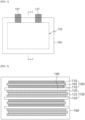
- FIGS. 1 and 2 are a schematic plan view and a cross-sectional view illustrating the lithium secondary battery according to exemplary embodiments, respectively. Specifically, FIG. 2 is a cross-sectional view taken on line I-I' in FIG. 1 .
- the lithium secondary battery may include a cathode 100 and an anode 130 disposed to face the cathode 100.
- the cathode 100 may include a cathode current collector 105 and a cathode active material layer 110 on the cathode current collector 105.
- the cathode active material layer 110 may include a cathode active material, and if necessary, a cathode binder and a conductive material.
- the cathode 100 may be prepared by mixing and stirring the cathode active material, the cathode binder, and the conductive material, etc. in a dispersion medium to prepare a cathode slurry, and then applying the cathode slurry to the cathode current collector 105, followed by drying and pressing the same.
- the cathode current collector 105 may include stainless steel, nickel, aluminum, titanium, copper, or an alloy thereof.
- the cathode active material may include lithium metal oxide particles capable of reversibly intercalating and deintercalating lithium ions.
- the cathode active material may include lithium metal oxide particles containing nickel.
- the lithium metal oxide particles may include 80 mol% or more of nickel based on a total number of moles of all elements except for lithium and oxygen. In this case, it is possible to implement a lithium secondary battery having a high capacity.
- the lithium metal oxide particles may include 83 mol% or more, 85 mol% or more, 90 mol% or more, or 95 mol% or more of nickel based on the total number of moles of all elements except for lithium and oxygen.
- the lithium metal oxide particles may further include at least one of cobalt and manganese.
- the lithium metal oxide particles may further include cobalt and manganese. In this case, it is possible to implement a lithium secondary battery having excellent output characteristics and penetration stability.
- the lithium metal oxide particles may be represented by Formula 2 below.
- Formula 2 Li x Ni (1-a-b) Co a M b O y
- M may be at least one of Al, Zr, Ti, Cr, B, Mg, Mn, Ba, Si, Y, W and Sr, and x, y, a and b may be in a range of 0.9 ⁇ x ⁇ 1.2, 1.9 ⁇ y ⁇ 2.1, and 0 ⁇ a+b ⁇ 0.5, respectively.
- a+b may be in a range of 0 ⁇ a+b ⁇ 0.4, 0 ⁇ a+b ⁇ 0.3, 0 ⁇ a+b ⁇ 0.2, 0 ⁇ a+b ⁇ 0.17, 0 ⁇ a+b ⁇ 0.15, 0 ⁇ a+b ⁇ 0.12, or 0 ⁇ a+b ⁇ 0.1.
- the lithium metal oxide particles may further include a coating element or a doping element.
- the coating element or the doping element may include Al, Ti, Ba, Zr, Si, B, Mg, P, Sr, W, La, or an alloy thereof, or an oxide thereof. In this case, it is possible to implement a lithium secondary battery having more improved lifespan characteristics.
- the conductive material may include a carbon-based conductive material such as graphite, carbon black, graphene, and carbon nanotubes; or a metal-based conductive material including tin, tin oxide, titanium oxide, or a perovskite material such as LaSrCoO 3 , and LaSrMnO 3 .
- the anode 130 may include an anode current collector 125 and an anode active material layer 120 on the anode current collector 125.
- the anode active material layer 120 may include an anode active material, and if necessary, an anode binder and a conductive material.
- the anode 130 may be prepared by mixing and stirring the anode active material, the anode binder, the conductive material, etc. in a solvent to prepare an anode slurry, and then applying the anode slurry to the anode current collector 125, followed by drying and pressing the same.
- the anode current collector 125 may include gold, stainless steel, nickel, aluminum, titanium, copper or an alloy thereof, and preferably, includes copper or a copper alloy.
- the anode active material may be a material capable of intercalating and deintercalating lithium ions.
- the anode active material may include a lithium alloy, a carbon-based active material, a silicon-based active material and the like.
- the lithium alloy may include aluminum, zinc, bismuth, cadmium, antimony, silicon, lead, tin, gallium, indium and the like.
- the carbon-based active material may include crystalline carbon, amorphous carbon, carbon composite, carbon fiber and the like.
- the amorphous carbon may include hard carbon, cokes, mesocarbon microbead (MCMB) calcined at 1500°C or lower, mesophase pitch-based carbon fiber (MPCF) or the like.
- the crystalline carbon may include natural graphite, graphite cokes, graphite MCMB, graphite MPCF and the like.
- the anode active material may include a silicon-based active material.
- the silicon-based active material may include Si, SiO x (0 ⁇ x ⁇ 2), Si/C, SiO/C, Si-metal and the like. In this case, it is possible to implement a lithium secondary battery having a high capacity.
- the anode active material includes the silicon-based active material
- the lithium secondary battery may include the above-described electrolyte to relieve a thickness increase rate of the battery.
- a content of the silicon active material in the anode active material may be included in an amount of 1 to 20 wt%, 1 to 15 wt%, or 1 to 10 wt%.
- the anode binder and the conductive material may be substantially the same as or similar to the above-described cathode binder and the conductive material.
- the anode binder may be an aqueous binder such as styrene-butadiene rubber (SBR).
- SBR styrene-butadiene rubber
- the anode binder may be used together with a thickener such as carboxymethyl cellulose (CMC).
- a separation membrane 140 may be interposed between the cathode 100 and the anode 130.
- the anode 130 may have an area greater than that of the cathode 100. In this case, lithium ions generated from the cathode 100 may smoothly move to the anode 130 without precipitation in the middle.
- the separation membrane 140 may include a porous polymer film made of a polyolefin polymer such as ethylene homopolymer, propylene homopolymer, ethylene/butene copolymer, ethylene/hexene copolymer, ethylene/methacrylate copolymer or the like.
- the separation membrane 140 may include a nonwoven fabric made of glass fiber having a high melting point, polyethylene terephthalate fiber or the like.
- an electrode cell may be formed including the cathode 100, the anode 130 and the separation membrane 140.
- a plurality of electrode cells may be stacked to form an electrode assembly 150.
- the electrode assembly 150 may be formed by winding, lamination, z-folding, etc. of the separation membrane 140.
- the lithium secondary battery according to exemplary embodiments may include: a cathode lead 107 connected to the cathode 100 and protruding to an outside of a case 160; and an anode lead 130 connected to the anode 130 and protruding to the outside of the case 160.
- the cathode 100 and the cathode lead 107 may be electrically connected with each other.
- the anode 130 and the anode lead 127 may be electrically connected with each other.
- the cathode lead 107 may be electrically connected to the cathode current collector 105.
- the anode lead 127 may be electrically connected to the anode current collector 125.
- the cathode current collector 105 may include a protrusion part (cathode tab, not illustrated) on one side.
- the cathode active material layer 110 may not be formed on the cathode tab.
- the cathode tab may be formed integrally with the cathode current collector 105 or may be connected thereto by welding or the like.
- the cathode current collector 105 and the cathode lead 107 may be electrically connected with each other through the cathode tab.
- the anode current collector 125 may include a protrusion part (anode tab, not illustrated) on one side.
- the anode active material layer 120 may not be formed on the anode tab.
- the anode tab may be formed integrally with the anode current collector 125 or may be connected thereto by welding or the like.
- the anode current collector 125 and the anode lead 127 may be electrically connected with each other through the anode tab.
- the electrode assembly 150 may include a plurality of cathodes and a plurality of anodes.
- the plurality of cathodes and anodes may be disposed alternately with each other, and the separation membranes may be interposed between the cathodes and the anodes.
- the lithium secondary battery according to an embodiment of the present invention may include a plurality of cathode tabs and a plurality of anode tabs protruding from each of the plurality of cathodes and the plurality of anodes.
- the cathode tabs may be stacked, compressed, and welded to form a cathode tab laminate (or, an anode tab laminate).
- the cathode tab laminate may be electrically connected to the cathode lead 107.
- the anode tab laminate may be electrically connected to the anode lead 127.
- the electrode assembly 150 may be housed in the case 160 together with the above-described electrolyte to form a lithium secondary battery.
- the lithium secondary battery may be manufactured, for example, in a cylindrical shape, a square shape, a pouch type, a coin shape or the like.
- a 1 M LiPF 6 solution (a mixed solvent of EC/EMC in a volume ratio of 25:75) was prepared.
- Electrolytes of the examples and comparative examples were prepared by adding additives and auxiliary additives in the contents (wt%) described in Table 1 below to the LiPF 6 solution based on the total weight of the electrolyte, and mixing with each other.
- a cathode slurry was prepared by mixing and dispersing a cathode active material of Li[Ni 0.8 Co 0.1 Mn 0.1 ]O 2 , carbon black, and polyvinylidene fluoride (PVDF) in NMP in a weight ratio of 98:1:1.
- a cathode active material Li[Ni 0.8 Co 0.1 Mn 0.1 ]O 2 , carbon black, and polyvinylidene fluoride (PVDF) in NMP in a weight ratio of 98:1:1.
- the cathode slurry was uniformly applied to an aluminum foil having a thickness of 12 ⁇ m, followed by drying and pressing the same to prepare a cathode.
- An anode slurry was prepared by mixing and dispersing an anode active material in which artificial graphite and natural graphite are mixed in a weight ratio of 7:3, a conductive material, styrene-butadiene rubber (SBR) and carboxymethyl cellulose (CMC) in water in a weight ratio of 96:3:1:1.
- SBR styrene-butadiene rubber
- CMC carboxymethyl cellulose
- An electrode assembly was manufactured by repeatedly stacking the prepared cathodes and anodes alternately, with a separator (thickness 13 ⁇ m, polyethylene film) interposed between the cathode and the anode.
- the lithium secondary batteries of the examples and comparative examples were subjected to 0.5C CC/CV charge (4.2 V, 0.05C CUT-OFF) and 0.5C CC discharge (2.7 V CUT-OFF) at 25 ° C three times, and discharge capacities C1 at the third cycle were measured.
- the charged lithium secondary batteries were stored at 60 ° C for 12 weeks, then additionally left at room temperature for 30 minutes, and subjected to 0.5C CC discharge (2.75 V CUT-OFF), then discharge capacities C2 were measured.
- the capacity retention rate was calculated by the following equation and results thereof are described in Table 2 below.
- Capacityretentionrate % C 2 / C 1 ⁇ 100 %
- the lithium secondary batteries of the examples and comparative examples were subjected to 0.5C CC/CV charge (4.2 V 0.05C CUT-OFF) at room temperature at 25°C, and then 0.5C CC discharge up to state-of-charge (SOC) 60.
- SOC 60 point the lithium secondary batteries were discharged and supplementary charged for 10 seconds, respectively, while changing C-rate to 0.2C 0.5C, 1C, 1.5C, 2C and 2.5C, then DCIRs R1 were measured.
- the charged lithium secondary batteries of the examples and comparative examples were left at 60°C for 12 weeks under a condition of being exposed to the atmosphere, followed by additionally leaving at room temperature for 30 minutes, then DCIRs R2 were measured by the same method as described above.
- the lithium secondary batteries of the examples and comparative examples were subjected to 0.5C CC/CV charge (4.2 V 0.05C CUT-OFF) at 25°C, then battery thicknesses T1 were measured.
- the lithium secondary batteries of the examples and comparative examples were subjected to 0.5C CC/CV charge (4.2 V 0.05C CUT-OFF) at room temperature (25°C), and then 0.5C CC discharge up to SOC 60.
- the lithium secondary batteries were discharged and supplementary charged for 10 seconds, respectively, while changing C-rate to 0.2C 0.5C, 1C, 1.5C, 2C and 2.5C, then initial DCIRs were measured and results thereof are shown in Table 3 below.
- the lithium secondary batteries of the examples and comparative examples were charged at 0.33C up to state of charge (SOC) 8%, then charged at 2.5C-2.25C-2C-1.75C-1.5C-1.0C stage by stage in a section of SOC 8-80%, and again charged at 0.33C (4.2 V, 0.05C cut-off) in the section of SOC 8-100%, and then CC discharged at 0.33C up to 2.7 V.
- SOC state of charge
- Discharge capacities A1 at the first cycle were measured, and the charge and discharge were repeated 100 times, then discharge capacities A2 at the 100th cycle were measured.
- Rapidchargecapacityretentionrate % A 2 / A 1 ⁇ 100 %
- the lithium secondary batteries of the examples and comparative examples were subjected to 0.5C CC/CV charge (4.2 V, 0.05C CUT-OFF) at 25°C, then left at -10°C for 4 hours, followed by 0.5C CC discharge (2.7 V CUT-OFF), and then discharge capacities (mAh) were measured and results thereof are shown in Table 3 below.
- the lithium secondary batteries of the examples and comparative examples were subjected to 0.5C CC/CV charge (4.2 V, 0.05C CUT-OFF) and 0.5C CC discharge (2.7 V CUT-OFF) at 25 ° C 500 times.
- the discharge capacity at the first cycle is referred to as C
- the lifespan capacity retention rate was determined by dividing the discharge capacity at the 500th cycle by the discharge capacity at the first cycle and results thereof are shown in Table 3 below.
- the lithium secondary batteries of the examples exhibited excellent results in the evaluation of high-temperature storage performance (capacity retention rate, resistance increase rate and thickness increase rate).
- the lithium secondary batteries of the examples exhibited excellent results in terms of other performances (initial resistance, rapid charge lifespan capacity retention rate, low-temperature capacity, and room-temperature lifespan capacity retention rate).
Landscapes
- Chemical & Material Sciences (AREA)
- Engineering & Computer Science (AREA)
- Manufacturing & Machinery (AREA)
- Chemical Kinetics & Catalysis (AREA)
- Electrochemistry (AREA)
- General Chemical & Material Sciences (AREA)
- Physics & Mathematics (AREA)
- Condensed Matter Physics & Semiconductors (AREA)
- General Physics & Mathematics (AREA)
- Inorganic Chemistry (AREA)
- Materials Engineering (AREA)
- Secondary Cells (AREA)
Abstract
According to exemplary embodiments, an electrolyte for a lithium secondary battery which includes an additive including a compound represented by a specific formula; an organic solvent; and a lithium salt may be provided. Thereby, the lithium secondary battery including the electrolyte for a lithium secondary battery may provide excellent high-temperature characteristics and other performances (e.g., initial resistance, rapid charge performance, room-temperature capacity characteristics, etc.).
Description
- The present disclosure relates to an electrolyte for a lithium secondary battery and a lithium secondary battery including the same, and more specifically, to an electrolyte for a lithium secondary battery which includes a solvent and an electrolyte salt, and a lithium secondary battery including the electrolyte.
- A secondary battery is a battery which can be repeatedly charged and discharged, and has been widely applied to portable electronic devices such as a mobile phone, a laptop computer, etc. as a power source thereof.
- A lithium secondary battery has a high operating voltage and a high energy density per unit weight, and is advantageous in terms of a charging speed and light weight. In this regard, the lithium secondary battery has been actively developed and applied to various industrial fields.
- For example, the lithium secondary battery may include: an electrode assembly including a cathode, an anode, and a separation membrane interposed between the cathode and the anode; and an electrolyte in which the electrode assembly is impregnated in a case.
- As an active material for the cathode of the lithium secondary battery, a lithium metal oxide may be used. Examples of the lithium metal oxide may include a nickel-based lithium metal oxide.
- As the application range of lithium secondary batteries expands, longer life, higher capacity, and operational stability are required. Accordingly, a lithium secondary battery that provides uniform output and capacity even during repeated charging and discharging is desirable.
- However, according to the repeated charging and discharging, the output and capacity may be decreased due to damage to the surface of the nickel-based lithium metal oxide used as a cathode active material, and a side reaction between the nickel-based lithium metal oxide and the electrolyte may occur. In particular, the lithium secondary battery is placed in a high-temperature environment during repetitive charging/discharging and overcharging. In this case, the above-described problems are accelerated, such that a swelling phenomenon of the battery (an increase in the battery thickness due to gases generated inside the battery), an increase in the internal resistance of the battery, a deterioration in lifespan characteristics of the battery, and the like are caused.
- An object of the present invention is to provide an electrolyte for a lithium secondary battery having excellent high-temperature characteristics and other performances (e.g., initial resistance, rapid charge performance, room-temperature capacity characteristics, etc.).
- Another object of the present invention is to provide a lithium secondary battery having excellent high-temperature characteristics and other performances (e.g., initial resistance, rapid charge performance, room-temperature capacity characteristics, etc.).
- To achieve the above object, according to an aspect of the present invention, there is provided an electrolyte for a lithium secondary battery including: an additive which includes a compound represented by Formula 1 below; an organic solvent; and a lithium salt:

- In Formula 1, In Formula 1, R1 and R2 may each independently be a substituted or unsubstituted C2-C8 cyclic ether group, and L1 and L2 may each independently be a substituted or unsubstituted C1-C5 alkylene group.
- In one embodiment, R1 and R2 may each independently be an unsubstituted C2-C5 cyclic ether group, and L1 and L2 are each independently an unsubstituted C1-C3 alkylene group.
- In one embodiment, R1 and R2 may each independently be an unsubstituted C4 cyclic ether group, and L1 and L2 may each independently be an unsubstituted C1 alkylene group.
- In one embodiment, the additive may be included in an amount of 0.1 to 5% by weight based on a total weight of the electrolyte.
- In one embodiment, the additive may be included in an amount of 0.2 to 2% by weight based on a total weight of the electrolyte.
- In one embodiment, the organic solvent may include a linear carbonate solvent and a cyclic carbonate solvent.
- In one embodiment, the electrolyte may further include at least one auxiliary additive selected from the group consisting of a cyclic carbonate compound, a fluorine-substituted carbonate compound, a sultone compound, a cyclic sulfate compound and a phosphate compound.
- In one embodiment, the auxiliary additive may be included in an amount of 0.05 to 10% by weight based on a total weight of the electrolyte.
- In one embodiment, the auxiliary additive may be included in an amount of 0.1 to 5% by weight based on the total weight of the electrolyte.
- In one embodiment, a ratio of a weight of the auxiliary additive to a weight of the additive in the electrolyte may be 0.1 to 10.
- According to another aspect of the present invention, there is provided a lithium secondary battery including an electrode assembly in which a plurality of cathodes and a plurality of anodes are repeatedly stacked; a case in which the electrode assembly is housed; and the electrolyte for a lithium secondary battery housed in the case together with the electrode assembly.
- The electrolyte including an additive for the electrolyte for a lithium secondary battery according to exemplary embodiments may form a robust solid electrolyte interphase (SEI) on the surface of an electrode.
- Accordingly, it is possible to implement a lithium secondary battery having improved high-temperature storage characteristics (e.g., improved capacity retention rate, and effects of preventing increases in resistance and thickness of the battery at a high temperature).
- The electrolyte for a lithium secondary battery according to exemplary embodiments may also implement a lithium secondary battery having improved other characteristics (e.g., decreased initial resistance, and effects of improving rapid charge lifespan capacity retention rate, low-temperature capacity, and lifespan capacity retention rate at 25 ° C).
-
-
FIG. 1 is a plan view schematically illustrating a lithium secondary battery according to exemplary embodiments. -
FIG. 2 is a cross-sectional view schematically illustrating a lithium secondary battery according to exemplary embodiments. -
FIG. 3 is a graph illustrating H-NMR results of an additive represented by Formula 1-1 according to an embodiment. - As used herein, the "X compound" may refer to a compound including an X unit attached to a matrix, etc. of the "X compound" and a derivative thereof.
- As used herein, the "Ca-Cb" may refer to "the number of carbon (C) atoms of a to b."
- An electrolyte for a lithium secondary battery according to exemplary embodiments may include: a lithium salt; an organic solvent; and an additive including a compound represented by Formula 1 below.
- The electrolyte for a lithium secondary battery according to exemplary embodiments may implement a lithium secondary battery having excellent high-temperature characteristics and other characteristics.
- Hereinafter, components of the present invention will be described in more detail.
- The electrolyte for a lithium secondary battery according to exemplary embodiments may include an additive including a compound represented by Formula 1 below.

- In Formula 1, R1 and R2 are independently from each other, and may be the same as or different from each other.
- For example, R1 may be a substituted or unsubstituted C2-C8 cyclic ether group. Preferably, R1 is an unsubstituted C2-C5 cyclic ether group, and more preferably, an unsubstituted C4 cyclic ether group.
- For example, R2 may be a substituted or unsubstituted C2-C8 cyclic ether group. Preferably, R1 is an unsubstituted C2-C5 cyclic ether group, and more preferably, an unsubstituted C4 cyclic ether group.
- For example, R1 and R2 are independently from each other, and may be the same as or different from each other.
- For example, L1 may be a substituted or unsubstituted C1-C5 alkylene group. Preferably, L1 is an unsubstituted C1-C3 alkylene group, and more preferably L1 is an unsubstituted C1 alkylene group.
- For example, the cyclic ether group may mean a heterocyclic compound having an ether bond in a ring formed of an alkyl group.
- For example, assuming that one hydrogen atom is removed from alkane (CnH2n+2), the alkyl group may mean a partial structure remaining. For example, CH3-CH2-CH2- may mean a propyl group.
- For example, the alkylene group may mean a form in which one hydrogen atom is separated from each of carbon atoms at both ends of the alkane (-CnH2n-). For example, - CH2-CH2-CH2- may mean a propylene group.
- For example, the ether may mean a compound in which two carbons are bonded to the same oxygen atom. For example, CH3-O-CH3 may mean dimethyl ether.
- For example, the meaning of "substituted" may mean that a hydrogen atom of the alkylene group is substituted with a substituent, such that the substituent can be further bonded to a carbon atom of the alkylene group. For example, the substituent may be at least one of halogen, a C1-C6 alkyl group, a C2-C6 alkenyl group, an amino group, a C1-C6 alkoxy group, a C3-C7 cycloalkyl group, and a 5- to 7-membered heterocycloalkyl group. In some embodiments, the substituent may be halogen or a C1-C6 alkyl group.
- When the electrolyte for a secondary battery includes the additive including the compound represented by Formula 1 above, for example, a sulfate functional group-based solid electrolyte film may be formed by inducing the formation of a film having a relatively reduced resistance on an electrode through a decomposition reaction of the cyclic ether group. Preferably, an SEI may be formed on an anode. Therefore, decomposition of the organic solvent may be effectively prevented, and gas generation and an increase in battery thickness may be significantly reduced. In addition, an SEI film having a relatively reduced resistance may prevent an initial resistance from increasing, and may also significantly improve rapid charging performance and lifespan characteristics.
- In other words, when the electrolyte for a secondary battery includes the additive including the compound represented by Formula 1 above, room-temperature characteristics, rapid charging characteristics and initial resistance characteristics may be improved together with the high-temperature storage characteristics.
- In one embodiment, the compound represented by Formula 1 above may include bis((tetrahydrofuran-2-yl)methyl) sulfate. For example, bis((tetrahydrofuran-2-yl)methyl) sulfate may be represented by Formula 1-1 below.

- For example, when including bis((tetrahydrofuran-2-yl)methyl) sulfate as an electrolyte additive for a secondary battery, a stable SEI film may be formed on the anode by the sulfate compound, thereby implementing a lithium secondary battery having improved high-temperature storage characteristics. In addition, decomposition of the electrolyte due to a reaction between the electrolyte and the anode may be suppressed, thereby reducing the gas generation.
- In particular, the formation of a film having a relatively reduced resistance may be induced through a decomposition reaction of the cyclic ether group, thereby improving other characteristics together, such as initial resistance value, rapid charging characteristics, room-temperature lifespan and low-temperature characteristics compared to existing additives which provide high-temperature storage characteristics.
- In one embodiment, in consideration of the implementation of sufficient passivation and the formation of stable SEI film, a content of the additive may be adjusted to 0.1% by weight ("wt%") or more, 0.2 wt% or more, 0.3 wt% or more, 0.4 wt% or more, 0.5 wt%, or 1 wt% or more based on a total weight of the electrolyte. In addition, in consideration of the movement of lithium ions and the activity of active material in the electrolyte, the content of the additive may be adjusted to 10 wt% or less, 9 wt% or less, 7 wt% or less, 6 wt% or less, 5 wt% or less, 4.5 wt% or less, 4 wt% or less, 3.5 wt% or less, 3 wt% or less, or 2 wt% or less based on the total weight of the electrolyte.
- In a preferred embodiment, the content of the additive may be 0.1 to 5 wt%, and more preferably 0.2 to 2 wt%. Within the above range, the passivation of the above-described anode may be sufficiently implemented, and the excellent capacity retention rate and the effects of preventing increases in battery thickness and resistance at a high temperature may be achieved without excessively inhibiting the movement of lithium ions and the activity of a cathode active material.
- The electrolyte for a lithium secondary battery according to exemplary embodiments may further include an auxiliary additive in addition to the above-described additive.
- In one embodiment, the auxiliary additive may include, for example, a cyclic carbonate compound, a fluorine-substituted carbonate compound, a sultone compound, a cyclic sulfate compound and a phosphate compound.
- In one embodiment, a content of the auxiliary additive may be adjusted to, for example, 10 wt% or less, 9 wt% or less, 8 wt% or less, 7 wt% or less, 6 wt% or less, 5 wt% or less, 4 wt% or less, 3 wt% or less, 2 wt% or less, or 1 wt% or less based on a total weight of the non-aqueous electrolyte, in consideration of the action with a main additive including the compound represented by Formula 1. In addition, the content of the auxiliary additive may be adjusted to 0.01 wt% or more, 0.02 wt% or more, 0.03 wt% or more, 0.05 wt% or more, 0.1 wt% or more, 0.2 wt% or more, 0.3 wt% or more, 0.4 wt% or more, or 0.5 wt% or more in consideration of the stabilization of the SEI film.
- Preferably, the auxiliary additive may be included in an amount of about 0.05 to 10 wt%, and more preferably 0.1 to 5 wt% based on the total weight of the non-aqueous electrolyte. Within the above range, it is possible to enhance durability of an electrode protective film, and help to improve high-temperature storage characteristics and other characteristics without inhibiting the role of the main additive.
- In one embodiment, a ratio of a weight of the auxiliary additive to a weight of the additive in the electrolyte may be 0.1 to 10, greater than 1 and 10 or less, or 5 to 10 or less. In this case, due to an interaction between the main additive and the auxiliary additive, a lithium secondary battery having more improved cycle characteristics together with high-temperature storage characteristics may be implemented.
- The cyclic carbonate compound may include vinylene carbonate (VC), vinyl ethylene carbonate (VEC), etc.
- The fluorine-substituted cyclic carbonate compound may include fluoroehtylene carbonate (FEC).
- The sultone compound may include 1,3-propane sultone, 1,3-propene sultone, 1,4-butane sultone, etc.
- The cyclic sulfate compound may include 1,2-ethylene sulfate, 1,2-propylene sulfate, etc.
- The phosphate compound may include lithium bis(oxalato)phosphate as an oxalatophosphate compound.
- In a preferred embodiment, as the auxiliary additive, the fluorine-substituted cyclic carbonate compound, the sultone compound, the cyclic sulfate compound and the oxalatophosphate compound may be used together.
- When adding the auxiliary additive, durability and stability of the electrode may be further enhanced. The auxiliary additive may be included in an appropriate amount within a range that does not inhibit the movement of lithium ions in the electrolyte.
- The organic solvent may include, for example, an organic compound which has sufficient solubility to the lithium salt, the additive, and the auxiliary additive, and does not have reactivity in the battery.
- For example, the organic solvent may include at least one of a carbonate solvent, an ester solvent, an ether solvent, a ketone solvent, an alcohol solvent and an aprotic solvent.
- In one embodiment, the organic solvent may include a carbonate solvent.
- In some embodiments, the carbonate solvent may include a linear carbonate solvent and a cyclic carbonate solvent.
- For example, the linear carbonate solvent may include at least one of dimethyl carbonate (DMC), ethyl methyl carbonate (EMC), diethyl carbonate (DEC), methyl propyl carbonate, ethyl propyl carbonate and dipropyl carbonate.
- For example, the cyclic carbonate solvent may include at least one of ethylene carbonate (EC), propylene carbonate (PC) and butylene carbonate.
- In some embodiments, the organic solvent may include more of the linear carbonate solvent than the cyclic carbonate solvent based on the volume.
- For example, a mixing volume ratio of the linear carbonate solvent and the cyclic carbonate solvent may be 1:1 to 9:1, and preferably 1.5:1 to 4:1.
- For example, the ester solvent may include at least one of methyl acetate (MA), ethyl acetate (EA), n-propyl acetate (n-PA), 1,1-dimethylethyl acetate (DMEA), methyl propionate (MP) and ethyl propionate (EP).
- For example, the ether solvent may include at least one of dibutyl ether, tetraethylene glycol dimethyl ether (TEGDME), diethylene glycol dimethyl ether (DEGDME), dimethoxyethane, tetrahydrofuran (THF) and 2-methyltetrahydrofuran.
- For example, the ketone solvent may include cyclohexanone.
- For example, the alcohol solvent may include at least one of ethyl alcohol and isopropyl alcohol.
- For example, the aprotic solvent may include at least one of a nitrile solvent, an amide solvent (e.g., dimethylformamide), a dioxolane solvent (e.g., 1,3-dioxolane), and a sulfolane solvent
- The electrolyte includes a lithium salt, and the lithium salt may be expressed as Li+X-.
- For example, the anion (X-) of the lithium salt may be at least one of F-, Cl-, Br-, I-, NO3 -, N(CN)2 -, BF4 -, ClO4 -, PF6 -, (CF3)2PF4 -, (CF3)3PF3 -, (CF3)4PF2 -, (CF3)5PF-, (CF3)6P-, CF3SO3 -, CF3CF2SO3 -, (CF3SO2)2N-, (FSO2)2N-, CF3CF2(CF3)2CO-, (CF3SO2)2CH-, (SF5)3C-, (CF3SO2)3C-, CF3(CF2)7SO3 -, CF3CO2 -, CH3CO2 -, SCN- and (CF3CF2SO2)2N-.
- In some embodiments, the lithium salt may include at least one of LiBF4 and LiPF6.
- In one embodiment, the lithium salt may be included in a concentration of 0.01 to 5 M, and more preferably 0.01 to 2 M relative to the organic solvent. Within the above concentration range, lithium ions and/or electrons may smoothly move during charging and discharging of the battery.
- A lithium secondary battery according to exemplary embodiments may include a cathode; an anode; a separation membrane interposed between the cathode and the anode; and an electrolyte including an organic solvent and a lithium salt.
- Hereinafter, the lithium secondary battery according to exemplary embodiments will be described in more detail with reference to the drawings.
FIGS. 1 and 2 are a schematic plan view and a cross-sectional view illustrating the lithium secondary battery according to exemplary embodiments, respectively. Specifically,FIG. 2 is a cross-sectional view taken on line I-I' inFIG. 1 . - Referring to
FIGS. 1 and 2 , the lithium secondary battery may include acathode 100 and ananode 130 disposed to face thecathode 100. - The
cathode 100 may include a cathodecurrent collector 105 and a cathodeactive material layer 110 on the cathodecurrent collector 105. - For example, the cathode
active material layer 110 may include a cathode active material, and if necessary, a cathode binder and a conductive material. - For example, the
cathode 100 may be prepared by mixing and stirring the cathode active material, the cathode binder, and the conductive material, etc. in a dispersion medium to prepare a cathode slurry, and then applying the cathode slurry to the cathodecurrent collector 105, followed by drying and pressing the same. - For example, the cathode
current collector 105 may include stainless steel, nickel, aluminum, titanium, copper, or an alloy thereof. - For example, the cathode active material may include lithium metal oxide particles capable of reversibly intercalating and deintercalating lithium ions.
- In one embodiment, the cathode active material may include lithium metal oxide particles containing nickel.
- In some embodiments, the lithium metal oxide particles may include 80 mol% or more of nickel based on a total number of moles of all elements except for lithium and oxygen. In this case, it is possible to implement a lithium secondary battery having a high capacity.
- In some embodiments, the lithium metal oxide particles may include 83 mol% or more, 85 mol% or more, 90 mol% or more, or 95 mol% or more of nickel based on the total number of moles of all elements except for lithium and oxygen.
- In some embodiments, the lithium metal oxide particles may further include at least one of cobalt and manganese.
- In some embodiments, the lithium metal oxide particles may further include cobalt and manganese. In this case, it is possible to implement a lithium secondary battery having excellent output characteristics and penetration stability.
- In one embodiment, the lithium metal oxide particles may be represented by Formula 2 below.
[Formula 2] LixNi(1-a-b)CoaMbOy
- For example, in Formula 2, M may be at least one of Al, Zr, Ti, Cr, B, Mg, Mn, Ba, Si, Y, W and Sr, and x, y, a and b may be in a range of 0.9≤x≤1.2, 1.9≤y≤2.1, and 0≤a+b≤0.5, respectively.
- In some embodiments, a+b may be in a range of 0<a+b≤0.4, 0<a+b≤0.3, 0<a+b≤0.2, 0<a+b≤0.17, 0<a+b≤0.15, 0<a+b≤0.12, or 0<a+b≤0.1.
- In one embodiment, the lithium metal oxide particles may further include a coating element or a doping element. For example, the coating element or the doping element may include Al, Ti, Ba, Zr, Si, B, Mg, P, Sr, W, La, or an alloy thereof, or an oxide thereof. In this case, it is possible to implement a lithium secondary battery having more improved lifespan characteristics.
- For example, the cathode binder may include an organic binder such as polyvinylidene fluoride (PVDF), vinylidene fluoride-hexafluoropropylene copolymer (PVDF-co-HFP), polyacrylonitrile, polymethyl methacrylate, etc., or an aqueous binder such as styrene-butadiene rubber (SBR). In addition, for example, the cathode binder may be used together with a thickener such as carboxymethyl cellulose (CMC).
- For example, the conductive material may include a carbon-based conductive material such as graphite, carbon black, graphene, and carbon nanotubes; or a metal-based conductive material including tin, tin oxide, titanium oxide, or a perovskite material such as LaSrCoO3, and LaSrMnO3.
- For example, the
anode 130 may include an anodecurrent collector 125 and an anodeactive material layer 120 on the anodecurrent collector 125. - For example, the anode
active material layer 120 may include an anode active material, and if necessary, an anode binder and a conductive material. - For example, the
anode 130 may be prepared by mixing and stirring the anode active material, the anode binder, the conductive material, etc. in a solvent to prepare an anode slurry, and then applying the anode slurry to the anodecurrent collector 125, followed by drying and pressing the same. - For example, the anode
current collector 125 may include gold, stainless steel, nickel, aluminum, titanium, copper or an alloy thereof, and preferably, includes copper or a copper alloy. - For example, the anode active material may be a material capable of intercalating and deintercalating lithium ions. For example, the anode active material may include a lithium alloy, a carbon-based active material, a silicon-based active material and the like.
- For example, the lithium alloy may include aluminum, zinc, bismuth, cadmium, antimony, silicon, lead, tin, gallium, indium and the like.
- For example, the carbon-based active material may include crystalline carbon, amorphous carbon, carbon composite, carbon fiber and the like.
- For example, the amorphous carbon may include hard carbon, cokes, mesocarbon microbead (MCMB) calcined at 1500°C or lower, mesophase pitch-based carbon fiber (MPCF) or the like. For example, the crystalline carbon may include natural graphite, graphite cokes, graphite MCMB, graphite MPCF and the like.
- In one embodiment, the anode active material may include a silicon-based active material. For example, the silicon-based active material may include Si, SiOx (0<x<2), Si/C, SiO/C, Si-metal and the like. In this case, it is possible to implement a lithium secondary battery having a high capacity.
- For example, when the anode active material includes the silicon-based active material, there may be a problem in that a thickness of the battery is increased during repeated charging and discharging. The lithium secondary battery according to exemplary embodiments may include the above-described electrolyte to relieve a thickness increase rate of the battery.
- In some embodiments, a content of the silicon active material in the anode active material may be included in an amount of 1 to 20 wt%, 1 to 15 wt%, or 1 to 10 wt%.
- The anode binder and the conductive material may be substantially the same as or similar to the above-described cathode binder and the conductive material. For example, the anode binder may be an aqueous binder such as styrene-butadiene rubber (SBR). In addition, for example, the anode binder may be used together with a thickener such as carboxymethyl cellulose (CMC).
- In one embodiment, a
separation membrane 140 may be interposed between thecathode 100 and theanode 130. - In some embodiments, the
anode 130 may have an area greater than that of thecathode 100. In this case, lithium ions generated from thecathode 100 may smoothly move to theanode 130 without precipitation in the middle. - For example, the
separation membrane 140 may include a porous polymer film made of a polyolefin polymer such as ethylene homopolymer, propylene homopolymer, ethylene/butene copolymer, ethylene/hexene copolymer, ethylene/methacrylate copolymer or the like. Alternatively, for example, theseparation membrane 140 may include a nonwoven fabric made of glass fiber having a high melting point, polyethylene terephthalate fiber or the like. - For example, an electrode cell may be formed including the
cathode 100, theanode 130 and theseparation membrane 140. - For example, a plurality of electrode cells may be stacked to form an
electrode assembly 150. For example, theelectrode assembly 150 may be formed by winding, lamination, z-folding, etc. of theseparation membrane 140. - The lithium secondary battery according to exemplary embodiments may include: a
cathode lead 107 connected to thecathode 100 and protruding to an outside of acase 160; and ananode lead 130 connected to theanode 130 and protruding to the outside of thecase 160. - For example, the
cathode 100 and thecathode lead 107 may be electrically connected with each other. Similarly, theanode 130 and theanode lead 127 may be electrically connected with each other. - For example, the
cathode lead 107 may be electrically connected to the cathodecurrent collector 105. In addition, theanode lead 127 may be electrically connected to the anodecurrent collector 125. - For example, the cathode
current collector 105 may include a protrusion part (cathode tab, not illustrated) on one side. The cathodeactive material layer 110 may not be formed on the cathode tab. The cathode tab may be formed integrally with the cathodecurrent collector 105 or may be connected thereto by welding or the like. The cathodecurrent collector 105 and thecathode lead 107 may be electrically connected with each other through the cathode tab. - Similarly, the anode
current collector 125 may include a protrusion part (anode tab, not illustrated) on one side. The anodeactive material layer 120 may not be formed on the anode tab. The anode tab may be formed integrally with the anodecurrent collector 125 or may be connected thereto by welding or the like. The anodecurrent collector 125 and theanode lead 127 may be electrically connected with each other through the anode tab. - In one embodiment, the
electrode assembly 150 may include a plurality of cathodes and a plurality of anodes. For example, the plurality of cathodes and anodes may be disposed alternately with each other, and the separation membranes may be interposed between the cathodes and the anodes. Accordingly, the lithium secondary battery according to an embodiment of the present invention may include a plurality of cathode tabs and a plurality of anode tabs protruding from each of the plurality of cathodes and the plurality of anodes. - In one embodiment, the cathode tabs (or, the anode tabs) may be stacked, compressed, and welded to form a cathode tab laminate (or, an anode tab laminate). The cathode tab laminate may be electrically connected to the
cathode lead 107. In addition, the anode tab laminate may be electrically connected to theanode lead 127. - For example, the
electrode assembly 150 may be housed in thecase 160 together with the above-described electrolyte to form a lithium secondary battery. - The lithium secondary battery may be manufactured, for example, in a cylindrical shape, a square shape, a pouch type, a coin shape or the like.
- Hereinafter, preferred examples of the present invention and comparative examples will be described. However, the following examples are only preferred examples of the present invention, and the present invention is not limited thereto.
- Acetonitrile (60 mL), distilled water (60 mL), and bis-tetrahydrofurfuryl sulfite (12 g, 48 mmol) were sequentially input into a round bottom flask, followed by cooling the same to 0°C. Sodium periodate (12.3 g, 58 mmol) and ruthenium (III) chloride hydrate (1.2 g, 6 mmol) were added to the mixture, and then the mixture was stirred for 2 hours. After the reaction was completed, 50 mL of a saturated sodium thiosulfate aqueous solution was slowly added dropwise to a filtrate obtained by filtering through Celite and washing with ethyl acetate. An organic layer was separated, and the production mixture was washed twice with a saturated sodium chloride aqueous solution (50 mL). The solvent in the organic layer, from which moisture was removed by performing sodium sulfate treatment, was dried and then purified through a silica column to obtain 6.7 g of white solid (bis((tetrahydrofuran-2-yl)methyl) sulfate). H-NMR results for the obtained compound are as follows, and H-NMR results are shown by a graph in
FIG. 3 .
1H-NMR(CDCl3, 600 MHz): 4.27(m, 2H), 4.20(m, 4H), 3.89(q, 2H), 3.81(q, 2H), 2.04(m, 2H), 1.92(m, 4H), 1.71(m, 2H) - A 1 M LiPF6 solution (a mixed solvent of EC/EMC in a volume ratio of 25:75) was prepared.
- Electrolytes of the examples and comparative examples were prepared by adding additives and auxiliary additives in the contents (wt%) described in Table 1 below to the LiPF6 solution based on the total weight of the electrolyte, and mixing with each other.
- A cathode slurry was prepared by mixing and dispersing a cathode active material of Li[Ni0.8Co0.1Mn0.1]O2, carbon black, and polyvinylidene fluoride (PVDF) in NMP in a weight ratio of 98:1:1.
- The cathode slurry was uniformly applied to an aluminum foil having a thickness of 12 µm, followed by drying and pressing the same to prepare a cathode.
- An anode slurry was prepared by mixing and dispersing an anode active material in which artificial graphite and natural graphite are mixed in a weight ratio of 7:3, a conductive material, styrene-butadiene rubber (SBR) and carboxymethyl cellulose (CMC) in water in a weight ratio of 96:3:1:1. The anode slurry was uniformly applied to a copper foil having a thickness of 8 µm, followed by drying and pressing the same to prepare an anode.
- An electrode assembly was manufactured by repeatedly stacking the prepared cathodes and anodes alternately, with a separator (thickness 13 µm, polyethylene film) interposed between the cathode and the anode.
- The electrode assembly was placed in a pouch, the electrolyte prepared in (2) above was injected, sealed, and impregnated for 12 hours to manufacture a lithium secondary battery.
[TABLE 1] Additive Auxiliary additive (wt%) FEC PS PRS Example 1 BHFSa, 0.2 wt% 1 0.5 - Example 2 BHFSa, 0.5 wt% 1 0.5 - Example 3 BHFSa 1.0 wt% 1 0.5 - Example 4 BHFSa 2.0 wt% 1 0.5 - Comparative Example 1 - 1 0.5 0.5 Comparative Example 2 - 1 0.5 - - The components described in Table 1 are as follows.
- BHFSa: Bis((tetrahydrofuran-2-yl)methyl) sulfate
- FEC: Fluoro ethylene carbonate
- PS: 1,3-Propane sultone
- PRS: Prop-1-ene-1,3-sultone
- The lithium secondary batteries of the examples and comparative examples were subjected to 0.5C CC/CV charge (4.2 V, 0.05C CUT-OFF) and 0.5C CC discharge (2.7 V CUT-OFF) at 25 ° C three times, and discharge capacities C1 at the third cycle were measured. The charged lithium secondary batteries were stored at 60 ° C for 12 weeks, then additionally left at room temperature for 30 minutes, and subjected to 0.5C CC discharge (2.75 V CUT-OFF), then discharge capacities C2 were measured. The capacity retention rate was calculated by the following equation and results thereof are described in Table 2 below.

- The lithium secondary batteries of the examples and comparative examples were subjected to 0.5C CC/CV charge (4.2 V 0.05C CUT-OFF) at room temperature at 25°C, and then 0.5C CC discharge up to state-of-charge (SOC) 60. At SOC 60 point, the lithium secondary batteries were discharged and supplementary charged for 10 seconds, respectively, while changing C-rate to 0.2C 0.5C, 1C, 1.5C, 2C and 2.5C, then DCIRs R1 were measured. The charged lithium secondary batteries of the examples and comparative examples were left at 60°C for 12 weeks under a condition of being exposed to the atmosphere, followed by additionally leaving at room temperature for 30 minutes, then DCIRs R2 were measured by the same method as described above. The internal resistance increase rate was calculated by the following equation, and result values are described in Table 2 below.

- The lithium secondary batteries of the examples and comparative examples were subjected to 0.5C CC/CV charge (4.2 V 0.05C CUT-OFF) at 25°C, then battery thicknesses T1 were measured.
- After leaving the charged lithium secondary batteries of the examples and comparative example under the condition of being exposed to the atmosphere at 60 °C for 12 weeks (using a thermostatic device), battery thicknesses T2 were measured. The battery thickness was measured using a plate thickness measuring device (Mitutoyo, 543-490B). The battery thickness increase rate was calculated by the following equation, and result values are described in Table 2 below.

- The lithium secondary batteries of the examples and comparative examples were subjected to 0.5C CC/CV charge (4.2 V 0.05C CUT-OFF) at room temperature (25°C), and then 0.5C CC discharge up to SOC 60. At SOC 60 point, the lithium secondary batteries were discharged and supplementary charged for 10 seconds, respectively, while changing C-rate to 0.2C 0.5C, 1C, 1.5C, 2C and 2.5C, then initial DCIRs were measured and results thereof are shown in Table 3 below.
- The lithium secondary batteries of the examples and comparative examples were charged at 0.33C up to state of charge (SOC) 8%, then charged at 2.5C-2.25C-2C-1.75C-1.5C-1.0C stage by stage in a section of SOC 8-80%, and again charged at 0.33C (4.2 V, 0.05C cut-off) in the section of SOC 8-100%, and then CC discharged at 0.33C up to 2.7 V.
- Discharge capacities A1 at the first cycle were measured, and the charge and discharge were repeated 100 times, then discharge capacities A2 at the 100th cycle were measured.
- The rapid charge capacity retention rate was calculated as the following equation and results thereof are shown in Table 3 below.

- The lithium secondary batteries of the examples and comparative examples were subjected to 0.5C CC/CV charge (4.2 V, 0.05C CUT-OFF) at 25°C, then left at -10°C for 4 hours, followed by 0.5C CC discharge (2.7 V CUT-OFF), and then discharge capacities (mAh) were measured and results thereof are shown in Table 3 below.
- The lithium secondary batteries of the examples and comparative examples were subjected to 0.5C CC/CV charge (4.2 V, 0.05C CUT-OFF) and 0.5C CC discharge (2.7 V CUT-OFF) at 25 ° C 500 times. At this time, the discharge capacity at the first cycle is referred to as C, and the lifespan capacity retention rate was determined by dividing the discharge capacity at the 500th cycle by the discharge capacity at the first cycle and results thereof are shown in Table 3 below.
[TABLE 2] High-temperature storage performance Ret. (%) DCIR increase rate (%) Thickness increase rate (%) Example 1 88.5 99.8 100.3 Example 2 88.8 102.8 79.2 Example 3 90.1 105.2 65.3 Example 4 90.1 110.4 70.4 Comparative Example 1 88.2 108.6 96.2 Comparative Example 2 86.1 115.5 116.4 [TABLE 3] Other performances Initial DCIR (mΩ) Rapid charge lifespan capacity retention rate (%, 100 cycles) Low-temperature capacity (%) Lifespan capacity retention rate at 25 ° C (%) Example 1 35.3 94.9 1524 91.1 Example 2 38.4 93.6 1514 90.0 Example 3 40.1 92.7 1500 91.0 Example 4 40.7 92.5 1455 90.8 Comparative Example 1 40.5 90.3 1399 86.8 Comparative Example 2 35.9 94.8 1525 90.8 - As can be confirmed from Table 2 above, the lithium secondary batteries of the examples exhibited excellent results in the evaluation of high-temperature storage performance (capacity retention rate, resistance increase rate and thickness increase rate).
- As can be confirmed from Table 3 above, the lithium secondary batteries of the examples exhibited excellent results in terms of other performances (initial resistance, rapid charge lifespan capacity retention rate, low-temperature capacity, and room-temperature lifespan capacity retention rate).
- In addition, when comparing Comparative Example 1 and Comparative Example 2, it can be seen that the high-temperature characteristics are improved when including PRS, but the other performances are deteriorated. However, it can be confirmed that the examples might improve other performances together with the high-temperature storage performance.
Claims (11)
- An electrolyte for a lithium secondary battery comprising:an additive which comprises a compound represented by Formula 1 below;an organic solvent; anda lithium salt:
 (in Formula 1, R1 and R2 are each independently a substituted or unsubstituted C2-C8 cyclic ether group, and L1 and L2 are each independently a substituted or unsubstituted C1-C5 alkylene group).
 - The electrolyte for a lithium secondary battery according to claim 1, wherein R1 and R2 are each independently an unsubstituted C2-C5 cyclic ether group, and L1 and L2 are each independently an unsubstituted C1-C3 alkylene group.
- The electrolyte for a lithium secondary battery according to claim 1, wherein R1 and R2 are each independently an unsubstituted C4 cyclic ether group, and L1 and L2 are each independently an unsubstituted C1 alkylene group.
- The electrolyte for a lithium secondary battery according to claim 1, wherein the additive is included in an amount of 0.1 to 5% by weight based on a total weight of the electrolyte.
- The electrolyte for a lithium secondary battery according to claim 1, wherein the additive is included in an amount of 0.2 to 2% by weight based on a total weight of the electrolyte.
- The electrolyte for a lithium secondary battery according to claim 1, wherein the organic solvent includes a linear carbonate solvent and a cyclic carbonate solvent.
- The electrolyte for a lithium secondary battery according to claim 1, further comprising at least one auxiliary additive selected from the group consisting of a cyclic carbonate compound, a fluorine-substituted carbonate compound, a sultone compound, a cyclic sulfate compound and a phosphate compound.
- The electrolyte for a lithium secondary battery according to claim 7, wherein the auxiliary additive is included in an amount of 0.05 to 10% by weight based on a total weight of the electrolyte.
- The electrolyte for a lithium secondary battery according to claim 7, wherein the auxiliary additive is included in an amount of 0.1 to 5% by weight based on the total weight of the electrolyte.
- The electrolyte for a lithium secondary battery according to claim 7, wherein a ratio of a weight of the auxiliary additive to a weight of the additive in the electrolyte is 0.1 to 10.
- A lithium secondary battery comprising an electrode assembly in which a plurality of cathodes and a plurality of anodes are repeatedly stacked;a case in which the electrode assembly is housed; andthe electrolyte for a lithium secondary battery according to claim 1 housed in the case together with the electrode assembly.
Applications Claiming Priority (2)
| Application Number | Priority Date | Filing Date | Title |
|---|---|---|---|
| KR1020220061630A KR20230161810A (en) | 2022-05-19 | 2022-05-19 | Electrolyte solution for lithium secondary battery and lithium secondary battery including the same |
| PCT/KR2023/006442 WO2023224319A1 (en) | 2022-05-19 | 2023-05-11 | Electrolyte for lithium secondary battery and lithium secondary battery comprising same |
Publications (1)
| Publication Number | Publication Date |
|---|---|
| EP4528876A1 true EP4528876A1 (en) | 2025-03-26 |
Family
ID=88835710
Family Applications (1)
| Application Number | Title | Priority Date | Filing Date |
|---|---|---|---|
| EP23807839.8A Pending EP4528876A1 (en) | 2022-05-19 | 2023-05-11 | Electrolyte for lithium secondary battery and lithium secondary battery comprising same |
Country Status (5)
| Country | Link |
|---|---|
| US (1) | US20260018669A1 (en) |
| EP (1) | EP4528876A1 (en) |
| KR (1) | KR20230161810A (en) |
| CN (1) | CN119156727A (en) |
| WO (1) | WO2023224319A1 (en) |
Family Cites Families (6)
| Publication number | Priority date | Publication date | Assignee | Title |
|---|---|---|---|---|
| KR101449353B1 (en) * | 2010-10-22 | 2014-10-08 | 미쓰이 가가쿠 가부시키가이샤 | Cyclic sulfate compound, non-aqueous electrolyte solution containing same, and lithium secondary battery |
| US9716290B2 (en) * | 2012-10-03 | 2017-07-25 | Gs Yuasa International Ltd. | Nonaqueous electrolyte secondary battery and method for producing nonaqueous electrolyte secondary battery |
| JP2016527682A (en) * | 2013-07-23 | 2016-09-08 | ビーエーエスエフ ソシエタス・ヨーロピアBasf Se | Oxiranyl ester derivatives as electrolyte additives for lithium ion batteries |
| KR20170056699A (en) * | 2014-10-22 | 2017-05-23 | 미쯔이가가꾸가부시끼가이샤 | Lithium secondary battery |
| KR102675258B1 (en) | 2018-01-30 | 2024-06-17 | 주식회사 엘지에너지솔루션 | Lithium secondary battery with improved high temperature storage property |
| KR102152304B1 (en) * | 2018-04-02 | 2020-09-04 | 삼성에스디아이 주식회사 | Electrolyte for rechargeable lithium battery and rechargeable lithium battery |
-
2022
- 2022-05-19 KR KR1020220061630A patent/KR20230161810A/en active Pending
-
2023
- 2023-05-11 US US18/867,126 patent/US20260018669A1/en active Pending
- 2023-05-11 CN CN202380041535.0A patent/CN119156727A/en active Pending
- 2023-05-11 WO PCT/KR2023/006442 patent/WO2023224319A1/en not_active Ceased
- 2023-05-11 EP EP23807839.8A patent/EP4528876A1/en active Pending
Also Published As
| Publication number | Publication date |
|---|---|
| KR20230161810A (en) | 2023-11-28 |
| CN119156727A (en) | 2024-12-17 |
| US20260018669A1 (en) | 2026-01-15 |
| WO2023224319A1 (en) | 2023-11-23 |
Similar Documents
| Publication | Publication Date | Title |
|---|---|---|
| KR20250032450A (en) | Electrolyte for lithium secondary battery and lithium secondary battery including the same | |
| US20250349898A1 (en) | Non-Aqueous Electrolyte, and Lithium Secondary Battery Comprising the Same | |
| KR20240038580A (en) | Electrolyte solution for lithium secondary battery and lithium secondary battery including the same | |
| EP4539192A1 (en) | Electrolyte for rechargeable lithium battery and rechargeable lithium battery including same | |
| US20260018669A1 (en) | Electrolyte for lithium secondary battery and lithium secondary battery comprising same | |
| EP4287336A1 (en) | Electrolyte solution for lithium secondary battery and lithium secondary battery including the same | |
| EP4303978B1 (en) | Electrolyte solution for lithium secondary battery and lithium secondary battery including the same | |
| EP4503226B1 (en) | Electrolyte for lithium secondary battery and lithium secondary battery including the same | |
| EP4398346B1 (en) | Electrolyte for lithium secondary battery and lithium secondary battery including the same | |
| EP4340096A1 (en) | Electrolyte solution for lithium secondary battery and lithium secondary battery including the same | |
| US12633571B2 (en) | Electrolyte for lithium secondary battery and lithium secondary battery including the same | |
| US12609355B2 (en) | Electrolyte for lithium secondary battery and lithium secondary battery including the same | |
| EP4307426A1 (en) | Electrolyte solution for lithium secondary battery and lithium secondary battery including the same | |
| US20230253627A1 (en) | Electrolyte for lithium secondary battery and lithium secondary battery including the same | |
| EP4611096A1 (en) | Electrolyte for lithium secondary battery and lithium secondary battery including the same | |
| US20250316760A1 (en) | Electrolyte for lithium secondary battery and lithium secondary battery including the same | |
| EP4564513A1 (en) | Electrolyte for rechargeable lithium battery and rechargeable lithium battery including same | |
| EP4645503A1 (en) | Electrolyte for rechargeable lithium battery, and rechargeable lithium battery comprising same | |
| EP3958370A1 (en) | Electrolyte for lithium secondary battery and lithium secondary battery including the same | |
| EP4738516A1 (en) | Lithium secondary battery | |
| EP4742350A1 (en) | Electrolyte for lithium secondary battery and lithium secondary battery including the same | |
| KR20240143417A (en) | Electrolyte for lithium secondary battery and lithium secondary battery comprising the same | |
| CN120184373A (en) | Electrolyte for lithium secondary battery and lithium secondary battery including the electrolyte | |
| KR20230011584A (en) | Electrolyte for lithium secondary battery with improved high-temperature stability and lithium secondary battery including the same |
Legal Events
| Date | Code | Title | Description |
|---|---|---|---|
| STAA | Information on the status of an ep patent application or granted ep patent |
Free format text: STATUS: THE INTERNATIONAL PUBLICATION HAS BEEN MADE |
|
| PUAI | Public reference made under article 153(3) epc to a published international application that has entered the european phase |
Free format text: ORIGINAL CODE: 0009012 |
|
| STAA | Information on the status of an ep patent application or granted ep patent |
Free format text: STATUS: REQUEST FOR EXAMINATION WAS MADE |
|
| 17P | Request for examination filed |
Effective date: 20241219 |
|
| AK | Designated contracting states |
Kind code of ref document: A1 Designated state(s): AL AT BE BG CH CY CZ DE DK EE ES FI FR GB GR HR HU IE IS IT LI LT LU LV MC ME MK MT NL NO PL PT RO RS SE SI SK SM TR |
|
| DAV | Request for validation of the european patent (deleted) | ||
| DAX | Request for extension of the european patent (deleted) |