EP4528859A1 - Bipolar plate of a proton-exchange membrane fuel cell and methods of manufacturing same - Google Patents
Bipolar plate of a proton-exchange membrane fuel cell and methods of manufacturing same Download PDFInfo
- Publication number
- EP4528859A1 EP4528859A1 EP22744234.0A EP22744234A EP4528859A1 EP 4528859 A1 EP4528859 A1 EP 4528859A1 EP 22744234 A EP22744234 A EP 22744234A EP 4528859 A1 EP4528859 A1 EP 4528859A1
- Authority
- EP
- European Patent Office
- Prior art keywords
- mpa
- gas
- cavity
- titanium
- period
- Prior art date
- Legal status (The legal status is an assumption and is not a legal conclusion. Google has not performed a legal analysis and makes no representation as to the accuracy of the status listed.)
- Pending
Links
Images



Classifications
-
- H—ELECTRICITY
- H01—ELECTRIC ELEMENTS
- H01M—PROCESSES OR MEANS, e.g. BATTERIES, FOR THE DIRECT CONVERSION OF CHEMICAL ENERGY INTO ELECTRICAL ENERGY
- H01M4/00—Electrodes
- H01M4/86—Inert electrodes with catalytic activity, e.g. for fuel cells
- H01M4/8605—Porous electrodes
-
- H—ELECTRICITY
- H01—ELECTRIC ELEMENTS
- H01M—PROCESSES OR MEANS, e.g. BATTERIES, FOR THE DIRECT CONVERSION OF CHEMICAL ENERGY INTO ELECTRICAL ENERGY
- H01M4/00—Electrodes
- H01M4/86—Inert electrodes with catalytic activity, e.g. for fuel cells
- H01M4/88—Processes of manufacture
- H01M4/8803—Supports for the deposition of the catalytic active composition
- H01M4/8807—Gas diffusion layers
-
- H—ELECTRICITY
- H01—ELECTRIC ELEMENTS
- H01M—PROCESSES OR MEANS, e.g. BATTERIES, FOR THE DIRECT CONVERSION OF CHEMICAL ENERGY INTO ELECTRICAL ENERGY
- H01M4/00—Electrodes
- H01M4/86—Inert electrodes with catalytic activity, e.g. for fuel cells
- H01M4/90—Selection of catalytic material
- H01M4/9041—Metals or alloys
-
- H—ELECTRICITY
- H01—ELECTRIC ELEMENTS
- H01M—PROCESSES OR MEANS, e.g. BATTERIES, FOR THE DIRECT CONVERSION OF CHEMICAL ENERGY INTO ELECTRICAL ENERGY
- H01M8/00—Fuel cells; Manufacture thereof
- H01M8/02—Details
- H01M8/0202—Collectors; Separators, e.g. bipolar separators; Interconnectors
- H01M8/0204—Non-porous and characterised by the material
- H01M8/0206—Metals or alloys
-
- H—ELECTRICITY
- H01—ELECTRIC ELEMENTS
- H01M—PROCESSES OR MEANS, e.g. BATTERIES, FOR THE DIRECT CONVERSION OF CHEMICAL ENERGY INTO ELECTRICAL ENERGY
- H01M8/00—Fuel cells; Manufacture thereof
- H01M8/02—Details
- H01M8/0202—Collectors; Separators, e.g. bipolar separators; Interconnectors
- H01M8/0204—Non-porous and characterised by the material
- H01M8/0223—Composites
- H01M8/0228—Composites in the form of layered or coated products
-
- H—ELECTRICITY
- H01—ELECTRIC ELEMENTS
- H01M—PROCESSES OR MEANS, e.g. BATTERIES, FOR THE DIRECT CONVERSION OF CHEMICAL ENERGY INTO ELECTRICAL ENERGY
- H01M8/00—Fuel cells; Manufacture thereof
- H01M8/02—Details
- H01M8/0202—Collectors; Separators, e.g. bipolar separators; Interconnectors
- H01M8/0247—Collectors; Separators, e.g. bipolar separators; Interconnectors characterised by the form
- H01M8/0256—Vias, i.e. connectors passing through the separator material
-
- H—ELECTRICITY
- H01—ELECTRIC ELEMENTS
- H01M—PROCESSES OR MEANS, e.g. BATTERIES, FOR THE DIRECT CONVERSION OF CHEMICAL ENERGY INTO ELECTRICAL ENERGY
- H01M8/00—Fuel cells; Manufacture thereof
- H01M8/10—Fuel cells with solid electrolytes
- H01M8/1016—Fuel cells with solid electrolytes characterised by the electrolyte material
- H01M8/1018—Polymeric electrolyte materials
-
- H—ELECTRICITY
- H01—ELECTRIC ELEMENTS
- H01M—PROCESSES OR MEANS, e.g. BATTERIES, FOR THE DIRECT CONVERSION OF CHEMICAL ENERGY INTO ELECTRICAL ENERGY
- H01M8/00—Fuel cells; Manufacture thereof
- H01M8/10—Fuel cells with solid electrolytes
- H01M2008/1095—Fuel cells with polymeric electrolytes
-
- H—ELECTRICITY
- H01—ELECTRIC ELEMENTS
- H01M—PROCESSES OR MEANS, e.g. BATTERIES, FOR THE DIRECT CONVERSION OF CHEMICAL ENERGY INTO ELECTRICAL ENERGY
- H01M4/00—Electrodes
- H01M4/86—Inert electrodes with catalytic activity, e.g. for fuel cells
- H01M4/88—Processes of manufacture
- H01M4/8878—Treatment steps after deposition of the catalytic active composition or after shaping of the electrode being free-standing body
- H01M4/8882—Heat treatment, e.g. drying, baking
- H01M4/8885—Sintering or firing
-
- H—ELECTRICITY
- H01—ELECTRIC ELEMENTS
- H01M—PROCESSES OR MEANS, e.g. BATTERIES, FOR THE DIRECT CONVERSION OF CHEMICAL ENERGY INTO ELECTRICAL ENERGY
- H01M8/00—Fuel cells; Manufacture thereof
- H01M8/02—Details
- H01M8/0202—Collectors; Separators, e.g. bipolar separators; Interconnectors
- H01M8/023—Porous and characterised by the material
- H01M8/0241—Composites
- H01M8/0245—Composites in the form of layered or coated products
-
- Y—GENERAL TAGGING OF NEW TECHNOLOGICAL DEVELOPMENTS; GENERAL TAGGING OF CROSS-SECTIONAL TECHNOLOGIES SPANNING OVER SEVERAL SECTIONS OF THE IPC; TECHNICAL SUBJECTS COVERED BY FORMER USPC CROSS-REFERENCE ART COLLECTIONS [XRACs] AND DIGESTS
- Y02—TECHNOLOGIES OR APPLICATIONS FOR MITIGATION OR ADAPTATION AGAINST CLIMATE CHANGE
- Y02E—REDUCTION OF GREENHOUSE GAS [GHG] EMISSIONS, RELATED TO ENERGY GENERATION, TRANSMISSION OR DISTRIBUTION
- Y02E60/00—Enabling technologies; Technologies with a potential or indirect contribution to GHG emissions mitigation
- Y02E60/30—Hydrogen technology
- Y02E60/50—Fuel cells
-
- Y—GENERAL TAGGING OF NEW TECHNOLOGICAL DEVELOPMENTS; GENERAL TAGGING OF CROSS-SECTIONAL TECHNOLOGIES SPANNING OVER SEVERAL SECTIONS OF THE IPC; TECHNICAL SUBJECTS COVERED BY FORMER USPC CROSS-REFERENCE ART COLLECTIONS [XRACs] AND DIGESTS
- Y02—TECHNOLOGIES OR APPLICATIONS FOR MITIGATION OR ADAPTATION AGAINST CLIMATE CHANGE
- Y02P—CLIMATE CHANGE MITIGATION TECHNOLOGIES IN THE PRODUCTION OR PROCESSING OF GOODS
- Y02P70/00—Climate change mitigation technologies in the production process for final industrial or consumer products
- Y02P70/50—Manufacturing or production processes characterised by the final manufactured product
Definitions
- the present invention relates to a bipolar plate of a proton-exchange membrane fuel cell made up of titanium, titanium alloys or any combination thereof comprising a porous titanium material, titanium alloys or any combination thereof and which is completely covered by a titanium nitride coating.
- the present invention relates to two methods of manufacturing said bipolar plate by means of metallurgical techniques, the use of space holders, sintering and gas nitriding.
- the present invention is of interest to the industry dedicated to the manufacture of fuel cells.
- BP proton-exchange membrane fuel cells
- Metal BPs are primarily manufactured in stainless steel [ T. Stein, Y. Ein-Eli, Challenges and Perspectives of Metal-Based Proton Exchange Membrane's Bipolar Plates: Exploring Durability and Longevity, Energy Technol. 8 (2020) 1-13 .], since it does not exhibit a strong passivation of the surface that prevents the capture and donation of electrons, as occurs with metals that are more resistant to corrosion (aluminium and titanium).
- the new more advanced BP targets (Table 1) mean that stainless steel alone does not meet the targets and requires coatings, which eliminates the initial advantage it had over aluminium and titanium, in addition to the fact that its density is much higher.
- Coatings for this application on steel and other metals range from nitrides (CrN, AIN or TiN, obtained by CVD or PVD), graphene materials, Teflon (PTFE) and PTFE compounds with graphene, or metal nitride particles.
- the materials that have been tested as fluid field bipolar plates based on porous material are mainly nickel, steel or titanium foams or sinters [ T. Hottinen, M. Mikkola, T. Mennola, P. Lund, Titanium sinter as gas diffusion backing in PEMFC, J. Power Sources. 118 (2003) 183-188 and WO1998052241A1 ], as well as copper, steel or titanium sintered felts [ Y. Tang, W. Yuan, M. Pan, Z. Wan, Feasibility study of porous copper fiber sintered felt: A novel porous flow field in proton exchange membrane fuel cells, Int. J. Hydrogen Energy. 35 (2010) 9661-9677 and S. Gamburzev, A.J.
- the present invention relates to a bipolar plate of a proton-exchange membrane fuel cell made up of titanium, titanium alloys or any combination thereof comprising a porous titanium material, titanium alloys or any combination thereof and which is completely covered by a titanium nitride coating.
- a fuel cell is an electrochemical device that directly transforms chemical energy into electrical energy. Due to a fuel (generally hydrogen H 2 ) and an oxidiser (such as oxygen O 2 or air) water, electricity are produced in the form of direct current and heat.
- a fuel generally hydrogen H 2
- an oxidiser such as oxygen O 2 or air
- a fuel cell can be divided into the various portions:
- the present invention relates to a bipolar plate for fuel cells that use a proton-conducting proton-exchange membrane as an electrolyte, and are therefore known as PEM-type fuel batteries or cells (polymer electrolyte membrane (PEM)). See Figure 1 .
- PEM polymer electrolyte membrane
- the function of the bipolar plate of the present invention is to connect the anode of cell 1, wherein the following reaction occurs: H 2 ⁇ 2 H + + 2 e ⁇ with the cathode of cell 2, wherein the following reaction takes place: 4 H + + 4 e ⁇ + O 2 ⁇ 2 H 2 O
- the bipolar plate of the present invention has a conductivity greater than 100 S/cm and a contact resistance of less than 10 m ⁇ cm 2 , so that the electrons e- move from the anode of cell 1 to the cathode of cell 2 therethrough.
- Another function of the bipolar plate of the present invention is to distribute the reactants (H 2 and O 2 ) and collect the products: water (H 2 O) and unreacted reactants through the inlet and outlet channels and through the inlet and outlet conduits.
- Another function of the bipolar plate of the present invention is to provide structural integrity to the PEM-type fuel cell assembly and manage the temperature thereof.
- a first aspect the present invention relates to a bipolar plate of a proton-exchange membrane fuel cell (hereinafter the bipolar plate of the invention) with an upper face and a lower face characterised in that
- the bipolar plate of the present invention is made up of titanium (Ti), titanium alloys or any of the combinations thereof.
- the titanium alloys are alpha ( ⁇ ) type titanium alloys, i.e., with a compact hexagonal crystalline structure (hcp) called the alpha ( ⁇ ) phase.
- the titanium alloys are selected from among Ti-6Al-4V, Ti-6Al y Ti-8Al.
- the porous material that is placed in the cavities of the bipolar plate is made up of titanium (Ti), titanium alloys or any of the combinations thereof.
- the titanium alloys are alpha ( ⁇ ) type titanium alloys, i.e., with a compact hexagonal crystalline structure (hcp) called the alpha ( ⁇ ) phase.
- the titanium alloys are selected from among Ti-6Al-4V, Ti-6Al y Ti-8Al.
- the inlet and outlet channels connect with an inlet conduit for H 2 and with an outlet conduit for the H 2 that remains unreacted.
- the inlet and outlet channels connect with the inlet conduit for air or O 2 and with the outlet conduit for unreacted air/O 2 and the H 2 O.
- said bipolar plate of the present invention has a thickness between 500 ⁇ m and 3 mm.
- the first cavity or the second cavity have an independent thickness of between 150 ⁇ m and 1 mm.
- the first cavity or the second cavity are arranged concentrically to the bipolar plate.
- the first cavity and the second cavity have equal dimensions.
- the first gas is H 2 and the second gas is O 2 or air, and the first gas is O 2 or air and the second gas is H 2 .
- the porous material arranged in the first cavity and in the second cavity has pores with a size lower than 500 ⁇ m in diameter.
- the porous material arranged in the first cavity and in the second cavity has pores with a size between 500 ⁇ m and 250 ⁇ m in diameter, between 150 ⁇ m and 250 ⁇ m or smaller at 150 ⁇ m.
- a second aspect of the invention relates to a first method of manufacturing the bipolar plate of the present invention (hereinafter the first method of the invention), characterised in that it comprises the following steps:
- step (a) relates to the pouring of powders selected from titanium, titanium hydride, titanium alloys or any combination thereof, into a mould comprising
- step (a) of the first method of the present invention already prepared titanium alloys can be used or said alloys can be prepared in situ, mixing their fundamental components in powder form and pouring said mixture directly into the mould.
- the titanium alloys are alpha ( ⁇ ) type titanium alloys, i.e., with a compact hexagonal crystalline structure (hcp) called the alpha ( ⁇ ) phase.
- the titanium alloys are selected from among Ti-6Al-4V, Ti-6Al and Ti-8Al.
- said method comprises an additional step (a1), between step (a) and step (b) of machining the compacted powder to form the inlet and outlet conduits (preferably by means of milling).
- the mould used in step (a) further comprises mandrels to form the inlet and outlet conduits.
- the step (b) of the first method of the invention relates to the sintering and gas nitriding of the pressed product obtained in step (a) to obtain a preform of the bipolar plate comprising a first cavity and a second cavity.
- step (b) of the first method of the present invention vacuum sintering is carried out in a furnace at a temperature between 900 °C and 1400 °C and at a pressure between 0.00001 MPa and 0.01 MPa for a period of time between 1 h and 4 h, and the gas nitriding of the sintered product is carried out in a furnace under a nitrogen atmosphere at a temperature of between 850 °C and 1200 °C for a period of time between 1 h and 4 h, wherein the nitrogen pressure is between 0.05 MPa and 0.2 MPa.
- the gas nitriding is preferably carried out with the surface rough and clean.
- step (b) sintering is carried out in a furnace at a temperature between 900 °C and 1400 °C and at a pressure between 0.05 MPa and 0.2 MPa in an argon (Ar) atmosphere for a period of time between 1 h and 4 h, and the gas nitriding of the sintered product is carried out in a furnace under a nitrogen atmosphere at a temperature between 850 °C and 1200 °C for a period of time between 1 h and 4 h, wherein the nitrogen pressure is between 0.05 MPa and 0.2 MPa.
- the gas nitriding is preferably carried out with the surface rough and clean.
- the sintering and gas nitriding of step (b) is carried out in a single step, in a single furnace, at a temperature between 850 °C and 1200 °C first under an argon (Ar) atmosphere for a period of time between 30 min and 4 h, wherein the argon pressure is between 0.05 MPa and 0.2 MPa, and then under a nitrogen atmosphere for a period between 1 h and 4 h, wherein the nitrogen pressure is between 0.05 MPa and 0.2 MPa.
- Ar argon
- the step (c) of the first method of the invention relates to the preparation of a homogeneous mixture of a powder selected from
- step (c) of the first method of the present invention already prepared titanium alloys can be used or said alloys can be prepared in situ, mixing their fundamental components in powder form in a mixer.
- the titanium alloys are alpha ( ⁇ ) type titanium alloys, i.e., with a compact hexagonal crystalline structure (hcp) called the alpha ( ⁇ ) phase.
- the titanium alloys are selected from among Ti-6AI-4V, Ti-6Al and Ti-8Al.
- step (c) of the first method of the present invention the preparation of the homogeneous mixture is carried out in a mixer that operates at a speed of between 40 rpm and 80 rpm for at least a period of time of 1 h, preferably in a period of time between 30 min and 4 h, more preferably between 1 h and 2 h. Under these operating conditions, the homogeneity of the mixture is guaranteed.
- the step (d) of the first method of the present invention relates to pouring the homogeneous mixture obtained in step (c) into a mould in the shape of the first cavity and the second cavity and pressing at a pressure of between 100 MPa and 600 MPa, thus obtaining the highest density and integrity of the porous material and avoiding the creation of cracks.
- the step (e) of the first method of the present invention relates to the elimination of the ammonium bicarbonate space holder ((NH 4 )HCO 3 ) of the product pressed in step (d) by heat treatment at a temperature between 40 °C and 120 °C for a period of time between 4 h and 12 h.
- a space holder such as ammonium bicarbonate ((NH 4 )HCO 3 ) enables the pore size of the porous material to be adjusted, as well as the elimination of the space holder in a simple way without requiring high temperatures or solvents.
- the step (f) of the first method relates to the sintering and gas nitriding of the porous material arranged in the mould in the shape of the first cavity (2) and the second cavity (3) obtained in step (e) to form a titanium nitride (TiN) coating on said porous material.
- step (f) of the first method of the present invention vacuum sintering is carried out in a furnace at a temperature between 900 °C and 1400 °C and at a pressure between 0.00001 MPa and 0.01 MPa for a period of time between 1 h and 4 h, and the gas nitriding of the sintered product is carried out in a furnace under a nitrogen atmosphere at a temperature of between 850 °C and 1200 °C for a period of time between 1 h and 4 h, wherein the nitrogen pressure is between 0.05 MPa and 0.2 MPa.
- the gas nitriding is preferably carried out with the surface rough and clean.
- step (f) sintering is carried out in a furnace at a temperature between 900 °C and 1400 °C and at a pressure between 0.05 MPa and 0.2 MPa in an argon (Ar) atmosphere for a period of time between 1 h and 4 h, and the gas nitriding of the sintered product is carried out in a furnace under a nitrogen atmosphere at a temperature between 850 °C and 1200 °C for a period of time between 1 h and 4 h, wherein the nitrogen pressure is between 0.05 MPa and 0.2 MPa.
- the gas nitriding is preferably carried out with the surface rough and clean.
- the sintering and gas nitriding of step (f) is carried out in a single step, in a single furnace, at a temperature between 900 °C and 1200 °C first under an argon (Ar) atmosphere for a period of time between 30 min and 4 h, wherein the argon pressure is between 0.05 MPa and 0.2 MPa, and then under a nitrogen atmosphere for a period between 1 h and 4 h, wherein the nitrogen pressure is between 0.05 MPa and 0.2 MPa.
- Ar argon
- the first method of the present invention result in a good cohesion of the porous material.
- the porosities obtained are open, with high connectivity between pores, which enable the passage of gases in the operation of the bipolar plate. Thanks to the method of the present invention, porosity levels of 65% have been obtained, maintaining the integrity of the porous material in the bipolar plate and exhibiting a flexural strength greater than 50 MPa.
- Said titanium nitride coating gives the assembly the required requirements for use thereof according to Table 1, preventing corrosion and providing resistance to contact and flexural strength.
- the titanium nitride coating of the preform of the bipolar plate has a thickness between 0.5 ⁇ m and 10 ⁇ m.
- the titanium nitride (TiN) coating of the porous material has a thickness between 0.5 ⁇ m and 10 ⁇ m.
- the titanium nitride coating of the preform of the bipolar plate obtained in step (b) and the titanium nitride coating of the porous material obtained in step (f) have the same thickness.
- the titanium nitride coating of the preform of the bipolar plate and the titanium nitride coating of the porous material are arranged on the same level.
- step (g) of the first method of the present invention relates to the assembly of the titanium nitride-coated porous material obtained in step (f) with the preform of the bipolar plate comprising a titanium nitride coating on the surface thereof.
- a third aspect of the present invention relates to a second method for producing the bipolar plate of the present invention (hereinafter the second method of the invention), characterised in that it comprises the following steps:
- the step (i) of the second method of the present invention relates to the pouring of powders selected from titanium, titanium hydride, titanium alloys or any combination thereof, into a mould comprising
- step (i) of the second method of the present invention already prepared titanium alloys can be used or said alloys can be prepared in situ, mixing their fundamental components in powder form and pouring said mixture directly into the mould.
- the titanium alloys are alpha ( ⁇ ) type titanium alloys, i.e., with a compact hexagonal crystalline structure (hcp) called the alpha ( ⁇ ) phase.
- the titanium alloys are selected from among Ti-6Al-4V, Ti-6Al and Ti-8Al.
- said method further comprises an additional step (i1), between step (i) and step (ii) of machining the compacted powder obtained in step (i) to form the inlet and outlet conduits (preferably by means of milling).
- the mould used in step (i) further comprises mandrels to form the inlet and outlet conduits.
- the step (ii) of the second method of the present invention relates to the preparation of a homogeneous mixture of
- step (ii) of the second method of the present invention already prepared titanium alloys can be used or said alloys can be prepared in situ, mixing their fundamental components in powder form in a mixer.
- the titanium alloys are alpha ( ⁇ ) type titanium alloys, i.e., with a compact hexagonal crystalline structure (hcp) called the alpha ( ⁇ ) phase.
- the titanium alloys are selected from among Ti-6Al-4V, Ti-6Al and Ti-8Al.
- step (ii) of the second method of the present invention the preparation of the homogeneous mixture is carried out in a mixer that operates at a speed of between 40 rpm and 80 rpm for at least a period of time of 1 h, preferably in a period of time between 30 min and 4 h, more preferably between 1 h and 2 h. Under these operating conditions, the homogeneity of the mixture is guaranteed.
- step (iii) of the second method of the present invention relates to the pouring of the homogeneous mixture obtained in step (ii) into the first cavity and into the second cavity of the preform of the bipolar plate obtained in step (i) and pressing at a pressure between 100 MPa and 600 MPa;
- step (iii) is carried out sequentially, wherein the homogeneous mixture obtained in step (ii) is first poured into the first cavity of the mould and pressed at a pressure of between 100 MPa and 600 MPa and then the homogeneous mixture obtained in step (ii) is poured into the second cavity of the mould and pressed at a pressure of between 100 MPa and 600 MPa.
- step (iv) of the second method of the present invention relates to the elimination of the ammonium bicarbonate space holder from the product pressed in step (iii) by heat treatment at a temperature between 40 °C and 120 °C for a period of time between 4 h and 12 h,
- a space holder such as ammonium bicarbonate ((NH 4 )HCO 3 ) enables the pore size of the porous material to be adjusted, as well as the elimination of the space holder in a simple way without requiring high temperatures or solvents.
- step (v) of the second method of the present invention relates to the sintering and gas nitriding of the product obtained in step (iv) to form a titanium nitride coating on said product.
- step (v) vacuum sintering is carried out in a furnace at a temperature between 900 °C and 1400 °C and at a pressure between 0.00001 MPa and 0.01 MPa for a period of time between 1 h and 4 h, and the gas nitriding of the sintered product is carried out in a furnace under a nitrogen atmosphere at a temperature of between 850 °C and 1200 °C for a period of time between 1 h and 4 h, wherein the nitrogen pressure is between 0.05 MPa and 0.2 MPa.
- step (v) sintering is carried out in a furnace at a temperature between 900 °C and 1400 °C and at a pressure between 0.05 MPa and 0.2 MPa in an argon (Ar) atmosphere for a period of time between 1 h and 4 h, and the gas nitriding of the sintered product is carried out in a furnace under a nitrogen atmosphere at a temperature between 850 °C and 1200 °C for a period of time between 1 h and 4 h, wherein the nitrogen pressure is between 0.05 MPa and 0.2 MPa.
- the gas nitriding is preferably carried out with the surface rough and clean.
- the sintering and gas nitriding of step (v) is carried out in a single furnace, at a temperature between 900 °C and 1200 °C, first under an argon atmosphere for a period of time between 30 min and 4 h, wherein the argon pressure is between 0.05 MPa and 0.2 MPa, and then under a nitrogen atmosphere for a period of time between 1 h and 4 h, wherein the nitrogen pressure is between 0.05 MPa and 0.2 MPa.
- the second method of the present invention result in a good cohesion of the porous material.
- the porosities obtained are open, with high connectivity between pores, which enable the passage of gases in the operation of the bipolar plate. Thanks to the method of the present invention, porosity levels of 65% have been obtained, maintaining the integrity of the porous material in the bipolar plate and exhibiting a flexural strength greater than 50 MPa.
- Said titanium nitride coating gives the assembly the required requirements for use thereof according to Table 1, preventing corrosion and providing resistance to contact and flexural strength.
- the titanium nitride coating obtained in step (v) has a thickness between 0.5 ⁇ m and 10 ⁇ m.
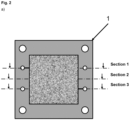
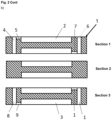
- Figure 2 (a) and (b) show a front view and a profile view in sections 1, 2 and 3, wherein
- Fig. 6 shows a scanning electron microscope image with a secondary electron detector (FEI TENEO Microscope) of the porous material after gas nitriding, showing the nitrided layer (arrows).
- FEI TENEO Microscope secondary electron detector
Landscapes
- Chemical & Material Sciences (AREA)
- Chemical Kinetics & Catalysis (AREA)
- Electrochemistry (AREA)
- General Chemical & Material Sciences (AREA)
- Engineering & Computer Science (AREA)
- Manufacturing & Machinery (AREA)
- Life Sciences & Earth Sciences (AREA)
- Sustainable Development (AREA)
- Sustainable Energy (AREA)
- Materials Engineering (AREA)
- Composite Materials (AREA)
- Solid-Phase Diffusion Into Metallic Material Surfaces (AREA)
Abstract
Description
- The present invention relates to a bipolar plate of a proton-exchange membrane fuel cell made up of titanium, titanium alloys or any combination thereof comprising a porous titanium material, titanium alloys or any combination thereof and which is completely covered by a titanium nitride coating. In addition, the present invention relates to two methods of manufacturing said bipolar plate by means of metallurgical techniques, the use of space holders, sintering and gas nitriding.
- Therefore, the present invention is of interest to the industry dedicated to the manufacture of fuel cells.
- Bipolar plates (BP) of proton-exchange membrane fuel cells (PEMFC) are one of the critical components to ensure proper functioning of these cells.
- With conventional BPs, manufactured in stainless steel or graphite, the weight of this component is between 50 % and 80 % of the total weight of the cell, and the manufacture of channels is complex, which causes it to exceed 30 % of the total cost of the fuel cell. For transportation applications, wherein PEMFCs are the reference hydrogen technology, it is essential to reduce the weight of the structures and simplify the manufacturing process, which would result in improved system performance and lower costs. Table 1 shows some of the requirements that the material used as a bipolar plate must meet.
Table 1. US Department of Energy Requirements for Bipolar Plates in Transportation Applications [T.U.D. of E. (DOE) E.E. and R.E. Fuel Cell Technologies Office, Fuel Cells, in: Multi-Year Res. Dev. Demonstr. Plan, 2016: pp. 3.4.1-3.4.58]. Requirement Value Corrosion (anode) (µA/cm2) <1, no active peak Corrosion (cathode) (µA/cm2) <1 Contact resistance (mΩ cm2) <10 Flexural strength (MPa) >25 - Metal BPs are primarily manufactured in stainless steel [T. Stein, Y. Ein-Eli, Challenges and Perspectives of Metal-Based Proton Exchange Membrane's Bipolar Plates: Exploring Durability and Longevity, Energy Technol. 8 (2020) 1-13 .], since it does not exhibit a strong passivation of the surface that prevents the capture and donation of electrons, as occurs with metals that are more resistant to corrosion (aluminium and titanium). However, the new more advanced BP targets (Table 1) mean that stainless steel alone does not meet the targets and requires coatings, which eliminates the initial advantage it had over aluminium and titanium, in addition to the fact that its density is much higher. Coatings for this application on steel and other metals range from nitrides (CrN, AIN or TiN, obtained by CVD or PVD), graphene materials, Teflon (PTFE) and PTFE compounds with graphene, or metal nitride particles.
- In the case of titanium BP, relevant inventions of coatings on titanium substrates oriented to bipolar plates are listed below, with special emphasis on those based on metal nitrides:
- Titanium coated with one or multiple layers of TiN, TiC, Ti(C,N), CrN, Cr(C,N), (Ti,Cr)N or (Ti,Cr)(C,N) or with a layer of carbon with embedded TiC particles, all these cases using physical deposition techniques, sometimes combined with plasma-assisted nitriding, carburation or carbonitriding [
CN111370722A ,CN104051743A ,CN101800318A ,CN102130341A ,CN111342073A ]. - Titanium coated with titanium nitride (TiN) by means of liquid nitriding [8]. Gas titanium nitriding to form titanium nitride (TiN) is not usually applied in practice due to the high temperature of the process.
- Multilayer coatings based on noble metals with higher conductivity and carbon-based materials. As an example: a layer of nickel or nickel/chrome followed by other layers of gold and graphene, also obtained by means of physical deposition techniques [
CN112467161A ]. - Graphene coating, using techniques such as electrodeposition [J. Wang, L. Min, F. Fang, W. Zhang, Y. Wang, Electrodeposition of graphene nano-thick coating for highly enhanced performance of titanium bipolar plates in fuel cells, Int. J. Hydrogen Energy. 44 (2019) 16909-16917].
- Regarding the fluid field distribution system and elimination of reactants and reagents (also called fluid field system), located on each face of the BP, the current solution involves a design of very fine channels, of the order of hundreds of microns in thickness (
fig. 1 , left), exhibiting two problems: - ▪ First, it does not guarantee optimum fluid distribution in conditions of greater power demand, with notable gas pressure losses [A. Kumar, R.G. Reddy, Materials and design development for bipolar/end plates in fuel cells, J. Power Sources. 129 (2004) 62-67 and B.T. Tsai, C.J. Tseng, Z.S. Liu, C.H. Wang, C.I. Lee, C.C. Yang, S.K. Lo, Effects of flow field design on the performance of a PEM fuel cell with metal foam as the flow distributor, Int. J. Hydrogen Energy. 37 (2012) 13060-13066];
- ▪ and second, they require complex manufacturing techniques to ensure that there are no defects.
- An alternative proposal is the use of sponges or networks of porous material as a fluid field, which have been shown to be more efficient at higher powers than the conventional ones (
Fig. 1 , right) [A. Baroutaji, J.G. Carton, J. Stokes, A.G. Olabi, Application of Open Pore Cellular Foam for air breathing PEM fuel cell, Int. J. Hydrogen Energy. 42 (2017) 25630-25638]. - The materials that have been tested as fluid field bipolar plates based on porous material are mainly nickel, steel or titanium foams or sinters [T. Hottinen, M. Mikkola, T. Mennola, P. Lund, Titanium sinter as gas diffusion backing in PEMFC, J. Power Sources. 118 (2003) 183-188 and
WO1998052241A1 ], as well as copper, steel or titanium sintered felts [Y. Tang, W. Yuan, M. Pan, Z. Wan, Feasibility study of porous copper fiber sintered felt: A novel porous flow field in proton exchange membrane fuel cells, Int. J. Hydrogen Energy. 35 (2010) 9661-9677 and S. Gamburzev, A.J. Appleby, Recent progress in performance improvement of the proton exchange membrane fuel cell (PEMFC), J. Power Sources. 107 (2002) 5-12.]. To improve the properties of the foams, surface modifications are carried out, among which PTFE (Teflon), graphene, titanium nitrides and noble metals such as gold stand out [Y.H. Lee, S.M. Li, C.J. Tseng, C.Y. Su, S.C. Lin, J.W. Jhuang, Graphene as corrosion protection for metal foam flow distributor in proton exchange membrane fuel cells, Int. J. Hydrogen Energy. 42 (2017) 22201-22207.]. In the case of porous materials for titanium bipolar plates, the only coating found has been platinum, which is very expensive and therefore would have little practical application. - The present invention relates to a bipolar plate of a proton-exchange membrane fuel cell made up of titanium, titanium alloys or any combination thereof comprising a porous titanium material, titanium alloys or any combination thereof and which is completely covered by a titanium nitride coating.
- A fuel cell is an electrochemical device that directly transforms chemical energy into electrical energy. Due to a fuel (generally hydrogen H2) and an oxidiser (such as oxygen O2 or air) water, electricity are produced in the form of direct current and heat.
- A fuel cell can be divided into the various portions:
- Electrodes wherein the following reactions take place
- ∘ Reaction at the anode: H2 -> 2 H+ + 2 e-
- ∘ Reaction at the cathode: ½ O2 + 2 H+ + 2 e- -> H2O
- ∘ Overall reaction: H2 + ½ O2 -> H2O
- Electrolyte the function of which is to separate the gases and enable the passage of protons H+ to the cathode and separate the electrons e-.
- Bipolar plates the function of which is to separate the cells, conduct the gases and evacuate the H2O.
- The present invention relates to a bipolar plate for fuel cells that use a proton-conducting proton-exchange membrane as an electrolyte, and are therefore known as PEM-type fuel batteries or cells (polymer electrolyte membrane (PEM)). See
Figure 1 . - The function of the bipolar plate of the present invention is to connect the anode of
cell 1, wherein the following reaction occurs:
cell 2, wherein the following reaction takes place:
- Therefore, the bipolar plate of the present invention has a conductivity greater than 100 S/cm and a contact resistance of less than 10 mΩ·cm2, so that the electrons e- move from the anode of
cell 1 to the cathode ofcell 2 therethrough. - Another function of the bipolar plate of the present invention is to distribute the reactants (H2 and O2) and collect the products: water (H2O) and unreacted reactants through the inlet and outlet channels and through the inlet and outlet conduits.
- Another function of the bipolar plate of the present invention is to provide structural integrity to the PEM-type fuel cell assembly and manage the temperature thereof.
- Therefore, a first aspect the present invention relates to a bipolar plate of a proton-exchange membrane fuel cell (hereinafter the bipolar plate of the invention) with an upper face and a lower face characterised in that
- ▪ said plate is composed of titanium (Ti), titanium alloys or any of the combinations thereof,
- ▪ said plate comprises
- ∘ a first cavity on the upper face and a second cavity on the lower face, a porous material is arranged in said cavities, wherein said porous material is made up of titanium (Ti), titanium alloys or any of the combinations thereof, wherein the pores of said porous material are interconnected and wherein the pores of said porous material are less than 500 µm in diameter,
- ∘ at least one first inlet conduit for a first gas or a second gas, wherein said first inlet conduit for a first gas or a second gas is connected to the first cavity through at least one first inlet channel for a first gas or a second gas,
- ∘ at least one second inlet conduit for a first gas or a second gas, wherein said second inlet conduit for a first gas or a second gas is connected to the second cavity through at least one second inlet channel for a first gas or a second gas,
- ∘ at least one first outlet conduit for a first gas or a second gas, wherein said first outlet conduit for a first gas or a second gas is connected to the first cavity through at least one first outlet channel for a first gas or a second gas, and
- ∘ at least one second outlet conduit for a first gas or a second gas, wherein said second outlet conduit for a first gas or a second gas is connected to the second cavity through at least one second outlet channel for a first gas or a second gas
- ▪ and said plate (1) is coated with titanium nitride on the entire surface thereof.
- The bipolar plate of the present invention is made up of titanium (Ti), titanium alloys or any of the combinations thereof. Preferably, the titanium alloys are alpha (α) type titanium alloys, i.e., with a compact hexagonal crystalline structure (hcp) called the alpha (α) phase. More preferably the titanium alloys are selected from among Ti-6Al-4V, Ti-6Al y Ti-8Al.
- In addition, the porous material that is placed in the cavities of the bipolar plate is made up of titanium (Ti), titanium alloys or any of the combinations thereof. Preferably, the titanium alloys are alpha (α) type titanium alloys, i.e., with a compact hexagonal crystalline structure (hcp) called the alpha (α) phase. More preferably the titanium alloys are selected from among Ti-6Al-4V, Ti-6Al y Ti-8Al.
- In a preferred embodiment of the bipolar plate of the present invention, on the anode side, the inlet and outlet channels connect with an inlet conduit for H2 and with an outlet conduit for the H2 that remains unreacted. On the cathode face, the inlet and outlet channels connect with the inlet conduit for air or O2 and with the outlet conduit for unreacted air/O2 and the H2O.
- In a preferred embodiment of the bipolar plate of the present invention said bipolar plate has a thickness between 500 µm and 3 mm.
- In another preferred embodiment of the bipolar plate of the present invention, the first cavity or the second cavity have an independent thickness of between 150 µm and 1 mm.
- In another preferred embodiment of the bipolar plate of the present invention, the first cavity or the second cavity are arranged concentrically to the bipolar plate.
- In another preferred embodiment of the bipolar plate of the present invention, the first cavity and the second cavity have equal dimensions.
- In another preferred embodiment of the bipolar plate of the present invention, the first gas is H2 and the second gas is O2 or air, and the first gas is O2 or air and the second gas is H2.
- The porous material arranged in the first cavity and in the second cavity has pores with a size lower than 500 µm in diameter. In another preferred embodiment of the bipolar plate of the present invention, the porous material arranged in the first cavity and in the second cavity has pores with a size between 500 µm and 250 µm in diameter, between 150 µm and 250 µm or smaller at 150 µm.
- The advantages exhibited by the bipolar plate of the present invention are the following:
- the use of titanium or titanium alloys as the base material of the bipolar plate of the invention ensures a low weight (represents a saving of 40 % in weight with respect to a steel plate of the same geometry), high mechanical resistance (greater than 50 MPa) and high corrosion resistance (corrosion rate less than 1 µA/cm2);
- the use of porous titanium or titanium alloy materials further reduces the weight of the bipolar plate and increases flow efficiency, and
- the titanium nitride coating on the entire surface of the bipolar plate gives it the required requirements for its use (see Table 1), preventing corrosion and providing resistance to contact and flexural strength.
- A second aspect of the invention relates to a first method of manufacturing the bipolar plate of the present invention (hereinafter the first method of the invention), characterised in that it comprises the following steps:
- a) pouring powders selected from titanium, titanium hydride, titanium alloys or any combination thereof, into a mould comprising
- a first cavity and a second cavity,
- a first inlet channel (5) and a second inlet channel (10), and
- a first outlet channel (7) and a second outlet channel (9),
- b) sintering and gas nitriding of the pressed product obtained in step (a) to obtain a preform of the bipolar plate comprising a titanium nitride (TiN) coating on the surface thereof,
- c) preparing a homogeneous mixture of
- a powder selected from titanium, titanium hydride, titanium alloys or any combination thereof, and
- an ammonium bicarbonate powder space holder ((NH4)HCO3) with a particle size between 250 µm and 500 µm, 150 µm and 250 µm or less than 150 µm,
- d) pouring the homogeneous mixture obtained in step (c) into a mould in the shape of the first cavity and the second cavity and pressing at a pressure of between 100 MPa and 600 MPa;
- e) removing the ammonium bicarbonate space holder ((NH4)HCO3) of the pressed product in step (d) by heat treatment at a temperature between 40 °C and 120 °C for a period of time between 4 h and 12 h,
- f) sintering and gas nitriding of the porous material arranged in the mould in the shape of the first cavity (2) and the second cavity (3) obtained in step (e) to form a titanium nitride (TiN) coating on said porous material, and
- g) assembling the porous material coated with titanium nitride obtained in step (f) with the preform of the bipolar plate (1) comprising a titanium nitride coating on the surface thereof.
- The first step of the first method of the invention, step (a), relates to the pouring of powders selected from titanium, titanium hydride, titanium alloys or any combination thereof, into a mould comprising
- a first cavity and a second cavity,
- a first inlet channel (5) and a second inlet channel (10), and
- a first outlet channel (7) and a second outlet channel (9),
- In a preferred embodiment of step (a) of the first method of the present invention, already prepared titanium alloys can be used or said alloys can be prepared in situ, mixing their fundamental components in powder form and pouring said mixture directly into the mould. Preferably, the titanium alloys are alpha (α) type titanium alloys, i.e., with a compact hexagonal crystalline structure (hcp) called the alpha (α) phase. Preferably, the titanium alloys are selected from among Ti-6Al-4V, Ti-6Al and Ti-8Al.
- In another preferred embodiment of the first method of the present invention, said method comprises an additional step (a1), between step (a) and step (b) of machining the compacted powder to form the inlet and outlet conduits (preferably by means of milling).
- In another preferred embodiment of the first method of the present invention, the mould used in step (a) further comprises mandrels to form the inlet and outlet conduits.
- The step (b) of the first method of the invention relates to the sintering and gas nitriding of the pressed product obtained in step (a) to obtain a preform of the bipolar plate comprising a first cavity and a second cavity.
- In a preferred embodiment of step (b) of the first method of the present invention, vacuum sintering is carried out in a furnace at a temperature between 900 °C and 1400 °C and at a pressure between 0.00001 MPa and 0.01 MPa for a period of time between 1 h and 4 h, and the gas nitriding of the sintered product is carried out in a furnace under a nitrogen atmosphere at a temperature of between 850 °C and 1200 °C for a period of time between 1 h and 4 h, wherein the nitrogen pressure is between 0.05 MPa and 0.2 MPa. The gas nitriding is preferably carried out with the surface rough and clean.
- In another preferred embodiment of the first method of the present invention, in step (b), sintering is carried out in a furnace at a temperature between 900 °C and 1400 °C and at a pressure between 0.05 MPa and 0.2 MPa in an argon (Ar) atmosphere for a period of time between 1 h and 4 h, and the gas nitriding of the sintered product is carried out in a furnace under a nitrogen atmosphere at a temperature between 850 °C and 1200 °C for a period of time between 1 h and 4 h, wherein the nitrogen pressure is between 0.05 MPa and 0.2 MPa. The gas nitriding is preferably carried out with the surface rough and clean.
- In another preferred embodiment of the first method of the present invention, the sintering and gas nitriding of step (b) is carried out in a single step, in a single furnace, at a temperature between 850 °C and 1200 °C first under an argon (Ar) atmosphere for a period of time between 30 min and 4 h, wherein the argon pressure is between 0.05 MPa and 0.2 MPa, and then under a nitrogen atmosphere for a period between 1 h and 4 h, wherein the nitrogen pressure is between 0.05 MPa and 0.2 MPa.
- The step (c) of the first method of the invention relates to the preparation of a homogeneous mixture of a powder selected from
- titanium, titanium hydride, titanium alloys, or any combination thereof, and
- an ammonium bicarbonate space holder ((NH4)HCO3) with a size between 250 µm and 500 µm, between 150 µm and 250 µm or less than 150 µm,
- In a preferred embodiment of step (c) of the first method of the present invention, already prepared titanium alloys can be used or said alloys can be prepared in situ, mixing their fundamental components in powder form in a mixer. Preferably, the titanium alloys are alpha (α) type titanium alloys, i.e., with a compact hexagonal crystalline structure (hcp) called the alpha (α) phase. Preferably, the titanium alloys are selected from among Ti-6AI-4V, Ti-6Al and Ti-8Al.
- In step (c) of the first method of the present invention, the preparation of the homogeneous mixture is carried out in a mixer that operates at a speed of between 40 rpm and 80 rpm for at least a period of time of 1 h, preferably in a period of time between 30 min and 4 h, more preferably between 1 h and 2 h. Under these operating conditions, the homogeneity of the mixture is guaranteed.
- The step (d) of the first method of the present invention relates to pouring the homogeneous mixture obtained in step (c) into a mould in the shape of the first cavity and the second cavity and pressing at a pressure of between 100 MPa and 600 MPa, thus obtaining the highest density and integrity of the porous material and avoiding the creation of cracks.
- The step (e) of the first method of the present invention relates to the elimination of the ammonium bicarbonate space holder ((NH4)HCO3) of the product pressed in step (d) by heat treatment at a temperature between 40 °C and 120 °C for a period of time between 4 h and 12 h.
- The use of a space holder such as ammonium bicarbonate ((NH4)HCO3) enables the pore size of the porous material to be adjusted, as well as the elimination of the space holder in a simple way without requiring high temperatures or solvents.
- The step (f) of the first method relates to the sintering and gas nitriding of the porous material arranged in the mould in the shape of the first cavity (2) and the second cavity (3) obtained in step (e) to form a titanium nitride (TiN) coating on said porous material.
- In a preferred embodiment of step (f) of the first method of the present invention, vacuum sintering is carried out in a furnace at a temperature between 900 °C and 1400 °C and at a pressure between 0.00001 MPa and 0.01 MPa for a period of time between 1 h and 4 h, and the gas nitriding of the sintered product is carried out in a furnace under a nitrogen atmosphere at a temperature of between 850 °C and 1200 °C for a period of time between 1 h and 4 h, wherein the nitrogen pressure is between 0.05 MPa and 0.2 MPa. The gas nitriding is preferably carried out with the surface rough and clean.
- In another preferred embodiment of the first method of the present invention, in step (f), sintering is carried out in a furnace at a temperature between 900 °C and 1400 °C and at a pressure between 0.05 MPa and 0.2 MPa in an argon (Ar) atmosphere for a period of time between 1 h and 4 h, and the gas nitriding of the sintered product is carried out in a furnace under a nitrogen atmosphere at a temperature between 850 °C and 1200 °C for a period of time between 1 h and 4 h, wherein the nitrogen pressure is between 0.05 MPa and 0.2 MPa. The gas nitriding is preferably carried out with the surface rough and clean.
- In another preferred embodiment of the first method of the present invention, the sintering and gas nitriding of step (f) is carried out in a single step, in a single furnace, at a temperature between 900 °C and 1200 °C first under an argon (Ar) atmosphere for a period of time between 30 min and 4 h, wherein the argon pressure is between 0.05 MPa and 0.2 MPa, and then under a nitrogen atmosphere for a period between 1 h and 4 h, wherein the nitrogen pressure is between 0.05 MPa and 0.2 MPa.
- In all the preferred embodiments of the first method of the present invention, they result in a good cohesion of the porous material. The porosities obtained are open, with high connectivity between pores, which enable the passage of gases in the operation of the bipolar plate. Thanks to the method of the present invention, porosity levels of 65% have been obtained, maintaining the integrity of the porous material in the bipolar plate and exhibiting a flexural strength greater than 50 MPa.
- Said titanium nitride coating gives the assembly the required requirements for use thereof according to Table 1, preventing corrosion and providing resistance to contact and flexural strength.
- In a preferred embodiment of the first method of the present invention, in step (b), the titanium nitride coating of the preform of the bipolar plate has a thickness between 0.5 µm and 10 µm.
- In another preferred embodiment of the first method of the present invention, in step (f), the titanium nitride (TiN) coating of the porous material has a thickness between 0.5 µm and 10 µm.
- In another preferred embodiment of the first method of the present invention, the titanium nitride coating of the preform of the bipolar plate obtained in step (b) and the titanium nitride coating of the porous material obtained in step (f) have the same thickness. Preferably, the titanium nitride coating of the preform of the bipolar plate and the titanium nitride coating of the porous material are arranged on the same level.
- The step (g) of the first method of the present invention relates to the assembly of the titanium nitride-coated porous material obtained in step (f) with the preform of the bipolar plate comprising a titanium nitride coating on the surface thereof.
- A third aspect of the present invention relates to a second method for producing the bipolar plate of the present invention (hereinafter the second method of the invention), characterised in that it comprises the following steps:
- i) pouring powders selected from titanium, titanium hydride, titanium alloys or any combination thereof, into a mould comprising
- a first cavity and a second cavity,
- a first inlet channel (5) and a second inlet channel (10), and
- a first outlet channel (7) and a second outlet channel (9),
- ii) preparing a homogeneous mixture of
- a powder selected from titanium, titanium hydride, titanium alloys or any combination thereof, and
- an ammonium bicarbonate powder space holder with a particle size between 250 µm and 500 µm, 150 µm and 250 µm or less than 150 µm,
- iii) pouring the homogeneous mixture obtained in step (ii) into the first cavity and into the second cavity of the preform of the bipolar plate (1) obtained in step (i) and pressing at a pressure between 100 MPa and 600 MPa;
- iv) removing the ammonium bicarbonate space holder from the product pressed in step (iii) by heat treatment at a temperature between 40 °C and 120 °C for a period of time between 4 h and 12 h,
- v) vacuum sintering and gas nitriding of the product obtained in step (iv) to form a titanium nitride coating on said product.
- The step (i) of the second method of the present invention relates to the pouring of powders selected from titanium, titanium hydride, titanium alloys or any combination thereof, into a mould comprising
- a first cavity (2) and a second cavity (3),
- a first inlet channel (5) and a second inlet channel (10), and
- a first outlet channel (7) and a second outlet channel (9),
- In a preferred embodiment of step (i) of the second method of the present invention, already prepared titanium alloys can be used or said alloys can be prepared in situ, mixing their fundamental components in powder form and pouring said mixture directly into the mould. Preferably, the titanium alloys are alpha (α) type titanium alloys, i.e., with a compact hexagonal crystalline structure (hcp) called the alpha (α) phase. Preferably, the titanium alloys are selected from among Ti-6Al-4V, Ti-6Al and Ti-8Al.
- In a preferred embodiment of the second method of the present invention, said method further comprises an additional step (i1), between step (i) and step (ii) of machining the compacted powder obtained in step (i) to form the inlet and outlet conduits (preferably by means of milling).
- In another preferred embodiment of the second method of the present invention, the mould used in step (i) further comprises mandrels to form the inlet and outlet conduits.
- The step (ii) of the second method of the present invention relates to the preparation of a homogeneous mixture of
- a powder selected from titanium, titanium hydride, titanium alloys or any combination thereof, and
- an ammonium bicarbonate powder space holder with a particle size between 250 µm and 500 µm, 150 µm and 250 µm or less than 150 µm,
- In a preferred embodiment of step (ii) of the second method of the present invention, already prepared titanium alloys can be used or said alloys can be prepared in situ, mixing their fundamental components in powder form in a mixer. Preferably, the titanium alloys are alpha (α) type titanium alloys, i.e., with a compact hexagonal crystalline structure (hcp) called the alpha (α) phase. Preferably, the titanium alloys are selected from among Ti-6Al-4V, Ti-6Al and Ti-8Al.
- In step (ii) of the second method of the present invention, the preparation of the homogeneous mixture is carried out in a mixer that operates at a speed of between 40 rpm and 80 rpm for at least a period of time of 1 h, preferably in a period of time between 30 min and 4 h, more preferably between 1 h and 2 h. Under these operating conditions, the homogeneity of the mixture is guaranteed.
- The step (iii) of the second method of the present invention relates to the pouring of the homogeneous mixture obtained in step (ii) into the first cavity and into the second cavity of the preform of the bipolar plate obtained in step (i) and pressing at a pressure between 100 MPa and 600 MPa;
- In a preferred embodiment of the second method of the present invention, the step (iii) is carried out sequentially, wherein the homogeneous mixture obtained in step (ii) is first poured into the first cavity of the mould and pressed at a pressure of between 100 MPa and 600 MPa and then the homogeneous mixture obtained in step (ii) is poured into the second cavity of the mould and pressed at a pressure of between 100 MPa and 600 MPa.
- The step (iv) of the second method of the present invention relates to the elimination of the ammonium bicarbonate space holder from the product pressed in step (iii) by heat treatment at a temperature between 40 °C and 120 °C for a period of time between 4 h and 12 h,
- The use of a space holder such as ammonium bicarbonate ((NH4)HCO3) enables the pore size of the porous material to be adjusted, as well as the elimination of the space holder in a simple way without requiring high temperatures or solvents.
- The step (v) of the second method of the present invention relates to the sintering and gas nitriding of the product obtained in step (iv) to form a titanium nitride coating on said product.
- In a preferred embodiment of the second method of the present invention, in step (v), vacuum sintering is carried out in a furnace at a temperature between 900 °C and 1400 °C and at a pressure between 0.00001 MPa and 0.01 MPa for a period of time between 1 h and 4 h, and the gas nitriding of the sintered product is carried out in a furnace under a nitrogen atmosphere at a temperature of between 850 °C and 1200 °C for a period of time between 1 h and 4 h, wherein the nitrogen pressure is between 0.05 MPa and 0.2 MPa.
- In another preferred embodiment of the first method of the present invention, in step (v), sintering is carried out in a furnace at a temperature between 900 °C and 1400 °C and at a pressure between 0.05 MPa and 0.2 MPa in an argon (Ar) atmosphere for a period of time between 1 h and 4 h, and the gas nitriding of the sintered product is carried out in a furnace under a nitrogen atmosphere at a temperature between 850 °C and 1200 °C for a period of time between 1 h and 4 h, wherein the nitrogen pressure is between 0.05 MPa and 0.2 MPa. The gas nitriding is preferably carried out with the surface rough and clean.
- In another preferred embodiment of the second method of the present invention, the sintering and gas nitriding of step (v) is carried out in a single furnace, at a temperature between 900 °C and 1200 °C, first under an argon atmosphere for a period of time between 30 min and 4 h, wherein the argon pressure is between 0.05 MPa and 0.2 MPa, and then under a nitrogen atmosphere for a period of time between 1 h and 4 h, wherein the nitrogen pressure is between 0.05 MPa and 0.2 MPa.
- In all the preferred embodiments of the second method of the present invention, they result in a good cohesion of the porous material. The porosities obtained are open, with high connectivity between pores, which enable the passage of gases in the operation of the bipolar plate. Thanks to the method of the present invention, porosity levels of 65% have been obtained, maintaining the integrity of the porous material in the bipolar plate and exhibiting a flexural strength greater than 50 MPa.
- Said titanium nitride coating gives the assembly the required requirements for use thereof according to Table 1, preventing corrosion and providing resistance to contact and flexural strength. Preferably the titanium nitride coating obtained in step (v) has a thickness between 0.5 µm and 10 µm.
- The advantages of the first and second methods of the present invention are as follows:
- The use of powder metallurgy techniques to manufacture titanium-based BP components enables a high productivity, suitable for mass manufacturing and reduces machining costs. In addition, powder metallurgy makes it possible to reduce the manufacturing costs of parts compared to conventional titanium processing techniques.
- The use of the space holders technique for manufacturing the titanium-based PEMFC bipolar plate enables porous areas to be manufactured with on-demand features in a simple and scalable way.
- The use of non-plasma assisted gas nitriding or without electric fields to obtain titanium nitride coatings on titanium substrates simplifies the complexity of the equipment, lowering costs without compromising the final properties of the bipolar plate.
- The preferred embodiment of sintering/nitriding in a single step in a single furnace for manufacturing titanium components with titanium nitride coatings greatly simplifies the manufacturing process.
- Throughout the description and the claims, the word "comprise" and its variants are not intended to exclude other technical features, additions, components or steps. For those skilled in the art, other objects, advantages and features of the invention will be deduced from both the description and the practical use of the invention. The following examples and figures are provided by way of illustration, and are not intended to be limiting of the present invention.
-
-
Fig. 1 General diagram of a PEM type fuel cell. -
Fig. 2 (a) Front view of the bipolar plate of the invention whereinsections sections - (1) Bipolar plate
- (2) First cavity
- (3) Second cavity
- (4) First gas or second gas inlet conduit
- (5) First gas or second gas inlet channel
- (6) First gas or second gas outlet conduit
- (7) First gas or second gas outlet channel
- (8) Second outlet conduit of the first gas or the second gas
- (9) Second outlet channel of the first gas or the second gas
- (10) Second inlet conduit of the first gas or the second gas
- (11) Second inlet channel of the first gas or the second gas
-
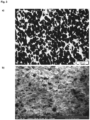
Fig. 3 . (a) Titanium foam with total porosity of 65% and pore-forming size in therange 150 to 250 µm: microstructure and (b) Fracture surface after three-point flexural test. -
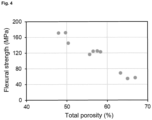
Fig. 4 Flexural strength as a function of porosity. -
Fig. 5 Behaviour of titanium before and after nitriding: contact resistance (a), corrosion under anodic conditions (b) and corrosion under cathodic conditions (c). -
Fig. 6 Surface of porous titanium material after gas nitriding, showing nitride layer (arrows). - Next, the invention will be illustrated by means of assays performed by the inventors, which demonstrate the effectiveness of the invention.
-
Figure 2 (a) and(b) show a front view and a profile view insections - (1) Bipolar plate
- (2) First cavity
- (3) Second cavity
- (4) First gas or second gas inlet conduit
- (5) First gas or second gas inlet channel
- (6) First gas or second gas outlet conduit
- (7) First gas or second gas outlet channel
- (8) Second outlet conduit of the first gas or the second gas
- (9) Second outlet channel of the first gas or the second gas
- (10) Second inlet conduit of the first gas or the second gas
- (11) Second inlet channel of the first gas or the second gas
- a) Method of manufacturing the preform of the bipolar plate (1) comprising cavities (2, 3) and inlet and outlet conduits and channels (4, 5, 6, 7, 8, 9, 10, 11):
- ∘ Titanium hydride powder (TiH2) with particle size <63 µm and irregular morphology from AMG Titanium Alloys & Coatings (GfE Metalle und Materialien GmbH).
- ∘ Pouring the titanium hydride powders into a high-speed steel mould comprising cavities (2, 3) and inlet and outlet conduits (4, 5, 6, 7, 8, 9, 10, 11), and pressing at 200 MPa with a hydraulic press.
- ∘ Sintering at 1250 °C for 2 h in high vacuum (10-6 MPa) in a Carbolite ceramic tube furnace with a high vacuum system (RV5 rotary pump and Edwards brand Diffstak 63/150M, 210-225V, 1-ph, 50/60Hz diffuser pump). Heating curve: 5 °C/min up to 450 °C, 2 °C/min between 450 °C and 650 °C, and 5 °C/min between 650 °C and 1250 °C. Cooling curve: 5 °C/min to room temperature.
- ∘ Roughing and cleaning of the surface.
- ∘ Gas nitriding in a furnace at 1000 °C for 2 h in a Carbolite ceramic tube furnace with a 1 bar N2 atmosphere (Nippon Gases). Initial purge of 45 min. Heating and cooling rate: 5 ° C/min.
- b) Method of manufacturing the porous material arranged in the cavities (2, 3):
- ∘ Starting powders: AMG Titanium Alloys & Coatings (GfE Metalle und Materialien GmbH) titanium hydride powder (TiH2) of <63 µm particle size and irregular morphology and Sigma-Aldrich Reagent Plus® ammonium bicarbonate powder (NH4HCO3), ≥99.0% pure.
- ∘ Sieving of the space holder between 150 µm and 250 µm using sieves of 150 µm and 250 µm light, for 5 minutes assisted by vibration.
- ∘ Mixing of the titanium hydride and bicarbonate powders with a ratio of 60% by volume for 1 hour at 50 rpm in a three-dimensional Turbula mixer (WAB Group).
- ∘ Pouring of the powder mixture into the high-speed steel mould with the preform of the cavities (2, 3) and the inlet and outlet conduits and channels (4, 5, 6, 7, 8, 9, 10, 11) first manufactured (a), pressed at 200 MPa with a hydraulic press.
- ∘ Removal of the space holder in an oven at 80 °C for 6 hours.
- ∘ Sintering at 1250 °C for 2 h in high vacuum (10-6 MPa) in a Carbolite ceramic tube furnace with a high vacuum system (RV5 rotary pump and Edwards brand Diffstak 63/150M, 210-225V, 1-ph, 50/60Hz diffuser pump). Heating curve: 5 °C/min up to 450 °C, 2 °C/min between 450 °C and 650 °C, and 5 °C/min between 650 °C and 1250 °C. Cooling curve: 5 °C/min to room temperature. The measurements of porosity and interconnectivity have been carried out using the Archimedean method. The porosities obtained are open, with high connectivity between pores, which enable the passage of gases in the operation of the bipolar plate (
Fig. 3 ). Images obtained in a FEI Teneo scanning electron microscope.Fig. 3b shows the interconnectivity and homogeneity of the porosity after three-point flexural test, with the following features:
Three-point flexural tests on bars with a rectangular cross section with minimum dimensions of 4x11x25 mm, with a distance between support points of 23 mm. The test was performed at a speed of 0.5 mm/min with a 15 kN load cell in a Microtest universal test kit. The porous material obtained has a flexural strength greater than 50 MPa (Fig 4 ). - ∘ Roughing and cleaning of the surface.
- ∘ Gas nitriding in a furnace at 1000 °C for 2 h in a Carbolite ceramic tube furnace with a 1 bar N2 atmosphere (Nippon Gases). Initial purge of 45 min. Heating and cooling rate: 5 ° C/min. With a gas nitriding at 1000 °C for 2 hours in the presence of N2 a surface layer of titanium nitride is achieved with sufficient thickness to protect against corrosion and with a structure with a predominant TiN presence (confirmed by X-ray diffraction), which enables the surface contact resistance to be approximately 10 mΩ·cm2, improving the behaviour of the uncoated substrate to levels required by the application (
Fig. 5a ). This treatment also enables a homogeneous coating to be obtained inside the porous samples, thus reducing corrosion on the entire exposed surface (Fig. 5b ,5c ).
- c) Assembling the porous material in the cavities (2, 3) of the preform of the bipolar plate (1).
- The characterisation techniques used were
- contact resistance in the range of 40 to 200 N/cm2 against Sigracet GDL 28BC carbon paper, using a Microtest mechanical testing micromachine, made to measure with a 5 kN load cell, and a BK Precision 1687B model direct current generator, applying a current of 2 A.
- corrosion under anodic conditions: galvanic polarisation at 70 °C in a solution of H2O with H2SO4 with pH=3 with argon purge, between -0.4 and +0.6 V vs Ag/AgCl, and
- corrosion under cathodic conditions: chronoamperometry for 24 h at 70 °C in a solution of H2O with H2SO4 of pH=3 with air bubbling, at a constant potential of +0.6 V vs Ag/AgCl.
The corrosion measurements were made using an Autolab PGSTAT302N potentiostat/galvanostat, with a three-electrode configuration, with Tipfix working electrode support, from Bank Electronik - Intelligent Controls GmbH, Ag/AgCl SE11 reference electrode from SensorTechnik Meinsberg and counter-electrode of platinised titanium from Bank Electronik - Intelligent Controls GmbH. - The results presented in
Figures 5a-c show the evolution of the contact resistance with pressure, the galvanic polarisation curve and the amperometry. Regarding the contact resistance (Fig. 5a ), uncoated titanium has a very high value (in the range of 300 and 400 mΩ cm2), associated with the passive layer of titanium oxide, and, after surface modification, the contact resistance value is less than 10 mΩ cm2, meeting the requirements of the application (Table 1). Regarding corrosion resistance in both anodic and cathodic conditions (Fig. 5b-c ), the uncoated titanium have values close to those required by the application, greater than 1 µA/cm2and, after coating, the corrosion requirements are met (Table 1). -
Fig. 6 shows a scanning electron microscope image with a secondary electron detector (FEI TENEO Microscope) of the porous material after gas nitriding, showing the nitrided layer (arrows).
Claims (27)
- A bipolar plate (1) of a proton-exchange membrane fuel cell with an upper face and a lower face characterised in that▪ said plate (1) is made up of titanium, titanium alloys or any of the combinations thereof,▪ said plate (1) compriseso a first cavity (2) on the upper face and a second cavity (3) on the lower face, a porous material is arranged in said cavities (2, 3), wherein said porous material is made up of titanium, titanium alloys or any of the combinations thereof, wherein the pores of said porous material are interconnected and wherein the pores of said porous material are less than 500 µm in diameter,∘ at least one first inlet conduit (4) for a first gas or a second gas, wherein said first inlet conduit (4) for a first gas or a second gas is connected to the first cavity (2) through at least one first inlet channel (5) for a first gas or a second gas,∘ at least one second inlet conduit (10) for a first gas or a second gas, wherein said second inlet conduit (10) for a first gas or a second gas is connected to the second cavity (3) through at least one second inlet channel (11) for a first gas or a second gas,∘ at least one first outlet conduit (6) for a first gas or a second gas, wherein said first outlet conduit (6) for a first gas or a second gas is connected to the first cavity (2) through at least one first outlet channel (7) for a first gas or a second gas, and∘ at least one second outlet conduit (8) for a first gas or a second gas, wherein said second outlet conduit (8) for a first gas or a second gas is connected to the second cavity (3) through at least one second outlet channel (9) for a first gas or a second gas,▪ and said plate (1) is coated with titanium nitride on the entire surface thereof.
- The bipolar plate (1) according to claim 1, wherein the plate (1) has a thickness between 500 µm and 3 mm.
- The bipolar plate (1) according to any of claims 1 or 2, wherein the first cavity (2) or the second cavity (3) have an independent thickness between 150 µm and 1 mm.
- The bipolar plate (1) according to any of claims 1 to 3, wherein the first cavity (2) or the second cavity (3) are arranged concentrically to the bipolar plate (1).
- The bipolar plate (1) according to any of claims 1 to 4, wherein the first cavity (2) and the second cavity (3) have equal dimensions.
- The bipolar plate (1) according to any of claims 1 to 5, wherein• the first gas is H2 and the second gas is O2 or air,• the first gas is O2 or air and the second gas is H2.
- The bipolar plate (1) according to any of claims 1 to 6, wherein the porous material arranged in the first cavity (2) and in the second cavity (3) has pores with a size between 500 µm and 250 µm in diameter, of between 150 µm and 250 µm or of less than 150 µm in size.
- A method for manufacturing the bipolar plate (1) according to any of claims 1 to 7, characterised in that it comprises the following steps:a) pouring powders selected from titanium, titanium hydride, titanium alloys or any combination thereof, into a mould comprising• a first cavity (2) and a second cavity (3),• a first inlet channel (5) and a second inlet channel (10), and• a first outlet channel (7) and a second outlet channel (9),and pressing at a pressure between 100 MPa and 600 MPa; andb) sintering and gas nitriding of the pressed product obtained in step (a) to obtain a preform of the bipolar plate (1) comprising a titanium nitride coating on the surface thereof,c) preparing a homogeneous mixture of• a powder selected from titanium, titanium hydride, titanium alloys or any combination thereof, and• an ammonium bicarbonate powder space holder with a particle size between 250 µm and 500 µm, 150 µm and 250 µm or less than 150 µm,in a mixer operating at a speed between 50 rpm and 60 rpm for at least a period of 1 h, wherein the proportion by volume of ammonium bicarbonate in the mixture is between 50 % v/v and 70 % v/v,d) pouring the homogeneous mixture obtained in step (c) into a mould in the shape of the first cavity (2) and the second cavity (3) and pressing at a pressure of between 100 MPa and 600 MPa;e) removing the ammonium bicarbonate space holder from the product pressed in step (d) by heat treatment at a temperature between 40 °C and 120 °C for a period of time between 4 h and 12 h,f) sintering and gas nitriding of the porous material arranged in the mould in the shape of the first cavity (2) and the second cavity (3) obtained in step (e) to form a titanium nitride coating on said porous material,g) assembling the porous material coated with titanium nitride obtained in step (f) with the preform of the bipolar plate (1) comprising a titanium nitride coating on the surface thereof.
- The method according to claim 8, said method further comprising an additional step (a1), between step (a) and step (b) of machining the compacted powder obtained in step (a) to form the inlet and outlet conduits (4, 6, 8, 10).
- The method according to claim 8, wherein the mould used in step (a) further comprises mandrels to form the inlet and outlet conduits (4, 6, 8, 10).
- The method according to any of claims 8 to 10, wherein, in step (b), vacuum sintering is carried out in a furnace at a temperature between 900 °C and 1400 °C and at a pressure between 0.00001 MPa and 0.01 MPa for a period of time between 1 h and 4 h, and the gas nitriding of the sintered product is carried out in a furnace under a nitrogen atmosphere at a temperature of between 850 °C and 1200 °C for a period of time between 1 h and 4 h, wherein the nitrogen pressure is between 0.05 MPa and 0.2 MPa.
- The method according to any of claims 8 to 10, wherein, in step (b), sintering is carried out in a furnace at a temperature between 900 °C and 1400 °C, in an argon atmosphere, wherein the argon pressure is between 0.05 MPa and 0.2 MPa, for a period of time between 1 h and 4 h, and the gas nitriding of the sintered product is carried out in a furnace under a nitrogen atmosphere at a temperature of between 850 °C and 1200 °C for a period of time between 1 h and 4 h, wherein the nitrogen pressure is between 0.05 MPa and 0.2 MPa.
- The method according to any of claims 8 to 10, wherein the sintering and gas nitriding of step (b) is carried out in a single furnace, at a temperature of between 850 °C and 1200 °C first under an argon atmosphere, for a period of time between 30 min and 4 h, wherein the argon pressure is between 0.05 MPa and 0.2 MPa, and then under a nitrogen atmosphere for a period of time between 1 h and 4 h, wherein the nitrogen pressure is between 0.05 MPa and 0.2 MPa.
- The method according to any of claims 8 to 13, wherein, in step (f), vacuum sintering is carried out in a furnace at a temperature between 900 °C and 1400 °C and at a pressure between 0.00001 MPa and 0.01 MPa for a period of time between 1 h and 4 h, and the gas nitriding of the sintered product is carried out in a furnace under a nitrogen atmosphere at a temperature of between 850 °C and 1200 °C for a period of time between 1 h and 4 h, wherein the nitrogen pressure is between 0.05 MPa and 0.2 MPa.
- The method according to any of claims 8 to 13, wherein, in step (f), sintering is carried out in a furnace at a temperature between 900 °C and 1400 °C, in an argon atmosphere, wherein the argon pressure is between 0.05 MPa and 0.2 MPa, for a period of time between 1 h and 4 h, and the gas nitriding of the sintered product is carried out in a furnace under a nitrogen atmosphere at a temperature of between 850 °C and 1200 °C for a period of time between 1 h and 4 h, wherein the nitrogen pressure is between 0.05 MPa and 0.2 MPa.
- The method according to any of claims 8 to 13, wherein the sintering and gas nitriding of step (f) is carried out in a single furnace, at a temperature of between 900 °C and 1200 °C first under an argon atmosphere, for a period of time between 30 min and 4 h, wherein the argon pressure is between 0.05 MPa and 0.2 MPa, and then under a nitrogen atmosphere for a period of time between 1 h and 4 h, wherein the nitrogen pressure is between 0.05 MPa and 0.2 MPa.
- The method according to any of claims 8 to 16, wherein, in step (b), the titanium nitride coating of the preform of the bipolar plate (1) has a thickness between 0.5 µm and 10 µm.
- The method according to any of claims 8 to 17, wherein, in step (f), the titanium nitride coating of the porous material has a thickness between 0.5 µm and 10 µm.
- The method according to any of claims 8 to 18, wherein the titanium nitride coating of the preform of the bipolar plate (1) obtained in step (b) and the titanium nitride coating of the porous material obtained in step (f) have the same thickness.
- A method for manufacturing the bipolar plate (1) according to any of claims 1 to 7, characterised in that it comprises the following steps:i) pouring powders selected from titanium, titanium hydride, titanium alloys or any combination thereof, into a mould comprising• a first cavity (2) and a second cavity (3),• a first inlet channel (5) and a second inlet channel (10), and• a first outlet channel (7) and a second outlet channel (9),and pressing at a pressure between 100 MPa and 600 MPa;ii) preparing a homogeneous mixture of• a powder selected from titanium, titanium hydride, titanium alloys or any combination thereof, and• an ammonium bicarbonate powder space holder with a particle size between 250 µm and 500 µm, 150 µm and 250 µm or less than 150 µm,in a mixer operating at a speed between 50 rpm and 60 rpm for at least a period of 1 h, wherein the proportion by volume of ammonium bicarbonate in the mixture is between 50 % v/v and 70 % v/v,iii) pouring the homogeneous mixture obtained in step (ii) into the first cavity (2) and into the second cavity (3) of the preform of the bipolar plate (1) obtained in step (i) and pressing at a pressure between 100 MPa and 600 MPa;iv) removing the ammonium bicarbonate space holder from the product pressed in step (iii) by heat treatment at a temperature between 40 °C and 120 °C for a period of time between 4 h and 12 h,v) sintering and gas nitriding of the product obtained in step (iv) to form a titanium nitride coating on said product.
- The method according to claim 20, said method further comprising an additional step (i1), between step (i) and step (ii), of machining the compacted powder obtained in step (i) to form the inlet and outlet conduits (4, 6, 8, 10).
- The method according to claim 20, wherein the mould used in step (i) further comprises mandrels to form the inlet and outlet conduits (4, 6, 8, 10).
- The method according to any of claims 20 to 22, wherein step (iii) is carried out sequentially, wherein the homogeneous mixture obtained in step (ii) is first poured into the first cavity (2) of the mould and pressed at a pressure between 100 MPa and 600 MPa and then the homogeneous mixture obtained in step (ii) is poured into the second cavity (3) of the mould and pressed at a pressure between 100 MPa and 600 MPa.
- The method according to any of claims 20 to 23, wherein, in step (v), vacuum sintering is carried out in a furnace at a temperature between 900 °C and 1400 °C and at a pressure between 0.00001 MPa and 0.01 MPa for a period of time between 1 h and 4 h, and the gas nitriding of the sintered product is carried out in a furnace under a nitrogen atmosphere at a temperature of between 850 °C and 1200 °C for a period of time between 1 h and 4 h, wherein the nitrogen pressure is between 0.05 MPa and 0.2 MPa.
- The method according to any of claims 20 to 23, wherein, in step (v), sintering is carried out in a furnace at a temperature between 900 °C and 1400 °C, in an argon atmosphere, wherein the argon pressure is between 0.05 MPa and 0.2 MPa, for a period of time between 1 h and 4 h, and the gas nitriding of the sintered product is carried out in a furnace under a nitrogen atmosphere at a temperature of between 850 °C and 1200 °C for a period of time between 1 h and 4 h, wherein the nitrogen pressure is between 0.05 MPa and 0.2 MPa.
- The method according to any of claims 20 to 23, wherein the sintering and gas nitriding of step (v) is carried out in a single furnace, at a temperature of between 900 °C and 1200 °C first under an argon atmosphere, for a period of time between 30 min and 4 h, wherein the argon pressure is between 0.05 MPa and 0.2 MPa, and then under a nitrogen atmosphere for a period of time between 1 h and 4 h, wherein the nitrogen pressure is between 0.05 MPa and 0.2 MPa.
- The method according to any of claims 20 to 26, wherein the titanium nitride coating obtained in step (v) has a thickness between 0.5 µm and 10 µm.
Applications Claiming Priority (1)
| Application Number | Priority Date | Filing Date | Title |
|---|---|---|---|
| PCT/ES2022/070303 WO2023222930A1 (en) | 2022-05-17 | 2022-05-17 | Bipolar plate of a proton-exchange membrane fuel cell and methods of manufacturing same |
Publications (1)
| Publication Number | Publication Date |
|---|---|
| EP4528859A1 true EP4528859A1 (en) | 2025-03-26 |
Family
ID=82611212
Family Applications (1)
| Application Number | Title | Priority Date | Filing Date |
|---|---|---|---|
| EP22744234.0A Pending EP4528859A1 (en) | 2022-05-17 | 2022-05-17 | Bipolar plate of a proton-exchange membrane fuel cell and methods of manufacturing same |
Country Status (2)
| Country | Link |
|---|---|
| EP (1) | EP4528859A1 (en) |
| WO (1) | WO2023222930A1 (en) |
Family Cites Families (12)
| Publication number | Priority date | Publication date | Assignee | Title |
|---|---|---|---|---|
| SE443897B (en) * | 1978-03-30 | 1986-03-10 | Jungner Ab Nife | SET FOR MANUFACTURE OF HOGPOROSA NICKEL ELECTRODE BODIES WITH 90-95% PORVOLUME FOR ELECTRIC ACCUMULATORS |
| US5813222A (en) * | 1994-10-07 | 1998-09-29 | Appleby; Anthony John | Method and apparatus for heating a catalytic converter to reduce emissions |
| AU7439498A (en) | 1997-05-13 | 1998-12-08 | Loughborough University Innovations Limited | Current distributors of sintered metals and fuel cells using them |
| JP2006012455A (en) * | 2004-06-22 | 2006-01-12 | Honda Motor Co Ltd | Manufacturing method of fuel cell separator |
| CN101800318B (en) | 2010-04-09 | 2012-01-11 | 新源动力股份有限公司 | Metal bipolar plate for proton exchange membrane fuel cell and preparation method thereof |
| CN102130341A (en) | 2011-01-18 | 2011-07-20 | 大连理工大学 | A kind of fuel cell bipolar plate and its surface carbon-titanium nanocomposite film preparation method |
| CN104051743B (en) | 2014-06-23 | 2016-04-20 | 航天新长征电动汽车技术有限公司 | Metal double polar plates and preparation method thereof |
| WO2016096806A1 (en) * | 2014-12-16 | 2016-06-23 | Fundació Institut Català D'investigació Química (Iciq) | Method for hydrogen production and electrolytic cell thereof |
| CN111342073A (en) | 2020-02-27 | 2020-06-26 | 太原理工大学 | Conductive corrosion-resistant titanium metal bipolar plate for fuel cell and preparation method thereof |
| CN111370722A (en) | 2020-03-25 | 2020-07-03 | 扬州市普锐泰新材料有限公司 | Titanium bipolar plate surface coating and preparation method thereof |
| EP4189144A4 (en) * | 2020-07-27 | 2024-10-16 | Ohmium International, Inc. | Porous electrolyzer gas diffusion layer and method of making thereof |
| CN112467161A (en) | 2020-10-28 | 2021-03-09 | 浙江工业大学 | TiN coating surface modified titanium alloy bipolar plate and liquid ion nitriding method thereof |
-
2022
- 2022-05-17 WO PCT/ES2022/070303 patent/WO2023222930A1/en not_active Ceased
- 2022-05-17 EP EP22744234.0A patent/EP4528859A1/en active Pending
Also Published As
| Publication number | Publication date |
|---|---|
| WO2023222930A1 (en) | 2023-11-23 |
Similar Documents
| Publication | Publication Date | Title |
|---|---|---|
| Stiber et al. | A high-performance, durable and low-cost proton exchange membrane electrolyser with stainless steel components | |
| Teuku et al. | Review on bipolar plates for low‐temperature polymer electrolyte membrane water electrolyzer | |
| KR102625438B1 (en) | Method for manufacturing porous transport layer for electrochemical cell | |
| Murphy et al. | Low-cost light weight high power density PEM fuel cell stack | |
| JP6663584B2 (en) | Porous metal body, fuel cell, and method for manufacturing porous metal body | |
| Deng et al. | Porous transport layers with TiC-coated microporous layers for proton exchange membrane water electrolysis | |
| KR20120082903A (en) | Highly electrically conductive surfaces for electrochemical applications and methods to produce same | |
| CN109983606B (en) | Fuel cell and method for producing porous metal body | |
| Mo et al. | Investigation of titanium felt transport parameters for energy storage and hydrogen/oxygen production | |
| JP7021669B2 (en) | Method for manufacturing metal porous body, solid oxide fuel cell and metal porous body | |
| Jiang et al. | Deep reconstruction of Ni–Al-based pre-catalysts for a highly efficient and durable anion-exchange membrane (AEM) electrolyzer | |
| JP2002329507A (en) | Electrochemical cell | |
| TWI878323B (en) | A method for chromium upgrading of ferritic steel interconnects for solid oxide cell stack applications | |
| Shi et al. | Tuning the in-plane electrical conductivity and performance of the low Ir anode in a proton exchange membrane water electrolyzer | |
| JPWO2020049851A1 (en) | Method for manufacturing metal porous body, fuel cell and metal porous body | |
| EP4528859A1 (en) | Bipolar plate of a proton-exchange membrane fuel cell and methods of manufacturing same | |
| JP4355828B2 (en) | Porous gas diffuser and reversible cell using the same | |
| Wang et al. | Microstructural regulation and water electrolysis performance of rolled titanium porous transport layers via oxalic acid etching | |
| EP3654429A1 (en) | Metal porous body, solid oxide fuel cell and method for manufacturing said metal porous body | |
| McClea et al. | Next-Generation Plasma-Sprayed Electrodes for Water Electrolysis and Beyond: Recent Advances and Future Directions | |
| EP1724863A1 (en) | Metal foam materials in alkaline fuel cells and alkaline electrolysers | |
| JP7845157B2 (en) | Anode-side separator and water electrolysis device | |
| Włodarczyk | Properties of graphite-stainless steel composite in bipolar plates in simulated anode and cathode environments of PEM fuel cells | |
| Stiber | Novel porous coatings for performance benefits and cost reduction of polymer exchange membrane water electrolyzer | |
| KR101210816B1 (en) | Method for Preparing anode support for solid oxide fuel cells by high-frequency induction-heated sintering |
Legal Events
| Date | Code | Title | Description |
|---|---|---|---|
| STAA | Information on the status of an ep patent application or granted ep patent |
Free format text: STATUS: UNKNOWN |
|
| STAA | Information on the status of an ep patent application or granted ep patent |
Free format text: STATUS: THE INTERNATIONAL PUBLICATION HAS BEEN MADE |
|
| PUAI | Public reference made under article 153(3) epc to a published international application that has entered the european phase |
Free format text: ORIGINAL CODE: 0009012 |
|
| STAA | Information on the status of an ep patent application or granted ep patent |
Free format text: STATUS: REQUEST FOR EXAMINATION WAS MADE |
|
| 17P | Request for examination filed |
Effective date: 20241203 |
|
| AK | Designated contracting states |
Kind code of ref document: A1 Designated state(s): AL AT BE BG CH CY CZ DE DK EE ES FI FR GB GR HR HU IE IS IT LI LT LU LV MC MK MT NL NO PL PT RO RS SE SI SK SM TR |
|
| DAV | Request for validation of the european patent (deleted) | ||
| DAX | Request for extension of the european patent (deleted) | ||
| STAA | Information on the status of an ep patent application or granted ep patent |
Free format text: STATUS: EXAMINATION IS IN PROGRESS |
|
| 17Q | First examination report despatched |
Effective date: 20260122 |