EP4528663A1 - Device and computer-implemented methods for machine learning, for providing a machine learning system, or for operating a technical system - Google Patents
Device and computer-implemented methods for machine learning, for providing a machine learning system, or for operating a technical system Download PDFInfo
- Publication number
- EP4528663A1 EP4528663A1 EP23198631.6A EP23198631A EP4528663A1 EP 4528663 A1 EP4528663 A1 EP 4528663A1 EP 23198631 A EP23198631 A EP 23198631A EP 4528663 A1 EP4528663 A1 EP 4528663A1
- Authority
- EP
- European Patent Office
- Prior art keywords
- depending
- diffusion model
- digital image
- class
- output
- Prior art date
- Legal status (The legal status is an assumption and is not a legal conclusion. Google has not performed a legal analysis and makes no representation as to the accuracy of the status listed.)
- Pending
Links
Images



Classifications
-
- G—PHYSICS
- G06—COMPUTING OR CALCULATING; COUNTING
- G06N—COMPUTING ARRANGEMENTS BASED ON SPECIFIC COMPUTATIONAL MODELS
- G06N3/00—Computing arrangements based on biological models
- G06N3/02—Neural networks
- G06N3/04—Architecture, e.g. interconnection topology
- G06N3/045—Combinations of networks
- G06N3/0455—Auto-encoder networks; Encoder-decoder networks
-
- G—PHYSICS
- G06—COMPUTING OR CALCULATING; COUNTING
- G06N—COMPUTING ARRANGEMENTS BASED ON SPECIFIC COMPUTATIONAL MODELS
- G06N3/00—Computing arrangements based on biological models
- G06N3/02—Neural networks
- G06N3/04—Architecture, e.g. interconnection topology
- G06N3/047—Probabilistic or stochastic networks
-
- G—PHYSICS
- G06—COMPUTING OR CALCULATING; COUNTING
- G06N—COMPUTING ARRANGEMENTS BASED ON SPECIFIC COMPUTATIONAL MODELS
- G06N3/00—Computing arrangements based on biological models
- G06N3/02—Neural networks
- G06N3/08—Learning methods
- G06N3/088—Non-supervised learning, e.g. competitive learning
-
- G—PHYSICS
- G06—COMPUTING OR CALCULATING; COUNTING
- G06N—COMPUTING ARRANGEMENTS BASED ON SPECIFIC COMPUTATIONAL MODELS
- G06N3/00—Computing arrangements based on biological models
- G06N3/02—Neural networks
- G06N3/08—Learning methods
- G06N3/09—Supervised learning
-
- G—PHYSICS
- G06—COMPUTING OR CALCULATING; COUNTING
- G06T—IMAGE DATA PROCESSING OR GENERATION, IN GENERAL
- G06T9/00—Image coding
-
- G—PHYSICS
- G06—COMPUTING OR CALCULATING; COUNTING
- G06V—IMAGE OR VIDEO RECOGNITION OR UNDERSTANDING
- G06V10/00—Arrangements for image or video recognition or understanding
- G06V10/40—Extraction of image or video features
- G06V10/44—Local feature extraction by analysis of parts of the pattern, e.g. by detecting edges, contours, loops, corners, strokes or intersections; Connectivity analysis, e.g. of connected components
- G06V10/443—Local feature extraction by analysis of parts of the pattern, e.g. by detecting edges, contours, loops, corners, strokes or intersections; Connectivity analysis, e.g. of connected components by matching or filtering
- G06V10/449—Biologically inspired filters, e.g. difference of Gaussians [DoG] or Gabor filters
- G06V10/451—Biologically inspired filters, e.g. difference of Gaussians [DoG] or Gabor filters with interaction between the filter responses, e.g. cortical complex cells
- G06V10/454—Integrating the filters into a hierarchical structure, e.g. convolutional neural networks [CNN]
-
- G—PHYSICS
- G06—COMPUTING OR CALCULATING; COUNTING
- G06V—IMAGE OR VIDEO RECOGNITION OR UNDERSTANDING
- G06V10/00—Arrangements for image or video recognition or understanding
- G06V10/70—Arrangements for image or video recognition or understanding using pattern recognition or machine learning
- G06V10/764—Arrangements for image or video recognition or understanding using pattern recognition or machine learning using classification, e.g. of video objects
-
- G—PHYSICS
- G06—COMPUTING OR CALCULATING; COUNTING
- G06V—IMAGE OR VIDEO RECOGNITION OR UNDERSTANDING
- G06V10/00—Arrangements for image or video recognition or understanding
- G06V10/70—Arrangements for image or video recognition or understanding using pattern recognition or machine learning
- G06V10/77—Processing image or video features in feature spaces; using data integration or data reduction, e.g. principal component analysis [PCA] or independent component analysis [ICA] or self-organising maps [SOM]; Blind source separation
- G06V10/774—Generating sets of training patterns; Bootstrap methods, e.g. bagging or boosting
-
- G—PHYSICS
- G06—COMPUTING OR CALCULATING; COUNTING
- G06V—IMAGE OR VIDEO RECOGNITION OR UNDERSTANDING
- G06V10/00—Arrangements for image or video recognition or understanding
- G06V10/70—Arrangements for image or video recognition or understanding using pattern recognition or machine learning
- G06V10/77—Processing image or video features in feature spaces; using data integration or data reduction, e.g. principal component analysis [PCA] or independent component analysis [ICA] or self-organising maps [SOM]; Blind source separation
- G06V10/776—Validation; Performance evaluation
-
- G—PHYSICS
- G06—COMPUTING OR CALCULATING; COUNTING
- G06V—IMAGE OR VIDEO RECOGNITION OR UNDERSTANDING
- G06V10/00—Arrangements for image or video recognition or understanding
- G06V10/70—Arrangements for image or video recognition or understanding using pattern recognition or machine learning
- G06V10/82—Arrangements for image or video recognition or understanding using pattern recognition or machine learning using neural networks
-
- G—PHYSICS
- G06—COMPUTING OR CALCULATING; COUNTING
- G06V—IMAGE OR VIDEO RECOGNITION OR UNDERSTANDING
- G06V20/00—Scenes; Scene-specific elements
- G06V20/50—Context or environment of the image
- G06V20/56—Context or environment of the image exterior to a vehicle by using sensors mounted on the vehicle
- G06V20/58—Recognition of moving objects or obstacles, e.g. vehicles or pedestrians; Recognition of traffic objects, e.g. traffic signs, traffic lights or roads
- G06V20/582—Recognition of moving objects or obstacles, e.g. vehicles or pedestrians; Recognition of traffic objects, e.g. traffic signs, traffic lights or roads of traffic signs
-
- G—PHYSICS
- G06—COMPUTING OR CALCULATING; COUNTING
- G06V—IMAGE OR VIDEO RECOGNITION OR UNDERSTANDING
- G06V20/00—Scenes; Scene-specific elements
- G06V20/50—Context or environment of the image
- G06V20/56—Context or environment of the image exterior to a vehicle by using sensors mounted on the vehicle
- G06V20/588—Recognition of the road, e.g. of lane markings; Recognition of the vehicle driving pattern in relation to the road
-
- G—PHYSICS
- G06—COMPUTING OR CALCULATING; COUNTING
- G06N—COMPUTING ARRANGEMENTS BASED ON SPECIFIC COMPUTATIONAL MODELS
- G06N3/00—Computing arrangements based on biological models
- G06N3/02—Neural networks
- G06N3/04—Architecture, e.g. interconnection topology
- G06N3/0464—Convolutional networks [CNN, ConvNet]
-
- G—PHYSICS
- G06—COMPUTING OR CALCULATING; COUNTING
- G06N—COMPUTING ARRANGEMENTS BASED ON SPECIFIC COMPUTATIONAL MODELS
- G06N3/00—Computing arrangements based on biological models
- G06N3/02—Neural networks
- G06N3/08—Learning methods
- G06N3/084—Backpropagation, e.g. using gradient descent
-
- G—PHYSICS
- G06—COMPUTING OR CALCULATING; COUNTING
- G06V—IMAGE OR VIDEO RECOGNITION OR UNDERSTANDING
- G06V2201/00—Indexing scheme relating to image or video recognition or understanding
- G06V2201/07—Target detection
Definitions
- the invention relates to a device and a computer-implemented methods for machine learning, for providing a machine learning system, or for operating a technical system.
- a diffusion model may be used in machine learning for generating synthetic digital images, e.g., for training, testing, verifying and/or validating the machine learning system depending on the synthetic digital image.
- the diffusion model may be trained unconditional or conditional.
- the device and the computer-implemented methods according to the independent claims provide a machine learning with a diffusion model and a discriminator for providing guidance, wherein learning parameters of the diffusion model and/or the discriminator are learned depending on the guidance provided by the discriminator in the unconditional or conditional case.
- the diffusion model may be a neural network.
- the parameters of the diffusion model may be weights of the neural network resembling the diffusion model.
- the discriminator may be a neural network.
- the parameters of the discriminator may be weights of the neural network resembling the discriminator.
- a computer-implemented method for machine learning comprises providing a latent variable of a diffusion model representing the synthetic digital image, wherein providing the latent variable comprises sampling the latent variable from random noise, or providing a digital reference image, and adding noise with the diffusion model to the digital reference image to determine the latent variable, or mapping the digital reference image with an encoder to an input of the diffusion model, and adding noise with the diffusion model to the input to determine the latent variable, wherein the method further comprises mapping the latent variable with the diffusion model depending on parameters of the diffusion model to features of the diffusion model, mapping the features with the diffusion model depending on parameters of the diffusion model to an output of the diffusion model, wherein the synthetic digital image comprises the output, or wherein the method comprises mapping the output with a decoder to the synthetic digital image, mapping the features or the synthetic digital image with a discriminator to a class, in particular either a class of a predetermined set of classes for a real digital image or
- the synthetic digital image comprises pixels.
- the method may comprise determining the class pixel-wise, and learning the at least one parameter depending on a loss that defined depending on the pixel-wise classes and respective predetermined pixel-wise reference classes. This means the discriminator provides the guidance pixel-wise in particular for the unconditional diffusion model to improve local details.
- the method may comprise determining a sequence of outputs comprising the output, wherein determining the sequence of outputs comprises determining a first output of the sequence depending on a result of encoding the input and decoding the encoded input, and successively determining a next output in the sequence depending on the result of encoding the output preceding the next output in the sequence and decoding the encoded output preceding the next output in the sequence, wherein encoding or decoding comprises determining the features.
- the outputs and the features are determined in stages. discriminator may use features of the encoder or decoder at different stages.
- the method may comprise determining, with a respective discriminator, the class for a plurality of outputs of the sequence depending on features collected from the respective encoding or decoding, and learning the parameters depending on the losses that are defined for the discriminators depending on the class predicted by the respective discriminator and the predetermined reference class.
- a discriminator per stage in the plurality of stages may be used for providing the guidance. Instead of training the diffusion model to predict noise at a single, randomly sampled stage during training, a multistep sampling at the plurality of stages takes into account several stages.
- the stages may be a number of successive stages, i.e., stages within a horizon defined by the number of stages.
- the method may comprise predicting a noise in a next output of the sequence depending on the output preceding the next output in the sequence of outputs, and learning the parameters depending a loss for noise and depending on the losses that are defined for the discriminators, wherein the loss for noise is defined depending on the predicted noise and a predetermined random noise, in particular random noise sampled from a Gaussian distribution. This reduces the memory consumption compared to using the loss for noise at several stages.
- the method may comprise providing a condition, in particular a label map, modulating the features depending on the condition and mapping the modulated features with the diffusion model to the output, and/or with the discriminator to the class.
- the label map for example comprises a pixel-wise reference class for the pixel of the synthetic digital image.
- the method may comprise learning the parameters depending on the loss that is defined for the discriminator, wherein the loss that is defined for the discriminator is defined depending on the condition, or learning the parameters depending on the losses that are defined for the discriminators, wherein the losses are defined depending on the condition.
- additional guidance is provided that depends on the condition.
- This discriminator provides in particular pixel-wise guidance and encourages the conditional alignment.
- the discriminator may be trained jointly with the diffusion model, and learns to predict the given label map condition on real samples and predict fake ones as the additional "fake" class.
- the diffusion model learns to generate realistic images aligned with the label map as synthetic digital images to fool the discriminator. In this way, the label map condition is explicitly leveraged during training.
- the condition comprises the predetermined reference class or the pixel-wise reference classes, e.g., the label map, to provide the additional guidance.
- a computer-implemented method for providing the machine learning system, in particular a neural network for semantic segmentation, object recognition, or classification of objects comprises generating a synthetic digital image with the method for machine learning, and training, testing, verifying, or validating the machine learning system for semantic segmentation, or object recognition, or classification of objects, preferably for recognizing background or an object, in particular a traffic sign, a road surface, a pedestrian, a vehicle, an animal, a plant, infrastructure, or the sky, depending on the synthetic digital image.
- Training the machine learning system may comprise providing the condition, in particular the label map that is provided for generating the synthetic digital image as ground truth for training the machine learning system.
- a computer-implemented method for operating a technical system comprises providing the machine learning system with the method for providing the machine learning system, capturing a digital image with a sensor, in particular a video, radar, LiDAR, ultrasonic, motion, or thermal image, and determining a control signal for operating the technical system with the machine learning system depending on the digital image.
- a computer program characterized in that the computer program comprises computer-readable instructions that, when executed by a computer, cause the computer to execute the method according to one of the claims 1 to 10.
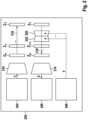
- Figure 1 depicts schematically a device 100.
- the synthetic digital image may be a video, radar, LiDAR, ultrasonic, motion, or thermal image.
- the device 100 may be configured to read a digital reference image from storage.
- the digital reference image may be a video, radar, LiDAR, ultrasonic, motion, or thermal image.
- the device 100 may comprise at least one interface 106.
- the at least one interface 106 may be configured for receiving the digital reference image, e.g., from a sensor 108.
- the at least one interface 106 may be configured to output a control signal for an actuator 110.
- the sensor 108 may be configured to capture a video, radar, LiDAR, ultrasonic, motion, or thermal image.
- the sensor 108 or the actuator 110 may be part of a technical system 112.
- the technical system 112 is a physical system.
- the technical system 112 may be a computer-controlled machine, preferably a robotic system, a vehicle, a domestic appliance, a power tool, a manufacturing machine, a personal assistant or an access control system.
- the device 100 may comprise a machine learning system that is configured to operate the technical system 112 depending on input from the sensor 108 and with output of the control signal to the actuator 110.
- the machine learning system is configured to determine the control signal for operating the technical system 112 depending on a digital image.
- the digital image may be a video, radar, LiDAR, ultrasonic, motion, or thermal image.
- Determining the control signal depending on the digital image for example comprises mapping the digital image with a neural network for semantic segmentation, object recognition or classification of objects.
- Determining the control signal depending on the digital image for example comprises determining the control signal depending on an output of the neural network, e.g., the semantic segmentation, object recognition, or classification of objects.
- a background is distinguished from objects, or recognized, or classified as background in the digital image or an object is distinguished from background, or recognized, or classified, e.g., as a traffic sign, a road surface, a pedestrian, a vehicle, an animal, a plant, infrastructure, or the sky, depending on the synthetic digital image.
- control signal is determined to move the technical system 112 upon recognizing or classifying the object as a predetermined object indicating that moving the technical system 112 is acceptable or stopping the technical system 112 otherwise or upon recognizing or classifying the object as a predetermined object indicating that stopping the technical system 112 is required.
- Classifying the object may comprise segmentation and/or object detection.
- Figure 2 schematically depicts an exemplary diffusion model 202.
- the diffusion model 202 is configured to receive a digital image x, e.g., a digital reference image 204, in an image space, and to determine an output x ⁇ , e.g., a synthetic digital image 208, in the image space.
- the digital image x and/or the digital reference image 204 and/or the synthetic digital image 208 may be a video, radar, LiDAR, ultrasonic, motion, or thermal image.
- the diffusion model 202 is configured to receive a condition y, e.g., a digital reference condition 206, and to determine the output x ⁇ depending on the condition y and the digital image x.
- the diffusion model 202 comprises an encoder 210 that is configured to encode the input x, e.g., the digital reference image 204, into a representation Z 0 , e.g., of the digital reference image 204, in a latent space of the diffusion model.
- the diffusion model 202 comprises a decoder 214 that is configured to decode a representation Z ⁇ 0 ,e.g., of the synthetic digital image 208, in the latent space to the output x ⁇ , e.g., the synthetic digital image 208, in the image space.
- the image space in the example is a pixel space, e.g., for a RGB image comprising a width W, a height H and 3 channels.
- the image space may comprise more or less channels.
- the diffusion model 202 is configured to successively add in a forward pass 216 random noise to the representation Z 0 in the latent space.
- the diffusion model according to the first embodiment 202 is configured to determine a sequence Z 1 , ..., Z T of representations, wherein after the first representation Z 0 a next representation Z t +1 in the sequence is determined depending on the result of adding random noise to the representation Z t preceding the next representation Z t +1 in the sequence of representations.
- the diffusion model 202 is configured to successively remove in a denoising process 218 random noise from the last representation Z T in the latent space.
- the exemplary diffusion model 202 is configured to determine a sequence Z ⁇ T-1 , ... , Z ⁇ 0 of outputs depending on the last representation Z T as input to the denoising process.
- a next output Z ⁇ t -1 in the sequence is determined depending on the result of denoising the output Z ⁇ t preceding the next output Z ⁇ t -1 in the sequence of outputs.
- the diffusion model 202 is configured to determine the respective next output Z ⁇ t-1 depending on a result of encoding the output Z ⁇ t preceding the next output Z ⁇ t-1 with an encoder and decoding the encoded input with a decoder.
- a respective encoder is configured to determine features of the encoder at different levels of the encoder.
- a respective decoder is configured to determine features of the decoder at different levels of the decoder.
- the diffusion model 202 is optionally configured to manipulate the features depending on the condition y.
- the diffusion model 202 is for example configured to manipulate the features of one encoder or multiple encoders or the features of one decoder or multiple decoders.
- the diffusion model 202 is for example configured to manipulate the features at at least one level or at different levels.
- the diffusion model 202 is for example configured to input the condition y to the encoder or decoder at the level or at the respective levels.
- the features of a respective encoder are manipulated depending on the condition y only or depending on the condition y and the features of the same encoder.
- the features of a respective decoder are manipulated depending on the condition y only or depending on the condition y and the features of the same decoder.
- An example for the diffusion model is a stable diffusion model that operates in a latent space of an autoencoder.
- the forward pass 216 and the denoising process 218 of the diffusion model are trained in the latent space.
- the forward pass is a Markov chain to gradually add Gaussian noise to the spatial latent code Z 0 : q z t
- the reverse denoising process 218 is parametrized in the example by another Gaussian distribution p ⁇ z t ⁇ 1
- z t : N z t ⁇ 1 ; ⁇ ⁇ z t t , ⁇ ⁇ z t t
- ⁇ ⁇ ( z t , t ) is expressed as a linear combination of z t and predicted noise ⁇ ⁇ ( zt , t ) which is modeled for example by the encoder and decoder that are configured to map the preceding output z t to the next output z t- 1 .
- the respective encoder and the respective decoder are implemented as a UNet.
- UNet is disclosed e.g., in Olaf Ronneberger, Philipp Fischer, Thomas Brox, U-Net: Convolutional Networks for Biomedical Image Segmentation, 18 May 2015, https://arxiv.org/abs/1505.04597.
- L noise E z ⁇ ⁇ x , ⁇ ⁇ N 0 I , t ⁇ ⁇ ⁇ ⁇ ⁇ z t t ⁇ 2
- the diffusion model 202 may comprise a sequence of a self-attention layer, a cross attention layer and a feed forward layer.
- the features f are extracted from an output of the cross-attention layer of the diffusion model that follows after the self-attention layer of the diffusion model in direction of the denoising process 218, and provided as input to the SPADE block and as input to the feed forward layer of the diffusion model.
- the features are modulated depending on an output of the SPADE block as described for the first exemplary modulation.
- the diffusion model 202 may comprise one or several of the parts for modulating features.
- SPADE blocks are inserted in parts of the diffusion model according to the first exemplary modulation or the second exemplary modulation at one predetermined location or at multiple predetermined locations of UNet or any other architecture of the diffusion model.
- the diffusion model 202 comprises trainable parameters.
- a discriminator or discriminators may be used for training the diffusion model 202.
- the training may use explicit supervision of the condition y.
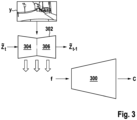
- Figure 3 schematically depicts an exemplary feature-based discriminator 300 and a first denoising stage 302 for the diffusion model 202 that is configured to determine the respective next output Z ⁇ t -1 depending on a result of encoding the output Z ⁇ t preceding the next output Z ⁇ t -1 with an encoder 304 of the first denoising stage 302 and decoding the encoded input with a decoder 306 of the first denoising stage 302.
- the first denoising stage 302 is configured to output features f of the encoder 304 and/or the decoder 306 of the first denoising stage 302 to the feature-based discriminator 300.
- the first denoising stage 302 is configured to manipulate the features f in the encoder 304 and/or the decoder 306 of the first denoising stage 302 as described above and to output the manipulated features f to the feature-based discriminator 300.
- the feature-based discriminator 300 is configured to map the features f that are provided to the feature-based discriminator 300 by the first denoising stage 302 to a class c, in particular either a class of a predetermined set of N classes for a real digital image or a class for a synthetic digital image.
- the feature-based discriminator 300 is configured to determine the class pixel-wise.
- the first denoising stage 302 may be configured to output an attention map depending on the output Z ⁇ t .
- the feature-based discriminator 300 may be configured to map the attention map received from denoising stage 302 and the features f to the class c or the pixel-wise class c.
- CE represents the cross-entropy loss
- the prediction y pred includes N real sematic classes (1,...
- a limited number of images e.g., 8 images, are sampled as batch per optimization step. For the limited number of 8 images, one training batch contains 8 images.
- Figure 4 schematically depicts an exemplary image-based discriminator 400 and a second denoising stage 402 for the diffusion model 202 that is configured to determine the respective next output Z ⁇ t -1 depending on a result of encoding the output Z ⁇ t preceding the next output Z ⁇ t -1 with an encoder 404 of the second denoising stage 402 and decoding the encoded input with a first decoder 406 of the second denoising stage 402.
- the second denoising stage 402 is configured to provide the next output Z ⁇ t -1 to a second decoder 408 of the second denoising stage 402 that is configured to map the next output Z ⁇ t -1 to a digital image x ⁇ t- 1 .
- the second denoising stage 402 is configured to manipulate the features f in the encoder 404 and/or the decoder 406 of the second denoising stage 402 as described above.
- the image-based discriminator 400 is configured to map the next output Z ⁇ t -1 that is provided to the image-based discriminator 400 by the second denoising stage 402 to a class c, in particular either a class of a predetermined set of N classes for a real digital image or a class for a synthetic digital image.
- the image-based discriminator 400 is configured to determine the class pixel-wise.
- the diffusion model 202 may comprise multiple first denoising stages 302 or multiple second denoising stages 402.
- the diffusion model 202 may comprise a first denoising stage 302 or multiple first denoising stages 302 and a second denoising stage 402 or multiple second denoising stages 402.
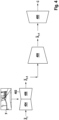
- Figure 5 schematically depicts a sequence of denoising stages 502 that are arranged in the diffusion model 202 to successively remove noise from output Z ⁇ t at different steps t within a horizon t h .
- the diffusion model 202 is configured to determine the sequence of outputs Z ⁇ t -1 , Z ⁇ t -2 , ... , Z ⁇ th within the horizon t h .
- L noise only gradients of the first step t, i.e., L noise , may be used, while the discriminator loss L seg may be determined at the following steps t - 1, ..., t - 1 - t h .
- Figure 6 schematically depicts the sequence of denoising stages 502 that are arranged in the diffusion model 202 to successively remove noise from output Z ⁇ t depending on the condition y at different steps t within a horizon t h .
- the condition is in the example mapped with a layer 602 to a representation of the condition y that is added to the respective output in the sequence of outputs Z ⁇ t -1 , Z ⁇ t -2 , ..., Z ⁇ th .
- a corresponding training strategy for the diffusion model 202 improves the synthesis quality and is particularly useful for the conditional diffusion model 202, i.e., the diffusion model 202 using the condition y to enhance the conditional alignment.
- the discriminator provides per-pixel guidance without using the condition or per-pixel conditional guidance when using the condition y.
- the multistep sampling of losses in the horizon during training further improves the training.
- the inter-step conditioning strengthens the conditional effect.
- the method comprises a step 702.
- the step 702 comprises providing a latent variable Z T of the diffusion model 202 representing the synthetic digital image x ⁇ .
- the latent variable Z T is sampled from random noise.
- the inference may use the condition y or not.
- the step 702 comprises providing the condition y.
- condition y is for example the label map.
- the method comprises a step 704.
- the step 704 comprises mapping the latent variable Z T with the diffusion model 202 depending on parameters of the diffusion model 202 to features f of the diffusion model 202.
- the step 704 may comprise determining the sequence of outputs Z T -1 , ... Z 0 comprising the output Z 0 .
- Determining the sequence of outputs Z ⁇ T-1 , ... Z ⁇ 0 may comprise determining a first output Z ⁇ T -1 of the sequence depending on a result of encoding the input Z T and decoding the encoded input, and successively determining a next output Z ⁇ T -2 , ... Z ⁇ 0 in the sequence depending on the result of encoding the output Z ⁇ T-1 , ... Z ⁇ 1 preceding the next output Z ⁇ T -2 , ... Z ⁇ 0 in the sequence and decoding the encoded output preceding the next output in the sequence.
- Encoding or decoding may comprise determining the features f.
- the step 704 comprises predicting a noise ⁇ i in a next output Z ⁇ i of the sequence Z ⁇ T -2 , ... Z ⁇ 0 depending on the output Z ⁇ T -1 , ... Z ⁇ 1 preceding the next output Z ⁇ i -1 in the sequence of outputs Z ⁇ T -1 , ... Z ⁇ 0 .
- the method comprises a step 706.
- the step 706 comprises mapping the features f with the diffusion model 202 depending on parameters of the diffusion model 202 to an output Z 0 of the diffusion model 202.
- the step 706 may comprise modulating the features f depending on the condition y as described above and mapping the modulated features f with the diffusion model 202 to the output Z 0 .
- the output Z 0 may be in image space, i.e., pixel space, or in latent space.
- the method may comprise a step 708 for mapping the output Z 0 in latent space to the synthetic digital image x ⁇ .
- the synthetic digital image x ⁇ may comprise the output Z 0 in image space. This means, no decoder 214 is used.
- the method may comprise a step 710.
- the step 710 may comprise mapping the features f with the feature-based discriminator 300 to a class c.
- the step 710 may comprise mapping the synthetic digital image x ⁇ with the image-based discriminator 400 to the class c.
- the class c is either a class of the predetermined set of N classes for the real digital image or the class for the fake digital image, i.e., recognition of a synthetic digital image x ⁇ .
- the method may comprise determining the class pixel-wise.
- the step 710 may comprise determining the class c for a plurality of outputs of the sequence Z T -1 , ... Z 0 with a respective discriminator depending on features f T- 1 , ... f 0 collected from the respective encoding or decoding.
- the method comprises a step 712.
- the step 712 comprises learning at least one parameter of the diffusion model 202 and/or of the feature-based discriminator 300 and/or of the image-based discriminator 400 depending on the loss L seg .
- one prediction represents a fake class and N prediction represent true classes.
- the prediction y pred for N real sematic classes (1,... ,N) and 1 fake class (N + 1) is used as described above.
- the loss L seg for the discriminator is defined depending on the class c and a predetermined reference class or the pixel-wise classes and pixel-wise reference classes.
- condition y may comprise the predetermined reference class or the pixel-wise reference classes.
- the step 712 may comprise learning the parameters depending on the losses L Seg,i that are defined for the discriminators depending on the class c predicted by the respective discriminator and the predetermined reference class.
- the step 712 may comprise learning the parameters depending the loss for noise L noise and depending on the losses L Seg that are defined for the discriminators.
- the loss for noise L noise is defined depending on the predicted noise ⁇ i and a predetermined random noise, in particular random noise sampled from a Gaussian distribution.
- the loss L seg that is defined for the discriminator or the losses L seg that are defined for the discriminators may be the loss L seg that is defined depending on the condition y.
- the reference class may be provided pixel-wise.
- the method may comprise learning the at least one parameter depending on the loss that is defined depending on the pixel-wise classes and respective predetermined pixel-wise reference classes.
- the steps 702 to 710 may be repeated to determine a batch of training data for learning the parameters.
- the step 712 may comprise learning the parameters e.g., with a gradient descent based on the batch of training data.
- Figure 8 schematically depicts a flow chart of a second embodiment of the method for generating a synthetic digital image.
- the diffusion model 202 is configured to process a digital image as input x, i.e., without the encoder 210.
- the method according to the second embodiment comprises a step 802.
- the step 802 comprises providing a digital reference image 204.
- the method according to the second embodiment comprises a step 804.
- the step 804 comprises adding noise with the diffusion model 202 to the input x, i.e., the digital reference image 204 to determine the latent variable Z T .
- the method according to the second embodiment comprises a step 806.
- the step 806 comprises mapping the latent variable Z T as described in step 704.
- the step 806 may comprise determining the sequence of outputs Z T -1 , ... Z 0 as described in step 704, wherein encoding or decoding may comprise determining the features f.
- the step 806 may comprise predicting the noise ⁇ i as describe in step 704.
- the method comprises a step 808.
- the step 808 comprises mapping the features f with the diffusion model 202 as described in step 706.
- the step 808 may comprise modulating the features f depending on the condition y as described in step 706.
- the output Z 0 may be in image space, i.e., pixel space, or in latent space.
- the method according to the second embodiment may comprise a step 810 for mapping the output Z 0 in latent space to the synthetic digital image x ⁇ .
- the synthetic digital image x ⁇ may comprise the output Z 0 in image space. This means, no decoder 214 is used.
- the method according to the second embodiment may comprise a step 812.
- the step 812 may comprise mapping the features f with the feature-based discriminator 300 to the class c.
- the step 812 may comprise mapping the synthetic digital image x ⁇ with the image-based discriminator 400 to the class c.
- the method according to the second embodiment may comprise determining the class pixel-wise.
- the step 812 may comprise determining the class c for a plurality of outputs of the sequence Z T -1 , ... Z 0 with a respective discriminator depending on features f T- 1 , ... f 0 collected from the respective encoding or decoding.
- the method according to the second embodiment comprises a step 814.
- the step 814 comprises learning at least one parameter of the diffusion model 202 and/or of the feature-based discriminator 300 and/or of the image-based discriminator 400 as described in step 712.
- the steps 802 to 812 may be repeated to determine a batch of training data for learning the parameters.
- the step 814 may comprise learning the parameters e.g., with a gradient descent based on the batch of training data
- Figure 9 schematically depicts a flow chart of a third embodiment of the method for generating a synthetic digital image.
- the diffusion model comprises the encoder 210 for mapping a digital image to an input x.
- the method comprises a step 902.
- the step 902 comprises providing the digital reference image 214.
- the method comprises a step 904.
- the step 904 comprises mapping the digital reference image 204 with the encoder 210 to the input x of the diffusion model 202.
- the method comprises a step 906.
- the step 906 comprises adding noise with the diffusion model 202 to the input x to determine the latent variable Z T .
- the method comprises a step 908.
- the step 908 comprises mapping the latent variable Z T as described in step 704.
- the step 908 may comprise determining the sequence of outputs Z T -1 , ... Z 0 as described in step 704, wherein encoding or decoding may comprise determining the features f.
- the step 908 may comprise predicting the noise ⁇ i as describe in step 704.
- the method comprises a step 910.
- the step 910 comprises mapping the features f with the diffusion model 202 as described in step 706.
- the step 910 may comprise modulating the features f depending on the condition y as described in step 706.
- the output Z 0 may be in image space, i.e., pixel space, or in latent space.
- the method according to the third embodiment may comprise a step 912 for mapping the output Z 0 in latent space to the synthetic digital image x ⁇ .
- the synthetic digital image x ⁇ may comprise the output Z 0 in image space. This means, no decoder 214 is used.
- the method according to the third embodiment may comprise a step 914.
- the step 914 may comprise mapping the features f with the feature-based discriminator 300 to the class c.
- the step 914 may comprise mapping the synthetic digital image x ⁇ with the image-based discriminator 400 to the class c.
- the method according to the third embodiment may comprise determining the class pixel-wise.
- the step 914 may comprise determining the class c for a plurality of outputs of the sequence Z T -1 , ... Z 0 with a respective discriminator depending on features f T- 1 , ... f 0 collected from the respective encoding or decoding.
- the method according to the third embodiment comprises a step 916.
- the step 916 comprises learning at least one parameter of the diffusion model 202 and/or of the feature-based discriminator 300 and/or of the image-based discriminator 400 as described in step 712.
- the steps 902 to 914 may be repeated to determine a batch of training data for learning the parameters.
- the step 916 may comprise learning the parameters e.g., with a gradient descent based on the batch of training data
- the method for generating synthetic images as described above may be used for providing a machine learning system.
- the machine learning system may comprise a neural network for semantic segmentation, object recognition, or classification of objects.
- An exemplary computer-implemented method for providing the machine learning system comprises generating a synthetic digital image with the method for generating the synthetic digital image, and training, testing, verifying, or validating the machine learning system depending on the synthetic digital image.
- a plurality of synthetic digital images are determined and the machine learning system is trained, tested, verified or validated depending on the plurality of synthetic digital images.
- the machine learning system is trained, tested, verified, or validated for semantic segmentation, or object recognition, or classification of objects.
- the machine learning system is trained, tested, verified, or validated for recognizing background or an object, in particular a traffic sign, a road surface, a pedestrian, a vehicle, an animal, a plant, infrastructure, or the sky, depending on the synthetic digital image.
- Training, testing, verifying, or validating the machine learning system may comprise providing the condition y, in particular the label map, that is provided for generating the synthetic digital image as ground truth for training, testing, verifying, or validating the machine learning system.
- the diffusion model may be a generative model or part of a generative model to generate training and/or test data for a machine learning system or training and/or test data for an image classifier.
- a computer-implemented method for generating the synthetic digital image x ⁇ with the diffusion model for generating training and/or test data for training a machine learning system or an image classifier comprises sampling an input Z T from a probability distribution, in particular a Gaussian distribution, providing the condition y for the semantic layout of the synthetic digital image x ⁇ , in text, a class label, a semantic label map, a two-dimensional or a three dimensional pose, or a depth map, and mapping the input Z T with the diffusion model to the output x ⁇ or Z ⁇ 0 of the diffusion model, e.g., as described in step 608.
- the synthetic digital image x ⁇ may comprise the output x ⁇ of the diffusion model, or the synthetic digital image x ⁇ is generated depending on the output Z ⁇ 0 of the diffusion model.
- the diffusion model is the generative model or part of the generative model to generate training and/or test data for a machine learning system or training and/or test data for an image classifier.
- the diffusion model comprises the successive levels.
- Mapping the input Z T with the diffusion model to the output x ⁇ or Z ⁇ 0 may comprise successively determining features f at the levels depending on the input Z T , inputting the condition y to the diffusion model at at least one level of the levels, modulating the features f of at least one level of the levels depending on the condition y, and determining the output Z ⁇ 0 of the diffusion model depending on the modulated features.
- An exemplary computer-implemented method for operating the technical system 112 comprises providing the machine learning system with the method for providing the machine learning system, capturing a digital image with the sensor 108, and determining the control signal for operating the technical system 112 with the machine learning system depending on the digital image.
- the methods comprises a generic training paradigm to improve the synthesis quality of the diffusion models, which is particularly useful for conditional diffusion models and improve the conditional alignment.
- the methods can improve the training of both unconditional and conditional diffusion models, and is independent of the architecture design of the diffusion models.
- the diffusion model may comprise a denoising model for the denoising process 218, which can be a UNet or a transformer-based model in the pixel space or in the latent space.
- the methods can be applied to improve ControlNet, FreestyleNet, despite they have different designs of the denoising model with conditions.
- the synthesized digital images are better aligned with the conditions, e.g., the label map.
- condition to the generative models will be used as the ground-truth label during training of the downstream task.
- the label map of the generative model may be reused as the ground-truth label to train the semantic segmentation network. If the synthesized images are not aligned with the conditional inputs, the mismatching will mislead the network training because the ground-truth label is no longer correct anymore.
Landscapes
- Engineering & Computer Science (AREA)
- Theoretical Computer Science (AREA)
- Physics & Mathematics (AREA)
- General Physics & Mathematics (AREA)
- Evolutionary Computation (AREA)
- Health & Medical Sciences (AREA)
- Artificial Intelligence (AREA)
- General Health & Medical Sciences (AREA)
- Multimedia (AREA)
- Computing Systems (AREA)
- Software Systems (AREA)
- Computer Vision & Pattern Recognition (AREA)
- Medical Informatics (AREA)
- Databases & Information Systems (AREA)
- Molecular Biology (AREA)
- Life Sciences & Earth Sciences (AREA)
- Biomedical Technology (AREA)
- Computational Linguistics (AREA)
- Biophysics (AREA)
- Data Mining & Analysis (AREA)
- General Engineering & Computer Science (AREA)
- Mathematical Physics (AREA)
- Biodiversity & Conservation Biology (AREA)
- Probability & Statistics with Applications (AREA)
- Image Analysis (AREA)
- Image Processing (AREA)
Abstract
A device and a computer-implemented method for machine learning, in particular for generating training and/or test data for training a machine learning system or for training an image classifier, for providing a machine learning system, or for operating a technical system, wherein the method for machine learning comprises providing a latent variable of a diffusion model representing the synthetic digital image, wherein providing the latent variable comprises sampling the latent variable from random noise, or providing a digital reference image, and adding noise with the diffusion model to the digital reference image to determine the latent variable, or mapping the digital reference image with an encoder to an input of the diffusion model, and adding noise with the diffusion model to the input to determine the latent variable, wherein the method further comprises mapping the latent variable with the diffusion model depending on parameters of the diffusion model to features (f) of the diffusion model, mapping the features (f) with the diffusion model depending on parameters of the diffusion model to an output (Z 0) of the diffusion model, wherein the synthetic digital image comprises the output, or wherein the method comprises mapping the output with a decoder to the synthetic digital image, mapping the features (f) or the synthetic digital image with a discriminator (300) to a class (c), in particular either a class (c) of a predetermined set of classes for a real digital image or a class for a synthetic digital image, depending on parameters of the discriminator, and learning at least one parameter of the diffusion model and/or the discriminator depending on a loss for the discriminator that is defined depending on the class and a predetermined reference class.
Description
- The invention relates to a device and a computer-implemented methods for machine learning, for providing a machine learning system, or for operating a technical system.
- A diffusion model may be used in machine learning for generating synthetic digital images, e.g., for training, testing, verifying and/or validating the machine learning system depending on the synthetic digital image.
- The diffusion model may be trained unconditional or conditional.
- The device and the computer-implemented methods according to the independent claims provide a machine learning with a diffusion model and a discriminator for providing guidance, wherein learning parameters of the diffusion model and/or the discriminator are learned depending on the guidance provided by the discriminator in the unconditional or conditional case. The diffusion model may be a neural network. The parameters of the diffusion model may be weights of the neural network resembling the diffusion model. The discriminator may be a neural network. The parameters of the discriminator may be weights of the neural network resembling the discriminator.
- A computer-implemented method for machine learning, in particular for generating training and/or test data for training a machine learning system or for training an image classifier, comprises providing a latent variable of a diffusion model representing the synthetic digital image, wherein providing the latent variable comprises sampling the latent variable from random noise, or providing a digital reference image, and adding noise with the diffusion model to the digital reference image to determine the latent variable, or mapping the digital reference image with an encoder to an input of the diffusion model, and adding noise with the diffusion model to the input to determine the latent variable, wherein the method further comprises mapping the latent variable with the diffusion model depending on parameters of the diffusion model to features of the diffusion model, mapping the features with the diffusion model depending on parameters of the diffusion model to an output of the diffusion model, wherein the synthetic digital image comprises the output, or wherein the method comprises mapping the output with a decoder to the synthetic digital image, mapping the features or the synthetic digital image with a discriminator to a class, in particular either a class of a predetermined set of classes for a real digital image or a class for a synthetic digital image, depending on parameters of the discriminator, and learning at least one parameter of the diffusion model and/or the discriminator depending on a loss for the discriminator that is defined depending on the class and a predetermined reference class. The discriminator may be semantic segmentation network based, i.e., segmenter based. The discriminator provides the guidance for learning.
- The synthetic digital image comprises pixels. The method may comprise determining the class pixel-wise, and learning the at least one parameter depending on a loss that defined depending on the pixel-wise classes and respective predetermined pixel-wise reference classes. This means the discriminator provides the guidance pixel-wise in particular for the unconditional diffusion model to improve local details.
- The method may comprise determining a sequence of outputs comprising the output, wherein determining the sequence of outputs comprises determining a first output of the sequence depending on a result of encoding the input and decoding the encoded input, and successively determining a next output in the sequence depending on the result of encoding the output preceding the next output in the sequence and decoding the encoded output preceding the next output in the sequence, wherein encoding or decoding comprises determining the features. This means, the outputs and the features are determined in stages. discriminator may use features of the encoder or decoder at different stages.
- The method may comprise determining, with a respective discriminator, the class for a plurality of outputs of the sequence depending on features collected from the respective encoding or decoding, and learning the parameters depending on the losses that are defined for the discriminators depending on the class predicted by the respective discriminator and the predetermined reference class. A discriminator per stage in the plurality of stages may be used for providing the guidance. Instead of training the diffusion model to predict noise at a single, randomly sampled stage during training, a multistep sampling at the plurality of stages takes into account several stages. The stages may be a number of successive stages, i.e., stages within a horizon defined by the number of stages.
- The method may comprise predicting a noise in a next output of the sequence depending on the output preceding the next output in the sequence of outputs, and learning the parameters depending a loss for noise and depending on the losses that are defined for the discriminators, wherein the loss for noise is defined depending on the predicted noise and a predetermined random noise, in particular random noise sampled from a Gaussian distribution. This reduces the memory consumption compared to using the loss for noise at several stages.
- The method may comprise providing a condition, in particular a label map, modulating the features depending on the condition and mapping the modulated features with the diffusion model to the output, and/or with the discriminator to the class. The label map for example comprises a pixel-wise reference class for the pixel of the synthetic digital image. The implicit assumption is that the conditional information is beneficial for the noise prediction in the diffusion model, thus the denoising will learn to use the condition. With the discriminator there is explicit enforcement or supervision for the usage of condition.
- The method may comprise learning the parameters depending on the loss that is defined for the discriminator, wherein the loss that is defined for the discriminator is defined depending on the condition, or learning the parameters depending on the losses that are defined for the discriminators, wherein the losses are defined depending on the condition. In the conditional case, additional guidance is provided that depends on the condition.
- This discriminator provides in particular pixel-wise guidance and encourages the conditional alignment. The discriminator may be trained jointly with the diffusion model, and learns to predict the given label map condition on real samples and predict fake ones as the additional "fake" class. The diffusion model learns to generate realistic images aligned with the label map as synthetic digital images to fool the discriminator. In this way, the label map condition is explicitly leveraged during training.
- The condition comprises the predetermined reference class or the pixel-wise reference classes, e.g., the label map, to provide the additional guidance.
- A computer-implemented method for providing the machine learning system, in particular a neural network for semantic segmentation, object recognition, or classification of objects, comprises generating a synthetic digital image with the method for machine learning, and training, testing, verifying, or validating the machine learning system for semantic segmentation, or object recognition, or classification of objects, preferably for recognizing background or an object, in particular a traffic sign, a road surface, a pedestrian, a vehicle, an animal, a plant, infrastructure, or the sky, depending on the synthetic digital image.
- Training the machine learning system may comprise providing the condition, in particular the label map that is provided for generating the synthetic digital image as ground truth for training the machine learning system.
- A computer-implemented method for operating a technical system, in particular a computer-controlled machine, preferably a robotic system, a vehicle, a domestic appliance, a power tool, a manufacturing machine, a personal assistant or an access control system, comprises providing the machine learning system with the method for providing the machine learning system, capturing a digital image with a sensor, in particular a video, radar, LiDAR, ultrasonic, motion, or thermal image, and determining a control signal for operating the technical system with the machine learning system depending on the digital image.
- A device may comprise at least one processor and at least one memory, wherein the at least one processor is configured to execute instructions that, when executed by the at least one processor, cause the device to execute the method for machine learning, for providing the machine learning system or operating the technical system, wherein the at least one memory is configured to store the instructions.
- A computer program, characterized in that the computer program comprises computer-readable instructions that, when executed by a computer, cause the computer to execute the method according to one of the
claims 1 to 10. - Further advantageous embodiments are derived from the following description and the drawing. In the drawing,
- Fig. 1
- schematically depicts a device,
- Fig. 2
- schematically depicts an exemplary diffusion model,
- Fig. 3
- schematically depicts a feature-based discriminator,
- Fig. 4
- schematically depicts an image-based discriminator,
- Fig. 5
- schematically depicts a sequence of denoising stages of the diffusion model,
- Fig. 6
- schematically depicts the sequence of denoising stages for remove the noise depending on a condition,
- Fig. 7
- schematically depicts a flow chart of a first embodiment of a method for generating a synthetic digital image,
- Fig. 8
- schematically depicts a flow chart of a second embodiment of the method for generating a synthetic digital image,
- Fig. 9
- schematically depicts a flow chart of a third embodiment of the method for generating a synthetic digital image.
-
Figure 1 depicts schematically adevice 100. - The
device 100 comprises at least oneprocessor 102 and at least onememory 104. The at least onememory 104 comprises at least one non-transitory memory. The at least onememory 104 is configured to store instructions that are executable by the at least oneprocessor 102 and that cause thedevice 100 to perform a method for generating a synthetic digital image, when executed by the at least oneprocessor 102. - The synthetic digital image may be a video, radar, LiDAR, ultrasonic, motion, or thermal image.
- The
device 100 may be configured to read a digital reference image from storage. The digital reference image may be a video, radar, LiDAR, ultrasonic, motion, or thermal image. - The
device 100 may comprise at least oneinterface 106. The at least oneinterface 106 may be configured for receiving the digital reference image, e.g., from asensor 108. The at least oneinterface 106 may be configured to output a control signal for anactuator 110. - The
sensor 108 may be configured to capture a video, radar, LiDAR, ultrasonic, motion, or thermal image. - The
sensor 108 or theactuator 110 may be part of atechnical system 112. Thetechnical system 112 is a physical system. Thetechnical system 112 may be a computer-controlled machine, preferably a robotic system, a vehicle, a domestic appliance, a power tool, a manufacturing machine, a personal assistant or an access control system. - The
device 100 may comprise a machine learning system that is configured to operate thetechnical system 112 depending on input from thesensor 108 and with output of the control signal to theactuator 110. - For example, the machine learning system is configured to determine the control signal for operating the
technical system 112 depending on a digital image. - The digital image may be a video, radar, LiDAR, ultrasonic, motion, or thermal image.
- Determining the control signal depending on the digital image for example comprises mapping the digital image with a neural network for semantic segmentation, object recognition or classification of objects.
- Determining the control signal depending on the digital image for example comprises determining the control signal depending on an output of the neural network, e.g., the semantic segmentation, object recognition, or classification of objects.
- For example, a background is distinguished from objects, or recognized, or classified as background in the digital image or an object is distinguished from background, or recognized, or classified, e.g., as a traffic sign, a road surface, a pedestrian, a vehicle, an animal, a plant, infrastructure, or the sky, depending on the synthetic digital image.
- For example, the control signal is determined to move the
technical system 112 upon recognizing or classifying the object as a predetermined object indicating that moving thetechnical system 112 is acceptable or stopping thetechnical system 112 otherwise or upon recognizing or classifying the object as a predetermined object indicating that stopping thetechnical system 112 is required. - Classifying the object may comprise segmentation and/or object detection.
-
Figure 2 schematically depicts anexemplary diffusion model 202. - The
diffusion model 202 is configured to receive a digital image x, e.g., adigital reference image 204, in an image space, and to determine an output x̃, e.g., a syntheticdigital image 208, in the image space. The digital image x and/or thedigital reference image 204 and/or the syntheticdigital image 208 may be a video, radar, LiDAR, ultrasonic, motion, or thermal image. Optionally, thediffusion model 202 is configured to receive a condition y, e.g., adigital reference condition 206, and to determine the output x̃ depending on the condition y and the digital image x. - The
diffusion model 202 comprises anencoder 210 that is configured to encode the input x, e.g., thedigital reference image 204, into a representation Z 0, e.g., of thedigital reference image 204, in a latent space of the diffusion model. - The
diffusion model 202 comprises adecoder 214 that is configured to decode a representation Z̃ 0 ,e.g., of the syntheticdigital image 208, in the latent space to the output x̃, e.g., the syntheticdigital image 208, in the image space. - The image space in the example is a pixel space, e.g., for a RGB image comprising a width W, a height H and 3 channels. The image space may comprise more or less channels.
- The
diffusion model 202 is configured to successively add in aforward pass 216 random noise to the representation Z 0 in the latent space. In the example, the diffusion model according to thefirst embodiment 202 is configured to determine a sequence Z 1, ..., ZT of representations, wherein after the first representation Z 0 a next representation Z t+1 in the sequence is determined depending on the result of adding random noise to the representation Zt preceding the next representation Z t+1 in the sequence of representations. - The
diffusion model 202 is configured to successively remove in adenoising process 218 random noise from the last representation Z T in the latent space. In the example, theexemplary diffusion model 202 is configured to determine a sequence Z̃ T-1, ... , Z̃ 0 of outputs depending on the last representation ZT as input to the denoising process. A first output Z̃ t=T-1 in the sequence is determined in the example by denoising the input ZT. After the first output Z̃ t=T-1 a next output Z̃ t-1 in the sequence is determined depending on the result of denoising the output Z̃t preceding the next output Z̃ t-1 in the sequence of outputs. - The
diffusion model 202 is configured to determine the first output Z̃ t=T-1 depending on a result of encoding the input ZT with anencoder 220 and decoding the encoded input with adecoder 222. - The
diffusion model 202 is configured to determine the respective next output Z̃ t-1 depending on a result of encoding the output Z̃ t preceding the next output Z̃ t-1 with an encoder and decoding the encoded input with a decoder. - A respective encoder is configured to determine features of the encoder at different levels of the encoder. A respective decoder is configured to determine features of the decoder at different levels of the decoder.
- The
diffusion model 202 is optionally configured to manipulate the features depending on the condition y. Thediffusion model 202 is for example configured to manipulate the features of one encoder or multiple encoders or the features of one decoder or multiple decoders. Thediffusion model 202 is for example configured to manipulate the features at at least one level or at different levels. Thediffusion model 202 is for example configured to input the condition y to the encoder or decoder at the level or at the respective levels. According to the example, the features of a respective encoder are manipulated depending on the condition y only or depending on the condition y and the features of the same encoder. According to the example, the features of a respective decoder are manipulated depending on the condition y only or depending on the condition y and the features of the same decoder. - An example for the diffusion model is a stable diffusion model that operates in a latent space of an autoencoder.
- Firstly, an encoder ε, i.e., the
encoder 210, maps a given image x, e.g., thedigital reference image 204, into a spatial latent code Z 0 = ε(x), then Z̃ 0 is mapped back to a prediction for the image x̃, e.g., the syntheticdigital image 208, in the image space by a decoder D, i.e., thedecoder 214. According to an example, the autoencoder is trained to reconstruct the given image, i.e., x̃ = D(ε(x)). - Secondly, the
forward pass 216 and thedenoising process 218 of the diffusion model are trained in the latent space. - The forward pass is a Markov chain to gradually add Gaussian noise to the spatial latent code Z 0:


- The
reverse denoising process 218 is parametrized in the example by another Gaussian distribution
- Essentially µθ (zt , t) is expressed as a linear combination of zt and predicted noise ε θ(zt,t) which is modeled for example by the encoder and decoder that are configured to map the preceding output zt to the next output z t-1.
- In an example, the respective encoder and the respective decoder are implemented as a UNet. UNet is disclosed e.g., in Olaf Ronneberger, Philipp Fischer, Thomas Brox, U-Net: Convolutional Networks for Biomedical Image Segmentation, 18 May 2015, https://arxiv.org/abs/1505.04597.
- The parameters of the encoder and decoder are learned in the example by minimizing the L2 norm of the noise prediction at a sampled timestep t:

- In case the optional condition y is used, in the training, or after an initial training of the diffusion model, the modulation of the features depending on the condition y may be trained with a loss

- The
diffusion model 202 may be configured to control the features of at least one of the decoders. Thediffusion model 202 may comprise a trainable copy of the encoder that precedes the decoder that is controlled. Thediffusion model 202 may be configured to provide the condition y to a convolution, in particular a zero convolution, and to provide a result of adding the convolved condition to the preceding output zt as input to the trainable copy of the encoder. Thediffusion model 202 may be configured to provide the output of the trainable copy of the encoder to a convolution, in particular a zero convolution. Thediffusion model 202 may be configured to manipulate the features of the decoder at one level depending on the output of the convolution. Thediffusion model 202 may be configured to propagate the output of the trainable copy of the encoder through a series of convolutions, in particular zero convolutions and manipulate the features of the decoder at different levels depending on the output of a respective convolution of the series. Propagate means for example, that the output of a convolution is used as input for a next convolution in the series. - Zero convolution in this context refers to a convolution that comprises parameters, weight and bias, that are initialized as zeros before training the diffusion model and that are learned in training. In the example, the zero convolution is a 1x1 convolution. Trainable copy of the encoder refers to an encoder that comprises parameters that are initialized before training of the trainable copy with the values of the parameters of the encoder. In training of the trainable copy, the parameters of the encoder are frozen, i.e., remain unchanged, and the parameters of the trainable copy are learned.
- The output of the convolutions and the trainable copy of the encoder is for example integrated in the
diffusion model 202 as ControlNet, wherein the features of the trainable copy of the encoder are manipulated. - The
diffusion model 202 may be configured to modulate the features of the trainable copy in the same way as described for the encoder of thediffusion model 202. - According to an example, the layers for modulating the features, e.g., the SPADE blocks, are inserted at predetermined locations of the trainable copy, e.g., UNet, an modulate the features of the trainable copy as described for the modulation of the features in the
diffusion model 202. - The features f may be manipulated depending on the condition y in different ways.
- The according to a first exemplary modulation, a SPADE block takes the conditional input y and extracted features f from a level of the frozen diffusion network, and outputs spatially modulated features fadp , e.g., as

- According to an example, the modulated features fadp and the extracted features f are added to an output fout that replaces the extracted features f at the original level, i.e., f ← fout = fadp + f.
- The modulated features fadp may be inserted to replace the extracted features f at the original level, i.e., f ← fout = fadp, or inserted at another level, e.g., a level that is after the original level in direction of the
denoising process 218. Thediffusion model 202 of the diffusion model may be configured to replace features f at a level with features fout = f + tanh(β) fadp , where β is a learnable factor and initialized e.g., as zero. This means, the modulated features fadp are added to f in a learnable way. - The
diffusion model 202 may comprise a sequence of a self-attention layer, a cross attention layer and a feed forward layer. According to a second exemplary modulation the features f are extracted from an output of the cross-attention layer of the diffusion model that follows after the self-attention layer of the diffusion model in direction of thedenoising process 218, and provided as input to the SPADE block and as input to the feed forward layer of the diffusion model. The features are modulated depending on an output of the SPADE block as described for the first exemplary modulation. - The
diffusion model 202 may comprise one or several of the parts for modulating features. - For example, SPADE blocks are inserted in parts of the diffusion model according to the first exemplary modulation or the second exemplary modulation at one predetermined location or at multiple predetermined locations of UNet or any other architecture of the diffusion model.
- At inference time, the input zT for the
denoising process 218 is randomly sampled from the Gaussian distribution and the condition y is provided. Then the trained denoising encoder and decoder sets, e.g., the UNet, are sequentially applied, to obtain the denoised latent z t-1 given zt from to t = T to t = 1, while the features are manipulated depending on the condition y. The final synthesized image can be obtained by feeding the clean latent space code Z̃ 0 through the decoder D:
- The
diffusion model 202 comprises trainable parameters. - A discriminator or discriminators may be used for training the
diffusion model 202. The training may use explicit supervision of the condition y. -
Figure 3 schematically depicts an exemplary feature-baseddiscriminator 300 and afirst denoising stage 302 for thediffusion model 202 that is configured to determine the respective next output Z̃ t-1 depending on a result of encoding the output Z̃t preceding the next output Z̃ t-1 with anencoder 304 of thefirst denoising stage 302 and decoding the encoded input with adecoder 306 of thefirst denoising stage 302. - The
first denoising stage 302 is configured to output features f of theencoder 304 and/or thedecoder 306 of thefirst denoising stage 302 to the feature-baseddiscriminator 300. - The
first denoising stage 302 is configured to manipulate the features f in theencoder 304 and/or thedecoder 306 of thefirst denoising stage 302 as described above and to output the manipulated features f to the feature-baseddiscriminator 300. - The feature-based
discriminator 300 is configured to map the features f that are provided to the feature-baseddiscriminator 300 by thefirst denoising stage 302 to a class c, in particular either a class of a predetermined set of N classes for a real digital image or a class for a synthetic digital image. In the example, the feature-baseddiscriminator 300 is configured to determine the class pixel-wise. - The
first denoising stage 302 may be configured to output an attention map depending on the output Z̃t . The feature-baseddiscriminator 300 may be configured to map the attention map received fromdenoising stage 302 and the features f to the class c or the pixel-wise class c. - Using the condition y is optional. In an unconditional case, i.e., without input of the condition y to the
first denoising stage 302, the feature-baseddiscriminator 300 may be trained to minimize the loss
discriminator 300, wherein i,j indicates a spatial location, the prediction ypred = 0 represents a fake class and the prediction ypred = 1 represents a real class, and Lseg represents the per-pixel binary cross-entropy loss with the ground truth label as 1 everywhere. - A loss for the conditional case, i.e., wherein the
diffusion model 202 uses the condition y, e.g., an input map, is for example:

-
Figure 4 schematically depicts an exemplary image-baseddiscriminator 400 and asecond denoising stage 402 for thediffusion model 202 that is configured to determine the respective next output Z̃ t-1 depending on a result of encoding the output Z̃t preceding the next output Z̃ t-1 with anencoder 404 of thesecond denoising stage 402 and decoding the encoded input with afirst decoder 406 of thesecond denoising stage 402. Thesecond denoising stage 402 is configured to provide the next output Z̃ t-1 to asecond decoder 408 of thesecond denoising stage 402 that is configured to map the next output Z̃ t-1 to a digital image x̃ t-1. - The
second denoising stage 402 is configured to manipulate the features f in theencoder 404 and/or thedecoder 406 of thesecond denoising stage 402 as described above. - The image-based
discriminator 400 is configured to map the next output Z̃ t-1 that is provided to the image-baseddiscriminator 400 by thesecond denoising stage 402 to a class c, in particular either a class of a predetermined set of N classes for a real digital image or a class for a synthetic digital image. In the example, the image-baseddiscriminator 400 is configured to determine the class pixel-wise. - Using the condition y is optional. In an unconditional case, i.e., without input of the condition to the
second denoising stage 402, the image-baseddiscriminator 400 may be trained to minimize the loss
discriminator 400, wherein i,j indicates a spatial location, the prediction ypred = 0 represents a fake class and the prediction ypred = 1 represents a real class, and Lseg represents the per-pixel binary cross-entropy loss with the ground truth label as 1 everywhere. - The
diffusion model 202 may comprise multiple first denoising stages 302 or multiple second denoising stages 402. Thediffusion model 202 may comprise afirst denoising stage 302 or multiple first denoising stages 302 and asecond denoising stage 402 or multiple second denoising stages 402. -
Figure 5 schematically depicts a sequence ofdenoising stages 502 that are arranged in thediffusion model 202 to successively remove noise from output Z̃ t at different steps t within a horizon th . This means, thediffusion model 202 is configured to determine the sequence of outputs Z̃ t-1,Z̃ t-2, ... ,Z̃th within the horizon th . - For example, the
diffusion model 202 is trained depending on a respective loss Lseg for the output Z̃t and for the sequence of outputs Z̃ t-1, Z̃ t-2, ... , Z̃th and the loss Lnoise for the output Z̃t , e.g., with the loss
-
Figure 6 schematically depicts the sequence ofdenoising stages 502 that are arranged in thediffusion model 202 to successively remove noise from output Z̃t depending on the condition y at different steps t within a horizon th . The condition is in the example mapped with alayer 602 to a representation of the condition y that is added to the respective output in the sequence of outputs Z̃ t-1, Z̃ t-2, ..., Z̃th. - The
layer 602 may be configured to map the condition y, e.g., the label map pixel-wise to determine a modified noise prediction:

- A corresponding training strategy for the
diffusion model 202 improves the synthesis quality and is particularly useful for theconditional diffusion model 202, i.e., thediffusion model 202 using the condition y to enhance the conditional alignment. The discriminator provides per-pixel guidance without using the condition or per-pixel conditional guidance when using the condition y. The multistep sampling of losses in the horizon during training further improves the training. Especially for the conditional case, i.e., when using the condition y, the inter-step conditioning strengthens the conditional effect. -
Figure 7 schematically depicts a flow chart of a first embodiment of a method for generating a synthetic digital image. According to the first embodiment, thediffusion model 202 is used for inference. - The method comprises a
step 702. - The
step 702 comprises providing a latent variable ZT of thediffusion model 202 representing the synthetic digital image x̃. - The latent variable ZT is sampled from random noise.
- The inference may use the condition y or not.
- In the conditional case, i.e., when the condition y is used, the
step 702 comprises providing the condition y. - The condition y is for example the label map.
- The method comprises a
step 704. - The
step 704 comprises mapping the latent variable ZT with thediffusion model 202 depending on parameters of thediffusion model 202 to features f of thediffusion model 202. - The
step 704 may comprise determining the sequence of outputs Z T-1, ... Z 0 comprising the output Z 0. - Determining the sequence of outputs Z̃ T-1, ... Z̃ 0 may comprise determining a first output Z̃ T-1 of the sequence depending on a result of encoding the input ZT and decoding the encoded input, and successively determining a next output Z̃ T-2, ... Z̃ 0 in the sequence depending on the result of encoding the output Z̃ T-1, ... Z̃ 1 preceding the next output Z̃ T-2, ... Z̃ 0 in the sequence and decoding the encoded output preceding the next output in the sequence.
- Encoding or decoding may comprise determining the features f.
- The
step 704 comprises predicting a noise εi in a next output Z̃i of the sequence Z̃ T-2, ... Z̃ 0 depending on the output Z̃ T-1, ... Z̃ 1 preceding the next output Z̃ i-1 in the sequence of outputs Z̃ T-1, ... Z̃0. - The method comprises a
step 706. - The
step 706 comprises mapping the features f with thediffusion model 202 depending on parameters of thediffusion model 202 to an output Z 0 of thediffusion model 202. - The
step 706 may comprise modulating the features f depending on the condition y as described above and mapping the modulated features f with thediffusion model 202 to the output Z 0. - The output Z 0 may be in image space, i.e., pixel space, or in latent space.
- The method may comprise a
step 708 for mapping the output Z 0 in latent space to the synthetic digital image x̃. - The synthetic digital image x̃ may comprise the output Z 0 in image space. This means, no
decoder 214 is used. - For training, validation, or verification, the method may comprise a
step 710. - The
step 710 may comprise mapping the features f with the feature-baseddiscriminator 300 to a class c. - The
step 710 may comprise mapping the synthetic digital image x̃ with the image-baseddiscriminator 400 to the class c. - The class c is either a class of the predetermined set of N classes for the real digital image or the class for the fake digital image, i.e., recognition of a synthetic digital image x̃.
- The method may comprise determining the class pixel-wise.
- The
step 710 may comprise determining the class c for a plurality of outputs of the sequence Z T-1, ... Z 0 with a respective discriminator depending on features f T-1 , ... f 0 collected from the respective encoding or decoding. - The method comprises a
step 712. - The
step 712 comprises learning at least one parameter of thediffusion model 202 and/or of the feature-baseddiscriminator 300 and/or of the image-baseddiscriminator 400 depending on the loss Lseg. - For the unconditional case, in the loss Lseg the prediction ypred = 0 represents a fake class and the prediction ypred = 1 represents a real class. For the conditional case, in the loss Lseg one prediction represents a fake class and N prediction represent true classes. For example, the prediction ypred for N real sematic classes (1,... ,N) and 1 fake class (N + 1) is used as described above.
- This means, the loss Lseg for the discriminator is defined depending on the class c and a predetermined reference class or the pixel-wise classes and pixel-wise reference classes.
- In the conditional case, the condition y may comprise the predetermined reference class or the pixel-wise reference classes.
- The
step 712 may comprise learning the parameters depending on the losses LSeg,i that are defined for the discriminators depending on the class c predicted by the respective discriminator and the predetermined reference class. - The
step 712 may comprise learning the parameters depending the loss for noise Lnoise and depending on the losses LSeg that are defined for the discriminators. - The loss for noise Lnoise is defined depending on the predicted noise εi and a predetermined random noise, in particular random noise sampled from a Gaussian distribution.
- The loss Lseg that is defined for the discriminator or the losses Lseg that are defined for the discriminators may be the loss Lseg that is defined depending on the condition y.
- The reference class may be provided pixel-wise.
- The method may comprise learning the at least one parameter depending on the loss that is defined depending on the pixel-wise classes and respective predetermined pixel-wise reference classes.
- The
steps 702 to 710 may be repeated to determine a batch of training data for learning the parameters. Thestep 712 may comprise learning the parameters e.g., with a gradient descent based on the batch of training data. -
Figure 8 schematically depicts a flow chart of a second embodiment of the method for generating a synthetic digital image. According to the second embodiment, thediffusion model 202 is configured to process a digital image as input x, i.e., without theencoder 210. - The method according to the second embodiment comprises a
step 802. - The
step 802 comprises providing adigital reference image 204. - The method according to the second embodiment comprises a
step 804. - The
step 804 comprises adding noise with thediffusion model 202 to the input x, i.e., thedigital reference image 204 to determine the latent variable ZT. - The method according to the second embodiment comprises a
step 806. - The
step 806 comprises mapping the latent variable ZT as described instep 704. - The
step 806 may comprise determining the sequence of outputs Z T-1, ... Z 0 as described instep 704, wherein encoding or decoding may comprise determining the features f. - The
step 806 may comprise predicting the noise εi as describe instep 704. - According to the second embodiment, the method comprises a
step 808. - The
step 808 comprises mapping the features f with thediffusion model 202 as described instep 706. - The
step 808 may comprise modulating the features f depending on the condition y as described instep 706. - The output Z 0 may be in image space, i.e., pixel space, or in latent space.
- The method according to the second embodiment may comprise a
step 810 for mapping the output Z 0 in latent space to the synthetic digital image x̃. - The synthetic digital image x̃ may comprise the output Z 0 in image space. This means, no
decoder 214 is used. - For training, validation, or verification, the method according to the second embodiment may comprise a
step 812. - The
step 812 may comprise mapping the features f with the feature-baseddiscriminator 300 to the class c. - The
step 812 may comprise mapping the synthetic digital image x̃ with the image-baseddiscriminator 400 to the class c. - The method according to the second embodiment may comprise determining the class pixel-wise.
- The
step 812 may comprise determining the class c for a plurality of outputs of the sequence Z T-1, ... Z 0 with a respective discriminator depending on features f T-1 , ... f 0 collected from the respective encoding or decoding. - The method according to the second embodiment comprises a
step 814. - The
step 814 comprises learning at least one parameter of thediffusion model 202 and/or of the feature-baseddiscriminator 300 and/or of the image-baseddiscriminator 400 as described instep 712. - The
steps 802 to 812 may be repeated to determine a batch of training data for learning the parameters. Thestep 814 may comprise learning the parameters e.g., with a gradient descent based on the batch of training data -
Figure 9 schematically depicts a flow chart of a third embodiment of the method for generating a synthetic digital image. - According to the third embodiment, the diffusion model comprises the
encoder 210 for mapping a digital image to an input x. - According to the third embodiment, the method comprises a
step 902. - The
step 902 comprises providing thedigital reference image 214. - According to the third embodiment, the method comprises a
step 904. - The
step 904 comprises mapping thedigital reference image 204 with theencoder 210 to the input x of thediffusion model 202. - According to the third embodiment, the method comprises a
step 906. - The
step 906 comprises adding noise with thediffusion model 202 to the input x to determine the latent variable ZT. - According to the third embodiment, the method comprises a
step 908. - The
step 908 comprises mapping the latent variable ZT as described instep 704. - The
step 908 may comprise determining the sequence of outputs Z T-1, ... Z 0 as described instep 704, wherein encoding or decoding may comprise determining the features f. - The
step 908 may comprise predicting the noise εi as describe instep 704. - According to the third embodiment, the method comprises a
step 910. - The
step 910 comprises mapping the features f with thediffusion model 202 as described instep 706. - The
step 910 may comprise modulating the features f depending on the condition y as described instep 706. - The output Z 0 may be in image space, i.e., pixel space, or in latent space.
- The method according to the third embodiment may comprise a
step 912 for mapping the output Z 0 in latent space to the synthetic digital image x̃. - The synthetic digital image x̃ may comprise the output Z 0 in image space. This means, no
decoder 214 is used. - For training, validation, or verification, the method according to the third embodiment may comprise a
step 914. - The
step 914 may comprise mapping the features f with the feature-baseddiscriminator 300 to the class c. - The
step 914 may comprise mapping the synthetic digital image x̃ with the image-baseddiscriminator 400 to the class c. - The method according to the third embodiment may comprise determining the class pixel-wise.
- The
step 914 may comprise determining the class c for a plurality of outputs of the sequence Z T-1, ... Z 0 with a respective discriminator depending on features f T-1, ... f 0 collected from the respective encoding or decoding. - The method according to the third embodiment comprises a
step 916. - The
step 916 comprises learning at least one parameter of thediffusion model 202 and/or of the feature-baseddiscriminator 300 and/or of the image-baseddiscriminator 400 as described instep 712. - The
steps 902 to 914 may be repeated to determine a batch of training data for learning the parameters. Thestep 916 may comprise learning the parameters e.g., with a gradient descent based on the batch of training data - The method for generating synthetic images as described above may be used for providing a machine learning system. The machine learning system may comprise a neural network for semantic segmentation, object recognition, or classification of objects.
- An exemplary computer-implemented method for providing the machine learning system comprises generating a synthetic digital image with the method for generating the synthetic digital image, and training, testing, verifying, or validating the machine learning system depending on the synthetic digital image.
- Preferably a plurality of synthetic digital images are determined and the machine learning system is trained, tested, verified or validated depending on the plurality of synthetic digital images.
- Depending on the purpose or type of machine learning system that shall be provided, the machine learning system is trained, tested, verified, or validated for semantic segmentation, or object recognition, or classification of objects.
- Preferably, the machine learning system is trained, tested, verified, or validated for recognizing background or an object, in particular a traffic sign, a road surface, a pedestrian, a vehicle, an animal, a plant, infrastructure, or the sky, depending on the synthetic digital image.
- Training, testing, verifying, or validating the machine learning system may comprise providing the condition y, in particular the label map, that is provided for generating the synthetic digital image as ground truth for training, testing, verifying, or validating the machine learning system.
- The diffusion model may be a generative model or part of a generative model to generate training and/or test data for a machine learning system or training and/or test data for an image classifier.
- This means, a computer-implemented method for generating the synthetic digital image x̃ with the diffusion model for generating training and/or test data for training a machine learning system or an image classifier comprises sampling an input ZT from a probability distribution, in particular a Gaussian distribution, providing the condition y for the semantic layout of the synthetic digital image x̃, in text, a class label, a semantic label map, a two-dimensional or a three dimensional pose, or a depth map, and mapping the input ZT with the diffusion model to the output x̃ or Z̃0 of the diffusion model, e.g., as described in step 608.
- The synthetic digital image x̃ may comprise the output x̃ of the diffusion model, or the synthetic digital image x̃ is generated depending on the output Z̃ 0 of the diffusion model.
- The diffusion model is the generative model or part of the generative model to generate training and/or test data for a machine learning system or training and/or test data for an image classifier. The diffusion model comprises the successive levels.
- Mapping the input ZT with the diffusion model to the output x̃ or Z̃ 0 may comprise successively determining features f at the levels depending on the input ZT, inputting the condition y to the diffusion model at at least one level of the levels, modulating the features f of at least one level of the levels depending on the condition y, and determining the output Z̃ 0 of the diffusion model depending on the modulated features.
- An exemplary computer-implemented method for operating the
technical system 112 comprises providing the machine learning system with the method for providing the machine learning system, capturing a digital image with thesensor 108, and determining the control signal for operating thetechnical system 112 with the machine learning system depending on the digital image. - The methods comprises a generic training paradigm to improve the synthesis quality of the diffusion models, which is particularly useful for conditional diffusion models and improve the conditional alignment. The methods can improve the training of both unconditional and conditional diffusion models, and is independent of the architecture design of the diffusion models. The diffusion model may comprise a denoising model for the
denoising process 218, which can be a UNet or a transformer-based model in the pixel space or in the latent space. For instance, the methods can be applied to improve ControlNet, FreestyleNet, despite they have different designs of the denoising model with conditions. By employing the methods, the synthesized digital images are better aligned with the conditions, e.g., the label map. This is beneficial for downstream applications, since the condition to the generative models will be used as the ground-truth label during training of the downstream task. For instance, when using the synthetic data for augmenting the training of a semantic segmentation network, the label map of the generative model may be reused as the ground-truth label to train the semantic segmentation network. If the synthesized images are not aligned with the conditional inputs, the mismatching will mislead the network training because the ground-truth label is no longer correct anymore.
Claims (13)
- Computer-implemented method for generating a synthetic digital image, in particular for generating training and/or test data for training a machine learning system or for training an image classifier, characterized in that the method comprises providing a latent variable (ZT ) of a diffusion model (202) representing the synthetic digital image (x̃), wherein providing the latent variable (ZT ) comprises sampling (702) the latent variable (ZT ) from random noise, or providing (802, 902) a digital reference image, and adding (804) noise with the diffusion model (202) to the digital reference image (204) to determine the latent variable (ZT ), or mapping (904) the digital reference image (204) with an encoder (210) to an input (x) of the diffusion model (202), and adding (906) noise with the diffusion model (202) to the input (x) to determine the latent variable (ZT ), wherein the method further comprises mapping (704, 806, 908) the latent variable (ZT ) with the diffusion model (202) depending on parameters of the diffusion model (202) to features (f) of the diffusion model, mapping (706, 808, 910) the features (f) with the diffusion model (202) depending on parameters of the diffusion model to an output (Z 0) of the diffusion model, wherein the synthetic digital image (x̃) comprises the output, or wherein the method comprises mapping (708, 810, 912) the output (Z 0) with a decoder to the synthetic digital image (x̃), mapping (710, 812, 914) the features (f) or the synthetic digital image (x̃) with a discriminator (300, 400) to a class (c), in particular either a class (c) of a predetermined set of classes for a real digital image or a class for a synthetic digital image (x̃), depending on parameters of the discriminator, and learning (712, 814, 916) at least one parameter of the diffusion model (202) and/or the discriminator depending on a loss (LSeg) for the discriminator that is defined depending on the class and a predetermined reference class.
- The method according to claim 1, characterized in that the synthetic digital image comprises pixels, wherein the method comprises determining (710, 812, 914) the class pixel-wise, and learning (712, 814, 916) the at least one parameter depending on a loss that defined depending on the pixel-wise classes and respective predetermined pixel-wise reference classes.
- The method according to one of the preceding claims, characterized in that the method comprises determining (704, 806, 908) a sequence of outputs (Z̃ T-1 , ... Z̃ 0) comprising the output (Z̃ 0), wherein determining the sequence of outputs (Z̃ T-1, ... Z̃ 0) comprises determining a first output (Z̃ T-1) of the sequence depending on a result of encoding the input (ZT ) and decoding the encoded input, and successively determining a next output (Z̃ T-2, ... Z̃ 0) in the sequence depending on the result of encoding the output (Z̃ T-1, ... Z̃ 1) preceding the next output (Z̃ T-2, ... Z̃ 0) in the sequence and decoding the encoded output preceding the next output in the sequence, wherein encoding or decoding comprises determining the features (f).
- The method according to claim 3, characterized in that the method comprises determining (710, 812, 914), with a respective discriminator, the class for a plurality of outputs of the sequence (Z̃ T-1, ... Z̃ 0) depending on features (f T-1, ... f 0) collected from the respective encoding or decoding, and learning (712, 814, 918) the parameters depending on the losses (LSeg,i ) that are defined for the discriminators depending on the class predicted by the respective discriminator and the predetermined reference class.
- The method according to claim 4, characterized in that the method comprises predicting (704, 806, 908) a noise (εi ) in a next output (Zi ) of the sequence (Z̃ T-2, ... Z̃ 0) depending on the output (Z̃ T-1, ... Z̃ 1) preceding the next output (Z̃ i-1) in the sequence of outputs (Z̃ T-1, ... Z̃ 0), and learning (712, 814, 918) the parameters depending a loss for noise (Lnoise ) and depending on the losses (LSeg) that are defined for the discriminators, wherein the loss (Lnoise ) for noise is defined depending on the predicted noise (εi ) and a predetermined random noise, in particular random noise sampled from a Gaussian distribution.
- The method according one of the preceding claims, characterized by providing (702, 804, 906) a condition (y), in particular a label map, modulating the features (f) depending on the condition (y) and mapping the modulated features (f) with the diffusion model to the output (Z 0), and/or with the discriminator to the class.
- The method according to claim 6, characterized in that the method comprises learning (712, 814, 918) the parameters depending on the loss (LSeg) that is defined for the discriminator, wherein the loss (LSeg) that is defined for the discriminator is defined depending on the condition (y), or learning (712, 814, 918) the parameters depending on the losses (LSeg,i ) that are defined for the discriminators, wherein the losses (LSeg,i ) are defined depending on the condition (y).
- The method according to claim 6 or 7, characterized in that the condition (y) comprises the predetermined reference class or the pixel-wise reference classes.
- Computer-implemented method for providing a machine learning system, in particular a neural network for semantic segmentation, object recognition, or classification of objects, characterized in that the method comprises generating a synthetic digital image with the method according to one of the preceding claims, and training, testing, verifying, or validating the machine learning system for semantic segmentation, or object recognition, or classification of objects, preferably for recognizing background or an object, in particular a traffic sign, a road surface, a pedestrian, a vehicle, an animal, a plant, infrastructure, or the sky, depending on the synthetic digital image.
- The method according to claim 9, characterized in that training, testing, verifying, or validating the machine learning system comprises providing the condition (y), in particular the label map, that is provided for generating the synthetic digital image as ground truth for training, testing, verifying, or validating the machine learning system.
- Computer-implemented method for operating a technical system (112), in particular a computer-controlled machine, preferably a robotic system, a vehicle, a domestic appliance, a power tool, a manufacturing machine, a personal assistant or an access control system, characterized in that the method comprises providing the machine learning system with the method according to claim 8, capturing a digital image with a sensor (108), in particular a video, radar, LiDAR, ultrasonic, motion, or thermal image, and determining a control signal for operating the technical system (112) with the machine learning system depending on the digital image.
- A device (100), characterized in that the device (100) comprises at least one processor (102) and at least one memory (104), wherein the at least one processor (102) is configured to execute instructions that, when executed by the at least one processor, (102) cause the device (100) to execute the method according to one of the preceding claims, wherein the at least one memory (104) is configured to store the instructions.
- A computer program, characterized in that the computer program comprises computer-readable instructions that, when executed by a computer, cause the computer to execute the method according to one of the claims 1 to 11.
Priority Applications (3)
| Application Number | Priority Date | Filing Date | Title |
|---|---|---|---|
| EP23198631.6A EP4528663A1 (en) | 2023-09-20 | 2023-09-20 | Device and computer-implemented methods for machine learning, for providing a machine learning system, or for operating a technical system |
| US18/802,764 US20250095338A1 (en) | 2023-09-20 | 2024-08-13 | Device and computer-implemented methods for machine learning, for providing a machine learning system, or for operating a technical system |
| CN202411307271.1A CN119672456A (en) | 2023-09-20 | 2024-09-19 | Apparatus and computer-implemented methods for machine learning, for providing a machine learning system, or for operating a technical system |
Applications Claiming Priority (1)
| Application Number | Priority Date | Filing Date | Title |
|---|---|---|---|
| EP23198631.6A EP4528663A1 (en) | 2023-09-20 | 2023-09-20 | Device and computer-implemented methods for machine learning, for providing a machine learning system, or for operating a technical system |
Publications (1)
| Publication Number | Publication Date |
|---|---|
| EP4528663A1 true EP4528663A1 (en) | 2025-03-26 |
Family
ID=88098352
Family Applications (1)
| Application Number | Title | Priority Date | Filing Date |
|---|---|---|---|
| EP23198631.6A Pending EP4528663A1 (en) | 2023-09-20 | 2023-09-20 | Device and computer-implemented methods for machine learning, for providing a machine learning system, or for operating a technical system |
Country Status (3)
| Country | Link |
|---|---|
| US (1) | US20250095338A1 (en) |
| EP (1) | EP4528663A1 (en) |
| CN (1) | CN119672456A (en) |
Families Citing this family (4)
| Publication number | Priority date | Publication date | Assignee | Title |
|---|---|---|---|---|
| US20250124551A1 (en) * | 2023-10-17 | 2025-04-17 | Qualcomm Incorporated | Efficient diffusion machine learning models |
| CN120104813B (en) * | 2025-05-08 | 2025-09-05 | 中国标准化研究院 | An artificial intelligence model management system based on metadata |
| CN120495454B (en) * | 2025-07-16 | 2025-09-19 | 湖南工商大学 | Method, system and medium for generating land use change image |
| CN120580252B (en) * | 2025-08-05 | 2025-10-14 | 杭州电子科技大学 | Image segmentation method and system integrating self-supervision semantic guidance and conditional modulation mechanism |
-
2023
- 2023-09-20 EP EP23198631.6A patent/EP4528663A1/en active Pending
-
2024
- 2024-08-13 US US18/802,764 patent/US20250095338A1/en active Pending
- 2024-09-19 CN CN202411307271.1A patent/CN119672456A/en active Pending
Non-Patent Citations (9)
| Title |
|---|
| BINGXUAN XU ET AL: "Latent Semantic Diffusion-based Channel Adaptive De-Noising SemCom for Future 6G Systems", ARXIV.ORG, CORNELL UNIVERSITY LIBRARY, 19 April 2023 (2023-04-19), XP091488796 * |
| DONGJUN KIM ET AL: "Refining Generative Process with Discriminator Guidance in Score-based Diffusion Models", ARXIV.ORG, CORNELL UNIVERSITY LIBRARY, 4 June 2023 (2023-06-04), XP091528213 * |
| KARLINSKY L ET AL (EDS.): "ECCV 2022 Workshops", vol. LNCS 138, 16 February 2023, SPRINGER INTERNATIONAL PUBLISHING, ISBN: 978-3-030-90436-4, article CAREIL MARLÈNE ET AL: "Unifying Conditional and Unconditional Semantic Image Synthesis with OCO-GAN", pages: 239 - 255, XP047651000 * |
| MARWANE HARIAT ET AL: "Learning to Generate Training Datasets for Robust Semantic Segmentation", ARXIV.ORG, CORNELL UNIVERSITY LIBRARY, 1 August 2023 (2023-08-01), XP091587399 * |
| MUZAFFER ÖZBEY ET AL: "Unsupervised Medical Image Translation with Adversarial Diffusion Models", ARXIV.ORG, CORNELL UNIVERSITY LIBRARY, 31 March 2023 (2023-03-31), XP091472782 * |
| OLAF RONNEBERGERPHILIPP FISCHERTHOMAS BROX, U-NET: CONVOLUTIONAL NETWORKS FOR BIOMEDICAL IMAGE SEGMENTATION, 18 May 2015 (2015-05-18), Retrieved from the Internet <URL:https://arxiv.org/abs/1505.04597> |
| SUSHKO VADIM ET AL: "OASIS: Only Adversarial Supervision for Semantic Image Synthesis", INTERNATIONAL JOURNAL OF COMPUTER VISION, vol. 130, no. 12, 17 September 2022 (2022-09-17), pages 2903 - 2923, XP093109193, ISSN: 0920-5691, DOI: 10.1007/s11263-022-01673-x * |
| TAESUNG PARKMING-YU LIUTING-CHUN WANGJUN-YAN ZHU, SEMANTIC IMAGE SYNTHESIS WITH SPATIALLY-ADAPTIVE NORMALIZATION, 5 November 2019 (2019-11-05), Retrieved from the Internet <URL:https://arxiv.org/abs/1903.07291> |
| ZHISHENG XIAO ET AL: "Tackling the Generative Learning Trilemma with Denoising Diffusion GANs", ARXIV.ORG, CORNELL UNIVERSITY LIBRARY, 4 April 2022 (2022-04-04), XP091195981 * |
Also Published As
| Publication number | Publication date |
|---|---|
| CN119672456A (en) | 2025-03-21 |
| US20250095338A1 (en) | 2025-03-20 |
Similar Documents
| Publication | Publication Date | Title |
|---|---|---|
| EP4528663A1 (en) | Device and computer-implemented methods for machine learning, for providing a machine learning system, or for operating a technical system | |
| Qi et al. | Convolutional neural network based detection and judgement of environmental obstacle in vehicle operation | |
| EP3690740B1 (en) | Method for optimizing hyperparameters of auto-labeling device which auto-labels training images for use in deep learning network to analyze images with high precision, and optimizing device using the same | |
| Cheng et al. | S3Net: 3D LiDAR sparse semantic segmentation network | |
| CN116051840A (en) | A semi-supervised underwater image semantic segmentation method based on generative adversarial learning | |
| CN113033473A (en) | ST2DCNN + SE-based radar overlapped signal identification method | |
| US12013700B2 (en) | Unsupervised contrastive learning of visual representations using negative mixing | |
| CN120035849A (en) | A general framework for panoptic segmentation of images and videos | |
| EP3767543A1 (en) | Device and method for operating a neural network | |
| CN116563683B (en) | Remote sensing image scene classification method based on convolutional neural network and multi-layer perceptron | |
| CN114004992B (en) | Training methods for multi-label classification models, multi-label classification methods for images | |
| EP4105839A1 (en) | Device and method to adapt a pretrained machine learning system to target data that has different distribution than the training data without the necessity of human annotations on target data | |
| CN117351550A (en) | Grid self-attention facial expression recognition method based on supervised contrastive learning | |
| Van Gansbeke et al. | A simple latent diffusion approach for panoptic segmentation and mask inpainting | |
| Li | Image semantic segmentation method based on GAN network and ENet model | |
| CN118072278A (en) | Object detection method, object detection device and non-transitory storage medium thereof | |
| CN117218477A (en) | Image recognition and model training methods, devices, equipment and storage media | |
| Wu | CNN-Based Recognition of Handwritten Digits in MNIST Database | |
| CN115346085A (en) | Semantic segmentation model training method and device, computing equipment and medium | |
| Wang et al. | Method for whale re-identification based on siamese nets and adversarial training | |
| EP4528667A1 (en) | Computer-implemented method and device for generating a synthetic digital image with a diffusion model | |
| CN118710962A (en) | Incremental object recognition method for few-shot classes based on generalization-enhanced network | |
| Bender et al. | Classification with probabilistic targets | |
| Xu et al. | Steganography algorithms recognition based on match image and deep features verification | |
| CN118097693A (en) | Document layout analysis method and system based on field noise self-adaption |
Legal Events
| Date | Code | Title | Description |
|---|---|---|---|
| PUAI | Public reference made under article 153(3) epc to a published international application that has entered the european phase |
Free format text: ORIGINAL CODE: 0009012 |
|
| STAA | Information on the status of an ep patent application or granted ep patent |
Free format text: STATUS: THE APPLICATION HAS BEEN PUBLISHED |
|
| AK | Designated contracting states |
Kind code of ref document: A1 Designated state(s): AL AT BE BG CH CY CZ DE DK EE ES FI FR GB GR HR HU IE IS IT LI LT LU LV MC ME MK MT NL NO PL PT RO RS SE SI SK SM TR |
|
| STAA | Information on the status of an ep patent application or granted ep patent |
Free format text: STATUS: REQUEST FOR EXAMINATION WAS MADE |
|
| 17P | Request for examination filed |
Effective date: 20250926 |