EP4528590A1 - Method and system for predicting the trajectory of an agent in motion in a real scene - Google Patents
Method and system for predicting the trajectory of an agent in motion in a real scene Download PDFInfo
- Publication number
- EP4528590A1 EP4528590A1 EP23198287.7A EP23198287A EP4528590A1 EP 4528590 A1 EP4528590 A1 EP 4528590A1 EP 23198287 A EP23198287 A EP 23198287A EP 4528590 A1 EP4528590 A1 EP 4528590A1
- Authority
- EP
- European Patent Office
- Prior art keywords
- polylines
- class
- attention
- polyline
- nnx
- Prior art date
- Legal status (The legal status is an assumption and is not a legal conclusion. Google has not performed a legal analysis and makes no representation as to the accuracy of the status listed.)
- Pending
Links
Images



Classifications
-
- G—PHYSICS
- G06—COMPUTING OR CALCULATING; COUNTING
- G06N—COMPUTING ARRANGEMENTS BASED ON SPECIFIC COMPUTATIONAL MODELS
- G06N3/00—Computing arrangements based on biological models
- G06N3/02—Neural networks
- G06N3/04—Architecture, e.g. interconnection topology
- G06N3/045—Combinations of networks
- G06N3/0455—Auto-encoder networks; Encoder-decoder networks
-
- B—PERFORMING OPERATIONS; TRANSPORTING
- B60—VEHICLES IN GENERAL
- B60W—CONJOINT CONTROL OF VEHICLE SUB-UNITS OF DIFFERENT TYPE OR DIFFERENT FUNCTION; CONTROL SYSTEMS SPECIALLY ADAPTED FOR HYBRID VEHICLES; ROAD VEHICLE DRIVE CONTROL SYSTEMS FOR PURPOSES NOT RELATED TO THE CONTROL OF A PARTICULAR SUB-UNIT
- B60W60/00—Drive control systems specially adapted for autonomous road vehicles
- B60W60/001—Planning or execution of driving tasks
- B60W60/0027—Planning or execution of driving tasks using trajectory prediction for other traffic participants
-
- B—PERFORMING OPERATIONS; TRANSPORTING
- B60—VEHICLES IN GENERAL
- B60W—CONJOINT CONTROL OF VEHICLE SUB-UNITS OF DIFFERENT TYPE OR DIFFERENT FUNCTION; CONTROL SYSTEMS SPECIALLY ADAPTED FOR HYBRID VEHICLES; ROAD VEHICLE DRIVE CONTROL SYSTEMS FOR PURPOSES NOT RELATED TO THE CONTROL OF A PARTICULAR SUB-UNIT
- B60W60/00—Drive control systems specially adapted for autonomous road vehicles
- B60W60/001—Planning or execution of driving tasks
- B60W60/0027—Planning or execution of driving tasks using trajectory prediction for other traffic participants
- B60W60/00276—Planning or execution of driving tasks using trajectory prediction for other traffic participants for two or more other traffic participants
-
- G—PHYSICS
- G06—COMPUTING OR CALCULATING; COUNTING
- G06N—COMPUTING ARRANGEMENTS BASED ON SPECIFIC COMPUTATIONAL MODELS
- G06N3/00—Computing arrangements based on biological models
- G06N3/02—Neural networks
- G06N3/04—Architecture, e.g. interconnection topology
- G06N3/0499—Feedforward networks
Definitions
- the present disclosure relates to the general topic of motion prediction in the field of autonomous driving.
- Movement prediction is crucial in autonomous driving, as it lies between perception and planning. Its role is to predict the future trajectories of other agents in the vicinity of the autonomous vehicle, based on various heterogeneous data such as high-definition (HD) maps, traffic lights, other vehicles, pedestrians and cyclists. This prediction is essential for the safe and comfortable navigation of the vehicle in interactive driving environments.
- HD high-definition
- state-of-the-art methods use agent-centric representations and transformer-based network architectures.
- these approaches are computationally intensive, which poses scalability problems when the number of agents increases, particularly in congested urban environments.
- the invention relates to an efficient method of predicting movements for autonomous driving, particularly in real time.
- it aims to minimize the waste of computing resources and to favour raw predictions rather than heuristic aggregations, especially in a real environment with limited resources for the determination module.
- the present disclosure proposes a method for predicting a future trajectory of at least one agent in motion in a real scene comprising static elements and elements with a variable state over time respectively represented as a first class and as a second class of polylines, said method comprising:
- elements of static scene may be represented as static map elements (road edges, solid lanes, broken lanes %) and elements with a variable state over time, such as traffic lights.
- traffic light is used hereafter for referring to a traffic light or to any other element of the scene with variable state over time.
- Polylines of the three classes are represented as a global pose and a local attribute.
- the global pose may represent the position and heading of the object represented by the polyline expressed in a global coordinates system.
- the local attributes of polylines specify what the polyline actually represent.
- a polyline of the first class may be an ordered series of vectors each representing a segment of a lane of the real scene
- the local attribute of a polyline may be expressed in a coordinate frame local to the global pose of the polyline.
- the global poses of the polylines may be used to derive a pairwise-relative pose.
- At least one module of the neural network transformer s is configured to:
- the pairwise-relative representation retains the viewpoint invariance of agent-centric representation and the good scalability of scene-centric representation at the same time.
- the heterogeneous polylines are considered as tokens, and a K-nearest neighbor attention with relative pose encoding mechanism is introduced. This feature advantageously allows the neural network transformers to aggregate the local contexts for each token via the local attributes and relative poses.
- the position r ij of polyline i relative to polyline j is computed using sinusoidal positional encoding and angular encoding.
- the modules of the neural network transformer comprise:
- the method may further comprise concatening each polyline i of the third class obtained at the output of the second decoder with learnable anchors to obtain context-enhanced trajectory polylines.
- the modules of the neural network transformer may further comprise a decoder configured for updating said context-enhanced trajectory polylines with self-attention on said context-enhanced trajectory polylines and with cross-attention limited to polylines of the first class encoded by the first encoder, polylines of the second class updated by the first decoder and polylines of the third class updated by the second decoder.
- the architecture of the attention based neural network transformer of this first embodiment emphasizes the heterogeneous nature of polylines in motion prediction tasks.
- the hierarchical transformer encoders and decoders separate the intra-class and inter-class attention.
- This architecture prevents redundant computations and allows that polylines be updated asynchronously during online inference.
- the present disclosure is not limited to this optimized architecture.
- the modules of the attention based neural network transformer further comprises an all-to-all self-attention encoder configured for updating local attributes of polylines of the first class encoded by the first encoder, local attributes of polylines of the second class updated by the first decoder and local attributes of polylines of the third class encoded by the second decoder.
- an all-to-all self-attention encoder configured for updating local attributes of polylines of the first class encoded by the first encoder, local attributes of polylines of the second class updated by the first decoder and local attributes of polylines of the third class encoded by the second decoder.
- the method may comprise a step of concatening each polyline of the third class updated with said all-to-all self-attention encoder with learnable anchors to obtain context-enhanced trajectory polylines.
- the modules of the neural network transformer may further comprise a decoder configured for updating said context-enhanced trajectory polylines with self-attention on said context-enhanced trajectory polylines and with cross-attention limited to polylines of the first, second and third classes updated by said all-to-all self-attention encoder.
- the neural network transformer may comprise a self-attention encoder configured for updating the local attributes of polylines of the second class and/or a self-attention encoder configured for updating the local attributes of polylines of the third class.
- the determination of future trajectories is performed using at least another neural network taking as input said of said attention based neural network transformer.
- the invention concerns a computer-implemented system for predicting a future trajectory of at least one agent in motion in a real scene comprising static elements and elements with a variable state over time respectively represented as a first class and as a second class of polylines, the system comprising:
- the steps of the method are determined by computer program instructions.
- the invention is also directed to a computer program for executing the steps of a method as described above when this program is executed by a computer.
- This program can use any programming language and take the form of source code, object code or a code intermediate between source code and object code, such as a partially compiled form, or any other desirable form.
- the invention is also directed to a computer-readable information medium containing instructions of a computer program as described above.
- the information medium can be any entity or device capable of storing the program.
- the medium can include storage means such as a ROM, for example a CD ROM or a microelectronic circuit ROM, or magnetic storage means, for example a diskette or a hard disk.
- the information medium can be an integrated circuit in which the program is incorporated, the circuit being adapted to execute the method in question or to be used in its execution.
- the present disclosure also concerns a vehicle comprising a computer-implemented system as mentioned above.
- the vehicle may use the method of the disclosure for predicting future trajectories of agents in the vicinity of the vehicle.
- the vehicle may adapt its own trajectory to avoid a future trajectory predicted by the method for another agent.
- the invention aims in particular at predicting the movements of agents in a real scene.
- the agents may be of different types (e.g. cars, pedestrians, cyclists, etc.).
- the scene may be represented as static map elements (road edges, solid lanes, broken lanes %) and traffic lights (or other elements with a variable state over time), such.
- Figure 1 represents four polylines i,i ⁇ ⁇ 0, ... 3 ⁇ .
- the two polylines “0” and “3” represent static map features MP
- the polyline “2” represents a traffic light (or other element of the scene with variable state over time) TL
- the polyline “1” represents a trajectory of an agent AG.
- Each polyline i may be represented by a global pose p i and a local attribute u i and denoted as ( p i , u i ).
- the global pose p i may specify the location and heading of the object (static map, traffic light, agent trajectory) represented by the polyline in the global coordinate system. It may have 3 degrees of freedom ( x,y, ⁇ ) i.e. the 2D position and the heading yaw angle.
- the local attribute u i represents a local context of the object represented by the polyline. It is derived from intrinsic characteristics c i of the object represented by the polyline. It is represented by polyline vectors l i expressed, not in the global coordinate system, but in a local coordinate frame of the global pose p i .
- c i MP of a static map MP polyline i.e. a polyline representing a static map element
- this element is, for example a yellow solid lane, 8 meters long, slightly curved to the right.
- polygonal static map elements such as crosswalks
- the static map elements may be represented as spatial polylines p i MP , u i MP , i ⁇ ⁇ 1, ..., N MP ⁇ where:
- the local attribute u i MP ⁇ R D is obtained by compressing l i MP c i MP .
- This compression may be obtained using the PointNet method described in reference [41].
- the intrinsic characteristics c i AG of an agent trajectory polyline AG may comprise the type of the agent (vehicle, pedestrian or cyclist) and its 3D size.
- the agent trajectories AG may be represented as spatial-temporal polylines p i AG , l i AG , c i AG i ⁇ ⁇ 1, ..., N AG ⁇ where:
- the local attribute u i AG ⁇ R D is obtained by compressing l i AG , c i AG .
- This compression may be obtained using the PointNet method described in reference [A].
- the traffic lights TL are represented as one-segment-polylines p i TL , c i TL , i ⁇ ⁇ 1, ..., N TL ⁇ where:
- a multi-layer perceptron is used to encode c i TL into u i TL .
- the method comprises a step of representing static map polylines MP, traffic lights polylines TL and agent trajectories polylines AG in a pairwise-relative polyline representation.
- a position r ij of polyline i is determined relatively to a position of polyline j.
- each polyline i is viewed as a token i so that it can be similarly considered that for each pair ( i , j ) of tokens a position r ij of token i is determined relatively to a position of token j .
- Figure 2 represents relative positions of the three polylines of Figure 1 with respect to a fourth polyline of Figure 1 .
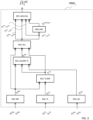
- Figure 3 represents a first neural network NNX 1 that can be used in one embodiment of the invention.
- This first neural network NNX 1 comprises three self-attention encoders ENC-MP, ENC-TL and ENC-AG respectively configured for updating the local attributes u i MP , u i TL and u i AG of first class polylines (static map) MP, second class polylines (traffic lights) and third class polylines (agent trajectories).
- the input of the first encoder ENC-MP is the sequence p i MP u i MP , i ⁇ ⁇ 1, ..., N MP ⁇ where u i MP is obtained using the PointNet method applied on l i MP c i MP .
- the input of the second encoder ENC-TL is the sequence p i TL u i TL , i ⁇ ⁇ 1, ..., N TL ⁇ where u i TL is obtained using the PointNet method applied on c i TL .
- the input of the third encoder ENC-AG is the sequence p i AG u i AG , i ⁇ ⁇ 1, ..., N AG ⁇ where u i AG is obtained using the PointNet method applied on l i AG c i AG .
- the output of first, second and third encoders are updated value of local context u i MP , u i TL and u i AG also denoted u i MP , u i TL and u i AG for simplicity.
- This first neural network NNX 1 comprises a first decoder DEC-TL/MP configured for updating the local attributes u i TL of polylines of the second class TL with self-attention on polylines p i TL u i TL of the second class TL and with cross-attention limited to polylines p i MP u i MP of the first class MP encoded by the first encoder ENC-MP.
- This first neural network NNX 1 comprises a second decoder DEC-AG/MP-TL configured for updating the local attributes u i AG of polylines of the third class AG with self-attention on polylines p i AG u i AG of the third class AG and with cross-attention limited to (i) polylines p i MP u i MP of the first class ( MP ) encoded by the first encoder ENC-MP and (ii) polylines p i TL u i TL of the second class (TL) updated by the first decoder DEC-TL/MP.
- This first neural network NNX 1 comprises an all-to-all self-attention encoder ENC-ALL configured for updating local attributes u i MP of polylines of the first MP class encoded by the first encoder ENC-MP, local attributes u i TL of polylines of the second class TL updated by the first decoder DEC-TL/MP and local attributes u i AG of polylines of the third AG class encoded by the second decoder DEC-AG/MP-TL.
- ENC-ALL an all-to-all self-attention encoder configured for updating local attributes u i MP of polylines of the first MP class encoded by the first encoder ENC-MP, local attributes u i TL of polylines of the second class TL updated by the first decoder DEC-TL/MP and local attributes u i AG of polylines of the third AG class encoded by the second decoder DEC-AG/MP-TL.
- This first neural network NNX 1 comprises a module ADD-ANC configured for concatening each polyline p i AG u i AG of the third class AG updated with the all-to-all self-attention encoder ENC-ALL with N AC learnable anchors u i Anchor to obtain context-enhanced trajectory polylines p i AG u i AG u i Anchor , i ⁇ ⁇ 1, ..., N AC . N AG ⁇ .
- This first neural network NNX 1 comprises a decoder DEC-ANC/ALL configured for updating said context-enhanced trajectory polylines with self-attention on said context-enhanced trajectory polylines and with cross-attention limited to (i) polylines p i MP u i MP of the first MP class, (ii) polylines p i TL u i TL of the second TL class and (iii) polylines ( p i AG u i AG ) of the third AG class updated by the all-to-all self-attention encoder ENC-ALL.
- DEC-ANC/ALL configured for updating said context-enhanced trajectory polylines with self-attention on said context-enhanced trajectory polylines and with cross-attention limited to (i) polylines p i MP u i MP of the first MP class, (ii) polylines p i TL u i TL of the second TL class and (iii) polylines ( p i AG u i AG ) of
- the updated context-enhanced trajectory polylines p i AG u i AG u i Anchor output of this first neural network NNX 1 are denoted z 1 ⁇ i AG .
- the ENC-MP, ENC-TL and ANC-AG encoders build a block diagonal attention matrix that models the interactions within each class of tokens.
- the inter-class decoders enhance the traffic lights tokens by making them attend to the map tokens, whereas the agent tokens are enhanced by attending to both the traffic lights and map tokens.
- the intuition behind this is the hierarchical nature of traffic; first there is only the map, then the traffic lights are added and finally the agents join. Intuitively, the map influences the interpretation of traffic lights but not vice versa, whereas map and traffic lights together influence the behavior of agents but not vice versa.
- the all-to-all transformer encoder builds a full attention matrix allowing tokens to attend to each other irrespective of their class.
- each agent token is concatenated with N AC learnable anchors, which are shared among each type of agent.
- the DEC-ANC/ALL anchor-to-all transformer decoder lets each of these anchor tokens attend to all tokens so as to aggregate more contextual information.
- the final output z 1 ⁇ i AG is used to generate the multi-modal future trajectories.
- the number of neighbours is set to K for the ENC-MP, ENC-TL, ENC-AG intra-class encoders and ENC-ALL all-to-all encoder and this number K is multiplied by ⁇ TL , ⁇ AG and ⁇ AC respectively for the DEC-TL/MP, DEC-AG/MP-TL and DEC-ANC/ALL modules such that these decoders can have a larger receptive field.
- the present disclosure proposes still improved architectures for the neural network transformer.
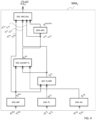
- Figure 4 represents a second neural network NNX 2 that can be used in another embodiment of the invention.
- the second neural network NNX 2 differs from the first neural network NNX 1 of figure 3 in that it does not comprise the all-to-all self-attention encoder ENC-ALL.
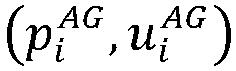
- the module ADD-ANC is configured for concatening each polyline p i AG u i AG of the third class AG updated by the second decoder DEC-AG/TL-MP with N AC learnable anchors u i Anchor to obtain context-enhanced trajectory polylines p i AG u i AG u i Anchor , i E ⁇ 1, ..., N AC . N AG ⁇ .
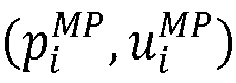
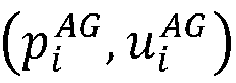
- the decoder DEC-ANC/ALL is configured for updating these context-enhanced trajectory polylines with self-attention on said context-enhanced trajectory polylines and with cross-attention limited to (i) polylines p i MP , u i MP of the first MP class encoded by the first encoder ENC-MP, (ii) polylines p i TL , u i TL of the second TL class updated by the first decoder DEC-TL/MP and (iii) polylines p i AG u i AG of the third AG class updated by the second decoder DEC-AG/TL-MP.
- the updated context-enhanced trajectory polylines p i AG u i AG u i Anchor output of this second neural network NNX 2 are denoted z 2 ⁇ i AG .
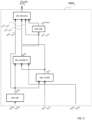
- Figure 5 represents a third neural network NNX 3 that can be used in another embodiment of the invention.
- the third neural network NNX 3 differs from the second neural network NNX 2 of figure 4 in that it does not comprise the self-attention encoders ENC-TL and ENC-AG.
- the updated context-enhanced trajectory polylines p i AG u i AG u i Anchor output of this third neural network NNX 3 are denoted z 3 ⁇ i AG .
- the modules may be organized in a hierarchical way such that some of the intermediate results can be cached and reused during the online inference; for example the outputs of the ENC-MP encoder. This allows tokens from different classes to be updated asynchronously, which significantly reduces the online inference latency.
- NNX 3 provides an improved efficiency without sacrificing the performance by trimming the redundant attentions.
- Some attention matrices shown in Figure 3 are overlapping, which means some relationships are repeatedly modeled, such as the agent-to-agent self-attention.
- the third neural network NNX 3 removes the intra-TL, intra-AG and all-to-all transformers, while keeping the ENC-MP, DEC-TL/MP and DEC-AG/MP-TL modules. These three modules together build a lower triangular attention matrix which is necessary and sufficient to model the relationship between map, traffic lights and agent trajectories.
- a fourth neural network transformer could be based on the third neural network NNX3, further comprising the two self-attention encoders ENC-TL and ENC-AG described with reference to Figure 3 and respectively configured for updating the local attributes u i TL and u i AG of the second class polylines (traffic lights) and of the third class polylines (agent trajectories).
- Figure 6 represents a transformer decoder with self-attention on tokens of a source class src and cross-attention from tokens of the source class src to tokens of a target class tgt.
- Figure 7 represents a transformer encoder with self-attention on token of a class src.
- self-attention acronym "src” is used for homogeneity only because the source class src and the target class tgt are in fact the same class).
- a source class src and a target class tgt may represent a class of polylines among the first class MP, the second class TL and the third class AG.
- the transformers of Figures 6 and 7 comprise in particular "Add Norm” (Addition followed by Normalization) and “Feed Forward” data processing layers known by the man skilled in the art of transformers.
- the "Add & Norm" layer generally allows the model to retain important information from the previous input while normalizing activations.
- the "Add” step involves adding the outputs of the previous step (e.g., the outputs of self-attention layer or cross-attention layer) to the input of that layer. This creates a residual connection, allowing the model to learn deviations from the input rather than learning the complete representation directly.
- This "residual" architecture helps address the vanishing gradient problem when training very deep networks.
- the "Norm” step corresponds to layer normalization, such as batch normalization or instance normalization. It normalizes activations to stabilize learning by ensuring that values do not become too large or too small.
- the "Feed Forward” step introduces non-linear transformations to learn more complex features. It may be implemented as a two-layer neural network (usually with non-linear activations like ReLU - Rectified Linear Unit between the layers) and is responsible for a non-linear transformation of data and capturing complex relationships in features.
- the two-layer neural network may be relatively small compared to other deep neural network architectures because the transformer model uses self-attention to capture long-range dependencies.
- the future trajectories may be determined from the outputs z 1 i AG , z 2 i AG or z 3 i AG (hereafter z i AG ) of neural network transformer NNX 1 , NNX 2 , or NNX 3 described above.
- outputs z i AG may be represented as a mixture of Gaussians and train with a hard assignment strategy, ie assigning for a given scenario each predicted trajectory to a single trajectory as the most likely outcome, without considering the possibility of multiple potential outcomes.
- the multi-modal future trajectories for each agent are generated by decoding z ⁇ i AG , i ⁇ ⁇ 1, ..., N AG .N AC ⁇ via two multi-layer perceptrons, a confidence head MLP1 and a trajectory head MLP2.
- the confidence head MLP1 predicts the scalar confidence of the whole trajectory. Besides the Gaussian parameters of 2D positions ( ⁇ x , ⁇ y , ⁇ x , ⁇ y , ⁇ ) at each future time step, the trajectory head MLP2 predicts also the yaw angles, speeds and 2D velocities.
- the cross entropy loss is used for confidences, negative log-likelihood loss for 2D positions, negative cosine loss for yaw angles and Huber loss for speeds and 2D velocities.
- the final training loss may be the unweighted sum of all losses.
- the confidence head MPL1 predicts the logits p k , k ⁇ ⁇ 1, ... 6 ⁇
- the trajectory head MPL2 predicts 6 trajectories, each of which is represented as ⁇ x t , ⁇ y t , log ⁇ x t , log ⁇ y t , ⁇ t , v x t , v y t , ⁇ t , s t , t ⁇ ⁇ 1, ..., T f ⁇ , i.e. the mean of the Gaussian in x,y, the log standard deviation of the Gaussian in x,y, the correlation of the Gaussians, the velocity in x,y, the heading angle and the speed.
- the final training loss for the complete model is the unweighted sum.
- L L traj + L conf
- Figure 9 represents a computer-implemented system SYS according to a particular embodiment of the disclosure.
- This system is configured for predicting a future trajectory of at least one agent in motion in a real scene comprising static elements and traffic lights (or other elements with a variable state over time) respectively represented as a first class and as a second class of polylines.
- the polylines of the first and second classes are represented by a global pose p i and a local attribute u i .
- This system SYS comprises a representation module REP-MOD configured to represent N AC past trajectories of agents in motion in said scene as a third class of polylines, these polylines of the third class being also represented by a global pose p i and a local attribute u i .
- the representation module REP-MOD is also configured to represent the polylines of the first and second classes by a global pose p i and a local attribute u i .
- the representation of the polylines of the first class may be performed by another device.
- the system SYS comprises an attention based neural network transformer for modelling interactions between said polylines, said attention based neural network transformer comprising modules configured to update local attributes u i of the polylines of one source class with attention to polylines of at least one target class, said source class and said at least one target class being one of said first, second or third classes of polylines.
- this attention based neural network transformer is the attention based neural network transformer NNX3 previously detailed with reference to Figure 5 .
- the system SYS comprise a determination module DET-MOD for determining a future trajectory of at least one said agent from outputs of the attention based neural network transformer.
- the determination module DET-MOD comprises the multi-layer perceptrons MLP1 and MLP2 previously detailed with reference to Figure 8 .
- Figure 10 illustrates an example of the hardware architecture of system of Figure 9 .
- the system SYS has the hardware architecture of a computer. As shown in Figure 3 , it comprises, in particular, a processor 1, a random access memory 2, a read-only memory 3, a non-volatile memory 4 and communication means 5.
- the read-only memory 3 of the system SYS constitutes a recording medium conforming to the invention, which is readable by processor 1 and on which is recorded a computer program PROG conforming to the invention, containing instructions for carrying out the steps of the detection method according to the invention.
- the program PROG defines functional modules of the system SYS, which are based on or control the aforementioned elements 1 to 5 of the system SYS, and which comprise in particular a representation module REP-MOD, an attention based neural network transformer, and a determination module DET-MOD as previously disclosed.
- Figure 11 illustrates the main steps of a detection method according to one embodiment of the disclosure.
- the prediction of future trajectories by a vehicle is carried out by executing inferences from the trained transformer, embedded in a vehicle computer.
- the method of the disclosure allows the different classes of polylines to be updated asynchronously during online inference.
- the method comprises a step E10 to determine which of (i) the static elements of the real scene, (ii) elements with the reals scene with a variable state over time (traffic lights) and (iii) agent trajectories are to be updated.
- these elements are represented by heterogeneous polylines with a global pose p i and a local attribute u i .
- first class MP polylines it is not necessary to update first class MP polylines, except when the static conditions of the real environment change, for example in the event of roadworks or, when the direction of traffic changes in a lane.
- the global pose and the local attribute of the third class polylines may be updated frequently, for example in real time.
- this modelling step E30 comprises a step E32 of determining a pairwise-relative representation of the polylines using their global poses and a step E34 of determining the K-nearest neighbors of each polyline, so that the number of target polylines taken into account for self or cross attention mechanisms is reduced.
- Future trajectories are determined during a step E40 from outputs of the attention based neural network transformer.
- This determination step can be realized by using a trajectory head multi-layer perceptron and a trajectory head multi-layer perceptron.
- agent-centered approaches are criticized for their limited scalability, resulting in a significant increase in memory consumption and inference latency as the number of agents increases.
- the method proposed in the present disclosure positions itself as a compromise between these two approaches and offers a convincing balance between efficiency and performance.
- the method disclosed in this document performs at a level similar to scene-centered approaches while maintaining predictive performance equivalent to agent-centered methods.
Landscapes
- Engineering & Computer Science (AREA)
- Physics & Mathematics (AREA)
- Theoretical Computer Science (AREA)
- Biophysics (AREA)
- Data Mining & Analysis (AREA)
- Transportation (AREA)
- Health & Medical Sciences (AREA)
- Life Sciences & Earth Sciences (AREA)
- Artificial Intelligence (AREA)
- Biomedical Technology (AREA)
- Human Computer Interaction (AREA)
- Computational Linguistics (AREA)
- Mechanical Engineering (AREA)
- Evolutionary Computation (AREA)
- General Health & Medical Sciences (AREA)
- Molecular Biology (AREA)
- Computing Systems (AREA)
- General Engineering & Computer Science (AREA)
- General Physics & Mathematics (AREA)
- Mathematical Physics (AREA)
- Software Systems (AREA)
- Automation & Control Theory (AREA)
- Image Analysis (AREA)
Abstract
This method predicts a future trajectory of at least one agent in motion in a real scene comprising static elements and elements with a variable state over time respectively represented as a first class and as a second class of polylines. It comprises:
- representing (E20) NAC past trajectories of agents in motion in said scene as a third class of polylines, polylines i of said classes (MP, TL, AG) being represented by a global pose pi and a local attribute ui ;
- modelling (E30) interactions between said polylines (MP, TL, AG) using an attention based neural network transformer comprising modules configured to update local attributes ui of the polylines of one source class with attention to polylines of at least one target class, said source class and said at least one target class being one of said first, second or third classes of polylines; and
- determining (E40) a future trajectory of at least one said agent from outputs of said attention based neural network transformer.
- representing (E20) NAC past trajectories of agents in motion in said scene as a third class of polylines, polylines i of said classes (MP, TL, AG) being represented by a global pose pi and a local attribute ui ;
- modelling (E30) interactions between said polylines (MP, TL, AG) using an attention based neural network transformer comprising modules configured to update local attributes ui of the polylines of one source class with attention to polylines of at least one target class, said source class and said at least one target class being one of said first, second or third classes of polylines; and
- determining (E40) a future trajectory of at least one said agent from outputs of said attention based neural network transformer.
Description
- The present disclosure relates to the general topic of motion prediction in the field of autonomous driving.
- Movement prediction is crucial in autonomous driving, as it lies between perception and planning. Its role is to predict the future trajectories of other agents in the vicinity of the autonomous vehicle, based on various heterogeneous data such as high-definition (HD) maps, traffic lights, other vehicles, pedestrians and cyclists. This prediction is essential for the safe and comfortable navigation of the vehicle in interactive driving environments.
- To achieve optimal performance in motion prediction, state-of-the-art methods use agent-centric representations and transformer-based network architectures. However, these approaches are computationally intensive, which poses scalability problems when the number of agents increases, particularly in congested urban environments.
- A major challenge is the waste of computing resources, which is often overlooked as many studies focus on offline scenarios. In practice, it is desirable fir the motion prediction module to be continuously called upon online, which requires efficient use of static and dynamic information to avoid costly repetition of inference. In addition, some methods generate numerous redundant trajectories, requiring adjustment during post-processing.
- The invention relates to an efficient method of predicting movements for autonomous driving, particularly in real time. In particular, it aims to minimize the waste of computing resources and to favour raw predictions rather than heuristic aggregations, especially in a real environment with limited resources for the determination module.
- More specifically, the present disclosure proposes a method for predicting a future trajectory of at least one agent in motion in a real scene comprising static elements and elements with a variable state over time respectively represented as a first class and as a second class of polylines, said method comprising:
- representing past trajectories of agents in motion in said scene as a third class of polylines, polylines i of said three classes being represented by a global pose pi and a local attribute ui ;
- modelling interactions between said polylines using an attention based neural network transformer comprising modules configured to update local attributes ui of the polylines of one source class with attention to polylines of at least one target class, said source class and said at least one target class being one of said first, second or third classes of polylines; and
- determining a future trajectory of at least one said agent from outputs of said attention based neural network transformer.
- According to this disclosure, elements of static scene may be represented as static map elements (road edges, solid lanes, broken lanes ...) and elements with a variable state over time, such as traffic lights.
- Hereafter, and for simplicity, the term "traffic light" is used hereafter for referring to a traffic light or to any other element of the scene with variable state over time.
- These elements as well as trajectories of agents (cars, vehicles, pedestrians, ...) are represented as heterogeneous polylines.
- Polylines of the three classes are represented as a global pose and a local attribute.
- The global pose may represent the position and heading of the object represented by the polyline expressed in a global coordinates system.
- The local attributes of polylines specify what the polyline actually represent.
- For example, a polyline of the first class may be an ordered series of vectors each representing a segment of a lane of the real scene;
- the global pose of the polyline may be position of a starting point of the first segment of said lane; and
- the local attribute of the polyline may represent a 2D position/direction of each segment and a type of the lane.
- For example, for a polyline of the second class representing a traffic light:
- the global pose may be a position of the traffic light in the real scene; and
- the local attribute may represent a state of the traffic light at a current date of observation.
- For example, for a polyline of the third class representing a past trajectory of an agent:
- the global pose may be the last observed agent pose in the real scene;
- the local attribute may represents data among past 2D positions, directions, velocities, 1D speed, yaw rate and acceleration of said agent, and a size and a type of said agent.
- Global poses of static elements of the real scene (roads, traffic lights, ...) may change very rarely and therefore do not need to be updated frequently. On the other hand, global pose of agents trajectories need to be tracked frequently.
- The local attribute of a polyline may be expressed in a coordinate frame local to the global pose of the polyline.
- Before processing polylines by the neural networks, the global poses of the polylines may be used to derive a pairwise-relative pose.
- Therefore, according to embodiments of the invention, at least one module of the neural network transformer s is configured to:
- determine, for each pair (i, j) of polylines, i and j being respectively of said source class and of one said target class, and using their global poses, a relative position rij of polyline i with respect to polyline j.
- The pairwise-relative representation retains the viewpoint invariance of agent-centric representation and the good scalability of scene-centric representation at the same time.
- In one embodiment of this disclosure, the heterogeneous polylines are considered as tokens, and a K-nearest neighbor attention with relative pose encoding mechanism is introduced. This feature advantageously allows the neural network transformers to aggregate the local contexts for each token via the local attributes and relative poses.
- This embodiment comprises:
- determining, using said relative positions rij, for each polyline i of said source class, a set of K-nearest neighbors comprising the K polylines j of said at least one target class closest to polyline i ;
- the updating the local attributes ui of the polylines of said source class being performed with attention to only said set of K-nearest neighbors.
- In one embodiment, the position rij of polyline i relative to polyline j is computed using sinusoidal positional encoding and angular encoding.
- According to a first embodiment, the modules of the neural network transformer comprise:
- a first self-attention encoder configured for updating the local attributes of polylines of the first class;
- a first decoder configured for updating the local attributes of polylines of the second class with self-attention on polylines of the second class and with cross-attention limited to polylines of the first class encoded by the first encoder;
- a second decoder configured for updating the local attributes of polylines of the third class with self-attention on polylines of the third class and with cross-attention limited to polylines of the first class encoded by said first encoder and polylines of the second class updated by said first decoder.
- In this first embodiment, the method may further comprise concatening each polyline i of the third class obtained at the output of the second decoder with learnable anchors to obtain context-enhanced trajectory polylines.
- In this first particular embodiment, the modules of the neural network transformer may further comprise a decoder configured for updating said context-enhanced trajectory polylines with self-attention on said context-enhanced trajectory polylines and with cross-attention limited to polylines of the first class encoded by the first encoder, polylines of the second class updated by the first decoder and polylines of the third class updated by the second decoder.
- The architecture of the attention based neural network transformer of this first embodiment emphasizes the heterogeneous nature of polylines in motion prediction tasks. The hierarchical transformer encoders and decoders separate the intra-class and inter-class attention.
- This architecture prevents redundant computations and allows that polylines be updated asynchronously during online inference.
- The present disclosure is not limited to this optimized architecture.
- For example; according to a second embodiment, the modules of the attention based neural network transformer further comprises an all-to-all self-attention encoder configured for updating local attributes of polylines of the first class encoded by the first encoder, local attributes of polylines of the second class updated by the first decoder and local attributes of polylines of the third class encoded by the second decoder.
- In this second embodiment, the method may comprise a step of concatening each polyline of the third class updated with said all-to-all self-attention encoder with learnable anchors to obtain context-enhanced trajectory polylines.
- In this second embodiment, the modules of the neural network transformer may further comprise a decoder configured for updating said context-enhanced trajectory polylines with self-attention on said context-enhanced trajectory polylines and with cross-attention limited to polylines of the first, second and third classes updated by said all-to-all self-attention encoder.
- Other architectures may also be envisaged for the neural network transformer. For example the neural network transformer may comprise a self-attention encoder configured for updating the local attributes of polylines of the second class and/or a self-attention encoder configured for updating the local attributes of polylines of the third class.
- In one embodiment, the determination of future trajectories is performed using at least another neural network taking as input said of said attention based neural network transformer.
- Correlatively the invention concerns a computer-implemented system for predicting a future trajectory of at least one agent in motion in a real scene comprising static elements and elements with a variable state over time respectively represented as a first class and as a second class of polylines, the system comprising:
- a representation module configured to represent past trajectories of agents in motion in said scene as a third class of polylines, polylines i of said classes being represented by a global pose pi and a local attribute ui;
- an attention based neural network transformer for modelling interactions between said polylines said attention based neural network transformer comprising modules configured to update local attributes ui of the polylines of one source class with attention to polylines of at least one target class, said source class and said at least one target class being one of said first, second or third classes of polylines; and
- a determination module for determining a future trajectory of at least one said agent from outputs of said attention based neural network transformer.
- In this particular embodiment, the steps of the method are determined by computer program instructions.
- Consequently, the invention is also directed to a computer program for executing the steps of a method as described above when this program is executed by a computer.
- This program can use any programming language and take the form of source code, object code or a code intermediate between source code and object code, such as a partially compiled form, or any other desirable form.
- The invention is also directed to a computer-readable information medium containing instructions of a computer program as described above.
- The information medium can be any entity or device capable of storing the program. For example, the medium can include storage means such as a ROM, for example a CD ROM or a microelectronic circuit ROM, or magnetic storage means, for example a diskette or a hard disk.
- Alternatively, the information medium can be an integrated circuit in which the program is incorporated, the circuit being adapted to execute the method in question or to be used in its execution.
- The present disclosure also concerns a vehicle comprising a computer-implemented system as mentioned above.
- The vehicle may use the method of the disclosure for predicting future trajectories of agents in the vicinity of the vehicle.
- For example, the vehicle may adapt its own trajectory to avoid a future trajectory predicted by the method for another agent.
- Further features and advantages of the present disclosure will become apparent from the following description of certain embodiments thereof, given by way of illustration only, not limitation, with reference to the accompanying drawings in which:
-
Figure 1 represents polylines. -
Figure 2 represents relative positions of polylines ofFigure 1 . -
Figures 3 to 5 illustrate three examples of attention based neural network transformers that may be used in embodiments of the method and system of the present disclosure. -
Figures 6 and 7 represent examples of transformer decoders and encoders that may be used in embodiments of the method and system of the present disclosure. -
Figure 8 represent modules that may be used to determine future trajectories based on outputs of attention based neural network transformers offigures 3 to 5 . -
Figure 9 represents a computer implemented system for predicting a future trajectory according to one embodiment of the present disclosure. -
Figure 10 represents the hardware architecture of the computer implemented system ofFigure 9 . -
Figure 11 illustrates the main steps of a detection method according to one embodiment of the disclosure. - As mentioned previously, the invention aims in particular at predicting the movements of agents in a real scene.
- The agents may be of different types (e.g. cars, pedestrians, cyclists, etc.).
- The scene may be represented as static map elements (road edges, solid lanes, broken lanes ...) and traffic lights (or other elements with a variable state over time), such.
- In one embodiment,
- (i) both elements of the scene (static map elements and traffic lights); and
- (ii) trajectories of the agents
-
Figure 1 represents four polylines i,i ∈ {0, ... 3}. The two polylines "0" and "3" represent static map features MP, the polyline "2" represents a traffic light (or other element of the scene with variable state over time) TL , and the polyline "1" represents a trajectory of an agent AG. - Each polyline i may be represented by a global pose pi and a local attribute ui and denoted as (pi ,ui ).
- The global pose pi may specify the location and heading of the object (static map, traffic light, agent trajectory) represented by the polyline in the global coordinate system. It may have 3 degrees of freedom (x,y,θ) i.e. the 2D position and the heading yaw angle.
- The local attribute ui represents a local context of the object represented by the polyline. It is derived from intrinsic characteristics ci of the object represented by the polyline. It is represented by polyline vectors li expressed, not in the global coordinate system, but in a local coordinate frame of the global pose pi .
- For example the intrinsic characteristics

- For example, polygonal static map elements, such as crosswalks, may be converted to a group of parallel polylines across the polygon.
- Hence, the static map elements may be represented as spatial polylines

- NMP is the number of static map elements;
-

- the local attribute

- (i)


- (ii)

- (i)
- In one embodiment, the local attribute


- For example the intrinsic characteristics

- Hence, the agent trajectories AG may be represented as spatial-temporal polylines

- NAG is the number of agents' trajectories;
-

- the local attribute

- (i)


- (ii)

- (i)
- In one embodiment, the local attribute


- A traffic light TL may be represented by a polyline of one segment, intrinsic characteristics

- Hence, the traffic lights TL are represented as one-segment-polylines

- NTL is the number of traffic lights;
-

-

- In one embdodiment, a multi-layer perceptron is used to encode


- The method comprises a step of representing static map polylines MP, traffic lights polylines TL and agent trajectories polylines AG in a pairwise-relative polyline representation.
- More precisely, in one embodiment, for each pair (i,j) of said polylines MP,TL,AG, a position rij of polyline i is determined relatively to a position of polyline j.
- In one embodiment, each polyline i is viewed as a token i so that it can be similarly considered that for each pair (i,j) of tokens a position rij of token i is determined relatively to a position of token j.
- Hereafter, the expressions "polyline i" and "token i" are used interchangeably.
- In one embodiment, denoting rij = (xij,yij,θ ij ) to be the global pose of token j represented in the coordinate of token i, i.e. pj transformed to the coordinate of pi , the relative pose encoding RPE of rij is computed using sinusoidal positional encoding (PE) and angular encoding (AE),


- For more details on PE and AE encoding, it can be referred to reference [B].
-
Figure 2 represents relative positions of the three polylines ofFigure 1 with respect to a fourth polyline ofFigure 1 . - More precisely, it represents:
- the relative position r 10 of the global pose of static element 0 with respect to the global pose of
agent trajectory 1; - the relative position r 12 of the global pose of
traffic light 2 with respect to the global pose ofagent trajectory 1; and - the relative position r 13 of the global pose of
static element 3 with respect to the global pose ofagent trajectory 1. - After encoding the local attributes via the polyline-level encoders, the scenario is now described as (pi, ui), i ∈ {1, ..., N} where N = NMP + NAG + NTL is the total number of polylines.
-
Figure 3 represents a first neural network NNX1 that can be used in one embodiment of the invention. - This first neural network NNX1 comprises three self-attention encoders ENC-MP, ENC-TL and ENC-AG respectively configured for updating the local attributes


- In one embodiment, the input of the first encoder ENC-MP is the sequence


- In one embodiment, the input of the second encoder ENC-TL is the sequence


- In one embodiment, the input of the third encoder ENC-AG is the sequence


- The output of first, second and third encoders are updated value of local context


- This first neural network NNX1 comprises a first decoder DEC-TL/MP configured for updating the local attributes


- This first neural network NNX1 comprises a second decoder DEC-AG/MP-TL configured for updating the local attributes


- This first neural network NNX1 comprises an all-to-all self-attention encoder ENC-ALL configured for updating local attributes


- This first neural network NNX1 comprises a module ADD-ANC configured for concatening each polyline


- This first neural network NNX1 comprises a decoder DEC-ANC/ALL configured for updating said context-enhanced trajectory polylines with self-attention on said context-enhanced trajectory polylines and with cross-attention limited to (i) polylines


- The updated context-enhanced trajectory polylines


- The ENC-MP, ENC-TL and ANC-AG encoders build a block diagonal attention matrix that models the interactions within each class of tokens.
- Then the inter-class decoders enhance the traffic lights tokens by making them attend to the map tokens, whereas the agent tokens are enhanced by attending to both the traffic lights and map tokens. The intuition behind this is the hierarchical nature of traffic; first there is only the map, then the traffic lights are added and finally the agents join. Intuitively, the map influences the interpretation of traffic lights but not vice versa, whereas map and traffic lights together influence the behavior of agents but not vice versa.
- After the inter-class transformer decoders, the all-to-all transformer encoder builds a full attention matrix allowing tokens to attend to each other irrespective of their class. Finally, each agent token is concatenated with NAC learnable anchors, which are shared among each type of agent.
- The DEC-ANC/ALL anchor-to-all transformer decoder lets each of these anchor tokens attend to all tokens so as to aggregate more contextual information.
- The
final output 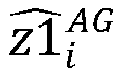
- In one embodiment, the number of neighbours is set to K for the ENC-MP, ENC-TL, ENC-AG intra-class encoders and ENC-ALL all-to-all encoder and this number K is multiplied by γTL, γAG and γAC respectively for the DEC-TL/MP, DEC-AG/MP-TL and DEC-ANC/ALL modules such that these decoders can have a larger receptive field.
- In two embodiments proposed here after with reference to
figures 4 and5 , the present disclosure proposes still improved architectures for the neural network transformer. - After encoding the local attributes via the polyline-level encoders, the scenario is described as (pi, ui), i ∈ {1, ..., N} where N = NMP + NAG + NTL is the total number of polylines.
- However, this representation cannot be efficiently handled by the first neural network NNX1 when N becomes large, the all-to-all attention becoming prohibitively expensive.
-
Figure 4 represents a second neural network NNX2 that can be used in another embodiment of the invention. - The second neural network NNX2 differs from the first neural network NNX1 of
figure 3 in that it does not comprise the all-to-all self-attention encoder ENC-ALL. - In this second neural network NNX2, the module ADD-ANC is configured for concatening each polyline


- In this second neural network NNX2, the decoder DEC-ANC/ALL is configured for updating these context-enhanced trajectory polylines with self-attention on said context-enhanced trajectory polylines and with cross-attention limited to (i) polylines

- The updated context-enhanced trajectory polylines


-
Figure 5 represents a third neural network NNX3 that can be used in another embodiment of the invention. - The third neural network NNX3 differs from the second neural network NNX2 of
figure 4 in that it does not comprise the self-attention encoders ENC-TL and ENC-AG. - The updated context-enhanced trajectory polylines


- In the third neural network NNX3 notably, the modules may be organized in a hierarchical way such that some of the intermediate results can be cached and reused during the online inference; for example the outputs of the ENC-MP encoder. This allows tokens from different classes to be updated asynchronously, which significantly reduces the online inference latency.
- Besides, the architecture of NNX3 provides an improved efficiency without sacrificing the performance by trimming the redundant attentions. Some attention matrices shown in
Figure 3 are overlapping, which means some relationships are repeatedly modeled, such as the agent-to-agent self-attention. - The third neural network NNX3 removes the intra-TL, intra-AG and all-to-all transformers, while keeping the ENC-MP, DEC-TL/MP and DEC-AG/MP-TL modules. These three modules together build a lower triangular attention matrix which is necessary and sufficient to model the relationship between map, traffic lights and agent trajectories.
- Among others, a fourth neural network transformer could be based on the third neural network NNX3, further comprising the two self-attention encoders ENC-TL and ENC-AG described with reference to
Figure 3 and respectively configured for updating the local attributes

- For all the architectures presented above:
- at least one encoder among the first encoder ENC-MP, the second encoder ENC-TL, the third encoder ENC-AG or the ANC-ALL encoder may be a self-attention transformer similar to the self-attention encoder described now with reference to
Figure 7 ; and/or - at least one decoder among the first decoder DEC-TL/MP, the second decoder DEC-AG/TL-MP or the DEC-ANC/ALL decoder may be a cross-attention transformer similar to the one described now with reference to
Figure 6 . -
Figure 6 represents a transformer decoder with self-attention on tokens of a source class src and cross-attention from tokens of the source class src to tokens of a target class tgt. -
Figure 7 represents a transformer encoder with self-attention on token of a class src. (For self-attention, acronym "src" is used for homogeneity only because the source class src and the target class tgt are in fact the same class). - On
figures 6 and 7 , a source class src and a target class tgt may represent a class of polylines among the first class MP, the second class TL and the third class AG. - The transformers of
Figures 6 and 7 comprise in particular "Add Norm" (Addition followed by Normalization) and "Feed Forward" data processing layers known by the man skilled in the art of transformers. - The "Add & Norm" layer generally allows the model to retain important information from the previous input while normalizing activations.
- More precisely, the "Add" step involves adding the outputs of the previous step (e.g., the outputs of self-attention layer or cross-attention layer) to the input of that layer. This creates a residual connection, allowing the model to learn deviations from the input rather than learning the complete representation directly. This "residual" architecture helps address the vanishing gradient problem when training very deep networks.
- The "Norm" step corresponds to layer normalization, such as batch normalization or instance normalization. It normalizes activations to stabilize learning by ensuring that values do not become too large or too small.
- The "Feed Forward" step introduces non-linear transformations to learn more complex features. It may be implemented as a two-layer neural network (usually with non-linear activations like ReLU - Rectified Linear Unit between the layers) and is responsible for a non-linear transformation of data and capturing complex relationships in features. The two-layer neural network may be relatively small compared to other deep neural network architectures because the transformer model uses self-attention to capture long-range dependencies.
- In summary, in a transformer model with a self-attention mechanism, "Add Norm" allows the model to retain important information from the previous input while normalizing activations, while "Feed Forward" introduces non-linear transformations to learn more complex features.
- In one embodiment, the updated value


- The future trajectories may be determined from the outputs


- For example, outputs

- In one embodiment, and as represented on
Figure 8 , the multi-modal future trajectories for each agent are generated by decoding
- The confidence head MLP1 predicts the scalar confidence of the whole trajectory. Besides the Gaussian parameters of 2D positions (µx ,µy,σx,σy,ρ) at each future time step, the trajectory head MLP2 predicts also the yaw angles, speeds and 2D velocities.
- In one embodiment, the cross entropy loss is used for confidences, negative log-likelihood loss for 2D positions, negative cosine loss for yaw angles and Huber loss for speeds and 2D velocities.
- The final training loss may be the unweighted sum of all losses.
- Following the hard-assignment strategy, for each agent we optimize only the predicted trajectory that is closest to the ground truth in terms of 2D average displacement error. More details are provided in the supplement.
- For example, for each anchor token


- We denote the ground truth as (x̂,ŷ,v̂x,v̂y,θ̂,ŝ). The negative log-likelihood loss for position is formulated as

- The negative cosine loss for the heading angle is formulated as

- The Huber loss for velocities and speed is formulated as


- In one embodiment, we use δ = 1 for all Huber losses.
- In one embodiment, the final regression loss for a trajectory is the unweighted sum Ltraj = Lpos + Lrot + Lvel
which is averaged over the future time steps where the ground truth is available. - In one embodiment, we use a hard assignment strategy, i.e. among the 6 predictions of each agent we select the one that is closest to the ground truth in terms of average displacement error and optimize only for that prediction. Denoting the index of this prediction as k̂, the confidence head MLP1 is trained via the cross entropy loss by taking k̂ as the ground truth

- The final training loss for the complete model is the unweighted sum.

-
Figure 9 represents a computer-implemented system SYS according to a particular embodiment of the disclosure. This system is configured for predicting a future trajectory of at least one agent in motion in a real scene comprising static elements and traffic lights (or other elements with a variable state over time) respectively represented as a first class and as a second class of polylines. - The polylines of the first and second classes are represented by a global pose pi and a local attribute ui.
- This system SYS comprises a representation module REP-MOD configured to represent NAC past trajectories of agents in motion in said scene as a third class of polylines, these polylines of the third class being also represented by a global pose pi and a local attribute ui.
- In one embodiment, the representation module REP-MOD is also configured to represent the polylines of the first and second classes by a global pose pi and a local attribute ui.
- In another embodiment, the representation of the polylines of the first class may be performed by another device.
- The system SYS comprises an attention based neural network transformer for modelling interactions between said polylines, said attention based neural network transformer comprising modules configured to update local attributes ui of the polylines of one source class with attention to polylines of at least one target class, said source class and said at least one target class being one of said first, second or third classes of polylines.
- In the embodiment of
figure 9 , this attention based neural network transformer is the attention based neural network transformer NNX3 previously detailed with reference toFigure 5 . - The system SYS comprise a determination module DET-MOD for determining a future trajectory of at least one said agent from outputs of the attention based neural network transformer.
- In the embodiment of
figure 9 , the determination module DET-MOD comprises the multi-layer perceptrons MLP1 and MLP2 previously detailed with reference toFigure 8 . -
Figure 10 illustrates an example of the hardware architecture of system ofFigure 9 . In this embodiment, the system SYS has the hardware architecture of a computer. As shown inFigure 3 , it comprises, in particular, aprocessor 1, arandom access memory 2, a read-only memory 3, anon-volatile memory 4 and communication means 5. - The read-
only memory 3 of the system SYS constitutes a recording medium conforming to the invention, which is readable byprocessor 1 and on which is recorded a computer program PROG conforming to the invention, containing instructions for carrying out the steps of the detection method according to the invention. The program PROG defines functional modules of the system SYS, which are based on or control theaforementioned elements 1 to 5 of the system SYS, and which comprise in particular a representation module REP-MOD, an attention based neural network transformer, and a determination module DET-MOD as previously disclosed. -
Figure 11 illustrates the main steps of a detection method according to one embodiment of the disclosure. - Generally speaking, the prediction of future trajectories by a vehicle is carried out by executing inferences from the trained transformer, embedded in a vehicle computer.
- Very advantageously, the method of the disclosure allows the different classes of polylines to be updated asynchronously during online inference.
- In this embodiment, the method comprises a step E10 to determine which of (i) the static elements of the real scene, (ii) elements with the reals scene with a variable state over time (traffic lights) and (iii) agent trajectories are to be updated.
- Each time one of said element needs to be created or updated, a polyline representing this element is created or updated (step E20).
- According to this disclosure, these elements are represented by heterogeneous polylines with a global pose pi and a local attribute ui .
- Generally, it is not necessary to update first class MP polylines, except when the static conditions of the real environment change, for example in the event of roadworks or, when the direction of traffic changes in a lane.
- Generally, for polylines of the second class, only the local attribute representing the current state of the element (for example the color of the traffic light) need to be updated.
- The global pose and the local attribute of the third class polylines may be updated frequently, for example in real time.
- Then, during a general step E30, interactions between polylines of the three classes are modelled during an attention based neural network transformer as previously disclosed.
- In a preferred embodiment, this modelling step E30 comprises a step E32 of determining a pairwise-relative representation of the polylines using their global poses and a step E34 of determining the K-nearest neighbors of each polyline, so that the number of target polylines taken into account for self or cross attention mechanisms is reduced.
- Future trajectories are determined during a step E40 from outputs of the attention based neural network transformer. This determination step can be realized by using a trajectory head multi-layer perceptron and a trajectory head multi-layer perceptron.
- Comparing the method in the present disclosure with other approaches, particularly in terms of memory usage and inference latency, the following conclusions can be drawn.
- In general, agent-centered approaches are criticized for their limited scalability, resulting in a significant increase in memory consumption and inference latency as the number of agents increases.
- On the other hand, the scene-centered approaches can be highly efficient, but suffer from reduced precision in their predictions.
- The method proposed in the present disclosure positions itself as a compromise between these two approaches and offers a convincing balance between efficiency and performance. In terms of computational efficiency, the method disclosed in this document performs at a level similar to scene-centered approaches while maintaining predictive performance equivalent to agent-centered methods.
- The architecture presented in
Figure 5 proves to be the optimal compromise between precision and latency. - Besides, the use of static map features during online inference enables the prediction of future positions for a significant number of agents with low latency, without the need for external libraries.
- Throughout the description, including the claims, the term "comprising a" should be understood as being synonymous with "comprising at least one" unless otherwise stated. In addition, any range set forth in the description, including the claims should be understood as including its end value(s) unless otherwise stated. Specific values for described elements should be understood to be within accepted manufacturing or industry tolerances known to one of skill in the art, and any use of the terms "substantially" and/or "approximately" and/or "generally" should be understood to mean falling within such accepted tolerances.
- Although the present disclosure herein has been described with reference to particular embodiments, it is to be understood that these embodiments are merely illustrative of the principles and applications of the present disclosure.
- It is intended that the specification and examples be considered as exemplary only, with a true scope of the disclosure being indicated by the following claims.
-
- [A]: Charles R Qi, Hao Su, Kaichun Mo, and Leonidas J Guibas. Pointnet: Deep learning on point sets for 3d classification and segmentation. In CVPR, 2017.
- [B] : Zhejun Zhang, Alexander Liniger, Dengxin Dai, Fisher Yu, and Luc Van Gool. Trafficbots: Towards world models for autonomous driving simulation and motion prediction. In ICRA, 2023.
Claims (16)
- A method of predicting a future trajectory of at least one agent in motion in a real scene comprising static elements and elements with a variable state over time respectively represented as a first class (MP) and as a second class (TL) of polylines, said method comprising:- representing (E20) NAC past trajectories of agents in motion in said scene as a third class (AG) of polylines, polylines i of said classes (MP,TL,AG) being represented by a global pose pi and a local attribute ui ;- modelling (E30) interactions between said polylines (MP,TL,AG) using an attention based neural network transformer (NNX1, NNX2, NNX3) comprising modules configured to update local attributes ui of the polylines of one source class (src) with attention to polylines of at least one target class (tgt), said source class (src) and said at least one target class (tgt) being one of said first (MP), second (TL) or third (AG) classes of polylines; and- determining (E40) a future trajectory of at least one said agent from outputs

- The method of claim 1, wherein said modules comprise:- a first self-attention encoder (ENC-MP) configured for updating said local attributes
 - a first decoder (DEC-TL/MP) configured for updating said local attributes
 - a second decoder (DEC-AG/MP-TL) configured for updating said local attributes
- The method of claim 2, further comprising:- concatening each polyline i of the third (AG) class obtained at the output of said second decoder (DEC-AG/MP-TL) with NAC learnable anchors

 - said modules further comprising a decoder (DEC-AC/ALL) configured for updating said context-enhanced trajectory polylines with self-attention on said context-enhanced trajectory polylines and with cross-attention limited to (i) polylines of the first (MP) class encoded by said first encoder (ENC-MP), polylines of the second (TL) class updated by said first decoder (DEC-TL/MP) and (iii) polylines of the third (AG) class updated by said second decoder (DEC-AG/TL-MP).
 - The method of claim 2, wherein said modules further comprises:- an all-to-all self-attention encoder (ENC-ALL) configured for updating local attributes


 - concatening each polyline i of the third (AG) class updated with said all-to-all (ENC-ALL) self-attention encoder with NAC learnable anchors
 - said modules further comprising a decoder (DEC-AC/ALL) configured for updating said context-enhanced trajectory polylines with self-attention on said context-enhanced trajectory polylines and with cross-attention limited to polylines of the first (MP), second (TL) and third (AG) classes updated by said all-to-all (ENC-ALL) self-attention encoder.
 - The method of any one of claims 1 to 4, wherein at least one of said modules is configured to:- determine (E32), for each pair (i,j) of polylines, i and j being respectively of said source class (src) and of one said target class (tgt), and using their global poses (pi,pj ), a relative position rij of polyline i with respect to polyline j;- determine (E34), using said relative positions rij , for each polyline i of said source class (src), a set (
 - said update of the local attributes ui of the polylines of said source class (src) being performed with attention to only said set (
- The method of claim 5, wherein said position rij of polyline i relative to polyline j is computed using sinusoidal positional encoding and angular encoding.
- The method of any one of claims 1 to 6, wherein:- said global pose pi is a position and heading of an object represented by said polyline i expressed in a global coordinates system;- said local attribute ui is a local context expressed in a coordinate frame local to said global pose pi .
- The method of claim 7, wherein:- said polyline i of the first class (MP) is an ordered series of vectors each representing a segment of a lane of the real scene;- the global pose
 - the local attribute


- The method of claim 7 or 8, wherein for said polyline i of the second class (TL) class representing an element of the real scene with a variable state over time:- said global pose
 - said local attribute
- The method of any one of claims 7 to 9, wherein for said polyline i of the third class representing a past trajectory of an agent (AG):- said global pose
 - said local attribute


- The method of any one of claims 1 to 10 wherein determining said future trajectory is performed using at least another neural network (MLP1, MLP2) taking as input said outputs

- The method of any of claims 1 to 11, further comprising at least one said agent by taking said future trajectory into account.
- A computer-implemented system (SYS) for predicting a future trajectory of at least one agent in motion in a real scene comprising static elements and elements with a variable state over time respectively represented as a first class (MP) and as a second class (TL) of polylines, the system comprising:- a representation module (REP-MOD) configured to represent NAC past trajectories of agents in motion in said scene as a third class (AG) of polylines, polylines i of said classes (MP,TL,AG) being represented by a global pose pi and a local attribute ui ;- an attention based neural network transformer (NNX1, NNX2, NNX3) for modelling interactions between said polylines (MP,TL,AG), said attention based neural network transformer comprising modules configured to update local attributes ui of the polylines of one source class (src) with attention to polylines of at least one target class (tgt), said source class (src) and said at least one target class (tgt) being one of said first (MP), second (TL) or third (AG) classes of polylines; and- a determination module (DET-MOD) for determining a future trajectory of at least one said agent from outputs

- A vehicle comprising a computer-implemented system according to Claim 13.
- A computer program (PROG) including instructions for executing the steps of a method according to any one of claims 1 to 12 when said program is executed by a computer.
- A recording medium readable by a computer and having recorded thereon a computer program including instructions for executing the steps of a method according to any one of claims 1 to 12.
Priority Applications (1)
| Application Number | Priority Date | Filing Date | Title |
|---|---|---|---|
| EP23198287.7A EP4528590A1 (en) | 2023-09-19 | 2023-09-19 | Method and system for predicting the trajectory of an agent in motion in a real scene |
Applications Claiming Priority (1)
| Application Number | Priority Date | Filing Date | Title |
|---|---|---|---|
| EP23198287.7A EP4528590A1 (en) | 2023-09-19 | 2023-09-19 | Method and system for predicting the trajectory of an agent in motion in a real scene |
Publications (1)
| Publication Number | Publication Date |
|---|---|
| EP4528590A1 true EP4528590A1 (en) | 2025-03-26 |
Family
ID=88098084
Family Applications (1)
| Application Number | Title | Priority Date | Filing Date |
|---|---|---|---|
| EP23198287.7A Pending EP4528590A1 (en) | 2023-09-19 | 2023-09-19 | Method and system for predicting the trajectory of an agent in motion in a real scene |
Country Status (1)
| Country | Link |
|---|---|
| EP (1) | EP4528590A1 (en) |
-
2023
- 2023-09-19 EP EP23198287.7A patent/EP4528590A1/en active Pending
Non-Patent Citations (2)
| Title |
|---|
| SHAOSHUAI SHI ET AL: "MTR++: Multi-Agent Motion Prediction with Symmetric Scene Modeling and Guided Intention Querying", ARXIV.ORG, CORNELL UNIVERSITY LIBRARY, 201 OLIN LIBRARY CORNELL UNIVERSITY ITHACA, NY 14853, 30 June 2023 (2023-06-30), XP091551928 * |
| YIYAO ZHU ET AL: "BiFF: Bi-level Future Fusion with Polyline-based Coordinate for Interactive Trajectory Prediction", ARXIV.ORG, CORNELL UNIVERSITY LIBRARY, 201 OLIN LIBRARY CORNELL UNIVERSITY ITHACA, NY 14853, 19 August 2023 (2023-08-19), XP091587169 * |
Similar Documents
| Publication | Publication Date | Title |
|---|---|---|
| Huang et al. | Gameformer: Game-theoretic modeling and learning of transformer-based interactive prediction and planning for autonomous driving | |
| Hu et al. | St-p3: End-to-end vision-based autonomous driving via spatial-temporal feature learning | |
| US11702105B2 (en) | Technology to generalize safe driving experiences for automated vehicle behavior prediction | |
| Huang et al. | Autonomous driving with deep learning: A survey of state-of-art technologies | |
| US11926347B2 (en) | Conditional agent trajectory prediction | |
| CN114787739B (en) | Method, system and medium for agent trajectory prediction using vectorized input | |
| Benrachou et al. | Use of social interaction and intention to improve motion prediction within automated vehicle framework: A review | |
| US11987265B1 (en) | Agent trajectory prediction using target locations | |
| Chen et al. | Ppad: Iterative interactions of prediction and planning for end-to-end autonomous driving | |
| Khanum et al. | Involvement of deep learning for vision sensor-based autonomous driving control: A review | |
| Kumar et al. | Interaction-based trajectory prediction over a hybrid traffic graph | |
| CN113119996B (en) | Trajectory prediction method and apparatus, electronic device and storage medium | |
| CN118306428B (en) | Method for constructing intelligent body driving prediction model, prediction method, equipment and medium | |
| CN115303297A (en) | Method and device for controlling end-to-end automatic driving under urban market scene based on attention mechanism and graph model reinforcement learning | |
| CN113807460A (en) | Method and device for determining intelligent body action, electronic equipment and medium | |
| US20250078519A1 (en) | Road geometry estimation for vehicles | |
| WO2021080507A1 (en) | Autonomous vehicle control using context aware reward | |
| CN120396993A (en) | System and method for grounded model-based reward design for autonomous driving | |
| Katyal et al. | Occupancy map prediction using generative and fully convolutional networks for vehicle navigation | |
| Shadab Siddiqui et al. | Comparison of different controller architectures for autonomous driving and recommendations for robust and safe implementations | |
| Xie et al. | A cognition‐inspired trajectory prediction method for vehicles in interactive scenarios | |
| Barrios et al. | Deep learning-based motion prediction leveraging autonomous driving datasets: state-of-the-art | |
| CN121413393A (en) | Probabilistic state simulation for end-to-end driving stack learning of autonomous and semi-autonomous machines and applications | |
| CN114925925A (en) | Machine Learning Models for Behavioral Understanding | |
| Alkorabi et al. | Deep learning algorithms for autonomous vehicle communications: Technical insights and open challenges |
Legal Events
| Date | Code | Title | Description |
|---|---|---|---|
| PUAI | Public reference made under article 153(3) epc to a published international application that has entered the european phase |
Free format text: ORIGINAL CODE: 0009012 |
|
| STAA | Information on the status of an ep patent application or granted ep patent |
Free format text: STATUS: REQUEST FOR EXAMINATION WAS MADE |
|
| 17P | Request for examination filed |
Effective date: 20230919 |
|
| AK | Designated contracting states |
Kind code of ref document: A1 Designated state(s): AL AT BE BG CH CY CZ DE DK EE ES FI FR GB GR HR HU IE IS IT LI LT LU LV MC ME MK MT NL NO PL PT RO RS SE SI SK SM TR |