EP4528090A1 - Swirl valves - Google Patents
Swirl valves Download PDFInfo
- Publication number
- EP4528090A1 EP4528090A1 EP24201551.9A EP24201551A EP4528090A1 EP 4528090 A1 EP4528090 A1 EP 4528090A1 EP 24201551 A EP24201551 A EP 24201551A EP 4528090 A1 EP4528090 A1 EP 4528090A1
- Authority
- EP
- European Patent Office
- Prior art keywords
- jet
- directional
- spin chamber
- recited
- housing
- Prior art date
- Legal status (The legal status is an assumption and is not a legal conclusion. Google has not performed a legal analysis and makes no representation as to the accuracy of the status listed.)
- Pending
Links
Images



Classifications
-
- F—MECHANICAL ENGINEERING; LIGHTING; HEATING; WEAPONS; BLASTING
- F02—COMBUSTION ENGINES; HOT-GAS OR COMBUSTION-PRODUCT ENGINE PLANTS
- F02C—GAS-TURBINE PLANTS; AIR INTAKES FOR JET-PROPULSION PLANTS; CONTROLLING FUEL SUPPLY IN AIR-BREATHING JET-PROPULSION PLANTS
- F02C7/00—Features, components parts, details or accessories, not provided for in, or of interest apart form groups F02C1/00 - F02C6/00; Air intakes for jet-propulsion plants
- F02C7/22—Fuel supply systems
- F02C7/232—Fuel valves; Draining valves or systems
-
- F—MECHANICAL ENGINEERING; LIGHTING; HEATING; WEAPONS; BLASTING
- F15—FLUID-PRESSURE ACTUATORS; HYDRAULICS OR PNEUMATICS IN GENERAL
- F15D—FLUID DYNAMICS, i.e. METHODS OR MEANS FOR INFLUENCING THE FLOW OF GASES OR LIQUIDS
- F15D1/00—Influencing flow of fluids
- F15D1/0015—Whirl chambers, e.g. vortex valves
-
- F—MECHANICAL ENGINEERING; LIGHTING; HEATING; WEAPONS; BLASTING
- F16—ENGINEERING ELEMENTS AND UNITS; GENERAL MEASURES FOR PRODUCING AND MAINTAINING EFFECTIVE FUNCTIONING OF MACHINES OR INSTALLATIONS; THERMAL INSULATION IN GENERAL
- F16K—VALVES; TAPS; COCKS; ACTUATING-FLOATS; DEVICES FOR VENTING OR AERATING
- F16K31/00—Actuating devices; Operating means; Releasing devices
- F16K31/02—Actuating devices; Operating means; Releasing devices electric; magnetic
- F16K31/04—Actuating devices; Operating means; Releasing devices electric; magnetic using a motor
-
- F—MECHANICAL ENGINEERING; LIGHTING; HEATING; WEAPONS; BLASTING
- F23—COMBUSTION APPARATUS; COMBUSTION PROCESSES
- F23R—GENERATING COMBUSTION PRODUCTS OF HIGH PRESSURE OR HIGH VELOCITY, e.g. GAS-TURBINE COMBUSTION CHAMBERS
- F23R3/00—Continuous combustion chambers using liquid or gaseous fuel
- F23R3/28—Continuous combustion chambers using liquid or gaseous fuel characterised by the fuel supply
Definitions
- Certain valves require only adjustment of the flow over a given range and not complete control, e.g. they do not have to completely close off flow. Some valves have springs with a balanced pressure force to control the open area of the valve. Some valves have integral check valves. Certain valves can be electronically controlled through a solenoid, stepper motor, or the like.
- Spool valves are currently used in fuel injectors for gas turbine engines to control the flow to a circuit for a given inlet pressure. They can be costly to make because of multiple factors such as the following. They are often made using a carefully toleranced port opening to allow a certain amount of flow for a given pressure.
- the spool valve is typically match ground with the sleeve to reduce the amount of leakage which bypasses the metering port.
- electronic solenoid type valves typically need large power forces to overcome flow pressure to adjust the spool window.
- a valve system includes a spin chamber having an outlet drain configured to allow flow out of the spin chamber.
- a main spin surface of the spin chamber is defined around the outlet drain.
- a directional jet system is in fluid communication with the spin chamber.
- the directional jet system includes a member that is configured to move between a first position for directing a tangential flow around the drain, and a second position for directing a radial flow toward the drain.
- the directional jet system can include a jet orifice that feeds into the spin chamber.
- the spin chamber may include only one inlet, namely the jet orifice.
- the spin chamber may include only one outlet, namely the outlet drain.
- the jet member can include a jet tube.
- the jet orifice can be defined at an outlet end of the jet tube.
- the directional jet system can be configured to rotate the jet tube to direct the jet orifice more toward a periphery of the spin chamber in the first position relative to the second position.
- the directional jet system can be configured to rotate the jet tube to direct the jet orifice more toward the drain outlet in the second position relative to the first position.
- the directional jet system can include one or more inlets configured to feed into the jet tube configured to supply fluid to the jet orifice.
- the directional jet system can include a rotational actuator operatively connected to rotate the jet tube between the first position and the second position.
- the directional jet system can include a housing with a main inlet in fluid communication with an interior of the housing.
- the jet tube can include at least one inlet inside the housing in fluid communication to receive flow from the interior of the housing into the jet tube.
- the rotational actuator can be inside the housing.
- the rotational actuator can be operatively connected to rotate the jet tube between the first position and the second position around a rotation axis parallel to an axis defined by the drain outlet.
- the main spin surface can be planar.
- the main spin surface can be conical, converging towards the drain outlet.
- the directional jet system can include a housing with a main inlet in fluid communication with an interior of the housing.
- the jet tube can include at least one inlet inside the housing in fluid communication to receive flow from the interior of the housing into the jet tube.
- the rotation actuator can be outside of the housing with a shaft extending into housing operatively connected to rotate jet tube inside housing.
- the main inlet can extend along or parallel to an axis defined by the drain outlet.
- the rotational actuator can be operatively connected to rotate the jet tube between the first position and the second position around a rotation axis oblique to the axis defined by the drain outlet.
- the main inlet can extend lateral to an axis defined by the drain outlet.
- the rotational actuator can be operatively connected to rotate the jet tube between the first position and the second position around a rotation axis oblique to the axis defined by the drain outlet.
- the directional jet system can include a seal operatively connected to the spin chamber to seal the jet orifice in a third position of the directional jet system to stop flow into the spin chamber from the directional jet system.
- the directional jet system can include a check valve operatively connected to the spin chamber to check the jet orifice in a third position of the directional jet system to stop flow into the spin chamber from the directional jet system below a predetermined pressure.
- the drain outlet can feed into a hydromechanical piston valve assembly.
- the drain outlet can feed into the hydromechanical piston valve assembly in series with a main flow passage through the hydromechanical piston valve assembly.
- the drain outlet can feed into the hydromechanical piston valve assembly in a side stream that is parallel with a main flow passage through the hydromechanical piston valve assembly.
- the jet orifice can be fixed relative to the spin chamber.
- the jet member can include a diverter downstream from the jet orifice.
- the diverter can be configured to move to divert flow from the jet orifice between the first position and the second position.
- a feed arm can be connected in fluid communication with the drain outlet.
- a spray nozzle can be connected in fluid communication with the feed arm downstream of the drain outlet for issuing a spray.
- FIG. 1 a partial view of an embodiment of a valve system in accordance with the disclosure is shown in Fig. 1 and is designated generally by reference character 100.
- FIGs. 2-11 Other embodiments of systems in accordance with the disclosure, or aspects thereof, are provided in Figs. 2-11 , as will be described.
- the systems and methods described herein can be used to control flow through a valve system using a directional jet and spin chamber, wherein changing direction of the jet relative to the spin chamber allows for increasing or decreasing flow through the valve system.
- the valve system 100 includes a spin chamber 102 having an outlet drain 104 configured to allow flow out of the spin chamber 102.
- a main spin surface 106 of the spin chamber is defined around the outlet drain 104, i.e. around an axis A defined through the outlet drain 104.
- a directional jet system 108 is in fluid communication with the spin chamber 102.
- the directional jet system 108 includes a member that is configured to move between a first position for directing a tangential flow around the drain, e.g. as indicated by the flow arrow in Fig. 6 , and a second position for directing a radial flow toward the drain, as indicated by the flow arrow in Fig. 7 . Directing the flow in the tangential direction indicated in Fig.
- valve 6 reduces flow through the valve system 100 relative to directing flow in the radial direction of Figs. 1 and 7 , so rotation of the directional jet ultimately controls how much flow can go through the valve system 100.
- Intermediate positions between the tangential and radial positions allow for intermediate flow volumes.
- the directional jet system 108 includes a jet orifice 110 that feeds into the spin chamber 102.
- the spin chamber 102 need only include one inlet, namely the jet orifice 110, and one outlet, namely the outlet drain 104.
- the jet member includes a jet tube 112.
- the jet orifice 110 is defined at an outlet end of the jet tube 112.
- the directional jet system 108 is configured to rotate the jet tube 112 about rotation axis B to direct the jet orifice 110 more toward a periphery of the spin chamber in the first position relative to the second position, for lower flow, highly swirling tangential flow in the spin chamber.
- the directional jet system 108 is configured to rotate the jet tube 112 about the rotation axis B to direct the jet orifice 110 more toward the drain outlet 104 in the second position relative to the first position for higher flow, relatively swirl free flow in the spin chamber.
- the directional jet system 108 includes one or more inlets, e.g. tangential inlets 114 configured to feed into the jet tube 112 to supply fluid to the jet orifice 110.
- the directional jet system 108 includes a rotational actuator 116 operatively connected to rotate the jet tube 112 back and forth between the first and second positions, i.e. about the rotation axis B.
- the actuator 116 can be a two way rotary solenoid or stepper motor, or the like, and/or can include a return bias member such as a spring so the actuator is biased toward one extreme position when not energized.
- a return bias member such as a spring
- the rotary actuator can cover operation all the way from either a fixed position 1 to position 2, but also varying the position between two positions gradually.
- Stepper motors can be used which could have very fine increments (e.g. 5° control) which would give good proportionality.
- the directional jet system 108 includes a housing 118 with a main inlet 120 in fluid communication with an interior 122 of the housing 118.
- the jet tube 112 includes at least one inlet 114 inside the housing 118 in fluid communication to receive flow from the interior 122 of the housing 118 into the jet tube 112.
- the rotational actuator 116 is inside the housing 118, and is operatively connected to rotate the jet tube 112 between the first and second positions around a rotation axis B that is parallel to the axis A defined by the drain outlet 104, and the main inlet 120 extends parallel with or along the axis B, and parallel with the axis A.
- the main spin surface is planar 106, however it is also contemplated that the main spin surface 106 can be conical, as shown in Figs. 2-3 , converging towards the drain outlet 104, e.g. to reduce flow angle into the drain outlet 104 and reduce pressure loss.
- the rotation actuator 116 can be outside of the housing 118 with a shaft 124 extending into housing 118 operatively connected to rotate jet tube 112 inside housing.
- the main inlet 120 can extend lateral to the axis A and to the axis B, wherein the rotational actuator 116 is operatively connected to rotate the jet tube 112 between the first and second positions around a rotation axis B that is oblique to the axis A.
- the main inlet 120 extends along or parallel to the axis A defined by the drain outlet 104, although the rotational actuator 116 is operatively connected to rotate the jet tube 112 between the first and second positions around a rotation axis B that is oblique to the axis A.
- Seals such as o-rings 126 can be used to prevent leaking round the porting for the jet tube 112.
- a feed arm 128 can be connected in fluid communication with the drain outlet 104.
- a spray nozzle 130 can be connected in fluid communication with the feed arm 128 downstream of the drain outlet 104 for issuing a spray, such as for fuel injection in a gas turbine engine or the like.
- the feed arm 128 and spray nozzle 130 are shown for the configuration of the valve system 100 as shown in Fig. 2 , however those skilled in the art will readily appreciate that the feed arm 128 and spay nozzle 130 can be included in any of the configurations disclosed herein.
- the directional jet system 106 can include a seal 132 operatively connected to the spin chamber 102 to seal the jet orifice 110 in a third position of the directional jet system 108 to stop flow into the spin chamber 102 from the directional jet system 108, as shown in Fig. 5 , where Figs. 6-7 show the first and second positions described above, with corresponding tangential and radial flow arrows, respectively.
- the item 132 can be a check valve operatively connected to the spin chamber 102 to check the jet orifice 110 in the third position of the directional jet system 108 to stop flow into the spin chamber 102 from the directional jet system 108 below a predetermined inlet pressure.
- the check valve configuration may not require elastomeric seal. Incorporating a completely closed check valve when jet is rotated past spin chamber wall allows valve to open as a port window until the jet is fully exposed, then with continued rotation toward the radial direction, the system can behave like a swirl valve. It is also contemplated that the seal 132 can be omitted and the jet orifice 110 can simply seal against the wall of the spin chamber 102 in the third position shown in Fig. 5 .
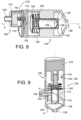
- the drain outlet 104 can feed into a hydromechanical piston valve assembly 134 that includes a piston 136 with ports 138 and a biasing member 140 configured to bias the member against pressure flowing through the assembly 134.
- a hydromechanical piston valve assembly 134 that includes a piston 136 with ports 138 and a biasing member 140 configured to bias the member against pressure flowing through the assembly 134.
- the piston 136 can slide linearly along its axis against the bias of the biasing member 140.
- the drain outlet 104 feeds into the hydromechanical piston valve assembly 134 in series with a main flow passage 142 through the hydromechanical piston valve assembly 134, e.g. upstream of the piston 136.
- the drain outlet 104 feeds into the hydromechanical piston valve assembly 134 in a side stream that is parallel with a main flow passage 142 through the hydromechanical piston valve assembly 134.
- the actuator 116 rotates the piston 136, which doubles as the jet tube 112.
- the rotational direction of the outlet orifice 110 controls how much flow can pass through the side stream that includes the drain outlet 104.
- the piston 136 is keyed to the shaft 124 of the actuator 116 for rotation by the actuator 116, but the piston 136 is free to slide along its axis relative to the shaft 124 of the actuator 116.
- the jet orifice 110 can be fixed relative to the spin chamber 102.
- the jet member includes a diverter 144 downstream from the jet orifice 110.
- the diverter 144 is configured to move to divert flow from the jet orifice 110 between the first position shown in Fig. 10 for tangential flow, e.g. where the downstream end of the diverter 144 points tangentially around the drain outlet 104, and the second position shown in Fig. 11 for radial flow, e.g. where the downstream end of the diverter 144 points to more directly to the drain outlet 104.
- Systems and methods as disclosed herein provide potential benefits including the following. They do not require match grinding to match a piston and a sleeve. They do not need highly calibrated valve porting (the flow profile can be set electronically). They can be used to trim high power or low power. They do not require large forces to hold position - there is no pressure balance except a relatively small thrust from a jet and force to overcome a spring return if included. They can be designed to fail in place, or closed, or open, depending on spring return chosen. They can adjust 30% or more of flow through adjusting the amount of swirl in the swirl chamber. The amount of adjustable flow depends on the size of the jet and amount of offset of the spin chamber e.g. as shown in Figs. 8-9 . They can be turned completely closed (e.g. with or without a check valve) and can have window opening. They can be integrated with existing hydromechanical valves to incorporate full scheduling.
Landscapes
- Engineering & Computer Science (AREA)
- General Engineering & Computer Science (AREA)
- Chemical & Material Sciences (AREA)
- Combustion & Propulsion (AREA)
- Mechanical Engineering (AREA)
- Physics & Mathematics (AREA)
- Fluid Mechanics (AREA)
- Multiple-Way Valves (AREA)
Abstract
A valve system includes a spin chamber (102) having an outlet drain (104) configured to allow flow out of the spin chamber (102). A main spin surface of the spin chamber (102) is defined around the outlet drain (104). A directional jet system (108) is in fluid communication with the spin chamber (102). The directional jet system (108) includes a member that is configured to move between a first position for directing a tangential flow around the drain, and a second position for directing a radial flow toward the drain.
Description
- The present disclosure relates to flow control, and more particularly to flow control such as for controlling flow of fuel in aircraft fuel injection and the like.
- Certain valves require only adjustment of the flow over a given range and not complete control, e.g. they do not have to completely close off flow. Some valves have springs with a balanced pressure force to control the open area of the valve. Some valves have integral check valves. Certain valves can be electronically controlled through a solenoid, stepper motor, or the like.
- Spool valves are currently used in fuel injectors for gas turbine engines to control the flow to a circuit for a given inlet pressure. They can be costly to make because of multiple factors such as the following. They are often made using a carefully toleranced port opening to allow a certain amount of flow for a given pressure. The spool valve is typically match ground with the sleeve to reduce the amount of leakage which bypasses the metering port. On the other hand, electronic solenoid type valves typically need large power forces to overcome flow pressure to adjust the spool window.
- The conventional techniques have been considered satisfactory for their intended purpose. However, there is an ever present need for improved systems and methods for reliable and cost effective valving, such as for valves used in fuel injectors for gas turbine engines and the like. This disclosure provides a solution for this need.
- A valve system includes a spin chamber having an outlet drain configured to allow flow out of the spin chamber. A main spin surface of the spin chamber is defined around the outlet drain. A directional jet system is in fluid communication with the spin chamber. The directional jet system includes a member that is configured to move between a first position for directing a tangential flow around the drain, and a second position for directing a radial flow toward the drain.
- The directional jet system can include a jet orifice that feeds into the spin chamber. The spin chamber may include only one inlet, namely the jet orifice. The spin chamber may include only one outlet, namely the outlet drain.
- The jet member can include a jet tube. The jet orifice can be defined at an outlet end of the jet tube. The directional jet system can be configured to rotate the jet tube to direct the jet orifice more toward a periphery of the spin chamber in the first position relative to the second position. The directional jet system can be configured to rotate the jet tube to direct the jet orifice more toward the drain outlet in the second position relative to the first position. The directional jet system can include one or more inlets configured to feed into the jet tube configured to supply fluid to the jet orifice. The directional jet system can include a rotational actuator operatively connected to rotate the jet tube between the first position and the second position. The directional jet system can include a housing with a main inlet in fluid communication with an interior of the housing. The jet tube can include at least one inlet inside the housing in fluid communication to receive flow from the interior of the housing into the jet tube. The rotational actuator can be inside the housing. The rotational actuator can be operatively connected to rotate the jet tube between the first position and the second position around a rotation axis parallel to an axis defined by the drain outlet. The main spin surface can be planar. The main spin surface can be conical, converging towards the drain outlet.
- The directional jet system can include a housing with a main inlet in fluid communication with an interior of the housing. The jet tube can include at least one inlet inside the housing in fluid communication to receive flow from the interior of the housing into the jet tube. The rotation actuator can be outside of the housing with a shaft extending into housing operatively connected to rotate jet tube inside housing. The main inlet can extend along or parallel to an axis defined by the drain outlet. The rotational actuator can be operatively connected to rotate the jet tube between the first position and the second position around a rotation axis oblique to the axis defined by the drain outlet. The main inlet can extend lateral to an axis defined by the drain outlet. The rotational actuator can be operatively connected to rotate the jet tube between the first position and the second position around a rotation axis oblique to the axis defined by the drain outlet.
- The directional jet system can include a seal operatively connected to the spin chamber to seal the jet orifice in a third position of the directional jet system to stop flow into the spin chamber from the directional jet system. The directional jet system can include a check valve operatively connected to the spin chamber to check the jet orifice in a third position of the directional jet system to stop flow into the spin chamber from the directional jet system below a predetermined pressure.
- The drain outlet can feed into a hydromechanical piston valve assembly. The drain outlet can feed into the hydromechanical piston valve assembly in series with a main flow passage through the hydromechanical piston valve assembly. The drain outlet can feed into the hydromechanical piston valve assembly in a side stream that is parallel with a main flow passage through the hydromechanical piston valve assembly.
- The jet orifice can be fixed relative to the spin chamber. The jet member can include a diverter downstream from the jet orifice. The diverter can be configured to move to divert flow from the jet orifice between the first position and the second position.
- A feed arm can be connected in fluid communication with the drain outlet. A spray nozzle can be connected in fluid communication with the feed arm downstream of the drain outlet for issuing a spray.
- These and other features of the systems and methods of the subject disclosure will become more readily apparent to those skilled in the art from the following detailed description of the preferred embodiments taken in conjunction with the drawings.
- So that those skilled in the art to which the subject disclosure appertains will readily understand how to make and use the devices and methods of the subject disclosure without undue experimentation, preferred embodiments thereof will be described in detail herein below with reference to certain figures, wherein:
-
Fig. 1 is a schematic cross-sectional perspective view of an embodiment of a valve system constructed in accordance with the present disclosure, showing the directional jet system and the spin chamber; -
Fig. 2 is a cross-sectional side elevation view of an embodiment of the valve system ofFig. 1 , showing a conical spin chamber; -
Fig. 3 is a cross-sectional side elevation view of an embodiment of the valve system ofFig. 2 , showing a different packaging of valve actuator; -
Fig. 4 is a cross-sectional side elevation view of the valve system ofFig. 2 , showing the feed arm and spray nozzle; -
Figs. 5-7 are schematic perspective views of an embodiment of the system ofFig. 1 , showing three respective positions of the jet tube; -
Figs. 8-9 are cross-sectional schematic perspective views of embodiments of the system ofFig. 1 , showing the directional jet system in series and in parallel with a hydromechanical valve assembly, respectively; and -
Figs. 10-11 are schematic perspective views of an embodiment of the system ofFig. 1 , showing a diverter for a fixed jet orifice, showing the diverter in the first and second positions, respectively. - Reference will now be made to the drawings wherein like reference numerals identify similar structural features or aspects of the subject disclosure. For purposes of explanation and illustration, and not limitation, a partial view of an embodiment of a valve system in accordance with the disclosure is shown in
Fig. 1 and is designated generally byreference character 100. Other embodiments of systems in accordance with the disclosure, or aspects thereof, are provided inFigs. 2-11 , as will be described. The systems and methods described herein can be used to control flow through a valve system using a directional jet and spin chamber, wherein changing direction of the jet relative to the spin chamber allows for increasing or decreasing flow through the valve system. - The
valve system 100 includes aspin chamber 102 having anoutlet drain 104 configured to allow flow out of thespin chamber 102. Amain spin surface 106 of the spin chamber is defined around theoutlet drain 104, i.e. around an axis A defined through theoutlet drain 104. Adirectional jet system 108 is in fluid communication with thespin chamber 102. Thedirectional jet system 108 includes a member that is configured to move between a first position for directing a tangential flow around the drain, e.g. as indicated by the flow arrow inFig. 6 , and a second position for directing a radial flow toward the drain, as indicated by the flow arrow inFig. 7 . Directing the flow in the tangential direction indicated inFig. 6 reduces flow through thevalve system 100 relative to directing flow in the radial direction ofFigs. 1 and7 , so rotation of the directional jet ultimately controls how much flow can go through thevalve system 100. Intermediate positions between the tangential and radial positions allow for intermediate flow volumes. - With continued reference to
Fig. 1 , thedirectional jet system 108 includes ajet orifice 110 that feeds into thespin chamber 102. Thespin chamber 102 need only include one inlet, namely thejet orifice 110, and one outlet, namely theoutlet drain 104. The jet member includes ajet tube 112. Thejet orifice 110 is defined at an outlet end of thejet tube 112. Thedirectional jet system 108 is configured to rotate thejet tube 112 about rotation axis B to direct thejet orifice 110 more toward a periphery of the spin chamber in the first position relative to the second position, for lower flow, highly swirling tangential flow in the spin chamber. Thedirectional jet system 108 is configured to rotate thejet tube 112 about the rotation axis B to direct thejet orifice 110 more toward thedrain outlet 104 in the second position relative to the first position for higher flow, relatively swirl free flow in the spin chamber. Thedirectional jet system 108 includes one or more inlets, e.g.tangential inlets 114 configured to feed into thejet tube 112 to supply fluid to thejet orifice 110. - With continued reference to
Fig. 1 , thedirectional jet system 108 includes arotational actuator 116 operatively connected to rotate thejet tube 112 back and forth between the first and second positions, i.e. about the rotation axis B. Theactuator 116 can be a two way rotary solenoid or stepper motor, or the like, and/or can include a return bias member such as a spring so the actuator is biased toward one extreme position when not energized. Reference is made to toUS Patent No. 9,617,919 jet tube 112 can cover not only full-on/off operation but can be positioned proportionally anywhere between the positions ofFigs. 5 and 7 for example, and the rotary actuator can cover operation all the way from either a fixed position 1 to position 2, but also varying the position between two positions gradually. Stepper motors can be used which could have very fine increments (e.g. 5° control) which would give good proportionality. - The
directional jet system 108 includes ahousing 118 with amain inlet 120 in fluid communication with an interior 122 of thehousing 118. Thejet tube 112 includes at least oneinlet 114 inside thehousing 118 in fluid communication to receive flow from theinterior 122 of thehousing 118 into thejet tube 112. Therotational actuator 116 is inside thehousing 118, and is operatively connected to rotate thejet tube 112 between the first and second positions around a rotation axis B that is parallel to the axis A defined by thedrain outlet 104, and themain inlet 120 extends parallel with or along the axis B, and parallel with the axis A. The main spin surface is planar 106, however it is also contemplated that themain spin surface 106 can be conical, as shown inFigs. 2-3 , converging towards thedrain outlet 104, e.g. to reduce flow angle into thedrain outlet 104 and reduce pressure loss. - With continued reference to
Figs. 2-3 , therotation actuator 116 can be outside of thehousing 118 with ashaft 124 extending intohousing 118 operatively connected to rotatejet tube 112 inside housing. As shown inFig. 2 , themain inlet 120 can extend lateral to the axis A and to the axis B, wherein therotational actuator 116 is operatively connected to rotate thejet tube 112 between the first and second positions around a rotation axis B that is oblique to the axis A. InFig. 3 , themain inlet 120 extends along or parallel to the axis A defined by thedrain outlet 104, although therotational actuator 116 is operatively connected to rotate thejet tube 112 between the first and second positions around a rotation axis B that is oblique to the axis A. Seals such as o-rings 126 can be used to prevent leaking round the porting for thejet tube 112. - With reference to
Fig. 4 , afeed arm 128 can be connected in fluid communication with thedrain outlet 104. Aspray nozzle 130 can be connected in fluid communication with thefeed arm 128 downstream of thedrain outlet 104 for issuing a spray, such as for fuel injection in a gas turbine engine or the like. Thefeed arm 128 andspray nozzle 130 are shown for the configuration of thevalve system 100 as shown inFig. 2 , however those skilled in the art will readily appreciate that thefeed arm 128 and spaynozzle 130 can be included in any of the configurations disclosed herein. - With reference now to
Figs. 5-7 , thedirectional jet system 106 can include aseal 132 operatively connected to thespin chamber 102 to seal thejet orifice 110 in a third position of thedirectional jet system 108 to stop flow into thespin chamber 102 from thedirectional jet system 108, as shown inFig. 5 , whereFigs. 6-7 show the first and second positions described above, with corresponding tangential and radial flow arrows, respectively. In addition to or in lieu of aseal 132, theitem 132 can be a check valve operatively connected to thespin chamber 102 to check thejet orifice 110 in the third position of thedirectional jet system 108 to stop flow into thespin chamber 102 from thedirectional jet system 108 below a predetermined inlet pressure. The check valve configuration may not require elastomeric seal. Incorporating a completely closed check valve when jet is rotated past spin chamber wall allows valve to open as a port window until the jet is fully exposed, then with continued rotation toward the radial direction, the system can behave like a swirl valve. It is also contemplated that theseal 132 can be omitted and thejet orifice 110 can simply seal against the wall of thespin chamber 102 in the third position shown inFig. 5 . - With referenced now to
Figs. 8-9 , thedrain outlet 104 can feed into a hydromechanicalpiston valve assembly 134 that includes apiston 136 withports 138 and a biasingmember 140 configured to bias the member against pressure flowing through theassembly 134. When pressure on flow through theassembly 134 acts on thepiston 136, thepiston 136 can slide linearly along its axis against the bias of the biasingmember 140. InFig. 8 , thedrain outlet 104 feeds into the hydromechanicalpiston valve assembly 134 in series with amain flow passage 142 through the hydromechanicalpiston valve assembly 134, e.g. upstream of thepiston 136. InFig. 9 , thedrain outlet 104 feeds into the hydromechanicalpiston valve assembly 134 in a side stream that is parallel with amain flow passage 142 through the hydromechanicalpiston valve assembly 134. In this case, theactuator 116 rotates thepiston 136, which doubles as thejet tube 112. The rotational direction of theoutlet orifice 110 controls how much flow can pass through the side stream that includes thedrain outlet 104. Thepiston 136 is keyed to theshaft 124 of theactuator 116 for rotation by theactuator 116, but thepiston 136 is free to slide along its axis relative to theshaft 124 of theactuator 116. - With reference now to
Figs. 10-11 , thejet orifice 110 can be fixed relative to thespin chamber 102. The jet member includes adiverter 144 downstream from thejet orifice 110. Thediverter 144 is configured to move to divert flow from thejet orifice 110 between the first position shown inFig. 10 for tangential flow, e.g. where the downstream end of thediverter 144 points tangentially around thedrain outlet 104, and the second position shown inFig. 11 for radial flow, e.g. where the downstream end of thediverter 144 points to more directly to thedrain outlet 104. - Systems and methods as disclosed herein provide potential benefits including the following. They do not require match grinding to match a piston and a sleeve. They do not need highly calibrated valve porting (the flow profile can be set electronically). They can be used to trim high power or low power. They do not require large forces to hold position - there is no pressure balance except a relatively small thrust from a jet and force to overcome a spring return if included. They can be designed to fail in place, or closed, or open, depending on spring return chosen. They can adjust 30% or more of flow through adjusting the amount of swirl in the swirl chamber. The amount of adjustable flow depends on the size of the jet and amount of offset of the spin chamber e.g. as shown in
Figs. 8-9 . They can be turned completely closed (e.g. with or without a check valve) and can have window opening. They can be integrated with existing hydromechanical valves to incorporate full scheduling. - The methods and systems of the present disclosure, as described above and shown in the drawings, provide for controlling flow through a valve system using a directional jet and spin chamber, wherein changing direction of the jet relative to the spin chamber allows for increasing or decreasing flow through the valve system. While the apparatus and methods of the subject disclosure have been shown and described with reference to preferred embodiments, those skilled in the art will readily appreciate that changes and/or modifications may be made thereto without departing from the scope of the subject disclosure.
Claims (15)
- A valve system comprising:a spin chamber (102) having an outlet drain (104) configured to allow flow out of the spin chamber (102), wherein a main spin surface of the spin chamber (102) is defined around the outlet drain (104); anda directional jet system (108) in fluid communication with the spin chamber (102), wherein the directional jet system (108) includes a member that is configured to move between:a first position for directing a tangential flow around the drain (104); anda second position for directing a radial flow toward the drain (104).
- The system as recited in claim 1, wherein the directional jet system (108) includes a jet orifice that feeds into the spin chamber (102), wherein the spin chamber (102) includes only one inlet, namely the jet orifice, and wherein the spin chamber (102) includes only one outlet, namely the outlet drain (104).
- The system as recited in claim 1 or 2, wherein the jet member includes a jet tube, wherein a jet orifice is defined at an outlet end of the jet tube, wherein the directional jet system (108) is configured to rotate the jet tube to direct the jet orifice more toward a periphery of the spin chamber (102) in the first position relative to the second position, and wherein the directional jet system (108) is configured to rotate the jet tube to direct the jet orifice more toward the drain outlet in the second position relative to the first position.
- The system as recited in claim 3, wherein the directional jet system (108) includes one or more inlets configured to feed into the jet tube configured to supply fluid to the jet orifice.
- The system as recited in claim 3, wherein the directional jet system (108) includes a rotational actuator operatively connected to rotate the jet tube between the first position and the second position.
- The system as recited in claim 5, wherein the directional jet system (108) includes a housing with a main inlet in fluid communication with an interior of the housing, wherein the jet tube includes at least one inlet inside the housing in fluid communication to receive flow from the interior of the housing into the jet tube, and optionally wherein the rotational actuator is inside the housing, or wherein the rotational actuator is operatively connected to rotate the jet tube between the first position and the second position around a rotation axis parallel to an axis defined by the drain outlet.
- The system as recited in claim 5, wherein the main spin surface is planar.
- The system as recited in claim 5, wherein the main spin surface is conical, converging towards the drain outlet.
- The system as recited in claim 5, wherein the directional jet system (108) includes a housing with a main inlet in fluid communication with an interior of the housing, wherein the jet tube includes at least one inlet inside the housing in fluid communication to receive flow from the interior of the housing into the jet tube, wherein the rotation actuator is outside of the housing with a shaft extending into housing operatively connected to rotate jet tube inside housing.
- The system as recited in claim 9, wherein the main inlet extends along or parallel to an axis defined by the drain outlet, wherein the rotational actuator is operatively connected to rotate the jet tube between the first position and the second position around a rotation axis oblique to the axis defined by the drain outlet, or wherein the main inlet extends lateral to an axis defined by the drain outlet, wherein the rotational actuator is operatively connected to rotate the jet tube between the first position and the second position around a rotation axis oblique to the axis defined by the drain outlet.
- The system as recited in claim 3, wherein the directional jet system (108) includes a seal operatively connected to the spin chamber (102) to seal the jet orifice in a third position of the directional jet system (108) to stop flow into the spin chamber (102) from the directional jet system (108), or wherein the directional jet system (108) includes a check valve operatively connected to the spin chamber (102) to check the jet orifice in a third position of the directional jet system (108) to stop flow into the spin chamber (102) from the directional jet system (108) below a predetermined pressure.
- The system as recited in any preceding claim, wherein the directional jet system (108) includes a jet orifice is fixed relative to the spin chamber (102), and wherein the jet member includes a diverter downstream from the jet orifice, wherein the diverter is configured to move to divert flow from the jet orifice between the first position and the second position.
- The system as recited in claim 2, wherein the drain outlet feeds into a hydromechanical piston valve assembly.
- The system as recited in claim 137, wherein the drain outlet feeds into the hydromechanical piston valve assembly in series with a main flow passage through the hydromechanical piston valve assembly, or wherein the drain outlet feeds into the hydromechanical piston valve assembly in a side stream that is parallel with a main flow passage through the hydromechanical piston valve assembly.
- The system as recited in any preceding claim, further comprising:a feed arm connected in fluid communication with the drain outlet; anda spray nozzle connected in fluid communication with the feed arm downstream of the drain outlet for issuing a spray.
Applications Claiming Priority (1)
| Application Number | Priority Date | Filing Date | Title |
|---|---|---|---|
| US18/370,502 US12618374B2 (en) | 2023-09-20 | Swirl valves |
Publications (1)
| Publication Number | Publication Date |
|---|---|
| EP4528090A1 true EP4528090A1 (en) | 2025-03-26 |
Family
ID=92895030
Family Applications (1)
| Application Number | Title | Priority Date | Filing Date |
|---|---|---|---|
| EP24201551.9A Pending EP4528090A1 (en) | 2023-09-20 | 2024-09-20 | Swirl valves |
Country Status (1)
| Country | Link |
|---|---|
| EP (1) | EP4528090A1 (en) |
Citations (6)
| Publication number | Priority date | Publication date | Assignee | Title |
|---|---|---|---|---|
| US3638672A (en) * | 1970-07-24 | 1972-02-01 | Hobson Ltd H M | Valves |
| US3776460A (en) * | 1972-06-05 | 1973-12-04 | American Standard Inc | Spray nozzle |
| US3899925A (en) * | 1974-01-17 | 1975-08-19 | Us Air Force | Valve system for confined vortex flow system |
| WO2008138347A1 (en) * | 2007-05-11 | 2008-11-20 | Mosbaek A/S | A vortex brake |
| US20150354824A1 (en) * | 2013-02-28 | 2015-12-10 | United Technologies Corporation | Variable Swirl Fuel Nozzle |
| US9617919B2 (en) | 2012-08-10 | 2017-04-11 | Delavan Inc. | Impulse duty cycle valves |
-
2024
- 2024-09-20 EP EP24201551.9A patent/EP4528090A1/en active Pending
Patent Citations (6)
| Publication number | Priority date | Publication date | Assignee | Title |
|---|---|---|---|---|
| US3638672A (en) * | 1970-07-24 | 1972-02-01 | Hobson Ltd H M | Valves |
| US3776460A (en) * | 1972-06-05 | 1973-12-04 | American Standard Inc | Spray nozzle |
| US3899925A (en) * | 1974-01-17 | 1975-08-19 | Us Air Force | Valve system for confined vortex flow system |
| WO2008138347A1 (en) * | 2007-05-11 | 2008-11-20 | Mosbaek A/S | A vortex brake |
| US9617919B2 (en) | 2012-08-10 | 2017-04-11 | Delavan Inc. | Impulse duty cycle valves |
| US20150354824A1 (en) * | 2013-02-28 | 2015-12-10 | United Technologies Corporation | Variable Swirl Fuel Nozzle |
Also Published As
| Publication number | Publication date |
|---|---|
| US20250092831A1 (en) | 2025-03-20 |
Similar Documents
| Publication | Publication Date | Title |
|---|---|---|
| US6981359B2 (en) | Centrifugal pump fuel system and method for gas turbine engine | |
| US8128056B2 (en) | Flow control valve | |
| US12281721B2 (en) | Metering valve with stepper motor-controlled rotary follow-up servo | |
| US4926629A (en) | Low cost fuel supply system for gas turbine engines | |
| CN110579252A (en) | A highly reliable fuel metering device driven by a stepping motor | |
| EP2499345B1 (en) | Variable performance valve | |
| EP4528090A1 (en) | Swirl valves | |
| US5284020A (en) | Fuel supply system for gas turbine engines | |
| US12618374B2 (en) | Swirl valves | |
| US10422527B2 (en) | Combustion apparatus | |
| US4408961A (en) | Jet pump with integral pressure regulator | |
| US12454916B2 (en) | Multi-component swirl valves | |
| US20090321667A1 (en) | Servo valve modules and torque motor assemblies | |
| US7913973B1 (en) | Reverse flow fueldraulic valve | |
| US4145876A (en) | Jet engine fuel flow transfer valve | |
| JPS6111454A (en) | Two-stage type fuel pump | |
| US5694967A (en) | Multi-port proportional flow control valve | |
| US12345211B2 (en) | Uncommanded or uncontrollable high thrust detection and mitigation | |
| EP4495425B1 (en) | Combined high pressure relief and bypass valves | |
| US12454950B2 (en) | Direct control for variable displacement pumps using a bypass valve and a minimum pressure shutoff valve | |
| RU2614460C1 (en) | Air flow control system for cooling turbine of bypass turbojet engine | |
| JP3376631B2 (en) | Flow control valve | |
| EP0399065A1 (en) | Fuel injection device for injection carburetors | |
| JP3371459B2 (en) | Flow control valve |
Legal Events
| Date | Code | Title | Description |
|---|---|---|---|
| PUAI | Public reference made under article 153(3) epc to a published international application that has entered the european phase |
Free format text: ORIGINAL CODE: 0009012 |
|
| STAA | Information on the status of an ep patent application or granted ep patent |
Free format text: STATUS: THE APPLICATION HAS BEEN PUBLISHED |
|
| AK | Designated contracting states |
Kind code of ref document: A1 Designated state(s): AL AT BE BG CH CY CZ DE DK EE ES FI FR GB GR HR HU IE IS IT LI LT LU LV MC ME MK MT NL NO PL PT RO RS SE SI SK SM TR |
|
| STAA | Information on the status of an ep patent application or granted ep patent |
Free format text: STATUS: REQUEST FOR EXAMINATION WAS MADE |
|
| 17P | Request for examination filed |
Effective date: 20250925 |