Field of the Invention
-
The present invention relates to a fiber-treating agent for imparting water resistance, heat resistance and heat shape memory ability to naturally derived fibers, and preferably relates to a fiber-treating agent for naturally derived fibers used in fiber products such as headdress products such as wigs and extensions.
Background of the Invention
-
Unlike synthetic fibers, naturally derived fibers generally have natural texture and appearance originating from a natural material. Among naturally derived fibers, regenerated protein fibers, for example, regenerated collagen fibers, are obtained by solubilizing acid-soluble collagen or by solubilizing insoluble collagen with an alkali or an enzyme to obtain a spinning stock solution, and discharging the spinning stock solution into a coagulation bath through a spinning nozzle to form fibers.
-
However, naturally derived fibers generally have higher hydrophilicity and hence higher water absorption as compared to synthetic fibers, and the fibers have generally low mechanical strength when they contain a large amount of water, and in particular, regenerated protein fibers have extremely low mechanical strength. This leads to deterioration of suitability as a fiber product such that during washing, mechanical strength significantly deteriorates because of the higher water absorption, and during subsequent drying, rupture occurs.
-
Among naturally derived fibers, regenerated protein fibers also have the problem of low heat resistance, so that, for example, if a heat set using a hair iron or the like is performed at a temperature as high as that for human hair, shrinkage or crimping occurs, resulting in impairment of visual quality.
-
Further, in plastic synthetic fibers, the shape in a heat set with an iron or the like is continuously memorized even after subsequent washing (there is heat shape memory ability), whereas in naturally derived fibers, the shape in a heat set with an iron or the like is lost through subsequent one time washing (there is no heat shape memory ability). Therefore, naturally derived fibers may be inferior to conventional plastic synthetic fibers in terms of degree of freedom of shape set.
-
The above points are supposed to be a factor in limiting popularization of naturally derived fibers, in particular regenerated protein fibers for fiber products such as headdress products. In particular, water resistance, that is, the deterioration of the mechanical strength when it is wet has a significant impact.
-
On the other hand, in the field of human hair fibers which are naturally derived fibers, a method is known in which to human hair fibers having essentially no heat shape memory ability, a specific aldehyde derivative and phenolic compound are applied for newly imparting heat shape memory ability (Patent Literature 1).
Citation List
Patent Literature
-
Patent Literature 1:
JP-A-2019-143281 Summary of the Invention
-
The present invention provides a fiber-treating agent which is a one-part type fiber-treating agent formed of a single composition or a multiple-part type fiber-treating agent formed of a plurality of compositions, the agent comprising the following components (A) to (C) in a total composition:
- (A): an aromatic compound having one or more vinyl groups or vinylidene groups, and a coordinating functional group;
- (B): a radical initiator; and
- (C): water.
-
Further, the present invention provides a fiber-treating agent kit comprising a composition containing the following component (A) and component (C) and a composition containing the following component (B) and component (C):
- (A): an aromatic compound having one or more vinyl groups or vinylidene groups, and a coordinating functional group;
- (B): a radical initiator; and
- (C): water.
Detailed Description of the Invention
-
In some situations of production of fiber products such as headdress products, fibers are intensively extended, and in the technique disclosed in Patent Literature 1, there are cases where the stretchability (tenacity) of treated fibers is not sufficient. For this reason, it is required to enhance the stretchability of treated fibers for preventing rupture during extension.
-
Therefore, the present invention relates to a fiber-treating agent which improves water resistance and heat resistance problematic in naturally derived fibers, imparts heat shape memory ability, and also improves stretchability (tenacity) and the feel of the surfaces.
-
The present inventors have conducted intensive studies and as a result, found that by treating naturally derived fibers with a composition containing an aromatic compound having a vinyl group or a vinylidene group and a coordinating functional group, and a radical initiator, not only the aromatic compound penetrated into the fibers are polymerized, but also its coordinating functional group is strongly coordinated with a metal (mainly polyvalent metal) in the naturally derived fibers, so that the strength in water and heat resistance of the fibers are improved, and the leakage of the aromatic compound or a polymerized product thereof from the fibers is prevented. As a result, the present inventors have found that not only water resistance, and heat resistance in both dry state and wet state of the naturally derived fibers are improved, so that the shape can be imparted by a heat set, but also surprisingly, the stretchability (tenacity) of the naturally derived fibers is improved as compared to that before treatment, and can be enhanced to a level close to that of human hair, leading to completion of the present invention.
-
According to the present invention, it is possible to provide a fiber-treating agent which can improve water resistance, and heat resistance in both dry state and wet state of naturally derived fibers, can impart heat shape memory ability, and can also improve the stretchability (tenacity) and the feel of the surfaces.
[One-part type and multiple-part type]
-
The fiber-treating agent of the present invention includes a one-part type fiber-treating agent formed of a single composition, and a multiple-part type fiber-treating agent such as a two-part type fiber-treating agent which is formed of a plurality of compositions and in which fibers are sequentially immersed in the plurality of compositions. The one-part type fiber-treating agent includes one used as a single composition by mixing a plurality of compositions upon use.
-
In the present invention, the content in the fiber-treating agent refers to, in the case of the one-part type fiber-treating agent, the content in a single composition to be used, and in the case of the multiple-part type fiber-treating agent, the content in each treating agent to be used in each step.
[Fibers to be treated in the present invention]
-
Fibers to be treated with the fiber-treating agent of the present invention are preferably metal-containing fibers, preferably naturally derived metal-containing fibers or synthetic metal-containing fibers, and among them, naturally derived metal-containing fibers are preferable. The naturally derived fiber refers to fibers which are taken from a natural animal or plant, or artificially produced fibers using a polymer or an oligomer, such as protein derived from keratin, collagen, casein, soybeans, peanuts, corn, silk flocks, silk protein (for example silk fibroin) or the like or a polysaccharide, as a raw material. Among them, artificially produced fibers using a polymer or an oligomer, such as protein derived from keratin, collagen, casein, soybeans, peanuts, corn, silk flocks, silk protein (for example silk fibroin) or the like or a polysaccharide, as a raw material are preferable, regenerated protein fibers using protein derived from keratin, collagen, casein, soybean protein, peanut protein, corn protein, silk protein (for example silk fibroin) or the like as a raw material are more preferable, regenerated protein fibers such as regenerated collagen fibers made from collagen as a raw material or regenerated silk fibers made from silk fibroin as a raw material are more preferable, and regenerated collagen fibers are further more preferable.
-
Regenerated collagen fibers can be produced by a known technique, are not required to have a composition of collagen 100%, and may contain a natural or synthetic polymer and additives for improvement of quality. Regenerated collagen fibers are preferably in the form of filaments. Filaments are generally taken from fibers wound around a bobbin or packed in a box. It is also possible to directly use filaments coming out from a drying step in a production process of regenerated collagen fibers.
-
Synthetic metal-containing fibers may be metal-treated synthetic fibers. Naturally derived metal-containing fibers include those originally containing a metal such as fibers taken from a natural animal or plant. In this case, those originally containing a metal are not required to contain metal additionally, but may be treated with a metal salt, as fibers treated with an aluminum salt to achieve water resistance as described in, for example,
JP-A-2003-027318 , and the like.
[Component (A): aromatic compound having vinyl group or vinylidene group, and coordinating functional group]
-
A component (A) is an aromatic compound having one or more vinyl groups or vinylidene groups, and a coordinating functional group. The coordinating functional group in the component (A) is preferably one containing a Pearson's hard base. The Pearson's hard base refers to the Lewis bases classified into hard bases in the concept of HSAB (Hard and Soft Acids and Bases) which is introduced by Pearson (R. G. Pearson) in the 1960s, and is considered to easily react with the Lewis acids classified into hard acids.
-
Examples of the hard base contained in the coordinating functional group in the aromatic compound of the component (A) include functional groups corresponding to hard bases described in Application of the Principle of Hard and Soft Acids and Bases to Organic Chemistry, Ralph G. Pearson and Jon. Songstad, J. Am. Chem. Soc. 1967, 89, 8, 1827-1836, such as COO-, O-, COOH, OH, and NH2. Among them, COO-, O-, COOH, and OH are preferable, and COO- and COOH are more preferable from the viewpoint of further reducing coloring of fibers and improving fixability after fiber treatment (suppressing elution during washing). As the coordinating functional group in the component (A), a functional group containing a carboxy group or a group in which one hydrogen atom is eliminated from the benzene ring of catechol (1,2-dihydroxybenzene) is preferable.
-
Hereinafter, the aromatic compound of the component (A) will be exemplified by being divided into (A-1) the case where the coordinating functional group contains COOH, COO-, or a salt of COOH, and (A-2) the case where the coordinating functional group contains OH, O-, or a salt of OH.
(A-1) Case where coordinating functional group contains COOH, COO-, or salt of COOH
-
Examples of (A-1) include (A-1-a) an aromatic compound having a vinyl group or a vinylidene group as a part of a styrene backbone, and (A-1-b) an aromatic compound having a vinyl group or a vinylidene group as a part of an acryloyl group or a methacryloyl group. When the component (A-1) is a salt, examples of the salt include alkaline metal salts such as sodium salts and potassium salts.
(A-1-a) Case where coordinating functional group contains COOH, COO-, or salt of COOH, and vinyl group or vinylidene group is part of styrene backbone
-
Examples of the aromatic compound of (A-1-a) include a compound of the following formula (1):
wherein R
1 represents a hydrogen atom or a methyl group, A
1 to A
5 each independently represent a hydrogen atom, a carboxy group, a group of formula (2), an acetyl group, a halogen atom, or a linear or branched alkyl group, alkenyl group, alkoxy group, or alkenyloxy group having 1 to 6 carbon atoms, wherein R
2 represents a linear or branched, saturated or unsaturated divalent hydrocarbon group or divalent hydrocarbonoxy group having 1 to 6 carbon atoms, an o-phenylene group, an m-phenylene group, a p-phenylene group, a benzylidene group, or a phenyl C
2 to C
4 alkylene group, provided that A
1 to A
5 contain at least one carboxy group or group of formula (2).
-
In (A-1-a), when A1 to A5 contain at least one carboxy group, specific examples of the aromatic compound include 2-vinylbenzoic acid, 3-vinylbenzoic acid, 4-vinylbenzoic acid, and a mixture of two or three selected from the group consisting of them, and a mixture of three is preferable from the viewpoint of easy availability and good feel quality of the surface of fibers after treatment. On the other hand, 4-vinylbenzoic acid is preferable from the viewpoint of imparting water resistance.
-
In (A-1-a), when A1 to A5 contain at least one group of formula (2), specific examples of the aromatic compound include 4-oxo-4-((4-vinylbenzyl)oxy)butanoic acid and 2-(((4-vinylbenzyl)oxy)carbonyl)benzoic acid.
(A-1-b) Case where coordinating functional group contains COOH, COO-, or salt of COOH, and vinyl group or vinylidene group is part of acryloyl group or methacryloyl group
-
Examples of the aromatic compound of (A-1-b) include a compound of the following formula (3):
wherein R
3 represents a hydrogen atom or a methyl group, B
1 to B
4 each independently represent a hydrogen atom, a carboxy group, an acetyl group, a halogen atom, or a linear or branched alkyl group, alkenyl group, alkoxy group, or alkenyloxy group having 1 to 6 carbon atoms, Ph represents a phenylene group, n represents an integer of 0 to 2, and m represents 0 or 1.
-
Specific examples of the aromatic compound of formula (3) include 2-((2-(acryloyloxy)ethoxy)carbonyl)benzoic acid, 2-((2-(methacryloyloxy)ethoxy)carbonyl)benzoic acid, and 2-(4-(2-(2-(acryloyloxy)ethoxy)ethoxy)benzoyl)benzoic acid.
(A-2) Case where coordinating functional group contains OH, O-, or salt of OH
-
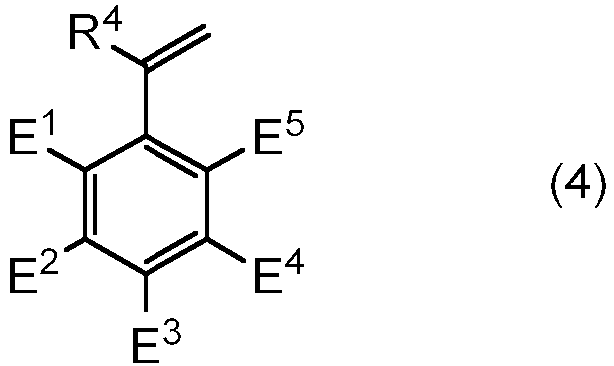
Examples of (A-2) include a compound of the following formula (4):
wherein R
4 represents a hydrogen atom or a methyl group, E
1 to E
5 each independently represent a hydrogen atom, a hydroxy group, a group of formula (5), an acetyl group, a halogen atom, or a linear or branched alkyl group, alkenyl group, alkoxy group, or alkenyloxy group having 1 to 6 carbon atoms, and G
1 to G
5 each independently represent a hydrogen atom, a hydroxy group, an acetyl group, a halogen atom, or a linear or branched alkyl group, alkenyl group, alkoxy group, or alkenyloxy group having 1 to 6 carbon atoms, provided that E
1 to E
5 contain at least one group of formula (5).
-
Specific examples of the aromatic compound of formula (4) include 3,4,5-trihydroxybenzoic acid 4-vinylbenzyl.
-
The component (A) more preferably corresponds to (A-1), from the viewpoint of further reducing coloring of fibers and improving fixability after fiber treatment (suppressing elution during washing).
-
One component (A) may be used alone, or two or more components (A) may be used in combination. The content of the component (A) in the fiber-treating agent of the present invention is different depending on the pH range of the fiber-treating agent, and the following range is preferable. Here, the content of the component (A) in the case where the component (A) is a salt refers to the content of the corresponding undissociated form. The content of the undissociated form refers to, in the case of an acid, the content of the state where the counter ion is substituted with a hydrogen, for example, in the case of a COO-salt, the content of its acid form COOH, and in the case of a base, the content of the state where proton is eliminated, for example, in the case of an ammonium salt, the content of the state of amine. When the fiber-treating agent is a multiple-part type fiber-treating agent, "the pH of the fiber-treating agent" here refers to the pH of the treating agent containing the component (A). When there is a plurality of treating agents containing the component (A), the preferred range of the content is determined depending on the pH of each treating agent. As described above, the fiber-treating agent used as a single composition by mixing a plurality of compositions upon use is included in the one-part type fiber-treating agent, and "the pH of the fiber-treating agent" refers to pH after mixing.
-
When the pH of the fiber-treating agent is 2.0 or more and less than 6.5, the content of the component (A) in the fiber-treating agent is, in an undissociated form in the case of a salt, preferably 0.1 mass% or more, more preferably 0.2 mass% or more, further more preferably 0.5 mass% or more, even more preferably 1.0 mass% or more, from the viewpoint of imparting higher shape sustainability, water resistance, stretchability (tenacity, that is, high breaking elongation during fiber tensioning),
and heat resistance to treated naturally derived fibers, and is preferably 40 mass% or less, more preferably 30 mass% or less, further more preferably 25 mass% or less, even more preferably 20 mass% or less, even more preferably 15 mass% or less, from the viewpoint of improving the feel of the fiber surfaces.
-
That is, when the pH of the fiber-treating agent is 2.0 or more and less than 6.5, the content of the component (A) in the fiber-treating agent of the present invention is, in an undissociated form in the case of a salt, preferably from 0.1 to 40 mass%, more preferably from 0.2 to 30 mass%, further more preferably from 0.5 to 25 mass%, even more preferably from 1.0 to 20 mass%, even more preferably from 1.0 to 15 mass%, from the above viewpoint.
-
When the pH of the fiber-treating agent is 6.5 or more and 11.0 or less, the content of the component (A) in the fiber-treating agent is, in an undissociated form in the case of a salt, preferably 1.0 mass% or more, more preferably 2.0 mass% or more, further more preferably 5.0 mass% or more, even more preferably 10 mass% or more, from the viewpoint of imparting higher shape sustainability, water resistance, stretchability (tenacity, that is, high breaking elongation during fiber tensioning),
and heat resistance to treated naturally derived fibers, and is preferably 90 mass% or less, more preferably 80 mass% or less, further more preferably 70 mass% or less, even more preferably 60 mass% or less, from the viewpoint of improving the feel of the fiber surfaces.
-
That is, when the pH of the fiber-treating agent is 6.5 or more and 11.0 or less, the content of the component (A) in the fiber-treating agent of the present invention is, in an undissociated form in the case of a salt, preferably from 1.0 to 90 mass%, more preferably from 2.0 to 80 mass%, further more preferably from 5.0 to 70 mass%, even more preferably from 10 to 60 mass%, from the above viewpoint.
[Component (B): radical initiator]
-
The component (B) is a radical initiator for polymerizing the component (A). The component (B) may be contained in the composition containing the component (A), but when the fiber-treating agent to be used is made into a multiple-part type, for example, a two-part type, the component (B) may be contained in a composition (the second part) different from the composition containing the component (A) (the first part). Examples of the component (B) include a peroxide initiator and an azo initiator. Examples thereof also include a combination of an oxidizing agent and a reducing agent as a redox initiator.
-
Examples of the peroxide initiator include sodium persulfate, potassium persulfate, ammonium persulfate, t-butyl hydroperoxide, t-amyl hydroperoxide, p-diisopropylbenzene hydroperoxide, cumene hydroperoxide, pinane hydroperoxide, p-menthane hydroperoxide, 1,1,3,3-tetramethylbutyl hydroperoxide, benzoyl peroxide, t-butyl perbenzoate, diisopropyl peroxydicarbonate, di-n-propyl peroxydicarbonate, di(2-ethoxyethyl) peroxydicarbonate, t-butyl peroxyneodecanoate, t-butyl peroxypivalate, (3,5,5-trimethylhexanoyl)peroxide, dipropionyl peroxide, and diacetyl peroxide.
-
Examples of the azo initiator include 2,2'-azobisisobutyronitrile, 2,2'-azobis(2-methylbutyronitrile), 1,1'-azobis(cyclohexane-1-carbonitrile), 2,2'-azobis(2,4-dimethylvaleronitrile), 2,2'-azobis(2,4-dimethyl-4-methoxyvaleronitrile), dimethyl 2,2'-azobis(2-methylpropionate), 2,2'-azobis(2-hydroxymethylpropionitrile), 2,2'-azobis[2-methyl-N-(2-hydroxyethyl)propionamide], 4,4'-azobis(4-cyanovaleric acid), 2,2'-azobis[2-(2-imidazolin-2-yl)propane], 2,2'-azobis[N-(2-carboxyethyl)-2-methylpropionamidine], 2,2'-azobis(2-methylpropionamidine) dihydrochloride, and 2,2'-azobis[2-(2-imidazolin-2-yl)propane] dihydrochloride.
-
Examples of the oxidizing agent used in the redox initiator include hydrogen peroxide, sodium hypochlorite, potassium hypochlorite, oxygen, and ozone, in addition to the above-described compounds exemplified as the peroxide initiator. Examples of the reducing agent used in the redox initiator include sodium sulfite, potassium sulfite, sodium hydrogen sulfite, potassium hydrogen sulfite, sodium pyrosulfite, potassium pyrosulfite, iron(II) ion, chromium ion, ascorbic acid, formaldehyde sulfoxylate, tetramethylene diamine, and sodium hydroxymethanesulfinate.
-
The fiber-treating agent for hydrophilic naturally derived fibers is preferably an aqueous solution from the viewpoint of promoting penetration of the compound in the solution into fibers, and therefore, also as the radical initiator to be formulated in the fiber-treating agent, a water-soluble radical initiator is preferable. As the water-soluble azo initiator, 2,2'-azobis[2-methyl-N-(2-hydroxyethyl)propionamide], 4,4'-azobis(4-cyanovaleric acid), 2,2'-azobis[2-(2-imidazolin-2-yl)propane], 2,2'-azobis[N-(2-carboxyethyl)-2-methylpropionamidine], 2,2'-azobis(2-methylpropionamidine) dihydrochloride, 2,2'-azobis[2-(2-imidazolin-2-yl)propane] dihydrochloride, or the like is preferable.
-
Here, the water-soluble radical initiator refers to, in the following terms showing the degree of solubility which is defined by the volume (mL) of water required to dissolve 1 g of radical initiator powder within 30 minutes when the powder is put in water and vigorously shaken for 30 seconds every 5 minutes at 20°C±5°C in accordance with JIS K8001 general rules for test methods of reagents, a radical initiator preferably corresponding to "slightly soluble" to "very soluble", more preferably "sparingly soluble" to "very soluble", further more preferably "soluble" to "very soluble", even more preferably "freely soluble" to "very soluble", even more preferably "very soluble".
<Amount of water required to dissolve 1 g of radical initiator>
-
- Very soluble: less than 1 mL
- Freely soluble: 1 mL or more and less than 10 mL
- Soluble: 10 mL or more and less than 30 mL
- Sparingly soluble: 30 mL or more and less than 100 mL
- Slightly soluble: 100 mL or more and less than 1 000 mL
- Very slightly soluble: 1 000 mL or more and less than 10 000 mL
- Practically insoluble: 10 000 mL or more
-
Further, as the treating agent for naturally derived fibers having a low heat resistance, a radical initiator having a low 10-hour half-life temperature such that it is efficiently cleaved even at a low treatment temperature and functions as a radical initiator is more preferably used. Among them, 2,2'-azobis[2-(2-imidazolin-2-yl)propane] (10-hour half-life temperature: 61°C), 2,2'-azobis[N-(2-carboxyethyl)-2-methylpropionamidine] (10-hour half-life temperature: 57°C), 2,2'-azobis(2-methylpropionamidine) dihydrochloride (10-hour half-life temperature: 56°C), or 2,2'-azobis[2-(2-imidazolin-2-yl)propane] dihydrochloride (10-hour half-life temperature: 44°C) is preferable.
-
Here, the 10-hour half-life temperature of the radical initiator refers to a temperature at which 50% of the radical initiator is decomposed after 10 hours. The 10-hour half-life temperature of the radical initiator is preferably 80°C or lower, more preferably 70°C or lower, further more preferably 60°C or lower, even more preferably 50°C or lower, from the viewpoint of efficiently progressing the reaction at a low temperature without damaging naturally derived fibers susceptible to high temperatures, and is preferably 0°C or higher, more preferably 10°C or higher, further more preferably 20°C or higher, from the viewpoint of exhibiting no excess reactivity during storage at ambient temperature and being advantageous in storage and transport.
-
One component (B) may be used alone, or two or more components (B) may be used in combination. The content of the component (B) in the fiber-treating agent of the present invention is, on an undissociated form of a compound as the main compound of the reaction basis in the case of a salt or a complex, for example, on a peroxide basis in the case of the peroxide initiator, on an azo compound basis in the case of the azo initiator, or on an undissociated form of the oxidizing agent and an undissociated form of the reducing agent basis in the case of the redox initiator, preferably 0.001 mass% or more, more preferably 0.01 mass% or more, further more preferably 0.1 mass% or more, even more preferably 0.5 mass% or more, from the viewpoint of efficiently progressing the reaction and imparting higher shape sustainability, water resistance, stretchability (tenacity, that is, high breaking elongation during fiber tensioning), and heat resistance to treated naturally derived fibers, and is preferably 80 mass% or less, more preferably 60 mass% or less, further more preferably 40 mass% or less, even more preferably 20 mass% or less from the viewpoint of preventing the molecular weight of the polymerized product produced by excess concentration from being too low. When the redox initiator is used as the component (B), the content of the component (B) represents the total amount of the undissociated form of the oxidizing agent and the undissociated form of the reducing agent.
-
The mass ratio of the component (B) to the component (A), (B)/(A) is preferably 0.001 or more, more preferably 0.01 or more, and preferably 200 or less, more preferably 50 or less, from the viewpoint of efficiently progressing the reaction and imparting higher shape sustainability, water resistance, stretchability (tenacity, that is, high breaking elongation during fiber tensioning), and heat resistance to treated naturally derived fibers. In the case of the multiple-part type fiber-treating agent in which the component (A) and the component (B) are contained in different treating agents, the mass ratio (B)/(A) in a mixed solution obtained by virtually mixing both agents is preferably within the range.
[Component (C): water]
-
The fiber-treating agent of the present invention has water as a medium. The content of the component (C) in the fiber-treating agent of the present invention is preferably 10 mass% or more, more preferably 20 mass% or more, further more preferably 30 mass% or more, even more preferably 40 mass% or more, and preferably 98 mass% or less, more preferably 97 mass% or less, further more preferably 96 mass% or less, even more preferably 95 mass% or less, even more preferably 90 mass% or less, even more preferably 85 mass% or less.
-
That is, the content of the component (C) in the fiber-treating agent of the present invention is preferably from 10 to 98 mass%, more preferably from 20 to 97 mass%, further more preferably from 30 to 96 mass%, even more preferably from 40 to 95 mass%, even more preferably from 40 to 90 mass%, even more preferably from 40 to 85 mass%.
[Cationic surfactant]
-
The fiber-treating agent of the present invention may contain a cationic surfactant as long as the effects of the present invention are not impaired. The cationic surfactant is preferably a long chain monoalkyl quaternary ammonium salt having one alkyl group having 8 to 24 carbon atoms and three alkyl groups having 1 to 4 carbon atoms.
-
Preferably, at least one long chain monoalkyl quaternary ammonium surfactant is selected from the group consisting of compounds of the following formula (6):
wherein R
5 is a saturated or unsaturated linear or branched alkyl group having 8 to 22 carbon atoms, R
9-CO-NH-(CH
2)
p- or R
9-CO-O-(CH
2)
p- (R
9 represents a saturated or unsaturated linear or branched alkyl chain having 7 to 21 carbon atoms, and p represents an integer of 1 to 4), R
6, R
7 and R
8 independently represent an alkyl group having 1 to 4 carbon atoms, or a hydroxyalkyl group having 1 to 4 carbon atoms, and An
- represents a chloride ion, a bromide ion, a methosulfate ion or an ethosulfate ion.
-
Examples of the suitable cationic surfactant include long chain quaternary ammonium compounds such as cetyltrimethylammonium chloride, myristyltrimethylammonium chloride, behentrimonium chloride, cetyltrimethylammonium bromide and stearamidopropyltrimonium chloride. One of them may be used alone, or a mixture thereof may be used.
-
The content of the cationic surfactant in the fiber-treating agent of the present invention is preferably 0.05 mass% or more, more preferably 0.10 mass% or more, and preferably 10 mass% or less, more preferably 5.0 mass% or less, from the viewpoint of improving the feel of the surfaces of naturally derived fibers after treatment, and further improving the effects of the present invention.
[Silicone]
-
The fiber-treating agent of the present invention may contain silicone from the viewpoint of improving the feel of the surfaces of naturally derived fibers after treatment, and improving styling ease. The silicone is preferably one or more selected from the group consisting of dimethylpolysiloxane and amino-modified silicone.
-
As the dimethylpolysiloxane, any of cyclic or acyclic dimethylsiloxane polymers can be used, and examples thereof include SH200 Series, BY22-019, BY22-020, BY11-026, B22-029, BY22-034, BY22-050A, BY22-055, BY22-060, BY22-083 and FZ-4188 (each manufactured by Dow Corning Toray), and KF-9088, KM-900 Series, MK-15H and MK-88 (each manufactured by Shin-Etsu Chemical Co., Ltd.).
-
As the amino-modified silicone, any silicone having an amino group or an ammonium group can be used, and examples thereof include amino-modified silicone oil which is terminal-blocked at all or a part of terminal hydroxyl groups with a methyl group or the like, and amodimethicone which is not terminal-blocked. Examples of the amino-modified silicone preferable from the viewpoint of improving the feel of the surfaces of naturally derived fibers after treatment and improving styling ease include compounds of the following formula:
wherein R' represents a hydrogen atom, a hydroxy group or R
X, where R
X represents a substituted or unsubstituted monovalent hydrocarbon group having 1 to 20 carbon atoms, J represents R
X, R"-(NHCH
2CH
2)aNH
2, OR
X or a hydroxy group, R" represents a divalent hydrocarbon group having 1 to 8 carbon atoms, a represents a number of 0 to 3, and b and c represent numbers whose sum is 10 or more and less than 20 000, preferably 20 or more and less than 3 000, more preferably 30 or more and less than 1 000, further more preferably 40 or more and less than 800, in terms of the number average.
-
Specific examples of the suitable commercially available product of amino-modified silicone include amino-modified silicone oils such as SF8452C and SS3551 (each manufactured by Dow Corning Toray) and KF-8004, KF-867S and KF-8015 (each manufactured by Shin-Etsu Chemical Co., Ltd.), and amodimethicone emulsions such as SM8704C, SM8904, BY22-079, FZ-4671 and FZ4672 (each manufactured by Dow Corning Toray).
-
The content of silicone in the fiber-treating agent of the present invention is preferably 0.1 mass% or more, more preferably 0.2 mass% or more, further more preferably 0.5 mass% or more, and preferably 20 mass% or less, more preferably 10 mass% or less, further more preferably 5.0 mass% or less, from the viewpoint of improving the feel of the surfaces of naturally derived fibers after treatment, and further improving the effects of the present invention.
[Cationic polymer]
-
The fiber-treating agent of the present invention may contain a cationic polymer from the viewpoint of improving the feel of the surfaces of naturally derived fibers after treatment.
-
The cationic polymer refers to a polymer having a cationic group, or a group capable of being ionized into a cationic group, and also includes an amphoteric polymer which is cationic as a whole. That is, examples of the cationic polymer include those in the form of an aqueous solution, which contain an amino group or an ammonium group on the side chain of the polymer chain or contain a diallyl quaternary ammonium salt as a constituent unit, for example, cationized cellulose derivatives, cationic starch, cationized guar gum derivatives, polymers or copolymers of a diallyl quaternary ammonium salt, and quaternized polyvinylpyrrolidone derivatives. Among them, one or more selected from the group consisting of a polymer containing a diallyl quaternary ammonium salt as a constituent unit, a quaternized polyvinylpyrrolidone derivative and a cationized cellulose derivative are preferable, and one or more selected from the group consisting of a polymer or copolymer of a diallyl quaternary ammonium salt and a cationized cellulose derivative are more preferable, from the viewpoint of improving the effects of softness in the feel, smoothness and finger-combability during rinsing and shampooing and ease of styling and moisture retainability during drying, and the stability of the agent.
-
Specific examples of the suitable polymer or copolymer of a diallyl quaternary ammonium salt include dimethyldiallylammonium chloride polymers (polyquaternium-6, for example, MERQUAT 100; Lubrizol Advanced Materials, Inc.), dimethyldiallylammonium chloride/acrylic acid copolymers (polyquaternium-22, for example, MERQUATs 280 and 295; Lubrizol Advanced Materials, Inc.), and dimethyldiallylammonium chloride/acrylamide copolymers (polyquaternium-7, for example, MERQUAT 550; Lubrizol Advanced Materials, Inc.).
-
Specific examples of the suitable quaternized polyvinylpyrrolidone derivative include polymers obtained by polymerizing a vinylpyrrolidone copolymer and dimethylaminoethyl methacrylate (polyquaternium 11, for example, GAFQUAT 734, GAFQUAT 755 and GAFQUAT 755N (Ashland Inc.)).
-
Specific examples of the suitable cationized cellulose include polymers obtained by adding glycidyltrimethylammonium chloride to hydroxycellulose (polyquaternium 10, for example, LEOGARDs G and GP (Lion Corporation) and POLYMERs JR-125, JR-400, JR-30M, LR-400 and LR-30M (Amerchol Corporation)), and hydroxyethylcellulose dimethyldiallylammonium chloride (polyquaternium-4, for example, CELQUATs H-100 and L-200 (Akzo Nobel N.V.)).
-
The content of the cationic polymer in the fiber-treating agent of the present invention is preferably 0.001 mass% or more, more preferably 0.01 mass% or more, further more preferably 0.05 mass% or more, and preferably 20 mass% or less, more preferably 10 mass% or less, from the viewpoint of improving the feel of the surfaces of naturally derived fibers after treatment.
-
Further, the fiber-treating agent of the present invention may contain an antioxidant such as ascorbic acid, and a pH adjuster such as sodium hydroxide, potassium hydroxide, phosphoric acid or hydrochloric acid.
[pH]
-
The pH of the fiber-treating agent of the present invention is preferably 2.0 or more, more preferably 3.0 or more, further more preferably 3.5 or more, even more preferably 4.0 or more, and preferably 11.0 or less, more preferably 10.0 or less, further more preferably 9.0 or less, from the viewpoint of suppressing damage to and improving durability of naturally derived fibers. The pH in the present invention is a value at 25°C.
-
That is, the pH of the fiber-treating agent of the present invention is preferably from 2.0 to 11.0, more preferably from 3.0 to 10.0, further more preferably from 3.5 to 9.0, even more preferably from 4.0 to 9.0, from the viewpoint of suppressing damage to and improving durability of naturally derived fibers.
-
In the case of the multiple-part type fiber-treating agent, the above conditions are applied to the pH of each agent. However, the pH of each agent is preferably close to each other, and specifically, the difference in pH between the agent having the highest pH and the agent having the lowest pH is preferably 3.0 or less, more preferably 2.0 or less, further more preferably 1.0 or less, even more preferably 0.5 or less. As described above, the fiber-treating agent used as a single composition by mixing a plurality of compositions upon use is included in the one-part type fiber-treating agent, and "the pH of the fiber-treating agent" refers to pH after mixing.
[Method for storing fiber-treating agent]
-
When the fiber-treating agent produced as described above is transported and stored before being applied to fibers, or a raw material before preparation of the fiber-treating agent is transported and stored, the storage temperature can be set to a cool temperature or a high temperature or gap portions in a storage container can be filled with nitrogen for the purpose of preventing coloring by oxidation of the polymerized product of the component (A) and progress of an unintentional reaction or recrystallization during transportation.
-
The storage temperature of the fiber-treating agent is preferably 1°C or higher, more preferably 2°C or higher, further more preferably 5°C or higher, from the viewpoint of preventing occurrence of freezing and recrystallization, and preferably 25°C or lower, more preferably 20°C or lower, further more preferably 15°C or lower, from the viewpoint of preventing coloring by oxidation and progress of an unintentional reaction.
-
The storage temperature of the fiber-treating agent is preferably 20°C or higher, more preferably 30°C or higher, further more preferably 40°C or higher, from the viewpoint of preventing recrystallization of a highly concentrated solution, and preferably 80°C or lower, more preferably 70°C or lower, further more preferably 60°C or lower, from the viewpoint of preventing coloring by oxidation and progress of an unintentional reaction.
[Method for treating fibers]
(Basic treatment)
-
By using the fiber-treating agent of the present invention and treating naturally derived fibers with a method comprising the following step (i), it is possible to improve the water resistance and heat the resistance which are problems of naturally derived fibers, impart heat shape memory ability, and improve stretchability (tenacity) and the feel of the surfaces.
-
Step (i) Immersing naturally derived fibers in the fiber-treating agent of the present invention.
-
When the fiber-treating agent of the present invention is the multiple-part type agent, examples of the multiple-part type fiber-treating agent include a two-part type fiber-treating agent composed of a first part containing the component (A) and a second part containing the component (B). When such a multiple-part type fiber-treating agent is used, step (i) is a step with multistep treatment in which naturally derived fibers are sequentially immersed in each agent. For example, when the two-part type fiber-treating agent is used, step (i) is a step of two-step treatment in which naturally derived fibers are immersed in the first part containing the component (A), and the naturally derived fibers treated with the first part are then immersed in the second part containing the component (B), or a step of two-step treatment in which naturally derived fibers are immersed in the second part containing the component (B), and the naturally derived fibers treated with the second part are then immersed in the first part containing the component (A).
-
In the step (i), the naturally derived fibers immersed in the fiber-treating agent may be dry or wet. The amount of the fiber-treating agent in which the naturally derived fibers are immersed is preferably 2.0 or more, more preferably 3.0 or more, further more preferably 5.0 or more, even more preferably 10 or more, even more preferably 20 or more, and preferably 500 or less, more preferably 250 or less, further more preferably 100 or less, in terms of bath ratio to the mass of the naturally derived fibers (mass of fiber-treating agent/mass of naturally derived fibers), from the viewpoint of improving the water resistance and the heat resistance, allowing heat shape memory ability to be imparted, and improving stretchability (tenacity) and the feel of the surfaces.
-
That is, the bath ratio is preferably from 2.0 to 500, more preferably from 3.0 to 250, further more preferably from 5.0 to 100, even more preferably from 10 to 100, even more preferably from 20 to 100 from the above viewpoint.
-
In the step (i), the naturally derived fibers may be fixed with a curler or the like, followed by immersion in the fiber-treating agent of the present invention under heating. This enables a desired shape to be imparted to the naturally derived fibers together with heat shape memory ability and high durability.
-
It is preferable that the immersion of the naturally derived fibers in the fiber-treating agent in the step (i) be performed under heating, and this heating is performed by heating the fiber-treating agent. This heating may be performed by immersing the naturally derived fibers in the fiber-treating agent being heated, or by immersing the naturally derived fibers in the fiber-treating agent at a low temperature, and then performing heating. The temperature of the fiber-treating agent is preferably 20°C or higher, more preferably 35°C or higher, further more preferably 45°C or higher for increasing interaction of the component (A) with fiber constituent molecules, for example protein molecules, in the naturally derived fibers to obtain the effects of the present invention, and preferably lower than 100°C, more preferably 80°C or lower, further more preferably 70°C or lower, further more preferably 60°C or lower for preventing the naturally derived fibers from being degenerated by heat and thus degraded.
-
The immersion time in the step (i) is appropriately adjusted depending on the heating temperature, and is, for example, preferably 15 minutes or more, more preferably 30 minutes or more, further more preferably 1 hour or more, from the viewpoint of exhibiting a stretchability improving effect on naturally derived fibers, and is preferably 48 hours or less, more preferably 24 hours or less, further more preferably 12 hours or less, for suppressing damage to naturally derived fibers.
-
It is preferable to carry out the step (i) in an environment where evaporation of moisture is suppressed. Examples of the specific means for suppressing evaporation of moisture include a method in which a container of the fiber-treating agent in which naturally derived fibers are immersed is covered with a film-shaped material, a cap, a lid or the like made of a material impermeable to water vapor.
-
In the case of multistep treatment using a multiple-part type fiber-treating agent, the bath ratio, temperature, immersion time, and other conditions are applied to each step. In the case of multistep treatment, rinsing, drying, or the like may be performed between each step.
-
After step (i), naturally derived fibers may be rinsed or may not be rinsed, but are preferably rinsed from the viewpoint of preventing deterioration of the feel of the surfaces of naturally derived fibers by an excess component (A) or the polymerized product thereof.
-
These treatments may allow the component (A) to penetrate into the naturally derived fibers, to be polymerized with them, and to be strongly coordinated with metals in the fibers, for example, polyvalent metals, thereby producing various effects.
[Optionally added treatment]
-
One or more treatments selected from the group consisting of bleaching, dyeing, the surface finish for imparting hydrophobicity and reducing friction, and heating treatment for further improving the fiber stretchability (tenacity) may be performed in addition to the step (i).
-
Here, the treatments of bleaching and dyeing may be performed before or after the step (i). A plurality of steps may be combined and added, and when both bleaching and dyeing are added, any of the treatments may be performed first except that it is necessary to perform bleaching before dyeing. It is also possible to perform another treatment between bleaching and dyeing.
-
On the other hand, the surface finish for imparting hydrophobicity and reducing friction and heating treatment for further improving the fiber stretchability (tenacity) need to be performed after the step (i), but their treatment order relation with bleaching and dyeing is not particularly limited. One of the surface finish for imparting hydrophobicity and reducing friction and heating treatment for further improving the fiber stretchability (tenacity) may be performed before or after the other.
(Bleaching)
-
The bleaching is performed by immersing naturally derived fibers in a bleach composition containing an alkali agent, an oxidizing agent and water. The bleach composition is typically of two-part type. The first part contains an alkali agent and water, and the second part contains an oxidizing agent and water. These two parts are typically stored separately, and mixed before immersion of naturally derived fibers.
-
Examples of the suitable alkali agent include, but are not limited to, ammonia and salts thereof; alkanolamines (monoethanolamine, isopropanolamine, 2-amino-2-methylpropanol, 2-aminobutanol and the like) and salts thereof; alkanediamines (1,3-propanediamine and the like) and salts thereof; carbonates (guanidine carbonate, sodium carbonate, potassium carbonate, sodium hydrogen carbonate, potassium hydrogen carbonate and the like); and mixtures thereof.
-
The content of the alkali agent in the bleach composition (mixture of first part and second part for two-part type) is preferably 0.1 mass% or more, more preferably 0.5 mass% or more, further more preferably 1.0 mass% or more, and preferably 15 mass% or less, more preferably 10 mass% or less, further more preferably 7.5 mass% or less.
-
Examples of the suitable oxidizing agent include, but are not limited to, hydrogen peroxide, urea peroxide, melamine peroxide and sodium bromate. Among these oxidizing agents, hydrogen peroxide is preferable.
-
The content of the oxidizing agent in the bleach composition is preferably 1 mass% or more, more preferably 2 mass% or more, and preferably 15 mass% or less, more preferably 12 mass% or less, further more preferably 9 mass% or less.
-
When the first part and the second part are stored separately, the pH of the second part at 25°C is preferably 2 or more, more preferably 2.5 or more, and preferably 6 or less, more preferably 4 or less. The pH can be adjusted by a suitable buffering agent. The pH of the bleach composition at 25°C is preferably 6 or more, more preferably 6.5 or more, further more preferably 6.8 or more, and preferably 11 or less, more preferably 10.5 or less, further more preferably 10 or less.
(Dyeing)
-
The dyeing is performed by immersing naturally derived fibers in a hair dye composition. The hair dye composition contains a dye, and optionally contains an alkali agent or an acid, an oxidizing agent or the like. Examples of the dye include direct dyes, oxidative dyes, and combinations thereof.
-
The type of the direct dye is not particularly limited, and any direct dye suitable for dyeing can be used. Examples of the direct dye include anionic dyes, nitro dyes, disperse dyes, cationic dyes, and dyes having an azo-phenol structure selected from the group consisting of the following HC Red 18, HC Blue 18 and HC Yellow 16, salts thereof, and mixtures thereof.
-
Examples of the cationic dye include, but are not limited to, Basic Blue 6, Basic Blue 7, Basic Blue 9, Basic Blue 26, Basic Blue 41, Basic Blue 99, Basic Brown 4, Basic Brown 16, Basic Brown 17, Natural Brown 7, Basic Green 1, Basic Orange 31, Basic Red 2, Basic Red 12, Basic Red 22, Basic Red 51, Basic Red 76, Basic Violet 1, Basic Violet 2, Basic Violet 3, Basic Violet 10, Basic Violet 14, Basic yellow 57, Basic Yellow 87, and mixtures thereof. Basic Red 51, Basic Orange 31, Basin Yellow 87 and mixtures thereof are particularly preferable.
-
Examples of the anionic dye include, but are not limited to, Acid Black 1, Acid Blue 1, Acid Blue 3, Food Blue 5, Acid Blue 7, Acid Blue 9, Acid Blue 74, Acid Orange 3, Acid Orange 4, Acid Orange 6, Acid Orange 7, Acid Orange 10, Acid Red 1, Acid Red 14, Acid Red 18, Acid Red 27, Acid Red 33, Acid Red 50, Acid Red 52, Acid Red 73, Acid Red 87, Acid Red 88, Acid Red 92, Acid Red 155, Acid Red 180, Acid Violet 2, Acid Violet 9, Acid Violet 43, Acid Violet 49, Acid Yellow 1, Acid Yellow 10, Acid Yellow 23, Acid Yellow 3, Food Yellow No. 8, D&C Brown No. 1, D&C Green No. 5, D&C Green No. 8, D&C Orange No. 4, D&C Orange No. 10, D&C Orange No. 11, D&C Red No. 21, D&C Red No. 27, D&C Red No. 33, D&C Violet 2, D&C Yellow No. 7, D&C Yellow No. 8, D&C Yellow No. 10, FD&C Red 2, FD&C Red 40, FD&C Red No. 4, FD&C Yellow No. 6, FD&C Blue 1, Food Black 1, Food Black 2, alkali metal salts (sodium salts, potassium salts and the like), thereof, and mixtures thereof.
-
Among them, preferred anionic dyes are Acid Black 1, Acid Red 52, Acid Violet 2, Acid Violet 43, Acid Red 33, Acid Orange 4, Acid Orange 7, Acid Red 27, Acid Yellow 3, Acid Yellow 10, and salts thereof. More preferred anionic dyes are Acid Red 52, Acid Violet 2, Acid red 33, Acid Orange 4, Acid Yellow 10, and salts and mixtures thereof.
-
Examples of the nitro dye include, but are not limited to, HC Blue No. 2, HC Blue No. 4, HC Blue No. 5, HC Blue No. 6, HC Blue No. 7, HC Blue No. 8, HC Blue No. 9, HC Blue No. 10, HC Blue No. 11, HC Blue No. 12, HC Blue No. 13, HC Brown No. 1, HC Brown No. 2, HC Green No. 1, HC Orange No. 1, HC Orange No. 2, HC Orange No. 3, HC Orange No. 5, HC Red BN, HC Red No. 1, HC Red No. 3, HC Red No. 7, HC Red No. 8, HC Red No. 9, HC Red No. 10, HC Red No. 11, HC Red No. 13, HC Red No. 54, HC Red No. 14, HC Violet BS, HC Violet No. 1, HC Violet No. 2, HC Yellow No. 2, HC Yellow No. 4, HC Yellow No. 5, HC Yellow No. 6, HC Yellow No. 7, HC Yellow No. 8, HC Yellow No. 9, HC Yellow No. 10, HC Yellow No. 11, HC Yellow No. 12, HC Yellow No. 13, HC Yellow No. 14, HC Yellow No. 15, 2-amino-6-chloro-4-nitrophenol, picramic acid, 1,2-diamino-4-nitrobenzole, 1,4-diamino-2-nitrobenzole, 3-nitro-4-aminophenol, 1-hydroxy-2-amino-3-nitrobenzole, 2-hydroxyethylpicramic acid, and mixtures thereof.
-
Examples of the disperse dye include, but are not limited to, Disperse Blue 1, Disperse Black 9, Disperse Violet 1, and mixtures thereof.
-
One of these direct dyes may be used alone, or two or more thereof may be used in combination. Direct dyes different in ionicity may be used in combination.
-
The content of the direct dye in the hair dye composition is preferably 0.001 mass% or more, more preferably 0.01 mass% or more, further more preferably 0.05 the mass% or more, from the viewpoint of obtaining sufficient dyeability, and preferably 10 mass% or less, more preferably 7.5 mass% or less, further more preferably 5.0 mass% or less, further more preferably 3.0 mass% or less, from the viewpoint of compatibility.
-
When the hair dye composition contains only direct dyes, an oxidizing agent is not necessary for dyeing naturally derived fibers. When it is desirable that the color of naturally derived fibers be lighter, the composition may contain an oxidizing agent.
-
When the hair dye composition contains an oxidative dye, the composition is typically of two-part type. The first part contains an oxidative dye intermediate (precursor and coupler) and an alkali agent, and the second part contains an oxidizing agent such as hydrogen peroxide. These two parts are typically stored separately, and mixed before immersion of naturally derived fibers.
-
The oxidative dye intermediate is not particularly limited, and it is possible to suitably use any known of precursors and couplers which are commonly used for dyed products.
-
Examples of the precursor include, but are not limited to, paraphenylenediamine, toluene-2,5-diamine, 2-chloro-paraphenylenediamine, N-methoxyethyl-para-phenylenediamine, N-phenylparaphenylenediamine, N,N-bis(2-hydroxyethyl)-paraphenylenediamine, 2-(2-hydroxyethyl)-paraphenylenediamine, 2,6-dimethyl-paraphenylenediamine, 4,4'-diaminodiphenylamine, 1,3-bis(N-(2-hydroxyethyl)-N-(4-aminophenyl)amino)-2-propanol, PEG-3,3,2'-paraphenylenediamine, paraaminophenol, paramethylaminophenol, 3-methyl-4-aminophenol, 2-aminomethyl-4-aminophenol, 2-(2-hydroxyethylaminoethyl)-4-aminophenol, ortho-aminophenol, 2-amino-5-methylphenol, 2-amino-6-methylphenol, 2-amino-5-acetamidephenol, 3,4-diaminobenzoic acid, 5-aminosalicylic acid, 2,4,5,6-tetraaminopyrimidine, 2,5,6-triamino-4-hydroxypyrimidine, 4,5-diamino-1-(4'-chlorobenzyl)pyrazole, 4,5-diamino-1-hydroxyethylpyrazole, salts of these substances, and mixture thereof.
-
Examples of the coupler include, but are not limited to, metaphenylenediamine, 2,4-diaminophenoxyethanol, 2-amino-4-(2-hydroxyethylamino)anisole, 2,4-diamino-5-methylphenetole, 2,4-diamino-5-(2-hydroxyethoxy)toluene, 2,4-dimethoxy-1,3-diaminobenzene, 2,6-bis(2-hydroxyethylamino) toluene, 2,4-diamino-5-fluorotoluene, 1,3-bis(2,4-diaminophenoxy)propane, metaaminophenol, 2-methyl-5-aminophenol, 2-methyl-5-(2-hydroxyethylamino)phenol, 2,4-dichloro-3-aminophenol, 2-chloro-3-amino-6-methylphenol, 2-methyl-4-chloro-5-aminophenol, N-cyclopentyl-metaaminophenol, 2-methyl-4-methoxy-5-(2-hydroxyethylamino)phenol, 2-methyl-4-fluoro-5-aminophenol, paraaminoorthocresol, resorcin, 2-methylresorcin, 4-chlororesorcin, 1-naphthol, 1,5-dihydroxynaphthalene, 1,7-dihydroxynaphthalene, 2,7-dihydroxynaphthalene, 2-isopropyl-5-methylphenol, 4-hydroxyindole, 5-hydroxyindole, 6-hydroxyindole, 7-hydroxyindole, 6-hydroxybenzomorpholine, 3,4-methylenedioxyphenol, 2-bromo-4,5-methylenedioxyphenol, 3,4-methylenedioxyaniline, 1-(2-hydroxyethyl)amino-3,4-methylenedioxybenzene, 2,6-dihydroxy-3,4-dimethylpyridine, 2,6-dimethoxy-3,5-diaminopyridine, 2,3-diamino-6-methoxypyridine, 2-methylamino-3-amino-6-methoxypyridine, 2-amino-3-hydroxypyridine, 2,6-diaminopyridine, salts of these substances, and mixtures thereof.
-
The content of each of the precursor and the coupler in the hair dye composition is preferably 0.01 mass% or more, more preferably 0.1 mass% or more, and preferably 10 mass% or less, more preferably 7.5 mass% or less, further more preferably 5.0 mass% or less.
-
When the hair dye composition contains an oxidative dye, the hair dye composition further contains an alkali agent. Examples of the suitable alkali agent include, but are not limited to, ammonia and salts thereof; alkanolamines (monoethanolamine, isopropanolamine, 2-amino-2-methylpropanol, 2-aminobutanol and the like) and salts thereof; alkanediamines (1,3-propanediamine and the like) and salts thereof; carbonates (guanidine carbonate, sodium carbonate, potassium carbonate, sodium hydrogen carbonate, potassium hydrogen carbonate and the like); and mixtures thereof.
-
The content of the alkali agent in the hair dye composition is preferably 0.1 mass% or more, more preferably 0.5 mass% or more, further more preferably 1.0 mass% or more, and preferably 15 mass% or less, more preferably 10 mass% or less, further more preferably 7.5 mass% or less.
-
The composition containing an oxidizing agent (second part) when the hair dye composition contains an oxidative dye is stored separately from the composition containing an oxidative dye (first part), and mixed before naturally derived fibers are immersed. Examples of the suitable oxidizing agent include, but are not limited to, hydrogen peroxide, urea peroxide, melamine peroxide and sodium brominate. Among these oxidizing agents, hydrogen peroxide is preferable.
-
The content of the oxidizing agent in the hair dye composition is preferably 1 mass% or more, more preferably 2 mass% or more, and preferably 15 mass% or less, more preferably 12 mass% or less, further more preferably 9 mass% or less.
-
When the first part and the second part are stored separately, the pH of the second part at 25°C is preferably 2 or more, more preferably 2.5 or more, and preferably 6 or less, more preferably 4 or less. The pH can be adjusted by a suitable buffering agent. The pH of the hair dye composition at 25°C obtained by mixing the first part and the second part is preferably 6 or more, more preferably 6.5 or more, further more preferably 6.8 or more, and preferably 11 or less, more preferably 10.5 or less, further more preferably 10 or less.
-
When the hair dye composition contains an oxidative dye, the hair dye composition may further contain any of the direct dyes exemplified above.
-
Preferably, the hair dye composition may further contain the following surfactant, conditioning component and the like. Preferably, the hair dye composition can be in the form of solution, emulsion, cream, paste and mousse.
-
The temperature of the hair dye composition is preferably 0°C or higher, more preferably 10°C or higher, further more preferably 20°C or higher, and preferably 90°C or lower, more preferably 80°C or lower, from the viewpoint of efficiently having the hair dye composition penetrated and diffused into naturally derived fibers to enhance the effect of dyeing.
(Post-heating: heating treatment for further improving fiber stretchability (tenacity))
-
Further, from the viewpoint of more effectively improving the stretchability of naturally derived fibers, naturally derived fibers can be heated while being stretched by applying tension to the fibers. When the naturally derived fibers are small in amount, it is preferable to use a hair iron for the heating, and when the naturally derived fibers are large in amount, an equivalent result can be obtained by, for example, performing hot air heating while applying tension by a rewinder.
-
The fiber elongation percentage during heating is preferably 0.1% or more, more preferably 0.2% or more, further more preferably 0.5% or more, from the viewpoint of more effectively improving the stretchability of the fibers, and preferably 10% or less, more preferably 5.0% or less, further more preferably 2.0% or less, from the viewpoint of suppressing damage to the fibers.
-
The heating temperature is preferably 120°C or higher, more preferably 140°C or higher, further more preferably 160°C or higher, from the viewpoint of more effectively improving the stretchability of the fibers, and preferably 240°C or lower, more preferably 220°C or lower, further more preferably 200°C or lower, from the viewpoint of suppressing damage to the fibers.
-
The heating time is preferably 1 second or more, more preferably 3 seconds or more, further more preferably 5 seconds or more, from the viewpoint of more effectively improving the stretchability of the fibers, and preferably 60 seconds or less, more preferably 30 seconds or less, further more preferably 20 seconds or less, from the viewpoint of suppressing damage to the fibers.
-
After heating, from the viewpoint of more effectively improving the stretchability of the fibers, naturally derived fibers can be left to stand in water while being stretched by applying tension to the fibers.
-
The elongation percentage here is preferably 0.1% or more, more preferably 0.2% or more, further more preferably 0.5% or more, from the viewpoint of more effectively improving the stretchability of the fibers, and preferably 10% or less, more preferably 5.0% or less, further more preferably 2.0% or less, from the viewpoint of suppressing damage to the fibers.
-
The water temperature is preferably 5°C or higher, more preferably 20°C or higher, further more preferably 30°C, from the viewpoint of more effectively improving the stretchability of the fibers, and preferably 80°C or lower, more preferably 60°C or lower, further more preferably 50°C or lower, from the viewpoint of suppressing damage to the fibers.
-
The time for leaving the fibers to stand in water is preferably 1 minute or more, more preferably 5 minutes or more, further more preferably 30 minutes or more, from the viewpoint of more effectively improving the stretchability of the fibers, and preferably 48 hours or less, more preferably 24 hours or less, further more preferably 3 hours or less, from the viewpoint of suppressing damage to the fibers.
-
Depending on conditions for treatment in the step (i), the stretchability equivalent to that of human hair can be achieved during drying of the fibers.
(Suppression or elimination of coloring)
-
Further, when the coordinating functional group of the component (A) is a group having OH or O-, the naturally derived fibers subjected to the treatment with the fiber-treating agent of the present invention can be treated with a composition containing a salt for the purpose of suppressing or eliminating coloring. Any one of an organic salt and an inorganic salt may be used as the salt. Specific examples of the organic salt include organic salts having a chelating action, such as disodium etidronate, disodium ethylenediaminetetraacetate, catechol-3,5-disulfonic acid disodium salt monohydrate, and sodium phytate; sodium mercaptoethanesulfonate; and sodium 2-naphthalenesulfonate, and examples of the inorganic salt include sulfites such as sodium sulfite; sodium chloride; and aluminum chlorhydroxide. Examples of the preferred salt for this purpose include, for the organic salt, salts having reducibility (for example, a salt of a thiol compound), salts having a metal chelating action (for example, a sodium salt of edetic acid such as disodium ethylenediaminetetraacetate, a sodium salt of etidronic acid such as disodium etidronate), and for the inorganic salt, salts having reducibility (for example, sulfite such as sodium sulfite). Among them, it is more preferable to use a salt having reducibility and a salt having a metal chelating action in combination.
-
Coloring of fibers which is caused by treatment with the fiber-treating agent of the present invention is considered to include both brownish coloring by oxidation (which can be countered by treatment with a salt having reducibility) and yellowish coloring by a catechin-metal complex (which can be countered by treatment with a chelating agent), and it may be possible to more adequately suppress coloring of the fibers by performing treatment to eliminate coloring corresponding to each case.
-
The composition containing a salt is preferably an aqueous solution. The pH of the composition is preferably 2.0 or more, more preferably 3.0 or more, further more preferably 4.0 or more, and preferably 9.0 or less, more preferably 7.0 or less, further more preferably 6.0 or less, from the viewpoint of preventing the deterioration of the water resistance, the stretchability (tenacity, that is, high breaking elongation during fiber tensioning), and the heat resistance of naturally derived fibers.
-
The content of the salt in the composition is preferably 0.5 mass% or more, more preferably 1.0 mass% or more, and further more preferably 2.0 mass% or more, from the viewpoint of exhibiting an effect of suppressing or eliminating coloring of naturally derived fibers, and is preferably 20 mass% or less, more preferably 10 mass% or less, further more preferably 5.0 mass% or less, from the viewpoint of preventing the deterioration of the water resistance, the stretchability (tenacity, that is, high breaking elongation during fiber tensioning), and the heat resistance of naturally derived fibers by a reducing action.
-
The temperature for the treatment with the composition containing a salt is preferably 5°C or higher, more preferably 10°C or higher, further more preferably 20°C or higher, from the viewpoint of exhibiting an effect of suppressing or eliminating coloring of naturally derived fibers, and preferably 100°C or lower, more preferably 60°C or lower, further more preferably 40°C or lower, from the viewpoint of avoiding damage to the fibers.
-
The time for the treatment with a composition containing a salt is preferably 1 second or more, more preferably 30 seconds or more, further more preferably 1 minute or more, from the viewpoint of exhibiting an effect of suppressing or eliminating coloring of naturally derived fibers, and preferably 60 minutes or less, more preferably 30 minutes or less, further more preferably 15 minutes or less, from the viewpoint of avoiding damage to the fibers.
-
The feel of the above fibers subjected to various treatments can be improved by subsequent commonly used after-treatment for fibers, such as treatment with a fiber-treating agent such as softening agent or treatment with a hair care agent such as conditioner or hair treatment.
-
When naturally derived fibers are treated by the above method for treating fibers, the fibers contain a polymerized product of the component (A), so that it is possible to produce fibers, preferably fibers for headdress products and the like, in which the shape of the fiber is possible to be imparted by a heat set, the fibers are excellent in the water resistance, the heat resistance, and the tensile elastic modulus, and the stretchability (tenacity) of the naturally derived fibers is highly improved, and to produce various fiber products using the fibers, preferably headdress products and the like.
-
In the present invention, examples of suitable headdress products include hair wigs, wigs, weavings, hair extensions, blade hairs, hair accessories, and doll hairs.
-
Concerning the embodiments described above, preferred aspects of the present invention will be further disclosed below.
- <1> A fiber-treating agent being a one-part type fiber-treating agent formed of a single composition or a multiple-part type fiber-treating agent formed of a plurality of compositions and comprising the following components (A) to (C) in a total composition:
- (A): an aromatic compound having one or more vinyl groups or vinylidene groups, and a coordinating functional group;
- (B): a radical initiator; and
- (C): water.
- <2> The fiber-treating agent according to <1>, wherein the coordinating functional group in the component (A) is preferably a group containing a Pearson's hard base.
- <3> The fiber-treating agent according to <1> or <2>, wherein the coordinating functional group in the component (A) is preferably a group containing COO-, O-, COOH, OH, or NH2, more preferably a group containing COO-, O-, COOH, or OH, further more preferably a carboxy group or a group in which one hydrogen atom is eliminated from the benzene ring of catechol (1,2-dihydroxybenzene).
- <4> The fiber-treating agent according to any one of <1> to <3>, wherein the component (A) is the following component (A-1) or (A-2):
- (A-1) an aromatic compound in which the coordinating functional group is a group containing COOH, COO-, or a salt of COOH; or
- (A-2) an aromatic compound in which the coordinating functional group is a group containing OH, O-, or a salt of OH.
- <5> The fiber-treating agent according to <4>, wherein the component (A-1) is preferably the following component (A-1-a) or (A-1-b):
- (A-1-a) an aromatic compound having a vinyl group or a vinylidene group as a part of a styrene backbone; or
- (A-1-b) an aromatic compound having a vinyl group or a vinylidene group as a part of an acryloyl group or a methacryloyl group.
- <6> The fiber-treating agent according to <5>, wherein the component (A-1-a) is preferably a compound of the following formula (1), more preferably 2-vinylbenzoic acid, 3-vinylbenzoic acid, 4-vinylbenzoic acid, or a mixture of two or three selected from the group consisting of them, 4-oxo-4-((4-vinylbenzyl)oxy)butanoic acid, or 2-(((4-vinylbenzyl)oxy)carbonyl)benzoic acid:
wherein R1 represents a hydrogen atom or a methyl group, A1 to A5 each independently represent a hydrogen atom, a carboxy group, a group of formula (2), an acetyl group, a halogen atom, or a linear or branched alkyl group, alkenyl group, alkoxy group, or alkenyloxy group having 1 to 6 carbon atoms, and R2 represents a linear or branched, saturated or unsaturated divalent hydrocarbon group or divalent hydrocarbonoxy group having 1 to 6 carbon atoms, an o-phenylene group, an m-phenylene group, a p-phenylene group, a benzylidene group, or a phenyl C2 to C4 alkylene group, provided that A1 to A5 contains at least one carboxy group or group of formula (2).
- <7> The fiber-treating agent according to <5>, wherein the component (A-1-b) is preferably a compound of the following formula (3), more preferably 2-((2-(acryloyloxy)ethoxy)carbonyl)benzoic acid, 2-((2-(methacryloyloxy)ethoxy)carbonyl)benzoic acid, or 2-(4-(2-(2-(acryloyloxy)ethoxy)ethoxy)benzoyl)benzoic acid:
-
wherein R3 represents a hydrogen atom or a methyl group, B1 to B4 each independently represent a hydrogen atom, a carboxy group, an acetyl group, a halogen atom, or a linear or branched alkyl group, alkenyl group, alkoxy group, or alkenyloxy group having 1 to 6 carbon atoms, Ph represents a phenylene group, n represents an integer of 0 to 2, and m represents 0 or 1.
- <8> The fiber-treating agent according to <4>, wherein the component (A-2) is preferably a compound of the following formula (4), more preferably 3,4,5-trihydroxybenzoic acid 4-vinyl benzyl:
wherein R4 represents a hydrogen atom or a methyl group, E1 to E5 each independently represent a hydrogen atom, a hydroxy group, a group of formula (5), an acetyl group, a halogen atom, or a linear or branched alkyl group, alkenyl group, alkoxy group, or alkenyloxy group having 1 to 6 carbon atoms, and G1 to G5 each independently represent a hydrogen atom, a hydroxy group, an acetyl group, a halogen atom, or a linear or branched alkyl group, alkenyl group, alkoxy group, or alkenyloxy group having 1 to 6 carbon atoms, provided that E1 to E5 contain at least one group of formula (5).
- <9> The fiber-treating agent according to any one of <1> to <8>, wherein the component (B) is any one of a peroxide initiator, an azo initiator, or a redox initiator.
- <10> The fiber-treating agent according to <9>, wherein the peroxide initiator is preferably one or more selected from the group consisting of sodium persulfate, potassium persulfate, ammonium persulfate, t-butyl hydroperoxide, t-amyl hydroperoxide, p-diisopropylbenzene hydroperoxide, cumene hydroperoxide, pinane hydroperoxide, p-menthane hydroperoxide, 1,1,3,3-tetramethylbutyl hydroperoxide, benzoyl peroxide, t-butyl perbenzoate, diisopropyl peroxydicarbonate, di-n-propyl peroxydicarbonate, di(2-ethoxyethyl) peroxydicarbonate, t-butyl peroxyneodecanoate, t-butyl peroxypivalate, (3,5,5-trimethylhexanoyl)peroxide, dipropionyl peroxide, and diacetyl peroxide.
- <11> The fiber-treating agent according to <9>, wherein the azo initiator is preferably one or more selected from the group consisting of 2,2'-azobisisobutyronitrile, 2,2'-azobis(2-methylbutyronitrile), 1,1'-azobis(cyclohexane-1-carbonitrile), 2,2'-azobis(2,4-dimethylvaleronitrile), 2,2'-azobis(2,4-dimethyl-4-methoxyvaleronitrile), dimethyl 2,2'-azobis(2-methylpropionate), 2,2'-azobis(2-hydroxymethylpropionitrile), 2,2'-azobis[2-methyl-N-(2-hydroxyethyl)propionamide], 4,4'-azobis(4-cyanovaleric acid), 2,2'-azobis[2-(2-imidazolin-2-yl)propane], 2,2'-azobis[N-(2-carboxyethyl)-2-methylpropionamidine], 2,2'-azobis(2-methylpropionamidine) dihydrochloride, and 2,2'-azobis[2-(2-imidazolin-2-yl)propane] dihydrochloride, more preferably one or more selected from the group consisting of 2,2'-azobis[2-methyl-N-(2-hydroxyethyl)propionamide], 4,4'-azobis(4-cyanovaleric acid), 2,2'-azobis[2-(2-imidazolin-2-yl)propane], 2,2'-azobis[N-(2-carboxyethyl)-2-methylpropionamidine], 2,2'-azobis(2-methylpropionamidine) dihydrochloride, and 2,2'-azobis[2-(2-imidazolin-2-yl)propane] dihydrochloride, further more preferably one or more selected from the group consisting of 2,2'-azobis[2-(2-imidazolin-2-yl)propane], 2,2'-azobis[N-(2-carboxyethyl)-2-methylpropionamidine], 2,2'-azobis(2-methylpropionamidine) dihydrochloride, and 2,2'-azobis[2-(2-imidazolin-2-yl)propane] dihydrochloride.
- <12> The fiber-treating agent according to <9>, wherein the redox initiator is a combination of an oxidizing agent selected from the group consisting of sodium persulfate, potassium persulfate, ammonium persulfate, t-butyl hydroperoxide, t-amyl hydroperoxide, p-diisopropylbenzene hydroperoxide, cumene hydroperoxide, pinane hydroperoxide, p-menthane hydroperoxide, 1,1,3,3-tetramethylbutyl hydroperoxide, benzoyl peroxide, t-butyl perbenzoate, diisopropyl peroxydicarbonate, di-n-propyl peroxydicarbonate, di(2-ethoxyethyl) peroxydicarbonate, t-butyl peroxyneodecanoate, t-butyl peroxypivalate, (3,5,5-trimethylhexanoyl)peroxide, dipropionyl peroxide, diacetyl peroxide, hydrogen peroxide, sodium hypochlorite, potassium hypochlorite, oxygen, and ozone, and a reducing agent selected from the group consisting of sodium sulfite, potassium sulfite, sodium hydrogen sulfite, potassium hydrogen sulfite, sodium pyrosulfite, potassium pyrosulfite, iron(II) ion, chromium ion, ascorbic acid, formaldehyde sulfoxylate, tetramethylene diamine, and sodium hydroxymethanesulfinate.
- <13> The fiber-treating agent according to any one of <1> to <12>, wherein a content of the component (B) in the fiber-treating agent (in the case of the multiple-part type fiber-treating agent, a content of the component (B) in a composition containing the component (B)) is, in an undissociated form, preferably 0.001 mass% or more, more preferably 0.01 mass% or more, further more preferably 0.1 mass% or more, even more preferably 0.5 mass% or more, and preferably 80 mass% or less, more preferably 60 mass% or less, further more preferably 40 mass% or less, even more preferably 20 mass% or less.
- <14> The fiber-treating agent according to any one of <1> to <13>, wherein the content of the component (C) is preferably 10 mass% or more, more preferably 20 mass% or more, further more preferably 30 mass% or more, even more preferably 40 mass% or more, and preferably 98 mass% or less, more preferably 97 mass% or less, further more preferably 96 mass% or less, even more preferably 95 mass% or less, even more preferably 90 mass% or less, even more preferably 85 mass% or less.
- <15> The fiber-treating agent according to any one of <1> to <14>,
wherein a pH of the fiber-treating agent is preferably 2.0 or more, more preferably 3.0 or more, further more preferably 3.5 or more, even more preferably 4.0 or more, and preferably 11.0 or less, more preferably 10.0 or less, further more preferably 9.0 or less. - <16> The fiber-treating agent according to any one of <1> to <15>,
wherein a pH of the treating agent containing the component (A) is 2.0 or more and less than 6.5, and a content of the component (A) in the fiber-treating agent is, in an undissociated form, preferably 0.1 mass% or more, more preferably 0.2 mass% or more, further more preferably 0.5 mass% or more, even more preferably 1.0 mass% or more, and preferably 40 mass% or less, more preferably 30 mass% or less, further more preferably 25 mass% or less, even more preferably 20 mass% or less, even more preferably 15 mass% or less. - <17> The fiber-treating agent according to any one of <1> to <15>,
wherein a pH of the treating agent containing the component (A) is 6.5 or more and 11.0 or less, and a content of the component (A) in the fiber-treating agent is, in an undissociated form, preferably 1.0 mass% or more, more preferably 2.0 mass% or more, further more preferably 5.0 mass% or more, even more preferably 10 mass% or more, and preferably 90 mass% or less, more preferably 80 mass% or less, further more preferably 70 mass% or less, even more preferably 60 mass% or less. - <18> The fiber-treating agent according to any one of <1> to <17>,
wherein a mass ratio of the component (B) to the component (A), (B)/(A) in the fiber-treating agent (in the case of a multiple-part type fiber-treating agent in which the component (A) and the component (B) are contained in different treating agents, in a mixed solution obtained by virtually mixing both agents) is preferably 0.001 or more, more preferably 0.01 or more, and preferably 200 or less, more preferably 50 or less. - <19> A fiber-treating agent kit comprising a composition containing the following component (A) and component (C) and a composition containing the following component (B) and component (C):
- (A): an aromatic compound having one or more vinyl groups or vinylidene groups, and a coordinating functional group;
- (B): a radical initiator; and
- (C): water.
- <20> A method for treating fibers, comprising the following step (i):
step (i) immersing naturally derived fibers in a single composition or a plurality of compositions containing the following components (A) to (C) in a total composition:
- (A): an aromatic compound having one or more vinyl groups or vinylidene groups, and a coordinating functional group;
- (B): a radical initiator; and
- (C): water.
- <21> A method for treating fibers, comprising the following step (i):
step (i) immersing naturally derived fibers in a single composition or a plurality of compositions containing the following components (A) to (C) in a total composition:
- (A): an aromatic compound having one or more vinyl groups or vinylidene groups, and a coordinating functional group (provided that vinylbenzoic acid and a salt thereof are excluded);
- (B): a radical initiator; and
- (C): water.
- <22> Use of a single composition or a plurality of compositions containing the following components (A) to (C) in a total composition, as a fiber-treating agent:
- (A): an aromatic compound having one or more vinyl groups or vinylidene groups, and a coordinating functional group;
- (B): a radical initiator; and
- (C): water.
- <23> Use of a single composition or a plurality of compositions containing the following components (A) to (C) in a total composition, as a fiber-treating agent:
- (A): an aromatic compound having one or more vinyl groups or vinylidene groups, and a coordinating functional group;(provided that vinylbenzoic acid and a salt thereof are excluded)
- (B): a radical initiator; and
- (C): water.
Examples
Example 1 and Comparative Examples 1 to 3
-
Using compositions whose formulations are shown in Table 1, regenerated collagen fibers were treated by the following method, and various properties were evaluated. The pH of each composition was measured with the prepared composition directly applied to a pH meter (F-52 manufactured by HORIBA, Ltd.) at room temperature (25°C).
<Treatment method>
-
- 1. A 22 cm-long tress with 0.50 g of regenerated collagen fibers (*) was immersed in a container containing the fiber-treating agent in such an amount that the bath ratio as shown in the table is achieved, the opening of the container was closed, the container was immersed together with its contents in a water bath (manufacturer: TOYO SEISAKUSHO, Ltd./Model: TBS221FA) at the temperature as shown in the table, and heating was performed for the time as shown in the table.
*: Regenerated collagen fibers manufactured by Kaneka Corporation were purchased in the form of a commercially available extension product, and cut, and the cut fibers were segmented into tresses, and used for evaluation. In this evaluation, extension products having a notation of the use of Ultima 100% as a fiber species, and being white with a color number of 30, and straight in shape, were used.
- 2. The container containing the tress was taken out from the water bath, and brought back to room temperature.
- 3. The tress was taken out from the container, then rinsed with running tap water at 30°C for 30 seconds, lathered with evaluating shampoo for 60 seconds, rinsed with running tap water at 30°C for 30 seconds, and lightly drained with a towel, and the tress was dried by a hot air dryer (Nobby White NB 3 000 manufactured by TESCOM Company) while being combed.
<Formulation of evaluating shampoo>
-
| Component |
(mass%) |
| sodium laureth sulfate |
15.5 |
| lauramide DEA |
1.5 |
| EDTA-2Na |
0.3 |
| phosphoric acid |
amount required to adjust pH to 7 |
| ion-exchange water |
balance |
| total |
100 |
<Increase in average breaking elongation during fiber tensioning>
-
As an index of water resistance and the stretchability (tenacity), an average breaking elongation during fiber tensioning, that is, an average value in evaluation on a plurality of fibers (ten fibers) for the percentage by which the fiber was stretched by tensioning with respect to the original fiber length when rupture occurred was used. The evaluation was performed in the following procedure using a tress immediately after treatment performed as described in <Treatment method> above.
- 1. Ten fibers were cut from the root of the tress. A 3 cm fiber fragment was taken from near the center between the root and the hair tip of each fiber, so that a total of ten 3 cm hair fragments were obtained.
- 2. The fiber fragment was set in "MTT690 Miniature Tensile Tester" manufactured by DIA-STRON Limited. After the fiber was allowed to stand for 30 minutes while being immersed in water, automatic measurement was started, and an average breaking elongation was determined in a state where the fiber was immersed in water. A large numerical value indicates that the fiber has high stretchability, and is excellent in tenacity and excellent in durability.
-
The degree of increase (C%) in average breaking elongation of the treated tress (B%) with respect to an untreated state when the average breaking elongation during fiber tensioning in an intact state (untreated; Comparative Example 1) at the time of being cut from the commercially available product (A%) is used as a reference is determined from the following expression, and shown as "ratio of increase in average breaking elongation during fiber tensioning [%]" in the table.
<Increase in average breaking load during fiber tensioning>
-
As an index of the water resistance, an average breaking load during fiber tensioning was used. Evaluation was performed using a tress immediately after treatment performed as described in <Treatment method> above. As a numerical value, an average value in evaluation on a plurality of fibers (ten fibers) was used. The evaluation was performed in the following procedure.
- 1. Ten fibers were cut from the root of the tress. A 3 cm fiber fragment was taken from near the center between the root and the hair tip of each fiber, so that a total of ten 3 cm hair fragments were obtained.
- 2. The fiber fragment was set in "MTT690 Miniature Tensile Tester" manufactured by DIA-STRON Limited. After the fiber was allowed to stand for 30 minutes while being immersed in water, automatic measurement was started, and a breaking load was determined when the fiber stretched while being immersed in water. A large numerical value indicates that the fiber has suppleness and resilience, and is insusceptible to stretching by an external force, and excellent in durability.
-
The degree of increase (Y (gf)) in average breaking load of the treated tress (W
1 (gf)) with respect to an untreated state when the average breaking load during fiber tensioning in an intact state (untreated; Comparative Example 1) at the time of being cut from the commercially available product (W
0 (gf)) is used as a reference is determined from the following expression, and shown as "amount of increase in average breaking load during fiber tensioning [gf]" in the table.
<Shrinkage ratio during set with iron at high temperature>
-
As an index of the heat resistance, a shrinkage ratio during a set with an iron at a high temperature was used. The evaluation was performed using a tress immediately after treatment performed as described in <Treatment method> above. As a numerical value, an average value in evaluation on a plurality of fibers (five fibers) was used. The evaluation was performed in the following procedure.
- 1. Five fibers were cut from the root of the tress immediately after treatment performed as described in <Treatment method> above, and marked. The lengths of these five fibers after treatment were measured, and an average value was recorded (length L1). Then, these marked five fibers after treatment were bundled together with separately prepared two untreated tresses with 0.5 g of regenerated collagen fibers (1 g in total) so as to be sandwiched therebetween to thereby produce a new tress (hereinafter, large tress), and a flat iron (manufactured by Miki Denki Sangyo K.K./Model: AHI-938) set at 180°C was applied throughout the large tress ten times at a rate of 5 cm/sec.
- 2. After the iron operation, marked five fibers after treatment were taken out from the large tress, and the lengths of these marked five fibers after treatment were measured again, and an average value was recorded (length L2).
- 3. The shrinkage ratio during a set with an iron at a high temperature was defined as Sdry = {1 - (L2/L1)} × 100 [%]. When Sdry is close to 0%, the fiber is unlikely to shrunk by dry heat and thus excellent in the heat resistance.
<Shrinkage ratio during hot-water heating>
-
As an index of the water resistance and the heat resistance, a shrinkage ratio during hot-water heating was used. The evaluation was performed using a tress immediately after treatment performed as described in <Treatment method> above. As a numerical value, an average value in evaluation on a plurality of fibers (five fibers) was used. The evaluation was performed in the following procedure.
- 1. Five fibers were cut from the root of the tress, an average value of the lengths of the fibers was recorded (length L1), and the fibers were immersed in a water bath (manufacturer: TOYO SEISAKUSHO, Ltd./Model: TBS221FA) at 90°C and heated for 1 minute.
- 2. After the heating operation, five fibers were taken out, lightly drained with a towel, and dried at ambient temperature and ambient humidity for 30 minutes, and then an average value of the lengths of the fibers was recorded again (length L2).
- 3. The shrinkage ratio during hot-water heating was defined as Swet = {1-(L2/L1)} × 100[%]. When Swet is close to 0%, the fiber is unlikely to shrunk by wet heat and thus excellent in the heat resistance.
<Heat shape memory ability>
-
Evaluation of heat shape memory ability was performed using a tress immediately after treatment performed as described in <Treatment method> above. When the value of the result of "I: shaping (curl)" was 5% or less, it was determined that there was no effect, and subsequent treatment and evaluation were not performed.
• I: Shaping (curl)
-
- 1. A 22 cm-long tress with 0.5 g of regenerated collagen fibers was wetted with tap water at 30°C for 30 seconds, and the wet tress was then wound around a plastic rod having a diameter of 14 mm, and fixed with a clip.
- 2. The tress wound around the rod was immersed in a water bath (manufacturer: TOYO SEISAKUSHO, Ltd./Model: TBS221FA) at 60°C, and heated for 1 minute.
- 3. The tress was taken out from the water bath, immersed in water at 25°C for 1 minute, and taken out from water to be brought back to room temperature.
- 4. The tress was removed from the rod, combed three times, and then, hung and photographed right from the side 3 minutes after being taken out from water.
(Evaluation criteria)
-
The curling-up ratio = ratio of decrease in tress length (I) (%) determined from the following expression, where L
0 is an untreated tress length (22 cm) and L is a treated tress length, was defined as curling strength.
• II: Reshaping (straight)
-
- 1. The tress evaluated in I was combed to eliminate entanglement, and a flat iron (manufactured by Miki Denki Sangyo K.K./Model: AHI-938) set at 180°C was then slid over the tress six times at a rate of 5 cm/sec.
- 2. The tress was rinsed with running tap water at 30°C for 30 seconds, lathered with evaluating shampoo for 60 seconds, then rinsed with running tap water at 30°C for 30 seconds, and dried with a towel.
- 3. The tress was hung and naturally dried at 20°C and 65%RH for 12 hours, combed, and then visually observed right from the side while being hung.
(Evaluation criteria)
-
The straightening ratio (ST) (%) determined from the following expression, where L
0 is an untreated tress length (22 cm) and L is a treated tress length, was defined as a degree of attainment straightening. The tress is completely straightened when ST is 100%.
• III: Re-reshaping (Curl)
-
- 1. The tress evaluated in II was wetted with tap water at 30°C for 30 seconds, and the wet tress was then wound around a plastic rod having a diameter of 14 mm, and fixed with a clip.
- 2. The tress wound around the rod was immersed in a water bath (manufacturer: TOYO SEISAKUSHO, Ltd./Model: TBS221FA) at 60°C, and heated for 1 minute.
- 3. The tress was taken out from the water bath, immersed in water at 25°C for 1 minute, and taken out from water to be brought back to room temperature.
- 4. The tress was removed from the rod, combed three times, and then, hung and photographed right from the side 3 minutes after being taken out from water.
(Evaluation criteria)
-
The curling-up ratio = ratio of decrease in tress length (I) (%) determined from the following expression, where L
0 is an untreated tress length (22 cm) and L is a treated tress length, was defined as curling strength.
<Surface feel quality>
-
For evaluation of the feel of the surfaces, five skilled panelists performed evaluation on the basis of the following criteria for feel smoothness when the tress immediately after treatment performed as described in <Treatment method> was touched by hand, and a total value for the five panelists was taken as an evaluation result.
(Evaluation criteria)
-
- 5: Much smoother hand feel over untreated fibers (Comparative Example 1).
- 4: Smoother hand feel over untreated fibers (Comparative Example 1).
- 3: Slightly smoother hand feel over untreated fibers (Comparative Example 1).
- 2: Comparable in hand feel to untreated fibers (Comparative Example 1).
- 1: Rougher, more frictional and poorer in hand feel than untreated fibers (Comparative Example 1).
<Suppression of coloring on fibers>
-
- 1. For each of the front and the back of the tress, the color in each of the vicinity of the root, the vicinity of the center and the vicinity of the hair tip was measured with a colorimeter (Colorimeter CR-400 manufactured by KONICA MINOLTA, INC.), and an average value for a total of six points was taken as a colorimetric value (L, a, b).
- 2. The degree of coloring was evaluated by ΔE*ab using an untreated white tress with a color number of 30 (*) (Comparative Example 1) as a reference. The color was measured on the day when the treatment was performed.
(*) Untreated white tress with a color number of 30
-
Regenerated collagen fibers manufactured by Kaneka Corporation were purchased in the form of a commercially available extension product, and cut, and the cut fibers were segmented into tresses, and used for evaluation. In this evaluation, extension products having a notation of the use of Ultima 100% as a fiber species, and being white with a color number of 30, and straight in shape, were used.
-
ΔE*ab was defined as [(L1 - L0)2 + (a1 - a0)2 + (b1 - b0)2]1/2, where (L0, a0, b0) is a measured value for the untreated white tress with a color number of 30 and (L1, a1, b1) is a measured value for the treated tress, and a coloring suppressing effect was determined on the basis of the following criteria.
- 5:
- 4:
- 3:
- 2:
- 1:
[Table 1] | | Example | Comparative Example |
| 1 | 1 | 2 | 3 |
| Treating agent (mass%) | (A) | 4-Vinylbenzoic acid | 5.0 | - | 5.0 | - |
| (B) | 2,2'-Azobis[2-(2-imidazolin-2-yl)propane] dihydrochloride (in parenthesis, amount as undissociated compound) | 5.0 (3.9) | - | - | 5.0 (3.9) |
| (C) | Water | Balance | - | Balance | Balance |
| pH adjuster | Hydrochloric acid or sodium hydroxide | * | - | * | * |
| Total | 100 | - | 100 | 100 |
| pH (25°C) | 5.5 | - | 5.5 | 5.5 |
| Treatment | Bath ratio | 40 | - | 40 | 40 |
| Heating condition | 50°C 3h | - | 40° 1h | 50° 3h |
| Effect | Durability improvement | Ratio of increase in average breaking elongation during fiber tensioning [%] | 4.6 | Reference | 0.1 | 0.2 |
| Amount of increase in average breaking load during fiber tensioning [gf] | 30.1 | Reference | 10.8 | 4.0 |
| Heat resistance improvement | Shrinkage ratio during set with iron at high temperature [%] | 10.7 | 14.7 | 14.0 | 14.0 |
| Shrinkage ratio during hot-water heating [%] | 16.0 | 76.0 | 28.0 | 40.0 |
| Heat shape memory ability | I: Shaping (curl) | 34 | 1 | 24 | 9 |
| II: Reshaping (straight) | 99 | 90 | 95 | 100 |
| III: Re-reshaping (curl) | 39 | 6 | 27 | 12 |
| Surface feel quality | 15 | Reference | 10 | 10 |
| Suppression of coloring on fibers | 5 | Reference | 5 | 5 |
| *: Amount of pH adjustment |
Examples 2 to 11
-
Using the first parts and the second parts whose formulations are shown in Table 2, the regenerated collagen fibers were treated by the following method, and various properties were evaluated. The pH of each composition was measured with the prepared composition directly applied to a pH meter (F-52 manufactured by HORIBA, Ltd.) at room temperature (25°C) .
-
The concentration of each component shown in the table is the concentration in the first part or the second part.
<Treatment method>
-
- 1. A 22 cm-long tress with 0.5 g of regenerated collagen fibers (*) was immersed in a container containing the first part in such an amount that the bath ratio as shown in the table is achieved, the opening of the container was closed, the container was immersed together with its contents in a water bath (manufacturer: TOYO SEISAKUSHO, Ltd./Model: TBS221FA) at the temperature as shown in the table, and heating was performed for the time as shown in the table.
*: Regenerated collagen fibers manufactured by Kaneka Corporation were purchased in the form of a commercially available extension product, and cut, and the cut fibers were segmented into tresses, and used for evaluation. In this evaluation, extension products having a notation of the use of Ultima 100% as a fiber species, and being white with a color number of 30, and straight in shape, were used.
- 2. The container containing the tress was taken out from the water bath, and brought back to room temperature.
- 3. The tress was taken out from the container, rinsed with running tap water at 30°C for 30 seconds, lathered with evaluating shampoo for 60 seconds, rinsed with running tap water at 30°C for 30 seconds, and lightly drained with a towel, and the tress was then dried by a hot air dryer (Nobby White NB 3 000 manufactured by TESCOM Company) while being combed.
- 4. The tress was immersed in a container containing the second part in such an amount that the bath ratio as shown in the table is achieved, the opening of the container was closed, the container was immersed together with its contents in a water bath (manufacturer: TOYO SEISAKUSHO, Ltd./Model: TBS221FA) at the temperature as shown in the table, and heating was performed for the time as shown in the table.
- 5. The container containing the tress was taken out from the water bath, and brought back to room temperature.
- 6. The tress was taken out from the container, then rinsed with running tap water at 30°C for 30 seconds, lathered with evaluating shampoo for 60 seconds, rinsed with running tap water at 30°C for 30 seconds, and lightly drained with a towel, and the tress was then dried by a hot air dryer (Nobby White NB 3 000 manufactured by TESCOM Company) while being combed. At this time, the tress remained straight.
[Table 2]
| |
Example |
| 2 |
3 |
4 |
5 |
6 |
7 |
8 |
9 |
10 |
11 |
| First part (mass%) |
(A) |
4-Vinylbenzoic acid |
5.0 |
20.0 |
1.0 |
5.0 |
5.0 |
- |
- |
- |
- |
- |
| 2-(((4-Vinylbenzyl)oxy)carbonyl)benzoic acid |
- |
- |
- |
- |
- |
5.0 |
- |
- |
- |
- |
| 2-((2-(Methacryloyloxy)ethoxy)carbonyl)benzoic acid |
- |
- |
- |
- |
- |
- |
5.0 |
- |
- |
- |
| 4-Oxo-4-((4-vinylbenzyl)oxy)butanoic acid |
- |
- |
- |
- |
- |
- |
- |
5.0 |
- |
- |
| 2-(4-(2-(2-(Acryloyloxy)ethoxy)ethoxy) benzoyl)benzoic acid |
- |
- |
- |
- |
- |
- |
- |
- |
5.0 |
- |
| 3,4,5-trihydroxybenzoic acid 4-vinylbenzyl |
- |
- |
- |
- |
- |
- |
- |
- |
- |
5.0 |
| (C) |
Water |
Balance |
Balance |
Balance |
Balance |
Balance |
Balance |
Balance |
Balance |
Balance |
Balance |
| pH adjuster |
Hydrochloric acid or sodium hydroxide |
* |
* |
* |
* |
* |
* |
* |
* |
* |
* |
| Total |
100 |
100 |
100 |
100 |
100 |
100 |
100 |
100 |
100 |
100 |
| pH(25°C) |
5.5 |
5.5 |
5.5 |
5.5 |
5.5 |
5.5 |
5.5 |
5.5 |
5.5 |
5.5 |
| First part Treatment |
Bath ratio |
40 |
40 |
40 |
40 |
40 |
40 |
40 |
40 |
40 |
40 |
| Heating condition |
40° 1h |
40° 1h |
40° 1h |
40° 1h |
40° 1h |
40° 1h |
40° 1h |
40° 1h |
40° 1h |
40° 1h |
| Second part (mass%) |
(B) |
2,2'-Azobis[2-(2-imidazolin-2-yl)propane] dihydrochloride (in parenthesis, amount as undissociated compound) |
5.0 (3.9) |
5.0 (3.9) |
5.0 (3.9) |
20.0 (15.5) |
1.0 (0.77) |
5.0 (3.9) |
5.0 (3.9) |
5.0 (3.9) |
5.0 (3.9) |
5.0 (3.9) |
| (C) |
Water |
Balance |
Balance |
Balance |
Balance |
Balance |
Balance |
Balance |
Balance |
Balance |
Balance |
| pH adjuster |
Hydrochloric acid or sodium hydroxide |
* |
* |
* |
* |
* |
* |
* |
* |
* |
* |
| Total |
100 |
100 |
100 |
100 |
100 |
100 |
100 |
100 |
100 |
100 |
| pH(25°C) |
5.5 |
5.5 |
5.5 |
5.5 |
5.5 |
5.5 |
5.5 |
5.5 |
5.5 |
5.5 |
| Second part Treatment |
Bath ratio |
40 |
40 |
40 |
40 |
40 |
40 |
40 |
40 |
40 |
40 |
| Heating condition |
50° 3h |
50° 3h |
50° 3h |
50° 3h |
50° 3h |
50° 3h |
50° 3h |
50° 3h |
50° 3h |
50° 3h |
| Effect |
Durability improvement |
ratio of increase in average breaking elongation during fiber tensioning [%] |
1.5 |
3.1 |
1.1 |
2.0 |
1.4 |
2.3 |
2.0 |
2.2 |
1.0 |
1.3 |
| amount of increase in average breaking load during fiber tensioning [gf] |
17.9 |
29.3 |
15.6 |
23.1 |
17.5 |
27.8 |
19.3 |
27.3 |
10.7 |
9.2 |
| Heat resistance improvement |
Shrinkage ratio during set with iron at high temperature [%] |
12.0 |
12.7 |
13.3 |
11.3 |
11.3 |
9.3 |
11.3 |
9.3 |
12.0 |
13.0 |
| Shrinkage ratio during hot-water heating [%] |
37.0 |
37.0 |
47.0 |
9.0 |
29.0 |
15.0 |
29.0 |
32.0 |
29.0 |
55.0 |
| Heat shape memory ability |
I: Shaping (curl) |
37 |
41 |
32 |
40 |
41 |
42 |
31 |
30 |
23 |
16 |
| II: Reshaping (straight) |
97 |
97 |
98 |
97 |
95 |
98 |
96 |
98 |
98 |
98 |
| III: Re-reshaping (curl) |
39 |
38 |
36 |
38 |
44 |
40 |
39 |
27 |
27 |
26 |
| Surface feel quality |
20 |
20 |
20 |
20 |
20 |
20 |
20 |
20 |
20 |
20 |
| Suppression of coloring on fibers |
5 |
5 |
5 |
5 |
5 |
5 |
5 |
5 |
5 |
5 |
| *:Amount of pH adjustment |
-
As a result of visual observation of the tress treated in the above Examples, no coloring was observed excluding Examples 9 and 10. In Examples 9 and 10, coloring (pale yellow) was slightly found, but ΔE*ab was 5.0 or less (evaluation 5).
Comparative Example 4
-
Using the following formulations, regenerated collagen fibers were treated by <Treatment method> in Example 1 and Comparative Examples 1 to 3. The degree of coloring of the treated tress was evaluated in the same manner as above, and as a result, brownish coloring was found (evaluation 1).
| Raw material name | Amount formulated [mass%] |
| Formaldehyde | 10.0 |
| Resorcin | 15.0 |
| Water | Balance |
| pH adjuster (hydrochloric acid or sodium hydroxide) | (Amount of pH adjustment) |
| Total | 100.0 |
pH (25°C): 5.5
Bath ratio: 40
Heating condition: 50°C 3 h |