EP4527860A1 - Resin composition, prepreg, laminate, resin film, printed wiring board and semiconductor package - Google Patents
Resin composition, prepreg, laminate, resin film, printed wiring board and semiconductor package Download PDFInfo
- Publication number
- EP4527860A1 EP4527860A1 EP23807623.6A EP23807623A EP4527860A1 EP 4527860 A1 EP4527860 A1 EP 4527860A1 EP 23807623 A EP23807623 A EP 23807623A EP 4527860 A1 EP4527860 A1 EP 4527860A1
- Authority
- EP
- European Patent Office
- Prior art keywords
- group
- resin composition
- resin
- component
- carbon atoms
- Prior art date
- Legal status (The legal status is an assumption and is not a legal conclusion. Google has not performed a legal analysis and makes no representation as to the accuracy of the status listed.)
- Pending
Links
Classifications
-
- C—CHEMISTRY; METALLURGY
- C08—ORGANIC MACROMOLECULAR COMPOUNDS; THEIR PREPARATION OR CHEMICAL WORKING-UP; COMPOSITIONS BASED THEREON
- C08F—MACROMOLECULAR COMPOUNDS OBTAINED BY REACTIONS ONLY INVOLVING CARBON-TO-CARBON UNSATURATED BONDS
- C08F222/00—Copolymers of compounds having one or more unsaturated aliphatic radicals, each having only one carbon-to-carbon double bond, and at least one being terminated by a carboxyl radical and containing at least one other carboxyl radical in the molecule; Salts, anhydrides, esters, amides, imides, or nitriles thereof
- C08F222/36—Amides or imides
- C08F222/40—Imides, e.g. cyclic imides
-
- C—CHEMISTRY; METALLURGY
- C08—ORGANIC MACROMOLECULAR COMPOUNDS; THEIR PREPARATION OR CHEMICAL WORKING-UP; COMPOSITIONS BASED THEREON
- C08L—COMPOSITIONS OF MACROMOLECULAR COMPOUNDS
- C08L79/00—Compositions of macromolecular compounds obtained by reactions forming in the main chain of the macromolecule a linkage containing nitrogen with or without oxygen or carbon only, not provided for in groups C08L61/00 - C08L77/00
- C08L79/04—Polycondensates having nitrogen-containing heterocyclic rings in the main chain; Polyhydrazides; Polyamide acids or similar polyimide precursors
- C08L79/08—Polyimides; Polyester-imides; Polyamide-imides; Polyamide acids or similar polyimide precursors
- C08L79/085—Unsaturated polyimide precursors
-
- B—PERFORMING OPERATIONS; TRANSPORTING
- B32—LAYERED PRODUCTS
- B32B—LAYERED PRODUCTS, i.e. PRODUCTS BUILT-UP OF STRATA OF FLAT OR NON-FLAT, e.g. CELLULAR OR HONEYCOMB, FORM
- B32B15/00—Layered products comprising a layer of metal
- B32B15/04—Layered products comprising a layer of metal comprising metal as the main or only constituent of a layer, which is next to another layer of the same or of a different material
- B32B15/08—Layered products comprising a layer of metal comprising metal as the main or only constituent of a layer, which is next to another layer of the same or of a different material of synthetic resin
-
- B—PERFORMING OPERATIONS; TRANSPORTING
- B32—LAYERED PRODUCTS
- B32B—LAYERED PRODUCTS, i.e. PRODUCTS BUILT-UP OF STRATA OF FLAT OR NON-FLAT, e.g. CELLULAR OR HONEYCOMB, FORM
- B32B15/00—Layered products comprising a layer of metal
- B32B15/04—Layered products comprising a layer of metal comprising metal as the main or only constituent of a layer, which is next to another layer of the same or of a different material
- B32B15/08—Layered products comprising a layer of metal comprising metal as the main or only constituent of a layer, which is next to another layer of the same or of a different material of synthetic resin
- B32B15/082—Layered products comprising a layer of metal comprising metal as the main or only constituent of a layer, which is next to another layer of the same or of a different material of synthetic resin comprising vinyl resins; comprising acrylic resins
-
- C—CHEMISTRY; METALLURGY
- C08—ORGANIC MACROMOLECULAR COMPOUNDS; THEIR PREPARATION OR CHEMICAL WORKING-UP; COMPOSITIONS BASED THEREON
- C08F—MACROMOLECULAR COMPOUNDS OBTAINED BY REACTIONS ONLY INVOLVING CARBON-TO-CARBON UNSATURATED BONDS
- C08F212/00—Copolymers of compounds having one or more unsaturated aliphatic radicals, each having only one carbon-to-carbon double bond, and at least one being terminated by an aromatic carbocyclic ring
-
- C—CHEMISTRY; METALLURGY
- C08—ORGANIC MACROMOLECULAR COMPOUNDS; THEIR PREPARATION OR CHEMICAL WORKING-UP; COMPOSITIONS BASED THEREON
- C08F—MACROMOLECULAR COMPOUNDS OBTAINED BY REACTIONS ONLY INVOLVING CARBON-TO-CARBON UNSATURATED BONDS
- C08F265/00—Macromolecular compounds obtained by polymerising monomers on to polymers of unsaturated monocarboxylic acids or derivatives thereof as defined in group C08F20/00
- C08F265/10—Macromolecular compounds obtained by polymerising monomers on to polymers of unsaturated monocarboxylic acids or derivatives thereof as defined in group C08F20/00 on to polymers of amides or imides
-
- C—CHEMISTRY; METALLURGY
- C08—ORGANIC MACROMOLECULAR COMPOUNDS; THEIR PREPARATION OR CHEMICAL WORKING-UP; COMPOSITIONS BASED THEREON
- C08F—MACROMOLECULAR COMPOUNDS OBTAINED BY REACTIONS ONLY INVOLVING CARBON-TO-CARBON UNSATURATED BONDS
- C08F283/00—Macromolecular compounds obtained by polymerising monomers on to polymers provided for in subclass C08G
- C08F283/04—Macromolecular compounds obtained by polymerising monomers on to polymers provided for in subclass C08G on to polycarbonamides, polyesteramides or polyimides
- C08F283/045—Macromolecular compounds obtained by polymerising monomers on to polymers provided for in subclass C08G on to polycarbonamides, polyesteramides or polyimides on to unsaturated polycarbonamides, polyesteramides or polyimides
-
- C—CHEMISTRY; METALLURGY
- C08—ORGANIC MACROMOLECULAR COMPOUNDS; THEIR PREPARATION OR CHEMICAL WORKING-UP; COMPOSITIONS BASED THEREON
- C08G—MACROMOLECULAR COMPOUNDS OBTAINED OTHERWISE THAN BY REACTIONS ONLY INVOLVING UNSATURATED CARBON-TO-CARBON BONDS
- C08G73/00—Macromolecular compounds obtained by reactions forming a linkage containing nitrogen with or without oxygen or carbon in the main chain of the macromolecule, not provided for in groups C08G12/00 - C08G71/00
- C08G73/06—Polycondensates having nitrogen-containing heterocyclic rings in the main chain of the macromolecule
- C08G73/10—Polyimides; Polyester-imides; Polyamide-imides; Polyamide acids or similar polyimide precursors
- C08G73/12—Unsaturated polyimide precursors
-
- C—CHEMISTRY; METALLURGY
- C08—ORGANIC MACROMOLECULAR COMPOUNDS; THEIR PREPARATION OR CHEMICAL WORKING-UP; COMPOSITIONS BASED THEREON
- C08G—MACROMOLECULAR COMPOUNDS OBTAINED OTHERWISE THAN BY REACTIONS ONLY INVOLVING UNSATURATED CARBON-TO-CARBON BONDS
- C08G73/00—Macromolecular compounds obtained by reactions forming a linkage containing nitrogen with or without oxygen or carbon in the main chain of the macromolecule, not provided for in groups C08G12/00 - C08G71/00
- C08G73/06—Polycondensates having nitrogen-containing heterocyclic rings in the main chain of the macromolecule
- C08G73/10—Polyimides; Polyester-imides; Polyamide-imides; Polyamide acids or similar polyimide precursors
- C08G73/12—Unsaturated polyimide precursors
- C08G73/126—Unsaturated polyimide precursors the unsaturated precursors being wholly aromatic
-
- C—CHEMISTRY; METALLURGY
- C08—ORGANIC MACROMOLECULAR COMPOUNDS; THEIR PREPARATION OR CHEMICAL WORKING-UP; COMPOSITIONS BASED THEREON
- C08J—WORKING-UP; GENERAL PROCESSES OF COMPOUNDING; AFTER-TREATMENT NOT COVERED BY SUBCLASSES C08B, C08C, C08F, C08G or C08H
- C08J5/00—Manufacture of articles or shaped materials containing macromolecular substances
- C08J5/18—Manufacture of films or sheets
-
- C—CHEMISTRY; METALLURGY
- C08—ORGANIC MACROMOLECULAR COMPOUNDS; THEIR PREPARATION OR CHEMICAL WORKING-UP; COMPOSITIONS BASED THEREON
- C08J—WORKING-UP; GENERAL PROCESSES OF COMPOUNDING; AFTER-TREATMENT NOT COVERED BY SUBCLASSES C08B, C08C, C08F, C08G or C08H
- C08J5/00—Manufacture of articles or shaped materials containing macromolecular substances
- C08J5/24—Impregnating materials with prepolymers which can be polymerised in situ, e.g. manufacture of prepregs
-
- C—CHEMISTRY; METALLURGY
- C08—ORGANIC MACROMOLECULAR COMPOUNDS; THEIR PREPARATION OR CHEMICAL WORKING-UP; COMPOSITIONS BASED THEREON
- C08J—WORKING-UP; GENERAL PROCESSES OF COMPOUNDING; AFTER-TREATMENT NOT COVERED BY SUBCLASSES C08B, C08C, C08F, C08G or C08H
- C08J5/00—Manufacture of articles or shaped materials containing macromolecular substances
- C08J5/24—Impregnating materials with prepolymers which can be polymerised in situ, e.g. manufacture of prepregs
- C08J5/241—Impregnating materials with prepolymers which can be polymerised in situ, e.g. manufacture of prepregs using inorganic fibres
- C08J5/244—Impregnating materials with prepolymers which can be polymerised in situ, e.g. manufacture of prepregs using inorganic fibres using glass fibres
-
- C—CHEMISTRY; METALLURGY
- C08—ORGANIC MACROMOLECULAR COMPOUNDS; THEIR PREPARATION OR CHEMICAL WORKING-UP; COMPOSITIONS BASED THEREON
- C08J—WORKING-UP; GENERAL PROCESSES OF COMPOUNDING; AFTER-TREATMENT NOT COVERED BY SUBCLASSES C08B, C08C, C08F, C08G or C08H
- C08J5/00—Manufacture of articles or shaped materials containing macromolecular substances
- C08J5/24—Impregnating materials with prepolymers which can be polymerised in situ, e.g. manufacture of prepregs
- C08J5/249—Impregnating materials with prepolymers which can be polymerised in situ, e.g. manufacture of prepregs characterised by the additives used in the prepolymer mixture
-
- C—CHEMISTRY; METALLURGY
- C08—ORGANIC MACROMOLECULAR COMPOUNDS; THEIR PREPARATION OR CHEMICAL WORKING-UP; COMPOSITIONS BASED THEREON
- C08L—COMPOSITIONS OF MACROMOLECULAR COMPOUNDS
- C08L61/00—Compositions of condensation polymers of aldehydes or ketones; Compositions of derivatives of such polymers
- C08L61/04—Condensation polymers of aldehydes or ketones with phenols only
- C08L61/06—Condensation polymers of aldehydes or ketones with phenols only of aldehydes with phenols
- C08L61/14—Modified phenol-aldehyde condensates
-
- C—CHEMISTRY; METALLURGY
- C09—DYES; PAINTS; POLISHES; NATURAL RESINS; ADHESIVES; COMPOSITIONS NOT OTHERWISE PROVIDED FOR; APPLICATIONS OF MATERIALS NOT OTHERWISE PROVIDED FOR
- C09D—COATING COMPOSITIONS, e.g. PAINTS, VARNISHES OR LACQUERS; FILLING PASTES; CHEMICAL PAINT OR INK REMOVERS; INKS; CORRECTING FLUIDS; WOODSTAINS; PASTES OR SOLIDS FOR COLOURING OR PRINTING; USE OF MATERIALS THEREFOR
- C09D4/00—Coating compositions, e.g. paints, varnishes or lacquers, based on organic non-macromolecular compounds having at least one polymerisable carbon-to-carbon unsaturated bond ; Coating compositions, based on monomers of macromolecular compounds of groups C09D183/00 - C09D183/16
- C09D4/06—Organic non-macromolecular compounds having at least one polymerisable carbon-to-carbon unsaturated bond in combination with a macromolecular compound other than an unsaturated polymer of groups C09D159/00 - C09D187/00
-
- H—ELECTRICITY
- H05—ELECTRIC TECHNIQUES NOT OTHERWISE PROVIDED FOR
- H05K—PRINTED CIRCUITS; CASINGS OR CONSTRUCTIONAL DETAILS OF ELECTRIC APPARATUS; MANUFACTURE OF ASSEMBLAGES OF ELECTRICAL COMPONENTS
- H05K1/00—Printed circuits
- H05K1/02—Details
- H05K1/03—Use of materials for the substrate
- H05K1/0313—Organic insulating material
-
- H—ELECTRICITY
- H05—ELECTRIC TECHNIQUES NOT OTHERWISE PROVIDED FOR
- H05K—PRINTED CIRCUITS; CASINGS OR CONSTRUCTIONAL DETAILS OF ELECTRIC APPARATUS; MANUFACTURE OF ASSEMBLAGES OF ELECTRICAL COMPONENTS
- H05K1/00—Printed circuits
- H05K1/02—Details
- H05K1/03—Use of materials for the substrate
- H05K1/0313—Organic insulating material
- H05K1/0353—Organic insulating material consisting of two or more materials, e.g. two or more polymers, polymer + filler, + reinforcement
- H05K1/0366—Organic insulating material consisting of two or more materials, e.g. two or more polymers, polymer + filler, + reinforcement reinforced, e.g. by fibres, fabrics
-
- H—ELECTRICITY
- H10—SEMICONDUCTOR DEVICES; ELECTRIC SOLID-STATE DEVICES NOT OTHERWISE PROVIDED FOR
- H10W—GENERIC PACKAGES, INTERCONNECTIONS, CONNECTORS OR OTHER CONSTRUCTIONAL DETAILS OF DEVICES COVERED BY CLASS H10
- H10W70/00—Package substrates; Interposers; Redistribution layers [RDL]
- H10W70/60—Insulating or insulated package substrates; Interposers; Redistribution layers
- H10W70/67—Insulating or insulated package substrates; Interposers; Redistribution layers characterised by their insulating layers or insulating parts
- H10W70/69—Insulating materials thereof
- H10W70/695—Organic materials
-
- H—ELECTRICITY
- H10—SEMICONDUCTOR DEVICES; ELECTRIC SOLID-STATE DEVICES NOT OTHERWISE PROVIDED FOR
- H10W—GENERIC PACKAGES, INTERCONNECTIONS, CONNECTORS OR OTHER CONSTRUCTIONAL DETAILS OF DEVICES COVERED BY CLASS H10
- H10W74/00—Encapsulations, e.g. protective coatings
- H10W74/10—Encapsulations, e.g. protective coatings characterised by their shape or disposition
- H10W74/111—Encapsulations, e.g. protective coatings characterised by their shape or disposition the semiconductor body being completely enclosed
-
- H—ELECTRICITY
- H10—SEMICONDUCTOR DEVICES; ELECTRIC SOLID-STATE DEVICES NOT OTHERWISE PROVIDED FOR
- H10W—GENERIC PACKAGES, INTERCONNECTIONS, CONNECTORS OR OTHER CONSTRUCTIONAL DETAILS OF DEVICES COVERED BY CLASS H10
- H10W74/00—Encapsulations, e.g. protective coatings
- H10W74/40—Encapsulations, e.g. protective coatings characterised by their materials
- H10W74/47—Encapsulations, e.g. protective coatings characterised by their materials comprising organic materials, e.g. plastics or resins
-
- B—PERFORMING OPERATIONS; TRANSPORTING
- B32—LAYERED PRODUCTS
- B32B—LAYERED PRODUCTS, i.e. PRODUCTS BUILT-UP OF STRATA OF FLAT OR NON-FLAT, e.g. CELLULAR OR HONEYCOMB, FORM
- B32B2457/00—Electrical equipment
- B32B2457/08—PCBs, i.e. printed circuit boards
-
- C—CHEMISTRY; METALLURGY
- C08—ORGANIC MACROMOLECULAR COMPOUNDS; THEIR PREPARATION OR CHEMICAL WORKING-UP; COMPOSITIONS BASED THEREON
- C08F—MACROMOLECULAR COMPOUNDS OBTAINED BY REACTIONS ONLY INVOLVING CARBON-TO-CARBON UNSATURATED BONDS
- C08F12/00—Homopolymers and copolymers of compounds having one or more unsaturated aliphatic radicals, each having only one carbon-to-carbon double bond, and at least one being terminated by an aromatic carbocyclic ring
- C08F12/02—Monomers containing only one unsaturated aliphatic radical
- C08F12/04—Monomers containing only one unsaturated aliphatic radical containing one ring
- C08F12/14—Monomers containing only one unsaturated aliphatic radical containing one ring substituted by hetero atoms or groups containing heteroatoms
- C08F12/22—Oxygen
-
- C—CHEMISTRY; METALLURGY
- C08—ORGANIC MACROMOLECULAR COMPOUNDS; THEIR PREPARATION OR CHEMICAL WORKING-UP; COMPOSITIONS BASED THEREON
- C08F—MACROMOLECULAR COMPOUNDS OBTAINED BY REACTIONS ONLY INVOLVING CARBON-TO-CARBON UNSATURATED BONDS
- C08F12/00—Homopolymers and copolymers of compounds having one or more unsaturated aliphatic radicals, each having only one carbon-to-carbon double bond, and at least one being terminated by an aromatic carbocyclic ring
- C08F12/02—Monomers containing only one unsaturated aliphatic radical
- C08F12/32—Monomers containing only one unsaturated aliphatic radical containing two or more rings
-
- C—CHEMISTRY; METALLURGY
- C08—ORGANIC MACROMOLECULAR COMPOUNDS; THEIR PREPARATION OR CHEMICAL WORKING-UP; COMPOSITIONS BASED THEREON
- C08J—WORKING-UP; GENERAL PROCESSES OF COMPOUNDING; AFTER-TREATMENT NOT COVERED BY SUBCLASSES C08B, C08C, C08F, C08G or C08H
- C08J2361/00—Characterised by the use of condensation polymers of aldehydes or ketones; Derivatives of such polymers
- C08J2361/04—Condensation polymers of aldehydes or ketones with phenols only
- C08J2361/06—Condensation polymers of aldehydes or ketones with phenols only of aldehydes with phenols
- C08J2361/14—Modified phenol-aldehyde condensates
-
- C—CHEMISTRY; METALLURGY
- C08—ORGANIC MACROMOLECULAR COMPOUNDS; THEIR PREPARATION OR CHEMICAL WORKING-UP; COMPOSITIONS BASED THEREON
- C08J—WORKING-UP; GENERAL PROCESSES OF COMPOUNDING; AFTER-TREATMENT NOT COVERED BY SUBCLASSES C08B, C08C, C08F, C08G or C08H
- C08J2379/00—Characterised by the use of macromolecular compounds obtained by reactions forming in the main chain of the macromolecule a linkage containing nitrogen with or without oxygen, or carbon only, not provided for in groups C08J2361/00 - C08J2377/00
- C08J2379/04—Polycondensates having nitrogen-containing heterocyclic rings in the main chain; Polyhydrazides; Polyamide acids or similar polyimide precursors
- C08J2379/08—Polyimides; Polyester-imides; Polyamide-imides; Polyamide acids or similar polyimide precursors
-
- C—CHEMISTRY; METALLURGY
- C08—ORGANIC MACROMOLECULAR COMPOUNDS; THEIR PREPARATION OR CHEMICAL WORKING-UP; COMPOSITIONS BASED THEREON
- C08J—WORKING-UP; GENERAL PROCESSES OF COMPOUNDING; AFTER-TREATMENT NOT COVERED BY SUBCLASSES C08B, C08C, C08F, C08G or C08H
- C08J2425/00—Characterised by the use of homopolymers or copolymers of compounds having one or more unsaturated aliphatic radicals, each having only one carbon-to-carbon double bond, and at least one being terminated by an aromatic carbocyclic ring; Derivatives of such polymers
- C08J2425/02—Homopolymers or copolymers of hydrocarbons
- C08J2425/16—Homopolymers or copolymers of alkyl-substituted styrenes
-
- C—CHEMISTRY; METALLURGY
- C08—ORGANIC MACROMOLECULAR COMPOUNDS; THEIR PREPARATION OR CHEMICAL WORKING-UP; COMPOSITIONS BASED THEREON
- C08J—WORKING-UP; GENERAL PROCESSES OF COMPOUNDING; AFTER-TREATMENT NOT COVERED BY SUBCLASSES C08B, C08C, C08F, C08G or C08H
- C08J2461/00—Characterised by the use of condensation polymers of aldehydes or ketones; Derivatives of such polymers
- C08J2461/04—Condensation polymers of aldehydes or ketones with phenols only
- C08J2461/06—Condensation polymers of aldehydes or ketones with phenols only of aldehydes with phenols
- C08J2461/14—Modified phenol-aldehyde condensates
-
- C—CHEMISTRY; METALLURGY
- C08—ORGANIC MACROMOLECULAR COMPOUNDS; THEIR PREPARATION OR CHEMICAL WORKING-UP; COMPOSITIONS BASED THEREON
- C08J—WORKING-UP; GENERAL PROCESSES OF COMPOUNDING; AFTER-TREATMENT NOT COVERED BY SUBCLASSES C08B, C08C, C08F, C08G or C08H
- C08J2479/00—Characterised by the use of macromolecular compounds obtained by reactions forming in the main chain of the macromolecule a linkage containing nitrogen with or without oxygen, or carbon only, not provided for in groups C08J2461/00 - C08J2477/00
- C08J2479/04—Polycondensates having nitrogen-containing heterocyclic rings in the main chain; Polyhydrazides; Polyamide acids or similar polyimide precursors
- C08J2479/08—Polyimides; Polyester-imides; Polyamide-imides; Polyamide acids or similar polyimide precursors
-
- C—CHEMISTRY; METALLURGY
- C08—ORGANIC MACROMOLECULAR COMPOUNDS; THEIR PREPARATION OR CHEMICAL WORKING-UP; COMPOSITIONS BASED THEREON
- C08L—COMPOSITIONS OF MACROMOLECULAR COMPOUNDS
- C08L2203/00—Applications
- C08L2203/16—Applications used for films
-
- C—CHEMISTRY; METALLURGY
- C08—ORGANIC MACROMOLECULAR COMPOUNDS; THEIR PREPARATION OR CHEMICAL WORKING-UP; COMPOSITIONS BASED THEREON
- C08L—COMPOSITIONS OF MACROMOLECULAR COMPOUNDS
- C08L2203/00—Applications
- C08L2203/20—Applications use in electrical or conductive gadgets
-
- H—ELECTRICITY
- H05—ELECTRIC TECHNIQUES NOT OTHERWISE PROVIDED FOR
- H05K—PRINTED CIRCUITS; CASINGS OR CONSTRUCTIONAL DETAILS OF ELECTRIC APPARATUS; MANUFACTURE OF ASSEMBLAGES OF ELECTRICAL COMPONENTS
- H05K1/00—Printed circuits
- H05K1/02—Details
- H05K1/03—Use of materials for the substrate
- H05K1/0313—Organic insulating material
- H05K1/0353—Organic insulating material consisting of two or more materials, e.g. two or more polymers, polymer + filler, + reinforcement
Definitions
- the present embodiment relates to a resin composition, a prepreg, a laminate, a resin film, a printed wiring board, and a semiconductor package.
- a mobile communication device represented by a mobile phone, a base station device thereof, a network infrastructure device such as a server, or a router, or a large computer
- the speed and the capacity of a signal to be used are increasing year by year.
- dielectric characteristics capable of reducing a transmission loss of a high-frequency signal that is, a low relative permittivity and a low dielectric dissipation factor are required for a substrate material and a semiconductor sealing material to be mounted on these electronic devices.
- the substrate material and the semiconductor sealing material are required to have heat resistance that can withstand the use environment.
- a maleimide resin which is one thermosetting resin, has excellent heat resistance and mechanical properties, thus to be applied to a substrate material for a printed wiring board, or the like (for example, PTL 1).
- the maleimide resin contains a large number of polar groups, and thus has a problem of poor dielectric characteristics, and improvement is required.
- an object of the present embodiment is to provide a resin composition having excellent dielectric characteristics, a prepreg, a laminate, a resin film, a printed wiring board, and a semiconductor package in which the resin composition is used.
- the present embodiment it is possible to provide a resin composition having excellent dielectric characteristics, a prepreg, a laminate, a resin film, a printed wiring board, and a semiconductor package in which the resin composition is used.
- a numerical range indicated by using “to” indicates a range including numerical values described before and after “to” as a minimum value and a maximum value, respectively.
- a numerical range "X to Y" (X and Y are real numbers) means a numerical range that is X or more and Y or less.
- the expression of "X or more” in the present description means X and a numerical value exceeding X.
- the expression of "Y or less” in the present description means Y and a numerical value less than Y.
- the lower limit value and the upper limit value of a numerical range described in the present description can be arbitrarily combined with the lower limit value or the upper limit value of another numerical range, respectively.
- the content of each component in the resin composition means the total amount of the plurality of substances present in the resin composition, unless particularly otherwise specified.
- the "solid content” means a nonvolatile content excluding a volatile substance such as a solvent. That is, the “solid content” refers to a component that remains without being volatilized when the resin composition is dried, and also includes liquid, syrup, and wax-like components at room temperature. In the present description, the room temperature means 25°C.
- the weight-average molecular weight (Mw) and the number-average molecular weight (Mn) in the present description mean values measured in terms of polystyrene by gel permeation chromatography (GPC). Specifically, the weight-average molecular weight (Mw) and the number-average molecular weight (Mn) in the present description can be measured by the method described in Examples.
- the "semi-cured product” in the present description is synonymous with the resin composition in the B-stage state in JIS K6800 (1985), and the “cured product” is synonymous with the resin composition in the C-stage state in JIS-K6800 (1985).
- the mechanism of action described in the present description is a conjecture, and does not limit the mechanism of achieving the effect of the present embodiment.
- each component may be sometimes referred to as an abbreviation such as the component (A), the component (B), which will be true for the other components as well in some cases.
- the maleimide resin having one or more N-substituted maleimide groups may be referred to as a " maleimide resin (AX)" or a “component (AX)".
- a derivative of the maleimide resin having one or more N-substituted maleimide groups may be referred to as a " maleimide resin derivative (AY)” or a “component (AY)".
- the maleimide resin (AX) is not particularly limited as long as it is a maleimide resin having one or more N-substituted maleimide groups.
- the maleimide resin (AX) is preferably an aromatic maleimide resin having two or more N-substituted maleimide groups, and more preferably an aromatic bismaleimide resin having two N-substituted maleimide groups, from the viewpoint of adhesion to conductors and heat resistance.
- maleimide resin (AX) a maleimide resin represented by the following general formula (A-1) is preferable. (In the formula, X A1 is a divalent organic group.)
- X A1 in the general formula (A-1) is a divalent organic group.
- Examples of the divalent organic group represented by X A1 in the general formula (A-1) include a divalent organic group represented by the following general formula (A-2), a divalent organic group represented by the following general formula (A-3), a divalent organic group represented by the following general formula (A-4), a divalent organic group represented by the following general formula (A-5), a divalent organic group represented by the following general formula (A-6), and a divalent organic group represented by the following general formula (A-7).
- R A1 is an aliphatic hydrocarbon group having 1 to 5 carbon atoms or a halogen atom
- n A1 is an integer of 0 to 4
- * represents a bonding site.
- Examples of the aliphatic hydrocarbon group having 1 to 5 carbon atoms represented by R A1 in the general formula (A-2) include alkyl groups having 1 to 5 carbon atoms such as a methyl group, an ethyl group, a n-propyl group, an isopropyl group, a n-butyl group, an isobutyl group, a t-butyl group, and a n-pentyl group; alkenyl groups having 2 to 5 carbon atoms; and alkynyl groups having 2 to 5 carbon atoms.
- the aliphatic hydrocarbon group having 1 to 5 carbon atoms may be either linear or branched.
- an aliphatic hydrocarbon group having 1 to 5 carbon atoms an aliphatic hydrocarbon group having 1 to 3 carbon atoms is preferable, an alkyl group having 1 to 3 carbon atoms is more preferable, and a methyl group is still more preferable.
- halogen atom examples include a fluorine atom, a chlorine atom, a bromine atom, and an iodine atom.
- n A1 is an integer of 0 to 4, and from the viewpoint of easy availability, preferably an integer of 0 to 2, more preferably 0 or 1, and still more preferably 0.
- R A1 is an integer of 2 or more
- R A2 and R A3 are each independently an aliphatic hydrocarbon group having 1 to 5 carbon atoms or a halogen atom
- X A2 is an alkylene group having 1 to 5 carbon atoms, an alkylidene group having 2 to 5 carbon atoms, an ether group, a sulfide group, a sulfonyl group, a carbonyloxy group, a keto group, a single bond, or a divalent organic group represented by the following general formula (A-3-1)
- n A2 and n A3 are each independently an integer of 0 to 4; and * represents a bonding site.
- Examples of the aliphatic hydrocarbon group having 1 to 5 carbon atoms represented by R A2 and R A3 in the general formula (A-3) include alkyl groups having 1 to 5 carbon atoms such as a methyl group, an ethyl group, a n-propyl group, an isopropyl group, a n-butyl group, an isobutyl group, a t-butyl group, and a n-pentyl group; alkenyl groups having 2 to 5 carbon atoms; and alkynyl groups having 2 to 5 carbon atoms.
- the aliphatic hydrocarbon group having 1 to 5 carbon atoms may be either linear or branched.
- an aliphatic hydrocarbon group having 1 to 5 carbon atoms an aliphatic hydrocarbon group having 1 to 3 carbon atoms is preferable, an alkyl group having 1 to 3 carbon atoms is more preferable, and a methyl group and an ethyl group are still more preferable.
- halogen atom examples include a fluorine atom, a chlorine atom, a bromine atom, and an iodine atom.
- Examples of the alkylene group having 1 to 5 carbon atoms represented by X A2 in the general formula (A-3) include a methylene group, a 1,2-dimethylene group, a 1,3-trimethylene group, a 1,4-tetramethylene group, and a 1,5-pentamethylene group.
- the alkylene group having 1 to 5 carbon atoms is preferably an alkylene group having 1 to 3 carbon atoms, more preferably an alkylene group having 1 or 2 carbon atoms, and still more preferably a methylene group.
- Examples of the alkylidene group having 2 to 5 carbon atoms represented by X A2 in the general formula (A-3) include an ethylidene group, a propylidene group, an isopropylidene group, a butylidene group, an isobutylidene group, a pentylidene group, and an isopentylidene group.
- an alkylidene group having 2 to 4 carbon atoms is preferable, an alkylidene group having 2 or 3 carbon atoms is more preferable, and an isopropylidene group is still more preferable.
- n A2 and n A3 in the general formula (A-3) are each independently an integer of 0 to 4.
- n A2 or n A3 is an integer of 2 or more, a plurality of R A2 's or a plurality of R A3 's may be the same as or different from each other.
- the divalent organic group represented by the general formula (A-3-1) represented by X A2 in the general formula (A-3) is as follows.
- R A4 and R A5 are each independently an aliphatic hydrocarbon group having 1 to 5 carbon atoms or a halogen atom
- X A3 is an alkylene group having 1 to 5 carbon atoms, an alkylidene group having 2 to 5 carbon atoms, an ether group, a sulfide group, a sulfonyl group, a carbonyloxy group, a keto group, or a single bond
- n A4 and n A5 are each independently an integer of 0 to 4; and * represents a bonding site.
- Examples of the aliphatic hydrocarbon group having 1 to 5 carbon atoms represented by R A4 and R A5 in the general formula (A-3-1) include alkyl groups having 1 to 5 carbon atoms such as a methyl group, an ethyl group, a n-propyl group, an isopropyl group, a n-butyl group, an isobutyl group, a t-butyl group, and a n-pentyl group; alkenyl groups having 2 to 5 carbon atoms; and alkynyl groups having 2 to 5 carbon atoms.
- the aliphatic hydrocarbon group having 1 to 5 carbon atoms may be either linear or branched.
- an aliphatic hydrocarbon group having 1 to 5 carbon atoms an aliphatic hydrocarbon group having 1 to 3 carbon atoms is preferable, an alkyl group having 1 to 3 carbon atoms is more preferable, and a methyl group is still more preferable.
- halogen atom examples include a fluorine atom, a chlorine atom, a bromine atom, and an iodine atom.
- Examples of the alkylene group having 1 to 5 carbon atoms represented by X A3 in the general formula (A-3-1) include a methylene group, a 1,2-dimethylene group, a 1,3-trimethylene group, a 1,4-tetramethylene group, and a 1,5-pentamethylene group.
- the alkylene group having 1 to 5 carbon atoms is preferably an alkylene group having 1 to 3 carbon atoms, more preferably an alkylene group having 1 or 2 carbon atoms, and still more preferably a methylene group.
- Examples of the alkylidene group having 2 to 5 carbon atoms represented by X A3 in the general formula (A-3-1) include an ethylidene group, a propylidene group, an isopropylidene group, a butylidene group, an isobutylidene group, a pentylidene group, and an isopentylidene group.
- an alkylidene group having 2 to 4 carbon atoms is preferable, an alkylidene group having 2 or 3 carbon atoms is more preferable, and an isopropylidene group is still more preferable.
- n A4 and n A5 in the general formula (A-3-1) are each independently an integer of 0 to 4, and from the viewpoint of easy availability, both of them are preferably an integer of 0 to 2, more preferably 0 or 1, and still more preferably 0.
- n A4 or n A5 is an integer of 2 or more, a plurality of R A4 's or a plurality of R A5 's may be the same as or different from each other.
- X A2 in the general formula (A-3) among the above-described options, an alkylene group having 1 to 5 carbon atoms, an alkylidene group having 2 to 5 carbon atoms, and a divalent organic group represented by the general formula (A-3-1) are preferable, an alkylene group having 1 to 5 carbon atoms is more preferable, and a methylene group is still more preferable.
- n A6 is an integer of 0 to 10; and * represents a bonding site.
- n A6 is preferably an integer of 0 to 5, more preferably an integer of 0 to 4, and still more preferably an integer of 0 to 3, from the viewpoint of easy availability.
- n A7 is a number of 0 to 5; and * represents a bonding site.
- R A6 and R A7 are each independently a hydrogen atom or an aliphatic hydrocarbon group having 1 to 5 carbon atoms; n A8 is an integer of 1 to 8; and * represents a bonding site.
- R A8 is an alkyl group having 1 to 10 carbon atoms, an alkyloxy group having 1 to 10 carbon atoms, an alkylthio group having 1 to 10 carbon atoms, an aryl group having 6 to 10 carbon atoms, an aryloxy group having 6 to 10 carbon atoms, an arylthio group having 6 to 10 carbon atoms, a cycloalkyl group having 3 to 10 carbon atoms, a halogen atom, a hydroxy group, or a mercapto group, and n A9 is an integer of 0 to 3; R A9 to R A11 are each independently an alkyl group having 1 to 10 carbon atoms; R A12 is each independently an alkyl group having 1 to 10 carbon atoms, an alkyloxy group having 1 to 10 carbon atoms, an alkylthio group having 1 to 10 carbon atoms, an aryl group having 6 to 10 carbon atoms, an aryloxy group having 6 to 10 carbon carbon carbon carbon atom
- Examples of the alkyl group having 1 to 10 carbon atoms represented by R A8 in the general formula (A-7) include a methyl group, an ethyl group, a propyl group, a butyl group, a pentyl group, a hexyl group, a heptyl group, an octyl group, and a decyl group. These alkyl groups may be either linear or branched.
- Examples of the alkyl groups contained in the alkyloxy group having 1 to 10 carbon atoms and the alkylthio group having 1 to 10 carbon atoms represented by R A8 include the same alkyl groups having 1 to 10 carbon atoms as those described above.
- Examples of the aryl group having 6 to 10 carbon atoms represented by R A8 include a phenyl group and a naphthyl group.
- Examples of the cycloalkyl group having 3 to 10 carbon atoms represented by R A8 include a cyclopropyl group, a cyclobutyl group, a cyclopentyl group, a cyclohexyl group, a cycloheptyl group, a cyclooctyl group, and a cyclodecyl group.
- R A8 is preferably an alkyl group having 1 to 4 carbon atoms, a cycloalkyl group having 3 to 6 carbon atoms, or an aryl group having 6 to 10 carbon atoms, and more preferably an alkyl group having 1 to 4 carbon atoms.
- Examples of the alkyl group having 1 to 10 carbon atoms represented by R A9 to R A11 include a methyl group, an ethyl group, a propyl group, a butyl group, a pentyl group, a hexyl group, a heptyl group, an octyl group, and a decyl group. These alkyl groups may be either linear or branched. Among these, R A9 to R A11 are preferably an alkyl group having 1 to 4 carbon atoms, more preferably a methyl group or an ethyl group, and still more preferably a methyl group.
- the divalent organic group represented by the general formula (A-7) is preferably a divalent organic group in which n A9 is 0 and R A9 to R A11 are each a methyl group, from the viewpoint of compatibility with other resins, solvent solubility, dielectric characteristics, adhesiveness with a conductor, and ease of production.
- a plurality of R A8 's, a plurality of R A12 's, a plurality of n A9 's, and a plurality of n A10 's may be the same as or different from each other, respectively.
- n A11 is greater than 1
- a plurality of R A9 's, a plurality of R A10 's, and a plurality of R A11 's may be the same as or different from each other, respectively.
- the description of the alkyl group having 1 to 10 carbon atoms, the alkyloxy group having 1 to 10 carbon atoms, the alkylthio group having 1 to 10 carbon atoms, the aryl group having 6 to 10 carbon atoms, the aryloxy group having 6 to 10 carbon atoms, the arylthio group having 6 to 10 carbon atoms, and the cycloalkyl group having 3 to 10 carbon atoms represented by R A12 in the general formula (A-7) is the same as the description of the alkyl group having 1 to 10 carbon atoms, the alkyloxy group having 1 to 10 carbon atoms, the alkylthio group having 1 to 10 carbon atoms, the aryl group having 6 to 10 carbon atoms, the aryloxy group having 6 to 10 carbon atoms, the arylthio group having 6 to 10 carbon atoms, and the cycloalkyl group having 3 to 10 carbon atoms represented by R A8 .
- R A12 is preferably an alkyl group having 1 to 4 carbon atoms, a cycloalkyl group having 3 to 6 carbon atoms, and an aryl group having 6 to 10 carbon atoms, and more preferably an alkyl group having 1 to 3 carbon atoms.
- n A10 is one or more
- the benzene ring and the N-substituted maleimide group have a twisted conformation, and the intermolecular stacking is suppressed, and thus the solvent solubility tends to be further improved.
- the substitution position of R A12 is preferably an ortho-position with respect to the N-substituted maleimide group.
- n A11 in the general formula (A-7) is preferably 0.98 to 8.0, more preferably 1.0 to 7.0, and still more preferably 1.1 to 6.0.
- Preferred examples of the divalent organic group represented by the general formula (A-7) include a divalent organic group represented by the following general formula (A-7-1), a divalent organic group represented by the following general formula (A-7-2), a divalent organic group represented by the following general formula (A-7-3), and a divalent organic group represented by the following general formula (A-7-4).
- A-7-1 a divalent organic group represented by the following general formula (A-7-1)
- A-7-2 divalent organic group represented by the following general formula (A-7-2)
- A-7-3 divalent organic group represented by the following general formula (A-7-3)
- A-7-4 a divalent organic group represented by the following general formula (A-7-4).
- maleimide resin (AX) examples include aromatic bismaleimide resins, aromatic polymaleimide resins, and aliphatic maleimide resins, and among these, aromatic bismaleimide resins are preferred.
- maleimide resin (AX) examples include N,N'-ethylenebismaleimide, N,N'-hexamethylenebismaleimide, N,N'-(1,3-phenylene)bismaleimide, N,N'-[1,3-(2-methylphenylene)]bismaleimide, N,N'-[1,3-(4-methylphenylene)]bismaleimide, N,N'-(1,4-phenylene)bismaleimide, bis(4-maleimidophenyl)methane, bis(3-methyl-4-maleimidophenyl)methane, 3,3'-dimethyl-5,5'-diethyl-4,4'-diphenylmethanebismaleimide, bis(4-maleimidophenyl)ether, bis(4-maleimidophenyl)sulfone, bis(4-maleimidophenyl)sulfide, bis(4-maleimidophenyl)ketone, bis(4-maleimid
- maleimide resin derivative (AY) an aminomaleimide resin containing a structural unit derived from the above-described maleimide resin (AX) and a structural unit derived from a diamine compound is preferable.
- Examples of the structural unit derived from the maleimide resin (AX) contained in the aminomaleimide resin include a structural unit in which at least one N-substituted maleimide group in the N-substituted maleimide group of the maleimide resin (AX) is subjected to a Michael addition reaction with an amino group of the diamine compound.
- the structural unit derived from the maleimide resin (AX) contained in the aminomaleimide resin may be one type alone or may be two or more types thereof.
- Examples of the structural unit derived from a diamine compound contained in the aminomaleimide resin include a structural unit in which one or both of the amino groups among two amino groups of a diamine compound are subjected to a Michael addition reaction with an N-substituted maleimide group of the maleimide resin (AX).
- the structural unit derived from a diamine compound contained in the aminomaleimide resin may be one type alone or may be two or more types thereof.
- diamine compound examples include aromatic diamine compounds such as 4,4'-diaminodiphenylmethane, 3,3'-dimethyl-4,4'-diaminodiphenylmethane, 3,3'-diethyl-4,4'-diaminodiphenylmethane, 4,4'-diaminodiphenylether, 4,4'-diaminodiphenylsulfone, 3,3'-diaminodiphenylsulfone, 4,4'-diaminodiphenylketone, 4,4'-diaminobiphenyl, 3,3'-dimethyl-4,4'-diaminobiphenyl, 2,2'-dimethyl-4,4'-diaminobiphenyl, 3,3'-dihydroxybenzidine, 2,2-bis(3-amino-4-hydroxyphenyl)propane, 3,3'-dimethyl-5,5'-diethyl-4,4'-di
- aromatic diamine compound means a compound having two amino groups directly bonded to an aromatic ring.
- the content of the maleimide-based resin (A) in the resin composition of the present embodiment is not particularly limited, and is preferably 10 to 90 mass%, more preferably 15 to 85 mass%, and still more preferably 20 to 80 mass% with respect to the total amount (100 mass%) of the resin components in the resin composition of the present embodiment.
- the content of the maleimide-based resin (A) is the lower limit value or more, the heat resistance, moldability, processability, and adhesion to conductors tends to be more easily improved.
- the content of the maleimide-based resin (A) is the upper limit value or less, the dielectric characteristics tend to be more easily improved.
- the "resin component” means a resin and a compound which forms a resin by a curing reaction.
- the component (A) and the component (B) correspond to resin components.
- the resin composition of the present embodiment contains, as an optional component, a resin or a compound that forms a resin by a curing reaction in addition to the above-described components, these optional components are also included in the resin component.
- the compound having a vinyl benzyl group contains one or more selected from the group consisting of (B1) a compound having three or more vinyl benzyl groups bonded to an oxygen atom and (B2) a compound having one or more vinyl benzyl groups bonded to a carbon atom.
- the vinyl group which is a reactive group contained in the vinyl benzyl compound (B) has a lower polarity than the N-substituted maleimide group contained in the component (A). Therefore, the resin composition of the present embodiment containing the vinyl benzyl compound (B) can develop excellent dielectric characteristics.
- the component (B) may be used alone or may be used in combination of two or more kinds thereof.
- the vinyl benzyl group contained in the component (B) may be any of an o-vinylbenzyl group, an m-vinylbenzyl group or a p-vinylbenzyl group, and is preferably a p-vinylbenzyl group from the viewpoint of the dielectric characteristics.
- the content of the p-vinyl benzyl group in all vinyl benzyl groups contained in the component (B) is not particularly limited, and is preferably 10 to 100 mass%, more preferably 15 to 95 mass%, still more preferably 20 to 90 mass%, and particularly preferably 25 to 85 mass% from the viewpoint of a low dielectric dissipation factor.
- the component (B1) is not particularly limited as long as it is a compound having three or more vinyl benzyl groups directly bonded to an oxygen atom.
- the resin composition of the present embodiment contains the component (B1) as the component (B), whereby excellent dielectric characteristics can be obtained, and it is possible to improve the curability.
- the number of the vinyl benzyl groups bonded to an oxygen atom in one molecule of the component (B1) is 3 or more, preferably 50 or less, and more preferably 30 or less from the viewpoint of solvent solubility.
- the weight-average molecular weight (Mw) of the component (B1) is not particularly limited, and is preferably 300 to 50,000, more preferably 500 to 30,000, and still more preferably 1,000 to 10,000 from the viewpoint of moldability and handleability.
- the component (B) contains the component (B1), and the component (B1) is preferably a compound having a structural unit represented by the following general formula (B1-1) from the viewpoint of curability, moldability, and handleability.
- the vinyl benzyl groups bonded to an oxygen atom of the component (B1) are all preferably included in the structural unit represented by the general formula (B1-1).
- the component (B1) containing the structural unit represented by the general formula (B1-1) is preferably a compound represented by the following general formula (B1-2).
- X B1 's are each independently a divalent hydrocarbon group, and n B1 is an integer of 1 to 5.
- Examples of the divalent hydrocarbon group represented by X B1 in the general formula (B1-2) include an alkylene group having 1 to 5 carbon atoms, an alkylidene group having 2 to 5 carbon atoms, a divalent alicyclic hydrocarbon group having 5 to 12 carbon atoms, an arylene group having 6 to 12 carbon atoms, and a divalent group formed by combining these groups.
- alkylene group having 1 to 5 carbon atoms examples include a methylene group, a 1,2-dimethylene group, a 1,3-trimethylene group, a 1,4-tetramethylene group, and a 1,5-pentamethylene group.
- alkylidene group having 2 to 5 carbon atoms examples include an ethylidene group, a propylidene group, an isopropylidene group, a butylidene group, an isobutylidene group, a pentylidene group, and an isopentylidene group.
- divalent alicyclic hydrocarbon group having 5 to 12 carbon atoms examples include divalent group formed by losing two hydrogen atoms bonded to two different carbon atoms from an alicyclic hydrocarbon compound such as norbornane, decalin, bicycloundecane, or saturated dicyclopentadiene.
- Examples of the arylene group having 6 to 12 carbon atoms include a phenylene group, a naphthylene group, and a biphenylene group.
- X B1 is preferably a group obtained by combining an alkylene group having 1 to 5 carbon atoms and an arylene group having 6 to 12 carbon atoms, and more preferably a divalent group represented by the following general formula (B1-2-1).
- *-X B2 -Ar B1 -X B2 -* (B1-2-1) (In the formula, X B2 's are each independently an alkylene group having 1 to 5 carbon atoms, Ar B1 is an arylene group having 6 to 12 carbon atoms; and * represents a bonding site.)
- the alkylene group having 1 to 5 carbon atoms represented by X B2 is preferably a methylene group among those listed above.
- the arylene group having 6 to 12 carbon atoms represented by Ar B1 is preferably a phenylene group or a biphenylene group among those listed above.
- the phenylene group is preferably a 1,4-phenylene group
- the biphenylene group is preferably a 4,4' - biphenylene group.
- n B1 in the general formula (B1-2) is an integer of 1 to 50, preferably an integer of 1 to 30, and more preferably an integer of 1 to 20.
- the component (B2) is not particularly limited as long as it is a compound having one or more vinyl benzyl groups directly bonded to a carbon atom.
- the resin composition of the present embodiment contains the component (B2) as the component (B), whereby particularly excellent dielectric characteristics can be obtained.
- the number of the vinyl benzyl groups bonded to a carbon atom in one molecule of the component (B2) may be 1 or more, preferably 2 to 4, and more preferably 2 or 3.
- the weight-average molecular weight (Mw) of the component (B2) is not particularly limited, and is preferably 200 to 800, more preferably 250 to 750, and still more preferably 300 to 700 from the viewpoint of moldability and handleability.
- the component (B) preferably contains the component (B2), and the component (B2) is preferably a compound having a condensed polycyclic structure containing an aromatic ring and a non-aromatic ring.
- Examples of the condensed polycyclic structure containing an aromatic ring and a non-aromatic ring in the component (B2) include a fluorene ring, an indene ring, an indane ring, a phenanthrene ring, and an acenaphthylene ring. Among these, from the viewpoint of dielectric characteristics, a fluorene ring and an indene ring are preferable.
- the component (B2) having a fluorene ring is preferably a compound represented by the following general formula (B2-1) from the viewpoint of dielectric characteristics.
- X B3 is an alkylene group having 1 to 10 carbon atoms
- R B1 is a hydrogen atom or a vinyl benzyl group.
- Examples of the alkylene group having 1 to 10 carbon atoms represented by X B3 in the general formula (B2-1) include a methylene group, a 1,2-dimethylene group, a 1,3-trimethylene group, a 1,4-tetramethylene group, a 1,5-pentamethylene group, and a 1,6-hexamethylene group.
- the component (B2) having an indene ring is preferably a compound represented by the following general formula (B2-2) from the viewpoint of dielectric characteristics.
- R B2 's are each independently a vinyl benzyl group, and n b2 is an integer of 1 to 3.
- the compound represented by the general formula (B2-2) may be any of a compound having one vinyl benzyl group, a compound having two vinyl benzyl groups, and a compound having three vinyl benzyl groups or may be a mixture thereof.
- the average number of the vinyl benzyl groups in one molecule of the compound represented by the general formula (B2-2) is preferably from 1.4 to 2.8, more preferably from 1.6 to 2.7, and still more preferably from 1.8 to 2.6.
- component (B) a commercially available product may be used, or a component synthesized by a known method may be used.
- Examples of a method for synthesizing the component (B) include a method in which a base compound for introducing a vinyl benzyl group and styrene having a halogenated methyl group are reacted in the presence of a basic compound.
- Examples of the base compound include a compound having a phenolic hydroxy group; and a compound having a condensed polycyclic structure containing an aromatic ring such as fluorene, indene, indane, phenanthrene, or acenaphthylene, and a non-aromatic ring.
- styrene having a halogenated methyl group examples include o-chloromethylstyrene, m-chloromethylstyrene, p-chloromethylstyrene, and mixtures thereof.
- Examples of the basic compound include alkali metal hydroxides and alkali metal alkoxides.
- phase transfer catalyst examples include tetrabutylammonium bromide.
- the reaction is preferably performed under heating and stirring, and the obtained product may be purified as necessary by a known method such as condensation, reprecipitation, or washing.
- the total content of one or more selected from the group consisting of the component (B1) and the component (B2) in the component (B) is not particularly limited, and is preferably 80 to 100 mass%, more preferably 90 to 100 mass%, and still more preferably 95 to 100 mass% based on the total amount of the component (B) from the viewpoint of dielectric characteristics.
- the content of the vinyl benzyl compound (B) in the resin composition of the present embodiment is not particularly limited, and is preferably 10 to 90 mass%, more preferably 15 to 85 mass%, and still more preferably 20 to 80 mass% with respect to the total amount (100 mass%) of the resin components in the resin composition of the present embodiment.
- the content of the vinyl benzyl compound (B) is the lower limit value or more, the dielectric characteristics tend to be more easily improved.
- the content of the vinyl benzyl compound (B) is the upper limit value or less, the conductor adhesiveness tends to be more easily improved.
- the content ratio [N-substituted maleimide group/vinyl group] of the N-substituted maleimide group derived from the component (A) to a vinyl group derived from the component (B) in the resin composition of the present embodiment is not particularly limited, and is preferably from 0.05 to 5, more preferably from 0.10 to 3, and still more preferably from 0.15 to 1.2 on a molar basis from the viewpoints of dielectric characteristics, curability, moldability, and adhesion to conductors.
- the content ratio [N-substituted maleimide group/vinyl group] may be 1.0 or less, 0.6 or less, 0.4 or less, or 0.3 or less on a molar basis from the viewpoint of dielectric characteristics.
- the resin composition of the present embodiment may or may not contain other components other than each of the above-described components as necessary.
- Examples of the other components include an elastomer, an inorganic filler, a curing accelerator, an organic solvent, and other additives.
- Each of these other components may be used alone, or two or more kinds may be used in combination.
- elastomer examples include styrene elastomers, olefin elastomers, urethane elastomers, polyester elastomers, polyamide elastomers, acrylic elastomers, silicone elastomers, and derivatives thereof.
- inorganic filler examples include silica, alumina, titanium oxide, mica, beryllia, barium titanate, potassium titanate, strontium titanate, calcium titanate, aluminum carbonate, magnesium hydroxide, aluminum hydroxide, aluminum silicate, calcium carbonate, calcium silicate, magnesium silicate, silicon nitride, boron nitride, clay, talc, aluminum borate, and silicon carbide.
- the curing accelerator examples include acidic catalysts such as p-toluenesulfonic acid; amine compounds such as triethylamine, pyridine, and tributylamine; imidazole compounds such as methylimidazole and phenylimidazole; isocyanate-masked imidazole compounds such as an addition reaction product of hexamethylene diisocyanate resin and 2-ethyl-4-methylimidazole; tertiary amine compounds; quaternary ammonium compounds; phosphorus-based compounds such as triphenylphosphine; organic peroxides such as dicumyl peroxide, 2,5-dimethyl-2,5-bis(t-butylperoxy)hexyne-3,2,5-dimethyl-2,5-bis(t-butylperoxy)hexane, t-butylperoxyisopropyl monocarbonate, and ⁇ , ⁇ '-bis(t-butylperoxy)d
- organic solvent examples include alcohol-based solvents such as ethanol, propanol, butanol, methyl cellosolve, butyl cellosolve, and propylene glycol monomethyl ether; ketone-based solvents such as acetone, methyl ethyl ketone, methyl isobutyl ketone, and cyclohexanone; ether-based solvents such as tetrahydrofuran; aromatic hydrocarbon-based solvents such as toluene, xylene, and mesitylene; nitrogen atom-containing solvents such as dimethylformamide, dimethylacetamide, and N-methylpyrrolidone; sulfur atom-containing solvents such as dimethyl sulfoxide; and ester-based solvents such as ⁇ -butyrolactone.
- alcohol-based solvents such as ethanol, propanol, butanol, methyl cellosolve, butyl cellosolve, and propylene glycol monomethyl ether
- additives examples include a flame retardant, an antioxidant, a thermal stabilizer, an antistatic agent, an ultraviolet absorbent, a pigment, a colorant, and a lubricant.
- the resin composition of the present embodiment can be produced by mixing the component (A), the component (B), other components used in combination as necessary by a known method.
- the respective components may be dissolved or dispersed while stirring.
- Conditions such as a mixing order, a temperature, and a time are not particularly limited, and may be arbitrarily set according to the type or the like of raw material.
- the relative permittivity (Dk) at 10 GHz of the cured product of the resin composition of the present embodiment is not particularly limited, and is preferably 3.0 or less, more preferably 2.8 or less, and still more preferably 2.7 or less.
- the relative permittivity (Dk) is preferably as small as possible, and the lower limit value thereof is not particularly limited, and may be, for example, 2.3 or more, or 2.4 or more, in consideration of the balance with other physical properties.
- the relative permittivity (Dk) is a value in accordance with a cavity resonator perturbation method, and more specifically, a value measured by a method described in Examples.
- the dielectric dissipation factor (Df) at 10 GHz of the cured product of the resin composition of the present embodiment is not particularly limited, and is preferably 0.0080 or less, more preferably 0.0070 or less, and still more preferably 0.0060 or less.
- the dielectric dissipation factor (Df) is preferably as small as possible, and the lower limit value thereof is not particularly limited, and may be, for example, 0.0010 or more, or 0.0015 or more, in consideration of the balance with other physical properties.
- the dielectric dissipation factor (Df) is a value in accordance with a cavity resonator perturbation method, and more specifically, a value measured by a method described in Examples.
- the prepreg of the present embodiment is a prepreg containing the resin composition of the present embodiment or a semi-cured product of the resin composition.
- the prepreg of the present embodiment contains, for example, the resin composition of the present embodiment or a semi-cured product of the resin composition and a sheet-shaped fiber base material.
- sheet-shaped fiber base material contained in the prepreg of the present embodiment for example, known sheet-shaped fiber base materials used in various laminates for electrical insulating materials can be used.
- sheet-shaped fiber base material examples include inorganic fibers such as E glass, D glass, S glass, and Q glass; organic fibers such as polyimide, polyester, and tetrafluoroethylene; and mixtures thereof.
- inorganic fibers such as E glass, D glass, S glass, and Q glass
- organic fibers such as polyimide, polyester, and tetrafluoroethylene
- sheet-shaped fiber base materials have a shape of, for example, a woven fabric, a nonwoven fabric, a roving, a chopped strand mat, or a surfacing mat.
- the prepreg of the present embodiment can be produced by, for example, impregnating or coating the resin composition of the present embodiment into a sheet-shaped fiber base material and then heating and drying the impregnated or coated resin composition to make it B-stage.
- the temperature and time of the heating and drying are not particularly limited, and from the viewpoint of productivity and appropriate B-staging of the resin composition of the present embodiment, for example, the temperature and time can be set to 50 to 200°C and 1 to 30 minutes.
- the solid content concentration derived from the resin composition in the prepreg of the present embodiment is not particularly limited, and from the viewpoint of easily obtaining better moldability when a laminate is formed, the solid content concentration is preferably 20 to 90 mass%, more preferably 25 to 80 mass%, and still more preferably 30 to 75 mass%.
- the resin film of the present embodiment is a resin film containing the resin composition of the present embodiment or a semi-cured product of the resin composition.
- the resin film of the present embodiment can be produced, for example, by coating the resin composition of the present embodiment containing an organic solvent, that is, a resin varnish, on a support and then heating and drying the coating.
- an organic solvent that is, a resin varnish
- Examples of the support include a plastic film, a metal foil, and a release paper.
- the temperature and time of the heating and drying are not particularly limited, and from the viewpoint of productivity and appropriate B-staging of the resin composition of the present embodiment, the temperature and time can be set to 50 to 200°C and 1 to 30 minutes.
- the resin film of the present embodiment is preferably used for forming an insulating layer in the case of producing a printed wiring board.
- the laminate of the present embodiment is a laminate having a cured product of the resin composition of the present embodiment, and a metal foil.
- a laminate having a metal foil is sometimes referred to as a metal-clad laminate.
- the metal of the metal foil is not particularly limited, and examples thereof include copper, gold, silver, nickel, platinum, molybdenum, ruthenium, aluminum, tungsten, iron, titanium, chromium, and an alloy containing one or more kinds of these metal elements.
- the laminate of the present embodiment can be produced, for example, by disposing a metal foil on one surface or both surfaces of the prepreg of the present embodiment, and then subjecting the prepreg to heating and press molding.
- the B-staged prepreg is cured by this heating and press molding to obtain the laminate of the present embodiment.
- only one prepreg may be used, or two or more prepregs may be laminated.
- heating and press molding for example, a multi-stage press, a multi-stage vacuum press, a continuous molding, or an autoclave molding machine can be used.
- the conditions of the heating and press molding are not particularly limited, and the temperature may be 100 to 300°C, the time may be 10 to 300 minutes, and the pressure may be 1.5 to 5 MPa, for example.
- the printed wiring board of the present embodiment is a printed wiring board having a cured product of the resin composition of the present embodiment.
- the printed wiring board of the present embodiment can be produced, for example, by performing conductor circuit formation by a known method on one or more kinds of materials selected from the group consisting of a cured product of the prepreg of the present embodiment, a cured product and a laminate of the resin film of the present embodiment.
- a multilayer printed wiring board can also be produced by further performing a multilayer adhesion process as necessary.
- the conductor circuit can be formed by, for example, appropriately performing a drilling process, a metal plating process, or etching of a metal foil.
- a semiconductor package of a first aspect of the present embodiment is a semiconductor package having the printed wiring board of the present embodiment and a semiconductor element.
- the semiconductor package of the first aspect of the present embodiment can be produced, for example, by mounting a semiconductor element and a memory on the printed wiring board of the present embodiment by a known method.
- a semiconductor package of a second aspect of the present embodiment is a semiconductor package including a semiconductor element and a cured product of the resin composition of the present embodiment for sealing the semiconductor element.
- the semiconductor package of the second aspect of the present embodiment can be produced by, for example, a method in which at least a part of a semiconductor element mounted on a printed wiring board is covered with the resin composition of the present embodiment and the resin composition is cured.
- the weight-average molecular weight (Mw) and the number-average molecular weight (Mn) were measured by the following procedure.
- the weight-average molecular weight (Mw) and the number-average molecular weight (Mn) were converted from a calibration curve using standard polystyrene by gel permeation chromatography (GPC).
- the calibration curve was approximated by a cubic equation using standard polystyrene: TSK standard POLYSTYRENE (Type; A-2500, A-5000, F-20, F-80) [manufactured by Tosoh Corporation, trade name].
- TSK standard POLYSTYRENE Type; A-2500, A-5000, F-20, F-80
- a 500 mL-volume reaction vessel equipped with a stirrer, a thermometer, a reflux tube, and an air pump was charged with a base compound, a chloromethylstyrene, a phase transfer catalyst, pure water, a polymerization inhibitor, and a solvent at amounts shown in Table 1, and heated and stirred at 40°C while blowing an air at a flow rate of 50 ml/min.
- a 500 mL-volume reaction vessel equipped with a stirrer, a thermometer, a reflux tube, and a nitrogen port was charged with a base compound, a chloromethylstyrene, a phase transfer catalyst, a polymerization inhibitor, and a solvent at amounts shown in Table 1, and heated and stirred at 40°C while blowing nitrogen at a flow rate of 50 ml/min.
- the vinyl benzyl compounds 4 and 5 had a structure in which two hydrogen atoms directly bonded to the carbon atom at the first position of indene represented by the following formula (B2-3) were substantially all substituted with vinyl benzyl groups and corresponded to a component (B2).
- GPC analysis showed that the vinyl benzyl compounds 4 and 5 were mixtures of a compound into which two vinyl benzyl groups had been introduced and a compound into which three vinyl benzyl groups had been introduced.
- the weight-average molecular weights (Mw) of the vinyl benzyl compounds 1 to 5 are shown in Table 1.
- each component shown in Table 2 was mixed in a powder state or blended together with toluene and methyl ethyl ketone in accordance with the blending amount shown in Table 2, stirred and mixed at 25°C to prepare resin compositions having a solid content concentration of about 60 mass%.
- the unit of the blending amount of each component is parts by mass, and in the case of a solution, the unit means parts by mass in terms of solid content.
- the resin composition obtained in each example was applied to a PET film (manufactured by Teijin Limited. trade name: G2000) having a thickness of 38 ⁇ m, and then heated and dried at 140°C for 5 minutes, thereby preparing a resin film in a B-stage state. This resin film was peeled off from the PET film and then pulverized, thereby obtaining a resin powder.
- a PET film manufactured by Teijin Limited. trade name: G2000
- the above-described resin powder was injected into a Teflon (registered trademark) sheet that had been die-cut into size of 1 mm in thickness, 50 mm in length, and 30 mm in width, and 18 ⁇ m-thick low profile copper foils (manufactured by Mitsui Mining & Smelting Co., Ltd., trade name: SI-VSP) were disposed above and below the Teflon sheet in a state in which the S surface contacts with the injected resin powder.
- a Teflon registered trademark
- the resin composition was cured by heating and press molding the laminate in a vacuum under the conditions of a temperature of 150°C, a pressure of 1.5 to 2.0 MPa, and a time of 120 minutes and further heating and molding the laminate under the conditions of a temperature of 180°C and a time of 300 minutes. Thereafter, the copper foils on both sides were peeled off, thereby obtaining a resin plate (resin plate thickness: 1 mm).
- a 1 mm ⁇ 50 mm test piece was prepared by cutting the resin plate obtained in each example. Next, the relative permittivity (Dk) and the dielectric dissipation factor (Df) of the test piece were measured in a 10 GHz band at an atmospheric temperature of 25°C in accordance with the cavity resonator perturbation method.
- the resin composition of Comparative Example 1 had poor moldability and did not make it possible to prepare a test piece for measuring the relative permittivity (Dk) and the dielectric dissipation factor (Df), and the relative permittivity and the dielectric dissipation factor were regarded as "not measurable".
- the resin composition of Comparative Example 1 containing no component (B) had poor moldability.
- the resin composition of Comparative Example 2 containing no component (B) had poor dielectric characteristics.
- the resin composition of the present embodiment has excellent dielectric characteristics, a prepreg, a laminate, a printed wiring board, and a semiconductor package obtained using the resin composition are particularly suitable for electronic components handling high-frequency signals.
Landscapes
- Chemical & Material Sciences (AREA)
- Engineering & Computer Science (AREA)
- Organic Chemistry (AREA)
- Polymers & Plastics (AREA)
- Chemical Kinetics & Catalysis (AREA)
- Medicinal Chemistry (AREA)
- Health & Medical Sciences (AREA)
- Materials Engineering (AREA)
- Manufacturing & Machinery (AREA)
- Microelectronics & Electronic Packaging (AREA)
- Life Sciences & Earth Sciences (AREA)
- Wood Science & Technology (AREA)
- Inorganic Chemistry (AREA)
- Addition Polymer Or Copolymer, Post-Treatments, Or Chemical Modifications (AREA)
- Reinforced Plastic Materials (AREA)
Abstract
Description
- The present embodiment relates to a resin composition, a prepreg, a laminate, a resin film, a printed wiring board, and a semiconductor package.
- In electronic devices such as a mobile communication device represented by a mobile phone, a base station device thereof, a network infrastructure device such as a server, or a router, or a large computer, the speed and the capacity of a signal to be used are increasing year by year. Accordingly, dielectric characteristics capable of reducing a transmission loss of a high-frequency signal (hereinafter, sometimes referred to as "high-frequency characteristics"), that is, a low relative permittivity and a low dielectric dissipation factor are required for a substrate material and a semiconductor sealing material to be mounted on these electronic devices.
- The substrate material and the semiconductor sealing material are required to have heat resistance that can withstand the use environment. A maleimide resin, which is one thermosetting resin, has excellent heat resistance and mechanical properties, thus to be applied to a substrate material for a printed wiring board, or the like (for example, PTL 1).
- PTL 1:
JP-A-2009-1783 - However, the maleimide resin contains a large number of polar groups, and thus has a problem of poor dielectric characteristics, and improvement is required.
- In view of such a current situation, an object of the present embodiment is to provide a resin composition having excellent dielectric characteristics, a prepreg, a laminate, a resin film, a printed wiring board, and a semiconductor package in which the resin composition is used.
- The present inventors have conducted studies to solve the above-described problems, and as a result, have found that the problem can be solved by the following embodiments [1] to [12].
- [1] A resin composition containing (A) one or more selected from the group consisting of a maleimide resin having one or more N-substituted maleimide groups and a derivative of the maleimide resin, and
- (B) a compound having a vinyl benzyl group,
- in which the component (B) contains one or more selected from the group consisting of (B1) a compound having 3 or more vinyl benzyl groups bonded to an oxygen atom and (B2) a compound having one or more vinyl benzyl groups bonded to a carbon atom.
- [2] The resin composition according to [1], in which the component (B) contains the component (B1), and
the component (B1) is a compound having a structural unit represented by the following general formula (B-1):
- [3] The resin composition according to [1], in which the component (B) contains the component (B2), and
the component (B2) is a compound having a condensed polycyclic structure containing an aromatic ring and a non-aromatic ring. - [4] The resin composition according to [3], in which the condensed polycyclic structure containing an aromatic ring and a non-aromatic ring is an indene ring.
- [5] The resin composition according to any one of [1] to [4], in which the component (A) is an aromatic bismaleimide resin having two N-substituted maleimide groups.
- [6] The resin composition according to any one of [1] to [5], in which a content ratio [N-substituted maleimide group/vinyl group] of the N-substituted maleimide group derived from the component (A) to a vinyl group derived from the component (B) is 0.05 to 5 on a molar basis.
- [7] A prepreg containing the resin composition according to any one of [1] to [6] or a semi-cured product of the resin composition.
- [8] A laminate including a cured product of the resin composition according to any one of [1] to [6], and a metal foil.
- [9] A resin film containing the resin composition according to any one of [1] to [6] or a semi-cured product of the resin composition.
- [10] A printed wiring board including a cured product of the resin composition according to any one of [1] to [6].
- [11] A semiconductor package including the printed wiring board according to [10], and a semiconductor element.
- [12] A semiconductor package including a semiconductor element and a cured product of the resin composition according to any one of [1] to [6] that seals the semiconductor element.
- According to the present embodiment, it is possible to provide a resin composition having excellent dielectric characteristics, a prepreg, a laminate, a resin film, a printed wiring board, and a semiconductor package in which the resin composition is used.
- In the present description, a numerical range indicated by using "to" indicates a range including numerical values described before and after "to" as a minimum value and a maximum value, respectively.
- For example, the expression of a numerical range "X to Y" (X and Y are real numbers) means a numerical range that is X or more and Y or less. Further, the expression of "X or more" in the present description means X and a numerical value exceeding X. Furthermore, the expression of "Y or less" in the present description means Y and a numerical value less than Y.
- The lower limit value and the upper limit value of a numerical range described in the present description can be arbitrarily combined with the lower limit value or the upper limit value of another numerical range, respectively.
- In a numerical range described in the present description, the lower limit value or the upper limit value of the numerical range may be replaced with a value shown in Examples.
- Each component and material exemplified in the present description may be used alone or may be used in combination of two or more kinds thereof, unless particularly otherwise specified.
- In the present description, when a plurality of substances corresponding to each component are present in a resin composition, the content of each component in the resin composition means the total amount of the plurality of substances present in the resin composition, unless particularly otherwise specified.
- In the present description, the "solid content" means a nonvolatile content excluding a volatile substance such as a solvent. That is, the "solid content" refers to a component that remains without being volatilized when the resin composition is dried, and also includes liquid, syrup, and wax-like components at room temperature. In the present description, the room temperature means 25°C.
- The weight-average molecular weight (Mw) and the number-average molecular weight (Mn) in the present description mean values measured in terms of polystyrene by gel permeation chromatography (GPC). Specifically, the weight-average molecular weight (Mw) and the number-average molecular weight (Mn) in the present description can be measured by the method described in Examples.
- The "semi-cured product" in the present description is synonymous with the resin composition in the B-stage state in JIS K6800 (1985), and the "cured product" is synonymous with the resin composition in the C-stage state in JIS-K6800 (1985).
- The mechanism of action described in the present description is a conjecture, and does not limit the mechanism of achieving the effect of the present embodiment.
- Aspects in which the matters described in the present description are arbitrarily combined are also included in the present embodiment.
- A resin composition of the present embodiment is a resin composition containing
- (A) one or more selected from the group consisting of a maleimide resin having one or more N-substituted maleimide groups and a derivative of the maleimide resin, and
- (B) a compound having a vinyl benzyl group,
- In the present description, each component may be sometimes referred to as an abbreviation such as the component (A), the component (B), which will be true for the other components as well in some cases.
-
- (A) A maleimide-based resin is one or more selected from the group consisting of a maleimide resin having one or more N-substituted maleimide groups and a derivative of the maleimide resin.
- (A) The maleimide-based resin may be used alone or may be used in combination of two or more kinds thereof.
- In the following description, the maleimide resin having one or more N-substituted maleimide groups may be referred to as a " maleimide resin (AX)" or a "component (AX)".
- In addition, a derivative of the maleimide resin having one or more N-substituted maleimide groups may be referred to as a " maleimide resin derivative (AY)" or a "component (AY)".
- The maleimide resin (AX) is not particularly limited as long as it is a maleimide resin having one or more N-substituted maleimide groups.
- The maleimide resin (AX) is preferably an aromatic maleimide resin having two or more N-substituted maleimide groups, and more preferably an aromatic bismaleimide resin having two N-substituted maleimide groups, from the viewpoint of adhesion to conductors and heat resistance.
- In the present description, the "aromatic maleimide resin" means a compound having an N-substituted maleimide group directly bonded to an aromatic ring. Further, in the present description, the "aromatic bismaleimide resin" means a compound having two N-substituted maleimide groups directly bonded to an aromatic ring. Furthermore, in the present description, the "aromatic polymaleimide resin" means a compound having three or more N-substituted maleimide groups directly bonded to an aromatic ring. In addition, in the present description, the "aliphatic maleimide resin" means a compound having an N-substituted maleimide group directly bonded to an aliphatic hydrocarbon.
- As the maleimide resin (AX), a maleimide resin represented by the following general formula (A-1) is preferable.

- XA1 in the general formula (A-1) is a divalent organic group.
- Examples of the divalent organic group represented by XA1 in the general formula (A-1) include a divalent organic group represented by the following general formula (A-2), a divalent organic group represented by the following general formula (A-3), a divalent organic group represented by the following general formula (A-4), a divalent organic group represented by the following general formula (A-5), a divalent organic group represented by the following general formula (A-6), and a divalent organic group represented by the following general formula (A-7).

- Examples of the aliphatic hydrocarbon group having 1 to 5 carbon atoms represented by RA1 in the general formula (A-2) include alkyl groups having 1 to 5 carbon atoms such as a methyl group, an ethyl group, a n-propyl group, an isopropyl group, a n-butyl group, an isobutyl group, a t-butyl group, and a n-pentyl group; alkenyl groups having 2 to 5 carbon atoms; and alkynyl groups having 2 to 5 carbon atoms. The aliphatic hydrocarbon group having 1 to 5 carbon atoms may be either linear or branched. As the aliphatic hydrocarbon group having 1 to 5 carbon atoms, an aliphatic hydrocarbon group having 1 to 3 carbon atoms is preferable, an alkyl group having 1 to 3 carbon atoms is more preferable, and a methyl group is still more preferable.
- Examples of the halogen atom include a fluorine atom, a chlorine atom, a bromine atom, and an iodine atom.
- In the general formula (A-2), nA1 is an integer of 0 to 4, and from the viewpoint of easy availability, preferably an integer of 0 to 2, more preferably 0 or 1, and still more preferably 0.
- When nA1 is an integer of 2 or more, a plurality of RA1's may be the same as or different from each other.

- Examples of the aliphatic hydrocarbon group having 1 to 5 carbon atoms represented by RA2 and RA3 in the general formula (A-3) include alkyl groups having 1 to 5 carbon atoms such as a methyl group, an ethyl group, a n-propyl group, an isopropyl group, a n-butyl group, an isobutyl group, a t-butyl group, and a n-pentyl group; alkenyl groups having 2 to 5 carbon atoms; and alkynyl groups having 2 to 5 carbon atoms. The aliphatic hydrocarbon group having 1 to 5 carbon atoms may be either linear or branched. As the aliphatic hydrocarbon group having 1 to 5 carbon atoms, an aliphatic hydrocarbon group having 1 to 3 carbon atoms is preferable, an alkyl group having 1 to 3 carbon atoms is more preferable, and a methyl group and an ethyl group are still more preferable.
- Examples of the halogen atom include a fluorine atom, a chlorine atom, a bromine atom, and an iodine atom.
- Examples of the alkylene group having 1 to 5 carbon atoms represented by XA2 in the general formula (A-3) include a methylene group, a 1,2-dimethylene group, a 1,3-trimethylene group, a 1,4-tetramethylene group, and a 1,5-pentamethylene group. The alkylene group having 1 to 5 carbon atoms is preferably an alkylene group having 1 to 3 carbon atoms, more preferably an alkylene group having 1 or 2 carbon atoms, and still more preferably a methylene group.
- Examples of the alkylidene group having 2 to 5 carbon atoms represented by XA2 in the general formula (A-3) include an ethylidene group, a propylidene group, an isopropylidene group, a butylidene group, an isobutylidene group, a pentylidene group, and an isopentylidene group. Among these, an alkylidene group having 2 to 4 carbon atoms is preferable, an alkylidene group having 2 or 3 carbon atoms is more preferable, and an isopropylidene group is still more preferable.
- nA2 and nA3 in the general formula (A-3) are each independently an integer of 0 to 4.
- When nA2 or nA3 is an integer of 2 or more, a plurality of RA2's or a plurality of RA3's may be the same as or different from each other.
- The divalent organic group represented by the general formula (A-3-1) represented by XA2 in the general formula (A-3) is as follows.
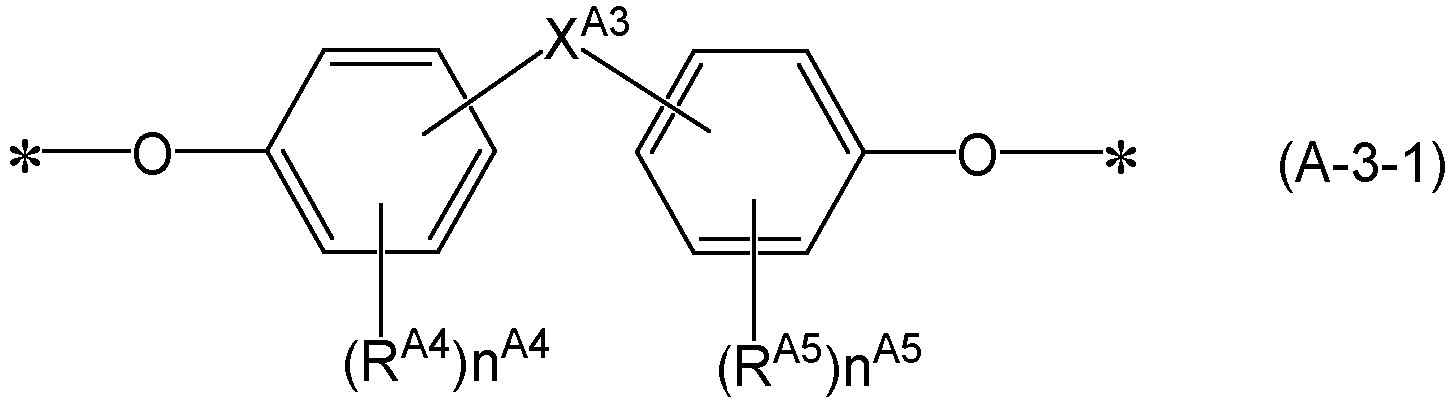
- Examples of the aliphatic hydrocarbon group having 1 to 5 carbon atoms represented by RA4 and RA5 in the general formula (A-3-1) include alkyl groups having 1 to 5 carbon atoms such as a methyl group, an ethyl group, a n-propyl group, an isopropyl group, a n-butyl group, an isobutyl group, a t-butyl group, and a n-pentyl group; alkenyl groups having 2 to 5 carbon atoms; and alkynyl groups having 2 to 5 carbon atoms. The aliphatic hydrocarbon group having 1 to 5 carbon atoms may be either linear or branched. As the aliphatic hydrocarbon group having 1 to 5 carbon atoms, an aliphatic hydrocarbon group having 1 to 3 carbon atoms is preferable, an alkyl group having 1 to 3 carbon atoms is more preferable, and a methyl group is still more preferable.
- Examples of the halogen atom include a fluorine atom, a chlorine atom, a bromine atom, and an iodine atom.
- Examples of the alkylene group having 1 to 5 carbon atoms represented by XA3 in the general formula (A-3-1) include a methylene group, a 1,2-dimethylene group, a 1,3-trimethylene group, a 1,4-tetramethylene group, and a 1,5-pentamethylene group. The alkylene group having 1 to 5 carbon atoms is preferably an alkylene group having 1 to 3 carbon atoms, more preferably an alkylene group having 1 or 2 carbon atoms, and still more preferably a methylene group.
- Examples of the alkylidene group having 2 to 5 carbon atoms represented by XA3 in the general formula (A-3-1) include an ethylidene group, a propylidene group, an isopropylidene group, a butylidene group, an isobutylidene group, a pentylidene group, and an isopentylidene group. Among these, an alkylidene group having 2 to 4 carbon atoms is preferable, an alkylidene group having 2 or 3 carbon atoms is more preferable, and an isopropylidene group is still more preferable.
- nA4 and nA5 in the general formula (A-3-1) are each independently an integer of 0 to 4, and from the viewpoint of easy availability, both of them are preferably an integer of 0 to 2, more preferably 0 or 1, and still more preferably 0.
- When nA4 or nA5 is an integer of 2 or more, a plurality of RA4's or a plurality of RA5's may be the same as or different from each other.
- As XA2 in the general formula (A-3), among the above-described options, an alkylene group having 1 to 5 carbon atoms, an alkylidene group having 2 to 5 carbon atoms, and a divalent organic group represented by the general formula (A-3-1) are preferable, an alkylene group having 1 to 5 carbon atoms is more preferable, and a methylene group is still more preferable.

- In the general formula (A-4), nA6 is preferably an integer of 0 to 5, more preferably an integer of 0 to 4, and still more preferably an integer of 0 to 3, from the viewpoint of easy availability.


- Examples of the aliphatic hydrocarbon group having 1 to 5 carbon atoms represented by RA6 and RA7 in the general formula (A-6) include alkyl groups having 1 to 5 carbon atoms such as a methyl group, an ethyl group, a n-propyl group, an isopropyl group, a n-butyl group, an isobutyl group, a t-butyl group, and a n-pentyl group; alkenyl groups having 2 to 5 carbon atoms; and alkynyl groups having 2 to 5 carbon atoms. The aliphatic hydrocarbon group having 1 to 5 carbon atoms may be either linear or branched.
- In the general formula (A-6), nA8 is an integer of 1 to 8, preferably an integer of 1 to 5, more preferably an integer of 1 to 3, and still more preferably 1. When nA8 is an integer of 2 or more, a plurality of RA6's or a plurality of RA7's may be the same as or different from each other.

- Examples of the alkyl group having 1 to 10 carbon atoms represented by RA8 in the general formula (A-7) include a methyl group, an ethyl group, a propyl group, a butyl group, a pentyl group, a hexyl group, a heptyl group, an octyl group, and a decyl group. These alkyl groups may be either linear or branched.
- Examples of the alkyl groups contained in the alkyloxy group having 1 to 10 carbon atoms and the alkylthio group having 1 to 10 carbon atoms represented by RA8 include the same alkyl groups having 1 to 10 carbon atoms as those described above.
- Examples of the aryl group having 6 to 10 carbon atoms represented by RA8 include a phenyl group and a naphthyl group.
- Examples of the aryl groups contained in the aryloxy group having 6 to 10 carbon atoms and the arylthio group having 6 to 10 carbon atoms represented by RA8 include the same aryl groups having 6 to 10 carbon atoms as those described above.
- Examples of the cycloalkyl group having 3 to 10 carbon atoms represented by RA8 include a cyclopropyl group, a cyclobutyl group, a cyclopentyl group, a cyclohexyl group, a cycloheptyl group, a cyclooctyl group, and a cyclodecyl group.
- In a case where nA9 in the general formula (A-7) is an integer of 1 to 3, from the viewpoint of solvent solubility and reactivity, RA8 is preferably an alkyl group having 1 to 4 carbon atoms, a cycloalkyl group having 3 to 6 carbon atoms, or an aryl group having 6 to 10 carbon atoms, and more preferably an alkyl group having 1 to 4 carbon atoms.
- Examples of the alkyl group having 1 to 10 carbon atoms represented by RA9 to RA11 include a methyl group, an ethyl group, a propyl group, a butyl group, a pentyl group, a hexyl group, a heptyl group, an octyl group, and a decyl group. These alkyl groups may be either linear or branched. Among these, RA9 to RA11 are preferably an alkyl group having 1 to 4 carbon atoms, more preferably a methyl group or an ethyl group, and still more preferably a methyl group.
- In the general formula (A-7), nA9 is an integer of 0 to 3, and when nA9 is 2 or 3, a plurality of RA8's may be the same as or different from each other.
- Among these, the divalent organic group represented by the general formula (A-7) is preferably a divalent organic group in which nA9 is 0 and RA9 to RA11 are each a methyl group, from the viewpoint of compatibility with other resins, solvent solubility, dielectric characteristics, adhesiveness with a conductor, and ease of production.
- In the general formula (A-7), a plurality of RA8's, a plurality of RA12's, a plurality of nA9's, and a plurality of nA10's may be the same as or different from each other, respectively. In addition, in a case where nA11 is greater than 1, a plurality of RA9's, a plurality of RA10's, and a plurality of RA11's may be the same as or different from each other, respectively.
- The description of the alkyl group having 1 to 10 carbon atoms, the alkyloxy group having 1 to 10 carbon atoms, the alkylthio group having 1 to 10 carbon atoms, the aryl group having 6 to 10 carbon atoms, the aryloxy group having 6 to 10 carbon atoms, the arylthio group having 6 to 10 carbon atoms, and the cycloalkyl group having 3 to 10 carbon atoms represented by RA12 in the general formula (A-7) is the same as the description of the alkyl group having 1 to 10 carbon atoms, the alkyloxy group having 1 to 10 carbon atoms, the alkylthio group having 1 to 10 carbon atoms, the aryl group having 6 to 10 carbon atoms, the aryloxy group having 6 to 10 carbon atoms, the arylthio group having 6 to 10 carbon atoms, and the cycloalkyl group having 3 to 10 carbon atoms represented by RA8.
- Among these, from the viewpoint of compatibility with other resins, solvent solubility, dielectric characteristics, adhesiveness with a conductor, and ease of production, RA12 is preferably an alkyl group having 1 to 4 carbon atoms, a cycloalkyl group having 3 to 6 carbon atoms, and an aryl group having 6 to 10 carbon atoms, and more preferably an alkyl group having 1 to 3 carbon atoms.
- In the general formula (A-7), nA10 is an integer of 0 to 4, and from the viewpoint of compatibility with other resins, solvent solubility, dielectric characteristics, adhesiveness with a conductor, and ease of production, nA10 is preferably an integer of 0 to 3, and more preferably 0 or 2.
- When nA10 is one or more, the benzene ring and the N-substituted maleimide group have a twisted conformation, and the intermolecular stacking is suppressed, and thus the solvent solubility tends to be further improved. From the same viewpoint, when nA10 is one or more, the substitution position of RA12 is preferably an ortho-position with respect to the N-substituted maleimide group.
- From the viewpoint of compatibility with other resins, solvent solubility, melt viscosity, handleability, and heat resistance, nA11 in the general formula (A-7) is preferably 0.98 to 8.0, more preferably 1.0 to 7.0, and still more preferably 1.1 to 6.0.
- Preferred examples of the divalent organic group represented by the general formula (A-7) include a divalent organic group represented by the following general formula (A-7-1), a divalent organic group represented by the following general formula (A-7-2), a divalent organic group represented by the following general formula (A-7-3), and a divalent organic group represented by the following general formula (A-7-4).


- Among the maleimide resins represented by the general formula (A-1), a maleimide resin having a divalent organic group represented by the general formula (A-3) is preferable as XA1, and a maleimide resin having a divalent organic group represented by the general formula (A-7) is preferable as XA1.
- Examples of the maleimide resin (AX) include aromatic bismaleimide resins, aromatic polymaleimide resins, and aliphatic maleimide resins, and among these, aromatic bismaleimide resins are preferred.
- Specific examples of the maleimide resin (AX) include N,N'-ethylenebismaleimide, N,N'-hexamethylenebismaleimide, N,N'-(1,3-phenylene)bismaleimide, N,N'-[1,3-(2-methylphenylene)]bismaleimide, N,N'-[1,3-(4-methylphenylene)]bismaleimide, N,N'-(1,4-phenylene)bismaleimide, bis(4-maleimidophenyl)methane, bis(3-methyl-4-maleimidophenyl)methane, 3,3'-dimethyl-5,5'-diethyl-4,4'-diphenylmethanebismaleimide, bis(4-maleimidophenyl)ether, bis(4-maleimidophenyl)sulfone, bis(4-maleimidophenyl)sulfide, bis(4-maleimidophenyl)ketone, bis(4-maleimidocyclohexyl)methane, 1,4-bis(4-maleimidophenyl)cyclohexane, 1,4-bis(maleimidomethyl)cyclohexane, 1,4-bis(maleimidomethyl)benzene, 1,3-bis(4-maleimidophenoxy)benzene, 1,3-bis(3-maleimidophenoxy)benzene, bis[4-(3-maleimidophenoxy)phenyl]methane, bis[4-(4-maleimidophenoxy)phenyl]methane, 1,1-bis[4-(3-maleimidophenoxy)phenyl]ethane, 1,1-bis[4-(4-maleimidophenoxy)phenyl]ethane, 1,2-bis[4-(3-maleimidophenoxy)phenyl]ethane, 1,2-bis[4-(4-maleimidophenoxy)phenyl]ethane, 2,2-bis[4-(3-maleimidophenoxy)phenyl]propane, 2,2-bis[4-(4-maleimidophenoxy)phenyl]propane, 2,2-bis[4-(3-maleimidophenoxy)phenyl]butane, 2,2-bis[4-(4-maleimidophenoxy)phenyl]butane, 2,2-bis[4-(3-maleimidophenoxy)phenyl]-1,1,1,3,3,3-hexafluoropropane, 2,2-bis[4-(4-maleimidophenoxy)phenyl]-1,1,1,3,3,3-hexafluoropropane, 4,4-bis(3-maleimidophenoxy)biphenyl, 4,4-bis(4-maleimidophenoxy)biphenyl, bis[4-(3-maleimidophenoxy)phenyl]ketone, bis[4-(4-maleimidophenoxy)phenyl]ketone, bis(4-maleimidophenyl)disulfide, bis[4-(3-maleimidophenoxy)phenyl]sulfide, bis[4-(4-maleimidophenoxy)phenyl]sulfide, bis[4-(3-maleimidophenoxy)phenyl]sulfoxide, bis[4-(4-maleimidophenoxy)phenyl]sulfoxide, bis[4-(3-maleimidophenoxy)phenyl]sulfone, bis[4-(4-maleimidophenoxy)phenyl]sulfone, bis[4-(3-maleimidophenoxy)phenyl]ether, bis[4-(4-maleimidophenoxy)phenyl]ether, 1,4-bis[4-(4-maleimidophenoxy)-α,α-dimethylbenzyl]benzene, 1,3-bis[4-(4-maleimidophenoxy)-α,α-dimethylbenzyl]benzene, 1,4-bis[4-(3-maleimidophenoxy)-α,α-dimethylbenzyl]benzene, 1,3-bis[4-(3-maleimidophenoxy)-α,α-dimethylbenzyl]benzene, 1,4-bis[4-(4-maleimidophenoxy)-3,5-dimethyl-α,α-dimethylbenzyl]benzene, 1,3-bis[4-(4-maleimidophenoxy)-3,5-dimethyl-α,α-dimethylbenzyl]benzene, 1,4-bis[4-(3-maleimidophenoxy)-3,5-dimethyl-α,α-dimethylbenzyl]benzene, 1,3-bis[4-(3-maleimidophenoxy)-3,5-dimethyl-α,α-dimethylbenzyl]benzene, polyphenylmethane maleimide, an aromatic bismaleimide resin having an indane skeleton, and a biphenyl aralkyl type maleimide resin. Among these, bis(4-maleimidophenyl)methane and an aromatic bismaleimide resin having an indane skeleton are preferable.
- As the maleimide resin derivative (AY), an aminomaleimide resin containing a structural unit derived from the above-described maleimide resin (AX) and a structural unit derived from a diamine compound is preferable.
- Examples of the structural unit derived from the maleimide resin (AX) contained in the aminomaleimide resin include a structural unit in which at least one N-substituted maleimide group in the N-substituted maleimide group of the maleimide resin (AX) is subjected to a Michael addition reaction with an amino group of the diamine compound.
- The structural unit derived from the maleimide resin (AX) contained in the aminomaleimide resin may be one type alone or may be two or more types thereof.
- Examples of the structural unit derived from a diamine compound contained in the aminomaleimide resin include a structural unit in which one or both of the amino groups among two amino groups of a diamine compound are subjected to a Michael addition reaction with an N-substituted maleimide group of the maleimide resin (AX).
- The structural unit derived from a diamine compound contained in the aminomaleimide resin may be one type alone or may be two or more types thereof.
- Examples of the diamine compound include aromatic diamine compounds such as 4,4'-diaminodiphenylmethane, 3,3'-dimethyl-4,4'-diaminodiphenylmethane, 3,3'-diethyl-4,4'-diaminodiphenylmethane, 4,4'-diaminodiphenylether, 4,4'-diaminodiphenylsulfone, 3,3'-diaminodiphenylsulfone, 4,4'-diaminodiphenylketone, 4,4'-diaminobiphenyl, 3,3'-dimethyl-4,4'-diaminobiphenyl, 2,2'-dimethyl-4,4'-diaminobiphenyl, 3,3'-dihydroxybenzidine, 2,2-bis(3-amino-4-hydroxyphenyl)propane, 3,3'-dimethyl-5,5'-diethyl-4,4'-diaminodiphenylmethane, 2,2-bis(4-aminophenyl)propane, 2,2-bis[4-(4-aminophenoxy)phenyl]propane, 1,3-bis(3-aminophenoxy)benzene, 1,3-bis(4-aminophenoxy)benzene, 1,4-bis(4-aminophenoxy)benzene, 4,4'-bis(4-aminophenoxy)biphenyl, 1,3-bis[1-[4-(4-aminophenoxy)phenyl]-1-methylethyl]benzene, 1,4-bis[1-[4-(4-aminophenoxy)phenyl]-1-methylethyl]benzene, 4,4'-[1,3-phenylenebis(1-methylethylidene)]bisaniline, 4,4'-[1,4-phenylenebis(1-methylethylidene)]bisaniline, 3,3'-[1,3-phenylenebis(1-methylethylidene)]bisaniline, bis[4-(4-aminophenoxy)phenyl]sulfone, bis[4-(3-aminophenoxy)phenyl]sulfone, and 9,9-bis(4-aminophenyl)fluorene; and silicone compounds having two primary amino groups.
- In the present description, the "aromatic diamine compound" means a compound having two amino groups directly bonded to an aromatic ring.
- The content of the maleimide-based resin (A) in the resin composition of the present embodiment is not particularly limited, and is preferably 10 to 90 mass%, more preferably 15 to 85 mass%, and still more preferably 20 to 80 mass% with respect to the total amount (100 mass%) of the resin components in the resin composition of the present embodiment.
- When the content of the maleimide-based resin (A) is the lower limit value or more, the heat resistance, moldability, processability, and adhesion to conductors tends to be more easily improved. On the other hand, when the content of the maleimide-based resin (A) is the upper limit value or less, the dielectric characteristics tend to be more easily improved.
- Here, in the present description, the "resin component" means a resin and a compound which forms a resin by a curing reaction.
- For example, in the resin composition of the present embodiment, the component (A) and the component (B) correspond to resin components.
- In a case where the resin composition of the present embodiment contains, as an optional component, a resin or a compound that forms a resin by a curing reaction in addition to the above-described components, these optional components are also included in the resin component.
- (B) The compound having a vinyl benzyl group (hereinafter, also referred to as "vinyl benzyl compound (B)") contains one or more selected from the group consisting of (B1) a compound having three or more vinyl benzyl groups bonded to an oxygen atom and (B2) a compound having one or more vinyl benzyl groups bonded to a carbon atom.
- The vinyl group which is a reactive group contained in the vinyl benzyl compound (B) has a lower polarity than the N-substituted maleimide group contained in the component (A). Therefore, the resin composition of the present embodiment containing the vinyl benzyl compound (B) can develop excellent dielectric characteristics.
- The component (B) may be used alone or may be used in combination of two or more kinds thereof.
- The vinyl benzyl group contained in the component (B) may be any of an o-vinylbenzyl group, an m-vinylbenzyl group or a p-vinylbenzyl group, and is preferably a p-vinylbenzyl group from the viewpoint of the dielectric characteristics.
- The content of the p-vinyl benzyl group in all vinyl benzyl groups contained in the component (B) is not particularly limited, and is preferably 10 to 100 mass%, more preferably 15 to 95 mass%, still more preferably 20 to 90 mass%, and particularly preferably 25 to 85 mass% from the viewpoint of a low dielectric dissipation factor.
- The component (B1) is not particularly limited as long as it is a compound having three or more vinyl benzyl groups directly bonded to an oxygen atom.
- The resin composition of the present embodiment contains the component (B1) as the component (B), whereby excellent dielectric characteristics can be obtained, and it is possible to improve the curability.
- The number of the vinyl benzyl groups bonded to an oxygen atom in one molecule of the component (B1) is 3 or more, preferably 50 or less, and more preferably 30 or less from the viewpoint of solvent solubility.
- The weight-average molecular weight (Mw) of the component (B1) is not particularly limited, and is preferably 300 to 50,000, more preferably 500 to 30,000, and still more preferably 1,000 to 10,000 from the viewpoint of moldability and handleability.
- The component (B) contains the component (B1), and the component (B1) is preferably a compound having a structural unit represented by the following general formula (B1-1) from the viewpoint of curability, moldability, and handleability.
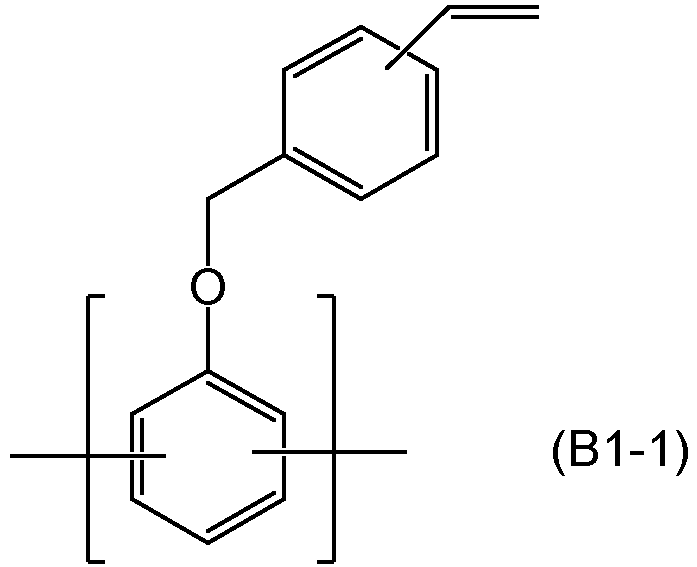
- The vinyl benzyl groups bonded to an oxygen atom of the component (B1) are all preferably included in the structural unit represented by the general formula (B1-1).
- The component (B1) containing the structural unit represented by the general formula (B1-1) is preferably a compound represented by the following general formula (B1-2).

- Examples of the divalent hydrocarbon group represented by XB1 in the general formula (B1-2) include an alkylene group having 1 to 5 carbon atoms, an alkylidene group having 2 to 5 carbon atoms, a divalent alicyclic hydrocarbon group having 5 to 12 carbon atoms, an arylene group having 6 to 12 carbon atoms, and a divalent group formed by combining these groups.
- Examples of the alkylene group having 1 to 5 carbon atoms include a methylene group, a 1,2-dimethylene group, a 1,3-trimethylene group, a 1,4-tetramethylene group, and a 1,5-pentamethylene group.
- Examples of the alkylidene group having 2 to 5 carbon atoms include an ethylidene group, a propylidene group, an isopropylidene group, a butylidene group, an isobutylidene group, a pentylidene group, and an isopentylidene group.
- Examples of the divalent alicyclic hydrocarbon group having 5 to 12 carbon atoms include divalent group formed by losing two hydrogen atoms bonded to two different carbon atoms from an alicyclic hydrocarbon compound such as norbornane, decalin, bicycloundecane, or saturated dicyclopentadiene.
- Examples of the arylene group having 6 to 12 carbon atoms include a phenylene group, a naphthylene group, and a biphenylene group.
- XB1 is preferably a group obtained by combining an alkylene group having 1 to 5 carbon atoms and an arylene group having 6 to 12 carbon atoms, and more preferably a divalent group represented by the following general formula (B1-2-1).
*-XB2-ArB1-XB2-* (B1-2-1)
(In the formula, XB2's are each independently an alkylene group having 1 to 5 carbon atoms, ArB1 is an arylene group having 6 to 12 carbon atoms; and * represents a bonding site.) - The alkylene group having 1 to 5 carbon atoms represented by XB2 is preferably a methylene group among those listed above.
- The arylene group having 6 to 12 carbon atoms represented by ArB1 is preferably a phenylene group or a biphenylene group among those listed above. In addition, the phenylene group is preferably a 1,4-phenylene group, and the biphenylene group is preferably a 4,4' - biphenylene group.
- nB1 in the general formula (B1-2) is an integer of 1 to 50, preferably an integer of 1 to 30, and more preferably an integer of 1 to 20.
- The component (B2) is not particularly limited as long as it is a compound having one or more vinyl benzyl groups directly bonded to a carbon atom.
- The resin composition of the present embodiment contains the component (B2) as the component (B), whereby particularly excellent dielectric characteristics can be obtained.
- The number of the vinyl benzyl groups bonded to a carbon atom in one molecule of the component (B2) may be 1 or more, preferably 2 to 4, and more preferably 2 or 3.
- The weight-average molecular weight (Mw) of the component (B2) is not particularly limited, and is preferably 200 to 800, more preferably 250 to 750, and still more preferably 300 to 700 from the viewpoint of moldability and handleability.
- The component (B) preferably contains the component (B2), and the component (B2) is preferably a compound having a condensed polycyclic structure containing an aromatic ring and a non-aromatic ring.
- Examples of the condensed polycyclic structure containing an aromatic ring and a non-aromatic ring in the component (B2) include a fluorene ring, an indene ring, an indane ring, a phenanthrene ring, and an acenaphthylene ring. Among these, from the viewpoint of dielectric characteristics, a fluorene ring and an indene ring are preferable.
- The component (B2) having a fluorene ring is preferably a compound represented by the following general formula (B2-1) from the viewpoint of dielectric characteristics.

- Examples of the alkylene group having 1 to 10 carbon atoms represented by XB3 in the general formula (B2-1) include a methylene group, a 1,2-dimethylene group, a 1,3-trimethylene group, a 1,4-tetramethylene group, a 1,5-pentamethylene group, and a 1,6-hexamethylene group.
- The component (B2) having an indene ring is preferably a compound represented by the following general formula (B2-2) from the viewpoint of dielectric characteristics.

- The compound represented by the general formula (B2-2) may be any of a compound having one vinyl benzyl group, a compound having two vinyl benzyl groups, and a compound having three vinyl benzyl groups or may be a mixture thereof. In the case of a mixture, the average number of the vinyl benzyl groups in one molecule of the compound represented by the general formula (B2-2) is preferably from 1.4 to 2.8, more preferably from 1.6 to 2.7, and still more preferably from 1.8 to 2.6.
- As the component (B), a commercially available product may be used, or a component synthesized by a known method may be used.
- Examples of a method for synthesizing the component (B) include a method in which a base compound for introducing a vinyl benzyl group and styrene having a halogenated methyl group are reacted in the presence of a basic compound. Examples of the base compound include a compound having a phenolic hydroxy group; and a compound having a condensed polycyclic structure containing an aromatic ring such as fluorene, indene, indane, phenanthrene, or acenaphthylene, and a non-aromatic ring.
- Examples of the styrene having a halogenated methyl group include o-chloromethylstyrene, m-chloromethylstyrene, p-chloromethylstyrene, and mixtures thereof.
- Examples of the basic compound include alkali metal hydroxides and alkali metal alkoxides.
- During the above reaction, a phase transfer catalyst may be used. Examples of the phase transfer catalyst include tetrabutylammonium bromide.
- The reaction is preferably performed under heating and stirring, and the obtained product may be purified as necessary by a known method such as condensation, reprecipitation, or washing.
- The total content of one or more selected from the group consisting of the component (B1) and the component (B2) in the component (B) is not particularly limited, and is preferably 80 to 100 mass%, more preferably 90 to 100 mass%, and still more preferably 95 to 100 mass% based on the total amount of the component (B) from the viewpoint of dielectric characteristics.
- The content of the vinyl benzyl compound (B) in the resin composition of the present embodiment is not particularly limited, and is preferably 10 to 90 mass%, more preferably 15 to 85 mass%, and still more preferably 20 to 80 mass% with respect to the total amount (100 mass%) of the resin components in the resin composition of the present embodiment.
- When the content of the vinyl benzyl compound (B) is the lower limit value or more, the dielectric characteristics tend to be more easily improved. In addition, when the content of the vinyl benzyl compound (B) is the upper limit value or less, the conductor adhesiveness tends to be more easily improved.
- The content ratio [N-substituted maleimide group/vinyl group] of the N-substituted maleimide group derived from the component (A) to a vinyl group derived from the component (B) in the resin composition of the present embodiment is not particularly limited, and is preferably from 0.05 to 5, more preferably from 0.10 to 3, and still more preferably from 0.15 to 1.2 on a molar basis from the viewpoints of dielectric characteristics, curability, moldability, and adhesion to conductors. In addition, the content ratio [N-substituted maleimide group/vinyl group] may be 1.0 or less, 0.6 or less, 0.4 or less, or 0.3 or less on a molar basis from the viewpoint of dielectric characteristics.
- The resin composition of the present embodiment may or may not contain other components other than each of the above-described components as necessary.
- Examples of the other components include an elastomer, an inorganic filler, a curing accelerator, an organic solvent, and other additives.
- Each of these other components may be used alone, or two or more kinds may be used in combination.
- Examples of the elastomer include styrene elastomers, olefin elastomers, urethane elastomers, polyester elastomers, polyamide elastomers, acrylic elastomers, silicone elastomers, and derivatives thereof.
- Examples of the inorganic filler include silica, alumina, titanium oxide, mica, beryllia, barium titanate, potassium titanate, strontium titanate, calcium titanate, aluminum carbonate, magnesium hydroxide, aluminum hydroxide, aluminum silicate, calcium carbonate, calcium silicate, magnesium silicate, silicon nitride, boron nitride, clay, talc, aluminum borate, and silicon carbide.
- Examples of the curing accelerator include acidic catalysts such as p-toluenesulfonic acid; amine compounds such as triethylamine, pyridine, and tributylamine; imidazole compounds such as methylimidazole and phenylimidazole; isocyanate-masked imidazole compounds such as an addition reaction product of hexamethylene diisocyanate resin and 2-ethyl-4-methylimidazole; tertiary amine compounds; quaternary ammonium compounds; phosphorus-based compounds such as triphenylphosphine; organic peroxides such as dicumyl peroxide, 2,5-dimethyl-2,5-bis(t-butylperoxy)hexyne-3,2,5-dimethyl-2,5-bis(t-butylperoxy)hexane, t-butylperoxyisopropyl monocarbonate, and α,α'-bis(t-butylperoxy)diisopropylbenzene; and carboxylates of manganese, cobalt, and zinc.
- Examples of the organic solvent include alcohol-based solvents such as ethanol, propanol, butanol, methyl cellosolve, butyl cellosolve, and propylene glycol monomethyl ether; ketone-based solvents such as acetone, methyl ethyl ketone, methyl isobutyl ketone, and cyclohexanone; ether-based solvents such as tetrahydrofuran; aromatic hydrocarbon-based solvents such as toluene, xylene, and mesitylene; nitrogen atom-containing solvents such as dimethylformamide, dimethylacetamide, and N-methylpyrrolidone; sulfur atom-containing solvents such as dimethyl sulfoxide; and ester-based solvents such as γ-butyrolactone.
- Examples of other additives include a flame retardant, an antioxidant, a thermal stabilizer, an antistatic agent, an ultraviolet absorbent, a pigment, a colorant, and a lubricant.
- The resin composition of the present embodiment can be produced by mixing the component (A), the component (B), other components used in combination as necessary by a known method. In this case, the respective components may be dissolved or dispersed while stirring. Conditions such as a mixing order, a temperature, and a time are not particularly limited, and may be arbitrarily set according to the type or the like of raw material.
- The relative permittivity (Dk) at 10 GHz of the cured product of the resin composition of the present embodiment is not particularly limited, and is preferably 3.0 or less, more preferably 2.8 or less, and still more preferably 2.7 or less. The relative permittivity (Dk) is preferably as small as possible, and the lower limit value thereof is not particularly limited, and may be, for example, 2.3 or more, or 2.4 or more, in consideration of the balance with other physical properties.
- The relative permittivity (Dk) is a value in accordance with a cavity resonator perturbation method, and more specifically, a value measured by a method described in Examples.
- The dielectric dissipation factor (Df) at 10 GHz of the cured product of the resin composition of the present embodiment is not particularly limited, and is preferably 0.0080 or less, more preferably 0.0070 or less, and still more preferably 0.0060 or less. The dielectric dissipation factor (Df) is preferably as small as possible, and the lower limit value thereof is not particularly limited, and may be, for example, 0.0010 or more, or 0.0015 or more, in consideration of the balance with other physical properties.
- The dielectric dissipation factor (Df) is a value in accordance with a cavity resonator perturbation method, and more specifically, a value measured by a method described in Examples.
- The prepreg of the present embodiment is a prepreg containing the resin composition of the present embodiment or a semi-cured product of the resin composition.
- The prepreg of the present embodiment contains, for example, the resin composition of the present embodiment or a semi-cured product of the resin composition and a sheet-shaped fiber base material.
- As the sheet-shaped fiber base material contained in the prepreg of the present embodiment, for example, known sheet-shaped fiber base materials used in various laminates for electrical insulating materials can be used.
- Examples of the material of the sheet-shaped fiber base material include inorganic fibers such as E glass, D glass, S glass, and Q glass; organic fibers such as polyimide, polyester, and tetrafluoroethylene; and mixtures thereof. These sheet-shaped fiber base materials have a shape of, for example, a woven fabric, a nonwoven fabric, a roving, a chopped strand mat, or a surfacing mat.
- The prepreg of the present embodiment can be produced by, for example, impregnating or coating the resin composition of the present embodiment into a sheet-shaped fiber base material and then heating and drying the impregnated or coated resin composition to make it B-stage.
- The temperature and time of the heating and drying are not particularly limited, and from the viewpoint of productivity and appropriate B-staging of the resin composition of the present embodiment, for example, the temperature and time can be set to 50 to 200°C and 1 to 30 minutes.
- The solid content concentration derived from the resin composition in the prepreg of the present embodiment is not particularly limited, and from the viewpoint of easily obtaining better moldability when a laminate is formed, the solid content concentration is preferably 20 to 90 mass%, more preferably 25 to 80 mass%, and still more preferably 30 to 75 mass%.
- The resin film of the present embodiment is a resin film containing the resin composition of the present embodiment or a semi-cured product of the resin composition.
- The resin film of the present embodiment can be produced, for example, by coating the resin composition of the present embodiment containing an organic solvent, that is, a resin varnish, on a support and then heating and drying the coating.
- Examples of the support include a plastic film, a metal foil, and a release paper.
- The temperature and time of the heating and drying are not particularly limited, and from the viewpoint of productivity and appropriate B-staging of the resin composition of the present embodiment, the temperature and time can be set to 50 to 200°C and 1 to 30 minutes.
- The resin film of the present embodiment is preferably used for forming an insulating layer in the case of producing a printed wiring board.
- The laminate of the present embodiment is a laminate having a cured product of the resin composition of the present embodiment, and a metal foil.
- A laminate having a metal foil is sometimes referred to as a metal-clad laminate.
- The metal of the metal foil is not particularly limited, and examples thereof include copper, gold, silver, nickel, platinum, molybdenum, ruthenium, aluminum, tungsten, iron, titanium, chromium, and an alloy containing one or more kinds of these metal elements.
- The laminate of the present embodiment can be produced, for example, by disposing a metal foil on one surface or both surfaces of the prepreg of the present embodiment, and then subjecting the prepreg to heating and press molding.
- Usually, the B-staged prepreg is cured by this heating and press molding to obtain the laminate of the present embodiment.
- When the heating and press molding is performed, only one prepreg may be used, or two or more prepregs may be laminated.
- For the heating and press molding, for example, a multi-stage press, a multi-stage vacuum press, a continuous molding, or an autoclave molding machine can be used.
- The conditions of the heating and press molding are not particularly limited, and the temperature may be 100 to 300°C, the time may be 10 to 300 minutes, and the pressure may be 1.5 to 5 MPa, for example.
- The printed wiring board of the present embodiment is a printed wiring board having a cured product of the resin composition of the present embodiment.
- The printed wiring board of the present embodiment can be produced, for example, by performing conductor circuit formation by a known method on one or more kinds of materials selected from the group consisting of a cured product of the prepreg of the present embodiment, a cured product and a laminate of the resin film of the present embodiment. In addition, a multilayer printed wiring board can also be produced by further performing a multilayer adhesion process as necessary. The conductor circuit can be formed by, for example, appropriately performing a drilling process, a metal plating process, or etching of a metal foil.
- A semiconductor package of a first aspect of the present embodiment is a semiconductor package having the printed wiring board of the present embodiment and a semiconductor element.
- The semiconductor package of the first aspect of the present embodiment can be produced, for example, by mounting a semiconductor element and a memory on the printed wiring board of the present embodiment by a known method.
- A semiconductor package of a second aspect of the present embodiment is a semiconductor package including a semiconductor element and a cured product of the resin composition of the present embodiment for sealing the semiconductor element.
- The semiconductor package of the second aspect of the present embodiment can be produced by, for example, a method in which at least a part of a semiconductor element mounted on a printed wiring board is covered with the resin composition of the present embodiment and the resin composition is cured.
- Hereinafter, the present embodiment will be specifically described with reference to Examples. However, the present embodiment is not limited to the following Examples.
- In each example, the weight-average molecular weight (Mw) and the number-average molecular weight (Mn) were measured by the following procedure.
- The weight-average molecular weight (Mw) and the number-average molecular weight (Mn) were converted from a calibration curve using standard polystyrene by gel permeation chromatography (GPC). The calibration curve was approximated by a cubic equation using standard polystyrene: TSK standard POLYSTYRENE (Type; A-2500, A-5000, F-20, F-80) [manufactured by Tosoh Corporation, trade name]. The measurement conditions of GPC are shown below.
- Apparatus: High-speed GPC apparatus HLC-8320GPC
- Detector: Ultraviolet absorption detector UV-8320 [manufactured by Tosoh Corporation]
- Column: Guard column; TSKgel guard column Super(HZ)-M + Column; TSKgel SuperMultipore HZ-M (two columns); reference column; TSKgel SuperH-RC (two columns) (all manufactured by Tosoh Corporation, trade names)
- Column size: 4.6 × 20 mm (guard column), 4.6 × 150 mm (column), 6.0 × 150 mm (reference column)
- Eluent: Tetrahydrofuran
- Sample concentration: 10 mg/1 mL
- Injection volume: 20 µL or 2 µL
- Flow rate: 0.35 mL/min
- Measurement temperature: 40°C
- A 500 mL-volume reaction vessel equipped with a stirrer, a thermometer, a reflux tube, and an air pump was charged with a base compound, a chloromethylstyrene, a phase transfer catalyst, pure water, a polymerization inhibitor, and a solvent at amounts shown in Table 1, and heated and stirred at 40°C while blowing an air at a flow rate of 50 ml/min.
- Next, while maintaining the temperature at 70°C, an amount, which is shown in Table 1, of a basic compound was added dropwise over 20 minutes, and furthermore, stirred at 70°C for 4 hours. During a reaction, the blowing of an air was continued. A reaction product was cooled to room temperature (25°C) and neutralized with a 10% hydrochloric acid aqueous solution, and an organic layer was then washed with pure water three times. Thereafter, the organic layer was precipitated in methanol to obtain target vinyl benzyl compounds 1 to 3. It was confirmed by infrared absorption (IR) spectrum analysis that the vinyl benzyl compounds 1 to 3 had a structure in which phenolic hydroxy groups contained in the base compound were substantially all substituted with vinyl benzyl ether groups and corresponded to a component (B1).
- A 500 mL-volume reaction vessel equipped with a stirrer, a thermometer, a reflux tube, and a nitrogen port was charged with a base compound, a chloromethylstyrene, a phase transfer catalyst, a polymerization inhibitor, and a solvent at amounts shown in Table 1, and heated and stirred at 40°C while blowing nitrogen at a flow rate of 50 ml/min.
- Next, an amount, which is shown in Table 1, of a basic compound was added dropwise over 20 minutes, and furthermore, stirred at 60°C for 9 hours. During a reaction, the blowing of nitrogen was continued. A reaction product was cooled to room temperature (25°C), neutralized with a 10% hydrochloric acid aqueous solution, and then washed with pure water twice, toluene was distilled off under reduced pressure, and the obtained viscous liquid was then washed with methanol and then dried in a vacuum, thereby obtaining vinyl benzyl compounds 4 and 5. It was confirmed by 1H-NMR analysis that the vinyl benzyl compounds 4 and 5 had a structure in which two hydrogen atoms directly bonded to the carbon atom at the first position of indene represented by the following formula (B2-3) were substantially all substituted with vinyl benzyl groups and corresponded to a component (B2). In addition, GPC analysis showed that the vinyl benzyl compounds 4 and 5 were mixtures of a compound into which two vinyl benzyl groups had been introduced and a compound into which three vinyl benzyl groups had been introduced.

- The weight-average molecular weights (Mw) of the vinyl benzyl compounds 1 to 5 are shown in Table 1.

- The details of the compounds shown in Table 1 are as follows.
-
- · J-DPP-115: Phenol resin having a dicyclopentadiene skeleton, manufactured by JFE Chemical Corporation, hydroxy group equivalent amount: 177 to 182 g/eq
- · MEHC-7851SS: Biphenyl aralkyl type phenol resin, manufactured by Meiwa Plastic Industries, Ltd., weight-average molecular weight (Mw): 1,000, number-average molecular weight (Mn): 700, hydroxy group equivalent amount 201 to 220 g/eq
- · MEHC-7851M: Biphenyl aralkyl type phenol resin, manufactured by Meiwa Plastic Industries, Ltd., weight-average molecular weight (Mw): 1,500, number-average molecular weight (Mn): 900, hydroxy group equivalent amount 201 to 220 g/eq
-
- · CMS: Manufactured by Changzhou Wujin Linchuan Chemical Co., Ltd., a mixture of an o-isomer and a p-isomer, o-isomer content: 17 mass%, p-isomer content: 83 mass%
- · CMS-P: Manufactured by AGC Seimi Chemical Co., Ltd., a mixture of an m-isomer and a p-isomer, m-isomer content: 50 mass%, p-isomer content: 50 mass%
-
- · Tetrabutylphosphonium bromide: Manufactured by Kanto Chemical Co., Inc.
- · Tetra-n-butylammonium bromide: Manufactured by Kanto Chemical Co., Inc.
-
- · Sodium hydroxide: Manufactured by Kanto Chemical Co., Inc., an aqueous solution having a concentration of 48 mass%
- Each component shown in Table 2 was mixed in a powder state or blended together with toluene and methyl ethyl ketone in accordance with the blending amount shown in Table 2, stirred and mixed at 25°C to prepare resin compositions having a solid content concentration of about 60 mass%. In Table 2, the unit of the blending amount of each component is parts by mass, and in the case of a solution, the unit means parts by mass in terms of solid content.
- The resin composition obtained in each example was applied to a PET film (manufactured by Teijin Limited. trade name: G2000) having a thickness of 38 µm, and then heated and dried at 140°C for 5 minutes, thereby preparing a resin film in a B-stage state. This resin film was peeled off from the PET film and then pulverized, thereby obtaining a resin powder. Next, the above-described resin powder was injected into a Teflon (registered trademark) sheet that had been die-cut into size of 1 mm in thickness, 50 mm in length, and 30 mm in width, and 18 µm-thick low profile copper foils (manufactured by Mitsui Mining & Smelting Co., Ltd., trade name: SI-VSP) were disposed above and below the Teflon sheet in a state in which the S surface contacts with the injected resin powder. Subsequently, the resin composition was cured by heating and press molding the laminate in a vacuum under the conditions of a temperature of 150°C, a pressure of 1.5 to 2.0 MPa, and a time of 120 minutes and further heating and molding the laminate under the conditions of a temperature of 180°C and a time of 300 minutes. Thereafter, the copper foils on both sides were peeled off, thereby obtaining a resin plate (resin plate thickness: 1 mm).
- Using the resin plates obtained in the examples and the comparative examples, each measurement and evaluation were performed according to the following methods. The results are shown in Table 2.
- The appearance of the resin plate obtained in each example was visually confirmed and evaluated according to the following criteria.
- A: There are no voids on the surface of the resin plate, and cutting is possible.
- C: There is a void on the surface of the resin plate, and cutting is impossible.
- A 1 mm × 50 mm test piece was prepared by cutting the resin plate obtained in each example. Next, the relative permittivity (Dk) and the dielectric dissipation factor (Df) of the test piece were measured in a 10 GHz band at an atmospheric temperature of 25°C in accordance with the cavity resonator perturbation method. The resin composition of Comparative Example 1 had poor moldability and did not make it possible to prepare a test piece for measuring the relative permittivity (Dk) and the dielectric dissipation factor (Df), and the relative permittivity and the dielectric dissipation factor were regarded as "not measurable".


- Each material shown in Table 2 is as follows.
- [Component (A)]
- · maleimide resin 1: Bis(4-maleimidophenyl)methane
- · maleimide resin 2: Aromatic bismaleimide resin having an indane ring
- [Component (B)]
- . Vinyl benzyl compounds 1 to 5: Vinyl benzyl compounds 1 to 5 obtained in Production Examples 1 to 5
- From the results shown in Table 2, it can be seen that all of the resin compositions of Examples 1 to 6 of the present embodiment have a low relative permittivity (Dk) and a low dielectric dissipation factor (Df), and have excellent dielectric characteristics while having good moldability.
- On the other hand, the resin composition of Comparative Example 1 containing no component (B) had poor moldability. In addition, the resin composition of Comparative Example 2 containing no component (B) had poor dielectric characteristics.
- In particular, when Examples 2 to 6 and Comparative Example 2, in which the same component (A) was used, are compared, it can be seen that the dielectric dissipation factor (Df) has significantly reduced in the resin compositions of Examples 2 to 6 than in the resin composition of Comparative Example 2, and the reduction amount thereof is so remarkable that it exceeds a range predicted from the blending amount of the component (B).
- Since the resin composition of the present embodiment has excellent dielectric characteristics, a prepreg, a laminate, a printed wiring board, and a semiconductor package obtained using the resin composition are particularly suitable for electronic components handling high-frequency signals.
Claims (12)
- A resin composition comprising:(A) one or more selected from the group consisting of a maleimide resin having one or more N-substituted maleimide groups and a derivative of the maleimide resin; and(B) a compound having a vinyl benzyl group,wherein the component (B) contains one or more selected from the group consisting of (B1) a compound having 3 or more vinyl benzyl groups bonded to an oxygen atom and (B2) a compound having one or more vinyl benzyl groups bonded to a carbon atom.
- The resin composition according to claim 1, wherein the component (B) contains the component (B1), and
the component (B1) is a compound having a structural unit represented by the following general formula (B-1):
- The resin composition according to claim 1, wherein the component (B) contains the component (B2), and
the component (B2) is a compound having a condensed polycyclic structure containing an aromatic ring and a non-aromatic ring. - The resin composition according to claim 3, wherein the condensed polycyclic structure containing an aromatic ring and a non-aromatic ring is an indene ring.
- The resin composition according to any one of claims 1 to 4, wherein the component (A) is an aromatic bismaleimide resin having two N-substituted maleimide groups.
- The resin composition according to any one of claims 1 to 4, wherein a content ratio [N-substituted maleimide group/vinyl group] of the N-substituted maleimide group derived from the component (A) to a vinyl group derived from the component (B) is 0.05 to 5 on a molar basis.
- A prepreg comprising:
the resin composition according to any one of claims 1 to 4 or a semi-cured product of the resin composition. - A laminate comprising:a cured product of the resin composition according to any one of claims 1 to 4; anda metal foil.
- A resin film comprising:
the resin composition according to any one of claims 1 to 4 or a semi-cured product of the resin composition. - A printed wiring board comprising:
a cured product of the resin composition according to any one of claims 1 to 4. - A semiconductor package comprising:the printed wiring board according to claim 10; anda semiconductor element.
- A semiconductor package comprising:a semiconductor element; anda cured product of the resin composition according to any one of claims 1 to 4 that seals the semiconductor element.
Applications Claiming Priority (2)
| Application Number | Priority Date | Filing Date | Title |
|---|---|---|---|
| JP2022082081 | 2022-05-19 | ||
| PCT/JP2023/018197 WO2023224021A1 (en) | 2022-05-19 | 2023-05-16 | Resin composition, prepreg, laminate, resin film, printed wiring board and semiconductor package |
Publications (2)
| Publication Number | Publication Date |
|---|---|
| EP4527860A1 true EP4527860A1 (en) | 2025-03-26 |
| EP4527860A4 EP4527860A4 (en) | 2025-08-20 |
Family
ID=88835526
Family Applications (1)
| Application Number | Title | Priority Date | Filing Date |
|---|---|---|---|
| EP23807623.6A Pending EP4527860A4 (en) | 2022-05-19 | 2023-05-16 | RESIN COMPOSITION, PREPREG, LAMINATE, RESIN FILM, CIRCUIT BOARD AND SEMICONDUCTOR HOUSING |
Country Status (7)
| Country | Link |
|---|---|
| US (1) | US20250326929A1 (en) |
| EP (1) | EP4527860A4 (en) |
| JP (1) | JPWO2023224021A1 (en) |
| KR (1) | KR20250009960A (en) |
| CN (1) | CN119137167A (en) |
| TW (1) | TW202407038A (en) |
| WO (1) | WO2023224021A1 (en) |
Families Citing this family (3)
| Publication number | Priority date | Publication date | Assignee | Title |
|---|---|---|---|---|
| WO2025197853A1 (en) * | 2024-03-22 | 2025-09-25 | 日本化薬株式会社 | Curable resin, curable resin composition, varnish, and cured product of same |
| WO2025262918A1 (en) * | 2024-06-21 | 2025-12-26 | 株式会社レゾナック | Arylalkyl-modified indene composition, curable resin material, prepreg, resin film, metal-clad laminate, printed wiring board, and semiconductor package |
| WO2026028262A1 (en) * | 2024-07-29 | 2026-02-05 | 株式会社レゾナック | Curable composition for sealing member, and sealing member |
Family Cites Families (13)
| Publication number | Priority date | Publication date | Assignee | Title |
|---|---|---|---|---|
| JPH0710902B2 (en) * | 1987-09-04 | 1995-02-08 | 昭和高分子株式会社 | Curable resin composition |
| JP4585505B2 (en) * | 2001-04-09 | 2010-11-24 | 昭和電工株式会社 | Curable polyvinylbenzyl compound and method for producing the same |
| US7514379B2 (en) * | 2001-04-09 | 2009-04-07 | Showa Highpolymer Co., Ltd. | Curable polyvinyl benzyl compound and process for producing the same |
| JP2003306591A (en) * | 2002-02-13 | 2003-10-31 | Showa Highpolymer Co Ltd | Curable resin composition and interlayer insulation material using the same |
| JP3615742B2 (en) * | 2002-03-25 | 2005-02-02 | 昭和高分子株式会社 | Curable vinylbenzyl compound and method for producing the same |
| JP3681170B2 (en) * | 2002-03-25 | 2005-08-10 | 昭和高分子株式会社 | High frequency substrate |
| JP4778687B2 (en) * | 2004-05-13 | 2011-09-21 | 昭和電工株式会社 | Thermosetting resin composition, prepreg using the same, metal foil with resin, substrate |
| JP5030297B2 (en) | 2007-05-18 | 2012-09-19 | 日本化薬株式会社 | Laminate resin composition, prepreg and laminate |
| JP6301173B2 (en) * | 2014-03-28 | 2018-03-28 | 新日鉄住金化学株式会社 | Curable resin composition, cured product thereof, composite material |
| CN105713312B (en) * | 2014-12-05 | 2017-11-14 | 台光电子材料(昆山)有限公司 | Aromatic series tetrafunctional ethylene benzyl resin combination and its application |
| WO2019208129A1 (en) * | 2018-04-27 | 2019-10-31 | 三菱瓦斯化学株式会社 | Thermosetting composition, prepreg, metal foil-clad laminate, resin sheet, and printed wiring board |
| CN112210210B (en) * | 2019-07-11 | 2023-04-25 | 台光电子材料(昆山)有限公司 | Resin composition and product thereof |
| MX2023011318A (en) * | 2021-03-31 | 2023-10-03 | Huntsman Adv Mat Licensing Switzerland Gmbh | Low dielectric resin composition and an article of manufacture prepared therefrom. |
-
2023
- 2023-05-16 KR KR1020247035294A patent/KR20250009960A/en active Pending
- 2023-05-16 WO PCT/JP2023/018197 patent/WO2023224021A1/en not_active Ceased
- 2023-05-16 EP EP23807623.6A patent/EP4527860A4/en active Pending
- 2023-05-16 CN CN202380037500.XA patent/CN119137167A/en active Pending
- 2023-05-16 US US18/859,264 patent/US20250326929A1/en active Pending
- 2023-05-16 JP JP2024521933A patent/JPWO2023224021A1/ja active Pending
- 2023-05-18 TW TW112118462A patent/TW202407038A/en unknown
Also Published As
| Publication number | Publication date |
|---|---|
| KR20250009960A (en) | 2025-01-20 |
| US20250326929A1 (en) | 2025-10-23 |
| JPWO2023224021A1 (en) | 2023-11-23 |
| EP4527860A4 (en) | 2025-08-20 |
| CN119137167A (en) | 2024-12-13 |
| WO2023224021A1 (en) | 2023-11-23 |
| TW202407038A (en) | 2024-02-16 |
Similar Documents
| Publication | Publication Date | Title |
|---|---|---|
| JP7501368B2 (en) | Resin composition, prepreg, laminate, resin film, multilayer printed wiring board, and multilayer printed wiring board for millimeter wave radar | |
| JP6620844B2 (en) | Multilayer printed wiring board and method for manufacturing multilayer printed wiring board | |
| US20060167189A1 (en) | Resin composition for printed wiring board, and vanish, prepreg and metal-clad laminate using the same | |
| US20250326929A1 (en) | Resin composition, prepreg, laminate, resin film, printed wiring board and semiconductor package | |
| JP7272068B2 (en) | Resin compositions, prepregs, laminates, multilayer printed wiring boards and semiconductor packages | |
| JP2024053355A (en) | Resin composition, prepreg, laminate, resin film, printed wiring board, and semiconductor package | |
| JP2020169274A (en) | Resin composition, prepreg, laminated plate, multilayer printed wiring board and semiconductor package | |
| JP2020169276A (en) | Resin composition, prepreg, laminated plate, multilayer printed wiring board and semiconductor package | |
| KR20250110826A (en) | Resin compositions, resin films, prepregs, laminates, printed wiring boards and semiconductor packages | |
| TW202502702A (en) | Compound, resin composition, prepreg, resin film, metal-clad laminate, printed wiring board, and semiconductor package | |
| JP2025035201A (en) | Compound, resin, curable composition, prepreg, resin film, metal-clad laminate, printed wiring board, and semiconductor package | |
| JP2024082850A (en) | Thermosetting resin composition, prepreg, resin film, laminate, printed wiring board, and semiconductor package | |
| JP2024084377A (en) | Resin composition, prepreg, laminate, resin film, printed wiring board, and semiconductor package | |
| JP2023013224A (en) | Method for manufacturing laminate for antenna module, method for manufacturing antenna device, method for manufacturing antenna module, and method for manufacturing communication device | |
| JP2020169275A (en) | Resin composition, prepreg, laminated plate, multilayer printed wiring board and semiconductor package | |
| US12168709B2 (en) | Thermosetting resin composition, prepreg, laminate, metal-clad laminate, printed wiring board, and high-speed communication compatible module | |
| JP7815960B2 (en) | Resin compositions, prepregs, resin films, laminates, printed wiring boards, and semiconductor packages | |
| EP4488336A1 (en) | Resin composition, prepreg, laminated board, resin film, printed wiring board, and semiconductor package | |
| HK40114407A (en) | Resin composition, prepreg, laminate, resin film, printed wiring board and semiconductor package | |
| JP2020169277A (en) | Resin composition, prepreg, laminated plate, multilayer printed wiring board and semiconductor package | |
| JP2025094409A (en) | Resin composition, resin film, prepreg, laminate, printed wiring board, and semiconductor package | |
| WO2024237106A1 (en) | Resin composition, resin film, prepreg, laminate, printed wiring board, and semiconductor package | |
| WO2025262918A1 (en) | Arylalkyl-modified indene composition, curable resin material, prepreg, resin film, metal-clad laminate, printed wiring board, and semiconductor package | |
| EP4624527A1 (en) | Resin composition, prepreg, resin film, laminate, printed wiring board and semiconductor package | |
| WO2025142841A1 (en) | Resin composition, resin film, prepreg, laminate, printed wiring board, and semiconductor package |
Legal Events
| Date | Code | Title | Description |
|---|---|---|---|
| STAA | Information on the status of an ep patent application or granted ep patent |
Free format text: STATUS: THE INTERNATIONAL PUBLICATION HAS BEEN MADE |
|
| PUAI | Public reference made under article 153(3) epc to a published international application that has entered the european phase |
Free format text: ORIGINAL CODE: 0009012 |
|
| STAA | Information on the status of an ep patent application or granted ep patent |
Free format text: STATUS: REQUEST FOR EXAMINATION WAS MADE |
|
| 17P | Request for examination filed |
Effective date: 20241028 |
|
| AK | Designated contracting states |
Kind code of ref document: A1 Designated state(s): AL AT BE BG CH CY CZ DE DK EE ES FI FR GB GR HR HU IE IS IT LI LT LU LV MC ME MK MT NL NO PL PT RO RS SE SI SK SM TR |
|
| STAA | Information on the status of an ep patent application or granted ep patent |
Free format text: STATUS: EXAMINATION IS IN PROGRESS |
|
| A4 | Supplementary search report drawn up and despatched |
Effective date: 20250721 |
|
| RIC1 | Information provided on ipc code assigned before grant |
Ipc: C08F 212/00 20060101AFI20250715BHEP Ipc: B32B 15/08 20060101ALI20250715BHEP Ipc: C08F 222/40 20060101ALI20250715BHEP Ipc: C08F 290/14 20060101ALI20250715BHEP Ipc: C08J 5/18 20060101ALI20250715BHEP Ipc: C08J 5/24 20060101ALI20250715BHEP Ipc: H01L 23/29 20060101ALI20250715BHEP Ipc: H01L 23/31 20060101ALI20250715BHEP Ipc: H05K 1/03 20060101ALI20250715BHEP Ipc: C08G 73/12 20060101ALI20250715BHEP Ipc: C08L 79/08 20060101ALI20250715BHEP |
|
| DAV | Request for validation of the european patent (deleted) | ||
| DAX | Request for extension of the european patent (deleted) | ||
| 17Q | First examination report despatched |
Effective date: 20250801 |