EP4525555A1 - Method for linking and controlling operations of plurality of wireless power transmission devices, wireless power transmission device for performing same, and small appliance - Google Patents
Method for linking and controlling operations of plurality of wireless power transmission devices, wireless power transmission device for performing same, and small appliance Download PDFInfo
- Publication number
- EP4525555A1 EP4525555A1 EP23812178.4A EP23812178A EP4525555A1 EP 4525555 A1 EP4525555 A1 EP 4525555A1 EP 23812178 A EP23812178 A EP 23812178A EP 4525555 A1 EP4525555 A1 EP 4525555A1
- Authority
- EP
- European Patent Office
- Prior art keywords
- power transmission
- wireless power
- cooking appliance
- transmission apparatus
- cooking
- Prior art date
- Legal status (The legal status is an assumption and is not a legal conclusion. Google has not performed a legal analysis and makes no representation as to the accuracy of the status listed.)
- Pending
Links
Images



















Classifications
-
- H—ELECTRICITY
- H05—ELECTRIC TECHNIQUES NOT OTHERWISE PROVIDED FOR
- H05B—ELECTRIC HEATING; ELECTRIC LIGHT SOURCES NOT OTHERWISE PROVIDED FOR; CIRCUIT ARRANGEMENTS FOR ELECTRIC LIGHT SOURCES, IN GENERAL
- H05B6/00—Heating by electric, magnetic or electromagnetic fields
- H05B6/02—Induction heating
- H05B6/10—Induction heating apparatus, other than furnaces, for specific applications
- H05B6/12—Cooking devices
- H05B6/1209—Cooking devices induction cooking plates or the like and devices to be used in combination with them
- H05B6/1236—Cooking devices induction cooking plates or the like and devices to be used in combination with them adapted to induce current in a coil to supply power to a device and electrical heating devices powered in this way
-
- A—HUMAN NECESSITIES
- A47—FURNITURE; DOMESTIC ARTICLES OR APPLIANCES; COFFEE MILLS; SPICE MILLS; SUCTION CLEANERS IN GENERAL
- A47J—KITCHEN EQUIPMENT; COFFEE MILLS; SPICE MILLS; APPARATUS FOR MAKING BEVERAGES
- A47J36/00—Parts, details or accessories of cooking-vessels
- A47J36/32—Time-controlled igniting mechanisms or alarm devices
- A47J36/321—Time-controlled igniting mechanisms or alarm devices the electronic control being performed over a network, e.g. by means of a handheld device
-
- H—ELECTRICITY
- H02—GENERATION; CONVERSION OR DISTRIBUTION OF ELECTRIC POWER
- H02J—ELECTRIC POWER NETWORKS; CIRCUIT ARRANGEMENTS OR SYSTEMS FOR SUPPLYING OR DISTRIBUTING ELECTRIC POWER; SYSTEMS FOR STORING ELECTRIC ENERGY
- H02J50/00—Circuit arrangements or systems for wireless supply or distribution of electric power
- H02J50/10—Circuit arrangements or systems for wireless supply or distribution of electric power using inductive coupling
-
- H—ELECTRICITY
- H02—GENERATION; CONVERSION OR DISTRIBUTION OF ELECTRIC POWER
- H02J—ELECTRIC POWER NETWORKS; CIRCUIT ARRANGEMENTS OR SYSTEMS FOR SUPPLYING OR DISTRIBUTING ELECTRIC POWER; SYSTEMS FOR STORING ELECTRIC ENERGY
- H02J50/00—Circuit arrangements or systems for wireless supply or distribution of electric power
- H02J50/80—Circuit arrangements or systems for wireless supply or distribution of electric power involving the exchange of data, concerning supply or distribution of electric power, between transmitting devices and receiving devices
-
- H—ELECTRICITY
- H02—GENERATION; CONVERSION OR DISTRIBUTION OF ELECTRIC POWER
- H02J—ELECTRIC POWER NETWORKS; CIRCUIT ARRANGEMENTS OR SYSTEMS FOR SUPPLYING OR DISTRIBUTING ELECTRIC POWER; SYSTEMS FOR STORING ELECTRIC ENERGY
- H02J50/00—Circuit arrangements or systems for wireless supply or distribution of electric power
- H02J50/90—Circuit arrangements or systems for wireless supply or distribution of electric power involving detection or optimisation of position, e.g. alignment
-
- H—ELECTRICITY
- H05—ELECTRIC TECHNIQUES NOT OTHERWISE PROVIDED FOR
- H05B—ELECTRIC HEATING; ELECTRIC LIGHT SOURCES NOT OTHERWISE PROVIDED FOR; CIRCUIT ARRANGEMENTS FOR ELECTRIC LIGHT SOURCES, IN GENERAL
- H05B6/00—Heating by electric, magnetic or electromagnetic fields
- H05B6/02—Induction heating
- H05B6/10—Induction heating apparatus, other than furnaces, for specific applications
- H05B6/12—Cooking devices
- H05B6/1209—Cooking devices induction cooking plates or the like and devices to be used in combination with them
-
- H—ELECTRICITY
- H05—ELECTRIC TECHNIQUES NOT OTHERWISE PROVIDED FOR
- H05B—ELECTRIC HEATING; ELECTRIC LIGHT SOURCES NOT OTHERWISE PROVIDED FOR; CIRCUIT ARRANGEMENTS FOR ELECTRIC LIGHT SOURCES, IN GENERAL
- H05B2213/00—Aspects relating both to resistive heating and to induction heating, covered by H05B3/00 and H05B6/00
- H05B2213/06—Cook-top or cookware capable of communicating with each other
-
- H—ELECTRICITY
- H05—ELECTRIC TECHNIQUES NOT OTHERWISE PROVIDED FOR
- H05B—ELECTRIC HEATING; ELECTRIC LIGHT SOURCES NOT OTHERWISE PROVIDED FOR; CIRCUIT ARRANGEMENTS FOR ELECTRIC LIGHT SOURCES, IN GENERAL
- H05B2213/00—Aspects relating both to resistive heating and to induction heating, covered by H05B3/00 and H05B6/00
- H05B2213/07—Heating plates with temperature control means
Definitions
- the disclosure relates to a method of linking and controlling operations of a plurality of wireless power transmission apparatuses, and a wireless power transmission apparatus and a small appliance for performing the method.
- a wireless power transmission apparatus also referred to as an induction cooker, a power plate, or a power station may include an apparatus for transmitting power to a cooking appliance so as to heat a container capable of induction heating (IH) or to operate a heater or motor included in the cooking appliance.
- IH induction heating
- a user may move, if needed, a cooking appliance to another wireless power transmission apparatus while cooking food. For example, when the user needs to start cooking another menu while cooking a specific menu using a wireless power transmission apparatus with a highest output and the menu to be newly started needs a high output, the user may move a cooking appliance currently used to another wireless power transmission apparatus with a lower output.
- a method, performed by a wireless power transmission apparatus, of performing a cooking operation includes detecting a cooking appliance, establishing a communication connection with the detected cooking appliance, obtaining operation history information corresponding to the cooking appliance, and transmitting power to the cooking appliance based on the operation history information.
- a wireless power transmission apparatus includes a user interface configured to receive an input from a user and display information about a cooking operation, at least one operating coil configured to transmit power to a cooking appliance, a communication interface configured to perform communication with at least one of the cooking appliance, a server, and another wireless power transmission apparatus, a memory storing a program for performing the cooking operation by transmitting power to the cooking appliance, and at least one processor, wherein the at least one processor is configured to execute the program to detect the cooking appliance, establish a communication connection with the detected cooking appliance, obtain operation history information corresponding to the cooking appliance, and transmit power to the cooking appliance based on the operation history information.
- a computer-readable recording medium has stored therein a program for executing, on a computer, at least one embodiment of the method.
- a computer program according to an embodiment of the present disclosure is stored in a medium to execute, on a computer, at least one embodiment of the method.
- blocks in flowcharts or combinations of the flowcharts may be performed by computer program instructions.
- the computer program instructions may be loaded into a processor of a general-purpose computer, special purpose computer, or other programmable data processing apparatus, and the instructions, which are executed via the processor of the computer or programmable data processing apparatus may generate means for implementing functions specified in the flowchart block(s).
- the computer program instructions may be stored in a computer-executable or computer-readable memory capable of directing a computer or another programmable data processing apparatus to implement a function in a particular manner, and thus the instructions stored in the computer-executable or computer-readable memory may also be capable of producing manufacturing items containing instruction units for performing the functions described in the flowchart block(s).
- the computer program instructions may be mounted on a computer or another programmable data processing apparatus.
- each block of the flowchart may represent a portion of a module, segment, or code that includes one or more executable instructions for executing specified logical function(s).
- functions described in the blocks may be performed out of order. For example, two blocks illustrated successively may be executed substantially concurrently, or may be performed in a reverse order according to a function.
- unit or “-er/or” used in an embodiment of the present disclosure may denote a software element or a hardware element such as a field-programmable gate array (FPGA) or an application-specific integrated circuit (ASIC), and may perform a certain function. Meanwhile, the term “unit” or “-er/or” is not limited to software or hardware.
- the “unit” or “-er/or” may be formed so as to be in an addressable storage medium, or may be formed so as to operate one or more processors.
- the term “unit” or “-er/or” may refer to components such as software components, object-oriented software components, class components, and task components, and may include processes, functions, attributes, procedures, subroutines, segments of program code, drivers, firmware, micro codes, circuits, data, a database, data structures, tables, arrays, or variables. Functions provided through a specific component or a specific "unit” or “-er/or” may be combined to reduce the number of the functions or may be separated into additional components. Also, in an embodiment, the "unit” or “-er/or” may include at least one processor.
- cooking appliance may include all containers or home appliances for cooking food.
- cooking appliances may include induction heating (IH) containers capable of IH and small appliances configured to perform communication using power received wirelessly and perform a cooking operation by operating a heater, a motor, and the like. Types of cooking appliances will be described in detail below.
- IH induction heating
- wireless power transmission apparatus may refer to an apparatus for transmitting power to a cooking appliance wirelessly.
- wireless power transmission apparatuses may include an induction cooker, a power plate, a power station, and the like.
- Operaation history information may refer to information about a history of operations performed by a wireless power transmission apparatus to cook a specific menu.
- the operation history information may include recipe information and cooking appliance status information.
- “Recipe information” may refer to information about power transmission control for cooking a specific menu, e.g., information required to control power transmission to cook the specific menu.
- the recipe information may include information about how much power is to be transmitted to a cooking appliance and for how long, and information about how to control power transmission to maintain a temperature of the cooking appliance at a certain value.
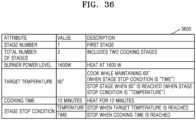
- An example of a basic format 3600 of the recipe information is illustrated in FIG. 36.
- FIG. 36 illustrates attributes included in the recipe information and meanings indicated by values of the attributes.
- An example of the recipe information will be described below with reference to FIG. 39 .
- “Cooking status information” may refer to information indicating a current status in which a wireless power transmission apparatus has transmitted power to a cooking appliance according to recipe information.
- the cooking status information may include information about a cooking operation performed by a cooking appliance up to a specific time (e.g., a time when a cooking appliance is detected by a new wireless power transmission apparatus).
- the cooking status information may include information about how much power has been transmitted to a cooking appliance and for how long, after cooking is started.
- the cooking status information may include a burner power level 3710 and a cooking time 3720 among the example format 3700 of the cooking appliance status information shown in FIG. 37 .
- the cooking appliance status information may be actually transmitted or received.
- “Remaining cooking information” may refer to information about a remaining cooking operation and may denote information required to control power transmission so that remaining cooking is completed when cooking is stopped and started again due to movement of a cooking appliance or disconnection of a communication connection between a wireless power transmission apparatus and the cooking appliance.
- the remaining cooking information may include information about how much power is to be transmitted to a cooking appliance and for how long so as to complete cooking a specific menu, and information about how to control power transmission to maintain a temperature of the cooking appliance at a certain value.
- the remaining cooking information may include the burner power level 3710 and a remaining cooking time 3730 among the example format 3700 of the cooking appliance status information shown in FIG. 37 .
- Device information of a wireless power transmission apparatus may refer to information including identification information, maximum output, and the like of the wireless power transmission apparatus.
- the device information of the wireless power transmission apparatus may be used while revising operation history information. For example, when the maximum output included in the device information is less than output required in recipe information, the recipe information may be revised to increase a time instead of decreasing the output.
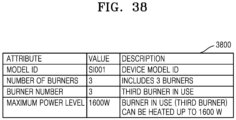
- An example format 3800 of the device information is illustrated in FIG. 38.
- FIG. 38 illustrates attributes included in the device information and meanings indicated by values of the attributes. An example of the device information will be described below with reference to FIGS. 39 and 40 .
- FIGS. 1 and 2 a system environment for linking and controlling operations of a plurality of wireless power transmission apparatuses, according to an embodiment of the present disclosure, will be described with reference to FIGS. 1 and 2 , configurations of apparatuses (a wireless power transmission apparatus and a cooking appliance) included in a system will be described with reference to FIGS. 3A to 5 , and various example embodiments will be described with reference to the remaining drawings.
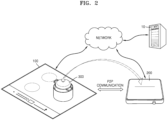
- FIGS. 1 and 2 are diagrams illustrating an example system environment for linking and controlling operations of wireless power transmission apparatuses, according to an embodiment of the present disclosure.
- a system may include a first wireless power transmission apparatus 100, a second wireless power transmission apparatus 200, and a cooking appliance 300. It is assumed that the cooking appliance 300 is performing a cooking operation while being placed on any one burner of the first wireless power transmission apparatus 100, and the cooking appliance 300 is moved to the second wireless power transmission apparatus 200 while cooking is not completed.
- a user may move the cooking appliance 300 to the second wireless power transmission apparatus 200 to perform remaining cooking so as to cook another food on the first wireless power transmission apparatus 100.
- the user may complete most of the cooking on the first wireless power transmission apparatus 100 and then move the cooking appliance 300 to the second wireless power transmission apparatus 200 at a place (e.g., on a table) where people eat to perform the remaining cooking.
- embodiments of the present disclosure may be applied to all situations where the cooking appliance 300 is moved to the second wireless power transmission apparatus 200 while cooking is performed in the cooking appliance 300 on the first wireless power transmission apparatus 100.
- the cooking appliance 300 of FIG. 1 corresponds to a small appliance among an IH container and a small appliance described above.
- an IH container may be used as the cooking appliance 300 when a small appliance is replaceable by the IH container because the cooking appliance 300 does not need to perform communication or the like, according to an embodiment of the present disclosure.
- maximum output of the first wireless power transmission apparatus 100 is 1600 W and maximum output of the second wireless power transmission apparatus 200 is 1200 W.
- the maximum output of the first and second wireless power transmission apparatuses 100 and 200 may affect revision of operation history information described below.
- the system may further include a server 10 capable of communicating with the first and second wireless power transmission apparatuses 100 and 200, and the cooking appliance 300.
- the first wireless power transmission apparatus 100 and the second wireless power transmission apparatus 200 may communicate with the server 10 through a network or the first and second wireless power transmission apparatuses 100 and 200 may perform peer-to-peer (P2P) communication.
- the cooking appliance 300 may also communicate with the server 10 through the network when a short-range wireless communication protocol, such as Wi-Fi, is supported.
- the cooking appliance 300 may communicate with the first wireless power transmission apparatus 100 or the second wireless power transmission apparatus 200 through a proximity communication protocol, such as Bluetooth low energy (BLE) or near field communication (NFC).
- BLE Bluetooth low energy
- NFC near field communication
- first wireless power transmission apparatus 100 and the second wireless power transmission apparatus 200 are linked and controlled to complete remaining cooking when the cooking appliance 300 is moved from the first wireless power transmission apparatus 100 to the second wireless power transmission apparatus 200 during cooking will be described in greater detail below with reference to a specific embodiment.
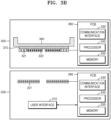
- FIGS. 3A , 3B and 3C are diagrams illustrating example configurations included in a cooking appliance (small appliance) and a wireless power transmission apparatus, according to an embodiment of the present disclosure.
- FIGS. 3A , 3B and 3C illustrate configurations of three example types of cooking appliances 300.
- the cooking appliance 300 may include a container 380 for containing food, a printed circuit board (PCB) 360 on which a communication interface 330, a processor 340, and a memory 350 are mounted, and a pickup coil 321 configured to receive power from the wireless power transmission apparatus 200 and supply the same to the PCB 360.
- PCB printed circuit board
- the wireless power transmission apparatus 200 may include a user interface 210, a transmission coil (Tx coil) 221 configured to transmit power to the cooking appliance 300, and a PCB 260 on which a communication interface 230, a processor 240, and a memory 250 are mounted.
- Tx coil transmission coil
- the container 380 of the cooking appliance 300 shown in FIG. 3A may be formed of an IH metal material and thus may be inductively heated by the power transmitted from the Tx coil 221 of the wireless power transmission apparatus 200, thereby cooking food.
- the cooking appliance 300 may include its own power source, such as a battery, and when the cooking appliance 300 does not include its own power source, internal components thereof may operate according to the power transmitted by the wireless power transmission apparatus 200. For example, when the cooking appliance 300 approaches the wireless power transmission apparatus 200 and the pickup coil 321 receives power from the Tx coil 221, the power received by the pickup coil 321 is transmitted to the PCB 360 to operate the communication interface 330 and the processor 340. When the communication interface 330 is operated by the received power, a wireless communication (e.g., BLE) connection may be established with the communication interface 230 of the wireless power transmission apparatus 200.
- a wireless communication e.g., BLE
- the cooking appliance 300 may further include a sensor such as a temperature sensor. Values (e.g., a temperature) measured by the sensor included in the cooking appliance 300 may be used to control cooking food (e.g., control power transmission of a wireless power transmission apparatus).
- a sensor such as a temperature sensor. Values (e.g., a temperature) measured by the sensor included in the cooking appliance 300 may be used to control cooking food (e.g., control power transmission of a wireless power transmission apparatus).
- the cooking appliance 300 may include the container 380 for containing food, the PCB 360 on which the communication interface 330, the processor 340, and the memory 350 are mounted, the pickup coil 321 configured to receive power from the wireless power transmission apparatus 200 and supply the same to the PCB 360, a load 370 configured to transmit heat to the container 380, and a reception coil (Rx coil) 322 configured to heat the load 370.
- the pickup coil 321 configured to receive power from the wireless power transmission apparatus 200 and supply the same to the PCB 360
- a load 370 configured to transmit heat to the container 380
- a reception coil (Rx coil) 322 configured to heat the load 370.
- the wireless power transmission apparatus 200 shown in FIG. 3B may include the user interface 210, the Tx coil 221 configured to transmit power to the cooking appliance 300, and the PCB 260 on which the communication interface 230, the processor 240, and the memory 250 are mounted.
- the cooking appliance 300 shown in FIG. 3B may include the load 370 configured to transmit heat to the container 380, and the load 370 may be heated by power received by the Rx coil 322 from the Tx coil 221 of the wireless power transmission apparatus 200.
- FIG. 3B may include the load 370 configured to transmit heat to the container 380, and the load 370 may be heated by power received by the Rx coil 322 from the Tx coil 221 of the wireless power transmission apparatus 200.
- the cooking appliance 300 including the load 370 (e.g., a heater) configured to transmit heat to the container 380, but alternatively, the cooking appliance 300 may include the load 370 (e.g., a motor) configured to provide electric power for cooking food (e.g., when a cooking appliance is a foam generator of a coffee maker).
- the load 370 e.g., a heater
- the load 370 e.g., a motor
- the cooking appliance 300 may include the container 380 for containing food, the PCB 360 on which the communication interface 330, the processor 340, and the memory 350 are mounted, the pickup coil 321 configured to receive power from the wireless power transmission apparatus 200 and supply the same to the PCB 360, the load 370 configured to transmit heat to the container 380, the Rx coil 322 configured to heat the load 370, and an NFC coil 323 configured to perform NFC.
- the wireless power transmission apparatus 200 shown in FIG. 3C may include the user interface 210, the Tx coil 221 configured to transmit power to the cooking appliance 300, the PCB 260 on which the communication interface 230, the processor 240, and the memory 250 are mounted, and an NFC coil 223 configured to perform NFC.
- the wireless power transmission apparatus 200 shown in FIG. 3C may receive data from the cooking appliance 300 through the NFC coil 223, and for example, may receive identification (ID) information of the cooking appliance 300 through NFC.
- ID information of the cooking appliance 300 may be used when obtaining operation history information, and details thereof will be described below.
- the first wireless power transmission apparatus 100 may also include a same configuration as the second wireless power transmission apparatus 200 shown in FIG. 3A , 3B , or 3C .
- FIG. 4 is a block diagram illustrating an example configuration of a cooking appliance (small appliance), according to an embodiment of the present disclosure.
- the cooking appliance 300 may include a user interface 310, a wireless power receiver 320, the communication interface 330, the processor 340, the memory 350, the load 370, and a sensor unit 390.
- the wireless power receiver 320 may include the pickup coil 321 and the Rx coil 322, but is not limited thereto.
- the pickup coil 321 may transmit power received from the wireless power transmission apparatus 200 to other components of the cooking appliance 300, excluding the load 370. Power received through the pickup coil 321 may be supplied to components of the wireless power transmission apparatus 200, excluding the load 370, through a rectifier circuit and a converter circuit.
- the Rx coil 322 may transmit power received from the wireless power transmission apparatus 200 to the load 370. Power received through the Rx coil 322 may be supplied to the load 370 through the rectifier circuit and the converter circuit.
- the rectifier circuit may convert alternating power to direct power.
- the rectifier circuit may convert an alternating voltage in which a size and polarity (a positive voltage or a negative voltage) change with time to a direct voltage in which a size and polarity are constant, and convert an alternating current in which a size and a direction (a positive current or a negative current) change with time to a direct current in which a size is constant.
- the rectifier circuit may include a bridge diode.
- the rectifier circuit may include four diodes.
- the bridge diode may convert an alternating voltage in which polarity changes with time to a positive voltage in which polarity is constant, and convert an alternating current in which a direction changes with time to a positive current in which a direction is constant.
- the rectifier circuit may include a direct current (DC) link capacitor.
- the DC link capacitor may convert a positive voltage in which a size changes with time to a direct voltage having a constant size.
- the converter circuit may include a switching circuit configured to transmit a current output from the pickup coil 321 or Rx coil 322 to other components or block the current, and a resonant circuit configured to generate resonance together with the pickup coil 321 or Rx coil 322.
- a current detection circuit may include a current sensor configured to measure a current output from the converter circuit.
- the processor 340 controls general operations of the cooking appliance 300.
- the processor 340 may execute programs stored in the memory 350 to control the wireless power receiver 320, the communication interface 330, the sensor unit 390, the user interface 310, and the memory 350.
- the cooking appliance 300 may include an artificial intelligence (AI) processor.
- the Al processor may be manufactured in the form of an Al dedicated hardware chip or manufactured as a part of an existing general-purpose processor (e.g., a central processing unit (CPU) or an application processor) or a graphic-dedicated processor (e.g., a graphics processing unit (GPU)) to be mounted on the wireless power transmission apparatus 200.
- a general-purpose processor e.g., a central processing unit (CPU) or an application processor
- a graphic-dedicated processor e.g., a graphics processing unit (GPU)
- the processor 340 may control the converter circuit to supply, to the communication interface 330 of the cooking appliance 300, power at a pre-set level to operate the communication interface 330.
- operations described to be performed by the cooking appliance 300 may be substantially performed by the processor 340.
- the communication interface 330 may include one or more components enabling communication between the cooking appliance 300 and the wireless power transmission apparatus 200 or between the cooking appliance 300 and the server 10.
- the communication interface 330 may include a short-range wireless communication interface 331 and a long-range communication interface 332.
- the short-range wireless communication interface may include a Bluetooth communication interface, a BLE communication interface, an NFC/radio frequency identification (RFID) communication interface, or an ultra-wide band (UWB) communication interface, but is not limited thereto.
- RFID radio frequency identification
- UWB ultra-wide band
- the long-range communication interface 332 may be used to communicate with a server device when the cooking appliance is controlled by the server 10 remotely in an Internet of things (IoT) environment.
- the long-range communication interface 332 may include the Internet, a computer network (e.g., a LAN or a wide area network (WAN)), and a mobile communication interface.
- the mobile communication interface may transmit or receive a wireless signal to or from at least one of a base station, an external terminal, and a server, on a mobile communication network.
- the wireless signal may include various types of data according to exchange of a voice call signal, an image call signal, or a text/multimedia message.
- the mobile communication interface may include a 3rd generation (3G) module, a 4th generation (4G) module, a long-tern evolution (LTE) module, a 5th generation (5G) module, a 6th generation (6G) module, a node B (NB)-Internet of things (IoT) module, or an LTE-machine type communication (LTE-M) module, but is not limited thereto.
- 3G 3rd generation
- 4G 4th generation
- LTE long-tern evolution
- 5G 5th generation
- 6G 6th generation
- NB node B
- IoT node B
- LTE-M LTE-machine type communication
- the sensor unit 390 may include a container detection sensor and a temperature sensor, but is not limited thereto.
- the temperature sensor may measure a temperature of content (food) in the container 380 of the cooking appliance 300.
- the temperature sensor may be provided on an outer surface of the container 380.
- the temperature sensor may include a thermistor in which an electric resistance value changes according to a temperature.
- the temperature sensor may be a negative temperature coefficient (NTC) temperature sensor, but is not limited thereto.
- the temperature sensor may be a positive temperature coefficient (PTC) temperature sensor.
- a voltage sensor may measure a voltage received from the wireless power transmission apparatus 200 and supplied to each component of the cooking appliance 300.
- a coupling detection sensor may determine whether a separable or openable component from among components included in the cooking appliance 300 has been coupled.
- the user interface 310 may include an output interface and an input interface.
- the output interface is for outputting an audio signal or a video signal and may include a display and a sound output unit.
- the display When the display is configured as a touch screen by forming a layer structure with a touch pad, the display may be used as an input interface as well as an output interface.
- the display may include at least one of a liquid crystal display, a thin-film transistor-liquid crystal display, a light-emitting diode (LED), an organic light-emitting diode, a flexible display, a 3-dimensional (3D) display, and an electrophoretic display.
- the wireless power transmission apparatus 200 may include two or more displays.
- the sound output unit may output audio data received from the communication interface 330 or stored in the memory 350. Also, the sound output unit may output an audio signal related to a function performed by the cooking appliance 300.
- the sound output unit may include a speaker, a buzzer, or the like.
- the input interface is for receiving an input from a user.
- the input interface may include at least one of a key pad, a dome switch, a touch pad (contact capacitance type, pressure resistive type, an infrared detection type, surface ultrasonic wave conduction type, integral tension measuring type, piezo-effect type, or the like), a jog wheel, and a jog switch, but is not limited thereto.
- the input interface may include a speech recognition module.
- the wireless power transmission apparatus 200 may receive a speech signal that is an analog signal through a microphone, and convert a speech portion into computer-readable text using an automatic speech recognition (ASR) model.
- ASR automatic speech recognition
- the memory 350 may store a program for processes and controls by the processor 340, or may store pieces of input/output data (e.g., a plurality of power transmission patterns and cooking progress information of the cooking appliance 300).
- the memory 350 may store an Al model.
- the memory 350 may include at least one type of storage medium among a flash memory type, a hard disk type, a multimedia card micro type, a card type memory (for example, a secure digital (SD) or an extreme digital (XD) memory), random access memory (RAM), static RAM (SRAM), read-only memory (ROM), electrically erasable programmable ROM (EEPROM), programmable ROM (PROM), a magnetic memory, a magnetic disk, and an optical disk.
- the wireless power transmission apparatus 200 may operate a web storage or cloud server performing a storing function on the Internet.
- the load 370 may include a heater and a motor.
- the heater may generate heat by receiving power through the Rx coil 322 and supply heat to food in the container 380 of the cooking appliance 300.
- the motor may operate by receiving power through the Rx coil 322 to supply electric power required to cook food in the container 380 of the cooking appliance 300 (e.g., a blender rotates blades to grind food).
- FIG. 5 is a block diagram illustrating an example configuration of a wireless power transmission apparatus, according to an embodiment of the present disclosure.
- FIG. 5 illustrates a configuration of the second wireless power transmission apparatus 200, and the first wireless power transmission apparatus 100 may have the same or similar configuration.
- the wireless power transmission apparatus 200 may include the user interface 210, a wireless power transmitter 220, the communication interface 230, the processor 240, the memory 250, and a sensor unit 290.
- the wireless power transmitter 220 may include a driver 224 and the operating coil 221, but is not limited thereto.
- the driver 224 may receive power from an external source and supply a current to the operating coil 221 according to a driving control signal of the processor 240.
- the driver 224 may include an electro-magnetic interface (EMI) filter, a rectifier circuit, an inverter circuit, a distribution circuit, a current detection circuit, and a driving processor, but is not limited thereto.
- EMI electro-magnetic interface
- the EMI filter may block high frequency noise included in an alternating current supplied from the external source and transmit the alternating current and an alternating voltage of pre-determined frequency (e.g., 50 Hz or 60 Hz).
- a fuse and a relay may be provided between the EMI filter and the external source to block an overcurrent. Alternating power in which the high frequency noise is blocked by the EMI filter is supplied to the rectifier circuit.
- the rectifier circuit may convert alternating power to direct power.
- the rectifier circuit may convert an alternating voltage in which a size and polarity (a positive voltage or a negative voltage) change with time to a direct voltage in which a size and polarity are constant, and convert an alternating current in which a size and a direction (a positive current or a negative current) change with time to a direct current in which a size is constant.
- the rectifier circuit may include a bridge diode.
- the rectifier circuit may include four diodes.
- the bridge diode may convert an alternating voltage in which polarity changes with time to a positive voltage in which polarity is constant, and convert an alternating current in which a direction changes with time to a positive current in which a direction is constant.
- the rectifier circuit may include a DC link capacitor.
- the DC link capacitor may convert a positive voltage of which size changes with time to a DC voltage having a constant size.
- the inverter circuit may include a switching circuit configured to supply or block a driving current to the operating coil 221, and a resonant circuit configured to generate resonance together with the operating coil 221.
- the switching circuit may include a first switch and a second switch. The first switch and the second switch may be connected in series to each other between a plus line and a minus line output from the rectifier circuit. The first switch and the second switch may be turned on or off according to the driving control signal of the driving processor.
- the inverter circuit may control a current supplied to the operating coil 221. For example, a size and direction of a current flowing through the operating coil 221 may change according to on/off of the first switch and the second switch included in the inverter circuit. In this case, an alternating current may be supplied to the operating coil 221. The alternating current in sine waves is supplied to the operating coil 221 according to switching operations of the first switch and second switch. Also, a current supplied to the operating coil 221 may be increased and strength of a magnetic field (an output of the wireless power transmission apparatus 200) output by the operating coil 221 may be increased when switching cycles of the first switch and second switch are increased (e.g., when switching frequencies of the first switch and second switch are decreased).
- the driver 224 may include the distribution circuit.
- the distribution circuit may include a plurality of switches configured to transmit or block a current supplied to the plurality of operating coils 221, and the plurality of switches may be turned on or off according to a distribution control signal of the driving processor.
- the current detection circuit may include a current sensor configured to measure a current output from the inverter circuit.
- the current sensor may transmit an electrical signal corresponding to a measured current value to the driving processor.
- the driving processor may determine a switching frequency (turn-on/turn-off frequency) of the switching circuit included in the inverter circuit, based on output strength (power level) of the wireless power transmission apparatus 200.
- the driving processor may generate the driving control signal for turning on/off the switching circuit according to the determined switching frequency.
- the operating coil 221 may generate a magnetic field for heating the cooking appliance 300.
- the magnetic field may be induced around the operating coil 221.
- a current e.g., the alternating current, in which a size and direction change with time
- a magnetic field in which a size and direction change with time may be induced around the operating coil 221.
- the magnetic field around the operating coil 221 may pass through a top plate including tempered glass and reach the cooking appliance 300 placed on the top plate.
- An eddy current rotating based on the magnetic field may be generated in the cooking appliance 300 due to the magnetic field in which the size and direction change with time, and electric resistance heat may be generated in the cooking appliance 300 due to the eddy current.
- the electric resistance heat is heat generated in a resistor when a current flows through the resistor, and may also be referred to as Joule heat.
- the cooking appliance 300 is heated by the electric resistance heat and content inside the cooking appliance 300 may be heated.
- the magnetic field around the operating coil 221 may be induced in the Rx coil 322.
- the processor 240 controls general operations of the wireless power transmission apparatus 200.
- the processor 240 may execute programs stored in the memory 250 to control the wireless power transmitter 220, the communication interface 230, the sensor unit 290, the user interface 210, and the memory 250.
- the wireless power transmission apparatus 200 may include an Al processor.
- the Al processor may be manufactured in the form of an Al dedicated hardware chip or manufactured as a part of an existing general-purpose processor (e.g., a central processing unit (CPU) or an application processor) or a graphic-dedicated processor (e.g., a graphics processing unit (GPU)) to be mounted on the wireless power transmission apparatus 200.
- a general-purpose processor e.g., a central processing unit (CPU) or an application processor
- a graphic-dedicated processor e.g., a graphics processing unit (GPU)
- the processor 240 may control the inverter circuit to supply, to the cooking appliance 300, power of a pre-set level so as to operate the communication interface 330 of the cooking appliance 300, and when the communication interface 330 of the cooking appliance 300 is operated, receive a first wireless communication signal transmitted from the communication interface 330 of the cooking appliance 300.
- the first wireless communication signal may include ID information (e.g., MAC address) of the cooking appliance 300.
- the processor 240 may identify the cooking appliance 300 as a general IH container when the first wireless communication signal is not received from the cooking appliance 300 within a certain period of time after detecting that the cooking appliance 300 is located on a top plate of the wireless power transmission apparatus 200.
- the processor 240 may identify the cooking appliance 300 as a communicable type small appliance.
- operations described to be performed by the wireless power transmission apparatus 200 may be substantially performed by the processor 240.
- the communication interface 230 may include one or more components enabling communication between the wireless power transmission apparatus 200 and the cooking appliance 300 or between the wireless power transmission apparatus 200 and the server 10.
- the communication interface 230 may include a short-range wireless communication interface 231 and a long-range communication interface 232.
- the short-range wireless communication interface may include a Bluetooth communication interface, a BLE communication interface, an NFC interface, a wireless local area network (WLAN) (Wi-Fi) communication interface, a Zigbee communication interface, an infrared data association (IrDA) communication interface, a Wi-Fi direct (WFD) communication interface, a UWB communication interface, or an Ant+ communication interface, but is not limited thereto.
- a Bluetooth communication interface may include a Bluetooth communication interface, a BLE communication interface, an NFC interface, a wireless local area network (WLAN) (Wi-Fi) communication interface, a Zigbee communication interface, an infrared data association (IrDA) communication interface, a Wi-Fi direct (WFD) communication interface, a UWB communication interface, or an Ant+ communication interface, but is not limited thereto.
- the long-range communication interface 232 may be used to communicate with a server device when the cooking appliance is controlled by the server 10 remotely in an IoT environment.
- the long-range communication interface 232 may include the Internet, a computer network (e.g., a LAN or a WAN), and a mobile communication interface.
- the mobile communication interface may transmit or receive a wireless signal to or from at least one of a base station, an external terminal, or a server, on a mobile communication network.
- the wireless signal may include various types of data according to exchange of a voice call signal, an image call signal, or a text/multimedia message.
- the mobile communication interface may include a 3G module, a 4G module, an LTE module, a 5G module, a 6G module, an NB-loT module, or an LTE-M module, but is not limited thereto.
- the sensor unit 290 may include a container detection sensor and a temperature sensor, but is not limited thereto.
- the container detection sensor may be a sensor configured to detect the cooking appliance 300 being placed on the top plate.
- the container detection sensor may be implemented as a current sensor, but is not limited thereto.
- the container detection sensor may be implemented as at least one of a proximity sensor, a touch sensor, a weight sensor, a temperature sensor, an illumination sensor, and a magnetic sensor.
- the temperature sensor may detect a temperature of the cooking appliance 300 placed on the top plate or a temperature of the top plate.
- the cooking appliance 300 is inductively heated by the operating coil 221 and may be over-heated according to a material. Accordingly, the wireless power transmission apparatus 200 may detect the temperature of the cooking appliance 300 placed on the top plate or the temperature of the top plate and block operations of the operating coil 221 when the cooking appliance 300 is over-heated.
- the temperature sensor may be provided near the operating coil 221. For example, the temperature sensor may be located at the center of the operating coil 221.
- the temperature sensor may include a thermistor in which an electric resistance value changes according to a temperature.
- the temperature sensor may be an NTC temperature sensor, but is not limited thereto.
- the temperature sensor may be a PTC temperature sensor.
- the user interface 210 may include an output interface and an input interface.
- the output interface is for outputting an audio signal or a video signal and may include a display and a sound output unit.
- the display When the display is configured as a touch screen by forming a layer structure with a touch pad, the display may be used as an input interface as well as an output interface.
- the display may include at least one of a liquid crystal display, a thin-film transistor-liquid crystal display, an LED, an organic light-emitting diode, a flexible display, a 3D display, and an electrophoretic display.
- the wireless power transmission apparatus 200 may include two or more displays.
- the sound output unit may output audio data received from the communication interface 230 or stored in the memory 250. Also, the sound output unit may output an audio signal related to a function performed by the wireless power transmission apparatus 200.
- the sound output unit may include a speaker, a buzzer, or the like.
- the output interface may display information about the cooking appliance 300.
- the output interface may output a graphical user interface (GUI) corresponding to ID information or product type information of the cooking appliance 300.
- GUI graphical user interface
- the output interface may output information about a current location of the cooking appliance 300.
- the input interface is for receiving an input from a user.
- the input interface may include at least one of a key pad, a dome switch, a touch pad (contact capacitance type, pressure resistive type, an infrared detection type, surface ultrasonic wave conduction type, integral tension measuring type, piezo-effect type, or the like), a jog wheel, and a jog switch, but is not limited thereto.
- the input interface may include a speech recognition module.
- the wireless power transmission apparatus 200 may receive a speech signal that is an analog signal through a microphone, and convert a speech portion into computer-readable text using an ASR model.
- the memory 250 may store a program for processes and controls by the processor 240, or may store pieces of input/output data (e.g., a plurality of power transmission patterns and cooking progress information of the cooking appliance 300).
- the memory 250 may store an Al model.
- the memory 250 may include at least one type of storage medium among a flash memory type, a hard disk type, a multimedia card micro type, a card type memory (for example, an SD or XD memory), RAM, SRAM, ROM, EEPROM, PROM, a magnetic memory, a magnetic disk, and an optical disk. Also, the wireless power transmission apparatus 200 may operate a web storage or cloud server performing a storing function on the Internet.
- the server 10 of FIG. 2 may include a communication interface, a processor, and a memory to perform operations required for linked control of the first and second wireless power transmission apparatuses 100 and 200 through communication with the first and second wireless power transmission apparatuses 100 and 200 and the cooking appliance 300.
- the server 10 may be an IoT server configured to integrally control home loT devices, and in this case, the server 10 may provide, to the user, information related to control of the loT devices through a mobile terminal and receive, from the user, a command for controlling the loT devices through the mobile terminal.
- the user may identify information related to control of the first and second wireless power transmission apparatuses 100 and 200 and the cooking appliance 300 through the mobile terminal and input a command for control.
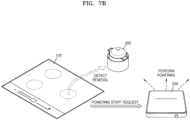
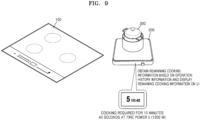
- FIGS. 6 , 7A , 7B , 8A , 8B , 8C , 8D and 9 are diagrams illustrating example processes of continuously performing, when a cooking appliance is moved from a first wireless power transmission apparatus to a second wireless power transmission apparatus, cooking previously performed by the first wireless power transmission apparatus, according to embodiments of the present disclosure. Embodiments will be described in an order in which operations are performed, with reference to the drawings. Some of FIGS. 6 , 7A , 7B , 8A , 8B , 8C , 8D and 9 (which may be referred to as FIGS. 6 to 9 ) do not illustrate the server 10 but it is assumed that the server 10 may be involved in embodiments of all drawings.
- FIG. 6 illustrates a situation in which cooking food is started while the cooking appliance 300 is placed on the first wireless power transmission apparatus 100.
- a user may input an operation command (a command for a cooking operation) for the third burner where the cooking appliance 300 is located, through a user interface 110.
- recipe information is set as in Table 1 below.
- Table 1 Attribute Value Stage Number 1 Total Number of Stages 2 Burner Power Level 1600 W Target Temperature 95° Cooking Time - Stage Stop Condition Temperature Stage Number 2 Total Number of Stages 2 Burner Power Level 1600 W Target Temperature - Cooking Time 20 minutes Stage Stop Condition Time
- the cooking appliance 300 needs to be heated at a fire power level of 1600 W until a temperature measured by the temperature sensor included in the cooking appliance 300 reaches a target temperature (95°) in a first stage, and after the measured temperature reaches the target temperature (95°), a second stage is entered to heat the cooking appliance 300 for 20 minutes at a fire power level of 1600 W.
- the fire power level (burner power level) is set to "Max” and a cooking time is set to "20 minutes".
- the maximum output of the first wireless power transmission apparatus 100 is 1600 W, and thus, such settings may correspond to the second stage (heating for 20 minutes at 1600 W is required) of the recipe information of Table 1.
- the user may directly set the fire power level and the cooking time through the user interface 110 of the first wireless power transmission apparatus 100.
- the recipe information may be set as the user inputs or selects a name of a menu (e.g., braised short ribs) to be cooked.
- the first wireless power transmission apparatus 100 may access a database (DB) of an embedded memory to extract a fire power level and cooking time corresponding to the menu and set recipe information accordingly. Also, according to an embodiment, the first wireless power transmission apparatus 100 may access a DB of an embedded memory of the cooking appliance 300 or server 10 to extract the fire power level and cooking time corresponding to the menu and set the recipe information accordingly. Also, according to an embodiment, the first wireless power transmission apparatus 100 may transmit the name of the menu to the cooking appliance 300, and the cooking appliance 300 may extract the recipe information corresponding to the menu from a DB stored in the memory 350 and transmit the recipe information to the first wireless power transmission apparatus 100.
- DB database
- the first wireless power transmission apparatus 100 may transmit the name of the menu to the cooking appliance 300, and the cooking appliance 300 may extract the recipe information corresponding to the menu from a DB stored in the memory 350 and transmit the recipe information to the first wireless power transmission apparatus 100.
- cooking may be started as the first wireless power transmission apparatus 100 transmits power to the cooking appliance 300 according to the set recipe information.
- food in the container 380 of the cooking appliance 300 may be cooked when the container 380 formed of an IH metal material, which is included in the cooking appliance 300, is inductively heated by power or when the load 370 included in the cooking appliance 300 is heated by power and transfers heat to the container 380.
- FIGS. 7A and 7B illustrate embodiments regarding processes in which the second wireless power transmission apparatus 200 detects the cooking appliance 300.
- the second wireless power transmission apparatus 200 may periodically or aperiodically perform powering.
- powering may refer, for example, to an operation of outputting a small amount of power to detect an object, such as the cooking appliance 300.
- the second wireless power transmission apparatus 200 may perform the powering to identify whether an object, such as the cooking appliance 300, is located thereon.
- the second wireless power transmission apparatus 200 may start the powering under various conditions. According to an embodiment, the second wireless power transmission apparatus 200 may perform the powering periodically or aperiodically from a time when power is turned on or perform the powering periodically or aperiodically from a time when power is turned on and a wireless power transmission mode is entered (e.g., an operating mode is activated by the user). According to an embodiment, the second wireless power transmission apparatus 200 may configured to perform the powering periodically or aperiodically even when power is turned off and be turned on automatically when the cooking appliance 300 is detected through the powering.
- a wireless power transmission mode e.g., an operating mode is activated by the user
- the second wireless power transmission apparatus 200 may start the powering according to a request of the first wireless power transmission apparatus 100, and such an embodiment is illustrated in FIG. 7B .
- the first wireless power transmission apparatus 100 may detect removal of the cooking appliance 300 during cooking and transmit a powering start request to the second wireless power transmission apparatus 200.
- the first wireless power transmission apparatus 100 and the second wireless power transmission apparatus 200 may be paired up in advance such that wireless communication is possible.
- the first wireless power transmission apparatus 100 may transmit the powering start request to the second wireless power transmission apparatus 200 through the server 10.
- the second wireless power transmission apparatus 200 may perform the powering periodically or aperiodically from a time when the request is received from the first wireless power transmission apparatus 100.
- FIG. 7B illustrates a case where there are two wireless power transmission apparatuses 100 and 200, but when there are three or more wireless power transmission apparatuses, it is unclear to which wireless power transmission apparatus the cooking appliance 300 has been moved, and thus, the first wireless power transmission apparatus 100 may transmit the powering start request to all remaining wireless power transmission apparatuses.
- the second wireless power transmission apparatus 200 performs the powering before and after a time when the cooking appliance 300 is removed from the first wireless power transmission apparatus 100, but according to an embodiment, the first wireless power transmission apparatus 100 may also perform the powering periodically or aperiodically when the removal of the cooking appliance 300 is detected.
- the embodiments of the present disclosure have been described based on an assumption that the cooking appliance 300 is moved to the second wireless power transmission apparatus 200 while performing cooking on the first wireless power transmission apparatus 100, but alternatively, the cooking appliance 300 may be removed from the first wireless power transmission apparatus 100 during cooking and then placed on the first wireless power transmission apparatus 100 again to perform remaining cooking.
- the first wireless power transmission apparatus 100 may detect the cooking appliance 300 through the powering and transmit power to the cooking appliance 300 for the remaining cooking, and operations (operations for the remaining cooking) described to be performed by the second wireless power transmission apparatus 200 in embodiments of the present disclosure may be performed by the first wireless power transmission apparatus 100.
- the pickup coil 321 of the cooking appliance 300 may receive power according to the powering.
- a wireless communication e.g., BLE communication
- the second wireless power transmission apparatus 200 may obtain operation history information corresponding to the cooking appliance 300 and perform the remaining cooking by transmitting power to the cooking appliance 300 based on the obtained operation history information.
- the second wireless power transmission apparatus 200 may receive, from the user, an input for setting new recipe information.
- the second wireless power transmission apparatus 200 may receive the input for setting the new recipe information in a similar manner as the user inputs an operation command through the user interface 110 of the first wireless power transmission apparatus 100 described above with reference to FIG. 6 .
- the user may directly input a fire power level and cooking time through the user interface 210 of the second wireless power transmission apparatus 200, and may input or select a name of a menu to be cooked.
- the second wireless power transmission apparatus 200 may obtain the operation history information through various paths, and FIGS. 8A to 8D illustrate various embodiments in which the second wireless power transmission apparatus 200 obtains the operation history information.
- the second wireless power transmission apparatus 200 may receive the operation history information from the cooking appliance 300.
- the cooking appliance 300 may include the memory 350 and the operation history information may be stored in the memory 350.
- the cooking appliance 300 may periodically receive, from the first wireless power transmission apparatus 100, the operation history information while performing cooking on the first wireless power transmission apparatus 100, and store the operation history information in the memory 350.
- the cooking appliance 300 may control power transmission of the first wireless power transmission apparatus 100 according to the recipe information (e.g., when the cooking appliance 300 transmits a command to the first wireless power transmission apparatus 100, the first wireless power transmission apparatus 100 transmits power to the cooking appliance 300 according to the command), and in this case, the processor 340 of the cooking appliance 300 may directly store the operation history information in the memory 350.
- the recipe information e.g., when the cooking appliance 300 transmits a command to the first wireless power transmission apparatus 100, the first wireless power transmission apparatus 100 transmits power to the cooking appliance 300 according to the command
- the processor 340 of the cooking appliance 300 may directly store the operation history information in the memory 350.
- the cooking appliance 300 may transmit the operation history information stored in the memory 350 to the second wireless power transmission apparatus 200.
- the second wireless power transmission apparatus 200 may obtain ID information (e.g., a model number, a serial number, a name set by the user, or the like) of the cooking appliance 300 from the cooking appliance 300, and obtain the operation history information corresponding to the cooking appliance 300 using the ID information. According to an embodiment, the second wireless power transmission apparatus 200 may request the operation history information corresponding to the ID information while transmitting the ID information of the cooking appliance 300 to the first wireless power transmission apparatus 100.
- ID information e.g., a model number, a serial number, a name set by the user, or the like
- the first wireless power transmission apparatus 100 may periodically or continuously match the operation history information with the ID information of the cooking appliance 300 and store the same in the embedded memory while performing cooking by transmitting power to the cooking appliance 300.
- the first wireless power transmission apparatus 100 may store the operation history information even when the cooking appliance 300 is removed, and transmit the operation history information corresponding to the ID information to the second wireless power transmission apparatus 200 when the ID information is received form the second wireless power transmission apparatus 200.
- the cooking appliance 300 may use BLE communication or NFC when transmitting the ID information to the second wireless power transmission apparatus 200.
- the second wireless power transmission apparatus 200 may receive, from the server 10, the operation history information corresponding to the cooking appliance 300.
- the second wireless power transmission apparatus 200 may transmit the ID information to the server 10 while requesting the operation history information corresponding to the ID information.
- the server 10 may request peripheral apparatuses including the first wireless power transmission apparatus 100 for the operation history information corresponding to the ID information and receive the operation history information from the first wireless power transmission apparatus 100.
- the operation history information and the ID information corresponding to the cooking appliance 300 may be previously matched and stored in the server 10.
- the first wireless power transmission apparatus 100 may transmit the ID information and operation history information of the cooking appliance 300 to the server 10 and request the server 10 to store the same.
- the second wireless power transmission apparatus 200 may also transmit device information (e.g., maximum output ) of the second wireless power transmission apparatus 200 when transmitting the operation history information to the server 10.
- the server 10 may revise the operation history information based on the device information of the second wireless power transmission apparatus 200 and then transmit the same to the second wireless power transmission apparatus 200. A method of revising the operation history information will be described in detail below with reference to FIG. 9 .
- FIG. 8D illustrates a process in which the second wireless power transmission apparatus 200 receives operation history information corresponding to an IH container 400 when cooking is performed through the IH container 400 instead of the cooking appliance 300 that is a small appliance. It is assumed that the IH container 400 is moved to the second wireless power transmission apparatus 200 while performing cooking by receiving power from the first wireless power transmission apparatus 100.
- the second wireless power transmission apparatus 200 When the second wireless power transmission apparatus 200 detects the IH container 400 through powering, the second wireless power transmission apparatus 200 requests the server 10 for operation history information stored in a wireless power transmission apparatus that has stopped operating within a certain period of time.
- the IH container 400 is unable to perform communication with the second wireless power transmission apparatus 200, and thus, the second wireless power transmission apparatus 200 is unable to obtain ID information of the IH container 400.
- the operation history information corresponding to the IH container 400 may be stored in the first wireless power transmission apparatus 100.
- the server 10 may identify whether there is a wireless power transmission apparatus that has stopped operating within a certain period of time (e.g., during a period of time from two minutes before a time when the IH container 400 is detected by the second wireless power transmission apparatus 200 to a time of the detection) from among peripheral wireless power transmission apparatuses.
- the server 10 may receive the operation history information from the first wireless power transmission apparatus 100 and transmit the received operation history information to the second wireless power transmission apparatus 200.
- the second wireless power transmission apparatus 200 may perform a remaining cooking operation by transmitting power to the cooking appliance 300 based on the operation history information.
- the second wireless power transmission apparatus 200 may obtain remaining cooking information based on the operation history information and display the remaining cooking information on the user interface 210.
- the remaining cooking information is obtained based on the operation history information and how the operation history information or remaining cooking information is revised will be described in detail.
- the recipe information may be set as Table 1 above. It is assumed that the cooking appliance 300 is heated for 12 minutes at 1600 W while being placed on the first wireless power transmission apparatus 100 and then moved to the second wireless power transmission apparatus 200. In this case, cooking appliance status information is as Table 2 below. [Table 2] Attribute Value Burner Number 3 Burner Operating Status Paused Burner Power Level 1600 W Cooking Time 12 minutes Remaining Cooking Time 8 minutes Timer Operating Status Paused
- cooking appliance status information of Table 2 Based on the cooking appliance status information of Table 2, it is determined that the cooking appliance 300 has been heated for 12 minutes at a fire power level of 1600 W in a third burner of the first wireless power transmission apparatus 100 and requires to be heated for 8 more minutes for cooking completion, and currently, power transmission operation of the third burner and an operation of a timer are temporarily stopped.
- cooking status information and remaining cooking information that may be verified from the cooking appliance status information above are as follows.
- a cooking operation may be performed continuously according to the remaining cooking information, but as assumed above, maximum output of the second wireless power transmission apparatus 200 is 1200 W, and thus, the operation history information or the remaining cooking information needs to be revised.
- the second wireless power transmission apparatus 200 may obtain the remaining cooking information based on the revised operation history information.
- the server 10 or the cooking appliance 300 may correct the operation history information as follows, based on the maximum output of the second wireless power transmission apparatus 200 being 1200 W.
- the second wireless power transmission apparatus 200 may transmit the device information to the server 10 or the cooking appliance 300.
- a model ID of the second wireless power transmission apparatus 200 is "SP002"
- the second wireless power transmission apparatus 200 includes one burner (a first burner) and has a maximum power level (a maximum fire power level) is 1200 W.
- FIG. 39 is a table illustrating an example process in which recipe information 3910 is revised based on device information 3930 of the second wireless power transmission apparatus 200 according to various embodiments.
- the first recipe information 3910 is recipe information initially set when an operation of the cooking appliance 300 starts on the first wireless power transmission apparatus 100
- second recipe information 3920 is recipe information revised based on the device information 3930 of the second wireless power transmission apparatus 200 after the cooking appliance 300 is moved to the second wireless power transmission apparatus 200.
- a fire power level (burner power level) required in all stages is 1600 W, but as identified from the device information 3930, the fire power level (maximum power level) supportable by the second wireless power transmission apparatus 200 is 1200 W, and thus, the first recipe information 3910 needs to be revised accordingly.
- a burner power level 3911 in a second stage of the first recipe information 3910 is 1600 W, but a burner power level 3921 in the second stage of the second recipe information 3920 is revised to 1200 W.
- a cooking time 3912 in the second stage of the first recipe information 3910 is 20 minutes, but a cooking time 3922 in the second stage of the second recipe information 3920 is revised to 26 minutes 40 seconds.
- a stage stop condition is "temperature”, and thus, only a burner power level is revised from 1600 W to 1200 W.
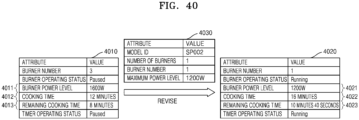
- FIG. 40 is a table illustrating an example process in which cooking appliance status information 4010 is revised based on device information 4030 of the second wireless power transmission apparatus 200 according to various embodiments.
- the first cooking appliance status information 4010 is cooking appliance status information stored last when the cooking appliance 300 is removed from the first wireless power transmission apparatus 100
- second cooking appliance status information 4020 is cooking appliance status information revised based on the device information 4030 of the second wireless power transmission apparatus 200 when the cooking appliance 300 is moved to the second wireless power transmission apparatus 200.
- the fire power level (burner power level) is 1600 W, but as identified from the device information 4030, the fire power level (maximum power level) supportable by the second wireless power transmission apparatus 200 is 1200 W, and thus, the first cooking appliance status information 4010 needs to be revised accordingly.
- a burner power level 4011 of the first cooking appliance status information 4010 is 1600 W, but a burner power level 4021 of the second cooking appliance status information 4020 is revised to 1200 W.
- a cooking time 4012 and a remaining cooking time 4013 of the first cooking appliance status information 4010 are respectively 12 minutes and 8 minutes, but a cooking time 4022 and a remaining cooking time 4023 of the second cooking appliance status information 4020 are revised respectively to 16 minutes and 10 minutes 40 seconds. Accordingly, the revised cooking status information obtained from the second cooking appliance status information 4020 may be as follows.
- the second wireless power transmission apparatus 200 may obtain remaining cooking information as follows.
- the server 10 or the cooking appliance 300 may obtain the remaining cooking information as follows from the second cooking appliance status information 4020.
- the second wireless power transmission apparatus 200 may obtain the remaining cooking information from the operation history information that is not revised, and revise the remaining cooking information based on its own device information. A result of obtaining the remaining cooking information based on the revised operation history information and a result of revising the remaining cooking information obtained based on the operation history information that is not revised are the same.
- a temperature when the cooking appliance 300 is removed from the first wireless power transmission apparatus 100 (hereinafter, a first time) and a temperature when the cooking appliance 300 is moved to the second wireless power transmission apparatus 200 (e.g., when BLE communication is established) (hereinafter, a second time) may be measured and applied when revising the operation history information.
- a temperature e.g., a temperature of food in the cooking appliance 300
- a temperature measured by the temperature sensor included in the cooking appliance 300 at the second time is 80°.
- a difference between the two measured temperatures is increased when a time difference between the first time and the second time is increased.
- the remaining cooking information indicating "needs to be heated for 10 minutes 40 seconds at 1200 W' is obtained, but when the sensing information (the temperatures at the first time and the second time) of the cooking appliance 300 are also considered, the remaining cooking information may be changed to "needs to be heated for 12 minutes 40 seconds at 1200 W' (2 minutes are added to a heating time as a temperature is decreased).
- the second wireless power transmission apparatus 200 may display the remaining cooking information on the user interface 210 for the user to identify the remaining cooking information.
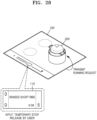
- the remaining cooking information indicating that the second wireless power transmission apparatus 200 needs to be heated for 10 minutes 40 seconds at a fire power level 5 (1200 W) is displayed on a display panel.
- the user may identify the remaining cooking information displayed on the user interface 210 and apply a confirmation input to the second wireless power transmission apparatus 200 when the user wants to perform the remaining cooking accordingly, and thus, the second wireless power transmission apparatus 200 may perform a power transmission operation for the remaining cooking.
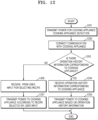
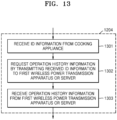
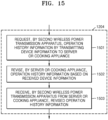
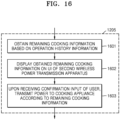
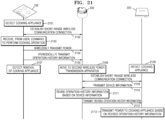
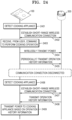
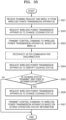
- FIGS. 10 to 24 operations performed by the server 10 and the first and second wireless power transmission apparatuses 100 and 200 and the cooking appliance 300, according to various embodiments, will be described with reference to flowcharts of FIGS. 10 to 24 .
- the signal flow diagrams and flowcharts of FIGS. 10 to 24 may include results of variously combining the above-described operations in chronological order, and thus, the descriptions above may also be applied to the flowcharts of FIGS. 10 to 24 .
- FIGS. 10 and 11 are signal flow diagrams illustrating example operations performed depending on whether operation history information is present after a cooking appliance is detected by a second wireless power transmission apparatus, according to an embodiment of the present disclosure.
- the second wireless power transmission apparatus 200 may detect the cooking appliance 300 by performing powering.
- a communication interface of the cooking appliance 300 may be activated according to power received by the powering.
- a BLE connection may be established between the cooking appliance 300 and the second wireless power transmission apparatus 200, in operation 1003.
- the cooking appliance 300 may transmit the operation history information to the second wireless power transmission apparatus 200, in operation 1004.
- the memory 350 of the cooking appliance 300 may store the operation history information at a time when the cooking operation previously performed by the cooking appliance 300 is stopped.
- the second wireless power transmission apparatus 200 may obtain the remaining cooking information based on the operation history information, in operation 1005.
- the second wireless power transmission apparatus 200 may display the remaining cooking information on a user interface.
- the remaining cooking information is displayed on the user interface of the second wireless power transmission apparatus 200, but according to an embodiment, the remaining cooking information may be displayed on a screen of a user terminal (e.g., a smartphone) directly connected to the second wireless power transmission apparatus 200 or connected to the server 10.
- a user terminal e.g., a smartphone
- an application for controlling the first and second wireless power transmission apparatuses 100 and 200 and the cooking appliance 300 may be installed on the user terminal and the remaining cooking information may be displayed through an execution screen of the application.
- the user may identify information about a time taken to complete cooking, based on the remaining cooking information, and determine whether to continuously perform cooking. For example, the user may instruct to continuously perform the remaining cooking by inputting a confirmation input through the user interface of the second wireless power transmission apparatus 200. According to an embodiment, the user may apply a confirmation input for the remaining cooking information through the user terminal to instruct the second wireless power transmission apparatus 200 to continuously perform the remaining cooking.
- the second wireless power transmission apparatus 200 may perform the remaining cooking by transmitting power to the cooking appliance 300 according to the remaining cooking information, in operation 1008.
- the second wireless power transmission apparatus 200 may detect the cooking appliance 300 by performing powering.
- the communication interface of the cooking appliance 300 may be activated according to power received by the powering.
- a BLE connection may be established between the cooking appliance 300 and the second wireless power transmission apparatus 200, in operation 1103.
- the cooking appliance 300 may notify that there is no stored operation history information to the second wireless power transmission apparatus 200.
- the second wireless power transmission apparatus 200 may inquire the cooking appliance 300 whether there is stored operation history information and the cooking appliance 300 may reply that there is no operation history information.
- the cooking appliance 300 may notify that there is no stored operation history information to the second wireless power transmission apparatus 200 when the BLE connection is established.
- the second wireless power transmission apparatus 200 may request the user for an input for selecting a recipe through the user interface, in operation 1105.
- the cooking appliance 300 needs to start new cooking because the cooking appliance 300 was not performing cooking before being detected by the second wireless power transmission apparatus 200.
- the user is requested for recipe information to start the new cooking.
- the second wireless power transmission apparatus 200 may transmit power to the cooking appliance 300 based on the selected recipe, in operation 1107.
- An embodiment illustrated in FIG. 11 may correspond to a process when the cooking appliance 300 first starts cooking on the second wireless power transmission apparatus 200.
- FIGS. 12 , 13 , 14 , 15 and 16 are flowcharts illustrating an example method of linking and controlling operations of a plurality of wireless power transmission apparatuses, according to an embodiment of the present disclosure. It is assumed that operations included in the flowcharts of FIGS. 12 to 16 are performed by the second wireless power transmission apparatus 200 unless described otherwise.
- FIGS. 12 , 13 , 14 , 15 and 16 (which may be referred to as FIGS. 12 to 16 ) are organized in terms of the second wireless power transmission apparatus 200 based on the processes described above with reference to FIGS. 6 to 11 , and thus, details described above may also be applied to the flowcharts of FIGS. 12 to 16 .
- the second wireless power transmission apparatus 200 may transmit power for cooking appliance detection and detect the cooking appliance 300 accordingly.
- communication may be connected between the second wireless power transmission apparatus 200 and the cooking appliance 300.
- the second wireless power transmission apparatus 200 determines whether there is the operation history information corresponding to the cooking appliance 300. According to an embodiment, when the operation history information corresponding to the cooking appliance 300 is stored in any one of the cooking appliance 300, the first wireless power transmission apparatus 100, and the server 10, the second wireless power transmission apparatus 200 may determine that there is the operation history information corresponding to the cooking appliance 300.
- the second wireless power transmission apparatus 200 may determine that there is no operation history information corresponding to the cooking appliance 300.
- the second wireless power transmission apparatus 200 may receive the operation history information corresponding to the cooking appliance 300, in operation 1204.
- the second wireless power transmission apparatus 200 may receive the operation history information corresponding to the cooking appliance 300 in various manners, and various embodiments are illustrated in FIGS. 13 , 14 and 15 (which may be referred to as FIGS. 13 to 15 ).
- the flowcharts of FIGS. 13 to 15 include detailed operations included in operation 1204.
- the second wireless power transmission apparatus 200 may receive the ID information of the cooking appliance 300 from the cooking appliance 300.
- the second wireless power transmission apparatus 200 may request the operation history information corresponding to the ID information by transmitting the received ID information to the first wireless power transmission apparatus 100 or the server 10.
- the first wireless power transmission apparatus 100 may have matched the operation history information with the ID information of the cooking appliance 300 and stored the same previously while performing cooking by transmitting power to the cooking appliance 300.
- the server 10 may request the first wireless power transmission apparatus 100 for the operation history information corresponding to the ID information and transmit the same to the second wireless power transmission apparatus 200.
- the server 10 may match the operation history information with the ID information of the cooking appliance 300 and store the same in real time while the first wireless power transmission apparatus 100 is performing cooking through the cooking appliance 300.
- the second wireless power transmission apparatus 200 may receive the operation history information from the first wireless power transmission apparatus 100 or the server 10.
- FIG. 14 illustrates an embodiment that may be used when food is cooked through the IH container 400. The embodiment of FIG. 14 may be applied even when food is cooked through the cooking appliance 300 in the form of a small appliance.
- the second wireless power transmission apparatus 200 may request the server 10 for operation history information stored in a wireless power transmission apparatus that has stopped operating within a certain period of time.
- the second wireless power transmission apparatus 200 may request the server 10 for operation history information stored in the corresponding wireless power transmission apparatus.
- the server 10 may identify the wireless power transmission apparatus storing the operation history information and receive the operation history information from the identified wireless power transmission apparatus. In detail, the server 10 may identify whether there is a wireless power transmission apparatus nearby, which has stopped operating for a certain period of time from a time when the second wireless power transmission apparatus 200 detected the cooking appliance 300 and stores operation history information, and when the wireless power transmission apparatus is identified, receive the operation history information by requesting the wireless power transmission apparatus for the same.
- the second wireless power transmission apparatus 200 may receive the operation history information from the server 10.
- the operation history information may need to be revised according to the maximum output of the second wireless power transmission apparatus 200, and in this case, the server 10 or the cooking appliance 300 may revise the operation history information and transmit the same to the second wireless power transmission apparatus 200.
- a corresponding embodiment is illustrated in FIG. 15 .
- the second wireless power transmission apparatus 200 may request the operation history information by transmitting the device information of the second wireless power transmission apparatus 200 to the server 10 or the cooking appliance 300.
- the second wireless power transmission apparatus 200 may also transmit the ID information of the cooking appliance 300 to the server 10. This is because the second wireless power transmission apparatus 200 requests the server 10 for the operation history information corresponding to the cooking appliance 300.
- the server 10 or the cooking appliance 300 may revise the operation history information based on the received device information.
- An example method of revising the operation history information based on the device information has been described above.
- the server 10 may obtain the operation history information corresponding to the cooking appliance 300, based on the ID information received from the second wireless power transmission apparatus 200, and revise the obtained operation history information based on the device information.
- the server 10 or the cooking appliance 300 may revise the operation history information in consideration of not only the device information of the second wireless power transmission apparatus 200, but also the sensing information of the cooking appliance 300.
- a method of revising the operation history information also in consideration of a temperature (sensing information) measured by the cooking appliance 300 has been described above with reference to FIG. 9 .
- the second wireless power transmission apparatus 200 may receive the revised operation history information from the server 10 or the cooking appliance 300.
- the second wireless power transmission apparatus 200 may transmit power to the cooking appliance 300 based on the operation history information, in operation 1205. Operations included in operation 1205 are illustrated in FIG. 16 .
- the second wireless power transmission apparatus 200 may obtain the remaining cooking information based on the operation history information. As described above, the second wireless power transmission apparatus 200 may obtain the remaining cooking information from the recipe information and the cooking status information, which are included in the operation history information.
- the second wireless power transmission apparatus 200 may display the obtained remaining cooking information on the user interface of the second wireless power transmission apparatus 200. In operation 1603, upon receiving a confirmation input of the user, the second wireless power transmission apparatus 200 may transmit power to the cooking appliance 300 according to the remaining cooking information.
- FIGS. 17 , 18 , 19 , 20 , 21 , 22 , 23 and 24 are signal flow diagrams illustrating example operations performed for each apparatus according to time, according to an embodiment of the present disclosure.
- FIG. 17 is a signal flow diagram illustrating example operations performed between wireless power transmission apparatuses and a cooking appliance when the cooking appliance is moved to a second wireless power transmission apparatus while being used by a first wireless power transmission apparatus, according to an embodiment of the present disclosure.
- the first wireless power transmission apparatus 100 may detect the cooking appliance 300.
- the first wireless power transmission apparatus 100 may detect the cooking appliance 300 by performing powering described above.
- a short-range wireless communication e.g. BLE communication
- the first wireless power transmission apparatus 100 may receive, from the user, a command to perform a cooking operation.
- the user may set a fire power level and a cooking time through the user interface of the first wireless power transmission apparatus 100 or may input a name of a specific menu.
- the first wireless power transmission apparatus 100 may wirelessly transmit power to the cooking appliance 300 in operation 1704 so that the cooking operation is performed.
- the first wireless power transmission apparatus 100 may periodically or aperiodically transmit the operation history information to the cooking appliance 300 while performing cooking by transmitting power to the cooking appliance 300 (operation 1705).
- the cooking appliance 300 may store the operation history information received from the first wireless power transmission apparatus 100 in the embedded memory 350.
- the first wireless power transmission apparatus 100 may detect removal of the cooking appliance 300 in operation 1707.
- the second wireless power transmission apparatus 200 detects the cooking appliance 300 in operation 1708, and a short-range wireless communication connection may be established between the second wireless power transmission apparatus 200 and the cooking appliance 300 in operation 1709.
- the cooking appliance 300 may transmit the operation history information to the second wireless power transmission apparatus 200 in operation 1710.
- the operation history information being transmitted may be operation history information received from the first wireless power transmission apparatus 100 and stored in the memory 350 in operation 1705.
- the second wireless power transmission apparatus 200 may continuously perform the remaining cooking operation by transmitting power to the cooking appliance 300 based on the operation history information.
- FIG. 18 is a signal flow diagram illustrating an example in which a first wireless power transmission apparatus requests a second wireless power transmission apparatus to start powering, upon detecting removal of a cooking appliance according to various embodiments.
- the first wireless power transmission apparatus 100 may detect the cooking appliance 300.
- the first wireless power transmission apparatus 100 may detect the cooking appliance 300 by performing powering described above.
- a short-range wireless communication e.g. BLE communication
- the first wireless power transmission apparatus 100 may receive, from the user, a command to perform a cooking operation.
- the user may set a fire power level and a cooking time through the user interface of the first wireless power transmission apparatus 100 or may input a name of a specific menu.
- the first wireless power transmission apparatus 100 may wirelessly transmit power to the cooking appliance 300 in operation 1804 so that the cooking operation is performed.
- the first wireless power transmission apparatus 100 may periodically or aperiodically transmit the operation history information to the cooking appliance 300 while performing cooking by transmitting power to the cooking appliance 300 (operation 1805).
- the cooking appliance 300 may store the operation history information received from the first wireless power transmission apparatus 100 in the embedded memory 350.
- the first wireless power transmission apparatus 100 may detect removal of the cooking appliance 300 in operation 1807.
- the first wireless power transmission apparatus 100 may transmit a powering start request to the second wireless power transmission apparatus 200 (operation 1808).
- the first wireless power transmission apparatus 100 transmits the powering start request only to the second wireless power transmission apparatus 200, but when there are one or more wireless power transmission apparatuses nearby, the first wireless power transmission apparatus 100 may transmit the powering start request to all wireless power transmission apparatuses. This is because the first wireless power transmission apparatus 100 is unable to determine to which one of a plurality of wireless power transmission apparatuses the cooking appliance 300 has been moved.
- the wireless power transmission apparatus that has detected the cooking appliance 300 may transmit a powering stop request to the remaining wireless power transmission apparatuses.
- the second wireless power transmission apparatus 200 may start powering according to the received request, detect the cooking appliance 300 in operation 1809, and establish a short-range wireless communication connection with the cooking appliance 300 in operation 1810.
- the cooking appliance 300 may transmit, to the second wireless power transmission apparatus 200, the operation history information stored in the memory 350, in operation 1811.
- the second wireless power transmission apparatus 200 may continuously perform the remaining cooking operation by transmitting power to the cooking appliance 300 based on the received operation history information.
- FIG. 19 is a signal flow diagram illustrating an example in which remaining cooking information is displayed on a user interface (UI) of a second wireless power transmission apparatus and a remaining cooking operation is performed upon receiving a confirmation input of a user according to various embodiments.
- FIG. 19 illustrates an example operation in which the cooking appliance 300 is moved from the first wireless power transmission apparatus 100 to the second wireless power transmission apparatus 200, but operations 1701 to 1705 of FIG. 17 may be first performed previously.
- the first wireless power transmission apparatus 100 may detect removal of the cooking appliance 300 in operation 1902.
- the first wireless power transmission apparatus 100 may transmit a powering start request to the second wireless power transmission apparatus 200, in operation 1903.
- the second wireless power transmission apparatus 200 may start powering according to the received request, detect the cooking appliance 300 in operation 1904, and establish a short-range wireless communication connection with the cooking appliance 300 in operation 1905.
- the cooking appliance 300 may transmit, to the second wireless power transmission apparatus 200, the operation history information stored in the memory 350, in operation 1906.
- the second wireless power transmission apparatus 200 Upon receiving the operation history information, the second wireless power transmission apparatus 200 obtains the remaining cooking information therefrom and display the remaining cooking information on the user interface of the second wireless power transmission apparatus 200, in operation 1907.
- the second wireless power transmission apparatus 200 may continuously perform the remaining cooking operation by transmitting power to the cooking appliance 300 according to the remaining cooking information, in operation 1909.
- the second wireless power transmission apparatus 200 may periodically or aperiodically transmit the operation history information to the cooking appliance 300, and the cooking appliance 300 may store the received cooking information in the memory 350.
- the server 10 or the cooking appliance 300 may revise the operation history information, and FIGS. 20 , 21 , 22 and 23 illustrate various examples thereof.
- FIG. 20 is a signal flow diagram illustrating an example in which a server revises operation history information based on device information of a second wireless power transmission apparatus and transmits the same to the second wireless power transmission apparatus according to various embodiments.
- the first wireless power transmission apparatus 100 may detect the cooking appliance 300.
- the first wireless power transmission apparatus 100 may detect the cooking appliance 300 by performing powering described above.
- a short-range wireless communication e.g. BLE communication
- BLE communication short-range wireless communication
- the first wireless power transmission apparatus 100 may receive, from the user, a command to perform a cooking operation.
- the user may set a fire power level and a cooking time through the user interface of the first wireless power transmission apparatus 100 or may input a name of a specific menu.
- the first wireless power transmission apparatus 100 may wirelessly transmit power to the cooking appliance 300 in operation 2004 so that the cooking operation is performed.
- the first wireless power transmission apparatus 100 may periodically or aperiodically transmit the operation history information to the cooking appliance 300 while performing cooking by transmitting power to the cooking appliance 300 (operation 2005).
- the cooking appliance 300 may store the operation history information received from the first wireless power transmission apparatus 100 in the embedded memory 350.
- the first wireless power transmission apparatus 100 may detect removal of the cooking appliance 300 in operation 2007.
- the first wireless power transmission apparatus 100 may transmit the operation history information to the server 10 in operation 2008.
- the second wireless power transmission apparatus 200 may detect the cooking appliance 300 (operation 2009). Upon detecting the cooking appliance 300, the second wireless power transmission apparatus 200 may request the server 10 for the operation history information corresponding to the cooking appliance 300 while transmitting its device information, in operation 2010.
- the server 10 may revise the operation history information based on the device information of the second wireless power transmission apparatus 200.
- a method of revising the operation history information based on the device information has been described above with reference to FIG. 9 .
- the server 10 transmits the revised operation history information to the second wireless power transmission apparatus 200 in operation 2012, and the second wireless power transmission apparatus 200 may transmit power to the cooking appliance 300 based on the revised operation history information in operation 2013.
- FIG. 21 is a signal flow diagram illustrating an example in which a cooking appliance revises operation history information based on device information of a second wireless power transmission apparatus and transmits the same to the second wireless power transmission apparatus according to various embodiments.
- the first wireless power transmission apparatus 100 may detect the cooking appliance 300.
- the first wireless power transmission apparatus 100 may detect the cooking appliance 300 by performing powering described above.
- a short-range wireless communication e.g. BLE communication
- the first wireless power transmission apparatus 100 may receive, from the user, a command to perform a cooking operation.
- the user may set a fire power level and a cooking time through the user interface of the first wireless power transmission apparatus 100 or may input a name of a specific menu.
- the first wireless power transmission apparatus 100 may wirelessly transmit power to the cooking appliance 300 in operation 2104 so that the cooking operation is performed.
- the first wireless power transmission apparatus 100 may periodically or aperiodically transmit the operation history information to the cooking appliance 300 while performing cooking by transmitting power to the cooking appliance 300 (operation 2105).
- the cooking appliance 300 may store the operation history information received from the first wireless power transmission apparatus 100 in the embedded memory 350.
- the first wireless power transmission apparatus 100 may detect removal of the cooking appliance 300 in operation 2107.
- the second wireless power transmission apparatus 200 detects the cooking appliance 300 in operation 2108, and a short-range wireless communication connection may be established between the second wireless power transmission apparatus 200 and the cooking appliance 300 in operation 2109.
- the second wireless power transmission apparatus 200 may request the cooking appliance 300 for the operation history information by transmitting its device information.
- the cooking appliance 300 may revise the operation history information based on the device information of the second wireless power transmission apparatus 200, in operation 2111, and transmit the revised operation history information to the second wireless power transmission apparatus 200, in operation 2112.
- the second wireless power transmission apparatus 200 may transmit power to the cooking appliance 300 based on the revised operation history information.
- FIG. 22 is a signal flow diagram illustrating an example in which a server revises operation history information based on device information of a second wireless power transmission apparatus and sensing information of a cooking appliance, and transmits the same to the second wireless power transmission apparatus according to various embodiments.
- the first wireless power transmission apparatus 100 may detect the cooking appliance 300.
- the first wireless power transmission apparatus 100 may detect the cooking appliance 300 by performing powering described above.
- a short-range wireless communication e.g. BLE communication
- the first wireless power transmission apparatus 100 may receive, from the user, a command to perform a cooking operation.
- the user may set a fire power level and a cooking time through the user interface of the first wireless power transmission apparatus 100 or may input a name of a specific menu.
- the first wireless power transmission apparatus 100 may wirelessly transmit power to the cooking appliance 300 in operation 2204 so that the cooking operation is performed.
- the first wireless power transmission apparatus 100 may periodically or aperiodically transmit the operation history information to the cooking appliance 300 while performing cooking by transmitting power to the cooking appliance 300 (operation 2205). While performing cooking, the cooking appliance 300 may periodically or aperiodically transmit sensing information (e.g., a value measured by a temperature sensor) to the first wireless power transmission apparatus 100 (operation 2206). The cooking appliance 300 and the first wireless power transmission apparatus 100 may respectively store the received operation history information and the received sensing information in embedded memories.
- sensing information e.g., a value measured by a temperature sensor
- the first wireless power transmission apparatus 100 may detect removal of the cooking appliance 300 in operation 2208.
- the first wireless power transmission apparatus 100 may transmit the operation history information and the sensing information to the server 10 in operation 2209.
- the sensing information transmitted by the first wireless power transmission apparatus 100 to the server 10 is sensing information stored last in the first wireless power transmission apparatus 100 before the cooking appliance 300 is removed from the first wireless power transmission apparatus 100, and will be referred to as first sensing information for convenience of description.
- the second wireless power transmission apparatus 200 may detect the cooking appliance 300 (operation 2210).
- the cooking appliance 300 may transmit the sensing information to the second wireless power transmission apparatus 200 in operation 2212.
- the sensing information transmitted by the cooking appliance 300 to the second wireless power transmission apparatus 200 is sensing information measured last by the cooking appliance 300 before operation 2212 is performed, and will be referred to as second sensing information for convenience of description.
- the second wireless power transmission apparatus 200 may request the operation history information while transmitting, to the server 10, its device information and sensing information (second sensing information).
- the server 10 may revise the operation history information based on the device information and sensing information.
- the server 10 may revise the operation history information using the device information while reflecting a difference between the first sensing information and the second sensing information.
- the first sensing information is a temperature measured last by the cooking appliance 300 before being removed from the first wireless power transmission apparatus 100 and the second sensing information is a temperature measured by the cooking appliance 300 at a time when the cooking appliance 300 is moved to the second wireless power transmission apparatus 200
- a great difference between the first sensing information and the second sensing information indicates that content in the cooking appliance 300 is cooed down a lot, and thus, to complete cooking, a time for transmitting power to the cooking appliance 300 needs to be added.
- a method of revising the operation history information based on the device information and the sensing information has been described above with reference to FIG. 9 .
- the server 10 transmits the revised operation history information to the second wireless power transmission apparatus 200 in operation 2215, and the second wireless power transmission apparatus 200 may transmit power to the cooking appliance 300 based on the revised operation history information in operation 2216.
- FIG. 23 is a signal flow diagram illustrating an example in which a cooking appliance revises operation history information based on device information of a second wireless power transmission apparatus and sensing information of a cooking appliance, and transmits the same to the second wireless power transmission apparatus according to various embodiments.
- the first wireless power transmission apparatus 100 may detect the cooking appliance 300.
- the first wireless power transmission apparatus 100 may detect the cooking appliance 300 by performing powering described above.
- a short-range wireless communication e.g. BLE communication
- the first wireless power transmission apparatus 100 may receive, from the user, a command to perform a cooking operation.
- the user may set a fire power level and a cooking time through the user interface of the first wireless power transmission apparatus 100 or may input a name of a specific menu.
- the first wireless power transmission apparatus 100 may wirelessly transmit power to the cooking appliance 300 in operation 2304 so that the cooking operation is performed.
- the first wireless power transmission apparatus 100 may periodically or aperiodically transmit the operation history information to the cooking appliance 300 while performing cooking by transmitting power to the cooking appliance 300 (operation 2305).
- the cooking appliance 300 may store the operation history information received from the first wireless power transmission apparatus 100 in the embedded memory 350.
- the first wireless power transmission apparatus 100 may detect removal of the cooking appliance 300 in operation 2307.
- the second wireless power transmission apparatus 200 detects the cooking appliance 300 in operation 2308, and a short-range wireless communication connection may be established between the second wireless power transmission apparatus 200 and the cooking appliance 300 in operation 2309.
- the second wireless power transmission apparatus 200 may request the cooking appliance 300 for the operation history information by transmitting its device information.
- the cooking appliance 300 may revise the operation history information based on the sensing information and device information of the second wireless power transmission apparatus 200, in operation 2311.
- the sensing information may include sensing information (first sensing information) stored last before the cooking appliance 300 is removed from the first wireless power transmission apparatus 100 and sensing information (second sensing information) stored at a time when the cooking appliance 300 is moved to the second wireless power transmission apparatus 200.
- the sensing information may be a value measured by a temperature sensor included in the cooking appliance 300, and a method of reflecting the sensing information to the revising of the operation history information when the sensing information is a temperature has been described above with reference to FIG. 22 .
- the cooking appliance 300 may transmit the revised operation history information to the second wireless power transmission apparatus 200.
- the second wireless power transmission apparatus 200 may transmit power to the cooking appliance 300 based on the revised operation history information.
- FIG. 24 is a signal flow diagram illustrating an example operation when a communication connection between a wireless power transmission apparatus and a cooking appliance is disconnected and connected again during cooking, according to various embodiments.
- the embodiment of FIG. 24 may occur in following situations.
- the first wireless power transmission apparatus 100 may detect the cooking appliance 300.
- the first wireless power transmission apparatus 100 may detect the cooking appliance 300 by performing powering described above.
- a short-range wireless communication e.g. BLE communication
- the first wireless power transmission apparatus 100 may receive, from the user, a command to perform a cooking operation.
- the user may set a fire power level and a cooking time through the user interface of the first wireless power transmission apparatus 100 or may input a name of a specific menu.
- the first wireless power transmission apparatus 100 may wirelessly transmit power to the cooking appliance 300 in operation 2404 so that the cooking operation is performed.
- the first wireless power transmission apparatus 100 may periodically or aperiodically transmit the operation history information to the cooking appliance 300 while performing cooking by transmitting power to the cooking appliance 300 (operation 2405).
- the cooking appliance 300 may store the operation history information received from the first wireless power transmission apparatus 100 in the embedded memory 350.
- the first wireless power transmission apparatus 100 may perform powering again to detect the cooking appliance 300 (operation 2406).
- a short-range wireless communication connection may be established between the first wireless power transmission apparatus 100 and the cooking appliance 300, in operation 2407.
- the cooking appliance 300 may transmit, to the first wireless power transmission apparatus 100, the operation history information that is stored last (operation 2408). In operation 2409, the first wireless power transmission apparatus 100 may transmit power to the cooking appliance 300 based on the received operation history information.
- the first and second wireless power transmission apparatuses 100 and 200 perform control operations of transmitting power to the cooking appliance 300 according to the recipe information or the remaining cooking information, but on the other hand, the cooking appliance 300 may control operations of the first and second wireless power transmission apparatuses 100 and 200.
- the cooking appliance 300 may control operations of the first and second wireless power transmission apparatuses 100 and 200 not only in embodiments described below, but also in the embodiments described above.
- FIGS. 25 , 26 , 27 , 28 , 29 and 30 are diagrams illustrating example processes in which a cooking operation is temporarily stopped and resumed according to a request of a user while a cooking appliance performs a cooking operation on a wireless power transmission apparatus, according to an embodiment of the present disclosure.
- the first wireless power transmission apparatus 100 may transmit, to the cooking appliance 300, the running request of the cooking operation and a menu ID.
- the menu ID transmitted by the first wireless power transmission apparatus 100 to the cooking appliance 300 may be information matched to a menu name ("braised short ribs") input by the user and stored in a DB of the first wireless power transmission apparatus 100.
- a first type is a "running request” that is an operation request input by the user when cooking first starts or when a cooking operation is stopped and resumed.
- a second type is a "pause request” that is an operation request input by the user to temporarily stop a cooking operation while the cooking operation is performed.
- a third type is a "stop request” that is an operation request input by the user to completely stop a cooking operation.
- the first wireless power transmission apparatus 100 may transmit the same to the cooking appliance 300.
- the cooking appliance 300 may transmit cooking status information and a control command to the first wireless power transmission apparatus 100.
- the cooking appliance 300 may request a cooking status change while transmitting the cooking status information to the first wireless power transmission apparatus 100, and the first wireless power transmission apparatus 100 may change a cooking status to "running" accordingly.
- the cooking status information transmitted at this time includes information that the cooking operation is currently being performed by the cooking appliance 300, and thus, the first wireless power transmission apparatus 100 may display an operating status on the user interface 110, wherein the operating status may include information about a name of a menu being cooked ("braised short ribs"), a remaining cooking time ("19 minutes 30 seconds"), a fire power level ("5"), and a location of a burner where the cooking operation is being performed (a fire power level is displayed at a location of a corresponding burner on a UI).
- the control command transmitted by the cooking appliance 300 to the first wireless power transmission apparatus 100 may include information about the amount of power to be transmitted and the duration of transmitting power.
- the first wireless power transmission apparatus 100 transmits power to the cooking appliance 300 according to the received control command.
- the first wireless power transmission apparatus 100 may update the cooking status information until the cooking operation is paused or completed (e.g., the remaining cooking time is reduced with time).
- the first wireless power transmission apparatus 100 may display, on the user interface 110, information indicating that the cooking operation is temporarily stopped and transmit the pause request to the cooking appliance 300.
- the cooking appliance 300 may pause an operation (e.g., an operation of transmitting the control command to the first wireless power transmission apparatus 100) according to the received pause request.
- the first wireless power transmission apparatus 100 may display, on the user interface 110, information indicating that the cooking operation is resumed again (e.g., a guide comment about the temporary stop disappears and the remaining cooking time resumes) and transmit the running request to the cooking appliance 300.
- information indicating that the cooking operation is resumed again e.g., a guide comment about the temporary stop disappears and the remaining cooking time resumes
- the cooking appliance 300 may transmit the cooking status information and the control command to the first wireless power transmission apparatus 100, based on the operation history information stored in the memory 350 inside the cooking appliance 300.
- the cooking status information transmitted at this time may include information indicating that the cooking appliance 300 is currently performing the cooking operation. Accordingly, the first wireless power transmission apparatus 100 may display, on the user interface 110, the operating status indicating that the cooking operation is resumed.
- control command transmitted by the cooking appliance 300 to the first wireless power transmission apparatus 100 may include information about the amount of power to be transmitted and the duration of transmitting power, and accordingly, the first wireless power transmission apparatus 100 may transmit power to the cooking appliance 300 according to the received control command.
- FIG. 30 is a signal flow diagram illustrating example operations performed by the first wireless power transmission apparatus 100 and the cooking appliance 300 according to time according to various embodiments.
- the first wireless power transmission apparatus 100 may transmit, to the cooking appliance 300, a running request and menu ID for a cooking operation, in operation 3002.
- the first wireless power transmission apparatus 100 may stand by while storing the menu ID corresponding to a received menu and transmit, to the cooking appliance 300, the stored menu ID and the running request together once the communication connection with the cooking appliance 300 is established.
- the cooking appliance 300 may transmit cooking status information to the first wireless power transmission apparatus 100 in operation 3003.
- the cooking status information transmitted at this time includes information indicating that the cooking operation is currently performed by the cooking appliance 300, and thus, the first wireless power transmission apparatus 100 changes a cooking status to "running” in operation 3004.
- an operating status indicating that the cooking operation is being performed may be displayed on the user interface of the first wireless power transmission apparatus 100.
- the operating status may include information about a name ("braised short ribs") of the menu being cooked, a remaining cooking time ("19 minutes 30 seconds"), a fire power level ("5"), and a location of a burner performing the cooking operation (the fire power level is displayed at a corresponding location of the burner on UI).
- the first wireless power transmission apparatus 100 may store the ID information of the cooking appliance 300 to record by which device the cooking status is being performed. This is to match, when the cooking operation is temporarily stopped and then resumed, operation history information received from the cooking appliance 300 with the cooking appliance 300.
- the cooking appliance 300 may transmit a control command to the first wireless power transmission apparatus 100 based on the received menu ID.
- the cooking appliance 300 may transmit, to the first wireless power transmission apparatus 100, the control command including information about the amount of power to be transmitted and the duration of transmitting power according to recipe information corresponding to the menu ID.
- the cooking appliance 300 may periodically or aperiodically store the operation history information according to a cooking progress while the cooking is being performed.
- the first wireless power transmission apparatus 100 may transmit power to the cooking appliance 300 according to the control command.
- the first wireless power transmission apparatus 100 may change the cooking status to "pause" in operation 3008 and transmit the pause request to the cooking appliance 300 in operation 3009.
- the cooking appliance 300 may pause the cooking operation in response to the pause request.
- the cooking appliance 300 may transmit, to the first wireless power transmission apparatus 100, a control command to stop power transmission.
- the first wireless power transmission apparatus 100 may transmit the running request to the cooking appliance 300 in operation 3012.
- the cooking appliance 300 may transmit, to the first wireless power transmission apparatus 100, the cooking status information stored in a memory (operation 3013).
- the cooking status information includes information indicating that the cooking operation is being performed, and thus, the first wireless power transmission apparatus 100 may change the cooking status to "running" and display the operating status on the user interface in operation 3014.
- the first wireless power transmission apparatus 100 may transmit power to the cooking appliance 300 according to the control command, in operation 3016.
- FIGS. 31 , 32 and 33 are diagrams illustrating example operations performed in a situation where a communication connection between a wireless power transmission apparatus and a cooking appliance is disconnected and reconnected while the cooking appliance performs a cooking operation on the wireless power transmission apparatus, according to an embodiment of the present disclosure. It is assumed that the embodiments illustrated in FIG. 31 and 32 are continued from the situations illustrated in FIGS. 25 and 26 .
- the cooking appliance 300 is moved outside the first wireless power transmission apparatus 100 and placed back on the first wireless power transmission apparatus 100 again during cooking. Accordingly, when the communication connection between the cooking appliance 300 and the first wireless power transmission apparatus 100 is disconnected and then the cooking appliance 300 approaches the first wireless power transmission apparatus 100, the first wireless power transmission apparatus 100 detects the cooking appliance 300 and a communication therebetween is connected again.
- the first wireless power transmission apparatus 100 stores the ID information of the cooking appliance 300 received from the cooking appliance 300 during the cooking status (running) and a previous stage.
- the cooking appliance 300 When the communication is connected, the cooking appliance 300 identifies that the cooking status of the first wireless power transmission apparatus 100 is "running" and identifies ID information stored by being matched with the cooking status. When the identified ID information is the ID information of the cooking appliance 300, the cooking appliance 300 may determine that the identified cooking status (running) corresponds to the cooking appliance 300.
- the cooking appliance 300 may transmit the cooking status information and the control command to the first wireless power transmission apparatus 100 based on the stored operation history information.
- the first wireless power transmission apparatus 100 may display the received cooking status information on the user interface 110 and transmit power to the cooking appliance 300 according to the received control command.
- FIG. 33 is a signal flow diagram illustrating example operations performed by the first wireless power transmission apparatus 100 and the cooking appliance 300 according to time according to various embodiments.
- the first wireless power transmission apparatus 100 may transmit, to the cooking appliance 300, a running request and menu ID for a cooking operation, in operation 3302.
- the cooking appliance 300 may transmit cooking status information to the first wireless power transmission apparatus 100 in operation 3303.
- the cooking status information transmitted at this time includes information indicating that the cooking operation is currently performed by the cooking appliance 300, and thus, the first wireless power transmission apparatus 100 changes a cooking status to "running” in operation 3304.
- an operating status indicating that the cooking operation is being performed may be displayed on the user interface of the first wireless power transmission apparatus 100.
- the first wireless power transmission apparatus 100 may store the ID information of the cooking appliance 300 to record by which device the cooking status is being performed. This is to, when the cooking operation is temporarily stopped and resumed due to communication disconnection or the like, match operation history information received from the cooking appliance 300 with the cooking appliance 300.
- the cooking appliance 300 may transmit a control command to the first wireless power transmission apparatus 100 based on the received menu ID.
- the cooking appliance 300 may transmit, to the first wireless power transmission apparatus 100, the control command including information about the amount of power to be transmitted and the duration of transmitting power according to recipe information corresponding to the menu ID.
- the cooking appliance 300 may periodically or aperiodically store the operation history information according to a cooking progress while the cooking is being performed.
- the first wireless power transmission apparatus 100 may transmit power to the cooking appliance 300 according to the control command.
- the cooking status stored in the first wireless power transmission apparatus 100 may change according to a time taken for reconnection after communication disconnection. At a time when the communication connection between the first wireless power transmission apparatus 100 and the cooking appliance 300 is disconnected, the cooking operation was performed, and thus, the cooking status may be set to "running" in the first wireless power transmission apparatus 100. Even after the communication connection between the first wireless power transmission apparatus 100 and the cooking appliance 300 is disconnected, a state in which the cooking status is "running" may be maintained for some time, but after a certain period of time, the cooking status may be changed to "ready".
- the cooking appliance 300 may request the first wireless power transmission apparatus 100 to identify the cooking status.
- the first wireless power transmission apparatus 100 may notify the cooking appliance 300 that the cooking status is "running", in operation 3308.
- the first wireless power transmission apparatus 100 may also transmit, to the cooking appliance 300, ID information stored by being matched with the cooking status (running), and the cooking appliance 300 may compare the received ID information with its ID information and identify that the two pieces of ID information match each other to determine that the received cooking status corresponds to the cooking appliance 300.
- the first wireless power transmission apparatus 100 may notify the cooking appliance 300 that the cooking status is "ready” and the cooking appliance 300 may not perform an additional operation.
- the cooking appliance 300 may resume the cooking based on the stored operation history information.
- the cooking appliance 300 transmits the cooking status information to the first wireless power transmission apparatus 100 in operation 3310, the first wireless power transmission apparatus 100 may change the cooking status to "running" in operation 3311.
- the first wireless power transmission apparatus 100 may transmit power to the cooking appliance 300 according to the received control command in operation 3313.
- FIGS. 34 and 35 are flowcharts illustrating an example method by which a cooking appliance controls a wireless power transmission apparatus, according to an embodiment of the present disclosure. Operations included in the flowcharts of FIGS. 34 and 35 may be performed by the cooking appliance 300.
- FIG. 34 is a flowchart according to an embodiment in which the user temporarily stops cooking and then resumes the cooking during the cooking, according to various embodiments
- FIG. 35 is a flowchart illustrating an example in which communication between the wireless power transmission apparatus 100 is temporarily disconnected and then reconnected during cooking according to various embodiments.
- FIGS. 34 and 35 are organized in terms of the cooking appliance 300 based on the processes described above with reference to FIGS. 25 to 33 , and thus, details described above may also be applied to the flowcharts of FIGS. 34 and 35 .
- the cooking appliance 300 may receive a running request and a menu ID from the wireless power transmission apparatus 100 in operation 3401.
- the wireless power transmission apparatus 100 may change the cooking status to "running".
- the cooking appliance 300 may transmit cooking status information while transmitting the request to change a cooking status to the wireless power transmission apparatus 100, and accordingly, the wireless power transmission apparatus 100 may display an operating status on a user interface.
- the cooking appliance 300 may transmit a control command to the wireless power transmission apparatus 100 based on the received menu ID.
- the cooking appliance 300 may extract recipe information corresponding to the menu ID from a DB stored in the embedded memory 350, and transmit a control command for power transmission to the wireless power transmission apparatus 100 according to the recipe information.
- the cooking appliance 300 may receive a pause request from the wireless power transmission apparatus 100 in operation 3404. Upon receiving the pause request from the wireless power transmission apparatus 100, the cooking appliance 300 may request the wireless power transmission apparatus 100 to stop power transmission in operation 3405. Because a power transmission operation of the wireless power transmission apparatus 100 is controlled by the cooking appliance 300, even when the wireless power transmission apparatus 100 receives the pause request, an operation of the wireless power transmission apparatus 100 is stopped through control by the cooking appliance 300.
- the cooking appliance 300 may receive the running request from the wireless power transmission apparatus 100 in operation 3406.
- the cooking appliance 300 may transmit, to the wireless power transmission apparatus 100, a request to change a cooking status in operation 3407, and the wireless power transmission apparatus 100 may change the cooking status to "running". Also, according to an embodiment, the cooking appliance 300 may transmit the cooking status information to the wireless power transmission apparatus 100 and the wireless power transmission apparatus 100 may display the operating status on the user interface.
- the cooking appliance 300 may transmit the control command to the wireless power transmission apparatus 100 based on the stored operation history information, and the wireless power transmission apparatus 100 may transmit power to the cooking appliance 300 according to the control command.
- the operation history information may be operation history information stored in the memory 350 of the cooking appliance 300 last before the pause request is received from the wireless power transmission apparatus 100 in operation 3404, and in this regard, the cooking appliance 300 may periodically or aperiodically store the operation history information in the memory 350 while the cooking operation is performed.
- the cooking appliance 300 may receive a running request and a menu ID from the wireless power transmission apparatus 100 in operation 3501.
- the wireless power transmission apparatus 100 may change the cooking status to "running".
- the cooking appliance 300 may transmit cooking status information while transmitting the request to change a cooking status to the wireless power transmission apparatus 100, and accordingly, the wireless power transmission apparatus 100 may display an operating status on a user interface.
- the cooking appliance 300 may transmit a control command to the wireless power transmission apparatus 100 based on the received menu ID.
- the cooking appliance 300 may extract recipe information corresponding to the menu ID from a DB stored in the embedded memory 350, and transmit a control command for power transmission to the wireless power transmission apparatus 100 according to the recipe information.
- the cooking appliance 300 may request the wireless power transmission apparatus 100 to identify the cooking status in operation 3504.
- the cooking appliance 300 may also identify ID information corresponding to the cooking status stored in the wireless power transmission apparatus 100.
- the cooking appliance 300 determines whether the cooking status stored in the wireless power transmission apparatus 100 is "running" and ID information stored accordingly matches ID information of the cooking appliance 300.
- the cooking appliance 300 may request the wireless power transmission apparatus 100 to change the cooking status in operation 3506. Accordingly, the wireless power transmission apparatus 100 may change the cooking status to "running".
- the cooking appliance 300 may transmit the control command to the wireless power transmission apparatus 100 based on the stored operation history information, and the wireless power transmission apparatus 100 may transmit power to the cooking appliance 300 according to the control command.
- the operation history information may be operation history information stored in the memory 350 of the cooking appliance 300 last before the communication disconnection.
- the wireless power transmission apparatuses are automatically linked and operated without a user having to input information for completing remaining cooking (e.g., a power level and cooking time required to complete cooking), and thus, user convenience may be increased.
- a method, performed by the wireless power transmission apparatus 200, of performing a cooking operation includes detecting the cooking appliance 300, establishing a communication connection with the detected cooking appliance 300, obtaining operation history information corresponding to the cooking appliance 300, and transmitting power to the cooking appliance 300 based on the operation history information.
- the operation history information may include recipe information and cooking status information, wherein the recipe information includes information about the amount of power to be transmitted and the duration of transmitting power to the cooking appliance 300 to cook a menu corresponding to the recipe information, and the cooking status information includes information about a cooking operation performed by the cooking appliance 300 until the cooking appliance 300 is detected.
- the obtaining of the operation history information may include receiving, from the cooking appliance 300, the operation history information through wireless communication.
- the obtaining of the operation history information may include obtaining ID information from the cooking appliance 300, transmitting the ID information to the other wireless power transmission apparatus 100 or the server 10 and requesting operation history information corresponding to the ID information, and obtaining the operation history information from the other wireless power transmission apparatus 100 or the server 10.
- the obtaining of the operation history information may include requesting the server 10 for operation history information stored in the other wireless power transmission apparatus 100 that has stopped operating within a specified period of time from a time based on the cooking appliance 300 being detected, and obtaining the operation history information from the server 10.
- the obtaining of the operation history information may include transmitting device information of the wireless power transmission apparatus 200 to the server 10 or the cooking appliance 300 and requesting the operation history information, and receiving, from the server 10 or the cooking appliance 300, the operation history information revised based on the device information.
- a power transmission time included in the operation history information may be revised based on maximum output of the wireless power transmission apparatus 200, which is included in the device information.
- the obtaining of the operation history information may include transmitting device information of the wireless power transmission apparatus 200 and sensing information of the cooking appliance 300 to the server 10 or the cooking appliance 300 and requesting the operation history information, and receiving, from the server 10 or the cooking appliance 300, the operation history information revised based on the device information and the sensing information.
- the power transmission time included in the operation history information may be revised based on the maximum output of the wireless power transmission apparatus 200, which is included in the device information, and a result obtained by comparing a temperature of content included in the cooking appliance 300 at a time when cooking is stopped, which is included in the operation history information, with a temperature of the content included in the cooking appliance 300 at a time when the cooking appliance 300 is detected, which is included in the sensing information.
- the transmitting of the power to the cooking appliance 300 may include obtaining remaining cooking information based on the operation history information, outputting the remaining cooking information through the user interface 210 of the wireless power transmission apparatus 200, and upon receiving a confirmation input of a user through the user interface 210, transmitting power to the cooking appliance 300 according to the remaining cooking information.
- the detecting of the cooking appliance 300 may include, based on the cooking appliance 300 being removed from the other wireless power transmission apparatus 100 while performing the cooking operation by being placed on the other wireless power transmission apparatus 100, receiving a powering start request from the other wireless power transmission apparatus 100, starting powering according to the request, and detecting the cooking appliance 300 according to the powering.
- the wireless power transmission apparatus 200 includes a user interface 210 configured to receive an input and display information about a cooking operation, at least one operating coil 221 configured to transmit power to the cooking appliance 300, a communication interface 230 configured to perform communication with at least one of the cooking appliance 300, a server 10, and another wireless power transmission apparatus 100, a memory 250 storing a program for performing the cooking operation by transmitting power to the cooking appliance 300, and at least one processor 240, wherein the at least one processor 240 is configured to execute the program to detect the cooking appliance 300, establish a communication connection with the detected cooking appliance 300, obtain operation history information corresponding to the cooking appliance 300, and transmit power to the cooking appliance 300 based on the operation history information.
- the operation history information may include recipe information and cooking status information, wherein the recipe information includes information about the amount of power to be transmitted and the duration of transmitting power to the cooking appliance 300 to cook a menu corresponding to the recipe information, and the cooking status information includes information about a cooking operation performed by the cooking appliance 300 until the cooking appliance 300 is detected.
- At least one processor 240 may be configured to receive, from the cooking appliance 300, the operation history information through wireless communication.
- At least one processor 240 may be further configured to obtain ID information from the cooking appliance 300, transmit the ID information to the other wireless power transmission apparatus 100 or the server 10, request operation history information corresponding to the ID information, and obtain the operation history information from the other wireless power transmission apparatus 100 or the server 10.
- At least one processor 240 may be configured to request the server 10 for operation history information stored in another wireless power transmission apparatus 100 that has stopped operating within a specified period of time from a time at which the cooking appliance 300 is detected, and obtain the operation history information from the server 10.
- At least one processor 240 may be configured to request the server 10 or the cooking appliance 300 for the operation history information by transmitting device information of the wireless power transmission apparatus 200, and then receive, from the server 10 or the cooking appliance 300, the operation history information revised based on the device information.
- a power transmission time included in the operation history information may be revised based on maximum output of the wireless power transmission apparatus 200, which is included in the device information.
- At least one processor 240 may be configured to request the server 10 or the cooking appliance 300 for the operation history information by transmitting device information of the wireless power transmission apparatus 200 and sensing information of the cooking appliance 300, and receive, from the server 10 or the cooking appliance 300, the operation history information revised based on the device information and the sensing information.
- the power transmission time included in the operation history information may be revised based on the maximum output of the wireless power transmission apparatus 200, which is included in the device information, and a result obtained by comparing a temperature of content included in the cooking appliance 300 at a time when cooking is stopped, which is included in the operation history information, with a temperature of the content included in the cooking appliance 300 at a time when the cooking appliance 300 is detected, which is included in the sensing information.
- At least one processor 240 may be configured to obtain remaining cooking information based on the operation history information, output the remaining cooking information through the user interface 210, and based on receiving a confirmation input through the user interface 210, transmit power to the cooking appliance 300 according to the remaining cooking information.
- At least one processor 240 may be configured to, based on the cooking appliance 300 being removed from the other wireless power transmission apparatus 100 while performing cooking operation by being placed on the other wireless power transmission apparatus 100, receive a powering start request from the other wireless power transmission apparatus 100, start powering according to the request, and detect the cooking appliance 300 according to the powering.
- Various embodiments of the present disclosure may be implemented or supported by one or more computer programs, and the computer programs may be formed based on computer-readable program code and recorded on computer-readable media.
- an "application” and a “program” may denote one or more computer programs, software components, instruction sets, procedures, functions, objects, classes, instances, related data, or some thereof, which are suitable to be implemented by computer-readable program code.
- Computer-readable program code may include various types of computer code including source code, object code, and executable code.
- Computer-readable media may include various types of media accessible by a computer, such as read-only memory (ROM), random access memory (RAM), hard disc drive (HDD), compact disc (CD), digital video disc (DVD), or various types of memory.
- a machine-readable storage medium may be provided in the form of a non-transitory storage medium.
- the "non-transitory storage medium” is a tangible device and may exclude wired, wireless, optical, or other communication links transmitting transitory electrical or other signals.
- the "non-transitory storage medium” does not distinguish a case where data is semi-permanently stored in a storage medium and a case where data is temporarily stored in a storage medium.
- the "non-transitory storage medium” may include a buffer where data is temporarily stored.
- a computer-readable medium may be an arbitrary available medium accessible by a computer, and may include all volatile and non-volatile media and separable and non-separable media.
- the computer-readable medium includes a medium on which data may be permanently stored and a medium on which data may be stored and later overwritten, for example, a rewritable optical disc or an erasable memory device.
- a method according to various embodiments disclosed herein may be provided by being included in a computer program product.
- the computer program products are products that can be traded between sellers and buyers.
- the computer program product may be distributed in the form of machine-readable storage medium (for example, a compact disc read-only memory (CD-ROM)), or distributed (for example, downloaded or uploaded) through an application store or directly or online between two user devices (for example, smartphones).
- machine-readable storage medium for example, a compact disc read-only memory (CD-ROM)
- CD-ROM compact disc read-only memory
- the computer program product for example, a downloadable application
Landscapes
- Engineering & Computer Science (AREA)
- Computer Networks & Wireless Communication (AREA)
- Power Engineering (AREA)
- Physics & Mathematics (AREA)
- Electromagnetism (AREA)
- Food Science & Technology (AREA)
- Induction Heating Cooking Devices (AREA)
Abstract
Description
- The disclosure relates to a method of linking and controlling operations of a plurality of wireless power transmission apparatuses, and a wireless power transmission apparatus and a small appliance for performing the method.
- A wireless power transmission apparatus also referred to as an induction cooker, a power plate, or a power station may include an apparatus for transmitting power to a cooking appliance so as to heat a container capable of induction heating (IH) or to operate a heater or motor included in the cooking appliance.
- Recently, cases where a plurality of wireless power transmission apparatuses are used in one kitchen have increased. When using a plurality of wireless power transmission apparatuses, a user may move, if needed, a cooking appliance to another wireless power transmission apparatus while cooking food. For example, when the user needs to start cooking another menu while cooking a specific menu using a wireless power transmission apparatus with a highest output and the menu to be newly started needs a high output, the user may move a cooking appliance currently used to another wireless power transmission apparatus with a lower output.
- When the user moves a cooking appliance to another wireless power transmission apparatus while cooking is performed as a wireless power transmission apparatus is controlled according to pre-set recipe information, a new wireless power transmission apparatus is unable to determine information about previous cooking processes, and thus, to complete the remaining cooking, the user needs to directly control the wireless power transmission apparatus or input new recipe information.
- A method, performed by a wireless power transmission apparatus, of performing a cooking operation, according to an embodiment of the present disclosure, includes detecting a cooking appliance, establishing a communication connection with the detected cooking appliance, obtaining operation history information corresponding to the cooking appliance, and transmitting power to the cooking appliance based on the operation history information.
- A wireless power transmission apparatus according to an embodiment of the present disclosure includes a user interface configured to receive an input from a user and display information about a cooking operation, at least one operating coil configured to transmit power to a cooking appliance, a communication interface configured to perform communication with at least one of the cooking appliance, a server, and another wireless power transmission apparatus, a memory storing a program for performing the cooking operation by transmitting power to the cooking appliance, and at least one processor, wherein the at least one processor is configured to execute the program to detect the cooking appliance, establish a communication connection with the detected cooking appliance, obtain operation history information corresponding to the cooking appliance, and transmit power to the cooking appliance based on the operation history information.
- A computer-readable recording medium, according to an embodiment of the present disclosure, has stored therein a program for executing, on a computer, at least one embodiment of the method.
- A computer program according to an embodiment of the present disclosure is stored in a medium to execute, on a computer, at least one embodiment of the method.
-
-
FIGS. 1 and2 are diagrams illustrating an example system environment for linking and controlling operations of wireless power transmission apparatuses, according to an embodiment of the present disclosure. -
FIGS. 3A ,3B and3C are diagrams illustrating example configurations of a cooking appliance (small appliance) and a wireless power transmission apparatus, according to an embodiment of the present disclosure. -
FIG. 4 is a block diagram illustrating an example configuration of a cooking appliance (small appliance), according to an embodiment of the present disclosure. -
FIG. 5 is a block diagram illustrating an example configuration of a wireless power transmission apparatus, according to an embodiment of the present disclosure. -
FIGS. 6 ,7A ,7B ,8A ,8B ,8C ,8D and9 are diagrams illustrating example processes of continuously performing, when a cooking appliance is moved from a first wireless power transmission apparatus to a second wireless power transmission apparatus, cooking previously performed by the first wireless power transmission apparatus, according to an embodiment of the present disclosure. -
FIGS. 10 and11 are signal flow diagrams illustrating example operations performed depending on whether operation history information is present after a cooking appliance is detected by a second wireless power transmission apparatus, according to an embodiment of the present disclosure. -
FIGS. 12 ,13 ,14 ,15 and16 are flowcharts illustrating an example method of linking and controlling operations of a plurality of wireless power transmission apparatuses, according to an embodiment of the present disclosure. -
FIG. 17 is a signal flow diagram for describing operations performed between wireless power transmission apparatuses and a cooking appliance when the cooking appliance is moved to a second wireless power transmission apparatus while being used by a first wireless power transmission apparatus, according to an embodiment of the present disclosure. -
FIG. 18 is a signal flow diagram illustrating an example in which a first wireless power transmission apparatus requests a second wireless power transmission apparatus to start powering, upon detecting removal of a cooking appliance according to various embodiments; -
FIG. 19 is a signal flow diagram illustrating an example in which remaining cooking information is displayed on a user interface (UI) of a second wireless power transmission apparatus and a remaining cooking operation is performed upon receiving a confirmation input of a user according to various embodiments; -
FIG. 20 is a signal flow diagram illustrating an example in which a server revises operation history information based on device information of a second wireless power transmission apparatus and transmits the same to the second wireless power transmission apparatus according to various embodiments; -
FIG. 21 is a signal flow diagram illustrating an example in which a cooking appliance revises operation history information based on device information of a second wireless power transmission apparatus and transmits the same to the second wireless power transmission apparatus according to various embodiments; -
FIG. 22 is a signal flow diagram illustrating an example in which a server revises operation history information based on device information of a second wireless power transmission apparatus and sensing information of a cooking appliance, and transmits the same to the second wireless power transmission apparatus according to various embodiments; -
FIG. 23 is a signal flow diagram illustrating an example in which a cooking appliance revises operation history information based on device information of a second wireless power transmission apparatus and sensing information of a cooking appliance, and transmits the same to the second wireless power transmission apparatus according to various embodiments; -
FIG. 24 is a signal flow diagram illustrating an example operation when a communication connection between a wireless power transmission apparatus and a cooking appliance is disconnected and connected again during cooking, according to various embodiments; -
FIGS. 25 ,26 ,27 ,28 ,29 and30 are diagrams illustrating example processes in which a cooking operation is temporarily stopped and resumed according to a request of a user while a cooking appliance performs a cooking operation on a wireless power transmission apparatus, according to various embodiments; -
FIGS. 31 ,32 and33 are diagrams illustrating example operations performed in a situation where a communication connection between a wireless power transmission apparatus and a cooking appliance is disconnected and reconnected while the cooking appliance performs a cooking operation on the wireless power transmission apparatus, according to an embodiment of the present disclosure. -
FIGS. 34 and35 are flowcharts illustrating an example method by which a cooking appliance controls a wireless power transmission apparatus, according to an embodiment of the present disclosure. -
FIG. 36 is a table illustrating an example basic format of recipe information, according to an embodiment of the present disclosure. -
FIG. 37 is a table illustrating an example basic format of cooking appliance status information, according to an embodiment of the present disclosure. -
FIG. 38 is a table illustrating an example basic format of device information of a wireless power transmission apparatus, according to an embodiment of the present disclosure. -
FIG. 39 is a diagram illustrating an example method of revising recipe information, based on device information of a wireless power transmission apparatus, according to an embodiment of the present disclosure. -
FIG. 40 is a diagram illustrating an example method of revising cooking appliance status information, based on device information of a wireless power transmission apparatus, according to an embodiment of the present disclosure. - While describing embodiments, technical content that is well-known in the art and not directly related to the present disclosure may not be provided. By omitting the unnecessary description, the gist of the present disclosure may be more clearly conveyed without obscuring the subject matter. Also, terms used below are defined in consideration of functions in the present disclosure, and may have different meanings according to an intention of a user or operator, customs, or the like. Therefore, the terms used herein have to be defined based on the meaning of the terms together with the description throughout the disclosure.
- Some elements are exaggerated, omitted, or schematically illustrated in drawings. Also, the size of each component does not completely reflect the actual size. In the drawings, like elements are denoted by like reference numerals.
- The advantages and features of the present disclosure and methods of achieving them will become apparent with reference to embodiments described in detail below with reference to the accompanying drawings. However, the present disclosure is not limited to the embodiments described below, and may be implemented in other various different forms. The embodiments are provided to complete the present disclosure and to fully inform one of ordinary skill in the art of the scope of the present disclosure. An embodiment of the present disclosure may be defined according to claims. Throughout the disclosure, like reference numerals denote like elements. While describing an embodiment the present disclosure, detailed description of related well-known functions or configurations may be omitted when it is deemed that they may unnecessarily obscure the essence of the present disclosure. Also, terms used below are defined in consideration of functions in the present disclosure, and may have different meanings according to an intention of a user or operator, customs, or the like. Therefore, the terms used herein have to be defined based on the meaning of the terms together with the description throughout the specification.
- According to an embodiment, blocks in flowcharts or combinations of the flowcharts may be performed by computer program instructions. The computer program instructions may be loaded into a processor of a general-purpose computer, special purpose computer, or other programmable data processing apparatus, and the instructions, which are executed via the processor of the computer or programmable data processing apparatus may generate means for implementing functions specified in the flowchart block(s). The computer program instructions may be stored in a computer-executable or computer-readable memory capable of directing a computer or another programmable data processing apparatus to implement a function in a particular manner, and thus the instructions stored in the computer-executable or computer-readable memory may also be capable of producing manufacturing items containing instruction units for performing the functions described in the flowchart block(s). The computer program instructions may be mounted on a computer or another programmable data processing apparatus.
- In addition, each block of the flowchart may represent a portion of a module, segment, or code that includes one or more executable instructions for executing specified logical function(s). In an embodiment, functions described in the blocks may be performed out of order. For example, two blocks illustrated successively may be executed substantially concurrently, or may be performed in a reverse order according to a function.
- The term "unit" or "-er/or" used in an embodiment of the present disclosure may denote a software element or a hardware element such as a field-programmable gate array (FPGA) or an application-specific integrated circuit (ASIC), and may perform a certain function. Meanwhile, the term "unit" or "-er/or" is not limited to software or hardware. The "unit" or "-er/or" may be formed so as to be in an addressable storage medium, or may be formed so as to operate one or more processors. According to the disclosure, the term "unit" or "-er/or" may refer to components such as software components, object-oriented software components, class components, and task components, and may include processes, functions, attributes, procedures, subroutines, segments of program code, drivers, firmware, micro codes, circuits, data, a database, data structures, tables, arrays, or variables. Functions provided through a specific component or a specific "unit" or "-er/or" may be combined to reduce the number of the functions or may be separated into additional components. Also, in an embodiment, the "unit" or "-er/or" may include at least one processor.
- Some terms frequently used in the present disclosure will be defined before starting the detailed description.
- The term "cooking appliance" may include all containers or home appliances for cooking food. According to an embodiment, cooking appliances may include induction heating (IH) containers capable of IH and small appliances configured to perform communication using power received wirelessly and perform a cooking operation by operating a heater, a motor, and the like. Types of cooking appliances will be described in detail below.
- A "wireless power transmission apparatus" may refer to an apparatus for transmitting power to a cooking appliance wirelessly. According to an embodiment, wireless power transmission apparatuses may include an induction cooker, a power plate, a power station, and the like.
- "Operation history information" may refer to information about a history of operations performed by a wireless power transmission apparatus to cook a specific menu. According to an embodiment, the operation history information may include recipe information and cooking appliance status information.
- "Recipe information" may refer to information about power transmission control for cooking a specific menu, e.g., information required to control power transmission to cook the specific menu. For example, the recipe information may include information about how much power is to be transmitted to a cooking appliance and for how long, and information about how to control power transmission to maintain a temperature of the cooking appliance at a certain value. An example of a
basic format 3600 of the recipe information is illustrated inFIG. 36. FIG. 36 illustrates attributes included in the recipe information and meanings indicated by values of the attributes. An example of the recipe information will be described below with reference toFIG. 39 . - "Cooking appliance status information" may refer to information about a status in which a cooking operation is performed when a wireless power transmission apparatus transmits power to a cooking appliance. An
example format 3700 of the cooking appliance status information is illustrated inFIG. 37. FIG. 37 illustrates attributes included in the cooking appliance status information and meanings indicated by values of the attributes. An example of the cooking appliance status information will be described below with reference toFIG. 40 . - According to an embodiment, the cooking appliance status information may include cooking status information and remaining cooking information.
- "Cooking status information" may refer to information indicating a current status in which a wireless power transmission apparatus has transmitted power to a cooking appliance according to recipe information. In other words, the cooking status information may include information about a cooking operation performed by a cooking appliance up to a specific time (e.g., a time when a cooking appliance is detected by a new wireless power transmission apparatus). For example, the cooking status information may include information about how much power has been transmitted to a cooking appliance and for how long, after cooking is started. The cooking status information may include a
burner power level 3710 and acooking time 3720 among theexample format 3700 of the cooking appliance status information shown inFIG. 37 . According to embodiments of the present disclosure, when the cooking status information is transmitted or received, the cooking appliance status information may be actually transmitted or received. - "Remaining cooking information" may refer to information about a remaining cooking operation and may denote information required to control power transmission so that remaining cooking is completed when cooking is stopped and started again due to movement of a cooking appliance or disconnection of a communication connection between a wireless power transmission apparatus and the cooking appliance. For example, the remaining cooking information may include information about how much power is to be transmitted to a cooking appliance and for how long so as to complete cooking a specific menu, and information about how to control power transmission to maintain a temperature of the cooking appliance at a certain value. The remaining cooking information may include the
burner power level 3710 and a remainingcooking time 3730 among theexample format 3700 of the cooking appliance status information shown inFIG. 37 . - "Device information" of a wireless power transmission apparatus may refer to information including identification information, maximum output, and the like of the wireless power transmission apparatus. According to embodiments of the present disclosure, the device information of the wireless power transmission apparatus may be used while revising operation history information. For example, when the maximum output included in the device information is less than output required in recipe information, the recipe information may be revised to increase a time instead of decreasing the output. An
example format 3800 of the device information is illustrated inFIG. 38. FIG. 38 illustrates attributes included in the device information and meanings indicated by values of the attributes. An example of the device information will be described below with reference toFIGS. 39 and40 . - Hereinafter, embodiments of the present disclosure will be described in greater detail with reference to accompanying drawings.
- First, a system environment for linking and controlling operations of a plurality of wireless power transmission apparatuses, according to an embodiment of the present disclosure, will be described with reference to
FIGS. 1 and2 , configurations of apparatuses (a wireless power transmission apparatus and a cooking appliance) included in a system will be described with reference toFIGS. 3A to 5 , and various example embodiments will be described with reference to the remaining drawings. -
FIGS. 1 and2 are diagrams illustrating an example system environment for linking and controlling operations of wireless power transmission apparatuses, according to an embodiment of the present disclosure. - Referring to
FIG. 1 , a system may include a first wirelesspower transmission apparatus 100, a second wirelesspower transmission apparatus 200, and acooking appliance 300. It is assumed that thecooking appliance 300 is performing a cooking operation while being placed on any one burner of the first wirelesspower transmission apparatus 100, and thecooking appliance 300 is moved to the second wirelesspower transmission apparatus 200 while cooking is not completed. - For example, while cooking food by placing the
cooking appliance 300 on the first wirelesspower transmission apparatus 100, a user may move thecooking appliance 300 to the second wirelesspower transmission apparatus 200 to perform remaining cooking so as to cook another food on the first wirelesspower transmission apparatus 100. For example, the user may complete most of the cooking on the first wirelesspower transmission apparatus 100 and then move thecooking appliance 300 to the second wirelesspower transmission apparatus 200 at a place (e.g., on a table) where people eat to perform the remaining cooking. In addition, embodiments of the present disclosure may be applied to all situations where thecooking appliance 300 is moved to the second wirelesspower transmission apparatus 200 while cooking is performed in thecooking appliance 300 on the first wirelesspower transmission apparatus 100. - It is assumed that the
cooking appliance 300 ofFIG. 1 corresponds to a small appliance among an IH container and a small appliance described above. However, it will be apparent that an IH container may be used as thecooking appliance 300 when a small appliance is replaceable by the IH container because thecooking appliance 300 does not need to perform communication or the like, according to an embodiment of the present disclosure. - In the present disclosure, for convenience of description and to describe an example embodiment, it is assumed that maximum output of the first wireless
power transmission apparatus 100 is 1600 W and maximum output of the second wirelesspower transmission apparatus 200 is 1200 W. The maximum output of the first and second wirelesspower transmission apparatuses - Referring to
FIG. 2 , the system may further include aserver 10 capable of communicating with the first and second wirelesspower transmission apparatuses cooking appliance 300. The first wirelesspower transmission apparatus 100 and the second wirelesspower transmission apparatus 200 may communicate with theserver 10 through a network or the first and second wirelesspower transmission apparatuses cooking appliance 300 may also communicate with theserver 10 through the network when a short-range wireless communication protocol, such as Wi-Fi, is supported. Thecooking appliance 300 may communicate with the first wirelesspower transmission apparatus 100 or the second wirelesspower transmission apparatus 200 through a proximity communication protocol, such as Bluetooth low energy (BLE) or near field communication (NFC). - How the first wireless
power transmission apparatus 100 and the second wirelesspower transmission apparatus 200 are linked and controlled to complete remaining cooking when thecooking appliance 300 is moved from the first wirelesspower transmission apparatus 100 to the second wirelesspower transmission apparatus 200 during cooking will be described in greater detail below with reference to a specific embodiment. -
FIGS. 3A ,3B and3C are diagrams illustrating example configurations included in a cooking appliance (small appliance) and a wireless power transmission apparatus, according to an embodiment of the present disclosure. - There may be various types of
cooking appliances 300 depending on detailed components included therein, andFIGS. 3A ,3B and3C (which may be referred to asFIGS. 3A to 3C ) illustrate configurations of three example types ofcooking appliances 300. - Referring to
FIG. 3A , thecooking appliance 300 may include acontainer 380 for containing food, a printed circuit board (PCB) 360 on which acommunication interface 330, aprocessor 340, and amemory 350 are mounted, and apickup coil 321 configured to receive power from the wirelesspower transmission apparatus 200 and supply the same to thePCB 360. - Also, referring to
FIG. 3A , the wirelesspower transmission apparatus 200 may include auser interface 210, a transmission coil (Tx coil) 221 configured to transmit power to thecooking appliance 300, and aPCB 260 on which acommunication interface 230, aprocessor 240, and amemory 250 are mounted. - The
container 380 of thecooking appliance 300 shown inFIG. 3A may be formed of an IH metal material and thus may be inductively heated by the power transmitted from theTx coil 221 of the wirelesspower transmission apparatus 200, thereby cooking food. - The
cooking appliance 300 may include its own power source, such as a battery, and when thecooking appliance 300 does not include its own power source, internal components thereof may operate according to the power transmitted by the wirelesspower transmission apparatus 200. For example, when thecooking appliance 300 approaches the wirelesspower transmission apparatus 200 and thepickup coil 321 receives power from theTx coil 221, the power received by thepickup coil 321 is transmitted to thePCB 360 to operate thecommunication interface 330 and theprocessor 340. When thecommunication interface 330 is operated by the received power, a wireless communication (e.g., BLE) connection may be established with thecommunication interface 230 of the wirelesspower transmission apparatus 200. - Although not illustrated in
FIG. 3A , thecooking appliance 300 may further include a sensor such as a temperature sensor. Values (e.g., a temperature) measured by the sensor included in thecooking appliance 300 may be used to control cooking food (e.g., control power transmission of a wireless power transmission apparatus). - Referring to
FIG. 3B , thecooking appliance 300 may include thecontainer 380 for containing food, thePCB 360 on which thecommunication interface 330, theprocessor 340, and thememory 350 are mounted, thepickup coil 321 configured to receive power from the wirelesspower transmission apparatus 200 and supply the same to thePCB 360, aload 370 configured to transmit heat to thecontainer 380, and a reception coil (Rx coil) 322 configured to heat theload 370. - Also, the wireless
power transmission apparatus 200 shown inFIG. 3B may include theuser interface 210, theTx coil 221 configured to transmit power to thecooking appliance 300, and thePCB 260 on which thecommunication interface 230, theprocessor 240, and thememory 250 are mounted. - Because the
container 380 of thecooking appliance 300 shown inFIG. 3B is not formed of an IH metal material, thecontainer 380 is unable to be heated by power transmitted by the wirelesspower transmission apparatus 200. Accordingly, thecooking appliance 300 shown inFIG. 3B may include theload 370 configured to transmit heat to thecontainer 380, and theload 370 may be heated by power received by theRx coil 322 from theTx coil 221 of the wirelesspower transmission apparatus 200.FIG. 3B illustrates thecooking appliance 300 including the load 370 (e.g., a heater) configured to transmit heat to thecontainer 380, but alternatively, thecooking appliance 300 may include the load 370 (e.g., a motor) configured to provide electric power for cooking food (e.g., when a cooking appliance is a foam generator of a coffee maker). - Referring to
FIG. 3C , thecooking appliance 300 may include thecontainer 380 for containing food, thePCB 360 on which thecommunication interface 330, theprocessor 340, and thememory 350 are mounted, thepickup coil 321 configured to receive power from the wirelesspower transmission apparatus 200 and supply the same to thePCB 360, theload 370 configured to transmit heat to thecontainer 380, theRx coil 322 configured to heat theload 370, and anNFC coil 323 configured to perform NFC. - Also, the wireless
power transmission apparatus 200 shown inFIG. 3C may include theuser interface 210, theTx coil 221 configured to transmit power to thecooking appliance 300, thePCB 260 on which thecommunication interface 230, theprocessor 240, and thememory 250 are mounted, and anNFC coil 223 configured to perform NFC. - The wireless
power transmission apparatus 200 shown inFIG. 3C may receive data from thecooking appliance 300 through theNFC coil 223, and for example, may receive identification (ID) information of thecooking appliance 300 through NFC. The received ID information of thecooking appliance 300 may be used when obtaining operation history information, and details thereof will be described below. - Although not illustrated, it is possible to add only the
NFC coil 323 to thecooking appliance 300 ofFIG. 3A , and detailed components described above may be variously combined. - The first wireless
power transmission apparatus 100 may also include a same configuration as the second wirelesspower transmission apparatus 200 shown inFIG. 3A ,3B , or3C . -
FIG. 4 is a block diagram illustrating an example configuration of a cooking appliance (small appliance), according to an embodiment of the present disclosure. - Referring to
FIG. 4 , thecooking appliance 300 according to an embodiment may include auser interface 310, awireless power receiver 320, thecommunication interface 330, theprocessor 340, thememory 350, theload 370, and asensor unit 390. - The
wireless power receiver 320 may include thepickup coil 321 and theRx coil 322, but is not limited thereto. - The
pickup coil 321 may transmit power received from the wirelesspower transmission apparatus 200 to other components of thecooking appliance 300, excluding theload 370. Power received through thepickup coil 321 may be supplied to components of the wirelesspower transmission apparatus 200, excluding theload 370, through a rectifier circuit and a converter circuit. TheRx coil 322 may transmit power received from the wirelesspower transmission apparatus 200 to theload 370. Power received through theRx coil 322 may be supplied to theload 370 through the rectifier circuit and the converter circuit. - The rectifier circuit may convert alternating power to direct power. For example, the rectifier circuit may convert an alternating voltage in which a size and polarity (a positive voltage or a negative voltage) change with time to a direct voltage in which a size and polarity are constant, and convert an alternating current in which a size and a direction (a positive current or a negative current) change with time to a direct current in which a size is constant. The rectifier circuit may include a bridge diode. For example, the rectifier circuit may include four diodes. The bridge diode may convert an alternating voltage in which polarity changes with time to a positive voltage in which polarity is constant, and convert an alternating current in which a direction changes with time to a positive current in which a direction is constant. The rectifier circuit may include a direct current (DC) link capacitor. The DC link capacitor may convert a positive voltage in which a size changes with time to a direct voltage having a constant size.
- The converter circuit may include a switching circuit configured to transmit a current output from the
pickup coil 321 orRx coil 322 to other components or block the current, and a resonant circuit configured to generate resonance together with thepickup coil 321 orRx coil 322. - A current detection circuit may include a current sensor configured to measure a current output from the converter circuit.
- The
processor 340 controls general operations of thecooking appliance 300. Theprocessor 340 may execute programs stored in thememory 350 to control thewireless power receiver 320, thecommunication interface 330, thesensor unit 390, theuser interface 310, and thememory 350. - According to an embodiment of the present disclosure, the
cooking appliance 300 may include an artificial intelligence (AI) processor. The Al processor may be manufactured in the form of an Al dedicated hardware chip or manufactured as a part of an existing general-purpose processor (e.g., a central processing unit (CPU) or an application processor) or a graphic-dedicated processor (e.g., a graphics processing unit (GPU)) to be mounted on the wirelesspower transmission apparatus 200. - According to an embodiment of the present disclosure, the
processor 340 may control the converter circuit to supply, to thecommunication interface 330 of thecooking appliance 300, power at a pre-set level to operate thecommunication interface 330. - In embodiments of the present disclosure, operations described to be performed by the
cooking appliance 300 may be substantially performed by theprocessor 340. - The
communication interface 330 may include one or more components enabling communication between thecooking appliance 300 and the wirelesspower transmission apparatus 200 or between thecooking appliance 300 and theserver 10. For example, thecommunication interface 330 may include a short-rangewireless communication interface 331 and a long-range communication interface 332. - The short-range wireless communication interface may include a Bluetooth communication interface, a BLE communication interface, an NFC/radio frequency identification (RFID) communication interface, or an ultra-wide band (UWB) communication interface, but is not limited thereto.
- The long-
range communication interface 332 may be used to communicate with a server device when the cooking appliance is controlled by theserver 10 remotely in an Internet of things (IoT) environment. The long-range communication interface 332 may include the Internet, a computer network (e.g., a LAN or a wide area network (WAN)), and a mobile communication interface. The mobile communication interface may transmit or receive a wireless signal to or from at least one of a base station, an external terminal, and a server, on a mobile communication network. Here, the wireless signal may include various types of data according to exchange of a voice call signal, an image call signal, or a text/multimedia message. The mobile communication interface may include a 3rd generation (3G) module, a 4th generation (4G) module, a long-tern evolution (LTE) module, a 5th generation (5G) module, a 6th generation (6G) module, a node B (NB)-Internet of things (IoT) module, or an LTE-machine type communication (LTE-M) module, but is not limited thereto. - The
sensor unit 390 may include a container detection sensor and a temperature sensor, but is not limited thereto. - The temperature sensor may measure a temperature of content (food) in the
container 380 of thecooking appliance 300. According to an embodiment, the temperature sensor may be provided on an outer surface of thecontainer 380. According to an embodiment of the present disclosure, the temperature sensor may include a thermistor in which an electric resistance value changes according to a temperature. For example, the temperature sensor may be a negative temperature coefficient (NTC) temperature sensor, but is not limited thereto. The temperature sensor may be a positive temperature coefficient (PTC) temperature sensor. - A voltage sensor may measure a voltage received from the wireless
power transmission apparatus 200 and supplied to each component of thecooking appliance 300. - A coupling detection sensor may determine whether a separable or openable component from among components included in the
cooking appliance 300 has been coupled. - The
user interface 310 may include an output interface and an input interface. The output interface is for outputting an audio signal or a video signal and may include a display and a sound output unit. - When the display is configured as a touch screen by forming a layer structure with a touch pad, the display may be used as an input interface as well as an output interface. The display may include at least one of a liquid crystal display, a thin-film transistor-liquid crystal display, a light-emitting diode (LED), an organic light-emitting diode, a flexible display, a 3-dimensional (3D) display, and an electrophoretic display. Also, according to an embodiment of the wireless
power transmission apparatus 200, the wirelesspower transmission apparatus 200 may include two or more displays. - The sound output unit may output audio data received from the
communication interface 330 or stored in thememory 350. Also, the sound output unit may output an audio signal related to a function performed by thecooking appliance 300. The sound output unit may include a speaker, a buzzer, or the like. - The input interface is for receiving an input from a user. The input interface may include at least one of a key pad, a dome switch, a touch pad (contact capacitance type, pressure resistive type, an infrared detection type, surface ultrasonic wave conduction type, integral tension measuring type, piezo-effect type, or the like), a jog wheel, and a jog switch, but is not limited thereto.
- The input interface may include a speech recognition module. For example, the wireless
power transmission apparatus 200 may receive a speech signal that is an analog signal through a microphone, and convert a speech portion into computer-readable text using an automatic speech recognition (ASR) model. - The
memory 350 may store a program for processes and controls by theprocessor 340, or may store pieces of input/output data (e.g., a plurality of power transmission patterns and cooking progress information of the cooking appliance 300). Thememory 350 may store an Al model. - The
memory 350 may include at least one type of storage medium among a flash memory type, a hard disk type, a multimedia card micro type, a card type memory (for example, a secure digital (SD) or an extreme digital (XD) memory), random access memory (RAM), static RAM (SRAM), read-only memory (ROM), electrically erasable programmable ROM (EEPROM), programmable ROM (PROM), a magnetic memory, a magnetic disk, and an optical disk. Also, the wirelesspower transmission apparatus 200 may operate a web storage or cloud server performing a storing function on the Internet. - The
load 370 may include a heater and a motor. The heater may generate heat by receiving power through theRx coil 322 and supply heat to food in thecontainer 380 of thecooking appliance 300. The motor may operate by receiving power through theRx coil 322 to supply electric power required to cook food in thecontainer 380 of the cooking appliance 300 (e.g., a blender rotates blades to grind food). -
FIG. 5 is a block diagram illustrating an example configuration of a wireless power transmission apparatus, according to an embodiment of the present disclosure.FIG. 5 illustrates a configuration of the second wirelesspower transmission apparatus 200, and the first wirelesspower transmission apparatus 100 may have the same or similar configuration. - Referring to
FIG. 5 , the wirelesspower transmission apparatus 200 according to an embodiment may include theuser interface 210, awireless power transmitter 220, thecommunication interface 230, theprocessor 240, thememory 250, and asensor unit 290. - The
wireless power transmitter 220 may include adriver 224 and the operatingcoil 221, but is not limited thereto. Thedriver 224 may receive power from an external source and supply a current to theoperating coil 221 according to a driving control signal of theprocessor 240. Thedriver 224 may include an electro-magnetic interface (EMI) filter, a rectifier circuit, an inverter circuit, a distribution circuit, a current detection circuit, and a driving processor, but is not limited thereto. - The EMI filter may block high frequency noise included in an alternating current supplied from the external source and transmit the alternating current and an alternating voltage of pre-determined frequency (e.g., 50 Hz or 60 Hz). A fuse and a relay may be provided between the EMI filter and the external source to block an overcurrent. Alternating power in which the high frequency noise is blocked by the EMI filter is supplied to the rectifier circuit.
- The rectifier circuit may convert alternating power to direct power. For example, the rectifier circuit may convert an alternating voltage in which a size and polarity (a positive voltage or a negative voltage) change with time to a direct voltage in which a size and polarity are constant, and convert an alternating current in which a size and a direction (a positive current or a negative current) change with time to a direct current in which a size is constant. The rectifier circuit may include a bridge diode. For example, the rectifier circuit may include four diodes. The bridge diode may convert an alternating voltage in which polarity changes with time to a positive voltage in which polarity is constant, and convert an alternating current in which a direction changes with time to a positive current in which a direction is constant. The rectifier circuit may include a DC link capacitor. The DC link capacitor may convert a positive voltage of which size changes with time to a DC voltage having a constant size.
- The inverter circuit may include a switching circuit configured to supply or block a driving current to the
operating coil 221, and a resonant circuit configured to generate resonance together with the operatingcoil 221. The switching circuit may include a first switch and a second switch. The first switch and the second switch may be connected in series to each other between a plus line and a minus line output from the rectifier circuit. The first switch and the second switch may be turned on or off according to the driving control signal of the driving processor. - The inverter circuit may control a current supplied to the
operating coil 221. For example, a size and direction of a current flowing through the operatingcoil 221 may change according to on/off of the first switch and the second switch included in the inverter circuit. In this case, an alternating current may be supplied to theoperating coil 221. The alternating current in sine waves is supplied to theoperating coil 221 according to switching operations of the first switch and second switch. Also, a current supplied to theoperating coil 221 may be increased and strength of a magnetic field (an output of the wireless power transmission apparatus 200) output by the operatingcoil 221 may be increased when switching cycles of the first switch and second switch are increased (e.g., when switching frequencies of the first switch and second switch are decreased). - When the wireless
power transmission apparatus 200 includes a plurality of the operating coils 221, thedriver 224 may include the distribution circuit. The distribution circuit may include a plurality of switches configured to transmit or block a current supplied to the plurality of operatingcoils 221, and the plurality of switches may be turned on or off according to a distribution control signal of the driving processor. - The current detection circuit may include a current sensor configured to measure a current output from the inverter circuit. The current sensor may transmit an electrical signal corresponding to a measured current value to the driving processor.
- The driving processor may determine a switching frequency (turn-on/turn-off frequency) of the switching circuit included in the inverter circuit, based on output strength (power level) of the wireless
power transmission apparatus 200. The driving processor may generate the driving control signal for turning on/off the switching circuit according to the determined switching frequency. - The operating
coil 221 may generate a magnetic field for heating thecooking appliance 300. For example, when the driving current is supplied to theoperating coil 221, the magnetic field may be induced around the operatingcoil 221. When a current, e.g., the alternating current, in which a size and direction change with time, is supplied to theoperating coil 221, a magnetic field in which a size and direction change with time may be induced around the operatingcoil 221. The magnetic field around the operatingcoil 221 may pass through a top plate including tempered glass and reach thecooking appliance 300 placed on the top plate. An eddy current rotating based on the magnetic field may be generated in thecooking appliance 300 due to the magnetic field in which the size and direction change with time, and electric resistance heat may be generated in thecooking appliance 300 due to the eddy current. The electric resistance heat is heat generated in a resistor when a current flows through the resistor, and may also be referred to as Joule heat. Thecooking appliance 300 is heated by the electric resistance heat and content inside thecooking appliance 300 may be heated. - When the
cooking appliance 300 includes theRx coil 322 as shown inFIG. 3B or3C , the magnetic field around the operatingcoil 221 may be induced in theRx coil 322. - The
processor 240 controls general operations of the wirelesspower transmission apparatus 200. Theprocessor 240 may execute programs stored in thememory 250 to control thewireless power transmitter 220, thecommunication interface 230, thesensor unit 290, theuser interface 210, and thememory 250. - According to an embodiment of the present disclosure, the wireless
power transmission apparatus 200 may include an Al processor. The Al processor may be manufactured in the form of an Al dedicated hardware chip or manufactured as a part of an existing general-purpose processor (e.g., a central processing unit (CPU) or an application processor) or a graphic-dedicated processor (e.g., a graphics processing unit (GPU)) to be mounted on the wirelesspower transmission apparatus 200. - According to an embodiment of the present disclosure, the
processor 240 may control the inverter circuit to supply, to thecooking appliance 300, power of a pre-set level so as to operate thecommunication interface 330 of thecooking appliance 300, and when thecommunication interface 330 of thecooking appliance 300 is operated, receive a first wireless communication signal transmitted from thecommunication interface 330 of thecooking appliance 300. The first wireless communication signal may include ID information (e.g., MAC address) of thecooking appliance 300. - According to an embodiment of the present disclosure, the
processor 240 may identify thecooking appliance 300 as a general IH container when the first wireless communication signal is not received from thecooking appliance 300 within a certain period of time after detecting that thecooking appliance 300 is located on a top plate of the wirelesspower transmission apparatus 200. When the first wireless communication signal transmitted from thecommunication interface 330 of thecooking appliance 300 is detected, theprocessor 240 may identify thecooking appliance 300 as a communicable type small appliance. - In embodiments of the present disclosure, operations described to be performed by the wireless
power transmission apparatus 200 may be substantially performed by theprocessor 240. - The
communication interface 230 may include one or more components enabling communication between the wirelesspower transmission apparatus 200 and thecooking appliance 300 or between the wirelesspower transmission apparatus 200 and theserver 10. For example, thecommunication interface 230 may include a short-rangewireless communication interface 231 and a long-range communication interface 232. - The short-range wireless communication interface may include a Bluetooth communication interface, a BLE communication interface, an NFC interface, a wireless local area network (WLAN) (Wi-Fi) communication interface, a Zigbee communication interface, an infrared data association (IrDA) communication interface, a Wi-Fi direct (WFD) communication interface, a UWB communication interface, or an Ant+ communication interface, but is not limited thereto.
- The long-
range communication interface 232 may be used to communicate with a server device when the cooking appliance is controlled by theserver 10 remotely in an IoT environment. The long-range communication interface 232 may include the Internet, a computer network (e.g., a LAN or a WAN), and a mobile communication interface. The mobile communication interface may transmit or receive a wireless signal to or from at least one of a base station, an external terminal, or a server, on a mobile communication network. Here, the wireless signal may include various types of data according to exchange of a voice call signal, an image call signal, or a text/multimedia message. The mobile communication interface may include a 3G module, a 4G module, an LTE module, a 5G module, a 6G module, an NB-loT module, or an LTE-M module, but is not limited thereto. - The
sensor unit 290 may include a container detection sensor and a temperature sensor, but is not limited thereto. - The container detection sensor may be a sensor configured to detect the
cooking appliance 300 being placed on the top plate. For example, the container detection sensor may be implemented as a current sensor, but is not limited thereto. The container detection sensor may be implemented as at least one of a proximity sensor, a touch sensor, a weight sensor, a temperature sensor, an illumination sensor, and a magnetic sensor. - The temperature sensor may detect a temperature of the
cooking appliance 300 placed on the top plate or a temperature of the top plate. Thecooking appliance 300 is inductively heated by the operatingcoil 221 and may be over-heated according to a material. Accordingly, the wirelesspower transmission apparatus 200 may detect the temperature of thecooking appliance 300 placed on the top plate or the temperature of the top plate and block operations of the operatingcoil 221 when thecooking appliance 300 is over-heated. The temperature sensor may be provided near the operatingcoil 221. For example, the temperature sensor may be located at the center of the operatingcoil 221. - According to an embodiment of the present disclosure, the temperature sensor may include a thermistor in which an electric resistance value changes according to a temperature. For example, the temperature sensor may be an NTC temperature sensor, but is not limited thereto. The temperature sensor may be a PTC temperature sensor.
- The
user interface 210 may include an output interface and an input interface. The output interface is for outputting an audio signal or a video signal and may include a display and a sound output unit. - When the display is configured as a touch screen by forming a layer structure with a touch pad, the display may be used as an input interface as well as an output interface. The display may include at least one of a liquid crystal display, a thin-film transistor-liquid crystal display, an LED, an organic light-emitting diode, a flexible display, a 3D display, and an electrophoretic display. Also, according to an embodiment of the wireless
power transmission apparatus 200, the wirelesspower transmission apparatus 200 may include two or more displays. - The sound output unit may output audio data received from the
communication interface 230 or stored in thememory 250. Also, the sound output unit may output an audio signal related to a function performed by the wirelesspower transmission apparatus 200. The sound output unit may include a speaker, a buzzer, or the like. - According to an embodiment of the present disclosure, the output interface may display information about the
cooking appliance 300. For example, the output interface may output a graphical user interface (GUI) corresponding to ID information or product type information of thecooking appliance 300. Also, the output interface may output information about a current location of thecooking appliance 300. - The input interface is for receiving an input from a user. The input interface may include at least one of a key pad, a dome switch, a touch pad (contact capacitance type, pressure resistive type, an infrared detection type, surface ultrasonic wave conduction type, integral tension measuring type, piezo-effect type, or the like), a jog wheel, and a jog switch, but is not limited thereto.
- The input interface may include a speech recognition module. For example, the wireless
power transmission apparatus 200 may receive a speech signal that is an analog signal through a microphone, and convert a speech portion into computer-readable text using an ASR model. - The
memory 250 may store a program for processes and controls by theprocessor 240, or may store pieces of input/output data (e.g., a plurality of power transmission patterns and cooking progress information of the cooking appliance 300). Thememory 250 may store an Al model. - The
memory 250 may include at least one type of storage medium among a flash memory type, a hard disk type, a multimedia card micro type, a card type memory (for example, an SD or XD memory), RAM, SRAM, ROM, EEPROM, PROM, a magnetic memory, a magnetic disk, and an optical disk. Also, the wirelesspower transmission apparatus 200 may operate a web storage or cloud server performing a storing function on the Internet. - Although not separately illustrated, the
server 10 ofFIG. 2 may include a communication interface, a processor, and a memory to perform operations required for linked control of the first and second wirelesspower transmission apparatuses power transmission apparatuses cooking appliance 300. According to an embodiment, theserver 10 may be an IoT server configured to integrally control home loT devices, and in this case, theserver 10 may provide, to the user, information related to control of the loT devices through a mobile terminal and receive, from the user, a command for controlling the loT devices through the mobile terminal. In other words, the user may identify information related to control of the first and second wirelesspower transmission apparatuses cooking appliance 300 through the mobile terminal and input a command for control. -
FIGS. 6 ,7A ,7B ,8A ,8B ,8C ,8D and9 are diagrams illustrating example processes of continuously performing, when a cooking appliance is moved from a first wireless power transmission apparatus to a second wireless power transmission apparatus, cooking previously performed by the first wireless power transmission apparatus, according to embodiments of the present disclosure. Embodiments will be described in an order in which operations are performed, with reference to the drawings. Some ofFIGS. 6 ,7A ,7B ,8A ,8B ,8C ,8D and9 (which may be referred to asFIGS. 6 to 9 ) do not illustrate theserver 10 but it is assumed that theserver 10 may be involved in embodiments of all drawings. -
FIG. 6 illustrates a situation in which cooking food is started while thecooking appliance 300 is placed on the first wirelesspower transmission apparatus 100. Referring toFIG. 6 , while thecooking appliance 300 is placed on any one (a third burner) of three burners of the first wirelesspower transmission apparatus 100, a user may input an operation command (a command for a cooking operation) for the third burner where thecooking appliance 300 is located, through auser interface 110. - In embodiments described with reference to
FIGS. 6 to 24 , it is assumed that recipe information is set as in Table 1 below.[Table 1] Attribute Value Stage Number 1 Total Number of Stages 2 Burner Power Level 1600 W Target Temperature 95° Cooking Time - Stage Stop Condition Temperature Stage Number 2 Total Number of Stages 2 Burner Power Level 1600 W Target Temperature - Cooking Time 20 minutes Stage Stop Condition Time - Based on the recipe information of Table 1 above, it is determined that the
cooking appliance 300 needs to be heated at a fire power level of 1600 W until a temperature measured by the temperature sensor included in thecooking appliance 300 reaches a target temperature (95°) in a first stage, and after the measured temperature reaches the target temperature (95°), a second stage is entered to heat thecooking appliance 300 for 20 minutes at a fire power level of 1600 W. - In the embodiment illustrated in
FIG. 6 , the fire power level (burner power level) is set to "Max" and a cooking time is set to "20 minutes". As described above, the maximum output of the first wirelesspower transmission apparatus 100 is 1600 W, and thus, such settings may correspond to the second stage (heating for 20 minutes at 1600 W is required) of the recipe information of Table 1. According to an embodiment, the user may directly set the fire power level and the cooking time through theuser interface 110 of the first wirelesspower transmission apparatus 100. Also, according to an embodiment, the recipe information may be set as the user inputs or selects a name of a menu (e.g., braised short ribs) to be cooked. For example, when the user inputs or selects a name of a menu through theuser interface 110 of the first wirelesspower transmission apparatus 100, the first wirelesspower transmission apparatus 100 may access a database (DB) of an embedded memory to extract a fire power level and cooking time corresponding to the menu and set recipe information accordingly. Also, according to an embodiment, the first wirelesspower transmission apparatus 100 may access a DB of an embedded memory of thecooking appliance 300 orserver 10 to extract the fire power level and cooking time corresponding to the menu and set the recipe information accordingly. Also, according to an embodiment, the first wirelesspower transmission apparatus 100 may transmit the name of the menu to thecooking appliance 300, and thecooking appliance 300 may extract the recipe information corresponding to the menu from a DB stored in thememory 350 and transmit the recipe information to the first wirelesspower transmission apparatus 100. - When the recipe information is set as in the situation illustrated in
FIG. 6 , cooking may be started as the first wirelesspower transmission apparatus 100 transmits power to thecooking appliance 300 according to the set recipe information. As described above, food in thecontainer 380 of thecooking appliance 300 may be cooked when thecontainer 380 formed of an IH metal material, which is included in thecooking appliance 300, is inductively heated by power or when theload 370 included in thecooking appliance 300 is heated by power and transfers heat to thecontainer 380. - When the
cooking appliance 300 is moved to the second wirelesspower transmission apparatus 200 while the food is being cooked by thecooking appliance 300 by receiving power from the first wirelesspower transmission apparatus 100, the second wirelesspower transmission apparatus 200 may detect thecooking appliance 300.FIGS. 7A and7B illustrate embodiments regarding processes in which the second wirelesspower transmission apparatus 200 detects thecooking appliance 300. - Referring to
FIG. 7A , the second wirelesspower transmission apparatus 200 may periodically or aperiodically perform powering. Here, "powering" may refer, for example, to an operation of outputting a small amount of power to detect an object, such as thecooking appliance 300. The second wirelesspower transmission apparatus 200 may perform the powering to identify whether an object, such as thecooking appliance 300, is located thereon. - The second wireless
power transmission apparatus 200 may start the powering under various conditions. According to an embodiment, the second wirelesspower transmission apparatus 200 may perform the powering periodically or aperiodically from a time when power is turned on or perform the powering periodically or aperiodically from a time when power is turned on and a wireless power transmission mode is entered (e.g., an operating mode is activated by the user). According to an embodiment, the second wirelesspower transmission apparatus 200 may configured to perform the powering periodically or aperiodically even when power is turned off and be turned on automatically when thecooking appliance 300 is detected through the powering. - According to an embodiment, the second wireless
power transmission apparatus 200 may start the powering according to a request of the first wirelesspower transmission apparatus 100, and such an embodiment is illustrated inFIG. 7B . - Referring to
FIG. 7B , the first wirelesspower transmission apparatus 100 may detect removal of thecooking appliance 300 during cooking and transmit a powering start request to the second wirelesspower transmission apparatus 200. In this regard, the first wirelesspower transmission apparatus 100 and the second wirelesspower transmission apparatus 200 may be paired up in advance such that wireless communication is possible. According to an embodiment, the first wirelesspower transmission apparatus 100 may transmit the powering start request to the second wirelesspower transmission apparatus 200 through theserver 10. - The second wireless
power transmission apparatus 200 may perform the powering periodically or aperiodically from a time when the request is received from the first wirelesspower transmission apparatus 100. -
FIG. 7B illustrates a case where there are two wirelesspower transmission apparatuses cooking appliance 300 has been moved, and thus, the first wirelesspower transmission apparatus 100 may transmit the powering start request to all remaining wireless power transmission apparatuses. - In the embodiments illustrated in
FIGS. 7A and7B , it has been described that the second wirelesspower transmission apparatus 200 performs the powering before and after a time when thecooking appliance 300 is removed from the first wirelesspower transmission apparatus 100, but according to an embodiment, the first wirelesspower transmission apparatus 100 may also perform the powering periodically or aperiodically when the removal of thecooking appliance 300 is detected. - This is because, the embodiments of the present disclosure have been described based on an assumption that the
cooking appliance 300 is moved to the second wirelesspower transmission apparatus 200 while performing cooking on the first wirelesspower transmission apparatus 100, but alternatively, thecooking appliance 300 may be removed from the first wirelesspower transmission apparatus 100 during cooking and then placed on the first wirelesspower transmission apparatus 100 again to perform remaining cooking. In this case, the first wirelesspower transmission apparatus 100 may detect thecooking appliance 300 through the powering and transmit power to thecooking appliance 300 for the remaining cooking, and operations (operations for the remaining cooking) described to be performed by the second wirelesspower transmission apparatus 200 in embodiments of the present disclosure may be performed by the first wirelesspower transmission apparatus 100. - As shown in
FIGS. 7A and7B , when thecooking appliance 300 approaches the second wirelesspower transmission apparatus 200 while the second wirelesspower transmission apparatus 200 is performing the powering, thepickup coil 321 of thecooking appliance 300 may receive power according to the powering. When thecommunication interface 330 is activated as power is supplied to thecommunication interface 330 of thecooking appliance 300 by the received power, a wireless communication (e.g., BLE communication) connection may be established with thecommunication interface 230 of the second wirelesspower transmission apparatus 200. - When the second wireless
power transmission apparatus 200 detects thecooking appliance 300, the second wirelesspower transmission apparatus 200 may obtain operation history information corresponding to thecooking appliance 300 and perform the remaining cooking by transmitting power to thecooking appliance 300 based on the obtained operation history information. - When there is no operation history information corresponding to the
cooking appliance 300, the second wirelesspower transmission apparatus 200 may receive, from the user, an input for setting new recipe information. According to an embodiment, the second wirelesspower transmission apparatus 200 may receive the input for setting the new recipe information in a similar manner as the user inputs an operation command through theuser interface 110 of the first wirelesspower transmission apparatus 100 described above with reference toFIG. 6 . In other words, the user may directly input a fire power level and cooking time through theuser interface 210 of the second wirelesspower transmission apparatus 200, and may input or select a name of a menu to be cooked. - Cases where there is no operation history information corresponding to the
cooking appliance 300 may, for example, and without limitation, be as follows. - (1) A case where there is no menu being cooked previously in the
cooking appliance 300 - (2) A case where the
cooking appliance 300 was previously cooking a menu but a certain period of time has passed after cooking was stopped, and thus, operation history information was deleted - (3) A case where the
cooking appliance 300 was previously cooking a menu but operation history information is lost due to a communication disconnection or the like - When there is operation history information corresponding to the
cooking appliance 300, the second wirelesspower transmission apparatus 200 may obtain the operation history information through various paths, andFIGS. 8A to 8D illustrate various embodiments in which the second wirelesspower transmission apparatus 200 obtains the operation history information. - Referring to
FIG. 8A , the second wirelesspower transmission apparatus 200 may receive the operation history information from thecooking appliance 300. As described above, thecooking appliance 300 may include thememory 350 and the operation history information may be stored in thememory 350. According to an embodiment, thecooking appliance 300 may periodically receive, from the first wirelesspower transmission apparatus 100, the operation history information while performing cooking on the first wirelesspower transmission apparatus 100, and store the operation history information in thememory 350. Alternatively, according to an embodiment, thecooking appliance 300 may control power transmission of the first wirelesspower transmission apparatus 100 according to the recipe information (e.g., when thecooking appliance 300 transmits a command to the first wirelesspower transmission apparatus 100, the first wirelesspower transmission apparatus 100 transmits power to thecooking appliance 300 according to the command), and in this case, theprocessor 340 of thecooking appliance 300 may directly store the operation history information in thememory 350. - According to an embodiment, when a wireless communication connection is established between the
cooking appliance 300 and the second wirelesspower transmission apparatus 200 as thecommunication interface 330 of thecooking appliance 300 is activated by power transmitted by the second wirelesspower transmission apparatus 200 through the powering, thecooking appliance 300 may transmit the operation history information stored in thememory 350 to the second wirelesspower transmission apparatus 200. - Referring to
FIG. 8B , the second wirelesspower transmission apparatus 200 may obtain ID information (e.g., a model number, a serial number, a name set by the user, or the like) of thecooking appliance 300 from thecooking appliance 300, and obtain the operation history information corresponding to thecooking appliance 300 using the ID information. According to an embodiment, the second wirelesspower transmission apparatus 200 may request the operation history information corresponding to the ID information while transmitting the ID information of thecooking appliance 300 to the first wirelesspower transmission apparatus 100. - The first wireless
power transmission apparatus 100 may periodically or continuously match the operation history information with the ID information of thecooking appliance 300 and store the same in the embedded memory while performing cooking by transmitting power to thecooking appliance 300. The first wirelesspower transmission apparatus 100 may store the operation history information even when thecooking appliance 300 is removed, and transmit the operation history information corresponding to the ID information to the second wirelesspower transmission apparatus 200 when the ID information is received form the second wirelesspower transmission apparatus 200. - The
cooking appliance 300 may use BLE communication or NFC when transmitting the ID information to the second wirelesspower transmission apparatus 200. - Referring to
FIG. 8C , the second wirelesspower transmission apparatus 200 may receive, from theserver 10, the operation history information corresponding to thecooking appliance 300. When the ID information of thecooking appliance 300 is received from thecooking appliance 300 through BLE communication or NFC, the second wirelesspower transmission apparatus 200 may transmit the ID information to theserver 10 while requesting the operation history information corresponding to the ID information. - According to an embodiment, upon receiving the ID information from the second wireless
power transmission apparatus 200, theserver 10 may request peripheral apparatuses including the first wirelesspower transmission apparatus 100 for the operation history information corresponding to the ID information and receive the operation history information from the first wirelesspower transmission apparatus 100. Also, according to an embodiment, the operation history information and the ID information corresponding to thecooking appliance 300 may be previously matched and stored in theserver 10. For example, while performing cooking by transmitting power to thecooking appliance 300, the first wirelesspower transmission apparatus 100 may transmit the ID information and operation history information of thecooking appliance 300 to theserver 10 and request theserver 10 to store the same. - According to an embodiment, the second wireless
power transmission apparatus 200 may also transmit device information (e.g., maximum output ) of the second wirelesspower transmission apparatus 200 when transmitting the operation history information to theserver 10. Theserver 10 may revise the operation history information based on the device information of the second wirelesspower transmission apparatus 200 and then transmit the same to the second wirelesspower transmission apparatus 200. A method of revising the operation history information will be described in detail below with reference toFIG. 9 . -
FIG. 8D illustrates a process in which the second wirelesspower transmission apparatus 200 receives operation history information corresponding to anIH container 400 when cooking is performed through theIH container 400 instead of thecooking appliance 300 that is a small appliance. It is assumed that theIH container 400 is moved to the second wirelesspower transmission apparatus 200 while performing cooking by receiving power from the first wirelesspower transmission apparatus 100. - When the second wireless
power transmission apparatus 200 detects theIH container 400 through powering, the second wirelesspower transmission apparatus 200 requests theserver 10 for operation history information stored in a wireless power transmission apparatus that has stopped operating within a certain period of time. - The
IH container 400 is unable to perform communication with the second wirelesspower transmission apparatus 200, and thus, the second wirelesspower transmission apparatus 200 is unable to obtain ID information of theIH container 400. When the first wirelesspower transmission apparatus 100 was cooking food using theIH container 400 before theIH container 400 is detected by the second wirelesspower transmission apparatus 200, the operation history information corresponding to theIH container 400 may be stored in the first wirelesspower transmission apparatus 100. Accordingly, theserver 10 may identify whether there is a wireless power transmission apparatus that has stopped operating within a certain period of time (e.g., during a period of time from two minutes before a time when theIH container 400 is detected by the second wirelesspower transmission apparatus 200 to a time of the detection) from among peripheral wireless power transmission apparatuses. When it is identified that the first wirelesspower transmission apparatus 100 has stopped operating within the certain period of time, theserver 10 may receive the operation history information from the first wirelesspower transmission apparatus 100 and transmit the received operation history information to the second wirelesspower transmission apparatus 200. - Upon obtaining the operation history information corresponding to the
cooking appliance 300, the second wirelesspower transmission apparatus 200 may perform a remaining cooking operation by transmitting power to thecooking appliance 300 based on the operation history information. - Referring to
FIG. 9 , the second wirelesspower transmission apparatus 200 may obtain remaining cooking information based on the operation history information and display the remaining cooking information on theuser interface 210. Hereinafter, how the remaining cooking information is obtained based on the operation history information and how the operation history information or remaining cooking information is revised will be described in detail. - As described above, the recipe information may be set as Table 1 above. It is assumed that the
cooking appliance 300 is heated for 12 minutes at 1600 W while being placed on the first wirelesspower transmission apparatus 100 and then moved to the second wirelesspower transmission apparatus 200. In this case, cooking appliance status information is as Table 2 below.[Table 2] Attribute Value Burner Number 3 Burner Operating Status Paused Burner Power Level 1600 W Cooking Time 12 minutes Remaining Cooking Time 8 minutes Timer Operating Status Paused - Based on the cooking appliance status information of Table 2, it is determined that the
cooking appliance 300 has been heated for 12 minutes at a fire power level of 1600 W in a third burner of the first wirelesspower transmission apparatus 100 and requires to be heated for 8 more minutes for cooking completion, and currently, power transmission operation of the third burner and an operation of a timer are temporarily stopped. In other words, cooking status information and remaining cooking information that may be verified from the cooking appliance status information above are as follows. - Heated for 12 minutes at 1600 W
- Requires to be heated for 8 minutes at 1600 W
- When the second wireless
power transmission apparatus 200 supports output of 1600 W, a cooking operation may be performed continuously according to the remaining cooking information, but as assumed above, maximum output of the second wirelesspower transmission apparatus 200 is 1200 W, and thus, the operation history information or the remaining cooking information needs to be revised. - According to an embodiment, when the
server 10 or thecooking appliance 300 revises the operation history information based on the device information of the second wirelesspower transmission apparatus 200, and transmits the same to the second wirelesspower transmission apparatus 200, the second wirelesspower transmission apparatus 200 may obtain the remaining cooking information based on the revised operation history information. Theserver 10 or thecooking appliance 300 may correct the operation history information as follows, based on the maximum output of the second wirelesspower transmission apparatus 200 being 1200 W. In this regard, the second wirelesspower transmission apparatus 200 may transmit the device information to theserver 10 or thecooking appliance 300. - A method of revising the operation history information (the recipe information and the cooking appliance status information) when the device information of the second wireless
power transmission apparatus 200 is as Table 3 below will be described with reference toFIGS. 39 and40 .[Table 3] Attribute Value Model ID SP002 Number of Burners 1 Burner Number 1 Maximum Power Level 1200 W - Based on the device information of Table 3 above, it is determined that a model ID of the second wireless
power transmission apparatus 200 is "SP002", and the second wirelesspower transmission apparatus 200 includes one burner (a first burner) and has a maximum power level (a maximum fire power level) is 1200 W. -
FIG. 39 is a table illustrating an example process in whichrecipe information 3910 is revised based ondevice information 3930 of the second wirelesspower transmission apparatus 200 according to various embodiments. - Referring to
FIG. 39 , thefirst recipe information 3910 is recipe information initially set when an operation of thecooking appliance 300 starts on the first wirelesspower transmission apparatus 100, andsecond recipe information 3920 is recipe information revised based on thedevice information 3930 of the second wirelesspower transmission apparatus 200 after thecooking appliance 300 is moved to the second wirelesspower transmission apparatus 200. - According to the
first recipe information 3910, a fire power level (burner power level) required in all stages is 1600 W, but as identified from thedevice information 3930, the fire power level (maximum power level) supportable by the second wirelesspower transmission apparatus 200 is 1200 W, and thus, thefirst recipe information 3910 needs to be revised accordingly. Thus, a burner power level 3911 in a second stage of thefirst recipe information 3910 is 1600 W, but aburner power level 3921 in the second stage of thesecond recipe information 3920 is revised to 1200 W. In addition, accordingly, acooking time 3912 in the second stage of thefirst recipe information 3910 is 20 minutes, but a cooking time 3922 in the second stage of thesecond recipe information 3920 is revised to 26minutes 40 seconds. In a first stage, a stage stop condition is "temperature", and thus, only a burner power level is revised from 1600 W to 1200 W. -
FIG. 40 is a table illustrating an example process in which cookingappliance status information 4010 is revised based ondevice information 4030 of the second wirelesspower transmission apparatus 200 according to various embodiments. - Referring to
FIG. 40 , the first cookingappliance status information 4010 is cooking appliance status information stored last when thecooking appliance 300 is removed from the first wirelesspower transmission apparatus 100, and second cookingappliance status information 4020 is cooking appliance status information revised based on thedevice information 4030 of the second wirelesspower transmission apparatus 200 when thecooking appliance 300 is moved to the second wirelesspower transmission apparatus 200. - According to the first cooking
appliance status information 4010, the fire power level (burner power level) is 1600 W, but as identified from thedevice information 4030, the fire power level (maximum power level) supportable by the second wirelesspower transmission apparatus 200 is 1200 W, and thus, the first cookingappliance status information 4010 needs to be revised accordingly. Thus, aburner power level 4011 of the first cookingappliance status information 4010 is 1600 W, but aburner power level 4021 of the second cookingappliance status information 4020 is revised to 1200 W. Also, acooking time 4012 and a remainingcooking time 4013 of the first cookingappliance status information 4010 are respectively 12 minutes and 8 minutes, but acooking time 4022 and a remainingcooking time 4023 of the second cookingappliance status information 4020 are revised respectively to 16 minutes and 10minutes 40 seconds. Accordingly, the revised cooking status information obtained from the second cookingappliance status information 4020 may be as follows. - Heated for 16 minutes at 1200 W
When the operation history information revised as such is received from theserver 10 or thecooking appliance 300, the second wirelesspower transmission apparatus 200 may obtain remaining cooking information as follows. Theserver 10 or thecooking appliance 300 may obtain the remaining cooking information as follows from the second cookingappliance status information 4020. - Needs to be heated for 10
minutes 40 seconds at 1200 W
According to an embodiment, the second wirelesspower transmission apparatus 200 may obtain the remaining cooking information from the operation history information that is not revised, and revise the remaining cooking information based on its own device information. A result of obtaining the remaining cooking information based on the revised operation history information and a result of revising the remaining cooking information obtained based on the operation history information that is not revised are the same. - According to an embodiment, when revising the operation history information, not only device information of a wireless power transmission apparatus, but also information (e.g., a temperature) sensed by the
cooking appliance 300 may be used. According to an embodiment, a temperature when thecooking appliance 300 is removed from the first wireless power transmission apparatus 100 (hereinafter, a first time) and a temperature when thecooking appliance 300 is moved to the second wireless power transmission apparatus 200 (e.g., when BLE communication is established) (hereinafter, a second time) may be measured and applied when revising the operation history information. - A process of revising the operation history information even in consideration of sensing information of the
cooking appliance 300 will be described in greater detail with reference toFIGS. 39 and40 . - It is assumed that a temperature (e.g., a temperature of food in the cooking appliance 300) measured by a temperature sensor included in the
cooking appliance 300 while a second stage is entered from among all stages included in the recipe information at the first time is 95°, and a temperature measured by the temperature sensor included in thecooking appliance 300 at the second time is 80°. A difference between the two measured temperatures is increased when a time difference between the first time and the second time is increased. - As described above with reference to
FIGS. 39 and40 , when the operation history information is revised only in consideration of the device information (maximum output is 1200 W) of the second wirelesspower transmission apparatus 200, the remaining cooking information indicating "needs to be heated for 10minutes 40 seconds at 1200 W' is obtained, but when the sensing information (the temperatures at the first time and the second time) of thecooking appliance 300 are also considered, the remaining cooking information may be changed to "needs to be heated for 12minutes 40 seconds at 1200 W' (2 minutes are added to a heating time as a temperature is decreased). - Upon obtaining the remaining cooking information, the second wireless
power transmission apparatus 200 may display the remaining cooking information on theuser interface 210 for the user to identify the remaining cooking information. In the embodiment ofFIG. 9 , the remaining cooking information indicating that the second wirelesspower transmission apparatus 200 needs to be heated for 10minutes 40 seconds at a fire power level 5 (1200 W) is displayed on a display panel. - The user may identify the remaining cooking information displayed on the
user interface 210 and apply a confirmation input to the second wirelesspower transmission apparatus 200 when the user wants to perform the remaining cooking accordingly, and thus, the second wirelesspower transmission apparatus 200 may perform a power transmission operation for the remaining cooking. - Hereinafter, operations performed by the
server 10 and the first and second wirelesspower transmission apparatuses cooking appliance 300, according to various embodiments, will be described with reference to flowcharts ofFIGS. 10 to 24 . The signal flow diagrams and flowcharts ofFIGS. 10 to 24 may include results of variously combining the above-described operations in chronological order, and thus, the descriptions above may also be applied to the flowcharts ofFIGS. 10 to 24 . -
FIGS. 10 and11 are signal flow diagrams illustrating example operations performed depending on whether operation history information is present after a cooking appliance is detected by a second wireless power transmission apparatus, according to an embodiment of the present disclosure. - Referring to
FIG. 10 , inoperation 1001, the second wirelesspower transmission apparatus 200 may detect thecooking appliance 300 by performing powering. Inoperation 1002, a communication interface of thecooking appliance 300 may be activated according to power received by the powering. When the communication interface is activated, a BLE connection may be established between thecooking appliance 300 and the second wirelesspower transmission apparatus 200, inoperation 1003. - When the BLE connection is established, the
cooking appliance 300 may transmit the operation history information to the second wirelesspower transmission apparatus 200, inoperation 1004. In this regard, thememory 350 of thecooking appliance 300 may store the operation history information at a time when the cooking operation previously performed by thecooking appliance 300 is stopped. - Upon receiving the operation history information, the second wireless
power transmission apparatus 200 may obtain the remaining cooking information based on the operation history information, inoperation 1005. Inoperation 1006, the second wirelesspower transmission apparatus 200 may display the remaining cooking information on a user interface. InFIG. 10 , the remaining cooking information is displayed on the user interface of the second wirelesspower transmission apparatus 200, but according to an embodiment, the remaining cooking information may be displayed on a screen of a user terminal (e.g., a smartphone) directly connected to the second wirelesspower transmission apparatus 200 or connected to theserver 10. In this regard, an application for controlling the first and second wirelesspower transmission apparatuses - The user may identify information about a time taken to complete cooking, based on the remaining cooking information, and determine whether to continuously perform cooking. For example, the user may instruct to continuously perform the remaining cooking by inputting a confirmation input through the user interface of the second wireless
power transmission apparatus 200. According to an embodiment, the user may apply a confirmation input for the remaining cooking information through the user terminal to instruct the second wirelesspower transmission apparatus 200 to continuously perform the remaining cooking. - Upon receiving the confirmation input from the user in
operation 1007, the second wirelesspower transmission apparatus 200 may perform the remaining cooking by transmitting power to thecooking appliance 300 according to the remaining cooking information, inoperation 1008. - Referring to
FIG. 11 , inoperation 1101, the second wirelesspower transmission apparatus 200 may detect thecooking appliance 300 by performing powering. Inoperation 1102, the communication interface of thecooking appliance 300 may be activated according to power received by the powering. When the communication interface is activated, a BLE connection may be established between thecooking appliance 300 and the second wirelesspower transmission apparatus 200, inoperation 1103. - After the BLE connection is established, the
cooking appliance 300 may notify that there is no stored operation history information to the second wirelesspower transmission apparatus 200. According to an embodiment, when the BLE connection is established, the second wirelesspower transmission apparatus 200 may inquire thecooking appliance 300 whether there is stored operation history information and thecooking appliance 300 may reply that there is no operation history information. According to an embodiment, even when there is no inquiry from the second wirelesspower transmission apparatus 200, thecooking appliance 300 may notify that there is no stored operation history information to the second wirelesspower transmission apparatus 200 when the BLE connection is established. - Upon identifying that there is no operation history information stored in the
cooking appliance 300, the second wirelesspower transmission apparatus 200 may request the user for an input for selecting a recipe through the user interface, inoperation 1105. When there is no operation history information stored in thecooking appliance 300, thecooking appliance 300 needs to start new cooking because thecooking appliance 300 was not performing cooking before being detected by the second wirelesspower transmission apparatus 200. Thus, the user is requested for recipe information to start the new cooking. - Upon receiving the input of selecting the recipe from the user in
operation 1106, the second wirelesspower transmission apparatus 200 may transmit power to thecooking appliance 300 based on the selected recipe, inoperation 1107. - An embodiment illustrated in
FIG. 11 may correspond to a process when thecooking appliance 300 first starts cooking on the second wirelesspower transmission apparatus 200. -
FIGS. 12 ,13 ,14 ,15 and16 are flowcharts illustrating an example method of linking and controlling operations of a plurality of wireless power transmission apparatuses, according to an embodiment of the present disclosure. It is assumed that operations included in the flowcharts ofFIGS. 12 to 16 are performed by the second wirelesspower transmission apparatus 200 unless described otherwise. - The flowcharts of
FIGS. 12 ,13 ,14 ,15 and16 (which may be referred to asFIGS. 12 to 16 ) are organized in terms of the second wirelesspower transmission apparatus 200 based on the processes described above with reference toFIGS. 6 to 11 , and thus, details described above may also be applied to the flowcharts ofFIGS. 12 to 16 . - Referring to
FIG. 12 , inoperation 1201, the second wirelesspower transmission apparatus 200 may transmit power for cooking appliance detection and detect thecooking appliance 300 accordingly. Inoperation 1202, communication may be connected between the second wirelesspower transmission apparatus 200 and thecooking appliance 300. - In
operation 1203, the second wirelesspower transmission apparatus 200 determines whether there is the operation history information corresponding to thecooking appliance 300. According to an embodiment, when the operation history information corresponding to thecooking appliance 300 is stored in any one of thecooking appliance 300, the first wirelesspower transmission apparatus 100, and theserver 10, the second wirelesspower transmission apparatus 200 may determine that there is the operation history information corresponding to thecooking appliance 300. However, when the operation history information is requested to any one of thecooking appliance 300, the first wirelesspower transmission apparatus 100, and theserver 10 but is not received, or when the operation history information is not received from any one of thecooking appliance 300, the first wirelesspower transmission apparatus 100, and theserver 10 before a certain time from a time when thecooking appliance 300 is detected, the second wirelesspower transmission apparatus 200 may determine that there is no operation history information corresponding to thecooking appliance 300. - When there is the operation history information corresponding to the
cooking appliance 300, based on a result of determination inoperation 1203, the second wirelesspower transmission apparatus 200 may receive the operation history information corresponding to thecooking appliance 300, inoperation 1204. The second wirelesspower transmission apparatus 200 may receive the operation history information corresponding to thecooking appliance 300 in various manners, and various embodiments are illustrated inFIGS. 13 ,14 and15 (which may be referred to asFIGS. 13 to 15 ). The flowcharts ofFIGS. 13 to 15 include detailed operations included inoperation 1204. - Referring to
FIG. 13 , inoperation 1301, the second wirelesspower transmission apparatus 200 may receive the ID information of thecooking appliance 300 from thecooking appliance 300. Inoperation 1302, the second wirelesspower transmission apparatus 200 may request the operation history information corresponding to the ID information by transmitting the received ID information to the first wirelesspower transmission apparatus 100 or theserver 10. - The first wireless
power transmission apparatus 100 may have matched the operation history information with the ID information of thecooking appliance 300 and stored the same previously while performing cooking by transmitting power to thecooking appliance 300. Upon receiving a request for the operation history information from the second wirelesspower transmission apparatus 200, theserver 10 may request the first wirelesspower transmission apparatus 100 for the operation history information corresponding to the ID information and transmit the same to the second wirelesspower transmission apparatus 200. Also, theserver 10 may match the operation history information with the ID information of thecooking appliance 300 and store the same in real time while the first wirelesspower transmission apparatus 100 is performing cooking through thecooking appliance 300. - In
operation 1303, the second wirelesspower transmission apparatus 200 may receive the operation history information from the first wirelesspower transmission apparatus 100 or theserver 10. - As described above with reference to
FIG. 8D , when theIH container 400 is used instead of thecooking appliance 300 that is in the form of a small appliance, the operation history information is unable to be stored in theIH container 400 and there is no ID information corresponding to theIH container 400.FIG. 14 illustrates an embodiment that may be used when food is cooked through theIH container 400. The embodiment ofFIG. 14 may be applied even when food is cooked through thecooking appliance 300 in the form of a small appliance. - Referring to
FIG. 14 , inoperation 1401, the second wirelesspower transmission apparatus 200 may request theserver 10 for operation history information stored in a wireless power transmission apparatus that has stopped operating within a certain period of time. In detail, when there is a wireless power transmission apparatus that has stopped operating for a certain period of time before a time when thecooking appliance 300 is detected, the second wirelesspower transmission apparatus 200 may request theserver 10 for operation history information stored in the corresponding wireless power transmission apparatus. - In
operation 1402, theserver 10 may identify the wireless power transmission apparatus storing the operation history information and receive the operation history information from the identified wireless power transmission apparatus. In detail, theserver 10 may identify whether there is a wireless power transmission apparatus nearby, which has stopped operating for a certain period of time from a time when the second wirelesspower transmission apparatus 200 detected thecooking appliance 300 and stores operation history information, and when the wireless power transmission apparatus is identified, receive the operation history information by requesting the wireless power transmission apparatus for the same. - In
operation 1403, the second wirelesspower transmission apparatus 200 may receive the operation history information from theserver 10. - According to an embodiment, the operation history information may need to be revised according to the maximum output of the second wireless
power transmission apparatus 200, and in this case, theserver 10 or thecooking appliance 300 may revise the operation history information and transmit the same to the second wirelesspower transmission apparatus 200. A corresponding embodiment is illustrated inFIG. 15 . - Referring to
FIG. 15 , inoperation 1501, the second wirelesspower transmission apparatus 200 may request the operation history information by transmitting the device information of the second wirelesspower transmission apparatus 200 to theserver 10 or thecooking appliance 300. The second wirelesspower transmission apparatus 200 may also transmit the ID information of thecooking appliance 300 to theserver 10. This is because the second wirelesspower transmission apparatus 200 requests theserver 10 for the operation history information corresponding to thecooking appliance 300. - In
operation 1502, theserver 10 or thecooking appliance 300 may revise the operation history information based on the received device information. An example method of revising the operation history information based on the device information has been described above. According to an embodiment, theserver 10 may obtain the operation history information corresponding to thecooking appliance 300, based on the ID information received from the second wirelesspower transmission apparatus 200, and revise the obtained operation history information based on the device information. Also, according to an embodiment, theserver 10 or thecooking appliance 300 may revise the operation history information in consideration of not only the device information of the second wirelesspower transmission apparatus 200, but also the sensing information of thecooking appliance 300. A method of revising the operation history information also in consideration of a temperature (sensing information) measured by thecooking appliance 300 has been described above with reference toFIG. 9 . - In
operation 1503, the second wirelesspower transmission apparatus 200 may receive the revised operation history information from theserver 10 or thecooking appliance 300. - Referring back to
FIG. 12 , upon receiving the operation history information, the second wirelesspower transmission apparatus 200 may transmit power to thecooking appliance 300 based on the operation history information, inoperation 1205. Operations included inoperation 1205 are illustrated inFIG. 16 . - Referring to
FIG. 16 , inoperation 1601, the second wirelesspower transmission apparatus 200 may obtain the remaining cooking information based on the operation history information. As described above, the second wirelesspower transmission apparatus 200 may obtain the remaining cooking information from the recipe information and the cooking status information, which are included in the operation history information. - In
operation 1602, the second wirelesspower transmission apparatus 200 may display the obtained remaining cooking information on the user interface of the second wirelesspower transmission apparatus 200. Inoperation 1603, upon receiving a confirmation input of the user, the second wirelesspower transmission apparatus 200 may transmit power to thecooking appliance 300 according to the remaining cooking information. -
FIGS. 17 ,18 ,19 ,20 ,21 ,22 ,23 and24 are signal flow diagrams illustrating example operations performed for each apparatus according to time, according to an embodiment of the present disclosure. -
FIG. 17 is a signal flow diagram illustrating example operations performed between wireless power transmission apparatuses and a cooking appliance when the cooking appliance is moved to a second wireless power transmission apparatus while being used by a first wireless power transmission apparatus, according to an embodiment of the present disclosure. - Referring to
FIG. 17 , inoperation 1701, the first wirelesspower transmission apparatus 100 may detect thecooking appliance 300. The first wirelesspower transmission apparatus 100 may detect thecooking appliance 300 by performing powering described above. When the first wirelesspower transmission apparatus 100 detects thecooking appliance 300, a short-range wireless communication (e.g. BLE communication) connection may be established between the first wirelesspower transmission apparatus 100 and thecooking appliance 300, inoperation 1702. - In
operation 1703, the first wirelesspower transmission apparatus 100 may receive, from the user, a command to perform a cooking operation. For example, the user may set a fire power level and a cooking time through the user interface of the first wirelesspower transmission apparatus 100 or may input a name of a specific menu. - Upon receiving the cooking operation command of the user, the first wireless
power transmission apparatus 100 may wirelessly transmit power to thecooking appliance 300 inoperation 1704 so that the cooking operation is performed. - The first wireless
power transmission apparatus 100 may periodically or aperiodically transmit the operation history information to thecooking appliance 300 while performing cooking by transmitting power to the cooking appliance 300 (operation 1705). Thecooking appliance 300 may store the operation history information received from the first wirelesspower transmission apparatus 100 in the embeddedmemory 350. - When the
cooking appliance 300 is moved to the second wirelesspower transmission apparatus 200 inoperation 1706, the first wirelesspower transmission apparatus 100 may detect removal of thecooking appliance 300 inoperation 1707. - When the
cooking appliance 300 is moved to the second wirelesspower transmission apparatus 200, the second wirelesspower transmission apparatus 200 detects thecooking appliance 300 inoperation 1708, and a short-range wireless communication connection may be established between the second wirelesspower transmission apparatus 200 and thecooking appliance 300 inoperation 1709. - When the short-range wireless communication connection is established with the second wireless
power transmission apparatus 200, thecooking appliance 300 may transmit the operation history information to the second wirelesspower transmission apparatus 200 inoperation 1710. The operation history information being transmitted may be operation history information received from the first wirelesspower transmission apparatus 100 and stored in thememory 350 inoperation 1705. - In
operation 1711, the second wirelesspower transmission apparatus 200 may continuously perform the remaining cooking operation by transmitting power to thecooking appliance 300 based on the operation history information. -
FIG. 18 is a signal flow diagram illustrating an example in which a first wireless power transmission apparatus requests a second wireless power transmission apparatus to start powering, upon detecting removal of a cooking appliance according to various embodiments. - Referring to
FIG. 18 , inoperation 1801, the first wirelesspower transmission apparatus 100 may detect thecooking appliance 300. The first wirelesspower transmission apparatus 100 may detect thecooking appliance 300 by performing powering described above. When the first wirelesspower transmission apparatus 100 detects thecooking appliance 300, a short-range wireless communication (e.g. BLE communication) connection may be established between the first wirelesspower transmission apparatus 100 and thecooking appliance 300, inoperation 1802. - In
operation 1803, the first wirelesspower transmission apparatus 100 may receive, from the user, a command to perform a cooking operation. For example, the user may set a fire power level and a cooking time through the user interface of the first wirelesspower transmission apparatus 100 or may input a name of a specific menu. - Upon receiving the cooking operation command of the user, the first wireless
power transmission apparatus 100 may wirelessly transmit power to thecooking appliance 300 inoperation 1804 so that the cooking operation is performed. - The first wireless
power transmission apparatus 100 may periodically or aperiodically transmit the operation history information to thecooking appliance 300 while performing cooking by transmitting power to the cooking appliance 300 (operation 1805). Thecooking appliance 300 may store the operation history information received from the first wirelesspower transmission apparatus 100 in the embeddedmemory 350. - When the
cooking appliance 300 is moved to the second wirelesspower transmission apparatus 200 inoperation 1806, the first wirelesspower transmission apparatus 100 may detect removal of thecooking appliance 300 inoperation 1807. - Upon detecting the removal of the
cooking appliance 300, the first wirelesspower transmission apparatus 100 may transmit a powering start request to the second wireless power transmission apparatus 200 (operation 1808). In the embodiment ofFIG. 18 , the first wirelesspower transmission apparatus 100 transmits the powering start request only to the second wirelesspower transmission apparatus 200, but when there are one or more wireless power transmission apparatuses nearby, the first wirelesspower transmission apparatus 100 may transmit the powering start request to all wireless power transmission apparatuses. This is because the first wirelesspower transmission apparatus 100 is unable to determine to which one of a plurality of wireless power transmission apparatuses thecooking appliance 300 has been moved. Also, according to an embodiment, when thecooking appliance 300 is detected by one wireless power transmission apparatus after the plurality of wireless power transmission apparatuses start powering according to a request of the first wirelesspower transmission apparatus 100, the wireless power transmission apparatus that has detected thecooking appliance 300 may transmit a powering stop request to the remaining wireless power transmission apparatuses. - The second wireless
power transmission apparatus 200 may start powering according to the received request, detect thecooking appliance 300 inoperation 1809, and establish a short-range wireless communication connection with thecooking appliance 300 inoperation 1810. - When the short-range wireless communication connection is established between the second wireless
power transmission apparatus 200 and thecooking appliance 300, thecooking appliance 300 may transmit, to the second wirelesspower transmission apparatus 200, the operation history information stored in thememory 350, inoperation 1811. - In
operation 1812, the second wirelesspower transmission apparatus 200 may continuously perform the remaining cooking operation by transmitting power to thecooking appliance 300 based on the received operation history information. -
FIG. 19 is a signal flow diagram illustrating an example in which remaining cooking information is displayed on a user interface (UI) of a second wireless power transmission apparatus and a remaining cooking operation is performed upon receiving a confirmation input of a user according to various embodiments.FIG. 19 illustrates an example operation in which thecooking appliance 300 is moved from the first wirelesspower transmission apparatus 100 to the second wirelesspower transmission apparatus 200, butoperations 1701 to 1705 ofFIG. 17 may be first performed previously. - Referring to
FIG. 19 , when thecooking appliance 300 is moved to the second wirelesspower transmission apparatus 200 inoperation 1901 while performing a cooking operation on the first wirelesspower transmission apparatus 100, the first wirelesspower transmission apparatus 100 may detect removal of thecooking appliance 300 inoperation 1902. - Upon detecting the removal of the
cooking appliance 300, the first wirelesspower transmission apparatus 100 may transmit a powering start request to the second wirelesspower transmission apparatus 200, inoperation 1903. - The second wireless
power transmission apparatus 200 may start powering according to the received request, detect thecooking appliance 300 inoperation 1904, and establish a short-range wireless communication connection with thecooking appliance 300 inoperation 1905. - When the short-range wireless communication connection is established between the second wireless
power transmission apparatus 200 and thecooking appliance 300, thecooking appliance 300 may transmit, to the second wirelesspower transmission apparatus 200, the operation history information stored in thememory 350, inoperation 1906. - Upon receiving the operation history information, the second wireless
power transmission apparatus 200 obtains the remaining cooking information therefrom and display the remaining cooking information on the user interface of the second wirelesspower transmission apparatus 200, inoperation 1907. - Upon receiving a confirmation input (a confirmation input for performing the remaining cooking operation) from the user in
operation 1908, the second wirelesspower transmission apparatus 200 may continuously perform the remaining cooking operation by transmitting power to thecooking appliance 300 according to the remaining cooking information, inoperation 1909. - In
operation 1910, the second wirelesspower transmission apparatus 200 may periodically or aperiodically transmit the operation history information to thecooking appliance 300, and thecooking appliance 300 may store the received cooking information in thememory 350. - As described above, the
server 10 or thecooking appliance 300 may revise the operation history information, andFIGS. 20 ,21 ,22 and23 illustrate various examples thereof. -
FIG. 20 is a signal flow diagram illustrating an example in which a server revises operation history information based on device information of a second wireless power transmission apparatus and transmits the same to the second wireless power transmission apparatus according to various embodiments. - Referring to
FIG. 20 , inoperation 2001, the first wirelesspower transmission apparatus 100 may detect thecooking appliance 300. The first wirelesspower transmission apparatus 100 may detect thecooking appliance 300 by performing powering described above. When the first wirelesspower transmission apparatus 100 detects thecooking appliance 300, a short-range wireless communication (e.g. BLE communication) connection may be established between the first wirelesspower transmission apparatus 100 and thecooking appliance 300, inoperation 2002. - In
operation 2003, the first wirelesspower transmission apparatus 100 may receive, from the user, a command to perform a cooking operation. For example, the user may set a fire power level and a cooking time through the user interface of the first wirelesspower transmission apparatus 100 or may input a name of a specific menu. - Upon receiving the cooking operation command of the user, the first wireless
power transmission apparatus 100 may wirelessly transmit power to thecooking appliance 300 inoperation 2004 so that the cooking operation is performed. - The first wireless
power transmission apparatus 100 may periodically or aperiodically transmit the operation history information to thecooking appliance 300 while performing cooking by transmitting power to the cooking appliance 300 (operation 2005). Thecooking appliance 300 may store the operation history information received from the first wirelesspower transmission apparatus 100 in the embeddedmemory 350. - When the
cooking appliance 300 is moved to the second wirelesspower transmission apparatus 200 inoperation 2006, the first wirelesspower transmission apparatus 100 may detect removal of thecooking appliance 300 inoperation 2007. - Upon detecting the removal of the
cooking appliance 300, the first wirelesspower transmission apparatus 100 may transmit the operation history information to theserver 10 inoperation 2008. - When the
cooking appliance 300 removed from the first wirelesspower transmission apparatus 100 is moved to the second wirelesspower transmission apparatus 200, the second wirelesspower transmission apparatus 200 may detect the cooking appliance 300 (operation 2009). Upon detecting thecooking appliance 300, the second wirelesspower transmission apparatus 200 may request theserver 10 for the operation history information corresponding to thecooking appliance 300 while transmitting its device information, inoperation 2010. - In
operation 2011, theserver 10 may revise the operation history information based on the device information of the second wirelesspower transmission apparatus 200. A method of revising the operation history information based on the device information has been described above with reference toFIG. 9 . - The
server 10 transmits the revised operation history information to the second wirelesspower transmission apparatus 200 inoperation 2012, and the second wirelesspower transmission apparatus 200 may transmit power to thecooking appliance 300 based on the revised operation history information inoperation 2013. -
FIG. 21 is a signal flow diagram illustrating an example in which a cooking appliance revises operation history information based on device information of a second wireless power transmission apparatus and transmits the same to the second wireless power transmission apparatus according to various embodiments. - Referring to
FIG. 21 , inoperation 2101, the first wirelesspower transmission apparatus 100 may detect thecooking appliance 300. The first wirelesspower transmission apparatus 100 may detect thecooking appliance 300 by performing powering described above. When the first wirelesspower transmission apparatus 100 detects thecooking appliance 300, a short-range wireless communication (e.g. BLE communication) connection may be established between the first wirelesspower transmission apparatus 100 and thecooking appliance 300, inoperation 2102. - In
operation 2103, the first wirelesspower transmission apparatus 100 may receive, from the user, a command to perform a cooking operation. For example, the user may set a fire power level and a cooking time through the user interface of the first wirelesspower transmission apparatus 100 or may input a name of a specific menu. - Upon receiving the cooking operation command of the user, the first wireless
power transmission apparatus 100 may wirelessly transmit power to thecooking appliance 300 inoperation 2104 so that the cooking operation is performed. - The first wireless
power transmission apparatus 100 may periodically or aperiodically transmit the operation history information to thecooking appliance 300 while performing cooking by transmitting power to the cooking appliance 300 (operation 2105). Thecooking appliance 300 may store the operation history information received from the first wirelesspower transmission apparatus 100 in the embeddedmemory 350. - When the
cooking appliance 300 is moved to the second wirelesspower transmission apparatus 200 inoperation 2106, the first wirelesspower transmission apparatus 100 may detect removal of thecooking appliance 300 inoperation 2107. - When the
cooking appliance 300 removed from the first wirelesspower transmission apparatus 100 is moved to the second wirelesspower transmission apparatus 200, the second wirelesspower transmission apparatus 200 detects thecooking appliance 300 inoperation 2108, and a short-range wireless communication connection may be established between the second wirelesspower transmission apparatus 200 and thecooking appliance 300 inoperation 2109. - In
operation 2110, the second wirelesspower transmission apparatus 200 may request thecooking appliance 300 for the operation history information by transmitting its device information. Thecooking appliance 300 may revise the operation history information based on the device information of the second wirelesspower transmission apparatus 200, inoperation 2111, and transmit the revised operation history information to the second wirelesspower transmission apparatus 200, inoperation 2112. Inoperation 2113, the second wirelesspower transmission apparatus 200 may transmit power to thecooking appliance 300 based on the revised operation history information. -
FIG. 22 is a signal flow diagram illustrating an example in which a server revises operation history information based on device information of a second wireless power transmission apparatus and sensing information of a cooking appliance, and transmits the same to the second wireless power transmission apparatus according to various embodiments. - Referring to
FIG. 22 , inoperation 2201, the first wirelesspower transmission apparatus 100 may detect thecooking appliance 300. The first wirelesspower transmission apparatus 100 may detect thecooking appliance 300 by performing powering described above. When the first wirelesspower transmission apparatus 100 detects thecooking appliance 300, a short-range wireless communication (e.g. BLE communication) connection may be established between the first wirelesspower transmission apparatus 100 and thecooking appliance 300, inoperation 2202. - In
operation 2203, the first wirelesspower transmission apparatus 100 may receive, from the user, a command to perform a cooking operation. For example, the user may set a fire power level and a cooking time through the user interface of the first wirelesspower transmission apparatus 100 or may input a name of a specific menu. - Upon receiving the cooking operation command of the user, the first wireless
power transmission apparatus 100 may wirelessly transmit power to thecooking appliance 300 inoperation 2204 so that the cooking operation is performed. - The first wireless
power transmission apparatus 100 may periodically or aperiodically transmit the operation history information to thecooking appliance 300 while performing cooking by transmitting power to the cooking appliance 300 (operation 2205). While performing cooking, thecooking appliance 300 may periodically or aperiodically transmit sensing information (e.g., a value measured by a temperature sensor) to the first wireless power transmission apparatus 100 (operation 2206). Thecooking appliance 300 and the first wirelesspower transmission apparatus 100 may respectively store the received operation history information and the received sensing information in embedded memories. - When the
cooking appliance 300 is moved to the second wirelesspower transmission apparatus 200 inoperation 2207, the first wirelesspower transmission apparatus 100 may detect removal of thecooking appliance 300 inoperation 2208. - Upon detecting the removal of the
cooking appliance 300, the first wirelesspower transmission apparatus 100 may transmit the operation history information and the sensing information to theserver 10 inoperation 2209. The sensing information transmitted by the first wirelesspower transmission apparatus 100 to theserver 10 is sensing information stored last in the first wirelesspower transmission apparatus 100 before thecooking appliance 300 is removed from the first wirelesspower transmission apparatus 100, and will be referred to as first sensing information for convenience of description. - When the
cooking appliance 300 removed from the first wirelesspower transmission apparatus 100 is moved to the second wirelesspower transmission apparatus 200, the second wirelesspower transmission apparatus 200 may detect the cooking appliance 300 (operation 2210). When a short-range wireless communication connection is established between the second wirelesspower transmission apparatus 200 and thecooking appliance 300 inoperation 2211, thecooking appliance 300 may transmit the sensing information to the second wirelesspower transmission apparatus 200 inoperation 2212. Here, the sensing information transmitted by thecooking appliance 300 to the second wirelesspower transmission apparatus 200 is sensing information measured last by thecooking appliance 300 beforeoperation 2212 is performed, and will be referred to as second sensing information for convenience of description. - In
operation 2213, the second wirelesspower transmission apparatus 200 may request the operation history information while transmitting, to theserver 10, its device information and sensing information (second sensing information). - In
operation 2214, theserver 10 may revise the operation history information based on the device information and sensing information. Theserver 10 may revise the operation history information using the device information while reflecting a difference between the first sensing information and the second sensing information. According to an embodiment, when the first sensing information is a temperature measured last by thecooking appliance 300 before being removed from the first wirelesspower transmission apparatus 100 and the second sensing information is a temperature measured by thecooking appliance 300 at a time when thecooking appliance 300 is moved to the second wirelesspower transmission apparatus 200, and a great difference between the first sensing information and the second sensing information indicates that content in thecooking appliance 300 is cooed down a lot, and thus, to complete cooking, a time for transmitting power to thecooking appliance 300 needs to be added. A method of revising the operation history information based on the device information and the sensing information has been described above with reference toFIG. 9 . - The
server 10 transmits the revised operation history information to the second wirelesspower transmission apparatus 200 inoperation 2215, and the second wirelesspower transmission apparatus 200 may transmit power to thecooking appliance 300 based on the revised operation history information inoperation 2216. -
FIG. 23 is a signal flow diagram illustrating an example in which a cooking appliance revises operation history information based on device information of a second wireless power transmission apparatus and sensing information of a cooking appliance, and transmits the same to the second wireless power transmission apparatus according to various embodiments. - Referring to
FIG. 23 , inoperation 2301, the first wirelesspower transmission apparatus 100 may detect thecooking appliance 300. The first wirelesspower transmission apparatus 100 may detect thecooking appliance 300 by performing powering described above. When the first wirelesspower transmission apparatus 100 detects thecooking appliance 300, a short-range wireless communication (e.g. BLE communication) connection may be established between the first wirelesspower transmission apparatus 100 and thecooking appliance 300, inoperation 2302. - In
operation 2303, the first wirelesspower transmission apparatus 100 may receive, from the user, a command to perform a cooking operation. For example, the user may set a fire power level and a cooking time through the user interface of the first wirelesspower transmission apparatus 100 or may input a name of a specific menu. - Upon receiving the cooking operation command of the user, the first wireless
power transmission apparatus 100 may wirelessly transmit power to thecooking appliance 300 inoperation 2304 so that the cooking operation is performed. - The first wireless
power transmission apparatus 100 may periodically or aperiodically transmit the operation history information to thecooking appliance 300 while performing cooking by transmitting power to the cooking appliance 300 (operation 2305). Thecooking appliance 300 may store the operation history information received from the first wirelesspower transmission apparatus 100 in the embeddedmemory 350. - When the
cooking appliance 300 is moved to the second wirelesspower transmission apparatus 200 inoperation 2306, the first wirelesspower transmission apparatus 100 may detect removal of thecooking appliance 300 inoperation 2307. - When the
cooking appliance 300 removed from the first wirelesspower transmission apparatus 100 is moved to the second wirelesspower transmission apparatus 200, the second wirelesspower transmission apparatus 200 detects thecooking appliance 300 inoperation 2308, and a short-range wireless communication connection may be established between the second wirelesspower transmission apparatus 200 and thecooking appliance 300 inoperation 2309. - In
operation 2310, the second wirelesspower transmission apparatus 200 may request thecooking appliance 300 for the operation history information by transmitting its device information. Thecooking appliance 300 may revise the operation history information based on the sensing information and device information of the second wirelesspower transmission apparatus 200, inoperation 2311. The sensing information may include sensing information (first sensing information) stored last before thecooking appliance 300 is removed from the first wirelesspower transmission apparatus 100 and sensing information (second sensing information) stored at a time when thecooking appliance 300 is moved to the second wirelesspower transmission apparatus 200. According to an embodiment, the sensing information may be a value measured by a temperature sensor included in thecooking appliance 300, and a method of reflecting the sensing information to the revising of the operation history information when the sensing information is a temperature has been described above with reference toFIG. 22 . - In
operation 2312, thecooking appliance 300 may transmit the revised operation history information to the second wirelesspower transmission apparatus 200. Inoperation 2313, the second wirelesspower transmission apparatus 200 may transmit power to thecooking appliance 300 based on the revised operation history information. -
FIG. 24 is a signal flow diagram illustrating an example operation when a communication connection between a wireless power transmission apparatus and a cooking appliance is disconnected and connected again during cooking, according to various embodiments. - The embodiment of
FIG. 24 may occur in following situations. - 1) While the cooking operation is performed with the
cooking appliance 300 placed on the first wirelesspower transmission apparatus 100, the user temporarily moves thecooking appliance 300 from the first wirelesspower transmission apparatus 100 to another place and places thecooking appliance 300 back on the first wirelesspower transmission apparatus 100 out of necessity. - 2) While the cooking operation is performed with the
cooking appliance 300 placed on the first wirelesspower transmission apparatus 100, power of the first wirelesspower transmission apparatus 100 is turned off and back on. - Referring to
FIG. 24 , inoperation 2401, the first wirelesspower transmission apparatus 100 may detect thecooking appliance 300. The first wirelesspower transmission apparatus 100 may detect thecooking appliance 300 by performing powering described above. When the first wirelesspower transmission apparatus 100 detects thecooking appliance 300, a short-range wireless communication (e.g. BLE communication) connection may be established between the first wirelesspower transmission apparatus 100 and thecooking appliance 300, inoperation 2402. - In
operation 2403, the first wirelesspower transmission apparatus 100 may receive, from the user, a command to perform a cooking operation. For example, the user may set a fire power level and a cooking time through the user interface of the first wirelesspower transmission apparatus 100 or may input a name of a specific menu. - Upon receiving the cooking operation command of the user, the first wireless
power transmission apparatus 100 may wirelessly transmit power to thecooking appliance 300 inoperation 2404 so that the cooking operation is performed. - The first wireless
power transmission apparatus 100 may periodically or aperiodically transmit the operation history information to thecooking appliance 300 while performing cooking by transmitting power to the cooking appliance 300 (operation 2405). Thecooking appliance 300 may store the operation history information received from the first wirelesspower transmission apparatus 100 in the embeddedmemory 350. - When a wireless communication connection between the first wireless
power transmission apparatus 100 and thecooking appliance 300 is disconnected afteroperation 2405 is performed, the first wirelesspower transmission apparatus 100 may perform powering again to detect the cooking appliance 300 (operation 2406). When the first wirelesspower transmission apparatus 100 detects thecooking appliance 300, a short-range wireless communication connection may be established between the first wirelesspower transmission apparatus 100 and thecooking appliance 300, inoperation 2407. - When the short-range wireless communication connection is established between the first wireless
power transmission apparatus 100 and thecooking appliance 300, thecooking appliance 300 may transmit, to the first wirelesspower transmission apparatus 100, the operation history information that is stored last (operation 2408). In operation 2409, the first wirelesspower transmission apparatus 100 may transmit power to thecooking appliance 300 based on the received operation history information. - In the embodiments described above, the first and second wireless
power transmission apparatuses cooking appliance 300 according to the recipe information or the remaining cooking information, but on the other hand, thecooking appliance 300 may control operations of the first and second wirelesspower transmission apparatuses cooking appliance 300 transmits a command to the first and second wirelesspower transmission apparatuses power transmission apparatuses cooking appliance 300 according to the received command. It will be apparent that thecooking appliance 300 may control operations of the first and second wirelesspower transmission apparatuses - Hereinafter, embodiments in which, while the
cooking appliance 300 is placed on the first wirelesspower transmission apparatus 100 and performs a cooking operation by controlling the first wirelesspower transmission apparatus 100, cooking is resumed in a situation where a user requests a pause and then requests resumption of the cooking operation or where a communication connection between thecooking appliance 300 and the first wirelesspower transmission apparatus 100 is disconnected and then reconnected. -
FIGS. 25 ,26 ,27 ,28 ,29 and30 are diagrams illustrating example processes in which a cooking operation is temporarily stopped and resumed according to a request of a user while a cooking appliance performs a cooking operation on a wireless power transmission apparatus, according to an embodiment of the present disclosure. - Referring to
FIG. 25 , when the user selects a menu and inputs an operation request, i.ee.g., a running request, to start cooking, through theuser interface 110 of the first wirelesspower transmission apparatus 100 while thecooking appliance 300 is placed on the first wirelesspower transmission apparatus 100, the first wirelesspower transmission apparatus 100 may transmit, to thecooking appliance 300, the running request of the cooking operation and a menu ID. The menu ID transmitted by the first wirelesspower transmission apparatus 100 to thecooking appliance 300 may be information matched to a menu name ("braised short ribs") input by the user and stored in a DB of the first wirelesspower transmission apparatus 100. - According to an embodiment, there are three types of operation requests that may be input by the user through the
user interface 110 of the first wirelesspower transmission apparatus 100. A first type is a "running request" that is an operation request input by the user when cooking first starts or when a cooking operation is stopped and resumed. A second type is a "pause request" that is an operation request input by the user to temporarily stop a cooking operation while the cooking operation is performed. A third type is a "stop request" that is an operation request input by the user to completely stop a cooking operation. Upon receiving the operation request from the user, the first wirelesspower transmission apparatus 100 may transmit the same to thecooking appliance 300. - Referring to
FIG. 26 , in response to the running request and the menu ID, thecooking appliance 300 may transmit cooking status information and a control command to the first wirelesspower transmission apparatus 100. According to an embodiment, thecooking appliance 300 may request a cooking status change while transmitting the cooking status information to the first wirelesspower transmission apparatus 100, and the first wirelesspower transmission apparatus 100 may change a cooking status to "running" accordingly. - The cooking status information transmitted at this time includes information that the cooking operation is currently being performed by the
cooking appliance 300, and thus, the first wirelesspower transmission apparatus 100 may display an operating status on theuser interface 110, wherein the operating status may include information about a name of a menu being cooked ("braised short ribs"), a remaining cooking time ("19 minutes 30 seconds"), a fire power level ("5"), and a location of a burner where the cooking operation is being performed (a fire power level is displayed at a location of a corresponding burner on a UI). - The control command transmitted by the
cooking appliance 300 to the first wirelesspower transmission apparatus 100 may include information about the amount of power to be transmitted and the duration of transmitting power. The first wirelesspower transmission apparatus 100 transmits power to thecooking appliance 300 according to the received control command. - Once the first wireless
power transmission apparatus 100 has received the cooking status information from thecooking appliance 300 when the cooking operation started, and displayed the same on theuser interface 110, the first wirelesspower transmission apparatus 100 may update the cooking status information until the cooking operation is paused or completed (e.g., the remaining cooking time is reduced with time). - In a situation illustrated in
FIG. 27 , when the user inputs a pause request for the cooking operation through theuser interface 110 of the first wirelesspower transmission apparatus 100, the first wirelesspower transmission apparatus 100 may display, on theuser interface 110, information indicating that the cooking operation is temporarily stopped and transmit the pause request to thecooking appliance 300. Thecooking appliance 300 may pause an operation (e.g., an operation of transmitting the control command to the first wireless power transmission apparatus 100) according to the received pause request. - In a situation illustrated in
FIG. 28 , when the user inputs a temporary stop release (inputs the running request) through theuser interface 110 of the first wirelesspower transmission apparatus 100, the first wirelesspower transmission apparatus 100 may display, on theuser interface 110, information indicating that the cooking operation is resumed again (e.g., a guide comment about the temporary stop disappears and the remaining cooking time resumes) and transmit the running request to thecooking appliance 300. - Referring to
FIG. 29 , upon receiving the running request from the first wirelesspower transmission apparatus 100, thecooking appliance 300 may transmit the cooking status information and the control command to the first wirelesspower transmission apparatus 100, based on the operation history information stored in thememory 350 inside thecooking appliance 300. - The cooking status information transmitted at this time may include information indicating that the
cooking appliance 300 is currently performing the cooking operation. Accordingly, the first wirelesspower transmission apparatus 100 may display, on theuser interface 110, the operating status indicating that the cooking operation is resumed. - As described above, the control command transmitted by the
cooking appliance 300 to the first wirelesspower transmission apparatus 100 may include information about the amount of power to be transmitted and the duration of transmitting power, and accordingly, the first wirelesspower transmission apparatus 100 may transmit power to thecooking appliance 300 according to the received control command. -
FIG. 30 is a signal flow diagram illustrating example operations performed by the first wirelesspower transmission apparatus 100 and thecooking appliance 300 according to time according to various embodiments. - Referring to
FIG. 30 , when the first wirelesspower transmission apparatus 100 receives, from a user through a user interface, an input for menu selection and cooking start request inoperation 3001, the first wirelesspower transmission apparatus 100 may transmit, to thecooking appliance 300, a running request and menu ID for a cooking operation, inoperation 3002. - According to an embodiment, when the input for the menu selection and cooking start request is received from the user before a communication connection is established between the first wireless
power transmission apparatus 100 and the cooking appliance 300 (e.g., before the user places thecooking appliance 300 on the first wireless power transmission apparatus 100), the first wirelesspower transmission apparatus 100 may stand by while storing the menu ID corresponding to a received menu and transmit, to thecooking appliance 300, the stored menu ID and the running request together once the communication connection with thecooking appliance 300 is established. - In response to the reception of the running request and the menu ID, the
cooking appliance 300 may transmit cooking status information to the first wirelesspower transmission apparatus 100 inoperation 3003. The cooking status information transmitted at this time includes information indicating that the cooking operation is currently performed by thecooking appliance 300, and thus, the first wirelesspower transmission apparatus 100 changes a cooking status to "running" inoperation 3004. When the cooking status is changed to "running", an operating status indicating that the cooking operation is being performed may be displayed on the user interface of the first wirelesspower transmission apparatus 100. The operating status may include information about a name ("braised short ribs") of the menu being cooked, a remaining cooking time ("19 minutes 30 seconds"), a fire power level ("5"), and a location of a burner performing the cooking operation (the fire power level is displayed at a corresponding location of the burner on UI). - According to an embodiment, when changing the cooking status to "running", the first wireless
power transmission apparatus 100 may store the ID information of thecooking appliance 300 to record by which device the cooking status is being performed. This is to match, when the cooking operation is temporarily stopped and then resumed, operation history information received from thecooking appliance 300 with thecooking appliance 300. - In
operation 3005, thecooking appliance 300 may transmit a control command to the first wirelesspower transmission apparatus 100 based on the received menu ID. In other words, thecooking appliance 300 may transmit, to the first wirelesspower transmission apparatus 100, the control command including information about the amount of power to be transmitted and the duration of transmitting power according to recipe information corresponding to the menu ID. Thecooking appliance 300 may periodically or aperiodically store the operation history information according to a cooking progress while the cooking is being performed. - In
operation 3006, the first wirelesspower transmission apparatus 100 may transmit power to thecooking appliance 300 according to the control command. - When the user inputs a pause request through the user interface of the first wireless
power transmission apparatus 100 in operation 3007, the first wirelesspower transmission apparatus 100 may change the cooking status to "pause" in operation 3008 and transmit the pause request to thecooking appliance 300 inoperation 3009. Inoperation 3010, thecooking appliance 300 may pause the cooking operation in response to the pause request. Thecooking appliance 300 may transmit, to the first wirelesspower transmission apparatus 100, a control command to stop power transmission. - When the user inputs a pause release request (running request) through the user interface of the first wireless
power transmission apparatus 100 in operation 3011, the first wirelesspower transmission apparatus 100 may transmit the running request to thecooking appliance 300 inoperation 3012. Upon receiving the running request, thecooking appliance 300 may transmit, to the first wirelesspower transmission apparatus 100, the cooking status information stored in a memory (operation 3013). The cooking status information includes information indicating that the cooking operation is being performed, and thus, the first wirelesspower transmission apparatus 100 may change the cooking status to "running" and display the operating status on the user interface in operation 3014. - When the
cooking appliance 300 transmits the control command to the first wirelesspower transmission apparatus 100 based on the operation history information, inoperation 3015, the first wirelesspower transmission apparatus 100 may transmit power to thecooking appliance 300 according to the control command, inoperation 3016. -
FIGS. 31 ,32 and33 are diagrams illustrating example operations performed in a situation where a communication connection between a wireless power transmission apparatus and a cooking appliance is disconnected and reconnected while the cooking appliance performs a cooking operation on the wireless power transmission apparatus, according to an embodiment of the present disclosure. It is assumed that the embodiments illustrated inFIG. 31 and32 are continued from the situations illustrated inFIGS. 25 and26 . - Referring to
FIG. 31 , thecooking appliance 300 is moved outside the first wirelesspower transmission apparatus 100 and placed back on the first wirelesspower transmission apparatus 100 again during cooking. Accordingly, when the communication connection between thecooking appliance 300 and the first wirelesspower transmission apparatus 100 is disconnected and then thecooking appliance 300 approaches the first wirelesspower transmission apparatus 100, the first wirelesspower transmission apparatus 100 detects thecooking appliance 300 and a communication therebetween is connected again. - According to an embodiment, even when the
cooking appliance 300 is removed from the first wirelesspower transmission apparatus 100 and the communication connection therebetween is broken, the first wirelesspower transmission apparatus 100 stores the ID information of thecooking appliance 300 received from thecooking appliance 300 during the cooking status (running) and a previous stage. - When the communication is connected, the
cooking appliance 300 identifies that the cooking status of the first wirelesspower transmission apparatus 100 is "running" and identifies ID information stored by being matched with the cooking status. When the identified ID information is the ID information of thecooking appliance 300, thecooking appliance 300 may determine that the identified cooking status (running) corresponds to thecooking appliance 300. - Then, referring to
FIG. 32 , thecooking appliance 300 may transmit the cooking status information and the control command to the first wirelesspower transmission apparatus 100 based on the stored operation history information. The first wirelesspower transmission apparatus 100 may display the received cooking status information on theuser interface 110 and transmit power to thecooking appliance 300 according to the received control command. -
FIG. 33 is a signal flow diagram illustrating example operations performed by the first wirelesspower transmission apparatus 100 and thecooking appliance 300 according to time according to various embodiments. - Referring to
FIG. 33 , when the first wirelesspower transmission apparatus 100 receives, from a user through a user interface, an input for menu selection and cooking start request inoperation 3301, the first wirelesspower transmission apparatus 100 may transmit, to thecooking appliance 300, a running request and menu ID for a cooking operation, inoperation 3302. - In response to the reception of the running request and the menu ID, the
cooking appliance 300 may transmit cooking status information to the first wirelesspower transmission apparatus 100 inoperation 3303. The cooking status information transmitted at this time includes information indicating that the cooking operation is currently performed by thecooking appliance 300, and thus, the first wirelesspower transmission apparatus 100 changes a cooking status to "running" in operation 3304. When the cooking status is changed to "running", an operating status indicating that the cooking operation is being performed may be displayed on the user interface of the first wirelesspower transmission apparatus 100. - According to an embodiment, when changing the cooking status to "running", the first wireless
power transmission apparatus 100 may store the ID information of thecooking appliance 300 to record by which device the cooking status is being performed. This is to, when the cooking operation is temporarily stopped and resumed due to communication disconnection or the like, match operation history information received from thecooking appliance 300 with thecooking appliance 300. - In
operation 3305, thecooking appliance 300 may transmit a control command to the first wirelesspower transmission apparatus 100 based on the received menu ID. In other words, thecooking appliance 300 may transmit, to the first wirelesspower transmission apparatus 100, the control command including information about the amount of power to be transmitted and the duration of transmitting power according to recipe information corresponding to the menu ID. Thecooking appliance 300 may periodically or aperiodically store the operation history information according to a cooking progress while the cooking is being performed. - In
operation 3306, the first wirelesspower transmission apparatus 100 may transmit power to thecooking appliance 300 according to the control command. - It is assumed that the communication connection between the first wireless
power transmission apparatus 100 and thecooking appliance 300 is disconnected and then reconnected. According to an embodiment, the cooking status stored in the first wirelesspower transmission apparatus 100 may change according to a time taken for reconnection after communication disconnection. At a time when the communication connection between the first wirelesspower transmission apparatus 100 and thecooking appliance 300 is disconnected, the cooking operation was performed, and thus, the cooking status may be set to "running" in the first wirelesspower transmission apparatus 100. Even after the communication connection between the first wirelesspower transmission apparatus 100 and thecooking appliance 300 is disconnected, a state in which the cooking status is "running" may be maintained for some time, but after a certain period of time, the cooking status may be changed to "ready". This is because it is unlikely that the first wirelesspower transmission apparatus 100 may resume the cooking operation when a sufficient time has elapsed after the communication connection is disconnected. In the embodiment ofFIG. 33 , it is assumed that the connection with thecooking appliance 300 is established again while the first wirelesspower transmission apparatus 100 maintains the cooking status to "running". - In
operation 3307, thecooking appliance 300 may request the first wirelesspower transmission apparatus 100 to identify the cooking status. In response thereto, the first wirelesspower transmission apparatus 100 may notify thecooking appliance 300 that the cooking status is "running", inoperation 3308. The first wirelesspower transmission apparatus 100 may also transmit, to thecooking appliance 300, ID information stored by being matched with the cooking status (running), and thecooking appliance 300 may compare the received ID information with its ID information and identify that the two pieces of ID information match each other to determine that the received cooking status corresponds to thecooking appliance 300. - When a certain period of time or greater has elapsed after the communication disconnection and the cooking status stored in the first wireless
power transmission apparatus 100 is changed to "ready" as described above, the first wirelesspower transmission apparatus 100 may notify thecooking appliance 300 that the cooking status is "ready" and thecooking appliance 300 may not perform an additional operation. - In
operation 3309, thecooking appliance 300 may resume the cooking based on the stored operation history information. When thecooking appliance 300 transmits the cooking status information to the first wirelesspower transmission apparatus 100 inoperation 3310, the first wirelesspower transmission apparatus 100 may change the cooking status to "running" in operation 3311. - When the
cooking appliance 300 transmits, to the first wirelesspower transmission apparatus 100, the control command based on the operation history information inoperation 3312, the first wirelesspower transmission apparatus 100 may transmit power to thecooking appliance 300 according to the received control command inoperation 3313. -
FIGS. 34 and35 are flowcharts illustrating an example method by which a cooking appliance controls a wireless power transmission apparatus, according to an embodiment of the present disclosure. Operations included in the flowcharts ofFIGS. 34 and35 may be performed by thecooking appliance 300.FIG. 34 is a flowchart according to an embodiment in which the user temporarily stops cooking and then resumes the cooking during the cooking, according to various embodiments, andFIG. 35 is a flowchart illustrating an example in which communication between the wirelesspower transmission apparatus 100 is temporarily disconnected and then reconnected during cooking according to various embodiments. - The flowcharts of
FIGS. 34 and35 are organized in terms of thecooking appliance 300 based on the processes described above with reference toFIGS. 25 to 33 , and thus, details described above may also be applied to the flowcharts ofFIGS. 34 and35 . - Referring to
FIG. 34 , thecooking appliance 300 may receive a running request and a menu ID from the wirelesspower transmission apparatus 100 inoperation 3401. When thecooking appliance 300 transmits, to the wirelesspower transmission apparatus 100, a request to change a cooking status inoperation 3402, the wirelesspower transmission apparatus 100 may change the cooking status to "running". According to an embodiment, thecooking appliance 300 may transmit cooking status information while transmitting the request to change a cooking status to the wirelesspower transmission apparatus 100, and accordingly, the wirelesspower transmission apparatus 100 may display an operating status on a user interface. - In
operation 3403, thecooking appliance 300 may transmit a control command to the wirelesspower transmission apparatus 100 based on the received menu ID. According to an embodiment, thecooking appliance 300 may extract recipe information corresponding to the menu ID from a DB stored in the embeddedmemory 350, and transmit a control command for power transmission to the wirelesspower transmission apparatus 100 according to the recipe information. - When the user inputs, through the user interface of the wireless
power transmission apparatus 100, a pause request for a cooking operation, thecooking appliance 300 may receive a pause request from the wirelesspower transmission apparatus 100 inoperation 3404. Upon receiving the pause request from the wirelesspower transmission apparatus 100, thecooking appliance 300 may request the wirelesspower transmission apparatus 100 to stop power transmission inoperation 3405. Because a power transmission operation of the wirelesspower transmission apparatus 100 is controlled by thecooking appliance 300, even when the wirelesspower transmission apparatus 100 receives the pause request, an operation of the wirelesspower transmission apparatus 100 is stopped through control by thecooking appliance 300. - When the user inputs, through the user interface of the wireless
power transmission apparatus 100, a request to release a pause status and resume the cooking operation while the cooking operation is temporarily stopped by the pause request of the user, thecooking appliance 300 may receive the running request from the wirelesspower transmission apparatus 100 inoperation 3406. - The
cooking appliance 300 may transmit, to the wirelesspower transmission apparatus 100, a request to change a cooking status inoperation 3407, and the wirelesspower transmission apparatus 100 may change the cooking status to "running". Also, according to an embodiment, thecooking appliance 300 may transmit the cooking status information to the wirelesspower transmission apparatus 100 and the wirelesspower transmission apparatus 100 may display the operating status on the user interface. - In
operation 3408, thecooking appliance 300 may transmit the control command to the wirelesspower transmission apparatus 100 based on the stored operation history information, and the wirelesspower transmission apparatus 100 may transmit power to thecooking appliance 300 according to the control command. Here, the operation history information may be operation history information stored in thememory 350 of thecooking appliance 300 last before the pause request is received from the wirelesspower transmission apparatus 100 inoperation 3404, and in this regard, thecooking appliance 300 may periodically or aperiodically store the operation history information in thememory 350 while the cooking operation is performed. - Referring to
FIG. 35 , thecooking appliance 300 may receive a running request and a menu ID from the wirelesspower transmission apparatus 100 inoperation 3501. When thecooking appliance 300 transmits, to the wirelesspower transmission apparatus 100, a request to change a cooking status inoperation 3502, the wirelesspower transmission apparatus 100 may change the cooking status to "running". According to an embodiment, thecooking appliance 300 may transmit cooking status information while transmitting the request to change a cooking status to the wirelesspower transmission apparatus 100, and accordingly, the wirelesspower transmission apparatus 100 may display an operating status on a user interface. - In operation 3503, the
cooking appliance 300 may transmit a control command to the wirelesspower transmission apparatus 100 based on the received menu ID. According to an embodiment, thecooking appliance 300 may extract recipe information corresponding to the menu ID from a DB stored in the embeddedmemory 350, and transmit a control command for power transmission to the wirelesspower transmission apparatus 100 according to the recipe information. - In the embodiment of
FIG. 35 , it is assumed that a communication connection between thecooking appliance 300 and the wirelesspower transmission apparatus 100 is disconnected and then connected again due to removal of thecooking appliance 300 or the like after operation 3503. - When communication between the wireless
power transmission apparatus 100 and thecooking appliance 300 are connected again, thecooking appliance 300 may request the wirelesspower transmission apparatus 100 to identify the cooking status inoperation 3504. Thecooking appliance 300 may also identify ID information corresponding to the cooking status stored in the wirelesspower transmission apparatus 100. - In
operation 3505, thecooking appliance 300 determines whether the cooking status stored in the wirelesspower transmission apparatus 100 is "running" and ID information stored accordingly matches ID information of thecooking appliance 300. - When it is determined that the cooking status stored in the wireless
power transmission apparatus 100 is "running" and the ID information stored accordingly matches the ID information of thecooking appliance 300, based on a result of the determination, thecooking appliance 300 may request the wirelesspower transmission apparatus 100 to change the cooking status inoperation 3506. Accordingly, the wirelesspower transmission apparatus 100 may change the cooking status to "running". - In
operation 3507, thecooking appliance 300 may transmit the control command to the wirelesspower transmission apparatus 100 based on the stored operation history information, and the wirelesspower transmission apparatus 100 may transmit power to thecooking appliance 300 according to the control command. Here, the operation history information may be operation history information stored in thememory 350 of thecooking appliance 300 last before the communication disconnection. - According to embodiments described above, even when a cooking appliance is moved to another wireless power transmission apparatus while the cooking appliance performs a cooking operation by being placed on any one of a plurality of wireless power transmission apparatuses, the wireless power transmission apparatuses are automatically linked and operated without a user having to input information for completing remaining cooking (e.g., a power level and cooking time required to complete cooking), and thus, user convenience may be increased.
- A method, performed by the wireless
power transmission apparatus 200, of performing a cooking operation, according to an embodiment of the present disclosure, includes detecting thecooking appliance 300, establishing a communication connection with the detectedcooking appliance 300, obtaining operation history information corresponding to thecooking appliance 300, and transmitting power to thecooking appliance 300 based on the operation history information. - According to an embodiment, the operation history information may include recipe information and cooking status information, wherein the recipe information includes information about the amount of power to be transmitted and the duration of transmitting power to the
cooking appliance 300 to cook a menu corresponding to the recipe information, and the cooking status information includes information about a cooking operation performed by thecooking appliance 300 until thecooking appliance 300 is detected. - According to an embodiment, the obtaining of the operation history information may include receiving, from the
cooking appliance 300, the operation history information through wireless communication. - According to an embodiment, the obtaining of the operation history information may include obtaining ID information from the
cooking appliance 300, transmitting the ID information to the other wirelesspower transmission apparatus 100 or theserver 10 and requesting operation history information corresponding to the ID information, and obtaining the operation history information from the other wirelesspower transmission apparatus 100 or theserver 10. - According to an embodiment, the obtaining of the operation history information may include requesting the
server 10 for operation history information stored in the other wirelesspower transmission apparatus 100 that has stopped operating within a specified period of time from a time based on thecooking appliance 300 being detected, and obtaining the operation history information from theserver 10. - According to an embodiment, the obtaining of the operation history information may include transmitting device information of the wireless
power transmission apparatus 200 to theserver 10 or thecooking appliance 300 and requesting the operation history information, and receiving, from theserver 10 or thecooking appliance 300, the operation history information revised based on the device information. - According to an embodiment, in the operation history information revised based on the device information, a power transmission time included in the operation history information may be revised based on maximum output of the wireless
power transmission apparatus 200, which is included in the device information. - According to an embodiment, the obtaining of the operation history information may include transmitting device information of the wireless
power transmission apparatus 200 and sensing information of thecooking appliance 300 to theserver 10 or thecooking appliance 300 and requesting the operation history information, and receiving, from theserver 10 or thecooking appliance 300, the operation history information revised based on the device information and the sensing information. - According to an embodiment, in the operation history information revised based on the device information and the sensing information, the power transmission time included in the operation history information may be revised based on the maximum output of the wireless
power transmission apparatus 200, which is included in the device information, and a result obtained by comparing a temperature of content included in thecooking appliance 300 at a time when cooking is stopped, which is included in the operation history information, with a temperature of the content included in thecooking appliance 300 at a time when thecooking appliance 300 is detected, which is included in the sensing information. - According to an embodiment, the transmitting of the power to the
cooking appliance 300 may include obtaining remaining cooking information based on the operation history information, outputting the remaining cooking information through theuser interface 210 of the wirelesspower transmission apparatus 200, and upon receiving a confirmation input of a user through theuser interface 210, transmitting power to thecooking appliance 300 according to the remaining cooking information. - According to an embodiment, the detecting of the
cooking appliance 300 may include, based on thecooking appliance 300 being removed from the other wirelesspower transmission apparatus 100 while performing the cooking operation by being placed on the other wirelesspower transmission apparatus 100, receiving a powering start request from the other wirelesspower transmission apparatus 100, starting powering according to the request, and detecting thecooking appliance 300 according to the powering. - The wireless
power transmission apparatus 200 according to an embodiment of the present disclosure includes auser interface 210 configured to receive an input and display information about a cooking operation, at least oneoperating coil 221 configured to transmit power to thecooking appliance 300, acommunication interface 230 configured to perform communication with at least one of thecooking appliance 300, aserver 10, and another wirelesspower transmission apparatus 100, amemory 250 storing a program for performing the cooking operation by transmitting power to thecooking appliance 300, and at least oneprocessor 240, wherein the at least oneprocessor 240 is configured to execute the program to detect thecooking appliance 300, establish a communication connection with the detectedcooking appliance 300, obtain operation history information corresponding to thecooking appliance 300, and transmit power to thecooking appliance 300 based on the operation history information. - According to an embodiment, the operation history information may include recipe information and cooking status information, wherein the recipe information includes information about the amount of power to be transmitted and the duration of transmitting power to the
cooking appliance 300 to cook a menu corresponding to the recipe information, and the cooking status information includes information about a cooking operation performed by thecooking appliance 300 until thecooking appliance 300 is detected. - According to an embodiment, based on obtaining the operation history information, at least one
processor 240 may be configured to receive, from thecooking appliance 300, the operation history information through wireless communication. - According to an embodiment, based on obtaining the operation history information, at least one
processor 240 may be further configured to obtain ID information from thecooking appliance 300, transmit the ID information to the other wirelesspower transmission apparatus 100 or theserver 10, request operation history information corresponding to the ID information, and obtain the operation history information from the other wirelesspower transmission apparatus 100 or theserver 10. - According to an embodiment, based on obtaining the operation history information, at least one
processor 240 may be configured to request theserver 10 for operation history information stored in another wirelesspower transmission apparatus 100 that has stopped operating within a specified period of time from a time at which thecooking appliance 300 is detected, and obtain the operation history information from theserver 10. - According to an embodiment, based on obtaining the operation history information, at least one
processor 240 may be configured to request theserver 10 or thecooking appliance 300 for the operation history information by transmitting device information of the wirelesspower transmission apparatus 200, and then receive, from theserver 10 or thecooking appliance 300, the operation history information revised based on the device information. - According to an embodiment, in the operation history information revised based on the device information, a power transmission time included in the operation history information may be revised based on maximum output of the wireless
power transmission apparatus 200, which is included in the device information. - According to an embodiment, based on obtaining the operation history information, at least one
processor 240 may be configured to request theserver 10 or thecooking appliance 300 for the operation history information by transmitting device information of the wirelesspower transmission apparatus 200 and sensing information of thecooking appliance 300, and receive, from theserver 10 or thecooking appliance 300, the operation history information revised based on the device information and the sensing information. - According to an embodiment, in the operation history information revised based on the device information and the sensing information, the power transmission time included in the operation history information may be revised based on the maximum output of the wireless
power transmission apparatus 200, which is included in the device information, and a result obtained by comparing a temperature of content included in thecooking appliance 300 at a time when cooking is stopped, which is included in the operation history information, with a temperature of the content included in thecooking appliance 300 at a time when thecooking appliance 300 is detected, which is included in the sensing information. - According to an embodiment, based on transmitting the power to the
cooking appliance 300, at least oneprocessor 240 may be configured to obtain remaining cooking information based on the operation history information, output the remaining cooking information through theuser interface 210, and based on receiving a confirmation input through theuser interface 210, transmit power to thecooking appliance 300 according to the remaining cooking information. - According to an embodiment, based on detecting the
cooking appliance 300, at least oneprocessor 240 may be configured to, based on thecooking appliance 300 being removed from the other wirelesspower transmission apparatus 100 while performing cooking operation by being placed on the other wirelesspower transmission apparatus 100, receive a powering start request from the other wirelesspower transmission apparatus 100, start powering according to the request, and detect thecooking appliance 300 according to the powering. - Various embodiments of the present disclosure may be implemented or supported by one or more computer programs, and the computer programs may be formed based on computer-readable program code and recorded on computer-readable media. In the present disclosure, an "application" and a "program" may denote one or more computer programs, software components, instruction sets, procedures, functions, objects, classes, instances, related data, or some thereof, which are suitable to be implemented by computer-readable program code. "Computer-readable program code" may include various types of computer code including source code, object code, and executable code. "Computer-readable media" may include various types of media accessible by a computer, such as read-only memory (ROM), random access memory (RAM), hard disc drive (HDD), compact disc (CD), digital video disc (DVD), or various types of memory.
- A machine-readable storage medium may be provided in the form of a non-transitory storage medium. The "non-transitory storage medium" is a tangible device and may exclude wired, wireless, optical, or other communication links transmitting transitory electrical or other signals. The "non-transitory storage medium" does not distinguish a case where data is semi-permanently stored in a storage medium and a case where data is temporarily stored in a storage medium. For example, the "non-transitory storage medium" may include a buffer where data is temporarily stored. A computer-readable medium may be an arbitrary available medium accessible by a computer, and may include all volatile and non-volatile media and separable and non-separable media. The computer-readable medium includes a medium on which data may be permanently stored and a medium on which data may be stored and later overwritten, for example, a rewritable optical disc or an erasable memory device.
- According to an embodiment, a method according to various embodiments disclosed herein may be provided by being included in a computer program product. The computer program products are products that can be traded between sellers and buyers. The computer program product may be distributed in the form of machine-readable storage medium (for example, a compact disc read-only memory (CD-ROM)), or distributed (for example, downloaded or uploaded) through an application store or directly or online between two user devices (for example, smartphones). In the case of online distribution, at least a part of the computer program product (for example, a downloadable application) may be at least temporarily generated or temporarily stored in a machine-readable storage medium, such as a server of a manufacturer, a server of an application store, or a memory of a relay server.
- The above description of the present disclosure is provided for illustration, and it will be understood by one of ordinary skill in the art that various changes in form and details may be readily made therein without departing from essential features and the scope of the present disclosure including the following claims. For example, appropriate results may be achieved even when the described techniques are performed in an order different from the described method, and/or components, such as a system, a structure, a device, and a circuit, are combined or associated in a form different from the described method, or replaced by other components or equivalents. Accordingly, embodiments described above are examples in all aspects and are not limited. For example, each element described as a single type may be implemented in a distributed manner, and similarly, elements described as distributed may be implemented in a combined form.
- The scope of the present disclosure is not limited by the detailed description, and all changes or modifications within the scope of the appended claims and their equivalents will be understood as being included in the scope of the present disclosure.
Claims (15)
- A method, performed by a wireless power transmission apparatus (200), of performing a cooking operation, the method comprising:detecting a cooking appliance (300);establishing a communication connection with the detected cooking appliance (300);obtaining operation history information corresponding to the cooking appliance (300); andtransmitting power to the cooking appliance (300) based on the operation history information.
- The method of claim 1, wherein the operation history information comprises recipe information and cooking status information,wherein the recipe information includes information about an amount of power to be transmitted and a duration of transmitting power to the cooking appliance (300) to cook a menu corresponding to the recipe information, andthe cooking status information includes information about a cooking operation performed by the cooking appliance (300) until the cooking appliance (300) is detected.
- The method of any one of claims 1 and 2, wherein the obtaining of the operation history information comprises receiving, from the cooking appliance (300), the operation history information through wireless communication.
- The method of any one of claims 1 to 3, wherein the obtaining of the operation history information comprises:obtaining identification (ID) information from the cooking appliance (300);transmitting the ID information to another wireless power transmission apparatus (100) or a server (10) and requesting operation history information corresponding to the ID information; andobtaining the operation history information from the another wireless power transmission apparatus (100) or the server (10).
- The method of any one of claims 1 to 4, wherein the obtaining of the operation history information comprises:transmitting device information of the wireless power transmission apparatus (200) to the server (10) or the cooking appliance (300) and requesting the operation history information; andreceiving, from the server (10) or the cooking appliance (300), the operation history information revised based on the device information.
- The method of any one of claims 1 to 5, wherein, in the operation history information revised based on the device information, a power transmission time included in the operation history information is revised based on maximum output of the wireless power transmission apparatus (200), which is included in the device information.
- The method of any one of claims 1 to 6, wherein the obtaining of the operation history information comprises:transmitting device information of the wireless power transmission apparatus (200) and sensing information of the cooking appliance (300) to the server (10) or the cooking appliance (300) and requesting the operation history information; andreceiving, from the server (10) or the cooking appliance (300), the operation history information revised based on the device information and the sensing information.
- The method of any one of claims 1 to 7, wherein, in the operation history information revised based on the device information and the sensing information, the power transmission time included in the operation history information is revised based on the maximum output of the wireless power transmission apparatus (200), which is included in the device information, and a result obtained by comparing a temperature of content included in the cooking appliance (300) at a time at which cooking is stopped, which is included in the operation history information, with a temperature of the content included in the cooking appliance (300) at a time at which the cooking appliance (300) is detected, which is included in the sensing information.
- The method of any one of claims 1 to 8, wherein the transmitting of the power to the cooking appliance (300) comprises:obtaining remaining cooking information based on the operation history information;outputting the remaining cooking information through a user interface (210) of the wireless power transmission apparatus (200); andbased on receiving a confirmation input through the user interface (210), transmitting power to the cooking appliance (300) according to the remaining cooking information.
- A non-transitory computer-readable recording medium having recorded thereon a program for executing, on a computer, the method of any one of claims 1 to 9.
- A wireless power transmission apparatus (200) comprising:a user interface (210)comprising circuitry configured to receive an input and display information about a cooking operation;at least one operating coil (221) configured to transmit power to a cooking appliance (300);a communication interface (230)comprising circuitry configured to perform communication with at least one of the cooking appliance (300), a server (10), and another wireless power transmission apparatus (100);a memory (250) storing a program including instructions for performing the cooking operation by transmitting power to the cooking appliance (300); andat least one processor, comprising processing circuitry (240),wherein the at least one processor, individually and/or collectively, (240) is configured to execute the program and to cause the apparatus to: detect the cooking appliance (300), establish a communication connection with the detected cooking appliance (300), obtain operation history information corresponding to the cooking appliance (300), and transmit power to the cooking appliance (300) based on the operation history information.
- The wireless power transmission apparatus (200) of claim 11, whereinthe operation history information comprises recipe information and cooking status information,wherein the recipe information includes information about an amount of power to be transmitted and a duration of transmitting power to the cooking appliance (300) to cook a menu corresponding to the recipe information, andthe cooking status information includes information about a cooking operation performed by the cooking appliance (300) until the cooking appliance (300) is detected.
- The wireless power transmission apparatus (200) of any one of claims 11 and 12, wherein, based on obtaining the operation history information, the at least one processor, individually and/or collectively, (240) is configured to receive, from the cooking appliance (300), the operation history information through wireless communication.
- The wireless power transmission apparatus (200) of any one of claims 11 to 13, wherein, based on obtaining the operation history information, the at least one processor, individually and/or collectively, (240) is configured to obtain identification (ID) information from the cooking appliance (300), transmit the ID information to the other wireless power transmission apparatus (100) or the server (10), request operation history information corresponding to the ID information, and obtain the operation history information from the other wireless power transmission apparatus (100) or the server (10).
- The wireless power transmission apparatus (200) of any one of claims 11 to 14, wherein, based on transmitting the power to the cooking appliance (300), the at least one processor, individually and/or collectively, (240) is configured to:obtain remaining cooking information based on the operation history information;output the remaining cooking information through the user interface (210); andbased on receiving a confirmation input through the user interface (210), transmit power to the cooking appliance (300) according to the remaining cooking information.
Applications Claiming Priority (3)
| Application Number | Priority Date | Filing Date | Title |
|---|---|---|---|
| KR20220065645 | 2022-05-27 | ||
| KR1020220166036A KR20230165684A (en) | 2022-05-27 | 2022-12-01 | Method for controlling operation of multiple wireless power transmission apparatuses by interworking them, wireless power trasmission apparatus and small appliance for performing the same |
| PCT/KR2023/007206 WO2023229404A1 (en) | 2022-05-27 | 2023-05-25 | Method for linking and controlling operations of plurality of wireless power transmission devices, wireless power transmission device for performing same, and small appliance |
Publications (2)
| Publication Number | Publication Date |
|---|---|
| EP4525555A1 true EP4525555A1 (en) | 2025-03-19 |
| EP4525555A4 EP4525555A4 (en) | 2025-11-05 |
Family
ID=88919765
Family Applications (1)
| Application Number | Title | Priority Date | Filing Date |
|---|---|---|---|
| EP23812178.4A Pending EP4525555A4 (en) | 2022-05-27 | 2023-05-25 | METHOD FOR LINKING AND CONTROLLING OPERATIONS OF MULTIPLE WIRELESS POWER TRANSMISSION DEVICES, WIRELESS POWER TRANSMISSION DEVICE FOR IMPLEMENTING THEM AND SMALL DEVICE |
Country Status (3)
| Country | Link |
|---|---|
| US (1) | US20250089133A1 (en) |
| EP (1) | EP4525555A4 (en) |
| WO (1) | WO2023229404A1 (en) |
Family Cites Families (7)
| Publication number | Priority date | Publication date | Assignee | Title |
|---|---|---|---|---|
| US7355150B2 (en) * | 2006-03-23 | 2008-04-08 | Access Business Group International Llc | Food preparation system with inductive power |
| US20130171304A1 (en) * | 2011-07-14 | 2013-07-04 | Robert E. Huntley | System and method for culinary interaction |
| WO2014104425A1 (en) * | 2012-12-27 | 2014-07-03 | 전자부품연구원 | Electric stove provided with wireless energy transmitting device |
| WO2015085878A1 (en) * | 2013-12-09 | 2015-06-18 | 珠海优特电力科技股份有限公司 | Access control method for easy dishes and digital cookbook, system therefor and smart device |
| KR20160012849A (en) * | 2014-07-26 | 2016-02-03 | 서원영 | Intelligent electric range |
| WO2018024913A1 (en) * | 2016-08-05 | 2018-02-08 | Koninklijke Philips N.V. | Cooking system having inductive heating and wireless powering of kitchen appliances |
| WO2019209371A1 (en) * | 2018-04-27 | 2019-10-31 | Meyer Intellectual Properties Ltd. | Cooking system for tracking a cooking device |
-
2023
- 2023-05-25 WO PCT/KR2023/007206 patent/WO2023229404A1/en not_active Ceased
- 2023-05-25 EP EP23812178.4A patent/EP4525555A4/en active Pending
-
2024
- 2024-11-27 US US18/962,505 patent/US20250089133A1/en active Pending
Also Published As
| Publication number | Publication date |
|---|---|
| US20250089133A1 (en) | 2025-03-13 |
| EP4525555A4 (en) | 2025-11-05 |
| WO2023229404A1 (en) | 2023-11-30 |
Similar Documents
| Publication | Publication Date | Title |
|---|---|---|
| US20240008674A1 (en) | Cooking system with error detection | |
| KR102297650B1 (en) | Communicating induction hotplate and method for seeking and monitoring a communicating culinary article on said plate | |
| US20170205077A1 (en) | Intelligent electric stove | |
| US9602170B2 (en) | Electrical instrument | |
| US12389498B2 (en) | Cooking device and cooking system | |
| CN105830397A (en) | Method for changing over domestic appliances between an at-home mode and a not-at-home mode, portable operating apparatus, system and computer program product | |
| CN105581641A (en) | Electric kettle, control method of electric kettle and electric kettle system | |
| CN107305358A (en) | Method for controlling a cooking appliance and cooking appliance | |
| CN103960956A (en) | Cooking heating device and cooking control method | |
| EP4395128A1 (en) | Method for outputting information about cooking appliance and wireless power transmission device therefor | |
| CN106020007A (en) | Control method and cooking utensil | |
| CN204232884U (en) | Insulating pot and insulating pot system | |
| CN106885444A (en) | Controlling method for refrigerator, refrigerator control system and refrigerator | |
| CN104521185B (en) | Information terminal, method for information display, computer readable recording medium storing program for performing and server | |
| EP4525555A1 (en) | Method for linking and controlling operations of plurality of wireless power transmission devices, wireless power transmission device for performing same, and small appliance | |
| WO2017049500A1 (en) | Method for controlling home appliances, and smart wristband | |
| JP2016076448A (en) | Induction heating cooker | |
| US20230276983A1 (en) | Method of controlling wireless power transmission device for automatic cooking and cooking appliance therefor | |
| US20230142856A1 (en) | Wireless power transmission apparatus, and method, performed by wireless power transmission apparatus, of identifying location of cooking appliance | |
| US20230389132A1 (en) | Home appliance and power transmission apparatus for detecting empty heating | |
| KR20230165684A (en) | Method for controlling operation of multiple wireless power transmission apparatuses by interworking them, wireless power trasmission apparatus and small appliance for performing the same | |
| KR20230115749A (en) | Method of outputting information about a cooking device and wireless power transmission apparatus therefor | |
| KR20230067953A (en) | Wireless power transmission apparatus and method for identifying location of cooking device by wireless power transmission apparatus | |
| KR20230080215A (en) | Multi-power driving in home appliance devices | |
| CN114554471A (en) | Wireless probe positioning method and device, cooking appliance and storage medium |
Legal Events
| Date | Code | Title | Description |
|---|---|---|---|
| STAA | Information on the status of an ep patent application or granted ep patent |
Free format text: STATUS: THE INTERNATIONAL PUBLICATION HAS BEEN MADE |
|
| PUAI | Public reference made under article 153(3) epc to a published international application that has entered the european phase |
Free format text: ORIGINAL CODE: 0009012 |
|
| STAA | Information on the status of an ep patent application or granted ep patent |
Free format text: STATUS: REQUEST FOR EXAMINATION WAS MADE |
|
| 17P | Request for examination filed |
Effective date: 20241213 |
|
| AK | Designated contracting states |
Kind code of ref document: A1 Designated state(s): AL AT BE BG CH CY CZ DE DK EE ES FI FR GB GR HR HU IE IS IT LI LT LU LV MC ME MK MT NL NO PL PT RO RS SE SI SK SM TR |
|
| DAV | Request for validation of the european patent (deleted) | ||
| DAX | Request for extension of the european patent (deleted) | ||
| A4 | Supplementary search report drawn up and despatched |
Effective date: 20251008 |
|
| RIC1 | Information provided on ipc code assigned before grant |
Ipc: H05B 6/06 20060101AFI20251001BHEP Ipc: H05B 6/12 20060101ALI20251001BHEP Ipc: H02J 50/80 20160101ALI20251001BHEP Ipc: H02J 50/90 20160101ALI20251001BHEP Ipc: H02J 50/10 20160101ALI20251001BHEP Ipc: H05B 6/64 20060101ALI20251001BHEP |