EP4525457A1 - Television and system control method - Google Patents
Television and system control method Download PDFInfo
- Publication number
- EP4525457A1 EP4525457A1 EP22944978.0A EP22944978A EP4525457A1 EP 4525457 A1 EP4525457 A1 EP 4525457A1 EP 22944978 A EP22944978 A EP 22944978A EP 4525457 A1 EP4525457 A1 EP 4525457A1
- Authority
- EP
- European Patent Office
- Prior art keywords
- broadcast program
- live broadcast
- server
- mobile device
- control method
- Prior art date
- Legal status (The legal status is an assumption and is not a legal conclusion. Google has not performed a legal analysis and makes no representation as to the accuracy of the status listed.)
- Pending
Links
Images







Classifications
-
- H—ELECTRICITY
- H04—ELECTRIC COMMUNICATION TECHNIQUE
- H04N—PICTORIAL COMMUNICATION, e.g. TELEVISION
- H04N21/00—Selective content distribution, e.g. interactive television or video on demand [VOD]
- H04N21/20—Servers specifically adapted for the distribution of content, e.g. VOD servers; Operations thereof
- H04N21/25—Management operations performed by the server for facilitating the content distribution or administrating data related to end-users or client devices, e.g. end-user or client device authentication, learning user preferences for recommending movies
- H04N21/262—Content or additional data distribution scheduling, e.g. sending additional data at off-peak times, updating software modules, calculating the carousel transmission frequency, delaying a video stream transmission, generating play-lists
- H04N21/26208—Content or additional data distribution scheduling, e.g. sending additional data at off-peak times, updating software modules, calculating the carousel transmission frequency, delaying a video stream transmission, generating play-lists the scheduling operation being performed under constraints
- H04N21/26241—Content or additional data distribution scheduling, e.g. sending additional data at off-peak times, updating software modules, calculating the carousel transmission frequency, delaying a video stream transmission, generating play-lists the scheduling operation being performed under constraints involving the time of distribution, e.g. the best time of the day for inserting an advertisement or airing a children programme
-
- H—ELECTRICITY
- H04—ELECTRIC COMMUNICATION TECHNIQUE
- H04N—PICTORIAL COMMUNICATION, e.g. TELEVISION
- H04N21/00—Selective content distribution, e.g. interactive television or video on demand [VOD]
- H04N21/40—Client devices specifically adapted for the reception of or interaction with content, e.g. set-top-box [STB]; Operations thereof
- H04N21/43—Processing of content or additional data, e.g. demultiplexing additional data from a digital video stream; Elementary client operations, e.g. monitoring of home network or synchronising decoder's clock; Client middleware
- H04N21/4302—Content synchronisation processes, e.g. decoder synchronisation
- H04N21/4307—Synchronising the rendering of multiple content streams or additional data on devices, e.g. synchronisation of audio on a mobile phone with the video output on the TV screen
- H04N21/43072—Synchronising the rendering of multiple content streams or additional data on devices, e.g. synchronisation of audio on a mobile phone with the video output on the TV screen of multiple content streams on the same device
-
- H—ELECTRICITY
- H04—ELECTRIC COMMUNICATION TECHNIQUE
- H04N—PICTORIAL COMMUNICATION, e.g. TELEVISION
- H04N21/00—Selective content distribution, e.g. interactive television or video on demand [VOD]
- H04N21/40—Client devices specifically adapted for the reception of or interaction with content, e.g. set-top-box [STB]; Operations thereof
- H04N21/43—Processing of content or additional data, e.g. demultiplexing additional data from a digital video stream; Elementary client operations, e.g. monitoring of home network or synchronising decoder's clock; Client middleware
- H04N21/434—Disassembling of a multiplex stream, e.g. demultiplexing audio and video streams, extraction of additional data from a video stream; Remultiplexing of multiplex streams; Extraction or processing of SI; Disassembling of packetised elementary stream
- H04N21/4345—Extraction or processing of SI, e.g. extracting service information from an MPEG stream
-
- H—ELECTRICITY
- H04—ELECTRIC COMMUNICATION TECHNIQUE
- H04N—PICTORIAL COMMUNICATION, e.g. TELEVISION
- H04N21/00—Selective content distribution, e.g. interactive television or video on demand [VOD]
- H04N21/20—Servers specifically adapted for the distribution of content, e.g. VOD servers; Operations thereof
- H04N21/21—Server components or server architectures
- H04N21/218—Source of audio or video content, e.g. local disk arrays
- H04N21/2187—Live feed
-
- H—ELECTRICITY
- H04—ELECTRIC COMMUNICATION TECHNIQUE
- H04N—PICTORIAL COMMUNICATION, e.g. TELEVISION
- H04N21/00—Selective content distribution, e.g. interactive television or video on demand [VOD]
- H04N21/20—Servers specifically adapted for the distribution of content, e.g. VOD servers; Operations thereof
- H04N21/25—Management operations performed by the server for facilitating the content distribution or administrating data related to end-users or client devices, e.g. end-user or client device authentication, learning user preferences for recommending movies
- H04N21/258—Client or end-user data management, e.g. managing client capabilities, user preferences or demographics, processing of multiple end-users preferences to derive collaborative data
- H04N21/25808—Management of client data
- H04N21/25816—Management of client data involving client authentication
-
- H—ELECTRICITY
- H04—ELECTRIC COMMUNICATION TECHNIQUE
- H04N—PICTORIAL COMMUNICATION, e.g. TELEVISION
- H04N21/00—Selective content distribution, e.g. interactive television or video on demand [VOD]
- H04N21/20—Servers specifically adapted for the distribution of content, e.g. VOD servers; Operations thereof
- H04N21/25—Management operations performed by the server for facilitating the content distribution or administrating data related to end-users or client devices, e.g. end-user or client device authentication, learning user preferences for recommending movies
- H04N21/258—Client or end-user data management, e.g. managing client capabilities, user preferences or demographics, processing of multiple end-users preferences to derive collaborative data
- H04N21/25866—Management of end-user data
- H04N21/25891—Management of end-user data being end-user preferences
-
- H—ELECTRICITY
- H04—ELECTRIC COMMUNICATION TECHNIQUE
- H04N—PICTORIAL COMMUNICATION, e.g. TELEVISION
- H04N21/00—Selective content distribution, e.g. interactive television or video on demand [VOD]
- H04N21/40—Client devices specifically adapted for the reception of or interaction with content, e.g. set-top-box [STB]; Operations thereof
- H04N21/41—Structure of client; Structure of client peripherals
- H04N21/4104—Peripherals receiving signals from specially adapted client devices
- H04N21/4126—The peripheral being portable, e.g. PDAs or mobile phones
-
- H—ELECTRICITY
- H04—ELECTRIC COMMUNICATION TECHNIQUE
- H04N—PICTORIAL COMMUNICATION, e.g. TELEVISION
- H04N21/00—Selective content distribution, e.g. interactive television or video on demand [VOD]
- H04N21/40—Client devices specifically adapted for the reception of or interaction with content, e.g. set-top-box [STB]; Operations thereof
- H04N21/41—Structure of client; Structure of client peripherals
- H04N21/414—Specialised client platforms, e.g. receiver in car or embedded in a mobile appliance
- H04N21/41407—Specialised client platforms, e.g. receiver in car or embedded in a mobile appliance embedded in a portable device, e.g. video client on a mobile phone, PDA, laptop
-
- H—ELECTRICITY
- H04—ELECTRIC COMMUNICATION TECHNIQUE
- H04N—PICTORIAL COMMUNICATION, e.g. TELEVISION
- H04N21/00—Selective content distribution, e.g. interactive television or video on demand [VOD]
- H04N21/40—Client devices specifically adapted for the reception of or interaction with content, e.g. set-top-box [STB]; Operations thereof
- H04N21/41—Structure of client; Structure of client peripherals
- H04N21/422—Input-only peripherals, i.e. input devices connected to specially adapted client devices, e.g. global positioning system [GPS]
- H04N21/42204—User interfaces specially adapted for controlling a client device through a remote control device; Remote control devices therefor
- H04N21/42206—User interfaces specially adapted for controlling a client device through a remote control device; Remote control devices therefor characterized by hardware details
- H04N21/42221—Transmission circuitry, e.g. infrared [IR] or radio frequency [RF]
-
- H—ELECTRICITY
- H04—ELECTRIC COMMUNICATION TECHNIQUE
- H04N—PICTORIAL COMMUNICATION, e.g. TELEVISION
- H04N21/00—Selective content distribution, e.g. interactive television or video on demand [VOD]
- H04N21/40—Client devices specifically adapted for the reception of or interaction with content, e.g. set-top-box [STB]; Operations thereof
- H04N21/43—Processing of content or additional data, e.g. demultiplexing additional data from a digital video stream; Elementary client operations, e.g. monitoring of home network or synchronising decoder's clock; Client middleware
- H04N21/436—Interfacing a local distribution network, e.g. communicating with another STB or one or more peripheral devices inside the home
- H04N21/43615—Interfacing a Home Network, e.g. for connecting the client to a plurality of peripherals
-
- H—ELECTRICITY
- H04—ELECTRIC COMMUNICATION TECHNIQUE
- H04N—PICTORIAL COMMUNICATION, e.g. TELEVISION
- H04N21/00—Selective content distribution, e.g. interactive television or video on demand [VOD]
- H04N21/40—Client devices specifically adapted for the reception of or interaction with content, e.g. set-top-box [STB]; Operations thereof
- H04N21/43—Processing of content or additional data, e.g. demultiplexing additional data from a digital video stream; Elementary client operations, e.g. monitoring of home network or synchronising decoder's clock; Client middleware
- H04N21/436—Interfacing a local distribution network, e.g. communicating with another STB or one or more peripheral devices inside the home
- H04N21/4363—Adapting the video stream to a specific local network, e.g. a Bluetooth® network
-
- H—ELECTRICITY
- H04—ELECTRIC COMMUNICATION TECHNIQUE
- H04N—PICTORIAL COMMUNICATION, e.g. TELEVISION
- H04N21/00—Selective content distribution, e.g. interactive television or video on demand [VOD]
- H04N21/40—Client devices specifically adapted for the reception of or interaction with content, e.g. set-top-box [STB]; Operations thereof
- H04N21/43—Processing of content or additional data, e.g. demultiplexing additional data from a digital video stream; Elementary client operations, e.g. monitoring of home network or synchronising decoder's clock; Client middleware
- H04N21/442—Monitoring of processes or resources, e.g. detecting the failure of a recording device, monitoring the downstream bandwidth, the number of times a movie has been viewed, the storage space available from the internal hard disk
- H04N21/44213—Monitoring of end-user related data
- H04N21/44222—Analytics of user selections, e.g. selection of programmes or purchase activity
-
- H—ELECTRICITY
- H04—ELECTRIC COMMUNICATION TECHNIQUE
- H04N—PICTORIAL COMMUNICATION, e.g. TELEVISION
- H04N21/00—Selective content distribution, e.g. interactive television or video on demand [VOD]
- H04N21/40—Client devices specifically adapted for the reception of or interaction with content, e.g. set-top-box [STB]; Operations thereof
- H04N21/45—Management operations performed by the client for facilitating the reception of or the interaction with the content or administrating data related to the end-user or to the client device itself, e.g. learning user preferences for recommending movies, resolving scheduling conflicts
- H04N21/462—Content or additional data management e.g. creating a master electronic programme guide from data received from the Internet and a Head-end or controlling the complexity of a video stream by scaling the resolution or bit-rate based on the client capabilities
- H04N21/4622—Retrieving content or additional data from different sources, e.g. from a broadcast channel and the Internet
-
- H—ELECTRICITY
- H04—ELECTRIC COMMUNICATION TECHNIQUE
- H04N—PICTORIAL COMMUNICATION, e.g. TELEVISION
- H04N21/00—Selective content distribution, e.g. interactive television or video on demand [VOD]
- H04N21/40—Client devices specifically adapted for the reception of or interaction with content, e.g. set-top-box [STB]; Operations thereof
- H04N21/47—End-user applications
- H04N21/472—End-user interface for requesting content, additional data or services; End-user interface for interacting with content, e.g. for content reservation or setting reminders, for requesting event notification, for manipulating displayed content
-
- H—ELECTRICITY
- H04—ELECTRIC COMMUNICATION TECHNIQUE
- H04N—PICTORIAL COMMUNICATION, e.g. TELEVISION
- H04N21/00—Selective content distribution, e.g. interactive television or video on demand [VOD]
- H04N21/40—Client devices specifically adapted for the reception of or interaction with content, e.g. set-top-box [STB]; Operations thereof
- H04N21/47—End-user applications
- H04N21/472—End-user interface for requesting content, additional data or services; End-user interface for interacting with content, e.g. for content reservation or setting reminders, for requesting event notification, for manipulating displayed content
- H04N21/47202—End-user interface for requesting content, additional data or services; End-user interface for interacting with content, e.g. for content reservation or setting reminders, for requesting event notification, for manipulating displayed content for requesting content on demand, e.g. video on demand
-
- H—ELECTRICITY
- H04—ELECTRIC COMMUNICATION TECHNIQUE
- H04N—PICTORIAL COMMUNICATION, e.g. TELEVISION
- H04N21/00—Selective content distribution, e.g. interactive television or video on demand [VOD]
- H04N21/40—Client devices specifically adapted for the reception of or interaction with content, e.g. set-top-box [STB]; Operations thereof
- H04N21/47—End-user applications
- H04N21/472—End-user interface for requesting content, additional data or services; End-user interface for interacting with content, e.g. for content reservation or setting reminders, for requesting event notification, for manipulating displayed content
- H04N21/4722—End-user interface for requesting content, additional data or services; End-user interface for interacting with content, e.g. for content reservation or setting reminders, for requesting event notification, for manipulating displayed content for requesting additional data associated with the content
- H04N21/4725—End-user interface for requesting content, additional data or services; End-user interface for interacting with content, e.g. for content reservation or setting reminders, for requesting event notification, for manipulating displayed content for requesting additional data associated with the content using interactive regions of the image, e.g. hot spots
-
- H—ELECTRICITY
- H04—ELECTRIC COMMUNICATION TECHNIQUE
- H04N—PICTORIAL COMMUNICATION, e.g. TELEVISION
- H04N21/00—Selective content distribution, e.g. interactive television or video on demand [VOD]
- H04N21/40—Client devices specifically adapted for the reception of or interaction with content, e.g. set-top-box [STB]; Operations thereof
- H04N21/47—End-user applications
- H04N21/482—End-user interface for programme selection
- H04N21/4826—End-user interface for programme selection using recommendation lists, e.g. of programmes or channels sorted out according to their score
-
- H—ELECTRICITY
- H04—ELECTRIC COMMUNICATION TECHNIQUE
- H04N—PICTORIAL COMMUNICATION, e.g. TELEVISION
- H04N21/00—Selective content distribution, e.g. interactive television or video on demand [VOD]
- H04N21/60—Network structure or processes for video distribution between server and client or between remote clients; Control signalling between clients, server and network components; Transmission of management data between server and client, e.g. sending from server to client commands for recording incoming content stream; Communication details between server and client
- H04N21/61—Network physical structure; Signal processing
- H04N21/6106—Network physical structure; Signal processing specially adapted to the downstream path of the transmission network
- H04N21/6125—Network physical structure; Signal processing specially adapted to the downstream path of the transmission network involving transmission via Internet
-
- H—ELECTRICITY
- H04—ELECTRIC COMMUNICATION TECHNIQUE
- H04N—PICTORIAL COMMUNICATION, e.g. TELEVISION
- H04N21/00—Selective content distribution, e.g. interactive television or video on demand [VOD]
- H04N21/60—Network structure or processes for video distribution between server and client or between remote clients; Control signalling between clients, server and network components; Transmission of management data between server and client, e.g. sending from server to client commands for recording incoming content stream; Communication details between server and client
- H04N21/63—Control signaling related to video distribution between client, server and network components; Network processes for video distribution between server and clients or between remote clients, e.g. transmitting basic layer and enhancement layers over different transmission paths, setting up a peer-to-peer communication via Internet between remote STB's; Communication protocols; Addressing
- H04N21/643—Communication protocols
- H04N21/64322—IP
-
- H—ELECTRICITY
- H04—ELECTRIC COMMUNICATION TECHNIQUE
- H04N—PICTORIAL COMMUNICATION, e.g. TELEVISION
- H04N21/00—Selective content distribution, e.g. interactive television or video on demand [VOD]
- H04N21/60—Network structure or processes for video distribution between server and client or between remote clients; Control signalling between clients, server and network components; Transmission of management data between server and client, e.g. sending from server to client commands for recording incoming content stream; Communication details between server and client
- H04N21/65—Transmission of management data between client and server
- H04N21/658—Transmission by the client directed to the server
-
- H—ELECTRICITY
- H04—ELECTRIC COMMUNICATION TECHNIQUE
- H04N—PICTORIAL COMMUNICATION, e.g. TELEVISION
- H04N21/00—Selective content distribution, e.g. interactive television or video on demand [VOD]
- H04N21/60—Network structure or processes for video distribution between server and client or between remote clients; Control signalling between clients, server and network components; Transmission of management data between server and client, e.g. sending from server to client commands for recording incoming content stream; Communication details between server and client
- H04N21/65—Transmission of management data between client and server
- H04N21/658—Transmission by the client directed to the server
- H04N21/6582—Data stored in the client, e.g. viewing habits, hardware capabilities, credit card number
-
- H—ELECTRICITY
- H04—ELECTRIC COMMUNICATION TECHNIQUE
- H04N—PICTORIAL COMMUNICATION, e.g. TELEVISION
- H04N21/00—Selective content distribution, e.g. interactive television or video on demand [VOD]
- H04N21/80—Generation or processing of content or additional data by content creator independently of the distribution process; Content per se
- H04N21/85—Assembly of content; Generation of multimedia applications
- H04N21/858—Linking data to content, e.g. by linking an URL to a video object, by creating a hotspot
-
- H—ELECTRICITY
- H04—ELECTRIC COMMUNICATION TECHNIQUE
- H04N—PICTORIAL COMMUNICATION, e.g. TELEVISION
- H04N21/00—Selective content distribution, e.g. interactive television or video on demand [VOD]
- H04N21/80—Generation or processing of content or additional data by content creator independently of the distribution process; Content per se
- H04N21/85—Assembly of content; Generation of multimedia applications
- H04N21/858—Linking data to content, e.g. by linking an URL to a video object, by creating a hotspot
- H04N21/8586—Linking data to content, e.g. by linking an URL to a video object, by creating a hotspot by using a URL
Definitions
- the present disclosure relates to various multimedia devices (e.g., television (TV), mobile phone, tablet personal computer (PC), laptop, wearable device, or the like).
- multimedia devices e.g., television (TV), mobile phone, tablet personal computer (PC), laptop, wearable device, or the like.
- the present disclosure is applicable to a content-linked service between a TV and a mobile device.
- a channel service on a TV (from the perspective of a TV manufacturer) and an over the top (OTT) service on a mobile device (from the perspective of an OTT service provider) are provided and operated independently of each other.
- OTT over the top
- An embodiment of the present disclosure is to provide a technique of transmitting information about a channel/content consumed on a TV to a backend server and a database, and upon execution of an OTT application or the like on a mobile device, continuously displaying the channel/content consumed on the TV on the mobile device.
- Another embodiment of the present disclosure is to provide a technique of mapping a TV and an OTT service (e.g., installed on a mobile phone) to a unique value, and when a user uses a corresponding channel on the TV or the mobile device for a predetermined time, enabling or recommending the user to continue watching the channel on the other device.
- OTT service e.g., installed on a mobile phone
- Another embodiment of the present disclosure is to provide a technique of caching and managing channel information or the like used on a device in a server.
- a control method of a system includes transmitting account information identifying at least one user using a first device to a server by the first device, displaying a live broadcast program received through an Internet protocol (IP) network by the first device, transmitting identification information about the live broadcast program to the server by the first device, mapping and storing the account information and the identification information by the server, transmitting account information identical to the account information to the server by a second device, and selectively displaying the live broadcast program or content corresponding to the live broadcast program by the second device according to a current time and an end time of the live broadcast program.
- IP Internet protocol
- the second device may display the live broadcast program.
- the identification information about the live broadcast program may be designed to be transmitted to the second device by the server.
- the second device may display the content corresponding to the live broadcast program.
- a first option for selecting a specific content provider (CP) from among at least one CP providing the content may be displayed by the second device, and a second option for selecting an image definition or a price of the content may be displayed by the second device.
- CP specific content provider
- the identification information about the live broadcast program may include at least one of a unique ID, channel information, a service name, a media universal resource locator (URL), or a media presentation description (MPD) URL.
- the second device When the first device corresponds to a television (TV), the second device may correspond to a mobile device. On the contrary, when the first device corresponds to a mobile device, the second device may correspond to a TV.
- TV television
- the first device corresponds to a television
- the second device may correspond to a TV.
- DVD-I digital video broadcasting ? Internet
- a TV controlled by a remote control includes an infrared (IR) receiver receiving a power-on signal from the remote control, a transceiver performing wireless communication with a server, a display outputting any video data, and a controller controlling the IR receiver, the transceiver, and the display.
- IR infrared
- the controller controls the display to selectively display a live broadcast program or content corresponding to the live broadcast program, for example, according to data received from the server and a current time.
- a channel may be advantageously watched continuously on the TV and the portable phone.
- the history information used in a TV and an OTT service since history information used in a TV and an OTT service is managed in a server, the history information may be used as big data as well as for a channel service, and also used for a personalized service (e.g., service recommendation, customized advertisement, and so on), as high value-added big data.
- a personalized service e.g., service recommendation, customized advertisement, and so on
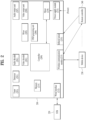
- FIG. 1 illustrates a data transmission protocol between a TV and a server according to an embodiment of the present disclosure.
- a TV according to an embodiment of the present disclosure may access a live TV service (a broadcast program or the like) transmitted through a broadband network (e.g., an IP network) rather than transmitted based on a radio frequency (RF). Therefore, a tuner for receiving an RF signal is not necessarily required. Further, the TV according to an embodiment of the present disclosure is also applicable to, for example, a digital video broadcasting ? Internet (DVB-I) standard.
- a DVB-I client 100 which is an example of a TV communicating with various servers, will be described.
- a service list registry 130 communicates with the DVB-I client 100 based on query parameters and so on.
- the DVB-I client corresponds to, for example, a TV capable of receiving a live broadcast program through an IP network, and specific components inside the TV will be described in more detail later with reference to FIG. 2 .
- a service list server 120 transmits a service list to the DVB-I client 100.
- a content guide server 110 responds to a request for content guide data received from the DVB-I client 100.
- a content/service provider 150 refers to an organization that provides DVB-I services.
- a playlist server 140 provides a list of services that reference a playlist of DVB-DASH content items.
- a media presentation description (MPD) server 160 provides a dynamic adaptive streaming over hypertext transfer protocol (HTTP) (DASH) MPD, and a stream server 170 transmits a DASH media segment to the DVB-I client 100.
- MPD media presentation description
- DASH dynamic adaptive streaming over hypertext transfer protocol
- a HTTP GET request is used for the processes of C1 (Request for playlist), D1 (Request for DASH MPD), and E1 (Request for media) illustrated in FIG. 1 , and a HTTP process between a TV (e.g., the DVB-I client 100) and a server will be described below in more detail with reference to FIG. 3 .
- FIG. 2 illustrates components inside a TV and an external device according to another embodiment of the present disclosure. Those skilled in the art may implement the present disclosure by combining some components with reference to FIGS. 1 and 2 .
- a TV 200 shown in FIG. 2 includes various components, the scope of the rights of the present disclosure is not limited thereto and should be determined according to the matters described in the claims.
- the components inside the TV 200 shown in FIG. 2 may be controlled through the controller 209, and each of the components may be directly or indirectly connected thereto. That is, although not shown in FIG. 2 , all of the components inside the TV 200 of FIG. 2 are designed to directly or indirectly transmit and receive control signals and/or data.
- a tuner 201 receives a broadcast signal through an antenna or the like, and a demuxer (demux or demultiplexer) 202 demultiplexes audio data and video data included in the broadcast signal.
- a demuxer demux or demultiplexer
- An audio decoder 203 decodes the audio data (in encoded state) included in the broadcast signal
- a video decoder 204 decodes the video data (in encoded state) included in the broadcast signal.
- the decoded audio data is outputted through an audio output unit 207.
- the audio output unit 207 may be, for example, a speaker attached to or spaced apart from the TV 200.
- the decoded video data is directly outputted through a video output unit 208.
- a mixer 205 mixes menu data generated by an OSD generating unit 206 and the video data and then transmits the mixed menu data to the video output unit 208.
- a memory 215 stores various control data and commands for controlling the TV 200, and the controller 209 may control all components in the TV with reference to the memory 215.
- the TV 200 transmits and receives data through communication with various peripheral external devices.
- video and audio data are received from an STB 220 via a wired interface 212, and then processed by the audio decoder 203 and the video decoder 204, respectively.
- the received video and audio data may be directly outputted through the audio output unit 207 and the video output unit 208 without passing through the decoders 203 and 204.
- a mobile device 230 e.g., a mobile phone, a wearable device, etc.
- a wireless communication module 213 e.g., a wireless communication module
- IR infrared
- the remote controller 240 capable of Bluetooth communication such as BT transmits and receives various data to and from the TV via the wireless communication module 213.
- FIG. 3 illustrates an overall system including a TV, a mobile device, and a server according to an embodiment of the present disclosure.
- a live channel watched on a TV 300 may be watched on a mobile device 320 by connecting it to a live channel provided by an over the top (OTT) of the mobile device 320.
- An OTT service refers to, for example, a service of providing various media contents such as broadcast programs, movies, and education through the Internet.
- IP network not only the TV 300 but also the mobile device 320 may provide the OTT service.
- a live channel watched on the TV 300 may be watched through the same VoD content provided by the OTT of the mobile device 320.
- a live channel provided by the OTT of the mobile device 320 may be watched on the TV 300 by connecting it to a live channel of the TV 300.
- a live channel provided by the OTT of the mobile device 320 may be watched as VoD content through an OTT application installed on the TV 300.
- the TV 300 and the mobile device 320 are designed to perform, for example, HTTP communication with a server 310.
- REST representational state transfer
- REST refers to specifying resources through an HTTP uniform resource identifier (URI) and applying CRUD operations to the resources (URI) through HTTP methods, POST, GET, PUT, and DELETE.
- URI uniform resource identifier
- CRUD operations to the resources (URI) through HTTP methods, POST, GET, PUT, and DELETE.
- CRUD is a term that collectively refers to the basic data processing functions of computer software, such as Create, Read, Update, and Delete.
- the CRUD operations in REST are as follows.
- the server 310 is designed to cache a specific live broadcast program in a data cache, when it has been watched for a predetermined time on the TV 300 and the mobile device 320.
- the server is designed to additionally operate an account manager.
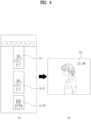
- FIG. 4 illustrates a process of selecting an OTT service on a mobile device.
- a mobile device executes an OTT application stored in a memory.
- the executed OTT application provides channels Ch. 1, Ch. 20, Ch. 100, and so on of programs currently broadcast in real time.
- the mobile device When a user selects a specific channel (Ch. 100 illustrated in (a) of FIG. 4 ), the mobile device according to an embodiment of the present disclosure displays a live broadcast program of the selected channel 410, as illustrated in (b) of FIG. 4 .
- FIG. 4 is based on the assumption that a live broadcast program is selected through the OTT application of the mobile device, the present disclosure is also applicable to a case where any video on demand VOD) content is selected.
- the TV and the mobile device according to an embodiment of the present disclosure are assumed to perform wireless communication, for example, HTTP communication, with the server.
- information about the live broadcast program selected through the mobile device in FIG. 4 is transmitted to the server.
- account information about the mobile device is also transmitted to the server.
- FIG. 5 illustrates a process of transmitting data related to an OTT service of a mobile device stored in a server to a TV, based on FIG. 4 .
- the server stores information about the live broadcast program watched currently through the OTT application of the mobile device in a database (DB).
- DB database
- the information about the live broadcast program is mapped to the account information about the mobile device that has transmitted it, and stored in the DB of the server.
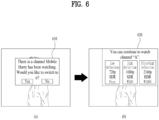
- FIG. 6 illustrates a process of displaying information related to an OTT service of a mobile device on a TV, based on FIG. 5 .
- a TV is generally shared and used by a plurality of users. Therefore, when person B turns on the TV, while person A is watching Ch. 11 on a portable phone, it is not desirable to continuously display Ch. 11 on the TV.
- options for identifying family members are preferably displayed after the TV is turned on.
- the TV transmits related information to the server. Therefore, there is a technical effect of providing a continue view service suitable for a user who has currently turned on the TV by the server.
- the TV may display a message 610 asking whether to switch to the channel watched on the mobile device.
- the TV sequentially displays a next message 620 for selecting an image definition or price of the channel, as illustrated in (b) of FIG. 6 .
- FIG. 7 is a flowchart illustrating the processes illustrated in FIGS. 4 to 6 in a time series manner.
- interfaces illustrated in FIG. 7 are configured as, for example, REST APIs.
- data is transmitted through HTTP, and methods such as PUT, GET, and POST may be defined depending on the type of transmitted information or a request.
- the GET method is mainly used when data is read or retrieved.
- a GET request is successfully completed, a 200 (OK) HTTP response code is returned along with XML or JSON.
- a 404 (Not found) error or a 400 (Bad request) error mainly occurs.
- the POST method is mainly used when a new resource is created. More specifically, POST is used to create sub-resources (sub-resources of parent resources). When the creation is successfully completed, a 201 (Created) HTTP response is returned.
- the PUT method is used to transmit data to the server to create/update resources.
- the mobile device transmits account information to the server (S700).
- the account information includes, for example, a serial number, a unique device ID, a user ID/PW, and so on of the mobile device.
- the server registers the account information received in step S700 in the DB (S710).
- the TV also transmits account information to the server (S720).
- the account information includes, for example, a serial number, a unique device ID, a user ID/PW, and so on of the TV.
- the server registers the account information received in step S720 in the DB (S730).
- the server is designed to enable the continue view function by managing the account information about the TV and the mobile device together, when they are the same (e.g., the IDs/PWs are the same).
- step S750 it is also within the scope of the present disclosure to design step S750 to be performed only when the live broadcast program received through an IP network is displayed on the mobile device for a predetermined time (e.g., 30 seconds or 1 minute). With this design, it is possible to solve the problem that unnecessary data is excessively accumulated on the server, thereby reducing a memory space.
- the server maps the account information registered in the DB in step S710 to the channel service identification information received in step S750 and stores them in the DB (S760).
- the TV requests the live channel service watched on the other device from the server, automatically or upon request of the user (S780).
- the server requests the live channel service used on the other device with the same account from the DB, based on the account information registered in step S730 (S790).
- the DB transmits the identification information about the live channel service used on the other device with the same account to the server (S791).
- the server is designed to transmit the identification information about the live channel service to the TV (S792), and the TV is designed to output a message recommending the recent channel used on the other device (e.g., the mobile device) on a screen (S793).
- FIG. 8 illustrates a process of selecting a live channel and communicating with a server by a TV.
- the TV receives any live broadcast program (Ch. 300 810) through an IP network and then displays it.
- the TV stores information about the currently output broadcast program to the server through the IP network.
- the server stores the information about the broadcast program together with account information transmitted by the TV, as illustrated in (b) of FIG. 8 .
- the account information will be described later in detail with reference to FIG. 10 (particularly, S1000).
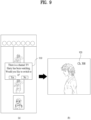
- FIG. 9 illustrates a process of displaying information related to an OTT service on a mobile device, based on FIG. 8 .
- the mobile device illustrated in (a) of FIG. 9 may also access the server illustrated in (b) of FIG. 8 through the IP network, and transmit and receive data.
- the mobile device is capable of displaying a guide message 910 that enables switching to a channel watched on the TV, based on information received from the DB of the server (see (b) of FIG. 8 ).
- the mobile device When “Yes” is selected in the guide message 910 illustrated in (a) of FIG. 9 , the mobile device also switches to the same channel 920 as that of the TV and displays the corresponding broadcast program, as illustrated in (b) of FIG. 9 .
- FIG. 10 is a flowchart illustrating the processes of FIGS. 8 and 9 in a time series manner.
- interfaces illustrated in FIG. 10 are also configured as, for example, REST APIs.
- Data is transmitted through HTTP, and methods such as PUT, GET, and POST may be defined depending on the type of transmitted information or a request.
- the TV transmits account information to the server (S1000).
- the account information includes, for example, a serial number, a unique device ID, a user ID/PW, and so on of the TV.
- the server registers the account information received in step S1000 in the DB (S1010).
- the mobile device also transmits account information to the server (S1020).
- the account information includes, for example, a serial number, a unique device ID, a user ID/PW, and so on of the mobile device.
- the server registers the account information received in step S1020 in the DB (S1030).
- the server is designed to enable the continue view function by managing the account information about the TV and the mobile device together, when they are the same (e.g., the IDs/PWs are the same).
- the TV transmits identification information related to the live broadcast program to the server (S1050).
- the server maps the account information registered in the DB in step S1010 to the channel service identification information received in step S1050 and stores them in the DB (S1060).
- the mobile device requests the live channel service watched on the other device from the server (S1080).
- the server Based on the account information registered in step S1030, the server requests the live channel service used on the other device with the same account from the DB (S1090).
- the DB transmits the identification information about the live channel service used on the other device with the same account to the server (S1091).
- the server is designed to transmit the identification information about the live channel service to the mobile device (S1092), and the mobile device is designed to output a message recommending the recent channel used on the other device (e.g., the TV) on a screen (S1093).
- the foregoing embodiments relate to a technique of, when a broadcast program of a specific channel is provided on a first device, providing the broadcast program of the same specific channel on a second device through communication with a server.
- a problem that the needs of the user are not satisfied may occur.
- FIG. 11 illustrates a process of selecting a live channel and communicating with a server by a mobile device.
- the mobile device accesses Ch. 200 through an OTT service.
- the broadcast time of the current live channel is set to 10:00 to 11:00 AM, which may be recognized by the mobile device through other metadata such as EPG information.
- the mobile device transmits information about the current channel, information about the start/end time of a current broadcast program, account information, and so on to the server.
- FIG. 12 illustrates a process of communicating with a server, while a TV is turned on.
- FIG. 12 is based on the situation described above with reference to FIG. 11 .
- the server illustrated in FIG. 11 is identical to the server illustrated in FIG. 12 .
- the TV when the TV according to an embodiment of the present disclosure is powered on, it receives information about a current channel, information about the start/end time of a current broadcast program, and so on of a mobile device managed with the same account information by the server.
- FIG. 13 illustrates a process of providing a live broadcast program based on current time information by a TV according to an embodiment of the present disclosure.
- FIG. 13 is based on the situation described above with reference to FIG. 12 .
- the TV upon recognizing that the current time (10:55 AM) is earlier than the end time (11:00 AM) of the broadcast program, the TV displays a message asking whether to switch to the same channel, as illustrated in (a) of FIG. 13 .
- FIG. 14 illustrates a process of providing content based on current time information by a TV according to an embodiment of the present disclosure.
- FIG. 14 is based on the situation described above with reference FIG. 12 , and is not related to the situation of FIG. 13 .
- the TV upon recognizing that the current time (11:05 AM) is earlier than the end time (11:00 AM) of the broadcast program, the TV displays a message asking whether to access content rather than switching the channel, as illustrated in (a) of FIG. 14 .
- FIG. 13 relates to simple channel switching, and thus has a 2-level depth
- FIG. 14 does not relate to simple channel switching, and thus has, for example, a depth of 3 or more levels.
- the TV displays a first option for selecting a specific content provider (CP) from among at least one CP providing the same content, using title information about a broadcast program received from the server, although a current live channel has ended, as illustrated in (a) of FIG. 14 .
- CP specific content provider
- the TV is designed to display a second option for selecting an image definition (e.g., 720p, 1080p, or 2160p) or price (e.g., free, W500, or W1000) of the content, as illustrated in (c) of FIG. 14 .
- an image definition e.g., 720p, 1080p, or 2160p
- price e.g., free, W500, or W1000
- the foregoing embodiments will be summarized as follows.
- the first device corresponds to a TV
- the second device corresponds to a mobile device.
- the first device corresponds to a mobile device
- the second device corresponds to a TV.
- Account information identifying at least one user using the first device is transmitted to the server by the first device.
- the first device displays a live broadcast program received through an IP network.
- the first device transmits identification information about the live broadcast program to the server.
- the identification information about the live broadcast program includes, for example, at least one of a unique ID, channel information, a service name, a media universal resource locator (URL), or a media presentation description (MPD) URL.
- the server is designed to store the account information and the identification information by mapping them.
- the second device transmits account information identical to the account information to the server.
- the second device selectively displays the live broadcast program (see FIG. 13 ) or content corresponding to the live broadcast program (see FIG. 14 ) according to a current time and the end time of the live broadcast program.
- the second device when the current time is earlier than the end time of the live broadcast program, the second device is designed to display the live broadcast program (see FIG. 13 ). To implement this, the identification information about the live broadcast program is transmitted to the second device by the server.
- the second device when the end time of the live broadcast program is earlier than the current time, the second device is designed to display the content corresponding to the live broadcast program. Obviously, before displaying the content (e.g., VOD), the second device displays a first option ((b) of FIG. 14 ) for selecting a specific CP from among at least one CP providing the content, and displays a second option ((c) of FIG. 14 ) for selecting an image definition or price of the content.
- a first option ((b) of FIG. 14 ) for selecting a specific CP from among at least one CP providing the content
- a second option ((c) of FIG. 14 ) for selecting an image definition or price of the content.
- the TV 200 controlled by the remote control 240 includes an IR receiver (the IR sensor 214 illustrated in FIG. 2 ) that receives a power-on signal from the remote control 240, a transceiver (the wireless communication module 213 illustrated in FIG. 2 ) that performs wireless communication with a server, a display (the video output unit 208 illustrated in FIG. 2 ) that outputs any video data, and a controller (the controller 209 illustrated in FIG. 2 ) that controls the IR receiver, the transceiver, and the display.
- IR receiver the IR sensor 214 illustrated in FIG. 2
- a transceiver the wireless communication module 213 illustrated in FIG. 2
- a display the video output unit 208 illustrated in FIG. 2
- a controller the controller 209 illustrated in FIG. 2
- the controller controls the display to selectively display a specific broadcast program (see FIG. 13 ) or content corresponding to the specific broadcast program (see FIG. 14 ) according to data received from the server and a current time.
- the data received from the server includes, for example, information about a live broadcast program being output through a mobile device using the same account information as the TV 200.
- the above-described specific broadcast program is designed to be received through an IP network, unlike the conventional technology.
- the controller 209 controls the transceiver (e.g., the wireless communication module 213 illustrated in FIG. 2 ) to output the live broadcast program.
- the transceiver e.g., the wireless communication module 213 illustrated in FIG. 2
- the controller 209 controls the transceiver (e.g., the wireless communication module 213 illustrated in FIG. 2 ) to output content corresponding to the live broadcast program.
- the transceiver e.g., the wireless communication module 213 illustrated in FIG. 2
- This design advantageously enables a linked channel service between a TV (e.g., conforming to the DVB-I standard) and a mobile device.
- a TV e.g., conforming to the DVB-I standard
- the embodiments of the present disclosure are different from the conventional technology in that a mobile device and a TV link a live channel and content through a communication network (e.g., 3G to 6G).
- a communication network e.g., 3G to 6G
- a conventional OTT service is a technology of simply recommending content, without any relation to linkage to a live channel.
- a server side registers and maps each device through unique information (e.g., account information) about a TV/mobile device, unique information about a channel/content consumed by each device is transmitted to the server, and another device receives the information from the server.
- unique information e.g., account information
- channel/content-related information accumulated in a DB of a server may be managed as big data, and thus used as linkage information and high value-added data available for personalized services or targeted advertising.
- Computer-readable media includes any type of recording device that stores data to be read by a computer system. Examples of computer-readable media include hard disk drives (HDDs), solid state disks (SSDs), silicon disk drives (SDDs), ROMs, RAMs, CD-ROMs, magnetic tapes, floppy disks, optical data storage devices, and also those implemented in the form of carrier waves (e.g., transmitted over the Internet).
- the computer may include a controller. Accordingly, the detailed description should not be construed as restrictive in all respects but should be considered illustrative. The scope of the present disclosure should be determined by a reasonable interpretation of the appended claims, and all changes within the equivalent scope of the present disclosure are intended to be included within the scope of the present disclosure.
- the present disclosure is applicable to any type of multimedia device (e.g., TV, portable phone, tablet PC, laptop, or wearable device), and thus its industrial applicability is acknowledged.
- multimedia device e.g., TV, portable phone, tablet PC, laptop, or wearable device
Landscapes
- Engineering & Computer Science (AREA)
- Multimedia (AREA)
- Signal Processing (AREA)
- Databases & Information Systems (AREA)
- Human Computer Interaction (AREA)
- Computer Networks & Wireless Communication (AREA)
- Computer Graphics (AREA)
- Health & Medical Sciences (AREA)
- General Health & Medical Sciences (AREA)
- Social Psychology (AREA)
- Business, Economics & Management (AREA)
- Marketing (AREA)
- General Engineering & Computer Science (AREA)
- Computer Security & Cryptography (AREA)
- Software Systems (AREA)
- Two-Way Televisions, Distribution Of Moving Picture Or The Like (AREA)
Abstract
Description
- The present disclosure relates to various multimedia devices (e.g., television (TV), mobile phone, tablet personal computer (PC), laptop, wearable device, or the like). For example, the present disclosure is applicable to a content-linked service between a TV and a mobile device.
- Conventional channel services are limited to a TV. In other words, there is no service of providing content continuously on another device.
- For example, a channel service on a TV (from the perspective of a TV manufacturer) and an over the top (OTT) service on a mobile device (from the perspective of an OTT service provider) are provided and operated independently of each other.
- Accordingly, there is a problem in that a history of using (consuming) TV channel services is not cached in a specific server and used as big data.
- An embodiment of the present disclosure is to provide a technique of transmitting information about a channel/content consumed on a TV to a backend server and a database, and upon execution of an OTT application or the like on a mobile device, continuously displaying the channel/content consumed on the TV on the mobile device.
- Another embodiment of the present disclosure is to provide a technique of mapping a TV and an OTT service (e.g., installed on a mobile phone) to a unique value, and when a user uses a corresponding channel on the TV or the mobile device for a predetermined time, enabling or recommending the user to continue watching the channel on the other device.
- Another embodiment of the present disclosure is to provide a technique of caching and managing channel information or the like used on a device in a server.
- According to an embodiment of the present disclosure, a control method of a system includes transmitting account information identifying at least one user using a first device to a server by the first device, displaying a live broadcast program received through an Internet protocol (IP) network by the first device, transmitting identification information about the live broadcast program to the server by the first device, mapping and storing the account information and the identification information by the server, transmitting account information identical to the account information to the server by a second device, and
selectively displaying the live broadcast program or content corresponding to the live broadcast program by the second device according to a current time and an end time of the live broadcast program. - Further, when the current time is earlier than the end time of the live broadcast program, the second device may display the live broadcast program. Further, the identification information about the live broadcast program may be designed to be transmitted to the second device by the server.
- For example, when the end time of the live broadcast program is earlier than the current time, the second device may display the content corresponding to the live broadcast program.
- For example, before the content corresponding to the live broadcast program is displayed, a first option for selecting a specific content provider (CP) from among at least one CP providing the content may be displayed by the second device, and a second option for selecting an image definition or a price of the content may be displayed by the second device.
- The identification information about the live broadcast program may include at least one of a unique ID, channel information, a service name, a media universal resource locator (URL), or a media presentation description (MPD) URL.
- Further, only when the live broadcast program received through the IP network is displayed by the first device for a predetermined time or longer, transmitting the identification information about the live broadcast program to the server by the first device may be performed.
- When the first device corresponds to a television (TV), the second device may correspond to a mobile device. On the contrary, when the first device corresponds to a mobile device, the second device may correspond to a TV.
- For example, a digital video broadcasting ? Internet (DVB-I) standard may be applied to the TV.
- According to an embodiment of the present disclosure, a TV controlled by a remote control includes an infrared (IR) receiver receiving a power-on signal from the remote control, a transceiver performing wireless communication with a server, a display outputting any video data, and a controller controlling the IR receiver, the transceiver, and the display.
- The controller controls the display to selectively display a live broadcast program or content corresponding to the live broadcast program, for example, according to data received from the server and a current time.
- According to an embodiment of the present disclosure, since a TV is linkable to an OTT service (e.g., through a portable phone), a channel may be advantageously watched continuously on the TV and the portable phone.
- According to another embodiment of the present disclosure, since history information used in a TV and an OTT service is managed in a server, the history information may be used as big data as well as for a channel service, and also used for a personalized service (e.g., service recommendation, customized advertisement, and so on), as high value-added big data.
- According to another embodiment of the present disclosure, there is a technical effect that once a TV and a mobile device are connected to a communication network, they may receive a service. Further, the problem that continuous view between a TV and a portable phone is possible only within a short distance based on conventional mirroring or WiFi direct may be overcome.
- The effects obtainable from the present disclosure are not limited to the effects described above, and other effects not described may be clearly understood by those skilled in the art to which the present disclosure belongs from the description below.
-
-
FIG. 1 illustrates a data transmission protocol between a TV and a server according to an embodiment of the present disclosure. -
FIG. 2 illustrates components inside a TV in addition to an external device according to another embodiment of the present disclosure. -
FIG. 3 illustrates an overall system including a TV, a mobile device, and a server according to an embodiment of the present disclosure. -
FIG. 4 illustrates a process of selecting an OTT service on a mobile device. -
FIG. 5 illustrates a process of transmitting OTT service-related data of a mobile device cached in a server to a TV, based onFIG. 4 . -
FIG. 6 illustrates a process of displaying OTT service-related information of a mobile device on a TV, based onFIG. 5 . -
FIG. 7 is a flowchart illustrating the processes illustrated inFIGS. 4 to 6 in a time series manner. -
FIG. 8 illustrates a process of selecting a live channel and communicating with a server by a TV. -
FIG. 9 illustrates a process of displaying OTT service-related information on a mobile device, based onFIG. 8 . -
FIG. 10 is a flowchart illustrating the processes illustrated inFIGS. 8 and9 in a time series manner. -
FIG. 11 illustrates a process of selecting a live channel and communicating with a server by a mobile device. -
FIG. 12 illustrates a process of communicating with a server, while a TV is turned on. -
FIG. 13 illustrates a process of providing a live broadcast program based on current time information or the like by a TV according to an embodiment of the present disclosure. -
FIG. 14 illustrates a process of providing content based on current time information or the like by a TV according to an embodiment of the present disclosure. - Description will now be given in detail according to exemplary embodiments disclosed herein, with reference to the accompanying drawings. For the sake of brief description with reference to the drawings, the same or equivalent components may be provided with the same reference numbers, and description thereof will not be repeated. In general, a suffix such as "module" and "unit" may be used to refer to elements or components. Use of such a suffix herein is merely intended to facilitate description of the specification, and the suffix itself is not intended to give any special meaning or function. In the present disclosure, that which is well-known to one of ordinary skill in the relevant art has generally been omitted for the sake of brevity. The accompanying drawings are used to help easily understand various technical features and it should be understood that the embodiments presented herein are not limited by the accompanying drawings. As such, the present disclosure should be construed to extend to any alterations, equivalents and substitutes in addition to those which are particularly set out in the accompanying drawings.
- It will be understood that although the terms first, second, etc. may be used herein to describe various elements, these elements should not be limited by these terms. These terms are generally only used to distinguish one element from another.
- It will be understood that when an element is referred to as being "connected with" another element, the element can be directly connected with the other element or intervening elements may also be present. In contrast, when an element is referred to as being "directly connected with" another element, there are no intervening elements present.
- A singular representation may include a plural representation unless it represents a definitely different meaning from the context
- Terms such as "include" or "has" are used herein and should be understood that they are intended to indicate an existence of several components, functions or steps, disclosed in the specification, and it is also understood that greater or fewer components, functions, or steps may likewise be utilized.
-
FIG. 1 illustrates a data transmission protocol between a TV and a server according to an embodiment of the present disclosure. - A TV according to an embodiment of the present disclosure may access a live TV service (a broadcast program or the like) transmitted through a broadband network (e.g., an IP network) rather than transmitted based on a radio frequency (RF). Therefore, a tuner for receiving an RF signal is not necessarily required. Further, the TV according to an embodiment of the present disclosure is also applicable to, for example, a digital video broadcasting ? Internet (DVB-I) standard. With reference to
FIG. 1 , a DVB-I client 100, which is an example of a TV communicating with various servers, will be described. - As illustrated in
FIG. 1 , aservice list registry 130 communicates with the DVB-I client 100 based on query parameters and so on. The DVB-I client corresponds to, for example, a TV capable of receiving a live broadcast program through an IP network, and specific components inside the TV will be described in more detail later with reference toFIG. 2 . - A
service list server 120 transmits a service list to the DVB-I client 100. - A
content guide server 110 responds to a request for content guide data received from the DVB-I client 100. - A content/
service provider 150 refers to an organization that provides DVB-I services. - A
playlist server 140 provides a list of services that reference a playlist of DVB-DASH content items. - A media presentation description (MPD)
server 160 provides a dynamic adaptive streaming over hypertext transfer protocol (HTTP) (DASH) MPD, and astream server 170 transmits a DASH media segment to the DVB-I client 100. - A HTTP GET request is used for the processes of C1 (Request for playlist), D1 (Request for DASH MPD), and E1 (Request for media) illustrated in
FIG. 1 , and a HTTP process between a TV (e.g., the DVB-I client 100) and a server will be described below in more detail with reference toFIG. 3 . -
FIG. 2 illustrates components inside a TV and an external device according to another embodiment of the present disclosure. Those skilled in the art may implement the present disclosure by combining some components with reference toFIGS. 1 and2 . - Although a
TV 200 shown inFIG. 2 includes various components, the scope of the rights of the present disclosure is not limited thereto and should be determined according to the matters described in the claims. - Moreover, the components inside the
TV 200 shown inFIG. 2 may be controlled through thecontroller 209, and each of the components may be directly or indirectly connected thereto. That is, although not shown inFIG. 2 , all of the components inside theTV 200 ofFIG. 2 are designed to directly or indirectly transmit and receive control signals and/or data. - First, a
tuner 201 receives a broadcast signal through an antenna or the like, and a demuxer (demux or demultiplexer) 202 demultiplexes audio data and video data included in the broadcast signal. - An audio decoder 203 decodes the audio data (in encoded state) included in the broadcast signal, and a video decoder 204 decodes the video data (in encoded state) included in the broadcast signal.
- The decoded audio data is outputted through an
audio output unit 207. Theaudio output unit 207 may be, for example, a speaker attached to or spaced apart from theTV 200. - Meanwhile, the decoded video data is directly outputted through a
video output unit 208. Alternatively, amixer 205 mixes menu data generated by anOSD generating unit 206 and the video data and then transmits the mixed menu data to thevideo output unit 208. - A
memory 215 stores various control data and commands for controlling theTV 200, and thecontroller 209 may control all components in the TV with reference to thememory 215. - Furthermore, the
TV 200 transmits and receives data through communication with various peripheral external devices. For example, video and audio data are received from anSTB 220 via awired interface 212, and then processed by the audio decoder 203 and the video decoder 204, respectively. Alternatively, the received video and audio data may be directly outputted through theaudio output unit 207 and thevideo output unit 208 without passing through the decoders 203 and 204. - Various data is transmitted and received with a mobile device 230 (e.g., a mobile phone, a wearable device, etc.) via a
wireless communication module 213, and an infrared (IR) signal of aremote controller 240 is received through an IR sensor 214. Alternatively, theremote controller 240 capable of Bluetooth communication such as BT transmits and receives various data to and from the TV via thewireless communication module 213. -
FIG. 3 illustrates an overall system including a TV, a mobile device, and a server according to an embodiment of the present disclosure. - According to an embodiment of the present disclosure, the following situations may all be covered.
- First, a live channel watched on a
TV 300 may be watched on amobile device 320 by connecting it to a live channel provided by an over the top (OTT) of themobile device 320. An OTT service refers to, for example, a service of providing various media contents such as broadcast programs, movies, and education through the Internet. When connected to an IP network, not only theTV 300 but also themobile device 320 may provide the OTT service. - Secondly, a live channel watched on the
TV 300 may be watched through the same VoD content provided by the OTT of themobile device 320. - Thirdly, a live channel provided by the OTT of the
mobile device 320 may be watched on theTV 300 by connecting it to a live channel of theTV 300. - Fourthly, a live channel provided by the OTT of the
mobile device 320 may be watched as VoD content through an OTT application installed on theTV 300. - To implement them, the
TV 300 and themobile device 320 are designed to perform, for example, HTTP communication with aserver 310. - More specifically, a representational state transfer (REST) API may be used. The REST API refers to an API created based on REST.
- REST refers to specifying resources through an HTTP uniform resource identifier (URI) and applying CRUD operations to the resources (URI) through HTTP methods, POST, GET, PUT, and DELETE.
- CRUD is a term that collectively refers to the basic data processing functions of computer software, such as Create, Read, Update, and Delete. The CRUD operations in REST are as follows.
- Create: Create data (POST)
- Read: Retrieve data (GET)
- Update: Modify data (PUT)
- Delete: Delete data (DELETE)
- The advantages of REST are as follows.
- First, since HTTP infrastructure is used as it is, there is no need to build separate infrastructure for using the REST API.
- Secondly, the roles of a server and a client may be clearly separated.
- Thirdly, since a REST API message clearly indicates what it intends, it is easy to understand what it intends.
- Further, unlike the conventional technology, the
server 310 is designed to cache a specific live broadcast program in a data cache, when it has been watched for a predetermined time on theTV 300 and themobile device 320. To implement a continue view function (TV ? mobile device or mobile device ? TV), the server is designed to additionally operate an account manager. - With reference to
FIGS. 4 to 7 , an embodiment in which content consumed on a mobile device may be continuously viewed on a TV will be described below. -
FIG. 4 illustrates a process of selecting an OTT service on a mobile device. - As illustrated in (a) of
FIG. 4 , it is assumed that a mobile device according to an embodiment of the present disclosure executes an OTT application stored in a memory. - The executed OTT application provides channels Ch. 1, Ch. 20, Ch. 100, and so on of programs currently broadcast in real time.
- When a user selects a specific channel (Ch. 100 illustrated in (a) of
FIG. 4 ), the mobile device according to an embodiment of the present disclosure displays a live broadcast program of the selectedchannel 410, as illustrated in (b) ofFIG. 4 . - Although
FIG. 4 is based on the assumption that a live broadcast program is selected through the OTT application of the mobile device, the present disclosure is also applicable to a case where any video on demand VOD) content is selected. - Further, as described before with reference to
FIG. 3 , the TV and the mobile device according to an embodiment of the present disclosure are assumed to perform wireless communication, for example, HTTP communication, with the server. - Therefore, information about the live broadcast program selected through the mobile device in
FIG. 4 is transmitted to the server. To implement a continue view function of the TV, account information about the mobile device is also transmitted to the server. -
FIG. 5 illustrates a process of transmitting data related to an OTT service of a mobile device stored in a server to a TV, based onFIG. 4 . - As illustrated in (a) of
FIG. 5 , the server according to an embodiment of the present disclosure stores information about the live broadcast program watched currently through the OTT application of the mobile device in a database (DB). Although not illustrated in (a) ofFIG. 5 , the information about the live broadcast program is mapped to the account information about the mobile device that has transmitted it, and stored in the DB of the server. - Further, as illustrated in (b) of
FIG. 5 , when a TV with the same account information as the mobile device is turned on, the information about the current live broadcast program of the mobile device stored in the server is transmitted from the server to the TV. InFIG. 5 , it is assumed that when the TV is turned on, the information about the current live broadcast program of the mobile device is transmitted. However, it is also within the scope of the present disclosure to design the information about the current live broadcast program of the mobile device to be transmitted, only when a request is made through a remote control of the TV. -
FIG. 6 illustrates a process of displaying information related to an OTT service of a mobile device on a TV, based onFIG. 5 . - Although not illustrated in
FIG. 6 , unlike a mobile device, a TV is generally shared and used by a plurality of users. Therefore, when person B turns on the TV, while person A is watching Ch. 11 on a portable phone, it is not desirable to continuously display Ch. 11 on the TV. - To solve this problem, options for identifying family members are preferably displayed after the TV is turned on. When an option for identifying a family member is selected through the TV, the TV transmits related information to the server. Therefore, there is a technical effect of providing a continue view service suitable for a user who has currently turned on the TV by the server.
- In (a) of
FIG. 6 , it is assumed that a person named Harry has selected an option for identifying himself after turning on the TV. Upon receipt of information identifying Harry from the TV, the server extracts information about a channel executed currently or immediately before on a mobile device with the same account from the DB, and transmits the extracted channel information back to the TV. - Therefore, as illustrated in (a) of
FIG. 6 , the TV according to an embodiment of the present disclosure may display amessage 610 asking whether to switch to the channel watched on the mobile device. - When "Yes" is selected in the
message 610 illustrated in (a) ofFIG. 6 , the TV according to an embodiment of the present disclosure sequentially displays anext message 620 for selecting an image definition or price of the channel, as illustrated in (b) ofFIG. 6 . - Although the foregoing embodiments of the present disclosure have been described with a focus on screens provided by the mobile device and the TV with reference to
FIGS. 4 to 6 , a specific communication protocol with the server will be described below with reference toFIG. 7 . -
FIG. 7 is a flowchart illustrating the processes illustrated inFIGS. 4 to 6 in a time series manner. - For reference, interfaces illustrated in
FIG. 7 are configured as, for example, REST APIs. In addition, data is transmitted through HTTP, and methods such as PUT, GET, and POST may be defined depending on the type of transmitted information or a request. - For example, the GET method is mainly used when data is read or retrieved. When a GET request is successfully completed, a 200 (OK) HTTP response code is returned along with XML or JSON. When an error occurs, a 404 (Not found) error or a 400 (Bad request) error mainly occurs.
- For example, the POST method is mainly used when a new resource is created. More specifically, POST is used to create sub-resources (sub-resources of parent resources). When the creation is successfully completed, a 201 (Created) HTTP response is returned.
- For example, the PUT method is used to transmit data to the server to create/update resources.
- Referring again to
FIG. 7 , the mobile device according to an embodiment of the present disclosure transmits account information to the server (S700). The account information includes, for example, a serial number, a unique device ID, a user ID/PW, and so on of the mobile device. The server registers the account information received in step S700 in the DB (S710). - The TV according to an embodiment of the present disclosure also transmits account information to the server (S720). The account information includes, for example, a serial number, a unique device ID, a user ID/PW, and so on of the TV. The server registers the account information received in step S720 in the DB (S730).
- Although not shown in
FIG. 7 , the server is designed to enable the continue view function by managing the account information about the TV and the mobile device together, when they are the same (e.g., the IDs/PWs are the same). - For example, it is assumed that a live broadcast program is being watched through an OTT service on the mobile device (S740). The mobile device transmits identification information related to the live broadcast program to the server (S750). In another embodiment, it is also within the scope of the present disclosure to design step S750 to be performed only when the live broadcast program received through an IP network is displayed on the mobile device for a predetermined time (e.g., 30 seconds or 1 minute). With this design, it is possible to solve the problem that unnecessary data is excessively accumulated on the server, thereby reducing a memory space.
- The server maps the account information registered in the DB in step S710 to the channel service identification information received in step S750 and stores them in the DB (S760).
- It is assumed that the TV according to an embodiment of the present disclosure is turned on (S770). The TV requests the live channel service watched on the other device from the server, automatically or upon request of the user (S780).
- The server requests the live channel service used on the other device with the same account from the DB, based on the account information registered in step S730 (S790).
- The DB transmits the identification information about the live channel service used on the other device with the same account to the server (S791).
- The server is designed to transmit the identification information about the live channel service to the TV (S792), and the TV is designed to output a message recommending the recent channel used on the other device (e.g., the mobile device) on a screen (S793).
- With reference to
FIGS. 4 to 7 , an embodiment of enabling a service, such as continuous viewing of content consumed on a mobile device, on a TV has been described in detail. - In contrast, an embodiment of enabling a service, such as continuous viewing of content consumed on a TV, on a mobile device will be described below with reference to
FIGS. 8 to 10 . -
FIG. 8 illustrates a process of selecting a live channel and communicating with a server by a TV. - As illustrated in (a) of
FIG. 8 , it is assumed that the TV according to an embodiment of the present disclosure receives any live broadcast program (Ch. 300 810) through an IP network and then displays it. - The TV according to an embodiment of the present disclosure stores information about the currently output broadcast program to the server through the IP network.
- Therefore, the server stores the information about the broadcast program together with account information transmitted by the TV, as illustrated in (b) of
FIG. 8 . The account information will be described later in detail with reference toFIG. 10 (particularly, S1000). -
FIG. 9 illustrates a process of displaying information related to an OTT service on a mobile device, based onFIG. 8 . - First, it is assumed that the mobile device illustrated in (a) of
FIG. 9 may also access the server illustrated in (b) ofFIG. 8 through the IP network, and transmit and receive data. - Therefore, the mobile device according to an embodiment of the present disclosure is capable of displaying a
guide message 910 that enables switching to a channel watched on the TV, based on information received from the DB of the server (see (b) ofFIG. 8 ). - When "Yes" is selected in the
guide message 910 illustrated in (a) ofFIG. 9 , the mobile device also switches to thesame channel 920 as that of the TV and displays the corresponding broadcast program, as illustrated in (b) ofFIG. 9 . - The operations of the TV, the mobile device, and the server have been described separately with reference to
FIGS. 8 and9 . Now, a description will be given of an overall process of transmitting and receiving data by each entity in the overall system with reference toFIG. 10 . -
FIG. 10 is a flowchart illustrating the processes ofFIGS. 8 and9 in a time series manner. - As described before with reference to
FIG. 7 , interfaces illustrated inFIG. 10 are also configured as, for example, REST APIs. Data is transmitted through HTTP, and methods such as PUT, GET, and POST may be defined depending on the type of transmitted information or a request. - Referring again to
FIG. 10 , the TV according to an embodiment of the present disclosure transmits account information to the server (S1000). The account information includes, for example, a serial number, a unique device ID, a user ID/PW, and so on of the TV. The server registers the account information received in step S1000 in the DB (S1010). - The mobile device according to an embodiment of the present disclosure also transmits account information to the server (S1020). The account information includes, for example, a serial number, a unique device ID, a user ID/PW, and so on of the mobile device. The server registers the account information received in step S1020 in the DB (S1030).
- Although not shown in
FIG. 10 , the server is designed to enable the continue view function by managing the account information about the TV and the mobile device together, when they are the same (e.g., the IDs/PWs are the same). - For example, it is assumed that a live broadcast program is being watched through an OTT service on the TV (S1040). The TV transmits identification information related to the live broadcast program to the server (S1050).
- The server maps the account information registered in the DB in step S1010 to the channel service identification information received in step S1050 and stores them in the DB (S1060).
- It is assumed that the mobile device according to an embodiment of the present disclosure is turned on (S1070). The mobile device requests the live channel service watched on the other device from the server (S1080).
- Based on the account information registered in step S1030, the server requests the live channel service used on the other device with the same account from the DB (S1090).
- The DB transmits the identification information about the live channel service used on the other device with the same account to the server (S1091).
- The server is designed to transmit the identification information about the live channel service to the mobile device (S1092), and the mobile device is designed to output a message recommending the recent channel used on the other device (e.g., the TV) on a screen (S1093).
- The foregoing embodiments relate to a technique of, when a broadcast program of a specific channel is provided on a first device, providing the broadcast program of the same specific channel on a second device through communication with a server. However, when the broadcast program displayed on the first device ends at a time when the second device accesses the specific channel, a problem that the needs of the user are not satisfied may occur.
- To solve this problem, a solution of displaying a different guide message on the second device according to the result of a comparison between a current time and the end time of the live broadcast program will be described below with reference to
FIGS. 11 to 14 . -
FIG. 11 illustrates a process of selecting a live channel and communicating with a server by a mobile device. - As illustrated in
FIG. 11 , it is assumed that the mobile device according to an embodiment of the present disclosure accesses Ch. 200 through an OTT service. The broadcast time of the current live channel is set to 10:00 to 11:00 AM, which may be recognized by the mobile device through other metadata such as EPG information. - Further, the mobile device transmits information about the current channel, information about the start/end time of a current broadcast program, account information, and so on to the server.
-
FIG. 12 illustrates a process of communicating with a server, while a TV is turned on.FIG. 12 is based on the situation described above with reference toFIG. 11 . In other words, the server illustrated inFIG. 11 is identical to the server illustrated inFIG. 12 . - Therefore, when the TV according to an embodiment of the present disclosure is powered on, it receives information about a current channel, information about the start/end time of a current broadcast program, and so on of a mobile device managed with the same account information by the server.
-
FIG. 13 illustrates a process of providing a live broadcast program based on current time information by a TV according to an embodiment of the present disclosure.FIG. 13 is based on the situation described above with reference toFIG. 12 . - As illustrated in (a) of
FIG. 13 , it is assumed that a current time is 10:55 AM, and the end time of a broadcast program watched on the mobile device is 11:00 AM. - Therefore, upon recognizing that the current time (10:55 AM) is earlier than the end time (11:00 AM) of the broadcast program, the TV displays a message asking whether to switch to the same channel, as illustrated in (a) of
FIG. 13 . - As illustrated in (b) of
FIG. 13 , the TV may also access the same channel and display the same broadcast program output from the mobile device. -
FIG. 14 illustrates a process of providing content based on current time information by a TV according to an embodiment of the present disclosure.FIG. 14 is based on the situation described above with referenceFIG. 12 , and is not related to the situation ofFIG. 13 . - As illustrated in (a) of
FIG. 14 , it is assumed that a current time is 11:05 AM, and the end time of a broadcast program watched on the mobile device is 11:00 AM. - Therefore, upon recognizing that the current time (11:05 AM) is earlier than the end time (11:00 AM) of the broadcast program, the TV displays a message asking whether to access content rather than switching the channel, as illustrated in (a) of
FIG. 14 . This is an embodiment clearly distinct from that illustrated in (a) ofFIG. 13 . - While the embodiment of
FIG. 13 relates to simple channel switching, and thus has a 2-level depth, whereas the embodiment ofFIG. 14 does not relate to simple channel switching, and thus has, for example, a depth of 3 or more levels. - For example, the TV according to an embodiment of the present disclosure displays a first option for selecting a specific content provider (CP) from among at least one CP providing the same content, using title information about a broadcast program received from the server, although a current live channel has ended, as illustrated in (a) of
FIG. 14 . - The TV according to an embodiment of the present disclosure is designed to display a second option for selecting an image definition (e.g., 720p, 1080p, or 2160p) or price (e.g., free, W500, or W1000) of the content, as illustrated in (c) of
FIG. 14 . - From the perspective of the overall system (a first device, a second device, and a server), the foregoing embodiments will be summarized as follows. When the first device corresponds to a TV, the second device corresponds to a mobile device. On the contrary, when the first device corresponds to a mobile device, the second device corresponds to a TV.
- Account information identifying at least one user using the first device is transmitted to the server by the first device. The first device displays a live broadcast program received through an IP network.
- The first device transmits identification information about the live broadcast program to the server. The identification information about the live broadcast program includes, for example, at least one of a unique ID, channel information, a service name, a media universal resource locator (URL), or a media presentation description (MPD) URL.
- The server is designed to store the account information and the identification information by mapping them.
- The second device transmits account information identical to the account information to the server. The second device selectively displays the live broadcast program (see
FIG. 13 ) or content corresponding to the live broadcast program (seeFIG. 14 ) according to a current time and the end time of the live broadcast program. - More specifically, when the current time is earlier than the end time of the live broadcast program, the second device is designed to display the live broadcast program (see
FIG. 13 ). To implement this, the identification information about the live broadcast program is transmitted to the second device by the server. - On the contrary, when the end time of the live broadcast program is earlier than the current time, the second device is designed to display the content corresponding to the live broadcast program. Obviously, before displaying the content (e.g., VOD), the second device displays a first option ((b) of
FIG. 14 ) for selecting a specific CP from among at least one CP providing the content, and displays a second option ((c) ofFIG. 14 ) for selecting an image definition or price of the content. - From the perspective of the TV (see
FIG. 2 ), the foregoing embodiments are summarized as follows. - According to an embodiment of the present disclosure, the
TV 200 controlled by theremote control 240 includes an IR receiver (the IR sensor 214 illustrated inFIG. 2 ) that receives a power-on signal from theremote control 240, a transceiver (thewireless communication module 213 illustrated inFIG. 2 ) that performs wireless communication with a server, a display (thevideo output unit 208 illustrated inFIG. 2 ) that outputs any video data, and a controller (thecontroller 209 illustrated inFIG. 2 ) that controls the IR receiver, the transceiver, and the display. - Particularly, the controller controls the display to selectively display a specific broadcast program (see
FIG. 13 ) or content corresponding to the specific broadcast program (seeFIG. 14 ) according to data received from the server and a current time. - The data received from the server includes, for example, information about a live broadcast program being output through a mobile device using the same account information as the
TV 200. - The above-described specific broadcast program is designed to be received through an IP network, unlike the conventional technology.
- As described above with reference to
FIG. 13 , when the current time is earlier than the end time of the live broadcast program, thecontroller 209 controls the transceiver (e.g., thewireless communication module 213 illustrated inFIG. 2 ) to output the live broadcast program. - As described above with reference to
FIG. 14 , when the end time of the live broadcast program is earlier than the current time, thecontroller 209 controls the transceiver (e.g., thewireless communication module 213 illustrated inFIG. 2 ) to output content corresponding to the live broadcast program. - This design advantageously enables a linked channel service between a TV (e.g., conforming to the DVB-I standard) and a mobile device.
- As described above, there has been no technique of attempting linkage between a channel service of a TV and an OTT service of a mobile device up to now, and there have been limitations in independent provisioning and operation between a TV manufacturer and an OTT of a service provider.
- According to the conventional technology, only screen sharing or mirroring is available through the same network or short-range communication (wifi direct). In contrast, the embodiments of the present disclosure are different from the conventional technology in that a mobile device and a TV link a live channel and content through a communication network (e.g., 3G to 6G).
- A conventional OTT service is a technology of simply recommending content, without any relation to linkage to a live channel.
- Further, according to an embodiment of the present disclosure, it is designed that a server side registers and maps each device through unique information (e.g., account information) about a TV/mobile device, unique information about a channel/content consumed by each device is transmitted to the server, and another device receives the information from the server.
- Accordingly, there is a technical effect that channel/content-related information accumulated in a DB of a server may be managed as big data, and thus used as linkage information and high value-added data available for personalized services or targeted advertising.
- The present disclosure described above may be implemented as a computer-readable code on a medium in which a program is recorded. Computer-readable media includes any type of recording device that stores data to be read by a computer system. Examples of computer-readable media include hard disk drives (HDDs), solid state disks (SSDs), silicon disk drives (SDDs), ROMs, RAMs, CD-ROMs, magnetic tapes, floppy disks, optical data storage devices, and also those implemented in the form of carrier waves (e.g., transmitted over the Internet). The computer may include a controller. Accordingly, the detailed description should not be construed as restrictive in all respects but should be considered illustrative. The scope of the present disclosure should be determined by a reasonable interpretation of the appended claims, and all changes within the equivalent scope of the present disclosure are intended to be included within the scope of the present disclosure.
- Various embodiments of the present disclosure have been described in "Best Mode " which is the previous content, and it should be appreciated to combine the embodiments described in two or more figures by those skilled in the art as needed belongs to the scope of the present disclosure.
- The present disclosure is applicable to any type of multimedia device (e.g., TV, portable phone, tablet PC, laptop, or wearable device), and thus its industrial applicability is acknowledged.
Claims (15)
- A control method of a system, comprising:transmitting account information identifying at least one user using a first device to a server by the first device;displaying a live broadcast program received through an Internet protocol (IP) network by the first device;transmitting identification information about the live broadcast program to the server by the first device;mapping and storing the account information and the identification information by the server;transmitting account information identical to the account information to the server by a second device; andselectively displaying the live broadcast program or content corresponding to the live broadcast program by the second device according to a current time and an end time of the live broadcast program.
- The control method of claim 1, wherein when the current time is earlier than the end time of the live broadcast program, the second device displays the live broadcast program.
- The control method of claim 2, further comprising transmitting the identification information about the live broadcast program to the second device by the server.
- The control method of claim 1, wherein when the end time of the live broadcast program is earlier than the current time, the second device displays the content corresponding to the live broadcast program.
- The control method of claim 3, further comprising, before the content corresponding to the live broadcast program is displayed:displaying a first option for selecting a specific content provider (CP) from among at least one CP providing the content by the second device; anddisplaying a second option for selecting an image definition or a price of the content by the second device.
- The control method of claim 1, wherein the identification information about the live broadcast program includes at least one of a unique ID, channel information, a service name, a media universal resource locator (URL), or a media presentation description (MPD) URL.
- The control method of claim 1, wherein only when the live broadcast program received through the IP network is displayed by the first device for a predetermined time or longer, transmitting the identification information about the live broadcast program to the server by the first device is performed.
- The control method of claim 1, wherein when the first device corresponds to a television (TV), the second device corresponds to a mobile device.
- The control method of claim 1, wherein when the first device corresponds to a mobile device, the second device corresponds to a TV.
- The control method of claim 8 or 9, wherein a digital video broadcasting ? Internet (DVB-I) standard is applied to the TV.
- A television (TV) controlled by a remote control, comprising:an infrared (IR) receiver receiving a power-on signal from the remote control;a transceiver performing wireless communication with a server;a display outputting any video data; anda controller controlling the IR receiver, the transceiver, and the display,wherein the controller controls the display to selectively display a live broadcast program or content corresponding to the live broadcast program according to data received from the server and a current time.
- The TV of claim 11, wherein the live broadcast program is received through an IP network.
- The TV of claim 11, wherein the data received from the server includes information about a live broadcast program being output through a mobile device using the same account information as the TV.
- The TV of claim 13, wherein when the current time is earlier than an end time of the live broadcast program, the controller controls the transceiver to output the live broadcast program.
- The TV of claim 14, wherein when the end time of the live broadcast program is earlier than the current time, the controller controls the display to display a first option for selecting a specific content provider (CP) from among at least one CP providing the content, and controls the display to display a second option for selecting an image definition or a price of the content.
Applications Claiming Priority (1)
| Application Number | Priority Date | Filing Date | Title |
|---|---|---|---|
| PCT/KR2022/007840 WO2023234440A1 (en) | 2022-06-02 | 2022-06-02 | Television and system control method |
Publications (2)
| Publication Number | Publication Date |
|---|---|
| EP4525457A1 true EP4525457A1 (en) | 2025-03-19 |
| EP4525457A4 EP4525457A4 (en) | 2025-05-14 |
Family
ID=89025065
Family Applications (1)
| Application Number | Title | Priority Date | Filing Date |
|---|---|---|---|
| EP22944978.0A Pending EP4525457A4 (en) | 2022-06-02 | 2022-06-02 | TELEVISION AND SYSTEM CONTROL METHOD |
Country Status (4)
| Country | Link |
|---|---|
| US (1) | US20250373875A1 (en) |
| EP (1) | EP4525457A4 (en) |
| KR (1) | KR20250016172A (en) |
| WO (1) | WO2023234440A1 (en) |
Family Cites Families (10)
| Publication number | Priority date | Publication date | Assignee | Title |
|---|---|---|---|---|
| CN1669298A (en) * | 2002-07-17 | 2005-09-14 | 皇家飞利浦电子股份有限公司 | Receiver with concurrent multi-user electronic program guide |
| US8789086B2 (en) * | 2011-02-11 | 2014-07-22 | Sony Corporation | Method and apparatus for content playback using multiple IPTV devices |
| GB201117514D0 (en) * | 2011-03-17 | 2011-11-23 | Zeebox Ltd | Content provision |
| US8966548B2 (en) * | 2013-05-20 | 2015-02-24 | Verizon Patent And Licensing Inc. | Alternative media presentation device recommendation |
| AU2014324893B2 (en) * | 2013-09-26 | 2020-05-14 | William Knight Foster | Providing targeted content based on a user's values |
| KR101513944B1 (en) * | 2013-10-30 | 2015-04-21 | 주식회사 케이티 | Set-top box and method for transmitting video data to plural device |
| KR20160010851A (en) * | 2014-07-18 | 2016-01-28 | 주식회사 에어코드 | System and method for mobile commerce linked with live broadcasting program |
| KR101667603B1 (en) * | 2015-05-06 | 2016-10-19 | 경희대학교 산학협력단 | Method, system and chatting server for providing chatting by broadcast channel |
| KR102123593B1 (en) * | 2018-07-23 | 2020-06-16 | 스노우 주식회사 | Method, system, and non-transitory computer readable record medium for synchronization of real-time live video and information data |
| KR20210052019A (en) * | 2019-10-31 | 2021-05-10 | 주식회사 그립컴퍼니 | Method and device for supporting 2 way live broadcast |
-
2022
- 2022-06-02 US US18/871,053 patent/US20250373875A1/en active Pending
- 2022-06-02 EP EP22944978.0A patent/EP4525457A4/en active Pending
- 2022-06-02 WO PCT/KR2022/007840 patent/WO2023234440A1/en not_active Ceased
- 2022-06-02 KR KR1020247041088A patent/KR20250016172A/en active Pending
Also Published As
| Publication number | Publication date |
|---|---|
| US20250373875A1 (en) | 2025-12-04 |
| KR20250016172A (en) | 2025-02-03 |
| WO2023234440A1 (en) | 2023-12-07 |
| EP4525457A4 (en) | 2025-05-14 |
Similar Documents
| Publication | Publication Date | Title |
|---|---|---|
| US8805817B2 (en) | Techniques to consume content and metadata | |
| US8375208B2 (en) | Method and apparatus for providing content aggregation in support of virtual channels | |
| KR102017301B1 (en) | Systems and methods for providing media guidance application functionality using a wireless communications device | |
| US20120233651A1 (en) | Iptv receiver and method for providing content | |
| CN110914900A (en) | System and method for generating volume-based responses for several voice-operated user devices | |
| US20120274852A1 (en) | Digital receiver and method for controlling the same | |
| US20110099488A1 (en) | Method and apparatus for presenting video assets | |
| KR20130042044A (en) | System and method for providing remote access to ineractive media guidance applications | |
| US20100017821A1 (en) | Software based Internet/Television convergence methods and systems for organizing and displaying Internet media content on computers and Television sets | |
| WO2012011061A2 (en) | Providing multimedia content to a user | |
| KR20050118018A (en) | Apparatus and method for providing epg, terminal and method for displaying epg | |
| KR100763206B1 (en) | Apparatus and method for providing available codec information | |
| US10390093B1 (en) | Automatic on-demand navigation based on meta-data broadcast with media content | |
| EP4525457A1 (en) | Television and system control method | |
| KR101271086B1 (en) | Systems for viewing multimedia, apparatus for receiving a broadcasting signal, methods for viewing multimedia thereof, and methods for receiving a broadcasting signal thereof | |
| US20090013355A1 (en) | Broadcast scheduling method and broadcast receiving apparatus using the same | |
| US9185333B2 (en) | Method and system for accessing content for presentation via a set-top box | |
| JP7737586B1 (en) | Receiving device and receiving method | |
| JP7783964B2 (en) | Receiving device and receiving method | |
| US20090260031A1 (en) | Method and apparatus for reproducing content | |
| JP7634763B1 (en) | Receiving device and receiving method | |
| JP2012178875A (en) | Content receiving terminal system and content receiving terminal device | |
| EP2608566A2 (en) | Client apparatus, system, and control method thereof. | |
| US20120079526A1 (en) | Method and apparatus for providing cross-system searches | |
| KR101271083B1 (en) | Systems for viewing multimedia, apparatus for receiving a broadcasting signal, methods for viewing multimedia thereof, and methods for receiving a broadcasting signal thereof |
Legal Events
| Date | Code | Title | Description |
|---|---|---|---|
| STAA | Information on the status of an ep patent application or granted ep patent |
Free format text: STATUS: THE INTERNATIONAL PUBLICATION HAS BEEN MADE |
|
| PUAI | Public reference made under article 153(3) epc to a published international application that has entered the european phase |
Free format text: ORIGINAL CODE: 0009012 |
|
| STAA | Information on the status of an ep patent application or granted ep patent |
Free format text: STATUS: REQUEST FOR EXAMINATION WAS MADE |
|
| 17P | Request for examination filed |
Effective date: 20241212 |
|
| AK | Designated contracting states |
Kind code of ref document: A1 Designated state(s): AL AT BE BG CH CY CZ DE DK EE ES FI FR GB GR HR HU IE IS IT LI LT LU LV MC MK MT NL NO PL PT RO RS SE SI SK SM TR |
|
| A4 | Supplementary search report drawn up and despatched |
Effective date: 20250415 |
|
| RIC1 | Information provided on ipc code assigned before grant |
Ipc: H04N 21/858 20110101ALI20250409BHEP Ipc: H04N 21/4725 20110101ALI20250409BHEP Ipc: H04N 21/482 20110101ALI20250409BHEP Ipc: H04N 21/4363 20110101ALI20250409BHEP Ipc: H04N 21/436 20110101ALI20250409BHEP Ipc: H04N 21/43 20110101AFI20250409BHEP |
|
| DAV | Request for validation of the european patent (deleted) | ||
| DAX | Request for extension of the european patent (deleted) |