EP4525404A1 - Streaming media data processing method and system - Google Patents
Streaming media data processing method and system Download PDFInfo
- Publication number
- EP4525404A1 EP4525404A1 EP23814909.0A EP23814909A EP4525404A1 EP 4525404 A1 EP4525404 A1 EP 4525404A1 EP 23814909 A EP23814909 A EP 23814909A EP 4525404 A1 EP4525404 A1 EP 4525404A1
- Authority
- EP
- European Patent Office
- Prior art keywords
- code stream
- streaming media
- stream data
- data
- buffer
- Prior art date
- Legal status (The legal status is an assumption and is not a legal conclusion. Google has not performed a legal analysis and makes no representation as to the accuracy of the status listed.)
- Granted
Links
Images




Classifications
-
- H—ELECTRICITY
- H04—ELECTRIC COMMUNICATION TECHNIQUE
- H04L—TRANSMISSION OF DIGITAL INFORMATION, e.g. TELEGRAPHIC COMMUNICATION
- H04L65/00—Network arrangements, protocols or services for supporting real-time applications in data packet communication
- H04L65/60—Network streaming of media packets
-
- H—ELECTRICITY
- H04—ELECTRIC COMMUNICATION TECHNIQUE
- H04N—PICTORIAL COMMUNICATION, e.g. TELEVISION
- H04N21/00—Selective content distribution, e.g. interactive television or video on demand [VOD]
- H04N21/60—Network structure or processes for video distribution between server and client or between remote clients; Control signalling between clients, server and network components; Transmission of management data between server and client, e.g. sending from server to client commands for recording incoming content stream; Communication details between server and client
- H04N21/63—Control signaling related to video distribution between client, server and network components; Network processes for video distribution between server and clients or between remote clients, e.g. transmitting basic layer and enhancement layers over different transmission paths, setting up a peer-to-peer communication via Internet between remote STB's; Communication protocols; Addressing
- H04N21/647—Control signaling between network components and server or clients; Network processes for video distribution between server and clients, e.g. controlling the quality of the video stream, by dropping packets, protecting content from unauthorised alteration within the network, monitoring of network load, bridging between two different networks, e.g. between IP and wireless
- H04N21/64784—Data processing by the network
-
- H—ELECTRICITY
- H04—ELECTRIC COMMUNICATION TECHNIQUE
- H04L—TRANSMISSION OF DIGITAL INFORMATION, e.g. TELEGRAPHIC COMMUNICATION
- H04L65/00—Network arrangements, protocols or services for supporting real-time applications in data packet communication
- H04L65/60—Network streaming of media packets
- H04L65/61—Network streaming of media packets for supporting one-way streaming services, e.g. Internet radio
- H04L65/612—Network streaming of media packets for supporting one-way streaming services, e.g. Internet radio for unicast
-
- H—ELECTRICITY
- H04—ELECTRIC COMMUNICATION TECHNIQUE
- H04N—PICTORIAL COMMUNICATION, e.g. TELEVISION
- H04N21/00—Selective content distribution, e.g. interactive television or video on demand [VOD]
- H04N21/20—Servers specifically adapted for the distribution of content, e.g. VOD servers; Operations thereof
- H04N21/21—Server components or server architectures
- H04N21/218—Source of audio or video content, e.g. local disk arrays
- H04N21/2187—Live feed
-
- H—ELECTRICITY
- H04—ELECTRIC COMMUNICATION TECHNIQUE
- H04N—PICTORIAL COMMUNICATION, e.g. TELEVISION
- H04N21/00—Selective content distribution, e.g. interactive television or video on demand [VOD]
- H04N21/20—Servers specifically adapted for the distribution of content, e.g. VOD servers; Operations thereof
- H04N21/21—Server components or server architectures
- H04N21/222—Secondary servers, e.g. proxy server, cable television Head-end
- H04N21/2225—Local VOD servers
-
- H—ELECTRICITY
- H04—ELECTRIC COMMUNICATION TECHNIQUE
- H04N—PICTORIAL COMMUNICATION, e.g. TELEVISION
- H04N21/00—Selective content distribution, e.g. interactive television or video on demand [VOD]
- H04N21/20—Servers specifically adapted for the distribution of content, e.g. VOD servers; Operations thereof
- H04N21/23—Processing of content or additional data; Elementary server operations; Server middleware
- H04N21/234—Processing of video elementary streams, e.g. splicing of video streams or manipulating encoded video stream scene graphs
- H04N21/23406—Processing of video elementary streams, e.g. splicing of video streams or manipulating encoded video stream scene graphs involving management of server-side video buffer
-
- H—ELECTRICITY
- H04—ELECTRIC COMMUNICATION TECHNIQUE
- H04N—PICTORIAL COMMUNICATION, e.g. TELEVISION
- H04N21/00—Selective content distribution, e.g. interactive television or video on demand [VOD]
- H04N21/20—Servers specifically adapted for the distribution of content, e.g. VOD servers; Operations thereof
- H04N21/23—Processing of content or additional data; Elementary server operations; Server middleware
- H04N21/234—Processing of video elementary streams, e.g. splicing of video streams or manipulating encoded video stream scene graphs
- H04N21/2343—Processing of video elementary streams, e.g. splicing of video streams or manipulating encoded video stream scene graphs involving reformatting operations of video signals for distribution or compliance with end-user requests or end-user device requirements
-
- H—ELECTRICITY
- H04—ELECTRIC COMMUNICATION TECHNIQUE
- H04N—PICTORIAL COMMUNICATION, e.g. TELEVISION
- H04N21/00—Selective content distribution, e.g. interactive television or video on demand [VOD]
- H04N21/40—Client devices specifically adapted for the reception of or interaction with content, e.g. set-top-box [STB]; Operations thereof
- H04N21/43—Processing of content or additional data, e.g. demultiplexing additional data from a digital video stream; Elementary client operations, e.g. monitoring of home network or synchronising decoder's clock; Client middleware
- H04N21/433—Content storage operation, e.g. storage operation in response to a pause request, caching operations
-
- H—ELECTRICITY
- H04—ELECTRIC COMMUNICATION TECHNIQUE
- H04N—PICTORIAL COMMUNICATION, e.g. TELEVISION
- H04N21/00—Selective content distribution, e.g. interactive television or video on demand [VOD]
- H04N21/40—Client devices specifically adapted for the reception of or interaction with content, e.g. set-top-box [STB]; Operations thereof
- H04N21/43—Processing of content or additional data, e.g. demultiplexing additional data from a digital video stream; Elementary client operations, e.g. monitoring of home network or synchronising decoder's clock; Client middleware
- H04N21/44—Processing of video elementary streams, e.g. splicing a video clip retrieved from local storage with an incoming video stream or rendering scenes according to encoded video stream scene graphs
- H04N21/4402—Processing of video elementary streams, e.g. splicing a video clip retrieved from local storage with an incoming video stream or rendering scenes according to encoded video stream scene graphs involving reformatting operations of video signals for household redistribution, storage or real-time display
Definitions
- Embodiments of the present disclosure relate to the field of streaming media data processing, and in particular, to a streaming media data processing method and system.
- 5th Generation Mobile Communication Technology is gradually entering the commercial era, which has brought profound impacts and changes to the global audio and video industry, and has also made streaming media systems serving products and services such as video conferencing, video Internet of Things, and video middle platforms an important mechanism for information dissemination.
- the quantitative change in speed brought by 5G will promote qualitative changes in the entire industry and will also help accelerate the development of the streaming media systems.
- the streaming media systems in the industry have live playing, recording, playback, and other main functions, and the receiving and forwarding performance thereof has become an important indicator to measure the quality of the streaming media systems.
- the receiving and forwarding speed in the industry can reach 2 Gbps, but it is difficult to further improve.
- the processing capacity may be greatly limited: for example, the speed of receiving data packets is not fast enough, resulting in loss at a system level; and for another example, the speed of forwarding and processing data packets is not fast enough, resulting in loss at an application level.
- the receiving and forwarding performance of the streaming media systems has become an important bottleneck restricting the development thereof.
- Embodiments of the present disclosure provides a streaming media data processing method and system, so as to at least solve the problem of packet loss of data of a streaming media data receiving and processing forwarding link in a case of high traffic in the related art.
- a streaming media data processing method including that: code stream data and message signaling are integrated to the same thread task channel according to different file descriptors, and buffered into a system buffer; a packet receiving thread acquires the code stream data from the system buffer, and stores same into an internal buffer of streaming media; and different types of service threads read the code stream data from the internal buffer of streaming media.
- a streaming media data processing system including: a data processing module, configured to integrate code stream data and message signaling to the same thread task channel according to different file descriptors, and buffer same into a system buffer; a data acquisition module, configured to acquire the code stream data from the system buffer, and store same into an internal buffer of streaming media; and a data reading module, configured to read the code stream data from the internal buffer of streaming media according to different types of service threads.
- a computer-readable storage medium in which a computer program is stored.
- the computer program is configured to execute, when running, the steps of any of the above method embodiments.
- an electronic apparatus including a memory and a processor.
- the memory stores a computer program
- the processor is configured to run the computer program to execute the steps in any of the above method embodiments.
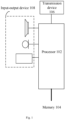
- Fig. 1 is a block diagram of a hardware structure of a mobile terminal of a streaming media data processing method according to an embodiment of the present disclosure.
- the mobile terminal may include one or more (only one is shown in Fig. 1 ) processors 102 (the processor 102 may include, but is not limited to, a processing apparatus such as a Micro Controller Unit (MCU) or a Field Programmable Gate Array (FPGA)) and a memory 104 for storing data.
- the above mobile terminal may further include a transmission device 106 and an input-output device 108 for communication functions.
- MCU Micro Controller Unit
- FPGA Field Programmable Gate Array
- the structure shown in Fig. 1 is only schematic and not intended to limit the structure of the above mobile terminal.
- the mobile terminal may further include more or fewer components than shown in Fig. 1 , or has a different configuration from that shown in Fig. 1 .
- the memory 104 may be configured to store a computer program, for example, a software program and a module of application software, for example, a computer program corresponding to the streaming media data processing method in the embodiments of the present disclosure.
- the processor 102 runs the computer program stored into the memory 104, thereby executing various functional applications and data processing, namely implementing the above method.
- the memory 104 may include a high speed Random Access Memory (RAM) and may further include a non-volatile memory such as one or more magnetic storage apparatuses, a flash memory, or other non-volatile solid state memories.
- the memory 104 may further include memories remotely located relative to the processor 102, which may be connected to the mobile terminal over a network.
- the examples of such networks include, but are not limited to, the Internet, the Intranet, local area networks, mobile communication networks, and combinations thereof.
- the transmission module 106 is configured to receive or send data via a network.
- a specific example of the network may include a wireless network provided by a communication provider of the mobile terminal.
- the transmission device 106 includes a Network Interface Controller (NIC) that may be connected to other network devices through a base station to communicate with the Internet.
- the transmission device 106 may be a Radio Frequency (RF) module, for communicating with the Internet wirelessly.
- NIC Network Interface Controller
- RF Radio Frequency
- the embodiments of the present disclosure may run on a network architecture shown in Fig. 2 .
- the network architecture runs on a server, which may be a physical machine, a virtual machine, or a Docker containerized environment.
- the network architecture is divided into two parts: a core space and a user space, where the core space refers to an environment in which an operating system and a driver run.
- code stream data After entering the server, code stream data first enters the core space.
- the user space refers to an environment in which a streaming media runs, and the streaming media may take the code stream data from the core space to the user space.
- a Socket Buffer system buffer is between the core space and the user space, and the system buffer is configured to temporarily buffer the code stream data when the code stream data transitions from the core space to the user space.
- the user space includes various functional modules of the streaming media: a packet receiving thread RECEIVE, an internal buffer rBuffer of the streaming media, a recording thread RECORD, a storage Input/output (IO) buffer IO Buffer, and a live playing thread PLAY.
- a streaming media data processing method running on the above mobile terminal or network architecture is provided.
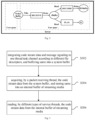
- Fig. 3 is a flowchart of a streaming media data processing method according to an embodiment of the present disclosure. As shown in Fig. 3 , the flow includes the following steps:
- the code stream data and the message signaling are integrated to the same thread task channel according to the different file descriptors, and buffered into the system buffer, which improves the receiving performance of the streaming media data;
- the packet receiving thread acquires the code stream data from the system buffer, and stores same into the internal buffer of streaming media; and the different types of service threads read the code stream data from the internal buffer of streaming media, which improves the processing and forwarding performance of the streaming media data and achieving the effect of improving the receiving and forwarding speed of the streaming media data.
- the executive body of the above steps may be a base station, a terminal, etc., but is not limited thereto.
- the code stream data and the message signaling are distinguished in the same thread task channel by a socket file descriptor and a named pipe file descriptor respectively.
- the operation that the packet receiving thread acquires the code stream data from the system buffer includes that: a data packet structure of the code stream data is transferred by using a pointer, the packet receiving thread acquires the code stream data from the system buffer by using an asynchronous IO event triggering mechanism, and the number of packets taken and the maximum number of events are adjusted according to the traffic of the code stream data.
- the operation that the packet receiving thread acquires the code stream data from the system buffer further includes that: the code stream data is acquired from the system buffer by using a multi-packet-receiving-thread, and sent to a designated Central Processing Unit (CPU) in a multi-core CPU for processing, and the priority of the packet receiving thread is increased.
- CPU Central Processing Unit
- the operation that the different types of service threads read the code stream data from the internal buffer of streaming media includes that: the packet receiving thread and the service threads transfer a data packet of the code stream data around the internal buffer of streaming media as a center in a producer/consumer mode, where the packet receiving thread is a producer and the service threads are consumers.
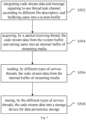
- Fig. 4 is a flowchart of a service thread reading code stream data according to an embodiment of the present disclosure. As shown in Fig. 4 , the operation that the different types of service threads read the code stream data from the internal buffer of streaming media further includes the following steps:
- the internal buffer of streaming media is a circular resource pool.
- Fig. 5 is a flowchart of a streaming media data processing method according to an embodiment of the present disclosure. As shown in Fig. 5 , after the different types of service threads read the code stream data from the internal buffer of streaming media, the method further includes that: the different types of service threads store the code stream data into a storage device for data persistence storage, that is, the flow includes the following steps:
- the technical solution of the present disclosure which is essential or contributes to the conventional art, may be embodied in the form of a software product.
- the computer software product is stored into a storage medium (such as a Read-Only Memory (ROM)/RAM, a magnetic disk and an optical disc), including a number of instructions for causing a terminal device (which may be a mobile phone, a computer, a server, or a network device, etc.) to perform the methods described in various embodiments of the present disclosure.
- a storage medium such as a Read-Only Memory (ROM)/RAM, a magnetic disk and an optical disc
- the embodiments further provide a streaming media data processing system, configured to implement the above embodiments and preferred implementations.
- the embodiments and preferred implementations that have been elaborated will not be repeated here.
- the term "module” used below can realize a combination of software and/or hardware with an intended function.
- the apparatus described in the following embodiment is preferably realized by software, but by hardware or a combination of software and hardware is also possible and conceived.
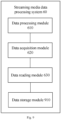
- Fig. 6 is a structural block diagram of a streaming media data processing system according to an embodiment of the present disclosure.
- a streaming media data processing system 60 includes: a data processing module 610, configured to integrate code stream data and message signaling to the same thread task channel according to different file descriptors, and buffer same into a system buffer; a data acquisition module 620, configured to acquire the code stream data from the system buffer, and store same into an internal buffer of streaming media; and a data reading module 630, configured to read the code stream data from the internal buffer of streaming media according to different types of service threads.
- Fig. 7 is a structural block diagram of a data processing module according to an embodiment of the present disclosure.
- the data processing module 70 divides the data processing module 610 in the streaming media data processing system 60 shown in Fig. 6 into two parts, namely: a first data processing unit 710, configured to integrate the code stream data into the thread task channel according to a socket file descriptor; and a second data processing unit 720, configured to integrate the message signaling into the thread task channel according to a named pipe file descriptor.
- the data processing module may be further subdivided into a plurality of data processing units in the actual implementation process according to different data contents, which is not limited herein.
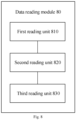
- Fig. 8 is a structural block diagram of a data reading module according to an embodiment of the present disclosure. As shown in Fig. 8 , the data reading module 80 divides the data reading module 630 in the streaming media data processing system 60 shown in Fig.
- a first reading unit 810 configured to read, after the code stream data is stored into the internal buffer of streaming media, the code stream data from the internal buffer of streaming media immediately according to different types of service threads
- a second reading module 820 configured to read, after the code stream data is stored into the internal buffer of streaming media, the code stream data from the internal buffer of streaming media at the same time according to different types of service threads
- a second reading module 830 configured to read, after the code stream data is stored into the internal buffer of streaming media, the code stream data from the internal buffer of streaming media at any time according to the requirements of different types of service threads.
- the data reading module may be further subdivided into a plurality of data reading units in the actual implementation process according to different data contents, which is not limited herein.
- Fig. 9 is a structural block diagram of a streaming media data processing system according to an embodiment of the present disclosure.
- the streaming media data processing system 90 further includes: a data storage module 910, configured to store the code stream data read by the data reading module into a storage device.
- each of the above modules may be realized by software or hardware.
- the each of the above modules may be realized by, but is not limited to, the following way: all of the above modules are in the same processor; or, the above modules are respectively in different processors in form of any combination.
- the embodiments of the present disclosure further provide a computer-readable storage medium, in which a computer program is stored.
- the computer program is configured to execute, when running, the steps in any of the above method embodiments.
- the computer-readable storage medium may include, but are not limited to, a U disk, an ROM, an RAM, a mobile hard disk, a magnetic disk, a compact disc, and other media capable of storing the computer program.
- the embodiments of the present disclosure further provide an electronic apparatus, including a memory and a processor.
- the memory stores a computer program.
- the processor is configured to run the computer program to execute the steps in any of the above method embodiments.
- the electronic apparatus may further include a transmission device and an input-output device.
- the transmission device is connected with the processor, and the input-output device is connected with the processor.
- Fig. 10 is a flowchart of streaming media data processing according to a scenario embodiment of the present disclosure.
- a streaming media data transmission model is taken as an example; first, a thread management mechanism is established in the entire link, and a channel convergence technology is proposed to reasonably manage and optimize threads; then, a streaming media packet receiving thread takes out a data packet from an operating system buffer, and a vertical and horizontal packet taking technology is proposed to improve the performance of the packet receiving stage; then, the packet receiving thread stores the taken out data packet into a circular buffer of a streaming media; then, a streaming media service thread copies the data packet from the circular buffer to the related service for data processing, and a producer-consumer merging technology is proposed to improve the data forwarding performance; and finally, data is persistently stored.
- the following is described in detail in conjunction with the specific steps shown in Fig. 10 .
- the thread management mechanism is established in the entire link for streaming media data transmission to reasonably manage and optimize the threads, thereby reducing the system congestion and improving the transmission performance.
- Fig. 11 is a schematic diagram of a thread management mechanism according to a scenario embodiment of the present disclosure.
- a data packet code stream and message signaling are integrated into the same receiving thread for processing and unified management, but are distinguished in an access channel, the signaling goes through a named pipe file fd, and the code stream goes through socket fd, thereby avoiding the use of a lock to prevent multi-thread access, reducing the investment in information management, and reducing CPU congestion and code redundancy.
- the channel is a thread task channel.
- the packet receiving thread receives the code stream data by using the vertical and horizontal packet taking technology.
- media data Before entering a streaming media module, media data may first reach the operating system buffer.
- the packet receiving thread RECEIVE of the streaming media is equivalent to an entry of the code stream data, which is responsible for taking the code stream data packet from the system buffer, that is, receiving data.
- the maximum processing performance of the receiving thread is mined in a vertical direction, and hardware and system resources are fully scheduled in a horizontal direction.
- the vertical and horizontal combination is conducive to improving the performance of the packet receiving thread stage.
- Fig. 12 is a schematic diagram of a principle of a packet receiving thread using a vertical and horizontal packet taking technology according to a scenario embodiment of the present disclosure.
- a data packet structure is transferred by using a pointer to avoid a large memory copy; and the packet receiving thread RECEIVE adjusts the number of packets taken and the maximum number of events according to the traffic by using an asynchronous IO event trigger mechanism, thereby improving the packet taking capability of a single thread.
- the number of receiving threads is increased, a multi-thread and system multi-core CPU affinity strategy is used, the packet receiving thread RECEIVE is sent to a designated CPU core for processing; and the priority of the packet receiving thread is increased, thereby increasing the utilization of system core resources and giving priority to fast processing.
- the code stream data is stored into the internal buffer of streaming media.
- the packet receiving thread After taking out the data, the packet receiving thread stores the data packet in the circular buffer rBuffer in the streaming media.
- the rBuffer may recycle a resource pool without increasing the storage capacity, thereby avoiding memory fragmentation.
- the module is responsible for temporarily buffering the data packet taken out from the system buffer by the packet receiving thread RECEIVE, which is equivalent to backing up the data packet, so that subsequent different services may read the data at the same time, such as RECORD storage and PLAY forwarding, so as to achieve simultaneous storage and playing.
- the service threads process the code stream data by using a producer-consumer merging technology.
- the service threads are logically located behind rBuffer. Various service threads may read the data in rBuffer at the same time for respective service flows, such as RECORD thread storage, PLAY thread forwarding, and the like.
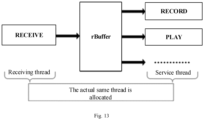
- the packet receiving thread is taken as a producer and the service thread are taken as consumers in a producer/consumer mode, and these working threads are unified into the actual same thread, so as to improve the performance of an rBuffer module and the data processing performance of the service threads.
- Fig. 13 is a schematic diagram of a principle of a producer-consumer merging technology of a service thread according to a scenario embodiment of the present disclosure.
- rBuffer is regarded as a center point
- the packet receiving thread RECEIVE is regarded as the producer
- the service threads RECORD, PLAY, etc. are regarded as the consumers.
- the data packet is transferred from the producer RECEIVE thread to the consumer RECORD, PLAY, and other threads through rBuffer.
- the technology decouples different working threads in an asynchronous calling manner, thereby reducing the mutual influence between the threads, and reducing the time-consuming delay.
- the code stream data is persistently stored.
- the link is the end of the code stream data transmission, and needs to be put in a storage device for persistence after receiving, forwarding and other processing.
- the recording thread RECORD after reading the data packet from rBuffer, the recording thread RECORD first writes the data packet into the IO Buffer buffer. When the file is closed or the buffer is full, the data of the buffer is flushed to the local storage or object storage to reduce the read and write IO pressure.
- the embodiments of the present disclosure provide the streaming media data processing method and system.
- the data code stream can be processed at the full bandwidth speed under a bandwidth of 10 Gigabit (10 Gbps).
- the receiving and forwarding performance of the streaming media system is greatly improved, and the resources and costs can be greatly saved for audio and video related industries.
- the thread management mechanism is first established in the entire link, the code stream and the signaling are integrated into the same receiving thread for processing and unified management, but are distinguished in the access channel, so as to avoid the use of the lock to prevent multi-threaded access, which is conducive to optimizing thread management and reducing system congestion. That is, a channel convergence technology is proposed to reasonably manage and optimize the threads.
- the packet taking performance of a single packet receiving thread is improved; and in the horizontal direction, the core resources are expanded in batches, which is conducive to speeding up taking out the code stream data packet from the system buffer and storing same into the internal buffer of streaming media. That is, the vertical and horizontal packet taking technology is proposed to improve the performance of the data receiving stage.
- different working threads are decoupled in an asynchronous calling manner to reduce the mutual influence and the time-consuming delay between the threads; and in addition, the abstract threads are merged into the same actual thread and core for processing, which reduces the extra consumption of the threads, fully utilizes the system resources, and helps speed up the data processing of the internal buffer module. That is, the producer-consumer merging technology is proposed to improve the performance of the data processing stage.
- the embodiments of the present disclosure are applicable to the audio and video related industries based on streaming data processing, such as video conferencing, video Internet of Things, and video middle platforms, and specifically, may be used in high-concurrency scenarios with huge number of access routes and traffic, may be used for high-performance data forwarding, may be used for services without packet loss requirements, etc.
- the data stream link flow and analysis idea, a phased performance optimization technology, the solution design, and the like have obvious characteristics.
- the purposes similar to or identical to those of the embodiments of the present disclosure are achieved by means of packet capture, service calling chain tracking tools, and the like should all be within the scope of protection of the present disclosure.
- modules and steps of the present disclosure may be implemented by a general-purpose computing device, and they may be centralized in a single computing device or distributed on a network composed of multiple computing devices; they may be implemented by a program code which is capable of being executed by the computing device, so that they may be stored into a storage device and executed by the computing device; and in some situations, the presented or described steps may be executed in an order different from that described here; or they are made into integrated circuit modules, respectively; or multiple modules and steps of them are made into a single integrated circuit module to realize. Therefore, the present disclosure is not limited to any particular combination of hardware and software.
Landscapes
- Engineering & Computer Science (AREA)
- Multimedia (AREA)
- Signal Processing (AREA)
- Computer Networks & Wireless Communication (AREA)
- Databases & Information Systems (AREA)
- Computer Security & Cryptography (AREA)
- Data Exchanges In Wide-Area Networks (AREA)
- Two-Way Televisions, Distribution Of Moving Picture Or The Like (AREA)
Abstract
Description
- Embodiments of the present disclosure relate to the field of streaming media data processing, and in particular, to a streaming media data processing method and system.
- At present, 5th Generation Mobile Communication Technology (5G) is gradually entering the commercial era, which has brought profound impacts and changes to the global audio and video industry, and has also made streaming media systems serving products and services such as video conferencing, video Internet of Things, and video middle platforms an important mechanism for information dissemination. The quantitative change in speed brought by 5G will promote qualitative changes in the entire industry and will also help accelerate the development of the streaming media systems.
- In general, the streaming media systems in the industry have live playing, recording, playback, and other main functions, and the receiving and forwarding performance thereof has become an important indicator to measure the quality of the streaming media systems. At present, the receiving and forwarding speed in the industry can reach 2 Gbps, but it is difficult to further improve. In a case of high concurrency and large traffic, the processing capacity may be greatly limited: for example, the speed of receiving data packets is not fast enough, resulting in loss at a system level; and for another example, the speed of forwarding and processing data packets is not fast enough, resulting in loss at an application level. The receiving and forwarding performance of the streaming media systems has become an important bottleneck restricting the development thereof.
- Embodiments of the present disclosure provides a streaming media data processing method and system, so as to at least solve the problem of packet loss of data of a streaming media data receiving and processing forwarding link in a case of high traffic in the related art.
- According to one embodiment of the present disclosure, a streaming media data processing method is provided, including that: code stream data and message signaling are integrated to the same thread task channel according to different file descriptors, and buffered into a system buffer; a packet receiving thread acquires the code stream data from the system buffer, and stores same into an internal buffer of streaming media; and different types of service threads read the code stream data from the internal buffer of streaming media.
- According to another embodiment of the present disclosure, a streaming media data processing system is provided, including: a data processing module, configured to integrate code stream data and message signaling to the same thread task channel according to different file descriptors, and buffer same into a system buffer; a data acquisition module, configured to acquire the code stream data from the system buffer, and store same into an internal buffer of streaming media; and a data reading module, configured to read the code stream data from the internal buffer of streaming media according to different types of service threads.
- According to still another embodiment of the present disclosure, a computer-readable storage medium is further provided, in which a computer program is stored. The computer program is configured to execute, when running, the steps of any of the above method embodiments.
- According to still another embodiment of the present disclosure, an electronic apparatus is further provided, including a memory and a processor. The memory stores a computer program, and the processor is configured to run the computer program to execute the steps in any of the above method embodiments.
-
-
Fig. 1 is a block diagram of a hardware structure of a mobile terminal of a streaming media data processing method according to an embodiment of the present disclosure. -
Fig. 2 is a diagram of a running network architecture of a streaming media data processing method according to an embodiment of the present disclosure. -
Fig. 3 is a flowchart of a streaming media data processing method according to an embodiment of the present disclosure. -
Fig. 4 is a flowchart of a service thread reading code stream data according to an embodiment of the present disclosure. -
Fig. 5 is a flowchart of a streaming media data processing method according to an embodiment of the present disclosure. -
Fig. 6 is a structural block diagram of a streaming media data processing system according to an embodiment of the present disclosure. -
Fig. 7 is a structural block diagram of a data processing module according to an embodiment of the present disclosure. -
Fig. 8 is a structural block diagram of a data reading module according to an embodiment of the present disclosure. -
Fig. 9 is a structural block diagram of a streaming media data processing system according to an embodiment of the present disclosure. -
Fig. 10 is a flowchart of streaming media data processing according to a scenario embodiment of the present disclosure. -
Fig. 11 is a schematic diagram of a thread management mechanism according to a scenario embodiment of the present disclosure. -
Fig. 12 is a schematic diagram of a principle of a packet receiving thread using a vertical and horizontal packet taking technology according to a scenario embodiment of the present disclosure. -
Fig. 13 is a schematic diagram of a principle of a producer-consumer merging technology of a service thread according to a scenario embodiment of the present disclosure. - Embodiments of the present disclosure are described below with reference to the drawings and in conjunction with the embodiments in detail.
- It is to be noted that terms "first", "second" and the like in the description, claims and the above drawings of the present disclosure are used for distinguishing similar objects rather than describing a specific sequence or a precedence order.
- The method embodiment provided by the embodiments of the present disclosure may be implemented in a mobile terminal, a computer terminal or a similar computing apparatus. Taking running on the mobile terminal as an example,
Fig. 1 is a block diagram of a hardware structure of a mobile terminal of a streaming media data processing method according to an embodiment of the present disclosure. As shown inFig. 1 , the mobile terminal may include one or more (only one is shown inFig. 1 ) processors 102 (theprocessor 102 may include, but is not limited to, a processing apparatus such as a Micro Controller Unit (MCU) or a Field Programmable Gate Array (FPGA)) and amemory 104 for storing data. The above mobile terminal may further include atransmission device 106 and an input-output device 108 for communication functions. Those of ordinary skill in the art may understand that the structure shown inFig. 1 is only schematic and not intended to limit the structure of the above mobile terminal. For example, the mobile terminal may further include more or fewer components than shown inFig. 1 , or has a different configuration from that shown inFig. 1 . - The
memory 104 may be configured to store a computer program, for example, a software program and a module of application software, for example, a computer program corresponding to the streaming media data processing method in the embodiments of the present disclosure. Theprocessor 102 runs the computer program stored into thememory 104, thereby executing various functional applications and data processing, namely implementing the above method. Thememory 104 may include a high speed Random Access Memory (RAM) and may further include a non-volatile memory such as one or more magnetic storage apparatuses, a flash memory, or other non-volatile solid state memories. In some examples, thememory 104 may further include memories remotely located relative to theprocessor 102, which may be connected to the mobile terminal over a network. The examples of such networks include, but are not limited to, the Internet, the Intranet, local area networks, mobile communication networks, and combinations thereof. - The
transmission module 106 is configured to receive or send data via a network. A specific example of the network may include a wireless network provided by a communication provider of the mobile terminal. In one example, thetransmission device 106 includes a Network Interface Controller (NIC) that may be connected to other network devices through a base station to communicate with the Internet. In one example, thetransmission device 106 may be a Radio Frequency (RF) module, for communicating with the Internet wirelessly. - The embodiments of the present disclosure may run on a network architecture shown in
Fig. 2 . As shown inFig. 2 , the network architecture runs on a server, which may be a physical machine, a virtual machine, or a Docker containerized environment. The network architecture is divided into two parts: a core space and a user space, where the core space refers to an environment in which an operating system and a driver run. After entering the server, code stream data first enters the core space. The user space refers to an environment in which a streaming media runs, and the streaming media may take the code stream data from the core space to the user space. A Socket Buffer system buffer is between the core space and the user space, and the system buffer is configured to temporarily buffer the code stream data when the code stream data transitions from the core space to the user space. The user space includes various functional modules of the streaming media: a packet receiving thread RECEIVE, an internal buffer rBuffer of the streaming media, a recording thread RECORD, a storage Input/output (IO) buffer IO Buffer, and a live playing thread PLAY. - In the embodiment, a streaming media data processing method running on the above mobile terminal or network architecture is provided.
Fig. 3 is a flowchart of a streaming media data processing method according to an embodiment of the present disclosure. As shown inFig. 3 , the flow includes the following steps: - S302, integrating code stream data and message signaling to one thread task channel according to different file descriptors, and buffering same into a system buffer;
- S304, acquiring, by a packet receiving thread, the code stream data from the system buffer, and storing same into an internal buffer of streaming media;
- S306, reading, by different types of service threads, the code stream data from the internal buffer of streaming media.
- Through the above steps, the code stream data and the message signaling are integrated to the same thread task channel according to the different file descriptors, and buffered into the system buffer, which improves the receiving performance of the streaming media data; the packet receiving thread acquires the code stream data from the system buffer, and stores same into the internal buffer of streaming media; and the different types of service threads read the code stream data from the internal buffer of streaming media, which improves the processing and forwarding performance of the streaming media data and achieving the effect of improving the receiving and forwarding speed of the streaming media data.
- The executive body of the above steps may be a base station, a terminal, etc., but is not limited thereto.
- In one exemplary embodiment, the code stream data and the message signaling are distinguished in the same thread task channel by a socket file descriptor and a named pipe file descriptor respectively.
- In one exemplary embodiment, the operation that the packet receiving thread acquires the code stream data from the system buffer includes that: a data packet structure of the code stream data is transferred by using a pointer, the packet receiving thread acquires the code stream data from the system buffer by using an asynchronous IO event triggering mechanism, and the number of packets taken and the maximum number of events are adjusted according to the traffic of the code stream data.
- In one exemplary embodiment, the operation that the packet receiving thread acquires the code stream data from the system buffer further includes that: the code stream data is acquired from the system buffer by using a multi-packet-receiving-thread, and sent to a designated Central Processing Unit (CPU) in a multi-core CPU for processing, and the priority of the packet receiving thread is increased.
- In one exemplary embodiment, the operation that the different types of service threads read the code stream data from the internal buffer of streaming media includes that: the packet receiving thread and the service threads transfer a data packet of the code stream data around the internal buffer of streaming media as a center in a producer/consumer mode, where the packet receiving thread is a producer and the service threads are consumers.
- In one exemplary embodiment,
Fig. 4 is a flowchart of a service thread reading code stream data according to an embodiment of the present disclosure. As shown inFig. 4 , the operation that the different types of service threads read the code stream data from the internal buffer of streaming media further includes the following steps: - S402, merging the different types of service threads into the packet receiving thread and using CPU for processing;
- S404, according to number of tasks of the different types of service threads, selecting a packet receiving thread with smallest load for processing.
- In one exemplary embodiment, the internal buffer of streaming media is a circular resource pool.
- In one exemplary embodiment,
Fig. 5 is a flowchart of a streaming media data processing method according to an embodiment of the present disclosure. As shown inFig. 5 , after the different types of service threads read the code stream data from the internal buffer of streaming media, the method further includes that: the different types of service threads store the code stream data into a storage device for data persistence storage, that is, the flow includes the following steps: - S502, integrating code stream data and message signaling to one thread task channel according to different file descriptors, and buffering same into a system buffer;
- S504, acquiring, by a packet receiving thread, the code stream data from the system buffer, and storing same into an internal buffer of streaming media;
- S506, reading, by different types of service threads, the code stream data from the internal buffer of streaming media;
- S508, storing, by the different types of service threads, the code stream data into a storage device for data persistence storage.
- Through the above description of implementations, those skilled in the art may clearly know that the method according to the above embodiments may be implemented by means of software plus a necessary common hardware platform, certainly by means of hardware; but in many cases, the former is the better implementation. Based on such understanding, the technical solution of the present disclosure, which is essential or contributes to the conventional art, may be embodied in the form of a software product. The computer software product is stored into a storage medium (such as a Read-Only Memory (ROM)/RAM, a magnetic disk and an optical disc), including a number of instructions for causing a terminal device (which may be a mobile phone, a computer, a server, or a network device, etc.) to perform the methods described in various embodiments of the present disclosure.
- The embodiments further provide a streaming media data processing system, configured to implement the above embodiments and preferred implementations. The embodiments and preferred implementations that have been elaborated will not be repeated here. The term "module" used below can realize a combination of software and/or hardware with an intended function. Although the apparatus described in the following embodiment is preferably realized by software, but by hardware or a combination of software and hardware is also possible and conceived.
-
Fig. 6 is a structural block diagram of a streaming media data processing system according to an embodiment of the present disclosure. As shown inFig. 6 , a streaming mediadata processing system 60 includes: adata processing module 610, configured to integrate code stream data and message signaling to the same thread task channel according to different file descriptors, and buffer same into a system buffer; adata acquisition module 620, configured to acquire the code stream data from the system buffer, and store same into an internal buffer of streaming media; and adata reading module 630, configured to read the code stream data from the internal buffer of streaming media according to different types of service threads. - In one exemplary embodiment,
Fig. 7 is a structural block diagram of a data processing module according to an embodiment of the present disclosure. As shown inFig. 7 , thedata processing module 70 divides thedata processing module 610 in the streaming mediadata processing system 60 shown inFig. 6 into two parts, namely: a firstdata processing unit 710, configured to integrate the code stream data into the thread task channel according to a socket file descriptor; and a seconddata processing unit 720, configured to integrate the message signaling into the thread task channel according to a named pipe file descriptor. - Those of ordinary skill in the art should know that the data processing module may be further subdivided into a plurality of data processing units in the actual implementation process according to different data contents, which is not limited herein.
- In one exemplary embodiment,
Fig. 8 is a structural block diagram of a data reading module according to an embodiment of the present disclosure. As shown inFig. 8 , thedata reading module 80 divides thedata reading module 630 in the streaming mediadata processing system 60 shown inFig. 6 into three parts, namely: afirst reading unit 810, configured to read, after the code stream data is stored into the internal buffer of streaming media, the code stream data from the internal buffer of streaming media immediately according to different types of service threads; asecond reading module 820, configured to read, after the code stream data is stored into the internal buffer of streaming media, the code stream data from the internal buffer of streaming media at the same time according to different types of service threads; and asecond reading module 830, configured to read, after the code stream data is stored into the internal buffer of streaming media, the code stream data from the internal buffer of streaming media at any time according to the requirements of different types of service threads. - Those of ordinary skill in the art should know that the data reading module may be further subdivided into a plurality of data reading units in the actual implementation process according to different data contents, which is not limited herein.
- In one exemplary embodiment,
Fig. 9 is a structural block diagram of a streaming media data processing system according to an embodiment of the present disclosure. As shown inFig. 9 , in addition to the various modules shown inFig. 6 , the streaming media data processing system 90 further includes: adata storage module 910, configured to store the code stream data read by the data reading module into a storage device. - Those of ordinary skill in the art should know that the various modules and units involved in the above embodiments may be combined together, or partially combined or integrated into one or more apparatuses or systems as needed, as long as the corresponding functions can be achieved.
- It is to be noted that, each of the above modules may be realized by software or hardware. For the latter, the each of the above modules may be realized by, but is not limited to, the following way: all of the above modules are in the same processor; or, the above modules are respectively in different processors in form of any combination.
- The embodiments of the present disclosure further provide a computer-readable storage medium, in which a computer program is stored. The computer program is configured to execute, when running, the steps in any of the above method embodiments.
- In an exemplary embodiment, the computer-readable storage medium may include, but are not limited to, a U disk, an ROM, an RAM, a mobile hard disk, a magnetic disk, a compact disc, and other media capable of storing the computer program.
- The embodiments of the present disclosure further provide an electronic apparatus, including a memory and a processor. The memory stores a computer program. The processor is configured to run the computer program to execute the steps in any of the above method embodiments.
- In one exemplary embodiment, the electronic apparatus may further include a transmission device and an input-output device. The transmission device is connected with the processor, and the input-output device is connected with the processor.
- The specific examples in the present embodiment may refer to the above embodiments and the examples described in the optional implementations, which will not be elaborated herein.
- In order to enable those skilled in the art to more clearly understand the technical solutions of the present disclosure, the technical solution of the present disclosure will be described below in conjunction with specific scenario embodiments.
-
Fig. 10 is a flowchart of streaming media data processing according to a scenario embodiment of the present disclosure. As shown inFig. 10 , a streaming media data transmission model is taken as an example; first, a thread management mechanism is established in the entire link, and a channel convergence technology is proposed to reasonably manage and optimize threads; then, a streaming media packet receiving thread takes out a data packet from an operating system buffer, and a vertical and horizontal packet taking technology is proposed to improve the performance of the packet receiving stage; then, the packet receiving thread stores the taken out data packet into a circular buffer of a streaming media; then, a streaming media service thread copies the data packet from the circular buffer to the related service for data processing, and a producer-consumer merging technology is proposed to improve the data forwarding performance; and finally, data is persistently stored. The following is described in detail in conjunction with the specific steps shown inFig. 10 . - At S1002, the thread management mechanism is established.
- The thread management mechanism is established in the entire link for streaming media data transmission to reasonably manage and optimize the threads, thereby reducing the system congestion and improving the transmission performance.
-
Fig. 11 is a schematic diagram of a thread management mechanism according to a scenario embodiment of the present disclosure. As shown inFig. 11 , a data packet code stream and message signaling are integrated into the same receiving thread for processing and unified management, but are distinguished in an access channel, the signaling goes through a named pipe file fd, and the code stream goes through socket fd, thereby avoiding the use of a lock to prevent multi-thread access, reducing the investment in information management, and reducing CPU congestion and code redundancy. The channel is a thread task channel. - At S1004, the packet receiving thread receives the code stream data by using the vertical and horizontal packet taking technology.
- Before entering a streaming media module, media data may first reach the operating system buffer. The packet receiving thread RECEIVE of the streaming media is equivalent to an entry of the code stream data, which is responsible for taking the code stream data packet from the system buffer, that is, receiving data.
- In order to improve the performance of the link, the maximum processing performance of the receiving thread is mined in a vertical direction, and hardware and system resources are fully scheduled in a horizontal direction. The vertical and horizontal combination is conducive to improving the performance of the packet receiving thread stage.
-
Fig. 12 is a schematic diagram of a principle of a packet receiving thread using a vertical and horizontal packet taking technology according to a scenario embodiment of the present disclosure. As shown inFig. 12 , in the vertical direction, a data packet structure is transferred by using a pointer to avoid a large memory copy; and the packet receiving thread RECEIVE adjusts the number of packets taken and the maximum number of events according to the traffic by using an asynchronous IO event trigger mechanism, thereby improving the packet taking capability of a single thread. - In the horizontal direction, the number of receiving threads is increased, a multi-thread and system multi-core CPU affinity strategy is used, the packet receiving thread RECEIVE is sent to a designated CPU core for processing; and the priority of the packet receiving thread is increased, thereby increasing the utilization of system core resources and giving priority to fast processing.
- At S 1006, the code stream data is stored into the internal buffer of streaming media.
- After taking out the data, the packet receiving thread stores the data packet in the circular buffer rBuffer in the streaming media. The rBuffer may recycle a resource pool without increasing the storage capacity, thereby avoiding memory fragmentation. The module is responsible for temporarily buffering the data packet taken out from the system buffer by the packet receiving thread RECEIVE, which is equivalent to backing up the data packet, so that subsequent different services may read the data at the same time, such as RECORD storage and PLAY forwarding, so as to achieve simultaneous storage and playing.
- At S1008, the service threads process the code stream data by using a producer-consumer merging technology.
- The service threads are logically located behind rBuffer. Various service threads may read the data in rBuffer at the same time for respective service flows, such as RECORD thread storage, PLAY thread forwarding, and the like.
- In order to improve the performance of the link, the packet receiving thread is taken as a producer and the service thread are taken as consumers in a producer/consumer mode, and these working threads are unified into the actual same thread, so as to improve the performance of an rBuffer module and the data processing performance of the service threads.
-
Fig. 13 is a schematic diagram of a principle of a producer-consumer merging technology of a service thread according to a scenario embodiment of the present disclosure. As shown inFig. 13 , rBuffer is regarded as a center point, the packet receiving thread RECEIVE is regarded as the producer, and the service threads RECORD, PLAY, etc. are regarded as the consumers. The data packet is transferred from the producer RECEIVE thread to the consumer RECORD, PLAY, and other threads through rBuffer. The technology decouples different working threads in an asynchronous calling manner, thereby reducing the mutual influence between the threads, and reducing the time-consuming delay. - Based on the technology, various abstract working threads are regarded as working tasks and uniformly merged into the same actual thread and CPU for processing. At the same time, when the task is assigned, the task is assigned to the thread with the smallest load based on the number of tasks of the current thread, so that hardware resources are more fully utilized and the extra consumption of the operating system in creating and managing the threads is reduced.
- At S 1010, the code stream data is persistently stored.
- The link is the end of the code stream data transmission, and needs to be put in a storage device for persistence after receiving, forwarding and other processing. As shown in
Fig. 2 , after reading the data packet from rBuffer, the recording thread RECORD first writes the data packet into the IO Buffer buffer. When the file is closed or the buffer is full, the data of the buffer is flushed to the local storage or object storage to reduce the read and write IO pressure. - In summary, the embodiments of the present disclosure provide the streaming media data processing method and system. Theoretically, the data code stream can be processed at the full bandwidth speed under a bandwidth of 10 Gigabit (10 Gbps). According to the embodiments of the present disclosure, the receiving and forwarding performance of the streaming media system is greatly improved, and the resources and costs can be greatly saved for audio and video related industries. For the problem of packet loss of data of a streaming media data receiving and processing forwarding link in a case of high traffic, in the embodiments of the present disclosure, the thread management mechanism is first established in the entire link, the code stream and the signaling are integrated into the same receiving thread for processing and unified management, but are distinguished in the access channel, so as to avoid the use of the lock to prevent multi-threaded access, which is conducive to optimizing thread management and reducing system congestion. That is, a channel convergence technology is proposed to reasonably manage and optimize the threads. Then, in the vertical direction, the packet taking performance of a single packet receiving thread is improved; and in the horizontal direction, the core resources are expanded in batches, which is conducive to speeding up taking out the code stream data packet from the system buffer and storing same into the internal buffer of streaming media. That is, the vertical and horizontal packet taking technology is proposed to improve the performance of the data receiving stage. Finally, different working threads are decoupled in an asynchronous calling manner to reduce the mutual influence and the time-consuming delay between the threads; and in addition, the abstract threads are merged into the same actual thread and core for processing, which reduces the extra consumption of the threads, fully utilizes the system resources, and helps speed up the data processing of the internal buffer module. That is, the producer-consumer merging technology is proposed to improve the performance of the data processing stage.
- The embodiments of the present disclosure are applicable to the audio and video related industries based on streaming data processing, such as video conferencing, video Internet of Things, and video middle platforms, and specifically, may be used in high-concurrency scenarios with huge number of access routes and traffic, may be used for high-performance data forwarding, may be used for services without packet loss requirements, etc. In the embodiments of the present disclosure, the data stream link flow and analysis idea, a phased performance optimization technology, the solution design, and the like have obvious characteristics. The purposes similar to or identical to those of the embodiments of the present disclosure are achieved by means of packet capture, service calling chain tracking tools, and the like should all be within the scope of protection of the present disclosure.
- It is apparent that those skilled in the art should appreciate that the above modules and steps of the present disclosure may be implemented by a general-purpose computing device, and they may be centralized in a single computing device or distributed on a network composed of multiple computing devices; they may be implemented by a program code which is capable of being executed by the computing device, so that they may be stored into a storage device and executed by the computing device; and in some situations, the presented or described steps may be executed in an order different from that described here; or they are made into integrated circuit modules, respectively; or multiple modules and steps of them are made into a single integrated circuit module to realize. Therefore, the present disclosure is not limited to any particular combination of hardware and software.
- The above are only the preferred embodiments of the present disclosure, and are not intended to limit the present disclosure, and for those of ordinary skill in the art, various modifications and changes may be made to the present disclosure. Any modifications, equivalent substitutions, improvements, etc. within the principle of the present disclosure shall be included in the scope of protection of the present disclosure.
Claims (14)
- A streaming media data processing method, comprising:integrating code stream data and message signaling to one thread task channel according to different file descriptors, and buffering same into a system buffer;acquiring, by a packet receiving thread, the code stream data from the system buffer, and storing same into an internal buffer of streaming media; andreading, by different types of service threads, the code stream data from the internal buffer of streaming media.
- The method according to claim 1, wherein the code stream data and the message signaling are distinguished in the thread task channel by a socket file descriptor and a named pipe file descriptor respectively.
- The method according to claim 1, wherein acquiring, by a packet receiving thread, the code stream data from the system buffer comprises:
transferring a data packet structure of the code stream data by using a pointer, acquiring, by the packet receiving thread, the code stream data from the system buffer by using an asynchronous Input/Output, IO, event triggering mechanism, and adjusting number of packets taken and maximum number of events according to traffic of the code stream data. - The method according to claim 1, wherein acquiring, by a packet receiving thread, the code stream data from the system buffer further comprises:
acquiring the code stream data from the system buffer by using a multi-packet-receiving-thread, sending same to a designated Central Processing Unit, CPU, in a multi-core CPU for processing, and increasing priority of the packet receiving thread. - The method according to claim 4, wherein the reading, by different types of service threads, the code stream data from the internal buffer of streaming media comprises:
transferring, by the packet receiving thread and the service threads, a data packet of the code stream data with the internal buffer of streaming media as a center in a producer/consumer mode, wherein the packet receiving thread is a producer and the service threads are consumers. - The method according to claim 5, wherein the reading, by different types of service threads, the code stream data from the internal buffer of streaming media further comprises:merging the different types of service threads into the packet receiving thread and using CPU for processing; andaccording to number of tasks of the different types of service threads, selecting a packet receiving thread with smallest load for processing.
- The method according to claim 6, wherein the internal buffer of streaming media is a circular resource pool.
- The method according to claim 1, wherein after reading, by the different types of service threads, the code stream data from the internal buffer of streaming media, the method further comprises:
storing, by the different types of service threads, the code stream data into a storage device for data persistence storage. - A streaming media data processing system, comprising:a data processing module, configured to integrate code stream data and message signaling to one thread task channel according to different file descriptors, and buffer same into a system buffer;a data acquisition module, configured to acquire the code stream data from the system buffer, and store same into an internal buffer of streaming media; anda data reading module, configured to read the code stream data from the internal buffer of streaming media according to different types of service threads.
- The system according to claim 9, wherein the data processing module comprises at least one of the following:a first data processing unit, configured to integrate the code stream data into the thread task channel according to a socket file descriptor; ora second data processing unit, configured to integrate the message signaling into the thread task channel according to a named pipe file descriptor.
- The system according to claim 9, wherein the data reading module comprises at least one of the following:a first reading module, configured to read, after the code stream data is stored into the internal buffer of streaming media, the code stream data from the internal buffer of streaming media immediately according to different types of service threads;a second reading module, configured to read, after the code stream data is stored into the internal buffer of streaming media, the code stream data from the internal buffer of streaming media at the same time according to different types of service threads; ora third reading module, configured to read, after the code stream data is stored into the internal buffer of streaming media, the code stream data from the internal buffer of streaming media at any time according to the requirements of different types of service threads.
- The system according to claim 9, further comprising:
a data storage module, configured to store the code stream data read by the data reading module into a storage device. - A computer-readable storage medium, in which a computer program is stored, wherein the computer program is configured to, when executed by a processor, implement the method according to any one of claims 1 to 8.
- An electronic apparatus, comprising a memory, a processor, and a computer program stored into the memory and capable of being run on the processor, wherein the processor is configured to execute the computer program to implement the method according to any one of claims 1 to 8.
Applications Claiming Priority (2)
| Application Number | Priority Date | Filing Date | Title |
|---|---|---|---|
| CN202210618490.6A CN116668415B (en) | 2022-06-01 | 2022-06-01 | Streaming media data processing method and system |
| PCT/CN2023/093058 WO2023231723A1 (en) | 2022-06-01 | 2023-05-09 | Streaming media data processing method and system |
Publications (3)
| Publication Number | Publication Date |
|---|---|
| EP4525404A1 true EP4525404A1 (en) | 2025-03-19 |
| EP4525404A4 EP4525404A4 (en) | 2025-05-28 |
| EP4525404B1 EP4525404B1 (en) | 2026-02-25 |
Family
ID=87726613
Family Applications (1)
| Application Number | Title | Priority Date | Filing Date |
|---|---|---|---|
| EP23814909.0A Active EP4525404B1 (en) | 2022-06-01 | 2023-05-09 | Streaming media data processing method and system |
Country Status (4)
| Country | Link |
|---|---|
| EP (1) | EP4525404B1 (en) |
| JP (1) | JP7828483B2 (en) |
| CN (1) | CN116668415B (en) |
| WO (1) | WO2023231723A1 (en) |
Families Citing this family (1)
| Publication number | Priority date | Publication date | Assignee | Title |
|---|---|---|---|---|
| CN116962512B (en) * | 2023-09-20 | 2024-01-05 | 北京信安世纪科技股份有限公司 | Message processing method, device, storage medium and apparatus |
Family Cites Families (9)
| Publication number | Priority date | Publication date | Assignee | Title |
|---|---|---|---|---|
| EP1605354A1 (en) * | 2004-06-10 | 2005-12-14 | Deutsche Thomson-Brandt Gmbh | Method and apparatus for improved synchronization of a processing unit for multimedia streams in a multithreaded environment |
| CN106302372A (en) * | 2015-06-12 | 2017-01-04 | 中兴通讯股份有限公司 | Network media stream packet receiving method, Apparatus and system |
| CN108270732B (en) * | 2016-12-30 | 2019-02-19 | 视联动力信息技术股份有限公司 | A kind of Streaming Media processing method and system |
| CN107731230A (en) * | 2017-11-10 | 2018-02-23 | 北京联华博创科技有限公司 | A kind of court's trial writing-record system and method |
| CN110312157B (en) * | 2019-06-14 | 2021-09-14 | 云南兆讯科技有限责任公司 | Multithreading streaming media cache control system based on embedded equipment |
| CN112995753B (en) * | 2019-12-16 | 2024-03-22 | 中兴通讯股份有限公司 | Media stream distribution method, CDN node server, CDN system and readable storage medium |
| CN112333475A (en) * | 2020-10-29 | 2021-02-05 | 京东方科技集团股份有限公司 | Processing method and processing system of streaming media data and storage server |
| CN113630439B (en) * | 2021-06-30 | 2023-05-05 | 网宿科技股份有限公司 | Real-time communication RTC connection method, server and storage medium |
| CN113553346B (en) * | 2021-07-22 | 2022-08-16 | 中国电子科技集团公司第十五研究所 | Large-scale real-time data stream integrated processing, forwarding and storing method and system |
-
2022
- 2022-06-01 CN CN202210618490.6A patent/CN116668415B/en active Active
-
2023
- 2023-05-09 WO PCT/CN2023/093058 patent/WO2023231723A1/en not_active Ceased
- 2023-05-09 EP EP23814909.0A patent/EP4525404B1/en active Active
- 2023-05-09 JP JP2024570830A patent/JP7828483B2/en active Active
Also Published As
| Publication number | Publication date |
|---|---|
| JP2025518249A (en) | 2025-06-12 |
| EP4525404B1 (en) | 2026-02-25 |
| CN116668415A (en) | 2023-08-29 |
| EP4525404A4 (en) | 2025-05-28 |
| CN116668415B (en) | 2025-01-24 |
| JP7828483B2 (en) | 2026-03-11 |
| WO2023231723A1 (en) | 2023-12-07 |
Similar Documents
| Publication | Publication Date | Title |
|---|---|---|
| CN105843738A (en) | Inter-process communication statistics and debugging method and system | |
| CN113553346A (en) | Large-scale real-time data stream integrated processing, forwarding and storing method and system | |
| CN116524621B (en) | Vehicle data collection method, device, vehicle and storage medium | |
| CN110083524A (en) | Upload data test method, apparatus, computer equipment and storage medium | |
| CN112100146A (en) | An efficient erasure erasure distributed storage writing method, system, medium and terminal | |
| CN112714164A (en) | Internet of things system and task scheduling method thereof | |
| CN118200253A (en) | RDMA UD transmission-oriented reliable communication method, electronic equipment and readable medium | |
| EP4525404B1 (en) | Streaming media data processing method and system | |
| WO2021238259A1 (en) | Data transmission method, apparatus and device, and computer-readable storage medium | |
| US9002969B2 (en) | Distributed multimedia server system, multimedia information distribution method, and computer product | |
| CN115767791A (en) | 5G edge Internet of things gateway with AI function | |
| CN118317002A (en) | Efficient dynamic compression instant transmission method based on data express | |
| CN114819176A (en) | A real-time distributed system for intelligent driving | |
| CN117234681A (en) | Data processing method, apparatus, device, storage medium, and program product | |
| CN113259408A (en) | Data transmission method and system | |
| CN112615773A (en) | Message processing method and system | |
| CN114466227B (en) | Video analysis method and device, electronic equipment and storage medium | |
| CN115277723A (en) | Buffer event-based breakpoint continuous transmission method and system for edge acquisition history module | |
| CN114186163A (en) | An application layer network data caching method | |
| CN117395307B (en) | Data transmission method, device and storage medium | |
| CN118093225A (en) | Subscription message transmission method and device, storage medium and electronic device | |
| CN117527458A (en) | Multicast data distribution method and device, electronic equipment and storage medium | |
| CN115941907A (en) | A method, system, electronic device and storage medium for sending RTP data packets | |
| CN116266844A (en) | Data access platform and data access method | |
| CN114490458A (en) | Data transmission method, chip, server and storage medium |
Legal Events
| Date | Code | Title | Description |
|---|---|---|---|
| STAA | Information on the status of an ep patent application or granted ep patent |
Free format text: STATUS: THE INTERNATIONAL PUBLICATION HAS BEEN MADE |
|
| PUAI | Public reference made under article 153(3) epc to a published international application that has entered the european phase |
Free format text: ORIGINAL CODE: 0009012 |
|
| STAA | Information on the status of an ep patent application or granted ep patent |
Free format text: STATUS: REQUEST FOR EXAMINATION WAS MADE |
|
| 17P | Request for examination filed |
Effective date: 20241209 |
|
| AK | Designated contracting states |
Kind code of ref document: A1 Designated state(s): AL AT BE BG CH CY CZ DE DK EE ES FI FR GB GR HR HU IE IS IT LI LT LU LV MC ME MK MT NL NO PL PT RO RS SE SI SK SM TR |
|
| A4 | Supplementary search report drawn up and despatched |
Effective date: 20250428 |
|
| RIC1 | Information provided on ipc code assigned before grant |
Ipc: H04L 65/612 20220101ALI20250422BHEP Ipc: H04N 21/2187 20110101ALI20250422BHEP Ipc: H04N 21/647 20110101ALI20250422BHEP Ipc: H04N 21/234 20110101ALI20250422BHEP Ipc: H04L 65/60 20220101AFI20250422BHEP |
|
| DAV | Request for validation of the european patent (deleted) | ||
| DAX | Request for extension of the european patent (deleted) | ||
| GRAJ | Information related to disapproval of communication of intention to grant by the applicant or resumption of examination proceedings by the epo deleted |
Free format text: ORIGINAL CODE: EPIDOSDIGR1 |
|
| GRAP | Despatch of communication of intention to grant a patent |
Free format text: ORIGINAL CODE: EPIDOSNIGR1 |
|
| GRAP | Despatch of communication of intention to grant a patent |
Free format text: ORIGINAL CODE: EPIDOSNIGR1 |
|
| STAA | Information on the status of an ep patent application or granted ep patent |
Free format text: STATUS: GRANT OF PATENT IS INTENDED |
|
| INTG | Intention to grant announced |
Effective date: 20250926 |
|
| GRAS | Grant fee paid |
Free format text: ORIGINAL CODE: EPIDOSNIGR3 |
|
| GRAA | (expected) grant |
Free format text: ORIGINAL CODE: 0009210 |
|
| STAA | Information on the status of an ep patent application or granted ep patent |
Free format text: STATUS: THE PATENT HAS BEEN GRANTED |
|
| AK | Designated contracting states |
Kind code of ref document: B1 Designated state(s): AL AT BE BG CH CY CZ DE DK EE ES FI FR GB GR HR HU IE IS IT LI LT LU LV MC ME MK MT NL NO PL PT RO RS SE SI SK SM TR |
|
| REG | Reference to a national code |
Ref country code: CH Ref legal event code: F10 Free format text: ST27 STATUS EVENT CODE: U-0-0-F10-F00 (AS PROVIDED BY THE NATIONAL OFFICE) Effective date: 20260225 Ref country code: GB Ref legal event code: FG4D |
|
| REG | Reference to a national code |
Ref country code: DE Ref legal event code: R096 Ref document number: 602023012745 Country of ref document: DE |
|
| REG | Reference to a national code |
Ref country code: IE Ref legal event code: FG4D |
|
| REG | Reference to a national code |
Ref country code: NL Ref legal event code: MP Effective date: 20260225 |
|
| PG25 | Lapsed in a contracting state [announced via postgrant information from national office to epo] |
Ref country code: RS Free format text: LAPSE BECAUSE OF FAILURE TO SUBMIT A TRANSLATION OF THE DESCRIPTION OR TO PAY THE FEE WITHIN THE PRESCRIBED TIME-LIMIT Effective date: 20260525 |
|
| PG25 | Lapsed in a contracting state [announced via postgrant information from national office to epo] |
Ref country code: ES Free format text: LAPSE BECAUSE OF FAILURE TO SUBMIT A TRANSLATION OF THE DESCRIPTION OR TO PAY THE FEE WITHIN THE PRESCRIBED TIME-LIMIT Effective date: 20260225 |
|
| PG25 | Lapsed in a contracting state [announced via postgrant information from national office to epo] |
Ref country code: PL Free format text: LAPSE BECAUSE OF FAILURE TO SUBMIT A TRANSLATION OF THE DESCRIPTION OR TO PAY THE FEE WITHIN THE PRESCRIBED TIME-LIMIT Effective date: 20260225 |
|
| PG25 | Lapsed in a contracting state [announced via postgrant information from national office to epo] |
Ref country code: GR Free format text: LAPSE BECAUSE OF FAILURE TO SUBMIT A TRANSLATION OF THE DESCRIPTION OR TO PAY THE FEE WITHIN THE PRESCRIBED TIME-LIMIT Effective date: 20260526 |
|
| REG | Reference to a national code |
Ref country code: LT Ref legal event code: MG9D |
|
| PG25 | Lapsed in a contracting state [announced via postgrant information from national office to epo] |
Ref country code: LT Free format text: LAPSE BECAUSE OF FAILURE TO SUBMIT A TRANSLATION OF THE DESCRIPTION OR TO PAY THE FEE WITHIN THE PRESCRIBED TIME-LIMIT Effective date: 20260225 |
|
| PGFP | Annual fee paid to national office [announced via postgrant information from national office to epo] |
Ref country code: DE Payment date: 20260522 Year of fee payment: 4 |
|
| PG25 | Lapsed in a contracting state [announced via postgrant information from national office to epo] |
Ref country code: NO Free format text: LAPSE BECAUSE OF FAILURE TO SUBMIT A TRANSLATION OF THE DESCRIPTION OR TO PAY THE FEE WITHIN THE PRESCRIBED TIME-LIMIT Effective date: 20260525 |
|
| PG25 | Lapsed in a contracting state [announced via postgrant information from national office to epo] |
Ref country code: SE Free format text: LAPSE BECAUSE OF FAILURE TO SUBMIT A TRANSLATION OF THE DESCRIPTION OR TO PAY THE FEE WITHIN THE PRESCRIBED TIME-LIMIT Effective date: 20260225 Ref country code: AT Free format text: LAPSE BECAUSE OF FAILURE TO SUBMIT A TRANSLATION OF THE DESCRIPTION OR TO PAY THE FEE WITHIN THE PRESCRIBED TIME-LIMIT Effective date: 20260225 Ref country code: FI Free format text: LAPSE BECAUSE OF FAILURE TO SUBMIT A TRANSLATION OF THE DESCRIPTION OR TO PAY THE FEE WITHIN THE PRESCRIBED TIME-LIMIT Effective date: 20260225 |
|
| REG | Reference to a national code |
Ref country code: AT Ref legal event code: MK05 Ref document number: 1892325 Country of ref document: AT Kind code of ref document: T Effective date: 20260225 |
|
| PG25 | Lapsed in a contracting state [announced via postgrant information from national office to epo] |
Ref country code: HR Free format text: LAPSE BECAUSE OF FAILURE TO SUBMIT A TRANSLATION OF THE DESCRIPTION OR TO PAY THE FEE WITHIN THE PRESCRIBED TIME-LIMIT Effective date: 20260225 |
|
| PG25 | Lapsed in a contracting state [announced via postgrant information from national office to epo] |
Ref country code: PT Free format text: LAPSE BECAUSE OF FAILURE TO SUBMIT A TRANSLATION OF THE DESCRIPTION OR TO PAY THE FEE WITHIN THE PRESCRIBED TIME-LIMIT Effective date: 20260625 Ref country code: IS Free format text: LAPSE BECAUSE OF FAILURE TO SUBMIT A TRANSLATION OF THE DESCRIPTION OR TO PAY THE FEE WITHIN THE PRESCRIBED TIME-LIMIT Effective date: 20260625 |
|
| PG25 | Lapsed in a contracting state [announced via postgrant information from national office to epo] |
Ref country code: NL Free format text: LAPSE BECAUSE OF FAILURE TO SUBMIT A TRANSLATION OF THE DESCRIPTION OR TO PAY THE FEE WITHIN THE PRESCRIBED TIME-LIMIT Effective date: 20260225 |
|
| PGFP | Annual fee paid to national office [announced via postgrant information from national office to epo] |
Ref country code: FR Payment date: 20260526 Year of fee payment: 4 |
|
| PG25 | Lapsed in a contracting state [announced via postgrant information from national office to epo] |
Ref country code: LV Free format text: LAPSE BECAUSE OF FAILURE TO SUBMIT A TRANSLATION OF THE DESCRIPTION OR TO PAY THE FEE WITHIN THE PRESCRIBED TIME-LIMIT Effective date: 20260225 |
|
| PG25 | Lapsed in a contracting state [announced via postgrant information from national office to epo] |
Ref country code: BG Free format text: LAPSE BECAUSE OF FAILURE TO SUBMIT A TRANSLATION OF THE DESCRIPTION OR TO PAY THE FEE WITHIN THE PRESCRIBED TIME-LIMIT Effective date: 20260225 |