EP4525358A1 - Signature authentication method and apparatus - Google Patents
Signature authentication method and apparatus Download PDFInfo
- Publication number
- EP4525358A1 EP4525358A1 EP23909549.0A EP23909549A EP4525358A1 EP 4525358 A1 EP4525358 A1 EP 4525358A1 EP 23909549 A EP23909549 A EP 23909549A EP 4525358 A1 EP4525358 A1 EP 4525358A1
- Authority
- EP
- European Patent Office
- Prior art keywords
- tee
- client device
- key
- signature
- authentication
- Prior art date
- Legal status (The legal status is an assumption and is not a legal conclusion. Google has not performed a legal analysis and makes no representation as to the accuracy of the status listed.)
- Pending
Links
Images



Classifications
-
- H—ELECTRICITY
- H04—ELECTRIC COMMUNICATION TECHNIQUE
- H04L—TRANSMISSION OF DIGITAL INFORMATION, e.g. TELEGRAPHIC COMMUNICATION
- H04L9/00—Cryptographic mechanisms or cryptographic arrangements for secret or secure communications; Network security protocols
- H04L9/32—Cryptographic mechanisms or cryptographic arrangements for secret or secure communications; Network security protocols including means for verifying the identity or authority of a user of the system or for message authentication, e.g. authorization, entity authentication, data integrity or data verification, non-repudiation, key authentication or verification of credentials
- H04L9/3226—Cryptographic mechanisms or cryptographic arrangements for secret or secure communications; Network security protocols including means for verifying the identity or authority of a user of the system or for message authentication, e.g. authorization, entity authentication, data integrity or data verification, non-repudiation, key authentication or verification of credentials using a predetermined code, e.g. password, passphrase or PIN
- H04L9/3231—Biological data, e.g. fingerprint, voice or retina
-
- H—ELECTRICITY
- H04—ELECTRIC COMMUNICATION TECHNIQUE
- H04L—TRANSMISSION OF DIGITAL INFORMATION, e.g. TELEGRAPHIC COMMUNICATION
- H04L9/00—Cryptographic mechanisms or cryptographic arrangements for secret or secure communications; Network security protocols
- H04L9/32—Cryptographic mechanisms or cryptographic arrangements for secret or secure communications; Network security protocols including means for verifying the identity or authority of a user of the system or for message authentication, e.g. authorization, entity authentication, data integrity or data verification, non-repudiation, key authentication or verification of credentials
- H04L9/3247—Cryptographic mechanisms or cryptographic arrangements for secret or secure communications; Network security protocols including means for verifying the identity or authority of a user of the system or for message authentication, e.g. authorization, entity authentication, data integrity or data verification, non-repudiation, key authentication or verification of credentials involving digital signatures
-
- G—PHYSICS
- G06—COMPUTING OR CALCULATING; COUNTING
- G06F—ELECTRIC DIGITAL DATA PROCESSING
- G06F21/00—Security arrangements for protecting computers, components thereof, programs or data against unauthorised activity
- G06F21/30—Authentication, i.e. establishing the identity or authorisation of security principals
- G06F21/31—User authentication
- G06F21/32—User authentication using biometric data, e.g. fingerprints, iris scans or voiceprints
-
- H—ELECTRICITY
- H04—ELECTRIC COMMUNICATION TECHNIQUE
- H04L—TRANSMISSION OF DIGITAL INFORMATION, e.g. TELEGRAPHIC COMMUNICATION
- H04L63/00—Network architectures or network communication protocols for network security
- H04L63/08—Network architectures or network communication protocols for network security for authentication of entities
- H04L63/0861—Network architectures or network communication protocols for network security for authentication of entities using biometrical features, e.g. fingerprint, retina-scan
-
- H—ELECTRICITY
- H04—ELECTRIC COMMUNICATION TECHNIQUE
- H04L—TRANSMISSION OF DIGITAL INFORMATION, e.g. TELEGRAPHIC COMMUNICATION
- H04L63/00—Network architectures or network communication protocols for network security
- H04L63/12—Applying verification of the received information
-
- H—ELECTRICITY
- H04—ELECTRIC COMMUNICATION TECHNIQUE
- H04L—TRANSMISSION OF DIGITAL INFORMATION, e.g. TELEGRAPHIC COMMUNICATION
- H04L9/00—Cryptographic mechanisms or cryptographic arrangements for secret or secure communications; Network security protocols
- H04L9/08—Key distribution or management, e.g. generation, sharing or updating, of cryptographic keys or passwords
- H04L9/088—Usage controlling of secret information, e.g. techniques for restricting cryptographic keys to pre-authorized uses, different access levels, validity of crypto-period, different key- or password length, or different strong and weak cryptographic algorithms
-
- H—ELECTRICITY
- H04—ELECTRIC COMMUNICATION TECHNIQUE
- H04L—TRANSMISSION OF DIGITAL INFORMATION, e.g. TELEGRAPHIC COMMUNICATION
- H04L9/00—Cryptographic mechanisms or cryptographic arrangements for secret or secure communications; Network security protocols
- H04L9/32—Cryptographic mechanisms or cryptographic arrangements for secret or secure communications; Network security protocols including means for verifying the identity or authority of a user of the system or for message authentication, e.g. authorization, entity authentication, data integrity or data verification, non-repudiation, key authentication or verification of credentials
- H04L9/3234—Cryptographic mechanisms or cryptographic arrangements for secret or secure communications; Network security protocols including means for verifying the identity or authority of a user of the system or for message authentication, e.g. authorization, entity authentication, data integrity or data verification, non-repudiation, key authentication or verification of credentials involving additional secure or trusted devices, e.g. TPM, smartcard, USB or software token
-
- H—ELECTRICITY
- H04—ELECTRIC COMMUNICATION TECHNIQUE
- H04L—TRANSMISSION OF DIGITAL INFORMATION, e.g. TELEGRAPHIC COMMUNICATION
- H04L63/00—Network architectures or network communication protocols for network security
- H04L63/08—Network architectures or network communication protocols for network security for authentication of entities
- H04L63/0815—Network architectures or network communication protocols for network security for authentication of entities providing single-sign-on or federations
-
- H—ELECTRICITY
- H04—ELECTRIC COMMUNICATION TECHNIQUE
- H04L—TRANSMISSION OF DIGITAL INFORMATION, e.g. TELEGRAPHIC COMMUNICATION
- H04L63/00—Network architectures or network communication protocols for network security
- H04L63/08—Network architectures or network communication protocols for network security for authentication of entities
- H04L63/0823—Network architectures or network communication protocols for network security for authentication of entities using certificates
Definitions
- One or more embodiments of this specification relate to network communication technologies, and in particular, to signature authentication methods and apparatuses.
- biometric feature identification has been used as an identity authentication method in many service scenarios.
- a biometric feature of a user such as fingerprint information or face information
- a password manually entered by the user such as a password in a digital/alphabetic form
- IFAA Internet Finance Authentication Alliance
- a new signature authentication technology referred to as Internet Finance Authentication Alliance (IFAA)
- IFAA Internet Finance Authentication Alliance
- a service private key is embedded in a trusted execution environment (TEE) of a terminal device such as a mobile phone before delivery of the terminal device, and a client device and the TEE cooperate to complete signing.
- TEE trusted execution environment
- the terminal device can sign based on the new signature authentication technology.
- a server performs authentication on signatures, and provides services after the authentication succeeds.
- One or more embodiments of this specification describe signature authentication methods and apparatuses, which can improve security of signature authentication.
- a signature authentication method is provided, applied to a client device.
- a service private key required for signature authentication is embedded in a TEE of a terminal device in which the client device is located, and the TEE performs verification on a biometric feature of a user.
- the method includes: The client device sends a signature authentication request to a server.
- the client device receives authentication data information sent from the server.
- the client device encrypts the authentication data information by using a key that is synchronized with the TEE in advance.
- the client device sends encrypted authentication data information to the TEE.
- the client device receives signature data sent from the TEE and sends the signature data to the server.
- the method further includes: In a process in which the client device initiates registration to the server, the client device generates the key. In the process in which the client device initiates registration to the server, the client device stores the key, and sends the key to the TEE to synchronize the key with the TEE.
- the sending the key to the TEE includes: The client device sends the key to the TEE when sending a registration response data field to the TEE.
- the method further includes: The client device obtains a key ID of the key when generating the key; and synchronizes the key ID of the key to the TEE.
- the step that the client device sends encrypted authentication data information to the TEE further includes: The client device sends the key ID of the key to the TEE.
- a signature authentication method is provided, applied to a TEE of a terminal device.
- a service private key required for signature authentication is embedded in the TEE.
- the method includes: The TEE receives encrypted authentication data information sent by a client device. The TEE decrypts the authentication data information by using a key that is synchronized with the client device in advance. The TEE receives a biometric feature input by a user. The TEE determines whether the authentication data information can be successfully decrypted, and if yes, generates to-be-signed data after biometric feature verification succeeds. The TEE signs for the to-be-signed data by using the embedded service private key, to obtain signature data. The TEE sends the signature data to the client device.
- the method further includes: in a process in which the client device initiates registration to a server, receiving the key sent from the client device to synchronize the key with the client device.
- a method for synchronizing the key with the client device in advance includes: receiving the key and an ID of the key that are sent from the client device, and storing a correspondence between the key and the key ID.
- the determining whether the authentication data information can be successfully decrypted includes: determining whether a key ID sent by the client device is received; and if not, determining that the authentication data information cannot be successfully decrypted, and ending a current procedure; or if yes, retrieving, by using the key ID sent by the client device, a key corresponding to the key ID; and decrypting the authentication data information by using the retrieved key.
- a signature authentication apparatus applied to a client device.
- a service private key required for signature authentication is embedded in a TEE of a terminal device in which the client device is located, and the TEE performs verification on a biometric feature of a user.
- the apparatus includes: an authentication request module, configured to send a signature authentication request to a server; a receiving module, configured to receive authentication data information sent from the server; an encryption module, configured to encrypt the authentication data information by using a key that is synchronized with the TEE in advance; a sending module, configured to send encrypted authentication data information to the TEE; and a signature data processing module, configured to receive signature data sent from the TEE and send the signature data to the server.
- a signature authentication apparatus applied to a TEE of a terminal device.
- a service private key required for signature authentication is embedded in the TEE.
- the apparatus includes: an encrypted information acquisition module, configured to receive encrypted authentication data information sent by a client device; a decryption module, configured to decrypt the authentication data information by using a key that is synchronized with the client device in advance; a biometric feature receiving module, configured to receive a biometric feature input by a user; a verification module, configured to: determine whether the authentication data information can be successfully decrypted, and perform verification on the biometric feature input by the user; a to-be-signed data generation module, configured to: after it is determined that the authentication data information can be successfully decrypted, and the biometric feature verification succeeds, generate to-be-signed data based on the authentication data information; and a signature data acquisition module, configured to sign for the to-be-signed data by using the embedded service private key, to obtain signature data; and send the signature data to the client device.
- a computing device including a memory and a processor.
- the memory stores executable code, and when executing the executable code, the processor implements the method according to any one of the embodiments of this specification.
- a client device sends related information to a TEE, and an authentication module (authenticator) in the TEE signs for to-be-signed data by using an embedded service private key provided that the TEE detects a correct biometric feature (such as fingerprint or face information) of a user.
- an attacker may exploit this characteristic. For example, the attacker can download a software development kit (SDK) from the Internet, and send related protocol-compliant information to a TEE of a terminal device uninterruptedly.
- SDK software development kit
- the terminal device such as a mobile phone is screen locked or powered off, and a user needs to unlocks the screen of the terminal device through fingerprint input or face scanning
- the user neither knows that the attacker is continuously sending a packet to the TEE, nor knows that the attacker will use biometric feature information input by the user, the user inputs a fingerprint or scans a face.
- the TEE receives signature-related information sent from the attacker, and detects correct biometric feature data of the user, and the TEE signs by using a service private key. Consequently, the attacker acquires a signature of the authorized user, and attacks by using the signature, for example, performs service login or payment by counterfeiting the authorized user.
- the system architecture mainly includes a terminal device and a server.
- the terminal device includes a TEE and various client devices.
- the client devices are installed and run in the terminal device.
- the terminal device can include but is not limited to an intelligent mobile terminal, a smart household device, a network device, a wearable device, a smart medical device, a personal computer (PC), etc.
- the intelligent mobile device can include a mobile phone, a tablet computer, a notebook computer, a personal digital assistant (PDA), an Internet vehicle, etc.
- the smart household device can include a smart appliance device, such as a smart TV, a smart air conditioner, a smart water heater, a smart refrigerator, a smart air purifier, etc.
- the smart household device can further include a smart door lock, a smart socket, a smart light, a smart camera, etc.
- the network device can include a switch, a wireless AP, a server, etc.
- the wearable device can include a smart watch, smart glasses, a smart band, a virtual reality device, an augmented reality device, a hybrid reality device (i.e., a device that can support virtual reality and augmented reality), etc.
- the smart medical device can include a smart thermometer, a smart blood pressure monitor, a smart blood glucometer, etc.
- the client devices can be various types of applications (APPs), including but not limited to a payment application, a multimedia playback application, a map application, a text editing application, a financial application, a browser application, an instant messaging application, etc.
- APPs applications
- the server is a serving-end device of a provider that provides network services, and can be a single server, or a server group including a plurality of servers.
- the server is responsible for providing network services for various applications, for example, security authentication and network service level management.
- a signature authentication related procedure performed by the client device and the TEE is mainly modified, to improve security of signature authentication.
- the embodiments of this specification include processing of the client device in the terminal device and processing of the TEE in the terminal device, which are separately described below in different embodiments.
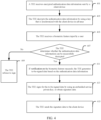
- FIG. 3 is a flowchart illustrating a signature authentication method performed by a client device, according to one or more embodiments of this specification.
- the method is performed by a client device in a terminal device.
- a service private key required for signature authentication is embedded in a TEE of the terminal device in which the client device is located, and the TEE performs verification on a biometric feature of a user. Understandably, the method can also be performed by any apparatus, device, platform, device cluster, etc. having computing and processing capabilities.
- the method includes step 301 to step 309.
- Step 301 The client device sends a signature authentication request to a server.
- Step 303 The client device receives authentication data information sent from the server.
- Step 305 The client device encrypts the authentication data information by using a key that is synchronized with the TEE in advance.
- Step 307 The client device sends encrypted authentication data information to the TEE.
- Step 309 The client device receives signature data sent from the TEE and sends the signature data to the server.
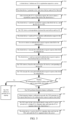
- FIG. 4 is a flowchart illustrating a signature authentication method performed by a TEE, according to one or more embodiments of this specification.
- the method is performed by a TEE in a terminal device, and a service private key required for signature authentication is embedded in the TEE. Understandably, the method can also be performed by any apparatus, device, platform, device cluster, etc. having computing and processing capabilities.
- the method includes step 401 to step 415.
- Step 401 The TEE receives encrypted authentication data information sent by a client device.
- Step 403 The TEE decrypts the authentication data information by using a key that is synchronized with the client device in advance.
- Step 405 The TEE receives a biometric feature input by a user.
- Step 407 The TEE determines whether the authentication data information can be successfully decrypted, and if yes, performs step 411; otherwise, performs step 409.
- Step 409 The TEE refuses to sign and ends a current procedure.
- Step 411 If verification on the biometric feature succeeds, the TEE generates to-be-signed data based on the authentication data information.
- Step 413 The TEE signs for the to-be-signed data by using the embedded service private key, to obtain signature data.
- Step 415 The TEE sends the signature data to the client device.
- an existing signature authentication process is modified.
- an authorized client device does not directly send authentication data information to a TEE, but first encrypts the authentication data information by using a key synchronized with the TEE, and then sends the authentication data information to the TEE.
- signing requires not only a biometric feature verification success, which is performed after the biometric feature verification success only when the following two conditions are met: first, the sent signature-related information, i.e., the authentication data information, needs to be encrypted; and second, the authentication data information can be successfully decrypted.
- the methods in the embodiments of this specification ensure that an identity of a client device that invokes an SDK of a signature authentication interface is authorized, that is, only an authorized client device (the authorized client device is a client device that can encrypt authentication data information by using a correct key) can enable the TEE to complete signing. Because an attacker cannot obtain the key, the attacker cannot successfully encrypt the authentication data information. Therefore, the TEE does not sign for authentication data information sent by the attacker, thereby ensuring that a signature is not abused.
- the authorized client device needs to synchronize the key with the TEE in advance.
- the key can be synchronized between the authorized client device and the TEE in a registration process initiated by the client device to the server (the registration process can be as follows: an authorized user inputs a fingerprint or scans a face to log in to a service provided by an application).
- the registration process can be as follows: an authorized user inputs a fingerprint or scans a face to log in to a service provided by an application).
- a difference between the authorized client device and the attacker is that an identity of the attacker is unauthorized and the attacker cannot complete a registration process initiated to the server, while an identity of the authorized client device such as an application is authorized, and therefore, the authorized client device can complete a registration process initiated to the server. Therefore, in the registration process, the key can be synchronized between the authorized client device and the TEE, while the attacker cannot synchronize a key with the TEE through a registration process.
- the client device in a process in which the client device initiates registration to the server, the client device generates the key.
- the client device stores the key, and sends the key to the TEE.
- the TEE receives the key sent from the client device. In this way, the key is synchronized between the client device and the TEE. For example, the client device sends the key to the TEE when sending a registration response data field to the TEE.
- each authorized client device generates an ID of a key when generating the key, and sends the identifier (ID) of the key to the TEE when synchronizing the key to the TEE.
- ID the identifier
- the client device synchronizes both the key and the key ID to the TEE.
- the TEE receives the key and the ID of the key that are sent from the client device, and stores a correspondence between the key and the key ID. In this way, in the process shown in FIG.
- an implementation process in which the TEE determines whether the authentication data information can be successfully decrypted includes: The TEE determines whether a key ID sent by the client device is received. If not, the TEE determines that the authentication data information cannot be successfully decrypted, and ends a current procedure. If yes, the TEE retrieves, by using the key ID sent by the client device, a key corresponding to the key ID; and the TEE decrypts the authentication data information by using the retrieved key.
- the method includes two procedures.
- a first procedure is a process performed in advance in which an authorized client device initiates IFAA registration to a server.
- a key and a key ID are synchronized between the client device and the TEE in the IFAA registration process.
- a second procedure is an IFAA signature authentication process.
- the method includes step 501 to step 533.
- Step 501 A client device 1 initiates an IFAA registration request to a server.
- Step 501 can be an IFAA registration request initiated by a user when the user needs to enable a password-free payment function of the client device 1, such as a shopping APP, and turns to fingerprint payment or face payment.
- a password-free payment function of the client device 1 such as a shopping APP
- Step 503 The client device 1 generates a key subsequently used for IFAA signature authentication and an ID of the key, and stores the key and the ID of the key.
- Step 505 After receiving the IFAA registration request, the server serving the client device 1 returns a registration response data field, i.e., a RegisterRespData field, to the client device 1.
- a registration response data field i.e., a RegisterRespData field
- Step 507 The client device 1 sends the RegisterRespData field, the key, and the key ID to a TEE.
- Step 509 The TEE stores a correspondence between the received key and key ID.
- an IFAA authentication module denoted as IFAA authenticator, in the TEE can store the correspondence between the key and the key ID.
- step 503 step 507, and step 509 in which the authorized client device initiates the IFAA registration process to the server, the key and the ID of the key are synchronized between the client device 1 and the TEE.
- Step 511 When the user performs a service program function, such as shopping, by using the client device 1, the client device 1 sends an IFAA signature authentication request to the server.
- a service program function such as shopping
- Step 513 The server returns an authentication request response data field, i.e., an AuthReqRespData field, to the client device 1.
- an authentication request response data field i.e., an AuthReqRespData field
- Step 515 The client device 1 encrypts the AuthReqRespData field by using the key generated in step 503.
- Step 517 The client device 1 sends an encrypted AuthReqRespData field and the key ID of the key to the TEE.
- Step 519 The TEE retrieves, based on the received key ID, the key corresponding to the key ID.
- Step 521 The TEE decrypts the encrypted AuthReqRespData field by using the retrieved key.
- Step 523 The TEE determines whether the AuthReqRespData field can be successfully decrypted, and if yes, performs step 527; otherwise, performs step 525.
- Step 525 The TEE refuses to perform IFAA signing and ends a current procedure.
- Step 527 The TEE performs biometric feature verification.
- Step 529 If the biometric feature verification succeeds, the TEE generates to-be-signed data based on the AuthReqRespData field.
- Step 531 The TEE signs for the to-be-signed data by using an IFAA service private key, to obtain IFAA signature data, and sends the IFAA signature data to the client device 1.
- Step 533 The client device 1 receives the IFAA signature data sent from the TEE, and sends the signature data to the server.
- IFAA signature authentication can be performed based on an IFAA signature authentication process of the related art.
- a signature authentication apparatus is provided, applied to a client device.
- a service private key required for signature authentication is embedded in a TEE of a terminal device in which the client device is located, and the TEE performs verification on a biometric feature of a user.
- the apparatus includes: an authentication request module 601, configured to send a signature authentication request to a server; a receiving module 602, configured to receive authentication data information sent from the server; an encryption module 603, configured to encrypt the authentication data information by using a key that is synchronized with the trusted execution environment (TEE) in advance; a sending module 604, configured to send encrypted authentication data information to the TEE; and a signature data processing module 605, configured to receive signature data sent from the TEE and send the signature data to the server.
- TEE trusted execution environment
- the apparatus further includes a registration module (not shown in the figure).
- the registration module is configured to: in a process in which the client device initiates registration to the server, generate and store the key, and send the key to the TEE to synchronize the key with the TEE.
- the registration module is configured to: send the key to the TEE when a registration response data field is sent to the TEE.
- a signature authentication apparatus is provided, applied to a TEE of a terminal device.
- a service private key required for signature authentication is embedded in the TEE.
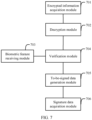
- the apparatus includes: an encrypted information acquisition module 701, configured to receive encrypted authentication data information sent by a client device; a decryption module 702, configured to decrypt the authentication data information by using a key that is synchronized with the client device in advance; a biometric feature receiving module 703, configured to receive a biometric feature input by a user; a verification module 704, configured to: determine whether the authentication data information can be successfully decrypted, and perform verification on the biometric feature input by the user; a to-be-signed data generation module 705, configured to: after it is determined that the authentication data information can be successfully decrypted, and the biometric feature verification succeeds, generate to-be-signed data based on the authentication data information; and a signature data acquisition module 706, configured to sign for the to-be-signed data by using the embedded service private key,
- the above-mentioned apparatuses are generally implemented on a server side, and can be separately disposed on independent servers, or a combination of a part or all of the apparatuses can be disposed on a same server.
- the server can be a single server, or a server cluster including a plurality of servers.
- the server can be a cloud server, or referred to as a cloud computing server or a cloud host, and is a host product in a cloud computing service system.
- the above-mentioned apparatuses can also be implemented in a computer terminal that has a strong computing capability.
- One or more embodiments of this specification provide a computer-readable storage medium.
- the computer-readable storage medium stores a computer program.
- the computer program When the computer program is executed in a computer, the computer is enabled to perform the method according to any one of the embodiments of this specification.
- One or more embodiments of this specification provide a computing device, including a memory and a processor.
- the memory stores executable code, and when executing the executable code, the processor implements the method according to any one of the embodiments of this specification.
- the structures shown in the embodiments of this specification constitute no specific limitations on the apparatuses in the embodiments of this specification.
- the above-mentioned apparatuses may include more or less components than those shown in the figures, or may combine some components, or may split some components, or may have different component arrangements.
- the illustrated components can be implemented by hardware, software, or a combination of software and hardware.
Landscapes
- Engineering & Computer Science (AREA)
- Computer Security & Cryptography (AREA)
- Signal Processing (AREA)
- Computer Networks & Wireless Communication (AREA)
- Computer Hardware Design (AREA)
- General Engineering & Computer Science (AREA)
- Health & Medical Sciences (AREA)
- Computing Systems (AREA)
- General Health & Medical Sciences (AREA)
- Biomedical Technology (AREA)
- Theoretical Computer Science (AREA)
- Physics & Mathematics (AREA)
- General Physics & Mathematics (AREA)
- Software Systems (AREA)
- Life Sciences & Earth Sciences (AREA)
- Biodiversity & Conservation Biology (AREA)
- Storage Device Security (AREA)
- Collating Specific Patterns (AREA)
Abstract
Description
- One or more embodiments of this specification relate to network communication technologies, and in particular, to signature authentication methods and apparatuses.
- With development of Internet technologies, biometric feature identification has been used as an identity authentication method in many service scenarios. To be specific, a biometric feature of a user, such as fingerprint information or face information, is used instead of a password manually entered by the user, such as a password in a digital/alphabetic form, to authenticate an identity of the user.
- To ensure convenience, security, and credibility of biometric feature identification as an identity authentication method, a new signature authentication technology, referred to as Internet Finance Authentication Alliance (IFAA), emerges at present. Referring to
FIG. 1 , in the new signature technology, a service private key is embedded in a trusted execution environment (TEE) of a terminal device such as a mobile phone before delivery of the terminal device, and a client device and the TEE cooperate to complete signing. In various service scenarios such as face authentication, the terminal device can sign based on the new signature authentication technology. A server performs authentication on signatures, and provides services after the authentication succeeds. - However, current signature authentication methods are not secure enough.
- One or more embodiments of this specification describe signature authentication methods and apparatuses, which can improve security of signature authentication.
- According to a first aspect, a signature authentication method is provided, applied to a client device. A service private key required for signature authentication is embedded in a TEE of a terminal device in which the client device is located, and the TEE performs verification on a biometric feature of a user. The method includes: The client device sends a signature authentication request to a server. The client device receives authentication data information sent from the server. The client device encrypts the authentication data information by using a key that is synchronized with the TEE in advance. The client device sends encrypted authentication data information to the TEE. The client device receives signature data sent from the TEE and sends the signature data to the server.
- The method further includes: In a process in which the client device initiates registration to the server, the client device generates the key. In the process in which the client device initiates registration to the server, the client device stores the key, and sends the key to the TEE to synchronize the key with the TEE.
- The sending the key to the TEE includes: The client device sends the key to the TEE when sending a registration response data field to the TEE.
- The method further includes: The client device obtains a key ID of the key when generating the key; and synchronizes the key ID of the key to the TEE. The step that the client device sends encrypted authentication data information to the TEE further includes: The client device sends the key ID of the key to the TEE.
- According to a second aspect, a signature authentication method is provided, applied to a TEE of a terminal device. A service private key required for signature authentication is embedded in the TEE. The method includes: The TEE receives encrypted authentication data information sent by a client device. The TEE decrypts the authentication data information by using a key that is synchronized with the client device in advance. The TEE receives a biometric feature input by a user. The TEE determines whether the authentication data information can be successfully decrypted, and if yes, generates to-be-signed data after biometric feature verification succeeds. The TEE signs for the to-be-signed data by using the embedded service private key, to obtain signature data. The TEE sends the signature data to the client device.
- The method further includes: in a process in which the client device initiates registration to a server, receiving the key sent from the client device to synchronize the key with the client device.
- A method for synchronizing the key with the client device in advance includes: receiving the key and an ID of the key that are sent from the client device, and storing a correspondence between the key and the key ID. The determining whether the authentication data information can be successfully decrypted includes: determining whether a key ID sent by the client device is received; and if not, determining that the authentication data information cannot be successfully decrypted, and ending a current procedure; or if yes, retrieving, by using the key ID sent by the client device, a key corresponding to the key ID; and decrypting the authentication data information by using the retrieved key.
- According to a third aspect, a signature authentication apparatus is provided, applied to a client device. A service private key required for signature authentication is embedded in a TEE of a terminal device in which the client device is located, and the TEE performs verification on a biometric feature of a user. The apparatus includes: an authentication request module, configured to send a signature authentication request to a server; a receiving module, configured to receive authentication data information sent from the server; an encryption module, configured to encrypt the authentication data information by using a key that is synchronized with the TEE in advance; a sending module, configured to send encrypted authentication data information to the TEE; and a signature data processing module, configured to receive signature data sent from the TEE and send the signature data to the server.
- According to a fourth aspect, a signature authentication apparatus is provided, applied to a TEE of a terminal device. A service private key required for signature authentication is embedded in the TEE. The apparatus includes: an encrypted information acquisition module, configured to receive encrypted authentication data information sent by a client device; a decryption module, configured to decrypt the authentication data information by using a key that is synchronized with the client device in advance; a biometric feature receiving module, configured to receive a biometric feature input by a user; a verification module, configured to: determine whether the authentication data information can be successfully decrypted, and perform verification on the biometric feature input by the user; a to-be-signed data generation module, configured to: after it is determined that the authentication data information can be successfully decrypted, and the biometric feature verification succeeds, generate to-be-signed data based on the authentication data information; and a signature data acquisition module, configured to sign for the to-be-signed data by using the embedded service private key, to obtain signature data; and send the signature data to the client device.
- According to a fifth aspect, a computing device is provided, including a memory and a processor. The memory stores executable code, and when executing the executable code, the processor implements the method according to any one of the embodiments of this specification.
- The signature authentication methods and apparatuses provided in the embodiments of this specification have at least the following beneficial effects:
- 1. In the embodiments of this specification, an existing signature authentication process is modified. During signature authentication, an authorized client device does not directly send authentication data information to a TEE, but first encrypts to-be-signed data by using a key synchronized with the TEE. In the TEE, signing requires not only a biometric feature verification success, which is performed after the biometric feature verification success only when the following conditions are met: first, the sent authentication data information needs to be encrypted; and second, the authentication data information can be successfully decrypted. Therefore, the methods in the embodiments of this specification ensure that an identity of a client device that invokes a software development kit (SDK) of a signature authentication interface is authorized, that is, only an authorized client device (the authorized client device is a client device that can encrypt authentication data information by using a correct key) can enable the TEE to complete signing. Because an attacker cannot obtain the key, the attacker cannot successfully encrypt the authentication data information. Therefore, the TEE does not sign for data sent by the attacker, thereby ensuring that a signature is not abused.
- 2. Because it is difficult for the TEE to generate user interface interaction with a rich execution environment (REE), it is difficult to determine whether a signature authentication request currently initiated by a client device is an authorized request of a previously registered authorized client device. According to the methods in the embodiments of this specification, it can be effectively ensured that a client device that initially performs password-free registration and a client device that initiates subsequent password-free verification are a same client device.
- 3. The embodiments of this specification can prevent a trojan or another malicious APP from impersonating an authorized APP to perform a local signature authentication process, i.e., a password-free verification process.
- To describe the technical solutions in the embodiments of this specification or the related art more clearly, the following briefly describes accompanying drawings required for describing the embodiments or the related art. Clearly, the accompanying drawings in the following description show some embodiments of this specification, and a person of ordinary skill in the art may still derive other drawings from these accompanying drawings without creative efforts.
-
FIG. 1 is a schematic structural diagram illustrating a terminal device; -
FIG. 2 is a schematic diagram illustrating a system structure to which one or more embodiments of this specification are applied; -
FIG. 3 is a flowchart illustrating a signature authentication method performed by a client device, according to one or more embodiments of this specification; -
FIG. 4 is a flowchart illustrating a signature authentication method performed by a TEE, according to one or more embodiments of this specification; -
FIG. 5 is a flowchart illustrating IFAA registration and an IFAA signature authentication method performed by a client device and a TEE cooperatively, according to one or more embodiments of this specification; -
FIG. 6 is a schematic structural diagram illustrating a signature authentication apparatus applied to a client device, according to one or more embodiments of this specification; and -
FIG. 7 is a schematic structural diagram illustrating a signature authentication apparatus applied to a TEE, according to one or more embodiments of this specification. - Referring to
FIG. 1 , in a signature authentication process, a client device sends related information to a TEE, and an authentication module (authenticator) in the TEE signs for to-be-signed data by using an embedded service private key provided that the TEE detects a correct biometric feature (such as fingerprint or face information) of a user. An attacker may exploit this characteristic. For example, the attacker can download a software development kit (SDK) from the Internet, and send related protocol-compliant information to a TEE of a terminal device uninterruptedly. In this case, if the terminal device such as a mobile phone is screen locked or powered off, and a user needs to unlocks the screen of the terminal device through fingerprint input or face scanning, because the user neither knows that the attacker is continuously sending a packet to the TEE, nor knows that the attacker will use biometric feature information input by the user, the user inputs a fingerprint or scans a face. In this way, the TEE receives signature-related information sent from the attacker, and detects correct biometric feature data of the user, and the TEE signs by using a service private key. Consequently, the attacker acquires a signature of the authorized user, and attacks by using the signature, for example, performs service login or payment by counterfeiting the authorized user. - It can be seen that the signature authentication process in the related art is not secure.
- The following describes, with reference to the accompanying drawings, the solutions provided in this specification.
- First notably, terms used in the embodiments of this application are merely used to describe specific embodiments, and are not intended to limit this application. The terms "a", "an", and "the" of singular forms used in the embodiments of this application and the appended claims are intended to include plural forms, unless otherwise specified in the context clearly.
- Understandably, the term "and/or" used in this specification merely describes an association relationship between associated objects and indicates that three relationships can exist. For example, A and/or B can indicate the following three cases: Only A exists, both A and B exist, and only B exists. In addition, the character "/" in this specification usually indicates an "or" relationship between the associated objects.
- To facilitate understanding of the methods provided in this specification, a related system architecture applicable to this specification is described first. As shown in
FIG. 2 , the system architecture mainly includes a terminal device and a server. The terminal device includes a TEE and various client devices. - The client devices are installed and run in the terminal device. The terminal device can include but is not limited to an intelligent mobile terminal, a smart household device, a network device, a wearable device, a smart medical device, a personal computer (PC), etc. The intelligent mobile device can include a mobile phone, a tablet computer, a notebook computer, a personal digital assistant (PDA), an Internet vehicle, etc. The smart household device can include a smart appliance device, such as a smart TV, a smart air conditioner, a smart water heater, a smart refrigerator, a smart air purifier, etc. The smart household device can further include a smart door lock, a smart socket, a smart light, a smart camera, etc. The network device can include a switch, a wireless AP, a server, etc. The wearable device can include a smart watch, smart glasses, a smart band, a virtual reality device, an augmented reality device, a hybrid reality device (i.e., a device that can support virtual reality and augmented reality), etc. The smart medical device can include a smart thermometer, a smart blood pressure monitor, a smart blood glucometer, etc.
- The client devices can be various types of applications (APPs), including but not limited to a payment application, a multimedia playback application, a map application, a text editing application, a financial application, a browser application, an instant messaging application, etc.
- The server is a serving-end device of a provider that provides network services, and can be a single server, or a server group including a plurality of servers. The server is responsible for providing network services for various applications, for example, security authentication and network service level management.
- Understandably, quantities of client devices, terminal devices, and servers in
FIG. 2 are merely examples. Any quantity can be selected and disposed based on implementation needs. - In the embodiments of this specification, a signature authentication related procedure performed by the client device and the TEE is mainly modified, to improve security of signature authentication. To be specific, the embodiments of this specification include processing of the client device in the terminal device and processing of the TEE in the terminal device, which are separately described below in different embodiments.
-
FIG. 3 is a flowchart illustrating a signature authentication method performed by a client device, according to one or more embodiments of this specification. The method is performed by a client device in a terminal device. A service private key required for signature authentication is embedded in a TEE of the terminal device in which the client device is located, and the TEE performs verification on a biometric feature of a user. Understandably, the method can also be performed by any apparatus, device, platform, device cluster, etc. having computing and processing capabilities. Referring toFIG. 3 , the method includesstep 301 to step 309. - Step 301: The client device sends a signature authentication request to a server.
- Step 303: The client device receives authentication data information sent from the server.
- Step 305: The client device encrypts the authentication data information by using a key that is synchronized with the TEE in advance.
- Step 307: The client device sends encrypted authentication data information to the TEE.
- Step 309: The client device receives signature data sent from the TEE and sends the signature data to the server.
-
FIG. 4 is a flowchart illustrating a signature authentication method performed by a TEE, according to one or more embodiments of this specification. The method is performed by a TEE in a terminal device, and a service private key required for signature authentication is embedded in the TEE. Understandably, the method can also be performed by any apparatus, device, platform, device cluster, etc. having computing and processing capabilities. Referring toFIG. 4 , the method includesstep 401 to step 415. - Step 401: The TEE receives encrypted authentication data information sent by a client device.
- Step 403: The TEE decrypts the authentication data information by using a key that is synchronized with the client device in advance.
- Step 405: The TEE receives a biometric feature input by a user.
- Step 407: The TEE determines whether the authentication data information can be successfully decrypted, and if yes, performs
step 411; otherwise, performsstep 409. - Step 409: The TEE refuses to sign and ends a current procedure.
- Step 411: If verification on the biometric feature succeeds, the TEE generates to-be-signed data based on the authentication data information.
- Step 413: The TEE signs for the to-be-signed data by using the embedded service private key, to obtain signature data.
- Step 415: The TEE sends the signature data to the client device.
- It can be seen from the procedures shown in
FIG. 3 andFIG. 4 that, in the embodiments of this specification, an existing signature authentication process is modified. During signature authentication, an authorized client device does not directly send authentication data information to a TEE, but first encrypts the authentication data information by using a key synchronized with the TEE, and then sends the authentication data information to the TEE. In the TEE, after signature-related information sent from outside is received, signing requires not only a biometric feature verification success, which is performed after the biometric feature verification success only when the following two conditions are met: first, the sent signature-related information, i.e., the authentication data information, needs to be encrypted; and second, the authentication data information can be successfully decrypted. Therefore, the methods in the embodiments of this specification ensure that an identity of a client device that invokes an SDK of a signature authentication interface is authorized, that is, only an authorized client device (the authorized client device is a client device that can encrypt authentication data information by using a correct key) can enable the TEE to complete signing. Because an attacker cannot obtain the key, the attacker cannot successfully encrypt the authentication data information. Therefore, the TEE does not sign for authentication data information sent by the attacker, thereby ensuring that a signature is not abused. - In the processes shown in
FIG. 3 andFIG. 4 , the authorized client device needs to synchronize the key with the TEE in advance. In one or more embodiments of this specification, the key can be synchronized between the authorized client device and the TEE in a registration process initiated by the client device to the server (the registration process can be as follows: an authorized user inputs a fingerprint or scans a face to log in to a service provided by an application). A difference between the authorized client device and the attacker is that an identity of the attacker is unauthorized and the attacker cannot complete a registration process initiated to the server, while an identity of the authorized client device such as an application is authorized, and therefore, the authorized client device can complete a registration process initiated to the server. Therefore, in the registration process, the key can be synchronized between the authorized client device and the TEE, while the attacker cannot synchronize a key with the TEE through a registration process. - Therefore, in one or more embodiments of this specification, in a process in which the client device initiates registration to the server, the client device generates the key. In the process in which the client device initiates registration to the server, the client device stores the key, and sends the key to the TEE. In the process in which the client device initiates registration to the server, the TEE receives the key sent from the client device. In this way, the key is synchronized between the client device and the TEE. For example, the client device sends the key to the TEE when sending a registration response data field to the TEE.
- In the embodiments of this specification, there are a plurality of service scenarios, that is, the TEE may need to sign for data of different client devices in different service scenarios. Therefore, different client devices/different service scenarios correspond to different keys. To distinguish between keys, each authorized client device generates an ID of a key when generating the key, and sends the identifier (ID) of the key to the TEE when synchronizing the key to the TEE. In other words, the client device synchronizes both the key and the key ID to the TEE. The TEE receives the key and the ID of the key that are sent from the client device, and stores a correspondence between the key and the key ID. In this way, in the process shown in
FIG. 4 , an implementation process in which the TEE determines whether the authentication data information can be successfully decrypted includes: The TEE determines whether a key ID sent by the client device is received. If not, the TEE determines that the authentication data information cannot be successfully decrypted, and ends a current procedure. If yes, the TEE retrieves, by using the key ID sent by the client device, a key corresponding to the key ID; and the TEE decrypts the authentication data information by using the retrieved key. - Using the above-mentioned IFAA protocol as an example, the following uses a specific example to describe how a client device and a TEE cooperatively implement an IFAA signature authentication method. Referring to
FIG. 5 , the method includes two procedures. A first procedure is a process performed in advance in which an authorized client device initiates IFAA registration to a server. A key and a key ID are synchronized between the client device and the TEE in the IFAA registration process. A second procedure is an IFAA signature authentication process. Referring toFIG. 5 , the method includesstep 501 to step 533. - Step 501: A
client device 1 initiates an IFAA registration request to a server. - Step 501 can be an IFAA registration request initiated by a user when the user needs to enable a password-free payment function of the
client device 1, such as a shopping APP, and turns to fingerprint payment or face payment. - Step 503: The
client device 1 generates a key subsequently used for IFAA signature authentication and an ID of the key, and stores the key and the ID of the key. - Step 505: After receiving the IFAA registration request, the server serving the
client device 1 returns a registration response data field, i.e., a RegisterRespData field, to theclient device 1. - Step 507: The
client device 1 sends the RegisterRespData field, the key, and the key ID to a TEE. - Step 509: The TEE stores a correspondence between the received key and key ID.
- In one or more embodiments of this specification, an IFAA authentication module, denoted as IFAA authenticator, in the TEE can store the correspondence between the key and the key ID.
- Then, a subsequent registration procedure to be performed is the same as that in the related art.
- It can be seen that through
step 503,step 507, and step 509 in which the authorized client device initiates the IFAA registration process to the server, the key and the ID of the key are synchronized between theclient device 1 and the TEE. - Step 511: When the user performs a service program function, such as shopping, by using the
client device 1, theclient device 1 sends an IFAA signature authentication request to the server. - Step 513: The server returns an authentication request response data field, i.e., an AuthReqRespData field, to the
client device 1. - Step 515: The
client device 1 encrypts the AuthReqRespData field by using the key generated instep 503. - Step 517: The
client device 1 sends an encrypted AuthReqRespData field and the key ID of the key to the TEE. - Step 519: The TEE retrieves, based on the received key ID, the key corresponding to the key ID.
- Step 521: The TEE decrypts the encrypted AuthReqRespData field by using the retrieved key.
- Step 523: The TEE determines whether the AuthReqRespData field can be successfully decrypted, and if yes, performs
step 527; otherwise, performsstep 525. - Step 525: The TEE refuses to perform IFAA signing and ends a current procedure.
- Step 527: The TEE performs biometric feature verification.
- Step 529: If the biometric feature verification succeeds, the TEE generates to-be-signed data based on the AuthReqRespData field.
- Step 531: The TEE signs for the to-be-signed data by using an IFAA service private key, to obtain IFAA signature data, and sends the IFAA signature data to the
client device 1. - Step 533: The
client device 1 receives the IFAA signature data sent from the TEE, and sends the signature data to the server. - Then, IFAA signature authentication can be performed based on an IFAA signature authentication process of the related art.
- In this embodiment of this specification, it can be verified whether an APP that performs password-free verification and an APP that actually registers are a same APP, to prevent malicious behavior between different APPs on a same mobile phone.
- In one or more embodiments of this specification, a signature authentication apparatus is provided, applied to a client device. A service private key required for signature authentication is embedded in a TEE of a terminal device in which the client device is located, and the TEE performs verification on a biometric feature of a user. Referring to
FIG. 6 , the apparatus includes: anauthentication request module 601, configured to send a signature authentication request to a server; areceiving module 602, configured to receive authentication data information sent from the server; anencryption module 603, configured to encrypt the authentication data information by using a key that is synchronized with the trusted execution environment (TEE) in advance; a sendingmodule 604, configured to send encrypted authentication data information to the TEE; and a signaturedata processing module 605, configured to receive signature data sent from the TEE and send the signature data to the server. - In one or more embodiments of the apparatus shown in
FIG. 6 in this specification, the apparatus further includes a registration module (not shown in the figure). - The registration module is configured to: in a process in which the client device initiates registration to the server, generate and store the key, and send the key to the TEE to synchronize the key with the TEE.
- In one or more embodiments of the apparatus shown in
FIG. 6 in this specification, the registration module is configured to: send the key to the TEE when a registration response data field is sent to the TEE. - In one or more embodiments of the apparatus shown in
FIG. 6 in this specification, the sendingmodule 604 is further configured to send an identifier (ID) of the key used during the encryption to the TEE. - In one or more embodiments of this specification, a signature authentication apparatus is provided, applied to a TEE of a terminal device. A service private key required for signature authentication is embedded in the TEE. Referring to
FIG. 7 , the apparatus includes: an encryptedinformation acquisition module 701, configured to receive encrypted authentication data information sent by a client device; adecryption module 702, configured to decrypt the authentication data information by using a key that is synchronized with the client device in advance; a biometricfeature receiving module 703, configured to receive a biometric feature input by a user; averification module 704, configured to: determine whether the authentication data information can be successfully decrypted, and perform verification on the biometric feature input by the user; a to-be-signeddata generation module 705, configured to: after it is determined that the authentication data information can be successfully decrypted, and the biometric feature verification succeeds, generate to-be-signed data based on the authentication data information; and a signaturedata acquisition module 706, configured to sign for the to-be-signed data by using the embedded service private key, to obtain signature data; and send the signature data to the client device. - In one or more embodiments of the apparatus shown in
FIG. 7 in this specification, the apparatus further includes a key synchronization module (not shown in the figure). The key synchronization module is configured to: in a process in which the client device initiates registration to a server, receive the key sent from the client device to synchronize the key with the client device. - In one or more embodiments of the apparatus shown in
FIG. 7 in this specification, the key synchronization module is configured to: receive the key and an ID of the key that are sent from the client device, and store a correspondence between the key and the key ID. Theverification module 704 is configured to: determine whether a key ID sent by the client device is received; and if not, determine that the authentication data information cannot be successfully decrypted, and end a current procedure; or if yes, retrieve, by using the key ID sent by the client device, a key corresponding to the key ID; and decrypt the authentication data information by using the retrieved key. - Notably, the above-mentioned apparatuses are generally implemented on a server side, and can be separately disposed on independent servers, or a combination of a part or all of the apparatuses can be disposed on a same server. The server can be a single server, or a server cluster including a plurality of servers. The server can be a cloud server, or referred to as a cloud computing server or a cloud host, and is a host product in a cloud computing service system. The above-mentioned apparatuses can also be implemented in a computer terminal that has a strong computing capability.
- One or more embodiments of this specification provide a computer-readable storage medium. The computer-readable storage medium stores a computer program. When the computer program is executed in a computer, the computer is enabled to perform the method according to any one of the embodiments of this specification.
- One or more embodiments of this specification provide a computing device, including a memory and a processor. The memory stores executable code, and when executing the executable code, the processor implements the method according to any one of the embodiments of this specification.
- Understandably, the structures shown in the embodiments of this specification constitute no specific limitations on the apparatuses in the embodiments of this specification. In some other embodiments of this specification, the above-mentioned apparatuses may include more or less components than those shown in the figures, or may combine some components, or may split some components, or may have different component arrangements. The illustrated components can be implemented by hardware, software, or a combination of software and hardware.
- The embodiments of this specification are described in a progressive way. For same or similar parts of the embodiments, mutual references can be made to the embodiments. Each embodiment focuses on a difference from other embodiments. In particular, the apparatus embodiments are basically similar to the method embodiments, and therefore are described briefly. For related parts, references can be made to related descriptions in the method embodiments.
- A person skilled in the art should be aware that in the above-mentioned one or more examples, functions described in this application can be implemented by hardware, software, firmware, or any combination thereof. When the functions are implemented by software, these functions can be stored in a computer-readable medium or transmitted as one or more instructions or code in a computer-readable medium.
- The specific implementations described above further describe the purposes, technical solutions, and beneficial effects of this application. Understandably, the descriptions above are merely specific implementations of this application and are not intended to limit the protection scope of this application. Any modification, equivalent replacement, or improvement made based on the technical solutions of this application shall fall within the protection scope of this application.
Claims (10)
- A signature authentication method, applied to a client device, wherein a service private key required for signature authentication is embedded in a trusted execution environment (TEE) of a terminal device in which the client device is located, and the TEE performs verification on a biometric feature of a user; and the method comprises:sending, by the client device, a signature authentication request to a server;receiving, by the client device, authentication data information sent from the server;encrypting, by the client device, the authentication data information by using a key that is synchronized with the TEE in advance;sending, by the client device, encrypted authentication data information to the TEE; andreceiving, by the client device, signature data sent from the TEE and sending the signature data to the server.
- The method according to claim 1, wherein the method further comprises:in a process in which the client device initiates registration to the server, generating, by the client device, the key; andin the process in which the client device initiates registration to the server, storing, by the client device, the key, and sending the key to the TEE to synchronize the key with the TEE.
- The method according to claim 2, wherein the sending the key to the TEE comprises:
sending, by the client device, the key to the TEE when sending a registration response data field to the TEE. - The method according to claim 2, wherein the method further comprises: obtaining, by the client device, a key ID of the key when generating the key; and synchronizing the key ID of the key to the TEE; and
the step of sending, by the client device, encrypted authentication data information to the TEE further comprises: sending, by the client device, the key ID of the key to the TEE. - A signature authentication method, applied to a trusted execution environment (TEE) of a terminal device, wherein a service private key required for signature authentication is embedded in the TEE; and the method comprises:receiving, by the TEE, encrypted authentication data information sent by a client device;decrypting, by the TEE, the authentication data information by using a key that is synchronized with the client device in advance;receiving, by the TEE, a biometric feature input by a user;determining, by the TEE, whether the authentication data information can be successfully decrypted, and if yes, generating to-be-signed data after biometric feature verification succeeds;signing, by the TEE, for the to-be-signed data by using the embedded service private key, to obtain signature data; andsending, by the TEE, the signature data to the client device.
- The method according to claim 5, wherein the method further comprises: in a process in which the client device initiates registration to a server, receiving the key sent from the client device to synchronize the key with the client device.
- The method according to claim 5, wherein a method for synchronizing the key with the client device in advance comprises: receiving the key and an ID of the key that are sent from the client device, and storing a correspondence between the key and the key ID; and
the determining whether the authentication data information can be successfully decrypted comprises:determining whether a key ID sent by the client device is received; andif not, determining that the authentication data information cannot be successfully decrypted, and ending a current procedure; orif yes, retrieving, by using the key ID sent by the client device, a key corresponding to the key ID; and decrypting the authentication data information by using the retrieved key. - A signature authentication apparatus, applied to a client device, wherein a service private key required for signature authentication is embedded in a trusted execution environment (TEE) of a terminal device in which the client device is located, and the TEE performs verification on a biometric feature of a user; and the apparatus comprises:an authentication request module, configured to send a signature authentication request to a server;a receiving module, configured to receive authentication data information sent from the server;an encryption module, configured to encrypt the authentication data information by using a key that is synchronized with the TEE in advance;a sending module, configured to send encrypted authentication data information to the TEE; anda signature data processing module, configured to receive signature data sent from the TEE and send the signature data to the server.
- A signature authentication apparatus, applied to a trusted execution environment (TEE) of a terminal device, wherein a service private key required for signature authentication is embedded in the TEE; and the apparatus comprises:an encrypted information acquisition module, configured to receive encrypted authentication data information sent by a client device;a decryption module, configured to decrypt the authentication data information by using a key that is synchronized with the client device in advance;a biometric feature receiving module, configured to receive a biometric feature input by a user;a verification module, configured to: determine whether the authentication data information can be successfully decrypted, and perform verification on the biometric feature input by the user;a to-be-signed data generation module, configured to: after it is determined that the authentication data information can be successfully decrypted, and the biometric feature verification succeeds, generate to-be-signed data based on the authentication data information; anda signature data acquisition module, configured to sign for the to-be-signed data by using the embedded service private key, to obtain signature data; and send the signature data to the client device.
- A computing device, comprising a memory and a processor, wherein the memory stores executable code, and when executing the executable code, the processor implements the method according to any one of claims 1 to 7.
Applications Claiming Priority (2)
| Application Number | Priority Date | Filing Date | Title |
|---|---|---|---|
| CN202211673944.6A CN115801287A (en) | 2022-12-26 | 2022-12-26 | Signature authentication method and device |
| PCT/CN2023/127184 WO2024139616A1 (en) | 2022-12-26 | 2023-10-27 | Signature authentication method and apparatus |
Publications (2)
| Publication Number | Publication Date |
|---|---|
| EP4525358A1 true EP4525358A1 (en) | 2025-03-19 |
| EP4525358A4 EP4525358A4 (en) | 2025-11-05 |
Family
ID=85426713
Family Applications (1)
| Application Number | Title | Priority Date | Filing Date |
|---|---|---|---|
| EP23909549.0A Pending EP4525358A4 (en) | 2022-12-26 | 2023-10-27 | METHOD AND DEVICE FOR AUTHENTICATION OF SIGNATURES |
Country Status (4)
| Country | Link |
|---|---|
| US (1) | US20250112784A1 (en) |
| EP (1) | EP4525358A4 (en) |
| CN (1) | CN115801287A (en) |
| WO (1) | WO2024139616A1 (en) |
Families Citing this family (2)
| Publication number | Priority date | Publication date | Assignee | Title |
|---|---|---|---|---|
| CN115801287A (en) * | 2022-12-26 | 2023-03-14 | 支付宝(杭州)信息技术有限公司 | Signature authentication method and device |
| CN117793705A (en) * | 2024-02-26 | 2024-03-29 | 中电科网络安全科技股份有限公司 | High-precision map data transmission method, device, equipment and storage medium |
Family Cites Families (19)
| Publication number | Priority date | Publication date | Assignee | Title |
|---|---|---|---|---|
| CN106576044B (en) * | 2015-04-23 | 2020-05-15 | 崔云虎 | Certification in a Ubiquitous Environment |
| CN105959249B (en) * | 2015-09-11 | 2019-03-29 | 天地融科技股份有限公司 | The management method and system of electronic equipment |
| CN105429760B (en) * | 2015-12-01 | 2018-12-14 | 神州融安科技(北京)有限公司 | A TEE-based digital certificate authentication method and system |
| CN105704123B (en) * | 2016-01-08 | 2017-09-15 | 腾讯科技(深圳)有限公司 | A kind of methods, devices and systems for carrying out business processing |
| WO2018164955A1 (en) * | 2017-03-06 | 2018-09-13 | Rivetz Corp. | Device enrollment protocol |
| CN111669408A (en) * | 2017-03-30 | 2020-09-15 | 阿里巴巴集团控股有限公司 | Method and device for identity registration and authentication |
| US10693650B2 (en) * | 2017-12-19 | 2020-06-23 | Mastercard International Incorporated | Biometric identity verification systems, methods and programs for identity document applications and renewals |
| US10958642B2 (en) * | 2018-04-05 | 2021-03-23 | The Toronto-Dominion Bank | Dynamic biometric authentication based on distributed ledger data |
| US11301897B2 (en) * | 2018-04-11 | 2022-04-12 | Intel Corporation | Secure visual transactions for mobile devices |
| US11223485B2 (en) * | 2018-07-17 | 2022-01-11 | Huawei Technologies Co., Ltd. | Verifiable encryption based on trusted execution environment |
| US10939295B1 (en) * | 2018-08-21 | 2021-03-02 | HYPR Corp. | Secure mobile initiated authentications to web-services |
| US10601828B2 (en) * | 2018-08-21 | 2020-03-24 | HYPR Corp. | Out-of-band authentication based on secure channel to trusted execution environment on client device |
| US12041039B2 (en) * | 2019-02-28 | 2024-07-16 | Nok Nok Labs, Inc. | System and method for endorsing a new authenticator |
| US11303452B2 (en) * | 2019-04-03 | 2022-04-12 | Keychainx Ag | Biometric digital signature generation for identity verification |
| KR102561689B1 (en) * | 2019-05-29 | 2023-08-01 | 삼성에스디에스 주식회사 | Apparatus and method for registering biometric information, apparatus and method for biometric authentication |
| US11451517B2 (en) * | 2020-05-27 | 2022-09-20 | Nec Corporation | Secure and auditable proxy technology using trusted execution environments |
| CN114676392B (en) * | 2022-03-18 | 2024-06-04 | 北京百度网讯科技有限公司 | Application trusted authorization method and device and electronic equipment |
| CN115001817B (en) * | 2022-06-01 | 2023-09-26 | 支付宝(杭州)信息技术有限公司 | An offline identity recognition method, device and equipment |
| CN115801287A (en) * | 2022-12-26 | 2023-03-14 | 支付宝(杭州)信息技术有限公司 | Signature authentication method and device |
-
2022
- 2022-12-26 CN CN202211673944.6A patent/CN115801287A/en active Pending
-
2023
- 2023-10-27 EP EP23909549.0A patent/EP4525358A4/en active Pending
- 2023-10-27 WO PCT/CN2023/127184 patent/WO2024139616A1/en not_active Ceased
-
2024
- 2024-12-13 US US18/979,840 patent/US20250112784A1/en active Pending
Also Published As
| Publication number | Publication date |
|---|---|
| CN115801287A (en) | 2023-03-14 |
| EP4525358A4 (en) | 2025-11-05 |
| WO2024139616A1 (en) | 2024-07-04 |
| US20250112784A1 (en) | 2025-04-03 |
Similar Documents
| Publication | Publication Date | Title |
|---|---|---|
| US11683187B2 (en) | User authentication with self-signed certificate and identity verification and migration | |
| US11361065B2 (en) | Techniques for authentication via a mobile device | |
| CN111064757B (en) | Application access method, apparatus, electronic device, and storage medium | |
| US10666642B2 (en) | System and method for service assisted mobile pairing of password-less computer login | |
| EP2057819B1 (en) | Method for synchronising between a server and a mobile device | |
| CN104412273B (en) | Method and system for activation | |
| US20250112784A1 (en) | Signature authentication methods and apparatuses | |
| US20140281495A1 (en) | Method and apparatus for performing authentication between applications | |
| US8953805B2 (en) | Authentication information generating system, authentication information generating method, client apparatus, and authentication information generating program for implementing the method | |
| CN102196375A (en) | Securing out-of-band messages | |
| US20100228987A1 (en) | System and method for securing information using remote access control and data encryption | |
| US12512991B2 (en) | Implementation of one-touch login service | |
| EP3282737B1 (en) | Information processing device, authentication device, system, information processing method, program, and authentication method | |
| CN109145628B (en) | Data acquisition method and system based on trusted execution environment | |
| CN112565265B (en) | Authentication method, authentication system and communication method between terminal devices of Internet of things | |
| US20250038987A1 (en) | Systems and methods for out-of-band authenticity verification of mobile applications | |
| JP2022117456A (en) | Message transmission system with hardware security module | |
| CN114079921B (en) | Session key generation method, anchor point function network element and system | |
| CN115473655B (en) | Terminal authentication method, device and storage medium for access network | |
| CN111740824B (en) | Trusted application management method and device | |
| US8495383B2 (en) | Method for the secure storing of program state data in an electronic device | |
| CN113904830B (en) | SPA authentication method, SPA authentication device, electronic equipment and readable storage medium | |
| CN112784237A (en) | Authentication processing method, authentication authorization method and related equipment of electronic document | |
| CN104994498A (en) | Method and system for interaction between terminal application and mobile phone card application | |
| CN114065170A (en) | Method and device for acquiring platform identity certificate and server |
Legal Events
| Date | Code | Title | Description |
|---|---|---|---|
| STAA | Information on the status of an ep patent application or granted ep patent |
Free format text: STATUS: THE INTERNATIONAL PUBLICATION HAS BEEN MADE |
|
| PUAI | Public reference made under article 153(3) epc to a published international application that has entered the european phase |
Free format text: ORIGINAL CODE: 0009012 |
|
| STAA | Information on the status of an ep patent application or granted ep patent |
Free format text: STATUS: REQUEST FOR EXAMINATION WAS MADE |
|
| 17P | Request for examination filed |
Effective date: 20241210 |
|
| AK | Designated contracting states |
Kind code of ref document: A1 Designated state(s): AL AT BE BG CH CY CZ DE DK EE ES FI FR GB GR HR HU IE IS IT LI LT LU LV MC ME MK MT NL NO PL PT RO RS SE SI SK SM TR |
|
| A4 | Supplementary search report drawn up and despatched |
Effective date: 20251002 |
|
| RIC1 | Information provided on ipc code assigned before grant |
Ipc: H04L 9/32 20060101AFI20250926BHEP Ipc: H04L 9/40 20220101ALI20250926BHEP Ipc: G06F 21/32 20130101ALI20250926BHEP |
|
| DAV | Request for validation of the european patent (deleted) | ||
| DAX | Request for extension of the european patent (deleted) |