EP4525343A2 - Scheduling of control signaling on a primary cell by a secondary cell - Google Patents
Scheduling of control signaling on a primary cell by a secondary cell Download PDFInfo
- Publication number
- EP4525343A2 EP4525343A2 EP25153441.8A EP25153441A EP4525343A2 EP 4525343 A2 EP4525343 A2 EP 4525343A2 EP 25153441 A EP25153441 A EP 25153441A EP 4525343 A2 EP4525343 A2 EP 4525343A2
- Authority
- EP
- European Patent Office
- Prior art keywords
- search space
- dci
- control signaling
- scell
- spcell
- Prior art date
- Legal status (The legal status is an assumption and is not a legal conclusion. Google has not performed a legal analysis and makes no representation as to the accuracy of the status listed.)
- Pending
Links
Images



Classifications
-
- H—ELECTRICITY
- H04—ELECTRIC COMMUNICATION TECHNIQUE
- H04W—WIRELESS COMMUNICATION NETWORKS
- H04W72/00—Local resource management
- H04W72/04—Wireless resource allocation
-
- H—ELECTRICITY
- H04—ELECTRIC COMMUNICATION TECHNIQUE
- H04L—TRANSMISSION OF DIGITAL INFORMATION, e.g. TELEGRAPHIC COMMUNICATION
- H04L5/00—Arrangements affording multiple use of the transmission path
- H04L5/0001—Arrangements for dividing the transmission path
- H04L5/0003—Two-dimensional division
- H04L5/0005—Time-frequency
- H04L5/0007—Time-frequency the frequencies being orthogonal, e.g. OFDM(A) or DMT
- H04L5/001—Time-frequency the frequencies being orthogonal, e.g. OFDM(A) or DMT the frequencies being arranged in component carriers
-
- H—ELECTRICITY
- H04—ELECTRIC COMMUNICATION TECHNIQUE
- H04L—TRANSMISSION OF DIGITAL INFORMATION, e.g. TELEGRAPHIC COMMUNICATION
- H04L5/00—Arrangements affording multiple use of the transmission path
- H04L5/0091—Signalling for the administration of the divided path, e.g. signalling of configuration information
- H04L5/0094—Indication of how sub-channels of the path are allocated
-
- H—ELECTRICITY
- H04—ELECTRIC COMMUNICATION TECHNIQUE
- H04L—TRANSMISSION OF DIGITAL INFORMATION, e.g. TELEGRAPHIC COMMUNICATION
- H04L5/00—Arrangements affording multiple use of the transmission path
- H04L5/003—Arrangements for allocating sub-channels of the transmission path
- H04L5/0048—Allocation of pilot signals, i.e. of signals known to the receiver
-
- H—ELECTRICITY
- H04—ELECTRIC COMMUNICATION TECHNIQUE
- H04L—TRANSMISSION OF DIGITAL INFORMATION, e.g. TELEGRAPHIC COMMUNICATION
- H04L5/00—Arrangements affording multiple use of the transmission path
- H04L5/003—Arrangements for allocating sub-channels of the transmission path
- H04L5/0053—Allocation of signalling, i.e. of overhead other than pilot signals
Definitions
- a next generation NodeB When establishing the network connection such as, for example, a connection to a 5G new radio (NR) network, a next generation NodeB (gNB) transmits downlink channel information (DCI) to the UE via a physical downlink control channel (PDCCH).
- DCI downlink channel information
- PDCCH physical downlink control channel
- the PDCCH is transmitted to the UE via one or more control resource sets (CORESETS).
- DSS dynamic spectrum sharing
- LTE long term evolution
- transmissions of the CORESETS for 5G communications may interfere with cell reference signals (CRS) transmissions on the LTE network.
- CRS cell reference signals
- Some exemplary embodiments are related to a processor of a base station configured to perform operations.
- the operations include configuring a first search space having a first search space identification (SearchSpaceld) in a special cell (SpCell) and a second search space having a second search space identification (SearchSpaceld) in a secondary cell (SCell) for monitoring control signaling that schedules operations on the SpCell and transmitting a radio resource control (RRC) configuration to a user equipment (UE) including the first SSID and the second SSID, wherein the RRC configuration configures the UE to monitor the first search space having the first SSID for scheduling of a first type of control signaling and the second search space having the second SSID for scheduling of a second type of control signaling.
- RRC radio resource control
- exemplary embodiments are related to a base station having a transceiver configured to communicate with a user equipment (UE) and a processor communicatively coupled to the transceiver and configured to perform operations.
- the operations include configuring a first search space having a first search space identification (SearchSpaceld) in a special cell (SpCell) and a second search space having a second search space identification (SearchSpaceld) in a secondary cell (SCell) for monitoring control signaling that schedules operations on the SpCell and transmitting a radio resource control (RRC) configuration to the UE including the first SSID and the second SSID, wherein the RRC configuration configures the UE to monitor the first search space having the first SSID for scheduling of a first type of control signaling and the second search space having the second SSID for scheduling of a second type of control signaling.
- RRC radio resource control
- the exemplary embodiments may be further understood with reference to the following description and the related appended drawings, wherein like elements are provided with the same reference numerals.
- the exemplary embodiments relate to the configuration of search spaces when a secondary cell (SCell) is configured to schedule UE operations on a special cell (SpCell) in addition to the SpCell also being configured to schedule its own operations.
- SpCell may refer to a primary cell (PCell) or a primary SCell (PSCell) .
- the exemplary embodiments are described with regard to a UE. However, reference to a UE is merely provided for illustrative purposes.
- the exemplary embodiments may be utilized with any electronic component that may establish a connection to a network and is configured with the hardware, software, and/or firmware to exchange information and data with the network. Therefore, the UE as described herein is used to represent any appropriate electronic component.
- NR 5G New Radio
- reference to a 5G NR network is merely provided for illustrative purposes.
- the exemplary embodiments may be utilized with any network that implements the functionalities described herein.
- a SCell e.g., a 5G cell
- DSS search space(s)
- the network configures one or more search spaces in at least one of the SpCell and the SCell for scheduling the control data transmissions on the SpCell.
- the network indicates to the UE which search space(s) should be monitored for this scheduling.
- Another issue that arises is how a UE should handle the deactivation or dormancy of an SCell when the scheduling of control data transmissions on the SpCell is performed by both the SpCell and the SCell.
- the network configures the one or more search spaces for each of the SpCell and the SCell.
- the network then explicitly or implicitly indicates to the UE which search space the UE should monitor when the SCell is deactivated or dormant.
- Fig. 1 shows an exemplary network arrangement 100 according to various exemplary embodiments.
- the exemplary network arrangement 100 includes a UE 110.
- UE may be any number of UE that is used in the network arrangement 100.
- the UE 110 may be any type of electronic component that is configured to communicate via a network, e.g., mobile phones, tablet computers, desktop computers, smartphones, phablets, embedded devices, wearables, Internet of Things (IoT) devices, etc.
- IoT Internet of Things
- an actual network arrangement may include any number of UEs being used by any number of users.
- the example of a single UE 110 is merely provided for illustrative purposes.
- the UE 110 may be configured to communicate with one or more networks.
- the networks with which the UE 110 may wirelessly communicate are a 5G New Radio (NR) radio access network (5G NR-RAN) 120, an LTE radio access network (LTE-RAN) 122 and a wireless local access network (WLAN) 124.
- NR 5G New Radio
- LTE-RAN LTE radio access network
- WLAN wireless local access network
- the UE 110 may also communicate with other types of networks and the UE 110 may also communicate with networks over a wired connection. Therefore, the UE 110 may include a 5G NR chipset to communicate with the 5G NR-RAN 120, an LTE chipset to communicate with the LTE-RAN 122 and an ISM chipset to communicate with the WLAN 124.
- the 5G NR-RAN 120 and the LTE-RAN 122 may be portions of cellular networks that may be deployed by cellular providers (e.g., Verizon, AT&T, T-Mobile, etc.). These networks 120, 122 may include, for example, cells or base stations (Node Bs, eNodeBs, HeNBs, eNBS, gNBs, gNodeBs, macrocells, microcells, small cells, femtocells, etc.) that are configured to send and receive traffic from UE that are equipped with the appropriate cellular chip set.
- the WLAN 124 may include any type of wireless local area network (WiFi, Hot Spot, IEEE 802.11x networks, etc.).
- the UE 110 may connect to the 5G NR-RAN 120 via the gNB 120A and/or the gNB 120B.
- the gNBs 120A and 120B may be configured with the necessary hardware (e.g., antenna array), software and/or firmware to perform massive multiple in multiple out (MIMO) functionality.
- Massive MIMO may refer to a base station that is configured to generate a plurality of beams for a plurality of UE.
- the UE 110 may be within range of a plurality of gNBs.
- Reference to two gNBs 120A, 120B is merely for illustrative purposes. The exemplary embodiments may apply to any appropriate number of gNBs.
- the UE 110 may communicate with the eNB 122A of the LTE-RAN 122 to transmit and receive control information used for downlink and/or uplink synchronization with respect to the 5G NR-RAN 120 connection.
- any association procedure may be performed for the UE 110 to connect to the 5G NR-RAN 120.
- the 5G NR-RAN 120 may be associated with a particular cellular provider where the UE 110 and/or the user thereof has a contract and credential information (e.g., stored on a SIM card).
- the UE 110 may transmit the corresponding credential information to associate with the 5G NR-RAN 120.
- the UE 110 may associate with a specific base station (e.g., the gNB 120A of the 5G NR-RAN 120).
- the network arrangement 100 also includes a cellular core network 130, the Internet 140, an IP Multimedia Subsystem (IMS) 150, and a network services backbone 160.
- the cellular core network 130 may be considered to be the interconnected set of components that manages the operation and traffic of the cellular network.
- the cellular core network 130 also manages the traffic that flows between the cellular network and the Internet 140.
- the IMS 150 may be generally described as an architecture for delivering multimedia services to the UE 110 using the IP protocol.
- the IMS 150 may communicate with the cellular core network 130 and the Internet 140 to provide the multimedia services to the UE 110.
- the network services backbone 160 is in communication either directly or indirectly with the Internet 140 and the cellular core network 130.
- the network services backbone 160 may be generally described as a set of components (e.g., servers, network storage arrangements, etc.) that implement a suite of services that may be used to extend the functionalities of the UE 110 in communication with the various networks.
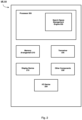
- Fig. 2 shows an exemplary UE 110 according to various exemplary embodiments.
- the UE 110 will be described with regard to the network arrangement 100 of Fig. 1 .
- the UE 110 may represent any electronic device and may include a processor 205, a memory arrangement 210, a display device 215, an input/output (I/O) device 220, a transceiver 225 and other components 230.
- the other components 230 may include, for example, an audio input device, an audio output device, a battery that provides a limited power supply, a data acquisition device, ports to electrically connect the UE 110 to other electronic devices, one or more antenna panels, etc.
- the UE 110 may be coupled to an industrial device via one or more ports.
- the processor 205 may be configured to execute a plurality of engines of the UE 110.
- the engines may include a search space management engine 235.
- the search space management engine 235 may perform various operations related to determining which search space(s) should be monitored for control data scheduling for the SpCell, as will be described in greater detail below.
- the above referenced engine being an application (e.g., a program) executed by the processor 205 is only exemplary.
- the functionality associated with the engine may also be represented as a separate incorporated component of the UE 110 or may be a modular component coupled to the UE 110, e.g., an integrated circuit with or without firmware.
- the integrated circuit may include input circuitry to receive signals and processing circuitry to process the signals and other information.
- the engines may also be embodied as one application or separate applications.
- the functionality described for the processor 205 is split among two or more processors such as a baseband processor and an applications processor.
- the exemplary embodiments may be implemented in any of these or other configurations of a UE.
- the memory arrangement 210 may be a hardware component configured to store data related to operations performed by the UE 110.
- the display device 215 may be a hardware component configured to show data to a user while the I/O device 220 may be a hardware component that enables the user to enter inputs.
- the display device 215 and the I/O device 220 may be separate components or integrated together such as a touchscreen.
- the transceiver 225 may be a hardware component configured to establish a connection with the 5G NR-RAN 120, the LTE-RAN 122, the WLAN 124, etc. Accordingly, the transceiver 225 may operate on a variety of different frequencies or channels (e.g., set of consecutive frequencies).
- Fig. 3 shows an exemplary network base station, in this case gNB 120A, according to various exemplary embodiments.
- the gNB 120A may represent any access node of the 5G NR network through which the UE 110 may establish a connection.
- the gNB 120A illustrated in Fig. 3 may also represent the gNB 120B.
- the gNB 120A may include a processor 305, a memory arrangement 310, an input/output (I/O) device 320, a transceiver 325, and other components 330.
- the other components 330 may include, for example, a power supply, a data acquisition device, ports to electrically connect the gNB 120A to other electronic devices, etc.
- the processor 305 may be configured to execute a plurality of engines of the gNB 120A.
- the engines may include a search space management engine 335 for performing operations including configuring one or more search spaces when both the SpCell and the SCell are configured to schedule control data transmissions on the SpCell and to configure the UE 110 to handle the deactivation or dormancy of the SCell. Examples of this process will be described in greater detail below.
- the above noted engine being an application (e.g., a program) executed by the processor 305 is only exemplary.
- the functionality associated with the engines may also be represented as a separate incorporated component of the gNB 120A or may be a modular component coupled to the gNB 120A, e.g., an integrated circuit with or without firmware.
- the integrated circuit may include input circuitry to receive signals and processing circuitry to process the signals and other information.
- the functionality described for the processor 305 is split among a plurality of processors (e.g., a baseband processor, an applications processor, etc.).
- the exemplary aspects may be implemented in any of these or other configurations of a gNB.
- the memory 310 may be a hardware component configured to store data related to operations performed by the UEs 110, 112.
- the I/O device 320 may be a hardware component or ports that enable a user to interact with the gNB 120A.
- the transceiver 325 may be a hardware component configured to exchange data with the UE 110 and any other UE in the system 100.
- the transceiver 325 may operate on a variety of different frequencies or channels (e.g., set of consecutive frequencies). Therefore, the transceiver 325 may include one or more components (e.g., radios) to enable the data exchange with the various networks and UEs.
- Fig. 4 shows a method 400 of configuring a search space of a SCell (e.g., a 5G cell) for scheduling transmissions on a SpCell (e.g., a 5G cell) according to various exemplary embodiments.
- the gNB 120A (or 120B) configures an SpCell (e.g., gNB 120A) and an SCell (e.g., eNB 122A) to schedule control data transmissions (e.g., DCI, PDCCH, etc.) for the SpCell.
- the SCell cannot be configured in frequency range 2 (FR2). In some embodiments, whether or not the SCell can be configured in FR2 depends on the capabilities of the UE.
- the SCell cannot be configured in the non-terrestrial network (NTN) spectrum. In some embodiments, the SCell cannot be configured in the NR unlicensed (NR-U) spectrum. In some embodiments, whether or not the SCell can be configured in the NR-U spectrum depends on the capabilities of the UE.
- NTN non-terrestrial network
- NR-U NR unlicensed
- the gNB 120A configures a first search space in the SpCell and a second search space in the SCell.
- the first and second search spaces have the same search space ID (SearchSpaceld).
- the two search spaces are automatically linked because when the gNB 120A configures the UE 110 with the SearchSpaceld to monitor, then that SearchSpaceld corresponds to the first and second search spaces.
- the nrofCandidates information element (IE) is in the first search space of the SpCell and all other control signal configurations (e.g., non-fallback DCI, remaining PDCCH configurations) are in the second search space of the SCell.
- the nrofCandidates IE and some other control signal configuration e.g., monitoringSlotPeriodicityAndOffset, monitoringSymbolsWithinSlot, duration
- some other control signal configuration e.g., monitoringSlotPeriodicityAndOffset, monitoringSymbolsWithinSlot, duration
- all other control signal configurations e.g., non-fallback DCI, remaining PDCCH configurations
- the first and second search spaces and their corresponding SearchSpacelds are different.
- the first search space of the SpCell includes fallback DCI scheduling (e.g., Format 0_0 and 1_0) and the second search space includes the scheduling of all other control signaling (e.g., non-fallback DCI, all PDCCH configurations).
- the gNB 120A explicitly indicates the second SSID to the UE 110 so that the UE 110 knows which search space to monitor for the non-fallback DCI and all PDCCH configurations.
- the second search space is counted as one of the standarddefined maximum of ten search spaces per cell. In some embodiments, the second search space is alternatively not counted as one of the standard defined maximum of ten search spaces per cell.
- the gNB 120A configures a beam failure recovery (BFR) search space.
- the BFR search space ( recoverySearchSpaceId ) is only configured in the SpCell.
- the BFR search space ( recoverySearchSpaceId ) is only configured in the SCell.
- the gNB 120A may choose which cell to configure the BFR search space ( recoverySearchSpaceId ).
- the gNB 120A configures whether downlink (DL) and/or uplink (UL) DCI transmissions are scheduled by the second search space of the SCell.
- both the first search space of the SpCell and the second search space of the SCell schedule DL and UL DCI for UE operations on the SpCell.
- the gNB 120A alternatively restricts which DCI (DL or UL) the UE 110 is configured to monitor on the SCell.
- the gNB 120A transmits an RRC configuration to the UE 110 that includes a first SearchSpaceld corresponding to the first search space and a second SearchSpaceld corresponding to the second search space so that the UE 110 knows which search space(s) to monitor for control signals that schedules operations on the SpCell.
- the RRC configuration further includes the BFR search space ID.
- the total number of different DCI sizes monitored by the UE 110 is four.
- the total number of different DCI sizes for DCI transmissions scrambled by cell radio network temporary identifier (C-RNTI) monitored by the UE 110 is three.
- the UE 110 is limited to these maximums on both the first and second search spaces.
- the UE 110 is alternatively limited to these maximums on each of the first and second search spaces.
- the UE 110 may report to the gNB 120A whether it supports the additional DCI size monitoring limitation associated with applying the size limit on a per cell basis.
- Fig. 5 shows a method 500 of configuring a UE 110 to handle deactivation of an SCell configured to schedule transmissions on a SpCell according to various exemplary embodiments. The following description is made with the assumption that the SpCell is a 5G cell and the SCell is a 5G cell.
- the gNB 120A (or 120B) configures an SpCell (e.g., gNB 120A) and an SCell (e.g., eNB 122A) to schedule control data transmissions (e.g., DCI) for the SpCell.
- the gNB 120A configures a first search space having a first SearchSpaceId in the SpCell and a second search space having a second SearchSpaceId in the SCell.
- the gNB 120A transmits an RRC configuration to the UE 110 including the SearchSpaceIds of the first and second search spaces.
- the gNB 120A provides an indication to the UE 110 regarding which search space to monitor (which search space is activated) when the SCell is deactivated or dormant.
- the indication provided by the gNB 120A at 520 is an implicit indication.
- the UE 110 when the UE 110 receives an indication that the SCell has been deactivated or is dormant, the UE 110 implicitly knows that the second search space is deactivated and the first search space is activated.
- the UE 110 receives an indication that the SCell has been activated, the UE 110 implicitly knows that the second search space is activated and the first search space is deactivated.
- the indication provided by the gNB 120A at 520 may be an explicit indication.
- the gNB 120A may transmit a DCI or a medium access control (MAC) control element (CE) to indicate to the UE 110 which search space the UE 110 should monitor.
- the gNB 120A may configure a timer to address a scenario in which the DCI/MAC CE is not received or improperly decoded by the UE 110. The timer begins when the DCI/MAC CE is received. Upon expiration of the timer, the UE 110 begins to monitor a default search space.
- MAC medium access control
- the UE 110 monitors the second search space until the expiration of the timer, at which point the UE 110 monitors the first search space, which is configured to be the default search space. If the gNB 120A intends for the UE 110 to continue to monitor the second search space, then the gNB 120A sends another DCI/MAC CE indicating that the UE 110 should monitor the second search space. Upon receipt of the second DCI/MAC CE, the timer is reset. In some embodiments, the timer is set to 100 ms. It should be noted that the default search space may be configured to be either of the first or second search spaces.
- the configured SCell at 505 may be a plurality of SCells. In such an embodiment, only one of the plurality of SCells is activated at any given time for monitoring the control signaling that schedules operations on the SpCell.
- the activated SCell may be indicated explicitly by the gNB 120A to the UE 110 when an SCell is deactivated or dormant via, for example, a DCI or MAC CE.
- the activated SCell may be determined based on a priority based on a plurality of predetermined factors such as, for example, the periodicity of the search space in each SCell that is configured to schedule the control data signaling on the SpCell, the SearchSpaceId of each search space in each SCell that is configured to schedule the control data signaling on the SpCell, and the cell index ( ServCellIndex ) of each SCell. For example, a search space with a lesser periodicity would have a higher priority than a search space with a greater periodicity.
- An exemplary hardware platform for implementing the exemplary embodiments may include, for example, an Intel x86 based platform with compatible operating system, a Windows OS, a Mac platform and MAC OS, a mobile device having an operating system such as iOS, Android, etc.
- the exemplary embodiments of the above-described method may be embodied as a program containing lines of code stored on a non-transitory computer readable storage medium that, when compiled, may be executed on a processor or microprocessor.
- personally identifiable information should follow privacy policies and practices that are generally recognized as meeting or exceeding industry or governmental requirements for maintaining the privacy of users.
- personally identifiable information data should be managed and handled so as to minimize risks of unintentional or unauthorized access or use, and the nature of authorized use should be clearly indicated to users.
Landscapes
- Engineering & Computer Science (AREA)
- Signal Processing (AREA)
- Computer Networks & Wireless Communication (AREA)
- Mobile Radio Communication Systems (AREA)
Abstract
Description
- When establishing the network connection such as, for example, a connection to a 5G new radio (NR) network, a next generation NodeB (gNB) transmits downlink channel information (DCI) to the UE via a physical downlink control channel (PDCCH). The PDCCH is transmitted to the UE via one or more control resource sets (CORESETS). Because 5G new radio (NR) spectrum is difficult to obtain and expensive, operators have utilized dynamic spectrum sharing (DSS) so that 5G NR and long term evolution (LTE) transmissions can coexist in the same spectrum. However, transmissions of the CORESETS for 5G communications may interfere with cell reference signals (CRS) transmissions on the LTE network.
- Some exemplary embodiments are related to a processor of a base station configured to perform operations. The operations include configuring a first search space having a first search space identification (SearchSpaceld) in a special cell (SpCell) and a second search space having a second search space identification (SearchSpaceld) in a secondary cell (SCell) for monitoring control signaling that schedules operations on the SpCell and transmitting a radio resource control (RRC) configuration to a user equipment (UE) including the first SSID and the second SSID, wherein the RRC configuration configures the UE to monitor the first search space having the first SSID for scheduling of a first type of control signaling and the second search space having the second SSID for scheduling of a second type of control signaling.
- Other exemplary embodiments are related to a base station having a transceiver configured to communicate with a user equipment (UE) and a processor communicatively coupled to the transceiver and configured to perform operations. The operations include configuring a first search space having a first search space identification (SearchSpaceld) in a special cell (SpCell) and a second search space having a second search space identification (SearchSpaceld) in a secondary cell (SCell) for monitoring control signaling that schedules operations on the SpCell and transmitting a radio resource control (RRC) configuration to the UE including the first SSID and the second SSID, wherein the RRC configuration configures the UE to monitor the first search space having the first SSID for scheduling of a first type of control signaling and the second search space having the second SSID for scheduling of a second type of control signaling.
-
-
Fig. 1 shows an exemplary network arrangement according to various exemplary embodiments. -
Fig. 2 shows an exemplary user equipment (UE) according to various exemplary embodiments. -
Fig. 3 shows an exemplary base station according to various exemplary embodiments. -
Fig. 4 shows a method of configuring a search space (SS) of a secondary cell (SCell) for scheduling transmissions on a special cell (SpCell) according to various exemplary embodiments. -
Fig. 5 shows a method of configuring a UE to handle deactivation of an SCell configured to schedule transmissions on a SpCell according to various exemplary embodiments. - The exemplary embodiments may be further understood with reference to the following description and the related appended drawings, wherein like elements are provided with the same reference numerals. The exemplary embodiments relate to the configuration of search spaces when a secondary cell (SCell) is configured to schedule UE operations on a special cell (SpCell) in addition to the SpCell also being configured to schedule its own operations. In the following description, SpCell may refer to a primary cell (PCell) or a primary SCell (PSCell) .
- The exemplary embodiments are described with regard to a UE. However, reference to a UE is merely provided for illustrative purposes. The exemplary embodiments may be utilized with any electronic component that may establish a connection to a network and is configured with the hardware, software, and/or firmware to exchange information and data with the network. Therefore, the UE as described herein is used to represent any appropriate electronic component.
- In addition, the exemplary embodiments are described with regard to a 5G New Radio (NR) network. However, reference to a 5G NR network is merely provided for illustrative purposes. The exemplary embodiments may be utilized with any network that implements the functionalities described herein.
- To provide more flexibility to a 5G NR network using dynamic spectrum sharing (DSS) to schedule control data to be transmitted, it has been suggested that in addition to configuring a SpCell (e.g., a 5G cell) to schedule its own transmissions, a SCell (e.g., a 5G cell) also be configured schedule operations on the SpCell. One issue that arises, however, is how the search space(s) (SS) should be configured to facilitate the scheduling of these transmissions on the SpCell by two cells (the SpCell and the SCell).
- According to some exemplary embodiments, the network configures one or more search spaces in at least one of the SpCell and the SCell for scheduling the control data transmissions on the SpCell. The network indicates to the UE which search space(s) should be monitored for this scheduling.
- Another issue that arises is how a UE should handle the deactivation or dormancy of an SCell when the scheduling of control data transmissions on the SpCell is performed by both the SpCell and the SCell.
- According to other exemplary embodiments, the network configures the one or more search spaces for each of the SpCell and the SCell. The network then explicitly or implicitly indicates to the UE which search space the UE should monitor when the SCell is deactivated or dormant.
-
Fig. 1 shows anexemplary network arrangement 100 according to various exemplary embodiments. Theexemplary network arrangement 100 includes a UE 110. It should be noted that any number of UE may be used in thenetwork arrangement 100. Those skilled in the art will understand that the UE 110 may be any type of electronic component that is configured to communicate via a network, e.g., mobile phones, tablet computers, desktop computers, smartphones, phablets, embedded devices, wearables, Internet of Things (IoT) devices, etc. It should also be understood that an actual network arrangement may include any number of UEs being used by any number of users. Thus, the example of a single UE 110 is merely provided for illustrative purposes. - The UE 110 may be configured to communicate with one or more networks. In the example of the
network configuration 100, the networks with which the UE 110 may wirelessly communicate are a 5G New Radio (NR) radio access network (5G NR-RAN) 120, an LTE radio access network (LTE-RAN) 122 and a wireless local access network (WLAN) 124. However, it should be understood that the UE 110 may also communicate with other types of networks and the UE 110 may also communicate with networks over a wired connection. Therefore, the UE 110 may include a 5G NR chipset to communicate with the 5G NR-RAN 120, an LTE chipset to communicate with the LTE-RAN 122 and an ISM chipset to communicate with theWLAN 124. - The 5G NR-RAN 120 and the LTE-RAN 122 may be portions of cellular networks that may be deployed by cellular providers (e.g., Verizon, AT&T, T-Mobile, etc.). These
networks - The UE 110 may connect to the 5G NR-RAN 120 via the gNB 120A and/or the gNB 120B. The gNBs 120A and 120B may be configured with the necessary hardware (e.g., antenna array), software and/or firmware to perform massive multiple in multiple out (MIMO) functionality. Massive MIMO may refer to a base station that is configured to generate a plurality of beams for a plurality of UE. During operation, the UE 110 may be within range of a plurality of gNBs. Reference to two
gNBs RAN 122 to transmit and receive control information used for downlink and/or uplink synchronization with respect to the 5G NR-RAN 120 connection. - Those skilled in the art will understand that any association procedure may be performed for the UE 110 to connect to the 5G NR-
RAN 120. For example, as discussed above, the 5G NR-RAN 120 may be associated with a particular cellular provider where the UE 110 and/or the user thereof has a contract and credential information (e.g., stored on a SIM card). Upon detecting the presence of the 5G NR-RAN 120, the UE 110 may transmit the corresponding credential information to associate with the 5G NR-RAN 120. More specifically, the UE 110 may associate with a specific base station (e.g., the gNB 120A of the 5G NR-RAN 120). - In addition to the
networks network arrangement 100 also includes acellular core network 130, the Internet 140, an IP Multimedia Subsystem (IMS) 150, and anetwork services backbone 160. Thecellular core network 130 may be considered to be the interconnected set of components that manages the operation and traffic of the cellular network. Thecellular core network 130 also manages the traffic that flows between the cellular network and the Internet 140. The IMS 150 may be generally described as an architecture for delivering multimedia services to the UE 110 using the IP protocol. The IMS 150 may communicate with thecellular core network 130 and the Internet 140 to provide the multimedia services to the UE 110. Thenetwork services backbone 160 is in communication either directly or indirectly with the Internet 140 and thecellular core network 130. Thenetwork services backbone 160 may be generally described as a set of components (e.g., servers, network storage arrangements, etc.) that implement a suite of services that may be used to extend the functionalities of the UE 110 in communication with the various networks. -
Fig. 2 shows anexemplary UE 110 according to various exemplary embodiments. TheUE 110 will be described with regard to thenetwork arrangement 100 ofFig. 1 . TheUE 110 may represent any electronic device and may include aprocessor 205, amemory arrangement 210, adisplay device 215, an input/output (I/O)device 220, atransceiver 225 andother components 230. Theother components 230 may include, for example, an audio input device, an audio output device, a battery that provides a limited power supply, a data acquisition device, ports to electrically connect theUE 110 to other electronic devices, one or more antenna panels, etc. For example, theUE 110 may be coupled to an industrial device via one or more ports. - The
processor 205 may be configured to execute a plurality of engines of theUE 110. For example, the engines may include a searchspace management engine 235. The searchspace management engine 235 may perform various operations related to determining which search space(s) should be monitored for control data scheduling for the SpCell, as will be described in greater detail below. - The above referenced engine being an application (e.g., a program) executed by the
processor 205 is only exemplary. The functionality associated with the engine may also be represented as a separate incorporated component of theUE 110 or may be a modular component coupled to theUE 110, e.g., an integrated circuit with or without firmware. For example, the integrated circuit may include input circuitry to receive signals and processing circuitry to process the signals and other information. The engines may also be embodied as one application or separate applications. In addition, in some UE, the functionality described for theprocessor 205 is split among two or more processors such as a baseband processor and an applications processor. The exemplary embodiments may be implemented in any of these or other configurations of a UE. - The
memory arrangement 210 may be a hardware component configured to store data related to operations performed by theUE 110. Thedisplay device 215 may be a hardware component configured to show data to a user while the I/O device 220 may be a hardware component that enables the user to enter inputs. Thedisplay device 215 and the I/O device 220 may be separate components or integrated together such as a touchscreen. Thetransceiver 225 may be a hardware component configured to establish a connection with the 5G NR-RAN 120, the LTE-RAN 122, theWLAN 124, etc. Accordingly, thetransceiver 225 may operate on a variety of different frequencies or channels (e.g., set of consecutive frequencies). -
Fig. 3 shows an exemplary network base station, in thiscase gNB 120A, according to various exemplary embodiments. ThegNB 120A may represent any access node of the 5G NR network through which theUE 110 may establish a connection. ThegNB 120A illustrated inFig. 3 may also represent thegNB 120B. - The
gNB 120A may include aprocessor 305, amemory arrangement 310, an input/output (I/O)device 320, atransceiver 325, andother components 330. Theother components 330 may include, for example, a power supply, a data acquisition device, ports to electrically connect thegNB 120A to other electronic devices, etc. - The
processor 305 may be configured to execute a plurality of engines of thegNB 120A. For example, the engines may include a searchspace management engine 335 for performing operations including configuring one or more search spaces when both the SpCell and the SCell are configured to schedule control data transmissions on the SpCell and to configure theUE 110 to handle the deactivation or dormancy of the SCell. Examples of this process will be described in greater detail below. - The above noted engine being an application (e.g., a program) executed by the
processor 305 is only exemplary. The functionality associated with the engines may also be represented as a separate incorporated component of thegNB 120A or may be a modular component coupled to thegNB 120A, e.g., an integrated circuit with or without firmware. For example, the integrated circuit may include input circuitry to receive signals and processing circuitry to process the signals and other information. In addition, in some gNBs, the functionality described for theprocessor 305 is split among a plurality of processors (e.g., a baseband processor, an applications processor, etc.). The exemplary aspects may be implemented in any of these or other configurations of a gNB. - The
memory 310 may be a hardware component configured to store data related to operations performed by theUEs 110, 112. The I/O device 320 may be a hardware component or ports that enable a user to interact with thegNB 120A. Thetransceiver 325 may be a hardware component configured to exchange data with theUE 110 and any other UE in thesystem 100. Thetransceiver 325 may operate on a variety of different frequencies or channels (e.g., set of consecutive frequencies). Therefore, thetransceiver 325 may include one or more components (e.g., radios) to enable the data exchange with the various networks and UEs. -
Fig. 4 shows amethod 400 of configuring a search space of a SCell (e.g., a 5G cell) for scheduling transmissions on a SpCell (e.g., a 5G cell) according to various exemplary embodiments. At 405, thegNB 120A (or 120B) configures an SpCell (e.g.,gNB 120A) and an SCell (e.g.,eNB 122A) to schedule control data transmissions (e.g., DCI, PDCCH, etc.) for the SpCell. In some embodiments, the SCell cannot be configured in frequency range 2 (FR2). In some embodiments, whether or not the SCell can be configured in FR2 depends on the capabilities of the UE. In some embodiments, the SCell cannot be configured in the non-terrestrial network (NTN) spectrum. In some embodiments, the SCell cannot be configured in the NR unlicensed (NR-U) spectrum. In some embodiments, whether or not the SCell can be configured in the NR-U spectrum depends on the capabilities of the UE. - At 410, the
gNB 120A configures a first search space in the SpCell and a second search space in the SCell. In some embodiments, the first and second search spaces have the same search space ID (SearchSpaceld). In such an embodiment, the two search spaces are automatically linked because when thegNB 120A configures theUE 110 with the SearchSpaceld to monitor, then that SearchSpaceld corresponds to the first and second search spaces. In some embodiments, when the first and second SearchSpacelds are the same, the nrofCandidates information element (IE) is in the first search space of the SpCell and all other control signal configurations (e.g., non-fallback DCI, remaining PDCCH configurations) are in the second search space of the SCell. In some embodiments, when the first and second SearchSpacelds are the same, the nrofCandidates IE and some other control signal configuration (e.g., monitoringSlotPeriodicityAndOffset, monitoringSymbolsWithinSlot, duration) is in the first search space of the SpCell and all other control signal configurations (e.g., non-fallback DCI, remaining PDCCH configurations) are in the second search space of the SCell. - In some embodiments, the first and second search spaces and their corresponding SearchSpacelds are different. In such an embodiment, the first search space of the SpCell includes fallback DCI scheduling (e.g., Format 0_0 and 1_0) and the second search space includes the scheduling of all other control signaling (e.g., non-fallback DCI, all PDCCH configurations). In such an embodiment, because the SearchSpacelds of the two search spaces are different, the
gNB 120A explicitly indicates the second SSID to theUE 110 so that theUE 110 knows which search space to monitor for the non-fallback DCI and all PDCCH configurations. In some embodiments, the second search space is counted as one of the standarddefined maximum of ten search spaces per cell. In some embodiments, the second search space is alternatively not counted as one of the standard defined maximum of ten search spaces per cell. - At 415, the
gNB 120A configures a beam failure recovery (BFR) search space. In some embodiments, the BFR search space (recoverySearchSpaceId) is only configured in the SpCell. In some embodiments, the BFR search space (recoverySearchSpaceId) is only configured in the SCell. In some embodiments, thegNB 120A may choose which cell to configure the BFR search space (recoverySearchSpaceId). - At 420, the
gNB 120A configures whether downlink (DL) and/or uplink (UL) DCI transmissions are scheduled by the second search space of the SCell. In some embodiments, both the first search space of the SpCell and the second search space of the SCell schedule DL and UL DCI for UE operations on the SpCell. In some embodiments, thegNB 120A alternatively restricts which DCI (DL or UL) theUE 110 is configured to monitor on the SCell. - At 425, the
gNB 120A transmits an RRC configuration to theUE 110 that includes a first SearchSpaceld corresponding to the first search space and a second SearchSpaceld corresponding to the second search space so that theUE 110 knows which search space(s) to monitor for control signals that schedules operations on the SpCell. In some embodiments, the RRC configuration further includes the BFR search space ID. - As currently defined by the Third Generation Partnership (3GPP) standards, the total number of different DCI sizes monitored by the
UE 110 is four. The total number of different DCI sizes for DCI transmissions scrambled by cell radio network temporary identifier (C-RNTI) monitored by theUE 110 is three. In some embodiments, theUE 110 is limited to these maximums on both the first and second search spaces. In some embodiments, theUE 110 is alternatively limited to these maximums on each of the first and second search spaces. In such an embodiment, theUE 110 may report to thegNB 120A whether it supports the additional DCI size monitoring limitation associated with applying the size limit on a per cell basis. -
Fig. 5 shows amethod 500 of configuring aUE 110 to handle deactivation of an SCell configured to schedule transmissions on a SpCell according to various exemplary embodiments. The following description is made with the assumption that the SpCell is a 5G cell and the SCell is a 5G cell. - At 505, the
gNB 120A (or 120B) configures an SpCell (e.g.,gNB 120A) and an SCell (e.g.,eNB 122A) to schedule control data transmissions (e.g., DCI) for the SpCell. At 510, thegNB 120A configures a first search space having a first SearchSpaceId in the SpCell and a second search space having a second SearchSpaceId in the SCell. At 515, thegNB 120A transmits an RRC configuration to theUE 110 including the SearchSpaceIds of the first and second search spaces. At 520, thegNB 120A provides an indication to theUE 110 regarding which search space to monitor (which search space is activated) when the SCell is deactivated or dormant. - In some embodiments, the indication provided by the
gNB 120A at 520 is an implicit indication. In such an embodiment, when theUE 110 receives an indication that the SCell has been deactivated or is dormant, theUE 110 implicitly knows that the second search space is deactivated and the first search space is activated. Similarly, when theUE 110 receives an indication that the SCell has been activated, theUE 110 implicitly knows that the second search space is activated and the first search space is deactivated. - In some embodiments, the indication provided by the
gNB 120A at 520 may be an explicit indication. In such an embodiment, thegNB 120A may transmit a DCI or a medium access control (MAC) control element (CE) to indicate to theUE 110 which search space theUE 110 should monitor. In some embodiments, thegNB 120A may configure a timer to address a scenario in which the DCI/MAC CE is not received or improperly decoded by theUE 110. The timer begins when the DCI/MAC CE is received. Upon expiration of the timer, theUE 110 begins to monitor a default search space. For example, if the DCI/MAC CE indicates that theUE 110 should monitor the second search space, theUE 110 monitors the second search space until the expiration of the timer, at which point theUE 110 monitors the first search space, which is configured to be the default search space. If thegNB 120A intends for theUE 110 to continue to monitor the second search space, then thegNB 120A sends another DCI/MAC CE indicating that theUE 110 should monitor the second search space. Upon receipt of the second DCI/MAC CE, the timer is reset. In some embodiments, the timer is set to 100 ms. It should be noted that the default search space may be configured to be either of the first or second search spaces. - In some embodiments, the configured SCell at 505 may be a plurality of SCells. In such an embodiment, only one of the plurality of SCells is activated at any given time for monitoring the control signaling that schedules operations on the SpCell. In some embodiments, the activated SCell may be indicated explicitly by the
gNB 120A to theUE 110 when an SCell is deactivated or dormant via, for example, a DCI or MAC CE. In some embodiments, the activated SCell may be determined based on a priority based on a plurality of predetermined factors such as, for example, the periodicity of the search space in each SCell that is configured to schedule the control data signaling on the SpCell, the SearchSpaceId of each search space in each SCell that is configured to schedule the control data signaling on the SpCell, and the cell index (ServCellIndex) of each SCell. For example, a search space with a lesser periodicity would have a higher priority than a search space with a greater periodicity. - Those skilled in the art will understand that the above-described exemplary embodiments may be implemented in any suitable software or hardware configuration or combination thereof. An exemplary hardware platform for implementing the exemplary embodiments may include, for example, an Intel x86 based platform with compatible operating system, a Windows OS, a Mac platform and MAC OS, a mobile device having an operating system such as iOS, Android, etc. The exemplary embodiments of the above-described method may be embodied as a program containing lines of code stored on a non-transitory computer readable storage medium that, when compiled, may be executed on a processor or microprocessor.
- Although this application described various embodiments each having different features in various combinations, those skilled in the art will understand that any of the features of one embodiment may be combined with the features of the other embodiments in any manner not specifically disclaimed or which is not functionally or logically inconsistent with the operation of the device or the stated functions of the disclosed embodiments.
- It is well understood that the use of personally identifiable information should follow privacy policies and practices that are generally recognized as meeting or exceeding industry or governmental requirements for maintaining the privacy of users. In particular, personally identifiable information data should be managed and handled so as to minimize risks of unintentional or unauthorized access or use, and the nature of authorized use should be clearly indicated to users.
- It will be apparent to those skilled in the art that various modifications may be made in the present disclosure, without departing from the spirit or the scope of the disclosure. Thus, it is intended that the present disclosure cover modifications and variations of this disclosure provided they come within the scope of the appended claims and their equivalent.
-
- 1. A processor of a base station configured to perform operations comprising:
- configuring a first search space having a first search space identification (SearchSpaceId) in a special cell (SpCell) and a second search space having a second search space identification (SearchSpaceId) in a secondary cell (SCell) for monitoring control signaling that schedules operations on the SpCell; and
- transmitting a radio resource control (RRC) configuration to a user equipment (UE) including the first SSID and the second SSID, wherein the RRC configuration configures the UE to monitor the first search space having the first SSID for scheduling of a first type of control signaling and the second search space having the second SSID for scheduling of a second type of control signaling.
- 2. The processor of statement 1, wherein the first SSID and the second SSID are the same.
- 3. The processor of statement 2, wherein the first type of control signaling includes downlink control information (DCI) Format 0_0 transmissions, DCI Format 1_0 transmissions, and an nrofCandidates information element (IE) from a physical downlink control channel (PDCCH) transmission, and
wherein the second type of control signaling includes all other DCI transmissions and PDCCH IEs not included in the first type of control signaling. - 4. The processor of statement 2, wherein the first type of control signaling includes downlink control information (DCI) Format 0_0 transmissions, DCI Format 1_0 transmissions, and an nrofCandidates information element (IE) and one or more predetermined IEs from a physical downlink control channel (PDCCH) transmission, and
wherein the second type of control signaling includes all other DCI transmissions and PDCCH IEs not included in the first type of control signaling. - 5. The processor of statement 4, wherein the one or more predetermined IEs from the PDCCH transmission include a monitoringSlotPeriodicityAndOffset IE, a monitoringSymbolsWithinSlot IE, and a duration IE.
- 6. The processor of statement 1, wherein the first SSID and the second SSID are different,
- wherein the first type of control signaling includes downlink control information (DCI) Format 0_0 transmissions and DCI Format 1_0 transmissions, and
- wherein the second type of control signaling includes all other DCI transmissions not included in the first type of control signaling and all information elements (IEs) in a physical downlink control channel (PDCCH) transmission.
- 7. The processor of statement 1, wherein the operations further comprise:
configuring a beam failure recovery (BFR) search space in the SpCell. - 8. The processor of statement 1, wherein the operations further comprise:
configuring a beam failure recovery (BFR) search space in the SCell. - 9. The processor of statement 1, wherein the second type of control signaling includes both downlink DCI signals and uplink DCI signals.
- 10. The processor of statement 1, wherein the second type of signaling includes one of downlink DCI signals or uplink DCI signals.
- 11. The processor of statement 1, wherein the UE is configured to monitor up to four different DCI sizes for both the first search space on the SpCell and the second search space on the SCell.
- 12. The processor of statement 1, wherein the UE is configured to monitor up to four different DCI sizes for each of the first search space on the SpCell and the second search space on the SCell.
- 13. The processor of statement 1, wherein the operations further comprise:
sending an indication to the UE identifying which search space to monitor when the SCell is deactivated or dormant. - 14. The processor of statement 13, wherein the indication is an implicit indication indicating whether the SCell is activated or deactivated,
- wherein when the SCell is activated or awoken from dormancy, the second search space is activated and the first search space is deactivated, and
- wherein when the SCell is deactivated or dormant, the first search space is activated and the second search space is deactivated.
- 15. The processor of statement 13, wherein the indication is an explicit indication including one of a DCI or a medium access control (MAC) control element (CE) that indicates which of the first or second search spaces is activated.
- 16. The processor of statement 15, wherein the UE is configured to monitor a default search space after expiration of a timer, wherein the timer begins upon receipt of the DCI or MAC CE, and wherein the default search space is one of the first search space or the second search space.
- 17. The processor of statement 13, wherein the SCell is one of a plurality of SCells that configure the UE to monitor the control signaling that schedules operations on the SpCell, and wherein the operations further comprise:
indicating to the UE which one of the plurality of SCells is activated. - 18. The processor of statement 17, wherein the one of the plurality of SCells that is activated is indicated explicitly in a DCI or MAC CE.
- 19. The processor of statement 17, wherein the one of the plurality of SCells that is activated is indicated implicitly based on a plurality of predetermined factors.
- 20. The processor of statement 19, wherein the predetermined factors include a periodicity of a search space in each of the plurality of SCells, a SearchSpaceId of each search space of the plurality of SCells, and a cell index (ServCellIndex) of each of the plurality of SCells.
- 21. A base station, comprising:
- a transceiver configured to communicate with a user equipment (UE); and
- a processor communicatively coupled to the transceiver and configured to perform operations comprising:
- configuring a first search space having a first search space identification (SearchSpaceId) in a special cell (SpCell) and a second search space having a second search space identification (SearchSpaceId) in a secondary cell (SCell) for monitoring control signaling that schedules operations on the SpCell; and
- transmitting a radio resource control (RRC) configuration to the UE including the first SSID and the second SSID, wherein the RRC configuration configures the UE to monitor the first search space having the first SSID for scheduling of a first type of control signaling and the second search space having the second SSID for scheduling of a second type of control signaling.
- 22. The base station of statement 21, wherein the first SSID and the second SSID are the same,
- wherein the first type of control signaling includes downlink control information (DCI) Format 0_0 transmissions, DCI Format 1_0 transmissions, and an nrofCandidates information element (IE) from a physical downlink control channel (PDCCH) transmission, and
- wherein the second type of control signaling includes all other DCI transmissions and PDCCH IEs not included in the first type of control signaling.
- 23. The base station of statement 21, wherein the first SSID and the second SSID are the same,
- wherein the first type of control signaling includes downlink control information (DCI) Format 0_0 transmissions, DCI Format 1_0 transmissions, and an nrofCandidates information element (IE) and one or more predetermined IEs from a physical downlink control channel (PDCCH) transmission, and
- wherein the second type of control signaling includes all other DCI transmissions and PDCCH IEs not included in the first type of control signaling.
- 24. The base station of statement 21, wherein the first SSID and the second SSID are different,
- wherein the first type of control signaling includes downlink control information (DCI) Format 0_0 transmissions and DCI Format 1_0 transmissions, and
- wherein the second type of control signaling includes all other DCI transmissions not included in the first type of control signaling and all information elements (IEs) in a physical downlink control channel (PDCCH) transmission.
- 25. The base station of statement 21, wherein the operations further comprise one of:
- configuring a beam failure recovery (BFR) search space in the SpCell; or
- configuring a beam failure recovery (BFR) search space in the SCell.
- 26. The base station of statement 21, wherein the second type of control signaling includes one of (i) both downlink DCI signals and uplink DCI signals, (ii) downlink DCI signals or (iii) uplink DCI signals.
- 27. The base station of statement 21, wherein the UE is configured to monitor up to four different DCI sizes for both the first search space on the SpCell and the second search space on the SCell.
- 28. The base station of statement 21, wherein the UE is configured to monitor up to four different DCI sizes for each of the first search space on the SpCell and the second search space on the SCell.
- 29. The base station of statement 21, wherein the operations further comprise:
sending an indication to the UE identifying which search space to monitor when the SCell is deactivated or dormant.
Claims (15)
- An apparatus comprising processing circuitry configured to:process, based on signaling received from a base station, a configuration comprising a first search space having a first search space identification, SearchSpaceID, in a special cell, SpCell, and a second search space having a second SearchSpaceID in a secondary cell, Scell, for monitoring control signaling that schedules operations on the SpCell, wherein the first SearchSpaceID and the second SearchSpaceID are the same;monitor the first search space having the first search space identification for scheduling of a first type of control signaling, wherein the first type of control signaling includes downlink control information, DCI, Format 0_0 transmissions, DCI Format 1_0 transmissions, and an nrofCandidates information element, IE, from a physical downlink control channel, PDCCH, transmission; andmonitor the second search space having the second search space identification for scheduling of a second type of control signaling, wherein the second type of control signaling includes all other DCI transmissions and PDCCH IEs not included in the first type of control signaling.
- The apparatus of claim 1, wherein the signaling comprises radio resource control, RRC, signaling.
- The apparatus of either of claims 1 or 2, wherein the configuration further comprises a beam failure recovery, BFR, search space in the SpCell.
- The apparatus of either of claims 1 or 2, wherein the configuration further comprises a beam failure recovery, BFR, search space in the SCell.
- The apparatus of any preceding claim, wherein the second type of control signaling includes both downlink DCI signals and uplink DCI signals.
- The apparatus of any of claims 1 to 4, wherein the second type of signaling includes one of downlink DCI signals or uplink DCI signals.
- The apparatus of any preceding claim, wherein the configuration comprises an indication to monitor up to four different DCI sizes for both the first search space on the SpCell and the second search space on the SCell.
- The apparatus of any of claims 1 to 6, wherein the configuration comprises an indication to monitor up to four different DCI sizes for each of the first search space on the SpCell and the second search space on the SCell.
- The apparatus of any preceding claim, wherein the processing circuitry is further configured to:
process, based on signals received from the base station, an indication identifying which search space to monitor when the SCell is deactivated or dormant. - A method performed by a user equipment, UE, comprising:receiving, from a base station, a configuration comprising a first search space having a first search space identification, SearchSpacelD, in a special cell, SpCell, and a second search space having a second SearchSpaceID in a secondary cell, Scell, for monitoring control signaling that schedules operations on the SpCell, wherein the first SearchSpaceID and the second SearchSpaceID are the same;monitoring the first search space having the first search space identification for scheduling of a first type of control signaling, wherein the first type of control signaling includes downlink control information, DCI, Format 0_0 transmissions, DCI Format 1_0 transmissions, and an nrofCandidates information element, IE, from a physical downlink control channel, PDCCH, transmission; andmonitoring the second search space having the second search space identification for scheduling of a second type of control signaling, wherein the second type of control signaling includes all other DCI transmissions and PDCCH IEs not included in the first type of control signaling.
- The method of claim 10, wherein the signaling comprises radio resource control, RRC, signaling.
- The method of either of claims 10 or 11, wherein the configuration further comprises a beam failure recovery, BFR, search space in the SpCell or the SCell.
- The method of any of claims 10 to 12, wherein the second type of control signaling includes downlink DCI signals or uplink DCI signals.
- The method of any of claims 10 to 13, wherein the configuration comprises an indication to monitor up to four different DCI sizes for one of (i) both the first search space on the SpCell and the second search space on the Scell or (ii) each of the first search space on the SpCell and the second search space on the SCell.
- The method of any of claims 10 to 14, further comprising:
receiving, from the base station, an indication identifying which search space to monitor when the SCell is deactivated or dormant.
Priority Applications (1)
| Application Number | Priority Date | Filing Date | Title |
|---|---|---|---|
| EP25153441.8A EP4525343A3 (en) | 2021-08-04 | 2021-08-04 | Scheduling of control signaling on a primary cell by a secondary cell |
Applications Claiming Priority (3)
| Application Number | Priority Date | Filing Date | Title |
|---|---|---|---|
| PCT/CN2021/110558 WO2023010334A1 (en) | 2021-08-04 | 2021-08-04 | Scheduling of control signaling on a primary cell by a secondary cell |
| EP25153441.8A EP4525343A3 (en) | 2021-08-04 | 2021-08-04 | Scheduling of control signaling on a primary cell by a secondary cell |
| EP21921650.4A EP4151017B1 (en) | 2021-08-04 | 2021-08-04 | Scheduling of control signaling on a primary cell by a secondary cell |
Related Parent Applications (2)
| Application Number | Title | Priority Date | Filing Date |
|---|---|---|---|
| EP21921650.4A Division EP4151017B1 (en) | 2021-08-04 | 2021-08-04 | Scheduling of control signaling on a primary cell by a secondary cell |
| EP21921650.4A Division-Into EP4151017B1 (en) | 2021-08-04 | 2021-08-04 | Scheduling of control signaling on a primary cell by a secondary cell |
Publications (2)
| Publication Number | Publication Date |
|---|---|
| EP4525343A2 true EP4525343A2 (en) | 2025-03-19 |
| EP4525343A3 EP4525343A3 (en) | 2025-03-26 |
Family
ID=94322754
Family Applications (2)
| Application Number | Title | Priority Date | Filing Date |
|---|---|---|---|
| EP22190051.7A Active EP4132176B1 (en) | 2021-08-04 | 2021-08-04 | Scheduling of control signaling on a primary cell by a secondary cell |
| EP25153441.8A Pending EP4525343A3 (en) | 2021-08-04 | 2021-08-04 | Scheduling of control signaling on a primary cell by a secondary cell |
Family Applications Before (1)
| Application Number | Title | Priority Date | Filing Date |
|---|---|---|---|
| EP22190051.7A Active EP4132176B1 (en) | 2021-08-04 | 2021-08-04 | Scheduling of control signaling on a primary cell by a secondary cell |
Country Status (1)
| Country | Link |
|---|---|
| EP (2) | EP4132176B1 (en) |
Family Cites Families (3)
| Publication number | Priority date | Publication date | Assignee | Title |
|---|---|---|---|---|
| WO2020067806A1 (en) * | 2018-09-28 | 2020-04-02 | 엘지전자 주식회사 | Operation method of terminal in carrier aggregation system and apparatus using method |
| US11374723B2 (en) * | 2019-03-28 | 2022-06-28 | Beijing Xiaomi Mobile Software Co., Ltd. | Cross-carrier scheduling activation for a dormant cell |
| US11864186B2 (en) * | 2019-08-05 | 2024-01-02 | Ofinno, Llc | Cross carrier scheduling |
-
2021
- 2021-08-04 EP EP22190051.7A patent/EP4132176B1/en active Active
- 2021-08-04 EP EP25153441.8A patent/EP4525343A3/en active Pending
Also Published As
| Publication number | Publication date |
|---|---|
| EP4132176C0 (en) | 2025-02-19 |
| EP4525343A3 (en) | 2025-03-26 |
| EP4132176A1 (en) | 2023-02-08 |
| EP4132176B1 (en) | 2025-02-19 |
Similar Documents
| Publication | Publication Date | Title |
|---|---|---|
| US20220312286A1 (en) | Synchronization for Low-Layer based Mobility Management | |
| WO2022077230A1 (en) | Physical downlink control channel transmission and reception techniques for dynamic spectrum sharing | |
| US12167268B2 (en) | Configuration of multiple measurement gaps for a UE | |
| US12463787B2 (en) | SRS signaling in 5G new radio wireless communications | |
| US12047967B2 (en) | Allocation of uplink opportunities to PUSCH repetitions | |
| EP4140173B1 (en) | Bandwidth part switching in 5g new radio dual connectivity | |
| US12317283B2 (en) | Scheduling of control signaling on a primary cell by a secondary cell | |
| US12058701B2 (en) | Scheduling of control signaling on a primary cell by a secondary cell | |
| EP4132176B1 (en) | Scheduling of control signaling on a primary cell by a secondary cell | |
| US12362811B2 (en) | Transmitter beam selection for PUCCH and PUSCH | |
| US20250261021A1 (en) | User Equipment Operation for Inter-Cell L1-RSRP Measurements | |
| WO2025025096A1 (en) | Power headroom reporting for simultaneous multi-panel transmission | |
| WO2025025088A1 (en) | Intra-frequency rrm measurement for ue supporting bwp without restriction without interruption | |
| WO2024092645A1 (en) | Ue capability reporting and configuration for dynamic ul tx switching for more than 2 bands | |
| WO2023077465A1 (en) | Secondary cells scheduling a special cell | |
| EP4131834A1 (en) | Srs signaling in 5g new radio wireless communications |
Legal Events
| Date | Code | Title | Description |
|---|---|---|---|
| PUAI | Public reference made under article 153(3) epc to a published international application that has entered the european phase |
Free format text: ORIGINAL CODE: 0009012 |
|
| STAA | Information on the status of an ep patent application or granted ep patent |
Free format text: STATUS: REQUEST FOR EXAMINATION WAS MADE |
|
| REG | Reference to a national code |
Ref country code: DE Ref legal event code: R079 Free format text: PREVIOUS MAIN CLASS: H04L0005000000 Ipc: H04W0072040000 |
|
| PUAL | Search report despatched |
Free format text: ORIGINAL CODE: 0009013 |
|
| 17P | Request for examination filed |
Effective date: 20250123 |
|
| AC | Divisional application: reference to earlier application |
Ref document number: 4151017 Country of ref document: EP Kind code of ref document: P |
|
| AK | Designated contracting states |
Kind code of ref document: A2 Designated state(s): AL AT BE BG CH CY CZ DE DK EE ES FI FR GB GR HR HU IE IS IT LI LT LU LV MC MK MT NL NO PL PT RO RS SE SI SK SM TR |
|
| AK | Designated contracting states |
Kind code of ref document: A3 Designated state(s): AL AT BE BG CH CY CZ DE DK EE ES FI FR GB GR HR HU IE IS IT LI LT LU LV MC MK MT NL NO PL PT RO RS SE SI SK SM TR |
|
| RIC1 | Information provided on ipc code assigned before grant |
Ipc: H04L 5/00 20060101ALI20250218BHEP Ipc: H04W 72/04 20230101AFI20250218BHEP |
|
| GRAP | Despatch of communication of intention to grant a patent |
Free format text: ORIGINAL CODE: EPIDOSNIGR1 |
|
| STAA | Information on the status of an ep patent application or granted ep patent |
Free format text: STATUS: GRANT OF PATENT IS INTENDED |