EP4524897A1 - Image processing device, image processing method, and image processing program - Google Patents
Image processing device, image processing method, and image processing program Download PDFInfo
- Publication number
- EP4524897A1 EP4524897A1 EP23915184.8A EP23915184A EP4524897A1 EP 4524897 A1 EP4524897 A1 EP 4524897A1 EP 23915184 A EP23915184 A EP 23915184A EP 4524897 A1 EP4524897 A1 EP 4524897A1
- Authority
- EP
- European Patent Office
- Prior art keywords
- normal line
- image
- objects
- query image
- shape data
- Prior art date
- Legal status (The legal status is an assumption and is not a legal conclusion. Google has not performed a legal analysis and makes no representation as to the accuracy of the status listed.)
- Pending
Links
Images


Classifications
-
- G—PHYSICS
- G06—COMPUTING OR CALCULATING; COUNTING
- G06V—IMAGE OR VIDEO RECOGNITION OR UNDERSTANDING
- G06V30/00—Character recognition; Recognising digital ink; Document-oriented image-based pattern recognition
- G06V30/10—Character recognition
- G06V30/14—Image acquisition
- G06V30/146—Aligning or centring of the image pick-up or image-field
- G06V30/1475—Inclination or skew detection or correction of characters or of image to be recognised
- G06V30/1478—Inclination or skew detection or correction of characters or of image to be recognised of characters or characters lines
-
- G—PHYSICS
- G06—COMPUTING OR CALCULATING; COUNTING
- G06T—IMAGE DATA PROCESSING OR GENERATION, IN GENERAL
- G06T15/00—Three-dimensional [3D] image rendering
- G06T15/10—Geometric effects
- G06T15/20—Perspective computation
-
- G—PHYSICS
- G06—COMPUTING OR CALCULATING; COUNTING
- G06T—IMAGE DATA PROCESSING OR GENERATION, IN GENERAL
- G06T5/00—Image enhancement or restoration
- G06T5/80—Geometric correction
Definitions
- the present disclosure relates to an image processing technology.
- a recognition apparatus which includes a vehicle detection unit that cuts out a peripheral image of a number plate from an image acquired from an image capturing apparatus, a number plate detection unit that extracts a front image of the number plate from the peripheral image of the number plate, a character recognition unit that recognizes a vehicle registration number from the front image of the number plate, a reliability determination unit that determines, on the basis of a level of recognition difficulty of the character recognition unit, an ability of the number plate detection unit to extract the front image, and a model change unit that changes the ability of the number plate detection unit to extract the front image on the basis of a result of the determination by the reliability determination unit (see PTL 1).
- the present disclosure is aimed at improving accuracy of recognition of a predetermined target included in an image.
- An example of the present disclosure is an image processing apparatus including: a query image acquisition means that acquires a query image in which a plurality of objects are image-captured; a normal line estimation means that estimates, for each of the plurality of objects image-captured in the query image, a normal line direction indicating a front direction of the object; a representative normal line determination means that determines a representative normal line direction representing an entirety of the query image on the basis of the plurality of normal line directions estimated for the plurality of objects; and a transformation means that geometrically transforms the query image on the basis of the representative normal line direction to generate a corrected query image.
- the present disclosure can be recognized as a method to be implemented by the image processing apparatus, a system, and a computer or as a program to be executed by the computer.
- the present disclosure can also be recognized as such a program recorded in a recording medium which is readable by the computer, another apparatus, a machine, or the like.
- the recording medium readable by the computer or the like mentioned herein refers to a recording medium which stores therein information such as data or a program by electric, magnetic, optical, mechanical, or chemical action and allows the information to be read by the computer or the like.
- a conventional technology has room for improvement in improving recognition accuracy in a case where the plurality of regions to be subjected to the character recognition are located apart from each other in the same image.
- the present disclosure is aimed at performing image transformation appropriate for character recognition on a query image in which a plurality of regions are image-captured.
- the present embodiment will describe a mode of implementation of a technology according to the present disclosure in which image transformation appropriate for character recognition is performed on a query image in which a plurality of objects are image-captured, and then character recognition processing is performed on an image after the transformation.
- the technology according to the present disclosure can be used widely to perform the image transformation appropriate for the character recognition on the query image in which the plurality of regions are image-captured, and an application target of the present disclosure is not limited to an example shown in the embodiment.
- the object may also be an object rendered in a virtual space or an object rendered using rendering software, not a tangible entity.
- an image may also be an image obtained by rendering a virtual space or an image rendered using rendering software, not an image obtained by image-capturing a real world.
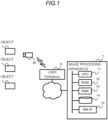
- Fig. 1 is a schematic diagram illustrating a configuration of a system according to the present embodiment.
- the system according to the present embodiment includes an image processing apparatus 1, an image capturing apparatus 81, and a user terminal 9 which are connected to a network to be communicative with each other.
- the image processing apparatus 1 is a computer including a CPU (Central Processing Unit) 11, a ROM (Read Only Memory) 12, a RAM (Random Access Memory) 13, a storage device 14 such as an EEPROM (Electrically Erasable and Programmable Read Only Memory) or a HDD (Hard Disk Drive), a communication unit 15 such as a NIC (Network Interface Card), and the like.
- a CPU Central Processing Unit
- ROM Read Only Memory
- RAM Random Access Memory
- storage device 14 such as an EEPROM (Electrically Erasable and Programmable Read Only Memory) or a HDD (Hard Disk Drive)
- a communication unit 15 such as a NIC (Network Interface Card), and the like.
- NIC Network Interface Card
- the image capturing apparatus 81 captures an image of a target to obtain a query image described later.
- a typical digital camera or another apparatus capable of recording light incident thereon from the target may be used appropriately, and a specific configuration thereof is not limited.
- the user terminal 9 is a terminal apparatus to be used by a user.
- the user terminal 9 is a computer including a CPU, a ROM, a RAM, a storage device, a communication unit, an input device, an output device, and the like (the illustration thereof is omitted).
- a specific hardware configuration of the user terminal 9 omissions, substitutions, and additions can be made as appropriate according to the mode of implementation.
- the user terminal 9 is not limited to an apparatus including a single housing.
- the user terminal 9 may also be implemented by a plurality of apparatuses using a so-called cloud, distributed computing technology, or the like.
- the user uses various services provided by the system according to the present embodiment via these user terminals 9.
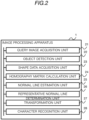
- Fig. 2 is a diagram illustrating an overview of a functional configuration of the image processing apparatus 1 according to the present embodiment.
- a program recorded in the storage device 14 is read into the RAM 13 and executed by the CPU 11 to control each hardware item included in the image processing apparatus 1 and thereby allow the image processing apparatus 1 to function as an image processing apparatus including a query image acquisition unit 21, an object detection unit 22, a shape data acquisition unit 23, a homography matrix calculation unit 24, a normal line estimation unit 25, a representative normal line determination unit 26, a transformation unit 27, and a character recognition unit 28.
- each of functions included in the image processing apparatus 1 is performed by the CPU 11, which is a versatile processor, but some or all of these functions may also be performed by one or a plurality of dedicated processors.
- the query image acquisition unit 21 acquires the query image resulting from simultaneous image capturing of a plurality of objects serving as targets of image processing and/or character recognition.
- a method of acquiring the query image is not limited and, in the present embodiment, a description will be given of an example in which the query image captured by using the image capturing apparatus 81 is acquired via the user terminal 9.
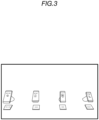
- Fig. 3 is a diagram illustrating an example of the query image in the present embodiment.
- the present diagram illustrates the query image resulting from image capturing of a plurality of smartphones placed on a table at a store with product information being displayed on displays with touch panels thereof and media for explanation (hereinafter referred to simply as "product information cards") having information such as explanation and prices of the plurality of individual smartphones, which are placed in the vicinities of the smartphones.
- product information cards media for explanation
- a person in charge takes a photograph at a location where the plurality of smartphones and the plurality of product information cards, which serve as target objects of the image processing and character recognition in the present embodiment, are present such that these objects are included in the same image.
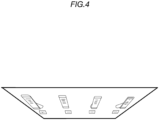
- Fig. 4 is a diagram illustrating an example in which geometrical transformation according to a conventional method is performed on the query image in the present embodiment.
- the image transformation is performed such that the product information card at a center of the query image directly faces a camera
- the center product information card directly facing the camera as a result of the transformation is in a state appropriate for character recognition, but another object, particularly the smartphones at the ends of a screen each having a front direction (since each of the objects in the present embodiment is the target of the character recognition, it is assumed hereinafter that a normal line direction of a surface with a character to be recognized, which is displayed on the object, is the front direction) greatly different from that of the center product information card are increasingly distorted, and accuracy of the character recognition deteriorates.
- the object detection unit 22 detects the plurality of object images from the query image.
- the object detection unit 22 uses a machine learning model which outputs, in response to an input of a type or attribute of the object intended to be the target of the character recognition, a position or range in the query image in which the object related to the type or attribute is image-captured to detect the plurality of objects mage-captured in the query image.
- a type of an object detection technology to be used at the time of the object detection from the image is not limited and, besides the currently known object detection technology, any object detection technology that will be developed in future may also be used.
- the shape data acquisition unit 23 acquires shape data related to a front shape of the object.
- the shape data may be an aspect ratio, a size, design data, a front image, or the like of the object which is held in advance in the RAM 13, the storage device 14, or the like.
- the shape data may also be data which uniquely determines at least the front shape of each of the objects related to the same type or attribute.
- the front shape of each of the objects related to the type or attribute may not be uniquely determined.
- the shape data may also be shape data having a range for the objects each related to the same type or attribute.
- the shape data having the range may also be a range of the aspect ratio of the object, a range of the size thereof, a plurality of the front images thereof, or the like.
- a range of the aspect ratio of the object is used as the shape data.
- the homography matrix calculation unit 24 calculates, for each of the plurality of objects, a homography matrix between the front shape of the object specified on the basis of the shape data and the object image related to the object in the query image.
- the homography matrix calculation unit 24 calculates, for each of the plurality of objects, a homography matrix related to a minimum value in the range of the shape data and a homography matrix related to a maximum value therein.
- the normal line estimation unit 25 estimates, for each of the plurality of objects image-captured in the query image, the normal line direction indicating the front direction of the object.
- the normal line estimation unit 25 estimates, for each of the plurality of objects, the normal line direction (normal line vector) of the object on the basis of the homography matrices calculated by the homography matrix calculation unit 24 to estimate the normal line direction according to a result of comparison between the front shape of the object specified on the basis of the shape data and the object image in the query image.
- the normal line estimation unit 25 calculates, for each of the plurality of objects, the normal line direction related to the minimum value in the range of the shape data and the normal line direction related to the maximum value therein.
- the representative normal line determination unit 26 determines the representative normal line direction representing the entire query image on the basis of the plurality of normal line directions estimated for the plurality of objects.
- the representative normal line determination unit 26 uses a mean value of the plurality of normal line vectors estimated for the plurality of objects as a representative normal line vector, and determines a direction of the representative normal line vector to be the representative normal line direction.
- the representative normal line direction may be acquired appropriately by a method of using a statistic method to obtain a direction serving as a representative, and may also be calculated by a method other than the calculation of the mean value of the normal line vectors.
- the representative normal line determination unit 26 determines, to be the representative normal line direction, a normal line direction representing the plurality of normal line directions related to the minimum value in the range of the shape data which are estimated for the plurality of individual objects and the plurality of normal line directions related to the maximum value in the range of the shape data which are estimated for the plurality of individual objects.
- the transformation unit 27 geometrically transforms the query image on the basis of the representative normal line direction to generate the corrected query image.
- the transformation unit 27 performs projective transformation on the query image such that the representative normal line direction corresponds to the front direction of an image after the transformation to generate the corrected query image.
- the character recognition unit 28 performs character recognition processing on the corrected query image to recognize a character written on the object intended to be the target of the character recognition.
- the technology according to the present disclosure is aimed at providing image transformation appropriate for the character recognition, and a specific algorithm to be adopted for the character recognition is not limited.
- a character recognition technology which has been used conventionally or will be developed in future may also be adopted.
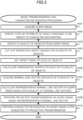
- Fig. 5 is a flow chart illustrating a flow of the image transformation and character recognition processing according to the present embodiment. The processing illustrated in the present flow chart is performed by being triggered by reception of an instruction to start the processing from the user.
- Step S101 the query image is acquired.
- An operator captures an image of a target by using the image capturing apparatus 81, and inputs image data of the obtained query image to the image processing apparatus 1.
- the image capturing target is the in-store table on which the smartphones and the product information cards each serving as the predetermined object are placed.
- An image capturing method and a method of inputting the image data to the image processing apparatus 1 are not limited but, in the present embodiment, an image of the target is captured using the image capturing apparatus 81, and the image data transferred from the image capturing apparatus 81 to the user terminal 9 by communication or via a recording medium is further transferred to the image processing apparatus 1 via a network to allow the image data of the query image to be input to the image processing apparatus 1.
- the processing advances to Step S102.
- Step S102 objects each intended to be the target of the character recognition are specified.
- the object detection unit 22 acquires object specification information indicating the type or attribute of each of the objects intended to be the target of the character recognition among the objects image-captured in the query image.
- object identification information e.g., "smartphone" and "tag" are input.
- the object specification information is acquired as text data input by the user from a prompt of a UI
- a method of acquiring the object identification information is not limited to the example shown in the present embodiment.
- the object identification information may also be acquired in a format (e.g., a code indicating the type or attribute of the object) other than the text data or, alternatively, the object identification information may also be acquired by being set in advance to the system before the acquisition of the query image. Subsequently, the processing advances to Step S103.
- Step S103 and Step S104 the objects are detected from the query image, and ranges in the query image in which the objects are image-captured are cut out as the object images.
- the object detection unit 22 detects, from the query image acquired in Step S101, the plurality of objects of the type or attribute specified by the object specification information acquired in Step S102 (Step S103). It is preferable herein that, among the objects image-captured in the query image, all the objects of the type or attribute specified by the object specification information are detected.
- a zero-shot object detector using a convolutional neural network (CNN) may be used for the object detection from the query image.
- CNN convolutional neural network
- the type of an algorithm used at the time of the object detection from the image is not limited and, besides the currently known algorithm, any algorithm that will be developed in future may also be used.
- the object detection unit 22 cuts out, for the plurality of detected objects, the ranges in which the objects are image-captured as the object images from the query image (Step S104).
- the image data of the object images need not be newly generated and, for the object images, the ranges thereof in the query image need only to be specified. Subsequently, the processing advances to Step S105.
- an aspect ratio (length-to-width ratio) of each of the objects is set.
- the shape data acquisition unit 23 sets, for each of the plurality of objects detected in Step S103, the aspect ratio according to the type or attribute of the object. Specifically, the shape data acquisition unit 23 chooses the aspect ratio related to a part or the whole of a configuration of the object when the object is viewed from the front (when viewed in plan view), which is held in advance on a per object type or attribute basis, on the basis of the type or attribute of the detected object, and sets the chosen aspect ratio as the aspect ratio of the object.
- the type or attribute of the object can be identified herein on the basis of the object specification information input in Step S102 or an output obtained from the object detector in Step S103.
- the aspect ratio held in advance as the aspect ratio of the smartphone is set and, for the object "product information card", the aspect ratio held in advance as the aspect ratio of the product information card is set.
- the aspect ratio set herein may also have a range.
- a smartphone has a different aspect ratio depending on a model. Accordingly, in the present embodiment, the aspect ratio of the smartphone is set in a range from a minimum value to a maximum value, such as "from 0.479 to 0.486".
- the processing advances to Step S106.
- Step S106 and Step S107 the homography matrix and normal line vector of each of the objects are calculated.
- the homography matrix calculation unit 24 calculates, for each of the plurality of objects detected in Step S103, the homography matrix by using the range of the aspect ratio set in Step S105.
- the homography matrix calculation unit 24 detects, for each of the objects, predetermined components of the object from the object image, and causes the detected components to match predetermined components related to the set aspect ratio.
- the objects are the smartphones and the product information cards, and each of the smartphones and the product information cards typically has a substantially rectangular shape. Accordingly, the homography matrix calculation unit 24 detects vertices (corners) of the rectangular shapes related to the objects, and causes the detected vertices to match vertices of rectangular shapes related to the set aspect ratios.
- an image analysis technology for detecting feature points in the images may also be used.
- the type of the image analysis technology to be used at the time of detection of the predetermined components from the object images is not limited and, besides the currently known image analysis technology, any image analysis technology that will be developed in future may also be used.
- the homography matrix calculation unit 24 compares the rectangular shapes of the objects in the matched object images to the set aspect ratios to thereby calculate the homography matrix of each of the objects (Step S106).
- the normal line estimation unit 25 decomposes, for each of the plurality of object images detected in Step S103, the homography matrix obtained in Step S106 to obtain the normal line vector of the object (Step S107. Note that, for details of a method of estimating the normal line vector of two flat objects by decomposing the homography matrix, see NPL 1).
- Fig. 6 is a diagram illustrating an example of normal line vectors N A and N B individually estimated for two objects A and B related to different directions. Since the aspect ratio used when each of the homography matrices is calculated is the aspect ratio when the object is viewed from the front, the normal line vector calculated in the present embodiment is the normal line vector indicating the front direction of the object.
- each of the normal line vectors calculated in the present embodiment is calculated on the basis of the aspect ratio having the range, and is therefore a normal line vector having a range from a normal line vector calculated on the basis of a minimum aspect ratio (hereinafter referred to as the "minimum-ratio normal line vector") to a normal line vector calculated on the basis of a maximum aspect ratio (hereinafter referred to as the "maximum-ratio normal line vector").
- Fig. 7 is a diagram illustrating an example of the minimum-ratio normal line vectors (indicated by broken lines) and the maximum-ratio normal line vectors (indicated by solid lines) which are estimated for the plurality of individual objects in the query image in the present embodiment.
- the processing advances to S 108.
- Step S108 the representative normal line vector is determined.
- the representative normal line determination unit 26 determines, on the basis of the plurality of normal line vectors calculated for the plurality of objects in Step S107, the representative normal line vector representing the query image including these objects.
- the representative normal line determination unit 26 determines a mean of the normal line vectors calculated for the plurality of individual objects to be the representative normal line vector.
- a method of determining the representative normal line vector is not limited to the calculation of the mean value, and a method of obtaining a vector serving as a representative by using a statistical method may also be adopted.
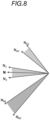
- Fig. 8 is a diagram illustrating a concept of calculation of a representative normal line vector N based on a plurality of minimum-ratio normal line vectors N A1 and N B1 and a plurality of maximum-ratio normal line vectors N A2 and N B2 which are individually estimated for the two objects A and B related to the different directions.
- the plurality of normal line vectors calculated in Step S107 are normal line vectors each having a range from the minimum-ratio normal line vector to the maximum-ratio normal line vector (for the object A in the drawing, a range from the minimum-ratio normal line vector N A1 to the maximum-ratio normal line vector N A2 and, for the object B in the drawing, a range from the minimum-ratio normal line vector N B1 to the maximum-ratio normal line vector N B2 ).
- the representative normal line determination unit 26 calculates a representative value (N1 in the drawing, which is hereinafter referred to as the "minimum-ratio representative normal line vector") of the plurality of minimum-ratio normal line vectors and a representative value (N2 in the drawing, which is hereinafter referred to as the "maximum-ratio representative normal line vector") of the plurality of maximum-ratio normal line vectors and calculates a representative value (N in the drawing, which is, e.g., a mean value) of the minimum-ratio representative normal line vector and the maximum-ratio representative normal line vector to determine the representative normal line vector.
- the processing advances to Step S109.
- Step S109 the projective transformation based on the representative normal line vector is performed on the query image.
- the transformation unit 27 performs the projective transformation (which is perspective correction based on homography transformation in the present embodiment) on the query image such that the representative normal line vector determined in Step S108 faces front to obtain the corrected query image.
- the transformation unit 27 calculates, on the basis of the representative normal line vector, the homography matrix such that, in the corrected query image when the corrected query image after the projective transformation is assumed to be in an XY plane, XY-axis components of the representative normal line vector are zero (such that only a Z-axis component is present), and performs the homography transformation on the query image by using the homography matrix.
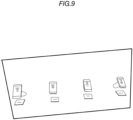
- Fig. 9 is a diagram illustrating an example in which geometrical transformation based on the representative normal line vector is performed on the query image in the present embodiment.
- the processing advances to Step S110.
- Step S110 characters image-captured in the corrected query image are recognized.
- the character recognition unit 28 performs optical character recognition (OCR) processing on the corrected query image obtained in Step S109 to recognize the characters image-captured in the corrected query image. Then, the character recognition unit 28 outputs a result of the character recognition, and the processing illustrated in the present flow chart is ended.
- OCR optical character recognition
- the processing illustrated in the present flow chart can improve the accuracy of the recognition of the characters written on the plurality of objects image-captured in the query image in the image transformation performed once on the query image and in the character recognition processing performed once thereon.
- the image processing apparatus the image processing method, and the image processing program each according to the present embodiment, it is possible to perform image transformation appropriate for character recognition on a query image in which a plurality of regions are image-captured and consequently improve accuracy of the character recognition for the query image in which the plurality of regions are image-captured.
- shape data When such shape data is used, calculation of a minimum-ratio normal line vector and a maximum-ratio normal line vector for each of the objects is omitted, and a representative normal line vector is determined on the basis of a normal line vector obtained for each of the plurality of objects on a one-to-one basis.
Landscapes
- Engineering & Computer Science (AREA)
- Physics & Mathematics (AREA)
- Theoretical Computer Science (AREA)
- General Physics & Mathematics (AREA)
- Computing Systems (AREA)
- Geometry (AREA)
- Computer Graphics (AREA)
- Computer Vision & Pattern Recognition (AREA)
- Multimedia (AREA)
- Character Input (AREA)
Abstract
Description
- The present disclosure relates to an image processing technology.
- Conventionally, a recognition apparatus has been proposed which includes a vehicle detection unit that cuts out a peripheral image of a number plate from an image acquired from an image capturing apparatus, a number plate detection unit that extracts a front image of the number plate from the peripheral image of the number plate, a character recognition unit that recognizes a vehicle registration number from the front image of the number plate, a reliability determination unit that determines, on the basis of a level of recognition difficulty of the character recognition unit, an ability of the number plate detection unit to extract the front image, and a model change unit that changes the ability of the number plate detection unit to extract the front image on the basis of a result of the determination by the reliability determination unit (see PTL 1).
- Meanwhile, a technology of decomposing a homography matrix to estimate a displacement of a camera between two images of a flat object is conventionally known (see NPL 1).
- [PTL 1]
Japanese Patent Application Publication No. 2020-160814 - [NPL 1] Ezio Malis, Manuel Vargas, "Deeper understanding of the homography decomposition for vision-based control", INSTITUT NATIONAL DE RECHERCHE EN INFORMATIQUE ET EN AUTOMATIQUE, September 25, 2007, RR-6303
- Conventionally, various technologies for recognizing a predetermined target (such as an image-captured object or character) included in an image have been proposed, but there is room for improvement in accuracy of the recognition of the target in the image. In view of the problem described above, the present disclosure is aimed at improving accuracy of recognition of a predetermined target included in an image.
- An example of the present disclosure is an image processing apparatus including: a query image acquisition means that acquires a query image in which a plurality of objects are image-captured; a normal line estimation means that estimates, for each of the plurality of objects image-captured in the query image, a normal line direction indicating a front direction of the object; a representative normal line determination means that determines a representative normal line direction representing an entirety of the query image on the basis of the plurality of normal line directions estimated for the plurality of objects; and a transformation means that geometrically transforms the query image on the basis of the representative normal line direction to generate a corrected query image.
- The present disclosure can be recognized as a method to be implemented by the image processing apparatus, a system, and a computer or as a program to be executed by the computer. The present disclosure can also be recognized as such a program recorded in a recording medium which is readable by the computer, another apparatus, a machine, or the like. The recording medium readable by the computer or the like mentioned herein refers to a recording medium which stores therein information such as data or a program by electric, magnetic, optical, mechanical, or chemical action and allows the information to be read by the computer or the like.
- According to the present disclosure, it is possible to improve accuracy of recognition of a predetermined target included in an image.
-
- [
Fig. 1] Fig. 1 is a schematic view illustrating a configuration of a system according to an embodiment. - [
Fig. 2] Fig. 2 is a diagram illustrating an overview of a functional configuration of an image processing apparatus according to the embodiment. - [
Fig. 3] Fig. 3 is a diagram illustrating an example of a query image in the embodiment. - [
Fig. 4] Fig. 4 is a diagram illustrating an example in which geometrical transformation according to a conventional method is performed on the query image in the embodiment. - [
Fig. 5] Fig. 5 is a flow chart illustrating a flow of image transformation and character recognition processing according to the embodiment. - [
Fig. 6] Fig. 6 is a diagram illustrating an example of respective normal line vectors estimated for two objects related to different directions in the embodiment. - [
Fig. 7] Fig. 7 is a diagram illustrating an example of respective minimum-ratio normal line vectors and respective maximum-ratio normal line vectors which are estimated for a plurality of individual objects in the query image in the embodiment. - [
Fig. 8] Fig. 8 is a diagram representing a concept of calculation of a representative normal line vector based on the plurality of minimum-ratio normal line vectors and the plurality of maximum-ratio normal line vectors which are estimated for the two respective objects related to the different directions in the embodiment. - [
Fig. 9] Fig. 9 is a diagram illustrating an example in which geometrical transformation based on the representative normal line vector is performed on the query image in the embodiment. - The following will describe a mode of implementation of an image processing apparatus, an image processing method, and an image processing program according to the present disclosure on the basis of the drawings. However, the mode of implementation described below is illustrative of an embodiment, and is not intended to limit the image processing apparatus, the image processing method, and the image processing program according to the present disclosure to specific configurations described below. In implementation, the specific configurations according to the mode of implementation are adopted as appropriate, and various improvements and modifications can be made therein.
- Conventionally, it has been practiced to perform geometrical transformation which causes a region included in an image acquired by image capturing or the like and intended to be a target of character recognition to face front and then perform the character recognition. However, in a case where the image includes a plurality of the regions each intended to be the target of the character recognition and surfaces (front surfaces) on which characters to be recognized are written in these plurality of regions face different directions or projections are different due to positional relationships with a camera used for the image capturing, even when the geometrical transformation that causes any region to face front is performed, the region caused to face front is brought into a state appropriate for the character recognition, but another region is not brought into the state appropriate for the character recognition. In other words, a conventional technology has room for improvement in improving recognition accuracy in a case where the plurality of regions to be subjected to the character recognition are located apart from each other in the same image. In view of the problem described above, the present disclosure is aimed at performing image transformation appropriate for character recognition on a query image in which a plurality of regions are image-captured.
- The present embodiment will describe a mode of implementation of a technology according to the present disclosure in which image transformation appropriate for character recognition is performed on a query image in which a plurality of objects are image-captured, and then character recognition processing is performed on an image after the transformation. However, the technology according to the present disclosure can be used widely to perform the image transformation appropriate for the character recognition on the query image in which the plurality of regions are image-captured, and an application target of the present disclosure is not limited to an example shown in the embodiment. For example, the object may also be an object rendered in a virtual space or an object rendered using rendering software, not a tangible entity. Meanwhile, for example, an image may also be an image obtained by rendering a virtual space or an image rendered using rendering software, not an image obtained by image-capturing a real world.
-
Fig. 1 is a schematic diagram illustrating a configuration of a system according to the present embodiment. The system according to the present embodiment includes animage processing apparatus 1, animage capturing apparatus 81, and auser terminal 9 which are connected to a network to be communicative with each other. - The
image processing apparatus 1 is a computer including a CPU (Central Processing Unit) 11, a ROM (Read Only Memory) 12, a RAM (Random Access Memory) 13, astorage device 14 such as an EEPROM (Electrically Erasable and Programmable Read Only Memory) or a HDD (Hard Disk Drive), acommunication unit 15 such as a NIC (Network Interface Card), and the like. However, with regard to a specific hardware configuration of theimage processing apparatus 1, omissions, substitutions, and additions can be made as appropriate according to the mode of implementation. Additionally, theimage processing apparatus 1 is not limited to an apparatus including a single housing. Theimage processing apparatus 1 may also be implemented by a plurality of apparatuses using a so-called cloud, distributed computing technology, or the like. - The
image capturing apparatus 81 captures an image of a target to obtain a query image described later. For theimage capturing apparatus 81, a typical digital camera or another apparatus capable of recording light incident thereon from the target may be used appropriately, and a specific configuration thereof is not limited. - The
user terminal 9 is a terminal apparatus to be used by a user. Theuser terminal 9 is a computer including a CPU, a ROM, a RAM, a storage device, a communication unit, an input device, an output device, and the like (the illustration thereof is omitted). However, with regard to a specific hardware configuration of theuser terminal 9, omissions, substitutions, and additions can be made as appropriate according to the mode of implementation. Additionally, theuser terminal 9 is not limited to an apparatus including a single housing. Theuser terminal 9 may also be implemented by a plurality of apparatuses using a so-called cloud, distributed computing technology, or the like. The user uses various services provided by the system according to the present embodiment via theseuser terminals 9. -
Fig. 2 is a diagram illustrating an overview of a functional configuration of theimage processing apparatus 1 according to the present embodiment. In theimage processing apparatus 1, a program recorded in thestorage device 14 is read into theRAM 13 and executed by theCPU 11 to control each hardware item included in theimage processing apparatus 1 and thereby allow theimage processing apparatus 1 to function as an image processing apparatus including a queryimage acquisition unit 21, anobject detection unit 22, a shapedata acquisition unit 23, a homographymatrix calculation unit 24, a normalline estimation unit 25, a representative normalline determination unit 26, atransformation unit 27, and acharacter recognition unit 28. Note that, in the present embodiment and another embodiment described later, each of functions included in theimage processing apparatus 1 is performed by theCPU 11, which is a versatile processor, but some or all of these functions may also be performed by one or a plurality of dedicated processors. - The query
image acquisition unit 21 acquires the query image resulting from simultaneous image capturing of a plurality of objects serving as targets of image processing and/or character recognition. A method of acquiring the query image is not limited and, in the present embodiment, a description will be given of an example in which the query image captured by using theimage capturing apparatus 81 is acquired via theuser terminal 9. -
Fig. 3 is a diagram illustrating an example of the query image in the present embodiment. The present diagram illustrates the query image resulting from image capturing of a plurality of smartphones placed on a table at a store with product information being displayed on displays with touch panels thereof and media for explanation (hereinafter referred to simply as "product information cards") having information such as explanation and prices of the plurality of individual smartphones, which are placed in the vicinities of the smartphones. A person in charge takes a photograph at a location where the plurality of smartphones and the plurality of product information cards, which serve as target objects of the image processing and character recognition in the present embodiment, are present such that these objects are included in the same image. -
Fig. 4 is a diagram illustrating an example in which geometrical transformation according to a conventional method is performed on the query image in the present embodiment. According to the present diagram, it will be understood that, when, e.g., the image transformation is performed such that the product information card at a center of the query image directly faces a camera, the center product information card directly facing the camera as a result of the transformation is in a state appropriate for character recognition, but another object, particularly the smartphones at the ends of a screen each having a front direction (since each of the objects in the present embodiment is the target of the character recognition, it is assumed hereinafter that a normal line direction of a surface with a character to be recognized, which is displayed on the object, is the front direction) greatly different from that of the center product information card are increasingly distorted, and accuracy of the character recognition deteriorates. It will additionally be understood that, before the image transformation, the smartphones and the product information cards corresponding to the smartphones have vertically aligned positional relationships therebetween (seeFig. 3 ) but, after the image transformation, respective positions of the smartphones and the product information cards corresponding to the smartphones are misaligned in a vertical direction, and it is difficult to associate the smartphones with the product information cards. - When a problem as described above is to be solved, it is considered to perform image transformation which causes each of the plurality of objects included in the query image to face front and perform character recognition on the object. However, when such a method is adopted, it is necessary to perform the image transformation and character recognition processing the same number of times as the number of the objects in the query image. Accordingly, in the system according to the present embodiment, it is intended to increase the accuracy of the character recognition, while reducing the number of times the image transformation and character recognition processing is performed on the one query image.
- The
object detection unit 22 detects the plurality of object images from the query image. In the present embodiment, theobject detection unit 22 uses a machine learning model which outputs, in response to an input of a type or attribute of the object intended to be the target of the character recognition, a position or range in the query image in which the object related to the type or attribute is image-captured to detect the plurality of objects mage-captured in the query image. However, a type of an object detection technology to be used at the time of the object detection from the image is not limited and, besides the currently known object detection technology, any object detection technology that will be developed in future may also be used. - The shape
data acquisition unit 23 acquires shape data related to a front shape of the object. For example, the shape data may be an aspect ratio, a size, design data, a front image, or the like of the object which is held in advance in theRAM 13, thestorage device 14, or the like. The shape data may also be data which uniquely determines at least the front shape of each of the objects related to the same type or attribute. - However, even though the objects are related to the same type or object, depending on a specified type or attribute, the front shape of each of the objects related to the type or attribute may not be uniquely determined. For example, when the object is specified to a "smartphone manufactured by xx company, model No. XX-XX" or a "B8 size card", the shape thereof can uniquely be determined but, when the object is specified merely to a "smartphone", a "smartphone manufactured by xx company", or a "product information card", the shape thereof ranges widely. Accordingly, in the present embodiment, the shape data may also be shape data having a range for the objects each related to the same type or attribute. The shape data having the range may also be a range of the aspect ratio of the object, a range of the size thereof, a plurality of the front images thereof, or the like. In the present embodiment, by way of example, a case where the range of the aspect ratio of the object is used as the shape data will be described.
- The homography
matrix calculation unit 24 calculates, for each of the plurality of objects, a homography matrix between the front shape of the object specified on the basis of the shape data and the object image related to the object in the query image. When the shape data has the range as described above, the homographymatrix calculation unit 24 calculates, for each of the plurality of objects, a homography matrix related to a minimum value in the range of the shape data and a homography matrix related to a maximum value therein. - The normal
line estimation unit 25 estimates, for each of the plurality of objects image-captured in the query image, the normal line direction indicating the front direction of the object. In the present embodiment, the normalline estimation unit 25 estimates, for each of the plurality of objects, the normal line direction (normal line vector) of the object on the basis of the homography matrices calculated by the homographymatrix calculation unit 24 to estimate the normal line direction according to a result of comparison between the front shape of the object specified on the basis of the shape data and the object image in the query image. - However, a specific method for estimating the normal line direction of the object is not limited to the calculation of the normal line vector from the homography matrix. In addition, when the shape data has the range as described above, the normal
line estimation unit 25 calculates, for each of the plurality of objects, the normal line direction related to the minimum value in the range of the shape data and the normal line direction related to the maximum value therein. - The representative normal
line determination unit 26 determines the representative normal line direction representing the entire query image on the basis of the plurality of normal line directions estimated for the plurality of objects. In the present embodiment, the representative normalline determination unit 26 uses a mean value of the plurality of normal line vectors estimated for the plurality of objects as a representative normal line vector, and determines a direction of the representative normal line vector to be the representative normal line direction. However, the representative normal line direction may be acquired appropriately by a method of using a statistic method to obtain a direction serving as a representative, and may also be calculated by a method other than the calculation of the mean value of the normal line vectors. In addition, when the shape data has the range as described above, the representative normalline determination unit 26 determines, to be the representative normal line direction, a normal line direction representing the plurality of normal line directions related to the minimum value in the range of the shape data which are estimated for the plurality of individual objects and the plurality of normal line directions related to the maximum value in the range of the shape data which are estimated for the plurality of individual objects. - The
transformation unit 27 geometrically transforms the query image on the basis of the representative normal line direction to generate the corrected query image. In the present embodiment, thetransformation unit 27 performs projective transformation on the query image such that the representative normal line direction corresponds to the front direction of an image after the transformation to generate the corrected query image. - The
character recognition unit 28 performs character recognition processing on the corrected query image to recognize a character written on the object intended to be the target of the character recognition. The technology according to the present disclosure is aimed at providing image transformation appropriate for the character recognition, and a specific algorithm to be adopted for the character recognition is not limited. For the character recognition, a character recognition technology which has been used conventionally or will be developed in future may also be adopted. - Next, a flow of processing to be performed by the image processing apparatus according to the present embodiment will be described. Note that a specific content of the processing described below and an order of the processing are examples for carrying out the present disclosure. The specific content of the processing and the order of the processing may be selected appropriately according to the mode of implementation of the present disclosure.
-
Fig. 5 is a flow chart illustrating a flow of the image transformation and character recognition processing according to the present embodiment. The processing illustrated in the present flow chart is performed by being triggered by reception of an instruction to start the processing from the user. - In Step S101, the query image is acquired. An operator captures an image of a target by using the
image capturing apparatus 81, and inputs image data of the obtained query image to theimage processing apparatus 1. In the present embodiment, the image capturing target is the in-store table on which the smartphones and the product information cards each serving as the predetermined object are placed. An image capturing method and a method of inputting the image data to theimage processing apparatus 1 are not limited but, in the present embodiment, an image of the target is captured using theimage capturing apparatus 81, and the image data transferred from theimage capturing apparatus 81 to theuser terminal 9 by communication or via a recording medium is further transferred to theimage processing apparatus 1 via a network to allow the image data of the query image to be input to theimage processing apparatus 1. When the query image is acquired by the queryimage acquisition unit 21, the processing advances to Step S102. - In Step S102, objects each intended to be the target of the character recognition are specified. The
object detection unit 22 acquires object specification information indicating the type or attribute of each of the objects intended to be the target of the character recognition among the objects image-captured in the query image. In the present embodiment, an example is described in which, among the objects image-captured in the query image in which the in-store table is image-captured, each of the smartphones displayed as products and the product information cards for the smartphones is used as the target of the character recognition. Accordingly, in the present embodiment, as object identification information, e.g., "smartphone" and "tag" are input. Note that, in the present embodiment, an example is described in which the object specification information is acquired as text data input by the user from a prompt of a UI, but a method of acquiring the object identification information is not limited to the example shown in the present embodiment. For example, the object identification information may also be acquired in a format (e.g., a code indicating the type or attribute of the object) other than the text data or, alternatively, the object identification information may also be acquired by being set in advance to the system before the acquisition of the query image. Subsequently, the processing advances to Step S103. - In Step S103 and Step S104, the objects are detected from the query image, and ranges in the query image in which the objects are image-captured are cut out as the object images. The
object detection unit 22 detects, from the query image acquired in Step S101, the plurality of objects of the type or attribute specified by the object specification information acquired in Step S102 (Step S103). It is preferable herein that, among the objects image-captured in the query image, all the objects of the type or attribute specified by the object specification information are detected. In the present embodiment, for the object detection from the query image, e.g., a zero-shot object detector using a convolutional neural network (CNN) may be used. However, the type of an algorithm used at the time of the object detection from the image is not limited and, besides the currently known algorithm, any algorithm that will be developed in future may also be used. - When the plurality of objects are detected from the query image, the
object detection unit 22 cuts out, for the plurality of detected objects, the ranges in which the objects are image-captured as the object images from the query image (Step S104). However, the image data of the object images need not be newly generated and, for the object images, the ranges thereof in the query image need only to be specified. Subsequently, the processing advances to Step S105. - In Step S105, an aspect ratio (length-to-width ratio) of each of the objects is set. The shape
data acquisition unit 23 sets, for each of the plurality of objects detected in Step S103, the aspect ratio according to the type or attribute of the object. Specifically, the shapedata acquisition unit 23 chooses the aspect ratio related to a part or the whole of a configuration of the object when the object is viewed from the front (when viewed in plan view), which is held in advance on a per object type or attribute basis, on the basis of the type or attribute of the detected object, and sets the chosen aspect ratio as the aspect ratio of the object. The type or attribute of the object can be identified herein on the basis of the object specification information input in Step S102 or an output obtained from the object detector in Step S103. In the present embodiment, for the object "smartphone" detected from the query image, the aspect ratio held in advance as the aspect ratio of the smartphone is set and, for the object "product information card", the aspect ratio held in advance as the aspect ratio of the product information card is set. - Note that the aspect ratio set herein may also have a range. For example, a smartphone has a different aspect ratio depending on a model. Accordingly, in the present embodiment, the aspect ratio of the smartphone is set in a range from a minimum value to a maximum value, such as "from 0.479 to 0.486". When the aspect ratio (length-to-width ratio) of each of the objects is set, the processing advances to Step S106.
- In Step S106 and Step S107, the homography matrix and normal line vector of each of the objects are calculated. The homography
matrix calculation unit 24 calculates, for each of the plurality of objects detected in Step S103, the homography matrix by using the range of the aspect ratio set in Step S105. First, the homographymatrix calculation unit 24 detects, for each of the objects, predetermined components of the object from the object image, and causes the detected components to match predetermined components related to the set aspect ratio. In the present embodiment, the objects are the smartphones and the product information cards, and each of the smartphones and the product information cards typically has a substantially rectangular shape. Accordingly, the homographymatrix calculation unit 24 detects vertices (corners) of the rectangular shapes related to the objects, and causes the detected vertices to match vertices of rectangular shapes related to the set aspect ratios. - For a means for detecting the predetermined components (the vertices of the rectangular shapes in the present embodiment) of the objects from the object images, e.g., an image analysis technology for detecting feature points in the images may also be used. However, the type of the image analysis technology to be used at the time of detection of the predetermined components from the object images is not limited and, besides the currently known image analysis technology, any image analysis technology that will be developed in future may also be used.
- When the matching of the predetermined components detected from the objects with the predetermined components related to the set aspect ratios is completed, the homography
matrix calculation unit 24 compares the rectangular shapes of the objects in the matched object images to the set aspect ratios to thereby calculate the homography matrix of each of the objects (Step S106). - When the homography matrix is calculated, the normal
line estimation unit 25 decomposes, for each of the plurality of object images detected in Step S103, the homography matrix obtained in Step S106 to obtain the normal line vector of the object (Step S107. Note that, for details of a method of estimating the normal line vector of two flat objects by decomposing the homography matrix, see NPL 1). -
Fig. 6 is a diagram illustrating an example of normal line vectors NA and NB individually estimated for two objects A and B related to different directions. Since the aspect ratio used when each of the homography matrices is calculated is the aspect ratio when the object is viewed from the front, the normal line vector calculated in the present embodiment is the normal line vector indicating the front direction of the object. In addition, each of the normal line vectors calculated in the present embodiment is calculated on the basis of the aspect ratio having the range, and is therefore a normal line vector having a range from a normal line vector calculated on the basis of a minimum aspect ratio (hereinafter referred to as the "minimum-ratio normal line vector") to a normal line vector calculated on the basis of a maximum aspect ratio (hereinafter referred to as the "maximum-ratio normal line vector"). -
Fig. 7 is a diagram illustrating an example of the minimum-ratio normal line vectors (indicated by broken lines) and the maximum-ratio normal line vectors (indicated by solid lines) which are estimated for the plurality of individual objects in the query image in the present embodiment. When the normal line vectors are calculated for the plurality of detected objects, the processing advances toS 108. - In Step S108, the representative normal line vector is determined. The representative normal
line determination unit 26 determines, on the basis of the plurality of normal line vectors calculated for the plurality of objects in Step S107, the representative normal line vector representing the query image including these objects. In the present embodiment, the representative normalline determination unit 26 determines a mean of the normal line vectors calculated for the plurality of individual objects to be the representative normal line vector. However, a method of determining the representative normal line vector is not limited to the calculation of the mean value, and a method of obtaining a vector serving as a representative by using a statistical method may also be adopted. -
Fig. 8 is a diagram illustrating a concept of calculation of a representative normal line vector N based on a plurality of minimum-ratio normal line vectors NA1 and NB1 and a plurality of maximum-ratio normal line vectors NA2 and NB2 which are individually estimated for the two objects A and B related to the different directions. As described above, the plurality of normal line vectors calculated in Step S107 are normal line vectors each having a range from the minimum-ratio normal line vector to the maximum-ratio normal line vector (for the object A in the drawing, a range from the minimum-ratio normal line vector NA1 to the maximum-ratio normal line vector NA2 and, for the object B in the drawing, a range from the minimum-ratio normal line vector NB1 to the maximum-ratio normal line vector NB2). Accordingly, the representative normalline determination unit 26 calculates a representative value (N1 in the drawing, which is hereinafter referred to as the "minimum-ratio representative normal line vector") of the plurality of minimum-ratio normal line vectors and a representative value (N2 in the drawing, which is hereinafter referred to as the "maximum-ratio representative normal line vector") of the plurality of maximum-ratio normal line vectors and calculates a representative value (N in the drawing, which is, e.g., a mean value) of the minimum-ratio representative normal line vector and the maximum-ratio representative normal line vector to determine the representative normal line vector. When the representative normal line vector is determined, the processing advances to Step S109. - In Step S109, the projective transformation based on the representative normal line vector is performed on the query image. The
transformation unit 27 performs the projective transformation (which is perspective correction based on homography transformation in the present embodiment) on the query image such that the representative normal line vector determined in Step S108 faces front to obtain the corrected query image. In other words, thetransformation unit 27 calculates, on the basis of the representative normal line vector, the homography matrix such that, in the corrected query image when the corrected query image after the projective transformation is assumed to be in an XY plane, XY-axis components of the representative normal line vector are zero (such that only a Z-axis component is present), and performs the homography transformation on the query image by using the homography matrix. -
Fig. 9 is a diagram illustrating an example in which geometrical transformation based on the representative normal line vector is performed on the query image in the present embodiment. According to the present diagram, it will be understood that, through the geometrical transformation performed on the basis of the representative normal line vector representing the plurality of objects in the query image, the entire query image including the plurality objects is in a state appropriate for the character recognition, and accuracy of the character recognition of the entire query image is improved. Additionally, it will be understood that, even after the image transformation, a positional relationship between each of the smartphones and the product information card corresponding to the smartphone in which the position of the smartphone and the position of the product information card are vertically aligned is substantially maintained. When the projective transformation of the query image based on the representative normal line vector is completed, the processing advances to Step S110. - In Step S110, characters image-captured in the corrected query image are recognized. The
character recognition unit 28 performs optical character recognition (OCR) processing on the corrected query image obtained in Step S109 to recognize the characters image-captured in the corrected query image. Then, thecharacter recognition unit 28 outputs a result of the character recognition, and the processing illustrated in the present flow chart is ended. By having a flow of processing as described above, the processing illustrated in the present flow chart can improve the accuracy of the recognition of the characters written on the plurality of objects image-captured in the query image in the image transformation performed once on the query image and in the character recognition processing performed once thereon. - With the image processing apparatus, the image processing method, and the image processing program each according to the present embodiment, it is possible to perform image transformation appropriate for character recognition on a query image in which a plurality of regions are image-captured and consequently improve accuracy of the character recognition for the query image in which the plurality of regions are image-captured.
- Note that, in the embodiment described above, the description has been given by using the processing when the shape data has the range as the example but, as described above, the shape data may also be data which uniquely determines at least a front shape of each of objects related to the same type or attribute. When such shape data is used, calculation of a minimum-ratio normal line vector and a maximum-ratio normal line vector for each of the objects is omitted, and a representative normal line vector is determined on the basis of a normal line vector obtained for each of the plurality of objects on a one-to-one basis.
-
- 1
- Image processing apparatus
Claims (11)
- An image processing apparatus comprising:a query image acquisition means that acquires a query image in which a plurality of objects are image-captured;a normal line estimation means that estimates, for each of the plurality of objects image-captured in the query image, a normal line direction indicating a front direction of the object;a representative normal line determination means that determines a representative normal line direction representing an entirety of the query image on the basis of the plurality of normal line directions estimated for the plurality of objects; anda transformation means that geometrically transforms the query image on the basis of the representative normal line direction to generate a corrected query image.
- The image processing apparatus according to claim 1, further comprising:a shape data acquisition means that acquires shape data related to a front shape of each of the objects, whereinthe normal line estimation means estimates, for each of the plurality of objects, the normal line direction of the object in accordance with a result of comparison between the front shape of the object specified in accordance with the shape data and an object image in the query image.
- The image processing apparatus according to claim 2, whereinthe shape data is shape data having a range for the objects of the same type or attribute,the normal line estimation means calculates, for each of the plurality of objects, the normal line direction related to the minimum value in the range of the shape data and the normal line direction related to the maximum value therein, andthe representative normal line determination means determines as the representative normal line direction the normal line direction representing the plurality of normal line directions related to the minimum value in the range of the shape data which are estimated for the plurality of individual objects and the plurality of normal line directions related to the maximum value in the range of the shape data which are estimated for the plurality of individual objects.
- The image processing apparatus according to claim 2, further comprising:a homography matrix calculation means that calculates, for each of the plurality of objects, a homography matrix between the front shape of the object specified in accordance with the shape data and the object image in the query image, whereinthe normal line estimation means estimates, for each of the plurality of objects, the normal line direction of the object on the basis of the homography matrix calculated by the homography matrix calculation means.
- The image processing apparatus according to claim 4, whereinthe shape data is shape data having a range for the objects of the same type or attribute,the homography matrix calculation means calculates, for each of the plurality of objects, the homography matrix related to a minimum value in the range of the shape data and the homography matrix related to a maximum value therein,the normal line estimation means calculates, for each of the plurality of objects, the normal line direction related to the minimum value in the range of the shape data and the normal line direction related to the maximum value therein, andthe representative normal line determination means determines as the representative normal line direction the normal line direction representing the plurality of normal line directions related to the minimum value in the range of the shape data which are estimated for the plurality of individual objects and the plurality of normal line directions related to the maximum value in the range of the shape data which are estimated for the plurality of individual objects.
- The image processing apparatus according to claim 3 or 5, whereinthe shape data includes an aspect rate of each of the objects, which is held in advance, andthe range is a range of the aspect ratio.
- The image processing apparatus according to claim 1, further comprising:an object detection means that uses a machine learning model which outputs, in response to an input of a type or attribute of the object intended to be a target of character recognition, a position or range in the query image, in which the object of the type or attribute is image-captured, to detect the plurality of objects image-captured in the query image; anda character recognition means that performs character recognition processing on the corrected query image to recognize a character written on the object intended to be the target of the character recognition.
- The image processing apparatus according to claim 1, whereinthe normal line estimation means estimates, for each of the plurality of objects image-captured in the query image, a normal line vector indicating the front direction of the object andthe representative normal line determination means determines as the representative normal line direction a mean of a plurality of the normal line vectors estimated for the plurality of objects.
- The image processing apparatus according to claim 1, wherein the transformation means performs projective transformation on the query image such that the representative normal line direction corresponds to the front direction of the image after the transformation.
- An image processing method of causing a computer to perform:a query image acquisition step of acquiring a query image in which a plurality of objects are image-captured;a normal line estimation step of estimating, for each of the plurality of objects image-captured in the query image, a normal line direction indicating a front direction of the object;a representative normal line determination step of determining a representative normal line direction representing an entirety of the query image on the basis of the plurality of normal line directions estimated for the plurality of objects; anda transformation step of geometrically transforming the query image on the basis of the representative normal line direction to generate a corrected query image.
- An image processing program for causing a computer to function as:a query image acquisition means that acquires a query image in which a plurality of objects are image-captured;a normal line estimation means that estimates, for each of the plurality of objects image-captured in the query image, a normal line direction indicating a front direction of the object;a representative normal line determination means that determines a representative normal line direction representing an entirety of the query image on the basis of the plurality of normal line directions estimated for the plurality of objects; anda transformation means that geometrically transforms the query image on the basis of the representative normal line direction to generate a corrected query image.
Applications Claiming Priority (1)
| Application Number | Priority Date | Filing Date | Title |
|---|---|---|---|
| PCT/JP2023/027609 WO2025022665A1 (en) | 2023-07-27 | 2023-07-27 | Image processing device, image processing method, and image processing program |
Publications (2)
| Publication Number | Publication Date |
|---|---|
| EP4524897A1 true EP4524897A1 (en) | 2025-03-19 |
| EP4524897A4 EP4524897A4 (en) | 2025-04-09 |
Family
ID=94374186
Family Applications (1)
| Application Number | Title | Priority Date | Filing Date |
|---|---|---|---|
| EP23915184.8A Pending EP4524897A4 (en) | 2023-07-27 | 2023-07-27 | IMAGE PROCESSING DEVICE, IMAGE PROCESSING METHOD, AND IMAGE PROCESSING PROGRAM |
Country Status (3)
| Country | Link |
|---|---|
| EP (1) | EP4524897A4 (en) |
| JP (1) | JP7701569B2 (en) |
| WO (1) | WO2025022665A1 (en) |
Family Cites Families (5)
| Publication number | Priority date | Publication date | Assignee | Title |
|---|---|---|---|---|
| JP4145014B2 (en) * | 2001-01-11 | 2008-09-03 | 株式会社リコー | Image processing device |
| JP2008077489A (en) * | 2006-09-22 | 2008-04-03 | Canon Inc | Image processing apparatus, method, program, and storage medium |
| JP6835536B2 (en) | 2016-03-09 | 2021-02-24 | 株式会社リコー | Image processing method, display device and inspection system |
| JP6835665B2 (en) | 2017-05-25 | 2021-02-24 | Kddi株式会社 | Information processing equipment and programs |
| JP2020160814A (en) | 2019-03-27 | 2020-10-01 | 沖電気工業株式会社 | Recognition device, recognition method and program |
-
2023
- 2023-07-27 JP JP2024534761A patent/JP7701569B2/en active Active
- 2023-07-27 EP EP23915184.8A patent/EP4524897A4/en active Pending
- 2023-07-27 WO PCT/JP2023/027609 patent/WO2025022665A1/en active Pending
Also Published As
| Publication number | Publication date |
|---|---|
| WO2025022665A1 (en) | 2025-01-30 |
| JP7701569B2 (en) | 2025-07-01 |
| EP4524897A4 (en) | 2025-04-09 |
| JPWO2025022665A1 (en) | 2025-01-30 |
Similar Documents
| Publication | Publication Date | Title |
|---|---|---|
| EP3721380B1 (en) | Method and system for facial recognition | |
| CN110610127B (en) | Face recognition method and device, storage medium and electronic equipment | |
| US10796179B2 (en) | Living face verification method and device | |
| JP3954484B2 (en) | Image processing apparatus and program | |
| CN110232369B (en) | Face recognition method and electronic equipment | |
| US9367753B2 (en) | Method and system for recognizing information on a card | |
| US20150262346A1 (en) | Image processing apparatus, image processing method, and image processing program | |
| US20200364478A1 (en) | Method and apparatus for liveness detection, device, and storage medium | |
| CN111553251B (en) | Certificate four-corner defect detection method, device, equipment and storage medium | |
| JP6071002B2 (en) | Reliability acquisition device, reliability acquisition method, and reliability acquisition program | |
| CN111462381A (en) | Access control method based on face temperature identification, electronic device and storage medium | |
| CN115019052B (en) | Image recognition method, device, electronic equipment and storage medium | |
| CN114399729B (en) | Monitoring object movement identification method, system, terminal and storage medium | |
| EP2717223A1 (en) | Information processing device, information processing method, and information processing program | |
| CN112818874B (en) | Image processing method, device, equipment and storage medium | |
| EP4156095A1 (en) | Image processing system, image processing method, and program | |
| CN113313125A (en) | Image processing method and device, electronic equipment and computer readable medium | |
| US20250349025A1 (en) | Automatic image cropping using a reference feature | |
| JP2016206909A (en) | Information processing apparatus and information processing method | |
| JP7701569B2 (en) | IMAGE PROCESSING APPARATUS, IMAGE PROCESSING METHOD, AND IMAGE PROCESSING PROGRAM | |
| CN106373121A (en) | Blurred image recognition method and device | |
| CN116959038A (en) | Palmprint recognition method, related devices and media | |
| CN116226050A (en) | File processing method and device | |
| JP5182879B2 (en) | Information terminal equipment | |
| JP7691582B1 (en) | IMAGE PROCESSING APPARATUS, IMAGE PROCESSING METHOD, AND IMAGE PROCESSING PROGRAM |
Legal Events
| Date | Code | Title | Description |
|---|---|---|---|
| STAA | Information on the status of an ep patent application or granted ep patent |
Free format text: STATUS: UNKNOWN |
|
| STAA | Information on the status of an ep patent application or granted ep patent |
Free format text: STATUS: THE INTERNATIONAL PUBLICATION HAS BEEN MADE |
|
| PUAI | Public reference made under article 153(3) epc to a published international application that has entered the european phase |
Free format text: ORIGINAL CODE: 0009012 |
|
| STAA | Information on the status of an ep patent application or granted ep patent |
Free format text: STATUS: REQUEST FOR EXAMINATION WAS MADE |
|
| REG | Reference to a national code |
Ref country code: DE Ref legal event code: R079 Free format text: PREVIOUS MAIN CLASS: G06T0015200000 Ipc: G06V0030146000 |
|
| 17P | Request for examination filed |
Effective date: 20240717 |
|
| AK | Designated contracting states |
Kind code of ref document: A1 Designated state(s): AL AT BE BG CH CY CZ DE DK EE ES FI FR GB GR HR HU IE IS IT LI LT LU LV MC ME MK MT NL NO PL PT RO RS SE SI SK SM TR |
|
| A4 | Supplementary search report drawn up and despatched |
Effective date: 20250311 |
|
| RIC1 | Information provided on ipc code assigned before grant |
Ipc: G06T 5/80 20240101ALI20250305BHEP Ipc: G06V 30/146 20220101AFI20250305BHEP |