EP4524825A1 - Information processing program, information processing method, and information processing device - Google Patents
Information processing program, information processing method, and information processing device Download PDFInfo
- Publication number
- EP4524825A1 EP4524825A1 EP24196649.8A EP24196649A EP4524825A1 EP 4524825 A1 EP4524825 A1 EP 4524825A1 EP 24196649 A EP24196649 A EP 24196649A EP 4524825 A1 EP4524825 A1 EP 4524825A1
- Authority
- EP
- European Patent Office
- Prior art keywords
- indexes
- evaluation
- information processing
- cluster
- machine learning
- Prior art date
- Legal status (The legal status is an assumption and is not a legal conclusion. Google has not performed a legal analysis and makes no representation as to the accuracy of the status listed.)
- Pending
Links
Images




Classifications
-
- G—PHYSICS
- G06—COMPUTING OR CALCULATING; COUNTING
- G06N—COMPUTING ARRANGEMENTS BASED ON SPECIFIC COMPUTATIONAL MODELS
- G06N20/00—Machine learning
-
- G—PHYSICS
- G06—COMPUTING OR CALCULATING; COUNTING
- G06F—ELECTRIC DIGITAL DATA PROCESSING
- G06F16/00—Information retrieval; Database structures therefor; File system structures therefor
- G06F16/90—Details of database functions independent of the retrieved data types
- G06F16/901—Indexing; Data structures therefor; Storage structures
-
- G—PHYSICS
- G06—COMPUTING OR CALCULATING; COUNTING
- G06F—ELECTRIC DIGITAL DATA PROCESSING
- G06F16/00—Information retrieval; Database structures therefor; File system structures therefor
- G06F16/90—Details of database functions independent of the retrieved data types
- G06F16/906—Clustering; Classification
-
- G—PHYSICS
- G06—COMPUTING OR CALCULATING; COUNTING
- G06N—COMPUTING ARRANGEMENTS BASED ON SPECIFIC COMPUTATIONAL MODELS
- G06N5/00—Computing arrangements using knowledge-based models
- G06N5/04—Inference or reasoning models
- G06N5/045—Explanation of inference; Explainable artificial intelligence [XAI]; Interpretable artificial intelligence
Definitions
- An embodiment discussed herein is related to an information processing program, an information processing method, and an information processing device.
- model machine learning model
- This information processing system outputs a determination result (availability of loan or employment) obtained by inputting a case to be determined into the model trained using results in past cases (availability of loan or employment) as training data.
- Japanese Laid-open Patent Publication No. 2015-87966 Japanese Laid-open Patent Publication No. 2013-101700
- Japanese Laid-open Patent Publication No. 2007-172427 Japanese Laid-open Patent Publication No. 2023/0024361
- an object is to provide an information processing program, an information processing method, and an information processing device that can properly tune a model.
- an information processing program for a computer to execute a processing includes acquiring an evaluation result that indicates evaluation for each of a plurality of indexes in a machine learning model, clustering the evaluation result for each combination pattern of the plurality of indexes, calculating a variance of the evaluation results in a cluster for each combination pattern, determining a combination pattern that satisfies a predetermined condition, from among a plurality of the combination patterns, based on the calculated variance of the evaluation results, aggregating the evaluation for each of the plurality of indexes for each cluster, based on the evaluation result included in each cluster obtained by performing clustering on the determined combination pattern, and determining a solution for each of the plurality of indexes in the machine learning model based on the aggregated evaluation for each of the plurality of indexes.
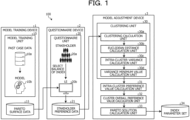
- FIG. 1 is a block diagram illustrating a configuration example of an information processing system according to the embodiment.
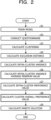
- FIG. 2 is a flowchart illustrating an operation example of the information processing system according to the embodiment.
- an information processing system 100 includes a model training device 1, a questionnaire device 2, and a model adjustment device 3.
- the model training device 1, the questionnaire device 2, and the model adjustment device 3 operate, for example, as in the flowchart (S1 to S9) illustrated in FIG. 2 , so as to tune a model 10b, in consideration of various preferences of an stakeholder 20a.
- the model 10b is a machine learning model trained using past case data 10a as teacher data, in order to assist decision making of a recruiter. Specifically, by inputting data of a job seeker, the model 10b outputs a determination result of whether or not to be employed, regarding whether or not a plurality of indexes (for example, age, history, desired annual income, or the like) satisfies employment criteria.
- the model 10b is not limited to a model that assists the decision making of the recruiter, and for example, may be applied to a machine learning model trained to assist decision making (availability of loans) of an examiner in loan examination.
- the stakeholder 20a in the decision making of the recruiter using the past case data 10a includes a job seeker or the like, in addition to the recruiter.
- the recruiter has a preference to minimize a possibility that a job seeker who does not satisfy the employment criteria is mistakenly employed (desire to minimize false-positive probability, desire to maximize specificity index). Furthermore, the job seeker has a preference that the job seeker does not desire to be mistakenly determined to be unemployed even though the job seeker satisfies the employment criteria (desire to minimize false-positive probability, desire to maximize sensitivity index). In this way, the stakeholder 20a has various preferences among individuals.
- the information processing system 100 tunes the model 10b in consideration of the preference of each of the recruiter and the job seeker included in the stakeholder 20a.
- the information processing system 100 including the plurality of information processing devices including the model training device 1, the questionnaire device 2, and the model adjustment device 3 are exemplified.
- the information processing system 100 may have a configuration in which a single information processing device executes processing of the model training device 1, the questionnaire device 2, and the model adjustment device 3.
- the model training device 1 includes a model training unit 10 and trains the model 10b (S1).
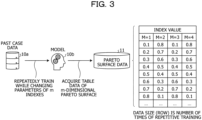
- FIG. 3 is an explanatory diagram for explaining an outline of model training.
- the model training unit 10 is a processing unit that performs machine learning of the model 10b, based on the past case data 10a associated with the data of the job seeker (age, history, desired annual income, or the like) and the result of whether or not to be employed.
- M 1, 2, ..., m
- the multi-objective optimization problem in machine learning of the model 10b can be defined as the following formula (1). [Expression 1] min x ⁇ X f 1 x , f 2 x , ... , f k x
- f k (x) is an objective function
- k (k ⁇ 2) represents the number of objective functions
- X represents a matrix of options (matrix of plurality of indexes in repetitive training using past case data 10a).
- Pareto surface In a case where an argument x * ⁇ X is not dominated by any other solution (Pareto optimum), an answer set X * is referred to as a Pareto surface.
- the model training unit 10 acquires table data (Pareto surface data 11) of the m-dimensional Pareto surface (answer set) regarding a plurality of indexes, by machine learning of the model 10b using the past case data 10a.
- the stakeholder 20a who conducts the questionnaire is a person randomly selected from among persons registered as a user of the model 10b in advance (recruiter or job seeker) or the like.
- FIG. 4 is an explanatory diagram for explaining an outline of the questionnaire.
- a preference value (evaluation value) of an individual (i) to each index M is referred to as V iM .
- the questionnaire unit 20 tabulates input data of the preference value V iM acquired from each person of the questionnaire unit 20 and sets the input data as stakeholder preference data 21.
- an stakeholder group of the recruiter/job seeker at the time of user registration and the preference value V iM to each index M (M 1, 2, 3, 4) are indicated, for each individual (i) of the stakeholder 20a.
- the model adjustment device 3 includes a clustering unit 30, an intra-cluster preference value calculation unit 31, a cluster overall preference value calculation unit 32, and a Pareto solution calculation unit 33.
- the clustering unit 30 clusters the evaluation result (preference value V iM of individual i) for each combination pattern of the plurality of indexes, using K-means clustering.
- the clustering unit 30 calculates a variance of the evaluation results in each cluster by this clustering, and determines a pattern that minimizes the variance. In this way, it is assumed that the clustering unit 30 select the plurality of indexes, by determining the pattern that minimizes the variance of the evaluation results in each cluster and use a clustering result of which consistency in the cluster is the highest (the lowest variance).
- the unimportant index serves as noise, and individuals having different preference patterns are mixed in the cluster, that is, the consistency of the preference in the cluster is lowered.
- the clustering unit 30 includes a clustering calculation unit 30a, a Euclidean distance calculation unit 30b, an intra-cluster variance calculation unit 30c, and a variance minimum value calculation unit 30d.
- FIG. 5 is an explanatory diagram for explaining an outline of the clustering calculation.
- the clustering calculation unit 30a selects k points as initial center points in a feature space.
- the clustering calculation unit 30a forms a cluster by assigning the preference value of each person (i) to the closest center point.
- the clustering calculation unit 30a replaces the center point of each cluster with a center of a point belonging to each center point.
- the clustering calculation unit 30a repeats the formation of the cluster and the calculation of the center point, until a position of the center point does not move.
- the individual (i) is assigned to any one cluster in all the patterns.
- the number of clusters k is determined by a known elbow method from among a plurality of candidates.
- the cluster of each pattern is referred to as K p .
- the Euclidean distance calculation unit 30b is a processing unit that calculates a Euclidean distance between an average value of the preference values of all the individuals included in the stakeholder preference data 21 and the preference value of each individual (S4).
- FIG. 6 is an explanatory diagram for explaining an outline of Euclidean distance calculation.
- the Euclidean distance calculation unit 30b acquires the preference values (V iM ) of all the individuals included in the stakeholder preference data 21.
- the Euclidean distance calculation unit 30b calculates an average value (V iM (upper bar)) of the preferences of all the individuals, and obtains a calculation result 30f of a Euclidean distance (d pi ) between the average value and the preference values (V iM ) of all the individuals.
- the intra-cluster variance calculation unit 30c is a processing unit that calculates the variance of the evaluation results in the cluster for each combination pattern (S5).
- FIG. 7 is an explanatory diagram for explaining an outline of intra-cluster variance calculation.
- the intra-cluster variance calculation unit 30c obtains a calculation result 30h of a variance value of d PKi of the individuals in each cluster, as in the following formula (6).
- the variance minimum value calculation unit 30d determines a combination pattern that satisfies a predetermined condition from among the plurality of combination patterns, based on the variance of the evaluation results calculated by the intra-cluster variance calculation unit 30c. Specifically, the variance minimum value calculation unit 30d performs intra-cluster variance average minimum value calculation (S6) and determines a pattern with the minimum variance, from among the plurality of combination patterns. Note that the variance minimum value calculation unit 30d may select and determine the pattern from among a plurality of patterns of which a variance is equal to or less than a predetermined threshold.
- the variance minimum value calculation unit 30d may select a predetermined pattern based on the number of indexes included in the pattern.
- the pattern of which the number of indexes is large is highly likely to have a positive-negative proportional relationship, an inverse proportional relationship, or the like between the indexes.
- the variance minimum value calculation unit 30d selects the pattern of which the number of indexes is large.
- FIG. 8 is an explanatory diagram for explaining an outline of the intra-cluster variance average minimum value calculation.
- the variance minimum value calculation unit 30d obtains a calculation result 30i of a variance value Mean p of each pattern, by performing calculation as in the following formula (8).
- the variance minimum value calculation unit 30d determines a pattern p to be argmin Mean p from among all the patterns, and obtains the calculation result 30i.
- a pattern p to be argmin Mean p from among all the patterns, and obtains the calculation result 30i.
- the intra-cluster preference value calculation unit 31 is a processing unit that calculates a preference (evaluation) for each of the plurality of indexes for each cluster, based on the preference result included in each cluster obtained by clustering performed on the determined combination pattern. Specifically, the intra-cluster preference value calculation unit 31 performs intra-cluster preference value calculation (S7), calculates an average value of the preference values of the individuals (i) in each cluster for all the indexes, and calculates an average value of each cluster.
- S7 intra-cluster preference value calculation
- FIG. 9 is an explanatory diagram for explaining an outline of the intra-cluster preference value calculation.
- the intra-cluster preference value calculation unit 31 calculates the average value of the preference values of the individuals (i) in each cluster, for all the indexes and obtains a calculation result 30l in which each average value of each cluster is set to V PKM .
- the cluster overall preference value calculation unit 32 is a processing unit that performs cluster overall preference value calculation (S8) that aggregates the preference values of all the clusters.
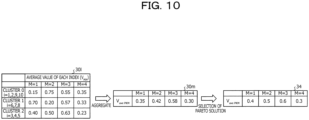
- FIG. 10 is an explanatory diagram for explaining an outline of the cluster overall preference value calculation.
- the cluster overall preference value calculation unit 32 obtains a geometric mean of V PKM for each index, based on the calculation result 30l and obtains a calculation result 30m to be V avePKM , that is, the aggregated evaluation result.
- the Pareto solution calculation unit 33 is a processing unit that performs Pareto solution calculation (S9) for determining a solution of each of the plurality of indexes in the model 10b, based on the calculation result 30m.
- the Pareto solution calculation unit 33 selects a Pareto solution of which a Euclidean distance to V ave PKM in the calculation result 30m is the smallest, from among the answer set of the m-dimensional Pareto surface included in the Pareto surface data 11.
- This Pareto solution is a parameter set for tuning the model 10b in consideration of the preference of each stakeholder 20a.
- the Pareto solution calculation unit 33 outputs an index parameter set 34 including each index value of the selected Pareto solution as data for tuning of the model 10b.
- FIG. 11 is an explanatory diagram for explaining an outline of the index parameter set.
- a case C1 in FIG. 11 is a case in which preference values are simply aggregated in an stakeholder group of each of recruiters and job seekers and the data for tuning of the model 10b is calculated.
- the case C1 is a case where the data for tuning of the model 10b is calculated in the present embodiment described above.
- the information processing system 100 acquires the evaluation result indicating the evaluation for each of the plurality of indexes in the machine learning model (model 10b).
- the information processing system 100 clusters the evaluation result for each combination pattern of the plurality of indexes.
- the information processing system 100 calculates the variance of the evaluation results in the cluster for each combination pattern.
- the information processing system 100 determines the combination pattern that satisfies the predetermined condition from among the plurality of combination patterns, based on the calculated variance of the evaluation results.
- the information processing system 100 aggregates the evaluation for each of the plurality of indexes for each cluster, based on the evaluation result included in each cluster obtained by performing clustering performed on the determined combination pattern.
- the information processing system 100 determines the solution of each of the plurality of indexes in the model 10b based on the aggregated evaluation for each of the plurality of indexes.
- the information processing system 100 can obtain the solution properly reflecting even a small number of evaluation results and can properly tune the model.
- the information processing system 100 determines the pattern with the minimum variance of the evaluation results from among the plurality of combination patterns. As a result, the information processing system 100 can determine the solution for each of the plurality of indexes in the model 10b, based on the clustering result of which the consistency in the cluster is the highest.
- the information processing system 100 determines the solution having a Euclidean distance close to the evaluation for each of the plurality of indexes, from among the answer set (Pareto surface data 11) of each of the plurality of indexes in the model 10b. As a result, the information processing system 100 can obtain the solution closer to the evaluation for each of the plurality of indexes.
- the evaluation result of the information processing system 100 is a questionnaire result for a person (stakeholder 20a) related to determination using the model 10b.
- the information processing system 100 can tune the model reflecting an opinion of the person related to the determination using the model 10b.
- each of the illustrated components in each of the devices is not necessarily physically configured as illustrated in the drawings.
- the specific aspects of distribution and integration of the respective devices are not limited to the illustrated aspects, and all or some of the devices can be functionally or physically distributed and integrated in any unit in accordance with various loads, use status, and the like.
- all or any part of various processing functions of the model training unit 10, the questionnaire unit 20, the clustering unit 30, the intra-cluster preference value calculation unit 31, the cluster overall preference value calculation unit 32, and the Pareto solution calculation unit 33 performed by the model training device 1, the questionnaire device 2, and the model adjustment device 3 may be executed by a central processing unit (CPU) (or microcomputer such as micro processing unit (MPU) or micro controller unit (MCU)). Furthermore, it is needless to say that all or any part of various processing functions may be executed on a program analyzed and executed by a CPU (or microcomputer such as MPU or MCU) or on hardware by wired logic. Furthermore, various processing functions performed by the model training device 1, the questionnaire device 2, and the model adjustment device 3 may be executed by an information processing device (computer) such as a single server device or may be executed by a plurality of computers in cooperation by cloud computing.
- a central processing unit or microcomputer such as micro processing unit (MPU) or micro controller unit (MCU)
- FIG. 12 is an explanatory diagram for explaining an example of a computer configuration.
- a computer 200 includes a CPU 201 that executes various type of arithmetic processing, an input device 202 that receives a data input, a monitor 203, and a speaker 204. Furthermore, the computer 200 includes a medium reading device 205 that reads a program or the like from a storage medium, an interface device 206 to be coupled to various devices, and a communication device 207 to be coupled to and communicate with an external device in a wired or wireless manner. Furthermore, the computer 200 also includes a random access memory (RAM) 208 that temporarily stores various types of information, and a hard disk device 209. Furthermore, each of the units (201 to 209) in the computer 200 is coupled to a bus 210.
- RAM random access memory
- the hard disk device 209 stores a program 211 for executing various types of processing of the functional configurations described in the above embodiment (for example, model training unit 10, questionnaire unit 20, clustering unit 30, intra-cluster preference value calculation unit 31, cluster overall preference value calculation unit 32, and Pareto solution calculation unit 33). Furthermore, the hard disk device 209 stores various types of data 212 that the program 211 refers to.
- the input device 202 receives, for example, an input of operation information from an operator.
- the monitor 203 displays, for example, various screens to be operated by the operator. For example, a printing device and the like are coupled to the interface device 206.
- the communication device 207 is coupled to a communication network such as a local area network (LAN), and exchanges various types of information with an external device via the communication network.
- LAN local area network
- the CPU 201 reads the program 211 stored in the hard disk device 209 and develops and executes the program 211 on the RAM 208 so as to execute various types of processing regarding the above functional configurations (for example, model training unit 10, questionnaire unit 20, clustering unit 30, intra-cluster preference value calculation unit 31, cluster overall preference value calculation unit 32, and Pareto solution calculation unit 33).
- the program 211 does not have to be stored in the hard disk device 209.
- the program 211 stored in a storage medium readable by the computer 200 may be read and executed.
- the storage medium readable by the computer 200 corresponds to, for example, a portable recording medium such as a compact disc read-only memory (CD-ROM), a digital versatile disc (DVD), or a universal serial bus (USB) memory, a semiconductor memory such as a flash memory, a hard disk drive, or the like.
- a portable recording medium such as a compact disc read-only memory (CD-ROM), a digital versatile disc (DVD), or a universal serial bus (USB) memory
- a semiconductor memory such as a flash memory, a hard disk drive, or the like.
- the program 211 may be prestored in a device coupled to a public line, the Internet, the LAN, or the like, and the computer 200 may read the program 211 from such a device to execute it.
Landscapes
- Engineering & Computer Science (AREA)
- Theoretical Computer Science (AREA)
- Software Systems (AREA)
- Data Mining & Analysis (AREA)
- Physics & Mathematics (AREA)
- General Engineering & Computer Science (AREA)
- General Physics & Mathematics (AREA)
- Databases & Information Systems (AREA)
- Medical Informatics (AREA)
- Artificial Intelligence (AREA)
- Evolutionary Computation (AREA)
- Computing Systems (AREA)
- Mathematical Physics (AREA)
- Computer Vision & Pattern Recognition (AREA)
- Computational Linguistics (AREA)
- Information Retrieval, Db Structures And Fs Structures Therefor (AREA)
- Management, Administration, Business Operations System, And Electronic Commerce (AREA)
Abstract
An information processing program for causing a computer to execute a process includes acquiring an evaluation result that indicates evaluation for each of a plurality of indexes in a machine learning model, clustering the evaluation result for each combination pattern of the plurality of indexes, calculating a variance of the evaluation results in a cluster for each combination pattern, determining a combination pattern that satisfies a predetermined condition, from among a plurality of the combination patterns, based on the calculated variance of the evaluation results, aggregating the evaluation for each of the plurality of indexes for each cluster, based on the evaluation result included in each cluster obtained by performing clustering on the determined combination pattern, and determining a solution for each of the plurality of indexes in the machine learning model based on the aggregated evaluation for each of the plurality of indexes.
Description
- An embodiment discussed herein is related to an information processing program, an information processing method, and an information processing device.
- Typically, there is an information processing system that assists decision making of loan examiners and recruiters using a machine learning model (hereinafter, model), in decision making of people such as loan examination or human resources recruitment. This information processing system outputs a determination result (availability of loan or employment) obtained by inputting a case to be determined into the model trained using results in past cases (availability of loan or employment) as training data.
- There is a problem that a bias according to race, gender, or the like intervenes in the output from the information processing system. Such a bias can be reduced by tuning the model using performance indexes and fairness indexes. However, it is important to perform tuning so that all stakeholders affected by the system can understand.
- Regarding such model tuning, there is related art for aggregating preference information by majority voting and considering various preferences of the stakeholders affected by the system, by using this aggregation result for tuning.
-
Japanese Laid-open Patent Publication No. 2015-87966 Japanese Laid-open Patent Publication No. 2013-101700 Japanese Laid-open Patent Publication No. 2007-172427 U.S. Patent Application Publication No. 2023/0024361 ,U.S. Patent Application Publication No. 2016/0180451 - However, with the above related art, the majority voting results wasted votes. Therefore, preferences of stakeholders (for example, women with less cases of loan examination, disabled people with a small number of job seekers, or the like) having minority opinions are excluded. Therefore, the related art has a problem in that it is difficult to tune the model so that all the stakeholders including the stakeholder having minority opinions understand.
- In one aspect, an object is to provide an information processing program, an information processing method, and an information processing device that can properly tune a model.
- According to an aspect of the embodiments, an information processing program for a computer to execute a processing includes acquiring an evaluation result that indicates evaluation for each of a plurality of indexes in a machine learning model, clustering the evaluation result for each combination pattern of the plurality of indexes, calculating a variance of the evaluation results in a cluster for each combination pattern, determining a combination pattern that satisfies a predetermined condition, from among a plurality of the combination patterns, based on the calculated variance of the evaluation results, aggregating the evaluation for each of the plurality of indexes for each cluster, based on the evaluation result included in each cluster obtained by performing clustering on the determined combination pattern, and determining a solution for each of the plurality of indexes in the machine learning model based on the aggregated evaluation for each of the plurality of indexes.
- According to an embodiment, it is possible to properly tune a model.
-
-
FIG. 1 is a block diagram illustrating a configuration example of an information processing system according to an embodiment; -
FIG. 2 is a flowchart illustrating an operation example of the information processing system according to the embodiment; -
FIG. 3 is an explanatory diagram for explaining an outline of model training; -
FIG. 4 is an explanatory diagram for explaining an outline of a questionnaire; -
FIG. 5 is an explanatory diagram for explaining an outline of clustering calculation; -
FIG. 6 is an explanatory diagram for explaining an outline of Euclidean distance calculation; -
FIG. 7 is an explanatory diagram for explaining an outline of intra-cluster variance calculation; -
FIG. 8 is an explanatory diagram for explaining an outline of intra-cluster variance average minimum value calculation; -
FIG. 9 is an explanatory diagram for explaining an outline of intra-cluster preference value calculation; -
FIG. 10 is an explanatory diagram for explaining an outline of cluster overall preference value calculation; -
FIG. 11 is an explanatory diagram for explaining an outline of an index parameter set; and -
FIG. 12 is an explanatory diagram for explaining an example of a computer configuration. - Hereinafter, an information processing program, an information processing method, and an information processing device according to an embodiment will be described with reference to the drawings. Configurations having the same functions in the embodiment are denoted by the same reference signs, and redundant description will be omitted. Note that the information processing program, the information processing method, and the information processing device to be described in the following embodiment are to merely indicate examples and do not limit the embodiment. Furthermore, each embodiment below may be appropriately combined within the scope of no contradiction.
-
FIG. 1 is a block diagram illustrating a configuration example of an information processing system according to the embodiment.FIG. 2 is a flowchart illustrating an operation example of the information processing system according to the embodiment. - As illustrated in
FIG. 1 , aninformation processing system 100 includes amodel training device 1, aquestionnaire device 2, and amodel adjustment device 3. In theinformation processing system 100, themodel training device 1, thequestionnaire device 2, and themodel adjustment device 3 operate, for example, as in the flowchart (S1 to S9) illustrated inFIG. 2 , so as to tune amodel 10b, in consideration of various preferences of anstakeholder 20a. - Note that the
model 10b according to the present embodiment is a machine learning model trained using past case data 10a as teacher data, in order to assist decision making of a recruiter. Specifically, by inputting data of a job seeker, themodel 10b outputs a determination result of whether or not to be employed, regarding whether or not a plurality of indexes (for example, age, history, desired annual income, or the like) satisfies employment criteria. Themodel 10b is not limited to a model that assists the decision making of the recruiter, and for example, may be applied to a machine learning model trained to assist decision making (availability of loans) of an examiner in loan examination. - The
stakeholder 20a in the decision making of the recruiter using the past case data 10a includes a job seeker or the like, in addition to the recruiter. - As an example, the recruiter has a preference to minimize a possibility that a job seeker who does not satisfy the employment criteria is mistakenly employed (desire to minimize false-positive probability, desire to maximize specificity index). Furthermore, the job seeker has a preference that the job seeker does not desire to be mistakenly determined to be unemployed even though the job seeker satisfies the employment criteria (desire to minimize false-positive probability, desire to maximize sensitivity index). In this way, the
stakeholder 20a has various preferences among individuals. - Therefore, the
information processing system 100 tunes themodel 10b in consideration of the preference of each of the recruiter and the job seeker included in thestakeholder 20a. - Note that, in the present embodiment, the
information processing system 100 including the plurality of information processing devices including themodel training device 1, thequestionnaire device 2, and themodel adjustment device 3 are exemplified. However, theinformation processing system 100 may have a configuration in which a single information processing device executes processing of themodel training device 1, thequestionnaire device 2, and themodel adjustment device 3. - The
model training device 1 includes amodel training unit 10 and trains themodel 10b (S1).FIG. 3 is an explanatory diagram for explaining an outline of model training. - As illustrated in
FIG. 3 , themodel training unit 10 is a processing unit that performs machine learning of themodel 10b, based on the past case data 10a associated with the data of the job seeker (age, history, desired annual income, or the like) and the result of whether or not to be employed. - Specifically, the
model training unit 10 performs machine learning of themodel 10b while repeatedly adjusting a trade-off relationship between a plurality of indexes M (M = 1, 2, ..., m) such as the age, the history, or the desired annual income, based on the past case data 10a and forms an m-dimensional Pareto surface (multi-objective optimization). - The multi-objective optimization problem in machine learning of the
model 10b can be defined as the following formula (1).
[Expression 1]
- Here, fk (x) is an objective function, k (k ≥ 2) represents the number of objective functions, and X represents a matrix of options (matrix of plurality of indexes in repetitive training using past case data 10a).
- Since it is not possible to simultaneously optimize all the objective functions in the multi-objective optimization problem, attention is paid to an answer set that is Pareto optimum.
- When the following formula (2) and formula (3) are satisfied, a feasible solution x1 ∈X performs Pareto control on x2 ∈X.
[Expression 2]

[Expression 3]

- In a case where an argument x* ∈X is not dominated by any other solution (Pareto optimum), an answer set X* is referred to as a Pareto surface.
- The
model training unit 10 acquires table data (Pareto surface data 11) of the m-dimensional Pareto surface (answer set) regarding a plurality of indexes, by machine learning of themodel 10b using the past case data 10a. - Returning to
FIGs. 1 and2 , thequestionnaire device 2 includes aquestionnaire unit 20, and acquires an evaluation result indicating evaluation (preference) to each of the plurality of indexes M (M = 1, 2, ..., m) of the machine learning model (model 10b), by conducting a questionnaire to thestakeholder 20a (S2). Note that thestakeholder 20a who conducts the questionnaire is a person randomly selected from among persons registered as a user of themodel 10b in advance (recruiter or job seeker) or the like. -
FIG. 4 is an explanatory diagram for explaining an outline of the questionnaire. As illustrated inFIG. 4 , thequestionnaire unit 20 receives the evaluation (preference) to each of the plurality of indexes M (M = 1, 2, 3, 4), by an operation input (slider operation or the like) from thestakeholder 20a via a user interface (UI) 20b. Specifically, thequestionnaire unit 20 receives a preference value of each index between 0.0 and 1.0 from each person of thestakeholder 20a (i = 1, ..., 10). - Here, a preference value (evaluation value) of an individual (i) to each index M is referred to as ViM. The
questionnaire unit 20 tabulates input data of the preference value ViM acquired from each person of thequestionnaire unit 20 and sets the input data asstakeholder preference data 21. - In the
stakeholder preference data 21, an stakeholder group of the recruiter/job seeker at the time of user registration and the preference value ViM to each index M (M = 1, 2, 3, 4) are indicated, for each individual (i) of thestakeholder 20a. - In the
stakeholder preference data 21 in the illustrated example, preferences of individuals i = 4 and 5 and preferences of individuals i = 9 and 10 have a selection pattern different from other individuals of the job seeker. For example, although a preference pattern of the individuals i = 9 and 10 has a large difference between the individuals with the indexes M = 1 and 2, the difference between the individuals is small with the indexes M = 3 and 4. - Returning to
FIGs. 1 and2 , themodel adjustment device 3 includes aclustering unit 30, an intra-cluster preferencevalue calculation unit 31, a cluster overall preferencevalue calculation unit 32, and a Paretosolution calculation unit 33. - The
clustering unit 30 clusters the evaluation result (preference value ViM of individual i) for each combination pattern of the plurality of indexes, using K-means clustering. Theclustering unit 30 calculates a variance of the evaluation results in each cluster by this clustering, and determines a pattern that minimizes the variance. In this way, it is assumed that theclustering unit 30 select the plurality of indexes, by determining the pattern that minimizes the variance of the evaluation results in each cluster and use a clustering result of which consistency in the cluster is the highest (the lowest variance). - In this way, it is possible to accurately group (cluster) individuals having similar preference patterns, by using the clustering result of which the consistency in the cluster is the highest (the lowest variance).
- For example, assuming that it is not possible for an individual to express a preference in consideration of a balance relationship of all indexes, it can be assumed that there be an index that is not considered by many people (not important).
- Furthermore, in a case where all the indexes are used in aggregation by clustering, the unimportant index serves as noise, and individuals having different preference patterns are mixed in the cluster, that is, the consistency of the preference in the cluster is lowered.
- Therefore, by creating the plurality of patterns as changing the indexes used for clustering and adopting a combination pattern of indexes that makes the consistency in the cluster be the highest, similarity between the preference patterns of the individuals in the cluster can be maximized. Therefore, it is possible to accurately model an stakeholder subgroup. That is, it is possible to accurately cluster the individuals (few) having the similar preference patterns and to properly reflect minority opinions.
- Specifically, the
clustering unit 30 includes aclustering calculation unit 30a, a Euclideandistance calculation unit 30b, an intra-cluster variance calculation unit 30c, and a variance minimumvalue calculation unit 30d. - The
clustering calculation unit 30a is a processing unit that performs clustering calculation (S3) for clustering the evaluation result (preference value ViM) for each combination pattern of the plurality of indexes M (M = 1, 2, ..., m), using the K-means clustering. -
FIG. 5 is an explanatory diagram for explaining an outline of the clustering calculation. As illustrated inFIG. 5 , theclustering calculation unit 30a performs the K-means clustering in each of patterns (p) with a changed combination of the plurality of indexes M (M = 1, 2, 3, 4). - For example, in the K-means clustering, the
clustering calculation unit 30a selects k points as initial center points in a feature space. In the feature space, the preference values of the plurality of indexes of machine learning (that is, preference values ViM to M = 1, 2, 3, 4) are used. Next, theclustering calculation unit 30a forms a cluster by assigning the preference value of each person (i) to the closest center point. Next, theclustering calculation unit 30a replaces the center point of each cluster with a center of a point belonging to each center point. Then, theclustering calculation unit 30a repeats the formation of the cluster and the calculation of the center point, until a position of the center point does not move. - The total number of combination patterns pis

- By performing clustering by the
clustering calculation unit 30a, k (cluster number K = 1, ..., k) clusters are made for each pattern number P (P = 1, ..., p). The cluster of each pattern is referred to as Kp. - In a
calculation result 30e in the illustrated example, since the number of indexes m = 4, the total number of patterns is p = 15. Furthermore, as an output example of Kp, when P = 1 (M = 1, 2, 3, 4), the individual (i) is classified into four clusters of K1 = 0, 1, 2, 3. - Returning to
FIGs. 1 and2 , the Euclideandistance calculation unit 30b is a processing unit that calculates a Euclidean distance between an average value of the preference values of all the individuals included in thestakeholder preference data 21 and the preference value of each individual (S4). -
FIG. 6 is an explanatory diagram for explaining an outline of Euclidean distance calculation. As illustrated inFIG. 6 , the Euclideandistance calculation unit 30b acquires the preference values (ViM) of all the individuals included in thestakeholder preference data 21. Next, the Euclideandistance calculation unit 30b calculates an average value (ViM (upper bar)) of the preferences of all the individuals, and obtains acalculation result 30f of a Euclidean distance (dpi) between the average value and the preference values (ViM) of all the individuals. - Here, the calculation of the Euclidean distance is as in the following formula (4), and the calculation of the average value is as in the following formula (5).
[Expression 4]

[Expression 5]

- Note that the Euclidean distance (dpi) of the individual in the cluster Kp is assumed to be dPK. This dPK takes a common value in any pattern.
- Returning to
FIGs. 1 and2 , the intra-cluster variance calculation unit 30c is a processing unit that calculates the variance of the evaluation results in the cluster for each combination pattern (S5). -
FIG. 7 is an explanatory diagram for explaining an outline of intra-cluster variance calculation. As illustrated inFIG. 7 , the intra-cluster variance calculation unit 30c obtains acalculation result 30h of a variance value of dPKi of the individuals in each cluster, as in the following formula (6).
[Expression 6]

- The upper bar dPK is an average value of dPK of all the individuals in the cluster, and a
calculation result 30g of the average value can be obtained as in the following formula (7).
[Expression 7]

- Returning to
FIGs. 1 and2 , the variance minimumvalue calculation unit 30d determines a combination pattern that satisfies a predetermined condition from among the plurality of combination patterns, based on the variance of the evaluation results calculated by the intra-cluster variance calculation unit 30c. Specifically, the variance minimumvalue calculation unit 30d performs intra-cluster variance average minimum value calculation (S6) and determines a pattern with the minimum variance, from among the plurality of combination patterns. Note that the variance minimumvalue calculation unit 30d may select and determine the pattern from among a plurality of patterns of which a variance is equal to or less than a predetermined threshold. - In a case of determining a pattern from among the plurality of patterns with the minimum variance or the plurality of patterns of which the variance is equal to or less than the predetermined threshold, the variance minimum
value calculation unit 30d may select a predetermined pattern based on the number of indexes included in the pattern. - For example, the pattern of which the number of indexes is large is highly likely to have a positive-negative proportional relationship, an inverse proportional relationship, or the like between the indexes. At this time, in a pattern holding more information regarding the relationship between the indexes (pattern of which the number of indexes is large), the number of elements for explaining a preference pattern of the stakeholder group is large. Therefore, in a case of determining the pattern from among the plurality of patterns, the variance minimum
value calculation unit 30d selects the pattern of which the number of indexes is large. -
FIG. 8 is an explanatory diagram for explaining an outline of the intra-cluster variance average minimum value calculation. As illustrated inFIG. 8 , the variance minimumvalue calculation unit 30d obtains acalculation result 30i of a variance value Meanp of each pattern, by performing calculation as in the following formula (8).
[Expression 8]

- Next, the variance minimum
value calculation unit 30d determines a pattern p to be argmin Meanp from among all the patterns, and obtains thecalculation result 30i. In the illustrated example, three patterns (P = 6, 12, 13) are obtained with an equal ratio, as thecalculation result 30i. The variance minimumvalue calculation unit 30d determines the pattern (P = 6) of which the number of indexes is large from among the three patterns, as described above. - Returning to
FIGs. 1 and2 , the intra-cluster preferencevalue calculation unit 31 is a processing unit that calculates a preference (evaluation) for each of the plurality of indexes for each cluster, based on the preference result included in each cluster obtained by clustering performed on the determined combination pattern. Specifically, the intra-cluster preferencevalue calculation unit 31 performs intra-cluster preference value calculation (S7), calculates an average value of the preference values of the individuals (i) in each cluster for all the indexes, and calculates an average value of each cluster. -
FIG. 9 is an explanatory diagram for explaining an outline of the intra-cluster preference value calculation. As illustrated inFIG. 9 , the intra-cluster preferencevalue calculation unit 31 obtains acalculation result 30k obtained by merging thestakeholder preference data 21 and the clustering result (P = 6 (M = 1, 2)) by theclustering unit 30. Next, the intra-cluster preferencevalue calculation unit 31 calculates the average value of the preference values of the individuals (i) in each cluster, for all the indexes and obtains a calculation result 30l in which each average value of each cluster is set to VPKM. - Returning to
FIGs. 1 and2 , the cluster overall preferencevalue calculation unit 32 is a processing unit that performs cluster overall preference value calculation (S8) that aggregates the preference values of all the clusters. -
FIG. 10 is an explanatory diagram for explaining an outline of the cluster overall preference value calculation. As illustrated inFIG. 10 , the cluster overall preferencevalue calculation unit 32 obtains a geometric mean of VPKM for each index, based on the calculation result 30l and obtains acalculation result 30m to be VavePKM, that is, the aggregated evaluation result. - Returning to
FIGs. 1 and2 , the Paretosolution calculation unit 33 is a processing unit that performs Pareto solution calculation (S9) for determining a solution of each of the plurality of indexes in themodel 10b, based on thecalculation result 30m. - Specifically, as illustrated in
FIG. 10 , the Paretosolution calculation unit 33 selects a Pareto solution of which a Euclidean distance to Vave PKM in thecalculation result 30m is the smallest, from among the answer set of the m-dimensional Pareto surface included in thePareto surface data 11. This Pareto solution is a parameter set for tuning themodel 10b in consideration of the preference of eachstakeholder 20a. The Paretosolution calculation unit 33 outputs an index parameter set 34 including each index value of the selected Pareto solution as data for tuning of themodel 10b. -
FIG. 11 is an explanatory diagram for explaining an outline of the index parameter set. A case C1 inFIG. 11 is a case in which preference values are simply aggregated in an stakeholder group of each of recruiters and job seekers and the data for tuning of themodel 10b is calculated. The case C1 is a case where the data for tuning of themodel 10b is calculated in the present embodiment described above. - As illustrated in
FIG. 11 , in the case C1, acalculation result 35b for tuning of themodel 10b is obtained, based on acalculation result 35a obtained by simply aggregating the preference values in the stakeholder group of each of the recruiters and the job seekers. Therefore, in the case C1, the preferences of the individuals i = 4 and 5 and i = 9 and 10 are affected by a difference in the number of people caused by other stakeholders, and are reflected too small in thecalculation result 35b. - On the other hand, in a case C2, the preferences of the individuals i = 4 and 5 and i = 9 and 10 are not affected by the difference in the number of people by the other stakeholders (with same weight as other clusters), and are reflected on the index parameter set 34.
- As described above, the
information processing system 100 acquires the evaluation result indicating the evaluation for each of the plurality of indexes in the machine learning model (model 10b). Theinformation processing system 100 clusters the evaluation result for each combination pattern of the plurality of indexes. Theinformation processing system 100 calculates the variance of the evaluation results in the cluster for each combination pattern. Theinformation processing system 100 determines the combination pattern that satisfies the predetermined condition from among the plurality of combination patterns, based on the calculated variance of the evaluation results. Theinformation processing system 100 aggregates the evaluation for each of the plurality of indexes for each cluster, based on the evaluation result included in each cluster obtained by performing clustering performed on the determined combination pattern. Theinformation processing system 100 determines the solution of each of the plurality of indexes in themodel 10b based on the aggregated evaluation for each of the plurality of indexes. - As a result, the
information processing system 100 can obtain the solution properly reflecting even a small number of evaluation results and can properly tune the model. - Furthermore, the
information processing system 100 determines the pattern with the minimum variance of the evaluation results from among the plurality of combination patterns. As a result, theinformation processing system 100 can determine the solution for each of the plurality of indexes in themodel 10b, based on the clustering result of which the consistency in the cluster is the highest. - Furthermore, the
information processing system 100 determines the solution having a Euclidean distance close to the evaluation for each of the plurality of indexes, from among the answer set (Pareto surface data 11) of each of the plurality of indexes in themodel 10b. As a result, theinformation processing system 100 can obtain the solution closer to the evaluation for each of the plurality of indexes. - Furthermore, the evaluation result of the
information processing system 100 is a questionnaire result for a person (stakeholder 20a) related to determination using themodel 10b. As a result, theinformation processing system 100 can tune the model reflecting an opinion of the person related to the determination using themodel 10b. - Note that each of the illustrated components in each of the devices is not necessarily physically configured as illustrated in the drawings. In other words, the specific aspects of distribution and integration of the respective devices are not limited to the illustrated aspects, and all or some of the devices can be functionally or physically distributed and integrated in any unit in accordance with various loads, use status, and the like.
- Furthermore, all or any part of various processing functions of the
model training unit 10, thequestionnaire unit 20, theclustering unit 30, the intra-cluster preferencevalue calculation unit 31, the cluster overall preferencevalue calculation unit 32, and the Paretosolution calculation unit 33 performed by themodel training device 1, thequestionnaire device 2, and themodel adjustment device 3 may be executed by a central processing unit (CPU) (or microcomputer such as micro processing unit (MPU) or micro controller unit (MCU)). Furthermore, it is needless to say that all or any part of various processing functions may be executed on a program analyzed and executed by a CPU (or microcomputer such as MPU or MCU) or on hardware by wired logic. Furthermore, various processing functions performed by themodel training device 1, thequestionnaire device 2, and themodel adjustment device 3 may be executed by an information processing device (computer) such as a single server device or may be executed by a plurality of computers in cooperation by cloud computing. - Meanwhile, the various types of processing described in the above embodiment can be implemented by execution of a program, prepared in advance, on a computer. Thus, hereinafter, an exemplary computer configuration (hardware) that executes a program having functions similar to the above embodiment will be described.
FIG. 12 is an explanatory diagram for explaining an example of a computer configuration. - As illustrated in
FIG. 12 , acomputer 200 includes aCPU 201 that executes various type of arithmetic processing, aninput device 202 that receives a data input, amonitor 203, and aspeaker 204. Furthermore, thecomputer 200 includes amedium reading device 205 that reads a program or the like from a storage medium, aninterface device 206 to be coupled to various devices, and acommunication device 207 to be coupled to and communicate with an external device in a wired or wireless manner. Furthermore, thecomputer 200 also includes a random access memory (RAM) 208 that temporarily stores various types of information, and ahard disk device 209. Furthermore, each of the units (201 to 209) in thecomputer 200 is coupled to abus 210. - The
hard disk device 209 stores aprogram 211 for executing various types of processing of the functional configurations described in the above embodiment (for example,model training unit 10,questionnaire unit 20,clustering unit 30, intra-cluster preferencevalue calculation unit 31, cluster overall preferencevalue calculation unit 32, and Pareto solution calculation unit 33). Furthermore, thehard disk device 209 stores various types ofdata 212 that theprogram 211 refers to. Theinput device 202 receives, for example, an input of operation information from an operator. Themonitor 203 displays, for example, various screens to be operated by the operator. For example, a printing device and the like are coupled to theinterface device 206. Thecommunication device 207 is coupled to a communication network such as a local area network (LAN), and exchanges various types of information with an external device via the communication network. - The
CPU 201 reads theprogram 211 stored in thehard disk device 209 and develops and executes theprogram 211 on theRAM 208 so as to execute various types of processing regarding the above functional configurations (for example,model training unit 10,questionnaire unit 20,clustering unit 30, intra-cluster preferencevalue calculation unit 31, cluster overall preferencevalue calculation unit 32, and Pareto solution calculation unit 33). Note that theprogram 211 does not have to be stored in thehard disk device 209. For example, theprogram 211 stored in a storage medium readable by thecomputer 200 may be read and executed. The storage medium readable by thecomputer 200 corresponds to, for example, a portable recording medium such as a compact disc read-only memory (CD-ROM), a digital versatile disc (DVD), or a universal serial bus (USB) memory, a semiconductor memory such as a flash memory, a hard disk drive, or the like. Furthermore, theprogram 211 may be prestored in a device coupled to a public line, the Internet, the LAN, or the like, and thecomputer 200 may read theprogram 211 from such a device to execute it.
Claims (12)
- An information processing program for causing a computer to execute a processing comprising:acquiring an evaluation result that indicates evaluation for each of a plurality of indexes in a machine learning model;clustering the evaluation result for each combination pattern of the plurality of indexes;calculating a variance of the evaluation results in a cluster for each combination pattern;determining a combination pattern that satisfies a predetermined condition, from among a plurality of the combination patterns, based on the calculated variance of the evaluation results;aggregating the evaluation for each of the plurality of indexes for each cluster, based on the evaluation result included in each cluster obtained by performing clustering on the determined combination pattern; anddetermining a solution for each of the plurality of indexes in the machine learning model based on the aggregated evaluation for each of the plurality of indexes.
- The information processing program according to claim 1, wherein
the processing of determining the combination pattern determines a pattern with a minimum variance of the evaluation results from among the plurality of combination patterns. - The information processing program according to claim 1, wherein
the processing of determining the solution determines a solution that has a Euclidean distance close to the evaluation for each of the plurality of indexes, from among an answer set of each of the plurality of indexes in the machine learning model. - The information processing program according to claim 1, wherein
the evaluation result is a questionnaire result for a person related to determination by using the machine learning model. - An information processing method implemented by a computer, the information processing method comprising:acquiring an evaluation result that indicates evaluation for each of a plurality of indexes in a machine learning model;clustering the evaluation result for each combination pattern of the plurality of indexes;calculating a variance of the evaluation results in a cluster for each combination pattern;determining a combination pattern that satisfies a predetermined condition, from among a plurality of the combination patterns, based on the calculated variance of the evaluation results;aggregating the evaluation for each of the plurality of indexes for each cluster, based on the evaluation result included in each cluster obtained by performing clustering on the determined combination pattern; anddetermining a solution for each of the plurality of indexes in the machine learning model based on the aggregated evaluation for each of the plurality of indexes.
- The information processing method according to claim 5, wherein
the processing of determining the combination pattern determines a pattern with a minimum variance of the evaluation results from among the plurality of combination patterns. - The information processing method according to claim 5, wherein
the processing of determining the solution determines a solution that has a Euclidean distance close to the evaluation for each of the plurality of indexes, from among an answer set of each of the plurality of indexes in the machine learning model. - The information processing method according to claim 5, wherein
the evaluation result is a questionnaire result for a person related to determination by using the machine learning model. - An information processing device comprising:
a control unit configured to execute processing comprising:acquiring an evaluation result that indicates evaluation for each of a plurality of indexes in a machine learning model;clustering the evaluation result for each combination pattern of the plurality of indexes;calculating a variance of the evaluation results in a cluster for each combination pattern;determining a combination pattern that satisfies a predetermined condition, from among a plurality of the combination patterns, based on the calculated variance of the evaluation results;aggregating the evaluation for each of the plurality of indexes for each cluster, based on the evaluation result included in each cluster obtained by performing clustering on the determined combination pattern; anddetermining a solution for each of the plurality of indexes in the machine learning model based on the aggregated evaluation for each of the plurality of indexes. - The information processing device according to claim 9, wherein
the processing of determining the combination pattern determines a pattern with a minimum variance of the evaluation results from among the plurality of combination patterns. - The information processing device according to claim 9, wherein
the processing of determining the solution determines a solution that has a Euclidean distance close to the evaluation for each of the plurality of indexes, from among an answer set of each of the plurality of indexes in the machine learning model. - The information processing device according to claim 9, wherein
the evaluation result is a questionnaire result for a person related to determination by using the machine learning model.
Applications Claiming Priority (1)
| Application Number | Priority Date | Filing Date | Title |
|---|---|---|---|
| JP2023150450A JP2025043122A (en) | 2023-09-15 | 2023-09-15 | Information processing program, information processing method, and information processing device |
Publications (1)
| Publication Number | Publication Date |
|---|---|
| EP4524825A1 true EP4524825A1 (en) | 2025-03-19 |
Family
ID=92583393
Family Applications (1)
| Application Number | Title | Priority Date | Filing Date |
|---|---|---|---|
| EP24196649.8A Pending EP4524825A1 (en) | 2023-09-15 | 2024-08-27 | Information processing program, information processing method, and information processing device |
Country Status (3)
| Country | Link |
|---|---|
| US (1) | US20250094869A1 (en) |
| EP (1) | EP4524825A1 (en) |
| JP (1) | JP2025043122A (en) |
Citations (5)
| Publication number | Priority date | Publication date | Assignee | Title |
|---|---|---|---|---|
| JP2007172427A (en) | 2005-12-26 | 2007-07-05 | Nissan Motor Co Ltd | Pareto new area search device, medium on which Pareto new area search program is recorded, Pareto new area search display device, and Pareto new area search method |
| JP2013101700A (en) | 2010-12-28 | 2013-05-23 | Giken Shoji International Co Ltd | Profiling system utilizing regional characteristics |
| JP2015087966A (en) | 2013-10-30 | 2015-05-07 | 富士通株式会社 | Analyzer, analysis method, and analysis program |
| US20160180451A1 (en) | 2014-12-22 | 2016-06-23 | Palantir Technologies Inc. | Systems and user interfaces for dynamic and interactive investigation of bad actor behavior based on automatic clustering of related data in various data structures |
| US20230024361A1 (en) | 2017-04-17 | 2023-01-26 | Walmart Apollo, Llc | Systems to fulfill a picked sales order and related methods therefor |
-
2023
- 2023-09-15 JP JP2023150450A patent/JP2025043122A/en active Pending
-
2024
- 2024-08-26 US US18/814,602 patent/US20250094869A1/en active Pending
- 2024-08-27 EP EP24196649.8A patent/EP4524825A1/en active Pending
Patent Citations (5)
| Publication number | Priority date | Publication date | Assignee | Title |
|---|---|---|---|---|
| JP2007172427A (en) | 2005-12-26 | 2007-07-05 | Nissan Motor Co Ltd | Pareto new area search device, medium on which Pareto new area search program is recorded, Pareto new area search display device, and Pareto new area search method |
| JP2013101700A (en) | 2010-12-28 | 2013-05-23 | Giken Shoji International Co Ltd | Profiling system utilizing regional characteristics |
| JP2015087966A (en) | 2013-10-30 | 2015-05-07 | 富士通株式会社 | Analyzer, analysis method, and analysis program |
| US20160180451A1 (en) | 2014-12-22 | 2016-06-23 | Palantir Technologies Inc. | Systems and user interfaces for dynamic and interactive investigation of bad actor behavior based on automatic clustering of related data in various data structures |
| US20230024361A1 (en) | 2017-04-17 | 2023-01-26 | Walmart Apollo, Llc | Systems to fulfill a picked sales order and related methods therefor |
Non-Patent Citations (3)
| Title |
|---|
| AHN YONGSU ET AL: "FairSight: Visual Analytics for Fairness in Decision Making", IEEE TRANSACTIONS ON VISUALIZATION AND COMPUTER GRAPHICS, IEEE, USA, vol. 26, no. 1, 1 January 2020 (2020-01-01), pages 1086 - 1095, XP011752638, ISSN: 1077-2626, [retrieved on 20191122], DOI: 10.1109/TVCG.2019.2934262 * |
| HAQ ANWAR UL ET AL: "Combining Multiple Feature-Ranking Techniques and Clustering of Variables for Feature Selection", IEEE ACCESS, vol. 7, 24 October 2019 (2019-10-24), pages 151482 - 151492, XP011752374, DOI: 10.1109/ACCESS.2019.2947701 * |
| NAKAO YURI ET AL: "Towards Responsible AI: A Design Space Exploration of Human-Centered Artificial Intelligence User Interfaces to Investigate Fairness", INTERNATIONAL JOURNAL OF HUMAN-COMPUTER INTERACTION., vol. 39, no. 9, 4 May 2022 (2022-05-04), US, pages 1762 - 1788, XP093244214, ISSN: 1044-7318, DOI: 10.1080/10447318.2022.2067936 * |
Also Published As
| Publication number | Publication date |
|---|---|
| JP2025043122A (en) | 2025-03-28 |
| US20250094869A1 (en) | 2025-03-20 |
Similar Documents
| Publication | Publication Date | Title |
|---|---|---|
| CN109472318B (en) | Method and device for selecting features for constructed machine learning model | |
| Cross | Statistical and methodological considerations when using cluster analysis in neuropsychological research | |
| CN113539460A (en) | Intelligent diagnosis guiding method and device for remote medical platform | |
| US20240394603A1 (en) | Prediction model generating method, prediction method, prediction model generating device, prediction device, prediction model generating program, and prediction program | |
| Liberati et al. | Personal values and credit scoring: new insights in the financial prediction | |
| US20200380392A1 (en) | Data analysis apparatus, data analysis method, and data analysis program | |
| Akanbi | Application of naive bayes to students’ performance classification | |
| Shi et al. | Monitoring and evaluating college Students' mental health based on big data analysis | |
| Kumar et al. | Predicting college students’ placements based on academic performance using machine learning approaches | |
| US8055593B2 (en) | Learning classifiers for multiple-label data analysis | |
| Chahar et al. | Multiclass classification of mental health disorders using XGBoost-HOA algorithm | |
| Martínez-Camblor et al. | Improving the biomarker diagnostic capacity via functional transformations | |
| Nurhidayat et al. | More accurate simulation for insurance data based on a modified SVM polynomial method | |
| US20250094869A1 (en) | Computer-readable recording medium storing information processing program, information processing method, and information processing device | |
| KR102335015B1 (en) | Debt management competency assessment system and analysis method for debt management competency information using the same | |
| Wang et al. | Undersampling based on generalized learning vector quantization and natural nearest neighbors for imbalanced data | |
| Kersten et al. | An Impact of Negotiation Profiles on the Accuracy of Negotiation Offer Scoring System? Experimental Study | |
| Bao et al. | Dynamic financial distress prediction based on Kalman filtering | |
| Yang et al. | Multi-classification of national fitness test grades based on statistical analysis and machine learning | |
| Dinov | Lazy learning: classification using nearest neighbors | |
| Chan et al. | Data mining of resilience indicators | |
| JP6395261B2 (en) | Prediction model construction device and program | |
| Weiss et al. | Making the cut: Comparing methods for selecting cut-point location in logistic regression | |
| Tutz et al. | Aggregating classifiers with ordinal response structure | |
| Bain et al. | When DIF Goes Unmodeled: Assessing the Viability of Random Forest for Diagnostic Classification |
Legal Events
| Date | Code | Title | Description |
|---|---|---|---|
| PUAI | Public reference made under article 153(3) epc to a published international application that has entered the european phase |
Free format text: ORIGINAL CODE: 0009012 |
|
| STAA | Information on the status of an ep patent application or granted ep patent |
Free format text: STATUS: THE APPLICATION HAS BEEN PUBLISHED |
|
| AK | Designated contracting states |
Kind code of ref document: A1 Designated state(s): AL AT BE BG CH CY CZ DE DK EE ES FI FR GB GR HR HU IE IS IT LI LT LU LV MC ME MK MT NL NO PL PT RO RS SE SI SK SM TR |
|
| STAA | Information on the status of an ep patent application or granted ep patent |
Free format text: STATUS: REQUEST FOR EXAMINATION WAS MADE |
|
| 17P | Request for examination filed |
Effective date: 20250806 |