EP4524548A1 - Method and device for contactless detection of embedded functionalized carbon nanotubes in a biomembrane - Google Patents
Method and device for contactless detection of embedded functionalized carbon nanotubes in a biomembrane Download PDFInfo
- Publication number
- EP4524548A1 EP4524548A1 EP23472009.2A EP23472009A EP4524548A1 EP 4524548 A1 EP4524548 A1 EP 4524548A1 EP 23472009 A EP23472009 A EP 23472009A EP 4524548 A1 EP4524548 A1 EP 4524548A1
- Authority
- EP
- European Patent Office
- Prior art keywords
- carbon nanotubes
- biomembrane
- functionalized carbon
- hybrid cell
- embedded
- Prior art date
- Legal status (The legal status is an assumption and is not a legal conclusion. Google has not performed a legal analysis and makes no representation as to the accuracy of the status listed.)
- Pending
Links
Images
Classifications
-
- G—PHYSICS
- G01—MEASURING; TESTING
- G01N—INVESTIGATING OR ANALYSING MATERIALS BY DETERMINING THEIR CHEMICAL OR PHYSICAL PROPERTIES
- G01N21/00—Investigating or analysing materials by the use of optical means, i.e. using sub-millimetre waves, infrared, visible or ultraviolet light
- G01N21/17—Systems in which incident light is modified in accordance with the properties of the material investigated
- G01N21/1717—Systems in which incident light is modified in accordance with the properties of the material investigated with a modulation of one or more physical properties of the sample during the optical investigation, e.g. electro-reflectance
-
- G—PHYSICS
- G01—MEASURING; TESTING
- G01N—INVESTIGATING OR ANALYSING MATERIALS BY DETERMINING THEIR CHEMICAL OR PHYSICAL PROPERTIES
- G01N27/00—Investigating or analysing materials by the use of electric, electrochemical, or magnetic means
- G01N27/02—Investigating or analysing materials by the use of electric, electrochemical, or magnetic means by investigating impedance
- G01N27/04—Investigating or analysing materials by the use of electric, electrochemical, or magnetic means by investigating impedance by investigating resistance
- G01N27/06—Investigating or analysing materials by the use of electric, electrochemical, or magnetic means by investigating impedance by investigating resistance of a liquid
- G01N27/07—Construction of measuring vessels; Electrodes therefor
Definitions
- the invention concerns method and device for contactless detection of embedded suitably functionalized carbon nanotubes in a biomembrane by means of the electromagnetic echo effect, with application in medicine, pharmacy/pharmacology and chemical technology.
- Phospholipids are essential building blocks of cell membranes, which separate the living unit from the surrounding environment.
- the phospholipid molecules consist of a phosphate-containing hydrophilic head group and two hydrophobic fatty acid chains linked by means of glycerol, thus making them more rigid. All lipids are poorly soluble in water, but due to their unique stoichiometry, they self-assemble in aqueous solutions as bilayers, with the hydrophobic tails buried in the interior of the membrane, and the polar hydrophilic head groups exposed on both sides outside in contact with the water.
- That hydrophobic effect lies in the basis of the formation of lipid bilayers and ensures the primary interaction between the hydrophobic phospholipid acyl chains, on one hand, and between the phospholipid acyl chains and any included in the phospholipid matrix nanoparticles, known as dopants, regardless of their nature and shape, on the other hand.
- Such a self-assembled planar bilayer structure is a convenient model for fundamental investigations of the physicochemical processes in the biological membrane. In this way we don't need to study the physical properties and functions of the separate lipid molecule [2, 3, 4].
- Electromagnetic echo effect which we apply for investigation of physical and structural properties of these lipid bilayers with embedded properly functionalized carbon nanotubes, requires that bio membrane to be formed on a solid substrate, which we use in the hybrid cell. Such a system provides wide and flat areas - domains, convenient for exploration/investigation by Electromagnetic echo effect.
- the inclusion of carbon nanotubes in phospholipid-bilayers may alter the local structure and dynamics of bio membranes [5].
- Suitably functionalized carbon nanotubes with well-defined shape and size are able to create trans-membrane channels into the bio membrane [5,6].
- DSC Differential scanning calorimetric
- Raman spectroscopy That is a technique for physicochemical analysis which analyses the interaction of monochromatic light with the chemical bonds inside of different materials.
- the substance under investigation is subjected to an incident laser beam and the light scattered by the sample is analyzed by an embedded spectrophotometer.
- the Raman spectra are like chemical fingerprints.
- BG67179B1 Contactless detection of phase transitions in liquid crystals by laser induced surface photo-charge effect by measurement of electrical signal
- BG67262B1 Optimization of the cleaning properties of fog using sensor, operating on the basis of laser induced surface photo-charge effect, by measurement of electrical signals
- Both patents use contactless detection.
- phase transitions in liquid crystals are detected by means of laser induced surface photo-charge effect, which is characterized by that the device consists of a liquid crystal cell, which is glass substrate covered with transparent conductive layer and the other one is made from semiconductor material, between them the liquid crystal is loaded/placed.
- the liquid crystal cell is irradiated by a modulated laser beam, which induces electrical signal from the surface photo-charge effect, being measured by a voltmeter, and the amplitude of that signal alters, when phase transition in the liquid crystal appears. Both methods are not applicable for contactless detection of dopants in the phospholipid model bio membrane.
- the aim of the invention is to create such method and device which are not so expensive don't need highly educated and experienced personnel for the investigations, the amplitude of the detected signal must be convenient for measurement with a simple voltmeter, the sensor cell does not need additional cooling to achieve better results.
- the modulated laser beam, which irradiates the sensor cell, does not need to be with high intensity.
- this is accomplished by means of the electromagnetic echo effect by measurement of the alteration in the interface of the substance under investigation, which is loaded in the hybrid cell.
- the hybrid cell is loaded with suitable hydrated pure phospholipid, and it is irradiated by a modulated laser beam using one function generator.
- an electrical signal caused by Electromagnetic echo effect is induced and is measured by a voltmeter and recorded into thermograms of phase transition in the pure phospholipid, at different temperatures from -2°C to +48°C, achievable by means of Peltier module and thermocontroler.
- bionanocomposite which is composed of a hydrated phospholipid membrane and embedded suitably functionalized carbon nanotubes, in this way the interfaces of that substance changes and that is the reason for alteration of the electrical signal, produced by the electromagnetic echo effect, which is registered at appearance of phase transition in the bionanocomposite substance under investigation at heating and as well at cooling. It is possible to make a calibration and in this way, one could obtain/measure the exact concentration of embedded functionalized carbon nanotubes in the bionanocomposite, which allows the registration of critical concentration, at which the biomembrane collapses.
- the device for contactless detection of embedded suitably functionalized carbon nanotubes in the bilayer phospholipid biomembrane by means of the electromagnetic echo effect consists of a hybrid cell which includes one transparent plate with covered conductive layer on to lower side, in contact with the upper interface of the substance under investigation, the last one being in contact trough the lower interface with the semiconductor substrate.
- the conductive layer by means of one electrode is connected with one voltmeter.
- a modulated laser beam, directed over the loaded hybrid cell is realized by means of a laser module connected with a function generator. Under that hybrid cell there is a thermally conductive plate, placed above one Peltier module, which is connected to one thermocontroller. One radiator is situated under the Peltier module.
- the method of detection of dopants in a model phospholipid biomembrane consists of the following: In the contactless detection of embedded functionalized carbon nanotubes into the biomembrane, first we load the sensor hybrid cell with emulsion of pure phospholipid, irradiate it by a modulated laser beam and after that the amplitudes of the electrical signals obtained via the electromagnetic echo effect are recorded at different temperatures. In this way, we obtain the thermograms of the characteristic biomembrane phase transition gel-liquid crystal state of the pure biomembrane, at heating and at cooling, using for that purpose only one Peltier module.
- the whole structure is irradiated by a modulated laser beam 4, generated by the laser 3, connected with the function generator 2, the electrode of the conductive layer E from the hybrid cell 5 being connected to the nanovoltmeter 1, which registers/measures the generated electrical signal from electromagnetic echo effect. So, at this temperature, after the hybrid cell has been irradiated by the modulated laser beam, the electrical signal generated by electromagnetic echo effect is measured. After that the same signal is registered and measured at different temperatures from -2 to +48°C. In this way, the thermograms with the point of phase transition in the pure phospholipid are obtained. The temperature is adjusted by means of one Peltier module 7, which is connected to the thermocontroller 6.
- bionanocomposite consisting of one hydrated emulsion of phospholipid membrane and embedded inside suitably functionalized carbon nanotubes. Applying one automatic micropipette assures that the cell is loaded with the same amount of bionanocomposite substance as in the case with the pure phospholipid.
- the essence of the method for contactless detection of embedded suitably functionalized carbon nanotubes into the biomembrane is that the amplitude of the signal, generated from bionanocomposite is different from the signal from the pure phospholipid at the same temperature. Also, the shape and the point of phase transition obtained from both substances are different. All that is a consequence of the addition of embedded nanoparticles into the phospholipid biomembrane, which leads to alteration in the interfaces I 1 I 2 After suitable calibration, the exact concentration of embedded functionalized carbon nanotubes into the biomembrane is measured, which is essential information for the bio pharmaceutical industry.
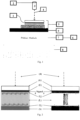
- the experimental set up of the device for detection of embedded suitably functionalized carbon nanotubes in the bilayer phospholipid biomembrane is showed in Fig. 1 .
- the device includes sensor hybrid cell 5, irradiated by solid-state laser module 3.
- the beam is modulated by function generator 2, which provides a referent signal for the nanovoltmeter 1 as well. That nanovoltmeter measures the induced electrical signals, generated from interfaces I 1 , I 2 of the sensor hybrid cell 5, via the electromagnetic echo effect.
- hybrid cell 5 The structure of hybrid cell 5 is showed with details in Fig. 2 . It includes modulated laser beam 4, glass plate G, liquid phospholipid bilayer L, interfaces I 1 , I 2 , semiconductor substrate S, electrode of the conductive layer E, outputting the obtained signal (Signal) to the voltmeter 1. If the composition of the structure of the liquid bilayer is changed, this will lead to alteration of interfaces I 1 , I 2 as well. In this way, the amplitude of the obtained signal strongly depends on the composition and the structure of that liquid bilayer.
- the liquid bilayer consists only of pure phospholipid, then there is no alteration in the amplitude of the signal and the recorded phase transition thermograms are with well-defined shape, but when suitably functionalized carbon nanotubes are embedded into phospholipid, this leads to alteration in the interfaces I 1 , I 2 from which the signal is generated. In this way, the signal measured by voltmeter 1 and the recorded thermograms from the new bionanocomposite substance reflect these alterations and in fact are a function of the concentration of the functionalized carbon nanotubes embedded into the biomembrane.
Landscapes
- Physics & Mathematics (AREA)
- Health & Medical Sciences (AREA)
- Life Sciences & Earth Sciences (AREA)
- Chemical & Material Sciences (AREA)
- Analytical Chemistry (AREA)
- Biochemistry (AREA)
- General Health & Medical Sciences (AREA)
- General Physics & Mathematics (AREA)
- Immunology (AREA)
- Pathology (AREA)
- Investigating Or Analysing Materials By Optical Means (AREA)
Abstract
Method and device for contactless detection of embedded properly functionalized carbon nanotubes in a biomembrane by means of the electromagnetic echo effect, with application in medicine, pharmacy/pharmacology and chemical technology.
Description
- The invention concerns method and device for contactless detection of embedded suitably functionalized carbon nanotubes in a biomembrane by means of the electromagnetic echo effect, with application in medicine, pharmacy/pharmacology and chemical technology.
- Phospholipids are essential building blocks of cell membranes, which separate the living unit from the surrounding environment. The phospholipid molecules consist of a phosphate-containing hydrophilic head group and two hydrophobic fatty acid chains linked by means of glycerol, thus making them more rigid. All lipids are poorly soluble in water, but due to their unique stoichiometry, they self-assemble in aqueous solutions as bilayers, with the hydrophobic tails buried in the interior of the membrane, and the polar hydrophilic head groups exposed on both sides outside in contact with the water. That hydrophobic effect lies in the basis of the formation of lipid bilayers and ensures the primary interaction between the hydrophobic phospholipid acyl chains, on one hand, and between the phospholipid acyl chains and any included in the phospholipid matrix nanoparticles, known as dopants, regardless of their nature and shape, on the other hand. [1] Such a self-assembled planar bilayer structure is a convenient model for fundamental investigations of the physicochemical processes in the biological membrane. In this way we don't need to study the physical properties and functions of the separate lipid molecule [2, 3, 4]. The Electromagnetic echo effect, which we apply for investigation of physical and structural properties of these lipid bilayers with embedded properly functionalized carbon nanotubes, requires that bio membrane to be formed on a solid substrate, which we use in the hybrid cell. Such a system provides wide and flat areas - domains, convenient for exploration/investigation by Electromagnetic echo effect. The inclusion of carbon nanotubes in phospholipid-bilayers may alter the local structure and dynamics of bio membranes [5]. Suitably functionalized carbon nanotubes with well-defined shape and size are able to create trans-membrane channels into the bio membrane [5,6]. There are couple of techniques, which could be used for investigation of structural, thermal and physicochemical properties of the model bio membrane and bio-nanocomposites such as: Differential scanning calorimetric (DSC) analysis [2,3], X-ray diffraction, Impedance spectroscopy, Raman spectroscopy and Fourier transform infrared (FTIR) spectroscopy [4].
- Comparably closer to the suggested innovation is Raman spectroscopy. That is a technique for physicochemical analysis which analyses the interaction of monochromatic light with the chemical bonds inside of different materials. The substance under investigation is subjected to an incident laser beam and the light scattered by the sample is analyzed by an embedded spectrophotometer. Such a result gives us detailed information about the substance and could be used for identification, defining the quantity, structure and chemical composition. The Raman spectra are like chemical fingerprints. There are referent libraries with already recorded spectra. In this way one could clearly distinguish one chemical component from others. That provides us with information about the investigated sample, its chemical composition, properties, polymorphism, inclusions and imperfections [7,8].
Disadvantages of this method are: - 1. The Raman spectroscopy requires registration of the scattered by that substance intensive laser light. Most of the scattered light is with the same wavelength as the incident laser light and doesn't give us useful information - it is Rayleigh scattering. Despite that small amount of light with different wavelengths (about 0,0000001%) is scattered, which depends on the chemical composition of the studied substance. Namely that is Raman scattering.
- 2. This method requires a complex technique, which needs experienced operators. It consists of components such as laser sources and optics for capturing and analyzing the scattered light from another complicated device - a spectrophotometer with a very wide band of wave lengths - from UV to Infrared regions in the electromagnetic spectrum. That involves very expensive equipment.
- 3. Very often the samples are subjected to irradiation with very intensive laser light, which leads to their degradation, because the energy of the photon is higher.
- 4. The sensor of the analyzing spectrophotometer consists of a CCD matrix, which often needs cooling. It is realized by Peltier element for temperatures down to - 90°C, but for special investigations liquid nitrogen is required.
- Some other methods and devices, which are comparable with the suggested innovation, are the two registered patents:
BG67179B1 BG67262B1 BG67179B1 - The aim of the invention is to create such method and device which are not so expensive don't need highly educated and experienced personnel for the investigations, the amplitude of the detected signal must be convenient for measurement with a simple voltmeter, the sensor cell does not need additional cooling to achieve better results. The modulated laser beam, which irradiates the sensor cell, does not need to be with high intensity.
- That aim of the invention is completed/achieved by the suggested method and apparatus for contactless detection of the presence of embedded suitably functionalized carbon nanotubes in the bilayer phospholipid bio membrane by means of measuring an electrical signal, induced in the bio nanocomposite under investigation by the electromagnetic echo effect, which depends on the structure and concentration of the embedded carbon nanotubes in the pure phospholipid.
- According to the proposed method for contactless detection of embedded suitably functionalized carbon nanotubes in the bio membrane, this is accomplished by means of the electromagnetic echo effect by measurement of the alteration in the interface of the substance under investigation, which is loaded in the hybrid cell. Initially, at room temperature the hybrid cell is loaded with suitable hydrated pure phospholipid, and it is irradiated by a modulated laser beam using one function generator. In this way, an electrical signal caused by Electromagnetic echo effect is induced and is measured by a voltmeter and recorded into thermograms of phase transition in the pure phospholipid, at different temperatures from -2°C to +48°C, achievable by means of Peltier module and thermocontroler. After that the above described procedure is repeated, but now the hybrid cell is loaded with the same amount of bionanocomposite, which is composed of a hydrated phospholipid membrane and embedded suitably functionalized carbon nanotubes, in this way the interfaces of that substance changes and that is the reason for alteration of the electrical signal, produced by the electromagnetic echo effect, which is registered at appearance of phase transition in the bionanocomposite substance under investigation at heating and as well at cooling. It is possible to make a calibration and in this way, one could obtain/measure the exact concentration of embedded functionalized carbon nanotubes in the bionanocomposite, which allows the registration of critical concentration, at which the biomembrane collapses.
- The device for contactless detection of embedded suitably functionalized carbon nanotubes in the bilayer phospholipid biomembrane by means of the electromagnetic echo effect consists of a hybrid cell which includes one transparent plate with covered conductive layer on to lower side, in contact with the upper interface of the substance under investigation, the last one being in contact trough the lower interface with the semiconductor substrate. The conductive layer by means of one electrode is connected with one voltmeter. A modulated laser beam, directed over the loaded hybrid cell is realized by means of a laser module connected with a function generator. Under that hybrid cell there is a thermally conductive plate, placed above one Peltier module, which is connected to one thermocontroller. One radiator is situated under the Peltier module.
-
-
Fig.1 is schematics of the experimental device for contactless detection of embedded suitably functionalized carbon nanotubes into bilayer phospholipid biomembrane by means of measurement of one electrical signal generated by the electromagnetic echo effect, where:- 1. Voltmeter
- 2. Function generator
- 3. Laser module
- 4. Modulated laser beam
- 5. Hybrid cell
- 6. Thermocontroller
- 7. Peltier module
- 8. Thermally conductive plate
-
Fig.2 is the structure of the sensor hybrid cell loaded with liquid bilayer for detection of embedded suitably functionalized carbon nanotubes into the bilayer phospholipid biomembrane by means of measurement of one electrical signal, generated by the electromagnetic echo effect, where:- G - glass plate
- L - bionanocomposite
- I1, I2 - interfaces
- S - semiconductor substrate
- E - conductive layer
- The method of detection of dopants in a model phospholipid biomembrane consists of the following: In the contactless detection of embedded functionalized carbon nanotubes into the biomembrane, first we load the sensor hybrid cell with emulsion of pure phospholipid, irradiate it by a modulated laser beam and after that the amplitudes of the electrical signals obtained via the electromagnetic echo effect are recorded at different temperatures. In this way, we obtain the thermograms of the characteristic biomembrane phase transition gel-liquid crystal state of the pure biomembrane, at heating and at cooling, using for that purpose only one Peltier module. After that, for the contactless detection of embedded dopants into the phospholipid biomembrane, we load again the sensor hybrid cell with the same quantity/amount of bionanocomposite consisting of hydrated mixture of pure phospholipid biomembrane and suitably functionalized carbon nanotubes. Again, we irradiate the already loaded with bionanocomposite sensor cell and the obtained electrical signals from the electromagnetic echo effect are recorded. By the amplitude of that signal and by the temperature at which the phase transition appears, it can be clearly determined if there are dopants and what their concentration into the phospholipid biomembrane is.
- One example of implementation of that method for contactless detection of embedded functionalized carbon nanotubes in a phospholipid biomembrane consists of the following operations. At first, the substance under investigation should be loaded into
hybrid cell 5, consisting of one glass plate G, covered with transparent conductive layer E, and another plate S made of semiconductor material - Si, GaAs, or GaP, both divided by means of Mylar spacers with thickness about d=20 µm (not showed inFig.2 ). That structure is placed over one thermallyconductive substrate 9, whose lower side is in contact with thePeltier module 7. Using one automatic micropipette, initially at room temperature, the hybrid cell is loaded with suitably hydrated pure phospholipid. The whole structure is irradiated by a modulatedlaser beam 4, generated by thelaser 3, connected with thefunction generator 2, the electrode of the conductive layer E from thehybrid cell 5 being connected to thenanovoltmeter 1, which registers/measures the generated electrical signal from electromagnetic echo effect. So, at this temperature, after the hybrid cell has been irradiated by the modulated laser beam, the electrical signal generated by electromagnetic echo effect is measured. After that the same signal is registered and measured at different temperatures from -2 to +48°C. In this way, the thermograms with the point of phase transition in the pure phospholipid are obtained. The temperature is adjusted by means of onePeltier module 7, which is connected to thethermocontroller 6. - The procedure described above is repeated with the same hybrid cell, but already loaded with bionanocomposite, consisting of one hydrated emulsion of phospholipid membrane and embedded inside suitably functionalized carbon nanotubes. Applying one automatic micropipette assures that the cell is loaded with the same amount of bionanocomposite substance as in the case with the pure phospholipid.
- The essence of the method for contactless detection of embedded suitably functionalized carbon nanotubes into the biomembrane is that the amplitude of the signal, generated from bionanocomposite is different from the signal from the pure phospholipid at the same temperature. Also, the shape and the point of phase transition obtained from both substances are different. All that is a consequence of the addition of embedded nanoparticles into the phospholipid biomembrane, which leads to alteration in the interfaces I1I2 After suitable calibration, the exact concentration of embedded functionalized carbon nanotubes into the biomembrane is measured, which is essential information for the bio pharmaceutical industry.

- The experimental set up of the device for detection of embedded suitably functionalized carbon nanotubes in the bilayer phospholipid biomembrane is showed in
Fig. 1 . The device includes sensorhybrid cell 5, irradiated by solid-state laser module 3. The beam is modulated byfunction generator 2, which provides a referent signal for thenanovoltmeter 1 as well. That nanovoltmeter measures the induced electrical signals, generated from interfaces I1, I2 of the sensorhybrid cell 5, via the electromagnetic echo effect. - The structure of
hybrid cell 5 is showed with details inFig. 2 . It includes modulatedlaser beam 4, glass plate G, liquid phospholipid bilayer L, interfaces I1, I2, semiconductor substrate S, electrode of the conductive layer E, outputting the obtained signal (Signal) to thevoltmeter 1. If the composition of the structure of the liquid bilayer is changed, this will lead to alteration of interfaces I1, I2 as well. In this way, the amplitude of the obtained signal strongly depends on the composition and the structure of that liquid bilayer. When the liquid bilayer consists only of pure phospholipid, then there is no alteration in the amplitude of the signal and the recorded phase transition thermograms are with well-defined shape, but when suitably functionalized carbon nanotubes are embedded into phospholipid, this leads to alteration in the interfaces I1, I2 from which the signal is generated. In this way, the signal measured byvoltmeter 1 and the recorded thermograms from the new bionanocomposite substance reflect these alterations and in fact are a function of the concentration of the functionalized carbon nanotubes embedded into the biomembrane. -
- [1] (https://www.nature.com/scitable/topicpage/cell-membranes-14052567/).
- [2] Julia Genova, Hassan Chamati, Zdravka Slavkova , Minko Petrov, Differential Scanning Calorimetric Study of the Effect of Cholesterol on the Thermotropic Phase Behavior of the Phospholipid 1-Stearoyl-2-Oleoyl-sn-Glycero-3-Phosphocholine, J Surfact Deterg (2019), DOI 10.1002/jsde.12289.
- [3] Julia Genova, Zdravka Slavkova, Hassan Chamati & Minko Petrov (2019): Gel-liquid crystal phase transition in dry and hydrated SOPC phospholipid studied by differential scanning calorimetry, Phase Transitions, Doi: 10.1080/01411594.2019.1580368 https.7/doi.org/10.1080/01411594.2019.1580368
- [4] J. Genova, M. Petrov, I. Bivas, P. Rafailov, H. Naradikian, B. Katranchev, Fourier transform infrared and Raman characterization of bilayer membranes of the phospholipid SOPC and its mixtures with cholesterol, Colloids Surf. Physicochem. Eng. Asp.557 (2018) 85e93, https://doi.org/10.1016/j.colsurfa.2018.04.044 .
- [5] Genova J, Chamati H, Petrov M, Study of SOPC with embedded pristine and amide-functionalized single wall carbon nanotubes by DSC and FTIR spectroscopy, Colloids and surfaces A: Physicochemical and Engineering Aspects (2020), Doi: https://doi.org/10.1016/j.colsurfa.2020.125261
- [6] X. Li, Y. Shi, B. Miao, Y. Zhao, Effects of Embedded Carbon Nanotube on Properties of Biomembrane, J. Phys. Chem. B. 116 (2012) 5391-5397 https://doi.org/10.1021/jp301864z.
- [7] Vandenabeele, Peter, Practical Raman Spectroscopy-An Introductio, First published:9 July 2013, Print ISBN:9780470683194 |Online ISBN:9781119961284 |DOI:10.1002/9781119961284, Copyright ⓒ 2013 John Wiley & Sons, Ltd.
- [8] Smith, Ewen. Modern Raman spectroscopy: a practical approach / Ewen Smith, Geoff Dent. p. cm. Includes bibliographical references and index. ISBN 0-471-49668-5 (cloth : alk. paper) - ISBN 0-471-49794-0 (pbk. : alk. paper) 1. Raman spectroscopy. 1. Dent, Geoffrey. II. Title. QD96.R34S58 2005 535.80 46-
dc22 2 - [9] Patent:
BG 67179 B1 issued on 16.03.2021 - [10] Patent:
BG 67262 B1 issued on 16.03.2021
Claims (2)
- Method for contactless detection of embedded functionalized carbon nanotubes into biomembrane by means of the electromagnetic echo effect and measurement of the alteration in the interface of the substance under investigation, characterized by the fact that initially at room temperature, the hybrid cell (5) is loaded with suitably hydrated pure phospholipid and irradiated with a modulated laser beam (4), generated by laser (3), modulated by function generator (2), in this way an electrical signal is induced due to the electromagnetic echo effect, which is measured by voltmeter (1) and is recorded in the thermograms of the phase transition of the pure phospholipid at different temperatures from -2°C to +48°C, controlled by the cooling-heating Peltier module (7) and the thermocontroller (6), after that the procedure described above is repeated with the same hybrid cell, but already loaded with the same amount of bionanocomposite, consisting of one hydrated emulsion of phospholipid membrane and embedded inside suitably functionalized carbon nanotubes, in which the alteration in interfaces (I1 and I2) of this substance leads to an alteration in the electrical signal from the electromagnetic echo effect and is registered exactly during the phase transition in the substance under investigation thus loaded in the hybrid cell (5) at heating as well as at cooling, and after calibration, the exact concentration of the functionalized carbon nanotubes in the biomembrane is measured.
- Device for contactless detection of embedded functionalized carbon nanotubes in the biomembrane, consisting of a hybrid cell, a laser module, a generator and a voltmeter, characterized by the fact that the cell (5) is hybrid, consisting of transparent plate (G), covered with conductive layer (E), which through its lower side is in contact with the interface (I1), borders with the bionanocomposite under investigation (L), bounded below through interface (I2) of the semiconductor substrate (S), connected by a thermally conductive substrate (9) to the upper part of one Peltier module (7), which is connected to the thermocontroller (6), and under the Peltier module radiator (8) is placed, whereby the modulated laser beam (4), which is directed over the transparent plate (G) of the loaded with the bionanocomposite (L) hybrid cell (5), is realized by laser module (3), which is connected to the function generator (2), and through electrode of the conductive layer (E) adherent to the hybrid cell (5) is connected to the voltmeter (1) by which the signal from the electromagnetic echo effect is registered.
Applications Claiming Priority (1)
| Application Number | Priority Date | Filing Date | Title |
|---|---|---|---|
| BG11377723 | 2023-09-13 |
Publications (1)
| Publication Number | Publication Date |
|---|---|
| EP4524548A1 true EP4524548A1 (en) | 2025-03-19 |
Family
ID=94686935
Family Applications (1)
| Application Number | Title | Priority Date | Filing Date |
|---|---|---|---|
| EP23472009.2A Pending EP4524548A1 (en) | 2023-09-13 | 2023-11-14 | Method and device for contactless detection of embedded functionalized carbon nanotubes in a biomembrane |
Country Status (1)
| Country | Link |
|---|---|
| EP (1) | EP4524548A1 (en) |
Citations (2)
| Publication number | Priority date | Publication date | Assignee | Title |
|---|---|---|---|---|
| BG112488A (en) * | 2017-04-13 | 2018-10-31 | Институт По Физика На Твърдото Тяло "Акад. Г. Наджаков" - Бан | Contact-free detection of phase transitions in liquid crystal media by laser-induced surface photoelectric effect through electrical signal measurement |
| BG67262B1 (en) | 2017-10-20 | 2021-02-26 | Институт По Физика На Твърдото Тяло "Академик Георги Наджаков"-Бан | Optimization of fog purification properties via a sensor operating on the basis of a laser induced photo-charge effect by measuring electric signals |
-
2023
- 2023-11-14 EP EP23472009.2A patent/EP4524548A1/en active Pending
Patent Citations (3)
| Publication number | Priority date | Publication date | Assignee | Title |
|---|---|---|---|---|
| BG112488A (en) * | 2017-04-13 | 2018-10-31 | Институт По Физика На Твърдото Тяло "Акад. Г. Наджаков" - Бан | Contact-free detection of phase transitions in liquid crystal media by laser-induced surface photoelectric effect through electrical signal measurement |
| BG67179B1 (en) | 2017-04-13 | 2020-10-30 | Институт По Физика На Твърдото Тяло "Акад. Г. Наджаков" - Бан | Method for contact-free detection of phase transitions in liquid crystal media by laser-induced surface photo-charge effect through electrical signal measurement and device according to the method thereof |
| BG67262B1 (en) | 2017-10-20 | 2021-02-26 | Институт По Физика На Твърдото Тяло "Академик Георги Наджаков"-Бан | Optimization of fog purification properties via a sensor operating on the basis of a laser induced photo-charge effect by measuring electric signals |
Non-Patent Citations (8)
| Title |
|---|
| GENOVA JCHAMATI HPETROV M: "Study of SOPC with embedded pristine and amide-functionalized single wall carbon nanotubes by DSC and FTIR spectroscopy", COLLOIDS AND SURFACES A: PHYSICOCHEMICAL AND ENGINEERING ASPECTS, 2020, Retrieved from the Internet <URL:https://doi.Org/10.1016/j.colsurfa.2020.125261> |
| J. GENOVA: "Study of SOPC with embedded pristine and amide-functionalized single wall carbon nanotubes by DSC and FTIR spectroscopy", COLLOIDS AND SURFACES A : PHYSIOCHEMICAL AND ENGINEERINGS ASPECTS, vol. 603, 3 July 2020 (2020-07-03), AMSTERDAM, NL, pages 125261, XP093155228, ISSN: 0927-7757, Retrieved from the Internet <URL:https://pdf.sciencedirectassets.com/271384/1-s2.0-S0927775720X00161/1-s2.0-S0927775720308542/main.pdf?X-Amz-Security-Token=IQoJb3JpZ2luX2VjED8aCXVzLWVhc3QtMSJHMEUCIBN3ky8+icDsNiAQRQJlqGzwGYMv0Yxx2GFh4on7EI95AiEA68Jb+xytqbC/wZhIplX1roQDYCP2kiZt1OrjYM3JvcsquwUIiP//////////ARAFGgwwNTkwMDM1NDY4NjUiDCDHf> [retrieved on 20240424], DOI: 10.1016/j.colsurfa.2020.125261 * |
| J. GENOVAM. PETROVI. BIVASP. RAFAILOVH. NARADIKIANB. KATRANCHEV: "Fourier transform infrared and Raman characterization of bilayer membranes of the phospholipid SOPC and its mixtures with cholesterol", COLLOIDS SURF. PHYSICOCHEM. ENG. ASP, vol. 557, 2018, pages 85 - 93, XP085500207, DOI: 10.1016/j.colsurfa.2018.04.044 |
| JULIA GENOVAHASSAN CHAMATIZDRAVKA SLAVKOVAMINKO PETROV: "Differential Scanning Calorimetric Study of the Effect of Cholesterol on the Thermotropic Phase Behavior of the Phospholipid 1-Stearoyl-2-Oleoyl-sn-Glycero-3-Phosphocholine", J SURFACT DETERG, 2019 |
| JULIA GENOVAZDRAVKA SLAVKOVAHASSAN CHAMATIMINKO PETROV: "Gel-liquid crystal phase transition in dry and hydrated SOPC phospholipid studied by differential scanning calorimetry", PHASE TRANSITIONS, 2019 |
| SMITH, EWEN: "Modern Raman spectroscopy: a practical approach / Ewen Smith, Geoff Dent. p. cm. Includes bibliographical references and index", RAMAN SPECTROSCOPY, vol. 1 |
| VANDENABEELEPETER: "Practical Raman Spectroscopy-An Introductio", 9 July 2013, JOHN WILEY & SONS, LTD |
| X. LIY. SHIB. MIAOY. ZHAO: "Effects of Embedded Carbon Nanotube on Properties of Biomembrane", J. PHYS. CHEM. B., vol. 116, 2012, pages 5391 - 5397, Retrieved from the Internet <URL:https://doi.org/10.1021/jp301864z> |
Similar Documents
| Publication | Publication Date | Title |
|---|---|---|
| Guo et al. | Preparation and application of microfluidic SERS substrate: Challenges and future perspectives | |
| US12607599B2 (en) | Method and apparatus for detecting particles, like biological macromolecules or nanoparticles | |
| Kaltenecker et al. | Infrared-spectroscopic, dynamic near-field microscopy of living cells and nanoparticles in water | |
| Kabashin et al. | Plasmonic nanorod metamaterials for biosensing | |
| GB2525854B (en) | Sensing methods and apparatus | |
| Wang et al. | Imaging grain microstructure in a model ceramic energy material with optically generated coherent acoustic phonons | |
| JP2006064691A (en) | Sensing device | |
| Humbert et al. | Optical spectroscopy of functionalized gold nanoparticles assemblies as a function of the surface coverage | |
| Polonschii et al. | High-resolution impedance mapping using electrically activated quantitative phase imaging | |
| WO2023090421A1 (en) | Method for generating spectral data pertaining to microparticle sample, method for analyzing microparticles, method for distinguishing microparticles, method for assessing whether cancer-cell-derived exosomes are present, substrate for measuring spectrum of microparticles, device for measuring spectrum of microparticles, and apparatus for measuring spectrum of microparticles | |
| Kumar et al. | Study on transport of molecules in gel by surface-enhanced Raman spectroscopy | |
| Yao et al. | Development of an innovative reusable terahertz biosensor platform integrated graphene and all-silicon groove for detecting cancer cells in aqueous environments | |
| EP4524548A1 (en) | Method and device for contactless detection of embedded functionalized carbon nanotubes in a biomembrane | |
| Bolarinho et al. | Background-free mid-infrared photothermal microscopy via single-shot measurement of thermal decay | |
| Lo Faro et al. | Surface-enhanced Raman scattering for biosensing platforms: a review | |
| Bertrand | Advantages of phase analysis in Fourier transform infrared photoacoustic spectroscopy | |
| Han et al. | Immiscible Oil–Water Interface: Dual Function of Electrokinetic Concentration of Charged Molecules and Optical Detection with Interfacially Trapped Gold Nanorods | |
| Nourbakhsh et al. | A sensitive surface-plasmon-resonance (SPR)-immunosensor based on multilayers of graphene oxide and gold nanoparticles for epidermal growth factor receptor detection | |
| BG113777A (en) | METHOD AND DEVICE FOR CONTACTLESS DETECTION OF EMBEDDED FUNCTIONALIZED NANOTUBE INTO THE BIOMEMBRANE | |
| CN104568850B (en) | A kind of computing chip Imaging biological sensing platform using surface plasma chip | |
| Kallay et al. | Techniques for the Study of Adsorption from Solution | |
| Morsin et al. | Development of plasmonic sensor for detection of toxic materials | |
| Ivanov et al. | Possibility to create a coronavirus sensor using an optically excited electrical signal | |
| Gotter et al. | Photothermal imaging in 3D surface analysis of membrane drug delivery | |
| JP6468572B2 (en) | Measuring method and measuring apparatus using array type sensor using enhanced electromagnetic field |
Legal Events
| Date | Code | Title | Description |
|---|---|---|---|
| STAA | Information on the status of an ep patent application or granted ep patent |
Free format text: STATUS: UNKNOWN |
|
| PUAI | Public reference made under article 153(3) epc to a published international application that has entered the european phase |
Free format text: ORIGINAL CODE: 0009012 |
|
| STAA | Information on the status of an ep patent application or granted ep patent |
Free format text: STATUS: THE APPLICATION HAS BEEN PUBLISHED |
|
| AK | Designated contracting states |
Kind code of ref document: A1 Designated state(s): AL AT BE BG CH CY CZ DE DK EE ES FI FR GB GR HR HU IE IS IT LI LT LU LV MC ME MK MT NL NO PL PT RO RS SE SI SK SM TR |
|
| STAA | Information on the status of an ep patent application or granted ep patent |
Free format text: STATUS: REQUEST FOR EXAMINATION WAS MADE |
|
| 17P | Request for examination filed |
Effective date: 20250912 |