EP4524376A1 - Spacers, structural support systems, and methods of use thereof - Google Patents
Spacers, structural support systems, and methods of use thereof Download PDFInfo
- Publication number
- EP4524376A1 EP4524376A1 EP24195888.3A EP24195888A EP4524376A1 EP 4524376 A1 EP4524376 A1 EP 4524376A1 EP 24195888 A EP24195888 A EP 24195888A EP 4524376 A1 EP4524376 A1 EP 4524376A1
- Authority
- EP
- European Patent Office
- Prior art keywords
- flange
- spacer
- fastener
- hole
- shank
- Prior art date
- Legal status (The legal status is an assumption and is not a legal conclusion. Google has not performed a legal analysis and makes no representation as to the accuracy of the status listed.)
- Pending
Links
Images



Classifications
-
- F—MECHANICAL ENGINEERING; LIGHTING; HEATING; WEAPONS; BLASTING
- F01—MACHINES OR ENGINES IN GENERAL; ENGINE PLANTS IN GENERAL; STEAM ENGINES
- F01D—NON-POSITIVE DISPLACEMENT MACHINES OR ENGINES, e.g. STEAM TURBINES
- F01D25/00—Component parts, details, or accessories, not provided for in, or of interest apart from, other groups
- F01D25/24—Casings; Casing parts, e.g. diaphragms, casing fastenings
- F01D25/243—Flange connections; Bolting arrangements
-
- F—MECHANICAL ENGINEERING; LIGHTING; HEATING; WEAPONS; BLASTING
- F01—MACHINES OR ENGINES IN GENERAL; ENGINE PLANTS IN GENERAL; STEAM ENGINES
- F01D—NON-POSITIVE DISPLACEMENT MACHINES OR ENGINES, e.g. STEAM TURBINES
- F01D21/00—Shutting-down of machines or engines, e.g. in emergency; Regulating, controlling, or safety means not otherwise provided for
- F01D21/04—Shutting-down of machines or engines, e.g. in emergency; Regulating, controlling, or safety means not otherwise provided for responsive to undesired position of rotor relative to stator or to breaking-off of a part of the rotor, e.g. indicating such position
- F01D21/045—Shutting-down of machines or engines, e.g. in emergency; Regulating, controlling, or safety means not otherwise provided for responsive to undesired position of rotor relative to stator or to breaking-off of a part of the rotor, e.g. indicating such position special arrangements in stators or in rotors dealing with breaking-off of part of rotor
-
- F—MECHANICAL ENGINEERING; LIGHTING; HEATING; WEAPONS; BLASTING
- F16—ENGINEERING ELEMENTS AND UNITS; GENERAL MEASURES FOR PRODUCING AND MAINTAINING EFFECTIVE FUNCTIONING OF MACHINES OR INSTALLATIONS; THERMAL INSULATION IN GENERAL
- F16B—DEVICES FOR FASTENING OR SECURING CONSTRUCTIONAL ELEMENTS OR MACHINE PARTS TOGETHER, e.g. NAILS, BOLTS, CIRCLIPS, CLAMPS, CLIPS OR WEDGES; JOINTS OR JOINTING
- F16B5/00—Joining sheets or plates, e.g. panels, to one another or to strips or bars parallel to them
- F16B5/02—Joining sheets or plates, e.g. panels, to one another or to strips or bars parallel to them by means of fastening members using screw-thread
- F16B5/0258—Joining sheets or plates, e.g. panels, to one another or to strips or bars parallel to them by means of fastening members using screw-thread using resiliently deformable sleeves, grommets or inserts
-
- F—MECHANICAL ENGINEERING; LIGHTING; HEATING; WEAPONS; BLASTING
- F05—INDEXING SCHEMES RELATING TO ENGINES OR PUMPS IN VARIOUS SUBCLASSES OF CLASSES F01-F04
- F05D—INDEXING SCHEME FOR ASPECTS RELATING TO NON-POSITIVE-DISPLACEMENT MACHINES OR ENGINES, GAS-TURBINES OR JET-PROPULSION PLANTS
- F05D2260/00—Function
- F05D2260/30—Retaining components in desired mutual position
- F05D2260/31—Retaining bolts or nuts
-
- F—MECHANICAL ENGINEERING; LIGHTING; HEATING; WEAPONS; BLASTING
- F05—INDEXING SCHEMES RELATING TO ENGINES OR PUMPS IN VARIOUS SUBCLASSES OF CLASSES F01-F04
- F05D—INDEXING SCHEME FOR ASPECTS RELATING TO NON-POSITIVE-DISPLACEMENT MACHINES OR ENGINES, GAS-TURBINES OR JET-PROPULSION PLANTS
- F05D2300/00—Materials; Properties thereof
- F05D2300/50—Intrinsic material properties or characteristics
- F05D2300/505—Shape memory behaviour
Definitions
- the present invention generally relates to gas turbine engines, and more particularly relates to structural support systems configured to reduce vibrations in gas turbine engines that occur after a fan blade out event.
- an unlikely event referred to as a "fan blade out” (FBO) event
- FBO fan blade out
- the gas turbine engine is rapidly decelerated, where the rotor speed drops suddenly from the normal flight operating rotation speed down to a windmilling speed.
- Modern gas turbine engines include robust containment structures around the fan section to prevent the broken fan blades from penetrating other engine components or escaping from the engine casing.
- FBO events due to the severity of postulated FBO events, there is an ongoing desire to further enhance the reliability and safety of gas turbine engines.
- other desirable features and characteristics of the present invention will become apparent from the subsequent detailed description and the appended claims, taken in conjunction with the accompanying drawings and the foregoing technical field and background.
- a spacer in various embodiments, includes a body having oppositely disposed first and second ends, cylindrical sidewalls extending between the first and second ends, and radially outward extending flanges at the first and second ends. Inner surfaces of the sidewalls define a longitudinal bore with openings at each of the first and second ends. The bore is configured to receive therethrough a shank of a fastener such that the body is secured between a head of the fastener and a structure to which the fastener is secured.
- the body of the spacer is formed from a super-elastic shape memory alloy that allows the sidewalls to undergo recoverable deformation without failing when at or above a transformation temperature of the super-elastic shape memory alloy.
- the sidewalls have an initial shape prior to undergoing deformation and are configured to undergo the recoverable deformation when a load transmitted through the sidewalls exceeds a first load threshold and recover back to the initial shape once the load drops below a second load threshold that is less than the first load threshold.
- a structural support system for a gas turbine engine includes a first flange having a first hole, a second flange having a second hole, a fastener configured to secure the first flange and the second flange to each other by inserting a shank of the fastener through the aligned first hole and second hole and securing the shank therein, and a spacer that includes a body having oppositely disposed first and second ends, cylindrical sidewalls extending between the first and second ends, and radially outward extending flanges at the first and second ends. Inner surfaces of the sidewalls define a longitudinal bore with openings at each of the first and second ends.
- the bore is configured to receive therethrough the shank of the fastener such that the body is secured between the first flange and a head of the fastener while the first flange and the second flange are secured to each other with the fastener.
- the body of the spacer is formed from a super-elastic shape memory alloy that allows the sidewalls to undergo recoverable deformation without failing when at or above a transformation temperature of the super-elastic shape memory alloy.
- the sidewalls have an initial shape prior to undergoing deformation and are configured to undergo the recoverable deformation when a load transmitted through the sidewalls exceeds a first load threshold and recover back to the initial shape once the load drops below a second load threshold that is less than the first load threshold.
- a method in various embodiments, includes locating a first flange having a first hole in proximity to a second flange having a second hole such that the first hole and the second hole are aligned, inserting a shank of a fastener into a longitudinal bore of a spacer, the longitudinal bore defined by inner surfaces cylindrical sidewalls of the spacer extending between oppositely disposed first and second ends of the spacer, inserting the shank of the fastener through the aligned first hole and second hole, and securing the shank therein to thereby secure the first flange and the second flange to each other, wherein the spacer is located between the first flange and a head of the fastener while the first flange and the second flange are secured to each other with the fastener.
- the spacer is formed from a super-elastic shape memory alloy that allows the sidewalls to undergo recoverable deformation without failing when at or above a transformation temperature of the super-elastic shape memory alloy.
- the sidewalls have an initial shape prior to undergoing deformation and are configured to undergo the recoverable deformation when a load transmitted through the sidewalls exceeds a first load threshold and recover back to the initial shape once the load drops below a second load threshold that is less than the first load threshold.
- embodiments of the present disclosure include structural support systems for gas turbine engines.
- the structural support systems are configured to maintain components in fixed relative locations during normal operation of the gas turbine engines, reduce loads applied to rotating components during high loading conditions (e.g., fan blade out (FBO) event), and reduce vibrations once the high loading conditions cease (e.g., post-FBO event windmilling).
- high loading conditions e.g., fan blade out (FBO) event
- FBO fan blade out
- the gas turbine engine 100 is a component of an aircraft's propulsion system. It includes an aerodynamically smooth outer covering referred to as a nacelle cowling 102 that wraps around and substantially encases internal components of the gas turbine engine 100.
- the nacelle cowling 102 is typically wider at the front or inlet end 200 of the gas turbine engine 100 and narrower at the back or exhaust end 202 of the gas turbine engine 100.
- a nacelle inlet assembly 204 circumscribes the inlet cavity 112 and is radially spaced from an engine centerline (for example engine centerline 300 of FIG. 3 ).
- a subcomponent of the nacelle inlet assembly 204 is a nacelle inlet forward compartment 106.
- the engine fan assembly 104 includes a plurality of fan blades 108 that are attached to, and extend radially out from, a fan rotor hub 110 centered within inlet cavity 112.
- an engine fan housing structure 206 is attached to the nacelle cowling 102.
- FIG. 3 is a cross-sectional view of a front portion of the gas turbine engine 100 shown in FIGS. 1 and 2 . Only the upper half of the gas turbine engine 100, delineated by centerline 300, is shown for clarity.
- the nacelle inlet assembly 204 comprises a number of separate, but detachable, parts including nacelle inlet outer skin 302 and the nacelle inlet forward compartment 106.
- the nacelle inlet outer skin 302, a subcomponent of nacelle cowling 102 is detachably coupled to the engine fan housing structure 206 at, for example, an aft bulkhead 306 by fasteners 308.
- the nacelle inlet forward compartment 106 is coupled to nacelle inlet outer skin 302 at the forward bulkhead 305.
- the nacelle inlet outer skin 302 is coupled to nacelle cowling 102.
- the engine fan assembly 104 including the fan rotor hub 110 and a plurality of the fan blades 108 (only one of which is shown in FIG. 3 ), is positioned for rotation such that the tips of the fan blades 108 are accommodated within a fan containment structure 310 that is positioned circumferentially around the fan rotor hub 110 to protect the aircraft from damage by the fan blades 108.
- FIGS. 4 and 5 an exemplary portion of a structural support system 400 of the gas turbine engine 100 is provided.
- the exemplary portion of the structural support system 400 shown in FIGS. 4 and 5 includes a first flange 410, a second flange 420, a fastener 430, a nut 440, and a spacer 450.
- the first flange 410 and the second flange 420 may be portions of various components within the gas turbine engine 100.
- the first flange 410 is a forward end of a containment housing (e.g., the engine fan housing structure 206) and the second flange 420 is an aft end of a nacelle inlet assembly (e.g., the nacelle inlet assembly 204).
- a containment housing e.g., the engine fan housing structure 206
- the second flange 420 is an aft end of a nacelle inlet assembly (e.g., the nacelle inlet assembly 204).
- a nacelle inlet assembly e.g., the nacelle inlet assembly 204
- the first flange 410 includes a first hole 412 and the second flange 420 includes a second hole 422.
- the first flange 410 and the second flange 420 are located in proximity to each other such that the first hole 412 and the second hole 422 are aligned along respective central axes thereof.
- the fastener 430 includes an elongated shank 432 with a head 434 on a first end thereof.
- the spacer 450 includes a body having oppositely disposed first and second ends, cylindrical sidewalls 452 extending between the first and second ends, and radially outward extending flanges 454 and 456 at the first and second ends, respectively. Inner surfaces of the sidewalls 452 define a longitudinal bore with openings at each of the first and second ends.
- the shank 432 of the fastener 430 is located within and through the longitudinal bore of the spacer 450 and within and through the first hole 412 of the first flange 410 and the second hole 422 of the second flange 420 with a second end of the shank 432 protruding from the second hole 422 on a distal side of the second flange 420.
- the nut 440 is secured to the second end of the shank 432 to fix the first flange 410 and the second flange 420 in intimate contact with each other.
- the shank 432 of the fastener 430 includes threads and the nut 440 is configured to threadedly and releasably secure to the second end of the shank 432.
- the fastener 430 and the nut 440 are configured to retain the first flange 410 and the second flange 420 on the shank 432 of the fastener 430 during operation of the gas turbine engine 100.
- the relative positions of the first flange 410 and the second flange 420 on the shank 432 are determined primarily by the spacer 450 and may vary based on the conditions of the gas turbine engine 100.
- the spacer 450 is configured to maintain the first flange 410 and the second flange 420 in first relative fixed positions, for example, in contact with each other, during normal operation of the gas turbine engine 100.
- the spacer 450 is configured to compress or otherwise change shape to allow the first flange 410 and the second flange 420 to be transition to second relative positions spaced apart on the shank 432 of the fastener 430.
- the spacer 450 is configured to return to its initial shape and size and thereby force the first flange 410 and the second flange 420 toward each other on the shank 432 of the fastener 430.
- the spacer 450 may force the first flange 410 and the second flange 420 to return to their first relative fixed positions, for example, contacting each other. For example, FIG.
- FIG. 4 presents the spacer 450 in an initial shape and FIG. 5 presents the spacer 450 in a deformed shape. While in the deformed shape ( FIG. 5 ), a longitudinal dimension of the spacer 450 is reduced by a first dimension D s relative to the initial shape, and therefore the first flange 410 and the second flange 420 are able to separate along the shank 432 by up to a second dimension D f . In some embodiments, D s may be substantially equal to D f . Upon a reduction of the load, the spacer 450 may return to its initial shape as presented in FIG. 4 .
- the body of the spacer 450 is formed from or includes a super-elastic shape memory alloy (SMA) that allows the sidewalls 452 to undergo recoverable deformation at high loads without failing.
- SMAs have the capability to be deformed and then subsequently return to a pre-deformed shape. This capability relates to the SMAs transitioning between two different phases (and three different crystal structures) in response to temperature and loading conditions.
- the spacer 450 is entirely formed of an SMA.
- the spacer 450 includes a combination of an SMA and a non-SMA material (e.g., an aluminum alloy).
- the sidewalls 452 are formed of an SMA and the flanges 454 and 456 are formed of a non-SMA material.
- the phase transformation of SMAs is temperature and stress dependent. Below a transformation temperature of the SMA, the material is in the martensite phase. Application of a mechanical load in this state may cause deformation which is maintained after release of the mechanical load. Upon sufficient heating of the SMA, the material transitions to the austenite phase and the deformation is recovered. This characteristic of SMAs is referred to herein as a shape memory effect. Above the transformation temperature, the SMA is in the austenite phase. When a load above a certain value is applied in this state, the deformation causes a stress-induced phase transformation from the austenite phase to a deformed martensite phase. When the applied stress is removed, the SMA transitions to the austenite phase and reverts its initial shape.
- the transformation temperature (A f ) may be a temperature at which the SMA completes a transition from martensite to austenite with no load applied thereto.
- the spacer 450 takes advantage of the pseudoelastic effect of SMAs and is configured to undergo recoverable deformation while above the transformation temperature.
- FIG. 12 provides an example stress-strain curve illustrating the material properties of a suitable super-elastic shape memory alloy above its transformation temperature.
- a first load threshold defined by points a and b in FIG. 12
- the SMA may undergo a large strain, thereby allowing the SMA to deform and provide reduced stiffness.
- point a in FIG. 12 represents the start of the solid-solid phase transformation from austenite to martensite
- point b in FIG. 12 represents the end of this solid-solid phase transformation.
- the SMA may recover all the strain once the load drops below a second load threshold (defined by points d and e' in FIG.
- point d in FIG. 12 represents the start of the reverse phase transformation from martensite to austenite
- point e' represents the end of this reverse phase transformation.
- the material properties of the SMA used herein for the spacer 450 may be selected such that the first load threshold (defined by points a and b in FIG. 12 ) is less than a predetermined load threshold at which the first flange 410, the second flange 420, and/or the fastener 430 are configured to fail.
- the sidewalls 452 of the spacer 450 can be configured to have an initial shape prior to undergoing deformation, configured to undergo the recoverable deformation when a load transmitted through the sidewalls 452 exceeds the first load threshold, and configured to recover back to the initial shape once the load drops below the second load threshold.
- the first load threshold may be higher than the second load threshold.
- the spacer 450 may be formed of various SMAs including, but not limited to, a nickel-titanium (NiTi) alloy, a nickel-titanium-hafnium (NiTiHf) alloy, a nickel-titanium-vanadium (NiTiVd) alloy, a nickeltitanium-palladium (NiTiPd) alloy, a nickel-titanium-copper (NiTiCu), a nickel-titanium-niobium (NiTiNb) alloy, a nickel-aluminum-copper (Ni-Al-Cu) alloy, a titanium-niobium (Ti-Nb) alloy, a copper-zinc-aluminum (CuZnAI) alloy, and a copper-aluminum-beryllium (CuAlBe) alloy.
- NiTi nickel-titanium
- NiTiHf nickel-titanium-hafnium
- the spacer 450 may be formed of a nickel-titanium (NiTi) alloy having a transformation temperature of about -20 °C to 110 °C, a first threshold of about 500 to 700 megapascals (MPa), and a second threshold of about 250 to 450 MPa.
- NiTi nickel-titanium
- FIGS. 6, 7 , 8, and 9 present spacers 600, 700, 800, and 1100 in accordance with various aspects described herein.
- the spacers 600, 700, 800, and 1100 are formed of SMAs and configured to function as previously described in reference to the spacer 450 of FIGS. 4 and 5 .
- the spacers 600, 700, 800, and 1100 are merely exemplary and the spacers, systems, and methods disclosed herein are not limited to the examples of FIGS. 6, 7 , 8, and 9 .
- the spacer 600 includes a body having a cylindrical sidewall 612 extending between first and second ends.
- a first radially outward extending flange 614 is located at the first end and a second radially outward extending flange 616 is located at the second end.
- Inner surfaces 618 define a longitudinal bore that extends between openings at the first end and the second end.
- a pattern of adjacent elongated slots 622 are formed in and spaced apart about the cylindrical sidewalls 612. Each of the slots 622 extend at least partly between the first end and the second end.
- the slots 622 define therebetween sidewall members 620. Upon high loading conditions, the sidewall members 620 may preferentially deform to reduce the longitudinal dimension of the spacer 600.
- the sidewall members 620 may bend radially outward during high loading conditions and then return to their initial straight shapes once the loading sufficiently decreases.
- the longitudinal length, transverse widths, and radial thicknesses of the sidewall members 620 may be configured to provide specific, predetermined values or ranges for the first threshold and the second threshold.
- the spacer 700 includes a body having a cylindrical sidewall 712 extending between first and second ends.
- a first radially outward extending flange 714 is located at the first end and a second radially outward extending flange 716 is located at the second end.
- Inner surfaces 718 define a longitudinal bore that extends between openings at the first end and the second end.
- a pattern of adjacent elongated slots 722 are formed in and spaced apart about the cylindrical sidewalls 712. Each of the slots 722 extend at least partly between the first end and the second end.
- Each of the slots 722 have a first end and a second end that are longitudinally offset from each other such that central axes of each of the slots 722 are not parallel to a central longitudinal axis of the longitudinal bore.
- the slots 722 define therebetween sidewall members 720.
- the sidewall members 720 may preferentially deform to reduce the longitudinal dimension of the spacer 700.
- the sidewall members 720 may bend radially outward during high loading conditions and then return to their initial straight shapes once the loading sufficiently decreases.
- the sidewalls 712 may twist in response to the sidewall members 720 bending radially outward.
- the longitudinal length, transverse widths, radial thicknesses, and the offset of the first and second ends of the sidewall members 720 may be adjusted to provide specific, predetermined values or ranges for the first threshold and the second threshold.
- the spacer 800 includes a body having a cylindrical sidewall 812 extending between first and second ends.
- a first radially outward extending flange 814 is located at the first end and a second radially outward extending flange 816 is located at the second end.
- Inner surfaces 818 define a longitudinal bore that extends between openings at the first end and the second end.
- a pattern or an array of holes 822 is formed in the cylindrical sidewalls 812. The holes 822 may optionally be equidistantly spaced apart.
- the holes 822 define therebetween sidewall members 820. Upon high loading conditions, the sidewall members 820 may preferentially deform to reduce the longitudinal dimension of the spacer 800.
- the sidewall members 820 may bend radially outward during high loading conditions and then return to their initial shapes once the loading sufficiently decreases.
- the diameters, quantity, and spacing of the holes 822 as well as the radial thicknesses of the sidewall members 820 may be adjusted to provide specific, predetermined values or ranges for the first threshold and the second threshold.
- the spacer 1100 includes a body having a curved or bowed (convex or radially outwardly protruding) cylindrical sidewall 1112 extending between first and second ends.
- a first radially outward extending flange 1114 is located at the first end and a second radially outward extending flange 1116 is located at the second end.
- Inner surfaces 1118 define a longitudinal bore that extends between openings at the first end and the second end.
- a pattern of adjacent elongated slots 1122 are formed in and spaced apart about the cylindrical sidewalls 1112. Each of the slots 1122 extend at least partly between the first end and the second end.
- the slots 1122 define therebetween sidewall members 1120.
- the sidewall members 1120 may preferentially deform to reduce the longitudinal dimension of the spacer 1100. For example, the sidewall members 1120 may bend radially outward during high loading conditions and then return to their curved or bowed shapes once the loading sufficiently decreases.
- the longitudinal length, transverse widths, angle of curvature, and radial thicknesses of the sidewall members 1120 may be configured to provide specific, predetermined values or ranges for the first threshold and the second threshold.
- a component interface 900 is presented that includes a pair of cylindrical flanges (only a first flange 910 shown) that are coupled via a plurality of fasteners (not shown for clarity) secured within a plurality of holes on each of the pair of flanges.
- the pair of cylindrical flanges may be components within the gas turbine engine 100.
- Each of the fasteners include a first spacer 920 or a second spacer 930 secured thereon as described in reference to the spacer 450 of FIGS. 4 and 5 .
- the first spacers 920 are formed of an SMA as previously described and the second spacers 930 are formed of a material that is not an SMA (e.g., an aluminum alloy such as Al 6061-T6).
- the first spacers 920 and the second spacers 930 may deform to reduce load transfer through the component interface 900. Once the loading conditions sufficiently reduce, the first spacers 920 may return to their initial shape and thereby apply compressive forces on the pair of flanges. In contrast, the second spacers 930 plastically deformed and remain in the deformed state upon reduction of the loading conditions.
- first spacers 920 and the second spacers 930 are arranged in an alternating pattern about the component interface 900.
- component interfaces may include any number of the first spacers 920 and any number of the second spacers 930, the first spacers 920 and the second spacers 930 may be arranged in any pattern, and additional spacers formed of other materials or having other structural configurations may be incorporated. In this manner, the compressive forces applied to the pair of flanges prior to and subsequent to high loading conditions may be selectively tailored.
- spacers formed of SMAs may provide various benefits in certain applications.
- the spacers formed of non-SMA materials may resist deformation at higher loads, may resist deformation more predictably, or may provide another beneficial property.
- the spacers formed of non-SMA materials may be used to control the deformation load of the flange interface structure. The spacers formed of SMAs may then be used to apply the post-high loading condition compressive forces to, for example, reduce vibrations in the gas turbine engine 100.
- the component interface 900 may correspond to a nacelle inlet an interface between a fan inlet and a fan containment housing of a gas turbine engine.
- high load conditions may cause the first spacers 920 and the second spacers 930 to be crushed. This may desirable, for example, to prevent damage to other component of the gas turbine engine.
- the first spacers 920 return to their initial shape whereas the second spacers 930 remain crushed.
- the gas turbine engine only included the second spacers 930 and did not have at least some of the first spacers 920, then the remaining axial play of the components on the fasteners (that is, the space available on the shank for the components to move) may have the potential to cause significant vibration and/or dangling during the remainder of flight which in turn may cause failure of the component interface 900.
- the presence of the first spacers 920 provides for at least some compressive forces to be reapplied to the component interface 900 thereby reducing the likelihood of the significant vibration and/or dangling caused by the axial play which would otherwise be present.
- FIG. 11 is a flowchart illustrating an exemplary method 1000.
- the method 1000 may start at 1010.
- the method 1000 may include locating a first flange having a first hole in proximity to a second flange having a second hole such that the first hole and the second hole are aligned.
- the method 1000 may include providing a spacer formed of an SMA.
- Providing the spacer may include manufacturing the spacer by one or more of various processes (e.g., casting, machining, finishing, etc.). Such processes are generally known in the art and will not be discussed in detail herein.
- the spacer may be formed of one or more of various SMAs including those described herein.
- the method 1000 may include inserting a shank of a fastener, such as a bolt, into a longitudinal bore of the spacer.
- the method 1000 may include inserting the shank of the fastener through the aligned first hole and second hole of the first flange and the second flange, respectively.
- the spacer is located between a face or surface of the first flange and a head of the fastener while the first flange and the second flange are secured to each other with the fastener.
- the method 1000 may include securing the shank in the aligned first hole and the second hole to thereby secure the first flange and the second flange to each other.
- the fastener may be secured by various means such as, but not limited to, a threadedly coupled nut.
- the method 1000 may optionally include repeating steps 1014-1020 with additional fasteners and spacers to secure additional aligned holes of the first flange and the second flange with the additional fasteners having the additional spacers thereon.
- each of the additional spacers are formed of either SMA or a non-SMA material.
- all of the additional spacers are formed of an SMA.
- at least one of the additional spacers is formed of a material that is not and does not include an SMA.
- the method 1000 may include inserting a shank of a second fastener into a longitudinal bore of a second spacer, the longitudinal bore defined by inner surfaces cylindrical sidewalls of the second spacer extending between oppositely disposed first and second ends of the second spacer, inserting the shank of the second fastener through a third hole of the first flange and a fourth hole of the second flange that is aligned with the third hole of the first flange, and securing the shank of the second fastener in the third hole and the fourth hole to secure the third flange and the fourth flange to each other.
- the second spacer may be located between the third flange and a head of the fastener, and may be formed of a material that is not an SMA.
- the method 1000 may end at 1024.
- the first flange and the second flange are parts of a gas turbine engine.
- the method 1000 may include operating the gas turbine engine in a first manner that imparts a first load on the spacer that exceeds the first load threshold causing the spacer to undergo recoverable deformation and allowing the first and second flanges to partially separate along the shank of the fastener.
- the method 1000 may further include operating the gas turbine engine in a second manner that imparts a second load on the spacer that is less than the second threshold causing the spacer to recover back to the initial shape and thereby causing the first and second flanges to contact and be fixed relative to each other along the shank of the fastener.
- the spacers of the structural systems provide for applying subsequent to high loading conditions which may limit or reduce the likelihood of vibrations.
- the term “axial” refers to a direction that is generally parallel to or coincident with an axis of rotation, axis of symmetry, or centerline of a component or components.
- the "axial" direction may refer to the direction that generally extends in parallel to the centerline between the opposite ends or faces.
- the term “axial” may be utilized with respect to components that are not cylindrical (or otherwise radially symmetric).
- the "axial" direction for a rectangular housing containing a rotating shaft may be viewed as a direction that is generally parallel to or coincident with the rotational axis of the shaft.
- radially may refer to a direction or a relationship of components with respect to a line extending outward from a shared centerline, axis, or similar reference, for example in a plane of a cylinder or disc that is perpendicular to the centerline or axis.
- components may be viewed as “radially” aligned even though one or both of the components may not be cylindrical (or otherwise radially symmetric).
- the terms “axial” and “radial” (and any derivatives) may encompass directional relationships that are other than precisely aligned with (e.g., oblique to) the true axial and radial dimensions, provided the relationship is predominantly in the respective nominal axial or radial direction.
- the term “substantially” denotes within 5% to account for manufacturing tolerances.
- the term “about” denotes within 5% to account for manufacturing tolerances.
Landscapes
- Engineering & Computer Science (AREA)
- General Engineering & Computer Science (AREA)
- Mechanical Engineering (AREA)
- Connection Of Plates (AREA)
Abstract
Description
- This application claims priority to
India Provisional Patent Application No. 202311061253, filed September 12, 2023 - The present invention generally relates to gas turbine engines, and more particularly relates to structural support systems configured to reduce vibrations in gas turbine engines that occur after a fan blade out event.
- During operation of a gas turbine engine, an unlikely event, referred to as a "fan blade out" (FBO) event, could occur and refers to a highly unlikely situation where one or more fan blades break or detach from the fan rotor. Upon detection of an unlikely FBO event, the gas turbine engine is rapidly decelerated, where the rotor speed drops suddenly from the normal flight operating rotation speed down to a windmilling speed.
- Should an unlikely FBO event occur, it can have serious implications for the engine's performance. The sudden loss of a fan blade disrupts the balance and aerodynamics of the rotating fan assembly, leading to an imbalance in the engine. The uneven distribution of forces can cause severe vibrations, which may lead to additional mechanical failures or damage to other engine components.
- Modern gas turbine engines include robust containment structures around the fan section to prevent the broken fan blades from penetrating other engine components or escaping from the engine casing. However, due to the severity of postulated FBO events, there is an ongoing desire to further enhance the reliability and safety of gas turbine engines. Furthermore, other desirable features and characteristics of the present invention will become apparent from the subsequent detailed description and the appended claims, taken in conjunction with the accompanying drawings and the foregoing technical field and background.
- This summary is provided to describe select concepts in a simplified form that are further described in the Detailed Description. This summary is not intended to identify key or essential features of the claimed subject matter, nor is it intended to be used as an aid in determining the scope of the claimed subject matter.
- In various embodiments, a spacer is provided that includes a body having oppositely disposed first and second ends, cylindrical sidewalls extending between the first and second ends, and radially outward extending flanges at the first and second ends. Inner surfaces of the sidewalls define a longitudinal bore with openings at each of the first and second ends. The bore is configured to receive therethrough a shank of a fastener such that the body is secured between a head of the fastener and a structure to which the fastener is secured. The body of the spacer is formed from a super-elastic shape memory alloy that allows the sidewalls to undergo recoverable deformation without failing when at or above a transformation temperature of the super-elastic shape memory alloy. The sidewalls have an initial shape prior to undergoing deformation and are configured to undergo the recoverable deformation when a load transmitted through the sidewalls exceeds a first load threshold and recover back to the initial shape once the load drops below a second load threshold that is less than the first load threshold.
- In various embodiments, a structural support system for a gas turbine engine is provided that includes a first flange having a first hole, a second flange having a second hole, a fastener configured to secure the first flange and the second flange to each other by inserting a shank of the fastener through the aligned first hole and second hole and securing the shank therein, and a spacer that includes a body having oppositely disposed first and second ends, cylindrical sidewalls extending between the first and second ends, and radially outward extending flanges at the first and second ends. Inner surfaces of the sidewalls define a longitudinal bore with openings at each of the first and second ends. The bore is configured to receive therethrough the shank of the fastener such that the body is secured between the first flange and a head of the fastener while the first flange and the second flange are secured to each other with the fastener. The body of the spacer is formed from a super-elastic shape memory alloy that allows the sidewalls to undergo recoverable deformation without failing when at or above a transformation temperature of the super-elastic shape memory alloy. The sidewalls have an initial shape prior to undergoing deformation and are configured to undergo the recoverable deformation when a load transmitted through the sidewalls exceeds a first load threshold and recover back to the initial shape once the load drops below a second load threshold that is less than the first load threshold.
- In various embodiments, a method is provided that includes locating a first flange having a first hole in proximity to a second flange having a second hole such that the first hole and the second hole are aligned, inserting a shank of a fastener into a longitudinal bore of a spacer, the longitudinal bore defined by inner surfaces cylindrical sidewalls of the spacer extending between oppositely disposed first and second ends of the spacer, inserting the shank of the fastener through the aligned first hole and second hole, and securing the shank therein to thereby secure the first flange and the second flange to each other, wherein the spacer is located between the first flange and a head of the fastener while the first flange and the second flange are secured to each other with the fastener. The spacer is formed from a super-elastic shape memory alloy that allows the sidewalls to undergo recoverable deformation without failing when at or above a transformation temperature of the super-elastic shape memory alloy. The sidewalls have an initial shape prior to undergoing deformation and are configured to undergo the recoverable deformation when a load transmitted through the sidewalls exceeds a first load threshold and recover back to the initial shape once the load drops below a second load threshold that is less than the first load threshold.
- Furthermore, other desirable features and characteristics of the spacer, the structural support system, and the method will become apparent from the subsequent detailed description and the appended claims, taken in conjunction with the accompanying drawings and the preceding background.
- The present disclosure will hereinafter be described in conjunction with the following drawing figures, wherein like numerals denote like elements, and wherein:
-
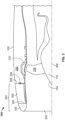
FIGS. 1 and 2 are front and side views of a turbofan gas turbine engine in accordance with an embodiment; -
FIG. 3 is a partial cross-sectional view of the turbofan gas turbine engine ofFIGS. 1 and 2 and representing certain components thereof in accordance with an embodiment; -
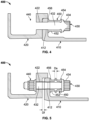
FIG. 4 is an isolated view of components of a structural support system of a gas turbine engine in accordance with an embodiment; -
FIG. 5 is an isolated view of the components of the structural support system ofFIG. 4 with a spacer thereof in a deformed state in accordance with an embodiment; -
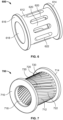
FIGS. 6, 7 ,8, 9 are perspective views of spacers in accordance with embodiments; -
FIG. 10 is an end view of a component interface that includes a plurality of spacers about a circumference thereof in accordance with an embodiment; -
FIG. 11 is a flowchart illustrating an exemplary method for coupling components of a gas turbine engine in accordance with an embodiment; and -
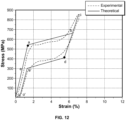
FIG. 12 is a plot representing a relationship between stress and strain of a shape memory alloy during loading and unloading above a transition temperature thereof in accordance with an embodiment. - The following detailed description is merely exemplary in nature and is not intended to limit the invention or the application and uses of the invention. As used herein, the word "exemplary" means "serving as an example, instance, or illustration." Thus, any embodiment described herein as "exemplary" is not necessarily to be construed as preferred or advantageous over other embodiments. All of the embodiments described herein are exemplary embodiments provided to enable persons skilled in the art to make or use the invention and not to limit the scope of the invention which is defined by the claims. Furthermore, there is no intention to be bound by any expressed or implied theory presented in the preceding technical field, background, brief summary, or the following detailed description.
- Broadly, embodiments of the present disclosure include structural support systems for gas turbine engines. The structural support systems are configured to maintain components in fixed relative locations during normal operation of the gas turbine engines, reduce loads applied to rotating components during high loading conditions (e.g., fan blade out (FBO) event), and reduce vibrations once the high loading conditions cease (e.g., post-FBO event windmilling).
- Referring to
FIG. 1 , a cross-sectional view of an exemplary turbofangas turbine engine 100 is illustrated. Thegas turbine engine 100 is a component of an aircraft's propulsion system. It includes an aerodynamically smooth outer covering referred to as a nacelle cowling 102 that wraps around and substantially encases internal components of thegas turbine engine 100. Thenacelle cowling 102 is typically wider at the front or inletend 200 of thegas turbine engine 100 and narrower at the back orexhaust end 202 of thegas turbine engine 100. Anacelle inlet assembly 204 circumscribes theinlet cavity 112 and is radially spaced from an engine centerline (forexample engine centerline 300 ofFIG. 3 ). A subcomponent of thenacelle inlet assembly 204 is a nacelle inletforward compartment 106. Theengine fan assembly 104 includes a plurality offan blades 108 that are attached to, and extend radially out from, afan rotor hub 110 centered withininlet cavity 112. In various embodiments, an enginefan housing structure 206 is attached to thenacelle cowling 102. -
FIG. 3 is a cross-sectional view of a front portion of thegas turbine engine 100 shown inFIGS. 1 and 2 . Only the upper half of thegas turbine engine 100, delineated bycenterline 300, is shown for clarity. As can be seen, thenacelle inlet assembly 204 comprises a number of separate, but detachable, parts including nacelle inletouter skin 302 and the nacelle inletforward compartment 106. The nacelle inletouter skin 302, a subcomponent ofnacelle cowling 102 is detachably coupled to the enginefan housing structure 206 at, for example, anaft bulkhead 306 byfasteners 308. The nacelle inletforward compartment 106 is coupled to nacelle inletouter skin 302 at theforward bulkhead 305. The nacelle inletouter skin 302 is coupled to nacelle cowling 102. Theengine fan assembly 104, including thefan rotor hub 110 and a plurality of the fan blades 108 (only one of which is shown inFIG. 3 ), is positioned for rotation such that the tips of thefan blades 108 are accommodated within afan containment structure 310 that is positioned circumferentially around thefan rotor hub 110 to protect the aircraft from damage by thefan blades 108. - Referring now to
FIGS. 4 and 5 , an exemplary portion of astructural support system 400 of thegas turbine engine 100 is provided. The exemplary portion of thestructural support system 400 shown inFIGS. 4 and 5 includes afirst flange 410, asecond flange 420, afastener 430, anut 440, and aspacer 450. Thefirst flange 410 and thesecond flange 420 may be portions of various components within thegas turbine engine 100. In various embodiments, thefirst flange 410 is a forward end of a containment housing (e.g., the engine fan housing structure 206) and thesecond flange 420 is an aft end of a nacelle inlet assembly (e.g., the nacelle inlet assembly 204). It should be understood that the exemplary portion of thegas turbine engine 100 presented inFIGS. 4 and 5 are merely exemplary, and the teachings herein are applicable to other portions of thegas turbine engine 100, including portions wherein a fastener couples components without flanges. In addition, the teachings disclosed herein may be suitable for use in applications other than coupling components within a gas turbine engine. - Referring again to
FIG. 4 , thefirst flange 410 includes afirst hole 412 and thesecond flange 420 includes asecond hole 422. Thefirst flange 410 and thesecond flange 420 are located in proximity to each other such that thefirst hole 412 and thesecond hole 422 are aligned along respective central axes thereof. Thefastener 430 includes anelongated shank 432 with ahead 434 on a first end thereof. Thespacer 450 includes a body having oppositely disposed first and second ends,cylindrical sidewalls 452 extending between the first and second ends, and radially outward extendingflanges sidewalls 452 define a longitudinal bore with openings at each of the first and second ends. - The
shank 432 of thefastener 430 is located within and through the longitudinal bore of thespacer 450 and within and through thefirst hole 412 of thefirst flange 410 and thesecond hole 422 of thesecond flange 420 with a second end of theshank 432 protruding from thesecond hole 422 on a distal side of thesecond flange 420. Thenut 440 is secured to the second end of theshank 432 to fix thefirst flange 410 and thesecond flange 420 in intimate contact with each other. In some embodiments, theshank 432 of thefastener 430 includes threads and thenut 440 is configured to threadedly and releasably secure to the second end of theshank 432. - In this arrangement, the
fastener 430 and thenut 440 are configured to retain thefirst flange 410 and thesecond flange 420 on theshank 432 of thefastener 430 during operation of thegas turbine engine 100. However, the relative positions of thefirst flange 410 and thesecond flange 420 on theshank 432 are determined primarily by thespacer 450 and may vary based on the conditions of thegas turbine engine 100. Specifically, thespacer 450 is configured to maintain thefirst flange 410 and thesecond flange 420 in first relative fixed positions, for example, in contact with each other, during normal operation of thegas turbine engine 100. In the event of high loading conditions, such as an FBO event, thespacer 450 is configured to compress or otherwise change shape to allow thefirst flange 410 and thesecond flange 420 to be transition to second relative positions spaced apart on theshank 432 of thefastener 430. After the high loading conditions end, thespacer 450 is configured to return to its initial shape and size and thereby force thefirst flange 410 and thesecond flange 420 toward each other on theshank 432 of thefastener 430. In various embodiments, upon returning to the initial shape, thespacer 450 may force thefirst flange 410 and thesecond flange 420 to return to their first relative fixed positions, for example, contacting each other. For example,FIG. 4 presents thespacer 450 in an initial shape andFIG. 5 presents thespacer 450 in a deformed shape. While in the deformed shape (FIG. 5 ), a longitudinal dimension of thespacer 450 is reduced by a first dimension Ds relative to the initial shape, and therefore thefirst flange 410 and thesecond flange 420 are able to separate along theshank 432 by up to a second dimension Df. In some embodiments, Ds may be substantially equal to Df. Upon a reduction of the load, thespacer 450 may return to its initial shape as presented inFIG. 4 . - In various embodiments, to achieve such functionality the body of the
spacer 450 is formed from or includes a super-elastic shape memory alloy (SMA) that allows thesidewalls 452 to undergo recoverable deformation at high loads without failing. SMAs have the capability to be deformed and then subsequently return to a pre-deformed shape. This capability relates to the SMAs transitioning between two different phases (and three different crystal structures) in response to temperature and loading conditions. In some embodiments, thespacer 450 is entirely formed of an SMA. In some embodiments, thespacer 450 includes a combination of an SMA and a non-SMA material (e.g., an aluminum alloy). In some embodiments, thesidewalls 452 are formed of an SMA and theflanges - The phase transformation of SMAs is temperature and stress dependent. Below a transformation temperature of the SMA, the material is in the martensite phase. Application of a mechanical load in this state may cause deformation which is maintained after release of the mechanical load. Upon sufficient heating of the SMA, the material transitions to the austenite phase and the deformation is recovered. This characteristic of SMAs is referred to herein as a shape memory effect. Above the transformation temperature, the SMA is in the austenite phase. When a load above a certain value is applied in this state, the deformation causes a stress-induced phase transformation from the austenite phase to a deformed martensite phase. When the applied stress is removed, the SMA transitions to the austenite phase and reverts its initial shape. This characteristic of SMAs is referred to herein as a pseudoelastic effect (or super-elastic effect). The transformation temperature (Af) may be a temperature at which the SMA completes a transition from martensite to austenite with no load applied thereto. The
spacer 450 takes advantage of the pseudoelastic effect of SMAs and is configured to undergo recoverable deformation while above the transformation temperature. -
FIG. 12 provides an example stress-strain curve illustrating the material properties of a suitable super-elastic shape memory alloy above its transformation temperature. As shown, upon application of a load at or in excess of a first load threshold (defined by points a and b inFIG. 12 ), the SMA may undergo a large strain, thereby allowing the SMA to deform and provide reduced stiffness. In this regard, point a inFIG. 12 represents the start of the solid-solid phase transformation from austenite to martensite, and point b inFIG. 12 represents the end of this solid-solid phase transformation. Additionally, the SMA may recover all the strain once the load drops below a second load threshold (defined by points d and e' inFIG. 12 ), thereby allowing the SMA to return back to its initial shape and provide increased stiffness. In this regard, point d inFIG. 12 represents the start of the reverse phase transformation from martensite to austenite, and point e' represents the end of this reverse phase transformation. It should be appreciated that the material properties of the SMA used herein for thespacer 450 may be selected such that the first load threshold (defined by points a and b inFIG. 12 ) is less than a predetermined load threshold at which thefirst flange 410, thesecond flange 420, and/or thefastener 430 are configured to fail. - By forming the
spacer 450 from a SMA, thesidewalls 452 of thespacer 450 can be configured to have an initial shape prior to undergoing deformation, configured to undergo the recoverable deformation when a load transmitted through thesidewalls 452 exceeds the first load threshold, and configured to recover back to the initial shape once the load drops below the second load threshold. Notably, the first load threshold may be higher than the second load threshold. - The
spacer 450 may be formed of various SMAs including, but not limited to, a nickel-titanium (NiTi) alloy, a nickel-titanium-hafnium (NiTiHf) alloy, a nickel-titanium-vanadium (NiTiVd) alloy, a nickeltitanium-palladium (NiTiPd) alloy, a nickel-titanium-copper (NiTiCu), a nickel-titanium-niobium (NiTiNb) alloy, a nickel-aluminum-copper (Ni-Al-Cu) alloy, a titanium-niobium (Ti-Nb) alloy, a copper-zinc-aluminum (CuZnAI) alloy, and a copper-aluminum-beryllium (CuAlBe) alloy. In various embodiments, thespacer 450 may be formed of a nickel-titanium (NiTi) alloy having a transformation temperature of about -20 °C to 110 °C, a first threshold of about 500 to 700 megapascals (MPa), and a second threshold of about 250 to 450 MPa. - The
sidewalls 452 of thespacer 450 may be solid or may include one or more radial openings. As examples,FIGS. 6, 7 ,8, and 9 present spacers spacers spacer 450 ofFIGS. 4 and 5 . Thespacers FIGS. 6, 7 ,8, and 9 . - Referring now to
FIG. 6 , thespacer 600 includes a body having acylindrical sidewall 612 extending between first and second ends. A first radially outward extendingflange 614 is located at the first end and a second radially outward extendingflange 616 is located at the second end.Inner surfaces 618 define a longitudinal bore that extends between openings at the first end and the second end. A pattern of adjacentelongated slots 622 are formed in and spaced apart about thecylindrical sidewalls 612. Each of theslots 622 extend at least partly between the first end and the second end. Theslots 622 definetherebetween sidewall members 620. Upon high loading conditions, thesidewall members 620 may preferentially deform to reduce the longitudinal dimension of thespacer 600. For example, thesidewall members 620 may bend radially outward during high loading conditions and then return to their initial straight shapes once the loading sufficiently decreases. The longitudinal length, transverse widths, and radial thicknesses of thesidewall members 620 may be configured to provide specific, predetermined values or ranges for the first threshold and the second threshold. - Referring now to
FIG. 7 , thespacer 700 includes a body having acylindrical sidewall 712 extending between first and second ends. A first radially outward extendingflange 714 is located at the first end and a second radially outward extendingflange 716 is located at the second end.Inner surfaces 718 define a longitudinal bore that extends between openings at the first end and the second end. A pattern of adjacentelongated slots 722 are formed in and spaced apart about thecylindrical sidewalls 712. Each of theslots 722 extend at least partly between the first end and the second end. Each of theslots 722 have a first end and a second end that are longitudinally offset from each other such that central axes of each of theslots 722 are not parallel to a central longitudinal axis of the longitudinal bore. Theslots 722 definetherebetween sidewall members 720. Upon high loading conditions, thesidewall members 720 may preferentially deform to reduce the longitudinal dimension of thespacer 700. For example, thesidewall members 720 may bend radially outward during high loading conditions and then return to their initial straight shapes once the loading sufficiently decreases. In addition, due to the arrangement of thesidewall members 720, thesidewalls 712 may twist in response to thesidewall members 720 bending radially outward. The longitudinal length, transverse widths, radial thicknesses, and the offset of the first and second ends of thesidewall members 720 may be adjusted to provide specific, predetermined values or ranges for the first threshold and the second threshold. - Referring now to
FIG. 8 , thespacer 800 includes a body having acylindrical sidewall 812 extending between first and second ends. A first radially outward extendingflange 814 is located at the first end and a second radially outward extendingflange 816 is located at the second end.Inner surfaces 818 define a longitudinal bore that extends between openings at the first end and the second end. A pattern or an array ofholes 822 is formed in the cylindrical sidewalls 812.Theholes 822 may optionally be equidistantly spaced apart. Theholes 822 definetherebetween sidewall members 820. Upon high loading conditions, thesidewall members 820 may preferentially deform to reduce the longitudinal dimension of thespacer 800. For example, thesidewall members 820 may bend radially outward during high loading conditions and then return to their initial shapes once the loading sufficiently decreases. The diameters, quantity, and spacing of theholes 822 as well as the radial thicknesses of thesidewall members 820 may be adjusted to provide specific, predetermined values or ranges for the first threshold and the second threshold. - Referring now to
FIG. 9 , thespacer 1100 includes a body having a curved or bowed (convex or radially outwardly protruding)cylindrical sidewall 1112 extending between first and second ends. A first radially outward extendingflange 1114 is located at the first end and a second radially outward extendingflange 1116 is located at the second end.Inner surfaces 1118 define a longitudinal bore that extends between openings at the first end and the second end. A pattern of adjacentelongated slots 1122 are formed in and spaced apart about thecylindrical sidewalls 1112. Each of theslots 1122 extend at least partly between the first end and the second end. Theslots 1122 definetherebetween sidewall members 1120. Upon high loading conditions, thesidewall members 1120 may preferentially deform to reduce the longitudinal dimension of thespacer 1100. For example, thesidewall members 1120 may bend radially outward during high loading conditions and then return to their curved or bowed shapes once the loading sufficiently decreases. The longitudinal length, transverse widths, angle of curvature, and radial thicknesses of thesidewall members 1120 may be configured to provide specific, predetermined values or ranges for the first threshold and the second threshold. - Referring now to
FIG. 10 , acomponent interface 900 is presented that includes a pair of cylindrical flanges (only afirst flange 910 shown) that are coupled via a plurality of fasteners (not shown for clarity) secured within a plurality of holes on each of the pair of flanges. In various embodiments, the pair of cylindrical flanges may be components within thegas turbine engine 100. Each of the fasteners include afirst spacer 920 or asecond spacer 930 secured thereon as described in reference to thespacer 450 ofFIGS. 4 and 5 . Thefirst spacers 920 are formed of an SMA as previously described and thesecond spacers 930 are formed of a material that is not an SMA (e.g., an aluminum alloy such as Al 6061-T6). Upon high loading conditions, thefirst spacers 920 and thesecond spacers 930 may deform to reduce load transfer through thecomponent interface 900. Once the loading conditions sufficiently reduce, thefirst spacers 920 may return to their initial shape and thereby apply compressive forces on the pair of flanges. In contrast, thesecond spacers 930 plastically deformed and remain in the deformed state upon reduction of the loading conditions. - In this example, an equal number of the
first spacers 920 and thesecond spacers 930 are arranged in an alternating pattern about thecomponent interface 900. However, component interfaces may include any number of thefirst spacers 920 and any number of thesecond spacers 930, thefirst spacers 920 and thesecond spacers 930 may be arranged in any pattern, and additional spacers formed of other materials or having other structural configurations may be incorporated. In this manner, the compressive forces applied to the pair of flanges prior to and subsequent to high loading conditions may be selectively tailored. - Combinations of spacers formed of SMAs (e.g., the spacers 920) and spacers formed of non-SMA materials (e.g., the spacers 930) may provide various benefits in certain applications. For example, the spacers formed of non-SMA materials may resist deformation at higher loads, may resist deformation more predictably, or may provide another beneficial property. In such instances, the spacers formed of non-SMA materials may be used to control the deformation load of the flange interface structure. The spacers formed of SMAs may then be used to apply the post-high loading condition compressive forces to, for example, reduce vibrations in the
gas turbine engine 100. - As a specific but nonlimiting example, the
component interface 900 may correspond to a nacelle inlet an interface between a fan inlet and a fan containment housing of a gas turbine engine. In an FBO event, high load conditions may cause thefirst spacers 920 and thesecond spacers 930 to be crushed. This may desirable, for example, to prevent damage to other component of the gas turbine engine. After the engine fan assembly rotation has been reduced to a windmilling speed, thefirst spacers 920 return to their initial shape whereas thesecond spacers 930 remain crushed. If the gas turbine engine only included thesecond spacers 930 and did not have at least some of thefirst spacers 920, then the remaining axial play of the components on the fasteners (that is, the space available on the shank for the components to move) may have the potential to cause significant vibration and/or dangling during the remainder of flight which in turn may cause failure of thecomponent interface 900. In contrast, the presence of thefirst spacers 920 provides for at least some compressive forces to be reapplied to thecomponent interface 900 thereby reducing the likelihood of the significant vibration and/or dangling caused by the axial play which would otherwise be present. - The systems disclosed herein, including the
structural support system 400, provide for methods of coupling components. For example,FIG. 11 is a flowchart illustrating anexemplary method 1000. Themethod 1000 may start at 1010. At 1012, themethod 1000 may include locating a first flange having a first hole in proximity to a second flange having a second hole such that the first hole and the second hole are aligned. - At 1014, the
method 1000 may include providing a spacer formed of an SMA. Providing the spacer may include manufacturing the spacer by one or more of various processes (e.g., casting, machining, finishing, etc.). Such processes are generally known in the art and will not be discussed in detail herein. The spacer may be formed of one or more of various SMAs including those described herein. - At 1016, the
method 1000 may include inserting a shank of a fastener, such as a bolt, into a longitudinal bore of the spacer. At 1018, themethod 1000 may include inserting the shank of the fastener through the aligned first hole and second hole of the first flange and the second flange, respectively. In this arrangement, the spacer is located between a face or surface of the first flange and a head of the fastener while the first flange and the second flange are secured to each other with the fastener. At 1020, themethod 1000 may include securing the shank in the aligned first hole and the second hole to thereby secure the first flange and the second flange to each other. The fastener may be secured by various means such as, but not limited to, a threadedly coupled nut. - At 1022, the
method 1000 may optionally include repeating steps 1014-1020 with additional fasteners and spacers to secure additional aligned holes of the first flange and the second flange with the additional fasteners having the additional spacers thereon. In such embodiments, each of the additional spacers are formed of either SMA or a non-SMA material. In some embodiments, all of the additional spacers are formed of an SMA. In some embodiments, at least one of the additional spacers is formed of a material that is not and does not include an SMA. - In a specific embodiment, the
method 1000 may include inserting a shank of a second fastener into a longitudinal bore of a second spacer, the longitudinal bore defined by inner surfaces cylindrical sidewalls of the second spacer extending between oppositely disposed first and second ends of the second spacer, inserting the shank of the second fastener through a third hole of the first flange and a fourth hole of the second flange that is aligned with the third hole of the first flange, and securing the shank of the second fastener in the third hole and the fourth hole to secure the third flange and the fourth flange to each other. The second spacer may be located between the third flange and a head of the fastener, and may be formed of a material that is not an SMA. - The
method 1000 may end at 1024. - In various embodiments, the first flange and the second flange are parts of a gas turbine engine. In such embodiments, the
method 1000 may include operating the gas turbine engine in a first manner that imparts a first load on the spacer that exceeds the first load threshold causing the spacer to undergo recoverable deformation and allowing the first and second flanges to partially separate along the shank of the fastener. Themethod 1000 may further include operating the gas turbine engine in a second manner that imparts a second load on the spacer that is less than the second threshold causing the spacer to recover back to the initial shape and thereby causing the first and second flanges to contact and be fixed relative to each other along the shank of the fastener. - The systems and methods disclosed herein provide various benefits over certain existing systems and methods. For example, the spacers of the structural systems provide for applying subsequent to high loading conditions which may limit or reduce the likelihood of vibrations.
- In this document, relational terms such as first and second, and the like may be used solely to distinguish one entity or action from another entity or action without necessarily requiring or implying any actual such relationship or order between such entities or actions. Numerical ordinals such as "first," "second," "third," etc. simply denote different singles of a plurality and do not imply any order or sequence unless specifically defined by the claim language. The sequence of the text in any of the claims does not imply that process steps must be performed in a temporal or logical order according to such sequence unless it is specifically defined by the language of the claim. The process steps may be interchanged in any order without departing from the scope of the invention as long as such an interchange does not contradict the claim language and is not logically nonsensical.
- Furthermore, depending on the context, words such as "connect" or "coupled to" used in describing a relationship between different elements do not imply that a direct physical connection must be made between these elements. For example, two elements may be connected to each other physically, electronically, logically, or in any other manner, through one or more additional elements.
- As used herein, the term "axial" refers to a direction that is generally parallel to or coincident with an axis of rotation, axis of symmetry, or centerline of a component or components. For example, in a cylinder or disc with a centerline and generally circular ends or opposing faces, the "axial" direction may refer to the direction that generally extends in parallel to the centerline between the opposite ends or faces. In certain instances, the term "axial" may be utilized with respect to components that are not cylindrical (or otherwise radially symmetric). For example, the "axial" direction for a rectangular housing containing a rotating shaft may be viewed as a direction that is generally parallel to or coincident with the rotational axis of the shaft. Furthermore, the term "radially" as used herein may refer to a direction or a relationship of components with respect to a line extending outward from a shared centerline, axis, or similar reference, for example in a plane of a cylinder or disc that is perpendicular to the centerline or axis. In certain instances, components may be viewed as "radially" aligned even though one or both of the components may not be cylindrical (or otherwise radially symmetric). Furthermore, the terms "axial" and "radial" (and any derivatives) may encompass directional relationships that are other than precisely aligned with (e.g., oblique to) the true axial and radial dimensions, provided the relationship is predominantly in the respective nominal axial or radial direction. As used herein, the term "substantially" denotes within 5% to account for manufacturing tolerances. Also, as used herein, the term "about" denotes within 5% to account for manufacturing tolerances.
- While at least one exemplary embodiment has been presented in the foregoing detailed description of the invention, it should be appreciated that a vast number of variations exist. It should also be appreciated that the exemplary embodiment or exemplary embodiments are only examples, and are not intended to limit the scope, applicability, or configuration of the invention in any way. Rather, the foregoing detailed description will provide those skilled in the art with a convenient road map for implementing an exemplary embodiment of the invention. It being understood that various changes may be made in the function and arrangement of elements described in an exemplary embodiment without departing from the scope of the invention as set forth in the appended claims.
Claims (15)
- A spacer comprising a body having oppositely disposed first and second ends, cylindrical sidewalls extending between the first and second ends, and radially outward extending flanges at the first and second ends, wherein inner surfaces of the sidewalls define a longitudinal bore with openings at each of the first and second ends, wherein the longitudinal bore is configured to receive therethrough a shank of a fastener such that the body is secured between the a head of the fastener and a structure to which the fastener is secured, wherein the body of the spacer is formed from a super-elastic shape memory alloy that allows the sidewalls to undergo recoverable deformation without failing when at or above a transformation temperature of the super-elastic shape memory alloy, wherein the sidewalls have an initial shape prior to undergoing deformation and are configured to undergo the recoverable deformation when a load transmitted through the sidewalls exceeds a first load threshold and recover back to the initial shape once the load drops below a second load threshold that is less than the first load threshold.
- The spacer of claim 1, wherein the first load threshold is between 500 and 700 MPA and the second load threshold is between 250 and 450 MPa.
- The spacer of claim 1, further comprising one or more radial openings in the cylindrical sidewalls.
- The spacer of claim 3, wherein the one or more radial openings include an array of holes equidistantly spaced apart about the cylindrical sidewalls.
- The spacer of claim 3, wherein the one or more radial openings include adjacent slots spaced apart about the cylindrical sidewalls and each extending between the first and second ends.
- The spacer of claim 5, wherein each of the slots have a first end and a second end that are longitudinally offset from each other such that central axes of each of the slots are not parallel to a central longitudinal axis of the longitudinal bore.
- The spacer of claim 1, further comprising:a first flange having a first hole;a second flange having a second hole; anda fastener configured to secure the first flange and the second flange to each other by inserting a shank of the fastener through the first hole and the second hole while the first hole and the second hole are aligned and securing the shank therein;wherein the longitudinal bore of the spacer is configured to receive therethrough the shank of the fastener such that the body is secured between the first flange and a head of the fastener while the first flange and the second flange are secured to each other with the fastener.
- The structural support system of claim 7, wherein the first hole is a first of a plurality of holes in the first flange, the second hole is a first of a plurality of holes in the second flange, the fastener is a first of a plurality of fasteners configured to be received in a respective one of the plurality of holes to secure the first flange to the second flange, and the spacer is a first of a plurality of spacers configured to be located on the shank of a respective one of the plurality of fasteners while the first flange and the second flange are secured therewith, wherein at least some of the plurality of spacers are formed of a material that is not a super-elastic shape memory alloy.
- The structural support system of claim 7, wherein the first load threshold is less than a third load threshold corresponding to a load capable of damaging the first flange or the second flange.
- A method, comprising:locating a first flange having a first hole in proximity to a second flange having a second hole such that the first hole and the second hole are aligned;inserting a shank of a fastener into a longitudinal bore of a spacer, the longitudinal bore defined by inner surfaces cylindrical sidewalls of the spacer extending between oppositely disposed first and second ends of the spacer;inserting the shank of the fastener through the first hole and the second hole while the first hole and the second hole are aligned; andsecuring the shank therein to thereby secure the first flange and the second flange to each other, wherein the spacer is located between the first flange and a head of the fastener while the first flange and the second flange are secured to each other with the fastener,wherein the spacer is formed from a super-elastic shape memory alloy that allows the sidewalls to undergo recoverable deformation without failing when at or above a transformation temperature of the super-elastic shape memory alloy, wherein the sidewalls have an initial shape prior to undergoing deformation and are configured to undergo the recoverable deformation when a load transmitted through the sidewalls exceeds a first load threshold and recover back to the initial shape once the load drops below a second load threshold that is less than the first load threshold.
- The method of claim 10, wherein the first and second flanges are parts of a gas turbine engine, the method comprising:operating the gas turbine engine in a first manner that imparts a first load on the spacer that exceeds the first load threshold causing the spacer to undergo the recoverable deformation and allowing the first and second flanges to partially separate along the shank of the fastener; andoperating the gas turbine engine in a second manner that imparts a second load on the spacer that is less than the second load threshold causing the spacer to recover back to the initial shape and thereby causing the first and second flanges to contact and be fixed relative to each other along the shank of the fastener.
- The method of claim 11, wherein the first load threshold is less than a third load threshold corresponding to a load capable of damaging the first flange or the second flange.
- The method of claim 11, wherein the first load threshold is between 500 and 700 MPA and the second load threshold is between 250 and 450 MPa.
- The method of claim 10, further comprising:inserting a shank of a second fastener into a longitudinal bore of a second spacer, the longitudinal bore defined by inner surfaces of the cylindrical sidewalls of the second spacer extending between oppositely disposed first and second ends of the second spacer;inserting the shank of the second fastener through a third hole of the first flange and a fourth hole of the second flange that is aligned with the third hole of the first flange; andsecuring the shank of the second fastener in the third hole and the fourth hole to secure the first flange and the second flange to each other, wherein the second spacer is located between the first flange and a head of the second fastener,wherein the second spacer is formed of a material that is not a super-elastic shape memory alloy.
- The method of claim 10, wherein the spacer includes one or more radial openings in the cylindrical sidewalls.
Applications Claiming Priority (2)
| Application Number | Priority Date | Filing Date | Title |
|---|---|---|---|
| IN202311061253 | 2023-09-12 | ||
| US18/494,032 US12163439B1 (en) | 2023-09-12 | 2023-10-25 | Spacers, structural support systems, and methods of use thereof |
Publications (1)
| Publication Number | Publication Date |
|---|---|
| EP4524376A1 true EP4524376A1 (en) | 2025-03-19 |
Family
ID=92538684
Family Applications (1)
| Application Number | Title | Priority Date | Filing Date |
|---|---|---|---|
| EP24195888.3A Pending EP4524376A1 (en) | 2023-09-12 | 2024-08-22 | Spacers, structural support systems, and methods of use thereof |
Country Status (1)
| Country | Link |
|---|---|
| EP (1) | EP4524376A1 (en) |
Citations (3)
| Publication number | Priority date | Publication date | Assignee | Title |
|---|---|---|---|---|
| JPH05332337A (en) * | 1992-05-29 | 1993-12-14 | Furukawa Electric Co Ltd:The | Connecting fixture and connecting method thereof |
| JP2007269282A (en) * | 2006-03-31 | 2007-10-18 | Jtekt Corp | Wheel mounting structure |
| US10113602B2 (en) * | 2016-06-12 | 2018-10-30 | The Boeing Company | Load controlling bolted flange deformable spacers |
-
2024
- 2024-08-22 EP EP24195888.3A patent/EP4524376A1/en active Pending
Patent Citations (3)
| Publication number | Priority date | Publication date | Assignee | Title |
|---|---|---|---|---|
| JPH05332337A (en) * | 1992-05-29 | 1993-12-14 | Furukawa Electric Co Ltd:The | Connecting fixture and connecting method thereof |
| JP2007269282A (en) * | 2006-03-31 | 2007-10-18 | Jtekt Corp | Wheel mounting structure |
| US10113602B2 (en) * | 2016-06-12 | 2018-10-30 | The Boeing Company | Load controlling bolted flange deformable spacers |
Similar Documents
| Publication | Publication Date | Title |
|---|---|---|
| CN115379986B (en) | Fan rotor with variable pitch blades and turbine equipped with such a rotor | |
| US8277188B2 (en) | Turbomachine rotor disk | |
| US8133011B2 (en) | Device for stiffening the stator of a turbomachine and application to aircraft engines | |
| JP4802192B2 (en) | Turbine case reinforcement in gas turbine jet engines. | |
| US11479104B2 (en) | System and method for gas turbine engine mount with seal | |
| CN102510953B (en) | Rotor disk for a turbo machine | |
| EP3231992B1 (en) | Turbocharger compressor wheel assembly | |
| EP3287624A1 (en) | Boss-mounted gearbox link comprising a bracket with an integrated shear neck | |
| EP3222857A1 (en) | Mechanical joint with a flanged retainer | |
| US20220324555A1 (en) | Aircraft airfoils including wave assemblies, systems including wave assemblies, and methods of using the same | |
| US9650914B2 (en) | Turbine blade for a gas turbine engine | |
| EP4524376A1 (en) | Spacers, structural support systems, and methods of use thereof | |
| US12163439B1 (en) | Spacers, structural support systems, and methods of use thereof | |
| US20200200018A1 (en) | Pre-tension and retention structure for composite fan blade | |
| EP3001014A1 (en) | Improved nacelle inlet and engine fan housing assembly and method for making same | |
| US11674399B2 (en) | Airfoil arrangement for a gas turbine engine utilizing a shape memory alloy | |
| US10718214B2 (en) | High-pressure compressor rotor with leading edge having indent segment | |
| EP3770069A1 (en) | System and method for gas turbine engine mount with seal | |
| US11313250B2 (en) | Frangible strut for gas turbine engine | |
| US11542820B2 (en) | Turbomachinery blade and method of fabricating | |
| EP3715244B1 (en) | Bolted joint for wheel assemblies | |
| US20250243786A1 (en) | Turbofan gas turbine engine with inner ring reinforcing structure and methods of producing the same | |
| US7090468B2 (en) | Fastening of moving turbomachine blades | |
| EP3219609B1 (en) | Propeller pitch change actuation system | |
| EP4596843A1 (en) | Turbofan gas turbine engine with inner ring reinforcing structure and methods of producing the same |
Legal Events
| Date | Code | Title | Description |
|---|---|---|---|
| PUAI | Public reference made under article 153(3) epc to a published international application that has entered the european phase |
Free format text: ORIGINAL CODE: 0009012 |
|
| STAA | Information on the status of an ep patent application or granted ep patent |
Free format text: STATUS: THE APPLICATION HAS BEEN PUBLISHED |
|
| AK | Designated contracting states |
Kind code of ref document: A1 Designated state(s): AL AT BE BG CH CY CZ DE DK EE ES FI FR GB GR HR HU IE IS IT LI LT LU LV MC ME MK MT NL NO PL PT RO RS SE SI SK SM TR |
|
| P01 | Opt-out of the competence of the unified patent court (upc) registered |
Free format text: CASE NUMBER: APP_31464/2025 Effective date: 20250630 |
|
| STAA | Information on the status of an ep patent application or granted ep patent |
Free format text: STATUS: REQUEST FOR EXAMINATION WAS MADE |
|
| 17P | Request for examination filed |
Effective date: 20250903 |