EP4524279A1 - Ultralow-carbon cold-rolled high-strength steel applicable to electrostatic dry powder enamel, and manufacturing method therefor - Google Patents
Ultralow-carbon cold-rolled high-strength steel applicable to electrostatic dry powder enamel, and manufacturing method therefor Download PDFInfo
- Publication number
- EP4524279A1 EP4524279A1 EP23802794.0A EP23802794A EP4524279A1 EP 4524279 A1 EP4524279 A1 EP 4524279A1 EP 23802794 A EP23802794 A EP 23802794A EP 4524279 A1 EP4524279 A1 EP 4524279A1
- Authority
- EP
- European Patent Office
- Prior art keywords
- ultra
- steel
- low carbon
- carbon cold
- strength
- Prior art date
- Legal status (The legal status is an assumption and is not a legal conclusion. Google has not performed a legal analysis and makes no representation as to the accuracy of the status listed.)
- Pending
Links
Images
Classifications
-
- C—CHEMISTRY; METALLURGY
- C21—METALLURGY OF IRON
- C21D—MODIFYING THE PHYSICAL STRUCTURE OF FERROUS METALS; GENERAL DEVICES FOR HEAT TREATMENT OF FERROUS OR NON-FERROUS METALS OR ALLOYS; MAKING METAL MALLEABLE, e.g. BY DECARBURISATION OR TEMPERING
- C21D8/00—Modifying the physical properties of ferrous metals or ferrous alloys by deformation combined with, or followed by, heat treatment
- C21D8/02—Modifying the physical properties of ferrous metals or ferrous alloys by deformation combined with, or followed by, heat treatment during manufacturing of plates or strips
- C21D8/0221—Modifying the physical properties of ferrous metals or ferrous alloys by deformation combined with, or followed by, heat treatment during manufacturing of plates or strips characterised by the working steps
- C21D8/0236—Cold rolling
-
- C—CHEMISTRY; METALLURGY
- C21—METALLURGY OF IRON
- C21D—MODIFYING THE PHYSICAL STRUCTURE OF FERROUS METALS; GENERAL DEVICES FOR HEAT TREATMENT OF FERROUS OR NON-FERROUS METALS OR ALLOYS; MAKING METAL MALLEABLE, e.g. BY DECARBURISATION OR TEMPERING
- C21D1/00—General methods or devices for heat treatment, e.g. annealing, hardening, quenching or tempering
- C21D1/26—Methods of annealing
-
- C—CHEMISTRY; METALLURGY
- C21—METALLURGY OF IRON
- C21D—MODIFYING THE PHYSICAL STRUCTURE OF FERROUS METALS; GENERAL DEVICES FOR HEAT TREATMENT OF FERROUS OR NON-FERROUS METALS OR ALLOYS; MAKING METAL MALLEABLE, e.g. BY DECARBURISATION OR TEMPERING
- C21D8/00—Modifying the physical properties of ferrous metals or ferrous alloys by deformation combined with, or followed by, heat treatment
- C21D8/02—Modifying the physical properties of ferrous metals or ferrous alloys by deformation combined with, or followed by, heat treatment during manufacturing of plates or strips
-
- C—CHEMISTRY; METALLURGY
- C21—METALLURGY OF IRON
- C21D—MODIFYING THE PHYSICAL STRUCTURE OF FERROUS METALS; GENERAL DEVICES FOR HEAT TREATMENT OF FERROUS OR NON-FERROUS METALS OR ALLOYS; MAKING METAL MALLEABLE, e.g. BY DECARBURISATION OR TEMPERING
- C21D8/00—Modifying the physical properties of ferrous metals or ferrous alloys by deformation combined with, or followed by, heat treatment
- C21D8/02—Modifying the physical properties of ferrous metals or ferrous alloys by deformation combined with, or followed by, heat treatment during manufacturing of plates or strips
- C21D8/0221—Modifying the physical properties of ferrous metals or ferrous alloys by deformation combined with, or followed by, heat treatment during manufacturing of plates or strips characterised by the working steps
- C21D8/0226—Hot rolling
-
- C—CHEMISTRY; METALLURGY
- C21—METALLURGY OF IRON
- C21D—MODIFYING THE PHYSICAL STRUCTURE OF FERROUS METALS; GENERAL DEVICES FOR HEAT TREATMENT OF FERROUS OR NON-FERROUS METALS OR ALLOYS; MAKING METAL MALLEABLE, e.g. BY DECARBURISATION OR TEMPERING
- C21D8/00—Modifying the physical properties of ferrous metals or ferrous alloys by deformation combined with, or followed by, heat treatment
- C21D8/02—Modifying the physical properties of ferrous metals or ferrous alloys by deformation combined with, or followed by, heat treatment during manufacturing of plates or strips
- C21D8/0221—Modifying the physical properties of ferrous metals or ferrous alloys by deformation combined with, or followed by, heat treatment during manufacturing of plates or strips characterised by the working steps
- C21D8/0242—Flattening; Dressing; Flexing
-
- C—CHEMISTRY; METALLURGY
- C21—METALLURGY OF IRON
- C21D—MODIFYING THE PHYSICAL STRUCTURE OF FERROUS METALS; GENERAL DEVICES FOR HEAT TREATMENT OF FERROUS OR NON-FERROUS METALS OR ALLOYS; MAKING METAL MALLEABLE, e.g. BY DECARBURISATION OR TEMPERING
- C21D8/00—Modifying the physical properties of ferrous metals or ferrous alloys by deformation combined with, or followed by, heat treatment
- C21D8/02—Modifying the physical properties of ferrous metals or ferrous alloys by deformation combined with, or followed by, heat treatment during manufacturing of plates or strips
- C21D8/0247—Modifying the physical properties of ferrous metals or ferrous alloys by deformation combined with, or followed by, heat treatment during manufacturing of plates or strips characterised by the heat treatment
- C21D8/0273—Final recrystallisation annealing
-
- C—CHEMISTRY; METALLURGY
- C21—METALLURGY OF IRON
- C21D—MODIFYING THE PHYSICAL STRUCTURE OF FERROUS METALS; GENERAL DEVICES FOR HEAT TREATMENT OF FERROUS OR NON-FERROUS METALS OR ALLOYS; MAKING METAL MALLEABLE, e.g. BY DECARBURISATION OR TEMPERING
- C21D9/00—Heat treatment, e.g. annealing, hardening, quenching or tempering, adapted for particular articles; Furnaces therefor
- C21D9/46—Heat treatment, e.g. annealing, hardening, quenching or tempering, adapted for particular articles; Furnaces therefor for sheet metals
-
- C—CHEMISTRY; METALLURGY
- C21—METALLURGY OF IRON
- C21D—MODIFYING THE PHYSICAL STRUCTURE OF FERROUS METALS; GENERAL DEVICES FOR HEAT TREATMENT OF FERROUS OR NON-FERROUS METALS OR ALLOYS; MAKING METAL MALLEABLE, e.g. BY DECARBURISATION OR TEMPERING
- C21D9/00—Heat treatment, e.g. annealing, hardening, quenching or tempering, adapted for particular articles; Furnaces therefor
- C21D9/52—Heat treatment, e.g. annealing, hardening, quenching or tempering, adapted for particular articles; Furnaces therefor for wires; for strips ; for rods of unlimited length
- C21D9/54—Furnaces for treating strips or wire
- C21D9/663—Bell-type furnaces
-
- C—CHEMISTRY; METALLURGY
- C22—METALLURGY; FERROUS OR NON-FERROUS ALLOYS; TREATMENT OF ALLOYS OR NON-FERROUS METALS
- C22C—ALLOYS
- C22C38/00—Ferrous alloys, e.g. steel alloys
- C22C38/001—Ferrous alloys, e.g. steel alloys containing N
-
- C—CHEMISTRY; METALLURGY
- C22—METALLURGY; FERROUS OR NON-FERROUS ALLOYS; TREATMENT OF ALLOYS OR NON-FERROUS METALS
- C22C—ALLOYS
- C22C38/00—Ferrous alloys, e.g. steel alloys
- C22C38/002—Ferrous alloys, e.g. steel alloys containing In, Mg, or other elements not provided for in one single group C22C38/001 - C22C38/60
-
- C—CHEMISTRY; METALLURGY
- C22—METALLURGY; FERROUS OR NON-FERROUS ALLOYS; TREATMENT OF ALLOYS OR NON-FERROUS METALS
- C22C—ALLOYS
- C22C38/00—Ferrous alloys, e.g. steel alloys
- C22C38/004—Very low carbon steels, i.e. having a carbon content of less than 0,01%
-
- C—CHEMISTRY; METALLURGY
- C22—METALLURGY; FERROUS OR NON-FERROUS ALLOYS; TREATMENT OF ALLOYS OR NON-FERROUS METALS
- C22C—ALLOYS
- C22C38/00—Ferrous alloys, e.g. steel alloys
- C22C38/02—Ferrous alloys, e.g. steel alloys containing silicon
-
- C—CHEMISTRY; METALLURGY
- C22—METALLURGY; FERROUS OR NON-FERROUS ALLOYS; TREATMENT OF ALLOYS OR NON-FERROUS METALS
- C22C—ALLOYS
- C22C38/00—Ferrous alloys, e.g. steel alloys
- C22C38/04—Ferrous alloys, e.g. steel alloys containing manganese
-
- C—CHEMISTRY; METALLURGY
- C22—METALLURGY; FERROUS OR NON-FERROUS ALLOYS; TREATMENT OF ALLOYS OR NON-FERROUS METALS
- C22C—ALLOYS
- C22C38/00—Ferrous alloys, e.g. steel alloys
- C22C38/06—Ferrous alloys, e.g. steel alloys containing aluminium
-
- C—CHEMISTRY; METALLURGY
- C22—METALLURGY; FERROUS OR NON-FERROUS ALLOYS; TREATMENT OF ALLOYS OR NON-FERROUS METALS
- C22C—ALLOYS
- C22C38/00—Ferrous alloys, e.g. steel alloys
- C22C38/12—Ferrous alloys, e.g. steel alloys containing tungsten, tantalum, molybdenum, vanadium, or niobium
-
- C—CHEMISTRY; METALLURGY
- C22—METALLURGY; FERROUS OR NON-FERROUS ALLOYS; TREATMENT OF ALLOYS OR NON-FERROUS METALS
- C22C—ALLOYS
- C22C38/00—Ferrous alloys, e.g. steel alloys
- C22C38/14—Ferrous alloys, e.g. steel alloys containing titanium or zirconium
-
- C—CHEMISTRY; METALLURGY
- C22—METALLURGY; FERROUS OR NON-FERROUS ALLOYS; TREATMENT OF ALLOYS OR NON-FERROUS METALS
- C22C—ALLOYS
- C22C38/00—Ferrous alloys, e.g. steel alloys
- C22C38/16—Ferrous alloys, e.g. steel alloys containing copper
-
- C—CHEMISTRY; METALLURGY
- C21—METALLURGY OF IRON
- C21D—MODIFYING THE PHYSICAL STRUCTURE OF FERROUS METALS; GENERAL DEVICES FOR HEAT TREATMENT OF FERROUS OR NON-FERROUS METALS OR ALLOYS; MAKING METAL MALLEABLE, e.g. BY DECARBURISATION OR TEMPERING
- C21D2211/00—Microstructure comprising significant phases
- C21D2211/005—Ferrite
Definitions
- the present disclosure relates to a steel plate and a method for manufacturing the same, particularly to a low-carbon cold-rolled high-strength steel plate and a method for manufacturing the same.
- an enameled article is made of a metal material and a vitreous inorganic material by firing at a high temperature.
- the metal material and the vitreous inorganic material two materials having completely different properties, are combined and form a whole, so that their respective shortcomings can be compensated for by each other, whereby highlighting their respective advantages.
- the metal having high strength can withstand the external force, thus protecting the article from damage or greatly reducing the damage; and when the enameled article is subjected to chemical erosion, the enamel layer can play a protective role, preventing the metal material from corrosion which may lead to damage to or scrappage of the article. Therefore, the enameled article can benefit from a series of excellent properties of the metal material and the vitreous inorganic material at the same time.
- An enameled steel article is a composite material formed by melting a vitreous inorganic material and coating it onto a steel plate surface.
- SCR denitrification equipment
- APH air preheaters
- GGH gas-gas heaters
- wet enameling in which a glaze slurry is applied to a metal blank is named wet enameling.
- wet enameling There are three basic processes for wet enameling: dip enameling, spray enameling and flow enameling.
- Dry enameling mainly refers to electrostatic dry powder enameling.
- the high voltage generation principle is adopted.
- an electrostatic spray gun is used to form a negatively charged electrostatic field at a voltage of 70 to 100 kV.
- a workpiece to be sprayed is grounded.
- the spray gun starts to spray powder.
- the positively charged workpiece and the negatively charged powder attract each other to form a powder coating.
- the electrostatic dry powder enameling method provides an enameled steel material with the best surface quality.
- this process also has higher requirements on the base steel plate.
- the porcelain layer obtained by the electrostatic dry powder enamel method is denser, and thus the hydrogen generated during the enamel firing process is more difficult to escape. As a result, fish-scaling defects are more likely to occur.
- the electrostatic dry powder enamel layer is relatively thin (usually less than 200 ⁇ m), defects such as bubbles, pinholes and the like are prone to occur on the enamel surface, affecting the surface quality. Therefore, when a steel plate applicable to electrostatic dry powder enameling is designed and developed, the steel plate needs to have excellent resistance to fish-scaling, pinhole and bubble defects.
- the steel plate used to prepare an enameled article also needs to have a high yield strength in specific applications and a small drop in strength after high-temperature enamel firing. This is because the quality of enameled articles is also required to be improved constantly as the enamel industry is making continuous progress. For example, in the field of manufacturing enameled steel plates for building decorative panels, in order to reduce splicing and improve aesthetics, it is necessary to produce larger enameled steel plates. However, this type of enameled steel plates is highly demanding on the plate shape. The larger the size of the workpiece, the more likely it is to deform during the high-temperature enamel firing process. Hence, it's required that the enameled steel plate used as a substrate must have sufficient resistance to high-temperature deformation to ensure that no serious deformation occurs after high-temperature enamel firing at 840-870°C.
- an ultra-low carbon cold-rolled high-strength steel applicable to electrostatic dry powder enameling.
- This ultra-low carbon cold-rolled high-strength steel can meet the various requirements for use in electrostatic dry powder double-side enameling. After enameling, no fish-scaling defect occurs; the porcelain layer is well adhered to the steel plate; and the enamel surface quality is excellent. Meanwhile, the ultra-low carbon cold-rolled high-strength steel has a yield strength of 200 MPa or higher. After high-temperature enamel firing at 840-870°C, the yield strength decreases by 10% or less. Therefore, the deformation problem after the high-temperature enamel firing is avoided, and the strength of the final enameled article is significantly improved. The enameled article obtains excellent performances in use and an extended service life.
- One of the objects of the present disclosure is to provide an ultra-low carbon cold-rolled high-strength steel applicable to electrostatic dry powder enameling.
- This ultra-low carbon cold-rolled high-strength steel can meet the various requirements for double-side enameling with electrostatic dry powder. After enameling, no fish-scaling defect occurs, and the porcelain layer is well adhered to the steel plate. Therefore, the enamel surface quality is excellent. Meanwhile, the ultra-low carbon cold-rolled high-strength steel has a yield strength of 200 MPa or higher. After high-temperature enamel firing at 840-870°C, the yield strength decreases by 10% or less. Therefore, the deformation problem after the high-temperature enamel firing is avoided, and the strength of the final enameled article is significantly improved. The enameled article obtains excellent performances in use and an extended service life.
- the ultra-low carbon cold-rolled high-strength steel of the present disclosure can be widely used in large-size enameled panels for architectural decoration, bathtubs and other products that need to be made by electrostatic dry powder enameling and require high yield strength after enameling. It has very significant application value.
- the present disclosure provides an ultra-low carbon cold-rolled high-strength steel applicable to electrostatic dry powder enameling, comprising Fe and unavoidable impurity elements, as well as the following chemical elements in mass percentage:
- the mass percentages of the chemical elements are:
- the chemical elements are designed according to the following principle: C:
- C In the ultra-low carbon cold-rolled high-strength steel of the present disclosure, the C element can all be combined with strong carbide-forming elements such as Ti or Nb to form dispersed fine precipitation phases. These precipitation phases can effectively increase the hydrogen storage capacity of the steel plate, thereby playing a role in resisting fish-scaling of the enamel.
- nano-scale precipitation phases such as TiC can also play a role in precipitation strengthening.
- the content of the C element should not be too high.
- the C element should not be added in an excessive amount relative to the alloying elements.
- the mass percentage of the C element is controlled at 0.002-0.010% in the ultra-low carbon cold-rolled high-strength steel according to the present disclosure.
- the Si element is a residual element. If the Si content in the steel is too high, the plasticity of the steel will deteriorate. In addition, during the enameling process, a higher Si content will also affect the adhesion between the steel plate and the enamel. Therefore, the mass percentage of the Si element is controlled to be Si ⁇ 0.05% in the ultra-low carbon cold-rolled high-strength steel according to the present disclosure. In some embodiments, the mass percentage of Si is 0.01-0.05% or 0.01-0.045%.
- Mn, P In the ultra-low carbon cold-rolled high-strength steel according to the present disclosure, the Mn and P elements are both major solid solution strengthening elements. Generally, a TiFe(P) precipitation phase may form in the steel with high Ti and P contents, and this precipitation phase may tend to cluster and precipitate at the ferrite grain boundaries, resulting in deterioration of the mechanical performances of the material. In the technical solution of the present disclosure, this situation is avoided by controlling the final temperature of the hot rolling and the coiling temperature to avoid the precipitation temperature range of the TiFe(P) phase, so that the P element only plays a role in solid solution strengthening.
- the mass percentage of the Mn element is limited to 0.25-1.0%, and the mass percentage of the P element is limited to 0.04-0.08%.
- the S element may combine with the Mn element to form strip-shaped and line-shaped MnS inclusions which may cause deterioration of the mechanical performances of the material.
- the S element in the steel mainly combines with Ti and C to form Ti 4 C 2 S 2 , TiS precipitation phases or inclusions.
- the mass percentage of the S element is controlled at 0.01-0.04%.
- molybdenum can be solid-dissolved in ferrite, austenite and carbide to play a role in solid solution strengthening.
- molybdenum can also increase the stability of carbides such as TiC and NbC, and reduce aggregation and coarsening of carbide precipitation phases caused by high-temperature enamel firing (usually at a temperature up to 840-870°C), thereby improving the high-temperature stability of the steel and avoiding the problem of a significant drop in the yield strength of the steel plate due to the weakened precipitation strengthening effect after enamel firing.
- the Mo content in the steel should not be too high. Adding excessive Mo will significantly increase the manufacturing cost. Therefore, in the ultra-low carbon cold-rolled high-strength steel according to the present disclosure, the mass percentage of the Mo element is limited to 0.02-0.10%.
- Al is a strong deoxidizing element.
- Al is often required to be used for deoxidation in medium and low carbon steels.
- the Al element dissolved in the steel can also combine with free nitrogen to precipitate A1N which has a high precipitation temperature and plays a role in refining the austenite grains.
- the Al element is beneficial to grain refinement and fine grain strengthening. Therefore, in order to exert the beneficial effects of the Al element, in the present disclosure, the mass percentage of the Al element is limited to 0.01-0.05%.
- Ti is the main element that enables the steel to obtain good hydrogen storage capacity.
- the Ti element in the steel can form dispersed fine TiC and Ti (C, N) precipitation phases in an appropriate process of controlled rolling and controlled cooling. These precipitation phases can act as irreversible hydrogen storage traps to increase the hydrogen storage capacity of the steel plate, and in turn play a role in resisting fish-scaling of the enamel.
- too much Ti in the steel will lead to poor forming performance of the material and increase the cost. Therefore, with both the mechanical performances of the steel and the cost factor taken into consideration, the mass percentage of the Ti element in the ultra-low carbon cold-rolled high-strength steel according to the present disclosure is limited to 0.05-0.12%.
- the Cu element may be deposited at the bonding interface between the enamel and the steel during the high-temperature enamel firing process, thereby improving the adhesion between the steel and the enamel, and in turn improving the anti-fish-scaling performance of the steel material.
- the Cu content in the steel should not be too high. If the Cu content in the steel is too high, it will also lead to poor forming performance of the material and increase the cost. Therefore, with both the mechanical performances of the steel and the cost factor taken into consideration, in the present disclosure, the mass percentage of the Cu element is limited to 0.02-0.08%.
- the main function of the N element is to form inclusions or precipitation phases such as TiN, NbN or Ti(C, N), Nb(C, N) with alloy elements such as Ti and Nb.
- the inclusions or precipitation phases act as hydrogen storage traps to resist fish-scaling of the enamel.
- the nitride inclusions are partially broken during the cold rolling process, thereby forming tiny cavities around them. These tiny cavities are also very important and effective hydrogen storage traps.
- the mass percentage of the N element is limited to 0.004-0.012% in the ultra-low carbon cold-rolled high-strength steel according to the present disclosure.
- N* the limiting relationship of the steel plate
- the steel plate has a yield strength of 200 MPa or higher, and after high-temperature enamel firing, the steel plate still maintains a relatively high yield strength value which is lower than the initial strength by no more than 10%.
- 0.012 ⁇ N* ⁇ 0.10 In some embodiments, 0.012 ⁇ N* ⁇ 0.06.
- ultra-low carbon cold-rolled high-strength steel according to the present disclosure may also comprise: B ⁇ 0.003%, and Nb ⁇ 0.06%.
- the chemical elements also include at least one of the following: B: 0.0006-0.003%; Nb: 0.02-0.06%.
- appropriate amounts of the B and Nb elements may be further added.
- the Nb element may be combined with the C and N elements to form fine precipitation phases such as NbC, NbN and the like.
- Nb may also adhere to the previously formed TiC precipitation phase to form a (Nb, Ti) C phase.
- These precipitation phase particles can act as irreversible hydrogen storage traps, and thus play a role in both resisting fish-scaling of the enamel and precipitation strengthening.
- these precipitation phase particles can also effectively inhibit the deformation and recrystallization of austenite and prevent growth of austenite grains during the hot rolling process, thereby playing a role in fine grain strengthening.
- a small amount of Nb may be preferably added to the ultra-low carbon cold-rolled high-strength steel according to the present disclosure, and the mass percentage of the Nb element is limited to 0.02%-0.06%.
- the microstructure is exclusively ferrite.
- the matrix of the microstructure is exclusively ferrite, and inclusions or precipitation phases such as TiN, TiC, Ti(C, N), Nb(C, N) and the like are distributed dispersively in the matrix.
- the ferrite has a grain size of grade 9-11.
- the ultra-low carbon cold-rolled high-strength steel according to the present disclosure has a thickness of 0.7-3.5 mm.
- the performances of the ultra-low carbon cold-rolled high-strength steel according to the present disclosure satisfy: yield strength ⁇ 200MPa, tensile strength ⁇ 400MPa, elongation ⁇ 30%, and drop in yield strength ⁇ 10% after high-temperature enamel firing at 840-870°C.
- the performances of the ultra-low carbon cold-rolled high-strength steel according to the present disclosure satisfy: yield strength ⁇ 220MPa, tensile strength ⁇ 410MPa, elongation ⁇ 34%, and drop in yield strength ⁇ 6.5% after enamel firing by holding at 840-870°C for 5min.
- the performances of the ultra-low carbon cold-rolled high-strength steel according to the present disclosure satisfy: yield strength ⁇ 210MPa, tensile strength ⁇ 370MPa, elongation ⁇ 34%.
- another object of the present disclosure is to provide a method for manufacturing an ultra-low carbon cold-rolled high-strength steel plate applicable to electrostatic dry powder enameling.
- the manufacturing method can be implemented with a simple production process, and the above-mentioned ultra-low carbon cold-rolled high-strength steel plate of the present disclosure can be prepared effectively with this manufacturing method.
- the ultra-low carbon cold-rolled high-strength steel plate is well adapted to enameling, and can be effectively used for electrostatic dry powder enameling.
- the casting process of the above step (1) may be specifically implemented by a continuous casting process which can guarantee a uniform internal composition of the cast blank and good surface quality.
- a die casting process may also be used for casting, and the die-cast steel ingot further needs to be rolled by a primary rolling mill to form a steel blank.
- step (2) the heating temperature is controlled to be 1180-1260°C.
- step (3) the heated cast blank is first rough-rolled into an intermediate blank, and then the intermediate blank is subjected to finish rolling, wherein the rough-rolling temperature is controlled to be 900°C or higher, such as 900-1080°C; the start temperature of the finish rolling is 900-1050°C; and the final temperature of the finish rolling is 860-940°C.
- the rough-rolling temperature is controlled to be 900°C or higher, such as 900-1080°C
- the start temperature of the finish rolling is 900-1050°C
- the final temperature of the finish rolling is 860-940°C.
- step (3) and step (4) by controlling the hot rolling, controlled rolling and controlled cooling processes in step (3) and step (4), it can be ensured that the steel of the present disclosure acquires a fine ferrite grain structure, so as to improve the yield strength of the steel plate by fine grain strengthening.
- control is also beneficial to generation of dispersed fine precipitation phases of alloy elements such as Ti and Nb, thereby improving the anti-fish-scaling performance of the steel plate.
- formation of a TiFe(P) precipitation phase can be effectively avoided. This precipitation phase tends to cluster and precipitate at the ferrite grain boundaries, and will lead to deterioration of the mechanical performances of the material.
- step (7) the cold rolling reduction rate is controlled to be 70-95%.
- the cold rolling reduction rate can be controlled at 70-95%.
- the recrystallization temperature of the steel can be reduced, and on the other hand, formation of tiny cavities around the inclusions or precipitation phases in the steel is favored, thereby increasing the hydrogen storage capacity of the steel, and in turn improving the anti-fish-scaling performance of the enamel on the steel plate.
- step (8) continuous annealing is utilized, and the annealing temperature is 770-830°C.
- step (8) bell-type annealing is utilized, and the annealing temperature is 690-740°C.
- a continuous annealing process or a bell-type annealing process may be utilized for the annealing process as desired.
- the continuous annealing temperature may be controlled to be 770-830°C; and when the bell-type annealing process is utilized, the bell-type annealing temperature may be controlled to be 690-740°C. Further, sufficient recrystallization and texture development can be guaranteed, which is beneficial for the steel plate to acquire good processing and forming performances.
- step (8) it's necessary to subject the steel plate or steel strip to temper rolling to improve the shape and surface quality of the steel plate or steel strip.
- the ultra-low carbon cold-rolled high-strength steel applicable to electrostatic dry powder enameling and the method for manufacturing the same according to the present disclosure have the following advantages and beneficial effects:
- the inventors have designed a brand-new chemical composition. With the design of a particular content relationship of P, Mn and Mo, and a particular content relationship of C, S, N, and Ti which is an alloy element, in combination with particular processes of hot rolling, controlled rolling and controlled cooling, as well as particular processes of cold rolling and annealing, an ultra-low carbon cold-rolled high-strength steel applicable to electrostatic dry powder enameling can be prepared effectively.
- the ultra-low carbon cold-rolled high-strength steel not only has a high yield strength performance, but can also satisfy the requirements of a double-side electrostatic dry powder enamel in terms of fish-scaling resistance, enamel adhesion, and enamel surface quality.
- the ultra-low carbon cold-rolled high-strength steel prepared according to the technical solution of the present disclosure has a yield strength of 200 MPa or higher. After high-temperature enamel firing at 840-870 °C, the yield strength decreases by 10% or less. The deformation problem of the steel plate after the high-temperature enamel firing can be avoided; the strength of the final enameled article can be improved significantly; and the service life of the enameled article can be extended.
- the ultra-low carbon cold-rolled high-strength steel designed according to the present disclosure can be widely used in large-size enameled panels for architectural decoration and other products that need to be made by electrostatic dry powder enameling and require high yield strength after enameling. It has very significant application value.
- the ultra-low carbon cold-rolled high-strength steel applicable to electrostatic dry powder enameling and the method for manufacturing the same according to the present disclosure will be further explained and illustrated below with reference to the specific examples and drawings of the specification. However, such explanation and illustration are not intended to unduly limit the technical solution of the present disclosure.
- the ultra-low carbon cold-rolled high-strength steel plates applicable to electrostatic dry powder enameling described in Examples 1-8 of the present disclosure and the comparative steel plates of Comparative Examples 1-2 were prepared by the following steps:
- Table 1-1 and Table 1-2 list the mass percentages of the chemical elements in the ultra-low carbon cold-rolled high-strength steel plates of Examples 1-8 and the comparative steel plates of Comparative Examples 1-2. Table 1-1. (wt%, the balance being Fe and unavoidable impurities) No. Chemical Elements C Si Mn P S Al Cu Ti Mo Nb N B Ex. 1 0.003 0.045 0.26 0.04 0.01 0.025 0.03 0.06 0.05 - 0.006 - Ex. 2 0.01 0.03 0.55 0.05 0.03 0.01 0.04 0.11 0.02 - 0.007 0.0015 Ex. 3 0.008 0.02 0.39 0.055 0.02 0.045 0.02 0.08 0.06 0.06 0.005 0.0006 Ex.
- Table 2 lists the specific process parameters in steps (1)-(8) of the above-mentioned method for manufacturing the ultra-low carbon cold-rolled high-strength steel plates of Examples 1-8 and the comparative steel plates of Comparative Examples 1-2. Table 2 No . Finished product thickness (mm) Step (2) Step (3) Step (4) Step (5) Step (7) Step (8) Heating temperature (°C) Rough rolling temperature (°C) Start temperature of finish rolling (°C) Final temperature of finish rolling (°C) Cooling rate (°C/s) Coiling temperature (°C) Cold rolling reduction rate (%) Annealing type Annealing temperature (°C) Ex. 1 1.2 1230 1050 1000 890 20 610 80 Continuous annealing 770 Ex.
- the enameling treatment included performing double-side electrostatic dry powder enameling treatment on the sample steel plates of the Examples and Comparative Examples, wherein TR1042 enamel produced by Ferro Corporation was used, and the enamel firing temperature was controlled to be 840-870°C which was held for 5 minutes, followed by air cooling to obtain the enameled steel plates.
- the ultra-low carbon cold-rolled high-strength steel plates of Examples 1-8 and the comparative steel plates of Comparative Examples 1-2 could provide the corresponding enameled steel plates after the enameling treatment.
- the enameled steel plates of Examples 1-8 and Comparative Examples 1-2 that had been enameled were observed and tested. That is, the surface quality of the enameled steel plates was observed after standing for 48 hours; a drop hammer test was used to verify and rate the adhesion between the steel plate and the enamel; and a tensile test was used to determine the room-temperature tensile performances of the steel plates of the Examples and Comparative Examples before and after enamel firing.
- Table 3 lists the test results of the mechanical performances of the plates of Examples 1-8 and Comparative Examples 1-2 before enameling treatment, as well as the enamel performances and mechanical performances of the enameled steel plates obtained by enameling treatment of the steel plates of the Examples and Comparative Examples.
- Table 3 No. Mechanical performances of as-prepared plates Enamel firing temperature Mechanical performances after enamel firing Enamel performances Yield strength Tensile strength Elongation A 50 Yield strength Tensile strength Elongation A 50 Drop of yield strength Adhesion Pin holes/ bubbles (MPa) (MPa) (%) (°C) (MPa) (MPa) (%) (%) Ex. 1 223 418 34 870 212 378 34 4.93 A1 No Ex. 2 230 436 35 845 223 402 36 3.04 A1 No Ex.
- the as-prepared ultra-low carbon cold-rolled high-strength steel plates of Examples 1-8 had a yield strength of 223-246 MPa, a tensile strength of 418-449 MPa, and an elongation A 50 of 34-38%.
- the ultra-low carbon cold-rolled high-strength steel plates of Examples 1-8 still exhibited excellent mechanical performances, having a drop in yield strength of 3.04-6.38%, and a yield strength of at least 200 MPa, and in the range of 212-230 MPa.
- the enamel surfaces of the enameled steel plates of Examples 1-8 were all observed to be free of fish-scaling, pinhole and bubble defects on the surface.
- the enameled steel plates prepared using the corresponding steel plates of Examples 1-8 were subjected to the drop hammer test according to European Standard BS EN 10209:2013, it was found that the adhesion between the steel plate and the porcelain layer was excellent, reaching grade A1.
- the performances of the comparative steel plates of Comparative Examples 1-2 were significantly inferior to those of the ultra-low carbon cold-rolled high-strength steel plates of Examples 1-8.
- the composition of the comparative steel of Comparative Example 1 didn't meet the requirement of the N* value designed according to the present disclosure. Its yield strength was relatively low both before and after enamel firing. The yield strength before enamel firing was 183 MPa, and after enameling and high-temperature firing, it decreased by 12.57% to 160 MPa. Meanwhile, the composition of the steel of Comparative Example 2 didn't meet the requirement of the M* value designed according to the present disclosure, and the quality of the enamel surface thereof was poor, as evidenced by the presence of a large number of pinhole and bubble defects (>200/m 2 ).
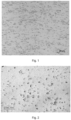
- FIG. 1 is a photograph showing the metallographic structure of the ultra-low carbon cold-rolled high-strength steel of Example 1.
- the metallographic structure of the ultra-low carbon cold-rolled high-strength steel of Example 1 was a ferrite structure having the structural characteristics of IF steel, and the grain size of the ferrite was evaluated as grade 10 according to Standard GB/T 6394-2017.
- FIG. 2 is a photograph showing the precipitation phase of the ultra-low carbon cold-rolled high-strength steel of Example 1.
- the morphology and distribution of the precipitation phases in the matrix of the ultra-low carbon cold-rolled high-strength steel of Example 1 can be seen from FIG. 2 .
- a large number of fine, dispersive precipitation phases such as TiC, Ti(C, N), Nb(C, N) and the like were present in the ultra-low carbon cold-rolled high-strength steel of Example 1, and they were distributed in the steel matrix.
Landscapes
- Chemical & Material Sciences (AREA)
- Engineering & Computer Science (AREA)
- Mechanical Engineering (AREA)
- Materials Engineering (AREA)
- Metallurgy (AREA)
- Organic Chemistry (AREA)
- Physics & Mathematics (AREA)
- Thermal Sciences (AREA)
- Crystallography & Structural Chemistry (AREA)
- Heat Treatment Of Sheet Steel (AREA)
Abstract
Description
- The present disclosure relates to a steel plate and a method for manufacturing the same, particularly to a low-carbon cold-rolled high-strength steel plate and a method for manufacturing the same.
- It's well known that an enameled article is made of a metal material and a vitreous inorganic material by firing at a high temperature. The metal material and the vitreous inorganic material, two materials having completely different properties, are combined and form a whole, so that their respective shortcomings can be compensated for by each other, whereby highlighting their respective advantages.
- For example, when the enamel layer of an enameled article is subjected to external impact, the metal having high strength can withstand the external force, thus protecting the article from damage or greatly reducing the damage; and when the enameled article is subjected to chemical erosion, the enamel layer can play a protective role, preventing the metal material from corrosion which may lead to damage to or scrappage of the article. Therefore, the enameled article can benefit from a series of excellent properties of the metal material and the vitreous inorganic material at the same time.
- An enameled steel article is a composite material formed by melting a vitreous inorganic material and coating it onto a steel plate surface. In recent years, it has been widely used in light industry, home appliances, and environmental protection and construction industries, for preparation of products such as ovens, water heaters, bathtubs, denitrification equipment (SCR) in thermal power plants, air preheaters (APH) and gas-gas heaters (GGH), building decorative panels, various glass-fused-to-steel tanks, etc.
- Nowadays, in the preparation of enameled steel, the enameling methods are mainly classified into two types: wet enameling and dry enameling. The enameling method in which a glaze slurry is applied to a metal blank is named wet enameling. There are three basic processes for wet enameling: dip enameling, spray enameling and flow enameling. Dry enameling mainly refers to electrostatic dry powder enameling. In this method, the high voltage generation principle is adopted. In particular, an electrostatic spray gun is used to form a negatively charged electrostatic field at a voltage of 70 to 100 kV. A workpiece to be sprayed is grounded. When the workpiece passes by the spray gun in a spray room, the spray gun starts to spray powder. The positively charged workpiece and the negatively charged powder attract each other to form a powder coating.
- Among the above-mentioned enameling methods, the electrostatic dry powder enameling method provides an enameled steel material with the best surface quality. However, this process also has higher requirements on the base steel plate.
- This is because the porcelain layer obtained by the electrostatic dry powder enamel method is denser, and thus the hydrogen generated during the enamel firing process is more difficult to escape. As a result, fish-scaling defects are more likely to occur. In addition, because the electrostatic dry powder enamel layer is relatively thin (usually less than 200 µm), defects such as bubbles, pinholes and the like are prone to occur on the enamel surface, affecting the surface quality. Therefore, when a steel plate applicable to electrostatic dry powder enameling is designed and developed, the steel plate needs to have excellent resistance to fish-scaling, pinhole and bubble defects.
- Besides, it should be noted that, in addition to excellent resistance to fish-scaling, pinhole and bubble defects, the steel plate used to prepare an enameled article also needs to have a high yield strength in specific applications and a small drop in strength after high-temperature enamel firing. This is because the quality of enameled articles is also required to be improved constantly as the enamel industry is making continuous progress. For example, in the field of manufacturing enameled steel plates for building decorative panels, in order to reduce splicing and improve aesthetics, it is necessary to produce larger enameled steel plates. However, this type of enameled steel plates is highly demanding on the plate shape. The larger the size of the workpiece, the more likely it is to deform during the high-temperature enamel firing process. Hence, it's required that the enameled steel plate used as a substrate must have sufficient resistance to high-temperature deformation to ensure that no serious deformation occurs after high-temperature enamel firing at 840-870°C.
- To this end, in order to meet the current market demand, it's desired according to the present disclosure to obtain an ultra-low carbon cold-rolled high-strength steel applicable to electrostatic dry powder enameling. This ultra-low carbon cold-rolled high-strength steel can meet the various requirements for use in electrostatic dry powder double-side enameling. After enameling, no fish-scaling defect occurs; the porcelain layer is well adhered to the steel plate; and the enamel surface quality is excellent. Meanwhile, the ultra-low carbon cold-rolled high-strength steel has a yield strength of 200 MPa or higher. After high-temperature enamel firing at 840-870°C, the yield strength decreases by 10% or less. Therefore, the deformation problem after the high-temperature enamel firing is avoided, and the strength of the final enameled article is significantly improved. The enameled article obtains excellent performances in use and an extended service life.
- In the prior art, there are some technologies for manufacturing cold-rolled enameling steel applicable to electrostatic dry powder enameling, but it's still different from the steel with specific strength and performance requirements according to the present disclosure, and there are still significant differences in chemical composition design.
- For example, Chinese Patent Application
CN101356295A, published on January 28, 2009 , and titled "CONTINUOUSLY CASTED ENAMELING STEEL PLATE WITH SIGNIFICANTLY EXCELLENT FISH-SCALING RESISTANCE AND METHOD FOR MANUFACTURING SAME", discloses a continuously casted enameling steel plate with significantly excellent fish-scaling resistance and a method for manufacturing the same, wherein the chemical element composition is designed as follows: C: 0.010% or less, Mn: 0.03-1.30%, Si: 0.100% or less, Al: 0.030% or less, N: 0.0055% or less, P: 0.035% or less, S: 0.08% or less, O: 0.005-0.085%, B: 0.0003-0.0250%, with non-integrated or integrated oxides comprising different mass concentrations of B or Mn present in the steel plate. - For another example, Chinese Patent Application
CN105518174A, published on April 20, 2016 , and titled "COLD-ROLLED ENAMELING STEEL PLATE, METHOD FOR MANUFACTURING SAME, AND ENAMELED ARTICLE" discloses a cold-rolled enameling steel plate, a method for manufacturing the same, and an enameled article , wherein the chemical element composition is designed as follows: C: 0.0005-0.0050%, Mn: 0.05-1.50%, Si: 0.001-0.015%, Al: 0.001-0.01%, N: 0.0010-0.0045%, O: 0.0150-0.0550%, P: 0.04-0.10%, S: 0.0050-0.050%, Nb: 0.020-0.080%, Cu: 0.015-0.045%, and a balance of Fe and impurities. - For still another example, Chinese Patent Application
CN106560523A, published on April 12, 2017 , and titled "COLD-ROLLED ENAMELING STEEL PLATE AND METHOD FOR MANUFACTURING SAME" discloses a cold-rolled enameling steel plate and a method for manufacturing the same, wherein the chemical element composition is designed as follows: C: 0.005% or less (except 0%), Mn: 0.05% to 0.3%, Al: 0.005% or less (except 0%), P: 0.03% or less (except 0%), S: 0.02% or less (except 0%), Si: 0.01% or less (except 0%), Ti: 0.005% to 0.01%, Y:0.01% to 0.02%, N: 0.003% or less (except 0%), and a balance of Fe and unavoidable impurities. - One of the objects of the present disclosure is to provide an ultra-low carbon cold-rolled high-strength steel applicable to electrostatic dry powder enameling. This ultra-low carbon cold-rolled high-strength steel can meet the various requirements for double-side enameling with electrostatic dry powder. After enameling, no fish-scaling defect occurs, and the porcelain layer is well adhered to the steel plate. Therefore, the enamel surface quality is excellent. Meanwhile, the ultra-low carbon cold-rolled high-strength steel has a yield strength of 200 MPa or higher. After high-temperature enamel firing at 840-870°C, the yield strength decreases by 10% or less. Therefore, the deformation problem after the high-temperature enamel firing is avoided, and the strength of the final enameled article is significantly improved. The enameled article obtains excellent performances in use and an extended service life.
- The ultra-low carbon cold-rolled high-strength steel of the present disclosure can be widely used in large-size enameled panels for architectural decoration, bathtubs and other products that need to be made by electrostatic dry powder enameling and require high yield strength after enameling. It has very significant application value.
- In order to achieve the above object, the present disclosure provides an ultra-low carbon cold-rolled high-strength steel applicable to electrostatic dry powder enameling, comprising Fe and unavoidable impurity elements, as well as the following chemical elements in mass percentage:
- C: 0.002-0.010%, Si≤0.05%, Mn: 0.25-1.0%, P: 0.04-0.08%, S: 0.01-0.04%; Al: 0.01-0.05%, Cu: 0.02-0.08%, Ti: 0.05-0.12%, Mo: 0.02-0.10%, N: 0.004-0.012%;
- wherein the chemical elements satisfy at least one of the following formulas:
- M*>0, where M*=Ti-S×1.5-N×3.4-C×4;
- N*≥0.012, where N*=(Mn+P)×Mo;
- wherein each chemical element in the formulas represents the value in front of the percentage symbol of the mass percentage of that chemical element.
- Further, in the ultra-low carbon cold-rolled high-strength steel of the present disclosure, the mass percentages of the chemical elements are:
- C: 0.002-0.010%, Si≤0.05%, Mn: 0.25-1.0%, P: 0.04-0.08%, S: 0.01-0.04%; Al: 0.01-0.05%, Cu: 0.02-0.08%, Ti: 0.05-0.12%, Mo: 0.02-0.10%, N: 0.004-0.012%; and a balance of Fe and unavoidable impurity elements;
- wherein the chemical elements satisfy at least one of the following formulas:
M*>0, where M*=Ti-S×1.5-N×3.4-C×4; - N*≥0.012, where N*=(Mn+P)×Mo;
- wherein each chemical element in the formulas represents the value in front of the percentage symbol of the mass percentage symbol of that chemical element.
- In the ultra-low carbon cold-rolled high-strength steel of the present disclosure, the chemical elements are designed according to the following principle:
C: In the ultra-low carbon cold-rolled high-strength steel of the present disclosure, the C element can all be combined with strong carbide-forming elements such as Ti or Nb to form dispersed fine precipitation phases. These precipitation phases can effectively increase the hydrogen storage capacity of the steel plate, thereby playing a role in resisting fish-scaling of the enamel. At the same time, nano-scale precipitation phases such as TiC can also play a role in precipitation strengthening. However, it should be noted that the content of the C element should not be too high. The C element should not be added in an excessive amount relative to the alloying elements. The reason is that when the enamel is fired, the surplus free carbon will lead to generation of a large amount of CO and other gases during the enamel firing process. These gases will result in an undesirable porous structure in the enamel layer, and in turn produce defects such as pinholes and bubbles, which influence the surface quality of the enamel. This influence is even greater during the electrostatic dry powder enameling process. Therefore, in view of the influence of the C content on the performances of the steel, the mass percentage of the C element is controlled at 0.002-0.010% in the ultra-low carbon cold-rolled high-strength steel according to the present disclosure. - Si: In the ultra-low carbon cold-rolled high-strength steel according to the present disclosure, the Si element is a residual element. If the Si content in the steel is too high, the plasticity of the steel will deteriorate. In addition, during the enameling process, a higher Si content will also affect the adhesion between the steel plate and the enamel. Therefore, the mass percentage of the Si element is controlled to be Si≤0.05% in the ultra-low carbon cold-rolled high-strength steel according to the present disclosure. In some embodiments, the mass percentage of Si is 0.01-0.05% or 0.01-0.045%.
- Mn, P: In the ultra-low carbon cold-rolled high-strength steel according to the present disclosure, the Mn and P elements are both major solid solution strengthening elements. Generally, a TiFe(P) precipitation phase may form in the steel with high Ti and P contents, and this precipitation phase may tend to cluster and precipitate at the ferrite grain boundaries, resulting in deterioration of the mechanical performances of the material. In the technical solution of the present disclosure, this situation is avoided by controlling the final temperature of the hot rolling and the coiling temperature to avoid the precipitation temperature range of the TiFe(P) phase, so that the P element only plays a role in solid solution strengthening. At the same time, it should also be taken into consideration that too high a P content will lead to formability and secondary brittleness of the material. Therefore, in the ultra-low carbon cold-rolled high-strength steel according to the present disclosure, the mass percentage of the Mn element is limited to 0.25-1.0%, and the mass percentage of the P element is limited to 0.04-0.08%.
- S: Usually, in the steel with more Mn element added, the S element may combine with the Mn element to form strip-shaped and line-shaped MnS inclusions which may cause deterioration of the mechanical performances of the material. On the contrary, for the ultra-low carbon cold-rolled high-strength steel according to the present disclosure, due to the addition of a relatively high amount of the Ti element which can promote formation of spherical or polygonal TiMn(S) inclusions, the mechanical properties of the material can be improved. In addition, in the present technical solution, the S element in the steel mainly combines with Ti and C to form Ti4C2S2, TiS precipitation phases or inclusions. These precipitation phases or inclusions formed in the steel can act as irreversible hydrogen storage traps, playing a role in resisting fish-scaling of the enamel. Therefore, in order to exert the beneficial effects of the S element, in the present disclosure, the mass percentage of the S element is controlled at 0.01-0.04%.
- Mo: In the ultra-low carbon cold-rolled high-strength steel according to the present disclosure, molybdenum can be solid-dissolved in ferrite, austenite and carbide to play a role in solid solution strengthening. In addition, molybdenum can also increase the stability of carbides such as TiC and NbC, and reduce aggregation and coarsening of carbide precipitation phases caused by high-temperature enamel firing (usually at a temperature up to 840-870°C), thereby improving the high-temperature stability of the steel and avoiding the problem of a significant drop in the yield strength of the steel plate due to the weakened precipitation strengthening effect after enamel firing. However, it should be noted that the Mo content in the steel should not be too high. Adding excessive Mo will significantly increase the manufacturing cost. Therefore, in the ultra-low carbon cold-rolled high-strength steel according to the present disclosure, the mass percentage of the Mo element is limited to 0.02-0.10%.
- Al: In the ultra-low carbon cold-rolled high-strength steel according to the present disclosure, Al is a strong deoxidizing element. In order to keep the O content in the steel at a low level, Al is often required to be used for deoxidation in medium and low carbon steels. In addition, the Al element dissolved in the steel can also combine with free nitrogen to precipitate A1N which has a high precipitation temperature and plays a role in refining the austenite grains. Thus, the Al element is beneficial to grain refinement and fine grain strengthening. Therefore, in order to exert the beneficial effects of the Al element, in the present disclosure, the mass percentage of the Al element is limited to 0.01-0.05%.
- Ti: In the ultra-low carbon cold-rolled high-strength steel according to the present disclosure, Ti is the main element that enables the steel to obtain good hydrogen storage capacity. The Ti element in the steel can form dispersed fine TiC and Ti (C, N) precipitation phases in an appropriate process of controlled rolling and controlled cooling. These precipitation phases can act as irreversible hydrogen storage traps to increase the hydrogen storage capacity of the steel plate, and in turn play a role in resisting fish-scaling of the enamel. However, too much Ti in the steel will lead to poor forming performance of the material and increase the cost. Therefore, with both the mechanical performances of the steel and the cost factor taken into consideration, the mass percentage of the Ti element in the ultra-low carbon cold-rolled high-strength steel according to the present disclosure is limited to 0.05-0.12%.
- Cu: In the ultra-low carbon cold-rolled high-strength steel according to the present disclosure, the Cu element may be deposited at the bonding interface between the enamel and the steel during the high-temperature enamel firing process, thereby improving the adhesion between the steel and the enamel, and in turn improving the anti-fish-scaling performance of the steel material. However, the Cu content in the steel should not be too high. If the Cu content in the steel is too high, it will also lead to poor forming performance of the material and increase the cost. Therefore, with both the mechanical performances of the steel and the cost factor taken into consideration, in the present disclosure, the mass percentage of the Cu element is limited to 0.02-0.08%.
- N: In the ultra-low carbon cold-rolled high-strength steel according to the present disclosure, the main function of the N element is to form inclusions or precipitation phases such as TiN, NbN or Ti(C, N), Nb(C, N) with alloy elements such as Ti and Nb. In turn, the inclusions or precipitation phases act as hydrogen storage traps to resist fish-scaling of the enamel. In addition, the nitride inclusions are partially broken during the cold rolling process, thereby forming tiny cavities around them. These tiny cavities are also very important and effective hydrogen storage traps. As such, in order to exert the beneficial effects of the N element, the mass percentage of the N element is limited to 0.004-0.012% in the ultra-low carbon cold-rolled high-strength steel according to the present disclosure.
- In the above technical solution of the present disclosure, while the mass percentages of the chemical elements in the steel are controlled separately, the elements in the steel according to the present disclosure are further controlled to satisfy the limiting relationship of "M*>0, where M*=Ti-S×1.5-N×3.4-C×4". The inventors have discovered through experimental research that when the contents of the elements in the steel satisfy the above-mentioned limiting relationship, it can be ensured that the C and N interstitial atoms in the steel are completely immobilized, thereby ensuring that the structure of the steel is exclusively ferrite. After electrostatic dry powder enameling is performed on the steel plate with such a structural feature, the enamel surface has excellent quality, with no defects such as pinholes or bubbles generated. In some embodiments, 0.001 ≤ M*≤ 0.02. In some embodiments, 0.001 ≤ M*≤ 0.013.
- Accordingly, in the present disclosure, while the mass percentages of the chemical elements in the steel are controlled separately, the elements in the steel plate for pressure vessels may be further controlled to satisfy the limiting relationship of "N*≥0.012, where N*=(Mn+P)×Mo". The inventors have discovered through experimental research that when this limiting relationship is satisfied, it can be ensured that the steel plate has a yield strength of 200 MPa or higher, and after high-temperature enamel firing, the steel plate still maintains a relatively high yield strength value which is lower than the initial strength by no more than 10%. In some embodiments, 0.012≤N*≤0.10. In some embodiments, 0.012≤N*≤0.06.
- Further, the ultra-low carbon cold-rolled high-strength steel according to the present disclosure may also comprise: B≤0.003%, and Nb≤0.06%.
- Further, in the ultra-low carbon cold-rolled high-strength steel according to the present disclosure, the chemical elements also include at least one of the following: B: 0.0006-0.003%; Nb: 0.02-0.06%.
- In the present disclosure, in order to obtain an ultra-low carbon cold-rolled high-strength steel having better performances, in certain embodiments, appropriate amounts of the B and Nb elements may be further added.
- Nb: In the technical solution according to the present disclosure, the Nb element may be combined with the C and N elements to form fine precipitation phases such as NbC, NbN and the like. Of course, Nb may also adhere to the previously formed TiC precipitation phase to form a (Nb, Ti) C phase. These precipitation phase particles can act as irreversible hydrogen storage traps, and thus play a role in both resisting fish-scaling of the enamel and precipitation strengthening. In addition, these precipitation phase particles can also effectively inhibit the deformation and recrystallization of austenite and prevent growth of austenite grains during the hot rolling process, thereby playing a role in fine grain strengthening. Therefore, in order to exert the beneficial effects of the Nb element, a small amount of Nb may be preferably added to the ultra-low carbon cold-rolled high-strength steel according to the present disclosure, and the mass percentage of the Nb element is limited to 0.02%-0.06%.
- B: In the technical solution according to the present disclosure, an appropriate amount of the B element may be added to form B (C, N) in the steel plate to increase the second-phase particles, and increase the number of hydrogen traps, thereby improving the anti-fish-scaling performance of the steel plate. In addition, B (C, N) may also act as crystal nuclei to facilitate formation of equiaxed crystals and prevent grain growth. This is beneficial to improving the enameling performance and mechanical properties of the steel plate. Therefore, in the ultra-low carbon cold-rolled high-strength steel according to the present disclosure, a small amount of B may be preferably added, and the mass percentage of the B element may be controlled at 0.0006-0.003%.
- Furthermore, in the ultra-low carbon cold-rolled high-strength steel according to the present disclosure, the microstructure is exclusively ferrite.
- In the ultra-low carbon cold-rolled high-strength steel designed according to the present disclosure, the matrix of the microstructure is exclusively ferrite, and inclusions or precipitation phases such as TiN, TiC, Ti(C, N), Nb(C, N) and the like are distributed dispersively in the matrix.
- Further, in the ultra-low carbon cold-rolled high-strength steel according to the present disclosure, the ferrite has a grain size of grade 9-11.
- Further, the ultra-low carbon cold-rolled high-strength steel according to the present disclosure has a thickness of 0.7-3.5 mm.
- Further, the performances of the ultra-low carbon cold-rolled high-strength steel according to the present disclosure satisfy: yield strength ≥ 200MPa, tensile strength ≥ 400MPa, elongation ≥ 30%, and drop in yield strength < 10% after high-temperature enamel firing at 840-870°C.
- Further, the performances of the ultra-low carbon cold-rolled high-strength steel according to the present disclosure satisfy: yield strength ≥ 220MPa, tensile strength ≥ 410MPa, elongation ≥ 34%, and drop in yield strength < 6.5% after enamel firing by holding at 840-870°C for 5min.
- Further, after enamel firing by holding at 840-870°C for 5min, the performances of the ultra-low carbon cold-rolled high-strength steel according to the present disclosure satisfy: yield strength ≥210MPa, tensile strength ≥370MPa, elongation ≥34%.
- Accordingly, another object of the present disclosure is to provide a method for manufacturing an ultra-low carbon cold-rolled high-strength steel plate applicable to electrostatic dry powder enameling. The manufacturing method can be implemented with a simple production process, and the above-mentioned ultra-low carbon cold-rolled high-strength steel plate of the present disclosure can be prepared effectively with this manufacturing method. The ultra-low carbon cold-rolled high-strength steel plate is well adapted to enameling, and can be effectively used for electrostatic dry powder enameling.
- In order to achieve the above object, it's proposed in the present disclosure a method for manufacturing the above ultra-low carbon cold-rolled high-strength steel, comprising the following steps:
- (1) Smelting and casting;
- (2) Heating of cast blank;
- (3) Hot rolling;
- (4) Laminar cooling: Controlling a cooling rate at 10-30°C/s to cool the steel plate to a coiling temperature;
- (5) Coiling: Coiling at a temperature of 600-680°C, and then air cooling to room temperature;
- (6) Pickling;
- (7) Cold rolling;
- (8) Annealing;
- (9) Temper rolling.
- In the present disclosure, the casting process of the above step (1) may be specifically implemented by a continuous casting process which can guarantee a uniform internal composition of the cast blank and good surface quality. Of course, in some other embodiments, a die casting process may also be used for casting, and the die-cast steel ingot further needs to be rolled by a primary rolling mill to form a steel blank.
- Further, in the manufacturing method according to the present disclosure, in step (2), the heating temperature is controlled to be 1180-1260°C.
- Further, in the manufacturing method according to the present disclosure, in step (3), the heated cast blank is first rough-rolled into an intermediate blank, and then the intermediate blank is subjected to finish rolling, wherein the rough-rolling temperature is controlled to be 900°C or higher, such as 900-1080°C; the start temperature of the finish rolling is 900-1050°C; and the final temperature of the finish rolling is 860-940°C.
- In the manufacturing method designed according to the present disclosure, by controlling the hot rolling, controlled rolling and controlled cooling processes in step (3) and step (4), it can be ensured that the steel of the present disclosure acquires a fine ferrite grain structure, so as to improve the yield strength of the steel plate by fine grain strengthening. In addition, the control is also beneficial to generation of dispersed fine precipitation phases of alloy elements such as Ti and Nb, thereby improving the anti-fish-scaling performance of the steel plate. Furthermore, formation of a TiFe(P) precipitation phase can be effectively avoided. This precipitation phase tends to cluster and precipitate at the ferrite grain boundaries, and will lead to deterioration of the mechanical performances of the material.
- Further, in the manufacturing method according to the present disclosure, in step (7), the cold rolling reduction rate is controlled to be 70-95%.
- In the above step (7), the cold rolling reduction rate can be controlled at 70-95%. As the cold rolling reduction rate increases, on the one hand, the recrystallization temperature of the steel can be reduced, and on the other hand, formation of tiny cavities around the inclusions or precipitation phases in the steel is favored, thereby increasing the hydrogen storage capacity of the steel, and in turn improving the anti-fish-scaling performance of the enamel on the steel plate.
- Further, in the manufacturing method according to the present disclosure, in step (8), continuous annealing is utilized, and the annealing temperature is 770-830°C.
- Further, in the manufacturing method according to the present disclosure, in step (8), bell-type annealing is utilized, and the annealing temperature is 690-740°C.
- In the present disclosure, a continuous annealing process or a bell-type annealing process may be utilized for the annealing process as desired. When the continuous annealing process is utilized, the continuous annealing temperature may be controlled to be 770-830°C; and when the bell-type annealing process is utilized, the bell-type annealing temperature may be controlled to be 690-740°C. Further, sufficient recrystallization and texture development can be guaranteed, which is beneficial for the steel plate to acquire good processing and forming performances.
- Accordingly, after the annealing process in step (8) is completed, it's necessary to subject the steel plate or steel strip to temper rolling to improve the shape and surface quality of the steel plate or steel strip.
- Compared with the prior art, the ultra-low carbon cold-rolled high-strength steel applicable to electrostatic dry powder enameling and the method for manufacturing the same according to the present disclosure have the following advantages and beneficial effects:
In contrast to the prior art, in the present disclosure, the inventors have designed a brand-new chemical composition. With the design of a particular content relationship of P, Mn and Mo, and a particular content relationship of C, S, N, and Ti which is an alloy element, in combination with particular processes of hot rolling, controlled rolling and controlled cooling, as well as particular processes of cold rolling and annealing, an ultra-low carbon cold-rolled high-strength steel applicable to electrostatic dry powder enameling can be prepared effectively. The ultra-low carbon cold-rolled high-strength steel not only has a high yield strength performance, but can also satisfy the requirements of a double-side electrostatic dry powder enamel in terms of fish-scaling resistance, enamel adhesion, and enamel surface quality. - The ultra-low carbon cold-rolled high-strength steel prepared according to the technical solution of the present disclosure has a yield strength of 200 MPa or higher. After high-temperature enamel firing at 840-870 °C, the yield strength decreases by 10% or less. The deformation problem of the steel plate after the high-temperature enamel firing can be avoided; the strength of the final enameled article can be improved significantly; and the service life of the enameled article can be extended.
- As it can be seen from the above description, the ultra-low carbon cold-rolled high-strength steel designed according to the present disclosure can be widely used in large-size enameled panels for architectural decoration and other products that need to be made by electrostatic dry powder enameling and require high yield strength after enameling. It has very significant application value.
-
-
FIG. 1 is a photograph showing the metallographic structure of the ultra-low carbon cold-rolled high-strength steel of Example 1. -
FIG. 2 is a photograph showing the precipitation phase of the ultra-low carbon cold-rolled high-strength steel of Example 1. - The ultra-low carbon cold-rolled high-strength steel applicable to electrostatic dry powder enameling and the method for manufacturing the same according to the present disclosure will be further explained and illustrated below with reference to the specific examples and drawings of the specification. However, such explanation and illustration are not intended to unduly limit the technical solution of the present disclosure.
- The ultra-low carbon cold-rolled high-strength steel plates applicable to electrostatic dry powder enameling described in Examples 1-8 of the present disclosure and the comparative steel plates of Comparative Examples 1-2 were prepared by the following steps:
- (1) Smelting and casting according to the chemical compositions shown in Table 1-1 and Table 1-2: The molten steel obtained after smelting was subjected to vacuum degassing treatment and then continuously cast to obtain a continuously cast blank.
- (2) Heating of the cast blank: The continuously cast blank obtained was heated with the heating temperature being controlled to be 1180-1260°C.
- (3) Hot rolling: The heated cast blank was first rough-rolled into an intermediate blank, and then the intermediate blank was subjected to finish rolling, wherein the rough rolling temperature was controlled to be 900°C or higher; the start temperature of the finish rolling was 900-1050°C; and the final temperature of the finish rolling was 860-940°C.
- (4) Laminar cooling: Laminar water cooling was performed, and the cooling rate was controlled to be 10-30°C/s to cool the steel plate to the coiling temperature.
- (5) Coiling: The coiling temperature was controlled to be 600-680°C, and then the coil was air cooled to room temperature.
- (6) Pickling: The mill scale on the surface of the steel plate was removed.
- (7) Cold rolling: The cold rolling reduction rate was controlled to be 70-95%.
- (8) Annealing: Annealing was performed by continuous annealing or bell-type annealing. When continuous annealing was utilized, the annealing temperature was controlled at 770-830°C; when bell-type annealing was utilized, the annealing temperature was controlled at 690-740°C.
- It should be noted that, in the present disclosure, the chemical compositions and the related processes for the ultra-low carbon cold-rolled high-strength steel plates of Examples 1-8 designed by the inventors all meet the requirements of the design specification of the present disclosure. Although the comparative steel plates of Comparative Examples 1-2 were also prepared using the above steps (1)-(8), they all involve parameters in their chemical compositions and/or the related processes that do not meet the requirements of the design of the present disclosure.
- Table 1-1 and Table 1-2 list the mass percentages of the chemical elements in the ultra-low carbon cold-rolled high-strength steel plates of Examples 1-8 and the comparative steel plates of Comparative Examples 1-2.
Table 1-1. (wt%, the balance being Fe and unavoidable impurities) No. Chemical Elements C Si Mn P S Al Cu Ti Mo Nb N B Ex. 1 0.003 0.045 0.26 0.04 0.01 0.025 0.03 0.06 0.05 - 0.006 - Ex. 2 0.01 0.03 0.55 0.05 0.03 0.01 0.04 0.11 0.02 - 0.007 0.0015 Ex. 3 0.008 0.02 0.39 0.055 0.02 0.045 0.02 0.08 0.06 0.06 0.005 0.0006 Ex. 4 0.006 0.01 0.42 0.08 0.035 0.05 0.04 0.12 0.1 - 0.012 - Ex. 5 0.007 0.03 0.98 0.07 0.025 0.038 0.08 0.09 0.05 0.02 0.005 - Ex. 6 0.002 0.035 0.66 0.046 0.015 0.032 0.065 0.05 0.04 0.045 0.004 0.003 Ex. 7 0.005 0.026 0.62 0.06 0.02 0.039 0.05 0.08 0.03 - 0.008 - Ex. 8 0.004 0.04 0.78 0.045 0.036 0.027 0.038 0.1 0.045 - 0.006 - Comp. Ex. 1 0.007 0.02 0.25 0.04 0.03 0.028 0.02 0.1 0.02 - 0.007 - Comp. Ex. 2 0.01 0.015 0.36 0.04 0.01 0.015 0.06 0.05 0.05 - 0.009 - Table 1-2. No. M* N* Ex. 1 0.0126 0.015 Ex. 2 0.0012 0.012 Ex. 3 0.001 0.0267 Ex. 4 0.0027 0.05 Ex. 5 0.0075 0.0525 Ex. 6 0.0059 0.028 Ex. 7 0.0028 0.0204 Ex. 8 0.0096 0.037 Comp. Ex. 1 0.0032 0.0058 Comp. Ex. 2 -0.0356 0.02 Note: In the above table, the formula for calculating M* is "M*=Ti-S×1.5-N×3.4-C×4", and the formula for calculating N* is "N*=(Mn+P)×Mo". In the above two formulas, each element represents the value in front of the percentage symbol of the mass percentage of that element. - Table 2 lists the specific process parameters in steps (1)-(8) of the above-mentioned method for manufacturing the ultra-low carbon cold-rolled high-strength steel plates of Examples 1-8 and the comparative steel plates of Comparative Examples 1-2.
Table 2 No. Finished product thickness (mm) Step (2) Step (3) Step (4) Step (5) Step (7) Step (8) Heating temperature (°C) Rough rolling temperature (°C) Start temperature of finish rolling (°C) Final temperature of finish rolling (°C) Cooling rate (°C/s) Coiling temperature (°C) Cold rolling reduction rate (%) Annealing type Annealing temperature (°C) Ex. 1 1.2 1230 1050 1000 890 20 610 80 Continuous annealing 770 Ex. 2 0.7 1220 900 900 870 30 680 93 Continuous annealing 810 Ex. 3 3.5 1240 1060 1020 880 15 600 72 Bell-type annealing 710 Ex. 4 2 1200 1050 1030 940 10 640 75 Continuous annealing 830 Ex. 5 2.5 1260 1080 1050 860 25 600 79 Bell-type annealing 690 Ex. 6 1.8 1180 970 960 900 13 640 78 Bell-type annealing 740 Ex. 7 1.5 1190 960 950 910 26 670 85 Continuous annealing 800 Ex. 8 3.0 1210 1000 980 930 28 650 80 Bell-type annealing 720 Comp. Ex. 1 2 1200 1050 1000 880 10 610 78 Continuous annealing 800 Comp. Ex. 2 1.5 1230 1050 1030 870 15 620 81 Continuous annealing 790 - In order to further demonstrate the performances of the ultra-low carbon cold-rolled high-strength steel plates applicable to electrostatic dry powder enameling in Examples 1-8 according to the present disclosure and the comparative steel plates in Comparative Examples 1-2 after enameling, the inventors sampled the finished ultra-low carbon cold-rolled high-strength steel plates of Examples 1-8 and the comparative steel plates of Comparative Examples 1-2 obtained by the above process steps, and subjected them to enameling treatment.
- The enameling treatment included performing double-side electrostatic dry powder enameling treatment on the sample steel plates of the Examples and Comparative Examples, wherein TR1042 enamel produced by Ferro Corporation was used, and the enamel firing temperature was controlled to be 840-870°C which was held for 5 minutes, followed by air cooling to obtain the enameled steel plates. In the present disclosure, the ultra-low carbon cold-rolled high-strength steel plates of Examples 1-8 and the comparative steel plates of Comparative Examples 1-2 could provide the corresponding enameled steel plates after the enameling treatment.
- After completing the above operations, the enameled steel plates of Examples 1-8 and Comparative Examples 1-2 that had been enameled were observed and tested. That is, the surface quality of the enameled steel plates was observed after standing for 48 hours; a drop hammer test was used to verify and rate the adhesion between the steel plate and the enamel; and a tensile test was used to determine the room-temperature tensile performances of the steel plates of the Examples and Comparative Examples before and after enamel firing.
- The relevant performance test methods and means are as follows:
- (1) Tensile test: The tensile test was carried out in accordance with GB/T 228.1-2010 "Metallic materials: tensile test method at room temperature". The test was performed using a SCL233 ambient temperature tensile testing machine. The drawing speed was controlled to be 3 mm/min, and the tensile specimen was a JIS5 tensile specimen. The yield strength, tensile strength and elongation of each of the Examples and Comparative Examples were obtained by testing.
It should be noted that, to carry out the above-mentioned tensile test, two test groups were designed, in which one group of plates were the enameled steel plates obtained by enamel firing the steel plates of Examples 1-8 and Comparative Examples 1-2, and the other group of plates were the as-prepared finished products of the ultra-low carbon cold-rolled high-strength steel plates of Examples 1-8 according to the present disclosure and the comparative steel plates of Comparative Examples 1-2. By means of these two test groups, the room-temperature tensile performances of the steel plates of the Examples and Comparative Examples before and after enamel firing were measured. - (2) Drop hammer test and adhesion rating: Following the drop hammer test method described in European Standard BS EN 10209-1996, the enameled steel plates obtained by enamel firing the steel plates of Examples 1-8 and Comparative Examples 1-2 were tested and rated for their adhesion performance using a corresponding drop hammer test apparatus.
- Table 3 lists the test results of the mechanical performances of the plates of Examples 1-8 and Comparative Examples 1-2 before enameling treatment, as well as the enamel performances and mechanical performances of the enameled steel plates obtained by enameling treatment of the steel plates of the Examples and Comparative Examples.
Table 3 No. Mechanical performances of as-prepared plates Enamel firing temperature Mechanical performances after enamel firing Enamel performances Yield strength Tensile strength Elongation A50 Yield strength Tensile strength Elongation A50 Drop of yield strength Adhesion Pin holes/ bubbles (MPa) (MPa) (%) (°C) (MPa) (MPa) (%) (%) Ex. 1 223 418 34 870 212 378 34 4.93 A1 No Ex. 2 230 436 35 845 223 402 36 3.04 A1 No Ex. 3 235 440 35 840 220 400 35 6.38 A1 No Ex. 4 246 449 34 860 231 420 34 6.10 A1 No Ex. 5 228 420 38 850 215 405 39 5.70 A1 No Ex. 6 240 447 35 840 228 416 36 5.00 A1 No Ex. 7 245 440 35 850 230 395 36 6.12 A1 No Ex. 8 236 438 37 860 225 409 38 4.66 A1 No Comp. Ex. 1 183 383 36 850 160 356 38 12.57 A1 No Comp. Ex. 2 277 384 33 850 260 370 35 6.14 A1 Yes - As shown in Table 3 above, in the present disclosure, the as-prepared ultra-low carbon cold-rolled high-strength steel plates of Examples 1-8 had a yield strength of 223-246 MPa, a tensile strength of 418-449 MPa, and an elongation A50 of 34-38%. After high-temperature enamel firing, the ultra-low carbon cold-rolled high-strength steel plates of Examples 1-8 still exhibited excellent mechanical performances, having a drop in yield strength of 3.04-6.38%, and a yield strength of at least 200 MPa, and in the range of 212-230 MPa.
- Accordingly, after standing for 48 hours, the enamel surfaces of the enameled steel plates of Examples 1-8 were all observed to be free of fish-scaling, pinhole and bubble defects on the surface. In addition, after the enameled steel plates prepared using the corresponding steel plates of Examples 1-8 were subjected to the drop hammer test according to European Standard BS EN 10209:2013, it was found that the adhesion between the steel plate and the porcelain layer was excellent, reaching grade A1.
- However, the performances of the comparative steel plates of Comparative Examples 1-2 were significantly inferior to those of the ultra-low carbon cold-rolled high-strength steel plates of Examples 1-8. The composition of the comparative steel of Comparative Example 1 didn't meet the requirement of the N* value designed according to the present disclosure. Its yield strength was relatively low both before and after enamel firing. The yield strength before enamel firing was 183 MPa, and after enameling and high-temperature firing, it decreased by 12.57% to 160 MPa. Meanwhile, the composition of the steel of Comparative Example 2 didn't meet the requirement of the M* value designed according to the present disclosure, and the quality of the enamel surface thereof was poor, as evidenced by the presence of a large number of pinhole and bubble defects (>200/m2).
-
FIG. 1 is a photograph showing the metallographic structure of the ultra-low carbon cold-rolled high-strength steel of Example 1. - As shown in
FIG. 1 , in this embodiment, the metallographic structure of the ultra-low carbon cold-rolled high-strength steel of Example 1 was a ferrite structure having the structural characteristics of IF steel, and the grain size of the ferrite was evaluated as grade 10 according to Standard GB/T 6394-2017. -
FIG. 2 is a photograph showing the precipitation phase of the ultra-low carbon cold-rolled high-strength steel of Example 1. - The morphology and distribution of the precipitation phases in the matrix of the ultra-low carbon cold-rolled high-strength steel of Example 1 can be seen from
FIG. 2 . As shown inFIG. 2 , in this embodiment, a large number of fine, dispersive precipitation phases such as TiC, Ti(C, N), Nb(C, N) and the like were present in the ultra-low carbon cold-rolled high-strength steel of Example 1, and they were distributed in the steel matrix. - It should be noted that the combinations of the various technical features in this case are not limited to the combinations recited in the claims of this case or the combinations described in the specific examples. All technical features recorded in this case can be freely combined or linked in any way unless there is a contradiction between them.
- It should also be noted that the examples listed above are only specific embodiments of the present disclosure. Obviously, the present disclosure is not limited to the above examples, and changes or modifications made thereto can be directly derived from the contents disclosed herein or readily conceivable to those skilled in the art, and all of the changes and modifications shall fall within the protection scope of the present disclosure.
Claims (15)
- An ultra-low carbon cold-rolled high-strength steel applicable to electrostatic dry powder enameling, comprising Fe and unavoidable impurity elements, as well as the following chemical elements in mass percentage:C: 0.002-0.010%, Si≤0.05%, Mn: 0.25-1.0%, P: 0.04-0.08%, S: 0.01-0.04%; Al: 0.01-0.05%, Cu:
0.02-0.08%, Ti: 0.05-0.12%, Mo: 0.02-0.10%, N: 0.004-0.012%;wherein the chemical elements satisfy at least one of the following formulas:
M*>0, where M*=Ti-S×1.5-N×3.4-C×4>0;N*≥0.012, where N*=(Mn+P)×Mo;wherein each chemical element in the formulas represents a value in front of a percentage symbol of the mass percentage of said chemical element. - The ultra-low carbon cold-rolled high-strength steel according to claim 1, wherein the chemical elements have the following mass percentages:C: 0.002-0.010%, Si≤0.05%, Mn: 0.25-1.0%, P: 0.04-0.08%, S: 0.01-0.04%; Al: 0.01-0.05%, Cu:0.02-0.08%, Ti: 0.05-0.12%, Mo: 0.02-0.10%, N: 0.004-0.012%; preferably Si: 0.01%-0.045%; and a balance of Fe and unavoidable impurity elements;wherein the chemical elements satisfy at least one of the following formulas:
M*>0, where M*=Ti-S×1.5-N×3.4-C×4>0;N*≥0.012, where N*=(Mn+P)×Mo;wherein each chemical element in the formulas represents a value in front of a percentage symbol of the mass percentage of said chemical element. - The ultra-low carbon cold-rolled high-strength steel according to claim 1 or 2, wherein the steel further comprises at least one of the following chemical elements: B: 0.0006-0.003%; Nb: 0.02-0.06%.
- The ultra-low carbon cold-rolled high-strength steel according to claim 1 or 2, wherein the steel has a microstructure that is exclusively ferrite.
- The ultra-low carbon cold-rolled high-strength steel according to claim 4, wherein the ferrite has a grain size of grade 9-11.
- The ultra-low carbon cold-rolled high-strength steel according to claim 1 or 2, wherein the steel has a thickness of 0.7-3.5 mm.
- The ultra-low carbon cold-rolled high-strength steel according to claim 1 or 2, wherein performances of the steel satisfy: yield strength ≥ 200MPa, tensile strength ≥ 400MPa, elongation ≥ 30%, and drop in yield strength < 10% after high-temperature enamel firing at 840-870°C, preferably holding for 5 min in the high-temperature enamel firing.
- The ultra-low carbon cold-rolled high-strength steel according to claim 7, wherein the performances of the steel satisfy: yield strength ≥ 220MPa, tensile strength ≥ 410MPa, elongation
≥ 34%, and drop in yield strength < 6.5% after enamel firing by holding at 840-870°C for 5min. - The ultra-low carbon cold-rolled high-strength steel according to claim 1 or 2, wherein after enamel firing by holding at 840-870°C for 5min, performances of the steel satisfy: yield strength ≥210MPa, tensile strength ≥370MPa, elongation ≥34%.
- A manufacturing method for the ultra-low carbon cold-rolled high-strength steel according to any one of claims 1-9, comprising the following steps:(1) Smelting and casting;(2) Heating of cast blank;(3) Hot rolling;(4) Laminar cooling: Controlling a cooling rate at 10-30°C/s to cool a steel plate to a coiling temperature;(5) Coiling: Coiling at a temperature of 600-680°C, and then air cooling to room temperature;(6) Pickling;(7) Cold rolling;(8) Annealing;(9) Temper rolling.
- The manufacturing method according to claim 10, wherein in step (2), a heating temperature is controlled to be 1180-1260°C.
- The manufacturing method according to claim 10, wherein in step (3), a heated cast blank is first rough-rolled into an intermediate blank, and then the intermediate blank is subjected to finish rolling, wherein a rough-rolling temperature is controlled to be 900°C or higher, preferably 900-1080°C; a start temperature of the finish rolling is 900-1050°C; and a final temperature of the finish rolling is 860-940°C.
- The manufacturing method according to claim 10, wherein in step (7), a cold rolling reduction rate is controlled to be 70-95%.
- The manufacturing method according to claim 8, wherein in step (8), continuous annealing is utilized, and an annealing temperature is 770-830°C.
- The manufacturing method according to claim 10, wherein in step (8), bell-type annealing is utilized, and an annealing temperature is 690-740°C.
Applications Claiming Priority (2)
| Application Number | Priority Date | Filing Date | Title |
|---|---|---|---|
| CN202210491707.1A CN117051318A (en) | 2022-05-07 | 2022-05-07 | Ultra-low carbon cold-rolled high-strength steel suitable for electrostatic dry powder enamel and its manufacturing method |
| PCT/CN2023/092463 WO2023217022A1 (en) | 2022-05-07 | 2023-05-06 | Ultralow-carbon cold-rolled high-strength steel applicable to electrostatic dry powder enamel, and manufacturing method therefor |
Publications (2)
| Publication Number | Publication Date |
|---|---|
| EP4524279A1 true EP4524279A1 (en) | 2025-03-19 |
| EP4524279A4 EP4524279A4 (en) | 2025-08-20 |
Family
ID=88652346
Family Applications (1)
| Application Number | Title | Priority Date | Filing Date |
|---|---|---|---|
| EP23802794.0A Pending EP4524279A4 (en) | 2022-05-07 | 2023-05-06 | Cold-rolled, ultra-low carbon high-strength steel for electrostatic dry powder coating and manufacturing process therefor |
Country Status (6)
| Country | Link |
|---|---|
| EP (1) | EP4524279A4 (en) |
| JP (1) | JP2025515393A (en) |
| KR (1) | KR20250006093A (en) |
| CN (1) | CN117051318A (en) |
| AU (1) | AU2023266433A1 (en) |
| WO (1) | WO2023217022A1 (en) |
Families Citing this family (1)
| Publication number | Priority date | Publication date | Assignee | Title |
|---|---|---|---|---|
| CN117535490B (en) * | 2023-12-18 | 2025-01-03 | 湖南华菱涟源钢铁有限公司 | Preparation method of cold-rolled high-strength enameled steel, cold-rolled high-strength enameled steel and application thereof |
Family Cites Families (13)
| Publication number | Priority date | Publication date | Assignee | Title |
|---|---|---|---|---|
| JP3942453B2 (en) * | 2002-02-13 | 2007-07-11 | 日新製鋼株式会社 | Hot-dip galvanized steel sheet with excellent high-temperature oxidation resistance of processed parts and method for producing the same |
| EP1950317B1 (en) | 2005-11-09 | 2016-03-30 | Nippon Steel & Sumitomo Metal Corporation | Steel sheet for continuous cast enameling with excellent resistance to fishscaling and process for producing the same |
| JP4858231B2 (en) * | 2007-02-28 | 2012-01-18 | Jfeスチール株式会社 | High-tensile cold-rolled steel sheet, high-tensile galvanized steel sheet, and methods for producing them |
| JP4858232B2 (en) * | 2007-02-28 | 2012-01-18 | Jfeスチール株式会社 | High-tensile cold-rolled steel sheet, high-tensile galvanized steel sheet, and methods for producing them |
| CN102251192A (en) * | 2010-05-19 | 2011-11-23 | 宝山钢铁股份有限公司 | Enamel steel and production method thereof |
| MY179869A (en) | 2013-09-10 | 2020-11-18 | Nippon Steel Corp | Cold-rolled steel sheet for vitreous enameling and enameled product |
| AU2016321009C1 (en) * | 2015-09-11 | 2019-11-21 | Nippon Steel Corporation | Steel sheet and enameled product |
| KR101669003B1 (en) | 2015-10-06 | 2016-10-25 | 주식회사 포스코 | Porcelain anamel steel sheet and manufacturing method thereof |
| CN108796380B (en) * | 2017-04-26 | 2020-06-23 | 宝山钢铁股份有限公司 | Steel sheet for extremely low carbon cold rolling enameling having post-firing yield strength of 210MPa or more, and method for producing same |
| CN109554607A (en) * | 2017-09-25 | 2019-04-02 | 上海梅山钢铁股份有限公司 | Cold rolling enamelled pressed steel and its manufacturing method with excellent scaling resistance and deep drawing quality |
| CN113308647B (en) * | 2020-02-27 | 2022-06-28 | 宝山钢铁股份有限公司 | A kind of cold-rolled steel plate for enamel and its manufacturing method |
| CN113684413B (en) * | 2020-05-18 | 2022-06-28 | 宝山钢铁股份有限公司 | Cold-rolled enamel steel for deep-drawing inner tank and manufacturing method thereof |
| CN112941418B (en) * | 2021-02-07 | 2022-08-05 | 首钢集团有限公司 | High-strength steel for cold rolling enamel and preparation method thereof |
-
2022
- 2022-05-07 CN CN202210491707.1A patent/CN117051318A/en active Pending
-
2023
- 2023-05-06 KR KR1020247037230A patent/KR20250006093A/en active Pending
- 2023-05-06 WO PCT/CN2023/092463 patent/WO2023217022A1/en not_active Ceased
- 2023-05-06 JP JP2024565999A patent/JP2025515393A/en active Pending
- 2023-05-06 EP EP23802794.0A patent/EP4524279A4/en active Pending
- 2023-05-06 AU AU2023266433A patent/AU2023266433A1/en active Pending
Also Published As
| Publication number | Publication date |
|---|---|
| WO2023217022A1 (en) | 2023-11-16 |
| KR20250006093A (en) | 2025-01-10 |
| CN117051318A (en) | 2023-11-14 |
| AU2023266433A1 (en) | 2024-11-28 |
| EP4524279A4 (en) | 2025-08-20 |
| JP2025515393A (en) | 2025-05-14 |
Similar Documents
| Publication | Publication Date | Title |
|---|---|---|
| EP4527965A1 (en) | High-strength and high-plasticity hot-rolled strip steel with high weather resistance and manufacturing method therefor | |
| EP4527966A1 (en) | High-strength hot-rolled strip steel with high weather resistance, and manufacturing method therefor | |
| KR102153194B1 (en) | Ultra high strength and high ductility cold rolled steel sheet with superior resistance to liquid metal embrittlment(lme) cracking, plated steel sheet and method for manufacturing the same | |
| EP2554699B1 (en) | Steel sheet with high tensile strength and superior ductility and method for producing same | |
| EP4012064B1 (en) | Steel sheet for hot press formed member having excellent painting adhesion and post-painting corrosion resistance, and method for manufacturing same | |
| EP3476968B1 (en) | Low-density hot-dipped steel and manufacturing method therefor | |
| KR101858868B1 (en) | Plated steel sheets for hot press forming having excellent impact toughness, hot press formed parts, and methods of manufacturing the same | |
| TWI580794B (en) | Non - directional electrical steel sheet and manufacturing method thereof | |
| JP6662501B1 (en) | Non-oriented electrical steel sheet and manufacturing method thereof | |
| WO2007119665A1 (en) | Process for producing alloyed hot-dip zinc-coated steel sheet satisfactory in processability, non-powdering property, and sliding property | |
| KR102453006B1 (en) | High strength hot-dip galvanized steel sheet having exceelent coatability and method of manufacturing the same | |
| CN1970812A (en) | A high strength steel excellent in uniform elongation properties and method of manufacturing the same | |
| CN109554607A (en) | Cold rolling enamelled pressed steel and its manufacturing method with excellent scaling resistance and deep drawing quality | |
| CN111349848A (en) | Corrosion-inhibited high-strength aluminum-clad substrate steel and manufacturing method thereof | |
| CN102676913B (en) | Cold-rolled steel strip for flux-cored wire and production method of cold-rolled steel strip | |
| AU2023266433A1 (en) | Ultralow-carbon cold-rolled high-strength steel applicable to electrostatic dry powder enamel, and manufacturing method therefor | |
| CN114908285B (en) | Low-cost hot rolled steel plate for high-temperature enameling and manufacturing method thereof | |
| KR102450998B1 (en) | STEEL SHEET PLATED WITH Al-Fe ALLOY FOR HOT PRESS FORMING HAVING EXCELLENT CORROSION RESISTANCE, HOT PRESS FORMED PART, AND HEAT RESISTANCE, AND MANUFACTURING METHOD THE SAME | |
| TW201942385A (en) | Steel sheet and method for producing steel sheet | |
| JP4214664B2 (en) | Sheet steel for press forming and manufacturing method thereof | |
| CN107815593A (en) | A kind of economical high-aluminum low-silicon TRIP steel of automobile using and preparation method thereof | |
| EP4435133A1 (en) | Hot-rolled steel for enameling having enameling and firing strengthening property, and manufacturing method therefor | |
| JP2025537618A (en) | Ni-plated steel sheet for cans and its manufacturing method | |
| JP3352904B2 (en) | Manufacturing method of non-oriented electrical steel sheet | |
| CN119685719B (en) | A low-cost hot-rolled steel sheet suitable for electrostatic dry powder enamel and its manufacturing method |
Legal Events
| Date | Code | Title | Description |
|---|---|---|---|
| STAA | Information on the status of an ep patent application or granted ep patent |
Free format text: STATUS: THE INTERNATIONAL PUBLICATION HAS BEEN MADE |
|
| PUAI | Public reference made under article 153(3) epc to a published international application that has entered the european phase |
Free format text: ORIGINAL CODE: 0009012 |
|
| STAA | Information on the status of an ep patent application or granted ep patent |
Free format text: STATUS: REQUEST FOR EXAMINATION WAS MADE |
|
| 17P | Request for examination filed |
Effective date: 20241112 |
|
| AK | Designated contracting states |
Kind code of ref document: A1 Designated state(s): AL AT BE BG CH CY CZ DE DK EE ES FI FR GB GR HR HU IE IS IT LI LT LU LV MC ME MK MT NL NO PL PT RO RS SE SI SK SM TR |
|
| REG | Reference to a national code |
Ref country code: DE Ref legal event code: R079 Free format text: PREVIOUS MAIN CLASS: C22C0038020000 Ipc: C22C0038000000 |
|
| DAV | Request for validation of the european patent (deleted) | ||
| DAX | Request for extension of the european patent (deleted) | ||
| A4 | Supplementary search report drawn up and despatched |
Effective date: 20250723 |
|
| RIC1 | Information provided on ipc code assigned before grant |
Ipc: C22C 38/00 20060101AFI20250717BHEP Ipc: C22C 38/02 20060101ALI20250717BHEP Ipc: C22C 38/04 20060101ALI20250717BHEP Ipc: C22C 38/06 20060101ALI20250717BHEP Ipc: C22C 38/12 20060101ALI20250717BHEP Ipc: C22C 38/14 20060101ALI20250717BHEP Ipc: C22C 38/16 20060101ALI20250717BHEP Ipc: C21D 9/46 20060101ALI20250717BHEP Ipc: C21D 9/663 20060101ALI20250717BHEP Ipc: C21D 1/26 20060101ALI20250717BHEP Ipc: C21D 8/02 20060101ALI20250717BHEP |