EP4524166A1 - Polypropylene composition for injection molded articles - Google Patents
Polypropylene composition for injection molded articles Download PDFInfo
- Publication number
- EP4524166A1 EP4524166A1 EP23197031.0A EP23197031A EP4524166A1 EP 4524166 A1 EP4524166 A1 EP 4524166A1 EP 23197031 A EP23197031 A EP 23197031A EP 4524166 A1 EP4524166 A1 EP 4524166A1
- Authority
- EP
- European Patent Office
- Prior art keywords
- random copolymer
- ethylene random
- range
- propylene ethylene
- propylene
- Prior art date
- Legal status (The legal status is an assumption and is not a legal conclusion. Google has not performed a legal analysis and makes no representation as to the accuracy of the status listed.)
- Pending
Links
Classifications
-
- C—CHEMISTRY; METALLURGY
- C08—ORGANIC MACROMOLECULAR COMPOUNDS; THEIR PREPARATION OR CHEMICAL WORKING-UP; COMPOSITIONS BASED THEREON
- C08K—Use of inorganic or non-macromolecular organic substances as compounding ingredients
- C08K5/00—Use of organic ingredients
- C08K5/0008—Organic ingredients according to more than one of the "one dot" groups of C08K5/01 - C08K5/59
- C08K5/0083—Nucleating agents promoting the crystallisation of the polymer matrix
-
- C—CHEMISTRY; METALLURGY
- C08—ORGANIC MACROMOLECULAR COMPOUNDS; THEIR PREPARATION OR CHEMICAL WORKING-UP; COMPOSITIONS BASED THEREON
- C08L—COMPOSITIONS OF MACROMOLECULAR COMPOUNDS
- C08L2203/00—Applications
- C08L2203/10—Applications used for bottles
-
- C—CHEMISTRY; METALLURGY
- C08—ORGANIC MACROMOLECULAR COMPOUNDS; THEIR PREPARATION OR CHEMICAL WORKING-UP; COMPOSITIONS BASED THEREON
- C08L—COMPOSITIONS OF MACROMOLECULAR COMPOUNDS
- C08L2205/00—Polymer mixtures characterised by other features
- C08L2205/02—Polymer mixtures characterised by other features containing two or more polymers of the same C08L -group
- C08L2205/025—Polymer mixtures characterised by other features containing two or more polymers of the same C08L -group containing two or more polymers of the same hierarchy C08L, and differing only in parameters such as density, comonomer content, molecular weight, structure
-
- C—CHEMISTRY; METALLURGY
- C08—ORGANIC MACROMOLECULAR COMPOUNDS; THEIR PREPARATION OR CHEMICAL WORKING-UP; COMPOSITIONS BASED THEREON
- C08L—COMPOSITIONS OF MACROMOLECULAR COMPOUNDS
- C08L2314/00—Polymer mixtures characterised by way of preparation
- C08L2314/02—Ziegler natta catalyst
Definitions
- Injection molded parts for containers and injection molded articles such as thin wall packaging applications (e.g. food and medical packaging and plastic cups), polypropylene (PP) compounds and automotive applications (e.g. car interior parts, engine casings, car exterior parts etc.) have specific requirements on the polymeric materials employed to produce these articles.
- thin wall packaging applications e.g. food and medical packaging and plastic cups
- PP polypropylene
- automotive applications e.g. car interior parts, engine casings, car exterior parts etc.
- the materials For the mass production of injection molded articles from PP in these different applications, the materials have to have good processability with low cycle times and also must have sufficient stiffness/impact balance to achieved the desired firmness and integrity of the final injection molded article.
- the materials for food and medical packaging articles should also have good organoleptic properties, and in some applications good optical properties are also desired.
- MFR melt flow rate
- Increasing the content of ethylene as a comonomer, like in a random copolymer of propylene and ethylene, can improve the impact strength, like the Charpy notched impact strength, but at the same time it will reduce the stiffness, heat resistance (HDT), and has a detrimental effect on the crystallization behavior (low crystallization temperature).
- HDT heat resistance
- propylene ethylene random copolymer compositions comprising a monophasic propylene ethylene random copolymer and a combination of a polymeric and a particulate nucleating agent lead to nucleated propylene ethylene random copolymer compositions having improved mechanical, optical and organoleptic properties.
- the present invention relates to an ⁇ -nucleated propylene ethylene random copolymer composition, comprising:
- the invention further relates to an injection molded article, preferably a thin-walled injection molded article or a polypropylene (PP) compound for automotive applications having low VOC (e.g. car interior parts, engine casings, car exterior parts etc.), comprising the inventive ⁇ -nucleated propylene ethylene copolymer composition. Therefore, in one specific embodiment of the present invention is directed to an injection molded article, like a thin wall packaging element, comprising the propylene copolymer (R- PP) of the present invention.
- PP polypropylene
- the present invention is directed to a thin wall packaging element selected from the group consisting of cups, boxes, trays, pails, buckets, bowls, lids, flaps, caps, CD covers, and DVD covers, wherein said thin wall packaging element comprises the propylene copolymer (R-PP) of the present invention.
- a thin wall packaging element selected from the group consisting of cups, boxes, trays, pails, buckets, bowls, lids, flaps, caps, CD covers, and DVD covers, wherein said thin wall packaging element comprises the propylene copolymer (R-PP) of the present invention.
- a propylene ethylene random copolymer i.e. the monophasic propylene ethylene random copolymer (R-PP) according to this invention, is a copolymer consisting of propylene units and ethylene units, in which the comonomer units, i.e. the ethylene units, are distributed randomly over the polymeric chain.
- Typical for monophasic propylene ethylene copolymers is the presence of only one glass transition temperature.
- the monophasic propylene ethylene copolymer according to this invention does not comprise polymer components which are not miscible with each other as it is the case for heterophasic propylene copolymers.
- heterophasic systems comprise a continuous polymer phase, like a polypropylene, in which a further non-miscible polymer, like an elastomeric polymer, is dispersed as inclusions.
- Said polypropylene systems containing a polypropylene matrix and inclusions as a second polymer phase would by contrast be called heterophasic and is not part of the present invention.
- second polymer phases or the so called inclusions are for instance visible by high resolution microscopy, like electron microscopy or atomic force microscopy, or by dynamic mechanical thermal analysis (DMTA).
- DMTA dynamic mechanical thermal analysis
- the presence of a multiphase structure can be identified by the presence of at least two distinct glass transition temperatures.
- the main component of the ⁇ -nucleated propylene ethylene random copolymer composition is a monophasic propylene-ethylene random copolymer (R-PP).
- the monophasic propylene-ethylene random copolymer has an ethylene content, as determined by 13 C-NMR spectroscopy, in the range of 0.5 to 5.0 wt.-%, more preferably in the range of 0.6 to 4.0 wt.-%, most preferably in the range of 0.6 to 2.5 wt.-%.
- the melt flow rate mainly depends on the average molecular weight. This is due to the fact that long molecules render the material a lower flow tendency than short molecules.
- the monophasic propylene-ethylene random copolymer (R-PP) of the invention has a melt flow rate MFR 2 (230 °C) measured according to ISO 1133 in the range of 20 to 500 g/10min, preferably in the range of 30 to 300 g/10min, more preferably in the range of 35 to 200 g/10min.
- the monophasic propylene-ethylene random copolymer has 2,1-regio-defects, measured by quantitative 13 C-NMR, of less than 0.4 mol-%, preferably 0.0 to 0.2 mol-%, still more preferably is free from 2,1-regiodefects, i.e. no 2,1-regiodefects are detectable.
- 2,1 regio defects as used in the present invention defines the sum of 2,1 erythro regio-defects and 2,1 threo regio-defects.
- the low amount and the absence, respectively, of 2,1-regiodefects in a monophasic propylene-ethylene random copolymer (R-PP) is indicative that the monophasic random propylene-ethylene copolymer (R-PP) has been polymerized in the presence of a Ziegler-Natta catalyst system (ZN).
- ZN Ziegler-Natta catalyst system
- the monophasic propylene-ethylene random copolymer (R-PP) is a multimodal monophasic propylene ethylene random copolymer (R-PP) in view of the ethylene content comprising at least two propylene ethylene random copolymer fractions (A) and (B), wherein the combined amount of the two propylene ethylene random copolymer fractions (A) and (B) is at least 90 wt.-%, preferably in the range of 95 to 100 wt.-%, based on the total weight of the propylene ethylene random copolymer (R-PP).
- the multimodal R-PP is a bimodal R-PP, i.e. consists of the two propylene ethylene random copolymer fractions (A) and (B).
- the monophasic propylene ethylene random copolymer (R-PP) is a multimodal monophasic propylene ethylene random copolymer (R-PP)
- the ethylene content of the first propylene ethylene random copolymer fraction (A) is in the range of 0.1 to 1.5 wt.-%, more preferably in the range of 0.3 to 1.2 wt.-%
- the ethylene content of the second propylene copolymer fraction (B) is in the range of 0.8 to 2.5 wt.-%, more preferably in the range of 1.0 to 2.0 wt.-%.
- the ethylene content of the first propylene ethylene random copolymer fraction (A) is lower than the ethylene content of the second propylene copolymer fraction (B), and more preferably the ethylene content of the first propylene ethylene random copolymer fraction (A) is at least 0.2 wt.-%, even more preferably 0.2 to 2.0 wt.-%, yet more preferably 0.3 to 1.5 wt.-%, lower than the ethylene content of the second propylene copolymer fraction (B).
- the weight ratio between the first propylene ethylene random copolymer fraction (A) and the second propylene ethylene random copolymer fraction (B) is in the range of 40:60 to 60:40.
- the ratio of the comonomer content of the first propylene ethylene random copolymer fraction (A) to the comonomer content of the second propylene ethylene random copolymer fraction (B) may be 0.45 to 0.85, more preferably 0.50 to 0.80, even more preferably 0.55 to 0.75.
- the monophasic propylene-ethylene random copolymer (R-PP) preferably has a xylene cold soluble content (XCS), as determined according to ISO 16152, of less than 4.0 wt.-%, preferably in the range from 0.5 to 3.5 wt.-%, more preferably in the range from 1.0 to 3.0 wt.-%, most preferably in the range from 1.5 to 2.7 wt.-%.
- XCS xylene cold soluble content
- the monophasic propylene ethylene random copolymer (R-PP) is non-visbroken, more preferably is a reactor-made monophasic propylene ethylene random copolymer; and/or does not contain peroxide(s) or decomposition products of peroxide(s).
- the organoleptic properties of the inventive composition can be improved.
- the monophasic propylene ethylene random copolymer (R-PP) preferably has a molecular weight distribution (MWD) determined by gel permeation chromatography according to ISO 16014-4:2003 and ASTM D 6474-99, of at least 5.0, preferably in the range of 6.0 to 10.0, more preferably in the range of 6.5 to 9.5.
- the ⁇ -nucleated propylene ethylene random copolymer composition may comprise further (polymer) components.
- the monophasic propylene ethylene random copolymer (R-PP) as described above is the main component of the inventive ⁇ -nucleated propylene ethylene random copolymer composition.
- the amount of the monophasic propylene ethylene random copolymer (R-PP) is more than 85 wt.-%, preferably in the range of 90 to 99.9 wt.-%, more preferably in the range of 95 to 99.9 wt.-%, based on the total weight of the propylene ethylene random copolymer composition.
- the inventive propylene ethylene random copolymer composition further comprises at least two nucleating agents (NU).
- Polymeric nucleating agents can either be accomplished by a special reactor technique, where the catalyst is prepolymerised with monomers like e.g. vinylcyclohexane (VCH), or by blending the polypropylene composition with the vinylcycloalkane polymer. These methods are described in greater detail in e.g.
- the polymeric nucleating agent (NU1) is accomplished by prepolymerizing the catalyst system, preferably Ziegler-Natta catalyst system with monomers of the vinylcycloalkane polymer before using the catalyst system in the polymerization of the propylene ethylene random copolymer (R-PP).
- the catalyst system preferably Ziegler-Natta catalyst system with monomers of the vinylcycloalkane polymer before using the catalyst system in the polymerization of the propylene ethylene random copolymer (R-PP).
- the polymeric nucleating agent vinylcycloalkane polymer (NU1) is preferably poly(vinylcyclopentane (pVCP) or poly(vinylcyclohexane) (pVCH). Even more preferably, the polymeric nucleating agent vinylcycloalkane polymer (NU1) is poly(vinylcyclohexane) (pVCH).
- the amount of the vinylcycloalkane polymer (NU1) in the composition is preferably in the range of 0.1 to 2000 ppm, preferably 1.0 to 1000 ppm, based on the total weight of the propylene ethylene random copolymer composition.
- the inventive propylene ethylene random copolymer composition further comprises a particulate nucleating agent (NU2).
- x*y has to be 2 in the counter ion xM y+ .
- Preferred alkali metals are lithium, sodium and potassium, more preferred sodium in Formula (I-a).
- Preferred alkaline earth metals are magnesium, calcium, strontium, and barium, more preferred calcium in Formula (I-b).
- nucleating agent (NU2) comprises the salt of an unbridged cyclohexane dicarboxylic acid represented by Formula (I-b).
- the counter ion xM y+ is preferably the ion of an alkaline earth metal. It is therefore preferred that x is 1 and y is 2 in Formula (I-a) or Formula (I-b).
- the counter ion xW y+ is selected from the alkaline earth metals magnesium, calcium, strontium, or barium, most preferably is calcium.
- all R 1 to R 10 are hydrogen atoms.
- the nucleating agent (NU2) comprises an alkaline earth metal salt, more preferably the calcium salt of cis-1,2-cyclohexanedicarboxylic acid represented by Formula (II)
- the nucleating agent (NU2) comprises the salt of a bridged or unbridged cyclohexane dicarboxylic acid as the major component. Therefore it is preferred that the nucleating agent (NU2) comprises the salt of a bridged or unbridged cyclohexane dicarboxylic acid represented by Formula (I-a) or (I-b) in an amount of ⁇ 50 wt.-%, more preferably in the range of 50 to 100 wt.-%, even more preferably in the range of 50 to 80 wt.-%, based on the total weight of the nucleating agent (NU2).
- the nucleating agent (NU2) further comprises a metal stearate, like zinc stearate, in an amount of ⁇ 50 wt.-%, preferably in the range of 20 to 45 wt.-%, more preferably in the range of 25 to 40 wt.-%, based on the total weight of the nucleating agent (NU2).
- a metal stearate like zinc stearate
- the particulate nucleating agent (NU2) according to the invention comprising the salt of a bridged or unbridged cyclohexane dicarboxylic acid represented by Formula (I-a) or (I-b) may be the commercial nucleating agent HPN600ei available from Milliken containing the calcium salt of cis-1,2-cyclohexanedicarboxylic acid as the main component in ⁇ 50 wt.-% and zinc stearate as a side component in ⁇ 40 wt.-%.
- the amount of the particulate nucleating agent (NU2) comprising the salt of a bridged or unbridged cyclohexane dicarboxylic acid represented by Formula (I-a) or (I-b) is preferably in the range of 20 to 1000 ppm, preferably 50 to 500 ppm, based on the total weight of the propylene ethylene random copolymer composition.
- the propylene ethylene random copolymer composition may comprise further nucleating agents.
- the propylene ethylene random copolymer composition does not comprise further polymeric or particulate nucleating agents, more preferably does not comprise any further nucleating agents.
- the combined amount of the propylene ethylene random copolymer (R-PP) and the at least two nucleating agents (NU) is preferably more than 90 wt.-%, more preferably in the range of 95.0 to 99.9 wt.-%, even more preferably in the range of 97.0 to 99.9 wt.-%, based on the total weight of the propylene ethylene random copolymer composition.
- the inventive composition may have one or more of the following characteristics.
- propylene ethylene random copolymer (R-PP) is monophasic but also that the propylene ethylene random copolymer composition is monophasic.
- the composition preferably has a melt flow rate MFR 2 (230 °C) measured according to ISO 1133 in the range of 20 to 500 g/10min, preferably in the range of 30 to 300 g/10min, more preferably in the range of 35 to 200 g/10min.
- the xylene soluble content (XS) of the composition is preferably less than 4.0 wt.-%, more preferably in the range of 0.5 to 3.5 wt.-%, yet more preferably in the range of 1.0 to 3.0 wt.-%, still yet more preferably in the range of 1.5 to 2.7 wt.-%.
- the composition preferably has a crystallization temperature Tc measured by differential scanning calorimetry (DSC) of at least 123 °C, more preferably in the range of 124°C to 135°C.
- Tc measured by differential scanning calorimetry
- the melting Temperature Tm measured by differential scanning calorimetry (DSC) of the composition is preferably at least 153 °C, more preferably in the range of 153°C to 160 °C, yet more preferably in the range of 155.5 to 159.0 °C.
- the composition preferably has a heat deflection Temperature (HDT), measured on injection molded bar test specimens of 80 ⁇ 10 ⁇ 4 mm 3 prepared in accordance with ISO 19069-2 using a melt temperature of 200 °C, of more than 110 °C, more preferably in the range of 112 °C to 125 °C.
- HDT heat deflection Temperature
- the ⁇ -nucleated propylene ethylene random copolymer composition according to the invention has improved mechanical properties. Accordingly the tensile modulus is improved while keeping the Charpy notched impact strength (NIS) value at the same level.
- NIS Charpy notched impact strength
- the composition preferably has a tensile modulus, determined according to ISO 527-1,-2 at 1 mm/min and 23°C, of more than 1800 MPa, preferably in the range of 1800 MPa to 2200 MPa.
- the advantageous balance between Charpy impact and, respectively, stiffness properties of the inventive composition is expressed herein as the ratio of tensile modulus to the Charpy notched impact strength (NIS).
- the ratio of the tensile modulus to the Charpy notched impact strength (NIS) at 23 °C, determined according to ISO 179 using 80 ⁇ 10 ⁇ 4 mm 3 test bars injection-moulded in line with ISO 19069-2, may fulfil the equation (a) Tensile modulus NIS ⁇ 850 MPa m 2 kJ
- the inventive ⁇ -nucleated propylene ethylene random copolymer composition also shows improved optical properties. Accordingly, the haze value determined according to ASTM D1003-07 on plaques with dimensions 60 ⁇ 60 ⁇ 1 mm 3 is preferably less than 70 %, more preferably less than 65 %, like in the range of 30 to 65%.
- the yellowness index measured according to ASTM E313 on plaques with dimensions 60 ⁇ 60 ⁇ 2 mm 3 is also preferably less than or equal to 6.0, more preferably in the range of 0.1 to 6.0, even more preferably 0.1 to 5.5.
- a Ziegler-Natta catalyst is modified by polymerizing the catalyst with vinylcyclohexane monomers, thereby forming a poly(vinylcyclohexane)-modified Ziegler-Natta catalyst.
- the respective process is described in EP 1 028 984 , EP 1 183 307 and EP 2 960 279 .
- propylene and optional ethylene are polymerized in the presence of the modified Ziegler-Natta catalyst in a pre-polymerization reactor. This pre-polymerized, modified catalyst composition is then used in the preparation of the propylene ethylene random copolymer.
- Fraction (A) is prepared by polymerizing, in a slurry reactor, for example a loop reactor, propylene together with the ethylene comonomer in the presence of the prepolymerized Ziegler-Natta catalyst composition.
- a slurry reactor for example a loop reactor
- polymerization of fraction (A) can be achieved in the slurry reactor without applying any prepolymerzation setp.
- the first propylene ethylene random copolymer fraction (A) according to this invention is the polymer obtained after slurry reactor.
- This fraction (A) is then transferred to a subsequent gas phase reactor, wherein in the gas phase reactor propylene is reacted in the presence of ethylene in order to produce the propylene ethylene random copolymer fraction (B) in the presence of the propylene ethylene random copolymer fraction (A).
- This reaction sequence provides a reactor blend of fraction (A) and fraction (B) constituting the monophasic propylene ethylene random copolymer (R-PP).
- the polymerization steps may be adjusted, for example by appropriately selecting monomer feed, comonomer feed, hydrogen feed, temperature and pressure in order to suitably adjust the properties of the polymerization products obtained. It is in particular possible to obtain a multimodality, preferably the bimodality, of the propylene ethylene random copolymer with respect to the ethylene distribution as well as with respect to the molecular weights and MFR 2 (230 °C) values during said multistage polymerization procedures.
- Such a process can be carried out using any suitable Ziegler-Natta catalyst for the preparation of the monophasic propylene ethylene random copolymer (R-PP).
- a Ziegler-Natta catalyst for the preparation of the monophasic propylene ethylene random copolymer (R-PP).
- the process as discussed above is carried out using a Ziegler-Natta catalyst, in particular a high yield Ziegler-Natta catalyst (so-called fourth and fifth generation type to differentiate from low yield, so called second generation Ziegler-Natta catalysts).
- a suitable Ziegler-Natta catalyst to be employed in accordance with the present invention comprises a catalyst component, a co-catalyst component and at least one electron donor (internal and/or external electron donor, preferably at least one external donor).
- the catalyst component is a Ti-Mg-based catalyst component and typically the co-catalyst is an Al-alkyl based compound.
- Suitable catalysts are in particular disclosed in US 5,234,879 , WO 92/19653 , WO 92/19658 and WO 99/33843 .
- Suitable external donors are the known silane-based donors, such as dicyclopentyl dimethoxy silane or cyclohexyl methyldimethoxy silane.
- the described process can be for example a loop-gas phase process, such as developed by Borealis, known as Borstar ® technology, described for example in EP 0 887 379 A1 and WO 92/12182 .
- the reaction product of the slurry polymerization which preferably is carried out in a loop reactor, is then transferred to the subsequent gas phase reactor, wherein the temperature preferably is within the range of from 50 to 130 °C, more preferably 80 to 100 °C, at a pressure in the range of from 5 to 50 bar, preferably 15 to 35 bar, again with the option of adding hydrogen in order to control the molecular weight.
- the residence time can vary in the reactor zones identified above.
- the residence time in the slurry reaction for example the loop reactor, is in the range of from 0.5 to 5 hours, for example 0.5 to 2 hours, while the residence time in the gas phase reactor generally will be from 1 to 8 hours.
- R-PP monophasic propylene ethylene random copolymer
- the monophasic propylene ethylene random copolymer (R-PP) obtained in a process as described above, can subsequently be compounded with nucleating agents, e.g. the particulate nucleating agent (NU2), and other additives in order to obtain the inventive ⁇ -nucleated propylene ethylene random copolymer composition comprising the R-PP, NU1 and NU2.
- nucleating agents e.g. the particulate nucleating agent (NU2)
- the present invention is directed to injection molded articles.
- the ⁇ -nucleated propylene ethylene random copolymer composition described above has excellent properties to be used in injection molding articles.
- the injection molded article may comprise other components, it is preferred that the article essentially consists of the ⁇ -nucleated propylene ethylene random copolymer composition as described above.
- an injection molded article like a thin wall packaging element, selected from the group consisting of cups, boxes, trays, pails, buckets, bowls, lids, flaps, caps, CD covers, and DVD covers, wherein said thin wall packaging element comprises the propylene copolymer (R-PP) of the present invention.
- the inventive propylene ethylene random copolymer composition Due to the high MFR 2 of the inventive propylene ethylene random copolymer composition and its superior stiffness / toughness balance, it can be used for various automotive applications like car interior parts, engine casings, car exterior parts, etc., because it can fulfill all the specific requirements on the employable polymeric materials to produce these articles.
- the melt flow rate is determined according to ISO 1133 and is indicated in g/10 min.
- the MFR is an indication of the flowability, and hence the processability, of the polymer.
- the MFR 2 of polypropylene is determined at a temperature of 230 °C and a load of 2.16 kg.
- the amount of the polymer soluble in xylene is determined at 25 °C according to ISO 16152; 5 th edition; 2005-07-01.
- the Flexural properties are determined according to ISO 178 method A (3-point bending test) on 80 mm ⁇ 10 mm ⁇ 4 mm specimens. Following the standard, a test speed of 2 mm/min and a span length of 16 times the thickness was used. The testing temperature was 23 ⁇ 2 ° C. Injection molding was carried out according to ISO 19069-2 using a melt temperature of 200 °C for all materials irrespective of material melt flow rate.
- the tensile properties are determined on injection moulded dogbone specimens prepared in accordance with ISO 527-2. Tensile modulus was determined according to ISO 527-1,-2 at 1 mm/min and 23°C. To determine stress at yield and strain at yield, a speed of 50 mm/min. was used.
- the Charpy notched impact strength (NIS) was measured according to ISO 179 1eA at +23°C, using injection moulded bar test specimens of 80 ⁇ 10 ⁇ 4 mm 3 prepared in accordance with ISO 19069-2 using a melt temperature of 200 °C for all materials irrespective of material melt flow rate.
- M n Number average molecular weight
- M w weight average molecular weight
- MTD molecular weight distribution
- Mw, Mn Molecular weight averages
- Mw/Mn molecular weight distribution
- a PolymerChar GPC instrument equipped with infrared (IR) detector was used with 3 x Olexis and lx Olexis Guard columns from Polymer Laboratories and 1,2,4-trichlorobenzene (TCB, stabilized with 250 mg/L 2,6-Di tert butyl-4-methyl-phenol) as solvent at 160 °C and at a constant flow rate of 1 mL/min. 200 ⁇ l. of sample solution were injected per analysis.
- the column set was calibrated using universal calibration (according to ISO 16014-2:2003) with at least 15 narrow MWD polystyrene (PS) standards in the range from 0,5 kg/mol to 11 500 kg/mol.
- PS narrow MWD polystyrene
- Quantitative nuclear-magnetic resonance (NMR) spectroscopy was used to quantify the comonomer content and comonomer sequence distribution of the polymers.
- Quantitative 13 C ⁇ 1 H ⁇ NMR spectra were recorded in the solution-state using a Bruker Advance III 400 NMR spectrometer operating at 400.15 and 100.62 MHz for 1 H and 13 C respectively. All spectra were recorded using a 13 C optimized 10 mm extended temperature probe head at 125°C using nitrogen gas for all pneumatics.
- Quantitative 13 C ⁇ 1 H ⁇ NMR spectra were processed, integrated and relevant quantitative properties determined from the integrals using proprietary computer programs. All chemical shifts were indirectly referenced to the central methylene group of the ethylene block (EEE) at 30.00 ppm using the chemical shift of the solvent. This approach allowed comparable referencing even when this structural unit was not present. Characteristic signals corresponding to the incorporation of ethylene were observed Cheng, H. N., Macromolecules 17 (1984), 1950 ).
- the tacticity distribution was quantified through integration of the methyl region between 23.6-19.7 ppm correcting for any sites not related to the stereo sequences of interest ( Busico, V., Cipullo, R., Prog. Polym. Sci. 26 (2001) 443 ; Busico, V., Cipullo, R., Monaco, G., Vacatello, M., Segre, A.L., Macromoleucles 30 (1997) 6251 ).
- the comonomer fraction was quantified using the method of Wang et. al. ( Wang, W-J., Zhu, S., Macromolecules 33 (2000), 1157 ) through integration of multiple signals across the whole spectral region in the 13 C ⁇ 1 H ⁇ spectra. This method was chosen for its robust nature and ability to account for the presence of regio-defects when needed. Integral regions were slightly adjusted to increase applicability across the whole range of encountered comonomer contents.
- the comonomer sequence distribution at the triad level was determined using the analysis method of Kakugo et al. ( Kakugo, M., Naito, Y., Mizunuma, K., Miyatake, T. Macromolecules 15 (1982) 1150 ). This method was chosen for its robust nature and integration regions slightly adjusted to increase applicability to a wider range of comonomer contents.
- HDT Heat deflection temperature
- the heat deflection temperature is measured on using injection molded bar test specimens of 80 ⁇ 10 ⁇ 4 mm 3 prepared in accordance with ISO 19069-2 using a melt temperature of 200 °C for all materials irrespective of material melt flow rate.
- the injection molded specimens are placed in a heating bath.
- the specimens were loaded in a three point bending set-up aiming for an outer fiber stress of 0.45 MPa or 1.82 MPa.
- the temperature of the bath is raised at a constant heating rate of 120 °C/h until an outer fiber strain reaches 0.2%.
- the temperature at which this level of deformation is reached is the heat deflection temperature of the material.
- the spiral flow length can be determined immediately after the injection operation. Haze was determined according to ASTM D1003-07 on plaques with dimensions 60 ⁇ 60 ⁇ 0.5 mm 3 , 60 ⁇ 60 ⁇ 1 mm 3 or 60 ⁇ 60 ⁇ 2 mm 3 from injection-molded plaques prepared at 220 °C according to ISO19069-2.
- Gloss was determined according to ISO 2813 on plaques with dimensions 60 ⁇ 60 ⁇ 1 mm 3 machined from injection-molded plaques prepared at 220 °C according to ISO19069-2.
- the yellowness index was measured according to ASTM E313.
- the plaques used had dimension 60 ⁇ 60 ⁇ 2 mm 3 and were prepared at 220 °C according to ISO19069-2.
- the cycle time optimization was done using Netstal SynErgy 1200-600, 45-23D, cc286 injection molding apparatus with different molds for houseware container lid and houseware container box.
- zone 1/ zone 2/zone 3/zone 4/zone 5/ feed zone zone 1/ zone 2/zone 3/zone 4/zone 5/ feed zone:
- compositions CE, IE1 and IE2 have been produced in a Borstar TM -type two-step polymerization process starting in a prepolymerization reactor, followed by polymerization in a bulk-phase loop reactor, again followed by polymerization in a gas phase reactor, varying the molecular weight and ethylene content by appropriate hydrogen and comonomer feeds.
- the catalyst used in the polymerization process was Ziegler-Natta catalyst with triethyl-aluminium (TEAL) as co-catalyst and dicyclo pentyl dimethoxy silane (donor "D") as donor.
- the catalyst was modified by prepolymerizing the catalyst with vinyl cyclohexane in an amount to achieve a concentration of 10 to 20 ppm poly(vinyl cyclohexane) (pVCH) in the final polymer.
- pVCH poly(vinyl cyclohexane)
- the first copolymer fraction (A) was produced with the parameters in the respective part of table 1 under Loop reactor, then the polymer was again transferred to the gas phase reactor (GPR 1) and the second copolymer fraction (B) was produced with the parameters in the respective part of table 1.
- Table 1 Polymerization conditions.
- CE IE1 IE2 Pre-polymerization TEALYTi (mol/mol) 225 225 225 TEAL/Donor (mol/mol) 7.8 7.8 7.8 Temp. (°C) 30 30 30 30 30
- Irganox 1010 Pentaerythrityl-tetrakis(3-(3',5'-di-tert. butyl-4-hydroxyphenyl)-propionate, CAS-no. 6683-19-8
- Irgafos 168 Tris (2,4-di-t-butylphenyl) phosphate, CAS-no. 31570-04-4
- Calcium stearate supplied by Croda Polymer Additives, CAS-no. 1592-23-0
- GMS95Tris Glyceryl Monostearate
- the comparative compositions CE1-3 were obtained by further compounding the CE PP-powder with BNT-Masterbatch (HC205TF, polypropylene homopolymer nucleated with pVCH) and either no further nucleating agent, NA21 (containing hydroxybis (2,4,8,10-tetra-tert. butyl-6-hydroxy-12H-dibenzo(d,g)(1.,3,2) dioxaphosphocin 6-oxidato) aluminium, CAS-no. 151841-65-5, commercially available from ADEKA Japan) or NA71 (containing 2,2'- methylene bis-(4,6-di-tert. butylphenyl) phosphate lithium salt, CAS-no. 85209-93-4, commercially available from ADEKA Japan).
- BNT-Masterbatch HC205TF, polypropylene homopolymer nucleated with pVCH
- NA21 containing hydroxybis (2,4,8,10-tetra-tert. butyl-6-hydroxy
- compositions IE1 and IE2 were obtained by compounding the PP-powders IE1 and IE2 with a further nucleating agent HPN600ei containing calcium salt of cis-1,2-cyclohexanedicarboxylic acid and zinc stearate (supplied by Milliken).
- Table 2 Weight percentages of additives and PP-powder in the compositions.
- CE1 IE1 IE2 MFR 2 (g/10min) 62 85 75 C 2 content (wt.%) 0.80 1.20 1.20 XS (wt.%) 2.0 2.1 2.2 T m (°C) 156.0 157.2 156.9 T c (°C) 122.6 125.9 126.2 Mn (g/mol) 19900 18550 19350 Mw (g/mol) 144050 132150 136450 MWD (Mw/Mn) 7.2 7.1 7.05
- DSC crystallization temperature was higher in IE1 and IE2, indicating faster crystallization than CE1. Both higher melting peak (Tm) as well as higher crystallization temperature (Tc) are reported for the inventive examples.
- Table 4 Mechanical and optical properties of the inventive examples and comparative examples.
- Flexural modulus and Tensile properties of IE1 and IE2 are superior compared to CE1 and it has significant effect on the finished molded article (keeping the same Charpy NIS value). Accordingly, the top load results or load bearing capacity of injection molded containers is also higher, which will help the stackability of the molded articles.
- the inventive examples have superior balance of stiffness (tensile modulus) and Charpy impact (NIS), demonstrated by the bigger ratio of tensile modulus to the Charpy notched impact strength (NIS) compared to CE1-CE3.
- the mechanical properties of the inventive examples also advantageous if there is a need to hold the content such as food contained therein as well as having sufficient stiffness to be stacked.
- the materials can also withstand mechanical impact damage, which is frequently incurred by e.g. dropping the articles.
- mechanical impact damage which is frequently incurred by e.g. dropping the articles.
- high MFR high tensile modulus and good impact strength, i.e superior Tensile modulus NIS ratio.
- CE1 IE1 IE2 Melt temperature, °C 220 220 220 Injection Speed set, mm/s 160 160 160 Injection pressure peak actual (bar) 750 718 726 Holding pressure peak (bar) 700 600 600 Injection time (sec) 0.11 0.11 0.11 Cooling time+ hold on time (sec) 2.65 2.40 2.40 Ejector time (sec) 0.19 0.19 0.19 Mold closing and opening time (
- the optimized cycle time of the finished containers of inventive examples were better and may vary from 5 to 10% a thin wall packaging container or various automotive parts like car interior parts, engine casings, car exterior parts etc.
Landscapes
- Chemical & Material Sciences (AREA)
- Crystallography & Structural Chemistry (AREA)
- Health & Medical Sciences (AREA)
- Chemical Kinetics & Catalysis (AREA)
- Medicinal Chemistry (AREA)
- Polymers & Plastics (AREA)
- Organic Chemistry (AREA)
- Compositions Of Macromolecular Compounds (AREA)
Abstract
Description
- Injection molded parts for containers and injection molded articles, such as thin wall packaging applications (e.g. food and medical packaging and plastic cups), polypropylene (PP) compounds and automotive applications (e.g. car interior parts, engine casings, car exterior parts etc.) have specific requirements on the polymeric materials employed to produce these articles.
- For the mass production of injection molded articles from PP in these different applications, the materials have to have good processability with low cycle times and also must have sufficient stiffness/impact balance to achieved the desired firmness and integrity of the final injection molded article. The materials for food and medical packaging articles should also have good organoleptic properties, and in some applications good optical properties are also desired.
- A high melt flow rate (MFR) of polypropylene is needed for the above purposes, but an increase in MFR will also increase the stiffness, while at the same time compromising the impact strength properties.
- Increasing the content of ethylene as a comonomer, like in a random copolymer of propylene and ethylene, can improve the impact strength, like the Charpy notched impact strength, but at the same time it will reduce the stiffness, heat resistance (HDT), and has a detrimental effect on the crystallization behavior (low crystallization temperature).
- There is a need for improved PP compositions which have improved flowability (suitable for large size molded articles), also having a desirable impact/stiffness balance with improved HDT and simultaneously good color stability and organoleptic properties. The latter requirement practically excludes the application of visbroken grades, i.e. polymers for which the MFR has been increased in a radical-based controlled degradation process. Accordingly it is in particular an object of the present invention to provide a polypropylene with high flowability and at the same time keeping impact properties and optical properties on a high level.
- It has now been surprisingly found that propylene ethylene random copolymer compositions comprising a monophasic propylene ethylene random copolymer and a combination of a polymeric and a particulate nucleating agent lead to nucleated propylene ethylene random copolymer compositions having improved mechanical, optical and organoleptic properties.
- The present invention relates to an α-nucleated propylene ethylene random copolymer composition, comprising:
- a) a monophasic propylene ethylene random copolymer (R-PP) having
- an ethylene content (C2), as determined by 13C-NMR spectroscopy, in the range of 0.5 to 5.0 wt.-%, more preferably in the range of 0.6 to 4.0 wt.- %, most preferably in the range of 0.6 to 2.5 wt.-%, based on the total weight of the propylene ethylene random copolymer,
- a melt flow rate MFR2 (230 °C) measured according to ISO 1133 in the range of 20 to 500 g/10min, preferably 30 to 300 g/10min, more preferably in the range of 35 to 200 g/10min; and
- b) at least two nucleating agents (NU), wherein
- one of the at least two nucleating agents is a vinylcycloalkane polymer (NU1), preferably is poly(vinylcyclopentane) (pVCP) or poly(vinylcyclohexane) (pVCH), more preferably is poly(vinylcyclohexane) (pVCH) and
- the other of the at least two nucleating agents (NU2) comprises the salt of a bridged or unbridged cyclohexane dicarboxylic acid represented by Formula (I-a) or (I-b):

- The invention further relates to an injection molded article, preferably a thin-walled injection molded article or a polypropylene (PP) compound for automotive applications having low VOC (e.g. car interior parts, engine casings, car exterior parts etc.), comprising the inventive α-nucleated propylene ethylene copolymer composition. Therefore, in one specific embodiment of the present invention is directed to an injection molded article, like a thin wall packaging element, comprising the propylene copolymer (R- PP) of the present invention. More preferably the present invention is directed to a thin wall packaging element selected from the group consisting of cups, boxes, trays, pails, buckets, bowls, lids, flaps, caps, CD covers, and DVD covers, wherein said thin wall packaging element comprises the propylene copolymer (R-PP) of the present invention.
- Unless defined otherwise, all technical and scientific terms used herein have the same meaning as commonly understood by one of ordinary skill in the art to which the invention pertains. Although, any methods and materials similar or equivalent to those described herein can be used in practice for testing of the present invention, the preferred materials and methods are described herein. In describing and aspecting the present invention, the following terminology will be used in accordance with the definitions set out below.
- Unless clearly indicated otherwise, use of the terms "a", "an", and the like refers to one or more.
- A propylene ethylene random copolymer, i.e. the monophasic propylene ethylene random copolymer (R-PP) according to this invention, is a copolymer consisting of propylene units and ethylene units, in which the comonomer units, i.e. the ethylene units, are distributed randomly over the polymeric chain.
- Typical for monophasic propylene ethylene copolymers is the presence of only one glass transition temperature. In other words the monophasic propylene ethylene copolymer according to this invention does not comprise polymer components which are not miscible with each other as it is the case for heterophasic propylene copolymers. In contrast to monophasic systems heterophasic systems comprise a continuous polymer phase, like a polypropylene, in which a further non-miscible polymer, like an elastomeric polymer, is dispersed as inclusions. Said polypropylene systems containing a polypropylene matrix and inclusions as a second polymer phase would by contrast be called heterophasic and is not part of the present invention. The presence of second polymer phases or the so called inclusions are for instance visible by high resolution microscopy, like electron microscopy or atomic force microscopy, or by dynamic mechanical thermal analysis (DMTA). Specifically in DMTA, the presence of a multiphase structure can be identified by the presence of at least two distinct glass transition temperatures.
- The main component of the α-nucleated propylene ethylene random copolymer composition is a monophasic propylene-ethylene random copolymer (R-PP).
- The monophasic propylene-ethylene random copolymer (R-PP) has an ethylene content, as determined by 13C-NMR spectroscopy, in the range of 0.5 to 5.0 wt.-%, more preferably in the range of 0.6 to 4.0 wt.-%, most preferably in the range of 0.6 to 2.5 wt.-%.
- One essential requirement of the inventive polypropylene composition is its high melt flow rate. The melt flow rate mainly depends on the average molecular weight. This is due to the fact that long molecules render the material a lower flow tendency than short molecules.
- The monophasic propylene-ethylene random copolymer (R-PP) of the invention has a melt flow rate MFR2 (230 °C) measured according to ISO 1133 in the range of 20 to 500 g/10min, preferably in the range of 30 to 300 g/10min, more preferably in the range of 35 to 200 g/10min.
- Preferably, the monophasic propylene-ethylene random copolymer (R-PP) has 2,1-regio-defects, measured by quantitative 13C-NMR, of less than 0.4 mol-%, preferably 0.0 to 0.2 mol-%, still more preferably is free from 2,1-regiodefects, i.e. no 2,1-regiodefects are detectable.
- The term "2,1 regio defects" as used in the present invention defines the sum of 2,1 erythro regio-defects and 2,1 threo regio-defects.
- The low amount and the absence, respectively, of 2,1-regiodefects in a monophasic propylene-ethylene random copolymer (R-PP) is indicative that the monophasic random propylene-ethylene copolymer (R-PP) has been polymerized in the presence of a Ziegler-Natta catalyst system (ZN).
- Preferably, the monophasic propylene-ethylene random copolymer (R-PP) is a multimodal monophasic propylene ethylene random copolymer (R-PP) in view of the ethylene content comprising at least two propylene ethylene random copolymer fractions (A) and (B), wherein the combined amount of the two propylene ethylene random copolymer fractions (A) and (B) is at least 90 wt.-%, preferably in the range of 95 to 100 wt.-%, based on the total weight of the propylene ethylene random copolymer (R-PP).
- Accordingly, it is preferred, that the multimodal R-PP is a bimodal R-PP, i.e. consists of the two propylene ethylene random copolymer fractions (A) and (B).
- In the case that the monophasic propylene ethylene random copolymer (R-PP) is a multimodal monophasic propylene ethylene random copolymer (R-PP), the ethylene content of the first propylene ethylene random copolymer fraction (A) is in the range of 0.1 to 1.5 wt.-%, more preferably in the range of 0.3 to 1.2 wt.-%, and the ethylene content of the second propylene copolymer fraction (B) is in the range of 0.8 to 2.5 wt.-%, more preferably in the range of 1.0 to 2.0 wt.-%. Preferably, the ethylene content of the first propylene ethylene random copolymer fraction (A) is lower than the ethylene content of the second propylene copolymer fraction (B), and more preferably the ethylene content of the first propylene ethylene random copolymer fraction (A) is at least 0.2 wt.-%, even more preferably 0.2 to 2.0 wt.-%, yet more preferably 0.3 to 1.5 wt.-%, lower than the ethylene content of the second propylene copolymer fraction (B).
- The weight ratio between the first propylene ethylene random copolymer fraction (A) and the second propylene ethylene random copolymer fraction (B) is in the range of 40:60 to 60:40.
- The ratio of the comonomer content of the first propylene ethylene random copolymer fraction (A) to the comonomer content of the second propylene ethylene random copolymer fraction (B) may be 0.45 to 0.85, more preferably 0.50 to 0.80, even more preferably 0.55 to 0.75.
- The monophasic propylene-ethylene random copolymer (R-PP) preferably has a xylene cold soluble content (XCS), as determined according to ISO 16152, of less than 4.0 wt.-%, preferably in the range from 0.5 to 3.5 wt.-%, more preferably in the range from 1.0 to 3.0 wt.-%, most preferably in the range from 1.5 to 2.7 wt.-%.
- Preferably, the monophasic propylene ethylene random copolymer (R-PP) is non-visbroken, more preferably is a reactor-made monophasic propylene ethylene random copolymer; and/or does not contain peroxide(s) or decomposition products of peroxide(s).
- Since there is no need for a visbreaking step, the organoleptic properties of the inventive composition can be improved.
- The monophasic propylene ethylene random copolymer (R-PP) preferably has a molecular weight distribution (MWD) determined by gel permeation chromatography according to ISO 16014-4:2003 and ASTM D 6474-99, of at least 5.0, preferably in the range of 6.0 to 10.0, more preferably in the range of 6.5 to 9.5. The α-nucleated propylene ethylene random copolymer composition may comprise further (polymer) components.
- However, the monophasic propylene ethylene random copolymer (R-PP) as described above is the main component of the inventive α-nucleated propylene ethylene random copolymer composition.
- Accordingly, it is preferred that the amount of the monophasic propylene ethylene random copolymer (R-PP) is more than 85 wt.-%, preferably in the range of 90 to 99.9 wt.-%, more preferably in the range of 95 to 99.9 wt.-%, based on the total weight of the propylene ethylene random copolymer composition.
- The inventive propylene ethylene random copolymer composition further comprises at least two nucleating agents (NU).
- From these at least two nucleating agents, one is a vinylcycloalkane polymer (NU1). Polymeric nucleating agents can either be accomplished by a special reactor technique, where the catalyst is prepolymerised with monomers like e.g. vinylcyclohexane (VCH), or by blending the polypropylene composition with the vinylcycloalkane polymer. These methods are described in greater detail in e.g.
-
- It is preferred that the polymeric nucleating agent (NU1) is accomplished by prepolymerizing the catalyst system, preferably Ziegler-Natta catalyst system with monomers of the vinylcycloalkane polymer before using the catalyst system in the polymerization of the propylene ethylene random copolymer (R-PP).
- The polymeric nucleating agent vinylcycloalkane polymer (NU1) is preferably poly(vinylcyclopentane (pVCP) or poly(vinylcyclohexane) (pVCH). Even more preferably, the polymeric nucleating agent vinylcycloalkane polymer (NU1) is poly(vinylcyclohexane) (pVCH).
- The amount of the vinylcycloalkane polymer (NU1) in the composition is preferably in the range of 0.1 to 2000 ppm, preferably 1.0 to 1000 ppm, based on the total weight of the propylene ethylene random copolymer composition.
- Besides the polymeric nucleating agent (NU1), the inventive propylene ethylene random copolymer composition further comprises a particulate nucleating agent (NU2).
- The particulate nucleating agent (NU2) according to the invention comprises the salt of a bridged or unbridged cyclohexane dicarboxylic acid represented by Formula (I-a) or (I-b):

- In order to equalize the negative charge of the dicarboxylate, x*y has to be 2 in the counter ion xMy+.
- Alkali metals can be used for M when y= 1 and alkaline earth metals for M when y=2.
- Preferred alkali metals are lithium, sodium and potassium, more preferred sodium in Formula (I-a).
- Preferred alkaline earth metals are magnesium, calcium, strontium, and barium, more preferred calcium in Formula (I-b).
- It is preferred that the nucleating agent (NU2) comprises the salt of an unbridged cyclohexane dicarboxylic acid represented by Formula (I-b).
- The counter ion xMy+ is preferably the ion of an alkaline earth metal. It is therefore preferred that x is 1 and y is 2 in Formula (I-a) or Formula (I-b).
- It is preferred, that the counter ion xWy+ is selected from the alkaline earth metals magnesium, calcium, strontium, or barium, most preferably is calcium.
- Preferably, all R1 to R10 are hydrogen atoms.
- In a preferred embodiment, the nucleating agent (NU2) comprises an alkaline earth metal salt, more preferably the calcium salt of cis-1,2-cyclohexanedicarboxylic acid represented by Formula (II)

- It is further preferred, that the nucleating agent (NU2) comprises the salt of a bridged or unbridged cyclohexane dicarboxylic acid as the major component. Therefore it is preferred that the nucleating agent (NU2) comprises the salt of a bridged or unbridged cyclohexane dicarboxylic acid represented by Formula (I-a) or (I-b) in an amount of ≥ 50 wt.-%, more preferably in the range of 50 to 100 wt.-%, even more preferably in the range of 50 to 80 wt.-%, based on the total weight of the nucleating agent (NU2).
- In certain embodiments of the invention, the nucleating agent (NU2) further comprises a metal stearate, like zinc stearate, in an amount of ≤ 50 wt.-%, preferably in the range of 20 to 45 wt.-%, more preferably in the range of 25 to 40 wt.-%, based on the total weight of the nucleating agent (NU2).
- The particulate nucleating agent (NU2) according to the invention comprising the salt of a bridged or unbridged cyclohexane dicarboxylic acid represented by Formula (I-a) or (I-b) may be the commercial nucleating agent HPN600ei available from Milliken containing the calcium salt of cis-1,2-cyclohexanedicarboxylic acid as the main component in ≥ 50 wt.-% and zinc stearate as a side component in ≤ 40 wt.-%.
- The amount of the particulate nucleating agent (NU2) comprising the salt of a bridged or unbridged cyclohexane dicarboxylic acid represented by Formula (I-a) or (I-b) is preferably in the range of 20 to 1000 ppm, preferably 50 to 500 ppm, based on the total weight of the propylene ethylene random copolymer composition.
- The propylene ethylene random copolymer composition may comprise further nucleating agents.
- However, it is preferred that the propylene ethylene random copolymer composition does not comprise further polymeric or particulate nucleating agents, more preferably does not comprise any further nucleating agents.
- The combined amount of the propylene ethylene random copolymer (R-PP) and the at least two nucleating agents (NU) is preferably more than 90 wt.-%, more preferably in the range of 95.0 to 99.9 wt.-%, even more preferably in the range of 97.0 to 99.9 wt.-%, based on the total weight of the propylene ethylene random copolymer composition.
- The combination of the polymeric nucleating agent (NU1) and the particulate nucleating agent (NU2) surprisingly leads to an α-nucleated propylene ethylene random copolymer composition having improved mechanical, optical and organoleptic properties.
- To obtain especially good results, the inventive composition may have one or more of the following characteristics.
- It is preferred that not only the propylene ethylene random copolymer (R-PP) is monophasic but also that the propylene ethylene random copolymer composition is monophasic.
- The composition preferably has a melt flow rate MFR2 (230 °C) measured according to ISO 1133 in the range of 20 to 500 g/10min, preferably in the range of 30 to 300 g/10min, more preferably in the range of 35 to 200 g/10min.
- The xylene soluble content (XS) of the composition, determined at 25 °C according to ISO 16152, is preferably less than 4.0 wt.-%, more preferably in the range of 0.5 to 3.5 wt.-%, yet more preferably in the range of 1.0 to 3.0 wt.-%, still yet more preferably in the range of 1.5 to 2.7 wt.-%.
- The composition preferably has a crystallization temperature Tc measured by differential scanning calorimetry (DSC) of at least 123 °C, more preferably in the range of 124°C to 135°C.
- The melting Temperature Tm measured by differential scanning calorimetry (DSC) of the composition is preferably at least 153 °C, more preferably in the range of 153°C to 160 °C, yet more preferably in the range of 155.5 to 159.0 °C.
- The composition preferably has a heat deflection Temperature (HDT), measured on injection molded bar test specimens of 80×10×4 mm3 prepared in accordance with ISO 19069-2 using a melt temperature of 200 °C, of more than 110 °C, more preferably in the range of 112 °C to 125 °C.
- The α-nucleated propylene ethylene random copolymer composition according to the invention has improved mechanical properties. Accordingly the tensile modulus is improved while keeping the Charpy notched impact strength (NIS) value at the same level.
- The composition preferably has a tensile modulus, determined according to ISO 527-1,-2 at 1 mm/min and 23°C, of more than 1800 MPa, preferably in the range of 1800 MPa to 2200 MPa.
- The advantageous balance between Charpy impact and, respectively, stiffness properties of the inventive composition is expressed herein as the ratio of tensile modulus to the Charpy notched impact strength (NIS).
- The ratio of the tensile modulus to the Charpy notched impact strength (NIS) at 23 °C, determined according to ISO 179 using 80×10×4 mm3 test bars injection-moulded in line with ISO 19069-2, may fulfil the equation (a)

- Besides the improved mechanical properties, the inventive α-nucleated propylene ethylene random copolymer composition also shows improved optical properties. Accordingly, the haze value determined according to ASTM D1003-07 on plaques with dimensions 60×60×1 mm3 is preferably less than 70 %, more preferably less than 65 %, like in the range of 30 to 65%.
- The yellowness index, measured according to ASTM E313 on plaques with dimensions 60×60×2 mm3 is also preferably less than or equal to 6.0, more preferably in the range of 0.1 to 6.0, even more preferably 0.1 to 5.5.
- The individual components used for the inventive α-nucleated propylene ethylene random copolymer composition are known by the person skilled in the art and thus can be readily produced by the information provided herein.
- In the following a non-limiting example of the preparation for the inventive nucleated propylene ethylene random copolymer composition is described in more detail.
- A Ziegler-Natta catalyst is modified by polymerizing the catalyst with vinylcyclohexane monomers, thereby forming a poly(vinylcyclohexane)-modified Ziegler-Natta catalyst. The respective process is described in
EP 1 028 984 ,EP 1 183 307 andEP 2 960 279 . Afterwards, propylene and optional ethylene are polymerized in the presence of the modified Ziegler-Natta catalyst in a pre-polymerization reactor. This pre-polymerized, modified catalyst composition is then used in the preparation of the propylene ethylene random copolymer. Fraction (A) is prepared by polymerizing, in a slurry reactor, for example a loop reactor, propylene together with the ethylene comonomer in the presence of the prepolymerized Ziegler-Natta catalyst composition. However polymerization of fraction (A) can be achieved in the slurry reactor without applying any prepolymerzation setp. Accordingly, the first propylene ethylene random copolymer fraction (A) according to this invention is the polymer obtained after slurry reactor. - This fraction (A) is then transferred to a subsequent gas phase reactor, wherein in the gas phase reactor propylene is reacted in the presence of ethylene in order to produce the propylene ethylene random copolymer fraction (B) in the presence of the propylene ethylene random copolymer fraction (A). This reaction sequence provides a reactor blend of fraction (A) and fraction (B) constituting the monophasic propylene ethylene random copolymer (R-PP). The above-discussed process, comprising at least two polymerization steps, is advantageous in view of the fact that it provides easily controllable reaction steps enabling the preparation of a desired reactor blend. The polymerization steps may be adjusted, for example by appropriately selecting monomer feed, comonomer feed, hydrogen feed, temperature and pressure in order to suitably adjust the properties of the polymerization products obtained. It is in particular possible to obtain a multimodality, preferably the bimodality, of the propylene ethylene random copolymer with respect to the ethylene distribution as well as with respect to the molecular weights and MFR2 (230 °C) values during said multistage polymerization procedures.
- Such a process can be carried out using any suitable Ziegler-Natta catalyst for the preparation of the monophasic propylene ethylene random copolymer (R-PP). Preferably, the process as discussed above is carried out using a Ziegler-Natta catalyst, in particular a high yield Ziegler-Natta catalyst (so-called fourth and fifth generation type to differentiate from low yield, so called second generation Ziegler-Natta catalysts). A suitable Ziegler-Natta catalyst to be employed in accordance with the present invention comprises a catalyst component, a co-catalyst component and at least one electron donor (internal and/or external electron donor, preferably at least one external donor). Preferably, the catalyst component is a Ti-Mg-based catalyst component and typically the co-catalyst is an Al-alkyl based compound. Suitable catalysts are in particular disclosed in
US 5,234,879 ,WO 92/19653 WO 92/19658 WO 99/33843 - Suitable external donors are the known silane-based donors, such as dicyclopentyl dimethoxy silane or cyclohexyl methyldimethoxy silane.
- The described process can be for example a loop-gas phase process, such as developed by Borealis, known as Borstar® technology, described for example in
EP 0 887 379 A1 andWO 92/12182 - With respect to the above-mentioned preferred slurry-gas phase process, the following general information can be provided with respect to the process conditions.
- Temperature of from 40 to 110 °C, preferably between 60 and 100 °C, in particular between 70 and 90 °C, with a pressure in the range of from 20 to 80 bar, preferably 30 to 60 bar, with the option of adding hydrogen in order to control the molecular weight. The reaction product of the slurry polymerization, which preferably is carried out in a loop reactor, is then transferred to the subsequent gas phase reactor, wherein the temperature preferably is within the range of from 50 to 130 °C, more preferably 80 to 100 °C, at a pressure in the range of from 5 to 50 bar, preferably 15 to 35 bar, again with the option of adding hydrogen in order to control the molecular weight.
- The residence time can vary in the reactor zones identified above. In embodiments, the residence time in the slurry reaction, for example the loop reactor, is in the range of from 0.5 to 5 hours, for example 0.5 to 2 hours, while the residence time in the gas phase reactor generally will be from 1 to 8 hours.
- The properties of the monophasic propylene ethylene random copolymer (R-PP) produced with the above-outlined process may be adjusted and controlled with the process conditions as known to the skilled person, for example by one or more of the following process parameters: temperature, hydrogen feed, comonomer feed, propylene feed, catalyst, type and amount of external donor, split between two or more components of a multimodal polymer.
- The monophasic propylene ethylene random copolymer (R-PP) obtained in a process as described above, can subsequently be compounded with nucleating agents, e.g. the particulate nucleating agent (NU2), and other additives in order to obtain the inventive α-nucleated propylene ethylene random copolymer composition comprising the R-PP, NU1 and NU2.
- Further the present invention is directed to injection molded articles. The α-nucleated propylene ethylene random copolymer composition described above has excellent properties to be used in injection molding articles.
- While the injection molded article may comprise other components, it is preferred that the article essentially consists of the α-nucleated propylene ethylene random copolymer composition as described above.
- Due to the excellent mechanical, optical and organoleptic properties of the inventive propylene ethylene random copolymer composition, it can be injection molded into a thin wall packaging container. In one specific embodiment, an injection molded article, like a thin wall packaging element, selected from the group consisting of cups, boxes, trays, pails, buckets, bowls, lids, flaps, caps, CD covers, and DVD covers, wherein said thin wall packaging element comprises the propylene copolymer (R-PP) of the present invention.
- Due to the high MFR2 of the inventive propylene ethylene random copolymer composition and its superior stiffness / toughness balance, it can be used for various automotive applications like car interior parts, engine casings, car exterior parts, etc., because it can fulfill all the specific requirements on the employable polymeric materials to produce these articles.
- Further, the invention can be described by the following numbered aspects:
- 1. An α-nucleated propylene ethylene random copolymer composition, comprising:
- a) a monophasic propylene ethylene random copolymer (R-PP) having
- an ethylene content (C2), as determined by 13C-NMR spectroscopy, in the range of 0.5 to 5.0 wt.-%, more preferably in the range of 0.6 to 4.0 wt.- %, most preferably in the range of 0.6 to 2.5 wt.-%, based on the total weight of the monophasic propylene ethylene random copolymer,
- a melt flow rate MFR2 (230 °C) measured according to ISO 1133 in the range of 20 to 500 g/10min, preferably in the range of 30 to 300 g/10min, more preferably 35 to 200 g/10min; and
- b) at least two nucleating agents (NU), wherein
- one of the at least two nucleating agents is a vinylcycloalkane polymer (NU1), preferably is poly(vinylcyclopentane) (pVCP) or poly(vinylcyclohexane) (pVCH), more preferably is poly(vinylcyclohexane) (pVCH), and
- the other of the at least two nucleating agents, (NU2), comprises the salt of a bridged or unbridged cyclohexane dicarboxylic acid represented by Formula (I-a) or (I-b):

- a) a monophasic propylene ethylene random copolymer (R-PP) having
- 2. The α-nucleated propylene ethylene random copolymer composition according to aspect 1, wherein the monophasic propylene ethylene random copolymer (R-PP) has 2,1-regio-defects, measured by quantitative 13C-NMR, of less than 0.40 mol-%.
- 3. The α-nucleated propylene ethylene random copolymer composition according to any of aspects 1 or 2, wherein in Formula (I-a) or (I-b), x is 1 and y is 2 for the counter ion xMy+.
- 4. The α-nucleated propylene ethylene random copolymer composition according any of aspects 1 to 3, wherein the metal M of the counter ion in Formula (I-a) or (I-b) is selected from magnesium, calcium, strontium, or barium, preferably is calcium.
- 5. The α-nucleated propylene ethylene random copolymer composition according to any of aspects 1 to 4, wherein the nucleating agent (NU2) comprises the salt of an unbridged cyclohexane dicarboxylic acid represented by Formula (I-b).
- 6. The α-nucleated propylene ethylene random copolymer composition according any of aspects 1 to 5, wherein the salt of a bridged or unbridged cyclohexane dicarboxylic acid represented by Formula (I-a) or (I-b) is the calcium salt of cis-1,2-cyclohexanedicarboxylic acid represented by Formula (II)

- 7. The α-nucleated propylene ethylene random copolymer composition according to any of the preceding aspects, wherein the nucleating agent (NU2) comprises the salt of a bridged or unbridged cyclohexane dicarboxylic acid represented by Formula (I-a) or (I-b) in an amount of ≥ 50 wt.-%, preferably in the range of 50 to 100 wt.-%, even more preferably in the range of 50 to 80 wt.-%, based on the total weight of the nucleating agent (NU2).
- 8. The α-nucleated propylene ethylene random copolymer composition according to aspect 7, wherein the nucleating agent (NU2) further comprises zinc stearate in an amount of ≤ 50 wt.-%, preferably in the range of 25 to 40 wt.-%, based on the total weight of the nucleating agent (NU2).
- 9. The α-nucleated propylene ethylene random copolymer composition according to any of the preceding aspects, wherein the monophasic propylene ethylene random copolymer (R-PP) is a multimodal, preferably bimodal, monophasic propylene ethylene random copolymer (R-PP) in view of the ethylene content and comprises at least two propylene ethylene random copolymer fractions (A) and (B), wherein
- the combined amount of the two propylene ethylene random copolymer fractions (A) and (B) is at least 90 wt.-%, based on the total weight of the propylene ethylene random copolymer (R-PP),
- the ethylene content of the first propylene ethylene random copolymer fraction (A) is in the range of 0.1 to 1.5 wt.-%, more preferably in the range of 0.3 to 1.2 wt.-%, the ethylene content of the second propylene ethylene random copolymer fraction (B) is in the range of 0.8 to 2.5 wt.- %, more preferably in the range of 1.0 to 2.0 wt.-%, and wherein the ethylene content of the first propylene ethylene random copolymer fraction (A) is lower than the ethylene content of the second propylene copolymer fraction (B), preferably the ethylene content of the first propylene ethylene random copolymer fraction (A) is at least 0.2 wt.-%, more preferably 0.2 to 2.0 wt.-%, yet more preferably 0.3 to 1.5 wt.-%, lower than the ethylene content of the second propylene copolymer fraction (B), and
- wherein the weight ratio between the first propylene copolymer fraction (A) and the second propylene copolymer fraction (B) is 40:60 to 60:40.
- 10. The α-nucleated propylene ethylene random copolymer composition according to aspect 9, wherein the ratio of the comonomer content of the first propylene ethylene random copolymer fraction (A) to the comonomer content of the second propylene ethylene random copolymer fraction (B) is 0.44 to 0.85, more preferably 0.50 to 0.80, even more preferably 0.55 to 0.75.
- 11. The α-nucleated propylene ethylene random copolymer composition according to any of the preceding aspects, wherein the propylene ethylene random copolymer (R-PP) is non-visbroken, preferably is a reactor-made propylene ethylene random copolymer.
- 12. The α-nucleated propylene ethylene random copolymer composition according to any of the preceding aspects, wherein the composition does not contain peroxide(s) or decomposition products of peroxide(s).
- 13. The α-nucleated propylene ethylene random copolymer composition according to any of the preceding aspects, wherein the propylene ethylene random copolymer (R-PP) has
- a molecular weight distribution (MWD) determined by gel permeation chromatography according to ISO 16014-4:2003 and ASTM D 6474-99, of at least 5.0, preferably in the range of 6.0 to 10.0, preferably in the range of 6.5 to 9.5.
- 14. The α-nucleated propylene ethylene random copolymer composition according to any of the preceding aspects, wherein the propylene ethylene random copolymer (R-PP) has a xylene soluble content (XS), determined at 25 °C according to ISO 16152, of less than 4.0 wt.-%, preferably in the range from 0.5 to 3.5 wt.-%, more preferably in the range from 1.0 to 3.0 wt.-%, most preferably in the range from 1.5 to 2.7 wt.-%.
- 15. The α-nucleated propylene ethylene random copolymer composition according to any one of the preceding aspects, wherein the amount of the vinylcycloalkane polymer (NU1) is in the range of 0.1 to 2000 ppm, preferably 1.0 to 1000 ppm, based on the total weight of the propylene ethylene random copolymer composition.
- 16. The α-nucleated propylene ethylene random copolymer composition according to any one of the preceding aspects, wherein the polymeric nucleating agent (NU1) is accomplished by prepolymerizing a catalyst system with monomers of the vinylcycloalkane polymer before using the catalyst system in the polymerization of the propylene ethylene random copolymer (R-PP).
- 17. The α-nucleated propylene ethylene random copolymer composition according to any one of the preceding aspects, wherein the amount of the nucleating agent comprising the salt of a bridged or unbridged cyclohexane dicarboxylic acid represented by Formula (I-a) or (I-b) (NU2) is in the range of 20 to 1000 ppm, preferably 50 to 500 ppm, based on the total weight of the propylene copolymer composition.
- 18. The α-nucleated propylene ethylene random copolymer composition according to any one of the preceding aspects, wherein the composition does not comprise further nucleating agents other than the vinylcycloalkane polymer (NU1) and the nucleating agent comprising the salt of a bridged or unbridged cyclohexane dicarboxylic acid represented by Formula (I-a) or (I-b) (NU2).
- 19. The α-nucleated propylene ethylene random copolymer composition according to any one of the preceding aspects, wherein the content of the monophasic propylene ethylene random copolymer (R-PP), based on the total weight of the propylene ethylene random copolymer composition is more than 85 wt.-%, preferably in the range of 90 to 99.9 wt.-%, more preferably in the range of 95 to 99.9 wt.-%.
- 20. The α-nucleated propylene ethylene random copolymer composition according to any one of the preceding aspects, wherein the combined content of the propylene ethylene random copolymer (R-PP) and the at least two nucleating agents (NU) is more than 90 wt.-%, preferably in the range of 95.0 to 99.9 wt.-%, more preferably in the range of 97.0 to 99.9 wt.-%, based on the total weight of the propylene ethylene random copolymer composition.
- 21. The α-nucleated propylene ethylene random copolymer composition according to any of the preceding aspects, wherein the composition has a melt flow rate MFR2 (230 °C) measured according to ISO 1133 in the range of 20 to 500 g/10min, preferably in the range of 30 to 300 g/10min, more preferably in the range of 35 to 200 g/10min; and
a xylene soluble content (XS), determined at 25 °C according to ISO 16152, of less than 4.0 wt.-%. - 22. The α-nucleated propylene ethylene random copolymer composition according to any of the preceding aspects, wherein the composition has a crystallization temperature Tc measured by differential scanning calorimetry (DSC) of at least 123 °C, preferably in the range of 124°C to 135°C, more preferably 125 °C to 130 °C.
- 23. The α-nucleated propylene ethylene random copolymer composition according to any of the preceding aspects, wherein the composition has a melting Temperature Tm measured by differential scanning calorimetry (DSC) of at least 153 °C, preferably in the range of 153°C to 170°C.
- 24. The α-nucleated propylene ethylene random copolymer composition according to any of the preceding aspects, wherein the composition has a heat deflection Temperature (HDT), measured on injection molded bar test specimens of 80×10×4 mm3 prepared in accordance with ISO 19069-2 using a melt temperature of 200 °C, of more than 110 °C, preferably in the range of 110 °C to 130 °C, more preferably in the range of 112 °C to 125 °C.
- 25. The α-nucleated propylene ethylene random copolymer composition according to any of the preceding aspects, wherein the composition has
- a tensile modulus, determined according to ISO 527-1,-2 at 1 mm/min and 23°C, of more than 1800 MPa, preferably in the range of 1800 MPa to 2200 MPa; and
- a ratio of the tensile modulus to the Charpy notched impact strength (NIS) at 23 °C, determined according to ISO 179 using 80×10×4 mm3 test bars injection-moulded in line with ISO 19069-2, fulfilling the equation (a)

- 26. The α-nucleated propylene ethylene random copolymer composition according to any of the preceding aspects, wherein the composition has a haze value determined according to ASTM D1003-07 on plaques with dimensions 60×60×1 mm3 of less than 70%, preferably less than 65%.
- 27. The α-nucleated propylene ethylene random copolymer composition according to any of the preceding aspects, wherein the composition has a yellowness index, measured according to ASTM E313 on plaques with dimensions 60×60×2 mm3 of less than or equal to 6.0, preferably in the range of 0.1 to less than 6.0, more preferably 0.1 to 5.5.
- 28. The α-nucleated propylene ethylene random copolymer composition according to any of the preceding aspects, wherein the composition is monophasic.
- 29. An injection molded article comprising the α-nucleated propylene ethylene random copolymer composition according to any of aspects 1 to 28.
- 30. The article according to aspect 29, wherein the article consists of the α-nucleated propylene ethylene random copolymer composition according to any of aspects 1 to 28.
- 31. The article according to aspects 29 or 30, wherein the article is a thin wall packaging container or various automotive parts like car interior parts, engine casings or car exterior parts.
- The melt flow rate (MFR) is determined according to ISO 1133 and is indicated in g/10 min. The MFR is an indication of the flowability, and hence the processability, of the polymer. The higher the melt flow rate, the lower the viscosity of the polymer. The MFR2 of polypropylene is determined at a temperature of 230 °C and a load of 2.16 kg.
- The amount of the polymer soluble in xylene is determined at 25 °C according to ISO 16152; 5th edition; 2005-07-01.
- DSC analysis, melting temperature (Tm) and heat of fusion (Hf), crystallization temperature (Tc) and heat of crystallization (Hc): measured with a TA Instrument Q200 differential scanning calorimetry (DSC) on 5 to 7 mg samples. DSC is run according to ISO 11357 / part 3 /method C2 in a heat / cool / heat cycle with a scan rate of 10 °C/min in the temperature range of -30 to +225°C. Crystallization temperature (Tc) and crystallization enthalpy (Hc) are determined from the cooling step, while melting temperature (Tm) and melting enthalpy (Hm) are determined from the second heating step.
- The Flexural properties are determined according to ISO 178 method A (3-point bending test) on 80 mm × 10 mm × 4 mm specimens. Following the standard, a test speed of 2 mm/min and a span length of 16 times the thickness was used. The testing temperature was 23±2 ° C. Injection molding was carried out according to ISO 19069-2 using a melt temperature of 200 °C for all materials irrespective of material melt flow rate.
- The tensile properties are determined on injection moulded dogbone specimens prepared in accordance with ISO 527-2. Tensile modulus was determined according to ISO 527-1,-2 at 1 mm/min and 23°C. To determine stress at yield and strain at yield, a speed of 50 mm/min. was used.
- The Charpy notched impact strength (NIS) was measured according to ISO 179 1eA at +23°C, using injection moulded bar test specimens of 80×10×4 mm3 prepared in accordance with ISO 19069-2 using a melt temperature of 200 °C for all materials irrespective of material melt flow rate.
- Molecular weight averages (Mw, Mn), and the molecular weight distribution (MWD), i.e. the Mw/Mn (wherein Mn is the number average molecular weight, Mw is the weight average molecular weight), were determined by Gel Permeation Chromatography (GPC) according to ISO 16014-4:2003 and ASTM D 6474-99. A PolymerChar GPC instrument, equipped with infrared (IR) detector was used with 3 x Olexis and lx Olexis Guard columns from Polymer Laboratories and 1,2,4-trichlorobenzene (TCB, stabilized with 250 mg/L 2,6-Di tert butyl-4-methyl-phenol) as solvent at 160 °C and at a constant flow rate of 1 mL/min. 200 µl. of sample solution were injected per analysis. The column set was calibrated using universal calibration (according to ISO 16014-2:2003) with at least 15 narrow MWD polystyrene (PS) standards in the range from 0,5 kg/mol to 11 500 kg/mol. Mark Houwink constants for PS, PE and PP used are as described per ASTM D 6474-99. All samples were prepared by dissolving 5.0 - 9.0 mg of polymer in 8 mL (at 160 °C) of stabilized TCB (same as mobile phase) for 2.5 hours for PP or 3 hours for PE at max. 160°C under continuous gentle shaking in the autosampler of the GPC instrument.
- Quantitative nuclear-magnetic resonance (NMR) spectroscopy was used to quantify the comonomer content and comonomer sequence distribution of the polymers. Quantitative 13C{1H} NMR spectra were recorded in the solution-state using a Bruker Advance III 400 NMR spectrometer operating at 400.15 and 100.62 MHz for 1H and 13C respectively. All spectra were recorded using a 13C optimized 10 mm extended temperature probe head at 125°C using nitrogen gas for all pneumatics. Approximately 200 mg of material was dissolved in 3 ml of 1,2-tetrachloroethane-d 2 (TCE-d2 ) along with chromium-(III)-acetylacetonate (Cr(acac)3) resulting in a 65 mM solution of relaxation agent in solvent (Singh, G., Kothari, A., Gupta, V., Polymer Testing 28 5 (2009), 475). To ensure a homogenous solution, after initial sample preparation in a heat block, the NMR tube was further heated in a rotatory oven for at least 1 hour. Upon insertion into the magnet the tube was spun at 10 Hz. This setup was chosen primarily for the high resolution and quantitatively needed for accurate ethylene content quantification. Standard single-pulse excitation was employed without NOE, using an optimized tip angle, 1 s recycle delay and a bilevel WALTZ16 decoupling scheme (Zhou, Z., Kuemmerle, R., Qiu, X., Redwine, D., Cong, R., Taha, A., Baugh, D. Winniford, B., J. Mag. Reson. 187 (2007) 225; Busico, V., Carbonniere, P., Cipullo, R., Pellecchia, R., Severn, J., Talarico, G., Macromol. Rapid Commun. 2007, 28, 1128). A total of 6144 (6k) transients were acquired per spectra.
- Quantitative 13C{1H} NMR spectra were processed, integrated and relevant quantitative properties determined from the integrals using proprietary computer programs. All chemical shifts were indirectly referenced to the central methylene group of the ethylene block (EEE) at 30.00 ppm using the chemical shift of the solvent. This approach allowed comparable referencing even when this structural unit was not present. Characteristic signals corresponding to the incorporation of ethylene were observed Cheng, H. N., Macromolecules 17 (1984), 1950).
- For polypropylene homopolymers all chemical shifts are internally referenced to the methyl isotactic pentad (mmmm) at 21.85 ppm.
- Characteristic signals corresponding to regio defects (Resconi, L., Cavallo, L., Fait, A., Piemontesi, F., Chem. Rev. 2000, 100, 1253; Wang, W-J., Zhu, S., Macromolecules 33 (2000), 1157; Cheng, H. N., Macromolecules 17 (1984), 1950) or comonomer were observed.
- The tacticity distribution was quantified through integration of the methyl region between 23.6-19.7 ppm correcting for any sites not related to the stereo sequences of interest (Busico, V., Cipullo, R., Prog. Polym. Sci. 26 (2001) 443; Busico, V., Cipullo, R., Monaco, G., Vacatello, M., Segre, A.L., Macromoleucles 30 (1997) 6251).
- Specifically the influence of regio defects and comonomer on the quantification of the tacticity distribution was corrected for by subtraction of representative regio defect and comonomer integrals from the specific integral regions of the stereo sequences.
- The isotacticity was determined at the pentad level and reported as the percentage of isotactic pentad (mmmm) sequences with respect to all pentad sequences:

- The presence of 2,1 erythro regio defects was indicated by the presence of the two methyl sites at 17.7 and 17.2 ppm and confirmed by other characteristic sites. Characteristic signals corresponding to other types of regio defects were not observed (Resconi, L., Cavallo, L., Fait, A., Piemontesi, F., Chem. Rev. 2000, 100, 1253).
- The amount of 2,1 erythro regio defects was quantified using the average integral of the two characteristic methyl sites at 17.7 and 17.2 ppm:

- The amount of 1,2 primary inserted propene was quantified based on the methyl region with correction undertaken for sites included in this region not related to primary insertion and for primary insertion sites excluded from this region:

- The total amount of propene was quantified as the sum of primary inserted propene and all other present regio defects:

- The mole percent of 2,1 erythro regio defects was quantified with respect to all propene:

- For copolymers characteristic signals corresponding to the incorporation of ethylene were observed (Cheng, H. N., Macromolecules 17 (1984), 1950).
- With regio defects also observed (Resconi, L., Cavallo, L., Fait, A., Piemontesi, F., Chem. Rev. 2000, 100, 1253; Wang, W-J., Zhu, S., Macromolecules 33 (2000), 1157; Cheng, H. N., Macromolecules 17 (1984), 1950) correction for the influence of such defects on the comonomer content was required.
- The comonomer fraction was quantified using the method of Wang et. al. (Wang, W-J., Zhu, S., Macromolecules 33 (2000), 1157) through integration of multiple signals across the whole spectral region in the 13C{1H} spectra. This method was chosen for its robust nature and ability to account for the presence of regio-defects when needed. Integral regions were slightly adjusted to increase applicability across the whole range of encountered comonomer contents.
- For systems where only isolated ethylene in PPEPP sequences was observed the method of Wang et. al. was modified to reduce the influence of non-zero integrals of sites that are known to not be present. This approach reduced the overestimation of ethylene content for such systems and was achieved by reduction of the number of sites used to determine the absolute ethylene content to:

- Through the use of this set of sites the corresponding integral equation becomes:

- The mole percent comonomer incorporation was calculated from the mole fraction:

- The weight percent comonomer incorporation was calculated from the mole fraction:

- The comonomer sequence distribution at the triad level was determined using the analysis method of Kakugo et al. (Kakugo, M., Naito, Y., Mizunuma, K., Miyatake, T. Macromolecules 15 (1982) 1150). This method was chosen for its robust nature and integration regions slightly adjusted to increase applicability to a wider range of comonomer contents.
- Calculation of comonomer content of the second propylene-ethylene random copolymer fraction (B):

- w(PP1)
- is the weight fraction [split wt%] of the first propylene-ethylene random copolymer fraction (A),
- w(PP2)
- is the weight fraction [split wt %] of second propylene-ethylene random copolymer fraction (B),
- C2(PP1)
- is the comonomer content [in wt-%] of the first propylene-ethylene random copolymer fraction (A),
- C2(R-PP)
- is the comonomer content [in wt-%] of the monophasic propyleneethylene random copolymer composition (R-PP),
- C2(PP2)
- is the calculated comonomer content [in wt-%] of the second propylene-ethylene random copolymer fraction (B).
- The heat deflection temperature is measured on using injection molded bar test specimens of 80×10×4 mm3 prepared in accordance with ISO 19069-2 using a melt temperature of 200 °C for all materials irrespective of material melt flow rate. The injection molded specimens are placed in a heating bath. The specimens were loaded in a three point bending set-up aiming for an outer fiber stress of 0.45 MPa or 1.82 MPa. The temperature of the bath is raised at a constant heating rate of 120 °C/h until an outer fiber strain reaches 0.2%. The temperature at which this level of deformation is reached is the heat deflection temperature of the material.
- Spiral Test is carried out using an Engel VC330/60 cc154 injection molding
- apparatus with a spiral mold and pressure of 600, 1000 or 1400 bar
- screw diameter: 35 mm
- max.swept volume: 154 cm3
- spec. injection pressure: 600, 1000, or 1400 bar
- tool form: oval form; provided by Axxicon; thickness 1 mm, breadth: 5 mm
- temperature in pre-chamber and die: 230°C
- temperature in zone 1/ zone 2/zone 3/zone 4/zone 5: 230°C/ 230°C/230°C/225°C/200°C
- melt temperature: 220°C
- injection cycle: injection time including holding: 10 s
- cooling time: 15 s
- injection pressure: Follows from the predetermined length of the testing material. dwell pressure = injection pressure
- screw speed: 30 rpm
- system pressure: 10 bar
- metering path: should be chosen so that the screw stops 20 mm before its final position at the end of the dwell pressure.
- tool temperature: 40°C
- The spiral flow length can be determined immediately after the injection operation. Haze was determined according to ASTM D1003-07 on plaques with dimensions 60×60×0.5 mm3, 60×60×1 mm3 or 60×60×2 mm3 from injection-molded plaques prepared at 220 °C according to ISO19069-2.
- Gloss was determined according to ISO 2813 on plaques with dimensions 60×60×1 mm3 machined from injection-molded plaques prepared at 220 °C according to ISO19069-2.
- The yellowness index was measured according to ASTM E313. The plaques used had dimension 60×60×2 mm3 and were prepared at 220 °C according to ISO19069-2.
- The compression test used to measure the rigidity of injection molded containers followed the method of standard test ASTM 2659-95 on a Zwick tensile machine operated at a velocity of 10 mm/min. Dimensions of the rectangular box (size 145×95×50 mm3) and having wall thickness of 0.5 mm was used for the measurement of Top load (N) till containers crushed.
- The cycle time optimization was done using Netstal SynErgy 1200-600, 45-23D, cc286 injection molding apparatus with different molds for houseware container lid and houseware container box.
- Screw diameter: 45 mm
- Max cylinder volume: 286 cc
- Tools used: houseware container lids (size = 145×95×10mm3, thickness 0.5mm) and houseware container box (size = 145×95×50mm3, thickness 0.5mm) molds.
- Temperature: zone 1/ zone 2/zone 3/zone 4/zone 5/ feed zone:
- 220°C/220°C/220°C/220°C /220°C/190°C
- Melt Temperature: 220°C
- Mold Sprue Temperature: 200°C
- Mold Temperature: 50°C
- The compositions CE, IE1 and IE2 have been produced in a Borstar™-type two-step polymerization process starting in a prepolymerization reactor, followed by polymerization in a bulk-phase loop reactor, again followed by polymerization in a gas phase reactor, varying the molecular weight and ethylene content by appropriate hydrogen and comonomer feeds. The catalyst used in the polymerization process was Ziegler-Natta catalyst with triethyl-aluminium (TEAL) as co-catalyst and dicyclo pentyl dimethoxy silane (donor "D") as donor.
- The catalyst has been produced as follows: First, 0.1 mol of MgCl2 × 3 EtOH was suspended under inert conditions in 250 ml of decane in a reactor at atmospheric pressure. The solution was cooled to the temperature of -15°C and 300 ml of cold TiCl4 was added while maintaining the temperature at said level. Then, the temperature of the slurry was increased slowly to 20 °C. At this temperature, 0.02 mol of dioctylphthalate (DOP) was added to the slurry. After the addition of the phthalate, the temperature was raised to 135 °C during 90 minutes and the slurry was allowed to stand for 60 minutes. Then, another 300 ml of TiCl4 was added and the temperature was kept at 135 °C for 120 minutes. After this, the catalyst was filtered from the liquid and washed six times with 300 ml heptane at 80 °C. Then, the solid catalyst component was filtered and dried. Catalyst and its preparation concept is described in general e. g. in patent publications
EP 491 566 EP 591 224 EP 586 390 - Before the Pre-polymerization for Examples IE1 and IE2, the catalyst was modified by prepolymerizing the catalyst with vinyl cyclohexane in an amount to achieve a concentration of 10 to 20 ppm poly(vinyl cyclohexane) (pVCH) in the final polymer. The respective process is described in
EP 1 028 984 ,EP 1 183 307 andEP 2 960 279 . The prepolymerisation with propylene was performed in a stirred tank reactor in liquid phase. Following a transfer to the loop reactor, the first copolymer fraction (A) was produced with the parameters in the respective part of table 1 under Loop reactor, then the polymer was again transferred to the gas phase reactor (GPR 1) and the second copolymer fraction (B) was produced with the parameters in the respective part of table 1.Table 1: Polymerization conditions. CE IE1 IE2 Pre-polymerization TEALYTi (mol/mol) 225 225 225 TEAL/Donor (mol/mol) 7.8 7.8 7.8 Temp. (°C) 30 30 30 | Press. (kPa) 5500 5500 5500 Donor/C3 (g/ton) 40 20 20 TEAL/C3 flow (g/ton) 130 135 135 Loop reactor Temp. (°C) 75 75 75 Press. (kPa) 5500 5500 5500 H2/C3 (mol/kmol) 20.0 24.5 23.0 C2/C3 (mol/kmol) 4 4 4 Split (wt.-%) 49 50 50 MFR2 (g/10min) 62 85 75 C2 content (wt.-%) C2(PP1) 0.80 0.90 0.90 XS (wt.-%) 2.5 2.5 2.5 GPR 1 Temp. (°C) 85 85 85 Press. (kPa) 2150 2150 2150 H2/C3 (mol/kmol) 170 190 180 C2/C3 (mol/kmol) 9 10 10 Split (wt.-%) 51 50 50 C2 content in GPR1 fraction (wt.% - calculated) C2(PP2) 0.80 1.50 1.50 C2(PP2) - C2 (PP1) (wt%) 0 0.6 0.6 Polymer powder (R-PP) MFR2 (g/10min) 62 85 75 C2 content (wt.-%) 0.80 1.20 1.20 XS (wt.-%) 2.0 2.1 2.2 2,1-regio-defects 0 0 0 - The comparative compositions CE1-3 were obtained by further compounding the CE PP-powder with BNT-Masterbatch (HC205TF, polypropylene homopolymer nucleated with pVCH) and either no further nucleating agent, NA21 (containing hydroxybis (2,4,8,10-tetra-tert. butyl-6-hydroxy-12H-dibenzo(d,g)(1.,3,2) dioxaphosphocin 6-oxidato) aluminium, CAS-no. 151841-65-5, commercially available from ADEKA Japan) or NA71 (containing 2,2'- methylene bis-(4,6-di-tert. butylphenyl) phosphate lithium salt, CAS-no. 85209-93-4, commercially available from ADEKA Japan).
- The compositions IE1 and IE2 were obtained by compounding the PP-powders IE1 and IE2 with a further nucleating agent HPN600ei containing calcium salt of cis-1,2-cyclohexanedicarboxylic acid and zinc stearate (supplied by Milliken).
Table 2: Weight percentages of additives and PP-powder in the compositions. CE1 CE2 CE3 IE1 IE2 PP-powder 97.715 97.690 97.690 99.780 99.840 BNT-Masterbatch (MB) 2.0 2.0 2.0 - - Calcium Stearate 0.063 0.063 0.063 0.032 0.032 Irganox 1010 0.039 0.039 0.039 0.056 0.056 Irgafos 168 0.078 0.078 0.078 0.056 0.056 GMS95 0.105 0.105 0.105 0.060 0 NA21 0 0.025 0 0 0 NA71 0 0 0.025 0 0 HPN600ei 0 0 0 0.016 0.016 Table 3: Physical properties of the resulting compositions. CE1 IE1 IE2 MFR2 (g/10min) 62 85 75 C2 content (wt.%) 0.80 1.20 1.20 XS (wt.%) 2.0 2.1 2.2 Tm (°C) 156.0 157.2 156.9 Tc (°C) 122.6 125.9 126.2 Mn (g/mol) 19900 18550 19350 Mw (g/mol) 144050 132150 136450 MWD (Mw/Mn) 7.2 7.1 7.05 - DSC crystallization temperature was higher in IE1 and IE2, indicating faster crystallization than CE1. Both higher melting peak (Tm) as well as higher crystallization temperature (Tc) are reported for the inventive examples.
Table 4: Mechanical and optical properties of the inventive examples and comparative examples. Properties CE1 CE2 CE3 IE1 IE2 Tensile modulus (MPa) 1780 1818 1800 1900 1870 Tensile stress at yield (MPa) 38 38.8 38.7 39.6 39.4 Flexural modulus (MPa) 1800 1834 1832 1930 1900 Charpy notched impact strength 23°C (kJ/m2) (NIS) 2.2 2.2 2.2 2.1 2.1 | HDT (0.45 MPa) (°C) 106.0 109.0 106.5 116.8 ; 114.6 Crush Properties - Top Load (N) 
654 662 660 682 675 809 826 818 905 890 Opticals & Colour Haze -1.0 mm test sample (%) 74.6 59.2 61.2 54.0 52.4 Haze -2.0 mm test sample (%) 96.0 88.4 90.5 83.0 82.4 Gloss at 60°- 1 mm thickness (GU) 91 93 95 100 100 Yellowness Index - 2 mm test sample 5.6 5.1 5.3 4.4 3.8 - Flexural modulus and Tensile properties of IE1 and IE2 are superior compared to CE1 and it has significant effect on the finished molded article (keeping the same Charpy NIS value). Accordingly, the top load results or load bearing capacity of injection molded containers is also higher, which will help the stackability of the molded articles. The inventive examples have superior balance of stiffness (tensile modulus) and Charpy impact (NIS), demonstrated by the bigger ratio of tensile modulus to the Charpy notched impact strength (NIS) compared to CE1-CE3. The mechanical properties of the inventive examples also advantageous if there is a need to hold the content such as food contained therein as well as having sufficient stiffness to be stacked. Finally, the materials can also withstand mechanical impact damage, which is frequently incurred by e.g. dropping the articles. In the field of thin-wall packaging and/or large parts in automotives, it is of great importance to have a well flowing material (high MFR) with high tensile modulus and good impact strength, i.e superior
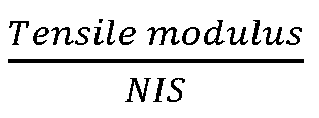
- IE1 and IE2 also have excellent clarity as pVCH (NU1) and HPN600ei (NU2) together provides faster growth of crystallites. Haze values of 1 mm or 2 mm molded specimen were also lower for inventive examples IE1 and IE2, and gloss value is also slightly higher. Improved clarity was observed in the inventive Examples with the combination of C2 content of 1.2 wt.-%, pVCH (NU1) and HPN600ei (NU2). The obtained polypropylene compositions were molded into articles.
Table 5: Cycle time testing for the inventive and comparative examples. Cycle time optimization with houseware container lids (size = 145×95×10mm3, thickness 0.5mm) ; ! CE1 IE1 IE2 Melt temperature, °C 220 220 220 Injection Speed set, mm/s 100 100 100 Injection pressure peak actual (bar) 1077 1033 1048 Holding pressure peak (bar) 500 500 500 Injection time (sec) 0.20 0.20 0.20 Cooling time+ hold on time (sec) 2.30 1.90 1.95 Ejector time (sec) 0.19 0.19 0.19 Mold closing and opening time (sec) 1.41 1.40 1.40 Total cycle time (sec) 4.10 3.69 3.74 Cycle time optimization with rectangular box (size = 145×95×50mm3, thickness 0.5mm) CE1 IE1 IE2 Melt temperature, °C 220 220 220 Injection Speed set, mm/s 160 160 160 Injection pressure peak actual (bar) 750 718 726 Holding pressure peak (bar) 700 600 600 Injection time (sec) 0.11 0.11 0.11 Cooling time+ hold on time (sec) 2.65 2.40 2.40 Ejector time (sec) 0.19 0.19 0.19 Mold closing and opening time (sec) ; 1.70 1.70 1.70 Total cycle time (sec) 4.65 4.40 4.40 - Depending upon the molded article's shape and size, the optimized cycle time of the finished containers of inventive examples were better and may vary from 5 to 10% a thin wall packaging container or various automotive parts like car interior parts, engine casings, car exterior parts etc.
- Below table 6 shows the clearly improved processability (flowability) demonstrated by Spiral Flow of 1 mm thick specimen measured at 220°C melt temperature (carried out five times and the average values are given) of the inventive and comparative examples.
Table 6: Flowability of inventive and comparative examples. Spiral flow CE1 IE1 IE2 Spiral Flow (cm) at 1400 bar 51.8 54.3 54.1 Spiral Flow (cm) at 1000 bar 42.7 44.9 45.0 Spiral Flow (cm) at 600 bar 31.4 33.0 33.0 - The good flowability of the inventive examples alognwith suitable additives demonstrated to achieve a good processability in various manufacturing methods of articles, e.g. injection molding processes, thereby allowing the high production speed together with lower cycle time, required in this mass production market.
Claims (15)
- An α-nucleated propylene ethylene random copolymer composition, comprising:a) a monophasic propylene ethylene random copolymer (R-PP) having- an ethylene content (C2), as determined by 13C-NMR spectroscopy, in the range of 0.5 to 5.0 wt.-%, more preferably in the range of 0.6 to 4.0 wt.- %, most preferably in the range of 0.6 to 2.5 wt.-%, based on the total weight of the monophasic propylene ethylene random copolymer,- a melt flow rate MFR2 (230 °C) measured according to ISO 1133 in the range of 20 to 500 g/10min, preferably in the range of 30 to 300 g/10min, more preferably 35 to 200 g/10min; andb) at least two nucleating agents (NU), wherein- one of the at least two nucleating agents is a vinylcycloalkane polymer (NU1), preferably is poly(vinylcyclopentane) or poly(vinylcyclohexane) (pVCH), more preferably is poly(vinylcyclohexane) (pVCH), and- the other of the at least two nucleating agents, (NU2), comprises the salt of a bridged or unbridged cyclohexane dicarboxylic acid represented by Formula (I-a) or (I-b):

- The α-nucleated propylene ethylene random copolymer composition according to claim 1, wherein the monophasic propylene ethylene random copolymer (R-PP) has 2,1-regio-defects, measured by quantitative 13C-NMR, of less than 0.4 mol-%.
- The α-nucleated propylene ethylene random copolymer composition according to any of the preceding claims, wherein the nucleating agent (NU2) comprises the salt of a bridged or unbridged cyclohexane dicarboxylic acid represented by Formula (I-a) or (I-b) in an amount of ≥ 50 wt.-%, based on the total weight of the nucleating agent (NL12); and/or wherein the salt of a bridged or unbridged cyclohexane dicarboxylic acid represented by Formula (I-a) or (I-b) is the calcium salt of cis-1,2-cyclohexanedicarboxylic acid.
- The α-nucleated propylene ethylene random copolymer composition according to claim 1 or 2, wherein the monophasic propylene ethylene random copolymer (R-PP) is a multimodal, preferably bimodal, propylene ethylene random copolymer (R-PP) in view of the ethylene content and comprises at least two propylene ethylene random copolymer fractions (A) and (B), wherein- the combined amount of the two propylene ethylene random copolymer fractions (A) and (B) is at least 90 wt.-%, based on the total weight of the propylene ethylene random copolymer (R-PP),- the ethylene content of the first propylene ethylene random copolymer fraction (A) is in the range of 0.1 to 1.5 wt.-%, more preferably in the range of 0.3 to 1.2 wt.-%, the ethylene content of the second propylene copolymer fraction (B) is in the range of 0.8 to 2.5 wt.-%, more preferably in the range of 1.0 to 2.0 wt.-%, and the ethylene content of the first propylene ethylene random copolymer fraction (A) is lower than the ethylene content of the second propylene copolymer fraction (B), preferably the ethylene content of the first propylene ethylene random copolymer fraction (A) is at least 0.2 wt.- %, more preferably 0.2 to 2.0 wt.-%, yet more preferably 0.3 to 1.5 wt.-%, lower than the ethylene content of the second propylene copolymer fraction (B) and- wherein the weight ratio between the first propylene copolymer fraction (A) and the second propylene copolymer fraction (B) is 40:60 to 60:40.
- The α-nucleated propylene ethylene random copolymer composition according to any of the preceding claims, wherein the propylene ethylene random copolymer (R-PP) is non-visbroken, preferably is a reactor-made propylene ethylene random copolymer; and/or does not contain peroxide(s) or decomposition products of peroxide(s).
- The α-nucleated propylene ethylene random copolymer composition according to any of the preceding claims, wherein the propylene ethylene random copolymer (R-PP) has- a molecular weight distribution (MWD) determined by gel permeation chromatography according to ISO 16014-4:2003 and ASTM D 6474-99, of at least 5.0, preferably in the range of 6.0 to 10.0; and/or- a xylene soluble content (XS), determined at 25 °C according to ISO 16152, of less than 4.0 wt.-%, preferably in the range from 0.5 to 3.5 wt.-%, more preferably in the range from 1.0 to 3.0 wt.-%, most preferably in the range from 1.5 to 2.7 wt.-%.
- The α-nucleated propylene ethylene random copolymer composition according to any one of the preceding claims, wherein- the amount of the vinylcycloalkane polymer (NU1) is in the range of 0.1 to 2000 ppm, preferably 1.0 to 1000 ppm, based on the total weight of the propylene ethylene random copolymer composition, and/or- the amount of the nucleating agent comprising the salt of a bridged or unbridged cyclohexane dicarboxylic acid represented by Formula (I-a) or (I-b) (NU2) is in the range of 20 to 1000 ppm, preferably 50 to 500 ppm, based on the total weight of the propylene ethylene random copolymer composition.
- The α-nucleated propylene ethylene random copolymer composition according to any one of the preceding claims, wherein the composition does not comprise further nucleating agents other than vinylcycloalkane polymer (NU1) and the nucleating agent comprising the salt of a bridged or unbridged cyclohexane dicarboxylic acid represented by Formula (I-a) or (I-b) (NU2).
- The α-nucleated propylene ethylene random copolymer composition according to any one of the preceding claims, wherein the amount of the propylene ethylene random copolymer (R-PP) is more than 85 wt.-%, preferably in the range of 90 to 99.9 wt.-%, more preferably in the range of 95 to 99.9 wt.-%, based on the total weight of the propylene ethylene random copolymer composition.
- The α-nucleated propylene ethylene random copolymer composition according to any one of the preceding claims, wherein the combined amount of the propylene ethylene random copolymer (R-PP) and the at least two nucleating agents (NU) is more than 90 wt.-%, preferably in the range of 95.0 to 99.9 wt.-%, more preferably in the range of 97.0 to 99.9 wt.-%, based on the total weight of the propylene ethylene random copolymer composition.
- The α-nucleated propylene ethylene random copolymer composition according to any of the preceding claims, wherein the composition has- a melt flow rate MFR2 (230 °C) measured according to ISO 1133 in the range of 20 to 500 g/10min, preferably in the range of 30 to 300 g/10min; and- a xylene soluble content (XS), determined at 25 °C according to ISO 16152, of less than 4 wt.-%.
- The α-nucleated propylene ethylene random copolymer composition according to any of the preceding claims, wherein the composition has- a crystallization temperature Tc measured by differential scanning calorimetry (DSC) of at least 123 °C, preferably in the range of 124 °C to 135 °C; more preferably 125 °C to 130 °C and/or- a melting Temperature Tm measured by differential scanning calorimetry (DSC) of at least 153 °C, more preferably in the range of 153 °C to 170 °C; and/or- a heat deflection Temperature (HDT), measured on injection molded bar test specimens of 80×10×4 mm3 prepared in accordance with ISO 19069-2 using a melt temperature of 200 °C, of more than 110 °C, preferably in the range of 110 °C to 130 °C, most preferably in the range of 112 °C to 125 °C.
- The α-nucleated propylene ethylene random copolymer composition according to any of the preceding claims, wherein the composition has- a tensile modulus, determined according to ISO 527-1,-2 at 1 mm/min and 23°C, of more than 1800 MPa, preferably in the range of 1800 MPa to 2200 MPa; and- a ratio of the tensile modulus to the Charpy notched impact strength (NIS) at 23 °C, determined according to ISO 179 using 80×10×4 mm3 test bars injection-molded in line with ISO 19069-2, fulfilling the equation (a)

- The α-nucleated propylene ethylene random copolymer composition according to any of the preceding claims, wherein the composition has- a haze value determined according to ASTM D1003-07 on plaques with dimensions 60×60×1 mm3 of less than 70%, preferably less than 65%; and/or- a yellowness index, measured according to ASTM E313 on plaques with dimensions 60×60×2 mm3 of less than or equal to 6.0, preferably in the range of 0.1 to less than 6.0, more preferably 0.1 to 5.5.
- An injection molded article comprising, preferably consisting of the α-nucleated propylene ethylene random copolymer composition according to any of claims 1 to 14, wherein the article is preferably a thin wall packaging container or automotive parts like car interior parts, engine casings or car exterior parts.
Priority Applications (2)
| Application Number | Priority Date | Filing Date | Title |
|---|---|---|---|
| EP23197031.0A EP4524166A1 (en) | 2023-09-13 | 2023-09-13 | Polypropylene composition for injection molded articles |
| PCT/EP2024/075439 WO2025056645A1 (en) | 2023-09-13 | 2024-09-12 | Improved polypropylene composition for injection molded articles |
Applications Claiming Priority (1)
| Application Number | Priority Date | Filing Date | Title |
|---|---|---|---|
| EP23197031.0A EP4524166A1 (en) | 2023-09-13 | 2023-09-13 | Polypropylene composition for injection molded articles |
Publications (1)
| Publication Number | Publication Date |
|---|---|
| EP4524166A1 true EP4524166A1 (en) | 2025-03-19 |
Family
ID=88093463
Family Applications (1)
| Application Number | Title | Priority Date | Filing Date |
|---|---|---|---|
| EP23197031.0A Pending EP4524166A1 (en) | 2023-09-13 | 2023-09-13 | Polypropylene composition for injection molded articles |
Country Status (2)
| Country | Link |
|---|---|
| EP (1) | EP4524166A1 (en) |
| WO (1) | WO2025056645A1 (en) |
Citations (16)
| Publication number | Priority date | Publication date | Assignee | Title |
|---|---|---|---|---|
| EP0183307A2 (en) | 1984-11-28 | 1986-06-04 | VARIAN S.p.A. | Electronic device for feeding an ion pump with two different tensions and for improved measuring of the pressure in said pump |
| EP0316187A2 (en) | 1987-11-10 | 1989-05-17 | Sumitomo Chemical Company, Limited | High-strength polypropylene fiber |
| EP0491566A2 (en) | 1990-12-19 | 1992-06-24 | Borealis A/S | A method for the modification of catalysts intended for the polymerization of olefins |
| WO1992012182A1 (en) | 1990-12-28 | 1992-07-23 | Neste Oy | Multi-stage process for producing polyethylene |
| WO1992019653A1 (en) | 1991-05-09 | 1992-11-12 | Neste Oy | A procatalyst for polymerization of olefins containing a trans-esterification product of a lower alcohol and a phthalic acid ester |
| WO1992019658A1 (en) | 1991-05-09 | 1992-11-12 | Neste Oy | Coarse grained polyolefin, production thereof and a procatalyst containing a transesterification product between a lower alcohol and dioctylphthalate used therefore |
| US5234879A (en) | 1990-12-19 | 1993-08-10 | Neste Oy | Method for the modification of catalysts intended for the polymerization of olefins |
| EP0887379A1 (en) | 1997-06-24 | 1998-12-30 | Borealis A/S | Process and apparatus for preparing propylene homopolymers and copolymers |
| WO1999024479A1 (en) | 1997-11-07 | 1999-05-20 | Borealis A/S | Novel propylene polymers and products thereof |
| WO1999033843A1 (en) | 1997-12-23 | 1999-07-08 | Borealis Technology Oy | Soluble magnesium dihalide complex, preparation and use |
| EP1028984A1 (en) | 1997-11-07 | 2000-08-23 | Borealis A/S | Process for preparing polypropylene |
| EP1183307A1 (en) | 1999-05-07 | 2002-03-06 | Borealis Technology Oy | High-stiffness propylene polymers and a process for the preparation thereof |
| EP2960279A1 (en) | 2014-06-27 | 2015-12-30 | Borealis AG | Nucleated polypropylene composition |
| US10266671B2 (en) * | 2015-07-08 | 2019-04-23 | Borealis Ag | Tube made of a heterophasic polypropylene composition |
| EP3617238A1 (en) * | 2018-08-28 | 2020-03-04 | Borealis AG | Propylene random copolymer with specific comonomer distribution |
| US20200181379A1 (en) * | 2016-10-25 | 2020-06-11 | Borealis Ag | High flow heterophasic polypropylene copolymers with improved mechanical and optical properties |
Family Cites Families (1)
| Publication number | Priority date | Publication date | Assignee | Title |
|---|---|---|---|---|
| US12129371B2 (en) * | 2021-06-14 | 2024-10-29 | Borealis Ag | Heterophasic propylene ethylene copolymer composition with excellent optical and sealing properties |
-
2023
- 2023-09-13 EP EP23197031.0A patent/EP4524166A1/en active Pending
-
2024
- 2024-09-12 WO PCT/EP2024/075439 patent/WO2025056645A1/en active Pending
Patent Citations (18)
| Publication number | Priority date | Publication date | Assignee | Title |
|---|---|---|---|---|
| EP0183307A2 (en) | 1984-11-28 | 1986-06-04 | VARIAN S.p.A. | Electronic device for feeding an ion pump with two different tensions and for improved measuring of the pressure in said pump |
| EP0316187A2 (en) | 1987-11-10 | 1989-05-17 | Sumitomo Chemical Company, Limited | High-strength polypropylene fiber |
| US5234879A (en) | 1990-12-19 | 1993-08-10 | Neste Oy | Method for the modification of catalysts intended for the polymerization of olefins |
| EP0491566A2 (en) | 1990-12-19 | 1992-06-24 | Borealis A/S | A method for the modification of catalysts intended for the polymerization of olefins |
| WO1992012182A1 (en) | 1990-12-28 | 1992-07-23 | Neste Oy | Multi-stage process for producing polyethylene |
| EP0591224A1 (en) | 1991-05-09 | 1994-04-13 | Borealis A/S | A procatalyst for polymerization of olefins containing a trans-esterification product of a lower alcohol and a phthalic acid ester |
| WO1992019658A1 (en) | 1991-05-09 | 1992-11-12 | Neste Oy | Coarse grained polyolefin, production thereof and a procatalyst containing a transesterification product between a lower alcohol and dioctylphthalate used therefore |
| EP0586390A1 (en) | 1991-05-09 | 1994-03-16 | Neste Oy | Coarse grained polyolefin, production thereof and a procatalyst containing a transesterification product between a lower alcohol and dioctylphthalate used therefore. |
| WO1992019653A1 (en) | 1991-05-09 | 1992-11-12 | Neste Oy | A procatalyst for polymerization of olefins containing a trans-esterification product of a lower alcohol and a phthalic acid ester |
| EP0887379A1 (en) | 1997-06-24 | 1998-12-30 | Borealis A/S | Process and apparatus for preparing propylene homopolymers and copolymers |
| WO1999024479A1 (en) | 1997-11-07 | 1999-05-20 | Borealis A/S | Novel propylene polymers and products thereof |
| EP1028984A1 (en) | 1997-11-07 | 2000-08-23 | Borealis A/S | Process for preparing polypropylene |
| WO1999033843A1 (en) | 1997-12-23 | 1999-07-08 | Borealis Technology Oy | Soluble magnesium dihalide complex, preparation and use |
| EP1183307A1 (en) | 1999-05-07 | 2002-03-06 | Borealis Technology Oy | High-stiffness propylene polymers and a process for the preparation thereof |
| EP2960279A1 (en) | 2014-06-27 | 2015-12-30 | Borealis AG | Nucleated polypropylene composition |
| US10266671B2 (en) * | 2015-07-08 | 2019-04-23 | Borealis Ag | Tube made of a heterophasic polypropylene composition |
| US20200181379A1 (en) * | 2016-10-25 | 2020-06-11 | Borealis Ag | High flow heterophasic polypropylene copolymers with improved mechanical and optical properties |
| EP3617238A1 (en) * | 2018-08-28 | 2020-03-04 | Borealis AG | Propylene random copolymer with specific comonomer distribution |
Non-Patent Citations (9)
| Title |
|---|
| BUSICO, V.CARBONNIERE, P.CIPULLO, R.PELLECCHIA, R.SEVERN, J.TALARICO, G., MACROMOL. RAPID COMMUN., vol. 28, 2007, pages 1128 |
| BUSICO, V.CIPULLO, R., PROG. POLYM. SCI., vol. 26, 2001, pages 443 |
| BUSICO, V.CIPULLO, R.MONACO, G.VACATELLO, M.SEGRE, A.L., MACROMOLEUCLES, vol. 30, 1997, pages 6251 |
| CHENG, H. N., MACROMOLECULES, vol. 17, 1984, pages 1950 |
| KAKUGO, M.NAITO, Y.MIZUNUMA, K.MIYATAKE, T., MACROMOLECULES, vol. 15, 1982, pages 1150 |
| RESCONI, L.CAVALLO, L.FAIT, A.PIEMONTESI, F., CHEM. REV., vol. 100, 2000, pages 1253 |
| SINGH, G.KOTHARI, A.GUPTA, V., POLYMER TESTING, vol. 28, no. 5, 2009, pages 475 |
| WANG, W-J.ZHU, S., MACROMOLECULES, vol. 33, 2000, pages 1157 |
| ZHOU, Z.KUEMMERLE, R.QIU, X.REDWINE, D.CONG, R.TAHA, A.BAUGH, D.WINNIFORD, B., J. MAG. RESON., vol. 187, 2007, pages 225 |
Also Published As
| Publication number | Publication date |
|---|---|
| WO2025056645A1 (en) | 2025-03-20 |
Similar Documents
| Publication | Publication Date | Title |
|---|---|---|
| EP2902438B1 (en) | High flow polyolefin composition with high stiffness and puncture resistance | |
| EP3036283B1 (en) | High flow polyolefin composition with high stiffness and toughness | |
| EP3036284B1 (en) | High flow polyolefin composition with high stiffness and toughness | |
| EP2999721B2 (en) | Propylene copolymer for thin-wall packaging | |
| EP2431416B1 (en) | High flow and stiff polymer material with good transparency and impact properties | |
| EP3330315B1 (en) | Foamed polypropylene composition | |
| EP3115412B1 (en) | Soft heterophasic random propylene copolymer with improved clarity | |
| EP2809718B1 (en) | Improved scratch resistance polypropylene at high flow | |
| EP3262114B1 (en) | Propylene copolymer composition with improved long-term mechanical properties | |
| EP3261815B1 (en) | Propylene copolymer composition with improved long-term mechanical properties | |
| US20160145366A1 (en) | Propylene copolymer for extrusion blow molded bottles | |
| EP2514770B1 (en) | Polypropylene homopolymers with high heat deflection temperature, high stiffness and flowability | |
| EP3263640B1 (en) | Soft and transparent polypropylene composition | |
| EP3873983B1 (en) | A moulded article comprising a polypropylene composition suitable for gamma-ray sterilization | |
| EP3850042B1 (en) | Polypropylene composition with excellent stiffness and impact strength | |
| EP3914645B1 (en) | Foamable polypropylene composition with excellent mechanical performance | |
| US12404394B2 (en) | High flow polypropylene composition for injection moulding applications | |
| US20250145797A1 (en) | Polypropylene composition with improved optical characteristics | |
| WO2025056645A1 (en) | Improved polypropylene composition for injection molded articles | |
| EP4600277A1 (en) | Improved polypropylene composition for injection or blow molded articles | |
| US20220298341A1 (en) | Articles with high rigidity and low warpage comprising heterophasic propylene polymer composition and uses therefor | |
| EP4538306A1 (en) | Dual nucleation for high-flow impact copolymers | |
| EP4671322A1 (en) | POLYPROPYLENE COMPOSITION WITH EXCELLENT STIFFNESS AND IMPACT RESISTANCE | |
| WO2021130228A1 (en) | Heterophasic propylene copolymer (heco) composition having excellent impact strength, stiffness and processability |
Legal Events
| Date | Code | Title | Description |
|---|---|---|---|
| PUAI | Public reference made under article 153(3) epc to a published international application that has entered the european phase |
Free format text: ORIGINAL CODE: 0009012 |
|
| STAA | Information on the status of an ep patent application or granted ep patent |
Free format text: STATUS: THE APPLICATION HAS BEEN PUBLISHED |
|
| AK | Designated contracting states |
Kind code of ref document: A1 Designated state(s): AL AT BE BG CH CY CZ DE DK EE ES FI FR GB GR HR HU IE IS IT LI LT LU LV MC ME MK MT NL NO PL PT RO RS SE SI SK SM TR |
|
| RAP3 | Party data changed (applicant data changed or rights of an application transferred) |
Owner name: ABU DHABI POLYMERS CO. LTD (BOROUGE) - SOLEPROPRIETORSHIP L.L.C. Owner name: BOREALIS GMBH |
|
| STAA | Information on the status of an ep patent application or granted ep patent |
Free format text: STATUS: REQUEST FOR EXAMINATION WAS MADE |
|
| 17P | Request for examination filed |
Effective date: 20250918 |
|
| REG | Reference to a national code |
Ref country code: DE Ref legal event code: R079 Free format text: PREVIOUS MAIN CLASS: C08F0210060000 Ipc: C08L0023140000 |
|
| GRAP | Despatch of communication of intention to grant a patent |
Free format text: ORIGINAL CODE: EPIDOSNIGR1 |
|
| STAA | Information on the status of an ep patent application or granted ep patent |
Free format text: STATUS: GRANT OF PATENT IS INTENDED |
|
| RIC1 | Information provided on ipc code assigned before grant |
Ipc: C08L 23/14 20060101AFI20251218BHEP Ipc: C08K 5/098 20060101ALI20251218BHEP Ipc: C08F 210/06 20060101ALI20251218BHEP Ipc: C08F 2/00 20060101ALI20251218BHEP |
|
| INTG | Intention to grant announced |
Effective date: 20260102 |
|
| GRAS | Grant fee paid |
Free format text: ORIGINAL CODE: EPIDOSNIGR3 |
|
| GRAA | (expected) grant |
Free format text: ORIGINAL CODE: 0009210 |
|
| STAA | Information on the status of an ep patent application or granted ep patent |
Free format text: STATUS: THE PATENT HAS BEEN GRANTED |