EP4524142A1 - Fluoroquinoxalinone derivative for selectively inhibiting parp1 - Google Patents
Fluoroquinoxalinone derivative for selectively inhibiting parp1 Download PDFInfo
- Publication number
- EP4524142A1 EP4524142A1 EP23802817.9A EP23802817A EP4524142A1 EP 4524142 A1 EP4524142 A1 EP 4524142A1 EP 23802817 A EP23802817 A EP 23802817A EP 4524142 A1 EP4524142 A1 EP 4524142A1
- Authority
- EP
- European Patent Office
- Prior art keywords
- compound
- added
- μmol
- reaction mixture
- alkyl
- Prior art date
- Legal status (The legal status is an assumption and is not a legal conclusion. Google has not performed a legal analysis and makes no representation as to the accuracy of the status listed.)
- Pending
Links
Images
Classifications
-
- A—HUMAN NECESSITIES
- A61—MEDICAL OR VETERINARY SCIENCE; HYGIENE
- A61P—SPECIFIC THERAPEUTIC ACTIVITY OF CHEMICAL COMPOUNDS OR MEDICINAL PREPARATIONS
- A61P35/00—Antineoplastic agents
-
- A—HUMAN NECESSITIES
- A61—MEDICAL OR VETERINARY SCIENCE; HYGIENE
- A61K—PREPARATIONS FOR MEDICAL, DENTAL OR TOILETRY PURPOSES
- A61K31/00—Medicinal preparations containing organic active ingredients
- A61K31/33—Heterocyclic compounds
- A61K31/395—Heterocyclic compounds having nitrogen as a ring hetero atom, e.g. guanethidine or rifamycins
- A61K31/435—Heterocyclic compounds having nitrogen as a ring hetero atom, e.g. guanethidine or rifamycins having six-membered rings with one nitrogen as the only ring hetero atom
- A61K31/4353—Heterocyclic compounds having nitrogen as a ring hetero atom, e.g. guanethidine or rifamycins having six-membered rings with one nitrogen as the only ring hetero atom ortho- or peri-condensed with heterocyclic ring systems
- A61K31/4375—Heterocyclic compounds having nitrogen as a ring hetero atom, e.g. guanethidine or rifamycins having six-membered rings with one nitrogen as the only ring hetero atom ortho- or peri-condensed with heterocyclic ring systems the heterocyclic ring system containing a six-membered ring having nitrogen as a ring heteroatom, e.g. quinolizines, naphthyridines, berberine, vincamine
-
- A—HUMAN NECESSITIES
- A61—MEDICAL OR VETERINARY SCIENCE; HYGIENE
- A61K—PREPARATIONS FOR MEDICAL, DENTAL OR TOILETRY PURPOSES
- A61K31/00—Medicinal preparations containing organic active ingredients
- A61K31/33—Heterocyclic compounds
- A61K31/395—Heterocyclic compounds having nitrogen as a ring hetero atom, e.g. guanethidine or rifamycins
- A61K31/495—Heterocyclic compounds having nitrogen as a ring hetero atom, e.g. guanethidine or rifamycins having six-membered rings with two or more nitrogen atoms as the only ring heteroatoms, e.g. piperazine or tetrazines
- A61K31/4985—Pyrazines or piperazines ortho- or peri-condensed with heterocyclic ring systems
-
- C—CHEMISTRY; METALLURGY
- C07—ORGANIC CHEMISTRY
- C07D—HETEROCYCLIC COMPOUNDS
- C07D241/00—Heterocyclic compounds containing 1,4-diazine or hydrogenated 1,4-diazine rings
- C07D241/36—Heterocyclic compounds containing 1,4-diazine or hydrogenated 1,4-diazine rings condensed with carbocyclic rings or ring systems
- C07D241/38—Heterocyclic compounds containing 1,4-diazine or hydrogenated 1,4-diazine rings condensed with carbocyclic rings or ring systems with only hydrogen or carbon atoms directly attached to the ring nitrogen atoms
- C07D241/40—Benzopyrazines
- C07D241/44—Benzopyrazines with hetero atoms or with carbon atoms having three bonds to hetero atoms with at the most one bond to halogen, e.g. ester or nitrile radicals, directly attached to carbon atoms of the hetero ring
-
- C—CHEMISTRY; METALLURGY
- C07—ORGANIC CHEMISTRY
- C07D—HETEROCYCLIC COMPOUNDS
- C07D401/00—Heterocyclic compounds containing two or more hetero rings, having nitrogen atoms as the only ring hetero atoms, at least one ring being a six-membered ring with only one nitrogen atom
- C07D401/02—Heterocyclic compounds containing two or more hetero rings, having nitrogen atoms as the only ring hetero atoms, at least one ring being a six-membered ring with only one nitrogen atom containing two hetero rings
- C07D401/12—Heterocyclic compounds containing two or more hetero rings, having nitrogen atoms as the only ring hetero atoms, at least one ring being a six-membered ring with only one nitrogen atom containing two hetero rings linked by a chain containing hetero atoms as chain links
-
- C—CHEMISTRY; METALLURGY
- C07—ORGANIC CHEMISTRY
- C07D—HETEROCYCLIC COMPOUNDS
- C07D401/00—Heterocyclic compounds containing two or more hetero rings, having nitrogen atoms as the only ring hetero atoms, at least one ring being a six-membered ring with only one nitrogen atom
- C07D401/14—Heterocyclic compounds containing two or more hetero rings, having nitrogen atoms as the only ring hetero atoms, at least one ring being a six-membered ring with only one nitrogen atom containing three or more hetero rings
-
- C—CHEMISTRY; METALLURGY
- C07—ORGANIC CHEMISTRY
- C07D—HETEROCYCLIC COMPOUNDS
- C07D471/00—Heterocyclic compounds containing nitrogen atoms as the only ring hetero atoms in the condensed system, at least one ring being a six-membered ring with one nitrogen atom, not provided for by groups C07D451/00 - C07D463/00
- C07D471/02—Heterocyclic compounds containing nitrogen atoms as the only ring hetero atoms in the condensed system, at least one ring being a six-membered ring with one nitrogen atom, not provided for by groups C07D451/00 - C07D463/00 in which the condensed system contains two hetero rings
- C07D471/04—Ortho-condensed systems
-
- C—CHEMISTRY; METALLURGY
- C07—ORGANIC CHEMISTRY
- C07D—HETEROCYCLIC COMPOUNDS
- C07D471/00—Heterocyclic compounds containing nitrogen atoms as the only ring hetero atoms in the condensed system, at least one ring being a six-membered ring with one nitrogen atom, not provided for by groups C07D451/00 - C07D463/00
- C07D471/12—Heterocyclic compounds containing nitrogen atoms as the only ring hetero atoms in the condensed system, at least one ring being a six-membered ring with one nitrogen atom, not provided for by groups C07D451/00 - C07D463/00 in which the condensed system contains three hetero rings
- C07D471/14—Ortho-condensed systems
-
- C—CHEMISTRY; METALLURGY
- C07—ORGANIC CHEMISTRY
- C07D—HETEROCYCLIC COMPOUNDS
- C07D487/00—Heterocyclic compounds containing nitrogen atoms as the only ring hetero atoms in the condensed system, not provided for by groups C07D451/00 - C07D477/00
- C07D487/02—Heterocyclic compounds containing nitrogen atoms as the only ring hetero atoms in the condensed system, not provided for by groups C07D451/00 - C07D477/00 in which the condensed system contains two hetero rings
- C07D487/04—Ortho-condensed systems
-
- C—CHEMISTRY; METALLURGY
- C07—ORGANIC CHEMISTRY
- C07D—HETEROCYCLIC COMPOUNDS
- C07D498/00—Heterocyclic compounds containing in the condensed system at least one hetero ring having nitrogen and oxygen atoms as the only ring hetero atoms
- C07D498/12—Heterocyclic compounds containing in the condensed system at least one hetero ring having nitrogen and oxygen atoms as the only ring hetero atoms in which the condensed system contains three hetero rings
- C07D498/14—Ortho-condensed systems
-
- C—CHEMISTRY; METALLURGY
- C07—ORGANIC CHEMISTRY
- C07D—HETEROCYCLIC COMPOUNDS
- C07D519/00—Heterocyclic compounds containing more than one system of two or more relevant hetero rings condensed among themselves or condensed with a common carbocyclic ring system not provided for in groups C07D453/00 or C07D455/00
Definitions
- the present disclosure relates to a series of fluorine-substituted heterocyclic compounds, specifically to a compound of formula (XII) and a pharmaceutically acceptable salt thereof.
- PARP Poly-ADP-ribose polymerase
- PARP1 and PARP2 have been extensively studied due to their roles in DNA damage repair.
- PARP1 is activated by DNA damage breaks and catalyzes the addition of poly(ADP-ribose) (PAR) chains to target proteins.
- PARylation This post-translational modification, known as PARylation, mediates the recruitment of additional DNA repair factors to the site of DNA damage.
- PARP undergoes auto-PARylation, which triggers the release of PARP bound to DNA, thereby allowing other DNA repair proteins to access and complete the repair.
- Inhibiting PARP family enzymes has been developed as an anti-tumor strategy, which selectively kills cancer cells by inactivating complementary DNA repair pathways.
- Numerous preclinical and clinical studies have shown that tumor cells with BRCA1 or BRCA2 mutations, where BRCA is a key tumor suppressor protein involved in double-strand DNA break (DSB) repair through homologous recombination (HR), possess defective homologous recombination repair (HRD) pathways and rely on the function of PARP enzyme for survival.
- the growth of tumors with BRCA mutations becomes more dependent on the PARP pathway, making the tumors particularly sensitive to PARP1 inhibitors.
- clinical studies have also demonstrated certain efficacy of PARP inhibitors in non-BRCA-mutated tumors that exhibit homologous recombination defects.
- PARP1-selective inhibitors can be used alone for solid tumors such as ovarian cancer, breast cancer, triple-negative breast cancer, and prostate cancer with BRCA1/2 mutations (synthetic lethality mechanism). They can also be used as combination therapies to enhance the effects of DNA-damage-based anti-cancer drugs (e.g., DNA alkylating agents, topoisomerase inhibitors, and platinum-based chemotherapeutics) and radiotherapy. Additionally, they can be used in combination with other targeted therapies, such as PD-1 inhibitors, androgen receptor (AR) inhibitors, cell cycle checkpoint kinase (Chk) inhibitors, and c-Met inhibitors, for the treatment of various BRCA-negative or BRCA-positive solid tumors.
- DNA-damage-based anti-cancer drugs e.g., DNA alkylating agents, topoisomerase inhibitors, and platinum-based chemotherapeutics
- radiotherapy e.g., platinum-based chemotherapeutics
- the present disclosure provides a compound of formula (XII) or a pharmaceutically acceptable salt thereof, wherein
- the present disclosure further provides a compound of formula (XII) or a pharmaceutically acceptable salt thereof, wherein
- the present disclosure further provides a compound of formula (XI) or a pharmaceutically acceptable salt thereof, wherein
- the present disclosure further provides a compound of formula (VIII) or a pharmaceutically acceptable salt thereof, wherein
- the present disclosure further provides a compound of formula (VIII) or a pharmaceutically acceptable salt thereof, wherein
- the present disclosure further provides a compound of formula (VII-1) or a pharmaceutically acceptable salt thereof, wherein
- the present disclosure further provides a compound of formula (VI) or a pharmaceutically acceptable salt thereof, wherein
- the present disclosure further provides a compound of formula (I) or a pharmaceutically acceptable salt thereof, wherein
- the present disclosure further provides a compound of formula (VII-2) or a pharmaceutically acceptable salt thereof, wherein
- the present disclosure further provides a compound of formula (I) or a pharmaceutically acceptable salt wherein
- the present disclosure further provides a compound of formula (I) or a pharmaceutically acceptable salt thereof, wherein
- the X is selected from O, S, and N(OCH 3 ), and other variables are as defined in the present disclosure.
- the X is selected from O and S, and other variables are as defined in the present disclosure.
- the X is selected from O, and other variables are as defined in the present disclosure.
- each R a is independently selected from H, F, Cl, Br, I, CH 3 , CH 2 CH 3 , and CH 2 CH 2 CH 3 , and the CH 3 , CH 2 CH 3 , and CH 2 CH 2 CH 3 are optionally substituted by 1, 2, or 3 halogens, and other variables are as defined in the present disclosure.
- each R a is independently selected from H, F and CH 3 , and other variables are as defined in the present disclosure.
- each R a is independently selected from H and CH 3 , and other variables are as defined in the present disclosure.
- each R b is independently selected from H, F, Cl, Br, I, CH 3 , CH 2 CH 3 , and CH 2 CH 2 CH 3 , and the CH 3 , CH 2 CH 3 , and CH 2 CH 2 CH 3 are optionally substituted by 1, 2, or 3 halogens, and other variables are as defined in the present disclosure.
- each R b is independently selected from H, F, and CH 3 , and other variables are as defined in the present disclosure.
- each R b is independently selected from H and CH 3 , and other variables are as defined in the present disclosure.
- each R c is independently selected from H, F, Cl, Br, I, CH 3 , CH 2 CH 3 , and CH 2 CH 2 CH 3 , and the CH 3 , CH 2 CH 3 , and CH 2 CH 2 CH 3 are optionally substituted by 1, 2, or 3 halogens, and other variables are as defined in the present disclosure.
- each R c is independently selected from H, F, and CH 3 , and other variables are as defined in the present disclosure.
- each R c is independently selected from H and F, and other variables are as defined in the present disclosure.
- the R d is selected from OCH 3 , and other variables are as defined in the present disclosure.
- the T 3 is selected from N, CH, and CF, and other variables are as defined in the present disclosure.
- the T 3 is selected from N and CF, and other variables are as defined in the present disclosure.
- the T 3 is selected from N, and other variables are as defined in the present disclosure.
- the T 4 is selected from N and CH, and other variables are as defined in the present disclosure.
- the R 1 is selected from CH 3 and CH 2 CH 3 , and other variables are as defined in the present disclosure.
- the R 1 is selected from CH 3 , and other variables are as defined in the present disclosure.
- the R 2 is selected from H and CH 3 , and other variables are as defined in the present disclosure.
- the R 2 is selected from CH 3 , and other variables are as defined in the present disclosure.
- the R 4 , R 5 , R 6 , and R 7 are each independently selected from H, F, and CH 3 , and other variables are as defined in the present disclosure.
- the R 3 is selected from H and F, and other variables are as defined in the present disclosure.
- the R 4 is selected from H, F, Cl, CN, and CH 3 , and other variables are as defined in the present disclosure.
- the R 4 is selected from H, F, Cl, and CN, and other variables are as defined in the present disclosure.
- the R 4 is selected from H, F, and CH 3 , and other variables are as defined in the present disclosure.
- the R 4 is selected from H and F, and other variables are as defined in the present disclosure.
- the R 4 is selected from F, and other variables are as defined in the present disclosure.
- the R 5 is selected from H, F, Cl, and CN, and other variables are as defined in the present disclosure.
- the R 5 is selected from H, F, CN, and CH 3 , and other variables are as defined in the present disclosure.
- the R 5 is selected from H, F, and CH 3 , and other variables are as defined in the present disclosure.
- the R 5 is selected from H and F, and other variables are as defined in the present disclosure.
- the R 5 is selected from H, and other variables are as defined in the present disclosure.
- the R 6 and R 7 are each independently selected from H, F, and CH 3 , and other variables are as defined in the present disclosure.
- the R 6 is selected from H, F, and CH 3 , and other variables are as defined in the present disclosure.
- the R 7 is selected from H, F, and CH 3 , and other variables are as defined in the present disclosure
- the R 6 is selected from H and F, and other variables are as defined in the present disclosure.
- the R 7 is selected from H and F, and other variables are as defined in the present disclosure.
- the R 8 is selected from CH 3 , CH 2 CH 3 , CH 2 CF 3 , cyclopropyl, and CD 3 , and other variables are as defined in the present disclosure.
- the R 8 is selected from CH 3 , CH 2 CF 3 , cyclopropyl, and CD 3 , and other variables are as defined in the present disclosure.
- the R 8 is selected from CH 3 , cyclopropyl, and CD 3 , and other variables are as defined in the present disclosure.
- the R 8 is selected from CH 3 and cyclopropyl, and other variables are as defined in the present disclosure.
- the R 9 is selected from H and F, and other variables are as defined in the present disclosure.
- the R 10 is selected from H and F, and other variables are as defined in the present disclosure.
- the R 12 is selected from H and CH 3 , and other variables are as defined in the present disclosure.
- the R 13 is selected from H and CH 3 , and other variables are as defined in the present disclosure.
- the R 14 is selected from H and CH 3 , and other variables are as defined in the present disclosure.
- the R 15 is selected from H, D, and CH 3 , and other variables are as defined in the present disclosure
- the R 16 is selected from H, D, and CH 3 , and other variables are as defined in the present disclosure
- ring A is selected from phenyl and 6-membered heteroaryl ring, and other variables are as defined in the present disclosure.
- ring A is selected from phenyl, pyrrolyl, pyrazolyl, imidazolyl, triazolyl, furanyl, thienyl, pyridyl, pyrazinyl, and pyrimidinyl, and other variables are as defined in the present disclosure.
- ring A is selected from phenyl, pyridyl, pyrazinyl, and pyrimidinyl, and other variables are as defined in the present disclosure.
- ring B is selected from 6-membered heteroaryl ring, and other variables are as defined in the present disclosure.
- the structural moiety is selected from and other variables are as defined in the present disclosure.
- the structural moiety is selected from and other variables are as defined in the present disclosure.
- the structural moiety is selected from and other variables are as defined in the present disclosure.
- the structural moiety is selected from and and other variables are as defined in the present disclosure.
- the structural moiety is selected from and other variables are as defined in the present disclosure.
- the structural moiety is selected from and other variables are as defined in the present disclosure.
- R 11 and R 1 form a benzene ring, so that the structural moiety is selected from and other variables are as defined in the present disclosure. In some embodiments of the present disclosure, the structural moiety is selected from and other variables are as defined in the present disclosure.
- the structural moiety is selected from and other variables are as defined in the present disclosure.
- the structural moiety is selected from and and other variables are as defined in the present disclosure.
- the R 2 and R 4 form a ring, so that the structural moiety is selected from and and other variables are as defined in the present disclosure.
- the R 3 and R 5 form a ring, so that the structural moiety is selected from and other variables are as defined in the present disclosure.
- the R 3 and R 5 form a ring, so that the structural moiety is selected from and other variables are as defined in the present disclosure.
- the R 2 and R 4 form a ring, so that the structural moiety is selected from and and other variables are as defined in the present disclosure.
- the R 3 and R 5 form a ring, so that the structural moiety is selected from and and other variables are as defined in the present disclosure.
- the structural moiety is selected from and other variables are as defined in the present disclosure.
- the R 2 and R 4 form a ring, so that the structural moiety is selected from and other variables are as defined in the present disclosure.
- the R 3 and R 5 form a ring, so that the structural moiety is selected from and other variables are as defined in the present disclosure.
- the L is selected from a single bond, the structural moiety is selected from and other variables are as defined in the present disclosure.
- the L is selected from a single bond, the structural moiety is selected from and other variables are as defined in the present disclosure.
- the L is selected from a single bond, the structural moiety is selected from and other variables are as defined in the present disclosure.
- the structural moiety is selected from and other variables are as defined in the present disclosure.
- the structural moiety is selected from and and other variables are as defined in the present disclosure.
- the structural moiety is selected from and other variables are as defined in the present disclosure.
- the structural moiety is selected from and and other variables are as defined in the present disclosure.
- the structural moiety is selected from and and other variables are as defined in the present disclosure.
- the structural moiety is selected from and other variables are as defined in the present disclosure.
- the structural moiety is selected from and and other variables are as defined in the present disclosure.
- the structural moiety is selected from , and other variables are as defined in the present disclosure.
- the structural moiety is selected from and other variables are as defined in the present disclosure.
- R 6 and R 7 are not simultaneously H, and other variables are as defined in the present disclosure.
- R 6 and R 7 are not simultaneously H, and other variables are as defined in the present disclosure.
- the structural moiety is selected from and other variables are as defined in the present disclosure.
- the structural moiety is selected from and other variables are as defined in the present disclosure.
- the compound or the pharmaceutically acceptable salt thereof is selected from:
- the compound or the pharmaceutically acceptable salt thereof is selected from:
- the compound or the pharmaceutically acceptable salt thereof is selected from: wherein
- the ring A is selected from a pyridine ring, and other variables are as defined in the present disclosure.
- the compound or the pharmaceutically acceptable salt thereof is selected from: and wherein ring A, ring B, R 1 , R 2 , R 3 , R 4 , R 5 , R 6 , R 7 , R 8 , R 9 , X, T 3 , T 4 , and the structural moiety are as defined in the present disclosure.
- the compound or the pharmaceutically acceptable salt thereof is selected from: wherein R 1 , R 2 , R 3 , R 4 , R 5 , R 6 , R 7 , R 8 , R 9 , R a , R b , X, T 3 , and T 4 are as defined in the present disclosure.
- the compound or the pharmaceutically acceptable salt thereof is selected from:
- the present disclosure further provides a compound as follows or a pharmaceutically acceptable salt thereof,
- the compound or the pharmaceutically acceptable salt thereof is provided, and the compound is selected from:
- the present disclosure further provides a pharmaceutical composition
- a pharmaceutical composition comprising a therapeutically effective amount of the compound or the pharmaceutically acceptable salt thereof as defined in the present disclosure, and a pharmaceutically acceptable carrier, diluent, or excipient.
- the present disclosure further provides a use of the compound, the pharmaceutically acceptable salt thereof, or the composition in the manufacture of a medicament for treating solid tumors.
- the solid tumors refer to solid tumors such as ovarian cancer, breast cancer, prostate cancer, and glioma.
- the present disclosure further provides the following synthesis methods:
- the present disclosure further provides the following bioassay methods:
- Test method 1 PARP1 enzyme activity assay
- PARP1 chemiluminescent assay kit purchased from BPS Bioscience; EnVision multimode microplate reader (PerkinElmer).
- PBST buffer 1X PBS containing 0.05% Tween-20 was prepared, that is, 5 ⁇ L of 100% Tween-20 added to 10 mL of PBS.
- test compound solutions The test compound was diluted 5-fold using 100% DMSO to the 8 th concentration, from 1000 ⁇ M to 12.8 nM.
- the internal control compound was diluted 5-fold using 100% DMSO to the 8 th concentration, from 200 ⁇ M to 2.56 nM.
- the test compound at each concentration gradient was further diluted using 1X assay buffer to prepare a working solution with a final DMSO concentration of 10%.
- Test method 2 Study on the binding affinity of the compounds of the present disclosure to PARP1 and PARP2
- the surface plasmon resonance (SPR) experiment was conducted on a Biacore 8K instrument (GE Healthcare).
- the biotinylated PARP1 protein (sequence: 655-end) was coupled to a streptavidin-coated SA chip (Cytiva, 29699622).
- the specific steps were as follows: the chip surface was activated using 1 mM NaCl/50 mM NaOH.
- the PARP1 protein was diluted with a coupling buffer (50 mM Tris-HCl, pH 8.0, 150 mM NaCl, 10 mM MgCl 2 , 0.05% P20) to prepare a ligand solution at a concentration of 10 ⁇ g/mL.
- Small molecule compounds were diluted by gradients in a buffer (50 mM Tris, pH 8.0, 150 mM NaCl, 10 mM MgCl 2 , 0.05% Tween 20) to obtain solutions with different compound concentrations. These solutions were injected over the chip surface, which was already coupled with the PARP1 protein. The injection flow rate was 50 ⁇ L/min, the injection time was 60 seconds, and the dissociation time was 20 minutes. The instrument detected the binding and dissociation curves of the protein-small molecule compounds.
- a buffer 50 mM Tris, pH 8.0, 150 mM NaCl, 10 mM MgCl 2 , 0.05% Tween 20
- the data from both the sample channel and the reference channel were analyzed using the Biacore 8K evaluation software to generate sensorgrams.
- the data were fitted based on a 1:1 binding model.
- the surface plasmon resonance (SPR) experiment was conducted on a Biacore 8K instrument (GE Healthcare).
- the biotinylated PARP2 protein (sequence: 223-end) was coupled to a streptavidin-coated SA chip (Cytiva, 29699622).
- the specific steps were as follows: the chip surface was activated using 1 mM NaCl/60 mM NaOH.
- the PARP2 protein was diluted with a coupling buffer (50 mM Tris-HCl, pH 8.0, 150 mM NaCl, 10 mM MgCl 2 , 0.05% P20) to prepare a ligand solution at a concentration of 10 ⁇ g/mL.
- Small molecule compounds were diluted by gradients in a buffer (50 mM Tris, pH 8.0, 150 mM NaCl, 10 mM MgCl 2 , 0.05% Tween 20) to obtain solutions with different compound concentrations. These solutions were injected over the chip surface, which was already coupled with the PARP2 protein. The injection flow rate was 30 ⁇ L/min, the injection time was 60 seconds, and the dissociation time was 400 seconds. The instrument detected the binding and dissociation curves of the protein-small molecule compounds.
- a buffer 50 mM Tris, pH 8.0, 150 mM NaCl, 10 mM MgCl 2 , 0.05% Tween 20
- the data from both the sample channel and the reference channel were analyzed using the Biacore 8K evaluation software to generate sensorgrams.
- the data were fitted based on a 1:1 binding model.
- the compounds of the present disclosure exhibit excellent binding activity to PARP1, selectively inhibiting the PARP1 protein while demonstrating weak binding activity to PARP2. These compounds also show superior antiproliferative activity against BRCA1-mutant MDA-MB-436 cells and BRCA2-knockout DLD 1 cells, along with excellent membrane permeability.
- the compounds of the present disclosure demonstrate excellent stability in both human and mouse liver microsomes.
- the compounds of the present disclosure exhibit excellent metabolic stability in vivo, demonstrating excellent oral absorption and drug exposure. Oral administration also leads to high drug concentration in brain tissue, with a high brain-to-blood ratio, and displays relatively significant anti-tumor activity.
- pharmaceutically acceptable salt refers to a salt of the compound of the present disclosure that is prepared by reacting the compound having a specific substituent of the present disclosure with a relatively non-toxic acid or base.
- a base addition salt can be obtained by contacting such compounds with a sufficient amount of base in a pure solution or a suitable inert solvent.
- the pharmaceutically acceptable base addition salt includes a salt of sodium, potassium, calcium, ammonium, organic amine, magnesium, or similar salts.
- an acid addition salt can be obtained by contacting the compound with a sufficient amount of acid in a pure solution or a suitable inert solvent.
- the pharmaceutically acceptable salt of the present disclosure can be prepared from the parent compound that contains an acidic or basic moiety by conventional chemical method.
- such salt can be prepared by reacting the free acid or base form of the compound with a stoichiometric amount of an appropriate base or acid in water or an organic solvent or a mixture thereof.
- the compounds of the present disclosure may exist in specific geometric or stereoisomeric forms.
- the present disclosure contemplates all such compounds, including cis and trans isomers, (-)- and (+)-enantiomers, (R)- and (S)-enantiomers, diastereoisomers, (D)- isomers, (L)-isomers, racemic, and other mixtures thereof, such as enantiomers or diastereomer enriched mixtures, all of which are within the scope of the present disclosure.
- Additional asymmetric carbon atoms may be present in substituents such as alkyl. All these isomers and their mixtures are included within the scope of the present disclosure.
- enantiomer or “optical isomer” refers to stereoisomers that are mirror images of each other.
- the absolute configuration of a stereogenic center is represented by a wedged solid bond and a wedged dashed bond and the relative configuration of a stereogenic center is represented by a straight solid bond and a straight dashed bond a wave line is used to represent a wedged solid bond or a wedged dashed bond or the wave line is used to represent a straight solid bond or a straight dashed bond
- tautomer or “tautomeric form” means that at room temperature, the isomers of different functional groups are in dynamic equilibrium and can be transformed into each other quickly. If tautomers possibly exist (such as in solution), the chemical equilibrium of tautomers can be reached.
- proton tautomer also called prototropic tautomer
- Valence tautomer includes some recombination of bonding electrons for mutual transformation.
- keto-enol tautomerization is the tautomerism between two tautomers of pentane-2,4-dione and 4-hydroxypent-3-en-2-one.
- the terms “enriched in one isomer”, “enriched in isomers”, “enriched in one enantiomer” or “enriched in enantiomers” refer to the content of one of the isomers or enantiomers is less than 100%, and the content of the isomer or enantiomer is greater than or equal to 60%, or greater than or equal to 70%, or greater than or equal to 80%, or greater than or equal to 90%, or greater than or equal to 95%, or greater than or equal to 96%, or greater than or equal to 97%, or greater than or equal to 98%, or greater than or equal to 99%, or greater than or equal to 99.5%, or greater than or equal to 99.6%, or greater than or equal to 99.7%, or greater than or equal to 99.8%, or greater than or equal to 99.9%.
- the term “isomer excess” or “enantiomeric excess” refers to the difference between the relative percentages of two isomers or two enantiomers. For example, if the content of one isomer or enantiomer is 90%, and the content of the other isomer or enantiomer is 10%, the isomer or enantiomer excess (ee value) is 80%.
- the compound of the present disclosure may contain an unnatural proportion of atomic isotope at one or more than one atom that constitutes the compound.
- the compound can be radiolabeled with a radioactive isotope, such as tritium ( 3 H), iodine-125 ( 125 I), or C-14 ( 14 C).
- deuterated drugs can be formed by replacing hydrogen with deuterium, the bond formed by deuterium and carbon is stronger than that of ordinary hydrogen and carbon, compared with non-deuterated drugs, deuterated drugs have the advantages of reduced toxic and side effects, increased drug stability, enhanced efficacy, extended biological half-life of drugs, etc. All isotopic variations of the compound of the present disclosure, whether radioactive or not, are encompassed within the scope of the present disclosure.
- variable such as R
- the definition of the variable at each occurrence is independent.
- the group can be optionally substituted with up to two R, wherein the definition of R at each occurrence is independent.
- a combination of the substituent and/or the variant thereof is allowed only when the combination results in a stable compound.
- linking group When the number of a linking group is 0, such as -(CRR) 0 -, it means that the linking group is a single bond.
- any one or more than one site of the group can be linked to other groups through chemical bonds.
- the linking site of the chemical bond is not positioned, and there is an H atom at the linkable site, then the number of H atoms at the site will decrease correspondingly with the number of the chemical bonds linking thereto so as to meet the corresponding valence.
- the chemical bond between the site and other groups can be represented by a straight solid bond a straight dashed bond or a wavy line
- the straight solid bond in -OCH 3 means that it is linked to other groups through the oxygen atom in the group
- the straight dashed bond in means that it is linked to other groups through the two ends of the nitrogen atom in the group
- the wave lines in means that the phenyl group is linked to other groups through carbon atoms at position 1 and position 2.
- the phrase "two R a on adjacent atoms, together with the atom to which they are attached, form a double bond" in the general formula means that the two R a on adjacent carbon atoms form a double bond along with the single bond between the two carbon atoms.
- the two R a form a double bond with the single bond between the two carbon atoms, resulting in the formation of the structural moiety
- halogen element or halogen by itself or as part of another substituent refers to fluorine, chlorine, bromine, or iodine atom.
- C 1-3 alkyl refers to a linear or branched saturated hydrocarbon group consisting of 1 to 3 carbon atoms.
- the C 1-3 alkyl includes C 1-2 and C 2-3 alkyl, etc.; it can be monovalent (such as methyl), divalent (such as methylene), or multivalent (such as methine).
- Examples of C 1--3 alkyl include, but are not limited to, methyl (Me), ethyl (Et), propyl (including n-propyl and isopropyl), etc.
- C 1-3 alkoxy refers to an alkyl group containing 1 to 3 carbon atoms that are connected to the rest of the molecule through an oxygen atom.
- the C 1-3 alkoxy includes C 1-2 , C 2-3 , C 3 , C 2 alkoxy, etc.
- Examples of C 1--3 alkoxy include, but are not limited to, methoxy, ethoxy, propoxy (including n-propoxy and isopropoxy), etc.
- C 3-5 cycloalkyl refers to a saturated cyclic hydrocarbon group consisting of 3 to 5 carbon atoms, which is a monocyclic system, and the C 3-5 cycloalkyl includes C 3-4 , C 4-5 cycloalkyl, etc.; it can be monovalent, divalent, or multivalent.
- Examples of C 3-5 cycloalkyl include, but are not limited to, cyclopropyl, cyclobutyl, cyclopentyl, etc.
- 5- to 6-membered heteroaryl ring and “5- to 6- membered heteroaryl” are used interchangeably.
- the term “5- to 6-membered heteroaryl” refers to a monocyclic group consisting of 5 to 6 ring atoms with a conjugated ⁇ -electron system, in which 1, 2, 3, or 4 ring atoms are heteroatoms independently selected from O, S, and N, and the rest are carbon atoms,
- the nitrogen atom is optionally quaternized, and nitrogen and sulfur heteroatoms can be optionally oxidized (i.e., NO and S(O) p , wherein p is 1 or 2).
- the 5- to 6-membered heteroaryl can be linked to the rest of the molecule through a heteroatom or a carbon atom.
- the 5- to 6-membered heteroaryl includes 5-membered and 6-membered heteroaryl.
- Examples of the 5- to 6-membered heteroaryl include, but are not limited to, pyrrolyl (including N-pyrrolyl, 2-pyrrolyl, and 3-pyrrolyl, etc.), pyrazolyl (including 2-pyrazolyl and 3-pyrazolyl, etc.), imidazolyl (including N-imidazolyl, 2-imidazolyl, 4-imidazolyl, and 5-imidazolyl, etc.), oxazolyl (including 2-oxazolyl, 4-oxazolyl, and 5-oxazolyl, etc.), triazolyl (including 1H-1,2,3-triazolyl, 2H-1,2,3-triazolyl, 1H-1,2,4-triazolyl, and 4H-1,2,4
- 6-membered heteroaryl ring and “6-membered heteroaryl” in the present disclosure can be used interchangeably, and the term “6-membered heteroaryl” refers to a monocyclic group consisting of 6 ring atoms with a conjugated ⁇ -electron system, wherein 1, 2, 3, or 4 ring atoms are heteroatoms independently selected from O, S, and N, and the rest are carbon atoms.
- the nitrogen atom is optionally quaternized, and nitrogen and sulfur heteroatoms can be optionally oxidized (i.e., NO and S(O) p , wherein p is 1 or 2).
- the 5- to 6-membered heteroaryl can be linked to the rest of the molecule through a heteroatom or a carbon atom.
- C n-n+m or C n -C n+m includes any specific case of n to n+m carbons, for example, C 1-12 includes C 1 , C 2 , C 3 , C 4 , C 5 , C 6 , C 7 , C 8 , C 9 , C 10 , C 11 , and C 12 , and any range from n to n+m is also included, for example C 1-12 includes C 1-3 , C 1-6 , C 1-9 , C 3-6 , C 3-9 , C 3-12 , C 6-9 , C 6-12 , C 9-12 , etc.; similarly, n-membered to n+m-membered means that the number of atoms on the ring is from n to n+m, for example, 3- to 12-membered ring includes 3-membered ring, 4-membered ring, 5-membered ring, 6-membered ring, 7-membered ring, 8-membered
- the compounds of the present disclosure can be prepared by a variety of synthetic methods known to those skilled in the art, including the specific embodiments listed below, the embodiments formed by their combination with other chemical synthesis methods, and equivalent alternatives known to those skilled in the art, and preferred embodiments include, but are not limited to, the examples of the present disclosure.
- the structure of the compounds of the present disclosure can be confirmed by conventional methods known to those skilled in the art, and if the present disclosure involves an absolute configuration of a compound, then the absolute configuration can be confirmed by means of conventional techniques in the art.
- the absolute configuration can be confirmed by collecting diffraction intensity data from the cultured single crystal using a Bruker D8 venture diffractometer with CuK ⁇ radiation as the light source and scanning mode: ⁇ / ⁇ scan, and after collecting the relevant data, the crystal structure can be further analyzed by the direct method (Shelxs97).
- KHMDS represents potassium bis(trimethylsilyl)amide
- Pd(OAc) 2 represents palladium acetate
- PPh 3 represents triphenylphosphine
- Pd/C represents palladium on carbon
- HATU 2-(7-azabenzotriazol-1-yl)-N,N,N',N'-tetramethyluronium hexafluorophosphate
- (Boc) 2 O represents di-tert-butyl dicarbonate
- LiAlH 4 represents lithium aluminum hydride
- N-Boc-piperazine represents 1-tert-butoxycarbonylpiperazine
- Lawesson's reagent represents the compound with CAS No.
- DMSO dimethyl sulfoxide
- NaBH(OAc) 3 represents sodium triacetoxyborohydride
- KI represents potassium iodide
- NH 4 Cl represents ammonium chloride
- HCl represents hydrochloric acid
- dioxane represents 1,4-dioxane
- Pd(dppf)Cl 2 represents [1,1'-bis(diphenylphosphino)ferrocene]dichloropalladium.
- intermediate 1d (6.7 g, 23.01 mmol) was added to a mixed solvent of 4 M HCl in dioxane (1.81 mL), ethyl acetate (70 mL), and methanol (70 mL). The reaction mixture was stirred for 2 hours. The reaction mixture was then filtered, and the filtrate was concentrated under reduced pressure to obtain intermediate 1e (5.5 g, 21.23 mmol).
- Triethylamine (6.94 mg, 68.56 ⁇ mol) was added to a solution of intermediate 7b (9.38 mg, 34.28 ⁇ mol, crude hydrochloride) in DMF (1 mL). The reaction mixture was stirred at 20°C for 0.5 hours. Intermediate 1h (9.29 mg, 34.28 ⁇ mol) and potassium iodide (569.03 ⁇ g, 3.43 ⁇ mol) were then added thereto. The reaction mixture was stirred at 50°C for 2 hours. The reaction mixture was concentrated under reduced pressure to obtain a crude product.
- Triethylamine (10.41 mg, 102.84 ⁇ mol) was added to a solution of intermediate 8d (15 mg, 51.42 ⁇ mol, crude hydrochloride) in DMF (1 mL). The reaction mixture was stirred at 20°C for 0.5 hours. Intermediate 1h (13.94 mg, 51.42 ⁇ mol) and potassium iodide (853.55 ⁇ g, 5.14 ⁇ mol) were then added thereto. The reaction mixture was stirred at 50°C for 2 hours. The reaction mixture was concentrated using an oil pump under reduced pressure to obtain a crude product.
- Methyl 6-bromo-5-fluoropicolinate 100 mg, 427.31 ⁇ mol
- intermediate 14d 148.03 mg, 427.31 ⁇ mol
- Pd(OAc) 2 9.59 mg, 42.73 ⁇ mol
- PPh 3 22.42 mg, 85.46 ⁇ mol
- Na 2 CO 3 90.58 mg, 854.62 ⁇ mol
- Triethylamine (70.73 ⁇ mol, 9.84 ⁇ L) was added to a solution of the hydrochloride of intermediate 14i (10 mg) in DMF (1 mL). The reaction mixture was stirred at 20°C for 0.5 hours. Then, intermediate 1h (9.59 mg, 35.36 ⁇ mol) and potassium iodide (587.06 ⁇ g, 3.54 ⁇ mol) were added, and the reaction mixture was stirred at 50°C for 2 hours.
- reaction mixture was filtered, and the residue was separated by preparative HPLC (column: Welch Xtimate C18, 100 ⁇ 40 mm ⁇ 3 ⁇ m; mobile phase: [water (trifluoroacetic acid)-acetonitrile]; gradient: 0%-30% acetonitrile over 8 minutes) to obtain a crude product.
- a solution of methylamine in ethanol (0.30 g) was added thereto. The reaction mixture was stirred at 25°C for 24 hours, then concentrated to obtain compound 14.
- triethylamine (19.46 g, 192.30 mmol) was added dropwise to a solution of compound 17a (10 g, 48.08 mmol) in DCM (50 mL). The mixture was stirred for 30 minutes. Subsequently, acetyl chloride (6.04 g, 76.92 mmol, 5.47 mL) was slowly added dropwise thereto. The reaction mixture was then warmed to 25°C and reacted for 3 hours. The reaction mixture was added to water (100 mL). The mixture was extracted with dichloromethane (40 mL ⁇ 5). The organic phases were combined, washed with saturated brine (100 mL).
- Fuming nitric acid (71.99 mmol, 3.24 mL) was added to a three-neck flask and cooled to 0°C. Intermediate 17b was added in batches, then sulfuric acid (334.75 mmol, 17.84 mL) was slowly added dropwise thereto while maintaining the temperature at 0°C. The dropwise addition was completed within 1 hour, and the mixture was then warmed to 25°C and reacted for 1 hour. The reaction mixture was poured into 100 mL of 3M sodium hydroxide solution at 0°C, and the pH was adjusted to approximately 7. The mixture was extracted with ethyl acetate (30 mL ⁇ 5).
- the crude product was further separated by preparative HPLC (column: Welch Xtimate C18, 100 ⁇ 40 mm ⁇ 3 ⁇ m; mobile phase: [water (trifluoroacetic acid)-acetonitrile]; gradient: 0%-26% acetonitrile over 8 minutes) to obtain intermediate 17g.
- the organic phases were combined, dried over anhydrous sodium sulfate, and concentrated under reduced pressure to obtain a crude product.
- the crude product was purified by preparative HPLC (column: Welch Xtimate C18, 100 ⁇ 40 mm ⁇ 3 ⁇ m; mobile phase: [water (trifluoroacetic acid)-acetonitrile]; gradient: 0%-30% acetonitrile over 8 minutes).
- the resulting product was basified with triethylamine (3 ⁇ L) and further purified by preparative TLC (100% EA) to obtain compound 17.
- intermediate 20b (2.52 g, 10.08 mmol) was suspended in nitric acid (1.27 g, 20.16 mmol, 907.24 ⁇ L). Sulfuric acid (9.19 g, 93.73 mmol, 5.00 mL) was then slowly added dropwise to the mixture. After the dropwise addition was complete, the mixture was reacted at 25°C for 1 hour. The reaction mixture was added dropwise into water, resulting in the precipitation of a solid. The pH was adjusted to 6-7 using 2 M NaOH solution. The mixture was filtered, and the filter cake was dried to obtain intermediate 20c.
- 1 H NMR 400 MHz, DMSO- d 6 ) ⁇ ppm10.48 (s, 1 H) 8.21 - 8.38 (m, 1 H) 2.07 (s, 3 H).
- intermediate 20f 500 mg, 1.82 mmol was dissolved in dioxane (5 mL).
- 1-(Tributylstannyl)methanol 700.42 mg, 2.18 mmol
- chloro(2-dicyclohexylphosphino-2',4',6'-triisoporpyl-1,1'-biphenyl)[2-(2'-amino-1,1'-biphenyl)] palladium (II) 71.51 mg, 90.89 ⁇ mol
- the crude product was purified by preparative HPLC (column: Welch Xtimate C18, 100 ⁇ 40 mm ⁇ 3 ⁇ m; mobile phase: [water (trifluoroacetic acid)-acetonitrile]; gradient: 0%-26% acetonitrile) to obtain intermediate 20g.
- the organic phases were combined, dried over anhydrous sodium sulfate, and concentrated under reduced pressure to obtain a crude product.
- the crude product was separated by preparative HPLC (column: Welch Xtimate C18, 100 ⁇ 40 mm ⁇ 3 ⁇ m; mobile phase: [water (trifluoroacetic acid)-acetonitrile]; gradient: 0%-30% acetonitrile) to obtain a crude product.
- the crude product was added with triethylamine (3 ⁇ L), and purified by preparative TLC (100% EA) to obtain compound 20.
- the crude product was purified by preparative HPLC (column: Welch Xtimate C18, 100 ⁇ 40 mm ⁇ 3 ⁇ m; mobile phase: [water (trifluoroacetic acid)-acetonitrile]; gradient: 0%-30% acetonitrile) to obtain a further crude product.
- Triethylamine (21.00 mg, 207.56 ⁇ mol) was added to a solution of intermediate 6d (25.64 mg, hydrochloride) in DMF (2 mL). The mixture was stirred at 25°C for 30 minutes. Intermediate 24a (30 mg, 103.78 ⁇ mol) and KI (1.72 mg, 10.38 ⁇ mol) were then added, and the reaction mixture was stirred at 50°C for 2 hours. The reaction mixture was filtered, and the filtrate was concentrated to obtain a crude product.
- the crude product was purified by preparative HPLC (column: Welch Xtimate C18, 100 ⁇ 40 mm ⁇ 3 ⁇ m; mobile phase: [water (trifluoroacetic acid)-acetonitrile]; gradient: 0%-30% acetonitrile) to obtain a further crude product.
- intermediate 25b (1.35 g, 4.87 mmol) was added to a mixed system of HCl/dioxane (4 M, 15.64 mL), EA (13.5 mL), and MeOH (13.5 mL). The reaction was carried out for 2 hours. The reaction mixture was directly concentrated under reduced pressure to obtain intermediate 25c. MS m/z: 245.0, 247.0 [M+1] + .
- intermediate 25g 80 mg, 226.41 ⁇ mol was added to a reaction flask.
- Trifluoroacetic acid (3.07 g, 26.93 mmol, 2.00 mL) and trifluoromethanesulfonic acid (4.52 mmol, 400.00 ⁇ L) were added thereto.
- the reaction mixture was stirred for 2 hours.
- the reaction mixture was added with water (5 mL) and methanol (5 mL).
- the pH was adjusted to 10 with the addition of solid potassium carbonate.
- the mixture was stirred for another 1 hour.
- the reaction mixture was extracted with dichloromethane (20 mL). The organic phases were combined, washed with water (15 mL ⁇ 2), then dried and filtered. The filtrate was concentrated under reduced pressure to obtain intermediate 25h.
- Methyl 2-pyrrolecarboxylate (262.88 mg, 2.10 mmol) and compound 1a (500 mg, 2.10 mmol) were dissolved in DMF (10 mL).
- Sodium hydride (126.05 mg, 3.15 mmol, purity of 60%) was added in batches, and the mixture was stirred at room temperature (20°C) for 3 hours.
- the reaction mixture was slowly added dropwise into 20 mL of saturated ammonium chloride solution.
- the mixture was extracted with ethyl acetate (30 mL ⁇ 2).
- the organic phases were combined, washed with 20 mL of saturated brine, dried over anhydrous sodium sulfate, and filtered.
- the filtrate was concentrated under reduced pressure to obtain a crude product.
- Triethylamine (10.54 mg, 104.19 ⁇ mol) was added to a solution of intermediate 37c (15.04 mg, hydrochloride) in DMF (1 mL). The mixture was stirred at 20°C for 0.5 hours. Intermediate 27a (20 mg, 52.10 ⁇ mol) and KI (864.82 ⁇ g, 5.21 ⁇ mol) were then added thereto, and the reaction mixture was stirred at 50°C for 2 hours. The reaction mixture was concentrated under reduced pressure to obtain a crude product. The crude product was purified by preparative TLC (EA,100%) to obtain compound 37. MS m/z: 479.1 [M+1] + .
- intermediate 38c 300 mg, 671.40 ⁇ mol
- tributylphosphine (135.83 mg, 671.40 ⁇ mol)
- 1,3-bis(diphenylphosphino)propane 110.76 mg, 268.56 ⁇ mol
- Pd(OAc) 2 60.29 mg, 268.56 ⁇ mol
- potassium carbonate 185.58 mg, 1.34 mmol
- reaction mixture was filtered, and the filtrate was purified by preparative liquid chromatography (column: C18, 100 ⁇ 40 mm; mobile phase: [water (trifluoroacetic acid)-acetonitrile]; gradient: 0%-30% acetonitrile) to obtain the trifluoroacetate of compound 41.
- Triethylamine (16.47 mg, 162.80 ⁇ mol) was added to a solution of intermediate 6d (17.69 mg, hydrochloride) in DMF (1 mL). The mixture was stirred at 25°C for 30 minutes. Intermediate 41g (25 mg, 81.40 ⁇ mol) and KI (1.35 mg, 8.14 ⁇ mol) were then added, and the reaction mixture was heated to 50°C and stirred for 2 hours. The reaction mixture was filtered, and the filtrate was purified by preparative HPLC (column: C18, 100 ⁇ 40 mm; mobile phase: [water (trifluoroacetic acid)-acetonitrile]; gradient: 0%-30% acetonitrile) to obtain the trifluoroacetate of compound 42.
- Triethylamine (32.95 mg, 325.61 ⁇ mol) was added to a solution of intermediate 43d (37.53 mg, hydrochloride) in DMF (1 mL). The mixture was stirred at 25°C for 30 minutes. Intermediate 27a (50 mg, 162.80 ⁇ mol) and KI (2.70 mg, 16.28 ⁇ mol) were then added, and the mixture was heated to 50°C and stirred for 2.5 hours. The reaction mixture was added with DMF (2 mL), and with water (1 mL), resulting in the precipitation of a solid. The mixture was filtered to obtain the filter cake, which was compound 43. MS m/z: 478.1 [M+1] + .
- Triethylamine (32.95 mg, 325.61 ⁇ mol) was added to a solution of intermediate 47b (37.93 mg, hydrochloride) in DMF (1.5 mL). The mixture was stirred at 25°C for 0.5 hours. Intermediate 27a (50 mg, 162.80 ⁇ mol) and KI (2.70 mg, 16.28 ⁇ mol) were then added, and the reaction mixture was stirred at 50°C for 2.5 hours. After cooling, the reaction mixture was added with 1.5 mL of water, resulting in the precipitation of a solid. The mixture was filtered to obtain the filter cake, which was compound 47. MS m/z: 481.0, 483.0 [M+1] + .
- Triethylamine (26.36 mg, 260.49 ⁇ mol) was added to a solution of intermediate 48c (39.75 mg, hydrochloride) in DMF (2 mL). The mixture was stirred at 20°C for 0.5 hours. Intermediate 27a (50 mg, 130.24 ⁇ mol) and KI (2.16 mg, 13.02 ⁇ mol) were then added thereto, and the reaction mixture was stirred at 50°C for 2 hours. The reaction mixture was concentrated under reduced pressure to obtain a crude product. The crude product was purified by preparative TLC (100% EA) to obtain compound 48. MS m/z: 495.2, 497.2 [M+1] + .
- Triethylamine (26.36 mg, 260.49 ⁇ mol) was added to a solution of intermediate 49b (40.14 mg, hydrochloride) in DMF (2 mL). The mixture was stirred at 20°C for 0.5 hours. Intermediate 27a (50 mg, 130.24 ⁇ mol) and KI (2.16 mg, 13.02 ⁇ mol) were added to the reaction mixture, and the mixture was stirred at 50°C for 2 hours. The mixture was concentrated under reduced pressure to obtain a crude product. The crude product was purified by preparative TLC (100% EA) to obtain compound 49. MS m/z: 498.2, 500.2 [M+1] + .
- Triethylamine (31.12 mg, 307.59 ⁇ mol) was added to a solution of intermediate 33c (35.83 mg, hydrochloride) in DMF (1 mL). The mixture was stirred at 25°C for 0.5 hours. Intermediate 38g (50 mg, 153.80 ⁇ mol) and KI (2.55 mg, 15.38 ⁇ mol) were then added, and the reaction mixture was stirred at 50°C for 2.5 hours. After cooling, the reaction mixture was added with 1 mL of water, resulting in the precipitation of a solid. The mixture was directly filtered to obtain the filter cake, which was compound 50. MS m/z: 499.1, 501.1 [M+1] + .
- Triethylamine (18.67 mg, 184.55 ⁇ mol) was added to a solution of intermediate 29b (23.07 mg, hydrochloride) in DMF (1 mL). The mixture was stirred at 25°C for 0.5 hours. Intermediate 38g (30 mg, 92.28 ⁇ mol) and KI (1.53 mg, 9.23 ⁇ mol) were then added, and the reaction mixture was stirred at 50°C for 2.5 hours. After cooling to room temperature, the reaction mixture was added with 1 mL of water, resulting in the precipitation of a solid. The mixture was filtered to obtain the filter cake, which was compound 51. MS m/z: 486.2 [M+1] + .
- the fluorescence polarization assay was performed in 96-well black-walled plates (Greiner).
- the reaction buffer consisted of 50 mM Tris (pH 8), 0.001% Triton X100, 10 mM MgCl 2 , and 150 mM NaCl. Both the fluorescent probe and His-Avi-tagged PARP1 protein were manufactured by WuXi AppTec (Shanghai).
- 8 nM PARP1, 5 nM fluorescent probe, and the compounds were added respectively.
- the compound concentration was prepared following the starting concentration and dilution gradient in Table 1. For example, compound 1 started from 100 nM with a 3-fold dilution.
- the test sample was incubated at room temperature for 4 hours, protected from light. Fluorescence polarization values were measured using an EnVision plate reader. The obtained fluorescence polarization values and compound concentrations were subjected to nonlinear fitting using GraphPad 8.0 software to determine the IC 50 values.
- PARP1 binding activity assay for the compounds of the present disclosure Compound No. PARP1 IC 50 (nM) Starting concentration and dilution gradient for test compounds Trifluoroacetate of compound 1 11 starting concentration at 100 nM, 3-fold dilution gradient Trifluoroacetate of compound 15 16 starting concentration at 50 nM, 2-fold dilution gradient Trifluoroacetate of compound 16 13 starting concentration at 50 nM, 2-fold dilution gradient Trifluoroacetate of compound 19 14 starting concentration at 50 nM, 2-fold dilution gradient Compound 21 22 starting concentration at 50 nM, 2-fold dilution gradient Trifluoroacetate of compound 22 14 starting concentration at 50 nM, 2-fold dilution gradient Compound 29 9.7 starting concentration at 1000 nM, 3-fold dilution gradient Compound 31 4.7 starting concentration at 1000 nM, 3-fold dilution gradient Compound 33 4.8 starting concentration at 1000 nM, 3-fold dilution gradient Compound 38 6.8 starting concentration at 1000 n
- the fluorescence polarization assay was performed in 96-well black-walled plates (Greiner).
- the reaction buffer consisted of 50 mM Tris (pH 8), 0.001% Triton X100, 10 mM MgCl 2 , and 150 mM NaCl. Both the fluorescent probe and His-Avi-tagged PARP2 protein were manufactured by WuXi AppTec (Shanghai).
- 3 nM PARP2, 5 nM fluorescent probe, and the compounds were added respectively.
- the compound concentration was prepared following the starting concentration and dilution gradient in Table 2.
- the test sample was incubated at room temperature for 4 hours, protected from light. Fluorescence polarization values were measured using an EnVision plate reader. The obtained fluorescence polarization values and compound concentrations were subjected to nonlinear fitting using GraphPad 8.0 software to determine the IC 50 values.
- PARP2 binding activity assay for the compounds of the present disclosure Compound No. PARP2 IC 50 ( ⁇ M) Starting concentration and dilution gradient for test compounds Trifluoroacetate of compound 1 >20 starting concentration at 20 ⁇ M, 3-fold dilution gradient Trifluoroacetate of compound 15 >50 starting concentration at 50 ⁇ M, 3-fold dilution gradient Trifluoroacetate of compound 16 >50 starting concentration at 50 ⁇ M, 3-fold dilution gradient Trifluoroacetate of compound 19 >50 starting concentration at 50 ⁇ M, 3-fold dilution gradient Compound 21 >50 starting concentration at 50 ⁇ M, 3-fold dilution gradient Trifluoroacetate of compound 22 >50 starting concentration at 50 ⁇ M, 3-fold dilution gradient Compound 29 >20 starting concentration at 20 ⁇ M, 3-fold dilution gradient Compound 31 >20 starting concentration at 20 ⁇ M, 3-fold dilution gradient Compound 33 >20 starting concentration at 20 ⁇ M, 3-fold dilution gradient Compound 38 >
- MDA-MB-436 cells (BRCA1 mutation) were seeded in black 96-well plates with clear bottoms. Each well contained 135 ⁇ L of cell suspension with 3,500 MDA-MB-436 cells (BRCA1 mutation). The cell plate was incubated overnight in a CO 2 incubator. A 400X stock solution of the test compound was prepared. The test compounds were 5-fold diluted with a multi-channel pipette to the 9th concentration, i.e., diluted from 4 mM to 104 nM, and duplicate experiment was set. 78 ⁇ L of medium was added to an intermediate plate. Subsequently, 2 ⁇ L of the serially diluted compound per well was transferred to the corresponding wells of the intermediate plate.
- IR (%) (1 - (RLU compound - RLU blank control) / (RLU vehicle control - RLU blank control)) ⁇ 100%
- IR (%) (1 - (RLU compound - RLU blank control) / (RLU vehicle control - RLU blank control)) ⁇ 100%
- IR (%) (1 - (RLU compound - RLU blank control) / (RLU vehicle control - RLU blank control)) ⁇ 100%
- IR (%) (1 - (RLU compound - RLU blank control) / (RLU vehicle control - RLU blank control)) ⁇ 100%
- the inhibition rates of compounds at different concentrations were calculated in Excel, and the inhibition curves were plotted and related parameters were calculated using GraphPad Prism software.
- the compounds of the present disclosure exhibit excellent proliferation inhibitory activity against MDA-MB-436 cells (BRCA1 mutation).
- DLD1 (BRCA2 KO) cells were seeded in white a 96-well plate with 80 ⁇ L of cell suspension per well, containing 1,000 DLD1 (BRCA2 KO) cells per well.
- the cell plate was incubated overnight in a CO 2 incubator.
- the test compounds were 5-fold diluted with a multi-channel pipette to the 8th concentration, i.e., diluted from 2 mM to 0.0256 ⁇ M, and duplicate experiment was set. 78 ⁇ L of medium was added to an intermediate plate. Subsequently, 2 ⁇ L of the serially diluted compound per well was transferred to the corresponding wells of the intermediate plate and mixed well. 20 ⁇ L of the mixture per well was then transferred to the cell plate.
- the concentration of the compound transferred to the cell plate ranged from 10 ⁇ M to 0.128 nM.
- the cell plate was incubated for 7 days in a CO 2 incubator. An additional cell plate was prepared to read the signal value on the day of compound addition, which served as the maximum value (Max in the following equation) for data analysis.
- the cell plate was added with 25 ⁇ L of chemiluminescent cell viability assay reagent per well and incubated at room temperature for 10 minutes to stabilize the luminescent signal.
- a multimode microplate reader was used for reading. After the incubation of the cell plate with the compound, the cell plate was added with 25 ⁇ L of chemiluminescent cell viability assay reagent per well and incubated at room temperature for 10 minutes to stabilize the luminescent signal.
- IC 50 value can be obtained by curve fitting with four parameters (obtained by "log (inhibitor) vs. response -- Variable slope" mode in GraphPad Prism).
- the trifluoroacetate of compound 16 was evaluated using female BALB/C mice, and the trifluoroacetate of compound 15 was evaluated using male CD-1 mice.
- a clear solution of the test compound (0.4 mg/mL) in 10% 2-hydroxypropyl- ⁇ -cyclodextrin and 90% water was administered to the mice (fasted overnight, aged 7 to 9 weeks) via tail vein injection at a dose of 2 mg/kg.
- a clear solution of the test compound (1 mg/mL) in 0.5% methylcellulose was administered to the mice (fasted overnight, aged 7 to 9 weeks) via oral gavage at a dose of 10 mg/kg.
- Blood samples (about 30 ⁇ L) were collected from the two groups of animals at the following time points: from the jugular vein at 0.0833, 0.25, 0.5, 1.0, 2.0, 4.0, 8.0, and 24 hours post-administration, and from the tail vein at 0.25, 0.5, 1.0, 2.0, 4.0, 6.0, 8.0, and 24 hours post-administration.
- the samples were placed in anticoagulant tubes containing EDTA-K2, followed by centrifugation to separate the plasma.
- IV intravenous administration
- PO 10 mg/kg
- Plasma and brain tissue homogenate samples were collected at the 2-hour time point. Plasma concentrations were determined by LC-MS/MS method, and relevant pharmacokinetic parameters were calculated using WinNonlin TM Version 6.3 (Pharsight, Mountain View, CA) pharmacokinetic software with non-compartmental model linear-log trapezoidal method.
- mice The pharmacokinetic data of mice are shown in Table 5, and the brain penetration data are shown in Table 6. Table 5.
- Pharmacokinetic data of mice Trifluoroacetate of compound 16 Trifluoroacetate of compound 15 IV 2 mg/kg PO 10 mg/kg IV 2 mg/kg PO 10 mg/kg C 0 (nM) or C max (nM) 14017 42673 4210 13700 T max (h) - 0.5 - 0.25 T 1/2 (h) 0.25 2 3.7 4.1 Vd ss (L/kg) 1.54 - 2.1 - Cl (mL/min/kg) 4.0 - 7.7 - T last (h) 24.0 24.0 24.0 24.0 AUC 0-last (nM.h) 17915 173382 9230 61600
- C 0 represents initial concentration
- C max represents peak concentration
- T max represents time to reach peak concentration
- T 1/2 represents elimination half-life
- Vd ss represents apparent volume of distribution at steady state
- Cl represents total clearance
- T last represents time point of the last quantifiable drug concentration
- AUC 0-last represents area under the plasma concentration-time curve from time 0 to the last quantifiable time point.
- Table 6 Brain penetration data of the compound of the present disclosure in mice PO 10 mg/kg Drug concentrations at the 2-hour time point C 2h (nM) Plasma drug concentration C 2h (nM) Brain drug concentration Brain-to-plasma drug concentration ratio Trifluoroacetate of compound 15 8467 5814 0.7
- the compounds of the present disclosure exhibit excellent metabolic stability in vivo and excellent drug exposure following oral administration. Oral administration result in superior drug concentration in brain tissue, with a high brain-to-plasma concentration ratio.
- This experiment used the MDR1-MDCK II cell line, authorized by the Piet Borst Laboratory at the Netherlands Cancer Institute, as the in vitro model for permeability evaluation experiment.
- Cells were seeded at a density of 2.3 ⁇ 10 5 cells/cm 2 in a Transwell-96 well plate. After being cultured for 4 to 7 days in a CO 2 incubator, the cells were used for transport experiments.
- the integrity of the MDR1-MDCK II cell layer was assessed using the Lucifer Yellow Rejection Assay.
- the remaining solution in the apical and basolateral wells was removed, followed by the addition of 75 ⁇ L of TB containing 100 ⁇ M Lucifer Yellow to the apical wells and 250 ⁇ L of TB to the basolateral wells.
- the cell plates were incubated in a cell incubator at 37 ⁇ 1°C, 5% CO 2 , and saturated humidity for 30 minutes. After incubation, 20 ⁇ L of the sample was collected from the apical side and mixed with 60 ⁇ L of TB, while 80 ⁇ L of the sample was collected from the basolateral side.
- the relative fluorescence intensity (RFU) was measured using a microplate reader at 425/528 nm (excitation/emission).
- sample analysis for the test compounds and the control compounds-nadolol, metoprolol, and digoxin- was conducted using liquid chromatographytandem mass spectrometry (LC-MS/MS).
- LC-MS/MS liquid chromatographytandem mass spectrometry
- the retention time, chromatogram acquisition, and chromatogram integration of the analytes and internal standards were processed using Analyst software (Sciex, Framingham, MA, USA).
- the semi-quantitative determination of the sample analysis was performed by calculating the ratio of the peak area of the analyte to that of the internal standard.
- V R represents the volume of the solution at the receiving side (0.075 mL for the apical side and 0.25 mL for the basolateral side). Area represents the relative surface area of the cell monolayer (0.0804 cm 2 ). Time represents the incubation time (9000 s). C 0 represents the peak area ratio of the compound on the donor side. V D is the volume on the donor side (0.075 mL for the apical side and 0.25 mL for the basolateral side). C D and C R represent the peak area ratios of the compound on the donor and receiving sides, respectively.
- % Lucifer Yellow V Basolateral ⁇ RFU Basolateral V Apical ⁇ RFU Apical + V Basolateral ⁇ RFU Basolateral ⁇ 100
- RFU Apical and RFU Basolateral are the relative fluorescence intensities of Lucifer Yellow on the apical and basolateral sides, respectively.
- V Apical and V Basolateral are the loading volumes on the apical and basolateral sides, which are 0.0750 mL and 0.250 mL, respectively.
- Table 7 Summary of permeability evaluation of the compounds in the present disclosure Compound Permeability P app (10 - 6 cm/s) Efflux ratio Permeability conclusion A to B B to A Trifluoroacetate of compound 15 25.2 17.7 0.703 High permeability Compound 33 10.6 7.2 0.679 High permeability
- a 0.2 mg/mL clear solution of the test compound in 10% 2-hydroxypropyl- ⁇ -cyclodextrin and 90% water was administered to male SD rats (fasted overnight, 200 to 230 g) via tail vein injection at a dose of 1 mg/kg.
- a 0.5 mg/mL solution of the test compound in 10% 2-hydroxypropyl- ⁇ -cyclodextrin and 90% water was administered to male SD rats (fasted overnight, 200 to 230 g) via oral gavage at a dose of 5 mg/kg.
- Blood samples (about 30 ⁇ L) were collected from the two groups of animals at the following time points: from the jugular vein at 0.0833, 0.25, 0.5, 1.0, 2.0, 4.0, 8.0, and 24 hours post-administration, and from the tail vein at 0.25, 0.5, 1.0, 2.0, 4.0, 8.0, and 24 hours post-administration.
- the samples were placed in anticoagulant tubes containing EDTA-K2, followed by centrifugation to separate the plasma.
- IV intravenous administration
- PO 5 mg/kg
- Plasma and brain tissue homogenate samples were collected at the 2-hour time point. Plasma concentrations were determined by LC-MS/MS method, and relevant pharmacokinetic parameters were calculated using WinNonlin TM Version 6.3 (Pharsight, Mountain View, CA) pharmacokinetic software with non-compartmental model linear-log trapezoidal method.
- C 0 represents initial concentration
- C max represents peak concentration
- T max represents time to reach peak concentration
- T 1/2 represents elimination half-life
- Vd ss represents apparent volume of distribution at steady state
- Cl represents total clearance
- T last represents time point of the last quantifiable drug concentration
- AUC 0-last represents area under the plasma concentration-time curve from time 0 to the last quantifiable time point
- F(%) represents bioavailability, calculated using AUC 0-last .
- the compounds of the present disclosure exhibit excellent metabolic stability in vivo and excellent drug exposure following oral administration. Oral administration result in superior drug concentration in brain tissue, with a high brain-to-plasma concentration ratio.
- the incubation was performed using 96-well incubation plates, with individual plates labeled as T0, T5, T15, T30, T45, T60, Blank60, and NCF60.
- the reaction time points corresponding to the incubation plates were set at 0, 5, 15, 30, 45, and 60 minutes.
- the Blank60 plate no test compound or control compound was added, and the sample was collected after 60 minutes of incubation.
- NCF60 plate potassium phosphate buffer was used in place of the NADPH regeneration system and incubated for 60 minutes. All time point samples were taken from individual wells.
- T0, T5, T15, T30, T45, T60, and NCF60 plates 5 ⁇ L of either the test or control compound working solution and 100 ⁇ L of microsomal working solution (with a liver microsomal protein concentration of 0.5 mg/mL) were added. Only microsomal working solution was added to the Blank60 well. In the Blank60 plate, only the microsomal working solution was added. Then, the incubation plates, except for T0 and NCF60, including Blank60, T5, T15, T30, T45, and T60, were pre-incubated in a 37°C water bath for approximately 10 minutes.
- stop solution For samples in the T0 plate, 180 ⁇ L of stop solution (where the stop solution was a solution of acetonitrile and methanol (95:5, V/V) containing 100 ng/mL tolbutamide) was added before adding the NADPH regeneration system working solution.
- T 1/2 The half-life (T 1/2 ) and clearance (CL int(liver) ) of the compound in human liver microsomes were determined by calculating the percentage of the compound remaining at each corresponding time point.
- CL int mic 0.693
- T 1 / 2 1 mg / mL microsomal protein in reaction system
- CL int liver CL int mic • mg microsomes g liver • g liver kg body weight
- Experimental example 9 In vivo pharmacodynamic study of the compounds of the present disclosure in a human breast cancer MDA-MB-436 cell subcutaneous xenograft tumor model using BALB/c nude mice
- Routine cell culture was performed under 5% CO 2 at 37°C in MEM medium containing 10% fetal bovine serum. The cells were passaged using 0.25% trypsin digestion. Depending on the growth condition of the cells, the cells were passaged two to three times per week at a ratio of 1:3 to 1:6.
- mice Female BALB/c nude mice, 6 to 8 weeks of age.
- MDA-MB-436 cells in the logarithmic growth phase were collected, counted, and then resuspended in a mixture of 50% serum-free MEM medium and 50% Matrigel to adjust the cell concentration to 5.0 ⁇ 10 7 cells/mL. After dispersing the cells evenly with a pipette, the suspension was transferred into a 50 mL centrifuge tube, which was placed in an icebox. Using a 1 mL syringe, the cell suspension was injected subcutaneously into the right axilla of each nude mouse, with 200 ⁇ L (1.1 ⁇ 10 7 cells/mouse) injected per animal, establishing the MDA-MB-436 nude mouse xenograft model.
- tumor diameters were measured using an electronic caliper, and the data were directly input into an Excel spreadsheet to calculate tumor volume.
- n 6
- the day of grouping was considered as the first day of the experiment (D1).
- D1 the tumor diameter was measured twice weekly, and tumor volume was calculated, while the body weight of the animals was weighed and recorded.
- TV (mm 3 ) a ⁇ w 2 /2; where a represents the long diameter of the tumor (mm) and w represents the short diameter of the tumor (mm).
- RTV Relative Tumor Volume
- %T/C 100% ⁇ (RTVT/RTVC); where RTVT represents the RTV of the treatment group, and RTVC represents the RTV of the vehicle control group.
- TGI Tumor Growth Inhibition
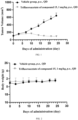
- Tumor growth volumes are shown in FIG. 1 .
- the body weight changes of mice during the administration are shown in FIG. 2 .
- Tumor growth inhibition rates and relative tumor proliferation rates are shown in Table 11.
- Table 11. Summary of tumor growth inhibition rate and relative tumor proliferation rate in MDA-MB-436 Dose (p.o.) TGI (%) (tumor growth inhibition rate) D24 T/C (%) (relative tumor proliferation rate) D24 p-value 1 Trifluoroacetate of compound 15 1.0 mg/kg 104% 14% **** 1 : Comparisons between the two groups were analyzed by T-test. A p-value ⁇ 0.05 was considered statistically significant: *p ⁇ 0.05, **p ⁇ 0.01, ***p ⁇ 0.001, ****p ⁇ 0.0001.
Landscapes
- Chemical & Material Sciences (AREA)
- Organic Chemistry (AREA)
- Health & Medical Sciences (AREA)
- Life Sciences & Earth Sciences (AREA)
- Pharmacology & Pharmacy (AREA)
- Medicinal Chemistry (AREA)
- Animal Behavior & Ethology (AREA)
- General Health & Medical Sciences (AREA)
- Public Health (AREA)
- Veterinary Medicine (AREA)
- Epidemiology (AREA)
- Chemical Kinetics & Catalysis (AREA)
- General Chemical & Material Sciences (AREA)
- Nuclear Medicine, Radiotherapy & Molecular Imaging (AREA)
- Pharmaceuticals Containing Other Organic And Inorganic Compounds (AREA)
Abstract
Description
- The present application claims the right of the following priorities:
-
CN202210495459.8, application date: May 7, 2022 -
CN202210693545.X, application date: June 17, 2022 -
CN202211204558.2, application date: September 29, 2022 -
CN202211351783.9, application date: October 31, 2022 -
CN202211408423.8, application date: November 10, 2022 -
CN202211593592.3, application date: December 9, 2022 -
CN202310088997X, application date: February 2, 2023 -
CN2023101237901, application date: February 15, 2023 -
CN2023102323675, application date: March 10, 2023 -
CN2023103034259, application date: March 23, 2023 -
CN2023103408613, application date: March 31, 2023 -
CN202310388951X, application date: April 12, 2023 - The present disclosure relates to a series of fluorine-substituted heterocyclic compounds, specifically to a compound of formula (XII) and a pharmaceutically acceptable salt thereof.
- Poly-ADP-ribose polymerase (PARP) is a superfamily of proteases, currently consisting of 18 members. It plays a significant role in various cell cycle processes, such as replication, recombination, chromatin remodeling, and DNA damage repair.
- Among them, PARP1 and PARP2 have been extensively studied due to their roles in DNA damage repair. PARP1 is activated by DNA damage breaks and catalyzes the addition of poly(ADP-ribose) (PAR) chains to target proteins. This post-translational modification, known as PARylation, mediates the recruitment of additional DNA repair factors to the site of DNA damage. After completing the recruitment of DNA repair factors, PARP undergoes auto-PARylation, which triggers the release of PARP bound to DNA, thereby allowing other DNA repair proteins to access and complete the repair.
- Inhibiting PARP family enzymes has been developed as an anti-tumor strategy, which selectively kills cancer cells by inactivating complementary DNA repair pathways. Numerous preclinical and clinical studies have shown that tumor cells with BRCA1 or BRCA2 mutations, where BRCA is a key tumor suppressor protein involved in double-strand DNA break (DSB) repair through homologous recombination (HR), possess defective homologous recombination repair (HRD) pathways and rely on the function of PARP enzyme for survival. The growth of tumors with BRCA mutations becomes more dependent on the PARP pathway, making the tumors particularly sensitive to PARP1 inhibitors. In addition to being effective against BRCA-mutated cancers, clinical studies have also demonstrated certain efficacy of PARP inhibitors in non-BRCA-mutated tumors that exhibit homologous recombination defects.
- Compared to other clinical PARP1/2 inhibitors, highly selective PARP1 inhibitors enhance selectivity for PARP1 over PARP2, which can reduce hematological toxicity caused by PARP2 inhibition, thereby achieving better clinical efficacy with lower toxicity. Therefore, there remains an unmet medical need for effective and safe PARP inhibitors, particularly for PARP inhibitors that selectively target PARP1.
- PARP1-selective inhibitors can be used alone for solid tumors such as ovarian cancer, breast cancer, triple-negative breast cancer, and prostate cancer with BRCA1/2 mutations (synthetic lethality mechanism). They can also be used as combination therapies to enhance the effects of DNA-damage-based anti-cancer drugs (e.g., DNA alkylating agents, topoisomerase inhibitors, and platinum-based chemotherapeutics) and radiotherapy. Additionally, they can be used in combination with other targeted therapies, such as PD-1 inhibitors, androgen receptor (AR) inhibitors, cell cycle checkpoint kinase (Chk) inhibitors, and c-Met inhibitors, for the treatment of various BRCA-negative or BRCA-positive solid tumors.
- The present disclosure provides a compound of formula (XII) or a pharmaceutically acceptable salt thereof,

- X is selected from O and S;
- the structural moiety


- ring A is selected from phenyl and 6-membered heteroaryl;
- ring B is selected from 6-membered heteroaryl;
- L is selected from a single bond, and ring C is selected from

-

- T2 is selected from C, N, and CH;
- T3 and T4 are each independently selected from N and CR10;
- R1 is selected from C1-3 alkyl and C3-5 cycloalkyl, and the C1-3 alkyl and C3-5 cycloalkyl are each independently and optionally substituted by 1, 2, or 3 halogens;
- R2 is selected from H and C1-3 alkyl, and the C1-3 alkyl is optionally substituted by 1, 2, or 3 halogens;
- R3 is selected from H and halogen;
- R9 is absent, or selected from H and halogen;
- R4 is selected from H, halogen, CN, C1-3 alkyl, and C1-3 alkoxy;
- R5 is selected from H, halogen, CN, C1-3 alkyl, and C1-3 alkoxy;
- R6 and R7 are each independently selected from H, halogen, C1-3 alkyl, and C1-3 alkoxy, and the C1-3 alkyl and C1-3 alkoxy are each independently and optionally substituted by 1, 2, or 3 halogens;
- R8 is selected from C1-3 alkyl and C3-5 cycloalkyl, and the C1-3 alkyl and C3-5 cycloalkyl are each independently and optionally substituted by 1, 2, or 3 R;
- R10 is selected from H and halogen;
- R13 and R14 are each independently selected from H, halogen, C1-3 alkyl, C1-3 alkoxy, and C3-5 cycloalkyl, and the C1-3 alkyl, C1-3 alkoxy, and C3-5 cycloalkyl are each independently and optionally substituted by 1, 2, or 3 halogens;
- R15 and R16 are each independently selected from H, D, C1-3 alkyl, and C1-3 alkoxy, and the C1-3 alkyl and C1-3 alkoxy are each independently and optionally substituted by 1, 2, or 3 halogens;
- or, R2 and R4 form a ring, so that the structural moiety


- or, R3 and R5 form a ring, so that the structural moiety


- each Ra is independently selected from H, halogen, C1-3 alkyl, C1-3 alkoxy, and C3-5 cycloalkyl, and the C1-3 alkyl, C1-3 alkoxy, and C3-5 cycloalkyl are optionally substituted by 1, 2, or 3 halogens;
- or, two Ra on adjacent atoms, together with the atom to which they are attached, form a double bond or a cyclopropyl group;
- each Rb is independently selected from H, halogen, C1-3 alkyl, C1-3 alkoxy, and C3-5 cycloalkyl, and the C1-3 alkyl, C1-3 alkoxy, and C3-5 cycloalkyl are optionally substituted by 1, 2, or 3 halogens;
- each Rc is independently selected from H, halogen, C1-3 alkyl, C1-3 alkoxy, and C3-5 cycloalkyl, and the C1-3 alkyl, C1-3 alkoxy, and C3-5 cycloalkyl are optionally substituted by 1, 2, or 3 halogens;
- each R is independently selected from halogen and D;
- n is selected from 0, 1, 2, 3, and 4;
- given that when the structural moiety


- the halogen represents F, Cl, Br, and I atoms;
- "hetero" in the 5- to 6-membered heteroaryl represents 1, 2, 3, or 4 heteroatoms or heteroatom groups, each independently selected from -O-, -S-, and -N-.
- The present disclosure further provides a compound of formula (XII) or a pharmaceutically acceptable salt thereof,

- X is selected from O, S, and N(Rd);
- the structural moiety


- ring A is selected from phenyl and 5- to 6-membered heteroaryl;
- ring B is selected from 5- to 6-membered heteroaryl;
- L is selected from a single bond, and ring C is selected from
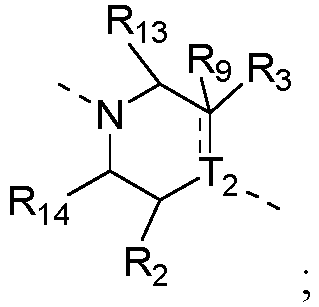
- or, L is selected from N(R12), and ring C is selected from

-

- T2 is selected from C, N, and CH;
- T3 and T4 are each independently selected from N and CR10;
- R1 is selected from C1-3 alkyl and C3-5 cycloalkyl, and the C1-3 alkyl and C3-5 cycloalkyl are each independently and optionally substituted by 1, 2, or 3 halogens;
- R2 is selected from H and C1-3 alkyl, and the C1-3 alkyl is optionally substituted by 1, 2, or 3 halogens;
- R3 is selected from H and halogen;
- R9 is absent, or selected from H and halogen;
- R4 is selected from H, halogen, CN, C1-3 alkyl, and C1-3 alkoxy;
- R5 is selected from H, halogen, CN, C1-3 alkyl, and C1-3 alkoxy;
- R6 and R7 are each independently selected from H, halogen, C1-3 alkyl, and C1-3 alkoxy, and the C1-3 alkyl and C1-3 alkoxy are each independently and optionally substituted by 1, 2, or 3 halogens;
- R8 is selected from C1-3 alkyl and C3-5 cycloalkyl, and the C1-3 alkyl and C3-5 cycloalkyl are each independently and optionally substituted by 1, 2, or 3 R;
- R10 is selected from H and halogen;
- R12 is selected from H, C1-3 alkyl, C1-3 alkoxy, and C3-5 cycloalkyl, and the C1-3 alkyl, C1-3 alkoxy, and C3-5 cycloalkyl are each independently and optionally substituted by 1, 2, or 3 halogens;
- R13 and R14 are each independently selected from H, halogen, C1-3 alkyl, C1-3 alkoxy, and C3-5 cycloalkyl, and the C1-3 alkyl, C1-3 alkoxy, and C3-5 cycloalkyl are each independently and optionally substituted by 1, 2, or 3 halogens;
- R15 and R16 are each independently selected from H, D, C1-3 alkyl, and C1-3 alkoxy, and the C1-3 alkyl and C1-3 alkoxy are each independently and optionally substituted by 1, 2, or 3 halogens;
- or, R2 and R4 form a ring, so that the structural moiety


- or, R3 and R5 form a ring, so that the structural moiety


- each Ra is independently selected from H, halogen, C1-3 alkyl, C1-3 alkoxy, and C3-5 cycloalkyl, and the C1-3 alkyl, C1-3 alkoxy, and C3-5 cycloalkyl are optionally substituted by 1, 2, or 3 halogens;
- or, two Ra on adjacent atoms, together with the atom to which they are attached, form a double bond or a cyclopropyl group;
- each Rb is independently selected from H, halogen, C1-3 alkyl, C1-3 alkoxy, and C3-5 cycloalkyl, and the C1-3 alkyl, C1-3 alkoxy, and C3-5 cycloalkyl are optionally substituted by 1, 2, or 3 halogens;
- each Rc is independently selected from H, halogen, C1-3 alkyl, C1-3 alkoxy, and C3-5 cycloalkyl, and the C1-3 alkyl, C1-3 alkoxy, and C3-5 cycloalkyl are optionally substituted by 1, 2, or 3 halogens;
- Rd is selected from C1-3 alkoxy, and the C1-3 alkoxy is optionally substituted by 1, 2, or 3 halogens;
- each R is independently selected from halogen and D;
- n is selected from 0, 1, 2, 3, and 4;
- given that
- 1) when the structural moiety


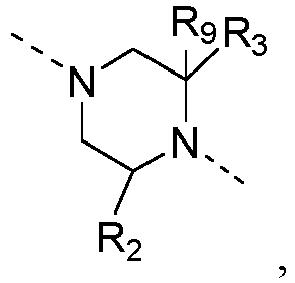
- 2) when the structural moiety


- 3) when the structural moiety
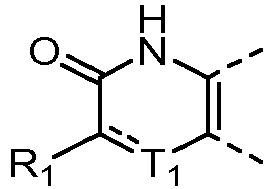

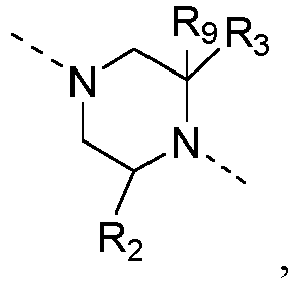
- 4) when the structural moiety


- 5) when the structural moiety


- 6) when the structural moiety


- 1) when the structural moiety
- The present disclosure further provides a compound of formula (XI) or a pharmaceutically acceptable salt thereof,

- X is selected from O, S, and N(Rd);
- the structural moiety

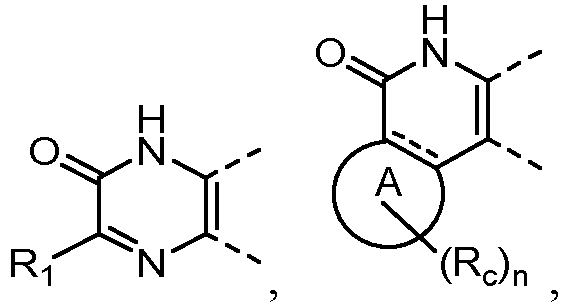

- ring A is selected from phenyl and 5- to 6-membered heteroaryl;
- ring B is selected from 5- to 6-membered heteroaryl;
- L is selected from a single bond, and ring C is selected from

- or, L is selected from N(R12), and ring C is selected from

-

- T2 is selected from C, N, and CH;
- T3 and T4 are each independently selected from N and CR10;
- R1 is selected from C1-3 alkyl and C3-5 cycloalkyl, and the C1-3 alkyl and C3-5 cycloalkyl are each independently and optionally substituted by 1, 2, or 3 halogens;
- R2 is selected from H and C1-3 alkyl, and the C1-3 alkyl is optionally substituted by 1, 2, or 3 halogens;
- R3 is selected from H and halogen;
- R9 is absent, or selected from H and halogen;
- R4 is selected from H and halogen;
- R5 is selected from H and halogen;
- R6 and R7 are each independently selected from H and halogen;
- R8 is selected from C1-3 alkyl and C3-5 cycloalkyl, and the C1-3 alkyl and C3-5 cycloalkyl are each independently and optionally substituted by 1, 2, or 3 R;
- R10 is selected from H and halogen;
- R12 is selected from H, C1-3 alkyl, C1-3 alkoxy, and C3-5 cycloalkyl, and the C1-3 alkyl, C1-3 alkoxy, and C3-5 cycloalkyl are each independently and optionally substituted by 1, 2, or 3 halogens;
- or, R2 and R4 form a ring, so that the structural moiety


- or, R3 and R5 form a ring, so that the structural moiety


- each Ra is independently selected from H, halogen, and C1-3 alkyl, and the C1-3 alkyl is optionally substituted by 1, 2, or 3 halogens;
- or, two Ra on adjacent atoms, together with the atom to which they are attached, form a double bond or a cyclopropyl group;
- each Rb is independently selected from H, halogen, and C1-3 alkyl, and the C1-3 alkyl is optionally substituted by 1, 2, or 3 halogens;
- each Rc is independently selected from H, halogen, and C1-3 alkyl, and the C1-3 alkyl is optionally substituted by 1, 2, or 3 halogens;
- Rd is selected from C1-3 alkoxy, and the C1-3 alkoxy is optionally substituted by 1, 2, or 3 halogens;
- each R is independently selected from halogen and D;
- n is selected from 0, 1, 2, 3, and 4;
- given that
- 1) when the structural moiety


- 2) when the structural moiety


- 3) when the structural moiety


- 4) when the structural moiety


- 1) when the structural moiety
- The present disclosure further provides a compound of formula (VIII) or a pharmaceutically acceptable salt thereof,

- X is selected from O, S, and N(Rd);
- the structural moiety


- ring A is selected from phenyl and 5- to 6-membered heteroaryl;
- ring B is selected from 5- to 6-membered heteroaryl;
-

- T2 is selected from C, N, and CH;
- T3 and T4 are each independently selected from N and CR10;
- R1 is selected from C1-3 alkyl and C3-5 cycloalkyl, and the C1-3 alkyl and C3-5 cycloalkyl are each independently and optionally substituted by 1, 2, or 3 halogens;
- R2 is selected from H and C1-3 alkyl, and the C1-3 alkyl is optionally substituted by 1, 2, or 3 halogens;
- R3 is selected from H and halogen;
- R9 is absent, or selected from H and halogen;
- R4 is selected from H and halogen;
- R5 is selected from H and halogen;
- R6 and R7 are each independently selected from H and halogen;
- R8 is selected from C1-3 alkyl and C3-5 cycloalkyl, and the C1-3 alkyl and C3-5 cycloalkyl are each independently and optionally substituted by 1, 2, or 3 R;
- R10 is selected from H and halogen;
- or, R2 and R4 form a ring, so that the structural moiety
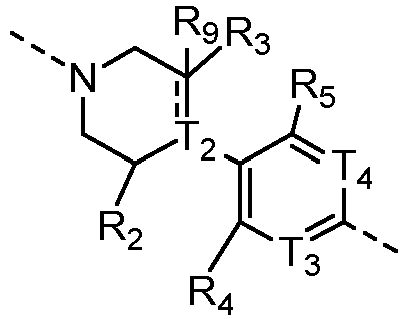

- or, R3 and R5 form a ring, so that the structural moiety


- each Ra is independently selected from H, halogen, and C1-3 alkyl, and the C1-3 alkyl is optionally substituted by 1, 2, or 3 halogens;
- or, two Ra on adjacent atoms, together with the atom to which they are attached, form a double bond or a cyclopropyl group;
- each Rb is independently selected from H, halogen, and C1-3 alkyl, and the C1-3 alkyl is optionally substituted by 1, 2, or 3 halogens;
- each Rc is independently selected from H, halogen, and C1-3 alkyl, and the C1-3 alkyl is optionally substituted by 1, 2, or 3 halogens;
- Rd is selected from OCH3;
- each R is independently selected from halogen and D;
- n is selected from 0, 1, 2, 3, and 4;
- given that
- 1) when the structural moiety


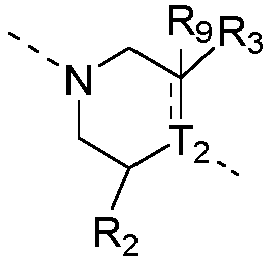

- 2) when the structural moiety


- 3) when the structural moiety


- 4) when the structural moiety


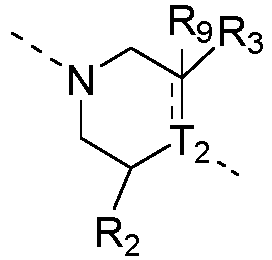

- 5) when the structural moiety


- 1) when the structural moiety
- The present disclosure further provides a compound of formula (VIII) or a pharmaceutically acceptable salt thereof,

- X is selected from O, S, and N(Rd);
- the structural moiety
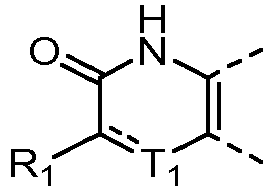


- ring A is selected from phenyl and 5- to 6-membered heteroaryl;
- ring B is selected from 5- to 6-membered heteroaryl;
-

- the structural moiety


- T3 and T4 are each independently selected from N and CR10;
- R1 is selected from C1-3 alkyl and C3-5 cycloalkyl, and the C1-3 alkyl and C3-5 cycloalkyl are each independently and optionally substituted by 1, 2, or 3 halogens;
- R2 is selected from H and C1-3 alkyl, and the C1-3 alkyl is optionally substituted by 1, 2, or 3 halogens;
- R3 and R9 are each independently selected from H and halogen;
- R4 is selected from H and halogen;
- R5 is selected from H and halogen;
- R6 and R7 are each independently selected from H and halogen;
- R8 is selected from C1-3 alkyl and C3-5 cycloalkyl, and the C1-3 alkyl and C3-5 cycloalkyl are each independently and optionally substituted by 1, 2, or 3 R;
- R10 is selected from H and halogen;
- or, R2 and R4 form a ring, so that the structural moiety


- or, R3 and R5 form a ring, so that the structural moiety


- T2 is selected from C, N, and CH;
- each Ra is independently selected from H, halogen, and C1-3 alkyl, and the C1-3 alkyl is optionally substituted by 1, 2, or 3 halogens;
- or, two Ra on adjacent atoms, together with the atom to which they are attached, form a double bond or a cyclopropyl group;
- each Rb is independently selected from H, halogen, and C1-3 alkyl, and the C1-3 alkyl is optionally substituted by 1, 2, or 3 halogens;
- each Rc is independently selected from H, halogen, and C1-3 alkyl, and the C1-3 alkyl is optionally substituted by 1, 2, or 3 halogens;
- Rd is selected from OCH3;
- each R is independently selected from halogen and D;
n is selected from 0, 1, 2, 3, and 4; - given that
- 1) when the structural moiety


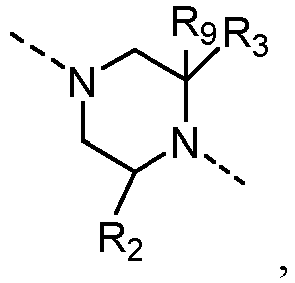
- 2) when the structural moiety


- 3) when the structural moiety


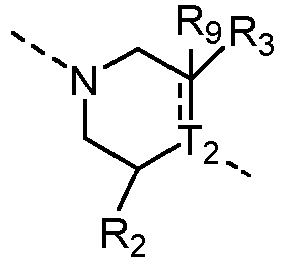

- 4) when the structural moiety


- 5) when the structural moiety


- 1) when the structural moiety
- The present disclosure further provides a compound of formula (VII-1) or a pharmaceutically acceptable salt thereof,

- when

- when

- is selected from a single bond, then T2 is selected from N and CH, R9 and
R3 are each independently selected from H and halogen; - X is selected from O, S, and N(Rd);
- T1 is selected from N;
- or, T1 and R1 form a ring, so that the structural moiety
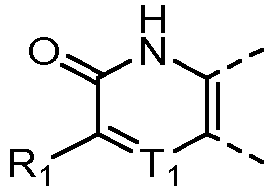

- T3 and T4 are each independently selected from N and CR10;
- R1 is selected from C1-3 alkyl and C3-5 cycloalkyl, and the C1-3 alkyl and C3-5 cycloalkyl are each independently and optionally substituted by 1, 2, or 3 halogens;
- R2 is selected from H and C1-3 alkyl, and the C1-3 alkyl is optionally substituted by 1, 2, or 3 halogens;
- R4 is selected from H and halogen;
- R5 is selected from H and halogen;
- R6 and R7 are each independently selected from H and halogen;
- R8 is selected from C1-3 alkyl and C3-5 cycloalkyl, and the C1-3 alkyl and C3-5 cycloalkyl are each independently and optionally substituted by 1, 2, or 3 R;
- R10 is selected from H and halogen;
- or, R2 and R4 form a ring, so that the structural moiety


- or, R3 and R5 form a ring, so that the structural moiety


- each Ra is independently selected from H, halogen, and C1-3 alkyl, and the C1-3 alkyl is optionally substituted by 1, 2, or 3 halogens;
- or, Ra on two adjacent atoms, together with the atom to which they are attached, form a double bond;
- each Rb is independently selected from H, halogen, and C1-3 alkyl, and the C1-3 alkyl is optionally substituted by 1, 2, or 3 halogens;
- each Rc is independently selected from H, halogen, and C1-3 alkyl, and the C1-3 alkyl is optionally substituted by 1, 2, or 3 halogens;
- Rd is selected from OCH3;
- each R is independently selected from halogen and D;
- n is selected from 0, 1, 2, 3, and 4;
- given that
- 1) when T1 is selected from N, T2 is selected from N, and one of T3 or T4 is selected from N, then R2, R3, and R9 are not simultaneously H; or
- 2) when T1 is selected from N, T2 is selected from N, and one of T3 or T4 is selected from N, then R6 and R7 are not simultaneously H; or
- 3) when T1 is selected from N, T2 is selected from N, T3 is selected from N, and T4 is selected from CR10, then R5 is selected from halogen; or
- 4) when T1 is selected from N, T2 is selected from N, T4 is selected from N, and T3 is selected from CR10, then R4 is selected from halogen; or
- 5) when T1 is selected from N, the structural moiety


- The present disclosure further provides a compound of formula (VI) or a pharmaceutically acceptable salt thereof,

- when

- when

- T1 is selected from N and CR11;
- T3 and T4 are selected from N and CR10;
- R1 is selected from C1-3 alkyl and C3-5 cycloalkyl, and the C1-3 alkyl and C3-5 cycloalkyl are each independently and optionally substituted by 1, 2, or 3 halogens;
- R2 is selected from H and C1-3 alkyl, and the C1-3 alkyl is optionally substituted by 1, 2, or 3 halogens;
- R4 is selected from H and halogen;
- R5 is selected from H and halogen;
- or, R2 and R4 form a ring, so that the structural moiety


- or, R3 and R5 form a ring, so that the structural moiety

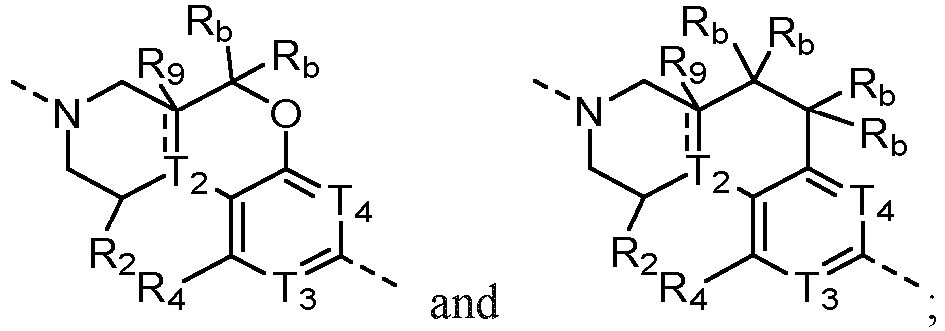
- R6 and R7 are each independently selected from H and halogen;
- R8 is selected from C1-3 alkyl and C3-5 cycloalkyl, and the C1-3 alkyl and C3-5 cycloalkyl are each independently and optionally substituted by 1, 2, or 3 halogens;
- R11 and R1 form a benzene ring, so that the structural moiety


- R10 is selected from H and halogen;
- each Ra is independently selected from H, halogen, and C1-3 alkyl, and the C1-3 alkyl is optionally substituted by 1, 2, or 3 halogens;
- each Rb is independently selected from H, halogen, and C1-3 alkyl, and the C1-3 alkyl is optionally substituted by 1, 2, or 3 halogens;
- each Rc is independently selected from H, halogen, and C1-3 alkyl, and the C1-3 alkyl is optionally substituted by 1, 2, or 3 halogens;
- n is selected from 0, 1, 2, 3, and 4;
- 1) R2, R3, and R9 are not simultaneously H; or
- 2) R6 and R7 are not simultaneously H; or
- 3) R5 is selected from halogen.
- The present disclosure further provides a compound of formula (I) or a pharmaceutically acceptable salt thereof,

- R1 is selected from C1-3 alkyl and C3-5 cycloalkyl, and the C1-3 alkyl and C3-5 cycloalkyl are each independently and optionally substituted by 1, 2, or 3 halogens;
- R2 is selected from C1-3 alkyl, and the C1-3 alkyl is optionally substituted by 1, 2, or 3 halogens;
- R3 is selected from H;
- R4 is selected from halogen;
- R5 is selected from H;
- or, R2 and R4 form a ring, so that the structural moiety


- or, R3 and R5 form a ring, so that the structural moiety


- each Ra is independently selected from H, halogen, and C1-3 alkyl, and the C1-3 alkyl is optionally substituted by 1, 2, or 3 halogens;
- each Rb is independently selected from H, halogen, and C1-3 alkyl, and the C1-3 alkyl is optionally substituted by 1, 2, or 3 halogens.
- The present disclosure further provides a compound of formula (VII-2) or a pharmaceutically acceptable salt thereof,

- T3 and T4 are each independently selected from N and CR10;
- R1 is selected from C1-3 alkyl and C3-5 cycloalkyl, and the C1-3 alkyl and C3-5 cycloalkyl are each independently and optionally substituted by 1, 2, or 3 halogens;
- R4 is selected from H and halogen;
- R5 is selected from H and halogen;
- R6 and R7 are each independently selected from H and halogen;
- R8 is selected from C1-3 alkyl and C3-5 cycloalkyl, and the C1-3 alkyl and C3-5 cycloalkyl are each independently and optionally substituted by 1, 2, or 3 R;
- R10 is selected from H and halogen;
- R12 is selected from H and C1-3 alkyl;
- each R is independently selected from halogen and D.
- The present disclosure further provides a compound of formula (I) or a pharmaceutically acceptable salt

- R1 is selected from C1-3 alkyl and C3-5 cycloalkyl, and the C1-3 alkyl and C3-5 cycloalkyl are each independently and optionally substituted by 1, 2, or 3 halogens;
- R2 is selected from C1-3 alkyl, and the C1-3 alkyl is optionally substituted by 1, 2, or 3 halogens;
- R3 is selected from H;
- R4 is selected from halogen;
- R5 is selected from H;
- or, R2 and R4 form a ring, so that the structural moiety


- or, R3 and R5 form a ring, so that the structural moiety


- each Ra is independently selected from H, halogen, and C1-3 alkyl, and the C1-3 alkyl is optionally substituted by 1, 2, or 3 halogens;
- each Rb is independently selected from H, halogen, and C1-3 alkyl, and the C1-3 alkyl is optionally substituted by 1, 2, or 3 halogens.
- The present disclosure further provides a compound of formula (I) or a pharmaceutically acceptable salt thereof,

- R1 is selected from C1-3 alkyl and C3-5 cycloalkyl, and the C1-3 alkyl and C3-5 cycloalkyl are each independently and optionally substituted by 1, 2, or 3 halogens;
- R2 is selected from C1-3 alkyl, and the C1-3 alkyl is optionally substituted by 1, 2, or 3 halogens;
- R3 is selected from H;
- R4 is selected from halogen;
- R5 is selected from H;
- or, R2 and R4 form a ring, so that the structural moiety


- or, R3 and R5 form a ring, so that the structural moiety


- each Ra is independently selected from H, halogen, and C1-3 alkyl, and the C1-3 alkyl is optionally substituted by 1, 2, or 3 halogens;
- each Rb is independently selected from H, halogen, and C1-3 alkyl, and the C1-3 alkyl is optionally substituted by 1, 2, or 3 halogens.
- In some embodiments of the present disclosure, the X is selected from O, S, and N(OCH3), and other variables are as defined in the present disclosure.
- In some embodiments of the present disclosure, the X is selected from O and S, and other variables are as defined in the present disclosure.
- In some embodiments of the present disclosure, the X is selected from O, and other variables are as defined in the present disclosure.
- In some embodiments of the present disclosure, each Ra is independently selected from H, F, Cl, Br, I, CH3, CH2CH3, and CH2CH2CH3, and the CH3, CH2CH3, and CH2CH2CH3 are optionally substituted by 1, 2, or 3 halogens, and other variables are as defined in the present disclosure.
- In some embodiments of the present disclosure, each Ra is independently selected from H, F and CH3, and other variables are as defined in the present disclosure.
- In some embodiments of the present disclosure, each Ra is independently selected from H and CH3, and other variables are as defined in the present disclosure.
- In some embodiments of the present disclosure, two Ra on adjacent atoms, together with the atom to which they are attached, form a double bond or a cyclopropyl group, so that the structural moiety


- In some embodiments of the present disclosure, two Ra on adjacent atoms, together with the atom to which they are attached, form a double bond or a cyclopropyl group, so that the structural moiety

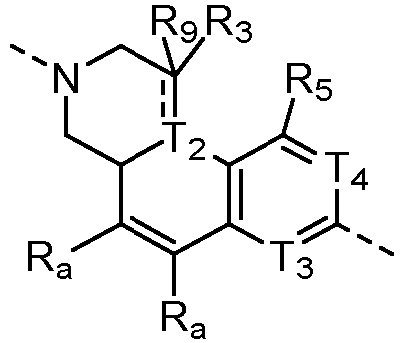
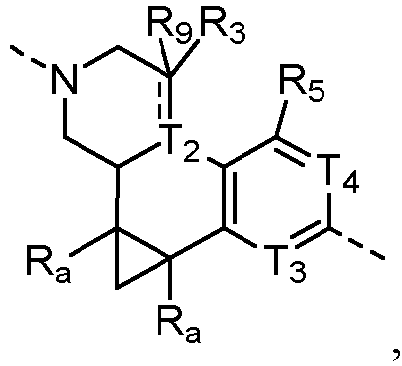
- In some embodiments of the present disclosure, two Ra on adjacent atoms, together with the atom to which they are attached, form a double bond or a cyclopropyl group, so that the structural moiety

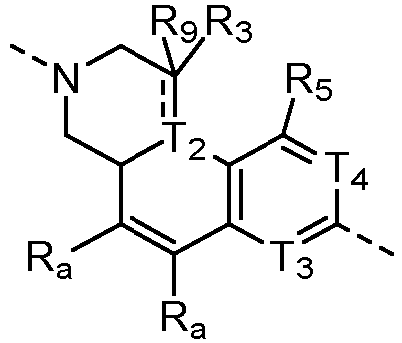

- In some embodiments of the present disclosure, Ra on the two adjacent atoms, together with the neighboring atom, form a double bond, so that the structural moiety


- In some embodiments of the present disclosure, Ra on the two adjacent atoms, together with the neighboring atom, form a double bond, so that the structural moiety


- In some embodiments of the present disclosure, each Rb is independently selected from H, F, Cl, Br, I, CH3, CH2CH3, and CH2CH2CH3, and the CH3, CH2CH3, and CH2CH2CH3 are optionally substituted by 1, 2, or 3 halogens, and other variables are as defined in the present disclosure.
- In some embodiments of the present disclosure, each Rb is independently selected from H, F, and CH3, and other variables are as defined in the present disclosure.
- In some embodiments of the present disclosure, each Rb is independently selected from H and CH3, and other variables are as defined in the present disclosure.
- In some embodiments of the present disclosure, each Rc is independently selected from H, F, Cl, Br, I, CH3, CH2CH3, and CH2CH2CH3, and the CH3, CH2CH3, and CH2CH2CH3 are optionally substituted by 1, 2, or 3 halogens, and other variables are as defined in the present disclosure.
- In some embodiments of the present disclosure, each Rc is independently selected from H, F, and CH3, and other variables are as defined in the present disclosure.
- In some embodiments of the present disclosure, each Rc is independently selected from H and F, and other variables are as defined in the present disclosure.
- In some embodiments of the present disclosure, the Rd is selected from OCH3, and other variables are as defined in the present disclosure.
- In some embodiments of the present disclosure, the T3 is selected from N, CH, and CF, and other variables are as defined in the present disclosure.
- In some embodiments of the present disclosure, the T3 is selected from N and CF, and other variables are as defined in the present disclosure.
- In some embodiments of the present disclosure, the T3 is selected from N, and other variables are as defined in the present disclosure.
- In some embodiments of the present disclosure, the T4 is selected from N and CH, and other variables are as defined in the present disclosure.
- In some embodiments of the present disclosure, the R1 is selected from CH3 and CH2CH3, and other variables are as defined in the present disclosure.
- In some embodiments of the present disclosure, the R1 is selected from CH3, and other variables are as defined in the present disclosure.
- In some embodiments of the present disclosure, the R2 is selected from H and CH3, and other variables are as defined in the present disclosure.
- In some embodiments of the present disclosure, the R2 is selected from CH3, and other variables are as defined in the present disclosure.
- In some embodiments of the present disclosure, the R4, R5, R6, and R7 are each independently selected from H, F, and CH3, and other variables are as defined in the present disclosure.
- In some embodiments of the present disclosure, the R3 is selected from H and F, and other variables are as defined in the present disclosure.
- In some embodiments of the present disclosure, the R4 is selected from H, F, Cl, CN, and CH3, and other variables are as defined in the present disclosure.
- In some embodiments of the present disclosure, the R4 is selected from H, F, Cl, and CN, and other variables are as defined in the present disclosure.
- In some embodiments of the present disclosure, the R4 is selected from H, F, and CH3, and other variables are as defined in the present disclosure.
- In some embodiments of the present disclosure, the R4 is selected from H and F, and other variables are as defined in the present disclosure.
- In some embodiments of the present disclosure, the R4 is selected from F, and other variables are as defined in the present disclosure.
- In some embodiments of the present disclosure, the R5 is selected from H, F, Cl, and CN, and other variables are as defined in the present disclosure.
- In some embodiments of the present disclosure, the R5 is selected from H, F, CN, and CH3, and other variables are as defined in the present disclosure.
- In some embodiments of the present disclosure, the R5 is selected from H, F, and CH3, and other variables are as defined in the present disclosure.
- In some embodiments of the present disclosure, the R5 is selected from H and F, and other variables are as defined in the present disclosure.
- In some embodiments of the present disclosure, the R5 is selected from H, and other variables are as defined in the present disclosure.
- In some embodiments of the present disclosure, the R6 and R7 are each independently selected from H, F, and CH3, and other variables are as defined in the present disclosure.
- In some embodiments of the present disclosure, the R6 is selected from H, F, and CH3, and other variables are as defined in the present disclosure.
- In some embodiments of the present disclosure, the R7 is selected from H, F, and CH3, and other variables are as defined in the present disclosure
- In some embodiments of the present disclosure, the R6 is selected from H and F, and other variables are as defined in the present disclosure.
- In some embodiments of the present disclosure, the R7 is selected from H and F, and other variables are as defined in the present disclosure.
- In some embodiments of the present disclosure, the R8 is selected from CH3, CH2CH3, CH2CF3, cyclopropyl, and CD3, and other variables are as defined in the present disclosure.
- In some embodiments of the present disclosure, the R8 is selected from CH3, CH2CF3, cyclopropyl, and CD3, and other variables are as defined in the present disclosure.
- In some embodiments of the present disclosure, the R8 is selected from CH3, cyclopropyl, and CD3, and other variables are as defined in the present disclosure.
- In some embodiments of the present disclosure, the R8 is selected from CH3 and cyclopropyl, and other variables are as defined in the present disclosure.
- In some embodiments of the present disclosure, the R9 is selected from H and F, and other variables are as defined in the present disclosure.
- In some embodiments of the present disclosure, the R10 is selected from H and F, and other variables are as defined in the present disclosure.
- In some embodiments of the present disclosure, the R12 is selected from H and CH3, and other variables are as defined in the present disclosure.
- In some embodiments of the present disclosure, the R13 is selected from H and CH3, and other variables are as defined in the present disclosure.
- In some embodiments of the present disclosure, the R14 is selected from H and CH3, and other variables are as defined in the present disclosure.
- In some embodiments of the present disclosure, the R15 is selected from H, D, and CH3, and other variables are as defined in the present disclosure
- In some embodiments of the present disclosure, the R16 is selected from H, D, and CH3, and other variables are as defined in the present disclosure
- In some embodiments of the present disclosure, ring A is selected from phenyl and 6-membered heteroaryl ring, and other variables are as defined in the present disclosure.
- In some embodiments of the present disclosure, ring A is selected from phenyl, pyrrolyl, pyrazolyl, imidazolyl, triazolyl, furanyl, thienyl, pyridyl, pyrazinyl, and pyrimidinyl, and other variables are as defined in the present disclosure.
- In some embodiments of the present disclosure, ring A is selected from phenyl, pyridyl, pyrazinyl, and pyrimidinyl, and other variables are as defined in the present disclosure.
- In some embodiments of the present disclosure, ring B is selected from 6-membered heteroaryl ring, and other variables are as defined in the present disclosure.
- In some embodiments of the present disclosure, ring B is selected from pyrrolyl, pyrazolyl, imidazolyl, triazolyl, furanyl, thienyl, pyridyl, pyrazinyl, and pyrimidinyl, and other variables are as defined in the present disclosure.
- In some embodiments of the present disclosure, ring B is selected from pyridyl, pyrazinyl, and pyrimidinyl, and other variables are as defined in the present disclosure.
- In some embodiments of the present disclosure, the structural moiety
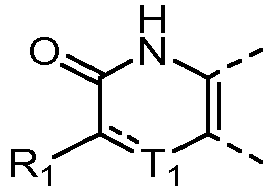


- In some embodiments of the present disclosure, the structural moiety
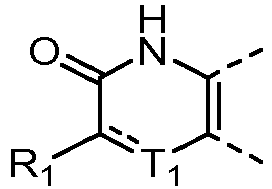
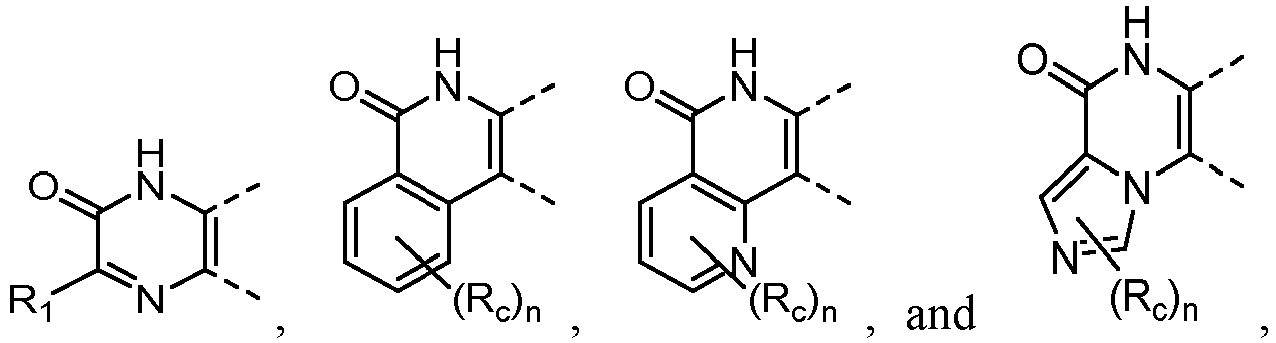
- In some embodiments of the present disclosure, the structural moiety


- In some embodiments of the present disclosure, the structural moiety


- In some embodiments of the present disclosure, the structural moiety


- In some embodiments of the present disclosure, the structural moiety
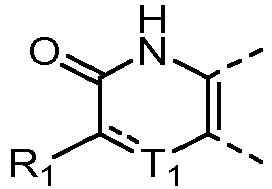

- In some embodiments of the present disclosure, R11 and R1 form a benzene ring, so that the structural moiety


- In some embodiments of the present disclosure, the structural moiety


- In some embodiments of the present disclosure, the structural moiety


- In some embodiments of the present disclosure, the R2 and R4 form a ring, so that the structural moiety
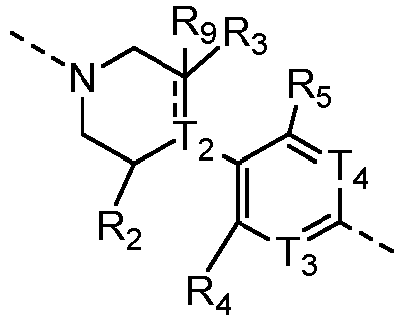


- In some embodiments of the present disclosure, the R3 and R5 form a ring, so that the structural moiety


- In some embodiments of the present disclosure, the R3 and R5 form a ring, so that the structural moiety
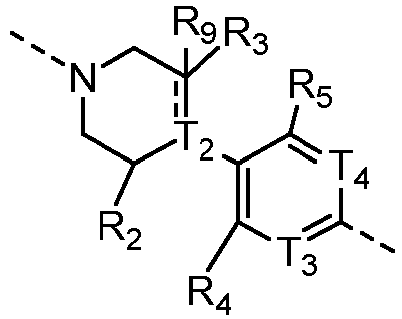


- In some embodiments of the present disclosure, the R2 and R4 form a ring, so that the structural moiety


- In some embodiments of the present disclosure, the R3 and R5 form a ring, so that the structural moiety


- In some embodiments of the present disclosure, the structural moiety


- In some embodiments of the present disclosure, the R2 and R4 form a ring, so that the structural moiety


- In some embodiments of the present disclosure, the R3 and R5 form a ring, so that the structural moiety


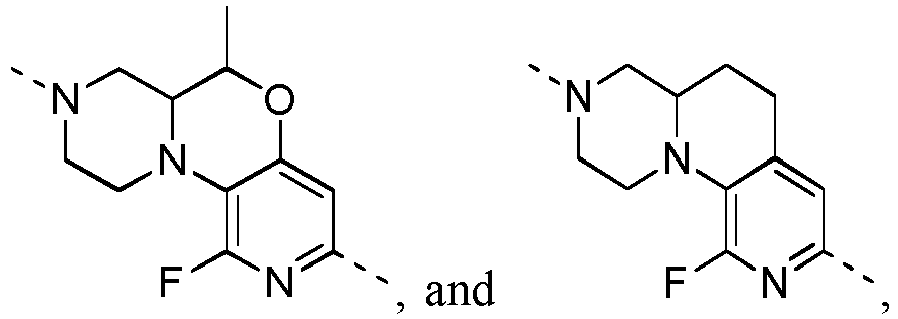
- In some embodiments of the present disclosure, the L is selected from a single bond, the structural moiety





- In some embodiments of the present disclosure, the L is selected from a single bond, the structural moiety





- In some embodiments of the present disclosure, the L is selected from a single bond, the structural moiety



- In some embodiments of the present disclosure, the structural moiety

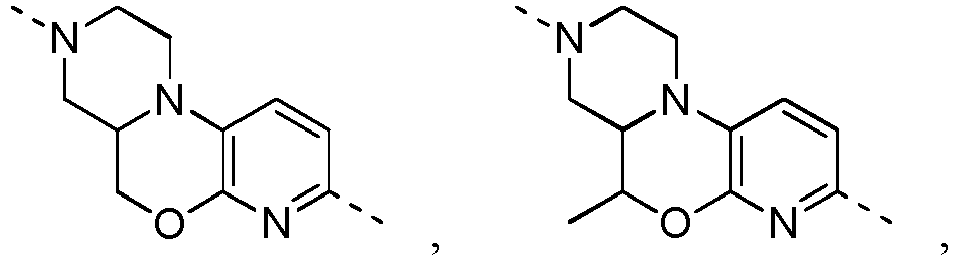




- In some embodiments of the present disclosure, the structural moiety




- In some embodiments of the present disclosure, the structural moiety


- In some embodiments of the present disclosure, the structural moiety


- In some embodiments of the present disclosure, the structural moiety

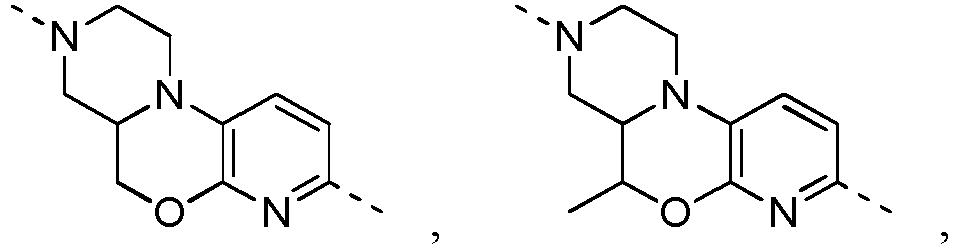




- In some embodiments of the present disclosure, the structural moiety


- In some embodiments of the present disclosure, the structural moiety


- In some embodiments of the present disclosure, the structural moiety


- In some embodiments of the present disclosure, the structural moiety


- In some embodiments of the present disclosure, when the structural moiety


- In some embodiments of the present disclosure, when the structural moiety


- In some embodiments of the present disclosure, the structural moiety
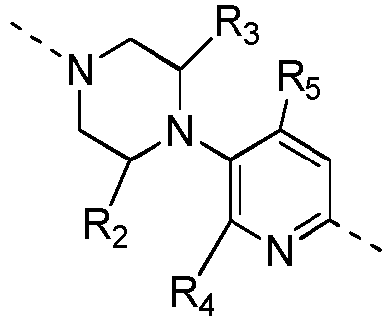


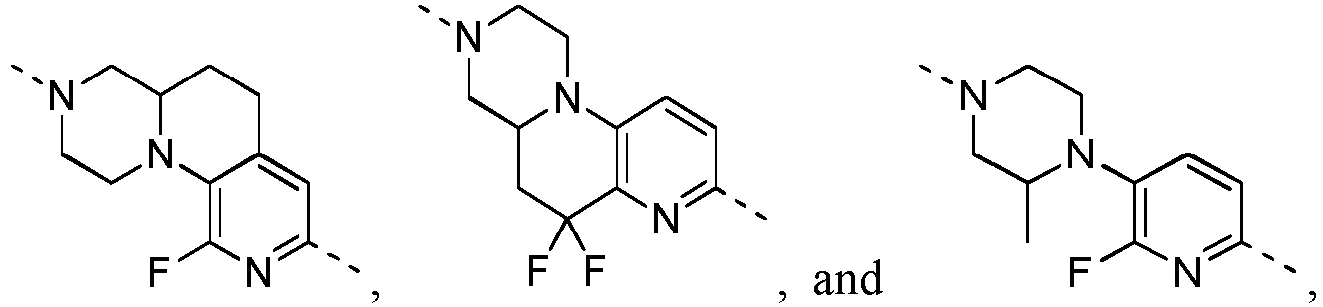
- In some embodiments of the present disclosure, the structural moiety


- In some embodiments of the present disclosure, the compound or the pharmaceutically acceptable salt thereof is selected from:

- wherein ring A is selected from pyridyl;
- R2, R3, R4, R5, R8, R9, R13, R14, R15, R16, Rc, T2, n, and

- In some embodiments of the present disclosure, the compound or the pharmaceutically acceptable salt thereof is selected from:

- wherein

- T2 is selected from C and N;
- R2 is selected from H and C1-3 alkyl, and the C1-3 alkyl is optionally substituted by 1, 2, or 3 halogens;
- R3 is selected from H and halogen;
- R4 is selected from H, halogen, CN, C1-3 alkyl, and C1-3 alkoxy;
- R5 is selected from H, halogen, CN, C1-3 alkyl, and C1-3 alkoxy;
- R9 is absent, or selected from H and halogen;
- R7, R8, R13, R14, R15, R16, Rc, and n are as defined in the present disclosure.
- In some embodiments of the present disclosure, the compound or the pharmaceutically acceptable salt thereof is selected from:

- ring A is selected from phenyl and 6-membered heteroaryl;
- ring B is selected from 6-membered heteroaryl;
- R2, R3, R4, R5, R6, R7, R8, R9, R13, R14, R15, R16, Rc, X, T2, T3, T4, n, and

- In some embodiments of the present disclosure, the ring A is selected from a pyridine ring, and other variables are as defined in the present disclosure.
- In some embodiments of the present disclosure, the compound or the pharmaceutically acceptable salt thereof is selected from:


- In some embodiments of the present disclosure, the compound or the pharmaceutically acceptable salt thereof is selected from:


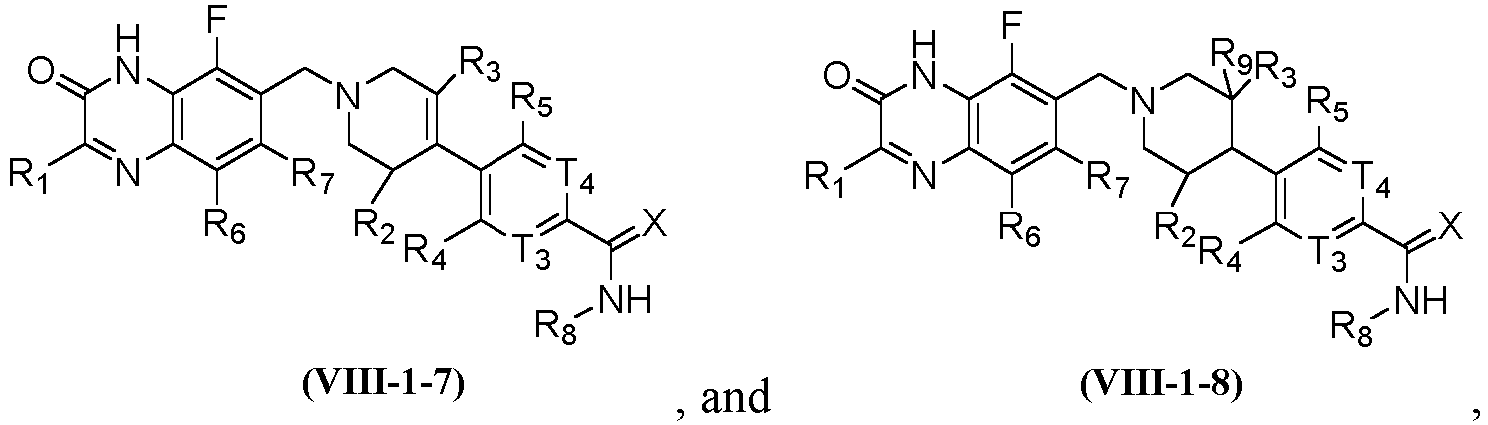
- In some embodiments of the present disclosure, the compound or the pharmaceutically acceptable salt thereof is selected from:


- wherein R1, R2, R3, R4, R5, R6, R7, R8, R9, Ra, Rb, X, T3, and T4 are as defined in the present disclosure;
- given that
- 1) when the compound is selected from a compound of formula (VIII-6a), and one of T3 or T4 is selected from N, then R2, R3, and R9 are not simultaneously H; or
- 2) when the compound is selected from a compound of formula (VIII-6a), and one of T3 or T4 is selected from N, then R6 and R7 are not simultaneously H; or
- 3) when the compound is selected from a compound of formula (VIII-6a), T3 is selected from N, and T4 is selected from CR10, then R5 is selected from halogen; or
- 4) when the compound is selected from a compound of formula (VIII-6a), T4 is selected from N, and T3 is selected from CR10, then R4 is selected from halogen; or
- 5) when the compound is selected from a compound of formula (VIII-7a), and T3 is selected from N, then R6 and R7 are not simultaneously H.
- There are still some embodiments of the present disclosure which are obtained by any combination of the above variables.
- The present disclosure further provides a compound as follows or a pharmaceutically acceptable salt thereof,












- In some embodiments of the present disclosure, the compound or the pharmaceutically acceptable salt thereof is provided, and the compound is selected from:













- The present disclosure further provides a pharmaceutical composition comprising a therapeutically effective amount of the compound or the pharmaceutically acceptable salt thereof as defined in the present disclosure, and a pharmaceutically acceptable carrier, diluent, or excipient.
- The present disclosure further provides a use of the compound, the pharmaceutically acceptable salt thereof, or the composition in the manufacture of a medicament for treating solid tumors.
- In some embodiments of the present disclosure, the solid tumors refer to solid tumors such as ovarian cancer, breast cancer, prostate cancer, and glioma.
- The present disclosure further provides the following synthesis methods:
-

-

-

-
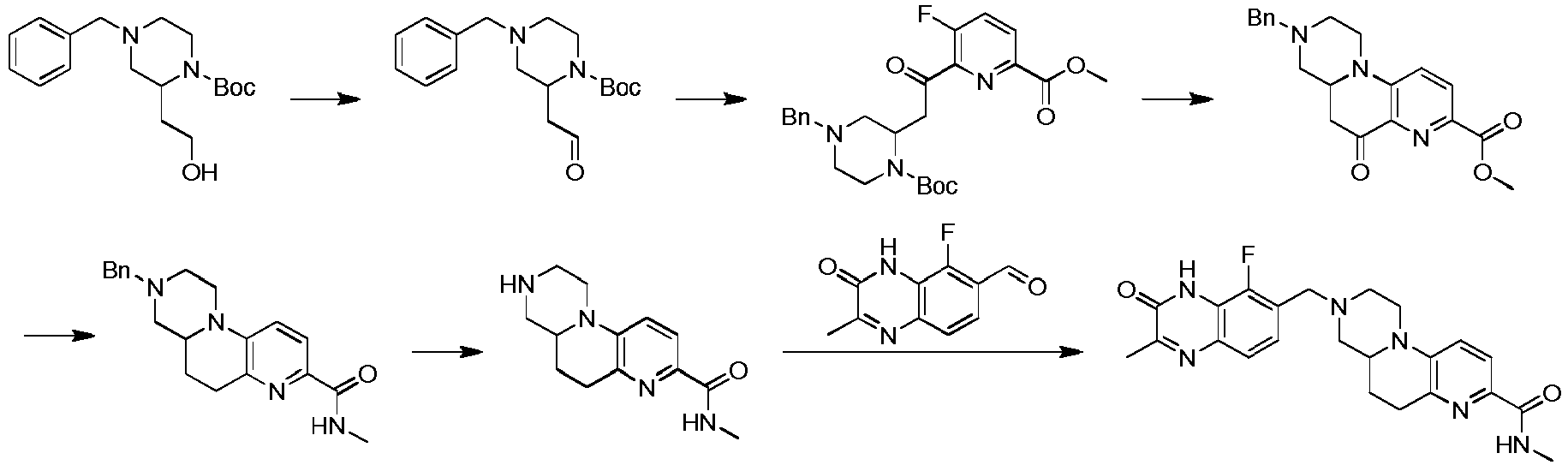
-

-

-

-

-

-

- The present disclosure further provides the following bioassay methods:
- PARP1 chemiluminescent assay kit purchased from BPS Bioscience; EnVision multimode microplate reader (PerkinElmer).
- Preparation of PBST buffer: 1X PBS containing 0.05% Tween-20 was prepared, that is, 5 µL of 100% Tween-20 added to 10 mL of PBS.
- Preparation of 1X assay buffer: The 10X PARP assay buffer was diluted 10-fold with double-distilled water.
- Preparation of compound solutions: The test compound was diluted 5-fold using 100% DMSO to the 8th concentration, from 1000 µM to 12.8 nM. The internal control compound was diluted 5-fold using 100% DMSO to the 8th concentration, from 200 µM to 2.56 nM. The test compound at each concentration gradient was further diluted using 1X assay buffer to prepare a working solution with a final DMSO concentration of 10%.
-
- a) The histone solution from the kit was diluted 5-fold with 1X PBS. Then, 25 µL of the diluted solution was added to each well of the microplate, which was incubated overnight at 4°C.
- b) After the incubation, the liquid in the wells was discarded. The wells were washed three times with 100 µL of PBST per well, and the remaining liquid in the wells was discarded.
- c) 100 µL of blocking solution was added to each well of the microplate and incubated at 25°C for 90 minutes. After the incubation, the liquid in the wells was discarded. The wells were washed three times with 100 µL of PBST per well, and the remaining liquid in the wells was discarded.
- d) 12.5 µL of substrate mixture solution (1.25 µL of 10X PARP assay buffer, 1.25 µL of 10X PARP assay mix, 2.5 µL of activated DNA, and 7.5 µL of double-distilled water) was added to each well of the microplate.
- e) 2.5 µL of the compound working solution was added to each well of the microplate, with the experiment set up in duplicate wells.
- f) PARP1 enzyme was diluted to a concentration of 2 ng/µL, and 10 µL of the diluted PARP1 enzyme solution was added to each well of the microplate. At this point, the final concentration gradient of the test compound ranged from 10 µM to 0.128 nM, while the final concentration gradient of the internal control compound ranged from 2 µM to 0.0256 nM. The reaction system, with PARP1 at 20 ng/well, was incubated at 25°C for 60 minutes.
- g) After the incubation, the liquid in the wells was discarded. The wells were washed three times with 100 µL of PBST per well, and the remaining liquid in the wells was discarded.
- h) Streptavidin-HRP was diluted 50-fold with blocking solution, and 25 µL of this diluted solution was added to each well of the microplate, which was incubated at 25°C for 30 minutes.
- i) After the incubation, the liquid in the wells was discarded. The wells were washed three times with 100 µL of PBST per well, and the remaining liquid in the wells was discarded.
- j) ELISA ECL substrate A and ELISA ECL substrate B were mixed at a ratio of 1:1 (v/v), and 50 µL of this mixture was added to each well of the microplate. The chemiluminescence values were then measured.
- Using the equation (Sample - Min)/(Max - Min) × 100% to convert the raw data into enzyme activity, the IC50 value might be obtained by curve fitting with four parameters (obtained by "log (inhibitor) vs. response -- Variable slope" mode in GraphPad Prism).
- Max: containing 1% DMSO, PARP1, and the substrate mixture solution.
- Min: without PARP1 enzyme.
- The surface plasmon resonance (SPR) experiment was conducted on a Biacore 8K instrument (GE Healthcare).
- First, under the condition of 25°C, the biotinylated PARP1 protein (sequence: 655-end) was coupled to a streptavidin-coated SA chip (Cytiva, 29699622). The specific steps were as follows: the chip surface was activated using 1 mM NaCl/50 mM NaOH. The PARP1 protein was diluted with a coupling buffer (50 mM Tris-HCl, pH 8.0, 150 mM NaCl, 10 mM MgCl2, 0.05% P20) to prepare a ligand solution at a concentration of 10 µg/mL. This solution was injected over the chip surface (with an injection time of 50 seconds and an injection flow rate of 5 µL/min), coupling the PARP1 protein to the chip surface. Any excess active sites on the chip were blocked using a solution of 50% isopropanol/1 M NaCl/50 mM NaOH. The final coupling level in the experiment was 2000-3000 RU (Response Units).
- Small molecule compounds were diluted by gradients in a buffer (50 mM Tris, pH 8.0, 150 mM NaCl, 10 mM MgCl2, 0.05% Tween 20) to obtain solutions with different compound concentrations. These solutions were injected over the chip surface, which was already coupled with the PARP1 protein. The injection flow rate was 50 µL/min, the injection time was 60 seconds, and the dissociation time was 20 minutes. The instrument detected the binding and dissociation curves of the protein-small molecule compounds.
- The data from both the sample channel and the reference channel were analyzed using the Biacore 8K evaluation software to generate sensorgrams. The data were fitted based on a 1:1 binding model.
- The surface plasmon resonance (SPR) experiment was conducted on a Biacore 8K instrument (GE Healthcare).
- First, under the condition of 25°C, the biotinylated PARP2 protein (sequence: 223-end) was coupled to a streptavidin-coated SA chip (Cytiva, 29699622). The specific steps were as follows: the chip surface was activated using 1 mM NaCl/60 mM NaOH. The PARP2 protein was diluted with a coupling buffer (50 mM Tris-HCl, pH 8.0, 150 mM NaCl, 10 mM MgCl2, 0.05% P20) to prepare a ligand solution at a concentration of 10 µg/mL. This solution was injected over the chip surface (with an injection time of 50 seconds and an injection flow rate of 10 µL/min), coupling the PARP2 protein to the chip surface. Any excess active sites on the chip were blocked using a solution of 50% isopropanol/1 M NaCl/50 mM NaOH. The final coupling level in the experiment was 3000-4000 RU (Response Units).
- Small molecule compounds were diluted by gradients in a buffer (50 mM Tris, pH 8.0, 150 mM NaCl, 10 mM MgCl2, 0.05% Tween 20) to obtain solutions with different compound concentrations. These solutions were injected over the chip surface, which was already coupled with the PARP2 protein. The injection flow rate was 30 µL/min, the injection time was 60 seconds, and the dissociation time was 400 seconds. The instrument detected the binding and dissociation curves of the protein-small molecule compounds.
- The data from both the sample channel and the reference channel were analyzed using the Biacore 8K evaluation software to generate sensorgrams. The data were fitted based on a 1:1 binding model.
- The compounds of the present disclosure exhibit excellent binding activity to PARP1, selectively inhibiting the PARP1 protein while demonstrating weak binding activity to PARP2. These compounds also show superior antiproliferative activity against BRCA1-mutant MDA-MB-436 cells and BRCA2-knockout DLD 1 cells, along with excellent membrane permeability. In vitro, the compounds of the present disclosure demonstrate excellent stability in both human and mouse liver microsomes. The compounds of the present disclosure exhibit excellent metabolic stability in vivo, demonstrating excellent oral absorption and drug exposure. Oral administration also leads to high drug concentration in brain tissue, with a high brain-to-blood ratio, and displays relatively significant anti-tumor activity.
- Unless otherwise specified, the following terms and phrases when used herein have the following meanings. A specific term or phrase should not be considered indefinite or unclear in the absence of a particular definition, but should be understood in the ordinary sense. When a trading name appears herein, it is intended to refer to its corresponding commodity or active ingredient thereof.
- The term "pharmaceutically acceptable" is used herein in terms of those compounds, materials, compositions, and/or dosage forms, which are suitable for use in contact with human and animal tissues within the scope of reliable medical judgment, with no excessive toxicity, irritation, an allergic reaction, or other problems or complications, commensurate with a reasonable benefit/risk ratio.
- The term "pharmaceutically acceptable salt" refers to a salt of the compound of the present disclosure that is prepared by reacting the compound having a specific substituent of the present disclosure with a relatively non-toxic acid or base. When the compound of the present disclosure contains a relatively acidic functional group, a base addition salt can be obtained by contacting such compounds with a sufficient amount of base in a pure solution or a suitable inert solvent. The pharmaceutically acceptable base addition salt includes a salt of sodium, potassium, calcium, ammonium, organic amine, magnesium, or similar salts. When the compound of the present disclosure contains a relatively basic functional group, an acid addition salt can be obtained by contacting the compound with a sufficient amount of acid in a pure solution or a suitable inert solvent. Certain specific compounds of the present disclosure contain both basic and acidic functional groups, thus can be converted to any base or acid addition salt.
- The pharmaceutically acceptable salt of the present disclosure can be prepared from the parent compound that contains an acidic or basic moiety by conventional chemical method. Generally, such salt can be prepared by reacting the free acid or base form of the compound with a stoichiometric amount of an appropriate base or acid in water or an organic solvent or a mixture thereof.
- The compounds of the present disclosure may exist in specific geometric or stereoisomeric forms. The present disclosure contemplates all such compounds, including cis and trans isomers, (-)- and (+)-enantiomers, (R)- and (S)-enantiomers, diastereoisomers, (D)-isomers, (L)-isomers, racemic, and other mixtures thereof, such as enantiomers or diastereomer enriched mixtures, all of which are within the scope of the present disclosure. Additional asymmetric carbon atoms may be present in substituents such as alkyl. All these isomers and their mixtures are included within the scope of the present disclosure.
- Unless otherwise specified, the term "enantiomer" or "optical isomer" refers to stereoisomers that are mirror images of each other.
- Unless otherwise specified, the term "cis-trans isomer" or "geometric isomer" is caused by the inability to rotate freely of double bonds or single bonds of ring-forming carbon atoms.
- Unless otherwise specified, the term "diastereomer" refers to a stereoisomer in which a molecule has two or more chiral centers and the relationship between the molecules is not mirror images.
- Unless otherwise specified, "(+)" refers to dextrorotation, "(-)" refers to levorotation, and or "(±)" refers to racemic.
- Unless otherwise specified, the absolute configuration of a stereogenic center is represented by a wedged solid bondand a wedged dashed bond
 and the relative configuration of a stereogenic center is represented by a straight solid bond
 and a straight dashed bond
 a wave line
 is used to represent a wedged solid bond
 or a wedged dashed bond
 or the wave line
 is used to represent a straight solid bond
 or a straight dashed bond

- Unless otherwise specified, when a double bond structure, such as carbon-carbon double bond, carbon-nitrogen double bond, and nitrogen-nitrogen double bond, exists in the compound, and each of the atoms on the double bond is connected to two different substituents (including the condition where a double bond contains a nitrogen atom, the lone pair of electrons attached on the nitrogen atom is regarded as a substituent connected), if the atom on the double bond in the compound is connected to its substituent by a wave line (), this refers to the (Z) isomer, (E) isomer or a mixture of two isomers of the compound. For example, the following formula (A) means that the compound exists as a single isomer of formula (A-1) or formula (A-2) or as a mixture of two isomers of formula (A-1) and formula (A-2); the following formula (B) means that the compound exists in the form of a single isomer of formula (B-1) or formula (B-2) or in the form of a mixture of two isomers of formula (B-1) and formula (B-2). The following formula (C) means that the compound exists as a single isomer of formula (C-1) or formula (C-2) or as two a mixture of two isomers of formula (C-1) and formula (C-2).


- Unless otherwise specified, the term "tautomer" or "tautomeric form" means that at room temperature, the isomers of different functional groups are in dynamic equilibrium and can be transformed into each other quickly. If tautomers possibly exist (such as in solution), the chemical equilibrium of tautomers can be reached. For example, proton tautomer (also called prototropic tautomer) includes interconversion through proton migration, such as keto-enol isomerization and imine-enamine isomerization. Valence tautomer includes some recombination of bonding electrons for mutual transformation. A specific example of keto-enol tautomerization is the tautomerism between two tautomers of pentane-2,4-dione and 4-hydroxypent-3-en-2-one.
- Unless otherwise specified, the terms "enriched in one isomer", "enriched in isomers", "enriched in one enantiomer" or "enriched in enantiomers" refer to the content of one of the isomers or enantiomers is less than 100%, and the content of the isomer or enantiomer is greater than or equal to 60%, or greater than or equal to 70%, or greater than or equal to 80%, or greater than or equal to 90%, or greater than or equal to 95%, or greater than or equal to 96%, or greater than or equal to 97%, or greater than or equal to 98%, or greater than or equal to 99%, or greater than or equal to 99.5%, or greater than or equal to 99.6%, or greater than or equal to 99.7%, or greater than or equal to 99.8%, or greater than or equal to 99.9%.
- Unless otherwise specified, the term "isomer excess" or "enantiomeric excess" refers to the difference between the relative percentages of two isomers or two enantiomers. For example, if the content of one isomer or enantiomer is 90%, and the content of the other isomer or enantiomer is 10%, the isomer or enantiomer excess (ee value) is 80%.
- The compound of the present disclosure may contain an unnatural proportion of atomic isotope at one or more than one atom that constitutes the compound. For example, the compound can be radiolabeled with a radioactive isotope, such as tritium (3H), iodine-125 (125I), or C-14 (14C). For another example, deuterated drugs can be formed by replacing hydrogen with deuterium, the bond formed by deuterium and carbon is stronger than that of ordinary hydrogen and carbon, compared with non-deuterated drugs, deuterated drugs have the advantages of reduced toxic and side effects, increased drug stability, enhanced efficacy, extended biological half-life of drugs, etc. All isotopic variations of the compound of the present disclosure, whether radioactive or not, are encompassed within the scope of the present disclosure.
- The term "optional" or "optionally" means that the subsequent event or condition may occur but not requisite, that the term includes the instance in which the event or condition occurs and the instance in which the event or condition does not occur.
- The term "substituted" means one or more than one hydrogen atom on a specific atom is substituted by the substituent, including deuterium and hydrogen variables, as long as the valence of the specific atom is normal and the substituted compound is stable. When the substituent is an oxygen (i.e., =O), it means two hydrogen atoms are substituted. The term "optionally substituted" means an atom can be substituted with a substituent or not, unless otherwise specified, the type and number of the substituent may be arbitrary as long as being chemically achievable.
- When any variable (such as R) occurs in the constitution or structure of the compound more than once, the definition of the variable at each occurrence is independent. Thus, for example, if a group is substituted by 0 to -2 R, the group can be optionally substituted with up to two R, wherein the definition of R at each occurrence is independent. Moreover, a combination of the substituent and/or the variant thereof is allowed only when the combination results in a stable compound.
- When the number of a linking group is 0, such as -(CRR)0-, it means that the linking group is a single bond.
- When one of the variables is selected from a single bond, it means that the two groups linked by the single bond are connected directly. For example, when L in A-L-Z represents a single bond, the structure of A-L-Z is actually A-Z.
- Unless otherwise specified, when a group has one or more than one linkable site, any one or more than one site of the group can be linked to other groups through chemical bonds. When the linking site of the chemical bond is not positioned, and there is an H atom at the linkable site, then the number of H atoms at the site will decrease correspondingly with the number of the chemical bonds linking thereto so as to meet the corresponding valence. The chemical bond between the site and other groups can be represented by a straight solid bond


position 2.


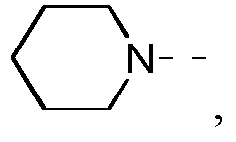


- Unless otherwise specified, the phrase "two Ra on adjacent atoms, together with the atom to which they are attached, form a double bond" in the general formula means that the two Ra on adjacent carbon atoms form a double bond along with the single bond between the two carbon atoms. For example, in the structural moiety

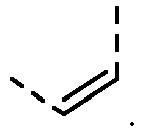
- Unless otherwise specified, the term "halogen element" or "halogen" by itself or as part of another substituent refers to fluorine, chlorine, bromine, or iodine atom.
- Unless otherwise specified, the term "C1-3 alkyl" refers to a linear or branched saturated hydrocarbon group consisting of 1 to 3 carbon atoms. The C1-3 alkyl includes C1-2 and C2-3 alkyl, etc.; it can be monovalent (such as methyl), divalent (such as methylene), or multivalent (such as methine). Examples of C1--3 alkyl include, but are not limited to, methyl (Me), ethyl (Et), propyl (including n-propyl and isopropyl), etc.
- Unless otherwise specified, the term "C1-3 alkoxy" refers to an alkyl group containing 1 to 3 carbon atoms that are connected to the rest of the molecule through an oxygen atom. The C1-3 alkoxy includes C1-2, C2-3, C3, C2 alkoxy, etc. Examples of C1--3 alkoxy include, but are not limited to, methoxy, ethoxy, propoxy (including n-propoxy and isopropoxy), etc.
- Unless otherwise specified, "C3-5 cycloalkyl" refers to a saturated cyclic hydrocarbon group consisting of 3 to 5 carbon atoms, which is a monocyclic system, and the C3-5 cycloalkyl includes C3-4, C4-5 cycloalkyl, etc.; it can be monovalent, divalent, or multivalent. Examples of C3-5 cycloalkyl include, but are not limited to, cyclopropyl, cyclobutyl, cyclopentyl, etc.
- Unless otherwise specified, the terms "5- to 6-membered heteroaryl ring" and "5- to 6- membered heteroaryl" are used interchangeably. The term "5- to 6-membered heteroaryl" refers to a monocyclic group consisting of 5 to 6 ring atoms with a conjugated π-electron system, in which 1, 2, 3, or 4 ring atoms are heteroatoms independently selected from O, S, and N, and the rest are carbon atoms, Here, the nitrogen atom is optionally quaternized, and nitrogen and sulfur heteroatoms can be optionally oxidized (i.e., NO and S(O)p, wherein p is 1 or 2). The 5- to 6-membered heteroaryl can be linked to the rest of the molecule through a heteroatom or a carbon atom. The 5- to 6-membered heteroaryl includes 5-membered and 6-membered heteroaryl. Examples of the 5- to 6-membered heteroaryl include, but are not limited to, pyrrolyl (including N-pyrrolyl, 2-pyrrolyl, and 3-pyrrolyl, etc.), pyrazolyl (including 2-pyrazolyl and 3-pyrazolyl, etc.), imidazolyl (including N-imidazolyl, 2-imidazolyl, 4-imidazolyl, and 5-imidazolyl, etc.), oxazolyl (including 2-oxazolyl, 4-oxazolyl, and 5-oxazolyl, etc.), triazolyl (including 1H-1,2,3-triazolyl, 2H-1,2,3-triazolyl, 1H-1,2,4-triazolyl, and 4H-1,2,4-triazolyl, etc.), tetrazolyl, isoxazolyl (including 3-isoxazolyl, 4-isoxazolyl, and 5-isoxazolyl, etc.), thiazolyl (including 2-thiazolyl, 4-thiazolyl, and 5-thiazolyl, etc.), furyl (including 2-furyl and 3-furyl, etc.), thienyl (including 2-thienyll and 3-thienyl, etc.), pyridyl (including 2-pyridyl, 3-pyridyl, and 4-pyridyl, etc.), pyrazinyl, pyrimidinyl (including 2-pyrimidinyl, 4-pyrimidinyl, etc.).
- Unless otherwise specified, the terms "6-membered heteroaryl ring" and "6-membered heteroaryl" in the present disclosure can be used interchangeably, and the term "6-membered heteroaryl" refers to a monocyclic group consisting of 6 ring atoms with a conjugated π-electron system, wherein 1, 2, 3, or 4 ring atoms are heteroatoms independently selected from O, S, and N, and the rest are carbon atoms. Here, the nitrogen atom is optionally quaternized, and nitrogen and sulfur heteroatoms can be optionally oxidized (i.e., NO and S(O)p, wherein p is 1 or 2). The 5- to 6-membered heteroaryl can be linked to the rest of the molecule through a heteroatom or a carbon atom.
- Unless otherwise specified, Cn-n+m or Cn-Cn+m includes any specific case of n to n+m carbons, for example, C1-12 includes C1, C2, C3, C4, C5, C6, C7, C8, C9, C10, C11, and C12, and any range from n to n+m is also included, for example C1-12 includes C1-3, C1-6, C1-9, C3-6, C3-9, C3-12, C6-9, C6-12, C9-12, etc.; similarly, n-membered to n+m-membered means that the number of atoms on the ring is from n to n+m, for example, 3- to 12-membered ring includes 3-membered ring, 4-membered ring, 5-membered ring, 6-membered ring, 7-membered ring, 8-membered ring, 9-membered ring, 10-membered ring, 11-membered ring, and 12-membered ring, and any range from n to n+m is also included, for example, 3- to 12-membered ring includes 3- to 6-membered ring, 3- to 9-membered ring, 5- to 6-membered ring, 5- to 7-membered ring, 6- to 7-membered ring, 6- to 8-membered ring, 6- to 10-membered ring, etc.
- The compounds of the present disclosure can be prepared by a variety of synthetic methods known to those skilled in the art, including the specific embodiments listed below, the embodiments formed by their combination with other chemical synthesis methods, and equivalent alternatives known to those skilled in the art, and preferred embodiments include, but are not limited to, the examples of the present disclosure.
- The structure of the compounds of the present disclosure can be confirmed by conventional methods known to those skilled in the art, and if the present disclosure involves an absolute configuration of a compound, then the absolute configuration can be confirmed by means of conventional techniques in the art. For example, in the case of single crystal X-ray diffraction (SXRD), the absolute configuration can be confirmed by collecting diffraction intensity data from the cultured single crystal using a Bruker D8 venture diffractometer with CuKα radiation as the light source and scanning mode: ϕ/ω scan, and after collecting the relevant data, the crystal structure can be further analyzed by the direct method (Shelxs97).
- The solvents used in the present disclosure are commercially available. The present disclosure uses the following abbreviations: hr represents hours; min represents minutes; DIEA represents N,N-diisopropylethylamine; DDQ represents 2,3-dichloro-5,6-dicyanobenzoquinone; XPHOS-PD-G2 represents chloro(2-dicyclohexylphosphino-2,4,6-triisopropyl-1,1'-biphenyl)[2-(2-amino-1,1'-biphenyl)]palladium(II); TBSCl represents tertbutyldimethylsilyl chloride; DMAP represents 4-dimethylaminopyridine; Cs2CO3 represents cesium carbonate; RuPhos represents 2-dicyclohexylphosphino-2,6-diisopropoxy-1,1'-biphenyl; Pd2(dba)3 represents tris(dibenzylideneacetone)dipalladium; TBAF represents tetrabutylammonium fluoride; Et3N represents triethylamine; Na2CO3 represents sodium carbonate; NaHCO3 represents sodium bicarbonate; H2O represents water; PE represents petroleum ether; EA represents ethyl acetate; DMF represents N,N-dimethylformamide; MeOH represents methanol; EtOH represents ethanol; THF represents tetrahydrofuran; DCM represents dichloromethane; NBS represents N-bromosuccinimide; Dess-Martin represents Dess-Martin periodinane, CAS No. 87413-09-0; KHMDS represents potassium bis(trimethylsilyl)amide; Pd(OAc)2 represents palladium acetate; PPh3 represents triphenylphosphine; Pd/C represents palladium on carbon; HATU represents 2-(7-azabenzotriazol-1-yl)-N,N,N',N'-tetramethyluronium hexafluorophosphate; (Boc)2O represents di-tert-butyl dicarbonate; LiAlH4 represents lithium aluminum hydride; N-Boc-piperazine represents 1-tert-butoxycarbonylpiperazine; Lawesson's reagent represents the compound with CAS No. 19172-47-5; DMSO represents dimethyl sulfoxide; NaBH(OAc)3 represents sodium triacetoxyborohydride; KI represents potassium iodide; NH4Cl represents ammonium chloride; HCl represents hydrochloric acid; dioxane represents 1,4-dioxane; Pd(dppf)Cl2 represents [1,1'-bis(diphenylphosphino)ferrocene]dichloropalladium.
-
-
FIG. 1 : Diagram showing tumor growth volumes. -
FIG. 2 : Diagram showing body weight changes of mice during drug administration. - The present disclosure is described in detail by the examples below, but it does not mean that there are any adverse restrictions on the present disclosure. The present disclosure has been described in detail herein, and its specific examples have also been disclosed; for those skilled in the art, it is obvious to make various modifications and improvements to the specific examples of the present disclosure without departing from the spirit and scope of the present disclosure.
-

- Compound 1a (9.5 g, 39.92 mmol), DIEA (15.48 g, 119.75 mmol, 20.86 mL), and compound 1b (6.13 g, 43.91 mmol, HCl) were added to DMF (100 mL) and the reaction mixture was stirred at 25°C for 18 hours. Water (1000 mL) was then added to the reaction mixture. The mixture was extracted with ethyl acetate (3 × 100 mL). The organic phases were combined, dried, and concentrated to obtain a crude product. The crude product was subjected to column chromatography (eluent: PE:EA = 4:1, v/v) to obtain intermediate 1c. MS m/z: 320.8, 322.8 [M+H]+.
- At 0°C, intermediate 1c (7.4 g, 23.05 mmol), NH4Cl (9.86 g, 184.37 mmol), and zinc powder (7.7 g, 117.76 mmol) were added to a mixture of MeOH (100 mL) and H2O (2 mL). The reaction mixture was stirred for 2 hours. The reaction mixture was then filtered, and the filtrate was evaporated under reduced pressure to remove methanol. Water (100 mL) was added thereto, and the mixture was extracted with ethyl acetate (2 × 30 mL). The organic phases were combined, dried, and filtered. The filtrate was concentrated under reduced pressure to obtain intermediate 1d, which was used directly in the next step. MS m/z: 290.7, 292.7 [M+H]+.
- At 0°C, intermediate 1d (6.7 g, 23.01 mmol) was added to a mixed solvent of 4 M HCl in dioxane (1.81 mL), ethyl acetate (70 mL), and methanol (70 mL). The reaction mixture was stirred for 2 hours. The reaction mixture was then filtered, and the filtrate was concentrated under reduced pressure to obtain intermediate 1e (5.5 g, 21.23 mmol). 1H NMR (400 MHz, DMSO-d 6) δ ppm 10.46 (s, 1 H) 7.42 - 7.57 (m, 1 H) 7.00 (dd, J=8.53, 7.28 Hz, 1 H) 6.49 (d, J=8.03 Hz, 1 H) 3.82 - 3.86 (m, 1 H) 1.25 (d, J=6.53 Hz, 3 H).
- At 0°C, DDQ (5.26 g, 23.16 mmol) was added in batches to a solution of intermediate 1e (5.0 g, 19.30 mmol) in DCM (250 mL). The temperature was then raised to 25°C, and the reaction mixture was stirred for 2 hours and evaporated under reduced pressure to remove the solvent. A saturated NaHCO3 aqueous solution (200 mL) was slowly added to quench the reaction, and the mixture was stirred overnight. The reaction mixture was extracted with ethyl acetate (3 × 50 mL), and the organic phases were combined and concentrated to obtain the target product, which was subjected to column chromatography (eluent: DCM:MeOH = 100:1, v/v) to obtain intermediate 1f. MS m/z: 256.7, 258.7 [M+H]+, 1H NMR (400 MHz, DMSO-d6 ) δ ppm 12.61 (br s, 1 H) 7.45 - 7.55 (m, 2 H) 2.40 (s, 3 H).
- Intermediate 1f (1.0 g, 3.89 mmol), 1-(tributylstannyl)methanol (1.50 g, 4.67 mmol), and XPHOS-PD-G2 (153.04 mg, 194.51 µmol) were added to 1,4-dioxane (20 mL). The reaction mixture was stirred at 80°C under a nitrogen atmosphere for 4 hours. The reaction mixture was then concentrated under reduced pressure to obtain a crude product. The crude product was purified by column chromatography (eluent: DCM/MeOH = 20/1, v/v) to obtain intermediate 1g. MS m/z: 209.0 [M+1]+.
- Under a nitrogen atmosphere at 0°C, tributylphosphine (388.72 mg, 1.92 mmol, 474.05 µL) was slowly added dropwise to a solution of 1,2-dibromotetrachloroethane (688.23 mg, 2.11 mmol, 253.96 µL) and intermediate 1g (200 mg, 960.67 µmol) in DCM (5 mL). The reaction mixture was stirred at 20°C for 3 hours. The reaction mixture was then concentrated under reduced pressure to obtain a crude product. A mixed solvent of DCM and MeOH (20:1, 5 mL) was added to the crude product. The mixture was stirred for 30 minutes and filtered. The filter cake was concentrated under reduced pressure to obtain intermediate 1h. 1H NMR (400 MHz, DMSO-d6 ) δ ppm 12.55 (s, 1 H) 7.47 - 7.58 (m, 1 H) 7.31 - 7.43 (m, 1 H) 4.80 - 4.90 (m, 2 H) 2.42 (s, 3 H).
- Triethylamine (1.87 g, 18.49 mmol) was added to a solution of intermediate 1i (2 g, 9.25 mmol), TBSCl (2.09 g, 13.87 mmol), and DMAP (112.97 mg, 924.74 µmol) in DCM (40 mL). The reaction mixture was stirred at 20°C for 16 hours. The reaction mixture was then concentrated under reduced pressure to obtain a crude product. The crude product was purified by column chromatography (eluent: DCM/MeOH = 20/1 to 10/1, v/v) to obtain intermediate 1j. 1H NMR (400 MHz, CD3OD) δ ppm 3.88 - 4.12 (m, 2 H) 3.63 (d, J=5.52 Hz, 2 H) 3.01 (d, J=12.30 Hz, 1 H) 2.54 - 2.94 (m, 4 H) 1.48 (s, 9 H) 0.95 (s, 9 H) 0.12 (s, 6 H).
- Cs2CO3 (197.15 mg, 605.08 µmol), RuPhos (14.12 mg, 30.25 µmol), intermediate 1j (0.1 g, 302.54 µmol), methyl 5-bromo-6-fluoro-pyridine-2-carboxylate (70.80 mg, 302.54 µmol), and Pd2(dba)3 (55.41 mg, 60.51 µmol) were added to a toluene solution (4 mL). The reaction mixture was stirred at 100°C for 24 hours. The reaction mixture was subjected to suction filtration under reduced pressure, and the filtrate was concentrated under reduced pressure to obtain a crude product. The crude product was separated by column chromatography (eluent: PE:EA= 1:1, v/v) to obtain intermediate 1k. MS m/z: 484.3 [M+H]+.
- TBAF (1 M in THF, 258.45 µL, 2.5 eq) and intermediate 1k (50 mg, 103.38 µmol) were added to a THF solution (4 mL). The reaction mixture was stirred at 25°C for 16 hours. The reaction mixture was then concentrated under reduced pressure to obtain intermediate 11. MS m/z: 350.2 [M+H]+.
- Intermediate 11 (30 mg, 85.87 µmol) was added to an EA solution (2 mL). HCl/EA (4 M, 85.87 µL) was added dropwise to the reaction mixture. The mixture was stirred at 25°C for 2 hours. The reaction mixture was concentrated under reduced pressure to obtain the hydrochloride of intermediate 1m. MS m/z: 250.2 [M+H]+.
- Under a nitrogen atmosphere, the hydrochloride of intermediate 1m (20 mg) was added to an EtOH solution (2 mL). Methylamine (2.26 mg, 72.84 µmol) was then added thereto. The mixture was stirred at 20°C for 1 hour. The reaction mixture was concentrated under reduced pressure to obtain intermediate 1n. MS m/z: 249.1 [M+H]+.
- Intermediate 1n (10.50 mg, 36.89 µmol) was added to DMF (2 mL). Et3N (7.47 mg, 73.78 µmol, 10.27 µL) was then added thereto. The mixture was stirred at 25°C for 30 minutes. KI (2.70 mg, 16.24 µmol, 5.68 µL) and intermediate 1h (10 mg, 36.89 µmol) were then added to the reaction mixture, and the mixture was stirred at 50°C for 2 hours. The reaction mixture was concentrated under reduced pressure using an oil pump at 60°C to obtain a crude product. The crude product was purified by preparative HPLC (column: Welch Xtimate C18, 100 × 40 mm × 3 µm; mobile phase: [water (trifluoroacetic acid)-acetonitrile]; acetonitrile%: 0%-23% over 8 minutes) to obtain the trifluoroacetate of compound 1. MS m/z: 439.2 [M+H]+, 1H NMR (400 MHz, CD3OD) δ ppm 7.63 - 7.73 (m, 2 H) 7.36 - 7.50 (m, 2 H) 4.44 - 4.54 (m, 3 H) 4.22 (dd, J=11.26, 7.63 Hz, 1 H) 4.13 (d, J=11.01 Hz, 1 H) 3.51 - 3.64 (m, 3 H) 3.11 - 3.22 (m, 2 H) 2.92 (s, 3 H) 2.85 - 2.91 (m, 1 H) 2.56 (s, 3 H).
-

- Compound 2a (0.5 g, 2.14 mmol) and compound 2b (642.89 mg, 3.21 mmol) were added to toluene (10 mL). Cs2CO3 (2.09 g, 6.42 mmol), RuPhos (199.72 mg, 428.00 µmol), and Pd2(dba)3 (195.96 mg, 214.00 µmol) were then added thereto. The reaction mixture was purged with nitrogen three times and stirred at 100°C for 16 hours. The reaction mixture was subjected to suction filtration under reduced pressure, and the filtrate was concentrated under reduced pressure to obtain a crude product. The crude product was purified by column chromatography (eluent: PE/EA = 4/1 to 2/1, v/v) to obtain intermediate 2c. MS m/z: 354.2 [M+1]+, 1H NMR (400 MHz, CDCl3) δ ppm 7.99 (d, J=8.03 Hz, 1 H) 7.22 - 7.29 (m, 1 H) 4.01 (d, J=6.53 Hz, 1 H) 4.00 - 4.24 (m, 1 H) 3.98 (s, 3 H) 3.81 (d, J=13.30 Hz, 1 H) 3.29 - 3.44 (m, 2 H) 3.07 - 3.25 (m, 2 H) 1.50 (s, 9 H) 1.08 (d, J=6.53 Hz, 3 H).
- Intermediate 2c (0.4 g, 1.13 mmol) and methylamine in THF (2 M, 7.27 mL) were added to EtOH (10 mL), and the reaction mixture was stirred at 20°C for 16 hours. The reaction mixture was concentrated under reduced pressure to obtain the crude intermediate 2d, which was used directly in the next step. MS m/z: 353.0 [M+H]+.
- Intermediate 2d (0.4 g, 1.14 mmol) was added to EA (5 mL). HCl in ethyl acetate (4 M, 1.42 mL) was then added thereto. The reaction mixture was stirred at 20°C for 16 hours. The reaction mixture was concentrated under reduced pressure to obtain the hydrochloride of the crude intermediate 2e, which was used directly in the next step. MS m/z: 253.0 [M+H]+.
- Intermediate 2e (21.30 mg) was added to DMF (2 mL). Then, Et3N (14.93 mg, 147.56 µmol, 20.54 µL) was added thereto. The reaction mixture was stirred at 25°C for 30 minutes. KI (5.39 mg, 32.49 µmol) and intermediate 1h (20 mg, 73.78 µmol) were then thereto. The reaction mixture was stirred at 50°C for 2 hours. The reaction mixture was concentrated under reduced pressure to obtain a crude product. The crude product was purified by preparative HPLC (column: Welch Xtimate C18, 100 × 40 mm × 3 µm; mobile phase: [water (trifluoroacetic acid)-acetonitrile]; acetonitrile%: 0%-26% over 8 minutes) to obtain the trifluoroacetate of
compound 2. MS m/z: 443.1 [M+H]+, 1H NMR (400 MHz, DMSO-d 6) δ ppm 7.19 (d, J=7.28 Hz, 1 H) 6.99 (s, 1 H) 6.90 (d, J=8.78 Hz, 1 H) 6.67 (d, J=6.78 Hz, 1 H) 3.80 (s, 2 H) 2.78 (s, 1 H) 2.70 (s, 3 H) 2.39 - 2.48 (m, 3 H) 2.14 (s, 3 H) 1.76 (s, 3 H) 0.32 (s, 3 H). -

- Compound 3a (1 g, 4.62 mmol) was added to DCM (20 mL), and the reaction mixture was cooled to 0°C. Et3N (935.74 mg, 9.25 mmol, 1.29 mL), TBSCl (1.05 g, 6.94 mmol, 849.87 µL), and DMAP (56.49 mg, 462.37 µmol) were then added thereto. The reaction mixture was stirred at 20°C for 16 hours. The reaction mixture was concentrated under reduced pressure to obtain a crude product. The crude product was purified by column chromatography (eluent: DCM/MeOH = 20/1 to 10/1, v/v) to obtain intermediate 3b. 1H NMR (400 MHz, CDCl3) δ ppm 3.86 ( s, 1 H) 3.52 ( s, 1 H) 3.41 (dd, J=9.79, 7.28 Hz, 1 H) 2.92 (d, J=11.29 Hz, 1 H) 2.63 - 2.84 (m, 3 H) 2.48 (s, 1 H) 1.90 (s, 1 H) 1.28 - 1.48 (m, 9 H) 0.72 - 0.97 (m, 9 H) -0.08 - 0.08 (m, 6 H).
- Methyl 5-bromo-6-fluoro-pyridine-2-carboxylate (1 g, 4.27 mmol) and intermediate 3b (987.97 mg, 2.99 mmol) were added to toluene (20 mL). RuPhos (398.80 mg, 854.00 µmol), Pd2(dba)3 (391.30 mg, 427.00 µmol), and Cs2CO3 (4.17 g, 12.81 mmol) were then added thereto. The reaction mixture was purged with nitrogen three times and stirred at 100°C for 2 hours. The reaction mixture was subjected to suction filtration under reduced pressure, and the filtrate was concentrated under reduced pressure to obtain a crude product. The crude product was purified by column chromatography (eluent: PE/EA = 4/1 to 2/1, v/v) to obtain intermediate 3c. MS m/z: 484.3 [M+H]+.
- Compound 3c (300 mg, 620.29 µmol) was added to THF (2 mL), and TBAF (1 M in THF, 1.86 mL) was added thereto. The reaction mixture was stirred at 20°C for 2 hours. The reaction mixture was subjected to suction filtration under reduced pressure, and the filtrate was concentrated under reduced pressure to obtain a crude product 3d, which was used directly in the next step. MS m/z: 350.1 [M+H]+.
- Compound 3d (200.00 mg) was added to EtOH (5 mL), and a solution of methylamine in ethanol (1 mL, 40%) was added thereto. The reaction mixture was stirred at 20°C for 32 hours. The reaction mixture was concentrated under reduced pressure to obtain a crude product. The crude product was used directly in the next step, yielding intermediate 3e. MS m/z: 349.1 [M+H]+.
- Compound 3e (0.1 g) was added to EA (5 mL), and HCl/ethyl acetate (4 M, 358.79 µL) was added thereto. The reaction mixture was stirred at 20°C for 8 hours. The reaction mixture was concentrated under reduced pressure to obtain a crude hydrochloride of compound 3f, which was used directly in the next step. MS m/z: 249.1 [M+H]+.
- Compound 3f (10.50 mg, HCl) was added to DMF (2 mL). Then, Et3N (7.47 mg, 73.78 µmol, 10.27 µL) was added thereto. The reaction mixture was stirred at 25°C for 30 minutes. KI (2.70 mg, 16.24 µmol, 5.68 µL) and compound 1h (10 mg, 36.89 µmol) were then added thereto. The reaction mixture was stirred at 50°C for 2 hours. The reaction mixture was concentrated using an oil pump at 60°C to obtain a crude product. The crude product was purified by preparative HPLC (column: Xtimate C18, 150 × 40 mm × 5 µm; mobile phase: [water (trifluoroacetic acid)-acetonitrile]; acetonitrile%: 1%-30% over 10 minutes) to obtain the trifluoroacetate of compound 3. MS m/z: 439.0 [M+H]+, 1H NMR (400 MHz, CD3OD) δ ppm 7.66 - 7.71 (m, 2 H) 7.42 - 7.48 (m, 1 H) 7.36 - 7.42 (m, 1 H) 4.50 (dd, J=11.19, 2.56 Hz, 1 H) 4.43 (s, 2 H) 4.22 (dd, J=11.13, 7.75 Hz, 1 H) 4.12 (d, J=10.01 Hz, 1 H) 3.56 (br s, 1 H) 3.51 (d, J=9.38 Hz, 2 H) 3.14 (s, 2 H) 2.92 (s, 3 H) 2.85 (s, 1 H) 2.56 (s, 3 H).
-

- Toluene (5 mL) was added to a reaction flask containing compound 2a (500 mg, 2.14 mmol) and N-Boc-piperazine (397.93 mg, 2.14 mmol). RuPhos (199.40 mg, 427.31 µmol), cesium carbonate (1.39 g, 4.27 mmol), and Pd2(dba)3 (195.65 mg, 213.65 µmol) were then sequentially added thereto. Under a nitrogen atmosphere, the reaction mixture was heated to 100°C and stirred for 16 hours. The reaction mixture was filtered directly, and the filtrate was concentrated under reduced pressure to obtain a crude product. The crude product was purified by silica gel column chromatography (gradient elution: PE:EA = 100:0 to 80:20) to obtain intermediate 4a. MS m/z: 340.1 [M+H]+. 1H NMR (400 MHz, CDCl3) δ ppm 7.98 - 7.98 (m, 1 H) 7.91 - 8.06 (m, 1 H) 3.98 (s, 3 H) 3.57 - 3.68 (m, 4 H) 3.16 - 3.31 (m, 4 H) 1.51 (s, 9 H).
- Compound 4a (200 mg, 589.34 µmol) was dissolved in ethanol (8 mL), and a solution of methylamine in ethanol (1.19 g, 17.68 mmol) was added. The reaction mixture was stirred at 25°C for 16 hours. The reaction mixture was concentrated to obtain intermediate 4b, which was used directly in the next reaction without purification. MS m/z: 339.1 [M+H]+. 1H NMR (400 MHz, CDCl3) δ ppm 1.42 (s, 9 H) 2.93 (d, J=5.13 Hz, 3 H) 3.03 - 3.16 (m, 4 H) 3.44 - 3.63 (m, 4 H) 7.24 (dd, J=10.01, 8.13 Hz, 1 H) 7.44 (br d, J=4.13 Hz, 1 H) 7.93 (dd, J=8.00, 1.00 Hz, 1 H).
- Intermediate 4b (50 mg, 147.76 µmol) was dissolved in toluene (2.5 mL), and Lawesson's reagent (71.72 mg, 177.32 µmol) was added. The reaction mixture was stirred at 120°C for 16 hours. The reaction mixture was extracted with water (1 mL) and ethyl acetate (3 mL). The organic phase was dried over anhydrous sodium sulfate. The reaction mixture was filtered and concentrated under reduced pressure, and the residue was purified by prep-TLC (PE:EA = 5:1) to obtain intermediate 4c. MS m/z: 355.1 [M+H]+.
- Intermediate 4c (10 mg, 28.21 µmol) was dissolved in DMF (0.5 mL), and sodium hydride (2.82 mg, 70.53 µmol, purity of 60%) was added. The mixture was stirred at 0°C for 0.5 hours. Methyl iodide (8.01 mg, 56.43 µmol, 3.51 µL) was then added thereto, and the mixture was stirred at 25°C for 2 hours. The reaction was quenched by adding two drops of ammonium chloride solution. The reaction mixture was extracted with ethyl acetate (5 mL), and the organic phase was washed with saturated brine (2 mL), then dried over anhydrous sodium sulfate, filtered, and concentrated to obtain intermediate 4d, which was used directly in the next step without purification. MS m/z: 369.2 [M+H]+.
- Intermediate 4d (5 mg, 13.57 µmol) was dissolved in EtOH (0.5 mL). Triethylamine (6.87 mg, 67.85 µmol, 9.44 µL) and methoxyamine hydrochloride (3.40 mg, 40.71 µmol) were added, and the reaction mixture was stirred at 60°C for 1.5 hours. The reaction mixture was extracted with ethyl acetate (5 mL). The organic phase was washed with water (2 mL), dried over anhydrous sodium sulfate, then filtered and concentrated. The resulting product was purified by prep-TLC (PE:EA = 1:1), and the reaction mixture was filtered and concentrated to obtain intermediate 4e. MS m/z: 368.1 [M+H]+. 1H NMR (400 MHz, CDCl3) δ ppm 7.48 - 7.56 (m, 1 H) 7.15 - 7.18 (m, 1 H) 3.79 (s, 3 H) 3.51 - 3.56 (m, 4 H) 3.00 - 3.05 (m, 4 H) 2.92 (s, 3 H)1.42 (s, 9 H) .
- Intermediate 4e (10 mg, 27.22 µmol) was dissolved in MeOH (0.5 mL). HCl/dioxane (4 M, 36.74 µL) was added, and the reaction mixture was stirred at 25°C for 1.5 hours. LCMS analysis indicated that most of the starting material remained. An additional 0.2 mL of HCl/dioxane (4 M, 36.74 µL) was added, and the mixture was stirred for another 1.5 hours. The reaction mixture was then concentrated to obtain the hydrochloride of intermediate 4f, which was used directly in the next step without purification.
- Intermediate 4f (10 mg, hydrochloride) was dissolved in DMF (1 mL). Triethylamine (6.66 mg, 65.84 µmol, 9.16 µL) was added, and the reaction mixture was stirred at 25°C for 0.5 hours. Intermediate 1h (8.92 mg, 32.92 µmol) and potassium iodide (2.73 mg, 16.46 µmol) were then added. The mixture was stirred at 50°C for 2 hours. The reaction mixture was filtered to obtain a crude product. The crude product was purified by preparative HPLC (column: Welch Xtimate C18, 100 × 40 mm × 3 µm; mobile phase: [water (trifluoroacetic acid)-acetonitrile]; acetonitrile%: 0%-30% over 8 minutes) to obtain the trifluoroacetate of
compound 4. MS m/z: 458.2 [M+H]+. 1H NMR (400 MHz, CD3OD) δ ppm 2.56 (s, 3 H) 3.03 (s, 3 H) 3.59 (br s, 8 H) 3.83 - 3.94 (m, 3 H) 4.64 (s, 2 H) 7.46 - 7.52 (m, 1 H) 7.60 - 7.76 (m, 3 H). -
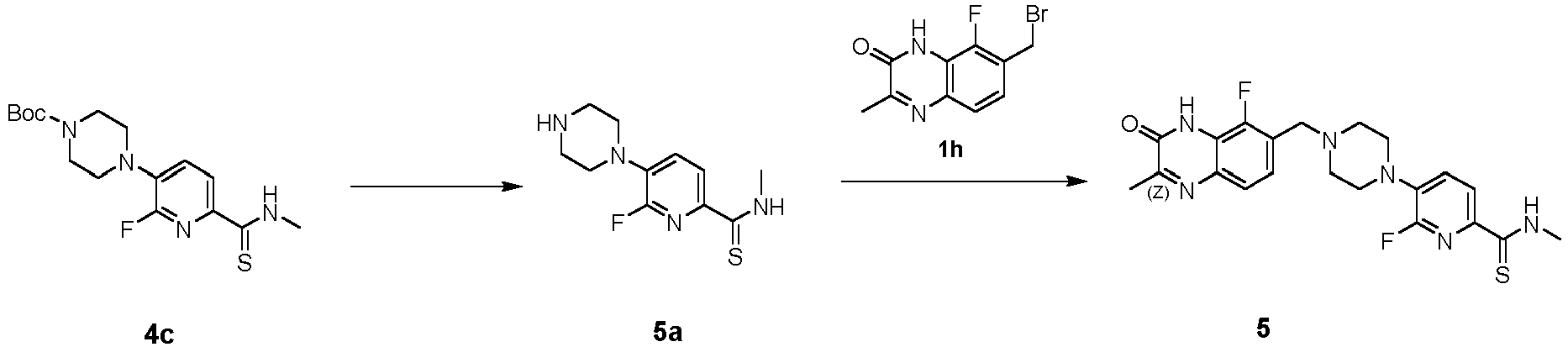
- Intermediate 4c (19.4 mg, 54.73 µmol) was dissolved in MeOH (1 mL). HCl/dioxane (4 M, 73.89 µL) was added, and the reaction mixture was stirred at 25°C for 16 hours. The reaction mixture was concentrated to obtain the hydrochloride of intermediate 5a, which was used directly in the next step without purification. MS m/z: 255.0 [M+H]+.
- Intermediate 5a (15 mg, hydrochloride) was dissolved in DMF (1 mL). Triethylamine (10.44 mg, 103.17 µmol, 14.36 µL) was added, and the reaction mixture was stirred at 25°C for 0.5 hours. Methyl iodide (4.28 mg, 25.79 µmol) and intermediate 1h (13.98 mg, 51.58 µmol) were then added, and the mixture was stirred at 50°C for 2 hours. The reaction mixture was filtered to obtain a crude product. The crude product was purified by preparative HPLC (column: Welch Xtimate C18, 100 × 40 mm × 3 µm; mobile phase: [water (trifluoroacetic acid)-acetonitrile]; gradient: 3%-33% acetonitrile over 8 minutes) to obtain the trifluoroacetate of
compound 5. MS m/z: 445.1 [M+H]+. 1H NMR (400 MHz, CD3OD) δ ppm 2.56 (s, 3 H) 3.27 - 3.29 (m, 3 H) 3.54 (br d, J=3.76 Hz, 8 H) 4.58 (s, 2 H) 7.47 (t, J=7.91 Hz, 1 H) 7.59 (dd, J=10.16, 8.41 Hz, 1 H) 7.70 (d, J=8.28 Hz, 1 H) 8.47 (d, J=8.03 Hz, 1 H) 10.18 - 10.34 (m, 1 H). -

- Dioxane (1 mL), water (0.2 mL), intermediate 2a (30 mg, 128.19 µmol), and compound 6a (43.60 mg, 141.01 µmol) were added to a 10 mL vial and stirred. After nitrogen purging, potassium phosphate (54.42 mg, 256.39 µmol) and [1,1'-bis(diphenylphosphino)ferrocene]dichloropalladium(II) (9.38 mg, 12.82 µmol) were added. The reaction mixture was heated to 80°C and reacted for 2 hours. The reaction mixture was filtered, and the filtrate was concentrated under reduced pressure to obtain a crude product. The crude product was purified by preparative TLC (eluent: PE:EA = 3:1) to obtain intermediate 6b. MS m/z: 337.1 [M+H]+.
- Intermediate 6b (37 mg, 110.00 µmol) was dissolved in EtOH (1.5 mL). A solution of methylamine in ethanol (222.81 mg, 3.30 mmol) was added, and the reaction mixture was stirred at 25°C for 6 hours. The reaction mixture was directly concentrated to obtain intermediate 6c, which was used directly in the next step without purification. MS m/z: 336.0 [M+H]+.
- Intermediate 6c (17 mg, 50.69 µmol) was dissolved in MeOH (0.5 mL). HCl/dioxane (4 M, 68.43 µL) was added, and the reaction mixture was stirred at 25°C for 2 hours. The reaction mixture was directly concentrated to obtain the hydrochloride of intermediate 6d, which was used directly in the next step without purification. MS m/z: 236.1 [M+H]+.
- Intermediate 6d (10 mg, 36.80 µmol, hydrochloride) was dissolved in DMF (1 mL). Triethylamine (7.45 mg, 73.61 µmol, 10.24 µL) was added, and the reaction mixture was stirred at 25°C for 0.5 hours. Intermediate 1h (9.98 mg, 36.80 µmol) and potassium iodide (3.05 mg, 18.40 µmol) were then added. The mixture was stirred at 50°C for 2 hours. The reaction mixture was filtered to obtain a crude product. The crude product was separated by preparative HPLC (column: Welch Xtimate C18, 100 × 40 mm × 3 µm; mobile phase: [water (trifluoroacetic acid)-acetonitrile]; gradient: 0%-30% acetonitrile over 8 minutes) to obtain the trifluoroacetate of compound 6. MS m/z: 426.2 [M+H]+. 1H NMR (400 MHz, CDCl3) δ ppm 8.12 (dd, J=7.78, 1.51 Hz, 1 H) 7.83 - 7.91 (m, 1 H) 7.70 - 7.79 (m, 1 H) 7.57 - 7.68 (m, 2 H) 6.13 (br s, 1 H) 4.53 (s, 2 H) 3.74 - 4.00 (m, 2 H) 3.36 - 3.66 (m, 2 H) 3.04 - 3.09 (m, 3 H) 2.91 - 2.99 (m, 1 H)2.65 (s, 3 H).
-

- Intermediate 6c (10 mg, 29.82 µmol) was added to a mixture of MeOH (3 mL) and ethyl acetate (1 mL). Palladium on carbon (2 mg, 29.82 µmol, 10%) was also added thereto. The reaction mixture was purged with argon three times and then with hydrogen three times. The reaction mixture was stirred under a hydrogen atmosphere at 16 psi and 30°C for 16 hours. The reaction mixture was filtered through diatomite, and the organic phase was concentrated under reduced pressure to obtain intermediate 7a, which was used directly in the next step. MS m/z: 360.2 [M+23]+.
- Intermediate 7a (10 mg, 29.64 µmol) was dissolved in MeOH (0.5 mL). HCl/dioxane (4 M, 37.05 µL) was added thereto. The reaction mixture was stirred at 25°C for 2 hours. The reaction mixture was directly concentrated under reduced pressure to obtain the hydrochloride of intermediate 7b, which was used directly in the next step. MS m/z: 238.0 [M+1]+.
- Triethylamine (6.94 mg, 68.56 µmol) was added to a solution of intermediate 7b (9.38 mg, 34.28 µmol, crude hydrochloride) in DMF (1 mL). The reaction mixture was stirred at 20°C for 0.5 hours. Intermediate 1h (9.29 mg, 34.28 µmol) and potassium iodide (569.03 µg, 3.43 µmol) were then added thereto. The reaction mixture was stirred at 50°C for 2 hours. The reaction mixture was concentrated under reduced pressure to obtain a crude product. The crude product was purified by preparative HPLC (column: Welch Xtimate C18, 100 × 40 mm × 3 µm; mobile phase: [water (trifluoroacetic acid)-acetonitrile]; gradient: 0%-30% acetonitrile over 8 minutes) to obtain the trifluoroacetate of compound 7. MS m/z: 428.3 [M+1]+. 1H NMR (400 MHz, CD3OD) δ ppm 8.75 ( s, 1 H) 8.01 (s, 2 H) 7.71 (d, J=8.28 Hz, 1 H) 7.47 (t, J=7.65 Hz, 1 H) 4.58 (s, 2 H) 3.72 (br s, 2 H) 3.18 - 3.30 (m, 3 H) 2.95 (d, J=5.02 Hz, 3 H) 2.56 (s, 3 H) 2.15 - 2.26 (m, 2 H) 2.07 (d, J=12.80 Hz, 2 H).
-

- Compound 8a (245.05 mg, 976.20 µmol) and N-Boc-piperazine (200 mg, 1.07 mmol) were added to toluene (5 mL). Pd2(dba)3 (8.94 mg, 9.76 µmol), RuPhos (9.11 mg, 19.52 µmol), and Cs2CO3 (636.13 mg, 1.95 mmol) were added thereto. The reaction mixture was purged with nitrogen three times and stirred at 100°C for 16 hours. The reaction mixture was filtered through diatomite, and the organic phase was concentrated under reduced pressure to obtain a crude product. A mixture of ethyl acetate and n-heptane (ethyl acetate/n-heptane = 5/1, 10 mL) was added to the crude product, and the resulting mixture was stirred at 25°C for 0.5 hours and subjected to suction filtration under reduced pressure, and the filter cake was concentrated to obtain intermediate 8b. MS m/z: 301.2 [M-56+1]+. 1H NMR (400 MHz, DMSO-d 6) δ ppm 7.61 (t, J=8.19 Hz, 1 H) 6.93 (t, J=8.38 Hz, 1 H) 3.83 (s, 3 H) 3.50-3.46 (m, 4 H) 3.13 - 3.23 (m, 4 H) 1.43 (s, 9 H).
- Compound 2 (100 mg, 280.61 µmol) and a solution of methylamine in ethanol (87.15 mg, 1.29 mmol) were added to EtOH (2 mL). The mixture was stirred at 25°C for 16 hours, and then the reaction temperature was increased to 50°C. The mixture was stirred at 50°C for 16 hours. The reaction mixture was directly concentrated under reduced pressure to obtain a crude product. The crude product was purified by preparative TLC (PE/EA = 2/1, Rf = 0.1) to obtain intermediate 8c. MS m/z: 378.2 [M+23]+.
- Intermediate 8c (50 mg, 140.69 µmol) was dissolved in MeOH (0.5 mL). HCl/dioxane (4 M, 37.05 µL) was added thereto. The reaction mixture was stirred at 25°C for 2 hours, then directly concentrated under reduced pressure to obtain the hydrochloride of intermediate 8d, which was used directly in the next step. MS m/z: 256.0 [M+1]+.
- Triethylamine (10.41 mg, 102.84 µmol) was added to a solution of intermediate 8d (15 mg, 51.42 µmol, crude hydrochloride) in DMF (1 mL). The reaction mixture was stirred at 20°C for 0.5 hours. Intermediate 1h (13.94 mg, 51.42 µmol) and potassium iodide (853.55 µg, 5.14 µmol) were then added thereto. The reaction mixture was stirred at 50°C for 2 hours. The reaction mixture was concentrated using an oil pump under reduced pressure to obtain a crude product. The crude product was purified by preparative HPLC (column: Welch Xtimate C18, 100 × 40 mm × 3 µm; mobile phase: [water (trifluoroacetic acid)-acetonitrile]; gradient: 0%-30% acetonitrile over 8 minutes) to obtain the trifluoroacetate of compound 8. MS m/z: 468.1 [M+23]+. 1H NMR (400 MHz, CD3OD) δ ppm 8.15 (s, 1 H) 7.70 (d, J=8.28 Hz, 1 H) 7.39 - 7.57 (m, 2 H) 6.89 - 7.03 (m, 1 H) 4.55 (s, 2 H) 3.50 (s, 8 H) 2.89 - 2.98 (m, 3 H) 2.56 (s, 3 H).
-

- Intermediate 4b (50 mg, 147.76 µmol) was dissolved in methanol (0.2 mL). HCl/dioxane (4 M, 199.48 µL) was added, and the reaction mixture was stirred at 25°C for 2 hours. The reaction mixture was concentrated under reduced pressure without further purification to obtain the hydrochloride of intermediate 9g. MS m/z: 238.9 [M+1]+.
- At 0°C, compound 9a (1 g, 4.81 mmol) was added to trifluoroacetic acid (10 mL). Potassium nitrate (760 mg, 7.52 mmol) was slowly added in batches. The reaction mixture was then stirred at 20°C for 16 hours. The reaction mixture was poured into 90 mL of saturated sodium bicarbonate solution, and then extracted with ethyl acetate (100 mL × 3). The organic phases was washed with saturated sodium chloride solution (100 mL × 2), filtered, and concentrated. The crude product was purified by silica gel column chromatography (EA:PE = 0%-10%) to obtain intermediate 9b. 1H NMR (400 MHz, DMSO-d 6) δ ppm 7.68 - 7.92 (m, 1 H), 7.08 (br s, 2 H).
- Intermediate 9b (100 mg, 395.26 µmol) was dissolved in EtOH (1 mL) and cooled to 0°C. Acetic acid (237.36 mg, 3.95 mmol, 226.27 µL) was first added, then zinc (240 mg, 3.67 mmol) was added in batches. The reaction was carried out for 6 hours. The reaction mixture was filtered and concentrated to obtain a crude product. The crude product was purified by preparative TLC (PE:EA = 3:1) to obtain intermediate 9c. MS m/z: 224.9, 226.9 [M+1]+, [M+3]+. 1H NMR (400 MHz, CDCl3) δ ppm 6.69 - 6.80 (m, 1 H), 3.52 (s, 4 H).
- Intermediate 9c (25 mg, 112.10 µmol) was added to EtOH (0.32 mL), then pyruvic acid (11.85 mg, 134.52 µmol) was added. The reaction mixture was reacted at 100°C for 2 hours, then slowly cooled to 25°C to crystallize over 14 hours. The reaction mixture was filtered, and the solid was washed once with 0.5 mL of ethanol. A mixture of intermediates 9d1 and 9d2 was obtained without further purification. MS m/z: 274.9 [M+1]+.
- The mixture of intermediates 9d1 and 9d2 (95 mg) and XPHOS-PD-G2 (13.59 mg, 17.27 µmol) was dissolved in dioxane (2 mL). 1-(Tributylstannyl)methanol (133.08 mg, 414.47 µmol) was added, and the mixture was purged with nitrogen and reacted at 80°C for 16 hours. The reaction mixture was purified by preparative TLC (PE:EA = 1:1) to obtain a mixture of intermediates 9e1 and 9e2. MS m/z: 227.0 [M+1]+.
- Under a nitrogen atmosphere and at 0°C, tributylphosphine (80.50 mg, 397.91 µmol, 98.18 µL) was slowly added dropwise to a solution of intermediates 9f1 and 9f2 (45 mg) and 1,2-dibromotetrachloroethane (142.54 mg, 437.71 µmol) in dichloromethane (1.2 mL). The reaction mixture was reacted at 25°C for 2 hours. The reaction mixture was purified by preparative TLC (dichloromethane:methanol = 15:1) to obtain a mixture of intermediates 9f1 and 9f2.
- The mixture of intermediates 9f1 and 9f2 (43 mg) was added to DMF (2 mL). Triethylamine (29.92 mg, 295.65 µmol) was added, and the reaction mixture was stirred at 25°C for 15 minutes. Potassium iodide (11.04 mg, 66.52 µmol) and intermediate 9g (46 mg, 147.82 µmol) were then added thereto. The mixture was stirred at 50°C for 2 hours. The reaction mixture was separated by preparative HPLC (column: Welch Xtimate C18, 100 × 40 mm × 3 µm; mobile phase: [water (trifluoroacetic acid)-acetonitrile]; acetonitrile%: 0%-30% acetonitrile over 8 minutes). Thus a mixture of trifluoroacetates of compounds 9-1 and 9-2 was obtained. MS m/z: 447.1 [M+1]+.
-

- Under a nitrogen atmosphere, 10a (50 mg, 231.45 µmol), compound 10b (51.73 mg, 277.74 µmol), Cs2CO3 (150.82 mg, 462.89 µmol), RuPhos (21.60 mg, 46.29 µmol), and Pd2(dba)3 (21.19 mg, 23.14 µmol) were added to toluene (1 mL). The mixture was heated to 100°C and stirred for 16 hours. The reaction mixture was filtered through diatomite and washed with DCM (5 mL). The filtrate was concentrated under reduced pressure to obtain a crude product. The crude product was purified by preparative TLC (PE:EA = 0:1) to obtain intermediate 10c. MS m/z: 322.1 [M+1]+, 1H NMR (400 MHz, DMSO-d 6) δ ppm 8.06 (d, J=2.76 Hz, 1H), 7.82 (d, J=8.53 Hz, 1H), 6.93 - 7.02 (m, 2H), 4.04 - 4.13 (m, 1H), 3.74 - 3.80 (m, 3 H), 3.53 - 3.61 (m, 1H), 3.42 - 3.47 (m, 1H), 3.32 - 3.35 (m, 1H), 3.04 - 3.21 (m, 1H), 2.09 - 2.20 (m, 1H), 1.74 - 1.86 (m, 1H), 1.40 (br d, J=6.53 Hz, 9H).
- Intermediate 10c (60 mg, 186.70 µmol) was added to EtOH (1 mL), then a solution of methylamine in ethanol (1.23 g, 11.88 mmol) was added thereto. The reaction mixture was stirred at 25°C for 16 hours. The reaction mixture was concentrated under reduced pressure to obtain intermediate 10d, which was used directly in the next step. MS m/z: 321.2 [M+1]+.
- Intermediate 10d (25 mg, 78.03 µmol) was added to MeOH (0.5 mL), then HCl/dioxane (4 M, 105.34 µL) was added. The reaction mixture was stirred at 25°C for 2 hours. The reaction mixture was concentrated under reduced pressure to obtain the hydrochloride of intermediate 10e, which was used directly in the next step. MS m/z: 221.1 [M+1]+, 1H NMR (400 MHz, DMSO-d 6) δ 9.35 (br s, 3H), 8.01 (d, J=2.51 Hz, 1H), 7.92 (dd, J=8.66, 4.39 Hz, 1H), 7.21 (dd, J=8.41, 2.38 Hz, 1H), 4.20 - 4.30 (m, 1H), 3.42 -3.51 (m, 1H), 3.24 - 3.37 (m, 2H), 3.04 - 3.13 (m, 1H), 2.79 (d, J=4.52 Hz, 3H), 2.19 - 2.31 (m, 1H), 1.86 - 1.98 (m, 1H).
- Triethylamine (15.77 mg, 155.80 µmol, 21.69 µL) was added to a solution of intermediate 10e (20 mg, hydrochloride) in DMF (1 mL). The reaction mixture was stirred at 20°C for 0.5 hours. Compound 1h (21.12 mg, 77.90 µmol) and potassium iodide (1.29 mg, 7.79 µmol) were then added thereto. The reaction mixture was heated to 50°C and stirred for 2 hours. The reaction mixture was washed with water (2 mL), extracted three times with a mixture of DCM and MeOH (DCM:MeOH = 10:1, 3 mL). The organic phases were combined, dried over anhydrous sodium sulfate, and filtered. The filtrate was concentrated under reduced pressure to obtain a crude product. The crude product was purified by preparative TLC (DCM:MeOH = 10:1) to obtain
compound 10. MS m/z: 411.1 [M+1]+, 1H NMR (400 MHz, DMSO-d 6) δ ppm 12.44 (s, 1H), 8.27 (br d, J=4.77 Hz, 1H), 7.91 (d, J=2.51 Hz, 1H), 7.72 (d, J=8.53 Hz, 1H), 7.50 (d, J=7.78 Hz, 1H), 7.24 - 7.32 (m, 1H), 6.94 (dd, J=8.16, 2.64 Hz, 1H), 6.65 (d, J=6.53 Hz, 1H), 3.94 - 4.02 (m, 1H), 3.75 (br s, 2H), 3.37 - 3.42 (m, 1H), 2.86 (br t, J=8.66 Hz, 1H), 2.75 (d, J=4.77 Hz, 3H), 2.65 - 2.71 (m, 1H), 2.43 - 2.47 (m, 1H), 2.41 (s, 3H), 2.20 - 2.28 (m, 1H), 1.54 - 1.65 (m, 1H). -

- Under a nitrogen atmosphere, 2a (50 mg, 231.45 µmol), compound 10b (51.73 mg, 277.74 µmol), Cs2CO3 (150.82 mg, 462.89 µmol), RuPhos (21.60 mg, 46.29 µmol), and Pd2(dba)3 (21.19 mg, 23.14 µmol) were added to toluene (1 mL). The reaction mixture was heated to 100°C and stirred for 16 hours. The reaction mixture was filtered through diatomite, washed with DCM (5 mL). The filtrate was concentrated under reduced pressure to obtain a crude product. The crude product was purified by preparative TLC (PE:EA = 0:1) to obtain intermediate 11c. MS m/z: 340.1 [M+1]+, 1H NMR (400 MHz, DMSO-d 6) δ ppm 7.84 (d, J=8.00 Hz, 1H), 7.24 (br t, J=9.26 Hz, 1H), 6.88 (br d, J=6.38 Hz, 1H), 4.07 - 4.18 (m, 1H), 3.79 (s, 3H), 3.56 - 3.64 (m, 1H), 3.38 - 3.49 (m, 2H), 3.20 (br dd, J=11.01, 4.75 Hz, 1H), 2.11 - 2.22 (m, 1H), 1.86 - 1.96 (m, 1H), 1.40 (br d, J=5.38 Hz, 9H).
- Intermediate 11c (60 mg, 186.70 µmol) was added to EtOH (1 mL), then a solution of methylamine in ethanol (1.23 g, 11.88 mmol) was added thereto. The reaction mixture was stirred at 25°C for 16 hours. The reaction mixture was concentrated under reduced pressure to obtain intermediate 11d, which was used directly in the next step. MS m/z: 339.1 [M+1]+. 1H NMR (400 MHz, DMSO-d 6) δ ppm 8.21 (br d, J=4.63 Hz, 1H), 7.75 (d, J=8.25 Hz, 1H), 7.24 - 7.31 (m, 1H), 6.56 (br d, J=6.50 Hz, 1H), 4.04 - 4.18 (m, 1H), 3.56 - 3.66 (m, 1H), 3.38 - 3.47 (m, 2H), 3.16 - 3.24 (m, 1H), 2.75 (d, J=4.75 Hz, 3H), 2.08 - 2.24 (m, 1H), 1.84 - 1.97 (m, 1H) 1.40 (br d, J=6.13 Hz, 9H).
- Intermediate 11d (25 mg, 78.03 µmol) was added to MeOH (0.5 mL), then HCl/dioxane (4 M, 105.34 µL) was added. The reaction mixture was stirred at 25°C for 4 hours. The reaction mixture was concentrated under reduced pressure to obtain the hydrochloride of intermediate 11e, which was used directly in the next step. MS m/z: 239.1 [M+1]+.
- Triethylamine (11.05 mg, 109.20 µmol, 15.20 µL) was added to a solution of the hydrochloride of 11e (obtained from
step 3, 15 mg) in DMF (1 mL). The reaction mixture was stirred at 20°C for 0.5 hours. Compound 1h (14.80 mg, 54.60 µmol) and potassium iodide (906.37 µg, 5.46 µmol) were thereto. The reaction mixture was stirred at 50°C for 2 hours. The reaction mixture was washed with water (2 mL), extracted three times with a mixture of DCM and MeOH (DCM:MeOH = 10:1, 3 mL). The organic phases were combined, dried over anhydrous sodium sulfate, and concentrated under reduced pressure to obtain a crude product. The crude product was purified by preparative TLC (DCM:MeOH = 10:1) to obtain compound 11. MS m/z: 429.2 [M+1]+, 1H NMR (400 MHz, DMSO-d 6) δ ppm 12.43 (s, 1H), 8.15 (br d, J=4.63 Hz, 1H), 7.72 (d, J=8.00 Hz, 1H), 7.50 (d, J=8.25 Hz, 1H), 7.28 (t, J=7.63 Hz, 1H), 7.16 (dd, J=10.44, 8.32 Hz, 1H), 6.41 (br d, J=5.88 Hz, 1H), 3.96 - 4.04 (m, 1H), 3.76 (br s, 2H), 3.29 (br s, 1H), 2.92 (br t, J=8.00 Hz, 1H), 2.74 (d, J=4.75 Hz, 3H), 2.64 - 2.70 (m, 1H), 2.53 - 2.58 (m, 1H), 2.41 (s, 3H), 2.18 - 2.27 (m, 1H), 1.73 - 1.81 (m, 1H). -

- Under a nitrogen atmosphere, 10a (50 mg, 231.45 µmol), compound 12a (51.73 mg, 277.74 µmol), Cs2CO3 (150.82 mg, 462.89 µmol), RuPhos (21.60 mg, 46.29 µmol), and Pd2(dba)3 (21.19 mg, 23.14 µmol) were added to toluene (1 mL). The reaction mixture was heated to 100°C and stirred for 16 hours. The reaction mixture was filtered through diatomite, washed with DCM (5 mL). The filtrate was concentrated under reduced pressure to obtain a crude product. The crude product was purified by preparative TLC (PE:EA = 0:1) to obtain intermediate 12b. MS m/z: 336.2 [M+1]+.
- Intermediate 12b (45 mg, 134.17 µmol) was added to EtOH (1 mL), then a solution of methylamine in ethanol (694.48 mg, 6.71 mmol) was added thereto. The reaction mixture was stirred at 25°C for 16 hours. The reaction mixture was concentrated under reduced pressure to obtain compound 12c. MS m/z: 335.2 [M+1]+. 1H NMR (400 MHz, DMSO-d 6) δ ppm 8.34 (br d, J=4.75 Hz, 1H), 8.18 (d, J=2.88 Hz, 1H), 7.81 (d, J=8.88 Hz, 1H), 7.31 (dd, J=8.88, 3.00 Hz, 1H), 4.61 - 4.70 (m, 1H), 3.53 (br t, J=8.88 Hz, 1H), 3.41 - 3.46 (m, 1H), 3.30 - 3.33 (m, 3H), 3.21 - 3.25 (m, 1H), 2.78 (d, J=4.88 Hz, 3H), 1.95 - 2.11 (m, 3H), 1.41 (s, 9H).
- Intermediate 12c (44 mg, 131.57 µmol) was added to MeOH (0.5 mL), and HCl/dioxane (4 M, 105.34 µL) was then added. The reaction mixture was stirred at 25°C for 2 hours. The reaction mixture was concentrated under reduced pressure to obtain the hydrochloride of intermediate 12d, which was used directly in the next step. MS m/z: 235.1 [M+1]+.
- Triethylamine (14.95 mg, 147.73 µmol, 20.56 µL) was added to a solution of the hydrochloride of 12d (20 mg) in DMF (1 mL). The reaction mixture was stirred at 20°C for 0.5 hours. Compound 1h (20.02 mg, 73.87 µmol) and potassium iodide (1.23 mg, 7.39 µmol) were then added thereto. The reaction mixture was stirred at 50°C for 2 hours. The reaction mixture was washed with water (2 mL), extracted three times with a mixture of DCM and MeOH (DCM:MeOH = 10:1, 3 mL). The organic phases were combined, dried over anhydrous sodium sulfate, and concentrated under reduced pressure to obtain a crude product. The crude product was purified by preparative TLC (DCM:MeOH=10:1) to obtain compound 12. MS m/z: 425.2 [M+1]+, 1H NMR (400 MHz, DMSO-d 6) δ ppm 12.45 (br s, 1H), 8.31 (br d, J=5.02 Hz, 1H), 8.11 (d, J=3.01 Hz, 1H), 7.77 (d, J=8.78 Hz, 1H), 7.52 (d, J=8.28 Hz, 1H), 7.30 (t, J=7.65 Hz, 1H), 7.22 (dd, J=8.78, 3.01 Hz, 1H), 4.56 - 4.67 (m, 1H), 3.75 (s, 2H), 3.32 (s, 3H), 2.87 (td, J=8.34, 2.89 Hz, 1H), 2.77 (d, J=5.02 Hz, 3H), 2.73 (dd, J=10.04, 3.26 Hz, 1H), 2.62 (t, J=8.78 Hz, 1H), 2.41 (s, 3H), 2.31 - 2.37 (m, 1H), 2.17 - 2.28 (m, 1H), 1.66 - 1.76 (m, 1H).
-

- Compound 3a (8 g, 36.99 mmol) was added to a mixture of DCM (80 mL) and H2O (80 mL). NaHCO3 (9.32 g, 110.97 mmol) was then added thereto. The reaction mixture was cooled to 0°C, and benzyl chloroformate (9.47 g, 55.48 mmol) was added thereto. The reaction mixture was stirred at 20°C for 16 hours. An additional 80 mL of DCM was added to the reaction mixture. The mixture was extracted to allow phase separation. The organic phase was dried over anhydrous sodium sulfate, and filtered. The filtrate was concentrated under reduced pressure at 50°C to obtain a crude product. The crude product was purified by column chromatography (eluent: PE/EA= 5/1 to 2/1, v/v) to obtain intermediate 14b.
- Intermediate 14b (5 g, 14.27 mmol) was added to DCM (100 mL). At 0°C, Dess-Martin periodinane (9.08 g, 21.40 mmol, 6.63 mL) was added thereto in batches, The reaction mixture was stirred at 0°C for 3 hours. Calcium hydroxide (6 g) was added to the reaction mixture, and the mixture was stirred at 0°C for 1 hour. The mixture was filtered, and the filter cake was washed with DCM (100 mL × 3). The organic phase was dried over anhydrous sodium sulfate and concentrated under reduced pressure at 50°C to obtain a crude product. The crude product was purified by flash silica gel column chromatography (eluent: PE:EA = 90:10 to 80:20, v/v) to obtain intermediate 14c.
- Under a nitrogen atmosphere, KHMDS (1 M, 3.44 mL) was added dropwise to a solution of methyltriphenylphosphonium bromide (1.23 g, 3.44 mmol) in THF (4 mL) at 20°C. The reaction mixture was stirred at 20°C for 1 hour. The temperature was then lowered to - 78°C, and a solution of intermediate 14c (0.4 g, 1.15 mmol) in THF (4 mL) was slowly added dropwise to the reaction mixture with stirring over 10 minutes. The mixture was warmed to 20°C and stirred for 1 hour at that temperature. Methanol (72 mL) was added to the reaction mixture, then a saturated potassium sodium tartrate solution (36 mL) was added. The mixture was extracted with ethyl acetate (180 mL × 3). The organic phases was dried over anhydrous sodium sulfate, and filtered. The filtrate was concentrated under reduced pressure at 45°C to obtain a crude product. The crude product was purified by silica gel column chromatography (eluent: PE/EA = 90:10 to 80:20, v/v) to obtain intermediate 14d.
- Methyl 6-bromo-5-fluoropicolinate (100 mg, 427.31 µmol), intermediate 14d (148.03 mg, 427.31 µmol), Pd(OAc)2 (9.59 mg, 42.73 µmol), PPh3 (22.42 mg, 85.46 µmol), and Na2CO3 (90.58 mg, 854.62 µmol) were added to DMF (5 mL). The reaction mixture was purged with nitrogen and then heated to 130°C and stirred for 6 hours. 5 mL of water was added to the reaction mixture, and the mixture was extracted with ethyl acetate (10 mL) three times. The organic phases were combined, dried over anhydrous sodium sulfate, and concentrated under reduced pressure to obtain a crude product. The crude product was purified by preparative TLC (PE:EA = 2:1) to obtain intermediate 14e. MS m/z: 500.2 [M+1]+.
- Intermediate 14e (20 mg, 40.04 µmol) was added to methanol (4 mL), then Pd/C (42.61 mg) was added to the reaction mixture. The reaction mixture was purged with argon three times, then with hydrogen three times. The reaction mixture was stirred at 30°C under a hydrogen pressure of 30 psi for 16 hours. The reaction mixture was cooled to 20°C, and subjected to suction filtration under reduced pressure. The filtrate was concentrated under reduced pressure to obtain intermediate 14f, which was used directly in the next step. MS m/z: 368.2 [M+1]+.
- Potassium carbonate (11.28 mg, 81.65 µmol) was added to a solution of intermediate 14f (15 mg, 40.83 µmol) in DMF (1 mL). The reaction mixture was heated to 50°C and stirred for 6 hours. Water (5 mL) was then added to the reaction mixture, and the mixture was extracted with EA (10 mL) three times. The organic phases were combined, dried over anhydrous sodium sulfate, and concentrated under reduced pressure to obtain a crude product. The crude product was purified by preparative TLC (PE:EA = 1:1) to obtain intermediate 14g. MS m/z: 348.2 [M+1]+; 1H NMR (400 MHz, CDCl3) δ ppm 7.82 (d, J=8.63 Hz, 1H), 6.94 (d, J=8.76 Hz, 1H), 3.98 - 4.13 (m, 2H), 3.87 (s, 3H), 3.62 - 3.74 (m, 1H), 3.14 (tt, J=10.33, 3.42 Hz, 1H), 2.94 - 3.06 (m, 2H), 2.84 - 2.92 (m, 1H), 2.57 - 2.70 (m, 1H), 2.04 (dq, J=13.35, 4.39 Hz, 1H), 1.67 - 1.82 (m, 1H), 1.52 - 1.63 (m, 1H), 1.42 (s, 9H).
- A solution of methylamine in ethanol (0.41 g, 3.96 mmol) was added to a solution of intermediate 14g (20 mg, 57.57 µmol) in EtOH (1 mL). The reaction mixture was stirred at 25°C for 16 hours. The reaction mixture was concentrated under reduced pressure to obtain intermediate 14h. MS m/z: 347.2 [M+1]+.
- Intermediate 14h (18 mg, 51.96 µmol) was dissolved in MeOH (0.5 mL). HCl/dioxane (4 M, 64.95 µL) was then added thereto, and the reaction mixture was stirred at 25°C for 2 hours. The reaction mixture was concentrated under reduced pressure to obtain the hydrochloride of intermediate 14i. MS m/z: 247.2 [M+1]+.
- Triethylamine (70.73 µmol, 9.84 µL) was added to a solution of the hydrochloride of intermediate 14i (10 mg) in DMF (1 mL). The reaction mixture was stirred at 20°C for 0.5 hours. Then, intermediate 1h (9.59 mg, 35.36 µmol) and potassium iodide (587.06 µg, 3.54 µmol) were added, and the reaction mixture was stirred at 50°C for 2 hours. The reaction mixture was filtered, and the residue was separated by preparative HPLC (column: Welch Xtimate C18, 100 × 40 mm × 3 µm; mobile phase: [water (trifluoroacetic acid)-acetonitrile]; gradient: 0%-30% acetonitrile over 8 minutes) to obtain a crude product. A solution of methylamine in ethanol (0.30 g) was added thereto. The reaction mixture was stirred at 25°C for 24 hours, then concentrated to obtain compound 14. MS m/z: 437.2 [M+1]+, 1H NMR (400 MHz, CD3OD) δ ppm 7.63 (d, J=8.53 Hz, 1H), 7.45 (d, J=8.53 Hz, 1H), 7.29 (t, J=7.65 Hz, 1H), 7.10 (d, J=8.78 Hz, 1H), 4.50 (br s, 1H), 3.75 (br d, J=11.29 Hz, 1H), 3.67 (s, 2H), 3.03 - 3.14 (m, 1H), 2.87 - 2.95 (m, 2H), 2.81 (s, 3H), 2.37 - 2.43 (m, 2H), 2.16 - 2.27 (m, 1H), 2.09 (t, J=7.53 Hz, 1H), 1.88 - 1.95 (m, 3H), 1.65 - 1.76 (m, 1H), 1.46 - 1.54 (m, 1H).
-

- Compound 15a (0.8 g, 3.96 mmol) and methyl 3-amino-2-fluorobenzoate (803.87 mg, 4.75 mmol) were added to DMF (10 mL). HATU (1.81 g, 4.75 mmol) and triethylamine (1.20 g, 11.88 mmol, 1.65 mL) were then added to the reaction mixture. The reaction mixture was stirred at 25°C for 16 hours. The reaction mixture was added to 5 mL of water, and the mixture was extracted with ethyl acetate (10 mL × 3). The organic phases were combined, dried over anhydrous sodium sulfate, and filtered. The filtrate was concentrated under reduced pressure at 45°C to obtain a crude product. The crude product was purified by preparative TLC (PE/EA= 2/1, Rf = 0.14) to obtain intermediate 15b. MS m/z: 352.7, 354.7 [M+1]+; 1H NMR (400 MHz, CDCl3) δ ppm 8.53 - 8.62 (m, 1 H) 8.43 (dd, J=4.75, 1.88 Hz, 2 H) 8.00 (dd, J=7.63, 1.88 Hz, 1 H) 7.65 (td, J=7.41, 1.69 Hz, 1 H) 7.36 (dd, J=7.63, 4.75 Hz, 1 H) 7.13 - 7.24 (m, 1 H) 3.84 - 3.91 (m, 3 H).
- Intermediate 15b (700 mg, 1.98 mmol) was added to DCM (15 mL). Et3N (5.95 mmol, 827.70 µL), (Boc)2O (519.14 mg, 2.38 mmol), and DMAP (48.43 mg, 396.44 µmol) were then added to the reaction mixture. The reaction mixture was stirred at 25°C for 4 hours. The reaction mixture was added to 5 mL of water, and the mixture was extracted with ethyl acetate (10 mL × 3). The organic phases were combined, dried over anhydrous sodium sulfate, and concentrated under reduced pressure at 45°C to obtain a crude product. The crude product was purified by column chromatography (eluent: PE/EA = 5/1 to 2/1, v/v) to obtain intermediate 15c. MS m/z: 452.9, 454.9[M+1]+.
- Intermediate 15c (20 mg, 44.12 µmol) was added to DMF (3 mL). Tributylphosphine (8.93 mg, 44.12 µmol), 1,3-bis(diphenylphosphino)propane (7.28 mg, 17.65 µmol), Pd(OAc)2 (3.96 mg, 17.65 µmol), and potassium carbonate (18.30 mg, 132.37 µmol) were then added to the reaction mixture. The reaction was carried out under microwave irradiation at 140°C for 10 minutes. The reaction mixture was concentrated under reduced pressure at 60°C to obtain a crude product. The crude product was purified by preparative TLC (DCM/MeOH = 20/1) to obtain intermediate 15d. MS m/z: 272.8 [M+1]+.
- Intermediate 15d (20 mg, 73.47 µmol) was added to THF (2 mL). At 0°C, LiAlH4 (2.79 mg, 73.47 µmol) was added to the reaction mixture. The mixture was stirred at 0°C for 30 minutes. The reaction mixture was added with saturated potassium sodium tartrate solution (2 mL), and extracted with ethyl acetate (10 mL × 3). The organic phases were combined, dried over anhydrous sodium sulfate, and concentrated under reduced pressure at 45°C to obtain a crude product. The crude product was purified by preparative TLC (PE/EA = 2/1) to obtain intermediate 15e. MS m/z: 244.8 [M+1]+.
- Intermediate 15e (11.5 mg, 47.09 µmol) was added to THF (4 mL). Manganese dioxide (40.94 mg, 470.89 µmol) was then added to the reaction mixture at 20°C. The mixture was reacted at 20°C for 2 hours, then filtered. The filtrate was concentrated under reduced pressure at 45°C to obtain a crude product 15f. MS m/z: 243.0 [M+1]+.
- Intermediate 9g (12.26 mg, hydrochloride) was added to DMSO (2 mL), then Et3N (9.03 mg, 89.22 µmol) was added to the reaction mixture. The reaction mixture was stirred at 25°C for 0.5 hours. Intermediate 15f (10 mg, 41.29 µmol) was then added to the reaction mixture, and the pH of the mixture was adjusted to 6 using acetic acid. The mixture was stirred at 25°C for 2 hours. NaBH(OAc)3 (18.91 mg, 89.22 µmol) was added to the reaction mixture, which was stirred at 25°C for 1 hour. The reaction mixture was added with water (2 mL), and extracted with dichloromethane (5 mL × 3). The organic phases were combined, dried over anhydrous sodium sulfate, and concentrated under reduced pressure at 45°C to obtain a crude product. The crude product was purified by preparative HPLC (column: Welch Xtimate C18, 100 × 40 mm × 3 µm; mobile phase: [water (trifluoroacetic acid)-acetonitrile]; gradient: 2%-32% acetonitrile over 8 minutes) to obtain the trifluoroacetate of
compound 15. MS m/z: 487.2 [M+Na]+. 1H NMR (400 MHz, DMSO-d6 ) δ ppm 12.19 (br s, 1H), 10.03-10.15 (m, 1H), 9.16 (d, J=2.40 Hz, 1H), 8.72 (d, J=3.20 Hz, 1H), 8.43-8.62 (m,2H), 7.92 (d, J=4.42 Hz, 1H), 7.71-7.84 (m, 2H), 7.45-7.52 (m, 1H), 4.66 (s, 2H), 3.70-3.81 (m, 4H), 3.19-3.25 (m, 4H), 2.81 (d, J=2.40 Hz, 3H). - Intermediate 15e (50 mg, 204.73 µmol) was dissolved in DCM (3 mL). 1,2-Dibromotetrachloroethane (146.67 mg, 450.41 µmol) was added, and at 0°C, tributylphosphine (82.84 mg, 409.47 µmol) was added. The reaction mixture was stirred at 25°C for 3 hours. The reaction mixture was filtered to obtain the filter cake, which was intermediate 15g. 1H NMR (400 MHz, DMSO-d6 ) δ ppm 12.02 (s, 1H), 9.10 (d, J=4.52 Hz, 1H), 8.65 (d, J=8.03 Hz, 1H), 8.39 - 8.52 (m, 1H), 7.69 - 7.80 (m, 1H), 7.34 - 7.54 (m, 1H), 4.78 - 5.01 (m, 2H).
- Intermediate 9g (38.02 mg, hydrochloride) was dissolved in DMF (1 mL). Triethylamine (32.95 mg, 325.61 µmol) was added, and the reaction mixture was stirred at 25°C for 0.5 hours. Intermediate 15g (50 mg, 162.80 µmol) and KI (2.70 mg, 16.28 µmol) were then added. The reaction mixture was stirred at 50°C for 3 hours. The reaction mixture was added with water (2 mL), and stirred for 10 minutes, resulting in the precipitation of a solid. The reaction mixture was filtered to obtain the filter cake, which was compound 15g. MS m/z: 465.1 [M+1]+. 1H NMR (400 MHz, DMSO-d6 ) δ ppm 11.90 (s, 1H), 9.09 (dd, J=4.63, 1.75 Hz, 1H), 8.65 (dd, J=7.94, 1.81 Hz, 1H), 8.39 - 8.49 (m, 2H), 7.84 (dd, J=8.13, 1.25 Hz, 1H), 7.72 (dd, J=8.00, 4.50 Hz, 1H), 7.57 (dd, J=10.76, 8.13 Hz, 1H), 7.37 (dd, J=7.94, 6.44 Hz, 1H), 3.75 (s, 2H), 3.15 - 3.24 (m, 4H), 2.76 (d, J=4.75 Hz, 3H), 2.61 - 2.65 (m, 4H).
-

- Compound 1i (5 g, 23.12 mmol) was added to a mixture of H2O (40 mL) and DCM (40 mL). NaHCO3 (5.83 g, 69.36 mmol) was then added to the reaction mixture. The mixture was cooled to 0°C, and benzyl chloroformate (5.92 g, 34.68 mmol, 4.95 mL) was added to the reaction mixture. The reaction mixture was stirred at 20°C for 16 hours. DCM (40 mL) was added to the reaction mixture, resulting in separation of phases. The organic phase was dried over anhydrous sodium sulfate, and concentrated under reduced pressure at 50°C to obtain a crude product. The crude product was purified by column chromatography (eluent: PE/EA = 5:1 to 2:1, v/v) to obtain intermediate 16b.
- Intermediate 16b (8 g, 22.83 mmol) was added to DCM (120 mL). At 0°C, Dess-Martin periodinane (14.52 g, 34.25 mmol, 10.61 mL) was added to the reaction mixture in batches. The mixture was stirred at 0°C for 3 hours. Calcium hydroxide (10 g) was added to the reaction mixture, and the mixture was stirred at 0°C for 1 hour. The mixture was then filtered, and the filter cake was washed with dichloromethane (60 mL × 3). The filtrate was dried over anhydrous sodium sulfate and concentrated under reduced pressure at 50°C to obtain a crude product. The crude product was purified by column chromatography (eluent: ethyl acetate/n-heptane = 5/1 to 2/1, v/v) to obtain intermediate 16c.
- Under a nitrogen atmosphere, KHMDS (1 M, 51.67 mL) was added dropwise to a solution of methyltriphenylphosphonium bromide (18.46 g, 51.67 mmol) in THF (50 mL) at 20°C. The reaction mixture was stirred at 20°C for 1 hour. The temperature was then lowered to -70°C, and a solution of intermediate 16c (6 g, 17.22 mmol) in THF (50 mL) was slowly added dropwise to the reaction mixture with stirring over 10 minutes. The reaction mixture was warmed to 20°C and stirred for 3 hours at that temperature. The reaction mixture was added with 50 mL of methanol, then 50 mL of saturated potassium sodium tartrate solution was added thereto. The mixture was extracted with ethyl acetate (100 mL × 3). The organic phase was dried over anhydrous sodium sulfate and filtered. The filtrate was concentrated under reduced pressure at 45°C to obtain a crude product. The crude product was purified by column chromatography (eluent: PE/EA = 5/1 to 1/1, v/v) to obtain intermediate 16d. 1H NMR (400 MHz, CDCl3) δ ppm 7.14 - 7.28 (m, 5 H) 5.61 (ddd, J=17.39, 10.76, 4.50 Hz, 1 H) 5.02 - 5.11 (m, 2 H) 5.00 (d, J=2.63 Hz, 2 H) 4.58 (br s, 1 H) 3.67 - 3.96 (m, 3 H) 2.58 - 3.04 (m, 3 H) 1.30 (s, 9 H).
- Intermediate 16d (500.00 mg, 1.44 mmol), methyl 6-bromo-5-fluoropicolinate (337.77 mg, 1.44 mmol), PPh3 (75.71 mg, 288.67 µmol), Na2CO3 (458.93 mg, 4.33 mmol), and Pd(OAc)2 (32.40 mg, 144.33 µmol) were added to DMF (5 mL). The reaction mixture was purged with nitrogen three times and stirred at 130°C for 12 hours. The reaction mixture was added with 10 mL of water, then extracted with ethyl acetate (10 mL × 3). The organic phase was dried over anhydrous sodium sulfate, and concentrated under reduced pressure at 50°C to obtain a crude product. The crude product was purified by column chromatography (eluent: PE/EA = 4/1 to 2/1, v/v) to obtain intermediate 16e. MS m/z: 522.1 [M+23]+.
- Intermediate 16e (0.2 g, 400.38 µmol) was added to a hydrogenation flask containing methanol (10 mL). The flask was purged with argon once, and Pd/C (200 mg) was added into the reaction flask. The reaction mixture was purged with hydrogen three times and stirred under a hydrogen atmosphere (30 psi) at 30°C for 16 hours. The reaction mixture was subjected to suction filtration under reduced pressure through diatomite, and the filtrate was concentrated under reduced pressure at 40°C to obtain intermediate 16f. MS m/z: 368.1 [M+1]+.
- Intermediate 16f (100 mg, 272.17 µmol) was added to DMF (4 mL), then potassium carbonate (75.23 mg, 544.34 µmol) was added to the reaction mixture. The reaction mixture was stirred at 50°C for 2 hours, and subjected to suction filtration under reduced pressure. The filtrate was concentrated under reduced pressure to obtain intermediate 16g.
- MS m/z: 348.2 [M+1]+.
- Intermediate 16g (80 mg, 230.28 µmol) was added to ethanol (2 mL). Then a solution of methylamine in ethanol (2.53 g, 24.44 mmol) was added thereto. The reaction mixture was stirred at 30°C for 16 hours, and concentrated under reduced pressure to obtain intermediate 16h. MS m/z: 347.1 [M+1]+
- Intermediate 16h (40 mg, 115.47 µmol) was added to MeOH (2 mL). HCl/dioxane solution (4 M, 144.33 µL) was then added thereto. The reaction mixture was stirred at 30°C for 4 hours, and concentrated under reduced pressure to obtain the hydrochloride of intermediate 16i. MS m/z: 269.1 [M+23]+.
- Et3N (10.74 mg, 106.09 µmol, 14.77 µL) was added to a solution of the hydrochloride of intermediate 16i (15 mg) in DMF (1 mL). The reaction mixture was stirred at 20°C for 0.5 hours. Intermediate 1h (14.38 mg, 53.05 µmol) and potassium iodide (880.58 µg, 5.30 µmol) were then added thereto. The reaction mixture was stirred at 50°C for 2 hours, and concentrated under reduced pressure to obtain a crude product. The crude product was purified by preparative HPLC (column: Welch Xtimate C18, 100 × 40 mm × 3 µm; mobile phase: [water (trifluoroacetic acid)-acetonitrile]; gradient: 24%-54% acetonitrile) to obtain the trifluoroacetate of
compound 16. MS m/z: 437.2 [M+1]+; 1H NMR (400 MHz, CD3OD) δ ppm 7.82 (d, J=8.53 Hz, 1 H) 7.71 (d, J=8.28 Hz, 1 H) 7.44 - 7.51 (m, 1 H) 7.37 (d, J=8.78 Hz, 1 H) 4.59 (s, 2 H) 4.23 (br d, J=14.56 Hz, 1 H) 3.61 - 3.75 (m, 2 H) 3.38 - 3.54 (m, 1 H) 3.08 - 3.23 (m, 3 H) 2.99 - 3.06 (m, 2 H) 2.94 (s, 3 H) 2.56 (s, 3 H) 2.14 - 2.24 (m, 1 H) 1.85 - 1.98 (m, 1 H). -

- At 0°C, triethylamine (19.46 g, 192.30 mmol) was added dropwise to a solution of compound 17a (10 g, 48.08 mmol) in DCM (50 mL). The mixture was stirred for 30 minutes. Subsequently, acetyl chloride (6.04 g, 76.92 mmol, 5.47 mL) was slowly added dropwise thereto. The reaction mixture was then warmed to 25°C and reacted for 3 hours. The reaction mixture was added to water (100 mL). The mixture was extracted with dichloromethane (40 mL × 5). The organic phases were combined, washed with saturated brine (100 mL). The organic phase was dried over anhydrous sodium sulfate, and filtered. The filtrate was concentrated under reduced pressure to obtain a crude product. The crude product was purified by column chromatography (eluent: EA/PE = 0%-10%, v/v) to obtain intermediate 17b. MS m/z: 249.9, 251.9 [M+1]+; 1H NMR (400 MHz, DMSO-d 6) δ ppm 10.41 (s, 1 H) 7.43-7.45 (m, 2 H) 2.07 (s, 3 H).
- Fuming nitric acid (71.99 mmol, 3.24 mL) was added to a three-neck flask and cooled to 0°C. Intermediate 17b was added in batches, then sulfuric acid (334.75 mmol, 17.84 mL) was slowly added dropwise thereto while maintaining the temperature at 0°C. The dropwise addition was completed within 1 hour, and the mixture was then warmed to 25°C and reacted for 1 hour. The reaction mixture was poured into 100 mL of 3M sodium hydroxide solution at 0°C, and the pH was adjusted to approximately 7. The mixture was extracted with ethyl acetate (30 mL × 5). The organic phases were combined, washed with saturated brine (100 mL × 2), dried over anhydrous sodium sulfate, filtered, and concentrated under reduced pressure to obtain intermediate 17c. 1H NMR (400 MHz, DMSO-d 6) δ ppm 10.55 (s, 1 H) 7.50-7.53 (m, 1 H) 2.08 (s, 3 H).
- Intermediate 17c (9.50 g, 32.20 mmol) was dissolved in sulfuric acid (90 mL) and reacted at 50°C for 2 hours. The reaction mixture was poured into 100 mL of ice water, and the pH was adjusted to 7-8 using 3 M NaOH solution. The mixture was filtered, and the filter cake was washed with 10 mL of water, dried under vacuum to obtain intermediate 17d. 1H NMR (400 MHz, DMSO-d6) δ ppm 7.45 (br, s, 2 H) 6.74-6.77 (m, 1 H).
- Intermediate 17d (6.2 g, 24.51 mmol) was dissolved in EtOH (70 mL) and cooled to 0°C. Acetic acid (14.72 g, 245.06 mmol, 14.03 mL) was added, then zinc (14.88 g, 227.56 mmol) was added in batches. The reaction was carried out for 1 hour. The reaction mixture was poured into 500 mL of water and extracted with ethyl acetate (80 mL × 5). The organic phase was washed with 300 mL of saturated brine, dried over anhydrous sodium sulfate, and concentrated under reduced pressure to obtain intermediate 17e. 1H NMR (400 MHz, DMSO-d6) δ ppm 6.37-6.40 (m, 1 H) 5.21 (br, s, 2 H) 4.65 (br, s, 2 H).
- Intermediate 17e (3.15 g, 14.12 mmol) was added to EtOH (30 mL). Then pyruvic acid (1.49 g, 16.95 mmol, 1.19 mL) was dropwise added. The reaction mixture was reacted at 100°C for 2 hours and concentrated under reduced pressure. 10 mL of ethanol was added, and the mixture was stirred for 20 minutes. The mixture was filtered, and the filter cake was collected to obtain a mixture of intermediate 17f. MS m/z: 274.9, 276.9 [M+1]+.
- The mixture of intermediate 17f (3.05 g, 11.09 mmol) and 1-(tributylstannyl)methanol (4.27 g, 13.31 mmol) were dissolved in dioxane (30 mL). Chloro(2-dicyclohexylphosphino-2',4',6'-triisoporpyl-1,1'-biphenyl)[2-(2'-amino-1,1'-biphenyl)] palladium (II) (436.24 mg, 554.45 µmol) was then added thereto. The reaction mixture was purged with nitrogen and reacted at 110°C for 3 hours. The reaction mixture was concentrated under reduced pressure. The reaction mixture was purified by flash silica gel chromatography (EA/PE = 0% to 30%, MeOH/DCM = 0% to 5%) to obtain a crude product. The crude product was further separated by preparative HPLC (column: Welch Xtimate C18, 100 × 40 mm × 3 µm; mobile phase: [water (trifluoroacetic acid)-acetonitrile]; gradient: 0%-26% acetonitrile over 8 minutes) to obtain intermediate 17g. MS m/z: 227.1 [M+1]+; 1H NMR (400 MHz, DMSO-d6) δ ppm 12.51(s, 1 H) 7.35-7.37 (m, 1 H) 5.25 (s, 1 H) 4.57 (s, 2 H) 2.41 (s, 3 H).
- At 25°C, Dess-Martin periodinane (84.39 mg, 198.96 µmol) was added to a solution of intermediate 17g (30 mg, 132.64 µmol) in DCM (2 mL). The reaction mixture was stirred for 2 hours. The reaction mixture was added with calcium hydroxide (0.057 g), and stirred at 25°C for 1 hour. The mixture was filtered, and the filter cake was washed with dichloromethane (10 mL × 3). The filtrate was concentrated under reduced pressure at 50°C to obtain a crude product. The crude product was purified by preparative TLC (PE:EA= 1:1) to obtain intermediate 17h. 1H NMR (400 MHz, DMSO-d 6) δ ppm 12.72 (s, 1H), 10.27 (s, 1H), 7.53 - 7.63 (m, 1H), 2.47 (s, 3H).
- Intermediate 9g (21.86 mg, hydrochloride) was dissolved in DMSO (1 mL). Triethylamine (13.54 mg, 133.83 µmol) was added to the reaction mixture with stirring, and the mixture was stirred at 25°C for 30 minutes. Intermediate 17h (15 mg, 66.92 µmol) was then added thereto, and the pH was adjusted to 6-7 using acetic acid. The reaction mixture was stirred at 25°C for 2 hours. NaBH(OAc)3 (28.36 mg, 133.83 µmol) was added thereto, and the mixture was stirred at 25°C for 16 hours. The reaction mixture was added with water (2 mL) and extracted with EA (5 mL) three times. The organic phases were combined, dried over anhydrous sodium sulfate, and concentrated under reduced pressure to obtain a crude product. The crude product was purified by preparative HPLC (column: Welch Xtimate C18, 100 × 40 mm × 3 µm; mobile phase: [water (trifluoroacetic acid)-acetonitrile]; gradient: 0%-30% acetonitrile over 8 minutes). The resulting product was basified with triethylamine (3 µL) and further purified by preparative TLC (100% EA) to obtain compound 17. MS m/z: 447.1 [M+1]+; 1H NMR (400 MHz, CDCl3) δ ppm 7.88 (dd, J=8.16, 1.13 Hz, 1H), 7.49 (dd, J=10.29, 8.03 Hz, 1H), 7.37 (dd, J=9.79, 1.76 Hz, 1H), 3.87 (s, 2H), 3.22 - 3.25 (m, 4H), 2.91 (s, 3H), 2.71 - 2.77 (m, 4H), 2.53 (s, 3H).
-

- Intermediate 14i (19.87 mg, hydrochloride) was dissolved in DMSO (1 mL). Triethylamine (133.83 µmol, 18.63 µL) was added to the reaction mixture with stirring, and the mixture was stirred at 25°C for 30 minutes. Intermediate 17h (15.00 mg, 66.92 µmol) was then added thereto, and the pH was adjusted to 6-7 using acetic acid. The mixture was stirred at 25°C for 2 hours. NaBH(OAc)3 (28.36 mg, 133.83 µmol) was added thereto, and the reaction mixture was stirred at 25°C for 16 hours. The reaction mixture was added with water (2 mL) and extracted with EA (5 mL × 3). The organic phases were combined, dried over anhydrous sodium sulfate, and concentrated under reduced pressure to obtain a crude product. The crude product was separated by preparative HPLC (column: Welch Xtimate C18, 100 × 40 mm × 3 µm; mobile phase: [water (trifluoroacetic acid)-acetonitrile]; gradient: 0%-30% acetonitrile over 8 minutes) to obtain a further crude product. The crude product was added with triethylamine (3 µL), and purified by preparative TLC (100% EA) to obtain
compound 18. MS m/z: 455.2 [M+1]+; 1H NMR (400 MHz, CD3OD) δ ppm 7.64 (d, J=8.53 Hz, 1H), 7.06 - 7.16 (m, 2H), 3.76 (br d, J=12.55 Hz, 1H), 3.64 (s, 2H), 3.06 - 3.15 (m, 1H), 2.83 - 2.95 (m, 4H), 2.81 - 2.83 (m, 3H), 2.43 (s, 3H), 2.23 (td, J=11.54, 3.26 Hz, 1H), 1.92 - 2.00 (m, 2H), 1.64 - 1.78 (m, 1H), 1.22 - 1.27 (m, 1H). -

- Intermediate 16i (12.5 mg, hydrochloride) was dissolved in DMSO (1 mL). Triethylamine (74.58 µmol, 10.38 µL) was added, and the reaction mixture was stirred at 20°C for 0.5 hours. 17h (8.36 mg, 37.29 µmol) and the pH was adjusted to 6-7 using acetic acid. The mixture was stirred at 20°C for 2 hours. Subsequently, NaBH(OAc)3 (15.81 mg, 74.58 µmol) was added, and the mixture was stirred for 16 hours. The reaction mixture was extracted with water (3 mL) and ethyl acetate (3 mL × 3). The organic phases were combined, washed with 3 mL of saturated brine, dried over anhydrous sodium sulfate, and filtered to obtain a crude product. The crude product was separated by preparative HPLC (column: Welch Xtimate C18, 100 × 40 mm × 3 µm; mobile phase: [water (trifluoroacetic acid)-acetonitrile]; gradient: 0%-30% acetonitrile over 8 minutes) to obtain the trifluoroacetate of compound 19. MS m/z: 455.1 [M+1]+; 1H NMR (400 MHz, CD3OD) δ ppm 1.63 - 1.77 (m, 1 H) 1.93 - 2.05 (m, 2 H) 2.18 - 2.31 (m, 1 H) 2.42 (s, 3 H) 2.81 (s, 3 H) 2.82 - 2.86 (m, 2 H) 2.93 (br t, J=10.42 Hz, 2 H) 3.07 (s, 2 H) 3.72 - 3.81 (m, 3 H) 7.09 (d, J=8.78 Hz, 1 H) 7.27 (dd, J=9.54, 1.76 Hz, 1 H) 7.59 - 7.68 (m, 1 H).
-
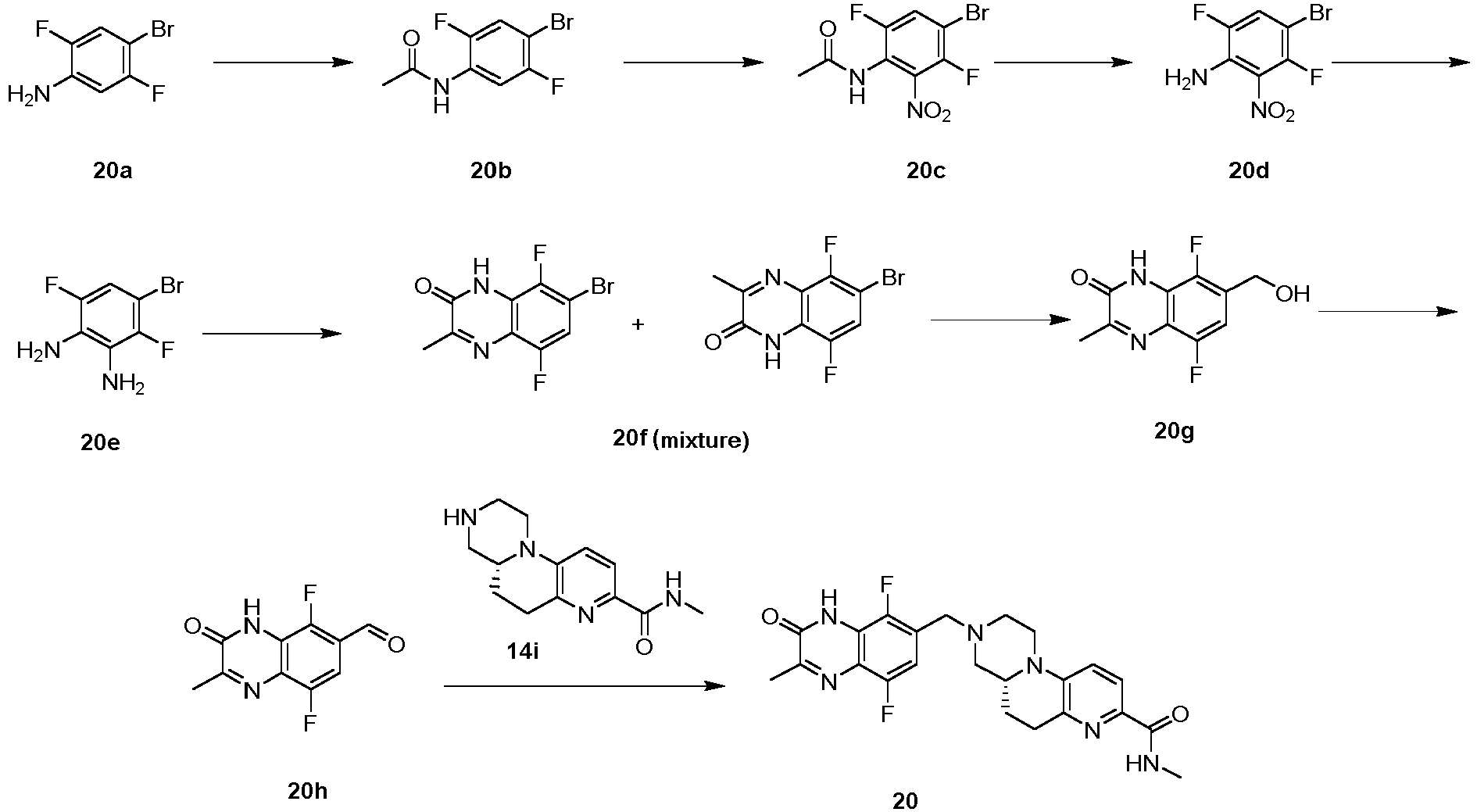
- At 0°C, triethylamine (7.78 g, 76.92 mmol, 10.71 mL) was added dropwise to a solution of compound 20a (4 g, 19.23 mmol) in DCM (20 mL). The mixture was stirred for 0.5 hours. Subsequently, acetyl chloride (2.42 g, 30.77 mmol, 2.19 mL) was slowly added dropwise thereto. The reaction mixture was then warmed to 18°C and reacted for 3 hours. The reaction mixture was slowly added dropwise into 100 mL of water. The mixture was extracted with dichloromethane (20 mL × 5). The organic phase was washed with 100 mL of saturated brine, dried over anhydrous sodium sulfate, and concentrated under reduced pressure to obtain a crude product. The crude product was purified by flash silica gel column chromatography (EA/PE = 0%-10%) to obtain intermediate 20b. MS m/z: 250.0 [M+1]+; 1H NMR (400 MHz, DMSO-d 6) δ ppm 10.03 (br s, 1 H) 8.02 - 8.17 (m, 1 H) 7.77 (dd, J=10.16, 6.40 Hz, 1 H) 2.12 (s, 3 H).
- At 0°C, intermediate 20b (2.52 g, 10.08 mmol) was suspended in nitric acid (1.27 g, 20.16 mmol, 907.24 µL). Sulfuric acid (9.19 g, 93.73 mmol, 5.00 mL) was then slowly added dropwise to the mixture. After the dropwise addition was complete, the mixture was reacted at 25°C for 1 hour. The reaction mixture was added dropwise into water, resulting in the precipitation of a solid. The pH was adjusted to 6-7 using 2 M NaOH solution. The mixture was filtered, and the filter cake was dried to obtain intermediate 20c. 1H NMR (400 MHz, DMSO-d 6) δ ppm10.48 (s, 1 H) 8.21 - 8.38 (m, 1 H) 2.07 (s, 3 H).
- Intermediate 20c (2.28 g, 7.73 mmol) was dissolved in sulfuric acid (22 mL) and stirred at 50°C for 2 hours. The reaction mixture was added into 400 mL of water, and the pH was adjusted to 6-7 using 2 M NaOH solution, resulting in the precipitation of a solid. The mixture was filtered to obtain the filter cake, and the filter cake was dried under vacuum to obtain intermediate 20d. 1H NMR (400 MHz, DMSO-d 6) δ ppm 7.76 - 7.89 (m, 1 H) 7.09 (s, 2 H).
- Intermediate 20d (1.49 g, 5.89 mmol) was dissolved in EtOH (15 mL). At 0°C, zinc powder (3.66 g, 55.95 mmol) and acetic acid (3.54 g, 58.89 mmol, 3.37 mL) were added in batches. The mixture was stirred at 40°C for 1 hour. The reaction mixture was filtered, and the filtrate was concentrated under reduced pressure to obtain a crude product. The crude product was purified by column chromatography (eluent: PE:EA = 100:0 to 90:10, v/v) to obtain intermediate 20e. MS m/z: 223.0 [M+1]+; 1H NMR (400 MHz, DMSO-d 6) δ ppm 6.65 (dd, J=10.04, 6.02 Hz, 1 H) 5.06 (s, 2 H) 4.90 (s, 2 H).
- Intermediate 20e (1.14 g, 5.11 mmol) was dissolved in EtOH (12 mL), and pyruvic acid (540.17 mg, 6.13 mmol, 432.14 µL) was then added. The mixture was stirred at 100°C for 2 hours, then slowly cooled to 25°C to crystallize over 14 hours. The reaction mixture was filtered to obtain the filter cake, which was intermediate 20f (mixture). MS m/z: 274.9 [M+1]+.
- Under a nitrogen atmosphere, intermediate 20f (500 mg, 1.82 mmol) was dissolved in dioxane (5 mL). 1-(Tributylstannyl)methanol (700.42 mg, 2.18 mmol) and chloro(2-dicyclohexylphosphino-2',4',6'-triisoporpyl-1,1'-biphenyl)[2-(2'-amino-1,1'-biphenyl)] palladium (II) (71.51 mg, 90.89 µmol) were added. The reaction mixture was stirred at 110°C for 4 hours. The reaction mixture was concentrated under reduced pressure and purified by column chromatography (eluent: PE:EA = 90:10 to 50:50, V/V) to obtain a crude product. The crude product was purified by preparative HPLC (column: Welch Xtimate C18, 100 × 40 mm × 3 µm; mobile phase: [water (trifluoroacetic acid)-acetonitrile]; gradient: 0%-26% acetonitrile) to obtain intermediate 20g. MS m/z: 226.8 [M+1]+; 1H NMR (400 MHz, DMSO-d6 ) δ ppm 12.58 (br s, 1 H) 6.99 - 7.25 (m, 1 H) 4.62 (br d, J=3.51 Hz, 2 H) 2.43 (br s, 3 H).
- Intermediate 20g (100 mg, 442.13 µmol) was dissolved in DCM (2 mL). Dess-Martin periodinane (281.29 mg, 663.19 µmol, 205.47 µL) was added, and the reaction mixture was stirred at 20°C for 2 hours. The reaction mixture was added with 0.1899 g of calcium hydroxide and stirred at 20°C for 1 hour. The reaction mixture was filtered to obtain a crude product. The crude product was purified by preparative TLC (DCM:MeOH = 20:1) to obtain intermediate 20h. 1H NMR (400 MHz, DMSO-d 6) δ ppm 12.96 (br, s, 1H), 10.26 (s, 1H), 7.40 - 7.44 (m, 1H), 2.49 (s, 3H).
- Intermediate 14i (13.25 mg, hydrochloride) was dissolved in DMSO (1 mL). Triethylamine (9.03 mg, 89.22 µmol, 12.42 µL) was added to the reaction mixture with stirring, and the mixture was stirred at 25°C for 30 minutes. Intermediate 20h (10 mg, 44.61 µmol) was added to the reaction mixture, and the pH was adjusted to 6-7 using acetic acid. The mixture was stirred at 25°C for 2 hours. NaBH(OAc)3 (18.91 mg, 89.22 µmol) was added thereto, and the reaction mixture was stirred at 25°C for 16 hours. The reaction mixture was added with water (2 mL) and extracted with EA (5 mL × 3). The organic phases were combined, dried over anhydrous sodium sulfate, and concentrated under reduced pressure to obtain a crude product. The crude product was separated by preparative HPLC (column: Welch Xtimate C18, 100 × 40 mm × 3 µm; mobile phase: [water (trifluoroacetic acid)-acetonitrile]; gradient: 0%-30% acetonitrile) to obtain a crude product. The crude product was added with triethylamine (3 µL), and purified by preparative TLC (100% EA) to obtain
compound 20. MS m/z: 455.2 [M+1]+; 1H NMR (400 MHz, CD3OD) δ ppm 7.75 (d, J=8.78 Hz, 1H), 7.38 (dd, J=9.41, 1.63 Hz, 1H), 7.21 (d, J=8.78 Hz, 1H), 4.59 (s, 1H), 3.83 - 3.90 (m, 3H), 3.14 - 3.23 (m, 1H), 3.01 - 3.11 (m, 2H), 2.94 - 2.99 (m, 1H), 2.92 - 2.94 (m, 3H), 2.85 - 2.92 (m, 1H), 2.54 (s, 3H), 2.31 - 2.41 (m, 1H), 1.93 - 2.23 (m, 2H), 1.75 - 1.88 (m, 1H). -

- Intermediate 16i (15 mg, hydrochloride) was dissolved in DMSO (1 mL). Triethylamine (9.06 mg, 89.50 µmol, 12.46 µL) was added, and the reaction mixture was stirred at 20°C for 0.5 hours. Intermediate 20h (12.54 mg, 44.75 µmol) was then added thereto and the pH was adjusted to 6-7 using acetic acid. The mixture was stirred at 20°C for 2 hours. Subsequently, NaBH(OAc)3 (18.97 mg, 89.50 µmol) was added, and the mixture was stirred for 16 hours. The reaction mixture was extracted with water (3 mL) and ethyl acetate (3 mL × 3). The organic phases were combined, washed with 10 mL of saturated brine, then dried over anhydrous sodium sulfate, and filtered to obtain a crude product. The crude product was separated by preparative HPLC (column: Welch Xtimate C18, 100 × 40 mm × 3 µm; mobile phase: [water (trifluoroacetic acid)-acetonitrile]; gradient: 0%-30% acetonitrile over 8 minutes) to obtain a crude product. The crude product was added with 3 µL of triethylamine and purified by preparative TLC (EA = 100%) to obtain compound 21. MS m/z: 455.0 [M+1]+; 1H NMR (400 MHz, CD3OD) δ ppm 7.58 - 7.69 (m, 1 H) 7.10 (d, J=8.78 Hz, 2 H) 3.76 (br d, J=11.80 Hz, 1 H) 3.64 (d, J=1.51 Hz, 2 H) 3.04 - 3.17 (m, 1 H) 2.82 - 2.96 (m, 5 H) 2.82 (s, 3 H) 2.43 (s, 3 H) 2.15 - 2.30 (m, 1 H) 1.88 - 2.01 (m, 2 H) 1.61 - 1.79 (m, 1 H).
-

- Intermediate 9g (7.29 mg, hydrochloride) was dissolved in DMSO (1 mL). Triethylamine (44.61 µmol, 6.21 µL) was added, and the reaction mixture was stirred at 20°C for 0.5 hours. Intermediate 20h (5 mg, 22.31 µmol) was then added thereto and the pH was adjusted to 6-7 using acetic acid. The mixture was stirred for 2 hours. Subsequently, NaBH(OAc)3 (9.45 mg, 44.61 µmol) was added, and the mixture was stirred for 4 hours. The reaction mixture was extracted with water (1 mL) and ethyl acetate (1 mL × 3). The organic phase was washed with 10 mL of saturated brine, dried, and filtered to obtain a crude product. The crude product was separated by preparative HPLC (column: Welch Xtimate C18, 100 × 40 mm × 3 µm; mobile phase: [water (trifluoroacetic acid)-acetonitrile]; gradient: 1%-31% acetonitrile over 8 minutes) to obtain the trifluoroacetate of compound 22. MS m/z: 447.1 [M+1]+; 1H NMR (400 MHz, CD3OD) δ ppm 7.92 - 7.99 (m, 1 H) 7.54 - 7.68 (m, 1 H) 7.27 (dd, J=10.16, 5.40 Hz, 1 H) 4.22 - 4.39 (m, 2 H) 3.42 - 3.51 (m, 4 H) 3.23 - 3.31 (m, 4 H) 2.93 (s, 3 H) 2.57 (s, 3 H).
-

- Compound 17g (100.00 mg, 442.13 µmol) and 1,2-dibromo-1,1,2,2-tetrachloroethane (316.74 mg, 972.68 µmol) were dissolved in DCM (5 mL). At 0°C, tributylphosphine (178.90 mg, 884.25 µmol) was added thereto. After the addition was complete, the mixture was warmed to 25°C and stirred for 12 hours. The reaction mixture was filtered to obtain the filter cake, which was intermediate 23a. 1H NMR (400 MHz, DMSO-d 6) δ ppm 12.63 (br s, 1H), 7.33 - 7.72 (m, 1H), 4.71 - 4.94 (m, 2H), 2.43 (s, 3H).
- Triethylamine (21.00 mg, 207.56 µmol) was added to a solution of intermediate 6d (25.64 mg, hydrochloride) in DMF (2 mL). The mixture was stirred at 25°C for 30 minutes. Intermediate 23a (30 mg, 103.78 µmol) and KI (1.72 mg, 10.38 µmol) were then added, and the reaction mixture was stirred at 50°C for 2 hours. The reaction mixture was filtered, and the filtrate was concentrated to obtain a crude product. The crude product was purified by preparative HPLC (column: Welch Xtimate C18, 100 × 40 mm × 3 µm; mobile phase: [water (trifluoroacetic acid)-acetonitrile]; gradient: 0%-30% acetonitrile) to obtain a further crude product. The crude product was added with triethylamine (20 µL), and purified by preparative TLC (eluent ratio: DCM:MeOH = 10:1) to obtain compound 23. MS m/z: 444.1 [M+1]+; 1H NMR (400 MHz, DMSO-d 6) δ ppm 12.54 (br s, 1H), 8.63 (br d, J=5.00 Hz, 1H), 8.05 (dd, J=9.82, 7.82 Hz, 1H), 7.91 (dd, J=7.69, 1.69 Hz, 1H), 7.46 (d, J=8.88 Hz, 1H), 6.14 - 6.27 (m, 1H), 3.80 (s, 2H), 3.13 - 3.26 (m, 3H), 2.79 (d, J=4.88 Hz, 3H), 2.60 - 2.76 (m, 3H), 2.44 (s, 3H).
-

- Compound 20g (100.00 mg, 442.13 µmol) and 1,2-dibromo-1,1,2,2-tetrachloroethane (316.74 mg, 972.68 µmol) were dissolved in DCM (5 mL). At 0°C, tributylphosphine (178.90 mg, 884.25 µmol) was added thereto. After the addition was complete, the mixture was warmed to 25°C and stirred for 8 hours. The reaction mixture was filtered to obtain the filter cake, which was intermediate 24a. 1H NMR (400 MHz, DMSO-d 6) δ ppm 12.72 (br s, 1H), 7.32 (dd, J=10.54, 5.77 Hz, 1H), 4.76 (s, 2H), 2.44 (s, 3H).
- Triethylamine (21.00 mg, 207.56 µmol) was added to a solution of intermediate 6d (25.64 mg, hydrochloride) in DMF (2 mL). The mixture was stirred at 25°C for 30 minutes. Intermediate 24a (30 mg, 103.78 µmol) and KI (1.72 mg, 10.38 µmol) were then added, and the reaction mixture was stirred at 50°C for 2 hours. The reaction mixture was filtered, and the filtrate was concentrated to obtain a crude product. The crude product was purified by preparative HPLC (column: Welch Xtimate C18, 100 × 40 mm × 3 µm; mobile phase: [water (trifluoroacetic acid)-acetonitrile]; gradient: 0%-30% acetonitrile) to obtain a further crude product. The crude product was added with triethylamine (20 µL), and purified by preparative TLC (eluent ratio: DCM:MeOH = 10:1) to obtain compound 24. MS m/z: 444.1 [M+1]+; 1H NMR (400 MHz, DMSO-d 6) δ ppm 12.63 (br s, 1H), 8.64 (br d, J=4.63 Hz, 1H), 8.01 - 8.17 (m, 1H), 7.92 (br d, J=7.38 Hz, 1H), 7.07 - 7.28 (m, 1H), 6.25 (br s, 1H), 3.75 (s, 2H), 3.18 - 3.25 (m, 3H), 2.80 (br d, J=4.63 Hz, 3H), 2.65 - 2.76 (m, 3H), 2.44 (s, 3H).
-

- Compound 1a (6.1 g, 25.63 mmol), methyl aminoacetate (3.54 g, 28.19 mmol, HCl), and N,N-diisopropylethylamine (9.94 g, 76.90 mmol) were added to DMF (60 mL). The reaction mixture was reacted at 25°C for 18 hours. The reaction mixture was poured into 300 mL of water and extracted with ethyl acetate (100 mL × 5). The organic phase was washed with 200 mL of saturated brine, dried over anhydrous sodium sulfate, filtered, and concentrated under reduced pressure to obtain a crude product. The crude product was purified by flash silica gel column chromatography (EA:PE = 0%-10%) to obtain intermediate 25a. 1H NMR (400 MHz, DMSO-d 6) δ ppm 7.54-7.68 (m, 2H), 6.70 (d, J=7.8 Hz, 1H), 4.20 (d, J=4.2 Hz, 2H), 3.68 (s, 3H).
- Intermediate 25a (1.82 g, 5.93 mmol) and NH4Cl (2.54 g, 47.42 mmol) were added to a mixed solution of MeOH (26 mL) and H2O (0.468 mL). Zinc (1.98 g, 30.29 mmol) was then added. The reaction was carried out at 0°C for 2 hours. The reaction mixture was filtered, and 50 mL of water was added to the filtrate. The mixture was extracted with ethyl acetate (30 mL × 3). The organic phases were combined, washed with 50 mL of saturated brine, dried over anhydrous sodium sulfate, and filtered. The filtrate was concentrated under reduced pressure to obtain intermediate 25b. MS m/z: 276.9, 278.9 [M+1]+.
- At 0°C, intermediate 25b (1.35 g, 4.87 mmol) was added to a mixed system of HCl/dioxane (4 M, 15.64 mL), EA (13.5 mL), and MeOH (13.5 mL). The reaction was carried out for 2 hours. The reaction mixture was directly concentrated under reduced pressure to obtain intermediate 25c. MS m/z: 245.0, 247.0 [M+1]+.
- At 0°C, DDQ (1.56 g, 6.86 mmol) was added to a solution of intermediate 25c (1.4 g, 5.71 mmol) in DCM (14 mL). The mixture was warmed to 25°C and reacted for 4 hours. The reaction mixture was concentrated under reduced pressure, and 70 mL of saturated sodium bicarbonate solution was slowly added thereto. The mixture was stirred overnight. The mixture was extracted with ethyl acetate (50 mL × 3). The organic phases were combined, washed with 70 mL of saturated brine, dried over anhydrous sodium sulfate, filtered, and concentrated under reduced pressure to obtain a crude product. The crude product was purified by flash silica gel column chromatography (eluent ratio: MeOH/DCM = 0%-5%) to obtain intermediate 25d. MS m/z: 243.0, 245.0 [M+1]+. 1H NMR (400 MHz, DMSO-d 6) δ ppm 12.75 (br s, 1H), 8.24 (s, 1H),7.53-7.60 (m, 2H).
- Intermediate 25d (660 mg, 2.72 mmol) was dissolved in DMF (1 mL). Potassium carbonate (563.00 mg, 4.07 mmol), potassium iodide (67.62 mg, 407.35 µmol), and p-methoxybenzyl chloride (510.36 mg, 3.26 mmol) were added thereto, and the mixture was stirred at 20°C for 3 hours. The reaction system was added with water (15 mL), and extracted with ethyl acetate (50 mL). The phases were separated. The organic phase was washed with water, dried over anhydrous sodium sulfate, and filtered. The filtrate was concentrated to obtain a crude product. The crude product was purified by flash silica gel column chromatography (PE:EA= 3:1) to obtain intermediate 25e. MS m/z: 362.8, 364.8 [M+1]+; 1H NMR (400 MHz, DMSO-d 6) δ ppm 8.43 (s, 1H), 7.50-7.64 (m, 2H),7.24 (d, J=4.2 Hz, 2H), 6.85 (d, J=4.2 Hz, 2H), 5.60 (s, 2H), 3.72 (s, 3H).
- At 0°C, a solution of p-toluenesulfonylmethyl isocyanide (451.57 mg, 2.31 mmol) in THF (10 mL) was added to sodium hydride (154.19 mg, 3.85 mmol). The mixture was stirred for 10 minutes, and intermediate 25e (700.00 mg, 1.93 mmol) was then added thereto. The reaction mixture was stirred at 25°C for 2 hours. The reaction mixture was added with water (5 mL), and extracted with ethyl acetate (30 mL). The organic phase was dried over anhydrous sodium sulfate and filtered. The filtrate was concentrated to obtain a crude product. The crude product was purified by flash silica gel column chromatography (first using PE:EA = 3:1 to 1:1, then DCM:MeOH = 10:1) to obtain intermediate 25f. MS m/z: 402.0, 404.0[M+1]+,1H NMR (400 MHz, CDCl3) δ ppm 8.44 (s, 1H), 8.13 (s, 1H), 7.40-7.51 (m, 2H),7.22 (d, J=4.2 Hz, 2H), 6.85 (d, J=4.2 Hz, 2H), 5.61 (s, 2H), 3.79 (s, 3H).
- 1-(Tributylstannyl)methanol (191.59 mg, 596.69 µmol) and intermediate 25f (200 mg, 497.24 µmol) were dissolved in 1,4-dioxane (5 mL). Chloro(2-dicyclohexylphosphino-2',4',6'-triisoporpyl-1,1'-biphenyl)[2-(2'-amino-1,1'-biphenyl)] palladium (II) (39.12 mg, 49.72 µmol) was added thereto, and the mixture was stirred at 80°C for 1.5 hours. 1-(Tributylstannyl)methanol (31.93 mg, 99.44 µmol) was then added thereto. The reaction mixture was stirred at 80°C for 2 hours, and heated to 100°C and stirred for another 2 hours. The reaction mixture was directly concentrated under reduced pressure to obtain a crude product. The crude product was purified by flash silica gel column chromatography (eluent ratio: PE:EA = 1:1; DCM:MeOH = 10:1) to obtain intermediate 25g. MS m/z: 354.1 [M+1]+.
- At 15 to 25°C, intermediate 25g (80 mg, 226.41 µmol) was added to a reaction flask. Trifluoroacetic acid (3.07 g, 26.93 mmol, 2.00 mL) and trifluoromethanesulfonic acid (4.52 mmol, 400.00 µL) were added thereto. The reaction mixture was stirred for 2 hours. The reaction mixture was added with water (5 mL) and methanol (5 mL). The pH was adjusted to 10 with the addition of solid potassium carbonate. The mixture was stirred for another 1 hour. The reaction mixture was extracted with dichloromethane (20 mL). The organic phases were combined, washed with water (15 mL × 2), then dried and filtered. The filtrate was concentrated under reduced pressure to obtain intermediate 25h. MS m/z: 234.1[M+1]+.
- Intermediate 25h (80 mg, 343.06 µmol) and 1,2-dibromotetrachloroethane (245.77 mg, 754.72 µmol) were added to DCM (1.5 mL). Tributylphosphine (138.81 mg, 686.11 µmol) was then added, and the mixture was stirred at 20°C for 3 hours. The reaction mixture was concentrated directly under reduced pressure to obtain the crude intermediate 25i.
- Intermediate 25i (30 mg) and compound 9g (28.97 mg, hydrochloride) were dissolved in DMF (1 mL). Et3N (10.25 mg, 101.32 µmol) and KI (16.82 mg, 101.32 µmol) were added thereto, and the mixture was stirred at 50°C for 2 hours. The reaction system was added with water (5 mL), and extracted with ethyl acetate (10 mL × 3). The organic phases were combined, dried over anhydrous sodium sulfate, and concentrated to obtain a crude product. The crude product was first purified by preparative TLC (eluent ratio: DCM:MeOH = 10:1), then separated by preparative HPLC (column: Welch Xtimate C18, 100 × 40 mm × 3 µm; mobile phase: [water (trifluoroacetic acid)-acetonitrile]; gradient: 0%-30% acetonitrile) to obtain the trifluoroacetate of
compound 25. MS m/z: 454.2[M+1]+, 1H NMR (400 MHz, CD3OD) δ ppm 8.99 (s, 1H), 8.05 (d, J=4.4 Hz, 1H), 8.02 (s, 1H), 7.93 (d, J=4.4 Hz, 1H), 7.58-7.63 (m, 1H), 7.46-7.49 (m, 1H), 4.46 (s, 2H), 3.71-3.75 (m, 4H), 3.40-3.51 (m, 4H), 2.92 (s, 3H). -

- Methyl 2-pyrrolecarboxylate (262.88 mg, 2.10 mmol) and compound 1a (500 mg, 2.10 mmol) were dissolved in DMF (10 mL). Sodium hydride (126.05 mg, 3.15 mmol, purity of 60%) was added in batches, and the mixture was stirred at room temperature (20°C) for 3 hours. The reaction mixture was slowly added dropwise into 20 mL of saturated ammonium chloride solution. The mixture was extracted with ethyl acetate (30 mL × 2). The organic phases were combined, washed with 20 mL of saturated brine, dried over anhydrous sodium sulfate, and filtered. The filtrate was concentrated under reduced pressure to obtain a crude product. The crude product was purified by flash silica gel column chromatography (eluent: PE:EA = 90:10, V/V) to obtain the mixture intermediate 26a (in an approximate ratio of 2:1). MS m/z: 342.8, 344.8 [M+1]+.
- The mixture intermediate compound 26a (370 mg) was dissolved in dioxane (10 mL). 1-(Tributylstannyl)methanol (415.51 mg, 1.29 mmol) and chloro(2-dicyclohexylphosphino-2',4',6'-triisoporpyl-1,1'-biphenyl)[2-(2'-amino-1,1'-biphenyl)] palladium (II) (42.42 mg, 53.92 µmol) were added thereto, and the mixture was stirred at 110°C for 4 hours. The reaction mixture was concentrated under reduced pressure to obtain a crude product. The crude product was purified by flash silica gel column chromatography (gradient elution: PE:EA = 100:0 to 60:40) to obtain the mixture intermediate 26b. MS m/z: 294.9 [M+1]+.
- The mixture intermediate 26b (185 mg) was dissolved in MeOH (3 mL) and purged with argon. Palladium hydroxide (8.83 mg, 62.87 µmol) was added. The reaction flask was purged with hydrogen, and the mixture was stirred at 30°C under 50 psi pressure for 16 hours. The reaction mixture was filtered, and the filtrate was concentrated under reduced pressure. DMF (2 mL) and 5 drops of triethylamine were added, and the mixture was stirred at 90°C for 16 hours. DMF was removed using an oil pump to obtain a crude product, and a mixed solution of DCM and MeOH (DCM:MeOH = 1:1, 3 mL) was added to the crude product. The mixture was filtered to obtain the filter cake, which was intermediate 26c. MS m/z: 232.8 [M+1]+. 1H NMR (400 MHz, DMSO-d 6) δ ppm 11.22 (br s, 1H), 8.18-8.19 (m, 1H), 7.87 (d, J=4.40 Hz 1H), 7.26 (t, J=8.20 Hz, 1H), 7.07 - 7.08 (m, 1H), 6.70-6.72 (m, 1H), 5.35 (t, J=5.60 Hz, 1H), 4.60 (d, J=2.80 Hz, 2H).
- Intermediate 26c (20 mg, 86.13 µmol) and 1,2-dibromotetrachloroethane (28.05 mg, 86.13 µmol) were dissolved in DCM (0.5 mL). At 0°C, tributylphosphine (17.43 mg, 86.13 µmol) was added. After the addition was complete, the mixture was stirred at room temperature (20°C) for 16 hours. An additional portion of 1,2-dibromotetrachloroethane (28.05 mg, 86.13 µmol) and tributylphosphine (17.43 mg, 86.13 µmol) was added thereto. The reaction mixture was stirred for another 1 hour. The reaction mixture was filtered to obtain the filter cake, which was intermediate 26d. 1H NMR (400 MHz, DMSO-d 6) δ ppm 11.41 (br s, 1H), 8.20-8.21 (m, 1H), 7.85 (d, J=4.40 Hz 1H), 7.36 (t, J=8.20 Hz, 1H), 7.10 - 7.11 (m, 1H), 6.73-6.75 (m, 1H), 4.79 (s, 2H).
- Intermediate 9g (11.83 mg, hydrochloride) was dissolved in DMF (1 mL). Triethylamine (17.43 mg, 172.26 µmol) was added, and the reaction mixture was stirred at 25°C for 0.5 hours. Intermediate 26d (10 mg, 43.06 µmol) and potassium iodide (3.57 mg, 21.53 µmol) were then added. The mixture was stirred at 50°C for 2 hours. The reaction mixture was added with water (2 mL), and extracted with ethyl acetate (3 mL × 3). The organic phases were combined, dried over anhydrous sodium sulfate, and filtered. The filtrate was concentrated under reduced pressure to obtain a crude product. The crude product was purified by preparative TLC (DCM:MeOH = 30:1) to obtain
compound 26. MS m/z: 453.0 [M+1]+. -

- Intermediate 15e (61.9 mg, 253.46 µmol) and 1,2-dibromotetrachloroethane (82.54 mg, 253.46 µmol) were dissolved in DCM (2 mL). At 0°C, tributylphosphine (51.28 mg, 253.46 µmol) was added. After the addition was complete, the mixture was stirred at room temperature (20°C) for 19 hours. The reaction mixture was filtered to obtain the filter cake, which was intermediate 27a. 1H NMR (400 MHz, DMSO-d 6) δ ppm 12.02 (s, 1 H) 9.05 - 9.13 (m, 1 H) 8.61 - 8.68 (m, 1 H) 8.41 - 8.49 (m, 1 H) 7.77 (br d, J=2.01 Hz, 1 H) 7.35 - 7.50 (m, 1 H) 4.94 (s, 2 H).
- Intermediate 6d (21.23 mg, 78.15 µmol, HCl) was dissolved in DMF (2 mL). Triethylamine (19.77 mg, 195.36 µmol) was added, and the mixture was stirred at 25°C for 0.5 hours. Intermediate 27a (30 mg, 97.68 µmol) and potassium iodide (1.62 mg, 9.77 µmol) were then added, and the mixture was stirred at 50°C for 2 hours. The reaction mixture was added with 2 mL of water, and extracted three times with 5 mL of a mixed solution (DCM:MeOH = 10:1). The organic phases were combined, dried over anhydrous sodium sulfate, and concentrated under reduced pressure to obtain a crude product. The crude product was stirred with EA (0.5 mL) for 10 minutes and filtered to obtain the filter cake, which was compound 27. MS m/z: 462.1 [M+1]+. 1H NMR (400 MHz, DMSO-d 6) δ ppm 11.90 (s, 1H), 9.09 (dd, J=4.82, 1.81 Hz, 1H), 8.65 (br dd, J=8.00, 1.88 Hz, 2H), 8.43 (d, J=8.50 Hz, 1H), 8.05 - 8.12 (m, 1H), 7.88 - 7.96 (m, 1H), 7.72 (dd, J=7.88, 4.88 Hz, 1H), 7.39 (br t, J=7.44 Hz, 1H), 6.26 (br s, 1H), 3.80 (s, 2H), 3.21 - 3.22 (m, 2H), 2.79 (d, J=4.75 Hz, 3H), 2.72 - 2.76 (m, 4H).
-

- Compound 26d (25 mg, 84.72 µmol) was dissolved in DMF (1 mL). Triethylamine (34.29 mg, 338.86 µmol) was added, and the mixture was stirred at 25°C for 0.5 hours. Compound 6d (23 mg, hydrochloride) and potassium iodide (7.03 mg, 42.36 µmol) were then added, and the mixture was stirred at 50°C for 2 hours. The reaction mixture was added with water (2 mL), and extracted with ethyl acetate (3 mL × 3). The organic phases were combined, dried over anhydrous sodium sulfate, and filtered. The filtrate was concentrated under reduced pressure to obtain a crude product. The crude product was stirred with 0.5 mL of ethyl acetate for 10 minutes and filtered to obtain the filter cake, which was compound 28. MS m/z: 450.0 [M+1]+; 1H NMR (400 MHz, DMSO-d 6) δ ppm 11.32 (s, 1 H), 8.64 (br d, J=4.77 Hz, 1 H), 8.20 (s, 1 H), 8.01 - 8.14 (m, 1 H), 7.83 - 7.97 (m, 2 H), 7.26 (t, J=7.78 Hz, 1 H), 7.09 (d, J=3.01 Hz, 1 H), 6.72 (t, J=3.26 Hz, 1 H), 6.25 (br s, 1 H), 3.72 (s, 2 H), 3.32 (s, 2 H), 3.13 - 3.22 (m, 2 H), 2.79 (d, J=4.77 Hz, 3 H), 2.66 - 2.75 (m, 2 H).
-

- Deuterated methylamine hydrochloride (124.71 mg, 1.77 mmol) was added to H2O (1 mL). Sodium tert-butoxide (84.95 mg, 884.01 µmol) was then added to the reaction mixture, and the mixture was stirred at 25°C for 1 hour. A solution of compound 4a (30 mg, 88.40 µmol) in MeOH (2 mL) was added thereto. The reaction mixture was then heated to 60°C and reacted for 4 hours. The reaction mixture was directly concentrated under reduced pressure to obtain a crude product, which was intermediate 29a. MS m/z: 342.1 [M+1]+.
- Intermediate 29a (20 mg) was dissolved in MeOH (0.6 mL). HCl/dioxane (4 M, 0.2 mL) was added thereto, and the mixture was stirred at 20°C for 2 hours. The reaction mixture was directly concentrated under reduced pressure to obtain the hydrochloride of intermediate 29b. MS m/z: 242.2 [M+1]+.
- Intermediate 29b (19.22 mg, hydrochloride) was dissolved in DMF (1 mL). Triethylamine (162.80 µmol, 22.66 µL) was added, and the mixture was stirred at 25°C for 30 minutes. Compound 27a (25 mg, 81.40 µmol) and potassium iodide (1.35 mg, 8.14 µmol) were then added, and the mixture was heated to 50°C and stirred for 3 hours. The reaction mixture was added with 2 mL of water, and filtered to obtain the filter cake, which was compound 29. MS m/z: 468.2 [M+1]+. 1H NMR (400 MHz, DMSO-d 6) δ ppm 11.90 (s, 1H), 9.09 (dd, J=4.63, 1.75 Hz, 1H), 8.65 (dd, J=8.00, 1.75 Hz, 1H), 8.43 (d, J=8.13 Hz, 1H), 8.38 (s, 1H), 7.85 (d, J=7.88 Hz, 1H), 7.72 (dd, J=8.00, 4.50 Hz, 1H), 7.57 (dd, J=10.57, 8.19 Hz, 1H), 7.37 (t, J=7.32 Hz, 1H), 3.75 (s, 2H), 3.15 - 3.22 (m, 4H), 2.62 - 2.65 (m, 4H).
-

- Intermediate 16i (29.46 mg, hydrochloride) was dissolved in DMF (2 mL). Triethylamine (52.72 mg, 520.97 µmol) was added, and the reaction mixture was stirred at 25°C for 0.5 hours. Intermediate 27a (40 mg, 130.24 µmol) and KI (21.62 mg, 130.24 µmol) were then added. The mixture was stirred at 50°C for 2 hours. The reaction mixture was added with 2 mL of water, and extracted with ethyl acetate (3 mL × 3). The organic phase was dried over anhydrous sodium sulfate, filtered, and concentrated under reduced pressure to obtain a crude product. The crude product was stirred with 0.5 mL of ethyl acetate for 10 minutes and filtered to obtain the filter cake. The filter cake was further purified by preparative TLC (DCM:MeOH = 20:1) to obtain
compound 30. MS m/z: 473.0[M+1]+. 1H NMR (400 MHz, CDCl3) δ ppm 8.95 - 9.02 (m, 1 H), 8.73 - 8.79 (m, 1 H), 8.68 (dd, J=8.16, 1.88 Hz, 1 H), 8.46 (br d, J=8.03 Hz, 1 H), 7.77 - 7.88 (m, 1 H), 7.65 - 7.75 (m, 1 H), 7.48 - 7.54 (m, 1 H), 7.34 - 7.43 (m, 1 H), 6.98 (d, J=8.53 Hz, 1 H), 3.63 - 3.86 (m, 3 H), 2.97 - 3.33 (m, 2 H), 2.92 (d, J=5.27 Hz, 3 H), 2.82 - 2.89 (m, 2 H), 2.03 - 2.43 (m, 1 H), 1.90 - 1.94 (m, 1 H), 1.68 - 1.83 (m, 1 H), 1.33 - 1.39 (m, 1 H), 1.23 - 1.31 (m, 2 H). -

- Deuterated methylamine hydrochloride (167.77 mg, 2.38 mmol) was added to H2O (1 mL). Potassium tert-butoxide (133.44 mg, 1.19 mmol) was then added to the reaction mixture, and the mixture was stirred at 25°C for 1 hour. A solution of compound 6b (40 mg, 118.92 µmol) in MeOH (2 mL) was added thereto. The reaction mixture was then heated to 60°C and reacted for 16 hours. The reaction mixture was directly concentrated under reduced pressure to obtain a crude product, which was intermediate 31a. MS m/z: 339.1 [M+1]+.
- Intermediate 31a was dissolved in MeOH (1 mL). HCl/dioxane (4 M, 99.74 µL) was added thereto, and the mixture was stirred at 25°C for 2 hours. The reaction mixture was directly concentrated under reduced pressure to obtain the hydrochloride of intermediate 31b. MS m/z: 238.9 [M+1]+.
- Intermediate 31b (15 mg, hydrochloride) was dissolved in DMF (1 mL). Triethylamine (27.62 mg, 272.99 µmol, 38.00 µL) was added, and the reaction mixture was stirred at 25°C for 0.5 hours. Intermediate 27a (20.96 mg, 68.25 µmol) and potassium iodide (5.66 mg, 34.12 µmol) were then added. The mixture was stirred at 50°C for 2 hours. After cooling, the reaction mixture was added with 2 mL of water, resulting in the precipitation of a solid. The mixture was filtered to obtain the filter cake, which was compound 31. MS m/z: 465.1 [M+1]+; 1H NMR (400 MHz, DMSO-d 6) δ ppm 11.89 (br d, J=1.76 Hz, 1 H), 9.02 - 9.14 (m, 1 H), 8.56 - 8.70 (m, 2 H), 8.43 (d, J=8.03 Hz, 1 H), 8.04 - 8.14 (m, 1 H), 7.89 - 7.96 (m, 1 H), 7.72 (dd, J=8.03, 4.52 Hz, 1 H), 7.39 (t, J=7.53 Hz, 1 H), 6.26 (br s, 1 H), 3.80 (s, 2 H), 3.31 (s, 2 H), 3.18 - 3.24 (m, 2 H), 2.74 (br t, J=5.27 Hz, 2 H).
-

- Intermediate 4a (0.2 g, 589.34 µmol) was added to a mixture of THF (5 mL) and H2O (1 mL). With stirring, lithium hydroxide monohydrate (123.65 mg, 2.95 mmol) was added thereto, and the reaction mixture was stirred at 20°C for 4 hours. The pH of the reaction mixture was adjusted to 3-4 using dilute hydrochloric acid (1 mol/L). The mixture was extracted with ethyl acetate (5 mL × 2). The organic phases were combined, dried over anhydrous sodium sulfate, concentrated under reduced pressure at 45°C to obtain intermediate 32a. MS m/z: 347.9 [M+23]+.
- Under a nitrogen atmosphere, intermediate 32a (0.1 g, 307.38 µmol), 2,2,2-trifluoroethylamine (45.67 mg, 461.06 µmol), 1H-benzotriazol-1-yltetramethyluronium tetrafluoroborate (197.39 mg, 614.75 µmol), and diisopropylethylamine (119.18 mg, 922.13 µmol) were added to DMF (2 mL). The reaction mixture was stirred at 40°C for 4 hours. The reaction mixture was concentrated under reduced pressure to obtain a crude product. The crude product was purified by preparative TLC (PE/EA= 2/1) to obtain intermediate 32b. MS m/z: 351.1 [M-56+1]+.
- Intermediate 32b (57.66 mg, 141.88 µmol) was added to MeOH (2 mL). With stirring, HCl/dioxane (4 M, 191.54 µL) was added thereto, and the reaction mixture was stirred at 25°C for 2 hours. The reaction mixture was concentrated under reduced pressure at 45°C to obtain a crude product, which was the hydrochloride of intermediate 32c. MS m/z: 306.9 [M+1]+
- Triethylamine (156.29 µmol, 21.75 µL) was added to a solution of intermediate 32c (26.78 mg, hydrochloride) in DMF (1 mL). The mixture was stirred at 20°C for 0.5 hours. Intermediate 27a (30 mg, 78.15 µmol) and potassium iodide (1.30 mg, 7.81 µmol) were added thereto. The reaction mixture was stirred at 50°C for 2 hours, and filtered. The filtrate was concentrated under reduced pressure at 60°C to obtain a crude product. The crude product was purified by preparative TLC (EA: 100%) to obtain compound 32. MS m/z: 555.1 [M+23]+. 1H NMR (400 MHz, CDCl3) δ ppm 8.92 - 9.04 (m, 1 H), 8.62 - 8.76 (m, 2 H), 8.44 (br d, J=8.25 Hz, 1 H), 7.93 (d, J=8.63 Hz, 1 H), 7.71 (s, 1 H), 7.45 - 7.55 (m, 1 H), 7.24 - 7.35 (m, 1 H), 3.92 - 4.07 (m, 2 H), 3.68 - 3.78 (m, 2 H), 3.21 (m, 4 H), 2.66 (m, 4 H).
-

- 10a (3 g, 13.89 mmol) was dissolved in toluene (30 mL). 1-(tert-Butoxycarbonyl)piperazine (2.59 g, 13.89 mmol), RuPhos (648.01 mg, 1.39 mmol), Pd2(dba)3 (381.49 mg, 416.61 µmol), and Cs2CO3 (13.57 g, 41.66 mmol) were added. The reaction mixture was stirred under a nitrogen atmosphere at 100°C for 16 hours. The reaction mixture was filtered, and the filtrate was concentrated under reduced pressure to obtain a crude product. The crude product was purified by column chromatography (eluent: PE:EA = 100:0 to 90:10 to 75:25, V/V) to obtain intermediate 33d. MS m/z: 321.9 [M+1]+.
- At 25°C, intermediate 33d (1 g, 3.11 mmol) was added to a solution of methylamine in ethanol (322.13 mg, 3.11 mmol). The reaction mixture was stirred at 25°C for 1 hour. The reaction mixture was concentrated under reduced pressure to obtain a crude product. The crude product was dissolved in 10 mL of dichloromethane and washed with 10 mL of water. The mixture was extracted, and the phases were separated to collect the organic phase. The organic phase was dried over anhydrous sodium sulfate, and filtered. The filtrate was concentrated under reduced pressure to obtain intermediate 33a. MS m/z: 320.9 [M+1]+. 1H NMR (400 MHz, CDCl3) δ ppm 8.16 (d, J=2.25 Hz, 1H), 8.08 (d, J=8.76 Hz, 1H), 7.85 (br s, 1H), 7.24 (dd, J=2.50, 8.75 Hz, 1H), 3.56-3.69 (m, 4H), 3.30 (br d, J=4.63 Hz, 4H), 3.01 (d, J=5.00 Hz, 3H), 1.49 (s, 9H).
- Compound 33a (0.3 g, 936.37 µmol) was dissolved in DMF (1.5 mL). N-Chlorosuccinimide (137.54 mg, 1.03 mmol) was added at 20°C, and the mixture was stirred for 14 hours. The reaction mixture was added with water (5 mL) and extracted with ethyl acetate (20 mL × 2). The organic phases were combined, washed with water (20 mL), then dried over anhydrous sodium sulfate, and filtered. The filtrate was concentrated under reduced pressure to obtain compound 33b. MS m/z: 355.1, 357.1 [M+1]+. 1H NMR (400 MHz, CDCl3) δ ppm 8.10 (d, J=4.2 Hz, 1 H), 7.69 (br, s, 1 H), 7.40 (d, J=4.2 Hz, 1 H), 3.63 - 3.66 (m, 4 H), 3.09 - 3.15 (m, 4 H), 3.03 (d, J=2.4 Hz, 3 H), 1.51 (s, 9 H).
- Intermediate 33b (350 mg, 986.39 µmol) was dissolved in MeOH (6 mL). HCl/dioxane (4 M, 6 mL) was added, and the mixture was stirred at 20°C for 4 hours. The reaction mixture was concentrated under reduced pressure at 60°C to obtain the hydrochloride of intermediate 33c. MS m/z: 255.1, 257.1 [M+1]+.
- Intermediate 27a (20 mg, 65.12 µmol), intermediate 33c (18.96 mg, hydrochloride), potassium iodide (5.41 mg, 32.56 µmol), and triethylamine (26.36 mg, 260.49 µmol) were sequentially added to DMF (1 mL). The reaction mixture was heated to 50°C and stirred for 12 hours. The reaction mixture was added with water (3 mL), and extracted with ethyl acetate (10 mL × 2). The organic phases were combined, dried over anhydrous sodium sulfate, and filtered. The filtrate was concentrated under reduced pressure to obtain a crude product. The crude product was stirred with 1.2 mL of methanol for 10 minutes, and the mixture was filtered to obtain the filter cake, which was compound 33. MS m/z: 481.1 [M+1]+. 1H NMR (400 MHz, DMSO-d 6) δ ppm 11.90 (br s, 1 H), 9.08 - 9.09 (m, 1 H), 8.65 (d, J=2.40 Hz, 2 H), 8.43 (d, J=4.20 Hz, 1 H), 7.93 (d, J=3.92 Hz, 1 H), 7.66 -7.74 (m, 2 H), 7.33 - 7.39 (m, 1 H), 3.77 (s, 2H), 3.05-3.15 (m, 4 H), 2.79 (d, J=2.40 Hz, 3 H), 2.65-2.68 (m, 4 H).
-

- Intermediate 2a (200 mg, 854.62 µmol) and (2R,5S)-1-tert-butoxycarbonyl-2,5-dimethylpiperazine (183.15 mg, 854.62 µmol) were dissolved in toluene (5 mL). RuPhos (79.76 mg, 170.92 µmol), Cs2CO3 (556.90 mg, 1.71 mmol), and Pd2(dba)3 (78.26 mg, 85.46 µmol) were sequentially added. The reaction mixture was stirred under a nitrogen atmosphere at 100°C for 16 hours. The reaction mixture was filtered, and the filtrate was concentrated under reduced pressure to obtain a crude product. The crude product was purified by column chromatography (eluent: PE:EA = 100:0 to 90:10 to 75:25, v/v) to obtain intermediate 34a. MS m/z: 368.0 [M+1]+; 1H NMR (400 MHz, CDCl3) δ ppm 7.97 (dd, J=8.03, 1.25 Hz, 1 H), 7.20 (dd, J=10.04, 8.03 Hz, 1 H), 4.38-4.45 (m, 1 H), 4.05 (br d, J=2.26 Hz, 1 H), 3.97 (s, 3 H), 3.74 - 3.83 (m, 1 H), 3.47-3.52 (m, 2 H), 3.10 (d, J=13.05 Hz, 1 H), 1.51 (s, 9 H), 1.29 - 1.32 (m, 3 H), 1.12 (d, J=5.27 Hz, 3 H).
- Intermediate 34a (187.4 mg, 510.05 µmol) was dissolved in EtOH (2 mL). A solution of methylamine in ethanol (792.03 mg, 7.63 mmol, 30%) was added, and the mixture was stirred at 25°C for 16 hours. The reaction mixture was directly concentrated under reduced pressure to obtain intermediate 34b. MS m/z: 367.0 [M+1]+,1H NMR (400 MHz, CDCl3) δ ppm 7.99 (dd, J=8.03, 1.26 Hz, 1 H), 7.47 - 7.54 (m, 1 H), 7.24 (dd, J=10.16, 8.16 Hz, 1 H), 4.39 - 4.52 (m, 1 H), 3.93 - 4.02 (m, 1 H), 3.73 - 3.78 (m, 1 H), 3.50 (dd, J=12.17, 3.89 Hz, 2 H), 2.95-3.02 (m, 4H), 1.51 (s, 9 H), 1.31 (d, J=6.78 Hz, 3 H), 1.09 (d, J=6.53 Hz, 3 H).
- Intermediate 34b (170 mg, 463.94 µmol) was dissolved in MeOH (2 mL). HCl/dioxane (4 M, 0.62 mL) was added, and the mixture was stirred at 25°C for 3 hours. The reaction mixture was concentrated under reduced pressure to obtain the hydrochloride of intermediate 34c. MS m/z: 266.9 [M+1]+.
- Intermediate 34c (26.51 mg, hydrochloride) was dissolved in DMF (1 mL). Triethylamine (39.54 mg, 390.73 µmol) was added, and the mixture was stirred at 25°C for 0.5 hours. Intermediate 27a (30 mg, 97.68 µmol) and potassium iodide (8.11 mg, 48.84 µmol) were then added, and the mixture was stirred at 50°C for 2 hours. The reaction mixture was filtered, and the filtrate was separated by preparative HPLC (column: Xtimate C18, 100 × 30 mm × 3 µm; mobile phase: [water (trifluoroacetic acid)-acetonitrile]; gradient: 14%-44% acetonitrile) to obtain the trifluoroacetate of compound 34. MS m/z: 493.1 [M+1]+. 1H NMR (400 MHz, CD3OD) δ ppm 9.11 (dd, J=4.52, 1.76 Hz, 1 H), 8.78 (dd, J=8.03, 1.76 Hz, 1 H), 8.69 (d, J=8.53 Hz, 1 H), 8.01 (d, J=7.03 Hz, 1 H), 7.85 - 7.92 (m, 1 H), 7.76 (dd, J=8.03, 4.52 Hz, 1 H), 7.53-7.56 (m, 1 H), 4.98 (br d, J=16.56 Hz, 2 H), 4.47 (br d, J=14.31 Hz, 1 H), 3.74 - 3.90 (m, 1 H), 3.49 - 3.57 (m, 2 H), 3.07 - 3.20 (m, 2 H), 2.95 (s, 3 H), 1.65 (d, J=6.27 Hz, 3 H), 1.02 (d, J=6.02 Hz, 3 H).
-

- (2S,5R)-1-tert-Butoxycarbonyl-2,5-dimethylpiperazine (180.00 mg, 839.93 µmol) and intermediate 2a (196.56 mg, 839.93 µmol) were dissolved in toluene (10 mL). Cs2CO3 (821.00 mg, 2.52 mmol), RuPhos (39.19 mg, 83.99 µmol), and Pd2(dba)3 (38.46 mg, 42.00 µmol) were sequentially added. The reaction mixture was stirred under a nitrogen atmosphere at 100°C for 16 hours. The reaction mixture was filtered while hot, and the filtrate was concentrated under reduced pressure to obtain a crude product. The crude product was added with 2 mL of a mixture of petroleum ether and ethyl acetate (PE/EA = 5/1) and stirred at 20°C for 0.5 hours. The mixture was subjected to suction filtration, and the filter cake was dried under reduced pressure to obtain intermediate 35a. MS m/z: 368.1 [M+1]+.
- Intermediate 35a (100 mg, 272.17 µmol) was dissolved in EtOH (2 mL). A solution of methylamine in ethanol (1.13 g, 10.89 mmol, 30%) was added, and the mixture was stirred at room temperature (25°C) for 16 hours. The reaction mixture was concentrated under reduced pressure to obtain intermediate 35b. MS m/z: 367.1 [M+1]+.
- Intermediate 35b (100 mg, 272.90 µmol) was dissolved in MeOH (2 mL). HCl/dioxane (4 M, 0.38 mL) was added, and the mixture was stirred at 25°C for 2 hours. The reaction mixture was concentrated under reduced pressure to obtain the hydrochloride of intermediate 35c. MS m/z: 267.0 [M+1]+.
- Triethylamine (15.8.2 mg, 156.29 µmol) was added to a solution of intermediate 35c (23.66 mg, hydrochloride) in DMF (1 mL). The mixture was stirred at 20°C for 0.5 hours. Intermediate 27a (30 mg, 78.15 µmol) and KI (1.30 mg, 7.815 µmol) were then added thereto, and the reaction mixture was stirred at 50°C for 0.5 hours. The reaction mixture was concentrated under reduced pressure to obtain a crude product. The crude product was purified by preparative HPLC (column: Xtimate C18, 100 × 30 mm × 3 µm; mobile phase: [water (trifluoroacetic acid)-acetonitrile]; gradient: 14%-44% acetonitrile) to obtain the trifluoroacetate of compound 35. MS m/z: 493.2 [M+1]+ 1H NMR (400 MHz, CD3OD) δ ppm 9.11 (dd, J=4.52, 1.76 Hz, 1 H), 8.77 (dd, J=8.03, 1.76 Hz, 1 H), 8.69 (d, J=7.78 Hz, 1 H), 8.01 (d, J=7.78 Hz, 1 H), 7.86 - 7.93 (m, 1 H), 7.76 (dd, J=8.03, 4.77 Hz, 1 H), 7.55 (dd, J=8.28, 6.78 Hz, 1 H), 4.91-5.02(m, 2H), 4.50 (br d, J=13.55 Hz, 1 H), 3.75-3.83 (m, 1 H), 3.48 - 3.58 (m, 2 H), 3.10 - 3.23 (m, 2 H), 2.94 (s, 3 H), 1.66 (d, J=6.53 Hz, 3 H), 1.01 (d, J=6.02 Hz, 3 H).
-

- (S)-1-N-tert-Butoxycarbonyl-2-methylpiperazine (128.37 mg, 640.96 µmol) and intermediate 2a (150 mg, 640.96 µmol) were dissolved in toluene (10 mL). RuPhos (59.82 mg, 128.19 µmol), Cs2CO3 (417.68 mg, 1.28 mmol), and Pd2(dba)3 (58.69 mg, 64.10 µmol) were sequentially added. The reaction mixture was stirred under a nitrogen atmosphere at 100°C for 16 hours. The reaction mixture was filtered, and the filtrate was concentrated under reduced pressure to obtain a crude product. The crude product was purified by column chromatography (eluent: PE:EA = 90:10 to 75:25, v/v) to obtain intermediate 36a. MS m/z: 354.1 [M+1]+. 1H NMR (400 MHz, CDCl3) δ ppm 7.99 (dd, J=8.03, 1.00 Hz, 1 H), 7.26 (dd, J=10.04, 8.28 Hz, 1 H), 4.38 (br d, J=5.02 Hz, 1 H), 4.02 (br s, 1 H), 3.98 (s, 3 H), 3.44 - 3.57 (m, 2 H), 3.31 (td, J=12.80, 3.26 Hz, 1 H), 3.02 (dd, J=11.92, 3.64 Hz, 1 H), 2.84 - 2.94 (m, 1 H), 1.51 (s, 9 H), 1.35 (d, J=6.78 Hz, 3 H).
- Intermediate 36a (100 mg, 272.17 µmol) was dissolved in EtOH (2 mL). A solution of methylamine in ethanol (0.65 g, 6.29 mmol, 30%) was added, and the mixture was stirred at room temperature (25°C) for 16 hours. The reaction mixture was directly concentrated under reduced pressure to obtain intermediate 36b. MS m/z: 353.1 [M+1]+. 1H NMR (400 MHz, CDCl3) δ ppm 7.94 - 8.06 (m, 1 H), 7.52 (br d, J=4.27 Hz, 1 H), 7.29 - 7.34 (m, 1 H), 4.39 (br s, 1 H), 4.01 (br d, J=13.80 Hz, 1 H), 3.38 - 3.49 (m, 2 H), 3.30 (td, J=12.74, 3.39 Hz, 1 H), 3.02 (d, J=5.02 Hz, 3 H), 2.97 (dd, J=11.80, 3.51 Hz, 1 H), 2.81 - 2.89 (m, 1 H), 1.51 (s, 9 H), 1.36 (d, J=6.78 Hz, 3 H).
- Intermediate 36b (51 mg, 428.49 µmol) was dissolved in MeOH (2 mL). HCl/dioxane (4 M, 0.54 mL) was added, and the mixture was stirred at 25°C for 2 hours. The reaction mixture was concentrated under reduced pressure to obtain the hydrochloride of intermediate 36c. MS m/z: 253.0 [M+1]+.
- Triethylamine (32.95 mg, 325.61 µmol) was added to a solution of intermediate 36c (21.18 mg, hydrochloride) in DMF (1 mL). The mixture was stirred at 20°C for 0.5 hours. Intermediate 27a (25 mg, 81.40 µmol) and KI (6.76 mg, 40.70 µmol) were then added thereto, and the reaction mixture was stirred at 50°C for 2 hours. The reaction mixture was added with water (2 mL), and extracted with ethyl acetate (3 mL × 3). The organic phases were combined, dried over anhydrous sodium sulfate, and filtered. The filtrate was concentrated under reduced pressure to obtain a crude product. The crude product was stirred with 1 mL of methanol for 10 minutes, and the mixture was filtered to obtain the filter cake, which was compound 36. MS m/z: 479.0 [M+1]+. 1H NMR (400 MHz, DMSO-d6) δ ppm 11.87 (s, 1 H), 9.08 (dd, J=4.64, 1.88 Hz, 1 H), 8.64 (dd, J=8.03, 1.76 Hz, 1 H), 8.34 - 8.49 (m, 2 H), 7.80 - 7.89 (m, 1 H), 7.71 (dd, J=8.03, 4.77 Hz, 1 H), 7.56 (dd, J=10.54, 8.28 Hz, 1 H), 7.33 - 7.44 (m, 1 H), 4.12 (d, J=13.55 Hz, 1 H), 3.50 (d, J=13.80 Hz, 1 H), 3.36 - 3.43 (m, 1 H), 2.87 - 2.98 (m, 1 H), 2.74 - 2.86 (m, 5 H), 2.65 - 2.73 (m, 1 H) 2.28 - 2.47 (m, 2 H) 1.22 (d, J=6.02 Hz, 3 H).
-

- (R)-1-N-tert-Butoxycarbonyl-2-methylpiperazine (0.13 g, 649.10 µmol) and intermediate 2a (151.90 mg, 649.10 µmol) were dissolved in toluene (10 mL). Cs2CO3 (634.47 mg, 1.95 mmol), RuPhos (30.29 mg, 64.91 µmol), and Pd2(dba)3 (29.72 mg, 32.46 µmol) were sequentially added. The reaction mixture was stirred under a nitrogen atmosphere at 100°C for 16 hours. The reaction mixture was filtered while hot, and the filtrate was concentrated under reduced pressure to obtain a crude product. The crude product was stirred with 2 mL of a mixture of PE and EA (PE/EA= 5/1) at 20°C for 0.5 hours. The mixture was subjected to suction filtration under reduced pressure, and the filter cake was dried under reduced pressure to obtain intermediate 37a. MS m/z: 376.1 [M+23]+.
- Intermediate 37a (96.18 mg, 272.17 µmol) was dissolved in EtOH (2 mL). A solution of methylamine in ethanol (1.13 g, 10.89 mmol, 30%) was added, and the mixture was stirred at 20°C for 16 hours. The reaction mixture was concentrated under reduced pressure to obtain intermediate 37b. MS m/z: 375.1 [M+23]+.
- Intermediate 37b (100 mg, 283.77 µmol) was dissolved in MeOH (2 mL). HCl/dioxane (4 M, 0.38 mL) was added, and the mixture was stirred at 25°C for 2 hours. The reaction mixture was concentrated under reduced pressure to obtain the hydrochloride of intermediate 37c. MS m/z: 253.0 [M+1]+.
- Triethylamine (10.54 mg, 104.19 µmol) was added to a solution of intermediate 37c (15.04 mg, hydrochloride) in DMF (1 mL). The mixture was stirred at 20°C for 0.5 hours. Intermediate 27a (20 mg, 52.10 µmol) and KI (864.82 µg, 5.21 µmol) were then added thereto, and the reaction mixture was stirred at 50°C for 2 hours. The reaction mixture was concentrated under reduced pressure to obtain a crude product. The crude product was purified by preparative TLC (EA,100%) to obtain compound 37. MS m/z: 479.1 [M+1]+.
-

- Compound 38a (1 g, 5.70 mmol), methyl 3-amino-2-fluorobenzoate (867.23 mg, 5.13 mmol), and pyridine (2.70 g, 34.18 mmol, 2.76 mL) were added to DCM (10 mL). At 0 to 5°C, phosphorus oxychloride (960.81 mg, 6.27 mmol) was added, and the mixture was stirred at the same temperature for 2 hours. At 0 to 5°C, the reaction mixture was added with 10 mL of water, and extracted with DCM (10 mL × 2). The organic phases were combined and concentrated under reduced pressure to obtain a crude product. The crude product was purified by column chromatography (eluent: PE:EA = 100:0 to 90:10, v/v) to obtain intermediate 38b. MS m/z: 327.0, 329.0 [M+1]+; 1H NMR (400 MHz, CDCl3) δ ppm 8.91 (br s, 1H), 8.64 - 8.72 (m, 1H), 8.45 (d, J=3.00 Hz, 1H), 8.11 (dd, J=7.75, 3.00 Hz, 1H), 7.75-7.80 (m, 1H), 7.29 - 7.34 (m, 1H), 3.98 (s, 3H).
- Intermediate 38b (1.3 g, 3.98 mmol) and potassium carbonate (1.65 g, 11.94 mmol) were added to DMF (15 mL). p-Methoxybenzyl chloride (747.85 mg, 4.78 mmol) was then added, and the mixture was heated to 90°C and stirred for 2 hours. The reaction mixture was filtered. The filtrate was added with 15 mL of water, and extracted with EA (30 mL × 2). The organic phases were combined and concentrated under reduced pressure to obtain a crude product. The crude product was purified by column chromatography (eluent: PE:EA = 100:0 to 75:25, v/v) to obtain intermediate 38c. MS m/z: 447.1, 449.1 [M+1]+.
- Under a nitrogen atmosphere, intermediate 38c (300 mg, 671.40 µmol), tributylphosphine (135.83 mg, 671.40 µmol), 1,3-bis(diphenylphosphino)propane (110.76 mg, 268.56 µmol), Pd(OAc)2 (60.29 mg, 268.56 µmol), and potassium carbonate (185.58 mg, 1.34 mmol) were added to DMF (8 mL). The reaction was carried out at 120°C under microwave irradiation for 10 minutes. The reaction mixture was filtered. The filter cake was washed with EA (30 mL), and the filtrate was concentrated to obtain a crude product. The crude product was purified by column chromatography (eluent: PE:EA = 100:0 to 90:10, v/v) to obtain intermediate 38d. MS m/z: 411.0 [M+1]+. 1H NMR (400 MHz, DMSO-d 6) δ ppm 9.22 (d, J=2.88 Hz, 1H), 8.69 (d, J=8.63 Hz, 1H), 8.51 (dd, J=8.38, 2.88 Hz, 1H), 7.80 (dd, J=8.38, 6.13 Hz, 1H), 7.15 (d, J=8.50 Hz, 2H), 6.87 (d, J=8.76 Hz, 2H), 5.60 (s, 2H), 3.86 (s, 3H), 3.71 (s, 3H).
- Intermediate 38d (140 mg, 341.16 µmol) was added to a mixed solution of trifluoroacetic acid (1 mL) and trifluoromethanesulfonic acid (0.2 mL). The reaction mixture was stirred at 25°C for 1 hour. The reaction mixture was added with water (4 mL), resulting in the precipitation of a solid. The mixture was filtered to obtain the filter cake, which was intermediate 38e. 1H NMR (400 MHz, DMSO-d 6) δ ppm 12.23 (br s, 1H), 9.18 (d, J=2.26 Hz, 1H), 8.44-8.46 (m, 2H), 7.70 - 7.84 (m, 1H), 3.93 (s, 3H).
- Under a nitrogen atmosphere at 0°C, LiAlH4 (23.54 mg, 620.22 µmol) was added to a solution of intermediate 38e (120 mg, 413.48 µmol) in THF (4 mL). The mixture was stirred at this temperature for 1 hour. To the reaction mixture, 24 µL of water, 24 µL of 15% sodium hydroxide solution, and 72 µL of ice water were slowly added in sequence to quench the reaction. The reaction mixture was added with water (2 mL) and extracted with EA (3 mL × 2). The organic phases were combined, dried, and concentrated to obtain a crude product. The crude product was stirred with 3 mL of a mixed solution (PE:EA = 1:1) for 10 minutes, and filtered to obtain the filter cake, which was intermediate 38f. MS m/z: 263.1 [M+1]+. 1H NMR (400 MHz, DMSO-d 6) δ ppm 12.01 (br s, 1H), 9.12 (d, J=2.76 Hz, 1H), 8.41 (dd, J=8.66, 2.89 Hz, 1H), 8.37 (d, J=8.03 Hz, 1H), 7.37 - 7.46 (m, 1H), 5.46 (t, J=5.65 Hz, 1H), 4.68 (d, J=5.27 Hz, 2H).
- Intermediate 38f (50 mg, 190.69 µmol) and 1,2-dibromotetrachloroethane (136.61 mg, 419.51 µmol) were dissolved in DCM (0.5 mL). At 0°C, tributylphosphine (77.16 mg, 381.37 µmol, 94.10 µL) was added. The mixture was warmed to room temperature (25°C) and stirred for 3 hours. The reaction mixture was filtered to obtain the filter cake, which was intermediate 38g. 1H NMR (400 MHz, DMSO-d 6) δ ppm 12.15 (s, 1H), 9.14 (d, J=3.01 Hz, 1H), 8.42 (dd, J=8.53, 3.01 Hz, 1H), 8.36 (d, J=8.28 Hz, 1H), 7.38 - 7.51 (m, 1H), 4.84 (s, 2H).
- At 25°C, triethylamine (15.56 mg, 153.80 µmol) was added to a solution of intermediate 9g (16.90 mg, hydrochloride) in DMF (1 mL). The mixture was stirred for 30 minutes. Intermediate 38g (25 mg, 76.90 µmol) and KI (1.28 mg, 7.69 µmol) were then added, and the reaction mixture was stirred at 50°C for 3 hours. With stirring, the reaction mixture was added with 2 mL of water, and stirred for about 10 minutes. The mixture was filtered to obtain the filter cake, which was compound 38. MS m/z: 483.1 [M+1]+. 1H NMR (400 MHz, DMSO-d 6) δ ppm 12.05 (s, 1H), 9.14 (d, J=2.76 Hz, 1H), 8.35-8.43 (m, 3H), 7.81 - 7.88 (m, 1H), 7.57 (dd, J=10.54, 8.03 Hz, 1H), 7.35 - 7.41 (m, 1H), 3.74 (s, 2H) 3.15 - 3.23 (m, 4H), 2.76 (d, J=4.77 Hz, 3H), 2.60 - 2.65 (m, 4H).
-

- Compound 2a (200 mg, 854.62 µmol) and (R)-4-tert-butoxycarbonyl-2-methylpiperazine (171.16 mg, 854.62 µmol) were dissolved in toluene (5 mL). RuPhos (79.76 mg, 170.92 µmol), Cs2CO3 (556.90 mg, 1.71 mmol), and Pd2(dba)3 (78.26 mg, 85.46 µmol) were sequentially added. The mixture was stirred under a nitrogen atmosphere at 100°C for 16 hours. The reaction mixture was filtered, and the filtrate was concentrated under reduced pressure to obtain a crude product. The crude product was purified by column chromatography (eluent: PE:EA = 100:0 to 90:10 to 75:25, V/V) to obtain intermediate 39a. MS m/z: 353.9 [M+1]+.
- Intermediate 39a (150 mg, 424.46 µmol) was dissolved in EtOH (2 mL). A solution of methylamine in ethanol (659.13 mg, 21.22 mmol) was added, and the reaction mixture was stirred at 25°C for 16 hours. The reaction mixture was concentrated under reduced pressure to obtain intermediate 39b. MS m/z: 353.0 [M+1]+.
- Intermediate 39b (150 mg, 425.65µmol) was dissolved in MeOH (3 mL). HCl/dioxane (4 M, 3 mL) was added, and the reaction mixture was stirred at room temperature (25°C) for 3 hours. The reaction mixture was concentrated under reduced pressure to obtain the hydrochloride of intermediate 39c. MS m/z: 253.1 [M+1]+
- Intermediate 27a (25 mg, 81.40 µmol), intermediate 39c (20.54 mg, hydrochloride), KI (6.76 mg, 40.70µmol), and triethylamine (32.95 mg, 325.61 µmol) were dissolved in DMF (1 mL). The mixture was heated to 50°C and stirred for 2 hours. After cooling, the mixture was added with 3 mL of water and extracted with ethyl acetate (4 mL × 2). The organic phases were combined, dried over anhydrous sodium sulfate, and filtered. The filtrate was concentrated to obtain a crude product. The crude product was separated by preparative HPLC (column: C18, 100 × 40 mm; mobile phase: [water (trifluoroacetic acid)-acetonitrile]; gradient: 3%-33% acetonitrile) to obtain the trifluoroacetate of compound 39. MS m/z: 479.2 [M+1]+. 1H NMR (400 MHz, CD3OD) δ ppm 9.08 (dd, J=1.76, 4.77 Hz, 1H), 8.74 (d, J=4.82 Hz, 1 H), 8.64 (d, J=8.53 Hz, 1 H), 7.96 (d, J=8.03 Hz, 1H), 7.73 (dd, J=4.52, 8.03 Hz, 1H), 7.52 (dd, J=6.78, 8.28 Hz, 1H), 7.35 (d, J=8.03 Hz, 1H), 4.54 (s, 2 H), 3.85 - 4.12 (m, 2 H), 3.32 - 3.51 (m, 4 H), 3.23 - 3.28 (m, 1 H), 2.93 (s, 3 H), 1.13 (d, J=6.27 Hz, 3 H).
-

- At 25°C, triethylamine (15.56 mg, 153.80 µmol) was added to a solution of intermediate 6d (16.72 mg, hydrochloride) in DMF (1 mL). The mixture was stirred for 30 minutes. Intermediate 38g (25 mg, 76.90 µmol) and KI (1.28 mg, 7.69 µmol) were then added, and the reaction mixture was stirred at 50°C for 3 hours. The reaction mixture was filtered, and the filtrate was separated by preparative HPLC (column: C18, 100 × 40 mm; mobile phase: [water (trifluoroacetic acid)-acetonitrile]; gradient: 6%-36% acetonitrile) to obtain the trifluoroacetate of compound 40. MS m/z: 480.2 [M+1]+. 1H NMR (400 MHz, DMSO-d 6) δ ppm 12.29 (br s, 1H), 10.26 (s, 1H), 9.18 (d, J=2.63 Hz, 1H), 8.66 (d, J=5.13 Hz, 1H), 8.42 - 8.56 (m, 2H), 8.13 (t, J=8.63 Hz, 1H), 7.98 (d, J=7.63 Hz, 1H), 7.45 - 7.61 (m, 1H), 6.27 (s, 1H), 4.66 (s, 2H), 3.90 - 4.12 (m, 2H), 3.66 - 3.83 (m, 1H), 2.80 (d, J=4.75 Hz, 3H), 2.74 - 2.79 (m, 1H), 2.22 - 2.32 (m, 2H).
-

- Compound 41a (2 g, 9.90 mmol) and methyl 3-amino-2-fluorobenzoate (867.23 mg, 5.13 mmol) were added to DMF (20 mL). Triethylamine (3.01 g, 29.70 mmol) and HATU (4.52 g, 11.88 mmol) were then added, and the mixture was stirred at 25°C for 16 hours. The reaction mixture was added with water (20 mL) and extracted with EA (30 mL × 3). The organic phases were combined, dried over anhydrous sodium sulfate, and concentrated to obtain a crude product. The crude product was purified by silica gel column chromatography (eluent: DCM:MeOH = 100:0 to 99:1, v/v) to obtain intermediate 41b. MS m/z: 352.9, 354.9 [M+1]+; 1H NMR (400 MHz, DMSO-d 6) δ ppm 10.67 - 10.84 (m, 1H), 8.89 (s, 1H), 8.70 (d, J=5.02 Hz, 1H), 8.06 - 8.12 (m, 1H), 7.74 - 7.78 (m, 1H), 7.65 (d, J=4.77 Hz, 1H), 7.38 (t, J=7.91 Hz, 1H), 3.88 (s, 3H).
- Intermediate 41b (1.8 g, 5.10 mmol) and potassium carbonate (2.11 g, 15.29 mmol) were added to DMF (20 mL). p-Methoxybenzyl chloride (957.90 mg, 6.12 mmol) was then added, and the mixture was heated to 90°C and stirred for 3 hours. The reaction mixture was filtered. The filtrate was added with 20 mL of water, and extracted with EA (30 mL × 2). The organic phases were combined and concentrated under reduced pressure to obtain a crude product. The crude product was purified by silica gel column chromatography (eluent: PE:EA = 2:1, v/v) to obtain intermediate 41c. MS m/z: 473.0, 475.0 [M+1]+.
- Under a nitrogen atmosphere, intermediate 41c (300 mg, 633.86 µmol), tributylphosphine (135.83 mg, 671.40 µmol), 1,3-bis(diphenylphosphino)propane (104.57 mg, 253.54 µmol), Pd(OAc)2 (56.92 mg, 253.54 µmol), and potassium carbonate (175.21 mg, 1.27 mmol) were added to DMF (10 mL). The reaction was carried out at 140°C under microwave irradiation for 10 minutes. The reaction mixture was filtered. The filtrate was added with 20 mL of water and extracted with EA (30 mL) three times. The organic phases were combined, dried over anhydrous sodium sulfate, and concentrated to obtain a crude product. The crude product was purified by column chromatography (eluent: PE:EA = 100:0 to 60:40, v/v) to obtain intermediate 41d. MS m/z: 393.1 [M+1]+; 1H NMR (400 MHz, DMSO-d 6) δ 9.99 (s, 1H), 8.95 (d, J=5.13 Hz, 1H), 8.66 (d, J=8.50 Hz, 1H), 8.22 (d, J=5.13 Hz, 1H), 7.76 (dd, J=8.38, 6.25 Hz, 1H), 7.13 (d, J=8.50 Hz, 2H), 6.86 (d, J=8.63 Hz, 2H), 5.58 (s, 2H), 3.86 (s, 3H), 3.71 (s, 3H).
- Intermediate 41d (250 mg, 637.14 µmol) was added to a mixed solution of trifluoroacetic acid (1 mL) and trifluoromethanesulfonic acid (0.2 mL). The mixture was stirred at 25°C for 1 hour. The reaction mixture was added with 2 mL of water and extracted with ethyl acetate (8 mL). The organic phase was dried over anhydrous sodium sulfate, and filtered. The filtrate was concentrated to obtain intermediate 41e. MS m/z: 273.1 [M+1]+; 1H NMR (400 MHz, DMSO-d 6) δ ppm12.17 (br s, 1H), 9.95 (s, 1H), 8.93 (d, J=5.13 Hz, 1H), 8.52 (d, J=8.50 Hz, 1H), 8.19 (d, J=5.25 Hz, 1H), 7.72 (dd, J=8.44, 6.69 Hz, 1H), 3.93 (s, 3H).
- Under a nitrogen atmosphere, at 0°C, LiAlH4 (2.5 M in tetrahydrofuran solution, 205.71 µL) was added to a solution of intermediate 41e (140 mg, 514.27 µmol) in THF (5 mL). The mixture was stirred at this temperature for 1 hour. To the reaction mixture, 30 µL of water, 30 µL of 15% sodium hydroxide solution, and 90 µL of ice water were slowly added in sequence to quench the reaction. The reaction mixture was added with water (10 mL) and extracted with EA (20 mL × 3). The organic phases were combined, dried, and concentrated to obtain a crude product, which was intermediate 41f. MS m/z: 245.1 [M+1]+. 1H NMR (400 MHz, DMSO-d 6) δ ppm 11.96 (br s, 1H), 9.89 (s, 1H), 8.85 (d, J=5.02 Hz, 1H), 8.41 (d, J=8.53 Hz, 1H), 8.14 (d, J=5.02 Hz, 1H), 7.39 (t, J=7.65 Hz, 1H), 5.46 (t, J=5.77 Hz, 1H), 4.68 (d, J=4.77 Hz, 2H).
- Intermediate 41f(50 mg, 204.73 µmol) and 1,2-dibromotetrachloroethane (146.67 mg, 450.41 µmol) were dissolved in DCM (0.5 mL). At 0°C, tributylphosphine (82.84 mg, 409.47 µmol) was added. The mixture was warmed to room temperature (25°C) and stirred for 3 hours. The reaction mixture was filtered to obtain the filter cake, which was intermediate 41g. 1H NMR (400 MHz, DMSO-d 6) δ ppm 12.16 (s, 1H), 9.90 - 9.98 (m, 1H), 8.82 - 9.06 (m, 1H), 8.38 - 8.48 (m, 1H), 8.21 (d, J=5.02 Hz, 1H), 7.46 (t, J=7.65 Hz, 1H), 4.94 (s, 2H).
- At 25°C, triethylamine (153.80 µmol, 21.41 µL) was added to a solution of intermediate 9g (16.90 mg, hydrochloride) in DMF (1 mL). The mixture was stirred for 30 minutes. Intermediate 41g (25 mg, 81.40 µmol) and KI (1.35 mg, 8.14 µmol) were then added, and the reaction mixture was stirred at 50°C for 2 hours. The reaction mixture was filtered, and the filtrate was purified by preparative liquid chromatography (column: C18, 100 × 40 mm; mobile phase: [water (trifluoroacetic acid)-acetonitrile]; gradient: 0%-30% acetonitrile) to obtain the trifluoroacetate of compound 41. MS m/z: 465.2 [M+1]+. 1H NMR (400 MHz, CD3OD) δ ppm 9.86 (s, 1H), 8.91 (d, J=5.27 Hz, 1H), 8.49 (d, J=8.53 Hz, 1H), 8.33 (d, J=5.27 Hz, 1H), 7.96 (d, J=8.28 Hz, 1H), 7.64 (dd, J=10.29, 8.28 Hz, 1H), 7.56 (dd, J=8.28, 7.03 Hz, 1H), 4.66 (s, 2H), 3.47 - 3.72 (m, 8H), 2.93 (s, 3H).
-
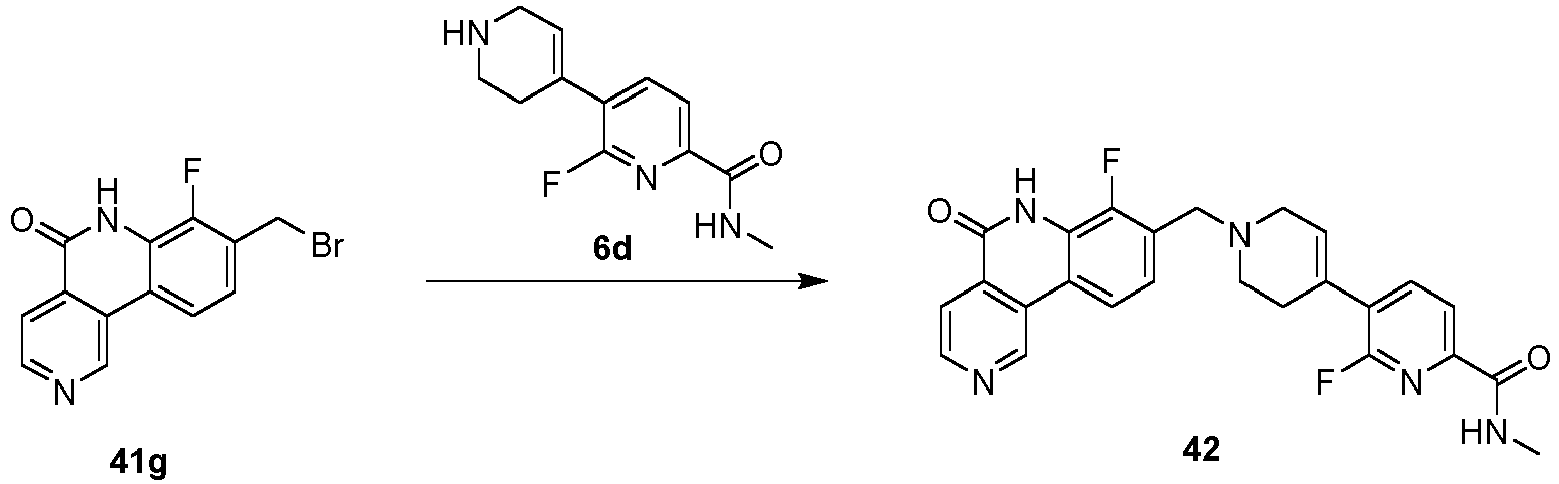
- Triethylamine (16.47 mg, 162.80 µmol) was added to a solution of intermediate 6d (17.69 mg, hydrochloride) in DMF (1 mL). The mixture was stirred at 25°C for 30 minutes. Intermediate 41g (25 mg, 81.40 µmol) and KI (1.35 mg, 8.14 µmol) were then added, and the reaction mixture was heated to 50°C and stirred for 2 hours. The reaction mixture was filtered, and the filtrate was purified by preparative HPLC (column: C18, 100 × 40 mm; mobile phase: [water (trifluoroacetic acid)-acetonitrile]; gradient: 0%-30% acetonitrile) to obtain the trifluoroacetate of compound 42. MS m/z: 462.1 [M+1]+. 1H NMR (400 MHz, CD3OD) δ 9.86 (s, 1H), 8.91 (d, J=5.27 Hz, 1H), 8.50 (d, J=7.78 Hz, 1H), 8.34 (d, J=5.77 Hz, 1H), 8.08 - 8.15 (m, 1H), 8.02 - 8.07 (m, 1H), 7.58 (dd, J=8.28, 7.03 Hz, 1H), 6.31 (s, 1H), 4.74 (s, 2H), 4.11 (s, 2H), 3.58 - 3.85 (m, 2H), 2.96 - 3.01 (m, 2H), 2.96 (s, 3H).
-

- Under a nitrogen atmosphere, 43e (800 mg, 3.19 mmol), compound 43a (1.09 g, 3.51 mmol), Pd(dppf)Cl2 (233.70 mg, 319.39 µmol), and potassium acetate (626.91 mg, 6.39 mmol) were added to a mixed solution of H2O (1.6 mL) and THF (8 mL). The mixture was heated to 70°C and stirred for 16 hours. The reaction mixture was filtered. The filter cake was rinsed with EA (15 mL), and the filtrate was concentrated under reduced pressure to obtain a crude product. The crude product was purified by flash column chromatography (eluent: PE:EA = 100:0 to 90:10, v/v) to obtain intermediate 43b. MS m/z: 353.1 [M+1]+. 1H NMR (400 MHz, CDCl3) δ ppm 8.07 (dd, J=7.78, 1.00 Hz, 1H), 7.64 - 7.76 (m, 1H), 5.83 (s, 1H), 4.11 (s, 2H), 3.67 (t, J=5.27 Hz, 2H), 2.50 (br s, 2H), 1.52 (s, 9H), 1.26 (s, 3H).
- A solution of methylamine in ethanol (9.05 g, 87.42 mmol, 30%) was added to a solution of intermediate 43b (300 mg, 850.31 µmol) in MeOH (1 mL). The mixture was stirred at 40°C for 16 hours. The reaction mixture was concentrated under reduced pressure to obtain intermediate 43c. MS m/z: 352.1 [M+1]+. 1H NMR (400 MHz, CD3OD) δ ppm7.92 (d, J=7.78 Hz, 1H), 7.74 (d, J=7.53 Hz, 1H), 5.75 (s, 1H), 3.98 (s, 2H), 3.53 - 3.61 (m, 2H), 2.85 (s, 3H), 2.33 - 2.41 (m, 2H), 1.40 (s, 9H).
- HCl/dioxane (4 M, 1.06 mL) was added to a solution of intermediate 43c (298 mg, 847.01 µmol) in MeOH (0.5 mL). The mixture was stirred at 25°C for 1 hour. HCl/dioxane (4 M, 635.26 µL) was further added. The mixture was stirred for another 1 hour. The reaction mixture was concentrated under reduced pressure to obtain the hydrochloride of intermediate 43d. MS m/z: 252.1 [M+1]+.
- Triethylamine (32.95 mg, 325.61 µmol) was added to a solution of intermediate 43d (37.53 mg, hydrochloride) in DMF (1 mL). The mixture was stirred at 25°C for 30 minutes. Intermediate 27a (50 mg, 162.80 µmol) and KI (2.70 mg, 16.28 µmol) were then added, and the mixture was heated to 50°C and stirred for 2.5 hours. The reaction mixture was added with DMF (2 mL), and with water (1 mL), resulting in the precipitation of a solid. The mixture was filtered to obtain the filter cake, which was compound 43. MS m/z: 478.1 [M+1]+. 1H NMR (400 MHz, DMSO-d 6) δ ppm 11.90 (s, 1H), 9.09 (dd, J=4.57, 1.81 Hz, 1H), 8.65 (dd, J=8.07, 1.81 Hz, 1H), 8.61 (d, J=4.88 Hz, 1H), 8.43 (d, J=8.51 Hz, 1H), 7.88 - 7.93 (m, 2H), 7.72 (dd, J=8.07, 4.57 Hz, 1H), 7.36 - 7.43 (m, 1H), 5.86 (s, 1H), 3.82 (s, 2H), 3.67 - 3.74 (m, 2H), 3.18 (d, J=2.50 Hz, 2H), 2.81 (d, J=4.75 Hz, 3H), 2.45 (d, J=1.63 Hz, 2H).
-

- Intermediate 15d (100 mg, 367.34 µmol) was dissolved in THF (1 mL). At 0°C, deuterated lithium aluminum hydride powder (20.91 mg, 551.00 µmol) was added thereto, and the mixture was stirred at 0°C for 1 hour. The reaction mixture was added to saturated sodium potassium tartrate solution (5 mL). The mixture was then extracted with ethyl acetate (10 mL × 3). The organic phases were combined, dried over anhydrous sodium sulfate, and filtered. The filtrate was concentrated under reduced pressure at 45°C to obtain intermediate 44a. MS m/z: 246.9 [M+1]+. 1H NMR (400 MHz, DMSO-d 6) δ ppm 11.87 (s, 1H), 9.08 (dd, J = 1.8, 4.5 Hz, 1H), 8.64 (dd, J = 1.9, 7.9 Hz, 1H), 8.43 (d, J = 7.5 Hz, 1H), 7.71 (dd, J = 4.8, 8.0 Hz, 1H), 7.40 (dd, J = 6.7, 8.2 Hz, 1H), 5.41 (s, 1H).
- Intermediate 44a (56 mg, 227.43 µmol) was dissolved in DCM (1 mL). 1,2-Dibromotetrachloroethane (162.93 mg, 500.34 µmol) was added, and at 0°C, tributylphosphine (92.02 mg, 454.85 µmol) was added. The mixture was stirred at 25°C for 3 hours. The reaction mixture was concentrated under reduced pressure, and methanol (2 mL) was added thereto. The mixture was stirred for 5 minutes and then filtered to obtain the filter cake, which was intermediate 44b. 1H NMR (400 MHz, DMSO-d 6) δ ppm 12.00 (s, 1H), 9.09 (d, J = 4.5 Hz, 1H), 8.71 - 8.61 (m, 1H), 8.49 - 8.38 (m, 1H), 7.80 - 7.69 (m, 1H), 7.51 - 7.36 (m, 1H).
- Intermediate 9g (31.99 mg, hydrochloride) was dissolved in DMF (1 mL). Triethylamine (58.92 mg, 582.28 µmol) was added, and the reaction mixture was stirred at 25°C for 0.5 hours. Intermediate 44b (45 mg, 145.57 µmol) and KI (12.08 mg, 72.78 µmol) were then added. The mixture was stirred at 50°C for 2 hours. The reaction mixture was added with water (1.5 mL), and stirred for 10 minutes, resulting in the precipitation of a solid. The mixture was filtered to obtain the filter cake, which was compound 44. MS m/z: 489.0 [M+23]+. 1H NMR (400 MHz, DMSO-d 6) δ ppm 11.90 (s, 1H), 9.09 (dd, J = 1.8, 4.5 Hz, 1H), 8.64 (dd, J = 1.8, 8.0 Hz, 1H), 8.47 - 8.37 (m, 2H), 7.84 (d, J = 7.8 Hz, 1H), 7.72 (dd, J = 4.5, 8.0 Hz, 1H), 7.57 (dd, J = 8.3, 10.5 Hz, 1H), 7.37 (dd, J = 6.7, 8.2 Hz, 1H), 3.17-3.20 (m, 4H), 2.76 (d, J = 4.8 Hz, 3H), 2.57-2.65 (m, 4H).
-

- Intermediate 33c (37.68 mg, hydrochloride) was dissolved in DMF (1 mL). Triethylamine (65.47 mg, 646.98 µmol) was added, and the reaction mixture was stirred at 25°C for 0.5 hours. Intermediate 44b (50 mg, 161.74 µmol) and KI (13.42 mg, 80.87 µmol) were then added. The mixture was stirred at 50°C for 1 hour. After cooling, the reaction mixture was added with water (1 mL), and stirred for 10 minutes, resulting in the precipitation of a solid. The mixture was filtered to obtain the filter cake, which was compound 45. MS m/z: 483.1 [M+1]+. 1H NMR (400 MHz, DMSO-d 6) δ ppm 11.90 (s, 1H), 9.09 (dd, J = 1.8, 4.5 Hz, 1H), 8.65 (dd, J = 1.8, 8.0 Hz, 1H), 8.48 - 8.38 (m, 2H), 7.94 (d, J = 8.3 Hz, 1H), 7.72 (dd, J = 4.5, 8.0 Hz, 1H), 7.66 (d, J = 8.3 Hz, 1H), 7.37 (dd, J = 6.7, 7.9 Hz, 1H), 3.10-3.15 (m, 4H), 2.79 (d, J = 4.8 Hz, 3H), 2.62-2.67 (m, 4H).
-

- Intermediate 46a (2 g, 6.22 mmol) was dissolved in THF (20 mL) and H2O (4 mL). Lithium hydroxide monohydrate (1.31 g, 31.12 mmol) was added thereto, and the mixture was stirred at room temperature (25°C) for 2 hours. The pH of the reaction mixture was adjusted to 3 with dilute hydrochloric acid (1 mol/L). Then the mixture was extracted with ethyl acetate (20 mL × 3). The organic phase was washed with 20 mL of saturated brine, dried over anhydrous sodium sulfate, and filtered. The filtrate was concentrated under reduced pressure to obtain intermediate 46b. MS m/z: 307.9 [M+1]+. 1H NMR (400 MHz, DMSO-d 6) δ ppm 8.37 (d, J = 2.8 Hz, 1H), 7.88 (d, J = 8.8 Hz, 1H), 7.36 (dd, J = 3.0, 8.8 Hz, 1H), 3.50 - 3.46 (m, 4H), 3.39 - 3.36 (m, 4H), 1.43 (s, 9H).
- Intermediate 46b (400 mg, 1.30 mmol) and deuterated methylamine hydrochloride (100.98 mg, 1.43 mmol) were dissolved in EA (4 mL). DIEA (336.41 mg, 2.60 mmol) and n-butyl phosphoric anhydride (50% ethyl acetate solution) (937.74 mg, 2.60 mmol) were added, and the mixture was stirred at 25°C for 3 hours. An additional 937.74 mg of n-butyl phosphoric anhydride was added, and the mixture was stirred for another 16 hours. The pH of the reaction mixture was adjusted to 10. The mixture was added with 5 mL of water and extracted with ethyl acetate (5 mL × 3). The organic phases were combined, dried over anhydrous sodium sulfate, and filtered. The filtrate was concentrated under reduced pressure to obtain intermediate 46c. MS m/z: 324.0 [M+1]+. 1H NMR (400 MHz, DMSO-d 6) δ ppm 8.43 - 8.37 (m, 1H), 8.28 (d, J = 2.8 Hz, 1H), 7.84 (d, J = 8.8 Hz, 1H), 7.41 (dd, J = 2.8, 8.8 Hz, 1H), 3.52 - 3.45 (m, 4H), 3.32 - 3.30 (m, 4H), 1.43 (s, 9H).
- Intermediate 46c (314 mg, 970.92 µmol) was dissolved in DMF (3.5 mL). N-Chlorosuccinimide (142.61 mg, 1.07 mmol) was added, and the reaction mixture was stirred at 50°C for 1 hour. The reaction mixture was added with 10 mL of water and extracted with ethyl acetate (10 mL × 3). The organic phases were combined, dried over anhydrous sodium sulfate, and filtered. The filtrate was concentrated under reduced pressure to obtain intermediate 46d. MS m/z: 358.0 [M+1]+ , 380.0 [M+23]+. 1H NMR (400 MHz, DMSO-d6 ) δ ppm 8.44 (s, 1H), 7.95 (d, J = 8.0 Hz, 1H), 7.68 (d, J = 8.0 Hz, 1H), 3.52 -3.47 (m, 4H), 3.09 - 3.01 (m, 4H), 1.43 (s, 9H).
- Intermediate 46d (355 mg, 992.04 µmol) was dissolved in MeOH (4 mL). HCl/dioxane (4 M, 1.34 mL) was added, and the reaction mixture was stirred at 25°C for 2 hours. The reaction mixture was concentrated under reduced pressure to obtain the hydrochloride of intermediate 46e. MS m/z: 257.9 [M+1]+.
- Intermediate 46e (38.32 mg, hydrochloride) was dissolved in DMF (1 mL). Triethylamine (65.90 mg, 651.22 µmol) was added, and the reaction mixture was stirred at 25°C for 0.5 hours. KI (13.51 mg, 81.40 µmol) and intermediate 27a (50 mg, 162.80 µmol) were then added, and the mixture was stirred at 50°C for 1 hour. After cooling, the reaction mixture was stirred with 2 mL of water for 10 minutes, resulting in the precipitation of a solid. The mixture was filtered to obtain the filter cake, which was compound 46. MS m/z: 484.0 [M+1]+; 506.0[M+23]+. 1H NMR (400 MHz, DMSO-d 6) δ ppm 11.90 (s, 1H), 9.09 (dd, J = 1.8, 4.5 Hz, 1H), 8.64 (dd, J = 1.8, 8.0 Hz, 1H), 8.47 - 8.38 (m, 2H), 7.94 (d, J = 8.3 Hz, 1H), 7.72 (dd, J = 4.5, 8.0 Hz, 1H), 7.67 (d, J = 8.0 Hz, 1H), 7.37 (dd, J = 6.8, 8.0 Hz, 1H), 3.76 (s, 2H), 3.16-3.12 (m, 4H), 2.69-2.63 (m, 4H).
-

- Deuterated methylamine hydrochloride (399.85 mg, 5.67 mmol) was added to H2O (2 mL). Sodium tert-butoxide (272.39 mg, 2.83 mmol) was then added. The mixture was stirred at 25°C for 1 hour. A solution of intermediate 43b (100 mg, 283.44 µmol) in MeOH (4 mL) was added. The reaction mixture was heated to 60°C and stirred for 4 hours. After cooling to room temperature, the mixture was extracted with ethyl acetate (5 mL × 3). The organic phases were combined, dried over anhydrous sodium sulfate, and concentrated under reduced pressure to obtain a crude product. The crude product was purified by preparative TLC (eluent: PE:EA=2:1) to obtain intermediate 47a. MS m/z: 355.1, 357.1[M+1]+.
- At 25°C, HCl/dioxane (4 M, 211.36 µL) was added to a solution of intermediate 47a (60 mg, 169.09 µmol) in MeOH (0.5 mL). The mixture was stirred for 2 hours. The reaction mixture was concentrated under reduced pressure to obtain the hydrochloride of intermediate 47b. MS m/z: 255.1, 257.1[M+1]+. 1H NMR (400 MHz, DMSO-d 6) δ ppm 9.36 (br s, 2H), 8.63 (s, 1H), 8.03 (d, J=7.78 Hz, 1H), 7.89 (d, J=7.78 Hz, 1H), 5.93 (br s, 1H), 3.76 (br d, J=1.51 Hz, 2H), 3.30 (br d, J=4.52 Hz, 2H), 2.63 (br d, J=1.51 Hz, 2H).
- Triethylamine (32.95 mg, 325.61 µmol) was added to a solution of intermediate 47b (37.93 mg, hydrochloride) in DMF (1.5 mL). The mixture was stirred at 25°C for 0.5 hours. Intermediate 27a (50 mg, 162.80 µmol) and KI (2.70 mg, 16.28 µmol) were then added, and the reaction mixture was stirred at 50°C for 2.5 hours. After cooling, the reaction mixture was added with 1.5 mL of water, resulting in the precipitation of a solid. The mixture was filtered to obtain the filter cake, which was compound 47. MS m/z: 481.0, 483.0 [M+1]+. 1H NMR (400 MHz, DMSO-d 6) δ ppm 11.89 (s, 1H), 9.09 (dd, J=4.50, 1.75 Hz, 1H), 8.65 (dd, J=8.00, 1.75 Hz, 1H), 8.57 (s, 1H), 8.44 (d, J=8.25 Hz, 1H), 7.95 - 7.99 (m, 1H), 7.88 - 7.93 (m, 1H), 7.72 (dd, J=8.00, 4.63 Hz, 1H), 7.36 - 7.43 (m, 1H), 5.87 (s, 1H), 3.82 (s, 2H), 3.19 (d, J=2.13 Hz, 2H), 2.72 - 2.78 (m, 2H), 2.44 - 2.47 (m, 2H).
-

- (R)-1-tert-Butoxycarbonyl-2-methylpiperazine (0.2 g, 998.62 µmol), 43e (250.13 mg, 998.62 µmol), Cs2CO3 (650.74 mg, 2.00 mmol), RuPhos (93.20 mg, 199.72 µmol), and Pd2(dba)3 (91.44 mg, 99.86 µmol) were sequentially added to toluene (4 mL). The mixture was purged with nitrogen three times and stirred at 100°C for 6 hours. The reaction mixture was filtered under reduced pressure while hot, and the filtrate was concentrated under reduced pressure at 50°C to obtain a crude product. The crude product was purified by column chromatography (eluent: PE/EA = 4/1, v/v) to obtain intermediate 48a. MS m/z: 370.0, 372.0 [M+1]+.
- Intermediate 48a (183.15 mg, 495.21 µmol) was added to EtOH (2 mL). With stirring, a solution of methylamine in ethanol (2.27 g, 21.93 mmol) was added thereto, and the reaction mixture was stirred at 20°C for 16 hours. The reaction mixture was concentrated under reduced pressure at 45°C to obtain a crude product of intermediate 48b. MS m/z: 312.9, 314.9 [M-56]+.
- Intermediate 48b (100 mg, 271.11 µmol) was added to MeOH (2 mL). With stirring, HCl/dioxane (4 M, 383.08 µL) was added thereto, and the reaction mixture was stirred at 25°C for 2 hours. The reaction mixture was concentrated under reduced pressure at 45°C to obtain the hydrochloride of intermediate 48c. MS m/z: 268.9,270.9 [M+1]+.
- Triethylamine (26.36 mg, 260.49 µmol) was added to a solution of intermediate 48c (39.75 mg, hydrochloride) in DMF (2 mL). The mixture was stirred at 20°C for 0.5 hours. Intermediate 27a (50 mg, 130.24 µmol) and KI (2.16 mg, 13.02 µmol) were then added thereto, and the reaction mixture was stirred at 50°C for 2 hours. The reaction mixture was concentrated under reduced pressure to obtain a crude product. The crude product was purified by preparative TLC (100% EA) to obtain compound 48. MS m/z: 495.2, 497.2 [M+1]+. 1H NMR (400 MHz, DMSO-d 6) δ ppm 11.86 (s, 1 H), 9.08 (dd, J=4.57, 1.69 Hz, 1 H), 8.64 (dd, J=8.00, 1.75 Hz, 1 H), 8.36 - 8.48 (m, 2 H), 7.94 (d, J=8.13 Hz, 1 H), 7.60 - 7.76 (m, 2 H), 7.33 - 7.47 (m, 1 H), 4.12 (d, J=13.38 Hz, 1 H), 3.53 (d, J=13.88 Hz, 1 H), 3.20-3.26 (m, 1 H), 2.85 - 2.95 (m, 1 H), 2.80 - 2.85 (m, 1 H), 2.79 (d, J=4.75 Hz, 3 H), 2.67 - 2.77 (m, 2 H), 2.38 - 2.45 (m, 2 H), 1.24 (d, J=5.50 Hz, 3 H).
-

- Deuterated methylamine hydrochloride (190.72 mg, 2.70 mmol) was added to H2O (1 mL). Sodium tert-butoxide (129.92 mg, 1.35 mmol) was then added thereto. The reaction mixture was stirred at 25°C for 1 hour. A solution of intermediate 48a (50 mg, 135.19 µmol) in MeOH (2 mL) was then added thereto, and the mixture was heated to 60°C and stirred for 4 hours. The reaction mixture was extracted with ethyl acetate (5 mL × 3). The organic phases were combined, dried over anhydrous sodium sulfate, and filtered. The filtrate was concentrated under reduced pressure to obtain intermediate 49a. MS m/z: 394.1, 396.1 [M+23]+.
- Intermediate 49a (50 mg, 134.45 µmol) was added to MeOH (2 mL). With stirring, HCl/dioxane (4 M, 383.08 µL) was added thereto, and the reaction mixture was stirred at 25°C for 1 hour. The reaction mixture was concentrated under reduced pressure to obtain the hydrochloride of intermediate 49b. MS m/z: 272.0, 274.0 [M+1]+.
- Triethylamine (26.36 mg, 260.49 µmol) was added to a solution of intermediate 49b (40.14 mg, hydrochloride) in DMF (2 mL). The mixture was stirred at 20°C for 0.5 hours. Intermediate 27a (50 mg, 130.24 µmol) and KI (2.16 mg, 13.02 µmol) were added to the reaction mixture, and the mixture was stirred at 50°C for 2 hours. The mixture was concentrated under reduced pressure to obtain a crude product. The crude product was purified by preparative TLC (100% EA) to obtain compound 49. MS m/z: 498.2, 500.2 [M+1]+. 1H NMR (400 MHz, DMSO-d 6) δ ppm 11.86 (s, 1 H), 9.08 (dd, J=4.57, 1.69 Hz, 1 H), 8.64 (dd, J=7.94, 1.81 Hz, 1 H), 8.33 - 8.50 (m, 2 H), 7.94 (d, J=8.25 Hz, 1 H), 7.58 - 7.78 (m, 2 H), 7.31 - 7.48 (m, 1 H), 4.12 (d, J=13.38 Hz, 1 H), 3.53 (d, J=13.76 Hz, 1 H), 3.24 (s, 1 H), 2.80 - 2.93 (m, 2 H), 2.70 - 2.79 (m, 2 H), 2.43 (t, J=9.01 Hz, 2 H), 1.24 (d, J=5.50 Hz, 3 H).
-

- Triethylamine (31.12 mg, 307.59 µmol) was added to a solution of intermediate 33c (35.83 mg, hydrochloride) in DMF (1 mL). The mixture was stirred at 25°C for 0.5 hours. Intermediate 38g (50 mg, 153.80 µmol) and KI (2.55 mg, 15.38 µmol) were then added, and the reaction mixture was stirred at 50°C for 2.5 hours. After cooling, the reaction mixture was added with 1 mL of water, resulting in the precipitation of a solid. The mixture was directly filtered to obtain the filter cake, which was
compound 50. MS m/z: 499.1, 501.1 [M+1]+. 1H NMR (400 MHz, DMSO-d 6) δ ppm 12.03 (br s, 1H), 9.13 (d, J=2.88 Hz, 1H), 8.39 - 8.46 (m, 2H), 8.36 (d, J=8.25 Hz, 1H), 7.93 (d, J=8.25 Hz, 1H), 7.66 (d, J=8.25 Hz, 1H), 7.38 (dd, J=8.00, 6.75 Hz, 1H), 3.76 (s, 2H), 3.08 - 3.16 (m, 4H), 2.79 (d, J=4.88 Hz, 3H), 2.63 - 2.69 (m, 4H). -

- Triethylamine (18.67 mg, 184.55 µmol) was added to a solution of intermediate 29b (23.07 mg, hydrochloride) in DMF (1 mL). The mixture was stirred at 25°C for 0.5 hours. Intermediate 38g (30 mg, 92.28 µmol) and KI (1.53 mg, 9.23 µmol) were then added, and the reaction mixture was stirred at 50°C for 2.5 hours. After cooling to room temperature, the reaction mixture was added with 1 mL of water, resulting in the precipitation of a solid. The mixture was filtered to obtain the filter cake, which was compound 51. MS m/z: 486.2 [M+1]+. 1H NMR (400 MHz, DMSO-d 6) δ ppm 12.05 (s, 1H), 9.13 (d, J=3.00 Hz, 1H), 8.42 (dd, J=8.57, 2.94 Hz, 1H), 8.34 - 8.39 (m, 2H), 7.84 (d, J=7.50 Hz, 1H), 7.56 (dd, J=10.57, 8.19 Hz, 1H), 7.34 - 7.41 (m, 1H), 3.74 (s, 2H), 3.15 - 3.22 (m, 4H), 2.59 - 2.65 (m, 4H).
-

- Intermediate 46e (21.72 mg, hydrochloride) was dissolved in DMF (1 mL). Triethylamine (37.35 mg, 369.11 µmol) was added, and the reaction mixture was stirred at 25°C for 0.5 hours. KI (7.66 mg, 46.14 µmol) and intermediate 38e (30 mg, 92.28 µmol) were then added, and the mixture was stirred at 50°C for 2 hours. After cooling to room temperature, the reaction mixture was added with 1 mL of water, resulting in the precipitation of a solid. The mixture was filtered to obtain the filter cake, which was compound 52. MS m/z: 502.2 [M+1]+. 1H NMR (400 MHz, DMSO-d6 ) δ ppm 12.06 (s, 1H), 9.14 (d, J = 3.0 Hz, 1H), 8.44 - 8.40 (m, 2H), 8.37 (d, J = 8.5 Hz, 1H), 7.94 (d, J = 8.0 Hz, 1H), 7.66 (d, J = 8.3 Hz, 1H), 7.39 (t, J = 7.5 Hz, 1H), 3.76 (s, 2H), 3.12 (m, 4H), 2.69 - 2.62 (m, 4H).
-

- Intermediate 38e (150 mg, 516.85 µmol) was dissolved in THF (2 mL). At 0°C, deuterated lithium aluminum hydride powder (29.42 mg, 775.27 µmol) was added thereto, and the mixture was stirred at 0°C for 1 hour. To the reaction mixture, 30 µL of water, 30 µL of 15% sodium hydroxide solution, and 90 µL of ice water were slowly added in sequence to quench the reaction. The reaction mixture was added with water (5 mL) and extracted with ethyl acetate (10 mL). The organic phase was dried over anhydrous sodium sulfate, and filtered. The filtrate was concentrated under reduced pressure at 45°C to obtain intermediate 53a. MS m/z: 265.1 [M+1]+. 1H NMR (400 MHz, DMSO-d6 ) δ ppm 9.10 (d, J = 2.8 Hz, 1H), 8.34-8.41 (m,2H), 7.36 (t, J =8.0 Hz, 1H), 5.38 (s, 1H).
- Intermediate 53a (130 mg, 492.01 µmol) was dissolved in DCM (3 mL). 1,2-Dibromotetrachloroethane (352.48 mg, 1.08 mmol) was added, and at 0°C, tributylphosphine (199.09 mg, 984.01 µmol) was added. The mixture was stirred at 25°C for 3 hours. The reaction mixture was concentrated under reduced pressure, and methanol (5 mL) was added thereto. The mixture was stirred for 5 minutes and then filtered to obtain the filter cake, which was intermediate 53b. 1H NMR (400 MHz, DMSO-d6 ) δ ppm 12.16 (s, 1H), 9.13 (d, J = 2.8 Hz, 1H), 8.41 - 8.43 (m, 1H), 8.34 - 8.37 (m, 1H), 7.44 (t, J=8.0 Hz, 1H).
- Intermediate 9g (22.68 mg, hydrochloride) was dissolved in DMF (1 mL). Triethylamine (18.56 mg, 183.42 µmol) was added, and the reaction mixture was stirred at 25°C for 0.5 hours. Intermediate 53b (30 mg, 91.71 µmol) and KI (1.52 mg, 9.17 µmol) were then added. The mixture was stirred at 50°C for 2 hours. The reaction mixture was added with water (1 mL), and stirred for 10 minutes, resulting in the precipitation of a solid. The mixture was filtered to obtain the filter cake, which was compound 53. MS m/z: 485.1 [M+1]+. 1H NMR (400 MHz, DMSO-d6 ) δ ppm 12.05 (s, 1H), 9.14 (d, J=3.01 Hz, 1H), 8.39 - 8.45 (m, 2H), 8.37 (d, J=8.03 Hz, 1H), 7.84 (d, J=7.28 Hz, 1H), 7.56 (dd, J=10.54, 8.28 Hz, 1H), 7.38 (t, J=7.15 Hz, 1H), 3.14 - 3.24 (m, 4H), 2.76 (d, J=4.77 Hz, 3H), 2.60 - 2.66 (m, 4H).
-

- Intermediate 29b (23.87 mg, hydrochloride) was dissolved in DMF (1 mL). Triethylamine (43.49 mg, 429.80 µmol) was added, and the reaction mixture was stirred at 25°C for 0.5 hours. KI (8.92 mg, 53.73 µmol) and intermediate 44b (33.22 mg, 107.45 µmol) were then added, and the mixture was stirred at 50°C for 1 hour. The reaction mixture was added with 1 mL of water, resulting in the precipitation of a solid. The mixture was filtered to obtain the filter cake, which was compound 54. MS m/z: 470.2 [M+1]+. 1H NMR (400 MHz, DMSO-d6 ) δ ppm 11.90 (s, 1H), 9.09 (dd, J = 1.8, 4.5 Hz, 1H), 8.64 (dd, J = 1.6, 7.9 Hz, 1H), 8.43 (d, J = 8.3 Hz, 1H), 8.38 (s, 1H), 7.84 (d, J = 8.5 Hz, 1H), 7.72 (dd, J = 4.5, 8.0 Hz, 1H), 7.57 (dd, J = 8.2, 10.7 Hz, 1H), 7.39 - 7.34 (m, 1H), 3.17-3.21 (m, 4H), 2.59-2.65 (m, 4H).
-

- Intermediate 29b (25 mg, hydrochloride) was dissolved in DMF (1 mL). Triethylamine (40.48 mg, 400.05 µmol) was added, and the reaction mixture was stirred at 25°C for 0.5 hours. KI (8.30 mg, 50.01 µmol) and intermediate 53b (32.72 mg, 100.01 µmol) were then added, and the mixture was stirred at 50°C for 1 hour. After cooling, the reaction mixture was added with 1 mL of water, resulting in the precipitation of a solid. The mixture was filtered to obtain the filter cake, which was compound 55. MS m/z: 488.2 [M+1]+. 1H NMR (400 MHz, DMSO-d6 ) δ ppm 12.06 (s, 1H), 9.14 (d, J = 2.8 Hz, 1H), 8.42 (dd, J = 3.0, 8.5 Hz, 1H), 8.39 - 8.34 (m, 2H), 7.84 (d, J = 8.0 Hz, 1H), 7.56 (dd, J = 8.0, 10.5 Hz, 1H), 7.38 (dd, J = 6.5, 8.3 Hz, 1H), 3.15-3.19 (m, 4H), 2.56-2.64 (m, 4H).
- The fluorescence polarization assay was performed in 96-well black-walled plates (Greiner). The reaction buffer consisted of 50 mM Tris (pH 8), 0.001% Triton X100, 10 mM MgCl2, and 150 mM NaCl. Both the fluorescent probe and His-Avi-tagged PARP1 protein were manufactured by WuXi AppTec (Shanghai). In a 100 µL reaction system, 8 nM PARP1, 5 nM fluorescent probe, and the compounds were added respectively. The compound concentration was prepared following the starting concentration and dilution gradient in Table 1. For example, compound 1 started from 100 nM with a 3-fold dilution. The test sample was incubated at room temperature for 4 hours, protected from light. Fluorescence polarization values were measured using an EnVision plate reader. The obtained fluorescence polarization values and compound concentrations were subjected to nonlinear fitting using GraphPad 8.0 software to determine the IC50 values.
-
Table 1. PARP1 binding activity assay for the compounds of the present disclosure Compound No. PARP1 IC50 (nM) Starting concentration and dilution gradient for test compounds Trifluoroacetate of compound 1 11 starting concentration at 100 nM, 3-fold dilution gradient Trifluoroacetate of compound 1516 starting concentration at 50 nM, 2-fold dilution gradient Trifluoroacetate of compound 1613 starting concentration at 50 nM, 2-fold dilution gradient Trifluoroacetate of compound 19 14 starting concentration at 50 nM, 2-fold dilution gradient Compound 21 22 starting concentration at 50 nM, 2-fold dilution gradient Trifluoroacetate of compound 22 14 starting concentration at 50 nM, 2-fold dilution gradient Compound 29 9.7 starting concentration at 1000 nM, 3-fold dilution gradient Compound 31 4.7 starting concentration at 1000 nM, 3-fold dilution gradient Compound 33 4.8 starting concentration at 1000 nM, 3-fold dilution gradient Compound 38 6.8 starting concentration at 1000 nM, 3-fold dilution gradient Compound 44 10 starting concentration at 1000 nM, 3-fold dilution gradient Compound 46 6.8 starting concentration at 1000 nM, 3-fold dilution gradient Compound 50 7.9 starting concentration at 1000 nM, 3-fold dilution gradient Compound 51 5.2 starting concentration at 100 nM, 3-fold dilution gradient Compound 52 5.5 starting concentration at 100 nM, 3-fold dilution gradient Compound 53 4.5 starting concentration at 100 nM, 3-fold dilution gradient Compound 54 6.0 starting concentration at 100 nM, 3-fold dilution gradient Compound 55 5.2 starting concentration at 100 nM, 3-fold dilution gradient - Conclusion: The compounds of the present disclosure exhibit excellent binding activity to PARP1.
- The fluorescence polarization assay was performed in 96-well black-walled plates (Greiner). The reaction buffer consisted of 50 mM Tris (pH 8), 0.001% Triton X100, 10 mM MgCl2, and 150 mM NaCl. Both the fluorescent probe and His-Avi-tagged PARP2 protein were manufactured by WuXi AppTec (Shanghai). In a 100 µL reaction system, 3 nM PARP2, 5 nM fluorescent probe, and the compounds were added respectively. The compound concentration was prepared following the starting concentration and dilution gradient in Table 2. The test sample was incubated at room temperature for 4 hours, protected from light. Fluorescence polarization values were measured using an EnVision plate reader. The obtained fluorescence polarization values and compound concentrations were subjected to nonlinear fitting using GraphPad 8.0 software to determine the IC50 values.
-
Table 2. PARP2 binding activity assay for the compounds of the present disclosure Compound No. PARP2 IC50 (µM) Starting concentration and dilution gradient for test compounds Trifluoroacetate of compound 1 >20 starting concentration at 20 µM, 3-fold dilution gradient Trifluoroacetate of compound 15>50 starting concentration at 50 µM, 3-fold dilution gradient Trifluoroacetate of compound 16>50 starting concentration at 50 µM, 3-fold dilution gradient Trifluoroacetate of compound 19 >50 starting concentration at 50 µM, 3-fold dilution gradient Compound 21 >50 starting concentration at 50 µM, 3-fold dilution gradient Trifluoroacetate of compound 22 >50 starting concentration at 50 µM, 3-fold dilution gradient Compound 29 >20 starting concentration at 20 µM, 3-fold dilution gradient Compound 31 >20 starting concentration at 20 µM, 3-fold dilution gradient Compound 33 >20 starting concentration at 20 µM, 3-fold dilution gradient Compound 38 >20 starting concentration at 20 µM, 3-fold dilution gradient Compound 44 >20 starting concentration at 20 µM, 3-fold dilution gradient Compound 46 >20 starting concentration at 20 µM, 3-fold dilution gradient Compound 50 >20 starting concentration at 20 µM, 3-fold dilution gradient - Conclusion: The compounds of the present disclosure exhibit relatively weak binding activity to PARP2.
- MDA-MB-436 cells (BRCA1 mutation) were seeded in black 96-well plates with clear bottoms. Each well contained 135 µL of cell suspension with 3,500 MDA-MB-436 cells (BRCA1 mutation). The cell plate was incubated overnight in a CO2 incubator. A 400X stock solution of the test compound was prepared. The test compounds were 5-fold diluted with a multi-channel pipette to the 9th concentration, i.e., diluted from 4 mM to 104 nM, and duplicate experiment was set. 78 µL of medium was added to an intermediate plate. Subsequently, 2 µL of the serially diluted compound per well was transferred to the corresponding wells of the intermediate plate. 2 µL of DMSO was added to the vehicle control and blank control. After mixing well, 15 µL of the mixture per well was then transferred to the cell plate. Concentrations of compounds transferred to the cell plate ranged from 10 µM to 0.26 nM, with a final DMSO concentration of 0.25%. The cell plate was incubated for 7 days in a CO2 incubator. The cell plate was removed and equilibrated to room temperature for 30 minutes. 75 µL of chemiluminescent cell viability assay reagent was added to each well. The cell plate was shaken on an orbital shaker for 3 minutes to induce cell lysis, followed by 10 minutes of incubation at room temperature to stabilize the luminescent signal. Luminescent signals were detected using a 2104 EnVision plate reader. The inhibition rate (IR) of the test compounds was calculated using the following formula: IR (%) = (1 - (RLU compound - RLU blank control) / (RLU vehicle control - RLU blank control)) × 100% The inhibition rates of compounds at different concentrations were calculated in Excel, and the inhibition curves were plotted and related parameters were calculated using GraphPad Prism software.
-
Table 3. Proliferation inhibition assay on MDA-MB-436 cells (BRCA1 mutation) Compound No. IC50 (nM) Trifluoroacetate of compound 51.2 Trifluoroacetate of compound 151.58 Trifluoroacetate of compound 22 5.73 Compound 27 0.69 Compound 28 0.37 Compound 29 1.14 Compound 31 0.75 Compound 33 0.41 Compound 37 4.54 Compound 38 0.56 Compound 41 2.92 Compound 44 0.65 Compound 45 0.27 Compound 46 0.36 Compound 500.41 - Experimental conclusion: The compounds of the present disclosure exhibit excellent proliferation inhibitory activity against MDA-MB-436 cells (BRCA1 mutation).
- DLD1 (BRCA2 KO) cells were seeded in white a 96-well plate with 80 µL of cell suspension per well, containing 1,000 DLD1 (BRCA2 KO) cells per well. The cell plate was incubated overnight in a CO2 incubator. The test compounds were 5-fold diluted with a multi-channel pipette to the 8th concentration, i.e., diluted from 2 mM to 0.0256 µM, and duplicate experiment was set. 78 µL of medium was added to an intermediate plate. Subsequently, 2 µL of the serially diluted compound per well was transferred to the corresponding wells of the intermediate plate and mixed well. 20 µL of the mixture per well was then transferred to the cell plate. The concentration of the compound transferred to the cell plate ranged from 10 µM to 0.128 nM. The cell plate was incubated for 7 days in a CO2 incubator. An additional cell plate was prepared to read the signal value on the day of compound addition, which served as the maximum value (Max in the following equation) for data analysis. The cell plate was added with 25 µL of chemiluminescent cell viability assay reagent per well and incubated at room temperature for 10 minutes to stabilize the luminescent signal. A multimode microplate reader was used for reading. After the incubation of the cell plate with the compound, the cell plate was added with 25 µL of chemiluminescent cell viability assay reagent per well and incubated at room temperature for 10 minutes to stabilize the luminescent signal. A multimode microplate reader was used for reading. Using the equation (Sample - Min) / (Max - Min) × 100% to convert the raw data into inhibition rate, the IC50 value can be obtained by curve fitting with four parameters (obtained by "log (inhibitor) vs. response -- Variable slope" mode in GraphPad Prism).
-
Table 4. Anti-proliferation assay on DLD1 (BRCA2 KO) cells Compound No. IC50 (nM) Trifluoroacetate of compound 151.71 Trifluoroacetate of compound 1613.05 Trifluoroacetate of compound 19 24.18 Compound 21 10.01 Trifluoroacetate of compound 22 4.43 - Experimental conclusion: The compounds of the present disclosure exhibit good antiproliferative inhibitory effects on DLD1 (BRCA2 KO) cells.
- The trifluoroacetate of
compound 16 was evaluated using female BALB/C mice, and the trifluoroacetate ofcompound 15 was evaluated using male CD-1 mice. A clear solution of the test compound (0.4 mg/mL) in 10% 2-hydroxypropyl-β-cyclodextrin and 90% water was administered to the mice (fasted overnight, aged 7 to 9 weeks) via tail vein injection at a dose of 2 mg/kg. A clear solution of the test compound (1 mg/mL) in 0.5% methylcellulose was administered to the mice (fasted overnight, aged 7 to 9 weeks) via oral gavage at a dose of 10 mg/kg. Blood samples (about 30 µL) were collected from the two groups of animals at the following time points: from the jugular vein at 0.0833, 0.25, 0.5, 1.0, 2.0, 4.0, 8.0, and 24 hours post-administration, and from the tail vein at 0.25, 0.5, 1.0, 2.0, 4.0, 6.0, 8.0, and 24 hours post-administration. The samples were placed in anticoagulant tubes containing EDTA-K2, followed by centrifugation to separate the plasma. For the trifluoroacetate ofcompound 15, one group received intravenous administration (IV, 2 mg/kg) with blood samples collected at the above time points, and another group received oral administration (PO, 10 mg/kg) with blood samples collected at the above time points. Additionally, for the oral administration group (PO, 10 mg/kg), plasma and brain tissue homogenate samples were collected at the 2-hour time point. Plasma concentrations were determined by LC-MS/MS method, and relevant pharmacokinetic parameters were calculated using WinNonlin™ Version 6.3 (Pharsight, Mountain View, CA) pharmacokinetic software with non-compartmental model linear-log trapezoidal method. - Experimental results: The pharmacokinetic data of mice are shown in Table 5, and the brain penetration data are shown in Table 6.
Table 5. Pharmacokinetic data of mice Trifluoroacetate of compound 16Trifluoroacetate of compound 15IV 2 mg/kg PO 10 mg/ kg IV 2 mg/ kg PO 10 mg/kg C0 (nM) or Cmax (nM) 14017 42673 4210 13700 Tmax (h) - 0.5 - 0.25 T1/2 (h) 0.25 2 3.7 4.1 Vdss (L/kg) 1.54 - 2.1 - Cl (mL/min/kg) 4.0 - 7.7 - Tlast (h) 24.0 24.0 24.0 24.0 AUC0-last (nM.h) 17915 173382 9230 61600 - Note: "-" indicates that the parameter could not be calculated. C0 represents initial concentration; Cmax represents peak concentration; Tmax represents time to reach peak concentration; T1/2 represents elimination half-life; Vdss represents apparent volume of distribution at steady state; Cl represents total clearance; Tlast represents time point of the last quantifiable drug concentration; AUC0-last represents area under the plasma concentration-time curve from
time 0 to the last quantifiable time point.Table 6. Brain penetration data of the compound of the present disclosure in mice PO 10 mg/kg Drug concentrations at the 2-hour time point C2h(nM) Plasma drug concentration C2h(nM) Brain drug concentration Brain-to-plasma drug concentration ratio Trifluoroacetate of compound 158467 5814 0.7 - Experimental conclusion: The compounds of the present disclosure exhibit excellent metabolic stability in vivo and excellent drug exposure following oral administration. Oral administration result in superior drug concentration in brain tissue, with a high brain-to-plasma concentration ratio.
- This experiment used the MDR1-MDCK II cell line, authorized by the Piet Borst Laboratory at the Netherlands Cancer Institute, as the in vitro model for permeability evaluation experiment. Cells were seeded at a density of 2.3 × 10⁵ cells/cm2 in a Transwell-96 well plate. After being cultured for 4 to 7 days in a CO2 incubator, the cells were used for transport experiments.
-
- Test compound concentration: 2.00 µM;
- Testing directions and replicates: Bidirectional (A (apical) -B (basolateral) and B-A), with 2 replicates;
- Transport buffer (TB): HBSS solution containing 10 mM HEPES (pH 7.40 ± 0.05)
- Incubation conditions: 37 ± 1°C, 5% CO2, incubated for 150 minutes
- Control compounds: Nadolol and Metoprolol were used as control compounds for low and high permeability, respectively. Digoxin was used as a substrate for P-glycoprotein. The administration concentration of nadolol and metoprolol was 2.00 µM, and that of digoxin was 10.0 µM.
- After the transport experiment, the integrity of the MDR1-MDCK II cell layer was assessed using the Lucifer Yellow Rejection Assay. The remaining solution in the apical and basolateral wells was removed, followed by the addition of 75 µL of TB containing 100 µM Lucifer Yellow to the apical wells and 250 µL of TB to the basolateral wells. The cell plates were incubated in a cell incubator at 37 ± 1°C, 5% CO2, and saturated humidity for 30 minutes. After incubation, 20 µL of the sample was collected from the apical side and mixed with 60 µL of TB, while 80 µL of the sample was collected from the basolateral side. The relative fluorescence intensity (RFU) was measured using a microplate reader at 425/528 nm (excitation/emission).
- In this experiment, sample analysis for the test compounds and the control compounds-nadolol, metoprolol, and digoxin-was conducted using liquid chromatographytandem mass spectrometry (LC-MS/MS). The retention time, chromatogram acquisition, and chromatogram integration of the analytes and internal standards were processed using Analyst software (Sciex, Framingham, MA, USA). The semi-quantitative determination of the sample analysis was performed by calculating the ratio of the peak area of the analyte to that of the internal standard.
-


- VR represents the volume of the solution at the receiving side (0.075 mL for the apical side and 0.25 mL for the basolateral side). Area represents the relative surface area of the cell monolayer (0.0804 cm2). Time represents the incubation time (9000 s). C0 represents the peak area ratio of the compound on the donor side. VD is the volume on the donor side (0.075 mL for the apical side and 0.25 mL for the basolateral side). CD and CR represent the peak area ratios of the compound on the donor and receiving sides, respectively.
- The permeability of Lucifer Yellow (%Lucifer Yellow) was calculated using the following formula:

- RFUApical and RFUBasolateral are the relative fluorescence intensities of Lucifer Yellow on the apical and basolateral sides, respectively. VApical and VBasolateral are the loading volumes on the apical and basolateral sides, which are 0.0750 mL and 0.250 mL, respectively.
- The permeability test results of the compounds of the present disclosure on the MDR1-MDCK II cell line are summarized in Table 7.
Table 7: Summary of permeability evaluation of the compounds in the present disclosure Compound Permeability Papp (10- 6 cm/s) Efflux ratio Permeability conclusion A to B B to A Trifluoroacetate of compound 1525.2 17.7 0.703 High permeability Compound 33 10.6 7.2 0.679 High permeability - Note: low permeability: Papp ≤ 1.0 (×10-6 cm/s); moderate permeability: 1.0 < Papp < 5.5 (×10-6 cm/s); high permeability: Papp ≥ 5.5 (×10-6 cm/s).
- Conclusion: The compounds of the present disclosure demonstrate excellent membrane permeability in the cell membrane permeability study.
- A 0.2 mg/mL clear solution of the test compound in 10% 2-hydroxypropyl-β-cyclodextrin and 90% water was administered to male SD rats (fasted overnight, 200 to 230 g) via tail vein injection at a dose of 1 mg/kg. A 0.5 mg/mL solution of the test compound in 10% 2-hydroxypropyl-β-cyclodextrin and 90% water was administered to male SD rats (fasted overnight, 200 to 230 g) via oral gavage at a dose of 5 mg/kg. Blood samples (about 30 µL) were collected from the two groups of animals at the following time points: from the jugular vein at 0.0833, 0.25, 0.5, 1.0, 2.0, 4.0, 8.0, and 24 hours post-administration, and from the tail vein at 0.25, 0.5, 1.0, 2.0, 4.0, 8.0, and 24 hours post-administration. The samples were placed in anticoagulant tubes containing EDTA-K2, followed by centrifugation to separate the plasma. For the trifluoroacetate of
compound 15, one group received intravenous administration (IV, 1 mg/kg) with blood samples collected at the above time points, and another group received oral administration (PO, 5 mg/kg) with blood samples collected at the above time points. Additionally, for the oral administration group (PO, 5 mg/kg), plasma and brain tissue homogenate samples were collected at the 2-hour time point. Plasma concentrations were determined by LC-MS/MS method, and relevant pharmacokinetic parameters were calculated using WinNonlin™ Version 6.3 (Pharsight, Mountain View, CA) pharmacokinetic software with non-compartmental model linear-log trapezoidal method. - Experimental results: The pharmacokinetic data of rats are shown in Table 8, and the brain penetration data are shown in Table 9.
Table 8. Pharmacokinetic data of rats Trifluoroacetate of compound 15IV 1 mg/ kg PO 5 mg/kg C0 (nM) or Cmax (nM) 2120 2830 Tmax (h) - 4 T1/2 (h) 5.2 3.3 Vdss (L/kg) 2.1 - Cl (mL/min/kg) 6.0 - Tlast (h) 24.0 24.0 AUC0-last (nM.h) 5820 22900 F (%) 78% - Note: "-" indicates that the parameter could not be calculated; C0 represents initial concentration; Cmax represents peak concentration; Tmax represents time to reach peak concentration; T1/2 represents elimination half-life; Vdss represents apparent volume of distribution at steady state; Cl represents total clearance; Tlast represents time point of the last quantifiable drug concentration; AUC0-last represents area under the plasma concentration-time curve from
time 0 to the last quantifiable time point; F(%) represents bioavailability, calculated using AUC0-last.Table 9. Brain penetration data of the compound of the present disclosure in rats PO 5 mg/kg Drug concentrations at the 2-hour time point C2h(nM) Plasma drug concentration C2h(nM) Brain drug concentration Brain-to-plasma drug concentration ratio Trifluoroacetate of compound 158467 5814 0.7 - Experimental conclusion: The compounds of the present disclosure exhibit excellent metabolic stability in vivo and excellent drug exposure following oral administration. Oral administration result in superior drug concentration in brain tissue, with a high brain-to-plasma concentration ratio.
- Experimental objective: To investigate the metabolic stability of the compound of the present disclosure in humans through in vitro metabolic stability testing using human liver microsomes.
- Experimental conditions: The compound (1 µM) was incubated with human liver microsomes supplemented with an NADPH regeneration system at 37°C for a specified duration, lasting up to 60 minutes. The concentration of the compound in the samples was determined by LC-MS/MS.
- Experimental process: The incubation was performed using 96-well incubation plates, with individual plates labeled as T0, T5, T15, T30, T45, T60, Blank60, and NCF60. The reaction time points corresponding to the incubation plates were set at 0, 5, 15, 30, 45, and 60 minutes. In the Blank60 plate, no test compound or control compound was added, and the sample was collected after 60 minutes of incubation. In the NCF60 plate, potassium phosphate buffer was used in place of the NADPH regeneration system and incubated for 60 minutes. All time point samples were taken from individual wells.
- For the T0, T5, T15, T30, T45, T60, and NCF60 plates, 5 µL of either the test or control compound working solution and 100 µL of microsomal working solution (with a liver microsomal protein concentration of 0.5 mg/mL) were added. Only microsomal working solution was added to the Blank60 well. In the Blank60 plate, only the microsomal working solution was added. Then, the incubation plates, except for T0 and NCF60, including Blank60, T5, T15, T30, T45, and T60, were pre-incubated in a 37°C water bath for approximately 10 minutes.
- For samples in the T0 plate, 180 µL of stop solution (where the stop solution was a solution of acetonitrile and methanol (95:5, V/V) containing 100 ng/mL tolbutamide) was added before adding the NADPH regeneration system working solution.
- 50 µL of potassium phosphate buffer was added to each well of the NCF60 plate and incubated for 60 minutes.
- After the pre-incubation of Blank60, T5, T15, T30, T45, and T60 incubation plates, 44 µL of NADPH regeneration system working solution was added to each sample well to initiate the reaction. Therefore, for sample wells containing either the test compound or the control compound working solutions, the final reaction concentration was 1 µM, with the concentration of liver microsomes at 0.5 mg/mL. The final concentrations of DMSO and acetonitrile in the reaction system were 0.01% (v/v) and 0.99% (v/v), respectively.
- After incubation for an appropriate period (e.g., 5, 15, 30, 45, and 60 minutes), 180 µL of stop solution was added to each test compound and control compound sample well in the Blank60, T5, T15, T30, T45, T60, and NCF60 plates to stop the reaction.
- All sample plates were shaken thoroughly and centrifuged for 10 minutes. A volume of 80 µL of the supernatant from each test compound was diluted to 240 µL with a solution of acetonitrile (1:9, v/v) containing 0.1% formic acid for LC-MS/MS analysis.
- The half-life (T1/2) and clearance (CLint(liver)) of the compound in human liver microsomes were determined by calculating the percentage of the compound remaining at each corresponding time point.


-
Table 10: In vitro metabolic stability study results of the compounds of the present disclosure in human and mouse liver microsomes Human liver microsomes Mouse liver microsomes CLint(liver) (mL/min/kg) T1/2 (minutes) CLint(liver) (mL/min/kg) T1/2 (minutes) Trifluoroacetate of compound 1 <8.6 >145 <38 >145 Compound 15<8.6 >145 74 77 Compound 27 9.5 132 NA NA Compound 29 NA NA <38 >145 Compound 31 <8.6 >145 NA NA Compound 37 NA NA 64 85 NA: Not tested - Conclusion: The compounds of the present disclosure demonstrate outstanding stability in both human and mouse liver microsomes in vitro.
- To investigate the inhibitory effect of the compound of the present disclosure on the in vivo growth of tumors in a human breast cancer MDA-MB-436 xenograft model in nude mice.
- Routine cell culture was performed under 5% CO2 at 37°C in MEM medium containing 10% fetal bovine serum. The cells were passaged using 0.25% trypsin digestion. Depending on the growth condition of the cells, the cells were passaged two to three times per week at a ratio of 1:3 to 1:6.
- MDA-MB-436 cells in the logarithmic growth phase were collected, counted, and then resuspended in a mixture of 50% serum-free MEM medium and 50% Matrigel to adjust the cell concentration to 5.0 × 10⁷ cells/mL. After dispersing the cells evenly with a pipette, the suspension was transferred into a 50 mL centrifuge tube, which was placed in an icebox. Using a 1 mL syringe, the cell suspension was injected subcutaneously into the right axilla of each nude mouse, with 200 µL (1.1 × 10⁷ cells/mouse) injected per animal, establishing the MDA-MB-436 nude mouse xenograft model. After inoculation, the animals were regularly observed for their condition and tumor growth. Tumor diameters were measured using an electronic caliper, and the data were directly input into an Excel spreadsheet to calculate tumor volume. When the tumor volume reached 100 to 200 mm3, healthy animals with similar tumor sizes were selected and grouped (n = 6) based on a randomized block design, while ensuring that the average body weight of each group remained consistent. The day of grouping was considered as the first day of the experiment (D1). After the experiment commenced, the tumor diameter was measured twice weekly, and tumor volume was calculated, while the body weight of the animals was weighed and recorded.
- The formula used for calculating tumor volume (TV) is as follows: TV (mm3) = a × w2/2; where a represents the long diameter of the tumor (mm) and w represents the short diameter of the tumor (mm).
- The formula for calculating Relative Tumor Volume (RTV) is as follows: RTV = TVt/TVinitial; where TVinitial is the tumor volume measured at the time of grouping and dosing, and TVt is the tumor volume measured at each time point during administration.
- The formula for calculating the Relative Tumor Proliferation Rate (%T/C) is: %T/C =100% × (RTVT/RTVC); where RTVT represents the RTV of the treatment group, and RTVC represents the RTV of the vehicle control group.
- The formula for calculating Tumor Growth Inhibition (TGI) is: TGI =100% × [1 - (TVt(T)- TVinitial(T))/(TVt(C)- TVinitial(C))]; where TVt(T) is the tumor volume of the treatment group at each measurement, TVinitial(T) is the tumor volume of the treatment group at the time of grouping and administration, TVt(C) is the tumor volume of the vehicle group at each measurement, and TVinitial(C) is the tumor volume of the vehicle group at the time of grouping and administration.
- Experimental results: Tumor growth volumes are shown in
FIG. 1 . The body weight changes of mice during the administration are shown inFIG. 2 . Tumor growth inhibition rates and relative tumor proliferation rates are shown in Table 11.Table 11. Summary of tumor growth inhibition rate and relative tumor proliferation rate in MDA-MB-436 Dose (p.o.) TGI (%) (tumor growth inhibition rate) D24 T/C (%) (relative tumor proliferation rate) D24 p-value1 Trifluoroacetate of compound 151.0 mg/kg 104% 14% **** 1: Comparisons between the two groups were analyzed by T-test. A p-value < 0.05 was considered statistically significant: *p < 0.05, **p < 0.01, ***p < 0.001, ****p < 0.0001. - Experimental conclusion: The compounds of the present disclosure exhibit significant anti-tumor activity.
Claims (28)
- A compound of formula (XII) or a pharmaceutically acceptable salt thereof,
 X is selected from O and S;the structural moiety

 ring A is selected from phenyl and 6-membered heteroaryl;ring B is selected from 6-membered heteroaryl;L is selected from a single bond, and ring C is selected from
 T2 is selected from C, N, and CH;T3 and T4 are each independently selected from N and CR10;R1 is selected from C1-3 alkyl and C3-5 cycloalkyl, and the C1-3 alkyl and C3-5 cycloalkyl are each independently and optionally substituted by 1, 2, or 3 halogens;R2 is selected from H and C1-3 alkyl, and the C1-3 alkyl is optionally substituted by 1, 2, or 3 halogens;R3 is selected from H and halogen;R9 is absent, or selected from H and halogen;R4 is selected from H, halogen, CN, C1-3 alkyl, and C1-3 alkoxy;R5 is selected from H, halogen, CN, C1-3 alkyl, and C1-3 alkoxy;R6 and R7 are each independently selected from H, halogen, C1-3 alkyl, and C1-3 alkoxy, and the C1-3 alkyl and C1-3 alkoxy are each independently and optionally substituted by 1, 2, or 3 halogens;R8 is selected from C1-3 alkyl and C3-5 cycloalkyl, and the C1-3 alkyl and C3-5 cycloalkyl are each independently and optionally substituted by 1, 2, or 3 R;R10 is selected from H and halogen;R13 and R14 are each independently selected from H, halogen, C1-3 alkyl, C1-3 alkoxy, and C3-5 cycloalkyl, and the C1-3 alkyl, C1-3 alkoxy, and C3-5 cycloalkyl are each independently and optionally substituted by 1, 2, or 3 halogens;R15 and R16 are each independently selected from H, D, C1-3 alkyl, and C1-3 alkoxy, and the C1-3 alkyl and C1-3 alkoxy are each independently and optionally substituted by 1, 2, or 3 halogens;or, R2 and R4 form a ring, so that the structural moiety
 or, R3 and R5 form a ring, so that the structural moiety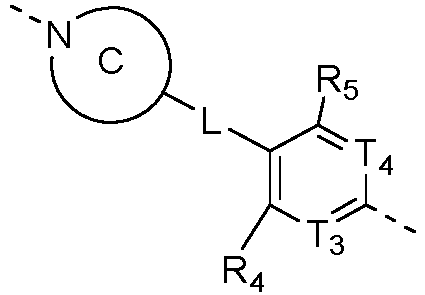
 each Ra is independently selected from H, halogen, C1-3 alkyl, C1-3 alkoxy, and C3-5 cycloalkyl, and the C1-3 alkyl, C1-3 alkoxy, and C3-5 cycloalkyl are optionally substituted by 1, 2, or 3 halogens;or, two Ra on adjacent atoms, together with the atom to which they are attached, form a double bond or a cyclopropyl group;each Rb is independently selected from H, halogen, C1-3 alkyl, C1-3 alkoxy, and C3-5 cycloalkyl, and the C1-3 alkyl, C1-3 alkoxy, and C3-5 cycloalkyl are optionally substituted by 1, 2, or 3 halogens;each Rc is independently selected from H, halogen, C1-3 alkyl, C1-3 alkoxy, and C3-5 cycloalkyl, and the C1-3 alkyl, C1-3 alkoxy, and C3-5 cycloalkyl are optionally substituted by 1, 2, or 3 halogens;each R is independently selected from halogen and D;n is selected from 0, 1, 2, 3, and 4;given that when the structural moiety

 the halogen represents F, Cl, Br, and I atoms;"hetero" in the 5- to 6-membered heteroaryl represents 1, 2, 3, or 4 heteroatoms or heteroatom groups, each independently selected from -O-, -S-, and -N-.
 - The compound or the pharmaceutically acceptable salt thereof according to claim 1, wherein the compound has a structure of formula (XII-1),
 ring A is selected from 6-membered heteroaryl;R2, R3, R4, R5, R6, R7, R8, R9, R13, R14, R15, R16, Rc, X, T2, T3, T4, n, and
- The compound or the pharmaceutically acceptable salt thereof according to claim 1, wherein X is selected from O.
- The compound or the pharmaceutically acceptable salt thereof according to claim 1, wherein each Ra, each Rb, and each Rc are independently selected from H, F, and CH3.
- The compound or the pharmaceutically acceptable salt thereof according to claim 1, wherein T3 is selected from N, CH, and CF; or T3 is selected from N.
- The compound or the pharmaceutically acceptable salt thereof according to claim 1, wherein T4 is selected from N and CH.
- The compound or the pharmaceutically acceptable salt thereof according to claim 1, wherein R1 is selected from CH3 and CH2CH3; or R1 is selected from CH3.
- The compound or the pharmaceutically acceptable salt thereof according to claim 1, wherein R2 is selected from H and CH3.
- The compound or the pharmaceutically acceptable salt thereof according to claim 1, wherein R6 and R7 are each independently selected from H, F, and CH3; or R6 and R7 are each independently selected from H and F.
- The compound or the pharmaceutically acceptable salt thereof according to claim 1, wherein R4 and R5 are each independently selected from H, F, Cl, CN, and CH3.
- The compound or the pharmaceutically acceptable salt thereof according to claim 1, wherein R8 is selected from CH3, CH2CH3, CH2CF3, cyclopropyl, and CD3.
- The compound or the pharmaceutically acceptable salt thereof according to claim 1, wherein R3 and R9 are each independently selected from H and F.
- The compound or the pharmaceutically acceptable salt thereof according to claim 1, wherein R10 is selected from H and F.
- The compound or the pharmaceutically acceptable salt thereof according to claim 1, wherein R13 and R14 are each independently selected from H and CH3.
- The compound or the pharmaceutically acceptable salt thereof according to claim 1, wherein R15 and R16 are each independently selected from H, D, and CH3.
- The compound or the pharmaceutically acceptable salt thereof according to claim 1, wherein ring A is selected from phenyl, pyridyl, pyrazinyl, and pyrimidinyl.
- The compound or the pharmaceutically acceptable salt thereof according to claim 1, wherein ring B is selected from pyridyl, pyrazinyl, and pyrimidinyl.
- The compound or the pharmaceutically acceptable salt thereof according to claim 1, wherein the structural moiety


- The compound or the pharmaceutically acceptable salt thereof according to claim 1, wherein the structural moiety


- The compound or the pharmaceutically acceptable salt thereof according to claim 1, wherein the structural moiety


- The compound or the pharmaceutically acceptable salt thereof according to claim 1, wherein L is selected from a single bond, and the structural moiety





- The compound or the pharmaceutically acceptable salt thereof according to claim 1, wherein the compound has a structure of formula (P-1),
 wherein ring A is selected from pyridyl;R2, R3, R4, R5, R7, R8, R9, R13, R14, R15, R16, Rc, T2, n, andare as defined in claim 1.
- The compound or the pharmaceutically acceptable salt thereof according to claim 1, wherein the compound has a structure of formula (P-2),
 wherein
 T2 is selected from C and N;R2 is selected from H and C1-3 alkyl, and the C1-3 alkyl is optionally substituted by 1, 2, or 3 halogens;R3 is selected from H and halogen;R4 is selected from H, halogen, CN, C1-3 alkyl, and C1-3 alkoxy;R5 is selected from H, halogen, CN, C1-3 alkyl, and C1-3 alkoxy;R9 is absent, or selected from H and halogen;R7, R8, R13, R14, R15, R16, Rc, and n are as defined in claim 1.
 - A compound as shown below or a pharmaceutically acceptable salt thereof,


















- The compound or the pharmaceutically acceptable salt thereof according to claim 24, wherein the compound is selected from:






- A pharmaceutical composition comprising a therapeutically effective amount of the compound or the pharmaceutically acceptable salt thereof according to any one of claims 1 to 25 as an active ingredient, and a pharmaceutically acceptable carrier, diluent, or excipient.
- A use of the compound or the pharmaceutically acceptable salt thereof according to any one of claims 1 to 25 or the composition according to claim 26 in the manufacture of a medicament for treating solid tumors.
- The use according to claim 27, wherein the solid tumors refer to solid tumors such as ovarian cancer, breast cancer, prostate cancer, and glioma.
Applications Claiming Priority (13)
| Application Number | Priority Date | Filing Date | Title |
|---|---|---|---|
| CN202210495459 | 2022-05-07 | ||
| CN202210693545 | 2022-06-17 | ||
| CN202211204558 | 2022-09-29 | ||
| CN202211351783 | 2022-10-31 | ||
| CN202211408423 | 2022-11-10 | ||
| CN202211593592 | 2022-12-09 | ||
| CN202310088997 | 2023-02-02 | ||
| CN202310123790 | 2023-02-15 | ||
| CN202310232367 | 2023-03-10 | ||
| CN202310303425 | 2023-03-23 | ||
| CN202310340861 | 2023-03-31 | ||
| CN202310388951 | 2023-04-12 | ||
| PCT/CN2023/092572 WO2023217045A1 (en) | 2022-05-07 | 2023-05-06 | Fluoroquinoxalinone derivative for selectively inhibiting parp1 |
Publications (1)
| Publication Number | Publication Date |
|---|---|
| EP4524142A1 true EP4524142A1 (en) | 2025-03-19 |
Family
ID=88729748
Family Applications (1)
| Application Number | Title | Priority Date | Filing Date |
|---|---|---|---|
| EP23802817.9A Pending EP4524142A1 (en) | 2022-05-07 | 2023-05-06 | Fluoroquinoxalinone derivative for selectively inhibiting parp1 |
Country Status (5)
| Country | Link |
|---|---|
| US (1) | US20250295642A1 (en) |
| EP (1) | EP4524142A1 (en) |
| JP (1) | JP7835895B2 (en) |
| CN (1) | CN119110801A (en) |
| WO (1) | WO2023217045A1 (en) |
Families Citing this family (10)
| Publication number | Priority date | Publication date | Assignee | Title |
|---|---|---|---|---|
| US20240287094A1 (en) * | 2021-05-24 | 2024-08-29 | Jiangsu Hengrui Pharmaceuticals Co., Ltd. | Nitrogen-containing heterocyclic compound, preparation method therefor, and application thereof in medicines |
| AU2023209820B2 (en) | 2022-01-21 | 2024-10-10 | Xinthera, Inc. | Parp1 inhibitors and uses thereof |
| CA3249318A1 (en) * | 2022-01-28 | 2023-08-03 | Xinthera, Inc. | Parp1 inhibitors and uses thereof |
| IL315586A (en) * | 2022-03-11 | 2024-11-01 | Impact Therapeutics Shanghai Inc | Modified tricyclic compounds and their use as poly(ADP-ribose) polymerase inhibitors |
| KR20240161147A (en) | 2022-03-14 | 2024-11-12 | 슬랩 파마슈티컬스 엘엘씨 | multicyclic compounds |
| CA3250945A1 (en) | 2022-04-28 | 2023-11-02 | Xinthera, Inc. | Tricyclic parp1 inhibitors and uses thereof |
| JP2025538192A (en) * | 2022-11-10 | 2025-11-26 | 上海海和薬物研究開発股▲ふん▼有限公司 | Fused tricyclic PARP1 inhibitors, methods for their preparation, and uses |
| CN120677162A (en) * | 2023-06-13 | 2025-09-19 | 中国医药研究开发中心有限公司 | Nitrogen-containing heterocyclic compound and medical application thereof |
| AU2024316921A1 (en) * | 2023-07-28 | 2026-02-05 | Sunshine Lake Pharma Co., Ltd. | Substituted nitrogen-containing bicyclic compound and use thereof |
| WO2025168048A1 (en) * | 2024-02-08 | 2025-08-14 | 上海璎黎药业有限公司 | Compound having triple bond structure, and pharmaceutical composition thereof and use thereof |
Family Cites Families (8)
| Publication number | Priority date | Publication date | Assignee | Title |
|---|---|---|---|---|
| ES2870203T3 (en) | 2015-06-09 | 2021-10-26 | Onconic Therapeutics Inc | Tricyclic derivative compound, method for preparing it and pharmaceutical composition comprising the same |
| HUE071067T2 (en) | 2019-07-19 | 2025-07-28 | Astrazeneca Ab | Parp1 inhibitors |
| US11795158B2 (en) * | 2020-06-25 | 2023-10-24 | Astrazeneca Ab | Chemical compounds |
| CN115702156A (en) * | 2021-04-23 | 2023-02-14 | 南京明德新药研发有限公司 | Pyridine amides |
| CN117980307A (en) * | 2021-08-27 | 2024-05-03 | 上海瑛派药业有限公司 | Substituted tricyclic compounds as PARP inhibitors and their use |
| CN116135398B (en) * | 2021-11-16 | 2025-07-04 | 通快(中国)有限公司 | Improvement method, welding method, processing system, control device, program product |
| IL315586A (en) * | 2022-03-11 | 2024-11-01 | Impact Therapeutics Shanghai Inc | Modified tricyclic compounds and their use as poly(ADP-ribose) polymerase inhibitors |
| CN115662296A (en) * | 2022-11-01 | 2023-01-31 | 武汉华星光电半导体显示技术有限公司 | Folding display module and folding display device |
-
2023
- 2023-05-06 JP JP2024565356A patent/JP7835895B2/en active Active
- 2023-05-06 CN CN202380038423.XA patent/CN119110801A/en active Pending
- 2023-05-06 US US18/862,180 patent/US20250295642A1/en active Pending
- 2023-05-06 EP EP23802817.9A patent/EP4524142A1/en active Pending
- 2023-05-06 WO PCT/CN2023/092572 patent/WO2023217045A1/en not_active Ceased
Also Published As
| Publication number | Publication date |
|---|---|
| WO2023217045A1 (en) | 2023-11-16 |
| US20250295642A1 (en) | 2025-09-25 |
| CN119110801A (en) | 2024-12-10 |
| JP7835895B2 (en) | 2026-03-25 |
| JP2025516367A (en) | 2025-05-27 |
Similar Documents
| Publication | Publication Date | Title |
|---|---|---|
| US20250295642A1 (en) | Fluoroquinoxalinone derivative for selectively inhibiting parp1 | |
| US12410196B2 (en) | Benzopyrimidine compounds and use thereof | |
| JP7644517B2 (en) | KRAS Mutant Protein Inhibitors | |
| EP4083038B1 (en) | Pyridazinyl thiazolecarboxamide compound | |
| US20260028329A1 (en) | Jak1 selective inhibitors | |
| EP4293027A1 (en) | Pyrimidine aromatic ring compounds | |
| JP6871864B2 (en) | Isooxazolyl-substituted benzimidazoles | |
| ES2791315T3 (en) | Triazole agonists of the APJ receptor | |
| EP4212522A1 (en) | Compounds for suppressing egfr mutant cancer and pharmaceutical use thereof | |
| JP2022520236A (en) | Compounds, compositions, and methods | |
| EP4089083A1 (en) | Piperidine-2,6-dione substituted isoindoles in the preparation of substituted quinoline-8-carbonitrile derivatives having androgen receptor degradation activity and uses thereof | |
| EP4393916A1 (en) | Nitrogen-containing heterocyclic derivative inhibitor, and preparation method therefor and use thereof | |
| EP3640248B1 (en) | Aminopyrimidine derivatives, preparation method therefor and use thereof | |
| EP3848367A1 (en) | Tricyclic compounds acting on crbn proteins | |
| CN115772159A (en) | KIF18A inhibitors | |
| BR112021011147A2 (en) | PYRAZOLYL-AMINO-PYRIMIDINIL DERIVATIVES BENZAMIDES AND COMPOSITIONS AND METHODS THEREOF | |
| CN115785068A (en) | KIF18A inhibitors | |
| JP2025525474A (en) | Nitrogen-containing compounds and their applications | |
| EP4236937B1 (en) | Pyrimidine derivatives as modulators of the 5-ht2a serotonin receptor useful for the treatment of disorders related thereto | |
| TW202130634A (en) | Chemical compounds | |
| WO2021098883A1 (en) | Compound used as egfr kinase inhibitor and use thereof | |
| EP4596544A1 (en) | Ep300/cbp regulator, and preparation method therefor and use thereof | |
| JP7340519B2 (en) | Pyridopyrimidine compounds as mTORC1/2 dual inhibitors | |
| CN115181104A (en) | Substituted fused tricyclic derivatives, compositions and uses thereof | |
| CA3291101A1 (en) | Fluoroquinoxalinone derivative for selectively inhibiting parp1 |
Legal Events
| Date | Code | Title | Description |
|---|---|---|---|
| STAA | Information on the status of an ep patent application or granted ep patent |
Free format text: STATUS: THE INTERNATIONAL PUBLICATION HAS BEEN MADE |
|
| PUAI | Public reference made under article 153(3) epc to a published international application that has entered the european phase |
Free format text: ORIGINAL CODE: 0009012 |
|
| STAA | Information on the status of an ep patent application or granted ep patent |
Free format text: STATUS: REQUEST FOR EXAMINATION WAS MADE |
|
| 17P | Request for examination filed |
Effective date: 20241206 |
|
| AK | Designated contracting states |
Kind code of ref document: A1 Designated state(s): AL AT BE BG CH CY CZ DE DK EE ES FI FR GB GR HR HU IE IS IT LI LT LU LV MC ME MK MT NL NO PL PT RO RS SE SI SK SM TR |
|
| DAV | Request for validation of the european patent (deleted) | ||
| DAX | Request for extension of the european patent (deleted) | ||
| RAP1 | Party data changed (applicant data changed or rights of an application transferred) |
Owner name: SCIBRUNCH THERAPEUTICS CO., LTD. |
|
| REG | Reference to a national code |
Ref country code: DE Ref legal event code: R079 Free format text: PREVIOUS MAIN CLASS: C07D0498140000 Ipc: C07D0241440000 |
|
| RIC1 | Information provided on ipc code assigned before grant |
Ipc: C07D 241/44 20060101AFI20260317BHEP Ipc: C07D 401/12 20060101ALI20260317BHEP Ipc: C07D 401/14 20060101ALI20260317BHEP Ipc: C07D 471/04 20060101ALI20260317BHEP Ipc: C07D 471/14 20060101ALI20260317BHEP Ipc: C07D 487/04 20060101ALI20260317BHEP Ipc: C07D 498/14 20060101ALI20260317BHEP Ipc: C07D 519/00 20060101ALI20260317BHEP Ipc: A61P 35/00 20060101ALI20260317BHEP |