EP4523594A1 - Dishwasher - Google Patents
Dishwasher Download PDFInfo
- Publication number
- EP4523594A1 EP4523594A1 EP23816358.8A EP23816358A EP4523594A1 EP 4523594 A1 EP4523594 A1 EP 4523594A1 EP 23816358 A EP23816358 A EP 23816358A EP 4523594 A1 EP4523594 A1 EP 4523594A1
- Authority
- EP
- European Patent Office
- Prior art keywords
- washing
- course
- cycle
- level
- dishwasher
- Prior art date
- Legal status (The legal status is an assumption and is not a legal conclusion. Google has not performed a legal analysis and makes no representation as to the accuracy of the status listed.)
- Pending
Links
Images









Classifications
-
- A—HUMAN NECESSITIES
- A47—FURNITURE; DOMESTIC ARTICLES OR APPLIANCES; COFFEE MILLS; SPICE MILLS; SUCTION CLEANERS IN GENERAL
- A47L—DOMESTIC WASHING OR CLEANING; SUCTION CLEANERS IN GENERAL
- A47L15/00—Washing or rinsing machines for crockery or tableware
- A47L15/0018—Controlling processes, i.e. processes to control the operation of the machine characterised by the purpose or target of the control
- A47L15/0052—Noise reduction
-
- A—HUMAN NECESSITIES
- A47—FURNITURE; DOMESTIC ARTICLES OR APPLIANCES; COFFEE MILLS; SPICE MILLS; SUCTION CLEANERS IN GENERAL
- A47L—DOMESTIC WASHING OR CLEANING; SUCTION CLEANERS IN GENERAL
- A47L15/00—Washing or rinsing machines for crockery or tableware
- A47L15/0018—Controlling processes, i.e. processes to control the operation of the machine characterised by the purpose or target of the control
- A47L15/0063—Controlling processes, i.e. processes to control the operation of the machine characterised by the purpose or target of the control using remote monitoring or controlling of the dishwasher operation, e.g. networking systems
-
- A—HUMAN NECESSITIES
- A47—FURNITURE; DOMESTIC ARTICLES OR APPLIANCES; COFFEE MILLS; SPICE MILLS; SUCTION CLEANERS IN GENERAL
- A47L—DOMESTIC WASHING OR CLEANING; SUCTION CLEANERS IN GENERAL
- A47L15/00—Washing or rinsing machines for crockery or tableware
- A47L15/42—Details
- A47L15/4293—Arrangements for programme selection, e.g. control panels; Indication of the selected programme, programme progress or other parameters of the programme, e.g. by using display panels
-
- A—HUMAN NECESSITIES
- A47—FURNITURE; DOMESTIC ARTICLES OR APPLIANCES; COFFEE MILLS; SPICE MILLS; SUCTION CLEANERS IN GENERAL
- A47L—DOMESTIC WASHING OR CLEANING; SUCTION CLEANERS IN GENERAL
- A47L15/00—Washing or rinsing machines for crockery or tableware
- A47L15/0018—Controlling processes, i.e. processes to control the operation of the machine characterised by the purpose or target of the control
- A47L15/0021—Regulation of operational steps within the washing processes, e.g. optimisation or improvement of operational steps depending from the detergent nature or from the condition of the crockery
- A47L15/0028—Washing phases
-
- A—HUMAN NECESSITIES
- A47—FURNITURE; DOMESTIC ARTICLES OR APPLIANCES; COFFEE MILLS; SPICE MILLS; SUCTION CLEANERS IN GENERAL
- A47L—DOMESTIC WASHING OR CLEANING; SUCTION CLEANERS IN GENERAL
- A47L2301/00—Manual input in controlling methods of washing or rinsing machines for crockery or tableware, i.e. information entered by a user
- A47L2301/04—Operation mode, e.g. delicate washing, economy washing, reduced time, sterilizing, water softener regenerating, odor eliminating or service
-
- A—HUMAN NECESSITIES
- A47—FURNITURE; DOMESTIC ARTICLES OR APPLIANCES; COFFEE MILLS; SPICE MILLS; SUCTION CLEANERS IN GENERAL
- A47L—DOMESTIC WASHING OR CLEANING; SUCTION CLEANERS IN GENERAL
- A47L2401/00—Automatic detection in controlling methods of washing or rinsing machines for crockery or tableware, e.g. information provided by sensors entered into controlling devices
- A47L2401/20—Time, e.g. elapsed operating time
-
- A—HUMAN NECESSITIES
- A47—FURNITURE; DOMESTIC ARTICLES OR APPLIANCES; COFFEE MILLS; SPICE MILLS; SUCTION CLEANERS IN GENERAL
- A47L—DOMESTIC WASHING OR CLEANING; SUCTION CLEANERS IN GENERAL
- A47L2401/00—Automatic detection in controlling methods of washing or rinsing machines for crockery or tableware, e.g. information provided by sensors entered into controlling devices
- A47L2401/34—Other automatic detections
-
- A—HUMAN NECESSITIES
- A47—FURNITURE; DOMESTIC ARTICLES OR APPLIANCES; COFFEE MILLS; SPICE MILLS; SUCTION CLEANERS IN GENERAL
- A47L—DOMESTIC WASHING OR CLEANING; SUCTION CLEANERS IN GENERAL
- A47L2501/00—Output in controlling method of washing or rinsing machines for crockery or tableware, i.e. quantities or components controlled, or actions performed by the controlling device executing the controlling method
- A47L2501/04—Water pressure or flow rate
-
- A—HUMAN NECESSITIES
- A47—FURNITURE; DOMESTIC ARTICLES OR APPLIANCES; COFFEE MILLS; SPICE MILLS; SUCTION CLEANERS IN GENERAL
- A47L—DOMESTIC WASHING OR CLEANING; SUCTION CLEANERS IN GENERAL
- A47L2501/00—Output in controlling method of washing or rinsing machines for crockery or tableware, i.e. quantities or components controlled, or actions performed by the controlling device executing the controlling method
- A47L2501/26—Indication or alarm to the controlling device or to the user
- A47L2501/265—Indication or alarm to the controlling device or to the user about the number of remaining operation cycles or the remaining operation time
-
- A—HUMAN NECESSITIES
- A47—FURNITURE; DOMESTIC ARTICLES OR APPLIANCES; COFFEE MILLS; SPICE MILLS; SUCTION CLEANERS IN GENERAL
- A47L—DOMESTIC WASHING OR CLEANING; SUCTION CLEANERS IN GENERAL
- A47L2501/00—Output in controlling method of washing or rinsing machines for crockery or tableware, i.e. quantities or components controlled, or actions performed by the controlling device executing the controlling method
- A47L2501/30—Regulation of machine operational steps within the washing process, e.g. performing an additional rinsing phase, shortening or stopping of the drying phase, washing at decreased noise operation conditions
Definitions
- the present disclosure relates to a dishwasher, and more particularly, to a dishwasher capable of changing a washing course to a low noise-level course during a washing cycle of a dishwasher.
- the dishwasher is an apparatus for washing dishes by spraying washing water in which detergent is dissolved to the dishes having food wastes and oil attached thereto after meal, thereby removing the food wastes and oil therefrom.
- the washing water is sprayed to an inner space of the tub at a high pressure, and the sprayed washing water collides with the dishes so that foreign substances such as food waste on the surface of the dish are washed away.
- a process of washing dishes using the dishwasher includes various steps including spraying the washing water in which detergent is dissolved, rather than including only the spraying the washing water in which detergent is dissolved.
- the dishwasher may operate in a preliminary washing cycle, a washing cycle, a rinsing cycle, a heating rinsing cycle, and a drying cycle.
- the user has to move to the kitchen space, and stop the washing operation, turn off the power, and then turn on the power again and then set the washing course to the low noise-level course.
- a purpose of the present specification is to provide a dishwasher in which a user is capable of simply changing, in a real-time manner, a washing course from a standard washing course to a low-noise course or a low noise-level mode during a washing cycle of the dishwasher using a user's voice, a remote controller manipulation, a user terminal, or the like.
- a dishwasher may include an input unit for receiving a course change signal instructing the dishwasher to change a washing course to a low noise-level course having a lower noise-level than a noise-level of the washing course; storage for storing therein, as data, a rotation speed of a washing motor in each washing cycle of the low noise-level course corresponding to each washing cycle of the washing course; and a controller configured to: upon receiving the course change signal, recognize a washing cycle of the washing course; and change a rotation speed of the washing motor in the recognized washing cycle of the washing course to a rotation speed of the washing motor in a washing cycle of the low noise-level course corresponding to the recognized washing cycle, thereby controlling the washing cycle of the low noise-level course.
- the dishwasher according to the present disclosure may further include: a casing constituting an outer appearance and having an open front; a door sealing the open front of the casing; a tub receiving washing water therein; and a rack positioned inside the tub and accommodating therein dishes.
- the input unit may include: a voice input unit configured to receive a voice signal as the course change signal; a communication unit configured to receive the course change signal from a user terminal or a management server through a communication network; and a remote receiver configured to wirelessly receive the course change signal from a remote controller.
- the washing cycle of the washing course may be one of a preliminary washing cycle, a main washing cycle, a rinsing cycle, a heating rinsing cycle, and a drying cycle.
- the storage may store therein a washing time duration and a washing water temperature of each washing cycle of the low noise-level course corresponding to each washing cycle of the washing course as data.
- the controller may be configured to: change a rotation speed of the washing motor to be lower than a rotation speed of the washing motor in the washing course such that the washing course is changed to the low noise-level course in a real-time manner at one of initial, middle, and end timings of the main washing cycle, thereby controlling the washing cycle of the low noise-level course.
- the controller may be configured to: change a rotation speed of the washing motor to be lower than a rotation speed of the washing motor in the washing course such that the washing course is changed to the low noise-level course in a real-time manner at one of initial, middle, and end timings of the rinsing cycle, thereby controlling the washing cycle of the low noise-level course.
- the controller may be configured to: change a rotation speed of the washing motor to be lower than a rotation speed of the washing motor in the washing course such that the washing course is changed to the low noise-level course in a real-time manner at one of initial, middle, and end timings of the heating rinsing cycle, thereby controlling the washing cycle of the low noise-level course.
- the controller may be configured to: change a rotation speed of the washing motor to be lower than a rotation speed of the washing motor in the washing course such that the washing course is changed to the low noise-level course in a real-time manner at one of initial, middle, and end timings of the preliminary washing cycle, thereby controlling the washing cycle of the low noise-level course.
- controller may be configured to change the washing time duration or the washing water temperature of the low noise-level course to control the washing cycle of the low noise-level course.
- the controller may be configured to: adjust a washing time duration of the low-noise course to be larger than a washing time duration of the washing course; or adjust a washing water temperature of the low-noise course to be higher than a washing water temperature of the washing course, thereby controlling the washing cycle of the low noise-level course.
- the controller may be configured to perform a first cycle, calculate a first temperature value of the dishes accommodated in the rack when the first cycle has been terminated, perform a second cycle, calculate a second temperature value of the dishes accommodated in the rack when the second cycle has been terminated, calculate an emissivity of the dishes accommodated in the rack based on the first temperature value and the second temperature value, and determine a third cycle based on the emissivity.
- the first temperature value may be calculated from a first thermal image acquired through an optical sensor after the first cycle has been terminated, and the second temperature value may be calculated from a second thermal image acquired through the optical sensor.
- a dishwasher may include an input unit for receiving a course change signal instructing the dishwasher to change a washing course to a low noise-level course having a lower noise-level than a noise-level of the washing course; a function execution unit for executing a washing cycle according to the washing course or the low noise-level course; and a controller configured to: upon receiving the course change signal during execution of the washing course, change a parameter of the washing course to a parameter of the low noise-level course; and control the function execution unit to execute the washing cycle of the low noise-level course based on the parameter of the low noise-level course.
- the washing course may include a standard course, a strong course, a delicate course, and a low noise-level course.
- the parameter of the low noise-level course may be the same as or different from the parameter of the low noise-level mode.
- the rotation speed of the washing motor in the low noise-level course may be the same as or different from the rotation speed of the washing motor of the low noise-level mode.
- the parameter of the low noise-level course may include a washing water spray pressure, a washing time duration, a washing water temperature, and a rotation speed of a washing motor.
- the controller may be configured to control the function execution unit to: lower a washing water spray pressure of the low noise-level course to a washable lowest spray pressure; adjust a washing time duration of the low noise-level course to be larger than a washing time duration of the washing course; adjust a washing water temperature of the low noise-level course to be higher than a washing water temperature of the washing course; and adjust a rotation speed of the washing motor of the low noise-level course to be lower than a rotation speed of the washing motor of the washing course, thereby executing the washing cycle of the low noise-level course.
- the washing cycle may include a preliminary washing cycle, a main washing cycle, a rinsing cycle, a heating rinsing cycle, and a drying cycle.
- an execution time duration of the rinsing cycle may be larger than an execution time duration of each of the main washing cycle and the heating rinsing cycle.
- an execution time duration of the main washing cycle may be larger than an execution time duration of each of the rinsing cycle and the heating rinsing cycle.
- the controller may be configured to: change the parameter of the washing course to the parameter of the low noise-level course at the course change signal receiving timing; control the function execution unit to execute the main washing cycle of the low noise-level course during a period from the course change signal receiving timing to an end timing of the main washing cycle based on the parameter of the low noise-level course; and subsequently, control the function execution unit to further execute the main washing cycle of the low noise-level course for a first time duration allocated to the main washing cycle of the low noise-level course.
- the controller may be configured to: change the parameter of the washing course to the parameter of the low noise-level course at the course change signal receiving timing; control the function execution unit to execute the rinsing cycle of the low noise-level course during a period from the course change signal receiving timing to an end timing of the rinsing cycle based on the parameter of the low noise-level course; and subsequently, control the function execution unit to further execute the rinsing cycle of the low noise-level course for a second time duration allocated to the rinsing cycle of the low noise-level course.
- the controller may be configured to: change the parameter of the washing course to the parameter of the low noise-level course at the course change signal receiving timing; control the function execution unit to execute the heating rinsing cycle of the low noise-level course during a period from the course change signal receiving timing to an end timing of the heating rinsing cycle based on the parameter of the low noise-level course; and subsequently, control the function execution unit to further execute the heating rinsing cycle of the low noise-level course for a third time duration allocated to the heating rinsing cycle of the low noise-level course.
- controller may be configured to control the function execution unit to: control the rotation speed of the washing motor of the low noise-level course to be lower than that of the washing course so that the washing water spray pressure of the low noise-level course is the lowest washable spray pressure, and to control the washing water temperature of the low noise-level course to be higher than that of the washing course, thereby controlling the washing cycle of the low noise-level course.
- the first time duration or the second time duration may be the longest, and the third time duration may be the shortest.
- the user may control the operation of the dishwasher via the smartphone held in the hand of the user to change the current operation course of the dishwasher to the low noise-level course with low-level noise in a real-time manner.
- the user may execute an app ThinQ App through a smartphone next to or close to the user to change the current operation course of the dishwasher to the low noise-level course with low-level noise in a real-time manner.
- the user may execute an app ThinQ App through a smartphone to change the current operation course of the dishwasher to the low noise-level course with low-level noise in a real-time manner, thereby reducing the noise.
- the washing performance of the low noise-level course may be equal to or greater than that of the washing course.
- the dishwasher when the standard washing course is changed to the low noise-level course, the dishwasher may be controlled such that the washing time duration of the low noise-level course may be larger than that of the washing course, and the washing water temperature of the low noise-level course may be higher than that of the washing course.
- the current operation course may be changed without stopping the currently operating washing course, and the operation course may be easily retuned to the previous washing course after the low noise-level course has been terminated.
- the user may change the course parameter through the app so that the operation noise-level of the dishwasher may operate under the lowest noise-level logic, thereby reducing the power consumption of the dishwasher.
- the dishwasher may automatically lower the hitting spray pressure, increase the washing time duration, and increase the washing water temperature (soaking energy) in the low-noise course or the low noise-level mode, thereby improving the convenience of the user.
- the component may be subdivided into sub-components for convenience of description. However, these sub-components may be implemented in one device or module, or may be distributed across a plurality of devices or modules.
- the home appliance described herein is a home appliance including a dishwasher.
- the function of the home appliance is continuously upgraded.
- the home appliance may be connected to a management server through a communication network using a router or an AP (access point).
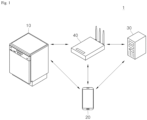
- FIG. 1 is a configuration diagram schematically illustrating an overall configuration of a home appliance control system according to an embodiment of the present disclosure.
- a home appliance control system 1 (hereinafter, referred to as a "system") according to an embodiment of the present disclosure may include a dishwasher 10, a user terminal 20, a management server 30, and an access point (AP) 40.
- the dishwasher 10 may include a display module for displaying information and a communication device having a communication function.
- the dishwasher 10 may be equipped with a communication interface or a communication unit necessary to perform wired or wireless communication. Furthermore, the dishwasher 10 may provide information related to a washing cycle to a user through visual or auditory information output.
- the dishwasher 10 may periodically transmit information of software installed in the dishwasher 10 to the management server 30 through the router 40.
- the dishwasher 10 may transmit software information about a separate electronic device connected thereto in a wired or wireless manner, for example, a remote controller, to the management server 30.
- a communication scheme between the dishwasher 10 and the management server 30 may be different from a communication scheme between the dishwasher 10 and the separate electronic device.
- the dishwasher 10 may transmit software received from the management server 30 to the electronic device or transmit the software to a plurality of separate electronic devices in a broadcasting manner.
- the software information transmitted from the dishwasher 10 to the management server 30 may include a user ID, a model name, a serial number, a software version, software contents, a user setting, storage capacity information of a product, and the like.
- the management server 30 may compare the software information of the dishwasher 10 with the software information registered in the management server 30 based on the user ID, the model name, the serial number, and the like included in the received software information.
- the management server 30 may select one of the general upgrade or the automatic upgrade as the software upgrade method of the dishwasher 10 based on the comparison result, or may select one of the general upgrade or the automatic upgrade as the software upgrade method of the dishwasher 10 based on the model name, the serial number, and the like of the dishwasher 10.
- the user terminal 20 may be a device carried or held by a user.
- the user terminal 20 may include a smartphone, a notebook, a tablet PC, a smart TV, a smart watch, or the like.
- the scope of the user terminal 20 is not limited thereto.
- an embodiment of the present disclosure will be described based on an example in which the user terminal 20 is a smartphone.
- the user terminal 20 is any terminal including a processor for processing instructions or computations, a display for displaying Various types of information, a voice input device (for example, a microphone) capable of receiving a user's voice, a voice output device (for example, a speaker) for outputting voice, a photographing device (for example, a camera) capable of acquiring a photo of an external object, and a communication module capable of performing a communication function with another device.
- a processor for processing instructions or computations
- a display for displaying Various types of information
- a voice input device for example, a microphone
- a voice output device for example, a speaker
- a photographing device for example, a camera
- a communication module capable of performing a communication function with another device.
- the user may remotely control the dishwasher 10 installed in the home or check an operation state of the dishwasher 10 in a real-time manner using the user terminal 20 (e.g. a mobile terminal or a tablet).
- the user terminal 20 e.g. a mobile terminal or a tablet.
- the user may execute an application for managing the dishwasher 10 installed in the user terminal 20, input a control command on the dishwasher 10, or request information inquiry related to an operation state of the dishwasher 10.
- the user terminal 20 may transmit a control command to the management server 30 or request transmission of information about the dishwasher 10 according to a user's request.
- the management server 30 may be a device that remotely manages the dishwasher 10.
- the management server 30 may be communicatively connected to the dishwasher 10 through the access point 40.
- the management server 30 may be communicatively connected to the user terminal 20, and may manage the dishwasher 10 in association with the user terminal 20.
- the management server 30 stores therein information to be provided to the dishwasher 10 or the user terminal 20, software necessary for the upgrade, and the like. Furthermore, the management server 30 may transmit software or information required for the upgrade to the dishwasher 10 or the user terminal 20 in a push manner according to a preset download scheme or storage mechanism.
- the management server 30 may store therein information for upgrading the dishwasher 10.
- the information stored in the management server 30 may include software data installed in the dishwasher 10, information related to the dishwasher 10, user-related information, and the like.
- the software data may include data (i.e. firmware data) about firmware of the dishwasher 10 and data (i.e. content program data) about a content program executed on the firmware.
- the access point 40 may serve to allow the management server 30 and the dishwasher 10 to communicate with each other via the access point 40.
- the access point 40 may be a Wi-Fi router. Accordingly, the access point 40 may be referred to as the router 40.
- the access point 40 is connected to a communication line installed in a place such as a home or office to transmit a RF signal.
- Each of the dishwasher 10 and the user terminal 20 is present in a distance range from the access point 40 in which each of the dishwasher 10 and the user terminal 20 is capable of receiving a RF signal from the access point 40.
- the access point 40 may receive a RF signal transmitted from a device communicatively connected to the router 40, for example, each of the dishwasher 10 and the user terminal 20, and transmit the received RF signal to an outside out of the home or the office through the communication line.
- the access point 40 may receive a signal input from the outside through the communication line and may convert the received signal into the RF signal and transmit the RF signal to the each of the dishwasher 10 and the user terminal 20.
- the dishwasher 10 connected to the access point 40 may communicate with the management server 30.
- the access point 40 may be, for example, the router 40.
- the management server 30 communicates with the dishwasher 10 through, for example, the router 40 installed in the home.
- the management server 30 transmits a control command input by the user to the dishwasher 10 through the router 40, or requests the dishwasher 10 to transmit information related to the operation state of the dishwasher 10.
- the dishwasher 10 may be controlled based on the control command input by the user, or may transmit the information related to the operation state of the dishwasher 10 to the management server 30 through the router 40.
- the management server 30 transmits information related to the operation state of the received dishwasher 10 to the user terminal 20.
- the user may remotely control the dishwasher 10 using the user terminal 20, or may check information related to the operation state of the dishwasher 10 in a real-time manner.
- the management server 30 transmits new software or firmware to the dishwasher 10.
- the user may set an element or function for upgrading software or firmware of the dishwasher 10 through an application installed in the user terminal 20, or may check an upgrade state of software or firmware of the dishwasher 10.
- Users may communicate with the management server 30 or communicate with the dishwasher 10 using the user terminal 20.
- the user may control functions of a plurality of dishwashers 10 or control the upgrade scheme thereof through the user terminal 20.
- the user terminal 20 and the dishwashers 10 may communicate with each other via the management server 30. Alternatively, the user terminal 20 and the dishwashers 10 may communicate with each other directly using short-range communication.
- a visual and auditory interface informing the user that a new function of the product has been added while the dishwasher 10 is connected to the network will be described.
- a new upgrade function is registered in the management server 30.
- the dishwasher 10 may provide a visual auditory interface informing that the new function has been added to the user.
- the new function is a function in which while the dishwasher 10 is executing a standard course of a washing function, an operation course of the dishwasher 10 is changed to a low noise-level course in which a noise-level is lower than or equal to a predetermined decibel (dB) according to a user's input, and then the dishwasher 10 operates in the low noise-level course.
- dB decibel
- a display (e.g. an LCD, an LED, etc.) of the dishwasher 10 may output visual information.
- a speaker, a vibration element, and a buzzer of the dishwasher 10 may output auditory information (sound effect).
- the user may identify visual and auditory information and recognize that the new function has been added, based on the visual and auditory information.
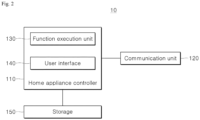
- FIG. 2 is a block diagram schematically illustrating an internal configuration of a dishwasher according to an embodiment of the present disclosure.
- the dishwasher 10 may include a home appliance controller 110, a communication unit 120, a function execution unit 130, a user interface 140, and storage 150.
- each of the communication unit 120 and the user interface 140 correspond to an example of an input unit.
- the input unit receives a course change signal instructing the dishwasher to change a washing course to a low noise-level course having a lower noise-level than a noise-level of the washing course.
- the washing course may include a standard course and a strong course.
- the standard course may include a preliminary wash cycle, a main washing cycle, a rinsing cycle, a heating rinsing cycle, a drying cycle, and the like.
- the communication unit 120 as the input unit receives the course change signal from the user terminal 20.
- the user interface 140 as the input unit receives the course change signal according to a user's touch manipulation.
- a configuration of the dishwasher 10 is not limited to FIG. 2 , and Various additional components may be included in the dishwasher 10.
- the input unit may further include: a voice input unit for receiving a voice signal as the course change signal; the communication unit for receiving the course change signal from the user terminal or the management server through the communication network; and a remote receiver for wirelessly receiving the course change signal from a remote controller.
- a voice input unit for receiving a voice signal as the course change signal
- the communication unit for receiving the course change signal from the user terminal or the management server through the communication network
- a remote receiver for wirelessly receiving the course change signal from a remote controller.
- the communication unit 120, the function execution unit 130, and the user interface 140 may transmit and receive data to and from each other through a local bus.
- the function execution unit 130 executes a washing function including a preliminary washing cycle, a main washing cycle, a rinsing cycle, a heating rinsing cycle, and a drying cycle as a unique function of the dishwasher.
- the function execution unit 130 may include a temperature sensor for detecting a temperature for performing the washing function.
- the preliminary washing cycle refers to a cycle of spraying washing water containing no detergent to the dishes
- the main washing cycle refers to a cycle of injecting detergent into the washing water and spraying the washing water to the dishes.
- the rinsing cycle may include a preliminary rinsing cycle of injecting washing water containing no rinse into the dishes, and a main rinsing cycle of injecting rinse into the washing water and spraying the washing water to the dishes.
- the rinsing cycle may include the heating rinsing cycle.
- the dishes When the washing water is heated and the heated washing water is used to rinse the dishes, the dishes may be heated, and vaporization of water remaining on a surface of the dish may be promoted due to the residual heat of the dishes during a subsequent drying process. That is, the rinsing cycle may be divided into the rinsing cycle performed without heating the washing water and the heating rinsing cycle performed by heating the washing water.
- a water discharge and supply process is performed such that the washing water used for each washing cycle is discharged through a water discharger and the washing water is supplied again through a water supply.
- a start and an end of each washing cycle may be distinguished based on the water discharge and the water supply.
- the washing cycle may be performed a plurality of times.
- An initial time, a middle time, and an end time of each washing cycle may correspond to 1/3 of an entire time duration of each washing cycle.
- a time duration from a timing at which the washing water to be used for each washing cycle is supplied to a timing at which the washing water used for each washing cycle is discharged is divided into three 1/3 time durations which may be allocated to the initial time, the middle time, and the end time of each washing cycle, respectively.
- the home appliance controller 110 may be connected to the communication unit 120 through a local bus, and may control an overall operation for performing a function of the dishwasher 10.
- the home appliance controller 110 may be simply referred to as a "controller 110".
- the home appliance controller 110 may include the storage 150 in which operation control software for controlling at least one washing operation is stored.
- the storage 150 stores therein a speed of a washing motor of a low noise-level course corresponding to each washing cycle of the washing course as data.
- the storage 150 may store therein a washing time duration and a washing water temperature of the low noise-level course corresponding to each washing cycle of the washing course as data.
- the home appliance controller 110 may control each washing cycle based on the operation control software.
- the storage 150 may not be included in the home appliance controller 110 but may be present separately from the home appliance controller 110 or may be embodied as a separate device.
- the home appliance controller 110 may recognize the washing cycle of the washing course and change a current motor speed to a rotation speed of the washing motor of the low noise-level course corresponding to the recognized unit cycle to control the washing cycle of the low noise-level course.
- the home appliance controller 110 may change not only the rotation speed of the washing motor of the low noise-level course but also the washing time duration and the washing water temperature to control the washing cycle of the low noise-level course.
- the home appliance controller 110 may change the washing course to the low noise-level course in a real-time manner, based on the course change signal received at a timing of one of unit cycles including a first cycle, a second cycle, a third cycle, a fourth cycle, and a fifth cycle, and may control the washing cycle by changing the motor speed, the washing time duration, and the temperature.
- the home appliance controller 110 may correspond to a microcomputer (MICOM).
- the home appliance controller 110 may operate based on main firmware.
- the dishwasher 10 may include a plurality of function controllers for controlling each function module of the home appliance based on separate firmware according to a function, that is, a plurality of microcomputer.
- the function controller may include a processor and an internal memory.
- the processor may include one or more of a central processing unit (CPU), an application processor, or a communication processor.
- the processor may operate based on the firmware to execute one or more instructions related to control of the home appliance 10.
- the internal memory may be a volatile and/or nonvolatile memory.
- the internal memory may store firmware therein and may store therein the one or more instructions related to control of the dishwasher 10.
- the communication unit 120 may communicate with the user terminal 20 and the management server 30. That is, the communication unit 120 may communicate with the user terminal 20 and the management server 30 to change a portion of the washing function.
- the communication unit 120 may transmit software information or firmware information to the management server 30, and may receive software data or firmware data to be upgraded from the management server 30.
- the communication unit 120 may receive software data such as firmware data and content program data from the management server 30, store the received software data, and transmit the stored software data to at least one of the home appliance controller 110, the function controller 130, and the user interface 140.
- the communication unit 120 may notify the user interface 140 or App of the user terminal 20 that an upgrade is ready and then may execute the upgrade of the individual function selected by the user interface 140 or the user terminal 20 in the software data.
- the communication unit 120 may output a message indicating that the individual function that has been completely upgraded may be set or used on a screen of a display module of the user interface 140 or through a speaker module thereof in a voice manner.
- the communication unit 120 may include a transmission/reception module, a communication controller, and storage.
- the transmission/reception module may transmit and receive data.
- the transmission/reception module may transmit and receive data in a wired manner and/or a wireless manner.
- the transmission/reception module may be a short-range wireless communication module that implements short-range wireless communication.
- the short-range wireless communication module may be a wireless communication module based on Wireless Fidelity (IPI), Bluetooth, Radio Frequency Identification (RFID), Infrared Data Association (RPCVD), Ultra-Wideband (UWB), ZigBee, or the like.
- the access point 40 may be provided in the user's residential space.
- the access point 40 may be a device that relays wireless communication between the management server 30 and the transmission/reception module.
- the transmission/reception module is the WiFi module
- the access point 40 may be a WiFi router.
- the transmission/reception module may be a long-range wireless communication module for implementing long-range wireless communication.
- the long-range wireless communication module may be a wireless communication module based on Code Division Multiple Access (CDMA), Frequency Division Multiple Access (FDMA), Time Division Multiple Access (TDMA), Orthogonal Frequency Division Multiple Access (OFDMA), Single Carrier Frequency Division Multiple Access (SCFDMA), 5G, or the like.
- CDMA Code Division Multiple Access
- FDMA Frequency Division Multiple Access
- TDMA Time Division Multiple Access
- OFDMA Orthogonal Frequency Division Multiple Access
- SCFDMA Single Carrier Frequency Division Multiple Access
- the communication controller may control the transmission/reception module and the storage.
- the communication controller may correspond to a microcomputer for controlling communication.
- the communication controller may operate based on the firmware.
- the communication controller may store data received from the transmission/reception module, particularly, software data in the storage. Furthermore, the communication controller may transmit the software data stored in the storage to the function execution unit 130 and the user interface 140 through the local bus.
- the communication controller may include a processor and an internal memory.
- the processor may include one or more of a central processing unit (CPU), an application processor, or a communication processor.
- the processor may operate based on the firmware to execute one or more instructions related to control of the dishwasher 10.
- the internal memory may be a volatile and/or nonvolatile memory.
- the internal memory may store therein firmware and may store therein one or more instructions related to control of the communication unit 120.
- the storage may be a volatile and/or nonvolatile memory, and may store therein software data received from the transmission/reception module.
- the function execution unit 130 performs the washing function as a unique function of the dishwasher 10. That is, the function execution unit 130 may be a component performing a unique function provided by the dishwasher 10. In one example, the unique function may include a function of washing and drying dishes.
- the communication unit 120 may communicate with the management server 30 to upgrade a portion or an entirety of the washing function. Furthermore, the communication unit 120 may include the storage for storing therein firmware-related information and software-related information necessary for performing the unique function.
- the function execution unit 130 may include a function execution module and a function controller.
- the function execution module is a module for performing a washing function, and may include, for example, a driver including a motor, a heater, a temperature sensor, and the like.
- the function controller may control the function execution module.
- the function controller may correspond to a microcomputer for controlling the execution of the function.
- the function controller may operate based on the firmware.
- the function controller may include a processor and an internal memory.
- the processor and the internal memory have been described above.
- the firmware of the communication controller, the firmware of the function controller, and the firmware of the interface controller may be different from each other.
- the user interface 140 may provide operation information about the washing function as the unique function of the dishwasher and information related to the upgrade on a screen, using a voice, or the like.
- the user interface 140 may provide operation information of the dishwasher 10, information related to the upgrade of the dishwasher 10, and the like to the user.
- the user interface 140 may include the display module and the speaker module.
- the user interface 140 may receive an input for controlling the operation of the dishwasher 10 from the user.
- the user interface 140 may perform an output of the washing operation information and an input of data.
- the user interface 140 may receive the course change signal instructing the dishwasher to change the standard course of the washing function to the low noise-level course in which the dishwasher operates in a noise-level lower than or equal to a predetermined decibel.
- the user interface 140 may include an input/output module and the interface controller.
- the input/output module may visually and/or audibly output operation information of the dishwasher 10 and information related to the upgrade to the user, and may receive input information.
- the input/output module is the display module
- the user interface 140 may be a display panel.
- the user interface 140 may include a speaker, a buzzer, an LED segment, and the like.
- the interface controller may control the input/output module.
- the interface controller may correspond to a microcomputer for controlling the interface.
- the interface controller may operate based on the firmware.
- the interface controller may include a processor and an internal memory.
- the processor and the internal memory have been described above
- the firmware of the communication controller, the firmware of the function controller, and the firmware of the interface controller may be different from each other.
- An embodiment of the dishwasher 10 for performing notification of software upgrade related to the washing course change according to an embodiment of the present disclosure is as follows.
- the communication unit 120 communicates with the management server 30, and receives software to be installed in the dishwasher 10 from the management server 30.
- the communication controller may install the software.
- the user interface 140 outputs notification information related to the installation of the software.
- the communication unit 120 receives an output instruction message instructing output of the software installation notification from the management server 30, the user interface 140 may output the installation notification under the control of the communication controller.
- the communication unit 120 may receive an installation instruction message instructing installation of software from the management server 30.
- the communication controller may install the software according to the installation instruction message.
- the installation instruction message instructs installing only a portion of the downloaded software
- the communication controller may be configured to install only the portion of the software or allow the only portion thereof to be executed.
- the user interface 140 includes an output interface including at least one of an LED segment, an LCD display, a buzzer, and a speaker, which is attached to the dishwasher 10 to perform visual or audible notification. Furthermore, the user interface 140 includes an input interface including at least one of a button, a touch of the touch screen, a dial, and a slide bar for instructing an operation of the dishwasher 10.
- the installation instruction message may be created from the user terminal 20.
- the communication unit 120 may receive the installation instruction message from the management server 30.
- the user interface 140 may output an installation state of the software so that the user may check the software installation state in a process of installing the software.
- the user interface 140 may display a guide wording, such as "during installation” or “during upgrading", or output a voice guide or an effect sound.
- the dishwasher 10 may receive an instruction message for changing the standard course to the low noise-level course from the user terminal 20. This reception may be performed via the management server 30 or in direct communication with the user terminal 20. Upon receiving the instruction message, the dishwasher 10 performs a task of changing the standard course to the low noise-level course.
- the user interface 140 may output operation information about the unique function of the dishwasher 10.
- the user interface 140 may display operation information about a preliminary washing cycle, a main washing cycle, a rinsing cycle, a heating rinsing cycle, a drying cycle, etc. of the dishwasher 10 on a screen.
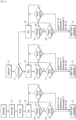
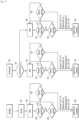
- the home appliance controller 110 may lower a rotation speed of the washing motor to be lower than a speed thereof in the washing course such that the washing course is switched to the low noise-level course in a real-time manner at an initial time point of the preliminary washing cycle and may control a washing cycle of the low noise-level course.
- the home appliance controller 110 may lower a rotation speed of the washing motor to be lower than a speed thereof in the washing course such that the washing course is switched to the low noise-level course in a real-time manner at a timing of one of the initial, middle, and end time durations of the main washing cycle, and may control the washing cycle of the low noise-level course.
- the home appliance controller 110 may lower a rotation speed of the washing motor to be lower than a speed thereof in the washing course such that the washing course is switched to the low noise-level course in a real-time manner at a timing of one of the initial, middle, and end time durations of the rinsing cycle, and may control the washing cycle of the low noise-level course.
- the home appliance controller 110 may lower a rotation speed of the washing motor to be lower than a speed thereof in the washing course such that the washing course is switched to the low noise-level course in a real-time manner at a timing of one of the initial, middle, and end time durations of the heating rinsing cycle, and may control the washing cycle of the low noise-level course.
- the home appliance controller 110 may control the washing cycle of the low noise-level course not only by lowering the rotation speed of the washing motor to be lower than that in the washing course but also by changing the washing time duration and the washing water temperature of the low noise-level course.
- the home appliance controller 110 may control the washing time duration of the low noise-level course to be three to five times of a washing time duration of the washing course.
- a time duration of a rinsing cycle of the low noise-level course may be exceptionally five times or greater of a time duration of a rinsing cycle of the washing course.
- the home appliance controller 110 may control the washing water temperature of the low noise-level course to be increased by 10% to 15%, compared to the washing water temperature of the washing course.
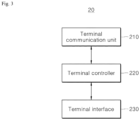
- FIG. 3 is a block diagram schematically illustrating an internal configuration of a user terminal according to an embodiment of the present disclosure.
- the user terminal 20 may be referred to as a client device or the like.
- the user terminal 20 may include a terminal communication unit 210, a terminal controller 220, and a terminal interface 230.
- the user terminal 20 may further include terminal storage.
- the terminal communication unit 210 may communicate with the management server 30.
- the terminal communication unit 210 may perform communication in a wired manner and/or a wireless manner.
- the wireless manner may include a short-range wireless communication manner and a long-range wireless communication manner.
- the terminal controller 220 may control the terminal communication unit 210 and the terminal interface 230.
- the terminal controller 220 may include a processor and an internal memory.
- the internal memory may store therein a terminal application ThinQ App for managing the dishwasher 10.
- the processor may execute the terminal application.
- the terminal interface 230 may output an execution screen of the terminal application.
- the terminal interface 230 may visually and/or audibly output information related to a washing operation instruction input or an upgrade of the dishwasher 10.
- the terminal communication unit 210 may transmit and receive a message to and from the management server 30. Then, the terminal communication unit 210 receives a notification message notifying that the software upgrade the dishwasher 10 linked to the user terminal 20 is ready from the management server 30. The terminal communication unit 210 transmits an upgrade request message for requesting installation of the software to the management server 30 in response to input through the terminal interface 230.
- the terminal communication unit 210 may receive, from the management server 30, at least one of a control instruction message or an upgrade function setting message for instructing the user terminal 20 to control the dishwasher 10 or to set the upgrade function to be adapted to the operation state of the dishwasher 10. Furthermore, the terminal interface 230 may output an interface corresponding to the control instruction message or the upgrade function setting message.
- the terminal communication unit 210 may transmit, to the dishwasher 10 or the management server 30, an instruction message instructing the dishwasher 10 to change the standard course of the washing function to the low noise-level course in which the dishwasher operates in a noise-level lower than or equal to a predetermined decibel in response to an input through the terminal interface 230 under the user's manipulation.
- the predetermined decibel (dB) may be a value lowered by 4 decibels (dB) or greater from the decibel (dB) of the noise-level of the standard course.
- FIG. 4 is a block diagram schematically illustrating an internal configuration of a management server according to an embodiment of the present disclosure.
- the management server 30 may be referred to as a 'server'.
- the management server 30 may include a server communication unit 310, a server controller 320, and server storage 333.
- the server communication unit 310 may communicate with the dishwasher 10 and the user terminal 20.
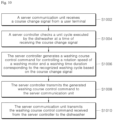
- the server communication unit 310 may receive the washing course control command from the server controller 320 and transmit the washing course control command to the dishwasher 10.
- the server communication unit 310 may perform communication in a wired manner and/or a wireless manner.
- the wireless method may include a short-range wireless communication manner and a long-range wireless communication manner.
- the server controller 320 may control a server communication unit 310 and server storage 330.
- the server controller 320 may be simply referred to as a "controller 320".
- the server controller 320 may generate the washing course control command corresponding to the course change signal and transmit the washing course control command to the dishwasher 10. That is, the server controller 320 may identify the washing cycle executed by the dishwasher 10 at a time when the dishwasher receives the course change signal, generate the washing course control command for controlling the rotation speed of the washing motor, the washing time duration, and the washing water temperature corresponding to the identified washing cycle based on the course change signal, and transmit the washing course control command to the dishwasher 10.
- the course change signal may include a message for requesting the dishwasher 10 to change the current course of the dishwasher 10 in a real-time manner to the low noise-level course in which an output noise-level of the dishwasher 10 is lowered to a value lower than or equal to the predetermined decibel while the dishwasher is operating in one of a preliminary washing cycle, a main washing cycle, a rinsing cycle, a heating rinsing cycle, and a drying cycle.
- the server controller 320 may receive the course change signal from the user terminal 20 through the server communication unit 310 during one of a preliminary washing cycle, a main washing cycle, a rinsing cycle, a heating rinsing cycle, and a drying cycle of the dishwasher 10.
- the server controller 320 may generate a washing course control command for changing, in a real-time manner, the standard course to the low noise-level course at one of the initial, middle, and end timings of the main washing cycle and transmit the washing course control command to the dishwasher 10.
- the server controller 320 may generate a washing course control command for changing, in a real-time manner, the standard course to the low noise-level course at one of the initial, middle, and end timings of the rinsing cycle and transmit the washing course control command to the dishwasher 10.
- the server controller 320 may generate a washing course control command for changing the standard course to the low noise-level course in a real-time manner at one of the initial, middle, and end timings of the heating rinsing cycle and transmit the washing course control command to the dishwasher 10.
- the server controller 320 may generate a washing course control command for changing the standard course to the low noise-level course in a real-time manner and changing the rotation speed of the washing motor, the washing time duration, and the washing water temperature in a real-time manner at an initial time point of the preliminary washing cycle, and transmit the generated washing course control command to the dishwasher 10.
- the server controller 320 may generate a washing course control command for changing the standard course to the low noise-level course in a real-time manner and changing the rotation speed of the washing motor, the washing time duration, and the washing water temperature and transmit the generated washing course control command to the dishwasher 10.
- the server controller 320 may include a processor and an internal memory.
- the internal memory may store therein a server application for managing the dishwasher 10.
- the processor may execute the server application.
- a customized course setting logic for generating a washing course control command corresponding to the course change signal received from the user terminal 20 is stored as program data in the server storage 330.
- the server storage 330 may be a volatile and/or non-volatile memory, may be implemented in a form of database (DB), and may store therein upgrade-related information of the dishwasher 10.
- the upgrade-related information may include software data installed in the dishwasher 10, information related to the dishwasher 10, user-related information, and the like.
- the software data may include firmware data and content program data of the dishwasher 10.
- each of Various versions of each of the firmware data and the content program data may be stored in the server storage 330.
- the latest version of each of the firmware data and the content program data may be stored in the server storage 330.
- the dishwasher 10 may include a plurality of controllers (microcomputer).
- the respective firmware of the plurality of controllers may be different from each other.
- the server storage 330 may store therein firmware data of each of the plurality of controllers of the dishwasher 10.
- the server communication unit 310 transmits software to be installed in the dishwasher 10 to the dishwasher 10, and transmits and receives messages to and from the dishwasher 10 and the user terminal 20.
- the server controller 320 may receive new software data through an upgrade management webpage. That is, a manager may upload the software data used to upgrade the dishwasher 10 to the upgrade management webpage.
- the server controller 320 may automatically download the uploaded software data to the dishwasher 10.
- the server controller 320 generates an output instruction message instructing output of the installation notification message of the software to the dishwasher 10. Furthermore, the server controller 320 controls the server communication unit 310 to transmit the output command message.
- the server communication unit 310 may transmit a message indicating that the software is ready to be upgraded to the user terminal 20 linked to the dishwasher 10 and receive an upgrade request message for requesting the installation of the software from the user terminal 20.
- the server communication unit 310 may transmit a software installation instruction message to the dishwasher 10 in response to the upgrade request message, and then receive an installation completion message from the dishwasher 10.
- the server controller 320 may check an operation state of the dishwasher 10.
- the server controller 320 may check a status message periodically transmitted by the dishwasher 10 or check whether a communication state with the dishwasher 10 is maintained, and display the operation state thereof.
- the server communication unit 310 may transmit, to the user terminal 20, at least one of a control instruction message or an upgrade function setting message for instructing the user terminal 20 to control the dishwasher 10 or to set the upgrade function to be adapted to the operation state of the dishwasher 10.
- the server controller 320 may manage software (SW) of an individual module using a microcomputer (MICOM) constituting the home appliance and a system structure.
- SW software
- MICOM microcomputer
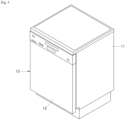
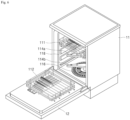
- FIG. 5 is a perspective view illustrating an outer appearance of a dishwasher according to an embodiment of the present disclosure.
- FIG. 6 is a perspective view illustrating a state in which a door of a dishwasher according to an embodiment of the present disclosure is opened.
- FIG. 7 is a flowchart illustrating a step-by-step cycle operation sequence of a dishwasher according to an embodiment of the present disclosure.
- FIG. 8 is a configuration diagram illustrating a controller and a functional block of a dishwasher according to an embodiment of the present disclosure.
- the dishwasher 10 includes a casing 11 having an open front, and a door 12 which seals the open front of the casing 11. While the casing 11 and the front door 12 of the dishwasher 10 seal an inner space thereof, the washing water or detergent does not escape to an outside of the dishwasher.
- the dishwasher 10 may include a tub 108 in which the washing water is received, a sump 106 disposed under the tub and constructed to collect the washing water and to filter foreign substances, a nozzle 104 rotatably connected to the sump and configured to spray the washing water into the tub, and a rack 101 and 102 positioned in an inner space of the tub and including upper and lower racks to receive a plurality of dishes thereon.
- the tub 108 in which the washing water is received is disposed inside the casing 11 of the dishwasher 10, and the sump 106 is disposed under the tub so that the washing water is collected into the sump.
- the sump filters the foreign matter from the washing water and provides the filtered washing water to the nozzle.
- An inner space of the dishwasher 10 configured as described above may be referred to as a 'washing chamber'.
- the washing chamber performs an operation of collecting the washing water and spraying the washing water to the dishes to remove the contaminants from the dishes according to a washing cycle of the washing course or the low-noise course.
- the inner space of the dishwasher 10 as described above may be referred to as the 'function execution unit 130'.
- the tub 108 accommodates therein a plurality of racks 101 and 102 vertically arranged so as to be spaced from each other, and the nozzle 104 for spraying the washing water toward each of the racks 101 and 102.
- a washing water channel 109 for supplying the washing water to each of an upper nozzle 104a and a top nozzle 104c is provided at one side of the inner space of the tub 108.
- an optical sensor may be provided inside the tub 108.
- the optical sensor may be a thermal imaging camera or a temperature measurement device.
- the present disclosure is not limited thereto, and the optical sensor may include all devices capable of measuring a temperature of an object without contact with the object based on a sensing result of infrared rays radiated from the object.
- the optical sensor is embodied as the thermal imaging camera will be described.
- a plurality of thermal imaging cameras 111 may be provided in the tub 108. That is, the thermal imaging camera 111 for photographing the dishes accommodated in the upper rack 101 may be positioned on top of the upper rack 101, and the thermal imaging camera 111 for photographing the dishes accommodated in the lower rack 102 may be positioned at a position between the lower rack 102 and the upper rack 101.
- the thermal imaging camera 111 may be provided at one side of the inner space of the tub 108. That is, the thermal imaging camera 111 may be disposed in a groove formed in an inner side surface of the tub. The groove may be blocked with a shielding film coplanar with the inner side surface of the tub.
- the shielding film may be made of a transparent material such as glass or plastic such that the thermal imaging camera 111 disposed in the groove may capture the image of the inside of the tub.
- the thermal imaging camera 111 is disposed in the groove, thereby reducing a possibility that the camera is physically damaged by the dish washing operation of the dishwasher 10. Furthermore, the groove may be blocked with the shielding film coplanar with the inner side surface of the tub 108 so as to protect the camera and to prevent foreign substances from being deposited on a camera lens.
- the thermal imaging camera 111 may be provided on an inner side surface of the door 12. That is, the thermal image camera 111 may be disposed inside a groove formed in the inner side surface of the door 12. The groove formed in the inner side surface of the door 12 may be blocked with a shielding film coplanar with the inner side surface of the door 12.
- the plurality of thermal imaging cameras 111 may be disposed on the inner side surfaces of the door 12 and the tub 108 and may capture the images of the dishes at Various angles. Accordingly, the dishwasher 10 may generate Various thermal images, and furthermore, may calculate an accurate temperature value and emissivity and perform a customized cycle based on the types of dishes identified based on the calculation result.
- the home appliance controller 110 sequentially performs the cycles related to washing of the dishes according to a preset order and controls the operation of the dishwasher 10.
- the thermal imaging camera 111 photographs a first thermal image and a second thermal image at different timings
- the home appliance controller 110 stores the captured first thermal image and second thermal image in image storage 113.
- the home appliance controller 110 may calculate a first temperature value and a second temperature value based on the first thermal image and the second thermal image using a temperature calculator 114, respectively.
- the thermal image may be obtained based on a detecting result of infrared rays radiated from the dishes. In the thermal image, a temperature distribution of the dishes is visually displayed so that different temperatures are expressed in different colors.
- the dishes on the thermal image may be expressed in colors varying depending on a temperature, for example, from a low temperature corresponding to a blue color to a high temperature corresponding to a red color in a gradation manner.
- the temperature inside the tub gradually rises while the washing cycle is performed. Accordingly, the heat generated from the dishes is changed over time, such that the first temperature value and the second temperature value have different values.
- a first cycle is performed and terminated.
- the home appliance controller 110 may calculate the first temperature value of the dishes accommodated in the rack. Then, the home appliance controller 110 performs a second cycle, and then calculates the second temperature value of the dishes accommodated in the racks 101 and 102 when the second cycle ends. Then, the home appliance controller 110 calculates the emissivity of the dishes accommodated in the racks 101 and 102 based on the first temperature value and the second temperature value, and determines a third cycle based on the emissivity.
- the first thermal image may be a thermal image generated after the first cycle starts and then five minutes has elapsed.
- the second thermal image may be a thermal image generated after the second cycle ends (after the first cycle starts and then 15 minutes has elapsed).
- the second thermal image includes a larger number of pixels emitting red light than that of the first thermal image.
- the second temperature value calculated from the second thermal image has a value higher than the first temperature value calculated from the first thermal image. That is, the first and second temperature values have different values.
- the first temperature value may be calculated from the first thermal image acquired through the optical sensor after the first cycle has been terminated.
- the second temperature value may be calculated from the second thermal image acquired through the optical sensor after the second cycle has been terminated.
- the home appliance controller 110 may extract a temperature value from a color value of light emitted from each of pixels respectively emitting light beams of different colors in the thermal image using the temperature calculator 114.
- the home appliance controller 110 may use a predetermined color model to extract the temperature value from the color value.
- the color model may be one of RGB, CMYK, HSV, HSL, or HEX.
- the present disclosure is not limited thereto, and the color model may include all color models used as a scheme of expressing a color in a digital manner.
- the color value may be a preset value pre-assigned to each of colors used in the predetermined color model.
- the home appliance controller 110 may preset a temperature value corresponding to each color value, and may calculate a temperature value from a color value of light emitted from each of pixels respectively emitting light beams of different colors in the thermal image.
- the first temperature value may be an average value of the temperature values of the pixels of a dish area in the first thermal image
- the second temperature value may be an average value of the temperature values of the pixels of the dish area in the second thermal image.
- the first thermal image may include a plurality of first thermal images and the second thermal image may include a plurality of second thermal images.
- the home appliance controller 110 may respectively extract the first temperature values from the plurality of first thermal images. When all of the extracted first temperature values are equal to each other, the home appliance controller 110 may select a temperature value having the highest occurrence among the extracted first temperature values as the first temperature value.
- the home appliance controller 110 may respectively extract the second temperature values from the plurality of second thermal images. When all of the extracted second temperature values are equal to each other, the home appliance controller 110 may select a temperature value having the highest occurrence among the extracted second temperature values as the second temperature value.
- the home appliance controller 110 may respectively extract the first temperature values from the plurality of first thermal images. When all of the extracted first temperature values are equal to each other, the home appliance controller 110 may select an average value of the extracted first temperature values as the first temperature value. Similarly, using the temperature calculator 114, the home appliance controller 110 may respectively extract the second temperature values from the plurality of second thermal images. When all of the extracted second temperature values are equal to each other, the home appliance controller 110 may select an average value of the extracted second temperature values as the second temperature value.
- the home appliance controller 110 may calculate an accurate temperature value by extracting the first temperature value and the second temperature value from the plurality of first thermal images and the plurality of second thermal images, respectively, and thus may calculate an accurate emissivity and perform a customized cycle based on the types of dishes determined based on the calculated emissivity.
- the emissivity has a value between 0 and 1.
- the emissivity may have a predetermined value based on the type of each of the dishes and a material of each of the dishes. Thus, the emissivity of the different dishes may be different from each other.
- a glass material may have an emissivity of 0.92
- a wood material may have an emissivity of 0.90
- a plastic material may have an emissivity of 0.84
- a stainless steel material may have an emissivity of 0.59
- a stainless thick plate material has an emissivity of 0.34.
- the dishes accommodated in the racks 101 and 102 may receive therein not only dishes of a single material type but also dishes of at least two material types.
- a total emissivity may vary depending on the emissivity of each of the accommodated dishes and the number or a volume of the accommodated dishes.
- the home appliance controller 110 may calculate the emissivity of the dishes based on the first temperature value and the second temperature value using an emissivity calculator 115, and may determine the material type of the dish having the largest number or volume among the dishes accommodated in the racks 101 and 102, based on the calculated emissivity. Accordingly, the home appliance controller 110 may perform the third cycle based on the determined type of the dish.
- the home appliance controller 110 may determine the third cycle using a cycle determination unit 116.
- the third cycle may include a basic cycle, an additional drying cycle, and an additional rinsing cycle, and the cycle determination unit 116 may select one of the cycles and may determine the selected one as a cycle to be performed in a next step.
- the home appliance controller 110 may perform the additional drying cycle using a drying device 112.
- the home appliance controller 110 may control a washing motor 107 located under the tub 108, and may spray the washing water into the tub through a lower nozzle 104b connected to the sump 106 and the upper nozzle 104a and the top nozzle 104c connected to the washing water channel 109 to perform the additional rinsing cycle.
- FIG. 7 is a flowchart illustrating a step-by-step cycle operation sequence of a dishwasher according to an embodiment of the present disclosure.
- the dishwasher 10 may perform the preliminary washing S101 in a first cycle. While performing the preliminary washing cycle S101, the detergent does not flow downwardly in the tub, and thus the food waste having a larger volume among the Various food wastes attached to the dishes is first removed therefrom using only the washing water without the detergent.
- the dishwasher 10 When the preliminary washing cycle S101 has been completed, the dishwasher 10 performs the main washing cycle S103.
- the dishwasher 10 performs the main washing cycle S103 on the dishes using only the washing water without the detergent, oil stains deposited on the dishes are not removed therefrom well.
- the detergent is used such that the oil stains deposited on the dishes are removed therefrom well.
- the dishwasher 10 discharges the used washing water to the outside through the sump 106, and performs the rinsing cycle S105 by supplying new washing water into the tub.
- the dishwasher 10 performs the heating rinsing cycle S107 using the heated washing water at a high temperature, thereby increasing the temperature of the surface of the dishes to easily evaporate the moisture on the surface of the dishes in a short time.
- the dishwasher 10 performs the drying cycle S109 to dry the dishes. In this way, all the steps necessary for dishwashing have been terminated.
- FIG. 9 is a view illustrating a basic concept of changing a washing course according to an embodiment of the present disclosure.
- a basic operation for changing the washing course include first transmitting, by the user terminal 20, a standard course command of the washing cycle to the dishwasher 10 via activation of the terminal application ThinQ App.
- the standard course command transmitted from the user terminal 20 may be directly transmitted to the dishwasher 10 in a wireless manner, or may be transmitted to the dishwasher 10 via the management server 30.
- the dishwasher 10 performs the washing cycle in a standard course in response to to a standard course command.
- the dishwasher may perform one of the preliminary washing cycle S101, the main washing cycle S103, the rinsing cycle S105, the heating rinsing cycle S107, and the drying cycle S109 as described above.
- washing noise of a level of, for example, 45 to 55 decibels (dB) which is uncomfortable for human ears may be generated from the dishwasher 10.
- the washing noise generated from the dishwasher 10 may interfere with the user watching TV in the living room.
- the dishwasher 10 may be configured to receive the course change signal and, in response thereto, change the current course from the washing course having the washing noise-level of 45 to 55 decibels (dB) to the low noise-level course having a noise-level lower by, for example, 4 decibels (dB) than that of the washing course, and operate in the changed low noise-level course.
- the dishwasher 10 may be configured to receive the course change signal and, in response thereto, change the current course from the washing course having the washing noise-level of 45 to 55 decibels (dB) to the low noise-level course having a noise-level lower by, for example, 4 decibels (dB) than that of the washing course, and operate in the changed low noise-level course.
- the user checks the current washing course of the dishwasher 10 through the terminal application ThinQ App of the user terminal 20, and executes the change of the current washing course to the low noise-level course according to a washing course control method according to an embodiment of the present disclosure.
- the user terminal 20 may change an operation mode, for example, from a standard course 01: 00 hour operation to a low noise-level course 01: 40 hours operation in response to to the user's manipulation on the user terminal.
- the dishwasher performs the washing cycle such that the noise-level according to the operation of the dishwasher 10 is changed to 41 to 51 decibels (dB) lower by, for example, 4 decibels (dB) than 45 to 55 decibels (dB) of the standard course.
- FIG. 10 is a flowchart illustrating a method of controlling, by a management server, a washing course according to an embodiment of the present disclosure.
- the server communication unit 310 of the management server 30 receives the course change signal from the user terminal 20 in S1002.
- the server controller 320 checks the washing cycle executed by the dishwasher 10 at the time of receiving the course change signal in S1004.
- the dishwasher 10 transmits packet data related to the operation state to the management server 30 at a regular interval.
- the management server 30 recognizes a current operation state of the dishwasher 10 based on the operation state-related packet data received from the dishwasher 10. Accordingly, the management server 30 recognizes a unit cycle of the washing cycle of the dishwasher 10 at the time when the management server 30 receives the course change signal from the user terminal 20.
- the server controller 320 transmits the generated washing course control command to the server communication unit 310 in S1008.
- the server communication unit 310 transmits the washing course control command received from the server controller 320 to the dishwasher 10 in S1010.
- the server controller 320 may generate a washing course control command for changing the standard course of the preliminary washing cycle to the low noise-level course of the preliminary washing cycle in which a noise-level is lowered by 3.7 to 4.0 decibels (dB) compared to the noise-level generated from the standard course of the preliminary washing cycle in a real-time manner in S1006.
- dB decibels
- an amount by which the noise-level in the low noise-level course of each of the unit cycles is lowered relative to the noise-level in the standard course of each of the unit cycles is pre-stored as data in the server storage 330.
- the dishwasher 10 pre-stores the amount by which the noise-level in the low noise-level course of each of the unit cycles is lowered relative to the noise-level in the standard course of each of the unit cycles in the storage 150, wherein the amount pre-stored in the storage 150 of the dishwasher 10 and the amount pre-stored in the server storage 330 of the management server 30 are identical with each other.
- the noise reduction amount in each unit cycle may be as follows: 3.7 to 4.0 decibels (dB) in the preliminary washing cycle, 3.6 to 5.0 decibel (dB) in the main washing cycle, 3.9 decibels (dB) or greater in the rinsing cycle, and 3.0 to 4.2 decibels (dB) in the heating rinsing cycle.
- the server controller 320 of the management server 30 generates the washing course control command such that the noise reduction amount corresponding to the recognized preliminary washing cycle of the dishwasher 10 is in a range of 3.7 to 4.0 decibels (dB), based on the noise reduction amount stored in the server storage 330.
- the major cause of the noise in the dishwasher 10 is a rotation speed (RPM) of the washing motor for performing the washing cycle. Therefore, the dishwasher 10 lowers the rotation speed of the washing motor such that the noise reduction amount becomes 3.7 to 4.0 decibels (dB) during the preliminary washing cycle, based on the noise reduction amount stored in the storage 150, in response to the washing course control command received from the management server 30.
- RPM rotation speed
- dB decibels
- the server controller 320 may generate a washing course control command for changing the standard course of the main washing cycle to the low noise-level course of the main washing cycle in which a noise-level is lowered by 3.6 to 5.0 decibels (dB) compared to the noise-level generated from the standard course of the main washing cycle in a real-time manner in S1006.
- the server controller 320 generates the washing course control command such that the noise reduction amount corresponding to the recognized main washing cycle of the dishwasher 10 is in a range of 3.6 to 5.0 decibels (dB), based on the noise reduction amount stored in the server storage 330.
- the dishwasher 10 lowers the rotation speed of the washing motor such that the noise reduction amount becomes 3.6 to 5.0 decibels (dB) during the main washing cycle, based on the noise reduction amount stored in the storage 150, in response to the washing course control command received from the management server 30.
- the server controller 320 may generate a washing course control command for changing the standard course of the rinsing cycle to the low noise-level course of the rinsing cycle in which a noise-level is lowered by 3.9 decibels (dB) or greater compared to the noise-level generated from the standard course of the rinsing cycle in a real-time manner in S1006.
- dB decibels
- the server controller 320 generates the washing course control command such that the noise reduction amount corresponding to the recognized rinsing cycle of the dishwasher 10 is in a range of 3.9 decibels (dB) or greater, based on the noise reduction amount stored in the server storage 330.
- the dishwasher 10 lowers the rotation speed of the washing motor such that the noise reduction amount becomes 3.9 decibels (dB) or greater during the rinsing cycle, based on the noise reduction amount stored in the storage 150, in response to the washing course control command received from the management server 30.
- dB decibels
- the server controller 320 may generate a washing course control command for changing the standard course of the heating rinsing cycle to the low noise-level course of the heating rinsing cycle in which a noise-level is lowered by 3.0 to 4.2 decibels (dB) compared to the noise-level generated from the standard course of the heating rinsing cycle in a real-time manner in S1006.
- dB decibels
- the server controller 320 generates the washing course control command such that the noise reduction amount corresponding to the recognized heating rinsing cycle of the dishwasher 10 is in a range of 3.0 to 4.2 decibels (dB), based on the noise reduction amount stored in the server storage 330.
- the dishwasher 10 lowers the rotation speed of the washing motor such that the noise reduction amount becomes 3.0 to 4.2 decibels (dB) during the heating rinsing cycle, based on the noise reduction amount stored in the storage 150, in response to the washing course control command received from the management server 30.
- FIG. 11 is a diagram illustrating an example of a course change time point in each unit cycle in a dishwasher according to an embodiment of the present disclosure.
- the dishwasher 10 when the standard course is changed to the low-noise course during each of unit cycles including preliminary washing, main washing 1, main washing 2, rinsing, heating rinsing 1, and heating rinsing 2, the dishwasher 10 according to an embodiment of the present disclosure may optimize a timing of each of unit cycles according to a cycle timing optimization logic in a real-time manner.
- the cycle timing optimization logic applies compensation at a beginning of a changed cycle so that the washing performance is maintained.
- TABLE 1 Number Course change timing Compensation application start timing 1 Main washing 1 (initial/middle/end timing) Start timing of changed cycle in each unit cycle 2 Main washing 2 (initial/middle/end timing) 3 Rinsing (initial/middle/end timing) 4 Heating rinsing 1 (initial/middle/end timing) 5 Heating rinsing 1 (initial/middle/end timing)
- a timing at which the dishwasher 10 starts to apply a compensation operation according to the real-time change to the low noise-level course may be the start time point of the main washing 1 cycle as the start time point of the changed cycle in each unit cycle (1). That is, the dishwasher 10 may set the compensation application start timing to the initial time point of the changed cycle. In this regard, the dishwasher 10 operates in the compensated manner during a period from the compensation application start timing to a cycle end timing.
- a timing at which the dishwasher 10 starts to apply a compensation operation according to the real-time change to the low noise-level course may be the start time point of the main washing 2 cycle as the start time point of the changed cycle in each unit cycle (2).
- the dishwasher 10 may apply the compensation operation according to the real-time change to the low noise-level course to the rinsing cycle (3).
- a timing at which the dishwasher 10 starts applying the compensation operation according to the real-time change to the low noise-level course may be the mid-time point of the heating rinsing 1 cycle (4).
- a timing at which the dishwasher 10 starts applying the compensation operation according to the real-time change to the low noise-level course may be the initial time point of the heating rinsing 2 cycle (5).
- the dishwasher 10 may change an adjustment target parameter of the washing motor at the real-time change time point of the standard course to the low noise-level course.
- the parameter may include the RPM of the washing motor, the washing time duration, the washing water temperature, Vario, etc.
- RPM represents rotation per minute of the washing motor.
- the dishwasher 10 may include the washing motor for operating a washing pump, a drain motor for operating a drain pump, and a Vario motor for switching a flow path of a Vario valve.
- the dishwasher 10 according to the present disclosure controls the rotation speed of the washing motor as the greatest noise causing cause. That is, when the RPM of the washing motor is very low, the dishwasher 10 according to an embodiment of the present disclosure may very easily implement the low noise-level course. However, the dishwasher 10 according to an embodiment of the present disclosure should be able to exhibit the minimum washing performance.
- the minimum washing performance may correspond to the minimum RPM of the washing motor at which a spraying pressure of the washing water from the nozzle 104 into the tub 108 is capable of rotating a spray.
- the washing time duration and the washing water temperature may be increased to satisfy the washing performance.
- the Vario represents change at a position of the spray nozzle spraying the washing water.
- the spray nozzle includes a top nozzle T, an upper nozzle U, and a lower nozzle L which are connected to a Vario valve via connection pipes.
- the top nozzle sprays the washing water vertically downwardly, and the upper nozzle sprays the washing water vertically upwardly, thereby washing dishes accommodated in the upper rack.
- the lower nozzle sprays the washing water upwardly in the vertical direction such that the dishes accommodated in the lower rack are washed. Therefore, the dishwasher 10 may control the Vario valve via the Vario motor to adjust the position of the spray nozzle spraying the washing water and the sprayed water amount from the spray nozzle.
- the dishwasher 10 may perform a preliminary washing (PRE1) cycle for 2 minutes, and may change the RPM of the washing motor corresponding to the lower nozzle (L) to 1620 RPM to 1980 RPM, change the RPM of the washing motor corresponding to the upper nozzle (U) to 1530 RPM to 1870 RPM, and change the RPM of the washing motor corresponding to the top nozzle (L) to 1980 RPM to 2380 RPM at the initial time point of the preliminary washing cycle at which the course change signal is received.
- PRE1 preliminary washing
- a connection relationship between the Vario valve and the upper, lower and top nozzles in the low noise-level course may be controlled to be different from that in the washing course.
- the home appliance controller 110 may change the washing time duration from 50 seconds to 70 seconds of the washing course to 1240 seconds to 1510 seconds of the low noise-level course at the initial timing of the preliminary washing cycle, change a heated water-based washing time duration from 54 seconds to 66 seconds of the washing course to 1240 seconds to 1510 seconds of the low noise-level course, and change the washing water temperature from 50°C to 60°C of the washing course to 57°C to 70°C of the low noise-level course.
- the dishwasher 10 may apply the same change setting in the preliminary washing cycle as described above to the main washing 1 (Main1) cycle when the washing course is changed to the low noise-level course during the main washing 1 (Main1) cycle.
- the dishwasher 10 may perform the main washing 1 (Main1) cycle for 9 minutes and then may perform a bubble detection operation for, for example, 30 seconds.
- the dishwasher 10 may perform the bubble detection operation for, for example, 30 seconds and then perform the main washing 2 (Main2) cycle, for example, for 10 minutes, and may apply the same change setting in the main washing 1 cycle as described above to the main washing 2 (Main2) cycle when the washing course is changed to the low noise-level course during the main washing 2 (Main2) cycle.
- the Vario change may be performed in the same manner as the Vario change in the preliminary washing cycle.
- the home appliance controller 110 may change the washing time duration, the heated water-based washing time duration, and the washing water temperature in the same manner as in the main washing 1 cycle.
- the dishwasher 10 may perform the rinsing cycle (Rinse1) for 1 minute, and may change the RPM of the washing motor corresponding to the lower nozzle (L) to 1620 RPM to 1980 RPM, change the RPM of the washing motor corresponding to the upper nozzle (U) to 1530 RPM to 1870 RPM, and change the RPM of the washing motor corresponding to the top nozzle (L) to 1980 RPM to 2380 RPM at the initial time point of the rinsing cycle at which the course change signal indicating the change to the low noise-level course is received.
- Rinse1 rinsing cycle
- the dishwasher 10 may perform a heating rinsing 3 (H_Rinse3) cycle for 6 minutes, and change the washing time duration from 50 seconds to 70 seconds of the washing course to 1240 seconds to 1510 seconds of the low noise-level course, and change the connection relationship between the Vario valve and the upper, lower and top nozzles in the low noise-level course to be different from that in the washing course, at the initial time point of the heating rinsing cycle 3 at which the course change signal indicating the change to the low noise-level course is received.
- H_Rinse3 heating rinsing 3
- the dishwasher 10 may perform a heating rinsing cycle 4 (H_Rinse4) for, for example, for 4 minutes or 1 minute, and may apply the same change setting in the heating rinsing 3 (H_Rinse3) cycle as described above to the heating rinsing cycle 4 (H_Rinse4) when the washing course is changed to the low noise-level course during the heating rinsing cycle 4 (H_Rinse4).
- the dishwasher 10 may perform a heating rinsing 5 (H_Rinse5) cycle, for example, for 1 minute after the heating rinsing 4 (H_Rinse4) cycle.
- FIG. 12 is a flowchart illustrating a method of controlling a washing course of a dishwasher according to an embodiment of the present disclosure.
- the function execution unit 130 of the dishwasher 10 performs a washing course in S1202.
- the function execution unit 130 may perform one of a preliminary washing cycle, a main washing cycle, a rinsing cycle, and a heating rinsing cycle.
- the input unit 120 and 140 receives the course change signal instructing the dishwasher to change the washing course to the low noise-level course having a lower noise-level than a noise-level of the washing course in S1204.
- the communication unit 120 may receive the course change signal from the user terminal 20 or receive the washing course control command from the management server 30.
- course change signal may be input from the user interface 140 according to a user's menu selection manipulation.
- the home appliance controller 110 recognizes the unit cycle of the washing course currently performed in the dishwasher 10 in S1206.
- the home appliance controller 110 may recognize one of a preliminary washing cycle, a main washing cycle, a rinsing cycle, and a heating rinsing cycle as the unit cycle of the washing course currently performed in the dishwasher 10.
- the home appliance controller 110 changes the current rotation speed of the washing motor to the rotation speed of the washing motor corresponding to the low noise-level course of the recognized unit cycle to control the unit cycle of the low noise-level course in S1208.
- the home appliance controller 110 may control the rotation speed of the washing motor in the low noise-level course to be lower than that in the washing course to control the unit cycle of the low noise-level course.
- the home appliance controller 110 may change the washing time duration of the low noise-level course or the washing water temperature of the low noise-level course to control the unit cycle of the low noise-level course.
- the home appliance controller 110 may change the RPM of the washing motor corresponding to the lower nozzle (L) from the lower 1800 to 2600 RPM of the washing course to 1620 RPM to 1980 RPM of the low noise-level course, and change the RPM of the washing motor corresponding to the upper nozzle (U) from 2500 to 2600 RPM of the washing course to 1530 RPM to 1870 RPM of the low noise-level course, and may change the RPM of the washing motor corresponding to the top nozzle (T) from 2200 RPM to 2380 RPM of the washing course to 2200 to 2500 RPM of the low noise-level course at the initial timing of the preliminary washing cycle or the main washing cycle at which the course change signal is received. That is, the home appliance controller 110 may control the rotation speed of the washing motor in the low noise-level course to be lower by 10 to 40% than the rotation speed of the washing motor in the washing course.
- the home appliance controller 110 may change the washing time duration from 50 seconds to 70 seconds of the washing course to 1240 seconds to 1510 seconds of the low noise-level course, change the heated water-based washing time duration from 54 seconds to 66 seconds of the washing course to 1240 seconds to 1510 seconds of the low noise-level course, or change the washing water temperature from 50°C to 60°C of the washing course to 57°C to 70°C of the low noise-level course, or change the connection relationship between the Vario valve and the upper, lower and top nozzles in the low noise-level course to be different from that in the washing course.
- the home appliance controller 110 may change the RPM of the washing motor corresponding to the lower nozzle (L) to 1620 RPM to 1980 rpm, change the RPM of the washing motor corresponding to the upper nozzle (U) to 1530 RPM to 1870 rpm, and change the RPM of the washing motor corresponding to the top nozzle (T) to 1980 RPM to 2380 rpm, at the initial time point of the rinsing cycle or the heating rinsing cycle at which the course change signal instructing the change to the low low noise-level course is received.
- the home appliance controller 110 may change the washing time duration from 50 seconds to 70 seconds of the washing course to 1240 seconds to 1510 seconds of the low noise-level course or change the connection relationship between the Vario valve and the upper, lower and top nozzles in the low noise-level course to be different from that in the washing course.
- data about a washing performance score of each unit cycle calculated based on an internal test standard method may be stored in the storage 150 of the dishwasher 10. Accordingly, the management server 30 may generate the washing course control command including the washing performance score corresponding to the currently recognized unit cycle of the dishwasher 10 based on the washing performance score stored in the server storage 330 and transmit the washing course control command to the dishwasher 10.
- the home appliance controller 110 may change the washing performance score from the washing performance score of the standard course to the washing performance score of the low noise-level course and control the corresponding unit cycle based on the changed score.
- the home appliance controller 110 may change the washing time duration, the washing water temperature, and the rotation speed of the washing motor such that the washing performance score of the standard course is changed to the washing performance score of the low noise-level course, based on the washing performance score stored in the storage 150 in the preliminary washing cycle or the first main washing cycle as the currently recognized unit cycle.
- the washing performance may be changed from the score of the standard course to the score of the low noise-level course.
- the dishwasher 10 may control the washing time duration, the washing water temperature, the rotation speed of the washing motor, and the like so that the washing performance score is changed from the score of the standard course to the score of the low noise-level course based on the washing performance score stored in the storage 150, during the second main washing cycle as the currently recognized unit cycle.
- the washing performances score may be changed from the score of the standard course to the score of the low noise-level course.
- the washing performance may be changed from the score of the standard course to the score of the low noise-level course.
- the dishwasher 10 may control the washing time duration, the washing water temperature, and the rotation speed of the washing motor such that the score of the standard course is maintained, based on the washing performance score stored in the storage 150 during the second heating rinsing cycle as the currently recognized unit cycle.
- the dishwasher 10 may be configured to change the operation noise-level of the main washing 1 (Main1) cycle from 48.2 dB to 44.0 dB so as to be lowered by 4.2 dB.
- the dishwasher 10 may be configured to change the operation noise-level of the main washing 3 (Main3) cycle from 47.5 dB to 42.5 dB so as to be lowered by 5.0 dB.
- Main3 main washing 3
- the dishwasher 10 may be configured to change the operation noise-level of the rinsing cycle from 46.7 dB to 42.8 dB so as to be lowered by 3.9 dB.
- the dishwasher 10 may be configured to change the operation noise-level of the heating rinsing 3 (H_R3) cycle from 47.4 dB to 43.2 dB so as to be lowered by 4.2 dB.
- H_R3 heating rinsing 3
- the dishwasher 10 may be configured to change the operation noise-level of the heating rinsing 4 (H_R4) cycle from 45.6 dB to 42.6 dB so as to be lowered by 3.0 dB.
- H_R4 heating rinsing 4
- the dishwasher 10 may be configured to change the operation noise-level of each of remaining cycles from 47.2 dB to 42.9 dB so as to be lowered by 4.3 dB.
- the dishwasher 10 at a course change timing 2 as the middle time point of the main washing 1 (Main1) cycle at which the course change signal is received, the dishwasher 10 according to an embodiment of the present disclosure may be configured to change the operation noise-level of the main washing 1 (Main1) cycle from 48.2 dB to 44.0 dB so as to be lowered by 4.2 dB.
- the dishwasher 10 may be configured to change the operation noise-level of the main washing 3 (Main3) cycle from 47.5 dB to 42.5 dB so as to be lowered by 5.0 dB.
- Main3 main washing 3
- the dishwasher 10 may be configured to change the operation noise-level of the rinsing cycle from 46.7 dB to 42.8 dB so as to be lowered by 3.9 dB.
- the dishwasher 10 may be configured to change the operation noise-level of each of remaining cycles from 47.1 dB to 43.0 dB so as to be lowered by 4.1 dB.
- the dishwasher 10 at a course change timing 3 as the initial time point of the main washing 3 (Main3) cycle at which the course change signal is received, the dishwasher 10 according to an embodiment of the present disclosure may be configured to change the operation noise-level of the main washing 3 (Main3) cycle from 47.5 dB to 42.5 dB so as to be lowered by 5.0 dB.
- the dishwasher 10 may be configured to change the operation noise-level of the rinsing cycle from 46.7 dB to 42.8 dB so as to be lowered by 3.9 dB.
- the dishwasher 10 may be configured to change the operation noise-level of the heating rinsing 3 (H_R3) cycle from 47.4 dB to 43.2 dB so as to be lowered by 4.2 dB.
- H_R3 heating rinsing 3
- the dishwasher 10 may be configured to change the operation noise-level of the heating rinsing 4 (H_R4) cycle from 45.6 dB to 42.6 dB so as to be lowered by 3.0 dB.
- H_R4 operation noise-level of the heating rinsing 4
- the dishwasher 10 may be configured to change the operation noise-level of each of remaining cycles from 46.8 dB to 42.8 dB so as to be lowered by 4.0 dB.
- the dishwasher 10 at a course change timing 4 as the initial time point of the rinsing cycle at which the course change signal is received, the dishwasher 10 according to an embodiment of the present disclosure may be configured to change the operation noise-level of the rinsing cycle from 46.7 dB to 42.8 dB so as to be lowered by 3.9 dB.
- the dishwasher 10 may be configured to change the operation noise-level of the heating rinsing 3 (H_R3) cycle from 47.4 dB to 43.2 dB so as to be lowered by 4.2 dB.
- H_R3 heating rinsing 3
- the dishwasher 10 may be configured to change the operation noise-level of the heating rinsing 4 (H_R4) cycle from 45.6 dB to 42.6 dB so as to be lowered by 3.0 dB.
- H_R4 operation noise-level of the heating rinsing 4
- the dishwasher 10 may be configured to change the operation noise-level of each of remaining cycles from 46.6 dB to 42.9 dB so as to be lowered by 3.7 dB.
- the dishwasher 10 may be configured to change the operation noise-level of the heating rinsing 4 (H_R4) cycle from 45.6 dB to 42.6 dB so as to be lowered by 3.0 dB.
- H_R4 operation noise-level of the heating rinsing 4
- the dishwasher 10 may be configured to change the operation noise-level of each of remaining cycles from 46.5 dB to 42.9 dB so as to be lowered by 3.6 dB.
- the dishwasher 10 at a course change timing 6 as the initial time point of the heating rinsing 4 (H_R4) cycle at which the course change signal is received, the dishwasher 10 according to an embodiment of the present disclosure may be configured to change the operation noise-level of the heating rinsing 4 (H_R4) cycle from 45.6 dB to 42.6 dB and lowered by 3.0 dB.
- the dishwasher 10 may be configured to change the operation noise-level of each of remaining cycles from 45.6 dB to 42.6 dB so as to be lowered by 3.0 dB.
- FIG. 14 is a view illustrating standard course noise-level in each unit cycle of a dishwasher according to an embodiment of the present disclosure.
- FIG. 15 is a view illustrating an example of noise reduction at a course change time point in each unit cycle of a dishwasher according to an embodiment of the present disclosure.
- the operating noise-level of the standard course is 47.2 dB.
- the course change time point 1 may occur during the preliminary washing cycle
- the course change time point 2 may occur during the main washing 1 cycle
- the course change time point 3 may occur during the main washing 2 cycle
- the course change time point 4 may occur during the rinsing cycle
- the course change time point 5 may occur during the heating rinsing 1 (H_R1) cycle
- the course change time point 6 may occur during the heating rinsing 2 (H_R2) cycle.
- the dishwasher 10 lowers the noise-level 47.5 dB in the standard course of the main washing 2 cycle to the noise-level 42.5 dB in the low noise-level course of the main washing 2 cycle by 5.0 dB.
- the dishwasher 10 lowers the noise-level 46.7 dB in the standard course of the rinsing cycle to the noise-level 42.8 dB in the low noise-level course of the rinsing cycle by 3.9 dB.
- the dishwasher 10 lowers the noise-level 47.4 dB in the standard course of the heating rinsing 1 (H_R1) cycle to the noise-level 43.2 dB in the low noise-level course of the heating rinsing 1 (H_R1) cycle by 4.2 dB.
- FIG. 16 is a diagram showing a low noise-level course execution and return logic during the preliminary washing cycle as the unit cycle of the dishwasher according to an embodiment of the present disclosure.
- T1 may be in a range of 90 to 130 seconds.
- the dishwasher 10 completes the unit cycle of the preliminary washing 1 in S1707.
- C1 may be in a range of 30 to 40°C.
- the Vario period may be changed from L1 min to U1 min, the washing time duration may be 2 mins, the washing water temperature may be C1, and the RPM of the washing motor may be in a range of L2380 to 2420/U2250 to 2450.
- the dishwasher 10 completes the unit cycle of the preliminary washing 1 of the low noise-level course in S1716.
- the dishwasher 10 completes the unit cycle of the preliminary washing 1 of the low noise-level course in S1716.
- the Vario period may be changed from L1 min to U1 min, the washing time duration may be 2 mins, the washing water temperature may be C1, and the RPM of the washing motor may be in a range of L1700 to 1900/U1800 to 2000. That is, it may be identified that in the preliminary washing 1 cycle of the low noise-level course, the RPM of the washing motor is lowered.
- the dishwasher 10 when the low noise-level course has been canceled (S1711-N), the dishwasher 10 performs the washing operation of the standard course in S1720.
- the dishwasher 10 completes the unit cycle of the preliminary washing 1 in S1724.
- the Vario period may be changed from L1 minute to U1 minute, the washing time duration may be 2 minutes, the washing water temperature may be C1, and the RPM of the washing motor may be returned to the previous state. That is, it may be identified that in the preliminary washing 1 cycle when the low noise-level course has been canceled, the RPM of the washing motor is returned to the previous state.
- FIG. 17 is a diagram showing a low noise-level course execution and return logic during a first main washing cycle among unit cycles of the dishwasher according to an embodiment of the present disclosure.
- the dishwasher 10 executes the washing operation in S1802.
- T2 may be in a range of 480 to 590 seconds
- C2 may be in a range of 45 to 55°C.
- the dishwasher 10 completes the unit cycle of the main washing 1 in S1806.
- the Vario period may be changed from U3.5 minutes to LT1 minutes, the washing time duration may be 9 minutes, the washing water temperature may be C2, and the RPM of the washing motor may be in a range of U2490 to 2590/LT2450 to 2550.
- the operation course of the dishwasher 10 may be changed to the low noise-level course through the app setting execution in S1810 of the user terminal 20 in S1811.
- the dishwasher 10 completes the unit cycle of the main washing 1 of the low noise-level course in S1816.
- the dishwasher 10 completes the unit cycle of the main washing 1 of the low noise-level course in S1816.
- the Vario period may be changed from U3.5 minutes to LT1 minutes, the washing time duration may be 9 minutes, the washing water temperature may be C2, and the RPM of the washing motor may be in a range of U1850 to 1950/LT2150 to 2250. That is, in the main washing 1 cycle of the low noise-level course, the RPM of the washing motor is lowered.
- the dishwasher 10 when the low noise-level course has been canceled (S1811-N), the dishwasher 10 performs the standard course washing operation in S1820.
- the dishwasher 10 completes the unit cycle of the main washing 1 in S1822.
- the dishwasher 10 completes the unit cycle of the main washing 1 in S1824.
- the Vario period may be changed from U3.5 minutes to LT1 minutes, the washing time duration may be 9 minutes, the washing water temperature may be C2, and the RPM of the washing motor may be returned to the previous state. That is, it may be identified that in the main washing 1 cycle when the low noise-level course has been canceled, the RPM of the washing motor is returned to the previous state.
- FIG. 18 is a diagram showing a low noise-level course execution and return logic during a second main washing cycle among the unit cycles of the dishwasher according to an embodiment of the present disclosure.
- the dishwasher 10 executes the water supply operation in S1901 and then executes the washing operation in S1902.
- C3 may be in a range of 50 to 60°C
- T3 may be in a range of 550 to 650 seconds.
- the dishwasher 10 continues to perform the washing operation in S1904 of the main washing 2 cycle.
- the Vario period may change from LT1 min to L2 min to U2 min, the washing time duration may be 10 mins, the washing water temperature may be C3, and the RPM of the washing motor may be in a range of LT2450 to 2550/L2550 to 2650/U2500 to 2600.
- the operation course of the dishwasher 10 may be changed to the low noise-level course through the app setting execution in S1910 of the user terminal 20 in S1911.
- the dishwasher 10 performs the washing operation according to the low noise-level course as described above in S1912.
- the dishwasher 10 continues to perform the washing operation of the main washing 2 cycle in S1914.
- the dishwasher 10 continues to perform the washing operation of the main washing 2 cycle in S1915.
- the dishwasher 10 completes the main washing 2 unit cycle of the low noise-level course in S1918.
- C4 may be in a range of 60 to 65°C and T4 may be in a range of 1900 to 1990 seconds.
- the Vario period may change from LT1 min to L2 min to U2 min, the washing time duration may be in a range of 30 to 35 mins, the washing water temperature may be C4, and the RPM of the washing motor may be in a range of LT2150 to 2250/L1750 to 1850/U1850 to 1950. That is, it may be identified that the RPM of the washing motor is lowered in the main washing 2 cycle of the low noise-level course.
- the dishwasher 10 when the low noise-level course has been canceled (S1911-N), the dishwasher 10 performs the washing operation of the standard course in S1920.
- the dishwasher 10 continues to perform the washing operation of the main washing 2 cycle in S1920.
- the dishwasher 10 completes the unit cycle of the main washing 2 of the standard course in S1924.
- the Vario period may be changed from LT1 minute to L2 minute to U2 minute, the washing time duration may be in a range of 30 to 35 minutes, the washing water temperature may be C3, and the RPM of the washing motor may be the previous value, that is, LT2450 to 2550/L2550 to 2650/U2500 to 2600. That is, it may be identified that in the main washing 2 cycle when the low noise-level course has been canceled, the RPM of the washing motor is returned to the previous state.
- FIG. 19 is a diagram showing a low noise-level course execution and return logic during a rinsing cycle among the unit cycles of the dishwasher according to an embodiment of the present disclosure.
- the dishwasher 10 executes a water supply operation in S2001 and then executes a washing operation in S2002.
- C5 may be in a range of 62 to 68°C
- T5 may be in a range of 55 to 65 seconds
- T6 may be in a range of 1320 to 1410 seconds.
- the dishwasher 10 completes the unit cycle of the rinsing 1 in S2006.
- the operation course of the dishwasher 10 may be changed to the low noise-level course through the app setting execution in S2010 of the user terminal 20 in S2011.
- the dishwasher 10 performs the washing operation according to the low noise-level course as described above in S2012.
- the dishwasher 10 completes the unit cycle of the rinsing 1 of the low noise-level course in S2016.
- the dishwasher 10 completes the unit cycle of the rinsing 1 of the low noise-level course in S2016.
- the Vario period may be changed from LT0.5 min to U0.5 min
- the washing time duration may be in a range of 24 to 28 min
- the washing water temperature may be C5
- the RPM of the washing motor may be in a range of LT2050 to 2150/U1850 to 1950. That is, it may be identified that in the rinsing 1 cycle of the low noise-level course, the RPM of the washing motor is lowered.
- the dishwasher 10 executes the washing operation of the standard course in S2020.
- the dishwasher 10 completes the unit cycle of the rinsing 1 of the standard course in S2024.
- the dishwasher 10 completes the unit cycle of the rinsing 1 of the standard course in S2024.
- the Vario period may be changed from LT0.5 min to U0.5 min
- the washing time duration may be in a range of 20 to 25 min
- the washing water temperature may be C5
- the RPM of the washing motor may be the previous value, that is, LT2550 to 2650/U2250 to 2450. That is, it may be identified that in the rinsing 1 cycle of the standard course, the RPM of the washing motor is returned to the previous state.
- FIG. 20 is a diagram showing a low noise-level course execution and return logic during a first heating rinsing cycle among the unit cycles of the dishwasher according to an embodiment of the present disclosure.
- C7 may be in a range of 50 to 58°C
- T7 may be in a range of 300 to 390 seconds.
- the dishwasher 10 continues to perform the washing operation of the heating rinsing 1 cycle in S2112.
- the dishwasher 10 completes the unit cycle of the heating rinsing 1 cycle of the standard course in S2124.
- the Vario period may be changed from LT0.5 minutes to L1 minutes to U2.5 minutes, the washing time duration may be in a range of 4 to 8 minutes, the washing water temperature may be C7, and the RPM of the washing motor may be the previous value, that is, LT2450 to 2550/L2550 to 2650/U2300 to 2400. That is, in the heating rinsing 1 cycle when the low noise-level course has been canceled, the RPM of the washing motor is returned to the previous state.
- the dishwasher 10 executes a water supply operation in S2201 and then performs a washing operation in S2202.
- the dishwasher 10 completes the unit cycle of the heating rinsing 2 in S2206.
- the operation course of the dishwasher 10 may be changed to the low noise-level course through the app setting execution in S2210 of the user terminal 20 in S2211.
- the dishwasher 10 performs the washing operation according to the low noise-level course as described above in S2212.
- the dishwasher 10 continues to perform the washing operation of the heating rinsing 2 cycle in S2214.
- the dishwasher 10 continues to perform the washing operation of the heating rinsing 2 cycle in S2212.
- the dishwasher 10 completes the unit cycle of the heating rinsing 2 in the low noise-level course in S2216.
- the Vario period may change from U4 minutes to T1 minutes
- the washing time duration may be in a range of 4 to 6 minutes
- the washing water temperature may be C8
- the RPM of the washing motor may be in a range of U1850 to 1950/T2150 to 2250. That is, it may be identified that the RPM of the washing motor is lowered in the heating rinsing 2 cycle of the low noise-level course.
- the dishwasher 10 when the low noise-level course has been canceled (S2211-N), the dishwasher 10 performs the washing operation of the standard course in S2220.
- the dishwasher 10 continues to perform the washing operation of the heating rinsing 2 cycle of the standard course in S2222.
- the dishwasher 10 continues to perform the washing operation of the heating rinsing 2 cycle in S2220.
- the dishwasher 10 completes the unit cycle of the heating rinsing 2 of the standard course in S2224.
- the Vario period may be changed from U4 minutes to T1 minutes, the washing time duration may be in a range of 4 to 6 minutes, the washing water temperature may be C8, and the RPM of the washing motor may be the previous value, that is, U2150 to 2350/T2300 to 2400. That is, in the heating rinsing 2 cycle when the low noise-level course has been canceled, the RPM of the washing motor may be returned to the previous state.
- FIG. 22 is a block diagram schematically showing a configuration of the dishwasher according to another embodiment of the present disclosure.
- the dishwasher 10 may include the controller 110, the input unit 120, and the function execution unit 130.
- the input unit 120 may input the course change signal that instructs the dishwasher to change the washing course to the low noise-level course lower than the noise-level of the washing course.
- the function execution unit 130 may execute the washing cycle according to the washing course or the low noise-level course.
- the washing course may include a standard (general) course, a strong course, a delicate course, and a low noise-level course (quiet at night).
- the standard (general) course is a course for washing the dishes in a general process
- the strong course is a course for washing the dishes with heavy contamination
- the delicate course is a course for washing the dishes that are easily damaged, such as wine glasses
- the low noise-level course is a course for washing the dishes slowly at a low noise-level at night.
- the controller 110 may change the operation parameter to the operation parameter of the low noise-level course at the course change signal receiving timing and may control the function execution unit 130 to execute the washing cycle of the low noise-level course according to the changed operation parameter.
- the parameter of the low noise-level course may have a different value from a value of the parameter of the low noise-level mode.
- the rotation speed of the washing motor of the low noise-level course may be different from the rotation speed of the washing motor of the low noise-level mode.
- the parameter of the low noise-level course may have the same value as that of the parameter of the low noise-level mode.
- the rotation speed RPM of the washing motor of the low noise-level course and the rotation speed RPM of the washing motor of the low noise-level mode may be equal to each other, and only the execution time duration of the washing cycle of the low noise-level course may be different from the execution time duration of the washing cycle of the low noise-level mode.
- the parameters of the low noise-level course may include the washing water spray pressure, the washing time duration, the washing water temperature, and the rotation speed of the washing motor.
- the controller 110 may control the function execution unit to: lower a washing water spray pressure of the low-level noise course to a washable lowest spray pressure; adjust a washing time duration of the low-level noise course to be larger than a washing time duration of the washing course; adjust a washing water temperature of the low-level noise course to be higher than a washing water temperature of the washing course; and adjust a rotation speed of the washing motor of the low-level noise course to be lower than a rotation speed of the washing motor of the washing course, thereby executing the washing cycle of the low-level noise course.
- the nozzle 104 is connected to the sump 106. While the nozzle 104 rotates, the nozzle 104 sprays the washing water into the tub and toward the racks 101 and 102 according to the spray pressure.
- the washable minimum spray pressure refers to a pressure at which the washing water sprayed from the nozzle 104 can reach the racks 101 and 102 adjacent to the nozzle 104 when the rotation speed RPM of the washing motor is lowered so that the washing cycle is executed in a low noise-level mode. Therefore, the washable minimum spray pressure may mean the minimum rotation speed RPM of the washing motor at which the dishwasher may perform the washing in the low noise-level mode.
- the washing cycle may be at least one of a preliminary washing cycle, a main washing cycle, a rinsing cycle, a heating rinsing cycle, and a drying cycle.
- the preliminary washing cycle refers to a cycle in which the dishwasher circulates the washing water by driving the washing motor without dispensing the detergent from a detergent dispenser and measures the amount of contamination through a turbidity sensor.
- the main washing cycle refers to a cycle in which the dishwasher washes dishes while dispensing the detergent from the detergent dispenser and circulating the washing water.
- the rinsing cycle refers to a cycle in which the dishwasher rinses the dishes with the water free of the detergent.
- the heating rinsing cycle refers to a cycle in which the dishwasher heats the dishes with hot water to help dry the dishes in the subsequent drying cycle.
- the execution time duration of the rinsing cycle may be larger than that of each of the main washing cycle and heating rinsing cycle.
- the controller 110 may be configured to: change the parameter of the washing course to the parameter (washing time duration and washing water temperature) of the low-level noise course at the course change signal receiving timing; control the function execution unit to execute the rinsing cycle of the low-level noise course during a period from the course change signal receiving timing to an end timing of the rinsing cycle based on the parameter of the low-level noise course; and subsequently, control the function execution unit to further execute the rinsing cycle of the low-level noise course for a second time duration allocated to the rinsing cycle of the low-level noise course.
- the controller 110 of the dishwasher 10 may control the function execution unit 130 to increase the washing water temperature to 50 to 58°C, lower the rotation speed RPM of the washing motor to LT2450 to 2550/L2550 to 2650/U2300 to 2400, set the time duration of the heating rinsing cycle of the low noise-level course to 3 minutes, and to execute the heating rinsing cycle of low noise-level course for the remaining 2 minutes of the heating rinsing cycle of the washing course.
- the controller 110 may control the function execution unit 130 to further execute the heating rinsing cycle of the low noise-level course for 3 minutes at the washing water temperature of 50 to 58°C and the rotation speed RPM of the washing motor of LT2450 to 2550/L2550 to 2650/U2300 to 2400. Therefore, the heating rinsing cycle of the low noise-level course may be executed for a total of 5 minutes as a sum of 2 minutes of the low noise-level course as a remaining duration of the washing course and 3 minutes of the additional low noise-level course.
- the third time duration allocated to the heating rinsing cycle of the low noise-level course as described above may be, for example, 3 minutes.
- the third time duration allocated to the heating rinsing cycle of the low noise-level course according to an embodiment of the present disclosure is not limited thereto.
- the controller may be configured to control the function execution unit to: adjust a rotation speed of the washing motor of the low-level noise course to be lower than a rotation speed of the washing motor of the washing course to lower a washing water spray pressure of the low-level noise course to a washable lowest spray pressure; and adjust a washing water temperature of the low-level noise course to be higher than a washing water temperature of the washing course, thereby executing the washing cycle of the low-level noise course.
- the first time duration or the second time duration may be the longest, and the third time duration may be the shortest.
- FIG. 23 is a drawing showing an operation flow chart for illustrating a washing course control method of the dishwasher according to another embodiment of the present disclosure.
- the function execution unit 130 of the dishwasher 10 executes the washing course in S 1402.
- the input unit 120 receives the course change signal that instructs the dishwasher to change the washing course to the low noise-level course having the lower noise-level lower than the noise-level of the washing course in S1404.
- the parameter corresponding to the low noise-level course may be set, for example, such that the washing time duration may be 20 minutes, the washing water temperature may be 50 to 60°C, and the rotation speed RPM of the washing motor may be in range of LT2450 to 2550/L2550 to 2650/U2500 to 2600 in the main washing cycle of the low noise-level course.
- the parameter corresponding to the low noise-level course may be set, for example, such that the washing time duration may be 25 minutes, the washing water temperature may be 62 to 68°C, and the rotation speed RPM of the washing motor may be in a range of LT2550 to 2650/U2250 to 2450 in the rinsing cycle of the low noise-level course.
- the parameter corresponding to the low noise-level course may be set, for example, such that the washing time duration may be 3 minutes, the washing water temperature may be 50 to 58°C, and the rotation speed RPM of the washing motor may be in a range of LT2450 to 2550/L2550 to 2650/U2300 to 2400 in the heating rinsing cycle of the low noise-level course.
- controller 110 controls the function execution unit 130 to execute the washing cycle of the low noise-level course according to the changed parameters in S 1408.
- the controller 110 may control the function execution unit 130 to execute the washing cycle of the low-level noise course during a period from the course change signal receiving timing to an end timing of the washing cycle based on the parameter of the low-level noise course, that is, in a state in which the rotation speed of the washing motor of the low-level noise course is lower than the rotation speed of the washing motor of the washing course such that the washing water spray pressure of the low-level noise course is the washable lowest spray pressure, the washing time duration of the low-level noise course is larger than a washing time duration of the washing course, and a washing water temperature of the low-level noise course is higher than a washing water temperature of the washing course; and subsequently, control the function execution unit 130 to further execute the washing cycle of the low-level noise course for the time duration allocated to the washing cycle of the low-level noise course.
- the controller 110 of the dishwasher 10 may control the function execution unit 130 to increase the washing water temperature, lower the rotation speed RPM of the washing motor, set the time duration of the main washing cycle of the low noise-level course to 25 minutes, and to execute the main washing cycle of low noise-level course for the remaining 20 minutes of the main washing cycle of the strong course.
- the controller 110 may control the function execution unit 130 to further execute the main washing cycle of the low noise-level course for 25 minutes at the increased washing water temperature and the lowered rotation speed RPM of the washing motor. Therefore, the main washing cycle of the low noise-level course may be executed for a total of 45 minutes as a sum of 20 minutes of the low noise-level course as a remaining duration of the strong course and 25 minutes of the additional low noise-level course.
- the time duration allocated to the main washing cycle of the low noise-level course in response to the reception of the course change signal during the execution of the strong course is not limited thereto.
- An embodiment of the present disclosure may apply each of the main washing cycle, the rinsing cycle, and the heating rinsing cycle of the low noise-level course to each of the main washing cycle, the rinsing cycle, and the heating rinsing cycle of each of the washing courses such as the standard (general) course, the strong course, and the delicate course.
- the execution time duration of each of the cycles of the low noise-level course may vary depending on a regional condition such as the continent or country, or depending on the climate or season condition such as hot weather, cold weather, rainy weather, and snowy weather.
- the dishwasher and the washing course control method of the dishwasher in which the washing course may be changed to the low noise-level course in real time via a simple manipulation on the user terminal while the dishwasher is in operation.
- the user may control the operation of the dishwasher via the smartphone held in the hand of the user to change the current operation course of the dishwasher to the low noise-level course with low-level noise in a real-time manner.
- the user may execute an app ThinQ App through a smartphone next to or close to the user to change the current operation course of the dishwasher to the low noise-level course with low-level noise in a real-time manner.
- the washing performance of the low noise-level course may be equal to or greater than that of the washing course.
- the current operation course may be changed without stopping the currently operating washing course, and the operation course may be easily retuned to the previous washing course after the low noise-level course has been terminated.
- the user may change the course parameter through the app so that the operation noise-level of the dishwasher may operate under the lowest noise-level logic, thereby reducing the power consumption of the dishwasher.
- the dishwasher may automatically lower the hitting spray pressure, increase the washing time duration, and increase the washing water temperature (soaking energy) in the low-noise course or the low noise-level mode, thereby improving the convenience of the user.
- the present disclosure may be applied to the dishwasher that controls the washing course so that the washing course may be changed to the low noise-level course during the washing cycle.
Landscapes
- Washing And Drying Of Tableware (AREA)
Abstract
Description
- The present disclosure relates to a dishwasher, and more particularly, to a dishwasher capable of changing a washing course to a low noise-level course during a washing cycle of a dishwasher.
- The dishwasher is an apparatus for washing dishes by spraying washing water in which detergent is dissolved to the dishes having food wastes and oil attached thereto after meal, thereby removing the food wastes and oil therefrom. Specifically, the washing water is sprayed to an inner space of the tub at a high pressure, and the sprayed washing water collides with the dishes so that foreign substances such as food waste on the surface of the dish are washed away.
- A process of washing dishes using the dishwasher includes various steps including spraying the washing water in which detergent is dissolved, rather than including only the spraying the washing water in which detergent is dissolved.
- The dishwasher may operate in a preliminary washing cycle, a washing cycle, a rinsing cycle, a heating rinsing cycle, and a drying cycle.
- However, a situation may occur in which when the user watches the TV in the living room, operation noise of the dishwasher generated in the kitchen space interferes with the user.
- Thus, in order to change the washing course of the dishwasher to the low noise-level course, the user has to move to the kitchen space, and stop the washing operation, turn off the power, and then turn on the power again and then set the washing course to the low noise-level course.
- A purpose of the present specification is to provide a dishwasher in which a user is capable of simply changing, in a real-time manner, a washing course from a standard washing course to a low-noise course or a low noise-level mode during a washing cycle of the dishwasher using a user's voice, a remote controller manipulation, a user terminal, or the like.
- Purposes according to the present disclosure are not limited to the above-mentioned purpose. Other purposes and advantages according to the present disclosure that are not mentioned may be understood based on following descriptions, and may be more clearly understood based on embodiments according to the present disclosure. Further, it will be easily understood that the purposes and advantages according to the present disclosure may be realized using means shown in the claims or combinations thereof.
- In order to achieve the above purpose, a dishwasher according to an embodiment of the present disclosure may include an input unit for receiving a course change signal instructing the dishwasher to change a washing course to a low noise-level course having a lower noise-level than a noise-level of the washing course; storage for storing therein, as data, a rotation speed of a washing motor in each washing cycle of the low noise-level course corresponding to each washing cycle of the washing course; and a controller configured to: upon receiving the course change signal, recognize a washing cycle of the washing course; and change a rotation speed of the washing motor in the recognized washing cycle of the washing course to a rotation speed of the washing motor in a washing cycle of the low noise-level course corresponding to the recognized washing cycle, thereby controlling the washing cycle of the low noise-level course.
- Furthermore, the dishwasher according to the present disclosure may further include: a casing constituting an outer appearance and having an open front; a door sealing the open front of the casing; a tub receiving washing water therein; and a rack positioned inside the tub and accommodating therein dishes.
- The input unit may include: a voice input unit configured to receive a voice signal as the course change signal; a communication unit configured to receive the course change signal from a user terminal or a management server through a communication network; and a remote receiver configured to wirelessly receive the course change signal from a remote controller.
- Further, the washing cycle of the washing course may be one of a preliminary washing cycle, a main washing cycle, a rinsing cycle, a heating rinsing cycle, and a drying cycle.
- Further, the storage may store therein a washing time duration and a washing water temperature of each washing cycle of the low noise-level course corresponding to each washing cycle of the washing course as data.
- Furthermore, upon receiving the course change signal during a main washing cycle of the washing course, the controller may be configured to: change a rotation speed of the washing motor to be lower than a rotation speed of the washing motor in the washing course such that the washing course is changed to the low noise-level course in a real-time manner at one of initial, middle, and end timings of the main washing cycle, thereby controlling the washing cycle of the low noise-level course.
- Furthermore, upon receiving the course change signal during a rinsing cycle of the washing course, the controller may be configured to: change a rotation speed of the washing motor to be lower than a rotation speed of the washing motor in the washing course such that the washing course is changed to the low noise-level course in a real-time manner at one of initial, middle, and end timings of the rinsing cycle, thereby controlling the washing cycle of the low noise-level course.
- Furthermore, upon receiving the course change signal during a heating rinsing cycle of the washing course, the controller may be configured to: change a rotation speed of the washing motor to be lower than a rotation speed of the washing motor in the washing course such that the washing course is changed to the low noise-level course in a real-time manner at one of initial, middle, and end timings of the heating rinsing cycle, thereby controlling the washing cycle of the low noise-level course.
- Furthermore, upon receiving the course change signal during a preliminary washing cycle of the washing course, the controller may be configured to: change a rotation speed of the washing motor to be lower than a rotation speed of the washing motor in the washing course such that the washing course is changed to the low noise-level course in a real-time manner at one of initial, middle, and end timings of the preliminary washing cycle, thereby controlling the washing cycle of the low noise-level course.
- Furthermore, the controller may be configured to change the washing time duration or the washing water temperature of the low noise-level course to control the washing cycle of the low noise-level course.
- Furthermore, the controller may be configured to: adjust a washing time duration of the low-noise course to be larger than a washing time duration of the washing course; or adjust a washing water temperature of the low-noise course to be higher than a washing water temperature of the washing course, thereby controlling the washing cycle of the low noise-level course.
- The controller may be configured to perform a first cycle, calculate a first temperature value of the dishes accommodated in the rack when the first cycle has been terminated, perform a second cycle, calculate a second temperature value of the dishes accommodated in the rack when the second cycle has been terminated, calculate an emissivity of the dishes accommodated in the rack based on the first temperature value and the second temperature value, and determine a third cycle based on the emissivity.
- Furthermore, the first temperature value may be calculated from a first thermal image acquired through an optical sensor after the first cycle has been terminated, and the second temperature value may be calculated from a second thermal image acquired through the optical sensor.
- In order to achieve the above purpose, a dishwasher according to another embodiment of the present disclosure may include an input unit for receiving a course change signal instructing the dishwasher to change a washing course to a low noise-level course having a lower noise-level than a noise-level of the washing course; a function execution unit for executing a washing cycle according to the washing course or the low noise-level course; and a controller configured to: upon receiving the course change signal during execution of the washing course, change a parameter of the washing course to a parameter of the low noise-level course; and control the function execution unit to execute the washing cycle of the low noise-level course based on the parameter of the low noise-level course.
- Furthermore, the washing course may include a standard course, a strong course, a delicate course, and a low noise-level course.
- Furthermore, the parameter of the low noise-level course may be the same as or different from the parameter of the low noise-level mode.
- Furthermore, the rotation speed of the washing motor in the low noise-level course may be the same as or different from the rotation speed of the washing motor of the low noise-level mode.
- The parameter of the low noise-level course may include a washing water spray pressure, a washing time duration, a washing water temperature, and a rotation speed of a washing motor.
- Furthermore, the controller may be configured to control the function execution unit to: lower a washing water spray pressure of the low noise-level course to a washable lowest spray pressure; adjust a washing time duration of the low noise-level course to be larger than a washing time duration of the washing course; adjust a washing water temperature of the low noise-level course to be higher than a washing water temperature of the washing course; and adjust a rotation speed of the washing motor of the low noise-level course to be lower than a rotation speed of the washing motor of the washing course, thereby executing the washing cycle of the low noise-level course.
- The washing cycle may include a preliminary washing cycle, a main washing cycle, a rinsing cycle, a heating rinsing cycle, and a drying cycle.
- Furthermore, an execution time duration of the rinsing cycle may be larger than an execution time duration of each of the main washing cycle and the heating rinsing cycle.
- Furthermore, an execution time duration of the main washing cycle may be larger than an execution time duration of each of the rinsing cycle and the heating rinsing cycle.
- Furthermore, upon receiving the course change signal during execution of the main washing cycle, the controller may be configured to: change the parameter of the washing course to the parameter of the low noise-level course at the course change signal receiving timing; control the function execution unit to execute the main washing cycle of the low noise-level course during a period from the course change signal receiving timing to an end timing of the main washing cycle based on the parameter of the low noise-level course; and subsequently, control the function execution unit to further execute the main washing cycle of the low noise-level course for a first time duration allocated to the main washing cycle of the low noise-level course.
- Furthermore, upon receiving the course change signal during execution of the rinsing cycle, the controller may be configured to: change the parameter of the washing course to the parameter of the low noise-level course at the course change signal receiving timing; control the function execution unit to execute the rinsing cycle of the low noise-level course during a period from the course change signal receiving timing to an end timing of the rinsing cycle based on the parameter of the low noise-level course; and subsequently, control the function execution unit to further execute the rinsing cycle of the low noise-level course for a second time duration allocated to the rinsing cycle of the low noise-level course.
- Furthermore, upon receiving the course change signal during execution of the heating rinsing cycle, the controller may be configured to: change the parameter of the washing course to the parameter of the low noise-level course at the course change signal receiving timing; control the function execution unit to execute the heating rinsing cycle of the low noise-level course during a period from the course change signal receiving timing to an end timing of the heating rinsing cycle based on the parameter of the low noise-level course; and subsequently, control the function execution unit to further execute the heating rinsing cycle of the low noise-level course for a third time duration allocated to the heating rinsing cycle of the low noise-level course.
- Furthermore, the controller may be configured to control the function execution unit to: control the rotation speed of the washing motor of the low noise-level course to be lower than that of the washing course so that the washing water spray pressure of the low noise-level course is the lowest washable spray pressure, and to control the washing water temperature of the low noise-level course to be higher than that of the washing course, thereby controlling the washing cycle of the low noise-level course.
- Furthermore, among the first time duration, the second time duration, and the third time duration, the first time duration or the second time duration may be the longest, and the third time duration may be the shortest.
- According to the present disclosure, when the operation noise of the dishwasher which is operating in the kitchen space interferes the user watching the TV in the living room, the user may control the operation of the dishwasher via the smartphone held in the hand of the user to change the current operation course of the dishwasher to the low noise-level course with low-level noise in a real-time manner.
- Furthermore, according to the present disclosure, when the operation noise of the dishwasher which is operating in the kitchen space interferes the user sleeping in the bedroom, the user may execute an app ThinQ App through a smartphone next to or close to the user to change the current operation course of the dishwasher to the low noise-level course with low-level noise in a real-time manner.
- Furthermore, according to the present disclosure, when a customer feels inconvenience due to washing hitting noise while the dishwasher which is operating, the user may execute an app ThinQ App through a smartphone to change the current operation course of the dishwasher to the low noise-level course with low-level noise in a real-time manner, thereby reducing the noise.
- Furthermore, according to the present disclosure, even though the contaminant hitting spraying force is lowered in order to reduce the washing noise as the washing course is changed to the low noise-level course during the washing course operation, the washing performance of the low noise-level course may be equal to or greater than that of the washing course.
- Furthermore, in the prior art, in order to change the washing course to the low noise-level course, a process of turning off the power during the operation and then turning on the power, and setting the operation course to the low noise-level course should be performed. However, according to the present disclosure, as soon as the user experiences discomfort due to the noise, the user may immediately change the washing course to the low noise-level course in a real-time manner through the execution of the app.
- Furthermore, according to the present disclosure, when the standard washing course is changed to the low noise-level course, the dishwasher may be controlled such that the washing time duration of the low noise-level course may be larger than that of the washing course, and the washing water temperature of the low noise-level course may be higher than that of the washing course.
- Furthermore, according to the present disclosure, the current operation course may be changed without stopping the currently operating washing course, and the operation course may be easily retuned to the previous washing course after the low noise-level course has been terminated.
- Furthermore, according to the present disclosure, as soon as the user experiences discomfort due to the operation noise of the dishwasher, the user may change the course parameter through the app so that the operation noise-level of the dishwasher may operate under the lowest noise-level logic, thereby reducing the power consumption of the dishwasher.
- Further, according to the present disclosure, in repose to that the user selects the low-noise course or the low noise-level mode with a simple manipulation of the user terminal, the dishwasher may automatically lower the hitting spray pressure, increase the washing time duration, and increase the washing water temperature (soaking energy) in the low-noise course or the low noise-level mode, thereby improving the convenience of the user.
- In addition to the above-described effects, specific effects of the present disclosure will be further described with reference to the detailed descriptions as set forth below.
-
-
FIG. 1 is a configuration diagram schematically illustrating an overall configuration of a home appliance control system according to an embodiment of the present disclosure. -
FIG. 2 is a block diagram schematically illustrating an internal configuration of a dishwasher according to an embodiment of the present disclosure. -
FIG. 3 is a block diagram schematically illustrating an internal configuration of a user terminal according to an embodiment of the present disclosure. -
FIG. 4 is a block diagram schematically illustrating an internal configuration of a management server according to an embodiment of the present disclosure. -
FIG. 5 is a perspective view illustrating an outer appearance of a dishwasher according to an embodiment of the present disclosure. -
FIG. 6 is a perspective view illustrating a state in which a door of a dishwasher according to an embodiment of the present disclosure is opened. -
FIG. 7 is a flowchart illustrating a step-by-step cycle operation sequence of a dishwasher according to an embodiment of the present disclosure. -
FIG. 8 is a block diagram illustrating a controller and a functional block of a dishwasher according to an embodiment of the present disclosure. -
FIG. 9 is a view illustrating a basic concept of changing a washing course according to an embodiment of the present disclosure. -
FIG. 10 is a flowchart illustrating a method of controlling, by a management server, a washing course according to an embodiment of the present disclosure. -
FIG. 11 is a diagram illustrating an example of a course change time point in each unit cycle in a dishwasher according to an embodiment of the present disclosure. -
FIG. 12 is a flowchart illustrating a method of controlling a washing course of a dishwasher according to an embodiment of the present disclosure. -
FIG. 13 is a diagram illustrating a noise reduction amount at a course change timing in each unit cycle of a dishwasher according to an embodiment of the present disclosure. -
FIG. 14 is a view illustrating standard course noise-level in each unit cycle of a dishwasher according to an embodiment of the present disclosure. -
FIG. 15 is a view illustrating an example of noise reduction at a course change time point in each unit cycle of a dishwasher according to an embodiment of the present disclosure. -
FIG. 16 is a diagram showing a low noise-level course execution and return logic during a preliminary washing cycle among unit cycles of a dishwasher according to an embodiment of the present disclosure. -
FIG. 17 is a view illustrating a low noise-level course execution and return logic during a first main washing cycle among unit cycles of a dishwasher according to an embodiment of the present disclosure. -
FIG. 18 is a view illustrating a low noise-level course execution and return logic during a second main washing cycle among unit cycles of a dishwasher according to an embodiment of the present disclosure. -
FIG. 19 is a view illustrating a low noise-level course execution and return logic during a rinsing cycle among unit cycles of a dishwasher according to an embodiment of the present disclosure. -
FIG. 20 is a view illustrating a low noise-level course execution and return logic during a first heating rinsing cycle among unit cycles of a dishwasher according to an embodiment of the present disclosure. -
FIG. 21 is a view illustrating a low noise-level course execution and return logic during a second heating cycle among unit cycles of a dishwasher according to an embodiment of the present disclosure. -
FIG. 22 is a block diagram schematically illustrating a configuration of a dishwasher according to another embodiment of the present disclosure. -
FIG. 23 is a flowchart illustrating a method of controlling a washing course of a dishwasher according to another embodiment of the present disclosure. - The above-described purposes, features, and advantages will be described in detail with reference to the accompanying drawings, and thus, those skilled in the art to which the present disclosure pertains may easily implement the technical spirit of the present disclosure.
- In the following descriptions of the present disclosure, a detailed description of a known technology related to the present disclosure will be omitted when it is determined that the detailed description may make the gist of the present disclosure rather unclear.
- Hereinafter, embodiments of the present disclosure will be described in detail with reference to the accompanying drawings. The present disclosure may be implemented in a variety of different forms and is not limited to the embodiments described herein.
- In order to clearly describe the present disclosure, contents unrelated to the description have been omitted, and the same or similar components will be denoted by the same reference numerals throughout the specifications.
- Further, some embodiments of the present disclosure will be described in detail with reference to illustrative drawings. When a reference numeral is added to each of the elements of the drawings, the same constituent element may have the same reference numeral even when the same constituent element is displayed on different drawings.
- In the following descriptions of the present disclosure, a detailed description of a known function or component related to the present disclosure will be omitted when it is determined that the detailed description may make the gist of the present disclosure rather unclear.
- Terms such as first, second, A, B, (a), (b) or the like may be used herein when describing components of the present disclosure. These terms are only used to distinguish one component from another component, and the nature, the sequence, the order, or the number of the component is not limited by the terms. It should be understood that when one component is referred to as being "connected", "coupled" or "joined" to another component, the former may be directly connected or coupled or joined to another component, or still another component may be "interposed" between the components, or the two components may be "connected", "coupled" or "joined" to each other via still another component.
- Further, in implementing the present disclosure, the component may be subdivided into sub-components for convenience of description. However, these sub-components may be implemented in one device or module, or may be distributed across a plurality of devices or modules.
- Hereinafter, the home appliance described herein is a home appliance including a dishwasher. The function of the home appliance is continuously upgraded. To this end, the home appliance may be connected to a management server through a communication network using a router or an AP (access point).
-
FIG. 1 is a configuration diagram schematically illustrating an overall configuration of a home appliance control system according to an embodiment of the present disclosure. - Referring to
FIG. 1 , a home appliance control system 1 (hereinafter, referred to as a "system") according to an embodiment of the present disclosure may include adishwasher 10, auser terminal 20, amanagement server 30, and an access point (AP) 40. - The
dishwasher 10 may include a display module for displaying information and a communication device having a communication function. - The
dishwasher 10 may be equipped with a communication interface or a communication unit necessary to perform wired or wireless communication. Furthermore, thedishwasher 10 may provide information related to a washing cycle to a user through visual or auditory information output. - The
dishwasher 10 may periodically transmit information of software installed in thedishwasher 10 to themanagement server 30 through therouter 40. - Furthermore, the
dishwasher 10 may transmit software information about a separate electronic device connected thereto in a wired or wireless manner, for example, a remote controller, to themanagement server 30. - Furthermore, a communication scheme between the
dishwasher 10 and themanagement server 30 may be different from a communication scheme between thedishwasher 10 and the separate electronic device. - Furthermore, when the upgrade is required on the software of the separate electronic device connected to the
dishwasher 10 in a wired or wireless manner, thedishwasher 10 may transmit software received from themanagement server 30 to the electronic device or transmit the software to a plurality of separate electronic devices in a broadcasting manner. - The software information transmitted from the
dishwasher 10 to themanagement server 30 may include a user ID, a model name, a serial number, a software version, software contents, a user setting, storage capacity information of a product, and the like. - The
management server 30 may compare the software information of thedishwasher 10 with the software information registered in themanagement server 30 based on the user ID, the model name, the serial number, and the like included in the received software information. - The
management server 30 may select one of the general upgrade or the automatic upgrade as the software upgrade method of thedishwasher 10 based on the comparison result, or may select one of the general upgrade or the automatic upgrade as the software upgrade method of thedishwasher 10 based on the model name, the serial number, and the like of thedishwasher 10. - The
user terminal 20 may be a device carried or held by a user. In one example, theuser terminal 20 may include a smartphone, a notebook, a tablet PC, a smart TV, a smart watch, or the like. However, the scope of theuser terminal 20 is not limited thereto. Hereinafter, an embodiment of the present disclosure will be described based on an example in which theuser terminal 20 is a smartphone. - The
user terminal 20 is any terminal including a processor for processing instructions or computations, a display for displaying Various types of information, a voice input device (for example, a microphone) capable of receiving a user's voice, a voice output device (for example, a speaker) for outputting voice, a photographing device (for example, a camera) capable of acquiring a photo of an external object, and a communication module capable of performing a communication function with another device. - The user may remotely control the
dishwasher 10 installed in the home or check an operation state of thedishwasher 10 in a real-time manner using the user terminal 20 (e.g. a mobile terminal or a tablet). - The user may execute an application for managing the
dishwasher 10 installed in theuser terminal 20, input a control command on thedishwasher 10, or request information inquiry related to an operation state of thedishwasher 10. Theuser terminal 20 may transmit a control command to themanagement server 30 or request transmission of information about thedishwasher 10 according to a user's request. - The
management server 30 may be a device that remotely manages thedishwasher 10. Themanagement server 30 may be communicatively connected to thedishwasher 10 through theaccess point 40. Furthermore, themanagement server 30 may be communicatively connected to theuser terminal 20, and may manage thedishwasher 10 in association with theuser terminal 20. - The
management server 30 stores therein information to be provided to thedishwasher 10 or theuser terminal 20, software necessary for the upgrade, and the like. Furthermore, themanagement server 30 may transmit software or information required for the upgrade to thedishwasher 10 or theuser terminal 20 in a push manner according to a preset download scheme or storage mechanism. - In particular, the
management server 30 may store therein information for upgrading thedishwasher 10. The information stored in themanagement server 30 may include software data installed in thedishwasher 10, information related to thedishwasher 10, user-related information, and the like. The software data may include data (i.e. firmware data) about firmware of thedishwasher 10 and data (i.e. content program data) about a content program executed on the firmware. - The
access point 40 may serve to allow themanagement server 30 and thedishwasher 10 to communicate with each other via theaccess point 40. Theaccess point 40 may be a Wi-Fi router. Accordingly, theaccess point 40 may be referred to as therouter 40. - The
access point 40 is connected to a communication line installed in a place such as a home or office to transmit a RF signal. Each of thedishwasher 10 and theuser terminal 20 is present in a distance range from theaccess point 40 in which each of thedishwasher 10 and theuser terminal 20 is capable of receiving a RF signal from theaccess point 40. Theaccess point 40 may receive a RF signal transmitted from a device communicatively connected to therouter 40, for example, each of thedishwasher 10 and theuser terminal 20, and transmit the received RF signal to an outside out of the home or the office through the communication line. Theaccess point 40 may receive a signal input from the outside through the communication line and may convert the received signal into the RF signal and transmit the RF signal to the each of thedishwasher 10 and theuser terminal 20. Accordingly, thedishwasher 10 connected to theaccess point 40 may communicate with themanagement server 30. In this regard, theaccess point 40 may be, for example, therouter 40. - The
management server 30 communicates with thedishwasher 10 through, for example, therouter 40 installed in the home. Themanagement server 30 transmits a control command input by the user to thedishwasher 10 through therouter 40, or requests thedishwasher 10 to transmit information related to the operation state of thedishwasher 10. Thedishwasher 10 may be controlled based on the control command input by the user, or may transmit the information related to the operation state of thedishwasher 10 to themanagement server 30 through therouter 40. - The
management server 30 transmits information related to the operation state of the receiveddishwasher 10 to theuser terminal 20. In this process, the user may remotely control thedishwasher 10 using theuser terminal 20, or may check information related to the operation state of thedishwasher 10 in a real-time manner. - When the user requests an upgrade of software or firmware installed in the
dishwasher 10 through an application installed in theuser terminal 20, themanagement server 30 transmits new software or firmware to thedishwasher 10. - The user may set an element or function for upgrading software or firmware of the
dishwasher 10 through an application installed in theuser terminal 20, or may check an upgrade state of software or firmware of thedishwasher 10. - Users may communicate with the
management server 30 or communicate with thedishwasher 10 using theuser terminal 20. The user may control functions of a plurality ofdishwashers 10 or control the upgrade scheme thereof through theuser terminal 20. - The
user terminal 20 and thedishwashers 10 may communicate with each other via themanagement server 30. Alternatively, theuser terminal 20 and thedishwashers 10 may communicate with each other directly using short-range communication. - A visual and auditory interface informing the user that a new function of the product has been added while the
dishwasher 10 is connected to the network will be described. - A new upgrade function is registered in the
management server 30. Thedishwasher 10 may provide a visual auditory interface informing that the new function has been added to the user. Thus, the user may recognize that the new function has been added. In this regard, the new function is a function in which while thedishwasher 10 is executing a standard course of a washing function, an operation course of thedishwasher 10 is changed to a low noise-level course in which a noise-level is lower than or equal to a predetermined decibel (dB) according to a user's input, and then thedishwasher 10 operates in the low noise-level course. - A display (e.g. an LCD, an LED, etc.) of the
dishwasher 10 may output visual information. A speaker, a vibration element, and a buzzer of thedishwasher 10 may output auditory information (sound effect). - The user may identify visual and auditory information and recognize that the new function has been added, based on the visual and auditory information.
- Hereinafter, a configuration of each of the
dishwasher 10, theuser terminal 20, and themanagement server 30 will be described in more detail with reference toFIGS. 2 to 4 . -
FIG. 2 is a block diagram schematically illustrating an internal configuration of a dishwasher according to an embodiment of the present disclosure. - Referring to
FIG. 2 , thedishwasher 10 according to an embodiment of the present disclosure may include ahome appliance controller 110, acommunication unit 120, afunction execution unit 130, auser interface 140, andstorage 150. - In this regard, each of the
communication unit 120 and theuser interface 140 correspond to an example of an input unit. The input unit receives a course change signal instructing the dishwasher to change a washing course to a low noise-level course having a lower noise-level than a noise-level of the washing course. The washing course may include a standard course and a strong course. The standard course may include a preliminary wash cycle, a main washing cycle, a rinsing cycle, a heating rinsing cycle, a drying cycle, and the like. - The
communication unit 120 as the input unit receives the course change signal from theuser terminal 20. Theuser interface 140 as the input unit receives the course change signal according to a user's touch manipulation. A configuration of thedishwasher 10 is not limited toFIG. 2 , and Various additional components may be included in thedishwasher 10. - For example, the input unit may further include: a voice input unit for receiving a voice signal as the course change signal; the communication unit for receiving the course change signal from the user terminal or the management server through the communication network; and a remote receiver for wirelessly receiving the course change signal from a remote controller.
- The
communication unit 120, thefunction execution unit 130, and theuser interface 140 may transmit and receive data to and from each other through a local bus. - The
function execution unit 130 executes a washing function including a preliminary washing cycle, a main washing cycle, a rinsing cycle, a heating rinsing cycle, and a drying cycle as a unique function of the dishwasher. Thefunction execution unit 130 may include a temperature sensor for detecting a temperature for performing the washing function. - In this regard, the preliminary washing cycle refers to a cycle of spraying washing water containing no detergent to the dishes, and the main washing cycle refers to a cycle of injecting detergent into the washing water and spraying the washing water to the dishes.
- The rinsing cycle may include a preliminary rinsing cycle of injecting washing water containing no rinse into the dishes, and a main rinsing cycle of injecting rinse into the washing water and spraying the washing water to the dishes.
- The rinsing cycle may include the heating rinsing cycle. When the washing water is heated and the heated washing water is used to rinse the dishes, the dishes may be heated, and vaporization of water remaining on a surface of the dish may be promoted due to the residual heat of the dishes during a subsequent drying process. That is, the rinsing cycle may be divided into the rinsing cycle performed without heating the washing water and the heating rinsing cycle performed by heating the washing water.
- Between the washing cycles, a water discharge and supply process is performed such that the washing water used for each washing cycle is discharged through a water discharger and the washing water is supplied again through a water supply. A start and an end of each washing cycle may be distinguished based on the water discharge and the water supply. The washing cycle may be performed a plurality of times.
- An initial time, a middle time, and an end time of each washing cycle may correspond to 1/3 of an entire time duration of each washing cycle. A time duration from a timing at which the washing water to be used for each washing cycle is supplied to a timing at which the washing water used for each washing cycle is discharged is divided into three 1/3 time durations which may be allocated to the initial time, the middle time, and the end time of each washing cycle, respectively.
- The
home appliance controller 110 may be connected to thecommunication unit 120 through a local bus, and may control an overall operation for performing a function of thedishwasher 10. Thehome appliance controller 110 may be simply referred to as a "controller 110". Thehome appliance controller 110 may include thestorage 150 in which operation control software for controlling at least one washing operation is stored. Thestorage 150 stores therein a speed of a washing motor of a low noise-level course corresponding to each washing cycle of the washing course as data. Furthermore, thestorage 150 may store therein a washing time duration and a washing water temperature of the low noise-level course corresponding to each washing cycle of the washing course as data. - The
home appliance controller 110 may control each washing cycle based on the operation control software. In this regard, as illustrated inFIG. 2 , thestorage 150 may not be included in thehome appliance controller 110 but may be present separately from thehome appliance controller 110 or may be embodied as a separate device. - When the course change signal is input to the
home appliance controller 110, thehome appliance controller 110 may recognize the washing cycle of the washing course and change a current motor speed to a rotation speed of the washing motor of the low noise-level course corresponding to the recognized unit cycle to control the washing cycle of the low noise-level course. - Furthermore, the
home appliance controller 110 may change not only the rotation speed of the washing motor of the low noise-level course but also the washing time duration and the washing water temperature to control the washing cycle of the low noise-level course. - For example, upon receiving the course change signal from the
user terminal 20 or themanagement server 30 through theuser interface 140 or thecommunication unit 120, thehome appliance controller 110 may change the washing course to the low noise-level course in a real-time manner, based on the course change signal received at a timing of one of unit cycles including a first cycle, a second cycle, a third cycle, a fourth cycle, and a fifth cycle, and may control the washing cycle by changing the motor speed, the washing time duration, and the temperature. - The
home appliance controller 110 may correspond to a microcomputer (MICOM). Thehome appliance controller 110 may operate based on main firmware. Thedishwasher 10 may include a plurality of function controllers for controlling each function module of the home appliance based on separate firmware according to a function, that is, a plurality of microcomputer. Although not shown in the drawings, the function controller may include a processor and an internal memory. - The processor may include one or more of a central processing unit (CPU), an application processor, or a communication processor. The processor may operate based on the firmware to execute one or more instructions related to control of the
home appliance 10. - The internal memory may be a volatile and/or nonvolatile memory. The internal memory may store firmware therein and may store therein the one or more instructions related to control of the
dishwasher 10. - The
communication unit 120 may communicate with theuser terminal 20 and themanagement server 30. That is, thecommunication unit 120 may communicate with theuser terminal 20 and themanagement server 30 to change a portion of the washing function. - The
communication unit 120 may transmit software information or firmware information to themanagement server 30, and may receive software data or firmware data to be upgraded from themanagement server 30. - Furthermore, the
communication unit 120 may receive software data such as firmware data and content program data from themanagement server 30, store the received software data, and transmit the stored software data to at least one of thehome appliance controller 110, thefunction controller 130, and theuser interface 140. - Furthermore, the
communication unit 120 may notify theuser interface 140 or App of theuser terminal 20 that an upgrade is ready and then may execute the upgrade of the individual function selected by theuser interface 140 or theuser terminal 20 in the software data. - Furthermore, after completion of the upgrade of the individual function selected by the
user interface 140 or theuser terminal 20 in the software data, thecommunication unit 120 may output a message indicating that the individual function that has been completely upgraded may be set or used on a screen of a display module of theuser interface 140 or through a speaker module thereof in a voice manner. - Although not shown, the
communication unit 120 may include a transmission/reception module, a communication controller, and storage. - The transmission/reception module may transmit and receive data. The transmission/reception module may transmit and receive data in a wired manner and/or a wireless manner.
- According to an embodiment, the transmission/reception module may be a short-range wireless communication module that implements short-range wireless communication. The short-range wireless communication module may be a wireless communication module based on Wireless Fidelity (IPI), Bluetooth, Radio Frequency Identification (RFID), Infrared Data Association (RPCVD), Ultra-Wideband (UWB), ZigBee, or the like.
- When the transmission/reception module is the short-range wireless communication module, the
access point 40 may be provided in the user's residential space. Theaccess point 40 may be a device that relays wireless communication between themanagement server 30 and the transmission/reception module. In one example, when the transmission/reception module is the WiFi module, theaccess point 40 may be a WiFi router. - According to another embodiment, the transmission/reception module may be a long-range wireless communication module for implementing long-range wireless communication. The long-range wireless communication module may be a wireless communication module based on Code Division Multiple Access (CDMA), Frequency Division Multiple Access (FDMA), Time Division Multiple Access (TDMA), Orthogonal Frequency Division Multiple Access (OFDMA), Single Carrier Frequency Division Multiple Access (SCFDMA), 5G, or the like.
- The communication controller may control the transmission/reception module and the storage. The communication controller may correspond to a microcomputer for controlling communication. The communication controller may operate based on the firmware.
- The communication controller may store data received from the transmission/reception module, particularly, software data in the storage. Furthermore, the communication controller may transmit the software data stored in the storage to the
function execution unit 130 and theuser interface 140 through the local bus. - Although not shown in the drawings, the communication controller may include a processor and an internal memory.
- The processor may include one or more of a central processing unit (CPU), an application processor, or a communication processor. The processor may operate based on the firmware to execute one or more instructions related to control of the
dishwasher 10. - The internal memory may be a volatile and/or nonvolatile memory. The internal memory may store therein firmware and may store therein one or more instructions related to control of the
communication unit 120. - The storage may be a volatile and/or nonvolatile memory, and may store therein software data received from the transmission/reception module.
- The
function execution unit 130 performs the washing function as a unique function of thedishwasher 10. That is, thefunction execution unit 130 may be a component performing a unique function provided by thedishwasher 10. In one example, the unique function may include a function of washing and drying dishes. - Therefore, the
communication unit 120 may communicate with themanagement server 30 to upgrade a portion or an entirety of the washing function. Furthermore, thecommunication unit 120 may include the storage for storing therein firmware-related information and software-related information necessary for performing the unique function. - Although not shown, the
function execution unit 130 may include a function execution module and a function controller. - The function execution module is a module for performing a washing function, and may include, for example, a driver including a motor, a heater, a temperature sensor, and the like.
- The function controller may control the function execution module. The function controller may correspond to a microcomputer for controlling the execution of the function. The function controller may operate based on the firmware.
- Although not shown in the drawings, the function controller may include a processor and an internal memory. The processor and the internal memory have been described above.
- The firmware of the communication controller, the firmware of the function controller, and the firmware of the interface controller may be different from each other.
- The
user interface 140 may provide operation information about the washing function as the unique function of the dishwasher and information related to the upgrade on a screen, using a voice, or the like. - The
user interface 140 may provide operation information of thedishwasher 10, information related to the upgrade of thedishwasher 10, and the like to the user. In one example, theuser interface 140 may include the display module and the speaker module. In one example, theuser interface 140 may receive an input for controlling the operation of thedishwasher 10 from the user. - The
user interface 140 may perform an output of the washing operation information and an input of data. For example, theuser interface 140 may receive the course change signal instructing the dishwasher to change the standard course of the washing function to the low noise-level course in which the dishwasher operates in a noise-level lower than or equal to a predetermined decibel. - Although not shown, the
user interface 140 may include an input/output module and the interface controller. - The input/output module may visually and/or audibly output operation information of the
dishwasher 10 and information related to the upgrade to the user, and may receive input information. When the input/output module is the display module, theuser interface 140 may be a display panel. Furthermore, theuser interface 140 may include a speaker, a buzzer, an LED segment, and the like. - The interface controller may control the input/output module. The interface controller may correspond to a microcomputer for controlling the interface. The interface controller may operate based on the firmware.
- Although not shown in the drawings, the interface controller may include a processor and an internal memory. The processor and the internal memory have been described above
- The firmware of the communication controller, the firmware of the function controller, and the firmware of the interface controller may be different from each other.
- An embodiment of the
dishwasher 10 for performing notification of software upgrade related to the washing course change according to an embodiment of the present disclosure is as follows. - The
communication unit 120 communicates with themanagement server 30, and receives software to be installed in thedishwasher 10 from themanagement server 30. The communication controller may install the software. - The
user interface 140 outputs notification information related to the installation of the software. When thecommunication unit 120 receives an output instruction message instructing output of the software installation notification from themanagement server 30, theuser interface 140 may output the installation notification under the control of the communication controller. - Furthermore, after the
user interface 140 outputs the notification information related to installation of the software, thecommunication unit 120 may receive an installation instruction message instructing installation of software from themanagement server 30. The communication controller may install the software according to the installation instruction message. When the installation instruction message instructs installing only a portion of the downloaded software, the communication controller may be configured to install only the portion of the software or allow the only portion thereof to be executed. - The
user interface 140 includes an output interface including at least one of an LED segment, an LCD display, a buzzer, and a speaker, which is attached to thedishwasher 10 to perform visual or audible notification. Furthermore, theuser interface 140 includes an input interface including at least one of a button, a touch of the touch screen, a dial, and a slide bar for instructing an operation of thedishwasher 10. - The installation instruction message may be created from the
user terminal 20. For example, when theuser terminal 20 operating in association with thedishwasher 10 instructs themanagement server 30 to install the software, thecommunication unit 120 may receive the installation instruction message from themanagement server 30. - Furthermore, the
user interface 140 may output an installation state of the software so that the user may check the software installation state in a process of installing the software. Theuser interface 140 may display a guide wording, such as "during installation" or "during upgrading", or output a voice guide or an effect sound. - Furthermore, the
dishwasher 10 may receive an instruction message for changing the standard course to the low noise-level course from theuser terminal 20. This reception may be performed via themanagement server 30 or in direct communication with theuser terminal 20. Upon receiving the instruction message, thedishwasher 10 performs a task of changing the standard course to the low noise-level course. - Furthermore, the
user interface 140 may output operation information about the unique function of thedishwasher 10. For example, theuser interface 140 may display operation information about a preliminary washing cycle, a main washing cycle, a rinsing cycle, a heating rinsing cycle, a drying cycle, etc. of thedishwasher 10 on a screen. - When the course change signal is input to the
home appliance controller 110 during the preliminary washing cycle of the washing course, thehome appliance controller 110 may lower a rotation speed of the washing motor to be lower than a speed thereof in the washing course such that the washing course is switched to the low noise-level course in a real-time manner at an initial time point of the preliminary washing cycle and may control a washing cycle of the low noise-level course. - When the course change signal is input to the
home appliance controller 110 during the main washing cycle of the washing course, thehome appliance controller 110 may lower a rotation speed of the washing motor to be lower than a speed thereof in the washing course such that the washing course is switched to the low noise-level course in a real-time manner at a timing of one of the initial, middle, and end time durations of the main washing cycle, and may control the washing cycle of the low noise-level course. - When the course change signal is input to the
home appliance controller 110 during the rinsing cycle of the washing course, thehome appliance controller 110 may lower a rotation speed of the washing motor to be lower than a speed thereof in the washing course such that the washing course is switched to the low noise-level course in a real-time manner at a timing of one of the initial, middle, and end time durations of the rinsing cycle, and may control the washing cycle of the low noise-level course. - When the course change signal is input to the
home appliance controller 110 during the heating rinsing cycle of the washing course, thehome appliance controller 110 may lower a rotation speed of the washing motor to be lower than a speed thereof in the washing course such that the washing course is switched to the low noise-level course in a real-time manner at a timing of one of the initial, middle, and end time durations of the heating rinsing cycle, and may control the washing cycle of the low noise-level course. - Furthermore, in changing each of the preliminary washing course, the main washing cycle, the rinsing cycle, and the heating rinsing cycle of the washing course e to the low noise-level course, the
home appliance controller 110 may control the washing cycle of the low noise-level course not only by lowering the rotation speed of the washing motor to be lower than that in the washing course but also by changing the washing time duration and the washing water temperature of the low noise-level course. For example, thehome appliance controller 110 may control the washing time duration of the low noise-level course to be three to five times of a washing time duration of the washing course. In this regard, a time duration of a rinsing cycle of the low noise-level course may be exceptionally five times or greater of a time duration of a rinsing cycle of the washing course. Furthermore, thehome appliance controller 110 may control the washing water temperature of the low noise-level course to be increased by 10% to 15%, compared to the washing water temperature of the washing course. -
FIG. 3 is a block diagram schematically illustrating an internal configuration of a user terminal according to an embodiment of the present disclosure. - In
FIG. 3 , theuser terminal 20 may be referred to as a client device or the like. - Referring to
FIG. 3 , theuser terminal 20 according to an embodiment of the present disclosure may include aterminal communication unit 210, aterminal controller 220, and aterminal interface 230. - Although not shown in
FIG. 3 , theuser terminal 20 according to an embodiment of the present disclosure may further include terminal storage. - The
terminal communication unit 210 may communicate with themanagement server 30. Theterminal communication unit 210 may perform communication in a wired manner and/or a wireless manner. The wireless manner may include a short-range wireless communication manner and a long-range wireless communication manner. - The
terminal controller 220 may control theterminal communication unit 210 and theterminal interface 230. - Although not shown in the drawings, the
terminal controller 220 may include a processor and an internal memory. The internal memory may store therein a terminal application ThinQ App for managing thedishwasher 10. The processor may execute the terminal application. - The
terminal interface 230 may output an execution screen of the terminal application. In particular, theterminal interface 230 may visually and/or audibly output information related to a washing operation instruction input or an upgrade of thedishwasher 10. - The
terminal communication unit 210 may transmit and receive a message to and from themanagement server 30. Then, theterminal communication unit 210 receives a notification message notifying that the software upgrade thedishwasher 10 linked to theuser terminal 20 is ready from themanagement server 30. Theterminal communication unit 210 transmits an upgrade request message for requesting installation of the software to themanagement server 30 in response to input through theterminal interface 230. - When the software installation has been completed, the
terminal communication unit 210 may receive, from themanagement server 30, at least one of a control instruction message or an upgrade function setting message for instructing theuser terminal 20 to control thedishwasher 10 or to set the upgrade function to be adapted to the operation state of thedishwasher 10. Furthermore, theterminal interface 230 may output an interface corresponding to the control instruction message or the upgrade function setting message. - The
terminal communication unit 210 may transmit, to thedishwasher 10 or themanagement server 30, an instruction message instructing thedishwasher 10 to change the standard course of the washing function to the low noise-level course in which the dishwasher operates in a noise-level lower than or equal to a predetermined decibel in response to an input through theterminal interface 230 under the user's manipulation. In this regard, the predetermined decibel (dB) may be a value lowered by 4 decibels (dB) or greater from the decibel (dB) of the noise-level of the standard course. -
FIG. 4 is a block diagram schematically illustrating an internal configuration of a management server according to an embodiment of the present disclosure. - In
FIG. 4 , themanagement server 30 may be referred to as a 'server'. - Referring to
FIG. 4 , themanagement server 30 according to an embodiment of the present disclosure may include aserver communication unit 310, aserver controller 320, and server storage 333. - The
server communication unit 310 may communicate with thedishwasher 10 and theuser terminal 20. - The
server communication unit 310 may receive the washing course control command from theserver controller 320 and transmit the washing course control command to thedishwasher 10. - The
server communication unit 310 may perform communication in a wired manner and/or a wireless manner. The wireless method may include a short-range wireless communication manner and a long-range wireless communication manner. - The
server controller 320 may control aserver communication unit 310 andserver storage 330. Theserver controller 320 may be simply referred to as a "controller 320". - The
server controller 320 may generate the washing course control command corresponding to the course change signal and transmit the washing course control command to thedishwasher 10. That is, theserver controller 320 may identify the washing cycle executed by thedishwasher 10 at a time when the dishwasher receives the course change signal, generate the washing course control command for controlling the rotation speed of the washing motor, the washing time duration, and the washing water temperature corresponding to the identified washing cycle based on the course change signal, and transmit the washing course control command to thedishwasher 10. - In this regard, the course change signal may include a message for requesting the
dishwasher 10 to change the current course of thedishwasher 10 in a real-time manner to the low noise-level course in which an output noise-level of thedishwasher 10 is lowered to a value lower than or equal to the predetermined decibel while the dishwasher is operating in one of a preliminary washing cycle, a main washing cycle, a rinsing cycle, a heating rinsing cycle, and a drying cycle. - The
server controller 320 may receive the course change signal from theuser terminal 20 through theserver communication unit 310 during one of a preliminary washing cycle, a main washing cycle, a rinsing cycle, a heating rinsing cycle, and a drying cycle of thedishwasher 10. - When the
server controller 320 receives the course change signal from theuser terminal 20 during a standard course operation of the main washing cycle of thedishwasher 10, theserver controller 320 may generate a washing course control command for changing, in a real-time manner, the standard course to the low noise-level course at one of the initial, middle, and end timings of the main washing cycle and transmit the washing course control command to thedishwasher 10. - When the
server controller 320 receives the course change signal from theuser terminal 20 during a standard course operation of the rinsing cycle of thedishwasher 10, theserver controller 320 may generate a washing course control command for changing, in a real-time manner, the standard course to the low noise-level course at one of the initial, middle, and end timings of the rinsing cycle and transmit the washing course control command to thedishwasher 10. - When the
server controller 320 receives the course change signal from theuser terminal 20 during a standard course operation of the heating rinsing cycle of thedishwasher 10, theserver controller 320 may generate a washing course control command for changing the standard course to the low noise-level course in a real-time manner at one of the initial, middle, and end timings of the heating rinsing cycle and transmit the washing course control command to thedishwasher 10. - When the
server controller 320 receives the course change signal from theuser terminal 20 during a standard course operation of the preliminary washing cycle of thedishwasher 10, theserver controller 320 may generate a washing course control command for changing the standard course to the low noise-level course in a real-time manner and changing the rotation speed of the washing motor, the washing time duration, and the washing water temperature in a real-time manner at an initial time point of the preliminary washing cycle, and transmit the generated washing course control command to thedishwasher 10. - When the
server controller 320 receives the course change signal from theuser terminal 20 at one of the initial, middle, and end timings of each of the unit cycles including the main washing cycle, the rinsing cycle, and the heating rinsing cycle of thedishwasher 10, theserver controller 320 may generate a washing course control command for changing the standard course to the low noise-level course in a real-time manner and changing the rotation speed of the washing motor, the washing time duration, and the washing water temperature and transmit the generated washing course control command to thedishwasher 10. - Although not shown in the drawings, the
server controller 320 may include a processor and an internal memory. The internal memory may store therein a server application for managing thedishwasher 10. The processor may execute the server application. - A customized course setting logic for generating a washing course control command corresponding to the course change signal received from the
user terminal 20 is stored as program data in theserver storage 330. - The
server storage 330 may be a volatile and/or non-volatile memory, may be implemented in a form of database (DB), and may store therein upgrade-related information of thedishwasher 10. The upgrade-related information may include software data installed in thedishwasher 10, information related to thedishwasher 10, user-related information, and the like. The software data may include firmware data and content program data of thedishwasher 10. - In one example, each of Various versions of each of the firmware data and the content program data may be stored in the
server storage 330. In particular, for the software upgrade, the latest version of each of the firmware data and the content program data may be stored in theserver storage 330. - Furthermore, as described above, the
dishwasher 10 may include a plurality of controllers (microcomputer). The respective firmware of the plurality of controllers may be different from each other. Theserver storage 330 may store therein firmware data of each of the plurality of controllers of thedishwasher 10. - The
server communication unit 310 transmits software to be installed in thedishwasher 10 to thedishwasher 10, and transmits and receives messages to and from thedishwasher 10 and theuser terminal 20. - The
server controller 320 may receive new software data through an upgrade management webpage. That is, a manager may upload the software data used to upgrade thedishwasher 10 to the upgrade management webpage. - In this case, the
server controller 320 may automatically download the uploaded software data to thedishwasher 10. - The
server controller 320 generates an output instruction message instructing output of the installation notification message of the software to thedishwasher 10. Furthermore, theserver controller 320 controls theserver communication unit 310 to transmit the output command message. - Further, under the control of the
server controller 320, theserver communication unit 310 may transmit a message indicating that the software is ready to be upgraded to theuser terminal 20 linked to thedishwasher 10 and receive an upgrade request message for requesting the installation of the software from theuser terminal 20. - The
server communication unit 310 may transmit a software installation instruction message to thedishwasher 10 in response to the upgrade request message, and then receive an installation completion message from thedishwasher 10. - Furthermore, the
server controller 320 may check an operation state of thedishwasher 10. Theserver controller 320 may check a status message periodically transmitted by thedishwasher 10 or check whether a communication state with thedishwasher 10 is maintained, and display the operation state thereof. - Furthermore, the
server communication unit 310 may transmit, to theuser terminal 20, at least one of a control instruction message or an upgrade function setting message for instructing theuser terminal 20 to control thedishwasher 10 or to set the upgrade function to be adapted to the operation state of thedishwasher 10. - In one example, the
server controller 320 may manage software (SW) of an individual module using a microcomputer (MICOM) constituting the home appliance and a system structure. -
FIG. 5 is a perspective view illustrating an outer appearance of a dishwasher according to an embodiment of the present disclosure.FIG. 6 is a perspective view illustrating a state in which a door of a dishwasher according to an embodiment of the present disclosure is opened.FIG. 7 is a flowchart illustrating a step-by-step cycle operation sequence of a dishwasher according to an embodiment of the present disclosure.FIG. 8 is a configuration diagram illustrating a controller and a functional block of a dishwasher according to an embodiment of the present disclosure. - Referring to
FIG. 5 , thedishwasher 10 according to an embodiment of the present disclosure includes acasing 11 having an open front, and adoor 12 which seals the open front of thecasing 11. While thecasing 11 and thefront door 12 of thedishwasher 10 seal an inner space thereof, the washing water or detergent does not escape to an outside of the dishwasher. - Referring to
FIG. 6 , when thedoor 2 of thedishwasher 10 has been fully opened, thedoor 12 may extend to be oriented at a right angle of 90 degrees with respect to a front surface of thecasing 11. Thedishwasher 10 may include a tub 108 in which the washing water is received, a sump 106 disposed under the tub and constructed to collect the washing water and to filter foreign substances, a nozzle 104 rotatably connected to the sump and configured to spray the washing water into the tub, and arack 101 and 102 positioned in an inner space of the tub and including upper and lower racks to receive a plurality of dishes thereon. - That is, the tub 108 in which the washing water is received is disposed inside the
casing 11 of thedishwasher 10, and the sump 106 is disposed under the tub so that the washing water is collected into the sump. The sump filters the foreign matter from the washing water and provides the filtered washing water to the nozzle. An inner space of thedishwasher 10 configured as described above may be referred to as a 'washing chamber'. The washing chamber performs an operation of collecting the washing water and spraying the washing water to the dishes to remove the contaminants from the dishes according to a washing cycle of the washing course or the low-noise course. The inner space of thedishwasher 10 as described above may be referred to as the 'function execution unit 130'. - The tub 108 accommodates therein a plurality of
racks 101 and 102 vertically arranged so as to be spaced from each other, and the nozzle 104 for spraying the washing water toward each of theracks 101 and 102. Awashing water channel 109 for supplying the washing water to each of an upper nozzle 104a and a top nozzle 104c is provided at one side of the inner space of the tub 108. - Furthermore, in an embodiment of the present disclosure, an optical sensor may be provided inside the tub 108. The optical sensor may be a thermal imaging camera or a temperature measurement device. However, the present disclosure is not limited thereto, and the optical sensor may include all devices capable of measuring a temperature of an object without contact with the object based on a sensing result of infrared rays radiated from the object. Hereinafter, an example in which the optical sensor is embodied as the thermal imaging camera will be described.
- Referring to
FIGS. 6 and8 , a plurality ofthermal imaging cameras 111 may be provided in the tub 108. That is, thethermal imaging camera 111 for photographing the dishes accommodated in theupper rack 101 may be positioned on top of theupper rack 101, and thethermal imaging camera 111 for photographing the dishes accommodated in the lower rack 102 may be positioned at a position between the lower rack 102 and theupper rack 101. - Furthermore, the
thermal imaging camera 111 may be provided at one side of the inner space of the tub 108. That is, thethermal imaging camera 111 may be disposed in a groove formed in an inner side surface of the tub. The groove may be blocked with a shielding film coplanar with the inner side surface of the tub. The shielding film may be made of a transparent material such as glass or plastic such that thethermal imaging camera 111 disposed in the groove may capture the image of the inside of the tub. - As described above, the
thermal imaging camera 111 is disposed in the groove, thereby reducing a possibility that the camera is physically damaged by the dish washing operation of thedishwasher 10. Furthermore, the groove may be blocked with the shielding film coplanar with the inner side surface of the tub 108 so as to protect the camera and to prevent foreign substances from being deposited on a camera lens. - In an embodiment of the present disclosure, the
thermal imaging camera 111 may be provided on an inner side surface of thedoor 12. That is, thethermal image camera 111 may be disposed inside a groove formed in the inner side surface of thedoor 12. The groove formed in the inner side surface of thedoor 12 may be blocked with a shielding film coplanar with the inner side surface of thedoor 12. - Accordingly, in the
dishwasher 10 of the present disclosure, the plurality ofthermal imaging cameras 111 may be disposed on the inner side surfaces of thedoor 12 and the tub 108 and may capture the images of the dishes at Various angles. Accordingly, thedishwasher 10 may generate Various thermal images, and furthermore, may calculate an accurate temperature value and emissivity and perform a customized cycle based on the types of dishes identified based on the calculation result. - The
home appliance controller 110 sequentially performs the cycles related to washing of the dishes according to a preset order and controls the operation of thedishwasher 10. When thethermal imaging camera 111 photographs a first thermal image and a second thermal image at different timings, thehome appliance controller 110 stores the captured first thermal image and second thermal image in image storage 113. - The
home appliance controller 110 may calculate a first temperature value and a second temperature value based on the first thermal image and the second thermal image using atemperature calculator 114, respectively. The thermal image may be obtained based on a detecting result of infrared rays radiated from the dishes. In the thermal image, a temperature distribution of the dishes is visually displayed so that different temperatures are expressed in different colors. - The dishes on the thermal image may be expressed in colors varying depending on a temperature, for example, from a low temperature corresponding to a blue color to a high temperature corresponding to a red color in a gradation manner.
- In one example, the temperature inside the tub gradually rises while the washing cycle is performed. Accordingly, the heat generated from the dishes is changed over time, such that the first temperature value and the second temperature value have different values.
- A first cycle is performed and terminated. Upon the termination of the first cycle, the
home appliance controller 110 may calculate the first temperature value of the dishes accommodated in the rack. Then, thehome appliance controller 110 performs a second cycle, and then calculates the second temperature value of the dishes accommodated in theracks 101 and 102 when the second cycle ends. Then, thehome appliance controller 110 calculates the emissivity of the dishes accommodated in theracks 101 and 102 based on the first temperature value and the second temperature value, and determines a third cycle based on the emissivity. - For example, the first thermal image may be a thermal image generated after the first cycle starts and then five minutes has elapsed. The second thermal image may be a thermal image generated after the second cycle ends (after the first cycle starts and then 15 minutes has elapsed). In this case, the second thermal image includes a larger number of pixels emitting red light than that of the first thermal image. Thus, the second temperature value calculated from the second thermal image has a value higher than the first temperature value calculated from the first thermal image. That is, the first and second temperature values have different values.
- In this regard, the first temperature value may be calculated from the first thermal image acquired through the optical sensor after the first cycle has been terminated. The second temperature value may be calculated from the second thermal image acquired through the optical sensor after the second cycle has been terminated.
- The
home appliance controller 110 may extract a temperature value from a color value of light emitted from each of pixels respectively emitting light beams of different colors in the thermal image using thetemperature calculator 114. Thehome appliance controller 110 may use a predetermined color model to extract the temperature value from the color value. For example, the color model may be one of RGB, CMYK, HSV, HSL, or HEX. However, the present disclosure is not limited thereto, and the color model may include all color models used as a scheme of expressing a color in a digital manner. - The color value may be a preset value pre-assigned to each of colors used in the predetermined color model. Specifically, using the
temperature calculator 114, thehome appliance controller 110 may preset a temperature value corresponding to each color value, and may calculate a temperature value from a color value of light emitted from each of pixels respectively emitting light beams of different colors in the thermal image. In this regard, the first temperature value may be an average value of the temperature values of the pixels of a dish area in the first thermal image, and the second temperature value may be an average value of the temperature values of the pixels of the dish area in the second thermal image. - In one example, the first thermal image may include a plurality of first thermal images and the second thermal image may include a plurality of second thermal images. In an embodiment of the present disclosure, using the
temperature calculator 114, thehome appliance controller 110 may respectively extract the first temperature values from the plurality of first thermal images. When all of the extracted first temperature values are equal to each other, thehome appliance controller 110 may select a temperature value having the highest occurrence among the extracted first temperature values as the first temperature value. Similarly, using thetemperature calculator 114, thehome appliance controller 110 may respectively extract the second temperature values from the plurality of second thermal images. When all of the extracted second temperature values are equal to each other, thehome appliance controller 110 may select a temperature value having the highest occurrence among the extracted second temperature values as the second temperature value. - In another embodiment of the present disclosure, using the
temperature calculator 114, thehome appliance controller 110 may respectively extract the first temperature values from the plurality of first thermal images. When all of the extracted first temperature values are equal to each other, thehome appliance controller 110 may select an average value of the extracted first temperature values as the first temperature value. Similarly, using thetemperature calculator 114, thehome appliance controller 110 may respectively extract the second temperature values from the plurality of second thermal images. When all of the extracted second temperature values are equal to each other, thehome appliance controller 110 may select an average value of the extracted second temperature values as the second temperature value. - The
home appliance controller 110 may calculate an accurate temperature value by extracting the first temperature value and the second temperature value from the plurality of first thermal images and the plurality of second thermal images, respectively, and thus may calculate an accurate emissivity and perform a customized cycle based on the types of dishes determined based on the calculated emissivity. - In one example, the emissivity has a value between 0 and 1. The emissivity may have a predetermined value based on the type of each of the dishes and a material of each of the dishes. Thus, the emissivity of the different dishes may be different from each other. For example, a glass material may have an emissivity of 0.92, a wood material may have an emissivity of 0.90, a plastic material may have an emissivity of 0.84, a stainless steel material may have an emissivity of 0.59, and a stainless thick plate material has an emissivity of 0.34.
- However, the dishes accommodated in the
racks 101 and 102 may receive therein not only dishes of a single material type but also dishes of at least two material types. In the latter case, a total emissivity may vary depending on the emissivity of each of the accommodated dishes and the number or a volume of the accommodated dishes. - However, according to the present disclosure, even when the dishes of two or more material types are accommodated in the rack in a mingling manner, only the first temperature value and the second temperature value may be acquired, and the
home appliance controller 110 may calculate the emissivity of the dishes based on the first temperature value and the second temperature value using an emissivity calculator 115, and may determine the material type of the dish having the largest number or volume among the dishes accommodated in theracks 101 and 102, based on the calculated emissivity. Accordingly, thehome appliance controller 110 may perform the third cycle based on the determined type of the dish. - The
home appliance controller 110 may determine the third cycle using a cycle determination unit 116. The third cycle may include a basic cycle, an additional drying cycle, and an additional rinsing cycle, and the cycle determination unit 116 may select one of the cycles and may determine the selected one as a cycle to be performed in a next step. - When the third cycle is determined as the additional drying cycle, the
home appliance controller 110 may perform the additional drying cycle using adrying device 112. When the third cycle is determined as the additional rinsing cycle, thehome appliance controller 110 may control a washing motor 107 located under the tub 108, and may spray the washing water into the tub through a lower nozzle 104b connected to the sump 106 and the upper nozzle 104a and the top nozzle 104c connected to thewashing water channel 109 to perform the additional rinsing cycle. -
FIG. 7 is a flowchart illustrating a step-by-step cycle operation sequence of a dishwasher according to an embodiment of the present disclosure. - Referring to
FIG. 7 , operation steps of thedishwasher 10 according to an embodiment of the present disclosure may include preliminary washing S101, main washing S103, rinsing S105, heating rinsing S107, and drying S109. - When the dishes used by the user are loaded on the
racks 101 and 102 of thedishwasher 10, the food wastes may remain on the dishes. Therefore, thedishwasher 10 may perform the preliminary washing S101 in a first cycle. While performing the preliminary washing cycle S101, the detergent does not flow downwardly in the tub, and thus the food waste having a larger volume among the Various food wastes attached to the dishes is first removed therefrom using only the washing water without the detergent. - When the preliminary washing cycle S101 has been completed, the
dishwasher 10 performs the main washing cycle S103. When thedishwasher 10 performs the main washing cycle S103 on the dishes using only the washing water without the detergent, oil stains deposited on the dishes are not removed therefrom well. Thus, when thedishwasher 10 performs the main washing cycle S103 on the dishes, the detergent is used such that the oil stains deposited on the dishes are removed therefrom well. - When the main washing cycle S103 has been completed, the
dishwasher 10 discharges the used washing water to the outside through the sump 106, and performs the rinsing cycle S105 by supplying new washing water into the tub. - Thereafter, the
dishwasher 10 performs the heating rinsing cycle S107 using the heated washing water at a high temperature, thereby increasing the temperature of the surface of the dishes to easily evaporate the moisture on the surface of the dishes in a short time. - Finally, the
dishwasher 10 performs the drying cycle S109 to dry the dishes. In this way, all the steps necessary for dishwashing have been terminated. -
FIG. 9 is a view illustrating a basic concept of changing a washing course according to an embodiment of the present disclosure. - Referring to
FIG. 9 , a basic operation for changing the washing course according to an embodiment of the present disclosure include first transmitting, by theuser terminal 20, a standard course command of the washing cycle to thedishwasher 10 via activation of the terminal application ThinQ App. - In this regard, the standard course command transmitted from the
user terminal 20 may be directly transmitted to thedishwasher 10 in a wireless manner, or may be transmitted to thedishwasher 10 via themanagement server 30. - Accordingly, the
dishwasher 10 performs the washing cycle in a standard course in response to to a standard course command. For example, in the standard course, the dishwasher may perform one of the preliminary washing cycle S101, the main washing cycle S103, the rinsing cycle S105, the heating rinsing cycle S107, and the drying cycle S109 as described above. - In this regard, in the washing cycle according to the standard course, washing noise of a level of, for example, 45 to 55 decibels (dB) which is uncomfortable for human ears may be generated from the
dishwasher 10. - Thus, the washing noise generated from the
dishwasher 10 may interfere with the user watching TV in the living room. - Therefore, the
dishwasher 10 according to the present disclosure may be configured to receive the course change signal and, in response thereto, change the current course from the washing course having the washing noise-level of 45 to 55 decibels (dB) to the low noise-level course having a noise-level lower by, for example, 4 decibels (dB) than that of the washing course, and operate in the changed low noise-level course. - The user checks the current washing course of the
dishwasher 10 through the terminal application ThinQ App of theuser terminal 20, and executes the change of the current washing course to the low noise-level course according to a washing course control method according to an embodiment of the present disclosure. - The
user terminal 20 may change an operation mode, for example, from a standard course 01: 00 hour operation to a low noise-level course 01: 40 hours operation in response to to the user's manipulation on the user terminal. - In this regard, in the low noise-level course, the dishwasher performs the washing cycle such that the noise-level according to the operation of the
dishwasher 10 is changed to 41 to 51 decibels (dB) lower by, for example, 4 decibels (dB) than 45 to 55 decibels (dB) of the standard course. -
FIG. 10 is a flowchart illustrating a method of controlling, by a management server, a washing course according to an embodiment of the present disclosure. - Referring to
FIG. 10 , theserver communication unit 310 of themanagement server 30 according to an embodiment of the present disclosure receives the course change signal from theuser terminal 20 in S1002. - Subsequently, the
server controller 320 checks the washing cycle executed by thedishwasher 10 at the time of receiving the course change signal in S1004. - In this regard, the
dishwasher 10 transmits packet data related to the operation state to themanagement server 30 at a regular interval. Themanagement server 30 recognizes a current operation state of thedishwasher 10 based on the operation state-related packet data received from thedishwasher 10. Accordingly, themanagement server 30 recognizes a unit cycle of the washing cycle of thedishwasher 10 at the time when themanagement server 30 receives the course change signal from theuser terminal 20. - Subsequently, the
server controller 320 generates a washing course control command for controlling the rotation speed of the washing motor and the washing time duration corresponding to the recognized washing cycle based on the course change signal in S1006. - Subsequently, the
server controller 320 transmits the generated washing course control command to theserver communication unit 310 in S1008. - Subsequently, the
server communication unit 310 transmits the washing course control command received from theserver controller 320 to thedishwasher 10 in S1010. - When it is identified in step S1004 that the unit cycle of the washing cycle executed by the
dishwasher 10 at the time when the course change signal is received from theuser terminal 20 is the preliminary washing cycle, theserver controller 320 may generate a washing course control command for changing the standard course of the preliminary washing cycle to the low noise-level course of the preliminary washing cycle in which a noise-level is lowered by 3.7 to 4.0 decibels (dB) compared to the noise-level generated from the standard course of the preliminary washing cycle in a real-time manner in S1006. - In this regard, an amount by which the noise-level in the low noise-level course of each of the unit cycles is lowered relative to the noise-level in the standard course of each of the unit cycles is pre-stored as data in the
server storage 330. Further, thedishwasher 10 pre-stores the amount by which the noise-level in the low noise-level course of each of the unit cycles is lowered relative to the noise-level in the standard course of each of the unit cycles in thestorage 150, wherein the amount pre-stored in thestorage 150 of thedishwasher 10 and the amount pre-stored in theserver storage 330 of themanagement server 30 are identical with each other. For example, the noise reduction amount in each unit cycle may be as follows: 3.7 to 4.0 decibels (dB) in the preliminary washing cycle, 3.6 to 5.0 decibel (dB) in the main washing cycle, 3.9 decibels (dB) or greater in the rinsing cycle, and 3.0 to 4.2 decibels (dB) in the heating rinsing cycle. - Accordingly, the
server controller 320 of themanagement server 30 generates the washing course control command such that the noise reduction amount corresponding to the recognized preliminary washing cycle of thedishwasher 10 is in a range of 3.7 to 4.0 decibels (dB), based on the noise reduction amount stored in theserver storage 330. - The major cause of the noise in the
dishwasher 10 is a rotation speed (RPM) of the washing motor for performing the washing cycle. Therefore, thedishwasher 10 lowers the rotation speed of the washing motor such that the noise reduction amount becomes 3.7 to 4.0 decibels (dB) during the preliminary washing cycle, based on the noise reduction amount stored in thestorage 150, in response to the washing course control command received from themanagement server 30. - When it is identified in step S1004 that the unit cycle of the washing cycle executed by the
dishwasher 10 at the time when the course change signal is received from theuser terminal 20 is the main washing cycle, theserver controller 320 may generate a washing course control command for changing the standard course of the main washing cycle to the low noise-level course of the main washing cycle in which a noise-level is lowered by 3.6 to 5.0 decibels (dB) compared to the noise-level generated from the standard course of the main washing cycle in a real-time manner in S1006. - That is, the
server controller 320 generates the washing course control command such that the noise reduction amount corresponding to the recognized main washing cycle of thedishwasher 10 is in a range of 3.6 to 5.0 decibels (dB), based on the noise reduction amount stored in theserver storage 330. - Therefore, the
dishwasher 10 lowers the rotation speed of the washing motor such that the noise reduction amount becomes 3.6 to 5.0 decibels (dB) during the main washing cycle, based on the noise reduction amount stored in thestorage 150, in response to the washing course control command received from themanagement server 30. - When it is identified in step S1004 that the unit cycle of the washing cycle executed by the
dishwasher 10 at the time when the course change signal is received from theuser terminal 20 is the rinsing cycle, theserver controller 320 may generate a washing course control command for changing the standard course of the rinsing cycle to the low noise-level course of the rinsing cycle in which a noise-level is lowered by 3.9 decibels (dB) or greater compared to the noise-level generated from the standard course of the rinsing cycle in a real-time manner in S1006. - That is, the
server controller 320 generates the washing course control command such that the noise reduction amount corresponding to the recognized rinsing cycle of thedishwasher 10 is in a range of 3.9 decibels (dB) or greater, based on the noise reduction amount stored in theserver storage 330. - Therefore, the
dishwasher 10 lowers the rotation speed of the washing motor such that the noise reduction amount becomes 3.9 decibels (dB) or greater during the rinsing cycle, based on the noise reduction amount stored in thestorage 150, in response to the washing course control command received from themanagement server 30. - When it is identified in step S1004 that the unit cycle of the washing cycle executed by the
dishwasher 10 at the time when the course change signal is received from theuser terminal 20 is the heating rinsing cycle, theserver controller 320 may generate a washing course control command for changing the standard course of the heating rinsing cycle to the low noise-level course of the heating rinsing cycle in which a noise-level is lowered by 3.0 to 4.2 decibels (dB) compared to the noise-level generated from the standard course of the heating rinsing cycle in a real-time manner in S1006. - That is, the
server controller 320 generates the washing course control command such that the noise reduction amount corresponding to the recognized heating rinsing cycle of thedishwasher 10 is in a range of 3.0 to 4.2 decibels (dB), based on the noise reduction amount stored in theserver storage 330. - Therefore, the
dishwasher 10 lowers the rotation speed of the washing motor such that the noise reduction amount becomes 3.0 to 4.2 decibels (dB) during the heating rinsing cycle, based on the noise reduction amount stored in thestorage 150, in response to the washing course control command received from themanagement server 30. -
FIG. 11 is a diagram illustrating an example of a course change time point in each unit cycle in a dishwasher according to an embodiment of the present disclosure. - Referring to
FIG. 11 , when the standard course is changed to the low-noise course during each of unit cycles including preliminary washing,main washing 1,main washing 2, rinsing, heating rinsing 1, and heating rinsing 2, thedishwasher 10 according to an embodiment of the present disclosure may optimize a timing of each of unit cycles according to a cycle timing optimization logic in a real-time manner. - In this regard, as shown in Table 1 as set forth below, the cycle timing optimization logic applies compensation at a beginning of a changed cycle so that the washing performance is maintained.
TABLE 1 Number Course change timing Compensation application start timing ① Main washing 1 (initial/middle/end timing) Start timing of changed cycle in each unit cycle ② Main washing 2 (initial/middle/end timing) ③ Rinsing (initial/middle/end timing) ④ Heating rinsing 1 (initial/middle/end timing) ⑤ Heating rinsing 1 (initial/middle/end timing) - For example, when the
dishwasher 10 receives the course change signal at the middle timing among the initial, middle, and end timings of themain washing 1 cycle (change timing = middle timing), a timing at which thedishwasher 10 starts to apply a compensation operation according to the real-time change to the low noise-level course may be the start time point of themain washing 1 cycle as the start time point of the changed cycle in each unit cycle (①). That is, thedishwasher 10 may set the compensation application start timing to the initial time point of the changed cycle. In this regard, thedishwasher 10 operates in the compensated manner during a period from the compensation application start timing to a cycle end timing. - Furthermore, when the
dishwasher 10 receives the course change signal at the end timing among the initial, middle, and end timings of themain washing 2 cycle (change timing = end timing), a timing at which thedishwasher 10 starts to apply a compensation operation according to the real-time change to the low noise-level course may be the start time point of themain washing 2 cycle as the start time point of the changed cycle in each unit cycle (②). - Furthermore, when the
dishwasher 10 receives the course change signal at the time of the rinsing cycle, thedishwasher 10 may apply the compensation operation according to the real-time change to the low noise-level course to the rinsing cycle (③). - Furthermore, when the
dishwasher 10 receives the course change signal at the middle timing of the heating rinsing 1 cycle, a timing at which thedishwasher 10 starts applying the compensation operation according to the real-time change to the low noise-level course may be the mid-time point of the heating rinsing 1 cycle (④). - Furthermore, when the
dishwasher 10 receives the course change signal at the initial time point of the heating rinsing 2 cycle, a timing at which thedishwasher 10 starts applying the compensation operation according to the real-time change to the low noise-level course may be the initial time point of the heating rinsing 2 cycle (⑤). - The
dishwasher 10 according to an embodiment of the present disclosure may change an adjustment target parameter of the washing motor at the real-time change time point of the standard course to the low noise-level course. The parameter may include the RPM of the washing motor, the washing time duration, the washing water temperature, Vario, etc. In this regard, RPM represents rotation per minute of the washing motor. Thedishwasher 10 may include the washing motor for operating a washing pump, a drain motor for operating a drain pump, and a Vario motor for switching a flow path of a Vario valve. - Therefore, the
dishwasher 10 according to the present disclosure controls the rotation speed of the washing motor as the greatest noise causing cause. That is, when the RPM of the washing motor is very low, thedishwasher 10 according to an embodiment of the present disclosure may very easily implement the low noise-level course. However, thedishwasher 10 according to an embodiment of the present disclosure should be able to exhibit the minimum washing performance. The minimum washing performance may correspond to the minimum RPM of the washing motor at which a spraying pressure of the washing water from the nozzle 104 into the tub 108 is capable of rotating a spray. In addition, in the low noise-level course, the washing time duration and the washing water temperature may be increased to satisfy the washing performance. - The Vario represents change at a position of the spray nozzle spraying the washing water. The spray nozzle includes a top nozzle T, an upper nozzle U, and a lower nozzle L which are connected to a Vario valve via connection pipes. The top nozzle sprays the washing water vertically downwardly, and the upper nozzle sprays the washing water vertically upwardly, thereby washing dishes accommodated in the upper rack. The lower nozzle sprays the washing water upwardly in the vertical direction such that the dishes accommodated in the lower rack are washed. Therefore, the
dishwasher 10 may control the Vario valve via the Vario motor to adjust the position of the spray nozzle spraying the washing water and the sprayed water amount from the spray nozzle. - For example, the
dishwasher 10 may perform a preliminary washing (PRE1) cycle for 2 minutes, and may change the RPM of the washing motor corresponding to the lower nozzle (L) to 1620 RPM to 1980 RPM, change the RPM of the washing motor corresponding to the upper nozzle (U) to 1530 RPM to 1870 RPM, and change the RPM of the washing motor corresponding to the top nozzle (L) to 1980 RPM to 2380 RPM at the initial time point of the preliminary washing cycle at which the course change signal is received. - In this case, regarding the Vario change, for example, a connection relationship between the Vario valve and the upper, lower and top nozzles in the low noise-level course may be controlled to be different from that in the washing course.
- Furthermore, the
home appliance controller 110 may change the washing time duration from 50 seconds to 70 seconds of the washing course to 1240 seconds to 1510 seconds of the low noise-level course at the initial timing of the preliminary washing cycle, change a heated water-based washing time duration from 54 seconds to 66 seconds of the washing course to 1240 seconds to 1510 seconds of the low noise-level course, and change the washing water temperature from 50°C to 60°C of the washing course to 57°C to 70°C of the low noise-level course. - Furthermore, the
dishwasher 10 may apply the same change setting in the preliminary washing cycle as described above to the main washing 1 (Main1) cycle when the washing course is changed to the low noise-level course during the main washing 1 (Main1) cycle. In this case, for example, thedishwasher 10 may perform the main washing 1 (Main1) cycle for 9 minutes and then may perform a bubble detection operation for, for example, 30 seconds. - Furthermore, the
dishwasher 10 may perform the bubble detection operation for, for example, 30 seconds and then perform the main washing 2 (Main2) cycle, for example, for 10 minutes, and may apply the same change setting in themain washing 1 cycle as described above to the main washing 2 (Main2) cycle when the washing course is changed to the low noise-level course during the main washing 2 (Main2) cycle. In this case, the Vario change may be performed in the same manner as the Vario change in the preliminary washing cycle. Furthermore, thehome appliance controller 110 may change the washing time duration, the heated water-based washing time duration, and the washing water temperature in the same manner as in themain washing 1 cycle. - Furthermore, for example, the
dishwasher 10 may perform the rinsing cycle (Rinse1) for 1 minute, and may change the RPM of the washing motor corresponding to the lower nozzle (L) to 1620 RPM to 1980 RPM, change the RPM of the washing motor corresponding to the upper nozzle (U) to 1530 RPM to 1870 RPM, and change the RPM of the washing motor corresponding to the top nozzle (L) to 1980 RPM to 2380 RPM at the initial time point of the rinsing cycle at which the course change signal indicating the change to the low noise-level course is received. - Furthermore, for example, the
dishwasher 10 may perform a heating rinsing 3 (H_Rinse3) cycle for 6 minutes, and change the washing time duration from 50 seconds to 70 seconds of the washing course to 1240 seconds to 1510 seconds of the low noise-level course, and change the connection relationship between the Vario valve and the upper, lower and top nozzles in the low noise-level course to be different from that in the washing course, at the initial time point of theheating rinsing cycle 3 at which the course change signal indicating the change to the low noise-level course is received. - Furthermore, the
dishwasher 10 may perform a heating rinsing cycle 4 (H_Rinse4) for, for example, for 4 minutes or 1 minute, and may apply the same change setting in the heating rinsing 3 (H_Rinse3) cycle as described above to the heating rinsing cycle 4 (H_Rinse4) when the washing course is changed to the low noise-level course during the heating rinsing cycle 4 (H_Rinse4).. Furthermore, thedishwasher 10 may perform a heating rinsing 5 (H_Rinse5) cycle, for example, for 1 minute after the heating rinsing 4 (H_Rinse4) cycle. -
FIG. 12 is a flowchart illustrating a method of controlling a washing course of a dishwasher according to an embodiment of the present disclosure. - Referring to
FIG. 12 , thefunction execution unit 130 of thedishwasher 10 according to an embodiment of the present disclosure performs a washing course in S1202. - For example, the
function execution unit 130 may perform one of a preliminary washing cycle, a main washing cycle, a rinsing cycle, and a heating rinsing cycle. - Subsequently, the
input unit - For example, the
communication unit 120 may receive the course change signal from theuser terminal 20 or receive the washing course control command from themanagement server 30. - Furthermore, the course change signal may be input from the
user interface 140 according to a user's menu selection manipulation. - Subsequently, the
home appliance controller 110 recognizes the unit cycle of the washing course currently performed in thedishwasher 10 in S1206. - For example, the
home appliance controller 110 may recognize one of a preliminary washing cycle, a main washing cycle, a rinsing cycle, and a heating rinsing cycle as the unit cycle of the washing course currently performed in thedishwasher 10. - Subsequently, the
home appliance controller 110 changes the current rotation speed of the washing motor to the rotation speed of the washing motor corresponding to the low noise-level course of the recognized unit cycle to control the unit cycle of the low noise-level course in S1208. - In this case, the
home appliance controller 110 may control the rotation speed of the washing motor in the low noise-level course to be lower than that in the washing course to control the unit cycle of the low noise-level course. - Furthermore, the
home appliance controller 110 may change the washing time duration of the low noise-level course or the washing water temperature of the low noise-level course to control the unit cycle of the low noise-level course. - In this regard, when the currently recognized unit cycle of the washing course is a preliminary washing cycle or a main washing cycle, the
home appliance controller 110 may change the RPM of the washing motor corresponding to the lower nozzle (L) from the lower 1800 to 2600 RPM of the washing course to 1620 RPM to 1980 RPM of the low noise-level course, and change the RPM of the washing motor corresponding to the upper nozzle (U) from 2500 to 2600 RPM of the washing course to 1530 RPM to 1870 RPM of the low noise-level course, and may change the RPM of the washing motor corresponding to the top nozzle (T) from 2200 RPM to 2380 RPM of the washing course to 2200 to 2500 RPM of the low noise-level course at the initial timing of the preliminary washing cycle or the main washing cycle at which the course change signal is received. That is, thehome appliance controller 110 may control the rotation speed of the washing motor in the low noise-level course to be lower by 10 to 40% than the rotation speed of the washing motor in the washing course. - Furthermore, at the initial timing of the preliminary washing cycle or the main washing cycle at which the course change signal instructing the change to the low low noise-level course is received, the
home appliance controller 110 may change the washing time duration from 50 seconds to 70 seconds of the washing course to 1240 seconds to 1510 seconds of the low noise-level course, change the heated water-based washing time duration from 54 seconds to 66 seconds of the washing course to 1240 seconds to 1510 seconds of the low noise-level course, or change the washing water temperature from 50°C to 60°C of the washing course to 57°C to 70°C of the low noise-level course, or change the connection relationship between the Vario valve and the upper, lower and top nozzles in the low noise-level course to be different from that in the washing course. - Furthermore, when the currently recognized unit cycle of the standard washing course is a rinsing cycle or a heating rinsing cycle, the
home appliance controller 110 may change the RPM of the washing motor corresponding to the lower nozzle (L) to 1620 RPM to 1980 rpm, change the RPM of the washing motor corresponding to the upper nozzle (U) to 1530 RPM to 1870 rpm, and change the RPM of the washing motor corresponding to the top nozzle (T) to 1980 RPM to 2380 rpm, at the initial time point of the rinsing cycle or the heating rinsing cycle at which the course change signal instructing the change to the low low noise-level course is received. - Furthermore, at the initial time point of the rinsing cycle or the heating rinsing cycle at which the course change signal instructing the change to the low low noise-level course is received, the
home appliance controller 110 may change the washing time duration from 50 seconds to 70 seconds of the washing course to 1240 seconds to 1510 seconds of the low noise-level course or change the connection relationship between the Vario valve and the upper, lower and top nozzles in the low noise-level course to be different from that in the washing course. - In one example, data about a washing performance score of each unit cycle calculated based on an internal test standard method may be stored in the
storage 150 of thedishwasher 10. Accordingly, themanagement server 30 may generate the washing course control command including the washing performance score corresponding to the currently recognized unit cycle of thedishwasher 10 based on the washing performance score stored in theserver storage 330 and transmit the washing course control command to thedishwasher 10. - Accordingly, when the unit cycle at which the course is changed from the washing course to the low noise-level course is the preliminary washing cycle or the first main washing cycle, the
home appliance controller 110 may change the washing performance score from the washing performance score of the standard course to the washing performance score of the low noise-level course and control the corresponding unit cycle based on the changed score. - Furthermore, in response to the course change signal input through the
input units home appliance controller 110 may change the washing time duration, the washing water temperature, and the rotation speed of the washing motor such that the washing performance score of the standard course is changed to the washing performance score of the low noise-level course, based on the washing performance score stored in thestorage 150 in the preliminary washing cycle or the first main washing cycle as the currently recognized unit cycle. - Furthermore, when the unit cycle at which the standard course is changed to the low noise-level course is the second main washing cycle, the washing performance may be changed from the score of the standard course to the score of the low noise-level course.
- Therefore, in response to the washing course control command received from the
management server 30, thedishwasher 10 may control the washing time duration, the washing water temperature, the rotation speed of the washing motor, and the like so that the washing performance score is changed from the score of the standard course to the score of the low noise-level course based on the washing performance score stored in thestorage 150, during the second main washing cycle as the currently recognized unit cycle. - Furthermore, when the unit cycle at which the standard course is changed to the low noise-level course is the rinsing cycle, the washing performances score may be changed from the score of the standard course to the score of the low noise-level course.
- Therefore, in response to the washing course control command received from the
management server 30, thedishwasher 10 may control the washing time duration, the washing water temperature, the rotation speed of the washing motor, and the like so that the washing performance score is changed from the score of the standard course to the score of the low noise-level course based on the washing performance score stored in thestorage 150, during the rinsing cycle as the currently recognized unit cycle. - Furthermore, when the unit cycle at which the standard course is changed to the low noise-level course is the first heating rinsing cycle, the washing performance may be changed from the score of the standard course to the score of the low noise-level course.
- Accordingly, in response to the washing course control command received from the
management server 30, thedishwasher 10 may control the washing time duration, the washing water temperature, the rotation speed of the washing motor, and the like so that the washing performance score is changed from the score of the standard course to the score of the low noise-level course based on the washing performance score stored in thestorage 150, during the first heating rinsing cycle as the currently recognized unit cycle. - Furthermore, when the unit cycle at which the standard course is changed to the low noise-level course is the second heating rinsing cycle, the washing performance score of the standard course may not be changed but may be maintained.
- Accordingly, in response to the washing course control command received from the
management server 30, thedishwasher 10 may control the washing time duration, the washing water temperature, and the rotation speed of the washing motor such that the score of the standard course is maintained, based on the washing performance score stored in thestorage 150 during the second heating rinsing cycle as the currently recognized unit cycle. -
FIG. 13 is a diagram illustrating a noise reduction amount at a course change timing in each unit cycle of a dishwasher according to an embodiment of the present disclosure. - Referring to
FIG. 13 , at acourse change timing ① as the initial time point of the main washing 1 (Main1) cycle at which the course change signal is received, thedishwasher 10 according to an embodiment of the present disclosure may be configured to change the operation noise-level of the main washing 1 (Main1) cycle from 48.2 dB to 44.0 dB so as to be lowered by 4.2 dB. - Furthermore, at the
course change timing ①, thedishwasher 10 according to an embodiment of the present disclosure may be configured to change the operation noise-level of the main washing 3 (Main3) cycle from 47.5 dB to 42.5 dB so as to be lowered by 5.0 dB. - Furthermore, at the
course change timing ①, thedishwasher 10 according to an embodiment of the present disclosure may be configured to change the operation noise-level of the rinsing cycle from 46.7 dB to 42.8 dB so as to be lowered by 3.9 dB. - Furthermore, at the
course change timing ①, thedishwasher 10 according to an embodiment of the present disclosure may be configured to change the operation noise-level of the heating rinsing 3 (H_R3) cycle from 47.4 dB to 43.2 dB so as to be lowered by 4.2 dB. - Furthermore, at the
course change timing ①, thedishwasher 10 according to an embodiment of the present disclosure may be configured to change the operation noise-level of the heating rinsing 4 (H_R4) cycle from 45.6 dB to 42.6 dB so as to be lowered by 3.0 dB. - Furthermore, at the
course change timing ①, thedishwasher 10 according to an embodiment of the present disclosure may be configured to change the operation noise-level of each of remaining cycles from 47.2 dB to 42.9 dB so as to be lowered by 4.3 dB. - In one example, at a
course change timing ② as the middle time point of the main washing 1 (Main1) cycle at which the course change signal is received, thedishwasher 10 according to an embodiment of the present disclosure may be configured to change the operation noise-level of the main washing 1 (Main1) cycle from 48.2 dB to 44.0 dB so as to be lowered by 4.2 dB. - Furthermore, at the
course change timing ②, thedishwasher 10 according to an embodiment of the present disclosure may be configured to change the operation noise-level of the main washing 3 (Main3) cycle from 47.5 dB to 42.5 dB so as to be lowered by 5.0 dB. - Furthermore, at the
course change timing ②, thedishwasher 10 according to an embodiment of the present disclosure may be configured to change the operation noise-level of the rinsing cycle from 46.7 dB to 42.8 dB so as to be lowered by 3.9 dB. - Furthermore, at the
course change timing ②, thedishwasher 10 according to an embodiment of the present disclosure may be configured to change the operation noise-level of the heating rinsing 3 (H_R3) cycle from 47.4 dB to 43.2 dB so as to be lowered by 4.2 dB. - Furthermore, at the
course change timing ②, thedishwasher 10 according to an embodiment of the present disclosure may be configured to change the operation noise-level of the heating rinsing 4 (H_R4) cycle from 45.6 dB to 42.6 dB so as to be lowered by 3.0 dB. - Furthermore, at the
course change timing ②, thedishwasher 10 according to an embodiment of the present disclosure may be configured to change the operation noise-level of each of remaining cycles from 47.1 dB to 43.0 dB so as to be lowered by 4.1 dB. - In one example, at a
course change timing ③ as the initial time point of the main washing 3 (Main3) cycle at which the course change signal is received, thedishwasher 10 according to an embodiment of the present disclosure may be configured to change the operation noise-level of the main washing 3 (Main3) cycle from 47.5 dB to 42.5 dB so as to be lowered by 5.0 dB. - Furthermore, at the
course change timing ③, thedishwasher 10 according to an embodiment of the present disclosure may be configured to change the operation noise-level of the rinsing cycle from 46.7 dB to 42.8 dB so as to be lowered by 3.9 dB. - Furthermore, at the
course change timing ③, thedishwasher 10 according to an embodiment of the present disclosure may be configured to change the operation noise-level of the heating rinsing 3 (H_R3) cycle from 47.4 dB to 43.2 dB so as to be lowered by 4.2 dB. - Furthermore, at the
course change timing ③, thedishwasher 10 according to an embodiment of the present disclosure may be configured to change the operation noise-level of the heating rinsing 4 (H_R4) cycle from 45.6 dB to 42.6 dB so as to be lowered by 3.0 dB. - Furthermore, at the
course change timing ③, thedishwasher 10 according to an embodiment of the present disclosure may be configured to change the operation noise-level of each of remaining cycles from 46.8 dB to 42.8 dB so as to be lowered by 4.0 dB. - In one example, at a
course change timing ④ as the initial time point of the rinsing cycle at which the course change signal is received, thedishwasher 10 according to an embodiment of the present disclosure may be configured to change the operation noise-level of the rinsing cycle from 46.7 dB to 42.8 dB so as to be lowered by 3.9 dB. - Furthermore, at the
course change timing ④, thedishwasher 10 according to an embodiment of the present disclosure may be configured to change the operation noise-level of the heating rinsing 3 (H_R3) cycle from 47.4 dB to 43.2 dB so as to be lowered by 4.2 dB. - Furthermore, at the
course change timing ④, thedishwasher 10 according to an embodiment of the present disclosure may be configured to change the operation noise-level of the heating rinsing 4 (H_R4) cycle from 45.6 dB to 42.6 dB so as to be lowered by 3.0 dB. - Furthermore, at the
course change timing ④, thedishwasher 10 according to an embodiment of the present disclosure may be configured to change the operation noise-level of each of remaining cycles from 46.6 dB to 42.9 dB so as to be lowered by 3.7 dB. - In one example, at a
course change timing ⑤ as the initial time point of the heating rinsing 3 (H_R3) cycle at which the course change signal is received, thedishwasher 10 according to an embodiment of the present disclosure may be configured to change the operation noise-level of the heating rinsing 3 (H_R3) cycle from 47.4 dB to 43.2 dB so as to be lowered by 4.2 dB. - Furthermore, at the
course change timing ⑤, thedishwasher 10 according to an embodiment of the present disclosure may be configured to change the operation noise-level of the heating rinsing 4 (H_R4) cycle from 45.6 dB to 42.6 dB so as to be lowered by 3.0 dB. - Furthermore, at the
course change timing ⑤, thedishwasher 10 according to an embodiment of the present disclosure may be configured to change the operation noise-level of each of remaining cycles from 46.5 dB to 42.9 dB so as to be lowered by 3.6 dB. - In one example, at a
course change timing ⑥ as the initial time point of the heating rinsing 4 (H_R4) cycle at which the course change signal is received, thedishwasher 10 according to an embodiment of the present disclosure may be configured to change the operation noise-level of the heating rinsing 4 (H_R4) cycle from 45.6 dB to 42.6 dB and lowered by 3.0 dB. - Furthermore, at the
course change timing ⑥, thedishwasher 10 according to an embodiment of the present disclosure may be configured to change the operation noise-level of each of remaining cycles from 45.6 dB to 42.6 dB so as to be lowered by 3.0 dB. -
FIG. 14 is a view illustrating standard course noise-level in each unit cycle of a dishwasher according to an embodiment of the present disclosure.FIG. 15 is a view illustrating an example of noise reduction at a course change time point in each unit cycle of a dishwasher according to an embodiment of the present disclosure. - Referring to
FIGS. 14 and15 , thedishwasher 10 according to an embodiment of the present disclosure may maintain the non-changed or greater washing performance even though the contaminant hitting spraying force is lowered to reduce the washing noise-level. - For example, the operating noise-level of the standard course is 47.2 dB. In this case, the course
change time point ① may occur during the preliminary washing cycle, the coursechange time point ② may occur during themain washing 1 cycle, the coursechange time point ③ may occur during themain washing 2 cycle, the coursechange time point ④ may occur during the rinsing cycle, the coursechange time point ⑤ may occur during the heating rinsing 1 (H_R1) cycle, and the coursechange time point ⑥ may occur during the heating rinsing 2 (H_R2) cycle. - For example, it may be identified that at the course
change time point ① at which the course changes to the low noise-level course, thedishwasher 10 lowers the noise-level 46.1 dB in the standard course of the preliminary washing cycle to the noise-level 42.1 dB in the low noise-level course of the preliminary washing cycle by 4.0 dB. - Furthermore, it may be identified that at the course
change time point ② at which the course changes to the low noise-level course, thedishwasher 10 lowers the noise-level 48.2 dB in the standard course of themain washing 1 cycle to the noise-level 44.6 dB in the low noise-level course of themain washing 1 cycle by 3.6 dB. - Furthermore, it may be identified that at the course
change time point ③ at which the course changes to the low noise-level course, thedishwasher 10 lowers the noise-level 47.5 dB in the standard course of themain washing 2 cycle to the noise-level 42.5 dB in the low noise-level course of themain washing 2 cycle by 5.0 dB. - Furthermore, it may be identified that at the course
change time point ④ at which the course changes to the low noise-level course, thedishwasher 10 lowers the noise-level 46.7 dB in the standard course of the rinsing cycle to the noise-level 42.8 dB in the low noise-level course of the rinsing cycle by 3.9 dB. - Furthermore, it may be identified that at the course
change time point ⑤ at which the course changes to the low noise-level course, thedishwasher 10 lowers the noise-level 47.4 dB in the standard course of the heating rinsing 1 (H_R1) cycle to the noise-level 43.2 dB in the low noise-level course of the heating rinsing 1 (H_R1) cycle by 4.2 dB. - Furthermore, it may be identified that at the course
change time point ⑥ at which the course changes to the low noise-level course, thedishwasher 10 lowers the noise-level 45.6 dB in the standard course of the heating rinsing 2 (H_R2) cycle to the noise-level 42.6 dB in the low noise-level course of the heating rinsing 2 (H_R2) cycle by 3.0 dB. -
FIG. 16 is a diagram showing a low noise-level course execution and return logic during the preliminary washing cycle as the unit cycle of the dishwasher according to an embodiment of the present disclosure. - Referring to
FIG. 16 , during thepreliminary washing 1 cycle, when the drainage has been completed in S1701, thedishwasher 10 according to an embodiment of the present disclosure executes the water supply operation in S1702, and then executes the washing operation in S1703. - In this regard, when the heater is turned off H_OFF such that the washing water temperature is lower than 35°C in S1704, and a washing time duration is T1 in S1705, the
dishwasher 10 completes the unit cycle of thepreliminary washing 1 in S1707. In this regard, T1 may be in a range of 90 to 130 seconds. - However, when the heater is turned on H_ON such that the washing water temperature is C1 or higher in S1704, and the washing time duration is T1 (S1706-Y), the
dishwasher 10 completes the unit cycle of thepreliminary washing 1 in S1707. C1 may be in a range of 30 to 40°C. - In this regard, in the
preliminary washing 1 cycle, for example, the Vario period may be changed from L1 min to U1 min, the washing time duration may be 2 mins, the washing water temperature may be C1, and the RPM of the washing motor may be in a range of L2380 to 2420/U2250 to 2450. - Moreover, in
FIG. 16 to FIG. 21 , when indicating the Vario period and the RPM of the washing motor, 'L' means Lower, 'U' means Upper, 'LT' means LowerTop, and 'T' means Top. - In one example, the operation course of the
dishwasher 10 may be changed to the low noise-level course through an app setting execution in S1710 of theuser terminal 20 in S1711. - In the low noise-level course (S1711-Y), the
dishwasher 10 performs the washing operation according to the low noise-level course as described above in S1712. - In this regard, when the heater is turned off H_OFF such that the washing water temperature is lower than C1 in S1713, and the washing time duration is T1 in S1714, the
dishwasher 10 completes the unit cycle of thepreliminary washing 1 of the low noise-level course in S1716. - However, when the heater is turned on H_ON such that the washing water temperature is higher than or equal to C1 in S1713, and the washing time duration is T1 (S1715-Y), the
dishwasher 10 completes the unit cycle of thepreliminary washing 1 of the low noise-level course in S1716. - In this regard, in the
preliminary washing 1 cycle of the low noise-level course, for example, the Vario period may be changed from L1 min to U1 min, the washing time duration may be 2 mins, the washing water temperature may be C1, and the RPM of the washing motor may be in a range of L1700 to 1900/U1800 to 2000. That is, it may be identified that in thepreliminary washing 1 cycle of the low noise-level course, the RPM of the washing motor is lowered. - In one example, when the low noise-level course has been canceled (S1711-N), the
dishwasher 10 performs the washing operation of the standard course in S1720. - In this regard, when the heater is turned off H_OFF such that the washing water temperature is lower than C1 in S1721, and the washing time duration is T1 in S1722, the
dishwasher 10 completes the unit cycle of thepreliminary washing 1 in S1724. - However, even when the heater is turned on H_ON such that the washing water temperature is C1 or higher in S1721, and the washing time duration is T1 (S1723-Y), the
dishwasher 10 completes the unit cycle of thepreliminary washing 1 in S1724. - In this regard, in the
preliminary washing 1 cycle of the standard course, for example, the Vario period may be changed from L1 minute to U1 minute, the washing time duration may be 2 minutes, the washing water temperature may be C1, and the RPM of the washing motor may be returned to the previous state. That is, it may be identified that in thepreliminary washing 1 cycle when the low noise-level course has been canceled, the RPM of the washing motor is returned to the previous state. -
FIG. 17 is a diagram showing a low noise-level course execution and return logic during a first main washing cycle among unit cycles of the dishwasher according to an embodiment of the present disclosure. - Referring to
FIG. 17 , after the water supply operation has been executed in S1801, thedishwasher 10 according to an embodiment of the present disclosure executes the washing operation in S1802. - In this regard, when the heater is turned off H_OFF such that the washing water temperature is lower than C2 in S1803, and the washing time duration is T2 (S1804-Y), the
dishwasher 10 completes the unit cycle of themain washing 1 in S1806. T2 may be in a range of 480 to 590 seconds, and C2 may be in a range of 45 to 55°C. - However, even when the heater is turned on H_ON such that the washing water temperature is C2 or higher in S1803, and the washing time duration is T2 (S1805-Y), the
dishwasher 10 completes the unit cycle of themain washing 1 in S1806. - In this regard, in the
main washing 1 cycle, for example, the Vario period may be changed from U3.5 minutes to LT1 minutes, the washing time duration may be 9 minutes, the washing water temperature may be C2, and the RPM of the washing motor may be in a range of U2490 to 2590/LT2450 to 2550. - In one example, the operation course of the
dishwasher 10 may be changed to the low noise-level course through the app setting execution in S1810 of theuser terminal 20 in S1811. - In the low noise-level course (S1811-Y), the
dishwasher 10 performs the washing operation according to the low noise-level course as described above in S1812. - In this regard, when the heater is turned off H_OFF such that the washing water temperature is lower than C2 in S1813, and the washing time duration is T2 in S1814, the
dishwasher 10 completes the unit cycle of themain washing 1 of the low noise-level course in S1816. - However, even when the heater is turned on H_ON such that the washing water temperature is higher than or equal to C2 in S1813, and the washing time duration is T2 (S1815-Y), the
dishwasher 10 completes the unit cycle of themain washing 1 of the low noise-level course in S1816. - In this regard, in the
main washing 1 cycle of the low noise-level course, the Vario period may be changed from U3.5 minutes to LT1 minutes, the washing time duration may be 9 minutes, the washing water temperature may be C2, and the RPM of the washing motor may be in a range of U1850 to 1950/LT2150 to 2250. That is, in themain washing 1 cycle of the low noise-level course, the RPM of the washing motor is lowered. - In one example, when the low noise-level course has been canceled (S1811-N), the
dishwasher 10 performs the standard course washing operation in S1820. - In this regard, when the heater is turned off H_OFF such that the washing water temperature is lower than C2 in S1821, and the washing time duration is T2 (S1822-Y), the
dishwasher 10 completes the unit cycle of themain washing 1 in S1822. - However, even when the heater is turned on H_ON such that the washing water temperature is higher than or equal to C2 in S1821, and the washing time duration is T2 (S1823-Y), the
dishwasher 10 completes the unit cycle of themain washing 1 in S1824. - In this regard, in the
main washing 1 cycle, for example, the Vario period may be changed from U3.5 minutes to LT1 minutes, the washing time duration may be 9 minutes, the washing water temperature may be C2, and the RPM of the washing motor may be returned to the previous state. That is, it may be identified that in themain washing 1 cycle when the low noise-level course has been canceled, the RPM of the washing motor is returned to the previous state. -
FIG. 18 is a diagram showing a low noise-level course execution and return logic during a second main washing cycle among the unit cycles of the dishwasher according to an embodiment of the present disclosure. - Referring to
FIG. 18 , during themain washing 2 cycle, thedishwasher 10 according to an embodiment of the present disclosure executes the water supply operation in S1901 and then executes the washing operation in S1902. - When the heater is turned off H_OFF such that the washing water temperature is lower than C3 in S1903, the
dishwasher 10 continues to perform the washing operation of themain washing 2 cycle in S1904. C3 may be in a range of 50 to 60°C, and T3 may be in a range of 550 to 650 seconds. - In this regard, when the washing time duration becomes T3 (S1905-Y), the
dishwasher 10 completes themain washing 2 unit cycle in S1906. - However, when the washing time duration is smaller than T3 (S1905-N), the
dishwasher 10 continues to perform the washing operation in S1904 of themain washing 2 cycle. - In the
main washing 2 cycle, for example, the Vario period may change from LT1 min to L2 min to U2 min, the washing time duration may be 10 mins, the washing water temperature may be C3, and the RPM of the washing motor may be in a range of LT2450 to 2550/L2550 to 2650/U2500 to 2600. - In one example, the operation course of the
dishwasher 10 may be changed to the low noise-level course through the app setting execution in S1910 of theuser terminal 20 in S1911. - In the low noise-level course (S1911-Y), the
dishwasher 10 performs the washing operation according to the low noise-level course as described above in S1912. - In this regard, when the heater is turned off H_OFF such that the washing water temperature is lower than C3 in S1913, the
dishwasher 10 continues to perform the washing operation of themain washing 2 cycle in S1914. - However, when the heater is turned on H_ON such that the washing water temperature is higher than or equal to C3 in S1913, the
dishwasher 10 continues to perform the washing operation of themain washing 2 cycle in S1915. - Next, when the washing water temperature is C4 or higher in S1916 and the washing time duration is T4 or larger (S1917-Y), the
dishwasher 10 completes themain washing 2 unit cycle of the low noise-level course in S1918. C4 may be in a range of 60 to 65°C and T4 may be in a range of 1900 to 1990 seconds. - In the
main washing 2 cycle of the low noise-level course, for example, the Vario period may change from LT1 min to L2 min to U2 min, the washing time duration may be in a range of 30 to 35 mins, the washing water temperature may be C4, and the RPM of the washing motor may be in a range of LT2150 to 2250/L1750 to 1850/U1850 to 1950. That is, it may be identified that the RPM of the washing motor is lowered in themain washing 2 cycle of the low noise-level course. - In one example, when the low noise-level course has been canceled (S1911-N), the
dishwasher 10 performs the washing operation of the standard course in S1920. - In this regard, when the heater is turned off H_OFF such that the washing water temperature is lower than C3 in S1921, the
dishwasher 10 continues to perform the washing operation of themain washing 2 cycle in S1922. - However, when the heater is turned on H_ON such that the washing water temperature is higher than or equal to C3 in S1921, the
dishwasher 10 continues to perform the washing operation of themain washing 2 cycle in S1920. - Then, when the washing time duration is greater than or equal to T4 (S1923-Y), the
dishwasher 10 completes the unit cycle of themain washing 2 of the standard course in S1924. - In the
main washing 2 cycle of the standard course, for example, the Vario period may be changed from LT1 minute to L2 minute to U2 minute, the washing time duration may be in a range of 30 to 35 minutes, the washing water temperature may be C3, and the RPM of the washing motor may be the previous value, that is, LT2450 to 2550/L2550 to 2650/U2500 to 2600. That is, it may be identified that in themain washing 2 cycle when the low noise-level course has been canceled, the RPM of the washing motor is returned to the previous state. -
FIG. 19 is a diagram showing a low noise-level course execution and return logic during a rinsing cycle among the unit cycles of the dishwasher according to an embodiment of the present disclosure. - Referring to
FIG. 19 , during the rinsing cycle, thedishwasher 10 according to an embodiment of the present disclosure executes a water supply operation in S2001 and then executes a washing operation in S2002. - In this regard, when heater is turned off H_OFF such that the washing water temperature is lower than C5 in S2003, and the washing time duration is T5 in S2004, the
dishwasher 10 completes the unit cycle of the rinsing 1 in S2006. C5 may be in a range of 62 to 68°C, T5 may be in a range of 55 to 65 seconds, and T6 may be in a range of 1320 to 1410 seconds. - However, when the heater is turned on H_ON such that the washing water temperature is higher than or equal to C5 in S2003 and the washing time duration is T5 (S2005-Y), the
dishwasher 10 completes the unit cycle of the rinsing 1 in S2006. - In this regard, in the rinsing 1 cycle, for example, the Vario period may be changed from LT0.5 minutes to U0.5 minutes, the washing time duration may be 1 minute, the washing water temperature may be C5, and the RPM of the washing motor may be in a range of LT2550 to 2650/U2250 to 2450.
- In one example, the operation course of the
dishwasher 10 may be changed to the low noise-level course through the app setting execution in S2010 of theuser terminal 20 in S2011. - In the low noise-level course (S2011-Y), the
dishwasher 10 performs the washing operation according to the low noise-level course as described above in S2012. - In this regard, when the heater is turned off H_OFF such that the washing water temperature is lower than C5 in S2013, and the washing time duration is T6 in S2014, the
dishwasher 10 completes the unit cycle of the rinsing 1 of the low noise-level course in S2016. - However, even when the heater is tuned on H_ON such that the washing water temperature is C5 or higher in S2013, and the washing time duration is T6 (S2015-Y), the
dishwasher 10 completes the unit cycle of the rinsing 1 of the low noise-level course in S2016. - In this regard, in the rinsing 1 cycle of the low noise-level course, for example, the Vario period may be changed from LT0.5 min to U0.5 min, the washing time duration may be in a range of 24 to 28 min, the washing water temperature may be C5, and the RPM of the washing motor may be in a range of LT2050 to 2150/U1850 to 1950. That is, it may be identified that in the rinsing 1 cycle of the low noise-level course, the RPM of the washing motor is lowered.
- In one example, when the low noise-level course has been canceled (S2011-N), the
dishwasher 10 executes the washing operation of the standard course in S2020. - In this regard, when the heater is turned off H_OFF such that the washing water temperature is lower than C5 in S2021, and the washing time duration is T6 in S2022, the
dishwasher 10 completes the unit cycle of the rinsing 1 of the standard course in S2024. - However, even when the heater is turned on H_ON such that the washing water temperature is higher than or equal to C5 in S2021, and the washing time duration is T6 (S2023-Y), the
dishwasher 10 completes the unit cycle of the rinsing 1 of the standard course in S2024. - In this regard, in the rinsing 1 cycle of the standard course, for example, the Vario period may be changed from LT0.5 min to U0.5 min, the washing time duration may be in a range of 20 to 25 min, the washing water temperature may be C5, and the RPM of the washing motor may be the previous value, that is, LT2550 to 2650/U2250 to 2450. That is, it may be identified that in the rinsing 1 cycle of the standard course, the RPM of the washing motor is returned to the previous state.
-
FIG. 20 is a diagram showing a low noise-level course execution and return logic during a first heating rinsing cycle among the unit cycles of the dishwasher according to an embodiment of the present disclosure. - Referring to
FIG. 20 , during the heating rinsing 1 cycle, thedishwasher 10 according to an embodiment of the present disclosure executes a water supply operation in S2101 and then executes a washing operation in S2102. - When the heater is turned off H_OFF such that the washing water temperature is lower than C7 in S2103, the
dishwasher 10 continues to perform the washing operation of the heating rinsing 1 cycle in S2104. C7 may be in a range of 50 to 58°C, and T7 may be in a range of 300 to 390 seconds. - In this regard, when the washing time duration becomes T7 (S2105-Y), the
dishwasher 10 completes the unit cycle of the heating rinsing 1 in S2106. - However, when the washing time duration is smaller than T7 (S2105-N), the
dishwasher 10 continues to perform the washing operation in S2104 of the heating rinsing 1 cycle. - In the heating rinsing 1 cycle, for example, the Vario period may change from LT0.5 min to L1 min to U2.5 min, the washing time duration may be in a range of 4 to 8 mins, the washing water temperature may be C7, and the RPM of the washing motor may be in a range of LT2450 to 2550/L2550 to 2650/U2300 to 2400.
- In one example, the operation course of the
dishwasher 10 may be changed to the low noise-level course through the app setting execution in S2110 of theuser terminal 20 in S2111. - In the low noise-level course (S2111-Y), the
dishwasher 10 performs the washing operation according to the low noise-level course as described above in S2112. - In this regard, when the heater is turned off H_OFF such that the washing water temperature is lower than 54°C in S2113, the
dishwasher 10 continues to perform the washing operation of the heating rinsing 1 cycle in S2114. - However, when and the heater is turned on H_ON such that the washing water temperature is higher than or equal to 54°C in S2113, the
dishwasher 10 continues to perform the washing operation of the heating rinsing 1 cycle in S2112. - Next, when the washing time duration is 360 seconds or larger (S2115-Y), the
dishwasher 10 completes the unit cycle of the heating rinsing 1 of the low noise-level course in S2116. - In the heating rinsing 1 cycle of the low noise-level course, for example, the Vario period may change from LT0.5 min to L1 min to U2.5 min, the washing time may be in a range of 4 to 8 mins, the washing water temperature may be C7, and the RPM of the washing motor may be in a range of LT2050 to 2150/L1750 to 1850/U1850 to 1950. That is, it may be identified that the RPM of the washing motor is lowered in the heating rinsing 1 cycle of the low noise-level course.
- In one example, when the low noise-level course has been canceled (S2111-N), the
dishwasher 10 performs the washing operation of the standard course in S2120. - In this regard, when the heater is turned off H_OFF such that the washing water temperature is lower than C7 in S2121, the
dishwasher 10 continues to perform the washing operation of the heating rinsing 1 cycle of the standard course in S2122. - However, when the heater is turned on H_ON such that the washing water temperature is higher than or equal to C7 in S2121, the
dishwasher 10 continues to perform the washing operation of the heating rinsing 1 cycle in S2120. - Then, when the washing time duration is greater than or equal to T7 (S2123-Y), the
dishwasher 10 completes the unit cycle of the heating rinsing 1 cycle of the standard course in S2124. - In the heating rinsing 1 cycle of the standard course, for example, the Vario period may be changed from LT0.5 minutes to L1 minutes to U2.5 minutes, the washing time duration may be in a range of 4 to 8 minutes, the washing water temperature may be C7, and the RPM of the washing motor may be the previous value, that is, LT2450 to 2550/L2550 to 2650/U2300 to 2400. That is, in the heating rinsing 1 cycle when the low noise-level course has been canceled, the RPM of the washing motor is returned to the previous state.
-
FIG. 21 is a diagram showing a low noise-level course execution and return logic during a second heating rinsing cycle among the unit cycles of the dishwasher according to an embodiment of the present disclosure. - Referring to
FIG. 21 , during the heating rinsing 2 cycle, thedishwasher 10 according to an embodiment of the present disclosure executes a water supply operation in S2201 and then performs a washing operation in S2202. - When the heater is turned off H_OFF such that the washing water temperature is lower than C8 in S2203, the
dishwasher 10 continues to perform the washing operation of the heating rinsing 2 cycle in S2204. C8 may be in a range of 60 to 65°C, and T8 may be in a range of 280 to 320 seconds. - In this regard, when the washing time duration becomes T8 (S2205-Y), the
dishwasher 10 completes the unit cycle of the heating rinsing 2 in S2206. - However, when the washing time duration is smaller than T8 (S2205-N), the
dishwasher 10 continues to perform the washing operation of the heating rinsing 2 cycle in S2204. - In the heating rinsing 2 cycle, the Vario period may be changed, for example, from U4 minutes to T1 minutes, the washing time may be in a range of 4 to 6 minutes, the washing water temperature may be C8, and the RPM of the washing motor may be in a range of U2150 to 2350/T2300 to 2400.
- In one example, the operation course of the
dishwasher 10 may be changed to the low noise-level course through the app setting execution in S2210 of theuser terminal 20 in S2211. - In the low noise-level course (S2211-Y), the
dishwasher 10 performs the washing operation according to the low noise-level course as described above in S2212. - In this regard, when the heater is turned off H_OFF such that the washing water temperature is lower than C8 in S2213, the
dishwasher 10 continues to perform the washing operation of the heating rinsing 2 cycle in S2214. - However, when the heater is turned on H_ON such that the washing water temperature is C8 or higher in S2213, the
dishwasher 10 continues to perform the washing operation of the heating rinsing 2 cycle in S2212. - Then, when the washing time duration is T8 or higher (S2215-Y), the
dishwasher 10 completes the unit cycle of the heating rinsing 2 in the low noise-level course in S2216. - In the heating rinsing 2 cycle of the low noise-level course, for example, the Vario period may change from U4 minutes to T1 minutes, the washing time duration may be in a range of 4 to 6 minutes, the washing water temperature may be C8, and the RPM of the washing motor may be in a range of U1850 to 1950/T2150 to 2250. That is, it may be identified that the RPM of the washing motor is lowered in the heating rinsing 2 cycle of the low noise-level course.
- In one example, when the low noise-level course has been canceled (S2211-N), the
dishwasher 10 performs the washing operation of the standard course in S2220. - In this regard, when the heater is turned off H_OFF such that the washing water temperature is lower than C8 in S2221, the
dishwasher 10 continues to perform the washing operation of the heating rinsing 2 cycle of the standard course in S2222. - However, when the heater is turned on H_ON such that the washing water temperature is higher than or equal to C8 in S2221, the
dishwasher 10 continues to perform the washing operation of the heating rinsing 2 cycle in S2220. - Furthermore, when the washing time duration is greater than or equal to T8 (S2223-Y), the
dishwasher 10 completes the unit cycle of the heating rinsing 2 of the standard course in S2224. - In the heating rinsing 2 cycle of the standard course, for example, the Vario period may be changed from U4 minutes to T1 minutes, the washing time duration may be in a range of 4 to 6 minutes, the washing water temperature may be C8, and the RPM of the washing motor may be the previous value, that is, U2150 to 2350/T2300 to 2400. That is, in the heating rinsing 2 cycle when the low noise-level course has been canceled, the RPM of the washing motor may be returned to the previous state.
-
FIG. 22 is a block diagram schematically showing a configuration of the dishwasher according to another embodiment of the present disclosure. - Referring to
FIG. 22 , thedishwasher 10 according to another embodiment of the present disclosure may include thecontroller 110, theinput unit 120, and thefunction execution unit 130. - The
input unit 120 may input the course change signal that instructs the dishwasher to change the washing course to the low noise-level course lower than the noise-level of the washing course. - The
function execution unit 130 may execute the washing cycle according to the washing course or the low noise-level course. In this regard, the washing course may include a standard (general) course, a strong course, a delicate course, and a low noise-level course (quiet at night). - The standard (general) course is a course for washing the dishes in a general process, the strong course is a course for washing the dishes with heavy contamination, the delicate course is a course for washing the dishes that are easily damaged, such as wine glasses, and the low noise-level course is a course for washing the dishes slowly at a low noise-level at night.
- When the course change signal is input to the
controller 110 during the execution of the washing course, thecontroller 110 may change the operation parameter to the operation parameter of the low noise-level course at the course change signal receiving timing and may control thefunction execution unit 130 to execute the washing cycle of the low noise-level course according to the changed operation parameter. - The parameter of the low noise-level course may have a different value from a value of the parameter of the low noise-level mode. For example, the rotation speed of the washing motor of the low noise-level course may be different from the rotation speed of the washing motor of the low noise-level mode.
- Furthermore, the parameter of the low noise-level course may have the same value as that of the parameter of the low noise-level mode. For example, the rotation speed RPM of the washing motor of the low noise-level course and the rotation speed RPM of the washing motor of the low noise-level mode may be equal to each other, and only the execution time duration of the washing cycle of the low noise-level course may be different from the execution time duration of the washing cycle of the low noise-level mode.
- The parameters of the low noise-level course may include the washing water spray pressure, the washing time duration, the washing water temperature, and the rotation speed of the washing motor.
- The
controller 110 may control the function execution unit to: lower a washing water spray pressure of the low-level noise course to a washable lowest spray pressure; adjust a washing time duration of the low-level noise course to be larger than a washing time duration of the washing course; adjust a washing water temperature of the low-level noise course to be higher than a washing water temperature of the washing course; and adjust a rotation speed of the washing motor of the low-level noise course to be lower than a rotation speed of the washing motor of the washing course, thereby executing the washing cycle of the low-level noise course. - The nozzle 104 is connected to the sump 106. While the nozzle 104 rotates, the nozzle 104 sprays the washing water into the tub and toward the
racks 101 and 102 according to the spray pressure. The washable minimum spray pressure refers to a pressure at which the washing water sprayed from the nozzle 104 can reach theracks 101 and 102 adjacent to the nozzle 104 when the rotation speed RPM of the washing motor is lowered so that the washing cycle is executed in a low noise-level mode. Therefore, the washable minimum spray pressure may mean the minimum rotation speed RPM of the washing motor at which the dishwasher may perform the washing in the low noise-level mode. - The washing cycle may be at least one of a preliminary washing cycle, a main washing cycle, a rinsing cycle, a heating rinsing cycle, and a drying cycle.
- The preliminary washing cycle refers to a cycle in which the dishwasher circulates the washing water by driving the washing motor without dispensing the detergent from a detergent dispenser and measures the amount of contamination through a turbidity sensor. The main washing cycle refers to a cycle in which the dishwasher washes dishes while dispensing the detergent from the detergent dispenser and circulating the washing water. The rinsing cycle refers to a cycle in which the dishwasher rinses the dishes with the water free of the detergent. The heating rinsing cycle refers to a cycle in which the dishwasher heats the dishes with hot water to help dry the dishes in the subsequent drying cycle. In the rinsing/heating rinsing cycle, the rinse may be dispensed from the detergent dispenser to improve the hydrophilicity of the dishes to help evaporate the water remaining on the surface of the dishes during the subsequent drying cycle. Each cycle may be omitted, duplicated, or adjusted depending on a course setting and option.
- The preliminary washing cycle is a process of removing large-volume food wastes from the dishes only with the washing water without the detergent while the detergent does not flow downwardly of the tub. The main washing cycle is performed after the preliminary washing cycle has been completed. When the
dishwasher 10 performs the main washing cycle on the dishes using only the washing water without the detergent, oil stains deposited on the dishes are not removed therefrom well. Thus, when thedishwasher 10 performs the main washing cycle on the dishes, the detergent is used such that the oil stains deposited on the dishes are removed therefrom well. The rinsing cycle is a process of discharging the used washing water to the outside through the sump after the main washing cycle has been completed, and then, supplying new washing water to perform the rinsing of the dishes. The heating rinsing cycle is the process of performing heating and rinsing the dishes using high-temperature heated washing water to rinse the dishes once again and increase the temperature of the surface of the dishes so that the moisture on the surface of the dishes may easily evaporate in a short period of time. - A process of draining the washing water used in each cycle and supplying new washing water may be performed between the cycles. A water supply process may be performed before the preliminary washing cycle. A water drainage and water supply process may be performed between the preliminary washing cycle and the main washing cycle, between the main washing cycle and the rinsing cycle, and between the heating rinsing cycle and the rinsing cycle. The water drainage process may be performed between the heating rinsing cycle and the drying cycle. The water may be supplied to the sump through a water supply path by controlling an aquastop (not shown) of the water supply. The water may be drained to the outside out of the sump and the dishwasher through a water drain path by controlling the draining motor connected to the sump.
- Among the main washing cycle, the rinsing cycle, and the heating rinsing cycle, the execution time duration of the rinsing cycle may be larger than that of each of the main washing cycle and heating rinsing cycle.
- Among the main washing cycle, the rinsing cycle, and the heating rinsing cycle, the execution time duration of the main washing cycle may be larger than that of each of the rinsing cycle and the heating rinsing cycle.
- According to another embodiment of the present disclosure, when the operation course of the
dishwasher 10 is changed from the standard washing course to the low noise-level course while executing the standard washing course, thedishwasher 10 may lower the spray pressure of the washing water, increase the washing time duration, and increase the washing water temperature in order to maintain the washing performance without affecting the washing performance even when the operation parameter is changed to the operation parameter of the low noise-level course in real time, thereby lowering the operation noise-level. - In this regard, the low noise-level course or mode means an operation course or mode in which the washing cycle is executed such that the rotation speed of the washing motor is adjusted to be lower than that of the washing course so that the washing water spray pressure becomes the lowest washable spray pressure, while the washing time duration is increased, and the washing water temperature is increased to maintain the washing performance as it is.
- Upon receiving the course change signal during execution of the main washing cycle of the washing course, the
controller 110 may be configured to: change the parameter of the washing course to the parameter (washing time duration and washing water temperature) of the low-level noise course at the course change signal receiving timing; control the function execution unit to execute the main washing cycle of the low-level noise course during a period from the course change signal receiving timing to an end timing of the main washing cycle based on the parameter of the low-level noise course; and subsequently, control the function execution unit to further execute the main washing cycle of the low-level noise course for a first time duration allocated to the main washing cycle of the low-level noise course. - When the
controller 110 of thedishwasher 10 receives the course change signal to the low noise-level course through the app from theuser terminal 20 at a timing when the main washing cycle has been executed for 10 minutes during a total 20-minute main washing cycle, thecontroller 110 of thedishwasher 10 may control thefunction execution unit 130 to increase the washing water temperature to 50 to 60°C, lower the rotation speed RPM of the washing motor to LT2450 to 2550/L2550 to 2650/U2500 to 2600, set the time duration of the main washing cycle of the low noise-level course to 20 minutes, and to execute the main washing cycle of low noise-level course for the remaining 10 minutes of the main washing cycle of the washing course. Next, thecontroller 110 may control thefunction execution unit 130 to further execute the main washing cycle of the low noise-level course for 20 minutes at the washing water temperature of 50 to 60°C and the rotation speed RPM of the washing motor of LT2450 to 2550/L2550 to 2650/U2500 to 2600. Therefore, the main washing cycle of the low noise-level course may be executed for a total of 30 minutes as a sum of 10 minutes of the low noise-level course as a remaining duration of the washing course and 20 minutes of the additional low noise-level course. Thus, the first time duration allocated to the main washing cycle of the low noise-level course as described above may be, for example, 20 minutes. The first time duration allocated to the main washing cycle of the low noise-level course according to an embodiment of the present disclosure is not limited thereto. - Upon receiving the course change signal during execution of the rinsing cycle of the washing course, the
controller 110 may be configured to: change the parameter of the washing course to the parameter (washing time duration and washing water temperature) of the low-level noise course at the course change signal receiving timing; control the function execution unit to execute the rinsing cycle of the low-level noise course during a period from the course change signal receiving timing to an end timing of the rinsing cycle based on the parameter of the low-level noise course; and subsequently, control the function execution unit to further execute the rinsing cycle of the low-level noise course for a second time duration allocated to the rinsing cycle of the low-level noise course. - When the
controller 110 of thedishwasher 10 receives the course change signal to the low noise-level course through the app from theuser terminal 20 at a timing when the rinsing cycle has been executed for 15 minutes during a total 25-minute rinsing cycle, thecontroller 110 of thedishwasher 10 may control thefunction execution unit 130 to increase the washing water temperature to 62 to 68°C, lower the rotation speed RPM of the washing motor to LT2550 to 2650/U2250 to 2450, set the time duration of the rinsing cycle of the low noise-level course to 25 minutes, and to execute the rinsing cycle of low noise-level course for the remaining 10 minutes of the rinsing cycle of the washing course. Next, thecontroller 110 may control thefunction execution unit 130 to further execute the rinsing cycle of the low noise-level course for 25 minutes at the washing water temperature of 62 to 68°C and the rotation speed RPM of the washing motor of LT2550 to 2650/U2250 to 2450. Therefore, the rinsing cycle of the low noise-level course may be executed for a total of 35 minutes as a sum of 10 minutes of the low noise-level course as a remaining duration of the washing course and 25 minutes of the additional low noise-level course. Thus, the second time duration allocated to the rinsing cycle of the low noise-level course as described above may be, for example, 25 minutes. The second time duration allocated to the rinsing cycle of the low noise-level course according to an embodiment of the present disclosure is not limited thereto. - Upon receiving the course change signal during execution of the heating rinsing cycle of the washing course, the
controller 110 may be configured to: change the parameter of the washing course to the parameter (washing time duration and washing water temperature) of the low-level noise course at the course change signal receiving timing; control the function execution unit to execute the heating rinsing cycle of the low-level noise course during a period from the course change signal receiving timing to an end timing of the heating rinsing cycle based on the parameter of the low-level noise course; and subsequently, control the function execution unit to further execute the heating rinsing cycle of the low-level noise course for a third time duration allocated to the heating rinsing cycle of the low-level noise course. - When the
controller 110 of thedishwasher 10 receives the course change signal to the low noise-level course through the app from theuser terminal 20 at a timing when the heating rinsing cycle has been executed for 1 minutes during a total 3-minute rinsing cycle, thecontroller 110 of thedishwasher 10 may control thefunction execution unit 130 to increase the washing water temperature to 50 to 58°C, lower the rotation speed RPM of the washing motor to LT2450 to 2550/L2550 to 2650/U2300 to 2400, set the time duration of the heating rinsing cycle of the low noise-level course to 3 minutes, and to execute the heating rinsing cycle of low noise-level course for the remaining 2 minutes of the heating rinsing cycle of the washing course. Next, thecontroller 110 may control thefunction execution unit 130 to further execute the heating rinsing cycle of the low noise-level course for 3 minutes at the washing water temperature of 50 to 58°C and the rotation speed RPM of the washing motor of LT2450 to 2550/L2550 to 2650/U2300 to 2400. Therefore, the heating rinsing cycle of the low noise-level course may be executed for a total of 5 minutes as a sum of 2 minutes of the low noise-level course as a remaining duration of the washing course and 3 minutes of the additional low noise-level course. Thus, the third time duration allocated to the heating rinsing cycle of the low noise-level course as described above may be, for example, 3 minutes. The third time duration allocated to the heating rinsing cycle of the low noise-level course according to an embodiment of the present disclosure is not limited thereto. - During the washing cycle of the low noise-level course including the main washing cycle, the rinsing cycle, and the heating rinsing cycle, the controller may be configured to control the function execution unit to: adjust a rotation speed of the washing motor of the low-level noise course to be lower than a rotation speed of the washing motor of the washing course to lower a washing water spray pressure of the low-level noise course to a washable lowest spray pressure; and adjust a washing water temperature of the low-level noise course to be higher than a washing water temperature of the washing course, thereby executing the washing cycle of the low-level noise course.
- In the low noise-level course, among the first time duration allocated to the main washing cycle, the second time duration allocated to the rinsing cycle, and the third time duration allocated to the heating rinsing cycle, the first time duration or the second time duration may be the longest, and the third time duration may be the shortest.
-
FIG. 23 is a drawing showing an operation flow chart for illustrating a washing course control method of the dishwasher according to another embodiment of the present disclosure. - Referring to
FIG. 23 , thefunction execution unit 130 of thedishwasher 10 according to another embodiment of the present disclosure executes the washing course inS 1402. - In this regard, the
function execution unit 130 may execute at least one of the preliminary washing cycle, the main washing cycle, the rinsing cycle, the heating rinsing cycle, and the drying cycle in the washing course. - Next, the
input unit 120 receives the course change signal that instructs the dishwasher to change the washing course to the low noise-level course having the lower noise-level lower than the noise-level of the washing course in S1404. - In this regard, the
input unit 120 may receive the course change signal from theuser terminal 20 through the app, or may receive the course change signal from the user through theuser interface unit 140. - Next, the
controller 110 changes the operation parameter of the washing course to the operation parameter corresponding to the low noise-level course in S 1406. - In this regard, the parameter corresponding to the low noise-level course may be set, for example, such that the washing time duration may be 20 minutes, the washing water temperature may be 50 to 60°C, and the rotation speed RPM of the washing motor may be in range of LT2450 to 2550/L2550 to 2650/U2500 to 2600 in the main washing cycle of the low noise-level course.
- Furthermore, the parameter corresponding to the low noise-level course may be set, for example, such that the washing time duration may be 25 minutes, the washing water temperature may be 62 to 68°C, and the rotation speed RPM of the washing motor may be in a range of LT2550 to 2650/U2250 to 2450 in the rinsing cycle of the low noise-level course.
- Furthermore, the parameter corresponding to the low noise-level course may be set, for example, such that the washing time duration may be 3 minutes, the washing water temperature may be 50 to 58°C, and the rotation speed RPM of the washing motor may be in a range of LT2450 to 2550/L2550 to 2650/U2300 to 2400 in the heating rinsing cycle of the low noise-level course.
- Then, the
controller 110 controls thefunction execution unit 130 to execute the washing cycle of the low noise-level course according to the changed parameters in S 1408. - The
controller 110 may control thefunction execution unit 130 to execute the washing cycle of the low-level noise course during a period from the course change signal receiving timing to an end timing of the washing cycle based on the parameter of the low-level noise course, that is, in a state in which the rotation speed of the washing motor of the low-level noise course is lower than the rotation speed of the washing motor of the washing course such that the washing water spray pressure of the low-level noise course is the washable lowest spray pressure, the washing time duration of the low-level noise course is larger than a washing time duration of the washing course, and a washing water temperature of the low-level noise course is higher than a washing water temperature of the washing course; and subsequently, control thefunction execution unit 130 to further execute the washing cycle of the low-level noise course for the time duration allocated to the washing cycle of the low-level noise course. - For example, when the
controller 110 of thedishwasher 10 receives the course change signal to the low noise-level course through the app from theuser terminal 20 at a timing when the main washing cycle has been executed for 40 minutes during the strong course including a 60-minute main washing cycle divided into 30 minutes of themain washing 1 cycle and 30 minutes of themain washing 2 cycle, thecontroller 110 of thedishwasher 10 may control thefunction execution unit 130 to increase the washing water temperature, lower the rotation speed RPM of the washing motor, set the time duration of the main washing cycle of the low noise-level course to 25 minutes, and to execute the main washing cycle of low noise-level course for the remaining 20 minutes of the main washing cycle of the strong course. Next, thecontroller 110 may control thefunction execution unit 130 to further execute the main washing cycle of the low noise-level course for 25 minutes at the increased washing water temperature and the lowered rotation speed RPM of the washing motor. Therefore, the main washing cycle of the low noise-level course may be executed for a total of 45 minutes as a sum of 20 minutes of the low noise-level course as a remaining duration of the strong course and 25 minutes of the additional low noise-level course. However, the time duration allocated to the main washing cycle of the low noise-level course in response to the reception of the course change signal during the execution of the strong course is not limited thereto. - An embodiment of the present disclosure may apply each of the main washing cycle, the rinsing cycle, and the heating rinsing cycle of the low noise-level course to each of the main washing cycle, the rinsing cycle, and the heating rinsing cycle of each of the washing courses such as the standard (general) course, the strong course, and the delicate course.
- The execution time duration of each of the cycles of the low noise-level course according to an embodiment of the present disclosure may vary depending on a regional condition such as the continent or country, or depending on the climate or season condition such as hot weather, cold weather, rainy weather, and snowy weather.
- As described above, according to the present disclosure, there may be provided the dishwasher and the washing course control method of the dishwasher in which the washing course may be changed to the low noise-level course in real time via a simple manipulation on the user terminal while the dishwasher is in operation.
- Further, when the operation noise of the dishwasher which is operating in the kitchen space interferes the user watching the TV in the living room, the user may control the operation of the dishwasher via the smartphone held in the hand of the user to change the current operation course of the dishwasher to the low noise-level course with low-level noise in a real-time manner.
- Furthermore, according to the present disclosure, when the operation noise of the dishwasher which is operating in the kitchen space interferes the user sleeping in the bedroom, the user may execute an app ThinQ App through a smartphone next to or close to the user to change the current operation course of the dishwasher to the low noise-level course with low-level noise in a real-time manner.
- Furthermore, according to the present disclosure, when a customer feels inconvenience due to washing hitting noise while the dishwasher which is operating, the user may execute an app ThinQ App through a smartphone to change the current operation course of the dishwasher to the low noise-level course with low-level noise in a real-time manner, thereby reducing the noise.
- Furthermore, according to the present disclosure, even though the contaminant hitting spraying force is lowered in order to reduce the washing noise as the washing course is changed to the low noise-level course during the washing course operation, the washing performance of the low noise-level course may be equal to or greater than that of the washing course.
- Furthermore, in the prior art, in order to change the washing course to the low noise-level course, a process of turning off the power during the operation and then turning on the power, and setting the operation course to the low noise-level course should be performed. However, according to the present disclosure, as soon as the user experiences discomfort due to the noise, the user may immediately change the washing course to the low noise-level course in a real-time manner through the execution of the app.
- Furthermore, according to the present disclosure, the current operation course may be changed without stopping the currently operating washing course, and the operation course may be easily retuned to the previous washing course after the low noise-level course has been terminated.
- Furthermore, according to the present disclosure, as soon as the user experiences discomfort due to the operation noise of the dishwasher, the user may change the course parameter through the app so that the operation noise-level of the dishwasher may operate under the lowest noise-level logic, thereby reducing the power consumption of the dishwasher.
- Further, according to the present disclosure, in repose to that the user selects the low-noise course or the low noise-level mode with a simple manipulation of the user terminal, the dishwasher may automatically lower the hitting spray pressure, increase the washing time duration, and increase the washing water temperature (soaking energy) in the low-noise course or the low noise-level mode, thereby improving the convenience of the user.
- Although the present disclosure has been above described with reference to the example drawings, the present disclosure is not limited to the embodiments and drawings disclosed herein. It is obvious that various modifications may be made by those skilled in the art within the scope of the technical idea of the present disclosure. In addition, it is obvious that even though the effect according to a configuration of the present disclosure is not explicitly described while describing the embodiments of the present disclosure, the effect predictable from the configuration should also be acknowledged.
- The present disclosure may be applied to the dishwasher that controls the washing course so that the washing course may be changed to the low noise-level course during the washing cycle.
Claims (15)
- A dishwasher comprising:an input unit for receiving a course change signal instructing the dishwasher to change a washing course to a low noise-level course having a lower noise-level than a noise-level of the washing course;storage for storing therein, as data, a rotation speed of a washing motor in each washing cycle of the low noise-level course corresponding to each washing cycle of the washing course; anda controller configured to:upon receiving the course change signal,recognize a washing cycle of the washing course; andchange a rotation speed of the washing motor in the recognized washing cycle of the washing course to a rotation speed of the washing motor in a washing cycle of the low noise-level course corresponding to the recognized washing cycle, thereby controlling the washing cycle of the low noise-level course.
- The dishwasher of claim 1, wherein upon receiving the course change signal during a main washing cycle of the washing course, the controller is configured to:
change a rotation speed of the washing motor to be lower than a rotation speed of the washing motor in the washing course such that the washing course is changed to the low noise-level course in a real-time manner at one of initial, middle, and end timings of the main washing cycle, thereby controlling the washing cycle of the low noise-level course. - The dishwasher of claim 1, wherein upon receiving the course change signal during a rinsing cycle of the washing course, the controller is configured to:
change a rotation speed of the washing motor to be lower than a rotation speed of the washing motor in the washing course such that the washing course is changed to the low noise-level course in a real-time manner at one of initial, middle, and end timings of the rinsing cycle, thereby controlling the washing cycle of the low noise-level course. - The dishwasher of claim 1, wherein upon receiving the course change signal during a heating rinsing cycle of the washing course, the controller is configured to:
change a rotation speed of the washing motor to be lower than a rotation speed of the washing motor in the washing course such that the washing course is changed to the low noise-level course in a real-time manner at one of initial, middle, and end timings of the heating rinsing cycle, thereby controlling the washing cycle of the low noise-level course. - The dishwasher of claim 1, wherein upon receiving the course change signal during a preliminary washing cycle of the washing course, the controller is configured to:
change a rotation speed of the washing motor to be lower than a rotation speed of the washing motor in the washing course such that the washing course is changed to the low noise-level course in a real-time manner at one of initial, middle, and end timings of the preliminary washing cycle, thereby controlling the washing cycle of the low noise-level course. - The dishwasher of claim 1, wherein the controller is configured to:adjust a washing time duration of the low-noise course to be larger than a washing time duration of the washing course; oradjust a washing water temperature of the low-noise course to be higher than a washing water temperature of the washing course, thereby controlling the washing cycle of the low noise-level course.
- The dishwasher of claim 1, wherein when the recognized washing cycle is a preliminary washing cycle or a main washing cycle, the controller is configured to:at an initial time point of the preliminary washing cycle or the main washing cycle,change a RPM of a washing motor corresponding to a lower nozzle (L) from 1800 to 2600 RPM of the washing course to 1620 RPM to 1980 RPM of the low level-noise course;change a RPM of a washing motor corresponding to an upper nozzle (U) from 2500 to 2600 RPM of the washing course to 1530 RPM to 1870 rpm of the low level-noise course; andchange a RPM of a washing motor corresponding to a top nozzle (T) from 2200 RPM to 2500 RPM of the washing course to 1980 RPM to 2380 RPM of the low level-noise course, thereby controlling the washing cycle of the low level-noise course.
- The dishwasher of claim 7, wherein the controller is configured to:at the initial time point of the preliminary washing cycle or the main washing cycle,change a washing time duration from 50 seconds to 70 seconds of the washing course to 1240 seconds to 1510 seconds of the low noise-level course;change a heated water-based washing time duration from 54 seconds to 66 seconds of the washing course to 1240 seconds to 1510 seconds of the low noise-level course; orchange a washing water temperature from 50°C to 60°C of the washing course to 57°C to 70° C of the low noise-level course, thereby controlling the washing cycle of the low level-noise course.
- The dishwasher of claim 1, wherein when the recognized washing cycle is a rinsing cycle or a heating rinsing cycle, the controller is configured to:at an initial time point of the rinsing cycle or the heating rinsing cycle,change a RPM of a washing motor corresponding to a lower nozzle (L) to 1620 RPM to 1980 RPM;change a RPM of a washing motor corresponding to an upper nozzle (U) to 1530 RPM to 1870 RPM; andchange a RPM of a washing motor corresponding to a top nozzle (T) to 1980 RPM to 2380 RPM, thereby controlling the washing cycle of the low level-noise course.
- The dishwasher of claim 9, wherein the controller is configured to:at an initial time point of the rinsing cycle or the heating rinsing cycle,change a washing time duration from 50 seconds to 70 seconds of the washing course to 1240 seconds to 1510 seconds of the low noise-level course; orchange a connection relationship between a Vario valve and the upper, lower and top nozzles in the low noise-level course to be different from a connection relationship between the Vario valve and the upper, lower and top nozzles in the washing course, thereby controlling the washing cycle of the low noise-level course.
- A dishwasher comprising:an input unit for receiving a course change signal instructing the dishwasher to change a washing course to a low noise-level course having a lower noise-level than a noise-level of the washing course;a function execution unit for executing a washing cycle according to the washing course or the low noise-level course; anda controller configured to:upon receiving the course change signal during execution of the washing course,change a parameter of the washing course to a parameter of the low noise-level course; andcontrol the function execution unit to execute the washing cycle of the low noise-level course based on the parameter of the low noise-level course.
- The dishwasher of claim 11, wherein the parameter of the low noise-level course includes a washing water spray pressure, a washing time duration, a washing water temperature, and a rotation speed of a washing motor,
wherein the controller is configured to control the function execution unit to:lower a washing water spray pressure of the low noise-level course to a washable lowest spray pressure;adjust a washing time duration of the low noise-level course to be larger than a washing time duration of the washing course;adjust a washing water temperature of the low noise-level course to be higher than a washing water temperature of the washing course; andadjust a rotation speed of the washing motor of the low noise-level course to be lower than a rotation speed of the washing motor of the washing course, thereby executing the washing cycle of the low noise-level course. - The dishwasher of claim 11, wherein the washing cycle may include a preliminary washing cycle, a main washing cycle, a rinsing cycle, a heating rinsing cycle, and a drying cycle,
wherein upon receiving the course change signal during execution of the main washing cycle, the controller is configured to:change the parameter of the washing course to the parameter of the low noise-level course at the course change signal receiving timing;control the function execution unit to execute the main washing cycle of the low noise-level course during a period from the course change signal receiving timing to an end timing of the main washing cycle based on the parameter of the low noise-level course; andsubsequently, control the function execution unit to further execute the main washing cycle of the low noise-level course for a first time duration allocated to the main washing cycle of the low noise-level course. - The dishwasher of claim 13, wherein upon receiving the course change signal during execution of the rinsing cycle, the controller is configured to:change the parameter of the washing course to the parameter of the low noise-level course at the course change signal receiving timing;control the function execution unit to execute the rinsing cycle of the low noise-level course during a period from the course change signal receiving timing to an end timing of the rinsing cycle based on the parameter of the low noise-level course; andsubsequently, control the function execution unit to further execute the rinsing cycle of the low noise-level course for a second time duration allocated to the rinsing cycle of the low noise-level course.
- The dishwasher of claim 13, wherein upon receiving the course change signal during execution of the heating rinsing cycle, the controller is configured to:change the parameter of the washing course to the parameter of the low noise-level course at the course change signal receiving timing;control the function execution unit to execute the heating rinsing cycle of the low noise-level course during a period from the course change signal receiving timing to an end timing of the heating rinsing cycle based on the parameter of the low noise-level course; andsubsequently, control the function execution unit to further execute the heating rinsing cycle of the low noise-level course for a third time duration allocated to the heating rinsing cycle of the low noise-level course.
Applications Claiming Priority (3)
| Application Number | Priority Date | Filing Date | Title |
|---|---|---|---|
| KR20220067247 | 2022-05-31 | ||
| KR1020230045695A KR20230166892A (en) | 2022-05-31 | 2023-04-06 | Dishwasher and method for controlling the washing course of the dishwasher |
| PCT/KR2023/007437 WO2023234697A1 (en) | 2022-05-31 | 2023-05-31 | Dishwasher |
Publications (2)
| Publication Number | Publication Date |
|---|---|
| EP4523594A1 true EP4523594A1 (en) | 2025-03-19 |
| EP4523594A4 EP4523594A4 (en) | 2025-08-13 |
Family
ID=89025143
Family Applications (1)
| Application Number | Title | Priority Date | Filing Date |
|---|---|---|---|
| EP23816358.8A Pending EP4523594A4 (en) | 2022-05-31 | 2023-05-31 | DISHWASHER |
Country Status (3)
| Country | Link |
|---|---|
| US (1) | US20250325162A1 (en) |
| EP (1) | EP4523594A4 (en) |
| WO (1) | WO2023234697A1 (en) |
Family Cites Families (9)
| Publication number | Priority date | Publication date | Assignee | Title |
|---|---|---|---|---|
| JP2005253623A (en) * | 2004-03-10 | 2005-09-22 | Sanyo Electric Co Ltd | Dishwasher |
| KR101156904B1 (en) * | 2005-07-11 | 2012-06-21 | 엘지전자 주식회사 | A dish washer and method for reducing a noise of the same |
| JP3867808B1 (en) * | 2006-05-11 | 2007-01-17 | 東陶機器株式会社 | Dishwasher |
| TW200911192A (en) * | 2007-02-14 | 2009-03-16 | Matsushita Electric Industrial Co Ltd | Dishware washing machine |
| EP2181636B1 (en) * | 2008-10-31 | 2016-08-31 | Electrolux Home Products Corporation N.V. | Method for operating a dishwasher |
| US8092611B2 (en) * | 2009-01-29 | 2012-01-10 | General Electric Company | Method and system for dishwasher operation |
| EP2446800A3 (en) * | 2012-02-06 | 2012-07-25 | V-Zug AG | Low-noise household device |
| CN107151892A (en) * | 2017-06-08 | 2017-09-12 | 无锡飞翎电子有限公司 | Washing machine and its noise reduction control method of washing and device |
| CN108937807A (en) * | 2018-05-23 | 2018-12-07 | 佛山市顺德区美的洗涤电器制造有限公司 | The noise control method, apparatus and computer readable storage medium of dish-washing machine |
-
2023
- 2023-05-31 US US18/870,579 patent/US20250325162A1/en active Pending
- 2023-05-31 WO PCT/KR2023/007437 patent/WO2023234697A1/en not_active Ceased
- 2023-05-31 EP EP23816358.8A patent/EP4523594A4/en active Pending
Also Published As
| Publication number | Publication date |
|---|---|
| EP4523594A4 (en) | 2025-08-13 |
| WO2023234697A1 (en) | 2023-12-07 |
| US20250325162A1 (en) | 2025-10-23 |
Similar Documents
| Publication | Publication Date | Title |
|---|---|---|
| CN110424771B (en) | Bathroom loudspeaker | |
| CN101077294B (en) | Dishwasher sterilizing method | |
| US10194781B2 (en) | User interface for dishwashing cycle optimization | |
| EP2790561B1 (en) | Dishmachine | |
| US20030213437A1 (en) | Automatic water dispenser for pets | |
| CN110944564A (en) | Domestic dishwasher and method for operating a domestic dishwasher | |
| US20100300487A1 (en) | Method of recycling a rinse aid to precondition soils | |
| JPH04261634A (en) | Dish-washing device | |
| EP3301214B1 (en) | Electronic equipment and control method for the same | |
| CN109936616A (en) | Based on Internet of Things cloud voice control electric kettle control system and its control method | |
| EP4523594A1 (en) | Dishwasher | |
| US9078551B2 (en) | Dishwasher | |
| CN108677461A (en) | A kind of intelligent washing machine system | |
| WO2019116018A1 (en) | Environmentally-friendly shower water recycling system | |
| EP1843693A1 (en) | A dishwasher and the control method | |
| CN113467260B (en) | Equipment linkage control method and device, electronic equipment, storage medium and product | |
| CN107836949A (en) | A kind of intelligence sterilizing thermos cup | |
| CN107608268A (en) | Shared cleaning device and its management method | |
| CN103792860B (en) | A kind of monitoring method and Intelligent cooker lid of carrying button based on Intelligent cooker lid carried button, pot cover | |
| US20140069465A1 (en) | Method of using liquid in a dishwasher | |
| CN107989120A (en) | Water use control system | |
| EP3725208B1 (en) | Dishwasher with optical device and illumination device | |
| KR20230166892A (en) | Dishwasher and method for controlling the washing course of the dishwasher | |
| CN107678346A (en) | Time controller and method for programmable strong and weak current control that can be downloaded by computer and mobile phone | |
| JP7240141B2 (en) | AIR CONDITIONING SYSTEM, SERVER DEVICE, AIR CONDITIONER AND CONTROL METHOD |
Legal Events
| Date | Code | Title | Description |
|---|---|---|---|
| STAA | Information on the status of an ep patent application or granted ep patent |
Free format text: STATUS: THE INTERNATIONAL PUBLICATION HAS BEEN MADE |
|
| PUAI | Public reference made under article 153(3) epc to a published international application that has entered the european phase |
Free format text: ORIGINAL CODE: 0009012 |
|
| STAA | Information on the status of an ep patent application or granted ep patent |
Free format text: STATUS: REQUEST FOR EXAMINATION WAS MADE |
|
| 17P | Request for examination filed |
Effective date: 20241210 |
|
| AK | Designated contracting states |
Kind code of ref document: A1 Designated state(s): AL AT BE BG CH CY CZ DE DK EE ES FI FR GB GR HR HU IE IS IT LI LT LU LV MC ME MK MT NL NO PL PT RO RS SE SI SK SM TR |
|
| A4 | Supplementary search report drawn up and despatched |
Effective date: 20250711 |
|
| RIC1 | Information provided on ipc code assigned before grant |
Ipc: A47L 15/00 20060101AFI20250707BHEP |
|
| DAV | Request for validation of the european patent (deleted) | ||
| DAX | Request for extension of the european patent (deleted) |