EP4523530A1 - Smart insect trap - Google Patents
Smart insect trap Download PDFInfo
- Publication number
- EP4523530A1 EP4523530A1 EP23795694.1A EP23795694A EP4523530A1 EP 4523530 A1 EP4523530 A1 EP 4523530A1 EP 23795694 A EP23795694 A EP 23795694A EP 4523530 A1 EP4523530 A1 EP 4523530A1
- Authority
- EP
- European Patent Office
- Prior art keywords
- trap
- housing
- active
- insect trap
- adhesive
- Prior art date
- Legal status (The legal status is an assumption and is not a legal conclusion. Google has not performed a legal analysis and makes no representation as to the accuracy of the status listed.)
- Pending
Links
Images


Classifications
-
- A—HUMAN NECESSITIES
- A01—AGRICULTURE; FORESTRY; ANIMAL HUSBANDRY; HUNTING; TRAPPING; FISHING
- A01M—CATCHING, TRAPPING OR SCARING OF ANIMALS; APPARATUS FOR THE DESTRUCTION OF NOXIOUS ANIMALS OR NOXIOUS PLANTS
- A01M1/00—Stationary means for catching or killing insects
- A01M1/02—Stationary means for catching or killing insects with devices or substances, e.g. food, pheronones attracting the insects
- A01M1/026—Stationary means for catching or killing insects with devices or substances, e.g. food, pheronones attracting the insects combined with devices for monitoring insect presence, e.g. termites
-
- A—HUMAN NECESSITIES
- A01—AGRICULTURE; FORESTRY; ANIMAL HUSBANDRY; HUNTING; TRAPPING; FISHING
- A01M—CATCHING, TRAPPING OR SCARING OF ANIMALS; APPARATUS FOR THE DESTRUCTION OF NOXIOUS ANIMALS OR NOXIOUS PLANTS
- A01M1/00—Stationary means for catching or killing insects
- A01M1/02—Stationary means for catching or killing insects with devices or substances, e.g. food, pheronones attracting the insects
-
- A—HUMAN NECESSITIES
- A01—AGRICULTURE; FORESTRY; ANIMAL HUSBANDRY; HUNTING; TRAPPING; FISHING
- A01M—CATCHING, TRAPPING OR SCARING OF ANIMALS; APPARATUS FOR THE DESTRUCTION OF NOXIOUS ANIMALS OR NOXIOUS PLANTS
- A01M1/00—Stationary means for catching or killing insects
- A01M1/02—Stationary means for catching or killing insects with devices or substances, e.g. food, pheronones attracting the insects
- A01M1/023—Attracting insects by the simulation of a living being, i.e. emission of carbon dioxide, heat, sound waves or vibrations
-
- A—HUMAN NECESSITIES
- A01—AGRICULTURE; FORESTRY; ANIMAL HUSBANDRY; HUNTING; TRAPPING; FISHING
- A01M—CATCHING, TRAPPING OR SCARING OF ANIMALS; APPARATUS FOR THE DESTRUCTION OF NOXIOUS ANIMALS OR NOXIOUS PLANTS
- A01M1/00—Stationary means for catching or killing insects
- A01M1/02—Stationary means for catching or killing insects with devices or substances, e.g. food, pheronones attracting the insects
- A01M1/04—Attracting insects by using illumination or colours
-
- A—HUMAN NECESSITIES
- A01—AGRICULTURE; FORESTRY; ANIMAL HUSBANDRY; HUNTING; TRAPPING; FISHING
- A01M—CATCHING, TRAPPING OR SCARING OF ANIMALS; APPARATUS FOR THE DESTRUCTION OF NOXIOUS ANIMALS OR NOXIOUS PLANTS
- A01M1/00—Stationary means for catching or killing insects
- A01M1/10—Catching insects by using Traps
- A01M1/103—Catching insects by using Traps for crawling insects
-
- A—HUMAN NECESSITIES
- A01—AGRICULTURE; FORESTRY; ANIMAL HUSBANDRY; HUNTING; TRAPPING; FISHING
- A01M—CATCHING, TRAPPING OR SCARING OF ANIMALS; APPARATUS FOR THE DESTRUCTION OF NOXIOUS ANIMALS OR NOXIOUS PLANTS
- A01M1/00—Stationary means for catching or killing insects
- A01M1/10—Catching insects by using Traps
- A01M1/12—Catching insects by using Traps automatically reset
-
- A—HUMAN NECESSITIES
- A01—AGRICULTURE; FORESTRY; ANIMAL HUSBANDRY; HUNTING; TRAPPING; FISHING
- A01M—CATCHING, TRAPPING OR SCARING OF ANIMALS; APPARATUS FOR THE DESTRUCTION OF NOXIOUS ANIMALS OR NOXIOUS PLANTS
- A01M1/00—Stationary means for catching or killing insects
- A01M1/14—Catching by adhesive surfaces
-
- A—HUMAN NECESSITIES
- A01—AGRICULTURE; FORESTRY; ANIMAL HUSBANDRY; HUNTING; TRAPPING; FISHING
- A01M—CATCHING, TRAPPING OR SCARING OF ANIMALS; APPARATUS FOR THE DESTRUCTION OF NOXIOUS ANIMALS OR NOXIOUS PLANTS
- A01M1/00—Stationary means for catching or killing insects
- A01M1/14—Catching by adhesive surfaces
- A01M1/145—Attracting and catching insects using combined illumination or colours and adhesive surfaces
-
- A—HUMAN NECESSITIES
- A01—AGRICULTURE; FORESTRY; ANIMAL HUSBANDRY; HUNTING; TRAPPING; FISHING
- A01M—CATCHING, TRAPPING OR SCARING OF ANIMALS; APPARATUS FOR THE DESTRUCTION OF NOXIOUS ANIMALS OR NOXIOUS PLANTS
- A01M1/00—Stationary means for catching or killing insects
- A01M1/20—Poisoning, narcotising, or burning insects
- A01M1/2005—Poisoning insects using bait stations
- A01M1/2011—Poisoning insects using bait stations for crawling insects
-
- A—HUMAN NECESSITIES
- A01—AGRICULTURE; FORESTRY; ANIMAL HUSBANDRY; HUNTING; TRAPPING; FISHING
- A01M—CATCHING, TRAPPING OR SCARING OF ANIMALS; APPARATUS FOR THE DESTRUCTION OF NOXIOUS ANIMALS OR NOXIOUS PLANTS
- A01M1/00—Stationary means for catching or killing insects
- A01M1/10—Catching insects by using Traps
- A01M1/106—Catching insects by using Traps for flying insects
Definitions
- the present invention relates to an intelligent insect trap, as for example to species from the Lepidoptera order, although not limited to this order, for remote monitoring and pest control. It allows a simple and effective monitoring and/or studying the insects captured inside the trap present in crops, forests, gardens, or other agricultural systems.
- the state of the art includes the trap disclosed in ES1195312U . It is a trap for remote monitoring of agricultural and forest pests, using semiochemicals (pheromones, allelochemicals, etc.) to attract insects. It has an insect entry point, adhesive bases to retain insects, and one or more cameras that transmit the trap's contents to a remote station. Additionally, it has a series of humidity and temperature sensors. This trap is considered the closest state of the art to the invention..
- the invention consists of an intelligent insect trap as described in the claims .
- the invention presents a design improvement that allows savings in materials (the type of material used in manufacturing, electronic devices, such as cameras for image capture), as well as in size. These modifications also simplify the assembly of the new system and its logistics. Additionally, it allows a single trap to operate autonomously for a longer time.
- the insect trap features a cylindrical or prismatic housing with a perimetral entrance leading to an usable internal surface positioned in the active state/mode.
- This active surface accessible from the entrance, is adhesive (sticky) and is close to the container holding the semiochemical.
- the trap also includes one or more video or photo cameras oriented toward the active surface, as well as a power battery.
- the trap includes two or more surfaces that are mobile along the housing, preferably disc or ring-shaped, and are configured to be consecutively positioned in an active state/mode.
- the trap housing includes a support that holds one or more adjustable photovoltaic plates for battery recharging .
- Figure 1 shows a general view of the trap according to an implementation. It includes a cylindrical housing (1) with a perimeter entrance (2) formed by a removable grid. Inside the housing (1), a container (7) holds the semiochemical specific to the insect to be attracted, along with a series of bases (3) in the form of discs or rings, with adhesive on their usable surfaces. One of the surfaces (3), referred to as “active,” exposes its adhesive/sticky surface to the entrance (2), while the rest are hidden by it or other surfaces (3). The unused and “inactive" surfaces are stored at the top of the housing (1) and can be moved to the active position when the user remotely activates the change system with the servomotor (12).
- One or more cameras (4) are oriented toward the active surface.
- the camera (4) typically one, can store images until they are manually retrieved or sent by an appropriate method to a computer server. For instance, through a SIM card, a LoRa communication system, Wi-Fi, etc., with the appropriate and required range.
- the surfaces (3) can have a central hole, so the camera (4) aligns with that central hole ( Figure 2 ).
- the two elements do not interfere with each other.
- insects are attracted inside by the specific semiochemical within a container (7), and they adhered/trapped on the active sticky surface (3).
- the servomotor (12) moves an inactive surface (3) stored at the top of the housing (1) to replace the used active surface (3).
- This process moves a new surface (3) into the active position, covering the previously used one.
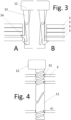
- the surfaces (3) descend by gravity into the active position, using the mechanism illustrated in Figure 3 .
- two claws (13, 14) perform alternating movements to sequentially release the bases (3).
- the two claws (13, 14) have spikes that hold the bases (3).
- the upper claw (14) separates the lowest surface from the rest, while the lower claw (13) releases the bottom base to activate it ( Figure 3A ).
- Figure 3B all surfaces are retained.
- FIG. 4 Another embodiment, shown schematically in Figure 4 , involves the surfaces (3) being interlocked by an alignment pin (31), for instance, in the slot of a variably pitched worm screw (11), which allows the surface (3) moves down at different speed.
- the pitch distance is narrow, so the surfaces (3) are close to each other (top in Figure 4 ).
- the pitch distance is wider, allowing the base to move faster into the working position while the previous surfaces barely move.
- the worm screw continues turning, advancing the new surface (3) through the large pitch area, while the used surface moves down through a small pitch area, covered by the new or falls by gravity into a container.
- the active surface (3) area lacks the screw, allowing it to fall by its weight. Consequently, a gap opens for insect access to the usable surface.
- Figure 5 shows an exploded drawing of a surface (3). It includes an adhesive ring-shaped sheet (32), an inner reinforcing ring (33), and several peripheral clamps (34).
- the clamps (34) among other functions, separate the surfaces (3) from each other.
- the trap housing (1) can be attached to a pole by mounting clamps (5).
- On top of the trap housing one or more photovoltaic plates (6) can be set for recharging the battery that powers the entire trap. This allows the photovoltaic plates (6) to be oriented independently of the trap (1) position or orientation.
- a power on/off button cage (8) manages the trap by powering the electronic controller (10), which manages and control all the electronic devices (servomotor, sensors, camera, etc.) of the trap.
Landscapes
- Life Sciences & Earth Sciences (AREA)
- Pest Control & Pesticides (AREA)
- Engineering & Computer Science (AREA)
- Insects & Arthropods (AREA)
- Wood Science & Technology (AREA)
- Zoology (AREA)
- Environmental Sciences (AREA)
- Health & Medical Sciences (AREA)
- General Health & Medical Sciences (AREA)
- Toxicology (AREA)
- Catching Or Destruction (AREA)
Abstract
This invention relates to an intelligent insect trap, which allows a simple and effective monitoring of the insects captured inside the trap. It consists of a cylindrical or prismatic housing with a perimetral entrance accessing to an usable internal surface positioned in the active state/mode. This surface is adhesive and located near a container that holds a semiochemical lure. The trap also includes one or more video or photo cameras oriented towards the active sticky surface. Additionally, the trap comprises two or more adherent surfaces, which are mobile along the housing, preferably in the form of a disc or ring, and configured to be consecutively positioned in the active state.
Description
- The present invention relates to an intelligent insect trap, as for example to species from the Lepidoptera order, although not limited to this order, for remote monitoring and pest control. It allows a simple and effective monitoring and/or studying the insects captured inside the trap present in crops, forests, gardens, or other agricultural systems.
- The state of the art includes the trap disclosed in
ES1195312U - The applicant is not aware of any solution to these problems that is as effective and efficient as the one claimed .
- The invention consists of an intelligent insect trap as described in the claims .
- The invention presents a design improvement that allows savings in materials (the type of material used in manufacturing, electronic devices, such as cameras for image capture), as well as in size. These modifications also simplify the assembly of the new system and its logistics. Additionally, it allows a single trap to operate autonomously for a longer time.
- To achieve this, the insect trap features a cylindrical or prismatic housing with a perimetral entrance leading to an usable internal surface positioned in the active state/mode. This active surface, accessible from the entrance, is adhesive (sticky) and is close to the container holding the semiochemical. The trap also includes one or more video or photo cameras oriented toward the active surface, as well as a power battery. According to the invention, the trap includes two or more surfaces that are mobile along the housing, preferably disc or ring-shaped, and are configured to be consecutively positioned in an active state/mode.
- Preferably, the trap housing includes a support that holds one or more adjustable photovoltaic plates for battery recharging .
- It may also include a communication system with a server: GSM, LoRa, Wi-Fi, etc., depending on the location of a nearby repeater or receiver, the necessary range, etc .
- Other specific solutions are included in the dependent claims and are described in detail below.
- To complement this description and to aid in a better understanding of the unique invention's features, a set of drawings is provided as an illustrative and non-limiting example, representing the following:
-
Figure 1 : Schematic view of an example of the invention. -
Figure 2 : Exploded view drawing of the main parts of the previous example. -
Figure 3 : Example of the base-changing system using a servomotor. -
Figure 4 : Example of the method for moving the bases consecutively. (A) dropping the lowest base while retaining the others; (B) retaining all bases. -
Figure 5 : Circular base containing adhesive/sticky surface for insect capture. - Below, an example of an implementation of the invention is described briefly, as an illustrative and non-limiting example of it.
-
Figure 1 shows a general view of the trap according to an implementation. It includes a cylindrical housing (1) with a perimeter entrance (2) formed by a removable grid. Inside the housing (1), a container (7) holds the semiochemical specific to the insect to be attracted, along with a series of bases (3) in the form of discs or rings, with adhesive on their usable surfaces. One of the surfaces (3), referred to as "active," exposes its adhesive/sticky surface to the entrance (2), while the rest are hidden by it or other surfaces (3). The unused and "inactive" surfaces are stored at the top of the housing (1) and can be moved to the active position when the user remotely activates the change system with the servomotor (12). - One or more cameras (4) are oriented toward the active surface. The camera (4), typically one, can store images until they are manually retrieved or sent by an appropriate method to a computer server. For instance, through a SIM card, a LoRa communication system, Wi-Fi, etc., with the appropriate and required range.
- For example, the surfaces (3) can have a central hole, so the camera (4) aligns with that central hole (
Figure 2 ). Thus, the two elements do not interfere with each other. - In use, insects are attracted inside by the specific semiochemical within a container (7), and they adhered/trapped on the active sticky surface (3). Once the active sticky surface (3) is considered saturated with insects or a reset is desired, the servomotor (12) moves an inactive surface (3) stored at the top of the housing (1) to replace the used active surface (3). This process moves a new surface (3) into the active position, covering the previously used one. For example, the surfaces (3) descend by gravity into the active position, using the mechanism illustrated in
Figure 3 . In this figure, two claws (13, 14) perform alternating movements to sequentially release the bases (3). The two claws (13, 14) have spikes that hold the bases (3). The upper claw (14) separates the lowest surface from the rest, while the lower claw (13) releases the bottom base to activate it (Figure 3A ). InFigure 3B , all surfaces are retained. - Another embodiment, shown schematically in
Figure 4 , involves the surfaces (3) being interlocked by an alignment pin (31), for instance, in the slot of a variably pitched worm screw (11), which allows the surface (3) moves down at different speed. At one end, for storage, the pitch distance is narrow, so the surfaces (3) are close to each other (top inFigure 4 ). At the active surface (3) area, the pitch distance is wider, allowing the base to move faster into the working position while the previous surfaces barely move. When a surface change (3) is desired, the worm screw continues turning, advancing the new surface (3) through the large pitch area, while the used surface moves down through a small pitch area, covered by the new or falls by gravity into a container. In another embodiment, the active surface (3) area lacks the screw, allowing it to fall by its weight. Consequently, a gap opens for insect access to the usable surface. -
Figure 5 shows an exploded drawing of a surface (3). It includes an adhesive ring-shaped sheet (32), an inner reinforcing ring (33), and several peripheral clamps (34). The clamps (34), among other functions, separate the surfaces (3) from each other. - The trap housing (1) can be attached to a pole by mounting clamps (5). On top of the trap housing one or more photovoltaic plates (6) can be set for recharging the battery that powers the entire trap. This allows the photovoltaic plates (6) to be oriented independently of the trap (1) position or orientation. A power on/off button cage (8) manages the trap by powering the electronic controller (10), which manages and control all the electronic devices (servomotor, sensors, camera, etc.) of the trap.
- Additionally, it includes humidity and/or temperature sensors (9), as known from the cited state of the art, but not limited exclusively to sensors for these two parameters.
Claims (3)
- Intelligent insect trap, with a cylindrical or prismatic housing (1) that has a perimeter entrance (2) allowing the access to an internal active adhesive/sticky usable surface (3), and a container (7) holding a semiochemical lure, one or more cameras (4) oriented toward the active usable surface (3), and a battery, the upper part of the cylindrical or prismatic housing can store two or more adhesive surfaces (3), which are mobile along the housing (1), configured to be positioned consecutively in the active state.
- Intelligent insect trap, according to claim 1, characterized by a housing support (5) holding one or more adjustable photovoltaic plates (6) for battery recharging, not limited to the photovoltaic plate being housed on top of the housing (1).
- Intelligent insect trap, according to claim 1, characterized by including a communication system with a computer server.
Applications Claiming Priority (2)
| Application Number | Priority Date | Filing Date | Title |
|---|---|---|---|
| ES202230685U ES1290514Y (en) | 2022-04-25 | 2022-04-25 | INTELLIGENT INSECT TRAP |
| PCT/ES2023/070255 WO2023209255A1 (en) | 2022-04-25 | 2023-04-24 | Smart insect trap |
Publications (1)
| Publication Number | Publication Date |
|---|---|
| EP4523530A1 true EP4523530A1 (en) | 2025-03-19 |
Family
ID=81534058
Family Applications (1)
| Application Number | Title | Priority Date | Filing Date |
|---|---|---|---|
| EP23795694.1A Pending EP4523530A1 (en) | 2022-04-25 | 2023-04-24 | Smart insect trap |
Country Status (5)
| Country | Link |
|---|---|
| US (1) | US20250324962A1 (en) |
| EP (1) | EP4523530A1 (en) |
| ES (1) | ES1290514Y (en) |
| MX (1) | MX2024012946A (en) |
| WO (1) | WO2023209255A1 (en) |
Family Cites Families (12)
| Publication number | Priority date | Publication date | Assignee | Title |
|---|---|---|---|---|
| US5325625A (en) * | 1993-09-09 | 1994-07-05 | University Of Kentucky Research Foundation | Automated adjustable interval insect trap |
| US20050172542A1 (en) * | 2004-02-06 | 2005-08-11 | Rose Donnie Sr. | Apparatus for trapping flying insects |
| ITPD20050072U1 (en) * | 2005-09-27 | 2007-03-28 | Multitecno Srl | INSECT CATCH DEVICE |
| KR100895507B1 (en) * | 2007-05-14 | 2009-05-06 | 주식회사 세스코 | Pole large cockroach trap |
| KR20090032253A (en) * | 2007-09-27 | 2009-04-01 | 주식회사 세스코 | Cockroach trap with top sticky |
| US7748159B1 (en) * | 2008-03-17 | 2010-07-06 | Wenner Carl F | Device for trapping flies |
| US20140007488A1 (en) * | 2012-07-09 | 2014-01-09 | Frank M. Calabrese | Passive Flycatcher |
| GB201619677D0 (en) * | 2016-11-21 | 2017-01-04 | Rentokil Initial 1927 Plc | An insect light trap |
| ES1195312Y (en) | 2017-10-05 | 2018-01-17 | Ferimark 2016 Sl | HEXAGONAL TRAP FOR Moths |
| IT201800001753A1 (en) * | 2018-01-24 | 2019-07-24 | Agrorobotica S R L | TRAP DEVICE FOR CAPTURE AND LOCAL IDENTIFICATION OF INFESTING INSECTS |
| CN110742047B (en) * | 2019-10-12 | 2021-12-17 | 西南大学 | Automatic paper changing system based on computer vision effect and insect pest monitoring system |
| KR20230173327A (en) * | 2022-06-17 | 2023-12-27 | 대한민국(농촌진흥청장) | Collecting unit for pest trap sheet and roll trap surveillance apparatus comprising the same |
-
2022
- 2022-04-25 ES ES202230685U patent/ES1290514Y/en active Active
-
2023
- 2023-04-24 WO PCT/ES2023/070255 patent/WO2023209255A1/en not_active Ceased
- 2023-04-24 EP EP23795694.1A patent/EP4523530A1/en active Pending
- 2023-04-24 US US18/859,186 patent/US20250324962A1/en active Pending
-
2024
- 2024-10-18 MX MX2024012946A patent/MX2024012946A/en unknown
Also Published As
| Publication number | Publication date |
|---|---|
| ES1290514U (en) | 2022-05-13 |
| US20250324962A1 (en) | 2025-10-23 |
| ES1290514Y (en) | 2022-08-03 |
| MX2024012946A (en) | 2024-12-06 |
| WO2023209255A1 (en) | 2023-11-02 |
Similar Documents
| Publication | Publication Date | Title |
|---|---|---|
| US10849320B2 (en) | Pest trap with disposal container and wireless monitoring | |
| US20210378225A1 (en) | Detection of arthropods | |
| US20230166865A1 (en) | Uav retrieval and deployment system and method therefor | |
| US5452540A (en) | Autoinoculating device for contaminating insects with active agents | |
| WO2019092707A1 (en) | Integrated system for controlling, detecting, monitoring, evaluating and treating crop pests | |
| EP3466256A1 (en) | Machine for capturing, counting and monitoring insects | |
| US20200377211A1 (en) | Individualized and customized plant management using autonomous swarming drones and artificial intelligence | |
| KR101301071B1 (en) | Pheromone trap system for remote monitoring based on image | |
| US20190364871A1 (en) | Arthropod trapping apparatus and method | |
| US11985914B2 (en) | Predation-resistant capsular planting systems and methods | |
| WO2004010776A2 (en) | Method and apparatus for conditioning honey bees | |
| EP2944155A1 (en) | Monitoring and control systems for the agricultural industry | |
| EP4523530A1 (en) | Smart insect trap | |
| WO2022000098A1 (en) | Method and system for monitoring and controlling the presence of at least one type of insect in agricultural crops | |
| Smith et al. | A method for low‐cost, low‐impact insect tracking using retroreflective tags | |
| KR20240028578A (en) | Solar Panel Cleaning System for Power Generation using Drone | |
| WO2020051650A1 (en) | System and method for automated phenology analysis | |
| WO2023129030A2 (en) | Precision agriculture kit | |
| CN114158548A (en) | Insect biological information countermeasures system | |
| US20240090490A1 (en) | Smart insect collection device | |
| CA3021755A1 (en) | Self-powered remote camera probes for automated horticultural pest detection | |
| CN211048226U (en) | Wireless insect condition monitor | |
| TWI754916B (en) | Safety monitoring method and system of nomadic beekeeping map combined with artificial intelligence | |
| RU240532U1 (en) | Electronic photo recording and telemetry module | |
| US20240057584A1 (en) | Sensory output and location monitoring system and method |
Legal Events
| Date | Code | Title | Description |
|---|---|---|---|
| STAA | Information on the status of an ep patent application or granted ep patent |
Free format text: STATUS: THE INTERNATIONAL PUBLICATION HAS BEEN MADE |
|
| PUAI | Public reference made under article 153(3) epc to a published international application that has entered the european phase |
Free format text: ORIGINAL CODE: 0009012 |
|
| STAA | Information on the status of an ep patent application or granted ep patent |
Free format text: STATUS: REQUEST FOR EXAMINATION WAS MADE |
|
| 17P | Request for examination filed |
Effective date: 20241122 |
|
| AK | Designated contracting states |
Kind code of ref document: A1 Designated state(s): AL AT BE BG CH CY CZ DE DK EE ES FI FR GB GR HR HU IE IS IT LI LT LU LV MC ME MK MT NL NO PL PT RO RS SE SI SK SM TR |
|
| DAV | Request for validation of the european patent (deleted) | ||
| DAX | Request for extension of the european patent (deleted) |