EP4521831A1 - Resource selection method and apparatus, resource exclusion method and apparatus, device, and storage medium - Google Patents
Resource selection method and apparatus, resource exclusion method and apparatus, device, and storage medium Download PDFInfo
- Publication number
- EP4521831A1 EP4521831A1 EP22951409.6A EP22951409A EP4521831A1 EP 4521831 A1 EP4521831 A1 EP 4521831A1 EP 22951409 A EP22951409 A EP 22951409A EP 4521831 A1 EP4521831 A1 EP 4521831A1
- Authority
- EP
- European Patent Office
- Prior art keywords
- resource
- exclusion
- control information
- sidelink control
- initialized
- Prior art date
- Legal status (The legal status is an assumption and is not a legal conclusion. Google has not performed a legal analysis and makes no representation as to the accuracy of the status listed.)
- Granted
Links
Images



Classifications
-
- H—ELECTRICITY
- H04—ELECTRIC COMMUNICATION TECHNIQUE
- H04W—WIRELESS COMMUNICATION NETWORKS
- H04W72/00—Local resource management
- H04W72/02—Selection of wireless resources by user or terminal
-
- H—ELECTRICITY
- H04—ELECTRIC COMMUNICATION TECHNIQUE
- H04B—TRANSMISSION
- H04B17/00—Monitoring; Testing
- H04B17/30—Monitoring; Testing of propagation channels
- H04B17/309—Measuring or estimating channel quality parameters
- H04B17/318—Received signal strength
- H04B17/328—Reference signal received power [RSRP]; Reference signal received quality [RSRQ]
-
- H—ELECTRICITY
- H04—ELECTRIC COMMUNICATION TECHNIQUE
- H04W—WIRELESS COMMUNICATION NETWORKS
- H04W28/00—Network traffic management; Network resource management
- H04W28/16—Central resource management; Negotiation of resources or communication parameters, e.g. negotiating bandwidth or QoS [Quality of Service]
- H04W28/26—Resource reservation
-
- H—ELECTRICITY
- H04—ELECTRIC COMMUNICATION TECHNIQUE
- H04W—WIRELESS COMMUNICATION NETWORKS
- H04W72/00—Local resource management
- H04W72/04—Wireless resource allocation
- H04W72/044—Wireless resource allocation based on the type of the allocated resource
- H04W72/0446—Resources in time domain, e.g. slots or frames
-
- H—ELECTRICITY
- H04—ELECTRIC COMMUNICATION TECHNIQUE
- H04W—WIRELESS COMMUNICATION NETWORKS
- H04W72/00—Local resource management
- H04W72/20—Control channels or signalling for resource management
- H04W72/25—Control channels or signalling for resource management between terminals via a wireless link, e.g. sidelink
Definitions
- Embodiments of the present disclosure relate to the technical field of communications, and in particular, relate to a method and apparatus for resource reselection, a method and apparatus for resource exclusion, and a device and a storage medium thereof.
- a terminal device may select transmission resources from a resource pool by sensing.
- further research is required on how to perform resource selection and resource exclusion by the terminal device.
- Embodiments of the present disclosure provide a method and apparatus for resource reselection, a method and apparatus for resource exclusion, and a device and a storage medium thereof.
- the technical solutions are as follows.
- a method for resource selection is provided.
- the method is applicable to a terminal device, and the method includes: selecting a transmission resource from a first resource set after resource exclusion on the first resource set; wherein any resource in the first resource set is a first resource, wherein the first resource corresponds to N consecutive time units in a time domain, N being an integer greater than 1.
- a method for resource exclusion is provided.
- the method is applicable to a terminal device, and the method includes: upon performing resource exclusion on a second resource set, raising a reference signal received power (RSRP) threshold in a case that a number of second resources in the second resource set meeting a first condition is less than a first threshold, and reperforming the resource exclusion on the second resource set upon initialization of the second resource set, wherein the first condition includes at least N consecutive time units from a time unit of a second resource all including a non-excluded second resource, wherein N is an integer greater than 1.
- RSRP reference signal received power
- an apparatus for resource selection includes: a selecting module, configured to select a transmission resource from a first resource set after resource exclusion on the first resource set; wherein any resource within the first resource set is a first resource, wherein the first resource corresponds to N consecutive time units in a time domain, N being an integer greater than 1.
- an apparatus for resource exclusion includes: an excluding module, configured to: upon performing resource exclusion on a second resource set, raise an RSRP threshold in a case that a number of second resources within the second resource set meeting a first condition is less than a first threshold, and reperform the resource exclusion on the second resource set upon initialization of the second resource set, wherein the first condition includes at least N consecutive time units from a time unit of a second resource all including a non-excluded second resource, wherein N is an integer greater than 1.
- a terminal device includes a processor and a memory storing one or more computer programs, wherein the processor, when loading and running the one or more computer programs, is caused to perform the method for resource selection or resource exclusion described above.
- a computer-readable storage medium stores one or more computer programs, wherein the one or more computer programs, when loaded and run by a processor, cause the processor to perform the method for resource selection or resource exclusion described above.
- a chip includes one or more programmable logic circuits and/or one or more program instructions, wherein the chip, when running, is caused to perform the method for resource selection or resource exclusion described above.
- a computer program product includes one or more computer instructions stored in a computer-readable storage medium, wherein the one or more computer instructions, when read from the computer-readable storage medium and executed by a processor, cause the processor to perform the method for resource selection or resource exclusion described above.
- a candidate resource set acquired by performing the resource exclusion includes contiguous resources in the time domain, such that the terminal device selects the contiguous resources in the time domain in selecting the transmission resource from the candidate resource set.
- B2B back-to-back
- COT channel occupancy time
- SL-U Unlicensed SL
- the network architecture and service scenarios described in the embodiments of the present disclosure are intended to describe the technical solutions according to the embodiments of the present disclosure more clearly, but do not constitute any limitation on the technical solutions according to the embodiments of the present disclosure.
- Those of ordinary skilled in the art understand that, with the evolution of the network architecture and the emergence of new service scenarios, the technical solutions according to the embodiments of the present disclosure are also applicable to similar technical problems.
- the network architecture includes: a core network 11, an access network 12, and terminal devices 13.
- the core network 11 includes a plurality of core network devices.
- the core network devices mainly function to provide user connection, user management, and service bearing, and serve as a bearer network to provide an interface to an external network.
- the core network of a 5 th generation mobile communication (5G) new radio (NR) system includes devices such as an access and mobility management function (AMF) entity, a user plane function (UPF) entity, and a session management function (SMF) entity.
- AMF access and mobility management function
- UPF user plane function
- SMF session management function
- the access network 12 includes a plurality of access network devices 14.
- the access network in the 5G NR system may be referred to as a new generation-radio access network (NG-RAN).
- the access network devices 14 refer to apparatuses deployed in the access network 12 to provide wireless communication functionality for the terminal devices 13.
- the access network device 14 includes various forms of macro base stations, micro base stations, relay stations, access points, and the like.
- the name of the device with the functionality of an access network device varies in systems employing different radio access technologies.
- the device is referred to as a gNodeB or a gNB in the 5G NR system.
- the name "access network device” may change.
- the above apparatuses providing the wireless communication functionality for the terminal devices 13 are collectively referred to as the access network device in the embodiments of the present disclosure.
- a plurality of terminal devices 13 are provided, and one or more terminal devices 13 may be distributed in a cell managed by each of the access network devices 14.
- the terminal devices 13 may include various handheld devices, in-vehicle devices, wearable devices, computing devices, other processing devices connected to a radio modem with the wireless communication functionality, various forms of user devices, mobile stations (MS), and the like.
- MS mobile stations
- the devices described above are collectively referred to as the terminal devices.
- the access network devices 14 communicate with the core network devices using an air technology, such as an NG interface in the 5G NR system.
- the access network devices 14 communicate with the terminal devices 13 using an air interface technology, such as a Uu interface.
- the terminal devices 13 may communicate with each other over a direct communication interface (for example, a PC5 interface). Accordingly, the communication link established based on the direct communication interface may be referred to as a direct link or SL.
- the SL transmission means that communication data transmission is carried out directly between the terminal devices over an SL, which is different from a conventional cellular system in which the communication data is received or transmitted by access network devices.
- the SL transmission has characteristics of short delay and low overhead, and is therefore suitable for communication between two terminal devices that are geographically close to each other, such as an in-vehicle device and another peripheral device that is geographically close to the in-vehicle device.
- two terminal devices that are geographically close to each other, such as an in-vehicle device and another peripheral device that is geographically close to the in-vehicle device.
- V2X vehicle to everything
- the terminal device in the present disclosure refers to any device that communicates using the SL technology.
- the "5G NR system" in the embodiments of the present disclosure may also be referred to as a 5G system or an NR system, but those skilled in the art can understand the meaning thereof.
- the technical solutions described in the embodiments of the present disclosure are applicable to the 5G NR system, and also to evolved systems of the 5G NR system.
- 3GPP has defined two transmission modes.
- transmission resources of the terminal device are allocated by an access network device (such as a base station).
- the terminal device transmits communication data over the sidelink based on the transmission resources allocated by the access network device.
- the access network device may allocate transmission resources to the terminal device for single transmission, or allocate transmission resources to the terminal device for semi-static transmission.
- the terminal device selects transmission resources from a resource pool autonomously for the transmission of communication data. Specifically, the terminal device may select transmission resources from the resource pool either by sensing or by random selection.
- a physical sidelink control channel is configured to bear first stage sidelink control information (SCI) (1st-stage-SCI), and a physical sidelink shared channel (PSSCH) is configured to bear data and second stage SCI (2nd-stage-SCI).
- SCI first stage sidelink control information
- PSSCH physical sidelink shared channel
- the PSCCH and the PSSCH are transmitted in the same slot.
- the 1st-stage-SCI and the 2nd-stage-SCI may be two pieces of sidelink control information having different functions.
- thelst-stage-SCI is carried in the PSCCH and mainly includes fields related to resource sensing, facilitating other terminal devices to perform resource exclusion and resource selection upon decoding.
- the 2nd-stage-SCI is further carried in addition to data, and mainly includes fields related to data demodulation, facilitating other terminal devices to demodulate the data in the PSSCH.
- the terminal device selects transmission resources autonomously for data transmission.
- Resource reservation is a prerequisite for resource selection.
- the NR V2X system supports intra-transport block (TB) resource reservation and inter-TB resource reservation is supported as well.
- the terminal device transmits the first sidelink control information, and indicates N time-frequency resources (including a resource used for current transmission) of a current TB by using the "time resource assignment" and "frequency resource assignment" fields in the first sidelink control information.
- N ⁇ Nmax, and Nmax is equal to 2 or 3 in NR V2X.
- the indicated N time-frequency resources should be distributed in W slots. W is equal to 32 in NR V2X. For example, in a TB1 as shown in FIG.
- the terminal device performs the inter-TB resource reservation by using a "Resource reservation period" field.
- the terminal device indicates time-frequency resource positions for initial transmission and retransmission 1 of the TB1 by using the "time resource assignment" and "frequency resource assignment" fields, which are denoted as ⁇ (t 1 , f 1 ), (t 2 , f 2 ) ⁇ .
- t 1 and t 2 represent the time domain positions of initial transmission and retransmission 1 resources of the TB1
- f 1 and f 2 represent corresponding frequency domain positions.
- the SCI simultaneously indicates the time-frequency resources ⁇ (t 1 +100, f 1 ), (t 2 +100, f 2 ) ⁇ .
- the two resources are used for the initial transmission and the retransmission 1 of TB2.
- the first sidelink control information transmitted in retransmission 1 of the TB1 also reserves time-frequency resources for retransmission 1 and retransmission 2 of the TB2 by using the "resource reservation period" field.
- the possible values for the "resource reservation period" field are 0, 1-99, 100, 200, 300, 400, 500, 600, 700, 800, 900, and 1000 ms, offering greater flexibility compared to LTE V2X.
- e values are configured in each resource pool, and the terminal device determines a possible value to be used based on the used resource pool.
- the e values in the resource pool configuration are denoted as a resource reservation period set M, and exemplarily, e is less than or equal to 16.
- the inter-TB reservation may be activated or deactivated on a resource pool basis by means of network configuration or pre-configuration.
- the first sidelink control information includes the "resource reservation period” field.
- the first sidelink control information does not include the "resource reservation period” field.
- the value of the "resource reservation period” field used by the terminal device i.e., the resource reservation period, is generally not changed prior to trigger of resource reselection.
- the terminal device reserves resources for a following period by using the "resource reservation period" field in the first sidelink control information for transmission of another TB every time the terminal device transmits the first sidelink control information, such that periodic semi-persistent transmission is achieved.
- the terminal device may acquire the first sidelink control information transmitted by another terminal device by sensing the PSCCHs from another terminal device to acknowledge the resources reserved by another terminal device.
- the terminal device excludes the resources reserved by another terminal device to avoid resource collision.
- the terminal device needs to select resources autonomously in the mode B.
- the terminal device triggers resource selection or reselection in a slot n, or the slot n is a slot where a higher layer triggers a physical layer to report a candidate resource set.
- a resource selection window 10 starts from n+T 1 and ends at n+T 2.
- 0 ⁇ T 1 ⁇ T proc,1 , and T proc,1 is 3, 5, 9, or 17 slots in the case that the subcarrier spacing is 15, 30, 60, or 120 kHz.
- T 2min ⁇ T 2 ⁇ a remaining delay budget of service, and a value set of T 2min is ⁇ 1, 5, 10, 20 ⁇ *2 ⁇ slots.
- ⁇ 0, 1, 2, or 3, which correspond to the subcarrier spacing being 15, 30, 60, or 120 kHz, respectively.
- the terminal device determines T 2min from the value set based on a priority of its own to-be-transmitted data. For example, in the case that the subcarrier spacing is 15 kHz, the terminal device determines T 2min from the set ⁇ 1, 5, 10, 20 ⁇ based on the priority of its own to-be-transmitted data. In the case that T 2min is greater than or equal to the remaining delay budget of service, T 2 is equal to the remaining delay budget of service.
- the remaining delay budget means a difference between a corresponding time of a delay requirement of the data and a current time. For example, for a packet arriving in the slot n, the delay requirement is 50 ms. Assuming that one slot is 1 ms, then the remaining delay budget is 50 ms in the case that the current time is the slot n, and the remaining delay budget is 30 ms in the case that the current time is a slot n+20.
- the terminal device senses resources from n-T 0 to n-T proc,0 (excluding n-T proc,0 ), and a value of T 0 is 100 or 1100 ms.
- T proc,0 is 1, 1, 2, or 4 slots.
- the terminal device senses resources in a slot that is within a resource pool used by the terminal device within a resource sensing window.
- the terminal device senses the first sidelink control information transmitted by another terminal device in each slot (except for its own transmission slot), and the terminal device uses the results of resource sensing in n-T 0 to n-T proc,0 upon trigger of resource selection or reselection in the slot n.
- the terminal device regards all available resources within the resource pool used by the terminal device in the resource selection window 10 as a resource set A, and any of the resources in the set A is denoted as the resource R(x,y). x and y respectively indicate a frequency domain position and a time domain position of the resource. An initial number of the resources in the set A is denoted as M total .
- the terminal device excludes resources in the resource set A based on a non-sensing slot in the resource sensing window 20 (step 1-1) and/or resource sensing results in the resource sensing window 20 (step 1-2).
- the terminal device determines whether the resource R(x,y) or a series of periodic resources corresponding to the resource R(x,y) is overlapped with a slot determined based on the non-sensing slot in step 1-1 or a resource determined based on the sensed first sidelink control information in step 1-2, and excludes the resource R(x,y) from the resource set A in the case that these resources are overlapped with each other.
- step 1-1 in the case that the terminal device transmits data in the slot t m within the resource sensing window 20 and does not carry out sensing, the terminal device determines corresponding Q slots based on the slot t m and each allowed resource reservation period in the resource pool used by the terminal device, having the resource reservation period as an interval.
- the Q slots are overlapped with the resource R(x,y) or a series of periodic resources corresponding to the resource R(x,y), the resource R(x,y) is excluded from the resource set A.
- Tscal is equal to a value of T 2 converted into milliseconds.
- Prx is one of the resource reservation periods allowed by the resource pool used by the terminal device.
- the Cresel is related to a random count value generated by the terminal device, and Ptxlg is the number of logical slots converted from. Ptx is the resource reservation period of the terminal device. for example, the case that the Cresel is equal to 3 in FIG. 4(a) means three periodic resources corresponding to the resource R(x,y) (including R(x,y)).
- the terminal device does not carry out sensing in the slot t m , but performs resource exclusion in sequence based on each resource reservation period in the resource reservation period set M in the used resource pool configuration.
- a resource reservation period 1 assuming that the Q value is calculated as 2
- the corresponding Q slots are two following slots mapped from the slot t m in FIG. 4(a) as indicated by horizontal line shadow, having the resource reservation period 1 as an interval.
- the corresponding Q slots are one following slot mapped from the slot t m in FIG. 4(a) as indicated by dotted shadow, having the resource reservation period 2 as an interval.
- the terminal device determines whether Q slots corresponding to each reservation period are overlapped with the resource R(x,y) or a series of periodic resources corresponding to the resource R(x,y), and excludes the resource R(x,y) from the resource set A in the case that these resources are overlapped with each other.
- the terminal device in the case that the inter-TB reservation is deactivated for the resource pool used by the terminal device, the terminal device does not perform step 1-1.
- step 1-1 upon completion of step 1-1, in the case that the number of remaining resources in the resource set A are less than M total *X, the resource set A is initialized into all available resources within the resource pool used by the terminal device in the resource selection window 10, and then step 1-2 is performed.
- step 1-2 in the case that the terminal device senses the first sidelink control information transmitted in the PSCCH within the slot t m of the resource sensing window 20, a sidelink reference signal received power (SL-RSRP) of the PSCCH or a SL-RSRP of the PSSCH scheduled by the PSCCH (that is, the SL-RSRP of the PSCCH transmitted in the same slot as the PSCCH) is measured.
- SL-RSRP sidelink reference signal received power
- the terminal device determines the corresponding Q slots based on the slot t m and the resource reservation period carried in the sensed first sidelink control information, having the resource reservation period as an interval. The terminal device assumes that the first sidelink control information with the same content is received in the Q slots.
- the terminal device determines whether the resources indicated in the "time resource assignment" and "frequency resource assignment" fields of the first sidelink control information received in the slot t m and the Q pieces of the first sidelink control information assumed to be received are overlapped with the resource R(x,y) or a series of periodic resources corresponding to the resource R(x,y), and excludes the corresponding resource R(x,y) from the set A in the case that these resources are overlapped with each other.
- Tscal is equal to a value of T 2 converted into milliseconds.
- Prx is the resource reservation period carried in the sensed first sidelink control information.
- the Cresel is related to a random count value generated by the terminal device, and Ptxlg is the number of logical slots converted from Ptx.
- Ptx is the resource reservation period of the terminal device. for example, the case that the Cresel is equal to 3 in FIG. 4(b) means three periodic resources corresponding to the resource R(x,y) (including the resource R(x,y)).
- the terminal device senses the first sidelink control information in the PSCCH in the slot t m resource E(v,m), having the resource reservation period in the field being Prx. Assuming that the Q value is calculated as 1, then the terminal device assumes that the first sidelink control information with the same content is also received in the slot t m+Prxlg .
- the terminal device determines whether the resources 1, 2, 3, 4, 5, and 6 indicated in the "time resource assignment" and "frequency resource assignment" fields of the first sidelink control information received in the slot t m and the first sidelink control information assumed to be received in the slot t m+Prxlg are overlapped with the resource R(x,y) or a series of periodic resources corresponding to the resource R(x,y), and excludes the resource R(x,y) from the resource set A in the case that these resources are overlapped with each other and the RSRP condition is met.
- the terminal device In the case that the SL-RSRP measured by the terminal device is greater than the SL-RSRP threshold and the first sidelink control information received by the terminal device does not include the "resource reservation period" field, the terminal device only determines whether the resource indicated in the "time resource assignment” and "frequency resource assignment" fields of the first sidelink control information received in the slot t m is overlapped with the resource R(x,y) or a series of resources corresponding to the resource R(x,y), and excludes the resource R(x,y) from the resource set A in the case that these resources are overlapped with each other.
- the terminal device determines whether the resources 1, 2, and 3 indicated in the "time resource assignment” and "frequency resource assignment” fields in the first sidelink control information are overlapped with the resource R(x,y) or a series of periodic resources corresponding to the resource R(x,y), and excludes the resource R(x,y) from the resource set A in the case that these resources are overlapped with each other and the RSRP condition is met.
- the SL-RSRP threshold is raised by 3 dB, and step 1 is performed again.
- the physical layer reports the resource set A upon resource exclusion to a higher layer as a candidate resource set.
- step 2 the higher layer randomly selects resources from the reported candidate resource set for data transmission. That is, the terminal device randomly selects resources from the candidate resource set for data transmission.
- the selectable values of the priority levels of both P1 and P2 are 0 to 7
- the SL-RSRP thresholds corresponding to different priority combinations are represented by ⁇ ij .
- i is a value of the priority level P1
- j is a value of the priority level P2.
- the terminal device In the case that the terminal device senses the PSCCH transmitted by another terminal device, the terminal device acquires the priority P1 carried in the first sidelink control information transmitted in the PSCCH and the priority P2 of the to-be-transmitted data, and determines an SL-RSRP threshold by looking up in Table 1.
- Whether the terminal device compares the measured PSCCH-RSRP or a PSSCH-RSRP scheduled by the PSCCH with the SL-RSRP threshold depends on the resource pool configuration of the resource pool used by the terminal device.
- the resource pool configuration may be configured on the network or preconfigured.
- the value of X described above is possibly ⁇ 20%, 35%, 50% ⁇ .
- the configuration of the resource pool used by the terminal device includes correspondence between the priorities and the possible values described above, and the terminal device determines the value of X based on the priority of the to-be-transmitted data and the correspondence.
- the resource pool configuration may be configured on the network or preconfigured.
- the resource reservation period is converted into logical slots.
- the terminal device transmits the first sidelink control information to indicate time-frequency resources to reserve resources to be used next.
- the terminal device for resource selection decodes the first sidelink control information transmitted by another terminal device to acquire resources reserved by another terminal device, and then excludes the corresponding resources during resource selection to avoid resource collision.
- the terminal device for resource selection converts a physical time (for example, 100 ms) indicated in the "resource reservation period" field in the decoded first sidelink control information into a corresponding number of logical slots, and then performs resource exclusion by using the number of the logical slots:
- P rsvp ′ T ′ max 10240 ms ⁇ P rsvp
- Prsvp represents a resource reservation period, for example, a resource reservation period indicated in the "resource reservation period" in the first sidelink control information sensed by the terminal device, or a resource reservation period allowed in the resource pool, or a resource reservation period of the terminal device
- P'rsvp represents a corresponding calculated number of logical slots.
- T'max represents the number of slots within a resource pool or a transmission resource pool of the terminal device in a system frame number (SFN) period or in 10240 ms.
- SFN system frame number
- the above description is for the SL communication method in NR-V2X. That is, the terminal device autonomously selects transmission resources by resource sensing and autonomously performs data transmission on the sidelink.
- the SL communication method is applicable to various SL communications such as direct communication between handheld terminals and direct communication between pedestrians and vehicles.
- occupied channel bandwidth occupied channel bandwidth
- PSD power spectral density
- occupied channel bandwidth should not be less than 80% of the total channel bandwidth in the case that the terminal device uses the channel for data transmission, and for SL-U, reference may be made to the IRB structure in NR-U to meet the OCB occupancy requirement.
- the 80% bandwidth requirement herein means that a span between a lowest PRB and a highest PRB accounts for 80% of the total bandwidth.
- the frequency domain continuous occupancy in FIG. 2 changes to discrete occupancy, such that 80% of the span is ensured without actually occupying 80% of the bandwidth.
- One interlaced resource includes N discrete PRBs of the frequency domain, M interlaced resources are in the frequency band range, and PRBs in the m th interlace is ⁇ m,M+m,2M+m, 3M+m,... ⁇ .
- the frequency domain intervals between two adjacent PRBs in the interlace are the same, that is, five PRBs.
- the numbers in the box in the drawings represent the interlace index. It should be noted that the PRB in the interlace is also referred to as an IRB, and the interlace is also referred to as the IRB.
- the resource block (RB) set is also introduced in the SL-U.
- the frequency domain resources on the carrier are organized into a plurality of RB sets, and guard frequency bands (guard bands for short) are configured or not configured between the RB sets.
- an RB set corresponds to a frequency domain width of 20MHz.
- the communication device needs to perform listen before talk (LBT) on the unlicensed spectrum, and the data is transmitted upon success of the LBT.
- LBT listen before talk
- the LBT is performed based on the granularity of one RB set, and thus one RB set is also referred to as an LBT sub-band.
- the communication device transmits data on the RB set the LBT needs to be performed on the corresponding RB set, and the data is transmitted upon success of the LBT.
- One RB set includes a plurality of IRBs.
- one resource block actually corresponds to one IRB in FIG. 5 .
- the BWP configured for the communication device includes an integer number of RB sets.
- the resource pool contains an integer number of RB sets (and guard bands between the RB sets), and each RB set includes a plurality of IRBs.
- each RB set includes a plurality of IRBs.
- the concept of sub-channels in the resource pool continues to be used, that is, a sub-channel is defined as one or more IRBs, or, the terminal device transmits directly on one or more IRBs without using the sub-channel.
- a random count value is generated. In the case that a listening slot is idle, 1 is subtracted from the random count value. In the case that a listening slot is active, no subtraction is performed for the random count value. In the case that the random count value is subtracted to 0, the channel is accessible and data transmission is allowed thereon. In the case that the random count value is subtracted to 0 and the communication device has not data to transmit, the random count value does not need to be generated again, and the LBT with a fixed time length only needs to be performed in the case that the communication device needs to transmit data. In the case that the LBT is successful, that is, the channel is idle within the fixed time length, the channel is accessed.
- the communication device listens channels with a length of 25 microseconds (denoted as Tshort). In the case that all listening slots within the Tshort are idle, the communication device may directly access the channel.
- the communication device listens channels with a length of 16 microseconds (denoted as Tf). In the case that the listening slots within the Tf are idle, the communication device may directly access the channel.
- the communication device needs to perform the LBT first, and the channel is accessed only upon success of the LBT.
- the time of occupying the channel is referred to as the COT.
- the communication device transmits continuously or non-continuously. Therefore, the B2B transmission is introduced into the SL-U to fully utilize the COT initiated upon success of the LBT. That is, the communication device continuously transmits in a plurality of slots to improve the utilization of the COT. Simultaneous and continuous using/occupancy of the channel also facilitates contention for the channel with another system. For example, in the case that the SL-U terminal adopts the B2B transmission, wireless fidelity (Wi-Fi) users cannot successfully access the channel concurrently due to continuous channel occupancy.
- Wi-Fi wireless fidelity
- the B2B transmission is introduced in the SL-U system. That is, the terminal device performs transmission on a plurality of contiguous slots. Therefore, how to ensure that the terminal device selects contiguous transmission resources in the time domain in the resource selection process is a to-be-solved problem and has not been discussed in the standards.
- the problem may be solved in the physical layer. That is, candidate resources in a candidate resource set reported by the physical layer are contiguous resources in the time domain, and the higher layer randomly selects resources from the candidate resource set. Alternatively, the problem may be solved in the higher layer.
- candidate resources in a candidate resource set reported by the physical layer are discrete or contiguous resources in the time domain, and the B2B transmission is introduced to prioritize selecting contiguous resources in the time domain in the case that the higher layer selects resources from the candidate resource set.
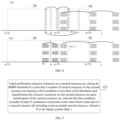
- FIG. 7 a flowchart of a method for resource selection according to some embodiments of the present disclosure is illustrated.
- the method is applicable to the network architecture shown in FIG. 1 , such as a terminal device.
- the method includes following processes.
- a transmission resource is selected from a first resource set upon resource exclusion on the first resource set, wherein any resource in the first resource set is a first resource, wherein the first resource corresponds to N consecutive time units in a time domain, N being an integer greater than 1.
- the first resource set includes at least one first resource, and each resource in the first resource set is the first resource. That is, each resource in the first resource set corresponds to a plurality of consecutive time units in the time domain.
- the first resource corresponds to two or more consecutive time units in the time domain.
- the "time unit” in the embodiments of the present disclosure indicates a slot, a sub-frame, or other time units, which is not limited in the present disclosure.
- the “time unit” herein reference may also be made to the explanation, which is not described again.
- the first resource corresponds to N contiguous slots in the time domain, and N is an integer greater than 1.
- the first resource corresponding to the N consecutive time units in the time domain means that the first resource corresponds to N consecutive physical time units in the time domain.
- the time unit being the slot as an example, the first resource corresponds to N contiguous physical slots in the time domain.
- the first resource corresponding to the N consecutive time units in the time domain means that the first resource corresponds to N consecutive time units belonging to a resource pool in the time domain.
- the time unit belonging to the resource pool is also referred to as a logical time unit. That is, the first resource corresponds to N consecutive logical time units in the time domain.
- the time unit being the slot as an example, the first resource corresponds to N contiguous slots belonging to the resource pool in the time domain, or, the first resource corresponds to N contiguous logical slots in the time domain.
- N consecutive time units belonging to the resource pool corresponding to the first resource in the time domain are N consecutive physical time units; and in the case that the time units in the resource pool are non-consecutive physical time units in the time domain, N consecutive time units belonging to the resource pool corresponding to the first resource in the time domain may be N non-consecutive physical time units.
- N is configured on the network, preconfigured, configured by the higher layer of the terminal device for the physical layer, determined based on practice of the terminal device, or a value predefined in the standard. In some embodiments, N is determined based on at least one of a COT duration, a remaining COT duration, a channel access priority, a priority of data transmission, a channel busy ratio (CBR), or a remaining delay budget. In some embodiments, N is contained in resource pool configuration.
- the first resource corresponds to U contiguous sub-channels or IRBs in a frequency domain.
- Each of the U contiguous sub-channels includes one or more contiguous IRBs, and U is a positive integer.
- U is equal to 1
- the first resource corresponds to one sub-channel or IRB in the frequency domain.
- U is greater than or equal to 2
- the first resource corresponds to U contiguous sub-channels or IRBs in the frequency domain.
- the U contiguous sub-channels or IRBs are in a same resource block set.
- U is configured on the network, preconfigured, configured by the higher layer of the terminal device for the physical layer, determined based on practice of the terminal device, or a value predefined in the standard.
- the terminal device performs the resource exclusion by following processes 1 to 3.
- the first exclusion process includes: determining Q1 time units corresponding to the non-sensing time unit based on the non-sensing time unit and each resource reservation period in the resource reservation period set configured in the resource pool or in sub-sets of the resource reservation period set, wherein Q1 is a positive integer; and excluding the first resource from the resource set in the case that the Q1 time units are overlapped with the first resource in the resource set or overlapped with a resource corresponding to the first resource.
- the resource reservation period set or the subsets of the resource reservation period set is configured on the network, preconfigured, or determined based on practice of the terminal device.
- the resource corresponding to the first resource is a periodic resource with a same frequency domain position as the first resource and having a fixed time interval with the first resource in the time domain position.
- the resource corresponding to the first resource includes the first resource.
- the fixed time interval is determined based on the resource reservation period of the terminal device.
- the terminal device does not perform the first exclusion process, that is, not perform the process of the resource exclusion on the resource set A based on the non-sensing time unit within the resource sensing window.
- the second exclusion process includes excluding the first resource from the resource set in the case that a resource indicated in the first sidelink control information is overlapped with the first resource in the resource set or overlapped with the resource corresponding to the first resource and meets the RSRP threshold condition.
- the second exclusion process includes determining Q2 time units corresponding to a first time unit based on the first time unit where the first sidelink control information is sensed and the resource reservation period indicated in the first sidelink control information, and assuming that the first sidelink control information with same content is to be received within the Q2 time units, wherein Q2 is a positive integer; and excluding the first resource from the resource set in the case that a resource indicated in the first sidelink control information that is sensed and assumed to be received is overlapped with the first resource in the resource set or overlapped with a resource corresponding to the first resource and meets the RSRP threshold condition.
- the RSRP threshold condition includes the RSRP of the PSCCH corresponding to the first sidelink control information or the RSRP of the PSSCH scheduled by the PSCCH being greater than the RSRP threshold.
- the resource indicated in the first sidelink control information is a resource determined based on at least one of following indication fields:
- the resource indicated in the first sidelink control information is a resource of one or more single time units.
- the resource indicated in the first sidelink control information is a resource of one or more single slots.
- the resource indicated in the first sidelink control information is one or more B2B transmission sets.
- the B2B transmission set is a resource of a set of consecutive single time units.
- the B2B transmission set is a resource of a set of contiguous single slots.
- the RSRP threshold is raised by H dB in the case that the number of remaining first resources in the resource set A is less than Z*M total , the resource set A is initialized, and the first resource in the resource set A is excluded by reperforming the resource exclusion process; the resource exclusion process is not performed on the resource set A in the case that the number of remaining first resources in the resource set A is greater than or equal to Z*M total , that is, the resource exclusion process is not required for the first resource set (or, the resource exclusion process on the first resource set is terminated).
- M total is a total number of first resources in the initialized resource set A
- Z and H are predefined values.
- the terminal device selects the transmission resource from the resource set A (or referred to as the candidate resource set) upon resource exclusion. In some embodiments, the transmission resource is selected randomly.
- the resources in the resource set are resources corresponding to a plurality of consecutive time units in the time domain, such that the candidate resource set acquired by performing the resource exclusion on the resource set includes the contiguous resources in the time domain.
- the terminal device selects the contiguous resources in the time domain in selecting the transmission resources from the candidate resource set, such that the B2B transmission is supported, the utilization rate of COT is improved, and SL-U users are enabled to contend for channels.
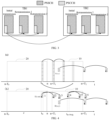
- the terminal device determines a resource selection window 10 from n+T 1 to n+T 2 and a resource sensing window 20 from n-T 0 to n-T proc,0 (not including n-T proc,0 ), and determines any resource corresponding to three slots in the time domain and one sub-channel in the frequency domain within the resource selection window 10 as the resource R(x,y).
- x represents a frequency domain start position of the resource R(x,y)
- y represents a time domain start position of the resource R(x,y).
- the resource R(x,y) shown in FIG. 8 corresponds to one sub-channel in the frequency domain, one sub-channel corresponds to one IRB, and one IRB includes three PRBs in the embodiments.
- All resources R(x,y) within the resource selection window 10 are initialized as the resource set A, and the number of resources R(x,y) in the initialize resource set A is denoted as M total .
- the exclusion is performed on the resource set A based on the non-sensing slot and/or the sensed sidelink control information.
- the exclusion is performed on the resource set A based on the non-sensing slot.
- the terminal device does not perform sensing in the slot m, but performs resource exclusion based on each resource reservation period in the resource reservation period set M configured in the resource pool used by the terminal device.
- the resource reservation period 1 For the resource reservation period 1, assuming that Q is calculated as 2, then the corresponding Q slots are two following slots mapped from the slot m in FIG. 8(a) as indicated by horizontal line shadow, having the resource reservation period 1 as an interval.
- the corresponding Q slots are one following slot mapped from the slot m in FIG. 8(a) as indicated by dotted shadow, having the resource reservation period 2 as an interval.
- the resource R(x,y) is excluded from the resource set A.
- the exclusion is performed on the resource set A based on the sensed sidelink control information.
- the terminal device senses the sidelink control information in the slot m.
- the sidelink control information indicates the resource indicated by horizontal line shadow or two B2B sets.
- the resource indicated in the sidelink control information is overlapped with the resource R(x,y) or the resource corresponding to the resource R(x,y), and the RSRP of the PSCCH corresponding to the sidelink control information or the RSRP of the PSSCH scheduled by the PSCCH is greater than the RSRP threshold, the resource R(x,y) is excluded from the resource set A.
- the resource corresponding to the resource R(x,y) is a periodic resource with a same frequency domain position as the resource R(x,y) and having a fixed time interval with the resource R(x,y) in a time domain position.
- the fixed time interval is determined based on the resource reservation period of the terminal device, and the resource corresponding to the resource R(x,y) includes the resource R(x,y).
- the resource corresponding to the resource R(x,y) is three transmission resources corresponding to the resource R(x,y).
- the resource set A is initialized, the RSRP threshold is raised by 3 dB, and the resource exclusion based on the non-sensing slot and/or the sensed sidelink control information is reperformed until the number of remaining resources R(x,y) in the resource set A upon the resource exclusion is greater than or equal to Z*M total .
- the transmission resource is randomly selected from the resource set A upon the resource exclusion.
- FIG. 9 a flowchart of a method for resource exclusion according to some embodiments of the present disclosure is illustrated.
- the method is applicable to the network architecture shown in FIG. 1 , such as a terminal device.
- the method includes following processes.
- an RSRP threshold is raised in the case that the number of second resources in the second resource set meeting a first condition is less than a first threshold, and the resource exclusion is reperformed on the second resource set upon initialization of the second resource set, wherein the first condition includes at least N consecutive time units from a time unit of a second resource all including a non-excluded second resource, wherein N is an integer greater than 1.
- the second resource is a resource of a single time unit. That is, the second resource corresponds to one time unit in the time domain.
- the "time unit" in the embodiments of the present disclosure indicates a slot, a sub-frame, or other time units, which is not limited in the present disclosure.
- time unit herein, reference may also be made to the explanation, which is not described again.
- the second resource only corresponds to one slot, and is also referred to as a single slot resource.
- the RSRP threshold is raised in the case that the number of second resources in the second resource set meeting the first condition is less than the first threshold and the number of remaining second resources in the second resource set meeting a second threshold, and the resource exclusion is reperformed on the second resource set upon initialization of the second resource set.
- the at least N consecutive time units are at least N consecutive physical time units.
- the time unit being the slot as an example, the at least N consecutive time units are at least N contiguous physical slots.
- the at least N consecutive time units are at least N consecutive time units belonging to a resource pool.
- the time unit belonging to the resource pool is also referred to as a logical time unit, that is, the at least N consecutive logical time units.
- the at least N consecutive time units are at least N contiguous slots belonging to the resource pool or at least N contiguous logical slots.
- the at least N consecutive time units belonging to the resource pool are at least N consecutive physical time units; and in the case that the time units in the resource pool are non-consecutive physical time units in the time domain, the at least N consecutive time units belonging to the resource pool may be at least N non-consecutive physical time units.
- the first condition includes N consecutive time units from a time unit of a second resource all including a non-excluded second resource.
- N is configured on the network, preconfigured, configured by the higher layer of the terminal device for the physical layer, determined based on practice of the terminal device, or a value predefined in the standard.
- the second resource corresponds to U contiguous sub-channels or IRBs in the frequency domain.
- Each of the U contiguous sub-channels includes one or more contiguous IRBs, and U is a positive integer.
- U is equal to 1
- the second resource corresponds to one sub-channel or IRB in the frequency domain.
- U is greater than or equal to 2
- the second resource corresponds to U contiguous sub-channels or IRBs in the frequency domain.
- the U contiguous sub-channels or IRBs are in a same resource block set.
- U is configured on the network, preconfigured, configured by the higher layer of the terminal device for the physical layer, determined based on practice of the terminal device, or a value predefined in the standard.
- the terminal device performs the resource exclusion by following processes 1 to 3.
- the first exclusion process includes: determining Q1 time units corresponding to the non-sensing time unit based on the non-sensing time unit and each resource reservation period in the resource reservation period set configured in the resource pool or in the sub-sets of the resource reservation period set, wherein Q1 is a positive integer; and excluding the second resource from the second resource set in the case that the Q1 time units are overlapped with the second resource in the second resource set or overlapped with the resource corresponding to the second resource.
- the resource reservation period set or the subsets of the resource reservation period set is configured on the network, preconfigured, or determined based on practice of the terminal device.
- the resource corresponding to the second resource is a periodic resource with a same frequency domain position as the second resource and having a fixed time interval with the second resource in the time domain position.
- the resource corresponding to the second resource includes the second resource.
- the fixed time interval is determined based on the resource reservation period of the terminal device.
- the terminal device does not perform the first exclusion process, that is, not perform the process of the resource exclusion on the resource set A based on the non-sensing time unit within the resource sensing window.
- the second exclusion process includes excluding the second resource from the second resource set in the case that a resource indicated in the first sidelink control information is overlapped with the second resource in the second resource set or overlapped with the resource corresponding to the second resource and meets the RSRP threshold condition.
- the second exclusion process includes determining Q2 time units corresponding to the first time unit based on the first time unit where the first sidelink control information is sensed and the resource reservation period indicated in the first sidelink control information, and assuming that the first sidelink control information with same content is to be received within the Q2 time units, wherein Q2 is a positive integer; and excluding the second resource from the second resource set in the case that the resource indicated in the first sidelink control information that is sensed and assumed to be received is overlapped with the second resource in the second resource set or overlapped with the resource corresponding to the second resource and meets the RSRP threshold condition.
- the RSRP threshold condition includes the RSRP of the PSCCH corresponding to the first sidelink control information or the RSRP of the PSSCH scheduled by the PSCCH being greater than the RSRP threshold.
- the resource indicated in the first sidelink control information is a resource determined based on at least one of following indication fields:
- the resource indicated in the first sidelink control information is the resource of one or more single time units.
- the resource indicated in the first sidelink control information is the resource of one or more single slots.
- the resource indicated in the first sidelink control information is one or more B2B transmission sets.
- the B2B transmission set is a resource of a set of consecutive single time units.
- the B2B transmission set is a resource of a set of contiguous single slots.
- the RSRP threshold is raised by H dB in the case that the second resource set upon the resource exclusion meets a condition 1 and/or a condition 2, the second resource set is initialized, and the second resource is excluded from the second resource set by reperforming the resource exclusion process; or, the second resource set upon the resource exclusion is determined as an acquired second resource set (or referred to as the candidate resource set) in the case that the resource set upon the resource exclusion does not meet the condition 1 and/or the condition 2.
- the condition 1 includes the number of remaining second resources in the second resource set being less than a second threshold
- the condition 2 includes the number of second resources meeting a first condition in the second resource set being less than a first threshold.
- the first condition is described above.
- the RSRP threshold is raised by H dB in the case that the second resource set upon the resource exclusion meets the condition 1, the second resource set is initialized, and the second resource is excluded from the second resource set by reperforming the resource exclusion process; or, the second resource set upon the resource exclusion is determined as the acquired second resource set in the case that the resource set upon the resource exclusion does not meet the condition 1.
- the condition 1 is described above.
- the RSRP threshold is raised by H dB in the case that the second resource set upon the resource exclusion meets the condition 2, the second resource set is initialized, and the second resource is excluded from the second resource set by reperforming the resource exclusion process; or, the second resource set upon the resource exclusion is determined as the acquired second resource set in the case that the resource set upon the resource exclusion does not meet the condition 2.
- the condition 2 is described above.
- the RSRP threshold is raised by H dB in the case that the second resource set upon the resource exclusion meets at least one of the condition 1 or the condition 2, the second resource set is initialized, and the second resource is excluded from the second resource set by reperforming the resource exclusion process; or, the second resource set upon the resource exclusion is determined as the acquired second resource set in the case that the resource set upon the resource exclusion does not meet the condition 1 and the condition 2.
- the condition 1 and the condition 2 are described above.
- the initiation is reperformed and the resource exclusion process is reperformed in the case that the second resource set meets at least one of the condition 1 or the condition 2, such that the acquired second resource set includes sufficient resources and a sufficient number of contiguous resources.
- the first condition is that at least N contiguous slots in a same resource block set from a slot of the resource R(x,y) include non-excluded or remaining resources R(x,y).
- the first condition is that N contiguous slots in a same resource block set from the time unit of the resource R(x,y) all include a non-excluded resource R(x,y).
- the second resources in the at least N consecutive time units (or N consecutive time units) are in a same resource block set.
- frequency domain positions of the second resources within the at least N consecutive time units (or N consecutive time units) are the same or different.
- frequency domain positions of resources R(x,y) within the at least N contiguous slots (or N contiguous slots) are the same.
- frequency domain positions of resources R(x,y) within the at least N contiguous slots (or N contiguous slots) are different.
- the first threshold is configured on the network, preconfigured, configured by the higher layer of the terminal device for the physical layer, determined based on practice of the terminal device, or a value predefined in the standard. In some embodiments, the first threshold is determined based on at least one of a COT duration, a remaining COT duration, a channel access priority, a priority of data transmission, a CBR, or a remaining delay budget. Illustratively, the first threshold is equal to Z*M total . Z is configured on the network, preconfigured, configured by the higher layer of the terminal device for the physical layer, determined based on practice of the terminal device, or a value predefined in the standard.
- the second threshold is configured on the network, preconfigured, configured by the higher layer of the terminal device for the physical layer, determined based on practice of the terminal device, or a value predefined in the standard.
- the second threshold is equal to X*M total .
- X is configured on the network, preconfigured, configured by the higher layer of the terminal device for the physical layer, determined based on practice of the terminal device, or a value predefined in the standard.
- the second resource set upon the resource exclusion is denoted as the candidate resource set, and the terminal device selects the transmission resource from the candidate resource set.
- the terminal device prioritizes selecting contiguous resources in the time domain from the candidate resource set as the transmission resources.
- the number of contiguous resources in the time domain are in the candidate resource set acquired by the resource exclusion, such that the terminal device selects the contiguous resources in the time domain in selecting the transmission resources from the candidate resource set.
- the B2B transmission is supported, the utilization rate of COT is improved, and SL-U users are facilitated to contend for channels.
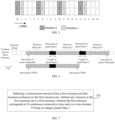
- one sub-channel in FIG. 10 corresponds to one IRB (that is, each of 0, 1, 2, 3, and 4 in the frequency domain in the drawing represents one IRB).
- resources R(x,y) are resources corresponding to two contiguous sub-channels (that is, U is equal to 2) from the sub-channel x in the frequency domain within the slot y, for example, R (0, 0) represents resources corresponding to the sub-channels 0 and 1 within the slot 0, and R (0, 1) represents resources corresponding to the sub-channels 0 and 1 within the slot 1, then the resource set A is initialized as all resources R(x,y) within the slots 0 to 11, and the number of resources R(x,y) in the initialized resource set A is M total .
- the resource exclusion based on the non-sensing slot and/or the sensed sidelink control information is performed on the resource set A, and remaining resources upon exclusion are shown in FIG. 10 , which including R(1,1), R(0,2), R(1,2), R(2,2)...R(2,6), R(3,6), R(2,7), ... , R(1,11).
- N configured by the higher layer for the physical layer is 2
- the higher layer configures the parameter Z for the physical layer
- the first threshold is Z*M total .
- the RSRP threshold is raised by 3 dB, the resource set A is initialized, and the resource exclusion is reperformed on the resource set A.
- the condition 1 is that the number of remaining resources R(x,y) in the resource set A is less than X*M total .
- the condition 2 is that the number of remaining resources R(x,y) meeting the first condition in the resource set A is less than Z*M total .
- the remaining resources R(x,y) meeting the condition in FIG. 10 includes R(1,1), R(0,2), R(1,2), R(2,2), R(2,6), R(3,6), R(2,7), R(3,7), R(0,8), R(1,8), R(0,9).
- the remaining resources R(x,y) meeting the condition in FIG. 10 includes R(1,1), R(0,2), R(1,2), R(2,2), R(2,6), R(3,6), R(2,7), R(3,7), R(0,8), R(1,8), R(2,8), R(3,8), R(0,9), R(1,9), R(0,10), R(3,10), R(1,11).
- the terminal device reports the resource set A upon the resource exclusion to the higher layer, and the higher layer selects resources from the resource set A.
- the terminal device initializes the resource set A as all available resources within the resource selection window, and performs the resource exclusion on the resource set A based on the non-sensing time unit and/or the sensed sidelink control information. For detailed processes, reference may be made to above description.
- the terminal device selects the transmission resource from the resource set A (or referred to as the candidate resource set) upon the resource exclusion.
- the terminal device prioritizes selecting contiguous time-frequency resources in the time domain as the transmission resources.
- the terminal device prioritizes selecting contiguous time-frequency resources in the time domain in randomly selecting the transmission resource from the resource set A.
- the terminal device selects a TB 1 for initial transmission and retransmission
- the initial transmission and the retransmission of the TB 1 occupy contiguous slots.
- the terminal device has selected the transmission resource for a TB 2
- the transmission resources of the TB 1 and the TB 2 occupy contiguous slots in selection of the transmission resource of the TB 1.
- the contiguous slots are contiguous slots in the resource pool.
- the TB 1 and the TB 2 are two different transmission blocks.
- the candidate resource set reported by the physical layer of the terminal device to the higher layer includes R(1,1), R(0,2), R(1,2), R(2,2), R(2,6), R(3,6), R(2,7), R(3,7), R(0,8), R(1,8), R(0,9).
- the TB 1 corresponds to three transmissions, that is, one initial transmission and two retransmissions, and the higher layer of the terminal device selects the resources R(2,6), R(2,7), R(0,8) for transmission of the TB 1.
- the candidate resource set reported by the physical layer of the terminal device to the higher layer includes R(1,1), R(0,2), R(1,2), R(2,2), R(2,6), R(3,6), R(2,7), R(3,7), R(0,8), R(1,8), R(0,9).
- the transmission resources of the TB 2 determined by the terminal device are within the slots 1, 6, and 8.
- the TB 1 corresponds to three transmissions, that is, one initial transmission and two retransmissions, and the higher layer of the terminal device selects the resources R(1,2), R(2,7), R(0,9) for transmission of the TB 1.
- the contiguous resources in the time domain are prioritized in selection of the transmission resource from the candidate resource set upon the resource exclusion, such that the B2B transmission is supported, the utilization rate of COT is improved, and SL-U users are facilitated to contend for channels.
- FIG. 11 a block diagram of an apparatus for resource selection according to some embodiments of the present disclosure is illustrated.
- the apparatus has the function of implementing the above embodiments of the method for resource selection, and the function may be achieved by hardware or by hardware executing corresponding software.
- the apparatus may be the terminal device mentioned above or may be provided in the terminal device.
- the apparatus 1100 includes: a selection module 1110.
- the selection module 1110 is configured to select a transmission resource from a first resource set after resource exclusion on the first resource set; wherein any resource in the first resource set is a first resource, wherein the first resource corresponds to N consecutive time units in a time domain, N being an integer greater than 1.
- the first resource corresponding to the N consecutive time units in the time domain includes following cases: the first resource corresponds to N consecutive physical time units in the time domain; or the first resource corresponds to N consecutive time units belonging to a resource pool in the time domain.
- the first resource corresponds to U contiguous sub-channels or IRBs in a frequency domain, wherein each of the U contiguous sub-channels includes one or more contiguous IRBs, and U is a positive integer.
- the U contiguous sub-channels or IRBs are in a same resource block set.
- the apparatus 1100 further includes an excluding module, configured to:
- the first exclusion process includes:
- the second exclusion process includes:
- the resource indicated in the first sidelink control information is a resource determined based on at least one of following indication fields:
- the resource indicated in the first sidelink control information is a resource of one or more single time units or one or more B2B transmission sets.
- the resource corresponding to the first resource is a periodic resource with a same frequency domain position as the first resource and having a fixed time interval with the first resource in a time domain position.
- N is determined based on at least one of a COT duration, a remaining COT duration, a channel access priority, a priority of data transmission, a CBR, or a remaining delay budget.
- FIG. 12 a block diagram of an apparatus for resource exclusion according to some embodiments of the present disclosure is illustrated.
- the apparatus has the function of implementing the above embodiments of the method for resource selection, and the function may be achieved by hardware or by hardware executing corresponding software.
- the apparatus may be the terminal device mentioned above or may be provided in the terminal device.
- the apparatus 1200 includes: an excluding module 1200.
- the excluding module 1200 is configured to: upon performing resource exclusion on a second resource set, raise an RSRP threshold in a case that the number of second resources in the second resource set meeting a first condition is less than a first threshold, and reperform the resource exclusion on the second resource set upon initialization of the second resource set, wherein the first condition includes at least N consecutive time units from a time unit of a second resource all including a non-excluded second resource, wherein N is an integer greater than 1.
- the second resource is a resource of a single time unit.
- the second resource corresponds to U contiguous sub-channels or IRBs in a frequency domain, wherein each of the U contiguous sub-channels includes one or more contiguous IRBs, and U is a positive integer.
- the U contiguous sub-channels or IRBs are in a same resource block set.
- the excluding module 1210 is further configured to raise the RSRP threshold in a case that the number of second resources in the second resource set meeting the first condition is less than the first threshold and the number of remaining second resources in the second resource set meeting a second threshold, and reperform the resource exclusion on the second resource set upon initialization of the second resource set.
- the at least N consecutive time units are at least N consecutive physical time units or at least N consecutive time units belonging to a resource pool.
- the excluding module 1200 is further configured to:
- the first exclusion process includes:
- the second exclusion process includes:
- the resource indicated in the first sidelink control information is a resource determined based on at least one of following indication fields:
- the resource indicated in the first sidelink control information is a resource of one or more single time units or one or more B2B transmission sets.
- the resource corresponding to the second resource is a periodic resource with a same frequency domain position as the second resource and having a fixed time interval with the second resource in a time domain position.
- the first threshold is determined based on at least one of a COT duration, a remaining COT duration, a channel access priority, a priority of data transmission, a CBR, or a remaining delay budget.
- the apparatus implements the functions thereof
- the division of the functional modules is merely exemplary.
- the above functions may be assigned to and completed by different functional modules according to actual needs, that is, the internal structure of the apparatus may be divided into different functional modules, to implement all or a part of the above functions.
- the terminal device 1300 includes: a processor 1301, a transceiver 1302, and a memory 1303.
- the processor 1301 includes one or more processing cores, and the processor 1301 runs various functional applications and performs information processing by running software programs and modules.
- the transceiver 1302 includes a receiver and a transmitter, which are practiced, for example, as the same wireless communication assembly that includes a wireless communication chip and a radio frequency antenna.
- the memory 1303 is connected to the processor 1301 and the transceiver 1302.
- the memory 1303 may be configured to store one or more computer programs run by the processor, and the processor 1301 is configured to run the one or more computer programs to perform the processes in the above method embodiments.
- the processor 1301 is configured to select a transmission resource from a first resource set after resource exclusion on the first resource set; wherein any resource in the first resource set is a first resource, wherein the first resource corresponds to N consecutive time units in a time domain, N being an integer greater than 1.
- the processor 1301 is configured to: upon performing resource exclusion on a second resource set, raise an RSRP threshold in a case that the number of second resources in the second resource set meeting a first condition is less than a first threshold, and reperform the resource exclusion on the second resource set upon initialization of the second resource set, wherein the first condition includes at least N consecutive time units from a time unit of a second resource all including a non-excluded second resource, wherein N is an integer greater than 1.
- the memory may be implemented by any type or combination of volatile or non-volatile storage devices, including, but not limited to: a magnetic or optical disc, an electrically erasable programmable read-only memory, an erasable programmable read-only memory, a static random-access memory, a read-only memory (ROM), a magnetic memory, a flash memory, and a programmable read-only memory.
- volatile or non-volatile storage devices including, but not limited to: a magnetic or optical disc, an electrically erasable programmable read-only memory, an erasable programmable read-only memory, a static random-access memory, a read-only memory (ROM), a magnetic memory, a flash memory, and a programmable read-only memory.
- the embodiments of the present disclosure further provide a computer-readable storage medium storing one or more computer programs therein.
- the one or more computer programs when loaded and run by a processor, cause the processor to perform the method for resource selection or the method for resource exclusion described above.
- the computer-readable storage medium includes: a ROM, a random-access memory (RAM), a solid state drive (SSD), an optical disk, etc.
- the RAM includes a resistance random-access memory (ReRAM) and a dynamic random access memory (DRAM).
- the embodiments of the present disclosure further provide a chip including one or more programmable logic circuits and/or one or more program instructions.
- the chip when running, is caused to perform the method for resource selection or the method for resource exclusion described above.
- the embodiments of the present disclosure further provide a computer program product or a computer program.
- the computer program product or the computer program includes computer instructions stored in a computer-readable storage medium.
- the computer instructions when read from the computer-readable storage medium and executed by a processor, cause the processor to perform the method for resource selection or the method for resource exclusion described above.
- indication is a direct indication, an indirect indication, or an indication that there is an association relationship.
- A indicates B, which may mean that A indicates B directly, e.g., B may be acquired by A; or that A indicates B indirectly, e.g., A indicates C by which B may be acquired; or that an association relationship is present between A and B.
- the term "correspond” indicates a direct or indirect corresponding relationship between two items, or indicates an associated relationship between the two items. It may also indicate relationships such as indicating and being indicated, or configuring and being configured.
- predefined is implemented by pre-storing corresponding codes, tables, or other means that may be defined to indicate related information in devices (including, for example, terminal devices and network devices), and the present disclosure does not limit the specific implementation thereof.
- predefined refers to "defined” in a protocol.
- the "protocol” refers to a standard protocol in the communication field including, for example, the LTE protocol, the NR protocol, and related protocols applied in future communication systems, which is not limited in the present disclosure.
- a plurality of herein means two or more.
- the term “and/or” describes the association relationship between the associated objects, and indicates that three relationships may be present.
- the phrase “A and/or B” means (A), (B), or (A and B).
- the symbol “/” generally indicates an "or” relationship between the associated objects.
- serial numbers of the processes described herein only show an exemplary possible sequence of performing the processes.
- the processes may also be performed out of the numbering sequence, for example, two processes with different serial numbers are performed concurrently, or two processes with different serial numbers are performed in a reverse order to the illustrated sequence, which is not limited in the present disclosure.
- the functions described in the embodiments of the present disclosure may be implemented in hardware, software, firmware, or any combination thereof.
- the functions, when implemented in software, may be stored in a computer-readable medium or transmitted as one or more instructions or codes on a computer-readable medium.
- the computer-readable medium includes a computer storage medium and a communication medium, where the communication medium includes any medium that facilitates the transfer of a computer program from one place to another.
- the storage medium is any available medium that is accessible by a general-purpose or special-purpose computer.
Landscapes
- Engineering & Computer Science (AREA)
- Computer Networks & Wireless Communication (AREA)
- Signal Processing (AREA)
- Quality & Reliability (AREA)
- Physics & Mathematics (AREA)
- Electromagnetism (AREA)
- Mobile Radio Communication Systems (AREA)
Abstract
Description
- Embodiments of the present disclosure relate to the technical field of communications, and in particular, relate to a method and apparatus for resource reselection, a method and apparatus for resource exclusion, and a device and a storage medium thereof.
- In sidelink (SL) communication, a terminal device may select transmission resources from a resource pool by sensing. With evolution of technologies, further research is required on how to perform resource selection and resource exclusion by the terminal device.
- Embodiments of the present disclosure provide a method and apparatus for resource reselection, a method and apparatus for resource exclusion, and a device and a storage medium thereof. The technical solutions are as follows.
- According to some embodiments of the present disclosure, a method for resource selection is provided. The method is applicable to a terminal device, and the method includes:
selecting a transmission resource from a first resource set after resource exclusion on the first resource set; wherein any resource in the first resource set is a first resource, wherein the first resource corresponds to N consecutive time units in a time domain, N being an integer greater than 1. - According to some embodiments of the present disclosure, a method for resource exclusion is provided. The method is applicable to a terminal device, and the method includes:
upon performing resource exclusion on a second resource set, raising a reference signal received power (RSRP) threshold in a case that a number of second resources in the second resource set meeting a first condition is less than a first threshold, and reperforming the resource exclusion on the second resource set upon initialization of the second resource set, wherein the first condition includes at least N consecutive time units from a time unit of a second resource all including a non-excluded second resource, wherein N is an integer greater than 1. - According to some embodiments of the present disclosure, an apparatus for resource selection is provided. The apparatus includes:
a selecting module, configured to select a transmission resource from a first resource set after resource exclusion on the first resource set; wherein any resource within the first resource set is a first resource, wherein the first resource corresponds to N consecutive time units in a time domain, N being an integer greater than 1. - According to some embodiments of the present disclosure, an apparatus for resource exclusion is provided. The apparatus includes:
an excluding module, configured to: upon performing resource exclusion on a second resource set, raise an RSRP threshold in a case that a number of second resources within the second resource set meeting a first condition is less than a first threshold, and reperform the resource exclusion on the second resource set upon initialization of the second resource set, wherein the first condition includes at least N consecutive time units from a time unit of a second resource all including a non-excluded second resource, wherein N is an integer greater than 1. - According to some embodiments of the present disclosure, a terminal device is provided. The terminal device includes a processor and a memory storing one or more computer programs, wherein the processor, when loading and running the one or more computer programs, is caused to perform the method for resource selection or resource exclusion described above.
- According to some embodiments of the present disclosure, a computer-readable storage medium is provided. The computer-readable storage medium stores one or more computer programs, wherein the one or more computer programs, when loaded and run by a processor, cause the processor to perform the method for resource selection or resource exclusion described above.
- According to some embodiments of the present disclosure, a chip is provided. The chip includes one or more programmable logic circuits and/or one or more program instructions, wherein the chip, when running, is caused to perform the method for resource selection or resource exclusion described above.
- According to some embodiments of the present disclosure, a computer program product is provided. The computer program product includes one or more computer instructions stored in a computer-readable storage medium, wherein the one or more computer instructions, when read from the computer-readable storage medium and executed by a processor, cause the processor to perform the method for resource selection or resource exclusion described above.
- The technical solutions according to the embodiments of the present disclosure include the following beneficial effects.
- A candidate resource set acquired by performing the resource exclusion includes contiguous resources in the time domain, such that the terminal device selects the contiguous resources in the time domain in selecting the transmission resource from the candidate resource set. Thus, back-to-back (B2B) transmission is supported, such that a utilization rate of channel occupancy time (COT) is improved, and Unlicensed SL (SL-U) users are facilitated to contend for channels.
-
-
FIG. 1 is a schematic diagram of a network architecture according to some embodiments of the present disclosure; -
FIG. 2 is a schematic diagram of a physical layer structure of SL communication according to some embodiments of the present disclosure; -
FIG. 3 is a schematic diagram of time-frequency resource position reservation according to some embodiments of the present disclosure; -
FIG. 4 is a schematic diagram of resource sensing and resource selection according to some embodiments of the present disclosure; -
FIG. 5 is a schematic diagram of an interlaced resource block (IRB) according to some embodiments of the present disclosure; -
FIG. 6 is a schematic diagram of division of a resource block set according to some embodiments of the present disclosure; -
FIG. 7 is a flowchart of a method for resource selection according to some embodiments of the present disclosure; -
FIG. 8 is a schematic diagram of the resource selection according to some embodiments shown inFIG. 7 ; -
FIG. 9 is a flowchart of a method for resource exclusion according to some embodiments of the present disclosure; -
FIG. 10 is a schematic diagram of the resource exclusion according to some embodiments shown inFIG. 9 ; -
FIG. 11 is a block diagram of an apparatus for resource reselection according to some embodiments of the present disclosure; -
FIG. 12 is a block diagram of an apparatus for resource exclusion according to some embodiments of the present disclosure; and -
FIG. 13 is a schematic structural diagram of a terminal device according to some embodiments of the present disclosure. - For clearer descriptions of the objectives, technical solutions, and advantages of the present disclosure, embodiments of the present disclosure are further described in detail hereinafter with reference to the accompanying drawings.
- The network architecture and service scenarios described in the embodiments of the present disclosure are intended to describe the technical solutions according to the embodiments of the present disclosure more clearly, but do not constitute any limitation on the technical solutions according to the embodiments of the present disclosure. Those of ordinary skilled in the art understand that, with the evolution of the network architecture and the emergence of new service scenarios, the technical solutions according to the embodiments of the present disclosure are also applicable to similar technical problems.
- Referring to
FIG. 1 , a schematic diagram of a network architecture according to some embodiments of the present disclosure is illustrated. The network architecture includes: acore network 11, anaccess network 12, andterminal devices 13. - The
core network 11 includes a plurality of core network devices. The core network devices mainly function to provide user connection, user management, and service bearing, and serve as a bearer network to provide an interface to an external network. For example, the core network of a 5th generation mobile communication (5G) new radio (NR) system includes devices such as an access and mobility management function (AMF) entity, a user plane function (UPF) entity, and a session management function (SMF) entity. - The
access network 12 includes a plurality ofaccess network devices 14. The access network in the 5G NR system may be referred to as a new generation-radio access network (NG-RAN). Theaccess network devices 14 refer to apparatuses deployed in theaccess network 12 to provide wireless communication functionality for theterminal devices 13. Theaccess network device 14 includes various forms of macro base stations, micro base stations, relay stations, access points, and the like. The name of the device with the functionality of an access network device varies in systems employing different radio access technologies. For example, the device is referred to as a gNodeB or a gNB in the 5G NR system. With the evolution of communication technologies, the name "access network device" may change. For the convenience of description, the above apparatuses providing the wireless communication functionality for theterminal devices 13 are collectively referred to as the access network device in the embodiments of the present disclosure. - Typically, a plurality of
terminal devices 13 are provided, and one or moreterminal devices 13 may be distributed in a cell managed by each of theaccess network devices 14. Theterminal devices 13 may include various handheld devices, in-vehicle devices, wearable devices, computing devices, other processing devices connected to a radio modem with the wireless communication functionality, various forms of user devices, mobile stations (MS), and the like. For convenience of description, the devices described above are collectively referred to as the terminal devices. Theaccess network devices 14 communicate with the core network devices using an air technology, such as an NG interface in the 5G NR system. Theaccess network devices 14 communicate with theterminal devices 13 using an air interface technology, such as a Uu interface. - The terminal devices 13 (for example, the in-vehicle device and another device, such as another in-vehicle device, a mobile phone, or a road side unit (RSU)) may communicate with each other over a direct communication interface (for example, a PC5 interface). Accordingly, the communication link established based on the direct communication interface may be referred to as a direct link or SL. The SL transmission means that communication data transmission is carried out directly between the terminal devices over an SL, which is different from a conventional cellular system in which the communication data is received or transmitted by access network devices. The SL transmission has characteristics of short delay and low overhead, and is therefore suitable for communication between two terminal devices that are geographically close to each other, such as an in-vehicle device and another peripheral device that is geographically close to the in-vehicle device. It should be noted that, in
FIG. 1 , only vehicle-to-vehicle communication in a vehicle to everything (V2X) scenario is illustrated, while the SL technology is applicable to various scenarios where terminal devices directly communicate with each other. In other words, the terminal device in the present disclosure refers to any device that communicates using the SL technology. - The "5G NR system" in the embodiments of the present disclosure may also be referred to as a 5G system or an NR system, but those skilled in the art can understand the meaning thereof. The technical solutions described in the embodiments of the present disclosure are applicable to the 5G NR system, and also to evolved systems of the 5G NR system.
- Before description of the technical solutions of the present disclosure, some background technical knowledge involved in the present disclosure is first explained. The following related technologies may be combined with the technical solutions according to the embodiments of the present disclosure in any manner, all of which fall within the scope of protection of the embodiments of the present disclosure. The embodiments of the present disclosure include at least some of the following content.
- Regarding SL transmission, 3GPP has defined two transmission modes.
- In mode A, transmission resources of the terminal device are allocated by an access network device (such as a base station). The terminal device transmits communication data over the sidelink based on the transmission resources allocated by the access network device. The access network device may allocate transmission resources to the terminal device for single transmission, or allocate transmission resources to the terminal device for semi-static transmission.
- In mode B, the terminal device selects transmission resources from a resource pool autonomously for the transmission of communication data. Specifically, the terminal device may select transmission resources from the resource pool either by sensing or by random selection.
- Next, SL communication in NR V2X systems where the terminal device autonomously selects resources (i.e., the mode B described above) is mainly described.
- A physical layer structure of SL communication in the NR V2X system is shown in
FIG. 2 . In the structure, a physical sidelink control channel (PSCCH) is configured to bear first stage sidelink control information (SCI) (1st-stage-SCI), and a physical sidelink shared channel (PSSCH) is configured to bear data and second stage SCI (2nd-stage-SCI). The PSCCH and the PSSCH are transmitted in the same slot. The 1st-stage-SCI and the 2nd-stage-SCI may be two pieces of sidelink control information having different functions. For example, thelst-stage-SCI is carried in the PSCCH and mainly includes fields related to resource sensing, facilitating other terminal devices to perform resource exclusion and resource selection upon decoding. In the PSSCH, the 2nd-stage-SCI is further carried in addition to data, and mainly includes fields related to data demodulation, facilitating other terminal devices to demodulate the data in the PSSCH. - In the NR V2X system, in the mode B described above, the terminal device selects transmission resources autonomously for data transmission. Resource reservation is a prerequisite for resource selection.
- The resource reservation means that the terminal device transmits the first sidelink control information (the 1st-stage-SCI described above) in the PSCCH to reserve resources to be used next. The NR V2X system supports intra-transport block (TB) resource reservation and inter-TB resource reservation is supported as well.
- As shown in
FIG. 3 , the terminal device transmits the first sidelink control information, and indicates N time-frequency resources (including a resource used for current transmission) of a current TB by using the "time resource assignment" and "frequency resource assignment" fields in the first sidelink control information. N≤Nmax, and Nmax is equal to 2 or 3 in NR V2X. Further, the indicated N time-frequency resources should be distributed in W slots. W is equal to 32 in NR V2X. For example, in a TB1 as shown inFIG. 3 , the terminal device transmits the first sidelink control information over the PSCCH while transmitting initial transmission data over the PSSCH, and indicates time-frequency resource positions for initial transmission and retransmission 1 (i.e., N=2 in this case) by using the two fields described above. That is, a time-frequency resource forretransmission 1 is reserved. Moreover, initial transmission andretransmission 1 are distributed in 32 slots in a time domain. Similarly, in the TB1 as shown inFIG. 3 , the terminal device indicates time-frequency resource positions forretransmission 1 andretransmission 2 using the first sidelink control information transmitted over the PSCCH ofretransmission 1, andretransmission 1 andretransmission 2 are distributed in 32 slots in the time domain. - Besides, in transmitting the first sidelink control information, the terminal device performs the inter-TB resource reservation by using a "Resource reservation period" field. For example, in
FIG. 3 , in transmitting the first sidelink control information of initial transmission of the TB1, the terminal device indicates time-frequency resource positions for initial transmission andretransmission 1 of the TB1 by using the "time resource assignment" and "frequency resource assignment" fields, which are denoted as {(t1, f1), (t2, f2)}. t1 and t2 represent the time domain positions of initial transmission andretransmission 1 resources of the TB1, and f1 and f2 represent corresponding frequency domain positions. In the case that a value of the "resource reservation period" field in the first sidelink control information is 100 ms, the SCI simultaneously indicates the time-frequency resources {(t1+100, f1), (t2+100, f2)}. The two resources are used for the initial transmission and theretransmission 1 of TB2. Similarly, the first sidelink control information transmitted inretransmission 1 of the TB1 also reserves time-frequency resources forretransmission 1 andretransmission 2 of the TB2 by using the "resource reservation period" field. In NR V2X, the possible values for the "resource reservation period" field are 0, 1-99, 100, 200, 300, 400, 500, 600, 700, 800, 900, and 1000 ms, offering greater flexibility compared to LTE V2X. However, only e values are configured in each resource pool, and the terminal device determines a possible value to be used based on the used resource pool. The e values in the resource pool configuration are denoted as a resource reservation period set M, and exemplarily, e is less than or equal to 16. - In addition, the inter-TB reservation may be activated or deactivated on a resource pool basis by means of network configuration or pre-configuration. In the case that the inter-TB reservation is activated, the first sidelink control information includes the "resource reservation period" field. In the case that the inter-TB reservation is deactivated, the first sidelink control information does not include the "resource reservation period" field. In the case that the inter-TB reservation is activated, the value of the "resource reservation period" field used by the terminal device, i.e., the resource reservation period, is generally not changed prior to trigger of resource reselection. The terminal device reserves resources for a following period by using the "resource reservation period" field in the first sidelink control information for transmission of another TB every time the terminal device transmits the first sidelink control information, such that periodic semi-persistent transmission is achieved.
- In the case that the terminal device operates in the mode B, the terminal device may acquire the first sidelink control information transmitted by another terminal device by sensing the PSCCHs from another terminal device to acknowledge the resources reserved by another terminal device. In resource selection, the terminal device excludes the resources reserved by another terminal device to avoid resource collision.
- In the NR V2X system, the terminal device needs to select resources autonomously in the mode B.
- As shown in
FIG. 4 , the terminal device triggers resource selection or reselection in a slot n, or the slot n is a slot where a higher layer triggers a physical layer to report a candidate resource set. Aresource selection window 10 starts from n+T1 and ends at n+T 2. 0≤T1≤Tproc,1, and Tproc,1 is 3, 5, 9, or 17 slots in the case that the subcarrier spacing is 15, 30, 60, or 120 kHz. T2min≤T2≤a remaining delay budget of service, and a value set of T2min is {1, 5, 10, 20}*2µ slots. µ=0, 1, 2, or 3, which correspond to the subcarrier spacing being 15, 30, 60, or 120 kHz, respectively. The terminal device determines T2min from the value set based on a priority of its own to-be-transmitted data. For example, in the case that the subcarrier spacing is 15 kHz, the terminal device determines T2min from the set {1, 5, 10, 20} based on the priority of its own to-be-transmitted data. In the case that T2min is greater than or equal to the remaining delay budget of service, T2 is equal to the remaining delay budget of service. The remaining delay budget means a difference between a corresponding time of a delay requirement of the data and a current time. For example, for a packet arriving in the slot n, the delay requirement is 50 ms. Assuming that one slot is 1 ms, then the remaining delay budget is 50 ms in the case that the current time is the slot n, and the remaining delay budget is 30 ms in the case that the current time is a slot n+20. - The terminal device senses resources from n-T0 to n-Tproc,0 (excluding n-Tproc,0), and a value of T0 is 100 or 1100 ms. In the case that the subcarrier spacing is 15, 30, 60, or 120 kHz, Tproc,0 is 1, 1, 2, or 4 slots. In some embodiments, the terminal device senses resources in a slot that is within a resource pool used by the terminal device within a resource sensing window. In some embodiments, the terminal device senses the first sidelink control information transmitted by another terminal device in each slot (except for its own transmission slot), and the terminal device uses the results of resource sensing in n-T0 to n-Tproc,0 upon trigger of resource selection or reselection in the slot n.
- In
step 1, the terminal device regards all available resources within the resource pool used by the terminal device in theresource selection window 10 as a resource set A, and any of the resources in the set A is denoted as the resource R(x,y). x and y respectively indicate a frequency domain position and a time domain position of the resource. An initial number of the resources in the set A is denoted as Mtotal. The terminal device excludes resources in the resource set A based on a non-sensing slot in the resource sensing window 20 (step 1-1) and/or resource sensing results in the resource sensing window 20 (step 1-2). The terminal device determines whether the resource R(x,y) or a series of periodic resources corresponding to the resource R(x,y) is overlapped with a slot determined based on the non-sensing slot in step 1-1 or a resource determined based on the sensed first sidelink control information in step 1-2, and excludes the resource R(x,y) from the resource set A in the case that these resources are overlapped with each other. - In step 1-1, in the case that the terminal device transmits data in the slot tm within the
resource sensing window 20 and does not carry out sensing, the terminal device determines corresponding Q slots based on the slot tm and each allowed resource reservation period in the resource pool used by the terminal device, having the resource reservation period as an interval. In the case that the Q slots are overlapped with the resource R(x,y) or a series of periodic resources corresponding to the resource R(x,y), the resource R(x,y) is excluded from the resource set A. Q=1 or
FIG. 4(a) means three periodic resources corresponding to the resource R(x,y) (including R(x,y)). - For example, in
FIG. 4(a) , the terminal device does not carry out sensing in the slot tm, but performs resource exclusion in sequence based on each resource reservation period in the resource reservation period set M in the used resource pool configuration. For aresource reservation period 1, assuming that the Q value is calculated as 2, then the corresponding Q slots are two following slots mapped from the slot tm inFIG. 4(a) as indicated by horizontal line shadow, having theresource reservation period 1 as an interval. For aresource reservation period 2, assuming that the Q value is calculated as 1, then the corresponding Q slots are one following slot mapped from the slot tm inFIG. 4(a) as indicated by dotted shadow, having theresource reservation period 2 as an interval. - The terminal device determines whether Q slots corresponding to each reservation period are overlapped with the resource R(x,y) or a series of periodic resources corresponding to the resource R(x,y), and excludes the resource R(x,y) from the resource set A in the case that these resources are overlapped with each other.
- In some embodiments, in the case that the inter-TB reservation is deactivated for the resource pool used by the terminal device, the terminal device does not perform step 1-1.
- In some embodiments, upon completion of step 1-1, in the case that the number of remaining resources in the resource set A are less than Mtotal*X, the resource set A is initialized into all available resources within the resource pool used by the terminal device in the
resource selection window 10, and then step 1-2 is performed. - In step 1-2, in the case that the terminal device senses the first sidelink control information transmitted in the PSCCH within the slot tm of the
resource sensing window 20, a sidelink reference signal received power (SL-RSRP) of the PSCCH or a SL-RSRP of the PSSCH scheduled by the PSCCH (that is, the SL-RSRP of the PSCCH transmitted in the same slot as the PSCCH) is measured. - In the case that the measured SL-RSRP is greater than an SL-RSRP threshold and the first sidelink control information received by the terminal device includes the "resource reservation period" field, the terminal device determines the corresponding Q slots based on the slot tm and the resource reservation period carried in the sensed first sidelink control information, having the resource reservation period as an interval. The terminal device assumes that the first sidelink control information with the same content is received in the Q slots. The terminal device determines whether the resources indicated in the "time resource assignment" and "frequency resource assignment" fields of the first sidelink control information received in the slot tm and the Q pieces of the first sidelink control information assumed to be received are overlapped with the resource R(x,y) or a series of periodic resources corresponding to the resource R(x,y), and excludes the corresponding resource R(x,y) from the set A in the case that these resources are overlapped with each other. The above Q=1 or Q=[Tscal/Prx] (for rounding up). Tscal is equal to a value of T2 converted into milliseconds. Prx is the resource reservation period carried in the sensed first sidelink control information. In some embodiments, a series of periodic resources corresponding to the resource R(x,y) are R(x,y+j*Ptxlg), j=0,1,2,···,Cresel-1. The Cresel is related to a random count value generated by the terminal device, and Ptxlg is the number of logical slots converted from Ptx. Ptx is the resource reservation period of the terminal device. for example, the case that the Cresel is equal to 3 in
FIG. 4(b) means three periodic resources corresponding to the resource R(x,y) (including the resource R(x,y)). - For example, in
FIG. 4(b) , in the case that the first sidelink control information received by the terminal device includes the "resource reservation period" field, the terminal device senses the first sidelink control information in the PSCCH in the slot tm resource E(v,m), having the resource reservation period in the field being Prx. Assuming that the Q value is calculated as 1, then the terminal device assumes that the first sidelink control information with the same content is also received in the slot tm+Prxlg. The terminal device determines whether theresources - In the case that the SL-RSRP measured by the terminal device is greater than the SL-RSRP threshold and the first sidelink control information received by the terminal device does not include the "resource reservation period" field, the terminal device only determines whether the resource indicated in the "time resource assignment" and "frequency resource assignment" fields of the first sidelink control information received in the slot tm is overlapped with the resource R(x,y) or a series of resources corresponding to the resource R(x,y), and excludes the resource R(x,y) from the resource set A in the case that these resources are overlapped with each other.
- For example, in
FIG. 4(b) , in the case that the first sidelink control information received by the terminal device does not include the "resource reservation period" field, and the terminal device senses the first sidelink control information in the PSCCH in the slot tm resource E(v,m), the terminal device determines whether theresources - In the case that the number of the remaining resources in the resource set A upon the resource exclusion is less than Mtotal*X, the SL-RSRP threshold is raised by 3 dB, and
step 1 is performed again. The physical layer reports the resource set A upon resource exclusion to a higher layer as a candidate resource set. - In
step 2, the higher layer randomly selects resources from the reported candidate resource set for data transmission. That is, the terminal device randomly selects resources from the candidate resource set for data transmission. - It should be noted that:
- 1. The RSRP threshold is determined based on the priority P1 carried in the PSCCH sensed by the terminal device and the priority P2 of the data to be transmitted by the terminal device. The configuration of the resource pool used by the terminal device includes an SL-RSRP threshold table, and the SL-RSRP threshold table includes SL-RSRP thresholds corresponding to all priority combinations. The configuration of the resource pool may be configured on the network or preconfigured.
- For example, as listed in Table 1, it is assumed that the selectable values of the priority levels of both P1 and P2 are 0 to 7, the SL-RSRP thresholds corresponding to different priority combinations are represented by γij. In γij, i is a value of the priority level P1, and j is a value of the priority level P2.

- In the case that the terminal device senses the PSCCH transmitted by another terminal device, the terminal device acquires the priority P1 carried in the first sidelink control information transmitted in the PSCCH and the priority P2 of the to-be-transmitted data, and determines an SL-RSRP threshold by looking up in Table 1.
- 2. Whether the terminal device compares the measured PSCCH-RSRP or a PSSCH-RSRP scheduled by the PSCCH with the SL-RSRP threshold depends on the resource pool configuration of the resource pool used by the terminal device. The resource pool configuration may be configured on the network or preconfigured.
- 3. The value of X described above is possibly {20%, 35%, 50%}. The configuration of the resource pool used by the terminal device includes correspondence between the priorities and the possible values described above, and the terminal device determines the value of X based on the priority of the to-be-transmitted data and the correspondence. The resource pool configuration may be configured on the network or preconfigured.
- 4. The resource reservation period is converted into logical slots.
- As mentioned above, the terminal device transmits the first sidelink control information to indicate time-frequency resources to reserve resources to be used next. In sensing, the terminal device for resource selection decodes the first sidelink control information transmitted by another terminal device to acquire resources reserved by another terminal device, and then excludes the corresponding resources during resource selection to avoid resource collision. In resource exclusion, the terminal device for resource selection converts a physical time (for example, 100 ms) indicated in the "resource reservation period" field in the decoded first sidelink control information into a corresponding number of logical slots, and then performs resource exclusion by using the number of the logical slots:

- In the above formula, Prsvp represents a resource reservation period, for example, a resource reservation period indicated in the "resource reservation period" in the first sidelink control information sensed by the terminal device, or a resource reservation period allowed in the resource pool, or a resource reservation period of the terminal device, and P'rsvp represents a corresponding calculated number of logical slots. T'max represents the number of slots within a resource pool or a transmission resource pool of the terminal device in a system frame number (SFN) period or in 10240 ms.
- The above description is for the SL communication method in NR-V2X. That is, the terminal device autonomously selects transmission resources by resource sensing and autonomously performs data transmission on the sidelink. The SL communication method is applicable to various SL communications such as direct communication between handheld terminals and direct communication between pedestrians and vehicles.
- In the case that the NR SL technology operates in the unlicensed spectrum, regulatory requirements in relevant areas, such as occupied channel bandwidth (OCB) and power spectral density (PSD) requirements, need to be considered in the system design. For example, for unlicensed spectrum within the 5GHz frequency range, European regulatory requirements include minimum OCB and maximum PSD requirements. For the OCB requirement, the occupied channel bandwidth should not be less than 80% of the total channel bandwidth in the case that the terminal device uses the channel for data transmission, and for SL-U, reference may be made to the IRB structure in NR-U to meet the OCB occupancy requirement. For example, the 80% bandwidth requirement herein means that a span between a lowest PRB and a highest PRB accounts for 80% of the total bandwidth. 80% of the total bandwidth is occupied in the case of continuous occupancy of the frequency domain in
FIG. 2 , and therefore data of only one user can be transmitted in one slot. Based on the interlaced structure, the frequency domain continuous occupancy inFIG. 2 changes to discrete occupancy, such that 80% of the span is ensured without actually occupying 80% of the bandwidth. - One interlaced resource includes N discrete PRBs of the frequency domain, M interlaced resources are in the frequency band range, and PRBs in the mth interlace is {m,M+m,2M+m, 3M+m,... }.
- As shown in
FIG. 5 , the system bandwidth includes 20 PRBs (one PRB corresponds to 12 subcarriers) and five interlaces (that is, M=5). Each interlace includes four PRBs (that is, N=4). The frequency domain intervals between two adjacent PRBs in the interlace are the same, that is, five PRBs. The numbers in the box in the drawings represent the interlace index. It should be noted that the PRB in the interlace is also referred to as an IRB, and the interlace is also referred to as the IRB. - In addition to the IRB structure, the resource block (RB) set is also introduced in the SL-U.
- The frequency domain resources on the carrier are organized into a plurality of RB sets, and guard frequency bands (guard bands for short) are configured or not configured between the RB sets. For example, an RB set corresponds to a frequency domain width of 20MHz. The communication device needs to perform listen before talk (LBT) on the unlicensed spectrum, and the data is transmitted upon success of the LBT. The LBT is performed based on the granularity of one RB set, and thus one RB set is also referred to as an LBT sub-band. In the case that the communication device transmits data on the RB set, the LBT needs to be performed on the corresponding RB set, and the data is transmitted upon success of the LBT. One RB set includes a plurality of IRBs. For simplicity, in
FIG. 6 , one resource block actually corresponds to one IRB inFIG. 5 . In general, the BWP configured for the communication device includes an integer number of RB sets. - In the SL-U, in one possible design, the resource pool contains an integer number of RB sets (and guard bands between the RB sets), and each RB set includes a plurality of IRBs. Furthermore, the concept of sub-channels in the resource pool continues to be used, that is, a sub-channel is defined as one or more IRBs, or, the terminal device transmits directly on one or more IRBs without using the sub-channel.
- In
type 1, a random count value is generated. In the case that a listening slot is idle, 1 is subtracted from the random count value. In the case that a listening slot is active, no subtraction is performed for the random count value. In the case that the random count value is subtracted to 0, the channel is accessible and data transmission is allowed thereon. In the case that the random count value is subtracted to 0 and the communication device has not data to transmit, the random count value does not need to be generated again, and the LBT with a fixed time length only needs to be performed in the case that the communication device needs to transmit data. In the case that the LBT is successful, that is, the channel is idle within the fixed time length, the channel is accessed. - In type 2A, the communication device listens channels with a length of 25 microseconds (denoted as Tshort). In the case that all listening slots within the Tshort are idle, the communication device may directly access the channel.
- In type 2B, the communication device listens channels with a length of 16 microseconds (denoted as Tf). In the case that the listening slots within the Tf are idle, the communication device may directly access the channel.
- Based on the above description, in the unlicensed spectrum, the communication device needs to perform the LBT first, and the channel is accessed only upon success of the LBT. In the case that the LBT of the communication device is successfully, and the channel is accessed, the time of occupying the channel is referred to as the COT. Within the COT, the communication device transmits continuously or non-continuously. Therefore, the B2B transmission is introduced into the SL-U to fully utilize the COT initiated upon success of the LBT. That is, the communication device continuously transmits in a plurality of slots to improve the utilization of the COT. Simultaneous and continuous using/occupancy of the channel also facilitates contention for the channel with another system. For example, in the case that the SL-U terminal adopts the B2B transmission, wireless fidelity (Wi-Fi) users cannot successfully access the channel concurrently due to continuous channel occupancy.
- Based on above description, the B2B transmission is introduced in the SL-U system. That is, the terminal device performs transmission on a plurality of contiguous slots. Therefore, how to ensure that the terminal device selects contiguous transmission resources in the time domain in the resource selection process is a to-be-solved problem and has not been discussed in the standards. Specifically, the problem may be solved in the physical layer. That is, candidate resources in a candidate resource set reported by the physical layer are contiguous resources in the time domain, and the higher layer randomly selects resources from the candidate resource set. Alternatively, the problem may be solved in the higher layer. That is, candidate resources in a candidate resource set reported by the physical layer are discrete or contiguous resources in the time domain, and the B2B transmission is introduced to prioritize selecting contiguous resources in the time domain in the case that the higher layer selects resources from the candidate resource set. Thus, the above solutions are respectively discussed in the present disclosure by detailing behaviors of the terminal device. The technical solutions according to the present disclosure are described in conjunction with several embodiments hereinafter.
- Referring to
FIG. 7 , a flowchart of a method for resource selection according to some embodiments of the present disclosure is illustrated. The method is applicable to the network architecture shown inFIG. 1 , such as a terminal device. The method includes following processes. - In S710, a transmission resource is selected from a first resource set upon resource exclusion on the first resource set, wherein any resource in the first resource set is a first resource, wherein the first resource corresponds to N consecutive time units in a time domain, N being an integer greater than 1.
- The first resource set includes at least one first resource, and each resource in the first resource set is the first resource. That is, each resource in the first resource set corresponds to a plurality of consecutive time units in the time domain.
- In the embodiments of the present disclosure, the first resource corresponds to two or more consecutive time units in the time domain. The "time unit" in the embodiments of the present disclosure indicates a slot, a sub-frame, or other time units, which is not limited in the present disclosure. For the "time unit" herein, reference may also be made to the explanation, which is not described again. Illustratively, the first resource corresponds to N contiguous slots in the time domain, and N is an integer greater than 1.
- In some embodiments, the first resource corresponding to the N consecutive time units in the time domain means that the first resource corresponds to N consecutive physical time units in the time domain. Using the time unit being the slot as an example, the first resource corresponds to N contiguous physical slots in the time domain.
- In some embodiments, the first resource corresponding to the N consecutive time units in the time domain means that the first resource corresponds to N consecutive time units belonging to a resource pool in the time domain. The time unit belonging to the resource pool is also referred to as a logical time unit. That is, the first resource corresponds to N consecutive logical time units in the time domain. Using the time unit being the slot as an example, the first resource corresponds to N contiguous slots belonging to the resource pool in the time domain, or, the first resource corresponds to N contiguous logical slots in the time domain.
- It should be noted that in the case that the time units in the resource pool are consecutive physical time units in the time domain, N consecutive time units belonging to the resource pool corresponding to the first resource in the time domain are N consecutive physical time units; and in the case that the time units in the resource pool are non-consecutive physical time units in the time domain, N consecutive time units belonging to the resource pool corresponding to the first resource in the time domain may be N non-consecutive physical time units.
- In addition, N is configured on the network, preconfigured, configured by the higher layer of the terminal device for the physical layer, determined based on practice of the terminal device, or a value predefined in the standard. In some embodiments, N is determined based on at least one of a COT duration, a remaining COT duration, a channel access priority, a priority of data transmission, a channel busy ratio (CBR), or a remaining delay budget. In some embodiments, N is contained in resource pool configuration.
- In some embodiments, the first resource corresponds to U contiguous sub-channels or IRBs in a frequency domain. Each of the U contiguous sub-channels includes one or more contiguous IRBs, and U is a positive integer. In the case that U is equal to 1, the first resource corresponds to one sub-channel or IRB in the frequency domain. In the case that U is greater than or equal to 2, the first resource corresponds to U contiguous sub-channels or IRBs in the frequency domain. Illustratively, the U contiguous sub-channels or IRBs are in a same resource block set. In some embodiments, U is configured on the network, preconfigured, configured by the higher layer of the terminal device for the physical layer, determined based on practice of the terminal device, or a value predefined in the standard.
- In some embodiments, the terminal device performs the resource exclusion by following
processes 1 to 3. - 1. A resource selection window and a resource sensing window are determined.
In some embodiments, the resource selection window is [n+T1, n+T2], and the resource sensing window is [n-T0, n-Tproc,0). n is a time unit where the terminal device triggers the resource selection or the resource reselection, or a time unit where the higher layer triggers the physical layer to report time units of the candidate resource set. T1, T2, T0, and Tproc,0 are predefined values, and reference may be made to above description for details. - 2. An initialized first resource set is determined, wherein the initialized first resource set includes at least one first resource within the resource selection window.
Illustratively, the above first resource set is denoted as the resource set A, and the resource set A includes resources within the resource selection window. In some embodiments, all first resources within the resource selection window are initialized as the resource set A. That is, any resource in the resource set A is denoted as the first resource. Illustratively, the first resource is a resource R(x,y). x represents a frequency domain position of the first resource, and y represents a time domain position of the first resource. In some embodiments, x represents a frequency domain start position of the first resource, and y represents a time domain start position of the first resource. Illustratively, using the time unit being the slot as an example, the resource R(x,y) represents N contiguous slots from the slot y, and time-frequency resources corresponding to U contiguous sub-channels or IRBs starting from the sub-channel or IRB x. In some embodiments, the number of first resources in the initialized resource set A is Mtotal. - 3. The resource exclusion is performed on the first resource set by a resource exclusion process, wherein the resource exclusion process includes at least one of a first exclusion process or a second exclusion process, wherein the first exclusion process is configured to perform resource exclusion based on a non-sensing time unit within the resource sensing window, and the second exclusion process is configured to perform resource exclusion based on first sidelink control information sensed within the resource sensing window.
- In some embodiments, the first exclusion process includes: determining Q1 time units corresponding to the non-sensing time unit based on the non-sensing time unit and each resource reservation period in the resource reservation period set configured in the resource pool or in sub-sets of the resource reservation period set, wherein Q1 is a positive integer; and excluding the first resource from the resource set in the case that the Q1 time units are overlapped with the first resource in the resource set or overlapped with a resource corresponding to the first resource. Illustratively, the resource reservation period set or the subsets of the resource reservation period set is configured on the network, preconfigured, or determined based on practice of the terminal device. Illustratively, the resource corresponding to the first resource is a periodic resource with a same frequency domain position as the first resource and having a fixed time interval with the first resource in the time domain position. In some embodiments, the resource corresponding to the first resource includes the first resource. In some embodiments, the fixed time interval is determined based on the resource reservation period of the terminal device. In some embodiments, the terminal device does not perform the first exclusion process, that is, not perform the process of the resource exclusion on the resource set A based on the non-sensing time unit within the resource sensing window.
- In some embodiments, the second exclusion process includes excluding the first resource from the resource set in the case that a resource indicated in the first sidelink control information is overlapped with the first resource in the resource set or overlapped with the resource corresponding to the first resource and meets the RSRP threshold condition.
- In some embodiments, the second exclusion process includes determining Q2 time units corresponding to a first time unit based on the first time unit where the first sidelink control information is sensed and the resource reservation period indicated in the first sidelink control information, and assuming that the first sidelink control information with same content is to be received within the Q2 time units, wherein Q2 is a positive integer; and excluding the first resource from the resource set in the case that a resource indicated in the first sidelink control information that is sensed and assumed to be received is overlapped with the first resource in the resource set or overlapped with a resource corresponding to the first resource and meets the RSRP threshold condition.
- In some embodiments, the RSRP threshold condition includes the RSRP of the PSCCH corresponding to the first sidelink control information or the RSRP of the PSSCH scheduled by the PSCCH being greater than the RSRP threshold.
- In some embodiments, the resource indicated in the first sidelink control information is a resource determined based on at least one of following indication fields:
- a first indication field, indicating a time domain position of the resource;
- a second indication field, indicating a frequency domain position of the resource;
- a third indication field, indicating whether the resource is transmitted by B2B transmission; or
- a fourth indication field, indicating a transmission round of B2B transmission. The transmission round can be considered as a position of the resource in the B2B transmission, the number of transmissions of the resource in the B2B transmission, and the like. Illustratively, the fourth indication field indicates a position of the resource corresponding to the first sidelink control information or a resource for transmitting the first sidelink control information in the B2B transmission or the number of transmissions the resources corresponding to the first sidelink control information or a resource for transmitting the first sidelink control information in the B2B transmission.
- In some embodiments, the resource indicated in the first sidelink control information is a resource of one or more single time units. For example, the resource indicated in the first sidelink control information is a resource of one or more single slots.
- In some embodiments, the resource indicated in the first sidelink control information is one or more B2B transmission sets. The B2B transmission set is a resource of a set of consecutive single time units. For example, the B2B transmission set is a resource of a set of contiguous single slots.
- In some embodiments, upon exclusion of the first resource from the resource set A by the resource exclusion process, the RSRP threshold is raised by H dB in the case that the number of remaining first resources in the resource set A is less than Z*Mtotal, the resource set A is initialized, and the first resource in the resource set A is excluded by reperforming the resource exclusion process; the resource exclusion process is not performed on the resource set A in the case that the number of remaining first resources in the resource set A is greater than or equal to Z*Mtotal, that is, the resource exclusion process is not required for the first resource set (or, the resource exclusion process on the first resource set is terminated). Mtotal is a total number of first resources in the initialized resource set A, and Z and H are predefined values. Z and H are configured on the network, preconfigured, determined based on practice of the terminal device, or a value predefined in the standard. The terminal device selects the transmission resource from the resource set A (or referred to as the candidate resource set) upon resource exclusion. In some embodiments, the transmission resource is selected randomly.
- In the technical solutions according to the embodiments, the resources in the resource set are resources corresponding to a plurality of consecutive time units in the time domain, such that the candidate resource set acquired by performing the resource exclusion on the resource set includes the contiguous resources in the time domain. Thus, the terminal device selects the contiguous resources in the time domain in selecting the transmission resources from the candidate resource set, such that the B2B transmission is supported, the utilization rate of COT is improved, and SL-U users are enabled to contend for channels.
- For example, as shown in
FIG. 8 , the terminal device determines aresource selection window 10 from n+T1 to n+T2 and aresource sensing window 20 from n-T0 to n-Tproc,0 (not including n-Tproc,0), and determines any resource corresponding to three slots in the time domain and one sub-channel in the frequency domain within theresource selection window 10 as the resource R(x,y). x represents a frequency domain start position of the resource R(x,y), and y represents a time domain start position of the resource R(x,y). The resource R(x,y) shown inFIG. 8 corresponds to one sub-channel in the frequency domain, one sub-channel corresponds to one IRB, and one IRB includes three PRBs in the embodiments. - All resources R(x,y) within the
resource selection window 10 are initialized as the resource set A, and the number of resources R(x,y) in the initialize resource set A is denoted as Mtotal. The exclusion is performed on the resource set A based on the non-sensing slot and/or the sensed sidelink control information. - The exclusion is performed on the resource set A based on the non-sensing slot. As shown in
FIG. 8(a) , the terminal device does not perform sensing in the slot m, but performs resource exclusion based on each resource reservation period in the resource reservation period set M configured in the resource pool used by the terminal device. For theresource reservation period 1, assuming that Q is calculated as 2, then the corresponding Q slots are two following slots mapped from the slot m inFIG. 8(a) as indicated by horizontal line shadow, having theresource reservation period 1 as an interval. For aresource reservation period 2, assuming that the Q value is calculated as 1, then the corresponding Q slots are one following slot mapped from the slot m inFIG. 8(a) as indicated by dotted shadow, having theresource reservation period 2 as an interval. In the case that the corresponding Q slots determined based on the non-sensing slot by the terminal device are overlapped with the resource R(x,y) or the resource corresponding to the resource R(x,y), the resource R(x,y) is excluded from the resource set A. - The exclusion is performed on the resource set A based on the sensed sidelink control information. As shown in
FIG. 8(b) , the terminal device senses the sidelink control information in the slot m. The sidelink control information indicates the resource indicated by horizontal line shadow or two B2B sets. In the case that the resource indicated in the sidelink control information is overlapped with the resource R(x,y) or the resource corresponding to the resource R(x,y), and the RSRP of the PSCCH corresponding to the sidelink control information or the RSRP of the PSSCH scheduled by the PSCCH is greater than the RSRP threshold, the resource R(x,y) is excluded from the resource set A. - The resource corresponding to the resource R(x,y) is a periodic resource with a same frequency domain position as the resource R(x,y) and having a fixed time interval with the resource R(x,y) in a time domain position. The fixed time interval is determined based on the resource reservation period of the terminal device, and the resource corresponding to the resource R(x,y) includes the resource R(x,y). For example, in
FIG. 8 , the resource corresponding to the resource R(x,y) is three transmission resources corresponding to the resource R(x,y). - In the case that the number of resources R(x,y) in the resource set A upon the resource exclusion is less than Z*Mtotal, the resource set A is initialized, the RSRP threshold is raised by 3 dB, and the resource exclusion based on the non-sensing slot and/or the sensed sidelink control information is reperformed until the number of remaining resources R(x,y) in the resource set A upon the resource exclusion is greater than or equal to Z*Mtotal. The transmission resource is randomly selected from the resource set A upon the resource exclusion.
- Referring to
FIG. 9 , a flowchart of a method for resource exclusion according to some embodiments of the present disclosure is illustrated. The method is applicable to the network architecture shown inFIG. 1 , such as a terminal device. The method includes following processes. - In S910, upon resource exclusion on a second resource set, an RSRP threshold is raised in the case that the number of second resources in the second resource set meeting a first condition is less than a first threshold, and the resource exclusion is reperformed on the second resource set upon initialization of the second resource set, wherein the first condition includes at least N consecutive time units from a time unit of a second resource all including a non-excluded second resource, wherein N is an integer greater than 1.
- In the embodiments of the present disclosure, the second resource is a resource of a single time unit. That is, the second resource corresponds to one time unit in the time domain. The "time unit" in the embodiments of the present disclosure indicates a slot, a sub-frame, or other time units, which is not limited in the present disclosure. For the "time unit" herein, reference may also be made to the explanation, which is not described again. Illustratively, the second resource only corresponds to one slot, and is also referred to as a single slot resource.
- In some embodiments, the RSRP threshold is raised in the case that the number of second resources in the second resource set meeting the first condition is less than the first threshold and the number of remaining second resources in the second resource set meeting a second threshold, and the resource exclusion is reperformed on the second resource set upon initialization of the second resource set.
- In some embodiments, the at least N consecutive time units are at least N consecutive physical time units. Using the time unit being the slot as an example, the at least N consecutive time units are at least N contiguous physical slots.
- In some embodiments, the at least N consecutive time units are at least N consecutive time units belonging to a resource pool. The time unit belonging to the resource pool is also referred to as a logical time unit, that is, the at least N consecutive logical time units. Using the time unit being the slot as an example, the at least N consecutive time units are at least N contiguous slots belonging to the resource pool or at least N contiguous logical slots.
- It should be noted that in the case that the time units in the resource pool are consecutive physical time units in the time domain, the at least N consecutive time units belonging to the resource pool are at least N consecutive physical time units; and in the case that the time units in the resource pool are non-consecutive physical time units in the time domain, the at least N consecutive time units belonging to the resource pool may be at least N non-consecutive physical time units.
- In some embodiments, the first condition includes N consecutive time units from a time unit of a second resource all including a non-excluded second resource. In some embodiments, N is configured on the network, preconfigured, configured by the higher layer of the terminal device for the physical layer, determined based on practice of the terminal device, or a value predefined in the standard.
- In some embodiments, the second resource corresponds to U contiguous sub-channels or IRBs in the frequency domain. Each of the U contiguous sub-channels includes one or more contiguous IRBs, and U is a positive integer. In the case that U is equal to 1, the second resource corresponds to one sub-channel or IRB in the frequency domain. In the case that U is greater than or equal to 2, the second resource corresponds to U contiguous sub-channels or IRBs in the frequency domain. Illustratively, the U contiguous sub-channels or IRBs are in a same resource block set. In some embodiments, U is configured on the network, preconfigured, configured by the higher layer of the terminal device for the physical layer, determined based on practice of the terminal device, or a value predefined in the standard.
- In some embodiments, the terminal device performs the resource exclusion by following
processes 1 to 3. - 1. A resource selection window and a resource sensing window are determined.
In some embodiments, the resource selection window is [n+T1, n+T2], and the resource sensing window is [n-T0, n-Tproc,0). n is a time unit where the terminal device triggers the resource selection or the resource reselection, or a time unit where the higher layer triggers the physical layer to report time units of the candidate resource set. T1, T2, T0, and Tproc,0 are predefined values, and reference may be made to above description for details. - 2.An initialized second resource set is determined, wherein the initialized second resource set includes at least one second resource within the resource selection window.
Illustratively, the above second resource set is denoted as the resource set A, and the resource set A includes all available resources within the resource selection window. In some embodiments, the available resource is a resource of a single time unit, for example, a resource of a single slot. Illustratively, the available resource is a resource in the resource pool. In some embodiments, all second resources within the resource selection window are initialized as the resource set A. That is, any resource in the resource set A is denoted as the second resource, and the second resource is a resource of a single time unit. Illustratively, the second resource is a resource R(x,y). x represents a frequency domain position of the second resource, and y represents a time domain position of the second resource. In some embodiments, y represents a time domain start position of the second resource. Illustratively, the resource R(x,y) represents U contiguous sub-channels or IRBs from the sub-channel or IRB x in the slot y. In some embodiments, the number of second resources in the initialized resource set A is Mtotal. - 3. The resource exclusion is performed on the second resource set by a resource exclusion process, wherein the resource exclusion process includes at least one of a first exclusion process or a second exclusion process, wherein the first exclusion process is configured to perform resource exclusion based on a non-sensing time unit within the resource sensing window, and the second exclusion process is configured to perform resource exclusion based on first sidelink control information sensed within the resource sensing window.
- In some embodiments, the first exclusion process includes: determining Q1 time units corresponding to the non-sensing time unit based on the non-sensing time unit and each resource reservation period in the resource reservation period set configured in the resource pool or in the sub-sets of the resource reservation period set, wherein Q1 is a positive integer; and excluding the second resource from the second resource set in the case that the Q1 time units are overlapped with the second resource in the second resource set or overlapped with the resource corresponding to the second resource. Illustratively, the resource reservation period set or the subsets of the resource reservation period set is configured on the network, preconfigured, or determined based on practice of the terminal device. Illustratively, the resource corresponding to the second resource is a periodic resource with a same frequency domain position as the second resource and having a fixed time interval with the second resource in the time domain position. In some embodiments, the resource corresponding to the second resource includes the second resource. In some embodiments, the fixed time interval is determined based on the resource reservation period of the terminal device. In some embodiments, the terminal device does not perform the first exclusion process, that is, not perform the process of the resource exclusion on the resource set A based on the non-sensing time unit within the resource sensing window.
- In some embodiments, the second exclusion process includes excluding the second resource from the second resource set in the case that a resource indicated in the first sidelink control information is overlapped with the second resource in the second resource set or overlapped with the resource corresponding to the second resource and meets the RSRP threshold condition.
- In some embodiments, the second exclusion process includes determining Q2 time units corresponding to the first time unit based on the first time unit where the first sidelink control information is sensed and the resource reservation period indicated in the first sidelink control information, and assuming that the first sidelink control information with same content is to be received within the Q2 time units, wherein Q2 is a positive integer; and excluding the second resource from the second resource set in the case that the resource indicated in the first sidelink control information that is sensed and assumed to be received is overlapped with the second resource in the second resource set or overlapped with the resource corresponding to the second resource and meets the RSRP threshold condition.
- In some embodiments, the RSRP threshold condition includes the RSRP of the PSCCH corresponding to the first sidelink control information or the RSRP of the PSSCH scheduled by the PSCCH being greater than the RSRP threshold.
- In some embodiments, the resource indicated in the first sidelink control information is a resource determined based on at least one of following indication fields:
- a first indication field, indicating a time domain position of the resource;
- a second indication field, indicating a frequency domain position of the resource;
- a third indication field, indicating whether the resource is transmitted by B2B transmission; or
- a fourth indication field, indicating a transmission round of B2B transmission. The transmission round can be considered as a position of the resource in the B2B transmission, the number of transmissions of the resource in the B2B transmission, and the like. Illustratively, the fourth indication field indicates the position of the resource corresponding to the first sidelink control information or the resource for transmitting the first sidelink control information in the B2B transmission or the number of transmissions the resources corresponding to the first sidelink control information or the resource for transmitting the first sidelink control information in the B2B transmission.
- In some embodiments, the resource indicated in the first sidelink control information is the resource of one or more single time units. For example, the resource indicated in the first sidelink control information is the resource of one or more single slots.
- In some embodiments, the resource indicated in the first sidelink control information is one or more B2B transmission sets. The B2B transmission set is a resource of a set of consecutive single time units. For example, the B2B transmission set is a resource of a set of contiguous single slots.
- In some embodiments, upon exclusion of the second resource from the second resource set by the resource exclusion process, the RSRP threshold is raised by H dB in the case that the second resource set upon the resource exclusion meets a
condition 1 and/or acondition 2, the second resource set is initialized, and the second resource is excluded from the second resource set by reperforming the resource exclusion process; or, the second resource set upon the resource exclusion is determined as an acquired second resource set (or referred to as the candidate resource set) in the case that the resource set upon the resource exclusion does not meet thecondition 1 and/or thecondition 2. Thecondition 1 includes the number of remaining second resources in the second resource set being less than a second threshold, and thecondition 2 includes the number of second resources meeting a first condition in the second resource set being less than a first threshold. The first condition is described above. - In some embodiments, upon exclusion of the second resource from the second resource set by the resource exclusion process, the RSRP threshold is raised by H dB in the case that the second resource set upon the resource exclusion meets the
condition 1, the second resource set is initialized, and the second resource is excluded from the second resource set by reperforming the resource exclusion process; or, the second resource set upon the resource exclusion is determined as the acquired second resource set in the case that the resource set upon the resource exclusion does not meet thecondition 1. Thecondition 1 is described above. - In some embodiments, upon exclusion of the second resource from the second resource set by the resource exclusion process, the RSRP threshold is raised by H dB in the case that the second resource set upon the resource exclusion meets the
condition 2, the second resource set is initialized, and the second resource is excluded from the second resource set by reperforming the resource exclusion process; or, the second resource set upon the resource exclusion is determined as the acquired second resource set in the case that the resource set upon the resource exclusion does not meet thecondition 2. Thecondition 2 is described above. - In some embodiments, upon exclusion of the second resource from the second resource set by the resource exclusion process, the RSRP threshold is raised by H dB in the case that the second resource set upon the resource exclusion meets at least one of the
condition 1 or thecondition 2, the second resource set is initialized, and the second resource is excluded from the second resource set by reperforming the resource exclusion process; or, the second resource set upon the resource exclusion is determined as the acquired second resource set in the case that the resource set upon the resource exclusion does not meet thecondition 1 and thecondition 2. Thecondition 1 and thecondition 2 are described above. In the embodiments, the initiation is reperformed and the resource exclusion process is reperformed in the case that the second resource set meets at least one of thecondition 1 or thecondition 2, such that the acquired second resource set includes sufficient resources and a sufficient number of contiguous resources. - Illustratively, using the time unit being the slot as an example, the first condition is that at least N contiguous slots in a same resource block set from a slot of the resource R(x,y) include non-excluded or remaining resources R(x,y). Illustratively, the first condition is that N contiguous slots in a same resource block set from the time unit of the resource R(x,y) all include a non-excluded resource R(x,y). In some embodiments, the second resources in the at least N consecutive time units (or N consecutive time units) are in a same resource block set. In some embodiments, frequency domain positions of the second resources within the at least N consecutive time units (or N consecutive time units) are the same or different. Illustratively, frequency domain positions of resources R(x,y) within the at least N contiguous slots (or N contiguous slots) are the same. Illustratively, frequency domain positions of resources R(x,y) within the at least N contiguous slots (or N contiguous slots) are different.
- In some embodiments, the first threshold is configured on the network, preconfigured, configured by the higher layer of the terminal device for the physical layer, determined based on practice of the terminal device, or a value predefined in the standard. In some embodiments, the first threshold is determined based on at least one of a COT duration, a remaining COT duration, a channel access priority, a priority of data transmission, a CBR, or a remaining delay budget. Illustratively, the first threshold is equal to Z*Mtotal. Z is configured on the network, preconfigured, configured by the higher layer of the terminal device for the physical layer, determined based on practice of the terminal device, or a value predefined in the standard.
- In some embodiments, the second threshold is configured on the network, preconfigured, configured by the higher layer of the terminal device for the physical layer, determined based on practice of the terminal device, or a value predefined in the standard. Illustratively, the second threshold is equal to X*Mtotal. X is configured on the network, preconfigured, configured by the higher layer of the terminal device for the physical layer, determined based on practice of the terminal device, or a value predefined in the standard.
- The second resource set upon the resource exclusion is denoted as the candidate resource set, and the terminal device selects the transmission resource from the candidate resource set. In some embodiments, the terminal device prioritizes selecting contiguous resources in the time domain from the candidate resource set as the transmission resources.
- In the technical solutions according to the embodiments, in the resource exclusion process, the number of contiguous resources in the time domain are in the candidate resource set acquired by the resource exclusion, such that the terminal device selects the contiguous resources in the time domain in selecting the transmission resources from the candidate resource set. Thus, the B2B transmission is supported, the utilization rate of COT is improved, and SL-U users are facilitated to contend for channels.
- Illustratively, as shown in
FIG. 10 , one sub-channel inFIG. 10 corresponds to one IRB (that is, each of 0, 1, 2, 3, and 4 in the frequency domain in the drawing represents one IRB). Assuming that resources R(x,y) are resources corresponding to two contiguous sub-channels (that is, U is equal to 2) from the sub-channel x in the frequency domain within the slot y, for example, R (0, 0) represents resources corresponding to the sub-channels 0 and 1 within theslot 0, and R (0, 1) represents resources corresponding to the sub-channels 0 and 1 within theslot 1, then the resource set A is initialized as all resources R(x,y) within theslots 0 to 11, and the number of resources R(x,y) in the initialized resource set A is Mtotal. The resource exclusion based on the non-sensing slot and/or the sensed sidelink control information is performed on the resource set A, and remaining resources upon exclusion are shown inFIG. 10 , which including R(1,1), R(0,2), R(1,2), R(2,2)...R(2,6), R(3,6), R(2,7), ... , R(1,11). - It is assumed that N configured by the higher layer for the physical layer is 2, the higher layer configures the parameter Z for the physical layer, and the first threshold is Z*Mtotal.
- In the case that the resource set A upon the resource exclusion meets at least one of the
condition 1 or thecondition 2, the RSRP threshold is raised by 3 dB, the resource set A is initialized, and the resource exclusion is reperformed on the resource set A. - The
condition 1 is that the number of remaining resources R(x,y) in the resource set A is less than X*Mtotal. - The
condition 2 is that the number of remaining resources R(x,y) meeting the first condition in the resource set A is less than Z*Mtotal. - Assuming that the first condition is that N contiguous slots starting from a slot of a resource R(x,y) all include a non-excluded or remaining resources R(x,y), and frequency positions of remaining resources R(x,y) in the N slots are the same, then the remaining resources R(x,y) meeting the condition in
FIG. 10 includes R(1,1), R(0,2), R(1,2), R(2,2), R(2,6), R(3,6), R(2,7), R(3,7), R(0,8), R(1,8), R(0,9). - Assuming that the firs condition is that N contiguous slots starting from a slot of a resource R(x,y) all include a non-excluded or remaining resources R(x,y), and frequency positions of remaining resources R(x,y) in the N slots are the same or different, then the remaining resources R(x,y) meeting the condition in
FIG. 10 includes R(1,1), R(0,2), R(1,2), R(2,2), R(2,6), R(3,6), R(2,7), R(3,7), R(0,8), R(1,8), R(2,8), R(3,8), R(0,9), R(1,9), R(0,10), R(3,10), R(1,11). - The terminal device reports the resource set A upon the resource exclusion to the higher layer, and the higher layer selects resources from the resource set A.
- In some embodiments, the terminal device initializes the resource set A as all available resources within the resource selection window, and performs the resource exclusion on the resource set A based on the non-sensing time unit and/or the sensed sidelink control information. For detailed processes, reference may be made to above description. The terminal device selects the transmission resource from the resource set A (or referred to as the candidate resource set) upon the resource exclusion.
- In the case that the terminal device selects the transmission resource from the candidate resource set, the terminal device prioritizes selecting contiguous time-frequency resources in the time domain as the transmission resources. Illustratively, the terminal device prioritizes selecting contiguous time-frequency resources in the time domain in randomly selecting the transmission resource from the resource set A. Illustratively, in the case that the terminal device selects a
TB 1 for initial transmission and retransmission, the initial transmission and the retransmission of theTB 1 occupy contiguous slots. Illustratively, in the case that the terminal device has selected the transmission resource for aTB 2, the transmission resources of theTB 1 and theTB 2 occupy contiguous slots in selection of the transmission resource of theTB 1. In some embodiments, the contiguous slots are contiguous slots in the resource pool. In addition, theTB 1 and theTB 2 are two different transmission blocks. - For example, the candidate resource set reported by the physical layer of the terminal device to the higher layer includes R(1,1), R(0,2), R(1,2), R(2,2), R(2,6), R(3,6), R(2,7), R(3,7), R(0,8), R(1,8), R(0,9). The
TB 1 corresponds to three transmissions, that is, one initial transmission and two retransmissions, and the higher layer of the terminal device selects the resources R(2,6), R(2,7), R(0,8) for transmission of theTB 1. - For example, the candidate resource set reported by the physical layer of the terminal device to the higher layer includes R(1,1), R(0,2), R(1,2), R(2,2), R(2,6), R(3,6), R(2,7), R(3,7), R(0,8), R(1,8), R(0,9). The transmission resources of the
TB 2 determined by the terminal device are within theslots TB 1 corresponds to three transmissions, that is, one initial transmission and two retransmissions, and the higher layer of the terminal device selects the resources R(1,2), R(2,7), R(0,9) for transmission of theTB 1. - In the technical solutions according to the embodiments, the contiguous resources in the time domain are prioritized in selection of the transmission resource from the candidate resource set upon the resource exclusion, such that the B2B transmission is supported, the utilization rate of COT is improved, and SL-U users are facilitated to contend for channels.
- The following are apparatus embodiments of the present disclosure, which may be used to implement the method embodiments of the present disclosure. For details not disclosed in the apparatus embodiments of the present disclosure, reference may be made to the method embodiments of the present disclosure.
- Referring to
FIG. 11 , a block diagram of an apparatus for resource selection according to some embodiments of the present disclosure is illustrated. The apparatus has the function of implementing the above embodiments of the method for resource selection, and the function may be achieved by hardware or by hardware executing corresponding software. The apparatus may be the terminal device mentioned above or may be provided in the terminal device. As shown inFIG. 11 , theapparatus 1100 includes: aselection module 1110. - The
selection module 1110 is configured to select a transmission resource from a first resource set after resource exclusion on the first resource set; wherein any resource in the first resource set is a first resource, wherein the first resource corresponds to N consecutive time units in a time domain, N being an integer greater than 1. - In some embodiments, the first resource corresponding to the N consecutive time units in the time domain includes following cases: the first resource corresponds to N consecutive physical time units in the time domain; or the first resource corresponds to N consecutive time units belonging to a resource pool in the time domain.
- In some embodiments, the first resource corresponds to U contiguous sub-channels or IRBs in a frequency domain, wherein each of the U contiguous sub-channels includes one or more contiguous IRBs, and U is a positive integer.
- In some embodiments, the U contiguous sub-channels or IRBs are in a same resource block set.
- In some embodiments, as shown in
FIG. 11 , theapparatus 1100 further includes an excluding module, configured to: - determine a resource selection window and a resource sensing window;
- determine an initialized first resource set, wherein the initialized first resource set includes at least one first resource within the resource selection window; and
- perform the resource exclusion on the initialized first resource set by a resource exclusion process, wherein the resource exclusion process includes at least one of a first exclusion process or a second exclusion process, wherein the first exclusion process is configured to perform the resource exclusion based on a non-sensing time unit within the resource sensing window, and the second exclusion process is configured to perform the resource exclusion based on first sidelink control information sensed within the resource sensing window.
- In some embodiments, the first exclusion process includes:
- determining Q1 time units corresponding to the non-sensing time unit based on the non-sensing time unit and each resource reservation period in a resource reservation period set configured in a resource pool or in sub-sets of a resource reservation period set, wherein Q1 is a positive integer; and
- excluding the first resource from the initialized first resource set in a case that the Q1 time units are overlapped with the first resource in the initialized first resource set or overlapped with a resource corresponding to the first resource.
- In some embodiments, the second exclusion process includes:
- excluding the first resource from the initialized first resource set in a case that a resource indicated in the first sidelink control information is overlapped with the first resource in the initialized first resource set or overlapped with a resource corresponding to the first resource and meets an RSRP threshold condition; or
- determining Q2 time units corresponding to a first time unit based on the first time unit where the first sidelink control information is sensed and a resource reservation period indicated in the first sidelink control information, and assuming that the first sidelink control information with same content is to be received within the Q2 time units, wherein Q2 is a positive integer; and excluding the first resource from the initialized first resource set in a case that a resource indicated in the first sidelink control information that is sensed and assumed to be received is overlapped with the first resource in the initialized first resource set or overlapped with a resource corresponding to the first resource and meets an RSRP threshold condition.
- In some embodiments, the resource indicated in the first sidelink control information is a resource determined based on at least one of following indication fields:
- a first indication field, indicating a time domain position of the resource;
- a second indication field, indicating a frequency domain position of the resource;
- a third indication field, indicating whether the resource is transmitted by B2B transmission; or
- a fourth indication field, indicating a transmission round of B2B transmission.
- In some embodiments, the resource indicated in the first sidelink control information is a resource of one or more single time units or one or more B2B transmission sets.
- In some embodiments, the resource corresponding to the first resource is a periodic resource with a same frequency domain position as the first resource and having a fixed time interval with the first resource in a time domain position.
- In some embodiments, N is determined based on at least one of a COT duration, a remaining COT duration, a channel access priority, a priority of data transmission, a CBR, or a remaining delay budget.
- Referring to
FIG. 12 , a block diagram of an apparatus for resource exclusion according to some embodiments of the present disclosure is illustrated. The apparatus has the function of implementing the above embodiments of the method for resource selection, and the function may be achieved by hardware or by hardware executing corresponding software. The apparatus may be the terminal device mentioned above or may be provided in the terminal device. As shown inFIG. 12 , theapparatus 1200 includes: an excludingmodule 1200. - The excluding
module 1200 is configured to: upon performing resource exclusion on a second resource set, raise an RSRP threshold in a case that the number of second resources in the second resource set meeting a first condition is less than a first threshold, and reperform the resource exclusion on the second resource set upon initialization of the second resource set, wherein the first condition includes at least N consecutive time units from a time unit of a second resource all including a non-excluded second resource, wherein N is an integer greater than 1. - In some embodiments, the second resource is a resource of a single time unit.
- In some embodiments, the second resource corresponds to U contiguous sub-channels or IRBs in a frequency domain, wherein each of the U contiguous sub-channels includes one or more contiguous IRBs, and U is a positive integer.
- In some embodiments, the U contiguous sub-channels or IRBs are in a same resource block set.
- In some embodiments, the excluding
module 1210 is further configured to raise the RSRP threshold in a case that the number of second resources in the second resource set meeting the first condition is less than the first threshold and the number of remaining second resources in the second resource set meeting a second threshold, and reperform the resource exclusion on the second resource set upon initialization of the second resource set. - In some embodiments, the at least N consecutive time units are at least N consecutive physical time units or at least N consecutive time units belonging to a resource pool.
- In some embodiments, the excluding
module 1200 is further configured to: - determine a resource selection window and a resource sensing window;
- determine an initialized second resource set, wherein the initialized second resource set includes at least one second resource within the resource selection window; and
- perform the resource exclusion on the initialized second resource set by a resource exclusion process, wherein the resource exclusion process includes at least one of a first exclusion process or a second exclusion process, wherein the first exclusion process is configured to perform the resource exclusion based on a non-sensing time unit within the resource sensing window, and the second exclusion process is configured to perform the resource exclusion based on first sidelink control information sensed within the resource sensing window.
- In some embodiments, the first exclusion process includes:
- determining Q1 time units corresponding to the non-sensing time unit based on the non-sensing time unit and each resource reservation period in a resource reservation period set configured in a resource pool or in sub-sets of a resource reservation period set, wherein Q1 is a positive integer; and
- excluding the second resource from the initialized second resource set in a case that the Q1 time units are overlapped with the second resource in the initialized second resource set or overlapped with a resource corresponding to the second resource.
- In some embodiments, the second exclusion process includes:
- excluding the second resource from the initialized second resource set in a case that a resource indicated in the first sidelink control information is overlapped with the second resource in the initialized second resource set or overlapped with a resource corresponding to the second resource and meets an RSRP threshold condition; or
- determining Q2 time units corresponding to a first time unit based on the first time unit where the first sidelink control information is sensed and a resource reservation period indicated in the first sidelink control information, and assuming that the first sidelink control information with same content is to be received within the Q2 time units, wherein Q2 is a positive integer; and excluding the second resource from the initialized second resource set in a case that a resource indicated in the first sidelink control information that is sensed and assumed to be received is overlapped with the second resource in the initialized second resource set or overlapped with a resource corresponding to the second resource and meets an RSRP threshold condition.
- In some embodiments, the resource indicated in the first sidelink control information is a resource determined based on at least one of following indication fields:
- a first indication field, indicating a time domain position of the resource;
- a second indication field, indicating a frequency domain position of the resource;
- a third indication field, indicating whether the resource is transmitted by B2B transmission; or
- a fourth indication field, indicating a transmission round of B2B transmission.
- In some embodiments, the resource indicated in the first sidelink control information is a resource of one or more single time units or one or more B2B transmission sets.
- In some embodiments, the resource corresponding to the second resource is a periodic resource with a same frequency domain position as the second resource and having a fixed time interval with the second resource in a time domain position.
- In some embodiments, the first threshold is determined based on at least one of a COT duration, a remaining COT duration, a channel access priority, a priority of data transmission, a CBR, or a remaining delay budget.
- It should be noted that, in the case that the apparatus according to the above embodiments implements the functions thereof, the division of the functional modules is merely exemplary. In practice, the above functions may be assigned to and completed by different functional modules according to actual needs, that is, the internal structure of the apparatus may be divided into different functional modules, to implement all or a part of the above functions.
- With regard to the apparatus in the above embodiments, the specific manner in which each module performs the operation has been described in detail in the embodiments related to the method and will not be described in detail herein. Reference may be made to the above method embodiments for details that are not specified in the apparatus embodiment.
- Referring to
FIG. 13 , a schematic structural diagram of a terminal device according to some embodiments of the present disclosure is illustrated. Theterminal device 1300 includes: aprocessor 1301, atransceiver 1302, and amemory 1303. - The
processor 1301 includes one or more processing cores, and theprocessor 1301 runs various functional applications and performs information processing by running software programs and modules. - The
transceiver 1302 includes a receiver and a transmitter, which are practiced, for example, as the same wireless communication assembly that includes a wireless communication chip and a radio frequency antenna. - The
memory 1303 is connected to theprocessor 1301 and thetransceiver 1302. - The
memory 1303 may be configured to store one or more computer programs run by the processor, and theprocessor 1301 is configured to run the one or more computer programs to perform the processes in the above method embodiments. - In some embodiments, the
processor 1301 is configured to select a transmission resource from a first resource set after resource exclusion on the first resource set; wherein any resource in the first resource set is a first resource, wherein the first resource corresponds to N consecutive time units in a time domain, N being an integer greater than 1. - In some embodiments, the
processor 1301 is configured to: upon performing resource exclusion on a second resource set, raise an RSRP threshold in a case that the number of second resources in the second resource set meeting a first condition is less than a first threshold, and reperform the resource exclusion on the second resource set upon initialization of the second resource set, wherein the first condition includes at least N consecutive time units from a time unit of a second resource all including a non-excluded second resource, wherein N is an integer greater than 1. - Reference is made to the foregoing embodiments for details that are not specified in the embodiments, which are not repeated herein.
- In addition, the memory may be implemented by any type or combination of volatile or non-volatile storage devices, including, but not limited to: a magnetic or optical disc, an electrically erasable programmable read-only memory, an erasable programmable read-only memory, a static random-access memory, a read-only memory (ROM), a magnetic memory, a flash memory, and a programmable read-only memory.
- The embodiments of the present disclosure further provide a computer-readable storage medium storing one or more computer programs therein. The one or more computer programs, when loaded and run by a processor, cause the processor to perform the method for resource selection or the method for resource exclusion described above. In some embodiments, the computer-readable storage medium includes: a ROM, a random-access memory (RAM), a solid state drive (SSD), an optical disk, etc. The RAM includes a resistance random-access memory (ReRAM) and a dynamic random access memory (DRAM).
- The embodiments of the present disclosure further provide a chip including one or more programmable logic circuits and/or one or more program instructions. The chip, when running, is caused to perform the method for resource selection or the method for resource exclusion described above.
- The embodiments of the present disclosure further provide a computer program product or a computer program. The computer program product or the computer program includes computer instructions stored in a computer-readable storage medium. The computer instructions, when read from the computer-readable storage medium and executed by a processor, cause the processor to perform the method for resource selection or the method for resource exclusion described above.
- It should be understood that the term "indication" mentioned in the embodiments of the present disclosure is a direct indication, an indirect indication, or an indication that there is an association relationship. For example, A indicates B, which may mean that A indicates B directly, e.g., B may be acquired by A; or that A indicates B indirectly, e.g., A indicates C by which B may be acquired; or that an association relationship is present between A and B.
- In the description of the embodiments of the present disclosure, the term "correspond" indicates a direct or indirect corresponding relationship between two items, or indicates an associated relationship between the two items. It may also indicate relationships such as indicating and being indicated, or configuring and being configured.
- In some embodiments of the present disclosure, the term "predefined" is implemented by pre-storing corresponding codes, tables, or other means that may be defined to indicate related information in devices (including, for example, terminal devices and network devices), and the present disclosure does not limit the specific implementation thereof. For example, "predefined" refers to "defined" in a protocol.
- In some embodiments of the present disclosure, the "protocol" refers to a standard protocol in the communication field including, for example, the LTE protocol, the NR protocol, and related protocols applied in future communication systems, which is not limited in the present disclosure.
- The mentioned term "a plurality of" herein means two or more. The term "and/or" describes the association relationship between the associated objects, and indicates that three relationships may be present. For example, the phrase "A and/or B" means (A), (B), or (A and B). The symbol "/" generally indicates an "or" relationship between the associated objects.
- Reference herein to "greater than or equal to" may indicate greater than or equal to or just greater than, and "less than or equal to" may indicate less than or equal to or just less than.
- In addition, serial numbers of the processes described herein only show an exemplary possible sequence of performing the processes. In some other embodiments, the processes may also be performed out of the numbering sequence, for example, two processes with different serial numbers are performed concurrently, or two processes with different serial numbers are performed in a reverse order to the illustrated sequence, which is not limited in the present disclosure.
- Those skilled in the art should understand that in one or more of the above embodiments, the functions described in the embodiments of the present disclosure may be implemented in hardware, software, firmware, or any combination thereof. The functions, when implemented in software, may be stored in a computer-readable medium or transmitted as one or more instructions or codes on a computer-readable medium. The computer-readable medium includes a computer storage medium and a communication medium, where the communication medium includes any medium that facilitates the transfer of a computer program from one place to another. The storage medium is any available medium that is accessible by a general-purpose or special-purpose computer.
- Described above are merely exemplary embodiments of the present disclosure and are not intended to limit the present disclosure. Any modifications, equivalent substitutions, improvements, and the like, made within the spirit and principle of the present disclosure should fall within the protection scope of the present disclosure.
Claims (52)
- A method for resource selection, applicable to a terminal device, the method comprising:
selecting a transmission resource from a first resource set after resource exclusion on the first resource set; wherein any resource in the first resource set is a first resource, wherein the first resource corresponds to N consecutive time units in a time domain, N being an integer greater than 1. - The method according to claim 1, wherein the first resource corresponding to the N consecutive time units in the time domain comprises following cases:the first resource corresponds to N consecutive physical time units in the time domain; orthe first resource corresponds to N consecutive time units belonging to a resource pool in the time domain.
- The method according to claim 1 or 2, wherein the first resource corresponds to U contiguous sub-channels or interlaced resource blocks (IRBs) in a frequency domain, wherein each of the U contiguous sub-channels comprises one or more contiguous IRBs, and U is a positive integer.
- The method according to claim 3, wherein the U contiguous sub-channels or IRBs are in a same resource block set.
- The method according to any one of claims 1 to 4, further comprising:determining a resource selection window and a resource sensing window;determining an initialized first resource set, wherein the initialized first resource set comprises at least one first resource within the resource selection window; andperforming the resource exclusion on the initialized first resource set by a resource exclusion process, wherein the resource exclusion process comprises at least one of a first exclusion process or a second exclusion process, wherein the first exclusion process is configured to perform the resource exclusion based on a non-sensing time unit within the resource sensing window, and the second exclusion process is configured to perform the resource exclusion based on first sidelink control information sensed within the resource sensing window.
- The method according to claim 5, wherein the first exclusion process comprises:determining Q1 time units corresponding to the non-sensing time unit based on the non-sensing time unit and each resource reservation period in a resource reservation period set configured in a resource pool or in sub-sets of a resource reservation period set, wherein Q1 is a positive integer; andexcluding the first resource from the initialized first resource set in a case that the Q1 time units are overlapped with the first resource in the initialized first resource set or overlapped with a resource corresponding to the first resource.
- The method according to claim 5 or 6, wherein the second exclusion process comprises:excluding the first resource from the initialized first resource set in a case that a resource indicated in the first sidelink control information is overlapped with the first resource in the initialized first resource set or overlapped with a resource corresponding to the first resource and meets a reference signal received power (RSRP) threshold condition; ordetermining Q2 time units corresponding to a first time unit based on the first time unit where the first sidelink control information is sensed and a resource reservation period indicated in the first sidelink control information, and assuming that the first sidelink control information with same content is to be received within the Q2 time units, wherein Q2 is a positive integer; and excluding the first resource from the initialized first resource set in a case that a resource indicated in the first sidelink control information that is sensed and assumed to be received is overlapped with the first resource in the initialized first resource set or overlapped with a resource corresponding to the first resource and meets an RSRP threshold condition.
- The method according to claim 7, wherein the resource indicated in the first sidelink control information is a resource determined based on at least one of following indication fields:a first indication field, indicating a time domain position of the resource;a second indication field, indicating a frequency domain position of the resource;a third indication field, indicating whether the resource is transmitted by back-to-back (B2B) transmission; ora fourth indication field, indicating a transmission round of B2B transmission.
- The method according to claim 7 or 8, wherein the resource indicated in the first sidelink control information is a resource of one or more single time units or one or more back-to-back (B2B) transmission sets.
- The method according to any one of claims 6 to 9, wherein the resource corresponding to the first resource is a periodic resource with a same frequency domain position as the first resource and having a fixed time interval with the first resource in a time domain position.
- The method according to any one of claims 1 to 10, wherein N is determined based on at least one of a channel occupancy time (COT) duration, a remaining COT duration, a channel access priority, a priority of data transmission, a channel busy ratio (CBR), or a remaining delay budget.
- A method for resource exclusion, applicable to a terminal device, the method comprising:
upon performing resource exclusion on a second resource set, raising a reference signal received power (RSRP) threshold in a case that a number of second resources in the second resource set meeting a first condition is less than a first threshold, and reperforming the resource exclusion on the second resource set upon initialization of the second resource set, wherein the first condition comprises at least N consecutive time units from a time unit of a second resource all comprising a non-excluded second resource, wherein N is an integer greater than 1. - The method according to claim 12, wherein the second resource is a resource of a single time unit.
- The method according to claim 12 or 13, wherein the second resource corresponds to U contiguous sub-channels or interlaced resource blocks (IRBs) in a frequency domain, wherein each of the U contiguous sub-channels comprises one or more contiguous IRBs, and U is a positive integer.
- The method according to claim 14, wherein the U contiguous sub-channels or IRBs are in a same resource block set.
- The method according to any one of claims 12 to 15, further comprising:
raising the RSRP threshold in a case that the number of second resources within the second resource set meeting the first condition is less than the first threshold and a number of remaining second resources within the second resource set meeting a second threshold, and reperforming the resource exclusion on the second resource set upon initialization of the second resource set. - The method according to any one of claims 12 to 16, wherein the at least N consecutive time units are at least N consecutive physical time units or at least N consecutive time units belonging to a resource pool.
- The method according to any one of claims 12 to 17, further comprising:determining a resource selection window and a resource sensing window;determining an initialized second resource set, wherein the initialized second resource set comprises at least one second resource within the resource selection window; andperforming the resource exclusion on the initialized second resource set by a resource exclusion process, wherein the resource exclusion process comprises at least one of a first exclusion process or a second exclusion process, wherein the first exclusion process is configured to perform the resource exclusion based on a non-sensing time unit within the resource sensing window, and the second exclusion process is configured to perform the resource exclusion based on first sidelink control information sensed within the resource sensing window.
- The method according to claim 18, wherein the first exclusion process comprises:determining Q1 time units corresponding to the non-sensing time unit based on the non-sensing time unit and each resource reservation period in a resource reservation period set configured in a resource pool or in sub-sets of a resource reservation period set, wherein Q1 is a positive integer; andexcluding the second resource from the initialized second resource set in a case that the Q1 time units are overlapped with the second resource in the initialized second resource set or overlapped with a resource corresponding to the second resource.
- The method according to claim 18 or 19, wherein the second exclusion process comprises:excluding the second resource from the initialized second resource set in a case that a resource indicated in the first sidelink control information is overlapped with the second resource in the initialized second resource set or overlapped with a resource corresponding to the second resource and meets a reference signal received power (RSRP) threshold condition; ordetermining Q2 time units corresponding to a first time unit based on the first time unit where the first sidelink control information is sensed and a resource reservation period indicated in the first sidelink control information, and assuming that the first sidelink control information with same content is to be received within the Q2 time units, wherein Q2 is a positive integer; and excluding the second resource from the initialized second resource set in a case that a resource indicated in the first sidelink control information that is sensed and assumed to be received is overlapped with the second resource in the initialized second resource set or overlapped with a resource corresponding to the second resource and meets an RSRP threshold condition.
- The method according to claim 20, wherein the resource indicated in the first sidelink control information is a resource determined based on at least one of following indication fields:a first indication field, indicating a time domain position of the resource;a second indication field, indicating a frequency domain position of the resource;a third indication field, indicating whether the resource is transmitted by back-to-back (B2B) transmission; ora fourth indication field, indicating a transmission round of B2B transmission.
- The method according to claim 20 or 21, wherein the resource indicated in the first sidelink control information is a resource of one or more single time units or one or more back-to-back (B2B) transmission sets.
- The method according to any one of claims 19 to 22, wherein the resource corresponding to the second resource is periodic resources with a same frequency domain position as the second resource and having a fixed time interval with the second resource in a time domain position.
- The method according to any one of claims 12 to 23, wherein the first threshold is determined based on at least one of a channel occupancy time (COT) duration, a remaining COT duration, a channel access priority, a priority of data transmission, a channel busy ratio (CBR), or a remaining delay budget.
- An apparatus for resource selection, comprising:
a selecting module, configured to select a transmission resource from a first resource set after resource exclusion on the first resource set; wherein any resource within the first resource set is a first resource, wherein the first resource corresponds to N consecutive time units in a time domain, N being an integer greater than 1. - The apparatus according to claim 25, wherein the first resource corresponding to the N consecutive time units in the time domain comprises following cases:the first resource corresponds to N consecutive physical time units in the time domain; orthe first resource corresponds to N consecutive time units belonging to a resource pool in the time domain.
- The apparatus according to claim 25 or 26, wherein the first resource corresponds to U contiguous sub-channels or interlaced resource blocks (IRBs) in a frequency domain, wherein each of the U contiguous sub-channels comprises one or more contiguous IRBs, and U is a positive integer.
- The apparatus according to claim 27, wherein the U contiguous sub-channels or IRBs are within a same resource block set.
- The apparatus according to any one of claims 25 to 28, further comprising: an excluding module, configured to:determine a resource selection window and a resource sensing window;determine an initialized first resource set, wherein the initialized first resource set comprises at least one first resource within the resource selection window; andperform the resource exclusion on the initialized first resource set by a resource exclusion process, wherein the resource exclusion process comprises at least one of a first exclusion process or a second exclusion process, wherein the first exclusion process is configured to perform the resource exclusion based on a non-monitored time unit within the resource sensing window, and the second exclusion process is configured to perform the resource exclusion based on first sidelink control information monitored within the resource sensing window.
- The apparatus according to claim 29, wherein the first exclusion process comprises:determining Q1 time units corresponding to the non-monitored time unit based on the non-monitored time unit and each resource reservation period within a resource reservation period set configured in a resource pool or in sub-sets of a resource reservation period set, wherein Q1 is a positive integer; andexcluding the first resource from the first resource set in a case that the Q1 time units are overlapped with the first resource within the first resource set or overlapped with a resource corresponding to the first resource.
- The apparatus according to claim 29 or 30, wherein the second exclusion process comprises:excluding the first resource from the first resource set in a case that a resource indicated in the first sidelink control information is overlapped with the first resource within the first resource set or overlapped with a resource corresponding to the first resource and meets a reference signal received power (RSRP) threshold condition; ordetermining Q2 time units corresponding to a first time unit based on the first time unit where the first sidelink control information is monitored and a resource reservation period indicated in the first sidelink control information, and assuming that the first sidelink control information with same content is to be received within the Q2 time units, wherein Q2 is a positive integer; and excluding the first resource from the first resource set in a case that a resource indicated in the first sidelink control information that is monitored and assumed to be received is overlapped with the first resource within the first resource set or overlapped with a resource corresponding to the first resource and meets an RSRP threshold condition.
- The apparatus according to claim 31, wherein the resource indicated in the first sidelink control information is a resource determined based on at least one of following indication fields:a first indication field, indicating a time domain position of the resource;a second indication field, indicating a frequency domain position of the resource;a third indication field, indicating whether the resource is transmitted by back-to-back (B2B) transmission; ora fourth indication field, indicating a transmission round of back-to-back (B2B) transmission.
- The apparatus according to claim 31 or 32, wherein the resource indicated in the first sidelink control information is a resource of one or more single time units or one or more back-to-back (B2B) transmission sets.
- The apparatus according to any one of claims 30 to 33, wherein the resource corresponding to the first resource is periodic resources with a same frequency domain position as the first resource and having a fixed time interval with the first resource in a time domain position.
- The apparatus according to any one of claims 25 to 34, wherein N is determined based on at least one of a channel occupancy time (COT) duration, a remaining channel occupancy time (COT) duration, a channel access priority, a priority of data transmission, a channel busy ratio (CBR), or a remaining delay budget.
- An apparatus for resource exclusion, comprising:
an excluding module, configured to: upon performing resource exclusion on a second resource set, raise a reference signal received power (RSRP) threshold in a case that a number of second resources within the second resource set meeting a first condition is less than a first threshold, and reperform the resource exclusion on the second resource set upon initialization of the second resource set, wherein the first condition comprises at least N consecutive time units from a time unit of a second resource all comprising a non-excluded second resource, wherein N is an integer greater than 1. - The apparatus according to claim 36, wherein the second resource is a resource of a single time unit.
- The apparatus according to claim 36 or 37, wherein the second resource corresponds to U contiguous sub-channels or interlaced resource blocks (IRBs) in a frequency domain, wherein each of the U contiguous sub-channels comprises one or more contiguous IRBs, and U is a positive integer.
- The apparatus according to claim 38, wherein the U contiguous sub-channels or IRBs are within a same resource block set.
- The apparatus according to any one of claims 36 to 39, wherein the excluding module is further configured to:
raise the RSRP threshold in a case that the number of second resources within the second resource set meeting the first condition is less than the first threshold and a number of remaining second resources within the second resource set meeting a second threshold, and reperform the resource exclusion on the second resource set upon initialization of the second resource set. - The apparatus according to any one of claims 36 to 40, wherein the at least N consecutive time units are at least N consecutive physical time units or at least N consecutive time units belonging to a resource pool.
- The apparatus according to any one of claims 36 to 41, wherein the excluding module is further configured to:determine a resource selection window and a resource sensing window;determine an initialized second resource set, wherein the initialized second resource set comprises at least one second resource within the resource selection window; andperform the resource exclusion on the initialized second resource set by a resource exclusion process, wherein the resource exclusion process comprises at least one of a first exclusion process or a second exclusion process, wherein the first exclusion process is configured to perform the resource exclusion based on a non-monitored time unit within the resource sensing window, and the second exclusion process is configured to perform the resource exclusion based on first sidelink control information monitored within the resource sensing window.
- The apparatus according to claim 42, wherein the first exclusion process comprises:determining Q1 time units corresponding to the non-monitored time unit based on the non-monitored time unit and each resource reservation period in a resource reservation period set configured in a resource pool or in sub-sets of a resource reservation period set, wherein Q1 is a positive integer; andexcluding the second resource from the initialized second resource set in a case that the Q1 time units are overlapped with the second resource within the initialized second resource set or overlapped with a resource corresponding to the second resource.
- The apparatus according to claim 42 or 3, wherein the second exclusion process comprises:excluding the second resource from the initialized second resource set in a case that a resource indicated in the first sidelink control information is overlapped with the second resource within the initialized second resource set or overlapped with a resource corresponding to the second resource and meets a reference signal received power (RSRP) threshold condition; ordetermining Q2 time units corresponding to a first time unit based on the first time unit where the first sidelink control information is monitored and a resource reservation period indicated in the first sidelink control information, and assuming that the first sidelink control information with same content is to be received within the Q2 time units, wherein Q2 is a positive integer; and excluding the second resource from the initialized second resource set in a case that a resource indicated in the first sidelink control information that is monitored and assumed to be received is overlapped with the second resource within the initialized second resource set or overlapped with a resource corresponding to the second resource and meets an RSRP threshold condition.
- The apparatus according to claim 44, wherein the resource indicated in the first sidelink control information is a resource determined based on at least one of following indication fields:a first indication field, indicating a time domain position of the resource;a second indication field, indicating a frequency domain position of the resource;a third indication field, indicating whether the resource is transmitted by back-to-back (B2B) transmission; ora fourth indication field, indicating a transmission round of B2B transmission.
- The apparatus according to claim 44 or 45, wherein the resource indicated in the first sidelink control information is a resource of one or more single time units or one or more back-to-back (B2B) transmission sets.
- The apparatus according to any one of claims 43 to 46, wherein the resource corresponding to the second resource is periodic resources with a same frequency domain position as the second resource and having a fixed time interval with the second resource in a time domain position.
- The apparatus according to any one of claims 36 to 47, wherein the first threshold is determined based on at least one of a channel occupancy time (COT) duration, a remaining COT duration, a channel access priority, a priority of data transmission, a channel busy ratio (CBR), or a remaining delay budget.
- A terminal device, comprising: a processor and a memory storing one or more computer programs, wherein the processor, when loading and running the one or more computer programs, is caused to perform the method as defined in any one of claims 1 to 24.
- A computer-readable storage medium, storing one or more computer programs, wherein the one or more computer programs, when loaded and run by a processor, cause the processor to perform the method as defined in any one of claims 1 to 24.
- A chip, comprising: one or more programmable logic circuits and/or one or more program instructions, wherein the chip, when running, is caused to perform the method as defined in any one of claims 1 to 24.
- A computer program product, comprising: one or more computer instructions stored in a computer-readable storage medium, wherein the one or more computer instructions, when read from the computer-readable storage medium and executed by a processor, cause the processor to perform the method as defined in any one of claims 1 to 24.
Applications Claiming Priority (1)
| Application Number | Priority Date | Filing Date | Title |
|---|---|---|---|
| PCT/CN2022/106325 WO2024016130A1 (en) | 2022-07-18 | 2022-07-18 | Resource selection method and apparatus, resource exclusion method and apparatus, device, and storage medium |
Publications (3)
| Publication Number | Publication Date |
|---|---|
| EP4521831A1 true EP4521831A1 (en) | 2025-03-12 |
| EP4521831A4 EP4521831A4 (en) | 2025-06-18 |
| EP4521831B1 EP4521831B1 (en) | 2026-03-25 |
Family
ID=89616710
Family Applications (1)
| Application Number | Title | Priority Date | Filing Date |
|---|---|---|---|
| EP22951409.6A Active EP4521831B1 (en) | 2022-07-18 | 2022-07-18 | Resource selection method and apparatus, resource exclusion method and apparatus, device, and storage medium |
Country Status (4)
| Country | Link |
|---|---|
| US (1) | US20250097904A1 (en) |
| EP (1) | EP4521831B1 (en) |
| CN (2) | CN119729778A (en) |
| WO (1) | WO2024016130A1 (en) |
Families Citing this family (1)
| Publication number | Priority date | Publication date | Assignee | Title |
|---|---|---|---|---|
| CN120417041A (en) * | 2024-01-30 | 2025-08-01 | 华为技术有限公司 | Communication method and communication device |
Family Cites Families (5)
| Publication number | Priority date | Publication date | Assignee | Title |
|---|---|---|---|---|
| CN111526540A (en) * | 2019-02-01 | 2020-08-11 | 北京三星通信技术研究有限公司 | Resource allocation method and equipment for bypass communication system |
| EP3713354B1 (en) * | 2019-03-22 | 2022-05-11 | ASUSTek Computer Inc. | Method and apparatus for resource selection in sidelink transmission in a wireless communication system |
| CN110536455B (en) * | 2019-10-16 | 2025-08-12 | 中兴通讯股份有限公司 | Resource selection method, device and storage medium |
| CN121463197A (en) * | 2020-04-07 | 2026-02-03 | Oppo广东移动通信有限公司 | User equipment and side chain resource elimination method |
| EP4169316B1 (en) * | 2020-06-22 | 2025-07-30 | Qualcomm Incorporated | Techniques for resource selection for sidelink communication in unlicensed radio frequency spectrum band |
-
2022
- 2022-07-18 WO PCT/CN2022/106325 patent/WO2024016130A1/en not_active Ceased
- 2022-07-18 EP EP22951409.6A patent/EP4521831B1/en active Active
- 2022-07-18 CN CN202510017127.2A patent/CN119729778A/en active Pending
- 2022-07-18 CN CN202280095024.2A patent/CN119032612A/en active Pending
-
2024
- 2024-11-20 US US18/954,313 patent/US20250097904A1/en active Pending
Also Published As
| Publication number | Publication date |
|---|---|
| EP4521831A4 (en) | 2025-06-18 |
| CN119032612A (en) | 2024-11-26 |
| CN119729778A (en) | 2025-03-28 |
| US20250097904A1 (en) | 2025-03-20 |
| WO2024016130A1 (en) | 2024-01-25 |
| EP4521831B1 (en) | 2026-03-25 |
Similar Documents
| Publication | Publication Date | Title |
|---|---|---|
| CN109392134B (en) | Resource selection method and device | |
| EP3016313A1 (en) | Contention based uplink orthogonal frequency-division multiple access | |
| CN106455087B (en) | Method and device for determining competition resources | |
| CN110768758B (en) | Method and device for allocating uplink channel resources, storage medium and base station | |
| US20240349252A1 (en) | Method for data transmission and terminal device | |
| KR20180111921A (en) | Uplink data transmission method and related apparatus | |
| US20250097904A1 (en) | Method for resource selection method for resource exclusion terminal device | |
| US20250097974A1 (en) | Method for resource reselection and terminal device | |
| US20250126606A1 (en) | Method, device and computer program product for wireless communication | |
| US20240381385A1 (en) | Resource determining method, apparatus, device, storage medium and program product | |
| US20240422749A1 (en) | Resource exclusion method, terminal device, and storage medium | |
| US20250267641A1 (en) | Method for determining resource set, device, and chip thereof | |
| EP4636750A1 (en) | Resource reselection method and apparatus, data transmission method and apparatus, device, and storage medium | |
| US20220400514A1 (en) | Controlling transmission medium access in an open spectrum | |
| US20250008489A1 (en) | Method for resource reselection and device | |
| CN117063521A (en) | Carrier selection method, device, terminal and storage medium | |
| CN118648326A (en) | Resource exclusion method, device, equipment, storage medium and program product | |
| US20240089925A1 (en) | Resource selection method and apparatus in carrier aggregation scenario, device, and storage medium | |
| WO2026065310A1 (en) | Resource indication method and apparatus, and device and storage medium | |
| WO2026025452A1 (en) | Information reporting method and apparatus, and device and storage medium | |
| CN119946888A (en) | Method, device and computer program | |
| CN119698892A (en) | Resource selection method, device and terminal | |
| CN117880969A (en) | A communication method, device, computer-readable storage medium and program product | |
| CN119946887A (en) | Method, device and computer program |
Legal Events
| Date | Code | Title | Description |
|---|---|---|---|
| STAA | Information on the status of an ep patent application or granted ep patent |
Free format text: STATUS: THE INTERNATIONAL PUBLICATION HAS BEEN MADE |
|
| PUAI | Public reference made under article 153(3) epc to a published international application that has entered the european phase |
Free format text: ORIGINAL CODE: 0009012 |
|
| STAA | Information on the status of an ep patent application or granted ep patent |
Free format text: STATUS: REQUEST FOR EXAMINATION WAS MADE |
|
| 17P | Request for examination filed |
Effective date: 20241206 |
|
| AK | Designated contracting states |
Kind code of ref document: A1 Designated state(s): AL AT BE BG CH CY CZ DE DK EE ES FI FR GB GR HR HU IE IS IT LI LT LU LV MC MK MT NL NO PL PT RO RS SE SI SK SM TR |
|
| A4 | Supplementary search report drawn up and despatched |
Effective date: 20250521 |
|
| RIC1 | Information provided on ipc code assigned before grant |
Ipc: H04W 72/0446 20230101ALN20250515BHEP Ipc: H04W 72/25 20230101ALN20250515BHEP Ipc: H04W 72/02 20090101ALI20250515BHEP Ipc: H04W 72/04 20230101AFI20250515BHEP |
|
| DAV | Request for validation of the european patent (deleted) | ||
| DAX | Request for extension of the european patent (deleted) | ||
| GRAP | Despatch of communication of intention to grant a patent |
Free format text: ORIGINAL CODE: EPIDOSNIGR1 |
|
| STAA | Information on the status of an ep patent application or granted ep patent |
Free format text: STATUS: GRANT OF PATENT IS INTENDED |
|
| RIC1 | Information provided on ipc code assigned before grant |
Ipc: H04W 72/04 20230101AFI20251113BHEP Ipc: H04W 72/02 20090101ALI20251113BHEP Ipc: H04W 72/25 20230101ALN20251113BHEP Ipc: H04W 72/0446 20230101ALN20251113BHEP |
|
| INTG | Intention to grant announced |
Effective date: 20251124 |
|
| GRAS | Grant fee paid |
Free format text: ORIGINAL CODE: EPIDOSNIGR3 |
|
| GRAA | (expected) grant |
Free format text: ORIGINAL CODE: 0009210 |
|
| STAA | Information on the status of an ep patent application or granted ep patent |
Free format text: STATUS: THE PATENT HAS BEEN GRANTED |
|
| AK | Designated contracting states |
Kind code of ref document: B1 Designated state(s): AL AT BE BG CH CY CZ DE DK EE ES FI FR GB GR HR HU IE IS IT LI LT LU LV MC MK MT NL NO PL PT RO RS SE SI SK SM TR |
|
| REG | Reference to a national code |
Ref country code: CH Ref legal event code: F10 Free format text: ST27 STATUS EVENT CODE: U-0-0-F10-F00 (AS PROVIDED BY THE NATIONAL OFFICE) Effective date: 20260325 Ref country code: GB Ref legal event code: FG4D |
|
| REG | Reference to a national code |
Ref country code: DE Ref legal event code: R096 Ref document number: 602022033235 Country of ref document: DE |
|
| REG | Reference to a national code |
Ref country code: IE Ref legal event code: FG4D |