EP4521509A1 - Monitoring method for a li-ion battery pack, module, or cell, and associated battery pack - Google Patents
Monitoring method for a li-ion battery pack, module, or cell, and associated battery pack Download PDFInfo
- Publication number
- EP4521509A1 EP4521509A1 EP23306484.9A EP23306484A EP4521509A1 EP 4521509 A1 EP4521509 A1 EP 4521509A1 EP 23306484 A EP23306484 A EP 23306484A EP 4521509 A1 EP4521509 A1 EP 4521509A1
- Authority
- EP
- European Patent Office
- Prior art keywords
- cell
- module
- profile
- silicon
- battery pack
- Prior art date
- Legal status (The legal status is an assumption and is not a legal conclusion. Google has not performed a legal analysis and makes no representation as to the accuracy of the status listed.)
- Granted
Links
Images



Classifications
-
- H—ELECTRICITY
- H01—ELECTRIC ELEMENTS
- H01M—PROCESSES OR MEANS, e.g. BATTERIES, FOR THE DIRECT CONVERSION OF CHEMICAL ENERGY INTO ELECTRICAL ENERGY
- H01M10/00—Secondary cells; Manufacture thereof
- H01M10/42—Methods or arrangements for servicing or maintenance of secondary cells or secondary half-cells
- H01M10/48—Accumulators combined with arrangements for measuring, testing or indicating the condition of cells, e.g. the level or density of the electrolyte
- H01M10/482—Accumulators combined with arrangements for measuring, testing or indicating the condition of cells, e.g. the level or density of the electrolyte for several batteries or cells simultaneously or sequentially
-
- G—PHYSICS
- G01—MEASURING; TESTING
- G01R—MEASURING ELECTRIC VARIABLES; MEASURING MAGNETIC VARIABLES
- G01R31/00—Arrangements for testing electric properties; Arrangements for locating electric faults; Arrangements for electrical testing characterised by what is being tested not provided for elsewhere
- G01R31/36—Arrangements for testing, measuring or monitoring the electrical condition of accumulators or electric batteries, e.g. capacity or state of charge [SoC]
- G01R31/392—Determining battery ageing or deterioration, e.g. state of health
-
- H—ELECTRICITY
- H01—ELECTRIC ELEMENTS
- H01M—PROCESSES OR MEANS, e.g. BATTERIES, FOR THE DIRECT CONVERSION OF CHEMICAL ENERGY INTO ELECTRICAL ENERGY
- H01M10/00—Secondary cells; Manufacture thereof
- H01M10/42—Methods or arrangements for servicing or maintenance of secondary cells or secondary half-cells
- H01M10/425—Structural combination with electronic components, e.g. electronic circuits integrated to the outside of the casing
-
- H—ELECTRICITY
- H01—ELECTRIC ELEMENTS
- H01M—PROCESSES OR MEANS, e.g. BATTERIES, FOR THE DIRECT CONVERSION OF CHEMICAL ENERGY INTO ELECTRICAL ENERGY
- H01M10/00—Secondary cells; Manufacture thereof
- H01M10/05—Accumulators with non-aqueous electrolyte
- H01M10/052—Li-accumulators
- H01M10/0525—Rocking-chair batteries, i.e. batteries with lithium insertion or intercalation in both electrodes; Lithium-ion batteries
-
- H—ELECTRICITY
- H01—ELECTRIC ELEMENTS
- H01M—PROCESSES OR MEANS, e.g. BATTERIES, FOR THE DIRECT CONVERSION OF CHEMICAL ENERGY INTO ELECTRICAL ENERGY
- H01M10/00—Secondary cells; Manufacture thereof
- H01M10/42—Methods or arrangements for servicing or maintenance of secondary cells or secondary half-cells
- H01M10/425—Structural combination with electronic components, e.g. electronic circuits integrated to the outside of the casing
- H01M2010/4271—Battery management systems including electronic circuits, e.g. control of current or voltage to keep battery in healthy state, cell balancing
-
- H—ELECTRICITY
- H01—ELECTRIC ELEMENTS
- H01M—PROCESSES OR MEANS, e.g. BATTERIES, FOR THE DIRECT CONVERSION OF CHEMICAL ENERGY INTO ELECTRICAL ENERGY
- H01M2220/00—Batteries for particular applications
- H01M2220/20—Batteries in motive systems, e.g. vehicle, ship, plane
-
- Y—GENERAL TAGGING OF NEW TECHNOLOGICAL DEVELOPMENTS; GENERAL TAGGING OF CROSS-SECTIONAL TECHNOLOGIES SPANNING OVER SEVERAL SECTIONS OF THE IPC; TECHNICAL SUBJECTS COVERED BY FORMER USPC CROSS-REFERENCE ART COLLECTIONS [XRACs] AND DIGESTS
- Y02—TECHNOLOGIES OR APPLICATIONS FOR MITIGATION OR ADAPTATION AGAINST CLIMATE CHANGE
- Y02E—REDUCTION OF GREENHOUSE GAS [GHG] EMISSIONS, RELATED TO ENERGY GENERATION, TRANSMISSION OR DISTRIBUTION
- Y02E60/00—Enabling technologies; Technologies with a potential or indirect contribution to GHG emissions mitigation
- Y02E60/10—Energy storage using batteries
Definitions
- the present invention concerns a method for monitoring a Li-ion battery pack comprising a plurality of battery cells, a Li-ion battery module comprising a plurality of battery cells, or a Li-ion battery cell, the or each cell comprising a negative active material.
- the invention further relates to an associated battery pack.
- Battery cells are susceptible to ageing, in particular in an unsustainable way relative to the use of the battery.
- Such ageing may lead, on short term, to consequences such as a loss of capacity of the battery or thermal runaway.
- lithium plating corresponds to the formation of metallic lithium on top of the negative electrode. It is a serious degradation mechanism, since it can lead to a rapid loss of capacity of the cell, and/or to a trigger mechanism for a thermal runaway of the cell, and even the entire pack.
- Risk of lithium deposition occurs when the rate at which the negative active material is lost is higher than the rate of active lithium loss.
- loss of negative active material at delithiated state is a hidden degradation mechanism, as long as the remaining negative material is able to accommodate for the remaining active lithium.
- the aim of the invention is thus to propose a method for monitoring a battery pack comprising a plurality of battery cells, a battery module comprising a plurality of battery cells, or a battery cell, where ageing is detected early, in particular before lithium deposition occurred and therefore before any incidents.
- the invention relates to a method for monitoring a Li-ion battery pack comprising a plurality of battery cells, a Li-ion battery module comprising a plurality of battery cells, or a Li-ion battery cell, the or each cell comprising negative active material, the negative active material comprising a silicon-based material, the method comprising the following phases:
- Li 15 Si 4 the most lithiated phase of the Li x Si alloy accessible electrochemically at room temperature, is formed when the silicon-based material is close to reach full capacity, in particular for a state of charge of at least 97%.
- the negative electrode has a higher surface capacity than the positive electrode, for example of a difference comprised between 10% and 20%.
- the negative electrode state of charge never exceeds 91%, which excludes the possibility to crystallize Li 15 Si 4 in the cell. Consequently, if Li 15 Si 4 is crystallized on the negative electrode, the cell is not in a healthy state.
- the delithiation of the crystallized Li 15 Si 4 is visible on the electrochemical profile of the silicon-based material during the discharge of the cell. Said delithiation is, for example, visible via a plateau at 440 mV vs Li + /Li. Here the voltage at which said plateau appears further depends on other cell parameters. The longer the plateau is, the higher the amount of Li 15 Si 4 is being delithiated, and thus has been formed previously, the less healthy the cell is.
- the method allows early detecting of the ageing of a cell through loss of negative active material at the delithiated state, by monitoring the electrochemical profile of the silicon-based material for any abnormality.
- Said abnormality corresponds to an indication of the delithiation of the crystallized Li 15 Si 4 .
- the method also has one or more of the following features, considered alone or according to any technically possible combination(s):
- the invention further relates to a battery pack comprising a plurality of battery cells and a battery management system, each cell comprising negative active material, the negative active material comprising a silicon-based material
- the battery management system comprises, a reception module, a profile module and a detection module, the reception module being designed to receive a measured voltage of the or each cell and/or of the module and/or of the pack, the profile module being adapted to generate an electrochemical profile of the silicon-based material during a discharge of the battery pack, the electrochemical profile representing the voltage linked to the silicon-based material depending on the capacity, said electrochemical profile being calculated from the measured voltage(s) received by the reception module, the detection module being designed to receive the electrochemical profile from the profile module and to detect an early indicator of imminent lithium plating based on said electrochemical profile.
- a Li-ion battery pack, more particularly for a vehicle, 10 is represented on figure 1 .
- the battery pack 10 comprises a plurality of battery cells 14.
- the battery pack 10 comprises a plurality of battery modules 12, each module 12 comprises a plurality of battery cells 14.
- the battery pack 10 is equipped with sensors for measuring the voltages of each cell and/or of the pack and/or of each module. More particularly, the battery pack 10 is equipped with sensors for measuring the voltages of each cell and of the pack.
- the battery pack further comprises a battery management system 16.
- the battery management system 16 is adapted to implement the method of the invention, and will be further described in parallel to the description of the method of the invention.
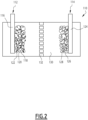
- FIG. 1 An example of a battery cell 110 is represented on figure 2 .
- the battery cell 110 conventionally comprises a positive electrode 112 and a negative electrode 114.
- the positive electrode 112 comprises a positive current collector 116 and positive active material 118.
- the positive active material 118 comprises, more particularly is constituted of, lithium-based material(s), such as Lithium Metal Oxyde, LiNiMnCoO 2 , LiFePO 4 or LiNiCoAlO 2 .
- lithium-based material(s) such as Lithium Metal Oxyde, LiNiMnCoO 2 , LiFePO 4 or LiNiCoAlO 2 .
- the positive current collector 116 for example, comprises an aluminum Al foil.
- the positive electrode 112 here further comprises a binder 120, for example a polymer, for example polyvinylidene fluoride (PVDF).
- a binder 120 for example a polymer, for example polyvinylidene fluoride (PVDF).
- the positive electrode 112 here further comprises a conductive additive 122, for example carbon black and/or carbon nanotubes.
- the negative electrode 114 comprises a negative current collector 124 and negative active material 126.
- the negative current collector 124 comprises, for example, a copper Cu foil.
- the negative active material 126 comprises at least one silicon-based material, for example silicon oxide (SiOx) and/or silicon carbide (SiC).
- the negative active material of each cell or the cell comprises at least 1,5 % mass of silicon.
- Said silicon comprises, more particularly here consists of, the silicon comprised within the silicon-based material.
- the silicon-based material comprises pure silicon nanodomains, said pure silicon nanodomains being bigger than 10 nm.
- the negative active material 126 for example, further comprises graphite carbon.
- the negative electrode 114 here further comprises a binder 128, for example a polymer, for example polyvinylidene fluoride (PVDF), and/or a combination of styrenebutadiene rubber (SBR) and carboxymethyl cellulose (CMC).
- PVDF polyvinylidene fluoride
- SBR styrenebutadiene rubber
- CMC carboxymethyl cellulose
- the positive electrode 112 and the negative electrode 114 are immersed together in an electrolyte 130, the electrolyte may be liquid or solid.
- the liquid electrolyte comprises a solvent, for example an organic solvent, and lithium salt.
- the solvent is, for example, ethylene carbonate (EC), dimethyl carbonate (DMC), ethyl methyl carbonate (EMC) or diethyl carbonate (DEC).
- EC ethylene carbonate
- DMC dimethyl carbonate
- EMC ethyl methyl carbonate
- DEC diethyl carbonate
- the lithium salt comprises for example Lithium hexafluorophosphate (LiPF6), Lithium bis(fluorosulfonyl)imide (LiFSI), and/or Lithium bis(trifluoromethanesulfonyl)imide (LiTFSI).
- LiPF6 Lithium hexafluorophosphate
- LiFSI Lithium bis(fluorosulfonyl)imide
- LiTFSI Lithium bis(trifluoromethanesulfonyl)imide
- the separator 132 for example comprises a base film, for example of polyolefin, in particular in Polypropylene (PP) or in Polyethylene (PE).
- PP Polypropylene
- PE Polyethylene
- the separator for example, comprises a coating, for example a ceramic coating, in particular comprising Aluminium oxide (Al 2 O 3 ) or Aluminium hydroxide oxide (AIOOH).
- a coating for example a ceramic coating, in particular comprising Aluminium oxide (Al 2 O 3 ) or Aluminium hydroxide oxide (AIOOH).
- a method for monitoring a Li-ion battery pack comprising a plurality of battery cells, a Li-ion battery module comprising a plurality of battery cells, or a Li-ion battery cell, all as described previously, will now be described in view of figures 3 and 4 .
- the or each cell comprises negative active material, the negative active material comprising a silicon-based material.
- the negative active material of each cell or the cell comprises at least 1,5 % mass of silicon.
- the silicon-based material comprises pure silicon nanodomains, said pure silicon nanodomains being bigger than 10 nm.
- the battery pack or module or cell has a state of charge superior or equal to 95%.
- the method comprising the following steps:
- the battery cells are here connected in series within the module, relative to a module, or within each module and within the pack, relative to a pack.
- the measuring step for example, comprises measuring the voltage of each cell and of the module.
- the measuring step for example, comprises measuring the voltage of each cell and of the pack.
- the or each voltage is measured during the whole phase of using, i.e during the whole discharge.
- the or each voltage is measured according to an acquisition frequency.
- the voltages are, for example, measured with the same acquisition frequency.
- the acquisition frequency is, for example, comprised between 1 Hz and 10 Hz.
- the measured voltages are sent to the battery management system 16, more particularly to a reception module 18.
- the electrochemical profile is here generated for each or the cell.
- the electrochemical profile represents the voltage of the battery pack, module or cell, here of the battery cell, depending on the capacity of the battery pack, module or cell, here of the battery cell.
- the capacity of the battery back, module or cell is calculated from coulometric metering or from the measured current.
- the electrochemical profile is calculated from the measured voltage(s), more particularly by a building profile module 20 of the battery management system 16, said building profile module 20 being connected to the reception module 18.
- the reception module 18 sends the measured voltages to the building profile module 20.
- the capacity considered here is, for example, the absolute capacity or the state of charge.
- the electrochemical profile is updated every time a condition 318 is filled after a voltage(s) measurement, for example every k voltage(s) measurement, k being an integer between 1 and 100 or every predefined period.
- said step is for example implemented at an analysis frequency, the acquisition frequency being between the analysis frequency and ten times the analysis frequency.
- the electrochemical profile is generated and gradually updated with the evolution of the voltage and the capacity.
- Each update here corresponds to the addition of one point in the electrochemical profile.
- Said point has an abscissa and an ordinate.
- the abscissa corresponds to the capacity of the battery, and the ordinate to the voltage of the battery pack, module or cell, here cell.
- the abscissa is, for example, the mean value of the capacity of the battery at the time of the previous measures since the last update.
- the ordinate is, for example, the mean value of the voltage of the battery pack, module or cell, here cell, for the measures since the last update.
- the measures considered for calculating the mean value exclude the outliers. Said outliers are, for example, identified using a known filter, for example based on the standard deviation error.
- each point is the voltage of the battery pack, module or cell for each measure since the last update.
- the abscissa of each point is the capacity of the battery at the time of the corresponding measures.
- Outliers are, for example, identified and excluded from the profile.
- the building profile module 20 is, for example, connected to a memory 22 of the battery management system 16.
- the building profile module 20 sends the electrochemical profile to the memory 22.
- the electrochemical profile is, for example, memorized in the memory 22 at the end of each generating step, such that, for the consecutive generating step, only the updated point(s) is (are) added to the profile, that is again memorized, and so on.
- the electrochemical profile is gradually completed during the discharge phase.
- the determining (215; 315) is, for example, done after each generating step (214; 314).
- the determining (215; 315) is implemented by a reconstruction module 23 of the battery management system 16, said reconstruction module 23 being connected to the building profile module 20.
- composition of each cell is known, as well as the individual electrochemical profile of each element composing the cell.
- the building profile module 20 sends the electrochemical profile, complete with the historic or only the updated point(s), to the reconstruction module 23.
- the contribution of the silicon-based material to the electrochemical profile of the battery pack, module or cell is deduced from the electrochemical profile, the composition of each cell and the respective individual electrochemical profiles, more particularly by reconstruction.
- each element composing the cell(s) contributes to the electrochemical profile of the battery pack, module or cell from the electrochemical profile, the composition of each cell and the respective individual electrochemical profiles.
- the reconstruction module 23 is, for example, connected to a memory 22 of the battery management system 16.
- the reconstruction module 23 for example, sends the contribution of at least of the silicon-based material to the electrochemical profile to the memory 22.
- the detecting (216; 316) is, for example, done after each determining step 215; 315.
- the detecting is here implemented at the analysis frequency.
- the detecting is implemented by a detection module 24 of the battery management system 16, said detection module 24 being connected to the reconstruction module 23.
- the detection module 24 is also connected to the memory 22.
- the reconstruction module 23 sends the contribution of the silicon-based material to electrochemical profile to the detection module 24.
- the detecting comprises comparing said contribution, determined during the last determining step, to a predetermined or predefined profile.
- the detecting is, for example, implemented for each cell independently. More particularly, the comparing is done between each contribution of the silicon-based material to the electrochemical profile generated for each cell and the predetermined or predefined profile.
- the predetermined or predefined profile is, for example, the same for all the cells. Alternatively, different predetermined or predefined profiles are determined or defined for the cells.
- the predetermined or predefined profile is previously recorded in the memory 22.
- the predetermined or predefined profile can be, for example, updated by an update of the battery management system 16.
- the detecting comprises comparing the voltage of the contribution of the silicon-based material, in particular to the point or each point of the electrochemical profile added during the last generating step, to the value of voltage for the same capacity in the predetermined or predefined profile.
- the deviation value is between 5 mV and 30 mV, more precisely between 15 mV and 25 mV.
- the detecting comprises detecting a plateau on the calculated contribution of the silicon-based material to the electrochemical profile.
- a plateau is, for example, detected if the voltage of the contribution of the silicon-based material to the electrochemical profile varies only within 5 mV or less for an interval of capacity of a minimum given size, for example for at least 0,1% of the state of charge.
- the generating, the determining and the detecting are done in parallel to the measuring step, during the discharge.
- the detection of early indicator of imminent lithium plating is done directly during the discharge of the battery pack, module and/or cell.
- an alert signal is sent, more particularly by the detection module 24, for example to a decision module 26.
- the method further comprises at least one 320 of the following steps: displaying a visual alert, generating an audible alarm, reducing the accessible state of charge of the battery pack or module or cell, and reducing the maximum charging current of the battery pack or module or cell.
- the method further comprises at least:
- the decision module 26 triggers said action(s), for example by sending control signals to the corresponding parts.
- the decision module 26 is connected to the corresponding parts.
- the visual alert is, for example, displayed on the control panel and/or central console of the vehicle.
- the visual alert is, for example, an illuminated light and/or illuminated icon and/or a message on a display.
- the audible alarm is, for example, a sound generated by a sound system of the vehicle.
- Said alert and/or alarm for example, prompts the user of the vehicle to go to a person of expertise, for example a dealership or garage.
- the accessible state of charge of the battery is, for example, reduced to 70%.
- the maximum charging current of the battery pack is, for example, reduced to 3,6 kW.
- the battery management system is an electronic device comprising an information processing unit consisting, for example, of memory 22 and a processor associated with the memory.
- Each cell is, for example, identifiable using an identification reference.
- the method then, for example, comprises displaying the identification reference(s) of the cell(s) where early indicator of imminent lithium plating has been detected, for example within a message on a display such as the control panel and/or central console.
- said identification reference(s) are memorized within the memory 22, that is accessible to the person of expertise.
- the electrochemical profile is generated only for each module, such that the detecting of the early indicator of imminent lithium plating is done for each module independently.
- the electrochemical profile is generated only for the pack as a whole, such that the detecting of the early indicator of imminent lithium plating is done at the level of the pack.
- the reception module 18, the profile module 20, the reconstruction module 23, the detection module 24 and, optionally, the decision module 26 are each implemented in the form of software, or a software brick, executable by the processor.
- the battery management system's memory 22 can store reception software, profile software, detection software and, optionally, decision software.
- the processor is then able to execute each of the reception software, profile construction software and detection software, as well as the optional decision software.
- the reception module 18, the profile module 20, the reconstruction module 23, the detection module 24 and, optionally, the decision module 26 are each implemented as a programmable logic component, such as an FPGA (Field Programmable Gate Array), or as an integrated circuit, such as an ASIC (Application Specific Integrated Circuit).
- a programmable logic component such as an FPGA (Field Programmable Gate Array)
- an ASIC Application Specific Integrated Circuit
- the battery management system When the battery management system is implemented in the form of one or more software programs, i.e. in the form of a computer program, also known as a computer program product, it can also be recorded on a computer-readable medium (not shown).
- the computer-readable medium is, for example, a medium capable of storing electronic instructions and of being coupled to a bus of a computer system.
- the readable medium is an optical disk, a magneto-optical disk, a ROM memory, a RAM memory, any type of non-volatile memory (e.g. FLASH or NVRAM) or a magnetic card.
- a computer program containing software instructions is stored on the readable medium.
- the method of the invention allows early detection of the degradation of a cell, module or pack. Thus, quick actions are taken by the battery management system 16 at an early stage, before any wrong event happens.
Landscapes
- Engineering & Computer Science (AREA)
- Manufacturing & Machinery (AREA)
- Chemical & Material Sciences (AREA)
- Chemical Kinetics & Catalysis (AREA)
- Electrochemistry (AREA)
- General Chemical & Material Sciences (AREA)
- Physics & Mathematics (AREA)
- General Physics & Mathematics (AREA)
- Microelectronics & Electronic Packaging (AREA)
- Secondary Cells (AREA)
Abstract
- measuring the voltage of each cell and/or pack and/or module during the discharge,
- generating an electrochemical profile during the discharge, the electrochemical profile representing the voltage depending on the capacity and being calculated from the measured voltage(s),
- determining from the electrochemical profile the contribution of the silicon-based material to said electrochemical profile, and
- detecting an early indicator of imminent lithium plating based on the determined contribution.
Description
- The present invention concerns a method for monitoring a Li-ion battery pack comprising a plurality of battery cells, a Li-ion battery module comprising a plurality of battery cells, or a Li-ion battery cell, the or each cell comprising a negative active material.
- The invention further relates to an associated battery pack.
- Battery cells are susceptible to ageing, in particular in an unsustainable way relative to the use of the battery.
- Such ageing may lead, on short term, to consequences such as a loss of capacity of the battery or thermal runaway.
- In particular, lithium plating corresponds to the formation of metallic lithium on top of the negative electrode. It is a serious degradation mechanism, since it can lead to a rapid loss of capacity of the cell, and/or to a trigger mechanism for a thermal runaway of the cell, and even the entire pack.
- Risk of lithium deposition occurs when the rate at which the negative active material is lost is higher than the rate of active lithium loss.
- However, loss of negative active material at delithiated state is a hidden degradation mechanism, as long as the remaining negative material is able to accommodate for the remaining active lithium.
- The aim of the invention is thus to propose a method for monitoring a battery pack comprising a plurality of battery cells, a battery module comprising a plurality of battery cells, or a battery cell, where ageing is detected early, in particular before lithium deposition occurred and therefore before any incidents.
- To that end, the invention relates to a method for monitoring a Li-ion battery pack comprising a plurality of battery cells, a Li-ion battery module comprising a plurality of battery cells, or a Li-ion battery cell, the or each cell comprising negative active material, the negative active material comprising a silicon-based material, the method comprising the following phases:
- charging the battery pack or module or cell,
- using the battery pack or module or cell, said using leading to a discharge of the battery pack or module or cell,
- measuring the voltage of the or each cell and/or of the pack and/or of the module during the discharge,
- generating an electrochemical profile during the discharge, the electrochemical profile representing the voltage depending on the capacity, said electrochemical profile being calculated from the measured voltage(s),
- determining from the electrochemical profile the contribution of the silicon-based material to said electrochemical profile, and
- detecting an early indicator of imminent lithium plating based on the contribution of the silicon-based material to said electrochemical profile.
- By monitoring the contribution of the silicon-based material to the electrochemical profile, this allows the detection of early indicators of imminent lithium plating, and thus of ageing.
- In the case of a negative active material comprising a silicon-based material, Li15Si4, the most lithiated phase of the LixSi alloy accessible electrochemically at room temperature, is formed when the silicon-based material is close to reach full capacity, in particular for a state of charge of at least 97%.
- However, the negative electrode has a higher surface capacity than the positive electrode, for example of a difference comprised between 10% and 20%. Thus, in normal operating condition and cell health, the negative electrode state of charge never exceeds 91%, which excludes the possibility to crystallize Li15Si4 in the cell. Consequently, if Li15Si4 is crystallized on the negative electrode, the cell is not in a healthy state.
- The delithiation of the crystallized Li15Si4 is visible on the electrochemical profile of the silicon-based material during the discharge of the cell. Said delithiation is, for example, visible via a plateau at 440 mV vs Li+/Li. Here the voltage at which said plateau appears further depends on other cell parameters. The longer the plateau is, the higher the amount of Li15Si4 is being delithiated, and thus has been formed previously, the less healthy the cell is.
- Thus, the method allows early detecting of the ageing of a cell through loss of negative active material at the delithiated state, by monitoring the electrochemical profile of the silicon-based material for any abnormality. Said abnormality corresponds to an indication of the delithiation of the crystallized Li15Si4.
- According to specific embodiments of the invention, the method also has one or more of the following features, considered alone or according to any technically possible combination(s):
- the detecting comprises comparing the contribution of the silicon-based material to the electrochemical profile to a predetermined or predefined profile;
- if the value of the contribution of the silicon-based material to the calculated electrochemical profile differs from a voltage value of the predetermined or predefined profile for the same capacity of at least a deviation value, the early indicator of imminent lithium plating is detected;
- the deviation value is between 5 mV and 30 mV, more precisely between 15 mV and 25 mV;
- if the early indicator of imminent lithium plating is detected, the method further comprises at least one of the following steps: displaying a visual alert, generating an audible alarm, reducing the state of charge of the battery pack or module or cell, and reducing a charging current of the battery pack or module or cell;
- the voltage(s) is measured according to an acquisition frequency, the generating, the determining and the detecting being implemented at an analysis frequency, the acquisition frequency being between the analysis frequency and ten times the analysis frequency;
- at the end of the charging step, the battery pack or module or cell has a state of charge superior or equal to 95%;
- for monitoring a battery pack, wherein the battery cells are connected in series, the voltage of each cell and of the pack being measured, the electrochemical profile of the silicon-based material being generated for each cell, such that the detecting of the early indicator of imminent lithium plating is done for each cell independently;
- the negative active material of each or the cell comprises at least 1,5 % mass of silicon;
- the silicon-based material comprises pure silicon nanodomains, said pure silicon nanodomains being bigger than 10 nm;
- the measuring, the determining, the generating and the detecting steps are implemented by a battery management system.
- The invention further relates to a battery pack comprising a plurality of battery cells and a battery management system, each cell comprising negative active material, the negative active material comprising a silicon-based material, the battery management system comprises, a reception module, a profile module and a detection module, the reception module being designed to receive a measured voltage of the or each cell and/or of the module and/or of the pack, the profile module being adapted to generate an electrochemical profile of the silicon-based material during a discharge of the battery pack, the electrochemical profile representing the voltage linked to the silicon-based material depending on the capacity, said electrochemical profile being calculated from the measured voltage(s) received by the reception module, the detection module being designed to receive the electrochemical profile from the profile module and to detect an early indicator of imminent lithium plating based on said electrochemical profile.
- Other features and advantages of the invention will appear upon reading the following description, provided solely as an example and done in reference to the appended drawings, in which:
-
Figure 1 is a schematic view of an example of a Li-ion battery pack according to the invention, -
Figure 2 is a schematic view of an example of a battery cell of the battery pack, -
Figure 3 is a schematic representation of steps of a method according to a first embodiment of the invention, and -
Figure 4 is a schematic representation of steps of a method according to a second embodiment of the invention. - A Li-ion battery pack, more particularly for a vehicle, 10 is represented on
figure 1 . - The
battery pack 10 comprises a plurality ofbattery cells 14. - More particularly, the
battery pack 10 comprises a plurality ofbattery modules 12, eachmodule 12 comprises a plurality ofbattery cells 14. - The
battery pack 10 is equipped with sensors for measuring the voltages of each cell and/or of the pack and/or of each module. More particularly, thebattery pack 10 is equipped with sensors for measuring the voltages of each cell and of the pack. - The battery pack further comprises a
battery management system 16. - The
battery management system 16 is adapted to implement the method of the invention, and will be further described in parallel to the description of the method of the invention. - An example of a
battery cell 110 is represented onfigure 2 . - The
battery cell 110 conventionally comprises apositive electrode 112 and anegative electrode 114. - The
positive electrode 112 comprises a positivecurrent collector 116 and positiveactive material 118. - The positive
active material 118 comprises, more particularly is constituted of, lithium-based material(s), such as Lithium Metal Oxyde, LiNiMnCoO2, LiFePO4 or LiNiCoAlO2. - The positive
current collector 116, for example, comprises an aluminum Al foil. - The
positive electrode 112 here further comprises abinder 120, for example a polymer, for example polyvinylidene fluoride (PVDF). - The
positive electrode 112 here further comprises aconductive additive 122, for example carbon black and/or carbon nanotubes. - The
negative electrode 114 comprises a negativecurrent collector 124 and negativeactive material 126. - The negative
current collector 124 comprises, for example, a copper Cu foil. - The negative
active material 126 comprises at least one silicon-based material, for example silicon oxide (SiOx) and/or silicon carbide (SiC). - More particularly, the negative active material of each cell or the cell comprises at least 1,5 % mass of silicon.
- Said silicon comprises, more particularly here consists of, the silicon comprised within the silicon-based material.
- The silicon-based material comprises pure silicon nanodomains, said pure silicon nanodomains being bigger than 10 nm.
- The negative
active material 126, for example, further comprises graphite carbon. - The
negative electrode 114 here further comprises abinder 128, for example a polymer, for example polyvinylidene fluoride (PVDF), and/or a combination of styrenebutadiene rubber (SBR) and carboxymethyl cellulose (CMC). - The
positive electrode 112 and thenegative electrode 114 are immersed together in anelectrolyte 130, the electrolyte may be liquid or solid. - The liquid electrolyte comprises a solvent, for example an organic solvent, and lithium salt.
- The solvent is, for example, ethylene carbonate (EC), dimethyl carbonate (DMC), ethyl methyl carbonate (EMC) or diethyl carbonate (DEC).
- The lithium salt comprises for example Lithium hexafluorophosphate (LiPF6), Lithium bis(fluorosulfonyl)imide (LiFSI), and/or Lithium bis(trifluoromethanesulfonyl)imide (LiTFSI).
- The
positive electrode 112 and thenegative electrode 114 are arranged apart from another, aseparator 132 being arranged between thepositive electrode 112 and thenegative electrode 114. - The
separator 132 for example comprises a base film, for example of polyolefin, in particular in Polypropylene (PP) or in Polyethylene (PE). - The separator, for example, comprises a coating, for example a ceramic coating, in particular comprising Aluminium oxide (Al2O3) or Aluminium hydroxide oxide (AIOOH).
- A method for monitoring a Li-ion battery pack comprising a plurality of battery cells, a Li-ion battery module comprising a plurality of battery cells, or a Li-ion battery cell, all as described previously, will now be described in view of
figures 3 and4 . - As mentioned previously, the or each cell comprises negative active material, the negative active material comprising a silicon-based material.
- More particularly, the negative active material of each cell or the cell comprises at least 1,5 % mass of silicon.
- The silicon-based material comprises pure silicon nanodomains, said pure silicon nanodomains being bigger than 10 nm.
- The method comprising the following phases:
- charging (200; 300) the battery pack or module or cell, and
- using (210; 310) the battery pack or module or cell, said using leading to a discharge of the battery pack or module or cell.
- At the end of the charging step, here, the battery pack or module or cell has a state of charge superior or equal to 95%.
- The method comprising the following steps:
- measuring (212; 312) the voltage of the or each cell and/or of the pack and/or of the module during the discharge,
- generating (214; 314) an electrochemical profile during the discharge,
- determining (215; 315) from the electrochemical profile the contribution of the silicon-based material to said electrochemical profile, and
- detecting (216; 316) an early indicator of imminent lithium plating based on said electrochemical profile.
- The battery cells are here connected in series within the module, relative to a module, or within each module and within the pack, relative to a pack.
- In the case of a module, the measuring step, for example, comprises measuring the voltage of each cell and of the module.
- In the case of a pack, the measuring step, for example, comprises measuring the voltage of each cell and of the pack.
- The or each voltage is measured during the whole phase of using, i.e during the whole discharge.
- The or each voltage is measured according to an acquisition frequency.
- The voltages are, for example, measured with the same acquisition frequency.
- The acquisition frequency is, for example, comprised between 1 Hz and 10 Hz.
- The measured voltages are sent to the
battery management system 16, more particularly to areception module 18. - The electrochemical profile is here generated for each or the cell.
- The electrochemical profile represents the voltage of the battery pack, module or cell, here of the battery cell, depending on the capacity of the battery pack, module or cell, here of the battery cell.
- The capacity of the battery back, module or cell is calculated from coulometric metering or from the measured current.
- The electrochemical profile is calculated from the measured voltage(s), more particularly by a
building profile module 20 of thebattery management system 16, saidbuilding profile module 20 being connected to thereception module 18. - The
reception module 18 sends the measured voltages to thebuilding profile module 20. - The capacity considered here is, for example, the absolute capacity or the state of charge.
- As represented on
figure 4 , in one embodiment, the electrochemical profile is updated every time acondition 318 is filled after a voltage(s) measurement, for example every k voltage(s) measurement, k being an integer between 1 and 100 or every predefined period. - Thus, said step is for example implemented at an analysis frequency, the acquisition frequency being between the analysis frequency and ten times the analysis frequency.
- More particularly, the electrochemical profile is generated and gradually updated with the evolution of the voltage and the capacity.
- Each update here corresponds to the addition of one point in the electrochemical profile.
- Said point has an abscissa and an ordinate.
- The abscissa corresponds to the capacity of the battery, and the ordinate to the voltage of the battery pack, module or cell, here cell.
- The abscissa is, for example, the mean value of the capacity of the battery at the time of the previous measures since the last update.
- The ordinate is, for example, the mean value of the voltage of the battery pack, module or cell, here cell, for the measures since the last update. In one embodiment, the measures considered for calculating the mean value exclude the outliers. Said outliers are, for example, identified using a known filter, for example based on the standard deviation error.
- Alternatively, a plurality of points are added at each update. The ordinate of each point is the voltage of the battery pack, module or cell for each measure since the last update. The abscissa of each point is the capacity of the battery at the time of the corresponding measures. Outliers are, for example, identified and excluded from the profile.
- The
building profile module 20 is, for example, connected to amemory 22 of thebattery management system 16. - The
building profile module 20 sends the electrochemical profile to thememory 22. - The electrochemical profile is, for example, memorized in the
memory 22 at the end of each generating step, such that, for the consecutive generating step, only the updated point(s) is (are) added to the profile, that is again memorized, and so on. - The electrochemical profile is gradually completed during the discharge phase.
- Alternatively, only the updated point(s) is (are) considered for the determining and detecting step.
- The determining (215; 315) is, for example, done after each generating step (214; 314).
- The determining (215; 315) is implemented by a
reconstruction module 23 of thebattery management system 16, saidreconstruction module 23 being connected to thebuilding profile module 20. - The composition of each cell is known, as well as the individual electrochemical profile of each element composing the cell.
- The
building profile module 20 sends the electrochemical profile, complete with the historic or only the updated point(s), to thereconstruction module 23. - The contribution of the silicon-based material to the electrochemical profile of the battery pack, module or cell is deduced from the electrochemical profile, the composition of each cell and the respective individual electrochemical profiles, more particularly by reconstruction.
- In particular, the contribution of each element composing the cell(s) to the electrochemical profile of the battery pack, module or cell is deduced from the electrochemical profile, the composition of each cell and the respective individual electrochemical profiles.
- The contribution is here determined only for the updated point(s).
- The contribution for the previous point(s) have already been calculated during anterior determining steps.
- The
reconstruction module 23 is, for example, connected to amemory 22 of thebattery management system 16. - The
reconstruction module 23, for example, sends the contribution of at least of the silicon-based material to the electrochemical profile to thememory 22. - The detecting (216; 316) is, for example, done after each determining
step 215; 315. The detecting is here implemented at the analysis frequency. - The detecting is implemented by a
detection module 24 of thebattery management system 16, saiddetection module 24 being connected to thereconstruction module 23. - The
detection module 24 is also connected to thememory 22. - The
reconstruction module 23 sends the contribution of the silicon-based material to electrochemical profile to thedetection module 24. - The detecting comprises comparing said contribution, determined during the last determining step, to a predetermined or predefined profile.
- The detecting is, for example, implemented for each cell independently. More particularly, the comparing is done between each contribution of the silicon-based material to the electrochemical profile generated for each cell and the predetermined or predefined profile.
- The predetermined or predefined profile is, for example, the same for all the cells. Alternatively, different predetermined or predefined profiles are determined or defined for the cells.
- The predetermined or predefined profile is previously recorded in the
memory 22. - The predetermined or predefined profile can be, for example, updated by an update of the
battery management system 16. - More particularly, the detecting comprises comparing the voltage of the contribution of the silicon-based material, in particular to the point or each point of the electrochemical profile added during the last generating step, to the value of voltage for the same capacity in the predetermined or predefined profile.
- If the value of the contribution of the silicon-based material to the calculated electrochemical profile differs from the voltage value of the predetermined or predefined profile for the same capacity of at least a deviation value, an early indicator of imminent lithium plating is detected.
- The deviation value is between 5 mV and 30 mV, more precisely between 15 mV and 25 mV.
- Additionnally or alternatively, the detecting comprises detecting a plateau on the calculated contribution of the silicon-based material to the electrochemical profile.
- A plateau is, for example, detected if the voltage of the contribution of the silicon-based material to the electrochemical profile varies only within 5 mV or less for an interval of capacity of a minimum given size, for example for at least 0,1% of the state of charge.
- The generating, the determining and the detecting are done in parallel to the measuring step, during the discharge.
- Thus, the detection of early indicator of imminent lithium plating is done directly during the discharge of the battery pack, module and/or cell.
- This allows a prompt action or reaction in consequence.
- If early indicator of imminent lithium plating is detected, an alert signal is sent, more particularly by the
detection module 24, for example to adecision module 26. - In one embodiment, as depicted on
figure 4 , if the early indicator of imminent lithium plating is detected, the method further comprises at least one 320 of the following steps: displaying a visual alert, generating an audible alarm, reducing the accessible state of charge of the battery pack or module or cell, and reducing the maximum charging current of the battery pack or module or cell. - More particularly, if the early indicator of imminent lithium plating is detected, the method further comprises at least:
- displaying a visual alert and/or generating an audible alarm, and
- reducing the accessible state of charge of the battery pack or module or cell, and/or reducing the maximum charging current of the battery pack or module or cell.
- The
decision module 26 triggers said action(s), for example by sending control signals to the corresponding parts. - The
decision module 26 is connected to the corresponding parts. - The visual alert is, for example, displayed on the control panel and/or central console of the vehicle.
- The visual alert is, for example, an illuminated light and/or illuminated icon and/or a message on a display.
- The audible alarm is, for example, a sound generated by a sound system of the vehicle.
- Said alert and/or alarm, for example, prompts the user of the vehicle to go to a person of expertise, for example a dealership or garage.
- The accessible state of charge of the battery is, for example, reduced to 70%.
- The maximum charging current of the battery pack is, for example, reduced to 3,6 kW.
- This allows operating the vehicle in a degraded mode, so that the user may bring the vehicle safely to the person of expertise.
- In the example shown in
Fig. 1 , the battery management system is an electronic device comprising an information processing unit consisting, for example, ofmemory 22 and a processor associated with the memory. - When the detecting is done individually for each cell, this allows knowing which cell is not healthy and the concerned number of cells, so that the maintenance is done accordingly.
- Each cell is, for example, identifiable using an identification reference.
- The method then, for example, comprises displaying the identification reference(s) of the cell(s) where early indicator of imminent lithium plating has been detected, for example within a message on a display such as the control panel and/or central console.
- Alternatively, said identification reference(s) are memorized within the
memory 22, that is accessible to the person of expertise. - Alternatively, during the generating step, the electrochemical profile is generated only for each module, such that the detecting of the early indicator of imminent lithium plating is done for each module independently.
- Alternatively, during the generating step, the electrochemical profile is generated only for the pack as a whole, such that the detecting of the early indicator of imminent lithium plating is done at the level of the pack.
- In the example shown in
Fig. 1 , thereception module 18, theprofile module 20, thereconstruction module 23, thedetection module 24 and, optionally, thedecision module 26 are each implemented in the form of software, or a software brick, executable by the processor. The battery management system'smemory 22 can store reception software, profile software, detection software and, optionally, decision software. The processor is then able to execute each of the reception software, profile construction software and detection software, as well as the optional decision software. - In a variant not shown, the
reception module 18, theprofile module 20, thereconstruction module 23, thedetection module 24 and, optionally, thedecision module 26 are each implemented as a programmable logic component, such as an FPGA (Field Programmable Gate Array), or as an integrated circuit, such as an ASIC (Application Specific Integrated Circuit). - When the battery management system is implemented in the form of one or more software programs, i.e. in the form of a computer program, also known as a computer program product, it can also be recorded on a computer-readable medium (not shown). The computer-readable medium is, for example, a medium capable of storing electronic instructions and of being coupled to a bus of a computer system. By way of example, the readable medium is an optical disk, a magneto-optical disk, a ROM memory, a RAM memory, any type of non-volatile memory (e.g. FLASH or NVRAM) or a magnetic card. A computer program containing software instructions is stored on the readable medium.
- The method of the invention allows early detection of the degradation of a cell, module or pack. Thus, quick actions are taken by the
battery management system 16 at an early stage, before any wrong event happens. - 10 battery pack
- 12 battery module
- 14, 110 battery cell
- 16 battery management system
- 18 reception module
- 20 profile module
- 22 memory
- 23 reconstruction module
- 24 detection module
- 26 decision module
- 112 positive electrode
- 114 negative electrode
- 116 positive current collector
- 118 positive active material
- 120 binder
- 122 conductive additive
- 124 negative current collector
- 126 negative active material
- 128 binder
- 130 electrolyte
- 132 separator
- 200, 300 charging phase
- 210, 310 using phase
- 212 ,312 measuring step
- 214, 314 generating step
- 216, 316 detecting step
- 318 condition
- 320 action step
Claims (12)
- Method for monitoring a Li-ion battery pack (10) comprising a plurality of battery cells (14), a Li-ion battery module (12) comprising a plurality of battery cells (14), or a Li-ion battery cell (14), the or each cell (14) comprising negative active material (126), the negative active material comprising a silicon-based material, the method comprising the following phases:- charging (200; 300) the battery pack or module or cell,- using (210; 310) the battery pack or module or cell, said using leading to a discharge of the battery pack or module or cell,the method comprising the following steps:- measuring (212; 312) the voltage of the or each cell and/or of the pack and/or of the module during the discharge,- generating (214; 314) an electrochemical profile during the discharge, the electrochemical profile representing the voltage depending on the capacity, said electrochemical profile being calculated from the measured voltage(s),- determining (215; 315) from the electrochemical profile the contribution of the silicon-based material to said electrochemical profile, and- detecting (216; 316) an early indicator of imminent lithium plating based on the contribution of the silicon-based material to said electrochemical profile.
- Method according to claim 1, wherein the detecting (216; 316) comprises comparing the contribution of the silicon-based material to the electrochemical profile to a predetermined or predefined profile.
- Method according to claim 2, wherein, if the value of the contribution of the silicon-based material to the calculated electrochemical profile differs from a voltage value of the predetermined or predefined profile for the same capacity of at least a deviation value, the early indicator of imminent lithium plating is detected.
- Method according to claim 3, wherein the deviation value is between 5 mV and 30 mV, more precisely between 15 mV and 25 mV.
- Method according to any one of claims 1 to 4, wherein, if the early indicator of imminent lithium plating is detected, the method further comprises at least one of the following steps (320): displaying a visual alert, generating an audible alarm, reducing the state of charge of the battery pack or module or cell, and reducing a charging current of the battery pack or module or cell.
- Method according to any of claims 1 to 5, wherein the voltage(s) is measured according to an acquisition frequency, the generating, the determining and the detecting being implemented at an analysis frequency, the acquisition frequency being between the analysis frequency and ten times the analysis frequency.
- Method according to any one of claims 1 to 6, wherein, at the end of the charging step (200; 300), the battery pack or module or cell has a state of charge superior or equal to 95%.
- Method according to any one of claims 1 to 7, for monitoring a battery pack (10), wherein the battery cells (14) are connected in series, the voltage of each cell (14) and of the pack (10) being measured, the electrochemical profile of the silicon-based material being generated for each cell (14), such that the detecting (216; 316) of the early indicator of imminent lithium plating is done for each cell (14) independently.
- Method according to any one of claims 1 to 8, wherein the negative active material (126) of each or the cell (14) comprises at least 1,5 % mass of silicon.
- Method according to any one of claims 1 to 9, wherein the silicon-based material comprises pure silicon nanodomains, said pure silicon nanodomains being bigger than 10 nm.
- Method according to any one of claims 1 to 10, wherein the measuring (212; 312), the determining (215; 315), the generating (214; 314) and the detecting (216; 316) steps are implemented by a battery management system (16).
- Battery pack (10) comprising a plurality of battery cells (14) and a battery management system (16), each cell (14) comprising negative active material (126), the negative active material (126) comprising a silicon-based material, the battery management system (16) comprises, a reception module (18), a profile module (20) and a detection module (24), the reception module (18) being designed to receive a measured voltage of the or each cell (14) and/or of the module (12) and/or of the pack (10), the profile module (20) being adapted to generate an electrochemical profile of the silicon-based material during a discharge of the battery pack, the electrochemical profile representing the voltage linked to the silicon-based material depending on the capacity, said electrochemical profile being calculated from the measured voltage(s) received by the reception module (18), the detection module (24) being designed to receive the electrochemical profile from the profile module (20) and to detect an early indicator of imminent lithium plating based on said electrochemical profile.
Priority Applications (1)
| Application Number | Priority Date | Filing Date | Title |
|---|---|---|---|
| EP23306484.9A EP4521509B1 (en) | 2023-09-07 | 2023-09-07 | Monitoring method for a li-ion battery pack, module, or cell, and associated battery pack |
Applications Claiming Priority (1)
| Application Number | Priority Date | Filing Date | Title |
|---|---|---|---|
| EP23306484.9A EP4521509B1 (en) | 2023-09-07 | 2023-09-07 | Monitoring method for a li-ion battery pack, module, or cell, and associated battery pack |
Publications (2)
| Publication Number | Publication Date |
|---|---|
| EP4521509A1 true EP4521509A1 (en) | 2025-03-12 |
| EP4521509B1 EP4521509B1 (en) | 2026-02-04 |
Family
ID=88241114
Family Applications (1)
| Application Number | Title | Priority Date | Filing Date |
|---|---|---|---|
| EP23306484.9A Active EP4521509B1 (en) | 2023-09-07 | 2023-09-07 | Monitoring method for a li-ion battery pack, module, or cell, and associated battery pack |
Country Status (1)
| Country | Link |
|---|---|
| EP (1) | EP4521509B1 (en) |
Citations (3)
| Publication number | Priority date | Publication date | Assignee | Title |
|---|---|---|---|---|
| US20170203667A1 (en) * | 2016-01-20 | 2017-07-20 | Ford Global Technologies, Llc | Charging strategies to mitigate lithium plating in electrified vehicle battery |
| US20220278378A1 (en) * | 2019-08-02 | 2022-09-01 | The Regents Of The University Of California | Acoustic wave driven mixing for suppression of dendrite formation and ion depletion in batteries |
| US20220276314A1 (en) * | 2019-09-11 | 2022-09-01 | Lg Energy Solution, Ltd. | Battery Management Apparatus and Method |
-
2023
- 2023-09-07 EP EP23306484.9A patent/EP4521509B1/en active Active
Patent Citations (3)
| Publication number | Priority date | Publication date | Assignee | Title |
|---|---|---|---|---|
| US20170203667A1 (en) * | 2016-01-20 | 2017-07-20 | Ford Global Technologies, Llc | Charging strategies to mitigate lithium plating in electrified vehicle battery |
| US20220278378A1 (en) * | 2019-08-02 | 2022-09-01 | The Regents Of The University Of California | Acoustic wave driven mixing for suppression of dendrite formation and ion depletion in batteries |
| US20220276314A1 (en) * | 2019-09-11 | 2022-09-01 | Lg Energy Solution, Ltd. | Battery Management Apparatus and Method |
Also Published As
| Publication number | Publication date |
|---|---|
| EP4521509B1 (en) | 2026-02-04 |
Similar Documents
| Publication | Publication Date | Title |
|---|---|---|
| EP3145021B1 (en) | Secondary-battery monitoring device and method for predicting capacity of secondary battery | |
| US20200355749A1 (en) | Device detecting abnormality of secondary battery, abnormality detection method, and program | |
| KR101337153B1 (en) | Device for detecting abnormality of state of charge in a lithium secondary battery and method for testing the same | |
| US8742725B2 (en) | Secondary battery system | |
| EP2700964B1 (en) | Battery state estimation system, battery control system, battery system, and battery state estimation method | |
| US7362076B2 (en) | Remaining capacity calculating device and method for electric power storage | |
| EP2634591B1 (en) | Method and system for estimating the charge level of a lithium electrochemical element including a lithium phosphate positive electrode | |
| EP2989675B1 (en) | Method and system for estimating a capacity of individual electrodes and the total capacity of a lithium-ion battery system | |
| EP2535730B1 (en) | System and method for determining the state of health of electrochemical battery cells | |
| JP2013181875A (en) | Secondary battery deterioration rate calculation method, secondary battery life prediction method, secondary battery deterioration rate calculation system and secondary battery life prediction system | |
| EP3051305A1 (en) | Status determining method for secondary battery, status determining apparatus for secondary battery, secondary battery system, and charge/discharge control apparatus having status determining apparatus | |
| EP3657189B1 (en) | Estimation device, power storage device, estimation method, and computer program | |
| CN113809412B (en) | Battery System | |
| KR20190129754A (en) | Method of diagnosing lithium-ion battery and diagnostic apparatus for lithium-ion battery | |
| CN108963354B (en) | State estimation device and state estimation method for lithium ion battery | |
| CN117769656A (en) | Battery lithium precipitation detection method, device, management system, battery and electricity utilization device | |
| JP2015087344A (en) | Capacity degradation estimation device, power storage device, and capacity degradation estimation method | |
| WO2019058666A1 (en) | Secondary battery deterioration detection system | |
| JP2003243042A (en) | Apparatus and method for detecting degree of deterioration of lithium battery constituting assembled battery | |
| JP2019145342A (en) | Diagnostic device and control device | |
| JP5904916B2 (en) | Battery soundness calculation device and soundness calculation method | |
| JP2013089311A (en) | Controller of laminated lithium ion battery | |
| EP4521509B1 (en) | Monitoring method for a li-ion battery pack, module, or cell, and associated battery pack | |
| JP7529458B2 (en) | Method and device for determining deterioration of lithium ion secondary battery | |
| US12374910B2 (en) | Charging/discharging control device and charging/discharging control method |
Legal Events
| Date | Code | Title | Description |
|---|---|---|---|
| PUAI | Public reference made under article 153(3) epc to a published international application that has entered the european phase |
Free format text: ORIGINAL CODE: 0009012 |
|
| STAA | Information on the status of an ep patent application or granted ep patent |
Free format text: STATUS: THE APPLICATION HAS BEEN PUBLISHED |
|
| AK | Designated contracting states |
Kind code of ref document: A1 Designated state(s): AL AT BE BG CH CY CZ DE DK EE ES FI FR GB GR HR HU IE IS IT LI LT LU LV MC ME MK MT NL NO PL PT RO RS SE SI SK SM TR |
|
| STAA | Information on the status of an ep patent application or granted ep patent |
Free format text: STATUS: REQUEST FOR EXAMINATION WAS MADE |
|
| P01 | Opt-out of the competence of the unified patent court (upc) registered |
Free format text: CASE NUMBER: APP_14647/2025 Effective date: 20250326 |
|
| 17P | Request for examination filed |
Effective date: 20250404 |
|
| GRAP | Despatch of communication of intention to grant a patent |
Free format text: ORIGINAL CODE: EPIDOSNIGR1 |
|
| STAA | Information on the status of an ep patent application or granted ep patent |
Free format text: STATUS: GRANT OF PATENT IS INTENDED |
|
| RIC1 | Information provided on ipc code assigned before grant |
Ipc: H01M 10/42 20060101AFI20250910BHEP Ipc: G01R 31/392 20190101ALI20250910BHEP Ipc: H01M 10/48 20060101ALI20250910BHEP Ipc: H01M 10/0525 20100101ALI20250910BHEP |
|
| INTG | Intention to grant announced |
Effective date: 20250924 |
|
| GRAS | Grant fee paid |
Free format text: ORIGINAL CODE: EPIDOSNIGR3 |
|
| GRAA | (expected) grant |
Free format text: ORIGINAL CODE: 0009210 |
|
| STAA | Information on the status of an ep patent application or granted ep patent |
Free format text: STATUS: THE PATENT HAS BEEN GRANTED |
|
| AK | Designated contracting states |
Kind code of ref document: B1 Designated state(s): AL AT BE BG CH CY CZ DE DK EE ES FI FR GB GR HR HU IE IS IT LI LT LU LV MC ME MK MT NL NO PL PT RO RS SE SI SK SM TR |
|
| REG | Reference to a national code |
Ref country code: CH Ref legal event code: F10 Free format text: ST27 STATUS EVENT CODE: U-0-0-F10-F00 (AS PROVIDED BY THE NATIONAL OFFICE) Effective date: 20260204 Ref country code: GB Ref legal event code: FG4D |
|
| REG | Reference to a national code |
Ref country code: DE Ref legal event code: R096 Ref document number: 602023011609 Country of ref document: DE |
|
| REG | Reference to a national code |
Ref country code: IE Ref legal event code: FG4D |