EP4521401A1 - Battery module - Google Patents
Battery module Download PDFInfo
- Publication number
- EP4521401A1 EP4521401A1 EP24711959.7A EP24711959A EP4521401A1 EP 4521401 A1 EP4521401 A1 EP 4521401A1 EP 24711959 A EP24711959 A EP 24711959A EP 4521401 A1 EP4521401 A1 EP 4521401A1
- Authority
- EP
- European Patent Office
- Prior art keywords
- insulating paper
- sub
- weight
- battery module
- upper case
- Prior art date
- Legal status (The legal status is an assumption and is not a legal conclusion. Google has not performed a legal analysis and makes no representation as to the accuracy of the status listed.)
- Pending
Links
- 239000005995 Aluminium silicate Substances 0.000 claims abstract description 6
- 235000012211 aluminium silicate Nutrition 0.000 claims abstract description 6
- NLYAJNPCOHFWQQ-UHFFFAOYSA-N kaolin Chemical compound O.O.O=[Al]O[Si](=O)O[Si](=O)O[Al]=O NLYAJNPCOHFWQQ-UHFFFAOYSA-N 0.000 claims abstract description 6
- LXEJRKJRKIFVNY-UHFFFAOYSA-N terephthaloyl chloride Chemical compound ClC(=O)C1=CC=C(C(Cl)=O)C=C1 LXEJRKJRKIFVNY-UHFFFAOYSA-N 0.000 claims abstract description 5
- 239000012790 adhesive layer Substances 0.000 claims description 5
- SKCOBKDMIOUPGW-UHFFFAOYSA-N 4,5-dichlorobenzene-1,3-dicarbaldehyde Chemical compound ClC1=CC(C=O)=CC(C=O)=C1Cl SKCOBKDMIOUPGW-UHFFFAOYSA-N 0.000 claims description 4
- MXRIRQGCELJRSN-UHFFFAOYSA-N O.O.O.[Al] Chemical compound O.O.O.[Al] MXRIRQGCELJRSN-UHFFFAOYSA-N 0.000 claims description 3
- 230000009172 bursting Effects 0.000 claims description 3
- 229910018626 Al(OH) Inorganic materials 0.000 abstract 1
- WNROFYMDJYEPJX-UHFFFAOYSA-K aluminium hydroxide Chemical compound [OH-].[OH-].[OH-].[Al+3] WNROFYMDJYEPJX-UHFFFAOYSA-K 0.000 abstract 1
- 239000004760 aramid Substances 0.000 description 9
- 238000000034 method Methods 0.000 description 9
- 239000007789 gas Substances 0.000 description 8
- 229920006231 aramid fiber Polymers 0.000 description 7
- 229920003235 aromatic polyamide Polymers 0.000 description 6
- 239000011230 binding agent Substances 0.000 description 5
- -1 polyparaphenylene terephthalamide Polymers 0.000 description 5
- 239000000463 material Substances 0.000 description 4
- 229910052751 metal Inorganic materials 0.000 description 4
- 239000002184 metal Substances 0.000 description 4
- 238000003860 storage Methods 0.000 description 4
- WHXSMMKQMYFTQS-UHFFFAOYSA-N Lithium Chemical compound [Li] WHXSMMKQMYFTQS-UHFFFAOYSA-N 0.000 description 3
- 229920001577 copolymer Polymers 0.000 description 3
- 238000004880 explosion Methods 0.000 description 3
- 229910052744 lithium Inorganic materials 0.000 description 3
- 229920005989 resin Polymers 0.000 description 3
- 239000011347 resin Substances 0.000 description 3
- 229920003002 synthetic resin Polymers 0.000 description 3
- 239000000057 synthetic resin Substances 0.000 description 3
- OKTJSMMVPCPJKN-UHFFFAOYSA-N Carbon Chemical compound [C] OKTJSMMVPCPJKN-UHFFFAOYSA-N 0.000 description 2
- XLOMVQKBTHCTTD-UHFFFAOYSA-N Zinc monoxide Chemical compound [Zn]=O XLOMVQKBTHCTTD-UHFFFAOYSA-N 0.000 description 2
- 238000010586 diagram Methods 0.000 description 2
- 238000007599 discharging Methods 0.000 description 2
- 239000006185 dispersion Substances 0.000 description 2
- 238000001035 drying Methods 0.000 description 2
- 239000000835 fiber Substances 0.000 description 2
- 239000000945 filler Substances 0.000 description 2
- 239000007788 liquid Substances 0.000 description 2
- 229920006122 polyamide resin Polymers 0.000 description 2
- 229920000642 polymer Polymers 0.000 description 2
- MHSKRLJMQQNJNC-UHFFFAOYSA-N terephthalamide Chemical compound NC(=O)C1=CC=C(C(N)=O)C=C1 MHSKRLJMQQNJNC-UHFFFAOYSA-N 0.000 description 2
- 229920001187 thermosetting polymer Polymers 0.000 description 2
- 229910052582 BN Inorganic materials 0.000 description 1
- PZNSFCLAULLKQX-UHFFFAOYSA-N Boron nitride Chemical compound N#B PZNSFCLAULLKQX-UHFFFAOYSA-N 0.000 description 1
- 238000012695 Interfacial polymerization Methods 0.000 description 1
- 229920000877 Melamine resin Polymers 0.000 description 1
- 239000004743 Polypropylene Substances 0.000 description 1
- 229920001807 Urea-formaldehyde Polymers 0.000 description 1
- 229920000180 alkyd Polymers 0.000 description 1
- MHCAFGMQMCSRGH-UHFFFAOYSA-N aluminum;hydrate Chemical compound O.[Al] MHCAFGMQMCSRGH-UHFFFAOYSA-N 0.000 description 1
- 125000003368 amide group Chemical group 0.000 description 1
- 239000007864 aqueous solution Substances 0.000 description 1
- 239000000440 bentonite Substances 0.000 description 1
- 229910000278 bentonite Inorganic materials 0.000 description 1
- SVPXDRXYRYOSEX-UHFFFAOYSA-N bentoquatam Chemical compound O.O=[Si]=O.O=[Al]O[Al]=O SVPXDRXYRYOSEX-UHFFFAOYSA-N 0.000 description 1
- OJIJEKBXJYRIBZ-UHFFFAOYSA-N cadmium nickel Chemical compound [Ni].[Cd] OJIJEKBXJYRIBZ-UHFFFAOYSA-N 0.000 description 1
- 239000002041 carbon nanotube Substances 0.000 description 1
- 229910021393 carbon nanotube Inorganic materials 0.000 description 1
- 230000015556 catabolic process Effects 0.000 description 1
- 230000006835 compression Effects 0.000 description 1
- 238000007906 compression Methods 0.000 description 1
- 239000011231 conductive filler Substances 0.000 description 1
- PMHQVHHXPFUNSP-UHFFFAOYSA-M copper(1+);methylsulfanylmethane;bromide Chemical compound Br[Cu].CSC PMHQVHHXPFUNSP-UHFFFAOYSA-M 0.000 description 1
- 230000008878 coupling Effects 0.000 description 1
- 238000010168 coupling process Methods 0.000 description 1
- 238000005859 coupling reaction Methods 0.000 description 1
- 230000000694 effects Effects 0.000 description 1
- 230000005611 electricity Effects 0.000 description 1
- 238000003487 electrochemical reaction Methods 0.000 description 1
- 238000005516 engineering process Methods 0.000 description 1
- 239000003822 epoxy resin Substances 0.000 description 1
- 238000010528 free radical solution polymerization reaction Methods 0.000 description 1
- 239000010439 graphite Substances 0.000 description 1
- 229910002804 graphite Inorganic materials 0.000 description 1
- 238000010438 heat treatment Methods 0.000 description 1
- 239000001257 hydrogen Substances 0.000 description 1
- 229910052739 hydrogen Inorganic materials 0.000 description 1
- 239000011256 inorganic filler Substances 0.000 description 1
- 229910003475 inorganic filler Inorganic materials 0.000 description 1
- 239000000395 magnesium oxide Substances 0.000 description 1
- CPLXHLVBOLITMK-UHFFFAOYSA-N magnesium oxide Inorganic materials [Mg]=O CPLXHLVBOLITMK-UHFFFAOYSA-N 0.000 description 1
- AXZKOIWUVFPNLO-UHFFFAOYSA-N magnesium;oxygen(2-) Chemical compound [O-2].[Mg+2] AXZKOIWUVFPNLO-UHFFFAOYSA-N 0.000 description 1
- 238000004519 manufacturing process Methods 0.000 description 1
- 239000007769 metal material Substances 0.000 description 1
- 239000010445 mica Substances 0.000 description 1
- 229910052618 mica group Inorganic materials 0.000 description 1
- 238000012986 modification Methods 0.000 description 1
- 230000004048 modification Effects 0.000 description 1
- QELJHCBNGDEXLD-UHFFFAOYSA-N nickel zinc Chemical compound [Ni].[Zn] QELJHCBNGDEXLD-UHFFFAOYSA-N 0.000 description 1
- TWNQGVIAIRXVLR-UHFFFAOYSA-N oxo(oxoalumanyloxy)alumane Chemical compound O=[Al]O[Al]=O TWNQGVIAIRXVLR-UHFFFAOYSA-N 0.000 description 1
- 239000005011 phenolic resin Substances 0.000 description 1
- 125000001997 phenyl group Chemical group [H]C1=C([H])C([H])=C(*)C([H])=C1[H] 0.000 description 1
- 230000000704 physical effect Effects 0.000 description 1
- 229920000647 polyepoxide Polymers 0.000 description 1
- 229920000728 polyester Polymers 0.000 description 1
- 229920001225 polyester resin Polymers 0.000 description 1
- 239000004645 polyester resin Substances 0.000 description 1
- 229920001155 polypropylene Polymers 0.000 description 1
- 229920002689 polyvinyl acetate Polymers 0.000 description 1
- 239000011118 polyvinyl acetate Substances 0.000 description 1
- 229920002451 polyvinyl alcohol Polymers 0.000 description 1
- 238000004080 punching Methods 0.000 description 1
- 230000000630 rising effect Effects 0.000 description 1
- 239000002002 slurry Substances 0.000 description 1
- 239000000243 solution Substances 0.000 description 1
- 238000006467 substitution reaction Methods 0.000 description 1
- 229920001169 thermoplastic Polymers 0.000 description 1
- 229920002803 thermoplastic polyurethane Polymers 0.000 description 1
- 229920005992 thermoplastic resin Polymers 0.000 description 1
- 239000004416 thermosoftening plastic Substances 0.000 description 1
- 239000011787 zinc oxide Substances 0.000 description 1
Images

Classifications
-
- H—ELECTRICITY
- H01—ELECTRIC ELEMENTS
- H01M—PROCESSES OR MEANS, e.g. BATTERIES, FOR THE DIRECT CONVERSION OF CHEMICAL ENERGY INTO ELECTRICAL ENERGY
- H01M50/00—Constructional details or processes of manufacture of the non-active parts of electrochemical cells other than fuel cells, e.g. hybrid cells
- H01M50/20—Mountings; Secondary casings or frames; Racks, modules or packs; Suspension devices; Shock absorbers; Transport or carrying devices; Holders
- H01M50/271—Lids or covers for the racks or secondary casings
-
- H—ELECTRICITY
- H01—ELECTRIC ELEMENTS
- H01M—PROCESSES OR MEANS, e.g. BATTERIES, FOR THE DIRECT CONVERSION OF CHEMICAL ENERGY INTO ELECTRICAL ENERGY
- H01M50/00—Constructional details or processes of manufacture of the non-active parts of electrochemical cells other than fuel cells, e.g. hybrid cells
- H01M50/20—Mountings; Secondary casings or frames; Racks, modules or packs; Suspension devices; Shock absorbers; Transport or carrying devices; Holders
- H01M50/204—Racks, modules or packs for multiple batteries or multiple cells
-
- H—ELECTRICITY
- H01—ELECTRIC ELEMENTS
- H01M—PROCESSES OR MEANS, e.g. BATTERIES, FOR THE DIRECT CONVERSION OF CHEMICAL ENERGY INTO ELECTRICAL ENERGY
- H01M50/00—Constructional details or processes of manufacture of the non-active parts of electrochemical cells other than fuel cells, e.g. hybrid cells
- H01M50/20—Mountings; Secondary casings or frames; Racks, modules or packs; Suspension devices; Shock absorbers; Transport or carrying devices; Holders
- H01M50/204—Racks, modules or packs for multiple batteries or multiple cells
- H01M50/207—Racks, modules or packs for multiple batteries or multiple cells characterised by their shape
- H01M50/209—Racks, modules or packs for multiple batteries or multiple cells characterised by their shape adapted for prismatic or rectangular cells
-
- H—ELECTRICITY
- H01—ELECTRIC ELEMENTS
- H01M—PROCESSES OR MEANS, e.g. BATTERIES, FOR THE DIRECT CONVERSION OF CHEMICAL ENERGY INTO ELECTRICAL ENERGY
- H01M50/00—Constructional details or processes of manufacture of the non-active parts of electrochemical cells other than fuel cells, e.g. hybrid cells
- H01M50/20—Mountings; Secondary casings or frames; Racks, modules or packs; Suspension devices; Shock absorbers; Transport or carrying devices; Holders
- H01M50/271—Lids or covers for the racks or secondary casings
- H01M50/273—Lids or covers for the racks or secondary casings characterised by the material
- H01M50/282—Lids or covers for the racks or secondary casings characterised by the material having a layered structure
-
- H—ELECTRICITY
- H01—ELECTRIC ELEMENTS
- H01M—PROCESSES OR MEANS, e.g. BATTERIES, FOR THE DIRECT CONVERSION OF CHEMICAL ENERGY INTO ELECTRICAL ENERGY
- H01M50/00—Constructional details or processes of manufacture of the non-active parts of electrochemical cells other than fuel cells, e.g. hybrid cells
- H01M50/20—Mountings; Secondary casings or frames; Racks, modules or packs; Suspension devices; Shock absorbers; Transport or carrying devices; Holders
- H01M50/289—Mountings; Secondary casings or frames; Racks, modules or packs; Suspension devices; Shock absorbers; Transport or carrying devices; Holders characterised by spacing elements or positioning means within frames, racks or packs
- H01M50/293—Mountings; Secondary casings or frames; Racks, modules or packs; Suspension devices; Shock absorbers; Transport or carrying devices; Holders characterised by spacing elements or positioning means within frames, racks or packs characterised by the material
-
- H—ELECTRICITY
- H01—ELECTRIC ELEMENTS
- H01M—PROCESSES OR MEANS, e.g. BATTERIES, FOR THE DIRECT CONVERSION OF CHEMICAL ENERGY INTO ELECTRICAL ENERGY
- H01M50/00—Constructional details or processes of manufacture of the non-active parts of electrochemical cells other than fuel cells, e.g. hybrid cells
- H01M50/30—Arrangements for facilitating escape of gases
- H01M50/342—Non-re-sealable arrangements
- H01M50/3425—Non-re-sealable arrangements in the form of rupturable membranes or weakened parts, e.g. pierced with the aid of a sharp member
-
- Y—GENERAL TAGGING OF NEW TECHNOLOGICAL DEVELOPMENTS; GENERAL TAGGING OF CROSS-SECTIONAL TECHNOLOGIES SPANNING OVER SEVERAL SECTIONS OF THE IPC; TECHNICAL SUBJECTS COVERED BY FORMER USPC CROSS-REFERENCE ART COLLECTIONS [XRACs] AND DIGESTS
- Y02—TECHNOLOGIES OR APPLICATIONS FOR MITIGATION OR ADAPTATION AGAINST CLIMATE CHANGE
- Y02E—REDUCTION OF GREENHOUSE GAS [GHG] EMISSIONS, RELATED TO ENERGY GENERATION, TRANSMISSION OR DISTRIBUTION
- Y02E60/00—Enabling technologies; Technologies with a potential or indirect contribution to GHG emissions mitigation
- Y02E60/10—Energy storage using batteries
Definitions
- the embodiments of the present disclosure relate to a battery module used to charge or supply electricity in electric vehicles, power storage devices, or portable electronic products.
- lithium secondary batteries have a higher energy density per unit weight and may be charged quickly compared to other secondary batteries, such as existing lead storage batteries, nickel-cadmium batteries, nickel-hydrogen batteries, and nickel-zinc batteries, and thus, the use of lithium secondary batteries has been actively increased.
- Lithium secondary batteries have an operating voltage of 3.6V or higher and are used as a power source for portable electronic devices, or multiple batteries may be connected in series or parallel to be used in high-power electric vehicles, hybrid vehicles, power tools, electric bicycles, power storage devices, and uninterruptible power supply systems, etc.
- a battery pack when a battery pack generates power, heat is generated due to an electrochemical reaction, and if this heat remains as it is in cells inside the battery pack, a temperature of the cells may increase to worsen operating conditions of the cells to deteriorate power generating efficiency, and in addition, pressure inside the sealed battery pack may increase due to the generated heat, leading to a risk of explosion, and therefore, ensuring safety is an important task.
- This method immediately turns off power to prevent the temperature of the battery pack from rising any further, but there is a problem in that the temperature remaining inside the battery pack has the potential to cause the battery pack to explode.
- An object of the present disclosure is to provide a battery module that may be prevented from exploding due to high temperatures by discharging internal gas to induce an immediate temperature drop when the temperature of the battery module rises above a set pressure.
- a battery module for accomplishing the above objects includes: a lower case in which a plurality of battery cells are accommodated; an upper case covering the lower case and including openings formed to discharge gas occurring when an internal pressure of the battery cells is above a certain level; and an insulating portion coupled to one surface of the upper case to cover the openings, wherein the insulating portion includes an insulating paper formed to include 55 to 70 parts by weight of kaolin; 13 to 22 parts by weight of 1,4-benzenedicarbonyl dichloride (C8H4Cl2O2); and 6 to 11 parts by weight of aluminum hydroxide (Al(OH)3).
- a first region in which an adhesive layer may be formed to be attached to the upper case and a second region covering the openings are formed on one surface of the insulating paper, and an open pattern formed to rupture when the gas may be discharged is formed on the insulating paper corresponding to the second region.
- a thickness of the insulating paper may be 0.10 to 0.15 mm
- the open pattern may include lines formed to have a notching depth of 50 to 90 ⁇ m
- the open pattern may include at least two intersections formed by the lines crossing each other per opening.
- the insulating paper may be formed to have a weight of 160 to 220 g/m2, a density of 1.3 to 1.6 g/cc, a tensile strength of 30 to 50 N/cm, and a bursting strength of 150 to 210 KPa.
- the battery module configured as described above may be prevented from exploding due to high temperatures in advance by discharging internal gas to induce an immediate temperature drop when the temperature of the battery module rises above a set pressure.
- the stability of the battery module may ultimately be effectively increased, and internal gas occurring due to a rapid increase in pressure of a battery cell may be discharged in a preset direction, thereby maintaining the pressure inside the battery constant.
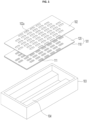
- FIG. 1 is an exploded perspective view of a battery module according to an embodiment of the present disclosure
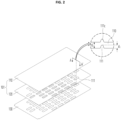
- FIG. 2 is a conceptual diagram of an insulating sheet used in FIG. 1
- FIG. 3 is a view illustrating one surface of the insulating sheet shown in FIG. 1 .
- a battery module according to an embodiment of the present disclosure includes a lower case 103, an upper case 102, and an insulating sheet 101.
- the lower case 103 is formed to accommodate battery cells 104.
- the lower case 103 may be formed of a metal or synthetic resin, or at least a portion may be formed of a different material.
- the lower case 103 may be entirely formed of a metal material, and at least a portion of the lower case 103 may be formed of a synthetic resin material.
- Battery cells may each include an electrode assembly and a cover.
- the electrode assembly may be formed such that a separator is interposed between a positive electrode plate and a negative electrode plate.
- the cover is configured to receive the electrode assembly.
- Electrode terminals may be formed on one side and the other side of the battery cells, and the battery cells may be electrically connected by a bus bar formed of metal.
- an internal pressure of the battery cells exceeds a certain level, part of the cover may be damaged to discharge gas to the outside. At this time, the internal pressure may be 150 to 210 KPa.
- the upper case 102 is coupled to the lower case 103 to cover the lower case 103.
- the upper case 102 includes openings 102a formed to discharge gas occurring when an internal pressure of the battery cell is above a certain level.
- the upper case 102 may be formed of a metal or synthetic resin, or at least a portion thereof may be formed of a different material.
- An insulating sheet 101 is formed on one surface of the upper case 102 to cover the openings 102a formed in the upper case 102.
- FIGS. 2 and 3 two regions are formed on one surface of the insulating sheet 101.
- a rear surface of an insulating paper is shown in FIG. 2
- a front surface of the insulating paper is shown in FIG. 3 .
- An adhesive layer 120 is formed in a first region of the insulating paper.
- the first region includes most of the regions in the insulating paper that do not cover the openings.
- the adhesive layer 120 may be formed by coupling a double-sided tape to the insulating paper 110.
- a second region covers the openings formed in the upper case 102, and an open pattern 111 is formed in the insulating paper 110 corresponding to the second region.
- a portion in which the open pattern 111 is not formed is the first region, and the insulating sheet 101 is provided to an assembler in a state in which a release paper and the insulating paper 110 are initially coupled by the adhesive layer 120, and an operator may separate the release paper from the insulating sheet 101 and couples the insulating sheet 101 to the upper case 102.
- the insulating sheet 101 may be coupled to one inner surface or one outer surface of the upper case 102.
- a thickness d2 of the insulating paper 110 is preferably 0.10 to 0.15 mm, and the open pattern 111 formed in the insulating paper 110 includes lines having a notching depth of 50 to 90 ⁇ m.
- the notching depth may be changed depending on a set internal pressure. When the internal pressure is 150 to 210 KPa, a notching depth d1 of the open pattern 111 may be 50 to 90 ⁇ m. If the thickness of the insulating paper 110 is less than 0.1 mm, the insulating paper 110 may rupture at a lower pressure or rupture in the open pattern 111 may not be induced. On the other hand, if the thickness of the insulating paper 110 exceeds 0.15 mm, the insulating paper 110 may not easily rupture and thermal deformation may occur in the insulating paper 110.
- notching refers to forming a recess 111 having a certain shape in the insulating paper 110.
- the recess 111 may be formed in the insulating paper 110 using laser notching equipment or press notching equipment (for example, punching equipment) .
- the recess may have a "U” shape, a "V” shape, etc.
- the open pattern may be manufactured to have various shapes depending on a designer's intention. For example, an open pattern may include "--" or "Y" as part of the pattern.
- the open pattern 111 is formed to include at least two intersection points 111a and 111b formed by lines per opening crossing each other. As a result, the open pattern 111 may rupture at an internal pressure exceeding a certain level to form and a plurality of open holes, thereby allowing gas to be discharged more smoothly and quickly.
- the insulating paper 110 has a weight of 160 to 220 g/m2, a density of 1.3 to 1.6 g/cc, a tensile strength of 30 to 50 N/cm, and a bursting strength of 150 to 210 KPa.
- the insulating paper 110 according to an embodiment of the present disclosure preferably has a dielectric breakdown voltage of 1.4 KV/mm or more.
- the insulating paper 110 includes 55 to 70 parts by weight of kaolin, 13 to 22 parts by weight of 1,4-benzenedicarbonyl dichloride (C8H4Cl2O2), and 6 to 11 parts by weight of aluminum hydroxide (Al(OH))3 and is formed by a process of forming fibers into sheets. That is, the insulating paper 110 according to an embodiment of the present disclosure may be manufactured by a method of forming aramid fibers into sheets.
- a wet papermaking method in which aramid fibers are dry mixed and then an insulating paper may be formed using air currents or aramid fibers are dispersed and mixed in a liquid medium and then discharged onto a support, such as a liquid-permeable net, to form a sheet, and then dried after removing the liquid, etc. may be used.
- an aqueous slurry containing aramid fibers is supplied to a papermaking machine, dispersed, followed by dewatering, squeezing, and drying, so as to be wound as a sheet.
- a papermaking machine a Fourdrinier papermaking machine, a cylinder papermaking machine, an inclined type papermaking machine, etc. may be used.
- a method of manufacturing insulating paper 110 using aramid fibers is generally known, and is known, for example, in Korean Patent Laid-open Publication No. 10-2017-0099968 .
- the insulating paper 110 obtained in this manner is thermally pressed at high temperatures and high pressure between a pair of rollers to improve density, heat resistance, mechanical strength, etc.
- a metal roller it is preferable to work at a temperature of 220 to 260 °C and a nip pressure of 280 to 320 kg/cm.
- aramid is classified into para-aramid, meta-aramid, and copolymers thereof, depending on a position of substitution of an amide group on a benzene ring.
- para-aramids include polyparaphenylene terephthalamide and copolymers thereof, poly(paraphenylene)-copoly(3,4'-diphenyl ether) terephthalamide (poly(paraphenylene)-copoly(3, 4'-diphenyl ether)terephthalamide), etc.
- meta-aramid include polymetaphenyleneisophthalamide and copolymers thereof.
- aramids are industrially manufactured by, for example, conventionally known interfacial polymerization methods, solution polymerization methods, etc., and may be obtained as commercial products, but are not limited thereto.
- 1,4-benzenedicarbonyl dichloride (C8H4Cl2O2) was used as an aramid fiber.
- the insulating paper 110 may additionally include at least one type of binder.
- Resins may be used as binders, which may be in the form of water-soluble or dispersible polymers that are added directly to a papermaking dispersion, or may be in the form of thermoplastic binder fibers of a resin material mixed with aramid fibers to be activated as a binder by heat applied to drying or between subsequent additional compression and/or heat treatment.
- Water-soluble or dispersible polymers include, for example, water-soluble or water-dispersible thermosetting resins, such as polyamide resin, epoxy resin, phenol resin, urea resin, urethane resin, melamine formaldehyde resin, thermosetting polyester resin, and alkyd resin.
- thermoplastic resins such as poly(vinyl alcohol), polypropylene, polyester, and poly(vinyl acetate) may also be used.
- Al(OH)3 aluminum hydroxide
- the insulating paper 110 may additionally include at least one type of filler.
- the type of filler is not particularly limited, but inorganic fillers are preferable, and, for example, clays, such as mica, graphite, kaolin, and bentonite, thermally conductive fillers, such as carbon nanotubes, aluminum nitride, aluminum oxide, boron nitride, magnesium oxide, zinc oxide, etc. may be included. Kaolin was used in the present disclosure.
- the battery module described above is not limited to the configuration and method of the embodiments described above, and the embodiments may be configured by selectively combining all or part of each embodiment so that various modifications may be made.
- the battery module according to the embodiments of this invention can be used in various applications, including vehicles, electronic products, and other products that require secondary batteries.
Landscapes
- Chemical & Material Sciences (AREA)
- Chemical Kinetics & Catalysis (AREA)
- Electrochemistry (AREA)
- General Chemical & Material Sciences (AREA)
- Gas Exhaust Devices For Batteries (AREA)
- Battery Mounting, Suspending (AREA)
Abstract
Description
- The embodiments of the present disclosure relate to a battery module used to charge or supply electricity in electric vehicles, power storage devices, or portable electronic products.
- Recently, as technology development and demand for electric vehicles, hybrid vehicles, power storage devices, and uninterruptible power supply systems have increased, demand for secondary batteries as an energy source has rapidly increased. In particular, battery packs used in electric and hybrid vehicles are made up of high-power, large-capacity secondary batteries, and a lot of research therefor has been conducted.
- In particular, lithium secondary batteries have a higher energy density per unit weight and may be charged quickly compared to other secondary batteries, such as existing lead storage batteries, nickel-cadmium batteries, nickel-hydrogen batteries, and nickel-zinc batteries, and thus, the use of lithium secondary batteries has been actively increased.
- Lithium secondary batteries have an operating voltage of 3.6V or higher and are used as a power source for portable electronic devices, or multiple batteries may be connected in series or parallel to be used in high-power electric vehicles, hybrid vehicles, power tools, electric bicycles, power storage devices, and uninterruptible power supply systems, etc.
- Meanwhile, when a battery pack generates power, heat is generated due to an electrochemical reaction, and if this heat remains as it is in cells inside the battery pack, a temperature of the cells may increase to worsen operating conditions of the cells to deteriorate power generating efficiency, and in addition, pressure inside the sealed battery pack may increase due to the generated heat, leading to a risk of explosion, and therefore, ensuring safety is an important task.
- In the related art, a method of preventing an explosion by forcibly turning off power has been used to prevent an explosion due to an increase in temperature according to the use of a battery pack.
- This method immediately turns off power to prevent the temperature of the battery pack from rising any further, but there is a problem in that the temperature remaining inside the battery pack has the potential to cause the battery pack to explode.
- An object of the present disclosure is to provide a battery module that may be prevented from exploding due to high temperatures by discharging internal gas to induce an immediate temperature drop when the temperature of the battery module rises above a set pressure.
- A battery module according to an embodiment of the present disclosure for accomplishing the above objects includes: a lower case in which a plurality of battery cells are accommodated; an upper case covering the lower case and including openings formed to discharge gas occurring when an internal pressure of the battery cells is above a certain level; and an insulating portion coupled to one surface of the upper case to cover the openings, wherein the insulating portion includes an insulating paper formed to include 55 to 70 parts by weight of kaolin; 13 to 22 parts by weight of 1,4-benzenedicarbonyl dichloride (C8H4Cl2O2); and 6 to 11 parts by weight of aluminum hydroxide (Al(OH)3).
- According to an embodiment of the present disclosure, a first region in which an adhesive layer may be formed to be attached to the upper case and a second region covering the openings are formed on one surface of the insulating paper, and an open pattern formed to rupture when the gas may be discharged is formed on the insulating paper corresponding to the second region.
- According to an embodiment of the present disclosure, a thickness of the insulating paper may be 0.10 to 0.15 mm, the open pattern may include lines formed to have a notching depth of 50 to 90 µm, and the open pattern may include at least two intersections formed by the lines crossing each other per opening.
- According to an embodiment of the present disclosure, the insulating paper may be formed to have a weight of 160 to 220 g/m2, a density of 1.3 to 1.6 g/cc, a tensile strength of 30 to 50 N/cm, and a bursting strength of 150 to 210 KPa.
- The battery module configured as described above may be prevented from exploding due to high temperatures in advance by discharging internal gas to induce an immediate temperature drop when the temperature of the battery module rises above a set pressure. As a result, the stability of the battery module may ultimately be effectively increased, and internal gas occurring due to a rapid increase in pressure of a battery cell may be discharged in a preset direction, thereby maintaining the pressure inside the battery constant.
- In addition, by maintaining a voltage drop time of the battery constant, sufficient evacuation time for passengers present in an electric vehicle may be secured in an emergency situation.
-
-
FIG. 1 is an exploded perspective view of a battery module according to an embodiment of the present disclosure. -
FIG. 2 is a conceptual diagram of an insulating sheet used inFIG. 1 . -
FIG. 3 is a view illustrating one surface of the insulating sheet shown inFIG. 1 . - Hereinafter, specific embodiments for carrying out the present disclosure will be described with reference to the drawings. The embodiments of the present disclosure are intended to describe one invention, and the scope of the present disclosure is not limited to the illustrated embodiments, and the illustrated drawings should not be interpreted as being limited to the drawings because only key contents are enlarged and minor details are omitted for clarity of the invention. In the following description, usage of suffixes, such as 'module', 'part' or 'unit' used for referring to elements is given merely to facilitate explanation of the present disclosure, without having any significant meaning by itself. In the present disclosure, the same reference numerals are given to the same or similar components in the different embodiments, and a redundant description thereof will be omitted. As used herein, the singular forms "a", "an" and "the" are intended to include the plural forms as well, unless the context clearly indicates otherwise.
-
FIG. 1 is an exploded perspective view of a battery module according to an embodiment of the present disclosure,FIG. 2 is a conceptual diagram of an insulating sheet used inFIG. 1 , andFIG. 3 is a view illustrating one surface of the insulating sheet shown inFIG. 1 . - Referring to
FIGS. 1 to 3 , a battery module according to an embodiment of the present disclosure includes alower case 103, anupper case 102, and aninsulating sheet 101. - The
lower case 103 is formed to accommodatebattery cells 104. Thelower case 103 may be formed of a metal or synthetic resin, or at least a portion may be formed of a different material. For example, thelower case 103 may be entirely formed of a metal material, and at least a portion of thelower case 103 may be formed of a synthetic resin material. Battery cells may each include an electrode assembly and a cover. The electrode assembly may be formed such that a separator is interposed between a positive electrode plate and a negative electrode plate. The cover is configured to receive the electrode assembly. Electrode terminals may be formed on one side and the other side of the battery cells, and the battery cells may be electrically connected by a bus bar formed of metal. When an internal pressure of the battery cells exceeds a certain level, part of the cover may be damaged to discharge gas to the outside. At this time, the internal pressure may be 150 to 210 KPa. - The
upper case 102 is coupled to thelower case 103 to cover thelower case 103. Theupper case 102 includesopenings 102a formed to discharge gas occurring when an internal pressure of the battery cell is above a certain level. Theupper case 102 may be formed of a metal or synthetic resin, or at least a portion thereof may be formed of a different material. - An
insulating sheet 101 is formed on one surface of theupper case 102 to cover theopenings 102a formed in theupper case 102. - Referring to
FIGS. 2 and3 , two regions are formed on one surface of theinsulating sheet 101. A rear surface of an insulating paper is shown inFIG. 2 , and a front surface of the insulating paper is shown inFIG. 3 . Anadhesive layer 120 is formed in a first region of the insulating paper. The first region includes most of the regions in the insulating paper that do not cover the openings. Theadhesive layer 120 may be formed by coupling a double-sided tape to the insulatingpaper 110. A second region covers the openings formed in theupper case 102, and anopen pattern 111 is formed in theinsulating paper 110 corresponding to the second region. A portion in which theopen pattern 111 is not formed is the first region, and theinsulating sheet 101 is provided to an assembler in a state in which a release paper and theinsulating paper 110 are initially coupled by theadhesive layer 120, and an operator may separate the release paper from theinsulating sheet 101 and couples theinsulating sheet 101 to theupper case 102. Theinsulating sheet 101 may be coupled to one inner surface or one outer surface of theupper case 102. - A thickness d2 of the
insulating paper 110 is preferably 0.10 to 0.15 mm, and theopen pattern 111 formed in theinsulating paper 110 includes lines having a notching depth of 50 to 90 µm. The notching depth may be changed depending on a set internal pressure. When the internal pressure is 150 to 210 KPa, a notching depth d1 of theopen pattern 111 may be 50 to 90 µm. If the thickness of theinsulating paper 110 is less than 0.1 mm, theinsulating paper 110 may rupture at a lower pressure or rupture in theopen pattern 111 may not be induced. On the other hand, if the thickness of theinsulating paper 110 exceeds 0.15 mm, theinsulating paper 110 may not easily rupture and thermal deformation may occur in theinsulating paper 110. - Here, notching refers to forming a
recess 111 having a certain shape in theinsulating paper 110. Therecess 111 may be formed in theinsulating paper 110 using laser notching equipment or press notching equipment (for example, punching equipment) . The recess may have a "U" shape, a "V" shape, etc. The open pattern may be manufactured to have various shapes depending on a designer's intention. For example, an open pattern may include "--" or "Y" as part of the pattern. - According to an embodiment, the
open pattern 111 is formed to include at least twointersection points open pattern 111 may rupture at an internal pressure exceeding a certain level to form and a plurality of open holes, thereby allowing gas to be discharged more smoothly and quickly. - The insulating
paper 110 according to an embodiment of the present disclosure has a weight of 160 to 220 g/m2, a density of 1.3 to 1.6 g/cc, a tensile strength of 30 to 50 N/cm, and a bursting strength of 150 to 210 KPa. In addition, the insulatingpaper 110 according to an embodiment of the present disclosure preferably has a dielectric breakdown voltage of 1.4 KV/mm or more. - For the physical properties of the insulating paper described above, the insulating
paper 110 includes 55 to 70 parts by weight of kaolin, 13 to 22 parts by weight of 1,4-benzenedicarbonyl dichloride (C8H4Cl2O2), and 6 to 11 parts by weight of aluminum hydroxide (Al(OH))3 and is formed by a process of forming fibers into sheets. That is, the insulatingpaper 110 according to an embodiment of the present disclosure may be manufactured by a method of forming aramid fibers into sheets. - Specifically, a wet papermaking method in which aramid fibers are dry mixed and then an insulating paper may be formed using air currents or aramid fibers are dispersed and mixed in a liquid medium and then discharged onto a support, such as a liquid-permeable net, to form a sheet, and then dried after removing the liquid, etc. may be used. In the wet papermaking method, an aqueous slurry containing aramid fibers is supplied to a papermaking machine, dispersed, followed by dewatering, squeezing, and drying, so as to be wound as a sheet. As a papermaking machine, a Fourdrinier papermaking machine, a cylinder papermaking machine, an inclined type papermaking machine, etc. may be used. A method of manufacturing insulating
paper 110 using aramid fibers is generally known, and is known, for example, inKorean Patent Laid-open Publication No. 10-2017-0099968 - The insulating
paper 110 obtained in this manner is thermally pressed at high temperatures and high pressure between a pair of rollers to improve density, heat resistance, mechanical strength, etc. When using a metal roller, it is preferable to work at a temperature of 220 to 260 °C and a nip pressure of 280 to 320 kg/cm. - Here, aramid is classified into para-aramid, meta-aramid, and copolymers thereof, depending on a position of substitution of an amide group on a benzene ring. Examples of para-aramids include polyparaphenylene terephthalamide and copolymers thereof, poly(paraphenylene)-copoly(3,4'-diphenyl ether) terephthalamide (poly(paraphenylene)-copoly(3, 4'-diphenyl ether)terephthalamide), etc. Examples of meta-aramid include polymetaphenyleneisophthalamide and copolymers thereof. These aramids are industrially manufactured by, for example, conventionally known interfacial polymerization methods, solution polymerization methods, etc., and may be obtained as commercial products, but are not limited thereto. However, in the present disclosure, 1,4-benzenedicarbonyl dichloride (C8H4Cl2O2) was used as an aramid fiber.
- The insulating
paper 110 may additionally include at least one type of binder. Resins may be used as binders, which may be in the form of water-soluble or dispersible polymers that are added directly to a papermaking dispersion, or may be in the form of thermoplastic binder fibers of a resin material mixed with aramid fibers to be activated as a binder by heat applied to drying or between subsequent additional compression and/or heat treatment. Water-soluble or dispersible polymers include, for example, water-soluble or water-dispersible thermosetting resins, such as polyamide resin, epoxy resin, phenol resin, urea resin, urethane resin, melamine formaldehyde resin, thermosetting polyester resin, and alkyd resin. In particular, water-soluble polyamide resins are useful. Aqueous solutions or dispersions of thermoplastic resins, such as poly(vinyl alcohol), polypropylene, polyester, and poly(vinyl acetate) may also be used. However, in the present disclosure, aluminum hydroxide (Al(OH)3) was used as a binder. - In addition, the insulating
paper 110 may additionally include at least one type of filler. The type of filler is not particularly limited, but inorganic fillers are preferable, and, for example, clays, such as mica, graphite, kaolin, and bentonite, thermally conductive fillers, such as carbon nanotubes, aluminum nitride, aluminum oxide, boron nitride, magnesium oxide, zinc oxide, etc. may be included. Kaolin was used in the present disclosure. - The battery module described above is not limited to the configuration and method of the embodiments described above, and the embodiments may be configured by selectively combining all or part of each embodiment so that various modifications may be made.
- The battery module according to the embodiments of this invention can be used in various applications, including vehicles, electronic products, and other products that require secondary batteries.
Claims (4)
- A battery module comprising:a lower case in which a plurality of battery cells are accommodated;an upper case covering the lower case and including openings formed to discharge gas occurring when an internal pressure of the battery cells is above a certain level; andan insulating portion coupled to one surface of the upper case to cover the openings,wherein the insulating portion includes an insulating paper formed to include:55 to 70 parts by weight of kaolin;13 to 22 parts by weight of 1,4-benzenedicarbonyl dichloride (C8H4Cl2O2); and6 to 11 parts by weight of aluminum hydroxide (Al(OH)3).
- The battery module of claim 1, whereina first region in which an adhesive layer is formed to be attached to the upper case and a second region covering the openings are formed on one surface of the insulating paper, andan open pattern formed to rupture when the gas is discharged is formed on the insulating paper corresponding to the second region.
- The battery module of claim 2, whereina thickness of the insulating paper is 0.10 to 0.15 mm,the open pattern includes lines formed to have a notching depth of 50 to 90 µm, andthe open pattern includes at least two intersections formed by the lines crossing each other per opening.
- The battery module of claim 3, wherein the insulating paper is formed to have a weight of 160 to 220 g/m2, a density of 1.3 to 1.6 g/cc, a tensile strength of 30 to 50 N/cm, and a bursting strength of 150 to 210 KPa.
Applications Claiming Priority (2)
| Application Number | Priority Date | Filing Date | Title |
|---|---|---|---|
| KR1020230094503A KR102613036B1 (en) | 2023-07-20 | 2023-07-20 | Battery module |
| PCT/KR2024/003607 WO2025018495A1 (en) | 2023-07-20 | 2024-03-22 | Battery module |
Publications (2)
| Publication Number | Publication Date |
|---|---|
| EP4521401A1 true EP4521401A1 (en) | 2025-03-12 |
| EP4521401A4 EP4521401A4 (en) | 2025-05-07 |
Family
ID=89159528
Family Applications (1)
| Application Number | Title | Priority Date | Filing Date |
|---|---|---|---|
| EP24711959.7A Pending EP4521401A4 (en) | 2023-07-20 | 2024-03-22 | Battery module |
Country Status (5)
| Country | Link |
|---|---|
| US (1) | US20250030107A1 (en) |
| EP (1) | EP4521401A4 (en) |
| KR (1) | KR102613036B1 (en) |
| CN (1) | CN119678306A (en) |
| WO (1) | WO2025018495A1 (en) |
Families Citing this family (7)
| Publication number | Priority date | Publication date | Assignee | Title |
|---|---|---|---|---|
| KR102613036B1 (en) * | 2023-07-20 | 2023-12-12 | (주)연호상사 | Battery module |
| KR20250146049A (en) * | 2024-03-29 | 2025-10-13 | 주식회사 엘지에너지솔루션 | Battery module |
| KR20250154071A (en) * | 2024-04-19 | 2025-10-28 | 주식회사 엘지에너지솔루션 | Battery module, Battery pack and vehicle including the same |
| KR20250175641A (en) * | 2024-06-10 | 2025-12-17 | 주식회사 엘지에너지솔루션 | Battery module cover assembly, battery pack and vehicle comprising the same |
| KR20250176416A (en) * | 2024-06-12 | 2025-12-19 | 주식회사 엘지에너지솔루션 | Battery module cover, battery pack and vehicle comprising the same |
| WO2026010217A1 (en) * | 2024-07-02 | 2026-01-08 | 주식회사 엘지에너지솔루션 | Battery box |
| KR20260024660A (en) * | 2024-08-14 | 2026-02-23 | 주식회사 엘지에너지솔루션 | Battery module |
Family Cites Families (9)
| Publication number | Priority date | Publication date | Assignee | Title |
|---|---|---|---|---|
| KR101605936B1 (en) | 2013-05-02 | 2016-03-23 | 주식회사 엘지화학 | Battery pack capable of releasing gas inside of pouch type battery cell |
| TWI665686B (en) * | 2014-12-26 | 2019-07-11 | 日商特種東海製紙股份有限公司 | Insulating paper |
| CN105619980B (en) * | 2015-12-18 | 2017-09-29 | 杭州福斯特应用材料股份有限公司 | A kind of crystalline silicon photovoltaic module encapsulation wet backboard of high insulation resistance |
| KR102306448B1 (en) * | 2016-09-06 | 2021-09-28 | 삼성에스디아이 주식회사 | Rechargeable battery |
| CN111295479A (en) * | 2017-11-07 | 2020-06-16 | 特种东海制纸株式会社 | insulating sheet |
| KR102803108B1 (en) * | 2018-12-21 | 2025-05-07 | 아와 세이시 가부시키가이샤 | Power supply and insulation sheets for power supply |
| US11145933B2 (en) * | 2019-09-05 | 2021-10-12 | Samsung Sdi Co., Ltd. | Energy storage module |
| CN219017792U (en) * | 2022-09-22 | 2023-05-12 | 深圳市拓邦锂电池有限公司 | High-capacity energy-storage battery device |
| KR102613036B1 (en) * | 2023-07-20 | 2023-12-12 | (주)연호상사 | Battery module |
-
2023
- 2023-07-20 KR KR1020230094503A patent/KR102613036B1/en active Active
-
2024
- 2024-03-22 WO PCT/KR2024/003607 patent/WO2025018495A1/en active Pending
- 2024-03-22 CN CN202480000641.9A patent/CN119678306A/en active Pending
- 2024-03-22 EP EP24711959.7A patent/EP4521401A4/en active Pending
- 2024-03-29 US US18/621,129 patent/US20250030107A1/en active Pending
Also Published As
| Publication number | Publication date |
|---|---|
| CN119678306A (en) | 2025-03-21 |
| WO2025018495A1 (en) | 2025-01-23 |
| US20250030107A1 (en) | 2025-01-23 |
| EP4521401A4 (en) | 2025-05-07 |
| KR102613036B1 (en) | 2023-12-12 |
Similar Documents
| Publication | Publication Date | Title |
|---|---|---|
| EP4521401A1 (en) | Battery module | |
| CN114175364B (en) | Battery, electrical device, method and device for preparing battery | |
| EP2273583B1 (en) | Sealed rectangular battery and battery module using same | |
| EP2453499B1 (en) | Battery module | |
| CN111670509A (en) | Lithium-ion battery with modular busbar assembly | |
| CN216250985U (en) | Battery cell, battery and consumer | |
| EP3293798B1 (en) | Electrode lead and secondary battery having same | |
| CN108232360B (en) | Heat distributor for batteries | |
| KR20120006974A (en) | Galvanic battery with outer cover | |
| KR101826142B1 (en) | Electrode assembly, manufacturing method of the same and rechargeable battery | |
| KR102566631B1 (en) | Battery module including pressure drop sheet | |
| EP3872923A1 (en) | Battery module | |
| KR102630853B1 (en) | Pouch-Type Secondary Battery Having Heat Transfer Member | |
| EP3598524B1 (en) | SECONDARY BATTERY AND INSULATOR FOR SECONDARY BATTERY\n | |
| KR102437572B1 (en) | Battery Modules and Battery Packs | |
| CN115395155B (en) | Battery pack, energy storage system and electric automobile | |
| CN116569394A (en) | Battery cell, battery, electric device, method and device for manufacturing battery cell | |
| CN219123305U (en) | Battery monomer, power battery and electric equipment | |
| US20220093987A1 (en) | Apparatus for insulating battery of electric vehicle | |
| CN223066241U (en) | Battery monomer, battery and power consumption device | |
| EP4465409A1 (en) | Layered perforated cell separator to mitigate thermal propagation | |
| KR20200041710A (en) | Pouch type secondary battery and manufacturing method thereof | |
| CN115832616A (en) | Battery core, battery monomer, battery and power consumption device | |
| CN118970057A (en) | Composite current collector and preparation method thereof, electrode, battery and battery application | |
| CN121906032A (en) | Battery devices and electrical appliances |
Legal Events
| Date | Code | Title | Description |
|---|---|---|---|
| STAA | Information on the status of an ep patent application or granted ep patent |
Free format text: STATUS: UNKNOWN |
|
| STAA | Information on the status of an ep patent application or granted ep patent |
Free format text: STATUS: THE INTERNATIONAL PUBLICATION HAS BEEN MADE |
|
| PUAI | Public reference made under article 153(3) epc to a published international application that has entered the european phase |
Free format text: ORIGINAL CODE: 0009012 |
|
| STAA | Information on the status of an ep patent application or granted ep patent |
Free format text: STATUS: REQUEST FOR EXAMINATION WAS MADE |
|
| 17P | Request for examination filed |
Effective date: 20240325 |
|
| AK | Designated contracting states |
Kind code of ref document: A1 Designated state(s): AL AT BE BG CH CY CZ DE DK EE ES FI FR GB GR HR HU IE IS IT LI LT LU LV MC ME MK MT NL NO PL PT RO RS SE SI SK SM TR |
|
| A4 | Supplementary search report drawn up and despatched |
Effective date: 20250409 |
|
| RIC1 | Information provided on ipc code assigned before grant |
Ipc: H01M 50/342 20210101ALI20250403BHEP Ipc: H01M 50/293 20210101ALI20250403BHEP Ipc: H01M 50/282 20210101ALI20250403BHEP Ipc: H01M 50/271 20210101ALI20250403BHEP Ipc: G06N 20/00 20190101ALI20250403BHEP Ipc: G10L 21/055 20130101ALI20250403BHEP Ipc: G10L 15/04 20130101ALI20250403BHEP Ipc: G06T 5/00 20240101ALI20250403BHEP Ipc: G06T 7/269 20170101ALI20250403BHEP Ipc: G06T 13/20 20110101ALI20250403BHEP Ipc: G10L 21/10 20130101AFI20250403BHEP |