EP4518572A1 - Cell reselection method for space-air-ground integrated network, and communication system and related device - Google Patents
Cell reselection method for space-air-ground integrated network, and communication system and related device Download PDFInfo
- Publication number
- EP4518572A1 EP4518572A1 EP23795389.8A EP23795389A EP4518572A1 EP 4518572 A1 EP4518572 A1 EP 4518572A1 EP 23795389 A EP23795389 A EP 23795389A EP 4518572 A1 EP4518572 A1 EP 4518572A1
- Authority
- EP
- European Patent Office
- Prior art keywords
- cell
- terminal
- terrestrial network
- candidate
- information
- Prior art date
- Legal status (The legal status is an assumption and is not a legal conclusion. Google has not performed a legal analysis and makes no representation as to the accuracy of the status listed.)
- Pending
Links
Images


Classifications
-
- H—ELECTRICITY
- H04—ELECTRIC COMMUNICATION TECHNIQUE
- H04B—TRANSMISSION
- H04B7/00—Radio transmission systems, i.e. using radiation field
- H04B7/14—Relay systems
- H04B7/15—Active relay systems
- H04B7/185—Space-based or airborne stations; Stations for satellite systems
- H04B7/1853—Satellite systems for providing telephony service to a mobile station, i.e. mobile satellite service
- H04B7/18539—Arrangements for managing radio, resources, i.e. for establishing or releasing a connection
- H04B7/18541—Arrangements for managing radio, resources, i.e. for establishing or releasing a connection for handover of resources
-
- H—ELECTRICITY
- H04—ELECTRIC COMMUNICATION TECHNIQUE
- H04W—WIRELESS COMMUNICATION NETWORKS
- H04W36/00—Hand-off or reselection arrangements
- H04W36/0005—Control or signalling for completing the hand-off
- H04W36/0007—Control or signalling for completing the hand-off for multicast or broadcast services, e.g. MBMS
-
- H—ELECTRICITY
- H04—ELECTRIC COMMUNICATION TECHNIQUE
- H04W—WIRELESS COMMUNICATION NETWORKS
- H04W36/00—Hand-off or reselection arrangements
- H04W36/0005—Control or signalling for completing the hand-off
- H04W36/0083—Determination of parameters used for hand-off, e.g. generation or modification of neighbour cell lists
- H04W36/00835—Determination of neighbour cell lists
-
- H—ELECTRICITY
- H04—ELECTRIC COMMUNICATION TECHNIQUE
- H04W—WIRELESS COMMUNICATION NETWORKS
- H04W36/00—Hand-off or reselection arrangements
- H04W36/24—Reselection being triggered by specific parameters
- H04W36/30—Reselection being triggered by specific parameters by measured or perceived connection quality data
-
- H—ELECTRICITY
- H04—ELECTRIC COMMUNICATION TECHNIQUE
- H04W—WIRELESS COMMUNICATION NETWORKS
- H04W36/00—Hand-off or reselection arrangements
- H04W36/24—Reselection being triggered by specific parameters
- H04W36/32—Reselection being triggered by specific parameters by location or mobility data, e.g. speed data
-
- H—ELECTRICITY
- H04—ELECTRIC COMMUNICATION TECHNIQUE
- H04W—WIRELESS COMMUNICATION NETWORKS
- H04W48/00—Access restriction; Network selection; Access point selection
- H04W48/16—Discovering, processing access restriction or access information
-
- H—ELECTRICITY
- H04—ELECTRIC COMMUNICATION TECHNIQUE
- H04W—WIRELESS COMMUNICATION NETWORKS
- H04W48/00—Access restriction; Network selection; Access point selection
- H04W48/20—Selecting an access point
-
- H—ELECTRICITY
- H04—ELECTRIC COMMUNICATION TECHNIQUE
- H04W—WIRELESS COMMUNICATION NETWORKS
- H04W84/00—Network topologies
- H04W84/02—Hierarchically pre-organised networks, e.g. paging networks, cellular networks, WLAN [Wireless Local Area Network] or WLL [Wireless Local Loop]
- H04W84/04—Large scale networks; Deep hierarchical networks
- H04W84/06—Airborne or Satellite Networks
-
- Y—GENERAL TAGGING OF NEW TECHNOLOGICAL DEVELOPMENTS; GENERAL TAGGING OF CROSS-SECTIONAL TECHNOLOGIES SPANNING OVER SEVERAL SECTIONS OF THE IPC; TECHNICAL SUBJECTS COVERED BY FORMER USPC CROSS-REFERENCE ART COLLECTIONS [XRACs] AND DIGESTS
- Y02—TECHNOLOGIES OR APPLICATIONS FOR MITIGATION OR ADAPTATION AGAINST CLIMATE CHANGE
- Y02D—CLIMATE CHANGE MITIGATION TECHNOLOGIES IN INFORMATION AND COMMUNICATION TECHNOLOGIES [ICT], I.E. INFORMATION AND COMMUNICATION TECHNOLOGIES AIMING AT THE REDUCTION OF THEIR OWN ENERGY USE
- Y02D30/00—Reducing energy consumption in communication networks
- Y02D30/70—Reducing energy consumption in communication networks in wireless communication networks
Definitions
- mobility management of a terminal in an idle state is mainly completed through cell selection/reselection, in which a target cell is selected according to wireless measurement signal strength.
- a method for cell reselection in a Space-Air-Ground Integrated Network including:
- the terminal initiates the cell reselection measurement according to a wireless signal strength of the serving cell.
- the cell reselection measurement result includes measurement information of a wireless signal of the neighboring cell and movement information of the terminal, and the movement information of the terminal includes one or more of a movement direction and a movement speed.
- performing cell reselection according to the cell reselection measurement result by the terminal includes:
- determining the first candidate cell set according to the measurement information of the wireless signal of the neighboring cell by the terminal includes: determining a neighboring cell satisfying an R criterion as the first candidate cell set according to the measurement information of the wireless signal of the neighboring cell by the terminal.
- selecting the target cell for camping from the first candidate cell set according to the movement information of the terminal and the coverage information of the neighboring cell by the terminal includes:
- selecting the target cell for camping from the second candidate cell set according to the movement speed of the terminal includes: determining whether the movement speed of the terminal is higher than a speed threshold or not; if the movement speed of the terminal is higher than the speed threshold, selecting a non-terrestrial network cell from the second candidate cell set as the target cell for camping; if the movement speed of the terminal is not higher than the speed threshold, selecting a terrestrial network cell from the second candidate cell set as the target cell for camping.
- the coverage information is used for describing a boundary of a cell.
- the coverage information is further used for implicitly indicating a type of the cell; or the broadcast message further includes indication information used for indicating the type of the cell; where the type of the cell includes a non-terrestrial network cell and a terrestrial network cell.
- the coverage information includes a cell center location and a cell radius.
- initiating cell reselection measurement according to the location relationship information between the terminal and the serving cell by the terminal includes: initiating the cell reselection measurement if a distance between the terminal and the serving cell is greater than a distance threshold.
- initiating cell reselection measurement according to the wireless signal strength of the serving cell by the terminal includes: initiating the cell reselection measurement if the wireless signal strength of the serving cell is lower than an intensity threshold.
- selecting the target cell for camping from the first candidate cell set according to the movement information of the terminal and the coverage information of the neighboring cell by the terminal includes: selecting a candidate cell in a same direction as the movement direction of the terminal from the first candidate cell set as a second candidate cell set according to the movement direction of the terminal and the coverage information of the neighboring cell by the terminal, and selecting a candidate cell with a different type from the serving cell from the second candidate cell set as the target cell for camping, where a type of the serving cell is a non-terrestrial network cell or a terrestrial network cell.
- a method for cell reselection in a Space-Air-Ground Integrated Network including: sending broadcast message, where the broadcast message includes coverage information of a present cell and coverage information of a neighboring cell, and the present cell and the neighboring cell are non-terrestrial network cells or terrestrial network cells, thus a terminal performs cell reselection according to the broadcast message.
- the coverage information is used for describing a boundary of a cell.
- the coverage information is further used for implicitly indicating a type of the cell; or, the broadcast message further includes indication information used for indicating the type of the cell; where the type of the cell includes a non-terrestrial network cell and a terrestrial network cell.
- a terminal including a memory and a processor coupled to the memory, where the processor is configured to execute a method for cell reselection in a Space-Air-Ground Integrated Network based on an instruction stored in the memory.
- a communication device including a memory and a processor coupled to the memory, where the processor is configured to execute a method for cell reselection in a Space-Air-Ground Integrated Network based on an instruction stored in the memory.
- a communication system including a terminal and a communication device.
- a non-transitory computer-readable storage medium on which a computer program is stored, where when the program is executed by a processor, steps of a method for cell reselection in a Space-Air-Ground Integrated Network are implemented.
- first and second in the present disclosure are used to distinguish different objects, and are not used to represent the meaning of size or time sequence.
- coverage information of related cells is added in the broadcast message, so that the terminal not only can select to initiate cell reselection measurement according to the wireless signal strength of the serving cell, but also can select to initiate cell reselection measurement according to the location relationship information between the terminal and the serving cell, thus the terminal selects a proper terrestrial network cell or a non-terrestrial network cell in the Space-Air-Ground Integrated Network for camping, which not only improves the accuracy and success rate of cell reselection, but also reduces the energy consumption and signaling overhead of the terminal.
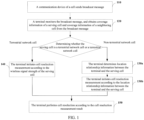
- FIG. 1 shows a schematic flowchart of a method for cell reselection in a Space-Air-Ground Integrated Network according to some embodiments of the present disclosure.
- the method for cell reselection in a Space-Air-Ground Integrated Network of this embodiment includes step 110 to step 150.
- a communication device of a cell sends broadcast message.
- the broadcast message includes coverage information of the present cell and coverage information of a neighboring cell.
- the present cell and the neighboring cell may be non-terrestrial network cells or terrestrial network cells.
- the coverage information may be used to describe a boundary of a cell on one hand, and may also implicitly indicate the type of the cell on the other hand, where the type of the cell includes a non-terrestrial network cell or a terrestrial network cell. This is because the coverage area of the non-terrestrial network cell is far greater than the coverage area of the terrestrial network cell, and it may be determined that the type of the cell is a non-terrestrial network cell or a terrestrial network cell according to the coverage area of the cell.
- the broadcast message further includes indication information used for indicating the type of the cell, so as to indicate the type of the cell by using an explicit method.
- the coverage information includes information such as a cell center location and a cell radius, but the coverage information is not limited to such expressions.
- the communication device of a terrestrial network cell that sends the broadcast message may be, for example, a base station or the like.
- the communication device of a non-terrestrial network cell that sends broadcast message may be, for example, a satellite or the like. However, it is not limited to the illustrated examples.
- the terminal may periodically monitor the broadcast message. According to the information carried in the broadcast message, the terminal may obtain the coverage information of the serving cell and the coverage information of the neighboring cell from the broadcast message, and may further obtain the indication information for the type of each cell.
- step 130 if the serving cell is a non-terrestrial network cell, the terminal determines location relationship information between the terminal and the serving cell according to the coverage information of the serving cell (step 130a), and initiates cell reselection measurement according to the location relationship information between the terminal and the serving cell (step 130b).
- Initiating cell reselection measurement by the terminal according to the location relationship information between the terminal and the serving cell includes: if the distance between the terminal and the serving cell is greater than a distance threshold, which indicates that the terminal is located at the edge of the current camping non-terrestrial network cell, initiating cell reselection measurement.
- the distance threshold may be set according to the coverage information of the non-terrestrial network cell.
- step 140 if the serving cell is a terrestrial network cell, the terminal initiates cell reselection measurement according to the wireless signal strength of the serving cell.
- Initiating cell reselection measurement by the terminal according to the wireless signal strength of the serving cell includes: if the wireless signal strength of the serving cell is lower than an intensity threshold, which indicates that the terminal is located at the edge of the current camping terrestrial network cell, initiating cell reselection measurement.
- the intensity threshold may be set according to the signal strength of the terrestrial network cell.
- step 150 the terminal performs cell reselection according to the cell reselection measurement result.
- the cell reselection measurement result obtained by the terminal performing cell reselection measurement includes measurement information of a wireless signal of the neighboring cell and movement information of the terminal, etc.
- the measurement information of the wireless signal is, for example, a wireless signal strength.
- the movement information of the terminal includes, for example, a movement direction, a movement speed, and a movement acceleration, etc.
- performing cell reselection by the terminal according to the cell reselection measurement result includes that: the terminal determines a first candidate cell set according to the measurement information of the wireless signal of the neighboring cell; and, the terminal selects a target cell for camping from the first candidate cell set according to the movement information of the terminal and the coverage information of the neighboring cell.
- determining the first candidate cell set by the terminal according to the measurement information of the wireless signal of the neighboring cell includes: determining a neighboring cell satisfying the R criterion as the first candidate cell set by the terminal according to the measurement information of the wireless signal of the neighboring cell.
- R parameters that includes Rs (R value of the serving cell) and Rn (R value of the neighboring cell). The higher the R value is, the higher the priority is. If the priority of the neighboring cell is higher than the priority of the current serving cell within the cell reselection time, the current serving cell is reselected onto the neighboring cell that satisfies the condition.
- selecting the target cell for camping from the first candidate cell set by the terminal according to the movement information of the terminal and the coverage information of the neighboring cell includes the following:
- selecting the target cell for camping from the second candidate cell set according to the movement speed of the terminal includes: determining whether the movement speed of the terminal is higher than a speed threshold or not; if the movement speed of the terminal is higher than the speed threshold, selecting a non-terrestrial network cell from the second candidate cell set as the target cell for camping, so as to avoid frequent cell reselection; and if the movement speed of the terminal is not higher than the speed threshold, selecting a terrestrial network cell from the second candidate cell set as the target cell for camping, so that the terminal is preferentially served by the terrestrial network cell, thus saving the power of the terminal.
- selecting the target cell for camping from the first candidate cell set by the terminal according to the movement information of the terminal and the coverage information of the neighboring cell includes the following:
- selecting the target cell for camping from the second candidate cell set according to the movement speed of the terminal includes: determining whether the movement speed of the terminal is higher than a speed threshold or not; if the movement speed of the terminal is higher than the speed threshold, selecting a non-terrestrial network cell from the second candidate cell set as the target cell for camping, so as to avoid frequent cell reselection; and if the movement speed of the terminal is not higher than the speed threshold, selecting a terrestrial network cell from the second candidate cell set as the target cell for camping, so that the terminal is preferentially served by the terrestrial network cell, thus saving the power of the terminal.
- selecting the target cell for camping from the first candidate cell set by the terminal according to the movement information of the terminal and the coverage information of the neighboring cell includes: selecting a candidate cell in a same direction as the movement direction of the terminal from the first candidate cell set as a second candidate cell set according to the movement direction of the terminal and the coverage information of the neighboring cell by the terminal, and selecting a candidate cell with a different type from the serving cell from the second candidate cell set as the target cell for camping.
- a terrestrial network cell of the urban area may be re-selected as a non-terrestrial network cell of the suburban area; or, when the terminal moves from the suburban area to the urban area, a non-terrestrial network cell of the suburban area may be re-selected as a terrestrial network cell of the urban area.
- coverage information of the related cells is added in the broadcast message, so that the terminal not only can select to initiate cell reselection measurement according to the wireless signal strength of the serving cell, but also can select to initiate cell reselection measurement according to the location relationship information between the terminal and the serving cell, thus the terminal selects a proper terrestrial network cell or a non-terrestrial network cell in the Space-Air-Ground Integrated Network for camping, which not only improves the accuracy and success rate of cell reselection, but also reduces the energy consumption and signaling overhead of the terminal. Moreover, the terminal selects the target cell for camping according to the movement direction/speed of the terminal and the coverage information of the cell, thus further improving the accuracy of cell reselection and reducing the number of times for cell reselection.
- FIG. 2 shows a schematic diagram of cell reselection among each non-terrestrial network cell.
- an NTN cell broadcasts information of cell center locations and cell radiuses of a present cell and a neighboring NTN within a service range of the NTN;
- the terminal periodically monitors the broadcast message, calculates the location relationship between the location of the terminal and the center of the camping NTN cell, and initiates cell reselection measurement when exceeding a threshold value.
- the cell reselection measurement result includes information such as measurement of the wireless signal of the neighboring cell, the movement direction and the movement speed of the terminal.
- step 3 a re-selected cell is determined.
- the terminal selects a candidate cell set S1 satisfying the R criterion according to a measurement result of the wireless signal; and the terminal selects a candidate cell with a longest expected camping time from the set S1 as the target cell for camping according to the movement information (such as the movement direction, the movement speed, etc.) of the terminal and the coverage information of the neighboring cell.
- the movement information such as the movement direction, the movement speed, etc.
- An NTN cell broadcasts the latitude and longitude information (X, Y) about the cell center and the cell radius R within the service range of the NTN cell, which can be added with original system information block (SIB) message, or be defined with a new SIB message.
- SIB system information block
- the terminal periodically monitors the broadcast message, calculates a distance D0 between the location of the terminal and the center location of the current serving NTN cell, calculates a distance Di between the location of the terminal and the center location of the i-th neighboring NTN cell ( D1 and D2 as shown in FIG. 2 ), and initiates cell reselection neighboring cell measurement when exceeding a threshold value.
- any one of the following may be used as a condition for initiating cell reselection measurement: (1) initiating cell reselection measurement when the distance D0 between the terminal and the serving NTN cell is greater than the threshold value TH0; (2) initiating cell reselection measurement when the distance Di between the terminal and the neighboring NTN cell is less than the threshold value THi; and (3) initiating cell reselection measurement when D0 is greater than the distance threshold value TH0 for the serving NTN cell and Di is less than the distance threshold value Thi for the neighboring NTN cell.
- the cell reselection measurement result includes information such as the measurement of the wireless signal of the neighboring cell and the movement direction/speed of the terminal.
- the candidate cells satisfying the R criterion obtained by the terminal through the wireless channel measurement result are all NTN cells: ⁇ NTN cell 1, NTN cell 2, NTN cell 3, NTN cell 4, NTN cell 5, NTN cell 6 ⁇ , the final re-selected cell is selected according to the longest expected camping time.
- FIG. 3 shows a schematic diagram of cell reselection at the boundary between NTN and TN.
- step 1 the NTN cell broadcasts the central location information of the present cell and the neighboring TN cell as well as the radius information of the present cell within the service range of the NTN cell; and, the TN cell broadcasts information of the central location and the cell radius of the neighboring NTN cell within the service range of the TN cell.
- step 2 the terminal periodically monitors the broadcast message; (1) if the terminal camps currently in the NTN cell, the terminal calculates the relationship between the location of the terminal and the center location of the camping NTN cell, and initiates cell reselection measurement when exceeding a threshold value, the cell reselection measurement result including information such as measurement of the wireless signal of the neighboring cell and movement direction/speed of the terminal; (2) if the terminal camps currently in the TN cell, , the terminal initiates cell reselection measurement when the wireless signal strength is lower than a threshold value, the cell reselection measurement result including information such as measurement of the wireless signal of the neighboring cell and movement direction/speed of the terminal.
- step 3 a re-selected cell is determined.
- the terminal selects a candidate cell set S1 satisfying the R criterion according to a measurement result of the wireless signal; the terminal selects a candidate cell set S2 in a same direction as the movement direction of the terminal from the set S1 according to the movement direction of the terminal and the coverage information of the neighboring cell; and then, the terminal selects the target cell for camping from the set S2 according to the movement speed of the terminal.
- a non-terrestrial network cell is selected from the second candidate cell set as the target cell for camping, so as to avoid frequent cell reselection; and if the movement speed of the terminal is not higher than the speed threshold, a terrestrial network cell is selected from the second candidate cell set as the target cell for camping , so that the terminal is preferentially served by the terrestrial network cell, thus saving the power of the terminal.
- the NTN cell broadcasts the latitude and longitude information (X1, Y1) about the center of the present cell and the cell radius R0 , as well as the latitude and longitude information (X2, Y2) about the center of the TN neighboring cell within the service range of the NTN cell.
- the above information may be added with an original SIB message or may be defined with a new SIB message.
- the terminal calculates the distance D0 between the location of the terminal and the center location of the serving cell, and initiates cell reselection neighboring cell measurement when exceeding a threshold value.
- the cell reselection measurement result includes information such as measurement of the wireless signal of the neighboring cell and movement direction/speed of the terminal.
- the candidate cell set S1 satisfying the R criterion obtained by the terminal through the wireless channel measurement result is: ⁇ NTN cell 1, NTN cell 2, NTN cell 3, NTN cell 4, TN cell 5, TN cell 6 ⁇
- the candidate cell set S2 is then narrowed to be ⁇ NTN cell 2, TN cell 5 ⁇ according to the movement direction; and then, selection is performed according to the movement speed of the terminal.
- the NTN cell 2 is selected from the set S2 as the target cell for camping, so as to avoid frequent cell reselection; and if the movement speed of the terminal is not fast, the TN cell 5 is selected from the set S2 as the target cell for camping, so that the terminal is preferentially served by the terrestrial network cell, thus saving the power of the terminal.
- FIG. 4 shows a schematic diagram of a communication system according to some embodiments of the present disclosure.
- the communications system 400 of this embodiment includes a terminal 410 and a communication device 420.
- the communication device 420 sends broadcast message, where the broadcast message includes coverage information of a present cell and coverage information of a neighboring cell.
- the terminal 410 monitors the broadcast message, and obtains coverage information of a serving cell and coverage information of the neighboring cell from the broadcast message, where the serving cell and the neighboring cell are non-terrestrial network cells or terrestrial network cells. If the serving cell is a non-terrestrial network cell, the terminal 410 determines location relationship information between the terminal and the serving cell according to the coverage information of the serving cell, and initiates cell reselection measurement according to the location relationship information between the terminal and the serving cell; if the serving cell is a terrestrial network cell, the terminal 410 initiates cell reselection measurement according to the wireless signal strength of the serving cell; and the terminal 410 performs cell reselection according to the cell reselection measurement result.
- FIG. 5 shows a schematic diagram of a terminal according to some embodiments of the present disclosure.
- the terminal is, for example, a user equipment such as a mobile phone and a tablet computer, etc.
- the terminal 410 of this embodiment includes a memory 510 and a processor 520 coupled to the memory 510, and the processor 520 is configured to execute the method for cell reselection in a Space-Air-Ground Integrated Network in any one of the foregoing embodiments based on an instruction stored in the memory 510.
- FIG. 6 shows a schematic diagram of a communication device according to some embodiments of the present disclosure.
- a communication device of the terrestrial network cell for sending the broadcast message may be, for example, a base station or the like.
- a communication device of a non-terrestrial network cell for sending broadcast message may be, for example, a satellite or the like. However, it is not limited to the illustrated examples.
- the communication device 420 of this embodiment includes a memory 610 and a processor 620 coupled to the memory 610, and the processor 620 is configured to execute the method for cell reselection in a Space-Air-Ground Integrated Network in any one of the foregoing embodiments based on an instruction stored in the memory 610.
- the memory 510, 610 may include, for example, a system memory, a fixed non-volatile storage medium, or the like.
- the system memory stores, for example, an operating system, an application, a boot loader, other programs, etc.
- the processor 520, 620 may be implemented by using a general-purpose processor, a digital signal processor (DSP), an application specific integrated circuit (ASIC), a field programmable gate array (FPGA), or another discrete hardware component such as a programmable logic device, a discrete gate, or a transistor, etc.
- DSP digital signal processor
- ASIC application specific integrated circuit
- FPGA field programmable gate array
- the terminal 410 and the communication device 420 may further include an input/output interface, a network interface, a storage interface, or the like. These interfaces, as well as the memory and the processor, may be connected, for example, through a bus.
- the input/output interface provides a connection interface for an input/output device such as a display, a mouse, a keyboard, and a touch screen, etc.
- the network interface provides a connection interface for various networking devices.
- the storage interface provides a connection interface for an external storage device such as an SD card and a USB flash disk, etc.
- the bus may use any bus structure in a variety of bus structures.
- the bus structure includes, but is not limited to, an industry standard architecture (ISA) bus, a micro channel architecture (MCA) bus, a peripheral component interconnect (PCI) bus.
- ISA industry standard architecture
- MCA micro channel architecture
- PCI peripheral component interconnect
- the embodiment of the present disclosure may be provided as a method, a system, or a computer program product.
- the present disclosure may take the form of an entire hardware embodiment, an entire software embodiment, or an embodiment combining software with hardware aspects.
- the present disclosure may take the form of a computer program product implemented on one or more non-transitory computer-readable storage medium (including but not limited to a disk memory, a CD-ROM, an optical memory, etc.) that includes computer program code.
- These computer program instructions may also be stored in a computer-readable memory that can direct a computer or another programmable data processing device to operate in a particular manner, such that the instructions stored in the computer-readable memory generate a product that includes an instruction apparatus.
- the instruction apparatus implements the functions specified in one or more processes of the flowcharts and/or one or more blocks of the block diagrams.
- These computer program instructions may also be loaded onto a computer or another programmable data processing device such that a series of operational steps are performed on the computer or another programmable device to generate a computer-implemented process, thus the instructions executed on the computer or another programmable device provide steps for implementing the functions specified in one or more processes of the flowcharts and/or one or more blocks of the block diagrams.
Landscapes
- Engineering & Computer Science (AREA)
- Computer Networks & Wireless Communication (AREA)
- Signal Processing (AREA)
- Physics & Mathematics (AREA)
- Astronomy & Astrophysics (AREA)
- General Physics & Mathematics (AREA)
- Computer Security & Cryptography (AREA)
- Aviation & Aerospace Engineering (AREA)
- Mobile Radio Communication Systems (AREA)
Abstract
Description
- The present disclosure claims priority based on
Chinese Patent Application No. 20221044502.8, filed on April 26, 2022 - The present disclosure relates to the field of wireless communication technology, and in particular, to a method for cell reselection in a Space-Air-Ground Integrated Network, a communication system, a terminal, a communication device, and other related devices.
- As the future network evolution trend, space-air-ground integration will have far-reaching effects on the original network architecture and communication process. Unlike traditional cellular networks, a Space-Air-Ground Integrated Network includes two parts of a terrestrial network (TN) and a non-terrestrial network (NTN). The terrestrial network includes, for example, a cellular network, etc.; and the non-terrestrial network includes, for example, a satellite network, etc.
- In some related arts, mobility management of a terminal in an idle state is mainly completed through cell selection/reselection, in which a target cell is selected according to wireless measurement signal strength.
- It has been found through research that in a Space-Air-Ground Integrated Network, the difference between the wireless signal strength of a user in the center of an NTN cell and the wireless signal strength of the user at the edge of the NTN cell is not obvious. Therefore, the method for cell reselection according to the wireless measurement signal strength cannot satisfy the requirements of cell reselection in the Space-Air-Ground Integrated Network.
- According to some embodiments of the present disclosure, there is provided a method for cell reselection in a Space-Air-Ground Integrated Network, including:
- monitoring broadcast message by a terminal, and obtaining coverage information of a serving cell and coverage information of a neighboring cell from the broadcast message, where the serving cell and the neighboring cell are non-terrestrial network cells or terrestrial network cells;
- determining, in a case that the serving cell is a non-terrestrial network cell, location relationship information between the terminal and the serving cell according to the coverage information of the serving cell by the terminal, and initiating cell reselection measurement according to the location relationship information between the terminal and the serving cell; and
- performing cell reselection according to a cell reselection measurement result by the terminal.
- In some embodiments, in a case that the serving cell is a terrestrial network cell, the terminal initiates the cell reselection measurement according to a wireless signal strength of the serving cell.
- In some embodiments, the cell reselection measurement result includes measurement information of a wireless signal of the neighboring cell and movement information of the terminal, and the movement information of the terminal includes one or more of a movement direction and a movement speed.
- In some embodiments, performing cell reselection according to the cell reselection measurement result by the terminal, includes:
- determining a first candidate cell set according to the measurement information of the wireless signal of the neighboring cell by the terminal; and
- selecting a target cell for camping from the first candidate cell set according to the movement information of the terminal and the coverage information of the neighboring cell by the terminal.
- In some embodiments, determining the first candidate cell set according to the measurement information of the wireless signal of the neighboring cell by the terminal, includes: determining a neighboring cell satisfying an R criterion as the first candidate cell set according to the measurement information of the wireless signal of the neighboring cell by the terminal.
- In some embodiments, selecting the target cell for camping from the first candidate cell set according to the movement information of the terminal and the coverage information of the neighboring cell by the terminal, includes:
- in a case that the serving cell is a non-terrestrial network cell and all neighboring cells are non-terrestrial network cells, selecting a candidate cell with a longest expected camping time from the first candidate cell set as the target cell for camping according to the movement information of the terminal and the coverage information of the neighboring cell by the terminal; or
- in a case that the serving cell is a non-terrestrial network cell and all neighboring cells are terrestrial network cells, taking a candidate cell with a highest priority in the first candidate cell set as the target cell for camping according to an R criterion by the terminal; or
- in a case that the serving cell is a non-terrestrial network cell and neighboring cells include non-terrestrial network cells and terrestrial network cells, selecting a candidate cell in the same direction as the movement direction of the terminal from the first candidate cell set as a second candidate cell set according to the movement direction of the terminal and the coverage information of the neighboring cell by the terminal, and selecting the target cell for camping from the second candidate cell set according to the movement speed of the terminal.
- In some embodiments, selecting the target cell for camping from the first candidate cell set according to the movement information of the terminal and the coverage information of the neighboring cell by the terminal, includes:
- in a case that the serving cell is a terrestrial network cell and all neighboring cells are non-terrestrial network cells, selecting a candidate cell with a longest expected camping time from the first candidate cell set as the target cell for camping according to the movement information of the terminal and the coverage information of the neighboring cell by the terminal; or
- in a case that the serving cell is a terrestrial network cell and all neighboring cells are terrestrial network cells, taking a candidate cell with a highest priority in the first candidate cell set as the target cell for camping according to an R criterion by the terminal; or
- in a case that the serving cell is a terrestrial network cell and neighboring cells include a non-terrestrial network cell and a terrestrial network cell, selecting a candidate cell in a same direction as the movement direction of the terminal from the first candidate cell set as a second candidate cell set according to the movement direction of the terminal and the coverage information of the neighboring cell by the terminal, and selecting the target cell for camping from the second candidate cell set according to the movement speed of the terminal.
- In some embodiments, selecting the target cell for camping from the second candidate cell set according to the movement speed of the terminal includes: determining whether the movement speed of the terminal is higher than a speed threshold or not; if the movement speed of the terminal is higher than the speed threshold, selecting a non-terrestrial network cell from the second candidate cell set as the target cell for camping; if the movement speed of the terminal is not higher than the speed threshold, selecting a terrestrial network cell from the second candidate cell set as the target cell for camping.
- In some embodiments, the coverage information is used for describing a boundary of a cell.
- In some embodiments, the coverage information is further used for implicitly indicating a type of the cell; or the broadcast message further includes indication information used for indicating the type of the cell; where the type of the cell includes a non-terrestrial network cell and a terrestrial network cell.
- In some embodiments, the coverage information includes a cell center location and a cell radius.
- In some embodiments, initiating cell reselection measurement according to the location relationship information between the terminal and the serving cell by the terminal, includes: initiating the cell reselection measurement if a distance between the terminal and the serving cell is greater than a distance threshold.
- In some embodiments, initiating cell reselection measurement according to the wireless signal strength of the serving cell by the terminal, includes: initiating the cell reselection measurement if the wireless signal strength of the serving cell is lower than an intensity threshold.
- In some embodiments, selecting the target cell for camping from the first candidate cell set according to the movement information of the terminal and the coverage information of the neighboring cell by the terminal, includes: selecting a candidate cell in a same direction as the movement direction of the terminal from the first candidate cell set as a second candidate cell set according to the movement direction of the terminal and the coverage information of the neighboring cell by the terminal, and selecting a candidate cell with a different type from the serving cell from the second candidate cell set as the target cell for camping, where a type of the serving cell is a non-terrestrial network cell or a terrestrial network cell.
- According to some embodiments of the present disclosure, there is provided a method for cell reselection in a Space-Air-Ground Integrated Network, including:
sending broadcast message, where the broadcast message includes coverage information of a present cell and coverage information of a neighboring cell, and the present cell and the neighboring cell are non-terrestrial network cells or terrestrial network cells, thus a terminal performs cell reselection according to the broadcast message. - In some embodiments, the coverage information is used for describing a boundary of a cell.
- In some embodiments, the coverage information is further used for implicitly indicating a type of the cell; or, the broadcast message further includes indication information used for indicating the type of the cell; where the type of the cell includes a non-terrestrial network cell and a terrestrial network cell.
- According to some embodiments of the present disclosure, there is provided a terminal, including a memory and a processor coupled to the memory, where the processor is configured to execute a method for cell reselection in a Space-Air-Ground Integrated Network based on an instruction stored in the memory.
- According to some embodiments of the present disclosure, there is provided a communication device, including a memory and a processor coupled to the memory, where the processor is configured to execute a method for cell reselection in a Space-Air-Ground Integrated Network based on an instruction stored in the memory.
- According to some embodiments of the present disclosure, there is provided a communication system including a terminal and a communication device.
- According to some embodiments of the present disclosure, there is provided a non-transitory computer-readable storage medium, on which a computer program is stored, where when the program is executed by a processor, steps of a method for cell reselection in a Space-Air-Ground Integrated Network are implemented.
- The accompanying drawings that need to be used in the embodiments or description of the related art will be briefly described below. The present disclosure may be more clearly understood according to the following detailed description with reference to the accompanying drawings.
- It is obvious that the accompanying drawings in the following description are merely some embodiments of the present disclosure. For those of ordinary skill in the art, other drawings may be obtained according to these drawings without involving creative efforts.
-
FIG. 1 shows a schematic flowchart of a method for cell reselection in a Space-Air-Ground Integrated Network according to some embodiments of the present disclosure. -
FIG. 2 shows a schematic diagram of cell reselection among each non-terrestrial network cell according to some embodiments of the present disclosure. -
FIG. 3 shows a schematic diagram of cell reselection at the boundary between NTN and TN according to some embodiments of the present disclosure. -
FIG. 4 shows a schematic diagram of a communication system according to some embodiments of the present disclosure. -
FIG. 5 shows a schematic diagram of a terminal according to some embodiments of the present disclosure. -
FIG. 6 shows a schematic diagram of a communication device according to some embodiments of the present disclosure. - The technical solutions in the embodiments of the present disclosure will be clearly and completely described below with reference to the accompanying drawings in the embodiments of the present disclosure.
- Unless specifically stated, terms of "first" and "second" in the present disclosure are used to distinguish different objects, and are not used to represent the meaning of size or time sequence.
- In the embodiments of the present disclosure, coverage information of related cells is added in the broadcast message, so that the terminal not only can select to initiate cell reselection measurement according to the wireless signal strength of the serving cell, but also can select to initiate cell reselection measurement according to the location relationship information between the terminal and the serving cell, thus the terminal selects a proper terrestrial network cell or a non-terrestrial network cell in the Space-Air-Ground Integrated Network for camping, which not only improves the accuracy and success rate of cell reselection, but also reduces the energy consumption and signaling overhead of the terminal.
-
FIG. 1 shows a schematic flowchart of a method for cell reselection in a Space-Air-Ground Integrated Network according to some embodiments of the present disclosure. - As shown in
FIG. 1 , the method for cell reselection in a Space-Air-Ground Integrated Network of this embodiment includesstep 110 tostep 150. - In
step 110, a communication device of a cell sends broadcast message. The broadcast message includes coverage information of the present cell and coverage information of a neighboring cell. In the Space-Air-Ground Integrated Network, the present cell and the neighboring cell may be non-terrestrial network cells or terrestrial network cells. - The coverage information may be used to describe a boundary of a cell on one hand, and may also implicitly indicate the type of the cell on the other hand, where the type of the cell includes a non-terrestrial network cell or a terrestrial network cell. This is because the coverage area of the non-terrestrial network cell is far greater than the coverage area of the terrestrial network cell, and it may be determined that the type of the cell is a non-terrestrial network cell or a terrestrial network cell according to the coverage area of the cell.
- According to needs, the broadcast message further includes indication information used for indicating the type of the cell, so as to indicate the type of the cell by using an explicit method.
- In some embodiments, the coverage information includes information such as a cell center location and a cell radius, but the coverage information is not limited to such expressions.
- The communication device of a terrestrial network cell that sends the broadcast message may be, for example, a base station or the like. The communication device of a non-terrestrial network cell that sends broadcast message may be, for example, a satellite or the like. However, it is not limited to the illustrated examples.
- In
step 120, the terminal monitors the broadcast message, and obtains coverage information of the serving cell and the coverage information of the neighboring cell from the broadcast message. The serving cell and the neighboring cell are non-terrestrial network cells or terrestrial network cells. - The terminal may periodically monitor the broadcast message. According to the information carried in the broadcast message, the terminal may obtain the coverage information of the serving cell and the coverage information of the neighboring cell from the broadcast message, and may further obtain the indication information for the type of each cell.
- In step 130, if the serving cell is a non-terrestrial network cell, the terminal determines location relationship information between the terminal and the serving cell according to the coverage information of the serving cell (
step 130a), and initiates cell reselection measurement according to the location relationship information between the terminal and the serving cell (step 130b). - Initiating cell reselection measurement by the terminal according to the location relationship information between the terminal and the serving cell includes: if the distance between the terminal and the serving cell is greater than a distance threshold, which indicates that the terminal is located at the edge of the current camping non-terrestrial network cell, initiating cell reselection measurement. The distance threshold may be set according to the coverage information of the non-terrestrial network cell.
- In
step 140, if the serving cell is a terrestrial network cell, the terminal initiates cell reselection measurement according to the wireless signal strength of the serving cell. - Initiating cell reselection measurement by the terminal according to the wireless signal strength of the serving cell includes: if the wireless signal strength of the serving cell is lower than an intensity threshold, which indicates that the terminal is located at the edge of the current camping terrestrial network cell, initiating cell reselection measurement. The intensity threshold may be set according to the signal strength of the terrestrial network cell.
- In
step 150, the terminal performs cell reselection according to the cell reselection measurement result. - The cell reselection measurement result obtained by the terminal performing cell reselection measurement includes measurement information of a wireless signal of the neighboring cell and movement information of the terminal, etc. Among them, the measurement information of the wireless signal is, for example, a wireless signal strength. The movement information of the terminal includes, for example, a movement direction, a movement speed, and a movement acceleration, etc.
- In some embodiments, performing cell reselection by the terminal according to the cell reselection measurement result includes that: the terminal determines a first candidate cell set according to the measurement information of the wireless signal of the neighboring cell; and, the terminal selects a target cell for camping from the first candidate cell set according to the movement information of the terminal and the coverage information of the neighboring cell.
- In some embodiments, determining the first candidate cell set by the terminal according to the measurement information of the wireless signal of the neighboring cell includes: determining a neighboring cell satisfying the R criterion as the first candidate cell set by the terminal according to the measurement information of the wireless signal of the neighboring cell.
-


- Among them:
- Qmeas_s is a quality measurement value of a signal received by a service cell, that is, a reference signal receiving power (RSRP) of a primary common control physical channel (P-CCPCH);
- Qmeas_n is a quality measurement value of a signal received by a neighboring cell;
- Qhysts is cell reselection hysteresis;
- Qoffsets_n is a difference between quality requirements of signals received by two cells (a serving cell and a neighboring cell).
- It is prioritized according to the sizes of R parameters that includes Rs (R value of the serving cell) and Rn (R value of the neighboring cell). The higher the R value is, the higher the priority is. If the priority of the neighboring cell is higher than the priority of the current serving cell within the cell reselection time, the current serving cell is reselected onto the neighboring cell that satisfies the condition.
- In some embodiments, selecting the target cell for camping from the first candidate cell set by the terminal according to the movement information of the terminal and the coverage information of the neighboring cell includes the following:
- if the serving cell is a non-terrestrial network cell and all neighboring cells are non-terrestrial network cells, the terminal selects a candidate cell with the longest expected camping time from the first candidate cell set as the target cell for camping according to the movement information of the terminal (such as the movement direction, the movement speed, etc.) and the coverage information of the neighboring cell; or,
- if the serving cell is a non-terrestrial network cell and all neighboring cells are terrestrial network cells, the terminal takes a candidate cell with the highest priority in the first candidate cell set as the target cell for camping according to the R criterion; or,
- if the serving cell is a non-terrestrial network cell and neighboring cells include a non-terrestrial network cell and a terrestrial network cell, the terminal selects a candidate cell in a same direction as the movement direction of the terminal from the first candidate cell set as a second candidate cell set according to the movement direction of the terminal and the coverage information of the neighboring cell, and selects the target cell for camping from the second candidate cell set according to the movement speed of the terminal.
- Among them, selecting the target cell for camping from the second candidate cell set according to the movement speed of the terminal includes: determining whether the movement speed of the terminal is higher than a speed threshold or not; if the movement speed of the terminal is higher than the speed threshold, selecting a non-terrestrial network cell from the second candidate cell set as the target cell for camping, so as to avoid frequent cell reselection; and if the movement speed of the terminal is not higher than the speed threshold, selecting a terrestrial network cell from the second candidate cell set as the target cell for camping, so that the terminal is preferentially served by the terrestrial network cell, thus saving the power of the terminal.
- In some other embodiments, selecting the target cell for camping from the first candidate cell set by the terminal according to the movement information of the terminal and the coverage information of the neighboring cell includes the following:
- if the serving cell is a terrestrial network cell and all neighboring cells are non-terrestrial network cells, the terminal selects a candidate cell with the longest expected camping time from the first candidate cell set as the target cell for camping according to the movement information of the terminal (such as the moving direction, the movement speed, etc.) and the coverage information of the neighboring cell; or,
- if the serving cell is a terrestrial network cell and all neighboring cells are terrestrial network cells, the terminal takes a candidate cell with the highest priority in the first candidate cell set as the target cell for camping according to the R criterion; or,
- if the serving cell is a terrestrial network cell and neighboring cells include a non-terrestrial network cell and a terrestrial network cell, the terminal selects a candidate cell in a same direction as the movement direction of the terminal from the first candidate cell set as a second candidate cell set according to the movement direction of the terminal and the coverage information of the neighboring cell, and selects the target cell for camping from the second candidate cell set according to the movement speed of the terminal.
- Among them, selecting the target cell for camping from the second candidate cell set according to the movement speed of the terminal includes: determining whether the movement speed of the terminal is higher than a speed threshold or not; if the movement speed of the terminal is higher than the speed threshold, selecting a non-terrestrial network cell from the second candidate cell set as the target cell for camping, so as to avoid frequent cell reselection; and if the movement speed of the terminal is not higher than the speed threshold, selecting a terrestrial network cell from the second candidate cell set as the target cell for camping, so that the terminal is preferentially served by the terrestrial network cell, thus saving the power of the terminal.
- In some other embodiments, selecting the target cell for camping from the first candidate cell set by the terminal according to the movement information of the terminal and the coverage information of the neighboring cell includes: selecting a candidate cell in a same direction as the movement direction of the terminal from the first candidate cell set as a second candidate cell set according to the movement direction of the terminal and the coverage information of the neighboring cell by the terminal, and selecting a candidate cell with a different type from the serving cell from the second candidate cell set as the target cell for camping. For example, when the terminal moves from an urban area to a suburban area, a terrestrial network cell of the urban area may be re-selected as a non-terrestrial network cell of the suburban area; or, when the terminal moves from the suburban area to the urban area, a non-terrestrial network cell of the suburban area may be re-selected as a terrestrial network cell of the urban area.
- According to the embodiment, coverage information of the related cells is added in the broadcast message, so that the terminal not only can select to initiate cell reselection measurement according to the wireless signal strength of the serving cell, but also can select to initiate cell reselection measurement according to the location relationship information between the terminal and the serving cell, thus the terminal selects a proper terrestrial network cell or a non-terrestrial network cell in the Space-Air-Ground Integrated Network for camping, which not only improves the accuracy and success rate of cell reselection, but also reduces the energy consumption and signaling overhead of the terminal. Moreover, the terminal selects the target cell for camping according to the movement direction/speed of the terminal and the coverage information of the cell, thus further improving the accuracy of cell reselection and reducing the number of times for cell reselection.
- Some examples of cell reselection in Space-Air-Ground Integrated Network are listed below.
- If the serving cell and the neighboring cell are all non-terrestrial network cells, cell reselection is performed among each non-terrestrial network cell.
FIG. 2 shows a schematic diagram of cell reselection among each non-terrestrial network cell. - In step 1, an NTN cell broadcasts information of cell center locations and cell radiuses of a present cell and a neighboring NTN within a service range of the NTN;
In step 2, the terminal periodically monitors the broadcast message, calculates the location relationship between the location of the terminal and the center of the camping NTN cell, and initiates cell reselection measurement when exceeding a threshold value. The cell reselection measurement result includes information such as measurement of the wireless signal of the neighboring cell, the movement direction and the movement speed of the terminal. - In step 3, a re-selected cell is determined.
- The terminal selects a candidate cell set S1 satisfying the R criterion according to a measurement result of the wireless signal; and the terminal selects a candidate cell with a longest expected camping time from the set S1 as the target cell for camping according to the movement information (such as the movement direction, the movement speed, etc.) of the terminal and the coverage information of the neighboring cell.
- Application examples for cell reselection among each non-terrestrial network cell are listed below.
- An NTN cell broadcasts the latitude and longitude information (X, Y) about the cell center and the cell radius R within the service range of the NTN cell, which can be added with original system information block (SIB) message, or be defined with a new SIB message.
- The terminal periodically monitors the broadcast message, calculates a distance D0 between the location of the terminal and the center location of the current serving NTN cell, calculates a distance Di between the location of the terminal and the center location of the i-th neighboring NTN cell (D1 and D2 as shown in
FIG. 2 ), and initiates cell reselection neighboring cell measurement when exceeding a threshold value. The threshold value includes a distance threshold value TH0 between the terminal and the current serving NTN cell, and the distance threshold value THi between the terminal and the i-th neighboring NTN cell, where TH0 = a0 × R0, THi = ai × Ri, a0 and ai are scaling factors, R0 is the radius of the current serving NTN cell, Ri is the radius of the i-th neighboring NTN cell. For example, taking two neighboring NTN cells inFIG. 2 as an example, where TH1 = a1 × R1 and TH2= a2 × R2, any one of the following may be used as a condition for initiating cell reselection measurement: (1) initiating cell reselection measurement when the distance D0 between the terminal and the serving NTN cell is greater than the threshold value TH0; (2) initiating cell reselection measurement when the distance Di between the terminal and the neighboring NTN cell is less than the threshold value THi; and (3) initiating cell reselection measurement when D0 is greater than the distance threshold value TH0 for the serving NTN cell and Di is less than the distance threshold value Thi for the neighboring NTN cell. Among them, the cell reselection measurement result includes information such as the measurement of the wireless signal of the neighboring cell and the movement direction/speed of the terminal. - If the candidate cells satisfying the R criterion obtained by the terminal through the wireless channel measurement result are all NTN cells: {NTN cell 1, NTN cell 2, NTN cell 3, NTN cell 4, NTN cell 5, NTN cell 6}, the final re-selected cell is selected according to the longest expected camping time.
- If at the boundary between NTN and TN, the NTN cell and the TN cell are neighboring cells to each other.
FIG. 3 shows a schematic diagram of cell reselection at the boundary between NTN and TN. - In step 1, the NTN cell broadcasts the central location information of the present cell and the neighboring TN cell as well as the radius information of the present cell within the service range of the NTN cell; and, the TN cell broadcasts information of the central location and the cell radius of the neighboring NTN cell within the service range of the TN cell.
- In step 2, the terminal periodically monitors the broadcast message; (1) if the terminal camps currently in the NTN cell, the terminal calculates the relationship between the location of the terminal and the center location of the camping NTN cell, and initiates cell reselection measurement when exceeding a threshold value, the cell reselection measurement result including information such as measurement of the wireless signal of the neighboring cell and movement direction/speed of the terminal; (2) if the terminal camps currently in the TN cell, , the terminal initiates cell reselection measurement when the wireless signal strength is lower than a threshold value, the cell reselection measurement result including information such as measurement of the wireless signal of the neighboring cell and movement direction/speed of the terminal.
- In step 3, a re-selected cell is determined.
- The terminal selects a candidate cell set S1 satisfying the R criterion according to a measurement result of the wireless signal; the terminal selects a candidate cell set S2 in a same direction as the movement direction of the terminal from the set S1 according to the movement direction of the terminal and the coverage information of the neighboring cell; and then, the terminal selects the target cell for camping from the set S2 according to the movement speed of the terminal. For example, if the movement speed of the terminal is higher than a speed threshold, a non-terrestrial network cell is selected from the second candidate cell set as the target cell for camping, so as to avoid frequent cell reselection; and if the movement speed of the terminal is not higher than the speed threshold, a terrestrial network cell is selected from the second candidate cell set as the target cell for camping , so that the terminal is preferentially served by the terrestrial network cell, thus saving the power of the terminal.
- Application examples of cell reselection at the boundary between NTN and TN are listed below.
- The NTN cell broadcasts the latitude and longitude information (X1, Y1) about the center of the present cell and the cell radius R0, as well as the latitude and longitude information (X2, Y2) about the center of the TN neighboring cell within the service range of the NTN cell. The above information may be added with an original SIB message or may be defined with a new SIB message.
- If the terminal currently camps in the NTN cell to periodically monitor the broadcast message, the terminal calculates the distance D0 between the location of the terminal and the center location of the serving cell, and initiates cell reselection neighboring cell measurement when exceeding a threshold value. The cell reselection measurement result includes information such as measurement of the wireless signal of the neighboring cell and movement direction/speed of the terminal.
- If the candidate cell set S1 satisfying the R criterion obtained by the terminal through the wireless channel measurement result is: {NTN cell 1, NTN cell 2, NTN cell 3, NTN cell 4, TN cell 5, TN cell 6}, the candidate cell set S2 is then narrowed to be {NTN cell 2, TN cell 5} according to the movement direction; and then, selection is performed according to the movement speed of the terminal. If movement speed of the terminal is relatively fast, such as in a train moving at high speed, the NTN cell 2 is selected from the set S2 as the target cell for camping, so as to avoid frequent cell reselection; and if the movement speed of the terminal is not fast, the TN cell 5 is selected from the set S2 as the target cell for camping, so that the terminal is preferentially served by the terrestrial network cell, thus saving the power of the terminal.
-
FIG. 4 shows a schematic diagram of a communication system according to some embodiments of the present disclosure. As shown inFIG. 4 , thecommunications system 400 of this embodiment includes a terminal 410 and acommunication device 420. - The
communication device 420 sends broadcast message, where the broadcast message includes coverage information of a present cell and coverage information of a neighboring cell. - The terminal 410 monitors the broadcast message, and obtains coverage information of a serving cell and coverage information of the neighboring cell from the broadcast message, where the serving cell and the neighboring cell are non-terrestrial network cells or terrestrial network cells. If the serving cell is a non-terrestrial network cell, the terminal 410 determines location relationship information between the terminal and the serving cell according to the coverage information of the serving cell, and initiates cell reselection measurement according to the location relationship information between the terminal and the serving cell; if the serving cell is a terrestrial network cell, the terminal 410 initiates cell reselection measurement according to the wireless signal strength of the serving cell; and the terminal 410 performs cell reselection according to the cell reselection measurement result.
-
FIG. 5 shows a schematic diagram of a terminal according to some embodiments of the present disclosure. The terminal is, for example, a user equipment such as a mobile phone and a tablet computer, etc. - As shown in
FIG. 5 , theterminal 410 of this embodiment includes amemory 510 and aprocessor 520 coupled to thememory 510, and theprocessor 520 is configured to execute the method for cell reselection in a Space-Air-Ground Integrated Network in any one of the foregoing embodiments based on an instruction stored in thememory 510. -
FIG. 6 shows a schematic diagram of a communication device according to some embodiments of the present disclosure. A communication device of the terrestrial network cell for sending the broadcast message may be, for example, a base station or the like. A communication device of a non-terrestrial network cell for sending broadcast message may be, for example, a satellite or the like. However, it is not limited to the illustrated examples. - As shown in
FIG. 6 , thecommunication device 420 of this embodiment includes amemory 610 and aprocessor 620 coupled to thememory 610, and theprocessor 620 is configured to execute the method for cell reselection in a Space-Air-Ground Integrated Network in any one of the foregoing embodiments based on an instruction stored in thememory 610. - Among them, the
memory - Among them, the
processor - The terminal 410 and the
communication device 420 may further include an input/output interface, a network interface, a storage interface, or the like. These interfaces, as well as the memory and the processor, may be connected, for example, through a bus. Among them, the input/output interface provides a connection interface for an input/output device such as a display, a mouse, a keyboard, and a touch screen, etc. The network interface provides a connection interface for various networking devices. The storage interface provides a connection interface for an external storage device such as an SD card and a USB flash disk, etc. The bus may use any bus structure in a variety of bus structures. For example, the bus structure includes, but is not limited to, an industry standard architecture (ISA) bus, a micro channel architecture (MCA) bus, a peripheral component interconnect (PCI) bus. - Those skilled in the art should understand that the embodiment of the present disclosure may be provided as a method, a system, or a computer program product. Thus, the present disclosure may take the form of an entire hardware embodiment, an entire software embodiment, or an embodiment combining software with hardware aspects. Moreover, the present disclosure may take the form of a computer program product implemented on one or more non-transitory computer-readable storage medium (including but not limited to a disk memory, a CD-ROM, an optical memory, etc.) that includes computer program code.
- The present disclosure is described with reference to flowcharts and/or block diagrams of methods, devices (systems), and computer program products according to embodiments of the present disclosure. It should be understood that each process and/or block in the flowcharts and/or block diagrams, and combinations of the processes and/or blocks in the flowcharts and/or block diagrams, can be implemented by computer program instructions. These computer program instructions can be provided to a processor of a general purpose computer, a special purpose computer, an embedded processor, or another programmable data processing device to generate a machine, such that an apparatus for implementing functions specified in one or more processes of the flowcharts and/or one or more blocks of the block diagrams is generated through the instructions executed by a processor of the computer or another programmable data processing device.
- These computer program instructions may also be stored in a computer-readable memory that can direct a computer or another programmable data processing device to operate in a particular manner, such that the instructions stored in the computer-readable memory generate a product that includes an instruction apparatus. The instruction apparatus implements the functions specified in one or more processes of the flowcharts and/or one or more blocks of the block diagrams.
- These computer program instructions may also be loaded onto a computer or another programmable data processing device such that a series of operational steps are performed on the computer or another programmable device to generate a computer-implemented process, thus the instructions executed on the computer or another programmable device provide steps for implementing the functions specified in one or more processes of the flowcharts and/or one or more blocks of the block diagrams.
- The foregoing description is merely preferred embodiments of the present disclosure and do not intended to limit the present disclosure. Any modification, equivalent replacement, improvement, or the like made within the spirit and principle of the present disclosure should be included within the protection scope of the present disclosure.
Claims (22)
- A method for cell reselection in a Space-Air-Ground Integrated Network, comprising:monitoring, by a terminal, broadcast message, and obtaining coverage information of a serving cell and coverage information of a neighboring cell from the broadcast message, wherein the serving cell and the neighboring cell are non-terrestrial network cells or terrestrial network cells;determining, by the terminal, in a case that the serving cell is a non-terrestrial network cell, location relationship information between the terminal and the serving cell according to the coverage information of the serving cell, and initiating cell reselection measurement according to the location relationship information between the terminal and the serving cell; andperforming, by the terminal, cell reselection according to a cell reselection measurement result.
- The method according to claim 1, further comprising:
initiating, by the terminal, in a case that the serving cell is a terrestrial network cell, the cell reselection measurement according to a wireless signal strength of the serving cell. - The method according to claim 1 or 2, wherein the cell reselection measurement result comprises measurement information of a wireless signal of the neighboring cell and movement information of the terminal, and the movement information of the terminal comprises one or more of a movement direction and a movement speed.
- The method according to claim 3, wherein performing, by the terminal, cell reselection according to the cell reselection measurement result comprises:determining, by the terminal, a first candidate cell set according to the measurement information of the wireless signal of the neighboring cell; andselecting, by the terminal, a target cell for camping from the first candidate cell set according to the movement information of the terminal and the coverage information of the neighboring cell.
- The method according to claim 4, wherein determining, by the terminal, the first candidate cell set according to the measurement information of the wireless signal of the neighboring cell comprises:
determining, by the terminal, a neighboring cell satisfying an R criterion as the first candidate cell set according to the measurement information of the wireless signal of the neighboring cell. - The method according to claim 4, wherein selecting, by the terminal, the target cell for camping from the first candidate cell set according to the movement information of the terminal and the coverage information of the neighboring cell comprises:in a case that the serving cell is a non-terrestrial network cell and all neighboring cells are non-terrestrial network cells, selecting, by the terminal, a candidate cell with a longest expected camping time from the first candidate cell set as the target cell for camping according to the movement information of the terminal and the coverage information of the neighboring cell; orin a case that the serving cell is a non-terrestrial network cell and all neighboring cells are terrestrial network cells, taking, by the terminal, a candidate cell with a highest priority in the first candidate cell set as the target cell for camping according to an R criterion; orin a case that the serving cell is a non-terrestrial network cell and neighboring cells comprise a non-terrestrial network cell and a terrestrial network cell, selecting, by the terminal, a candidate cell in a same direction as the movement direction of the terminal from the first candidate cell set as a second candidate cell set according to the movement direction of the terminal and the coverage information of the neighboring cell, and selecting the target cell for camping from the second candidate cell set according to the movement speed of the terminal.
- The method according to claim 4, wherein selecting, by the terminal, the target cell for camping from the first candidate cell set according to the movement information of the terminal and the coverage information of the neighboring cell comprises:in a case that the serving cell is a terrestrial network cell and all neighboring cells are non-terrestrial network cells, selecting, by the terminal, a candidate cell with a longest expected camping time from the first candidate cell set as the target cell for camping according to the movement information of the terminal and the coverage information of the neighboring cell; orin a case that the serving cell is a terrestrial network cell and all neighboring cells are terrestrial network cells, taking, by the terminal, a candidate cell with a highest priority in the first candidate cell set as the target cell for camping according to an R criterion; orin a case that the serving cell is a terrestrial network cell and neighboring cells comprise a non-terrestrial network cell and a terrestrial network cell, selecting, by the terminal, a candidate cell in a same direction as the movement direction of the terminal from the first candidate cell set as a second candidate cell set according to the movement direction of the terminal and the coverage information of the neighboring cell, and selecting the target cell for camping from the second candidate cell set according to the movement speed of the terminal.
- The method according to claim 6 or 7, wherein selecting the target cell for camping from the second candidate cell set according to the movement speed of the terminal comprises:
determining whether the movement speed of the terminal is higher than a speed threshold or not; if the movement speed of the terminal is higher than the speed threshold, selecting a non-terrestrial network cell from the second candidate cell set as the target cell for camping; or, if the movement speed of the terminal is not higher than the speed threshold, selecting a terrestrial network cell from the second candidate cell set as the target cell for camping. - The method according to claim 1 or 2, wherein the coverage information is used for describing a boundary of a cell.
- The method according to claim 9, wherein,the coverage information is further used for implicitly indicating a type of the cell; orthe broadcast message further comprises indication information used for indicating the type of the cell;wherein the type of the cell comprises a non-terrestrial network cell and a terrestrial network cell.
- The method according to claim 1 or 2, wherein the coverage information comprises a cell center location and a cell radius.
- The method according to claim 1 or 2, wherein initiating, by the terminal, cell reselection measurement according to the location relationship information between the terminal and the serving cell comprises:
initiating the cell reselection measurement if a distance between the terminal and the serving cell is greater than a distance threshold. - The method according to claim 2, wherein initiating, by the terminal, cell reselection measurement according to the wireless signal strength of the serving cell comprises:
initiating the cell reselection measurement if the wireless signal strength of the serving cell is lower than an intensity threshold. - The method according to claim 4, wherein selecting, by the terminal, the target cell for camping from the first candidate cell set according to the movement information of the terminal and the coverage information of the neighboring cell comprises:
selecting, by the terminal, a candidate cell in a same direction as the movement direction of the terminal from the first candidate cell set as a second candidate cell set according to the movement direction of the terminal and the coverage information of the neighboring cell, and selecting a candidate cell with a different type from the serving cell from the second candidate cell set as the target cell for camping, wherein a type of the serving cell is a non-terrestrial network cell or a terrestrial network cell. - A method for cell reselection in a Space-Air-Ground Integrated Network, comprising:
sending broadcast message, wherein the broadcast message comprises coverage information of a present cell and coverage information of a neighboring cell, and the present cell and the neighboring cell are non-terrestrial network cells or terrestrial network cells, thus a terminal performs cell reselection according to the broadcast message. - The method according to claim 15, wherein the coverage information is used for describing a boundary of a cell.
- The method according to claim 16, wherein,the coverage information is further used for implicitly indicating a type of the cell; orthe broadcast message further comprises indication information used for indicating the type of the cell;wherein the type of the cell comprises a non-terrestrial network cell and a terrestrial network cell.
- A terminal, comprising:a memory; anda processor, coupled to a processor of the memory, wherein the processor is configured to execute the method for cell reselection in a Space-Air-Ground Integrated Network according to any one of claims 1 to 14 based on an instruction stored in the memory.
- A communication device, comprising:a memory; anda processor, coupled to the memory, wherein the processor is configured to execute the method for cell reselection in a Space-Air-Ground Integrated Network according to any one of claims 15 to 17 based on an instruction stored in the memory.
- A communication system, comprising:
the terminal according to claim 18 and the communication device according to claim 19. - A non-transitory computer-readable storage medium, with a computer program stored thereon, wherein steps of the method for cell reselection in a Space-Air-Ground Integrated Network according to any one of claims 1 to 17 are implemented when the program is executed by a processor.
- A computer program, comprising:
an instruction, when executed by a processor, the processor being enabled to execute the method for cell reselection in a Space-Air-Ground Integrated Network according to any one of claims 1 to 17.
Applications Claiming Priority (2)
| Application Number | Priority Date | Filing Date | Title |
|---|---|---|---|
| CN202210444502.8A CN116996947B (en) | 2022-04-26 | 2022-04-26 | Integrated air-space-ground network cell reselection method, communication system and related equipment |
| PCT/CN2023/090537 WO2023207957A1 (en) | 2022-04-26 | 2023-04-25 | Cell reselection method for space-air-ground integrated network, and communication system and related device |
Publications (2)
| Publication Number | Publication Date |
|---|---|
| EP4518572A1 true EP4518572A1 (en) | 2025-03-05 |
| EP4518572A4 EP4518572A4 (en) | 2026-04-08 |
Family
ID=88517726
Family Applications (1)
| Application Number | Title | Priority Date | Filing Date |
|---|---|---|---|
| EP23795389.8A Pending EP4518572A4 (en) | 2022-04-26 | 2023-04-25 | CELL RESELECTION METHOD FOR AN INTEGRATED SPACE-AIR-SURFOUND NETWORK AND COMMUNICATION SYSTEM AND ASSOCIATED DEVICE |
Country Status (5)
| Country | Link |
|---|---|
| US (1) | US20240340725A1 (en) |
| EP (1) | EP4518572A4 (en) |
| JP (1) | JP7729986B2 (en) |
| CN (2) | CN121240155A (en) |
| WO (1) | WO2023207957A1 (en) |
Families Citing this family (5)
| Publication number | Priority date | Publication date | Assignee | Title |
|---|---|---|---|---|
| WO2024254746A1 (en) * | 2023-06-12 | 2024-12-19 | 北京小米移动软件有限公司 | Communication method, device and system, and storage medium |
| CN117545047B (en) * | 2024-01-09 | 2024-05-03 | 广东世炬网络科技股份有限公司 | Resident data-based NTN connection selection method, device, equipment and medium |
| CN121220113A (en) * | 2024-01-23 | 2025-12-26 | 北京小米移动软件有限公司 | Information transmission methods and devices, storage media |
| WO2025161032A1 (en) * | 2024-02-04 | 2025-08-07 | 北京小米移动软件有限公司 | Communication methods, terminals, network device and storage medium |
| CN121056946A (en) * | 2024-05-29 | 2025-12-02 | 中国星网网络创新研究院有限公司 | Triggering methods, devices, communication equipment and communication systems for neighboring cell measurements |
Family Cites Families (21)
| Publication number | Priority date | Publication date | Assignee | Title |
|---|---|---|---|---|
| CN102457918B (en) * | 2010-10-20 | 2015-12-02 | 华为技术有限公司 | Determine the method and apparatus of Target cell |
| CN103210683A (en) * | 2010-11-11 | 2013-07-17 | 高通股份有限公司 | Systems and methods for improving circuit switched fallback performance |
| EP3513510B1 (en) * | 2016-09-13 | 2021-12-29 | QUALCOMM Incorporated | Neighbor cell list in a satellite communication system |
| CN108289316B (en) * | 2017-01-10 | 2020-10-16 | 中国移动通信有限公司研究院 | Cell selection or reselection method, cell handover parameter setting method and device |
| CN111010708B (en) * | 2018-10-08 | 2023-01-03 | 大唐移动通信设备有限公司 | Method for mobility management, radio access network, terminal, and computer storage medium |
| CN111294733B (en) * | 2018-12-17 | 2021-07-06 | 展讯通信(上海)有限公司 | A kind of mobility management method, device and storage medium in satellite communication |
| CN111565428B (en) * | 2019-02-14 | 2022-10-25 | 华为技术有限公司 | Cell reselection method and device |
| CN112153706B (en) * | 2019-06-28 | 2022-10-28 | 华为技术有限公司 | Method and device for cell selection in NTN |
| US11528644B2 (en) * | 2019-08-26 | 2022-12-13 | Acer Incorporated | Method of handling cell selection and related network device and mobile device |
| CN114342469B (en) * | 2019-09-12 | 2024-01-30 | 华为技术有限公司 | Cell selection method and communication device |
| EP4068854B1 (en) * | 2019-12-20 | 2026-01-28 | Huawei Technologies Co., Ltd. | Cell reselection method and apparatus |
| WO2021159535A1 (en) * | 2020-02-14 | 2021-08-19 | Oppo广东移动通信有限公司 | Cell reselection method and apparatus |
| CN115244987B (en) * | 2020-03-11 | 2024-07-09 | 联发科技(新加坡)私人有限公司 | Improved cell selection and reselection method and user equipment thereof |
| CN113395717B (en) * | 2020-03-12 | 2023-09-08 | 大唐移动通信设备有限公司 | Cell searching method, terminal and ground wireless access network node |
| BR112022024220A2 (en) * | 2020-05-29 | 2022-12-20 | Beijing Xiaomi Mobile Software Co Ltd | METHOD, APPARATUS AND DEVICE FOR RESELECTION OF CELLS, AND, NON-TRAINER COMPUTER READABLE STORAGE MEDIA |
| CN113891405A (en) * | 2020-07-03 | 2022-01-04 | 华为技术有限公司 | Cell selection method and device |
| EP4192040A4 (en) * | 2020-07-28 | 2024-04-24 | Beijing Xiaomi Mobile Software Co., Ltd. | Position determining method and apparatus, and communication device and storage medium |
| EP4197235A1 (en) * | 2020-08-17 | 2023-06-21 | Telefonaktiebolaget LM Ericsson (publ) | Using the expected time to be served as cell selection and reselection criterion in a non-terrestrial network |
| CN112822732A (en) * | 2020-12-31 | 2021-05-18 | 上海擎昆信息科技有限公司 | Method, system, user equipment and storage medium for realizing cell reselection |
| CN115134740A (en) * | 2021-03-23 | 2022-09-30 | 华为技术有限公司 | Measurement and reporting method, device and system |
| CN117561741A (en) * | 2021-10-15 | 2024-02-13 | Oppo广东移动通信有限公司 | Cell measurement method, message sending method, device, equipment and storage medium |
-
2022
- 2022-04-26 CN CN202511611470.6A patent/CN121240155A/en active Pending
- 2022-04-26 CN CN202210444502.8A patent/CN116996947B/en active Active
-
2023
- 2023-04-25 WO PCT/CN2023/090537 patent/WO2023207957A1/en not_active Ceased
- 2023-04-25 EP EP23795389.8A patent/EP4518572A4/en active Pending
- 2023-04-25 US US18/291,401 patent/US20240340725A1/en active Pending
- 2023-04-25 JP JP2024522593A patent/JP7729986B2/en active Active
Also Published As
| Publication number | Publication date |
|---|---|
| JP7729986B2 (en) | 2025-08-26 |
| EP4518572A4 (en) | 2026-04-08 |
| JP2024523754A (en) | 2024-06-28 |
| CN121240155A (en) | 2025-12-30 |
| WO2023207957A1 (en) | 2023-11-02 |
| CN116996947B (en) | 2026-03-17 |
| US20240340725A1 (en) | 2024-10-10 |
| CN116996947A (en) | 2023-11-03 |
Similar Documents
| Publication | Publication Date | Title |
|---|---|---|
| US20240340725A1 (en) | Method for cell reselection in space-air-ground integrated network, and terminal | |
| CN111726846B (en) | Network cell switching method and device, storage medium and electronic equipment | |
| CN106879009B (en) | Cell reselection method, user equipment and network side equipment | |
| US20230089127A1 (en) | Cell reselection method, cell reselection apparatus, and storage medium | |
| US8433321B2 (en) | Method and apparatus for intelligently reporting neighbor information to facilitate automatic neighbor relations | |
| CN111918348B (en) | Network cell switching method, device, storage medium and electronic equipment | |
| EP3552351B1 (en) | Method and migration managing module for managing a migration of a service | |
| CN111294733B (en) | A kind of mobility management method, device and storage medium in satellite communication | |
| EP2717625A1 (en) | Method and device for cell changing in heterogeneous network | |
| EP3965471A1 (en) | Cell selection method, network device and terminal | |
| WO2021207966A1 (en) | Accurate Reference Timing Delivery Over Handover Procedure | |
| CN108076489A (en) | A kind of method and device of cell selection | |
| EP2911450B1 (en) | Cell reselection method and apparatus | |
| CN102595523A (en) | Cell list processing method and device, and mobile terminal | |
| CN114631356A (en) | Cell selection method, device, equipment and storage medium | |
| WO2021185019A1 (en) | Method and apparatus for reporting terminal location information | |
| CN109792624B (en) | Signal quality measurement method and device and terminal | |
| CN113015224B (en) | Cell reselection method and device, terminal equipment and storage medium | |
| CN112822732A (en) | Method, system, user equipment and storage medium for realizing cell reselection | |
| US8036666B2 (en) | Wireless communication system and method for switching base station thereof | |
| CN120128943A (en) | Wireless communication method, device and equipment | |
| WO2021031705A1 (en) | Information transmission method, terminal, and network device | |
| CN112969189A (en) | SSB beam transmitting processing method and related equipment | |
| CN118555626B (en) | Cell reselection method and device, electronic equipment and storage medium | |
| RU2802590C1 (en) | Cell reselection method and device and storage medium |
Legal Events
| Date | Code | Title | Description |
|---|---|---|---|
| STAA | Information on the status of an ep patent application or granted ep patent |
Free format text: STATUS: THE INTERNATIONAL PUBLICATION HAS BEEN MADE |
|
| PUAI | Public reference made under article 153(3) epc to a published international application that has entered the european phase |
Free format text: ORIGINAL CODE: 0009012 |
|
| STAA | Information on the status of an ep patent application or granted ep patent |
Free format text: STATUS: REQUEST FOR EXAMINATION WAS MADE |
|
| 17P | Request for examination filed |
Effective date: 20240415 |
|
| AK | Designated contracting states |
Kind code of ref document: A1 Designated state(s): AL AT BE BG CH CY CZ DE DK EE ES FI FR GB GR HR HU IE IS IT LI LT LU LV MC ME MK MT NL NO PL PT RO RS SE SI SK SM TR |
|
| DAV | Request for validation of the european patent (deleted) | ||
| DAX | Request for extension of the european patent (deleted) | ||
| A4 | Supplementary search report drawn up and despatched |
Effective date: 20260305 |
|
| RIC1 | Information provided on ipc code assigned before grant |
Ipc: H04W 84/06 20090101AFI20260227BHEP Ipc: H04W 36/00 20090101ALI20260227BHEP Ipc: H04W 36/30 20090101ALI20260227BHEP Ipc: H04W 36/32 20090101ALI20260227BHEP Ipc: H04W 36/08 20090101ALI20260227BHEP Ipc: H04B 7/185 20060101ALI20260227BHEP |