EP4517657A1 - Image processing device, imaging device, and control method therefor - Google Patents
Image processing device, imaging device, and control method therefor Download PDFInfo
- Publication number
- EP4517657A1 EP4517657A1 EP23796079.4A EP23796079A EP4517657A1 EP 4517657 A1 EP4517657 A1 EP 4517657A1 EP 23796079 A EP23796079 A EP 23796079A EP 4517657 A1 EP4517657 A1 EP 4517657A1
- Authority
- EP
- European Patent Office
- Prior art keywords
- data
- training data
- image
- target
- dictionary
- Prior art date
- Legal status (The legal status is an assumption and is not a legal conclusion. Google has not performed a legal analysis and makes no representation as to the accuracy of the status listed.)
- Pending
Links
Images





Classifications
-
- H—ELECTRICITY
- H04—ELECTRIC COMMUNICATION TECHNIQUE
- H04N—PICTORIAL COMMUNICATION, e.g. TELEVISION
- H04N23/00—Cameras or camera modules comprising electronic image sensors; Control thereof
- H04N23/60—Control of cameras or camera modules
- H04N23/61—Control of cameras or camera modules based on recognised objects
-
- G—PHYSICS
- G06—COMPUTING OR CALCULATING; COUNTING
- G06F—ELECTRIC DIGITAL DATA PROCESSING
- G06F40/00—Handling natural language data
- G06F40/20—Natural language analysis
- G06F40/237—Lexical tools
- G06F40/242—Dictionaries
-
- G—PHYSICS
- G06—COMPUTING OR CALCULATING; COUNTING
- G06T—IMAGE DATA PROCESSING OR GENERATION, IN GENERAL
- G06T7/00—Image analysis
- G06T7/10—Segmentation; Edge detection
- G06T7/11—Region-based segmentation
-
- G—PHYSICS
- G06—COMPUTING OR CALCULATING; COUNTING
- G06V—IMAGE OR VIDEO RECOGNITION OR UNDERSTANDING
- G06V10/00—Arrangements for image or video recognition or understanding
- G06V10/10—Image acquisition
- G06V10/17—Image acquisition using hand-held instruments
-
- G—PHYSICS
- G06—COMPUTING OR CALCULATING; COUNTING
- G06V—IMAGE OR VIDEO RECOGNITION OR UNDERSTANDING
- G06V10/00—Arrangements for image or video recognition or understanding
- G06V10/20—Image preprocessing
- G06V10/22—Image preprocessing by selection of a specific region containing or referencing a pattern; Locating or processing of specific regions to guide the detection or recognition
- G06V10/235—Image preprocessing by selection of a specific region containing or referencing a pattern; Locating or processing of specific regions to guide the detection or recognition based on user input or interaction
-
- G—PHYSICS
- G06—COMPUTING OR CALCULATING; COUNTING
- G06V—IMAGE OR VIDEO RECOGNITION OR UNDERSTANDING
- G06V10/00—Arrangements for image or video recognition or understanding
- G06V10/20—Image preprocessing
- G06V10/25—Determination of region of interest [ROI] or a volume of interest [VOI]
-
- G—PHYSICS
- G06—COMPUTING OR CALCULATING; COUNTING
- G06V—IMAGE OR VIDEO RECOGNITION OR UNDERSTANDING
- G06V10/00—Arrangements for image or video recognition or understanding
- G06V10/70—Arrangements for image or video recognition or understanding using pattern recognition or machine learning
- G06V10/764—Arrangements for image or video recognition or understanding using pattern recognition or machine learning using classification, e.g. of video objects
-
- G—PHYSICS
- G06—COMPUTING OR CALCULATING; COUNTING
- G06V—IMAGE OR VIDEO RECOGNITION OR UNDERSTANDING
- G06V10/00—Arrangements for image or video recognition or understanding
- G06V10/70—Arrangements for image or video recognition or understanding using pattern recognition or machine learning
- G06V10/77—Processing image or video features in feature spaces; using data integration or data reduction, e.g. principal component analysis [PCA] or independent component analysis [ICA] or self-organising maps [SOM]; Blind source separation
- G06V10/772—Determining representative reference patterns, e.g. averaging or distorting patterns; Generating dictionaries
-
- G—PHYSICS
- G06—COMPUTING OR CALCULATING; COUNTING
- G06V—IMAGE OR VIDEO RECOGNITION OR UNDERSTANDING
- G06V10/00—Arrangements for image or video recognition or understanding
- G06V10/70—Arrangements for image or video recognition or understanding using pattern recognition or machine learning
- G06V10/77—Processing image or video features in feature spaces; using data integration or data reduction, e.g. principal component analysis [PCA] or independent component analysis [ICA] or self-organising maps [SOM]; Blind source separation
- G06V10/774—Generating sets of training patterns; Bootstrap methods, e.g. bagging or boosting
-
- G—PHYSICS
- G06—COMPUTING OR CALCULATING; COUNTING
- G06V—IMAGE OR VIDEO RECOGNITION OR UNDERSTANDING
- G06V10/00—Arrangements for image or video recognition or understanding
- G06V10/70—Arrangements for image or video recognition or understanding using pattern recognition or machine learning
- G06V10/77—Processing image or video features in feature spaces; using data integration or data reduction, e.g. principal component analysis [PCA] or independent component analysis [ICA] or self-organising maps [SOM]; Blind source separation
- G06V10/778—Active pattern-learning, e.g. online learning of image or video features
-
- G—PHYSICS
- G06—COMPUTING OR CALCULATING; COUNTING
- G06V—IMAGE OR VIDEO RECOGNITION OR UNDERSTANDING
- G06V10/00—Arrangements for image or video recognition or understanding
- G06V10/70—Arrangements for image or video recognition or understanding using pattern recognition or machine learning
- G06V10/82—Arrangements for image or video recognition or understanding using pattern recognition or machine learning using neural networks
-
- G—PHYSICS
- G06—COMPUTING OR CALCULATING; COUNTING
- G06V—IMAGE OR VIDEO RECOGNITION OR UNDERSTANDING
- G06V10/00—Arrangements for image or video recognition or understanding
- G06V10/94—Hardware or software architectures specially adapted for image or video understanding
- G06V10/945—User interactive design; Environments; Toolboxes
-
- G—PHYSICS
- G06—COMPUTING OR CALCULATING; COUNTING
- G06T—IMAGE DATA PROCESSING OR GENERATION, IN GENERAL
- G06T2207/00—Indexing scheme for image analysis or image enhancement
- G06T2207/20—Special algorithmic details
- G06T2207/20081—Training; Learning
-
- G—PHYSICS
- G06—COMPUTING OR CALCULATING; COUNTING
- G06T—IMAGE DATA PROCESSING OR GENERATION, IN GENERAL
- G06T2207/00—Indexing scheme for image analysis or image enhancement
- G06T2207/20—Special algorithmic details
- G06T2207/20084—Artificial neural networks [ANN]
-
- G—PHYSICS
- G06—COMPUTING OR CALCULATING; COUNTING
- G06T—IMAGE DATA PROCESSING OR GENERATION, IN GENERAL
- G06T2207/00—Indexing scheme for image analysis or image enhancement
- G06T2207/30—Subject of image; Context of image processing
- G06T2207/30196—Human being; Person
- G06T2207/30201—Face
Definitions
- the present invention relates to an image processing apparatus related to a trained model that detects a specific object by using machine learning, an image pickup apparatus, and control methods for those apparatuses.
- Object detection is one of fields of computer vision research and has been widely studied so far.
- the computer vision is a technique for understanding an image that has been input to a computer and automatically identifying various features of the image.
- the object detection is a task for estimating a position and a type of an object that is present in the image.
- the object detection is applied to an autofocus technique or the like of an image pickup apparatus.
- an image processing apparatus which detects an object by a machine learning scheme represented by a neural network or the like has been known.
- a trained model corresponding to a specific object
- an image processing apparatus detects the specific object to perform image pickup control.
- a type of the specific object a human figure, an animal such as a dog or a cat, or a vehicle such as an automobile is representative, which is a highly demanded object for an autofocus (AF) function of the image pickup apparatus.
- Japanese Patent Laid-Open No. 2021-57672 discloses an image processing apparatus that collects an image from a user and detects an AF point appropriate for the user by additional learning. However, since images are automatically categorized to perform learning, it is difficult to detect any new object desired by the user to be detected.
- PTL 1 Japanese Patent Laid-Open No. 2021-57672
- An object of the present invention is to provide an image processing apparatus capable of generating or using dictionary data with detection performance of a certain level or more from a small number of pieces of positive instance data.
- an image processing apparatus of the present invention includes first acquisition means for acquiring first training data including image data of a positive instance for a first target, second acquisition means for acquiring second training data including image data of a negative instance for the first target, and generation means for generating first dictionary data for detecting the first target based on the training data acquired by the first acquisition means and the second acquisition means, and it is characterized in that the learning means performs additional learning on second dictionary data to generate the first dictionary data, and that a number of pieces of the first training data acquired by the first acquisition means is smaller than a number of pieces of the second training data acquired by the second acquisition means.
- the present invention it is possible to generate or use the dictionary data with detection performance of a certain level or more from a small number of pieces of positive instance data.
- the image processing apparatus includes an electronic device or the like having an image pickup function, such as a digital still camera, a digital movie camera, a smartphone with a camera, a tablet computer with a camera, a network camera, an in-vehicle camera, a drone camera, or a camera mounted to a robot.
- an image pickup function such as a digital still camera, a digital movie camera, a smartphone with a camera, a tablet computer with a camera, a network camera, an in-vehicle camera, a drone camera, or a camera mounted to a robot.
- Fig. 1 is a configuration diagram of the image processing system according to the first embodiment, and the image processing system is constituted by an image pickup apparatus 100, a server 110 serving as an information processing server, a mobile terminal 120 serving as an information processing terminal, and the like.
- the image pickup apparatus 100 and the server 110 are connected to each other by a wireless communication network, for example.
- the server 110 and the mobile terminal 120 are connected to each other by a wireless communication network, for example.
- the image processing system performs object detection based on a neural network and also enables detection of any object by the user.
- a representative scheme of the object detection include a scheme called convolutional neural network (hereinafter, abbreviated as CNN).
- CNN convolutional neural network
- inference processing is executed based on an image signal and dictionary data that is a processing parameter, and the dictionary data is generated in advance through learning processing based on training data.
- the mobile terminal 120 includes a training data input unit 121 serving as training data input means for inputting training data for object detection.
- the training data input unit 121 executes a training data input step of inputting training data for the object detection.
- the training data input unit 121 can input, while image data and object area information of the image data in which a target object is present are prepared as a set of the training data, a plurality of sets of the training data, and the plurality of sets can be transmitted to the server 110.
- an input data acquisition unit 111 serving as first acquisition means acquires positive instance training data and negative instance training data which are transmitted from the mobile terminal 120
- an intra-server data acquisition unit 112 serving as second acquisition means acquires a predetermined number of pieces of negative instance training data from among a negative instance data group 113 prepared in the server 110 in advance.
- the number of pieces of data input by the user using the training data input unit 121 including the positive instance data and the negative instance data is set to be equal to or less than 100.
- a sufficient level of performance is not to be achieved when learning is performed by using only 100 or fewer pieces of data input by the user.
- the intra-server data acquisition unit 112 acquires 101 or more pieces of training data to be used for learning.
- the intra-server data acquisition unit 112 uses 10,000 or more pieces of negative instance training data, so that it is possible to perform learning with which an object detection rate is compensated and increased even though the number of pieces of positive instance training data from the user is small. As a result, sufficient learning can be performed while a load of a data input operation on the user side is reduced.
- Custom dictionary data is generated in a learning unit 114 by way of performing, based on the acquired data, additional learning on pre-trained base dictionary data.
- the generated custom dictionary data is transmitted to the image pickup apparatus 100 after a determination unit 115 determines whether to further acquire negative instance training data.
- the learning unit 114 is provided in the server 110 serving as the information processing server which is different from the image pickup apparatus.
- the dictionary data transmitted from the server 110 is received, and inference processing based on the neural network is performed by an object detection unit 101 based on the received dictionary data. Subsequently, image pickup control such as autofocus is executed in an image pickup control unit 102 based on an inference result. That is, the image pickup apparatus 100 performs object detection based on the dictionary data and performs predetermined image pickup control (such as autofocus or exposure control) on an object detected through the object detection.
- predetermined image pickup control such as autofocus or exposure control
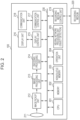
- Fig. 2 is a block diagram illustrating a configuration example of the image pickup apparatus 100 of the first embodiment.
- the image pickup apparatus 100 includes a CPU 201, a memory 202, a nonvolatile memory 203, an operation unit 204, a neural network processing unit 205, an image pickup unit 212, an image processing unit 213, and an encoding processing unit 214.
- the image pickup apparatus 100 further includes a display control unit 215, a display unit 216, a communication control unit 217, a communication unit 218, a recording medium control unit 219, and an internal bus 230.
- the image pickup apparatus 100 causes an optical image of the object to be focused on a pixel array of the image pickup unit 212 by using a shooting lens 211, but the shooting lens 211 may be non-detachable or may be detachable from a body (a body frame or a main body) of the image pickup apparatus 100.
- the image pickup apparatus 100 performs write and read of image data to and from a recording medium 220 via the recording medium control unit 219.
- the recording medium 220 may be detachable or may be non-detachable from the image pickup apparatus 100.
- the CPU 201 controls each of the units (each of the functional blocks) in the image pickup apparatus 100 via the internal bus 230 by executing a computer program stored in the nonvolatile memory 203.
- the memory 202 is a rewritable volatile memory.
- the memory 202 temporarily records a computer program for controlling an operation of each unit in the image pickup apparatus 100, information such as a parameter related to the operation of each unit in the image pickup apparatus 100, information received by the communication control unit 217, and the like.
- the memory 202 also temporarily records an image acquired by the image pickup unit 212 and an image and information which have been processed by the image processing unit 213, the encoding processing unit 214, or the like.
- the memory 202 is provided with a sufficient storage capacity to temporarily record these images and information.
- the nonvolatile memory 203 is a memory where electrical deletion and recording can be performed, and for example, an EEPROM, a hard disk, or the like is used.
- the nonvolatile memory 203 stores information such as a computer program for controlling an operation of each unit in the image pickup apparatus 100 and a parameter related to the operation of each unit in the image pickup apparatus 100. In accordance with such a computer program, various operations to be performed by the image pickup apparatus 100 are realized.
- the nonvolatile memory 203 further stores a computer program which is to be used in the neural network processing unit 205 and in which processing content of the neural network is described, and a trained coefficient parameter such as a weight coefficient or a bias value.
- the weight coefficient is a value indicating a strength of connection between nodes in the neural network
- the bias is a value for providing an offset to an integrated value of the weight coefficient and the input data.
- the nonvolatile memory 203 can hold a plurality of trained coefficient parameters and a plurality of computer programs in which the processing of the neural network is described.
- the memory 202 may temporarily store a plurality of computer programs which are to be used in the neural network processing unit 205 and in which the processing of the neural network is described and a plurality of trained coefficient parameters which have been described above. Note that the computer program in which the processing of the neural network is described and the trained coefficient parameter are equivalent to the dictionary data for the object detection.
- the operation unit 204 provides a user interface for operating the image pickup apparatus 100.
- the operation unit 204 includes various buttons such as a power button, a menu button, a release button for shooting, a movie recording button, and a cancel button.
- the various buttons are constituted by a switch, a touch panel, and the like.
- the CPU 201 controls the image pickup apparatus 100 according to an instruction from the user which is input via the operation unit 204.
- the CPU 201 controls the image pickup apparatus 100 based on an operation input via the operation unit 204 but is not limited to this.
- the CPU 201 may control the image pickup apparatus 100 based on a request input from a remote controller which is not illustrated in the drawing or the mobile terminal 120 via the communication unit 218.
- the inference processing of the object detection unit 101 based on the dictionary data is performed. A detail thereof will be described below with reference to Fig. 3 .
- the shooting lens (lens unit) 211 is constituted by a lens group including a zoom lens, a focus lens, and the like, a lens control unit which is not illustrated in the drawing, a diaphragm which is not illustrated in the drawing, and the like.
- the shooting lens 211 may function as zoom means for changing a field angle.
- the lens control unit of the shooting lens 211 performs adjustment of focus and control of an aperture value (F number) based on control signals transmitted from the CPU 201.
- the image pickup unit 212 may function as acquisition means for sequentially acquiring a plurality of images including a motion image.
- a CCD (charge coupling device) image sensor, a CMOS (complementary metal oxide semiconductor) image sensor, or the like is used as the image pickup unit 212.
- the image pickup unit 212 has a pixel array which is not illustrated in the drawing in which photoelectric conversion units (pixels) that convert the optical image of the object into electrical signals are arranged in a matrix manner, that is, a two-dimensional manner.
- the optical image of the object is focused on the pixel array by the shooting lens 211.
- the image pickup unit 212 outputs a picked-up image to the image processing unit 213 or the memory 202. Note that the image pickup unit 212 can also acquire a still image.
- the image processing unit 213 performs predetermined image processing on image data output from the image pickup unit 212 or image data read from the memory 202. Examples of the image processing include dynamic range conversion processing, interpolation processing, reduction processing (resizing processing), color conversion processing, and the like. The image processing unit 213 also performs predetermined calculation processing for exposure control, ranging control, or the like by using the image data acquired by the image pickup unit 212.
- the exposure control, the ranging control, and the like are performed by the CPU 201 based on a calculation result acquired through the calculation processing by the image processing unit 213. Specifically, AE (Auto Exposure) processing, AWB (Auto White Balance) processing, AF (Auto Focus) processing, and the like are performed by the CPU 201. These shooting controls are performed by referring to an object detection result by the neural network processing unit 205.
- the encoding processing unit 214 compresses a size of the image data by performing intra-frame prediction coding (intra-picture prediction coding), inter-frame prediction coding (inter-picture prediction coding), or the like on the image data from the image processing unit 213.
- the display control unit 215 controls the display unit 216.
- the display unit 216 includes a display screen which is not illustrated in the drawing.
- the display control unit 215 generates an image that can be displayed on the display screen of the display unit 216 and outputs the image, that is, an image signal, to the display unit 216.
- the display control unit 215 can not only output the image data to the display unit 216 but also output the image data to an external device via the communication control unit 217.
- the display unit 216 displays the image on the display screen based on the image signal transmitted from the display control unit 215.
- the display unit 216 includes an OSD (On Screen Display) function that is a function of displaying a setting screen such as a menu on the display screen.
- the display control unit 215 may superimpose an OSD image on the image signal and output the image signal to the display unit 216.
- An object frame can also be generated based on the object detection result by the neural network processing unit 205 and displayed by being superimposed on the image signal.
- the display unit 216 is constituted by a liquid crystal display, an organic EL display, or the like and displays the image signal transmitted from the display control unit 215.
- the display unit 216 may include, for example, a touch panel. In a case where the display unit 216 includes the touch panel, the display unit 216 may also function as the operation unit 204.
- the communication control unit 217 is controlled by the CPU 201.
- the communication control unit 217 generates a modulation signal in conformity to a wireless communication standard such as IEEE802.11 to output the modulation signal to the communication unit 218, and also receives a modulation signal from an external device via the communication unit 218.
- the communication control unit 217 can transmit and receive a control signal of a video signal.
- the communication control unit 217 may transmit a video signal compliant with a communication standard such as HDMI (registered trademark) (High Definition Multimedia Interface) or SDI (Serial Digital Interface).
- the communication unit 218 converts the video signal and the control signal into physical electrical signals to perform transmission and reception to and from an external device. Note that the communication unit 218 performs not only the transmission and the reception of the video signal and the control signal but also reception or the like of the dictionary data for the object detection in the neural network processing unit 205.
- the recording medium control unit 219 controls the recording medium 220.
- the recording medium control unit 219 outputs a control signal for controlling the recording medium 220 to the recording medium 220 based on a request from the CPU 201.
- a nonvolatile memory, a magnetic disk, or the like is used as the recording medium 220.
- the recording medium 220 may be detachable as described above or may be non-detachable.
- the recording medium 220 saves coded image data or the like as a file in a format in conformity to a file system of the recording medium 220.
- Each of the functional blocks 201 to 205, 212 to 215, 217, and 219 is mutually accessible via the internal bus 230.
- part of the functional blocks illustrated in Fig. 2 is realized by causing the CPU 201 serving as a computer included in the image pickup apparatus 100 to execute a computer program stored in the nonvolatile memory 203 or the like serving as a storage medium.
- part or all of those functional blocks may be realized by hardware.
- a dedicated circuit (ASIC), a processor (a reconfigurable processor or a DSP), or the like can be used as the hardware.
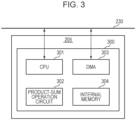
- the neural network processing unit 205 includes a CPU 301, a product-sum operation circuit 302, a dynamic memory access (DMA) 303, an internal memory 304, and the like in a neural core 300.
- DMA dynamic memory access
- the CPU 301 acquires a computer program in which processing content of the neural network is described from the memory 202 or the nonvolatile memory 203 via the internal bus 230 or from the internal memory 304, and executes the computer program.
- the CPU 301 also performs control on the product-sum operation circuit 302 and the DMA 303.
- the product-sum operation circuit 302 is a circuit that performs a product-sum operation in the neural network.
- the product-sum operation circuit 302 includes a plurality of product-sum operation units, and these product-sum operation units can execute the product-sum operation in parallel.
- the product-sum operation circuit 302 outputs intermediate data calculated at the time of the product-sum operation executed in parallel by the plurality of product-sum operation units to the internal memory 304 via the DMA 303.
- the DMA 303 is a circuit specialized for data transfer without intermediation of the CPU 301 and performs data transfer between the memory 202 or the nonvolatile memory 203 and the internal memory 304 via the internal bus 230. In addition, the DMA 303 performs data transfer between the product-sum operation circuit 302 and the internal memory 304. Examples of data to be transferred by the DMA 303 include the computer program in which the processing content of the neural network is described, the trained coefficient parameter, the intermediate data calculated by the product-sum operation circuit 302, and the like.
- the internal memory 304 stores the computer program in which the processing content of the neural network is described, the trained coefficient parameter, the intermediate data calculated by the product-sum operation circuit 302, and the like.
- the internal memory 304 may include a plurality of banks and may dynamically switch between the banks.
- Fig. 4 is a block diagram illustrating a hardware configuration example of the server 110.
- the server 110 includes a CPU 401, a memory 402, a display unit 403, an operation unit 405, a recording unit 406, a communication unit 407, and a neural network processing unit 408.
- part of the functional blocks illustrated in Fig. 4 is realized by causing the CPU 401 serving as a computer included in the server 110 to execute a computer program stored in the recording unit 406 or the like serving as a storage medium.
- part or all of those functional blocks may be realized by hardware.
- a dedicated circuit (ASIC), a processor (a reconfigurable processor or a DSP), or the like can be used as the hardware.
- the CPU 401 controls all processing blocks constituting the server 110 by executing a computer program stored in the recording unit 406.
- the memory 402 is a memory that is mainly used as a work area of the CPU 401 or a temporary buffer area for data.
- the display unit 403 is constituted by a liquid crystal panel, an organic EL panel, or the like and performs display of an operation screen or the like based on an instruction of the CPU 401.
- An internal bus 404 is a bus with which each of the processing blocks in the server 110 is mutually connected.
- the operation unit 405 is constituted by a keyboard, a mouse, a button, a touch panel, a remote controller, or the like and accepts an operation instruction of the user. Operation information that is input from the operation unit 405 is transmitted to the CPU 401, and the CPU 401 executes control on each of the processing blocks based on the operation information.
- the recording unit 406 is constituted by a recording medium and is a processing block that stores or reads various data in or from the recording medium based on an instruction of the CPU 401.
- the recording medium is constituted by an EEPROM, a built-in flash memory, a built-in hard disk, a removable memory card, or the like.
- the input data and the training data which are the data for learning in the neural network processing unit 408, the dictionary data, and the like are saved in the recording unit 406.
- the communication unit 407 includes hardware or the like configured to perform communication of a wireless LAN and a wired LAN.
- the wireless LAN for example, processing of IEEE802.11n/a/g/b standards is performed.
- the communication unit 407 is connected to an external access point by the wireless LAN and performs wireless LAN communication with another wireless communication device via the access point.
- the communication unit 407 performs communication via an external router or a switching hub by an Ethernet cable or the like in the wired LAN.
- the communication unit 407 performs communication with an external device including the image pickup apparatus 100 to exchange information such as the training data or the dictionary data.
- the neural network processing unit 408 performs leaning processing of the neural network by the training data acquired via the communication unit 407.
- the neural network processing unit 408 is equivalent to the learning unit 114 in Fig. 1 and performs the learning processing for developing the dictionary data corresponding to respective objects in different classes by using the training data.
- the neural network processing unit 408 is constituted by a GPU (Graphic Processing Unit), a DSP (Digital Signal Processor), or the like.
- the dictionary data that is a result of the learning processing performed by the neural network processing unit 408 is held in the recording unit 406.
- Fig. 5 is a block diagram illustrating a hardware configuration example of the mobile terminal 120.
- the mobile terminal 120 includes a CPU 501, a memory 502, an image pickup unit 503, a display unit 504, an operation unit 505, a recording unit 506, a communication unit 507, and an internal bus 508.
- Part of the functional blocks illustrated in Fig. 5 is realized by causing the CPU 501 serving as a computer included in the mobile terminal 120 to execute a computer program stored in the recording unit 506 or the like serving as a storage medium.
- part or all of those functional blocks may be realized by hardware.
- a dedicated circuit (ASIC), a processor (a reconfigurable processor or a DSP), or the like can be used as the hardware.
- the CPU 501 controls all processing blocks constituting the mobile terminal 120 by executing the computer program stored in the recording unit 506.
- the memory 502 is a memory that is mainly used as a work area of the CPU 501 or a temporary buffer area for data.
- a program such as an OS (Operation System) or application software is loaded onto the memory 502 and executed by the CPU 501.
- the image pickup unit 503 includes an optical lens, a CMOS sensor, a digital image processing unit, and the like and picks up an optical image that is input via an optical lens to acquire picked-up image data by converting the optical image into digital data.
- the captured image data acquired by the image pickup unit 503 is temporarily stored in the memory 502 and processed based on the control of the CPU 501. For example, recording into a recording medium by the recording unit 506, transmission to an external device by the communication unit 507, or the like is performed.
- the image pickup unit 503 also includes a lens control unit and performs control such as zoom, focus, or aperture adjustment based on a command from the CPU 501.
- the display unit 504 is constituted by a liquid crystal panel, an organic EL panel, or the like and performs display based on an instruction of the CPU 501.
- An image of the training data is selected from among captured images, and also display of the operation screen, the captured images, or the like is performed to designate a network structure.
- the operation unit 505 is constituted by a keyboard, a mouse, a button, a four-way operative key, a touch panel, a remote controller, or the like and accepts an operation instruction of the user. Operation information that is input from the operation unit 505 is transmitted to the CPU 501, and the CPU 501 executes control on each of the processing blocks based on the operation information.
- the recording unit 506 is constituted by a large capacity recording medium and is a processing block that stores and reads various data in and from the recording medium based on an instruction of the CPU 501.
- the recording medium is constituted by a built-in flash memory, a built-in hard disk, a removable memory card, or the like.
- the communication unit 507 includes processing hardware or the like configured to perform communication of an antenna, a wireless LAN, a wired LAN, or the like. For example, the communication unit 507 performs wireless LAN communication of the IEEE802.11n/a/g/b standards. The communication unit 507 is connected to an external access point by way of the wireless LAN and performs the wireless LAN communication with another wireless communication device via the access point. By the communication unit 507, the training data or the network structure which has been input from the user via the operation unit 505 is transmitted to the server 110.
- the internal bus 508 is a bus configured to mutually connect each of the processing blocks in the mobile terminal SP.
- Fig. 6 is a flowchart illustrating processing of the image pickup apparatus according to the first embodiment, and with reference to Fig. 6 , a flow of the processing in which the dictionary data to be executed in the image pickup apparatus 100 is received, and object detection is performed to carry out image pickup control in the first embodiment will be described.
- This operation is realized when, in a state in which power of the image pickup apparatus 100 is on, the computer program stored in the nonvolatile memory 203 is loaded onto the memory 202, and the CPU 201 reads and executes the computer program in the memory 202.
- step S601 the image pickup apparatus 100 checks the server 110 via the communication unit 218 as to whether or not dictionary data that is not yet received from the server 110 is present.
- step S602 the dictionary data is acquired from the server 110 via the communication unit 218 to be stored in the nonvolatile memory 203.
- step S601, NO the flow proceeds to step S603.
- step S603 the object detection is performed by the neural network processing unit 205 by using the dictionary data recorded in the nonvolatile memory 203.
- the dictionary data may be copied from the nonvolatile memory 203 to the memory 202 or the internal memory 304 of the neural network processing unit 205 to be used in the object detection.
- the object detection in step S603 is performed by using the image data acquired by the image pickup unit 212 as the input data.
- step S604 image pickup control such as autofocus is performed by the image pickup unit 212 based on the object detection result. That is, focus is on the detected object, and also the image pickup control such as autofocus and exposure control is performed such that appropriate exposure is established.
- steps S603 and S604 function as an image pickup step of performing the object detection based on the dictionary data and performing the predetermined image pickup control on the object detected by the object detection.
- the step of acquiring the dictionary data from the server, and the object detection based on the acquired dictionary data and the shooting control are performed in the same flow.
- the configuration is not limited to this, and for example, a mode in which or timing at which the dictionary data is acquired by inquiring the server in advance during a non-shooting period may be provided.
- the dictionary data used for the object detection it is not necessarily to inquire the server to acquire the dictionary data that has not yet been acquired and use the dictionary data as it is. For example, before the dictionary data is used (for example, before step S604), as a step of determining the dictionary data, a step of accepting a user operation or a step of automatically determining the dictionary data may be provided.
- Figs. 7A and 7B are diagrams for describing an example of the object detection based on the dictionary data.
- the dictionary data of the first embodiment has a computer program in which processing content for executing an object detection task by the neural network processing unit 205 is described or a trained coefficient parameter for each type of the object.
- a human figure an animal such as a dog or a cat, a vehicle such as an automobile, a motorbike, or the like is exemplified.
- Reference numerals 701 and 705 in Figs. 7A and 7B denote examples of a menu screen of the display unit 216, on which an object to be detected is set by the user via the operation unit 204.
- "human figure” 702 is set as the object to be detected.
- the object detection is performed by using the dictionary data of the "human figure” which is stored in advance in the nonvolatile memory 203.
- Reference numeral 703 denotes a shot image displayed on the display unit 216, illustrating a state in which a face of the "human figure” is detected, and a frame 704 is superimposed to be displayed.
- Fig. 7B "custom” 706 is set as the object to be detected.
- the object detection is performed by using, for example, "fish” as the dictionary data for custom which is received from the server 110.
- Reference numeral 707 denotes a shot image displayed on the display unit 216, illustrating a state in which the dictionary data of the "custom” is "fish”, and a frame 708 is superimposed on the detected fish to be displayed.
- Fig. 8 and Fig. 9 are flowcharts illustrating processing performed by the CPU 401 of the server 110 according to the first embodiment.
- Fig. 8 the processing of Fig. 8 is realized, in a state in which the power of the server 110 is on, when the computer program stored in the recording unit 406 is loaded onto the memory 402, and the CPU 401 reads and executes the computer program in the memory 402.
- step S801 the server 110 acquires positive instance data and negative instance data from the mobile terminal 120 via the communication unit 407.
- step S802 negative instance data saved in advance in the storage unit 406 is acquired.
- steps S801 and S802 function as training data acquisition means for acquiring training data for object detection.
- step S803 the base dictionary data saved in the storage unit 406 is acquired.
- step S804 it is determined whether or not data necessary to generate the dictionary data is prepared through steps S801 to S803.
- the flow proceeds to step S805.
- the flow proceeds to step S806.
- NO is determined in step S804.
- step S806 notification of occurrence of an error to the mobile terminal 120 is performed via the communication unit 507.
- step S805 the neural network processing unit 408 generates custom dictionary data.
- the generation of the dictionary data a method of generating the dictionary data through learning from the training data (for example, Fig. 9 ) is proposed.
- Step S805 functions as learning means for generating the custom dictionary data.
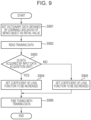
- Fig. 9 is a flowchart for describing a flow of processing for the generation of the dictionary data according to step S805.
- step S901 dictionary data obtained by learning a wide variety of objects in advance is set to an initial value as the base dictionary data.
- dictionary data obtained by learning a specific type of objects such as a dog, a cat, or a motorcycle may be used.
- step S902 the training data used for learning is read.
- step S903 it is determined whether or not the read training data is the data acquired by the input data acquisition unit, that is, whether or not the read training data is the data acquired from the mobile terminal 120.
- the flow proceeds to step S904.
- the flow proceeds to step S905.
- a coefficient of a loss function for the read data is set to be larger than that of the data acquired by the intra-server data acquisition unit 112. For example, the coefficient is set such that the loss calculated at the time of learning is doubled. This is because the training data acquired by the input data acquisition unit is considered as data with a high object detection accuracy on which an intention of the user is clearly reflected.
- step S905 the coefficient of the loss function for the read data is set to be smaller than that of the data acquired by the input data acquisition unit.
- the negative instance data acquired by the intra-server data acquisition unit 112 is not data provided from the user, learning is to be performed by taking into account a possibility that the positive instance data desired by the user to be detected is included in part of the negative instance data.
- step S904 and step S905 it is possible to reduce negative effects that a loss, in a case where the positive instance data is mixed in the negative instance data, is calculated to be large.
- step S906 learning is performed based on the training data. Since the initial value of the dictionary data is not a random number but is a value obtained by learning a likelihood of being the object, so-called fine tuning is carried out.
- step S906 functions as dictionary generation means for generating the dictionary data by performing the learning based on the training data.
- step S807 determines whether to additionally acquire the negative instance data. For example, when a value of the loss function of the learning is equal to or less than a predetermined threshold, the generation of the dictionary data is determined to be successful. When the value of the loss function is greater than the predetermined threshold, the generation of the dictionary data is determined to have failed. When the generation of the dictionary data has failed, it is determined that the negative instance data is to be additionally acquired.
- step S807 functions as determination means for determining whether to further acquire the negative instance training data by the intra-server data acquisition unit 112 in addition to the data acquired by the intra-server data acquisition unit 112.
- step S808 the dictionary data is transmitted to the image pickup apparatus 100 via the communication unit 407.
- step S807 When the generation of the dictionary data has failed (in step S807, YES is determined), the flow proceeds to step S809, and the intra-server data acquisition unit 112 additionally acquires the negative instance data. After the acquisition, the flow returns to step S804.
- step S804 When the generation failure of the dictionary data has continued a predetermined number of times, it is assumed that the generation of the dictionary data is not to be successful even when further negative instance data is added, and NO is determined in step S804 so that notification of an error may be performed in step S808.
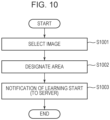
- Fig. 10 is a flowchart illustrating an example of a flow of processing executed by the mobile terminal 120 according to the first embodiment.
- Figs. 11A, 11B , and 11C are diagrams for describing an input screen example for the training data of the display unit 504 of the mobile terminal according to the first embodiment.
- step S1001 of Fig. 10 the user selects, via the operation unit 505, an image to be used as the training data from among captured images stored in the recording unit 506.
- Fig. 11A illustrates an example of an image selection screen by the display unit 504, and 12 captured images are displayed as indicated by reference numeral 1101.
- the user selects two images through touching or the like by the operation unit 505 as the training data from among these 12 captured images.
- reference numeral 1102 captured images with a circle displayed on top left are set as the selected images of the training data.
- step S1002 the user designates, via the operation unit 505, an object area that is set as a target in the image for the two images selected as the training data.
- Fig. 11B illustrates an example of an input screen for the object area by the display unit 504, and a rectangular frame 1103 indicates the object area input by the user.
- the object area is set for each of the images selected as the training data.
- the area selection may be directly performed from the displayed image via a touch panel which is part of the operation unit 505 and which is integrated with the display unit 504.
- the object area may be a characteristic object area selected by performing selection, fine adjustment, or the like from the object frame simply detected based on a feature amount such as an edge by the CPU 501 or the like.
- step S1003 the user determines that generation of the dictionary data via the operation unit 505 is to be started.
- Fig. 11C illustrates a confirmation window example for the start of the generation of the dictionary data by the display unit 504, in which YES or NO is input.
- YES indicated by reference numeral 1104 the training data and information of the type of the image pickup apparatus are transmitted to the server 110 via the communication unit 507, and the generation of the dictionary data is performed in the server 110.
- NO is selected in Fig. 11C , the processing is terminated.
- the object area in the image data of the training data is treated as a positive instance and other areas are treated as negative instances during the dictionary data generation in the server 110.
- an example of the selection of the image in which the object area is present has been illustrated, but an image in which the object area is absent may be selected. In that case, the information of the object area is not input, and the whole image is treated as a negative instance.
- Subject matters to which the present invention may be applied are not limited to the image pickup apparatus 100, the server 110, the mobile terminal 120, and the like which are explained in the above-described embodiment.
- the image pickup apparatus 100 is a system constituted by a plurality of apparatuses, a function similar to the above-described embodiment can be realized.
- the function can be realized when part of the processing of the image pickup apparatus 100 is implemented by an external apparatus on a network.
- the processing of the mobile terminal 120 can be implemented by the image pickup apparatus 100.
- a computer program for realizing the functions of the above-described embodiment for part or all of the control in the present embodiment may be supplied to the image pickup system or the like via a network or various storage media. Then, a computer (or a CPU, an MPU, or the like) in the image pickup system or the like may read and execute the program. In the above-described case, the program and a storage medium storing the program constitute the present invention.
Landscapes
- Engineering & Computer Science (AREA)
- Theoretical Computer Science (AREA)
- General Physics & Mathematics (AREA)
- Physics & Mathematics (AREA)
- Multimedia (AREA)
- Artificial Intelligence (AREA)
- Health & Medical Sciences (AREA)
- General Health & Medical Sciences (AREA)
- Databases & Information Systems (AREA)
- Software Systems (AREA)
- Evolutionary Computation (AREA)
- Computer Vision & Pattern Recognition (AREA)
- Medical Informatics (AREA)
- Computing Systems (AREA)
- Audiology, Speech & Language Pathology (AREA)
- Computational Linguistics (AREA)
- General Engineering & Computer Science (AREA)
- Signal Processing (AREA)
- Image Analysis (AREA)
- Image Processing (AREA)
- Manipulator (AREA)
Abstract
Description
- The present invention relates to an image processing apparatus related to a trained model that detects a specific object by using machine learning, an image pickup apparatus, and control methods for those apparatuses.
- Object detection is one of fields of computer vision research and has been widely studied so far. The computer vision is a technique for understanding an image that has been input to a computer and automatically identifying various features of the image. In the technique, the object detection is a task for estimating a position and a type of an object that is present in the image. The object detection is applied to an autofocus technique or the like of an image pickup apparatus.
- In recent years, an image processing apparatus which detects an object by a machine learning scheme represented by a neural network or the like has been known. By using a trained model (dictionary data) corresponding to a specific object, such an image processing apparatus detects the specific object to perform image pickup control. As a type of the specific object, a human figure, an animal such as a dog or a cat, or a vehicle such as an automobile is representative, which is a highly demanded object for an autofocus (AF) function of the image pickup apparatus.
-
Japanese Patent Laid-Open No. 2021-57672 - PTL 1:
Japanese Patent Laid-Open No. 2021-57672 - In addition, to generate dictionary data with which it is possible to detect any new object desired by the user to be detected, it is necessary for the user to provide training data of the object. However, in some cases, the number of pieces of data (training data of a positive instance) that can be prepared by the user is small, and an issue occurs that dictionary data with a sufficient level of detection performance is not acquired.
- An object of the present invention is to provide an image processing apparatus capable of generating or using dictionary data with detection performance of a certain level or more from a small number of pieces of positive instance data.
- To achieve the above-described object, an image processing apparatus of the present invention includes first acquisition means for acquiring first training data including image data of a positive instance for a first target, second acquisition means for acquiring second training data including image data of a negative instance for the first target, and generation means for generating first dictionary data for detecting the first target based on the training data acquired by the first acquisition means and the second acquisition means, and it is characterized in that the learning means performs additional learning on second dictionary data to generate the first dictionary data, and that a number of pieces of the first training data acquired by the first acquisition means is smaller than a number of pieces of the second training data acquired by the second acquisition means.
- According to the present invention, it is possible to generate or use the dictionary data with detection performance of a certain level or more from a small number of pieces of positive instance data.
-
- [
Fig. 1] Fig. 1 is a configuration diagram of an image processing system according to a first embodiment of the present invention. - [
Fig. 2] Fig. 2 is a block diagram illustrating a configuration example of animage pickup apparatus 100 of the first embodiment. - [
Fig. 3] Fig. 3 is a block diagram illustrating a schematic configuration of a neuralnetwork processing unit 205 according to the first embodiment. - [
Fig. 4] Fig. 4 is a block diagram illustrating a hardware configuration example of aserver 110. - [
Fig. 5] Fig. 5 is a block diagram illustrating a hardware configuration example of amobile terminal 120. - [
Fig. 6] Fig. 6 is a flowchart illustrating processing of the image pickup apparatus according to the first embodiment. - [
Fig. 7A] Fig. 7A is a diagram for describing an example of object detection based on dictionary data. - [
Fig. 7B] Fig. 7B is a diagram for describing an example of the object detection based on the dictionary data. - [
Fig. 8] Fig. 8 is a flowchart illustrating processing of a server according to the first embodiment. - [
Fig. 9] Fig. 9 is a flowchart for describing a flow of processing for dictionary data generation according to the first embodiment. - [
Fig. 10] Fig. 10 is a flowchart illustrating an example of a flow of processing executed by themobile terminal 120 according to the first embodiment. - [
Fig. 11A] Fig. 11A is a diagram for describing an input screen example for training data and a network structure of adisplay unit 504 of the mobile terminal according to the first embodiment. - [
Fig. 11B] Fig. 11B is a diagram for describing an input screen example for the training data and the network structure of thedisplay unit 504 of the mobile terminal according to the first embodiment. - [
Fig. 11C] Fig. 11C is a diagram for describing an input screen example for the training data and the network structure of thedisplay unit 504 of the mobile terminal according to the first embodiment. - Hereinafter, with reference to the attached drawings, a preferred embodiment of the present invention will be described with use of embodiments. Note that the same members or elements in the respective drawings are assigned with the same reference signs, and duplicate explanations will be omitted or simplified.
- In addition, according to the present embodiment, an example of an application to an information processing server as an image processing apparatus will be described. However, the image processing apparatus includes an electronic device or the like having an image pickup function, such as a digital still camera, a digital movie camera, a smartphone with a camera, a tablet computer with a camera, a network camera, an in-vehicle camera, a drone camera, or a camera mounted to a robot.
- Hereinafter, an image processing system according to a first embodiment will be described in detail.
-
Fig. 1 is a configuration diagram of the image processing system according to the first embodiment, and the image processing system is constituted by animage pickup apparatus 100, aserver 110 serving as an information processing server, amobile terminal 120 serving as an information processing terminal, and the like. Theimage pickup apparatus 100 and theserver 110 are connected to each other by a wireless communication network, for example. In addition, theserver 110 and themobile terminal 120 are connected to each other by a wireless communication network, for example. - Note that functional blocks in the
server 110 and themobile terminal 120 which are illustrated inFig. 1 are respectively realized by causing computers respectively included in theserver 110 and themobile terminal 120 to execute computer programs stored in memories serving as storage media. - The image processing system according to the first embodiment performs object detection based on a neural network and also enables detection of any object by the user. Examples of a representative scheme of the object detection include a scheme called convolutional neural network (hereinafter, abbreviated as CNN). According to the CNN, inference processing is executed based on an image signal and dictionary data that is a processing parameter, and the dictionary data is generated in advance through learning processing based on training data.
- In the image processing system of the first embodiment, the
mobile terminal 120 includes a trainingdata input unit 121 serving as training data input means for inputting training data for object detection. In addition, the trainingdata input unit 121 executes a training data input step of inputting training data for the object detection. - In addition, the training
data input unit 121 can input, while image data and object area information of the image data in which a target object is present are prepared as a set of the training data, a plurality of sets of the training data, and the plurality of sets can be transmitted to theserver 110. - In the
server 110, an inputdata acquisition unit 111 serving as first acquisition means acquires positive instance training data and negative instance training data which are transmitted from themobile terminal 120, and an intra-serverdata acquisition unit 112 serving as second acquisition means acquires a predetermined number of pieces of negative instance training data from among a negativeinstance data group 113 prepared in theserver 110 in advance. At this time, the number of pieces of data input by the user using the trainingdata input unit 121 including the positive instance data and the negative instance data is set to be equal to or less than 100. Herein, it is desired that, more preferably, five or more pieces of positive instance training data are input from the user to enable detection of an object intended by the user. However, a sufficient level of performance is not to be achieved when learning is performed by using only 100 or fewer pieces of data input by the user. - In view of the above, the intra-server
data acquisition unit 112 acquires 101 or more pieces of training data to be used for learning. Herein, for example, the intra-serverdata acquisition unit 112 uses 10,000 or more pieces of negative instance training data, so that it is possible to perform learning with which an object detection rate is compensated and increased even though the number of pieces of positive instance training data from the user is small. As a result, sufficient learning can be performed while a load of a data input operation on the user side is reduced. - Custom dictionary data is generated in a
learning unit 114 by way of performing, based on the acquired data, additional learning on pre-trained base dictionary data. The generated custom dictionary data is transmitted to theimage pickup apparatus 100 after adetermination unit 115 determines whether to further acquire negative instance training data. According to the first embodiment, thelearning unit 114 is provided in theserver 110 serving as the information processing server which is different from the image pickup apparatus. - In the
image pickup apparatus 100, the dictionary data transmitted from theserver 110 is received, and inference processing based on the neural network is performed by anobject detection unit 101 based on the received dictionary data. Subsequently, image pickup control such as autofocus is executed in an imagepickup control unit 102 based on an inference result. That is, theimage pickup apparatus 100 performs object detection based on the dictionary data and performs predetermined image pickup control (such as autofocus or exposure control) on an object detected through the object detection. -
Fig. 2 is a block diagram illustrating a configuration example of theimage pickup apparatus 100 of the first embodiment. As illustrated inFig. 2 , theimage pickup apparatus 100 includes aCPU 201, amemory 202, anonvolatile memory 203, anoperation unit 204, a neuralnetwork processing unit 205, animage pickup unit 212, animage processing unit 213, and anencoding processing unit 214. Theimage pickup apparatus 100 further includes adisplay control unit 215, adisplay unit 216, acommunication control unit 217, acommunication unit 218, a recordingmedium control unit 219, and aninternal bus 230. - The
image pickup apparatus 100 causes an optical image of the object to be focused on a pixel array of theimage pickup unit 212 by using ashooting lens 211, but theshooting lens 211 may be non-detachable or may be detachable from a body (a body frame or a main body) of theimage pickup apparatus 100. In addition, theimage pickup apparatus 100 performs write and read of image data to and from arecording medium 220 via the recordingmedium control unit 219. Therecording medium 220 may be detachable or may be non-detachable from theimage pickup apparatus 100. - The
CPU 201 controls each of the units (each of the functional blocks) in theimage pickup apparatus 100 via theinternal bus 230 by executing a computer program stored in thenonvolatile memory 203. - The
memory 202 is a rewritable volatile memory. Thememory 202 temporarily records a computer program for controlling an operation of each unit in theimage pickup apparatus 100, information such as a parameter related to the operation of each unit in theimage pickup apparatus 100, information received by thecommunication control unit 217, and the like. Thememory 202 also temporarily records an image acquired by theimage pickup unit 212 and an image and information which have been processed by theimage processing unit 213, theencoding processing unit 214, or the like. Thememory 202 is provided with a sufficient storage capacity to temporarily record these images and information. - The
nonvolatile memory 203 is a memory where electrical deletion and recording can be performed, and for example, an EEPROM, a hard disk, or the like is used. Thenonvolatile memory 203 stores information such as a computer program for controlling an operation of each unit in theimage pickup apparatus 100 and a parameter related to the operation of each unit in theimage pickup apparatus 100. In accordance with such a computer program, various operations to be performed by theimage pickup apparatus 100 are realized. Thenonvolatile memory 203 further stores a computer program which is to be used in the neuralnetwork processing unit 205 and in which processing content of the neural network is described, and a trained coefficient parameter such as a weight coefficient or a bias value. - Note that the weight coefficient is a value indicating a strength of connection between nodes in the neural network, and the bias is a value for providing an offset to an integrated value of the weight coefficient and the input data. The
nonvolatile memory 203 can hold a plurality of trained coefficient parameters and a plurality of computer programs in which the processing of the neural network is described. - Note that instead of the
memory 203, thememory 202 may temporarily store a plurality of computer programs which are to be used in the neuralnetwork processing unit 205 and in which the processing of the neural network is described and a plurality of trained coefficient parameters which have been described above. Note that the computer program in which the processing of the neural network is described and the trained coefficient parameter are equivalent to the dictionary data for the object detection. - The
operation unit 204 provides a user interface for operating theimage pickup apparatus 100. Theoperation unit 204 includes various buttons such as a power button, a menu button, a release button for shooting, a movie recording button, and a cancel button. The various buttons are constituted by a switch, a touch panel, and the like. TheCPU 201 controls theimage pickup apparatus 100 according to an instruction from the user which is input via theoperation unit 204. - Note that herein, a case has been described as an example where the
CPU 201 controls theimage pickup apparatus 100 based on an operation input via theoperation unit 204 but is not limited to this. For example, theCPU 201 may control theimage pickup apparatus 100 based on a request input from a remote controller which is not illustrated in the drawing or themobile terminal 120 via thecommunication unit 218. - In the neural
network processing unit 205, the inference processing of theobject detection unit 101 based on the dictionary data is performed. A detail thereof will be described below with reference toFig. 3 . - The shooting lens (lens unit) 211 is constituted by a lens group including a zoom lens, a focus lens, and the like, a lens control unit which is not illustrated in the drawing, a diaphragm which is not illustrated in the drawing, and the like. The
shooting lens 211 may function as zoom means for changing a field angle. The lens control unit of theshooting lens 211 performs adjustment of focus and control of an aperture value (F number) based on control signals transmitted from theCPU 201. - The
image pickup unit 212 may function as acquisition means for sequentially acquiring a plurality of images including a motion image. For example, a CCD (charge coupling device) image sensor, a CMOS (complementary metal oxide semiconductor) image sensor, or the like is used as theimage pickup unit 212. Theimage pickup unit 212 has a pixel array which is not illustrated in the drawing in which photoelectric conversion units (pixels) that convert the optical image of the object into electrical signals are arranged in a matrix manner, that is, a two-dimensional manner. The optical image of the object is focused on the pixel array by theshooting lens 211. Theimage pickup unit 212 outputs a picked-up image to theimage processing unit 213 or thememory 202. Note that theimage pickup unit 212 can also acquire a still image. - The
image processing unit 213 performs predetermined image processing on image data output from theimage pickup unit 212 or image data read from thememory 202. Examples of the image processing include dynamic range conversion processing, interpolation processing, reduction processing (resizing processing), color conversion processing, and the like. Theimage processing unit 213 also performs predetermined calculation processing for exposure control, ranging control, or the like by using the image data acquired by theimage pickup unit 212. - Then, the exposure control, the ranging control, and the like are performed by the
CPU 201 based on a calculation result acquired through the calculation processing by theimage processing unit 213. Specifically, AE (Auto Exposure) processing, AWB (Auto White Balance) processing, AF (Auto Focus) processing, and the like are performed by theCPU 201. These shooting controls are performed by referring to an object detection result by the neuralnetwork processing unit 205. - The
encoding processing unit 214 compresses a size of the image data by performing intra-frame prediction coding (intra-picture prediction coding), inter-frame prediction coding (inter-picture prediction coding), or the like on the image data from theimage processing unit 213. - The
display control unit 215 controls thedisplay unit 216. Thedisplay unit 216 includes a display screen which is not illustrated in the drawing. Thedisplay control unit 215 generates an image that can be displayed on the display screen of thedisplay unit 216 and outputs the image, that is, an image signal, to thedisplay unit 216. In addition, thedisplay control unit 215 can not only output the image data to thedisplay unit 216 but also output the image data to an external device via thecommunication control unit 217. Thedisplay unit 216 displays the image on the display screen based on the image signal transmitted from thedisplay control unit 215. - The
display unit 216 includes an OSD (On Screen Display) function that is a function of displaying a setting screen such as a menu on the display screen. Thedisplay control unit 215 may superimpose an OSD image on the image signal and output the image signal to thedisplay unit 216. An object frame can also be generated based on the object detection result by the neuralnetwork processing unit 205 and displayed by being superimposed on the image signal. Thedisplay unit 216 is constituted by a liquid crystal display, an organic EL display, or the like and displays the image signal transmitted from thedisplay control unit 215. Thedisplay unit 216 may include, for example, a touch panel. In a case where thedisplay unit 216 includes the touch panel, thedisplay unit 216 may also function as theoperation unit 204. - The
communication control unit 217 is controlled by theCPU 201. Thecommunication control unit 217 generates a modulation signal in conformity to a wireless communication standard such as IEEE802.11 to output the modulation signal to thecommunication unit 218, and also receives a modulation signal from an external device via thecommunication unit 218. In addition, thecommunication control unit 217 can transmit and receive a control signal of a video signal. For example, by controlling thecommunication unit 218, thecommunication control unit 217 may transmit a video signal compliant with a communication standard such as HDMI (registered trademark) (High Definition Multimedia Interface) or SDI (Serial Digital Interface). - The
communication unit 218 converts the video signal and the control signal into physical electrical signals to perform transmission and reception to and from an external device. Note that thecommunication unit 218 performs not only the transmission and the reception of the video signal and the control signal but also reception or the like of the dictionary data for the object detection in the neuralnetwork processing unit 205. - The recording
medium control unit 219 controls therecording medium 220. The recordingmedium control unit 219 outputs a control signal for controlling therecording medium 220 to therecording medium 220 based on a request from theCPU 201. For example, a nonvolatile memory, a magnetic disk, or the like is used as therecording medium 220. Therecording medium 220 may be detachable as described above or may be non-detachable. Therecording medium 220 saves coded image data or the like as a file in a format in conformity to a file system of therecording medium 220. - Each of the
functional blocks 201 to 205, 212 to 215, 217, and 219 is mutually accessible via theinternal bus 230. - Note that part of the functional blocks illustrated in
Fig. 2 is realized by causing theCPU 201 serving as a computer included in theimage pickup apparatus 100 to execute a computer program stored in thenonvolatile memory 203 or the like serving as a storage medium. However, part or all of those functional blocks may be realized by hardware. A dedicated circuit (ASIC), a processor (a reconfigurable processor or a DSP), or the like can be used as the hardware. - As illustrated in
Fig. 3 , the neuralnetwork processing unit 205 includes aCPU 301, a product-sum operation circuit 302, a dynamic memory access (DMA) 303, aninternal memory 304, and the like in aneural core 300. - The
CPU 301 acquires a computer program in which processing content of the neural network is described from thememory 202 or thenonvolatile memory 203 via theinternal bus 230 or from theinternal memory 304, and executes the computer program. TheCPU 301 also performs control on the product-sum operation circuit 302 and theDMA 303. - The product-
sum operation circuit 302 is a circuit that performs a product-sum operation in the neural network. The product-sum operation circuit 302 includes a plurality of product-sum operation units, and these product-sum operation units can execute the product-sum operation in parallel. In addition, the product-sum operation circuit 302 outputs intermediate data calculated at the time of the product-sum operation executed in parallel by the plurality of product-sum operation units to theinternal memory 304 via theDMA 303. - The
DMA 303 is a circuit specialized for data transfer without intermediation of theCPU 301 and performs data transfer between thememory 202 or thenonvolatile memory 203 and theinternal memory 304 via theinternal bus 230. In addition, theDMA 303 performs data transfer between the product-sum operation circuit 302 and theinternal memory 304. Examples of data to be transferred by theDMA 303 include the computer program in which the processing content of the neural network is described, the trained coefficient parameter, the intermediate data calculated by the product-sum operation circuit 302, and the like. - The
internal memory 304 stores the computer program in which the processing content of the neural network is described, the trained coefficient parameter, the intermediate data calculated by the product-sum operation circuit 302, and the like. In addition, theinternal memory 304 may include a plurality of banks and may dynamically switch between the banks. -
Fig. 4 is a block diagram illustrating a hardware configuration example of theserver 110. - As illustrated in
Fig. 4 , theserver 110 includes aCPU 401, amemory 402, adisplay unit 403, anoperation unit 405, arecording unit 406, acommunication unit 407, and a neuralnetwork processing unit 408. - Note that part of the functional blocks illustrated in
Fig. 4 is realized by causing theCPU 401 serving as a computer included in theserver 110 to execute a computer program stored in therecording unit 406 or the like serving as a storage medium. However, part or all of those functional blocks may be realized by hardware. A dedicated circuit (ASIC), a processor (a reconfigurable processor or a DSP), or the like can be used as the hardware. - The
CPU 401 controls all processing blocks constituting theserver 110 by executing a computer program stored in therecording unit 406. - The
memory 402 is a memory that is mainly used as a work area of theCPU 401 or a temporary buffer area for data. - The
display unit 403 is constituted by a liquid crystal panel, an organic EL panel, or the like and performs display of an operation screen or the like based on an instruction of theCPU 401. - An
internal bus 404 is a bus with which each of the processing blocks in theserver 110 is mutually connected. - The
operation unit 405 is constituted by a keyboard, a mouse, a button, a touch panel, a remote controller, or the like and accepts an operation instruction of the user. Operation information that is input from theoperation unit 405 is transmitted to theCPU 401, and theCPU 401 executes control on each of the processing blocks based on the operation information. - The
recording unit 406 is constituted by a recording medium and is a processing block that stores or reads various data in or from the recording medium based on an instruction of theCPU 401. For example, the recording medium is constituted by an EEPROM, a built-in flash memory, a built-in hard disk, a removable memory card, or the like. In addition to the computer program, the input data and the training data which are the data for learning in the neuralnetwork processing unit 408, the dictionary data, and the like are saved in therecording unit 406. - The
communication unit 407 includes hardware or the like configured to perform communication of a wireless LAN and a wired LAN. In the wireless LAN, for example, processing of IEEE802.11n/a/g/b standards is performed. Thecommunication unit 407 is connected to an external access point by the wireless LAN and performs wireless LAN communication with another wireless communication device via the access point. In addition, thecommunication unit 407 performs communication via an external router or a switching hub by an Ethernet cable or the like in the wired LAN. Thecommunication unit 407 performs communication with an external device including theimage pickup apparatus 100 to exchange information such as the training data or the dictionary data. - The neural
network processing unit 408 performs leaning processing of the neural network by the training data acquired via thecommunication unit 407. The neuralnetwork processing unit 408 is equivalent to thelearning unit 114 inFig. 1 and performs the learning processing for developing the dictionary data corresponding to respective objects in different classes by using the training data. - The neural
network processing unit 408 is constituted by a GPU (Graphic Processing Unit), a DSP (Digital Signal Processor), or the like. In addition, the dictionary data that is a result of the learning processing performed by the neuralnetwork processing unit 408 is held in therecording unit 406. -
Fig. 5 is a block diagram illustrating a hardware configuration example of themobile terminal 120. - As illustrated in
Fig. 5 , themobile terminal 120 includes aCPU 501, amemory 502, animage pickup unit 503, adisplay unit 504, anoperation unit 505, arecording unit 506, acommunication unit 507, and aninternal bus 508. Part of the functional blocks illustrated inFig. 5 is realized by causing theCPU 501 serving as a computer included in themobile terminal 120 to execute a computer program stored in therecording unit 506 or the like serving as a storage medium. However, part or all of those functional blocks may be realized by hardware. A dedicated circuit (ASIC), a processor (a reconfigurable processor or a DSP), or the like can be used as the hardware. - The
CPU 501 controls all processing blocks constituting themobile terminal 120 by executing the computer program stored in therecording unit 506. - The
memory 502 is a memory that is mainly used as a work area of theCPU 501 or a temporary buffer area for data. A program such as an OS (Operation System) or application software is loaded onto thememory 502 and executed by theCPU 501. - The
image pickup unit 503 includes an optical lens, a CMOS sensor, a digital image processing unit, and the like and picks up an optical image that is input via an optical lens to acquire picked-up image data by converting the optical image into digital data. The captured image data acquired by theimage pickup unit 503 is temporarily stored in thememory 502 and processed based on the control of theCPU 501. For example, recording into a recording medium by therecording unit 506, transmission to an external device by thecommunication unit 507, or the like is performed. Theimage pickup unit 503 also includes a lens control unit and performs control such as zoom, focus, or aperture adjustment based on a command from theCPU 501. - The
display unit 504 is constituted by a liquid crystal panel, an organic EL panel, or the like and performs display based on an instruction of theCPU 501. An image of the training data is selected from among captured images, and also display of the operation screen, the captured images, or the like is performed to designate a network structure. - The
operation unit 505 is constituted by a keyboard, a mouse, a button, a four-way operative key, a touch panel, a remote controller, or the like and accepts an operation instruction of the user. Operation information that is input from theoperation unit 505 is transmitted to theCPU 501, and theCPU 501 executes control on each of the processing blocks based on the operation information. - The
recording unit 506 is constituted by a large capacity recording medium and is a processing block that stores and reads various data in and from the recording medium based on an instruction of theCPU 501. For example, the recording medium is constituted by a built-in flash memory, a built-in hard disk, a removable memory card, or the like. - The
communication unit 507 includes processing hardware or the like configured to perform communication of an antenna, a wireless LAN, a wired LAN, or the like. For example, thecommunication unit 507 performs wireless LAN communication of the IEEE802.11n/a/g/b standards. Thecommunication unit 507 is connected to an external access point by way of the wireless LAN and performs the wireless LAN communication with another wireless communication device via the access point. By thecommunication unit 507, the training data or the network structure which has been input from the user via theoperation unit 505 is transmitted to theserver 110. - The
internal bus 508 is a bus configured to mutually connect each of the processing blocks in the mobile terminal SP. -
Fig. 6 is a flowchart illustrating processing of the image pickup apparatus according to the first embodiment, and with reference toFig. 6 , a flow of the processing in which the dictionary data to be executed in theimage pickup apparatus 100 is received, and object detection is performed to carry out image pickup control in the first embodiment will be described. This operation is realized when, in a state in which power of theimage pickup apparatus 100 is on, the computer program stored in thenonvolatile memory 203 is loaded onto thememory 202, and theCPU 201 reads and executes the computer program in thememory 202. - In step S601, the
image pickup apparatus 100 checks theserver 110 via thecommunication unit 218 as to whether or not dictionary data that is not yet received from theserver 110 is present. When the dictionary data that is not received from theserver 110 is present in the server 110 (in step S601, YES is determined), in step S602, the dictionary data is acquired from theserver 110 via thecommunication unit 218 to be stored in thenonvolatile memory 203. When the dictionary data that is not received from theserver 110 is absent (in step S601, NO is determined), the flow proceeds to step S603. - In step S603, the object detection is performed by the neural
network processing unit 205 by using the dictionary data recorded in thenonvolatile memory 203. The dictionary data may be copied from thenonvolatile memory 203 to thememory 202 or theinternal memory 304 of the neuralnetwork processing unit 205 to be used in the object detection. In addition, the object detection in step S603 is performed by using the image data acquired by theimage pickup unit 212 as the input data. - In step S604, image pickup control such as autofocus is performed by the
image pickup unit 212 based on the object detection result. That is, focus is on the detected object, and also the image pickup control such as autofocus and exposure control is performed such that appropriate exposure is established. Herein, steps S603 and S604 function as an image pickup step of performing the object detection based on the dictionary data and performing the predetermined image pickup control on the object detected by the object detection. - According to the present embodiment, the step of acquiring the dictionary data from the server, and the object detection based on the acquired dictionary data and the shooting control are performed in the same flow. However, the configuration is not limited to this, and for example, a mode in which or timing at which the dictionary data is acquired by inquiring the server in advance during a non-shooting period may be provided. In addition, with regard to the dictionary data used for the object detection, it is not necessarily to inquire the server to acquire the dictionary data that has not yet been acquired and use the dictionary data as it is. For example, before the dictionary data is used (for example, before step S604), as a step of determining the dictionary data, a step of accepting a user operation or a step of automatically determining the dictionary data may be provided.
-
Figs. 7A and 7B are diagrams for describing an example of the object detection based on the dictionary data. - The dictionary data of the first embodiment has a computer program in which processing content for executing an object detection task by the neural
network processing unit 205 is described or a trained coefficient parameter for each type of the object. - For example, as a type of the object for which the dictionary data is registered, a human figure, an animal such as a dog or a cat, a vehicle such as an automobile, a motorbike, or the like is exemplified.
-
Reference numerals Figs. 7A and 7B denote examples of a menu screen of thedisplay unit 216, on which an object to be detected is set by the user via theoperation unit 204. InFig. 7A , "human figure" 702 is set as the object to be detected. When the "human figure" is set, the object detection is performed by using the dictionary data of the "human figure" which is stored in advance in thenonvolatile memory 203.Reference numeral 703 denotes a shot image displayed on thedisplay unit 216, illustrating a state in which a face of the "human figure" is detected, and aframe 704 is superimposed to be displayed. - In
Fig. 7B , "custom" 706 is set as the object to be detected. In a case of the "custom", the object detection is performed by using, for example, "fish" as the dictionary data for custom which is received from theserver 110.Reference numeral 707 denotes a shot image displayed on thedisplay unit 216, illustrating a state in which the dictionary data of the "custom" is "fish", and aframe 708 is superimposed on the detected fish to be displayed. -
Fig. 8 andFig. 9 are flowcharts illustrating processing performed by theCPU 401 of theserver 110 according to the first embodiment. - Note that the processing of
Fig. 8 is realized, in a state in which the power of theserver 110 is on, when the computer program stored in therecording unit 406 is loaded onto thememory 402, and theCPU 401 reads and executes the computer program in thememory 402. - With reference to
Fig. 8 , processing will be described which is extracted from the processing performed by theCPU 401 of theserver 110, in which information related to the training data and the network structure is acquired from themobile terminal 120 to generate dictionary data, and the generated dictionary data is transmitted to theimage pickup apparatus 100. - In step S801, the
server 110 acquires positive instance data and negative instance data from themobile terminal 120 via thecommunication unit 407. In step S802, negative instance data saved in advance in thestorage unit 406 is acquired. Herein, steps S801 and S802 function as training data acquisition means for acquiring training data for object detection. Furthermore, in step S803, the base dictionary data saved in thestorage unit 406 is acquired. - Subsequently, in step S804, it is determined whether or not data necessary to generate the dictionary data is prepared through steps S801 to S803. When the data is prepared (in step S804, YES is determined), the flow proceeds to step S805. When at least part of the data is not prepared (in step S804, NO is determined), the flow proceeds to step S806.
- For example, when the training data is present but the base dictionary data is absent, NO is determined in step S804. When NO is determined, in step S806, notification of occurrence of an error to the
mobile terminal 120 is performed via thecommunication unit 507. - In step S805, the neural
network processing unit 408 generates custom dictionary data. As the generation of the dictionary data, a method of generating the dictionary data through learning from the training data (for example,Fig. 9 ) is proposed. Step S805 functions as learning means for generating the custom dictionary data. -
Fig. 9 is a flowchart for describing a flow of processing for the generation of the dictionary data according to step S805. - When learning is to be performed in a state in which an initial value of the dictionary data is a random number, a large number of pieces of training data are required. When the large number of pieces of training data are required, since it takes time for the user to input the training data, a method of performing learning with a small number of pieces of training data is desirable.
- In view of the above, in step S901, dictionary data obtained by learning a wide variety of objects in advance is set to an initial value as the base dictionary data. As the base dictionary data, dictionary data obtained by learning a specific type of objects such as a dog, a cat, or a motorcycle may be used.
- In step S902, the training data used for learning is read.
- In step S903, it is determined whether or not the read training data is the data acquired by the input data acquisition unit, that is, whether or not the read training data is the data acquired from the
mobile terminal 120. When the data is data acquired by the input data acquisition unit, the flow proceeds to step S904. When the data is not data acquired by the input data acquisition unit, the flow proceeds to step S905. - In step S904, a coefficient of a loss function for the read data is set to be larger than that of the data acquired by the intra-server
data acquisition unit 112. For example, the coefficient is set such that the loss calculated at the time of learning is doubled. This is because the training data acquired by the input data acquisition unit is considered as data with a high object detection accuracy on which an intention of the user is clearly reflected. - In addition, in step S905, the coefficient of the loss function for the read data is set to be smaller than that of the data acquired by the input data acquisition unit. When the negative instance data acquired by the intra-server
data acquisition unit 112 is not data provided from the user, learning is to be performed by taking into account a possibility that the positive instance data desired by the user to be detected is included in part of the negative instance data. In view of the above, by separating the processing into step S904 and step S905, it is possible to reduce negative effects that a loss, in a case where the positive instance data is mixed in the negative instance data, is calculated to be large. - In step S906, learning is performed based on the training data. Since the initial value of the dictionary data is not a random number but is a value obtained by learning a likelihood of being the object, so-called fine tuning is carried out. Herein, step S906 functions as dictionary generation means for generating the dictionary data by performing the learning based on the training data.
- The description returns to the flowchart in
Fig. 8 . When the generation of the dictionary data is performed in step S805, it is determined in step S807 whether to additionally acquire the negative instance data. For example, when a value of the loss function of the learning is equal to or less than a predetermined threshold, the generation of the dictionary data is determined to be successful. When the value of the loss function is greater than the predetermined threshold, the generation of the dictionary data is determined to have failed. When the generation of the dictionary data has failed, it is determined that the negative instance data is to be additionally acquired. Herein, step S807 functions as determination means for determining whether to further acquire the negative instance training data by the intra-serverdata acquisition unit 112 in addition to the data acquired by the intra-serverdata acquisition unit 112. - When the generation of the dictionary data is successful (in step S807, NO is determined), in step S808, the dictionary data is transmitted to the
image pickup apparatus 100 via thecommunication unit 407. - When the generation of the dictionary data has failed (in step S807, YES is determined), the flow proceeds to step S809, and the intra-server
data acquisition unit 112 additionally acquires the negative instance data. After the acquisition, the flow returns to step S804. When the generation failure of the dictionary data has continued a predetermined number of times, it is assumed that the generation of the dictionary data is not to be successful even when further negative instance data is added, and NO is determined in step S804 so that notification of an error may be performed in step S808. -
Fig. 10 is a flowchart illustrating an example of a flow of processing executed by themobile terminal 120 according to the first embodiment. - An extraction regarding processing in the
mobile terminal 120 will be described in which information related to the training data and the network structure is input to notify theserver 110 of learning start in themobile terminal 120. This operation is realized, in a state in which the power of themobile terminal 120 is on, when the computer program stored in therecording unit 506 is loaded onto thememory 502, and theCPU 501 reads and executes the computer program in thememory 502. - With reference to
Figs. 11A, 11B , and11C , the flow of the processing of the flowchart inFig. 10 will be described. -
Figs. 11A, 11B , and11C are diagrams for describing an input screen example for the training data of thedisplay unit 504 of the mobile terminal according to the first embodiment. - In step S1001 of
Fig. 10 , the user selects, via theoperation unit 505, an image to be used as the training data from among captured images stored in therecording unit 506.Fig. 11A illustrates an example of an image selection screen by thedisplay unit 504, and 12 captured images are displayed as indicated byreference numeral 1101. For example, the user selects two images through touching or the like by theoperation unit 505 as the training data from among these 12 captured images. As indicated byreference numeral 1102, captured images with a circle displayed on top left are set as the selected images of the training data. - In step S1002, the user designates, via the
operation unit 505, an object area that is set as a target in the image for the two images selected as the training data.Fig. 11B illustrates an example of an input screen for the object area by thedisplay unit 504, and arectangular frame 1103 indicates the object area input by the user. The object area is set for each of the images selected as the training data. As a method of setting the object area, the area selection may be directly performed from the displayed image via a touch panel which is part of theoperation unit 505 and which is integrated with thedisplay unit 504. - Alternatively, the object area may be a characteristic object area selected by performing selection, fine adjustment, or the like from the object frame simply detected based on a feature amount such as an edge by the
CPU 501 or the like. - In step S1003, the user determines that generation of the dictionary data via the
operation unit 505 is to be started.Fig. 11C illustrates a confirmation window example for the start of the generation of the dictionary data by thedisplay unit 504, in which YES or NO is input. When YES indicated byreference numeral 1104 is selected, the training data and information of the type of the image pickup apparatus are transmitted to theserver 110 via thecommunication unit 507, and the generation of the dictionary data is performed in theserver 110. When NO is selected inFig. 11C , the processing is terminated. - Note that the object area in the image data of the training data is treated as a positive instance and other areas are treated as negative instances during the dictionary data generation in the
server 110. In the explanation described above, an example of the selection of the image in which the object area is present has been illustrated, but an image in which the object area is absent may be selected. In that case, the information of the object area is not input, and the whole image is treated as a negative instance. - As described above, in accordance with the image processing system of the first embodiment, it is possible to generate any dictionary data by the user from the small number of pieces of positive instance training data.
- The present invention has been described above in detail by way of the preferred embodiment, but the present invention is not limited to the above-described embodiment. Various modifications can be made based on the gist of the present invention, and those modifications are not to be excluded from the scope of the present invention.
- Subject matters to which the present invention may be applied are not limited to the
image pickup apparatus 100, theserver 110, themobile terminal 120, and the like which are explained in the above-described embodiment. For example, even when theimage pickup apparatus 100 is a system constituted by a plurality of apparatuses, a function similar to the above-described embodiment can be realized. Furthermore, the function can be realized when part of the processing of theimage pickup apparatus 100 is implemented by an external apparatus on a network. In addition, the processing of themobile terminal 120 can be implemented by theimage pickup apparatus 100. - Note that a computer program for realizing the functions of the above-described embodiment for part or all of the control in the present embodiment may be supplied to the image pickup system or the like via a network or various storage media. Then, a computer (or a CPU, an MPU, or the like) in the image pickup system or the like may read and execute the program. In the above-described case, the program and a storage medium storing the program constitute the present invention.
- The invention is not limited to the above-described embodiments, and various modifications and alterations can be made without departing from the spirit and the scope of the present invention. Therefore, the following claims are accompanied to make the scope of the present invention public.
- This application claims the benefit of
Japanese Patent Application No. 2022-074365 filed April 28, 2022
Claims (15)
- An image processing apparatus comprising:first acquisition means for acquiring first training data including image data of a positive instance for a first target;second acquisition means for acquiring second training data including image data of a negative instance for the first target; andgeneration means for generating first dictionary data for detecting the first target based on the training data acquired by the first acquisition means and the second acquisition means, the image processing apparatus being characterized in thatthe learning means performs additional learning on second dictionary data to generate the first dictionary data, and that a number of pieces of the first training data acquired by the first acquisition means is smaller than a number of pieces of the second training data acquired by the second acquisition means.
- The image processing apparatus according to Claim 1, characterized in that a location from which the first training data is acquired is different from a location from which the second training data is acquired.
- The image processing apparatus according to Claim 1 or 2, characterized in that at least one piece of the first training data is training data provided from a user.
- The image processing apparatus according to any one of Claims 1 to 3, characterized in that the second acquisition means acquires data that is prepared in advance.
- The image processing apparatus according to any one of Claims 1 to 4, characterized in that the first acquisition means acquires the second training data in addition to the acquired first training data.
- The image processing apparatus according to any one of Claims 1 to 5, characterized in that the second target is obtained by further limiting the first target.
- The image processing apparatus according to any one of Claims 1 to 6, characterized in that the first target is a characteristic object area.
- The image processing apparatus according to any one of Claims 1 to 6, characterized in that the first target is a specific object.
- The image processing apparatus according to any one of Claims 1 to 8, characterized in that the learning means includes determination means for determining whether to further acquire second training data including image data of a negative instance by the second acquisition means in addition to the second training data acquired by the second acquisition means.
- The image processing apparatus according to any one of Claims 1 to 9, characterized in that the number of pieces of the first training data acquired by the first acquisition means is 100 or less, and that the number of pieces of the data acquired by the second acquisition means is 101 or more.
- The image processing apparatus according to any one of Claims 1 to 10, characterized by comprising control means for performing object detection based on the dictionary data generated by the learning means to perform shooting control.
- The image processing apparatus according to any one of Claims 1 to 11, characterized in that the learning means sets a coefficient of a loss function in a case where learning is performed with the data acquired by the first acquisition means to be larger than a coefficient of a loss function in a case where learning is performed with the data acquired by the second acquisition means.
- An image pickup apparatus comprising:transmission means for transmitting first training data including image data of a positive instance for a first target;reception means for receiving first dictionary data generated by using the first training data transmitted by the transmission means and second training data including image data of a negative instance for the first target; andcontrol means for performing object detection based on the dictionary data received by the reception means to perform shooting control, the image pickup apparatus being characterized in thatthe first dictionary data is dictionary data generated by performing additional learning on second dictionary data by using the first training data and the second training data including the image data of the negative instance for the first target, andthat a number of pieces of the first training data is smaller than a number of pieces of the second training data.
- A control method for an image processing apparatus, the control method comprising:a first acquisition step of acquiring first training data including image data of a positive instance for a first target;a second acquisition step of acquiring second training data including image data of a negative instance for the first target; anda generation step of generating first dictionary data for detecting the first target based on the training data acquired by the first acquisition means and the second acquisition means, the control method being characterized in thatin the learning step, additional learning is performed on second dictionary data to generate the first dictionary data, and that a number of pieces of the first training data acquired in the first acquisition step is smaller than a number of pieces of the second training data acquired in the second acquisition step.
- A control method for an image pickup apparatus, the control method comprising:a transmission step of transmitting first training data including image data of a positive instance for a first target;a reception step of receiving first dictionary data generated by using the first training data transmitted in the transmission step and second training data including image data of a negative instance for the first target; anda control step of performing object detection based on the first dictionary data received in the reception step to perform shooting control, the control method being characterized in thatthe first dictionary data is dictionary data generated by performing additional learning on second dictionary data by using the first training data and the second training data including the image data of the negative instance for the first target, andthat a number of pieces of the first training data is smaller than a number of pieces of the second training data.
Applications Claiming Priority (2)
| Application Number | Priority Date | Filing Date | Title |
|---|---|---|---|
| JP2022074365A JP2023163443A (en) | 2022-04-28 | 2022-04-28 | Image processing device, imaging device, and control method thereof |
| PCT/JP2023/014607 WO2023210334A1 (en) | 2022-04-28 | 2023-04-10 | Image processing device, imaging device, and control method therefor |
Publications (2)
| Publication Number | Publication Date |
|---|---|
| EP4517657A1 true EP4517657A1 (en) | 2025-03-05 |
| EP4517657A4 EP4517657A4 (en) | 2025-12-31 |
Family
ID=88518389
Family Applications (1)
| Application Number | Title | Priority Date | Filing Date |
|---|---|---|---|
| EP23796079.4A Pending EP4517657A4 (en) | 2022-04-28 | 2023-04-10 | IMAGE PROCESSING DEVICE, IMAGE DEVICE AND CONTROL METHOD FOR IT |
Country Status (5)
| Country | Link |
|---|---|
| US (1) | US20250056112A1 (en) |
| EP (1) | EP4517657A4 (en) |
| JP (1) | JP2023163443A (en) |
| CN (1) | CN119183581A (en) |
| WO (1) | WO2023210334A1 (en) |
Family Cites Families (21)
| Publication number | Priority date | Publication date | Assignee | Title |
|---|---|---|---|---|
| JP5385752B2 (en) * | 2009-10-20 | 2014-01-08 | キヤノン株式会社 | Image recognition apparatus, processing method thereof, and program |
| US20150095017A1 (en) * | 2013-09-27 | 2015-04-02 | Google Inc. | System and method for learning word embeddings using neural language models |
| JP6816713B2 (en) * | 2015-03-19 | 2021-01-20 | 日本電気株式会社 | Object detector, object detection method and program |
| WO2016147652A1 (en) * | 2015-03-19 | 2016-09-22 | 日本電気株式会社 | Object detection device, object detection method, and recording medium |
| CN106021364B (en) * | 2016-05-10 | 2017-12-12 | 百度在线网络技术(北京)有限公司 | Foundation, image searching method and the device of picture searching dependency prediction model |
| US20190188285A1 (en) * | 2017-12-19 | 2019-06-20 | Facebook, Inc. | Image Search with Embedding-based Models on Online Social Networks |
| CN108334605B (en) * | 2018-02-01 | 2020-06-16 | 腾讯科技(深圳)有限公司 | Text classification method and device, computer equipment and storage medium |
| US10783400B2 (en) * | 2018-04-06 | 2020-09-22 | Dropbox, Inc. | Generating searchable text for documents portrayed in a repository of digital images utilizing orientation and text prediction neural networks |
| CN110163234B (en) * | 2018-10-10 | 2023-04-18 | 腾讯科技(深圳)有限公司 | Model training method and device and storage medium |
| JP6896818B2 (en) * | 2018-10-25 | 2021-06-30 | キヤノン株式会社 | Information processing equipment, information processing methods, and programs |
| JP7286330B2 (en) * | 2019-02-04 | 2023-06-05 | キヤノン株式会社 | Image processing device and its control method, program, storage medium |
| JP7018408B2 (en) * | 2019-02-20 | 2022-02-10 | 株式会社 日立産業制御ソリューションズ | Image search device and teacher data extraction method |
| US11605019B2 (en) * | 2019-05-30 | 2023-03-14 | Adobe Inc. | Visually guided machine-learning language model |
| JP7395910B2 (en) | 2019-09-27 | 2023-12-12 | ソニーグループ株式会社 | Information processing equipment, electronic equipment, terminal devices, information processing systems, information processing methods and programs |
| WO2021096856A1 (en) * | 2019-11-12 | 2021-05-20 | X Development Llc | Entity identification using machine learning |
| JP7521931B2 (en) * | 2020-05-26 | 2024-07-24 | Fcnt合同会社 | Mobile terminal, information processing method, and information processing program |
| JP2021189616A (en) * | 2020-05-27 | 2021-12-13 | キヤノン株式会社 | Recognition device, recognition method |
| US11354936B1 (en) * | 2020-07-15 | 2022-06-07 | Amazon Technologies, Inc. | Incremental clustering for face recognition systems |
| JP2022074365A (en) | 2020-11-04 | 2022-05-18 | サカエ理研工業株式会社 | Door mirror device |
| JP7706896B2 (en) * | 2021-02-18 | 2025-07-14 | キヤノン株式会社 | Image capture device, image capture device control method and program |
| US12602610B2 (en) * | 2021-09-03 | 2026-04-14 | International Business Machines Corporation | Classification based on imbalanced dataset |
-
2022
- 2022-04-28 JP JP2022074365A patent/JP2023163443A/en active Pending
-
2023
- 2023-04-10 CN CN202380036245.7A patent/CN119183581A/en active Pending
- 2023-04-10 EP EP23796079.4A patent/EP4517657A4/en active Pending
- 2023-04-10 WO PCT/JP2023/014607 patent/WO2023210334A1/en not_active Ceased
-
2024
- 2024-10-25 US US18/927,198 patent/US20250056112A1/en active Pending
Also Published As
| Publication number | Publication date |
|---|---|
| EP4517657A4 (en) | 2025-12-31 |
| CN119183581A (en) | 2024-12-24 |
| JP2023163443A (en) | 2023-11-10 |
| US20250056112A1 (en) | 2025-02-13 |
| WO2023210334A1 (en) | 2023-11-02 |
Similar Documents
| Publication | Publication Date | Title |
|---|---|---|
| US8089527B2 (en) | Image capturing apparatus, image capturing method and storage medium | |
| EP2587407A1 (en) | Vision recognition apparatus and method | |
| US20100315542A1 (en) | Image capturing apparatus and image capturing apparatus control method | |
| US11516372B2 (en) | Image capturing apparatus, information processing apparatus, methods for controlling the same, image capturing apparatus system, and storage medium | |
| JP7570806B2 (en) | Imaging device, information processing device, control method and program thereof, and trained model selection system | |
| TW201007491A (en) | System and method for efficiently performing image processing operations | |
| US8681235B2 (en) | Apparatus for processing digital image signal that obtains still image at desired point in time and method of controlling the apparatus | |
| US11659275B2 (en) | Information processing apparatus that performs arithmetic processing of neural network, and image pickup apparatus, control method, and storage medium | |
| JP2009027647A (en) | Photographed image recording system, photographing apparatus, and photographed image recording method | |
| US20220337750A1 (en) | Imaging apparatus and controlling method | |
| US20240212305A1 (en) | Imaging system, imaging device, information processing server, imaging method, information processing method, and storage medium | |
| CN107295247B (en) | Image recording apparatus and control method thereof | |
| US20250056112A1 (en) | Image processing apparatus, image pickup apparatus, and control methods for those apparatuses | |
| EP4198925A1 (en) | Image processing apparatus and method for controlling the same, and computer program | |
| US11736820B2 (en) | Image capture apparatus and control method for raw images | |
| US20240386706A1 (en) | Image capturing system, image capturing device, information processing server, image capturing method, information processing method, and computer program | |
| JP2021125828A (en) | Image processing device and image processing method | |
| JP2015159406A (en) | Image pickup device and control method of the same | |
| JP5733615B2 (en) | Image display device, image display program, and image display system | |
| JP5446942B2 (en) | Information processing apparatus and method, imaging apparatus and control method, program, and information processing system | |
| JP6776741B2 (en) | Processing equipment, processing methods and programs | |
| JP2007058208A (en) | Imaging apparatus, control method therefor, computer program, and storage medium | |
| JP2017168984A (en) | Imaging device and control method for imaging device |
Legal Events
| Date | Code | Title | Description |
|---|---|---|---|
| STAA | Information on the status of an ep patent application or granted ep patent |
Free format text: STATUS: THE INTERNATIONAL PUBLICATION HAS BEEN MADE |
|
| PUAI | Public reference made under article 153(3) epc to a published international application that has entered the european phase |
Free format text: ORIGINAL CODE: 0009012 |
|
| STAA | Information on the status of an ep patent application or granted ep patent |
Free format text: STATUS: REQUEST FOR EXAMINATION WAS MADE |
|
| 17P | Request for examination filed |
Effective date: 20241128 |
|
| AK | Designated contracting states |
Kind code of ref document: A1 Designated state(s): AL AT BE BG CH CY CZ DE DK EE ES FI FR GB GR HR HU IE IS IT LI LT LU LV MC ME MK MT NL NO PL PT RO RS SE SI SK SM TR |
|
| DAV | Request for validation of the european patent (deleted) | ||
| DAX | Request for extension of the european patent (deleted) | ||
| REG | Reference to a national code |
Ref country code: DE Ref legal event code: R079 Free format text: PREVIOUS MAIN CLASS: G06T0007000000 Ipc: G06V0010774000 |
|
| A4 | Supplementary search report drawn up and despatched |
Effective date: 20251127 |
|
| RIC1 | Information provided on ipc code assigned before grant |
Ipc: G06V 10/774 20220101AFI20251121BHEP Ipc: G06V 10/00 20220101ALI20251121BHEP Ipc: G06V 10/25 20220101ALI20251121BHEP Ipc: G06V 10/764 20220101ALI20251121BHEP Ipc: G06V 10/772 20220101ALI20251121BHEP Ipc: G06V 10/82 20220101ALI20251121BHEP Ipc: G06F 40/242 20200101ALI20251121BHEP Ipc: G06T 7/11 20170101ALI20251121BHEP Ipc: G06V 10/10 20220101ALI20251121BHEP Ipc: G06V 10/22 20220101ALI20251121BHEP Ipc: G06V 10/778 20220101ALI20251121BHEP Ipc: G06V 10/94 20220101ALI20251121BHEP Ipc: H04N 23/61 20230101ALI20251121BHEP Ipc: G06T 7/00 20170101ALI20251121BHEP |