EP4517649A1 - Information processing device, information processing method, and program - Google Patents
Information processing device, information processing method, and program Download PDFInfo
- Publication number
- EP4517649A1 EP4517649A1 EP23796023.2A EP23796023A EP4517649A1 EP 4517649 A1 EP4517649 A1 EP 4517649A1 EP 23796023 A EP23796023 A EP 23796023A EP 4517649 A1 EP4517649 A1 EP 4517649A1
- Authority
- EP
- European Patent Office
- Prior art keywords
- image data
- data
- information processing
- processing apparatus
- brightness
- Prior art date
- Legal status (The legal status is an assumption and is not a legal conclusion. Google has not performed a legal analysis and makes no representation as to the accuracy of the status listed.)
- Pending
Links
Images




Classifications
-
- H—ELECTRICITY
- H04—ELECTRIC COMMUNICATION TECHNIQUE
- H04N—PICTORIAL COMMUNICATION, e.g. TELEVISION
- H04N7/00—Television systems
- H04N7/18—Closed-circuit television [CCTV] systems, i.e. systems in which the video signal is not broadcast
- H04N7/183—Closed-circuit television [CCTV] systems, i.e. systems in which the video signal is not broadcast for receiving images from a single remote source
- H04N7/185—Closed-circuit television [CCTV] systems, i.e. systems in which the video signal is not broadcast for receiving images from a single remote source from a mobile camera, e.g. for remote control
-
- G—PHYSICS
- G06—COMPUTING OR CALCULATING; COUNTING
- G06N—COMPUTING ARRANGEMENTS BASED ON SPECIFIC COMPUTATIONAL MODELS
- G06N20/00—Machine learning
-
- G—PHYSICS
- G06—COMPUTING OR CALCULATING; COUNTING
- G06N—COMPUTING ARRANGEMENTS BASED ON SPECIFIC COMPUTATIONAL MODELS
- G06N3/00—Computing arrangements based on biological models
- G06N3/02—Neural networks
- G06N3/04—Architecture, e.g. interconnection topology
- G06N3/045—Combinations of networks
-
- G—PHYSICS
- G06—COMPUTING OR CALCULATING; COUNTING
- G06N—COMPUTING ARRANGEMENTS BASED ON SPECIFIC COMPUTATIONAL MODELS
- G06N3/00—Computing arrangements based on biological models
- G06N3/02—Neural networks
- G06N3/08—Learning methods
-
- G—PHYSICS
- G06—COMPUTING OR CALCULATING; COUNTING
- G06N—COMPUTING ARRANGEMENTS BASED ON SPECIFIC COMPUTATIONAL MODELS
- G06N3/00—Computing arrangements based on biological models
- G06N3/02—Neural networks
- G06N3/08—Learning methods
- G06N3/084—Backpropagation, e.g. using gradient descent
-
- G—PHYSICS
- G06—COMPUTING OR CALCULATING; COUNTING
- G06T—IMAGE DATA PROCESSING OR GENERATION, IN GENERAL
- G06T5/00—Image enhancement or restoration
- G06T5/60—Image enhancement or restoration using machine learning, e.g. neural networks
-
- G—PHYSICS
- G06—COMPUTING OR CALCULATING; COUNTING
- G06T—IMAGE DATA PROCESSING OR GENERATION, IN GENERAL
- G06T5/00—Image enhancement or restoration
- G06T5/90—Dynamic range modification of images or parts thereof
- G06T5/94—Dynamic range modification of images or parts thereof based on local image properties, e.g. for local contrast enhancement
-
- G—PHYSICS
- G06—COMPUTING OR CALCULATING; COUNTING
- G06V—IMAGE OR VIDEO RECOGNITION OR UNDERSTANDING
- G06V10/00—Arrangements for image or video recognition or understanding
- G06V10/20—Image preprocessing
- G06V10/25—Determination of region of interest [ROI] or a volume of interest [VOI]
-
- G—PHYSICS
- G06—COMPUTING OR CALCULATING; COUNTING
- G06V—IMAGE OR VIDEO RECOGNITION OR UNDERSTANDING
- G06V10/00—Arrangements for image or video recognition or understanding
- G06V10/40—Extraction of image or video features
- G06V10/60—Extraction of image or video features relating to illumination properties, e.g. using a reflectance or lighting model
-
- G—PHYSICS
- G06—COMPUTING OR CALCULATING; COUNTING
- G06V—IMAGE OR VIDEO RECOGNITION OR UNDERSTANDING
- G06V10/00—Arrangements for image or video recognition or understanding
- G06V10/70—Arrangements for image or video recognition or understanding using pattern recognition or machine learning
-
- G—PHYSICS
- G06—COMPUTING OR CALCULATING; COUNTING
- G06V—IMAGE OR VIDEO RECOGNITION OR UNDERSTANDING
- G06V10/00—Arrangements for image or video recognition or understanding
- G06V10/70—Arrangements for image or video recognition or understanding using pattern recognition or machine learning
- G06V10/82—Arrangements for image or video recognition or understanding using pattern recognition or machine learning using neural networks
-
- G—PHYSICS
- G06—COMPUTING OR CALCULATING; COUNTING
- G06V—IMAGE OR VIDEO RECOGNITION OR UNDERSTANDING
- G06V20/00—Scenes; Scene-specific elements
- G06V20/50—Context or environment of the image
- G06V20/56—Context or environment of the image exterior to a vehicle by using sensors mounted on the vehicle
-
- G—PHYSICS
- G06—COMPUTING OR CALCULATING; COUNTING
- G06V—IMAGE OR VIDEO RECOGNITION OR UNDERSTANDING
- G06V20/00—Scenes; Scene-specific elements
- G06V20/50—Context or environment of the image
- G06V20/56—Context or environment of the image exterior to a vehicle by using sensors mounted on the vehicle
- G06V20/58—Recognition of moving objects or obstacles, e.g. vehicles or pedestrians; Recognition of traffic objects, e.g. traffic signs, traffic lights or roads
- G06V20/584—Recognition of moving objects or obstacles, e.g. vehicles or pedestrians; Recognition of traffic objects, e.g. traffic signs, traffic lights or roads of vehicle lights or traffic lights
-
- G—PHYSICS
- G08—SIGNALLING
- G08G—TRAFFIC CONTROL SYSTEMS
- G08G1/00—Traffic control systems for road vehicles
- G08G1/01—Detecting movement of traffic to be counted or controlled
- G08G1/0104—Measuring and analyzing of parameters relative to traffic conditions
- G08G1/0108—Measuring and analyzing of parameters relative to traffic conditions based on the source of data
- G08G1/0112—Measuring and analyzing of parameters relative to traffic conditions based on the source of data from the vehicle, e.g. floating car data [FCD]
-
- G—PHYSICS
- G08—SIGNALLING
- G08G—TRAFFIC CONTROL SYSTEMS
- G08G1/00—Traffic control systems for road vehicles
- G08G1/01—Detecting movement of traffic to be counted or controlled
- G08G1/0104—Measuring and analyzing of parameters relative to traffic conditions
- G08G1/0125—Traffic data processing
- G08G1/0133—Traffic data processing for classifying traffic situation
-
- G—PHYSICS
- G06—COMPUTING OR CALCULATING; COUNTING
- G06T—IMAGE DATA PROCESSING OR GENERATION, IN GENERAL
- G06T2207/00—Indexing scheme for image analysis or image enhancement
- G06T2207/10—Image acquisition modality
- G06T2207/10004—Still image; Photographic image
-
- G—PHYSICS
- G06—COMPUTING OR CALCULATING; COUNTING
- G06T—IMAGE DATA PROCESSING OR GENERATION, IN GENERAL
- G06T2207/00—Indexing scheme for image analysis or image enhancement
- G06T2207/10—Image acquisition modality
- G06T2207/10016—Video; Image sequence
-
- G—PHYSICS
- G06—COMPUTING OR CALCULATING; COUNTING
- G06T—IMAGE DATA PROCESSING OR GENERATION, IN GENERAL
- G06T2207/00—Indexing scheme for image analysis or image enhancement
- G06T2207/20—Special algorithmic details
- G06T2207/20021—Dividing image into blocks, subimages or windows
-
- G—PHYSICS
- G06—COMPUTING OR CALCULATING; COUNTING
- G06T—IMAGE DATA PROCESSING OR GENERATION, IN GENERAL
- G06T2207/00—Indexing scheme for image analysis or image enhancement
- G06T2207/20—Special algorithmic details
- G06T2207/20081—Training; Learning
-
- G—PHYSICS
- G06—COMPUTING OR CALCULATING; COUNTING
- G06T—IMAGE DATA PROCESSING OR GENERATION, IN GENERAL
- G06T2207/00—Indexing scheme for image analysis or image enhancement
- G06T2207/20—Special algorithmic details
- G06T2207/20084—Artificial neural networks [ANN]
-
- G—PHYSICS
- G06—COMPUTING OR CALCULATING; COUNTING
- G06T—IMAGE DATA PROCESSING OR GENERATION, IN GENERAL
- G06T2207/00—Indexing scheme for image analysis or image enhancement
- G06T2207/30—Subject of image; Context of image processing
- G06T2207/30236—Traffic on road, railway or crossing
-
- G—PHYSICS
- G06—COMPUTING OR CALCULATING; COUNTING
- G06T—IMAGE DATA PROCESSING OR GENERATION, IN GENERAL
- G06T2207/00—Indexing scheme for image analysis or image enhancement
- G06T2207/30—Subject of image; Context of image processing
- G06T2207/30248—Vehicle exterior or interior
- G06T2207/30252—Vehicle exterior; Vicinity of vehicle
Definitions
- Patent Document 1 discloses a monitoring control system that includes a server device that receives image data consisting of a key frame inserted at a predetermined interval and a difference frame from an image captured by a camera of a moving body and controls transmission of an emergency control signal based on a reception state of the key frame.
- An information processing apparatus includes: an extractor configured to extract a first region having brightness equal to or greater than predetermined brightness in an image shown by image data imaged by a moving body; a converter configured to convert extraction data of the first region extracted into first brightness lower than the predetermined brightness; and an output unit configured to output the image data in which the extraction data converted is reflected.
- An information processing method includes: at a computer, extracting a first region having brightness equal to or greater than predetermined brightness in an image shown by image data imaged by a moving body; converting extraction data of the first region extracted into first brightness lower than the predetermined brightness; and outputting the image data in which the extraction data converted is reflected.
- a program causes a computer to execute: extracting a first region having brightness equal to or greater than predetermined brightness in an image shown by image data imaged by a moving body; converting extraction data of the first region extracted into first brightness lower than the predetermined brightness; and outputting the image data in which the extraction data converted is reflected.
- the information processing apparatus 100 is an apparatus that can monitor the plurality of moving bodies 1000 at a remote place.
- the information processing apparatus 100 is an apparatus that can, for example, process and display image data D10 imaged by the plurality of moving bodies 1000.
- the information processing apparatus 100 is, for example, a server apparatus that is provided outside the moving body 1000.
- the information processing apparatus 100 displays in real time the image data D10 (video) transmitted by the moving body 1000.
- the image data D10 includes, for example, two-dimensional images such as moving images and still images. The present embodiment will describe a case where the image data D10 is a still image for simplicity of description.
- the moving bodies 1000 include, for example, vehicles that can move by automatic traveling, manual traveling by a driver, or the like.
- the vehicles include, for example, buses, trucks, and passenger cars.
- the present embodiment will describe a case where the moving bodies 1000 are vehicles that automatically travel on cruising routes.
- the moving bodies 1000 are not limited thereto.
- the moving bodies 1000 may be trains, airplanes, ships, drones, spacecrafts, or the like.
- the cruising route is a route along which the moving body 1000 periodically moves.
- the moving body 1000 includes an imaging device that images the surroundings of the imaging device.
- the moving body 1000 has a function of transmitting the image data D10 imaged by the imaging device to the information processing apparatus 100. That is, the moving body 1000 can transmit to the information processing apparatus 100 the image data D10 imaged at the same position and in different traffic environments such as a daytime, a nighttime, a sunny weather, and a rainy weather.
- the information processing apparatus 100 when the information processing apparatus 100 displays the image data D10 transmitted by the moving body 1000 as is, if the image data D10 includes an image that the observer feels dazzling, there is a probability that the observer undergoes accumulation of the degree of fatigue associated with the dazzle, and quality of monitoring lowers.
- the information processing apparatus 100 decreases the brightness of the image data D10 transmitted by the moving body 1000 and displays the image data D10, the quality of monitoring of important portions such as a brake lamp in front of the moving body 1000 may lower.
- the information processing apparatus 100 can suppress accumulation of fatigue of the observer who monitors the image data D10 imaged by the moving body 1000 without decreasing the quality of monitoring.
- FIG. 2 is a diagram illustrating an example of an outline of processing of the image data D10 of the information processing apparatus 100 according to the embodiment.
- the information processing apparatus 100 extracts a first region E10-1 and a first region E10-2 having brightness equal to or greater than the predetermined brightness in an image D11 shown by the imaged image data D10.
- the predetermined brightness can be set to, for example, brightness at which the observer feels dazzling.
- the first region E10-1 is a region that includes imaging objects such as a streetlight and a headlight of an oncoming vehicle having higher brightness than that of the first region E10-2.
- the first region E10-2 is a region that includes imaging objects such as tail lamps of the vehicles having the predetermined brightness or more. In the following description, if the first region E10-1 and the first region E10-2 do not need to be distinguished from each other, the first region E10-1 and the first region E10-2 will be simply referred to as a first region E10.
- the information processing apparatus 100 includes a converter 152 that converts extraction data D30 of the extracted first region E10 into first brightness lower than the predetermined brightness.
- the first brightness can be set to, for example, brightness lower than the predetermined brightness at which the observer does not feel dazzling, brightness desired by the observer, or the like.
- the converter 152 includes a conversion model M machine-learned to convert a plurality of pieces of learning image data having an imaging condition different from that of the extraction data and having a feature of the extraction data D30 into the first brightness.
- the imaging condition includes, for example, a time zone, a date and time, and weather when an image is imaged.
- the learning image data is data that has the features of the extraction data D30 and indicates an image imaged under the imaging condition different from that of the extraction data D30 (image data D10). An example of the learning image data will be described later.
- the converter 152 may decrease the brightness of the streetlight and suppress a decrease in the brightness of at least one selected from the group consisting of a traffic light, a lamp of a car, a light of a construction site, and a light emitter worn by a person compared to the brightness of the streetlight. That is, the converter 152 decreases the brightness of a portion such as a streetlight that is less important for safety during movement of the moving body 1000 among the portions of the image D11 that the observer feels dazzling. However, the converter 152 suppresses a decrease in the brightness of an object such as the traffic light, the lamp of the car, the light of the construction site, or the light emitter worn by the person that is important for safety during movement of the moving body 1000.
- the conversion model M includes a first conversion model M1 and a second conversion model M2.
- the first conversion model M1 is a machine learned model machine-learned to convert learning image data into the first brightness.
- the first conversion model M1 converts the input extraction data D30 into the first brightness, and outputs the converted extraction data D30.
- the second conversion model M2 is a machine learned model machine-learned to convert into the first brightness a region in an image shown by the learning image data in which the imaging object having the predetermined brightness or more does not exist without converting into the first brightness a region in which the imaging object exists.
- the second conversion model M2 converts into the first brightness a region in which an imaging object having the predetermined brightness or more does not exist in the image shown by the input extraction data D30 and outputs the converted extraction data D30.
- the information processing apparatus 100 inputs the extraction data D30 to the first conversion model M1, and obtains the converted extraction data D30 output by the first conversion model M1.
- the information processing apparatus 100 inputs the extraction data D30 to the second conversion model M2, and obtains the converted extraction data D30 output by the second conversion model M2.
- the information processing apparatus 100 reflects the extraction data D30 in the image data D10 by blending a patch of the converted extraction data D30 with the first region E10-1 and the first region E10-2 of the image D11 shown by the image data D10.
- the information processing apparatus 100 can provide the image data D10 that indicates a converted image D12 having reduced dazzle of the light or the like having a low degree of importance in the image D11 and maintained monitoring target such as the tail lamp of the vehicle.
- the information processing apparatus 100 allows the observer to visually recognize an important image shown by the converted image data D10 and alleviate fatigue.
- FIG. 3 is a configuration diagram illustrating an example of a configuration of the moving body 1000 illustrated in FIG. 1 .
- the moving body 1000 includes a plurality of imaging devices 1100, a sensor 1200, a communicator 1300, and an electronic control unit (ECU) 1400.
- the ECU 1400 is communicably connected to the imaging devices 1100, the sensor 1200, the communicator 1300, and the like.
- the plurality of imaging devices 1100 are provided in the moving body 1000 and can image each of the front side, the rear side, the right side, and the left side of the moving body 1000.
- the plurality of imaging devices 1100 can electronically capture image data by using an image sensor such as a charge coupled device (CCD) or a complementary metal oxide semiconductor (CMOS).
- CMOS complementary metal oxide semiconductor
- the plurality of imaging devices 1100 have different imaging directions.
- the plurality of imaging devices 1100 can image an environment around the moving body 1000 at a predetermined frame rate in real time, and supply the imaged image data D10 to the ECU 1400.
- the sensor 1200 detects sensor information by which the state of the moving body 1000 can be identified.
- a sensor such as a position sensor or a gyro sensor can be used.
- a position sensor is exemplified as a sensor that acquires a position of absolute coordinates of a global positioning system (GPS) receiver or the like.
- the sensor 1200 can supply to the ECU 1400 sensor information including the position of the moving body 1000 (the position of the information processing apparatus 100) and an angular velocity.
- the ECU 1400 can acquire information such as the imaging positions and directions of the imaging devices 1100 based on the sensor information.
- the communicator 1300 can communicate with, for example, other communication devices.
- the communicator 1300 can support various communication standards.
- the communicator 1300 can, for example, transmit and receive various data via a wired or wireless network.
- the communicator 1300 can supply received data to the ECU 1400.
- the communicator 1300 can transmit the image data D10 decoded by an encoder 1410 to the information processing apparatus 100 as a transmission destination instructed by the ECU 1400.
- the ECU 1400 includes the encoder 1410, a storage 1420, and a controller 1430.
- the controller 1430 is electrically connected to the encoder 1410 and the storage 1420.
- the encoder 1410 has a function of encoding the image data D10 under control of the controller 1430.
- the encoder 1410 converts the image data D10 transmitted by the moving body 1000 into a specific code based on a certain format.
- the encoder 1410 decodes the image data D10 input from the controller 1430 and supplies the decoded image data D10 to the communicator 1300.
- the storage 1420 stores various data and programs.
- the storage 1420 includes, for example, a semiconductor memory element such as a RAM and a flash memory, a hard disk, and an optical disk.
- the storage 1420 stores the information and the like received via the communicator 1300.
- the storage 1420 stores, for example, various information such as the above-described image data D10, position information D51, direction information D52, and time information D53.
- the position information D51 includes, for example, information indicating an imaging position of the image data D10 detected by the sensor 1200.
- the direction information D52 includes, for example, information indicating the imaging direction of the image data D10 detected by the sensor 1200.
- the time information D53 includes, for example, information indicating a date and time, a time zone, and the like at which the image data D10 is imaged.
- the position information D51, the direction information D52, and the time information D53 are associated with the image data D10.
- the image data D10 may include the position information D51, the direction information D52, and the time information D53.
- the storage 1420 may store, for example, machine learning data.
- the machine learning data may be data generated by machine learning.
- the machine learning data may include parameters generated by machine learning.
- Machine learning may be based on a technique of an Artificial Intelligence (AI) that can execute a specific task by training. More specifically, machine learning may be a technique where an information processing apparatus such as a computer learns a large amount of data and automatically constructs algorithms or models of performing tasks such as classification and/or prediction.
- part of the AI may include machine learning.
- machine learning may include supervised learning of learning features or rules of input data based on correct answer data.
- Machine learning may include unsupervised learning of learning features or rules of input data in a state where there is no correct answer data.
- Machine learning may include reinforcement learning of giving a reward, a penalty, or the like and learning features or rules of input data.
- machine learning may be any combination of supervised learning, unsupervised learning, and reinforcement learning.
- a concept of machine learning data may include an algorithm of outputting a predetermined inference (estimation) result by using an algorithm learned for input data.
- this algorithm for example, other appropriate algorithms such as linear regression of predicting a relationship between a dependent variable and an independent variable, a Neural Network (NN) that mathematically models a human cranial nerve system neuron, a least squares method of squaring and calculating an error, a decision tree that converts a problem solution into a tree structure, and regularization that modifies data by a predetermined method can be used.
- deep neural network learning that is a type of neural network may be used. Deep neural network learning is a type of a neural network, and, in general, a neural network that means a network having a deep structure whose network hierarchy has one or more intermediate layers is called deep learning. Deep learning is frequently used as an algorithm that configures the AI.
- the controller 1430 is an arithmetic processing device. Examples of the arithmetic processing device include, but are not limited to, a central processing unit (CPU), a system-on-a-chip (SoC), a micro control unit (MCU), a field-programmable gate array (FPGA), and a coprocessor.
- the controller 1430 is an integrated control unit that controls the moving body 1000.
- the controller 1430 executes instructions included in a program stored in the storage 1420 while referring, as appropriate, to information stored in the storage 1420.
- the controller 1430 has a function of causing the encoder 1410 to decode each piece of the image data D10 imaged by the plurality of imaging devices 1100, associating the image data D10 with the position information D51, the direction information D52, and the time information D53, and transmitting to the information processing apparatus 100.
- the controller 1430 transmits the image data D10 to the information processing apparatus 100 in real time via the communicator 1300 when the moving body 1000 is moving on the cruising route.
- the functional configuration example of the moving body 1000 according to the embodiment has been described above.
- the above configuration described with reference to FIG. 3 is merely an example and the functional configuration of the moving body 1000 according to the embodiment is not limited thereto.
- the functional configuration of the moving body 1000 according to the embodiment can be flexibly modified according to specifications and application.
- FIG. 4 is a diagram illustrating an example of a configuration of the information processing apparatus 100 illustrated in FIG. 1 .
- FIG. 5 is a diagram illustrating an example of learning image data D40 and additional data D50.
- FIG. 6 is a diagram for explaining an extraction example of extraction of the first region E10 from the image D11 shown by the image data D10.
- FIG. 7 is a diagram for explaining another extraction example of extraction of the first region E10 from the image D11 shown by the image data D10.
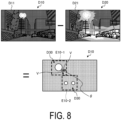
- FIG. 8 is a diagram illustrating an example of a method of extracting the first region E10 of the information processing apparatus 100.
- the information processing apparatus 100 includes a display 110, a communicator 120, a decoder 130, a storage 140, and a controller 150.
- the controller 150 is electrically connected to the display 110, the communicator 120, the decoder 130, the storage 140, and the like.
- the display 110 can display the image data D10 and the like transmitted by the moving body 1000 under control of the controller 150.
- the display 110 can display the image data D10 and the like decoded by the decoder 130 under control of the controller 150.
- the display 110 includes, for example, a display device such as a liquid crystal display and an organic Electro Luminescence (EL) display.
- the display 110 can selectively display or simultaneously display the plurality of pieces of image data D10 transmitted by the plurality of moving bodies 1000.
- the display 110 may be implemented as a plurality of display devices.
- the communicator 120 can communicate with, for example, the communicator 1300 of the moving body 1000 and other communication devices.
- the communicator 120 can support various communication standards.
- the communicator 120 can, for example, transmit and receive various data via a wired or wireless network.
- the communicator 120 can supply received data to the controller 150.
- the communicator 120 can transmit data to a transmission destination instructed by the controller 150.
- the decoder 130 decodes the image data D10 under control of the controller 150.
- the decoder 130 decodes the image data D10 received by the communicator 120 based on a certain format and supplies the decoded image data D10 to the controller 150.
- the storage 140 can store a program and data.
- the storage 140 is also used as a work area that temporarily stores a processing result of the controller 150.
- the storage 140 may include a freely selected non-transitory storage medium such as a semiconductor storage medium and a magnetic storage medium.
- the storage 140 may include a plurality of types of storage media.
- the storage 140 may include a combination of a portable storage medium such as a memory card, an optical disk, a magneto-optical disk, or the like and a device for reading a storage medium.
- the storage 140 may include a storage device used as a temporary storage area such as a Random Access Memory (RAM).
- RAM Random Access Memory
- the storage 140 can store, for example, various data such as a program 141, the first conversion model M1, the second conversion model M2, the image data D10, conversion data D20, the extraction data D30, the learning image data D40, and the additional data D50.
- the program 141 is a program that causes the controller 150 to execute functions of implementing processing related to various operations of the information processing apparatus 100.
- the first conversion model M1 is a machine learned model machine-learned to convert the learning image data D40 into the first brightness.
- the second conversion model M2 is an image indicated by the learning image data D40 and is a machine learned model machine-learned to convert into the first brightness a region in which the imaging object having the predetermined brightness or more does not exist without converting into the first brightness a region in which the imaging object exists.
- the first conversion model M1 may be a model that converts the image D11 in which the streetlight is turned on under the imaging condition of a time zone of a nighttime into the image D11 whose brightness is lowered.
- the second conversion model M2 may be a model that converts the image D11 into the image D11 in which brightness of the streetlight or the like is decreased without decreasing the brightness of the image D11 in which the tail lamp of the car or the like is turned on under the imaging condition of the time zone of the nighttime. That is, in the present disclosure, the first conversion model M1 decreases the brightness of the streetlight or the like that is not so important for the observer of the image D11.
- the second conversion model M2 does not decrease the brightness of a tail lamp or the like of a car that is important for security or the like for the observer of the image D11.
- the brightness of the image D11 can be switched to a conversion method suitable for the degree of importance.
- the image data D10 is the image data D10 transmitted by the moving body 1000.
- the storage 140 stores the image data D10 for each of the plurality of moving bodies 1000 in chronological order.
- the conversion data D20 is data indicating a gamma conversion image obtained by performing gamma correction processing on the image data D10.
- the extraction data D30 is data indicating an extraction image extracted from the first region E10 of the image D11 shown by the image data D10.
- the learning image data D40 is data indicating an image for machine learning having an imaging condition different from that of the extraction data D30 and having the feature of the extraction data D30.
- the learning image data D40 is training data of machine learning.
- the learning image data D40 includes data imaged by the moving body 1000.
- the additional data D50 is data to be added to the image data D10 from which the extraction data D30 is extracted, the learning image data D40, or the like.
- the additional data D50 is data by which the imaging condition can be identified.
- the additional data D50 includes the position information D51, the direction information D52, the time information D53, feature information D54, and weather information D55.
- the position information D51 includes information such as the latitude, the longitude, and GPS information indicating a position at which the learning image data D40 is imaged.
- the direction information D52 includes information indicating the imaging direction of the moving body 1000 that images the learning image data D40.
- the learning image data D40 and the additional data D50 are associated with each other, yet are not limited thereto.
- the additional data D50 can be associated with at least one of the image data D10 and the extraction data D30.
- the controller 150 can execute instructions included in the program 141 stored in the storage 140 while referring, as appropriate, to information stored in the storage 140.
- the controller 150 can control the functional units in accordance with the data and the instructions, thereby implementing various functions.
- the functional units include, but are not limited to, for example, the display 110 and the communicator 120.
- the extractor 151 extracts the first region E10 having brightness equal to or greater than the predetermined brightness in the image D11 shown by the image data D10 imaged by the imaging device 1100 of the moving body 1000, and having a larger area of the region than a determination threshold value K.
- the determination threshold value K is a value for determining whether to decrease the brightness of the entire image D11.
- the first region E10 having the area larger than the determination threshold value K includes, for example, an over exposure region in the image D11.
- the extractor 151 extracts the extraction data D30 indicating the image D11 of the first region E10 whose area is larger than the determination threshold value K, and stores the extraction data D30 in the storage 140.
- the collector 154 collects the plurality of pieces of learning image data D40 having the imaging condition different from that of the extraction data D30 and having the feature of the extraction data D30. Based on the additional data D50 added to the extraction data D30, the collector 154 collects the learning image data D40 indicating an image having similar features.
- the route bus runs on a specific cruising route over and over again, so that the image data D10 can be captured at the same point and in different time zones.
- FIG. 9 is a flowchart illustrating an example of a processing procedure executed by the moving body 1000 according to the embodiment.
- the processing procedure illustrated in FIG. 9 is implemented by the controller 1430 of the moving body 1000 by executing a program.
- the processing procedure illustrated in FIG. 9 is executed when the moving body 1000 cruises.
- the processing procedure illustrated in FIG. 9 indicates a procedure for transmitting the image data D10 of the imaging device 1100 that images the front of the moving body 1000.
- the moving body 1000 acquires the image data D10 (step S101). For example, the moving body 1000 acquires the image data D10 from the imaging device 1100, and stores in the storage 1420 the image data D10 in which the position information D51 based on sensor information acquired from the sensor 1200, the direction information D52 indicating the imaging direction of the imaging device 1100, and the time information D53 are associated.
- the processing in step S101 ends, the moving body 1000 advances processing to step S102.
- the moving body 1000 encodes the image data D10 (step S102). For example, the moving body 1000 uses the encoder 1410 to encode transmission data for transmitting the image data D10, the position information D51, the direction information D52, the time information D53, and the like. When the processing in step S102 ends, the moving body 1000 advances processing to step S103.
- the moving body 1000 transmits the image data D10 (step S103). For example, the moving body 1000 transmits the image data D10 to the information processing apparatus 100 by instructing the communicator 1300 to transmit the encoded transmission data to the information processing apparatus 100.
- the moving body 1000 advances processing to step S104.
- the moving body 1000 determines whether the transmission ends (step S104). For example, the moving body 1000 determines that the transmission ends if a transmission end condition of the image data D10 is satisfied. As the transmission end condition, for example, a condition such as an end timing of cruising movement of the moving body 1000 or a preset end timing is set. If determining that the transmission ends (No in step S104), the moving body 1000 returns the processing to step S101 already described and continues the processing. If determining that transmission the transmission ends (Yes in step S104), the moving body 1000 ends the processing procedure illustrated in FIG. 9 .
- a transmission end condition of the image data D10 for example, a condition such as an end timing of cruising movement of the moving body 1000 or a preset end timing is set. If determining that the transmission ends (No in step S104), the moving body 1000 returns the processing to step S101 already described and continues the processing. If determining that transmission the transmission ends (Yes in step S104), the moving body 1000 ends the processing procedure illustrated in FIG. 9 .
- the information processing apparatus 100 receives the image data D10 (step S201). For example, the information processing apparatus 100 receives the image data D10 transmitted by the moving body 1000 via the communicator 120. When receiving the image data D10, the information processing apparatus 100 advances processing to step S202.
- the information processing apparatus 100 decodes the received image data D10 (step S202). For example, the information processing apparatus 100 decodes the image data D10, the position information D51, the direction information D52, the time information D53, and the like by decoding the transmission data received by the communicator 120 by the decoder 130.
- the information processing apparatus 100 advances processing to step S203.
- the information processing apparatus 100 extracts the extraction data D30 of the first region E10 from the image D11 (step S203). For example, the information processing apparatus 100 extracts the first region E10 having the brightness equal to or greater than the predetermined brightness from the image D11 shown by the decoded image data D10, and extracts the extraction data E30 indicating the image of the first region E10. The information processing apparatus 100 extracts the first region E10 based on a difference between the image data D10 and the conversion data D20 converted by performing gamma correction processing on the image data D10, and extracts the extraction data E30 indicating the image of the first region E10. The information processing apparatus 100 associates the extracted extraction data D30 with the image data D10 and store it in the storage 140. The information processing apparatus 100 generates the additional data D50 and associates the additional data D50 with the extraction data D30 and the image data D10. When the processing in step S203 ends, the information processing apparatus 100 advances processing to step S204.
- the information processing apparatus 100 executes processing of converting the extraction data D30 (step S204).
- the information processing apparatus 100 converts the brightness of the extraction data D30 by executing the conversion processing illustrated in FIG. 11 .
- the information processing apparatus 100 acquires the original image data D10 (step S301-1). For example, the information processing apparatus 100 acquires from the storage 140 the image data D10 of an extraction source associated with the extraction data D30.
- the information processing apparatus 100 calculates an area of the image of the first region E10 (step S301-2). For example, the information processing apparatus 100 calculates the area based on the vertical and horizontal lengths of the first region E10.
- the information processing apparatus 100 determines whether the area in step S301-2 is larger than the determination threshold value K (step S302). If determining that the area is larger than the determination threshold value K (Yes in step S302), the information processing apparatus 100 regards the extraction data D30 as an over exposure image and advances processing to step S303.
- Over exposure may mean that the brightness of a captured image exceeds the brightness of an imaging target. Over exposure may occur when a dynamic range limit of the imaging device 1100 is exceeded.
- the information processing apparatus 100 reduces the brightness of the original image data D10 (step S303). For example, the information processing apparatus 100 executes image processing of decreasing the entire brightness of the original image data D10 acquired in step S301-1 to the brightness that reduces dazzle.
- the information processing apparatus 100 stores the converted data in the storage 140 (step S304). For example, the information processing apparatus 100 stores in the storage 140 the original image data D10 converted as the conversion data D20.
- the processing in step S304 ends, the information processing apparatus 100 ends the processing procedure illustrated in FIG. 11 and returns to the processing in step S204 illustrated in FIG. 10 .
- step S305 determines the conversion condition of the extraction data D30 (step S305). For example, the information processing apparatus 100 determines that the first conversion condition is satisfied when the first region E10 exists in the conversion region in the image D11. For example, the information processing apparatus 100 determines that the second conversion condition is satisfied when the first region E10 exists in the monitoring region in the image D11. For example, the information processing apparatus 100 determines the conversion condition for each of the plurality of pieces of extraction data D30 when the plurality of pieces of extraction data D30 exists.
- step S306 determines the conversion condition of the extraction data D30 (step S305).
- the information processing apparatus 100 determines whether the first conversion condition is satisfied (step S306). If determining that the first conversion condition is satisfied based on the determination result in step S305 (Yes in step S306), the information processing apparatus 100 advances processing to step S307.
- the information processing apparatus 100 converts the input extraction data D30 using the first conversion model M1 (step S307). For example, the information processing apparatus 100 inputs to the first conversion model M1 the extraction data D30 satisfying the first conversion condition, the first conversion model M1 converts the extraction data D30 into the first brightness, and the data output by the first conversion model M1 is the converted extraction data D30.
- step S304 the information processing apparatus 100 stores the converted data in the storage 140 (step S304).
- the information processing apparatus 100 stores in the storage 140 the extraction data D30 converted as the conversion data D20.
- the information processing apparatus 100 ends the processing procedure illustrated in FIG. 11 and returns to the processing in step S204 illustrated in FIG. 10 .
- step S306 If determining that the first conversion condition is not satisfied based on the determination result in step S305 (No in step S306), the information processing apparatus 100 advances processing to step S308 described later.
- the information processing apparatus 100 determines whether the second conversion condition is satisfied (step S308). If determining that the second conversion condition is not satisfied based on the determination result in step S305 (No in step S308), the information processing apparatus 100 advances processing to step S304.
- the information processing apparatus 100 stores the converted data in the storage 140 (step S304). For example, the information processing apparatus 100 may store in the storage 140 information indicating that the data is not converted or may store in the storage 140 the extraction data D30 that is not converted as the conversion data D20.
- the processing in step S304 ends, the information processing apparatus 100 ends the processing procedure illustrated in FIG. 11 and returns to the processing in step S204 illustrated in FIG. 10 .
- step S309 The information processing apparatus 100 converts the input extraction data D30 using the second conversion model M2 (step S309).
- the information processing apparatus 100 inputs to the second conversion model M2 the extraction data D30 satisfying the second conversion condition, and the second conversion model M2 converts into the first brightness the region of the extraction data D30 in which the imaging object having the predetermined brightness or more does not exist without converting into the first brightness the region in which the imaging object exists.
- the information processing apparatus 100 converts the data output by the second conversion model M2 into the converted extraction data D30.
- step S304 the information processing apparatus 100 stores the converted data in the storage 140 (step S304).
- step S304 the information processing apparatus 100 stores in the storage 140 the extraction data D30 converted as the conversion data D20.
- the processing in step S304 ends, the information processing apparatus 100 ends the processing procedure illustrated in FIG. 11 and returns to the processing in step S204 illustrated in FIG. 10 .
- the information processing apparatus 100 can convert, by using the conversion model M machine-learned to convert the plurality of pieces of learning image data D40 having the imaging condition different from that of the extraction data D30 and having the feature of the extraction data D30, the input extraction data into the first brightness.
- the information processing apparatus 100 may input the extraction data D30 to the conversion model M, so that a processing load for monitoring the image data D10 of the plurality of moving bodies 1000 can be suppressed.
- the information processing apparatus 100 compares the image data D10 and the conversion data D20 obtained by performing gamma correction processing on the image data D10 to specify the first region E10 of the image D11 and extracts the extraction data D30 of the first region E10 from the image data D10.
- the information processing apparatus 100 can detect a dazzling region (high-brightness region) based on the difference between the image data D10 and the conversion data D20 by setting a high gamma value of the gamma correction processing.
- FIG. 12 is a diagram illustrating an example of a cruising route 1000R of the moving body 1000.
- FIG. 13 is a flowchart illustrating an example of a processing procedure of collection processing executed by the information processing apparatus 100 according to the embodiment. The processing procedure illustrated in FIG. 13 is implemented by the controller 150 of the information processing apparatus 100 by executing the program 141. The processing procedure illustrated in FIG. 13 is executed when the observer monitors the moving body 1000, and execution ends when finishing the processing procedure is instructed.
- the information processing apparatus 100 acquires the image data D10 (step S401). For example, the information processing apparatus 100 acquires the decoded image data D10 received via the communicator 120. The information processing apparatus 100 detects the first region E10 having the first brightness or more from the image D11 (step S402). For example, the information processing apparatus 100 detects the first region E10 having the brightness equal to or greater than the predetermined brightness from the image D11. When storing a detection result of the first region E10 in the storage 140, the information processing apparatus 100 advances processing to step S403.
- the information processing apparatus 100 determines whether the first region E10 is detected based on the detection result in step S403 (step S403). If determining that the first region E10 is detected (Yes in step S403), the information processing apparatus 100 advances processing to step S404.
- the information processing apparatus 100 extracts the first region E10 having the first brightness or more from the image D11 (step S404). For example, the information processing apparatus 100 extracts the extraction data D30 indicating the first region E10 of the image E11 from the image data D10. When storing the extracted extraction data D30 in the storage 140, the information processing apparatus 100 advances processing to step S405.
- the information processing apparatus 100 calculates a feature vector of the extraction data D30 (step S405). For example, the information processing apparatus 100 calculates the feature vector by using a luminance-invariant feature amount for the image D11 shown by the extraction data D30. The information processing apparatus 100 associates the feature information D54 including the calculated feature vector, an object, and a background as the additional data D50 with the extraction data D30 and store it in the storage 140. The information processing apparatus 100 acquires the weather information D55 indicating the weather at a position at which the moving body 1000 is moving and associates the weather information D55 as the additional data D50 with the extraction data D30 and store it in the storage 140. When the processing in step S405 ends, the information processing apparatus 100 advances processing to step S406.
- the information processing apparatus 100 acquires the another image data D10 having a different imaging condition (step S406). For example, based on the additional data D50 associated with the image data D10, the information processing apparatus 100 acquires the another image data D10 having the same imaging position and imaging direction and having different time zones, weather conditions, and the like.
- the information processing apparatus 100 acquires the second extraction data of the first region E10 from the another image data D10 (step S407). For example, the information processing apparatus 100 extracts the second extraction data indicating the first region E10 of the image D11 from the another image data D10. When storing the extracted second extraction data in the storage 140, the information processing apparatus 100 advances processing to step S408.
- the information processing apparatus 100 calculates a feature vector of the second extraction data (step S408). For example, the information processing apparatus 100 calculates a feature vector by using a luminance-invariant feature amount for the image D11 shown by the second extraction data.
- the information processing apparatus 100 calculates the similarity between the extraction data and the second extraction data (step S409). For example, the information processing apparatus 100 calculates the similarity of the feature vectors by using a calculation program, machine learning, or the like, and stores a calculation result in the storage 140.
- the processing in step S409 ends, the information processing apparatus 100 advances processing to step S410.
- the information processing apparatus 100 determines whether the similarity is larger than the determination threshold value (step S410).
- the determination threshold value for the similarity is a threshold value set to determine whether features are identical. If determining that the similarity is larger than the determination threshold value (Yes in step S410), the information processing apparatus 100 advances processing to step S411.
- the information processing apparatus 100 associates the first region E10 of the second extraction data with identifiable information and stores it (step S411). For example, the information processing apparatus 100 refers to the additional data D50 associated with the image data D10 that is an extraction source of the second extraction data, and changes the feature information D54 of the additional data D50 to indicate the features of the second extraction data.
- the information processing apparatus 100 associates the second extraction data as the learning image data D40 with the additional data D50 and store it in the storage 140.
- step S412 the information processing apparatus 100 acquires the image data D10 of a next frame (step S412). For example, the information processing apparatus 100 acquires the image data D10 of the next frame transmitted by the moving body 1000 via the communicator 120.
- step S412 ends, the information processing apparatus 100 returns processing to step S402 already described and continues the processing.
- the information processing apparatus 100 can collect a large amount of the learning image data D40 suitable for learning of the extraction data D30 based on the additional data D50 from the image data D10 transmitted by the moving body 1000 that is cruising around.
- the image data D10 imaged at the same position and in the same imaging direction is likely to have different brightness, visibility, and the like by different imaging conditions such as a time zone and weather even when the image D11 has a similar context.
- the information processing apparatus 100 can collect the learning image data D40 having features similar to the features indicated by the additional data D50 and having different imaging conditions from the image data D10 imaged on the cruising route 1000R shown by the route data D60.
- the conversion model M can perform machine learning on a large number of items of the learning image data D40, so that the information processing apparatus 100 can further improve the reliability of an output of the conversion model M.
- the above-described information processing apparatus 100 may be configured to recognize an imaging object in the image data D10 based on RGB information, a context, or the like of the image D11 shown by the image data D10, and switch between the first conversion model M1 and the second conversion model M2 used for conversion based on a recognition result.
- the information processing apparatus 100 implements the function of converting the brightness of the image data D10 and the function of collecting the learning image data D40 is described, the information processing apparatus 100 is not limited to this.
- the information processing apparatus 100 may have only a function of converting the brightness of the image data D10.
- the information processing apparatus 100 may implement the two functions using separate apparatuses.
- the information processing apparatus 100 may implement the function of collecting the learning image data D40 using the moving body 1000.
- the information processing apparatus 100 may be mounted on the moving body 1000, or may be implemented as the ECU 1400, an in-vehicle device, or the like mounted on the moving body 1000.
- each functional unit, each means, each step, and the like can be added to another embodiment or replaced with each functional unit, each means, each step, and the like of another embodiment so as not to be logically inconsistent.
- a plurality of functional units, means, steps, and the like can be combined into one or divided.
- Each of the embodiments of the present disclosure described above is not limited to being implemented faithfully to each of the embodiments described above, and can be implemented by appropriately combining each feature or omitting a part thereof.
Landscapes
- Engineering & Computer Science (AREA)
- Theoretical Computer Science (AREA)
- Physics & Mathematics (AREA)
- General Physics & Mathematics (AREA)
- Multimedia (AREA)
- Software Systems (AREA)
- Evolutionary Computation (AREA)
- Artificial Intelligence (AREA)
- Computing Systems (AREA)
- Health & Medical Sciences (AREA)
- General Health & Medical Sciences (AREA)
- Mathematical Physics (AREA)
- General Engineering & Computer Science (AREA)
- Data Mining & Analysis (AREA)
- Medical Informatics (AREA)
- Computer Vision & Pattern Recognition (AREA)
- Biophysics (AREA)
- Computational Linguistics (AREA)
- Biomedical Technology (AREA)
- Molecular Biology (AREA)
- Life Sciences & Earth Sciences (AREA)
- Databases & Information Systems (AREA)
- Analytical Chemistry (AREA)
- Chemical & Material Sciences (AREA)
- Signal Processing (AREA)
- Image Analysis (AREA)
- Image Processing (AREA)
- Closed-Circuit Television Systems (AREA)
- Traffic Control Systems (AREA)
- Studio Devices (AREA)
Abstract
Description
- The present application relates to an information processing apparatus, an information processing method, and a program.
- Autonomous driving vehicles are remotely monitored.
Patent Document 1 discloses a monitoring control system that includes a server device that receives image data consisting of a key frame inserted at a predetermined interval and a difference frame from an image captured by a camera of a moving body and controls transmission of an emergency control signal based on a reception state of the key frame. - Patent Document 1:
JP 2019-3403 A - A conventional remote monitoring system allows for detection in an emergency and support in an emergency by causing an observer from a remote place to monitor videos from a plurality of moving bodies. Unfortunately, the remote monitoring system causes the observer to monitor the videos from the moving bodies in real time, thus causing the observer to accumulate fatigue when the videos include high-brightness videos. Accordingly, there is a need for the remote monitoring system to reduce accumulation of fatigue of an observer who monitors image data imaged by moving bodies.
- An information processing apparatus according to one of aspects includes: an extractor configured to extract a first region having brightness equal to or greater than predetermined brightness in an image shown by image data imaged by a moving body; a converter configured to convert extraction data of the first region extracted into first brightness lower than the predetermined brightness; and an output unit configured to output the image data in which the extraction data converted is reflected.
- An information processing method according to one of the aspects includes: at a computer, extracting a first region having brightness equal to or greater than predetermined brightness in an image shown by image data imaged by a moving body; converting extraction data of the first region extracted into first brightness lower than the predetermined brightness; and outputting the image data in which the extraction data converted is reflected.
- A program according to one of the aspects causes a computer to execute: extracting a first region having brightness equal to or greater than predetermined brightness in an image shown by image data imaged by a moving body; converting extraction data of the first region extracted into first brightness lower than the predetermined brightness; and outputting the image data in which the extraction data converted is reflected.
-
-
FIG. 1 is a diagram for explaining an outline of a system including an information processing apparatus according to the embodiment. -
FIG. 2 is a diagram illustrating an example of an outline of processing of image data of the information processing apparatus according to the embodiment. -
FIG. 3 is a configuration diagram illustrating an example of a configuration of a moving body illustrated inFIG. 1 . -
FIG. 4 is a diagram illustrating an example of a configuration of the information processing apparatus illustrated inFIG. 1 . -
FIG. 5 is a diagram illustrating an example of learning image data and additional data. -
FIG. 6 is a diagram for explaining an extraction example where a first region is extracted from an image shown by image data. -
FIG. 7 is a diagram for explaining another extraction example where the first region is extracted from the image shown by the image data. -
FIG. 8 is a diagram illustrating an example of a method of extracting the first region of the information processing apparatus. -
FIG. 9 is a flowchart illustrating an example of a processing procedure executed by the moving body according to the embodiment. -
FIG. 10 is a flowchart illustrating an example of a processing procedure executed by the information processing apparatus according to the embodiment. -
FIG. 11 is a flowchart illustrating an example of a processing procedure of conversion processing illustrated inFIG. 10 . -
FIG. 12 is a diagram illustrating an example of a cruising route of the moving body. -
FIG. 13 is a flowchart illustrating an example of a processing procedure of collection processing executed by the information processing apparatus according to the embodiment. - A plurality of embodiments for implementing an information processing apparatus, an information processing method, and a program according to the present application will be described in detail with reference to the drawings. Note that the present application is not limited by the following description. Constituent elements in the following description include those that can be easily assumed by a person skilled in the art, those that are substantially identical to the constituent elements, and those within a so-called range of equivalents. In the following description, the same reference signs may be assigned to the same constituent elements. Redundant description may be omitted.
-
FIG. 1 is a diagram for explaining an outline of a system including the image processing apparatus according to the embodiment. As illustrated inFIG. 1 , asystem 1 includes aninformation processing apparatus 100 and a plurality ofmoving bodies 1000. Thesystem 1 is a remote monitoring system in which theinformation processing apparatus 100 can monitor at a remote place the plurality ofmoving bodies 1000. In thesystem 1, theinformation processing apparatus 100 and the plurality ofmoving bodies 1000 are communicably connected to each other via an unillustrated network. Note that theinformation processing apparatus 100 and the plurality ofmoving bodies 1000 have a one-to-many relationship in thesystem 1 in the present embodiment. However, theinformation processing apparatus 100 and the movingbody 1000 may have a one-to-one relationship. In the present disclosure, the functions of theinformation processing apparatus 100 described below may be mounted on themoving body 1000. - The
information processing apparatus 100 is an apparatus that can monitor the plurality of movingbodies 1000 at a remote place. Theinformation processing apparatus 100 is an apparatus that can, for example, process and display image data D10 imaged by the plurality ofmoving bodies 1000. Theinformation processing apparatus 100 is, for example, a server apparatus that is provided outside the movingbody 1000. Theinformation processing apparatus 100 displays in real time the image data D10 (video) transmitted by the movingbody 1000. The image data D10 includes, for example, two-dimensional images such as moving images and still images. The present embodiment will describe a case where the image data D10 is a still image for simplicity of description. - The
moving bodies 1000 include, for example, vehicles that can move by automatic traveling, manual traveling by a driver, or the like. The vehicles include, for example, buses, trucks, and passenger cars. The present embodiment will describe a case where themoving bodies 1000 are vehicles that automatically travel on cruising routes. However, themoving bodies 1000 are not limited thereto. Themoving bodies 1000 may be trains, airplanes, ships, drones, spacecrafts, or the like. The cruising route is a route along which the movingbody 1000 periodically moves. The movingbody 1000 includes an imaging device that images the surroundings of the imaging device. The movingbody 1000 has a function of transmitting the image data D10 imaged by the imaging device to theinformation processing apparatus 100. That is, the movingbody 1000 can transmit to theinformation processing apparatus 100 the image data D10 imaged at the same position and in different traffic environments such as a daytime, a nighttime, a sunny weather, and a rainy weather. - The
information processing apparatus 100 enables an observer to check a situation around the movingbody 1000 by displaying in real time the image data D10 transmitted by the movingbody 1000. Theinformation processing apparatus 100 can divide and simultaneously display a plurality of pieces of the image data D10 transmitted by the plurality ofmoving bodies 1000 on a display screen. Thus, theinformation processing apparatus 100 allows for detection in an emergency or support in an emergency by causing an observer from a remote place to monitor automatic driving or the like of the movingbody 1000. - In the
system 1, when theinformation processing apparatus 100 displays the image data D10 transmitted by the movingbody 1000 as is, if the image data D10 includes an image that the observer feels dazzling, there is a probability that the observer undergoes accumulation of the degree of fatigue associated with the dazzle, and quality of monitoring lowers. When theinformation processing apparatus 100 decreases the brightness of the image data D10 transmitted by the movingbody 1000 and displays the image data D10, the quality of monitoring of important portions such as a brake lamp in front of the movingbody 1000 may lower. According to the present embodiment, theinformation processing apparatus 100 can suppress accumulation of fatigue of the observer who monitors the image data D10 imaged by the movingbody 1000 without decreasing the quality of monitoring. -
FIG. 2 is a diagram illustrating an example of an outline of processing of the image data D10 of theinformation processing apparatus 100 according to the embodiment. As illustrated inFIG. 2 , theinformation processing apparatus 100 extracts a first region E10-1 and a first region E10-2 having brightness equal to or greater than the predetermined brightness in an image D11 shown by the imaged image data D10. The predetermined brightness can be set to, for example, brightness at which the observer feels dazzling. The first region E10-1 is a region that includes imaging objects such as a streetlight and a headlight of an oncoming vehicle having higher brightness than that of the first region E10-2. The first region E10-2 is a region that includes imaging objects such as tail lamps of the vehicles having the predetermined brightness or more. In the following description, if the first region E10-1 and the first region E10-2 do not need to be distinguished from each other, the first region E10-1 and the first region E10-2 will be simply referred to as a first region E10. - The
information processing apparatus 100 includes aconverter 152 that converts extraction data D30 of the extracted first region E10 into first brightness lower than the predetermined brightness. The first brightness can be set to, for example, brightness lower than the predetermined brightness at which the observer does not feel dazzling, brightness desired by the observer, or the like. Theconverter 152 includes a conversion model M machine-learned to convert a plurality of pieces of learning image data having an imaging condition different from that of the extraction data and having a feature of the extraction data D30 into the first brightness. The imaging condition includes, for example, a time zone, a date and time, and weather when an image is imaged. The learning image data is data that has the features of the extraction data D30 and indicates an image imaged under the imaging condition different from that of the extraction data D30 (image data D10). An example of the learning image data will be described later. - For example, the
converter 152 may decrease the brightness of the streetlight and suppress a decrease in the brightness of at least one selected from the group consisting of a traffic light, a lamp of a car, a light of a construction site, and a light emitter worn by a person compared to the brightness of the streetlight. That is, theconverter 152 decreases the brightness of a portion such as a streetlight that is less important for safety during movement of the movingbody 1000 among the portions of the image D11 that the observer feels dazzling. However, theconverter 152 suppresses a decrease in the brightness of an object such as the traffic light, the lamp of the car, the light of the construction site, or the light emitter worn by the person that is important for safety during movement of the movingbody 1000. - The conversion model M includes a first conversion model M1 and a second conversion model M2. The first conversion model M1 is a machine learned model machine-learned to convert learning image data into the first brightness. The first conversion model M1 converts the input extraction data D30 into the first brightness, and outputs the converted extraction data D30. The second conversion model M2 is a machine learned model machine-learned to convert into the first brightness a region in an image shown by the learning image data in which the imaging object having the predetermined brightness or more does not exist without converting into the first brightness a region in which the imaging object exists. The second conversion model M2 converts into the first brightness a region in which an imaging object having the predetermined brightness or more does not exist in the image shown by the input extraction data D30 and outputs the converted extraction data D30.
- When the extraction data D30 is an image that suppresses dazzle and does not include a monitoring target, the
information processing apparatus 100 inputs the extraction data D30 to the first conversion model M1, and obtains the converted extraction data D30 output by the first conversion model M1. When the extraction data D30 is an image that includes a monitoring target, theinformation processing apparatus 100 inputs the extraction data D30 to the second conversion model M2, and obtains the converted extraction data D30 output by the second conversion model M2. Theinformation processing apparatus 100 reflects the extraction data D30 in the image data D10 by blending a patch of the converted extraction data D30 with the first region E10-1 and the first region E10-2 of the image D11 shown by the image data D10. Thus, theinformation processing apparatus 100 can provide the image data D10 that indicates a converted image D12 having reduced dazzle of the light or the like having a low degree of importance in the image D11 and maintained monitoring target such as the tail lamp of the vehicle. As a result, theinformation processing apparatus 100 allows the observer to visually recognize an important image shown by the converted image data D10 and alleviate fatigue. -
FIG. 3 is a configuration diagram illustrating an example of a configuration of the movingbody 1000 illustrated inFIG. 1 . As illustrated inFIG. 3 , the movingbody 1000 includes a plurality ofimaging devices 1100, asensor 1200, acommunicator 1300, and an electronic control unit (ECU) 1400. TheECU 1400 is communicably connected to theimaging devices 1100, thesensor 1200, thecommunicator 1300, and the like. - The plurality of
imaging devices 1100 are provided in the movingbody 1000 and can image each of the front side, the rear side, the right side, and the left side of the movingbody 1000. The plurality ofimaging devices 1100 can electronically capture image data by using an image sensor such as a charge coupled device (CCD) or a complementary metal oxide semiconductor (CMOS). The plurality ofimaging devices 1100 have different imaging directions. The plurality ofimaging devices 1100 can image an environment around the movingbody 1000 at a predetermined frame rate in real time, and supply the imaged image data D10 to theECU 1400. - The
sensor 1200 detects sensor information by which the state of the movingbody 1000 can be identified. As thesensor 1200, for example, a sensor such as a position sensor or a gyro sensor can be used. A position sensor is exemplified as a sensor that acquires a position of absolute coordinates of a global positioning system (GPS) receiver or the like. Thesensor 1200 can supply to theECU 1400 sensor information including the position of the moving body 1000 (the position of the information processing apparatus 100) and an angular velocity. Thus, theECU 1400 can acquire information such as the imaging positions and directions of theimaging devices 1100 based on the sensor information. - The
communicator 1300 can communicate with, for example, other communication devices. Thecommunicator 1300 can support various communication standards. Thecommunicator 1300 can, for example, transmit and receive various data via a wired or wireless network. Thecommunicator 1300 can supply received data to theECU 1400. Thecommunicator 1300 can transmit the image data D10 decoded by anencoder 1410 to theinformation processing apparatus 100 as a transmission destination instructed by theECU 1400. - The
ECU 1400 includes theencoder 1410, astorage 1420, and acontroller 1430. Thecontroller 1430 is electrically connected to theencoder 1410 and thestorage 1420. - The
encoder 1410 has a function of encoding the image data D10 under control of thecontroller 1430. Theencoder 1410 converts the image data D10 transmitted by the movingbody 1000 into a specific code based on a certain format. Theencoder 1410 decodes the image data D10 input from thecontroller 1430 and supplies the decoded image data D10 to thecommunicator 1300. - The
storage 1420 stores various data and programs. Thestorage 1420 includes, for example, a semiconductor memory element such as a RAM and a flash memory, a hard disk, and an optical disk. Thestorage 1420 stores the information and the like received via thecommunicator 1300. Thestorage 1420 stores, for example, various information such as the above-described image data D10, position information D51, direction information D52, and time information D53. The position information D51 includes, for example, information indicating an imaging position of the image data D10 detected by thesensor 1200. The direction information D52 includes, for example, information indicating the imaging direction of the image data D10 detected by thesensor 1200. The time information D53 includes, for example, information indicating a date and time, a time zone, and the like at which the image data D10 is imaged. The position information D51, the direction information D52, and the time information D53 are associated with the image data D10. The image data D10 may include the position information D51, the direction information D52, and the time information D53. - The
storage 1420 may store, for example, machine learning data. The machine learning data may be data generated by machine learning. The machine learning data may include parameters generated by machine learning. Machine learning may be based on a technique of an Artificial Intelligence (AI) that can execute a specific task by training. More specifically, machine learning may be a technique where an information processing apparatus such as a computer learns a large amount of data and automatically constructs algorithms or models of performing tasks such as classification and/or prediction. As described herein, part of the AI may include machine learning. In this description, machine learning may include supervised learning of learning features or rules of input data based on correct answer data. Machine learning may include unsupervised learning of learning features or rules of input data in a state where there is no correct answer data. Machine learning may include reinforcement learning of giving a reward, a penalty, or the like and learning features or rules of input data. In this description, machine learning may be any combination of supervised learning, unsupervised learning, and reinforcement learning. - A concept of machine learning data according to the present embodiment may include an algorithm of outputting a predetermined inference (estimation) result by using an algorithm learned for input data. According to the present embodiment, as this algorithm, for example, other appropriate algorithms such as linear regression of predicting a relationship between a dependent variable and an independent variable, a Neural Network (NN) that mathematically models a human cranial nerve system neuron, a least squares method of squaring and calculating an error, a decision tree that converts a problem solution into a tree structure, and regularization that modifies data by a predetermined method can be used. In the present embodiment, deep neural network learning that is a type of neural network may be used. Deep neural network learning is a type of a neural network, and, in general, a neural network that means a network having a deep structure whose network hierarchy has one or more intermediate layers is called deep learning. Deep learning is frequently used as an algorithm that configures the AI.
- The
controller 1430 is an arithmetic processing device. Examples of the arithmetic processing device include, but are not limited to, a central processing unit (CPU), a system-on-a-chip (SoC), a micro control unit (MCU), a field-programmable gate array (FPGA), and a coprocessor. Thecontroller 1430 is an integrated control unit that controls the movingbody 1000. - More specifically, the
controller 1430 executes instructions included in a program stored in thestorage 1420 while referring, as appropriate, to information stored in thestorage 1420. Thecontroller 1430 has a function of causing theencoder 1410 to decode each piece of the image data D10 imaged by the plurality ofimaging devices 1100, associating the image data D10 with the position information D51, the direction information D52, and the time information D53, and transmitting to theinformation processing apparatus 100. Thecontroller 1430 transmits the image data D10 to theinformation processing apparatus 100 in real time via thecommunicator 1300 when the movingbody 1000 is moving on the cruising route. - The functional configuration example of the moving
body 1000 according to the embodiment has been described above. The above configuration described with reference toFIG. 3 is merely an example and the functional configuration of the movingbody 1000 according to the embodiment is not limited thereto. The functional configuration of the movingbody 1000 according to the embodiment can be flexibly modified according to specifications and application. -
FIG. 4 is a diagram illustrating an example of a configuration of theinformation processing apparatus 100 illustrated inFIG. 1 .FIG. 5 is a diagram illustrating an example of learning image data D40 and additional data D50.FIG. 6 is a diagram for explaining an extraction example of extraction of the first region E10 from the image D11 shown by the image data D10.FIG. 7 is a diagram for explaining another extraction example of extraction of the first region E10 from the image D11 shown by the image data D10.FIG. 8 is a diagram illustrating an example of a method of extracting the first region E10 of theinformation processing apparatus 100. - As illustrated in
FIG. 4 , theinformation processing apparatus 100 includes adisplay 110, acommunicator 120, adecoder 130, astorage 140, and acontroller 150. Thecontroller 150 is electrically connected to thedisplay 110, thecommunicator 120, thedecoder 130, thestorage 140, and the like. - The
display 110 can display the image data D10 and the like transmitted by the movingbody 1000 under control of thecontroller 150. Thedisplay 110 can display the image data D10 and the like decoded by thedecoder 130 under control of thecontroller 150. Thedisplay 110 includes, for example, a display device such as a liquid crystal display and an organic Electro Luminescence (EL) display. For example, thedisplay 110 can selectively display or simultaneously display the plurality of pieces of image data D10 transmitted by the plurality of movingbodies 1000. Thedisplay 110 may be implemented as a plurality of display devices. - The
communicator 120 can communicate with, for example, thecommunicator 1300 of the movingbody 1000 and other communication devices. Thecommunicator 120 can support various communication standards. Thecommunicator 120 can, for example, transmit and receive various data via a wired or wireless network. Thecommunicator 120 can supply received data to thecontroller 150. Thecommunicator 120 can transmit data to a transmission destination instructed by thecontroller 150. - The
decoder 130 decodes the image data D10 under control of thecontroller 150. Thedecoder 130 decodes the image data D10 received by thecommunicator 120 based on a certain format and supplies the decoded image data D10 to thecontroller 150. - The
storage 140 can store a program and data. Thestorage 140 is also used as a work area that temporarily stores a processing result of thecontroller 150. Thestorage 140 may include a freely selected non-transitory storage medium such as a semiconductor storage medium and a magnetic storage medium. Thestorage 140 may include a plurality of types of storage media. Thestorage 140 may include a combination of a portable storage medium such as a memory card, an optical disk, a magneto-optical disk, or the like and a device for reading a storage medium. Thestorage 140 may include a storage device used as a temporary storage area such as a Random Access Memory (RAM). - The
storage 140 can store, for example, various data such as aprogram 141, the first conversion model M1, the second conversion model M2, the image data D10, conversion data D20, the extraction data D30, the learning image data D40, and the additional data D50. Theprogram 141 is a program that causes thecontroller 150 to execute functions of implementing processing related to various operations of theinformation processing apparatus 100. The first conversion model M1 is a machine learned model machine-learned to convert the learning image data D40 into the first brightness. The second conversion model M2 is an image indicated by the learning image data D40 and is a machine learned model machine-learned to convert into the first brightness a region in which the imaging object having the predetermined brightness or more does not exist without converting into the first brightness a region in which the imaging object exists. - In the present disclosure, the first conversion model M1 may be a model that converts the image D11 in which the streetlight is turned on under the imaging condition of a time zone of a nighttime into the image D11 whose brightness is lowered. In the present disclosure, the second conversion model M2 may be a model that converts the image D11 into the image D11 in which brightness of the streetlight or the like is decreased without decreasing the brightness of the image D11 in which the tail lamp of the car or the like is turned on under the imaging condition of the time zone of the nighttime. That is, in the present disclosure, the first conversion model M1 decreases the brightness of the streetlight or the like that is not so important for the observer of the image D11. On the other hand, in the present disclosure, the second conversion model M2 does not decrease the brightness of a tail lamp or the like of a car that is important for security or the like for the observer of the image D11. In the present disclosure, by using the first conversion model M1 and the second conversion model M2, the brightness of the image D11 can be switched to a conversion method suitable for the degree of importance.
- The image data D10 is the image data D10 transmitted by the moving
body 1000. Thestorage 140 stores the image data D10 for each of the plurality of movingbodies 1000 in chronological order. The conversion data D20 is data indicating a gamma conversion image obtained by performing gamma correction processing on the image data D10. The extraction data D30 is data indicating an extraction image extracted from the first region E10 of the image D11 shown by the image data D10. The learning image data D40 is data indicating an image for machine learning having an imaging condition different from that of the extraction data D30 and having the feature of the extraction data D30. The learning image data D40 is training data of machine learning. In the present embodiment, the learning image data D40 includes data imaged by the movingbody 1000. - The additional data D50 is data to be added to the image data D10 from which the extraction data D30 is extracted, the learning image data D40, or the like. The additional data D50 is data by which the imaging condition can be identified. As illustrated in
FIG. 5 , the additional data D50 includes the position information D51, the direction information D52, the time information D53, feature information D54, and weather information D55. The position information D51 includes information such as the latitude, the longitude, and GPS information indicating a position at which the learning image data D40 is imaged. The direction information D52 includes information indicating the imaging direction of the movingbody 1000 that images the learning image data D40. The time information D53 includes information indicating a date and time, a time zone, and the like at which the learning image data D40 is imaged. The feature information D54 includes a recognition result of a subject image shown by the image D11, a feature vector of a shape object of the subject image, and information by which features such as a background of the subject image can be identified. The subject image includes, for example, an image of an object such as a streetlight, a lamp of a vehicle, or a traffic light that can emit light. The weather information D55 includes information indicating the weather such as sunny, cloudy, rainy, snowy, foggy, and a temperature when the learning image data D40 is imaged. The present disclosure does not limit the additional data D50 to the above and may include other additional data. - In an example illustrated in
FIG. 5 , the learning image data D40 and the additional data D50 are associated with each other, yet are not limited thereto. The additional data D50 can be associated with at least one of the image data D10 and the extraction data D30. - The
information processing apparatus 100 can use the additional data D50 as a label of the learning image data D40 by associating the learning image data D40 and the additional data D50. Associating the additional data D50 with the image data D10 or the extraction data D30 allows theinformation processing apparatus 100 to collect the learning image data D40 that is similar to the additional data D50 and has a different imaging condition. Thus, theinformation processing apparatus 100 can collect the learning image data D40 based on the additional data D150 from the plurality of image data D10 transmitted by the movingbody 1000. - As illustrated in
Fig. 4 , thecontroller 150 is an arithmetic processing device. For example, the arithmetic processing device includes, but is not limited to, a CPU, an SoC, an MCU, an FPGA, and a coprocessor. Thecontroller 150 can comprehensively control the operation of theinformation processing apparatus 100 and implement various functions. - Specifically, the
controller 150 can execute instructions included in theprogram 141 stored in thestorage 140 while referring, as appropriate, to information stored in thestorage 140. Thecontroller 150 can control the functional units in accordance with the data and the instructions, thereby implementing various functions. The functional units include, but are not limited to, for example, thedisplay 110 and thecommunicator 120. - The
controller 150 includes functional units such as anextractor 151, aconverter 152, anoutput unit 153, and acollector 154. Thecontroller 150 implements functional units such as theextractor 151, theconverter 152, theoutput unit 153, and thecollector 154 by executing theprogram 141. Theprogram 141 is a program for causing thecontroller 150 of theinformation processing apparatus 100 to function as theextractor 151, theconverter 152, theoutput unit 153, and thecollector 154. - The
extractor 151 extracts the first region E10 having the brightness equal to or greater than the predetermined brightness in the image D11 shown by the image data D10 imaged by theimaging device 1100 of the movingbody 1000. As illustrated inFIG. 6 , theextractor 151 extracts, in the image D11, a region (first region E10-1) of the streetlight that is a region having the brightness at which the observer feels dazzling, a region (first region E10-2) in which the tail lamp is kept turned on, and the like. The first region E10-1 includes a region in which a lighting image included in the image D11 is changed. The first region E10-1 includes a region in which a lighting image included in the image D11 is replaced with a non-lighting image of the identical portion having a different imaging condition. Theextractor 151 extracts extraction data D30-1 indicating an image of the first region E10-1. The first region E10-2 includes a region in which the lighting image included in the image D11 is maintained. The first region E10-2 includes a region in which the lighting image included in the image D11 is replaced with a lighting image having the different imaging condition and having the suppressed brightness. Theextractor 151 extracts extraction data D30-2 indicating the image of the first region E10-2 and stores the extraction data D30-2 in thestorage 140. - As illustrated in
FIG. 7 , theextractor 151 extracts the first region E10 having brightness equal to or greater than the predetermined brightness in the image D11 shown by the image data D10 imaged by theimaging device 1100 of the movingbody 1000, and having a larger area of the region than a determination threshold value K. The determination threshold value K is a value for determining whether to decrease the brightness of the entire image D11. The first region E10 having the area larger than the determination threshold value K includes, for example, an over exposure region in the image D11. Theextractor 151 extracts the extraction data D30 indicating the image D11 of the first region E10 whose area is larger than the determination threshold value K, and stores the extraction data D30 in thestorage 140. - As illustrated in
FIG. 8 , theextractor 151 extracts the first region E10-1 and the first region E10-2 having the predetermined brightness or more from the image D11 based on a difference between the image data D10 and the conversion data D20 indicating a gamma conversion image obtained by performing gamma correction processing on the image data D10. The gamma correction processing includes, for example, processing of increasing the brightness of the image data D10. Theextractor 151 extracts from the image data D10 the extraction data D30 indicating the image of the first region E10-1 and the first region E10-2. Theextractor 151 vectorizes the image shown by the extraction data D30 by using the luminance-invariant feature amount, and calculates cosine similarity based on an angle θ formed between a vector V and the vector V. Thus, theextractor 151 can obtain the feature information D54 that enables identification of the similarity of the image shown by the extraction data D30. The feature amount includes, for example, a known SIFT feature amount and SURF feature amount. Theextractor 151 associates the obtained feature information D54 with the extraction data D30 and store it in thestorage 140. - As illustrated in
FIG. 4 , theconverter 152 converts the extraction data D30 of the extracted first region E10 into the first brightness lower than the predetermined brightness. Theconverter 152 converts the input extraction data D30 by using the conversion model M machine-learned to convert a plurality of pieces of learning image data D40 having a different imaging condition from that of the extraction data D30 and having the feature of the extraction data D30 into the first brightness. That is, theconverter 152 converts the extraction data D30 into the first brightness by inputting the extraction data D30 into the conversion model M. - The
converter 152 converts the extraction data D30 satisfying an input first conversion condition using the first conversion model M1. For example, a region that needs to be monitored by the observer in the image D11 imaged by the movingbody 1000 is a region that is from the vicinity of the center to a lower side and whose center to upper side do not need to be monitored in the image D11 obtained by capturing the front of the movingbody 1000. Accordingly, the first conversion condition includes a condition regarding whether the first region E10 exists in the conversion region in the image D11. The conversion region includes, for example, a region above 2/3 in the vertical direction of the image D11. Theconverter 152 converts the extraction data D30 satisfying an input second conversion condition using the second conversion model M2. The second conversion condition includes a condition regarding whether the first region E10 exists in a monitoring region in the image D11. The monitoring region includes, for example, a region below 2/3 in the vertical direction of the image D11. Theconverter 152 reflects the extraction data D30 in the image data D10 by blending a patch of the converted extraction data D30 with the first region E10 of the image D11 shown by the image data D10. - When the
extractor 151 extracts the first region E10, theconverter 152 performs brightness reduction processing of reducing the brightness of all pixels in the image D11 shown by the image data D10 if the area of the first region E10 is larger than the determination threshold value. Theconverter 152 replaces the original image data D10 stored in thestorage 140 with the converted image data D10. - The
output unit 153 outputs the image data D10 in which the converted extraction data D30 is reflected. Theoutput unit 153 controls thedisplay 110 to output (display) the changed image data D10. Thus, thedisplay 110 can display the image data D10 in which the high-brightness region is suppressed. - The
collector 154 collects the plurality of pieces of learning image data D40 having the imaging condition different from that of the extraction data D30 and having the feature of the extraction data D30. Based on the additional data D50 added to the extraction data D30, thecollector 154 collects the learning image data D40 indicating an image having similar features. When, for example, the movingbody 1000 is a route bus, the route bus runs on a specific cruising route over and over again, so that the image data D10 can be captured at the same point and in different time zones. There is a high probability that the image data D10 imaged by the movingbody 1000 at different dates and times, in time zones, on different weathers, and the like at the imaging position shown by the additional data D50 includes an image having features, backgrounds, and the like similar to those of the extraction data D30. For example, an image on a rainy day has different brightness and clarity compared to an image on a sunny day. Accordingly, thecollector 154 collects, from the image data D10 imaged by the movingbody 1000, the plurality of pieces of learning image data D40 having the different imaging condition from that of the extraction data D30 and having the feature of the extraction data D30 into the first brightness. Thecollector 154 associates the collected learning image data D40 with the additional data D50 by which features or the like of the image can be identified and stores it in thestorage 140. This allows theinformation processing apparatus 100 to improve the reliability of the first conversion model M1 and the second conversion model M2 machine-learned to convert the plurality of pieces of learning image data D40 into the first brightness. - The functional configuration example of the
information processing apparatus 100 according to the present embodiment has been described above. The above configuration described with reference toFIG. 4 is merely an example, and the functional configuration of theinformation processing apparatus 100 according to the present embodiment is not limited to the example. The functional configuration of theinformation processing apparatus 100 according to the present embodiment can be flexibly changed in accordance with specifications and operations. -
FIG. 9 is a flowchart illustrating an example of a processing procedure executed by the movingbody 1000 according to the embodiment. The processing procedure illustrated inFIG. 9 is implemented by thecontroller 1430 of the movingbody 1000 by executing a program. The processing procedure illustrated inFIG. 9 is executed when the movingbody 1000 cruises. For simplicity of the description, the processing procedure illustrated inFIG. 9 indicates a procedure for transmitting the image data D10 of theimaging device 1100 that images the front of the movingbody 1000. - As illustrated in
FIG. 9 , the movingbody 1000 acquires the image data D10 (step S101). For example, the movingbody 1000 acquires the image data D10 from theimaging device 1100, and stores in thestorage 1420 the image data D10 in which the position information D51 based on sensor information acquired from thesensor 1200, the direction information D52 indicating the imaging direction of theimaging device 1100, and the time information D53 are associated. When the processing in step S101 ends, the movingbody 1000 advances processing to step S102. - The moving
body 1000 encodes the image data D10 (step S102). For example, the movingbody 1000 uses theencoder 1410 to encode transmission data for transmitting the image data D10, the position information D51, the direction information D52, the time information D53, and the like. When the processing in step S102 ends, the movingbody 1000 advances processing to step S103. - The moving
body 1000 transmits the image data D10 (step S103). For example, the movingbody 1000 transmits the image data D10 to theinformation processing apparatus 100 by instructing thecommunicator 1300 to transmit the encoded transmission data to theinformation processing apparatus 100. When the processing in step S103 ends, the movingbody 1000 advances processing to step S104. - The moving
body 1000 determines whether the transmission ends (step S104). For example, the movingbody 1000 determines that the transmission ends if a transmission end condition of the image data D10 is satisfied. As the transmission end condition, for example, a condition such as an end timing of cruising movement of the movingbody 1000 or a preset end timing is set. If determining that the transmission ends (No in step S104), the movingbody 1000 returns the processing to step S101 already described and continues the processing. If determining that transmission the transmission ends (Yes in step S104), the movingbody 1000 ends the processing procedure illustrated inFIG. 9 . -
FIG. 10 is a flowchart illustrating an example of a processing procedure executed by theinformation processing apparatus 100 according to the embodiment.FIG. 11 is a flowchart illustrating an example of a processing procedure of conversion processing illustrated inFIG. 10 . The processing procedures illustrated inFIGs. 10 and11 are implemented by thecontroller 150 of theinformation processing apparatus 100 by executing theprogram 141. The processing procedures illustrated inFIGs. 10 and11 are executed when the observer monitors the movingbody 1000. For simplicity of the description, the processing procedures illustrated inFIGs. 10 and11 are procedures of processing the image data D10 transmitted from the one movingbody 1000. - As illustrated in
FIG. 10 , theinformation processing apparatus 100 receives the image data D10 (step S201). For example, theinformation processing apparatus 100 receives the image data D10 transmitted by the movingbody 1000 via thecommunicator 120. When receiving the image data D10, theinformation processing apparatus 100 advances processing to step S202. - The
information processing apparatus 100 decodes the received image data D10 (step S202). For example, theinformation processing apparatus 100 decodes the image data D10, the position information D51, the direction information D52, the time information D53, and the like by decoding the transmission data received by thecommunicator 120 by thedecoder 130. When associating the decoded image data D10 with the position information D51, the direction information D52, and the time information D53, and the information by which the movingbody 1000 and storing it in thestorage 140, theinformation processing apparatus 100 advances processing to step S203. - The
information processing apparatus 100 extracts the extraction data D30 of the first region E10 from the image D11 (step S203). For example, theinformation processing apparatus 100 extracts the first region E10 having the brightness equal to or greater than the predetermined brightness from the image D11 shown by the decoded image data D10, and extracts the extraction data E30 indicating the image of the first region E10. Theinformation processing apparatus 100 extracts the first region E10 based on a difference between the image data D10 and the conversion data D20 converted by performing gamma correction processing on the image data D10, and extracts the extraction data E30 indicating the image of the first region E10. Theinformation processing apparatus 100 associates the extracted extraction data D30 with the image data D10 and store it in thestorage 140. Theinformation processing apparatus 100 generates the additional data D50 and associates the additional data D50 with the extraction data D30 and the image data D10. When the processing in step S203 ends, theinformation processing apparatus 100 advances processing to step S204. - The
information processing apparatus 100 executes processing of converting the extraction data D30 (step S204). Theinformation processing apparatus 100 converts the brightness of the extraction data D30 by executing the conversion processing illustrated inFIG. 11 . - As illustrated in
FIG. 11 , theinformation processing apparatus 100 acquires the original image data D10 (step S301-1). For example, theinformation processing apparatus 100 acquires from thestorage 140 the image data D10 of an extraction source associated with the extraction data D30. Theinformation processing apparatus 100 calculates an area of the image of the first region E10 (step S301-2). For example, theinformation processing apparatus 100 calculates the area based on the vertical and horizontal lengths of the first region E10. - The
information processing apparatus 100 determines whether the area in step S301-2 is larger than the determination threshold value K (step S302). If determining that the area is larger than the determination threshold value K (Yes in step S302), theinformation processing apparatus 100 regards the extraction data D30 as an over exposure image and advances processing to step S303. Over exposure may mean that the brightness of a captured image exceeds the brightness of an imaging target. Over exposure may occur when a dynamic range limit of theimaging device 1100 is exceeded. - When processing in step S301-1 ends and it is determined in step S302 that the area is larger than the determination threshold value K, the
information processing apparatus 100 reduces the brightness of the original image data D10 (step S303). For example, theinformation processing apparatus 100 executes image processing of decreasing the entire brightness of the original image data D10 acquired in step S301-1 to the brightness that reduces dazzle. Theinformation processing apparatus 100 stores the converted data in the storage 140 (step S304). For example, theinformation processing apparatus 100 stores in thestorage 140 the original image data D10 converted as the conversion data D20. When the processing in step S304 ends, theinformation processing apparatus 100 ends the processing procedure illustrated inFIG. 11 and returns to the processing in step S204 illustrated inFIG. 10 . - If determining that the area is not larger than the determination threshold value K (No in step S302), the
information processing apparatus 100 advances processing to step S305. Theinformation processing apparatus 100 determines the conversion condition of the extraction data D30 (step S305). For example, theinformation processing apparatus 100 determines that the first conversion condition is satisfied when the first region E10 exists in the conversion region in the image D11. For example, theinformation processing apparatus 100 determines that the second conversion condition is satisfied when the first region E10 exists in the monitoring region in the image D11. For example,, theinformation processing apparatus 100 determines the conversion condition for each of the plurality of pieces of extraction data D30 when the plurality of pieces of extraction data D30 exists. When the processing in step S305 ends, theinformation processing apparatus 100 advances processing to step S306. - The
information processing apparatus 100 determines whether the first conversion condition is satisfied (step S306). If determining that the first conversion condition is satisfied based on the determination result in step S305 (Yes in step S306), theinformation processing apparatus 100 advances processing to step S307. Theinformation processing apparatus 100 converts the input extraction data D30 using the first conversion model M1 (step S307). For example, theinformation processing apparatus 100 inputs to the first conversion model M1 the extraction data D30 satisfying the first conversion condition, the first conversion model M1 converts the extraction data D30 into the first brightness, and the data output by the first conversion model M1 is the converted extraction data D30. When the processing in step S307 ends, theinformation processing apparatus 100 advances processing to step S304. Theinformation processing apparatus 100 stores the converted data in the storage 140 (step S304). For example, theinformation processing apparatus 100 stores in thestorage 140 the extraction data D30 converted as the conversion data D20. When the processing in step S304 ends, theinformation processing apparatus 100 ends the processing procedure illustrated inFIG. 11 and returns to the processing in step S204 illustrated inFIG. 10 . - If determining that the first conversion condition is not satisfied based on the determination result in step S305 (No in step S306), the
information processing apparatus 100 advances processing to step S308 described later. - The
information processing apparatus 100 determines whether the second conversion condition is satisfied (step S308). If determining that the second conversion condition is not satisfied based on the determination result in step S305 (No in step S308), theinformation processing apparatus 100 advances processing to step S304. Theinformation processing apparatus 100 stores the converted data in the storage 140 (step S304). For example, theinformation processing apparatus 100 may store in thestorage 140 information indicating that the data is not converted or may store in thestorage 140 the extraction data D30 that is not converted as the conversion data D20. When the processing in step S304 ends, theinformation processing apparatus 100 ends the processing procedure illustrated inFIG. 11 and returns to the processing in step S204 illustrated inFIG. 10 . - If determining that the second conversion condition is satisfied based on the determination result in step S305 (Yes in step S308), the
information processing apparatus 100 advances processing to step S309. Theinformation processing apparatus 100 converts the input extraction data D30 using the second conversion model M2 (step S309). For example, theinformation processing apparatus 100 inputs to the second conversion model M2 the extraction data D30 satisfying the second conversion condition, and the second conversion model M2 converts into the first brightness the region of the extraction data D30 in which the imaging object having the predetermined brightness or more does not exist without converting into the first brightness the region in which the imaging object exists. Theinformation processing apparatus 100 converts the data output by the second conversion model M2 into the converted extraction data D30. When the processing in step S309 ends, theinformation processing apparatus 100 advances processing to step S304. Theinformation processing apparatus 100 stores the converted data in the storage 140 (step S304). For example, theinformation processing apparatus 100 stores in thestorage 140 the extraction data D30 converted as the conversion data D20. When the processing in step S304 ends, theinformation processing apparatus 100 ends the processing procedure illustrated inFIG. 11 and returns to the processing in step S204 illustrated inFIG. 10 . - Returning to
FIG. 10 , when the conversion processing in step S204 ends, theinformation processing apparatus 100 advances processing to step S205. Theinformation processing apparatus 100 reflects the conversion data D20 in the image data D10 (step S205). For example, theinformation processing apparatus 100 reflects the extraction data D30 in the image data D10 by blending the patch of the converted extraction data D30 into the first region E10 of the image D11 shown by the image data D10. When the processing in step S205 ends, theinformation processing apparatus 100 advances processing to step S206. - The
information processing apparatus 100 outputs the image data D10 to the display 110 (step S206). For example, theinformation processing apparatus 100 controls thedisplay 110 to output (display) the changed image data D10. For example, theinformation processing apparatus 100 may output the converted image data D10 to an external device via thecommunicator 120. When the processing in step S206 ends, theinformation processing apparatus 100 advances processing to step S207. - The
information processing apparatus 100 determines whether the transmission ends (step S207). For example, theinformation processing apparatus 100 determines that the transmission ends if a transmission end condition of the image data D10 is satisfied. As the transmission end condition, for example, a condition such as a duration time during which the image data D10 is not received via thecommunicator 120 or a preset end timing is set. If determining that the transmission does not end (No in step S207), theinformation processing apparatus 100 returns the processing to step S201 already described and continues the processing. If determining that the transmission ends (Yes in step S207), theinformation processing apparatus 100 ends the processing procedure illustrated inFIG. 10 . - As described above, the
information processing apparatus 100 extracts the first region E10 having the brightness equal to or greater than the predetermined brightness in the image D11 shown by the imaged image data D10, and converts the brightness of the extraction data D30 of the first region E10 into the lower brightness. Theinformation processing apparatus 100 outputs to thedisplay 110 the image data D10 in which the converted extraction data D30 is reflected. This allows theinformation processing apparatus 100 to display, on thedisplay 110, the image data D10 having brightness equal to or greater than the predetermined brightness is reduced, allowing the degree of fatigue of the observer to be alleviated. - The
information processing apparatus 100 can convert, by using the conversion model M machine-learned to convert the plurality of pieces of learning image data D40 having the imaging condition different from that of the extraction data D30 and having the feature of the extraction data D30, the input extraction data into the first brightness. Thus, theinformation processing apparatus 100 may input the extraction data D30 to the conversion model M, so that a processing load for monitoring the image data D10 of the plurality of movingbodies 1000 can be suppressed. - The
information processing apparatus 100 can convert the extraction data D30 satisfying the input first conversion condition using the first conversion model M1, and convert the extraction data D30 satisfying the input second conversion condition using the second conversion model M2. This allows theinformation processing apparatus 100 to convert or not to convert the brightness of a subject image in the image data D10, allowing a priority subject image of high importance to be maintained. - The
information processing apparatus 100 compares the image data D10 and the conversion data D20 obtained by performing gamma correction processing on the image data D10 to specify the first region E10 of the image D11 and extracts the extraction data D30 of the first region E10 from the image data D10. Thus, theinformation processing apparatus 100 can detect a dazzling region (high-brightness region) based on the difference between the image data D10 and the conversion data D20 by setting a high gamma value of the gamma correction processing. -
FIG. 12 is a diagram illustrating an example of acruising route 1000R of the movingbody 1000.FIG. 13 is a flowchart illustrating an example of a processing procedure of collection processing executed by theinformation processing apparatus 100 according to the embodiment. The processing procedure illustrated inFIG. 13 is implemented by thecontroller 150 of theinformation processing apparatus 100 by executing theprogram 141. The processing procedure illustrated inFIG. 13 is executed when the observer monitors the movingbody 1000, and execution ends when finishing the processing procedure is instructed. - Route data D60 illustrated in
FIG. 12 includes information by which thecruising route 1000R that is a predetermined route of the movingbody 1000, positions of a plurality ofstops 1000B and the like, and a cruising schedule can be identified. The movingbody 1000 travels on thecruising route 1000R over and over again, so that the movingbody 1000 can capture the image data D10 at the same point and in different time zones. For example, when the position information D51, the direction information D52, and the time information D53 are associated with the extraction data D30, theinformation processing apparatus 100 collects the learning image data D40 from the image data D10 having the same position information D51 and direction information D52 and having different imaging conditions such as the time zone or the time indicated by the time information D53 and the weather indicated by the weather information D55. - As illustrated in
FIG. 13 , theinformation processing apparatus 100 acquires the image data D10 (step S401). For example, theinformation processing apparatus 100 acquires the decoded image data D10 received via thecommunicator 120. Theinformation processing apparatus 100 detects the first region E10 having the first brightness or more from the image D11 (step S402). For example, theinformation processing apparatus 100 detects the first region E10 having the brightness equal to or greater than the predetermined brightness from the image D11. When storing a detection result of the first region E10 in thestorage 140, theinformation processing apparatus 100 advances processing to step S403. - The
information processing apparatus 100 determines whether the first region E10 is detected based on the detection result in step S403 (step S403). If determining that the first region E10 is detected (Yes in step S403), theinformation processing apparatus 100 advances processing to step S404. Theinformation processing apparatus 100 extracts the first region E10 having the first brightness or more from the image D11 (step S404). For example, theinformation processing apparatus 100 extracts the extraction data D30 indicating the first region E10 of the image E11 from the image data D10. When storing the extracted extraction data D30 in thestorage 140, theinformation processing apparatus 100 advances processing to step S405. - The
information processing apparatus 100 calculates a feature vector of the extraction data D30 (step S405). For example, theinformation processing apparatus 100 calculates the feature vector by using a luminance-invariant feature amount for the image D11 shown by the extraction data D30. Theinformation processing apparatus 100 associates the feature information D54 including the calculated feature vector, an object, and a background as the additional data D50 with the extraction data D30 and store it in thestorage 140. Theinformation processing apparatus 100 acquires the weather information D55 indicating the weather at a position at which the movingbody 1000 is moving and associates the weather information D55 as the additional data D50 with the extraction data D30 and store it in thestorage 140. When the processing in step S405 ends, theinformation processing apparatus 100 advances processing to step S406. - The
information processing apparatus 100 acquires the another image data D10 having a different imaging condition (step S406). For example, based on the additional data D50 associated with the image data D10, theinformation processing apparatus 100 acquires the another image data D10 having the same imaging position and imaging direction and having different time zones, weather conditions, and the like. Theinformation processing apparatus 100 acquires the second extraction data of the first region E10 from the another image data D10 (step S407). For example, theinformation processing apparatus 100 extracts the second extraction data indicating the first region E10 of the image D11 from the another image data D10. When storing the extracted second extraction data in thestorage 140, theinformation processing apparatus 100 advances processing to step S408. - The
information processing apparatus 100 calculates a feature vector of the second extraction data (step S408). For example, theinformation processing apparatus 100 calculates a feature vector by using a luminance-invariant feature amount for the image D11 shown by the second extraction data. Theinformation processing apparatus 100 calculates the similarity between the extraction data and the second extraction data (step S409). For example, theinformation processing apparatus 100 calculates the similarity of the feature vectors by using a calculation program, machine learning, or the like, and stores a calculation result in thestorage 140. When the processing in step S409 ends, theinformation processing apparatus 100 advances processing to step S410. - The
information processing apparatus 100 determines whether the similarity is larger than the determination threshold value (step S410). The determination threshold value for the similarity is a threshold value set to determine whether features are identical. If determining that the similarity is larger than the determination threshold value (Yes in step S410), theinformation processing apparatus 100 advances processing to step S411. Theinformation processing apparatus 100 associates the first region E10 of the second extraction data with identifiable information and stores it (step S411). For example, theinformation processing apparatus 100 refers to the additional data D50 associated with the image data D10 that is an extraction source of the second extraction data, and changes the feature information D54 of the additional data D50 to indicate the features of the second extraction data. Theinformation processing apparatus 100 associates the second extraction data as the learning image data D40 with the additional data D50 and store it in thestorage 140. When the processing in step S411 ends, theinformation processing apparatus 100 advances processing to step S412 described later. - If determining that the similarity is not larger than the determination threshold value (No in step S410), the
information processing apparatus 100 advances processing to step S412. Theinformation processing apparatus 100 acquires the image data D10 of a next frame (step S412). For example, theinformation processing apparatus 100 acquires the image data D10 of the next frame transmitted by the movingbody 1000 via thecommunicator 120. When the processing in step S412 ends, theinformation processing apparatus 100 returns processing to step S402 already described and continues the processing. - As described above, the
information processing apparatus 100 can collect a large amount of the learning image data D40 suitable for learning of the extraction data D30 based on the additional data D50 from the image data D10 transmitted by the movingbody 1000 that is cruising around. For example, the image data D10 imaged at the same position and in the same imaging direction is likely to have different brightness, visibility, and the like by different imaging conditions such as a time zone and weather even when the image D11 has a similar context. Theinformation processing apparatus 100 can collect the learning image data D40 having features similar to the features indicated by the additional data D50 and having different imaging conditions from the image data D10 imaged on thecruising route 1000R shown by the route data D60. Thus, the conversion model M can perform machine learning on a large number of items of the learning image data D40, so that theinformation processing apparatus 100 can further improve the reliability of an output of the conversion model M. - The above-described
information processing apparatus 100 may be configured to recognize an imaging object in the image data D10 based on RGB information, a context, or the like of the image D11 shown by the image data D10, and switch between the first conversion model M1 and the second conversion model M2 used for conversion based on a recognition result. - Although a case where the above-described
information processing apparatus 100 implements the function of converting the brightness of the image data D10 and the function of collecting the learning image data D40 is described, theinformation processing apparatus 100 is not limited to this. For example, theinformation processing apparatus 100 may have only a function of converting the brightness of the image data D10. For example, theinformation processing apparatus 100 may implement the two functions using separate apparatuses. For example, theinformation processing apparatus 100 may implement the function of collecting the learning image data D40 using the movingbody 1000. - Although a case where the above-described
information processing apparatus 100 is provided outside the movingbody 1000, theinformation processing apparatus 100 is not limited to this. Theinformation processing apparatus 100 may be mounted on the movingbody 1000, or may be implemented as theECU 1400, an in-vehicle device, or the like mounted on the movingbody 1000. - Embodiments have been described in order to fully and clearly disclose the technique according to the appended claims. However, the appended claims are not to be limited to the embodiments described above and may be configured to embody all variations and alternative configurations that those skilled in the art may make within the underlying matter set forth herein. A person skilled in the art can easily make various variations or modifications of the present disclosure based on the present disclosure. Accordingly, these variations and modifications are included within the scope of the present disclosure. For example, in each embodiment, each functional unit, each means, each step, and the like can be added to another embodiment or replaced with each functional unit, each means, each step, and the like of another embodiment so as not to be logically inconsistent. In each embodiment, a plurality of functional units, means, steps, and the like can be combined into one or divided. Each of the embodiments of the present disclosure described above is not limited to being implemented faithfully to each of the embodiments described above, and can be implemented by appropriately combining each feature or omitting a part thereof.
-
- 1 System
- 100 Information processing apparatus
- 110 Display
- 120 Communicator
- 130 Decoder
- 140 Storage
- 141 Program
- 150 Controller
- 151 Extractor
- 152 Converter
- 153 Output unit
- 154 Collector
- 1000 Moving body
- 1000R Cruising route
- 1100 Imaging device
- 1200 Sensor
- 1300 Communicator
- 1400 ECU
- 1410 Encoder
- 1420 Storage
- 1430 Controller
- D10 Image data
- D11 Image
- D20 Conversion data
- D30 Extraction data
- D40 Learning image data
- D50 Additional data
- D51 Position information
- D52 Direction information
- D53 Time information
- D54 Feature information
- D55 Weather information
- D60 Route data
- E10 First region
Claims (10)
- An information processing apparatus, comprising:an extractor configured to extract a first region having brightness equal to or greater than predetermined brightness in an image shown by image data imaged by a moving body;a converter configured to convert extraction data of the first region extracted into first brightness lower than the predetermined brightness; andan output unit configured to output the image data in which the extraction data converted is reflected.
- The information processing apparatus according to claim 1, wherein the converter converts, by using a conversion model machine-learned to convert a plurality of pieces of learning image data having an imaging condition different from that of the extraction data and having a feature of the extraction data, the extraction data input into the first brightness.
- The information processing apparatus according to claim 2, whereinthe conversion model comprisesa first conversion model machine-learned to convert an image in the first region shown by the learning image data into the first brightness anda second conversion model machine-learned to convert a region of the first region in which an imaging object having the predetermined brightness or more does not exist into the first brightness without converting a region in which the imaging object having the predetermined brightness or more exists in the image shown by the learning image data into the first brightness, andthe converter converts the extraction data satisfying an input first conversion condition by using the first conversion model and converts the extraction data satisfying an input second conversion condition by using the second conversion model.
- The information processing apparatus according to claim 2, whereinthe image data imaged is image data imaged by an imaging device that is provided in a moving body periodically moving on a predetermined route and can image an outside of the moving body, andthe learning image data is data based on the image data imaged on the predetermined route.
- The information processing apparatus according to claim 4, wherein the imaging condition comprises a time zone.
- The information processing apparatus according to claim 2, whereinthe image data and the learning image data comprise, as additional data, at least one selected from the group consisting ofinformation of a position at which the image data and the learning image data are acquired,direction information of a direction in which the image data and the learning image data are imaged,time information of time at which the image data and the learning image data are imaged,weather information of weather in imaging the image data and the learning image data, andfeature information by which a feature of a subject image of the image data and the learning image data can be identified.
- The information processing apparatus according to claim 1, wherein the extractor compares the image data and conversion data obtained by performing gamma correction processing on the image data to specify the first region of the image and extracts the extraction data of the first region from the image data.
- The information processing apparatus according to claim 1, wherein
the converterdecreases brightness of a streetlight shown in the image andsuppresses a decrease in the brightness of the streetlight compared to a decrease in brightness of at least one selected from the group consisting of a traffic light, a lamp of a car, a light at a construction site, and a light emitter worn by a person shown in the image. - An information processing method comprising:at a computer,extracting a first region having brightness equal to or greater than predetermined brightness in an image shown by image data imaged by a moving body;converting extraction data of the first region extracted into first brightness lower than the predetermined brightness; andoutputting the image data in which the extraction data converted is reflected.
- A program causing a computer to execute:extracting a first region having brightness equal to or greater than predetermined brightness in an image shown by image data imaged by a moving body;converting extraction data of the first region extracted into first brightness lower than the predetermined brightness; andoutputting the image data in which the extraction data converted is reflected.
Applications Claiming Priority (2)
| Application Number | Priority Date | Filing Date | Title |
|---|---|---|---|
| JP2022072603A JP2023161938A (en) | 2022-04-26 | 2022-04-26 | Information processing device, information processing method and program |
| PCT/JP2023/013905 WO2023210276A1 (en) | 2022-04-26 | 2023-04-04 | Information processing device, information processing method, and program |
Publications (2)
| Publication Number | Publication Date |
|---|---|
| EP4517649A1 true EP4517649A1 (en) | 2025-03-05 |
| EP4517649A4 EP4517649A4 (en) | 2025-10-22 |
Family
ID=88518748
Family Applications (1)
| Application Number | Title | Priority Date | Filing Date |
|---|---|---|---|
| EP23796023.2A Pending EP4517649A4 (en) | 2022-04-26 | 2023-04-04 | INFORMATION PROCESSING DEVICE, INFORMATION PROCESSING METHOD AND PROGRAM |
Country Status (4)
| Country | Link |
|---|---|
| US (1) | US20260120482A1 (en) |
| EP (1) | EP4517649A4 (en) |
| JP (1) | JP2023161938A (en) |
| WO (1) | WO2023210276A1 (en) |
Family Cites Families (7)
| Publication number | Priority date | Publication date | Assignee | Title |
|---|---|---|---|---|
| JP3817174B2 (en) * | 2001-12-28 | 2006-08-30 | 矢崎総業株式会社 | Vehicle image correction device and night driving visibility support device |
| JP4935586B2 (en) * | 2007-09-05 | 2012-05-23 | 株式会社デンソー | Image processing apparatus, in-vehicle image processing apparatus, in-vehicle image display apparatus, and vehicle control apparatus |
| JP4952499B2 (en) * | 2007-10-12 | 2012-06-13 | 株式会社デンソー | Image processing device |
| US8208022B2 (en) * | 2008-06-05 | 2012-06-26 | Lg Electronics Inc. | Apparatus and method for removing blooming of camera image |
| JP6779835B2 (en) | 2017-06-15 | 2020-11-04 | 株式会社日立製作所 | Monitoring control system, monitoring control device and monitoring control method |
| WO2019058492A1 (en) * | 2017-09-22 | 2019-03-28 | マクセル株式会社 | Display system and display method |
| EP4160526A4 (en) * | 2020-05-27 | 2023-07-19 | Sony Group Corporation | Information processing device, information processing method, information processing system, and program |
-
2022
- 2022-04-26 JP JP2022072603A patent/JP2023161938A/en active Pending
-
2023
- 2023-04-04 EP EP23796023.2A patent/EP4517649A4/en active Pending
- 2023-04-04 US US18/855,687 patent/US20260120482A1/en active Pending
- 2023-04-04 WO PCT/JP2023/013905 patent/WO2023210276A1/en not_active Ceased
Also Published As
| Publication number | Publication date |
|---|---|
| WO2023210276A1 (en) | 2023-11-02 |
| EP4517649A4 (en) | 2025-10-22 |
| US20260120482A1 (en) | 2026-04-30 |
| JP2023161938A (en) | 2023-11-08 |
Similar Documents
| Publication | Publication Date | Title |
|---|---|---|
| EP3850549B1 (en) | System and method for obtaining training data | |
| US10877485B1 (en) | Handling intersection navigation without traffic lights using computer vision | |
| EP3885993B1 (en) | Robust object detection and classification using rgb + events | |
| US20230211722A1 (en) | Automatic high beam control for autonomous machine applications | |
| US11001231B1 (en) | Using camera data to manage a vehicle parked outside in cold climates | |
| CN109117709B (en) | Collision avoidance system for autonomous vehicles | |
| US20250131065A1 (en) | Multiple Stage Image Based Object Detection and Recognition | |
| US11655893B1 (en) | Efficient automatic gear shift using computer vision | |
| US10161754B2 (en) | Driving assistance system and driving assistance method | |
| JP7701986B2 (en) | Data-driven dynamically reconstructed disparity maps | |
| DE102018123467B4 (en) | METHODS AND SYSTEMS FOR RADAR LOCALIZATION IN AUTONOMOUS VEHICLES | |
| US11586843B1 (en) | Generating training data for speed bump detection | |
| US11436839B2 (en) | Systems and methods of detecting moving obstacles | |
| US12340482B2 (en) | Systems and methods for generating object detection labels using foveated image magnification for autonomous driving | |
| US12165436B1 (en) | Toll collection and carpool lane automation using in-vehicle computer vision and radar | |
| US12325436B1 (en) | Dynamic actuation map using neural network fed by visual odometry | |
| US11645779B1 (en) | Using vehicle cameras for automatically determining approach angles onto driveways | |
| US20260103189A1 (en) | Intelligent Driving Method and Apparatus | |
| JP2024059279A (en) | Resolution conversion device, resolution conversion method, and computer program for resolution conversion | |
| CN117292346A (en) | Vehicle driving risk warning method for integrated perception of driver and vehicle status | |
| CN116997940B (en) | Lane line detection method and device | |
| US20240017746A1 (en) | Assessing present intentions of an actor perceived by an autonomous vehicle | |
| EP4517649A1 (en) | Information processing device, information processing method, and program | |
| CN115100903A (en) | Highway curve bidirectional early warning system based on YOLOV3 target detection algorithm | |
| CN113744304B (en) | A method and device for target detection and tracking |
Legal Events
| Date | Code | Title | Description |
|---|---|---|---|
| STAA | Information on the status of an ep patent application or granted ep patent |
Free format text: STATUS: THE INTERNATIONAL PUBLICATION HAS BEEN MADE |
|
| PUAI | Public reference made under article 153(3) epc to a published international application that has entered the european phase |
Free format text: ORIGINAL CODE: 0009012 |
|
| STAA | Information on the status of an ep patent application or granted ep patent |
Free format text: STATUS: REQUEST FOR EXAMINATION WAS MADE |
|
| 17P | Request for examination filed |
Effective date: 20241010 |
|
| AK | Designated contracting states |
Kind code of ref document: A1 Designated state(s): AL AT BE BG CH CY CZ DE DK EE ES FI FR GB GR HR HU IE IS IT LI LT LU LV MC ME MK MT NL NO PL PT RO RS SE SI SK SM TR |
|
| DAV | Request for validation of the european patent (deleted) | ||
| DAX | Request for extension of the european patent (deleted) | ||
| A4 | Supplementary search report drawn up and despatched |
Effective date: 20250922 |
|
| RIC1 | Information provided on ipc code assigned before grant |
Ipc: G06T 5/00 20240101AFI20250916BHEP Ipc: G08G 1/00 20060101ALI20250916BHEP Ipc: H04N 7/18 20060101ALI20250916BHEP Ipc: G06T 5/60 20240101ALI20250916BHEP Ipc: G06T 5/94 20240101ALI20250916BHEP |