EP4517603A1 - Device and computer-implemented method machine learning - Google Patents
Device and computer-implemented method machine learning Download PDFInfo
- Publication number
- EP4517603A1 EP4517603A1 EP23194518.9A EP23194518A EP4517603A1 EP 4517603 A1 EP4517603 A1 EP 4517603A1 EP 23194518 A EP23194518 A EP 23194518A EP 4517603 A1 EP4517603 A1 EP 4517603A1
- Authority
- EP
- European Patent Office
- Prior art keywords
- input
- classification
- model
- output
- determining
- Prior art date
- Legal status (The legal status is an assumption and is not a legal conclusion. Google has not performed a legal analysis and makes no representation as to the accuracy of the status listed.)
- Pending
Links
Images

Classifications
-
- G—PHYSICS
- G06—COMPUTING OR CALCULATING; COUNTING
- G06N—COMPUTING ARRANGEMENTS BASED ON SPECIFIC COMPUTATIONAL MODELS
- G06N3/00—Computing arrangements based on biological models
- G06N3/02—Neural networks
- G06N3/08—Learning methods
-
- G—PHYSICS
- G05—CONTROLLING; REGULATING
- G05B—CONTROL OR REGULATING SYSTEMS IN GENERAL; FUNCTIONAL ELEMENTS OF SUCH SYSTEMS; MONITORING OR TESTING ARRANGEMENTS FOR SUCH SYSTEMS OR ELEMENTS
- G05B17/00—Systems involving the use of models or simulators of said systems
- G05B17/02—Systems involving the use of models or simulators of said systems electric
-
- G—PHYSICS
- G06—COMPUTING OR CALCULATING; COUNTING
- G06F—ELECTRIC DIGITAL DATA PROCESSING
- G06F18/00—Pattern recognition
- G06F18/20—Analysing
- G06F18/24—Classification techniques
- G06F18/241—Classification techniques relating to the classification model, e.g. parametric or non-parametric approaches
-
- G—PHYSICS
- G06—COMPUTING OR CALCULATING; COUNTING
- G06F—ELECTRIC DIGITAL DATA PROCESSING
- G06F18/00—Pattern recognition
- G06F18/20—Analysing
- G06F18/21—Design or setup of recognition systems or techniques; Extraction of features in feature space; Blind source separation
- G06F18/217—Validation; Performance evaluation; Active pattern learning techniques
- G06F18/2178—Validation; Performance evaluation; Active pattern learning techniques based on feedback of a supervisor
-
- G—PHYSICS
- G06—COMPUTING OR CALCULATING; COUNTING
- G06F—ELECTRIC DIGITAL DATA PROCESSING
- G06F18/00—Pattern recognition
- G06F18/20—Analysing
- G06F18/24—Classification techniques
- G06F18/241—Classification techniques relating to the classification model, e.g. parametric or non-parametric approaches
- G06F18/2415—Classification techniques relating to the classification model, e.g. parametric or non-parametric approaches based on parametric or probabilistic models, e.g. based on likelihood ratio or false acceptance rate versus a false rejection rate
-
- G—PHYSICS
- G06—COMPUTING OR CALCULATING; COUNTING
- G06N—COMPUTING ARRANGEMENTS BASED ON SPECIFIC COMPUTATIONAL MODELS
- G06N20/00—Machine learning
-
- G—PHYSICS
- G06—COMPUTING OR CALCULATING; COUNTING
- G06N—COMPUTING ARRANGEMENTS BASED ON SPECIFIC COMPUTATIONAL MODELS
- G06N3/00—Computing arrangements based on biological models
- G06N3/02—Neural networks
- G06N3/04—Architecture, e.g. interconnection topology
-
- G—PHYSICS
- G06—COMPUTING OR CALCULATING; COUNTING
- G06N—COMPUTING ARRANGEMENTS BASED ON SPECIFIC COMPUTATIONAL MODELS
- G06N7/00—Computing arrangements based on specific mathematical models
- G06N7/01—Probabilistic graphical models, e.g. probabilistic networks
Definitions
- the invention relates to a device and a computer-implemented method for machine learning.
- the device and the computer-implemented method according to the independent claims provide a reliable machine learning.
- the method for machine learning comprises providing an input for a model, determining with the model a first classification that indicates a class for the input, determining with the model depending on the input a likelihood that an expert determines a correct classification for the input, determining with the model depending on the input a likelihood that the input is in-distribution data or out-of-distribution data with respect to a distribution of data that the model is trained on, determining a second classification that indicates whether the input is considered as in-distribution data or out-of-distribution data with respect to the distribution of data that the model is trained on depending on the first classification and depending on the likelihoods, determining an output of the model depending on the first classification and the second classification, and outputting the output.
- This provides a reliable out-of-distribution detection for a machine learning system.
- the resulting machine learning system mitigates using output that is based on input that is out-of-distribution.
- the output comprises a control signal for a technical system, in particular a physical system, preferably a robot, a vehicle, a household appliance, a power tool, a personal assist system, an access control system, a medical imaging device.
- a technical system in particular a physical system, preferably a robot, a vehicle, a household appliance, a power tool, a personal assist system, an access control system, a medical imaging device.
- the input comprises a sensor signal, in particular audio data or a digital image, preferably from a camera, a radar sensor, a lidar sensor, an infrared sensor, an ultrasound sensor, or a motion sensor.
- a sensor signal in particular audio data or a digital image, preferably from a camera, a radar sensor, a lidar sensor, an infrared sensor, an ultrasound sensor, or a motion sensor.
- Determining the output may comprise determining that the second classification indicates that the input is considered as in-distribution data, wherein the output is determined depending on the first classification if the second classification indicates that the input is considered as in-distribution data. This means, the output is used when it is considered as in-distribution data.
- Determining the output may comprise determining that the second classification indicates that the input is considered as out-of-distribution data and rejecting first classification. This means, the output is not used when it is considered as out-of-distribution data.
- Determining the output may comprise providing the input and/or the first classification to an expert, in particular to a classifier outside the model or via a human machine interface to a human, and determining the output depending on a response to the input and/or the first classification from the expert if the second classification indicates that the input is considered as out-of-distribution data.
- the expert may be another machine learning system. This provides a hybrid machine learning system.
- the expert may be human. This provides a hybrid intelligent system that combines human and machine intelligence.
- the device for machine learning comprises at least one processor and at least one memory, wherein the at least one processor is configured to execute instructions that, when executed by the at least one processor, cause the device to execute the method, wherein the at least one memory is configured to store the instructions.
- a computer program comprises instructions that, when executed by the computer, cause the computer to execute the method.
- Figure 1 schematically depicts a device 100 for machine learning.
- the device 100 is configured to receive input 101.
- the device 100 comprises at least one processor 102 and at least one memory 103.
- the at least one processor 102 and the at least one memory 103 communicate via a data connection 104.
- the device 100 is configured for outputting an output 105 to a technical system 106.
- the device 100 is configured for receiving the input 101 from the technical system 106.
- the technical system 106 is a physical system.
- the technical system 106 may be a robot, a vehicle, a household appliance, a power tool, a personal assist system, an access control system, a medical imaging device.
- the technical system 106 may comprise the device 100.
- the technical system 106 comprises a sensor 107 for monitoring the technical system 106 that is configured to determine the input 101.
- the sensor 107 may be a camera, a radar sensor, a lidar sensor, an infrared sensor, an ultrasound sensor, or a motion sensor.
- the device 100 is configured to receive the input from the sensor 107.
- the device 100 may comprise the sensor 107.
- the technical system 106 comprises an actuator 108 that is configured to actuate the technical system 106 depending on the output 105.
- the device 100 is configured to control the actuator 108 depending on the output 105.
- the actuator 108 may be configured to move the technical system 106 or a part thereof.
- the actuator 108 may comprise a human machine interface that is configured to output the output 105 to a human.
- the device 100 may comprise the actuator 108.
- the at least one processor 102 is configured to execute instructions that, when executed by the at least one processor 102, cause the device 100 to execute a method for determining the classification.
- the at least one memory 103 is configured to store the instructions.
- the device 100 may be a computer.
- a computer program may comprise the instructions.
- the computer may be configured to execute the instructions to cause the computer to execute the method.
- Figure 2 schematically depicts a part of a model 200 for machine learning.
- the model 200 is configured to determine the output 105 depending on the input 101.
- the model 200 comprises a feature space X and an output space Y, wherein the output space Y comprises K classes.
- the model 200 comprises a classifier 201.
- the model 200 comprises a rejector 202.
- the model 200 comprises an estimator 203.
- the model 200 comprises an interface 204 to an expert.
- the expert may be an expert system or a human expert.
- the model 200 may comprise the expert system.
- the classifier 201 is configured to determine, depending on the input 101, a first classification that indicates a class for the input 101.
- the classifier 201 comprises a function h : X ⁇ Y.
- the estimator 203 is configured to determine, depending on the input 101, a likelihood that the expert determines a correct classification for the input 101.
- the estimator 203 is configured to determine, depending on the input 101, a likelihood that the input 101 is in-distribution data or out-of-distribution data with respect to a distribution of data that the model 200 is trained on.
- the rejector 202 is configured to determine, depending on the input 101 and depending the on likelihoods, a second classification that indicates whether the input 101 is considered as in-distribution data or out-of-distribution data with respect to the distribution of data that the model 200 is trained on.
- the rejector 202 comprises a function r : X ⁇ ⁇ 0,1 ⁇ .
- r acts as a filter on which classification is used as output 105.
- the interface 204 is configured to prompt the expert for a classification of the input 101 and to receive the classification from the expert.
- the model 200 may be configured to prompt the expert for the classification only when the second classification indicates that the input 101 is considered as out-of-distribution data with respect to the distribution that the model 200 is trained on.
- the model 200 is configured to output the output 105.
- the model 200 is configured to output the classification of the classifier 201 or the expert depending on the second classification.
- the model 200 is configured to output the classification of the classifier when the second classification indicates that the input 101 is considered as in-distribution data with respect to the distribution that the model 200 is trained on.
- the model 200 is configured to output the classification of the expert when the second classification indicates that the input 101 is considered as out-of-distribution data with respect to the distribution that the model 200 is trained on.
- the model 200 may be configured to reject the classification of the classifier without prompting the expert for the classification or without outputting the classification of the expert when the second classification indicates that the input 101 is considered as out-of-distribution data with respect to the distribution that the model 200 is trained on.
- the model 200 may be configured to determine a control signal for the technical system 106 depending on the classification.
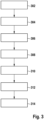
- Figure 3 depicts a flow chart with steps of the method for machine learning.
- the method in the example is a computer-implemented method.
- the model that is used in the method is trained on a distribution of the data D.
- both losses are a canonical 0-1 misclassification loss.
- the output of the function g k (x) is an example for the first classification.
- the output of the function g ⁇ ( x ) is an example for a likelihood that the expert correctly determines whether the input x is in-distribution data or out-of-distribution data with respect to a distribution of data that the model 200 is trained on.
- Learning comprises minimizing this surrogate loss to get g K ⁇ and g ⁇ .
- the function ⁇ ( x ) is selected to be close to zero for input x that is far out-of-distribution and close to one for input x that resembles training in-distribution data. Any function ⁇ ( x ) that satisfies this two conditions may be used.
- n ( z ) 1 1 + exp ⁇ mz wherein m ⁇ R is a hyperparameter.
- x n F x n
- c is a given constant parameter for a cost associated with deferring to the expert.
- a typical value for the constant parameter c is in between 0 and 1, subject to the condictions of the application.
- the output of the function ⁇ ( x ) is determined for the input x. This means, the likelihood whether the input x is in-distribution or out-of-distribution with respect to the distribution of the data that the model 200 is trained on, is determined.
- ⁇ ( x ) ranges in [0,1] with, ideally, 0 for out-of-distribution data and, ideally, 1 for in-distribution data.
- the product c ⁇ ( x ) has the effect to decrease an overall cost of rejection, resulting in increased rejection upon exposure to severe out-of-distribution data.
- the output of the function g ⁇ ( x ) is determined for the input x. This means, the likelihood that the expert will provide the correct prediton for the input x as in-distribution data or out-of-distribution data with respect to the distribution of data that the model 200 is trained on, is determined.
- the output of the function r( x ) is determined for the input x, depending on the output of the function ⁇ ( x ) and the output of the function g ⁇ ( x ).
- the second classification is determined depending on the first classification g k ( x ) and depending on the likelihoods, e.g., the outputs of the functions ⁇ ( x ), g ⁇ ( x ) for the input x.
- the output of the second classification is adjusted to allow for distributional properties, i.e., if the input is unfamiliar to the trained model, the likelihood of it being rejected and passed on to the expert is increased.
- the input 101 of the model 200 may be within the distribution of data, i.e., in-distribution, or outside of the distribution of data, i.e., out-of-distribution.
- the model 200 in the example comprises a neural network that is trained with inputs 101 from the distribution of data.
- the input 101 may be a sensor signal, in particular audio data or a digital image.
- the input 101 may be provided with a ground truth class.
- the model 200 is for example trained to determine a classification of the input 101 that indicates the ground truth class.
- the method comprises a step 302.
- the step 302 comprises providing the input 101 for the model 200.
- the method comprises a step 304.
- the step 304 comprises determining with the model 200 the first classification that indicates a class for the input 101.
- the method comprises a step 306.
- the step 306 comprises determining with the model 200 depending on the input 101 a likelihood that an expert determines a correct classification for the input 101.
- the method comprises a step 308.
- the step 308 comprises determining with the model 200 depending on the input 101 a likelihood that the input 101 is in-distribution data or out-of-distribution data with respect to the distribution of data that the model 200 is trained on.
- the method comprises a step 308.
- the step 308 comprises determining the second classification that indicates whether the input 101 is considered as in-distribution data or out-of-distribution data with respect to the distribution of data that the model 200 is trained on.
- the second classification is determined depending on the first classification and depending on the likelihoods.
- the method comprises a step 312.
- the step 312 comprises determining an output 105 of the model 200 depending on the first classification and the second classification.
- the output 105 comprises a control signal for the technical system 106.
- the control signal may be determined by the model 200 depending on the classification.
- the output 105 comprises the classification.
- Determining the output 105 comprises for example determining either that the second classification indicates that the input 101 is considered as in-distribution data or as out-of-distribution data.
- the output 105 comprises a classification of the input 101 that is determined depending on the first classification or comprises a control signal that is determined depending on the first classification if the second classification indicates that the input 101 is considered as in-distribution data. In the example, the first classification is rejected otherwise.
- the output 105 comprises the classification provided by the expert or the control signal that is determined depending on the classification that is provided by the expert if the second classification indicates that the input 101 is considered as out-of-distribution data.
- the input 101 and/or the first classification may be provided to the expert in order to receive the classification from the expert.
- the expert may be a classifier outside the model 200 that provides the classification of the expert.
- the human expert may be prompted for the classification via the human machine interface.
- the classification may be provided by the expert in a response to the input 101 and/or the first classification. According to an example, the expert is prompted for the response only if the second classification indicates that the input 101 is considered as out-of-distribution data.
- the method comprises a step 314.
- the step 314 comprises outputting the output 105.
- Outputting the output 105 may result in outputting the classification e.g., via the human-machine interface or to the actuator 108 for actuating the technical system 106 depending on the classification. Outputting the output 105 may result in outputting the control signal to the actuator 108 for actuating the technical system 106 depending on the classification.
- the first classification may comprise a first class indicating that a movement of the technical system 106 shall stop and a second class indicating that the movement of the technical system 106 may proceed.
- the input 101 may be a digital image of an environment of the technical system 106.
- the method may comprise actuating the actuator 108 to stop the technical system 108 when the first class is determined by the first classification or the expert.
- the method may comprise actuating the actuator 108 to proceed moving the technical system 108 when the second class is determined by the first classification or the expert.
- the first class for stopping the first class may be used for changing a trajectory of a movement of the technical system 106.
- the digital image may comprise an object that is present in the environment. Stopping or changing the movement may be used for avoiding a collision of the technical system 106 or a part thereof with the object in the environment.
Landscapes
- Engineering & Computer Science (AREA)
- Theoretical Computer Science (AREA)
- Physics & Mathematics (AREA)
- Data Mining & Analysis (AREA)
- General Physics & Mathematics (AREA)
- General Engineering & Computer Science (AREA)
- Evolutionary Computation (AREA)
- Artificial Intelligence (AREA)
- Software Systems (AREA)
- Life Sciences & Earth Sciences (AREA)
- Computing Systems (AREA)
- Computer Vision & Pattern Recognition (AREA)
- Mathematical Physics (AREA)
- Bioinformatics & Cheminformatics (AREA)
- Evolutionary Biology (AREA)
- Bioinformatics & Computational Biology (AREA)
- Computational Linguistics (AREA)
- General Health & Medical Sciences (AREA)
- Probability & Statistics with Applications (AREA)
- Health & Medical Sciences (AREA)
- Biomedical Technology (AREA)
- Biophysics (AREA)
- Molecular Biology (AREA)
- Automation & Control Theory (AREA)
- Medical Informatics (AREA)
- Algebra (AREA)
- Computational Mathematics (AREA)
- Mathematical Analysis (AREA)
- Mathematical Optimization (AREA)
- Pure & Applied Mathematics (AREA)
- Image Analysis (AREA)
Abstract
A device and a computer-implemented method for machine learning, wherein the method comprises providing an input (101) for a model (200), determining with the model (200) a first classification that indicates a class for the input (101), determining with the model (200) depending on the input (101) a likelihood that an expert determines a correct classification for the input (101), determining with the model (200) depending on the input (101) a likelihood that the input (101) is in-distribution data or out-of-distribution data with respect to a distribution of data that the model (200) is trained on, determining a second classification that indicates whether the input (101) is considered as in-distribution data or out-of-distribution data with respect to the distribution of data that the model (200) is trained on depending on the first classification and depending on the likelihoods, determining an output (105) of the model (200) depending on the first classification and the second classification, and outputting the output (105).
Description
- The invention relates to a device and a computer-implemented method for machine learning.
- For machine learning systems, it is desirable to provide a reliable classification of the input in particular in the event of a shift of a distribution of the input that is presented to the classifier in inference as compared to a distribution of the input that is presented to the classifier in training.
- The device and the computer-implemented method according to the independent claims provide a reliable machine learning.
- The method for machine learning comprises providing an input for a model, determining with the model a first classification that indicates a class for the input, determining with the model depending on the input a likelihood that an expert determines a correct classification for the input, determining with the model depending on the input a likelihood that the input is in-distribution data or out-of-distribution data with respect to a distribution of data that the model is trained on, determining a second classification that indicates whether the input is considered as in-distribution data or out-of-distribution data with respect to the distribution of data that the model is trained on depending on the first classification and depending on the likelihoods, determining an output of the model depending on the first classification and the second classification, and outputting the output. This provides a reliable out-of-distribution detection for a machine learning system. The resulting machine learning system mitigates using output that is based on input that is out-of-distribution.
- According to some embodiments, the output comprises a control signal for a technical system, in particular a physical system, preferably a robot, a vehicle, a household appliance, a power tool, a personal assist system, an access control system, a medical imaging device.
- According to some embodiments, the input comprises a sensor signal, in particular audio data or a digital image, preferably from a camera, a radar sensor, a lidar sensor, an infrared sensor, an ultrasound sensor, or a motion sensor.
- Determining the output may comprise determining that the second classification indicates that the input is considered as in-distribution data, wherein the output is determined depending on the first classification if the second classification indicates that the input is considered as in-distribution data. This means, the output is used when it is considered as in-distribution data.
- Determining the output may comprise determining that the second classification indicates that the input is considered as out-of-distribution data and rejecting first classification. This means, the output is not used when it is considered as out-of-distribution data.
- Determining the output may comprise providing the input and/or the first classification to an expert, in particular to a classifier outside the model or via a human machine interface to a human, and determining the output depending on a response to the input and/or the first classification from the expert if the second classification indicates that the input is considered as out-of-distribution data. This means the input is deferred to the expert, when it is considered as out-of-distribution data. The expert may be another machine learning system. This provides a hybrid machine learning system. The expert may be human. This provides a hybrid intelligent system that combines human and machine intelligence.
- The device for machine learning, comprises at least one processor and at least one memory, wherein the at least one processor is configured to execute instructions that, when executed by the at least one processor, cause the device to execute the method, wherein the at least one memory is configured to store the instructions.
- A computer program comprises instructions that, when executed by the computer, cause the computer to execute the method.
- Further advantageous embodiments are derived from the following description and the drawing. In the drawing:
- Fig. 1
- schematically depicts a part of a device for machine learning,
- Fig. 2
- schematically depicts a part of a model for machine learning,
- Fig. 3
- depicts a flow chart with steps of a computer-implemented method for machine learning.
-
Figure 1 schematically depicts adevice 100 for machine learning. Thedevice 100 is configured to receiveinput 101. Thedevice 100 comprises at least oneprocessor 102 and at least onememory 103. The at least oneprocessor 102 and the at least onememory 103 communicate via adata connection 104. - The
device 100 is configured for outputting anoutput 105 to atechnical system 106. Thedevice 100 is configured for receiving theinput 101 from thetechnical system 106. Thetechnical system 106 is a physical system. Thetechnical system 106 may be a robot, a vehicle, a household appliance, a power tool, a personal assist system, an access control system, a medical imaging device. Thetechnical system 106 may comprise thedevice 100. - The
technical system 106 comprises asensor 107 for monitoring thetechnical system 106 that is configured to determine theinput 101. Thesensor 107 may be a camera, a radar sensor, a lidar sensor, an infrared sensor, an ultrasound sensor, or a motion sensor. Thedevice 100 is configured to receive the input from thesensor 107. Thedevice 100 may comprise thesensor 107. - The
technical system 106 comprises anactuator 108 that is configured to actuate thetechnical system 106 depending on theoutput 105. Thedevice 100 is configured to control theactuator 108 depending on theoutput 105. - The
actuator 108 may be configured to move thetechnical system 106 or a part thereof. Theactuator 108 may comprise a human machine interface that is configured to output theoutput 105 to a human. Thedevice 100 may comprise theactuator 108. - The at least one
processor 102 is configured to execute instructions that, when executed by the at least oneprocessor 102, cause thedevice 100 to execute a method for determining the classification. The at least onememory 103 is configured to store the instructions. - The
device 100 may be a computer. A computer program may comprise the instructions. The computer may be configured to execute the instructions to cause the computer to execute the method. -
Figure 2 schematically depicts a part of amodel 200 for machine learning. Themodel 200 is configured to determine theoutput 105 depending on theinput 101. - According to an example, the
model 200 comprises a feature space X and an output space Y, wherein the output space Y comprises K classes. Theinput 101 may be sampled from a data set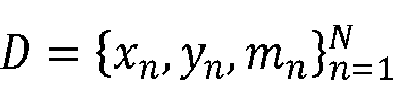
input 101 and yn denotes an output, e.g., the classification. - The
model 200 comprises aclassifier 201. Themodel 200 comprises arejector 202. Themodel 200 comprises anestimator 203. Themodel 200 comprises aninterface 204 to an expert. The expert may be an expert system or a human expert. Themodel 200 may comprise the expert system. Theinterface 204 may be a human-machine interface. According to an example, the expert provides a classification mn from a space M, wherein M=Y. - The
classifier 201 is configured to determine, depending on theinput 101, a first classification that indicates a class for theinput 101. According to an example, theclassifier 201 comprises a function h: X → Y. - The
estimator 203 is configured to determine, depending on theinput 101, a likelihood that the expert determines a correct classification for theinput 101. Theestimator 203 is configured to determine, depending on theinput 101, a likelihood that theinput 101 is in-distribution data or out-of-distribution data with respect to a distribution of data that themodel 200 is trained on. - The
rejector 202 is configured to determine, depending on theinput 101 and depending the on likelihoods, a second classification that indicates whether theinput 101 is considered as in-distribution data or out-of-distribution data with respect to the distribution of data that themodel 200 is trained on. According to an example, therejector 202 comprises a function r: X → {0,1}. - According to an example, the
model 200 is configured to defer the classification to the expert when r(x) = 0 and to output the first classification when r(x) = 1. This means, r acts as a filter on which classification is used asoutput 105. - The
interface 204 is configured to prompt the expert for a classification of theinput 101 and to receive the classification from the expert. Themodel 200 may be configured to prompt the expert for the classification only when the second classification indicates that theinput 101 is considered as out-of-distribution data with respect to the distribution that themodel 200 is trained on. - The
model 200 is configured to output theoutput 105. Themodel 200 is configured to output the classification of theclassifier 201 or the expert depending on the second classification. Themodel 200 is configured to output the classification of the classifier when the second classification indicates that theinput 101 is considered as in-distribution data with respect to the distribution that themodel 200 is trained on. Themodel 200 is configured to output the classification of the expert when the second classification indicates that theinput 101 is considered as out-of-distribution data with respect to the distribution that themodel 200 is trained on. - The
model 200 may be configured to reject the classification of the classifier without prompting the expert for the classification or without outputting the classification of the expert when the second classification indicates that theinput 101 is considered as out-of-distribution data with respect to the distribution that themodel 200 is trained on. - The
model 200 may be configured to determine a control signal for thetechnical system 106 depending on the classification. -
Figure 3 depicts a flow chart with steps of the method for machine learning. The method in the example is a computer-implemented method. The model that is used in the method is trained on a distribution of the data D. - According to an example, training comprises fitting the functions h and r. For example, when r(x) = 0 a loss l(h(x), y) is incurred and when r(x) = 1 a loss lexp (m, y) is incurred. In the example, both losses are a canonical 0-1 misclassification loss. The goal is learning to minimize the following objective function:

- However, one cannot directly minimize the above objective function. In the example, K+1 parameterized surrogate loss functions


- The output of the function gk (x) is an example for the first classification.
- The output of the function g ⊥(x) is an example for a likelihood that the expert correctly determines whether the input x is in-distribution data or out-of-distribution data with respect to a distribution of data that the
model 200 is trained on. - Learning comprises minimizing this surrogate loss to get

- According to an example, the functions r(x) and h(x) are:


- The function α(x) is selected to be close to zero for input x that is far out-of-distribution and close to one for input x that resembles training in-distribution data. Any function α(x) that satisfies this two conditions may be used.
- For example, the function α(x) = p Θ(x) is provided as

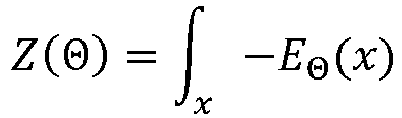
- Considering

- For example, the function α(x) is provided by an additional generative model, e.g., normalizing flows, that models a density p(x) of the training distribution:

- For example, the density p(x) is estimated by


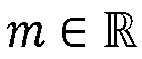
- According to an example, a validation set



- In the example, c is a given constant parameter for a cost associated with deferring to the expert. The constant parameter c may be selected in a range of [0,1] depending on whether there is no cost whatsoever (c = 0) or expert's advise is expensive (c = 1). A typical value for the constant parameter c is in between 0 and 1, subject to the condictions of the application.
- According to an example, the output of the function α(x) is determined for the input x. This means, the likelihood whether the input x is in-distribution or out-of-distribution with respect to the distribution of the data that the
model 200 is trained on, is determined. - In the example α(x) ranges in [0,1] with, ideally, 0 for out-of-distribution data and, ideally, 1 for in-distribution data. The product cα(x) has the effect to decrease an overall cost of rejection, resulting in increased rejection upon exposure to severe out-of-distribution data.
- According to an example, the output of the function g ⊥(x) is determined for the input x. This means, the likelihood that the expert will provide the correct prediton for the input x as in-distribution data or out-of-distribution data with respect to the distribution of data that the
model 200 is trained on, is determined. - According to an example, the output of the function r(x) is determined for the input x, depending on the output of the function α(x) and the output of the function g ⊥(x). This means, the second classification is determined depending on the first classification gk (x) and depending on the likelihoods, e.g., the outputs of the functions α(x), g ⊥(x) for the input x. Based on the output of the first classification gk (x), the output of the second classification is adjusted to allow for distributional properties, i.e., if the input is unfamiliar to the trained model, the likelihood of it being rejected and passed on to the expert is increased.
- The output of the function h(x) is determined depending on the input x. The output of the function h(x) is a classification of the input x.
- In inference, the
input 101 of themodel 200 may be within the distribution of data, i.e., in-distribution, or outside of the distribution of data, i.e., out-of-distribution. - The
model 200 in the example comprises a neural network that is trained withinputs 101 from the distribution of data. Theinput 101 may be a sensor signal, in particular audio data or a digital image. In training, theinput 101 may be provided with a ground truth class. Themodel 200 is for example trained to determine a classification of theinput 101 that indicates the ground truth class. - The method comprises a
step 302. - The
step 302 comprises providing theinput 101 for themodel 200. - The method comprises a
step 304. - The
step 304 comprises determining with themodel 200 the first classification that indicates a class for theinput 101. - The method comprises a
step 306. - The
step 306 comprises determining with themodel 200 depending on the input 101 a likelihood that an expert determines a correct classification for theinput 101. - The method comprises a
step 308. - The
step 308 comprises determining with themodel 200 depending on the input 101 a likelihood that theinput 101 is in-distribution data or out-of-distribution data with respect to the distribution of data that themodel 200 is trained on. - The method comprises a
step 308. - The
step 308 comprises determining the second classification that indicates whether theinput 101 is considered as in-distribution data or out-of-distribution data with respect to the distribution of data that themodel 200 is trained on. - The second classification is determined depending on the first classification and depending on the likelihoods.
- An example for determining the second classification is
- The method comprises a
step 312. - The
step 312 comprises determining anoutput 105 of themodel 200 depending on the first classification and the second classification. - According to an example, the
output 105 comprises a control signal for thetechnical system 106. The control signal may be determined by themodel 200 depending on the classification. According to an example, theoutput 105 comprises the classification. - Determining the
output 105 comprises for example determining either that the second classification indicates that theinput 101 is considered as in-distribution data or as out-of-distribution data. - In the example, the
output 105 comprises a classification of theinput 101 that is determined depending on the first classification or comprises a control signal that is determined depending on the first classification if the second classification indicates that theinput 101 is considered as in-distribution data. In the example, the first classification is rejected otherwise. - According to the example, the
output 105 comprises the classification provided by the expert or the control signal that is determined depending on the classification that is provided by the expert if the second classification indicates that theinput 101 is considered as out-of-distribution data. - The
input 101 and/or the first classification may be provided to the expert in order to receive the classification from the expert. - The expert may be a classifier outside the
model 200 that provides the classification of the expert. The human expert may be prompted for the classification via the human machine interface. - The classification may be provided by the expert in a response to the
input 101 and/or the first classification. According to an example, the expert is prompted for the response only if the second classification indicates that theinput 101 is considered as out-of-distribution data. - The method comprises a
step 314. - The
step 314 comprises outputting theoutput 105. - Outputting the
output 105 may result in outputting the classification e.g., via the human-machine interface or to theactuator 108 for actuating thetechnical system 106 depending on the classification. Outputting theoutput 105 may result in outputting the control signal to theactuator 108 for actuating thetechnical system 106 depending on the classification. - In an example of a movable
technical system 106, the first classification may comprise a first class indicating that a movement of thetechnical system 106 shall stop and a second class indicating that the movement of thetechnical system 106 may proceed. In the example of the movabletechnical system 106, theinput 101 may be a digital image of an environment of thetechnical system 106. The method may comprise actuating theactuator 108 to stop thetechnical system 108 when the first class is determined by the first classification or the expert. The method may comprise actuating theactuator 108 to proceed moving thetechnical system 108 when the second class is determined by the first classification or the expert. Instead of using the first class for stopping the first class may be used for changing a trajectory of a movement of thetechnical system 106. The digital image may comprise an object that is present in the environment. Stopping or changing the movement may be used for avoiding a collision of thetechnical system 106 or a part thereof with the object in the environment.
Claims (9)
- A computer-implemented method for machine learning, characterized by providing (302) an input (101) for a model (200), determining (304) with the model (200) a first classification that indicates a class for the input (101), determining (306) with the model (200) depending on the input (101) a likelihood that an expert determines a correct classification for the input (101), determining (308) with the model (200) depending on the input (101) a likelihood that the input (101) is in-distribution data or out-of-distribution data with respect to a distribution of data that the model (200) is trained on, determining (310) a second classification that indicates whether the input (101) is considered as in-distribution data or out-of-distribution data with respect to the distribution of data that the model (200) is trained on depending on the first classification and depending on the likelihoods, determining (312) an output (105) of the model (200) depending on the first classification and the second classification, and outputting (314) the output (105).
- The method according to claim 1, characterized in that the output (105) comprises (312) a control signal for a technical system (106), in particular a physical system, preferably a robot, a vehicle, a household appliance, a power tool, a personal assist system, an access control system, a medical imaging device.
- The method according to one of the previous claims, characterized in that the input (101) comprises (302) a sensor signal, in particular audio data or a digital image.
- The method according to one of the previous claims, characterized in that determining (312) the output (105) comprises determining that the second classification indicates that the input (101) is considered as in-distribution data, wherein the output (105) comprises the classification of the input that is determined depending on the first classification if the second classification indicates that the input (101) is considered as in-distribution data.
- The method according to one of the previous claims, characterized in that determining (312) the output (105) comprises determining that the second classification indicates that the input (101) is considered as out-of-distribution data and rejecting first classification.
- The method according to one of the previous claims, characterized in that determining (312) the output (105) comprises providing the input (101) and/or the first classification to an expert, in particular to a classifier outside the model (200) or via a human machine interface to a human, and determining the output (105) depending on a response to the input (101) and/or the first classification from the expert if the second classification indicates that the input (101) is considered as out-of-distribution data.
- A device (100) for machine learning, characterized by at least one processor (102) and at least one memory (103), wherein the at least one processor (102) is configured to execute instructions that, when executed by the at least one processor (102), cause the device (100) to execute the method according to one of the claims 1 to 6, wherein the at least one memory (103) is configured to store the instructions.
- The device (100) according to claim 7, characterized in that the device (100) is configured to receive the input (101) from a sensor (107) for monitoring a technical system (106), preferably from a camera, a radar sensor, a lidar sensor, an infrared sensor, an ultrasound sensor, or a motion sensor or that the device (100) is configured to control an actuator (108) of a technical system (106) depending on the output (105).
- Computer program, characterized in that the computer program comprises instructions that, when executed by the computer, cause the computer to execute the method according to one of the claims 1 to 6.
Priority Applications (3)
| Application Number | Priority Date | Filing Date | Title |
|---|---|---|---|
| EP23194518.9A EP4517603A1 (en) | 2023-08-31 | 2023-08-31 | Device and computer-implemented method machine learning |
| US18/795,248 US20250076832A1 (en) | 2023-08-31 | 2024-08-06 | Device and computer-implemented method machine learning |
| CN202411207378.9A CN119538020A (en) | 2023-08-31 | 2024-08-30 | Device and computer implementation method for machine learning |
Applications Claiming Priority (1)
| Application Number | Priority Date | Filing Date | Title |
|---|---|---|---|
| EP23194518.9A EP4517603A1 (en) | 2023-08-31 | 2023-08-31 | Device and computer-implemented method machine learning |
Publications (1)
| Publication Number | Publication Date |
|---|---|
| EP4517603A1 true EP4517603A1 (en) | 2025-03-05 |
Family
ID=87889930
Family Applications (1)
| Application Number | Title | Priority Date | Filing Date |
|---|---|---|---|
| EP23194518.9A Pending EP4517603A1 (en) | 2023-08-31 | 2023-08-31 | Device and computer-implemented method machine learning |
Country Status (3)
| Country | Link |
|---|---|
| US (1) | US20250076832A1 (en) |
| EP (1) | EP4517603A1 (en) |
| CN (1) | CN119538020A (en) |
Citations (3)
| Publication number | Priority date | Publication date | Assignee | Title |
|---|---|---|---|---|
| WO2022243329A1 (en) * | 2021-05-21 | 2022-11-24 | Robert Bosch Gmbh | Safe control/monitoring of a computer-controlled system |
| EP4105847A1 (en) * | 2021-06-16 | 2022-12-21 | Robert Bosch GmbH | Device and method to adapt a pretrained machine learning system to target data that has different distribution than the training data without the necessity of human annotations on target data |
| US11586214B2 (en) * | 2020-06-05 | 2023-02-21 | Gatik Ai Inc. | Method and system for deterministic trajectory selection based on uncertainty estimation for an autonomous agent |
-
2023
- 2023-08-31 EP EP23194518.9A patent/EP4517603A1/en active Pending
-
2024
- 2024-08-06 US US18/795,248 patent/US20250076832A1/en active Pending
- 2024-08-30 CN CN202411207378.9A patent/CN119538020A/en active Pending
Patent Citations (3)
| Publication number | Priority date | Publication date | Assignee | Title |
|---|---|---|---|---|
| US11586214B2 (en) * | 2020-06-05 | 2023-02-21 | Gatik Ai Inc. | Method and system for deterministic trajectory selection based on uncertainty estimation for an autonomous agent |
| WO2022243329A1 (en) * | 2021-05-21 | 2022-11-24 | Robert Bosch Gmbh | Safe control/monitoring of a computer-controlled system |
| EP4105847A1 (en) * | 2021-06-16 | 2022-12-21 | Robert Bosch GmbH | Device and method to adapt a pretrained machine learning system to target data that has different distribution than the training data without the necessity of human annotations on target data |
Non-Patent Citations (2)
| Title |
|---|
| LIN HEGUANG ET AL: "Adaptive Out-of-Distribution Detection with Human-in-the-Loop", ICML 2022 WORKSHOP ON HUMAN-MACHINE COLLABORATION AND TEAMING, 17 July 2022 (2022-07-17), XP093130865, Retrieved from the Internet <URL:https://ramyakv.github.io/Adaptive-OOD-Detection-Human-in-the-loop.pdf> * |
| MOZANNAR HUSSEIN ET AL: "Consistent Estimators for Learning to Defer to an Expert", ARXIV (CORNELL UNIVERSITY), 25 January 2021 (2021-01-25), Ithaca, XP093131246, Retrieved from the Internet <URL:https://arxiv.org/pdf/2006.01862v3.pdf> [retrieved on 20240214], DOI: 10.48550/arxiv.2006.01862 * |
Also Published As
| Publication number | Publication date |
|---|---|
| US20250076832A1 (en) | 2025-03-06 |
| CN119538020A (en) | 2025-02-28 |
Similar Documents
| Publication | Publication Date | Title |
|---|---|---|
| EP3929824B1 (en) | Robust multimodal sensor fusion for autonomous driving vehicles | |
| Hu et al. | Probabilistic prediction of vehicle semantic intention and motion | |
| Tran et al. | A human-vehicle collaborative driving framework for driver assistance | |
| Li et al. | Continual driver behaviour learning for connected vehicles and intelligent transportation systems: Framework, survey and challenges | |
| US11699075B2 (en) | Method for training an artificial neural network, artificial neural network, use of an artificial neural network, and corresponding computer program, machine-readable memory medium, and corresponding apparatus | |
| US11961275B2 (en) | Device and method for training a normalizing flow | |
| Amsalu et al. | Driver behavior modeling near intersections using support vector machines based on statistical feature extraction | |
| Yi | Personalised driving status recognition and monitoring | |
| Yao et al. | Target vehicle selection algorithm for adaptive cruise control based on lane-changing intention of preceding vehicle | |
| Griesbach et al. | Lane change prediction with an echo state network and recurrent neural network in the urban area | |
| US12159447B2 (en) | Device and method for training a classifier | |
| Sharma et al. | Highway lane-changing prediction using a hierarchical software architecture based on support vector machine and continuous hidden markov model | |
| Kim et al. | Anomaly monitoring framework in lane detection with a generative adversarial network | |
| Barajas-Montiel et al. | Identifying pain and hunger in infant cry with classifiers ensembles | |
| CN117698762B (en) | Intelligent driving assistance system and method based on environment perception and behavior prediction | |
| Sackmann et al. | Classification of Driver Intentions at Roundabouts. | |
| EP4517603A1 (en) | Device and computer-implemented method machine learning | |
| Savelonas et al. | Hybrid time-series representation for the classification of driving behaviour | |
| US8909572B2 (en) | Systems, methods, and media for performing classification using a boosted classifier | |
| CN120766502A (en) | Traffic risk prediction and vehicle fault diagnosis system for autonomous vehicles based on ANFIS | |
| US20250036967A1 (en) | Method for training a machine learning model to classify sensor data | |
| Balal et al. | Comparative evaluation of fuzzy inference system, support vector machine and multilayer feed-forward neural network in making discretionary lane changing decisions | |
| Jin et al. | A learning-based evaluation for lane departure warning system considering driving characteristics | |
| EP3654246A1 (en) | Method, vehicle, system, and storage medium for indicating anomalous vehicle scenario using encoder network and replay buffer | |
| Dahl et al. | Performance and efficiency analysis of a linear learning-based prediction model used for unintended lane-departure detection |
Legal Events
| Date | Code | Title | Description |
|---|---|---|---|
| PUAI | Public reference made under article 153(3) epc to a published international application that has entered the european phase |
Free format text: ORIGINAL CODE: 0009012 |
|
| STAA | Information on the status of an ep patent application or granted ep patent |
Free format text: STATUS: THE APPLICATION HAS BEEN PUBLISHED |
|
| AK | Designated contracting states |
Kind code of ref document: A1 Designated state(s): AL AT BE BG CH CY CZ DE DK EE ES FI FR GB GR HR HU IE IS IT LI LT LU LV MC ME MK MT NL NO PL PT RO RS SE SI SK SM TR |
|
| STAA | Information on the status of an ep patent application or granted ep patent |
Free format text: STATUS: REQUEST FOR EXAMINATION WAS MADE |
|
| 17P | Request for examination filed |
Effective date: 20250905 |