EP4517582A1 - Privacy-preserving federated learning method, associated computer program and framework - Google Patents
Privacy-preserving federated learning method, associated computer program and framework Download PDFInfo
- Publication number
- EP4517582A1 EP4517582A1 EP23306437.7A EP23306437A EP4517582A1 EP 4517582 A1 EP4517582 A1 EP 4517582A1 EP 23306437 A EP23306437 A EP 23306437A EP 4517582 A1 EP4517582 A1 EP 4517582A1
- Authority
- EP
- European Patent Office
- Prior art keywords
- model
- local
- image
- dataset
- map
- Prior art date
- Legal status (The legal status is an assumption and is not a legal conclusion. Google has not performed a legal analysis and makes no representation as to the accuracy of the status listed.)
- Pending
Links
Images
Classifications
-
- G—PHYSICS
- G06—COMPUTING OR CALCULATING; COUNTING
- G06N—COMPUTING ARRANGEMENTS BASED ON SPECIFIC COMPUTATIONAL MODELS
- G06N3/00—Computing arrangements based on biological models
- G06N3/02—Neural networks
- G06N3/04—Architecture, e.g. interconnection topology
- G06N3/045—Combinations of networks
-
- G—PHYSICS
- G06—COMPUTING OR CALCULATING; COUNTING
- G06N—COMPUTING ARRANGEMENTS BASED ON SPECIFIC COMPUTATIONAL MODELS
- G06N3/00—Computing arrangements based on biological models
- G06N3/02—Neural networks
- G06N3/08—Learning methods
- G06N3/098—Distributed learning, e.g. federated learning
-
- G—PHYSICS
- G06—COMPUTING OR CALCULATING; COUNTING
- G06N—COMPUTING ARRANGEMENTS BASED ON SPECIFIC COMPUTATIONAL MODELS
- G06N3/00—Computing arrangements based on biological models
- G06N3/02—Neural networks
- G06N3/04—Architecture, e.g. interconnection topology
- G06N3/0464—Convolutional networks [CNN, ConvNet]
-
- G—PHYSICS
- G06—COMPUTING OR CALCULATING; COUNTING
- G06N—COMPUTING ARRANGEMENTS BASED ON SPECIFIC COMPUTATIONAL MODELS
- G06N3/00—Computing arrangements based on biological models
- G06N3/02—Neural networks
- G06N3/08—Learning methods
- G06N3/084—Backpropagation, e.g. using gradient descent
-
- G—PHYSICS
- G06—COMPUTING OR CALCULATING; COUNTING
- G06N—COMPUTING ARRANGEMENTS BASED ON SPECIFIC COMPUTATIONAL MODELS
- G06N3/00—Computing arrangements based on biological models
- G06N3/02—Neural networks
- G06N3/08—Learning methods
- G06N3/096—Transfer learning
Definitions
- the present invention relates to a method for performing privacy-preserving federated learning in the framework of object detection.
- the invention further relates to a computer program and a framework.
- the invention applies to the field of computer science, and more specifically to artificial intelligence for image processing.
- a purpose of the present invention is to overcome at least one of these drawbacks.
- Another purpose of the invention is to provide a method suitable for privacy-preserving federated learning in the framework of object detection.
- the present invention concerns a computer-implemented method of the aforementioned type, comprising the following steps:
- each private training dataset is stored in a respective local node, and since only the outputs of the local models are shared to the central node, privacy of the data contained in each private training dataset is preserved.
- using such outputs enables an efficient knowledge transfer to the central node, and, consequently, allows to obtain a central model that is reliable.
- prediction vectors and attention maps enables reliable and efficient knowledge distillation between local nodes with large domain gaps.
- the claimed method therefore allows to leverage not only the direct outputs of teachers' models (prediction vectors) but also the way these models reason when performing object detection (thanks to the attention maps).
- the method includes one or several of the following features, taken alone or in any technically possible combination:
- aggregating the generated prediction vectors to obtain the aggregated prediction vector includes computing a mean of said generated prediction vectors
- aggregating the corresponding attention maps to obtain the at least one corresponding aggregated attention map includes:
- computing each attention map includes implementing an Eigen-CAM algorithm or a Grad-CAM algorithm
- each prediction vector includes:
- implementing the Eigen-CAM algorithm includes, for each image of the public dataset, and for each local model:
- each local model is a convolutional neural network.
- the computer program may be in any programming language such as C, C++, JAVA, Python, etc.
- the computer program may be in machine language.
- the computer program may be stored, in a non-transient memory, such as a USB stick, a flash memory, a hard-disc, a processor, a programmable electronic chop, etc.
- a non-transient memory such as a USB stick, a flash memory, a hard-disc, a processor, a programmable electronic chop, etc.
- the computer program may be stored in a computerized device such as a smartphone, a tablet, a computer, a server, etc.
- a framework for performing privacy-preserving federated learning for object detection comprising a public server, a central node, and N local nodes, N being an integer greater than or equal to 1,
- Each of the central node and the local nodes may be a personal device such as a smartphone, a tablet, a smartwatch, a computer, any wearable electronic device, etc.
- Each of the central node and the local nodes according to the invention may execute one or several applications to carry out the method according to the invention.
- Each of the central node and the local nodes may be loaded with, and configured to execute, the computer program according to the invention.
- a framework 2 according to the invention is shown on figure 1 .
- the framework 2 is designed to perform privacy-preserving federated learning for object detection.
- the framework 2 includes a public server 4, a central node 6, and N local nodes 8, N being an integer greater than or equal to 1.
- the public server 4 is configured to store a public dataset 10. Moreover, the public server 4 is configured so that the central node 6 and each local node 8 can access and read the public dataset 10.
- the public dataset 10 includes at least one predetermined image.
- the central node 6 may be configured to store a central training dataset 12.
- the central training dataset 12 is suitable for the training of an object detection model.
- the central training dataset 12 includes a set of predetermined images, each image being annotated to define, for each object shown in said image, respective bounding box and class.
- the central training dataset 12 is stored in a data storing unit (not shown) of the framework 2, distinct from the central node 6 and the local nodes 8.
- the data storing unit is preferably configured so that the central training dataset 12 can be accessed and read at least by the central node 6.
- each local node 8 is configured to store a respective private training dataset 14.
- Each private training dataset 14 is suitable for the training of an object detection model.
- each private training dataset 14 includes a set of predetermined images, each image being annotated to define, for each object shown in said image, respective bounding box and class.
- each private training dataset 14 is representative of data collected from one or more source(s) associated with the respective local node 8.
- each private training dataset 14 can only be read by the respective local node 8. This feature is advantageous, as it prevents data leakage, thereby enhancing privacy.
- the private training datasets 14 differ from one another other.
- the framework 2 is configured to perform a method 20, shown on figure 2 .
- the method 20 includes an initial training step 22, a local training step 24, an output generation step 26, an output aggregation step 28 and an optimization step 30.
- an object detection model is trained to obtain an intermediate model 40 as a result of the training.
- the object detection model is a convolutional neural network.
- the object detection model may also be a vision transformer, or any other object detection model known to the person skilled in the art.
- the object detection model is trained based on the central training dataset 12.
- the intermediate model 40 stored in each local node 8 is trained based on the respective private training dataset 14, resulting in a respective local model 42.
- a set of outputs is determined based on the public dataset 10 stored in the public server 4. Specifically, for each local node 8, the corresponding set of outputs is obtained using the respective local model 42, i.e., is a result of processing the public dataset 10 by the local model 42.
- each prediction vector is an output of the local model 42, an output of a predetermined layer of the local model 42, or even a result of applying a predetermined function to an output of one or more predetermined layer(s) of the local model 42.
- each prediction vector includes coordinates of the respective bounding box, an objectness probability P obj , and class probabilities P CL1 , P CL2 , ..., P CLn .
- Objectness probability is representative of a probability that an object is actually present in the corresponding bounding box.
- the central node 6 For each image of the public dataset 10, the central node 6 generates a corresponding aggregated set of outputs.
- the central node 6 computes a mean of said prediction vectors.
- the central node 6 computes:
- the central node 6 modifies parameters of the intermediate model 40 stored in said central node 6 to obtain a central model.
- the local node 6 modifies parameters of the intermediate model 40 to minimize a difference between:
- the local node 6 is configured to use the lower and upper bound aggregated attention maps to train the intermediate 40 model in such a way that encourages pixels in the output of the intermediate model 40 to get activated inside the lower bound (intersection) and penalizes their activation outside the upper bound (union).
- the central node 6 is configured to perform a gradient descent method.
Landscapes
- Engineering & Computer Science (AREA)
- Theoretical Computer Science (AREA)
- Physics & Mathematics (AREA)
- Data Mining & Analysis (AREA)
- General Health & Medical Sciences (AREA)
- Biomedical Technology (AREA)
- Biophysics (AREA)
- Computational Linguistics (AREA)
- Life Sciences & Earth Sciences (AREA)
- Evolutionary Computation (AREA)
- Artificial Intelligence (AREA)
- Molecular Biology (AREA)
- Computing Systems (AREA)
- General Engineering & Computer Science (AREA)
- General Physics & Mathematics (AREA)
- Mathematical Physics (AREA)
- Software Systems (AREA)
- Health & Medical Sciences (AREA)
- Image Analysis (AREA)
Abstract
- storing, in a central node (6) and in N local nodes (8), an intermediate model (40) obtained by training an object detection model based on a central training dataset;
- for each local node, obtaining a local model (42) by training the intermediate model based on a private training dataset;
- for each image of a public dataset (10), and for each local model, determining a prediction vector and an attention map;
- for each image of the public dataset, generating an aggregated set of outputs from the prediction vectors, and an aggregated attention map from the attention maps;
- obtaining a central model by modifying parameters of the intermediate model stored in the central node to minimize a difference between the aggregated set of outputs and an output of said intermediate model based on the public dataset as input.
Description
- The present invention relates to a method for performing privacy-preserving federated learning in the framework of object detection.
- The invention further relates to a computer program and a framework.
- The invention applies to the field of computer science, and more specifically to artificial intelligence for image processing.
- It is known to perform federated learning, that is to say to collect knowledge from various heterogeneous sources of data (hereinafter called "local data"), generally scattered across different geographical locations, and to incorporate this knowledge into a central artificial intelligence model.
- However, known methods for federated learning are not entirely satisfactory.
- Indeed, such methods are generally unable to avoid data leakage when extracting knowledge from local data to teach the central artificial intelligence model. In this case, data leakage may result from either direct transfer of local data or indirect leakages, such as through sharing model parameters or gradients. In other words, such methods do not guarantee that the local data remain private, which may be a major concern in the case of, for instance, data that should always physically stay at customers' premises, such as patients' medical data.
- Moreover, known methods for federated learning are not suitable for federated learning in the framework of object detection.
- A purpose of the present invention is to overcome at least one of these drawbacks.
- Another purpose of the invention is to provide a method suitable for privacy-preserving federated learning in the framework of object detection.
- To this end, the present invention concerns a computer-implemented method of the aforementioned type, comprising the following steps:
- training an object detection model based on a central training dataset to obtain an intermediate model;
- storing a copy of the intermediate model in a central node and in each of N local nodes, N being an integer greater than or equal to 1;
- for each local node, training the respective intermediate model based on a respective private training dataset, thereby obtaining a local model;
- for each image of a predetermined public dataset, and for each local model:
- determining at least one corresponding prediction vector, each prediction vector defining a respective bounding box;
- computing at least one corresponding attention map representative of a contribution of each section of the image in a detection, by the local model, of one ore more object(s) in the image;
- generating an aggregated set of outputs including, for each image of the public dataset:
- an aggregated prediction vector obtained by aggregating the corresponding prediction vectors; and
- at least one corresponding aggregated attention map obtained by aggregating the corresponding attention maps;
- modifying parameters of the intermediate model stored in the central node to minimize a difference between:
- an output of said intermediate model stored in the central node based on the public dataset as input; and
- the aggregated set of outputs,
- Indeed, since each private training dataset is stored in a respective local node, and since only the outputs of the local models are shared to the central node, privacy of the data contained in each private training dataset is preserved. On the other hand, using such outputs enables an efficient knowledge transfer to the central node, and, consequently, allows to obtain a central model that is reliable.
- Furthermore, the combination of prediction vectors and attention maps enables reliable and efficient knowledge distillation between local nodes with large domain gaps. The claimed method therefore allows to leverage not only the direct outputs of teachers' models (prediction vectors) but also the way these models reason when performing object detection (thanks to the attention maps).
- According to other advantageous aspects of the invention, the method includes one or several of the following features, taken alone or in any technically possible combination:
- for each image of the public dataset, aggregating the generated prediction vectors to obtain the aggregated prediction vector includes computing a mean of said generated prediction vectors;
- for each image of the public dataset, aggregating the corresponding attention maps to obtain the at least one corresponding aggregated attention map includes:
- computing a lower bound aggregated attention map as an intersection of the corresponding attention maps;
- computing an upper bound aggregated attention map as a union of the corresponding attention maps;
- for each image of the public dataset, and for each local model, computing each attention map includes implementing an Eigen-CAM algorithm or a Grad-CAM algorithm;
- each prediction vector includes:
- an objectness probability representative of a probability that an object is actually present in the corresponding bounding box;
- a class probability representative of a probability that an object present in the corresponding bounding box belongs to a given class among a predetermined set of classes;
- selecting the corresponding prediction vectors that have an objectness probability that is greater than a predetermined objectness threshold;
- computing a gradient, with respect to parameters of a last convolutional layer of the local model, of a target function defined as:

- where T is the target function,
- m is the number of selected prediction vectors having an objectness probability greater than the predetermined objectness threshold,
- and Ii is a scalar associated with the ith selected prediction vector and equal to a result of multiplying the corresponding objectness probability with the highest corresponding class probability;
- for each activation map of the local model, computing a corresponding weight as:

- where αk is the weight associated with the kth activation map,
- Z is the number of pixels of the kth activation map, and
- summation over i, j corresponds to global average pooling over the width and height of the kth activation map, and
- and

- computing the attention map as:
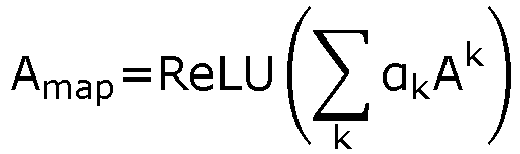
- where Amap is the attention map for said image of the public dataset and said local model, and
- ReLU is a rectified linear unit function;
- implementing the Eigen-CAM algorithm includes, for each image of the public dataset, and for each local model:
- forward-propagating said image through said local model up to a predetermined layer of the local model;
- factorizing an output of the predetermined layer using singular value decomposition to obtain at least one eigen vector;
- computing the corresponding attention map as a projection of the output the predetermined layer on the first obtained eigenvector;
- each local model is a convolutional neural network.
- According to another aspect of the same invention, it is proposed a computer program comprising instructions, which when executed by a computer, cause the computer to carry out the steps of the method as defined above.
- The computer program may be in any programming language such as C, C++, JAVA, Python, etc.
- The computer program may be in machine language.
- The computer program may be stored, in a non-transient memory, such as a USB stick, a flash memory, a hard-disc, a processor, a programmable electronic chop, etc.
- The computer program may be stored in a computerized device such as a smartphone, a tablet, a computer, a server, etc.
- According to another aspect of the same invention, it is proposed a framework for performing privacy-preserving federated learning for object detection, the framework comprising a public server, a central node, and N local nodes, N being an integer greater than or equal to 1,
- the public server being configured to store a predetermined public dataset, each local node being configured to:
- store a copy of an intermediate model obtained by training an object detection model based on a central training dataset;
- store a respective private training dataset;
- train the respective intermediate model based on the respective private training dataset, thereby obtaining a local model;
- for each image of the public dataset, and for each local model:
- determine at least one corresponding prediction vector, each prediction vector defining a respective bounding box;
- compute at least one corresponding attention map representative of a contribution of each section of the image in a detection, by the local model, of one ore more object(s) in the image;
- the central node being configured to:
- store a copy of the intermediate model;
- generate an aggregated set of outputs including, for each image of the public dataset:
- an aggregated prediction vector obtained by aggregating the corresponding prediction vectors; and
- at least one corresponding aggregated attention map obtained by aggregating the corresponding attention maps;
- modify parameters of the intermediate model stored therein to minimize a difference between:
- an output of said intermediate model stored therein based on the public dataset as input; and
- the aggregated set of outputs,
- Each of the central node and the local nodes may be a personal device such as a smartphone, a tablet, a smartwatch, a computer, any wearable electronic device, etc.
- Each of the central node and the local nodes according to the invention may execute one or several applications to carry out the method according to the invention.
- Each of the central node and the local nodes may be loaded with, and configured to execute, the computer program according to the invention.
- Other advantages and characteristics will become apparent on examination of the detailed description of an embodiment which is in no way limitative, and the attached figures, where:
-
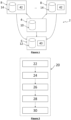
Figure 1 is a schematic representation of a framework according to the invention; and -
Figure 2 is a flowchart of a method implemented by the framework offigure 1 . - It is well understood that the embodiments that will be described below are in no way limitative. In particular, it is possible to imagine variants of the invention comprising only a selection of the characteristics described hereinafter, in isolation from the other characteristics described, if this selection of characteristics is sufficient to confer a technical advantage or to differentiate the invention with respect to the state of the prior art. Such a selection comprises at least one, preferably functional, characteristic without structural details, or with only a part of the structural details if this part alone is sufficient to confer a technical advantage or to differentiate the invention with respect to the prior art.
- In the FIGURES, elements common to several figures retain the same reference.
- A
framework 2 according to the invention is shown onfigure 1 . - The
framework 2 is designed to perform privacy-preserving federated learning for object detection. - The
framework 2 includes apublic server 4, acentral node 6, and Nlocal nodes 8, N being an integer greater than or equal to 1. - The
public server 4 is configured to store apublic dataset 10. Moreover, thepublic server 4 is configured so that thecentral node 6 and eachlocal node 8 can access and read thepublic dataset 10. - The
public dataset 10 includes at least one predetermined image. - Moreover, the
central node 6 may be configured to store acentral training dataset 12. - The
central training dataset 12 is suitable for the training of an object detection model. For instance, thecentral training dataset 12 includes a set of predetermined images, each image being annotated to define, for each object shown in said image, respective bounding box and class. - Alternatively, the
central training dataset 12 is stored in a data storing unit (not shown) of theframework 2, distinct from thecentral node 6 and thelocal nodes 8. In this case, the data storing unit is preferably configured so that thecentral training dataset 12 can be accessed and read at least by thecentral node 6. - Furthermore, each
local node 8 is configured to store a respectiveprivate training dataset 14. - Each
private training dataset 14 is suitable for the training of an object detection model. For instance, eachprivate training dataset 14 includes a set of predetermined images, each image being annotated to define, for each object shown in said image, respective bounding box and class. - For instance, each
private training dataset 14 is representative of data collected from one or more source(s) associated with the respectivelocal node 8. - Advantageously, each
private training dataset 14 can only be read by the respectivelocal node 8. This feature is advantageous, as it prevents data leakage, thereby enhancing privacy. - Preferably, the
private training datasets 14 differ from one another other. - The remaining features of the
framework 2 will be better understood through the description of the operation of theframework 2, provided below with reference to the figures. - The
framework 2 is configured to perform amethod 20, shown onfigure 2 . - The
method 20 includes aninitial training step 22, alocal training step 24, anoutput generation step 26, anoutput aggregation step 28 and anoptimization step 30. - During the
initial training step 22, an object detection model is trained to obtain anintermediate model 40 as a result of the training. - For instance, the object detection model is a convolutional neural network. The object detection model may also be a vision transformer, or any other object detection model known to the person skilled in the art.
- More specifically, the object detection model is trained based on the
central training dataset 12. - Moreover, once the
intermediate model 40 is obtained, a copy of theintermediate model 40 is stored in thecentral node 6 and in eachlocal node 8. - Then, during the
local training step 24, theintermediate model 40 stored in eachlocal node 8 is trained based on the respectiveprivate training dataset 14, resulting in a respectivelocal model 42. - Then, during the
output generation step 26, for eachlocal node 8, a set of outputs is determined based on thepublic dataset 10 stored in thepublic server 4. Specifically, for eachlocal node 8, the corresponding set of outputs is obtained using the respectivelocal model 42, i.e., is a result of processing thepublic dataset 10 by thelocal model 42. - More precisely, for any given
local node 8, and for each image of the public dataset 10: - the
local node 8 determines at least one corresponding prediction vector, each prediction vector defining a respective bounding box; and - the
local node 8 computes at least one attention map corresponding to said image, each attention map being representative of a contribution of each section of the image in the detection of one or more object(s) in the image by thelocal model 42. - For instance, each prediction vector is an output of the
local model 42, an output of a predetermined layer of thelocal model 42, or even a result of applying a predetermined function to an output of one or more predetermined layer(s) of thelocal model 42. - Preferably, each prediction vector includes coordinates of the respective bounding box, an objectness probability Pobj, and class probabilities PCL1, PCL2, ..., PCLn.
- Objectness probability is representative of a probability that an object is actually present in the corresponding bounding box.
- Furthermore, class probability is representative of a probability that an object present in the bounding box belongs to a given class among a predetermined set of classes.
- Preferably, for each
local model 42, the respectivelocal node 8 computes, for each image of thepublic dataset 10, each corresponding attention map by implementing an Eigen-CAM algorithm or a Grad-CAM algorithm. - More precisely, in the case where the
local node 8 is configured to implement the Grad-CAM algorithm, then, for any given image of thepublic dataset 10, in order to compute the attention map, thelocal node 8 selects the corresponding prediction vectors that have an objectness probability Pobj that is greater than a predetermined objectness threshold Pmin. - Then, the
local node 8 computes a gradient of a target function T, with respect to parameters of a last convolutional layer of thelocal model 42. - The target function T is defined as:

- where m is the number of selected prediction vectors, i.e., the number of prediction vectors that fulfill the aforementioned objectness probability requirement (i.e., Pobj ≥ Pmin); and
- and Ii is a scalar associated with the ith selected prediction vector, and equal to a result of multiplying the objectness probability Pobj of said selected prediction vector with the highest corresponding class probability PCL1, PCL2, ..., PCLn.
- Then, the
local node 8 computes a weight for each activation map of thelocal model 42, as:
- where αk is the weight associated with the kth activation map of the
local model 42, - Z is the number of pixels of the kth activation map, and
- summation over i, j corresponds to global average pooling over the width and height of the kth activation map, and
- and

- By "kth activation map of a computer vision model", it is meant, in the context of the present invention, a 2-dimensional map obtained by forward propagation of an input image throughout the computer vision model up to the kth layer.
- Then, the
local node 8 computes the attention map as
- where Amap is the attention map for said image of the
public dataset 10 and saidlocal model 42, and - ReLU is a rectified linear unit function.
- Alternatively, in the case where the
local node 8 is configured to implement the Eigen-CAM algorithm, then, for any given image of thepublic dataset 10, in order to compute the attention map, thelocal node 8 forward propagates said image through the correspondinglocal model 42 up to a layer of interest N. Then, thelocal node 8 further factorizes an output of layer N using singular value decomposition to obtain eigen vectors and eigen values. - In this case, the
local model 42 is preferably a convolutional neural network. More precisely, afterlocal training 24 based on the respectiveprivate training dataset 14, the obtainedlocal model 42 is used in inference mode to generate a feature map corresponding to the layer of interest N, which is then further factorized with singular value decomposition. - Then, the
local node 8 computes the corresponding attention map as a projection of the output layer N on the first eigenvector. - Then, during the
output aggregation step 28, the sets of outputs generated by eachlocal node 8 for each image of thepublic dataset 10 are transferred to thecentral node 6 for processing. - Then, for each image of the
public dataset 10, thecentral node 6 generates a corresponding aggregated set of outputs. - More precisely, for each image of the
public dataset 10, the aggregated set of outputs includes: - an aggregated prediction vector obtained by aggregating the corresponding prediction vectors determined by the
local nodes 8; and - at least one corresponding aggregated attention map obtained by aggregating the attention map computed for said image by the
local nodes 8. - Preferably, for each image of the
public dataset 10, in order to aggregate the corresponding prediction vectors so as to obtain the aggregated prediction vector, thecentral node 6 computes a mean of said prediction vectors. - Alternatively, or in addition, for each image of the
public dataset 10, in order to aggregate the corresponding attention maps so as to obtain the aggregated attention map, thecentral node 6 computes: - a lower bound aggregated attention map as an intersection of the corresponding attention maps;
- an upper bound aggregated attention map as a union of the corresponding attention maps.
- Then, during the
optimization step 30, thecentral node 6 modifies parameters of theintermediate model 40 stored in saidcentral node 6 to obtain a central model. - More precisely, to obtain the central model, the
local node 6 modifies parameters of theintermediate model 40 to minimize a difference between: - an output of the
intermediate model 40 stored in thecentral node 6, based on thepublic dataset 10 as input; and - the aggregated set of outputs generated during the
output aggregation step 28. - More precisely, the
local node 6 is configured to use the lower and upper bound aggregated attention maps to train the intermediate 40 model in such a way that encourages pixels in the output of theintermediate model 40 to get activated inside the lower bound (intersection) and penalizes their activation outside the upper bound (union). - Preferably, to obtain the central model, the
central node 6 is configured to perform a gradient descent method. - Of course, the invention is not limited to the examples detailed above.
Claims (9)
- A computer-implemented method (20) for performing privacy-preserving federated learning in the framework of object detection, the method comprising the following steps:- training (22) an object detection model based on a central training dataset (12) to obtain an intermediate model (40);- storing a copy of the intermediate model (40) in a central node (6) and in each of N local nodes (8), N being an integer greater than or equal to 1;- for each local node (8), training (24) the respective intermediate model (40) based on a respective private training dataset (14), thereby obtaining a local model (42);- for each image of a predetermined public dataset (10), and for each local model (42):• determining at least one corresponding prediction vector, each prediction vector defining a respective bounding box;• computing at least one corresponding attention map representative of a contribution of each section of the image in a detection, by the local model (42), of one ore more object(s) in the image;- generating (28) an aggregated set of outputs including, for each image of the public dataset (10):• an aggregated prediction vector obtained by aggregating the corresponding prediction vectors; and• at least one corresponding aggregated attention map obtained by aggregating the corresponding attention maps;- modifying (30) parameters of the intermediate model (40) stored in the central node (6) to minimize a difference between:thereby obtaining a central model.• an output of said intermediate model (40) stored in the central node (6) based on the public dataset (10) as input; and• the aggregated set of outputs,
- The method (20) according to claim 1, wherein, for each image of the public dataset, aggregating the generated prediction vectors to obtain the aggregated prediction vector includes computing a mean of said generated prediction vectors.
- The method (20) according to claim 1 or 2, wherein for each image of the public dataset, aggregating the corresponding attention maps to obtain the at least one corresponding aggregated attention map includes:- computing a lower bound aggregated attention map as an intersection of the corresponding attention maps;- computing an upper bound aggregated attention map as a union of the corresponding attention maps.
- The method (20) according to any one of the claims 1 to 3, wherein, for each image of the public dataset, and for each local model, computing each attention map includes implementing an Eigen-CAM algorithm or a Grad-CAM algorithm.
- The method (20) according to claim 4, wherein each prediction vector includes:- an objectness probability representative of a probability that an object is actually present in the corresponding bounding box;- a class probability representative of a probability that an object present in the corresponding bounding box belongs to a given class among a predetermined set of classes;and wherein implementing the Grad-CAM algorithm includes, for each image of the public dataset, and for each local model:- selecting the corresponding prediction vectors that have an objectness probability that is greater than a predetermined objectness threshold;- computing a gradient, with respect to parameters of a last convolutional layer of the local model, of a target function defined as:
 where T is the target function,m is the number of selected prediction vectors having an objectness probability greater than the predetermined objectness threshold,and Ii is a scalar associated with the ith selected prediction vector and equal to a result of multiplying the corresponding objectness probability with the highest corresponding class probability;- for each activation map of the local model, computing a corresponding weight as:
 where αk is the weight associated with the kth activation map,Z is the number of pixels of the kth activation map, and summation over i, j corresponds to global average pooling over the width and height of the kth activation map, andand
 - computing the attention map as:
 where Amap is the attention map for said image of the public dataset and said local model, andReLU is a rectified linear unit function.
 - The method (20) according to claim 4, wherein implementing the Eigen-CAM algorithm includes, for each image of the public dataset, and for each local model:- forward-propagating said image through said local model up to a predetermined layer of said local model;- factorizing an output of the predetermined layer using singular value decomposition to obtain at least one eigen vector;- computing the corresponding attention map as a projection of the output the predetermined layer on the first obtained eigenvector.
- The method (20) according to claim 6, wherein each local model is a convolutional neural network.
- Computer program comprising instructions, which when executed by a computer, cause the computer to carry out the steps of the method according to any one of claims 1 to 7.
- A framework (2) for performing privacy-preserving federated learning for object detection, the framework comprising a public server (4), a central node (6), and N local nodes (8), N being an integer greater than or equal to 1, the public server (4) being configured to store a predetermined public dataset (10),each local node (6) being configured to:- store a copy of an intermediate model (40) obtained by training an object detection model based on a central training dataset (12);- store a respective private training dataset (14);- train the respective intermediate model based on the respective private training dataset (14), thereby obtaining a local model (42);- for each image of the public dataset (10), and for each local model (42):• determine at least one corresponding prediction vector, each prediction vector defining a respective bounding box;• compute at least one corresponding attention map representative of a contribution of each section of the image in a detection, by the local model, of one ore more object(s) in the image;the central node (6) being configured to:thereby obtaining a central model.- store a copy of the intermediate model (40);- generate an aggregated set of outputs including, for each image of the public dataset (10):• an aggregated prediction vector obtained by aggregating the corresponding prediction vectors; and• at least one corresponding aggregated attention map obtained by aggregating the corresponding attention maps;- modify parameters of the intermediate model (40) stored therein to minimize a difference between:• an output of said intermediate model (40) stored therein based on the public dataset (10) as input; and• the aggregated set of outputs,
Priority Applications (2)
| Application Number | Priority Date | Filing Date | Title |
|---|---|---|---|
| EP23306437.7A EP4517582A1 (en) | 2023-08-30 | 2023-08-30 | Privacy-preserving federated learning method, associated computer program and framework |
| US18/787,085 US20250077890A1 (en) | 2023-08-30 | 2024-07-29 | Privacy-preserving federated learning method, associated computer program and framework |
Applications Claiming Priority (1)
| Application Number | Priority Date | Filing Date | Title |
|---|---|---|---|
| EP23306437.7A EP4517582A1 (en) | 2023-08-30 | 2023-08-30 | Privacy-preserving federated learning method, associated computer program and framework |
Publications (1)
| Publication Number | Publication Date |
|---|---|
| EP4517582A1 true EP4517582A1 (en) | 2025-03-05 |
Family
ID=88697513
Family Applications (1)
| Application Number | Title | Priority Date | Filing Date |
|---|---|---|---|
| EP23306437.7A Pending EP4517582A1 (en) | 2023-08-30 | 2023-08-30 | Privacy-preserving federated learning method, associated computer program and framework |
Country Status (2)
| Country | Link |
|---|---|
| US (1) | US20250077890A1 (en) |
| EP (1) | EP4517582A1 (en) |
Citations (3)
| Publication number | Priority date | Publication date | Assignee | Title |
|---|---|---|---|---|
| US20180330238A1 (en) * | 2017-05-09 | 2018-11-15 | Neurala, Inc. | Systems and methods to enable continual, memory-bounded learning in artificial intelligence and deep learning continuously operating applications across networked compute edges |
| US20220157054A1 (en) * | 2018-11-13 | 2022-05-19 | Adobe Inc. | Object Detection In Images |
| WO2023287392A1 (en) * | 2021-07-12 | 2023-01-19 | Google Llc | Systems and methods for federated learning of machine-learned models with sampled softmax |
-
2023
- 2023-08-30 EP EP23306437.7A patent/EP4517582A1/en active Pending
-
2024
- 2024-07-29 US US18/787,085 patent/US20250077890A1/en active Pending
Patent Citations (3)
| Publication number | Priority date | Publication date | Assignee | Title |
|---|---|---|---|---|
| US20180330238A1 (en) * | 2017-05-09 | 2018-11-15 | Neurala, Inc. | Systems and methods to enable continual, memory-bounded learning in artificial intelligence and deep learning continuously operating applications across networked compute edges |
| US20220157054A1 (en) * | 2018-11-13 | 2022-05-19 | Adobe Inc. | Object Detection In Images |
| WO2023287392A1 (en) * | 2021-07-12 | 2023-01-19 | Google Llc | Systems and methods for federated learning of machine-learned models with sampled softmax |
Non-Patent Citations (1)
| Title |
|---|
| HU LI ET AL: "MHAT: An efficient model-heterogenous aggregation training scheme for federated learning", INFORMATION SCIENCES, ELSEVIER, AMSTERDAM, NL, vol. 560, 2 February 2021 (2021-02-02), pages 493 - 503, XP086541854, ISSN: 0020-0255, [retrieved on 20210202], DOI: 10.1016/J.INS.2021.01.046 * |
Also Published As
| Publication number | Publication date |
|---|---|
| US20250077890A1 (en) | 2025-03-06 |
Similar Documents
| Publication | Publication Date | Title |
|---|---|---|
| EP4375948A1 (en) | Cross-domain segmentation with uncertainty-guided curriculum learning | |
| US11048978B2 (en) | Meta-learning for multi-task learning for neural networks | |
| US20240177458A1 (en) | Cross domain segmentation with uncertainty-guided curriculum learning | |
| US20250316074A1 (en) | Multi-layer perceptron-based computer vision neural networks | |
| US20180247156A1 (en) | Machine learning systems and methods for document matching | |
| US20210406687A1 (en) | Method for predicting attribute of target object based on machine learning and related device | |
| US12061987B2 (en) | Interpretable neural network | |
| EP4287144A1 (en) | Video behavior recognition method and apparatus, and computer device and storage medium | |
| US12106549B2 (en) | Self-supervised learning for artificial intelligence-based systems for medical imaging analysis | |
| US12354259B2 (en) | Semi-supervised learning leveraging cross-domain data for medical imaging analysis | |
| US20190380657A1 (en) | Generating natural language representations of mental content from functional brain images | |
| JP6378150B2 (en) | Optimization device, optimization method, and optimization program | |
| JP7842253B2 (en) | Detection of open vocabulary objects in images | |
| EP3975071A1 (en) | Identifying and quantifying confounding bias based on expert knowledge | |
| Dias et al. | Applying the JBOS reduction method for relevant knowledge extraction | |
| CN116997939A (en) | Use expert blending to process images | |
| US12524676B2 (en) | End-to-end training of neural networks for image processing | |
| CN111985616B (en) | Image feature extraction method, image retrieval method, device and equipment | |
| CN118135222A (en) | A unimodal image segmentation method based on cross-modal consistency | |
| US20250077890A1 (en) | Privacy-preserving federated learning method, associated computer program and framework | |
| Ankireddy | Assistive Diagnostic Tool for Brain Tumor Detection using Computer Vision | |
| EP4586149A1 (en) | Privacy-preserving federated learning method, associated computer program and framework | |
| US12597504B2 (en) | Automatic selection and display layout of medical images from clinical descriptions | |
| US12555230B2 (en) | Regression-based approach for measurement of rotator cuff tears in shoulder MRI images | |
| US20240256835A1 (en) | Training ultra-large-scale vision transformer neural networks |
Legal Events
| Date | Code | Title | Description |
|---|---|---|---|
| PUAI | Public reference made under article 153(3) epc to a published international application that has entered the european phase |
Free format text: ORIGINAL CODE: 0009012 |
|
| STAA | Information on the status of an ep patent application or granted ep patent |
Free format text: STATUS: THE APPLICATION HAS BEEN PUBLISHED |
|
| AK | Designated contracting states |
Kind code of ref document: A1 Designated state(s): AL AT BE BG CH CY CZ DE DK EE ES FI FR GB GR HR HU IE IS IT LI LT LU LV MC ME MK MT NL NO PL PT RO RS SE SI SK SM TR |
|
| P01 | Opt-out of the competence of the unified patent court (upc) registered |
Free format text: CASE NUMBER: APP_22857/2025 Effective date: 20250514 |
|
| STAA | Information on the status of an ep patent application or granted ep patent |
Free format text: STATUS: REQUEST FOR EXAMINATION WAS MADE |
|
| 17P | Request for examination filed |
Effective date: 20250904 |